FM 3-24.2 TACTICS IN COUNTERINSURGENCY (APRIL 2009) - page 4
Chapter 4
DECIDE
4-142. This function focuses and sets priorities for intelligence collection and both lethal and nonlethal
plans. Intelligence and operations personnel, with the commander and other staff members, decide when a
target is developed well enough to engage. Continuous staff integration and regular meetings of the
intelligence cell and targeting board enable this function. Specifically, intelligence analysts need to identify
individuals and groups to engage as potential counterinsurgency supporters, targets to isolate from the
population, and targets to eliminate. During the decide activity, the targeting board produces a prioritized
list of targets and a recommended course of action associated with each. Executing targeting decisions may
require the operations section to issue fragmentary orders. Each of these orders is a task that should be
nested within the higher headquarters’ plan and the commander’s intent. Targeting decisions may require
changing the intelligence synchronization plan. The targeting working group participates in COA analysis
and collaboratively develops the following decide function products:
High-Payoff Target List
4-143. An HPT list is a prioritized list of targets, by phase of the joint operation, whose loss to an enemy
will contribute to the success of the mission (JP 3-60)
Intelligence Synchronization Plan
4-144. This is what the intelligence officer uses, with staff input, to synchronize the entire collection
effort, to include all assets the commander controls, assets of lateral units, and higher echelon units,
organizations, and intelligence reach to answer the commander’s critical information requirements
(FM 2-0).
Target Selection Standards
4-145. Target selection standards establish criteria, including accuracy, that must be met before an attack.
For targets to be attacked using lethal means. requirements might include a picture, address, 8-digit grid,
and enough evidence to prosecute. For targets to be attacked by nonlethal means, requirements may include
background information on an individual, meetings he may attend, and known associates.
Attack Guidance Matrix
4-146. The attack guidance matrix lists which targets or target sets approved by the commander to act on,
how and when to act on them, and the desired effects.
Target Synchronization Matrix
4-147. The target synchronization matrix combines data from the high-payoff target list, intelligence
synchronization plan, and the attack guidance matrix. It lists high-payoff targets by category and the
agencies responsible for detecting them, attacking them, and assessing the effects of the attacks.
Targeting FRAGO
4-148. The targeting FRAGO tasks units to execute the lethal and nonlethal plans.
DETECT
4-149. The detect function involves locating HPTs accurately enough to engage them. Targets are
detected through the maximum use of all available assets. The S-2 must focus the intelligence acquisition
efforts on the designated HPTs and PIR. Situation development information, through detection
and tracking, will be accumulated as collection systems satisfy PIR and information requirements.
Tracking is an essential element of the “detect” function of the targeting process. Tracking priorities are
based on the commander’s concept of the operation and targeting priorities. Tracking is executed through
the collection plan, since many critical targets move frequently.
4-150. Detection at the tactical level is achieved through a variety of means such as a HUMINT source,
an anonymous tip, UAS, a combat patrol, SIGINT, DOMEX, rotary wing aircraft, USAF aircraft
or military working dog teams. The best means of detecting a target during an insurgency is HUMINT,
4-28
FM 3-24.2
21 April 2009
Comprehensive Tactical Planning in Counterinsurgency
though. As such, the detect activity requires a detailed understanding of social networks, insurgent
networks, insurgent actions, and the community’s attitude toward the counterinsurgent forces.
4-151. For a target that must be engaged by nonlethal means, the detect function may require patrols
to conduct reconnaissance of a leader’s home to determine if they are there, an assessment of a potential
project, or attendance at a greeting to meet with a leader.
RSTA AND ISR OPERATIONS
4-152. Reconnaissance, surveillance and target acquisition
(RSTA) and intelligence, surveillance,
and reconnaissance are activities that synchronize and integrate the planning and operation of sensors,
assets, and processing; exploitation; and dissemination systems in direct support of current and future
operations. This is an integrated intelligence and operations function
(JP 2-01). RSTA/ISR provides
relevant information about all aspects of the operational environment. RSTA/ISR helps commanders assess
the degree to which information superiority is achieved. RSTA/ISR also directly supports information
engagements by defining targets in detail and by helping assess the effectiveness of friendly and adversary
information engagements.
4-153. Reconnaissance and surveillance operations help to confirm or deny insurgent COAs
and estimates of guerrilla capabilities and combat effectiveness. Reconnaissance and surveillance also
confirm or deny assumptions about the operational environment and threat made during planning.
4-154. Doctrine requires the staff to carefully focus RSTA/ISR on the CCIR (PIR and FFIR) and be able
to quickly retask units and assets as the situation changes. This ensures that the enemy situation drives
RSTA/ISR operations. The S-2 and S-3 play a critical role in this challenging task that is sometimes
referred to as “fighting ISR.” Through RSTA/ISR, commanders and staffs continuously plan, task,
and employ collection assets and forces. They collect, process, and disseminate timely and accurate
information, combat information, and intelligence to satisfy the commander’s critical information
requirements and other intelligence requirements.
4-155. RSTA/ISR synchronization analyzes information requirements and intelligence gaps; evaluates
available assets both internal and external to the organization; determines gaps in the use of those assets;
recommends RSTA/ISR assets controlled by the organization to collect on the CCIR; and submits requests
for information for adjacent or higher collection support (FM 3-0). Collection tasks linked to decision
points play a critical part in the operation. The reconnaissance and surveillance plan must ensure that
information tied to decision points reaches the commander and staff in time to support the decision. The
reconnaissance and surveillance plan also ties directly into the targeting process. Collection assets are
identified, prioritized, and planned to detect certain targets during the “decide” and “detect” phases of the
D3A process. The collector’s information, if it meets the established, criteria may trigger the deliver
function. After delivery, the collectors, also identified in the “decide” phase, provide information to assess
the attack. These may be the same collector or a different asset. If not, a different asset is tasked to do this.
One tool to achieve this is a daily RSTA/ISR and operations synchronization meeting, which is discussed
in the targeting section of this chapter. The RSTA/ISR synchronization plan is an output of this meeting,
and coordinates and synchronizes the RSTA/ISR. (For more, see FM 2-0.)
DELIVER
4-156. The deliver function of targeting begins in earnest with execution. The targeting process provides
speed and efficiency in the delivery of lethal or nonlethal fires on targets in accordance with the Attack
Guidance Matrix or the targeting FRAGO. Within the deliver function, the system or combination
of systems selected during the “decide” phase is employed.
4-157. For a target that requires lethal means, units may eliminate the target using a joint direct attack
munition (JDAM) from a USAF aircraft, an Excalibur round, a Joint Tactical Attack Cruise Missile System
(JTACMS), or a sniper. However, many times it is more important to capture the target, so commanders
will choose to execute a raid or a cordon and search. For a target that requires nonlethal means, a
commander may choose to use an information engagement to convince a local leader, or to conduct a
project to garner the population’s support through money or employment.
21 April 2009
FM 3-24.2
4-29
Chapter 4
4-158. Target exploitation in the counterinsurgency environment is similar to that in law enforcement.
An exploitation plan not only facilitates gathering evidence for future court cases, but also may lead
to follow-on targets after successful exploitation. (See Chapter 6 for details on tactical site exploitation.)
ASSESS
4-159. At the tactical level, commanders use assessment to get a series of timely and accurate snapshots
of their effect on the insurgent and the population. It provides commanders with an estimate of the
insurgent’s combat effectiveness, capabilities, and intentions, as well as an accurate understanding of the
people. This helps commanders determine when, or if, their targeting efforts have been accomplished. The
“assess” phase relies heavily upon MOEs and MOPs.
4-160. Producing the assessment is primarily an intelligence responsibility, but requires coordination
with operations, civil affairs, public affairs, information operations, and PSYOP to be effective. As part
of the targeting process, assessment helps to determine if another engagement of the target is necessary.
TARGETING BATTLE RHYTHM
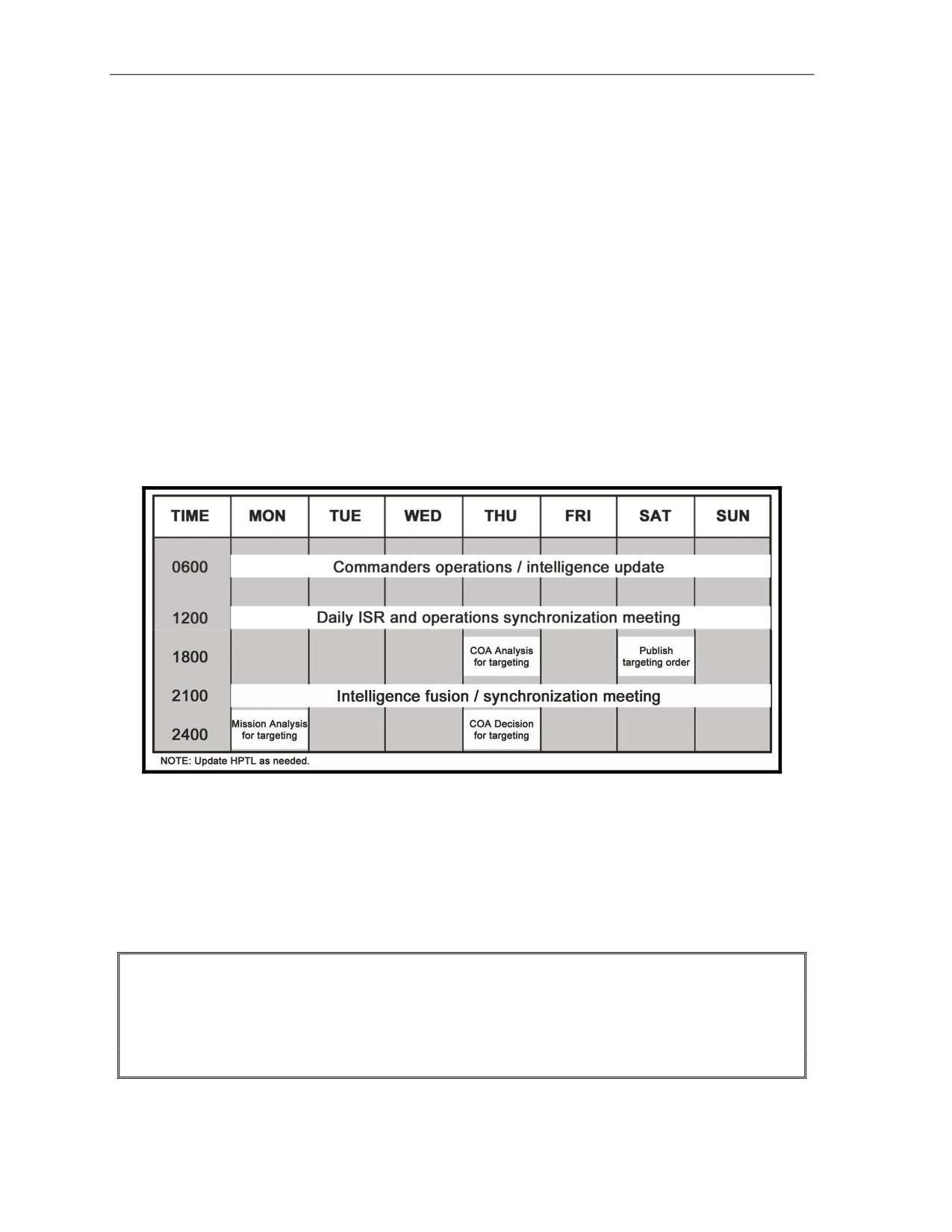
4-161. During COIN operations, brigades and battalions typically use a one or two week targeting battle
rhythm. The target cycle drives the tactical unit’s daily and weekly operations. Figure 4-8 shows an
example of a targeting cycle and battle rhythm.
Figure 4-8. Targeting battle rhythm.
4-162. Another important facet of the battle rhythm is the daily RSTA/ISR and operations
synchronization meeting. Due to the air tasking order cycle, this traditionally synchronizes operations from
96 hours to 24 hours in the preparation to hand over to current operations. In counterinsurgencies, this
meeting must synchronize all actions along the seven COIN LOEs. Especially critical is planning
and requesting higher-level assets such as air force aircraft, jamming, UASs, ISR, and aviation ahead of the
higher headquarters decision cycle. There are three outputs from this meeting—a 96-hour synchronization
matrix, a 96-hour RSTA/ISR plan, and a daily FRAGO.
SUMMARY
Planning in COIN uses tactical design, either MDMP or TLP, and targeting to ensure units achieve their
end state over time. Throughout the COIN planning process, tactical units employ the seven COIN lines
of effort to ensure that they achieve unity of effort, prioritization in accomplishing tasks, control of the
population, and an increase in the Host Nation government’s legitimacy.
4-30
FM 3-24.2
21 April 2009
Chapter 5
Offensive Considerations in Counterinsurgency
“For it is in the nature of warfare…that the initiative must be maintained, that the
regular army must lead while its adversaries follow, and that the enemy must be
made to feel a moral inferiority throughout. There must be no doubt as to which side
is in the ascendant, no question as to who controls the general course of the war…”
C. E. Callwell, Small Wars, 1896
Tactical units conduct offensive operations during COIN operations to destroy,
disrupt, interdict, deny, or neutralize the elements of an insurgency in support of the
lines of effort (LOEs). Tactical units may be tasked to conduct offensive operations
as part of clear-hold-build operations, strike operations or populace and resource
control operations. Units may be tasked to isolate, disrupt, or fix an insurgency’s
base, auxiliary, underground, leaders, or guerrillas. This chapter explores how
offensive operations support the following seven LOEs in counterinsurgencies:
• Establish civil security.
• Establish civil control.
• Support Host Nation security forces.
• Support to governance.
• Restore essential services.
• Support to economic and infrastructure development.
• Conduct information engagements.
Section I—OVERVIEW
In COIN, the characteristics of the offense apply to all offensive operations. Tactical units conduct all four
types of offensive operations in the COIN environment—Movement to Contact, Attack, Exploitation,
and Pursuit. Within the four types of offensive operations, units conducting COIN focus on specific tactics
and techniques which include search and attacks, raids, cordon and searches, ambushes, sniper employment,
site exploitation
(SE), and COIN patrols. Additionally, US forces should conduct combined offensive
operations with HN security forces at every opportunity in order to reinforce HN legitimacy, support HN
security forces, and support the HN rule of law.
PURPOSE IN COIN
5-1.
Units conduct offensive operations to—
• Secure the populace continuously.
• Isolate the insurgency from populace.
• Prevent crime.
• Destroy, disrupt, interdict, deny or neutralize elements of the insurgency.
• Secure national and regional borders.
• Integrate with and support HN security forces.
CHARACTERISTICS OF THE OFFENSE
5-2.
The characteristics of the offense are surprise, audacity, tempo, and concentration. For COIN, an
additional characteristic, flexibility, is added.
21 April 2009
FM 3-24.2
5-1
Chapter 5
SURPRISE
5-3.
Units achieve surprise by striking the enemy at a time, place, or manner in which he
is unprepared. Total surprise is rarely attainable or essential in conventional operations but is often
essential during COIN operations.
CONCENTRATION
5-4.
This is the massing of combat power, particularly its effects, at the decisive point to achieve the
unit’s purpose. During COIN, insurgents avoid situations in which US/HN security forces could potentially
mass combat power unless the potential collateral effects of use of that combat power will distance the
population from the US/HN government. This outweighs combat losses. US/HN security forces always
seek to mass nonlethal and lethal combat power, though not always visibly.
TEMPO
5-5.
This is the rate of military action relative to the insurgency. Tempo is not the same as speed.
Successful COIN units control or alter tempo to maintain the initiative. Such action promotes surprise,
enters the enemy’s decision cycle, increases the protection of the attacking force, and decreases the
insurgent’s ability to defend or plan effectively.
AUDACITY
5-6.
This is a simple plan of action, boldly executed. Audacity is critical to successful COIN offensive
operations and is completely reliant on a thorough understanding of the operational environment.
Creativity and mental agility are characteristics of an audacious counterinsurgent.
FLEXIBILITY
5-7.
This is the ability of a military unit to adapt to unplanned or unexpected conditions of the
operational environment to achieve its tactical purpose and support the LOE.
TYPES OF OFFENSIVE OPERATIONS
5-8.
The types of offensive operations are movement to contact, attack, exploitation, and pursuit:
MOVEMENT TO CONTACT
5-9.
This develops the situation and establishes or regains contact with the enemy (insurgent) forces
(FM 3-0). It also creates favorable conditions for subsequent tactical actions and stability operation. At a
tactical level, every movement can be treated as a movement to contact, because of the lack of information
concerning insurgent location, strength, capabilities, and intentions. Specific types of movements to contact
include search and attack and cordon and search operations.
ATTACK
5-10.
This destroys or defeats enemy (insurgent) forces, seizes and secures terrain, or both (FM 3-0).
Attacks require mobility, countermobility, and survivability supported by direct and indirect fires. Attacks
may be hasty or deliberate, depending on the time available for planning and preparation. Commanders
execute hasty attacks when the situation calls for immediate action with available forces and minimal
preparation. They conduct deliberate attacks when they have more time to plan and prepare.
5-11.
Tactical units normally conduct synchronized and special purpose attacks during COIN
operations. Special purpose attacks are ambushes, spoiling attacks, counterattacks, raids, feints,
and demonstrations. This chapter focuses on the tactics of raids, ambushes, and sniper employment.
5-2
FM 3-24.2
21 April 2009
Offensive Considerations in Counterinsurgency
EXPLOITATION
5-12.
This rapidly follows a successful attack and disorganizes the enemy in depth (FM 3-0). Tactical
commanders exploit successful offensive operations. In COIN, failure to exploit may allow the insurgent
to egress, reposition, or disappear into the population. An example of a tactical unit conducting an
exploitation in COIN would be sending a unit on a raid based on information and intelligence gathered on
a cordon and search that occurred earlier in the day. Effective search procedures, tactical site exploitation,
tactical questioning, and use of ISR assets are key to units being able to effectively conduct an exploitation.
PURSUIT
5-13.
This is conducted to catch or cut off a hostile force attempting to escape with the aim
of destroying it (FM 3-0). Pursuit operations begin when an insurgent forces attempts to conduct retrograde
operations. Unlike conventional operations, where the enemy’s transition to retrograde operations leaves
him vulnerable to loss of internal cohesion and complete destruction, the insurgent’s transition
to retrograde operations may make it more difficult for tactical units to engage, capture, or kill him.
Successful pursuit of the insurgent relies on maintaining contact through surveillance assets, patrols,
and HN security forces.
5-14.
Tactical leaders must recognize the potential of the insurgent to conduct a baited ambush during
retrograde operations. Critical to mitigating risk to friendly forces during a pursuit is maintaining one
of the eight forms of contact (direct, indirect, nonhostile/civilian, obstacle, CBRN, aerial, visual, and
electronic) and positioning of adjacent units such as aviation, HN security forces, surveillance assets, other
ground forces, and quick reaction forces (QRF).
OFFENSIVE OPERATIONS IN CLEAR, HOLD, BUILD OPERATIONS
5-15.
Offensive operations are the initial focus in clear, hold build, operations. These operations
establish civil security and establish civil control. Both are pivotal in setting the conditions for balanced
development across the seven COIN LOEs. Offensive operations will continue to be conducted in the hold
and build phases. This keeps insurgents from reestablishing influence over an area and is based on a
change in the insurgency’s organizational and operational patterns.
MISSION VARIABLES IN COIN
5-16.
In counterinsurgency operations, tactical units face a unique set of considerations based on the
mission variables. Specific considerations for types of offensive operations will be discussed later.
However, some considerations for all offensive operations include—
MISSION
• Offensive operations should be based on the best intelligence available, while inflicting the
minimal damage to the population, infrastructure, and local economy.
• To further gather intelligence, units must be prepared to conduct SE.
• Leaders should consider having a consequence management and a Perception Management
plan, in case the offensive actions go poorly.
ENEMY
• Leaders must pay careful attention to insurgent escape routes, as most insurgents will seek
to flee from most. Other enemy considerations include—
The insurgent resistance in the direction of attack into the target area.
Insurgent resistance in the objective area.
Insurgent resistance at the target.
Insurgent resistance departing the objective.
21 April 2009
FM 3-24.2
5-3
Chapter 5
TERRAIN AND WEATHER
• Leaders often seek to conduct operations during limited visibility or early morning hours in
order to surprise the targets.
TROOPS AND SUPPORT AVAILABLE
• Tactical units are often task-organized with additional teams or units (Chapter 3). Host Nation
security forces are essential for every offensive operation.
TIME AVAILABLE
• Leaders allocate sufficient time to conduct the operation; in COIN, this should include time
to conduct SE and tactical questioning.
CIVIL CONSIDERATIONS
• The level of inconvenience to the local populace should discourage insurgents and insurgent
sympathizers from remaining in the locale and encourage the local population to provide
information on the insurgents. The level of inconvenience should not be so great as to turn the
local population towards active or passive support of the insurgency.
• Actions on the objective must include how to deal with nonhostile persons, bystanders, family
members, and detainees.
Section II—CIVIL SECURITY AND CONTROL
Establishing civil security promotes a safe environment. Establishing civil control involves regulates selected
behavior and activities of individuals and groups. It reduces risk to individuals and groups and provides
security from both external and internal threats (FM 3-07). Together, actions along these LOEs in COIN often
take the form of unilateral and combined offensive operations against insurgent leadership, guerrillas,
underground, and auxiliary. These offensive actions help establish public order and safety. In COIN, offensive
operations are more successful when supported by effective targeting.
SEARCH AND ATTACK
5-17.
This technique is used for conducting a movement to contact that shares many of the
characteristics of an area security mission
(FM 3-90). A search and attack is a specialized technique
of conducting a movement to contact in an environment of noncontiguous AOs. In COIN, a search
and attack uses multiple coordinated small-units (team, squad, or platoon) that conduct decentralized
movement to find and attack the enemy. A commander normally employs this form of a movement
to contact when the enemy is operating in small, dispersed elements. Often searches and attacks are used
to support the establish civil security subtask of enforce cessation of hostilities, peace agreement, and other
arrangements.
5-18.
Search and attack operations are used in both urban and rural terrain. They are followed by
operations supporting the other LOE such as restoring damaged infrastructure or conducting information
engagements in a neighborhood. This tactic disrupts insurgent activities, while trying to solve some of the
root causes of the insurgency. The search and attack is typically used during the clear phase of a
clear-hold-build operation. It may also be used in a strike operation.
5-19.
To develop a specific search and attack concept, the commander must understand the OE by using
the operational variables, the mission variables, and mission analysis. The troop-leading procedures (TLP)
and military decision-making process (MDMP) applied to the COIN OE serve as the planning foundation
for commanders and leaders.
CONSIDERATIONS DURING COUNTERINSURGENCIES
5-20.
Specific considerations using elements of the mission variables to a search and attack
in COIN are—
5-4
FM 3-24.2
21 April 2009
Offensive Considerations in Counterinsurgency
Mission
5-21.
Leaders determine whether the search and attack is enemy or terrain-oriented. If enemy-oriented,
the search and attack should attack the enemy while inflicting minimal damage to the population,
infrastructure, and local economy. If terrain-oriented, the search and attack must be prepared to locate base
camps, caches, safe houses, or subterranean structures.
Time Available
5-22.
The size of the area, especially the interior layout of urban buildings, impacts force size
and search time.
PHASES
5-23.
A search and attack has three basic phases: organize, plan, and execute.
Organize
5-24.
The commander task-organizes his unit into reconnaissance, fixing, and finishing forces, each
with a specific purpose and task. The size of the reconnaissance force is based on the available intelligence
about the size of insurgent forces in the AO. The less known about the situation, the larger the
reconnaissance force. The reconnaissance force typically consists of scout, infantry, aviation,
and electronic warfare assets. The fixing force must have enough combat power to isolate insurgents once
the reconnaissance force finds them. The finishing force must have enough combat power to defeat
insurgents. The commander can direct each subordinate unit to retain a finishing force, or he can retain the
finishing force at his echelon. The commander may rotate his subordinate elements through the
reconnaissance, fixing, and finishing roles. However, rotating roles may require a change in task
organization and additional time for training and rehearsal.
Reconnaissance Force
5-25.
The reconnaissance force finds the enemy force using all means available. It can serve as an
element of the fixing force or follow and assume the role of the attack force if sufficiently resourced. If the
reconnaissance element makes contact without being detected by the insurgent, the commander has the
initiative. In COIN, HN security forces are often the best suited to conduct the reconnaissance, if they have
the training, equipment, and capability.
Fixing Force
5-26.
Although sometimes included in the reconnaissance force in COIN, the fixing force develops the
situation, and then executes one of two options based on the commander's guidance and the mission
variables. The first option is to block identified routes that the insurgent can use to escape or use
for reinforcements. The second option is to conduct an attack to fix the insurgent in his current positions
until the finishing force arrives. The fixing force attacks if that action meets the commander's intent and it
can generate sufficient combat power against the insurgents. Depending on the insurgent's mobility and the
likelihood of the reconnaissance force being compromised, the commander may need to position his fixing
force before his reconnaissance force enters the AO.
Finishing Force
5-27.
The finishing force must possess and maintain sufficient combat power to defeat the insurgent
templated. The finishing force may move behind the reconnaissance and fixing force or it may locate
where it is best prepared to rapidly maneuver on the insurgent’s location, by foot, vehicle, or air. The
finishing force must be responsive enough to engage the insurgent before he can break contact with the
reconnaissance force. The finishing force destroys or captures the insurgent by conducting hasty
or deliberate attacks, or employing indirect fire, attack reconnaissance aviation, or close air support
to destroy the insurgent. The commander may direct the finishing force to establish an area ambush and use
his reconnaissance and fixing forces to drive the insurgent into the ambushes.
21 April 2009
FM 3-24.2
5-5
Chapter 5
Plan
5-28.
The commander establishes control measures that allow for maximum decentralized actions
and small-unit initiative. Control measures facilitate the rapid consolidation and concentration of combat
power before an attack. The minimum control measures for a search and attack are an AO, objectives,
checkpoints, phase lines, limits of advance, and contact points. The use of target reference points (TRPs)
facilitates responsive fire support once a reconnaissance force makes contact with the enemy. The
commander uses objectives and checkpoints to guide the movement of subordinate elements. The
commander uses other control measures as needed such as phase lines, restrictive fire lines,
and marking systems.
Zones
5-29.
The commander next determines how the area of operations will be broken down. Two
options are—
Multiple
5-30.
Assigning multiple small zones that keep subordinate elements concentrated and allow controlled,
phased movement throughout the overall area. This facilitates overall control and allows subordinates
to rapidly mass their combat power.
Single
5-31.
Concentrate the main effort in one zone and use fire teams or squad patrols to reconnoiter the next
zone. Once the main effort has completed a thorough reconnaissance of the initial zone, it then moves into
the zone that the small units have reconnoitered, as they then move to their next zone. Small patrols
provide the initial reconnaissance information, which commanders evaluate and then focus additional
reconnaissance efforts.
Orientation
5-32.
The commander determines how the search and attack will be conducted within the designated
zones. The zones may be searched selectively or systematically. The commander must visualize, describe,
and direct how subordinates will conduct the reconnaissance and how the attacking force will maneuver
against the enemy. Two methods include—
Decentralized Attack
5-33.
Each subordinate element is tasked to find, fix, finish, and exploit all enemy forces in their area
within their capabilities. If more combat power is required, then the BCT will employ additional assets, the
reserve, or adjacent units.
Centralized Attack
5-34.
The commander retains control of the attack force while each subordinate element is tasked
to find and fix the enemy in their AO. This method works well when insurgents use base camps.
Execute
5-35.
The four typical steps in search and attack operations are enter the AO, search the AO, locate the
enemy, and conduct the attack.
Enter the AO
5-36.
Commanders determine how combined forces enter, conduct movement, and establish objective
rally points (ORPs) and bases (patrol bases, combat outposts), or (joint security stations) within the AO by
considering the eight forms of contact possible with the insurgent or the population. This technique allows
commanders and subordinate leaders to identify their units’ potential contact with the enemy
and population throughout all phases of the search and attack. Leaders synchronize the actions of adjacent
units and provide specific tasks to ensure subordinates understand actions on contact with both enemy
5-6
FM 3-24.2
21 April 2009
Offensive Considerations in Counterinsurgency
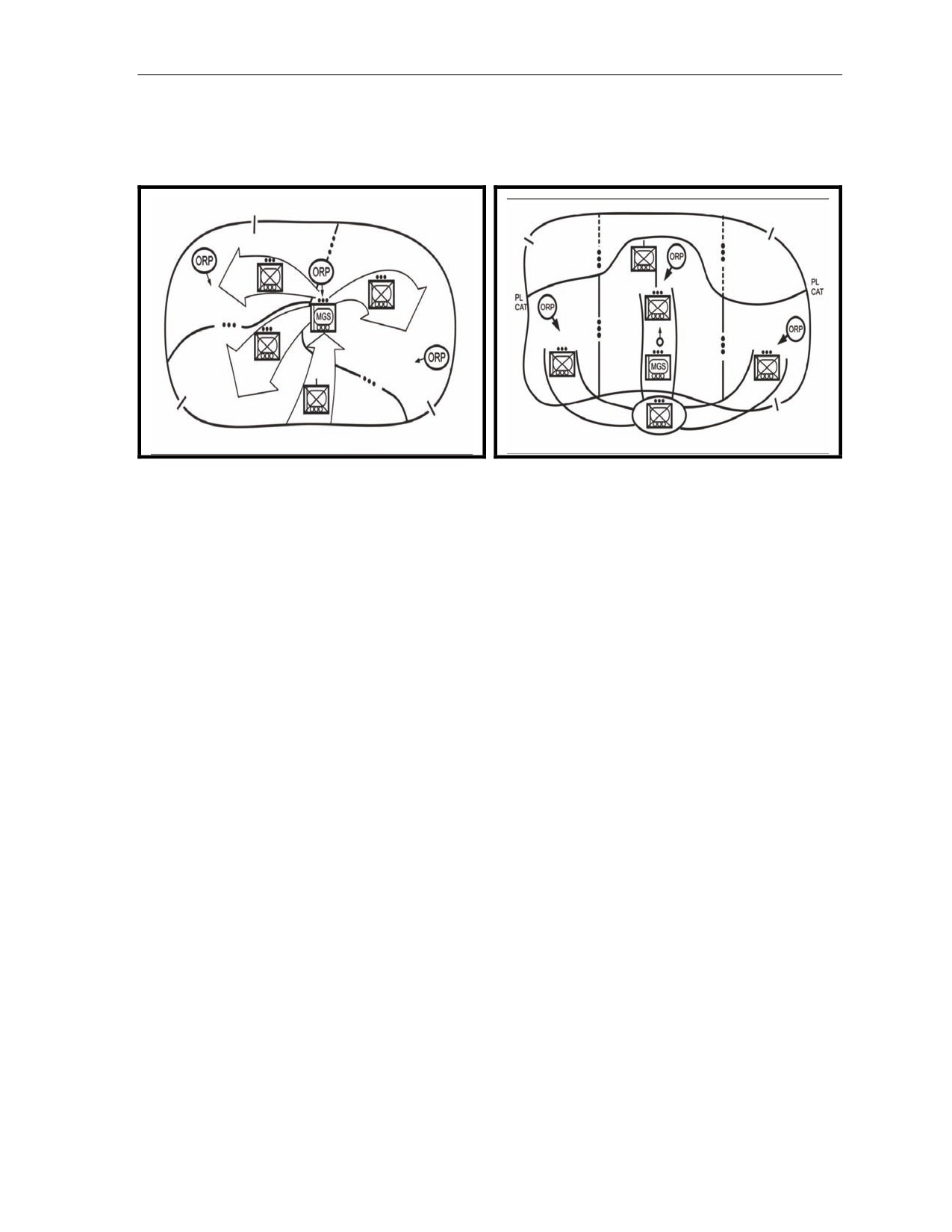
and civilians within the ROE. Units may enter the area or zone by infiltrating as an entire unit and splitting
or by infiltrating as smaller subordinate units via ground, air, or water (Figures 5-1 and 5-2).
Figure 5-1. Infiltration by company.
Figure 5-2. Infiltration by squad/platoon.
Search the AO
5-37.
Reconnaissance elements search areas to locate the enemy without detection. This allows more
time for leaders to plan and coordinate an attack. Generally, small units are used, since they move quickly
and with more stealth among the population regardless of the AO. Once an element of the insurgency
is discovered, the commander’s concept, intent, and the situation on the ground dictates whether the
reconnaissance element follows the insurgent or fixes the insurgent until the attack force is in position.
Specific tasks may include route, area, and zone reconnaissance or other surveillance tasks.
Locate Enemy
5-38.
Reconnaissance units must locate insurgent forces, tracks, or other indicators of direction
or location. In rural and some border operations, well-trained trackers can identify and follow insurgent
tracks that are hours or even days old. Units tracking the insurgent must be prepared to react to insurgent
contact and avoid likely ambush situations. Leaders must ensure support for the reconnaissance force if it
is compromised. In urban areas, tracking the insurgent is more difficult due to the nature of the terrain
and the insurgent’s use of the population. Leaders rely on HUMINT, a thorough knowledge of their AO,
UAS, attack reconnaissance aviation, and sound communication and coordination with adjacent units
to find the elusive insurgent.
Conduct the Attack
5-39.
The attack in a search and attack has four elements:
Concentrate Combat Power
5-40.
Once the insurgent is discovered, the plan must support the rapid concentration of combat power
to fix and destroy the insurgent. Leaders at each echelon must plan to destroy the insurgent within their
capabilities, or at least fix the insurgent.
Fix the Enemy
5-41.
If the insurgent cannot be destroyed by the forces on hand, then the forces must fix the insurgent
until finishing forces arrive. Fixing forces block egress routes with indirect fires, maneuver forces,
obstacles or all three. They also suppress the insurgent’s weapons systems, obscure his vision, and disrupt
his command and control. Specific tasks may include establishing a blocking position, an ambush, or a
support by fire position.
21 April 2009
FM 3-24.2
5-7
Chapter 5
React to Contact
5-42.
If a unit makes contact, it takes immediate action to fix or destroy the insurgent. The speed
and violence of a hasty attack may compensate for the lack of a reconnaissance or combat power.
However, this is rarely true against a prepared insurgent defense or during periods of limited visibility.
Leaders should not assume the discovered insurgent force is alone; there may be mutually supporting
positions or units.
Finish the Enemy
5-43.
An initial attempt to finish the insurgent by a squad or platoon in contact may become a fixing
effort for a platoon or company attack.
CORDON AND SEARCH
5-44.
A cordon and search operation is conducted to seal (cordon) off an area in order to search it
for persons or things such as items, intelligence data, or answers to PIR. Effective cordon and search
operations possess sufficient forces to both effectively cordon a target area and thoroughly search that
target. Usually, this operation contributes to establishing public order and safety, a key establish civil
control subtask. It is also one of the techniques used in the “clear” phase of a clear-hold-build operation.
5-45.
Cordon is a tactical task given to a unit to prevent withdrawal from or reinforcement to a position.
Cordon implies occupying or controlling terrain especially mounted and dismounted avenues of approach.
Search implies the physical and visual inspection of an area. Both the object of the search and the physical
area of the search influence the type and degree of the search (FM 3-90.5, FM 3-90.15, and FM 3.06.20),
and for additional information on searches and site exploitation.
METHODS
5-46.
The two basic methods of executing a cordon and search are—cordon and knock and cordon
and enter. They differ in level of aggression. Based on the enemy SITEMP and identified operational risk,
actual cordon and search operations vary between these two levels.
5-47.
Key factors to consider in selecting the method to use include the enemy threat, the local populace
support, the level of intelligence available, and the capabilities of the HN security forces. In both methods,
the cordon is still established with as much speed or surprise as possible to isolate the objective. Both
methods may require some integrated HN security forces or civil authorities to obtain the agreement by the
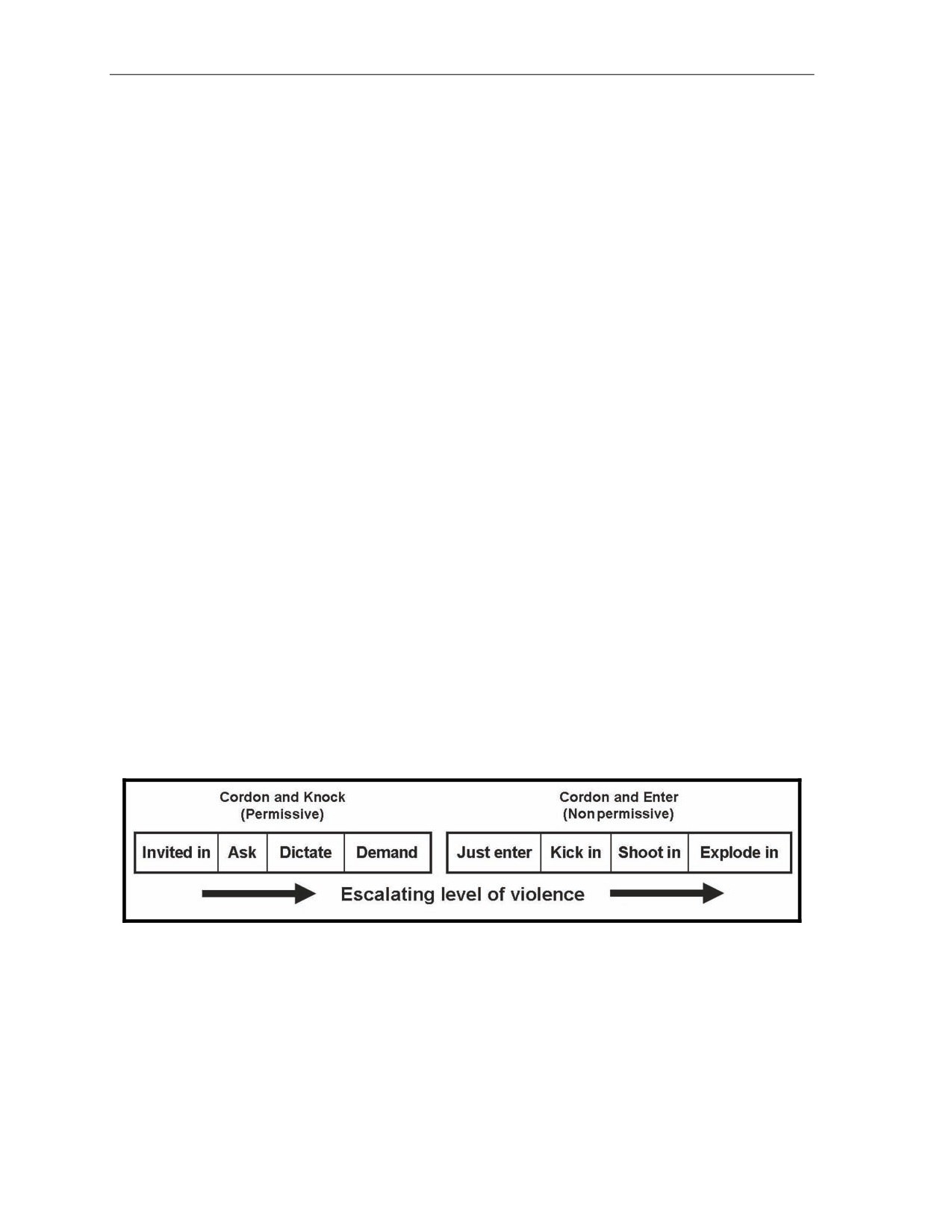
occupants of the targeted search area. Figure
5-3 compares the characteristics of permissive and
nonpermissive cordon and search operations.
Figure 5-3. Comparison of cordon and search methods.
Cordon and Knock
5-48.
This is less intrusive than cordon and search. It is used when the populace is seen as friendly
or neutral, when no resistance is expected, and when the goal is to disrupt and inconvenience the occupants
as little as possible. One version of this is called the tactical callout. This is a procedure where occupants
are asked to exit the before search forces enter. If occupants refuse to exit, or if the ground commander
believes that the potential exists for an insurgent encounter, he may escalate to cordon and enter.
5-8
FM 3-24.2
21 April 2009
Offensive Considerations in Counterinsurgency
5-49.
A second version of the cordon and knock is cordon and ask, which means occupants or the local
Host Nation authorities are asked for permission to search a particular location. If permission is denied, no
entry occurs. However, the cordon and knock and the cordon and ask require some degree of integration
with HN security force or HN authorities to obtain the agreement by the occupants of the target to the
subsequent search. At a minimum, a sufficient number of translators, preferably one with each element,
is required.
Cordon and Enter
5-50.
This approach is intrusive. The intent is to rapidly breach barriers to gain entry into the search
area, typically using speed and surprise to allow the unit to quickly gain control. This action allows units
to maintain the initiative over a potentially unknown insurgent force operating in the search area. Intrusive
entry ranges from a Soldier simply opening a door without occupant permission, to mechanical ballistic, or
explosive breaching. In addition, mounted units can use vehicles to breach. The cordon and enter
approach does not explicitly require integrated HN security forces or HN authorities, because occupants'
permission is not required. However, during a counterinsurgency, obtaining the leadership or direct support
of the HN is always preferred. Commanders assume operational risk in COIN by foregoing these
considerations. Some considerations when using the cordon and enter method follow. These considerations
may be more or less important than capturing the target individual, site, or equipment. Gains in security by
violent capture of a key insurgent leader may result in far more substantial losses along the other LOE:
• Risk to civilian occupants and bystanders.
• Collateral damage to infrastructure.
• Perception of the populace.
• Risk to Soldiers.
• Rehearsals.
• Level of training of breach element.
• Effects on subsequent tactical site exploitations.
APPROACHES
5-51.
Leaders plan and execute cordon and search operations using either a systematic or selective
approach. A systematic approach is the search of all buildings in the targeted area, while a selective
approach is the search of specific locations within a targeted area. The approach used depends on
numerous factors. However, the purpose of the operation is still to capture the designated personnel, site,
or equipment.
CONSIDERATIONS
5-52.
If intelligence indicates enemy presence, and the local populace is either neutral or supportive
of the insurgency, then the principles of speed and surprise are the keys to a successful cordon and search.
Specific considerations using elements of the mission variables are—
Mission
5-53.
Leaders determine the focus and method of the cordon and search based on the anticipated threat
and the level of violence in the area of operations.
Enemy
5-54.
Cordon elements cannot effectively block pedestrian egress or ingress. Therefore, commanders
should consider how to best physically stop pedestrian traffic. Lethal fire is not a universal means
of enforcing the nature of a cordon.
Troops and Support Available
5-55.
The size and composition of the cordon and search force is based on the size of the area to be
cordoned, the size of the area to be searched and the suspected enemy SITEMP. Normally, a military
commander, with the police in support, best controls a search involving a battalion or larger force. The
21 April 2009
FM 3-24.2
5-9
Chapter 5
police, with the military in support, best control a search involving smaller forces. Regardless of the
controlling agency, HN police are the best choice for performing the actual search. However, they must be
available in adequate numbers and be trained in search operations.
Time Available
5-56.
As time available to plan and prepare for a cordon and search mission is generally limited, it
is often necessary to conduct planning while reconnaissance and intelligence collection are ongoing. The
size of the area, especially the interior layout of urban buildings, impacts force size and search time.
Leaders should plan on allowing time for follow-on missions based on exploitable information.
Civil Considerations
5-57.
Cordon and search operations are a great opportunity for all Soldiers to conduct information
engagements with the population. Each Soldier should know and understand the information engagement
task and purpose.
PHASES
5-58.
The phases of a cordon and search are the planning phase, reconnaissance phase, movement to the
objective phase, isolate the objective phase, search phase, and the withdrawal phase.
Plan
5-59.
Establishing the cordon requires detailed planning, effective coordination, and meticulous
integration and synchronization of available assets to achieve the desired effects. This requires the
commander to consider both lethal and nonlethal effects. Each subordinate cordon position such as a traffic
control point or blocking position must have a designated leader and a clearly understood task and purpose.
5-60.
A cordon and search operation can usually support the conduct engagement LOE. Commanders
must develop, integrate, and nest the information message in accordance with the purpose of the search.
Often the best message in COIN is one’s actions or that of the entire unit.
5-61.
Search of an urban area varies from a few, easily isolated buildings to a large well-developed
urban city. Leaders should divide the urban area to be searched into zones. Buildings should be numbered
and assigned specific search parties for coordination and clarity
Enablers
5-62.
Assets employed during the cordon and search may include tactical PSYOP teams (TPTs), tactical
HUMINT teams (THTs), law enforcement professionals (LEPs), special advisors, attack, reconnaissance,
and assault aviation, CAS, SIGINT enablers, MASINT enablers, military working dog teams, (MWDs)
biometrics collection efforts, female searchers, and civil affairs teams (CATs, Chapter 3).
5-63.
A TPT is an outstanding combat multiplier. Messages broadcast in the local language during
cordon and search/knock operations facilitates situational awareness and understanding for the local
inhabitants. These TPTs, using vehicle-mounted or man-pack loudspeaker systems, can help inform
and control the population. In addition, the TPT conducts face-to-face communication along with
disseminating handbills or leaflets explaining the purpose and scope of the cordon and search. This helps in
gaining compliance by the local population.
5-64.
THT is also an outstanding combat multiplier. THTs collect valuable information from individuals
in the search area, provide a tactical questioning capability, and have additional language capabilities.
Organization
5-65.
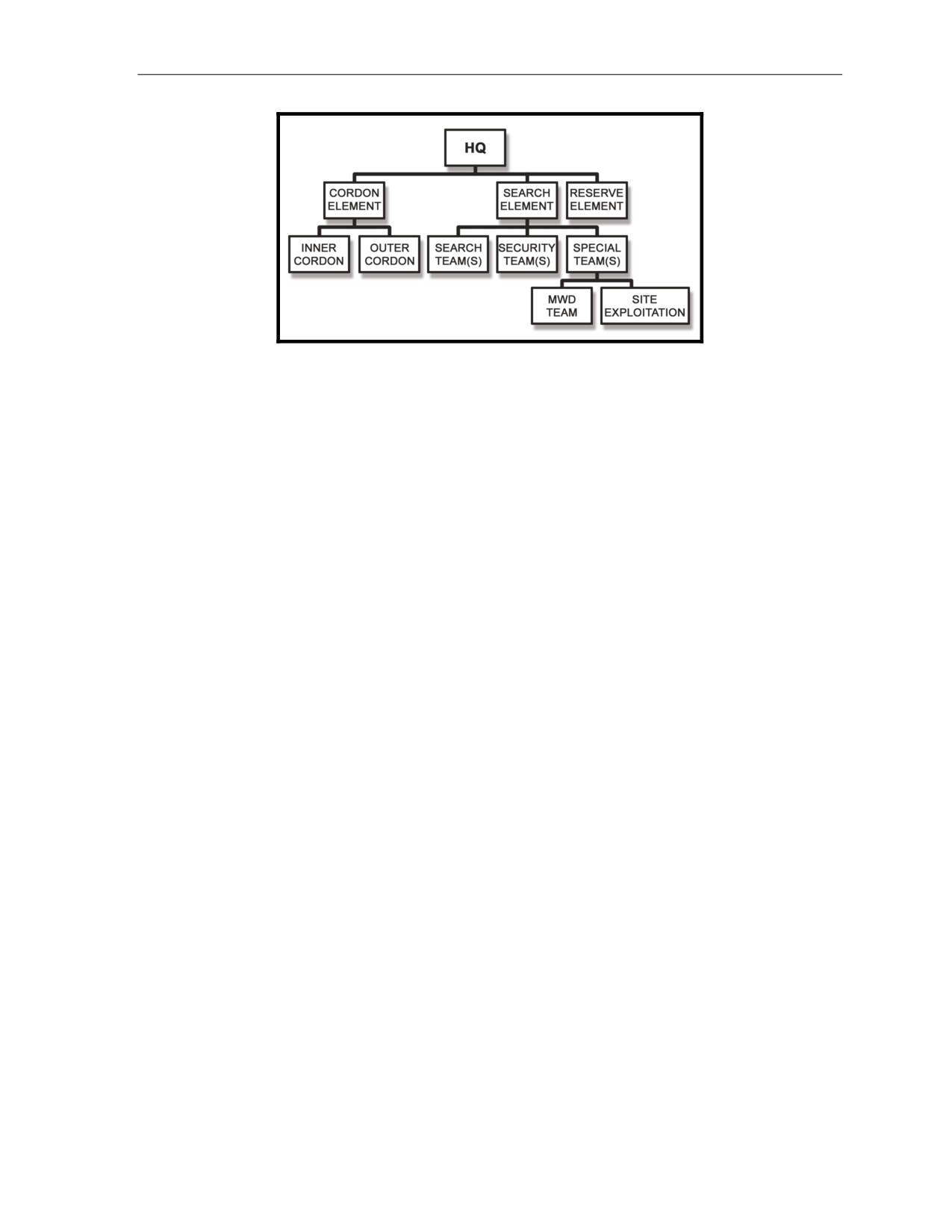
The typical cordon and search organization includes a command element, a cordon element, a
search element, and a reserve element each with a clear task and purpose. Figure 5-4 displays a typical
organization for search operations.
5-10
FM 3-24.2
21 April 2009
Offensive Considerations in Counterinsurgency
Figure 5-4. Typical organization for cordon and search operations.
Command Element
5-66.
An overall commander controls the unit conducting the cordon and search. He identifies the
subordinate element leaders.
Cordon Element
5-67.
This force must have enough combat power to cordon off the area. An effective cordon that both
prevents the egress of individuals from the search area and prevents outside support to the search area,
is critical to the success of the search effort. Based on the mission variables (METT-TC), two cordons are
often established: an outer cordon to isolate the objective from outside reinforcements or disruptions,
and an inner cordon to prevent individuals from leaving or communicating with someone outside the
search area. Both cordon elements must maintain 360-degree security. UAS, scouts, attack reconnaissance
aviation, or sniper teams should be considered by tactical units for use in observing the objective area
for enemy both before and during the operation.
Search/Assault Element
5-68.
The search element conducts the actual search operation. A search may orient on people, on
materiel, on buildings, or on terrain. Normally, it is organized into special teams. The most basic search
team is a two-person team consisting of one person who conducts the actual search while another person
provides immediate security to the searcher. Establish discipline and standardized search SOPs to ensure
searches are thorough, PIR-focused, and of minimal risk to Soldiers.
5-69.
All search elements must be prepared to handle male and female personnel, key equipment,
hazardous materials (biohazards or other toxic elements), ordinance, and record key events. They must be
trained to understand and on order execute information engagements, tactical site exploitation, detainee
operations, and adjacent unit coordination. Search personnel must be trained to operate with HN security
forces and within the established ROE. First aid and other medical training is critical. Soldiers must be
proficient with signaling and marking devices as well as detection and recording equipment. Biometric
and video/audio recording device proficiency is crucial in COIN search operations. Basic language training
is essential to maintain effective searches and overall operational tempo.
5-70.
Typical search teams are organized in two- to three-Soldier teams. Female Soldiers are a proven
combat multiplier during search operations, because few cultures tolerate males searching females. Search
teams clear each room or area in accordance with FM 3-21.8. Units should not confuse entry methods
and their levels of aggression with the requirement to respect the Host Nation’s people and homes.
Typically, once a room is cleared, one team member provides security while the other(s) searches. All
search element personnel are prepared to fight. Basic considerations for any search team include the
following:
• Detailed instructions including prohibited items such as weapons, chemicals, medicines,
and machine tools.
21 April 2009
FM 3-24.2
5-11
Chapter 5
• Understanding of search restrictions and special considerations to include—
Searching of religious buildings.
Searching of females by female Soldiers.
Searching of historical, cultural, or governmental sites (unauthorized or hostile).
• Host nation security forces or local interpreters.
• Biometrics tools.
• Breaching kit.
• Vehicle access tools such as lock picks.
• Information engagement products and tools.
• Audio and video recording devices and data imaging devices.
• Markings and signaling techniques and any constraints.
• Respect for personal property.
• Tools to collect and record information for HUMINT.
• Necessity to maintain communication and report location.
• Standardization of maps, imagery, and labeling conventions.
Reserve Element
5-71.
The reserve element or QRF must possess and maintain enough combat power to defeat the
insurgent forces templated within the AO. The commander gives priorities for planning to the reserve that
could include to be prepared to execute any of the subordinate unit missions. Priorities can also include
additional missions such as CASEVAC or reinforcement. The reserve element leader focuses efforts on
synchronized communications, rehearsals, battle tracking, and positioning before and during the operation.
Reconnaissance
5-72.
Every target area should be reconnoitered prior to execution using many of the available
resources. If the target is part of a unit’s AO, then a patrol around the target may not be out of order. ISR
assets, attack reconnaissance aviation, local nationals, and imagery are other methods for conducting
reconnaissance. The reconnaissance plan must not provide the enemy with indicators of an impending
cordon and search. Given the nature of COIN, the reconnaissance phase could last an extended period,
as units identify the relative size and location of buildings, entry points, cordon position and avenues
of approach. Further tools for objective analysis may be obtained from attack aviation photographs, maps,
and local emergency services departments.
Movement to the Objective
5-73.
The timing, routes, and execution of movement to the objective should consider the factors
of METT-TC, and whether it should be simultaneous or phased. If contact is made in the movement,
commanders should consider whether they wish to send forces forward to initiate the cordon.
Isolation of the Objective
5-74.
Although analysis of the mission variables using METT-TC determines specifics, a unit typically
establishes the outer cordon first, establishes the inner cordon second, and moves the search element to the
objective last. Commanders should consider the value of using the opposite technique of forming the
cordons following rapid movement to the objective to gain surprise. Timing is when executing either
technique is important. The quicker these three events are accomplished, the less time personnel on the
objectives have to egress, find concealment, or destroy materials or equipment.
Position the Reserve Element
5-75.
The reserve element or QRF is a mobile force positioned in a nearby area, with multiple planned
ground, water, or air routes to the objective area. Its mission is to aid the search and security elements
if they require assistance or become unable to achieve their purpose.
5-12
FM 3-24.2
21 April 2009
Offensive Considerations in Counterinsurgency
Establish the Cordon
5-76.
There are two techniques for emplacing the actual cordon positions: simultaneously
and sequentially. Careful consideration must be given to both, because each has advantages
and disadvantages. Units establishing a cordon position themselves to be able to block movement to
and from the objective area. This may be by observed fire, but usually it will be by physically controlling
routes. Cordon positions should be occupied rapidly just prior to the search element reaching the objective.
Establishing the cordon during a period of limited visibility increases movement security but makes control
difficult. Cordon positions, once occupied, will be detected by locals as they conduct their daily business.
5-77.
Both the outer and inner cordon leaders must maintain situational understanding of not only their
AOs, but also each other’s cordon and the progress of operations of the search element. In doing so, they
can anticipate insurgent activity, control direct and indirect fires, and achieve their task and purpose.
5-78.
The various positions of the outer and inner cordons may include, vehicle mounted platoons
or sections, dismounted platoons or squads, interpreters, detainee security teams, crowd control teams,
tactical PSYOP teams, observation posts, traffic control points or blocking positions, Host Nation security
forces (military or police), and aviation assets.
5-79.
The outer cordon usually focuses on traffic control points and blocking positions, while the inner
cordon focuses on overwatching the objective and preventing exfiltration or reposition of persons within
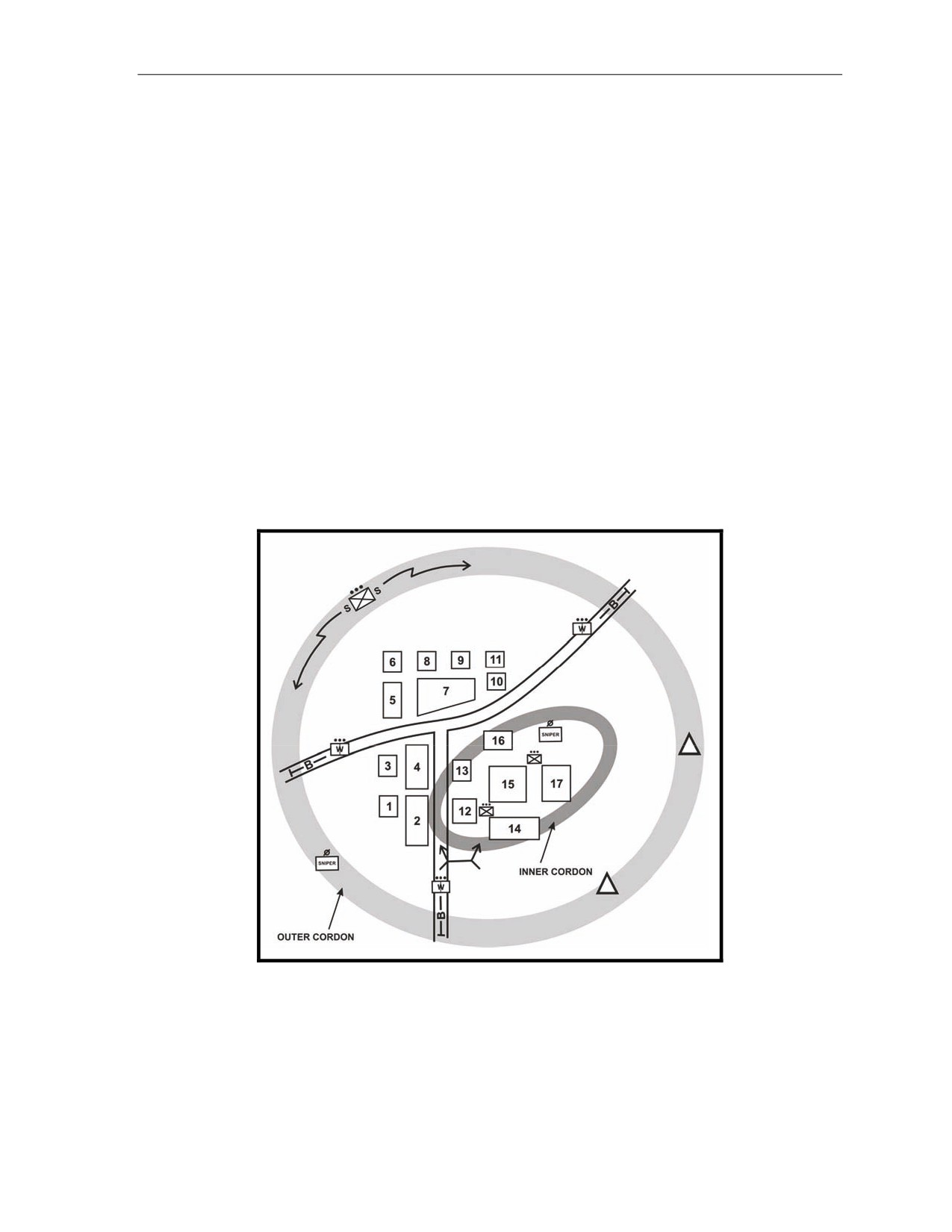
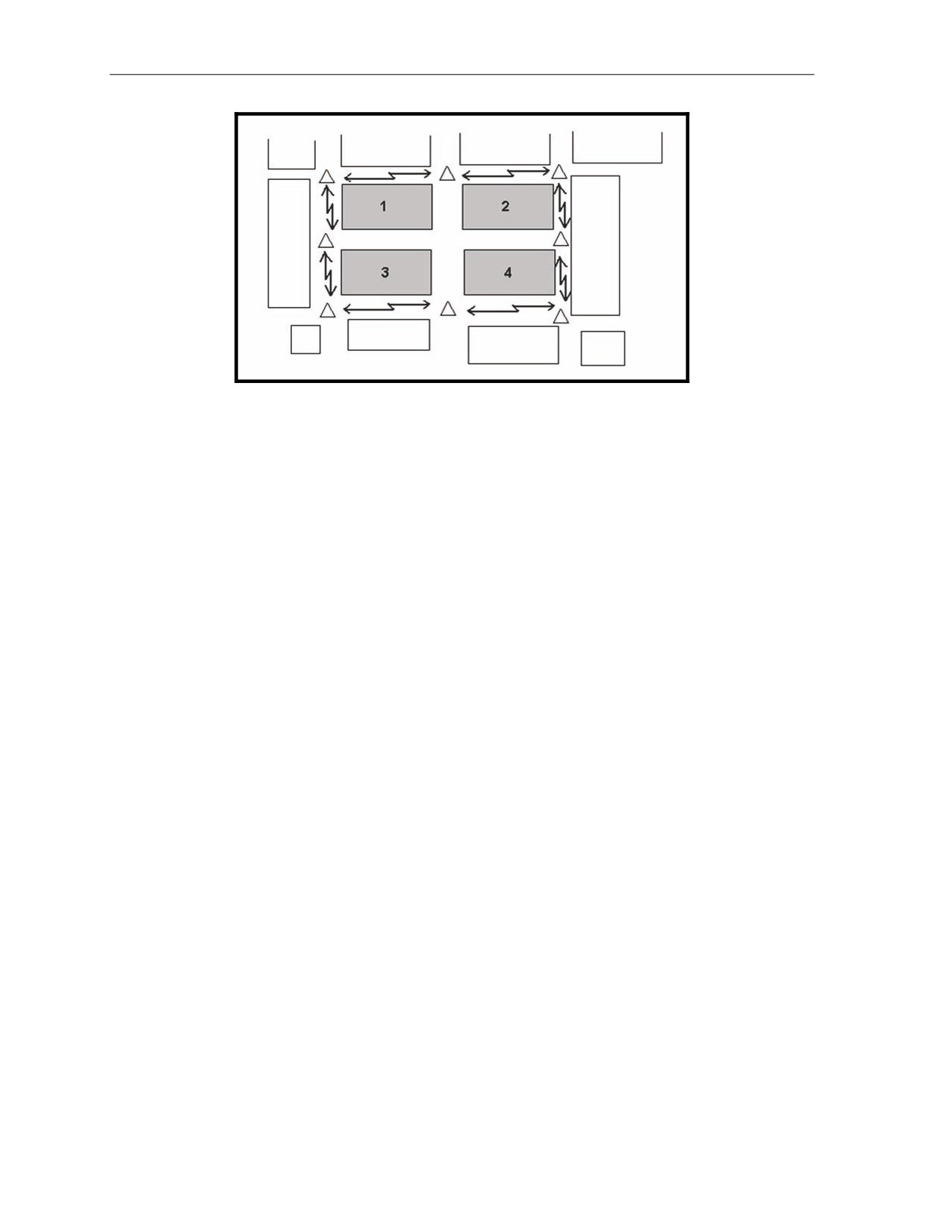
the search area. Figure 5-5 shows the typical establishment of a cordon and Figure 5-6 shows the details
of an inner cordon in an urban setting. Note the technique of assigning each building a number to increase
clarity and coordination between units.
Figure 5-5. Typical establishment of an urban cordon.
21 April 2009
FM 3-24.2
5-13
Chapter 5
Figure 5-6. Urban inner cordon.
Search
5-80.
A search may be oriented toward people, materiel, buildings, or terrain. It usually involves both
HN police and military personnel. It must be a systematic action to ensure that personnel, documents,
electronic data, and other material are identified, evaluated, collected, and protected to develop intelligence
and facilitate follow-on actions.
5-81.
The tempo at which a search operation is conducted should be slow enough to allow for an
effective search, while not so slow that it allows the insurgent force time to react to the search. Search
teams must consider a return to an area after an initial search. This can surprise and remove insurgents who
may not have been detected or may have returned. All searches should create pressure on insurgents
and sympathizers to not stay in the area, but not inconvenience the local residents to the degree that they
will collaborate with the insurgents.
5-82.
Special laws regulate the search powers of military forces. Misuse of search authority can
adversely affect the outcome of operations and future legal proceedings; therefore, all searches must be
lawful and properly recorded to be of value. These laws must be disseminated to the population to ensure
understanding and compliance. Additional information on searches can be found in FM 3-06.20. Search
teams must have instructions for three basic categories:
Personnel
5-83.
This includes both male and female and both persons of interest and other persons.
Physical Items
5-84.
This includes weapons, equipment, documents, computers, and cameras.
Information Mediums
5-85.
This includes data inside computers, cameras, and cell phones.
Withdrawal
5-86.
During this phase, the unit may be the most vulnerable. To mitigate risk, a commander may
choose to—
• A relief in place.
• Stay-behind elements to cover the withdrawal.
• Different routes and timing.
• Simultaneous or phased withdrawals.
5-14
FM 3-24.2
21 April 2009
Offensive Considerations in Counterinsurgency
SEARCH OPERATIONS
5-87.
A search is the deliberate examination of a person, place, area or object using Soldiers, animal
or technological sensors to discover something or someone. Examples include searches of enemy
or detained personnel, military objective areas, personnel or vehicles at a checkpoint, and lines
of communication.
5-88.
A search is conducted under a wide variety of situations and for a wide variety of purposes.
Typically, a person is searched in order to find something that is concealed. A place, area, or object, such
as a car or desk, is searched for something that may or may not be concealed. For more on vehicle
searches, see Chapter 7. Communication objects, such as letters, books, computers, cell phones, and other
media and signaling tools, are searched to discover information.
5-89.
During a counterinsurgency, the rules of engagement and various agreements between the Host
Nation and US counterinsurgent forces often describe search situations, and may limit search methods.
5-90.
During a search, it is important to keep the local population informed, as much as tactically
possible, that search contributes to their safety and security. This communication should begin during the
actual search, if possible, but is often accomplished after the search by follow-up patrols. Follow-up patrols
can not only aid in mitigating some of the negative aspects of the search but also see if missed individuals
have returned to the searched area. Follow up patrols which include civil affairs teams or tactical PSYOP
teams provide a great capability to conduct consequence management, assisting in the achievement
of information engagement, often through reinforcing themes, and collecting information for development
into intelligence.
TECHNIQUES
5-91.
A search can orient on people, materiel, buildings, or terrain
(FM 3-21.8) Key basic
considerations for conducting a search in various includes searching individuals, tactical site exploitation,
aerial searches, searching subterranean areas, searching individuals, detention of individuals, tactical
questioning and detainee processing.
Individuals
5-92.
Any individual can be an insurgent, auxiliary, or member of the mass base. However, searchers
must avoid mistaking all suspects for the enemy. Because there may be little or no Host Nation personnel
identification procedures, identifying the correct person as an insurgent may be very difficult. It is during
the initial handling of individuals about to be searched that the greatest caution is required. During the
search, one member of a search team always covers the other member who makes the actual search. When
females have to be searched, every precaution is made to prevent violating local customs and mores. If
female searchers cannot be provided, consider using the medic to search female suspects.
Teams
5-93.
Soldiers conduct individual searches in search teams that consist of the following:
Searcher
5-94.
Actually conducts the search. This is the highest-risk position.
Security
5-95.
Maintains eye contact with the person being searched.
Observer
5-96.
Supervises search and warns of suspicious behavior or actions.
Methods
5-97.
The most common search methods used to search an individual are frisk and wall searches.
A third, less common method, used in very select situations, is the strip search.
21 April 2009
FM 3-24.2
5-15
Chapter 5
Frisk Search
5-98.
Quick and adequate to detect weapons, evidence, or contraband. A frisk search is more dangerous
because the searcher has less control of the individual being searched.
Wall Search
5-99.
Affords more safety for the searcher by leaning the suspect against any upright surface, such as a
wall, vehicle, tree, or fence. The search team places the subject in the kneeling or prone position if more
control is needed to search an uncooperative individual.
Strip Search
5-100. Considered only when the individual is suspected of carrying documents or other contraband on
his or her person. This extreme search method should be conducted in an enclosed area and by qualified
personnel when available.
Search with Sensors
5-101. Metal detectors or thermals can identify hidden items.
Population Control
5-102. Three basic methods are used to control the population during a search of an urban area: assembly
of inhabitants in a central location, restriction of inhabitants to their homes, and control of the heads of the
households.
Assemble Inhabitants in a Central Location
5-103. This method moves inhabitants from their homes to a central area. It provides the most control,
simplifies a thorough search, denies insurgents an opportunity to conceal evidence, and allows for tactical
questioning. However, this method has the disadvantage of taking the inhabitants away from their
dwellings and possibly encouraging looting, which, in turn, engenders ill feelings. A specific element must
be identified to control the centralized inhabitants. A TPT, using a loudspeaker, can facilitate assembly by
giving specific instructions to the inhabitants of the search area.
Restrict Inhabitants to their Home
5-104. This technique prohibits movement of civilians, allows them to stay in their dwellings,
and discourages looting. The use of a TPT to broadcast “stay-indoors” messages facilitates clearing the
streets of civilians and aids in restricting their movement. The security element must enforce this restriction
to ensure compliance. The disadvantages of this method are it makes control and tactical questioning
difficult, and gives inhabitants time to conceal contraband in their homes.
Control Heads of Households
5-105. The head of each household is told to remain in front of the house while everyone else in the
house is brought to one room. The security element controls the group at the central location, controls the
head of each household, and provides external security for the search team. When dealing with the head
of a household, it is important to explain the purpose of the search using an interpreter. During the search,
the head of the household accompanies the search team through the house. This person can be used to open
doors and containers to facilitate the search. It is important for the head of the household to see that the
search team steals nothing.
Houses or Buildings
5-106. The object of a house search is to look for contraband and to screen residents to determine if any
are guerrillas, auxiliaries, members of the underground or the mass base. A search party assigned to search
an occupied building should consist of at least one local police officer, a protective escort for local
security, and a female searcher. If inhabitants remain in the dwellings, the protective escort must isolate
and secure the inhabitants during the search. Forced entry may be necessary if a house is vacant or if an
occupant refuses to allow searchers to enter. If the force searches a house containing property while its
5-16
FM 3-24.2
21 April 2009
Offensive Considerations in Counterinsurgency
occupants are away, it should secure the house to prevent looting. Before US forces depart, the commander
should arrange for the community to protect such houses until the occupants return.
5-107. Try to leave the house in the same or better condition than when the search began. In addition
to information collection, the search team may use digital cameras or video recorders to establish the
condition of the house before and after the search. All sensitive material or equipment found in the house
should be documented before it is removed, to include date, time, location, the person from whom it was
confiscated, and the reason for the confiscation. The use of a digital camera can assist in this procedure.
For a detailed search, the walls and floors must be searched to discover hidden caches.
SITE EXPLOITATION
5-108. Tactical leaders plan, resource, direct, and supervise tactical site exploitation efforts during all
COIN offensive operations. Site exploitation (SE) is the systematic action executed with the appropriate
equipment, to ensure that personnel, documents, electronic data, and other material at a site are identified,
evaluated, collected, and protected in order to gather intelligence and facilitate follow-on actions. It is a
means by which tactical units exploit and analyze the insurgent after collecting biometric, physical, digital,
and spoken data. In COIN, insurgents who are captured many times are prosecuted within the HN rule
of law and SE is an excellent means of providing courts with evidence, especially when properly recorded.
SE contribute to the decide, detect, assess activities of D3A targeting cycle. Once collected, analyzed,
and assessed, it may lead to future operations. More information on SE can be found in CALL product
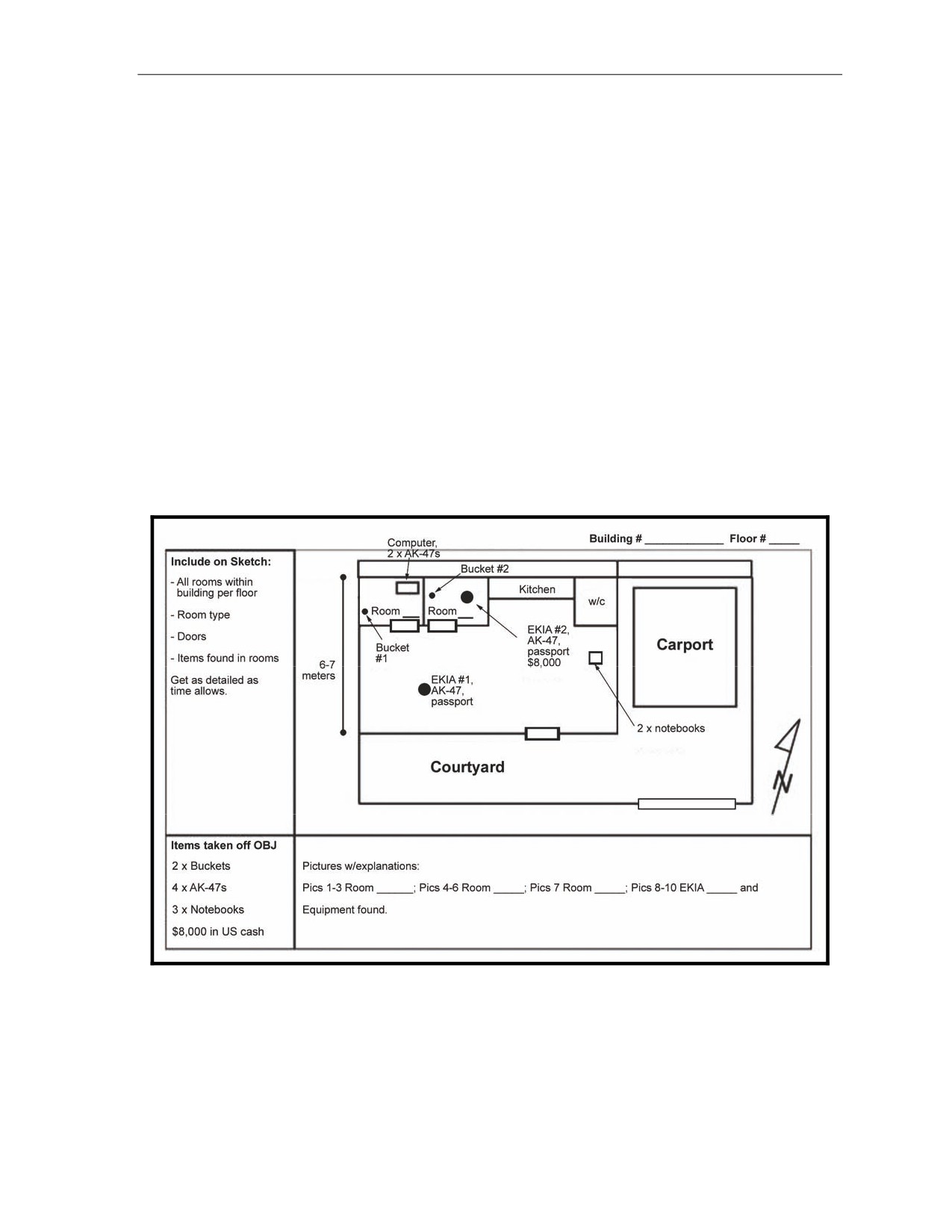
07-26. Figure 5-7 shows an example SE site sketch.
Figure 5-7. Example site exploitation sketch.
Conduct
5-109. Leaders ensure that Soldiers methodically and effectively identify, preserve, and collect evidence
while maintaining its integrity. They strive to prevent damage or corruption from foreign materials,
undocumented chains of custody, or loss. They consider how to mitigate risk by allowing minimal
21 April 2009
FM 3-24.2
5-17
Chapter 5
personnel to operate in the area, by minimizing time on target, by concealing movement of evidence, by
avoiding patterns, and by maintaining an obvious respect for civilians and their belongings.
5-110. An important SE resource, biometric assets can measure humans by face, fingerprint, hand
geometry, handwriting, iris, retina, vein, voice, and DNA. Other SE resources include search, detention,
and marking tools; collection containers; marking materials; photographic, video, and voice recording
devices; linguists; and artificial sources of light. In addition, leaders—
• Initially evaluate the situation.
• Decide whether the unit must perform an expedient or formal site exploitation.
• Properly bag and tag evidence.
• Record sworn statements, from Soldiers and locals, for entry into the legal system. (Using
evidence kits is the best and easiest way.)
• Photograph captured contraband evidence with the suspect for judicial proceedings.
• Ensure that photos of people, materiel, and other items of potential intelligence interest
and evidence collection are documented on and adjacent to the site.
• Use document and material exploitation (DOMEX), which includes hasty analysis of pocket
contents, electronic mirror-imaging media, and evacuating data for further, more
detailed analysis.
• Process detainees into detainee holding area
(DHA), to include collection of biometric
and computer database information, by special BCT-level teams.
• Ensure that pre- and post-bomb blast forensics and signatures collected from IED factories,
routinely collected by weapons intelligence teams
(WITs), are entered into the system
for comparison and analysis with detainee records.
Techniques
5-111. Basic SE techniques include search methods, searches of individuals, detention of individuals,
tactical questioning, and debriefing.
Methods
5-112. Search methods must include providing security for search team, ensuring integrity of site,
conducting a methodical search, and coherently documenting effort for later review. The type of search
team used depends on many factors such as available forces, HN capabilities, and purpose of the search.
Most of these are covered in METT-TC. The following SE on-target checklist is not all inclusive:
• Search all rooms or caves, to include roof, yard, any subterranean areas, and associated
vehicles for—
ID cards.
Weapons.
Computers.
Documents.
Digital media.
Propaganda.
Cellular and satellite phones.
Large amounts of money.
• Search other likely hiding places, which may include—
Appliances (refrigerator—ice cube trays, under and inside back housing).
Furniture hide spots (taped under furniture, hollow legs, inside cushions.
Floors (hollow flooring, removable wood boards, removable tiles, under rugs).
Gardens, false wall locations, chimney hide locations.
• Search all vehicles for weapons and photograph the weapons.
• Positively identify (PID) the target.
• Photograph all individuals.
• Complete packets on all individuals.
5-18
FM 3-24.2
21 April 2009
Offensive Considerations in Counterinsurgency
• Verify individual by checking ID cards.
• Perform a gunpowder test or use X-spray on all individuals.
• Photograph each detainee with evidence.
• Collect and document all evidence, and take it to the transport vehicle.
• Load all detainees for transit to FOB, combat outpost, patrol base, or DCP.
Detention
5-113. Detainee refers to any person captured or otherwise detained by an armed force (JP 1-02). The
reason for capture or detention of a detainee, and his ultimate disposition and categorization, depends on
the situation. Before detaining someone, a leader must first decide what to do with the person afterward.
Does the leader want to search, question, process, or release the person?
5-114. AR 190-8, FM 3-19.40, and, international law
(including the Law of War and the Geneva
Conventions) cover policies, procedures, and responsibilities for administering, treating, protecting,
securing, and transferring custody of detainees. They also cover other planning factors as well as
regulatory and legal requirements concerning detainees.
Rules
5-115. The six rules for processing detainees follow:
• Search the detainee thoroughly and disarm him.
• Silence the detainee.
• Segregate the detainee from other detainees by sex and rank.
• Safeguard the detainee from harm while preventing him from escaping.
• Speed the detainee to the designated detainee collection point.
• Tag the detainee with key information. Use approved format if possible. The tag includes the
date of capture, location of capture (grid coordinate), capturing unit, and special circumstances
of capture (how the person was captured).
Protected Status
5-116. Once the suspected insurgents are under friendly control, they assume the protected status
of detainees. This term includes any person captured or otherwise detained by armed force. Under the law
of war, leaders and Soldiers are personally responsible for detainees under their control. Mistreatment
of detainees is a criminal offense under the Geneva Convention and the 1996 War Crimes Act. One of the
most conspicuous violations of the Geneva Convention is the unauthorized photography of detainees.
Note: Avoid photographing detainees for nonmilitary or unofficial purposes. Doing so is
unauthorized.
Tactical Questioning
5-117. Units recognize value of timely information and intelligence during COIN operations and thus
may tactically question an insurgent on the objective. Units designate or construct a detainee holding area,
ensuring detainees are unable to communicate in any manner. Leaders then conduct tactical questioning
of priority detainees away from the group, as they carefully gather facts and details required to establish
consistencies or inconsistencies. Leaders then sort detainees into those to be taken off target, those without
further value, those no longer of interest, and those who require immediate battlefield interrogation by
qualified personnel. Leaders wanting the ability to interrogate personnel during a potential operations
should request and incorporate qualified interrogators into their mission task organization to facilitate
timelier information or intelligence.
Necessity for Soldier Presence
5-118. The terminology may change, but the need for Soldiers at the point of capture or point
of detainment to ask questions remains. Trained interrogators are seldom on hand, but Soldiers are always
21 April 2009
FM 3-24.2
5-19
Chapter 5
present. Experiences from recent operations show that US forces using immediate tactical questioning
techniques with their Soldiers on target find important information that leads to actionable intelligence.
Tactical questioning must not violate the Law of War or any legal agreements (SOFAs and coalition
agreements). Typical questions should focus on discovering other nearby insurgents, their intentions, their
equipment, how they are financed, or their means of support.
Backtracking of Route
5-119. A successful technique to determine where the individuals were before they came to the point
of capture is to verbally backtrack their route. The detainee is questioned as to when he/she arrived, how
he/she traveled to the point of capture (foot or vehicle), and from what direction. With a general direction
and a means of travel, the route can be developed. Using a map, the Soldier asks leading questions
to determine the route. The detainee identifies significant terrain features seen at specific locations, such
as rivers, bridges, key buildings, or hills. Talking jogs the detainee's memory. Gradually, the detainee
reveals their route (where they originated). Considerations for successful tactical questioning follow:
• Know your linguist; use more than one to double-check the integrity and accuracy
of information and reliability of linguist.
• Have a basic knowledge of language(s) of detainee(s).
• Learn to identify physical behavior and posture, resistance or defensive postures; use multiple
observers.
• Study your target before he becomes a detainee on the objective.
• Study behavior, values, and interests of others in the OE before conducting tactical questioning.
• Consider placing uniformed linguist in the area of detainees and allow the detainees
to communicate so that the uniformed linguist can collect information (deception collection).
• Conduct questioning of one individual in a separate room from other detainees so that if the
detainee answers he maintains plausible deniability with members of his community.
• Commanders can prepare four to five questions related to information requirements. These can
be briefed as part of the patrol order and used by leaders during operations.
• Prepare a tactical questioning plan for information that you believe the detainee may have.
Aerial Searches
5-120. Unmanned aerial systems (UAS), close air support (CAS), and rotary wing aircraft
(attack
and reconnaissance aviation) can be used as observation platforms. CAS aircraft and attack reconnaissance
aviation can also provide commanders an aerial search capability with different search perspectives
and constraints. Rotary wing aircraft are an effective means of conducting mounted search patrols, specific
population control measures, and security operations.
5-121. Helicopter-mounted patrols may reconnoiter an assigned area or route in search of insurgent
elements. They may conduct snap checkpoints on roads to interdict insurgent mounted and dismounted
movement. When the element locates a known or suspected element, it can instruct attack aviation teams
to engage the insurgent element or it may also choose to land and attack the enemy with a dismounted
assault. This technique can be useful in open rural areas unless an air defense threat is present. Use
of aerial patrols should be used in operations when sufficient intelligence is available to justify their use
or friendly ground-based operations have become predictable to the insurgents. Such patrols are most
effective when used in conjunction with ground operations.
5-122. In aerial or air/ground search operations, helicopters insert troops in an area suspected
of containing insurgents. With the helicopters overwatching from the air, Soldiers search the area. Soldiers
remount and the process is repeated in other areas. Members of aerial patrols should be trained in tracking
procedures to follow insurgents to their base or safe houses using terrain, deception, and stand-off
capability of aviation optics in conjunction with ground and other technological assets. Leaders must plan
for the evacuation of prisoners, casualties, and materials, both by air and ground.
5-20
FM 3-24.2
21 April 2009
Offensive Considerations in Counterinsurgency
Subterranean Area Searches
5-123. In both urban and rural areas, insurgents must remain undetected to survive. Therefore, insurgents
use all means of concealment available. Subterranean areas, in both rural and urban areas, reduce the
chance of detection and facilitate insurgent movement. Subterranean areas include natural caves,
basements, manmade underground bunkers, tunnels, holes, and sewer systems. Underground sewers
and tunnels may also be used in the attack of targets and for egress after an attack. See FM 3-34.170,
Engineer Reconnaissance, for a discussion of tunnel
(and subterranean) detection, reconnaissance,
maneuver, and destruction.
Signs of Use of Subterranean Area
5-124. Certain signs may reveal the often signal or identify that insurgent forces within a certain area are
using subterranean structures. These indicators include—
• Movement of insurgents in a specific direction when spotted by aircraft.
• Sniper fire occurring from areas where there are no obvious avenues of withdrawal.
• HUMINT reports of subterranean areas
• Failure of cordons to prevent withdrawal or infiltration of insurgent forces
• Turned or managed soil far away from places of habitation or daily labor.
• Operations where insurgents inflict casualties and withdraw without detection or engaging
COIN forces.
• The smell of burning wood or food cooking in an uninhabited area.
• Mounds of dirt, and dirt of different colors, which might indicate digging.
• Trails to water sources in uninhabited areas that may indicate personnel requiring water.
Methodical and Coordinated Approach
5-125. Searching an area where suspected subterranean facilities are located requires a methodical
and coordinated approach. The size of the surface area and the suspected size of the subterranean
determine the size and the strength of the unit assigned. The unit is task-organized for subterranean search
operations, and is divided into five elements: C2, security, search, guard, and reserve. The C2 element
often remains with the reserve element.
Narrowing of the Search
5-126. To detect or locate subterranean, leaders first reduce the geographical area of interest to smaller
areas of probable locations. Acquiring existing blueprints, maps, imagery, video, aerial photographs,
and hydrology analysis tools; actively observing for indicators of probable subterranean access locations;
and questioning the local population as to the existence or specific knowledge of any subterranean.
Overhead imagery may produce results if the appearance of the surface and vegetation are changed or
if deductions about substructure can be made from analysis of existing or historical terrain.
Security
5-127. Perimeter and flank security is imperative. A slow, methodical search is conducted in the area
of operations, with each search team systematically searching every square meter. The security element
moves toward the limits of advance of the search area. Deliberate search techniques emphasize where
to look for the insurgent locations that provide him with observation, cover, concealment, and an
egress route.
Signs of Tunnels
5-128. Several visual signs help in detecting the actual tunnels. Visual inspections often disclose the
general area of a tunnel, but not its precise location. The keys to finding a tunnel system are a thorough
terrain analysis (OAKOC) and an equally thorough physical ground search.
21 April 2009
FM 3-24.2
5-21
Chapter 5
Rural Visual Indicators
5-129. Visual indicators in a rural operational environment include—
• Air holes.
• Worn places on trees the insurgent uses as handholds.
• A small trail, much like a game trail, through the brush into a clump of small trees
• Cut trees and Limbs tied near a treetop to conceal the use of a tunnel from aircraft.
• Slight depression in or around a group of small trees.
• A lone individual, especially a female, in the area.
• Fresh cooked food with no one attending the site.
• Fresh human feces in an area.
Urban Visual Indicators
5-130. Visual indicators in an urban operational environment include—
• Sewer, storm drain, or utility grates or manhole covers
• Disturbed soil in mature gardens
• Presence of flooring materials in homes, businesses, and other structures not under
construction.
RAID
5-131. This is an operation to temporarily seize an area in order to secure information, confuse an
adversary, capture personnel or equipment, or to destroy a capability. It ends with a planned withdrawal
upon completion of the assigned mission (JP 3-0). A raid is conducted to destroy a position or installation,
destroy or capture insurgents or equipment, free friendly prisoners, or seize possible intelligence;
and is followed by a rapid withdrawal. By capturing insurgents, information can be developed into
intelligence and confiscating contraband can contribute to improved public order and safety. It is often
used as part of a strike operation. For additional information on raids, see FM 3-21.8 and FM 3-21.10.
5-132. A raid in a COIN environment can differ from a raid in conventional operations since the
requirement for minimizing collateral damage may be a significant factor. In addition, the time on the
objective prior to withdrawal may be greater, due to the requirement to conduct a detailed SE. As in all
raids, the success of the raid is based on accurate, timely, and detailed intelligence and planning.
CONSIDERATIONS
5-133. Raids in COIN could have lasting effects on the population and the insurgents. Specific
considerations using elements of the mission variables are—
Mission
5-134. In a COIN, raids target insurgents, terrain, intelligence, or equipment. Missions are often executed
in conjunction with a form of cordon to prevent enemy escape into the population. Units should plan
and rehearse according to target intelligence, the commander’s intent, and the purpose of the raid.
Enemy
5-135. The objective of the raid may be a valuable asset the insurgency is prepared to defend. Often, the
insurgent will have additional forces in the area positioned to alert, react, facilitate egress, or conduct
combat. Effective reconnaissance can increase awareness of these factors.
Time Available
5-136. Leaders should plan on allowing time for follow-on missions based on exploitable information.
Also, units should not stay on the objective too long.
5-22
FM 3-24.2
21 April 2009
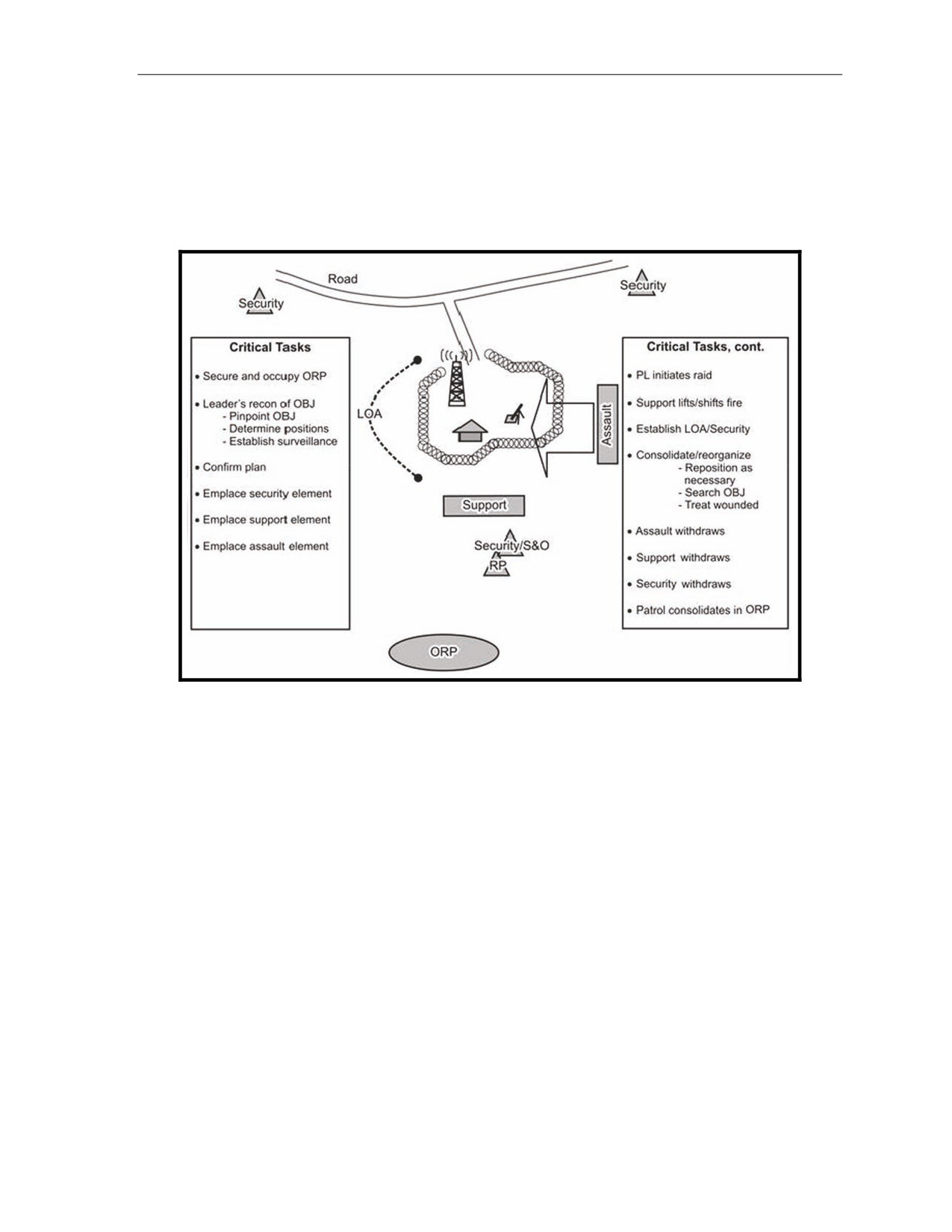
Offensive Considerations in Counterinsurgency
TECHNIQUES
5-137. The minimum task organization for a raid is a headquarters section, an assault element, and a
security element. Depending on METT-TC variables, a support element may be formed separately
or integrated into the assault element. Additional specialty teams should consist of detainees or EPWs, SE,
or CASEVAC teams. Squads are typically too small to execute raids, especially in urban AOs. Figure 5-8
shows the concept of operations for a typical raid.
Figure 5-8. Example raid concept.
5-138. A typical raid during a counterinsurgency is executed in five phases—insertion, seal off the
objective, assault the objective, secure the objective, and withdrawal. The following are some
considerations for each phase:
Insert
5-139. Insertion in COIN is less difficult than infiltration, especially in urban terrain, due to constant
civilian interaction. Units should use whichever method is most likely to achieve surprise. Deception, such
as disguising intent with other activities such as establishing a checkpoint, may be useful. Other
considerations include—
• Insertion by airborne or air assault can enhance surprise.
• Launch the raid at an unexpected time or place by taking advantage of darkness and limited
visibility and moving over terrain that the enemy may consider impassable.
• Infiltration of a sniper team before the raid.
• Avoid detection in rural areas through proper movement techniques and skillful camouflage
and concealment to include taking advantage of natural cover of the terrain.
• In urban areas, avoiding detection is difficult, therefore planning to delay detection
or awareness of the objective is better. This can be accomplished by rapid movement
or deception.
21 April 2009
FM 3-24.2
5-23
Chapter 5
Seal Off the Objective
5-140. Units should ensure insurgents can neither leave nor reinforce the objective. In many cases, this
may be the decisive operation. Some considerations include—
• All forces must understand and adhere to rules of engagement (ROE) and escalation of force
(EOF) procedures.
• Establish an outer cordon to block avenues of approach into the objective areas.
• Support force provides initial overwatching fire for the assault force (can be aviation).
• Use of aerial UAS or aviation support to maintain observation as needed.
Assault the Objective
5-141. Any insurgent element at or near the objective is overcome by surprise and violence of action.
Some considerations include—
• Time the assault as close as possible to the execution of the cordon.
• Perform quick, violent, precise, and audacious actions that focus full combat power at the
decisive point.
• Breach rapidly—if possible, the breach should be the first overt action of the raid.
• If fires are used, the support element either provides a heavy volume of fire or precision fires
dictated by civil considerations. Fires must be closely controlled to ensure precision using
FCMs, marking, and signaling. On order or as planned, fires are lifted and shifted to support
the assault element by suppressing enemy fire from the objective.
Secure the Objective
5-142. Units secure the objective by detaining insurgents, controlling personnel on or near the objective,
clearing the objective of other threats, conducting SE, and setting conditions that prevent insurgent fires
from outside the objective.
Withdraw
5-143. As planned, the unit withdraws from the objective area. A support force may provide suppressive
fires for withdrawal or provide escort away from the objective. Commanders consider use of stay behind
measures or devices to monitor backfill of insurgents or population support for the insurgency. A raid in a
COIN environment may modify phase five and withdraws at the discretion of the commander.
AMBUSH
5-144. An ambush is a form of attack by fire or other destructive means from concealed positions on a
moving or temporarily halted enemy (FM 3-90). Ambush patrols are combat patrols with missions
to establish and execute ambushes to harass or destroy insurgents or capture personnel and equipment. (For
further information on ambush, see FM 3-21.8 and FM 3-21.10.) By eliminating insurgents, an ambush
contributes to improving public order and safety, a key civil security subtask. It may be used
in clear-hold-build operations or strike operations.
TYPES
5-145. The two types of ambushes follow:
• A point ambush involves elements deployed to support the attack of a single killing zone.
• An area ambush involves elements deployed as multiple, related, point ambushes.
CATEGORIES
5-146. Based on the amount of preparation time, ambushes can be hasty or deliberate.
• A hasty ambush is an immediate action drill of a friendly force with little or no information on
the insurgent force. The discovery of a nearby insurgent element, usually moving, provides a
5-24
FM 3-24.2
21 April 2009
Offensive Considerations in Counterinsurgency
limited opportunity for a friendly force to hastily occupy a position from which to ambush the
guerrilla.
• A deliberate ambush is a planned operation against a specific insurgent force. Sufficient
detailed information of the enemy force, such as the size, nature, organization, armament,
equipment, route, direction or movement timeline is available to permit the detailed planning
of an ambush.
CHARACTERIZATIONS
5-147. An ambush is characterized as either near or far. These are based upon the proximity of the
insurgent to friendly forces.
• A near ambush is an ambush with the assault element within hand grenade distance of the kill
zone (less than 50 meters). Close terrain such as urban, jungle, and heavy woodlands may
require this positioning. It may also be appropriate in open or mountainous terrain in a “rise
from the ground” ambush.
• A far ambush is an ambush with the assault element beyond reasonable assaulting distance
of the kill zone (beyond 50 meters).This location may be appropriate in open terrain offering
good fields of fire.
CONTROL MEASURES
5-148. The ambush commander’s control of all elements at the ambush site is critical. This includes the
initial occupation, time in position, execution, and withdrawal. Commanders should develop control
measures for the—
• Occupation.
• Execution.
• Fire control measures.
• Fratricide and collateral damage prevention, especially if assault element or a nonlinear
ambush.
• Initiation of assault and actions on the objective.
• Tactical site exploitation.
CONSIDERATIONS
5-149. Well-planned and well-executed ambushes are a useful offensive technique to employ against
insurgents. It is an effective technique to interdict and disrupt movement of insurgent forces within an area.
Specific considerations using elements of the mission variables are—
Mission
5-150. Tactical units should attempt to ambush insurgents in manners they least expect and in ways that
minimize compromise by and risk to the HN populace. It is difficult for US forces to emplace an ambush
in populated areas due to size of units, appearance, and insurgent presence amongst the population.
Enemy
5-151. Commanders ensure ambush plans are flexible as to allow adjustment and initiative at the
ambush site.
Troops and Support Available
5-152. A small ambush party is generally more practical but likely less secure. The size of the party
depends on the size of the unit targeted, the estimated insurgent strength in the area and an analysis
of operational risk. In COIN, some popular units used to execute ambushes are small capture teams
(SCTs), small observation teams (SOTs) and small kill teams (SKTs). Most SCTs, SOTs, and SKTs in an
urban AO conduct area ambushes.
21 April 2009
FM 3-24.2
5-25
Chapter 5
TECHNIQUES
5-153. An ambush in COIN has five basic phases: planning, organizing, moving, occupying,
and executing.
Plan
5-154. Key steps in planning a deliberate ambush include—
• Determine the target and purpose of the ambush (kill or capture).
• Determine the advantages and disadvantage for executing the ambush during limited visibility,
amongst the population, or vicinity of sensitive sites.
• Determine if the ambush will be a point ambush or an area ambush.
• Select the appropriate ambush formation.
• Determine if the ambush will be a near ambush or a far ambush.
• Determine communication requirements.
• Determine weapons requirements and limitations.
• Determine compromise contingency plans.
• Determine what, if any, special equipment is required. This includes money for damage
compensation or the need to video or photograph the area for documentation.
• Withdrawal.
Organization
5-155. An ambush patrol is organized in the same manner as other combat patrols to include a
headquarters, an assault element, a support element, and a security element. If an ambush site is to be
occupied for an extended period, double ambush forces may be organized to allow continuous coverage.
One ambush force occupies the site while the other conducts routine maintenance, rests, and eats at the
objective rallying point or alternate and supplementary concealed locations. They alternate on command,
usually after no more than eight hours.
Movement
5-156. Deliberate ambushes should include an objective rally point (ORP). Units should plan movement
to the ORP, from the ORP to the ambush site and back and withdrawal from the ambush site is back to the
ORP or to another final destination. In addition, leaders should plan movement that allows the unit to enter
the ambush site from the rear and avoid moving into the kill zone or across the suspected route of the
enemy force to be ambushed. In COIN, the presence of people near the ambush positions requires a
carefully planned movement. Units should use maps, imagery, video, HUMINT, and aerial photographs
to analyze the terrain and HN population. If possible, units conduct ground reconnaissance and avoid
selecting obvious ambush sites. Surprise is even more difficult to achieve in these areas. An ambush site
should provide—
• Clear fields of fire.
• Concealed positions.
• Canalization of the insurgents into the killing zone.
• Little or no cover and concealment in the kill zone.
• Covered routes of withdrawal (to enable the ambush force to break contact and avoid pursuit).
• No egress route for the insurgent force.
• A defensible position if compromised.
Occupation
5-157. In COIN, especially urban environments, it can be extremely difficult to occupy ambush sites
or positions uncompromised due to locals. As a rule, the ambush force occupies the ambush site at the
latest possible time permitted by the tactical situation and the amount of site preparation required. This not
only reduces the risk of discovery, but also reduces the time Soldiers must remain still and in position.
5-26
FM 3-24.2
21 April 2009
Offensive Considerations in Counterinsurgency
Techniques
5-158. Some techniques include using—
• Stay-behind elements.
• Alternate infiltration methods such as HN security force vehicles.
• Subterranean (urban) or subterranean structures (rural).
• Feints.
• Deception.
Firing Positions
5-159. The unit typically moves into the ambush site from the rear. Security elements are positioned first
to prevent surprise while the ambush is being established. Position automatic and precision fire weapons so
each can fire along the entire kill zone. If this is impossible, then ensure that automatic weapons have
overlapping sectors of fire. The point is to cover the entire kill zone and to achieve a large volume of near
simultaneous concentrated fires into the kill zone, fires that can inflict maximum damage on the insurgent.
The unit leader then selects a position where he can see when to initiate the ambush. Claymores,
explosives, and M203 grenade launchers are examples of what may be used to cover any dead space left by
the automatic and precision fire weapons. All weapons are assigned sectors of fire to provide mutual
support. Multiple positions also provide interlocking or overlapping support. The unit leader sets a time by
which positions are to be prepared.
Kill Zone
5-160. If Soldiers must enter the kill zone to place booby traps, special-purpose munitions, or expedient
devices, they must remove any tracks or signs that might alert the insurgents and compromise the ambush.
Under a strict ROE, units may choose to record the ambush using a video cameras.
Execution
5-161. A clear target engagement criteria is all that is needed to execute an ambush. Audible and visible
signals such as whistles and pyrotechnics must be changed often to avoid establishing patterns, or alerting
the insurgents to friendly actions or positions.
• A signal by the security force to alert the patrol leader to the insurgent’s approach may be given
by hand-and-arm signals, radio, as a quiet voice message, transmission of a prearranged
number of taps, or by signaling with the push-to-talk switch or field telephone when there is no
danger that wire between positions will compromise the ambush.
• A signal to initiate the ambush given by the patrol leader or a designated individual may be a
shot or the detonation of mines or other types of explosives. The ambush should be initiated
with a mass casualty-producing weapon (claymore, machine gun, or similar system).
• A signal for lifting or shifting fires may be given by voice command, whistles, or pyrotechnics.
All fire stops immediately so the assault can be made before the insurgent can react.
• A signal for withdrawal may also be by voice command, whistles, or pyrotechnics.
• Surprise must be achieved or the attack is not an ambush. Surprise allows the ambush force
to seize and retain control of the situation. Units achieve surprise by careful planning,
preparation, and execution. Concealment and fire discipline are also critically important.
FORMATIONS
5-162. Whether independent or part of an area ambush, a point ambush is positioned along the expected
avenue of approach of the insurgent force. The selection of the type of ambush formation is important,
because it determines the volume of concentrated fire required to isolate, trap, and destroy the insurgents.
The formation to be used is determined by carefully considering possible formations and the advantages
and disadvantages of each in relation to terrain; conditions of visibility, forces, weapons, and equipment
ease or difficulty of control; force to be attacked; and overall combat situation. Types of ambush
formations include linear, L-shaped, Z-shaped, T-shaped, V-shaped, triangle, and box.
21 April 2009
FM 3-24.2
5-27
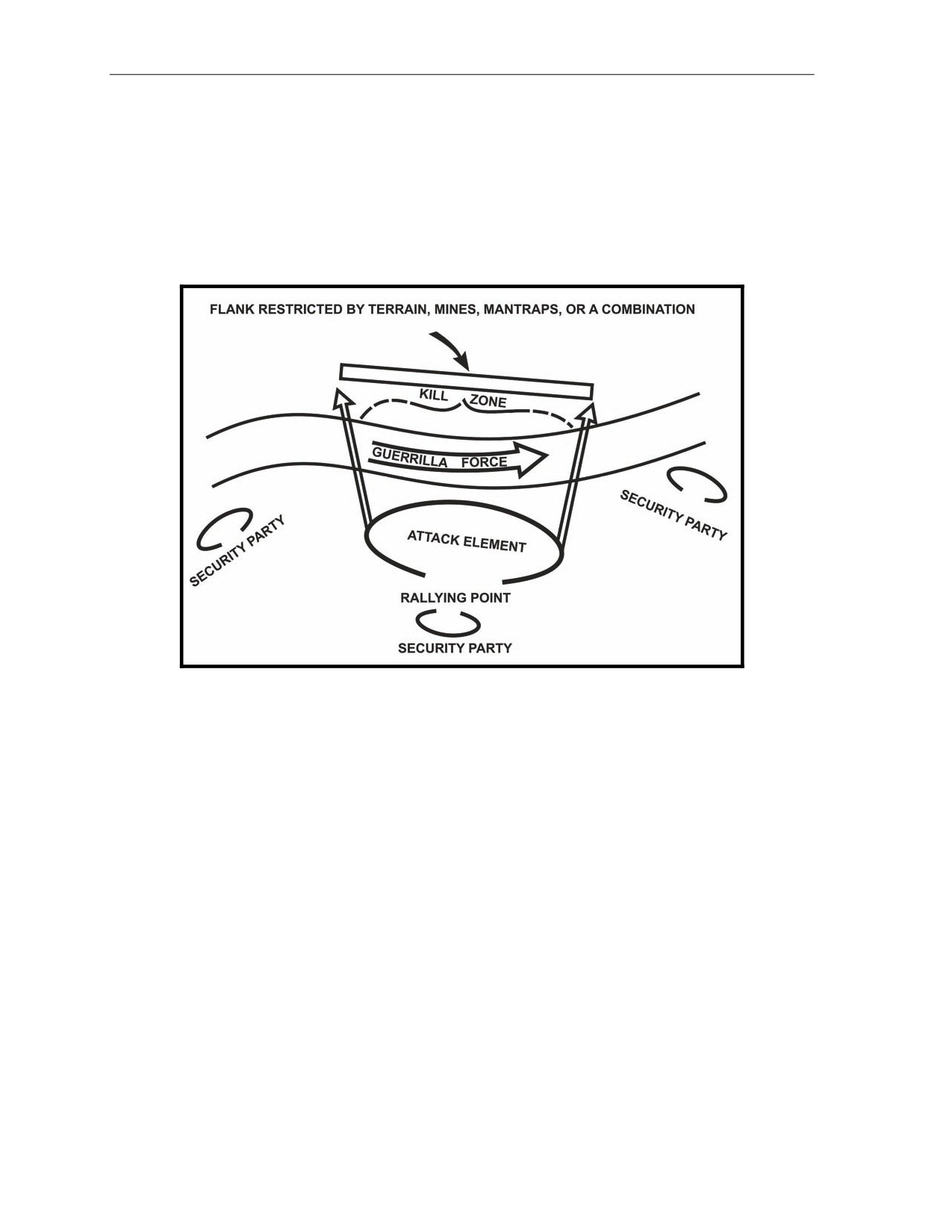
Chapter 5
Linear
5-163. In a linear ambush, the attack element is deployed generally parallel to the insurgent force’s route
of movement (road, trail, and stream). This positions the attack element parallel to the long axis of the kill
zone and subjects the insurgent force to heavy flanking fire (Figure 5-9). An advantage of the linear
formation is its relative ease of control under all conditions of visibility. The size of the force that can be
trapped in the kill zone is limited by the area the attack element can effectively cover with highly
concentrated fire. The force is trapped in the kill zone by natural obstacles, mines, booby traps,
or expedient devices, and direct and indirect fires.
Figure 5-9. Linear formation ambush.
5-164. A disadvantage of the linear formation is the chance that lateral dispersion of the force may be too
great for effective coverage. The linear formation is appropriate in close terrain that restricts insurgent
maneuver, and in open terrain where one flank is restricted by natural obstacles, mines, booby traps,
special-purpose munitions, or expedient devices. Similar obstacles and casualty producing systems can be
placed between the attack element and the kill zone to provide protection from insurgent counter ambush
measures. When a destruction ambush is deployed in this manner, access lanes are left so the force in the
kill zone can be assaulted. The line formation can be effectively used in a “rise from the ground” ambush
in terrain seemingly unsuitable for ambush.
L-Shaped
5-165. The L-shaped formation (Figure 5-10) is a variation of the linear formation. The long side of the
attack element is parallel to the kill zone and delivers flanking fire. The short side of the attack element
is at the end of, and at right angles to, the kill zone and delivers enfilading fire that interlocks with fire
from the other leg.
5-28
FM 3-24.2
21 April 2009
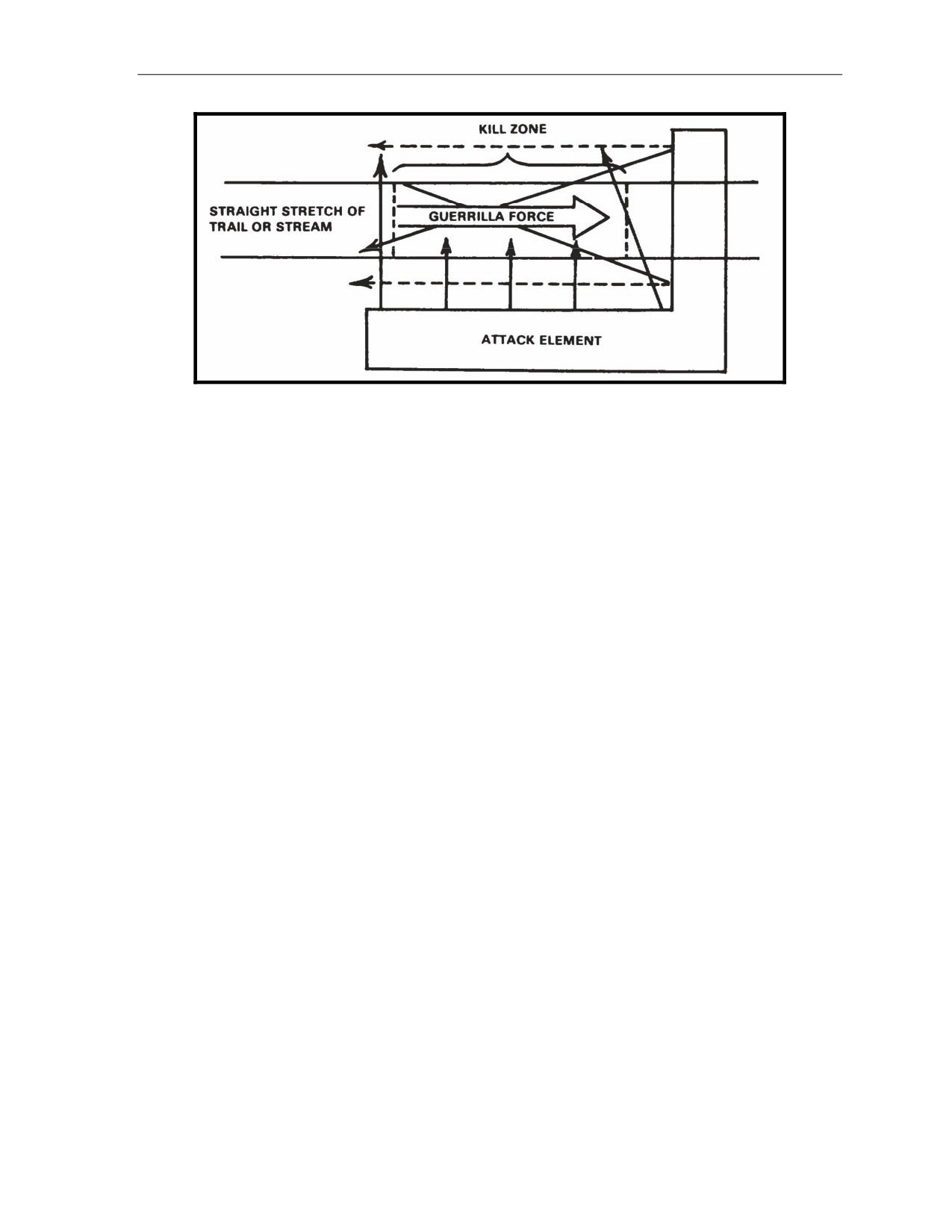
Offensive Considerations in Counterinsurgency
Figure 5-10. L-shaped formation ambush.
5-166. The L-shaped formation is flexible. It can be established on a curving stretch of a trail, near a
stream, or at a sharp bend in a trail or stream. When appropriate, fire from the short leg can be shifted
to parallel the long leg if the insurgent force attempts to assault or escape in the opposite direction.
In addition, the short leg prevents escape in that direction or reinforcement from that direction. Positive
means of controlling fires, such as aiming stakes, are needed to prevent the fire from one leg hitting
Soldiers positioned on the other leg.
Other
5-167. Other traditional ambush formations that are highly METT-TC dependent and usually better for
rural operations, include the following:
Z-Shaped Formation
5-168. The Z-shaped formation is a variation of the L-formation. The attack force is deployed as in the
L-formation, but with an additional side so that the formation resembles the letter Z. The additional side
may serve to engage a force attempting to relieve or reinforce the guerrillas, restrict a flank, prevent an
envelopment of the ambush force.
T-Shaped Formation
5-169. In the T-shaped formation, the attack element is deployed across, and at right angles to, the route
of movement of the hostile force so that the attack element and the target form the letter T. This formation
can be used day or night to establish a purely harassing ambush. It can be used at night to interdict
movement through open, hard-to-seal areas.
V-Shaped Formation
5-170. The V-shaped attack element is deployed along both sides of the insurgent route of movement so
it forms a V. Care is taken to ensure that neither group fires into the other. The V-formation is suited
for open terrain, but can also be used in the jungle.
Triangle Formation
5-171. The triangle is a variation of the V-formation that can be employed in three ways. The most
common technique is the closed triangle. The attack element is deployed in three groups, positioned so that
they form a triangle. An automatic weapon is placed at each point of the triangle and positioned so it can be
shifted quickly to interlock with either of the others. Elements are positioned so their fields of fire overlap.
Mortars may be positioned inside the triangle. When deployed in this manner, the triangle ambush becomes
a small unit strongpoint that is used to interdict night movement through open areas when insurgent
strategy is likely to be from any direction. Advantages include ease of control, all-round security,
21 April 2009
FM 3-24.2
5-29
Chapter 5
and guerrillas approaching from any direction can be fired on by at least two automatic weapons.
Disadvantages include the requirement for an ambush force of platoon size or larger to reduce the danger
of being overrun by a large guerrilla force; one or more legs of the triangle may come under guerrilla
enfilade fire; and lack of dispersion, particularly at the points, increases danger from guerrilla mortar fire.
Box Formation
5-172. The box formation is similar in purpose to the triangle ambush. The unit is deployed in four
elements positioned so each element becomes a corner of a square or rectangle. Advantages
and disadvantages are much the same as the triangle formation.
VARIATIONS
5-173. Common ambush variations during counterinsurgency operations include—
Baited Trap
5-174. A variation of the area ambush is the “baited trap” ambush. A central kill zone is established along
the insurgent’s avenue of approach. Point ambushes are established along the routes over which units
supporting or reinforcing the insurgent force will have to approach. The insurgents in the central kill zone
serve as “bait” to lure relieving or reinforcing insurgent units into the kill zones of the outlying ambushes.
Items such as infrastructure, sensitive equipment, caches, and security measures can be used as bait.
Spider Hole
5-175. This type of point ambush is designed for open areas that lack the cover and concealment
and other features normally desirable in a good ambush site. This technique is effective in less populated
rural areas or urban areas with subterranean. Concealed in a “spider hole," a type of covered and concealed
foxhole, the attack element is deployed in the formation best suited to the overall situation. Soil is carefully
removed and positions expertly camouflaged. This ambush takes advantage of the tendency of patrols
and other units to relax in areas that do not appear to favor ambush. The chief disadvantage of this
technique is that the ambush element’s vulnerability if compromised.
SNIPER OPERATIONS
5-176. Sniper operations are effective for both insurgent and counterinsurgent in the COIN environment.
Snipers, if employed correctly, are a COIN force multiplier and provide the commander an immediate
means to enter the insurgent decision cycle.
5-177. Small kill teams (SKTs), small observation teams (SOTs), and small capture teams (SCTs) differ
by task, manning, and equipment. SKT focuses on destroying of insurgent elements. SCTs focus on the
capture of those elements. SOTs are for reconnaissance. In COIN, more may be gained by capturing than
by killing the insurgent. However, SKTs can give commanders a deterrent to insurgent activity.
5-178. Sniper teams sometimes as part of SKTs, SOTs, or SCTs, are employed in populated urban areas
or large rural areas with adequate fields of fire. For mission success, all three teams employ specific point
and area weapons systems. All three also rely on redundant communications, marking materials, detailed
infiltration plans, exfiltration, mutual support, security, compromise contingencies, and engagement criteria
CONSIDERATIONS
5-179. Sniper employment in a COIN must be carefully considered. The infiltration or exfiltration
of snipers, SKTs, and SCTs must be meticulously planned with the understanding of the habits, behaviors,
and density of the local population. Besides the basic mission of precision fires and surgical elimination
of individuals, they are valuable for ISR collection, route and area security augmentation, countersniper
operations, and counter mortar or rocket operations. Compromise and contingency planning is critical
to sniper employment. Commanders base this detailed planning on a thorough analysis of the mission
variables with specific attention to terrain and civil considerations. Specific considerations using elements
of the mission variables are—
5-30
FM 3-24.2
21 April 2009
Offensive Considerations in Counterinsurgency
Mission
• Snipers must have clear engagement criteria and a thorough understanding of the ROE.
Engagement criteria must be refined so the individual sniper can make the correct engagement
decision while the target is engageable.
• Once an engagement area and a sniper position are identified, then leaders should determine a
mutually supporting position for a security team to occupy.
• Current and planned locations of sniper teams should be tracked by the headquarters
responsible for the area in which the snipers are operating. Often this means designating their
locations as a no fire area that can be tracked by all forces operating in the area to prevent
fratricide.
Enemy
• Sniper positions need to be defendable in case of compromise by the enemy.
Terrain and Weather
• Snipers, small kill teams, small observation teams, and small capture teams can aid
commanders in denying terrain and freedom of movement to insurgent elements while
providing security to sensitive or critical sites in both rural and urban areas.
Troops and Support Available
• In addition to a robust communications capability, commanders resource these elements with
linguists, medical personnel, surveillance equipment, and sustainment resources. The QRF
is typically involved in the detailed planning of these operations and can be deployed forward
to minimize reaction time.
• SKTs, SOTs or SCTs are task-organized with sniper-qualified personnel or squad designated
marksman, weapons squads, and specialty skills personnel. They may be comprised
of sniper-qualified individuals or squad designated marksman.
TECHNIQUES
5-180. All sniper operations in COIN should consider sniper positions, sniper security sniper insertion
and sniper extraction.
Positions
• Tactical leaders must continually analyze the OE for potential sniper team overwatch positions.
Leaders reconnoiter to determine the suitability of potential positions. Leaders reconnoiter
to determine the suitability of potential positions. When employing sniper teams, leaders ensure
each position provides mutual support against a threat.
• The insurgent often will engage from areas of passive support, and where he has a sense
of security. Detailed reconnaissance and accurate knowledge of the OE allows leaders
to recognize advantages and disadvantages of different positions and types of areas. There are
two basic areas for sniper positions in an urban environment—residential areas and industrial
areas. Both areas include the use of elevated positions or ground level positions. Roofs are not
always the best place to operate since roofs are often not the highest location in the area and are
often wide open with little cover. Successful position selection techniques in COIN are—
Rent Uninhabited Dwellings or Other Structures
• Teams are careful not to establish a pattern or expose the property owner to the insurgency.
Owners may compromise the snipers.
Positions in Locally Occupied Homes
• Teams, however, must consolidate the family in one part of the house with a security element.
When exfiltrating the residence, compensation should be provided to the owner.
21 April 2009
FM 3-24.2
5-31
Chapter 5
Stay-Behind Opportunities
•
Teams may have the opportunity to achieve surprise if insurgents attempt to return to areas
after another counterinsurgent unit has conducted an operation.
Security
•
Sniper teams should move with a security element (squad or platoon) whenever possible. This
allows the teams to reach their area of operation faster and safer than if alone. The security
element also protects snipers during operations. When moving with a security element, snipers
follow these guidelines:
The leader of the security element leads the sniper team.
Snipers must appear to be an integral part of the security element. To do so, each sniper
carries his weapon system in line with and close to his body to hide the weapon's outline
and barrel length. Snipers also conceal from view all sniper-unique equipment (optics
and ghillie suits).
Sniper uniforms must be the same as that of security element members.
Snipers and element members maintain proper intervals and positions in the element
formation.
Infiltration
•
The key to sniper infiltration is undetected occupation of hide positions. An insertion may be
as simple as a drop off in close proximity and moving dismounted to the position. It can be
as complex as conducting a cordon and search/knock and leaving a stay-behind team. Planning
considerations for insertion include the mission variables and a detailed understanding of the
terrain and people. Planning considerations include—streetlights, barking dogs, nightlife
establishments, insertion vehicle noise (HMMWV engines, vehicle ramps hitting the ground),
and local nationals who may sleep on their roof or outdoors during hot summer months.
Exfiltration
•
Exfiltration is just as important; snipers do not want to compromise a position you may want
to use again in the future. The amount of time spent in a Sniper Position is dependent on the
situation. Sniper teams should have a preplanned emergency exfiltration route to a safe zone,
known by all supporting elements. The snipers can withdraw dismounted, during hours
of limited visibility, to a designated rally point, where the QRF can retrieve them
•
Some units use a quick reaction force (QRF) as a means of reinforcement or emergency
extraction, as well as maintaining or regaining contact with insurgents engaged by the snipers.
When properly employed, the US sniper teams can contribute significantly to the fight by
overwatching key areas, serving as an economy of force, eliminating insurgents, and causing
uncertainty within the insurgents. For further information on conventional sniper employment
techniques, see FM 3-21.11.
COIN PATROLS
5-181. A patrol is a detachment sent out by a larger unit to conduct a combat or reconnaissance
operation. A patrol may be a fire team, squad, platoon, or company. Conventional patrolling doctrine
applies to counterinsurgency operations, but some modifications must be made to account for the
insurgent’s activities and the operational environment. Aggressive patrolling in an area greatly reduces the
insurgents’ freedom of movement, disrupts operations, and weakens their influence on the local population.
Furthermore, Patrolling becomes more significant in counterinsurgency operations because of the difficulty
in locating and identifying insurgent forces. This section discusses the important role patrols play
in defeating the insurgent force. There are two types of patrolling in COIN operations: Reconnaissance
patrols and combat patrols. Patrols are an integral part of clear-hold-build operations, strike operations,
and PRC operations.
5-32
FM 3-24.2
21 April 2009
Offensive Considerations in Counterinsurgency
CONSIDERATIONS
5-182. Specific considerations using elements of the mission variables for COIN patrols are—
Mission
5-183. Leaders must brief all patrol members as to the task and purpose of the operation. Every COIN
patrol has a task and purpose that is nested within one of the LOEs.
5-184. Leaders must plan patrol routes carefully and coordinate in detail with higher, lower, and adjacent
units, to include Host Nation security forces, aviation elements, fires, ISR elements, and reserve forces. All
patrols conduct rehearsals and a patrol brief at a minimum.
Enemy
5-185. Small-unit patrols are more effective than larger unit patrols against insurgent activities. This is
because they can cover more territory than a large unit, and are more difficult to track and predict. This
keeps the insurgent off balance.
Terrain and Weather
5-186. Patrol leaders must learn and know the routes, terrain, and weather implications on the HN
population, the counterinsurgent, and the insurgent. For example, urban patrol techniques will differ from
rural patrol techniques.
Troops and Support Available
5-187. Communication between patrol vehicles, riflemen, and higher headquarters is essential. Within the
patrol, radios, data transfer devices, voice commands, and visual signals may be used. Vehicular-mounted
radios and data systems are usually the best means for communication within the patrol and to higher
headquarters. Aircraft may be used to relay radio messages for long distance patrol communication. Blue
Force Tracker text messages or single channel TACSAT provide excellent means of maintaining long haul
communications.
5-188. Tactical units may be involved in patrolling in one of three ways: patrol as a complete unit;
provide subordinate unit for patrols (as directed by higher), or send out patrols to support their own
operation. Normally, the planned action at the objective determines the type of the patrol, usually
categorized as either combat or reconnaissance. Patrols may be mounted or dismounted or a combination.
Civil Considerations
5-189. Patrols are often the easiest way for tactical units to engage the HN population across
multiple LOEs.
Mounted Patrols versus Dismounted Patrols
5-190. Patrols may be mounted or dismounted. Mounted patrols allow greater coverage of distances than
dismounted patrols but sacrifice interaction with the populace and the opportunity to conduct more
effective information engagements. Mounted patrols can operate in insurgent controlled areas too
dangerous for dismounted patrols while carrying more or heavier equipment, weapons, and ammunition.
5-191. Dismounted patrols can be physically demanding and patrol members must be in good shape.
Additionally, contact with insurgents in close combat is physically demanding. The patrol leader ensures
patrol members carry only mission essential equipment.
5-192. A mounted patrol is prepared in the same manner as a dismounted patrol. Leaders ensure vehicles
are mechanically fully mission capable and properly supplied with fuel, oil, ammunition, and water.
Drivers and other personnel receive the same patrol brief as dismounted patrol members.
5-193. A mixture of mounted and dismounted patrolling can provide greater flexibility. The dismounted
element can interact with the population. The mounted element provides increased firepower,
communications, and CASEVAC.
21 April 2009
FM 3-24.2
5-33
Chapter 5
Urban Patrols
5-194. The basics of patrolling remain the same in both urban and rural environments; however, the
differences between the urban and the rural environment require specific patrol considerations. Urban areas
have a high population density and patrols must be prepared for population related incidents. The
population may interact with the patrol in many ways, such as asking for medical attention
or demonstrating against the presence of the patrol itself. Basic urban patrolling consideration include—
• While contact with insurgents may happen, contact with elements of the population is certain.
• If available, armored vehicles should be ready to rapidly reinforce urban patrols to provide
additional firepower.
• At least one Soldier in each squad or team should be dedicated to scanning the rooftops
and upper level windows.
• Actions at a halt must include 360-degree security. Soldiers should seek cover and face out.
Cover in an urban environment may be a light pole, a building corner or even a parked car.
• Urban patrols should thoroughly scan the far side of all open areas, since insurgents will use
them to achieve stand-off.
• If contact is likely, then the patrol should move by bounds. Moving by bounds, with one
element overwatching another element, is used in urban terrain just as in rural terrain.
• React to contact in an urban environment often includes the basic elements of a cordon
and search. Once contact is made, return fire is initiated and simultaneously the area should be
cordoned to prevent the insurgent’s escape.
Combined Patrols
5-195. The combined patrol is a patrol conducted with Host Nation security forces and US units.
They are an important piece in increasing the legitimacy of the HN government and improving the skills
of the HN security forces.
Mutual Support
5-196. Commanders consider mutual support when task-organizing forces and assigning areas
of operations. Mutual support is support units render each other against an enemy, because of their
assigned tasks, their position relative to each other and to the enemy, and their inherent capabilities (JP
1-02). Mutual support has two aspects: supporting range and supporting distance.
Supporting Range
5-197. Supporting range is the distance one unit may be geographically separated from a second unit yet
remain within the maximum range of the second unit’s weapons systems (FM 3-0). It depends on available
weapons systems and is normally the maximum range of the supporting unit’s indirect fire weapons. For
small units such as squads, sections, or platoons, it is the distance between two units that their direct fires
can cover effectively. If one unit cannot effectively or safely fire in support of the other unit, they may be
out of supporting range even though their weapons have the requisite range.
Supporting Distance
5-198. Supporting distance is the distance between two units that can be traveled in time for one to come
to the aid of the other. It is a function of terrain and mobility, distance, enemy capabilities, friendly
capabilities, and reaction time. During counterinsurgency operations, commanders should always consider
supporting distance. Units maintain mutual support when one unit can draw on another unit’s capabilities
for support.
TYPES OF PATROLS
5-199. There are two types of patrols:
5-34
FM 3-24.2
21 April 2009
Offensive Considerations in Counterinsurgency
Reconnaissance Patrols
5-200. This type of patrol collects information and confirms or disproves the accuracy of information
previously received. They are used to locate insurgent units and base camps, to reconnoiter specific
locations, locate leaders, and gather intelligence. Reconnaissance patrols provide the commander with
timely, accurate information of insurgents, the population, and the terrain. This information is vital
in making tactical decisions. Leaders must ensure that no pattern is established that would allow an
insurgent force to ambush reconnaissance units. Reconnaissance patrols are further classified into two
types.
Route Reconnaissance Patrols
5-201. These are a form of reconnaissance that focuses along a specific line of communication, such as a
road, railway, or cross-country mobility corridor. It provides new or updated information on route
conditions, such as obstacles and bridge classifications, insurgent and civilian activity, and traffic patterns
along the route. A route reconnaissance includes not only the route itself, but also all terrain along the route
from which the insurgent could influence the friendly force’s movement.
Zone Reconnaissance Patrols
5-202. These are conducted to obtain information on enemy, terrain, people, and routes within a specified
zone. The commander may require information of an extended area, or may desire information of several
locations within an area. A zone reconnaissance patrol secures this information by reconnoitering the area,
maintaining surveillance over the area, or by making the coordinated area reconnaissance of designated
locations within the area.
Area Reconnaissance Patrols
5-203. This is conducted to obtain information on a specific location or small specific area, usually a
known or suspected position or activity. An area reconnaissance patrol secures this information by
reconnoitering the location or by maintaining surveillance over the location.
5-204. In addition to reaching the objective without discovery, a reconnaissance patrol also tries
to conduct its reconnaissance or surveillance without being discovered. Stealth, patience, and maximum
use of concealment are mandatory. A reconnaissance patrol must be prepared to fight to protect itself.
5-205. Continual technological improvements have a significant impact on reconnaissance abilities.
Sensors and video cameras can be emplaced to be remotely monitored. Computer and electronic
technology must be leveraged to extract information from a wide array of technological systems.
Day and Night Patrols
5-206. These use about the same techniques as other patrols. The main differences are—
• Day Reconnaissance requires greater use of concealment. The patrol is more likely to be seen
than at night and usually will not be able to move as close to the objective.
• Night Reconnaissance requires stealth. Sounds carry farther at night, and reduced visibility
usually requires a closer approach to the objective.
Combat Patrols
5-207. In counterinsurgency operations, the term security patrol has often been used; however, this is still
a combat patrol. A combat patrol provides security and harasses, destroys, or captures enemy troops,
equipment, and installations. A combat patrol also collects and reports information, whether related to its
mission or not. Combat patrols in a counterinsurgency include raids, ambushes, security, saturation,
and satellite patrols. Regardless of the name, all counterinsurgency combat patrols have the general mission
of seeking out and attacking targets of opportunity.
Raid and Ambush Patrols
5-208. Raids and ambushes were discussed earlier in Chapter 5.
21 April 2009
FM 3-24.2
5-35
Chapter 5
Security Patrols
5-209. The difference between a security patrol and a raid or ambush patrol is that combat activity is not
the primary mission of the security patrol. This is true even if combat is expected during the patrol.
Security patrols normally seek to control critical roads and trails, maintain contact between villages
and units, provide security for friendly forces, provide security in rural areas, and interdict insurgent routes
of supply and communication.
Saturation Patrols
5-210. This is when units use numerous combat patrols to saturate an area of suspected insurgent activity
by moving over planned and coordinated routes, which are changed frequently to avoid establishing
patterns. Saturation patrols are extremely effective against insurgents. Use of saturation patrols results in
the following:
• Denial of an area to an insurgent force as it seeks to avoid contact with the saturation patrols.
• Ability to harass insurgent forces.
• Opportunity to discover insurgent forces.
• Chance to gain an intimate knowledge of the area of operations.
• Chance to reassure the local population that the government provides protection and security.
Satellite Patrols
5-211. This patrol technique adds depth to a patrol, deters ambushes, and provides patrols with a
maneuver element on enemy contact. Figure 5-11 shows a satellite patrol moving through a built-up area.
5-212. The satellite patrol uses a base unit to control smaller units, or satellites, that leave and return to
the base unit. The advantage of this technique is the unpredictability, to the enemy, of the route, size,
locations, and the patrol’s overall axis of advance. Satellite patrols are given either an area or an axis
of movement. As with all other patrols, they should have a specific task and purpose. Units have specific
requirements including—
Organization
5-213. At a minimum, the patrol has one base and one satellite unit.
Size
5-214. The size of the base unit and satellites is METT-TC dependent. Normally, a satellite unit consists
of either a squad or a fire team. All units must be able to defend themselves until reinforcements arrive.
Command and Control
5-215. The base unit is under the direct control of the senior leader and must have radio communications
with each of the satellites units. This facilitates control and actions if contact is made. The base unit sets the
pace and maintains the general direction of the patrol. Controlling multiple small satellite patrols is difficult
and requires an experienced leader and excellent communications.
5-36
FM 3-24.2
21 April 2009
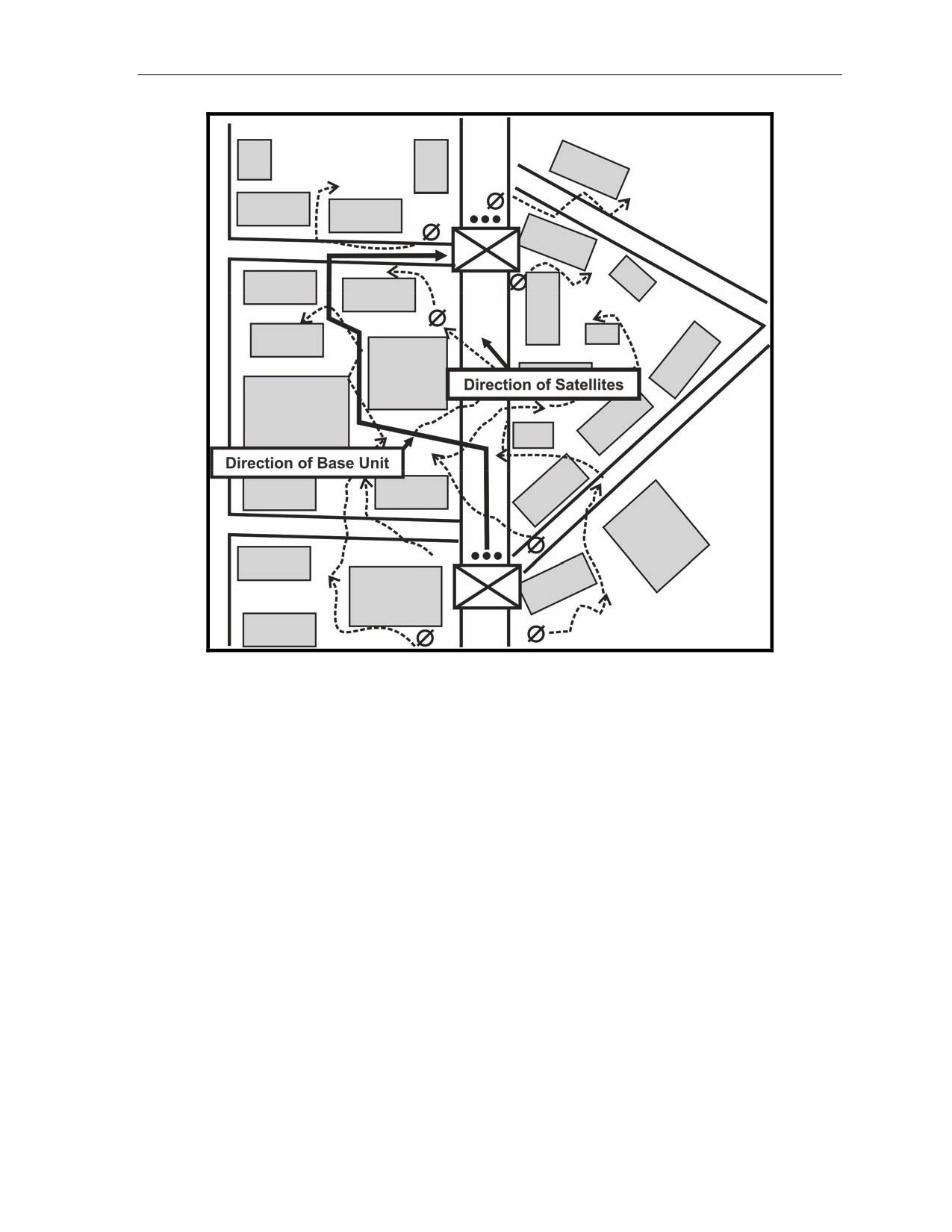
Offensive Considerations in Counterinsurgency
Figure 5-11. Satellite patrol movement.
Movement
5-216. All units must know the overall route and if possible, left and right boundaries. Both the base unit
and the satellite units move in ways to confuse the enemy as to the patrol’s actual axis of advance.
Standard movement techniques are still used. Satellites move away from the base unit for limited periods
of time to inspect potential ambush sites, dead spaces, parallel roads, or other assigned missions. The time
that the satellite is separated from the base unit should be prescribed by the patrol leader prior to departure.
Training
5-217. Units may experience initial difficulty with this technique because of the dispersed, unpredictable,
and seemingly random movement of the satellite patrols. To properly execute the technique, units must
train and practice.
Actions on Contact
5-218. The unit in contact reacts normally. All other units move towards the unit in contact. The satellite
patrol leader coordinates, as needed, their routes, actions, and linkup.
Patrol Debrief
5-219. One of the best ways to turn information into intelligence is to conduct a patrol debrief following
every patrol. When the patrol is over, the unit has not completed its mission. The leader must ensure that
all the information collected during the patrol is turned over to the appropriate staff section for evaluation.
Additionally, all patrol members must be debriefed to collect any information not already identified. The
unit must also conduct an after-action review of the entire mission from start to finish. The unit must record
21 April 2009
FM 3-24.2
5-37