FM 3-24.2 TACTICS IN COUNTERINSURGENCY (APRIL 2009) - page 2
Chapter 2
2-8.
Guerrillas may continue in their normal positions in society and lead clandestine lives for the
insurgent movement. Guerrillas tend to organize themselves based upon the activity they will be
conducting. Those focused on using terrorism usually operate individually or in small cells and are often
armed with explosives instead of weapons. Guerrilla bands, historically, have lived in remote areas
and conducted raids on HN government infrastructure. Historical examples of guerrillas include the
Maquis in World War II France, the Viet Cong in the Vietnam War and the Mahdi Army in Iraq.
UNDERGROUND
2-9.
The underground is a cellular organization of active supporters of the insurgency, which may
contain an element that works in the HN government. Keeping the nature of their work for the insurgency
secret is often paramount to them. They are more engaged than the auxiliaries are and may at times be
guerrillas, if they use weapons or conduct combat operations. They operate in all areas; especially in areas
denied to any established guerrilla force and where operations are not suitable for guerrilla forces.
They conduct clandestine, covert, and overt operations, sometimes infiltrating the HN government.
Members of the underground often continue in their normal positions in society, but lead second,
clandestine lives for the insurgent movement. Some insurgencies are unique in that they conduct most
of their political activities inside the underground while a different section trains recruits, maintains
propaganda, and helps in population control. The underground may—
• Spread propaganda.
• Support sabotage, assassination and subversion.
• Support intelligence and counterintelligence operations.
• Run safe houses.
• Provide transportation.
• Manufacture and maintain arms and explosives.
AUXILIARIES
2-10.
An auxiliary is the support element of the insurgency. Auxiliaries are active sympathizers who
provide important logistical services but do not directly participate in combat operations. If they participate
in guerrilla activities, they become guerrillas. Auxiliaries may work full time or part time for the
insurgency and generally conduct safer activities than the underground. They often include women,
children and other individuals that tend to be less scrutinized by counterinsurgent forces. Examples
of auxiliaries include shepherds or street merchants that may openly operate near a counterinsurgent base
and provide intelligence on that site. Examples of support that auxiliaries provide include—
• Store weapons and supplies.
• Perform courier operations.
• Provide passive intelligence collection.
• Give early warning of counterinsurgent movements.
• Acquire funds from lawful and unlawful sources.
• Provide forged or stolen documents.
• Promote and facilitate desertion of security forces.
• Recruit and screen new members.
• Create and spread propaganda.
• Provide medical support.
• Manufacture and maintain equipment.
MASS BASE
2-11.
The mass base consists of the population of the state who are sympathetic to the insurgent
movement. This sympathy varies between the specific elements within the population such as religious
and ethnic groups and within those specific elements themselves. This mass base, by default, passively
2-4
FM 3-24.2
21 April 2009
Foundations of Insurgency
supports the insurgency. As occasions arise, they may provide active support. Leaders often recruit
members of the mass base, who are more actively oriented, to serve as auxiliaries, underground
or guerrillas. Mass base members are the true silent supporters of the insurgency and are often the most
available for the HN government to positively influence.
EXAMPLE
2-12.
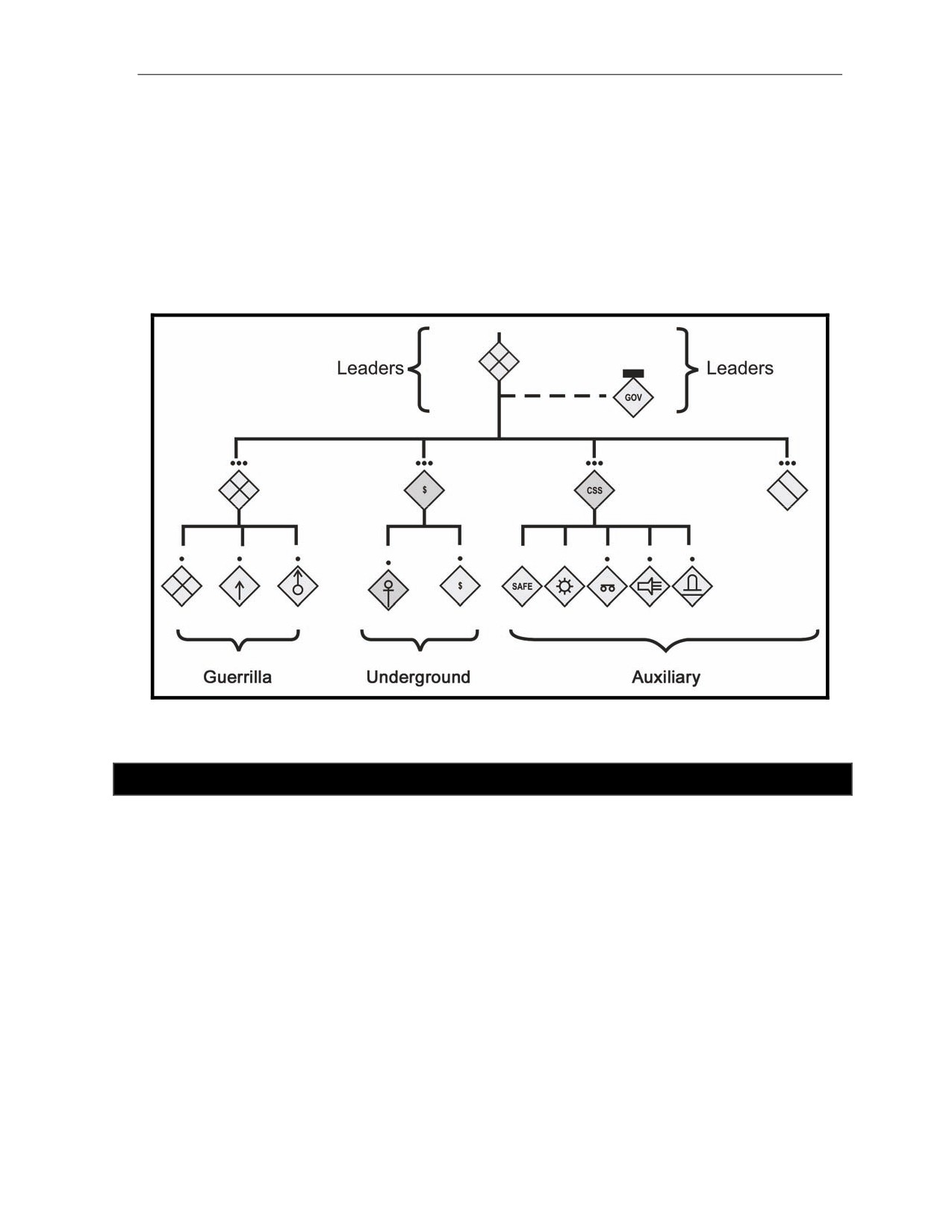
Although no two insurgencies or insurgent organizations are alike, they still have elements that
can be identified and some form of hierarchy. Figure 2-4 shows an example insurgent organization with a
developed structure. In this insurgency, the underground finances the insurgency.
Figure 2-4. Example insurgent organization.
Section III—DYNAMICS
Insurgencies are political movements that result from real or perceived grievances, or neglect that leads
to alienation from an established government. Eight dynamics are common to an insurgency. Knowing
and understanding these dynamics helps to understanding the insurgency. The eight dynamics are leadership,
objectives, ideology, environment and geography, external support, internal support, phasing and timing,
organizational and operational patterns.
LEADERSHIP
2-13.
Insurgent leaders provide vision, direction, guidance, coordination, organization for an insurgent
movement. Successful insurgent leaders use, interpret and shape the frustrations of a dissatisfied populace
into the insurgent strategy. They often provide solutions to grievances by advancing alternatives to existing
conditions that support the insurgency. Effective insurgent leaders make their cause and solutions known to
the people to gain popular support. Individual leaders of an insurgency are often members of the elite
of society who have been somehow alienated from the power structure. Their education, background,
family connections, social standing, and experiences contribute to their ability to organize and inspire the
people who makeup the insurgency. To be successful, they must break the ties between the people and the
government and establish credibility for their movement.
21 April 2009
FM 3-24.2
2-5
Chapter 2
STRUCTURE
2-14.
In general, there are three categories of leadership found in insurgencies. They are—
Single person
2-15.
One person may be the overall leader of an insurgency. This leadership structure has one person
who provides cohesion, motivation, and direction for the insurgency. Cuba’s Fidel Castro is an excellent
example of a single person leadership structure. However, this single leader may centralize power
or decentralize decision-making and execution, leaving decision-making and execution to subordinates. At
the local level, most units will see organizations controlled by a single person.
Single group or party
2-16.
The insurgency may be headed by a ruling council that makes and executes policy. This
leadership group or party may also control other groups involved in the insurgency. China’s Communist
Party, before the ascendancy of Mao, is an example of a group leading an insurgency.
Group of groups
2-17.
Different groups that have different concepts of how the country should be governed make up the
leadership. Under this kind of leadership, there will be many leaders, possibly unified only by their
opposition to the government. They compete with each other and the government. Example: The partisan
forces in Yugoslavia and Greece during World War II were united in their fight against the German
occupation, but ranged from monarchist to democratic to communist. Sometimes, they fought each other
more violently than they did the Germans.
2-18.
As a group, insurgent leaders operate in either a decentralized or centralized manner.
Decentralized
2-19.
The power base of some insurgencies is collective and does not depend on specific leaders
or personalities to be effective. These insurgencies are easier to penetrate, but recover rapidly when they
lose key personnel. Decentralization restricts an insurgency in its ability to function as a coherent body
and to create a viable counter state. However, decentralized insurgencies are very hard to destroy and can
continue to sow disorder, even when degraded. For example, Al Qaeda in 2008 is a loose, decentralized
organization held together by an ideal of re-establishing the Caliphate.
Centralized
2-20.
Other organizations depend on a single, often charismatic personality to provide cohesion,
motivation, and direction. Centralized insurgencies make decisions and initiate new actions rapidly.
However, they are vulnerable to disruptions if key personalities are removed, co-opted, discredited,
or eliminated. These insurgencies are often led by traditional authority figures such as tribal sheikhs, local
warlords, and religious leaders. For example, Tecumseh was the major factor in the creation of Shawnee
confederation. After he was killed in battle, the confederation fell apart.
IDENTIFICATION OF KEY LEADERS
2-21.
Identifying leaders can be critical in determining an insurgency’s organizational structure,
strategy, and tactics. Understanding the basic beliefs, intentions, capabilities, and vulnerabilities of known
key leaders is extremely important to countering insurgency. Removing these key leaders will normally
degrade an organization’s capabilities. Che Guevara was a well-known, centralized leader that
counterinsurgents effectively targeted, when he was killed, his insurgency fell apart. Alternately, in the
case of the decentralized leader Abu Musab al-Zarqawi, his organization, Al-Qaeda in Iraq, although
severely disrupted, continued as a functioning organization after his death. The following information
is vital to understand and target an insurgent leader:
2-6
FM 3-24.2
21 April 2009
Foundations of Insurgency
• Role.
• Activities.
• Associates.
• Personal background.
• Personal beliefs, motivations, and ideology.
• Education and training.
• Temperament.
• Position within the organization.
• Public popularity.
OBJECTIVE
2-22.
Insurgencies normally seek to achieve one of three objectives: to overthrow the existing
government in order to reallocate power, to expel whom they perceive to be “outsiders” or “occupiers," or
to seek to create or maintain a region where there is little or no governmental control that they can exploit.
Insurgents’ objectives include struggles for independence against colonial powers; the rising up
of political, ethnic, or religious groups against their rivals; and resistance to foreign invaders. The central
issue in an insurgency is the reallocation of power. Usually, an insurgency mounts a political challenge to
the existing state through the formation of a counter state, which is promoted as an alternative to the
existing state.
2-23.
Understanding the root causes of the insurgency is essential to analyzing the insurgents’
objectives. Effective analysis of an insurgency requires knowing its strategic, operational, and tactical
objectives. These objectives can be psychological in nature, physical in nature or a combination of the two.
STRATEGIC
2-24.
The insurgent’s overall political goals are their strategic objectives. The set of required conditions
that define achievement of the insurgents’ objectives are their desired end state. Examples of strategic
objectives include—
• Overthrow an established government.
• Establish an autonomous national territory.
• Cause the withdrawal of a foreign occupying power.
• Extract political concessions.
OPERATIONAL
2-25.
Insurgent operational objectives are those that insurgents pursue to destroy government legitimacy
and progressively achieve their political end state. These are the means they use to link tactical goals with
strategic end states. They often target the government’s inability to address the root causes that lead to the
insurgency. The insurgent’s operational objectives define their overall plan, although most insurgents will
not have a formal plan. These objectives are based on the insurgent’s strategy across political, military,
economic, and social objectives. Examples of operational objectives include—
Political
2-26.
Disrupt elections; develop or strengthen an insurgency’s political wing, attack government
legitimacy; gain recognition of their political party by the government; attack the legitimacy of the
government; or gain ability to run candidates for elected office
Military
2-27.
Disrupt operational lines of communication and supply routes; force US or HN units out of an
area; keep government forces in their bases; draw US or HN forces into fight; or provoke over-reaction
from US or HN forces, which result in media-reported civilian casualties.
21 April 2009
FM 3-24.2
2-7
Chapter 2
Economic
2-28.
Disrupt reconstruction and attack infrastructure; thereby preventing the government from
addressing root causes; prevent government from addressing the populace’s issues.
Social
2-29.
Spark sectarian violence; subvert education system; cause population to question the government;
highlight corrupt or oppressive police; or establish a regular means for mass communication
(radio
or paper).
TACTICAL
2-30.
Tactical objectives are the immediate aims of insurgent acts such as disseminating propaganda
such as posters, compact discs and handbills, killing individuals, or the attack and seizure of key facilities.
Tactical objectives can be both physical and psychological aspects. Counterinsurgents can often gain
insight into tactical goals by analyzing the insurgent propaganda. Examples of tactical objectives include—
Political
2-31.
Intimidation of a local official or the dissemination of propaganda products.
Military
2-32.
Attack a US or HN government convoy or checkpoint or random indirect fire attacks on bases.
Economic
2-33.
Attack manufacturing centers, stores and markets; sabotage roads, bridges, electrical lines
and pipelines. Threaten violence against storeowners, employees and customers.
Social
2-34.
Attack a police station or directly interact with the population in order to communicate directly to
the populace.
GENERAL INSURGENT GOALS FOR TERRORISM AND GUERRILLA WARFARE
2-35.
Insurgents typically work toward achieving ten general objectives as they gain the support of the
population. Insurgent activity, like all other aspect of the insurgency, develops and evolves over time.
Obtaining Popular Support
2-36.
Insurgent operations are normally focused directly or indirectly at decreasing support to the
existing government. Simultaneously, competent insurgents try to gain support for the insurgent movement
through propaganda, coercion, or by causing terror. If they cannot gain active support, they will seek
passive support such as silence.
Undermining Host Nation Legitimacy
2-37.
Insurgent efforts can damage or destroy both real and perceived economic and political targets.
The loss of government services, overreaction by government forces, or the belief that the government
is powerless against the insurgency contributes to the population’s dissatisfaction with the government.
Lessening Government Control
2-38.
By defeating small government forces, remaining government forces can be forced to consolidate
in larger size elements or bases. This can reduce the overall presence of the counterinsurgent forces
and allow an insurgent force to operate openly where counterinsurgent forces are not, if even for a short
2-8
FM 3-24.2
21 April 2009
Foundations of Insurgency
amount of time. This can create the perception that the insurgency is increasing its control or the
government is losing control and legitimacy.
Providing Psychological Victories
2-39.
The guerrilla seeks to gain small psychological victories. These victories do not need to be
significant in terms of material damage to the government or its armed forces. These tactical victories show
that a small guerrilla force can defeat the much larger government force.
Tying Up or Blocking Host Nation Government Resources
2-40.
By forcing the HN government to expend resources on military operations against guerrillas, the
insurgency seeks to tie up resources that could best be used by the government to provide services
and development programs to the populace.
Weakening Host Nation Government Resolve
2-41.
By defeating small elements of the HN’s security forces and attacking government agencies, the
guerrilla weakens the resolve of government employees and forces. Small government forces and agencies
become aware of their vulnerability. Desertion, absence from work, willingness to compromise, difficulty
in recruiting, or limitations on services to dangerous areas all benefit the insurgency’s purpose.
Intimidating the Population
2-42.
By attacking vocal opponents and certain types of individuals, such as teachers, the insurgents
seek to frighten the population.
Acquiring Supplies and Equipment
2-43.
Guerrillas seek to acquire government weapons, uniforms, equipment, supplies, or vehicles.
Infiltrating Host Nation Government and Government Forces
2-44.
Insurgents will often attempt to infiltrate various government ministries and security forces by
emplacing sympathizers and by converting existing members of those agencies. These infiltrators are used
to gather intelligence and to subvert operations.
Causing COIN Security Force Overreaction
2-45.
Since a COIN fight is the fight for the population, often the intent of insurgents using terrorism
or guerrilla warfare is to cause a heavy-handed response to attacks on the part of the COIN force or HN
security force. These responses will often drive the population to support the insurgency.
IDEOLOGY
2-46.
Insurgents often use their ideology to show the population how they can address the root causes
that the government cannot provide or is not providing. Insurgent ideology attempts to provide a vision
of how a society, including a political and economic system, should be structured. Ideology should not be
confused with the insurgent strategy, which is the way that the insurgents intend to achieve their end state.
Two of the most identifiable insurgent ideologies have been communism and religious extremism.
2-47.
Ideology is a motivating factor in insurgent activities. Insurgencies can gather recruits and amass
popular support through ideological appeal, which includes religious or other cultural factors. The
insurgency’s ideology explains its followers’ difficulties and provides a means to remedy those ills. The
most powerful ideologies tap latent, emotional concerns of the populace. Tactical units could see ideology
expressed in the propaganda and recruitment techniques of local insurgents.
21 April 2009
FM 3-24.2
2-9
Chapter 2
COMMUNISM
2-48.
Communism is a political system where private property is eliminated and controlled by the state.
Historically, it has been advocated in countries where wealth is unevenly distributed among the classes.
Communism was once the most typical form of insurgent ideology and often experienced success. With the
fall of Soviet Union, communism has not been a successful motivation for insurgents, especially since
there is currently little or no external support for communist-based insurgency.
RELIGIOUS EXTREMISM
2-49.
Religious extremism, often a byproduct of religious fundamentalism, can be defined by strict
adherence to a set of religious principles and the rejection of compromise. These ideologies are often
energized by inequities in social, political or economic development and further helped by
counterinsurgent attempts to marginalize religious issues. Globalization creates opportunities for an
increase in religious extremism based on both real and perceived inequities. Insurgencies based on
religious extremism want their values incorporated into the nation’s governmental structure. This fulfills
the frustration and dissatisfaction of the religious extremists. Adherents often receive formal instruction on
the religion’s fundamentals and use adherence to these fundamentals as a recruiting tool. Religious leaders
are often leaders of the insurgency and nonextremist leaders are often replaced. Characteristics
of insurgencies motivated by religious extremism that differ from traditional insurgencies are—
• Individual duty with an indifference to popular support.
• Use of violence that maximizes shock, awe, and casualties.
• Disinterest with governance and lack of a practical political objective in organizations with
global reach or establishing a theocracy in local cases.
• Ability to regenerate guerrillas without popular support.
NARRATIVE
2-50.
The central mechanism through which ideologies are expressed and absorbed is a narrative.
A narrative is when a story is used to display the benefits of a certain ideology. Narratives are often central
to representing identity, particularly the collective identity of religious sects, ethnic groupings, and tribal
elements. Stories about a community’s history provide models of how actions and consequences are linked.
Stories are often the basis for strategies and actions, as well as for interpreting others’ intentions. Insurgent
organizations use narratives and religious-based concepts very effectively in developing, spreading,
and mobilizing followers.
2-51.
In the Al Qaeda narrative, Osama bin Laden shows himself as a man purified in the mountains
of Afghanistan who is gathering and inspiring followers and punishing infidels. In the collective
imagination of Bin Laden and his followers, they are agents of Islamic history who will reverse the decline
of the umma [Muslim community], reestablish the Caliphate, and bring about its inevitable triumph over
Western imperialism. This image mobilizes support for Al Qaeda among some of the most traditional
Muslims.
ENVIRONMENT AND GEOGRAPHY
2-52.
Environment and geography, including cultural, religious, tribal affiliation, and other
demographic factors along with terrain and weather, affect all participants in an operational environment.
How insurgents and counterinsurgents adapt to these realities creates advantages and disadvantages
for each. In Chapter 1, this manual stressed the importance of understanding an AO’s civil considerations
(ASCOPE). Considerations for environment and geography include—
• Population density and distribution, especially degree of urbanization
• Root causes of the insurgency within an urban population, such as lack of basic services,
security, markets, governance, municipal council representation, or schools.
2-10
FM 3-24.2
21 April 2009
Foundations of Insurgency
• Root causes that lead to the insurgency within a rural population, such as lack of land
ownership, grazing rights, water rights, isolation or inclusion in political process, access
to markets, or schools.
• Growing seasons, rainy/dry seasons, planting/harvest time (key events). These may influence
level and type of insurgent activity.
• Use of structures and infrastructures by both the insurgent and population.
• Tribal, religious, or other affiliations, which may have tremendous effect on the local
populace’s willingness to support an insurgency, or where people and insurgents can expect
sanctuary or will avoid.
• Proximity to international borders that may provide sanctuary or support.
• Rugged, inaccessible terrain with often hostile populations to outsiders that may provide
sanctuary or support.
• Economic enclaves, such as slums, market areas, middle class areas, and wealthy areas.
• Geographic divisions along ethnic, tribal, religious, political or other factors.
EXTERNAL SUPPORT
2-53.
External support includes moral support, political support, resource support, or sanctuary support.
External support can come from any entity outside of the Host Nation—not just neighboring states.
Countries from outside the region seeking political or economic influence can also support insurgencies.
Insurgencies may turn to transnational criminal elements for funding or use the Internet to create a support
network. Ethnic or religious communities in other states may also provide a form of external support
and sanctuary, particularly for transnational insurgencies. Access to external support influences the
effectiveness of insurgencies.
2-54.
Accepting external support can affect the legitimacy of both insurgents and counterinsurgents.
The act of acceptance implies the inability to sustain oneself. In addition, the country or group providing
support attaches its legitimacy along with the insurgent group it supports. The consequences can affect
programs in the supporting nation wholly unrelated to the insurgent situation.
MORAL SUPPORT
2-55.
Moral support is the acknowledgement that the insurgent or their cause is just and admirable. It
starts as outside popular approval and can manifest with negative media attention focused towards the
counterinsurgent or Host Nation. Moral support often leads to political, resource, and sanctuary support.
POLITICAL SUPPORT
2-56.
Political support is the active promotion of insurgents’ strategic goals in international forums.
International forums such as the United Nations, trade sanctions and embargoes, and the creation
of political discussion in the Unites States can all provide political support, which negatively influences the
counterinsurgent’s effort. Another form of political support can come when a legitimate state actually
recognizes an insurgent group as a legitimate authority. Political support is the most dangerous form
of support as it can result in an insurgency gaining international legitimacy, forcing the counterinsurgent
to stop actively targeting them.
RESOURCE SUPPORT
2-57.
Resource support is typically guerrillas, money, weapons, equipment, food, advisors, and training.
Resource support is often the most important form of support, such as, during the French experience
in Algeria. Although insurgents were numerous, weapons were not, because the French closed
international borders, preventing arms smuggling.
21 April 2009
FM 3-24.2
2-11
Chapter 2
SANCTUARY SUPPORT
2-58.
Sanctuary support is a secure site to train, obtain sustainment, rest and refit. Historically,
sanctuaries provided insurgents a place to rebuild and reorganize without fear of Host Nation
or counterinsurgent interference. Often these were in neighboring countries or remote areas difficult
to access. Sanctuaries may also include areas within a state, including neighborhoods where HN security
forces cannot or will not conduct operations. The meaning of the term sanctuary is evolving. Today,
insurgents can draw on “virtual” sanctuaries in the Internet, global financial systems, and the international
media. These virtual sanctuaries can be used to present insurgent actions as acceptable activities worthy of
internal and external support. Effective COIN operations work to eliminate all sanctuaries.
INTERNAL SUPPORT
2-59.
Internal support is any support provided from inside the country. It is normally broken down into
the two general categories: popular and logistical support. Together, these two form the mass base. For the
purposes of this manual, one other category is added—insurgent bases.
POPULAR SUPPORT
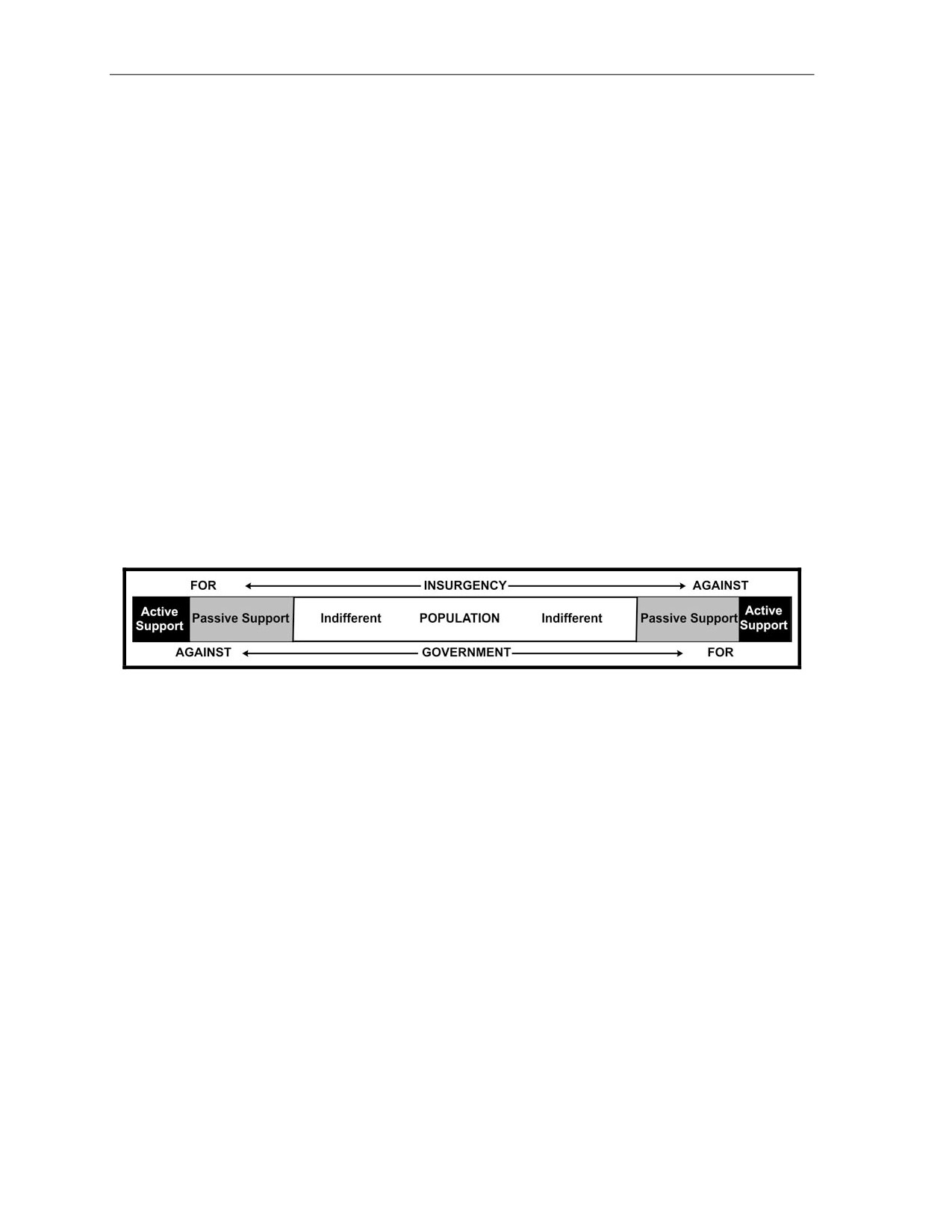
2-60.
An insurgent movement requires popular support (Figure 2-5) to survive, and popular support
is even more essential for an insurgency to succeed. Typically, there is also a relationship between the
amount of popular support and the size of the insurgency. To grow, an insurgency needs an adequately
sized mass base that will support this growth. One of the best means of defeating insurgencies is to shrink
this mass bass by causing the local population to become hostile or at least apathetic toward the insurgents.
Figure 2-5. Range of popular support.
Types of Support
2-61.
Popular support can be either active or passive and may come from only a small segment of the
population or from a broad base of the population. Supporters of an insurgency may also be overt
or clandestine.
Active Support
2-62.
Active supporters provide open sympathy to the movement, participate in legal insurgent
activities, such as strikes, find new recruits, and may transition to being an active element of the insurgency
such as guerrillas, underground, or auxiliary. Active supporters are usually central to the insurgency’s
propaganda efforts.
Passive Support
2-63.
Passive supporters vary from those who are sympathetic yet inactive to those who are not
sympathetic, but who choose to remain silent about insurgent activities. Silence on the part of the populace
concerning insurgent activities provides passive insurgent support.
2-12
FM 3-24.2
21 April 2009
Foundations of Insurgency
Recruitment
2-64.
Local insurgent representatives address local grievances and conduct recruiting. Elements of the
population who are dissatisfied with existing conditions or those who have been marginalized through
psychological alienation are prone to insurgent recruitment. The cadre often gives credit to the insurgent
movement for all local successes and blames government forces for all failures and problems. Every
promise and appeal made by cadre members is associated with tangible solutions and deeds. Competent
insurgents and counterinsurgents both seek to mobilize and sustain popular support for their cause while
discouraging popular support for their adversaries. There are five common methods, used individually or
in various combinations, to mobilize popular support. Knowing these five means provides an opportunity
for the counterinsurgent to identify when they are being used and then counter them. The five common
methods are—
Persuasion
2-65.
Political, social, religious, security, and economic promises can often entice people to support one
side or the other.
Coercion
2-66.
Through threat of violence or abuse, insurgents can force people to support them. Citizens seek
to ally with groups that can guarantee their safety.
Reaction to Abuses
2-67.
Though firmness by security forces is often necessary to establish a secure operational
environment, a tyrannical government can generate resistance to its rule.
Foreign Support
2-68.
Foreign governments can provide the expertise, international legitimacy, and money needed
to start or intensify a conflict.
Apolitical Motivations
2-69.
Insurgencies attract foreign volunteers, criminals, and mercenaries who are often motivated by
money or extremism.
Measurement
2-70.
The reality of insurgencies is that the support of the population fluctuates between the government
and the insurgency due to many factors, but no one side will ever possess the support of the total
population. Trying to quantify why the populace favors the government or the insurgency is difficult, but
evaluating the issue is important. Gauging aspects such as the reaction of a local populace to the presence
of troops or government leaders can help estimate popular support at the tactical level. Asking the
population directly or using surveys can produce valuable insight into popular support and attitudes.
LOGISTICAL SUPPORT
2-71.
Modern warfare is inherently resource intensive. The insurgent needs to ensure continual access
to supplies, weapons, ammunition, and money, and this requires insurgents to maintain open supply lines.
While logistical support may be an insurgent’s greatest vulnerability, it can be difficult to interdict. As an
insurgency develops and expands, logistical support increasingly relies on external sources. In a
conventional war, insurgent forces often receive significant amounts of supplies from external sources—
usually from one of the opposing nations involved in the conflict. The protracted popular war strategy
emphasizes mobilization of the masses and requires considerable resources to build and maintain a counter
state. The urban strategy requires significantly less support.
21 April 2009
FM 3-24.2
2-13
Chapter 2
Supplies
2-72.
Once the insurgent’s on-hand supplies are exhausted, supplies must come from the populace or an
external source. In most insurgencies, initial support comes from the populace
(either voluntarily
or coerced). Identifying types of supplies the insurgency needs and then discovering how the insurgent
is obtaining these supplies are significant steps in the process of identifying insurgent supporters
and insurgent bases. Medical supplies are often the most critical supply that the insurgency requires.
Weapons and Ammunition
2-73.
External sources are often required to sustain specialized arms and equipment. Insurgents can
obtain these weapons through legal or illegal purchases, or from foreign sources. Another common tactic
is to capture weapons from government forces.
Money
2-74.
Money is essential to an insurgency for the purchase of critical supplies, especially high-tech
weapons and ammunition or bomb making materials. Money is also essential for the payment of guerrillas
and the bribery of corrupt officials. Money can be obtained through many sources and in today’s electronic
world, it crosses all boundaries. While money is often shipped to insurgents just like other supplies, it may
also be moved and held by local financial institutions. In some cases, insurgencies develop an
“underground banking” system, sometimes known as hawala, which can be used to launder money. Just
like supply lines, the money path must be discovered, tracked, and disrupted. Funding greatly influences an
insurgency’s character and vulnerabilities. Local supporters or international front organizations may
provide donations. Sometimes legitimate businesses are established to furnish funding. In areas controlled
by insurgents, confiscation or taxation might be used, especially in cases when insurgencies provide their
own essential services to the population. Another common source of funding is criminal activity, especially
the illegal trade of drugs.
Supply Lines
2-75.
In all cases, either the insurgents must go to their suppliers, or the suppliers must come to the
insurgents. Discovering and tracking these supply lines can provide key information on insurgent forces
and support. Although rarely overt, all insurgent organizations will have some system of supply lines,
means of transportation, and storage facilities. Skillful counterinsurgents attempt to cut off the flow
of supplies, especially weapons and ammunition. Often, a nation neighboring an insurgent AO is used as a
depot.
INSURGENT BASES
2-76.
In counterinsurgencies, there are two general types of insurgent bases: safe houses and guerrilla
base camps. Insurgents will normally establish multiple safe houses of guerrilla camps based upon
functioning groups or cells. Urban insurgents tend to use safe houses, while rural insurgents tend use
guerrilla base camps. Additionally, training camps may be established. These training camps may be
established within a safe house; however, they normally will be established either in a rural guerrilla base
camp or outside the territory controlled by the existing government, often in a foreign country.
Safe Houses
2-77.
Many legitimate and illegitimate organizations use safe houses. A safe house is typically occupied
by a member of the auxiliary and temporarily used to hide insurgents. Normally a system of “safe houses”
have been carefully selected. The occupant of the safe house has procedures to move insurgents along
selected routes at the best times to avoid detection.
Guerrilla Base Camps
2-78.
Like any other armed force, guerrillas have requirements for command and control, rest, resupply,
refit, and training. The larger the guerrilla force and more active they are, the more they will need
2-14
FM 3-24.2
21 April 2009
Foundations of Insurgency
established bases, both semipermanent and temporary. Base camps must be relatively safe and secure
in areas where insurgents can rest, eat, and plan. More sophisticated guerrilla base camps have command
posts, training areas, communications facilities, medical stations, and sustainment centers. These base
camps, however, are not the same as conventional bases. They are usually small in overall scope, spread
out, and sometimes underground. Insurgents try to locate base camps within insurgent-controlled areas
where cover and concealment provide security against detection. In rural areas, base camps tend to be
in remote areas characterized by rough, inaccessible terrain. In urban areas, base camps tend to be located
in areas where the insurgent has popular support. Urban insurgents may rent houses for use as temporary
base camps. Insurgents will normally avoid battling over their base camp. Once detected, they will move
to an alternate location. Routes into a base camp will be constantly observed for security. Mines, booby
traps, special-purpose munitions, expedient devices, and ambushes are used as standard security
enhancements. If surprised and cornered, they will vigorously defend themselves with a delaying action
while evacuating key personnel and equipment.
Insurgent Training Camps
2-79.
Insurgent training camps are established both in urban and rural environments. While some
training is accomplished at urban safe houses or rural guerrilla base camps, most training is accomplished
at locations focused on training. This may be a special urban safe house, a remote guerrilla base camp or an
insurgent training center in another country.
PHASING AND TIMING
2-80.
Insurgencies often progress through three phases in their efforts. While the use of these three
phases is common in most writings concerning insurgencies, the titles used for these three phases vary
considerably. However, what makes up each phase remains nearly identical.
Phase I—Latent and Incipient
2-81.
The first phase of an insurgency tends to begin with the government having stronger forces than
the insurgents do. As a result, insurgents often must concentrate on survival and building support.
Insurgent efforts may include—
• Establishing and expanding the organization
• Spreading its ideology through information operations
• Starting or supporting antigovernment activity such as demonstrations and strikes
• Raising funds through illegal taxation and crime
• Organizing small, local guerrilla forces that conduct small-scale intermittent operations
• Using terrorism and sabotage to intimidate uncooperative government officials and members
of the population
Phase II—Guerrilla Warfare
2-82.
The second phase of an insurgency starts when force correlations approach equilibrium
and guerrilla warfare becomes the most important, pervasive activity. Insurgent efforts may include—
• Increased scale of guerrilla attacks; attempt to force government forces into the defense.
• Increased use of sabotage and terrorism.
• Intensified propaganda.
• Attempts to gain control of isolated geographic areas and develop bases for further operations.
• Government officials are being driven out of areas with strong insurgent support.
• Establishment of local shadow governments.
• Increased efforts to gain international recognition and support.
21 April 2009
FM 3-24.2
2-15
Chapter 2
Phase III—War of Movement
2-83.
The third phase of an insurgency normally begins when insurgents believe they have superior
strength and their military forces attempt conventional operations to destroy the government’s military
capability. Insurgent efforts may include—
• Combining guerrilla forces and training them to fight as conventional forces. Over time, these
conventional forces form multiple echelons. These forces confront the counterinsurgents
in conventional battle.
• Acquiring more powerful and sophisticated weapons through foreign assistance or capture.
• Obtaining support from external combat forces, such as special or conventional forces.
• Expanding areas of insurgent control and increasing political activity.
2-84.
Not all insurgencies progress through all three phases, and linear progression through all three
phases is certainly not a requirement for success. Insurgent success can occur in any phase. Also,
insurgencies can revert to an earlier phase and resume development when favorable conditions return.
Insurgent success can occur in any phase.
2-85.
Movement from one phase to another phase does not end the operational and tactical activities
of earlier phases; it incorporates them. Therefore, it is difficult to determine when an insurgency moves
from one phase to another. In addition, a single insurgency may be in different phases in different parts of
the country. Advanced insurgencies can rapidly shift, split, combine, or reorganize—they are dynamic
and adaptive.
ORGANIZATIONAL AND OPERATIONAL PATTERNS
2-86.
Insurgencies develop organizational and operational patterns from the interaction of many factors.
Although each insurgency organization is unique, there are often similarities among them and knowing the
commonly accepted general patterns or strategies of insurgency helps in predicting the tactics
and techniques they may employ against the government. Other considerations include the operational
environment, level of success of the insurgency, and the length of time an insurgency has been operating.
A counterinsurgent must learn about the insurgency and adapt to it based off its operational
organizational patterns.
2-87.
Insurgent organizational and operational patterns vary widely between one province or urban area
and another. Different insurgent groups using different methods may form loose coalitions when it serves
their interests. These groups may also fight among themselves. The result is more than just a “three-block
war”—it is a shifting, “mosaic war” that is difficult for counterinsurgents to envision as a whole. In such
situations, an effective COIN strategy must be multifaceted and flexible. Insurgents gain ground by sowing
chaos and disorder anywhere. Counterinsurgents lose ground by failing to maintain stability order
everywhere. Insurgents normally begin substantially weaker than the established government. This sets the
tone for how they operate and how they fight
Section IV—STRATEGIES
Even if modern insurgencies use more than one doctrinal model or theory for their strategy, aspects of these
strategies and recognizable characteristics do exist. The six common insurgent strategies are urban,
military-focused, protracted popular war, identity-focused, conspiratorial, and composite and coalition. At the
tactical level, a counterinsurgent will deal usually only with the urban, military-focused, and protracted popular
war strategies. These insurgent strategies provide a common frame of reference for the counterinsurgent. The
savvy counterinsurgent can identify if an insurgency is using one or a combination of the strategies. Knowing
what strategy the insurgents are using facilitates the anticipation of insurgent courses of action (COAs).
2-16
FM 3-24.2
21 April 2009
Foundations of Insurgency
URBAN STRATEGY
2-88.
In the urban strategy, the insurgents attack government targets with the intention of causing
government forces to overreact against the population. The insurgents want the government’s repressive
measures to enrage the people so they will rise up, support the insurgency and overthrow the government.
This strategy can be initiated without popular support. Its success relies almost exclusively on a
spontaneous uprising sparked by rage at government oppression. However, an insurgency occurring in an
urban area does not necessarily mean that it uses the urban strategy. On November 1, 1954, the National
Liberation Front in Algeria used a form of the urban strategy when they launched a series of bombings
and attacks, causing significant civilian casualties, in order to shock the French into negotiations. The
urban strategy actions are often predictable and possess these characteristics—
• Insurgents often use terrorist attacks, which they hope are highly visible and produce high
casualties. Their true intention may not necessarily be to cause fear or terror, but to provoke the
government into overreaction.
• Insurgent propaganda tends to focus on government brutality, calling attention to specific harsh
government actions such as massacres, torture of political prisoners, disappearances
of individuals, and brutal responses to peaceful demonstrations.
• Insurgent political organization is minimal with no sustained effort to indoctrinate political
cadre or the masses.
• Insurgents make little or no effort to subvert the government from within (however, infiltration
of HN government and security forces still possible.
• Insurgents require only a small amount of popular support.
MILITARY-FOCUSED STRATEGY
2-89.
The military-focused strategy believes that military action can create the conditions needed
for success. Military-focused insurgents often believe that a small group of guerrillas operating in an area
where grievances exist can eventually gather enough support to achieve their aims. The success of this
small group depends upon successful military action and popular uprising. The most iconic examples
of military-focused strategy are Che Guevara and Fidel Castro; both proposed attacks on military
and government targets until they gathered the support necessary to seize power. Military-focused strategy
actions include—
• Attacks on Host Nation targets to gain popular support.
• Propaganda that incites people to join the insurgency and rise up against the government
and that focuses on demonstrating the Host Nation Government’s weakness and illegitimacy.
• Little evidence of long-term efforts at building a political base.
• Little effort to building the political wing or infiltrating legitimate organizations.
PROTRACTED POPULAR WAR STRATEGY
2-90.
The protracted popular war strategy is based on Mao Zedong’s theory of protracted popular war.
This strategy is broken down into three distinct phases—latent or incipient, guerrilla warfare, and war
of movement. Each phase builds upon the previous phase, and continues activities from the previous
phases. The protracted popular war strategy has both a political wing and a military wing. This strategy
requires a high level of organization and indoctrination, actions along multiple lines of effort,
and leadership to direct the shifting of phases according to circumstances. In all the variations of this
strategy, certain characteristics tend to stand out, such as—
• Continuous, long-term efforts to build popular support, infiltrate legitimate government
organizations, and establish and maintain a clandestine organization.
• Highly-indoctrinated leadership, political cadre, and guerrilla fighters.
• Extensive, well-organized, unarmed auxiliary.
• Leadership that is able to exert control over the insurgency.
21 April 2009
FM 3-24.2
2-17
Chapter 2
• Ability to shift phases at the direction of its leadership; including return to previous phase
if necessary.
• Attacks on infrastructure and attacks designed to wear down the government
and counterinsurgents.
• Continuous operations along multiple lines of effort, although some phases will emphasize
different lines of effort.
IDENTITY-FOCUSED STRATEGY
2-91.
The identity-focused strategy mobilizes support based on the common identity of religious
affiliation, clan, tribe, or ethnic group. In this strategy, legitimacy and popular support are tied to their
identity and, often, no effort is made to garner popular support outside their identity. Rather, communities
often join the insurgent movement as a whole, bringing with them their existing social or military
hierarchy. External support is garnered from international elements of the same identity. In Sri Lanka, the
Tamil Tigers have fought an insurgency against the government for decades in order to establish an ethnic
Tamil state and, at times, have received support from India. Contemporary characteristics of the
identity-focused strategy include—
• Attacks on those who threaten the traditions and social structure of the identity.
• Little or no need to establish a shadow government; already established.
• Protects what it considers the interest of the identity.
• Willingness to use tactics of other strategies.
• Mass base easily aligns with insurgency objectives.
CONSPIRATORIAL STRATEGY
2-92.
The conspiratorial strategy attempts to subvert the government from within and often involves a
few leaders and a militant cadre. Although subversive activities may take place in other strategies,
particularly in the protracted popular war or urban strategies, conspiratorial strategies often attempt to have
its illegal political party become a legitimate political party, enter the government legitimately and then
take control of the government. Insurgents using the conspiratorial strategy do not intend to integrate into
the national government, but to overthrow the government. Once the insurgency succeeds in gaining
legitimate political representation, the newly legitimized politicians, who may have been previously
targeted by counterinsurgents, must be re-evaluated to see if they are still legitimate targets. In the Russian
Revolution in 1917, the Bolshevik Party actively worked to break existing government, while being elected
to serve in the administration. Distinguishing characteristics of this strategy include—
• Insurgents seeking meetings with HN government to discuss ceasefires.
• Attacks on infrastructure designed to wear down and reduce the credibility of government.
• Political cadre distancing itself from the insurgency by making public statements denouncing
violence, yet the insurgent leadership still controls the cadre.
• A public breach between militant and political elements of the insurgency, although this
is often a deception.
• Formation of new alliances, often with groups that seem to have little in common with the
insurgency or its ideology apart from the desire for governmental change.
• An end or reduction in guerrilla activity with an increase in political activity.
• Intensive efforts to gain international moral and political support.
• Using sophisticated propaganda, aimed at specific target audiences.
• Insurgent political wing seeks recognition and entry into politics, including election to local,
district, departmental, regional, or national offices.
2-18
FM 3-24.2
21 April 2009
Foundations of Insurgency
COMPOSITE AND COALITION STRATEGY
2-93.
The composite and coalition strategy applies when different insurgent groups using different
strategies combine to form loose coalitions that serve the purposes of the different groups. However, the
composite and coalition strategy is usually united in opposition to something, for example an occupier or
specific grievance, rather than for a positive objective. Within a single AO, there may be multiple
competing entities, each seeking to maximize its survivability and influence. Recently, Al—Qaeda in Iraq
provides the best example of a composite and coalition strategy; they founded the Islamic State of Iraq
and became an umbrella group for many other established insurgent groups. Contemporary actions of the
composite and coalition strategy include—
• Unclear or vague objective.
• Multiple or disjointed strategies within a single area of operations.
• More likely to ally with criminal actors.
• Attacks on other members of the coalition.
SHIFTS BETWEEN STRATEGIES AND PHASES
2-94.
Insurgencies often operate using different strategies, in different phases, in different geographical
areas. These decisions are based on the operational environment and insurgent objectives. Most
insurgencies eventually move to the protracted popular war or subversive strategy after another strategy
proves unsuccessful.
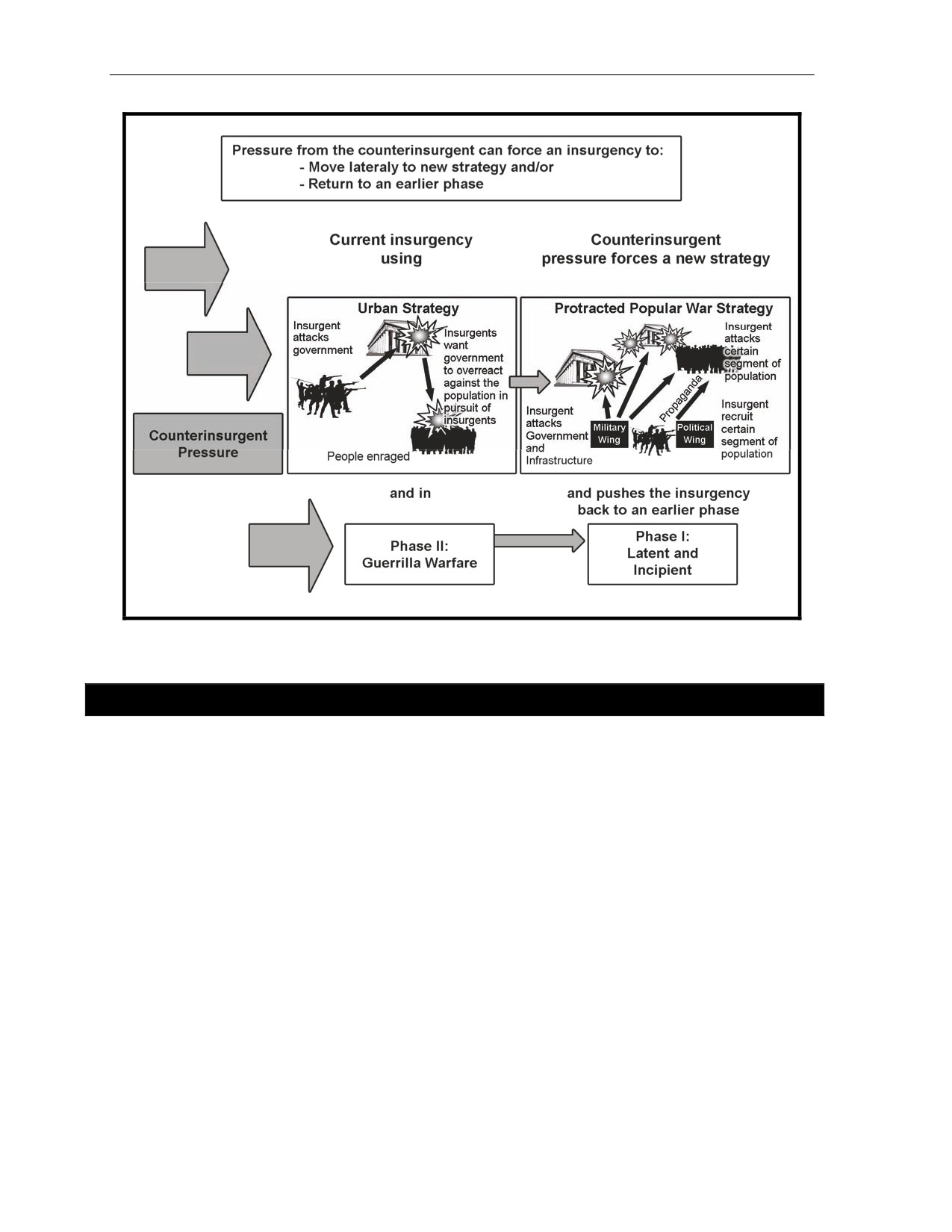
2-95.
Insurgencies can also shift both phases and strategy. Pressure from the counterinsurgent can force
an insurgent to move laterally to a new strategy or return to an earlier phase (Figure 2-6). For example, an
insurgency in Phase I, Latent and Incipient, using an urban strategy, builds sufficient strength to progress
to Phase II, Guerrilla Warfare. Once in Phase II, the insurgents may believe they are strong enough
to initiate a series of attacks. Then, if counterinsurgents successfully drive out the insurgents, the insurgents
will normally consolidate and reorganize elsewhere. However, this failure may force the insurgency back
to Phase I in that area. Additionally, the insurgent leadership may transition from the urban strategy to a
protracted popular war strategy. When the insurgent leaders believe they are ready, the insurgency will
return to Phase II, Guerrilla Warfare.
2-96.
Insurgencies are often vulnerable when they shift between strategy or phases. These shifts may be
due to fractures within the insurgent leadership or setbacks. Shifts may also occur due to time, changes
in external support, changes in leadership, or counterinsurgent action. These shifts are often rapid so
counterinsurgents must be able to recognize and exploit them. Indicators of a shift in strategies may be:
• Changes in propaganda message content
• Uncharacteristic increase in communications
• Unexplained pauses or sudden increases in guerrilla attacks
• Shift of effort between urban and rural efforts
• Displacement of insurgents from one location to another
• Unanticipated statements of support from external actors for an insurgency
• Increased organization, indoctrination, and secure means of communications
• Increased efforts to infiltrate legitimate organizations such as trade unions, professional
or business organizations, universities, and so on.
• New advocacy for rights of peasants, farmers, or other groups
• Change of in focus of attacks, such as the targeting of a specific sector
21 April 2009
FM 3-24.2
2-19
Chapter 2
Figure 2-6. Shifts between strategies and phases.
Section V—TACTICS
Insurgencies employ both violent and nonviolent tactics to achieve their objectives. Nonviolent tactics attempt
to achieve political goals without the use of force. Insurgent violent tactics are often accompanied by a variety
of nonviolent tactics. Used together, these tactics, along with supporting propaganda, can assist in recruiting
and gathering popular support. Historically insurgencies have fielded dedicated personnel to foment nonviolent
action such as strikes and protests to supplement violent action. Insurgents are by nature an asymmetric threat.
Asymmetric Warfare is a conflict in which a weaker opponent uses unorthodox or surprise tactics to attack
weak points of a stronger opponent, especially if the tactics include terrorism, guerrilla warfare, criminal
activity, subversion, or propaganda. Violent tactics by insurgents can include terrorism, guerrilla warfare,
sabotage, or conventional operations. Insurgents often use terrorism and guerrilla tactics to achieve their goals,
because they do not have the capability to contest the government or counterinsurgency forces in conventional
operations.
VIOLENT TACTICS
2-97.
Violent insurgent tactics are normally characterized by elusiveness, surprise, and brief, violent
action. These tactics are often divided between terrorism and guerrilla warfare early in the insurgency.
In Phase III of the insurgency, it is common to see more conventional operations. There are three general
tactics available to insurgents that use violence—terrorism, guerrilla tactics, conventional tactics
and criminal activity. The challenge is that at any given time the insurgent could use any of them. For
clarity, the term ‘guerrilla’ applies to any insurgent forces performing any of these four types of violence.
2-20
FM 3-24.2
21 April 2009
Foundations of Insurgency
2-98.
Although violence can alienate the population when not linked to a vision of a better life or the
violence is indiscriminant, the commitment to use violence is a potent insurgent weapon. Targets
of violence can be anything insurgents deem to be obstructions to their cause. Host nation security forces,
foreign forces, aid workers, members of the population who do not accept insurgent claims,
and infrastructure are typical insurgent targets.
2-99.
Normally, organized groups of insurgents using terrorism or guerrilla warfare use violent tactics.
The differences between these two can become blurred, especially within an urban environment or where
the government exerts strong control. Although potentially nonviolent, criminal activity provides a ready
source of income for an insurgency and, for the purposes of this FM, has a violent nature. Violent tactics
include, but are not limited to (for more see FM 3-24):
• Ambushes.
• Assassination.
• Arson.
• Bombing and high explosives.
• Chemical, biological, radiological, or nuclear weapons.
• Hijacking and skyjacking.
• Hostage taking.
• Indirect fire.
• Kidnapping.
• Raids or attacks on facilities.
• Sabotage.
• Seizure.
TERRORISM
2-100. A terrorist is an individual who uses violence, terror, and intimidation to achieve a result (DOD).
Insurgents may use terrorism. Terrorist attacks employ violence primarily against noncombatants as a way
to increase the population's vulnerability and decrease their perception of security. Insurgent terrorism
techniques include assassination, arson, blackmail, bombings, hijacking, kidnapping, threats, murder,
mutilation, and torture. The insurgent using terrorism often targets economic and political symbols
to undermine the legitimacy of the government. Any overreaction by government forces or other
authorities adds to the population's resentment toward the government and turns its support to the
insurgency.
2-101. Insurgents using terrorism generally require fewer personnel than guerrilla warfare
or conventional operations. Inherently, these activities have greater security and lower support
requirements. Insurgents using terrorism often select targets for their political and psychological impact.
Their attacks can be effective in generating popular support within one faction when used against a
competing faction. They can also be effective in forcing government reaction that alters government
policies to benefit insurgent objectives.
GUERRILLA TACTICS
2-102. Guerrilla tactics are typified by hit-and-run attacks by lightly armed, small groups. The guerrilla is
the combat element of the insurgency. Guerrilla tactics emphasize ambushes, raids, snipers, rocket
and mortar attacks, and the use of explosive devices. Guerrilla tactics may also include assassination,
coercion, and kidnapping to achieve support or eliminate opposition.
Principles
2-103. The principles of guerrilla tactics as stated by Mao Zedong are still valid: “Enemy advances, we
retreat. Enemy halts, we harass. Enemy tires, we attack. Enemy retreats, we pursue.”
21 April 2009
FM 3-24.2
2-21
Chapter 2
2-104. Guerrilla operations are generally offensive, not defensive, and are often harassing in nature.
Guerrillas seldom attempt to seize and defend physical objectives and, in general, avoid decisive
engagement. Their overall aim is often to cause confusion, to destroy infrastructure or security forces,
and to lower public morale. Guerrilla harassment attempts to keep government forces on the defensive
and weaken the Host Nation, which can include destroying resources and disrupting lines
of communication. One advantage of harassment is that it may create the perception that the guerrilla can
strike anywhere and that the Host Nation cannot prevent it. Because of this, counterinsurgents the must not
only win small battles, but also win the battle of public perception. In rural areas, guerrillas may seize a
remote area or conduct raids and small-scale attacks on remote targets and lines of communications.
Numerical Superiority
2-105. While government forces outnumber the guerrilla, the guerrilla seeks to attain local numerical
superiority. If guerrillas can successfully concentrate against counterinsurgents, they can attain victory over
small elements of government forces. Guerrillas often use simple techniques of speed, surprise, maneuver,
and especially infiltration. Near the target area, small guerrilla elements will often mass in order to conduct
a specific, larger-scale operation. The baited ambush is a favorite guerrilla technique. Guerrillas often
create incidents, such as arsons, bombings, and hoaxes, as the bait. These baited ambushes can attempt
to lure small government forces of all types into a mechanical or manned ambush.
CONVENTIONAL TACTICS
2-106. Conventional operations are not always necessary for success; however, guerrillas may engage
in conventional operations after an insurgency develops extensive popular and logistical support. When
they feel the conditions are set, insurgents may generate a conventional military force that can directly
confront HN security forces. These conventional operations may vary from a small regional operation
to general conventional warfare. Large conventional operations are usually an attempt to obtain the
strategic or operational objectives.
CRIMINAL ACTIVITY
2-107. Sustainment requirements, especially funding, often bring insurgents into relationships with
organized crime or insurgents may turn to criminal activity themselves. Reaping windfall profits
and avoiding the costs and difficulties involved in securing external support makes illegal activity
attractive to insurgents. Taxing a mass base usually yields low returns and alienates the population,
especially in cases where the insurgency provides essential services to the population. In contrast,
kidnapping or hostage taking, extortion, armed robbery, and trafficking (drug, human, black market goods,
and so on)—four possible insurgent criminal activities—are very lucrative, although they also alienate the
population. The activities of the Fuerzas Armadas Revolucionarias de Colombia (FARC) are a perfect
example. The FARC often receives millions of US dollars from a single high-profile kidnapping. Similarly,
failed and failing states with rich natural resources like oil or poppies are particularly lucrative areas
for criminal activity.
2-108. Devoting exceptional amounts of time and effort to fund-raising requires insurgents
to shortchange ideological or armed action. Indeed, the method of raising funds is often at the heart
of internal debates within the insurgency. For example, the FARCs involvement in the drug trade has made
it the richest self-sustaining insurgent group in history; yet it continues to claim to pursue “Bolivarian”
and “socialist” or “Marxist-Leninist” ends. FARC activities have increasingly been labeled
“narco-terrorist” or, simply "criminal," by a variety of critics.
2-109. Many insurgencies have degenerated into criminality. This occurred as the primary movements
disintegrated and the remaining elements were cast adrift. Such disintegration is desirable for the
counterinsurgent. It replaces a dangerous, ideologically inspired body of disaffiliated individuals with a
less dangerous but more diverse body. This transition would mean the counterinsurgency would also
transition to more of a law-and-order approach. Successful counterinsurgents must recognize that the ideal
approach eliminates both the insurgency and any criminal threats.
2-22
FM 3-24.2
21 April 2009
Foundations of Insurgency
NONVIOLENT TACTICS
2-110. Successful insurgents use nonviolent tactics in conjunction with violent tactics. Subversion
and propaganda are the two most prevalent forms of nonviolent warfare. Although some subversive
activities can bleed over to violent activities, for the purposes of this FM, subversion will emphasize the
nonviolent activities that define the nonviolent nature of subversion. Nonviolent tactics include, but are not
limited to (for more see FM 3-24):
• Demonstrations
• Denial and Deception
• Hoaxes
• Infiltration
• Strikes
SUBVERSION
2-111. Subversion is action designed to undermine the military, economic, psychological, or political
strength or morale of a regime (DOD). In addition, Subversive activity is anyone lending aid, comfort,
and moral support to individuals, groups, or organizations that advocate the overthrow of incumbent
governments by force and violence (DOD). All willful acts that are intended to be detrimental to the best
interests of the government that do not fall into the categories of treason, sedition, sabotage, or espionage
are subversive activity.
2-112. Insurgents use various subversive techniques in their attempt to convince the populace to resist the
government and COIN forces and support their insurgency. These techniques include demonstrations,
boycotts, clandestine radio broadcasts, newspapers, and pamphlets. In addition, movement leaders organize
or develop cooperative relationships with legitimate political action groups, youth groups, and trade
unions. This approach develops popular support for later political and military activities. Subversive
activities often openly challenge, in an organized pattern and just short of violence, the control
and legitimacy of the established government and COIN forces.
2-113. One of the most visual forms of subversion is civil unrest. The fomenting of riots, organizing
of strikes, and staging of demonstrations can drain the power, presence, and capabilities of the government
and conversely increase the power and prestige of the insurgency. Another means of subversion
is infiltration of government organizations, political parties, labor unions, community groups, universities,
and charitable organizations.
2-114. To increase public credibility, attract new supporters, generate revenue, and acquire other
resources, insurgent groups may establish their own front groups. Front groups are organizations that
purport to be independent, but are in fact created and controlled by the leaders of the insurgency. A historic
example of a front group is the Sinn Fein. The Irish Republican Army (IRA) used Sinn Fein, their
“political wing” made up of political cadre, to serve as the IRA’s respectable public face.
PROPAGANDA
2-115. Insurgent groups commonly use propaganda to increase their base of support or reduce support
for COIN forces. The joint definition of propaganda is any form of communication in support of national
objectives designed to influence the opinions, emotions, attitudes, or behavior of any group in order
to benefit the sponsor, either directly or indirectly (JP 1-02). In this case, the insurgents use propaganda
to further their own ends.
2-116. The insurgent’s propaganda efforts use activities such as clandestine radio broadcasts, the
Internet, newspapers, graffiti and pamphlets that openly challenge the control and legitimacy of the
established government. Insurgents will search for any leverage they can use in their propaganda. This
includes seeking support based on the common identity of religious affiliation, clan, tribe, or ethnic group.
Additionally, insurgents often create new problems and reinforce existing problems they then can exploit.
Insurgents will arrange for the “coincidental” presence of photographers or cameras where planned events
21 April 2009
FM 3-24.2
2-23
Chapter 2
occur. If the government is unwilling or unable to address these problems successfully, the insurgency can
claim they will solve them. Common insurgent propaganda efforts include the following:
• Encouraging the HN populace or specific neutral parties to avoid supporting HN or other
friendly government’s forces.
• Increasing insurgent will to resist by fanning hatreds, biases, and predispositions.
• Inciting riots or organizing rallies, which may include honoring “martyred” insurgents.
• Causing or exacerbating a dislocated civilian crises.
• Creating or fostering public distrust of the HN security forces.
• Undermining the support of specific HN local leaders or businessmen.
• Creating or intensifying general ethnic or religious unrest or friction.
• Supporting or revitalizing dissident or opposition organizations.
• Linking local groups with similar groups in neighboring countries or regions.
• Discrediting or ridiculing specific HN or counterinsurgent officials.
• Characterizing government leaders as puppets and tools of foreign COIN forces.
• Spreading hostile coverage of COIN personnel, especially counterinsurgent mistakes.
2-117. Effective counterinsurgents must counter insurgent propaganda. This can be accomplished by
conducting information engagement (IE) to exploit inconsistencies in the insurgents’ propaganda and their
excessive use of force or intimidation. Additionally, counterinsurgents must have a coherent and unified
information engagement plan. This IE plan must be planned, prepared, and executed with input from all
appropriate civil and military agencies, especially the HN.
Section VI—STRENGTHS AND VULNERABILITIES
Understanding insurgents’ typical strengths and vulnerabilities allows counterinsurgents at the tactical level
to work toward neutralizing or avoiding their capabilities and exploiting their weaknesses. The typical strengths
and vulnerabilities of insurgents are explained below.
STRENGTHS
2-118. The recognized strengths of insurgent warfare provide a base to analyze the specific insurgent
threat. No two insurgent forces are identical. Known strengths are applied against a specific situation the
COIN force encounters, and are refined because of local analysis. Regardless, identified insurgent strengths
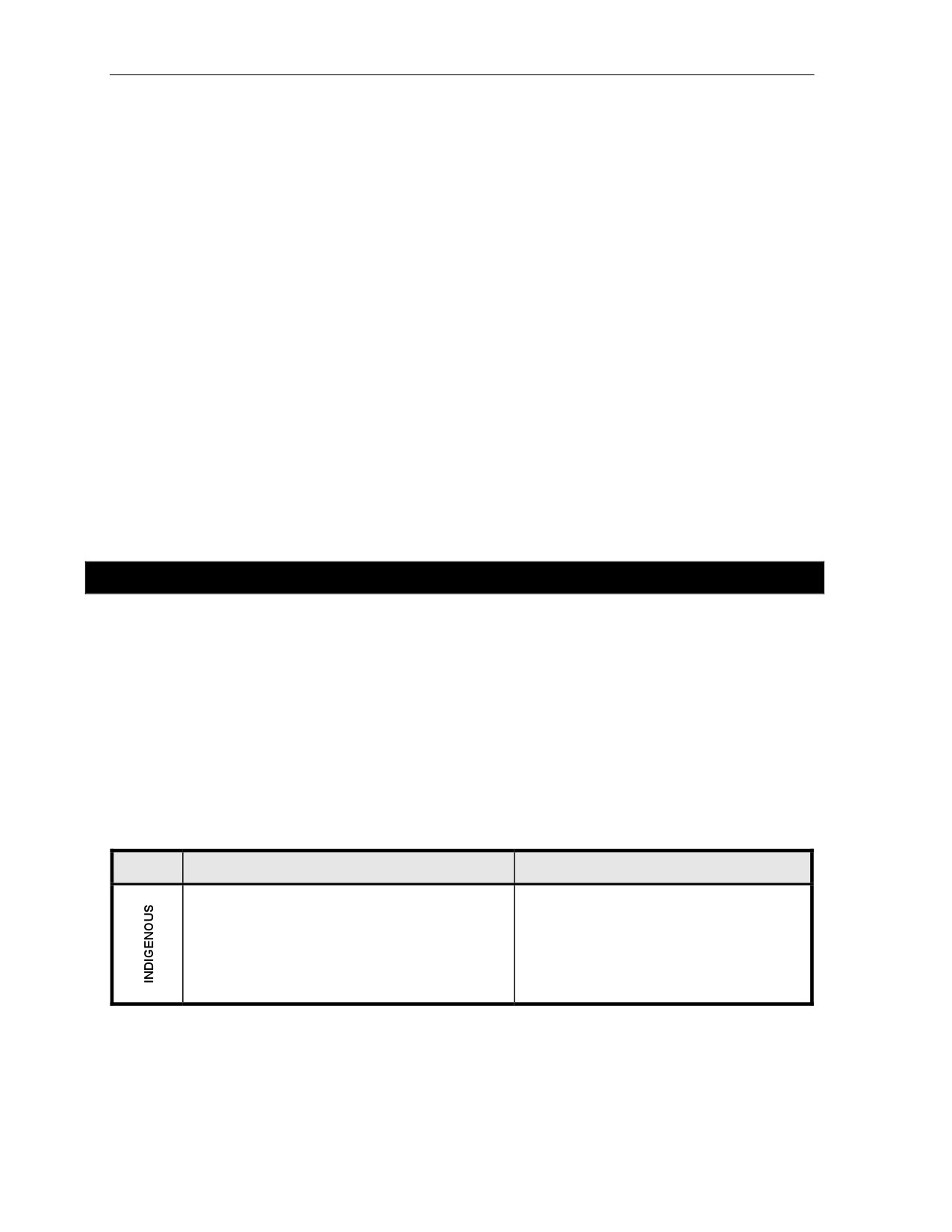
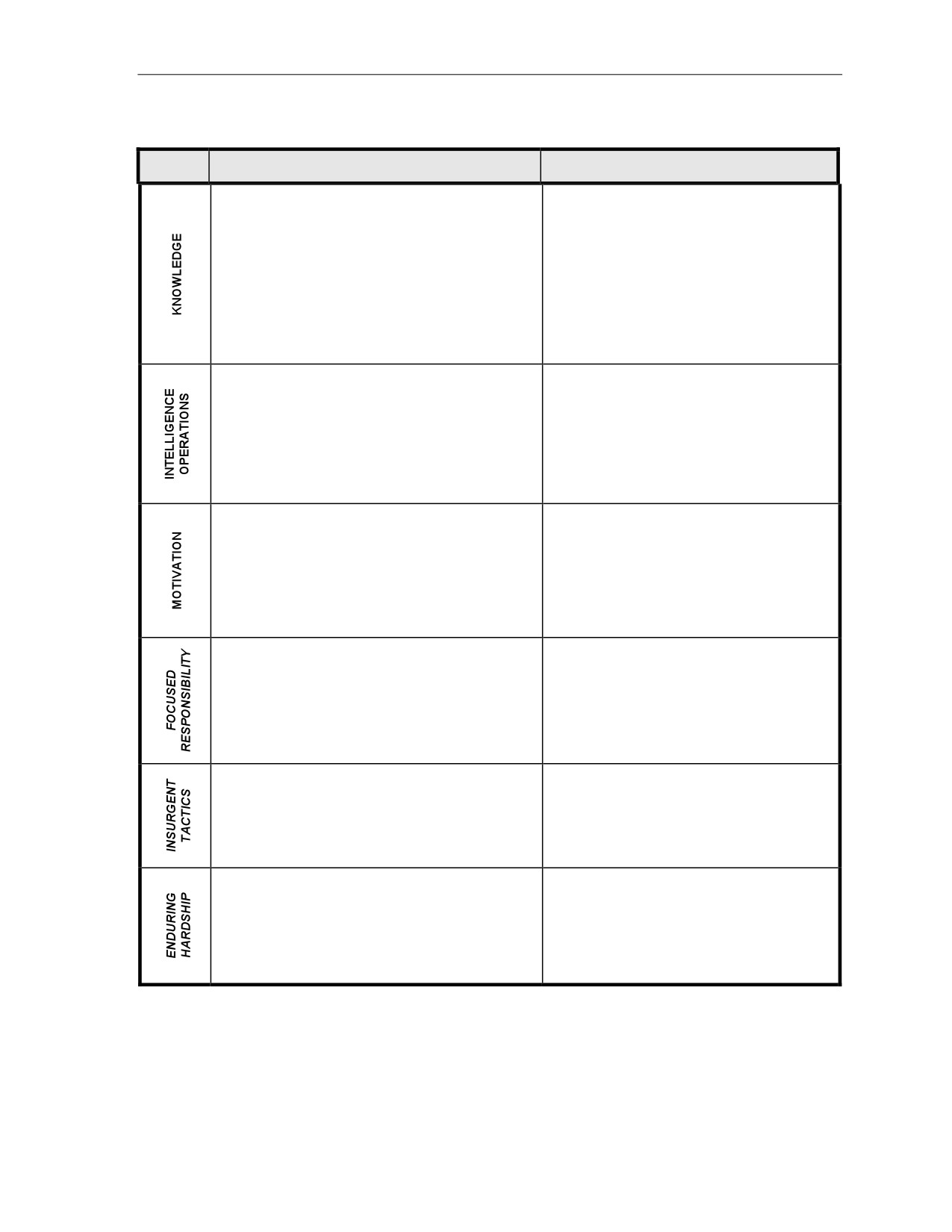
must be reduced or circumvented. Table 2-1 presents insurgent strengths and countermeasures for analysis
during COIN operations.
Table 2-1. Insurgent strengths and countermeasures.
Insurgent Strengths
Countermeasures
Insurgents are usually indigenous to the local area
The counterinsurgent force must separate the
and have the support of at least some of the populace.
insurgent from the rest of the populace. This is best
Therefore, they have the ability to blend with the local
accomplished through the effective use of populace
populace. In many cases they have two roles—a local
and resources control. Care must be taken
resident one moment, an insurgent the next moment. This
to ensure that civilians are not injured or mistreated
enhances their capability to operate without discovery in a
as a result of counterinsurgent operations
given area.
2-24
FM 3-24.2
21 April 2009
Foundations of Insurgency
Table 2-1. Insurgent strengths and countermeasures (continued).
Insurgent Strengths
Countermeasures
Since most insurgents are indigenous, their knowledge
The counterinsurgent force must overcome the
of the local populace, customs, issues, language
insurgent’s advantage of local knowledge by
and terrain are first hand. The insurgents use this
fostering a strong relationship with government
understanding to develop working relationships with the
security forces, other counterinsurgent forces,
populace. The insurgent can apply this knowledge to the
and the populace. If possible, counterinsurgent
effective use of propaganda. If insurgents can get some
forces should include members of the local
of the local populace to identify to some degree with their
populace and reside within the local area.
cause, they can win their support and gain new recruits. If
Maintaining continuous counterinsurgent operations
insurgents cannot persuade locals to help or refrain from
in a given area through a permanently stationed
hindering, they may resort to coercion.
counterinsurgent force is important. The skillful use
of local assets or creating a local civilian defense
force that has the support and backing of the
government are some ways to accomplish this.
The insurgent’s inherent advantage with the population
The counterinsurgent
force
must place
normally allows them to develop intelligence networks
counterintelligence
operations,
intelligence
and infrastructure within the government and population.
collecting, and intelligence analyses
as a high
These networks can provide insurgents with continuous
priority. The use of compartmentalization, deception,
and current information on government or counterinsurgent
operations security, and communications security
force dispositions, strengths, weaknesses, and capabilities
must be constantly emphasized. Since insurgents
are indigenous, their intelligence networks
and infrastructures can be infiltrated to gather
intelligence and turn insurgent operatives into
double agents.
Some insurgents may be devoted to their cause to the
The counterinsurgent force must therefore promote
point of fanaticism. On the other hand, insurgents who wish
the belief that remaining an insurgent leads only
to abandon the movement face major challenges. their
to death and defeat while at the same time creating
ability to cease being an insurgent is difficult. The
a viable method for “former” insurgents to return
government and the local populace may not welcome them
to normal life. Host government reintegration,
back, and the remaining insurgents will view them as a
reconciliation, and amnesty programs remain the
turncoat and threat. Motivation within the insurgency
important elements of this success.
is usually kept high through intimidation and threats
of violence on them and their families.
Insurgents do not have the responsibility to maintain
Counterinsurgent forces can use the insurgent’s
normal governmental obligations toward society. This frees
lack of provisions for the society, as a tool
their efforts to conduct focused operations in support
to increase
government
support
of their goals. However, they often provide some aid
of counterinsurgent
operations and to decrease
and services to the local community, especially where
populace’s insurgent support. In addition, they
government services fall short and they highly advertise
can show that the insurgents have acted
this fact.
irresponsibly. Increasing the HN governments
ability to provide services to the population may
marginalize insurgent efforts.
The insurgent can use a broad range of tactics, from
The counterinsurgents must remain flexible
conventional warfare to terrorism. They can escalate
and adaptive to engage and, if possible, disband,
or deescalate their activity in reaction to government
defeat or destroy the insurgent force while at the
or counterinsurgent activity almost at will.
same time preventing the insurgent force from
having tactical successes. They must also learn
and adapt quickly.
Insurgents often come from impoverished backgrounds,
The counterinsurgent force must therefore
are young, and are in good shape. They can make do with
establish controls and eliminate resource support.
less by both design and background. Successful
Tight
security
and control
on
arms
insurgents are innovative in their tactics, techniques
and ammunition must be maintained, to include
and procedures. They learn and adapt to changes in the
thorough destruction of unused, abandoned,
operational environment.
discarded equipment. Hardships are still
hardships, and the harder life is for the insurgent,
the more likely they are to quit.
VULNERABILITIES
2-119. The vulnerabilities of insurgents also provide a base for analysis. To gain the advantage over the
insurgent and enhance effectiveness, these weaknesses must be targeted and exploited. Table 2-2 displays
insurgent vulnerabilities and considerations for analysis during COIN operations.
21 April 2009
FM 3-24.2
2-25
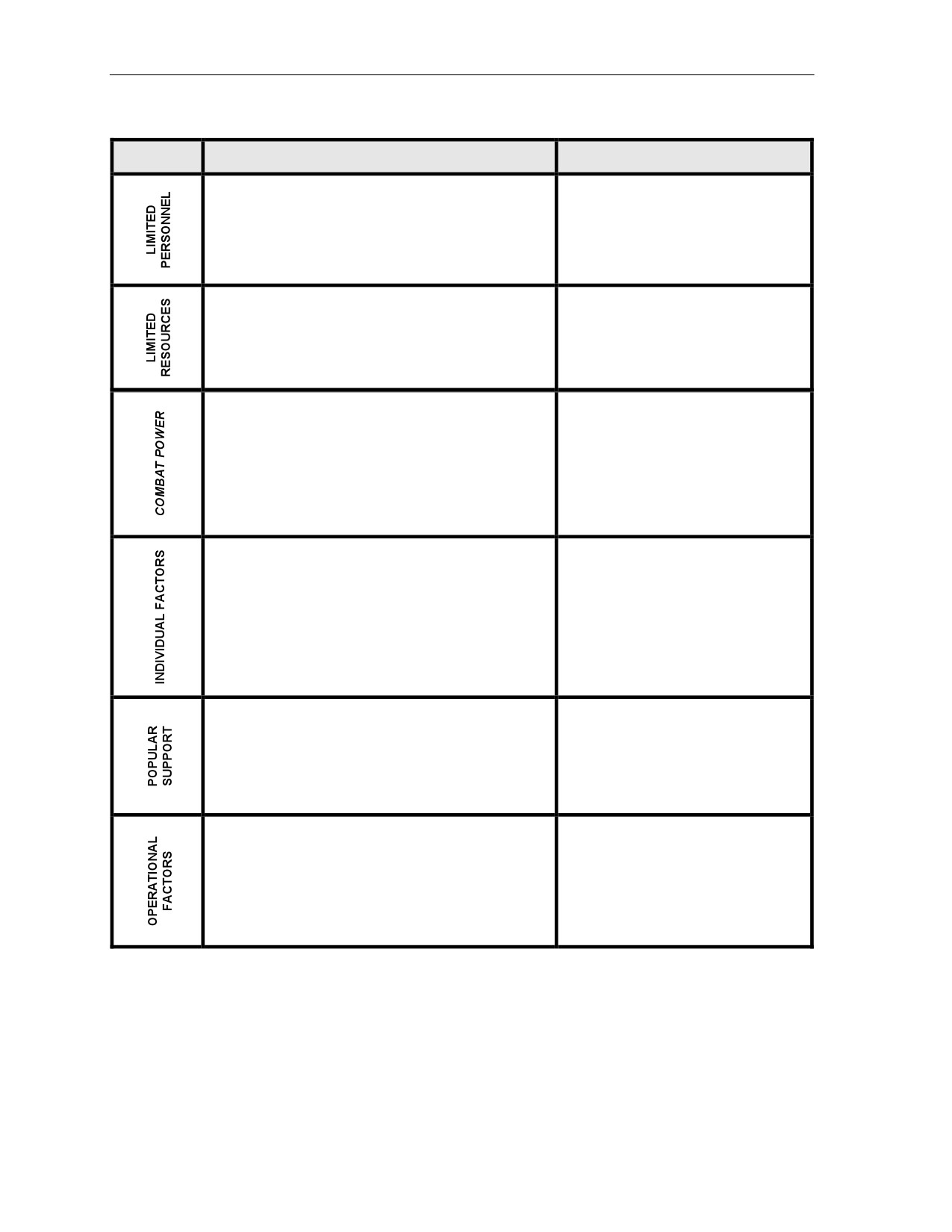
Chapter 2
Table 2-2. Insurgent vulnerabilities and considerations.
Insurgent Vulnerabilities
Considerations
Insurgents operate in small bands to avoid detection by
Insurgent methods to recruit replacements
government and counterinsurgent forces. Due to the
can be identified and exploited.
challenges of recruiting new insurgents, insurgent personnel
losses are not easily replaced.
Because of their covert nature, insurgents must rely on
Insurgent equipment losses are not easily
resources that are stolen or clandestinely delivered from
replaced, and methods of re-supply can be
friendly entities such as internal or external supporters. This
discovered, severed, or tracked to sources
is especially true for sophisticated equipment, cash,
and destinations.
replacement parts and expendable supplies.
The insurgents normally lack the combat power for a
Insurgents will usually break off
sustained fight. As a result, insurgents typically avoid decisive
engagements when they become too
engagements with government forces. By their own design,
intense, as the potential for higher losses
insurgent operations are usually limited in scope and are
is not usually worth the risk. However, they
driven by both engagement and disengagement plans.
may conduct a stand up fight if they have a
large base of expendable guerrillas; they
think they can manipulate a large political
gain; or in some cases a rites of passage
event.
The insurgent endures a life of physical danger, privation
Counterinsurgent forces can exploit these
and many types of stress. Stresses include combat and the
stresses. Offering insurgents, a pardon,
fear of combat, the need to live covertly (constantly fearing
to include food, shelter and protections from
discovery by the government) recognizing the numeric
both the government and insurgent,
superiority of the government forces they face; fear of criminal
is sometimes enough incentive to induce
treatment if captured by the government; and fear of violence
insurgent desertions.
to self and family (often imposed by the insurgent organization
to ensure cooperation). Besides a belief in the cause, the
insurgent may remain an insurgent due to fear of government
reprisal or reprisals from the insurgent organization.
The dependence of the insurgent on popular support is a
If the popular support is withdrawn, the
major weakness. This popular support includes direct aid
insurgent will not be able to operate
and active intelligence reporting.
effectively. If the populace turns against the
insurgent, the government can reap
significant benefits. Willing locals can help
locate, capture, or kill once “popular”
insurgents.
Insurgent operational weaknesses can include security
The counterinsurgent force can exploit these
(requiring extensive resources that may slow down
insurgent weaknesses by interdicting supply
responsiveness); bases and safe houses (that are difficult
routes and facilities, following the supply
to acquire and operate); a lack of sophisticated
trail, forcing desertion because of hardships,
communications (requiring insurgents to spend excessive
and inflicting combat losses that are hard
amounts of time preparing to launch operations); and a lack
to replace.
of technology (including the ability to maintain captured
high-technology items).
2-26
FM 3-24.2
21 April 2009
Foundations of Insurgency
SUMMARY
The central struggle of the majority of insurgencies is to gain and maintain the support of the population.
However, the five elements of each insurgency, the eight dynamics, the strategy, the tactics, and the
specific strengths and vulnerabilities are each unique to an individual insurgent group. For the tactical
leader, from the platoon to the brigade, it is imperative that they first identify and understand the insurgent
group or groups that they are fighting, before determining potential insurgent COAs and friendly COAs.
21 April 2009
FM 3-24.2
2-27
This page intentionally left blank.
Chapter 3
Foundations of Counterinsurgency
“The best way to attain peace is to combine force with politics, We must remember
that destruction must be used as a last recourse, and even then only in order to build
something better in the end…Each time an officer is required to act against a village
in a war, he needs to remember that his first duty, after securing submission of the
local population, is to rebuild the village, reorganize the local market and establish
a school.”
General Joseph Gallieni, Fundamental Instructions, 1898
US and Host Nation participation in combating an insurgency includes simultaneous
military and nonmilitary efforts that normally build upon the Host Nation
government’s efforts, its institutions and plans. This chapter discusses the foundations
of a successful counterinsurgency through sections on the seven of counterinsurgency
lines of effort, tactical force consideration, clear-hold-build operations, other major
COIN operations, and the phases of COIN operations.
Section I—OVERVIEW
A counterinsurgency is a complex subset of warfare. This section defines counterinsurgency, explains the
concepts of foreign internal defense (FID) and internal defense and development (IDAD), and describes the
scores of units, agencies, organizations that units could work with in their area of operations. This discussion
also covers full-spectrum operations and their applications in counterinsurgency. Finally, it introduces the
seven counterinsurgency lines of effort (LOEs) to help units achieve unity of effort.
DEFINITION OF COUNTERINSURGENCY
3-1.
Counterinsurgency is those military, paramilitary, economic, psychological and civil actions taken
by a government to defeat an insurgency
(JP 1-02). In a counterinsurgency, Host Nation forces
and partners operate to defeat armed resistance, reduce passive opposition, and establish or reestablish the
legitimacy of the Host Nation's government
(FM 3-0). Counterinsurgency is a proactive approach
involving all elements of national power; even down to the tactical level. COIN operations strive to achieve
unity of effort amongst many joint, interagency, intergovernmental, and multinational organizations. COIN
includes tactical planning; intelligence development and analysis; training; materiel, technical,
organizational assistance; advice; infrastructure development; tactical-level operations; and information
engagement. US forces often lead the US government’s counterinsurgency efforts because the US military
can quickly project a counterinsurgent force and sustain not only its force but also other agencies.
GOAL OF COUNTERINSURGENCY OPERATIONS
3-2.
The end state of counterinsurgency operations is a legitimate Host Nation government that can
provide effective governance. This includes providing for their populace, eliminating the root causes of the
insurgency and preventing those root causes from returning. Counterinsurgent operations can successfully
defeat an insurgency; achieve unity of effort along multiple lines of effort; isolate the insurgent from the
people; and increase the legitimacy of the Host Nation government. The five requirements for successful
COIN operations at the tactical level include:
• Together, US and HN military commanders devise the plan for attacking the insurgent strategy,
and focus on bolstering governmental legitimacy.
• HN and US forces establish control of area and secure the population continuously.
21 April 2009
FM 3-24.2
3-1
Chapter 3
• Operations should be initiated from the HN government’s area of strength against areas under
insurgent control.
• Regaining control of the insurgent’s areas requires the HN government to expand operations
to secure and support the population.
• Information engagements favorably influence perceptions of HN legitimacy, obtain local
support for COIN operations, publicize insurgent violence, and discredit insurgent propaganda.
FOREIGN INTERNAL DEFENSE
3-3.
Foreign internal defense
(FID) is the participation by civilian and military agencies of a
government in any of the action programs taken by another government or other designated organization
to free and protect its society from subversion, lawlessness, and insurgency (JP 3-07.1). The FID programs
are used to support friendly nations operating in or threatened with potential hostilities. As a tool of US
foreign policy, FID is a national-level effort that involves numerous US Government agencies all working
together to eliminate the root causes of an insurgency.
3-4.
US military involvement in FID has traditionally been focused toward counterinsurgency.
Although much of the FID effort remains focused on this important area, US FID programs may aim at
other threats to an HN’s internal stability, such as civil disorder, illicit drug trafficking, or terrorism. These
threats may, in fact, predominate in the future as traditional power centers shift, suppressed cultural
and ethnic rivalries surface, and the economic incentives of illegal drug trafficking continue. Typical
tactical involvement in FID entails conducting combat operations against guerrillas, conducting actions
across all seven lines of effort to defeat insurgency, and training Host Nation security forces.
INTERNAL DEFENSE AND DEVELOPMENT
3-5.
Internal defense and development
(IDAD) is the full range of measures taken by a nation
to promote its growth and protect itself from subversion, lawlessness, and insurgency. It focuses on
building viable institutions (political, economic, social, and military) that respond to the need of the society
(FM 1-02). IDAD is not only a single master plan, it is a compilation of all internal defense
and development plans at the strategic, operational, and tactical level that a nation possesses. The
fundamental goal of IDAD is to prevent subversion, lawlessness and insurgency by forestalling
or defeating the threat and by working to correct the conditions that prompted the violence. Tactical units
may only see the local government strategy, economic development plan, or the long-range military plan
of their partner HN security force unit, which are part of the IDAD plan.
JOINT, INTERAGENCY, INTERGOVERNMENTAL,
MULTINATIONAL
3-6.
Successfully conducting a counterinsurgency requires a host of organizations. Brigade, battalion,
and company commanders must integrate and synchronize their operations directly with the activities
and operations of other military forces and nonmilitary organizations in their area of operations.
TERMS
3-7.
Leaders must understand the terminology between joint, interagency, intergovernmental,
and multinational operations.
Joint
3-8.
Between military services (Army, Navy, USAF, and USMC).
Interagency
3-9.
Between other government agencies, for example, Department of State, Central Intelligence
Agency, Federal Bureau of Investigation, National Security Agency, USAID.
3-2
FM 3-24.2
21 April 2009
Foundations of Counterinsurgency
Intergovernmental
3-10.
Between international government organizations, for example, United Nations, European Union,
NATO, African Union.
Multinational
3-11.
Between foreign government organizations, for example, Great Britain, Saudi Arabia, Poland.
COMMAND RESPONSIBILITIES
3-12.
When working with interagency, intergovernmental, nongovernmental and multinational groups,
Army commanders have inherent responsibilities that include clarifying the military’s mission; determining
controlling legal and policy authorities; and sustaining and caring for these organizations and individuals.
Information sharing between the elements is essential to establish ground truth. Not all agencies may agree
on the nature or scope of support required or on the operation’s progress.
3-13.
Gaining and maintaining popular support presents a formidable challenge that the military cannot
accomplish alone. Achieving these aims requires synchronizing the efforts of many nonmilitary and HN
agencies in a coordinated approach. Coordination at the lowest level is essential for unity of effort. Likely
participants in COIN operations include the following:
• US military forces.
• Multinational (including HN) military forces.
• US governmental organizations.
• Intergovernmental organizations (IGOs).
• Nongovernmental Organizations (NGOs).
• Multinational corporations and contractors.
• Indigenous population and institutions (IPI).
US MILITARY FORCES
3-14.
The military’s contribution is vital for COIN efforts. Demanding and complex, COIN draws
heavily on a broad range of the force’s capabilities and requires a different mix of offensive, defensive,
and stability operations from that expected in major combat operations. Air, land, and maritime
components all contribute to successful operations and to the vital effort to separate insurgents from the
people. The Army and Marine Corps usually furnish the principal US military contributions to COIN
forces.
3-15.
The most important military assets in COIN are disciplined Soldiers and Marines with adaptive,
self-aware, and intelligent leaders. Tactical units may have specially trained or attached personnel who
bring certain capabilities such as—
• Civil affairs.
• PSYOP.
• Language specialists.
• Human intelligence.
• Logistic support.
• Contractors.
• Medical units.
• Military police.
• Engineers.
• Legal affairs.
21 April 2009
FM 3-24.2
3-3
Chapter 3
MULTINATIONAL MILITARY FORCES
3-16.
Soldiers and Marines may function as part of a multinational force. In COIN operations, US
forces usually operate with the Host Nation security forces. Each multinational participant provides
capabilities and strengths that US forces may not have. Other countries’ military forces bring different
cultural backgrounds, historical experiences, languages and other capabilities that can be particularly
valuable to COIN efforts.
US GOVERNMENTAL ORGANIZATIONS
3-17.
Commanders’ situational awareness includes being familiar with other US governmental
organizations participating in the COIN effort and their capabilities. Commanders and leaders of other US
governmental organizations should collaboratively plan and coordinate actions to avoid duplication
or conflicting purposes. Within the US Government, key organizations that tactical units may work with
are shown in Table 3-1.
Table 3-1. US governmental organizations.
Department of State
Office of the Coordinator for
Stabilization and Reconstruction
US Agency for International Development
(USAID)
Central Intelligence Agency
Department of Justice
• Drug Enforcement Administration
• Federal Bureau of Investigation
Department of the Treasury
Department of Homeland Security
• US Coast Guard
• Immigration Customs Enforcement
Department of Agriculture
INTERGOVERNMENTAL ORGANIZATIONS
3-18.
An intergovernmental organization is an organization created by a formal agreement, for
example, a treaty, between two or more governments. It may be established on a global, regional,
or functional basis for wide-ranging or narrowly defined purposes. IGOs are formed to protect and promote
national interests shared by member states (JP 1-02). The most notable IGO is the United Nations.
Depending on the situation and HN needs, tactical units can expect to encounter any number of UN
organizations in their AOs, such as the following:
• Department of Peacekeeping Operations.
• World Food Program.
• UN Refugee Agency (the UN High Commissioner for Refugees).
• UN High Commissioner for Human Rights.
NONGOVERNMENTAL ORGANIZATIONS
3-19.
Joint doctrine defines a nongovernmental organization as a private, self-governing, not-for-profit
organization dedicated to alleviating human suffering; or promoting education, health care, economic
3-4
FM 3-24.2
21 April 2009
Foundations of Counterinsurgency
development, environmental protection, human rights, and conflict resolution; or encouraging the
establishment of democratic institutions and civil society.
(JP 1-02). There are several thousand NGOs
of many different types. NGO activities are governed by their organizing charters and their members’
motivations. Typical NGOs that tactical units may encounter include—
• Médecins sans Frontières (Doctors without Borders).
• Cooperative for Assistance and Relief Everywhere (CARE).
• Oxford Committee for Famine Relief (OXFAM).
• Save the Children.
INDIGENOUS POPULATION AND INSTITUTIONS
3-20.
IPI is the civilian construct of an area of operations to include its population, governmental, tribal,
commercial, and private organizations and entities. The population includes legal citizens, legal and illegal
immigrants, and all categories of dislocated civilians. As stated earlier, this is the most important group
for counterinsurgent units to protect, engage, and synchronize actions.
MULTINATIONAL CORPORATIONS AND CONTRACTORS
3-21.
Multinational corporations often engage in reconstruction, economic development, security
and governance activities. At a minimum, commanders should know which companies are present in their
AO and where those companies are conducting business. Such information can prevent fratricide
and destruction of private property.
INTERAGENCY COORDINATION IN COIN
3-22.
A tactical unit conducting COIN operations can expect to work with a wide range of agencies and
will be expected to track, manage, support, and coordinate with all of these agencies, some of whose
agendas or desired outcomes may or may not coincide with the overall COIN effort. Commanders at all
levels will have to overcome many challenges and work to integrate all the agencies organizations present
in the AO, so that everyone works towards a common end state.
3-23.
Challenges to the integration of military and civilian agencies include different organizational
cultures, capabilities and structures. Some civilian organizations may not be trained and equipped
to operate in austere, unsecured environments or they may not be able to sustain themselves in remote
areas. Some organizations may be averse to assuming risk, which may hinder the overall COIN effort.
Military and governmental organizations are heavily dependent on establishing and implementing their
internal operating procedures and they are often reluctant to adapt or change those procedures
to accommodate the addition of new actors. Different expectations amongst the organizations can also
serve to further heighten tensions and create friction among agencies.
3-24.
US government and civilian agencies provide capabilities critical to the successful
accomplishment of the counterinsurgency mission. Most agencies have their own budgets, and often will
have more robust financial capabilities than military units. An effective interagency effort can use all of the
organizations’ budgets in a complementary way to facilitate stability and development efforts. Civilian
agencies can also provide links to strategic resources that may not be available to tactical units. They may
also have access to information, resources and enablers that can help military units develop a
comprehensive understanding of the operational environment.
3-25.
Military forces have several complementary characteristics that can be of value to other agencies.
The most obvious is the ability to provide security and transportation assets. Military forces also have the
ability to provide an accurate assessment of whether an area is ready for or capable of supporting essential
services and economic development projects. Once these indicators become apparent, counterinsurgent
forces have the ability to provide logistical support, security, and expertise to a project.
3-26.
The formation of effective civil-military teams creates complementary capabilities that mitigate
the inherent weaknesses of both the counterinsurgent force and civilian agencies. Effective interagency
21 April 2009
FM 3-24.2
3-5
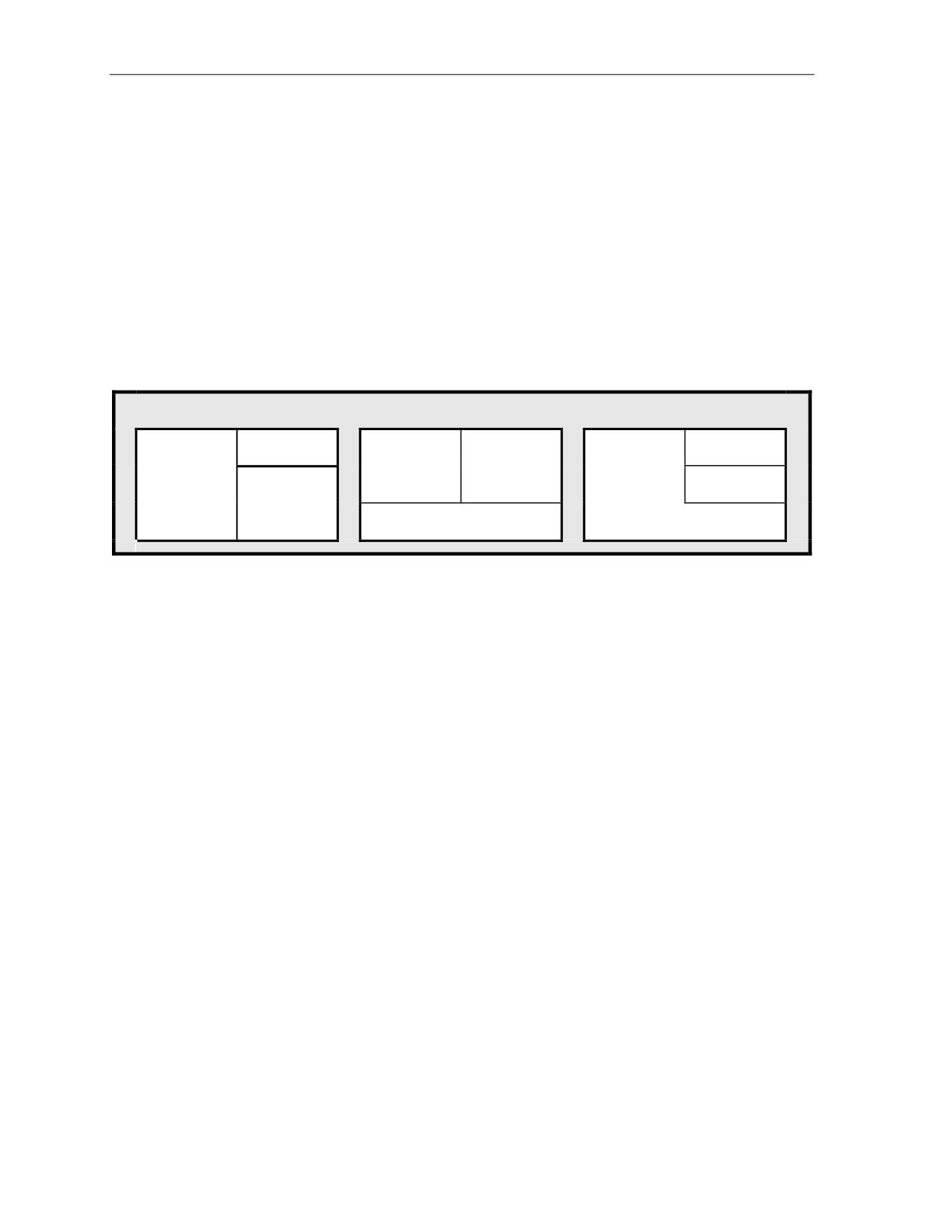
Chapter 3
teams can conduct concurrent operations to capitalize on gains made through security operations.
In Afghanistan on 2002, USAID representatives embedded with units were able to render immediate aid
to returning families whose homes were damaged during combat operations.
FULL SPECTRUM OPERATIONS
3-27.
FM 3-0 states that Army forces conduct full-spectrum operations outside the United States by
executing offensive, defensive, and stability operations as part of integrated joint, interagency,
and multinational teams. Full spectrum operations entail simultaneous and continuous combinations
of offensive, defensive, and stability or civil support operations. Based on the mission, one type
of operation may predominate. Commanders shift the predominant type of operation based on the current
situation and their assessment as they shape the operational environment and set the conditions to achieve
the end-state (Figure 3-1).
Joint Campaigns (Overseas)
Offense
Offense
Offense
Defense
Defense
Stability
Defense
Stability
Stability
Figure 3-1. Full-spectrum operations.
3-28.
Like any Army operation, at the tactical level, counterinsurgency operations are a combination
of offensive, defensive, and stability operations. Counterinsurgent offensive operations focus on
eliminating the insurgents. Counterinsurgent defensive operations focus on protecting the populace
and infrastructure from insurgent attacks. Stability operations focus on addressing the root causes that
allowed to insurgency to come into existence. Determining the combination is not easy, since it varies
depending on the situation, the mission, and the commander’s desired end-state. All three of these
operations may be ongoing within different parts of the area of operations at the same time.
OFFENSIVE OPERATIONS
3-29.
These are combat operations conducted to defeat and destroy enemy forces and seize terrain,
resources and population centers. They impose the commander’s will on the enemy. This active imposition
of land power potentially makes the offense the decisive type of military operation, whether undertaken
against irregular forces or the armed forces of a nation-state supporting the insurgency. The physical
presence of land forces also enhances stability operations through the threat of offensive action in areas
they occupy. During an insurgency, offensive operations aim at destroying the guerrilla, underground
or leader in order to establish a secure environment for the establishment or the re-establishment of the rule
of law, legitimate government, and economic development. The successful counterinsurgent unit designs
their offensive operations to complement their other defensive and stability operations. Chapter 5 further
discusses offensive operations.
DEFENSIVE OPERATIONS
3-30.
These are combat operations conducted to defeat an enemy attack, gain time, economize forces,
and develop conditions favorable for offensive or stability operations. They defeat attacks, destroying
as many attackers as necessary. The defense preserves physical dominance over land, resources,
and populations. Defensive operations retain terrain, as well as protecting the HN population and key
resources. Defensive operations during an insurgency aim at securing the population, protecting
3-6
FM 3-24.2
21 April 2009
Foundations of Counterinsurgency
counterinsurgent forces, securing key sites, and securing key personnel. The successful counterinsurgent
unit designs its defensive operations to complement its other offensive and stability operations. Chapter 6
further discusses defensive operations.
STABILITY OPERATIONS
3-31.
These encompass various military missions, tasks, and activities conducted outside the United
States in coordination with other instruments of national power to maintain or reestablish a safe and secure
environment, provide essential government, services, emergency infrastructure, reconstruction,
and humanitarian relief. Most stability operations are both multiagency and multinational. Forces engaged
in stability operations may have to conduct offensive and defensive operations to defend themselves
or destroy forces seeking to undermine the effectiveness or credibility of the stability mission.
3-32.
Stability operations consist of five primary tasks—establish civil security, establish civil control,
support to governance, restore essential services, and support to economic and infrastructure development.
At the tactical level, the primary stability tasks may serve as lines of effort or simply as guideposts
to ensure broader unity of effort. In this manual, they become the nucleus for the seven COIN lines
of effort.
3-33.
The degree to which Army forces engage in stability operations is dependent on the specific
circumstances of any given operation. In some operations, the Host Nation can carry out most security
operations and Army forces are engaged in stability operations to offset any negative impact of military
presence on the populace. In other operations, Army forces within a failed state may be responsible for the
well-being of the local population, to include providing basic civil functions, while working with other
agencies to restore essential services to the area or region. An example of this was Operation Restore Hope
in Somalia in 1992 and 1993. Chapter 7 further discusses stability operations.
LINES OF EFFORT IN COUNTERINSURGENCY
3-34.
Commanders use LOEs to visualize, describe, and direct operations when positional reference
to enemy forces has little relevance, such as an insurgency. FM 3-0 defines a line of effort as a line that
links multiple tasks and missions using the logic of purpose—cause and effect—to focus efforts toward
establishing operational and strategic conditions. A plan based on LOEs unifies the efforts of all actors
participating in a counterinsurgency toward a common purpose. Each LOE represents a conceptual
category along which the HN government and COIN force commander intend to attack the insurgent
strategy and tactics and establish HN government legitimacy. LOEs are closely related and are not
sequential in nature. Successful achievement of the end state requires careful coordination of actions
undertaken along all LOEs. Figure 3-2 shows example COIN LOEs. The figure also shows how the LOEs
try to gain the support of the population to reach the end state.
3-35.
Success in one LOE reinforces successes in the others. Progress along each LOE contributes
to attaining a stable and secure environment for the Host Nation. Once a measure of stability is achieved,
achievements in other LOEs, like popular recognition of the HN government’s legitimacy, improved
governance, and progressive, substantive reduction of the root causes that lead to the insurgency, follow.
No single list of LOEs applies to all insurgencies. Commanders select LOEs based on their understanding
of the nature of the insurgency and what the COIN force must do to counter it. Commanders designate
LOEs that best focus counterinsurgent efforts against the insurgents’ strategy.
3-36.
Commanders at all echelons can use LOEs. Lower echelon operations are nested within the higher
echelon’s LOEs; however, lower echelon operations are conducted based on each unit’s AO. Commanders
and staffs synchronize activities along all LOEs to gain unity of effort. This approach ensures the LOEs
converge on a well-defined, commonly understood end state.
3-37.
Commanders at all levels should select the LOEs that relate best to achieving the desired end state.
The following list of possible LOEs is not all-inclusive. However, it gives commanders a place to start:
• Establish civil security.
21 April 2009
FM 3-24.2
3-7
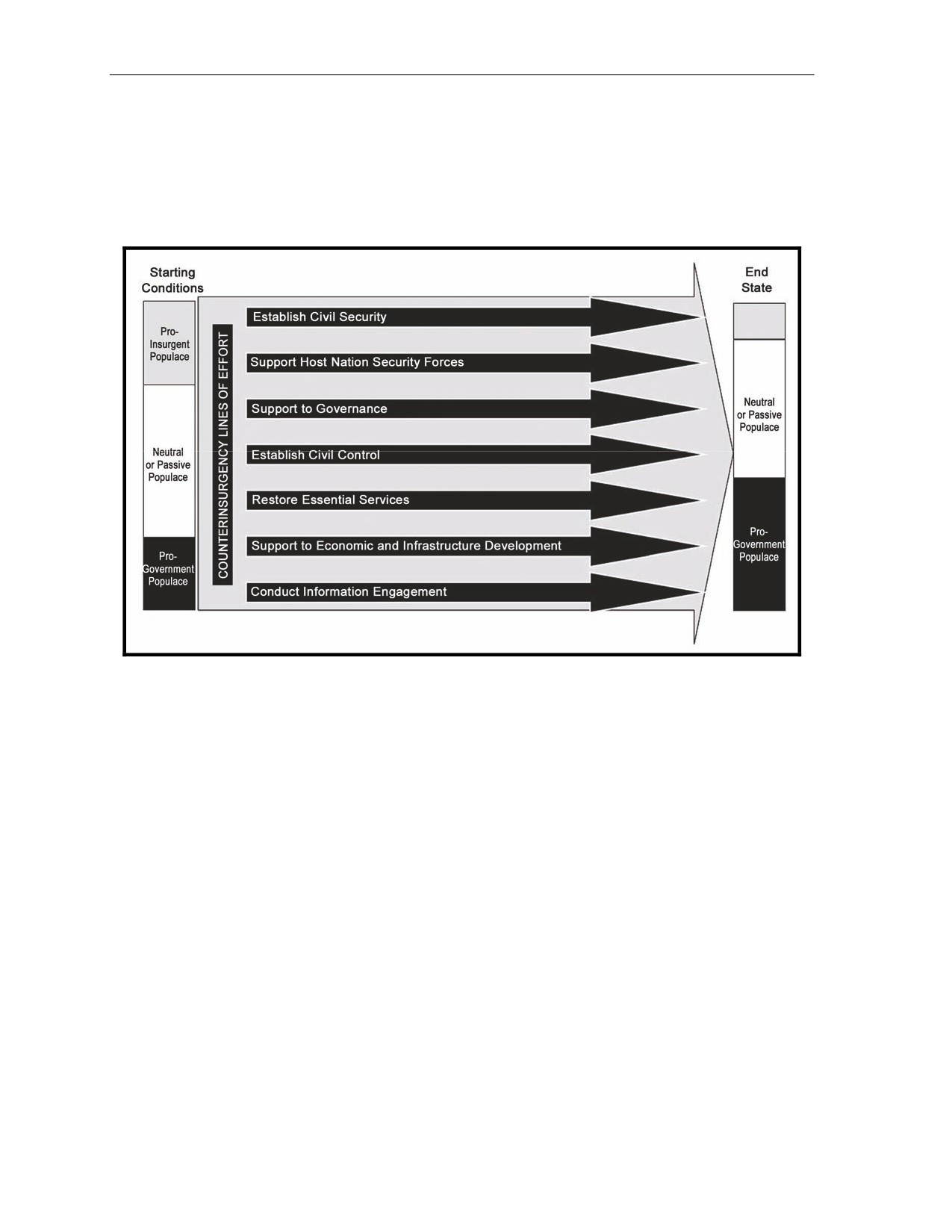
Chapter 3
• Establish civil control.
• Support HN security forces.
• Support to governance.
• Restore essential services.
• Support to economic and infrastructure development.
• Conduct information engagement.
Figure 3-2. Example lines of effort for a counterinsurgency.
3-38.
These lines can be customized, renamed, changed altogether, or simply not used. Commanders
may combine two or more of the listed LOEs or split one LOE into several. For example, some
commanders may combine the LOEs, restore essential services, and support to economic and infrastructure
development into one LOE. Likewise, other commanders may split out rule of law from the civil
control LOE.
3-39.
Tactical units, HN security forces and the HN’s government can only accomplish a limited
number of tasks at any one time. The seven COIN LOEs help prioritize and synchronize efforts along all
of the LOEs. One useful construct is the rheostat approach with LOEs—increased effort along the establish
civil security LOE usually means less effort along the other LOEs. Units may see this during operations
against a powerful insurgency or during the clear phase of a clear-hold-build operation. In most cases,
restoring security to an AO enables units and the HN government to rapidly meet objectives along the
other lines of effort. In other AOs, units may increase effort along the support to governance and support
to economic and infrastructure development LOEs, while seeing a reduction in effort along the establish
civil control LOE. This occurs during operations against a weak insurgency or during the build phase of a
clear-hold-build operation. Figure 3-3 shows the rheostat approach to the LOEs.
3-40.
Operations designed using LOEs typically employ an extended, event-driven timeline with short-,
mid-, and long-term goals. These operations combine the effects of long-term operations, such
as neutralizing the insurgent infrastructure, with cyclic and short-term events, like regular trash collection
and attacks against insurgent bases. Chapter 4 discusses considerations for planning LOEs and horizons.
3-8
FM 3-24.2
21 April 2009
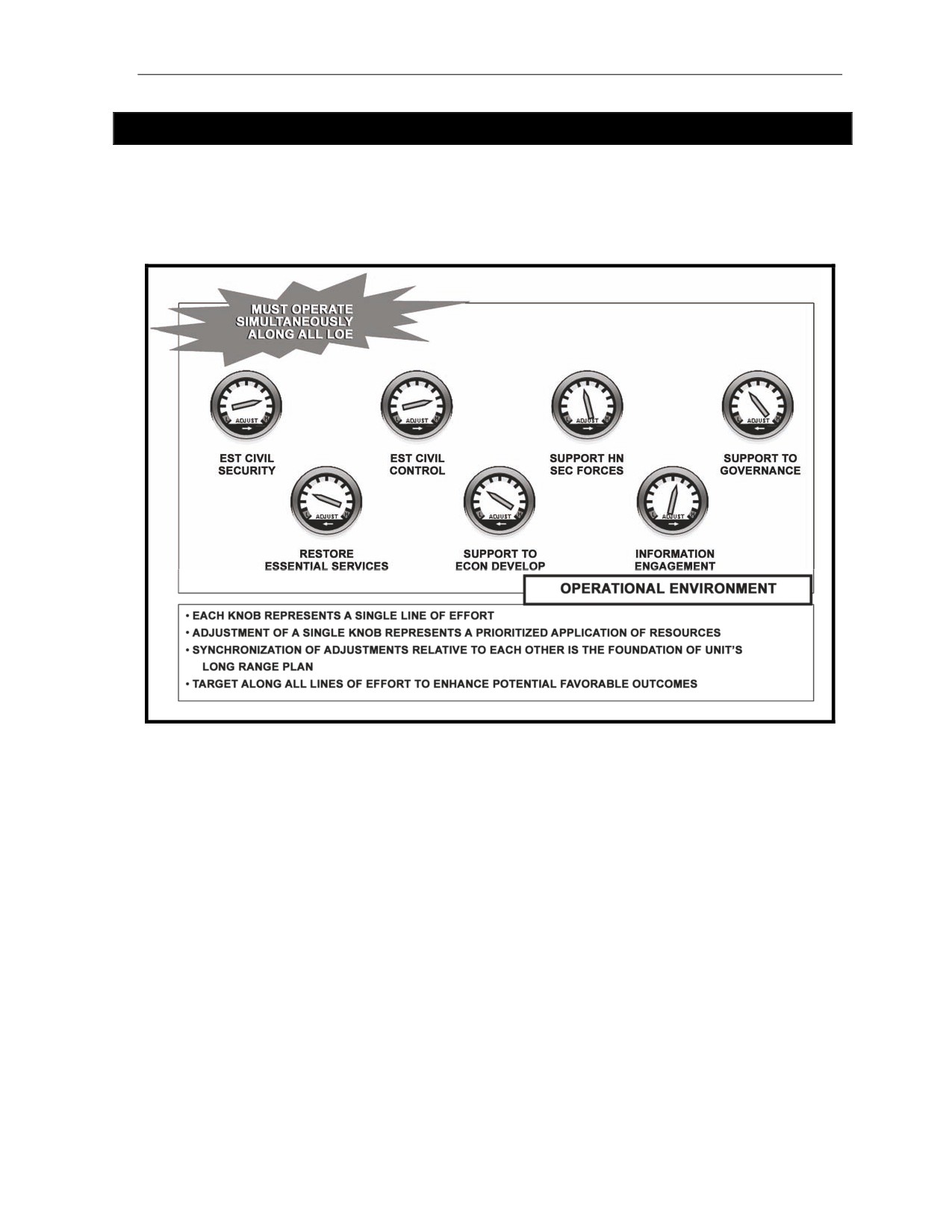
Foundations of Counterinsurgency
Section II—HISTORICAL THEORIES
This section compares three historic theories of counterinsurgency. Together, they provide a reference
for forces engaged in COIN operations. COIN operations are complicated. Even considering these theories will
not guarantee success. However, understanding these aspects will help illuminate the challenges inherent
in defeating an insurgency. Three counterinsurgency experts, Robert Thompson, David Galula and Charles
Callwell, had very specific theories concerning the conduct of counterinsurgency based on their experience.
Figure 3-3. Rheostat approach to the lines of effort.
ROBERT THOMPSON'S PRINCIPLES FOR SUCCESSFUL COIN
3-41.
Robert Thompson’s Five Principles for Successful Counterinsurgency based on his experience in
the Malayan emergency follow:
• The need for government to have a clear political aim.
• To function within the law.
• To establish an overall plan, whereby all political, socio-economic and military responses were
coordinated.
• To give priority to the elimination of political subversion.
• To secure the government’s base area before conducting a military campaign.
DAVID GALULA’S FOUR LAWS FOR SUCCESSFUL COIN
3-42.
David Galula’s Four Laws for Successful Counterinsurgency based on his experience
in Indochina and Algeria follow:
• The support of the population is necessary for the counterinsurgent as it is the insurgent.
• Support is gained through the active minority.
21 April 2009
FM 3-24.2
3-9
Chapter 3
• Support from the population is conditional.
• Intensity of efforts and vastness of means are essential.
CHARLES CALLWELL’S IDEAS FOR SUCCESSFUL COIN
3-43.
Charles Callwell’s Ideas for Successful Counterinsurgency, based on his experience in the Boer
War and other British Imperial operations, follow:
•
[Following up] successes…; a single blow will often achieve results, but a succession of blows
paralyzes the enemy.
• Matching the enemy in mobility and inventiveness.
• Collecting actionable intelligence.
• Seizing what the enemy prizes most.
Section III—TACTICAL CONSIDERATIONS
This section contains basic tactical considerations common to counterinsurgency operations, categorized first
by terrain, and then by troops. As for any type of operation, the commander and staff must consider all relevant
operational and mission variables, and their effects on operations. These additional considerations for terrain
and troops allow the commander to better visualize the conduct of counterinsurgency operations as he
accomplishes the assigned mission.
TERRAIN
3-44.
As with any type military operation, terrain plays a key role in counterinsurgency operations.
Insurgencies are fought in either urban or a rural terrain, each with its own characteristics.
URBAN AREAS
3-45.
The urbanization of the world population continues to increase. The concealment and anonymity
that was once only provided by remote rural areas to the insurgent is now available in urban areas. The
transient nature and size of urban populations increasingly hinder a counterinsurgent’s ability to detect
and identify insurgents. Insurgents use urban centers for freedom of movement, easy access to their mass
base and proximity to targets. Popular support at the outset of this kind of insurgency is not necessary, but
can be gained through intimidation and attacking basic services provided by the government. With a
greater population density, urban areas need more government functions and services than rural areas. This
requires more government organizations for operations and a balanced approach using all LOEs.
3-46.
Insurgencies thrive in an urban environment. Operations against urban insurgents vary from
operations designed to control the population to operations that involve seeking out and killing or capturing
the insurgent. In these urban areas, counterinsurgency forces may have to emphasize intelligence
and police operations to counter clandestine organizational, intelligence, logistic, and terrorist activities.
Counterinsurgency forces may be required to reinforce HN police forces in combating riots and disorders
provoked by the insurgents as well as conducting raids and cordon and searches. Military
counterinsurgency forces must be able to communicate with HN police forces and other agencies involved
in operations.
Considerations during Counterinsurgencies
3-47.
When military forces must reinforce police or defeat insurgent forces inside the urban area,
leaders must closely control and coordinate operations. However, the local government determines the
level of intensity at which urban operations are conducted. Military forces should be withdrawn as soon
as police forces can manage the situation. Basic urban counterinsurgency considerations include—
• Maintaining a constant, forward presence with the population.
• Acquiring and disseminating accurate and timely intelligence.
3-10
FM 3-24.2
21 April 2009
Foundations of Counterinsurgency
• Avoiding overreaction to insurgent activity.
• Ensuring the population has the basic level of essential services.
• Developing relationships with competent Host Nation officials.
• Using countersniper operations, especially at roadblocks, outposts, and sentry posts.
• Reacting to the ambush of patrols and firing on helicopters.
• Emphasizing countermeasures against explosive hazards (to include improvised explosive
devices and mines) and booby traps of all types.
• Controlling access to weapons, uniforms and other supplies the insurgents may use.
• Protecting industry and public services from attack and sabotage.
• Preventing riots, protests and other large population incidents.
Lines of Effort
3-48.
All urban operations require careful planning and coordination, particularly those operations
involving application of force. The most vital requirement is accurate and timely intelligence. Military
forces must be able to communicate with police and other agencies involved in the operations. During
urban operations, actions must be taken across the all LOEs. Examples of actions along each LOE are—
Establish Civil Security
3-49.
Conduct targeted raids with HN security forces to attack key insurgent cells.
Establish Civil Control
3-50.
Conduct investigative training for HN police forces to increase arrests and convictions; establish a
block committee to control the population.
Support HN Security Forces
3-51.
Maximize the number, effectiveness, and use of HN security forces to secure and control the
population and to prevent the insurgent’s freedom of movement.
Support to Governance
3-52.
Establish or convene local or tribal council meetings to identify and solve the underlying issues
of the insurgency.
Restore Essential Services
3-53.
Provide projects, such as the restoration of electrical power and sewer systems to blocks that
support the government. Projects should provide positive reinforcement of desired behavior.
Support to Economic and Infrastructure Development
3-54.
Provide funds to city managers to hire additional personnel and initiate economic development
projects. Hire from blocks that are neutral to increase their support for the government.
Conduct Information Engagement
3-55.
Conduct information engagements to highlight government successes and expose insurgent
defeats and excesses.
RURAL AREAS
3-56.
Much of the guerrilla warfare in the 20th Century occurred in a rural setting—the mountains
of Yugoslavia in WWII, the jungles of South Vietnam in the 1950s and 1960s, and the jungles of Columbia
in the 1980s and 1990s. The reduced potential for collateral damage, limited infrastructure, and the lack of
21 April 2009
FM 3-24.2
3-11
Chapter 3
urban development, and the characteristics of the rural setting itself influence both insurgent
and counterinsurgent operations.
Considerations during Counterinsurgencies
3-57.
Counterinsurgency operations in a rural environment may allow for the potential application
of full military combat power, conventional fire and maneuver, and less restrictive rules of engagement due
to a lower population density. However, leaders, still plan for the application of the minimum-essential
force required to accomplish the mission.
3-58.
In the rural environment, insurgents rely on friendly elements within the population to provide
supplies and intelligence. Rural insurgents prefer to operate in regions providing plenty of cover
and concealment such as heavily forested and mountainous areas that hinder the counterinsurgency force
in gaining access and intelligence. Often operating from their own home or village, rural insurgents will
often move to camps if security does not permit them to remain at home. Insurgent camps are also chosen
with a view toward easy access to the target population, access to a friendly or neutral border, prepared
escape routes, and good observation of counterinsurgency force approach routes. When counterinsurgency
operations force the insurgents out of his preferred base camps, he tends to establish camps in rugged
inhospitable areas not easily penetrated. Like COIN in urban areas, rural counterinsurgency operations
must focus on both locating and killing the guerrilla and on severing the supportive element of the
population, such as the mass base and auxiliary, from providing supplies and intelligence.
3-59.
Offensive operations are usually conducted in areas that either are under insurgent control or are
contested. In these areas, ground or water modes of entry are often used, but air assault or parachute
operations can also be employed. These operations use offensive tactics such as a raid, a reconnaissance
in force, a cordon and search, a hasty or deliberate attack, a pursuit, or a combination of these.
Purpose
3-60.
Their purpose is to—
• Destroy the insurgent force and its base complexes.
• Expand controlled areas.
• Isolate guerrillas from their support.
• Demonstrate support for the government and for the populace in the local area.
• Harass the insurgent to prevent the buildup of personnel and logistical resources.
Lines of Effort
3-61.
All rural operations must address all LOEs. Examples along each LOE to consider include—
Establish Civil Security
3-62.
Conduct raids with HN security forces to attack key guerrilla groups.
Establish Civil Control
3-63.
Reinforce police operations, especially police stations and checkpoints, as a means to increase
control of the population; conduct census.
Support HN Security Forces
3-64.
Use HN security forces to increase combat power, expand the AO, increase the number of villages
secured, and increase the legitimacy of the operation.
Support to Governance
3-65.
Establish or convene a village, district, provincial or tribal council to identify and solve
underlying issues.
3-12
FM 3-24.2
21 April 2009
Foundations of Counterinsurgency
Restore Essential Services
3-66.
Provide projects such as wells to villages that support the government.
Support to Economic and Infrastructure Development
3-67.
Provide economic stimuli such as the donation of a tractor or gasoline to villages that are neutral
to increase their support for the government.
Conduct Information Engagement
3-68.
Conduct information engagements to generate support for the HN government, highlight
government victories and expose insurgent defeats and excesses.
BORDER AREAS
3-69.
In addition to the typical external support, usually supplies, that an insurgent group may receive
from across a border, insurgents may also establish sanctuary base camps and conduct cross-border
operations from adjacent countries.
3-70.
Host nation police, customs, or paramilitary border forces should be responsible for border
security. However, the guerrilla threat may force the military to conduct border operations, particularly
in rural areas. US forces advise and assist Host Nation security forces to interdict the infiltration
of insurgent personnel and materiel across international boundaries with the intent of isolating the
insurgent forces from their external support and sanctuaries. Border operations normally require restrictive
measures for tribal and ethnic groups who do not recognize the international boundary.
3-71.
Border operations require close coordination and cooperation between the armed forces,
paramilitary forces, and government agencies involved. Physically sealing the border may be impossible,
since doing so could increase the requirement for forces and materiel beyond available resources. Placing
forces or barriers at every crossing and entry site may also be impossible. Commanders should prioritize
where to place their forces or barriers.
Routes
3-72.
Based on detailed terrain analysis and intelligence, commanders can determine infiltration
and exfiltration routes, support sites, frequency and volume of traffic, type of transportation, number
and type of personnel, amount and type of materiel, terrain and traffic conditions, and the probable location
of base areas and sanctuaries. Continuous and detailed surveillance is required.
Zones
3-73.
Restricted zones or friendly population buffer zones can be established if needed. Either of these
operations, which could require relocating many persons, must be carefully planned. Although armed
forces may assist, civil authorities normally are responsible for planning and carrying out a relocation
program. Forced relocation is held to a minimum. The
1949 Geneva Conventions prohibit forced
population resettlement unless there is clear military necessity.
Restricted Zone
3-74.
This is a carefully selected area, varied in width and contiguous to the border. Authorities
normally relocate all persons living in this zone. Authorities give public notice that they will regard all
unauthorized individuals or groups encountered in the restricted zone as infiltrators or insurgents.
Friendly Population Buffer Zone
3-75.
This is an area where only civilians believed to be loyal to the government live in the AO. The
government relocates all persons whose loyalty it cannot establish. The government may use this operation
21 April 2009
FM 3-24.2
3-13
Chapter 3
to establish information nets and employ loyal citizens in paramilitary units. The operation denies
insurgents potential civilian contacts and base areas for border-crossing activities.
Lines of Effort
3-76.
Border operations must use actions across all LOEs. One or two examples along each LOE are—
Establish Civil Security
3-77.
Conduct ambushes with and without HN security forces at likely insurgent crossing sites.
Establish Civil Control
3-78.
Conduct training of HN police and border forces to increase the speed and results of searches.
Support HN Security Forces
3-79.
Integrate and maximize the number and effectiveness of HN border, police and Army forces.
Support to Governance
3-80.
Establish or convene a village or tribal council from both sides of the border to identify
and solve issues.
Restore Essential Services
3-81.
Provide projects, such as restoration of irrigation systems to villages that assist the government’s
efforts to close the border. Projects should provide positive reinforcement of desired behavior.
Support to Economic and Infrastructure Development
3-82.
Provide economic stimuli such as hiring village personnel to build border fences or to act
as guards. Hire from villages that are neutral to increase their support for the government.
Conduct Information Engagement
3-83.
Create information engagements to canalize movement through official points of entry
and establish the legitimacy of the border in the eyes of the populace.
TROOPS
3-84.
Counterinsurgency operations typically involve actions that combine joint, interagency,
multinational, and nongovernmental organizations efforts. The increased number of military
and nonmilitary participants and their divergent missions and methods are a coordination and unity
of effort challenge. Achieving unity of effort requires the greatest possible common purpose and direction
among all agencies. One means of achieving this is using a long-range plan designed around the seven
COIN lines of effort.
TASK ORGANIZATION
3-85.
The organization for, and conduct of, counterinsurgency operations depends on the mission
variables and the OE. However, COIN operations place a premium on boots on the ground. Task
organization is the temporary grouping of forces designed to accomplish a particular mission (FM 3-0).
Task organization for counterinsurgency operations is often substantially different from how units are task
organized in conventional operations. During counterinsurgency operations, many units do not perform
their traditional role. For example, in Iraq and Afghanistan, many artillerymen have served in infantry, civil
affairs, military police, or intelligence roles.
3-14
FM 3-24.2
21 April 2009
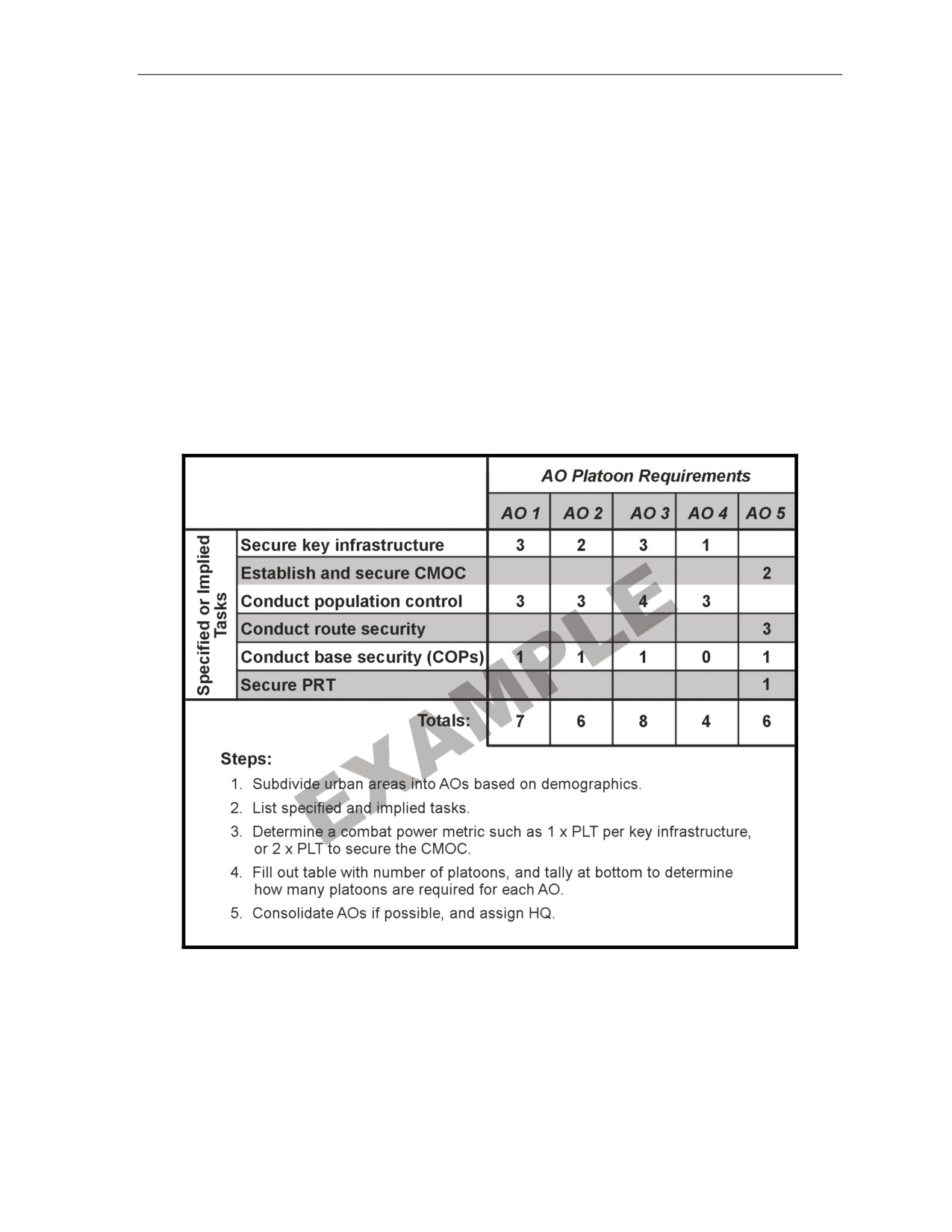
Foundations of Counterinsurgency
TROOPS-TO-TASK ANALYSIS
3-86.
Given the extended nature of COIN, tactical units must maximize all available assets to
accomplish missions in each of the COIN LOEs and sustain Soldier proficiency, physical fitness, and
emotional and psychological well-being. A means to maximize the employment of all assets is referred to
as troops-to-task analysis. This process enables units to correctly assign tasks to units of appropriate size
and capabilities.
3-87.
Often conducted during MDMP, staffs and tactical units begin troops-to-task analysis by
determining a standard size element to use as a baseline (Infantry platoon, Armor platoon, Cavalry platoon,
company, or others). The staff determines the forces available (often including HN security forces). Then,
the staff or tactical unit lists and prioritizes each task and determines the forces required to accomplish each
task using the baseline unit as a measure,. Finally, the tactical unit and staff uses the commander’s planning
guidance to array forces and assign tasks.
3-88.
Figure 3-4 shows an example format for a troops-to-task analysis worksheet. It identifies specified
and implied tasks, a baseline number of unit or units, including HN security forces, required to accomplish
a task, and assigned them higher headquarters. The troops-to-task process is also useful for establishing
unit AOs.
Figure 3-4. Example format for AO platoon requirements worksheet.
BRIGADE COMBAT TEAMS
3-89.
In larger COIN efforts, BCTs will usually provide the required command and control apparatus
to conduct sustained tactical operations over an AO. Typically, a BCT’s boundary is aligned with a Host
Nation governmental boundary. BCTs also allocate resources to their subordinate battalions and coordinate
21 April 2009
FM 3-24.2
3-15