FM 3-24.2 TACTICS IN COUNTERINSURGENCY (APRIL 2009) - page 3
Chapter 3
with higher military headquarters, Host Nation government officials, HN security forces, NGOs, or US
agencies.
3-90.
Once a BCT is given an AO, they, along with the Host Nation, should be the controlling
headquarters for all other elements in their AO. This should include the temporary attachment for control,
if not command, of any element that is physically within their AO. Examples would include the United
States Agency for Internal Development (USAID), Corps of Engineers, Military Police, advisor teams,
reconstruction teams, Host Nation security forces, or private contracting security firms, since these
elements may not completely understand the intricacies in the BCT’s assigned AO.
3-91.
The military force conducting counterinsurgency operations will not always consist of maneuver
forces. Counterinsurgency operations are manpower intensive and therefore infantry, armor, artillery,
reconnaissance, and military police battalions are the primary tactical building blocks for combat in a
counterinsurgency environment. The composition of the tactical force in counterinsurgency operations
depends upon these available forces and the threat that is faced. Aviation, engineers, military working dog
teams, special operations forces, and reconstruction teams are key force multipliers for the
counterinsurgency force. In deciding how to use these forces, leaders assess the factors of METT-TC.
Normally, most ground combat elements are organized to fight as maneuver forces. However, the proper
use of other forces can provide the counterinsurgency force with many advantages.
HOST NATION SECURITY FORCES
3-92.
The Host Nation security forces must be included or, in some cases, drive the unity of effort of the
counterinsurgent effort. HN security forces can be integrated in planning cells, share bases with US forces
and, at a tactical level, conduct parallel planning in corresponding staff sections. Additionally, HN security
forces give many benefits to counterinsurgency efforts. For more information, see Chapter 8.
CAPABILITIES
3-93.
Units conducting counterinsurgency operations have identified the need for additional capabilities
beyond their standard task organization. Human terrain teams, document and media exploitation teams,
personal security detachments, detainee holding areas, Host Nation security force advisor teams, base
commanders and base defense commanders, explosive ordnance disposal teams, company intelligence
support teams, and tactical site exploitation teams have all proved useful during recent operations.
3-94.
A human terrain team is a group of civilian anthropologists attached to brigades and battalions.
This team helps the unit understand local cultures. These social scientists aid leaders in better
understanding relevant cultural history, engaging locals in a positive way, and incorporating knowledge of
tribal traditions to help resolve conflicts.
3-95.
Document and media exploitation teams (DOMEX) process, translate, analyze, exploit, and share
hard copy documents and electronic media collected during operations. This capability increases
in importance as the rule of law is re-established and insurgents go to trial, rather than long term detention.
3-96.
Due to the organization of brigade and battalion headquarters, commanders and sergeant majors
lack the combat power needed to move freely around the battlefield. In recent operations, units have either
built ad hoc organizations or tasked platoons to serve as escorts so that they can reconnoiter the AO, attend
meetings, engage locals, check on Soldiers, and better visualize the fight. These are often called personal
security detachments. Most theaters have implemented a three or four vehicle rule for convoys, which
make this unit’s strength at least twelve Soldiers strong.
3-97.
A detainee holding area (DHA) is a temporary location used to field process and house any
person captured or otherwise detained by an armed force, and provide resources for intelligence
exploitation. Detainees are kept here for a short period of time before being released or being sent to a
theater internment facility. The DHA generally consists of a semipermanent structure designed to house
detainees. Basic infrastructure includes shelter, latrines, basic hygiene facilities, medical care, interrogation
facilities, and evidence holding areas. For more see FM 3-19.40.
3-16
FM 3-24.2
21 April 2009
Foundations of Counterinsurgency
3-98.
Host nation security force advisor teams conduct operations to train HN military individuals
and units in tactical employment, sustainment and integration of land, air, and maritime skills; provide
advice and assistance to military leaders; and provide training on tactics, techniques, and procedures. These
teams can be resourced by the BCT or battalion, or provided by DA. Their size and capability varies on the
size of the HN security force being advised. (For more information, see Chapter 8.)
3-99.
Base commanders and base defense commanders are typically internally resourced personnel
and units of the brigade, battalion, and company level who command and control the base and supervise
the defense of the base. (For more information, see Chapter 6.)
3-100. Explosive ordnance disposal
(EOD) support provides the capability to neutralize domestic
of foreign conventional explosive hazards, which include unexploded ordnance (UXO), booby traps,
improvised explosive devices (IEDs), captured enemy ammunition, and bulk explosive. EOD units detect,
mark, identify, render safe, and dispose of explosive hazards. Also, EOD specialists work with intelligence
personnel to conduct explosive forensics to help identify the makers of the devices, as well as their ever
evolving methods of construction, placement, concealment, and detonation.
3-101. Human intelligence collection teams (HCTs) are teams with trained HUMINT collectors that
collect information for people and their associated documents and media sources to identify elements,
intentions, capability, strength, disposition, tactics, and equipment. The team uses human sources as tools
and a variety of collection methods to satisfy the commander’s intelligence requirements.
They can conduct source operations and interrogate detainees.
3-102. A PSYOP team is a team that reinforces the effects of tactical and nontactical operations, as well
as discrediting and demoralizing the insurgency. Their actions enhance the probability of accomplishing
the unit’s mission.
3-103. A civil affairs team (CAT) is a team that helps a unit establish, maintain, influence, or exploit
relations between the unit and civilian organizations, governments, authorities, and populace in an area
of operations. Civil affairs core tasks include populace and resource control (PRC), foreign humanitarian
assistance, civil information management, nation assistance, and support to civil administration.
3-104. Company operations teams sometimes referred to as company intelligence support teams are a
group of two to six individuals at the company level who enhance the company commanders’ situational
awareness of their area of operations by producing intelligence at the company level. They collect
and analyze patrol reports, human intelligence reports, and battalion intelligence reports. As a result, they
are able to conduct link analysis, conduct pattern analysis, create target folders, and enemy situation
templates.
3-105. Site exploitations teams are teams at the company or battalion level that execute systematic
actions with the appropriate equipment, to ensure that personnel, document, electronic data, and other
material at any site are identified, evaluated, collected, and protected to gather information to be developed
into intelligence and facilitate future operations. They may collect biometric, physical, digital, and spoken
data. (See also Chapter 5 of this manual or CALL product 07-26.)
Section IV—CLEAR-HOLD-BUILD OPERATIONS
A clear-hold-build operation is a full spectrum operation that combines offense (finding and eliminating the
insurgent), defense (protecting the local populace) and stability (rebuilding the infrastructure, increasing the
legitimacy of the local government and bringing the rule of law to the area) operations. Each phase—clear,
hold, and build—combines offensive, defensive, and stability operations in varying degrees. In the clear phase,
offensive operations usually dominate; in the hold phase, defensive operations are emphasized; and in the hold
phase stability operations are preeminent. It is usually a relatively long-term operation and requires the
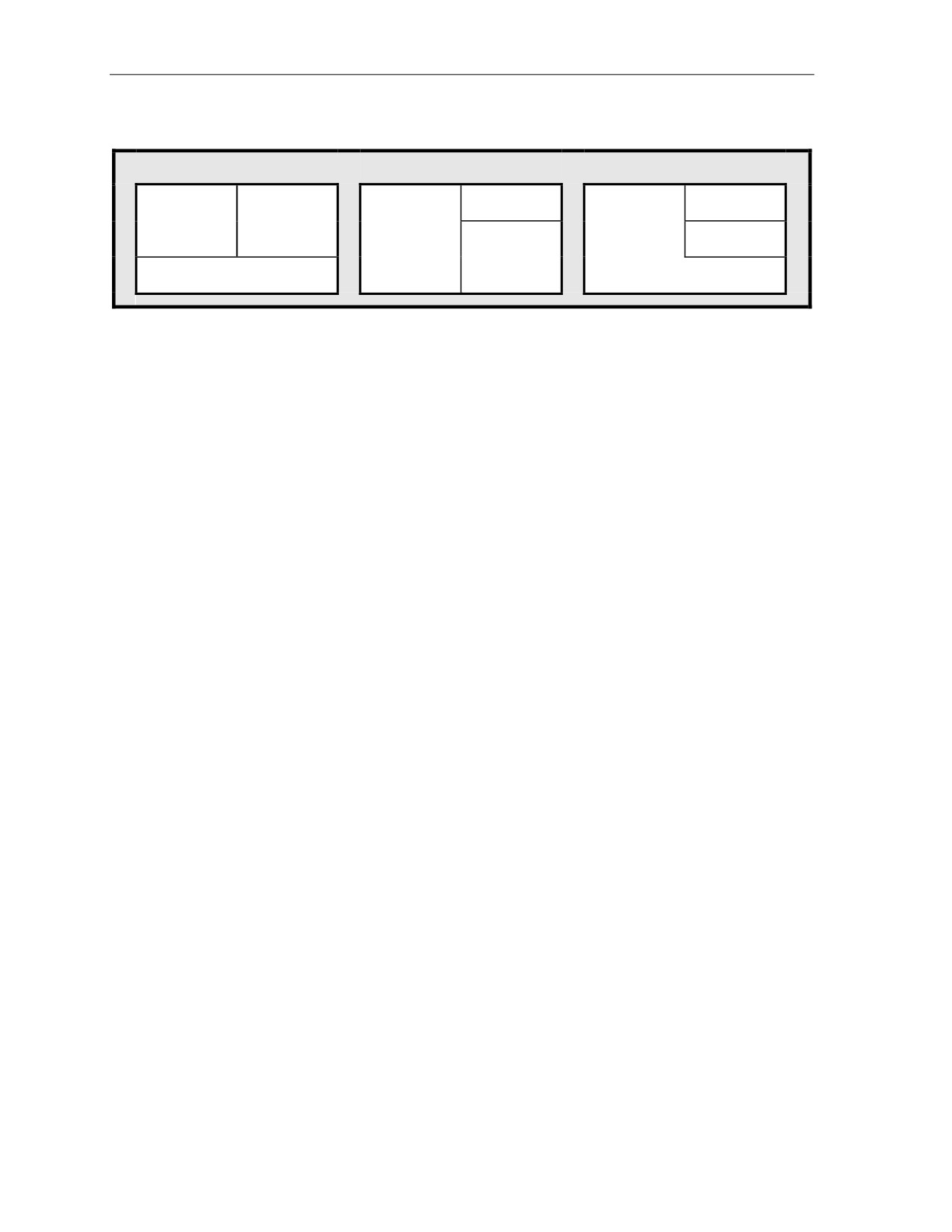
commitment of a large number of forces. Figure 3-5 shows the typical combination of offense, defense
and stability operations.
21 April 2009
FM 3-24.2
3-17
Chapter 3
Clear
Hold
Build
Offense
Offense
Offense
Defense
Defense
Stability
Defense
Stability
Stability
Figure 3-5. Clear-hold-build framework.
OVERVIEW
3-106. This pattern of operation is to clear, hold, and build one village, area, or city at a time—and then
expand into another area. In previous conflicts, this was known as the "Oil Spot Strategy." This type
of operation was used successfully in Algeria and Indochina by the French, who called it tache d’huile;
in Malaysia by the British, who referred to it as "The Briggs Plan"; and in Tal Afar by the Americans, who
named it "clear-hold-build." This operation aims to develop a long-term, effective Host Nation government
framework and presence in the area, which secures the people and facilitates meeting their basic needs,
and provides legitimate governance.
3-107. The purpose of America’s ground forces is to fight and win the Nation’s wars. Throughout
history, however, the Army has been called on to perform many tasks beyond pure combat; this has been
particularly true during the conduct of COIN operations. COIN operations will continue to require Soldiers
to be ready both to fight and to build—depending on the security situation and a variety of other factors.
RESOURCES
3-108. Clear-hold-build operations require a substantial commitment of resources, time and a clear unity
of effort by civil authorities, other agencies, and security forces. Counterinsurgent commanders must first
plan and prepare for a long-term effort. Before conducting a clear-hold-build operation, units must ensure
that they have identified or coordinated for—
• Adequate troops, US and HN, to clear the insurgents from a designated area.
• Interagency cooperation and unity of effort.
• Sufficient resources, expertise, and labor to restore essential services.
• A local government that will support the operation.
• Means for US and HN security (military, police, and paramilitary) forces to share intelligence.
OBJECTIVES
3-109. Actual operations begin by controlling access to the area and then by controlling key points within
the area. Security and influence can then spread out from these areas. Often, the steps of clear-hold-build
operations will overlap, especially between hold and build, where activities are often conducted
simultaneously. Clear-hold-build operations have the following objectives:
• Create a secure physical and psychological environment.
• Provide continuous security for the local populace.
• Eliminate the insurgent presence.
• Reinforce political primacy.
• Enforce the rule of law.
3-18
FM 3-24.2
21 April 2009
Foundations of Counterinsurgency
• Rebuild local Host Nation institutions.
• Gain the populace’s support.
CLEAR
3-110. Clear is a tactical mission task that requires the commander to remove all enemy forces
and eliminate organized resistance in an assigned area (FM 3-90). The force does this by destroying,
capturing, or forcing the withdrawal of insurgent combatants and leaders. This task is most effectively
initiated by a clear-in-zone or cordon-and-search operation, as well as patrolling, ambushes,
and targeted raids.
OFFENSIVE OPERATIONS
3-111. Offensive operations predominate during the clear phase; however, defensive and stability
operations are still conducted. Eliminating guerrilla forces does not remove the entrenched insurgent
infrastructure. While leaders and the underground exist, insurgents will continue to recruit among the
population, undermine the Host Nation government, receive supplies, and coerce the populace through
intimidation and violence. After guerrilla forces have been eliminated, removing the insurgent
infrastructure such as leaders, underground, and auxiliaries begins. This should be done in a way that
minimizes the impact on the local populace.
3-112. If insurgent forces are not eliminated, but are expelled or have broken into smaller groups instead,
they must be prevented from reentering the area. Once counterinsurgent units have established their bases,
platoons and companies cannot become static. They should be mobile and should patrol throughout the
area. The local populace should be compensated for damages that occur while clearing the area of
insurgents.
DEFENSIVE AND STABILITY OPERATIONS
3-113. Defensive and stability operations are continued to maintain gains and set the conditions for future
activities. These include—
• Isolating the area to cut off external support and to kill or capture escaping insurgents.
• Conducting periodic patrols to identify, disrupt, eliminate, or expel insurgents, as well as secure
the population.
• Employing security forces and government representatives throughout the area to secure the
populace and facilitate follow-on stages of development.
LINES OF EFFORT
3-114. Although the clear phase emphasizes establishing civil security, operations across the other LOEs
must happen. Examples of complimentary actions across all LOEs include—
Establish Civil Security
3-115. Conduct targeting of insurgent leaders and guerrilla bands, cordon and searches of insurgent
controlled areas, and raids on safehouses.
Establish Civil Control
3-116. Train and support police forces or paramilitary forces to implement curfews to interdict insurgent
movement.
Support HN Security Forces
3-117. Train and use HN security forces to increase combat power during clearing operations.
21 April 2009
FM 3-24.2
3-19
Chapter 3
Support to Governance
3-118. Identify key government and local leaders that can support the re-establishment of local
government that can administer the area. Identifying the underlying issues of the population.
Restore Essential Services
3-119. Identify essential services that need immediate attention.
Support to Economic and Infrastructure Development
3-120. Identify potential
“quick win” projects to stimulate the local economy and create additional
support for the government.
Conduct Information Engagement
3-121. The message to the populace focuses on gaining and maintaining their overt support for the
counterinsurgency effort, as well as informing them that active support for the insurgency would prolong
combat operations, creating a risk to themselves and their neighbors. The message to the insurgent force
focuses on convincing them that they cannot win, and that the most constructive alternatives are
to surrender or cease their activities.
HOLD
3-122. After clearing the area of guerrillas, the counterinsurgent force must then assign sufficient troops
to the cleared area to prevent their return, to defeat any remnants, and to secure the population. This is the
hold task. Ideally, Host Nation security forces execute this part of the clear-hold-build operation. Success
or failure depends on effectively and continuously securing the populace and on reestablishing an HN local
government. Although offensive and stability operations continue, in this phase, uses defensive operations
to secure the population.
BASES
3-123. Cleared areas are best held by establishing counterinsurgent forces in bases among or adjacent to
the area. From these bases, the counterinsurgent forces can then concentrate on two primary purposes:
to disrupt, identify, and ultimately eliminate the insurgents, especially their leadership and infrastructure;
and to end popular support for the insurgency and to gain popular support for the government
3-124. Exactly where these bases are established and their actual force composition is a key
counterinsurgent decision. The main consideration should be towards the desired effect on the population,
especially increasing their security. If a area is supportive of the insurgency, then a base established
in known insurgent strongholds may sever the relationships between insurgents and the populace.
However, if the area is neutral or has pockets of support for the government, then the base should be
established where it can best help in developing the area.
SECURING THE POPULACE
3-125. If adequate HN security forces are not available, units should consider hiring and training local
paramilitary forces to secure the cleared village or neighborhood. Not only do the members of the
paramilitary have a stake in their area’s security, they also receive a wage. Providing jobs stimulates the
economy. Having a job improves morale and allows locals to become a potential member of the local
governmental process.
3-126. Contact with the population should be continuous, and both planned and unplanned. Being based
within the population forces information engagement and provides opportunities for contact with the
population. From the first day, Soldier’s actions in these areas, if culturally astute, can build bonds with the
local populace and in many cases change the attitudes of the people. Ultimately, the goal of this contact
3-20
FM 3-24.2
21 April 2009
Foundations of Counterinsurgency
is twofold: to gain a better picture of the actual situation and to turn the population’s support toward the
government.
3-127. Another consideration is to secure key physical infrastructure. Because resources are always
limited, parts of the infrastructure vital for stability and vulnerable to attack must receive the priority
of protection. This can be accomplished by analyzing the risk and likelihood of attack on various sites in
the AO. (Chapter 7 discusses one technique for this.)
LINES OF EFFORT
3-128. Although the hold phase emphasizes defensive actions, operations across all LOEs must be
employed. Examples of complimentary actions along multiple LOEs include—
Establish Civil Security
3-129. Continuously secure the people and separate them from the insurgents. Establish a firm
government presence and control over the area and populace by recruiting, organizing, arming,
and training local paramilitary forces and integrate them into operations against the insurgents. Continue
to conduct raids on insurgent leaders or members of the underground.
Establish Civil Control
3-130. Train and support police force to combat crime and enforce curfews to curtail insurgent
movement.
Support HN Security Forces
3-131. Conduct combined patrols, checkpoints, cordon and searches, and raids with HN security forces.
Support to Governance
3-132. Establish or reestablish a government political apparatus to replace the insurgent apparatus.
Restore Essential Services
3-133. Establish contracts, empower or finance local governments to initiate SWEAT-MSO repairs.
Support to Economic and Infrastructure Development
3-134. Conduct local improvements designed to convince the populace to support the Host Nation
government, participate in securing their area, and contribute to the reconstruction effort.
Conduct Information Engagement
3-135. Information engagements should affirm that security forces supporting the Host Nation
government are in the area for the long term and are securing the population from insurgent intimidation,
coercion, and reprisals.
BUILD
3-136. The build phase of clear-hold-build operations consists of carrying out programs designed
to remove the root causes that led to the insurgency, improve the lives of the inhabitants, and strengthen the
Host Nation’s ability to provide effective governance. Stability operations predominate in this phase, with
many important activities being conducted by nonmilitary agencies. During this phase, the Host Nation
security forces should have primary responsibility for security. Progress in building support for the Host
Nation government requires protecting the local populace. People who do not believe they are secure from
insurgent intimidation, coercion, and reprisals will not risk overtly supporting counterinsurgent efforts.
21 April 2009
FM 3-24.2
3-21
Chapter 3
SECURING THE POPULACE
3-137. To secure the populace, security forces should continuously conduct patrols and use measured
force against insurgent targets of opportunity. Just like in the hold phase, if the HN security forces are
inadequate, units should consider hiring a paramilitary force to secure the village or neighborhood. Contact
with the people is critical to the local counterinsurgency effort’s success. Actions to eliminate the
remaining covert insurgent support infrastructure, such as the underground, auxiliary, and mass base, must
be continued, because any insurgent presence will continue to threaten and influence people.
END STATE
3-138. During the build phase, Host Nation government representatives reestablish government offices
and normal administrative procedures. National and international development agencies rebuild
infrastructure and key facilities. Local leaders are developed and given authority. Life for the area’s
inhabitants begins the return to normal.
LINES OF EFFORT
3-139. Although the build phase continues to secure the population and separate them from the
insurgents, the focus will shift to the other LOEs. Examples of complimentary actions along multiple LOEs
include—
Establish Civil Security
3-140. Conduct targeted raids on insurgent leaders and the underground, led by HN security forces.
Provide a US Quick Reaction Force (QRF) to HN security forces.
Establish Civil Control
3-141. Continue to patrol the area and control the population while improving HN police training
and equipment. Police forces may continue to expand their role.
Support HN Security Forces
3-142. Increase the number of patrols by HN security forces; US forces begin reducing their roles.
Support to Governance
3-143. Continue to support and enhance the local government.
Restore Essential Services
3-144. Continue projects to restore SWEAT-MSO services such as building roads, digging wells,
building schools and establishing emergency services.
Support to Economic and Infrastructure Development
3-145. Continue to stimulate the local economy through projects such as market repairs.
Conduct Information Engagement
3-146. Information engagements should affirm that security forces supporting the Host Nation
government are in the area for the long term and are eliminating insurgent leaders, organizations
and infrastructure and improving essential services.
3-22
FM 3-24.2
21 April 2009
Foundations of Counterinsurgency
The Strategic Hamlet Program
Successful clear-hold build operations (CORDS program and Tal Afar) are discussed in FM 3-24. This
vignette highlights the challenges of executing a clear-hold-build operation properly.
In 1962, the Military Assistance Command Vietnam (MACV) launched the Strategic Hamlet Program
to compliment its advisory efforts with the Republic of Vietnam’s military. The Strategic Hamlet Program
was an extremely ambitious program designed to build fortified hamlets, relocate the population to the
hamlets, and train paramilitary forces, known as the Regional or Provincial Forces, across South Vietnam.
Together this would increase security and quality of life for the population. With the goal of fortifying half
the country’s hamlets in only 18 months, the program struggled with providing governance and solving
bureaucratic issues, ensuring security for all the villages, and limiting corruption. Additionally, the program
met resistance from locals, who felt an ancestral connection to their original hamlets.
Although the program was abandoned in 1964, after the war, the North Vietnamese Army acknowledged
that the well-run hamlets forced their guerrilla forces to relocate to other, insurgent controlled areas. The
South Vietnamese Strategic Hamlet program failed to meet all five prerequisites for a clear-hold-build
operation, especially obtaining an adequate number of troops, securing sufficient resources, and providing
a local government up to the task.
Section V—OTHER MAJOR COIN TACTICAL OPERATIONS
Major counterinsurgency tactical operations include Strike operations and Populace and Resource Control
operations. Strike operations are operations to find, fix and finish insurgent forces in areas under insurgent
control where the counterinsurgent does not want to maintain a permanent presence afterwards. Population
and resources control operations are government operations to control the populace, deny insurgents access to
the populace and resources, and reestablish law order.
STRIKE OPERATIONS
3-147. Strike operations are short duration
(generally one day to several weeks) offensive, tactical
operations conducted in contested or insurgent controlled urban or rural areas to find, fix and destroy
insurgent forces. Small, highly mobile combat forces operate in dispersed formations to locate and fix the
insurgents. Upon locating the insurgents, commanders direct their forces to attack, pursue, and destroy
them. If contact is lost, the units resume aggressive patrolling to reestablish contact and destroy insurgent
forces before they can rest, reorganize, and resume operations. Strike operations seek to destroy insurgent
forces and base areas, isolate insurgent forces from their support, and interdict insurgent infiltration routes
and lines of communications (LOCs). Strike forces are organized as self-sufficient task forces capable
of operating in areas remote from logistical bases. Ground or water borne means of entry may be used,
as well as air assault or parachute deliveries. Strike operations use offensive tactics such as raids,
reconnaissance in force, cordons and attacks, hasty or deliberate attacks, and pursuits. It is often a
complementary operation to a clear-hold-build operation.
3-148. Speed and surprise are important in strike operations. The sudden and unexpected delivery
of combat forces into an insurgent-held or contested area provides significant advantages to the forces
conducting these operations. Speed and surprise can be achieved by using air assaults to insert the first
forces into the area of operations. Subsequent forces can be delivered on later airlifts or by other modes
of transportation. Fires can also be used to block escape routes or areas that are not secured by
ground forces.
3-149. A strike on an insurgent force normally requires superior combat power. COIN forces attempt
to immediately engage and destroy insurgents before they can disperse. Depending on the situation, hasty
or deliberate attacks are made on bases that contain fortifications. After a successful attack on insurgent
forces, troops thoroughly search the area for insurgent personnel, supplies, equipment, and documents. All
21 April 2009
FM 3-24.2
3-23
Chapter 3
captured enemy documents must be placed into intelligence channels as soon as possible to ensure that it
is properly exploited by DOMEX personnel. Pursuit operations are undertaken to destroy or capture forces
attempting to flee. Artillery, air support, and air assault forces support ground pursuit.
PURPOSE
3-150. Strike operations may also be used as a means to encourage reconcilable insurgents to the
negotiation table. Strike operations are conducted to—
• Harass the insurgent to prevent the buildup of personnel and logistical resources.
• Destroy the insurgent force and its base complexes.
• Demonstrate government resolve and garner support from the populace in the local area.
• Set the conditions to expand clear-hold-build operations.
•
LINES OF EFFORT
3-151. Along the LOEs in a strike operation, tactical units should examine—
Establish Civil Security
3-152. Conduct attacks, raids, and cordon and searches with HN security forces on insurgent forces
and bases.
Establish Civil Control
3-153. Conduct PRC operations, such as a census, a checkpoint or a search operation in villages
or blocks to control the populace.
Support HN Security Forces
3-154. Increase combat power by using HN security forces.
Support to Governance
3-155. Establish or convene local or tribal council meetings to identify and solve the underlying issues
of the insurgency.
Restore Essential Services
3-156. Ensure projects provide positive reinforcement of desired behavior, such as digging a well for a
tribal sheik who provides intelligence.
Support to Economic and Infrastructure Development
3-157. Hire people from villages or blocks that are neutral to increase support for the government.
Conduct Information Engagements
3-158. Use information engagements to highlight government success and expose insurgent defeats
and excesses.
POPULACE AND RESOURCE CONTROL OPERATIONS
3-159. Populace and resource control (PRC) operations are government actions to protect the populace
and its materiel resources from insurgents, to deny insurgents access to the populace and material resources
and to identify and eliminate the insurgents, their organization, their activities, and influence while doing
so. The objective of populace and resources control is to assist in preserving or reestablishing a state of law
3-24
FM 3-24.2
21 April 2009
Foundations of Counterinsurgency
order within an area or entire nation. PRC operations are normally nontactical, police-type operations and a
responsibility of HN governments. However, US forces may be required to conduct PRC operations until
HN security forces possess the will and capability. PRC operations may be conducted independently
of clear-hold-build operations or Strike operations or as an integrated part in each of these operations.
3-160. In peacetime, police forces protect the population and resources of a state from criminal activity
by both armed and unarmed criminals. During an insurgency, however, the number of armed insurgents,
the willingness of insurgents to use violence against the police and the populace, and the potential
for civilians to become displaced or refugees, often creates a situation where police forces and their
operations cannot successfully curtail the insurgents nor protect the population and resources.
OBJECTIVES
3-161. Typical objectives for populace and resources control operations include—
• Establish and maintain a secure physical and psychological environment for the population.
• Limit insurgent freedom of movement and initiative.
• Sever relationships between the population and insurgents.
• Identify and neutralize insurgent support activities.
• Establish and maintain security of resources.
CATEGORIES
3-162. Populace and resources control measures can be classified into four general categories:
• Surveillance and intelligence measures.
• Establish control measures.
• Enforce control measures.
• Protection measures.
Surveillance and Intelligence Measures
3-163. Surveillance and intelligence measures include both overt and covert surveillance of known, likely
or potential insurgents, their targets, and the creation of a QRF to exploit intelligence or conduct greater
surveillance of insurgent targets. Expanded police intelligence and surveillance operations, to include
police informants and agent networks, may link criminal acts from robberies, kidnappings, terrorism,
and extortion to insurgent activities.
3-164. Surveillance must be established and maintained over key individuals, groups, and activities
of interest. Increased surveillance must be maintained over critical locations, especially government
and civilian sources of weapons and ammunition. This includes maximum use of sensors, cameras
and other electronic surveillance equipment to provide continuous coverage of suspected areas and routes
used by insurgents. An additional means of gathering intelligence is to monitor local media
(radio,
newspaper) both for rumor control and counterpropaganda purposes as well as intelligence tip-offs.
In addition, the public and private actions of influential local leaders provide additional insight. It
is important to live forward with the local people and listen to what they are saying. Still other intelligence
and surveillance measures include—
• Establish general covert surveillance measures at marketplace and stores.
• Use HUMINT collection teams (HCTs) or the HN police to recruit locals for surveillance
and intelligence.
• Establish a system of block or village wardens with reporting procedures as well as incentives.
Hold the wardens accountable for knowing what is going on in their block or village.
Establish Control Measures
3-165. Successful counterinsurgency operations typically use increased control measures to limit
insurgent activities and their ability to hide within the population. Normal security functions must be
performed efficiently and effectively, which is especially true if they are in any way part of the root causes
of the insurgency. However, due to the insurgency, additional security measures and operational techniques
21 April 2009
FM 3-24.2
3-25
Chapter 3
must be implemented. Two such considerations are increasing the size of police/border patrols due to the
threat and establishing QRFs to rapidly reinforce any patrol or site.
3-166. Combating an insurgency requires increased control measures to limit the insurgent’s freedom
of movement and their supporters. Control measures should be well planned and coordinated to ensure
rapid and efficient operations, with a minimum of delay and inconvenience to the people. All control
measures must be authorized by national laws and regulations, as well as be enforceable. Each control
measure should be tailored to fit the situation and used to establish or reinforce the credibility of the Host
Nation government.
3-167. The Host Nation government should explain and justify all control measures to the HN
population. They should be the least restrictive to accomplish the purpose. Local civilians must understand
that these measures are necessary to protect them from insurgent intimidation, coercion, and reprisals.
Ideally, the local population and their leaders should accept the needed measures before implementation
and that their support will minimize the inconvenience of the measures. These restrictions must be lifted
as soon as the situation permits.
3-168. Once control measures are in place, the Host Nation government should implement a system
of punishments for offenses related to them. These punishments should be announced and enforced
equally. All inconveniences and discomforts these measures cause should be blamed squarely upon the
insurgents. PSYOP products, widely disseminated to the population, can help ensure the measures have the
intended effect and undermine popular support for the insurgency. Control measures fall under the
populace control or resource control categories.
Populace Controls
3-169. Population control measures include—
• Curfews.
• Travel permits and passes.
• Movement restrictions.
• Restricted areas.
• Census or registration of residents.
• Block committee.
• National or regional identification system or ID cards.
• Licensing for jobs such as medical, security, construction, and drivers.
• Immigration restrictions
Resource Controls
3-170. Resource control measures include control of select resources to include foodstuffs, medical
supplies, and key equipment through:
• Rationing or purchase permits
• Registration of firearms.
• Registration of automobiles and trucks.
• Export and import restrictions.
Techniques
3-171. Enforcement operations must be conducted both day and night. Checkpoints and roadblocks are
set up to check and control the movement of personnel, vehicles, and material, and prevent actions that aid
the insurgency. During counterinsurgency operations, checkpoints and roadblocks assist the government
and counterinsurgent forces in maintaining the initiative against the insurgents by disrupting, interfering
with, and deterring insurgent operations and disrupting the insurgents’ decision-making cycle. It
is important to conduct checkpoints and roadblocks with interpreters, HN police, or other HN security
forces. Checkpoints and roadblocks used together can channel vehicles and personnel into a checkpoint
or a search.
3-26
FM 3-24.2
21 April 2009
Foundations of Counterinsurgency
Roadblock
3-172. A barrier or obstacle (usually covered by fire) used to block or limit the movement of vehicles
along a route.
Checkpoint
3-173. Checkpoints are manned locations used to control movement that may be established from 1 to 72
hours depending on the purpose of the operation.
Inspections
3-174. This includes random cordons and searches, both day and night, of homes, shops and buildings
for arms, propaganda material and insurgents. The use of military working dog teams can be very effective
in intercepting contraband. To decrease population resentment, it is important to ensure intelligence
supports the inspections. An inspection can also be used as a subterfuge for a meeting with key people.
Rewards for Cooperation and Compliance
3-175. A separate, yet related, function is the rewarding of cooperation or compliance. The ultimate
reward to the society as a whole is the removal or reduction of restrictions. However, this must be balanced
with the increased potential of the insurgent to gain benefit from these reduced or removed restrictions.
• Cooperative towns, villages or neighborhoods may be collectively rewarded by essential
service projects or economic stimulation projects.
• At the individual level, the government may provide monetary or material rewards
for information on suspicious activities.
Protection Measures
3-176. A form of protection measures is internment and resettlement, which consist of those measures
necessary to provide shelter, sustain, guard, protect, and account for people
(enemy prisoners of war
[EPWs] and civilian internees [CIs]), US military prisoners, and dislocated civilians [DC]. Resettlement
of a population may vary from a geographic based resettlement to the resettlement of a specific population
group within a defined area. Resettlement operations should be under Host Nation direction and control.
For more information, see FM 3-19.40.
Section VI—PHASES
Major counterinsurgency tactical operations are long-term population security operations conducted in territory
generally under Host Nation government control to establish, regain, or maintain control of those areas
and to provide adequate security and control to the populace to allow restoration of essential services
and improvements to the economy. They typically move through three phases. They combine offensive,
defensive, and stability operations to achieve the stable and secure environment needed for effective
governance, essential services, and economic development to flourish. At the operational level, the phases
are—the initial response phase, the transformation phase, and the fostering sustainability phase. At the tactical
level, these three phases may resemble the three parts of a clear-hold-build operation. Understanding this
evolution and recognizing the relative maturity of the AO are important for the proper planning, preparation,
execution, and assessment of COIN operations. It is also important to recall that the insurgent also operates
in three stages—latent and incipient, guerrilla warfare, and war of movement. This knowledge allows
commanders to ensure that their activities are appropriate to the current situation.
INITIAL RESPONSE PHASE
3-177. The initial response phase generally reflects tasks executed to stabilize the operational
environment in a crisis. During this phase, military forces perform stability tasks during or directly after a
conflict where the security situation hinders the introduction of civilian personnel. Activities during the
initial response phase aim to provide a safe, secure environment as well as to attend to the immediate
essential service needs of the Host Nation population. At the tactical level, the initial response may appear
21 April 2009
FM 3-24.2
3-27
Chapter 3
to be similar to the clear phase of a clear-hold-build operation. Units may also incorporate strike operations
and PRC operations during this phase. Against a determined insurgency, the initial response may last
months or years.
TRANSFORMATION PHASE
3-178. The transformation phase represents a broad range of post-conflict reconstruction, stabilization,
and capacity-building. The transformation phase may be executed in either crisis or vulnerable states.
Counterinsurgent forces are most active here, working aggressively along all lines of effort (LOEs). The
desire in this stage is to develop and build enduring capability and capacity in the HN government
and security forces. As civil security is assured, focus expands to include the development of legitimate
governance, provision of essential services, and stimulation of economic development. Relationships with
HN counterparts in the government and security forces and with the local populace are developed
and strengthened. These relationships increase the flow of intelligence. This intelligence facilitates
measured offensive operations in conjunction with the HN security forces. The Host Nation increases its
legitimacy through providing security, expanding effective governance, providing essential services,
and achieving incremental success in meeting public expectations.
3-179. At the tactical level, the transformation phase may look a lot like the hold phase of a
clear-hold-build operation. Units may use Strike operations and PRC operations that complement their
holding efforts. Once again, a tenacious insurgency may cause the transformation or hold phase to last
months or even years.
FOSTERING SUSTAINABILITY PHASE
3-180. Fostering sustainability phase encompasses long-term efforts that capitalize on capacity-building
and reconstruction activities to establish conditions that enable sustainable development. This phase
is characterized by the expansion of stability operations across contested regions, ideally using HN security
forces. The main goal for this phase is to transition responsibility for COIN operations to HN leadership
and security forces. In this phase, the multinational force works with the Host Nation in an increasingly
supporting role, turning over responsibility wherever and whenever appropriate. QRF and fire support
capabilities may still be needed in some areas, but more functions along all LOEs are performed by HN
security forces with the assistance of multinational advisors. In this phase, the Host Nation has established
or reestablished the systems needed to provide effective and stable governance that sustains the rule of law.
The government secures its citizens continuously, sustains and builds legitimacy through effective
governance, has effectively isolated the insurgency, and can manage and meet the expectations of the
population.
3-181. At the tactical level, the fostering sustainability phase may resemble the build phase of a
clear-hold-build operation. Due to the stable security environment, PRC operations may be relaxed.
In ungoverned areas, there still may be a requirement for strike operations to disrupt the remnants of an
insurgency. This phase progresses at the pace of the HN’s ability to rebuild their infrastructure
and institutions, assume control of their security, and provide legitimate governance to the people.
SUMMARY
The foundations of COIN are the guiding principles for any unit conducting counterinsurgency operations.
Once understood and applied they enable commanders to craft a coherent plan that achieves unity
of effort amongst all organizations in the area of operations.
3-28
FM 3-24.2
21 April 2009
Chapter 4
Comprehensive Tactical Planning in Counterinsurgency
“The fight against the guerrilla must be organized methodically and conducted with
unremitting patience and resolution. Except for the rare exception, it will never
achieve spectacular results, so dear to laurel seeking military leaders.”
Roger Trinquier. Modern Warfare—A French View of Counterinsurgency. 1964.
The aim of counterinsurgency operations is to set the conditions that eliminate
insurgency by securing and garnering the support of the population, as well
as increasing the legitimacy of the Host Nation government. To accomplish this,
tactical COIN planning uses all capabilities, not just military capabilities. This
chapter shows the tactical planning process of counterinsurgency operations through
sections on basic tactical design, planning horizons, the military decision-making
process (MDMP), troop-leading procedures (TLP), and targeting.
Section I—OVERVIEW
The battlefield of the Twenty-First Century has proven to be complex due to increasing urbanization,
globalization, and religious fundamentalism; multiple enemy, friendly, and neutral actors; and ambiguous
guidance and direction. It is through planning that the commander is able to see the desired outcome, lay out
effective ways to achieve it, and communicate his vision, intent, and decisions to his subordinates, focusing on
the results he wants to achieve (FM 5-0). Progress in counterinsurgencies is slow and difficult to measure.
It can continue for weeks, months, even years. With the complexity of counterinsurgency operations,
commanders and staff have relied upon end states, the seven COIN lines of effort, measures of effectiveness
and performance and tight planning horizons to impose order on the chaos and craft functional plans to guide
counterinsurgent efforts to increase the legitimacy of the Host Nation government along multiple lines of effort.
END STATE
4-1.
At the tactical level, this is the set of conditions that, when achieved, accomplish the mission.
4-2.
A condition is a specific existing circumstance, framed in military terms. that, when achieved,
describes one aspect of the desired end state. Achievement of all of the conditions obtains the end state. For
tactical commanders, the end state is typically a set of required conditions, usually for each LOE, that
defines the achievement of the commander’s tactical objective.
4-3.
Historically, successful counterinsurgencies commonly focus on the political end state, unified
in their approach, and flexible in addressing the core insurgency issues. They secure the people, enhance
the legitimacy of the Host Nation government and, above all, show patience.
4-4.
A military operation must be linked to a political end state, composed of various conditions that
the populace supports.
UNITY OF ACTION
4-5.
Close coordination and effective cooperation between the Host Nation (civil, police, and military),
the US counterinsurgency force and all other coalition partners, allows the full strength of each to engage
all levels of the insurgency. Unity of effort is key.
21 April 2009
FM 3-24.2
4-1
Chapter 4
ROOT CAUSES
4-6.
Root causes are the grievances of the people. Ultimately, for an insurgency to be successful, it
must provide a solution to the key issues of the people. At the same time, for a counterinsurgency to be
successful, it too must address these key issues.
PROTECTION OF THE PEOPLE
4-7.
Most insurgencies use coercion and terror to gain support from the people and to inhibit the
people’s support of the government. The target of this coercion and terror is frequently the people
connected to the government—police, local administrators and teachers. As such, if the counterinsurgent
wishes to receive the support of the people they must not only protect their supporters and their families,
but also their communities. Often, protecting and controlling the people enables the counterinsurgent
to achieve the other conditions.
ENHANCEMENT OF THE LEGITIMACY OF THE HN GOVERNMENT
4-8.
The US and other counterinsurgency partners must always focus on strengthening the Host Nation
government’s ability to defend itself and its populace from the insurgency.
PATIENCE
4-9.
There is no decisive battle in counterinsurgency operations. Often, it takes years to create an
environment where a Host Nation government can and will defend itself and its people.
MEASURES OF PERFORMANCE AND EFFECTIVENESS
4-10.
Tactical units must measure progress toward mission accomplishment. Commanders continuously
assess the operational environment and the progress of operations, and compare them to their initial vision
and commander’s intent. Units evaluate the operations progress or success through intelligence assets,
patrol reports, engagement with local leaders, graffiti, or surveys. Commanders adjust operations based on
their assessment to ensure objectives are met and the desired end state is achieved.
4-11.
The assessment process measures the efforts that support operational and tactical objectives
and progress toward the desired military end state of the counterinsurgency across all LOEs. The
assessment process uses measures of performance and measures of effectiveness to gauge progress.
They are defined as follows:
MEASURE OF PERFORMANCE
4-12.
An MOP is criterion used to assess friendly actions that is tied to measuring task accomplishment
(JP 1-02). MOPs confirm or deny that the task has been correctly performed. An example of a MOP
is “How many people registered to vote at the school this week?”
MEASURE OF EFFECTIVENESS
4-13.
An MOE is criterion used to assess changes in system behavior, capability, or operational
environment that is tied to measuring the attainment of an end state, achievement of an objective,
or creation of an effect (JP 3-0). An example of a MOE is “Did the well project provide clean drinking
water to the village?”
PURPOSES
4-14.
Measures of effectiveness and of performance help commanders determine when all or part of the
mission has been accomplished. The criteria used depend on the situation. Many times the MOP and MOE
must be determined and evaluated by the HN government or security forces. They often require
readjustment as the situation changes and objectives evolve. If an effect cannot be measured directly, then
4-2
FM 3-24.2
21 April 2009
Comprehensive Tactical Planning in Counterinsurgency
indicators of achieving the effect are measured. A measure of effectiveness or a measure of performance
has four characteristics. They are—
Measurable
4-15.
They require quantitative or qualitative standards that can be used to measure them.
Discrete
4-16.
Each criterion measures a distinct aspect of the operation. Excessive numbers of MOEs and MOPs
become unmanageable. At that point, the cost of collection efforts outweighs the value of assessing.
Relevant
4-17.
Each MOE and MOP must be relevant to the result or outcome. The key is visualizing the desired
result or outcome and identifying the most accurate and simplest indicator of it.
Responsive
4-18.
MOEs and MOPs must detect changes quickly enough for commanders to respond immediately
and effectively.
4-19.
Commanders and staffs also develop a standard or baseline as a comparison and identify trends.
From this information and analysis of why a trend is up or down, staffs can identify trouble spots and plan
operations to reverse negative trends. They can also capitalize on positive trends by determining what
is causing the positive increases and apply those tactics, techniques, and procedures more broadly.
4-20.
Measures of effectiveness and measures of performance are included in the approved plan
or order and reevaluated continuously throughout preparation and execution. Higher echelon staffs should
ensure that the number of MOEs and MOPs do not overly burden lower echelons—especially battalion
and below. Well-devised MOEs and MOPs, supported by effective management of available information,
help commanders and staffs understand links between tasks, end state, and lines of effort.
PLANNING HORIZONS
4-21.
During operations, a headquarters sends a tactical unit an operations plan or operations order.
Tactical units must then consider the scope of their mission and determine the planning horizons.
A planning horizon is a point in time commanders use to focus the organization’s planning efforts to shape
future events. Planning horizons, which in major combat operations are measured in hours and days
for tactical commanders may, in COIN operations, be measured in weeks, months, and years.
4-22.
In contrast, tactical commanders, who have responsibility for terrain and a mission covering
multiple objectives that must be achieved systematically, require extended planning horizons. Managing
extended planning horizons have an impact on a tactical unit. The staff processes must be organized
to facilitate multiple outlooks, as an extended outlook does not relieve the immediacy of current operations.
However, this may be challenging for a company commander without a staff.
4-23.
FM 5-0 defines three planning horizons—long-, mid-, and short-range plans. These horizons
create a useful construct for operations executed by tactical units in a counterinsurgency. Additionally, the
familiar quarterly training guidance and brief processes in FM
7-0 fit the long-term nature
of counterinsurgency operations.
LONG-RANGE PLANNING
4-24.
Long-range planning encompasses the range of time where the situation is too uncertain to plan
for specific operations. Commanders must visualize what conditions they desire to exist, resulting from the
cumulative effect of all their tactical objectives. Visualizing the time required to establish these conditions
places approximate bounds on the extent of future planning. In general, when units are in a rotation
and have a planned transfer of authority, the long-range plan should consider the conditions that the
commander desires to exist at three months after the transfer.
21 April 2009
FM 3-24.2
4-3

Chapter 4
4-25.
The long-range plan provides a construct for a commander to describe his vision of the
operational environment and their unit’s role over time using lines of effort. In addition to describing the
unit’s tactical objectives and the conditions they create, the plan provides a description of major events.
Providing a long lead time on major events can be critical to anticipating resources and identifying
milestones, or identifying and completing a series of interrelated tasks well in advance of the event.
Friendly forces as in a transfer of authority, the population as in elections, or the insurgency could drive the
event as it changes in phases, strategies, or organization.
4-26.
Management of long-range plans allows the unit to synchronize its efforts with adjacent units
and the higher headquarters. When an objective requires the cumulative effect of hundreds of company,
platoon and squad missions to achieve the desired end state, long-range plans using lines of effort become
the tool to ensure unity of effort across the echelons. Assessment from current operations is analyzed
to determine if the desired effect is being achieved, then the long-range plan adjusts the activities of current
operations to ensure that the unit’s efforts are directed towards the defined end state. Table 4-1 shows
COIN long-range planning cycles.
Table 4-1. COIN long-range planning cycle.
Planning Action
Planning Guidance
Planning Horizon
Division Long-Range Plan
3 months prior to start
Long-range plan horizon of 1 year
and Long-Range Calendar
Calendar at least 1 year
BCT Long-Range Plan
2 months prior to start
Long-range plan horizon of 1 year
and Long-Range Calendar
Calendar at least 1 year
Battalion/Squadron Long-Range Plan
1 months prior to start
Long-range plan horizon of 1 year
and Long-Range Calendar
Calendar at least 6 months
MID-RANGE PLANNING
4-27.
Mid-range plans are derived from the long-range plan. The long-range plan narrows the scope to a
frame of time where objectives or milestones that support objectives can be clearly defined and operations
planned in detail along all lines of effort. The mid-range plans therefore refine and expand upon the
appropriate portion of the long-range plan. Mid-range planning should not exceed the unit’s capability
to reasonably forecast events, assign resources and commit to a particular plan.
4-28.
It is the mid-range plan that analyzes the mission in detail and produces the warning, fragmentary,
and operations orders that drive daily actions. These plans represent a commitment of resources and initiate
preparation by subordinate units. Table 4-2 shows various mid-range planning cycles.
Table 4-2. COIN mid-range planning cycle.
Planning Action
Planning Guidance
Planning Horizon
Division Quarterly FRAGO
6 weeks prior to start
3 months
of quarter
BCT Quarterly FRAGO
1 month prior to start
3 months
of quarter
Battalion/Squadron Quarterly FRAGO
2 weeks prior to start
3 months
of quarter
Company plan and calendar
1 week prior to start
3 months
of quarter
Quarterly assessment and backbrief
Prior to start
3 months or more
of quarter
4-4
FM 3-24.2
21 April 2009
Comprehensive Tactical Planning in Counterinsurgency
SHORT-RANGE PLANNING
4-29.
Short-range planning represents the scope of detailed planning associated with a specific mission
or one to four weeks of normal operations. With resources assigned through mid-range planning,
short-range planning, the unit refines and expands the plan to include the tactical arrangement of forces,
execution matrices, patrol schedules, ISR plans and convoys.
4-30.
A framework order is a fragmentary order (FRAGO) that identifies and tasks units for missions
for one to four weeks. It has also been called a “steady state order.” An example is a battalion FRAGO that
identifies the company that will patrol the route each day during the upcoming week. Table 4-3 shows
possible short-range planning cycles for units.
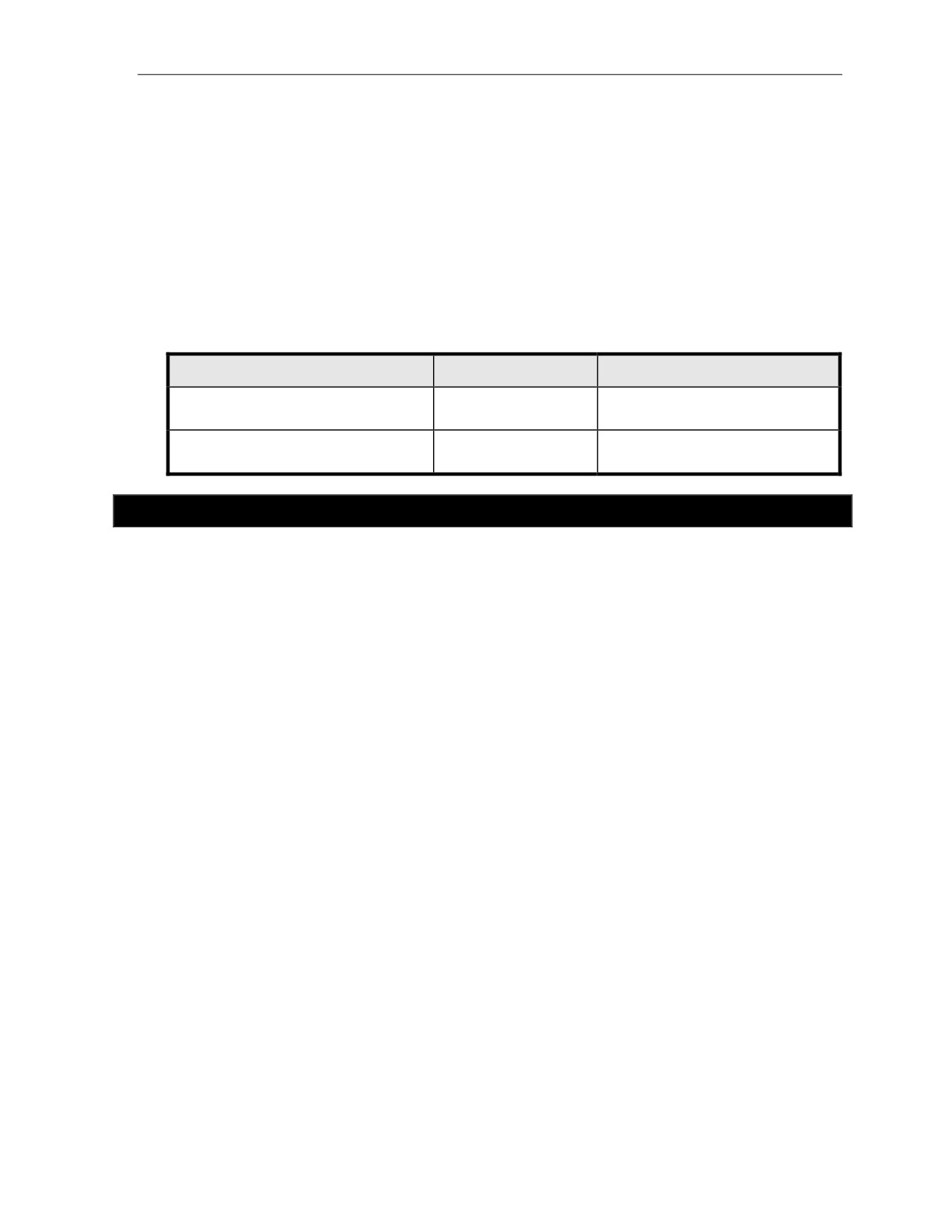
Table 4-3. COIN short-range planning cycle.
Planning Action
Planning Guidance
Planning Horizon
Brigade/Battalion/Squadron Meetings,
3 to 4 days prior to
1 to 4 weeks
Calendars, and Framework FRAGOs
execution
Company Calendar and FRAGO
1 to 2 days prior to
1 week
execution
Section II—TACTICAL DESIGN
During counterinsurgency operations, small units address immediate objectives through tactics such as a raid
or cordon and search. These operations resemble the small unit actions of tactical units in major combat
operations, and many of the planning tools apply directly. The counterinsurgent, however, must also
accomplish objectives, which require time, assessment and continual redirection to accomplish tasks arranged
in lines of effort. Thus, COIN is an iterative process. In addition to presenting commanders and staffs with
objectives that must be accomplished both immediately and over time, counterinsurgencies typically present
more tactical objectives to a unit than they can address simultaneously. The counterinsurgent must truly plan
for full spectrum operations, transitioning from tasks that support one objective onto tasks that support a
different objective often within the same day. A systematic approach must be developed that is tailored to the
situation based on continuous assessment. While the complexities of major combat operations should not be
underestimated, counterinsurgencies bring a different set of complexities that requires staffs to apply analytical
tools to achieve mission success.
CONSIDERATIONS
4-31.
The long, mid and short-range planning horizons help units establish a routine to assess the
success of their plan and revise the plan based on a changing operational environment. COIN is an iterative
process. —No unit—company, battalion, or brigade—understands its AO well enough to craft a perfect
plan across all seven LOEs. Like a rheostat, each must be balanced against the others. Success in the
Establish Civil Security and Establish Civil Control lines of effort typically allows units to focus less on
security and more on support to governance and restoration of essential services LOEs. The most effective
C2 mechanisms often give one single, permanent, senior local government official overall responsibility
for the counterinsurgency in their AO. These local officials in turn establish a local board, composed
of representatives from the civil authority, the military, the police, the intelligence services, and the civil
population, who manage all civil or military assets inside their AO. Additionally, tactical design
in counterinsurgency must consider how to—
• Secure the populations and areas that remain loyal.
• Reclaim the populations and areas that support the insurgency.
• Eliminate the insurgency, politically, militarily and philosophically.
• Develop Host Nation military and police forces that—
Defend their own bases and other critical sites.
21 April 2009
FM 3-24.2
4-5
Chapter 4
Protect and secure all elements of the populace equally.
Support the restoration of government presence and control.
Aggressively oppose insurgency in order to neutralize the insurgent leadership, cadre,
and combatants, through death, capture, co-opting individual, or forcing them to leave
the area.
Promote normalcy and stability.
Protect basic services.
Assist civic action projects.
• Help establish an HN legal framework and C2 mechanisms to aid implementation of the plan.
• Secure the critical infrastructure, to include governmental and societal critical sites.
• Win the information war, specifically—
Counter the insurgent’s propaganda.
Conduct friendly information engagements.
• Continually analyze and assess the success of the plan.
THE SEVEN COUNTERINSURGENCY LINES OF EFFORT
4-32.
As discussed in Chapter
3, lines of effort
(LOEs) are used to visualize, describe and direct
operations when positional references to an adversary have little relevance, like in a counterinsurgency.
Ideally, LOEs combine the complementary, long-term effects of stability tasks with the cyclic, short-term
events typical of combat operations. Using lines of effort, tactical commanders develop tactical tasks
and tactical missions, allocate resources, and assess the effectiveness of the operation. The commander
may specify which line of effort represents the decisive operation and which are shaping operations.
Commanders synchronize activities along multiple LOEs to achieve the conditions that compose the
desired end state and do not view them as a sequential “road map” to success.
4-33.
The seven counterinsurgency lines of effort—establish civil security, establish civil control,
support Host Nation security forces, restore essential services, support to economic and infrastructure
development, support to governance, and conduct information engagement—are intended as a guide
for tactical units. LOEs can be combined, eliminated, or expanded depending on the insurgency and the
overall situation. Employing the seven COIN LOEs adeptly requires a unity of effort with the HN
and other nonmilitary agencies. Figure
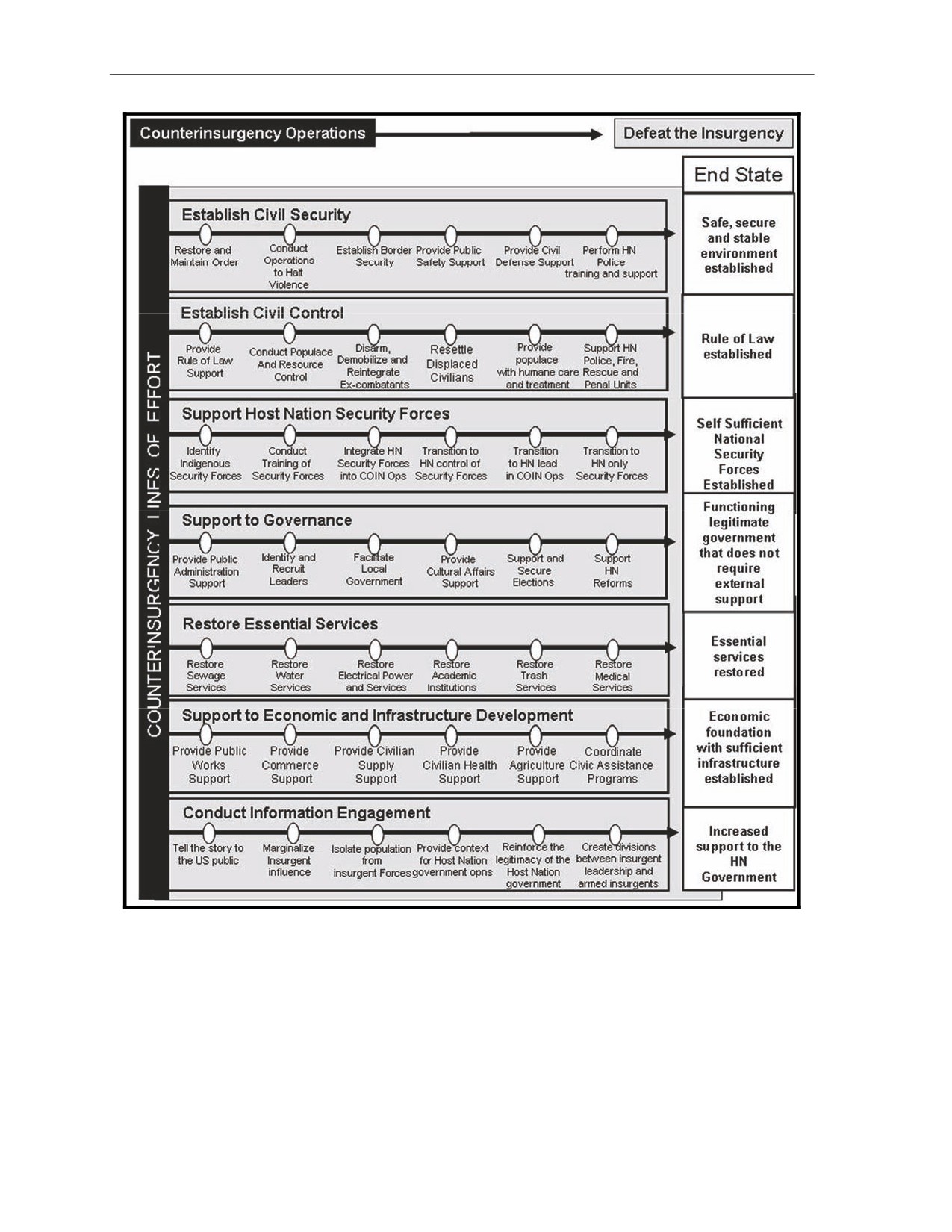
4-1 shows a notional tactical unit’s LOEs during a
counterinsurgency. The subparagraphs that follow the figure summarize the seven counterinsurgency lines
of effort and their first primary subtasks.
ESTABLISH CIVIL SECURITY
4-34.
Civil security involves protecting areas, resources, and the populace from both external
and internal threats (FM 3-07). Ideally, Army forces focus on the external threats while police and security
elements address internal security against terrorists, criminals and small, hostile groups. However, during
an insurgency, the Army may also address the internal security against criminals, terrorists, and guerrillas.
4-35.
Most societal and government functions require a secure environment and obtaining civil security
is often a prerequisite for other stability tasks to be effective. Although US and multinational forces can
provide direct assistance to establish and maintain security, this situation is at best a provisional solution.
Ultimately, the Host Nation must secure its own people. Typical civil security tasks include—
• Enforce cessation of hostilities, peace agreements, and other arrangements.
• Conduct disarmament, demobilization, and registration.
• Conduct border control, boundary security, and freedom of movement.
• Support identification.
• Protect key personnel and facilities.
• Clear explosive and CBRN hazards.
4-6
FM 3-24.2
21 April 2009
Comprehensive Tactical Planning in Counterinsurgency
ESTABLISH CIVIL CONTROL
4-36.
Civil control regulates selected behavior and activities of individuals and groups (FM 3-07). This
control reduces risk to individuals or groups and promotes security. Civil control channels the population’s
activities to allow provision of security and essential services while coexisting with a military force
conducting operations. Typical civil control tasks include—
• Establish public order and safety.
• Establish interim criminal justice system.
• Support law enforcement and police reform.
• Support judicial reform.
• Support property dispute resolution processes.
• Support corrections reform.
• Support public outreach and community rebuilding programs.
21 April 2009
FM 3-24.2
4-7
Chapter 4
Figure 4-1. Lines of effort.
SUPPORT TO HOST NATION SECURITY FORCES
4-37.
The US military helps the Host Nation develop the forces required to establish and sustain
stability within its borders. This assistance can include developing, equipping, training and employing HN
security forces. It may expand to multinational operations where HN forces and US forces fight alongside
one another. HN security forces include military forces, police, corrections and border guards. Typical civil
control tasks include—
• Measure (assess) HN security forces.
• Organize HN security forces.
4-8
FM 3-24.2
21 April 2009
Comprehensive Tactical Planning in Counterinsurgency
• Rebuild/build infrastructure for HN security forces.
• Train HN security forces.
• Equip HN security forces.
• Advise HN security forces.
• Mentor HN security forces.
SUPPORT TO GOVERNANCE
4-38.
Sometimes no HN government exists or the government is unable or unwilling to assume full
responsibility for governance. In those cases, this LOE may involve establishing and maintaining a military
government or a civil administration while creating an HN capability to govern. When well executed, these
actions may eliminate the root causes of the insurgency. Governance activities are among the most
important of all in establishing lasting stability for a region or nation. Stability operations establish
conditions that enable interagency and Host Nation actions to succeed. Military efforts help to build
progress toward achieving effective, legitimate governance by restoring public administration
and re-sorting public services while fostering long-term efforts to establish a functional, effective system
of political governance. Military actions help to shape the environment so interagency and HN actions can
succeed. Typical support to government tasks include—
• Support transitional administrations.
• Support development of local governance.
• Support anticorruption initiatives.
• Support elections.
RESTORE ESSENTIAL SERVICES
4-39.
Army forces establish or restore the basic services that address the life support needs of the HN
population and protect them until a civil authority or the Host Nation can provide them (FM 3-0). The
counterinsurgent force works toward meeting the population’s basic needs. Ideally, the military is simply
providing the security for the humanitarian assistance by supporting other government, intergovernmental,
and Host Nation agencies. When the Host Nation or other agency cannot perform its role, Army forces
may provide the basics directly. Typical "restore essential services tasks include—
• Provide essential civil services.
• Tasks related to civilian dislocation.
• Support famine prevention and emergency food relief programs.
• Support public health programs.
• Support education programs.
SUPPORT TO ECONOMIC AND INFRASTRUCTURE DEVELOPMENT
4-40.
Military task executed to support the economic sector are critical to sustainable economic
development (FM 3-07). The economic development LOE includes both short—and long-term aspects.
The short-term aspect concerns immediate problems, such as large-scale unemployment and reestablishing
an economy. The long-term aspect involves stimulating indigenous, robust, and broad economic activity.
The stability a nation enjoys is often related to its people’s economic situation and its adherence to the rule
of law. However, a nation’s economic health also depends on its government’s ability to continuously
secure its population. Support to economic and infrastructure development helps a Host Nation develop
capability and capacity in these areas. It may involve direct and indirect military assistance to local,
regional, and national entities. Typical support economic and infrastructure development tasks include—
• Support economic generation and enterprise creation.
• Support public sector investment programs.
• Support private sector development.
• Support agricultural development programs.
• Restore transportation infrastructure.
21 April 2009
FM 3-24.2
4-9
Chapter 4
• Restore telecommunications infrastructure.
• Support general infrastructure reconstruction programs.
• Use money as a weapon system.
CONDUCT INFORMATION ENGAGEMENT
4-41.
This is the integrated employment of public affairs to inform US and friendly audiences;
psychological operations, combat camera, US Government strategic communication and defense support
to public diplomacy, and other means necessary to influence foreign audiences; and, leader and Soldier
engagements to support both efforts (FM 3-0). Information engagements are part of all military operations
in an area. All leaders must be directly involved in conducting information engagements. These shape the
information environment in three ways: by informing audiences using factual information (with public
affairs), by influencing selected audiences in the area of operations
(with psychological operations
and face-to-face meetings), and most important, by persuading audiences through the actions of Soldiers.
Considerations for Constructing an Information Engagement Plan
4-42.
Effective information engagement plans can rally popular support for counterinsurgent efforts,
marginalize insurgent violent actions, and neutralize the insurgency’s political decision-making
capabilities. Everything that a tactical unit does or fails to do in COIN plays a part in its information
engagement plan. Therefore, information engagements must be synchronized and nested through common
multiechelon themes. Themes must be tailored to different target audience by the manner in which they are
presented or distributed. In COIN, perception is often more important than truth.
Successful Planning Characteristics
4-43.
To effectively craft an effective information engagement plan, tactical units must ensure that it is
decentralized to the lowest level, executed in a timely manner, account for HN culture, be planned with HN
counterparts, and easily be combined into all COIN operations. The commander should take an active
interest in his information engagement plan. He does this through his information engagement intent,
emphasis to his staff and soldiers, and assignment of information engagement responsibilities. The staff
should be integrated into the information engagement plan and dedicated to information engagement
success. Higher headquarters should prevent information fratricide by subordinate units through integrating
mechanisms, which most often comes through daily or weekly synchronization meetings.
Themes
4-44.
Tactical units most often implement their information engagement plans through the construct of
themes that address target audiences. Themes may include simple messages that can easily be repeated (the
“bumper sticker”) and are often referred to as “talking points.” Successful themes are those that -
• Keep objectives simple and achievable.
• Manage expectations and perceptions of the HN populace. Keep counterinsurgent goals
attainable.
• Use previous HN contacts and relationships.
• Can be distributed using formal and informal methods by Soldiers at all levels. Formal methods
include posting public notices, briefings to community leaders, and talking to local media.
Informal methods include patrols talking to local citizenry, handing out leaflets, and using
loudspeakers.
• Respond to events and insurgent propaganda rapidly, admit mistakes, and deals with the
populace honestly.
Target Audiences
4-45.
In COIN, themes must be tailored to resonate with the target audience. The tailoring process
should take into account cultural understanding. In addition, audiences can be separated as far down as
neighborhoods, ethnicity, religion, class, and other factors. The audience may include the US civilian
population, international forums, US soldiers, HN population, and insurgents.
4-10
FM 3-24.2
21 April 2009
Comprehensive Tactical Planning in Counterinsurgency
HN Population
4-46.
Themes that target the HN populace should focus on rallying them against insurgent activities and
highlight successes of the HN government and HN security forces. Both themes will reinforce legitimacy.
These themes generally build cohesiveness among the population and counter insurgent divisive themes.
Cohesive themes highlight—
• Commonality of ultimate goals.
• Commonality of labor, economic, and material problems.
• Ability to separate facts from perceptions and solve important problems.
• Ethnic similarities and common origins.
• Religion and social similarities.
• Traditional or historical evidence of unity.
• Failure of traditional solutions accompanied by awareness of a need for new solutions.
• Patriotism and nationalism.
• Ability to provide information to the government without fear of reprisal.
Insurgent
4-47.
Insurgents manage perceptions through propaganda and disinformation. Rarely do they have to
tell the truth. In technologically advanced insurgencies, filming an attack may be as important as the attack
itself. Therefore, themes aimed at insurgents must divide insurgent groups into smaller groups and
separate the insurgents from the population. Also, themes should counter insurgent propaganda. In many
successful information engagement plans, reconciliation and amnesty for certain insurgents have been key
components.
• Divisive theme categories.
Political, social, economic, and ideological differences among elements of the insurgents.
Leadership rivalries within the insurgent movement.
Portrait of insurgents as criminals, inept, and counter to the goals of the HN populace.
Danger of betrayal from among the insurgents.
Harsh living conditions of insurgents.
Selfish motivation of opportunists supporting the insurgents.
Separate foreign fighters from domestic groups using patriotism and nationalism, when
appropriate.
Separate public from the perception that insurgents are noble.
Public outcry.
Reconciliation or amnesty.
• Countering insurgent propaganda
Proactive and designed to neutralize the psychological impact of future attacks.
Acknowledge the possibility, even likelihood, of future attacks.
Criminal attacks against HN population.
Foreign ties and leadership.
Highlight Insurgent ineptitude.
Public Affairs
4-48.
This is a commander’s responsibility. Its purpose is to proactively inform and educate through
public information, command information, and direct community engagement. Public affairs have a
statutory responsibility to factually and accurately inform various publics without intent to propagandize
or manipulate public opinion. Public affairs facilitates a commander’s obligation to support informed US
citizenry, US Government decision makers, and as tactical requirements may dictate non-US audiences.
Public affairs and other information engagement tasks must be synchronized to ensure consistency,
command credibility, and operations security as part of the planning process. (For more information, see
JP 3-61, AR 360-1, FM 46-1 and FM 3-61.1.)
21 April 2009
FM 3-24.2
4-11
Chapter 4
Media
4-49.
In a COIN environment, the most difficult portion of information engagement—when necessary—
involves dealing with the media. Media contacts normally should be handled by the appropriate public
affairs officer (PAO). However, this is not always possible, and silence is not always the best solution.
Refusal to speak with accredited members of the media may create strong negative impressions with
strategic implications.
Best Practices
•
Stress the human aspects of a story, including the impact of opposing operations on people,
with which readers, viewers, or listeners can identify.
•
Point out the needs of the unfortunate, and the fact that both Soldiers and HN counterparts are
working to address those needs.
•
If you do not know the answer, try to get it and then either inform the reporter, or refer the
reporter to another source. This may establish your team as a helpful source and develop a
relationship that can help ensure future balanced coverage.
•
Resist the temptation to attack other groups or organizations, and avoid committing information
fratricide.
•
If questioned about another agency’s activities, refer to that agency for comment. Never speak
for other organizations.
•
Keep trusted reporters and editors who cover the AO about significant activities there.
•
Answer media inquiries promptly, accurately, and courteously.
•
Learn reporters’ deadlines and use them to the friendly force’s advantage.
•
Encourage media to see what HN and US Soldiers are doing.
•
Avoid reacting emotionally to skepticism or hostility.
•
Discuss issues calmly.
•
Use facts to back up statements.
•
Stay focused on the mission.
•
Follow the policies of higher HQ and PAO for media interviews.
•
Remain friendly, yet professional.
•
Use reporters' names.
•
Use clear, understandable language.
•
Be prepared. Anticipate questions and think about various responses.
•
Get to know the interviewers.
•
Research the media’s organizations and views.
•
Find out how the reporter previously conducted interviews.
•
Emphasize the interests of the local nationals or other beneficiaries of the mission.
•
Avoid speculation.
•
State only facts that can be verified.
•
Quote statistics with care, as data is easily repurposed.
•
Avoid repeating questions, especially those with incorrect or inflammatory language, as this
could easily be misquoted or taken out of context.
•
Refuse “off-the-record” discussions—there is no such thing!
•
Avoid saying “No comment.” which can make you sound evasive.
•
Stay objective. Save personal opinions and beliefs for a more appropriate time and place.
Psychological Operations
4-50.
These operations convey selected information and indicators to foreign audiences to influence
their emotions, motives, objective reasoning, and ultimately the behavior of foreign governments,
organizations, groups, and individuals. The purpose of psychological operations is to induce or reinforce
foreign attitudes and behavior favorable to the originator’s objectives (JP 1-02). Psychological operations
4-12
FM 3-24.2
21 April 2009
Comprehensive Tactical Planning in Counterinsurgency
can be directed at the civilian populace as a whole, specific groups, or individuals outside the United States
and its territories. Psychological operations can influence and modify the behavior of foreign target
audiences in support of US objectives. In a COIN operation, PSYOP seeks to increase popular support for
the Host Nation government. Typically, PSYOP directs its messages at the populace. However,
psychological operations may focus on convincing enemy fighters to surrender rather than risk destruction.
Therefore, these capabilities may be integrated into counterinsurgency targeting. Psychological operations
units may also be task-organized with maneuver forces.
Population
4-51.
The PSYOP message to the population in COIN has three key facets:
• Obtain buy-in by COIN force for actions that affect the populace, such as—
Control measures.
Census.
• Win over passive or neutral people by showing HN legitimacy and commitment.
• Encourage locals to provide information about the insurgency to US or HN security forces.
Insurgents
4-52.
The PSYOP message to the insurgents has three key facets:
• Divide insurgent leaders and guerrillas by emphasizing differences
In ideology within the insurgency.
In the degree of sacrifice required by different groups.
• Divide insurgents and mass base by emphasizing
Failures of the insurgency.
Successes of the government.
• Create a means for insurgents to abandon the movement and return to the society.
Leader and Soldier Engagement
4-53.
The actions of leaders and Soldiers are the most powerful components of information
engagement. Visible actions coordinated with carefully chosen, truthful words influence audiences more
than either does alone. Local and regional audiences as well as adversaries compare the friendly force’s
message with its actions. Face-to-face interaction by leaders and Soldiers strongly influences the
perceptions of the local populace. Meetings conducted by leaders with key communicators, civilian
leaders, or others whose perceptions, decisions, and actions will affect mission accomplishment can be
critical to mission success. These meetings provide the most convincing venue for conveying positive
information, assuaging fears, and refuting rumors, lies, and misinformation.
Techniques
4-54.
At the tactical level, there are three primary means a unit can use to disseminate its message: word
of mouth, announcements, and town hall meetings.
Word of Mouth
4-55.
This is the most basic form of sending and receiving information, and ultimately the form that
every other method will become. Word of mouth is the quickest, most common, most inaccurate and most
uncontrollable means of disseminating information; but it may be the best way to send a message. Rumors,
spins, casual conversations and dinner-table discussions—whatever form they take, word of mouth travels
like wild fire. It spreads out of control and the story grows and changes with each conversation. Everything
a unit does is observed and discussed by the locals and spun by the enemy. Units should be prepared
to counter false information. Patrols must interact with the populace. They must listen for rumors
and correct the ones they hear, but do not waste time arguing about them. Units must spread a positive
image and reinforce the good things the government is doing in the area to help the populace.
21 April 2009
FM 3-24.2
4-13
Chapter 4
Announcements
4-56.
Both written and verbal announcements are quick and controlled means of sending messages.
Flyers, loud speakers and public speaking are useful ways of informing the populace of progress, incentive
programs, civil projects and operations.
Town Hall Meetings
4-57.
Town Hall meetings are an effective means of discussing points and counter points to coalition
or government presence, operations and the unifying message. They tend to draw the people that are most
interested in the issues and have the most legitimate grievances. This type of meeting also exposes the
leaders of the community and the general opinion of the locals. These are planned meetings with an open
forum. Units should exercise caution and not allow themselves to get trapped in arguments that take them
off their message. Keep in mind that it is an open forum and the insurgents will ensure that people
sympathetic to their cause are present and are fighting for their interests in the political arena.
Section III—MDMP AND TLP
The Army has two tactical planning processes: the military decision-making process
(MDMP)
and troop-leading procedures (TLP). The MDMP is more appropriate for headquarters with staffs; it provides a
logical sequence of decisions and interactions between the commander and staff for developing estimates
and effective plans orders. Leaders at company level and below use TLP to plan and prepare for an operation.
The preferred method of planning is reverse planning. The commander visualizes and describes the end state
and the staff plans from the operations end state, working backward in time. Counterinsurgency can create
situations where the end state serves as a distant aiming point for a tactical objective. Over time and through
continual assessment, the end state and conditions that define mission success become more clear. Forward
planning involves starting with the present conditions and laying out potential decisions and actions forward
in time, identifying the next feasible step, and the next after that. The counterinsurgent must effectively
combine the two methods of planning to achieve both the immediate objective and those, which must be
accomplished over time.
MILITARY DECISION-MAKING PROCESS
4-58.
The military decision-making process is a planning model that establishes procedures
for analyzing a mission; developing, analyzing, and comparing courses of action against measures of
effectives and performance and each other; selecting the optimum course of action; and producing a plan
or order. The MDMP helps organize the thought process of commanders and staff. It is the process used by
tactical counterinsurgent forces to organize large amounts of information orchestrate the appropriate
sequence of action to defeat the insurgency. The process of developing long-range plans uses the military
decision-making process. The following are some key points in the development of the plan.
• Perform IPB (incorporate enemy and population throughout the process).
• Analyze the mission using the operational variables (PMESII-PT).
• Analyze the mission using the mission variables (METT-TC).
Use ASCOPE to understand `the civil considerations.
If not clear from higher, determine the problem. This may be an iterative process.
• Determine end state and conditions along nested LOEs.
• Determine objectives.
Specified (directed objectives and missions).
Implied (direct approach to insurgents, indirect approach to insurgents addressing
prerequisites and root causes, supporting higher HQs objectives and end state).
• Organize objectives along LOEs and adjust LOEs and further define conditions.
• Identify a potentially decisive line of effort.
• Refine each objective and develop—
Decisive points.
MOEs.
4-14
FM 3-24.2
21 April 2009
Comprehensive Tactical Planning in Counterinsurgency
MOPs.
Supporting objectives.
Targets.
• Frame the time and resources for near-term planning—
Events
Ability to predict or analyze
Combat power
Operating tempo
Phasing or timing.
• Pay attention to balanced development across all lines of effort.
• Prioritize supporting objectives and targets to resources.
• Develop order with tasks and ISR plan.
• Make current operations plans.
• Execute near-term missions.
• Assess current operations, new intelligence or new missions.
• Use this assessment to drive the process through another cycle.
4-59.
Commanders modify the process as needed to fit the situation. While typical modification of the
MDMP is driven by the need to save time, the counterinsurgent unit has two key reasons to modify
the process:
• The end product of long-range planning is not an operations order that is prepared
for execution in the traditional sense. The long-range plan provides a focus for short-range
planning and ensures that the operations currently being conducted are having the desired effect
on the end state.
• Each planning session within a counterinsurgency is interrelated to the planning that preceded
it. Units will conduct a thorough MDMP initially and then build continuously on those products
and their situational understanding as they progress through successive planning cycles. Units
throughout their rotation continue to “learn and adapt." Through assessment, the commander
will focus his staff on areas that require further detailed analysis and limit effort on areas where
sufficient analysis has already been conducted.
4-60.
This analysis is captured in the staff’s running estimate. A running estimate is a staff section’s
continuous assessment of current and future operations to determine if the current operation is proceeding
according to the commander’s intent and if future operations are supportable. This, along with the
commander’s assessment and those of subordinate commanders, build a growing understanding of the
unit’s operations area and allows the unit to modify the MDMP, not out of necessity of time but through
the ability to rapidly and accurately define problems and solutions.
4-61.
Insurgencies are inherently complex and dynamic; they cannot be fully understood through a
single cycle of the MDMP. It is the cumulative effect of analysis and planning that builds and refines
knowledge of a unit’s area of operations, captured in the running estimate over the course of many
successive planning cycles that allows the successful defeat of the insurgency.
4-62.
By developing a comprehensive and iterative plan the counterinsurgent force follows the
conventional MDMP steps. However, fighting an insurgency, or more precisely conducting
counterinsurgency operations, is not a conventional military operation. As such, the operational
environment of counterinsurgency dictates some unique considerations to the conventional MDMP steps.
These considerations apply primarily to four MDMP steps—receive the mission, mission analysis, COA
development and COA analysis. Figure 4-2 highlights considerations in a COIN MDMP.
21 April 2009
FM 3-24.2
4-15
Chapter 4
Input
Steps
Output
Coin
Mission received from
Step 1: Receipt of
Commander's initial
Mission developed internally
higher or developed
mission
guidance *
internally *
WARNORD
WARNORD
Higher HQ's order/plan
Step 2: Mission analysis
Restated mission *
Use PMESII-PT to analyze
Higher HQ's IPB
Initial commander's intent
the AO
Running estimates
and planning guidance *
Use the mission variables
Initial CCIR *
and civil considerations to
develop better understanding
Updated running estimates
of the AO
Initial IPB products
Account for HN security
Initial ISR plan
forces, multinational,
Preliminary movement
paramilitary, and all US
forces and agencies
Account for multiple enemy,
multinational, and
paramilitary forces
WARNORD
Restated mission *
Step 3: COA
Updated running estimates
Use components and
Initial commander's intent,
Development
and products
manifestations of the
planning guidance, and
COA statements and
insurgency in IPB
CCIR *
sketches
Develop COAs for HN
Updated running
Refined commander's intent
security forces
estimates
and planning guidance *
Initial PPB products
Refined commander's
Step 4: COA Analysis
War-game results
War-game with four groups:
intent and planning
(Wargame)
Decision support templates
Enemy/population
guidance
Task organization
Host Nation/US COIN forces
Enemy COAs
Mission to subordinate units
Modeling may be an
COA statements and
appropriate wargaming tool
Recommended CCIR
sketches
War-game results
Step 5: COA
Decision matrix *
Criteria for comparison
Comparison
Decision matrix
Step 6: COA Approval
Approved COA *
Refined commander's
intent *
Refined CCIR *
High payoff target list *
WARNORD
Approved COA
Step 7: Orders
OPLAN/OPORD
Ensure balance between
Refined commander's
Production
LOEs
intent and guidance
Ensure unity of effort
Refined CCIR
Using two languages
increases the time required to
produce and brief the order,
and to conduct combined
rehearsals
* Commander's activity or decision
Figure 4-2. COIN MDMP.
4-16
FM 3-24.2
21 April 2009
Comprehensive Tactical Planning in Counterinsurgency
Step 1: Receipt of Mission
4-63.
As with any military operation, the MDMP begins upon receipt of an order, upon anticipating a
change in mission or upon seizing an opportunity in the AO. As in conventional operations, the MDMP
steps during this phase—alert the staff, gather the tools, update running estimates, perform an initial
assessment, issue the initial guidance, and issue the initial warning order—are largely unchanged. Units
should account for additional time when working with HN security forces and continue to refine their
METT-TC analysis, especially the civil considerations using ASCOPE.
4-64.
During receipt of the mission, two basic considerations apply. First, the strategic mission
of defeating the insurgency applies to all levels at all times. This means that all operational or tactical
missions, activities and tasks are nested within this mission and can have a direct, lasting impact on its
success or failure. Second, it is here that the commander begins to visualize the operation. It is critical for
the commander to create a comprehensive vision of the end state. From this desired end state, the staff
develops the lines of effort that support creating the commander’s vision. All lines of effort are focused on
their own end states and those end states are nested with the commander’s overall end state for the
operation, which is nested with the overall mission of defeating the insurgency.
Step 2: Mission Analysis
4-65.
The seventeen tasks within mission analysis differ little from those for conventional operations.
For COIN, the staff considers the following factors:
Analyze Higher Headquarters' Order
4-66.
In addition to analyzing the information the order, the staff must use the operational and mission
variables to analyze the AO. Staff members pay special attention to civil considerations within the AO,
using ASCOPE.
Perform Initial IPB
4-67.
(See Appendix A for a detailed discussion of IPB in a COIN environment.)
Determine Specified, Implied, and Essential Tasks
4-68.
The staff may find identifying the implied tasks in the ambiguous and complex COIN
environment more difficult than the task would be for a conventional operation. They may have to conduct
the MDMP many times as situations change.
Review Available Assets
4-69.
The staff must remember to account for all HN security forces and for US, coalition, and Host
Nation enablers.
Determine Constraints
4-70.
The staff reviews the ROE.
Identify Critical Facts and Assumptions
4-71.
The staff ensures that facts and assumptions include US, HN security forces, population groups as
well as the enemy.
Perform Risk Assessment
4-72.
(Same as for conventional operations; see FM 5-19.)
Determine Initial CCIR (PIR and FFIR) and EEFI
4-73.
(No change from conventional.)
21 April 2009
FM 3-24.2
4-17
Chapter 4
Determine Initial ISR Plan
4-74.
The staff considers all HN security force assets.
Update Operational Timeline
4-75.
The staff may decide to use the higher, operational, planning, enemy, and populace (HOPE-P)
construct to develop the timeline.
Restate Mission
4-76.
Although it is challenging to do for a COIN environment, the staff must use tactical mission
task(s) as the verb(s) in the mission statement.
Deliver Mission Analysis Briefing
4-77.
(No change.)
Approve Restated Mission
4-78.
(No change.)
Develop Initial Commander’s Intent
4-79.
(No change.)
Issue Commander's Planning Guidance
4-80.
(No change.)
Issue Warning Order
4-81.
The staff must account for additional time needed to translate and brief a WARNORD in two
languages.
Review Facts and Assumptions
4-82.
(No change.)
Step 3: COA Development
4-83.
The staff develops a COA to determine one or more ways to accomplish the mission. For all types
of plans, the brigade and battalion must construct a COA that accounts for tasks across all seven COIN
LOEs. In a time-constrained environment, leaders may be only able to craft one COA. The six steps
of COA development remain the same, however the staff must—
Analyze Relative Combat Power
4-84.
Combat power is the total means of destructive, constructive, and information capabilities that a
military unit or formation can apply at a given time (FM 3-0). The staff compares friendly combat power,
including that of the Host Nation, all enablers, and insurgent combat power. The staff must also account for
pro and anti government populations.
Generate Options
4-85.
The staff ensures that they cover all options, including additional LOEs and HN actions.
Array Initial Forces
4-86.
The staff arrays all enemy forces such as different insurgent groups as well as all friendly forces,
to include Host Nation security forces. Small units may also have to develop plans to employ special teams
such as military working dog teams, tactical site exploitation teams, UASs or attack, reconnaissance,
and assault aviation.
4-18
FM 3-24.2
21 April 2009
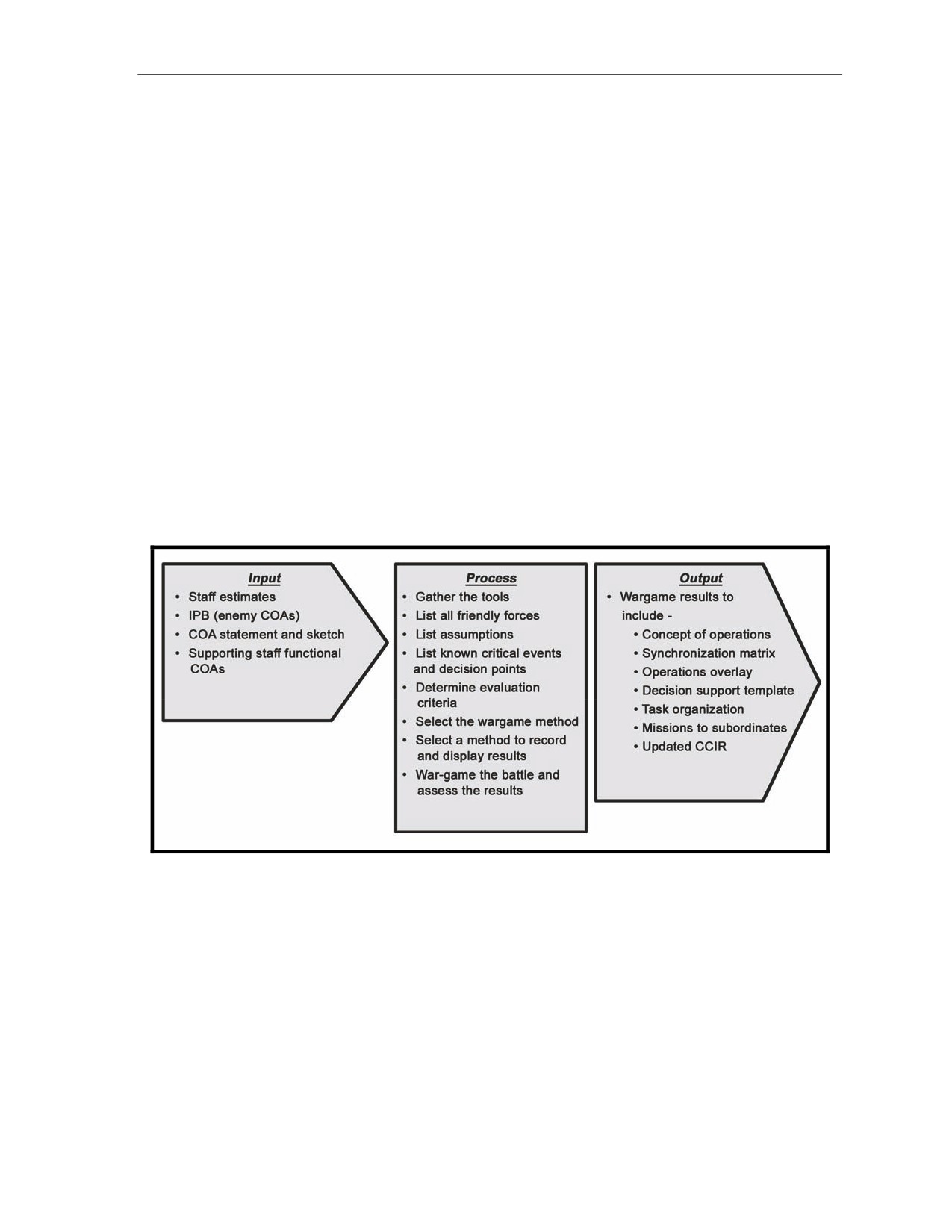
Comprehensive Tactical Planning in Counterinsurgency
Develop the Concept of Operation
4-87.
The staff describes the operation from start to finish. Extremely important is construction of the
battlefield framework to include, for example, objectives, phase lines, building numbers, and target
reference points. It is important to establish this early to ensure subordinate units doing parallel planning
use the correct graphic control measures.
Assign Headquarters
4-88.
The staff assigns headquarters, including HN security, joint and coalition forces.
Prepare COA Statement and Sketches
4-89.
The S3 develops statements and sketches that show how the unit will accomplish the mission
and explains the concept of operation.
Step 4: COA Analysis (Wargame)
4-90.
It is during COA analysis (wargaming) that the most significant and unique considerations apply.
COA analysis (wargaming) includes rules and steps that help commanders and staffs visualize the flow of a
battle. Wargaming focuses the staff’s attention on each phase of the operation in a logical sequence. It is an
iterative process of action, reaction, and counteraction. However, the standard wargaming methods of the
belt, avenue-in-depth or box method may not capture the complexity of the COIN environment that
commanders and planners must have to conduct successful counterinsurgency operations. The box method
is the traditional method that comes the closest to facilitating COIN wargaming. The traditional wargaming
process is shown in Figure 4-3.
Figure 4-3. Course of action analysis (wargame).
4-91.
To wargame an operation, the staff visualizes it from start to finish, evaluating the enemy’s
actions, and then modifying their plan. With only one COA, this step is often used to synchronize the plan
across the warfighting functions. Analyzing a COA (modeling it) gives the staff a deeper understanding
of the complex and adaptive OE of COIN, and how particular actions will affect it.
Eight Steps of COA Analysis (Modeling)
4-92.
Conduct the model using the same eight steps as laid out in FM 5-0 for the wargaming process—
gather the tools, list friendly forces, list assumptions, list critical events, determine evaluation criteria,
select the wargame method, select a method to record, and war-game the operation. All of these steps are
still valid and essential. Within some steps, there are modifications that must occur to successfully model.
4-93.
Different groups may conduct specific LOE modeling sessions prior to a larger group conducting
a larger scale modeling session. For some LOE, the wargaming method may be more appropriate. Unlike
21 April 2009
FM 3-24.2
4-19
Chapter 4
wargaming, modeling is not a one-time event. Modeling sessions should be rerun as operations, events
and the operational environment changes.
4-94.
Steps one through four remain unchanged in this technique. Step five, determining evaluation
criteria, can be complicated. This is where the planners develop the operation’s measures of effectiveness
and measures of performance. These measures are derived from the commander’s end state and the
conditions leading to the end state. These measures show when the unit is successful and achieves the
commander’s end state. Additionally, the measures should also tell commanders when they are gaining the
ability to influence the system.
4-95.
The number of insurgent attacks can be a misleading indicator. Measures of effectiveness are
more accurate when there are multiple supporting measures that look at similar issues with the intent
of seeing the whole. In a counterinsurgency, the three major areas to measure are the strength of the
government, the support of the people, and the strength of the insurgency. By measuring these three areas
through a variety of quantifiable measurements, such as the ability to complete an essential service, the
number of tips reported to the police, and the volume and type of insurgent propaganda, the commander
should have a good feel for success and workable measures of effectiveness.
4-96.
For step seven, select a method to record and display the results; the recording method must
capture the depth of the lessons that will be gained from the modeling and there must be a method to refine
certain critical products. There are four areas where the planners should focus on capturing new
information.
1. The planners must capture any greater depth of understanding for each of the variables.
2. They must record any new understanding of the variables and how they relate.
3. They must update the rules of behavior for each variable.
4. They must update the collection matrix.
4-97.
An expanded synchronization matrix (Figure 4-4) captures the actions of US forces, HN forces
and the insurgents using the warfighting functions (WFFs). It also shows the population groups across the
political, economic, and social categories. Using a synch matrix to show these factors can reveal the
complexity of the operational environment over time. Based on their deeper understanding of the system,
new critical information requirements will arise that must be addressed in the collection matrix.
4-20
FM 3-24.2
21 April 2009

Comprehensive Tactical Planning in Counterinsurgency
Units
Week 1
Week 2
Week 3
Week 4
US COIN Forces
Movement and Maneuver
Fires
Intelligence
Sustainment
C2
Protection
HN COIN Forces
Movement and Maneuver
Fires
Intelligence
Sustainment
C2
Protection
Population
Political
Military
Economic
Social
Insurgent
Movement and Maneuver
Fires
Intelligence
Sustainment
C2
Protection
Figure 4-4. Example expanded synch(ronization) matrix.
4-98.
The last step, war-game the operation and assess the results, is the modeling session itself. The
focus of the modeling method is to gain a better understanding of the complex system that makes up an
insurgency and to accurately forecast how actions affect the system. Like wargaming, there are many
different techniques to conduct the actual modeling session. For the purposes of this manual, the turn-based
technique using four groups is used.
Modeling Technique
4-99.
During each turn, each group states their actions followed by the next group’s actions. The four
groups are the US COIN forces, the Host Nation (includes other friendly forces), all neutral elements (IPI,
the population, NGOs, and so on), and the insurgents. Before beginning, the group must clearly explain the
concept, rules, and limitations for the modeling session to everyone, to include specific guidance to key
individuals. Two key parts of COIN modeling are modeling the individual LOE and modeling the overall
area or sector affected. In a typical staff, the S-3 plays the role of US and HN forces, the S-9 plays the
neutral elements, and the S-2 plays the role of the insurgents. The XO facilitates. The staff plays its
respective parts as accurately as possible portray their group in the coming modeling session.
4-100. Like with wargames, the staff needs a visual reference to conduct the modeling process. This may
be a sand table, a map, or some other visual board. Most of the items that compose this visual board come
out of the mission analysis and must include more than just the hills and roads and other normal military
aspects of terrain. For the model to be successful, it has to set the stage for the other planners to be able
to see the world through their group’s eyes. That means the visual board should include significant cultural
21 April 2009
FM 3-24.2
4-21
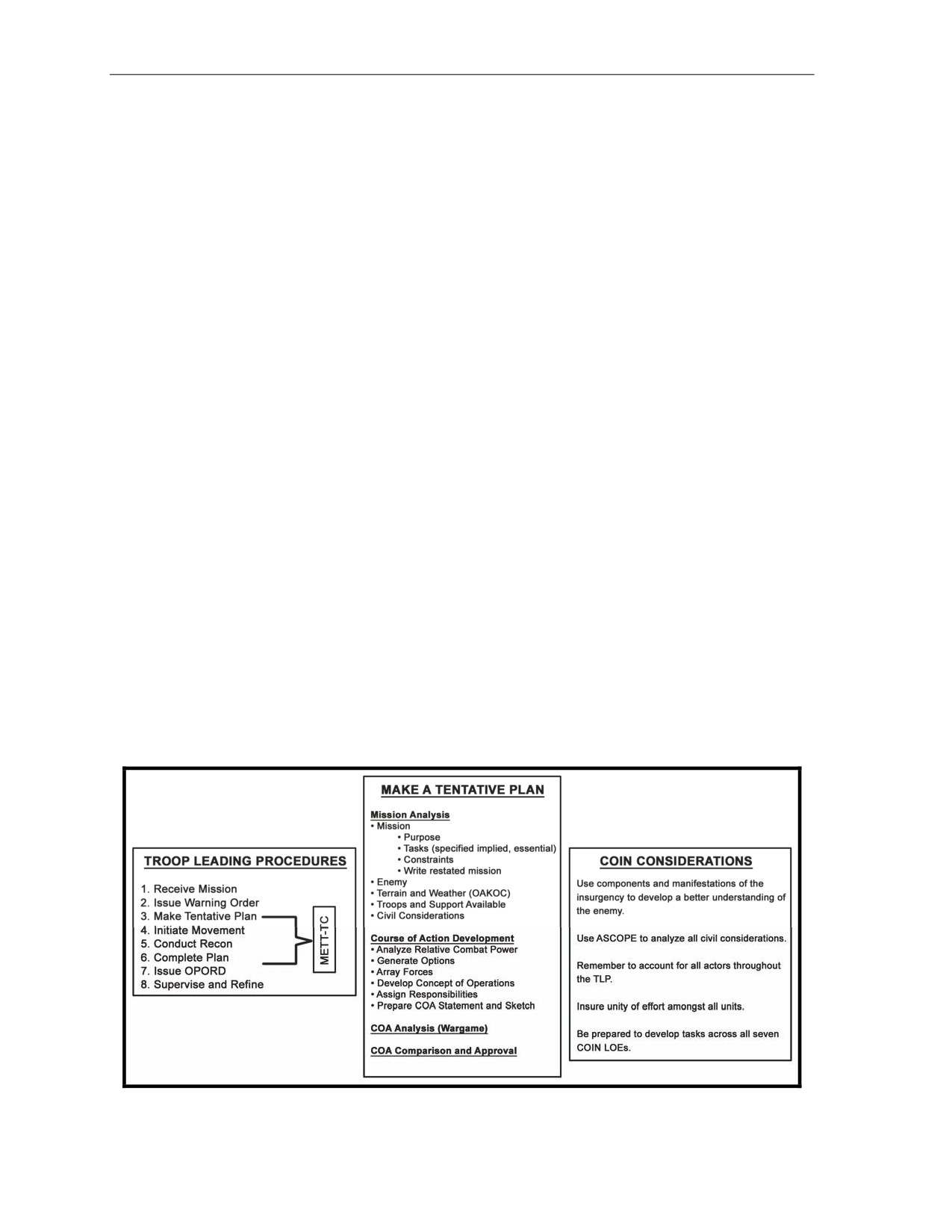
Chapter 4
sites and key social infrastructure sites. The more detailed the board, the more accurate and meaningful the
modeling will be.
4-101. As operations unfold and more intelligence is gathered, the planners should update the rules
of behavior and capabilities for each group. As the knowledge of the individual groups and the system as a
whole is improved, the planners will be able to identify how to more effectively influence the system. This
planning tool does not stop when the operation order is issued. Modeling is an effective way
of understanding the counterinsurgency system and ongoing operations.
Step 5: COA Comparison
4-102. Staffs analyze and evaluate the advantages and disadvantages of each COA, as well as identifying
the one with the highest probability of success against the most likely enemy COA. Additional COIN
evaluation considerations may include—
• Effect on or role of the HN government.
• Effect on or role of the HN security forces.
• Effect on groups of the population.
• Impact on information engagement.
Step 6: COA Approval
4-103. Either after participating in the COA comparison process or upon receipt of a COA recommended
decision, the commander makes a COA decision by approving a COA to execute.
Step 7: Orders Production
4-104. Units in COIN operations issue a warning order or WARNORD, and, after the commander selects
a COA, issue a written operation order. However, additional time for orders production may be needed if
the order must be translated into another language. To ensure nothing is lost in the translation, and ensure
success in multinational operations, the staff must keep orders and rehearsals simple.
TROOP-LEADING PROCEDURES
4-105. Troop-leading procedures (TLPs) give small-unit leaders a dynamic framework for analyzing,
planning, and preparing for an operation.
4-106. TLPs in a COIN environment differ little from those described in FM 5-0. The next sections will
provide a brief description of the eight steps along with some additional considerations for COIN
operations. Figure 4-5 shows addition COIN considerations during TLPs.
Figure 4-5. TLPs in COIN.
4-22
FM 3-24.2
21 April 2009
Comprehensive Tactical Planning in Counterinsurgency
Step 1: Receive Mission
4-107. Receipt of a mission may occur with a written or verbal WARNORD, FRAGO, or OPORD. Due
to the ambiguity in COIN operations, companies or platoons often start planning after identifying an
insurgent vulnerability, receiving HUMINT, or after having a conversation with a local leader.
4-108. Upon receipt of a mission, leaders must rapidly assess the situation using METT-TC. Leaders
must provide additional emphasis on analyzing civil considerations by using the ASCOPE method.
4-109. In a time constrained situation, an ongoing assessment of the AO using the operational variables
(PMESII-PT) should provide relevant information to accomplish the mission. Based on current
information, leaders estimate and allocate
1/3 of available time to plan and prepare for the mission,
including time to accommodate the language barrier with HN security forces; and the remaining 2/3 of the
available time for subordinates' planning and rehearsals. This remains relevant in a COIN environment.
Step 2: Issue Warning Order
4-110. Once done with the initial assessment, leaders issue the best possible WARNORDs, often called
WARNORD 1, with the information at hand. They also draw relevant information from their ongoing
assessment of the AO using the operational variables (PMESII-PT). Typically, three WARNORDs are
issued. Each builds upon the previous one. Normally, a WARNORD consists of—
• Mission.
• Time and place of the OPORD.
• Units participating in the operation.
• Specific tasks.
• Time line of the operation.
Step 3: Make a Tentative Plan
4-111. Once the WARNORD is issued, leaders build a tentative plan by combining mission analysis,
COA development, COA analysis, COA comparison, and COA approval. Within companies and platoons,
these steps are less structured and are often done mentally by the leader.
Mission Analysis
4-112. Leaders use the METT-TC format to conduct mission analysis as they expand on the hasty
analysis they conducted in step one. After mission analysis is complete, an updated WARNORD,
WARNORD 2 is issued. In a COIN environment, special consideration must be given to—
Mission
4-113. Units create their restated mission statement after analyzing higher headquarters’ mission
or analyzing their particular problem. It may take multiple times of conducting mission analysis to fully
grasp the problem.
Enemy
4-114. Units use the tools from Chapter 2 (elements of an insurgency, dynamics of an insurgency, the six
insurgent strategies, insurgent tactics and the strengths and vulnerabilities of insurgents) to help further
identify the group or groups of insurgents they may encounter. Then, define composition, disposition,
recent activities, most probable COA, and most dangerous COA.
Terrain and Weather
4-115. No significant changes from FM 5-0.
21 April 2009
FM 3-24.2
4-23
Chapter 4
Troops and Support Available
4-116. Leaders must determine the amount and type of friendly forces available, especially Host Nation
security forces, coalition forces and the nonmilitary enablers.
Time
4-117. Use the acronym HOPE-P (higher, operational, planning, enemy, and populace) to identify the
various timelines.
Civil Considerations
4-118. Leaders must use the ASCOPE method to analyze areas controlled by various demographic
groups to obtain a better understanding of the AO.
COA Development
4-119. Leaders use COA development to determine one or more ways to accomplish the mission. In a
time-constrained environment, leaders may only be able to craft one COA. For long, mid, and short-range
plans, companies will need to develop tasks along all lines of effort. The six steps of COA development
in COIN are unchanged, but special consideration should be given to—
Analyze Relative Combat Power
4-120. Leaders compare friendly, including Host Nation, all enablers and insurgent combat power.
Leaders may incorporate analysis of pro—and anti—government populations.
Generate Options
4-121. Options should always consider employment of HN security forces and the HN government.
Array Forces
4-122. Array all enemy forces, such as different insurgent groups, as well as all friendly forces to include
Host Nation security forces. Small units may also have to develop plans to employ special teams such
as military working dog teams, tactical site exploitation teams, UASs or attack, reconnaissance, and assault
aviation.
Develop Concept of Operations
4-123. Leaders describe the operation from start to finish. Especially critical is the creation of graphic
control measures such as phase lines and building numbers to assist with C2 and clarify roles and tasks.
The COA must achieve unity of effort amongst all organizations.
Assign Responsibilities
4-124. Assign responsibilities for each task including those for HN security forces.
Prepare a COA Statement and Sketch
4-125. Leaders prepare a COA statement that describes all significant actions from start to finish, as well
as a sketch.
COA Analysis (Wargame)
4-126. To wargame, leaders visualize the operation from start to finish, evaluate the enemy’s actions
and then modify their plan. With only one COA, often this step is used to synchronize the plan across
the WFF.
4-24
FM 3-24.2
21 April 2009
Comprehensive Tactical Planning in Counterinsurgency
COA Comparison and COA Approval
4-127. These two steps are normally done mentally by the leader during TLP.
Step 4: Initiate Movement
4-128. As in any military operation, leaders may choose to initiate movement necessary to enable mission
preparation or position the unit for execution. In COIN, this may mean moving US forces to an HN
security force patrol base to conduct combined planning and movement.
Step 5: Conduct Reconnaissance
4-129. Whenever time and circumstances allow, leaders personally observe the AO for the mission since
there is no substitute for first hand information. Leaders may also consider using a map, Joint Land Attack
Cruise Missile Defense Elevated Netted Sensor System (JLENs), UAS, or attack reconnaissance aviation
to conduct the reconnaissance if time, OPSEC, or other considerations preclude a personal reconnaissance.
Step 6: Complete Plan
4-130. Leaders incorporate the results of the reconnaissance, update information, refine their products,
make coordination with adjacent units, including Host Nation units, and issue the final WARNORD. Extra
time may be needed to translate the order into the Host Nation’s language.
Step 7: Issue OPORD
4-131. Leaders issue verbal or written orders to their subordinates, using the standard five-paragraph
field order format. In addition, leaders use map, overhead imagery, or terrain model to enhance
subordinates’ understanding of the mission. Additional time may be required to brief the OPORD in two
languages if HN forces are participating in the operation. Units who have experienced OPSEC issues with
HN security forces may choose to issue the OPORD to the HN unit just prior to crossing the line
of departure.
Step 8: Supervise and Refine
4-132. Throughout the TLPs, Army leaders monitor preparations, refine the plan, coordinate with
adjacent units, and conduct rehearsals. COIN operations use the standard five types of rehearsals. They are
the confirmation brief, the back brief, the combined arms rehearsal, the support rehearsal, and the battle
drill or SOP rehearsal.
4-133. Additional time may be required to conduct rehearsals in two languages. Units who have
experienced operational security (OPSEC) issues with HN security forces may choose to have HN forces
conduct generic rehearsals, for example, clear a room or establish checkpoint versus the actual complete
operation.
Section IV—TARGETING INSURGENTS
In major combat operations, targeting focuses on identifying capabilities or resources the maneuver commander
must have effects for his operation to succeed, then attacking them with fire support, aviation, and close air
support. During counterinsurgency operations, the role of targeting can include a broad range of both enemy
and stability targets that use all seven COIN Lines of Effort to attack or influence them.
ROLE IN COIN
4-134. The expanded use of targeting in COIN gives the planner two key benefits: prioritization
and synchronization. Because the counterinsurgent often faces multiple objectives, many without clear
positional references, friendly courses of action may not be easily represented in terms of various forms
of maneuver. Each may instead portray a series of targets that the unit must influence over a specified time.
21 April 2009
FM 3-24.2
4-25
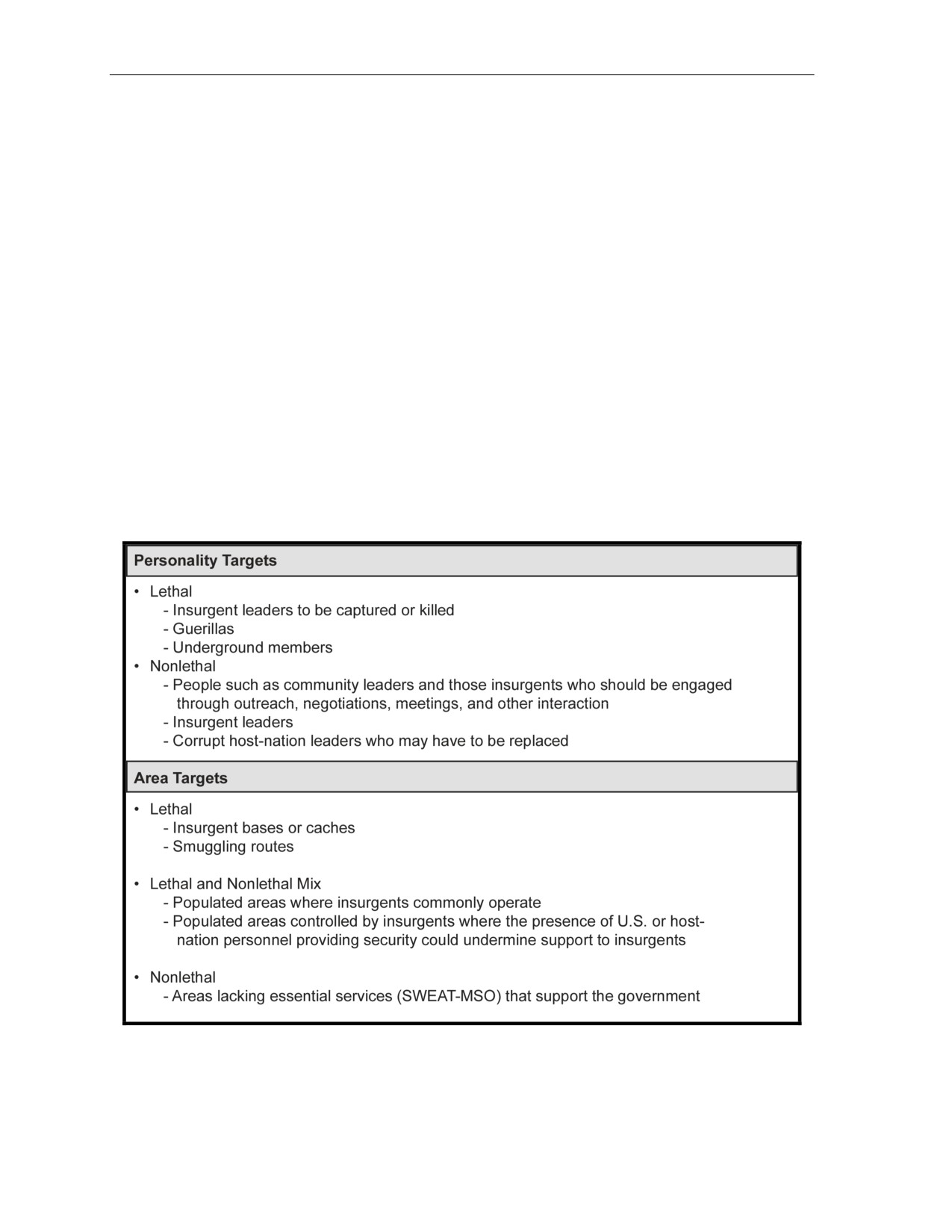
Chapter 4
4-135. The targeting process focuses operations and the use of limited assets and time. Commanders
and staffs use the targeting process to achieve effects that support the objectives and missions during
counterinsurgency operations. It is important to understand that targeting is done for all operations, not just
attacks against insurgent. The targeting process can support PSYOP, civil-military operations, and even
meetings between commanders and Host Nation leaders, based on the commander’s desires.
4-136. The synchronization of RSTA/ISR assets with available combat power is the greatest contribution
targeting brings to the counterinsurgent. The indirect nature of irregular warfare often creates limited
opportunities to strike or influence targets. Integrating the intelligence process and the operations process
through targeting can be used to ensure that maneuver units strike the right targets at the right time or are
prepared to strike targets of opportunity.
4-137. Effective targeting requires the creation of a targeting board or working group, although in many
cases, the targeting staff is similar to the planning staff. It is typically chaired by the XO or fire support
coordinator, and includes representatives from across the staff including S-2, S-3, S-5, S-7, S-9, air liaison
officer, and staff judge advocate. The goal is to prioritize targets and determine the means of engaging
them that best supports the commander’s intent and operation plan. The focus of the targeting cell, in a
counterinsurgency environment, is to target people, both the insurgents and the population.
4-138. Effective targeting identifies the targeting options, both lethal and nonlethal, to achieve effects
that support the commander’s objectives. Lethal assets are normally employed against targets with
operations to capture or kill. Nonlethal assets are normally employed against targets that are best engaged
with PSYOP, negotiation, political programs, economic programs, and social programs. Figure 4-6 shows
examples of potential targets.
Figure 4-6. Lethal and nonlethal targeting.
4-26
FM 3-24.2
21 April 2009
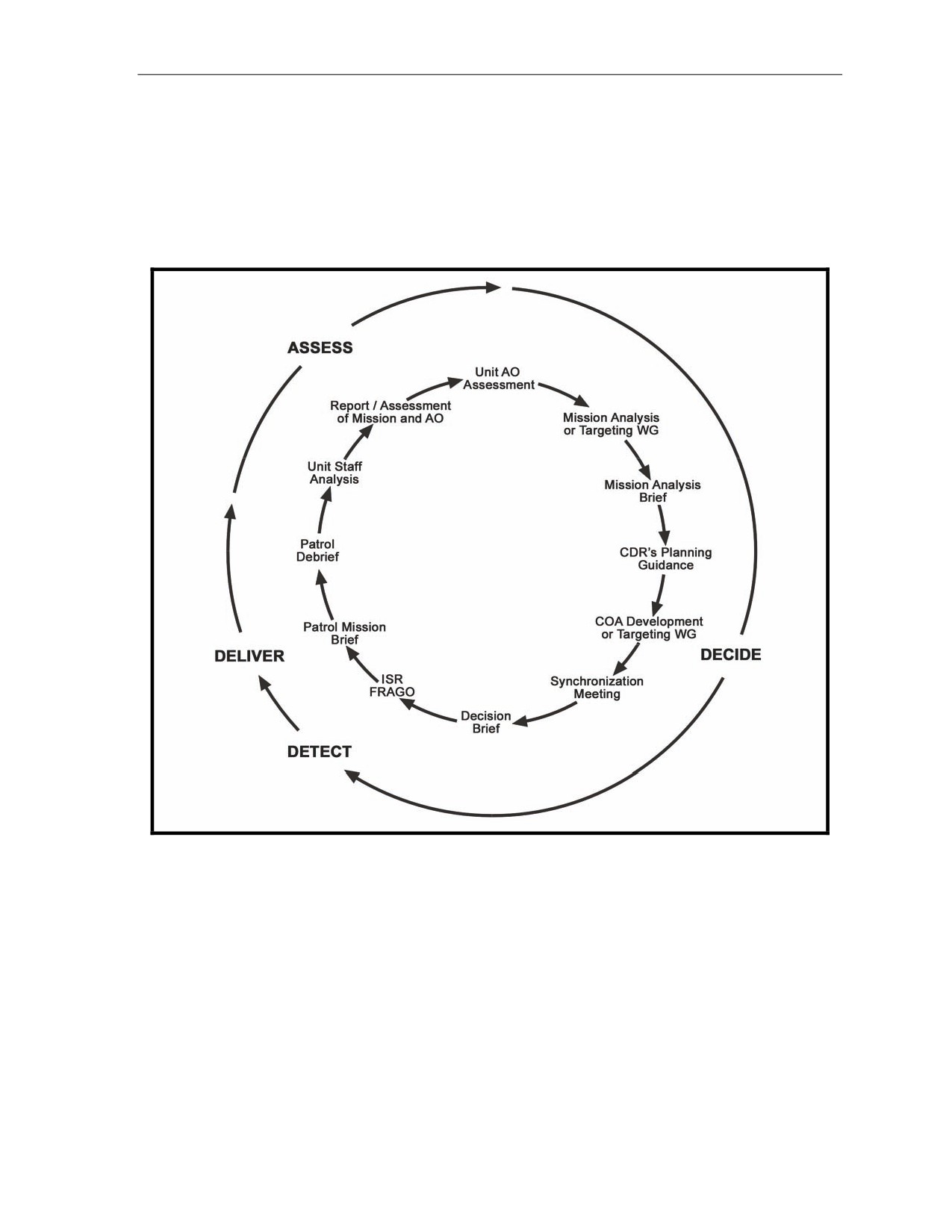
Comprehensive Tactical Planning in Counterinsurgency
COUNTERINSURGENCY TARGETING PROCESS
4-139. The targeting process comprises the four functions of decide, detect, deliver, and assess (D3A).
Targeting is critically linked to the MDMP. The decide function derives critical information that develops
from mission analysis through course of action approval. Both detect and assess functions are tied to the
unit’s RSTA/ISR plan which is driven by IPB, the MDMP, and tactical site exploitation. Figure 4-7 shows
the links between the targeting cycle and MDMP.
Figure 4-7. Targeting and MDMP.
4-140. The commander’s guidance drives the targeting process. Commanders issue targeting guidance
during Decide. Actions during Detect may give commanders the intelligence needed to refine their
guidance. Target identification may be difficult once a counterinsurgency operation begins. The focus
during Deliver should be on decisive points that the commanders can engage. Immediately after delivering,
units Assess the effect.
4-141. The unit S2 must understand that the targeting process depends on the effective and timely use
of the intelligence cycle and on the exploitation of objectives and detainees. Target development against
insurgents results from complete and accurate situation development during peacetime, contingency
planning, and analysis of the operational environment during conflict. The IPB supports the target
development process and provides the commander with the intelligence needed to select valid target nodes
to engage.
21 April 2009
FM 3-24.2
4-27