FM 3-24.2 TACTICS IN COUNTERINSURGENCY (APRIL 2009) - page 6
Chapter 7
• Locate and safeguard key witnesses, documents, and other evidence related to key ongoing
or potential investigations and prosecutions.
• Control crowds, prevent looting, and manage civil disturbances.
• Secure facilities, records, storage equipment, and funds related to criminal justice and security
institutions.
• Build Host Nation capacity to protect military infrastructure.
• Build Host Nation capacity to protect infrastructure and public institutions.
• Build Host Nation capacity for emergency response.
• Fostering sustainability where military forces identify modernization needs and the means
to achieve them.
Establish Interim Criminal Justice System
7-14.
Often in COIN, establishing or reestablishing an interim justice system is a prerequisite. This
restoration requires a wide range of skilled professionals working under a clearly defined legal authority:
judges, prosecutors, court administrators, defense lawyers, corrections personnel, law enforcement,
and investigators. These personnel—and the institutions they represent—provide a temporary respite that
allows the Host Nation to restore its legal system. Essential tasks may include an initial response in which
military forces—
• Assess current laws and need for modifications or adoption of internationally accepted codes.
• Assess Host Nation capacity to combat crime.
• Deploy interim justice personnel to complement Host Nation criminal justice system.
• Establish mechanisms to review the legality of detentions and minor cases to minimize pretrial
detention.
• Enact interim legal codes and procedures permitted by international law.
Support Law Enforcement and Police Reform
7-15.
US military forces provide support to law enforcement and policing operations, which is integral
to establishing civil control. HN police may provide this capability if the security environment permits.
Usually in insurgencies, the HN police may have become corrupt or failed altogether. In failed states,
especially during and immediately after conflict, military police forces are the only organizations able
to fill this void. At times, HN police augment military forces, rather than the other way around. The
preferred providers of civilian law enforcement services are HN police, augmented as required by military
and paramilitary police units with policing capabilities. Civilian agencies typically provide training
and capacity-building support for law enforcement services. However, US and HN military forces may be
required to perform these services in the interim, until the situation permits transition of this function
to civilian agencies or organizations. Essential tasks may include the following:
• Identify, secure, and preserve evidence of—
War crimes.
Crimes against humanity.
Corruption.
Transnational crime such as terrorism, organized crime, human trafficking, and narcotics.
• Identify and detain perpetrators of these offenses.
• Support vetting, checking credentials, and accounting for HN police forces.
• Inventory and assess police facilities and systems.
• Train and advise HN police forces.
• Rehabilitate or construct necessary facilities.
• Establish police academies.
7-6
FM 3-24.2
21 April 2009
Stability Operations Considerations in Counterinsurgency
Support Judicial Reform
7-16.
The reform of judicial bodies is integral to rule of law and provides the necessary framework
for broader security sector reform. The support provided to judicial institutions parallels efforts with police
and security forces to enhance the state’s capability to maintain civil control and security. Under most
circumstances, other agencies organizations typically support the development of the judicial branch
of government. In a failed state, however, military forces may initially perform these functions until they
can be transitioned to an appropriate civilian agency or organization. Essential tasks may include—
• Identify Host Nation legal professionals.
• Educate criminal justice personnel on interim legal codes and international human rights
standards.
• Inventory and assess courts, law schools, legal libraries, and bar associations.
• Deploy judicial advisors and liaisons.
• Rehabilitate or construct necessary facilities.
• Support vetting of Host Nation legal professionals.
Support Property Dispute Resolution
7-17.
A vital service of the judiciary branch is to resolve property disputes. One of the causes of an
insurgency might be old disputes over ownership and control of property. Authorities must implement
dispute resolution mechanisms. This prevents the escalation of violence that can occur in the absence
of law order as people seek resolution on their own terms. Typically, the military’s role in resolving
disputes is limited to transitional military authority where these mechanisms are implemented in the
absence of a functioning Host Nation government. Essential tasks may include an initial response in which
military forces—
• Implement mechanisms to prevent unauthorized occupation or seizure of property.
• Publicize dispute resolution process.
• Coordinate dispute resolution process to deter violence and retribution.
Support Corrections Reform
7-18.
When the goal in COIN is to criminalize the insurgency and prosecute insurgents in the HN court
system, corrections reform is an integral component of broader security sector reform. Corrections reform
tasks focus on building HN capacity in the penal system, restoring the institutional infrastructure,
and providing oversight of the incarceration process. Tasks also include a comprehensive assessment of the
prisoner population to help reintegrate political prisoners and others unjustly detained or held without due
process. Essential tasks may include—
• Identify and register all detention, correction, or rehabilitative facilities.
• Preserve and secure penal administrative records and reports.
• Inventory and assess prison populations and conditions.
• Implement humanitarian standards in prisons.
• Provide emergency detention facilities.
• Vet corrections personnel.
• Deploy penal trainers and advisors.
• Refurbish prison facilities at key sites.
• Coordinate jurisdiction and handover.
• Facilitate international monitoring.
• Rebuild corrections institutions.
• Train and advise corrections personnel to internationally accepted standards.
• Develop reconciliation, parole, and reintegration mechanisms.
21 April 2009
FM 3-24.2
7-7
Chapter 7
Support Public Outreach and Community Rebuilding Programs
7-19.
These programs are central to the reconciliation process in a counterinsurgency, and to promoting
public respect for the rule of law. They provide the HN populace with a means to form a cohesive society.
While these programs generally do not involve substantial military involvement, some activities require the
force’s support to achieve success. Essential tasks may include an initial response in which military
forces—
• Establish broad public information programs to promote reconciliation efforts.
• Assess needs of vulnerable populations.
TECHNIQUES
7-20.
Most combat-oriented techniques for performing establish civil control-type tasks are covered
in Chapter 5 and Chapter 6. Checkpoint operations and vehicle searches help establish public order
and safety by limiting the insurgent’s freedom of movement.
Establish Checkpoint (Control Traffic)
7-21.
A checkpoint is a manned position, usually at a chokepoint on a main thoroughfare, which can
control all vehicular and pedestrian traffic passing along that road. A checkpoint may stop and check all
vehicles or only a selected few. A checkpoint is not a roadblock. A roadblock prevents all vehicular
or pedestrian traffic along a thoroughfare.
7-22.
Checkpoints may be temporary, semipermanent, or permanent. A common discriminator between
a temporary and a semipermanent checkpoint is its manning requirements. A temporary checkpoint has no
shift requirements—the same individuals can establish, operate, and then break down the checkpoint.
A semipermanent checkpoint requires at least one additional ‘shift’ of personnel to operate it for the length
of time required. Over time, a semipermanent checkpoint may turn into a permanent checkpoint.
A permanent checkpoint usually has no set end time. Most nations have permanent checkpoints, especially
at international border crossings or at key access control points. Common reasons for establishing a
checkpoint during counterinsurgency operations include—
• Demonstrating the presence and authority of the host government.
• Checking vehicles for explosive devices.
• Maintaining control of vehicular and pedestrian traffic.
• Apprehending suspects.
• Preventing smuggling of controlled items.
• Preventing infiltration of unauthorized civilians into or through a controlled area.
• Serving as an observation post.
Considerations
7-23.
Checkpoints cause considerable inconvenience and sometimes fear to the population. Therefore, it
is important that the citizens understand that checkpoints are a preventive and not a punitive measure. The
use of a TPT to broadcast instructions and explanations and disseminate handbills to civilians waiting at a
checkpoint helps minimize negative reactions to the control measure and to ensure compliance.
7-24.
The rapid establishment of a temporary checkpoint can support a host of counterinsurgency
operations. The two types of checkpoints follow:
Snap Checkpoint
7-25.
This is a rapidly established, temporary checkpoint. If time allows, a designated, mobile unit
is trained and resourced for this mission. Then, with little warning, this unit can establish a snap checkpoint
almost anywhere.
7-8
FM 3-24.2
21 April 2009
Stability Operations Considerations in Counterinsurgency
Enduring Checkpoint
7-26.
This is often established initially as a snap checkpoint. As the site is further developed, an
enduring checkpoint becomes semipermanent.
7-27.
Insurgent forces often target traffic checkpoints with harassing sniper or indirect fire. A plan
to quickly locate and react to these threats often reaps great benefit. Additionally, checkpoints are often
targeted by insurgent snipers or by a scripted traffic incident. The insurgent's goal is to induce the
counterinsurgent to overact and then to exploit the overreaction in the media.
Locations
7-28.
The precise location and degree of visibility of a checkpoint reflect its purpose. A highly visible
checkpoint is often located where traffic can avoid it. This works well for entry-control points and border
crossings. A concealed checkpoint is often located where traffic cannot avoid it by bypassing, turning
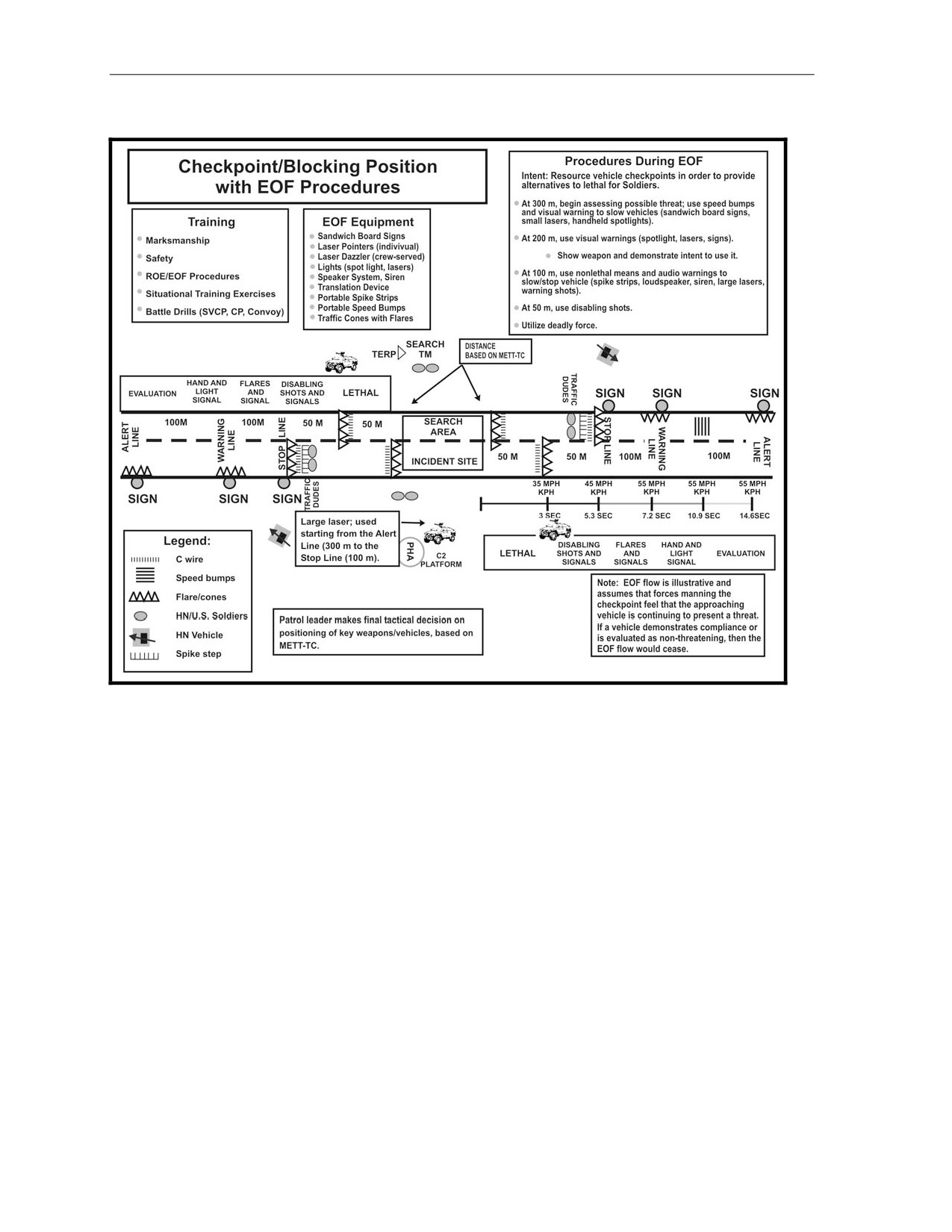
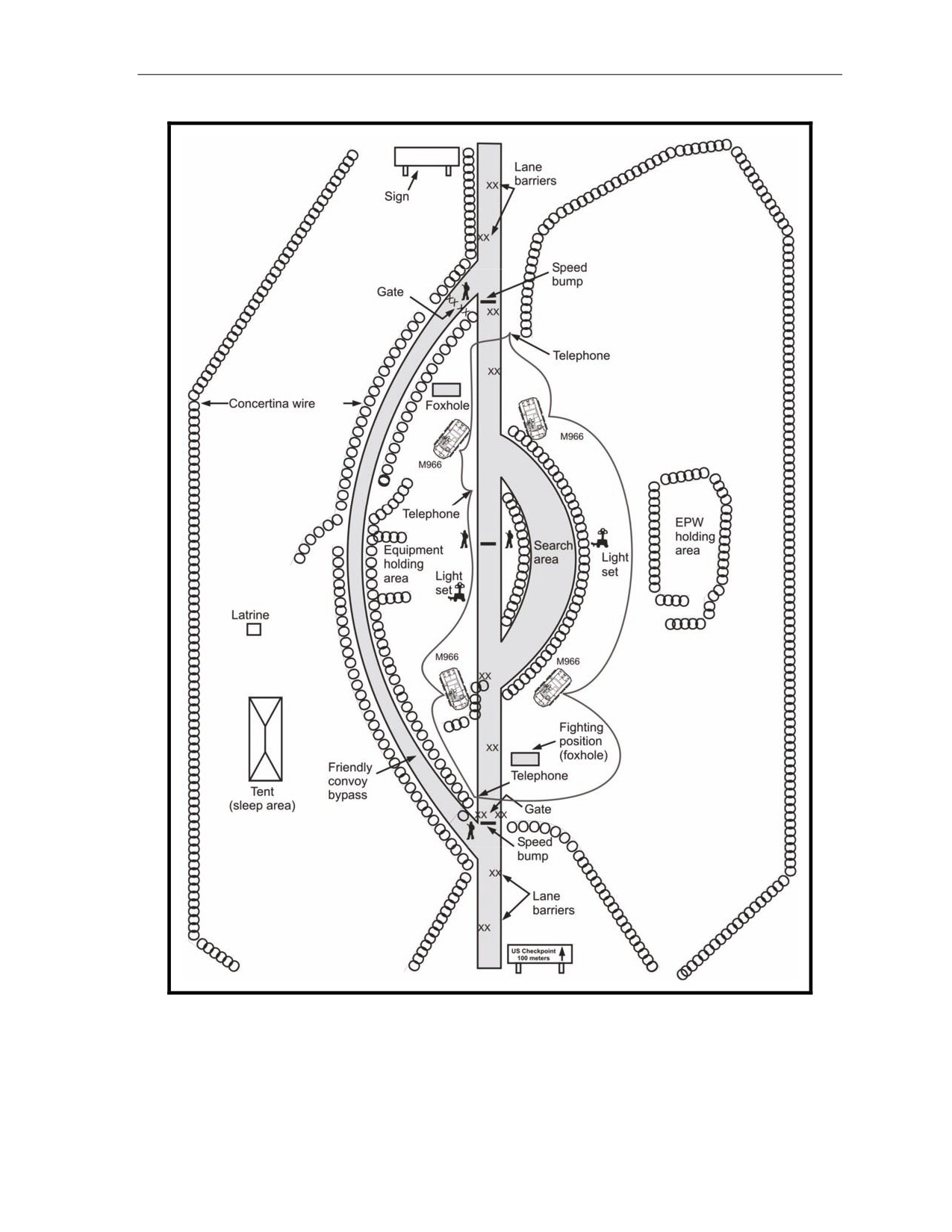
around or getting off the road without being observed and, if ordered, detained. Figure 7-2 and Figure 7-3
show possible setups for snap and enduring checkpoints.
Conduct Vehicle Searches
7-29.
Any unit may be tasked to conduct the routine search of vehicles. If there is a high probability that
vehicles may be wired with explosives, then an EOD team should lead the search effort. All vehicles
should be screened before entering the search area. Usually screening is done at the initial barrier and IAW
local screening criteria. Vehicles are then directed either through the search area or to one of the search
sites. Normally passenger vehicles are segregated from commercial vehicles as part of the screening
process.
PLANS
7-30.
Determine the specific purpose of the checkpoint. The purpose influences the location, degree
of individual checks, length of time, resources, and manpower required.
• Define the parameters of searches—this includes whether to search all pedestrians and all
vehicles. For vehicles, determine whether to search the vehicle, the occupants, or a
combination. Determine the search method and level of search detail. Distribute a “Be on the
look out” (BOLO) list, if available.
• Establish the screening criteria for searches and the method of screening. This can reduce time
and manpower requirements.
• Determine the in-effect time. Checkpoints lasting longer than 12 hours will require shifts.
Consider placing rest areas for shifts near the search area so they can be used as a reserve force.
• Establish both near and far security. Near security protects the checkpoint force. Far security,
often concealed, prevents the escape of any vehicle or person attempting to turn back upon
sighting the checkpoint. Plans must include the actions taken when this happens.
• Establish and brief the ROE and EOF procedures including warning signs.
• Rehearse checkpoint operations, especially EOF procedures.
• Design the checkpoint layout and gather the needed materials before arrival.
• Determine the personnel requirements.
• Emplace in positions where traffic cannot easily bypass the checkpoint.
• After it can operate on its own, determine if the HN security force should man the checkpoint.
21 April 2009
FM 3-24.2
7-9
Chapter 7
Figure 7-2. Well-equipped snap checkpoint layout.
7-10
FM 3-24.2
21 April 2009
Stability Operations Considerations in Counterinsurgency
Figure 7-3. Typical enduring checkpoint layout.
MATERIAL CONSIDERATIONS
7-31.
Consider equipment, for example—
• Equipment, such as speed bumps or filled barrels, to slow and canalize vehicles.
21 April 2009
FM 3-24.2
7-11
Chapter 7
• Protection items, which may include both lethal and nonlethal munitions.
• Concertina wire to control movement around the checkpoint.
• Sandbags and wood for defensive positions or bunkers.
• Binoculars, night vision devices, and flashlights.
• Long-handled mirrors (for inspecting vehicle undercarriages).
• Logs and checklists for inspectors, supervisors, and so on.
• Caution flags and unit signs.
PERSONNEL CONSIDERATIONS
7-32.
Consider each element:
• Command element.
• Security element.
• Search element.
• Linguists and Host Nation representation.
• Military police.
• Medical personnel.
• Communications personnel.
• Tactical PSYOP team.
• HCTs.
• Military working dog teams.
• HN security force personnel.
ESTABLISHMENT
7-33.
Position a combat vehicle off the road, but within sight, to deter resistance.
• Keep this vehicle in a hull-down position and protected by local security. It must be able
to engage vehicles attempting to break through or bypass the checkpoint.
• Place obstacles in the road to slow or canalize traffic into the search area.
• Establish a reserve, if applicable.
• Establish a bypass lane for approved convoy traffic.
• Designate the vehicle search area.
• Establish a parking area adjacent to the search area.
• Designate male and female search areas near the vehicle search area. Normally, search women
using a metal detector, searched by a female Soldier or searched by a Host Nation female.
• Consider a controlled bypass lane for HN civilians with medical emergencies, HN civilian
officials, or other HN population concerns
• Consider the effect on the local population to include market times, sporting events, holidays,
and collateral damage
OPERATION
7-34.
Screen all vehicles IAW with established, preferably written, criteria. Establish observation
for vehicles or occupants attempting to avoid the checkpoint. This includes—
• Exiting a vehicle and walking away or around the checkpoint.
• Having a lead vehicle signal a following vehicle to avoid the area.
• Creating a distraction to allow the vehicle or occupants to slip away.
SCREENING CONSIDERATIONS
7-35.
In addition to having a basic published list of criteria—
• Note the number of occupants.
• Note the type or color of the vehicle.
• Devise a method of managing important changes or alerts.
7-12
FM 3-24.2
21 April 2009
Stability Operations Considerations in Counterinsurgency
• Observe all vehicles and all occupants.
• Always maintain some element of randomness.
Basic Levels
7-36.
The three basic levels of vehicle searches follow:
Initial
7-37.
This is a cursory search that is the same for all stopped vehicles. This relatively quick check
should take no more than two minutes. It may be combined with initial vehicle screening. Basic vehicle
initial search procedures include—
• Ensure at least two people conduct the search:
One guard (driver and occupants)
One searcher (vehicle)
• Stop the vehicle at the search site.
• Have all occupants exit the vehicle and move them to one location.
• Instruct the driver to turn off the engine, and then open the hood, trunk, and all doors.
• Continue the search once the above is complete.
• Question or search of the driver and occupants is optional.
• Begin and end the exterior search at the front of the vehicle, moving in a clockwise direction.
• Visually search of the exterior and top of the vehicle.
• Visually search of the underside of the vehicle.
• Search the interior starting at the front compartment, then the right side, then the rear
compartment, then the left side, ending at the front.
• Complete the search.
• Instruct the driver and occupants to continue.
Primary
7-38.
This is a full search of select vehicles. Vehicles may be selected randomly, IAW screening
guidelines or due to similarities to vehicles associated with previous events
(a be-on-the-look-out,
or BOLO list.) This search usually entails checking the interior, exterior, engine and trunk compartments
and mirror checks of the vehicle underside. It should take two to five minutes. Primary search include
those of those of the initial search and may add the following—
• Question or search the driver and occupants.
• Check the inside of the front hood.
• Check the rear compartment.
Secondary
7-39.
This is a detailed search of a suspect vehicle. A vehicle becomes suspect usually due to screening
or discovery of items during a primary search. This thorough search is manpower and time intensive. It
may include disassembling panels, checking interiors of wheels, and so on. At the basic level, to conduct a
secondary search of a vehicle—
• Ensure at least four people conduct the search:
Two for the driver and occupants.
Two more for the vehicle.
• Assume that the driver and occupants or the vehicle itself is suspect.
• If possible, have the vehicle stop in a safe and secure location.
• Instruct the driver to turn off the engine, open the hood, open the trunk, and open all doors.
• Obtain the keys from the driver.
• Move the driver and occupants to a separate location.
• Detain and search driver and occupants while searching the vehicle.
21 April 2009
FM 3-24.2
7-13
Chapter 7
• Begin the vehicle search at the front and end at the rear.
One searcher searches the right front, right side, and right rear.
The other searcher searches the left front, left side, and left rear.
• Conduct a visual search of the exterior and top.
• Conduct a visual search of the underside of the vehicle.
• Without entering, conduct a visual search of the interior of the vehicle.
• Ensure the engine is off, and then ensure the hood, trunk, and all doors are open.
• Check the inside of the front hood.
• Check the interior left and right sides.
• Check the rear compartment.
• Complete the search.
• Return keys to driver.
• Instruct driver and occupants to continue.
Vehicle Types
7-40.
Vehicles are generally categorized into four types: automobiles (cars), motorcycles and bicycles,
buses, and heavy goods vehicles (trucks). Search considerations for the car are covered above as part
of basic vehicle considerations. Search considerations for the three additional vehicles follow:
Motorcycles and Bicycles
7-41.
Basic motorcycle and bicycle search procedures include—
• Ensure at least two people conduct the search.
One for the driver and passenger.
One for the vehicle.
• Have the driver or a passenger turn off the engine and dismount.
• Visually inspect the vehicle and any compartments on the vehicle.
• Complete the search.
• Instruct driver and passenger to mount up and continue.
Buses
7-42.
Basic bus search procedures include—
• Ensure at least four people conduct this search.
Two for the driver and occupants.
Two for the bus itself.
• Set aside an area to search buses due to their length, potentially large number of occupants,
and lots of luggage.
• Instruct only the driver to turn off the engine and open all exterior compartments.
• Initially, board the bus, check all occupants' identification, note seating arrangements,
and check carry-on baggage.
• If a full search is required, have all occupants exit the bus with their baggage, and then detain
them while you search the bus and baggage.
• Complete the search.
• Instruct driver and occupants to reload and continue.
Heavy Goods Vehicles (Trucks)
7-43.
Basic heavy goods (truck) vehicle search procedures include—
• Ensure at least three personnel conduct the search.
One for the driver and occupants.
Two for the vehicle.
• Set aside an area to search these vehicles due to their length and amount of cargo.
• Instruct the driver to turn off the engine, open the hood, and open all doors.
7-14
FM 3-24.2
21 April 2009
Stability Operations Considerations in Counterinsurgency
• Check the driver’s credentials and cargo manifests.
• Inspect to the degree required for the cargo.
• Complete the search.
• Instruct driver and occupants to secure load and continue.
SUPPORT TO GOVERNANCE
7-44.
This helps build toward effective, legitimate governance. Specifically, it focuses on restoring
public administration and resuming public services, while fostering long-term efforts to establish a
functional, effective system of political governance. In every case, for the counterinsurgent to develop a
long-term solution, unit actions must strengthen the Host Nation government and reinforce its legitimacy
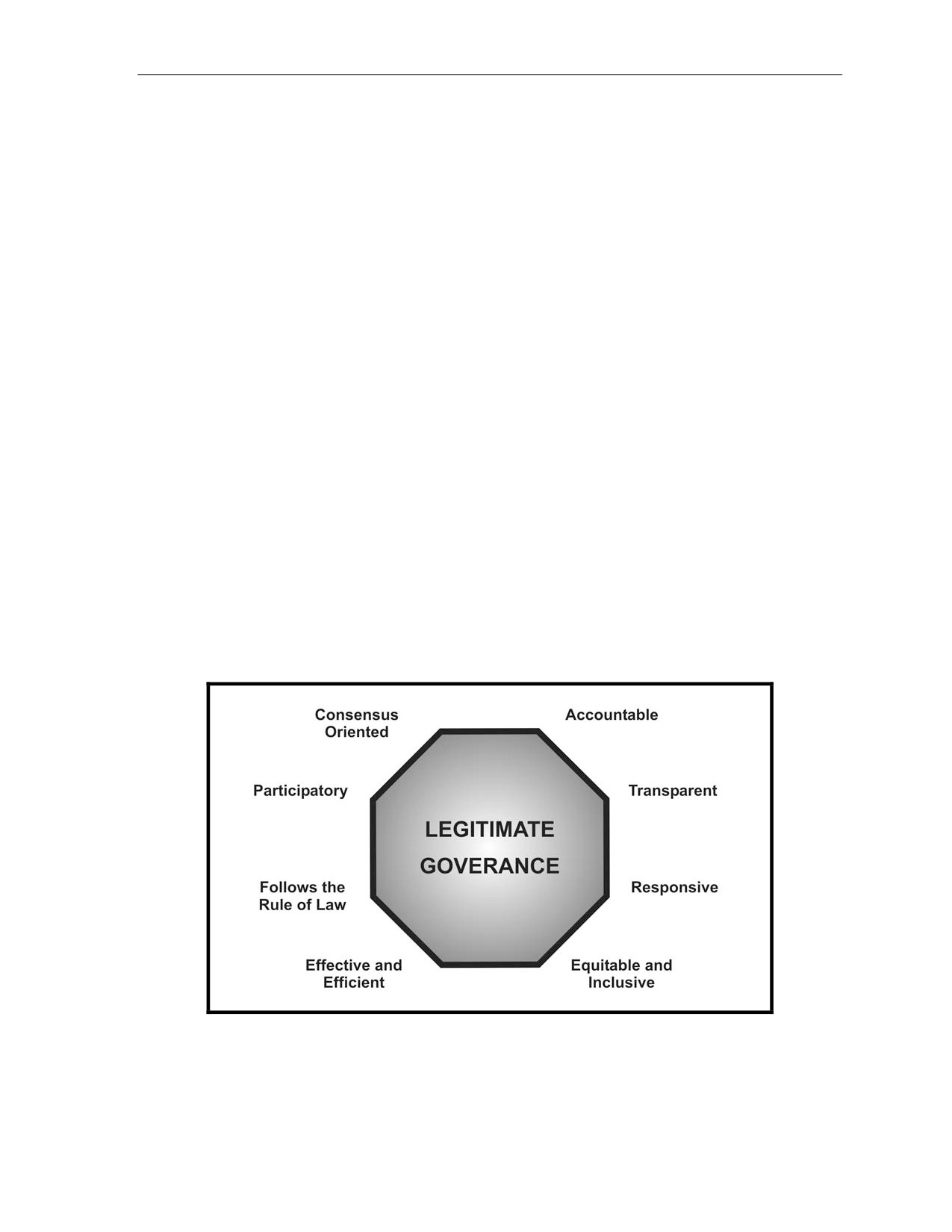
with the people (Figure 7-4). The formation of an effective local government is critical to the success
of any counterinsurgency operation because they provide the foundation for legitimate governance at the
national level. Additionally, effective local governments promote social stability when people have a say
in their own government. They also increase financial transparency, which helps fight corruption. At the
local level, the formation of local neighborhood councils serves as an excellent starting point
for supporting governance. Units may have to initiate these efforts without an external agency support.
Neighborhood and district councils are effective because they empower the population on many levels.
They help the populace devise local solutions to local problems and help citizens and community leaders
build skills in community decision making. All involved parties learn to resolve conflicts peacefully
and in a transparent fashion. Local councils also help leaders at the local level develop skills that can help
them serve at higher levels of government.
SUBORDINATE TASKS
7-45.
Typical tasks include—
• Support transitional administrations.
• Support development of local governance.
• Support anticorruption initiatives.
• Support elections.
Figure 7-4. Legitimate governance.
21 April 2009
FM 3-24.2
7-15
Chapter 7
THE CHALLENGES OF GOVERNANCE IN IRAQ
In
2003, perhaps the most volatile site for this ethnic conflict was the city of Kirkuk, located
in northern Iraq about 150 miles north of Baghdad. The city was located in what was historically
Kurdish territory, but its population had long been a mix of Kurds, Arabs, Assyrian Christians,
and Turkoman. Situated in the heart of Iraq’s oil fields, Kirkuk had strategic importance for much
of the 20th century. Partly for that reason, in the 1970s and 1980s Saddam attempted to “Arabize”
Kirkuk by forcing Kurds to leave and moving Arab groups in. The arrival of Coalition troops in the
city in May 2003 opened up the possibility for the Kurdish population to take control once again over
an important cultural and economic center.
The 173d Airborne Brigade (173d ABN) took responsibility for the city soon after the toppling of the
Saddam regime. In May 2003, Soldiers of the brigade found themselves attempting to mediate
between groups of armed Arabs moving north to ensure the Kurds did not overwhelm the city
and the Kurdish groups that had begun flexing their muscles by forcibly evicting some Arabs. On 17
May 2003, this conflict became violent with firefights erupting in the streets of Kirkuk.
Colonel William Mayville, the brigade commander, recalled that this event served as the “really big
first lesson into, or insight into what some of the social dynamics in this community at play were.”
He added, “If you did not address [these dynamics], the consequences could be very, very violent.”
Instead of finding citizens eager for democracy, the Soldiers of the
173d ABN discovered a
multiethnic populace interested in removing all vestiges of Baathist power and solving the problems
of Saddam’s Arabization policies, while also ensuring their ethnic group retained its social,
economic, and political position in the city. This presented a complex problem to the Soldiers of the
brigade, the large majority of whom had no experience in politics of any type.
One of the first recommendations made by brigade officers was the establishment of a multiethnic
city council that could help redress the grievances of the various groups and begin moving the city
forward. By the end of May 2003, less than 6 weeks after the brigade arrived in Kirkuk, Mayville
and his governance team selected 300 delegates from the city, who elected a 30-seat council,
which included 6 representatives from each of the 4 ethnic groups.
Working with civilian contract consultants who had partnered with USAID, brigade officers
convinced the city council to establish a new structure that included five directorates: employment,
public safety, public works, budget office, and resettlement. The employment directorate would play
a direct role in enforcing the de-Baathification process and US officers hoped the resettlement
office could work with both Arabs and Kurds to defuse the tensions caused by land disputes. RTI
consultants and CA officers also helped the new Kirkuk budget office prepare the city’s budget
for 2004 and established a citizen’s bureau to help handle complaints from the public.
Adapted from "On Point II: Transition to the New Campaign: The United States Army in Operation
IRAQI FREEDOM," May 2003—January 2005
Support Transitional Administrations
7-46.
When the HN government has collapsed or been deposed, counterinsurgency efforts focus on
immediately filling the void in governance. In either situation, the reliability and trustworthiness of local
officials is suspect; due care and prudence are necessary to avoid empowering officials whose interests
and loyalties are inconsistent with those of the occupying force. For example, a tactical unit may struggle
with identifying and emplacing a good neighborhood council leader. Tasks may include—
• Vet Host Nation officials.
• Reconstitute leadership at local levels of government.
• Establish interim legislative processes.
7-16
FM 3-24.2
21 April 2009
Stability Operations Considerations in Counterinsurgency
Support Development of Local Governance
7-47.
Establishing effective governance at the local level is necessary before developing governance
institutions and processes throughout the HN. Initially, effective local governance almost depends entirely
on the ability to provide essential civil services to the people. Most stability tasks require an integrated
and synchronized effort across all sectors to achieve the desired end state. Tactical Units have often had
success when working with a city, district or tribal council, or city manager. Essential tasks may include—
• Establish mechanisms for local-level participation.
• Identify, secure, rehabilitate, and maintain basic facilities for the local government.
• Restore essential local public services.
• Provide resources to maintain essential local public services.
Support Anticorruption Initiatives
7-48.
Corruption of government official could be a root cause that led to the insurgency. Providing legal
guidance and assistance to the transitional government mitigates the near-term effects of corruption.
Long-term measures ensure lasting success. Corruption and graft can hinder efforts to establish
governance, restore rule of law, or institute economic recovery. While some level of corruption is common
to many cultures, its existence can unhinge reform efforts and put the entire mission at risk. Essential tasks
may include an initial response in which military forces create mechanisms to curtail corruption across
government institutions. Units must decide if there is an acceptable level of corruption in the HN society.
Essential tasks may include an initial response to—
• Disseminate ethical standards for civil servants.
• Ensure transparency in the dispersal of government resources.
• Implement reporting procedures for corruption and intimidation.
Support Elections
7-49.
The ability of the HN government and its local subdivisions to stage fair and secure elections is a
significant milestone toward establishing legitimate, effective governance. While civilian agencies that
maintain strict transparency guide the elections process, military forces provide the support that enables
broad participation by the local populace. Essential tasks may include—
• Provide security for polling places, voters, and ballots.
• Determine identification requirements for voter registration.
• Establish or verify voter registry.
TECHNIQUES
7-50.
Two critical governance techniques are negotiating and mediating, and leader and meeting
security. See FM 3-07 for additional technique considerations.
Negotiations and Mediations
7-51.
In a counterinsurgency, situations may arise that require counterinsurgency personnel to negotiate,
mediate, and perhaps arbitrate disputes. These usually involve minor points of contention between the
belligerents or disagreements about the daily routines of the counterinsurgent force. Unit leaders must
remain aware of their limitations. Larger points of contention or issues beyond their ability to resolve
should be referred to a higher authority. If possible, arbitration should be referred to the existing legal
system. Negotiations are made from a position of strength while mediation is made from a position
of impartiality. In the joint, combined, and interagency environment, negotiations and mediations can be
complex. Nonetheless, all negotiations and mediations require tact, diplomacy, honesty, patience, fairness,
effective communications, cross-cultural sensitivity, and careful planning. For the purposes of this manual,
the following definitions are used:
Negotiation
7-52.
This is a discussion between at least two parties, with the intention to produce an agreement.
21 April 2009
FM 3-24.2
7-17
Chapter 7
Mediation
7-53.
This is an attempt to bring about a peaceful settlement or compromise between disputants through
the objective intervention of a neutral party.
Arbitration
7-54.
This is the process by which disputants submit their differences to the judgment of an impartial
person or group appointed by mutual consent.
Usage in a Counterinsurgency
7-55.
Unit leaders must be prepared to conduct negotiations or mediations with the leaders or members
of various groups. These groups may be political, ethnic, religious, tribal, military, or even family.
Understanding the composition of groups in the AO is vital for effective negotiations and mediations.
Analyzing civil considerations using ASCOPE of various groups can be extremely helpful in preparation
for these discussions. Furthermore, tensions or hostilities between groups may destabilize a society
and provide opportunities for insurgents. Negotiations and mediations may be broken down into two
categories: situational and preplanned.
Situational negotiations and mediations
7-56.
These both allow immediate discussion and resolution of an issue or problem. For example,
members of a ground patrol might encounter two groups arguing at an intersection. To negotiate a
resolution to this problem, the patrol must thoroughly understand the ROE and rules of interaction (ROI).
Soldiers apply this working knowledge to the process of discussing and, when possible, resolving issues
and problems between opposing parties, which might include the unit itself. The leader on the ground must
know when he has exhausted his options under the ROE and ROI, and turn over the discussion to a higher
authority.
Preplanned negotiations
7-57.
These allow discussion and resolution of an upcoming, specific issue or problem. For example, a
company commander may conduct a work coordination meeting between leaders of the belligerents
to determine mine-clearing responsibilities. As with situational negotiations, preplanned negotiations
require leaders to know and understand the ROE and ROI. Leaders must also know as much as possible
about every aspect of the dispute or issue. The negotiator’s goal is to reach an agreement that is acceptable
to both sides, and that reduces antagonism and the threat of renewed hostilities.
Considerations during Counterinsurgencies
7-58.
Commanders should identify powerful groups both inside and outside their AOs, and obtain key
information about them to better prepare for negotiating and mediating. Analyzing civil considerations
using ASCOPE is a useful tool. This prior preparation can be especially beneficial for the day-to-day
situational negotiations and mediations that can easily arise during daily operations. This key
information includes—
• Formal relationships such as treaties or alliances between groups.
• Informal relationships such as tolerance or friction between groups.
• Divisions and cleavages between groups.
• Cross-cutting relationships between groups such as religious beliefs, political parties, and
business ventures.
Guidelines for Negotiations and Mediations
7-59.
Credibility is key to success. As a rule, only communicate necessary information and those actions
that authorities and commanders intend to do or have the authority to do. Successful negotiating often
involves communicating a clear position on all issues. This includes visualizing several possible end states,
while maintaining a clear idea of the best end state and conveying a willingness to bargain on negotiable
points. Use tact to justify standing firm on nonnegotiable points while still communicating respect for other
participants and consider having points that are disposable to use for concessions.
7-18
FM 3-24.2
21 April 2009
Stability Operations Considerations in Counterinsurgency
Steps
7-60.
Several steps are common to negotiations and mediations, especially preplanned negotiations:
Determine the Purpose
7-61.
Before contacting leaders of the belligerent parties to initiate the negotiation or mediation process,
participants must know what they are trying to do, as well as the limits of their authority. Ensure that
participants can recommend that their superiors ratify the agreement.
Prepare
7-62.
Thorough preparation is needed to ensure the success of the negotiation or mediation process.
Commanders must familiarize themselves with both the situation and the area in which their unit will
operate. They should consider selecting one person who understands conflict dynamics and cross-cultural
issues to observe a negotiation or mediation and give advice. This individual can watch for body language
and other indicators of how the process is working. In turn, this person may be able to coach more effective
techniques to the negotiators or mediators. Leaders should also develop an agenda for the meeting
and consider the conduct, customs, and actions expected at the meeting
Communicate
7-63.
Participants must establish an effective means of communicating with all parties. They should not
assume that a certain leader or element is opposed to their efforts without careful investigation. Instead,
they must ensure that facts are correct before forming any opinions. The commander must earn the trust
and confidence of any opposing party. This includes establishing an atmosphere (and a physical setting)
that participants will judge to be both fair and safe.
Execute
7-64.
Always strive to maintain control of the session; be firm, yet even-handed, in leading the
discussion. At the same time, be flexible, with a willingness to accept recommendations from the opposing
parties and from assistants and advisors. Settle the easy issues first. Be prepared to precede issue-by-issue
in a predetermined order. Actions can have different connotations to individuals of other cultures. Culture
shapes how people reason, what they accept as fact, and what principles they apply to decision making.
Also, nonverbal behavior, such as the symbolic rituals or protocols of the arrangement for a meeting,
is important. If participants cannot reach agreement, they must keep the dialogue going. At a minimum,
they must seek agreement on when the parties will meet again.
Leader and Meeting Security
7-65.
Key leaders and important meetings, even in established nonviolent peaceful areas of the world,
need security. This security allows leaders to focus on the meeting’s purpose without distractions. During a
counterinsurgency, security becomes an absolute requirement as all key leaders and important meetings are
potential targets for insurgents. Successful counterinsurgency operations require active interaction with the
population. This interaction varies from formal meetings and negotiations to informal interactions with
local citizens. Formal meetings and negotiations are significant mission events and should be thoroughly
planned and properly resourced. Informal interactions happen with little or no planning but must still be
prepared for thorough training and SOPs. In most situations, unit leaders, from team leaders up are the
individuals who will be involved in regular interactions and meetings. These personnel are often placed
in exposed positions as they execute their mission. At the tactical level, a personal security detachment, MP
platoon, or squad will typically secure a leader, VIP, or meeting. Leaders and units consider several things
when preparing for meetings or negotiations:
Individual Soldier Interactions
7-66.
In a counterinsurgency environment, individual Soldiers interact daily with the local population.
When doing so, they must maintain situational awareness and be prepared to react immediately to a range
of situations. While one Soldier interacts, another should provide security for the other. This is easy if the
buddy system is used.
21 April 2009
FM 3-24.2
7-19
Chapter 7
Considerations for Leader Security
7-67.
At least one person should be ready to provide close-in, direct physical protection for the leader.
However, this should not interfere with the leader’s mission accomplishment, should not irritate to other
participants, and should not include behavior that could be seen as a threat. Planning must also determine
any restrictions on people approaching the protected leader, and should restrict the circulation of people
around the leader. If armed at all, the leader should carry a sidearm. This leaves the leader's hands free
to react to close-in threats. Security personnel should take positions where they can observe everything
and everyone near the leader.
Considerations for Meeting Security
7-68.
Before a meeting, crowd-control measures should be planned and prepared, even if crowds are not
expected. Evacuation routes and EOF procedures should be planned for key personnel. Planning for outer
security should include coverage of inner and outer cordons.
• The inner cordon protects the meeting participants, controls access to the meeting, and controls
the immediate crowd.
• The outer cordon isolates and controls access to the meeting. This cordon may be close in
and visible or out of sight of the actual meeting, focusing on outside elements trying to gain
access.
7-69.
If available, use special units or weapons such as snipers and shotguns or nonlethal weapons. Use
at least one interpreter (two are preferred). One actively interprets while the other observes body language
and listens to side conversations in the audience. All of these steps should be rehearsed before execution.
7-70.
A typical technique for conducting a meeting includes reconnoitering the meeting site and also
conducting a pre-site clearance before the meeting. Forces also establish outer and inner cordons, secure
the meeting, collapse both cordons, and then conduct an orderly movement back to their base or combat
outpost. All of these actions should be rehearsed extensively prior to execution.
RESTORE ESSENTIAL SERVICES
7-71.
Army forces establish or restore the most basic services and protect them until a civil authority or
the Host Nation can provide them. Here, the counterinsurgent force works toward meeting the population’s
basic needs. Ideally, the military is simply providing the security for the humanitarian assistance.
Normally, Army forces support other government, intergovernmental, and Host Nation agencies. When the
Host Nation or other agency cannot perform its role, Army forces may provide the basics directly
(FM 3-0). Tactical units focus primarily on addressing the immediate needs of a population and fostering
Host Nation efforts at restoring essential services. However, in the absence of Host Nation capability,
military forces may directly perform these tasks as the Host Nation develops the ability to do them on its
own. Tactical units will generally provide for the basic needs of the population, such as food, water,
shelter, and basic medical care. Should other agencies be present, close coordination between military
forces and those agencies will become paramount. (See FM 3-07 for technique considerations.)
SUBORDINATE TASKS
7-72.
Typical subordinate tasks to restore essential services follow:
• Provide essential civil services.
• Tasks related to civilian dislocation.
• Support famine prevention and emergency food relief programs.
• Support public health programs.
• Support education programs.
Provide Essential Civil Services
7-73.
Although closely related to establishing and supporting effective local governance, efforts
to provide essential civil services to the HN population involve developing the capacity to operate,
7-20
FM 3-24.2
21 April 2009
Stability Operations Considerations in Counterinsurgency
maintain, and improve those services. This broader focus involves a societal component that encompasses
long-range education and training, employment programs, and economic investment and development. At
the tactical level, activities of military forces to provide essential civil services are often defined in terms
of the immediate humanitarian needs of the people: providing the food, water, shelter, and medical support
necessary to sustain the population until local civil services are restored. Once their immediate needs are
satisfied, efforts to restore basic services and transition control to civil authorities typically progress using
lines of effort based on the memory aid, SWEAT-MSO (sewage, water, electricity, academics, trash,
medical, safety, and other considerations). These lines of effort are vital to integrating efforts to reestablish
local HN services with similar, related actions to establish a safe, secure environment. Tactical units may
support the effort to provide essential civil services by conducting detailed infrastructure reconnaissance
or security for those types of reconstruction projects. Essential tasks may include—
• Provide for immediate humanitarian needs (food, water, shelter, and medical support).
• Ensure proper sanitation, purification, and distribution of drinking water.
• Provide interim sanitation, wastewater, and waste disposal services.
Tasks Related to Civilian Dislocation
7-74.
In the fluid and uncertain nature of an insurgency, the population is often left homeless. The
presence and uncontrolled flow of dislocated civilians can threaten the success of any stability operation.
The treatment of displaced populations either fosters trust and confidence—laying the foundation
for stabilization and reconstruction among a traumatized population—or creates resentment and further
chaos. Local and international aid organizations are most often best equipped to deal with the needs of the
local populace but require a secure environment in which to operate. Through close cooperation, tactical
units can enable the success of these organizations by providing critical assistance to the populace. Nearly
80 percent of all dislocated civilians are women or children. Most suffer from some form of posttraumatic
stress disorder, and all require food, shelter, and medical care. Following a major disaster, humanitarian
crisis, or conflict, providing adequate support to dislocated civilians often presents a challenge beyond the
capability of available military forces. Therefore, military forces offer vital support—coordinated with the
efforts of other agencies organizations—to provide humanitarian assistance to the general population. The
list of essential tasks includes—
• Assist dislocated civilians.
• Support assistance to dislocated civilians.
• Support security to dislocated civilian camps.
Support Famine Prevention and Emergency Food Relief Programs
7-75.
Famine vulnerability may cause an insurgency. An insurgency could certainly lead to a food
scarcity. The combination of weak institutions, poor policies, and environmental change often results
in famine. Famine may result in food insecurity, increased poverty, morbidity, malnutrition, and mortality.
Government agencies, such as the US Agency for International Development
(USAID), numerous
nongovernmental organizations, and the United Nations, are instrumental to response efforts
in famine-prone states. They oversee the major relief programs that provide emergency food aid
to suffering populations. Tactical unit of these efforts is vital to the overall success of the operation.
Essential tasks may include—
• Monitor and analyze food security and market prices.
• Predict the effects of conflict on access to food.
• Estimate total food needs.
• Assess the adequacy of local physical transport, distribution, and storage of food.
• Deliver emergency food aid to most vulnerable populations.
Support Public Health Programs
7-76.
This enables the complementary efforts of local and international aid organizations. The initial
efforts of military forces aim to stabilize the public health situation within the operational area. These
efforts may include assessments of the civilian medical and public health system such as infrastructure,
medical staff, training and education, medical logistics, and public health programs. Achieving measurable
21 April 2009
FM 3-24.2
7-21
Chapter 7
progress requires early coordination and constant dialog with other actors; ultimately, this also facilitates a
successful transition from military-led efforts to civilian organizations or the Host Nation. Essential tasks
may include—
• Assess public health hazards within their AO including malnutrition, water sources, and sewer
and other sanitation services.
• Assess existing medical infrastructure including preventative and veterinary services, health—
physical and psychological—care systems, and medical logistics.
• Evaluate the need for additional medical capabilities.
• Repair existing civilian clinics and hospitals.
• Operate or augment the operations of existing civilian medical facilities.
• Prevent epidemics through immediate vaccinations.
• Support improvements to local waste and wastewater management capacity.
• Promote and enhance the HN medical infrastructure.
Support Education Programs
7-77.
Military activities to support education programs generally focus on repairing or building physical
infrastructure such as classrooms, schools, or universities. In some cases, trained personnel with
appropriate civilian backgrounds provide additional services such as administrative or educational
expertise.
SUPPORT TO ECONOMIC AND INFRASTRUCTURE
DEVELOPMENT
7-78.
This helps a Host Nation develop capability and capacity. It includes both short—and long-term
aspects. The short-term aspect concerns immediate problems, such as large-scale unemployment
and reestablishing an economy at all levels. The long-term aspect involves stimulating indigenous, robust,
and broad economic activity. The stability a nation enjoys is often related to its people’s economic situation
and its adherence to the rule of law. However, a nation’s economic health also depends on its government’s
ability to continuously secure its population.
SUBORDINATE TASKS
7-79.
Typical subordinate tasks for support to economic and infrastructure development include—
• Support economic generation and enterprise creation.
• Support public sector investment programs.
• Support private sector development.
• Protect natural resources and environment.
• Support agricultural development programs.
• Restore transportation infrastructure.
• Restore telecommunications infrastructure.
• Support general infrastructure reconstruction programs.
• Use money as a weapon.
SUPPORT ECONOMIC GENERATION AND ENTERPRISE CREATION
7-80.
Economic recovery begins with an actively engaged labor force. Insurgencies often gain recruits
by offering the unemployed a wage. When a tactical unit occupies its AO, the demand for local goods,
services, and labor creates employment opportunities for the local populace. Local projects, such
as restoring public services, rebuilding schools, or clearing roads, offer additional opportunities for the
local labor pool. Drawing on local goods, services, and labor presents the force with the first opportunity
to infuse cash into the local economy, which in turn stimulates market activity. However, this initial
economic infusion must be translated into consistent capital availability and sustainable jobs programs.
Thus, short-term actions are taken with an eye towards enabling financial self-reliance and the creation of a
durable enterprise and job market.
7-22
FM 3-24.2
21 April 2009
Stability Operations Considerations in Counterinsurgency
7-81.
The local economy requires this stimulus to sustain economic generation and enterprise creation.
It includes efforts to execute contracting duties; identify, prioritize, and manage local projects;
and implement employment programs. Often, such programs reinforce efforts to establish security and civil
order by providing meaningful employment and compensation for the local populace. The assessment
of the economic sector must include developing knowledge and understanding of local pay scales; this
is essential to establishing jobs programs with appropriate wages. Inflated pay scales may divert critical
professionals from their chosen field in pursuit of short-term financial gains from new jobs created by the
force. Establishing appropriate pay scales is also significant when the environment includes illicit actors
willing to pay for actions or services in direct conflict with the aims of the force. Adversaries can easily
exploit relatively low pay scales and quickly undermine efforts to build positive perceptions among the
people.
7-82.
HN enterprise creation is an essential activity whereby the local people organize themselves
to provide valuable goods and services. In doing so, they create jobs for themselves, their families,
and neighbors that are inherently sustainable after the departure of other actors. Host nation enterprises
may provide various goods and services, including essential services such as small-scale sewerage, water,
electricity, transportation, health care, and communications. The availability of financing through banking
or microfinance institutions is essential to enterprise creation. Essential tasks may include—
• Implement initiatives to provide immediate employment.
• Create employment opportunities for all ages and genders.
• Assess the labor force for critical skills requirements and shortfalls.
• Assess market sector for manpower requirements and pay norms.
• Implement public works projects.
• Support establishment of a business registry to register lawful business activity at the local
or provincial level.
• Provide start-up capital for small businesses through small-scale enterprise grants.
• Encourage the creation of small lending institutions.
• Enable the development of financial institutions.
Support Public Sector Investment Programs
7-83.
Organizations such as the US Agency for International Development usually manage public sector
investment in a fragile state. However, the military force can also influence success in these programs.
Public sector investment ensures the long-term viability of public education, health care, and mass transit.
It also provides for development in industries—such as mining, oil, and natural gas—and hydroelectricity.
At the tactical level, units may spur investment through grant programs or direct public investment
projects. Essential tasks may include—
• Identify projects that require large amounts of labor.
• Prioritize public investment needs.
• Develop plans to allocate available resources.
Support Private Sector Development
7-84.
Developing the private sector typically begins with employing large portions of the labor force.
In addition to acquiring goods and services from the local economy, the tasks that support private sector
development infuse much-needed cash into local markets and initiate additional public investment
and development. Essential tasks may include—
• Identify projects that require large amounts of labor.
• Assess the depth of the private sector and enterprise creation.
• Identify obstacles to private sector development.
• Facilitate access to markets.
• Strengthen the private sector through contracting and outsourcing.
• Provide investors with protection and incentives.
21 April 2009
FM 3-24.2
7-23
Chapter 7
Support Agricultural Development Programs
7-85.
The agricultural sector is a cornerstone of a viable market economy, providing crops and livestock
vital to local markets and international trade. The development of this sector may be hindered by property
disputes, difficulty accessing nearby markets, poor irrigation, animal disease, minefields, or unexploded
ordnance. Therefore, development agencies prioritize and integrate projects with related tasks in other
stability sectors to establish and institutionalize practical solutions to the long-term growth of the
agricultural sector. The military contribution to agricultural development parallels related efforts to spur
economic growth in local communities. Together, they draw on local labor pools to help reestablish basic
services central to the agricultural sector. Essential tasks may include—
• Assess the state of agricultural sector.
• Secure and protect post-harvest storage facilities.
• Rebuild small-scale irrigation systems.
• Establish work programs to support agricultural development.
• Protect water sources.
• Identify constraints to production.
• Assess health, diversity, and numbers of animals.
• Establish transportation and distribution networks.
• Encourage Host Nation enterprise creation to provide goods and services to the
agricultural sector.
• Ensure open transit and access to local markets.
Restore Transportation Infrastructure
7-86.
Even at the local level, this is central to economic recovery. An underdeveloped or incapacitated
transportation infrastructure limits freedom of movement, trade, social interaction, and development.
Goods must make it to the markets. Military forces often initiate immediate improvement to the
transportation and distribution networks of the Host Nation. These networks enable freedom of maneuver,
logistic support, and the movement of personnel and materiel to support ongoing operations. They also
may reduce the risk of IED attacks on security forces. These improvements facilitate the vital assistance
efforts of civilian agencies organizations that follow in the wake of military forces. Essential tasks may
include an initial response in which military forces—
• Assess overall condition of local transportation infrastructure
(airports, roads, bridges,
railways, coastal and inland ports, harbors, and waterways), including facilities and equipment.
• Determine and prioritize essential infrastructure programs and projects.
• Conduct expedient repairs or build new facilities to facilitate commercial trade.
Restore Telecommunications Infrastructure
7-87.
This exists to support every element of a society, from the government to the financial sector,
and from the media to the HN populace. The failure of this infrastructure accelerates the collapse of the
HN, isolates the HN government and populace from the outside world, and hampers development efforts.
The military contribution to reconstruction efforts in the telecommunications infrastructure is limited;
normally, few essential tasks exist in this area. Essential tasks may include military forces—
• Assess overall condition of the national telecommunications infrastructure.
• Determine and prioritize essential infrastructure programs and projects.
Support General Infrastructure Reconstruction Programs
7-88.
General infrastructure reconstruction programs focus on rehabilitating the state’s ability
to produce and distribute fossil fuels, generate electrical power, exercise engineering and construction
support, and provide municipal and other services to the populace. Such capacity building spurs
rehabilitation efforts that establish the foundation for long-term development. As with the restoration
of essential services, support to general infrastructure programs requires a thorough understanding of the
civil considerations using ASCOPE. Civil affairs (CA) personnel support this information collection
7-24
FM 3-24.2
21 April 2009
Stability Operations Considerations in Counterinsurgency
to help prioritize programs and projects. Essential tasks may include an initial response in which military
forces—
• Assess overall condition of local energy infrastructure.
• Determine and prioritize essential infrastructure programs and projects.
• Assess condition of existing power generation and distribution facilities.
• Assess condition of existing natural resources conversion and distribution facilities.
• Assess condition of existing facilities needed to effectively execute essential tasks
in other sectors.
• Assess conditions of existing municipal facilities that provide essential services.
• Conduct expedient repairs or build new facilities to support the local populace.
Use Money as a Weapon System
7-89.
Recent experiences have shown the effectiveness of using money to win popular support
and further the interests and goals of units conducting counterinsurgency operations. Money should be
used carefully. In most cases, higher authority will tightly control funds through strict accountability
measures that ensure the money is used properly. When used effectively, and with an end state in mind,
money can be an effective means to mobilize public support for the counterinsurgent’s cause and further
alienate the insurgents from the population. A counterinsurgency force can use money to—
• Fund civic cleanup and other sanitation projects, and the equipment to complete those projects.
• Fund small scale infrastructure improvements.
• Fund agricultural projects to improve farming practices and livestock health, or help implement
cooperative farming programs.
• Repair civic and cultural sites and facilities.
• Repair institutions and infrastructure critical to governance and rule of law such as prisons,
courthouses, and police stations.
• Purchase education supplies or repair infrastructure critical for educating the local populace.
• Pay rewards to citizens who provide information on enemy activities and locations
• Support the creation, training, and operation of Host Nation security forces.
• Fund events and activities that build relationships with Host Nation officials and citizens.
• Repair damage resulting from combined and coalition operations.
• Provide condolence payments to civilians for casualties from combined and coalition
operations.
TECHNIQUES
7-90.
Two techniques include the USAID principles of reconstruction and development, which can be
used by tactical units for project selection and small-scale building projects. (See FM 3-07 for additional
considerations.)
Principles of Project Selection
7-91.
The following principals apply to project selection and the corresponding use of resources,
especially financial resources, in support of counterinsurgency operations:
Host Nation Ownership
7-92.
This principle holds that units must ensure that there is counterinsurgent and Host Nation
ownership of any project. The local population and the government officials who serve them should view
any project as their own and not one that has been imposed by outside agencies. A project that has been
locally conceived, funded, and constructed legitimizes the government and contributes to stability.
21 April 2009
FM 3-24.2
7-25
Chapter 7
Capacity Building
7-93.
This principle involves the transfer of knowledge, techniques, and skills to the local people,
institutions, and government so that they develop the requisite abilities to deliver essential services to the
population. Ultimately, the local officials and institutions that gain capacity are better prepared to lead their
regions through political, economic, and security-related issues.
Sustainability
7-94.
This principle says that commanders should design and select projects and services that will have
a lasting effect on the local population. In other words, the impact of the projects under consideration must
endure after the facility or service is handed off to local authorities and the unit (or contractor's) departure
from the site. Sustainability also implies that the local government has the necessary resources to staff
and maintain the project. There are examples where commanders have failed to conduct adequate analysis
and built new schools or medical clinics only to discover that too few teachers or doctors were available
to staff these facilities. Similarly, some commanders have purchased large generator systems to address
electricity shortfalls for neighborhoods within their AOs. However, without addressing the fuel,
maintenance, and service requirements of these systems, the machines eventually failed and were unable
to serve as a sustainable solution for the local electrical deficit.
Selectivity
7-95.
The development community defines this principle as the allocation of resources based on need,
local commitment, and foreign policy interests. These strategic characteristics are equally important
tactically. Commanders seldom receive all of the financial resources they need when implementing their
essential service, economic, and governance lines of effort. Therefore, they must "mass" available
resources into select reconstruction projects that offer the following advantages:
• The local government strongly supports them.
• They will positively impact the most people
• They will achieve the commander's desired effects.
Assessment
7-96.
This principle advises the commander and his staff to carefully research nominations, adopt best
practices, and design for local conditions in their proposed projects. Commanders should request
or conduct an assessment of local conditions before investing financial resources into any potential relief
or reconstruction program. Money should not be invested in an intelligence vacuum—all available
information about local conditions should be considered such as the population's requirements, animosities,
traditions, capabilities, economics, and so on. A detailed assessment of local conditions will best advise the
commander on the project's potential to deliver its desired effects.
Results
7-97.
This principle relates directly to the principle of assessment and advises commanders to direct
resources to achieve clearly defined, measurable, and long-term focused objectives. This development
principle is analogous to the military principle of objective—direct every military operation toward a
clearly defined, decisive, and attainable objective. It is equally critical that the commander and his staff
also assess potential unintended results from their use of money. Many second or third order effects from a
project may potentially outweigh the benefits from the original intent.
Partnership
7-98.
This principle encourages close collaboration with local governments, communities, donors,
nonprofit organizations, the private sector, international organizations, and universities. Partnership plays a
central role in any relief, reconstruction, or development program as it supports each of the other principles
of reconstruction and development. In the context of money as a weapon system, effective partnership will
ensure the unit's financial resources are well invested and deconflicted with other programs from other
agencies.
7-26
FM 3-24.2
21 April 2009
Stability Operations Considerations in Counterinsurgency
Flexibility
7-99.
This principle states that units must adapt to changing conditions, take advantage of opportunities,
and maximize effectiveness as part of their reconstruction and development program. Just as the conditions
for offensive and defensive operations are often changing and uncertain, so are the relief
and reconstruction tasks associated with stability operations. These conditions will often require
commanders to change tactics to achieve desired objectives.
Accountability
7-100. Enforcing accountability, building transparency into systems, and emplacing effective checks
and balances to guard against corruption are important components to any relief, reconstruction,
or development program. Accountability in all actions, including the unit’s use of money, reinforces the
legitimacy of the commander and his operations, as well as the legitimacy of the local government, in the
eyes of the population.
Small-Scale Building Projects
7-101. Small-scale building projects encompass almost all construction, both permanent and temporary,
that is limited in scale. Examples include schoolhouses, clinics, simple irrigation works, farm-to-market
roads, or small police stations. These projects also try to provide immediate, short-term economic stimuli
and long term benefits to a local area. The HN should have the highest possible profile and participation
in all phases of these projects. Before construction begins, leader’s should understand the second and third
order effects of the project, such as which group(s) will profit from the project or use the project and any
conflicts of interest that arise from it. They should also consider the following:
• The local population should need or want the project.
• The project should support the Host Nation’s plan.
• The project should support the unit’s COIN mission and long-range plans.
• The project should support Host Nation civilian authority.
• The counterinsurgent unit should develop a sustainability plan.
Basic Technique Considerations
7-102. The following outlines a basic process to conduct a small-scale building project:
Concept Development
7-103. Identify needs and potential projects to fill those needs. Soldiers and leaders at every level
of responsibility should help in identifying potential projects that will further the unit’s and the Host
Nation’s interests in an AO. Leaders identify potential projects through meetings with local officials
and through interaction with the local populace, along with their own observations of their area
of operations. Concurrently, possible locations are identified, surveyed, and discussed with the local
population and leaders to ensure suitability.
Project Planning
7-104. Once the site has been selected and the project is ready to move forward, a plan for security
is developed and implemented. Whenever possible, Host Nation police forces should be used. The
counterinsurgent unit should also continually assess the security situation and adjust the security plan
accordingly based on the changing threat. Consideration should also be given to sustaining the security
forces for the duration of the project.
• Create the design and obtain approval of design.
• Determine resource requirements.
Material.
Equipment.
Personnel—Labor (professional, skilled, and unskilled).
21 April 2009
FM 3-24.2
7-27
Chapter 7
Wages and payment system.
Infrastructure needs (SWEAT-MSO).
• Conduct available resource assessment.
Availability of local HN civilian resources.
Availability of National/regional HN civilian resources.
US civilian and international resources.
US government and military resources
• Determine project participants and division of responsibilities.
HN national and regional.
Local HN.
US Government employees and contractors.
NGO.
• Contract the services.
Material support.
Equipment support
Personnel support (individual labor).
Subcontractor support (specific service).
Infrastructure support (warehouses, electrical, sewage, water, and so on).
• Identify, design and incorporate information engagement theme and message.
Project Execution
• Execute the project.
• Establish periodic progress meetings or reviews.
Project Completion
• Hand over ownership to HN authority—preferably local officials.
• Plan on a follow-up visit to resolve questions or issues and ensure sustainability.
SUMMARY
The seven counterinsurgency lines of effort (LOEs), establish civil security, establish civil control, support
Host Nation security forces, support to governance, restore essential services, and support to economic
and infrastructure development are critical to the success of any stability consideration during a
counterinsurgency operation. Ultimate success in any counterinsurgency operation requires a
combination of military and nonmilitary efforts. As President Bush stated in 2007 in reference
to operations in Iraq:
“A successful strategy for Iraq goes beyond military operations. Ordinary Iraqi citizens must see that
military operations are accompanied by visible improvements in their neighborhoods and communities.”
Stability operations during a counterinsurgency seek to bring about those community improvements
and create a safe, secure, and productive environment for the populace.
7-28
FM 3-24.2
21 April 2009
Chapter 8
Support to Host Nation Security Forces
“Do not try to do too much with your own hands. Better the Arabs do it tolerably
than that you do it perfectly. It is their war, and you are to help them, not to win it
for them. Actually, also, under the very odd conditions of Arabia, your practical
work will not be as good as, perhaps, you think it is.”
T.E. Lawrence, 27 Articles
This chapter addresses the working relationship between US forces and Host Nation
security forces. It begins with a discussion of the benefits and challenges involved
and resources required. It provides a framework for successful US and Host Nation
operations that accomplish both HN and US objectives.
Section I—BENEFITS, CHALLENGES, AND GOALS
Success in counterinsurgency operations requires establishing a legitimate government, supported by the
people, and able to address the root causes that insurgents use to gain support. Achieving these goals requires
the Host Nation to secure the populace, defeat the insurgents, uphold the rule of law, and provide a basic level
of essential services and security for the populace. Key to all these tasks is developing an effective Host Nation
security force. A goal in any counterinsurgency operation is the eventual transition of the responsibility
for security to the Host Nation security forces. Many factors influence the amount and type of assistance
required in developing Host Nation security forces. These factors include—
• Existing HN security force capabilities.
• Character of the insurgency.
• Population and culture.
• Level of commitment and sovereignty of the Host Nation.
• Level of commitment from the United States and other nations.
• Impact of US forces on the local infrastructure and HN legitimacy.
BENEFITS
8-1.
A Host Nation is a nation which permits, either by written agreement or official invitation,
government representatives, agencies, forces or supplies of another nation to operate in or to transit
through its territory under specified conditions (JP 1-02). A Host Nation naturally needs security forces.
Therefore, a primary goal of partnering is to get the best that both sides have to offer. Figure 8-1 shows a
typical flow of these benefits.
US ARMY ASSETS
8-2.
These bring numerous assets to the counterinsurgency fight. They bring a professional military
with its training, leadership, targeting, technology, assets, resources, and expertise.
HN ASSETS
8-3.
These also bring many assets to the fight. If properly measured, organized, rebuilt, trained,
equipped, advised, and mentored, an HN security force unit is uniquely able to protect the HN population,
because they understand the operational environment far better than US Forces. Their cultural
and situational awareness is a significant force multiplier during any counterinsurgency operation,
especially in HUMINT, information engagement, negotiations, and targeting. In terms of specific COIN
operations, HN security forces can aid or even take the lead on clear-hold-build operations. They should be
21 April 2009
FM 3-24.2
8-1
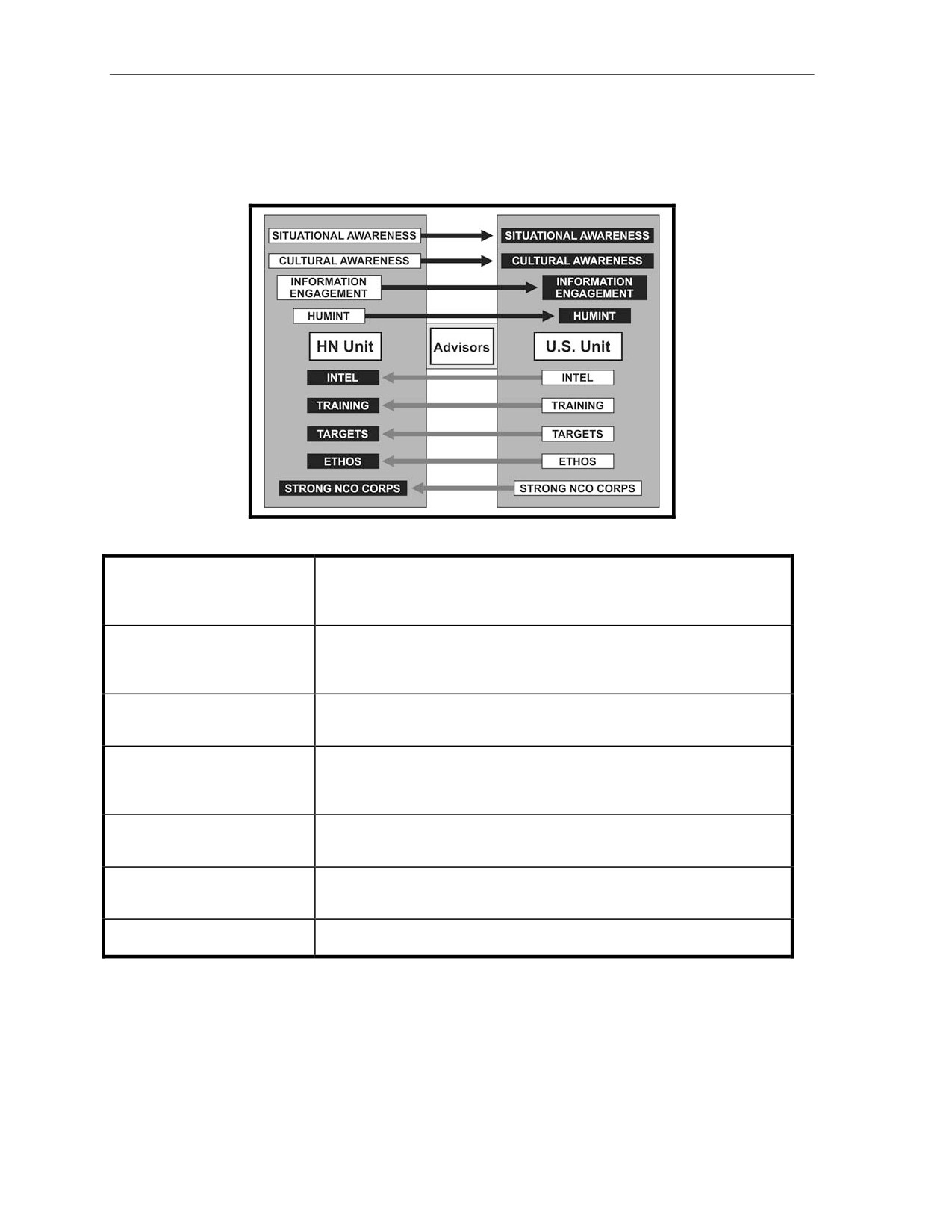
Chapter 8
completely integrated in the planning process, instrumental in the decision of what areas need to be
cleared, included in the site selection process for the hold phase, and leveraged in the decisions on what
stability operations need to be conducted during the build phase. Thus, a Host Nation unit potentially
brings to a counterinsurgency fight the abilities shown in Figure 8-2.
Figure 8-1. Partnership benefits.
Understand the Operational
The AO is their home and their culture; they know the language, the
Environment
different groups, the political situation, educational levels, economic
considerations, historical bad actors, and unofficial community leaders.
Provide Human Intelligence
The HN security force is better able to gather information that leads
to HUMINT for a host of reasons, to include speaking the same
language, understanding the important players in the area, and so on.
Put the Pieces Together
They can often better integrate the different fragments of intelligence
into the context of the operational environment.
Determine Credibility of
They possess a vastly superior sense of cultural and situational
Intelligence Assets (Sources,
awareness vital to managing and assigning credibility to sources.
Walk-Ins, Call-Ins)
Validate and Check
They can confirm not only the interpreters' ability, but also the
Interpreters
interpreters' loyalty.
Identify and Root Out
They can pick out minute differences between normal and abnormal
Infiltrators
behavior.
Gain Information Superiority
They can write messages that resonate with the local populace.
Figure 8-2. Host nation contributions.
CHALLENGES
8-4.
Most nations have at least some cultural obstacles to developing a professional military that
is responsive and accountable to the HN population. Part of the challenge is to design a professional
military that minimizes these culture obstacles. Most challenges arise from the differing perspectives of the
US and the Host Nation.
8-2
FM 3-24.2
21 April 2009
Support to Host Nation Security Forces
EXAMPLES
8-5.
Common cultural challenges include the following:
• Nepotism, such as, rank or positions based on who you know.
• Denial of negative results or errors in the interest of saving face.
• Corruption, such as unofficial or under the table entitlements.
• Influence from competing loyalties (ethnic, religious, tribal and political allegiances).
CATEGORIES
8-6.
These challenges fall under one of four broad categories of resources, leadership, abusing power
organizational structures.
Resources
8-7.
Governments must properly balance national resources to meet the people’s expectations. Funding
for services, education, and health care can limit resources available for security forces. HN spending
priorities may result in a security force capable of protecting only the capital and key government facilities,
leaving the rest of the country unsecured. HN security forces will typically not have the same resources,
equipment, money, or salaries as US units. US units may not have the means to partially sustain the HN
security forces to maximize their effectiveness. Conducting effective COIN operations requires allocating
resources to ensure integration of efforts to develop all aspects of the security force.
Leadership
8-8.
Counterinsurgents may need to influence the existing HN approach to leadership. HN leaders may
be appointed and promoted based on family ties or membership in a party or faction, rather than on
demonstrated competence or performance. Leaders may not seek to develop their subordinates or feel the
need to ensure the welfare of subordinates. In some cases, leaders enforce the subordinates’ obedience by
fear and use their leadership position to exploit them. Positions of power can lead to corruption, which can
also be affected by local culture. Ethical climate and decision making in the HN security force leadership
is often reflected in the HN security force organization’s treatment of detainees. This is a proven barometer
of the commander’s ability to guide his unit and provide lasting security for the HN population.
8-9.
US Forces tasked to develop HN security forces should take special interest in how the Host
Nation appoints, promotes, and develops leaders. The best way US advisors and partner units can influence
leaders is to provide positive leadership examples.
Abuse of Power
8-10.
The behavior of HN security force personnel is often a primary cause of public dissatisfaction.
Corrupting influences of power must be guarded against. Cultural and ethnic differences within a
population may lead to significant discrimination within the security forces and by security forces against
minority groups. In more ideological struggles, discrimination may be against members of other political
parties, whether in a minority cultural group or not. Security forces that abuse civilians do not win the
populace’s trust and confidence; they may even be a contributing factor of the insurgency. US partners
and advisors must identify and address biases, as well as improper or corrupt practices.
8-11.
Abuse of power, such as hoarding property, extortion, or reprisal attacks on a specific group,
could be a root cause that lead to the insurgency or could worsen the insurgency. Units need to understand
issues in the OE and define the problem before attempting to “fix” problems. A current example is how various
groups may have a long cyclical history of conflict with other population groups. Ethnic, historical, political,
racial, religious, social, and territorial turmoil may contribute to cycles of violence in the Host Nation so
intractable that it will take establishing discipline, a code of honor, patriotic nationalism, and a merit based
promotion system inherent in a professional military to break this societal norm. Even then, these efforts may
not be sufficient to stop the abuse of power.
21 April 2009
FM 3-24.2
8-3
Chapter 8
Organizational Structures
8-12.
Perhaps the biggest hurdle for US forces is accepting that the Host Nation can ensure security
using organizational and operational structures that differ from US practices. The goal is not to make the HN
unit a US unit, nor even to make it operate like a US unit. HN security force commanders must be given leeway
in resolving their own security problems. Mirror imaging HN security force structure is often impractical
and does not approach the problem from the perspective root causes that lead to the insurgency. The
population, and subsequently their military, will have cultural aspects that will differ with US norms.
8-13.
Commanders must recognize that the “American way is best” bias is counterproductive with
respect to most Host Nation security forces. While relationships among US police, customs, and military
organizations and individual unit structure work for the United States, those relationships may not exist in other
nations that have developed differently. Units and advisors should develop innovative ways to maximize the
effectiveness of the Host Nation’s organization, units, and bureaucracy.
GOALS
8-14.
Training HN security forces is a slow and painstaking process. It does not lend itself to a “quick
fix.” To ensure long-term success, commanders clarify their desired end state for training programs early. These
goals consist of a set of military characteristics common to all militaries. Those characteristics have nuances
in different countries. Figure 8-3 shows how well-trained HN security forces should be characterized.
Section II—THE FRAMEWORK
Developing HN security forces is a complex and challenging mission. The United States and multinational
partners can only succeed if they approach the mission with the same deliberate planning and preparation,
energetic execution, and appropriate resourcing as the combat aspects of the COIN operation. Accordingly,
COIN force commanders and staffs need to consider the task of developing HN security forces during their
initial mission analysis. They must make that task an integral part of all assessments, planning, coordination,
and preparation. This section discusses developing a plan and developing Host Nation security forces.
DEVELOPING A PLAN
8-15.
To defeat the insurgency and be able to sustain success, the Host Nation should develop a plan,
with US assistance when necessary, to improve the unit’s organization, training, material, leadership, personnel,
and facilities. However, these elements are tightly linked, simultaneously pursued, and difficult to prioritize.
Commanders monitor progress in all domains. The HN security force plan must be appropriate to HN
capabilities and requirements. At the tactical level, the US advisors or partner units will outline goals, allocate
resources, and schedule events as part of the plan under the COIN line of effort—support Host Nation security
forces.
CONSIDERATIONS
8-16.
Competently trained and led Host Nation security forces are vital to winning a counterinsurgency
and to sustaining a stable, secure, and just state. If local communities do not perceive US and HN forces
as legitimate, or that they cannot provide for security, then the population will not risk providing the timely
intelligence necessary to defeat the insurgency. In addition, if the populace does not see at least a gradual
transition to Host Nation responsibility, they may begin to view the HN security forces as an instrument
or puppet of US forces. Finally, these failures will result in HN security forces that are ill equipped to persevere
in a protracted struggle after US/coalition forces withdraw.
8-4
FM 3-24.2
21 April 2009

Support to Host Nation Security Forces
PROFICIENT
Security forces can work well in close coordination to suppress lawlessness and insurgency.
Military units are—
Tactically and technically proficient
Able to perform their national security responsibilities
Able to integrate their operations with those of multinational partners.
Nonmilitary security forces—
Can maintain civil order, enforce laws, control borders, secure key infrastructure, and detain criminal
suspects.
Are well trained in modern police ethics.
Understand police and legal procedures, including the basics of investigation and evidence collection.
WELL LED
Leaders at all levels—
Have sound professional standards and appropriate military values.
Are selected and promoted based on competence and merit.
PROFESSIONAL
Security forces—
Are honest, impartial, and committed to protecting and serving the entire population, operating under
the rule of law, and respecting human rights.
Are loyal to the central government and serving national interests, recognizing their role as the
people’s servants and not their masters.
Operate within a code of conduct and ethical behavior.
Recognize the merits of a trained and capable NCO and junior officer corps.
FLEXIBLE
Security forces can accomplish the broad missions required by the Host Nation—not only to defeat
insurgents or defend against outside aggression, but also to increase security in all areas. This requires an
effective command organizational structure that makes sense for the Host Nation.
INTEGRATED INTO SOCIETY
Security forces represent the Host Nation’s major ethnic groups. They are not seen as instruments of just
one faction. Cultural sensitivities toward the incorporation of women must be observed, but efforts should
also be made to include women in police and military organizations.
SELF-SUSTAINED
Security forces must be able to manage their own equipment throughout its life cycle. They must also
be able to provide their own administrative and sustainment support, especially fuel, water, food, and
ammunition.
Figure 8-3. Characteristics of well-trained HN security forces.
8-17.
US leaders must gain trust and form bonds with HN security force units and personnel as part
of the partnership mission. Working towards cultural understanding improves the US forces relationship
with the partner units. Commanders must treat the individuals in partner units as they treat their Soldiers by
living, eating, sleeping, socializing, planning, and fighting side by side. The Host National security force
21 April 2009
FM 3-24.2
8-5
Chapter 8
must know that US forces care for them both individually and professionally. It is this bond, not the
materials or support that commanders provide, that inspires that level of commitment and loyalty. To
successfully train and support HN security forces, the US partner unit or advisor must—
•
Ensure security forces understand that they support the HN government and the people.
•
Maintain relevancy of security forces for their culture, their population, and their laws.
•
Understand and define the security problem.
•
Ensure credibility and legitimacy to all counterinsurgency operations.
•
Provide a model for society by using military units of mixed ethnicity, religion, political
affiliation, for example, who can work together to secure and protect all the people.
•
Conduct multinational operations with each newly trained security force.
•
Promote mutual respect between US and HN forces and between the military, police,
and paramilitary.
•
Train the trainers first, and then train the HN cadre.
•
Support the HN cadre in training the whole force.
•
Separate HN military and police forces, especially during their training.
•
Place the HN cadre in charge as soon as possible.
•
Recognize achievement, especially excellence.
•
Train all security forces not to tolerate abuses or illegal activity outside of culturally
acceptable levels.
•
Develop methods to report violations.
•
Enable HN to assume the lead in counterinsurgency operations to alleviate effects of a large US
presence.
•
Create, as needed, special elements in each force such as SWAT, waterway, border, or SOF.
•
Establish and use mobile training teams.
•
Ensure infrastructure and pay is appropriate and managed by the Host Nation government.
•
Promote professionalism that does not tolerate internal incompetence. Develop methods
to redress.
ORGANIZING US FORCES
8-18.
As planning unfolds, mission requirements should drive the initial organization for the unit
charged with developing security forces. To achieve unity of effort, a single organization should receive
this responsibility. Typically, these duties are undertaken by some form of an advisor team. Due
to manpower constraints, some functions are best undertaken by partner units.
Partner Units
8-19.
This is a unit that shares all or a portion of an area of operation with an HN security force unit. US
forces operating as partner units to HN security forces need to be prepared to make some organizational
changes. US forces should consider establishing combined staff cells for intelligence, operations, planning
and logistics. These staff cells support transparent operations and unity of effort, enhance the relationship
between the BCT and the HN force by demonstrating a degree of trust, and develop HN capacity in key
staff areas by having HN personnel get intimately familiar with various staff procedures by performing
them alongside their CF partners.
8-20.
Additionally, before deploying, US forces should train in partnering with HN security forces. This
will ease the transition to multinational operations. At a minimum, this should include cultural awareness
training, basic language training, and basic soldier skills training such as marksmanship and first aid.
Advisor Units
8-21.
An advisor is a military member who conducts operations that train Host Nation military
individuals and units in tactical employment, sustainment, and integration of land, air, and maritime skills;
provide advice and assistance to military leaders, and provide training on tactics, techniques,
8-6
FM 3-24.2
21 April 2009

Support to Host Nation Security Forces
and procedures required to protect the HN from subversion, lawlessness, and insurgency, and develop
indigenous individual, leader, organizational skills. Advisor units can be internally or externally resourced.
Internally resourced advisor teams are created from the partner unit when they are required to establish
them on their own. Externally resourced teams are usually DA resourced for the duration of the advisor
team mission. One way of organizing for this role is to have an eleven person team with clearly divided
responsibilities. Each person's duties should reflect his responsibilities to the internal team, and to advising
their HN security force counterpart. In certain situations, the partner unit commander might need to provide
a security element to support an advisor team. This security element might need to be large enough
to guard a compound on an HN security force base and to crew several vehicles. A ten-person security
element has proved be useful in Iraq and Afghanistan. Figure 8-4 shows possible duties on the advisor
team.
Team Chief
This Soldier is the principal advisor to the HN battalion commander and is
the Advisor team commander.
Team Sergeant
This is the advisor team NCOIC, who also serves as principal advisor to the
HN command sergeant major or equivalent.
Executive Officer
This Soldier is the principal advisor to the HN security forces executive
officer in addition to performing the same functions that any unit executive
officer would do in a traditional unit.
Intelligence Officer
This Soldier is the principal advisor to the HN Intelligence Staff and provides
intelligence to the Advisor Team Chief.
Operations Officer
This Soldier is the principal advisor to HN Staff for Operations and Training
(S3) and plans the advisor team operations.
Operations NCOIC
This Soldier is the training NCOIC for the Advisor Team and is the principal
advisor to the Operations Staff NCO in the HN security force.
Operations NCO
This Soldier is the advisor team armorer and principal instructor for basic
rifle marksmanship (small arms), short-range marksmanship
(SRM)/close-quarters battle (CQB), urban operations, patrolling,
checkpoints, and any other individual training deemed necessary based on
the OE.
Operations NCO
This Soldier is the advisor team S1. He is also the principal instructor
for fires and effects considerations (CAS and artillery support).
Medical NCO
This Soldier is the advisor team medical NCOIC and primary instructor
to HN security forces concerning medical issues.
Communications NCO
This Soldier is the advisor team communications NCOIC and principal
communications instructor.
Logistics Officer
This Soldier is the principal advisor to the HN staff for logistics and is the
logistics Chief for the advisor team.
Figure 8-4. Possible duties of the advisor team.
DEVELOPING HN SECURITY FORCES
8-22.
The mission to develop HN security forces at all levels can be organized around seven tasks—
measure (assess), organize, rebuild/build facilities, train, equip, advise, and mentor. The memory aid
MORTEAM can help partner units and advisors. These tasks incorporate all doctrine, organization,
training, material, leadership and education, personnel and facilities
(DOTMLPF) requirements
for developing the HN security forces. Although described sequentially, these tasks are normally
performed concurrently. For example, training and equipping operations must be integrated and, as the
operation progresses, assessments will lead to changes. If US forces are directly involved in operations
against insurgents, the development program requires a transition period during which major COIN
operations are handed over to HN security forces. Figure 8-5 shows the seven framework tasks as an
iterative and cyclical process, in which both advisor teams and partner units measure and mentor HN
security force units at each step.
21 April 2009
FM 3-24.2
8-7
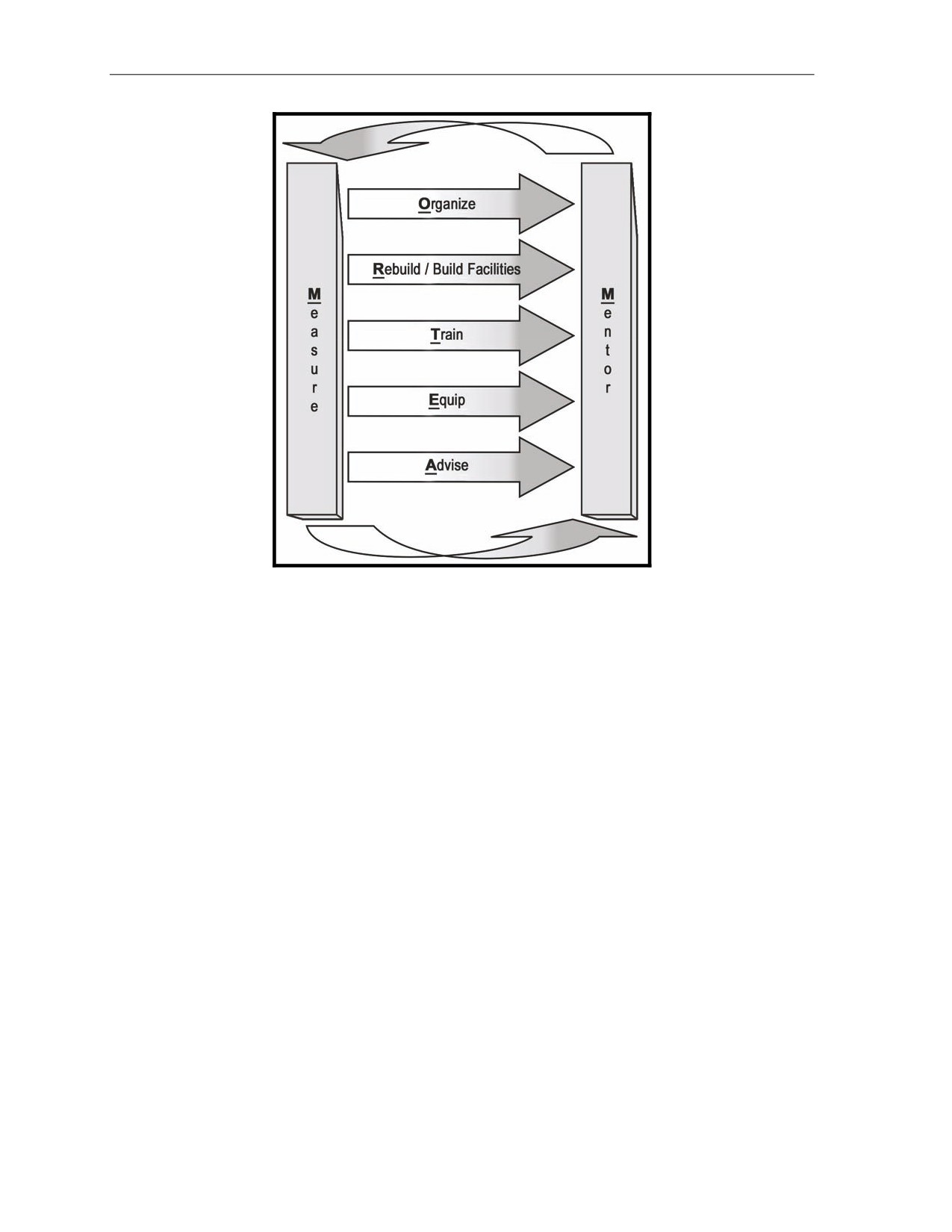
Chapter 8
Figure 8-5. Seven framework tasks.
MEASURE (ASSESS) HOST NATION SECURITY FORCES
8-23.
Commanders of advisor units and partner units must measure and assess the HN security forces
as part of the comprehensive program of analyzing the OE and the insurgency. The partner unit
and advisor team must work closely in assessing the quality of HN security forces. From the assessment,
planners develop short-, mid-, and long-range goals and programs. As circumstances change, so do the
goals and programs. In measuring the state of the Host Nation’s security forces, it may be determined that
some existing security forces are so dysfunctional or corrupt that the organizations must be disbanded
rather than rehabilitated. In some cases, commanders will need to replace some HN leaders before their
units will become functional. While every situation is different, leaders of the development program should
assess and measure the following HN security force factors throughout planning, preparation,
and execution of the operation:
• Social structure, organization, demographics, interrelationships, and education levels
of security force elements.
• Extent of acceptance of ethnic and religious minorities.
• Laws and regulations governing the security forces and their relationship to national leaders.
• Corruption, abuse of power, and nepotism.
• Equipment and facilities, with a priority placed on maintenance.
• Logistic and support structure, and its ability to meet the force’s requirements.
• The unit’s methods and proficiency at conducting COIN operations.
• State of training at all levels, and the specialties and education of leaders.
Assessment Techniques
8-24.
HN security forces must be trained and tactically proficient for some time before they are
considered as ready to conduct operations on their own. US Partner units are responsible for the mentoring,
training, and welfare of their HN counterparts. Advisors assigned to the unit provide the day-to-day
8-8
FM 3-24.2
21 April 2009
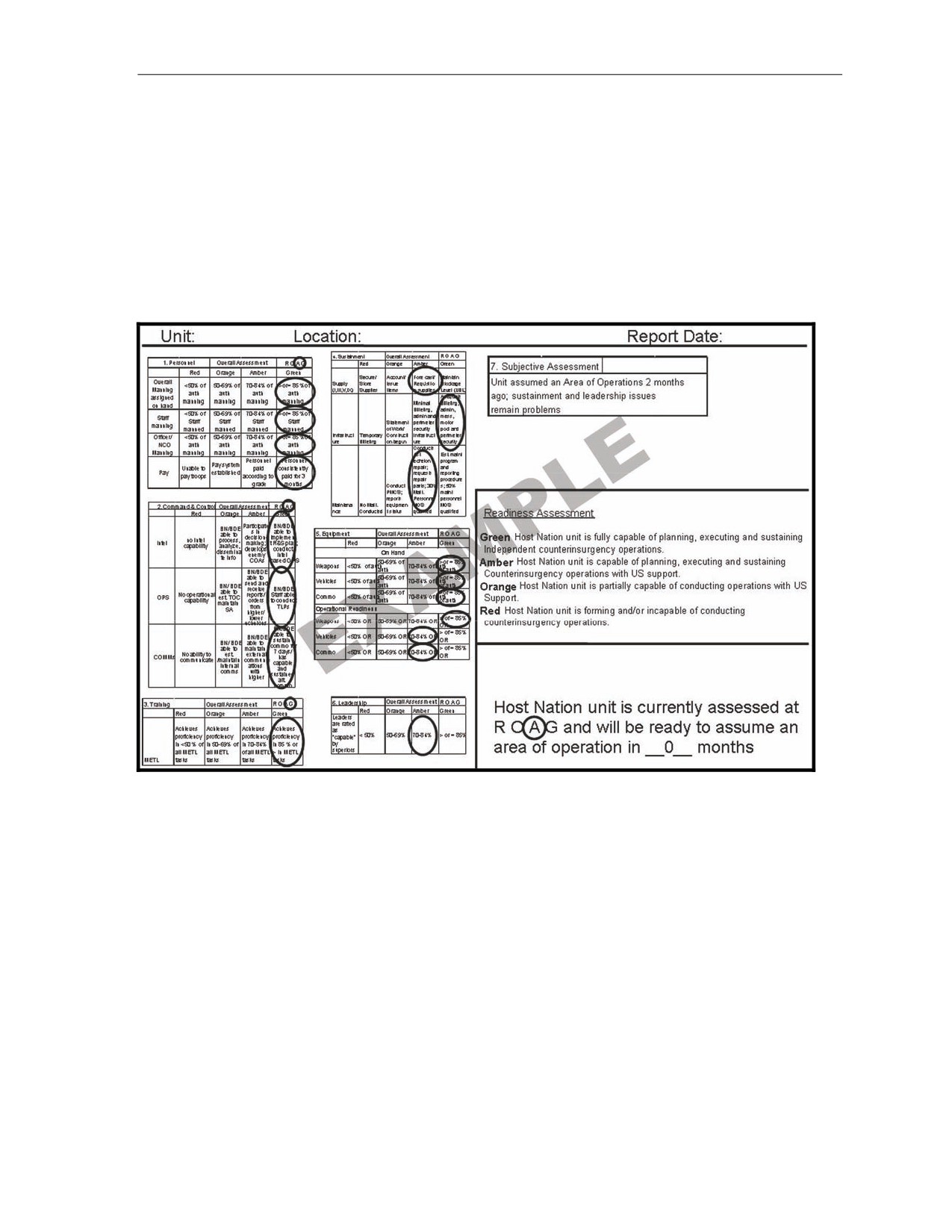
Support to Host Nation Security Forces
connection, but are not sufficiently equipped to do everything required to build a well trained, well led,
sustainable and professional force. A nation's armed force that behaves unprofessionally can quickly lose
legitimacy, which is needed to conduct counterinsurgency operations and draw quality recruits. When the
US military mission fails to prepare HN security forces to take the lead—a key political objective—unity
of effort suffers at many levels. The results are often corruption, nepotism, and bureaucracy, which
generate obstacles to units who must rapidly adapt to the insurgent strategies and tactics. Due to these
factors, the HN will eventually lose the ability to persevere against a steadfast insurgent fighting a
protracted war.
8-25.
US forces often choose to use a readiness assessment of an HN security force unit. Figure 8-6
shows an example format for a readiness assessment.
Figure 8-6. Example format for readiness assessment.
Assessment Periods
8-26.
Assessing Host Nation security forces should be done for three distinct periods of time—short,
mid, and long. Considerations for each include—
Short
8-27.
The advisor and partner unit are involved in the training of the Host Nation security force unit.
An example of a short term goal for an advisor unit would be ensuring that the HN operations officer
is tracking all of his units conducting missions. An example for a partner unit would be training the HN
Soldiers on marksmanship and room clearing.
Mid
8-28.
The HN unit is more self-sufficient, but still not fully capable, and the advisor acts in a
supervisory role. An example of a mid-range goal for an advisor unit would be ensuring that the HN staff
plans for logistical support during missions. An example of a mid range goal for a partner unit would be
training platoon size units to move tactically during patrols.
21 April 2009
FM 3-24.2
8-9
Chapter 8
Long
8-29.
The HN unit can conduct training, planning, sustainment, and operations with little guidance
and the advisor provides oversight and mentorship. An example of advisor unit long-range goal would be
to ensure that the HN intelligence officer gathers, analyzes, and disseminates intelligence and is fully
integrated into the planning process. An example of a partner long-range goal would be to migrate
to providing only the additional forces and quick-reaction force (QRF) capabilities to the Host Nation
security force unit.
Assessing Methods and Proficiency
8-30.
The training, leadership, equipment, logistics and operations of Host Nation security forces must
be assessed. If US advisors are not on the objective with the Host Nation forces, US forces may not know
their capabilities. Assessment of HN security forces may include their ability to—
• Plan and brief an operation.
• Perform correct actions on contact.
• Properly clear and mark rooms, halls, and stairwells.
• Perform other small unit tasks appropriate to the HN OE.
• Use NCOs.
• Employ fire control measures and maintain fire control.
• Call for air reserves or quick reaction force.
• Sustain themselves with Class I, III, and V supplies and provide medical support.
• Maintain vehicles and equipment.
• Maintain professionalism.
ORGANIZE
8-31.
Organizing HN forces depends on the Host Nation’s social and economic conditions, cultural
and historical factors, and security threat. The development program’s aim is to create an efficient
organization with a command, intelligence, logistic, and operations structure that makes sense for the Host
Nation. Conventional forces with limited special-purpose teams, such as explosive ordnance disposal
and special weapons and tactics (SWAT), are preferred. Elite units tend to divert a large share of the best
leadership and remove critical talent from the regular forces. Doctrine should be standard across the force,
as should unit structures. The organization must facilitate the collection, processing, and dissemination
of intelligence across and throughout all security forces.
8-32.
In many situations, simple personnel accountability is one of the greatest impediments to effective
organizations. The advisor team should mentor and advise the Host Nation security forces on keeping
better accountability. Formations, timelines, and uniform standards can be slow to be accepted, which can
stem from lack of supplies. Also, it is important that the unit can manage its leave and pass system. Once
achieved, this will further the capabilities of the Host Nation unit and allow them to focus on operations
and training, not troops to task.
Organizational Structure
8-33.
As much as possible, the Host Nation should determine the security force organization’s structure.
The Host Nation may be open to proposals from US forces, but should approve all organizational designs.
As the HN government strengthens, US leaders and trainers should expect increasingly independent
organizational decisions. These may include changing the numbers of forces, types of units, and internal
organizational designs. Culture and conditions might result in security forces being given what may be
considered nontraditional roles and missions. HN police may be more paramilitary than their US
counterparts, and the military may have a role in internal security. Eventually, police and military roles
should clearly differ. Police should counter crime, while the military should address external threats.
However, the exact nature of these missions depends on the HN situation. In any event, police and military
roles should be clearly delineated.
8-10
FM 3-24.2
21 April 2009
Support to Host Nation Security Forces
Organizational Types
8-34.
The day-to-day troops-to-task requirements and priorities of effort requires a wide assortment of
Host Nation security forces to conduct counterinsurgency operations. Although the police force should be
the frontline of COIN security forces, other units are required to assist the police on a temporary basis until
the police can conduct operations on their own. Police forces are not equipped or trained in operating
in high intensity situations.
Military
8-35.
Military forces might have to perform police duties at the start of an insurgency; however, it
is best to establish police forces to assume these duties as soon as possible. Few military units can match a
good police unit in developing an accurate human intelligence picture of their AO. Because of their
frequent contact with populace, police often are the best force for countering small insurgent bands
supported by the local populace.
8-36.
Although the long term objectives in training Host Nation militaries need to focus on foreign
defense, realities of counterinsurgencies often dictate that the military establish civil security and civil
control. Commanders must ensure that military units coordinate with local police with respect
to intelligence gathering, interacting with civilians, and civil affairs.
8-37.
A Host Nation security force unit will be task-organized into elements that can accomplish one
of three functions—conducting offensive operations, conducting defensive operations, and implementing
civil control. These organizations’ sizes vary based on the operational environment; the components, the
elements and dynamics of the insurgency; and the phase of the counterinsurgency. A Host Nation security
force must also have C2, a reserve, and some form of sustainment support.
Offensive Force
8-38.
A HN unit needs the capability to conduct offensive operations as well as specific
counterinsurgency operations, such as search and attacks, raids, cordon and searches, ambushes, and site
exploitation (SE). Due to the elusive nature of the insurgent, this force may be the smallest organization in
the unit.
Defensive Force
8-39.
A HN unit needs to have the ability to conduct defensive operations. Typically, HN
counterinsurgency units focus on executing area defense at the tactical level that includes securing
important events, critical infrastructure, and bases. Depending on the phase of the counterinsurgency
and insurgent capabilities, this force may be quite large.
Civil Control or Constabulary Force
8-40.
A HN unit needs to have a force that contributes to national security, as well as performs police
duties and civil functions. Typically, this type of force conducts tasks associated with the civil control LOE
such as manning checkpoints, gathering intelligence, conducting investigations into crimes and attacks,
and performing reconnaissance. Often the largest force, it has constant interaction with the population
which increases security of both the unit and the population. Historical and current examples include the
Philippine Constabulary, the Italian Carabinieri, the Iraqi National Police, and Haitian Constabulary.
Police
8-41.
The primary frontline COIN force is often the police—not the military. However, the police are
only a part of the rule of law. Common roles of the police forces are to— investigate crimes, provide traffic
control, preserve the peace by resolving simple disputes and civil disturbance control. Police require
support from a code of law, judicial courts, and a penal system. Such support provides a coherent
and transparent system that imparts justice. Upholding the rule of law also requires other civil institutions
and an HN ability to support the legal system. If parts of the rule of law do not work, then commanders
must be prepared to meet detention requirements.
21 April 2009
FM 3-24.2
8-11
Chapter 8
8-42.
Countering an insurgency requires a police force that is visible day and night. The Host Nation
will not gain legitimacy if the populace believes that insurgents and criminals control the streets. Well-sited
and protected police stations can establish a presence in communities, which secures communities
and builds support for the HN government. Daily contact with locals gives police a chance to collect
information for counterinsurgents.
8-43.
Police might be organized on a national or local basis. Whatever police organization
is established, Soldiers must understand it and help the Host Nation effectively organize and use it. This
often means dealing with several police organizations and developing plans for training and advising each
one. A formal link or liaison channel must exist between the HN police, HN military forces, and US forces.
This channel for coordination, deconfliction, and information sharing enables successful COIN operations.
Police often consist of several independent but mutually supporting forces. These may include—
• Criminal and traffic police.
• Border police.
• Transport police for security of rail lines and public transport.
• Specialized police forces.
• Internal Affairs.
Paramilitary
8-44.
Success in a counterinsurgency depends on isolating the insurgent from the population. Insurgents
intimidate the population into passive support and prevent the population from providing information
to counterinsurgent units. A technique to combat this is to establish a paramilitary organization.
Paramilitary forces are designed to support the rule of law and stabilize the operating environment,
particularly for when the HN police forces and military forces are standing-up organizing. Temporary
in nature, the paramilitary unit’s mandate should be two-fold.
• It needs to provide the population with a means of securing themselves.
• It should have the means to gather and report intelligence about the insurgency.
• It can sometimes be used covertly to target insurgents within higher headquarters guidance.
Organization
8-45.
Once citizen leaders are identified, units can work with locals in organizing the paramilitary units.
The units need to have recognizable uniforms, standard light weapons, and a salary. The salaries will take
away from the insurgent recruitment base.
Limitations
8-46.
Paramilitary organizations should be prevented from conducting offensive operations. They
should also be monitored closely for insurgent infiltration or abuse of power.
Demobilization
8-47.
Eventually, the best way to demobilize a paramilitary force might be to integrate part of it into the
HN military or police force.
Corrections
8-48.
If counterinsurgents seek to delegitimize an insurgency by criminalizing it, then the Host Nation
must establish a robust corrections system. A counterinsurgency with this goal, should be provided with a
more robust armament than in stable governments.
8-12
FM 3-24.2
21 April 2009
Support to Host Nation Security Forces
The situations in Iraq and Afghanistan are not the first time US forces have
created Host Nation security forces from scratch and allowed them to win
in a counterinsurgency. The Philippine-American War began in 1898
and ended officially in 1902, but hostilities remained until 1913. The war was
not a popular one in the United States, but resulted in a stable and free
Philippine Republic.
The Philippine Constabulary
(PC) was established on August 8,
1901,
to assist the United States military in combating the remaining Filipino
revolutionaries. The PC was entrusted into the hands of Captain Henry T.
Allen, named as the chief of the force and later dubbed as "the Father of the
Philippine Constabulary." With the help of four other army officers, Captain
Allen organized the force, trained, equipped, and armed the men as best
as could be done under difficult conditions.
General Henry Adler said it best when he said, “For some time to come, the
number of troops to be kept here should be a direct function of the number
of guns put into the hands of the natives…It is unwise to ignore the great
moral effect of a strong armed force above suspicion.”
The Constabulary was instrumental in defeating the insurgency. Originally
officered by Americans, the Filipinos slowly over took all operations of the
unit. At a tactical level, they were initially used to augment US forces
and moved into having their own area of operations. In July of 1901, the US
Army garrisoned 491 positions and by December it only garrisoned 372
positions. Although poorly armed with shotguns and revolvers, the
constabulary soon maintained ownership of entire provinces.
REBUILD OR BUILD FACILITIES
8-49.
HN security forces need infrastructure support. Soldiers and police need buildings for storage,
training, and shelter. Often, requirements include barracks, ranges, motor pools, and other military
facilities. Construction takes time; the Host Nation needs to invest early in such facilities if they are to be
available when needed. Protection must be considered in any infrastructure design, including headquarters
facilities, since infrastructure is an attractive target for insurgents.
(See FM 5-104 for information on
hardening measures to increase infrastructure survivability and improve protection.)
8-50.
During an insurgency, HN military and police forces often operate from local bases. Building
training centers and unit garrisons requires a long-term force-basing plan. If possible, garrisons should
include housing for the commissioned officers, NCOs, and families; government-provided medical care for
the families; and other benefits that make national service attractive.
8-51.
The easiest way for a partner unit to do this is to build a combined facility to house both itself
and the HN unit. As the situation improves, the Host Nation security forces can occupy the entire
compound once the partner unit leaves.
8-52.
Advisor units can use funding that they have to build showers, tents, toilets, dining facility
equipment, barriers and minor building renovations. Improving the military facilities can result in an
increase in the morale and performance of the HN unit.
TRAIN
8-53.
US and multinational training assistance should address shortfalls at every level with the purpose
of establishing self-sustaining training systems.
US Trainers
8-54.
Soldiers assigned to training missions should receive training on the specific requirements
of developing HN forces. The course should emphasize the Host Nation’s cultural background, introduce
21 April 2009
FM 3-24.2
8-13
Chapter 8
its language, and provide cultural tips for developing a good rapport with HN personnel. The course should
also include protection training for troops working with HN forces. US trainees must become familiar with
the HN organization and equipment, especially weapons not in the US inventory. This training must
emphasize the following:
• Sustaining training and reinforcing individual and team skills.
• Using the smallest possible student-to-instructor ratio.
• Developing HN trainers.
• Training to standards—not to time.
• Providing immediate feedback and using after-action reviews.
• Respecting the HN culture, but learning to distinguish between cultural practices and excuses.
• Learning the HN language.
• Working with interpreters.
Establish Standards
8-55.
The Host Nation unit and trainers must establish clear measures for evaluating the training
of individuals, leaders, and units. Insurgent strategies and their corresponding responses from targeted
governments vary widely. COIN operations require many of the same individual and collective skills
performed in conventional military operations, but also include additional requirements for COIN. Small
units execute most COIN operations; therefore, effective COIN forces require strong junior leaders.
Soldiers and Marines know how to evaluate military training. Metrics for evaluating units should include
subjective measures, such as loyalty to the HN government, as well as competence in military tasks.
However, the acceptance of values, such as ethnic equality or the rejection of corruption, is far more
difficult than evaluating task performance.
Soldiers and Police
8-56.
Security force members must be developed through a systematic training program. The program
first builds their basic skills, then teaches them to work together as a team, and finally allows them
to function as a unit. Basic military training should focus first on Soldier skills, such as first aid,
marksmanship, and fire discipline. Leaders must be trained in planning tactics, including patrolling, urban
operations, or other skills necessary. Everyone must master the rules of engagement and the law of armed
conflict. Required skills include the following:
• Conduct basic intelligence functions.
• Manage their security.
• Coordinate indirect fires.
• Conduct logistic (planning, maintenance, sustainment, and movement) operations.
• Provide for effective medical support.
• Provide effective personnel management.
Advisor Teams
8-57.
Advisor teams are generally responsible for initial Host Nation unit training and then provide
oversight as the Host Nation units implement their own training plan. Leader and ethics training should be
integrated into all aspects of training.
Partner Units
8-58.
Partner units play an important role in advising. Advisors cannot go out with every Host Nation
operation, but, as almost all operations in COIN are combined, a partner unit can effectively advise a Host
Nation unit. Partner units can be most effective at advising Host Nation units in the planning process,
especially MDMP. The MDMP model may need to be modified to suit the HN security force. Staff
sections should work closely with their HN peers as part of the planning process.
8-14
FM 3-24.2
21 April 2009
Support to Host Nation Security Forces
8-59.
Partner units might have to provide limited support or supplies to their Host Nation unit. For
example, a unit might provide its HN unit JP-8 or Class VIII, or it might help recover a disabled tank.
It should never create a reliance on partner unit support. The commander allocates partner support,
considering the realities of the situation.
8-60.
HN security force staffs, when fully capable, should be able to achieve the following:
Operations
8-61.
Plans are synchronized with consideration given to all Warfighting Functions. They are
disseminated to appropriate personnel in a timely manner and operate within a short-, mid-, and long-term
framework.
Intelligence
8-62.
Intelligence is shared with other units and agencies. It is fully integrated into the planning process,
is bottom fed, and uses multiple sensors.
Sustainment
8-63.
Units have synchronized methods for requesting supplies and sustainment assets. Planners
account for logistical capabilities during the planning process.
Command and Control
8-64.
The command structure is unified. Leaders empower subordinate leaders within the commander’s
intent. Commanders visualize, describe, and direct their units.
Soldiers
8-65.
Training can be divided into individual, unit, and staff training.
Individual
8-66.
Individual skills training covers marksmanship, first aid, land navigation, and individual
movement techniques. Host nation security forces do not always have the institutional military instruction
that US forces have, so much of the individual skills training occurs at the unit. Marksmanship will be
of particular concern, due to the need for precise fires in COIN.
Unit
8-67.
Unit training is focused on getting Host Nation battalions, companies, platoons, and squads ready
to conduct operations. This typically means training focused on three key tasks: checkpoint operations,
combat patrols (mounted and dismounted), and cordon and search operations.
Staff
8-68.
Staff training involves training staffs to use and implement systems focused on planning, logistical
support, intelligence integration, and command and control.
Police
8-69.
Police training is best conducted as an interagency and multinational operation. Ideally, leaders
for police training are civilian police officers from the Departments of Justice and State, along with senior
police officers from multinational partners. Civilian police forces have personnel with extensive experience
in large city operations and in operating against organized crime groups. Experience countering organized
crime is especially relevant to COIN; many insurgent groups are more similar to organized crime in their
organizational structure and relations with the populace than they are to military units. US military police
units serve best when operating as a support force for the professional civilian police trainers. However,
military police units may be assigned the primary responsibility for police training, and they must be
prepared to assume that role if required.
21 April 2009
FM 3-24.2
8-15
Chapter 8
8-70.
Higher level police skills, such as civilian criminal investigation procedures, anti-organized crime
operations, and police intelligence operations—are best taught by civilian experts.
8-71.
Effective policing also requires an effective justice system that can process arrests, detentions,
warrants, and other judicial records. Such a system includes trained judges, prosecutors, defense counsels,
prison officials, and court personnel. These people are important to establishing the rule of law.
8-72.
Military police or corrections personnel can also provide training for detention and corrections
operations. HN personnel should be trained to handle and interrogate detainees and prisoners according
to internationally recognized human rights norms by the appropriate US personnel. Prisoner and detainee
management procedures should provide for the security and the fair and efficient processing of those
detained.
8-73.
Police forces, just like military forces, need quality support personnel to be effective. This
requires training teams to ensure that training in support functions is established. Specially trained
personnel required by police forces include the following:
• Armorers.
• Supply specialists.
• Communications personnel.
• Administrative personnel.
• Vehicle mechanics.
Leaders
8-74.
The effectiveness of the HN security forces directly relates to the quality of their leadership.
Building effective leaders requires a comprehensive program of officer, staff, and specialized training. The
ultimate success of any US involvement in a COIN effort depends on creating viable HN leaders able
to carry on the fight at all levels and build their nation on their own. One of the major challenges that
partner units and advisor teams may face is the perceived low quality of leader, especially the junior
leader ranks.
8-75.
The leader training methodology must reinforce the different levels of authority within the HN
security force. The roles and responsibilities of each commissioned officer and NCO rank must be firmly
established so recruits understand what is expected of them. Their subordinate relationship to civilian
authorities must also be reinforced to ensure civilian control. In addition, training should establish team
dynamics. In some cultures, security forces may need training to understand the vital role of members not
in primary leadership positions.
Commissioned Officers
8-76.
Officer candidate standards should be high. Candidates should be in good health and pass an
academic test with higher standards than the test for enlisted troops.
Officer Candidates
8-77.
These should be carefully vetted to ensure that they do not have close ties to any radical
or insurgent organizations.
Basic Officer Training
8-78.
Various models for basic officer training exist:
• One-year military college.
• Two-year military college.
• Four-year military college.
• Officer Candidate School.
• Military training at civilian universities.
8-16
FM 3-24.2
21 April 2009
Support to Host Nation Security Forces
Additional Training
8-79.
In addition to tactical skills, commissioned officers should be trained in accountability,
decision-making, delegation authority, values, and ethics. Special COIN training should address—
• Intelligence collection and legal considerations.
• Day and night patrolling.
• Site security.
• Cordon and search operations.
• Operations with—
Other US Forces.
Other HN governmental agencies.
Intergovernmental organizations.
Nongovernmental organizations.
• Treatment of detainees and prisoners.
• Psychological operations.
• Civil military operations.
• Negotiations.
• Ethnic and religious sensitivity.
Noncommissioned Officers
8-80.
Professional and effective security forces all have a professional NCO Corps. NCOs need training
in tactical skills, accountability, values, and ethics. Relations and responsibilities between the Officer
and NCO Corps should be clearly defined, and should empower the NCO Corps. Units often create special
NCO academies to train NCOs from partner Host National units.
Civilian Leaders
8-81.
Additionally, Host Nation civilian leaders may need specific training to improve their skills
and performance. These key representatives might include—
• City mayor.
• Officials from public works, utilities, transportation, and communication.
• Local police chief.
• Fire-fighting officials.
• Superintendent of schools.
• Religious leaders.
• Health and medical officials and leaders.
• Judicial representatives.
• Editors of local news media.
• Business and commercial leaders.
Augmenting
8-82.
This is an arrangement where the Host Nation provides either individuals or elements to US units
or vice versa. Augmentation can occur at a number of levels and in many different forms. For example, a
US squad can be augmented with HN individuals, a US company can be augmented with an HN platoon,
and a US battalion can be augmented with an HN company. The benefit of this type of training strategy
is that Host Nation security forces can emulate US forces in actual combat operations. In addition, US
forces can gain valuable cultural, language, and intelligence-gathering skills. Typically a chain of
command will be agreed upon prior to execution, however, command may be executed as a partnership.
Figure 8-7 shows an example of how augmenting a unit can be implemented.
21 April 2009
FM 3-24.2
8-17