FM 3-13 Information Operations: Doctrine, Tactics, Techniques, and Procedures (NOVEMBER 2003) - page 6
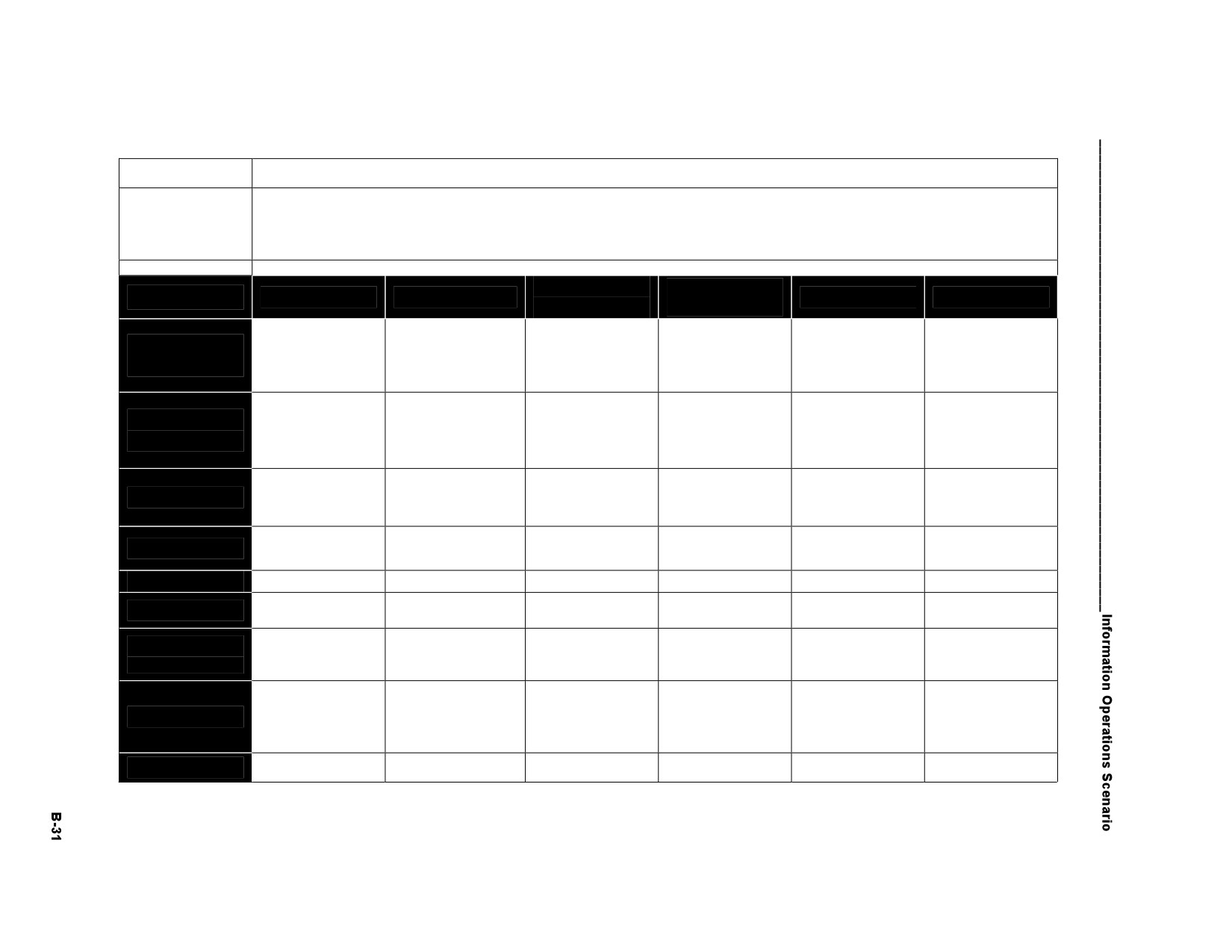
XXI Corps conducts a one-division air assault, D-day, H-hour, over two aerial axes of advance to seize Objectives DOG and CAT. 27th ACR
COA # 1
covers corps east flank and links up with ASA forces advancing westward. Division clears AO COURTNEY and links up with 6th MEB.
IO supports XXI Corps operations by preventing preemption of the air assault and by minimizing civil interference within AO COURTNEY
through destroying, degrading, disrupting, and exploiting Rendovan C2 and fire support systems; deceiving Rendovan decisionmakers; de-
IO Concept of
stroying, degrading, disrupting, and deceiving Rendovan ISR systems; denying Rendovan decisionmakers information about XXI Corps inten-
Support
tions and capabilities; protecting friendly C2 and INFOSYS; countering Rendovan propaganda and deception operations. CMO emphasizes the
Government of San Anglos stay-put policy. IO supports the JTF and XXI Corps deception plans.
IO Objective #4
Minimize civilian interference in the objective area
Military Decep-
Physical
EW
PSYOP
OPSEC
IA
tion
Destruction
Task EW-05
Task IA-04
Task PSY-04
Task MD-04
Conduct EA to re-
Task OP-04
Ensure links be-
What
Influence locals to
Provide information
duce Tiger Corps’
Conceal XXI Corps’
tween XXI Corps
comply with the stay-
compatible with stay-
(Task)
access to electro-
true mission
and JTF 250 are
put policy
put theme
magnetic spectrum
intact
To prevent civilian in-
To prevent civilian
To prevent civilian
To prevent civilian
terference with the
interference with the
interference with the
interference with the
Why
To reduce Rendovan
operation and mini-
operation and mini-
operation and mini-
operation and mini-
messages to locals
(Purpose)
mize civilian casual-
mize civilian casual-
mize civilian casual-
mize civilian casual-
ties
ties
ties
ties
JTF aircraft-EA6b
1st Bn, 19th PSYOP
1st Bn, 19th PSYOP
XXI Corps and 121st
XXI Corps G-6, JTF
Who
21st MI Bde
Grp, 121st ID PSYOP
Grp
ID units
250 J-6
Tm
HQ XXI Corps, HQ
Where
AO Courtney
AO Courtney
AO Courtney
Throughout AO
JTF 250
When
H - 48
H - 48
H - 48
H - 48
H - 48
Counter misinforma-
Increase displaced
Penetrate communi-
Counteraction
Increase EP
Penetrate OPSEC
tion campaign
persons
cations links
Minimal civilian pres-
Minimal civilian
Minimal civilian
Criteria of
Messages to locals
XXI Corps mission
ence in objective
presence in objec-
presence objective
Success
significantly reduced
not compromised
areas
tive areas
areas
Location of large
Location of large
Are there reduced
concentrations of
concentrations of
Indication of OPSEC
IO IR
messages to civil-
DCs.
DCs.
Needs and
Links are not broken
penetration
ians?
Needs and inten-
intentions of
tions of DCs
displaced
Combatant cdr
Remarks
XXI corps approves
JTF 250 approves
XXI Corps approves
JTF 250 approves
approves
Figure B-22. IO Input Work Sheet, IO Objective #4
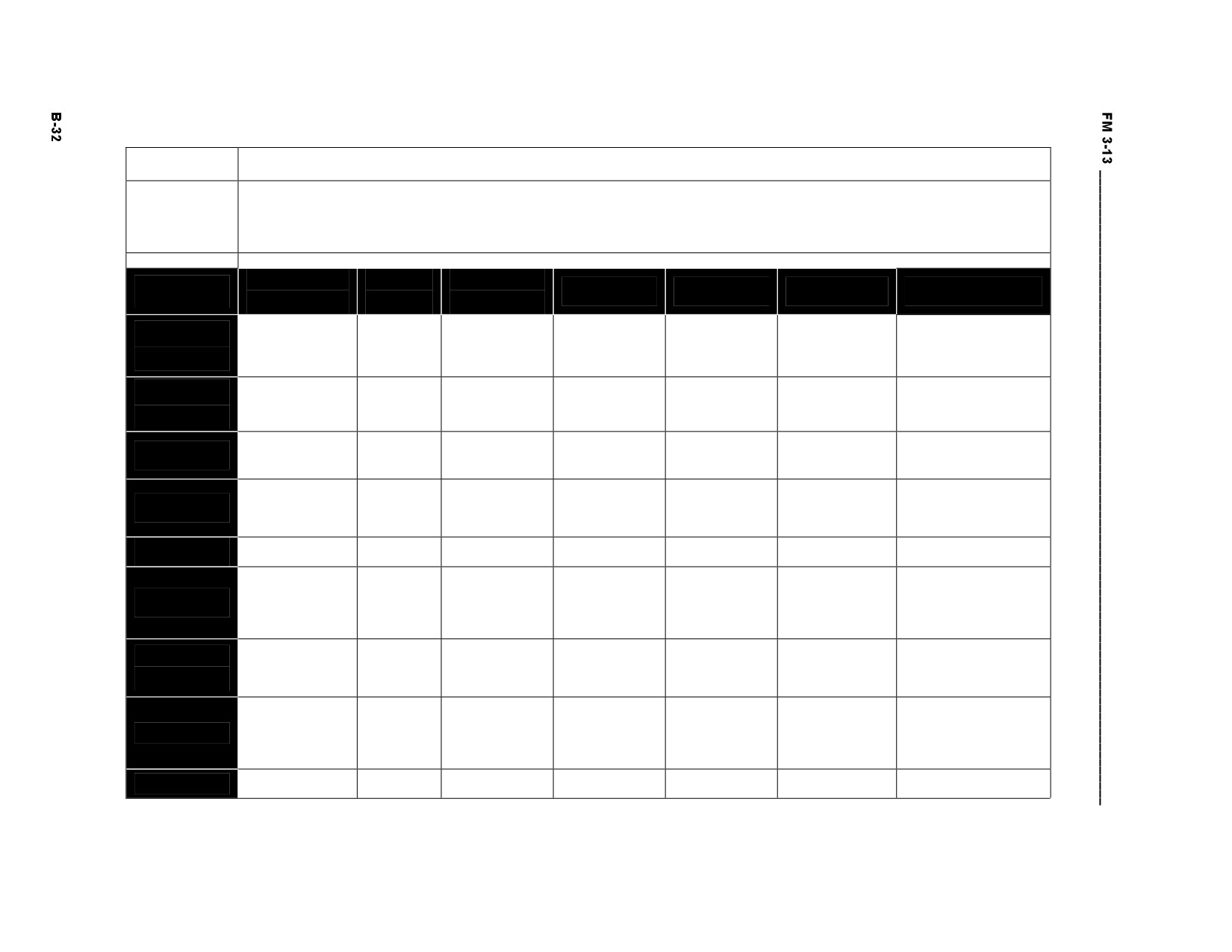
XXI Corps conducts a one-division air assault, D-day, H-hour, over two aerial axes of advance to seize Objectives DOG and CAT. 27th ACR
COA # 1
covers corps east flank and links up with ASA forces advancing westward. Division clears AO COURTNEY and links up with 6th MEB.
IO supports XXI Corps operations by preventing preemption of the air assault and by minimizing civil interference within AO COURTNEY
through destroying, degrading, disrupting, and exploiting Rendovan C2 and fire support systems; deceiving Rendovan decisionmakers; destroy-
IO Concept of
Support
ing, degrading, disrupting, and deceiving Rendovan ISR systems; denying Rendovan decisionmakers information about XXI Corps intentions
and capabilities; protecting friendly C2 and INFOSYS; countering Rendovan propaganda and deception operations. CMO emphasizes the Gov-
ernment of San Anglos stay-put policy. IO supports the JTF and XXI Corps deception plans.
IO Objective #4
Minimize civilian interference in the objective area
Counter-
Counter-
Physical
CND
CI
PA
CMO
propaganda
deception
Security
Task PS-04
Task CND-04
Task CI-04
Task PA-04
What
Task CP-03
Task CMO-03
Safeguard San
Prevent PSYOP
Counter
Influence civilian
Degrade Rendo-
Influence DCs to stay
(Task)
Anglos
message com-
Rendovan
populace to sup-
van disinformation
put
leadership
promise
HUMINT
port US objectives
Why
Prevent DC
Prevent DC
Prevent DC
Prevent DC
Prevent DC
Prevent civilian interfer-
movement into
movement into
movement into
movement into
movement into
(Purpose)
ence in objective areas
objective areas
objective areas
objective areas
objective areas
objective areas
1st Bn, 19th PSY-
JTF and corps
Who
OP Bde, 121st ID
JTF 250 CMO
XXI Corps G-6
21st MI Bde
365 CA Bde
PAOs
PSYOP Tm
HQ 1st Bn, 19th
Corps media
PSYOP Grp; HQ
operations center
Where
Throughout AO
San Anglos
Throughout AO
Throughout AO
121 ID PSYOP
and designated
Tm
unit locations
When
Ongoing
Ongoing
Ongoing
Ongoing
Ongoing
Ongoing
Rendovan attacks
Rendovan forces
San Anglos
Rendovan
Rendovan forces
against HN assets
increase propa-
leadership
Rendova
Counteraction
increases
increase propa-
Rendovan propa-
ganda efforts or
causes inter-
increases CNA
HUMINT
ganda
ganda for people to
changes story
ference
move
Enhanced interna-
No attacks against
DCs do not move
DCs do not
DCs do not
DCs do not
Criteria of
tional and local
critical assets
into objective
interfere with
move into
move into
Success
support for JTF
Minimum Interference
areas
operation
objective areas
objective areas
250 operations
from DCs
Location of
Location of
Locations of large con-
large DC
Location of large
Tenor and focus
Indicators of
Rendovan
centrations of DCs
IO IR
concentrations
concentrations of
of press coverage
compromise
HUMINT
Needs and intentions
DC needs and
DCs
of the operation
sources
of DCs.
intentions
JTF 250
STRATCOM
XXI corps
Remarks
JTF 250 approves
JTF 250 approves
JTF 250 approves
approves
approves
approves
Figure B-22. IO Input Work Sheet, IO Objective #4 (continued)
_____________________________________________________________ Information Operations Scenario
D-Day
IO
H - 48
H - 24
H - 5
H - 1
H + 24
H + 48
H-hour
Objectives
PA-01
PSY-01
CMO-01
IO OBJ #1
CI-01
PD-01
Prevent com-
OP-01
EW-01
promise of
CD-01
XXI Corps
PS-01
mission and
CND-01
concept of
IA-01
operations
MD-01
PSY-02
EW-02
MD-02
CND-02
CI-02
PA-02
IO OBJ # 2
CMO-02
Protect Corps
CD-01
C2
IA-02
CP-01
PS-02
OP-02
MD-03
PSY-03
CD-02
EW-03
IO OBJ #3
PA-03
EW-04
Disrupt 109
OP-03
ADA, ISR, C2
IA-03
PD-02
Systems
PS-03
PD-03
CND-03
EW-05
PSY-04
MD-04
OP-04
IO OBJ #4
IA-04
Minimize
CP-03
Civilian inter-
CMO-03
ference
PA-04
CI-04
PS-04
CND-04
DP to launch
121 ID air
122 ID air
Maneuver
121st ID
assault
movement
Execute RFL
PL Gray
PL Blue is
becomes LD
C2
boundary
Locate/track
Track adver-
Track adver-
adversaries
saries east of
saries west
Intelligence
East of PL Blue
PL Blue
of PL Blue
SEAD
SEAD
SEAD
Fire support
Wpns Hold
Wpns Tight
Wpns Tight
Air defense
Priority to
survivability
MCS
in objective
areas
Jump
BSAs to
CSS
objective
areas
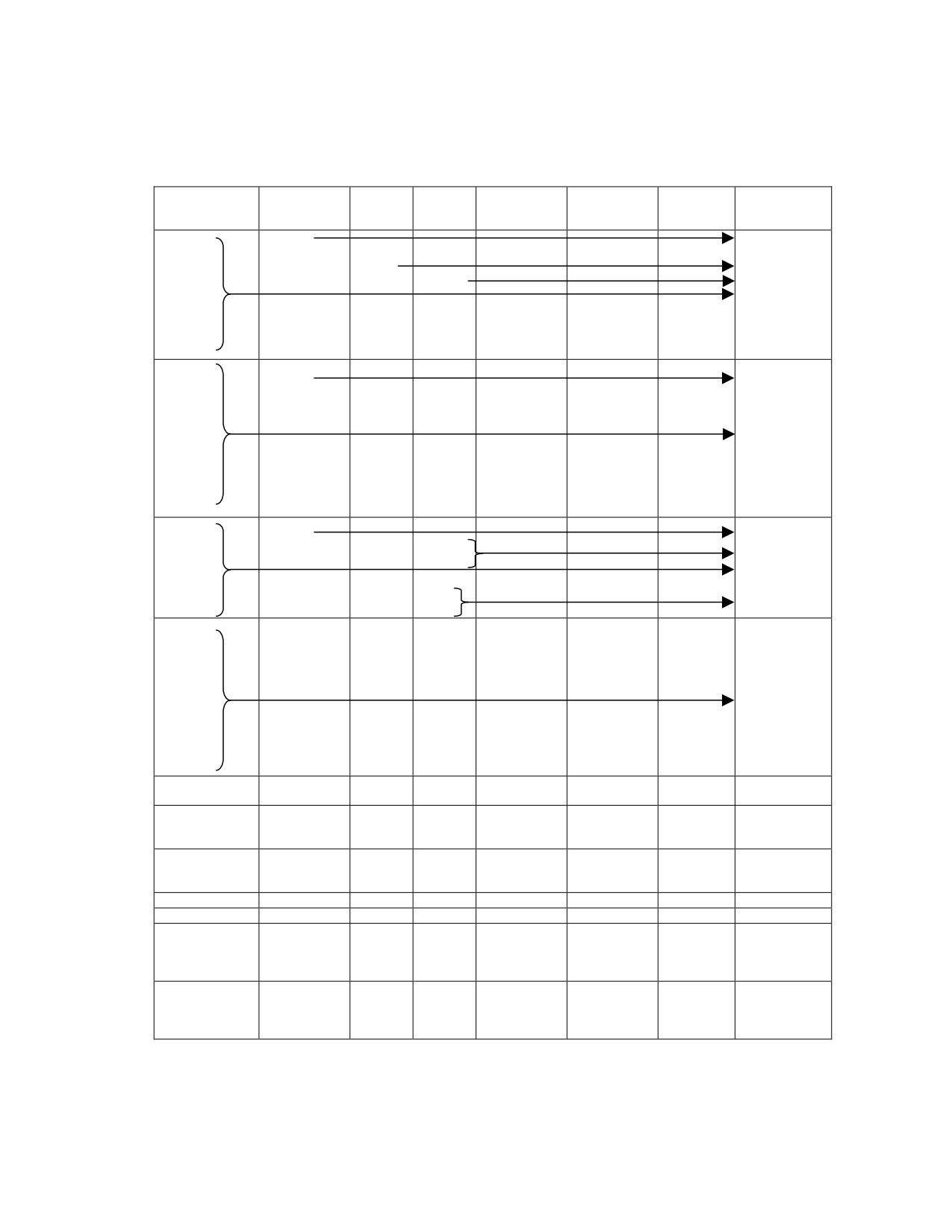
Figure B-23. IO Synchronization Matrix
B-33

FM 3-13 __________________________________________________________________________________
Information-Operations-Related Target Nominations
B-37. Based on IPB products, the high-value target, and information derived
during mission analysis, the G-7 develops the EW and physical destruction
IO tasks in figures B-19-B-22, pages B-25-B-32, into one or more IO-related
targets. The G-7 nominates them as high-payoff targets (HPTs), as part of
the targeting process. The targeting team determines which of these nomi-
nated targets are included in the high-payoff target list. (See appendix E.)
The G-7 develops these IO-related HPTs and IO IRs needed to assess their ef-
fects as IO tasks and includes them on IO input work sheets and the IO as-
sessment matrix (see figure B-26, page B-39).
Critical Asset List
B-38. The G-7 determines that there are no changes to the critical asset list
developed during mission analysis (see figure B-6, page B-11) for COA #1.
Critical assets may be added or deleted from the list based on how their loss
or degradation would affect a COA.
Assessment of Information-Operations-Associated Risk
B-39. The staff assesses hazards associated with each COA as it is developed
(see paragraphs B-16-B-18 and FM 100-14). The G-7 reviews each COA to
determine tactical and accident hazards that may result from IO activities.
The G-7 then develops controls to manage IO-related hazards, determines re-
sidual risk, and prepares to test the controls during COA analysis. The G-7
coordinates controls with other staff sections as necessary. Controls that re-
quire IO tasks to implement are added to the IO input matrix for the COA.
Mission: XXI Corps attacks D-day, H-hour to clear AO COURTNEY, link up with ASA forces vicinity AWASH River,
and link up with 6th MEB vicinity HELIOTROPE; supports Government of San Anglos authorities in establishing order
and providing basic services.
1
2
3
4
5
6
IO Objective
Identify
Assess
Develop
Determine
Implement
Hazards
Hazards
Controls
Residual
Controls
Risk
Disrupt Tiger Corps
ADA, ISR, C2, and
targeting during criti-
Electronic fratricide
low
XXI Corps SOP
Low
XXI Corps SOP
cal periods of the
operation
Early initiation of
Large numbers of
CMO/PSYOP
DCs generated by
Minimize civilian in-
actions to control
Rendovan
extremely
terference in the
interference may
Moderate
IO Annex
operations may
high
objective area
reduce the num-
interfere with XXI
ber of DCs in the
Corps operations
objective area
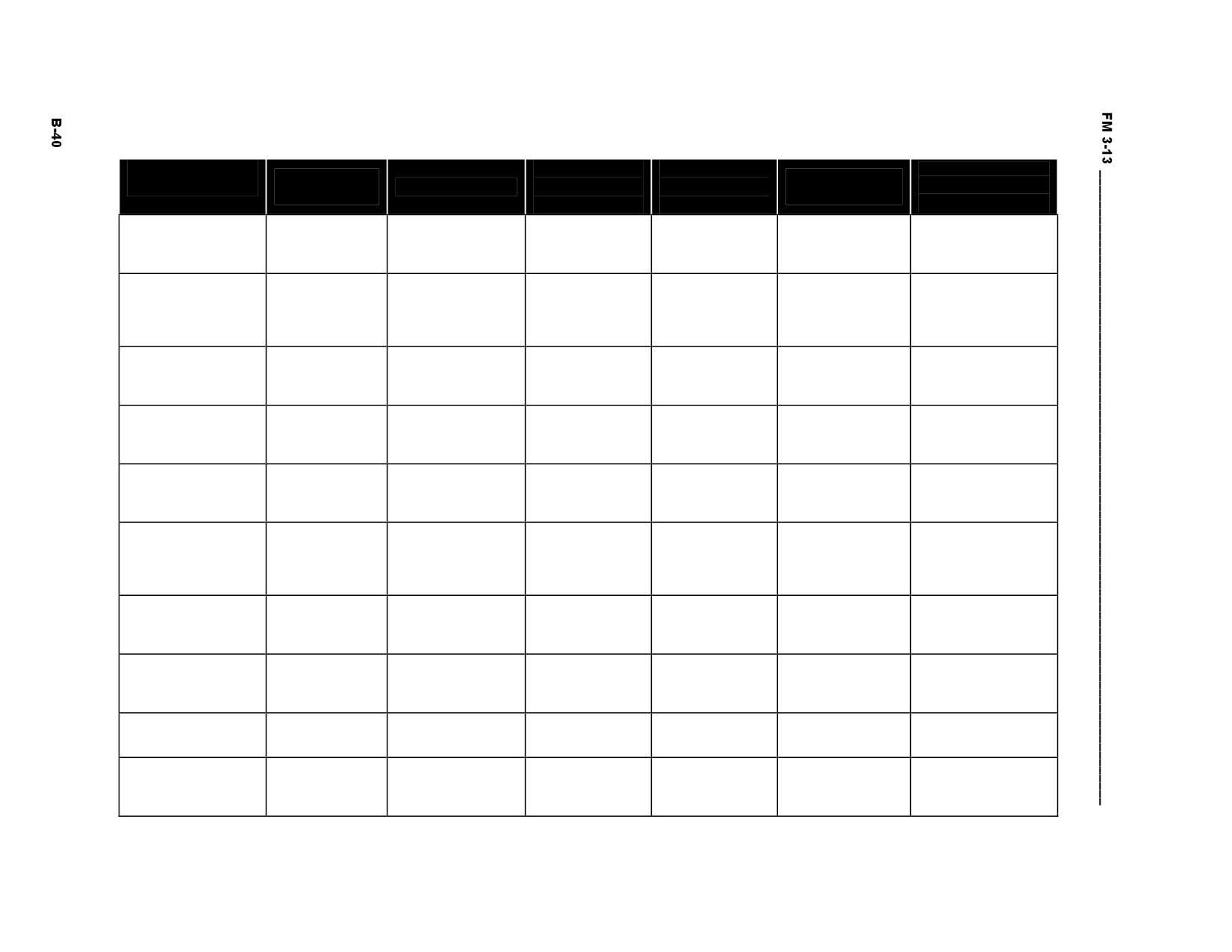
Figure B-24. IO Input to Risk Assessment (extract)
B-40. Figure B-24 shows the results of the G-7 risk analysis for the two offen-
sive IO objectives developed for COA #1. The G-7 used the following logic
during the risk analysis:
B-34
_____________________________________________________________ Information Operations Scenario
• Initial assessment.
Electronic fratricide. Disrupting the Tiger Corps and 109th
Division ADA, ISR, C2, and targeting systems during critical periods of
the operation risks electronic fratricide. However, the 21st MI Brigade is
experienced in conducting EW and has worked frequently the JFACC
and NAVFOR EW elements. XXI Corps units also have well-rehearsed
SOPs for dealing with jamming and other electronic disruptions. The G-7,
in consultation with the G-6, rates the severity of a hazard incident as
marginal and the likelihood as seldom. Based on the risk assessment ma-
trix at figure B-11, page B-15, the G-7 determines the risk associated
with this task to be low.
Civilian interference. In consultation with the G-3, the G-7
determines that civilian interference in the objective area could result in
mission failure (a catastrophic effect). According to the G-2, the probabil-
ity that it will occur is likely unless the commander establishes some con-
trols. Based on the risk assessment matrix at figure B-11, page B-15, the
G-7 determines the risk associated with this hazard to be extremely high.
• Residual risk.
Electronic fratricide. Because the risk of electronic fratricide
is low, G-2, G-3, G-6, and G-7 determine that no controls other than those
mandated by SOP are necessary.
Civilian interference. The G-7 estimates that the CMO and
PSYOP actions being planned will reduce the likelihood of civilian inter-
ference in the objective area from occasional to seldom. Based on the risk
assessment matrix at figure B-11, page B-15, the G-7 determines the risk
associated with it is moderate.
B-41. The G-7 lists the MDMP products or references that contain the con-
trols in Column 6 of the risk assessment matrix. The G-7 then submits it to
the G-3 for incorporation into the command risk management matrix.
Criteria of Success and Assessment
B-42. The IO criteria of success for each IO task are stated on the IO input
work sheets (see figures B-19-B-22, pages B-25-B-24), and the IO assess-
ment matrix (see figure B-26, page B-39).
RECOMMEND HEADQUARTERS
B-43. During this task, the G-7 identifies units to perform IO tasks and
makes task-organization recommendations based on IO factors. The IO input
worksheets show this information.
PREPARE COA STATEMENTS AND SKETCHES
B-44. The G-3 prepares a COA statement and supporting sketch for each
COA for the overall operation (see figure B-17, page B-22).
MDMP TASK 4—COURSE OF ACTION ANALYSIS (WAR-GAMING)
B-45. As each COA is war-gamed, the G-7 confirms that the IO concept of
support achieves what the commander intends and determines when to
execute each IO task. The G-7 alters IO objectives and IO tasks if necessary
B-35
FM 3-13 __________________________________________________________________________________
to synchronize them with the overall operation. The G-7 uses the IO input
work sheets and the IO COA statements and sketches/synchronization ma-
trixes as aids during COA analysis. The G-7 records the results of each war
game, using either the synchronization matrix method or the sketch note
method (see FM 5-0). The COA analysis product for IO is a refined IO concept
of support for each COA, an execution time and duration for each IO task,
and a list of advantages and disadvantages of each COA from the IO perspec-
tive.
MDMP TASK 5—COURSE OF ACTION COMPARISON
B-46. During COA comparison, the staff identifies the COA with the highest
probability of success against the most likely enemy COA and the most dan-
gerous enemy COA. The G-7’s input to this analysis becomes paragraph 4 of
the IO estimate (see appendix C).
MDMP TASK 6—COURSE OF ACTION APPROVAL
B-47. When COA comparison is complete, the staff is prepared to recommend
which COA the commander should select. The G-7’s recommendation be-
comes paragraph 5 of the IO estimate. Time permitting, the staff presents its
recommendation to the commander at a decision briefing. At the end of the
decision briefing, the commander decides which COA to adopt. The com-
mander then refines the commander’s intent and issues additional planning
guidance.
B-48. After receiving the commander’s guidance, the G-7 revises the IO con-
cept of support for the approved COA as necessary. The WARNO that the G-3
issues after the commander approves a COA includes the final IO concept of
support (see figure B-25).
[heading omitted]
WARNING ORDER 21-03
References: JTF 250 OPORD 01, DTG; XXI Corps WARNO 21-01; XXI Corps WARNO
21-02, DTG
Time Zone Used Throughout the Order: Zulu
1. SITUATION.
a. Enemy. No change.
b. Friendly. No change.
c. Attachments and detachments. No change.
2. MISSION. No change.
3. EXECUTION.
Figure B-25. Third XXI Corps Warning Order (extract)
B-36
_____________________________________________________________ Information Operations Scenario
a. Concept of operations. [omitted; see figure B-17, page B-22]
(1-6) [omitted]
(7) Information Operations.
(a) IO Concept of Support. IO supports XXI Corps operations by preventing
preemption of the air assault and by minimizing civil interference in and around the ob-
jective area through destroying, degrading, disrupting, and exploiting Rendovan C2 and
fire support systems; deceiving Rendovan decisionmakers; destroying, degrading, dis-
rupting, and deceiving Rendovan ISR systems; denying Rendovan decisionmakers in-
formation about XXI Corps intentions and capabilities; protecting friendly C2 systems and
INFOSYS; countering Rendovan propaganda and deception operations. CMO empha-
sizes the Government of San Anglos stay-put policy. IO supports the JTF 250 and XXI
Corps deception plans.
(b) IO Objectives.
(i and ii) IO Objectives 1 and 2. No change.
(iii) IO Objective 3. Disrupt 109th ID ADA, ISR, C2, and targeting during critical
periods of the operation.
(iv) IO Objective 4. Minimize civilian interference in objective areas.
b. Tasks to maneuver units.
(1) 121st ID. No change.
(2) 27th ACR. No change.
c. Tasks to combat support units.
(1) 21st CAB. No change.
(2) 21st MI Bde. No change.
(3) 365th CA Bde. On order, support San Anglos civil authorities in restoring ba-
sic services.
(4) Corps Artillery. DS 121st ID. On order DS one FA brigade to 27th ACR.
(5) 1st Bn, 19th PSYOP Grp. [omitted]
d. Coordinating Instructions.
(1) Initial CCIR. No change.
(2) OPSEC Planning Guidance.
(a) EEFI. No change.
(b) Provisional OPSEC measures. [omitted]
(3) Risk guidance. [omitted]
(4) Deception guidance. [omitted]
Figure B-25. Third XXI Corps Warning Order (extract) (continued)
B-37
FM 3-13 __________________________________________________________________________________
(5) Submit plans to G-3 plans NLT DTG.
(6) Rehearsal at AA Jackson, DTG.
4. SERVICE SUPPORT. [omitted]
5. COMMAND AND SIGNAL. [omitted]
ACKNOWLEGE: [authentication omitted]
Figure B-25. Third XXI Corps Warning Order (extract) (continued)
MDMP TASK 7—ORDERS PRODUCTION
B-49. The G-7 uses the products developed during the MDMP to prepare in-
put to the OPORD. A complex operation, such as the one in this example, re-
quires a separate IO annex. (See example at appendix D.) The minimum in-
put is paragraph 3a(7) of the OPORD. Paragraph 3a(7) follows the format of
paragraph 3 of the IO annex. In a time-constrained environment, the G-7
may prepare the IO annex as an execution matrix.
EXECUTION AND ASSESSMENT
B-50. The G-7 may prepare an IO execution matrix as an appendix to the IO
annex (see appendix D). Normally, the IO synchronization matrix for the
approved COA becomes the basis for IO execution matrix for the operation.
B-51. Commanders, assisted by the staff, continuously assess the situation
and the progress of the operation, and compare it with the commander’s visu-
alization. The G-7 is responsible for assessing the effects of IO and recom-
mending changes to the commander, when appropriate. The G-7 may prepare
an assessment matrix to help with this function during execution (see figure
B-26).
B-38

Associated
Task
Tasked Unit
Criteria of
Adversary
IO Task
Desired Effect
Target
Execution
or Equipment
Success
Response
Information
Status
Ensure Rendovan
Task CD-01
Rendovan deception
Rendovans modify or
deception operations
Exploit Rendovan de-
21st MI Bde
GREEN
operations identified
cease their deception
do not deceive
ception plan
and countered
operation
friendly commanders
Task CD-02
To target 109th ID
Rendovan forces modify
Identify targets in the
XXI Corps and
ADA, ISR, C2 tar-
ADA, ISR, C2 sys-
GREEN
or cease deception
Tiger Corps deception
121st ID G-2
gets are found
tems
operation
plan
Prevent compro-
No evidence of
Task CI-01
mise of the operation
compromise of
Rendovan forces
Assess OPSEC
21st MI Bde
Counter Rendovan
GREEN
operation
change espionage and
program
HUMINT, SIGINT,
No evidence of
sabotage methods
and IMINT
OPSEC lapses
Task CI-02
Counter Rendovan
Rendovans change
No evidence of
Assess OPSEC
21st MI Bde
HUMINT, SIGINT,
AMBER
intelligence collection
OPSEC lapses
program
and IMINT
methods
Task CI-04
Prevent DCs
DCs do not move
Rendovan increases
Counter Rendovan
21st MI Bde
movement into
AMBER
into objective areas
HUMINT
HUMINT
objective areas
Task CMO-01
Support PSYOP with
Input to possible
PSYOP themes are
Corps mission is
365th CA Bde
GREEN
feedback on PSYOP
compromise
working
compromised
theme
Task CMO-02
Take advantage of
Rendovan use local
Coordinate for HN
ASA supports XXI
365th CA Bde
ASA CI assets and
GREEN
sympathizers as
support to counter
Corps CI efforts
familiarity with the AO
agents
enemy agents
No attacks against
Rendovans attack
Task CMO-03
Prevent civilian
critical assets
HN assets
Influence DCs to stay
365th CA Bde
interference in
AMBER
Minimum
Rendovans increase
put
objective areas
interference from
propaganda for people
DCs
to move
Task CND-01
All G-6/S-6 IANM,
To prevent hostile
Rendovan CNA
Rendovans reinforce
Protect XXI Corps IN-
IASO, SA, in all
collection from
GREEN
does not affect
CNA
FOSYS against CNA
units
friendly INFOSYS
friendly computers
Task CND-03
Allow EA against
Protect fire control
109th ID ADA, ISR,
Rendovan forces
XXI Corps G-6
109th ID ADA, ISR
AMBER
systems of XXI Corps
C2 targets are found
increase CNA
and C2 systems
Artillery
Figure B-26. IO Assessment Matrix
Associated
Task
Tasked Unit
Criteria of
IO Task
Desired Effect
Target
Execution
Adversary
or Equipment
Success
Information
Status
Response
Task CND-04
Prevent DC
Prevent compromise of
DCs do not move
Rendovan forces
XXI Corps G-6
movement into
AMBER
PSYOP message
into objective areas
increase CNA
objective areas
before release
Task EW-01
Interruption of
Disrupt Rendovan
Prevent collection of
targeted systems
21st MI Bde,
Attack friendly EA
communications
EEFI and location of
GREEN
Confirmation from
121st ID MI Bn
assets
interception and
friendly CPs
ISR that locating
locating systems
systems not working
Task EW-02
Ensure lack of
EP protects XXI corps
Increased EA by
21st MI Bde
interference of
AMBER
EP not degraded
personnel and
Rendovan forces
operations.
equipment
Lack of ADA fire
Task EW-03
Commander
Protect the air assault
from units
Rendovans reprogram
Disrupt 109th ID ADA
GREEN
Solo, 21st MI Bde
forces from ADA fires
Confused
EA/EP systems
C2
transmissions
Lack of ADA fire
Task EW-04
JTF 250 EW
Protect the air assault
from units
Rendovans reprogram
Conduct nonlethal
aircraft
GREEN
forces from ADA fires
Confused
EA/EP systems
SEAD
21st MI Bde
transmissions
Task EW- 05
Conduct EA to reduce
Messages to
Reduce Rendovan
Tiger Corps’ access to
21st MI Bde
AMBER
civilians significantly
Increased EP
messages to locals
electromagnetic
reduced
spectrum
Task IA-01
Provide RI to com-
Commanders re-
Rendovan forces
Protect XXI Corps and
All XXI Corps and
manders throughout
AMBER
ceive RI throughout
increase CNA and EW
121st ID INFOSYS and
121 ID units
the operation
the operation
attacks
C2 systems
Task IA-02
Provide RI to com-
Cdrs receive RI
Rendovan forces
Protect XXI Corps
All XXI Corps units
manders throughout
GREEN
throughout the
increase CNA and EW
INFOSYS and C2
the operation
operation
attacks
systems
Task IA-03
Ensure fire control
Links broken.
Ensure links between
Corps G-6
and C2 links are
GREEN
Links intact
Penetrate
HQ XXI Corps and JTF
operating
communications links
Task MD-01
Protect the air assault
Movement of
Deceive the Tiger
force from ADA fires
Rendovan forces to
Increased ISR
21st MI Bde
GREEN
Corps cdr as to the XXI
and ground
where they cannot
collection operations
Corps mission
counterattack
affect the operation
Figure B-26. IO Assessment Matrix (continued)
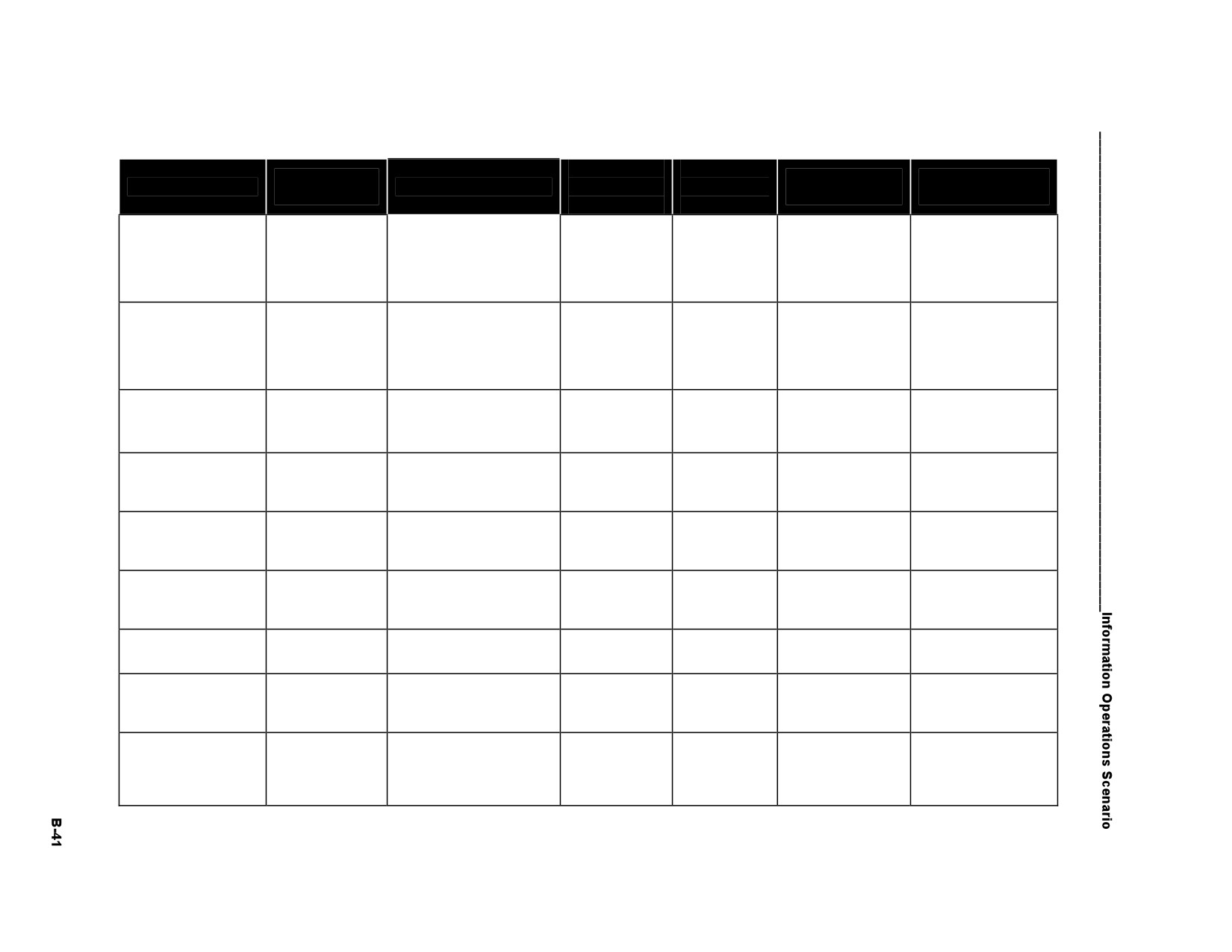
Associated
Task
Tasked Unit
Criteria of
Adversary
IO Task
Desired Effect
Target
Execution
or Equipment
Success
Response
Information
Status
Task MD -02
1st Bn. 19th
Cause Tiger Corps to
Protect the air assault force
Increase CNA by
PSYOP Grp and
GREEN
CND not changed
believe CND of JTF
from ADA fires
Rendovan forces
Corps G-6
250 is greater that it is
Task MD- 03
Cause 109th ID units to
Divert 109th ID resources
Increased defensive
defend C2 system that
XXI Corps G-3
GREEN
Resources diverted
from other areas
activates
XXI corps does not
plan to destroy
Task MD- 04
Prevent civilian interference
Minimal civilian
Provide information
1st Bn, 19th
Counter misinformation
with the operation and
AMBER
presence in
compatible with spy-put
PSYOP Grp
campaign
minimize civilian casualties
objective areas
theme
Task OP-01
System operators.
Prevent detection and
Deny Tiger Corps
CI personnel,
location of critical air assault
Achieving surprise
Increased ISR
GREEN
knowledge of JTF 250
A/322nd MI Bn
assets
for air assault
collection operations
mission
(ACE)
Support deception story
Task OP-02
INFOSYS
Prevent detection and
Deny Tiger Corps
operators, CI per-
location of critical air assault
Achieving surprise
Increased ISR
AMBER
knowledge of XXI
sonnel, HQ 121st
assets
for air assault
collection operations
Corps mission
ID
Support deception story
Task OP-03
Conceal physical and
XXI Corps, Div
Ensure fire control and C2
Locations not
GREEN
OPSEC compromised
electronic INFOSYS
G-3; Bde/Bn S3s
links are operating
compromised
locations
Task OP-04
To prevent civilians interfer-
Minimal civilian
XXI Corps, 121st
Penetrate OPSEC
Conceal corps true
ence with the operation and
AMBER
presence in
ID units
Move ISR systems
mission
minimize civilian casualties
objective areas
Task PD-01
Corps and division
Degrade Rendovan
artillery systems,
Disrupt intelligence
BDA from observed
AMBER
Move ISR systems
ISR systems in the
attack helicopters,
collection and C2
fires
Tiger Corps
AI
Task PD-02
Destroy ADA target
Protect the air assault force
Lack of signals from
ADA units relocate or
identification, process-
XXI Corps Artillery
GREEN
from ADA fires
targeted systems
reconstitute
ing systems, and firing
systems in Tiger Corps
Figure B-26. IO Assessment Matrix (continued)

Associated
Task
Tasked Unit
Criteria of
Adversary
IO Task
Desired Effect
Target
Execution
or Equipment
Success
Response
Information
Status
Task PSY-01
Prevent compromise
Minimize resistance
XXI Corps PSYOP
Noninterference by
Propaganda by
of corps mission by
AMBER
and interference of
Support Element.
local population
Rendovan government
civilian interference
locals in AO Courtney
Task PSY-02
1st Bn. 19th
To portray a greater
Increase EA by
Enhance the IA in mind
PSYOP Grp and
IA capability than the
GREEN
IA not changed
Rendovan forces
of Tiger Corps cdr
Corps G-6
XXI Corps processes
Task PSY-03
Broadcast PSYOP
1st Bn. 19th
To disrupt C2
Disruption of C2
Reprogram C2
AMBER
products over Tiger
PSYOP Grp
frequencies
frequencies
systems
Corps C2 frequency
Prevent civilian in-
Task PSY-04
JTF aircraft EA6b.
terference with the
Minimal civilian pre-
Rendovan counter-
Influence locals to
1st Bn, 19th
operation and
GREEN
sence in objective
misinformation
comply with the stay-
PSYOP Grp 121st
minimize civilian
areas
campaign
put policy
ID PSYOP Tm
casualties
Task CP-01
1st Bn, 19th
C2 systems
Provide EA targets and
To protect corps C2
GREEN
Increased propaganda
PSYOP Grp
protected by EP
emphasize EP
Task CP-02
To target 109th ID
1st Bn, 19th
ADA, ISR, C2
109th ID forces
Provide target locations
ADA, ISR, C2
GREEN
PSYOP Grp
targets are found
increases their OPSEC
for physical destruction
systems
1st Bn, 19th
Task CP-03
Prevent DC
Rendovans increase
PSYOP Bde
DCs do not move
Degrade Rendovan
movement into
AMBER
propaganda efforts or
121st ID PSYOP
into objective areas
disinformation
objective areas
changes story
Tm
Task PA-01
Tiger Corps sources
To determine if corps
Assess effects of
CI shows no
know mission of corps
XXI Corps PAO
mission appears in
GREEN
media coverage on
compromise
Rendova increases
media
PSYOP
misinformation
Task PA-03
Assess effects of
To determine if
ADA, ISR, C2 targets
XXI Corps PAO
GREEN
No media coverage
media coverage of
disruption is effective
are found
PSYOP broadcast
Task PA-04
Enhanced
Prevent DC
Influence civilian
JTF and corps
international and local
Rendovans increase
movement into
AMBER
populace to support US
PAO
support for JTF
propaganda
objective areas
objectives
operations
Figure B-26. IO Assessment Matrix (continued)
Appendix C
Information Operations Estimate
The information operation (IO) estimate is the G-7’s evaluation of how IO
factors may influence courses of action the commander is considering.
This appendix discusses the IO estimate. It addresses how the G-7 devel-
ops and maintains it, and its relationship to the tasks of the military deci-
sionmaking process. It shows which paragraphs of the estimate contribute
to the IO annex of operations plans and operations orders. It includes an
annotated IO estimate format and an example of a completed IO estimate
based on the scenario in appendix B.
INFORMATION OPERATIONS ESTIMATE DEVELOPMENT
C-1. The information operations
(IO) estimate supports decisionmaking
throughout an operation. It is particularly helpful during the military deci-
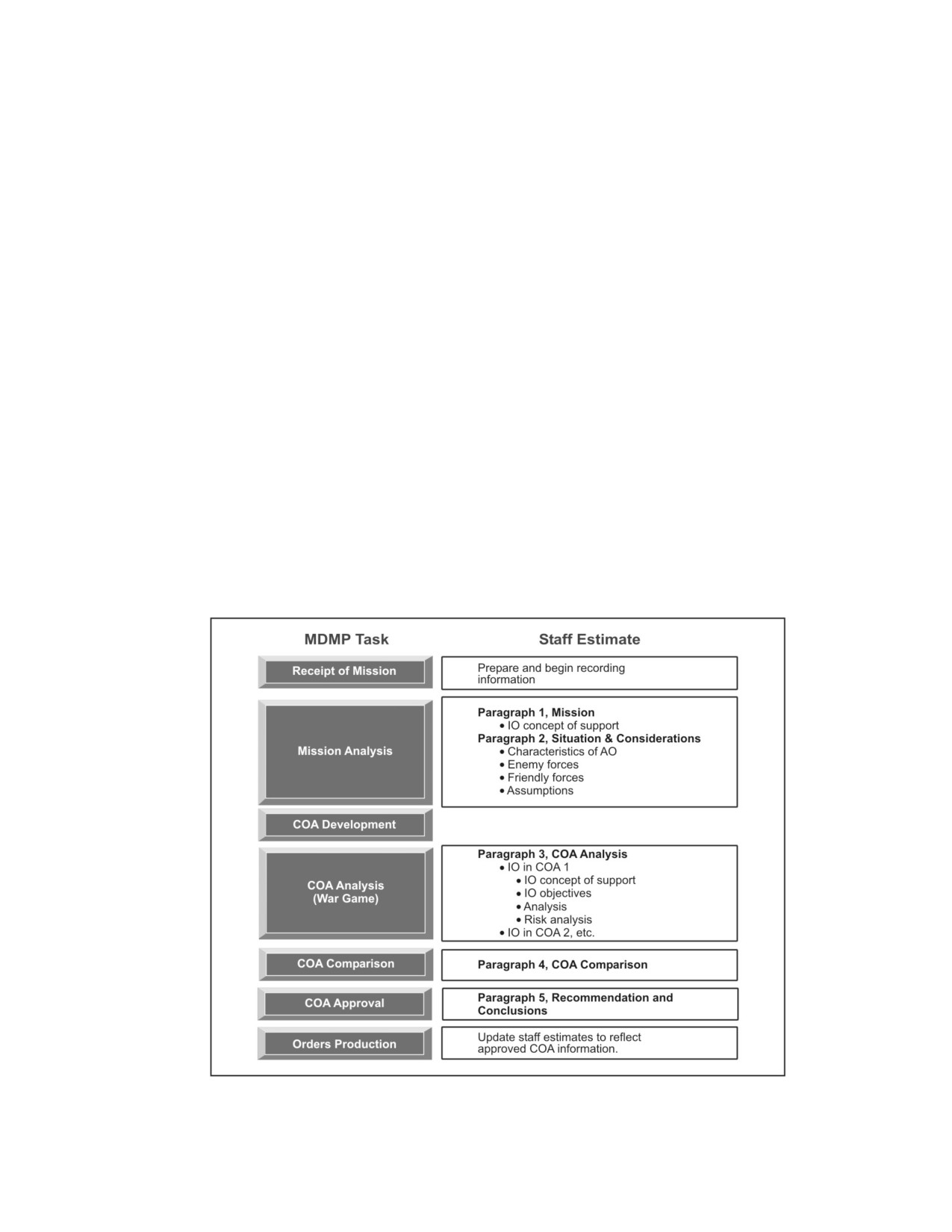
sionmaking process (see figure C-1). The IO estimate shows how IO can best
be integrated into the overall operation. An effective G-7 begins to compile
Figure C-1. IO Estimate Contributions to the MDMP
C-1
FM 3-13 __________________________________________________________________________________
the IO estimate immediately upon receipt of the higher command’s warning
order, or sooner if possible.
C-2. The IO estimate and supporting estimates prepared for some IO ele-
ments are running estimates (see FM 6-0). They are living documents that
are continuously updated throughout the operations process. This is a staff
tool for assessing during preparation and execution.
C-3. Units below corps level rarely prepare written staff estimates. At those
levels, a staff estimate usually consists of verbal summaries of available in-
formation backed up by overlays and charts. However, the staff estimate for-
mat is less an outline for a written product than it is a way to organize
information. Maintaining a running IO estimate means that the G-7 main-
tains current information on all aspects of the situation and is prepared to
make recommendations on decisions the commander must make. The IO es-
timate format lists aspects of the situation in a logical sequence. The G-7 may
use it as a briefing aid to ensure that all aspects of the situation are ad-
dressed.
C-4. Normally the IO estimate provides enough information to complete the
first draft of the IO annex and write the IO paragraph for the base operation
order (OPORD) or operation plan (OPLAN). The estimate’s depiction of the
future also contributes to the commander’s visualization. The estimate-
derived initial IO annex should be enough to begin an operation. The IO es-
timate should be as comprehensive as possible within the time available.
C-5. Paragraphs 1 and 2 of the IO estimate are input to the mission analysis
briefing. Paragraphs 3, 4, and 5 are input to the course of action (COA) deci-
sion briefing.
C-6. During peacetime, units maintain staff estimates for potential
contingencies. These form the basis for staff estimates related to a specific
mission. During operations, they maintain running estimates. These esti-
mates address decision points, branches, and sequels. If no IO estimate ex-
ists, the G-7 begins developing one upon receipt of mission and refines it
throughout the operation. Staff officers from IO elements provide input to the
IO estimate. IO input to the OPLAN/OPORD comes from the IO estimate.
C-7. The focus of estimate development is on situation assessment rather
than COA development. The purpose is not to develop a perfect plan, but to
assemble information underlying an IO concept of support that can be modi-
fied to support overall concept of operations. Estimate development never
stops. The IO estimate is continuously updated.
MISSION ANALYSIS
C-8. During mission analysis, the G-7 produces paragraphs 1 and 2 of the IO
estimate. These paragraphs guide all subsequent IO planning—both for the
current operation and for any branches and sequels. By the end of mission
analysis, the IO estimate includes the following information—
• The restated IO mission (paragraph 1, the G-7 determines the initial
IO mission during the analysis of the higher headquarters OPLAN/
OPORD and the restated IO mission during mission analysis. At the
same time the commander approves the restated mission for the
overall operation, he approves the restated IO mission.)
C-2
_____________________________________________________________ Information Operations Estimate
• Characteristics of the area of operations (AO) and the information envi-
ronment that may influence friendly and adversary operations (para-
graph 2a, determined during IPB).
• Adversary IO-related capabilities in the AO (paragraph 2b, determined
during IPB. It may be displayed as a situation template).
• Assets and resources that can be employed in an IO role (paragraphs
2c[2] and [3], determined during review of available assets).
• Critical IO facts and assumptions. (Facts are placed in the IO-estimate
subparagraph [usually 2a, 2b, or 2c] that concerns them. Assumptions
are placed in subparagraph 2e.)
• IO criteria of success for analyzing and comparing COAs (paragraph
2c(5).
• IO-related high-payoff target recommendations.
• IO information requirements.
C-9. At the end of mission analysis, paragraph 2 of the IO estimate is well
formed. However, it is not complete. As part of a running estimate, it is up-
dated as new information is received. Normally paragraph 2 of the IO esti-
mate becomes the IO input to the mission analysis briefing.
COURSE OF ACTION COMPARISON
C-10. The G-7 uses the information in the IO estimate to refine IO objectives
and check the soundness of the IO concept of support for each COA. The G-7
plans officer assesses the IO concept of support for each COA to ensure it can
accomplish the IO objectives with available resources. The G-7 plans officer
also assesses the general strengths and vulnerabilities of the IO concept of
support for the COA. Special attention is paid to critical vulnerabilities that,
if exploited by the adversary, could cause the IO to fail. The G-7 records the
information gathered during COA development for use during COA analysis.
The information developed during COA comparison and analysis forms the
basis for paragraph three of the IO estimate.
C-11. During COA analysis, the G-7 confirms and refines the following
information contained in the IO estimate:
• IO concept of support and IO objectives.
• IO strengths and vulnerabilities.
• IO resource requirements in terms of amount and effectiveness.
• IO effectiveness of risk control measures and resultant residual risk.
C-12. The assistant G-7 plans officer assesses the IO concept of support
against the IO criteria of success, as each COA is war-gamed. The results of
this assessment are the basis for the COA comparison recorded in paragraph
four of the estimate.
RECOMMENDATIONS AND CONCLUSIONS
C-13. The G-7 staff analyzes the war-gaming of the IO concepts of support
and compares the results for each COA with the others. The IO concepts of
support are rank ordered according to how well they meet the evaluation cri-
teria. Usually the comparison and ranking of the concepts of support are
shown on a COA decision matrix. The matrix and a narrative explanation are
recorded in paragraph four of the IO estimate.
C-3
FM 3-13 __________________________________________________________________________________
C-14. After analyzing and comparing the IO concepts of support, The G-7
plans officer recommends the COA that the comparison shows IO can best
support. The recommendation and summarized conclusions become the final
paragraph of the IO estimate.
C-15. Once the commander approves a COA, the G-7 analyzes how each IO
element can best support it. This is not a total reevaluation. Rather, the
analysis done during COA comparison is explained based on the approved
COA.
C-16. The G-7 prepares an IO estimate in the format shown in figure C-2.
G-7
Place of Issue
Date/Time Group
IO ESTIMATE NO. _____
References:
a. Maps and charts.
b. Other relevant documents.
1. MISSION. The restated IO mission from mission analysis.
2. SITUATION AND CONSIDERATIONS.
a. Characteristics of the area of operations and information
environment. (Key IO factors from the intelligence estimate.)
(1) Weather. How different military aspects of weather will affect both
friendly and adversary IO.
(2) Terrain and physical environment. How aspects of the terrain and the
physical and environmental infrastructure will affect friendly and adversary IO.
(3) Information environment. Describe how the political, economic,
sociological, psychological, and information environments will affect IO.
(4) Probable adversary picture of friendly forces.
b. Enemy Forces. Include key IO factors from the intelligence estimate. Ad-
dress adversary dispositions, composition, capabilities, strength, and weaknesses
likely to significantly affect COAs. Include the following subparagraphs. Add others as
necessary.
(1) Decisionmakers and decisionmaking process.
(2) Information systems strength and vulnerabilities.
(3) IO capabilities, (including collection capabilities) disposition, composi-
tion, and strength.
(4) Likely IO COAs
c. Friendly Forces.
(1) IO concept of support for each COA.
Figure C-2. Annotated IO Estimate Outline
C-4
_____________________________________________________________ Information Operations Estimate
(2) Current status of IO assets.
(3) Current status of IO resources.
(4) Comparison of IO assets and resource requirements versus IO
capabilities available and recommended solutions.
(5) Criteria of success to determine IO supportability for each COA:
(a) Measured against each of the IO effects.
(b) Cost versus benefits. Is accomplishing the effects worth the cost in
resources and time?
(c) What are the chances of success for IO in each COA?
(6) Vulnerability assessment.
d. Operations Security.
(1) Essential elements of friendly information.
(2) OPSEC indicators. List by EEFI element and staff function.
(3) OPSEC measures in effect. List by EEFI element and staff function.
(4) OPSEC measures contemplated. List by EEFI element and staff func-
tion.
e. Assumptions. IO assumptions developed during mission analysis.
3. COA ANALYSIS. [For each friendly COA]
a. COA 1.
(1) Analyze the IO concept of support using the IO evaluation criteria and
the war-gaming methodology (action-reaction-counteraction) to support the maneu-
ver COA.
(2) Estimate the likelihood of accomplishing IO objectives in the available
time, given friendly IO capabilities and vulnerabilities, versus those of the adversary.
(3) Determine the potential for unintended consequences of IO tasks and
the possible impacts on both adversary and friendly COAs.
(4) Identify critical events that should be evaluated within COA analysis to
assess defensive IO requirements.
(5) Assess the effectiveness of friendly and adversary IO-related capabili-
ties in relation to each other, the effects of the AO as favorable or unfavorable to IO,
and the most significant friendly and adversary IO-related vulnerabilities.
(6) Evaluate the risk of failure or compromise of IO in terms of effects on
the success of the COA and the potential for loss or compromise of command assets.
(7) Analyze the risk in executing IO in the COA in terms of nonavailability
or untimely availability of assessment.
Figure C-2. Annotated IO Estimate Outline (continued)
C-5
FM 3-13 __________________________________________________________________________________
(8) List EEFI for this COA if different from paragraph 2d.
b. COA 2. [Repeat the process outlined above for all other COAs.]
4. COA COMPARISON. Compare the COAs in terms of the evaluation criteria. Rank-
order COAs for each criterion. Visually support the comparison with a decision
matrix.
a. Compare the costs of IO in each COA based on the resources and time re-
quired executing them in relation to the operational impact of their success.
b. Compare the levels of risk to COA success and friendly assets should IO
fail or be compromised.
c. Summarize the advantages and disadvantages for IO in each COA to
evaluate the chance of success in each.
5. RECOMMENDATION AND CONCLUSIONS.
a. Recommend a COA based on the comparison (most supportable from the
IO perspective).
b. Present IO issues, deficiencies, risks, and recommendations to reduce their
impacts.
/signed/
G-7
Appendix 1, OPSEC estimate, if used
Appendix 2, PSYOP estimate, if used
Figure C-2. Annotated IO Estimate Outline (continued)
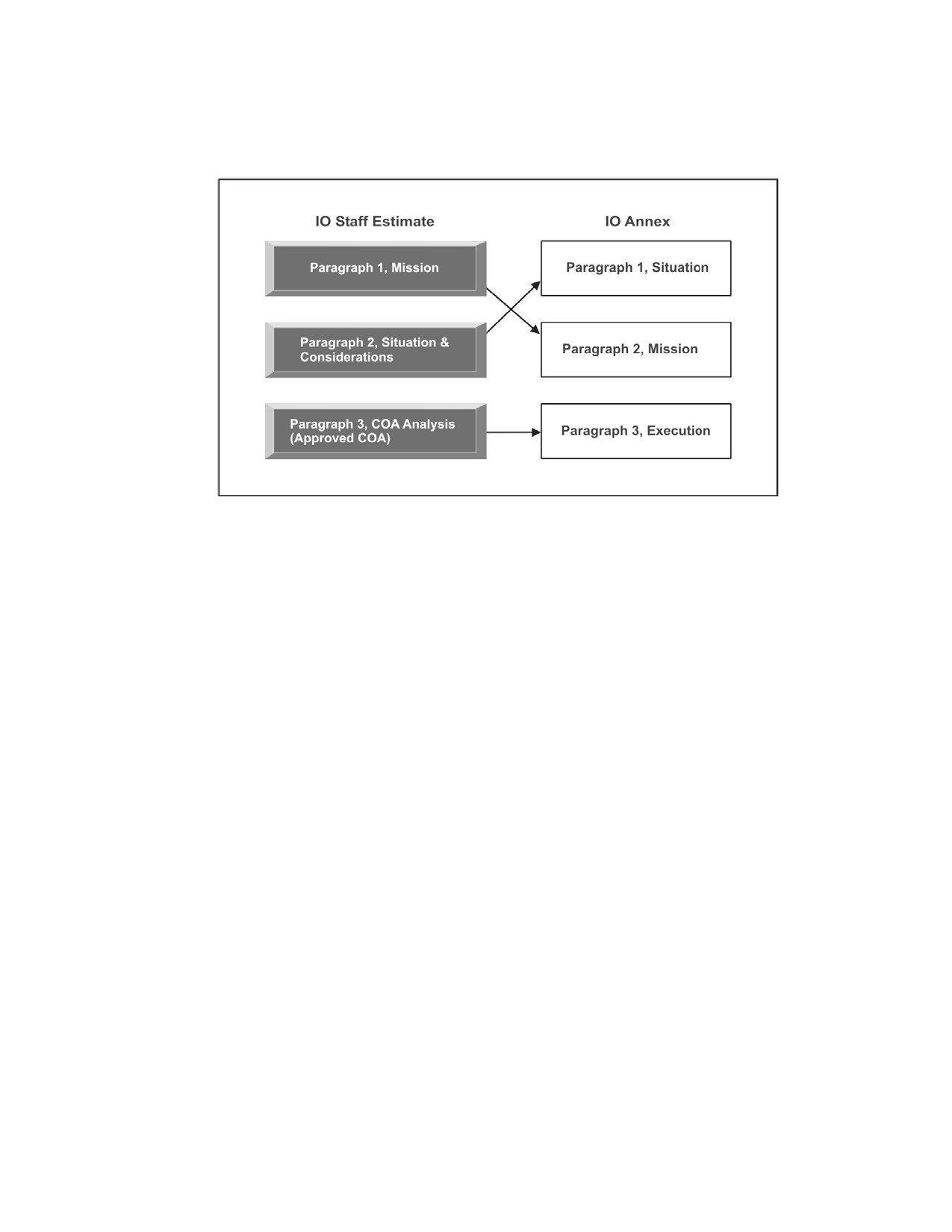
C-17. Upon completion of the IO estimate, the G-7 will have prepared the ma-
jority of input needed for the OPLAN/OPORD. The G-7 can build most of the
IO annex through “cut and paste” from a well-prepared IO estimate (see fig-
ure C-3).
STAFF ESTIMATE BRIEFING
C-18. The IO estimate may be presented as a briefing to provide IO informa-
tion to the commander and staff. The briefing will normally elaborate on the
key points derived from preparing the estimate, focusing principally on ad-
versary and friendly IO capabilities and vulnerabilities, and support IO can
provide to the COAs. The briefing is part of either the mission analysis
briefing (paragraphs 1 and 2) or part of the commander’s decision briefing
(paragraphs 3, 4, 5). The briefing itself consists of all of paragraph one and a
summary of paragraphs 2 through 5 of the IO estimate.
C-6
_____________________________________________________________ Information Operations Estimate
Figure C-3. IO Staff Estimate Contributions to IO Annex
SUMMARY
C-19. The IO estimate is both a process and a product. The process calls for a
disciplined approach to collecting and processing information, and to re-
cording the results. Automated tools such as databases and word processing
programs give the G-7 the flexibility and responsiveness needed to tailor the
estimate to meet a variety of requirements. The IO estimate is a living docu-
ment that is continuously refined, as additional information becomes avail-
able. A current estimate allows the G-7 to quickly provide accurate informa-
tion to meet planning requirements as they change.
C-7
Appendix D
Information Operations Annex
This appendix discusses the contents of the information operation (IO)
annex to orders and plans. It includes annotated formats for an IO annex
and its appendixes (see figures D-1-D-6, pages D-2-D-15), and examples
of an IO annex (see figure D-7, pages D-15-D-19), and IO execution ma-
trix (see figure D-8, page D-20).
INFORMATION OPERATIONS ANNEX DEVELOPMENT
D-1.
The information operations (IO) annex serves three primary purposes:
• The situation paragraph provides operational details on the situation
from an IO perspective.
• The execution paragraph and matrix provide the direction needed to
focus the effects of the IO elements/related activities.
• The assessment matrix displays the information needed to assess IO
tasks.
The IO annex also addresses service support, command, and signal aspects of
IO that are not covered elsewhere in the operation plan (OPLAN)/operation
order (OPORD). Some of the information in the IO annex is derived from the
IO estimate. Major portions of the annex can be written directly from the IO
estimate (see figure C-3, page C-7). Much of the information required for the
execution and assessment matrices is taken from the IO input worksheets for
the approved course of action (COA).
SITUATION PARAGRAPH
D-2.
The situation paragraph provides operational details on the situation
from an IO perspective. This description does not repeat the OPLAN/OPORD
situation paragraph. It is tailored to aspects of the information environment
that affect offensive and defensive IO. The situation paragraph describes how
the information environment (including the civilian infrastructure) may af-
fect friendly, adversary, and other force/group operations. It discusses how
the information environment will influence protecting friendly critical assets.
EXECUTION PARAGRAPH AND MATRIX
D-3.
The execution paragraph provides the direction needed to synchronize
the effects of IO elements/related activities. It outlines the effects the com-
mander wants IO to achieve. It describes the activities of the IO ele-
ments/related activities in enough detail to synchronize them.
D-4. The IO execution matrix is normally an appendix to the IO annex. It
shows when each IO task is to be executed. The execution matrix helps the G-7
D-1
FM 3-13 __________________________________________________________________________________
monitor and direct IO during execution. It also allows the G-7 to monitor the
coordination needed to execute IO effectively without incurring unanticipated
interference or information fratricide. Because they contribute significantly
to massing combat power at a decisive point, the G-7 also places IO tasks in
the G-3 execution matrix.
D-5.
The IO execution matrix is not a tasking document. The G-7 places IO
tasks under tasks to subordinate units in IO element appendixes or in the
appropriate OPLAN/OPORD annex.
ASSESSMENT MATRIX
D-6.
The G-7 incorporates the criteria of success for each IO task, the
information required to measure task accomplishment, and the source of that
information into the IO assessment matrix (see figure B-26, pages B-39-B-42).
The IO input worksheets and IO synchronization matrix list this informa-
tion, which was refined during the COA analysis.
D-7. The IO assessment matrix includes the IO information requirements
(IRs) needed to produce IO-specific intelligence, identify high-payoff targets
(HPTs), and assess IO task accomplishment. The G-7 crosswalks IO IRs with
the collection plan.
Annex P (Information Operations) to OPORD No _____________
1. SITUATION
a. Enemy.
(1) Terrain. List terrain aspects affecting each IO element.
(2) Weather. List weather aspects affecting each IO element.
(3) Enemy IO capabilities.
(a) Identify enemy IO elements.
(b) Identify enemy C2 vulnerabilities.
(c) Identify enemy capabilities to degrade friendly C2.
(d) Identify the enemy situation, force disposition, intelligence elements,
and possible actions.
(e) Identify specific information that bears directly on the planned IO.
b. Friendly.
(1) Identify IO capabilities.
(2) Identify IO assets needed to attack enemy targets.
(3) Identify the friendly forces that will directly affect IO.
(4) Identify the critical limitations of planned IO.
Figure D-1. Annotated Information Operations Annex
D-2
_____________________________________________________________ Information Operations Annex
(5) Identify potential conflicts within the friendly electromagnetic spectrum
especially if conducting joint or multinational operations. Identify deconfliction meth-
ods and priority of spectrum distribution.
c. Civil Considerations. Identify other key people and groups of people in
the AO.
d. Attachments and detachments.
(1) List IO assets that are attached or detached.
(2) List IO resources available from higher headquarters.
2. MISSION
State the IO mission statement.
3. EXECUTION
a. Scheme of Support.
(1) Concept of Support. Describe the IO concept of support and IO objec-
tives. A complex IO concept of support may require a schematic to show IO objec-
tives and IO task relationships. Include a discussion of the overall IO concept of sup-
port, with the specific details in element subparagraphs or appendixes. Refer to the
execution matrix to clarify timing relationships among various IO tasks. This annex
should contain the information needed to synchronize timing relationships of each of
the elements/related IO activities. Include IO-related constraints, if appropriate.
(2) Operations Security. State how OPSEC tasks will deny the enemy
knowledge of the EEFI. Synchronize this element with the other IO elements. Refer
to appendix 1, Operations Security, for detailed information.
(3) Psychological Operations. State how the PSYOP tasks will degrade,
disrupt, deny, or influence the enemy. Identify the audiences and desired effects, in
priority, for PSYOP. Synchronize this element with the other IO elements. Refer to
appendix 2, PSYOP, for detailed information.
(4) Military Deception. State how the MD tasks will deceive and influence
the enemy. Synchronize this element with the other IO elements. Refer to appendix
3, Military Deception, for detailed information.
(5) Electronic Warfare. State how the EW tasks will degrade, disrupt,
deny, and deceive the enemy. State the defensive and offensive EW measures.
Identify target sets and effects, by priority, for EW operations. Synchronize this
element with the other IO elements. Refer to appendix 4, Electronic Warfare, for
detailed information.
(6) Computer Network Operations. For echelons above corps or a
corps/division designated as a JTF, stating CNO requirements is appropriate. For a
corps or lower echelon unit that is not designated as a JTF, CNO is not appropriate.
In the case of a JTF, the CNO paragraph or appendix states CNO tasks in terms of
CNA, CND, and CNE (as in the following paragraphs).
Figure D-1. Annotated Information Operations Annex (continued)
D-3
FM 3-13 __________________________________________________________________________________
(7) Computer Network Attack. State how the CNA tasks will destroy, de-
grade, disrupt, and deny the enemy. Identify target sets and effect, by priority, for
CNA. Synchronize this element with the other IO elements. Pass request for CNA to
higher headquarters for approval and implementation.
(8) Computer Network Defense. State how CND will protect and defend
computer networks. Synchronize this element with the other IO elements. Refer to
annex H, Command, Control, Computer, and Communications, for detailed informa-
tion.
(9) Computer Network Exploitation. For echelons above corps or a
corps/division designated as a JTF, stating CNE requirements is appropriate. For a
corps or lower echelon unit that is not designated as a JTF, CNE is not appropriate.
In the case of a JTF, the CNE paragraph or appendix states the CNE tasks and syn-
chronizes CNE with other IO elements. Pass requests for CNE to higher headquar-
ters for approval and implementation.
(10) Physical Destruction. State how the physical destruction tasks will
destroy, degrade, disrupt, and deny the enemy. Identify target sets and effects, by
priority, for physical destruction. Synchronize this element with the other IO elements.
Refer to annex D, Fire Support for detailed information.
(11) Information Assurance. State how the IA tasks will deny the enemy
access to the friendly C2 system. Identify the information and INFOSYS for
protection. Synchronize this element with the other IO elements. Refer to annex H,
Command, Control, Computer, and Communications, for detailed information.
(12) Physical Security. State how the physical security tasks will deny the
enemy. Synchronize this element with the other IO elements. Refer to annex K, Pro-
vost Marshal, for detailed information.
(13) Counterintelligence. State how the counterintelligence tasks will de-
grade, disrupt, deny, and exploit the enemy. Identify the units for protection. Synchro-
nize this element with the other IO elements. Refer to annex B, Intelligence, for de-
tailed counterintelligence information.
(14) Counterdeception. State how the counterdeception tasks will disrupt,
deny, and exploit the enemy. Identify the units for protection. Synchronize this
element with the other IO elements. Refer to annex B, Intelligence, for detailed
counterdeception information.
(15) Counterpropaganda. State how the counterpropaganda objectives
and counterpropaganda tasks will degrade, disrupt, deny, and exploit the enemy
based on the approved COA. Identify the units for protection. Synchronize this
element with the other IO elements. Refer to appendix 2, PSYOP for detailed
counterpropaganda information.
(16) Civil-Military Operations. CMO is a related activity to IO. State how
CMO supports the elements of IO. See annex U, Civil Military Operations, for
detailed information.
Figure D-1. Annotated Information Operations Annex (continued)
D-4
_____________________________________________________________ Information Operations Annex
(17) Public Affairs. PA is a related activity to IO. State the IO task for PA.
See annex V, Public Affairs, for detailed information.
b. Tasks to Subordinate Units. Review specific and implied tasks by com-
mand.
(1) List IO tasks to maneuver units.
(2) List tasks to PSYOP units.
(3) List tasks to EW units.
(4) List IO tasks to counterintelligence units.
c. IO Cell.
(1). List members of the IO cell.
(2) State non-SOP tasks assigned to the IO cell.
d. Coordinating Instructions.
(1) Include only IO instructions common to two or more units not already
covered in the base OPLAN/OPORD.
(2) State specific ROE for each IO element.
(3) Refer to IO appendixes for details.
(4) Do not include SOP information.
(5) List any constraints not contained in the concept of support.
4. SERVICE SUPPORT
Identify requirements for supply distribution, transportation, and HN support
pertaining to IO as a whole. Service support to individual IO elements will be
identified in their separate appendixes.
5. COMMAND AND SIGNAL
Significant command and signal information related to IO is normally covered
in the body of the order. This paragraph covers arrangements needed to exchange
information among IO elements.
Appendix 1, OPSEC
Appendix 2, PSYOP
Appendix 3, Military Deception
Appendix 4, Electronic Warfare
Appendix 5, IO Execution Matrix
Figure D-1. Annotated Information Operations Annex (continued)
D-5
FM 3-13 __________________________________________________________________________________
Appendix 1 (OPSEC) to Annex P (Information Operations) to OPORD No _____
1. SITUATION
a. Enemy.
(1) Identify the estimated enemy’s assessment of friendly operations, ele-
ments, and intentions.
(2) Identify the enemy’s intelligence collection elements according to major
categories (for example, SIGINT, HUMINT, and IMINT).
(3) Identify potential sources (including other nations) that provide support
to the enemy.
(4) Identify unofficial intelligence organizations that support the national
leadership, if any.
(5) Identify the enemy intelligence element strengths and weaknesses.
b. Friendly.
(1) State the EEFI of the higher headquarters.
(2) State the EEFI of the command.
(3) Identify the major OPSEC tasks.
c. Attachments and Detachments.
(1) Identify attachments required to conduct OPSEC.
(2) Identify detachments of units that enhance the OPSEC posture of the
command.
2. MISSION
State how OPSEC will protect EEFI and support IO objectives.
3. EXECUTION
a. Scheme of Support.
(1) State the OPSEC tasks. Describe phased operations where applicable.
Describe how OPSEC will help achieve the commander’s intent and end state.
(2) List the OPSEC tasks not listed in the base OPORD and IO annex to
be performed by maneuver elements. Ensure maneuver units implement the
appropriate program against the current threat.
(3) List the countermeasures to be taken by the unit to ensure enemy
collection efforts are unsuccessful.
(4) List countermeasures and counterintelligence methods, assets, and
programs of special importance to operations. Include personnel security, physical
security, COMSEC, SIGSEC, patrolling, and counterreconnaissance. Ensure efforts
are aimed at both external and internal security threats.
Figure D-2. Annotated Operations Security Appendix
D-6
_____________________________________________________________ Information Operations Annex
(5) State how OPSEC supports the other IO elements.
(6) Identify the concept for monitoring the effectiveness of OPSEC meas-
ures during execution.
(7) Identify the OPSEC-related IO IRs needed for feedback.
(8) Identify AAR requirements.
b. Tasks to subordinate units.
(1) List countermeasures that specific units are to implement.
(2) List the countermeasures that require special emphasis by assigned,
attached, or supporting units. These countermeasures are designed to counter a
specific enemy intelligence threat.
(3) Identify the specific OPSEC measures to be executed. List these by
phase and include specific responsibilities for subordinate elements.
c. Coordinating Instructions.
(1) Identify OPSEC measures common to two or more units.
(2) Identify the required coordination with PA.
(3) Identify the guidance on termination of OPSEC-related activities.
(4) Identify the guidance on declassification and public release of OPSEC-
related information.
4. SERVICE SUPPORT
Identify, if any, the OPSEC-related supply support requirements.
5. COMMAND AND SIGNAL
a. Command. State the location of the G-7.
b. Signal. Identify special or unusual OPSEC-related communications
requirements, if any.
Figure D-2. Annotated Operations Security Appendix (continued)
D-7
FM 3-13 __________________________________________________________________________________
Appendix 2 (PSYOP) to Annex P (Information Operations) to OPORD No._____
1. SITUATION
a. Enemy.
(1) State enemy resources and elements, both military and civilian, avail-
able to conduct PSYOP. State past enemy PSYOP efforts (who were targeted, using
what means, and their effectiveness).
(2) Identify the enemy decisionmakers.
(3) Identify the characteristics of enemy decisionmakers, their key
advisors, and staff (particularly intelligence analysts).
(4) Identify the enemy elements that affect counterpropaganda activities.
b. Friendly.
(1) Identify ongoing PSYOP programs, if any.
(2) Identify competing PSYOP goals in the AO.
(3) Identify PSYOP tasks to be accomplished.
(4) Identify the organizations that are not subordinate to this command and
the counterpropaganda tasks assigned to each.
c. Attachments and Detachments.
(1) List PSYOP assets that are attached or detached.
(2) List PSYOP resources available from higher headquarters.
2. MISSION
State the PSYOP concept of support (who, what, where, how, when, why).
3. EXECUTION
a. Scheme of Support.
(1) State the PSYOP tasks.
(2) State the counterpropaganda concept of support.
(3) Identify the counterpropaganda activities occurring in each phase.
(4) Describe activity sequences in each phase, keyed to phase initiation
and supported operational events. Identify the time-phased guidance for accomplish-
ing actions implementing counterpropaganda.
b. Tasks to subordinate units.
(1) Ensure tasks clearly fix responsibilities and provide feedback on
effectiveness of PSYOP activities.
Figure D-3. Annotated Psychological Operations Appendix
D-8
_____________________________________________________________ Information Operations Annex
(2) Identify the command element responsible for coordinating
counterpropaganda actions.
(3) Identify the counterpropaganda tasks assigned to each subordinate
unit, to include identification of vulnerabilities.
c. Coordinating instructions.
(1) Identify activities and resources available to these neutral intentions.
(2) Identify neutral actions/behavior that favor mission accomplishment.
(3) Identify the characteristics of decisionmakers and their key advisors,
major staff planners, staff factions (to include particularly influential individuals), and
intelligence system analysts.
(4) Identify groups that can influence plans, decisions, and operational
effectiveness in task accomplishment.
(5) Identify how susceptible these groups are to PSYOP.
(6) Identify the apparent goals, motivations, and characteristics of each
group.
(7) Identify the leaders able to cause these groups to behave in various
ways.
(8) Identify approved PSYOP objectives, themes to stress, and themes to
avoid.
(9) Identify target audiences in the AO, to include key communicators.
Identify relevant background information on target audience perspectives,
vulnerabilities, effectiveness, and susceptibility to friendly and enemy PSYOP.
(10) Identify military activities and actions conducted by subordinate units
that support or facilitate PSYOP efforts.
(11) Provide OPSEC guidance on PSYOP sensitivity and employment.
(12) State classification authority for PSYOP tasks.
(13) Address mechanisms for coordinating PSYOP with attached PSYOP
support elements and assigned PSYOP staff.
(14) State procedures for coordinating fixed-wing, rotary-wing, UAV, and
field artillery delivery of PSYOP products.
(15) State PSYOP-specific current intelligence requirements (or refer to the
intelligence annex).
(16) State how intelligence, multidiscipline CI, security monitoring, and
operational feedback will be provided.
(17) Identify coordination required with adjacent commands and civilian
agencies.
Figure D-3. Annotated Psychological Operations Appendix (continued)
D-9
FM 3-13 __________________________________________________________________________________
(18) Identify the detailed requirements for coordinating among elements in-
volved in counterpropaganda.
(19) Identify, if any, the special security or handling requirements for
counterpropaganda.
(20) Identify, if any, the operational reporting requirements necessary for
effective monitoring of counterpropaganda tasks.
4. SERVICE SUPPORT
a. Identify resources required to conduct (plan, prepare, execute, and assess)
PSYOP actions.
b. Identify logistic requirements. Include preparation, distribution, and stocking
of PSYOP materials; transport of PSYOP material and personnel to operational ar-
eas, and their basing and support while conducting PSYOP; provisions for the supply
and maintenance of US and indigenous PSYOP material; and fiscal and personnel
matters.
c. Identify the provisions for control and maintenance of indigenous
equipment and materials.
d. Identify the fiscal matters relating to special funds.
e. Identify the personnel matters relating to indigenous personnel.
5. COMMAND AND SIGNAL
a. Command.
(1) Identify how control will be effected and implementation centrally
coordinated.
(2) Identify the recognition and identification instructions.
(3) Identify the headquarters locations and movements.
b. Signal.
(1) State the PSYOP approval and release authority that has been dele-
gated or retained by higher headquarters.
(2) State the PSYOP approval authority the commander has delegated or
specifically retained to subordinate commanders for the development of proposed
PSYOP products, actions, and programs.
(3) State the PSYOP release authority the commander has delegated to
subordinate commanders, or specifically retained, for releasing and disseminating
approved PSYOP products in their respective AOs.
(4) Identify the INFOSYS that will be used to plan COAs and control,
coordinate, and supervise execution of the approved COA.
(5) Identify the codeword.
Figure D-3. Annotated Psychological Operations Appendix (continued)
D-10
_____________________________________________________________ Information Operations Annex
Appendix 3 (Military Deception) to Annex P (Information Operations) to OPORD
No. ___
1. SITUATION
a. Enemy.
(1) Identify the assessed enemy goal or condition (favorable or
unfavorable, as perceived through the enemy’s perspective) that this deception plan
is designed to counter or exploit.
(2) Identify significant enemy military capabilities that can affect the decep-
tion.
(3) Describe the deception target.
(4) Describe those biases and predispositions of the deception target.
(5) Discuss the ability of the deception target to respond to the deception.
Discuss how the enemy has previously responded to similar events, conditions, and
circumstances.
(6) Discuss probable enemy COAs and their possible results if deception is
not used.
(7) Precisely identify the key conclusions, estimates, or assumptions that
the deception target will have to accept as being true in order for him to act in accor-
dance with the deception objective.
b. Friendly. Identify the deception plan of higher headquarters.
c. Attachments and Detachments.
(1) List units attached or detached in support of the deception.
(2) List assets that support the deception that are attached or detached.
(3) List resources available from higher headquarters to support the
deception.
2. MISSION
State how the deception will support IO objectives.
3. EXECUTION
a. Scheme of Support.
(1) State the deception objective deception, target and deception story.
Describe phased operations where applicable and describe how the deception plan
will support achieving the commander’s intent and end state.
(2) List the deception tasks not listed in the base IO annex to be performed
by maneuver units. Ensure maneuver units implement the appropriate program
against he current threat.
Figure D-4. Annotated Psychological Operations Appendix
D-11
FM 3-13 __________________________________________________________________________________
(3) List the countermeasures to be taken by the unit to ensure enemy
collection efforts are unsuccessful at exposing the deception operation.
(4) State how the deception supports the concept of operations. Describe
how the deception is integrated into the IO annex. If applicable, list how the
deception operation is phased.
(a) State other IO elements that will support the deception operation.
(b) State the other plans and operations pertinent to the deception.
(c) State the required coordination and deconfliction.
(5) Outline the framework for the deception operation and the deception
means to be employed. A general description of the types of executions and means
to be used to portray them will be identified for each operational phase. If applicable,
include the time lines for major phase executions. Use tab A, Deception Event and
Execution Schedule, to describe specific operations and events.
(6) State the intended effect of the deception on the deception target in
terms of the specific action or inaction the deception operation is expected to elicit
from the target. State exactly what we want the target to do or not to do with his
forces, capabilities, or operations. Identify how friendly capabilities, the situation, con-
ditions, or operations will be improved or protected if the target executes the desired
actions.
(7) Outline the friendly actions that will be portrayed to cause the deception
target to acquire the desired perceptions and appreciations. The deception story is
presented in a style that replicates the style of the target. Identify what the target
would expect to read in his own intelligence estimate.
b. Tasks to subordinate units.
(1) List deception tasks to subordinate units. Include in the task description
the cover story, and a description of how the tasks support the overall deception
plan. Include what enemy observation measures the tasks are intended to target.
(2) Specify execution and feedback tasking to elements participating in the
execution and monitoring of the deception operation. Refer to tab C, Task Organiza-
tion, if used.
c. Coordinating instructions.
(1) State the coordination of two or more units during specific deception
tasks. State what data is to be collected on enemy forces to exhibit success or failure
of the deception.
(a) Identify specific enemy intelligence operations and indicators that will
be monitored to determine if deception executions are being sensed by hostile intelli-
gence collection, analytic, or dissemination systems.
(b) Identify specific expected hostile actions or inactions that will indicate
whether the deception target is acting per the deception objective.
Figure D-4. Annotated Psychological Operations Appendix (continued)
D-12
_____________________________________________________________ Information Operations Annex
(2) Identify and rate as high, medium, or low the following risks: failure,
compromise, and unintended effects.
(3) Discuss security measures and cover stories to be used in connection
with the deception operations. Identify code words, nicknames, and special handling
caveats and procedures for planning and executing documents, materials, and asso-
ciated implementing activities. Refer to the OPSEC appendix.
(a) List specific security concerns, policies, practices, and procedures with
general application to all participating personnel and associated activities.
(b) List specific security, concerns, policy, practices, and procedures that
apply to specific persons, events, or activities.
4. SERVICE SUPPORT
a. Specify any special administrative measures that may be required for the
execution of the deception operation.
(1) Identify general administrative requirements and procedures that apply
to the execution of the deception operation.
(2) Identify any specific administrative tasks or procedures that should be
highlighted to supporting administrative personnel and functions.
b. Provide an estimate of the expected material and resource expenditure of
the deception plan.
5. COMMAND AND SIGNAL
a. Command. Specify the general and specific responsibilities of each
echelon of command and headquarters for further deception implementation and
execution activities.
(1) Approval Authority. Identify approval chain for the deception plan and
the individual exercising plan approval authority.
(2) Oversight and Termination Authority. Identify the command echelon
and commander responsible for monitoring the execution of the deception operation
and the commander with routine authority to terminate the operation. Identify other
individuals who may be authorized to terminate executions and operations in the
event of extremely adverse or time-critical conditions.
b. Signal. Outline the communications means, methods, and signal operating
instructions for control personnel and witting participants in the deception operations.
Tabs
Tab A. Deception Event and Execution Schedule
Tab B. Feedback and Monitoring Procedures
Tab C. Task Organization
Figure D-4. Annotated Psychological Operations Appendix (continued)
D-13
FM 3-13 __________________________________________________________________________________
Appendix 4 (Electronic Warfare) to Annex P (Information Operations) to
OPORD No____
1. SITUATION
a. Enemy.
(1) Identify the vulnerabilities of enemy INFOSYS and EW systems.
(2) Identify the enemy capability to interfere with accomplishment of the
EW mission.
b. Friendly.
(1) Identify friendly EW assets and resources that affect EW planning by
subordinate commanders.
(2) Identify friendly foreign forces with which subordinate commanders may
operate.
(3) Identify potential conflicts within the friendly electromagnetic spectrum,
especially if conducting joint or multinational operations. Identify and deconflict meth-
ods and priority of spectrum distribution.
c. Attachments and Detachments.
(1) List the EW assets that are attached or detached.
(2) List the EW resources available from higher headquarters.
2. MISSION
State how EW will support IO objectives.
3. EXECUTION
a. Scheme of Support. State the EW tasks.
b. Tasks to subordinate units. Identify the EW tasks for each unit.
c. Coordinating Instructions.
(1) Identify EW instructions applicable to two or more units.
(2) Identify the requirements for the coordination of EW actions between
units.
(3) Identify the emission control guidance.
4. SERVICE SUPPORT. Identify service support for EW operations.
5. COMMAND AND SIGNAL
a. Command.
b. Signal. Identify if any, the special or unusual EW-related communications
requirements.
Figure D-5. Annotated Electronic Warfare Appendix
D-14

_____________________________________________________________ Information Operations Annex
Appendix 5 (IO Execution Matrix) to annex P (Information Operations) to OPORD
No_____
State the IO Objective in terms of the desired information operations effects.
Tasked
Time of TOT
Unit or
IO Task
Location
Remarks
or Effect
System
• Unit
• List tasks
• Continuing
• Unit location
• EEFI
• System
by IO
• On order
• Grid
• Deny
• Delivery
element
• NLT
• Target
• Influence Protect
system
• Continuing
• Destroy
• Weapon
• Per fire plan
system
Special instructions.
Figure D-6. Annotated Information Operations Execution Matrix
Annex P (Information Operations) to XXI Corps OPORD 03-01
1. SITUATION
a. Enemy forces. See Appendix 1 (Initial IPB) to annex B (Intelligence).
b. Friendly forces.
(1) IO assets and resources needed.
(a) XXI Corps. E/151st Target Acquisition Det (Q37), A/322d MI Bn (ACE),
C/305th MI Bn (UAV), 365 CA Bde, 408 CA Bn (-), 362d PSYOP Co.
(b) Theater. EC-130H, EC-130E, EA-6B, F-16CJ (HARM), AC-130 (Spec-
ter).
(2) Critical limitations are METT-TC dependent.
c. Civil considerations.
(1) San Anglos has a free press.
(2) Most San Anglos homes have radio.
(3) Most citizens have access to TV.
d. Attachments and detachments. 362d PSYOP Co, 449th CA Bn, 2 x CA
tms from 408th CA Bn.
2. MISSION. IO supports XXI Corps operations by preventing preemption of the air
assault, influencing the local population not to interfere in and around the objective
areas, and shaping the information environment to support efforts to establish order
and provide basic services.
Figure D-7. Example Information Operations Annex
D-15
FM 3-13 __________________________________________________________________________________
3. EXECUTION
a. Scheme of Support.
(1) IO Concept of Support. IO supports XXI Corps operations by
preventing preemption of the air assault and by minimizing civil interference in and
around the objective areas through destroying, degrading, disrupting, and exploiting
Rendovan C2 and fire support systems; deceiving Rendovan decisionmakers;
destroying, degrading, disrupting, and deceiving Rendovan ISR systems; denying
Rendovan decisionmakers information about XXI Corps intentions and capabilities;
protecting friendly C2 and INFOSYS; countering Rendovan propaganda and
deception operations. CMO emphasizes the Government of San Anglos stay-put
policy. IO supports the JTF and XXI Corps deception plans. IO objectives, in priority,
are—
(a) Prevent compromise of the operation.
(b) Protect XXI Corps C2.
(c) Disrupt 109th Division ADA, ISR, C2, and targeting systems during
critical periods of the operation.
(d) Minimize civilian interference in the objective area.
(2) OPSEC (see appendix 1, OPSEC). Prior to H-hour, prevent Tiger
Corps commander from determining the XXI Corps mission. After H-hour, prevent
Tiger Corps commander from determining the objectives of the air assault and the
avenues of approach. Throughout, OPSEC emphasizes protecting HVTs and EEFI.
EEFI include movement or staging sites, unit assembly areas, counterbattery radar
sites, ADA radar locations, FARPs, location or movement of communications nodes,
and ammunition storage sites. All elements conduct counterreconnaissance to
protect HVTs. Protect the daily agendas for the CG, ADC-M, ADC-S, and COS.
(3) PSYOP (see appendix 2, PSYOP). PSYOP promotes the Government
of San Anglos stay-put policy through leaflet and loudspeaker operations. PSYOP
products will disseminate themes and messages coordinated with HQ JTF that stress
civilian noninterference (“stay-put”), exploit Rendovan military failures and casualties,
counter Rendovan propaganda, and sustain civilian morale in occupied areas. Sur-
render appeals to Rendovans will be continuous and focused on JTF successes and
Rendovan failures/losses. Additionally, surrender appeals will include offers of
shelter and food. PSYOP will also support the corps MD operation.
(4) Military Deception (see appendix 3, MD). The JTF deception opera-
tion is attempting to convince Rendovan national decisionmakers that the US is using
San Anglos as a staging area for an invasion of Rendova that will be spearheaded by
the IV MEF, which is off shore in the Strait of Dawaro. It is supported by a national-
level PSYOP campaign. The XXI Corps MD operation complements the JTF and
national deception operations by portraying XXI Corps as preparing for an air and
amphibious assault across the Strait of Dawaro.
Figure D-7. Example Information Operations Annex (continued)
D-16
_____________________________________________________________ Information Operations Annex
(5) Electronic Warfare (see appendix 4, EW). Before H-hour, EW
supports the corps MD operation. After H-hour, EW supports SEAD to disrupt the
Tiger Corps ADA targeting and C2.
(6) Computer Network Operations. Not applicable.
(7) Computer Network Attack. XXI Corps will forward CNA requests to
JTF 250. Results will be provided to the commander and G-7.
(8) Computer Network Defense (see annex H, C4OPS). System
managers will stress all protection and defensive measures.
(9) Computer Network Exploitation. Not applicable.
(10) Physical Destruction (see annex D, Fire Support). Corps Artillery,
and JTF fire support assets will support the air assault and MD operations. Critical
C2 nodes will be destroyed at decisive points during the battle. Other INFOSYS and
infrastructure that supports information transfer or that are useful to the enemy will be
disrupted or degraded but will not be destroyed.
(11) Information Assurance (see annex H, C4OPS). Throughout the
entire operation, the G-6 will monitor the TACWAN with an intrusion detection system
for malicious codes, viruses and hacking activities. The G-6 will enforce XXI Corps
INFOSYS security in accordance with the XXI Corps Security SOP. Computer users
will receive periodic information systems security/OPSEC awareness reminders at
the formal staff update, by email, and on the TACWAN web page.
(12) Physical Security (see annex K, Provost Marshal). Throughout the
operation, elements in the JRA will conduct aggressive counterreconnaissance to
search out and destroy all SPF and to protect critical C2 nodes and LOCs. MPs will
integrate the stay-put policy and their counterincursion operations (combat patrols to
find and destroy SPF) into the rear area force protection plan. MPs will establish a
timely and recurring exchange of information collected on SPF HUMINT with HN po-
lice/security forces, counterintelligence, and the CMOC.
(13). Counterintelligence (see annex B, Intelligence). Counterintelligence
assets will support force protection and identify SPF activities through obtaining in-
formation from civilians, liaison with San Anglos police forces and established source
operations. CI/IPW will establish a timely recurring exchange of information collected
on SPF with CA, MP, and XXI Corps main IO cell.
(14) Counterdeception (see annex B, Intelligence). Counterdeception
activities will forewarn subordinate unites of Rendovan deception operations and
exploit their deception.
(15) Counterpropaganda (see appendix 2, PSYOP). XXI Corps PSYOP
units will broadcast messages countering Rendovan propaganda. Themes will em-
phasize the unity of San Anglos and how well ethnic Rendovans have fared under
the current regime. Additionally, in accordance with JTF PAO, PA will present the
international and US press with accurate information on JTF and ASA operations.
Figure D-7. Example Information Operations Annex (continued)
D-17
FM 3-13 __________________________________________________________________________________
(16) Civil-Military Operations (see annex U, CMO). Support the stay-put
policy throughout the operation. Coordinate with SJA for ROE/local restrictions. Prior-
ity is to establish links with Rendovan civil-military organizations. Coordinate with
PSYOP, MP, CI, and IPW assets to provide composite teams at DC collection points
and camps. Coordinate with PSYOP for DC control messages.
(17) Public Affairs. (See annex V, Public Affairs). PA will coordinate
information about the stay-put policy with the San Anglos media. The internal [for-
merly command] information program will focus on such issues as force protection,
protecting EEFI, and information on other command-emphasized issues. The internal
information program will also provide facts on casualties and selected events on a
timely basis to preempt propaganda, misinformation, and rumors. Embedded media
support will include plans for operations in an NBC environment. Priorities are (1)
emphasizing the lead role played by the ASA, (2) publicizing XXI Corps successes
and enemy failures, and (3) conveying US resolve and overwhelming combat
capability. PA will provide support and access to the national and international media
as appropriate.
b. Tasks to subordinate units. See Appendix 5 (Execution Matrix).
c. IO Cell.
(1) The IO cell consists of representatives from all IO elements and coordi-
nating staff sections.
(2) Facilitate integration and coordination of the stay-put policy for the pur-
pose of locating/targeting SPF and providing support to OPSEC, MD operations, and
force protection.
(3) Assist subordinates in planning/coordinating their IO missions.
(4) Analyze information reported through the stay-put policy, and other
operational sensors. Ensure collated information is provided to the intelligence
collection plan manager. Assist in verifying the accuracy of the identification/reports.
Facilitate the timely dissemination of this information to the tactical operations watch
officer.
(5) Meet per SOP.
d. Coordinating Instructions.
(1) XXI Corps will contact their San Anglos PA, CMO, PSYOP, CI/IPW,
and MP counterparts to coordinate and synchronize efforts to identify and report sus-
pected SPF locations and movements. IO will coordinate and synchronize EW,
PSYOP, and physical destruction to disrupt or degrade Tiger Corps C2 nodes and
other INFOSYS affecting the Rendovan decisionmaking process. During the air as-
sault, IO will minimize DC interference, and support the XXI Corps MD plan. The XXI
Corps IO cell will integrate the actions of PA, CMO, PSYOP, MP, NGOs, ISR, base
security, force protection, and OPSEC into a single coordinated effort to support the
Government of San Anglos stay-put policy. Efforts include—
Figure D-7. Example Information Operations Annex (continued)
D-18
_____________________________________________________________ Information Operations Annex
(a) Integrate the XXI Corps “Neighborhood Partnership” program with
existing San Anglos procedures used by citizens to report suspected enemy activity.
(b) Build cooperation and support for the stay-put policy among the local
population, local media, humanitarian assistance groups, local law enforcement, and
San Anglos governmental agencies.
(c) Establish and widely publicize central locations and telephone numbers
throughout the XXI Corps AO for citizens and others to use to report information on
suspected SPF activity.
(d) Provide centralized locations for displaced citizens to receive food and
shelter from NGOs operating in XXI Corps AO.
(e) Build public support through open and responsive media relations, both
in San Anglos and in the United States, for the XXI Corps participation in the conflict.
(2) XXI Corps IO Cell. G-7 will brief the effectiveness of the stay-put policy
and other IO activities at the XXI Corps formal staff update briefing.
4. SERVICE SUPPORT. See annex I, Service Support.
5. COMMAND AND SIGNAL
a. Command.
(1) The G-7 reports IO significant activity to COS.
(2) XXI Corps will centrally coordinate assets to be used in an IO role.
(3) The XXI Corps IO cell is located in the main CP.
b. Signal. See annex H, C4OPS.
Appendix 1, OPSEC.
Appendix 2, PSYOP
Appendix 3, Military Deception
Appendix 4, Electronic Warfare
Appendix 5, IO Execution Matrix
ACKNOWLEDGE
Figure D-7. Example Information Operations Annex (continued)
D-19

FM 3-13 __________________________________________________________________________________
Appendix 4 (IO Execution Matrix) to Annex P (Information Operations) to OPORD
No_____
Tasked Unit
Time of TOT
IO Task
Location
Remarks
or System
or Effect
Known and
Use latest targeting data
XXI Corps
templated Tiger
PD-01
H - 5
from Corps and 121st ID G-
Artillery
Corps ISR
2
systems
XXI Corps G-6;
Start at H - 48
121st ID G-6; all
CND-01
Throughout AO
and continue
unit S-6s
Lack of coverage may
Start at H - 48
XXI Corps PAO
PA-01
Throughout AO
show PSYOP message is
and continue
working
Start at H - 48
Provost marshal provides
XXI Corps units
PS-01
Throughout AO
and continue
info to COS
XXI Corps units
Start at H - 48
IA-01
Throughout AO
and 121 ID units.
and continue
Successful if DCs stay off
21st MI Bde
PSY-01
H - 24
AO Courtney
roads
Start at H - 48
21st MI Bde
MD-01
HQ Tiger Corps
and continue
Start at H - 48,
21st MI Bde
CI-01
one sortie every
Throughout AO
10 hours
Tiger Corps
communications
Use latest targeting data
21st MI Bde/
EW-01
H-hour
interception and
from XXI Corps and 121st
121st MI Bn
locating
ID G-2
systems
Start at H - 48
365th CA Bde
CMO-01
Throughout AO
and continue
1st Bn, 19th
Successful if civilians stay
PSY-01
H - 24
AO Courtney
PSYOP Grp
off roads
Figure D-8. Example Information Operations Execution Matrix (extract)
D-20
Appendix E
Information Operations Targeting
This appendix discusses applying the targeting process to developing and
engaging information-operations-related targets. It is organized around
the four targeting functions: decide, detect, deliver, assess. It discusses
the decide function in terms of military decisionmaking process tasks.
This appendix supplements the tactics, techniques, and procedures that
FM 6-20-10 establishes for the targeting process. Refer to FM 6-20-10 for
targeting process details and examples of targeting products.
THE TARGETING PROCESS AND TARGETING TEAM
E-1.
Targeting is a logical process that synchronizes lethal and nonlethal
fires with the effects of other battlefield operating systems. It is an integral
part of Army operations. Based on the commander’s targeting guidance and
targeting objectives, the targeting team determines what targets to attack
and how, where, and when to attack them. It then assigns targets to systems
best suited to achieve the desired effects. The chief of staff/executive officer
leads the targeting team. Fire support, G-2, G-3, and Air Force representa-
tives form its core. Other coordinating and special staffs participate, as their
functional areas require. A G-7 representative attends all targeting team
meetings, submits information-operations-related targets, and integrates in-
formation operations (IO) factors into the targeting process.
E-2. Targeting supports both offensive IO and defensive IO. Engaging IO-
related targets contributes to achieving such offensive IO objectives as—
• Destroy, degrade, disrupt, deny, deceive, and exploit adversary com-
mand and control (C2) systems.
• Degrade or influence adversary morale and will to fight.
• Influence adversary decisionmakers.
• Influence the local population to support the command’s mission.
Targeting for defensive IO supports protecting friendly units and decision-
makers; their decisionmaking processes, information, and information sys-
tems; and friendly/neutral populations.
CONTENTS
The Targeting Process and Targeting
COA Comparison, COA Approval, and
Team
E-1
Orders Production
E-10
Decide
E-3
Detect
E-10
Mission Analysis
E-4
Deliver
E-10
Course of Action Development
E-5
Assess
E-10
Course of Action Analysis
E-8
Summary
E-11
E-1