FM 3-13 Information Operations: Doctrine, Tactics, Techniques, and Procedures (NOVEMBER 2003) - page 4
FM 3-13 __________________________________________________________________________________
• Information operations assets are organic, assigned, and at-
tached units with information operations capabilities.
• Information operations resources are information-operations-
capable units not assigned or attached to the command, but
whose capabilities are available to conduct information opera-
tions.
5-48. The unit task organization lists IO assets. The higher headquarters
OPLAN/OPORD, particularly the intelligence and IO annexes, list IO re-
sources. The fire support annex identifies physical destruction assets that
might be assigned IO-related targets. The air tasking order shows the availa-
bility of joint air assets available for executing missions to support Army IO.
If the command needs additional IO assets or IO resources, the G-7 identifies
the requirements to the G-3, who coordinates with higher headquarters for
them.
5-49. Identifying and obtaining IO resources allows the command to increase
IO-related combat power. Some IO resources may be available to directly
support the command’s IO concept of support. These resources may be em-
ployed in a fashion similar to close air support. In other cases, nesting the
command’s IO with higher headquarters IO and synchronizing them with
adjacent units’ IO can create reinforcing effects, possibly for all units con-
cerned. The IO assets of these other organizations may be considered IO re-
sources for the command. Finally, the information environment has no
boundaries. Agencies located outside the theater may be available through
reachback to shape aspects of the information environment in ways that
complement or reinforce the unit’s IO concept of support.
5-50. The G-7 compares available IO assets and IO resources with IO-related
tasks to identify capability shortfalls and additional resources required. They
consider both offensive and defensive IO requirements. The specified, im-
plied, and essential IO-related tasks form the basis for offensive IO require-
ments. They may include some defensive IO requirements. The critical asset
list determines the minimum defensive IO requirements. The G-7 considers
the following factors:
• Changes in normal task organization resulting in changed capabilities
and limitations.
• Current capabilities and limitations of available units.
• Comparison of tasks to assets and capabilities.
5-51. The IO product for this task is a list of assets and resources that can be
employed to execute IO. This list becomes subparagraphs 2c(2) and (3) of the
IO estimate (see figure B-7, page B-12 and appendix C). G-7 personnel up-
date this list throughout the operation. Among other things, they use it to
analyze relative combat power, determine what kinds of IO tasks the com-
mand can perform, and array initial forces during COA development.
DETERMINE CONSTRAINTS
5-52. A constraint is a restriction placed on the command by a higher com-
mand. A constraint dictates an action or inaction, thus restricting the free-
dom of action the subordinate commander has for planning (FM 5-0). IO
5-14
_____________________________________________________________ Planning Information Operations
constraints may include legal, moral, social, operational, and political factors.
They may be listed in the following paragraphs or annexes of the higher
headquarters OPLAN/OPORD:
• Commander’s intent.
• Tasks to subordinate units.
• Rules of engagement.
• Civil military operations.
• Fire support.
Commanders may also include constraints in the commander’s guidance.
5-53. Constraints establish limits within which the commander can conduct
IO. They may affect the use of lethal and nonlethal fires. Constraints may
also limit the use of MD and some OPSEC measures. The IO product of this
task is a list of the constraints that the G-7 believes will affect the IO concept
of support (see figure B-8, page B-13).
IDENTIFY CRITICAL FACTS AND ASSUMPTIONS
5-54. Sources of facts and assumptions include existing plans, the initial
guidance, observations, and reports. Some facts concerning friendly forces
were determined during the review of the available assets task. During IPB,
the G-2, with assistance from the G-7 and other staff elements, develops facts
and assumptions about adversaries and others, the AO, and the information
environment. The following categories of information are important to the G-7:
• Intelligence on adversary commanders and other key leaders.
• Adversary morale.
• The weather.
• Dispositions of adversary, friendly, and other key groups.
• Available troops, unit strengths, and materiel readiness.
• Friendly force IO vulnerabilities.
• Adversary and other key group IO vulnerabilities.
5-55. The IO product of this task is a list of facts and assumptions that con-
cern IO. Facts are placed in the subparagraph of the IO estimate that that
concerns them (usually 2a, 2b, or 2c). Assumptions are placed in subpara-
graph 2e (see figure B-9, page B-13). The G-7 prepares and submits to appro-
priate agencies IO IRs for information that would confirm or disprove facts
and assumptions. The G-7 reviews facts and assumptions as information is
received, revising them or (for assumptions) converting them into facts.
CONDUCT RISK ASSESSMENT
5-56. Commanders and staffs assess risk when they identify hazards, (see
FM 100-14) regardless of type; they do not wait until a set point in a cycle.
The G-7 assesses IO-associated risk throughout the operations process. The
G-3 incorporates the G-7’s IO risk assessment into the command’s overall
risk assessment.
5-57. IO-related hazards fall into three categories:
5-15
FM 3-13 __________________________________________________________________________________
• OPSEC vulnerabilities (hazards associated with compromise of EEFI;
see chapter 3).
• C2 vulnerabilities, including those associated with the loss of critical
assets (see paragraph 5-45) or identified during the vulnerability as-
sessment (see paragraph 5-46).
• Hazards associated with executing IO tasks.
The first two categories involve tactical hazards. The last category includes
both tactical and accident hazards. The G-7 uses the techniques in FM 100-
14 to analyze them (See paragraphs B-15-B-17 and figure B-10, page B-14
and figure B-11, page B-15).
5-58. During mission analysis, the G-7 assesses primarily OPSEC- and C2-
related hazards. The G-7 also identifies known or expected hazards from pre-
vious operations. If the higher headquarters has assigned any specified tasks,
the G-7 assesses hazards associated with them as well. The G-7 assesses
hazards related to executing most IO tasks during COA development and
COA analysis because most IO tasks are identified then.
5-59. During mission analysis, the G-7 combines risk assessment with the
OPSEC process, vulnerability assessments, and IPB products from the G-2.
IPB products and the OPSEC process identify OPSEC vulnerabilities. IPB
products and vulnerability assessments identify C2 vulnerabilities. After as-
sessing the risk associated with these tactical hazards, the G-7 develops
OPSEC measures and other controls, and determines residual risk. This
process results in recommended OPSEC planning guidance (see paragraph 3-
32) and recommended controls to protect C2 vulnerabilities. The G-7 presents
these recommendations and any recommended controls for risk associated
with IO-related tasks to the commander during the mission analysis briefing,
or earlier if appropriate. The G-7 considers OPSEC measures and other con-
trols the unit normally practices (SOP measures). However they are not in-
cluded in this briefing. SOP measures do not require command approval. The
G-3 disseminates approved OPSEC measures and other controls (other than
SOP measures) by WARNO.
5-60. As do all operations, IO entail risk. Resource constraints, combined
with adversary reactions and initiatives, reduce the degree and scope of in-
formation superiority possible. Risk assessment is one means commanders
use to allocate resources. Staffs identify which hazards pose the greatest
threat to mission accomplishment. They then determine the resources re-
quired to control them and estimate the benefits gained. This estimate of re-
sidual risk gives commanders a tool to help decide how to allocate scarce re-
sources and where to accept risk.
DETERMINE INITIAL COMMANDER’S CRITICAL INFORMATION
REQUIREMENTS
5-61. The commander’s critical information requirements are elements of
information required by commanders that directly affect decisionmaking and
dictate the successful execution of military operations (FM 3-0; see also FM
6-0). CCIR include PIRs and friendly forces information requirements
(FFIR). Staff sections, including the G-7, recommend CCIR to the G-3. In a
time-constrained environment, the staff may collectively compile this
5-16
_____________________________________________________________ Planning Information Operations
information. The G-3 presents a consolidated list of CCIR to the commander
for approval. The commander determines the final CCIR.
5-62. Establishing CCIR is one means commanders use to focus assessment
efforts. CCIR change throughout the operations process because the types of
decisions required change as an operation progresses. During planning, staff
sections establish IRs to obtain the information they need to develop the
plan. Commanders establish CCIR that support decisions they must make
regarding the form the plan takes. The most important decision during plan-
ning is which COA to select. During preparation, the focus of IRs and CCIR
shifts to decisions required to refine the plan. During execution, commanders
establish CCIR that identify the information they need to make execution
and adjustment decisions (see FM 6-0).
5-63. During mission analysis, the G-7 determines information the com-
mander needs to decide how to employ IO during the upcoming operation.
The G-7 recommends that the commander include these IO IRs in the CCIR
(see figure B-12, page B-16). This task produces no IO-specific product unless
the G-7 recommends one or more IO IRs as CCIR. However, at this point, the
G-7 should have assembled a list of IO IRs and submitted them to the G-2.
The following is an example of CCIR for a stability operation in which an in-
formation operation is the decisive operation:
• Who are the key players in ethnic violence within the municipality?
• What is each of the political parties’ platform?
• Who will represent the political parties?
• Which party is most likely to cooperate with friendly forces?
• Which party will not only represent the majority of the people, but also
actively support progress within the municipality?
• What are the friendly force centers of gravity and vulnerabilities?
DETERMINE THE INITIAL INTELLIGENCE, SURVEILLANCE, AND
RECONNAISSANCE REQUIREMENTS
5-64. Based on the initial IPB and CCIR, the staff identifies information
gaps (see FM 3-0; FM 6-0) and determines initial ISR requirements. The G-2
incorporates them into the collection plan. The collection plan is coordinated
with the G-3 to ensure it includes all ground and air surveillance and recon-
naissance assets. The G-3 prepares the initial ISR annex and issues the or-
ders necessary to begin collection as soon after receipt of mission as possible.
5-65. The G-7 identifies gaps in information needed to support IO planning
and to support execution and assessment of early-initiation actions. These
are submitted to the G-2 as IO IRs. The G-2 incorporates them into the col-
lection plan and the G-3 makes the appropriate ISR taskings. The IO product
of this task is those IO IRs actually submitted for inclusion in the initial ISR
annex.
PLAN USE OF AVAILABLE TIME
5-66. At this point, the G-3 refines the initial time plan developed during re-
ceipt of mission. The G-7 provides input specifying the long lead-time items
associated with certain IO-related tasks.
(Usually these involve MD or
5-17

FM 3-13 __________________________________________________________________________________
PSYOP.) Identifying these IO-related tasks is important because of the long
lead-time needed to collect and analyze intelligence, and the potentially long
time necessary to achieve results. Upon receiving the revised time plan, the
G-7 compares the time available to accomplish IO-related tasks with the
command and adversary time lines, and revises the IO time allocation plan
based on them. The IO product from this task is a revised IO time plan.
WRITE THE RESTATED MISSION
5-67. The G-3 develops the proposed restated mission based on the force’s
essential tasks. The G-7 provides IO input based on the current IO estimate.
The restated mission must include IO-related essential tasks, if any (see fig-
ure B-13, page B-16).
CONDUCT A MISSION ANALYSIS BRIEFING
5-68. Time permitting; the staff briefs the commander on the results of its
mission analysis. The mission analysis briefing is often the only time that the
entire staff is present and the only opportunity to ensure that all staff mem-
bers start from a single reference point. Figure 5-4 shows the topics the mis-
sion analysis briefing covers and the IO input to them. IO input is based pri-
marily on the IO estimate. The unit SOP lists the information the G-7
provides. This information summarizes or restates the results of previous
MDMP tasks and, at a minimum, captures the topics listed in figure 5-4.
Briefing Topic
Information Operations Input
Mission
• IO-related essential tasks
• Adversary decisionmakers, decisionmaking proc-
Initial IPB
esses, C2 systems, IO capabilities, and IO vulner-
(map and display charts)
abilities
Specified, implied, and essential tasks
• IO-related specified, implied, and essential tasks
(text chart)
Constraints (text chart)
• Any constraints on IO placed on the command
Forces Available
• Available IO assets and capabilities
(IO asset status chart)
• Additional IO resources needed
• Recommended OPSEC planning guidance
• Recommended controls to protect C2 vulnerabili-
Risk assessment
ties and critical assets
(chart)
• Recommended controls for risk associated with
IO-related tasks
• Information need to make critical IO decisions,
Recommended initial CCIR
especially information needed to determine or
(text chart)
validate IO planning
• Recommended IO-related CCIR
Recommended time lines
• Time required to accomplish IO-related tasks
(graphic display)
• Compare time needed to the time available
Recommended restated mission (text chart)
• IO-related essential tasks
Figure 5-4. Information Operations Input to Mission Analysis Briefing
5-18
_____________________________________________________________ Planning Information Operations
APPROVE RESTATED MISSION
5-69. Following the mission analysis briefing, the commander approves the
restated mission. Once approved, the restated mission becomes the unit mis-
sion. The G-7 ensures that the section members receive and understand the
approved mission statement.
DEVELOP INITIAL COMMANDER’S INTENT
5-70. The commander’s intent is a clear, concise statement of what the force
must do and the conditions the force must meet to succeed with respect to the
enemy, terrain, and the desired end state (FM 3-0). It links the mission with
the concept of operations by stating the key tasks that, along with the mis-
sion, form the basis for subordinates to exercise initiative when unantici-
pated opportunities arise or when the original concept of operations no longer
applies. (Key tasks are those tasks the force as a whole must perform, or con-
ditions the force must meet, to achieve the end state and stated purpose of
the operation [FM 6-0].) The operation’s tempo, duration, and effect on the
enemy or terrain that must be controlled are examples of key tasks. The G-7
develops recommended IO input to the commander’s intent and submits it to
the chief of staff (COS) for the commander’s consideration. When developing
recommended input to the commander’s intent, the G-7 assists the com-
mander in visualizing how IO can support mission accomplishment (see fig-
ure B-14, page B-17).
ISSUE THE COMMANDER’S GUIDANCE
5-71. After approving the restated mission and stating the commander’s in-
tent, the commander provides the staff with additional guidance to focus staff
planning activities. The commander includes his visualization of IO in this
guidance. Commanders consider the following when developing their IO
planning guidance:
• Aspects of higher headquarters IO policies or guidance that the com-
mander wants to emphasize.
• COAs for which IO is most likely to increase the chance of success.
• Risk they are willing to take with respect to IO.
• IO decisions for which they want to retain or delegate authority.
5-72. The commander’s guidance focuses on the command’s essential tasks
(see FM 5-0). Commanders may give guidance for IO separately or as part of
their overall guidance. They provide enough guidance for IO planning. This
guidance includes any identified or contemplated IO objectives, stated in fi-
nite and measurable terms. It also includes OPSEC planning guidance (see
paragraph 3-32), MD guidance (see paragraph 4-74), and targeting guidance
(see paragraphs E-9-E-12). (See figure B-15, page B-17).
5-73. The G-7 helps the commander visualize offensive IO requirements and
opportunities. The G-7 also provides expertise on friendly IO vulnerabilities,
adversary IO capabilities, and available defensive IO measures. Considera-
tions for the G-7 when recommending IO input for the commander’s guidance
include—
• The extent that the command is vulnerable to hostile IO.
5-19
FM 3-13 __________________________________________________________________________________
• Specific IO actions required for the operation.
• The command’s capability to execute specific offensive IO actions and
to implement specific defensive IO measures.
• Additional information needed to conduct IO.
ISSUE A WARNING ORDER
5-74. Immediately after receiving the commander’s guidance, the G-3 sends
subordinate and supporting units a WARNO (see figure B-16, page B-18).
The G-7 provides IO input to the G-3 for inclusion in the WARNO. This IO
input includes the initial IO mission statement. It also includes the OPSEC
planning guidance and MD planning guidance, if these are not already dis-
seminated. It may include recommendations concerning—
• CCIR.
• Risk guidance.
• ISR tasks.
• Security measures.
REVIEW FACTS AND ASSUMPTIONS
5-75. Throughout an operation, the G-7 maintains a record of IO-related
facts and assumptions in paragraph 2 of the IO estimate. The G-7 periodi-
cally reviews them. When a fact or assumption changes, the G-7 updates the
IO estimate and assesses the effect of the change. If the change requires an
adjustment of the operation, the G-7 advises the COS and G-3.
5-76. During the MDMP, the G-7 periodically reviews the IO facts and
assumptions to ensure their comprehensiveness and validity based on the re-
stated mission, the updated commander’s guidance, and the initial com-
mander’s intent. The G-7 keeps current facts and assumptions in mind dur-
ing COA development. IO issues are dynamic and require constant
assessment throughout the operation.
SUMMARY OF MISSION ANALYSIS ACTIONS
5-77. A thorough mission analysis is critical to understanding the overall
operation and determining how to achieve success. It lays the foundation for
subsequent MDMP tasks. Information and products developed during mis-
sion analysis support development of the IO estimate, which underlies IO
planning. As these are developed, the G-7 shares them with higher and lower
echelon G-7s to facilitate parallel/collaborative planning. The initial IO mis-
sion statement provides the focus for developing IO concepts of support dur-
ing COA development. The G-7 uses information in the IO estimate to com-
plete IO portions of the OPLAN/OPORD during orders production.
SECTION IV - COURSE OF ACTION DEVELOPMENT
5-78. After the mission analysis briefing, the staff begins developing COAs
for analysis and comparison based on the restated mission, commander’s in-
tent, and planning guidance. During COA development, the staff prepares
5-20
_____________________________________________________________ Planning Information Operations
feasible COAs that integrate
COA Development Tasks
the effects of all combat power
elements to accomplish the
• Analyze relative combat power
mission. Based on the initial IO
• Generate options
mission statement, the G-7 de-
• Array initial forces
velops a distinct IO concept of
• Develop the concept of operations
support, IO objectives, and IO
• Recommend headquarters
tasks for each COA. IO cell
• Prepare COA statements and
members develop tasks that
sketches
their IO elements/related activ-
ities can perform to help achieve IO objectives.
5-79. The G-7 is involved early in COA development. The focus is on deter-
mining how to achieve information superiority at the critical times and
places of each COA. Depending on the time available, planning products may
be written or verbal. IO cell representatives assist the G-7 in considering and
synchronizing all IO elements/related activities.
ANALYZE RELATIVE COMBAT POWER
5-80. Combat power is the total means of destructive and/or disruptive force,
which a military unit/formation can apply against the opponent at a given
time (JP 1-02). The elements of combat power are maneuver, firepower, lead-
ership, protection, and information (see FM 3-0). By analyzing relative com-
bat power, planners determine friendly and opposing force strengths and
weaknesses, and determine which types and forms of operations
(see
FM 3-90) are feasible.
5-81. The G-7, assisted by the IO cell, ensures the staff considers information
with the other elements of combat power. However, the staff does not fully
integrate IO assets/resources until it arrays forces and develops COAs. In
some instances, information complements the effects of other combat power
elements; in others it reinforces them (see FM 3-0). Sometimes information is
the most important element of combat power. Here are examples of how IO
can increase friendly combat power:
• MD can influence adversary application of combat power at places and
times that favor friendly operations.
• Counterpropaganda can degrade adversary propaganda by exposing
lies and providing truth.
• PA operations can favorably influence domestic and foreign audiences
by publicizing positive actions by US forces. PSYOP can achieve the
same effect in foreign AOs.
5-82. The G-7 ensures that the staff considers IO capabilities when analyzing
relative combat power. IO can be especially valuable in reducing resource ex-
penditure by other combat power elements. For example, commanders can
use electronic warfare (EW) to jam a communications node instead of using
fires to destroy it.
5-83. Offensive and defensive IO contributions are often difficult to factor
into numerical force ratios. With G-7 planners’ support, staff planners
consider the effects of IO on the intangible factors of military operations as
5-21
FM 3-13 __________________________________________________________________________________
they assess relative combat power. Intangible factors include such things as
the friction of war and the will of Army forces and adversaries. Varied ap-
proaches and methods may be used to portray IO effects. One method is to
increase the relative combat power assigned to forces with IO assets. For ex-
ample, strict OPSEC discipline by friendly forces increases the difficulty ad-
versaries have in collecting information. Also, the PA officer can determine
indicators of each side’s vulnerabilities with respect to media coverage.
GENERATE OPTIONS
5-84. After determining feasible types and forms of operations, the staff
generates options for conducting them. Commanders generally focus COA
development with their planning guidance. As many feasible options as time
allows are developed as COAs.
5-85. The G-7 assists the staff in considering the advantages and disadvan-
tages IO brings to each possible COA. Some IO tasks—such as those that use
fire support, intelligence, or maneuver assets—require tradeoffs with other
maneuver options. An example is using maneuver forces for MD operations
instead of weighting the decisive operation. The staff considers these trade-
offs when generating options and reviews them during COA analysis.
ARRAY INITIAL FORCES
5-86. The staff arrays forces to determine the forces necessary to accomplish
the mission and to develop a knowledge base for making decisions concerning
concepts of operations. The G-7 ensures that planners consider the impact of
available IO assets/resources on force ratios as they determine the initial
placements. IO assets/resources may reduce the number of maneuver forces
required or may increase the COA options available. Planners consider the
deception story during this step. Because aspects of it may affect unit posi-
tioning, the staff considers major elements of the deception story before de-
veloping COAs.
DEVELOP THE CONCEPT OF OPERATIONS
5-87. The concept of operations for a COA describes how the arrayed force is
to accomplish the mission within the commander’s intent (see figure B-17,
page B-22). The G-7 develops a distinct IO concept of support and IO objec-
tives for each COA based on the initial IO mission. With input from the IO
cell, the G-7 considers what IO assets and resources can do to achieve the IO
objectives. These capabilities are developed into IO tasks. The G-7 develops
or refines the following IO products to support each COA the staff develops
and prepare for COA analysis:
• IO concept of support.
• IO objectives.
• IO tasks to support each IO objective.
• IO input work sheets.
• IO synchronization matrix.
• IO-related target nominations.
• Critical asset list.
5-22
_____________________________________________________________ Planning Information Operations
• Assessment of IO-associated risk.
• Criteria of success and IO IRs to support IO assessment.
INFORMATION OPERATIONS CONCEPT OF SUPPORT
5-88. IO concepts of support state how the commander will use IO to accom-
plish the IO mission. They are linked to and simultaneously developed with
COAs for the overall operation. IO concepts of support identify IO priorities
by critical event, phase, or unit and area (see figure B-18, page B-24). They
focus IO effects on the COA’s decisive point or on shaping operations that al-
low the force to mass combat power at the decisive point. As IO concepts of
support are developed, the G-7 determines which IO elements/ related activi-
ties to use at points throughout the COA. The G-7 ensures that IO priorities
are consistent with the commander’s intent. First priority of IO support is to
the decisive operation.
5-89. While synchronizing the IO concept of support and IO objectives with
the overall COA, the G-7 also synchronizes them with those of higher and
adjacent headquarters. Synchronization of the command’s effort with higher
headquarters IO masses IO effects. For example, a PSYOP program has an
increased chance of success if it builds on programs of higher headquarters
and nests with those of lower echelons.
INFORMATION OPERATIONS OBJECTIVES
5-90. IO objectives focus and state the purpose for performing IO tasks. They
do not refer to any IO element. For example, there is no such thing as a
PSYOP objective, only PSYOP tasks. An IO objective is stated in terms of the
effect the commander desires. The initial IO mission statement focuses de-
velopment of offensive and defensive IO objectives.
5-91. An offensive IO objective is stated in terms of only one IO effect: de-
stroy, degrade, disrupt, deny, deceive, exploit, or influence. A well-defined IO
objective specifies the desired effect, an action, a target, and a purpose for the
action. Normally, offensive IO objectives are written in terms of causing an
adversary to do or not do something: for example—
• Delay [the effect] Rendovan forces [the target] crossing of the Awash
River for 72 hours [the action] to allow establishment of a forward op-
erating base [the purpose].
• Deny [the effect] Rendovan insurgents’ [the target] ability to create
civil unrest [the action] in order to maintain a safe and secure envi-
ronment for reestablishing civilian control and services [the purpose].
5-92. Defensive IO objectives are also written in terms of only one IO effect.
They usually begin with such words as protect, detect, restore, or respond.
They may have friendly, adversary, or other forces/groups as their target: for
example, Protect [the effect] the 121st Division tactical command net and
tactical local area network [the targets] from disruption [the action] to ensure
effective command and control [the purpose]. The G-7 uses the critical asset
list and IO vulnerability assessment to determine defensive IO objectives.
5-93. Mass and simplicity, two principles of war, are important when con-
ducting IO. The number of IO objectives that a command can execute
5-23
FM 3-13 __________________________________________________________________________________
depends on the resources available and the staff’s ability to synchronize their
actions. As the number of IO objectives grows, IO C2 requirements become
more complex. Ideally, IO focuses on a few objectives selected to directly af-
fect the COA’s decisive point. Limiting the number of IO objectives reduces
the chance of inadequate synchronization and keeps the number of IO tasks
manageable. Assigning fewer IO tasks facilitates the commander’s ability to
mass IO effects. The command’s ability to assess (monitor and evaluate) ef-
fects may limit the number of IO tasks it can assign.
INFORMATION OPERATIONS TASKS
5-94. When developing IO tasks, the G-7 considers all IO elements and deter-
mines, based on available assets and resources, what contributions each can
make to achieve each IO objective. A single IO task may support several IO
objectives, both offensive and defensive. Tasks are written with the intent of
being unit mission statements. Staff officers responsible for each IO element
analyze the IO tasks and, translate them into—
• Target nominations and assessment criteria. IO-related targets and as-
sessment requirements are developed as IO tasks (see appendix E).
• Tasks to subordinate units.
• Requests for support to higher headquarters.
• Internal staff actions.
5-95. IO tasks tell a unit to do something. They always address only one IO
element. The commander assigns IO tasks to units that are able and have the
assets to perform them. Tasks of several IO elements/related activities may
contribute to accomplishing a single IO objective. Conversely, a single IO
task may support more than one IO objective (see figure 5-1, page 5-2).
INFORMATION OPERATIONS INPUT WORK SHEETS
5-96. The G-7 may use IO input work sheets to prepare for COA analysis and
focus IO cell member efforts (see figures B-19-B-22, pages B-25-B-32). The
G-7 prepares one work sheet for each IO objective in each IO concept of sup-
port. IO work sheets include the following information:
• A description of the COA.
• The IO concept of support.
• The IO objective.
• Information concerning IO tasks that support the IO objective, listed
by IO element.
• Anticipated adversary counteractions for each IO task.
• Criteria of success for each IO task.
• Information required to assess each IO task.
5-97. The matrix format of the IO input work sheet shows how each IO ele-
ment contributes to the IO objective and the IO concept of support for that
COA. When completed, the work sheets help the G-7 tie together the staff
products developed to support each COA. G-7 planners also use the work
sheets to focus IO task development for all IO elements/related activities.
They retain completed work sheets for use during COA analysis and orders
production.
5-24
_____________________________________________________________ Planning Information Operations
INFORMATION OPERATIONS SYNCHRONIZATION MATRIX
5-98. The G-7 develops an IO synchronization matrix for each COA to deter-
mine when to execute IO tasks. IO synchronization matrices show estimates
of the time it takes for friendly forces to execute an IO task; the adversary to
observe, process and analyze it; and the adversary to act on it. The G-7 syn-
chronizes IO tasks with other combined arms tasks. The G-2 and G-3 time
lines are used to reverse-plan and determine when to initiate IO tasks. Due
to the lead time required, some IO tasks must be executed before combat and
combat support tasks. Regardless of when the IO tasks start, they are still
synchronized with other combined arms tasks. Many IO tasks are executed
throughout an operation; some are both first to begin and last to end (see fig-
ure B-23, page B-33).
INFORMATION-OPERATIONS-RELATED TARGET NOMINATIONS
5-99. The G-7 uses information derived during mission analysis, IPB prod-
ucts, and the high-value target list (HVTL) to nominate IO-related high-pay-
off targets (HPTs) for each friendly COA. HPTs are selected from the HVTL
and become the high-payoff target list (HPTL). IO-related HPTs are devel-
oped as IO tasks. Targets attacked by nonlethal means, such as jamming or
PSYOP broadcasts, may require assessment by means other than those nor-
mally used in battle damage assessment. The G-7 submits IO IRs for this in-
formation to the G-2 when nominating them. If these targets are approved,
the IO IRs needed to assess the effects on them become PIRs that the G-2
adds to the collection plan. If the command does not have the assets or re-
sources to answer the IO IRs, the target is not engaged unless the attack
guidance (see appendix E) specifies otherwise or the commander so directs.
The targeting team performs this synchronization.
CRITICAL ASSET LIST
5-100. The G-7 reviews the critical asset list and centers of gravity developed
during mission analysis to determine defensive IO tasks for each COA. Criti-
cal assets may be added or deleted from the list based on how their loss or
degradation would affect the COA.
ASSESSMENT OF INFORMATION-OPERATIONS-ASSOCIATED RISK
5-101. The assessment of IO-associated risk during COA development and
COA analysis focuses primarily on hazards related to executing IO tasks (see
paragraphs B-39-B-41). However, the G-7 assesses all hazards as they
emerge. The G-7 also monitors identified hazards and evaluates the effec-
tiveness of controls established to counter them.
5-102. The G-7 examines each COA and its IO concept of support to deter-
mine if they contain hazards not identified during mission analysis. The G-7
then develops controls to manage these hazards, determines residual risk
(using the procedure described in paragraphs B-14-B-17 and figures B-10
and B-11, pages B-14 and B-15), and prepares to test the controls during
COA analysis (see FM 100-14). The G-7 coordinates controls with other staff
sections as necessary. Controls that require IO tasks to implement are added
to the IO input work sheet for the COA.
5-25
FM 3-13 __________________________________________________________________________________
5-103. The G-7 considers two types of tactical and accident hazards associ-
ated with performing IO tasks:
• Those associated with the IO concept of support itself.
• Those from other aspects of the concept of operations that may affect
execution of IO.
The G-7 identifies as many of these hazards as possible so the commander
can consider them in decisions.
5-104. Some hazards result from the need to focus IO efforts. These hazards
require commanders to take calculated risks (see FM 3-90). Some examples:
• As part of a MD operation, the commander limits camouflage, conceal-
ment, and deception measures applied to elements he wants the adver-
sary to detect. The commander accepts the risk of adversaries target-
ing these elements.
• The commander concentrates information assurance efforts on a few
critical C2 nodes, accepting the risk that other nodes may be degraded.
• The commander elects to destroy an adversary communications node
that is also a valuable intelligence source. The commander accepts the
risk of operating without that intelligence.
5-105. Hazards can also result from unintended actions by adversary and
other forces/groups in response to friendly IO. In addition, unintended conse-
quences of other tactical activities can affect IO. For example—
• An electronic attack may disrupt friendly as well as adversary
communications (information fratricide).
• In a peace operation, influencing a mayor to support US forces instead
of simply not opposing them may boost the popularity of an anti-US ri-
val, risking loss of long-term local political support.
Thorough planning can reduce, but will never eliminate, unintended conse-
quences. The G-7 identifies possible unintended consequences and focuses on
those most likely to affect mission accomplishment.
5-106. Since adverse effects of military operations on the environment and ci-
vilians can influence IO, the G-7 considers the effects of IO-related hazards
on the local populace and infrastructure as well as on friendly forces. The G-7
assesses these hazards, develops controls, determines residual risks, and ad-
vises the commander on risk mitigation measures (see figure B-24, page B-34).
5-107. The commander alone accepts or rejects risk. The G-7 advises the com-
mander concerning risk associated with IO-related hazards and recommends
IO tasks as controls to mitigate it. The commander decides what risk to ac-
cept. An example of using IO for accident risk mitigation is the integrated
use of CMO, PSYOP, and PA to warn the local populace of the accident
hazards associated with military operations. When appropriate, the G-7 con-
verts risk mitigation measures into IO tasks. These are assigned to units or
placed in the IO annex coordinating instructions. Risk control measures that
apply to the entire force are placed in the OPLAN/OPORD coordinating in-
structions.
5-108. The G-7 produces a list of IO-related hazards and assessments of their
associated risks. This list becomes the IO input to the G-3 risk assessment
matrix (see figure B-10, page B-14, and figure B-24, page B-34).
5-26
_____________________________________________________________ Planning Information Operations
CRITERIA OF SUCCESS AND ASSESSMENT
5-109. Criteria of success are information requirements developed during the
operations process that measure the degree of success in accomplishing the
unit’s mission. They are normally expressed as either an explicit evaluation
of the present situation or forecast of the degree of mission accomplishment
(FM 6-0). As COA development continues, the G-7 considers how to assess IO
effectiveness. The G-7 determines—
• IO tasks that require assessment.
• Preliminary criteria of success for each IO task, including IO-related
targets.
• The information needed to make the assessment.
• How to collect the information.
• Who will collect the information.
• How the commander will use the information to support decisions.
These are recorded on IO input work sheets and added to the IO assessment
matrix during orders production (see figure B-26, page B-39). The effects of
IO tasks must be measurable in terms of criteria of success. The G-7 identi-
fies information required to determine whether each IO task has met its cri-
teria of success, the possible sources of required information, and the means
available to obtain the information. The G-7 pays particular attention to IO-
related targets nominated for nonlethal engagement, since most require in-
formation gathered by ISR assets to assess. Criteria of success for defensive
IO tasks are expressed in terms of protect or other appropriate term. FM 7-15
lists measures of effectiveness for IO tasks that the G-7 may use as examples
of criteria of success. The G-7 ’s challenge is to develop criteria of success that
will help assess the overall effectiveness of IO execution (see paragraphs 6-
25—6-32).
5-110. Information required for the G-7 to assess IO effects becomes IO IRs.
The G-7 submits IO IRs for the COA the commander approves to the G-2. The
G-7 establishes criteria of success based on how each task’s effects contribute
to achieving one or more IO objectives. If a task’s results are not measurable,
the G-7 eliminates the task.
5-111. Assessing all tasks during execution may be impractical. At a mini-
mum, IO tasks that support the decisive operation are assessed. The G-7
works with the G-2 to include IO IRs that support assessment in the collec-
tion plan and the appropriate sections of the OPLAN/OPORD. (See figure B-
26 for an example of an IO assessment matrix.)
RECOMMEND HEADQUARTERS
5-112. For each COA, the staff recommends headquarters to command and
control the forces available to execute it. When approved, these assignments
become the task organization. The G-7 identifies units to perform IO tasks
and makes task organization recommendations based on IO factors.
5-113. When developing IO objectives and tasks, the G-7 organizes IO tasks
by IO element. However, IO elements are not organizations. For an IO task
to be performed, it must be assigned to a unit. The G-7 recommends units to
perform each IO task. These recommendations take into account tradeoffs
5-27
FM 3-13 __________________________________________________________________________________
between using units to apply the information versus other elements of
combat power. They are refined during COA analysis.
5-114. The G-7 makes task organization recommendations based on the IO
capabilities of each headquarters, IO assets assigned and IO resources at-
tached to it. The IO estimate, including the vulnerability assessment, pro-
vides information needed to support any IO-related recommendations. For
example, a headquarters inexperienced in using the latest INFOSYS should
not be assigned to a critical role in an operation where the adversary force is
highly capable of electronic attack. Likewise, a headquarters highly capable
in using INFOSYS may be ideal to oppose an adversary with a cumbersome,
low technology, or inexperienced decisionmaking capability. Another consid-
eration is the headquarters’ experience in conducting IO. The G-7’s consider-
ation of each headquarters’ vulnerabilities may result in additional defensive
IO tasks.
PREPARE COURSE OF ACTION STATEMENTS AND SKETCHES
5-115. The G-3 prepares a COA statement and supporting sketch for each
COA for the overall operation. Together, the statement and sketch cover who,
what, when, where, how, and why for each subordinate unit. They also state
any significant risks for the force as a whole. The G-7 provides IO input to
each COA statement and sketch. At a minimum, each COA statement or
sketch should include the IO concept of support. This statement may identify
the most important IO objectives and IO tasks for the COA (see figure B-17,
page B-22).
5-116. The G-7 may prepare an IO concept of support sketch for each COA.
IO synchronization matrices may serve as these sketches. They can be used
to depict the IO concept of support to IO cell members or as a briefing aid.
They may be based on logical lines of operations.
SUMMARY OF COA DEVELOPMENT TASKS
5-117. At the end of COA development, the G-7 has a synchronized IO con-
cept of support, IO objectives, and IO tasks for each COA. The G-7 knows
which units will perform each task, where they need to be at the execution
time, and when the task is to be executed. Criteria of success and the source
of the information required to assess each task are identified. The G-7 has
organized this information for COA analysis using IO input work sheets, IO
concept of support sketches, synchronization matrices, or other products.
SECTION V - COURSE OF ACTION ANALYSIS (WAR-GAMING)
5-118. COA analysis (war-gaming) identifies which COA accomplishes the
mission with minimum casualties while best positioning the force to retain
the initiative. War-gaming is a disciplined process that staffs use to envision
the flow of battle. Its purpose is to stimulate ideas and provide insights that
might not otherwise be discovered. Effective war-gaming allows the staff to
test each COA, identify its strengths and weaknesses, and alter it if neces-
sary. During war-gaming, new hazards may be identified, the risk associated
5-28
_____________________________________________________________ Planning Information Operations
with them assessed, and controls established. OPSEC measures and other
risk control measures are also evaluated.
5-119. War-gaming helps the G-7 synchronize IO element/related activity ef-
fects and helps the staff integrate IO into the overall operation. During the
war game, the G-7 addresses how each element/related activity contributes to
the IO concept of support for that COA and its associated time lines, critical
events, and decision points. The G-7 revises IO concepts of support as needed
during war-gaming.
5-120. The G-7 uses IO execution matrices and IO input work sheets for each
COA as scripts for the war game. The IO elements/related activities are syn-
chronized with each other and with the concepts of operations for the differ-
ent COAs. To the extent possible, the G-7 also includes planned IO counter-
actions to anticipated adversary reactions.
5-121. During preparation for war-gaming, the G-7 gives the G-2 likely
adversary IO actions and reactions to friendly IO. The G-7 also continues to
provide input to the G-2 for HPT development and selection.
5-122. Before beginning the war game, staff planners develop evaluation
criteria to measure the effectiveness and efficiency of each COA. They use
these to compare COAs during COA comparison. These criteria are listed in
paragraph 2c(5) of the IO estimate and become the outline for the COA anal-
ysis subparagraphs of paragraph 3 (see appendix C). The G-7 develops the
criteria for evaluating IO concepts of support. Using IO-specific criteria al-
lows the G-7 to explain the IO advantages and disadvantages of each COA.
IO evaluation criteria that may help discriminate among various COAs could
include—
• Lead time required for IO implementation.
• How often information superiority must be achieved for the COA to
succeed.
• The number of decision points that require IO support.
• The cost of IO versus the expected benefits.
• The risk to friendly assets posed by adversary IO.
5-123. During war-gaming, the G-7 participates in the action-reaction-
counteraction process. For example, the IO action may be EW jamming; the
adversary reaction may be changing frequencies; the IO counteraction may
be jamming the new frequency. The G-7 uses the IO execution matrices and
IO input work sheets to insert IO tasks into the war game at the time
planned. A complete IO input work sheet allows the G-7 to state the organi-
zation performing the task and its location. The G-7 remains flexible through-
out the process and is prepared to modify input to the war game as it
develops. The G-7 is also prepared to modify the IO concept of support, IO ob-
jectives, and IO tasks to counter possible adversary actions discovered during
the war game. The G-7 notes any branches and sequels identified during the
war game. Concepts of support for them are developed as time permits.
5-124. The results of COA analysis are a refined IO concept of support and
associated products for each COA. During war-gaming, the G-7 refines IO
IRs, IO-related EEFI, and HPTs for each COA, synchronizing them with that
COA’s concept of operations. Staff planners normally record war-gaming
5-29
FM 3-13 __________________________________________________________________________________
results, including IO results, on the G-3 synchronization matrix. The G-7
may also record the results on IO input work sheets. These help the G-7
synchronize IO element efforts. These matrices provide the basis for IO input
to paragraph 3 of the OPLAN/OPORD, paragraph 3 of the IO annex, and IO
element appendixes (see appendix D).
SECTION VI - COURSE OF ACTION COMPARISON
5-125. During COA comparison, the staff compares feasible courses of action
to identify the one with the highest probability of success against the most
likely adversary COA and the most dangerous adversary COA. Each staff
section evaluates the advantages and disadvantages of each COA from the
staff section’s perspective, and presents its findings to the staff. The staff
outlines each COA in terms of the evaluation criteria established before the
war game and identifies the advantages and disadvantages of each with re-
spect to the others. The G-7 records this analysis in paragraph 4 of the IO es-
timate (see appendix C).
5-126. The G-7 determines the COA that IO can best support based on the
evaluation criteria established during war-game preparation. The results of
this comparison become paragraph 5 of the IO estimate.
SECTION VII - COURSE OF ACTION APPROVAL
5-127. After completing the COA comparison, the staff identifies its preferred
COA and recommends it to the commander—in a COA decision briefing, if
time permits. The concept of operations for the approved COA becomes the
concept of operations for the operation itself. The IO concept of support for
the approved COA becomes the IO concept of support for the operation. Once
a COA is approved, the commander refines the commander’s intent and is-
sues additional planning guidance. The G-3 then issues a WARNO and be-
gins orders production (see figure B-25, page B-36).
5-128. The WARNO issued after COA approval contains information that
executing units require to complete planning and preparation. Possible IO
input to this WARNO includes—
• IO contributions to the commander’s intent/concept of operations.
• Changes to the CCIR.
• Additional or modified risk guidance.
• Time-sensitive reconnaissance tasks.
• IO tasks requiring early initiation.
• A summary of the IO concept of support and IO objectives.
5-129. During the COA decision briefing, the G-7 is prepared to present the
associated IO concept of support for each COA and comment on the COA
from an IO perspective. If the G-7 perceives the need for additions or changes
to the commander’s intent or guidance with respect to IO, he asks for it.
5-30
_____________________________________________________________ Planning Information Operations
SECTION VIII - ORDERS PRODUCTION
5-130. Based on the commander’s decision and final guidance, the staff re-
fines the approved COA and completes and issues the OPLAN/OPORD. Time
permitting, the staff begins planning branches and sequels. The G-7 ensures
IO input is placed in the appropriate paragraphs of the base order and its an-
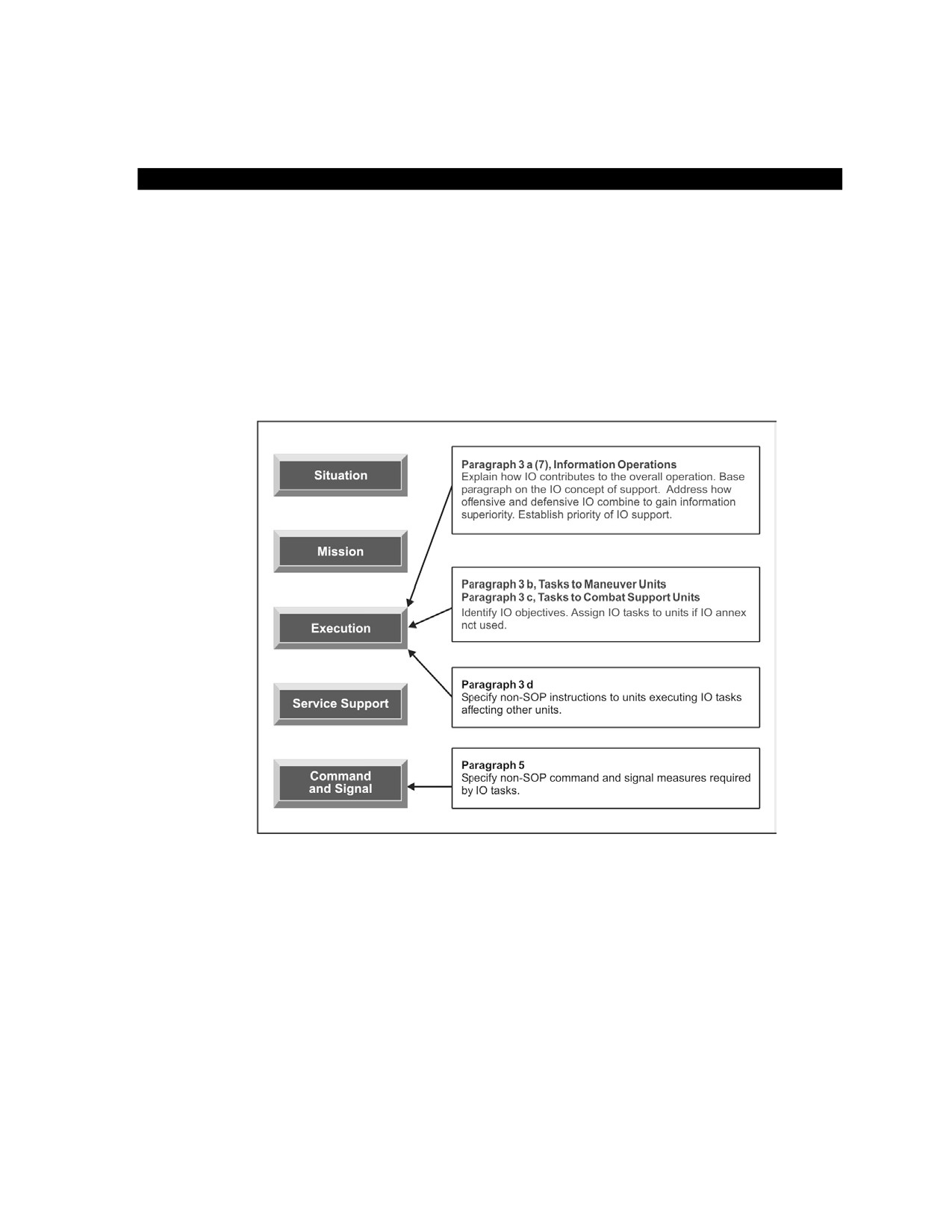
nexes (see figure 5-5). If the OPLAN/OPORD requires an IO annex, the G-7
prepares it. The IO annex usually includes an IO execution matrix and an IO
assessment matrix as appendixes. When necessary, the G-7 or appropriate
special staff officers prepare appendixes for one or more IO elements/related
activities.
Figure 5-5. Information Operations Input to the Base OPLAN/OPORD
G-7 ACTIONS ON COURSE OF ACTION APPROVAL
5-131. With approval of a COA, the IO concept of support for that COA be-
comes the IO concept of support for the operation. If necessary, the G-7 modi-
fies it and other IO planning products based on the revised commander’s in-
tent and planning guidance. The G-7 refines the IO tasks to support
accomplishing the finalized IO objectives. The IO synchronization matrix for
the approved COA becomes the basis for the IO execution matrix for the op-
eration.
5-132. Placement of IO tasks in the OPLAN/OPORD varies according to the
importance of the task and the complexity of the operation. IO tasks may ap-
pear in the body of the order—particularly if it is relatively simple or short,
5-31
FM 3-13 __________________________________________________________________________________
as may be the case of a FRAGO or WARNO. For complex plans and orders,
only the IO concept of support and IO objectives appear in the body. IO tasks
are placed under tasks to subordinate units in the IO annex, IO element ap-
pendixes, or other annexes.
INPUT TO THE OPERATION PLAN/OPERATION ORDER
5-133. The G-7 writes paragraph 3a(7) of the base OPLAN/OPORD, which
discusses IO, and the IO annex. Paragraph 3a(7) states the IO concept of
support and IO objectives. If an IO annex is not used, it may contain a sub-
paragraph for each IO element/related activity and follow the same format as
paragraph 3 of the IO annex (see appendix D). Paragraph 3a(7) establishes
priority of support and refers to appropriate annexes and IO element appen-
dixes as required. This paragraph gives the staff and subordinate commands
the information needed to synchronize IO effects.
5-134. IO-related reporting requirements appear in the OPLAN/OPORD
coordinating instructions. IO tasks are placed in the coordinating instruc-
tions in the following circumstances:
• When an IO task affects two or more units.
• When the timing of an IO task depends on friendly actions.
• When the task involves synchronization with fire support and EW ac-
tions.
SUMMARY OF ORDERS PRODUCTION
5-135. Orders production is the last step of the MDMP. Its product is a com-
plete OPLAN/OPORD with supporting documents. When the time comes to
write input to the body of the order and the IO annex, nearly all the detailed
coordination, synchronization, and deconfliction work is completed. The G-7
coordinates the IO annex with organizations involved with executing tasks
and with those IO will affect. The G-7 also crosswalks the IO annex with the
OPLANs/OPORDs of higher, lower, and adjacent units. During planning, the
force has made some preparations for the operation based on WARNOs and
the results of parallel and collaborative planning. When the OPLAN/OPORD
is issued, the force focuses its efforts on preparing for the operation.
5-32
Chapter 6
Preparing for Information Operations
Preparation for information operations (IO) includes actions performed
before execution to improve the ability to conduct both offensive and
defensive IO. It includes revising and refining plans and orders,
assessment, force protection, coordination and liaison, rehearsals, task
organization and movements, preoperation checks and inspections,
logistic preparations, and integration of new soldiers and IO-capable
units. When a unit executing one mission receives a warning order for a
follow-on mission, it begins preparing for that mission while executing its
current mission.
PREPARATION CONCEPTS
6-1. Preparation is an activity of the operations process (see FM 3-0; FM 6-0).
Most preparations occur between receipt and execution of an operation order
(OPORD); however, preparation begins during planning and often continues
during execution. For example, a unit assigned a reserve or striking-force
mission prepares until the commander commits it. When a unit executing
one mission receives a warning order (WARNO) for a follow-on mission, it
begins preparing for that mission, while executing its current mission.
6-2. Because many information operations (IO) objectives and IO tasks
require long lead times to create the desired effects, preparation for IO often
starts earlier than for other types of operations. Initial preparation for
specific IO elements may begin during peacetime, although execution is
during conflict or war. Peacetime preparation by units involves building
contingency plan databases about the anticipated area of operations (AO).
These databases can be used for IO input to IPB and to plan defensive IO,
such as network protection and operations security (OPSEC). IO portions of
CONTENTS
Preparation Concepts
6-1
External Coordination
6-11
Revise and Refine Plans and Orders
6-2
Liaison
6-12
Assessment of Information Operations ... 6-3
Rehearsals
6-12
Assessment and Hierarchy of Effects .. 6-5
Task Organization and Movements
6-13
Establishing Cause and Effect
6-5
Preoperation Checks and
Developing Criteria of Success
6-6
Inspections
6-13
Assessment - Putting It All Together ... 6-8
Logistic Preparations
6-13
Force Protection
6-9
Integration of New Soldiers and
Coordination and Liaison
6-9
IO-capable Units
6-13
Internal Coordination
6-9
Summary
6-13
6-1
FM 3-13 __________________________________________________________________________________
contingency plans are continuously updated. Normal IO cell participants
maintain their own data to provide the G-7 with the latest information.
Peacetime preparation also lays the groundwork for IO coordination in
operational and tactical units.
6-3. During peacetime, the G-7 prepares for future operations by analyzing
potential target countries’ IO capabilities. Examples of factors to consider
include—
• Religious, ethnic, and cultural mores, norms, and values.
• Communications infrastructure.
• Military communication and C2 infrastructure.
• Military training and level of proficiency (to determine susceptibility to
denial, deception, and psychological operations [PSYOP]).
• Literacy rate.
• Ethnic factional relationships and languages.
6-4. Preparation includes assessing unit readiness to execute IO.
Commanders and staffs monitor preparations and evaluate them against
criteria of success established during planning to determine variances. (See
FM 6-0.) This assessment forecasts the effect of those factors on readiness to
execute the overall operation as well as individual IO tasks.
6-5. Preparation for IO takes place at three levels: G-7, units assigned IO
tasks, and individual. The G-7 helps prepare for IO by performing staff tasks
and monitoring preparations by units assigned IO tasks. These units perform
preparation activities as a group for tasks that involve the entire unit, and as
individuals for tasks that each soldier and leader must complete.
6-6. While many IO tasks are not executed until the overall operation begins,
some start while the unit as a whole is preparing for the operation. Most
defensive IO tasks are executed continuously. This situation requires units
assigned IO tasks to plan and prepare very quickly. A complete IO estimate
based on current relevant information is necessary. Technical competence
and leadership are essential to success.
REVISE AND REFINE PLANS AND ORDERS
6-7. Plans are not static; the commander adjusts them based on new
information. This information may include assessments of unit preparations
or answers to IO information requirements (IRs). While Army forces are
preparing, adversaries also prepare and may execute their own IO. When the
commander directs revising or refining the plan, the G-7 adjusts the IO
portion of it.
6-8. During preparation, the G-7 adjusts the IO portions of the operation
plan (OPLAN) or OPORD to reflect the commander’s decisions and changes
to the IO estimate. The G-7 updates the IO estimate so that it contains the
most current information about adversary IO activities, changes in the
weather or terrain, and friendly IO capabilities (see appendix C).
6-9. The G-7 ensures that IO input to IPB remains relevant throughout
planning and preparation. To do this, he ensures that IO input to the
6-2
_________________________________________________________ Preparing for Information Operations
intelligence, surveillance, and reconnaissance
(ISR) plan is adjusted to
support refinements and revisions made to the OPLAN/OPORD.
6-10. IO preparation begins during planning. As the IO annex begins to take
shape, G-7 coordination is vital because IO affects several battlefield
operating systems. For example, planning a physical destruction attack on a
command and control (C2) high-payoff target requires coordination with the
targeting team (see appendix E). A comprehensive attack offering a high
probability of success may involve air interdiction, deep attack, and
intelligence assets. Such an IO-related target must be placed on the air
tasking order. Rocket and missile fires have to be scheduled in the fire
support plan. Army jammers and collectors need to fly the missions when and
where needed. Making sure the different portions of the OPLAN/OPORD
contain the necessary instructions requires coordination and attention to
detail.
6-11. Effective IO is consistent at all echelons. The G-7 reviews subordinate
unit OPLANs/OPORDs to ensure IO tasks have been effectively addressed
and to detect any inconsistencies. The G-7 also looks for possible conflicts
between the command’s OPLAN/OPORD and those of subordinates. When
appropriate, the G-7 reviews adjacent unit OPLANs/OPORDs for possible
conflicts. This review allows the G-7 to identify opportunities to mass the IO
effects of both units.
6-12. OPLAN/OPORD refinement includes developing branches and sequels.
Branches and sequels are normally identified during war-gaming (COA
analysis). However, the staff may determine the need for them at any time.
The G-3 prioritizes branches and sequels. The staff develops them as time
permits. The G-7 participates in their development as with any other aspect
of planning (see chapter 5).
6-13. The focus during preparation for IO returns to assessment. A critical
part of assessment is monitoring and evaluating the criteria of success that
were developed during planning. The criteria of success for IO are monitored
and refined as the plan is revised. The initial development and subsequent
adjustments to the criteria of success are difficult tasks because, in many
respects, establishing criteria of success is more art than science. However, a
continued effort to refine criteria of success and ensure they are tied to an
effective assessment process enables the G-7 to better determine the progress
and effectiveness of IO, thereby enhancing IO support to the force.
ASSESSMENT OF INFORMATION OPERATIONS
6-14. Assessing the effectiveness of an information operation is one of the
greatest challenges facing a staff. To assess IO effectiveness, the G-7 must
quantify the intangible attributes of the information environment. The lack
of physical evidence of IO effects makes this task difficult.
6-15. The information environment is the aggregate of individuals,
organizations, or systems that collect, process, or disseminate information;
also included, is information itself
(JP
3-13). Thus, the information
environment is a combination of physical assets
(information systems
[INFOSYS]) and nonphysical concepts
(information, information-based
6-3
FM 3-13 __________________________________________________________________________________
processes, and human decisionmaking processes). IO attack and defend the
physical assets of the information environment to affect its nonphysical
aspects.
6-16. Not all IO capabilities reside in the physical world. While the IO
element of physical destruction is tangible, many IO elements are
nonphysical. Operations security (OPSEC), some aspect of electronic warfare
(EW), military deception (MD), and psychological operations (PSYOP) all aim
to produce effects in the intangible domain of ideas, perceptions, and
attitudes. Capturing data or information to measure such nonphysical effects
is difficult and often time-consuming. It requires a depth of analysis that
seems impossible during high-tempo operations.
6-17. An integrated information operation achieves a complex, tiered
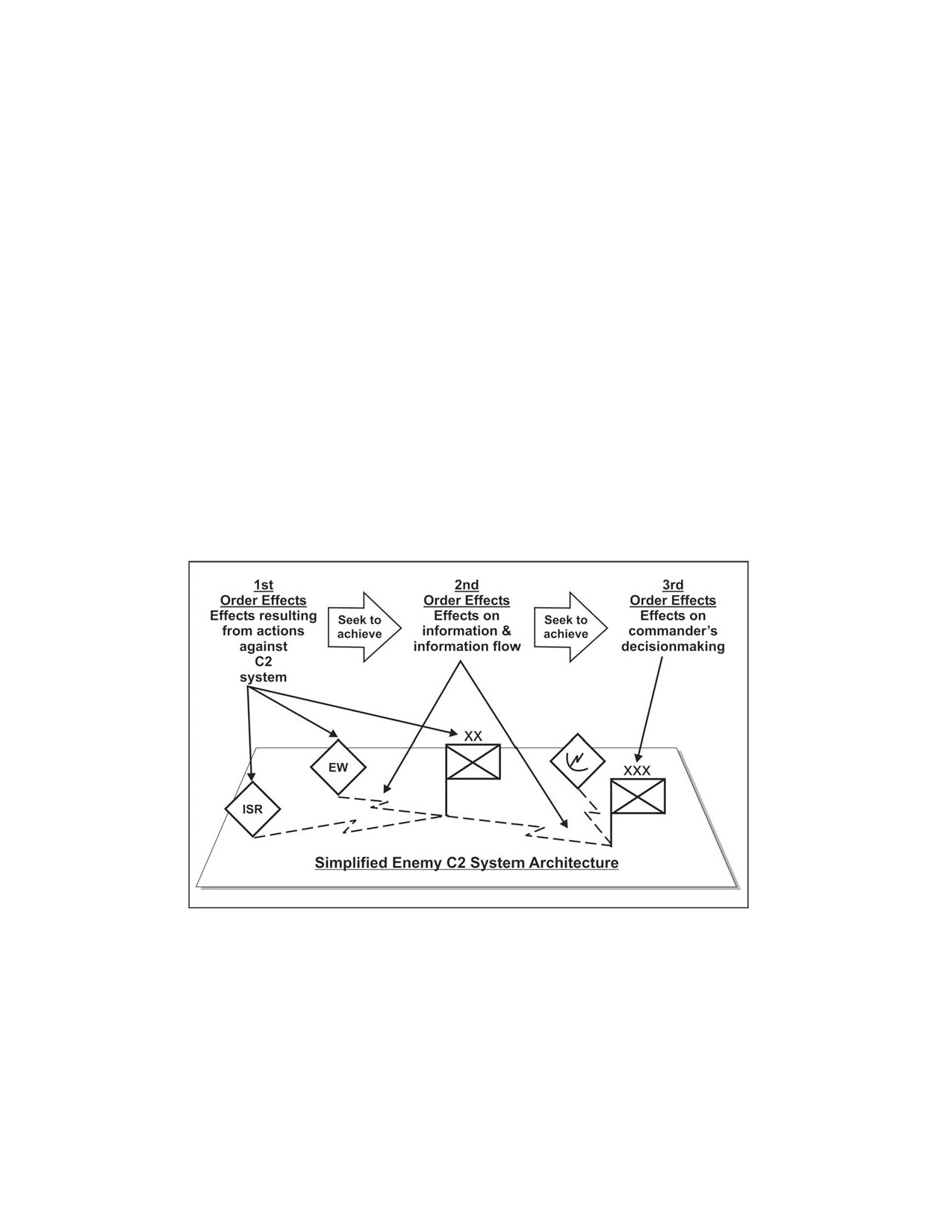
hierarchy of effects (see figure 6-1). Attacking or defending physical assets
yields the first-order effects, such as destruction, degradation, and disruption
of enemy signal nodes and command posts. First-order effects are directed
against adversary INFOSYS to achieve second-order effects on adversary
information and information-based processes. Effective second-order effects
produce third-order effects on the enemy commander’s decisionmaking.
Producing these third-order effects is the ultimate goal of IO.
Figure 6-1. Information Operations Effects Hierarchy
6-18. Defensively, first-order effects may be the protection of friendly force
INFOSYS. Second-order effects may be the maintenance of situational
understanding or an uninterrupted information flow. Third-order effects may
be the preservation of effective decisionmaking. Each level of effects produces
corresponding enemy and friendly reactions. This situation results in a
complex, tiered set of causes and effects, which must be identified and
interpreted to determine the overall impact of IO. To sort through this maze
of causal relationships, something more than traditional battle damage
assessments (BDA) is required.
6-4
_________________________________________________________ Preparing for Information Operations
ASSESSMENT AND HIERARCHY OF EFFECTS
6-19. Assessment is the continuous monitoring—throughout planning,
preparation, and execution—of the current situation and progress of an
operation, and the evaluation of it against criteria of success to make
decisions and adjustments (FM 3-0). Measurement and analysis of effects
resulting from the attack of enemy INFOSYS and protection of friendly
INFOSYS make assessment of IO possible. However, to do this, it is
necessary to understand the hierarchy of effects resulting from IO activities
(first-, second-, third-order effects).
6-20. First-order effects result from offensive IO directed against enemy
INFOSYS and defensive IO taken to protect friendly INFOSYS. Generally,
first-order effects are determined from reports and BDA. This level of
assessment determines whether planned offensive and defensive IO tasks
have occurred and the effects of them.
6-21. Second- and third-order effects are those generated by the sum total of
actions directed against enemy and friendly INFOSYS. These effects are less
detectable and quantifiable than first-order effects. At these levels,
assessment seeks to determine if the aggregate of executed IO tasks have
achieved the desired result: What were the effects on the enemy and friendly
INFOSYS (second-order effects)? Were the enemy and friendly commanders
affected (third-order effects)? If so, how and to what extent? Second- and
third-order effects are usually determined through inductive analysis of
intelligence reports and assessments.
ESTABLISHING CAUSE AND EFFECT
6-22. Because IO and the information environment are a mixture of physical
assets and abstract concepts, the only way to achieve cause and effect
linkages is to acknowledge that military conflict consists of interactions
between humans and technology. Also, it is assumed that the physical assets
of a military force and the intangible aspects of military operations, such as
morale, leadership, will, and cohesion, are linked. Thus, attacking physical
assets—command posts, target acquisition systems, intelligence collection
and processing systems, and communication systems—will adversely impact
a military force’s ability to make and act upon decisions. Consequently, this
will have a detrimental affect on those intangibles that provide the military
force with the ability to conduct operations.
6-23. Establishing a linkage or correlation is necessary to determine whether
IO elements/related activities are impacting friendly and enemy information
flow and decisionmakers. A correlation exists when the value of an action
(such as number of occurrences or degree of effect) increases or decreases,
causing the value of the effect to increase or decrease. For example, a
correlation exists in the following cases:
• The number of enemy soldiers surrendering increases after PSYOP
leaflets dropped on enemy formations.
• The traffic on a C2 net decreases as the number of jamming attacks
against it increase on that net.
This deductive reasoning forms the basis of determining first-order effects.
6-5
FM 3-13 __________________________________________________________________________________
6-24. However, the relationship between action (cause) and effect may be
coincidental, meaning that the occurrence of an effect is either purely
accidental or perhaps caused by the correlation of two or more actions
executed to achieve the effect. For example, if friendly forces are successfully
engaging enemy formations with fire and maneuver at the same time PSYOP
activities are urging enemy soldiers to surrender, then correlating an
increase in surrendering soldiers to PSYOP activities may not be accurate.
Furthermore, because IO often employ multiple elements to engage the
adversary C2 system, the cumulative effect of IO support to combat actions
may make the impact of individual IO objectives and tasks indistinguishable.
Since there will rarely be enough time to definitively rule out coincidental
relationships, the only possible antidote is an in-depth knowledge of the
enemy and information environment that facilitates the development of an
informed estimate through inductive reasoning.
DEVELOPING CRITERIA OF SUCCESS
6-25. Criteria of success are information requirements developed during the
operations process that measure the degree of success in accomplishing the
unit’s mission. They are normally expressed as either an explicit evaluation
of the present situation or forecast of the degree of mission accomplishment
(FM 6-0). Criteria of success determine second- and third-order effects by
establishing a cause-and-effect linkage between usually observable and
quantifiable first-order effects, and abstract and subjective second- and third-
order effects. Criteria of success do not constitute the assessment itself. They
are an evaluation means to determine if the individual IO tasks are
achieving the IO objectives and whether achieving the IO objectives is
fulfilling the IO concept of support. This ensures the success of the IO
mission. Criteria of success may be developed to measure the
accomplishment of individual IO tasks. Doing so is largely dependent upon
the importance of the task, as well as the availability of resources and time
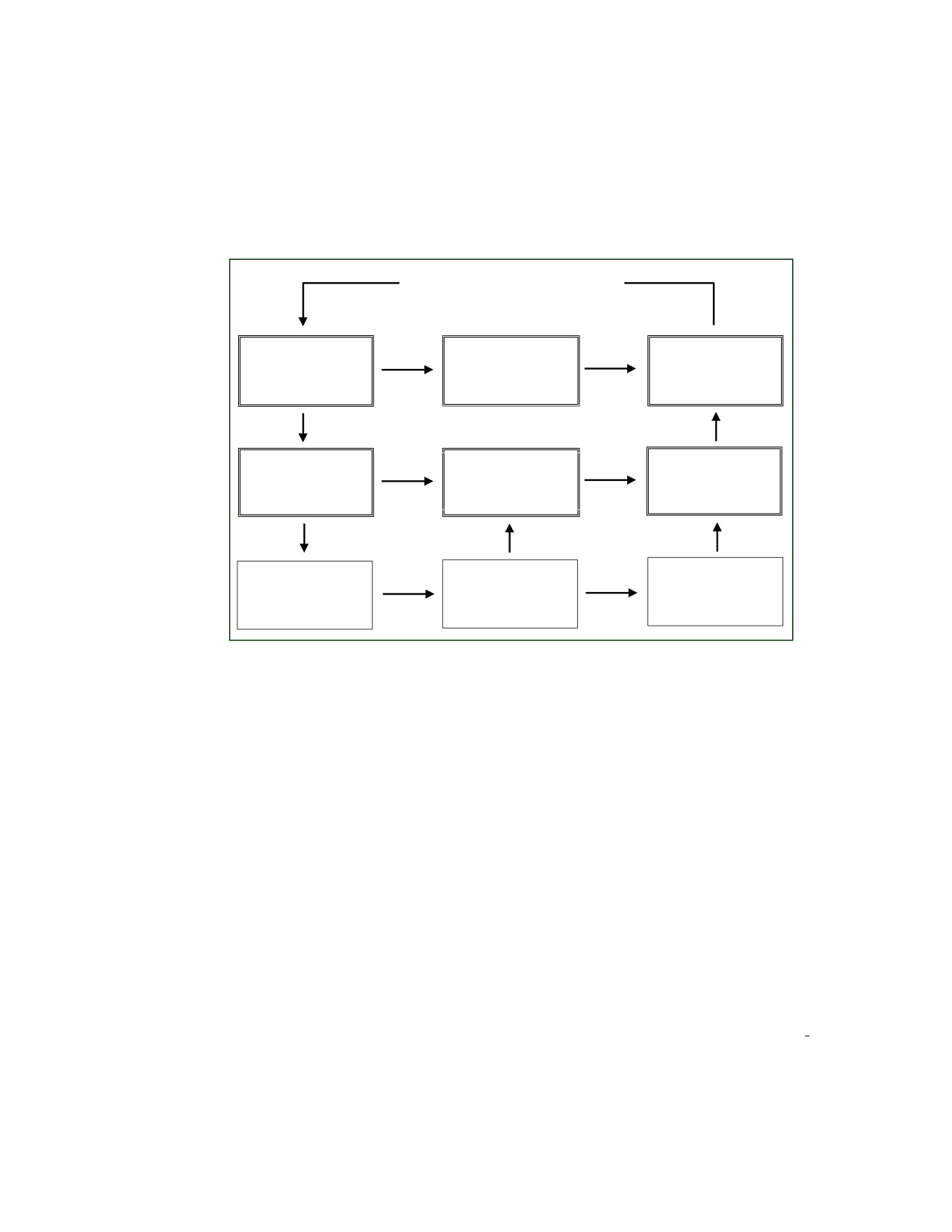
conduct an assessment to that level of detail. (See figure 6-2.)
6-26. Criteria of success are developed during planning (see chapter 5) to
determine the effects of both offensive and defensive IO. To be meaningful,
criteria of success must link friendly and enemy actions and activities
(causes) to enemy and friendly capabilities to make and act upon decisions
(effects). Therefore, criteria of success development begins with the IO
mission statement. Developing effective criteria of success requires a
properly crafted IO mission statement, IO concept of support, IO objectives,
and IO tasks.
6-27. The information operations mission statement is a short
paragraph or sentence describing what the commander wants IO to
accomplish and the purpose for accomplishing it. An effective IO
mission statement focuses on specific aspects of the operation. It is not a
general statement that merely identifies standard doctrinal requirements for
IO.
6-28. The information operations concept of support is a clear,
concise statement of where, when, and how the commander intends
to focus the information element of combat power to accomplish the
6-6
_________________________________________________________ Preparing for Information Operations
mission. The criteria of success developed for each of the IO objectives
collectively lead to the success of the IO concept of support for the approved
course of action.
Proceed with, or change, plan
Criteria of
IO
Assessment
Success
Concept of
of Information
(For IO Concept
Support
Operation
of Support)
Criteria of
IO
Assessment
Success
Objectives
of IO Objectives
(For each IO Objective)
Tasks
• Unit Reporting
Assessment
to Elements
• Battle Damage
of Tasks
and Units
Assessment
Figure 6-2. Criteria of Success in Assessing an IO Mission Statement
6-29. Information operations objectives are clearly defined,
obtainable aims that the commander intends to achieve using IO
elements/related activities. Criteria of success are developed to assess
each IO objective’s desired effect. A well-crafted IO objective specifies an
effect, an object of the effect, and a purpose for the effect. Normally, offensive
IO objectives are written in terms of destroy, disrupt, degrade, deny, deceive,
exploit, and influence. Defensive IO objectives are written in terms of
protecting and defending friendly force’s information and INFOSYS. Ideally,
each objective has a clearly defined, attainable effect. Otherwise it is not
possible to determine if or when that effect is achieved, and whether the IO
objective is met.
6-30. Information operations tasks are tasks developed to support
accomplishment of one or more IO objectives. Criteria of success are
stated for each task, with the understanding that an IO task addresses only
one IO element/related activity. Unit reporting or BDA is important to assess
the effectiveness of the individual IO task.
6-31. Criteria of success for second-order effects seek to determine if the
aggregate of IO tasks are accomplishing the IO objectives. If possible, the
criteria of success should be observable
(to aid intelligence collection),
quantifiable
(to increase objectivity), precise
(to ensure accuracy), and
correlated to the progress of the operation (to attain timeliness). While it is
6-7
FM 3-13 __________________________________________________________________________________
possible for an IO objective to have multiple criteria of success, limited
intelligence collection and analysis assets may preclude this.
6-32. Criteria of success for third-order effects seek to determine if the
enemy and friendly commanders were affected by IO as planned. These
criteria of success should determine if the decisionmaker has responded as
predicted. Often, these criteria of success are subjective.
ASSESSMENT - PUTTING IT ALL TOGETHER
6-33. Criteria of success are but one part of assessment. Traditional BDA
and other intelligence analyses, as well as friendly unit reporting, are still
key to assessing IO effectiveness. These sources provide the information on
quantifiable effects. This information can be used as the basis for estimates
of whether the IO mission is being accomplished. Information from unit
reports and BDA are typical sources for determining first-order effects.
Intelligence reporting and assessments provide information to determine
second- and third-order effects.
6-34. Once criteria of success are written, a mechanism to obtain the
information needed to determine the three orders of effects is developed. (See
figure B-26, page B-39, for an example of an IO assessment matrix.) The G-7
determines the assessments required, specific information needed to make
the assessments, and agencies and assets tasked to provide the information.
This assessment plan then contributes to the command’s intelligence
collection plan and friendly forces information requirements (FFIR).
6-35. Timely and accurate reporting of information is essential to assessing
IO effectiveness. Much of this information is reported from subordinate units.
Intelligence collection assets—including maneuver units, tactical PSYOP
teams, and tactical human intelligence
(HUMINT) teams—all provide
information with which to gauge IO mission success. Additionally, on-going
intelligence analysis, including analysis of media and other open sources,
supports assessing whether IO is achieving its objectives and if the IO
concept of support is successful. Civil affairs tactical support teams, although
not intelligence collection assets, can also provide feedback on IO mission
success.
6-36. To receive information, the G-7 must actively monitor the operational
situation and aggressively pursue information through unit reports and
debriefings, IO cell meetings, and other venues. Commanders’ battle update
briefings, conference calls, and other meetings also facilitate monitoring IO
execution. They provide a forum from which information is received for
subsequent analysis. Some other G-7 actions are—
• Submit requests for information (RFIs) based on the assessment
plan.
• Coordinate with the effects coordination cell and targeting team for
BDA reporting.
• Review assessments at each IO cell meeting.
• Monitor G-2 and G-3 incident databases and analyze trends.
6-8
_________________________________________________________ Preparing for Information Operations
FORCE PROTECTION
6-37. Force protection is a continuous process executed by all commanders,
regardless of the mission, location, or threat. It consists of a broad set of unit-
specific, coordinated actions conducted to protect the force. Commanders
conduct force protection operations throughout the range of operations
(offensive, defense, stability, support) and the across the spectrum of conflict
(peace, crisis, war). The G-7 develops and initiates force protection actions
during planning, but executes them mainly during preparation and
execution. IO actions related to force protection include tasks involving all IO
elements.
6-38. Threat assessment, begun during planning, continues during the
preparation. Force protection measures may include IO elements. IO
conducted to support force protection is related to protecting the integrity
and capability of the force. These operations may also physically protect the
headquarters and communications assets. The most prominent IO elements
with respect to force protection are OPSEC, (see chapter 3) physical security,
counterintelligence, PYSOP, computer network defense, and information
assurance (see chapter 2).
6-39. Some IO-related questions that the commander and staff may ask
when preparing force protection measures are—
• Do IO rules of engagement (ROE) support force protection?
• In multinational operations, what will be the multinational ROE
before hostilities and after the first hostile act?
• When will training of IO-capable units take place? at home or en
route—either to operation or in the AO?
• What collective training IO-capable units take place?
• Have PSYOP been developed to support force protection?
• Have PSYOP assets been requested?
COORDINATION AND LIAISON
6-40. Synchronized operations require all units to coordinate with each other
continuously. Coordinating IO begins during planning; however, input to a
plan alone does not constitute coordination. Coordinating involves
exchanging the information needed to synchronize operations. The majority
of coordination takes place during preparation. It is then that the G-7 follows
up on the coordination made during planning. Exchanging information is
critical to successful coordination and execution. Coordination may be
internal or external. Liaison is an important coordination means
(see
FM 6-0).
INTERNAL COORDINATION
6-41. Internal coordination occurs within the unit headquarters. The G-7
initiates the explicit and implicit coordinating activities within itself and
with other staff sections. Much of this coordination occurs during IO cell
meetings; however, IO cell members do not wait for a meeting to coordinate.
They remain aware of actions that may affect, or be affected by, their
6-9
FM 3-13 __________________________________________________________________________________
functional responsibilities. They initiate coordination as soon as they become
aware of a situation that requires it. The G-7 remains fully informed of IO-
related coordination. The G-7 corrects or resolves problems of external
coordination revealed by command and staff visits and information
gathering. During internal coordination, the G-7 resolves problems and
conflicts. It also ensures that resources allocated to support units assigned IO
tasks actually arrive. The G-7 uses the IO execution matrix as an assessment
tool. It displays information that supports monitoring and evaluating
coordination. Examples of internal coordination include—
• Deconflicting PSYOP and public affairs (PA) products.
• Monitoring the progress of answers to IO IRs.
• Monitoring RFIs to higher headquarters by the G-3 current operations,
with notification to the G-7.
• Checking the air tasking order for missions requested by the G-7.
• Monitoring the movements and readiness of IO assets.
• Determining space asset status and space weather implications.
• Participating in the integration of IO-related targets into the targeting
process.
• Using figure 2-1 (pages 2-27-2-30) to coordinate IO elements that
support each other.
• Using figure 2-2 (pages 2-31-2-32) to deconflict those elements that
conflict with each other.
• Using figure 2-3 (page 2-33) to see how the elements of IO support or
conflict with the related activities of PA and CMO (all IO cell members;
see appendix F).
• Continuous monitoring and validation of OPSEC procedures,
particularly in preparation for military deception. This could include a
short statement on physical security, particularly during movement.
6-42. The G-7 remains mindful that training is conducted during planning
and preparation. This occurs particularly as new soldiers and IO capabilities
are integrated into the command and the command’s battle rhythm.
6-43. Each staff officer has responsibilities during preparation for each of the
IO elements. Examples related to some IO elements follow:
• Electronic warfare.
G-1—Identify personnel with cryptologic and linguistic skills to
support EW operations.
G-2—Coordinate intelligence gathering in support of the EW
mission. Recommend the use of EW against adversary surveillance
measures.
G-3—Coordinate the priority targets for electronic countermeasures.
G-4—Coordinate distribution of EW equipment and supplies, less
cryptographic support.
G-5—Coordinate for use of host-nation personnel with special
linguistic qualifications.
EW officer—Monitor the preparation of military intelligence units
with EW missions.
6-10
_________________________________________________________ Preparing for Information Operations
•
Psychological operations.
G-1—Assist in the administration and control of civilian personnel
who have skills desired by PSYOP units.
G-2—Prepare intelligence estimate and analysis of the area of
operation.
G-3—Request additional PSYOP units as required.
G-4—Prepare logistic support of PSYOP.
G-7—Identify requirements for additional PSYOP units to the G-3.
PSYOP officer—Prepare the PSYOP appendix to IO annex. Prepare
the PSYOP estimate.
•
Operations security.
G-1—Procure, when required, civilian resources for use as guard
forces.
G-2—Provide data on adversary intelligence.
G-4—Advise on the vulnerabilities of supply, transport, and
maintenance facilities, and lines of communications.
G-5—Determine availability of civilian resources for use as guard
forces.
G-7—Determine the EEFI.
OPSEC officer—Prepare the OPSEC estimate and appendix.
Provost marshal—Advise on physical security measures.
•
Military deception.
G-1—Coordinate personnel support requirements to implement the
MD plan.
G-2—Determine adversary surveillance capabilities.
G-3—Coordinate movement of units participating in MD.
G-4—Coordinate logistic support to carry out assigned deception
tasks.
G-5—Coordinate host-nation support to implement the MD plan.
MD officer—Prepare to monitor execution of MD operation.
EXTERNAL COORDINATION
6-44. External coordination includes coordinating with or among subordinate
units and higher headquarters. This coordination concerns IO assets and
resources or forces that may not be under the unit’s control during planning.
These IO assets may be available during preparing or executing. External
coordination also includes coordinating with adjacent units or agencies. (In
the information environment, adjacent refers to any organization that can
affect a unit’s operations.) This coordination is necessary to synchronize IO
throughout the force. Examples of external coordination include—
• Ensuring preparation of PSYOP and PA products, including release
approval.
• Assessing unit OPSEC posture.
• Making sure the MD operation is tracking with preparation for the
overall operation.
• Periodically validating assumptions.
6-11
FM 3-13 __________________________________________________________________________________
• Ensuring MD operations are synchronized with those of higher,
lower, and adjacent units.
• When possible, the G-7 requires each unit, detachment, and section
involved in IO to backbrief its responsibilities. This ensures a
comprehensive understanding of their tasks and how each task is
synchronized within the IO concept of support.
6-45. The G-7 remains aware of the effectiveness of computer network
defense actions/tasks, including information assurance tasks taken by the G-6.
Proper protection of plans and orders, and refinements to them, is essential
during operations.
LIAISON
6-46. Establishing and maintaining liaison is one of the most important
means of external coordination (see FM 6-0). The G-7 may perform liaison
through the command’s liaison officers; a member of the G-7 may be part of a
liaison team. Establishing liaison early in planning supports effective
coordination.
6-47. Practical liaison can be achieved through personal contact between
G-7s. This is accomplished through the exchange of liaison personnel,
through agreement on mutual support between adjacent units, or through a
combination of these means. Liaison should, when possible, be reciprocal
between higher, lower, and adjacent units. Liaison must be reciprocal
between IO sections when US forces are operating with or adjacent to,
multinational partners.
6-48. Liaison also has a force protection mission. Where host-nation security
forces retain some operational capability, liaison is vital to coordinate
actions. In some cases, it may be more important to coordinate with host-
nation security forces than with Army forces. In nearly all cases, they provide
intelligence and other related information about conditions in-theater.
REHEARSALS
6-49. The G-7 participates in unit rehearsals to ensure IO is synchronized
with the overall operation and to identify potential problems during
execution. The G-7 may conduct further rehearsals of IO tasks and actions to
ensure coordination and synchronization of IO among units assigned them.
Before participating in a rehearsal, the G-7 reviews the plans or orders of
subordinate and supporting commands (see paragraph 6-8).
6-50. Commanders and staffs use a form of rehearsal called a rock drill. A
rock drill is a leader and staff rehearsal that usually uses a sand table or
similar training aid. Its primary purpose is to synchronize the actions of all
battlefield operating systems. IO are fully integrated into rock drills and
other staff rehearsals. Doing this ensures all concerned know their IO tasks
and understand how IO may affect their functional responsibilities.
Rehearsals also verify the timing of IO execution relative to the overall
operation.
6-12
_________________________________________________________ Preparing for Information Operations
TASK ORGANIZATION AND MOVEMENTS
6-51. The G-7 coordinates with the G-3 for movement of IO assets and
resources during preparation. The G-7 integrates movements of units
assigned IO tasks with OPSEC measures to ensure that they do not reveal
any intentions. IO-capable units involved in MD operations adhere strictly to
the MD plan so as not to compromise it. This is a carryover from planning.
6-52. Units cannot be assigned missions supporting IO objectives and given
IO tasks without first receiving the capabilities needed to execute them. For
example, a divisional maneuver brigade does not have an S-7 section. It
requires augmentation if it is detached and assigned a mission involving IO.
One procedure to overcome the lack of an organic S-7 is to attach a staff
officer from the G-7 section to the brigade headquarters to synchronize IO
elements.
PREOPERATION CHECKS AND INSPECTIONS
6-53. As with other units, units assigned IO tasks complete preoperation
checks and inspections. The G-7 role is staff coordination, which ensures that
resources are provided according to by the commander’s priorities.
Preparation includes checks and inspections of soldier training and systems
used to execute the mission. All IO systems are checked without revealing
these checks to the adversary.
LOGISTIC PREPARATIONS
6-54. Resupplying, maintaining, and issuing special supplies or equipment to
or in IO-capable units takes place during preparation. Repositioning of
logistic assets for units assigned IO tasks also occurs during preparation. The
G-7 coordinates with the G-4 to ensure that units assigned IO tasks receive
the necessary support. The G-7 ensures that these preparations do not
violate OPSEC measures.
INTEGRATION OF NEW SOLDIERS AND IO-CAPABLE UNITS
6-55. The G-7 assures that IO-capable units made available to the force are
fully integrated into the command in a posture that allows them to
contribute effectively. This responsibility includes integrating any support
received from the 1st Information Operations Command (Land). The G-7
ensures that IO-capable units are prepared to perform their IO tasks.
SUMMARY
6-56. Preparation begins during planning and continues through execution.
IO preparation raises the readiness of units assigned IO tasks. It includes,
but is not limited to, plan or order refinement, force protection, coordination
and liaison, rehearsals
(unit and IO-specific), task organization, and
adjustment and movement of IO-capable units. Preparation combines
preoperation checks and inspections of IO assets, logistic preparations, and
integration of new soldiers and IO-capable units into the force’s mission until
committed by the commander. It also involves reviewing plans and orders of
6-13
FM 3-13 __________________________________________________________________________________
subordinate and supporting units to identify conflicts and to ensure IO
synchronization. Rehearsals offer the G-7 opportunities to identify and
resolve IO issues before execution. Preparation for IO often requires longer
lead times than preparation for other types of operations.
6-14
Chapter 7
Executing Information Operations
The complexity of information operations (IO) execution stems from IO’s
multiple elements with their diverse operational capabilities and require-
ments. The wide variance in the time IO elements need to achieve effects
and the coordination required between echelons add complexity. Well-exe-
cuted IO results in confused and demoralized adversary leaders and soldiers.
It produces psychologically and electronically isolated adversary units inca-
pable of mounting coordinated efforts. Often, adversary commanders are
severed from their subordinates and powerless to counter Army force actions
at the decisive point. This chapter discusses topics related to IO execution:
staff coordination, assessing IO, decisionmaking, and other IO-related con-
siderations.
STAFF COORDINATION
7-1. The challenges faced by the G-7 are how to assess IO execution and how to
adjust IO as the operation unfolds. Simultaneously, the G-7 integrates the IO
elements. The G-7 assists the G-3 in synchronizing IO with the overall opera-
tion.
7-2. IO execution is critically dependent on the intelligence battlefield operat-
ing system for three reasons. First, intelligence provides an assessment of IO
effects on adversaries and others, and of their reactions to counter these effects.
Second, intelligence provides a real-time assessment of how adversaries and
others are attempting to degrade friendly C2. Third, intelligence operates
many of the Army’s airborne and ground-based sensors and jammers that play
a vital role in both offensive and defensive IO. It also converts the information
they collect into intelligence.
CONTENTS
Staff Coordination
7-1
Adjusting Information Operations to an
Assessing Information Operations During
Unexpected Adversary Reaction
7-7
Execution
7-3
Other Considerations
7-7
Monitoring Information Operations ... 7-3
Information Operations Execution
Evaluating Information Operations ... 7-4
Begins Early
7-7
Decisionmaking During Execution
7-5
Information Operations Delivers
Executing Information Operations as
Unanticipated Results
7-7
Planned
7-5
Summary
7-8
Adjusting Information Operations to a
Changing Friendly Situation
7-6
7-1
FM 3-13 __________________________________________________________________________________
7-3. The requirement for responsive staff coordination among the IO elements
intensifies during execution as an operation progresses and variances from the
operation order (OPORD) increase. The decentralized nature of IO execution,
combined with the multiple command levels involved and the allocation of in-
formation monitoring responsibilities among the unit’s command posts (CPs),
place a heavy demand on the G-7.
7-4. A headquarters monitors the effects of its own IO and coordinates any
activities that may directly affect the operations of other commands. To do
this, the G-7 establishes links with higher and adjacent command G-7s to ob-
tain effects assessments in near real-time. With this information, the G-7
tracks how the effects of other organizations’ IO impact the command’s over-
all operation.
7-5. IO execution is complicated because the tactical command post (TAC
CP), main CP, and rear CP each monitor different parts of the operation.
Continuous exchange of information among the G-7s, S-7s, and others re-
sponsible for controlling IO at these CPs is paramount.
7-6. The TAC CP directs IO execution and adjusts missions as required. The
IO cell in the TAC CP provides initial assessment of IO effectiveness. It—
• Maintains the IO portion of the common operational picture (COP) to
support current operations.
• Maintains a picture of the adversary C2 system.
• Maintains IO information requirement (IR) status.
• Coordinates preparation and execution of IO with maneuver and fires.
• Recommends adjustments to current IO.
• Tracks IO assets and recommends repositioning of IO assets as
required.
• Tracks IO-related targets in conjunction with the G-2.
• Nominates targets for attack.
7-7. The main CP plans, coordinates, and integrates IO. It—
• Creates and maintains IO aspects of the COP.
• Maintains the IO estimate.
• Incorporates answers to IO IRs into the IO estimate.
• Maintains a current IO order of battle.
• Deconflicts IO internally and externally.
• Requests/coordinates IO support with other battlefield operating
system representatives, outside agencies, higher headquarters, and
augmenting forces.
• Identifies future IO objectives based on successes or failures of current
operations.
7-8. The rear CP answers IO IRs that the main and TAC CPs cannot answer.
When necessary, it obtains augmentation to meet special needs or shortfalls.
In addition, IO representatives at the rear CP—
• Advise rear CP staff on IO.
• Coordinate IO support with outside agencies, higher headquarters, and
augmenting IO forces.
7-2
____________________________________________________________ Executing Information Operations
• Integrate out-of-theater and national information sources into the
targeting process.
7-9. The G-7 receives reports from elements executing IO tasks and keeps
the chief of staff (COS) informed on IO status. Changes in taskings are
planned and coordinated by the G-7 and disseminated by fragmentary orders
(FRAGO) from the G-3 (see appendix G.)
ASSESSING INFORMATION OPERATIONS DURING EXECUTION
7-10. Assessment is the continuous monitoring—throughout planning,
preparation, and execution—of the current situation and progress of an op-
eration, and the evaluation of it against criteria of success to make decisions
and adjustments (FM 3-0).
7-11. The G-7 compiles information from all CPs, the G-2, and higher
headquarters to maintain a continuous IO assessment in the IO estimate (see
appendix C). The primary objective of assessment is to determine whether IO
are having the desired effects. As the situation changes, the G-7 and G-3
make sure IO remains fully synchronized with the overall operation.
7-12. IO assessments are derived from monitoring IO task execution. IO as-
sessments evaluate the effects of friendly offensive IO and defensive IO. Of-
fensive IO are evaluated in terms of their effects on adversary C2 systems
and the information environment. Defensive IO are evaluated in terms of
how well they counter adversary IO. Assessment allows the G-7 to decide ei-
ther to recommend continuing IO as specified by the OPORD, or to alter the
plan (usually with a FRAGO) to fit the situation.
7-13. IO assessment begins during planning. At that time, the commander
and staff determine the IO tasks to be assessed, the criteria of success, and
the means of obtaining the required information. During orders production,
the G-7 planner uses this information to prepare the IO assessment matrix.
(See figure B-26, pages B-39-B-42). During execution, the G-7 uses the
execution matrix to control IO execution and the assessment matrix to
determine when and where to obtain information to assess IO tasks. The
measures of performance in FM 7-15 may be used as the basis for criteria of
success for IO tasks.
MONITORING INFORMATION OPERATIONS
7-14. The G-7 monitors IO to determine progress towards achieving the IO
objectives. Once execution begins, the G-7 monitors the adversary and
friendly situations to track IO task accomplishment, determine the effects of
IO during each phase of the operation, and detect and track any unintended
consequences of the IO.
7-15. Monitoring the execution of defensive IO is done at the main CP be-
cause it is the focal point for intelligence analysis and production, and be-
cause the command’s C2 nodes are monitored there. The G-7 works closely
with G-2 and IO cell representatives to provide a running assessment of the
effectiveness of adversary IO and keeps the COS informed. The main CP is
where offensive and defensive IO are collectively reviewed and where the IO
effectiveness is assessed.
7-3
FM 3-13 __________________________________________________________________________________
7-16. With G-2, G-3, and fire support representatives, the G-7 monitors
offensive IO execution in the TAC CP and the main CP. The G-7 is concerned
with attacking adversary C2 nodes with airborne and ground-based jammers,
fire support, attack helicopters, and tactical air. After preplanned IO-related
high-payoff targets (HPTs) have been struck, the strike effectiveness is as-
sessed. Effective IO support of current operations depends on how rapidly the
TAC CP can perform the targeting cycle to strike targets of opportunity. The
IO representative in the TAC CP monitors the effectiveness of friendly com-
munications and recommends actions to maintain or improve communica-
tions nodes and links. The G-3 representative in the TAC CP keeps the main
CP informed of current operations, including IO.
7-17. Monitoring IO execution at the rear CP focuses principally on
maintaining freedom of movement and uninterrupted operations in the rear
area. From an IO perspective, the rear CP focuses on forces and
organizations that could disrupt the C2 of sustaining operations and the flow
of assets into the forward areas. Most rear CP attention is concentrated on
reducing terrorist or special operations force threats, sustaining civil
infrastructure, and supporting the deployed force. Normally, the support
command’s operations and intelligence staffs monitor and direct IO in the
rear area, reporting plans and activities to the main CP.
7-18. To organize and portray IO execution, the G-7 uses various staff
devices and aids. Some useful aids are—
• IO execution matrix. Either the execution matrix taken directly from
the IO annex, or an extract containing only the current and near-term
IO tasks, may be used, depending on the complexity of the operation.
The execution matrix is used by the G-7 to monitor progress and
results of IO objectives and tasks, and to keep IO execution focused on
contributing to the overall operation (see figure D-6, page D-15; figure
D-8, page D-20).
• Decision support template. The decision support template produced
by the G-3 is used by the G-7 to monitor progress of IO in relation to
decision points and any branches or sequels.
• High-payoff target list. The G-7 maintains a list or graphic (for
example, a link and node diagram) to track the status of IO-related
HPTs identified during planning.
• Critical assets list. The G-7 uses the critical assets list to monitor the
status of critical friendly information nodes and the status of critical
systems supporting IO, for example, electronic warfare systems,
psychological operations (PSYOP) assets, and deep attack assets.
EVALUATING INFORMATION OPERATIONS
7-19. During execution, the G-7 works with the G-2, G-3, and the analysis
and control element (ACE) to obtain the information needed to determine the
individual and collective IO effects.
7-20. Evaluation not only estimates the effectiveness of task execution, but
also evaluates the effect of the entire IO effort on adversaries, other key peo-
ple in the area of operations (AO), and friendly operations. One way to evalu-
ate the IO contribution to the overall operation is to compare IO progress
7-4
____________________________________________________________ Executing Information Operations
against the IO objectives. This can be done by confirming execution of IO
tasks and monitoring reports on adversary reactions to judge each task’s ef-
fects. An analysis of these individual effects may help determine the total
effect of all the IO tasks on adversary operations. It allows an assessment of
whether the adversary is acting as envisioned during planning. The G-7 may
use an IO assessment matrix to capture and record assessment information
(see figure B-26, pages B-39-B-42).
7-21. Based on the IO effects evaluation, the G-7 adjusts IO to further exploit
adversary vulnerabilities, redirects actions yielding few effects, or terminates
actions after they have achieved the desired result. The G-7 keeps the COS
and commander informed of IO effects and how these impact friendly and ad-
versary operations. Some of the possible changes to IO are—
• Strike a target or continue to protect a critical asset to ensure the
desired effect.
• Execute a branch or sequel.
DECISIONMAKING DURING EXECUTION
7-22. Decisionmaking during execution includes—
• Executing IO as planned.
• Adjusting IO to a changing friendly situation.
• Adjusting IO to an unexpected adversary reaction.
EXECUTING INFORMATION OPERATIONS AS PLANNED
7-23. Essential to execution is a continuous information flow among the G-2,
G-3, G-7, and ACE (see figure 7-1, page 7-6). The G-7 tracks execution with
the G-3 and ACE. The IO targeting officer coordinates with the targeting
staff for feedback on IO tasks and IO-related targets.
7-24. To execute IO, the G-7 maintains an execution matrix. This matrix is
periodically updated and provided to the G-2, G-3, and ACE. Using the ma-
trix, the G-7 keeps a record of completed IO tasks. As tasks are completed,
the G-7 passes the information to the ACE. The G-7 uses this information to
keep IO synchronized with the overall operation.
7-25. The G-7 determines whether the adversary commander and other tar-
geted leaders are reacting to IO as anticipated during course of action (COA)
analysis. The G-7 also looks for new adversary vulnerabilities and for new
IO-related targets. The G-7 proposes changes to the OPORD to deal with
variances throughout execution. The G-3 issues FRAGOs pertaining to IO as
requested by the G-7. These FRAGOs may implement changes to the IO con-
cept of support, IO objectives, and IO tasks. The G-7 updates the IO execu-
tion matrix and IO assessment matrix to reflect these changes.
7-26. Given the flexibility of advanced information systems, the time avail-
able to exploit new adversary C2 vulnerabilities may be limited and require
an immediate response from several IO elements. Actions to defeat adversary
IO need to be countered immediately. The G-3 may issue a verbal FRAGO
when immediate action is required.
7-5
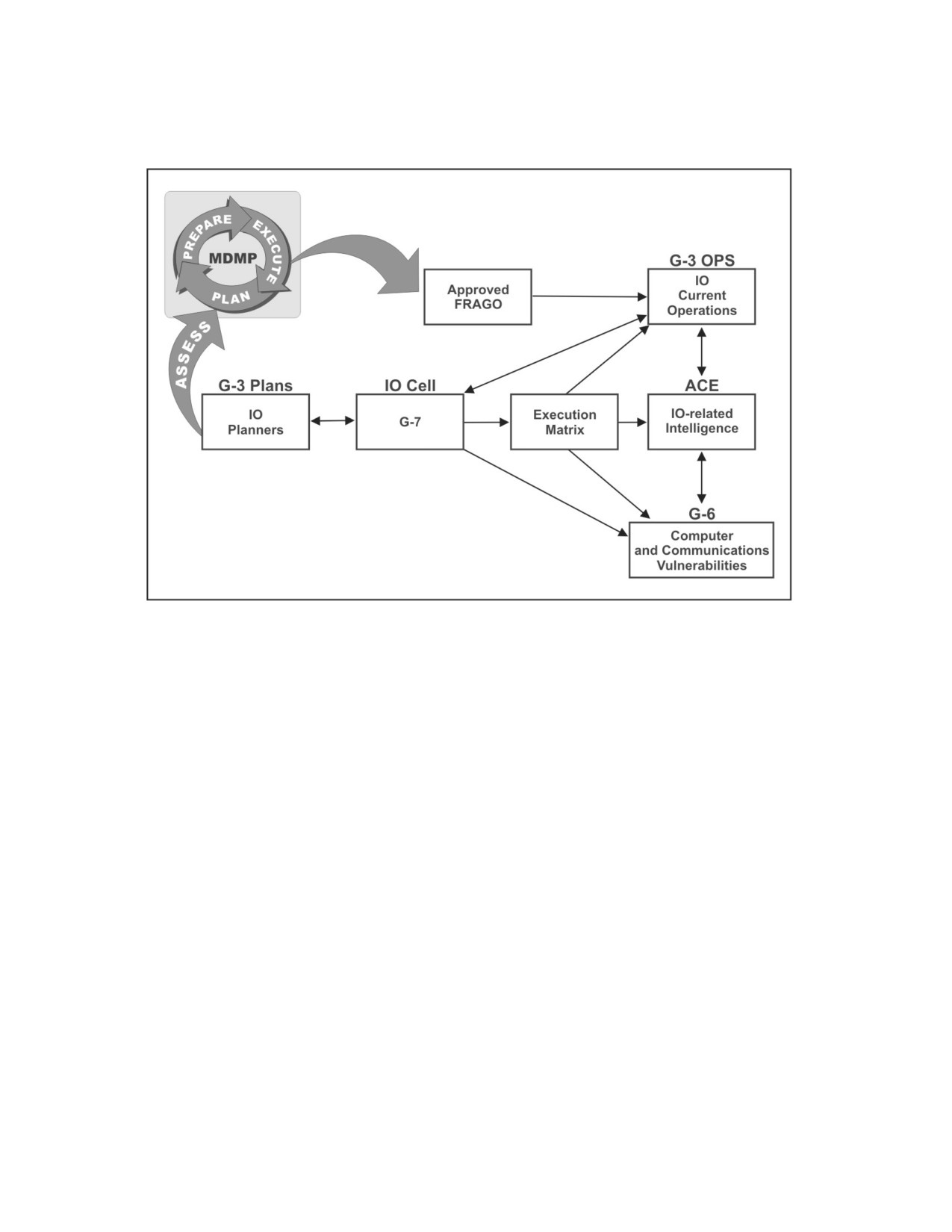
FM 3-13 __________________________________________________________________________________
Figure 7-1. Information Operations Execution at the Main Command Post
ADJUSTING INFORMATION OPERATIONS TO A CHANGING FRIENDLY SITUATION
7-27. IO will not be executed exactly as planned. Possible reasons for a vari-
ance from the plan include—
• An IO task is aborted or assets redirected.
• An IO-related target did not respond as anticipated.
• The adversary effectively countered an IO attack.
• The adversary successfully disrupted friendly C2.
• The initial plan did not identify an IO-related target/target of
opportunity.
7-28. The G-7’s challenge under these circumstances is to rapidly assess how
changes in IO execution affect the overall operation and to determine
necessary follow-on actions. Based on the commander’s input, the G-7—in
coordination with the G-2, G-3, and ACE—considers COAs, conducts a quick
COA analysis, and determines the most feasible COA.
7-29. If the selected COA falls within the decisionmaking authority of the G-3,
IO execution can be adjusted without notifying the commander. When changes
exceed previously designated limits, the G-7 obtains approval from the com-
mander. At this point, a more formal decisionmaking process may be required
before issuing a FRAGO, especially if a major adjustment to the operation order
(OPORD) is needed. In such a case, the G-7, working with the G-3, participates
in a time-constrained military decisionmaking process to develop a new COA.
7-6
____________________________________________________________ Executing Information Operations
ADJUSTING INFORMATION OPERATIONS TO AN UNEXPECTED ADVERSARY
REACTION
7-30. Adversaries may react in an unexpected manner to IO or to the overall
operation. If adversary actions diverge significantly from those anticipated when
the OPORD was written, the commander and staff look first at branch and
sequel plans. If branch or sequel plans fail to adequately address the new situa-
tion, a new planning effort may be required.
7-31. The G-7 prepares branches that modify and direct defensive IO when
adversary actions cause new friendly C2 vulnerabilities, or when friendly offen-
sive IO prove ineffective. The G-3 and ACE work with the G-7 to maintain a
running assessment of adversary capability to disrupt friendly C2, and look for
ways to lessen friendly vulnerabilities. Concurrently, they look for opportunities
to reestablish offensive IO effectiveness. Under these conditions, the G-7 deter-
mines the adequacy of existing branches and sequels. If none fit the situation,
they create a new branch or sequel and disseminate it by FRAGO.
7-32. If a new plan is needed, time available dictates the length of the decision-
making process and the amount of detail contained in an order. The G-7 may
only be able to use IO elements that can immediately affect the overall
operation: for example, physical destruction, electronic warfare, and sometimes
PSYOP. Other IO elements proceed as originally planned and are adjusted later,
unless they conflict with the new plan.
OTHER CONSIDERATIONS
7-33. Other considerations include, but are not limited to—
• IO exection begins early.
• IO delivers unanticipated results.
INFORMATION OPERATIONS EXECUTION BEGINS EARLY
7-34. A potential adversary commander begins forming a perception of a situa-
tion well before encounters with friendly forces. Recognizing this fact, command-
ers establish a baseline of IO that is practiced routinely in garrison and training.
Selected IO elements (for example, PSYOP, operations security (OPSEC), mili-
tary deception, and public affairs) may begin contributing to an IO objective well
before a deployment occurs. To support early execution of the overall operation,
IO planning, preparation, and execution frequently begins well before the staff
starts planning for an operation.
INFORMATION OPERATIONS DELIVERS UNANTICIPATED RESULTS
7-35. It is difficult to estimate how offensive and defensive IO will affect an
operation. Actions by decisionmakers, the ultimate target of IO, sometimes take
surprising turns, uncovering unanticipated weaknesses or strengths. Similarly,
friendly commanders, stressed by attacks on their C2 system, may react unex-
pectedly. Flexibility is key to success in IO execution. Effective commanders and
well-trained staffs are flexible enough to compensate for adversary IO, while ex-
ploiting both projected and unanticipated adversary vulnerabilities.
7-7