FM 3-13 Information Operations: Doctrine, Tactics, Techniques, and Procedures (NOVEMBER 2003) - page 5
FM 3-13 __________________________________________________________________________________
SUMMARY
7-36. Successful IO execution relies on teamwork by several staff sections
and rapid information exchange among them. As an operation unfolds and
the situation becomes increasingly fluid, IO objectives and tasks are modified
to exploit success and protect friendly vulnerabilities. The G-7 prepares
branches and sequels to allow the commander to rapidly adjust IO when
necessary. The G-7 also prepares to coordinate changes with other staffs and
headquarters.
7-8

Appendix A
Quick Reference to IO Input to the MDMP
This appendix lists the IO planning actions and IO products associated
with each task and subtask of the military decisionmaking process. It in-
cludes the sources of information needed for each task. Refer to chapter 5
for details. Refer to appendix B for a scenario and examples of corps-level
IO products. Refer to appendix C for an example of an IO estimate. Refer
to appendix D for an example of an IO annex.
Information
MDMP Task
Sources
G-7 Actions
G-7 Products
(Inputs)
Receipt of
• Higher HQ
• Participate in commander’s
• Input to initial IPB, in-
OPLAN/ OPORD or
initial assessment
cluding initial EEFI (OP-
Mission
deduced mission
• Receive the commander’s
SEC)
(figure B-2, page B-
initial guidance (figure B-3,
• Input to initial ISR task-
3)
page B-5)
ing (IO IRs); include IO
• Commander’s ini-
IRs concerning adversary
• Perform an initial IO as-
tial guidance (figure
sessment
capability to collect EEFI
B-3, page B-5)
(OPSEC)
• Prepare for subsequent
• IO estimate
• Submit IO IRs concern-
planning
(appendix C)
ing adversary capability to
• Allocate time to perform
collect EEFI to G-2 (OP-
tasks
SEC)
• IO input to first
WARNO; input includes
initial EEFI (figure B-4,
page B-6)
• Recommend initial
EEFI to G-2 & G-3 (OP-
SEC)
• Assemble DWG; begin
MD mission analysis (MD)
• Update IO estimate
• Allocate available time
A-1

FM 3-13 __________________________________________________________________________________
Information
MDMP Task
Sources
G-7 Actions
G-7 Products
(Inputs)
Mission
• Higher HQ
• Understand higher com-
• IO-related tasks as-
OPLAN/OPORD,
mander’s intent and concept of
signed to the unit by
Analysis—
particularly the IO
operations
higher HQ
Analyze the
annex
• Understand higher com-
Higher HQ
• Commander’s in-
mander’s AO, mission-task
Order
tent two echelons up
constraints, acceptable risk,
• Commander’s ini-
available assets
tial IO guidance
• Understand higher com-
mander’s schedule for con-
ducting operations
• Understand missions of ad-
jacent units
• Analyze the mission from an
IO perspective
• Determine IO-related tasks
assigned to the unit by higher
HQ
• Identify information needed
for IO planning
Mission
• Higher HQ IPB
• Develop IO input to the IPB
• Provide IO input to IPB
Analysis—
• Higher HQ staff
• Analyze key friendly and
products. These become
part of paragraph 2 of the
estimates
adversary leaders and deci-
Conduct IPB
sionmakers, supporting deci-
IO estimate (figure B-5,
• Higher HQ
page B-9)
OPLAN/OPORD
sionmaking processes, INFO-
SYS, and C2 systems
• Submit IO IRs to G-2
• Identify adversary IO-
• Nominations to HPTL
related capabilities and vulner-
for lethal and nonlethal at-
abilities
tack (targeting)
• Analyze friendly IO capabili-
• Refined EEFI
ties and vulnerabilities
(OPSEC)
• Identify gaps in current intel-
ligence on adversary IO
• Derive IO-related HPTs
• Describe the part of the in-
formation environment in the
commander’s battlespace and
its effect on friendly and ad-
versary IO
• Determine probable IO
COAs
• Assess the potential effects
of IO on adversary operations
• Determine additional EEFI
(OPSEC)
A-2

______________________________________________________Quick Reference to IO Input to the MDMP
Information
MDMP Task
Sources
G-7 Actions
G-7 Products
(Inputs)
Mission
• Specified and im-
• Identify specified and im-
• IO-related tasks (figure
plied IO-related
plied IO-related tasks in the
B-6, page B-11)
Analysis—
tasks from higher
higher HQ OPLAN/OPORD.
• Refined EEFI (OPSEC)
Determine
HQ OPLAN/OPORD
Specified,
• Develop IO-related implied
• Provide critical asset
|Implied, and
• IPB products
tasks
list to G-3 (figure B-6,
Essential Tasks
• Determine additional EEFI
page B-11)
(OPSEC)
• IO input to the com-
• Develop IO input to the
mand targeting guidance
command targeting guidance
• Assemble critical asset list
Mission
• Current task or-
• Identify friendly IO assets
• List of available IO as-
ganization (for IO
and resources
sets and capabilities (IO
Analysis—
assets)
estimate paragraph 2c)
Review
• Determine if available as-
(figure B-7, page B-12)
Available
• Higher HQ task
sets can perform all IO-related
Assets
organization (for IO
tasks
• Requests for additional
resources)
• Identify additional resources
IO resources, if necessary
• Status reports
(such as fire support assets)
• Unit SOP
needed to execute or support
IO
• Compare available assets
and resources to IO-related
tasks
• List of constraints on
Mission
• Commander’s ini-
• Identify constraints (re-
IO, including those that af-
tial guidance
quirements and prohibitions)
Analysis—
fect possible OPSEC
on IO, including those that af-
Determine
• Higher HQ
measures (IO annex con-
OPLAN/OPORD
fect possible OPSEC meas-
Constraints
cept of support or coordi-
ures
nating instructions) (figure
B-8, page B-13)
Mission
• Higher HQ
• Identify facts and assump-
• List of facts and as-
OPLAN/OPORD
tions affecting IO elements
sumptions pertinent to IO
Analysis—
elements (IO estimate
Identify Critical
• Commander’s ini-
• Submit IO IRs for informa-
paragraph 2) (figure B-9,
Facts and
tial guidance
tion that will confirm or dis-
prove facts and assumptions
page B-13)
Assumptions
• Observations and
reports
• Identify facts and assump-
• IO IRs for information
that will confirm or dis-
tions that regarding OPSEC
prove facts and assump-
indicators that result in OPSEC
vulnerabilities
tions
Mission
• Higher HQ
• Identify and assess hazards
• List of assessed haz-
OPLAN/OPORD
associated with IO
ards to IO
Analysis—
Conduct Risk
• IPB
• Identify OPSEC indicators
• IO input to risk as-
Assessment
• Commander’s ini-
• Assess risk associated with
sessment (figure B-10,
page B-14)
tial guidance
OPSEC indicators to deter-
mine OPSEC vulnerabilities
• List of provisional OP-
SEC measures
• Establish provisional OP-
SEC measures
A-3

FM 3-13 __________________________________________________________________________________
Information
MDMP Task
Sources
G-7 Actions
G-7 Products
(Inputs)
Mission
• IO IRs
• Determine information the
• IO IRs nominated as
commander needs to make
CCIR (figure B-12, page
Analysis—
critical IO decisions or to as-
B-16)
Determine Initial
sess IO actions
CCIR
• Identify IO IRs to recom-
mend as CCIR
Mission
• Initial IPB
• Identify gaps in information
• IO IRs for information
needed to support IO planning
needed to support IO
Analysis—
• PIRs/IO IRs
and execution and assessment
planning and execution
Prepare the
of early-initiation actions
and assessment of early-
initial ISR
initiation actions
Annex
• Confirm that the initial ISR
annex includes IO IRs con-
• IO IRs concerning ad-
cerning adversary capability to
versary capability to col-
collect EEFI
lect EEFI
Mission
• Revised G-3 time
• Determine time required to
• IO time line (provided
plan
accomplish IO objectives
to G-3), with emphasis on
Analysis—
the effect on IO of long
Plan Use of
• Compare time available to
accomplish essential IO-
lead-time events
Available Time
related tasks within the higher
HQ time line and the adversary
time line developed during IPB
• Refine initial time allocation
plan
Mission
• Initial IO mission
• Recommend possible IO
• IO-related essential
objectives for inclusion in the
tasks
Analysis—
• Initial IO objec-
restated mission
Write the
tives
• Restated IO mission
Restated
• IO objectives recom-
Mission
mended for inclusion in
the restated mission
Mission
• IO estimate
• Prepare to brief IO portion
• IO portion of mission
of mission analysis
analysis briefing (figure 5-
Analysis—
• Unit SOP
• Brief MD estimate
4, page 5-18)
Conduct
Mission
• MD estimate
Analysis
Briefing
Mission
• Restated mission
• Receive and understand the
• None
Analysis—
approved mission statement
• Mission analysis
Approve the
briefing
Restated
Mission
Mission
• Higher HQ com-
• Develop recommended IO
• Recommend IO input to
mander’s intent
input to the commander’s in-
the commander’s intent
Analysis—
• Results of mis-
tent
(figure B-14, page B-17)
Develop Initial
Commander’s
sion analysis
Intent
• IO estimate
A-4

______________________________________________________Quick Reference to IO Input to the MDMP
Information
MDMP Task
Sources
G-7 Actions
G-7 Products
(Inputs)
Mission
• Higher HQ
• Develop recommended IO
• Recommended IO input
OPLAN/OPORD
input to the commander’s
to the commander’s guid-
Analysis—
• Results of mis-
guidance
ance (figure B-15, page B-
Issue
17)
Commander’s
sion analysis
• Combine the refined EEFI
Guidance
with the provisional OPSEC
• Recommended OPSEC
• IO estimate
measures to produce the OP-
planning guidance
SEC planning guidance
• Recommended MD
guidance
• Recommended IO tar-
geting guidance
Mission
• Commander’s
• Prepare input to the warning
• Input to mission, com-
guidance and intent
order. Input may include—
mander’s intent CCIR, and
Analysis—
Develop early taskings
concept of operations (see
Issue
• Approved re-
to subordinate units
figure B-16, page B-18)
Warning Order
stated mission, re-
stated IO mission,
Initial IO mission state-
• Recommend the initial
and initial IO objec-
ment
IO mission statement
tives
OPSEC planning guid-
ance
• IO mission analy-
Reconnaissance and
sis products
surveillance taskings
MD guidance
Mission
• Commander’s
• Review IO facts and
• Updated facts and as-
guidance and intent
assumptions
sumptions
Analysis—
Review Facts
• Approved re-
• Refine initial IO mission
• Refined IO mission
and
stated mission
statement
statement
Assumptions
• IO mission analy-
• Refined OPSEC meas-
sis products
ures
COA
• IPB
• Analyze IO effects on
• Description of the po-
Develop-
friendly and adversary
tential effect of IO on the
• Task organization
capabilities, vulnerabilities, and
relative combat power,
ment—
• IO estimate
combat power
stated by IO element
Analyze
• Vulnerability as-
Relative
sessment
Combat Power
• Commander’s
• Develop different ways for
• IO concept of support
COA
guidance and intent
IO to support each COA
for each COA
Develop-
• IPB
• Determine IO elements to
• One or more MD COAs
ment—
• Adversary and
use
Generate
friendly IO assets,
• Determine how to focus IO
Options
resources, and vul-
on the overall objective
nerabilities
• Determine IO’s role in the
decisive and shaping opera-
tions of each COA
• Determine possible trade-
offs between IO and other as-
sets
• Develop MD COAs (decep-
tion stories)
A-5

FM 3-13 __________________________________________________________________________________
Information
MDMP Task
Sources
G-7 Actions
G-7 Products
(Inputs)
COA
• Restated mission
• Allocate assets for each IO
• Initial IO asset locations
concept of support
Develop-
• Commander’s in-
• Additional IO resource
tent and guidance
• Identify requirements for
requirements
ment—
Array Initial
• IPB
additional IO resources
Forces
• MD plan or con-
• Examine effect of possible
cept
MD COAs on force positioning
• Identify MD means
COA
• COAs (figure B-
• For each COA—
• For each COA—
Develop-
17, page B-22)
• Develop IO concept of sup-
• IO input work sheet
• IPB
port (figures B-18, page B-24)
containing a refined IO
ment—
• Develop IO objectives
concept of support, IO ob-
Develop
• HVTL
jectives, and IO tasks (fig-
Concept of
• IO mission state-
• Synchronize IO element ac-
ures B-19 through B-22,
Operations
ment
tions
pages B-19-32)
• Identify and prioritize offen-
• Initial IO concept of
sive and defensive IO tasks
• IO execution time line
support for each
COA
• Nominate selected HVTs as
• IO-related HPT nomi-
HPTs
nations
• Critical asset list
• Determine initial IO task
execution time line
• IO input to risk man-
• Refine IO input to risk as-
agement plan, including
sessment
residual risk associated
with each OPSEC vulner-
• Develop IO assessment
ability (figure B-24, page
plan
B-34)
• Identify additional EEFI
• Criteria of success and
• Identify and assess OPSEC
IO IRs to support IO as-
indicators to determine OP-
sessment
SEC vulnerabilities
• Additional EEFI
• Develop OPSEC measures
• OPSEC vulnerabilities
to shield OPSEC vulnerabili-
ties
• OPSEC measures (IO
tasks) to shield OPSEC
• Determine residual risk as-
vulnerabilities
sociated with each OPSEC
vulnerability after OPSEC
measures are applied (figure
B-24, page B-34)
• Determine feedback re-
quired for assessment of MD
COAs
• Conduct a risk assessment
for each MD COA
• Conduct an OPSEC analy-
sis for each MD COA
• Prepare termination
branches for each MD COA
A-6

______________________________________________________Quick Reference to IO Input to the MDMP
Information
MDMP Task
Sources
G-7 Actions
G-7 Products
(Inputs)
COA
• IPB
• Assess C2 strengths and
• Recommendations
weaknesses to determine IO-
concerning role of HQ in
Develop-
• IO estimate
related vulnerabilities of spe-
light of C2 vulnerability
ment—
• IO vulnerability
cific HQ
assessment
Recommend
assessment
• Reevaluate critical asset list
• Updated critical asset
Headquarters
• IO tasks by IO
list
element
• Initial list of assets/re-
sources to tasks assigned
COA
• COA statement
• Submit input for each COA
• Input for each COA
statement/sketch to G-3
statement/sketch
Develop-
• An IO concept of
support and IO ob-
• Prepare IO concept of sup-
• IO concept of support
ment—
jectives for each
port statement and sketch for
sketches for each COA,
Prepare COA
COA
each COA
stating the most important
Statements and
IO objectives
Sketches
COA
• COAs
• Develop evaluation criteria
• An evaluation of each
for each COA
MD COA in terms of crite-
Analysis
• IPB
ria established before the
• IO input work-
• Synchronize IO tasks per-
war game
formed by different IO ele-
sheets
ments
For each COA—
• IO execution time
• Integrate IO concept of
• An evaluation in terms
line
of criteria established be-
support into the concept of op-
fore the war game
erations for each COA
• Refined IO input work-
• Synchronize IO concept of
support with that of higher and
sheets
adjacent HQ
• Refined IO concept of
support
• Identify adversary IO
capabilities and likely actions
• Refined IO objectives
and reactions
• Refined IO tasks
• War-game friendly IO capa-
• Refined IO input to
bilities against adversary vul-
AGM and TSM
nerabilities
• IO IRs and RFIs identi-
• War-game adversary IO ca-
fied during the war game
pabilities against friendly vul-
• Refined EEFI and OP-
nerabilities
SEC vulnerabilities, and
• Synchronize and deconflict
OPSEC measures
initial IO tasks
• Paragraph 3 of the IO
• Refine targeting guidance
estimate
and HPTL
• IO input to G-3 syn-
• Synchronize and deconflict
chronization matrix
IO targets
• IO input to HPTL
• Determine whether modifi-
cations to the COA result in
additional EEFI or OPSEC
vulnerabilities; if so, recom-
mend OPSEC measures to
shield them
• Assign attack measures to
HPTs
A-7

FM 3-13 __________________________________________________________________________________
Information
MDMP Task
Sources
G-7 Actions
G-7 Products
(Inputs)
• Test OPSEC measures
• Determine decision points
for executing OPSEC meas-
ures
• Determine operational sup-
port needed for OPSEC meas-
ures
• Determine OPSEC meas-
ures needed to support possi-
ble OPSEC branches and se-
quels
• Determine whether any
OPSEC measures require ad-
dition coordination
• War-game each MD COA
• Identify each MD COA’s po-
tential branches; assess risk to
the COA
• List the most danger-
ous/beneficial branch on IO
decision support template or
IO execution matrix
COA
• COA evaluations
• Compare the COAs with
• IO advantages and dis-
from COA analysis
each other to determine the
advantages for each COA
Comparison
advantages and disadvan-
• COA evaluation
• Determine which COA
tages of each
criteria
is most supportable from
• Determine which COA is
an IO perspective
most supportable from an IO
• IO COA decision matrix
perspective
• Paragraph 4, IO esti-
• Determine if any OPSEC
mate
measures require the com-
mander’s approval
A-8

______________________________________________________Quick Reference to IO Input to the MDMP
Information
MDMP Task
Sources
G-7 Actions
G-7 Products
(Inputs)
• Results from COA
• Provide IO input to COA
• Finalized IO concept of
COA
comparison
recommendation
support for approved COA
Approval
• Recommended
• Reevaluate IO input to the
• Finalized IO objectives
COA
commander’s guidance and in-
and IO tasks based on
tent
approved COA
• Refine IO concept of sup-
• IO input to WARNO
port, IO objectives, and IO
(figure B-25, page B-36)
tasks for approved COA and
• IO execution matrix
develop associated IO execu-
tion matrix
• Prepare IO input to the
WARNO
• Participate in COA decision
briefing
• Recommend COA that IO
can best support
• Request decision on
executing any OPSEC meas-
ures that entail significant
resource expenditure or risk
• Approved COA
• Ensures IO input (such as,
• IO synchronization ma-
Orders
EEFI and IO tasks to subordi-
trix
• Refined com-
Production
mander’s guidance
nate units) is placed in base
• IO subparagraph to
OPLAN/OPORD
• Refined com-
base OPLAN/ OPORD
mander’s intent
• Finalize IO annex
• IO annex
• IO estimate
• Coordinate IO objectives
• IO input to the AGM
and tasks (including OPSEC
• IO execution ma-
and TSM
measures) with IO element
trix
• MD appendix to IO an-
staff officers
nex
• Finalized IO mis-
• Conduct other staff coordi-
sion statement, IO
nation
concept of support,
• Refine IO execution matrix
IO objectives, and
IO tasks
A-9
Appendix B
Information Operations Scenario
This appendix contains sample corps-level information operations (IO)
products based on a notional scenario. The products and tasks it outlines
apply during war and military operations other than war. The products
are illustrated in the order they are developed during the military deci-
sionmaking process (MDMP). (Appendix A lists G-7 actions and products
associated with each MDMP task. Appendix D includes an example IO
annex based on this scenario. Appendix G includes an example of an IO-
focused fragmentary order based on this scenario.) The products illus-
trated are examples only and are not intended to be authoritative or pre-
scriptive. They contain the minimum information needed to show how to
develop an IO concept of support. They are not intended to be complete.
General Scenario
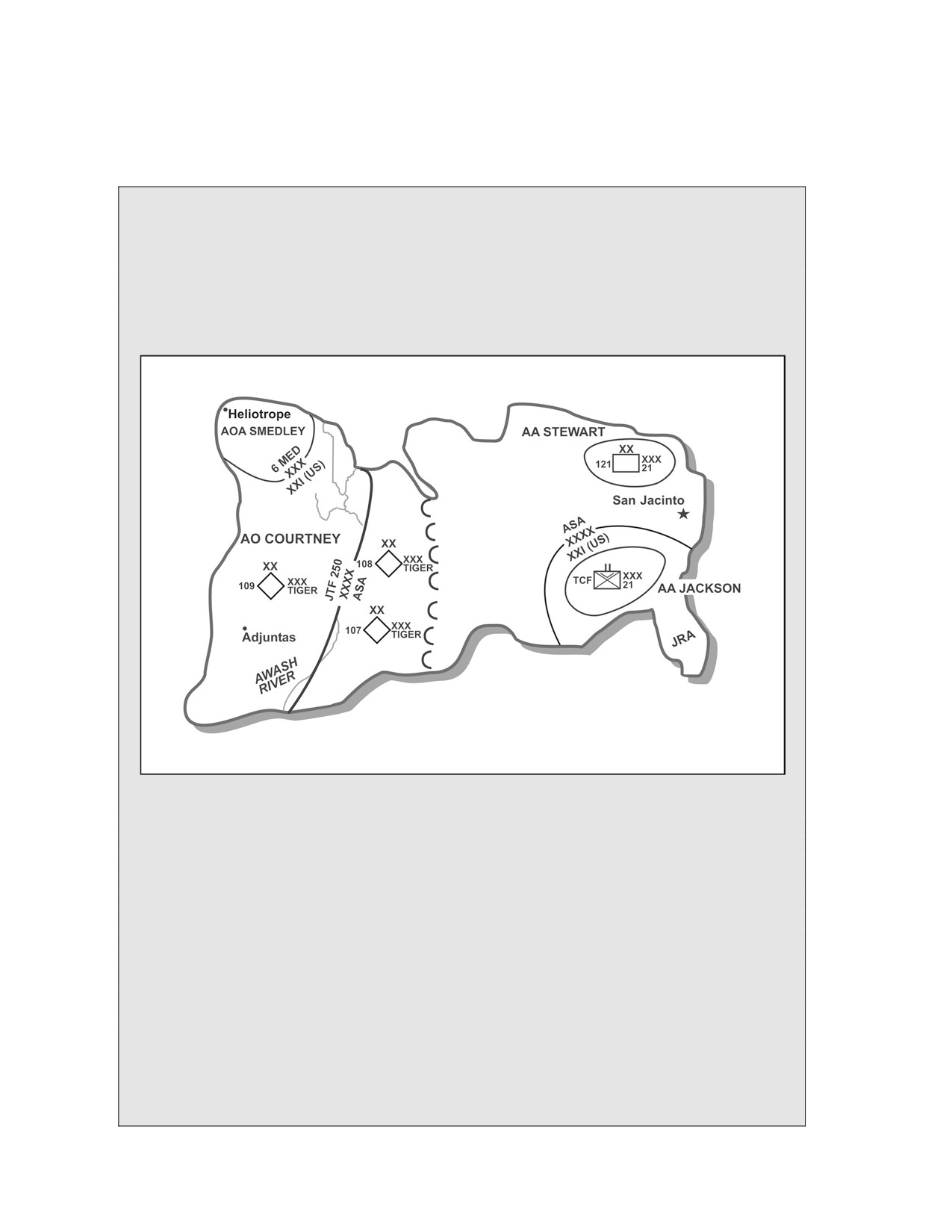
Six months ago, the nation of Rendova invaded its smaller neighbor, the Republic of
San Anglos (see figure B-1, page B-2). Both San Anglos and Rendova have had ties to
the United States since the Spanish-American War. San Anglos is an island approxi-
mately 300 kilometers east to west and 200 kilometers north to south. The Strait of
Dawaro, which is 45 kilometers wide, separates it from Rendova, The western half of
San Anglos has a significant ethnic Rendovan minority. Most work as laborers, al-
though some are middle class. Rendova used alleged exploitation of this minority to
justify its invasion and has drawn significant support from it.
The stated Rendovan war aim is to “liberate” the ethnic Rendovans in western San An-
glos. However, Rendovan actions make it appear that they intend to conquer the entire
island. The Army of San Anglos (ASA) was able to stop the Rendovan advance and
stabilize the front after two months of fighting. Rendovan forces occupy the western
CONTENTS
MDMP TASK 1-Receipt of Mission
B-3
MDMP TASK 5-COA Comparison
B-36
MDMP TASK 2-Conduct Mission
MDMP TASK 6-COA Approval
B-36
Analysis
B-8
MDMP TASK 7-Orders
MDMP TASK 3-COA Development .. B-21
Production
B-38
MDMP TASK 4-COA Analysis
B-35
Execution and Assessment
B-38
B-1
FM 3-13 __________________________________________________________________________________
third of San Anglos. The ASA controls the rest. Rendova is now talking in terms of par-
titioning San Anglos and annexing the territory it now holds. The Government of San
Anglos does not consider partition acceptable. It believes it can expel the Rendovan in-
vaders. However, the Government believes that the longer Rendovan forces remain,
the harder it will be to expel them.
Figure B-1. Joint Operations Area SAN ANGLOS
The ASA is well trained and has participated in exercises with US forces. It could
probably reoccupy western San Anglos unassisted; however, its leaders believe that
such an action would require extended fighting and result in destruction of the industry
and infrastructure. San Anglos also lacks the maritime capability to block reinforce-
ments from Rendova. Therefore, 45 days ago, San Anglos requested US assistance.
The Government of San Anglos believes that the US capability to conduct rapid land
operations, combined with US sea power, will allow the ASA to quickly overwhelm
Rendovan forces and reestablish San Anglos control of the occupied territory. The US
President authorized the geographic combatant commander responsible for the area to
create and deploy Joint Task Force (JTF) 250 to conduct coalition operations with San
Anglos forces. For political reasons, the coalition force has a parallel command struc-
ture. A coalition coordination, communications, and integration center (C3IC) is coordi-
nating the operations of JTF 250 and San Anglos forces. Several JTF IO, including psy-
chological operations (PSYOP) and a military deception (MD) operation, are underway.
B-2
_____________________________________________________________ Information Operations Scenario
MDMP TASK 1—RECEIPT OF MISSION
B-1. When a mission is received or deduced, the commander and staff con-
duct an initial assessment. The commander issues initial guidance and the
staff prepares and issues a warning order (WARNO). The JTF 250 operation
order (OPORD) illustrated in figure B-2 contains the initial instructions to
XXI Corps.
[Heading information omitted]
HEADING/TASK ORGANIZATION//
/UNITDES
/UNITLOC
/CMNTS
XXI CORPS
SAN ANGLOS
ARFOR
1ST AEF
SAN JACINTO
AFFOR
COMBATGRU16
STRAIT OF DAWARO
NAVFOR
6TH MEB
AFLOAT
MARFOR
GENTEXT/SITUATION/
1. GENERAL SITUATION.
A. ENEMY FORCES. The invasion force is the Rendovan Tiger Corps, consisting of
three motorized divisions, the 107th, 108th, and 109th. Two divisions face the ASA along
the line of contact. The third occupies the conquered territory. Tiger Corps has estab-
lished defensive positions and is awaiting reinforcements from the port of
RSOSCHKOSH. Rendovan propaganda is emphasizing alleged US “neocolonialism” and
condemning the leaders of San Anglos as “campradore collaborators.”
B. FRIENDLY FORCES. ASA attacks D-day, H-hour to destroy the 107th and 108th
Divisions; links up with XXI Corps vicinity AWASH River; prepares to assume control of
AO COURTNEY and AOA SMEDLEY.
GENTEXT/MISSION/
2. JTF 250 attacks D-day, H-hour to clear AO COURTNEY and restore the territorial in-
tegrity of San Anglos; seize HELIOTROPE and clear AOA SMEDLEY to prevent move-
ment of Rendovan reinforcements into San Anglos; links up with ASA vicinity AWASH
River; assists Government of San Anglos in reestablishing order and basic services; on
order passes control of AO COURTNEY and AOA SMEDLEY to ASA.
GENTEXT/EXECUTION/
3. CONCEPT OF OPERATIONS.
A. Phase I: NAVFOR/6th MEB conducts amphibious assault to seize HELIOTROPE
and clear AOA SMEDLEY. XXI Corps clears AO COURTNEY; links up with ASA vicinity
of the AWASH River; links up with 6th MEB. The coalition decisive operation is the ASA
attack. The JTF 250 decisive operation is the XXI Corps operation. The end state is the
destruction or capture of all Tiger Corps forces.
B. Phase II: JTF 250 supports San Anglos civil authorities restoring order and civil
services.
Figure B-2. Joint Task Force 250 Operation Order
B-3
FM 3-13 __________________________________________________________________________________
C. Phase III: JTF 250 passes control of AO COURTNEY/AOA SMEDLEY to ASA.
D. Military Deception. JTF 250 deception story is that JTF forces will conduct an
amphibious and air assault to seize RSOSCHKOSH and secure a beachhead for follow-
on operations by XXI Corps forces using northern San Anglos as a staging area.
4. ARFOR.
A. Phase I.
(1) Clear AO COURTNEY.
(2) Link up with ASA forces vicinity AWASH River.
(3) Link up with 6th MEB vicinity HELIOTROPE.
(4) Provide IO support to 6th MEB for amphibious assault.
(5) Assume JFLCC responsibilities upon linkup with 6th MEB.
B. Phase II: Support Government of San Anglos in restoring order and civil services
in AO COURTNEY and AOA SMEDLEY.
C. Phase III: Pass control of AO COURTNEY and AOA SMEDLEY to ASA.
D. Military Deception. Portray preparation for air assault of RSOSCHKOSH to sup-
port the JTF 250 deception story.
5. AFFOR (all phases).
A. Gain and maintain air superiority.
B. Prevent air movement of Rendovan forces and supplies from RSOSCHKOSH to
HELIOTROPE.
C. Support coalition ground operations with CAS and intratheater logistics.
D. Maintain control of air lines of communications.
E. Assume JFACC responsibilities upon linkup with 6th MEB.
6. NAVFOR (all phases).
A. Conduct sea control operations in Strait of Dawaro.
B. Prevent sea movement of Rendovan forces and supplies from RSOSCHKOSH to
HELIOTROPE.
C. Portray preparations for amphibious assault of RSOSCHKOSH.
D. Support MARFOR amphibious assault of HELIOTROPE.
E. Support coalition ground operations with logistics.
F. Maintain control of sea lines of communications.
G. Transfer control of 6th MEB to ARFOR upon linkup with XXI Corps.
Figure B-2. Joint Task Force 250 Operation Order (continued)
B-4
_____________________________________________________________ Information Operations Scenario
7. MARFOR.
A. Conduct amphibious assault to seize HELIOTROPE to prevent its use by Rendo-
van reinforcements from RSOSCHKOSH.
B. Clear AOA SMEDLEY.
C. Link up with XXI Corps. CHOP from NAVFOR to JFLCC at linkup.
8. COORDINATING INSTRUCTIONS.
A. The name of this operation is FRIED ANCHOR.
B. This OPORD is effective for planning upon receipt and execution in 72 hours.
C. Do not execute PSYOP or EW on frequencies that might cause interference with
local civil communications.
D. Minimize damage to civilian infrastructure.
E. Maintain support of the local populace.
GENTEXT/ADMIN AND LOG/
9. [omitted]
GENTEXT/COMMAND AND SIGNAL/
10. [omitted]
AKNLDG/Y//
DECL/OADR//
Figure B-2. Joint Task Force 250 Operation Order (continued)
INITIAL ASSESSMENT AND COMMANDER’S INITIAL GUIDANCE
B-2. When the commander and staff have finished their initial assessment,
the commander issues initial guidance. The XXI Corps commander issues the
initial guidance in figure B-3.
H-hour is in 72 hours. That gives us time to do a full-blown MDMP. I want to issue
the OPORD in 24 hours. Give me a mission analysis briefing in 6 hours. Plan to begin
the war game in 12 hours.
Make sure our ASA and 6th MEB liaison teams have everything they need.
G-2, identify the locations of the 107th and 108th Division reserves. Locate any battal-
ion-sized 109th Division concentrations. G-3, initiate reconnaissance to fill gaps left
by higher-level assets. Avoid any operations that would reveal the XXI Corps mission.
Minimize any movements. I want to execute from our current locations if possible.
Figure B-3. XXI Corps Commander’s Initial Guidance
B-5
FM 3-13 __________________________________________________________________________________
When movements are necessary, conceal them or portray them as preparations for an
air assault on RSOSCHKOSH.
G-3, plan the operation as an air assault by the 121st Division. Consider both a single
and a double envelopment. I don’t want to overfly the ASA FLOT.
FSCOORD, find out what JFACC and NAVFOR can do for us in the JSEAD area. An
air assault will take unacceptable losses without their support, and we need them to
reinforce our artillery once we’re on the ground. We are the JTF decisive operation,
and we need their help on this one.
G-5, focus your planning on Phase II. G-3, I want a seamless transition from offensive
to support operations. G-7, support him with PSYOP and any other IO assets and re-
sources you can muster. I want to minimize civilian casualties. G-5, G-7, look at ways
to make this happen.
G-7, give me a recommendation on when to shift resources from the MD operation to
the air assault. I want to achieve operational surprise, but I also need as many of
those resources as I can get for the air assault. Look at ways to portray the objective of
the air assault as RSOSCHKOSH. Coordinate this with NAVFOR.
G-7, IO is key to our success. We need to achieve surprise and we need to be able to
talk. You have the lead on both of those tasks. Focus on the 109th Division, but look at
the entire Tiger Corps C2 system. Coordinate any IO that might affect ASA operations
through the C3IC. Here are the initial EEFI:
• The XXI Corps mission and concept of operations.
• The identity and locations of the XXI Corps critical C2 system nodes.
• The identity and locations of the TAC and main CPs of the XXI Corps, its subordi-
nate divisions, the Corps Artillery and the Corps Support Command.
• The location of the INFOSYS nodes for 21st CAB CP and its subordinate battalion
CPs.
Figure B-3. XXI Corps Commander’s Initial Guidance (continued)
WARNING ORDER
B-3. Based on the initial assessment and initial guidance, the XXI Corps staff
issues the WARNO illustrated in figure B-4.
[heading omitted]
WARNING ORDER 21-01
References. JTF 250 OPORD 01, DTG; [map sheets]; operation overlay [see figure B-1,
page B-2]
Time Zone Used throughout the Order: Zulu
Figure B-4. First XXI Corps Warning Order (extract)
B-6
_____________________________________________________________ Information Operations Scenario
Task Organization.
121st ID
21st Signal Bde
Corps Artillery
21st CAB
27th ACR
1st Bn, 19th PSYOP Grp
21st MI Bde
365th CA Bde
21st Public Affairs Det
1. SITUATION.
a. Enemy forces. Tiger Corps controls the western third of San Anglos. Two divi-
sions (the 107th and 108th) face ASA forces. One (the 109th) serves as the occupation
force for western San Anglos.
b. Friendly forces. ASA attacks D-day, H-hour to destroy Tiger Corps along the line
of contact; links up with XXI Corps vicinity AWASH River. 6th MEB conducts amphibious
assault to seize HELIOTROPE to prevent Rendovan reinforcement from
RSOSCHKOSH; clears AOA SMEDLEY; links up with XXI Corps. Coalition decisive op-
eration is ASA attack. JTF 250 decisive operation is XXI Corps operations. JFACC and
NAVFOR support XXI Corps with JSEAD, AI, and CAS.
c. Attachments and detachments. [omitted]
2. MISSION. TBD.
3.EXECUTION.
Intent. TBD.
a. Concept of operations. XXI Corps conducts air assault D-day, H-hour to seize
forward operating bases in western San Anglos; clears AO COURTNEY; links up with
ASA vicinity AWASH River; links up with 6th MEB; supports Government of San Anglos
in restoring order and civil services.
b. Tasks to maneuver units.
(1) [Initial movement and reconnaissance instructions are omitted.]
(2) 121st ID. Prepare to execute air assault and clear AO COURTNEY.
c. Tasks to combat support units.
(1) [Initial movement and reconnaissance instructions are omitted.]
(2) 21st CAB. Prepare to support air assault by 121st ID.
(3) 365th CA Bde. Prepare to assist San Anglos civil authorities in reestablishing
order and services in AO COURTNEY and AOA SMEDLEY.
d. Coordinating instructions.
(1) Initial Time Line. H-hour is DTG [72 hours from receipt of JTF OPORD]; ex-
pect OPORD by DTG [24 hours from receipt of JTF OPORD]; rehearsal will be held at
[location] at DTG.
(2) EEFI.
(a) The XXI Corps mission and concept of operations.
Figure B-4. First XXI Corps Warning Order (extract) (continued))
B-7
FM 3-13 __________________________________________________________________________________
(b) The identity and locations of the XXI Corps critical C2 system nodes.
(c) The identity and locations of the TAC and main CPs of the XXI Corps, its
subordinate divisions, the Corps Artillery, and the Corps Support Command.
(d) The location of the INFOSYS nodes for 21st CAB CP and its subordinate bat-
talion CPs.
(3) Deception guidance.
(a) Continue current MD operations.
(b) Conceal all movements or portray them as preparations for an air assault on
RSOSCHKOSH.
(4) Risk guidance. [omitted]
4. SERVICE SUPPORT. [omitted]
5. COMMAND AND SIGNAL. [omitted]
ACKNOWLEDGE: [authentication omitted]
Figure B-4. First XXI Corps Warning Order (extract) (continued))
MDMP TASK 2—CONDUCT MISSION ANALYSIS
B-4. During mission analysis, staffs define the tactical problem and begin to
determine feasible solutions. Mission analysis produces the restated mission,
initial commander’s intent, commander’s guidance, and at least one WARNO.
The G-7 ensures each of these products considers IO factors and provides IO
input to the other tasks. The major G-7 mission analysis products are the ini-
tial IO mission statement and an updated IO estimate.
Mission Analysis Tasks
• Analyze the higher headquarters order
• Determine the initial ISR annex
• Conduct IPB
• Plan use of available time
• Determine specified, implied, and
• Write the restated mission
essential tasks
• Conduct a mission analysis briefing
• Review available assets
• Approve the restated mission
• Determine constraints
• Develop the initial commander’s intent
• Identify critical facts and assumptions
• Issue the commander’s guidance
• Conduct risk assessment
• Issue a warning order
• Determine initial CCIR
• Review facts and assumptions
ANALYZE HIGHER HEADQUARTERS ORDER
B-5. Mission analysis begins with a thorough examination of the XXI Corps
OPORD in light of the commander’s initial guidance. There is no formal IO
product for this task. Its purpose is for all to obtain a clear understanding of
the mission and information relating to it, especially the higher commander’s
intent.
B-8
_____________________________________________________________ Information Operations Scenario
CONDUCT INITIAL INTELLIGENCE PREPARATION OF THE BATTLEFIELD
B-6. The G-7 provides IO input, including IO-related high-value targets, to
the G-2 for intelligence preparation of the battlefield (IPB). The portions of
IPB relating to IO become parts of paragraph 2 of the IO estimate (see figure
B-5).
2. SITUATION AND CONSIDERATIONS.
a. Characteristics of the AO and information environment.
(1) Weather. Storms that would preclude air assault operations are infrequent at
this time of year.
(2) Terrain and physical environment. [omitted]
(3) Information environment.
(a) Intense media interest in JTF 250 operations exists due to the long-standing
relationship between the US and both Rendova and San Anglos. International media
presence on San Anglos is steadily increasing.
(b) San Anglos has a free press. Hard-hitting investigative reporting is valued.
(c) Most San Anglos homes have radios. Virtually all citizens have access to
televisions. San Anglos is within the broadcast footprint of major Rendovan radio and
television outlets. San Anglos broadcast media continue to operate.
(d) San Anglos has allowed most foreign journalists into the country.
(4) Probable adversary picture of friendly forces. [omitted]
b. Enemy Forces. The major force opposing XXI Corps is the 109th Division of the
Tiger Corps. The 107th and 108th Divisions face the ASA. The 109th Division is the oc-
cupation force for western San Anglos. It is widely dispersed, with no force concentration
larger than a battalion. The brigade-sized reserves of the 107th and 108th Divisions are
close enough to AO COURTNEY to be employed against XXI Corps.
(1) Decisionmakers and decisionmaking process. Commander, Tiger Corps is
the deception target. He must be made to believe that the ASA will continue to defend
and that XXI Corps is preparing to exploit an amphibious assault on RSOSHKOSH.
(2) INFOSYS strengths and vulnerabilities. Critical Rendovan C2 systems and
ISR nodes include the CPs of the Tiger Corps and its divisions; artillery-associated ra-
dars and target processing systems; ground control stations for the divisional UAV com-
panies; and divisional signal nodes (primarily line-of-sight and troposcatter multichannel
systems, and their control centers).
(3) IO capabilities, dispositions, composition, and strengths.
(a) Tiger Corps and its divisions receive operational-level intelligence and target-
ing support from Special Purpose Forces and agents.
(b) 409th Radio Electronic Combat (REC) Battalion (109th Division) can detect,
locate, and jam AM and FM radio communications in the HF-VHF frequency bands.
Figure B-5. Paragraphs 2a and 2b, Information Operations Estimate
B-9
FM 3-13 __________________________________________________________________________________
109th REC battalion can conduct CNA. Each division also has an organic REC company
with similar capabilities minus CNA.
(c) 409th Public Information Company (109th Division) can produce and dissemi-
nate propaganda. Brigades do not have a similar capability.
(d) Rendovan ISR capabilities are robust, multidiscipline, and multispectral. They
consist of both ground-based and airborne systems comparable to those of Western
European nations.
(e) Tiger Corps is supported by a sophisticated fire support capability, including
tube artillery and an attack helicopter battalion. The brigades of its divisions have 120
mm mortars. Each division has an artillery battalion with medium-range, self-propelled
cannon and a multiple rocket launcher battery. The 109th Division’s artillery and multiple
rocket launchers are supporting the 107th and 108th Divisions. The 109th Division’s bri-
gades retain control of their mortars.
(f) HVT are corps, division, and brigade CPs, and supporting communications
nodes; air defense- and artillery-associated radars, and target-processing systems; REC
assets; and the local civilian populace.
(g) The Rendovans are adept at using the national and international media to ex-
ploit political and military actions for their propaganda potential.
(h) Rendovan air defense is highly sophisticated; has excellent, redundant
INFOSYS; and has very good long-range, low-altitude detection capabilities. Its highly
centralized command structure is its most significant weakness.
(4) Likely IO COAs.
(a) COA #1—Most likely. Tiger Corps commander is surprised by the air assault.
He reacts by counterattacking with one or both of the frontline divisions’ reserves.
(b) COA #2—Most dangerous. Tiger Corps commander discovers the deception
plan and prepares to defeat the air assault. Plans could include positioning artillery, air
defense, and ground forces to attack possible LZs, and making arrangements to flood
LZs with dislocated civilians.
Figure B-5. Paragraphs 2a and 2b, IO Estimate (continued)
B-7. The G-7 examines the results of the initial IPB to determine the critical
nodes of the Tiger Corps C2 system. These may include command posts,
(CPs) C2 system nodes, networks, and information systems (INFOSYS) criti-
cal to the Tiger Corps and 109th Division commanders’ decisionmaking proc-
esses. The analysis identifies information gaps. The G-7 submits IO informa-
tion requirements (IRs) to fill these gaps to the G-2. The G-7 also requests
information on Tiger Corps intelligence, surveillance, and reconnaissance
(ISR) assets to better determine enemy capabilities and vulnerabilities that
may affect the air assault. This information includes Tiger Corps’s ability to
collect and exploit information from the XXI Corps C2 system and Tiger
Corps air defense systems’ ability to counter JTF electronic warfare (EW) ca-
pabilities. IO-cell members—especially the PSYOP, civil-military operations
(CMO), and public affairs (PA) representatives—identify how best to influ-
ence the attitudes and actions of the civilian populace in the area of
B-10
_____________________________________________________________ Information Operations Scenario
operations (AO). This effort results in additional IO IRs concerning target
audience analysis for PSYOP. These are submitted to the G-2. As answers to
these IO IRs arrive, they are added to paragraph 2 of the IO estimate.
DETERMINE SPECIFIC, IMPLIED, AND ESSENTIAL TASKS
B-8. Concurrently with the initial IPB, the staff analyzes the JTF OPORD to
identify specified, implied, and essential tasks assigned to XXI Corps. Some
of these tasks may require IO to accomplish. For the G-7, this task comprises
identifying these IO-related specified tasks in the higher headquarters
OPORD, developing IO-related implied tasks that support accomplishing the
mission, and assembling the critical asset list (see figure B-6).
IO-Related Specified Tasks
• Portray preparation for an air assault of RSOSCHKOSH.
• Provide IO support to 6th MEB for amphibious assault.
•
(Essential task) Support Government of San Anglos in restoring order and civil ser-
vices in AO COURTNEY and AOA SMEDLEY.
IO-Related Implied Tasks
• Prevent compromise of the operation.
• Protect XXI Corps C2.
• Disrupt Tiger Corps and 109th Division ADA, ISR, C2, and targeting systems during
critical periods of the operation.
•
Minimize civilian interference in AO COURTNEY.
Critical Asset List
•
Corps area common-user network (voice and data).
•
Tactical-to-strategic theater communications interface points.
•
UAV-SR (Hunter).
•
Quick Fix.
•
Guardrail.
Figure B-6. Information-Operations-Related Tasks and Critical Assets
B-9. One of the IO-related tasks assigned to XXI Corps is, Portray prepara-
tion for an air assault of RSOSCHKOSH. This task supports the JTF decep-
tion operation. The JTF deception operation targets Rendovan national deci-
sionmakers. It is attempting to convince them that the US is using San An-
glos as a staging area for an invasion of Rendova that will be spearheaded by
the 6th Marine Expeditionary Brigade (MEB), which is off shore in the Strait
of Dawaro. It is supported by a national-level PSYOP campaign that is em-
phasizing the US President’s “desire to strike at the root of the problem” (by
invading Rendova itself), “rather than nibbling around the edges” (conduct-
ing combat operations on San Anglos). The XXI Corps military deception
(MD) operation is complementing the JTF and national deception operations
by portraying XXI Corps as preparing for an air assault across the Strait of
Dawaro. Convincing the Tiger Corps and 109th Division commanders that
this portrayal is the actual situation is an MD task that supports the IO-
B-11
FM 3-13 __________________________________________________________________________________
related implied task, Prevent compromise of the operation. The military de-
ception officer (MDO) is responsible for overseeing the corps MD operation
and synchronizing it with the JTF deception operation. MD planning pro-
ceeds concurrently with planning for the overall operation.
B-10. Supporting the Government of San Anglos in restoring order and civil
services in AO COURTNEY and AOA SMEDLEY is mainly a CMO task. How-
ever, it might involve such IO elements/related activities as public affairs
and PSYOP. The G-7 and G-5 coordinate IO aspects of this task with the G-3.
REVIEW AVAILABLE ASSETS
B-11. From the JTF order, the G-7 identifies joint assets in the task organiza-
tion that might be available for IO support to XXI Corps. The G-7 also re-
views the XXI Corps standing operating procedure (SOP) to identify available
assets and resources that can be employed in an IO role. These resources
form subparagraphs 2c(2) and (3) of the IO estimate (see figure B-7).
2. SITUATION AND CONSIDERATIONS.
a. Characteristics of the area of operations and information environment.
[omitted; see figure B-5, page B-9]
b. Enemy Forces [omitted; see figure B-5, page B-9].
c. Friendly Forces.
(1) IO concept of support to each COA. [developed during COA development].
(2) Current status of IO assets.
(a) EW.
(i) 21st MI Bde.
(ii) 21st Signal Bde.
(b) PSYOP.
(i) XXI Corps PSYOP Support Element.
(ii) 1st Battalion, 19th PSYOP Grp.
(c) PA.
(i) XXI Corps PAO.
(ii) 21st PA Det.
(d) Physical destruction.
(i) XXI Corps maneuver units.
(ii) XXI Corps Artillery.
(iii) 21st CAB.
(e) CMO. 365 CA Bde.
(3) Current status of IO resources.
(a) Special Operations Command and Control Element (SOCCE) liaison team.
(b) 1st Information Operations Command (Land).
(i) Field support team (attached).
(ii) Vulnerability assessment team (attached).
Figure B-7. Paragraph 2c, IO Estimate—IO Asset and Resources Identification
B-12

_____________________________________________________________ Information Operations Scenario
(c) JFACC.
(i) EW [list support available].
(ii) PSYOP [list support available]
(iii) Physical destruction [list support available].
(d) MARFOR.
(i) EW [list support available]
(ii) Physical destruction [list support available]
d. OPSEC. [omitted]
e. Assumptions. [omitted; see figure B-9, page B-13]
Figure B-7. Paragraph 2c, IO Estimate—IO Asset and Resources Identification (continued)
DETERMINE CONSTRAINTS
B-12. The G-7’s review of the JTF order also produces a list of constraints
that may affect IO (see figure B-8). These are placed in either the IO concept
of support or coordinating instructions of the IO annex.
• Maintain support of the local populace
• Minimize damage to the civilian infrastructure
• Do not execute PSYOP or EW on frequencies that might cause interference with
local civil communications
Figure B-8. Constraints Affecting IO
IDENTIFY CRITICAL FACTS AND ASSUMPTIONS
B-13. Throughout mission analysis, the G-7 identifies critical IO-related facts
and assumptions. Facts are placed in the subparagraph of the IO estimate
that that concerns them (usually 2a, 2b, or 2c). Assumptions are placed in
subparagraph 2e. Figure B-9 shows the assumptions the G-7 makes based on
the initial analysis of the JTF order and XXI Corps AO.
2. SITUATION AND CONSIDERATIONS.
a. Characteristics of the AO and information environment. [omitted; see figure B-5,
page B-9].
b. Enemy Forces. [omitted; see figure B-5, page B-9]
c. Friendly Forces. [omitted; see figure B-7, page B-12].
d. OPSEC. [omitted; determined during risk assessment]
e. Assumptions.
Figure B-9. Paragraph 2d, IO Estimate—IO-Related Assumptions
B-13

FM 3-13 __________________________________________________________________________________
(1) Rendovan forces will take advantage of friendly ROE and constraints con-
cerning civilian casualties, and will attempt to employ dislocated civilians to block LZs
and clog maneuver routes in the objective area.
(2) JSEAD support from JTF air and naval assets will be available and effective.
(3) Rendovan IO-associated capabilities will attack key XXI Corps communica-
tions and ISR systems/nodes in an effort to degrade friendly C2 and intelligence at criti-
cal points in the operation.
Figure B-9. Paragraph 2d, IO Estimate—IO-Related Assumptions (continued)
CONDUCT RISK ASSESSMENT
B-14. During mission analysis, the G-7 assesses primarily OPSEC- and C2-
related hazards. The G-7 uses the technique that FM 100-14 prescribes for
assessing hazards associated with tactical risk to assess these hazards. Fig-
ure B-10 shows an extract of an example of the work sheet the G-7 used to
assess OPSEC- and C2-related hazards.
Mission: TBD. Concept of operations: XXI Corps conducts air assault D-day, H-hour to seize forward operating bases
in western San Anglos; clears AO COURTNEY; links up with ASA vicinity AWASH River; links up with 6th MEB; sup-
ports Government of San Anglos in restoring order and civil services.
1
2
3
4
5
6
EEFI/C2
OPSEC/C2
Assess
Develop
Determine
Implement
Category/Critical
Vulnerability
Hazards
Controls
Residual
Controls
Asset
Risk
[List means the
[List controls
[List residual
G-7 will use to
[EEFI] The XXI Corps
[List associated
[Assess each
to reduce the
risk associated
assess the suc-
mission and concept of
OPSEC vulnerabili-
OPSEC
risk associ-
with each
cess of con-
operations
ties]
vulnerability]
ated with each
OPSEC vulner-
trols. Include IO
vulnerability]
ability]
IRs, if any]
[List means the
[C2-related] Tactical-to-
[List residual
G-7 will use to
[List controls
strategic theater com-
[List associated
[Assess each
risk associated
assess the suc-
for each haz-
munications interface
hazards]
hazard]
with each haz-
cess of con-
ard]
points
ard]
trols. Include IO
IRs, if any]
[List means the
[List residual
G-7 will use to
[List controls
[Critical asset] UAV-SR
[List associated
[Assess each
risk associated
assess the suc-
for each haz-
(Hunter)
hazards]
hazard]
with each haz-
cess of con-
ard]
ard]
trols. Include IO
IRs, if any]
Figure B-10. Initial Assessment of IO-Related Hazards (extract)
B-15. Column 1 lists the essential elements of friendly information (EEFI),
C2 systems, and critical assets that the G-7 has identified. Using the OPSEC
process, the G-7 identifies OPSEC vulnerabilities associated with each EEFI
element. In coordination with the G-3 and G-6, the G-7 determines the
hazards that could cause the loss of each INFOSYS/critical asset. These are
listed in column 2. The G-7 uses a risk assessment matrix similar to the one
at figure B-11, page B-15, to estimate the chance of a hazard incident
B-14

_____________________________________________________________ Information Operations Scenario
occurring if no controls other than those established by SOP are implement-
ed. That probability and the severity of an incident determine the risk as-
sociated with each hazard. That risk is entered in Column 3 for each hazard.
B-16. The following paragraphs describe the logic the G-7 followed in assess-
ing one EEFI element and one C2-related vulnerability.
• Compromise of the XXI Corps mission and concept of opera-
tions could result in a loss of surprise. The G-3 estimates that this sit-
uation could result in mission failure (a catastrophic effect). Following
the OPSEC process, the G-7 identifies OPSEC indicators that could re-
veal this information and determines which of them Tiger Corps is ca-
pable of acquiring. These are OPSEC vulnerabilities. With G-2 assis-
tance, the G-7 estimates the likelihood that Rendovan ISR operations
will acquire each vulnerability. The G-2 and G-7 then estimate the
probability that the Rendovan intelligence system will acquire and
process enough of the vulnerabilities to deduce the corps mission and
concept of operations. The G-7 uses that estimate to enter the risk as-
sessment matrix and determine the risk associated with this EEFI
element.
• Tactical-to-strategic theater communications interface points
have been designated as critical C2 assets. With the G-6, the G-7 esti-
mates the effect that losing each node or system would produce. With
the G-2, the G-7 estimates the likelihood of each being lost. Based on
these two estimates, the G-7 determines the overall risk to this system.
Severity of Hazard
Probability of Hazard Incident Occurring
Incident
Frequent
Likely
Occasional
Seldom
Unlikely
Catastrophic
E
E
H
H
H
Critical
E
H
H
M
L
Marginal
H
M
M
L
L
Negligible
M
L
L
L
L
E-Extremely High Risk
H-High Risk
M-Moderate Risk
L-Low Risk
See FM 100-14 for severity and probability descriptions.
Figure B-11. Risk Assessment Matrix
B-17. The G-7 then develops controls to manage these hazards (entered in
column 4) and means of assessing the controls (entered in column 5), and de-
termines the residual risk associated with each hazard (entered in column 6).
The G-7 may compute an overall risk for each EEFI element, C2 hazard, and
critical asset, if appropriate. The G-7 coordinates controls with other staff
sections as necessary. Controls that require IO tasks to implement are added
to the IO input matrix for the course of action (COA). Controls that require
significant resources to implement are presented to the commander for ap-
proval. IO IRs that support assessment of controls are submitted to the G-2.
DETERMINE INITIAL COMMANDER’S CRITICAL INFORMATION REQUIREMENTS
B-18. During mission analysis, the G-7 recommends as commander’s critical
information requirements
(CCIR) any IRs dealing with information the
commander needs to make critical decisions on employing IO during the up-
coming operation. The G-7 recommends that the commander include the IO
B-15
FM 3-13 __________________________________________________________________________________
IRs listed in figure B-12 with the CCIR. The G-7 submits them to the G-3 as
specified in the unit SOP. The G-7 refines IO IRs and tracks their status
throughout the operation.
Priority Intelligence Requirements
• What and where are the critical INFOSYS nodes associated with the 109th Division
and its subordinate maneuver, air defense, and artillery assets?
• What and where are the critical INFOSYS nodes associated with Tiger Corps maneu-
ver, air defense, and artillery assets within supporting distance of the 109th Division?
• Will the 109th Division employ dislocated civilians to disrupt XXI Corps operations in
the objective areas? How will they do this?
• What ISR assets will Tiger Corps/109th Division forces use to identify the nature and
objectives of this operation? What are their capabilities and vulnerabilities? Where are
they deployed?
Friendly Force Information Requirements
• Loss or degradation of critical XXI Corps INFOSYS nodes or networks, specifically
the XXI Corps airborne CP and TAC CP, and the C2 and fire support nets of the 121st ID
and the 21st CAB
• Damage or destruction of civil infrastructure in the objective area caused by XXI
Corps operations
• Death or injury of civilians in the objective area due to XXI Corps operations
Figure B-12. IO IRs Recommended as CCIR
DETERMINE THE INITIAL INTELLIGENCE, RECONNAISSANCE, AND
SURVEILLANCE ANNEX
B-19. The G-2 incorporates IO IRs from the G-7 into the collection plan and
ISR taskings. The G-3 prepares the initial ISR annex and issues the orders
necessary to begin collection.
PLAN USE OF AVAILABLE TIME
B-20. At this point, the G-3 refines the initial time plan developed at receipt
of mission. The G-7 makes sure the G-3 considers any IO tasks that require a
long lead-time to accomplish. Upon receiving the revised time plan, the G-7
refines the initial IO time allocation plan.
WRITE THE RESTATED MISSION
B-21. The G-3 develops the proposed restated mission based on the essential
tasks. The G-7 provides IO input based on the current IO estimate. The re-
stated mission must include IO-related essential tasks, if any. Figure B-13
shows the XXI Corps restated mission.
XXI Corps attacks D-day, H-hour to clear AO COURTNEY; links up with ASA forces vi-
cinity AWASH River, links up with 6th MEB vicinity HELIOTROPE; supports Government
of San Anglos authorities in establishing order and providing basic services.
Figure B-13. XXI Corps Restated Mission
B-16
_____________________________________________________________ Information Operations Scenario
CONDUCT A MISSION ANALYSIS BRIEFING AND APPROVE THE RESTATED
MISSION
B-22. Time permitting, the staff briefs the commander on the results of its
mission analysis. The G-7 provides the input shown in figure 5-4, page 5-18).
After the mission analysis briefing, the commander approves or alters the re-
stated mission.
DEVELOP THE INITIAL COMMANDER’S INTENT
B-23. At the end of the mission analysis briefing, the XXI Corps commander
issues the initial commander’s intent (see figure B-14).
Key tasks XXI Corps must accomplish are—
• Clear AO COURTNEY.
• Link up with ASA.
• Link up with 6th MEB.
• Support San Anglos civil authorities in restoring order and basic services.
The tempo will be fast. Shock the Rendovan commander into inaction and destroy his
forces before they have time to react to our attack or damage any of the civilian infra-
structure. Anticipate beginning support operations NLT H + 48.
Figure B-14. Initial XXI Corps Commander’s Intent
ISSUE THE COMMANDER’S GUIDANCE
B-24. After approving the restated mission and stating his intent, the com-
mander provides the staff with enough additional guidance to focus staff
planning activities. Commanders may give guidance for IO separately or as
part of their overall initial guidance. In this case, the XXI Corps commander
issues the separate IO guidance shown in figure B-15. Based on this guid-
ance, the G-7 prepares the initial IO mission statement.
[IO Objectives]
Two defensive IO objectives are apparent:
• Prevent compromise of XXI Corps mission and concept of operations.
• Protect XXI Corps C2.
Develop offensive IO objectives to support each COA.
[OPSEC Planning Guidance]
EEFI remain the same. Notify the G-3 if you identify additional EEFI. Disseminate
them by WARNO.
Continue with OPSEC measures prescribed in the SOP. Synchronize OPSEC opera-
tions with MD operations. Focus on any OPSEC vulnerabilities that would reveal our
actual mission.
Figure B-15. XXI Corps Commander’s IO Guidance
B-17
FM 3-13 __________________________________________________________________________________
[Military Deception Guidance]
The deception objective remains to convince the Tiger Corps commander that we are
going to attack Rendova proper. Continue our ongoing MD operation. Inform me im-
mediately of any possible compromises.
[Targeting Guidance]
• Destroy ADA systems.
• Degrade Rendovan ISR systems. Priority to ADA systems.
• Disrupt Rendovan C2 nets.
• Exploit Rendovan intelligence nets.
[Psychological Operations Guidance]
Focus PSYOP on influencing civilians to remain in their homes during the operation.
[Public Affairs Guidance]
Use PA to favorably influence the population in the AO and worldwide. Emphasize
the lead role of the ASA and tell the truth: that we are here to assist a well-trained
army accomplish a worthwhile mission.
Figure B-15. XXI Corps Commander’s IO Guidance (continued)
ISSUE A WARNING ORDER
B-25. Immediately after the commander gives his guidance, the G-3 sends
subordinate and supporting units a WARNO (see figure B-16). The G-7 pro-
vides IO input to the G-3 for inclusion in the WARNO. This input includes, as
a minimum, the initial IO mission statement, the OPSEC planning guidance,
and MD planning guidance.
[heading omitted]
WARNING ORDER 21-02
References. JTF 250 OPORD 01, DTG; XXI Corps WARNO 21-01, DTG; [map sheets]
Time Zone Used throughout the Order: Zulu
1. SITUATION.
a. Enemy forces. Current intelligence summary.
b. Friendly forces. No change.
c. Attachments and detachments. [omitted]
2. MISSION. XXI Corps attacks D-day, H-hour to clear AO COURTNEY, link up with ASA
forces vicinity AWASH River, and link up with 6th MEB vicinity HELIOTROPE; supports
Government of San Anglos authorities in establishing order and providing basic services.
B-16. Second XXI Corps Warning Order (extract)
B-18
_____________________________________________________________ Information Operations Scenario
3. EXECUTION.
Intent. Key tasks XXI Corps must accomplish are (1) clear AO COURTNEY, (2) link
up with the ASA (3) link up with 6th MEB, and (4) support San Anglos civil authorities in
restoring order and basic services. The tempo will be fast. Shock the Rendovan command-
er into inaction and destroy his forces before they have time to react to our attack or
damage any civilian infrastructure. Anticipate beginning support operations NLT H + 48.
a. Concept of operations.
[(1)-(6) omitted]
(7) Information Operations.
(a) IO mission statement. IO supports XXI Corps operations by preventing pre-
emption of the air assault, influencing the local population not to interfere in and around
the objective areas, and shaping the information environment to support efforts to estab-
lish order and provide basic services.
(b) IO Objectives.
(1) Prevent compromise of XXI Corps mission and concept of operations.
(2) Protect XXI Corps C2.
(c) Critical Asset List.
(1) Corps area common-user network (voice and data).
(2) Tactical-to-strategic theater communications interface points.
(3) UAV-SR (Hunter).
(4) Quick Fix.
(5) Guardrail.
(d) Targeting Guidance.
(1) Destroy C2 for ADA systems in AO COURTNEY.
(2) Degrade ISR systems. Priority to ADA systems.
(3) Disrupt C2 nets.
(4) Exploit intelligence nets.
(5) Focus PSYOP on influencing the population to remain in their homes during
the operation.
(6) Use PA to favorably influence the population in the AO and worldwide.
Emphasize the lead role of the ASA and tell the truth: that we are here to assist a well-
trained army accomplish a worthwhile mission.
(e) Constraints.
(1) Maintain support of the local populace.
Figure B-16. Second XXI Corps Warning Order (extract) (continued)
B-19
FM 3-13 __________________________________________________________________________________
(2) Minimize damage to the civil infrastructure.
(3) Do not employ PSYOP or EW assets on frequencies that might cause
interference with local civil communications.
b. Tasks to maneuver units.
(1) 121st ID.
(a) Conduct air assault to clear AO COURTNEY.
(b) Prepare to support Government of San Anglos authorities in establishing or-
der and services.
(2) 27th ACR.
(a) Cover west flank of 121st ID.
(b) Link up with ASA vicinity AWASH River.
c. Tasks to combat support units.
(1) 21st MI Bde.
(a) Portray preparations for air and sea movement across the Strait of Dawaro.
(b) Support JTF 250 deception plan.
(2) 21st CAB. DS 121st ID.
d. Coordinating instructions.
(1) CCIR. [only IO IRs shown]
(a) Priority Intelligence Requirements.
(i) What and where are the critical INFOSYS nodes associated with the 109th
Division and its subordinate maneuver, air defense, and artillery assets?
(ii) What and where are the critical INFOSYS nodes associated with Tiger Corps
maneuver, air defense, and artillery assets within supporting distance of the 109th Divi-
sion?
(iii) Will the 109th Division employ dislocated civilians to disrupt XXI Corps
operations in the objective areas? How will they do this?
(iv) What ISR assets will Tiger Corps/109th Division forces use to identify the na-
ture and objectives of this operation? What are their capabilities and vulnerabilities?
Where are they deployed?
(v) Has the Tiger Corps discovered the deception story?
(b) Friendly Force Information Requirements.
(i) Loss or degradation of critical XXI Corps INFOSYS nodes or networks,
specifically the XXI Corps airborne CP and TAC CP, and the C2 and fire support nets of
the 121st ID and the 21st CAB.
Figure B-16. Second XXI Corps Warning Order (extract) (continued)
B-20
_____________________________________________________________ Information Operations Scenario
(ii) Damage or destruction of civil infrastructure in the objective area caused by
XXI Corps operations.
(iii) Death or injury of civilians due to XXI Corps operations in the objective areas
due to XXI Corps operations.
(2) OPSEC Planning Guidance.
(a) EEFI. No change from Warning Order 21-01.
(b) Provisional OPSEC measures. [omitted]
(3) Risk Guidance. [omitted]
(4) Deception Guidance. The deception objective remains to convince the Tiger
Corps commander that we are going to attack Rendova proper. Continue our ongoing
MD operation. Report any possible compromises.
4. SERVICE SUPPORT. [omitted]
5. COMMAND AND SIGNAL. [omitted]
ACKNOWLEGE: [authentication omitted]
Figure B-16. Second XXI Corps Warning Order (extract) (continued)
REVIEW FACTS AND ASSUMPTIONS
B-26. Throughout the MDMP, the G-7 periodically reviews the IO facts and
assumptions to ensure their comprehensiveness and validity. The restated
mission, updated commander’s guidance, and initial commander’s intent
form the basis of this review. These current facts and assumptions are part of
the IO running estimate. The G-7 keeps them in mind during COA develop-
ment.
MDMP TASK 3—COURSE OF ACTION DEVELOPMENT
B-27. After receiving the com-
mander’s initial guidance, the
COA Development Tasks
staff develops COAs for analysis
• Analyze relative combat power
and comparison. The G-7 ensures
• Generate options
that the staff considers IO
• Array initial forces
throughout this task and devel-
• Develop the concept of operations
ops an IO concept of support and
• Recommend headquarters
other IO products for each COA.
• Prepare COA statements and
The following paragraphs discuss
sketches
G-7 products developed to sup-
port one COA. Time permitting, the G-7 develops similar products for each
COA.
ANALYZE RELATIVE COMBAT POWER
B-28. IO applies the information element of combat power. The G-7 makes
sure that the staff includes IO assets and resources as it analyzes friendly
and adversary combat power.
B-21
FM 3-13 __________________________________________________________________________________
GENERATE OPTIONS
B-29. Based on the commander’s guidance and the relative combat power of
friendly and adversary forces, the staff generates options for COA
development. The G-7 makes sure the staff considers IO factors when it se-
lects COAs from these options. The following paragraphs illustrate develop-
ment of one COA.
ARRAY INITIAL FORCES
B-30. The G-7 ensures that planners consider IO capabilities and available
IO resources when determining forces required for the operation. IO-capable
forces are drawn from the list of IO assets and IO resources identified during
mission analysis. These are listed in paragraph 2c of the IO estimate (see
figure B-7, page B-12). The G-7 also ensures the staff considers the deception
story when arraying forces.
DEVELOP THE CONCEPT OF OPERATIONS
B-31. The concept of operations describes how the arrayed forces will accom-
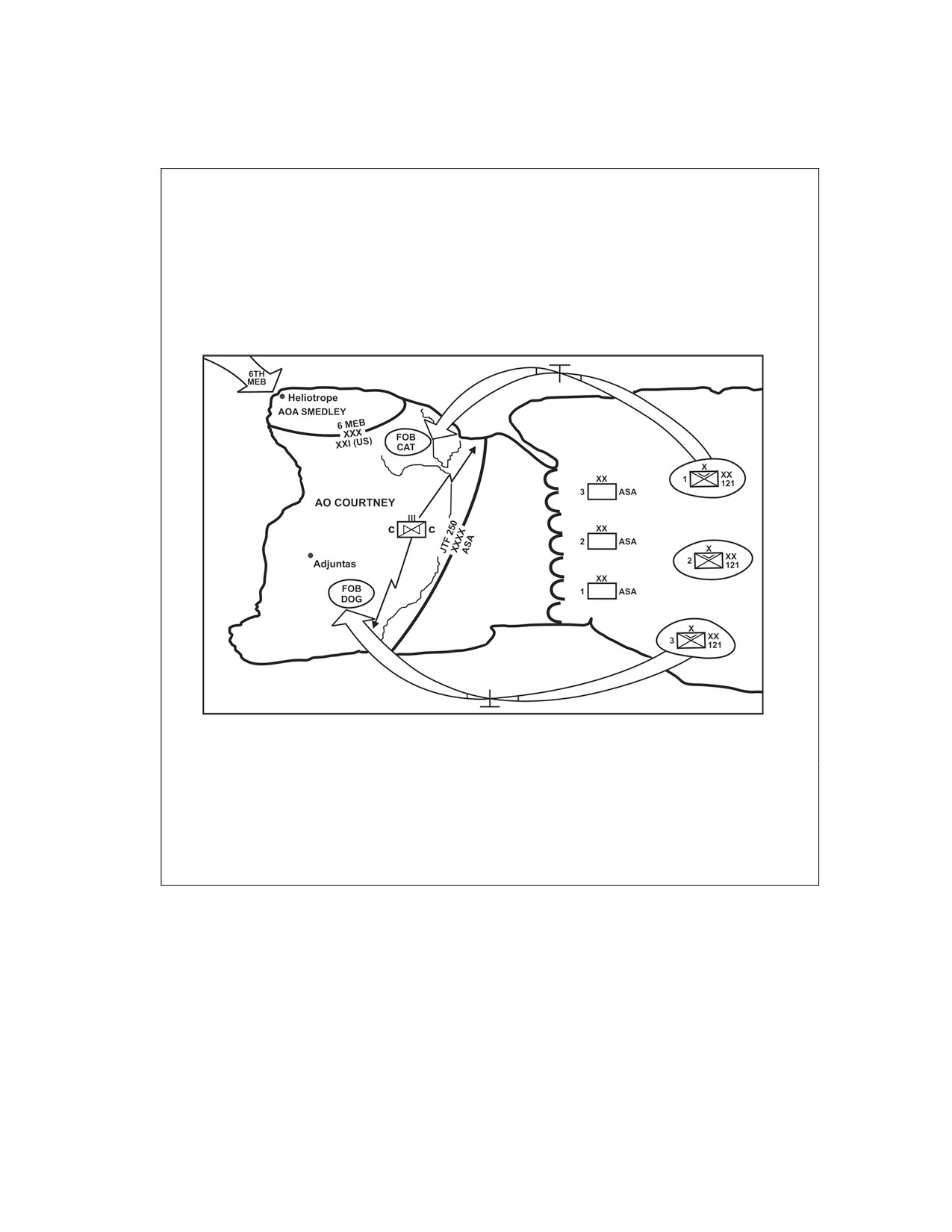
plish the mission. Figure B-17 shows the COA and COA sketch for Phase I of
XXI Corps COA #1. The COA and COA sketch are products of the final COA
development task. They are placed here for clarity.
XXI Corps conducts a one-division air assault, D-day, H-hour, over two aerial axes of ad-
vance to seize Objectives DOG and CAT. 27th ACR covers corps east flank and links up
with ASA forces advancing westward. Division clears AO COURTNEY and links up with
6th MEB.
Decisive. The decisive operation is destruction of all 109th Division forces in detail by
simultaneous attacks throughout AO COURTNEY by the 121st Division and 21st CAB
attack aviation, supported JTF 250 air and naval fires (JSEAD, AI, and CAS).
Shaping. The intent of shaping operations is to prevent 109th Division forces from
massing combat power, to include receiving reinforcement from Tiger Corps or the 107th
and 108th Divisions.
21st MI Bde. Portray preparations for air assault across Strait of DAWARO; termi-
nate on order. Conduct EA and nonlethal SEAD against 109th Division C2 system. UAV
and remote sensors monitor locations/movements of Tiger Corps and 107th and 108th
Division reserves; report movements to 27th ACR.
21st CAB (-). Provide lift for air assault and for 121st ID operations in AO
COURTNEY.
27th ACR. Cover 121st ID east flank; link up with ASA vicinity AWASH River.
365th CA Bde. Influence civilians in AO COURTNEY to comply with Government of
San Anglos stay-put policy.
Corps Artillery. Reinforce 121st DIVARTY for SEAD; on order, place one FA bri-
gade DS to 27th ACR.
Figure B-17. COA and COA Sketch for Phase I of XXI Corps COA #1
B-22
_____________________________________________________________ Information Operations Scenario
1st Bn, 19th PSYOP Grp. Influence civilians in AO COURTNEY to comply with Gov-
ernment of San Anglos stay-put policy.
TCF. TCF doubles as corps reserve (entails accepting risk).
Reserve. Occupy AA Jackson. Plan in priority: (1) Commitment to block movement
of additional Tiger Corps forces into AO COURTNEY; (2) support to civil authorities per
OPLAN Provider; (3) counter Level III threats in JRA.
IO. TBD.
Sustaining. [omitted]
End state. (Phase I)
All Rendovan forces either destroyed or captured. XXI Corps and ASA units link up vicin-
ity AWASH River. XXI Corps and 6th MEB link up vicinity of Heliotrope. XXI Corps transi-
tions to support of San Anglos civil authorities and prepares to turn AO COURTNEY and
AOA SMEDLEY over to ASA.
Figure B-17. COA and COA Sketch for Phase I of XXI Corps COA #1 (continued)
B-32. The following figures illustrate IO products needed to support one
COA. Time permitting, the G-7 develops similar products to support each
COA the staff develops. The G-7 develops the following IO products:
• IO concept of support.
• IO objectives and IO tasks to support each IO objective.
• IO input work sheets.
• IO synchronization matrix.
• IO-related target nominations (HPTs).
• Critical asset list
B-23
FM 3-13 __________________________________________________________________________________
• Assessment of IO-associated risk.
• Criteria of success and IO IRs to support IO assessment.
Information Operations Concept of Support
B-33. While the staff is developing COAs, the G-7 develops an IO concept of
support (based on the initial IO mission statement) for each one (see figure
B-18). The G-7 has identified two offensive IO objectives that are added to
the defensive IO objectives identified during mission analysis.
IO supports XXI Corps operations by preventing preemption of the air assault and by
minimizing civil interference within AO COURTNEY through destroying, degrading, dis-
rupting, and exploiting Rendovan C2 and fire support systems; deceiving Rendovan de-
cisionmakers; destroying, degrading, disrupting, and deceiving Rendovan ISR systems;
denying Rendovan decisionmakers information about XXI Corps intentions and capabili-
ties; protecting friendly C2 systems and INFOSYS; countering Rendovan propaganda
and deception operations. CMO emphasizes the Government of San Anglos stay-put
policy. IO supports the JTF and XXI Corps deception plans. IO objectives, in priority,
are—
1. Prevent compromise of XXI Corps mission and concept of operations.
2. Protect XXI Corps C2.
3. Disrupt 109th Division ADA, ISR, C2, and targeting systems during critical periods of
the operation.
4. Minimize civilian interference in objective areas.
Figure B-18. IO Concept of Support and IO Objectives for XXI Corps COA #1
Information Operations Objectives and Information Operations Tasks
B-34. The G-7 identifies and refines IO objectives and IO tasks as concepts of
operations are developed for each COA. The XXI Corps G-7 elects to use IO
input work sheets to prepare for COA analysis.
Information Operations Input Work Sheets
B-35. The G-7 staff prepares one IO input work sheet for each IO objective in
each IO concept of support. Figures B-19-B-22, pages B-25-B-32, show work
sheets prepared the IO objectives supporting COA #1. Because echelons
above corps conduct CNO, CNA, and CNE, figures B-19-B-22 do not show
these three IO elements.
Information Operations Synchronization Matrix
B-36. The IO synchronization matrix shows the execution time and duration
of all IO tasks (see figure B-23, page B-33). It also shows which IO objective
each IO task supports. To synchronize IO with the overall operation, the
matrix shows major events for each battlefield operating system. It may
serve as the IO concept of support sketch. The IO synchronization matrix for
the approved COA becomes the basis for the IO execution matrix for the
operation.
B-24
XXI Corps conducts a one-division air assault, D-day, H-hour, over two aerial axes of advance to seize Objectives DOG and CAT. 27th ACR
COA # 1
covers corps east flank and links up with ASA forces advancing westward. Division clears AO COURTNEY and links up with 6th MEB.
IO supports XXI Corps operations by preventing preemption of the air assault and by minimizing civil interference within AO COURTNEY
through destroying, degrading, disrupting, and exploiting Rendovan C2 and fire support systems; deceiving Rendovan decisionmakers;
IO Concept of
destroying, degrading, disrupting, and deceiving Rendovan ISR systems; denying Rendovan decisionmakers information about XXI Corps in-
Support
tentions and capabilities; protecting friendly C2 and INFOSYS; countering Rendovan propaganda and deception operations. CMO emphasizes
the Government of San Anglos stay-put policy. IO supports the JTF and XXI Corps deception plans.
IO Objective #1
Prevent compromise of the XXI Corps mission and concept of operations
Military
Physical
EW
PSYOP
OPSEC
IA
Deception
Destruction
Task EW-01
Task PSY-01
Task IA-01
Task MD-01
Task PD-01
Task OP-01
Disrupt Rendovan
Minimize resistance
Protect XXI Corps
What
Deceive the Tiger
Degrade Rendovan
Deny Tiger Corps
communications inter-
and interference of
and 121st ID
Corps cdr as to the
ISR systems in the
knowledge of JTF
(Task)
ception and locating
locals in AO Court-
INFOSYS and C2
XXI Corps mission
Tiger Corps
mission
systems
ney
systems
To prevent detection
To prevent compro-
To protect the air
To prevent collection
To disrupt intelli-
and location of critical
To provide RI to
Why
mise of corps mis-
assault force from
of EEFI and location
gence collection
air assault assets and
cdrs throughout the
sion by civilian in-
ADA fires and
(Purpose)
of friendly CPs
and C2
support deception
operation
terference
ground counterattack
story
Corps and division
System operators. CI
21st MI Bde
XXI Corps PSYOP
artillery systems,
All XXI Corps and
Who
21st MI Bde
personnel. A/322nd
121st ID MI Bn
Support Element
attack helicopters,
121st ID units
MI Bn (ACE)
AI
Tiger Corps communi-
Tiger Corps ISR
Where
cations intercept and
AO Courtney
HQ Tiger Corps
Throughout AO
Throughout AO
systems
locating systems
When
H - 1
H - 24
Ongoing
H - 5
Ongoing
Ongoing
Rendovan forces
Attack of friendly EA
Propaganda by Ren-
Increased ISR col-
Increased ISR collec-
Counteraction
Move ISR systems
increase CNA and
assets
dovan government
lection operations
tion operations
EW attacks
Interruption of tar-
Movement of Ren-
geted systems
Commanders re-
Criteria of
Noninterference by
dovan forces to
BDA from observed
Achieving surprise for
Confirmation from
ceive RI throughout
local population
where they cannot
fires
air assault
Success
ISR that targeted
the operation
affect the operation
systems not working
Rendovan capabil-
Counterreconnais-
XXI Corps systems
Movement of civil-
Movement of tar-
CI not detecting
ities and intentions
IO IR
sance operations
not detected
ians
geted units
collection
to attack INFOSYS/
reports
C2 systems
Remarks
XXI Corps approves
JTF 250 approves
JTF 250 approves
XXI Corps approves
Each HQ approves
Each HQ approves
Figure B-19. IO Input Work Sheet, IO Objective #1
XXI Corps conducts a one-division air assault, D-day, H-hour, over two aerial axes of advance to seize Objectives DOG and CAT. 27th ACR
COA # 1
covers corps east flank and links up with ASA forces advancing westward. Division clears AO COURTNEY and links up with 6th MEB.
IO supports XXI Corps operations by preventing preemption of the air assault and by minimizing civil interference within AO COURTNEY
through destroying, degrading, disrupting, and exploiting Rendovan C2 and fire support systems; deceiving Rendovan decisionmakers;
IO Concept of
destroying, degrading, disrupting, and deceiving Rendovan ISR systems; denying Rendovan decisionmakers information about XXI Corps
Support
intentions and capabilities; protecting friendly C2 and INFOSYS; countering Rendovan propaganda and deception operations. CMO empha-
sizes the Government of San Anglos stay-put policy. IO supports the JTF and XXI Corps deception plans.
IO Objective #1
Prevent compromise of XXI Corps mission and concept of operations
Counter-
Counter-
Physical
CND
CI
PA
CMO
propaganda
deception
Security
Task CMO-01
Task PS-01
Task CND-01
Task PA-01
Task CD-01
Task CI-01
Support PSOP
What
Protect XXI
Protect XXI
Assess effects of
Exploit Rendovan
Assess OPSEC
with feedback
Corps INFOSYS
Corps INFOSYS
media coverage
(Task)
deception plan
program
on PSYOP
from sabotage
against CNA
on PSYOP
theme
Ensure Rendovan
To prevent hos-
To counter Ren-
To determine if
To counter Ren-
To input to
Why
deception opera-
tile collection
dovan HUMINT,
corps’ mission
dovan sabotage
possible com-
tions do not de-
from friendly
SIGINT, and
appears in me-
(Purpose)
attempts
promise
ceive friendly cdrs
INFOSYS
IMINT
dia
All G-6/S-6
Who
21st MI Bde
All units
IANM, IASO, SA
21st MI Bde
XXI Corps PAO
365 CA Bde
in all units
Tiger corps C2
Throughout
Where
Throughout AO
Throughout AO
Throughout AO
Throughout AO
system
AO
When
Ongoing
Ongoing
Ongoing
Ongoing
Ongoing
Ongoing
Rendovan forces
Rendovan forces
Rendovan forces
modify or cease
change their
Rendovan forces
change their es-
Counteraction
None
None
deception opera-
sabotage meth-
reinforce CNA
pionage and sab-
tion
ods
otage methods
Rendovan decep-
Rendovan CNA
No evidence that
PSYOP
Criteria of
tion operations
No evidence of
does not affect
CI shows no
operation is com-
themes are
identified and
sabotage
XXI Corps com-
compromise
Success
promised
working
countered
puters
Indicators
Identify the Ren-
Indicators of Ren-
Indicators of
Indicators of
Indicators of
Tiger Corps
IO IR
dovan deception
dovan espionage
PSYOP mes-
sabotage
Rendovan CNA
knows corps
story
and sabotage
sage working
mission
XXI Corps
STRATCOM
JTF 250
TF 250
Remarks
JTF 250 approves
JTF 250 approves
approves
approves
approves
approves
Figure B-19. IO Input Work Sheet, IO Objective #1 (continued)
XXI Corps conducts a one-division air assault, D-day, H-hour, over two aerial axes of advance to seize Objectives DOG and CAT. 27th ACR
COA # 1
covers corps east flank and links up with ASA forces advancing westward. Division clears AO COURTNEY and links up with 6th MEB.
IO Concept of
IO supports XXI Corps operations by preventing preemption of the air assault and by minimizing civil interference within AO COURTNEY
Support
through destroying, degrading, disrupting, and exploiting Rendovan C2 and fire support systems; deceiving Rendovan decisionmakers; de-
stroying, degrading, disrupting, and deceiving Rendovan ISR systems; denying Rendovan decisionmakers information about XXI Corps inten-
tions and capabilities; protecting friendly C2 and INFOSYS; countering Rendovan propaganda and deception operations. CMO emphasizes
the Government of San Anglos stay-put policy. IO supports the JTF and XXI Corps deception plans.
IO Objective #2
Protect XXI Corps C2
Military
Physical
EW
PSYOP
OPSEC
IA
Deception
Destruction
Task EW-02
Task PSY-02
Task MD-02
Task OP-02
Task IA-02
What
EP protects XXI
Enhance the IA in
Cause Tiger Corps to
Deny Tiger Corps knowl-
Protect XXI Corps
Corps personnel
mind of Tiger Corps
believe CND of JTF is
edge of XXI Corps mis-
INFOSYS and C2
(Task)
and equipment
cdr
greater than it is
sion
system
To portray a
To portray a greater
Prevent detection and
To ensure lack
Provide RI to cdrs
Why
greater IA capabil-
CND capability than
location of critical air as-
of interference of
throughout the
ity than the XXI
the XXI Corps proc-
sault assets
(Purpose)
operations
operation
corps processes
esses
Support deception story
1st Bn, 19th
Who
1st Bn, 19th PSYOP
INFOSYS operators, CI
21st MI Bde
PSYOP Grp and
All XXI Corps units
Grp and corps G-6
personnel, HQ 121st ID
corps G-6
XXI Corps, 121st
Where
Throughout AO
HQ Tiger Corps
HQ Tiger Corps
Throughout AO
ID HQ and C2
nodes
When
H - 24
H - 48
H - 48
Ongoing
Ongoing
Increased CNA/EA
Rendovan forces
Increased EA by
Increased CNA by
Increased ISR collection
Counteraction
by Rendovan
increase CNA and
Rendovan forces
Rendovan forces
operations
forces
EW attacks
Cdr receives RI
Criteria of
Achieving surprise for air
EP not degraded
IA not changed
CND not changed
throughout the
assault
Success
operation
Rendovan capabil-
ities and intentions
Rendovan EA
Indications of Ren-
Indications of Rendo-
Counterreconnaissance
IO IR
to attack
capabilities
dovan CNA and EA
van CNA.
operation reports
INFOSYS/C2 sys-
tem
JTF 250
STRATCOM
JTF 250 approves
Each HQ approves
Each HQ approves
Remarks
approves
approves
Figure B-20. IO Input Work Sheet, IO Objective #2
XXI Corps conducts a one-division air assault, D-day, H-hour, over two aerial axes of advance to seize Objectives DOG and CAT. 27th ACR
COA # 1
covers corps east flank and links up with ASA forces advancing westward. Division clears AO COURTNEY and links up with 6th MEB.
IO Concept of
IO supports XXI Corps operations by preventing preemption of the air assault and by minimizing civil interference within AO COURTNEY
Support
through destroying, degrading, disrupting, and exploiting Rendovan C2 and fire support systems; deceiving Rendovan decisionmakers; destroy-
ing, degrading, disrupting, and deceiving Rendovan ISR systems; denying Rendovan decisionmakers information about XXI Corps intentions
and capabilities; protecting friendly C2 and INFOSYS; countering Rendovan propaganda and deception operations. CMO emphasizes the Gov-
ernment of San Anglos stay-put policy. IO supports the JTF and XXI Corps deception plans.
IO Objective #2
Protect XXI Corps C2.
Counter-
Counter-
Physical
CND
CI
PA
CMO
propaganda
deception
Security
Task PA-02
Task CMO-02
Task CND 02
Task CP-01
Task CD-01
Task PS-02
Task CI-02
Protect soldiers
Coordinate for
What
Protect XXI Corps
Provide EA targets
Exploit Rendovan
Safeguard EW
Assess OPSEC
against misinfor-
HN support to
INFOSYS against
(Task)
and emphasize EP
deception plan
equipment
program
mation or disinfor-
counter enemy
CNA
mation
agents
To ensure Rendo-
To counter Ren-
To take advan-
Why
To protect corps
van deception op-
To protect corps
To ensure C2 is
dovan HUMINT,
To enhance corps
tage of ASA CI
C2
erations do not de-
C2
not disrupted
SIGINT, and
C2
assets and famili-
(Purpose)
ceive friendly cdrs
IMINT
arity with the AO
XXI Corps, 121st
All G-6/S-6 IANM,
1st Bn, 19th
Who
21st MI Bde
ID G-6; Bde/Bn
IASO, SA, in all
21st MI Bde
XXI Corps PAO
365 CA Bde
PSYOP Grp
S-2s
units
XXI Corps C2
All XXI Corps and
Where
AO Courtney
21st MI Bde
Throughout AO
Throughout AO
Throughout AO
nodes
121st ID Units
When
Ongoing
Ongoing
Ongoing
Ongoing
Ongoing
Ongoing
Ongoing
Rendovan forces
Rendovans
Rendovans in-
Rendovans use
Increased propa-
modify or cease
EW equipment
Rendovan forces
Counteraction
change collection
crease misinfor-
local sympathi-
ganda
deception opera-
penetrated
reinforce CNA
methods
mation
zers as agents
tion
Rendovan decep-
XXI Corps world-
Criteria of
C2 systems pro-
tion operations
Lack of penetra-
No evidence of
No evidence of
ASA supports XXI
wide network and
tected by EP
identified and
tion
OPSEC lapses
new misinformation
Corps CI efforts
Success
LAN are secure
countered
Identify the Rendo-
Identify Rendo-
Indications of
Indicators of in-
Lack of Rendovan
Indicators of Ren-
Indicators of lack
IO IR
van deception
van attempts to
Rendovan collec-
creased misinfor-
EA
dovan CNA
of support
story
penetrate
tion efforts
mation
XXI Corps
XXI Corps
STRATCOM
XXI Corps
XXI Corps
STRATCOM
Remarks
JTF 250 approves
approves
approves
approves
approves
approves
approves
Figure B-20. IO Input Work Sheet, IO Objective #2 (continued)
XXI Corps conducts a one-division air assault, D-day, H-hour, over two aerial axes of advance to seize Objectives DOG and CAT. 27th ACR
COA # 1
covers corps east flank and links up with ASA forces advancing westward. Division clears AO COURTNEY and links up with 6th MEB.
IO supports XXI Corps operations by preventing preemption of the air assault and by minimizing civil interference within AO COURTNEY
through destroying, degrading, disrupting, and exploiting Rendovan C2 and fire support systems; deceiving Rendovan decisionmakers; de-
IO Concept of
stroying, degrading, disrupting, and deceiving Rendovan ISR systems; denying Rendovan decisionmakers information about XXI Corps inten-
Support
tions and capabilities; protecting friendly C2 and INFOSYS; countering Rendovan propaganda and deception operations. CMO emphasizes the
Government of San Anglos stay-put policy. IO supports the JTF and XXI Corps deception plans.
IO Objective #3
Disrupt 109th Division ADA, ISR, C2, and targeting systems during critical periods of the operation
Military
Physical
EW
PSYOP
OPSEC
IA
Deception
Destruction
Task PD-02
Task MD-03
Destroy ADA target
Task OP-03
Task IA-03
Task EW-03
Task PSY-03
Cause 109 ID units
identification, proc-
Conceal physical
Assure links
What
Disrupt 109th ID ADA C2
Broadcast PSYOP
to defend C2 system
essing and firing
and electronic
between HQ
Task EW-04
products over Tiger
(Task)
that XXI corps does
systems
INFOSYS loca-
XXI Corps and
Conduct nonlethal SEAD
Corps C2 frequency
not plan to destroy
Task PD-03
tions
JTF 250
Destroy ADA CPs
Ensure fire
To divert 109th ID
To protect the air
Ensure fire con-
Why
To protect the air assault
To disrupt C2 frequen-
control and C2
resources from other
assault force from
trol and C2 links
forces from ADA fires
cies
links are oper-
(Purpose)
areas
ADA fires
are operating
ating
Commander Solo
Corps/div G-3s;
Who
1st Bn, 19 PSYOP Grp
XXI Corps G-3
XXI Corps Artillery
Corps G-6
21st MI Bde
Bde/Bn S-3s
Current locations of
XXI Corps and
HQ XXI Corps
Current locations of 109th ID
Current locations of
Current locations of
Where
Tiger Corps ADA C2
121st ID
and HQ JTF
ADA C2 nodes
109th ID C2 nodes
Rendovan ADA units
nodes
INFOSYS nodes
250
When
H - 1
H - 24
H - 48
H - 1
Ongoing
Ongoing
Reprogram C2 sys-
ADA units relocate
Increased 109th
Counteraction
Reprogram EA/EP systems
Resources diverted
None
tems
or reconstitute
ID ISR attempts
Criteria of
Lack of ADA fires
Disruption of C2 fre-
Increased defense
Lack of signals from
Locations not
Links intact
Success
Confused transmissions
quencies
activities
targeted systems
compromised
Changes in Rendovan
Specific locations
Tiger Corps
emitter parameters
Changes in Rendovan
New units being
of ISR and ADA
Indications of
IO IR
increases intelli-
Jamming effectiveness
emitter parameters
defended
assets
penetrations
gence collection
reports
Aerial BDA
XXI Corps
JTF 250
Remarks
XXI Corps approves
JTF 250 approves
XXI Corps approves
XXI Corps approves
approves
approves
Figure B-21. IO Input Work Sheet, IO Objective #3
XXI Corps conducts a one-division air assault, D-day, H-hour, over two aerial axes of advance to seize Objectives DOG and CAT. 27th ACR
COA # 1
covers corps east flank and links up with ASA forces advancing westward. Division clears AO COURTNEY and links up with 6th MEB.
IO supports XXI Corps operations by preventing preemption of the air assault and by minimizing civil interference within AO COURTNEY
through destroying, degrading, disrupting, and exploiting Rendovan C2 and fire support systems; deceiving Rendovan decisionmakers; de-
IO Concept of
stroying, degrading, disrupting, and deceiving Rendovan ISR systems; denying Rendovan decisionmakers information about XXI Corps inten-
Support
tions and capabilities; protecting friendly C2 and INFOSYS; countering Rendovan propaganda and deception operations. CMO emphasizes the
Government of San Anglos stay-put policy. IO supports the JTF and XXI Corps deception plans.
IO Objective #3
Disrupt 109th Division ADA, ISR, C2, and targeting systems during critical periods of the operation
Counter-
Counter-
Physical
CND
CI
PA
CMO
propaganda
deception
Security
Task CND-03
Task PA-03
Task CD-02
Task PS-03
Protect fire con-
Assess effects of
What
Identify targets in
Safeguard EW
trol systems of
media coverage
the Tiger Corps
(Task)
equipment
XXI Corps Artil-
of PSYOP
deception plan
lery
broadcasts
To allow EA
To allow EA
To target 109th
To determine if
Why
against 109th ID
against 109tj ID
ID ADA, ISR, C2
disruption is
ADA, ISR and C2
ADA, ISR and
(Purpose)
systems
effective
systems
C2 systems
XXI Corps and
Who
21st MI Bde
XXI Corps G-6
XXI Corps PAO
121st ID G-2s
109th ID ADA,
HQ, XXI Corps
International
Where
ISR and C2
HQ 21st MI Bde
Artillery
media coverage
nodes
H - 48
Ongoing
Ongoing
Ongoing
When
Rendova uses
None, if suc-
media to dis-
Counteraction
None
Increased CNA
cessful
seminate
counter-PSYOP
Fire control sys-
Media coverage
Criteria of
ADA, ISR, C2
EW equipment
tems remain
favorable to JTF
targets are found
secure
Success
operational
250
Locations of
Locations of
Locations of
IO IR
109th ADA, ISR,
None
109th ID ADA,
109th ID ADA
C2 nodes
ISR, C2 nodes
XXI Corps
XXI Corps
STRATCOM
JTF 250
Remarks
approves
approves
approves
approves
Figure B-21. IO Input Work Sheet, IO Objective #3 (continued)