FM 3-13 Information Operations: Doctrine, Tactics, Techniques, and Procedures (NOVEMBER 2003) - page 3
FM 3-13 __________________________________________________________________________________
FOCUS ON THE TARGET
4-12. MD operations focus on a deception target. The deception target is the
adversary decisionmaker with the authority to make the decision that will
achieve the deception objective (JP 3-58). (See definition of deception objec-
tive in paragraph 4-15.) For example, an MD operation designed to delay the
movement of an adversary reserve would target the commander who could
make the decision to commit it. The adversary’s intelligence system is the
channel for getting the deception story to the deception target. It is not nor-
mally the target itself.
4-13. The more that is known about the deception target, the greater the ef-
fect that can be achieved and the
better the chances of success. The
Principles of Military
target’s assessment and decision-
Deception
making processes are the main ele-
• Focus on the target
ments against which an MD opera-
• Cause the target to act
tion operates. Understanding how
• Centralize control
the adversary C2 system collects,
processes, and disseminates infor-
• Employ variety
mation from the collector to the tar-
• Enforce strict OPSEC
get allows injection of indicators
• Minimize falsehood/leverage
(see definition, paragraph 4-20) at
truth
the proper places and times to cre-
• Ensure timeliness
ate the desired perceptions (see def-
• Ensure integration
inition, paragraph 4-36). Also useful
• Exploit target biases
is detailed knowledge of the target’s
• Avoid windfalls
biases, for example, how the target
• Utilize space effectively
reacts to various kinds of messages,
• Work within available
and which information sources the
competencies and resources
target finds most reliable.
CAUSE TARGET TO ACT
4-14. An effective MD operation leads the deception target to take (or not
take) specific actions that favor friendly force operations. The situation that
the commander wants to create by these actions is the deception objective.
4-15. A deception objective is the desired result of a deception operation ex-
pressed in terms of what the adversary is to do or not to do at the critical
time and/or location (JP 3-58). It states the end state of the MD operation. An
MD operation often requires substantial resources that would otherwise be
applied directly against the adversary. Consequently, commanders visualize
a deception objective in terms of its specific contribution to accomplishing the
mission. Any MD operation should create an exploitable advantage at a spe-
cific time or place. A deception objective is stated as a positive result, for ex-
ample
• Increase friendly force relative combat power at decisive points.
• Provide time for unhindered friendly force entry activities.
• Gain and exploit surprise.
• Protect friendly capabilities and intentions from compromise.
• Achieve a significant advantage in operational timing.
4-4

_________________________________________________________________________ Military Deception
• Enable the force to reach objectives with minimal opposition or re-
source use.
4-16. If the deception objective is stated in terms of its contribution to the ac-
complishing the mission, the deception working group (DWG; see paragraph
4-57) refines it into one or more subordinate deception objectives. A subordi-
nate deception objective is a restatement of the deception objective
in terms that reflect the deception target’s point of view. Subordinate
deception objectives state what the deception will lead the target to do or not
do. Properly worded subordinate deception objectives can be used as IO
information requirements (IRs) or requests for information (RFIs). Figure 4-2
shows examples deception objectives supported by subordinate deception
objectives.
Deception Objective
Subordinate Deception Objectives
(stated in terms of advantages the
(stated in terms of what the MD operation
MD operation will provide the force)
will lead the adversary to do)
My adversary will—
This deception will—
• Redeploy his reserve to the wrong place.
Improve my relative combat power in a
• Commit his main forces in the wrong place.
given location.
• Delay the commitment of his reserve.
• Withdraw his forces.
My adversary will—
This deception will—
• Conduct additional reconnaissance.
Provide a period for defensive prepa-
• Delay his attack to await reinforcements.
rations.
• Prepare for defensive operations.
• Redeploy his forces to a “threatened” area.
This deception will—
My adversary will—
Provide cover for the withdrawal of my
• Not press an attack or pursuit of my forces.
forces.
• Redeploy his forces to a “threatened” area.
Figure 4-2. Relationship of Subordinate Deception Objectives to
Deception Objectives
4-17. Subordinate objectives can take several forms. However, all are stated
in terms of causing adversaries to do something, for example
• Delay a decision until it is too late to affect the friendly operation.
• Select or not select a specific course of action (COA).
• Employ or array their forces in ways that make them vulnerable to
friendly attack.
• Reveal strength, dispositions, capabilities, and intentions by prema-
turely committing forces.
• Not react to friendly actions (due to being conditioned to patterns of
friendly behavior).
• Waste combat power with inappropriate or delayed actions.
• Withhold an appreciable amount of force to account for uncertainties.
• Shift his effort away from the friendly decisive operation.
4-18. It is not enough for the deception target to believe something about the
situation; success requires the target to act on that belief. Commanders—
both friendly and adversary—act based on their situational understanding.
4-5
FM 3-13 __________________________________________________________________________________
They arrive at their situational understanding, in part, by applying judgment
to answers to their commander’s critical information requirements (CCIR).
(See FM 6-0.) An effective MD operation substitutes desired perceptions (see
definition, paragraph 4-36) for true answers to the target’s CCIR. It provides
false information about those aspects of the situation upon which the target
makes decisions.
CENTRALIZE CONTROL
4-19. Commanders make one individual responsible for overseeing an MD
operation. The military deception officer
(MDO), the special staff officer
responsible for MD, is a member of the IO cell and supports the G-7. (See
appendix F.) Based on recommendations from the MDO, the G-3 integrates
MD into the operation. This ensures the MD operation does not conflict with
other objectives and that all elements portray the same deception story.
Execution of the MD operation may be decentralized as long as all
participants follow one plan.
EMPLOY VARIETY
4-20. The deception story is a scenario that outlines the friendly actions that
will be portrayed to cause the deception target to adopt the desired
perception
(JP
3-58). It is a detailed and systematic expansion of the
perceptions and indicators into a complete narrative. Perceptions are mental
images the commander wants the deception target to believe are real. An
indicator in intelligence usage is an item of information which reflects the
intention or capability of a potential enemy to adopt or reject a course of
action (JP 1-02).
4-21. MD operations portray indicators that reflect intentions or capabilities
that the friendly force commander does not have. The adversary intelligence
system may overlook or disregard indicators essential to the deception story
if they are transmitted by a single source. The deception target should
receive all indicators, both true and false, from multiple sources. This
situation lends credibility to the deception story, allows its “verification,” and
provides the target with more opportunities to conclude that the deception is
real. However, if indicators are unusually easy to obtain or if the target
suspects the sources, this awareness may arouse enough suspicion to
compromise the deception.
4-22. The friendly actions that the deception story outlines are deception
events. A deception event is a deception means executed at a specific time and
location in support of a deception operation (JP 3-58). Indicators are por-
trayed by deception means.
4-23. Deception means are the methods, resources, and techniques that can
be used to convey information to the deception target. There are three catego-
ries of deception means: physical, technical, and administrative (JP 3-58).
(The complete joint definition includes definitions of the categories.) While
objectives, targets, and available resources are different at each echelon, the
basic deception means are the same.
4-24. Physical means are activities and resources used to convey or deny se-
lected information to a foreign power (JP 3-58). (To apply this definition to
4-6
_________________________________________________________________________ Military Deception
the operational and tactical levels of war, the Army considers foreign power
to mean deception target.) Physical means present visual indicators through
the physical activities of forces. Adversary ground, aerial, and space ISR
capabilities offer major avenues for projecting the deception story. Physical
means provide indicators that adversary ISR systems report. Physical means
include
• Reconnaissance unit operations.
• Alert and movement of forces.
• Training, testing, evaluation, and rehearsal activities.
• Dummy and decoy equipment, devices, and displays (see FM 20-3).
• Smoke and obscurants (see FM 3-50).
• Logistic, stockpiling, and repair activities.
• Feints, demonstrations, and ruses (see FM 3-90).
• Sonic indicators, which reproduce common noises of military activity.
(Such noises are directed against adversary sound ranging sensors and
the human ear. Sounds can be real or simulated. The deception plan
may also require that the adversary not hear certain sounds; such in-
stances require strict noise discipline.)
• Olfactory indicators, which project battlefield smells to deceive human
and technical sensors. (Examples of olfactory deception measures are
the creation of odors common to military units and operations, such as
those of food, explosives, and petroleum products.)
4-25. Technical means are military materiel resources and their associated
operating techniques used to convey or deny selected information to the de-
ception target through the deliberate radiation, reradiation, alteration, ab-
sorption, or reflection of energy; the emission or suppression of chemical or
biological odors; and the emission or suppression of nuclear particles
(JP 3-58). (To apply this definition to the operational and tactical levels of
war, the Army considers foreign power to mean deception target.) Electro-
magnetic deception is an important technical means. Electromagnetic decep-
tion includes
• Manipulative electronic deceptionactions to eliminate revealing, or
convey misleading, electromagnetic indicators.
• Simulative electronic deceptionactions to simulate friendly, notional,
or actual capabilities to mislead adversary forces.
• Imitative electronic deceptionthe introduction of electromagnetic en-
ergy into adversary systems that imitates adversary emissions.
4-26. With the advent of advanced multispectral sensors mounted on air and
space platforms, electromagnetic deception is growing more complex. How-
ever, its basic objectiveto manipulate, falsify, or distort the electromagnetic
signals received by adversary sensorsis unchanged (Electromagnetic decep-
tion is also a method of electronic attack. See chapter 1).
4-27. Administrative means are resources, methods, and techniques to
convey or deny oral, pictorial, documentary, or other physical evidence to the
deception target. (To apply this definition to the operational and tactical
levels of war, the Army considers foreign power to mean deception target.) An
example of administrative means is planting bogus material.
4-7
FM 3-13 __________________________________________________________________________________
4-28. The most effective way to convince the deception target of the deception
story’s truth is to provide indicators in several different ways, each supported
by different elements of truth. Wherever the target turns, there must be in-
formation that confirms his preconceptions, that makes any questionable
parts of the deception story seem believable. The best way to ensure the story
is believable to the target is to present a significant amount of truth in ways
that confirm the target’s preconceptions.
ENFORCE STRICT OPERATIONS SECURITY
4-29. Successful MD operations require strict operations security (OPSEC).
Adversaries must be denied knowledge of the MD operation’s existence. Pro-
tecting MD operations requires limiting the number of witting actors. (A wit-
ting actor is an individual participating in the conduct of a military
deception operation who is fully aware of the facts of the deception.)
Only staff and subordinate commanders who need to know are informed of an
MD operation. To ensure both secrecy and realism, unwitting actors are often
tasked to portray deception events. (An unwitting actor is an individual
participating in the conduct of a military deception operation with-
out personal knowledge of the facts of the deception.) Commanders
limit knowledge of the MD operation’s details to those who—
• Provide effective feedback.
• Control execution.
• Maintain balance among operational priorities.
• Assess the potential for inadvertent compromise.
MINIMIZE FALSEHOOD/LEVERAGE TRUTH
4-30. Although the deception story uses false information to shape the decep-
tion target’s perceptions, the less it relies on falsehoods, the smaller the risk
of compromise. Even when the deception story’s central elements are false,
the preponderance of information that creates the target’s perceptions is in-
evitably factual. A deception should use only the amount of false information
necessary to produce the desired and supporting perceptions.
4-31. Releasing truthful information to an adversary runs counter to OPSEC.
However, it may be necessary to reduce the deception target’s uncertainties
about conclusions based on the false information that the deception story
conveys. Consequently, a delicate balance must be achieved between OPSEC
requirements and MD requirements. Obtaining the greatest credibility at the
least cost in OPSEC requires skillful planning.
ENSURE TIMELINESS
4-32. The time needed to conduct an MD operation must be less than the
time needed for the deception target to react to it. Applying this principle re-
quires two actions: First, determine the time by which the target must act (or
fail to act) if the friendly force is to exploit the deception objective. Then re-
verse-plan all friendly and adversary activities from that time. The G-7 en-
sures that the time required to conduct the MD operation fits the time avail-
able, based on the mission and concept of operations.
4-8
_________________________________________________________________________ Military Deception
ENSURE INTEGRATION
4-33. An MD operation must be fully integrated with the overall operation.
MD planning occurs simultaneously with operations planning. Development
of the MD plan occurs during the COA development, comparison, and ap-
proval tasks of the MDMP.
EXPLOIT TARGET BIASES
4-34. Most people have biases that affect their decisions. Determining the
deception target’s biases can be the most powerful weapon in the MD plan-
ner’s arsenal. However, such information is not essential to preparing a vi-
able MD plan. When the target’s specific biases are not known, an MD plan
can be prepared based on biases of the target’s ethnic group or culture.
Knowing these biases helps MD planners determine perceptions that will
lead the target to act. It also provides clues as to whether and when to in-
crease or reduce the target’s uncertainty.
4-35. Perceptions are mental images the commander wants the
deception target to believe are real. They include the personal con-
clusions, official estimates, and assumptions about friendly force intentions,
capabilities, and activities that the target uses to make decisions. There are
two types of perceptions: desired and supporting.
4-36. A desired perception is what the deception target must believe for it to
make the decision that will achieve the deception objective (JP 3-58). For ex-
ample, if the deception objective is for the target to commit additional ground
forces to coastal defense at the expense of other areas, the target must
believe that an amphibious threat current defending forces cannot handle
exists.
4-37. Supporting perceptions are mental images that enhance the
likelihood that the deception target will form the desired percep-
tions and accept them as true. Expanding the example above, if the target
is led to conclude that friendly forces consider a land attack too costly, it will
likely bolster his confidence in the desired perception that the main threat is
from the sea.
4-38. Forms of uncertainty are, in military deception, means of
shaping the deception target’s perceptions. Increasing uncertainty
aims to confuse the deception target. Reducing uncertainty aims to
reinforce the deception target’s predispositions.
4-39. Decisionmakers can be deceived because they operate in an uncertain
environment. Uncertainties about the situation and the inability to predict
outcomes accurately require commanders to take risks. Commanders can
take advantage of the deception target’s uncertainty in one of two ways: they
can either increase it or reduce it.
4-40. Increasing uncertainty aims to confuse the deception target. This confu-
sion can produce different results: It can cause the target to delay a decision
until it is too late to prevent friendly mission success. It can place the target
in a dilemma for which there is no acceptable solution. It may even reduce
some targets to inaction.
4-9
FM 3-13 __________________________________________________________________________________
4-41. Reducing uncertainty aims to reinforce the deception target’s choice of
action that best benefits Army forces. It seeks to elicit or prevent a particular
adversary COA by supplying the target with enough information to make a
firm, but incorrect, decision.
4-42. For an MD operation to be successful, the deception target must believe
the deception story, both its parts and as a whole. A good story conforms to
the target’s beliefs about reality. It is much simpler to have the deception
conform to the target’s beliefs than to attempt to change them. A target’s
beliefs include his preconceptions of US doctrine, strategy, objectives, and
values. These preconceptions often differ from views Americans hold of
themselves.
4-43. As a rule, a deception story should not portray a reality that would sur-
prise the deception target. If parts of the story do not fit into the target’s pre-
conceptions, they may create enough suspicion to reveal the deception.
People normally accept information that conforms to their preconceptions.
Such information must be disproved to become ineffective. Conversely,
elements that go against the target’s preconceptions will have to be proved
true before the target accepts them. Even when all pieces of the story are
believable, if enough of them do not fit the target’s preconceptions, their
overall effect may be inconsistent with the target’s existing beliefs. In such
cases, the target is likely to ignore the deception story.
4-44. Taking advantage of biases exploits the deception target’s own reason-
ing and preferred choices. Most people are unaware of how deeply their bi-
ases influence their perceptions and decisions. The influence of biases is very
strong. In many instances, the target may believe a well-crafted deception
story until it is too late to act effectively, even in the face of mounting contra-
dictory evidence.
4-45. Nearly any bias can be exploited. When the group that advises the
deception target shares a bias, exploiting it is more likely to succeed. How-
ever, MD planners must not fall into the trap of believing that the target
shares their perceptions, values, or thought patterns (ethnocentricity). All
people and cultures are different. Effective MD planners are aware of these
differences.
AVOID WINDFALLS
4-46. Clever adversaries suspect indicators that are too easily obtained.
Indicators that “fall” into adversary hands must be presented so that the cir-
cumstances appear believable, given friendly security practices. There are
two ways to achieve this: The first is the unintentional mistake, designed to
make the target believe that he obtained the indicator due to a friendly error
or oversight. The second is bad luck, designed to make the target believe that
he obtained information because the source fell victim to uncontrollable cir-
cumstances.
USE SPACE EFFECTIVELY
4-47. For the target to believe the deception story, it must fit the physical
and operational environment. A story supporting a tactical deception must be
4-10
_________________________________________________________________________ Military Deception
consistent with how the deception target expects friendly forces to use ter-
rain. Portraying a force in a region unsuitable for military operations or por-
traying a large force in an impossibly small area is not believable.
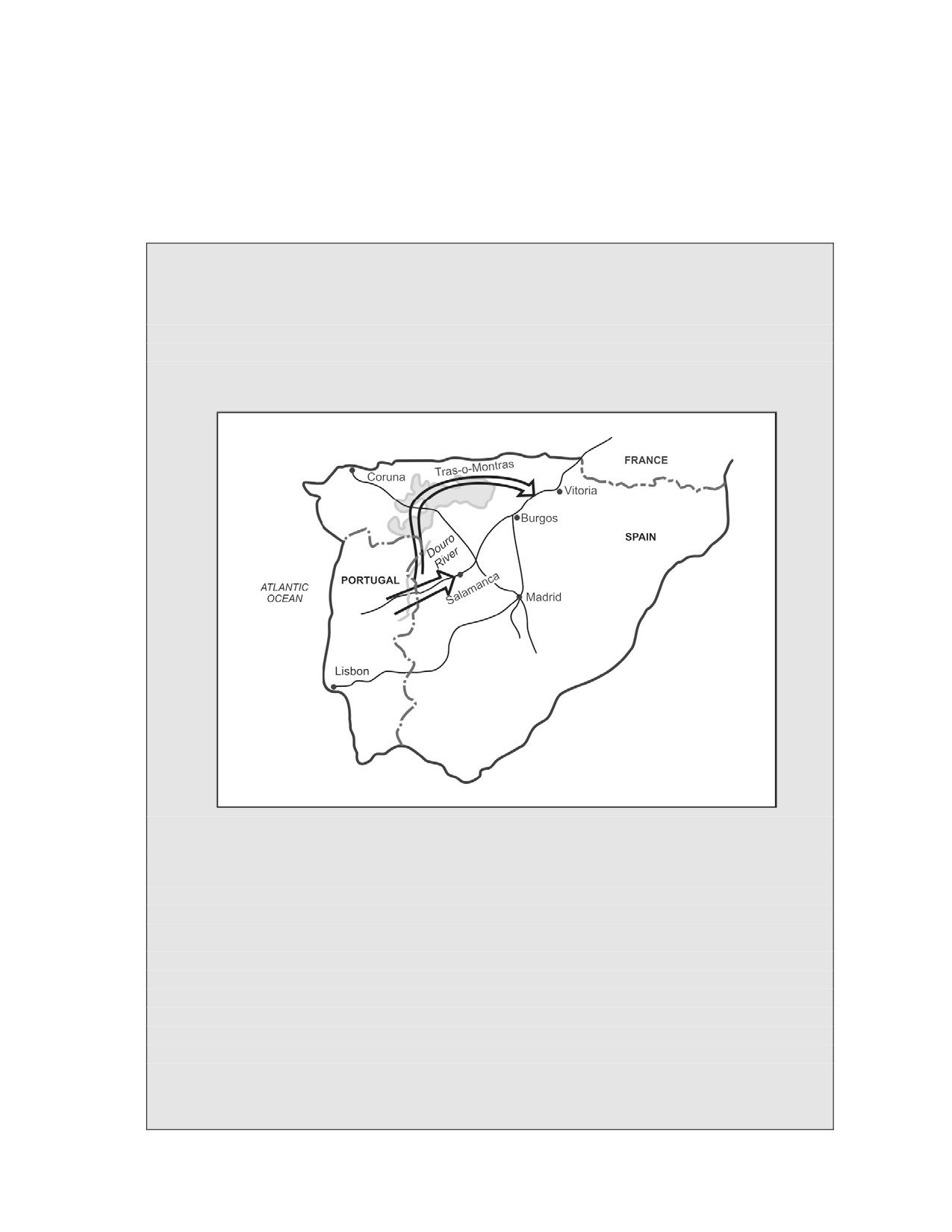
Exploiting a Bias: Duke of Wellington in Spain
An MD plan need not be complex to work. A plan executed by the Duke of Wellington,
commander of British forces during the 1813 campaign against Napoleon’s army in
Spain, provides an example of a simple, effective deception. (See Map 4-1.)
Map 4-1. Battle of Vitoria
During his advance toward Vitoria, Wellington decided to envelop the French defenders
and force them to yield rather than conducting a frontal attack. Wellington divided his
90,000-man army into two unequal columns. He moved the larger force through a wil-
derness the French believed impassable while sending a smaller force of 30,000 troops
along the expected avenue of approach toward Salamanca.
Knowing the French expected him to lead the main effort, Wellington placed himself in
plain view at the head of the smaller force on the expected route. The main Allied ad-
vance was made in the north by the left wing of the army under Sir Thomas Graham. It
crossed the Douro River and marched through northern Portugal and the Tras-o-
Monters Mountains before swinging down behind the French defensive lines. The ad-
vance was aimed at Burgos, with a possible follow-on operation of moving to the Pyre-
nees and into southern France.
4-11
FM 3-13 __________________________________________________________________________________
Wellington anticipated that the French would conclude that he was leading the decisive
operation. Diverting the French commander’s attention allowed the enveloping force,
the real decisive operation, to move undetected to a flanking position. Having created
the deception, Wellington secretly departed to join the larger force as it completed its
flanking movement.
Wellington skillfully played on his adversary’s preconceptions, which he knew were
based on his own tactical habits. He created a ruse that contributed to successfully out-
flanking the French army while allowing him to be at the decisive point at the decisive
time. The Battle of Vitoria ended Napoleon’s domination of Spain. This is a classic ex-
ample of integrating offensive IO into a scheme of maneuver.
WORK WITHIN AVAILABLE COMPETENCIES AND RESOURCES
4-48. The DWG (see paragraph 4-57) always works within the capabilities,
experience, and skills of individuals and units available to support the MD.
However, MD competencies can be developed through training just as other
skills can. MD training in peacetime will increase the chances of MD success
during operations.
4-49. MD operations require a diverse array of resources. The resources in-
vested in an MD operation must be adequate to achieve its objective. The
concept of operations for the MD operation, deception objective, and higher
echelon support determine the resources needed. Commanders weigh the re-
source costs of an MD operation and ensure that sufficient resources are
made available to support it. As all three examples in this chapter show, suc-
cessful MD operations often require significant resources. However, depend-
ing on the concept of operations for the MD operation, these resources may be
available for use later in the overall operation. United States Central Com-
mand’s (CENTCOM’s) use of the IV Marine Expeditionary Force and 1st
Cavalry Division during Operation Desert Storm illustrate this.
4-50. Corps and higher headquarters control the resources required to con-
duct operational MD operations. Normally divisions conduct tactical MD op-
erations. However, divisions may execute tactical MD operations as part of a
corps operational MD operation.
MILITARY DECEPTION IN THE CONDUCT OF OPERATIONS
4-51. Although attaining complete surprise may not be possible, MD can still
be effectively applied in offensive, defensive, and stability operations. MD is
rarely appropriate in support operations.
ARMY SUPPORT TO JOINT DECEPTION OPERATIONS
4-52. In joint operations, the ARFOR integrates Army MD operations with
joint force MD operations to ensure unity of effort. ARFORs coordinate MD
operations with the joint force deception staff element. Normally, ARFORs
provide liaison to the deception staff element. When an Army command
4-12
_________________________________________________________________________ Military Deception
functions as a joint task force, the MDO establishes the deception support
element to accomplish the same tasks as the DWG (see paragraph 4-57) in
corps and divisions.
MILITARY DECEPTION IN THE DEFENSE
4-53. MD operations can allow a defender to offset an attacker’s advantage
or conceal friendly force vulnerabilities. Typical deception objectives that
support the defense are
• Cause the deception target to delay or misdirect an attack.
• Cause the deception target to not attack at all.
• Confuse the deception target about the defense’s depth, organization,
or forces.
• Mislead the deception target regarding the duration of and reason for
the defense.
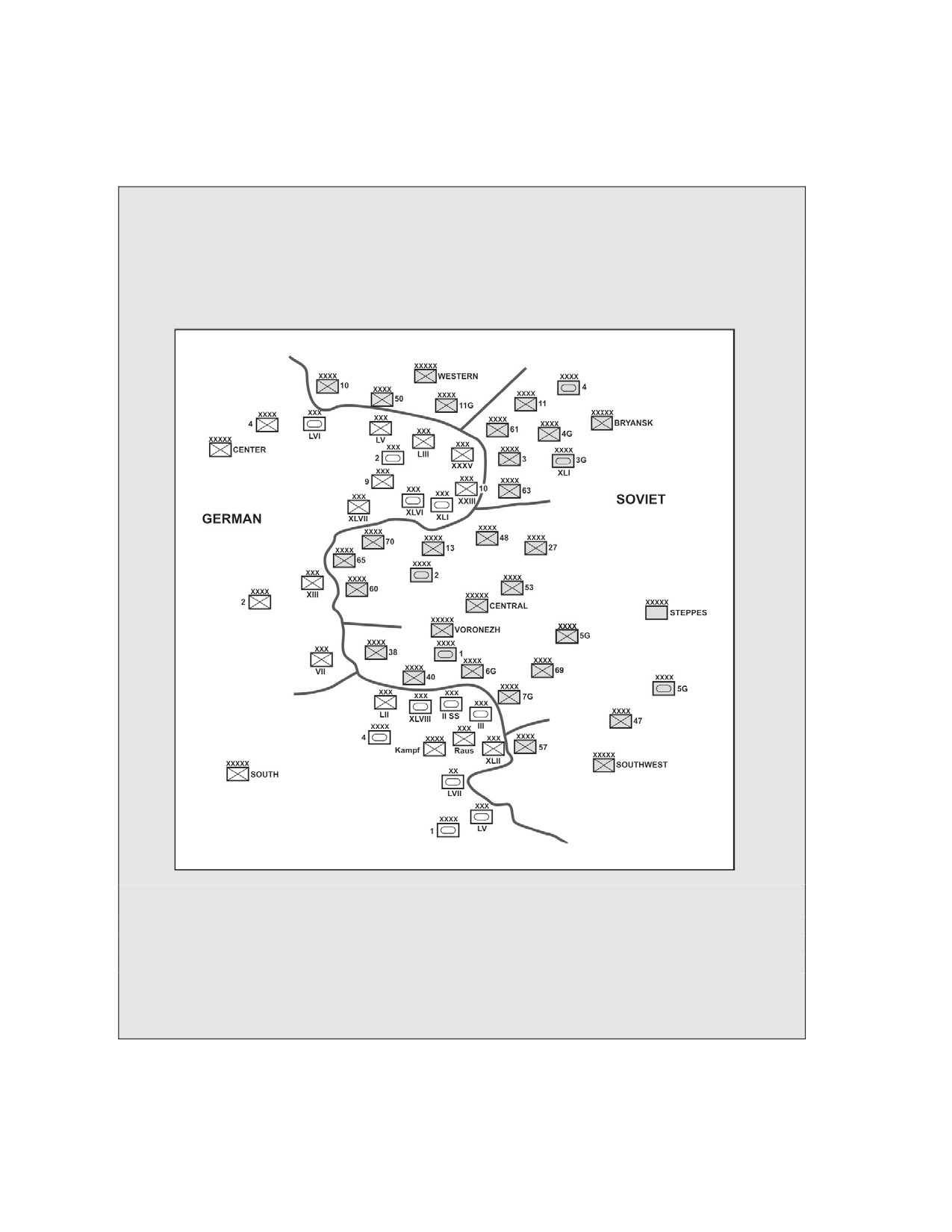
Military Deception the Defense: Kursk
In the spring of 1943, the German army in Russia was recovering from a series of des-
perate battles to stabilize the front after losing the Sixth Army at Stalingrad. For their
summer offensive, the German planners were drawn to a large salient that jutted into
their lines near Kursk. It offered an opportunity to concentrate their shrinking combat
power in a large encirclement in a relatively narrow AO. (See Map 4-2, page 4-14.)
In May, the Russian high command learned of the German plan. Stalin’s immediate de-
sire was to launch a series of offensives before the Germans could initiate the Kursk
operation. His generals convinced him that a better COA was to defend, absorbing the
main blow where they could prepare the battlefield. Once the attacking force had ex-
hausted itself, Russian reserves would launch a series of shattering counterattacks.
The Russians developed a comprehensive MD plan to lead the Germans to continue
their offensive preparations, while denying them knowledge that the Soviet Army knew
about and was preparing for them. The deception objective was to lure the cream of the
panzer corps onto a battlefield specially prepared to kill tanks. The weakened German
force would then be vulnerable to a massive counterattack and exploitation.
The Russians did the following to support their deception:
• Front (army group) and army staffs developed detailed MD plans that specified the
MD operation’s objective; the means, forces, and resources allocated to it; and de-
ception event timing.
• Defensive preparations in the Kursk salient were not hidden, but their depth and
complexity was.
• Strict OPSEC measures concealed the strategic reserve behind the Kursk salient.
• Imitative electronic deception portrayed a false order of battle. Fake vehicle
concentrations, dummy minefields and field fortifications, false airfields, and simu-
lated command posts drew German reconnaissance and fires away from actual ac-
tivities.
• When the Germans attacked, adjacent fronts conducted offensive operations to
prevent reinforcement of the German attack.
4-13
FM 3-13 __________________________________________________________________________________
The Germans attacked on 5 July and quickly bogged down in the extensive defenses.
The nature of the defense and the presence of a large operational reserve surprised
the Germans. When the defense had exhausted German forces, the strategic reserve
counterattacked and drove them back towards the Dnepr River.
Map 4-2. Battle of Kursk
The Russian defense at Kursk, supported by an extensive MD operation, created favor-
able conditions for a decisive counteroffensive. MD was critical to the operation’s suc-
cess because it ensured that the German attack occurred at a place known to the Rus-
sians and in a manner they had prepared to defeat and exploit.
MILITARY DECEPTION IN THE OFFENSE
4-54. In the offense, attackers have the initiative and control the objective,
tempo, and place of the fight. Such clarity allows commanders to develop
4-14
_________________________________________________________________________ Military Deception
sharply focused deception objectives. Deception events can conceal the at-
tack’s timing, scale, scope, and location, or manipulate them to friendly ad-
vantage. They can conceal force composition as well as the tactics and tech-
niques used to execute the attack. Deception events can also mask the
concentration of friendly forces, help achieve economy of force, and protect
the decisive operation from premature detection.
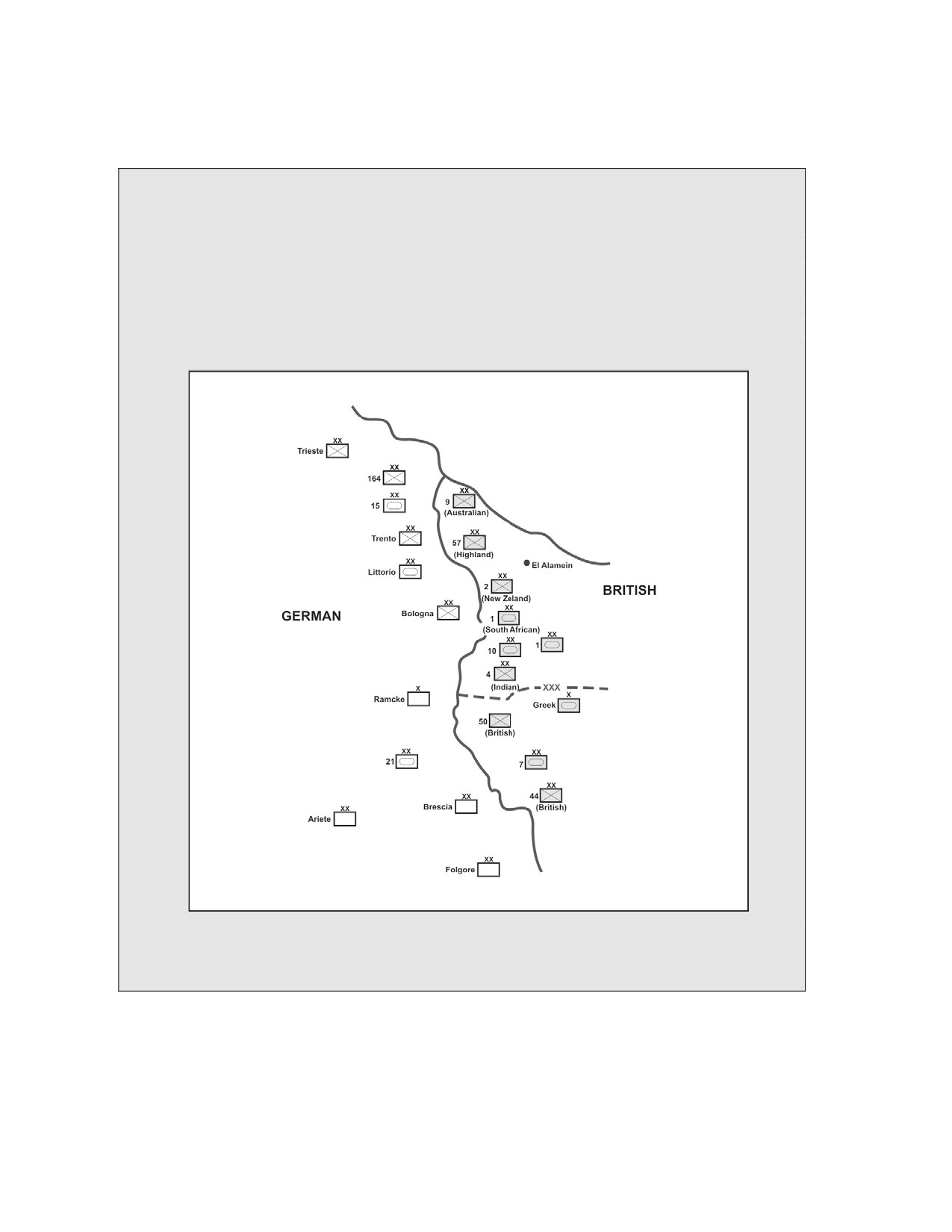
Military Deception in the Attack: Operation Bertram
Today’s MD concepts were developed in the North Africa theater of operations of World
War II. As early as 1940, the British Eighth Army had established a staff responsible for
integrating MD into operations. The years of experience applying MD paid off with the
support provided to British GEN Bernard L. Montgomery’s 1942 counteroffensive at El
Alamein. (See Map 4-3, page 4-16.)
In the summer of 1942, the British had halted the German Afrika Korps, under Field
Marshal Erwin Rommel, at a defensive line extending 35 miles south from the Mediter-
ranean coast at El Alamein. Poor logistic support and lack of replacements forced Field
Marshal Rommel to defend. Field Marshal Rommel expected the British to attack but
did not know where or when. GEN Montgomery recognized that strategic surprise was
impossible, so he planned to gain tactical surprise.
The logical place for the British to attack was at the north of the defensive line. This
area contained well-developed logistic sites and the theater’s main supply route. Based
on their initial intelligence assessment, the Germans placed their armored reserves and
strengthened their defenses to meet an attack there.
GEN Montgomery’s deception objective was to achieve a favorable correlation of forces
in the north, where he intended to conduct his decisive operation. The subordinate de-
ception objectives were to cause the Germans to deploy their armored reserves to the
south and delay their response to the attack in the north until D + 4.
The following are representative deception events used to support the deception objec-
tives:
• Armored formation training exercises emphasized a southern orientation. Dust and
smoke reduced visibility, and the Germans were unsure of what was happening.
• Known adversary agents were told the attack would not occur until early November
due to mechanical problems with newly arrived, American-made Sherman tanks.
• Artillery positions in the north were disguised as small logistic dumps.
• Dummy artillery sites were constructed in the south.
• Using simulated truck covers, tank concentrations in the north were disguised as
logistic marshaling areas.
• Simulated logistic activity in the south portrayed the support needed by a large ar-
mored force to conduct offensive operations. Actual support operations occurring in
the north were concealed.
The MD operation was a success. Field Marshal Rommel, expecting an attack in early
November, returned to Germany and missed the start of the attack on 23 October.
The armored reserves were held in the south until D + 4. When committed, they arrived
4-15
FM 3-13 __________________________________________________________________________________
too late to have a decisive effect. The tactic GEN Montgomery used to initiate the
attack—infantry achieving the breach—also confused the Germans.
Operation Bertram demonstrated that the desert’s lack of concealment was not an in-
surmountable obstacle to successful MD operations. Deception objectives were
achieved with demonstrations and maneuver. It also showed that, even against a vigi-
lant and skilled opponent, MD could provide significant support to an offensive
operation by masking the plan’s critical aspects: the when and the where.
Map 4-3. Battle of El Alamein
MILITARY DECEPTION IN STABILITY OPERATIONS
4-55. Depending on the objectives and rules of engagement, MD may be
appropriate in a stability operation. When mission transparency is not re-
quired, MD can be used to—
• Protect the force by deterring local elements from hostile acts.
4-16
_________________________________________________________________________ Military Deception
• Mask intentions.
• Encourage cooperation among belligerent parties.
• Conceal the timing, circumstances, and conditions of withdrawal upon
mission completion.
4-56. The use of deception in stability operations must be carefully weighed
against immediate and long-term political impacts. Determining deception
objectives will likely require ingenuity. Because many stability operations
are also crisis action responses, available time and intelligence may restrict
the opportunity to use MD. When MD operations are appropriate, the
following conditions apply:
• Political goals and objectives often prevail over military considerations.
Deceptions that are perfectly logical from a military perspective may
not be appropriate for political reasons. Deceptions that the US consid-
ers benign may be considered hostile by the deception target and his
supporters.
• Because of political sensitivities, coordination and approval of MD
plans can be both lengthy and complex.
• Because conditions are often chaotic, it may be difficult to identify suit-
able deception targets.
• If the adversary intelligence system is weakly organized or technologi-
cally unsophisticated, the number of exploitable information systems
(INFOSYS) may be very small. Some technical means may not work.
• Military activities and personnel are usually readily accessible to the
general populace during most stability operations. This may offer op-
portunities to use the local populace as a conduit to the target.
DECEPTION WORKING GROUP
4-57. Because of the size and the diverse range of skills required for an MD
operation, the MDO normally forms a DWG. It is tailored to bring together
the special technical skills required to conduct a specific MD operation. The
MDO relies on the DWG to coordinate the MD operation. The G-7 helps the
G-3 integrate the MD operation into the overall operation. As the MD opera-
tion proceeds, group membership may change to reflect requirements. When
forming the DWG, the MDO balances OPSEC concerns with assurance that
the requisite technical skills are adequately reflected during each phase.
SECTION II - CONDUCTING MILITARY DECEPTION OPERATIONS
4-58. Like other operations, MD operations conducted by Army forces follow
the operations process (see FM 3-0). (Joint staffs follow the deception plan-
ning process established in JP 3-58.) During the operations process, the
situationand consequently many of its associated time factorsare likely
to change. The MDO stays abreast of the situation. Planning and preparing
in isolation results in a deception that does not correspond to reality and is
therefore useless. Planning, preparing, and executing are subject to continu-
ous assessment.
4-17
FM 3-13 __________________________________________________________________________________
4-59. MD operations start with defining the deception goal, what the com-
mander wants to accomplish with the MD operation. The DWG determines
how the adversary (deception target) needs to act in order to accomplish the
commander’s goal for the MD operation.
4-60. For the MD operation to succeed, the DWG must understand how the
deception target acquires and acts on information, what knowledge the de-
ception target has, and how the target views the friendly force. After deter-
mining this information, the DWG constructs the deception story. The
deception story is a plausible, but false, view of the situation, which will lead
the deception target into acting in a manner that will accomplish the com-
mander’s goal. Once the story is completed, the DWG determines the decep-
tion means necessary to portray the events and indicators, and identifies the
units to execute them.
4-61. Part of planning an MD operation is emulating the deception target’s
decisionmaking process. This includes determining how the target’s recon-
naissance and surveillance systems observe deception events and collect indi-
cators that support the deception story. It also includes evaluating how the
target’s intelligence system is likely to process the indicators and whether it
will portray them in a form that will allow the target to reconstruct the de-
ception story. Only then can the DWG determine if the reconstructed decep-
tion story will cause the target to form the desired perceptions and whether
these perceptions will cause the target to act in the desired manner (uncer-
tainties). This analysis considers the time the deception target requires to
perform these steps and issue the orders that will cause the adversary force
to act in a manner consistent with the deception objective.
PLANNING
4-62. Planning develops the information needed to prepare, execute, and as-
sess MD operations. MD planning proceeds concurrently with planning for
the overall operation and follows the MDMP. The G-7, assisted by the MDO,
participates in planning the overall operation and coordinates the MD opera-
tion with the G-3 to ensure it is synchronized with the overall operation. The
MDO keeps a log of significant deception planning actions and resources ex-
pended. This log becomes the basis of the deception after-action report (AAR).
4-63. Because MD operations support a range of missions, personnel
responsible for conducting them remain aware of all higher- and lower-eche-
lon deception activities. To prevent one unit’s MD operation from
compromising another’s, all MD operations are coordinated horizontally and
vertically, and approved by the headquarters two echelons higher.
RECEIPT OF MISSION
4-64. Two authorities can direct an MD operation: a higher headquarters and
the commander. In both cases, the command’s deception plan is coordinated
with higher headquarters. When the requirement to prepare the plan for an
MD operation is received, the MDO assembles the DWG and begins a mission
analysis for a possible MD operation.
4-65. The requirement to support a higher headquarters MD operation can
take the form of specified tasks (for example, Position a unit at a certain
4-18
_________________________________________________________________________ Military Deception
location to support the deception story) or IO objectives. The appropriate
coordinating staff section oversees execution of specified tasks. The G-7
incorporates IO objectives assigned by higher headquarters into the IO
concept of support. This includes developing IO input matrices in the same
way as IO objectives that support the command’s own operations
(see
chapter 5).
MISSION ANALYSIS
4-66. The mission analysis for an MD operation proceeds concurrently with
the overall mission analysis. The MDO, with the G-7 and G-3 plans, staffs de-
veloping MD COAs. A commander who has a firm understanding of the
force’s deception capabilities may include initial MD planning guidance in
the commander’s initial guidance, issued during receipt of mission.
Otherwise, the commander relies on the staff to provide information on MD
capabilities and opportunities. In that case, the staff performs the mission
analysis for a possible MD operation and briefs the commander. The
commander then issues guidance for MD and the MDO develops MD COAs.
4-67. MD plans require highly specialized and detailed information regard-
ing friendly capabilities and adversary vulnerabilities. An MD operation that
cannot be adequately supported with information is not viable. Obtaining
this information requires timely and accurate intelligence. The G-7
understands the supporting intelligence system and works closely with the G-2
to obtain responsive intelligence preparation of the battlefield (IPB) and
deception-related intelligence support. MD operations take longer to prepare
than other types of operations, so early preparation is key to success.
Military Deception Database
4-68. Before starting to plan, the MDO prepares a database to support poten-
tial MD COAs. This database contains information needed to determine ways
an MD operation can support the overall operation. It includes information
about the current situation and foreseeable conditions that are not specific to
a particular mission. The commander needs this general information to objec-
tively determine how an MD operation could support a specific mission. Accu-
rate knowledge of force capabilities prevents underusing deception assets or
attempting to use nonexistent capabilities. Both errors divert resources
better used elsewhere. The MDO and DWG build and continually update the
MD database. External intelligence elements may be asked to support them.
4-69. Being aware of one’s ability or inability to influence a potential
deception target is the first step in avoiding risks and conducting successful
MD operations. The MD database requires two types of information on any
potential adversary:
• Information about adversary doctrine and capabilities.
• Information about the adversary’s intelligence system and decisionmak-
ing process.
4-70. The first category concerns the adversary’s forces and concept of mili-
tary art. In a stability operation, it may include information about the adver-
sary’s ideology, view of the struggle’s context, and appropriate means. It
4-19
FM 3-13 __________________________________________________________________________________
includes data on the adversary’s C2 and intelligence systems. Most of this
information is collected as part of normal IPB.
4-71. The second category concerns adversary procedures for collecting and
analyzing data. It includes how the deception target makes decisions and any
matters that can influence these decisions. This part of the MD database
should include the characteristics and personalities of potential deception
targets, including the characteristics that define their degree of susceptibility
to deception. The second category provides tools needed to best use the first
category. This information is necessary for the MD planner to emulate the
target’s thought process. Developing the levels of awareness needed to con-
duct emulative role-playing of the more important potential targets is an MD
goal. Key DWG members should be able to play the role of the adversary
commander during COA analysis.
4-72. The MD database contains specific information on friendly MD means.
It includes information on friendly doctrine and tactics, technical characteris-
tics of combat systems, and friendly intelligence and counterintelligence re-
sources and operations.
Military Deception Estimate
4-73. The output of the MD mission analysis is the MD estimate, prepared by
the MDO. (FM 5-0 discusses staff estimates. Appendix C discusses the IO es-
timate.) It provides information, capabilities, MD opportunities, and recom-
mendations on feasible deception objectives. The MDO presents this estimate
during the mission analysis briefing. The estimate considers the limitations
of current capabilities based on deception target susceptibilities, available
time, and available MD means. The commander considers the MD estimate
in developing the commander’s guidance.
Military Deception Guidance
4-74. The commander issues MD guidance as part of the commander’s guid-
ance at the conclusion of mission analysis. It establishes the role that MD is
to play and is usually expressed as one or more deception objectives. In that
case, no further planning guidance may be needed. Alternatively, the com-
mander may describe the possible role for MD, leaving the staff to recom-
mend specific deception objectives. If the staff is asked to make recommenda-
tions for deception objectives or if the commander provides no guidance for
MD, the MDO proposes deception objectives. If there are no MD
opportunities or the commander decides that the risks do not justify the
costs, then MD is limited to MD in support of OPSEC. MD in support of
OPSEC aims to prevent compromise of sensitive or classified activities,
capabilities, or intentions. It seeks to deny adversaries a clear picture of what
is occurring within the AO by targeting adversary intelligence functions.
COURSE OF ACTION DEVELOPMENT
4-75. After receiving the commander’s guidance for MD, the DWG develops
MD COAs while the G-3 develops COAs for the overall operation. The G-3-
developed operational COAs provide the basis for MD COAs. Basing MD
4-20
_________________________________________________________________________ Military Deception
COAs on operational COAs ensures MD COAs are feasible and practical. Pre-
paring an MD COA includes six tasks—
• Develop the deception story.
• Identify the deception means.
• Determine the feedback required for assessment.
• Conduct a risk assessment.
• Conduct an OPSEC analysis (see chapter 3).
• Plan for termination.
Develop Deception Story
4-76. Deception story development is an art and a science. It combines
intelligence on adversary information collection, processing, and dissemina-
tion; how adversary preconceptions are likely to influence the deception tar-
get’s conclusions; and how the target makes decisions. The story is built and
stated exactly as the DWG wants the target to reconstruct it.
4-77. The DWG derives the candidate deception story from indicators that
will lead the deception target to the desired perceptions. It weaves deception
events together into a coherent whole that describes the situation that the
commander wants the target to perceive. The story is always written from
the target’s perspective, what the target is expected to see and think as he
sees indicators and assimilates them into his commander’s visualization.
4-78. If the deception target is to develop the desired perceptions, the decep-
tion story must be believable, verifiable, and consistent. The story must be
doctrinally correct and consistent with the situation. For example, if a unit
that has traditionally followed sound practices of signature reduction bla-
tantly violates that discipline, the deception target would probably suspect a
deception event. Ideally, the MD planner wants the deception story to be the
exact mental picture the target forms as the MD operation unfolds. Simply
stated, the deception story should read like the deception target’s own intelli-
gence estimate.
4-79. Each deception story element is associated with a deception means that
can credibly portray the required indicators. The MD COA identifies how the
adversary C2 system should transmit this information to the deception
target. The DWG anticipates that various nodes in the C2 system will filter
the information conveyed, introducing their own predispositions and biases.
4-80. The finished deception story is like a completed jigsaw puzzle. It allows
the DWG to check the logic and consistency of the MD COA’s internal
elements. The group can then identify perceptions, indicators, and deception
events that need refinement. The check also identifies where indicators can
be added to strengthen deception events or diminish the effect of competing
indicators.
Identify Deception Means
4-81. During this task, the DWG further refines the desired perceptions. The
nature of these perceptions, the number of them required, and the supporting
indicators needed to convey them to the deception target in a believable
fashion determine the MD operation’s complexity.
4-21
FM 3-13 __________________________________________________________________________________
4-82. As the DWG integrates indicators into deception events, it ensures that
they are consistent with the friendly force operational profile and that adver-
sary ISR systems are likely to detect them. The group determines which
adversary ISR elements to target. For example, indicators may be collected
by an adversary communications interceptor, reported to an intelligence
analysis center, included in a command intelligence summary, and presented
to the deception target during a morning intelligence briefing. In this case,
the adversary ISR elements include the—
• Intercept operator and equipment.
• Communications intelligence report and means by which it was
transmitted.
• Analysis center personnel who handled the information.
• Intelligence summary and the means by which it was transmitted.
• Briefer and the briefing to the deception target.
4-83. An important part of MD planning is determining the adversary ISR
assets most likely to observe the deception event and pass it to the deception
target. When selecting the assets, MD planners consider
• How information enters the intelligence system (the collection mechan-
ism).
• What kind of information the intelligence system conveys.
• When ISR assets are available to transmit information.
• How long the information will take to reach the deception target.
• What degree of control the deceiver can exercise over various ISR
assets.
• How credible the target believes information from these different
sources to be.
• What filters are likely to affect the information as it moves through the
intelligence system.
4-84. A principal method of projecting a deception story is to create the illu-
sion of unintentional security breaches. A deception target is likely to believe
information derived from apparently isolated and random security violations.
The systematic yet seemingly random transmissions of deception story ele-
ments by multiple means also makes the deception more believable.
Determine Feedback Required for Assessment
4-85. As, the DWG develops an MD COA, it determines the feedback needed
to assess the MD operation. This task includes
• Envisioning how the deception target would act without the deception.
• Envisioning how the target would respond to indicators and desired
perceptions.
• Determining detectable actions that would indicate the target believes
the deception story.
• Submitting IO IRs or RFIs to obtain reports of those actions.
Commanders assess MD operations based on feedback. They monitor feed-
back and compare it against the criteria of success established for the MD op-
eration.
4-22
_________________________________________________________________________ Military Deception
4-86. Feedback is information that reveals how the deception target
is responding to the deception story and if the military deception
plan is working. There are two forms of feedback: indicator and perception.
4-87. Indicator feedback is information that indicates whether and
how the deception story is reaching the deception target. It is useful
in timing and sequencing deception events. It can also alert the MD planner
to the need for additional deception events to effectively portray indicators
that have not yet been “seen.” Indicator feedback was formerly called “opera-
tional feedback.”
4-88. Perception feedback is information that indicates whether the
deception target is responding to the deception story. It shows
whether the target is forming the desired perceptions and is acting (or likely
to act) in accordance with the deception objective. Analytical feedback may be
obtained from a variety of target activities, such as questions the target asks
the intelligence staff or orders the target gives. Perception feedback was for-
merly called “analytical feedback.”
Conduct Risk Assessment
4-89. All MD operations involve risks and costs. Commanders base the deci-
sion to conduct an MD operation on a deliberate assessment that weighs
costs against benefits. The MDO performs a risk analysis of each MD COA
during COA development using the techniques discussed in chapter 5. They
consider the results of this analysis during COA comparison. The MDO
presents the risks, benefits, and costs of the recommended MD COA to the
commander during COA approval. The commander decides if the potential
gains outweigh the risks. Risks are considered during MD planning and
continuously assessed and recalculated throughout preparation and
execution.
4-90. Any MD operation risks losses if it fails. The possibility of failure stems
from the uncertainties involved in how indicators intended for the deception
target are received and interpreted as well as how they eventually affect the
target’s situational understanding. If the MD operation must succeed for the
overall COA to succeed, then the MD operation is an essential task. This use
of MD usually provides the highest payoff but at greater risk. The G-3 and G-
7 ensure that the commander is willing to accept this level of risk before in-
cluding it in any COA. Deception risks take the following forms:
• Risk of failure. If the target sees the deception and all the informa-
tion, but does not act in accordance with the deception story and objec-
tives the deception fails.
• Risk of exposure. If the MD operation is compromised, it may cause
the deception target to deduce the actual plan. If discovered, the re-
sources used for the MD operation may be placed in jeopardy. Worst
case, a compromised friendly MD operation may be turned against its
originator.
• Risk of unintended effects. The target may react to the MD opera-
tion in an unanticipated way, or unintended third parties may be inad-
vertently deceived and react to the deception in unforeseen ways. Such
4-23
FM 3-13 __________________________________________________________________________________
effects can be positive or negative, and may involve either the MD op-
eration itself or other operations.
4-91. The command can mitigate the risks associated with MD operations by
applying the following measures:
• Use MD as a shaping operation to enhance mission success, but not as
an essential task.
• Identify realistic deception objectives.
• Establish robust intelligence support for the MD operation.
• Anticipate conditions that could compromise the MD operation and
plan responses.
• Use emulative red-teaming of the MD operation during planning.
• Continuously assess the command’s OPSEC posture.
• Conduct continuous assessment to determine if the adversary believes
the deception.
Conduct an OPSEC Analysis
4-92. MD operations create a complex OPSEC challenge. They require com-
manders to rigorously employ and artfully manipulate OPSEC measures. For
an MD operation to succeed, commanders carefully manage OPSEC require-
ments to provide adequate, but not excessive, protection. Excessive concern
about OPSEC can unnecessarily impede the MD operation. The G-7 inte-
grates OPSEC measures into all MD operation phases.
4-93. Deception events frequently portray seemingly careless breaches of
friendly OPSEC. These must be accomplished without compromising actual
OPSEC practices and other friendly operations. False indicators are usually
wrapped in significant amounts of factual information to enhance their
acceptance. The G-7 ensures that release of accurate information does not
compromise friendly plans or forces. Essential security is maintained, even
as the MD operation conveys a controlled flow of factual data.
4-94. Throughout every phase, the MD operation must be protected from
both hostile and unintended friendly detection. This requires applying the
OPSEC process to MD planning (see chapter 3). First, the DWG identifies, by
MD COA phase, the information that would allow the adversary to detect the
MD operation. These become essential elements of friendly information
(EEFI) related to the MD operation (OPSEC action 1).
4-95. Next, the DWG analyzes the adversary’s ability to detect the MD oper-
ation (OPSEC action 2). Adversaries can acquire EEFI through either direct
detection or systematic analysis. The DWG anticipates that adversary
analysis will include not only obvious EEFI, but also second- and third-level
indicators that together can reveal an MD operation. To determine OPSEC
indicators, the DWG determines how the EEFI are passed internally and
where they may “leak out.” This analysis of vulnerabilities (OPSEC action 3)
is done from the adversary’s point of view. It is the crucial task of the OPSEC
process. It identifies OPSEC measures that may be used to protect EEFI
related to the MD operation. Field support teams from the 1st Information
Operations Command (Land) (1st IOC [L]) can assist in this effort (see
appendix F).
4-24
_________________________________________________________________________ Military Deception
4-96. When the analysis of vulnerabilities is done, the DWG assesses the
risks involved in using or not using individual OPSEC measures (OPSEC
action 4). The group considers the results of this assessment during COA
comparison. The OPSEC measures for the recommended MD COA are
presented to the commander during COA approval. The commander decides
which OPSEC measures to implement.
4-97. The commander’s approval of an MD COA constitutes direction to
implement the OPSEC measures associated with that COA (OPSEC action
5). The OPSEC officer converts approved OPSEC measures into IO tasks and
incorporates them into IO planning. IO tasks that implement OPSEC
measures are assigned to units in paragraph 3b of the OPSEC appendix to
the IO annex of the operation plan (OPLAN)/operation order (OPORD).
4-98. Developing viable COAs is critical to planning an MD operation. Overly
ambitious MD COAs risk failure, while overly conservative COAs may leave
potential capabilities untapped. The ability to establish viable COAs depends
on the DWG’s creativity and the extent to which deception capabilities have
been developed beforehand.
Plan for Termination
4-99. A MD COA includes the conditions that will result in terminating the
MD operation and branches that address them. Termination planning estab-
lishes measures to advantageously end the MD operation while protecting
deception means and techniques. Termination preparations continue
throughout the MD operation. Three actions take place regardless of whether
the MD operation reaches its objective or remains concealed. They are
• The organized cessation of deception activities.
• The protected withdrawal of deception means.
• After-action assessments and reports.
4-100. The MD COA states the risks to sources and means that would out-
weigh the MD operation’s benefits and result in its termination being recom-
mended. It includes termination branches that address each of these circum-
stances:
• Success.
• Failure.
• Compromise.
• Deception no longer needed.
COA ANALYSIS, COMPARISON, AND APPROVAL
4-101. The staff analyzes MD COAs as it war-games COAs for the overall
operation. The MDO establishes criteria for evaluating MD COAs before the
war game begins. These criteria usually include the risks and costs of each
COA, including those associated with OPSEC measures.
4-102. G-3 planners consider MD COAs when they compare COAs for the
overall operation. They analyze the strengths and weaknesses of each MD
COA. The ability of an MD COA to support a particular overall COA is one of
the factors considered when determining which MD COA to recommend. The
G-7 may recommend one to the commander as part of the decision briefing
4-25
FM 3-13 __________________________________________________________________________________
during COA approval, or in a separate briefing, if OPSEC or other factors
make it appropriate. When the commander approves an MD COA, it becomes
the concept of operations for the MD operation.
ORDERS PRODUCTION
4-103. The DWG prepares the MD plan after the commander approves an
MD COA. (The MD appendix to the IO annex contains the MD plan. Its dis-
tribution is usually limited to those with a need to know.) Once the MD plan
is completed, coordinated, and reviewed for consistency, it is presented to the
commander for tentative approval. To ensure synchronization of MD at all
levels, approval authority for MD operations resides two echelons above the
originating command. After the approving authority has approved the MD
plan, it becomes a part of the OPLAN/OPORD. Approved MD plans that are
not intended for immediate execution are updated on the same basis as the
supported OPLAN and reviewed through the final approval authority before
execution.
PREPARATION
4-104. During preparation, commanders take every opportunity to refine the
MD plan based on updated intelligence. While many sources provide updated
intelligence, reconnaissance is often the most important part of this activity.
Reconnaissance operations are carefully planned so as not to compromise the
MD operation. Commanders balance the need for information with the possi-
ble compromise of the MD plan by reconnaissance units. Reconnaissance
units are normally unwitting participants in MD operations.
4-105. OPSEC activities continue during preparation for the MD operation.
As with reconnaissance, OPSEC is a dynamic effort that anticipates and re-
acts to adversary collection efforts. Unit movements are closely integrated
with MD operations and OPSEC measures to ensure they do not reveal
friendly intentions.
4-106. MD plans are not static. They may be adjusted based on new informa-
tion. As assumptions prove true or false, adversary perceptions are con-
firmed, or the status of friendly units change. Commanders adjust the MD
operation, or abort it if it can no longer affect the situation significantly.
4-107. Task organization changes are normally done during preparation.
Changes connected to an MD operation may be covert. Extensive OPSEC
measures are required. The deception plan may be compromised if the adver-
sary detects the changes and perceives no logical reason for them. Converse-
ly, if task organization changes are part of a deception event, subtle OPSEC
violations can be used as indicators.
4-108. One preparation technique is to condition potential targets to “set them
up” for subsequent MD operations. Conditioning is the process of deliberately
creating or reinforcing biases or predispositions that make the target more
likely to form desired perceptions. For example, conducting recurring offen-
sive exercises in a given area may cause the target to disregard indications of
actual later offensive preparations and believe a deception story designed to
cover an intended attack.
4-26
_________________________________________________________________________ Military Deception
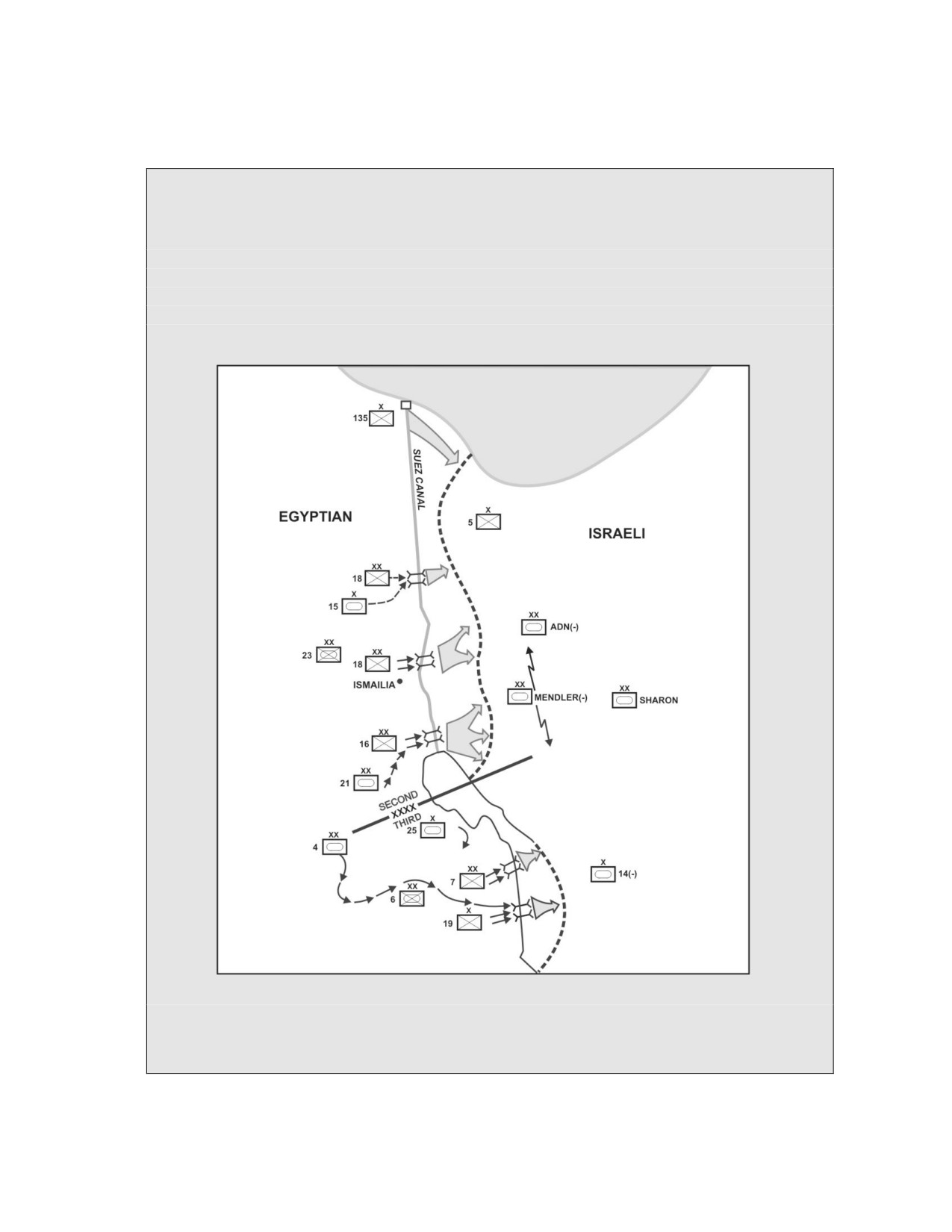
Conditioning an Adversary: The Egyptian Crossing of the Suez
The rapid crossing of the Suez Canal by the Egyptian Army at the start of the1973 Yom
Kippur War was facilitated by a carefully orchestrated MD operation. The canal-
crossing operation was conducted against a highly skilled opponent. The Israeli
intelligence service was efficient and could observe the Egyptian rear area with all
intelligence disciplines. (See map 4-4.)
Map 4-4. The Egyptian Crossing of the Suez
4-27
FM 3-13 __________________________________________________________________________________
The Egyptian deception objective was to achieve operational surprise in the initial
phase of the attack. The Egyptians sought to do this by denying information on the
assault preparations to the Israelis, their own troops, foreign intelligence services, and
the media. Egyptian EEFI included details on the timing, scope, and tactical execution
of the assault. The subordinate deception objectives were to—
• Cause the Israelis to delay early mobilization.
• Deny the Israelis an opportunity to conduct a preemptive strike.
• Delay the Israeli decision to execute an armored counterattack for at least eight
hours after the crossing began.
This was a formidable task. The Suez Canal averages 200 meters wide. From defen-
sive position on the eastern bank, the Israelis could observe any Egyptian preparations.
The Egyptians used deceptive measures and a broad range of centrally directed and
controlled deception events involving political and military activities. These included—
• Maintaining a pattern of national-level normalcy in international affairs by not
canceling scheduled diplomatic activities and visits by foreign dignitaries.
• Demobilizing 20,000 reservists 48 hours before the attack.
• Providing cover for large numbers of assault troops on the canal by establishing a
pattern of maneuvers and training during the six months before the attack.
• Moving assault bridging to the canal by sections at night, placing it in specially dug
pits, and covering it with canvas and sand.
• Closing descents to the canal in some areas and opening new ones at others loca-
tions.
• Improving defensive position on the Egyptian side of the canal.
• Publishing reports in the press that officers would be allowed leave for the annual
hajj pilgrimage.
• Hiding recently purchased, commercial, high-capacity fire-fighting water pumps to
conceal their ability to quickly remove large sections of the Israeli sand berm.
• The Egyptian MD operation could not conceal the coming attack, but it did perform
a vital function: it concealed how the Egyptians planned to use new technology and
the scale, scope, and precise timing of the operation. The Egyptian example illus-
trates that although it may not be possible to totally conceal one’s intent to attack, it
may be possible to protect a sufficient number of details associated with the plan
by deception. Masking key elements of the plan can give the friendly commander a
demonstrable advantage on the battlefield.
EXECUTION
4-109. Execution takes place in a dynamic environment. Consequently, the
commander continually assesses and refines the MD operation. As with plan-
ning and preparation, assessment is continuous during execution. By its na-
ture, there is little flexibility in an MD operation. The key to success is
knowing precisely when to take the next step in conveying the deception
4-28
_________________________________________________________________________ Military Deception
story. The MD plan identifies feedback events and indicators for intelligence
collection and analysis to provide these cues.
4-110. An MD operation is executed as part of the overall operation. Execut-
ing an MD operation involves controlling and terminating.
CONTROLLING DECEPTION OPERATIONS
4-111. Within command and control, control is the regulation of forces and
battlefield operating systems to accomplish the mission in accordance with
the commander’s intent. It includes collecting, processing, displaying, storing,
and disseminating relevant information for creating the common operational
picture, and using information, primarily by the staff, during the operations
process (FM 6-0). In MD, it consists of decisions undertaken while executing
the MD operation. It involves deciding to execute each deception event as
specified by the MD plan or to change the plan to align it to situational
changes or adversary responses. Many deception activities are projected
during planning as a part of the progression of events envisioned in the exe-
cution schedule. Other decisions are dictated by events revealed during exe-
cution. Centralized control over deception events is imperative to ensure they
are synchronized in a way that does not conflict with other operations. This
requires close coordination among the assets tasked to conduct them. The
MD plan’s C2 paragraph states the person with authority to order changes to
the deception plan.
TERMINATING DECEPTION OPERATIONS
4-112. Terminating the MD operation is the final execution control action.
When the termination decision is made, the appropriate termination branch
or sequel becomes the basis for a deliberate series of termination events.
4-113. An AAR is an integral part of terminating an MD operation. AARs
should include lessons learned as well as deception cost parameters, such as
monetary expenditures, materiel and resources, units employed, man-hours
needed, and opportunity costs. Cost data provides the G-7, the MDO, and the
commander with a concrete basis for evaluating COAs for future MD opera-
tions.
ASSESSMENT
4-114. Assessment is the continuous monitoring—throughout planning,
preparation, and execution—of the current situation and progress of an op-
eration, and the evaluation of it against criteria of success to make decisions
and adjustments (FM 3-0). It involves receiving and processing information
about implementing the MD operation. It also includes continual reexamina-
tion of deception objectives, targets, stories, and means. Control activities in-
clude the interim decisions and instructions needed to adjust the MD plan’s
implementation. Both activities continue until termination activities are
complete. There are four types of assessment activities during MD
operations:
• Monitoring and evaluating the MD operation to ensure it continues to
correspond to actual conditions.
4-29
FM 3-13 __________________________________________________________________________________
• Obtaining the feedback necessary to evaluate the progress of the de-
ception story.
• Monitoring unintended consequences of the MD operation. Data on un-
intentional effects may be used to adjust deception events or take ad-
vantage of new opportunities.
• Evaluating the need to terminate the MD operation for reasons other
than success.
4-115. Experience is a major source of MD planning information. Institution-
al experience includes AARs and analyses from recent MD operations. These
address both potential deception targets and the mechanics of conducting an
MD operation. As with other operations, these data are generated during
execution. Their collection, processing, and storage end the MD operation.
Lessons from all operations process activitiesplanning, preparation,
execution, and assessmentare captured.
4-116. Commanders assess MD operations continually. An MD plan’s quality
is related to the validity of assumptions concerning what the situation will be
when the overall operation starts. Validating such assumptions with updated
information is essential to any assessment. To do this, the general situation
is continually assessed prior to the overall operation’s start. Such assessment
may be necessary to determine when to start the MD operation.
4-30
PART TWO
Tactics, Techniques, and Procedures
Like all military operations, information operations follow the operations process:
planning, preparation, execution, and continuous assessment. These activities are
sequential but not discrete; they overlap and recur as circumstances demand (see
FM 3-0; FM 6-0). Part Two is organized around these activities: Chapter 5 addresses
planning. Chapter 6 addresses preparation. Chapter 7 addresses execution. Since
commanders assess operations continuously, each chapter addresses aspects of
assessment that apply to the activity being discussed.
Chapter 5
Planning Information Operations
Chapter 5 explains how to use the military decisionmaking process
(MDMP) to plan information operations. (FM 5-0 discusses the MDMP.)
Each section addresses an MDMP task or a group of related tasks.
Appendix A lists the MDMP tasks and the G-7 actions and products
associated with them. Appendix B contains a scenario that illustrates the
products developed during each MDMP task. This chapter includes cross-
references to the examples in Appendix B.
SECTION I - INFORMATION OPERATIONS PLANNING CONCEPTS
5-1. Planning is the means by which the commander envisions a desired out-
come, lays out effective ways of achieving it, and communicates to his
CONTENTS
Section I - Information Operations Planning
Section VI - Course of Action
Concepts
5-1
Comparison
5-30
Section II - Receipt of Mission
5-4
Section VII - Course of Action
Section III - Mission Analysis
5-8
Approval
5-30
Section IV - Course of Action
Section VIII - Orders Production
5-31
Development
5-20
Section V - Course of Action Analysis
(War-gaming)
5-28
5-1
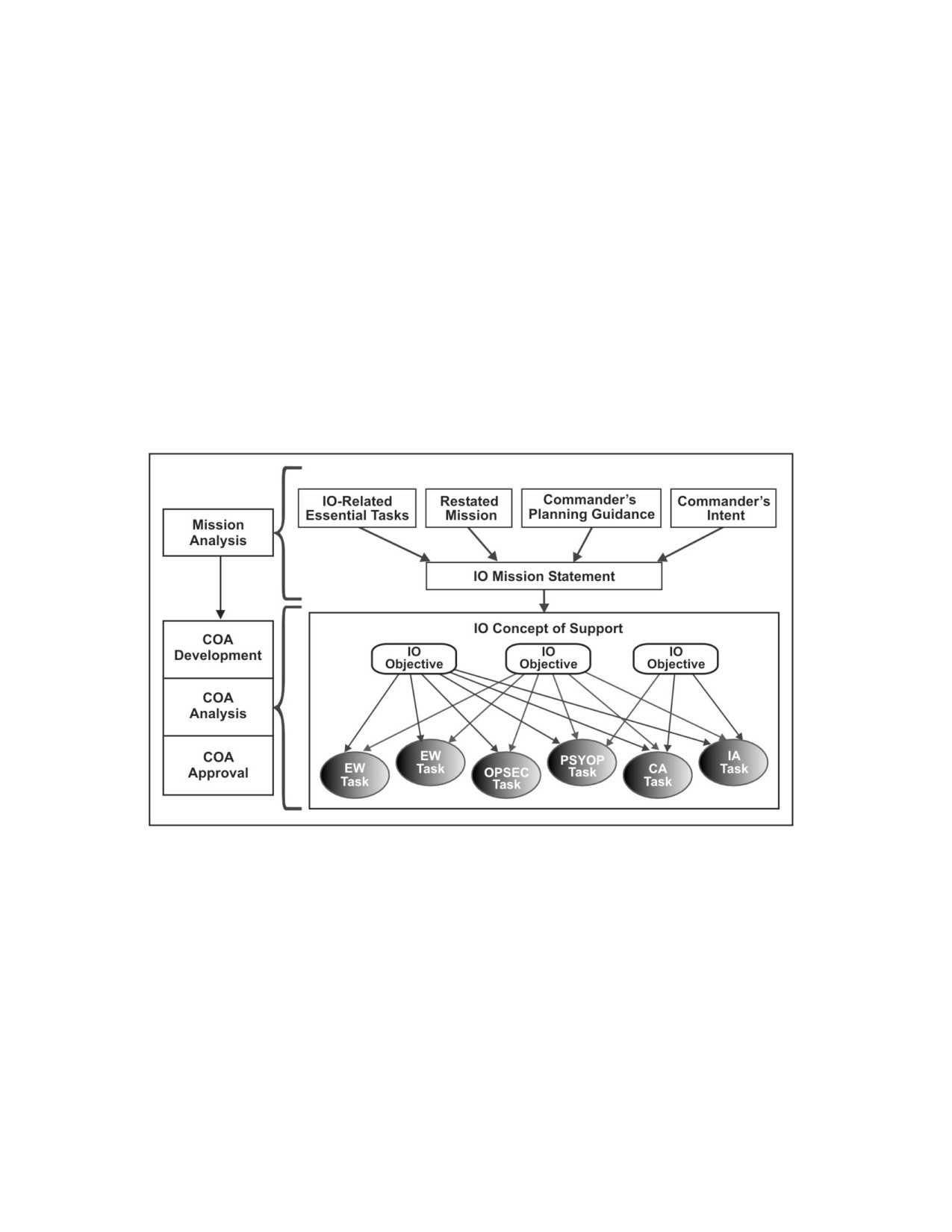
FM 3-13 __________________________________________________________________________________
subordinates his vision, intent, and decisions, focusing on the results he
expects to achieve (FM 3-0). Commanders and staffs above company level use
the military decisionmaking process (MDMP) to plan operations. The G-7
follows MDMP techniques to plan and synchronize information operations
(IO). The commander’s personal interest and involvement is essential to en-
sure that IO effectively supports accomplishing the mission. To achieve this,
commanders and staff planners consider IO throughout the MDMP. Planning
IO requires integrating it with several other processes: among them, intelli-
gence preparation of the battlefield (IPB) (see FM 34-130) and targeting (see
appendix E and FM 6-20-10). G-2 and fire support representatives partici-
pate in IO cell meetings and work with IO cell members to synchronize IO
with their activities and the overall operation. Commanders use the IO mis-
sion statement, IO concept of support, IO objectives, and IO tasks to describe
and direct IO (see figure 5-1).
Figure 5-1. Relationship of the IO Concept of Support, IO Objectives, and IO Tasks
5-2. The information operations mission statement is a short para-
graph or sentence describing what the commander wants IO to ac-
complish and the purpose for accomplishing it. The G-7 develops the
initial IO mission statement at the end of mission analysis, based on the re-
stated mission, IO-related essential tasks, commander’s intent, and com-
mander’s planning guidance. The G-7 develops the final IO mission state-
ment after the commander approves a course of action (COA). The final IO
mission statement includes the IO objectives for the approved COA. The IO
initial mission statement may include initial IO objectives, if any emerge during
mission analysis.
5-3. The information operations concept of support is a clear, concise
statement of where, when, and how the commander intends to focus
5-2
_____________________________________________________________ Planning Information Operations
the information element of combat power to accomplish the mission.
During COA development, the G-7 develops a separate IO concept of support
for each COA the staff develops. IO concepts of support are written in terms
of IO objectives and IO elements/related activities.
5-4. Information operations objectives are clearly defined, obtainable
aims that the commander intends to achieve using IO elements/re-
lated activities. IO objectives serve a function similar to that of terrain or
force-oriented objectives in maneuver operations. They focus IO on things
that must be done to accomplish the IO mission and support the command-
ers’ intent and concept of the operation. IO objectives usually involve tasks
by more than one IO element.
5-5. Accurate situational understanding is key to establishing IO objectives.
Operational- and tactical-level objectives are more immediate than strategic-
level objectives. However, they may also contribute to national- and theater-
strategic IO objectives. Joint and component staffs at the operational level inte-
grate and synchronize IO into campaigns and major operations (see FM 3-0).
5-6. The G-7 develops most IO objectives concurrently with IO concepts of
support during COA development. At the same time the G-3 develops terrain
or force-oriented objectives. However, some IO objectives may emerge during
mission analysis. These include IO objectives that are present during all op-
erations: such as, prevent compromise of the operation, and protect C2. Oth-
ers may be related to specified tasks from the higher headquarters. IO objec-
tives become part of the final IO mission statement. The G-7 uses them to fo-
cus the conduct of IO tasks.
5-7. IO objectives for offensive and defensive IO are stated in terms of ef-
fects. For offensive IO, these are destroy, disrupt, degrade, deny, deceive, ex-
ploit, and influence. For defensive IO, these are protect, detect, restore, and
respond (see chapter 1).
5-8. Information operations tasks are tasks developed to support ac-
complishment of one or more information operations objectives. An
IO task addresses only one IO element/related activity. The G-7 develops IO
tasks during COA development and finalizes them during COA analysis.
During COA development and COA analysis, IO tasks are discussed in terms
of IO elements/related activities. During orders production, IO tasks are as-
signed to units. FM 3-13 uses IO task in only one context: to refer to a task
that is performed by one IO element/related activity and supports one or
more IO objectives. All other tasks that concern IO are referred to as IO-re-
lated tasks.
5-9. The goal of IO planning is to integrate IO into the overall operation. The
G-7 achieves this by developing IO planning products that—
• Express how IO contribute to accomplishing the mission.
• Assign IO tasks to units responsible for performing them.
• Synchronize IO task performance.
• Describe how the command will assess IO.
The most important IO planning product is the IO subparagraph or IO annex
of the operation plan (OPLAN) or operation order (OPORD) (see appendix D).
5-3
FM 3-13 __________________________________________________________________________________
The IO annex usually includes an IO execution matrix and IO assessment
matrix as appendixes.
5-10. Integrated IO planning requires innovation and flexibility. Some IO
elements/related activities—such as, psychological operations (PSYOP), op-
erations security (OPSEC), and military deception (MD)—require a long lead
time for planning and preparation. Some elements must be executed before
other aspects of the overall operation. Others demand higher resolution and
more up-to-date intelligence. For some, there is a long lag between execution
and assessment of their effects. IO require a concentrated intelligence, sur-
veillance, and reconnaissance (ISR) effort during preparation and execution
to obtain and analyze information for assessing IO effectiveness. The in-
creased resolution of intelligence, new intelligence data requirements, and
the long lead time required necessitate early collection and analysis. These
factors increase the challenges facing IO planners and decrease the time
available to prepare IO. Nevertheless, early execution of selected IO tasks
can enhance efforts to shape the area of operations (AO) and information en-
vironment.
5-11. Integral to IO planning is the development and continuous updating of
the IO estimate (see appendix C). Some IO elements/related activities, such
as PSYOP, maintain separate estimates. All estimates are running (continu-
ously updated) estimates. Maintaining a current IO estimate pays off during
orders production because major portions of it contain information that forms
the basis for the IO annex and associated appendixes. In addition to sup-
porting the development of the base order and warning orders (WARNOs)
during planning, the G-7 uses the IO estimate to plan branches and sequels
during preparation (see FM 3-0), and to prepare IO input to fragmentary or-
ders (FRAGOs) during execution.
SECTION II - RECEIPT OF MISSION
5-12. Upon receipt of a mission, either from higher headquarters or from the
commander (see figure B-2, page B-3), the commander and staff perform an
initial assessment. Based on this assessment, the commander issues initial
guidance (see figure B-3, page B-5) and the staff prepares and issues a
WARNO (see figure B-4, page B-6). During the time between receiving the
commander’s initial guidance and issuing the WARNO, the staff performs re-
ceipt of mission actions. During receipt of mission, the G-7—
• Participates in the commander’s initial assessment.
• Receives the commander’s initial guidance.
• Reviews the IO estimate.
• Prepares for future planning.
5-13. The primary G-7 products are input to the following products and proc-
esses: IPB, the initial ISR tasking, and the initial WARNO. The G-7 also de-
termines how much time to allocate to each action and ensures the com-
mander includes IO factors in the commander’s initial guidance and
WARNO.
5-4
_____________________________________________________________ Planning Information Operations
PARTICIPATE IN COMMANDER’S INITIAL ASSESSMENT
5-14. The commander’s initial guidance emerges from the initial com-
mander’s visualization. This process includes an exchange of information be-
tween the commander and staff members—typically the G-2, G-3, G-6, G-7,
and the fire support coordinator (see FM 6-0). More staff elements become
involved later. At this point the G-7 helps the commander visualize the op-
eration by describing how IO can support it. The G-7 bases the advice on the
IO estimate.
RECEIVE COMMANDER’S INITIAL GUIDANCE
5-15. Commanders include IO guidance in their initial guidance. Separate
guidance on IO may be appropriate during peace operations or other missions
where information is the principal element of combat power. However, com-
manders do not consider IO in a vacuum. When they issue IO guidance sepa-
rately, they ensure it is consistent with their other guidance. To ensure de-
velopment of a clear IO concept of support and specific IO objectives, IO
tasks, and criteria of success, commanders provide as much specific guidance
on IO as possible.
5-16. The commander’s initial guidance may include essential elements of
friendly information (EEFI) and instructions regarding military deception
(MD). Establishing EEFI starts the OPSEC process (see chapter 3). The G-7
reviews existing EEFI and recommends changes, if necessary. If the com-
mander issues MD guidance, the military deception officer (MDO) assembles
the deception working group and begins MD planning (see chapter 4).
PERFORM INITIAL INFORMATION OPERATIONS ASSESSMENT
5-17. Once the commander issues initial guidance, the G-7 assembles the IO
cell (time permitting) and performs an initial IO assessment. This assess-
ment begins with the IO estimate. The G-7 updates it based on input from IO
cell members and identifies any information gaps. In a time-constrained en-
vironment, the only information reasonably available may be that in the IO
estimate. During this assessment, the G-7 derives guidance from two sources:
the commander’s initial guidance and the higher headquarters OPLAN/
OPORD. These two sources define the IO role in the operation and provide
the information needed to start planning. The initial IO assessment results
in the following products:
• IO input to IPB.
• IO input to the initial ISR tasking.
• IO input to the initial WARNO.
PROVIDE INITIAL INPUT TO INTELLIGENCE PREPARATION OF THE
BATTLEFIELD
5-18. IPB supports IO by identifying the IO capabilities and vulnerabilities
of friendly, adversary, and other key groups. It portrays adversary and other
key group leaders/decisionmakers, command and control (C2) systems, and
decisionmaking processes. IO input to the initial IPB performed during re-
ceipt of mission focuses on identifying IO IRs that include information
about—
5-5
FM 3-13 __________________________________________________________________________________
• Adversary and other key group IO capabilities and vulnerabilities.
• The portion of the information environment in the commander’s battle-
space.
• The impact of the physical and information environments on friendly,
adversary, and other IO.
• How adversaries and others might support their operations with IO
(predictions).
• The potential impact of friendly IO on adversary and other operations
(assessments).
The G-7 refines IO input to IPB throughout the operation.
PROVIDE INPUT TO THE INITIAL INTELLIGENCE, RECONNAISSANCE, AND
SURVEILLANCE TASKING
5-19. Commanders deploy ISR assets as soon after they receive a mission as
possible (see FM 5-0). The G-7 combines requirements for IO information,
target identification, and assessments to produce IO input to the initial ISR
tasking. ISR resources are limited and can be constrained by weather and
other factors. Submitting IO information requirements (IRs) early increases
the likelihood of obtaining information in time to affect IO execution.
5-20. The G-7 submits IO IRs to the G-2. The G-2 submits tasks for subordi-
nate units to the G-3 and collection requests to higher headquarters. Staff
members responsible for specific IO elements/related activities also submit
IO IRs through their technical support channels.
PROVIDE INPUT TO THE INITIAL WARNING ORDER
5-21. The initial WARNO is the staff product for the first MDMP task. It is
issued after the commander and staff have completed their initial assessment
and before mission analysis begins. It includes, as a minimum, the type and
general location of the operation, initial time line, and any movements or re-
connaissance to begin. When they receive the initial WARNO, subordinate
units begin parallel planning.
5-22. Parallel planning and collaborative planning (in units with the neces-
sary information systems [INFOSYS]) are routine MDMP techniques. The
time needed to achieve and assess IO effects makes it especially important to
successful IO. Effective parallel/collaborative planning requires all echelons
to fully share information as soon as it is available. Information sharing in-
cludes providing higher headquarters plans, orders, and guidance to subordi-
nate G-7s. IO cell representatives use staff and technical channels (see FM 5-
0) to share information as it is developed.
5-23. Because some IO elements/related activities require a long time to plan
or must begin execution before the overall operation, WARNOs include de-
tailed IO information. Although the MDMP includes three points at which
commanders issue WARNOs, the number of WARNOs is not fixed. WARNOs
serve a purpose in planning similar to that of FRAGOs during execution.
Commanders issue both, as the situation requires. Possible IO input to the
initial WARNO includes—
5-6
_____________________________________________________________ Planning Information Operations
• Tasks to subordinate units for early initiation of approved IO actions,
particularly for MD operations and PSYOP.
• EEFI to facilitate defensive IO and begin the OPSEC process.
• Known IO-related hazards and risk guidance.
• MD guidance and IO priorities.
PREPARE FOR SUBSEQUENT PLANNING
5-24. During the initial IO assessment, the G-7 establishes the concept of
work for the IO cell. The concept of work usually includes locations, times,
preparation requirements, and the anticipated schedule. Upon receiving a
new mission, each planner begins gathering planning data. These can include
a copy of the higher command OPLAN/OPORD, maps of the AO, appropriate
references, and the IO estimate. The list of IO tools should be a part of the
G-7 SOP.
5-25. The most important G-7 planning tools are the IO estimate and
supporting IO element estimates (see appendix C). The IO estimate is a run-
ning estimate. The G-7 refines it and keeps it on hand throughout the opera-
tion. The IO estimate is a record of IO assessments. The G-7 uses it for plan-
ning and recommending changes throughout preparation and execution.
INITIAL TIME ALLOCATION
5-26. Based on the commander’s time allocation, the G-7 allocates time to
plan and prepare for IO. This allocation of available time is the most impor-
tant task the G-7 performs during receipt of mission. It determines how the
G-7 manages IO planning throughout the rest of the MDMP. Depending on
the situation, assembling an IO cell with staff members representing each IO
element facilitates IO planning and makes the best use of time. Spreading
the workload among IO element representatives also helps synchronize their
efforts and identify problems early.
5-27. Initial time allocation is also important to IO because some IO activi-
ties need a long time to produce effects or a significant time to assess them.
The time available may be a limiting factor for some IO. The G-7 identifies
IO activities for which this is the case and includes the effects of not being
able to conduct (plan, prepare, execute, and assess) them in estimates and
recommendations.
PLANNING IN TIME-CONSTRAINED CONDITIONS
5-28. The commander determines when to execute a time-constrained
MDMP. Under time-constrained conditions, the G-7 relies on existing tools
and products, either their own or those of higher headquarters. The lack of
time to conduct reconnaissance requires planners to rely more heavily on as-
sumptions and increases the importance of routing combat information and
intelligence to the people who need it. A current IO estimate is essential to
planning in time-constrained conditions.
5-7
FM 3-13 __________________________________________________________________________________
SUMMARY OF RECEIPT OF MISSION ACTIONS
5-29. How well the G-7 accomplishes the receipt of mission actions deter-
mines the effectiveness of G-7 actions throughout the rest of the MDMP. It
affects the quality of the OPLAN/OPORD and possibly the success or failure
of the operation. The G-7 is present and carries the current IO estimate when
the commander reviews the new mission and issues initial guidance. From
that point, the G-7 works closely with other coordinating staff officers and
planners to synchronize IO with all aspects of the operation. Input to IPB
and the initial ISR tasking is time sensitive. Failing to meet the input dead-
line places the G-7 at a severe disadvantage. The G-7 planners work with the
G-3 planners to include IO aspects in the initial WARNO. Early dissemina-
tion of IO-related information and requirements facilitates synchronization
and parallel/collaborative planning.
SECTION III - MISSION ANALYSIS
5-30. During mission analysis, the staff defines the tactical problem and be-
gins to determine feasible solutions. Mission analysis consists of 17 tasks.
Many of them are performed concurrently. The mission analysis products are
the restated mission, initial commander’s intent, commander’s guidance, and
at least one WARNO. The G-7 ensures each of these products includes IO fac-
tors. The G-7 also provides IO input to other staff processes (such as IPB and
targeting) and performs IO-specific tasks. The major G-7 mission analysis
products are the initial IO mission statement and an updated IO estimate.
Some IO objectives may also emerge. For the G-7, mission analysis focuses on
developing information for use during the rest of the operations process.
5-31. The staff performs the following tasks during mission analysis:
• Analyze the higher headquarters order.
• Conduct IPB.
• Determine specified, implied, and essential tasks.
• Review available assets.
• Determine constraints.
• Identify critical facts and assumptions.
• Conduct risk assessment.
• Determine initial commander’s critical information requirements.
• Determine the initial ISR annex.
• Plan use of available time.
• Write the restated mission.
• Conduct a mission analysis briefing.
• Approve the restated mission.
• Develop the initial commander’s intent.
• Issue the commander’s guidance.
• Issue a WARNO.
• Review facts and assumptions.
5-8
_____________________________________________________________ Planning Information Operations
ANALYZE THE HIGHER HEADQUARTERS ORDER
5-32. Mission analysis begins with a thorough examination of the higher
headquarters OPLAN/OPORD in terms of the commander’s initial guidance.
By examining higher echelon IO plans, commanders and staffs learn how
higher headquarters are using IO elements/related activities and which IO
resources and higher headquarters assets are available. The G-7 researches
to understand the—
• Higher commander’s intent and concept of operations.
• Higher headquarters AO, mission/task constraints, acceptable risk,
and available IO assets.
• Higher headquarters schedule for conducting the operation.
• Missions of adjacent units.
Conducting IO without considering these factors may decrease IO effective-
ness, increase the chance of failure, and reduce the impact of IO at all eche-
lons. A thorough analysis also helps determine if it is necessary to request
external IO support. There is no formal IO product for this task. Its purpose
is for all to obtain a clear understanding of the mission and information re-
lating to it, especially the higher commander’s intent. Any questions should
be raised immediately and any confusion resolved.
CONDUCT INTELLIGENCE PREPARATION OF THE BATTLEFIELD
5-33. During mission analysis, the G-2 prepares a new IPB or updates exist-
ing IPB products and the initial IPB performed upon receipt of the mission.
The G-2, with technical assistance and input from other staff elements, uses
IPB to define the battlefield environment, describe the battlefield’s effects,
evaluate adversaries, and determine adversary COAs (see FM 34-130). Fig-
ure 5-2, page 5-10, lists possible IO-related factors to consider during each
IPB step. During IPB, the G-7 works with the G-2 to determine adversary IO
capabilities and vulnerabilities.
• Information operations capabilities are units or systems that
support the accomplishment of information operations tasks.
• Information operations vulnerabilities are deficiencies in
protective measures that may allow an adversary to use infor-
mation operations capabilities against friendly information
systems or command and control systems.
5-34. IPB often begins with doctrinal templates that portray how adversaries
may use forces and assets unconstrained by the environment. Doctrinal tem-
plates are often developed before deployment. The G-2 and G-7 may add fac-
tors from the information environment to a maneuver-based doctrinal tem-
plate, or they may prepare a separate IO doctrinal template (see figure 5-3,
page 5-11). Since IO often follow logical lines of operations (see FM 3-0), a
separate IO template may be needed. However, when adversaries have IO
assets that maneuver with their forces, adding these assets to the maneuver-
based doctrinal template may be appropriate. The situation, available infor-
mation, and type of adversary affect the approach taken. IO-related portions
of IPB products become part of paragraph 2b of the IO estimate (see figure B-
5, page B-9 and appendix C).
5-9
FM 3-13 __________________________________________________________________________________
Define the Battlefield Environment
• Portions/aspects of the information environment that can affect friendly opera-
tions
• Features/activities that can influence information and C2 systems
• Political and governmental structures and population demographics
• Major cultures, languages, religions, and ethnic groups
• Civilian communication and power infrastructures
• Nonstate actors: NGOs and significant nonadversary groups
Describe the Battlefield’s Effects
• Information environment effects on decisionmakers, C2 systems, and decision-
making processes
• How the information environment relates to the battlefield environment
• Information environment effects on friendly, adversary, and other operations
• Combined effects of friendly, adversary, and other INFOSYS and C2 systems on
the information environment and AO
• Effects of terrain, weather, and other characteristics of the AO on friendly and en-
emy INFOSYS and C2 systems
Evaluate the Threat
• Adversary and other group C2 systems, including functions, assets, capabilities,
and vulnerabilities (both offensive and defensive)
• Assets and functions (such as, decisionmakers, C2 systems, and decisionmak-
ing processes) that adversaries and others require to operate effectively
• Adversary capabilities to attack friendly INFOSYS and defend their own
• Models of adversary and other group C2 systems
• IO-related strengths, vulnerabilities, and susceptibilities of adversaries and other
groups
Determine Threat COAs
• How adversaries and other groups may pursue information superiority
• How, when, where, and why (to what purpose) adversaries and other groups will
use IO capabilities to achieve their likely objectives
Figure 5-2. Information-Operations-Related Factors to Consider During IPB
5-35. The G-7 provides input to help the G-2 develop IPB templates, data-
bases, and other products that portray information about adversary and
other key groups in the AO and area of interest. These products contain in-
formation about each group’s leaders and decisionmakers. Information rele-
vant to conducting IO includes—
• Religion, language, and culture of key groups and decisionmakers.
• Agendas of nongovernmental organizations.
• Size and location of adversary/other forces and assets.
• Military and civilian communication infrastructures and connectivity.
• Population demographics, linkages, and related information.
5-10
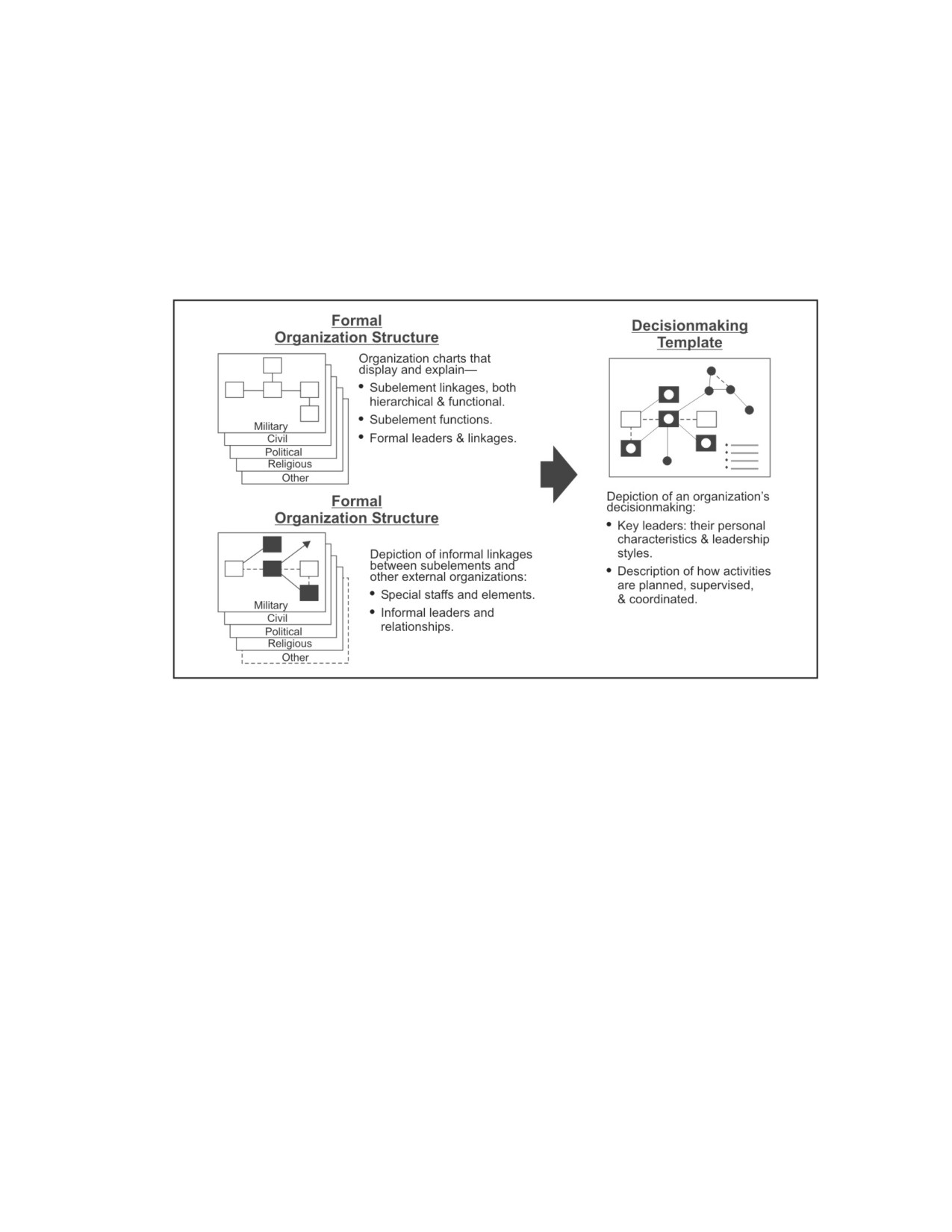
_____________________________________________________________ Planning Information Operations
• Location and types of radars, jammers, and other noncommunication
INFOSYS.
• Audio, video, and print media outlets and centers, and the populations
they service.
• C2 vulnerabilities of friendly, adversary, and other forces/groups.
Figure 5-3. Sample Information Operations Doctrinal Template
5-36. The G-2 uses IPB to determine possible adversary COAs and arrange
them in probable order of adoption. These COAs, depicted as situation
templates, include adversary IO capabilities. A comprehensive IPB addresses
adversary offensive and defensive IO capabilities and vulnerabilities. An IO
situation template depicting how adversaries and others may employ IO
capabilities to achieve information superiority is sometimes appropriate.
DEFINING THE INFORMATION ENVIRONMENT
5-37. Although the information environment has always affected military op-
erations, its impact today is greater than ever. The G-7 brings IO IRs that
address how information environment factors might affect operations to the
G-2. The G-2 obtains the information from strategic and national-level data-
bases, country studies, ISR assets, and—when necessary—other intelligence
agencies.
5-38. As part of defining the battlefield environment, the G-2 establishes the
limits of area of interest. The area of interest includes areas outside the AO
that are occupied by adversary or other forces/groups that can affect mission
accomplishment. It also includes portions of the information environment
that affect operations within the AO. The ability of actors in the information
environment to affect operations makes areas of interest larger than in the
5-11
FM 3-13 __________________________________________________________________________________
past. The G-7 ensures the G-2 considers factors in the information environ-
ment when determining the area of interest. IPB includes analyzing portions
of the information environment within the area of interest.
INTELLIGENCE PREPARATION OF THE BATTLEFIELD SUPPORT OF TARGETING
5-39. IPB supports the targeting process by identifying high-value targets
(HVTs) and showing where and when they may be anticipated (see appendix E).
Some of these are IO-related targets. IO elements/related activities focus on dif-
ferent types of targets. For example, physical destruction targets are normally
point targets, while PSYOP targets may be different civilian populations spread
throughout the AO. The G-2 works with the G-7 to develop IO-related HVTs.
The G-7 determines which IO-related HVTs contribute to one or more IO objec-
tives and develops them as IO tasks during COA development and analysis.
These tasks/targets are submitted to the targeting team as high-payoff targets
(HPTs) after COA analysis.
OTHER INTELLIGENCE PREPARATION OF THE BATTLEFIELD PRODUCTS
5-40. IPB identifies facts and assumptions concerning adversaries and the
operational environment that the G-7 considers when planning IO. These are
incorporated into paragraph 2 of the IO estimate. The G-7 submits IO IRs to
update facts and verify assumptions. Working with the G-2 and other staff
sections, the G-7 ensures IO IRs are clearly identified and requests for infor-
mation (RFIs) are submitted to the appropriate agency when necessary. IPB
may generate priority intelligence requirements (PIRs) pertinent to IO. The
G-7 may nominate these as commander’s critical information requirements
(CCIR) (see FM 3-0; FM 6-0). It may also identify OPSEC vulnerabilities. The
G-7 analyzes these to determine appropriate OPSEC measures (see chapter 3).
DETERMINE SPECIFIED, IMPLIED, AND ESSENTIAL TASKS
5-41. Concurrently with IPB, the staff determines specified, implied, and
essential tasks the unit must perform. For the G-7, this task comprises iden-
tifying IO-related specified tasks in the higher headquarters OPLAN/
OPORD, developing IO-related implied tasks that support accomplishing the
mission, and assembling the critical asset list (see figure B-6, page B-11). All
these products are refined throughout the MDMP, based on continuous as-
sessment of the friendly and adversary situations. The IO-related tasks iden-
tified form the basis for the initial IO mission. The G-7 develops them into IO
objectives during COA development.
IDENTIFYING INFORMATION-OPERATIONS-RELATED SPECIFIED TASKS
5-42. The G-7 looks for specified tasks that may involve IO in the higher
headquarters OPLAN/OPORD. Sections of the OPLAN/OPORD that may in-
clude these tasks include the commander’s intent, concept of operations, air
tasking order, and various annexes and operation overlays. In reviewing the
higher headquarters OPLAN/OPORD for IO-related tasks, the G-7 pays par-
ticular attention to—
• Paragraph 1, Situation.
• Paragraph 2, Mission.
5-12
_____________________________________________________________ Planning Information Operations
• Paragraph 3, Execution, especially subparagraphs on IO, tasks to
maneuver units, tasks to combat support units, and CCIR.
• Annexes that address intelligence, operations, fire support, rules of en-
gagement, IO, civil-military operations (CMO), and public affairs (PA).
5-43. Some IO-related specified tasks, such as support the higher headquar-
ters deception plan, become unit IO objectives. Others, particularly those
that address only one IO element, are incorporated under unit IO objectives
as IO tasks. If the command must accomplish an IO-related task to accom-
plish its mission, that IO-related task is an essential task for the command.
DEVELOPING INFORMATION-OPERATIONS-RELATED IMPLIED TASKS
5-44. As the staff identifies specified and implied tasks for the overall opera-
tion, the G-7 identifies IO-related tasks that can support accomplishing
them. These are IO-related implied tasks. The G-7 determines them based on
what the command is required to do and how IO can support doing it. The G-7
treats both types of IO-related tasks the same way. As with specified tasks, if
the command must accomplish an IO-related implied task to accomplish its
mission, that IO-related task is an essential task.
ASSEMBLING THE CRITICAL ASSET LIST
5-45. The critical asset list is a list of intelligence, surveillance, and
reconnaissance elements, and elements of the command’s command
and control system, whose loss or functional disruption would jeop-
ardize mission accomplishment. At the operational and strategic levels,
this subtask includes identifying centers of gravity. Protecting critical assets
and centers of gravity is an implied task for every operation. The G-7 obtains
input for the critical asset list from all IO cell representatives, particularly
those from the G-2, G-3, and G-6. It and the vulnerability assessment form
the basis for planning defensive IO. The G-7 establishes one or more IO ob-
jectives that focus on protecting critical assets/centers of gravity.
5-46. One means to identify critical assets is a vulnerability assessment. The
command’s vulnerability assessment identifies aspects of the command’s C2
system that require protection. Combined with the critical asset list and cen-
ters of gravity, it forms the basis for planning defensive IO. The 1st Informa-
tion Operations Command (Land) (1st IOC [L]) provides information opera-
tions vulnerability assessment teams (IOVATs) to assess and enhance a
commander’s ability to incorporate defensive IO into operations (see appen-
dix F). IOVATs contribute to force protection and information assurance by
conducting vulnerability analyses and recommending defensive IO and coun-
termeasures to mitigate vulnerabilities. The vulnerability assessment is con-
tinuously updated throughout an operation. Its results are recorded in para-
graph 2c(6) of the IO estimate.
REVIEW AVAILABLE ASSETS
5-47. During this task, the commander and staff determine if they have the
assets required to perform the specified, implied, and essential tasks. The G-7
performs this analysis to identify IO assets and IO resources:
5-13