FM 3-13 Information Operations: Doctrine, Tactics, Techniques, and Procedures (NOVEMBER 2003) - page 1
FM 3-13 (FM 100-6)
Information Operations:
Doctrine, Tactics,
Techniques, and
Procedures
NOVEMBER 2003
DISTRIBUTION RESTRICTION: Approved for public release; distribution is unlimited.
HEADQUARTERS, DEPARTMENT OF THE ARMY
*FM 3-13 (FM 100-6)
Field Manual
Headquarters
No. 3-13
Department of the Army
Washington, DC, 28 November 2003
Information Operations:
Doctrine, Tactics, Techniques, and Procedures
Contents
Page
PREFACE
iii
INTRODUCTION
v
PART ONE INFORMATION OPERATIONS DOCTRINE
Chapter 1
DESIGN OF ARMY INFORMATION OPERATIONS
1-1
Chapter 2
INFORMATION OPERATIONS ELEMENTS AND RELATED ACTIVITIES
2-1
Chapter 3
OPERATIONS SECURITY
3-1
Chapter 4
MILITARY DECEPTION
4-1
PART TWO TACTICS, TECHNIQUES, AND PROCEDURES
Chapter 5
PLANNING INFORMATION OPERATIONS
5-1
Chapter 6
PREPARING FOR INFORMATION OPERATIONS
6-1
Chapter 7
EXECUTING INFORMATION OPERATIONS
7-1
Appendix A QUICK REFERENCE TO IO INPUT TO THE MDMP
A-1
Appendix B INFORMATION OPERATIONS SCENARIO
B-1
Appendix C INFORMATION OPERATIONS ESTIMATE
C-1
Appendix D INFORMATION OPERATIONS ANNEX
D-1
Appendix E INFORMATION OPERATIONS TARGETING
E-1
Appendix F STAFF RESPONSIBILITIES AND SUPPORTING CAPABILITIES
F-1
Appendix G EXAMPLE OF IO-FOCUSED FRAGMENTARY ORDER
G-1
GLOSSARY
Glossary-1
BIBLIOGRAPHY
Bibliography-1
INDEX
...........................................................................................................................Index-1
________
DISTRIBUTION RESTRICTION: Approved for public release; distribution is unlimited.
*This publication supersedes FM 100-6, 27 August 1996.
i
Preface
Information is an element of combat power. Commanders conduct informa-
tion operations (IO) to apply it. Focused IO—synchronized with effective in-
formation management and intelligence, surveillance, and reconnaissance—
enable commanders to gain and maintain information superiority. IO is a
prime means for achieving information superiority.
Users of FM 3-13 must be familiar with the military decisionmaking process
established in FM 5-0, Army Planning and Orders Production; the operations
process, established in FM 3-0, Operations; and commander’s visualization,
described in FM 6-0, Mission Command: Command and Control of Army
Forces.
PURPOSE
As the Army’s key integrating manual for IO, this manual prescribes IO doc-
trine and tactics, techniques, and procedures (TTP). It also establishes doc-
trine and TTP for the IO elements of operations security and military decep-
tion. This manual implements joint IO doctrine established in JP 3-13, Joint
Doctrine for Information Operations; JP 3-54, Joint Doctrine for Operations
Security; and JP 3-58, Joint Doctrine for Military Deception.
This manual establishes the following as the definition of IO used by Army
forces: Information operations is the employment of the core capabili-
ties of electronic warfare, computer network operations, psychologi-
cal operations, military deception, and operations security, in con-
cert with specified supporting and related capabilities, to affect or
defend information and information systems, and to influence deci-
sionmaking. This definition supersedes the definition of IO in FM 3-0. It is
consistent with joint initiatives.
SCOPE
The publication addresses IO doctrine in Part I and TTP in Part II. Part I
also establishes Army operations security (OPSEC) and military deception
doctrine.
APPLICABILITY
This publication applies to Army forces from Army service component com-
mand (ASCC) to maneuver brigade. It is most applicable to corps and divi-
sions. The primary users of this manual are ASCC, corps, division, and bri-
gade commanders and staff officers—specifically the G-2, G-3, G-7, and staff
representatives for military deception, electronic warfare, operations secu-
rity, fire support, psychological operations, civil affairs, and public affairs.
Battalions normally execute higher headquarters IO. In stability operations
and support operations, they may be given IO assets. Thus, they need to
know their role in brigade and division IO.
iii
FM 3-13 __________________________________________________________________________________
TRADOC service schools and branch proponents should use FM 3-13 as a
point of departure for integrating IO into branch doctrine and military in-
struction.
ADMINISTRATIVE INFORMATION
Terms that have joint or Army definitions are identified in both the glossary
and the text. The glossary lists most terms used in FM 3-13 that have joint or
Army definitions. Terms for which FM 3-13 is the proponent manual (the au-
thority) are indicated with an asterisk in the glossary. Definitions for which
FM 3-13 is the proponent manual are printed in boldface in the text. These
terms and their definitions will be incorporated into the next revision of FM
1-02. For other definitions in the text, the term is italicized and the number
of the proponent manual follows the definition.
The glossary contains referents of acronyms and definitions of terms not de-
fined in JP 1-02 and FM 1-02. It does not list acronyms and abbreviations
that are included for clarity only and appear one time, nor those that appear
only in a figure and are listed in the legend for that figure. Some common ab-
breviations and acronyms—for example, the abbreviations for military ranks
and publications—are not spelled out; refer to the glossary. Since ARFOR is a
defined term as well as an acronym, it is not spelled out.
“President” refers to the President and the Secretary of Defense, or their duly
deputized alternates and successors.
All references to annexes refer to annexes to operation plans (OPLANs) or
operation orders (OPORDs) unless stated otherwise.
Unless stated otherwise, masculine nouns or pronouns do not refer exclu-
sively to men.
Headquarters, US Army Training and Doctrine Command, is the proponent
for this publication. The preparing agency is the Combined Arms Doctrine
Directorate, US Army Combined Arms Center. Send written comments and
recommendations on DA Form 2028 (Recommended Changes to Publications
and Blank Forms) directly to: Commander, US Army Combined Arms Center
and Fort Leavenworth, ATTN: ATZL-CD (FM 3-13), 1 Reynolds Road (Build-
ing 111), Fort Leavenworth, KS 66027-1352. Send comments and recommen-
dations by e-mail to web-cadd@leavenworth.army.mil. Follow the DA Form
2028 format or submit an electronic DA Form 2028.
iv
Introduction
Information operations (IO) encompass attacking adversary command and control
(C2) systems (offensive IO) while protecting friendly C2 systems from adversary
disruption (defensive IO). Effective IO combines the effects of offensive and defen-
sive IO to produce information superiority at decisive points.
IO brings together several previously separate functions as IO elements and
related activities. IO elements include the IO core capabilities, specified sup-
porting capabilities, and related activities discussed in chapter 1. It also allows
commanders to use all of them both offensively and defensively, as they deem
appropriate. The assistant chief of staff (ACOS) G-7 has the coordinating staff
responsibility for coordinating IO elements and related activities. This enables
the G-7 to shape the information environment to friendly advantage and pro-
tect commanders and friendly C2 systems from adversary IO.
Commanders do not conduct IO simply for the sake of doing IO. Effective IO is an
integrated effort that synchronizes the effects of IO elements/related activities to
accomplish specific objectives designated by the commander. It is the means
commanders use to mass the effects of the information element of combat power.
Offensive IO destroy, degrade, disrupt, deny, deceive, exploit, and influence
adversary decisionmakers and others who can affect the success of friendly
operations. Offensive IO also target the information and information systems
(INFOSYS) used in adversary decisionmaking processes.
Defensive IO protect and defend friendly information, C2 systems, and
INFOSYS. Effective defensive IO assure friendly commanders an accurate com-
mon operational picture (COP) based not only on a military perspective, but also
on nonmilitary factors that may affect the situation. An accurate COP is essen-
tial to achieving situational understanding. (See FM 6-0.) Most IO elements may
be used either offensively or defensively. Effective IO requires integrating IO re-
lated activities—such as, public affairs and civil military operations—into IO as
well.
The goal of IO is to gain and maintain information superiority, a condition that
allows commanders to seize, retain, and exploit the initiative. It facilitates more
effective decisionmaking and faster execution. IO involve constant efforts to deny
adversaries the ability to detect and respond to friendly operations, while simul-
taneously retaining and enhancing friendly force freedom of action. When expe-
ditiously exploited, IO provide a potent advantage that facilitates rapid military
success with minimal casualties. Effective IO and information management al-
low commanders to take advantage of opportunities, while denying adversary
commanders the information needed to make timely and accurate decisions or
leading them to make decisions favorable to friendly forces.
Army forces routinely employed the elements of IO separately in past conflicts.
Psychological operations, operations security, military deception, physical de-
struction, and electronic warfare were viable tools of Army commanders during
World War II. The Gulf War demonstrated the benefit of employing these elements
v
FM 3-13 __________________________________________________________________________________
together and synchronizing them with ground operations. Capitalizing on this
knowledge, the Joint Staff produced a series of doctrinal publications that culmi-
nated in October 1998 with JP 3-13, Joint Doctrine for Information Operations.
Today, Army IO doctrine and tactics, techniques, and procedures (TTP) adapt
joint IO doctrine to achieve information superiority at decisive points during full
spectrum operations. Because adversaries have asymmetric abilities to counter
finite friendly IO capabilities, the probability of maintaining information superi-
ority over long periods is unlikely. Therefore, commanders execute IO to gain
information superiority at times and places where it supports their intent and
concept of operations.
Technological advancements in automated INFOSYS and communications have
allowed commanders to see the battlefield as actions unfold, closer to near real-
time than ever before, and to rapidly pass information across their areas of op-
erations. Combined, IO and advanced INFOSYS and communications continue to
shorten the time required for staff processes. This compresses the decision cycle
and increases operational tempo, the rate of military action. Commanders now
have opportunities to achieve decisive results early in an operation, reducing
casualties and conserving resources.
Advancements in automated INFOSYS and communications carry with them
vulnerabilities commanders need to recognize and offset. Clearly, a force dependent
on technology offers adversaries new opportunities to degrade its effectiveness.
Army forces face significant vulnerabilities due to their dependence on infor-
mation technology. Army communications and technologies are becoming more
and more dependent on commercial backbones and commercial off-the-shelf
products and systems that are also readily available to potential adversaries.
This situation makes defensive IO an essential aspect of all operations.
vi
PART ONE
Information Operations Doctrine
Commanders conduct (plan, prepare, execute, and assess) information operations
(IO) to apply the information element of combat power. Combined with information
management and intelligence, surveillance, and reconnaissance operations,
effective IO results in gaining and maintaining information superiority. Information
superiority creates conditions that allow commanders to shape the operational
environment and enhance the effects of all elements of combat power. IO has two
categories, offensive IO and defensive IO. Commanders conduct IO by
synchronizing IO elements and related activities, each of which may be used either
offensively or defensively. Army IO doctrine supports joint IO doctrine, supplementing it
where necessary to meet the conditions of land operations. Part One discusses the
doctrinal concepts that underlie IO and the capabilities of, contributions made by,
and links among the IO elements and related activities. It also establishes doctrine for
two IO elements: operations security and military deception.
Chapter 1
Design of Army Information Operations
Information operations (IO) bring together several previously separate
functions as IO elements and related activities. To provide unity of effort,
IO is placed under a special staff officer, the assistant chief of staff G-7.
CONTENTS
Information Environment
1-2
Army-Joint Information Operations
Information-Environment-Based
Relationships
1-14
Threats
1-3
Offensive Information Operations
1-14
Information Environment
Defensive Information Operations
1-17
Challenges
1-9
Relationship of Offensive and
Information Superiority
1-10
Defensive Information Operations
1-18
Information Management
Information Operations Across the
Contributions
1-10
Spectrum of Conflict
1-18
Intelligence, Surveillance, and
Peace
1-19
Reconnaissance Contributions
1-10
Crisis
1-20
Information Operations
War
1-21
Contributions
1-11
The G-7 Section and the Information
Achieving Information Superiority
1-12
Operations Cell
1-21
Aspects of Information Operations
1-13
Training for Information Operations
1-22
Elements of Information Operations .. 1-13
Summary
1-23
1-1
FM 3-13 __________________________________________________________________________________
The G-7 has coordinating staff responsibility for IO. He does this by
means of the G-7 section and IO cell. Placing responsibility for synchro-
nizing the activities of the IO elements and related activities on one spe-
cial staff officer helps commanders mass their effects to gain and maintain
information superiority. Chapter 1 discusses the role of the G-7 and IO cell.
In addition, it describes the information environment (where Army forces
conduct IO), information superiority (the object of IO), and the categories
of IO (offensive IO and defensive IO). It also discusses how IO applies
across the spectrum of conflict and its relationship to intelligence, sur-
veillance, and reconnaissance. The chapter concludes with IO training
considerations.
INFORMATION ENVIRONMENT
1-1. The information environment is the aggregate of individuals, organizations,
or systems that collect, process, or disseminate information; also included is the
information itself (JP 3-13). It includes—
• The worldwide interconnection of communications networks.
• Command and control (C2) systems of friendly and adversary forces
and other organizations.
• Friendly, adversary, and other personnel who make decisions and han-
dle information.
Climate, terrain, and weapons effects
(such as electromagnetic pulse or
blackout) affect the information environment but are not part of it. Army
forces increasingly rely on the unrestricted use of the information environ-
ment to conduct (plan, prepare, execute, and assess) full spectrum opera-
tions.
1-2. The information environment is one of the components of battlespace
(see FM 3-0). A commander’s area of interest now includes part of the infor-
mation environment. The part of the information environment within a
commander’s battlespace encompasses information activities that affect an
operation. To visualize it, commanders consider the dimensions of the entire
information environment. They seek to understand how activity in the in-
formation environment may affect their mission. Commanders determine in-
formation activities that affect their operations and C2 systems, and those
they can influence. Activities in the information environment that command-
ers cannot influence may force them to assume or act to mitigate risk.
1-3. The requirement for commanders to conduct reachback operations has
expanded the portion of the information environment within a commander’s
area of interest. It now includes tactical to strategic C2 systems connected
through the Global Information Grid (GIG). Commanders depend on support
by elements of the GIG they do not control. They therefore rely on strategic de-
fensive IO to ensure necessary connectivity.
1-4. Many significant actors in the information environment can affect the
strategic, operational, and tactical direction of military operations—perhaps be-
fore they begin. Examples of these actors include—
• Foreign governments.
1-2
_______________________________________________________ Design of Army Information Operations
• US governmental agencies.
• Nongovernmental organizations.
• Agencies that coordinate international efforts.
• Social and cultural elements, and their leaders.
• Leaders of other Services, multinational partners, and adversaries.
• Individuals able to communicate with a worldwide audience.
• The news media.
1-5. All military operations take place within the information environment,
much of which is largely outside the control of Army forces. Commanders
consider the political and social implications that isolated small unit actions
might produce. Within this context, commanders face many new challenges and
opportunities. The complex relationship among political, strategic, technological,
and military factors requires adopting a broad perspective of how operations
and the information environment affect each other.
INFORMATION-ENVIRONMENT-BASED THREATS
1-6. Information-environment-based threats target one of three objects: com-
manders and other important decisionmakers, C2 systems, or information
systems (INFOSYS). The Army defines a command and control system as the
arrangement of personnel, information management, procedures, and equip-
ment and facilities essential to the commander to conduct operations (FM 6-0).
The Army defines information systems as the equipment and facilities that
collect, process, store, display, and disseminate information. This includes
computers—hardware and software—and communications, as well as policies
and procedures for their use (FM 3-0). C2 systems contain INFOSYS. Prevent-
ing commanders from exercising effective C2 is the goal of adversaries operating
in the information environment. They seek to achieve it by attacking C2 systems
or the INFOSYS they contain.
1-7. Threats against friendly C2 systems vary across the spectrum of conflict
(peace, crisis, and war) and by potential adversaries’ technical capabilities
and motivation (see FM 3-0). Threats have many sources and use many attack
methods. Commanders and staffs evaluate them based on several criteria—
some technical, some not. The following paragraphs discuss threat capabilities
and sources, methods of attack, and evaluation criteria.
Threat Capabilities and Sources
1-8. Most threats to units engaged in offensive, defensive, and stability op-
erations are straightforward and familiar. During these types of operations,
commanders expect adversaries to conduct some form of IO against them and
their C2 systems. They assume that adversaries will use multiple means to
try to deny them information, cast doubts on information they have, and disrupt
their decisionmaking process. However, the information environment contains
other threats as well. These threats are worldwide, technically multifaceted,
and growing. They come from a range of sources with varying capabilities—
from individuals, to organizations, to nation-states. Military, political, social,
cultural, ethnic, religious, or personal factors may motivate them. Commanders
anticipate these threats, prepare defenses, and—when appropriate—conduct IO
against them.
1-3
FM 3-13 __________________________________________________________________________________
1-9. Threat Capabilities. The capabilities of adversaries operating in the
information environment are ranked as follows:
• First level. Lone or small groups of amateurs using common hacker
tools and techniques in an unsophisticated manner without significant
support.
• Second level. Individuals or small groups supported by commercial
business entities, criminal syndicates, or other transnational groups
using common hacker tools in a sophisticated manner. This level of ad-
versary includes terrorists and nongovernmental terrorist organiza-
tions. Their activities include espionage, data collection, network map-
ping or reconnaissance, and data theft.
• Third level. Individuals or small groups supported by state-sponsored
institutions (military or civilian) and significant resources, using so-
phisticated tools. Their activities include espionage, data collection,
network mapping or reconnaissance, and data theft.
• Fourth level. State-sponsored offensive IO, especially computer net-
work attacks (CNAs), using state-of-the-art tools and covert techniques
conducted in coordination with military operations.
1-10. Threat sources are listed at the right.
Boundaries among these threats and
Threat Sources
among the capability levels are indistinct,
• Hackers
and it is often difficult to discern the ori-
• Insiders
gins of any particular incident. For exam-
• Activist nonstate actors
ple, actions that appear to be the work of
• Terrorists
first level threat may actually be the work
• Foreign IO activities
of a fourth level attack. In addition to ac-
• Information fratricide
tive adversary actions, information fratri-
ide can also threaten IO success.
1-11. Hackers. Hackers are unauthorized users who attempt to or actually
gain access to C2 systems and INFOSYS, or deny their use to legitimate us-
ers. They are often people who enjoy exploring the details of programmable
systems and determining how to stretch their capabilities. The worldwide
spread of INFOSYS in general, and the establishment of the Internet in par-
ticular, has led to a new threat: mass attacks by hackers to make political
statements. This phenomenon is notable because it crosses national bounda-
ries. When groups of activists believe that an entity is acting contrary to
their goals, they make a global call for hackers to attack their perceived ad-
versary. Calls to arms are made to individuals based on personal beliefs and
morality; response to such a call is nearly impossible to predict. Even if hack-
ers do not penetrate the target’s C2 system, the number of attempts may
have the effect of a denial of service attack.
1-12. Insiders. Insiders are individuals with legitimate access to elements of
a C2 system. They pose one of the most serious threats to C2 systems.
Whether recruited or self-motivated, insiders have access to INFOSYS normally
protected against attack.
1-13. Activist Nonstate Actors. Nonstate actors, ranging from drug cartels
to social activists, are taking advantage of the possibilities the information
environment offers. They can acquire capabilities to strike at foes’ C2
1-4
_______________________________________________________ Design of Army Information Operations
systems at low cost. Moreover, they can strike with relative impunity from a
distance. Besides attacking opponents directly, these actors use the interna-
tional news media to attempt to influence global public opinion and shape
decisionmaker perceptions.
1-14. Terrorists. Terrorist actions range from gaining unauthorized access
to C2 systems to physical attacks against commanders and decisionmakers.
Terrorist groups have been identified as using commercial INFOSYS—espe-
cially computer bulletin boards—to pass intelligence and technical data
across international borders.
1-15. Foreign Information Operations Activities. During peace, crisis,
and war, foreign nations conduct IO against Army C2 systems, INFOSYS,
and information. These actions will, in most cases, mimic those activities of
hackers, terrorists, and activist including nonstate actors. Foreign IO activi-
ties take advantage of the anonymity offered by computer bulletin boards to
hide organized collection or disruption activities. Some also masquerade as
unorganized hackers. Their primary targets are often commercial and scien-
tific, rather than military, INFOSYS. In addition, adversaries use IO capa-
bilities—both low-tech and high-tech—to attempt to shape the information
environment in their favor.
1-16. During crisis or war, adversary IO may attack commercial INFOSYS
and military C2 systems on which Army forces rely. These attacks may take
the form of jamming, broadcasting false signals and deceptive transmissions,
or generating electromagnetic pulses. In such cases, adversaries can disrupt
more than communications. Sensors at all levels can be jammed or triggered
to produce misleading information. Commercial systems and sensors are par-
ticularly vulnerable to the effects of electromagnetic pulse due to their rela-
tively unshielded architectures.
1-17. Foreign IO may actively seek to manipulate, knowingly or unknow-
ingly, other threat sources. In particular, foreign intelligence services may
use the threat of blackmail and other forms of trickery to cause other parties
to act or facilitate actions on their behalf.
1-18. Information Fratricide. Information fratricide is the result of
employing information operations elements in a way that causes ef-
fects in the information environment that impede the conduct of
friendly operations or adversely affect friendly forces. A familiar ex-
ample is friendly force jamming degrading friendly radio communications.
However, information fratricide covers other IO aspects as well. Actions, per-
ceptions, and information from friendly forces that create improper impres-
sions can adversely affect IO in sensitive situations. For example, working with
an international organization that is locally controlled by a leader opposed to
the US effort can give the wrong perception to the local populace.
1-19. Threat sources at all capability levels are present during peace and cri-
ses. Commanders consider their presence during war, even while focusing on
the combined arms operations of the identified enemy. For example, the
threat posed by insiders depends on their access to components of a C2 sys-
tem. Likewise, a well-funded nonstate actor can pose a greater threat than
some less sophisticated foreign intelligence services. Information fratricide
also threatens IO success during peace and crisis. Effective staff work is
1-5
FM 3-13 __________________________________________________________________________________
essential to ensure that the activities and messages of all forces and agencies
are synchronized to achieve national objectives.
Methods of Attack
1-20. Adversaries may use several
Methods of Attack
methods to attack friendly C2 systems
and INFOSYS, or shape the informa-
• Unauthorized access
tion environment in their favor. The
• Malicious software
nature of the information environment
• Electromagnetic deception
makes such attacks hard to detect.
• Electronic attack
Some attacks, such as corrupting data-
• Physical destruction
bases or controlling programs, can be
• Perception management
designed with delayed effects. Others
may employ immediate actions to degrade or destroy information nodes. Pos-
sible attacks are called incidents. An incident is an assessed event of at-
tempted entry, unauthorized entry, or an information attack on an auto-
mated information system. It includes unauthorized probing and browsing;
disruption or denial of service; altered or destroyed input, processing, stor-
age, or output of information; or changes to information system hardware,
firmware, or software characteristics with or without the users knowledge, in-
struction, or intent (JP 3-13).
1-21. Unauthorized Access. Unauthorized access is designed to gain
information from, insert data into, modify data stored within, or delete data
from C2 systems. Individuals can log on to military networks, such as local
area networks, from the Internet. Firewalls (software that provides network
security) exist to prevent this. However, if a firewall is penetrated, the C2
system is penetrated. Unauthorized access need not originate from the Inter-
net and proceed through a firewall breach. A person with physical access to a
terminal connected to a C2 system (an insider) can gain unauthorized access.
1-22. Malicious Software. Inserting malicious software causes a computer
to operate in a manner other than that intended by its users. Malicious soft-
ware includes computer viruses, logic bombs, and programs designed to by-
pass protective programs. Files downloaded from the Internet may contain
viruses that disrupt software or corrupt databases.
1-23. Electromagnetic Deception. Electromagnetic deception is the
deliberate radiation, reradiation, alteration, suppression, absorption, denial,
enhancement, or reflection of electromagnetic energy in a manner intended
to convey misleading information to an enemy or to enemy electromagnetic-
dependent weapons, thereby, degrading or neutralizing the enemy’s combat
capability. Among the types of electromagnetic deception are manipulative
electromagnetic deception, simulative electromagnetic deception, and imita-
tive electromagnetic deception (JP 3-51).
• Manipulative electromagnetic deception comprises actions to eliminate
revealing, or convey misleading, electromagnetic telltale indicators
that may be used by hostile forces (JP 3-51). If not properly identified,
manipulative electromagnetic deception may result in false informa-
tionsignals, radiation, or databeing passed through the intelli-
gence analysts, to the commander. Adversaries may pass inaccurate or
1-6
_______________________________________________________ Design of Army Information Operations
distorted information by indirect means (through the information envi-
ronment) or direct means (such as deceiving friendly intelligence, sur-
veillance and reconnaissance [ISR] systems).
• Simulative electromagnetic deception comprises actions to simulate
friendly, notional, or actual capabilities to mislead hostile forces
(JP 3-51). For example, a military deception operation may place sur-
veillance radars in a typical defensive array when, in fact, the com-
mander’s intention is to attack.
• Imitative electromagnetic deception is the introduction of electromag-
netic energy into enemy systems that imitates enemy emissions
(JP 3-51).
1-24. Electronic Attack. Electronic attack is that division of electronic war-
fare involving the use of electromagnetic energy, directed energy, or antira-
diation weapons to attack personnel, facilities, or equipment with the intent
of degrading, neutralizing, or destroying enemy combat capability and is con-
sidered a form of fires. Electronic attack includes (1) actions taken to prevent
or reduce an adversary’s effective use of the electromagnetic spectrum, such
as jamming and electromagnetic deception, and (2) employment of weapons
that use either electromagnetic or directed energy as their primary destruc-
tive mechanism (lasers, radio frequency weapons, particle beams) (JP 3-51).
Electronic attack (EA) against friendly C2 systems and their associated net-
works can occur at any timeduring peace, crisis, or war. Army C2 systems
are always subject to attack, regardless of the level of international tensions
or hostilities.
1-25. Adversaries may try to inhibit operations by shutting down networks
through electronic means. Some adversaries can conduct computer network
attacks (CNAs) as well. Computer networks are particularly vulnerable to
denial of service attacks. Networks do not have to be compromised or de-
stroyed to disable them. Hackers can deny use of a network or other
INFOSYS without gaining access to it. This capability makes denial of ser-
vice attacks hard to defend against.
1-26. Physical Destruction. Weapons that can destroy, disrupt, or degrade
C2 systems by physically destroying parts of them range from terrorist
bombs to artillery, missiles, and aircraft. The ability of adversaries to strike
will only grow as more capable systems, such as cruise missiles and preci-
sion-guided munitions, proliferate. The spread of such technologies as global
positioning systems, unmanned aerial vehicles, and near real-time-imagery
satellites, will enhance precision-strike capabilities.
1-27. Perception Management. Perception management consists of actions
to convey and/or deny selected information and indicators to foreign audi-
ences to influence their emotions, motives, and objective reasoning; and to
intelligence systems and leaders at all levels to influence official estimates,
ultimately resulting in foreign behaviors and official actions favorable to the
originator’s objectives. In various ways, perception management combines
truth projection, operations security, cover, deception, and psychological op-
erations (JP 3-13). Some adversaries will target friendly forces and interests with
perception management activities, such as propaganda and deception, to
1-7
FM 3-13 __________________________________________________________________________________
undermine their will to fight or resist. These activities can take many forms,
from civilian media broadcasts to special operations forces strikes.
1-28. Propaganda seeks to shape the information environment in the adver-
sary’s favor. Strategic propaganda supports adversary strategic or opera-
tional objectives by influencing the opinions, emotions, attitudes, or be-
havior of people who can affect friendly operations. Operational and tactical
propaganda seeks to incite opposition to friendly operations by targeting au-
diences in the area of operations (AO). Tactical propaganda may also attempt
to influence the attitudes, emotions, motivations, and reasoning of command-
ers and members of friendly forces.
1-29. Deception is another means of shaping the information environment.
However, it is usually targeted against a decisionmaker rather than a large
population. Deception operations portray a false image of the situation. Their
object is to lead friendly commanders to act in ways that favor the adversary.
Common forms of deception include portraying false information about the
exact strength and composition of adversary forces, their deployment and ori-
entation, and their intended manner of employment. Military deception op-
erations are deception operations conducted by Army forces (see chapter 4).
Evaluation of Information-Environment-Based Threats
1-30. Because the information environment contains more than just techni-
cal threats, commanders evaluate threats from several perspectives. Com-
manders and staffs consider the following factors:
•
The adversary C2 system. Does the adversary C2 system include
computers, networks, and other digital devices? Or, does the adversary
use less technical ways to exercise C2?
•
Sources of information. What is the best way to collect information
from the adversary C2 system? The sophistication and technical
complexity of the adversary C2 system determine the means required to
exploit it.
•
Adversary goals and interests. What are adversary short- and long-
range goals? Can friendly forces affect them?
•
Influential groups, individuals, and decisionmakers. What indi-
viduals or groups determine adversary or other group actions? These
people may be leaders within the adversary armed forces or government,
or interest groups in the information environment. They may be located
within or outside the AO. Decisionmakers may be commanders or
trusted subordinates.
•
Adversary IO resources and capabilities. What resources can
adversaries use to protect their C2 systems or inhibit friendly mission
success? These may change over time. Adversaries may gain, lose, or
reconstitute IO resources and capabilities, based combat actions or out-
side support. Accurately understanding current adversary capabilities is
essential to success in a fast-moving operational environment.
•
Adversary IO vulnerabilities. Where and how are adversaries
vulnerable? How can friendly forces exploit those vulnerabilities? What
are adversaries doing to keep friendly forces from exploiting them?
1-8
_______________________________________________________ Design of Army Information Operations
• Friendly vulnerabilities to adversary IO efforts. How is the
friendly force vulnerable? What can it do to keep adversaries from ex-
ploiting those vulnerabilities?
INFORMATION ENVIRONMENT CHALLENGES
1-31. The complexity of the information environment presents commanders
with significant and interrelated challenges. Most operations are conducted
in full view of a global audience. Information technology changes rapidly, af-
fecting friendly and adversary operations, and how they are perceived. Com-
manders face challenges in the areas of policy and public opinion, soldier mo-
rale, and legal considerations.
Policy and Public Opinion
1-32. The global expanse of the information environment allows news reports
and analyses to rapidly influence public opinion and decisions concerning
military operations. Audiences include the US public, decisionmakers, multina-
tional partners, other nations, and international organizations. It also includes
potential or actual adversaries. The news media will likely provide 24-hour
coverage of, and diverse perspectives on, any future operation.
1-33. Global visibility of operations can also affect strategic or operational
deterrence and affect commanders’ decisions. Stories in the global informa-
tion environment may be inaccurate, incomplete, or presented out of context.
They may be based on rumor or be the result of intentional disinformation
efforts. In such circumstances, commanders may be tempted to act in haste,
make emotional decisions, or make choices inconsistent with the real situa-
tion. Effective commanders anticipate how adversaries might attempt to
shape the information environment. Preventing adversaries from setting the
terms of a conflict in the public arena is a form of maintaining the initiative
and a fundamental aspect of perception management.
Morale
1-34. The global audience’s perception of an operation may affect a com-
mand’s combat power by influencing soldier morale. The rapid capabilities of
modern communications systems often disseminate informationaccurate or
inaccurateto soldiers faster than the chain of command does. Such activi-
ties as the will to win, dedication to the cause, understanding of the mission, and
devotion to fellow soldiers and the unit can affect aspects of the human dimen-
sion (see FM 22-100). Because the human dimension includes families and com-
munities as well as soldiers, a commander’s battlespace includes home sta-
tion (see FM 3-0). Bad news, misinterpretations, misinformation, and disinfor-
mation can affect morale there and indirectly undermine the will of the force.
Legal Considerations
1-35. Legal use or access to INFOSYS and technologies is rapidly changing
as new laws and regulations are implemented. Even so, existing laws are of-
ten outdated. Commanders may face complex legal challenges and other con-
straints, such as, rules of engagement, treaties, or status of forces/mission
agreements. Commanders include the staff judge advocate in the conduct of
IO to ensure that legal and policy issues are thoroughly addressed.
1-9
FM 3-13 __________________________________________________________________________________
INFORMATION SUPERIORITY
1-36. The Army defines information superiority as the operational advan-
tage derived from the ability to collect, process, and disseminate an uninter-
rupted flow of information while exploiting or denying an adversary’s ability
to do the same (FM 3-0). This definition differs slightly from the joint defini-
tion. While joint doctrine considers information superiority a capability, Ar-
my doctrine establishes it as an operational advantage. For Army forces, in-
formation superiority describes the degree of dominance that commanders
have over the part of the information environment that affects their opera-
tions, and over the adversary. Commanders measure it in terms of informa-
tion-based activities. Gaining and maintaining information superiority cre-
ates conditions that allow commanders to shape the information environment
and enhance the effects of other elements of combat power. Commanders di-
rect three interdependent contributors to achieve this goal:
• Information management.
• Intelligence, surveillance, and reconnaissance.
• Information operations (including related activities).
INFORMATION MANAGEMENT CONTRIBUTIONS
1-37. Information management is the provision of relevant information to the
right person at the right time in a usable form to facilitate situational under-
standing and decisionmaking. It uses procedures and information systems to
collect, process, store, display, and disseminate information (FM 3-0). Informa-
tion management (IM) consists of INFOSYS (see paragraph 1-6) and relevant
information (RI). Relevant information is all information of importance to
commanders and staffs in the exercise of command and control (FM 3-0). The
G-6 exercises primary staff oversight for IM. The G-6 maintains the status of
INFOSYS and ensures the C2 system provides relevant information to the
commander and staff based on the priorities the commander establishes.
1-38. IM is integral to C2. Commanders drive IM by establishing com-
mander’s critical information requirements (CCIR). CCIR tell the staff which
RI is most important to the commander. This RI is given priority for process-
ing within the C2 system. FM 6-0 discusses the role of IM in C2, including
providing support to achieving situational understanding, decisionmaking,
and execution information.
1-39. An important IM enabler is network operations (NETOPS). NETOPS
provide the collaborative, integrated management of networks, information
systems, and resources that produce the common operational picture.
NETOPS is performed from the strategic to the tactical extension of the GIG.
It includes network management, information assurance, and information
dissemination management. Effective NETOPS ensure that networks and
INFOSYS are available, protected, and able to pass RI throughout the AO.
INTELLIGENCE, SURVEILLANCE, AND RECONNAISSANCE CONTRIBUTIONS
1-40. The G-3 synchronizes intelligence, surveillance, and reconnaissance
(ISR). ISR is an enabling operation that integrates and synchronizes all bat-
tlefield operating systems to collect RI to facilitate the commander’s deci-
sionmaking.
1-10
_______________________________________________________ Design of Army Information Operations
1-41. The G-2 has staff responsibility for producing intelligence about adver-
saries and the environment. Intelligence analysts process and analyze infor-
mation (to include open-source information) to produce intelligence. They in-
corporate IO aspects into intelligence preparation of the battlefield (IPB) to
develop an accurate description of adversaries, other individuals and groups,
and the environment throughout the area of interest. Intelligence produc-
tion focuses on answering priority intelligence requirements (PIRs) and
identifying high-payoff targets.
1-42. Priority intelligence requirements are those intelligence requirements
for which a commander has an anticipated and stated priority in the task of
planning and decisionmaking (FM 3-0). They are the subset of CCIR that
deal with adversaries, other individuals and groups, and the environment.
PIRs establish priorities for ISR. As part of the CCIR, they establish priori-
ties for IM as well. PIRs tell soldiers, especially those performing ISR tasks,
what to look for. PIRs tell soldiers in the C2 system which intelligence to dis-
seminate first.
1-43. The G-7 contributes to the overall IPB by developing IO input for IPB
(see chapter 5). The G-7 works with the G-2 to develop products that portray
the information infrastructure of the AO and aspects of the information
environment that can affect operations. In addition to information about
adversary forces, these products include information on adversary and
other decisionmakers, key people, and significant groups in the AO. They
address potential strengths and vulnerabilities of adversaries and other
groups as well as friendly force operations security (OPSEC) considerations.
1-44. Through the intelligence system, the G-2 has access to higher echelon
information sources and ISR assets. Information from these sources is ana-
lyzed with information from organic sources to produce the adversary and
environment portions of the operational picture (see FM 6-0). Advanced
INFOSYS, adequate procedures, and trained soldiers allow the C2 system to
disseminate this intelligence throughout the command. Effective IM provides
different commanders and staffs with a common operational picture based on
intelligence and friendly force information.
1-45. ISR provides input essential to IPB and the targeting process (see
FM 34-130; FM 6-20-10). The three are interrelated. An accurate IPB requires
effective ISR. Identifying, engaging, and evaluating effects on targets requires
synchronizing both processes.
1-46. The G-3 exercises primary staff responsibility over reconnaissance
operations. To answer PIRs, the G-3 tasks organic reconnaissance and sur-
veillance assets. Together, the G-2 and G-3 exploit all available resources to
answer the PIRs. The G-7 submits information requirements to the G-2.
Information requirements that cannot be answered with organic assets are
submitted to appropriate agencies as requests for information (RFIs).
INFORMATION OPERATIONS CONTRIBUTIONS
1-47. The IO concept brings together several previously separate functions as
IO elements and related activities. Commanders use the IO elements/related
activities to shape the information environment.
1-11
FM 3-13 __________________________________________________________________________________
1-48. Successful IO depends on effective ISR and IM. ISR occurs both within
and outside the C2 system. Surveillance and reconnaissance assets collect
data throughout the area of interest. Intelligence assets process this data
into intelligence. Commanders use this intelligence to focus the other ele-
ments of combat power. IM occurs within the C2 system. It enables both ISR
and IO. Effective IM ensures intelligence and other RI gets to the com-
mander in time to make decisions. Commanders apply the leadership ele-
ment of combat power by using their judgment to make those decisions.
1-49. IM, IO, and ISR each have a different focus. ISR collects data and pro-
duces intelligence. IM disseminates and uses RI throughout the C2 system.
IO applies that RI to protect the friendly C2 system, attack the adversary C2
system, and shape the information environment. All are essential to achiev-
ing and maintaining information superiority.
ACHIEVING INFORMATION SUPERIORITY
1-50. To achieve information superiority, commanders focus efforts to im-
prove the friendly operational picture while affecting adversary battlefield
perceptions in a way that leads them to make decisions favoring friendly forces.
This situation provides a window of opportunity for decisive operations at times
and places the commander chooses. Absolute and sustained information superi-
ority is not possible. Adversary actions, friendly counteractions, and adversary
reactions frequently determine how long friendly forces can exploit it.
1-51. Adversaries exercise a variety of means to protect their C2 systems.
Some use means similar to those of friendly forces; others employ asymmetric
means and methods. Similarly, adversaries use various capabilities to attack
friendly C2 systems and shape the information environment in their favor.
Regardless of friendly force capabilities, information superiority can decay
quickly. A technologically equal opponent can use technological means to negate
friendly information superiority. A technologically inferior opponent may use
less sophisticated means or superior technology in one area to counter
friendly capabilities. Thus, friendly commanders do not seek to sustain infor-
mation superiority over an extended period. They act to forge localized informa-
tion superiority when and where it produces decisive results.
1-52. Information superiority exists relative to an adversary. Commanders
may not know when they have information superiority. However, when the
information available to commanders allows them to accurately visualize the
situation, anticipate events, and make appropriate, timely decisions better
than adversary commanders can, information superiority exists. Information
superiority enhances commanders’ freedom of action and allows them to exe-
cute decisions and maintain the initiative. However, commanders recognize
that without continuous IO designed to achieve and retain information supe-
riority, adversaries may counter its advantages and possibly wrest it from
them. Commanders achieve information superiority by maintaining accurate
situational understanding through effective IM (including NETOPS) and ISR
while creating a disparity between reality and how adversaries perceive it.
The more IO shapes this disparity, the greater the friendly advantage.
1-12
_______________________________________________________ Design of Army Information Operations
ASPECTS OF INFORMATION OPERATIONS
1-53. Information operations is the employment of the core capabili-
ties of electronic warfare, computer network operations, psychologi-
cal operations, military deception, and operations security, in con-
cert with specified supporting and related capabilities, to affect or
defend information and information systems, and to influence deci-
sionmaking. (This definition supersedes the definition of IO in FM 3-0. It is
consistent with joint initiatives.) Commanders are flexible when determining
how to exploit IO. The type of exploitation depends on their IO capabilities
and objectives. As adversary C2 systems become more sophisticated, the
friendly commander’s decisionmaking window becomes smaller. Conversely,
if adversary C2 systems are less sophisticated, the commander’s ability to af-
fect them directly with sophisticated capabilities becomes less likely. A
friendly force with electronic warfare capabilities may dominate an opponent
with a radio-based C2 system and no redundancy. However, an asymmetric
environment may include an adversary with a C2 system based on cou-
rier/word of mouth capabilities that require Army forces to adopt equally un-
sophisticated IO methods. Countering the diverse threats in of the informa-
tion environment demands imagination and creativity. The quick pace of IO
places a heavy demand on preplanned IO branches and sequels (see FM 3-0).
1-54. Commanders from brigade through echelons above corps conduct IO.
Responsibilities vary by echelon based on IO element and type of military op-
eration.
ELEMENTS OF INFORMATION OPERATIONS
1-55. IO are enabling operations that create and present opportunities for
decisive operations. Commanders use both offensive IO and defensive IO si-
multaneously to accomplish the mission, increase their force effectiveness,
and protect their organizations and systems. IO elements include core capa-
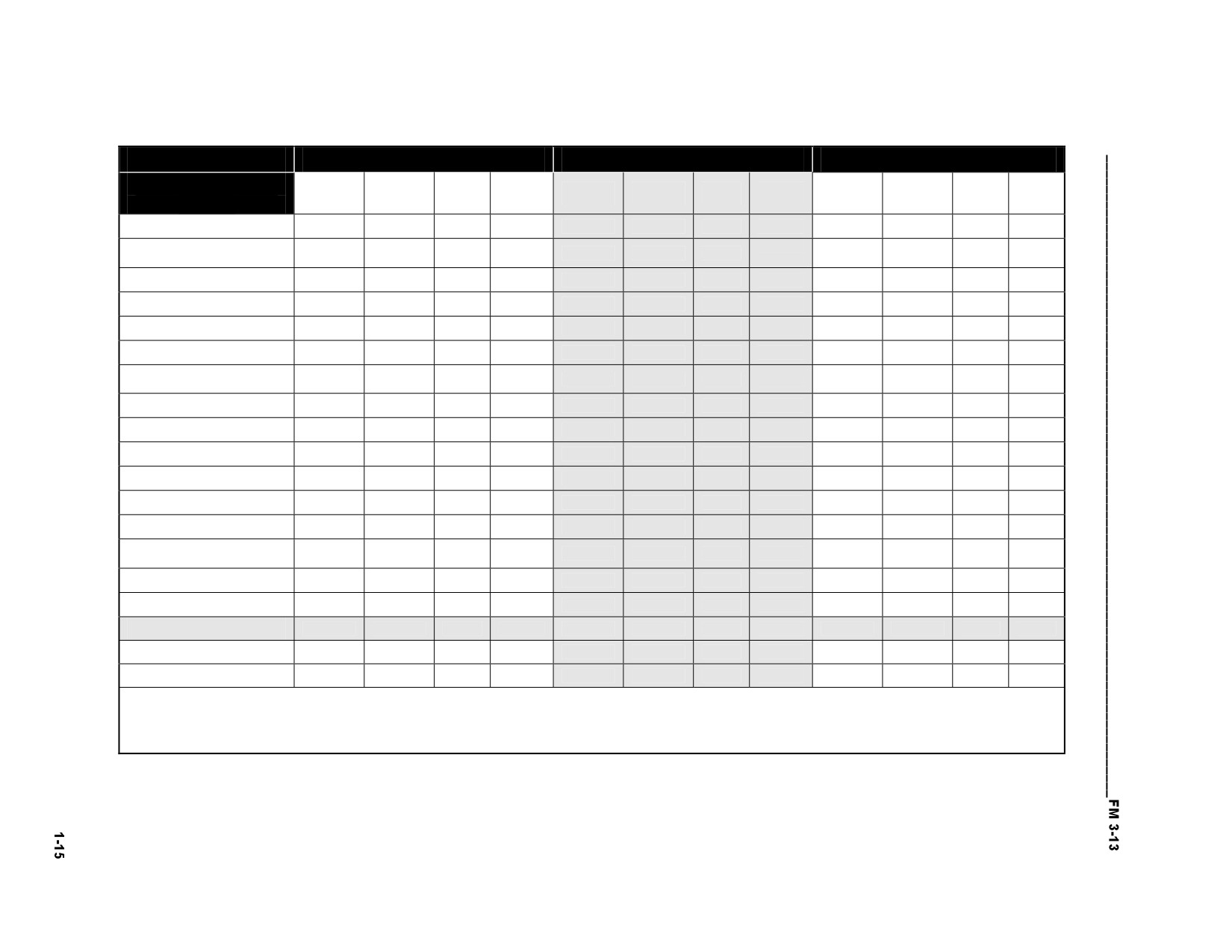
bilities and supporting capabilities (see figure 1-1, page 1-14). Commanders
conduct IO through a combination of these elements and related activities.
Figure 1-2, page 1-15, shows the relationship between the IO elements/
related activities, the types of operations, and unit responsibilities.
1-56. The elements of IO are not organizations. They are independent activi-
ties that, when taken together and synchronized, constitute IO. Commanders
decide which IO elements are appropriate to accomplish the mission. All ele-
ments may not be required for each operation.
1-57. With the possible exceptions of computer network operations (CNO),
CNA, computer network defense (CND) and computer network exploitation
(CNE), no IO element is new. What is new is bringing these elements/related
activities together as components of the information element of combat
power. IO focuses efforts that before were diffuse. A single staff officer—the
G-7—is assigned authority and responsibility for these previously separate
activities. This allows commanders to mass the effects of the information
element of combat power.
1-13
FM 3-13 __________________________________________________________________________________
Core
Supporting
• Electronic warfare
• Physical destruction
• Computer network operations
• Information assurance
• Computer network attack
• Physical security
• Computer network defense
• Counterintelligence
• Computer network exploitation
• Counterdeception
• Psychological operations
• Counterpropaganda
• Operations security
• Military deception
Figure 1-1. Information Operation Elements
1-58. IO related activities include but are not limited to public affairs (PA) and
CMO. Although FM 3-13 discusses only these two, any activity that contrib-
utes to gaining and maintaining information superiority (for example, an op-
eration in support of diplomatic efforts conducted by special operations
forces) may be considered an IO related activity.
ARMY-JOINT INFORMATION OPERATIONS RELATIONSHIPS
1-59. IO, by their nature, are joint operations. Each Service component con-
tributes to an integrated whole synchronized by the joint force headquarters.
All Army IO flow from the theater campaign plan. Army IO support joint
force missions and receive support from joint force assets. Based on the unit
mission, IO are integrated throughout the joint force to prevent information
fratricide by different Services or different echelons (see JP 3-13; FM 3-0). In
multinational operations, the US joint force commander (JFC) is responsible
for coordinating the integration of US and multinational IO.
1-60. The IO cell at joint force headquarters deconflicts and synchronizes
joint force IO. All Service components are represented. The joint force IO cell
synchronizes all the Service-specific IO elements/related activities to achieve
unity of effort supporting the joint force. Army forces submit requests for IO
support from joint force or higher echelons through the senior Army head-
quarters to the joint force IO cell.
OFFENSIVE INFORMATION OPERATIONS
1-61. The Army defines offensive information operations as the integrated
use of assigned and supporting capabilities and activities, mutually sup-
ported by intelligence, to affect enemy decisionmakers or to influence others
to achieve or promote specific objectives (FM 3-0). The Army definition de-
letes a sentence in the joint definition that lists IO elements associated with
offensive IO. Army doctrine allows commanders to use all IO elements offen-
sively.
1-14
Type of Operation
Offensive & Defensive
Stability
Support
IO Element/Related
ASCC
Corps
Div
Bde
ASCC
Corps
Div
Bde
ASCC
Corps
Div
Bde
Activity
OPSEC
P E
P E
P E
P E 4
P E
P E
P E
P E 4
P E
P E
P E
P E 4
P 1, 2/
P 1, 2/
P 1, 2/
PSYOP
P E
P E A
P E A
P E
P E A
P E A
P E
P E A
P E A
E A 4
E A 4
E A 4
Military Deception
P E
P E
P E A
P E 4
PE
P E
P E
E 4
X
X
X
X
EW-EA
P E
P E
P E
E A 4
P E
P E
P E
E A 4
X
X
X
X
EW-ES
P E
P E
P E
P E 4
P E
P E
P E
E 4
P E
E
E
E 4
EW-EP
P E
P E
P E
P E 4
P E
P E
P E
P E 4
P E
P E
P E
P E 4
CNO
P
P
X
X
P
X
X
X
X
X
X
X
CNA
P
P
X
X
P
X
X
X
X
X
X
X
CND
P E
P E
P E
P E 4
P E
P E
P E
E 4
P E
P E
P E
E 4
CNE
P
P
X
X
P
X
X
X
X
X
X
X
Physical Destruction
P
P E
P E
P E 4
P
P E
P E
P E 4
X
X
X
X
IA
P E
P E
P E
P E 4
P E
P E
P E
P E 4
P E
P E
P E
P E 4
Physical Security
P E
P E
P E
P E 4
P E
P E
P E
P E 4
P E
P E
P E
P E 4
P E A 1
Counterintelligence
P E
P E
P E
P E
P E
P E
E A 4
P E
P E
P E
E A 4
2
Counterdeception
P E
P E
P E
P E 1 2
P E
P E
E
E 4
P E
P E
E
E 4
Counterpropaganda
P E
P E
P E
P E 4
P E
P E
P E
E 4
P E
P E
E
EA 4
Related Activity
CMO
P E
P E
P E
P E A 4
P E
P E
P E
P E A 4
P E
P E
P E
P E A
Public Affairs
P E
P E
P E
E A 4
P E
P E
P E
E A 4
P E
P E
P E
E A 4
P - Plan/prepare element, objectives, and tasks as stated in OPLAN/OPORD
1 - Stryker brigade combat teams (SBCT)
E - Execute the objective and task as stated in OPLAN/OPORD
2 - Enhanced Army National Guard brigades
X - Command is not involved with this element
3 - Divisional maneuver brigades
A - Accomplished with attached assets
4 - All brigades
Figure 1-2. Information Operations Responsibilities by Echelon
FM 3-13 __________________________________________________________________________________
1-62. Commanders conduct offensive IO across the range of military
operations and throughout the spectrum of conflict. The rules of engagement
affect the means used and the effects sought in any given situation. Offensive
IO facilitates seizing and retaining the initiative by creating a disparity
between the quality of information available to friendly forces and that available
to adversaries. The following effects create this information advantage:
•
Destroy. Destroy is to damage a combat system so badly that it cannot
perform any function or be restored to a usable condition without being
entirely rebuilt (FM 3-90). Destruction is most often the use of lethal
and nonlethal means to physically render adversary information
useless or INFOSYS ineffective unless reconstituted. It is most effective
when timed to occur just before adversaries need to execute a C2 function
or when focused on a resource-intensive target that is hard to reconsti-
tute.
•
Disrupt. Disrupt is a tactical mission task in which a commander inte-
grates direct and indirect fires, terrain, and obstacles to upset an en-
emy’s formation or tempo, interrupt his timetable, or cause his forces
to commit prematurely or attack in a piecemeal fashion (FM 3-90).
Disrupt, in information operations, means breaking or inter-
rupting the flow of information between selected C2 nodes. It
may be desired when attack resources are limited, to comply with rules
of engagement, or to create certain effects. Electronic attack is a common
means of disrupting adversary C2 systems. Commanders conduct offen-
sive IO across the range of military operations.
•
Degrade. Degrade, in information operations, is using nonleth-
al or temporary means to reduce the effectiveness or efficiency
of adversary command and control systems, and information
collection efforts or means. Offensive IO can also degrade the
morale of a unit, reduce the target’s worth or value, or reduce the
quality of adversary decisions and actions.
•
Deny. Deny, in information operations, entails withholding
information about Army force capabilities and intentions that
adversaries need for effective and timely decisionmaking. Effec-
tive denial leaves opponents vulnerable to offensive capabilities.
OPSEC is the primary nonlethal means of denial. It applies through-
out the spectrum of conflict.
•
Deceive. Deceive is to cause a person to believe what is not
true. Military deception (MD) seeks to mislead adversary decision-
makers by manipulating their understanding of reality. Successful de-
ception causes them to believe what is not true.
•
Exploit. Exploit, in information operations, is to gain access to
adversary command and control systems to collect information
or to plant false or misleading information.
•
Influence. Influence is to cause adversaries or others to behave
in a manner favorable to Army forces. It results from applying
perception management to affect the target’s emotions, motives, and
reasoning. Perception management also seeks to influence the target’s
perceptions, plans, actions, and will to oppose friendly forces. Targets may
include noncombatants and others in the AO whom commanders want
1-16
_______________________________________________________ Design of Army Information Operations
to support friendly force missions or not resist friendly force activities.
Perception management achieves the influence effect by conveying or de-
nying selected information to targets.
DEFENSIVE INFORMATION OPERATIONS
1-63. The Army defines defensive information operations as the integration
and coordination of policies and procedures, operations, personnel, and tech-
nology to protect and defend friendly information and information systems.
Defensive information operations ensure timely, accurate, and relevant in-
formation access while denying adversaries the opportunity to exploit
friendly information and information systems for their own purposes
(FM 3-0). The Army definition deletes a sentence in the joint definition that
lists IO elements associated with defensive IO. Army doctrine allows com-
manders to use all IO elements defensively.
1-64. Defensive IO seeks to limit the vulnerability of C2 systems to adver-
sary action and to prevent enemy interference with friendly information and
INFOSYS. Defensive IO effects include: protection, detection, restoration,
and response.
1-65. Protection. Protection is all actions taken to guard against
espionage or capture of sensitive equipment and information. In IO,
protection occurs at the digital perimeter to control access to or mitigate the ef-
fects of adversary access to friendly decisionmakers and INFOSYS. Protection
applies to both the quantity and quality of information. It denies the adver-
sary information about friendly capabilities and intentions by controlling in-
dicators.
1-66. Detection. Detection is to discover or discern the existence,
presence, or fact of an intrusion into information systems. Detection
is the identification of adversary attempts to gain access to friendly informa-
tion and INFOSYS. Detection begins with INFOSYS users and administra-
tors. Timely detection and reporting are the keys to initiating restoration and
response. Electronic detection occurs at the internal digital perimeter.
1-67. Restoration. Restoration is to bring information systems back
to their original state. Restoration is reestablishment of essential capabili-
ties of INFOSYS damaged by enemy offensive IO. Restoration may rely on
backup or redundant links, INFOSYS components, or alternative means of in-
formation transfer.
1-68. Response. Response in information operations is to react
quickly to an adversary’s information operations attack or intrusion.
Timely identification of adversaries, their intent and capabilities, is the cor-
nerstone of effective response to adversary offensive IO.
1-69. Defensive IO uses technical and nontechnical activities to limit the vul-
nerability of friendly C2 systems to hostile IO. It also seeks to prevent adver-
saries from tampering with friendly force information or interfering with
friendly C2 systems. Defensive IO supports efforts to maintain effective C2
by countering or turning to friendly advantage adversary IO efforts. Timely,
accurate intelligence—some of which is based on information collected during
offensive IO—is essential to defensive IO. Forces conducting defensive IO
1-17
FM 3-13 __________________________________________________________________________________
require information about adversary attack methods, tools, capabilities,
weapons, and means of operation—which ISR produces.
RELATIONSHIP OF OFFENSIVE AND DEFENSIVE INFORMATION OPERATIONS
1-70. Commanders synchronize offensive and defensive IO to produce
complementary and reinforcing effects (see FM 3-0). Offensive IO supports
the decisive operation, while defensive IO protects friendly force critical as-
sets and centers of gravity. Conducting offensive and defensive IO independ-
ently detracts from the efficient employment of IO elements. At best, it ex-
pends more resources than would be required if the two were done in concert.
At worst, uncoordinated efforts increase conflicts and mutual interference. In
the extreme, they may compromise friendly intentions or result in information
fratricide. Fully integrating offensive and defensive IO requires planners to
treat IO as a single function. Commanders assisted by their G-7s integrate of-
fensive and defensive IO to gain and maintain information superiority. Com-
manders avoid concentrating on offensive IO to the exclusion of defensive IO.
They employ all IO elements offensively and defensively. Often offensive and
defensive IO use the same tactics, techniques, and procedures (TTP). The
commander’s intent and desired effects determine whether an information
operation is offensive or defensive.
1-71. Commanders integrate offensive and defensive IO at all levels of war
(see FM 3-0). At the strategic level, IO seek to engage adversary or potential
adversary leadership to deter crises or end hostilities. At the operational
level, IO focuses on denying adversaries the ability to conduct operations.
Military deception may be the significant offensive IO element. At the tacti-
cal level, IO focuses on an adversary’s use of information and INFOSYS. Le-
thal and nonlethal fires may be a significant contributor in offensive and de-
fensive operations. PSYOP and CMO may be significant contributors in
support operations and stability operations.
1-72. Tactical-level IO contributes to achieving strategic and operational
objectives. Operational- and strategic-level IO facilitate tactical operations.
Commanders also conduct IO across the range of military operations (see
FM 3-0). IO can be a potent force multiplier during offensive, defensive, and
support operations, and may be the decisive operation during stability opera-
tions.
1-73. The complexities and scope of the information environment make it
difficult to achieve the desired effects with a single IO element. Effective in-
tegration and synchronization of all IO elements is necessary to achieve mu-
tual support. Likewise, protecting friendly C2 systems and their components re-
quires careful integration and synchronization of IO elements. Two ways of
integrating are deconflicting and coordinating.
1-74. Commanders synchronize IO to cause specific effects at decisive points
to support the overall operation. Synchronizing offensive and defensive IO is
more effective than conducting them independently. Activities of all IO elements
often occur simultaneously. Synchronizing them results in complementary and
reinforcing effects. It also decreases the probability of conflicts and interference
that may compromise friendly intentions or result in information fratricide.
1-18
_______________________________________________________ Design of Army Information Operations
INFORMATION OPERATIONS ACROSS THE SPECTRUM OF
CONFLICT
1-75. The national security and national military strategies establish an im-
perative for engagement (see FM 1). Engagement involves the nation exer-
cising the instruments of national power—diplomatic, informational, mili-
tary, and economic—to shape the security environment. One means by which
the United States exercises the informational instrument of national power is
through joint IO. Army forces conduct IO within joint force parameters.
Throughout the spectrum of conflict, commanders conduct IO to apply the in-
formation element of combat power. In all situations, Army forces do not act
in isolation. Almost all operations are joint; most are interagency as well.
PEACE
1-76. During peace, commanders conduct IO to shape the strategic environ-
ment or to prepare for operations during crisis and war. Normally IO are part
of a combatant commander’s theater engagement plan. The majority of
peacetime preparation is done at home station or during training
exercises. Using contingency plans to focus their efforts, commanders
prepare databases for each IO element. These databases contain infor-
mation on possible adversaries and other significant actors. At the stra-
tegic and operational levels, databases focus on one or more of the following
target sets:
• Political leadership.
• Information capabilities and vulnerabilities, including military and
civilian communication networks, and domestic and foreign media.
• Military operations, leadership, and infrastructure, and their
vulnerabilities at the strategic, operational, and tactical levels.
• Economic factors that affect an actor’s ability to mount and sustain
military operations, and those that affect the morale of the population
and its leadership. This set includes the infrastructure that supports
economic activity.
• Social effects of ethnic, racial, and historical animosities and alliances.
1-77. The first four of these target sets coincide with the instruments of na-
tional power. The last target set addresses aspects of the information envi-
ronment that commanders consider when conducting IO. Examples of infor-
mation that databases may include are—
• People and groups who wield influence, both within states and non-
state actors.
• Decisionmakers, both within states and nonstate actors.
• People and groups sympathetic to US interests.
• People and groups hostile to US interests.
• People and groups vulnerable to US influence.
• Themes that appeal to specific audiences.
• Attributes of states that make them stable or unstable.
• States and nonstate actors that either accept or reject US economic or
military support.
• Religious, ethnic, and cultural customs, norms, and values.
1-19
FM 3-13 __________________________________________________________________________________
• Assessments of communications infrastructure.
• Assessments of military communication and C2 infrastructures.
• Assessments of military training and proficiency
(to determine
susceptibility to denial, military deception, and psychological opera-
tions).
• Literacy rates.
• Assessments of ethnic factional relationships and languages.
1-78. During peace, execution of some IO activities requires strategic-level
approval (see figure 1-2, page 1-15). However, IO assessment, planning,
preparation, and training during peace allow commanders to develop links
between governmental and nongovernmental agencies that are useful during
crisis and war. These activities also allow different echelons to coordinate
and deconflict their IO plans before receiving a mission. Commanders at all
echelons can determine the approval authority for the various IO elements/
related activities and synchronize their plans. Commanders also learn to rec-
ognize the risks involved and the tradeoffs required to conduct effective IO.
1-79. Department of Defense (DOD) and other intelligence agencies publish
reports and other products to support contingency planning (see AR 381-11).
These are available under the DOD Intelligence Dissemination Program.
New production requirements, less requirements for signals intelligence end
products (SEPs), are processed under the Department of Defense Intelligence
Production Program. Authorized users submit requests using the automated
Community On-line Intelligence System for End Users and Management
(COLISEUM). SEP requirements are submitted through major Army com-
mands to the United States Army Intelligence and Security Command
(INSCOM).
1-80. In addition to preparing for possible contingencies, some forces conduct
IO to accomplish the objectives of an actual deployment. For example, IO has
been a major, if not the decisive, aspect of peace operations in the Balkans.
Commanders conduct IO to influence decisionmakers and other actors in the
information environment. During peace, IO are often the primary means geo-
graphic combatant commanders use to shape the strategic environment.
CRISIS
1-81. During crises, Army forces conduct IO based on existing contingency
plans or a crisis action plan (see JP 5-0). A potential or actual contingency
requires commanders at all echelons to gather additional information and re-
fine their contingency plans based on a specific AO or target set. Geographic
combatant commanders may use the relationships and conditions in the in-
formation environment created during peace to influence potential adversary
decisionmakers to act in ways that will resolve the crisis peacefully. Other IO
may attempt to influence actors within the target group’s political, economic,
military, and social structures. Still other IO collect information about target
groups to use in decisionmaking and in conducting operations, if necessary.
Operational and tactical commanders prepare for IO as part of their deploy-
ment preparations. They coordinate preparations with the JFC to ensure unity
of effort and prevent information fratricide. Preparing for IO includes obtaining
information about potential adversaries from all available sources.
1-20
_______________________________________________________ Design of Army Information Operations
1-82. Information in the social and informational target sets shape com-
manders’ thinking about the AO. The military target set focuses operational
planning and preparation. Commanders conduct IO to develop the situation
and refine their situational understanding. Some IO elements/related activities
are more suited for this than others. For example, PA shape the information
environment by keeping the US public informed. Counterdeception may reveal
adversary intentions. Counterpropaganda may be able to stabilize a crisis.
CND can ensure that timely and accurate information is transmitted within
the command so a common operational picture is available for deci-
sionmakers (see FM 6-0). The objective during a crisis is to move the poten-
tial conflict back towards peace. The more subtle IO elements can help ac-
complish this.
1-83. During crises, commanders may be authorized to conduct more focused
ISR operations against possible adversaries to prepare for operations. This
means devoting additional resources to the collection effort (offensive IO).
Effective contingency planning helps commanders determine what informa-
tion requirements must be met to execute an operation. Commanders obtain
approval for IO tasks and products developed during contingency planning
and preparation. They also execute operations with objectives that require a
long time to achieve. As figure 1-3, page 1-22, shows, IO elements have dif-
ferent approval chains, and many IO activities may require a long time to
approve.
WAR
1-84. During war, commanders conduct IO to synchronize the information
element of combat power with the other elements of combat power. Well-syn-
chronized offensive IO can cripple not only adversary military power but also
adversary civilian decisionmaking capability. Commanders and staffs follow
the military decisionmaking process to plan IO that accomplishes the com-
mander’s intent and concept of operations. Part Two describes how they do
this. Appendix B provides an example scenario.
THE G-7 SECTION AND THE INFORMATION OPERATIONS CELL
1-85. The G-7 has coordinating staff responsibility for IO. He does this by
means of the G-7 section and IO cell. The G-7 section has assigned officers and
NCOs responsible for IO current operations, IO planning and IO targeting (see
appendix F). The G-7 coordinates IO related activities of other staff officers
through the IO cell.
1-86. The IO cell, located in the main command post, brings together
representatives of organizations responsible for all IO elements and related ac-
tivities. Related activities include any organizations able to contribute to
achieving IO objectives. PA and CMO are always related activities; command-
ers may designate others. The IO cell also includes representatives of special
and coordinating staff sections, as the mission requires. All battlefield operating
systems are represented. The primary function of an IO cell is to synchronize
IO throughout the operations process. In corps and divisions, the G-7
section forms its nucleus. In Army service component commands (ASCCs), the
plans, current operations, and effects control divisions—under the deputy
chief of staff for operations—coordinate IO. The ASCC ensures Army IO
1-21

FM 3-13 __________________________________________________________________________________
supports the theater IO campaign plan. If another headquarters
is
designated as the ARFOR, that headquarters assumes this responsibility.
IO Element/Related
IO Concept of
IO Objectives
IO Tasks
Activity
Support
Planning
Planning
Planning
OPSEC
headquarters
headquarters
headquarters
Planning
Joint force
Geographic combatant
PSYOP
headquarters
commander
commander
Planning
Next higher
Next higher
Military Deception
headquarters
headquarters
headquarters
Planning
Planning
Planning
Electronic Warfare
headquarters
headquarters
headquarters
INSCOM &
Planning
Planning
CNO
geographic combatant
headquarters
headquarters
commander*
INSCOM &
Planning
Planning
CNA
geographic combatant
headquarters
headquarters
commander*
Planning
Planning
CND
NETCOM
headquarters
headquarters
INSCOM &
Planning
Planning
CNE
geographic combatant
headquarters
headquarters
commander*
Executing
Executing
Executing
Physical Destruction
headquarters
headquarters
headquarters
Planning
Planning
Executing
Information Assurance
headquarters
headquarters
headquarters
Planning
Planning
Planning
Physical Security
headquarters
headquarters
headquarters
Planning
Counterintelligence
Echelon dependant
Task dependant
headquarters
Planning
Next higher
Next higher
Counterdeception
headquarters
headquarters
headquarters
Planning
Joint force
Geographic combatant
Counterpropaganda
headquarters
commander
commander
*Approval for execution is with the Secretary of Defense
Figure 1-3. Information Operations Approval Authorities
1-87. IO cell members may coordinate during meetings or over a local area
network. The frequency and times of IO cell meetings are synchronized with
the command’s battle rhythm (see figure E-2, page E-3). The IO cell also
identifies IO targets, which the G-7 nominates during targeting team meet-
ings. IO cell members coordinate IO objectives and tasks with their counterparts
at the higher and lower echelons. This coordination ensures that IO objectives
and tasks at all echelons are synchronized.
TRAINING FOR INFORMATION OPERATIONS
1-88. Effective IO requires soldiers who have trained as they intend to fight.
When commanders and units exercise IO elements realistically in training,
the readiness and confidence of the force increases. Part Two contains TTP
for IO. They form the basis for individual and collective IO training. When
developing IO for exercises, the following considerations are important:
• Include IO in training objectives.
• Establish how achieving information superiority aids mission accom-
plishment.
1-22
_______________________________________________________ Design of Army Information Operations
• Develop concrete, attainable IO training objectives.
• Support exercise objectives with realistic play by all IO elements/re-
lated activities.
• Create a realistic IO exercise environment.
• Assess and evaluate employment and synchronization of IO elements/
related activities.
• Use appropriate security measures to protect IO activities.
• Evaluate the use of computer support products (such as synchroniza-
tion tools) to execute IO.
• Use simulations to augment IO where and when applicable.
• Give credit to the playing units for IO execution; penalize those who
should and do not.
• Apply effects of friendly offensive and defensive IO to opposing forces,
and effects of adversary offensive and defensive IO to friendly forces.
• Require units to maintain mission effectiveness when they lose the
support of digital/advanced technology.
1-89. Effective IO training requires products that contain specific informa-
tion on adversary social, military, religious, and economic institutions. Exer-
cise planners may have to provide these. The data needed to create, update,
and use these products should be built into the exercise scenario and master
scenario events list (MSEL). The opposing force should have an IO capability
consistent with the exercise scenario. Realistic IO are essential to evaluating
friendly IO proficiency. Within the exercise tenets, both sides should be al-
lowed free IO play. Structured, mechanical IO degrades participants’ ability
to develop the mental agility and creativity that actual IO demand. Senior
exercise participants should allow, even welcome, opportunities to work
through the C2 chaos that effective IO can cause. Units should include IO
tasks in their mission essential task lists (METLs).
SUMMARY
1-90. Information superiority is an operational advantage commander’s gain
through effective IM, ISR, and IO. Commanders from brigade through eche-
lons above corps conduct IO to attack adversary C2 systems, defend friendly
C2 systems, and shape the information environment. They conduct IO
throughout the spectrum of conflict and across the range of military opera-
tions. IO brings together many elements and related activities. The G-7 has
coordinating staff responsibility for IO. IO applies the information element of
combat power. Properly synchronized, it enhances employment of the other
elements of combat power. Successful IO helps commanders gain, maintain,
and exploit the initiative. Available technology allows commanders to syn-
chronize offensive and defensive IO to produce complementary and reinforc-
ing effects. However, despite advances in technology, the human dimension
remains the primary focus of IO.
1-23
Chapter 2
Information Operations
Elements and Related Activities
This chapter discusses the contributions and links of each information
operations (IO) core and supporting element and related activity to offen-
sive and defensive IO. It also shows the links among them in diagram
form. The core and supporting IO elements are similar to the battlefield oper-
ating systems. They are independent activities that, when taken together
and synchronized, constitute IO. Figure 2-1, pages 2-27-2-30, shows how
each IO element supports the others. Figure 2-2, pages 2-31-2-32, shows
possible conflicts among IO elements. Figure 2-3, page 2-33, shows the
support between IO and the related activities of public affairs and civil-
military operations.
CORE ELEMENTS
2-1. Core IO elements are operations security (OPSEC), psychological operations
(PSYOP), military deception (MD), electronic warfare (EW) and computer net-
work operations (CNO). Computer network operations comprise com-
puter network attack (CNA), computer network defense (CND), and
related computer network exploitation (CNE) enabling operations.
(This definition is consistent with joint initiatives and is being staffed as a
possible joint definition). These core IO elements can be employed either in-
dividually or in conjunction with various supporting elements, related
activities, and intelligence capabilities to provide a fully integrated warfighting
capability.
2-2. PSYOP, MD and OPSEC are employed to influence adversary
decisionmakers or groups while protecting friendly decisionmaking. EW and
CNO are employed to affect or defend the electromagnetic spectrum, informa-
tion systems
(INFOSYS), and information that support decisionmakers,
weapon systems, command and control (C2), and automated responses.
CONTENTS
Core Elements
2-1
Supporting Elements
2-11
Operations Security
2-2
Physical Destruction
2-11
Psychological Operations
2-3
Information Assurance
2-12
Military Deception
2-6
Physical Security
2-15
Electronic Warfare
2-7
Counterintelligence
2-16
Computer Network Operations
2-9
Counterdeception
2-17
Computer Network Attack
2-9
Counterpropaganda
2-18
Computer Network Defense
2-10
Related Activities
2-21
Computer Network Exploitation
2-11
Public Affairs
2-22
Civil Military Operations
2-24
2-1
FM 3-13 __________________________________________________________________________________
OPERATIONS SECURITY
2-3. The Army defines operations security as a process of identifying
essential elements of friendly information and subsequently analyz-
ing friendly actions attendant to military operations and other ac-
tivities to
• Identify those actions that can be observed by adversary
intelligence systems.
• Determine indicators hostile intelligence systems might obtain
that could be interpreted or pieced together to derive essential
elements of friendly information time to be useful to adversar-
ies.
• Select and execute measures that eliminate or reduce to an
acceptable level the vulnerabilities of friendly actions to
adversary exploitation.
The Army substitutes essential elements of friendly information (EEFI) for
the joint term critical information in the joint definition of OPSEC. Other-
wise, the two definitions are identical. The Army does not use the term criti-
cal information. The Army and joint definitions describe identical processes
with the same objective: protect information that can impede or prevent the
force from accomplishing the mission.
2-4. JP 3-54 establishes joint OPSEC doctrine. Chapter 3 establishes Army
OPSEC doctrine. Duties of the OPSEC officer, a special staff officer, are
listed in appendix F. OPSEC includes camouflage, concealment, and decoy
employment. FM 20-3 discusses how camouflage, concealment, and decoy
employment supports defensive IO in the Army and joint environments. FM
20-3 also discusses camouflage tactics, techniques, and procedures (TTP).
Contributions
2-5. OPSEC contributes to offensive and defensive IO. OPSEC is offensive
when the desired effect is to deny adversaries information about friendly
force actions, intentions, and future operations. It contributes to offensive IO
by slowing the adversary decision cycle and directly affecting the quality of
the adversary commander’s decisions. OPSEC is defensive when the desired
effect is to deny adversaries information that could be used for targeting or
attacking friendly forces. Effective OPSEC measures based on solid planning
starve the adversary intelligence system by denying it the information
needed to produce intelligence.
Staff Coordination
2-6. Commanders establish routine OPSEC measures in unit standing operating
procedures (SOPs). The OPSEC officer coordinates additional OPSEC meas-
ures with G-2, G-3 and other staff and command elements as necessary. The
OPSEC officer develops OPSEC measures during the military decisionmaking
process (MDMP) (see chapter 3). The G-2 assists the OPSEC process by com-
paring friendly OPSEC indicators with the adversary’s intelligence collection
capabilities. OPSEC measures are published in the OPSEC appendix to the
IO annex to plans and orders. The G-7 exercises coordinating staff responsi-
bility over the OPSEC officer.
2-2
_________________________________________ Information Operations Elements and Related Activities
PSYCHOLOGICAL OPERATIONS
2-7. Psychological operations are planned operations that convey selected in-
formation and indicators to foreign audiences to influence their emotions, mo-
tives, objective reasoning, and ultimately to influence the behavior of foreign
governments, organizations, groups, and individuals. The purpose of psycho-
logical operations is to induce or reinforce foreign attitudes and behavior favor-
able to the originator’s objectives (JP 3-53). Only Department of Defense agen-
cies (including Army forces) conduct PSYOP.
2-8. Strategic-level PSYOP are synchronized with International Public
Information Program (IPIP). The IPIP coordinates dissemination of informa-
tion about US foreign policy outside the United States, its territories, and its
possessions through by various government agencies. Presidential Decision
Directive 68 requires that information distributed through the IPIP not be
designed “to mislead foreign audiences,” and that information programs
“must be truthful.”
Contributions
2-9. Psychological operations can articulate to appropriate foreign audiences
the mission, intent, and combat power of the force. It can also curb unreason-
able expectations about the US role and actions during operations. PSYOP
are a mainstay of US government efforts to influence foreign audiences at the
strategic, operational, and tactical levels (see JP 3-53; FM 33-1-1).
2-10. PSYOP is a force multiplier. Its capabilities include—
• Increasing the effects of MD.
• Reinforcing adversary perceptions that support friendly operations.
• Planting doubts about the adversary leadership.
• Enhancing live-fire capability demonstrations with surrender appeals.
• Projecting the image of US superiority.
• Influencing foreign populations by expressing information in a fashion
that affects attitudes and behavior.
• Obtaining compliance or noninterference with Army force operations.
• Facilitating operations; minimizing needless loss of life and collateral
damage, and furthering objectives of the United States and its partners.
PSYOP personnel can also assist commanders by advising them of whom to
influence and how.
2-11. Specific PSYOP techniques include—
• Identifying adversary information-gathering capabilities and actions.
• Ascertaining information and indicators that should be conveyed
and denied to adversaries to reinforce desired perceptions and pre-
serve essential secrecy.
• Developing themes and actions to be stressed or avoided to support
attaining specific IO objectives.
• Using face-to-face communications, essential communicators, and mass
media to channel adversary behavior.
2-12. PSYOP can also convince adversaries not to do something by describing
results of their taking an undesired action. This type of operation is usually
2-3
FM 3-13 __________________________________________________________________________________
conducted at the strategic level, but all PSYOP units reinforce the strategic
message. Operational-level PSYOP, employed with other IO elements, seek
to convince adversary decisionmakers that taking certain actions is in their
best interest. PSYOP personnel integrate PSYOP actions, PSYOP enabling
actions, and targeting restrictions into the targeting process. These actions
and restrictions facilitate mission accomplishment, minimize adverse effects,
and attack the adversary’s will to continue. The actions may be based on
political, cultural, ethnic, and religious considerations. They may also have
historical, economic, military, or ideological origins. Regional, national,
demographic, or geographic factors are also taken into account.
2-13. As with offensive IO, PSYOP transmit information that may degrade
the morale and effectiveness of adversary commanders and units. As defen-
sive IO, PSYOP can be used to deny adversary exploitation of the target popula-
tion. PSYOP missions include—
• Projecting a favorable image of US actions by informing friendly,
neutral, and hostile audiences in both denied areas and friendly areas.
• Bypassing censorship, illiteracy, or interrupted communications systems
to convey messages to target audiences.
• Targeting adversaries to—
Degrade their morale.
Reduce their will to resist.
Discourage them from employing certain kinds of weapons, such as
weapons of mass destruction (WMD).
Offer alternatives to continued conflict.
• Sustaining the morale of resistance fighters.
• Exploiting ethnic, cultural, religious, or economic differences.
• Influencing local support for insurgents.
• Providing intelligence regarding nonmilitary factors for contingencies.
• Disseminating rules of interaction and cultural information to US
forces under the auspices of the unit internal information program.
2-14. Considerations during PSYOP planning include
• Legal constraints.
PSYOP is prohibited from targeting audiences within the United
States, its territories, or its possessions.
PSYOP must follow international law, treaties, and US law, espe-
cially when conducted offensively.
For additional details, see the Smith-Mundt Act of 1948; Pres-
idential Decision Directive 68.
• Approval authority. PSYOP product approval authority can be no
lower than the commander, joint task force (CJTF). There are two lev-
els of PSYOP product approval:
Objectives, themes, and messages. The President, combatant
commander, JFC, or appropriate ambassador approves objectives,
themes, and messages.
Products. Commanders subordinate to CJTFs may modify ap-
proved products within guidelines issued by the higher headquar-
ters to better target local audiences.
2-4
_________________________________________ Information Operations Elements and Related Activities
• Influencing adversaries. Commanders must be able to back up mes-
sages intended to influence adversaries with the truth.
• Counterpropaganda. One PSYOP unit responsibility is to conduct
counterpropaganda programs. Counterpropaganda is discussed as a
separate IO element.
• Time constraints. Some PSYOP effects require more time to achieve
than others. For example, changing the mind-set of adversary decisionmak-
ers takes longer than influencing an adversary to commit forces in
response to a deception story. In addition, assessing the effects of PSYOP
designed to produce intangible results generally requires more time
than assessing those designed to produce tangible results.
• Accessibility of potential target audiences. The target audience
may be beyond the limits of military PSYOP targeting methods due to
physical or policy restrictions. Conversely, commanders must ensure
their PSYOP effects are limited to their area of operations
(AO).
PSYOP that may cause effects beyond the AO are coordinated with the
affected units or higher headquarters.
• Logistic requirements for PSYOP. Print and multi media require-
ments must be taken into consideration. Producing PSYOP products
may increase requirements for paper, ink, magnetic media, and other
printing supplies.
2-15. The following are examples of how strategic, operational, and tactical
PSYOP forces can support both national and in-theater objectives. Com-
manders conduct PSYOP concurrently at strategic, operational, and tactical
levels.
• Strategic. Strategic PSYOP use radio, television, and various forms of
printed products. They can influence adversary civil populations to—
Deny or lessen support for their government.
Move (usually not the desirable action) or stay in place.
Actively oppose their government’s actions.
• Operational. Operational PSYOP uses radio, television, and various
forms of printed products. They can influence adversary civil popula-
tions to—
Stimulate support of opposition elements within the adversary
force.
Support resistance activities.
Encourage disaffection of adversary.
• Tactical. Tactical PSYOP seeks to influence PSYOP targets directly.
It uses face-to-face, limited production printed products and loudspeak-
ers. Tactical PSYOP can—
Influence adversary civil populations not to interfere with friendly
force efforts.
Induce cooperation or reduce active opposition.
Reduce collateral damage by giving instructions to noncombatants
in the combat zone.
2-16. Both strategic and tactical PSYOP forces can increase the cooperation
of civil authorities and populace with friendly forces. Some examples are—
2-5
FM 3-13 __________________________________________________________________________________
• PSYOP can increase the safety of the populace by informing them of
hazards such as mines and contaminated areas.
• PSYOP can assist in military traffic control and make public health an-
nouncements.
• A combination of civil-military operations (CMO), PSYOP, and public
affairs (PA) operations can reduce the resources required to manage
the AO and reduce the US-only force protection requirements.
Staff Coordination
2-17. With the G-2, G-3, and G-5, the G-7 evaluates enemy PSYOP efforts
and the effectiveness of friendly PSYOP on target groups. Once PSYOP tasks
are determined, the PSYOP officer coordinates them with higher headquar-
ters for the G-7. The geographic combatant commander approves PSYOP
tasks. A statement of requirements is a significant portion of the logistic and
operational staff planning process in support of PSYOP (see FM 3-05.30). Du-
ties of the PSYOP officer, a special staff officer, are listed in appendix F. The
G-7 exercises coordinating staff responsibility over the PSYOP officer.
MILITARY DECEPTION
2-18. Military deception comprises actions executed to deliberately mislead
adversary military decisionmakers as to friendly military capabilities, inten-
tions, and operations, thereby causing the adversary to take specific actions
(or inactions) that will contribute to the accomplishment of the friendly mis-
sion (JP 3-58). (The complete joint definition includes definitions of five
MD categories; see chapter 4.) It is used to make an adversary more vulner-
able to the effects of friendly force weapons, maneuver, and operations. JP 3-
58 contains joint doctrine for MD. Chapter 4 contains Army doctrine for MD.
Duties of the military deception officer (MDO), a special staff officer, are
listed in appendix F.
Contributions
2-19. MD operations deceive adversaries by manipulation, distortion, or
falsification of evidence, and induce them to react in a manner prejudicial to
their interests. Two ways of manipulating adversary commanders are
• Increasing their uncertainty concerning friendly force intent.
• Reducing their uncertainty concerning a friendly course of action.
2-20. MD used offensively causes adversary commanders to act based on
inaccurate impressions. Adversary actions may include wasting intelligence
assets or failing to use other resources to their best advantage. MD used de-
fensively hides friendly force capabilities and intentions.
Staff Coordination
2-21. The G-7 exercises coordinating staff responsibility over the MDO. This
responsibility includes integrating MD into all operational planning. MD
plans are normally prepared by a deception working group formed by the
MDO. Psychological, MD, and OPSEC operations all deal with presenting or
denying friendly force information to adversaries; they are interrelated and
require detailed synchronization. In addition, MD and PSYOP often require
2-6
_________________________________________ Information Operations Elements and Related Activities
a long time to achieve effects. The approval of MD tasks is at the higher
headquarters of the echelon assigned the task. The MDO—
• Coordinates with the G-2 to determine requirements or opportunities
for MD operations.
• Coordinates with the G-3 and the G-7 to ensure the MD supports the
commander’s intent and concept of the operation.
• Recommends the deception target, deception objective, and deception
story.
• Coordinates MD operations within the staff on a need-to-know basis.
2-22. Although the transparency required for traditional peacekeeping may
preclude using MD, MD may be appropriate and necessary during peace en-
forcement operations. However, PSYOP may complicate the conduct of MD
operations. PA can withhold information that could negate MD. The multina-
tional and interagency character of peace enforcement operations may also
complicate the MD effort, as it could confuse multinational partners if they
not aware of it. Foreign area officers, multinational and special operations
force liaison officers, and State Department personnel should be consulted
during planning to ensure the messages sent to potential adversaries are ap-
propriate.
ELECTRONIC WARFARE
2-23. Electronic warfare is any military action involving the use of
electromagnetic and directed energy to control the electromagnetic spectrum
or to attack the enemy (JP 3-51). (See JP 3-51 and FM 34-40 for detailed dis-
cussions of EW.)
Contributions
2-24. The three major components of EW are electronic protection (EP), elec-
tronic warfare support (ES), and electronic attack (EA).
2-25. Electronic Protection. Electronic protection is that division of elec-
tronic warfare involving passive and active means taken to protect personnel,
facilities, and equipment from any effects of friendly or enemy employment of
electronic warfare that degrade, neutralize, or destroy friendly combat capa-
bility (JP 3-51). Friendly forces use emission control and other antijamming
measures to perform EP.
2-26. Electronic Warfare Support. Electronic warfare support is that divi-
sion of electronic warfare involving actions tasked by, or under direct control
of, an operational commander to search for, intercept, identify, and locate or
localize sources of intentional and unintentional radiated electromagnetic en-
ergy for the purpose of immediate threat recognition, targeting, planning and
conduct of future operations. Thus, ES provides information required for de-
cisions involving electronic warfare operations and other tactical actions such
as threat avoidance, targeting, and homing. Electronic warfare support data
can be used to produce signal intelligence, provide targeting for electronic or
destructive attack, and produce measurement and signature intelligence (JP
3-51). ES supports both offensive and defensive IO. It identifies, locates, and
exploits adversary emitters
(signals). It helps commanders achieve situ-
ational understanding and assess damage. It protects the force by producing
2-7
FM 3-13 __________________________________________________________________________________
detailed information on adversary INFOSYS. Information produced by ES
operations supports ISR opera-
tions. It gathers technical informa-
Electronic Warfare in Peace
tion that supports the development
Operations
and maintenance of the electronic
EW capabilities that can support
order of battle database used for
peace operations include jamming
EA and other ES operations.
and sensor systems. In 1997, US
2-27. Electronic Attack. Elec-
forces in Bosnia used jamming
and other military action to stop an
tronic attack is that division of
anti-NATO propaganda campaign
electronic warfare involving the
on Bosnian Serb television. Early
use of electromagnetic energy,
in the mission, sensors were used
directed energy, or antiradiation
to provide warning of military
weapons to attack personnel, facil-
activity by indigenous paramilitary
ities, or equipment with the intent
groups, assess their intentions,
of degrading, neutralizing, or de-
and determine their resolve to use
stroying enemy combat capability
military force. As the situation
and is considered a form of fires.
stabilized, EW operations shifted
Electronic attack includes:
(1)
to monitoring indigenous para-
actions taken to prevent or reduce
military C2 systems for compli-
an enemy’s effective use of the
ance with the military provisions of
electromagnetic spectrum, such as
the Dayton peace accords. In
jamming and electromagnetic
addition, surveillance assets were
deception, and (2) employment of
used to monitor civilian and
weapons that use either electro-
paramilitary movements.
magnetic or directed energy as
their primary destructive mechanism
(lasers, radio frequency weapons,
particle beams) (JP 3-51). EA deceives adversaries, denies them information,
and disrupts their C2 systems. There are trade-offs when jamming enemy C2
systems. Jamming may cause the loss of a collection source for a time. The
source may change frequencies, necessitating a new search it. When syn-
chronized and integrated with lethal fires, EA becomes a combat multiplier.
EA can be used against computers, but it is not CNA. CNA relies on the data
stream to execute the attack while EA relies on the electromagnetic spec-
trum. Here are examples of each operation: Sending a code or instruction to a
central processing unit that causes a computer to short out the power supply
is CNA. Using an electromagnetic pulse to destroy a computer’s electronics
and causing the same result is EA. United States Army Intelligence and
Security Command (INSCOM) is the Army’s EA force provider (capabilities
and units) and executor for Army and joint warfighters. Requests for EA
should be forwarded through higher headquarters to United States Army
Space Command (ARSPACE), where the EA coordination and planning
process begins. Both are involved in Army EA planning and operations.
Staff Coordination
2-28. Staff responsibility for EW resides with the electronic warfare officer
(EWO). Duties of the EWO as a special staff officer are listed in appendix F.
The G-7 exercises coordinating staff responsibility over the EWO.
2-29. The EWO coordinates with the G-6 to deconflict EA targets with
frequencies and the joint restricted frequency list. Together with the G-2
2-8
_________________________________________ Information Operations Elements and Related Activities
analysis and control element (ACE), the EWO identifies jamming, MD, and
PSYOP targets. The EWO coordinates with the G-2 to deconflict/synchronize
EW operations with intelligence collection operations, and for intelligence
support to EW. The G-7 synchronizes CNA request with EW operations,
deconflicting and synchronizing EW tasks with other IO tasks.
COMPUTER NETWORK OPERATIONS
2-30. Computer network operations comprise computer network at-
tack, computer network defense, and related computer network ex-
ploitation enabling operations. CNO is not totally applicable at the tacti-
cal level. CNO is applicable at echelons above corps. CNA conducted in
support of an Army service component command or its equivalent may affect
lower echelons and support their objectives. CND is done at all army
echelons across the spectrum of conflict. CNE is an intelligence function
conducted at echelons above corps. (See definition at paragraph 2-43.)
COMPUTER NETWORK ATTACK
2-31. Computer network attack is operations to disrupt, deny, degrade, or de-
stroy information resident in computers and computer networks, or the com-
puters and networks themselves (JP 3-13). CNA gives commanders with
CNA release authority a nonkinetic strike option to enhance the effects of
other lethal and nonlethal capabilities by destroying digital information. The
G-7 is responsible for CNA planning and coordinates closely with the G-2,
who begins the intelligence process to support CNA planning and operations,
including battle damage assessment.
2-32. To maximize its effects, commanders integrate CNA with other IO ele-
ments. CNA can support, augment, and facilitate PSYOP and maneuver,
deep strike, EW, fire support, and MD operations. Its capabilities include de-
nying, deceiving, disrupting, and destroying adversary C2 nodes, weapon sys-
tems, communications systems, information, and networks. The G-7 looks for
innovative ways to integrate its capabilities into the overall operation. IO
planners coordinate and deconflict CNA and intelligence collection efforts.
They also perform the following tasks:
• Determine desired CNA effects and their duration.
• Integrate CNA with other capabilities, lethal and nonlethal, to
enhance its effects.
• Conduct a risk assessment to determine possible consequences of second-
and third-order CNA effects.
• Deconflict potential CNA operations with CNE and other ongoing
operations. Deconfliction includes an intelligence gain/loss assessment.
The possible effects of a CNA operation on intelligence operations are a
critical factor that commanders consider before executing it.
2-33. Most CNA are offensive IO. CNA targeted against resources the adver-
sary requires to perform offensive IO is considered defensive IO.
2-34. Commanders consider its potential consequences before executing
CNA. For example, a technologically advanced adversary that has refrained
from conducting CNA may retaliate to friendly CNA in kind.
2-9
FM 3-13 __________________________________________________________________________________
Contributions
2-35. CNA employs weapons that strike at the core attribute of an INFOSYS,
connectivity, and its core function, C2 support. CNA has two objectives: deny
or stop network service, and corrupt data. Of these two, data corruption has
potentially the most disruptive effect on tactical C2, particularly if unde-
tected.
Staff Coordination
2-36. Corps G-7s request CNA support from their joint task force or geo-
graphic combatant command headquarters through operations channels. The
Secretary of Defense retains release authority for CNA execution. Upon ap-
proval, INSCOM initiates actions to begin Army CNA planning. (See ap-
pendix F.)
2-37. CNA are executed after careful policy and legal review. Commanders
ensure any use of it is consistent with US international obligations and the law
of war. Basic principles of the law of war—such as the requirements of
military necessity, proportionality, and avoidance of undue suffering—apply
to CNA.
COMPUTER NETWORK DEFENSE
2-38. Computer network defense consists of defensive measures to protect and
defend information, computers, and networks from disruption, denial, degra-
dation, or destruction (JP 3-51). It includes all measures to detect unauthor-
ized network activity and adversary CNA and defend computers and net-
works against it. Such measures include access controls, malicious computer
code and program detection, and intrusion-detection tools. CND is enabled by
information assurance (IA). (See DODD O-8530.1.)
Contributions
2-39. To defend computer networks from unauthorized activity, each
organization uses inherent capabilities to conduct CND. CND includes many
responses to stop or minimize the effects of unauthorized activity. These in-
clude—
• Establishing protective measures within computer networks through
network management (G-6) and information assurance (G-6 and G-7),
procedures, tools, and trained personnel.
• Compiling and safeguarding information for tracking, apprehending
and prosecuting perpetrators of unauthorized activity.
• Incorporating intrusion software into networks.
• Establishing firewalls.
• Increasing awareness training, including information from the G-2 on
CND threats.
Staff Coordination
2-40. The G-6 has staff responsibility for CND at the tactical level. CND em-
ploys the capabilities of communications (G-6), law enforcement (Criminal
Investigation Division (CID), and intelligence (G-2). System administrators
ensure users follow appropriate procedures to prevent network intrusion.
2-10
///////////////////////////////////////