FM 3-13 Information Operations: Doctrine, Tactics, Techniques, and Procedures (NOVEMBER 2003) - page 7
FM 3-13 __________________________________________________________________________________
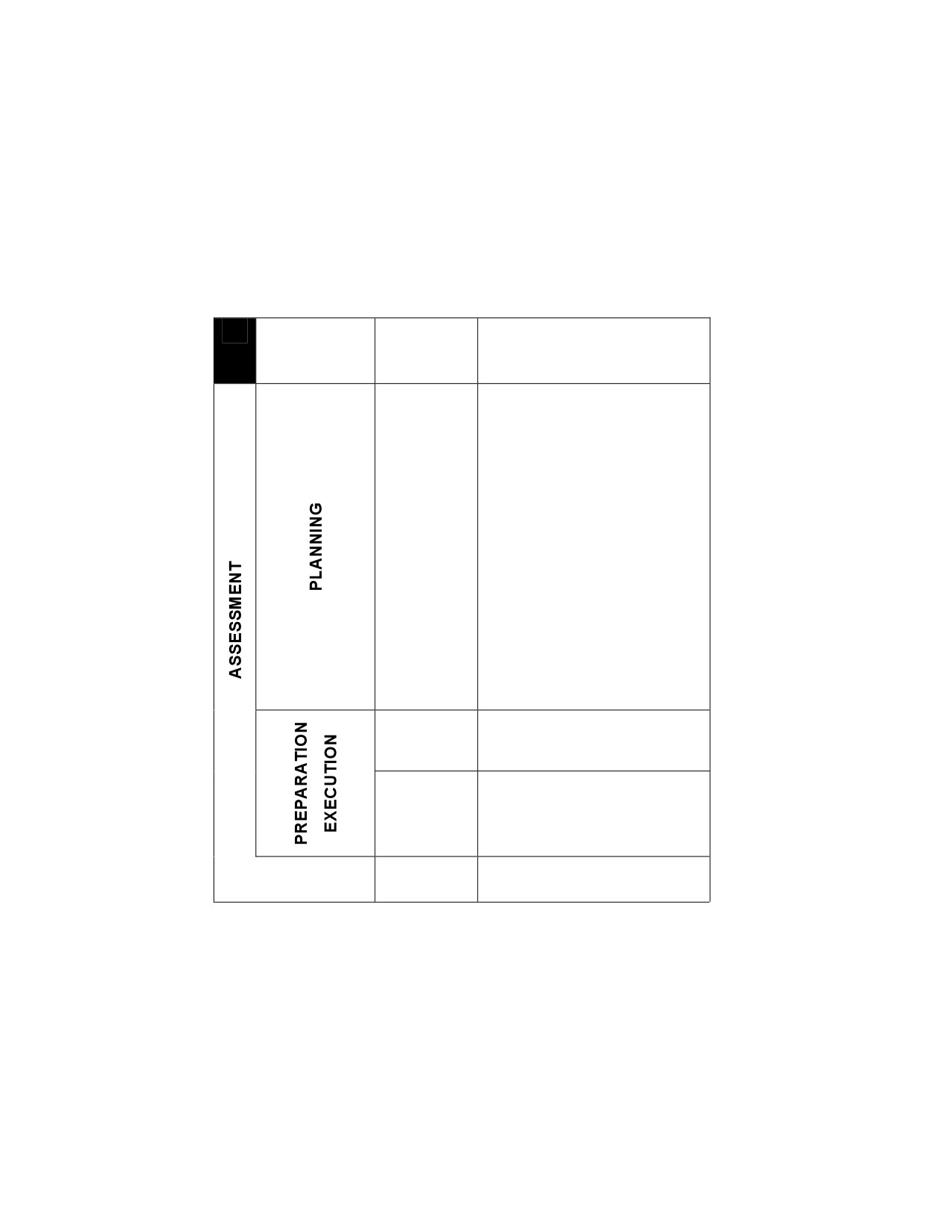
E-3. The Army targeting methodology is based on four functions: decide, de-
tect, deliver, and assess (see figure E-1). The decide function occurs concur-
rently with planning. The detect function occurs during preparation and exe-
cution. The deliver function occurs primarily during execution, although
some IO-related targets may be engaged while the command is preparing for
the overall operation. The assess function occurs throughout the operations
process but is most intense during execution.
Operations
Targeting
Process
Process
Targeting Task
Activity
Function
Mission Analysis
•
Develop IO-related HVTs
•
Provide IO input to targeting guid-
ance and targeting objectives
COA Development
Designate potential IO-
related HPTs
Contribute to TVA
Deconflict and coordinate
potential HPTs
COA Analysis
DECIDE
Develop HPTL
Establish TSS
Develop AGM
Determine criteria of
success BDA
requirements
Orders Production
Finalize HPTL
Finalize TSS
Finalize AGM
Submit IO IRs/RFIs to G-2
•
Execute collection plan
•
Update PIRs/IO IRs as they are
DETECT
answered
•
Update HPTL and AGM
•
Execute attacks in accordance
DELIVER
with the AGM
•
Evaluate effects of attacks
ASSESS
•
Monitor targets attacked with
nonlethal IO
Figure E-1. Targeting Process Activities and Tasks
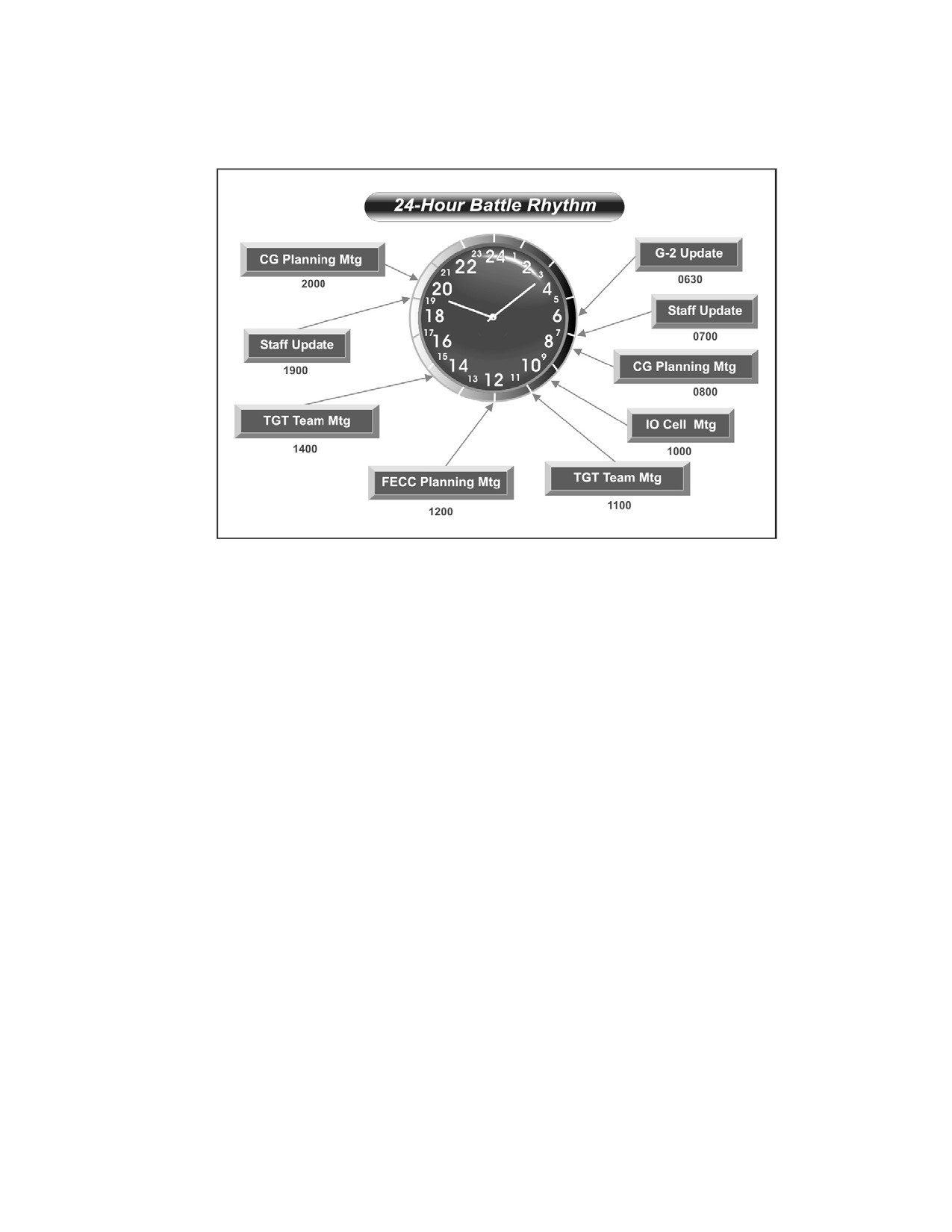
E-4. The targeting process is cyclical. The command’s battle rhythm deter-
mines the frequency of targeting team meetings. The G-7 schedules internal
targeting meetings so IO-related target nominations arrive within the com-
mand’s target nomination windows. To conserve time, the G-7 may hold IO
targeting meetings concurrently with IO cell meetings. Figure E-2 shows an
example of an IO schedule that fits a command’s battle rhythm.
E-2
____________________________________________________________ Information Operations Targeting
Figure E-2. Information Operations Targeting and Battle Rhythm
DECIDE
E-5. The decide function is part of the planning activity of the operations
process. It occurs concurrently with the military decisionmaking process
(MDMP). During the decide function, the targeting team focuses and sets
priorities for intelligence collection and attack planning. Based on the com-
mander’s intent and concept of operations, the targeting team establishes
targeting priorities for each phase or critical event of an operation. The fol-
lowing products reflect these priorities:
• High-payoff target list. The high-payoff target list
(HPTL) is a
prioritized list of high-payoff targets. A high-payoff target is a target
whose loss to the enemy will significantly contribute to the success of
the friendly course of action (COA). High-payoff targets are those high-
value targets (see definition at paragraph E-6), identified through war-
gaming, that must be acquired and successfully attacked for the suc-
cess of the friendly commander’s mission (JP 1-02). IO-related high-
payoff targets (HPTs) are C2 nodes and intelligence collection appara-
tuses.
• Intelligence collection plan. The intelligence collection plan, pre-
pared by the G-2 and coordinated with the G-3, integrates intelligence,
surveillance, and reconnaissance (ISR) to answer the priority intelli-
gence requirements (PIRs) (see FM 34-2). It is a major contributor to
the detect and assess functions.
• Target selection standards. Target selection standards (TSS) estab-
lish criteria for deciding when targets are located accurately enough to
attack. (See FM 6-20-10).
E-3
FM 3-13 __________________________________________________________________________________
• Attack guidance matrix. The attack guidance matrix (AGM) lists
targets or target categories, specific HPTs, when targets should be at-
tacked, how they should be attacked, and any restrictions (see FM 6-
20-10).
• Target synchronization matrix. The target synchronization matrix
(TSM) is a list of HPTs by category and the agencies responsible for de-
tecting them, attacking them, and assessing the effects of the attacks.
It combines data from the high-payoff target list, intelligence collection
plan and attack guidance matrix.
The targeting team develops or contributes to these products throughout the
MDMP. The commander approves them during COA approval. The G-7 en-
sures they include information necessary to engage IO-related targets. IO-
related vulnerability analyses done by the G-2 and the G-7 provides a basis
for deciding which IO-related targets to attack. (See chapters 1 and 5 for the
desired effects for offensive and defensive IO.)
E-6.
A high-value target is a target the enemy commander requires for the
successful completion of the mission. The loss of high-value targets would be
expected to seriously degrade important enemy functions throughout the
friendly commander’s area of interest. (JP 1-02). During mission analysis and
COA development, the G-7 develops IO-related high value targets (HVTs)
concurrently with IO objectives and IO tasks. Not all IO tasks are candidates
for the targeting process. During COA analysis the G-7 determines which IO-
related HVTs should be HPTs and refines IO input to the AGM and TSS. The
G-7 integrates IO objectives, IO tasks, and IO-related targets to ensure suc-
cessful accomplishment of the IO mission.
MISSION ANALYSIS
E-7.
The two targeting-related G-7 products of mission analysis are a list of
IO-related HVTs and recommendations for the commander’s IO targeting
guidance. The G-7 works with the G-2 during intelligence preparation of the
battlefield (IPB) to develop IO-related HVTs. The G-7 works with the tar-
geting team to develop IO targeting guidance recommendations.
Intelligence Preparation of the Battlefield
E-8.
IPB includes preparing doctrinal templates that portray adversary
forces and assets unconstrained by the environment. The G-2 adjusts doc-
trinal templates based on terrain and weather to create situational templates
that portray possible adversary COAs. These situational templates allow the
G-2 to identify HVTs. The G-7 works with the G-2 throughout IPB to identify
IO capabilities and vulnerabilities of adversaries and other key groups in the
AO. These capabilities and vulnerabilities become IO-related HVTs.
Targeting Guidance
E-9. The commander’s guidance, issued at the end of mission analysis, in-
cludes targeting guidance. Targeting guidance describes the desired effects of
lethal and nonlethal fires. It is expressed in terms of targeting objectives
(limit, disrupt, delay, divert, or destroy) or IO effects (destroy, degrade, dis-
rupt, deny, deceive, exploit, or influence). Targeting focuses on essential ad-
versary capabilities and functions, such as, the ability to form a hostile
E-4
____________________________________________________________ Information Operations Targeting
crowd, mobilize, exercise C2 of forward units, or mass artillery fires. IO tar-
geting focuses on HVTs the adversary needs to keep friendly forces from
achieving their IO objectives.
E-10.
The G-7 develops IO input to targeting guidance based on the initial IO
mission and IO-related tasks. It identifies the function, capability, or units to
be attacked; the IO effects desired; and the purpose for the attack. The G-7
uses the IO targeting guidance to select IO-related HPTs from the high-value
target list. These HPTs are confirmed during COA analysis.
E-11.
Targeting guidance is developed separately from IO objectives. IO
objectives are generally broad in scope. They encompass both offensive and
defensive IO, and often require both lethal and nonlethal means to accom-
plish. The G-7 develops recommendations for IO targeting guidance that
support achieving IO objectives.
E-12.
When developing IO input to the targeting guidance, the G-7 considers
the potentially long lead time required to achieve effects from offensive IO
and the possible lag time in determining results. Some IO elements may re-
quire targeting guidance that allows for the acquisition, engagement, and as-
sessment of targets while the unit is preparing for the overall operation. For
example, the commander may want to psychologically and electronically iso-
late an adversary reserve before engaging it with lethal fires. Doing this
could require electronic attack (EA) of adversary C2 systems and psychologi-
cal operations (PSYOP) directed at adversary soldiers 24 to 48 hours before
the strikes. Successfully achieving the IO objectives for that phase of the op-
eration requires targeting guidance that gives IO-related targets the appro-
priate priority.
COURSE OF ACTION DEVELOPMENT
E-13.
During COA development, the staff prepares feasible COAs that inte-
grate the effects of all elements of combat power to accomplish the mission.
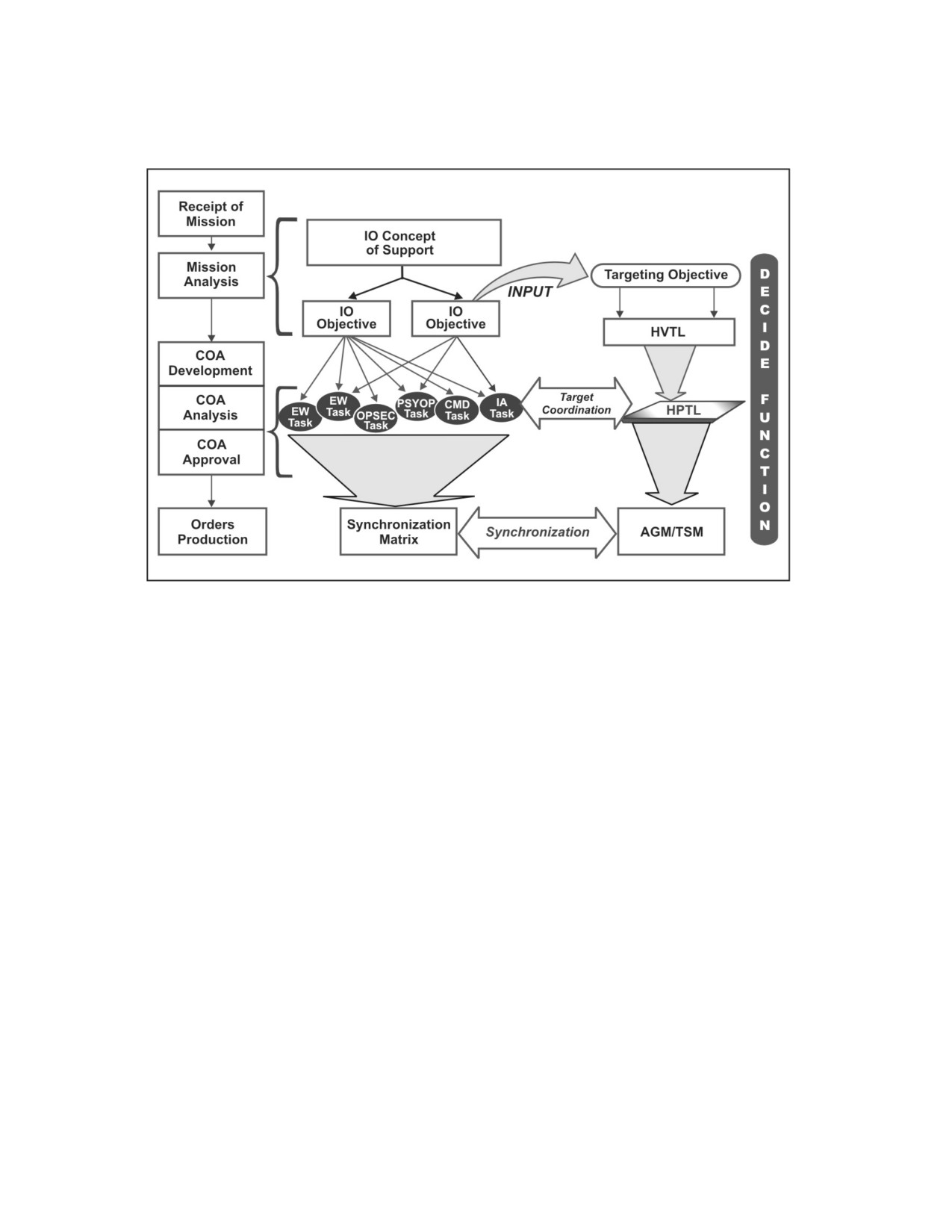
The G-7 prepares an IO concept of support that identifies IO objectives, and
IO tasks required to achieve them, for each COA. IO-related targets are de-
veloped and coordinated as IO tasks (see figure E-3, page E-6).
E-14.
When achieving an IO objective requires engaging an HVT, the G-7
designates that HVT as a potential IO-related target. The G-7 treats IO-
related targets as IO tasks when preparing IO input worksheets. IO-related
targets that are approved for engagement become HPTs. This determination
is made during COA analysis.
E-15.
During COA development, the targeting team performs target value
analysis (TVA), coordinates and deconflicts targets, and establishes assess-
ment criteria. The G-7 participates in each of these tasks.
Target Value Analysis
E-16.
The targeting team performs TVA for each COA the staff develops. The
initial TVA sources are target spread sheets and target sheets.
E-17. Target spreadsheets identify target sets associated with adversary func-
tions that could interfere with each friendly COA or that are key to adversary
success. The fire support element (FSE) usually prepares them. IO-related
E-5
FM 3-13 __________________________________________________________________________________
Figure E-3. Planning Information-Operations-Related Targets
targets can be analyzed as a separate target set or can be incorporated into
other target sets. The G-7 and fire support coordinator (FSCOORD) deter-
mine which technique fits the situation. The G-7 establishes any IO-specific
target sets. Each target set—including the IO target set, if designated—is as-
signed a priority (also called relative worth or relative value), based on how it
contributes to the adversary COA being considered. The targeting team uses
target spreadsheets during the war game to determine which HVTs to attack.
The G-7—
• Ensures that target spreadsheets include information on adversary IO
assets and IO-related HVTs.
• Ensures the IO target set, if designated, is assigned a value appropri-
ate to IO’s relative importance to each friendly COA. If an IO target set
is not designated, the G-7 ensures that IO-related targets are assigned
an appropriate priority within the target sets used.
E-18. A target sheet contains the information required to engage a target. It
is a locally produced product. Target sheets state how attacking the target
would affect the adversary operation. The G-7 prepares target sheets for IO-
related HVTs to analyze them from an IO perspective. These HVTs are ex-
pressed as target subsets, such as decisionmakers. Information requirements
(IRs) concerning them include—
• Influences on them.
• How they communicate.
• With whom they communicate.
• Weakness, susceptibility, accessibility, feasibility, and pressure points.
E-6
____________________________________________________________ Information Operations Targeting
Deconflicting and Coordinating Targets
E-19.
Members of the IO cell nominate IO-related targets and advise the G-7
on possible consequences of attacking them. Deconflicting the effects of at-
tacking some IO-related targets is more complex than deconflicting the ef-
fects of lethal fires. IO often seeks to influence civilian audiences. Sometimes
the act of engaging a target may have as great an effect as actually destroy-
ing it. Civil-military operations (CMO), public affairs (PA), and PSYOP per-
sonnel evaluate the advantages gained from engaging IO-related targets in
those terms. Attacking some targets may have legal consequences; the staff
judge advocate representative evaluates IO-related targets from that per-
spective. If engaging an IO-related target might result in effects outside the
AO, the G-7 clears that target with higher headquarters.
E-20.
IO cell members consider all targets from their IO element’s perspec-
tive. Deconfliction in this context means making sure that engaging a target
does not produce effects that interfere with the effects of other IO tasks or
IO-related targets, or otherwise inhibit mission accomplishment. Coordina-
tion means making sure that the effects of engaging different targets com-
plement each other and further the commander’s intent. G-7s at different
echelons may engage the same targets or may desire different effects. There-
fore, IO targeting includes coordinating and deconflicting targets with higher
and subordinate G-7s before the targeting team meets. Some IO-related tar-
gets may also be nominated by other staff elements. The G-7 presents the ef-
fects required to accomplish the IO objective associated with those targets
when the targeting team determines how to engage them.
E-21.
One way to achieve this coordination and deconfliction is by beginning
parallel planning as early as possible in the MDMP. The G-7 and the target-
ing team share all pertinent information with subordinate units and adjacent
and higher headquarters.
Assessment Criteria
E-22.
Generally, the effects of lethal attacks can be evaluated using objective,
quantifiable criteria, such as the percentage of the target that is destroyed.
The G-7 requests battle damage assessment (BDA) of these targets. However,
evaluating nonlethal attacks may require subjective criteria and monitoring
the target over time. Establishing meaningful criteria of success requires un-
derstanding the desired end state. Evaluating effects in terms of subjective
criteria requires interpreting information that portrays qualitative effects
and determining how these effects change over time.
E-23. IO-related targets attacked by nonlethal fires, such as jamming or
PSYOP broadcasts, may require assessment by means other than those nor-
mally used in BDA. The G-7 develops criteria of success for these targets and
determines the information needed to determine how well they have been
met. The G-7 prepares IO IRs or requests for information (RFIs) for this in-
formation. If these targets are approved, the IO IRs and RFIs needed to as-
sess the effects on them become PIRs that the G-2 adds to the collection plan.
If the command does not have the assets to answer these IO IRs, the target is
not engaged unless the attack guidance specifies otherwise or the commander
so directs. BDA can be obtained from various sources:
E-7
FM 3-13 __________________________________________________________________________________
• G-2 provides feedback on the effects electronic warfare.
• G-3 provides feedback on the effects of disrupting C2 by reconnais-
sance units.
• G-5 provides feedback on the effectiveness of CMO.
• Public affairs officer provides feedback on how the operation is being
reported in the international media.
COURSE OF ACTION ANALYSIS
E-24.
COA analysis (war-gaming) is a disciplined process that staffs use to
visualize the flow of a battle. During the war game, the staff decides or de-
termines—
• Which HVTs are HPTs.
• When to engage each HPT.
• Which system to use against each HPT.
• The desired effects of each attack, expressed in terms of the targeting
objectives or IO effects.
• Which HPTs require BDA. The G-7 submits BDA requirements for IO-
related targets to the G-2 for inclusion in the collection plan.
• Which HPTs require special instructions or require coordination.
E-25.
Based on the war game, the targeting team produces the following
draft targeting products for each COA:
• High-payoff target list.
• Target selection standards.
• Attack guidance matrix.
• Target synchronization matrix.
High-Payoff Target List
E-26.
During the war game, the staff determines which HVTs are HPTs for
each COA. HPTs are critical to both the adversary’s needs and the friendly
concept of operations. They support achieving the commander’s intent and
executing the concept of operations. They are determined based on the com-
mander’s targeting guidance. The HPTL is a prioritized list of HPTs.
E-27. One way to organize the HPTL is to group all HPTs into target sets
that reflect the capabilities and functions described in the targeting objec-
tives. Thus, if the commander’s targeting guidance is to “Delay the adversary
force’s ability to move mechanized forces across river Y to allow their de-
struction by air and artillery fires,” then two target sets could be the follow-
ing: “the ability to conduct a river crossing” and “C2 of mechanized forces
listing specific nodes or pieces of equipment to cause a specific effect at a spe-
cific time and place.” Target sets are identified and prioritized for each phase
of the operation. Within the sets, individual targets are rank-ordered by tar-
get value, sequence of appearance, importance, or other criteria that satisfy
the targeting objectives. In this way, the targeting team reduces, modifies,
and reprioritizes HVTs while ensuring that HPTs support the concept of op-
erations.
E-8
____________________________________________________________ Information Operations Targeting
Target Selection Standards
E-28.
TSS are criteria applied to adversary activities (acquisitions or combat
information) to decide whether the activity can be engaged as a target. TSS
are usually disseminated as a matrix. Military intelligence analysts use TSS
to determine targets from combat information and pass them to FSEs for at-
tack. Attack systems managers, such as fire control elements and fire direc-
tion centers, use TSS to determine whether to attack a potential target. The
G-2 and FSCOORD determine TSS. The G-7 ensures that they consider IO-
related targets and establish appropriate standards for engaging them.
E-29.
For nonlethal attacks, the G-7 may have to develop descriptive criteria
to supplement or replace criteria developed by the FSE. For example,
nonlethal TSS during a peace operation may describe what constitutes a hos-
tile crowd (such as, a group larger than 25 people, armed with sticks or other
weapons, and with leaders using radios or cellular telephones to direct it). To
do this, the G-7 identifies specific pressure points, such as one’s credibility.
The G-7 then attacks these pressure points with specific means/products, de-
livered to a specific communications node or system, to cause a specific effect.
Attack Guidance Matrix
E-30.
The targeting team recommends attack guidance based on the results
of the war game. Attack guidance is normally disseminated as a matrix (the
AGM). An AGM includes the following information, listed by target set or
HPT:
• Timing of attacks (expressed as immediate, planned, or as acquired).
• Attack system assigned.
• Attack criteria (expressed as neutralize, suppress, harass, or destroy).
• Restrictions or special instructions.
E-31.
Only one AGM is produced for execution at any point in the operation;
however, each phase of the operation may have its own matrix. To synchro-
nize lethal and nonlethal fires, all lethal and nonlethal attack systems, in-
cluding PSYOP and EA, are placed on the AGM. The AGM is a synchroniza-
tion and integration tool. It is normally included as part of the fire support
annex. However, it is not a tasking document. Attack tasks for unit assets,
including IO elements, are identified as taskings to subordinate units and
agencies in the body or appropriate annexes or appendixes of the operation
plan (OPLAN)/operation order (OPORD).
Target Synchronization Matrix
E-32. The TSM lists HPTs by category and the agencies responsible for
detecting them, attacking them, and assessing the effects of the attacks. It
combines data from the HPTL, intelligence collection plan, and AGM. A com-
pleted TSM allows the targeting team to verify that assets have been as-
signed to each targeting process task for each target. The targeting team may
prepare a TSM for each COA, or may use the HPTL, TSS, and AGM for the
war game and prepare a TSM for only the approved COA.
E-9
FM 3-13 __________________________________________________________________________________
COA COMPARISON, COA APPROVAL, AND ORDERS PRODUCTION
E-33.
After war-gaming all the COAs, the staff compares them and recom-
mends one to the commander for approval. When the commander approves a
COA, the targeting products for that COA become the basis for targeting for
the operation. The targeting team meets to finalize the HPTL, TSS, AGM,
and input to the collection plan. The team also performs any additional coor-
dination required. After accomplishing these tasks, targeting team members
ensure that targeting factors that fall within their functional areas are
placed in the appropriate part of the OPLAN/OPORD.
DETECT
E-34.
The detect function involves locating HPTs accurately enough to engage
them. It primarily entails execution of the intelligence collection plan. Al-
though the G-2 oversees the execution of intelligence collection plan, the col-
lection assets themselves do not all belong to the G-2. All staff agencies, in-
cluding the G-7, are responsible for passing to the G-2 information collected
by their assets that answer IRs. Conversely, the G-2 is responsible for pass-
ing combat information and intelligence to the agencies that identified the
IRs. Sharing information allow timely evaluation of attacks, assessment of
IO, and development of new targets. Effective information management is
essential.
E-35.
The intelligence collection plan focuses on identifying HPTs and
answering PIRs. These are prioritized based on the importance of the target
or information to the commander’s concept of operation and intent. PIRs can
include IO IRs, as designated by the commander; these priority intelligence
collection requirements will assist the G-7 in assessing IO. Thus, there is
some overlap between detect and assess functions. Detecting targets for
nonlethal attacks may require ISR support from higher headquarters. The
targeting team adjusts the HPTL and AGM to meet changes as the situation
develops. The G-7 submits new IO IRs/RFIs as needed.
DELIVER
E-36.
The deliver function involves engaging targets located within the TSS
according to the guidance in the AGM. HPT that are located within the TSS
are tracked and engaged at the time designated in the OPORD/AGM. Other
collection assets look at HPTs that are not located accurately enough or for
targets within priority target sets. When one of these is located within the
TSS, its location is sent to the system that the AGM assigns to attack it. All
HPTs will not be identified accurately enough to be attacked before execu-
tion. Some target sets may not have very many targets identified. Collection
assets and the intelligence system develop information that locates or de-
scribes potential targets accurately enough to engage them. The HPTL sets
the priority in which they accomplish this task.
ASSESS
E-37. Assessment occurs throughout the operations process. The effects of le-
thal attacks on IO-related targets are assessed the same way as other fire
E-10
____________________________________________________________ Information Operations Targeting
support or EA targets. Targets are reattacked until the effects outlined in the
AGM are achieved or until the target is no longer within the TSS (see FM 6-
20-10).
E-38.
The effects of nonlethal attacks on IO-related targets require continu-
ous assessment. The G-7 is responsible for this assessment and monitors re-
porting based on IO IRs and RFIs submitted during planning (the decide
function). IO elements/related activities with close contact with the civilian
populace—such as counterintelligence, PA, and CMO—can collect informa-
tion about the effects of nonlethal IO by such IO elements as PSYOP and co-
unterpropaganda. The G-7 uses the criteria of success established during
COA analysis to evaluate IO effectiveness and monitors targets as required
to maintain a continuous assessment. Based on this assessment, the G-7 de-
cides whether to continue to engage the target, break off the attack, or en-
gage the target with another IO element. This decision is based on the extent
to which continuing to engage the target will further accomplishing the IO
objectives it supports and the extent to which accomplishing the IO objectives
will contribute to accomplishing the mission.
E-39.
The large amount of information generated during operations means
target attack effects may be difficult to capture. The G-2, G-3, and G-7 work
closely to develop meaningful, timely BDA of IO-related targets. The G-7 es-
tablishes mechanisms and procedures with other staff elements, particularly
the G-2, that allow exploitation of real-time data to support timely assess-
ment of IO targeting. In a digitized division, this may include using the Ma-
neuver Control System-Light (MCS-light). (See figure B-26, pages B-39-B-
42, for an example of an IO assessment matrix).
SUMMARY
E-40. The G-7 develops IO-related targets that support achieving IO objec-
tives. Throughout the MDMP, the G-7 integrates IO planning with the tar-
geting process. During preparation and execution, the G-7 monitors BDA and
other reports to evaluate the effectiveness of IO against IO-related targets
and to assess the overall effects of IO.
E-11
Appendix F
Staff Responsibilities and Supporting Capabilities
Appendix F lists information-operations-related responsibilities of staff
sections at Army service component command, corps, division, and bri-
gade levels. It also describes the capabilities of, and support available
from, selected Army commands. Figure 1-2, page 1-15, shows the relation-
ship between the IO elements/related activities, the types of operations,
and unit responsibilities.
CORPS AND DIVISION INFORMATION OPERATIONS
RESPONSIBILITIES
F-1. Corps and divisions have organic G-7 sections. G-7 sections—supervised
by the assistant chief of staff (ACOS) G-7—plan, assess, and oversee prepara-
tion and execution of information operations (IO). The ACOS G-7 exercises
coordinating staff responsibility over the following special staff officers: elec-
tronic warfare officer (EWO), military deception officer (MDO), operations se-
curity (OPSEC) officer, and psychological operations (PSYOP) officer. They
have the following responsibilities.
ASSISTANT CHIEF OF STAFF, G-7 (INFORMATION OPERATIONS)
F-2. The G-7 is the coordinating staff officer for all IO matters, including cur-
rent operations, plans, and IO-related targeting. He is a functional area 30
officer. A G-7 is authorized at Army service component commands (ASCCs),
corps, and divisions. Selected Army National Guard and active component
brigades are authorized an S-7.
CONTENTS
Corps and Division Information Operations
ASCC IO Responsibilities
F-14
Responsibilities
F-1
Current Operations Division
F-14
Assistant Chief of Staff, G-7 (IO)
F-1
Plans Division
F-14
Electronic Warfare Officer
F-4
Psychological Operations Division ..F-15
Military Deception Officer
F-5
Echelons Above ASCC IO
Operations Security Officer
F-5
Responsibilities
F-15
Psychological Operations Officer
F-6
Space and Missile Defense
Other Staff Officer IO
Command
F-15
Responsibilities
F-7
1st Information Operations Command
Brigade IO Responsibilities
F-12
(Land)
F-15
Stryker Brigade Combat Team
F-12
US Army Intelligence and Security
Army National Guard Enhanced Separate
Command
F-19
Brigade
F-13
US Army Network Enterprise
Divisional Maneuver Brigade
F-13
Technology Command/9th ASC ...F-19
F-1
FM 3-13 __________________________________________________________________________________
Current Operations
F-3. FM 6-0 establishes the following general G-7 (S-7) responsibilities re-
lated to current operations:
• Ensure IO supports achieving information superiority.
• Synchronize and coordinate offensive and defensive IO with the overall
operation.
• Assess the effects of offensive and defensive IO throughout the opera-
tions process; recommend IO adjustments as required.
• Coordinate and synchronize tactical IO with theater-strategic- and
operational-level IO.
• Coordinate IO elements and related activities for the chief of staff
(COS) or executive officer (XO).
• Integrate intelligence from the G-2 (S-2) into IO.
• Coordinate the attachment of the 1st Information Operations Com-
mand (Land) (1st IOC [L]) field support teams and other specialized IO
teams.
• Monitor execution by IO elements to ensure delivery of massed
information effects when needed.
F-4. The following responsibilities clarify the G-7 (S-7) general current opera-
tions responsibilities established in FM 6-0:
• Request, through the G-3, IO resources from higher headquarters.
• Integrate IO into all current operations.
• Synchronize measures to protect friendly information and other IO
capabilities from attack. The G-6, in coordination with the G-7, is re-
sponsible for information assurance (IA) management, computer net-
work defense (CND) functions, and ensuring IA activities support IO
objectives established in the IO annex. The G-7 supports IA by ensur-
ing external vulnerability analyses are performed.
• Synchronize the capabilities of the IO elements.
• Coordinate with the ASCC and joint task force (JTF) staffs on IO mat-
ters (corps G-7).
• Coordinate with the corps G-7 and subordinate brigade headquarters
on all IO matters (division G-7).
• Coordinate links to access/exchange information from military and non-
military sources.
• Prepare for or arrange augmentation to meet special needs and short-
falls of headquarters designated as ARFOR headquarters.
• Monitor the out-of -theater information environment.
• Monitor and recommend adjustment of collection of IO information re-
quirements (IRs).
• Coordinate with G-2 to answer IO IRs.
• Maintain liaison with supporting military, governmental, and
nongovernmental organizations to obtain IO IR answers not normally
available at the tactical level.
• Act as a witting participant in military deception (MD) operations.
• Determine IO assets available from the higher headquarters.
F-2
______________________________________________ Staff Responsibilities and Supporting Capabilities
Plans
F-5. FM 6-0 establishes the following general G-7 (S-7) responsibilities re-
lated to plans:
• Exercise staff coordination over the conduct of the overall IO effort.
• Coordinate preparation of the IO portions of plans and orders.
• Produce other IO products.
• Recommend priorities to accomplish IO tasks identified during plan-
ning.
• Leverage the capabilities of higher-echelon IO agencies and units
providing connectivity with national- and theater-level IO agencies.
F-6. The following responsibilities clarify the G-7
(S-7) general planning
responsibilities established in FM 6-0:
• Coordinate IO plans with higher and lower headquarters.
• Assess the effects of offensive and defensive IO throughout the opera-
tions process, modifying IO plans as required.
• Recommend appropriate IO IRs as commander’s critical information re-
quirements (CCIR).
• Act as a witting participant in MD operations.
• Develop IO objectives and tasks.
• Establish priorities for IO objective and tasks.
• Synchronize, coordinate, and deconflict planning for IO tasks.
• Produce other IO products for the commander and staff.
• Develop IO input to intelligence preparation of the battlefield (IPB).
• Integrate intelligence, surveillance, and reconnaissance (ISR) capabili-
ties from the G-3 and G-2 into IO planning.
• Provide IO input to the G-3 plans cell with assistance of IO element
subject matter experts.
• Develop IO plans within the commander’s intent to support the concept
of operations and achieve desired end state.
• Submit IO IRs that require intelligence-reach support to the G-2.
Targeting
F-7. FM 6-0 establishes the following general G-7 (S-7) responsibilities re-
lated to targeting:
• Participate in targeting meetings.
• Recommend IO effects to influence adversary perceptions, decisions,
and actions.
F-8. The following responsibilities clarify the G-7 (S-7) general targeting re-
sponsibilities established in FM 6-0:
• Develop IO-related targets.
• Coordinate the nomination of IO-related targets with the G-2 analysis
and control element (ACE).
• Provide input to IPB.
• Act as a witting participant in MD operations.
• Provide IO input into the targeting process.
F-3
FM 3-13 __________________________________________________________________________________
• Provide IO input to target lists, estimates, and assessments.
• Receive input from out-of-theater and national information sources.
• Assist in deconflicting targets scheduled for electronic attack (EA) and
ISR collection.
• Nominate IO targets for lethal and nonlethal attack.
Staff Planning and Supervision
F-9. The G-7
(S-7) has the following staff planning and supervision
responsibilities:
• Establish and supervise IO cell.
• Coordinate IO with other agencies (such as, the US Information Agen-
cy, US Agency for International Development, and US ambassador).
ELECTRONIC WARFARE OFFICER
F-10. The EWO is normally a military intelligence officer who performs elec-
tronic warfare (EW) duties. An EWO is authorized at corps and divisions.
EWO responsibilities established in FM 6-0 include—
• Coordinate with the G-7 to integrate EW into IO.
• Coordinate, prepare, and maintain the EW target list, EA taskings, EA
requests, and the EW portion of the sensor/attack matrix.
• Coordinate with the G-6 to deconflict EW targets with frequencies and
the joint restricted frequency list.
• Coordinate with the fire support coordinator (FSCOORD) and G-2
(ACE) to identify opportunities for conducting effective EA.
• Participate in targeting meetings.
• Analyze adversary EW activities (with the G-2).
• Assess adversary vulnerabilities, friendly capabilities, and friendly
missions in EW terms.
• Develop a prioritized adversary C2 target list based on high-value tar-
gets (HVTs) and high-payoff targets (HPTs) (with the FSCOORD).
• Develop the EA mission tasking based on the command and control
(C2) target list, and issue the EA target list.
• Coordinate the EA target list with organic military intelligence units
and with adjacent and higher commands, including joint and multina-
tional commands when appropriate.
• Coordinate with the higher headquarters EWO to deconflict IO on the
communications spectrum.
• Help the G-6 determine electronic protection (EP) requirements.
• Prepare EW estimates and the EW appendix to the IO annex.
• Forward and coordinate electronic warfare support (ES) targets with
the G-2. The G-2 collection manager integrates ES targets into the
collection plan and the intelligence synchronization plan.
• Brief adversary and friendly EW vulnerabilities for each course of ac-
tion (COA).
F-11. The following responsibilities clarify the G-7
(S-7) general EWO
responsibilities established in FM 6-0:
• Recommend where EW should be considered during IO planning.
F-4
______________________________________________ Staff Responsibilities and Supporting Capabilities
• Deconflict targets with the joint restricted frequency list.
• Provide a representative to the IO cell.
• Forward and coordinate ES targets with the G-2. The G-2 integrates
ES targets into the collection plan and the intelligence synchronization
plan.
MILITARY DECEPTION OFFICER
F-12. The MDO is a functional area 30 officer responsible for coordinating
MD assets and operations. FM 6-0 establishes the following general MDO re-
sponsibilities:
• Exercise staff supervision over MD activities.
• Provide expertise in MD operations.
• Manage information required for conducting MD operations.
• Determine requirements or opportunities for MD operations (with the
G-2).
• Recommend to the G-7 the deception target, deception objective, and
deception story.
• Write the MD appendix to the IO annex.
• Coordinate operations security (OPSEC) measures to shield the MD
plan with the OPSEC officer.
• Coordinate with the higher headquarters MDO and G-7, the engineer
coordinator (ENCOORD), and the chemical officer (CHEMO).
• Distribute the MD plan on a need-to-know basis.
• Integrate MD assets.
• Assess execution of MD operations.
F-13. The following responsibilities clarify the general MDO responsibilities
established in FM 6-0:
• Ensure all MD operations support the commander’s intent.
• Monitor witting and unwitting participants involved in MD operations.
• Recommend who should participate in the deception working group
(DWG).
• Provide a representative to the IO cell.
• Coordinate with the G-7 to ensure synergism of MD.
• Ensure other IO tasks do not conflict with MD operations and vice
versa.
• Collect and process information on how potential deception targets
exercise command and control.
OPERATIONS SECURITY OFFICER
F-14. The OPSEC officer helps the G-7 (S-7) perform OPSEC functions. Com-
manders at all echelons, battalion through corps, are authorized or appoint
an OPSEC officer. Divisions and above are authorized a functional area 30
OPSEC officer. FM 6-0 establishes the following general OPSEC officer re-
sponsibilities:
• Conduct OPSEC assessments to analyze the command’s OPSEC pos-
ture.
F-5
FM 3-13 __________________________________________________________________________________
• Coordinate with higher headquarters for OPSEC activities support.
• Determine essential elements of friendly information (EEFI) and OP-
SEC vulnerabilities and recommend EEFI to the commander.
• Recommend OPSEC measures, based on weighing the risks to the mis-
sion against the cost of protection.
• Publish the OPSEC appendix to the IO annex.
• Coordinate with other members of the IO cell to ensure OPSEC cover-
age and dissemination of OPSEC measures.
• Submit taskings for OPSEC tasks to subordinate units through the G-7
to the G-3.
• Determine the effect of compromises of critical friendly information
systems (INFOSYS), functions, and data.
• Coordinate with the 1st IOC (L) for IO vulnerability assessments and
red-teaming.
• Evaluate effectiveness of force-protection measures
(with the G-7,
ENCOORD, and the CHEMO).
• Report incidents through channels to regional computer emergency re-
sponse team and Army Computer Emergency Response Team
(ACERT).
F-15. The following responsibilities clarify the general OPSEC officer
responsibilities established in FM 6-0:
• Request support for IO vulnerability assessments, and red-teaming
through the G-7 to the G-3.
• Request ACERT, and regional computer emergency response team
(RCERT) support through the G-7 to the G-6.
• Coordinate with the G-2 to determine collection capabilities of
adversaries.
• Provide a representative to the IO cell.
PSYCHOLOGICAL OPERATIONS OFFICER
F-16. The PSYOP officer is functional area
39 officer responsible for
coordinating PSYOP operations. A PSYOP officer is authorized at corps and
divisions. If no PSYOP officer is assigned, the commander of an attached
PSYOP support element may assume the PSYOP officer’s responsibilities.
FM 6-0 establishes the following general PSYOP officer responsibilities:
• Coordinate with the G-7 to ensure synchronization of PSYOP.
• Synchronize command PSYOP with higher headquarters PSYOP.
• Write the PSYOP appendix to the IO annex.
• Perform staff planning and coordination of PSYOP activities.
• Conduct PSYOP to support the overall operation.
• Allocate organic and supporting resources to support PSYOP efforts.
• Prioritize the efforts of attached PSYOP forces.
• Evaluate enemy PSYOP efforts and the effectiveness of friendly
PSYOP on target groups (with the G-2 and G-5).
• Coordinate possible PSYOP effects with the G-5.
• Coordinate support of dislocated civilian operations with the G-5.
F-6
______________________________________________ Staff Responsibilities and Supporting Capabilities
• Coordinate audience pretesting and posttesting of propaganda and
counterpropaganda products.
• Assess PSYOP effectiveness.
• Provide a representative to IO cell meetings.
• Assess the psychological impact of military operations on the enemy
and the civilian populace.
• Counter enemy propaganda and misinformation.
• Coordinate with the public affairs officer (PAO) and G-5 to ensure dis-
seminated messages are consistent.
F-17. The following responsibilities clarify the general PSYOP officer
responsibilities established in FM 6-0:
• Provide PSYOP expertise.
• Coordinate with the G-2 to determine the following:
Shared ideologies among potential adversaries.
Funding of adversary activities.
Order of battle of potential adversaries.
OTHER STAFF OFFICER INFORMATION OPERATIONS RESPONSIBILITIES
F-18. In addition to the staff responsibilities listed in FM 6-0, the following
staff officers have IO-related responsibilities.
Chief of Staff
F-19. The COS (the XO at brigades and battalions) is the commander’s
principal assistant for directing, coordinating, supervising, and training the
staff, except in areas the commander reserves. IO-related responsibilities of
the COS (XO) are—
• Ensure information superiority is accomplished at times and places the
commander designates.
• Ensure that the information element of combat power is integrated into
operations as stated in the commander’s intent and concept of opera-
tions. At corps, divisions, and selected brigades, the G-7 (S-7) and other
coordinating staff officers assist the COS (XO) with IO responsibilities.
• Ensure IO is executed along with information management (IM) and
ISR to accomplish information superiority.
• Chair targeting meetings.
• Act as a witting participant in MD operations.
Assistant Chief of Staff, G-1/AG (Personnel)
F-20. The ACOS G-1/AG is the principal staff officer for personnel functions.
IO-related responsibilities of the G-1 are—
• Coordinate with the ACOS G-7 on IO matters.
• Provide a representative to the IO cell.
• Conduct personnel support of IO.
• Provide IO instructions in the personnel appendix of the service sup-
port annex.
• Perform personnel manning functions prescribed in FM 12-6.
F-7
FM 3-13 __________________________________________________________________________________
• Review IO mission and METT-TC considerations from personnel sup-
port perspective.
• Advise the MDO on availability of personnel resources required for the
MD operation.
• Act as either a witting or unwitting participant in MD operations.
Assistant Chief of Staff, G-2 (Intelligence)
F-21. The ACOS G-2 is the principal staff officer for all matters concerning
military intelligence, counterintelligence, security operations, and military
intelligence training. The G-2 produces the intelligence used by the G-7 and
his special staff officers. IO-related responsibilities of the G-2 are—
• Coordinate with the ACOS G-7 on IO matters.
• Participate in IO cell meetings.
• Provide IO instructions in intelligence annex.
• Provide information on adversary C2 systems for vulnerability assess-
ments.
• Contribute to EA detection by providing warning and assessment of
potential adversary activities, and by cueing collection to specific ac-
tivity indicators.
• Include IO RFI from the G-7 in intelligence reach.
• Answer IO IRs.
• Coordinate with counterintelligence; law enforcement; and INFOSYS
developers, providers, administrators, and users to ensure timely
sharing of relevant information (RI).
• Prepare a vulnerability assessment of adversary C2 systems. Include—
Political, economic, social, and cultural influences.
Targets and methods for offensive operations.
Adversary (or potential adversary) decisionmaking processes.
Biographical backgrounds of key adversary leaders, decisionmakers,
and communicators, and their advisors. Include motivating factors
and leadership styles.
IPB of adversary C2 systems and INFOSYS.
A comprehensive comparison of adversary offensive IO capabilities
against friendly IO vulnerabilities.
• Collect data to establish an EW database and C2 target list.
• Provide intelligence support to MD operations; specifically—
Determine adversary INFOSYS through which information reaches
the deception target.
Help the G-6 plan use of friendly INFOSYS as deception means.
Establish counterintelligence measures to protect the MD operation
from detection.
• Support computer network attack (CNA) requests with assessments.
Assistant Chief of Staff, G-3 (Operations)
F-22. The ACOS G-3 is the principal staff officer for all matters concerning
training, operations and plans, and force development modernization. The G-3
F-8
______________________________________________ Staff Responsibilities and Supporting Capabilities
synchronizes tactical operations and has staff responsibility for orders
preparation. IO-related responsibilities of the G-3 are—
• Tasks units and assets to accomplish information superiority.
• Provide plans and current operations briefings to IO cell meetings.
• Request IO resources from higher headquarters upon recommendation
from G-7. After allocations are made, pass coordination responsibility
to the G-7.
• Integrate ISR into operations being supported by the G-2 (with the
COS).
• Integrate space support, IO (with the G-7), and fire support into all
operations.
The ACOS G-3 exercises coordinating staff responsibility over the following
special staff officers with IO-related responsibilities.
F-23. Chemical Officer. The CHEMO has staff responsibility for nuclear,
biological, and chemical (NBC) defense; smoke operations; and the use of
chemical assets. IO-related responsibilities are—
• Coordinate with the PSYOP officer and G-7 when adversaries have the
capability to use weapons of mass destruction.
• Provide a representative to the IO cell.
• Provides IO instructions in the chemical annex.
• Include IO aspects in the NBC defense and obscurant employment
appendixes to orders and plans.
F-24. Space Operations Officer. The space operations officer provides
space-related tactical support and coordinates space-based capabilities avail-
able to the command. IO-related responsibilities are—
• Coordinate with the Army space support team to provide space-based
products to support IO requirements.
• Provide a representative to the IO cell.
• Include IO requirements in the space operations appendix to the opera-
tions annex.
• Coordinate IO requirements with higher headquarters for US Army
Space Command and US Strategic Command support.
• Coordinate with the IO targeting officer to include adversary space-sys-
tem elements in the targeting process.
• Support OPSEC and MD efforts by maintaining the adversary space or-
der of battle, to include monitoring orbital paths and satellite coverage
areas.
• Monitor space architecture
(the hardware, systems and feedback
mechanisms) availability in the areas of communications; posi-
tion/navigation; space-based surveillance/warning; and weather, ter-
rain, and environmental monitoring (WTEM).
• Conduct operational planning analysis and determine how space opera-
tions can meet IO requirements to assess vulnerabilities and deter-
mine follow-on requirements.
• Monitor satellite system operations in the area of C2 routing.
F-9
FM 3-13 __________________________________________________________________________________
Assistant Chief of Staff, G-4 (Logistics)
F-25. The ACOS G-4 is the principal staff officer for all matters concerning
combat service support (CSS) operations. IO-related responsibilities of the G-4
are—
• Coordinate with the ACOS G-7 on IO matters.
• Daily conduct of CSS to IO.
• Ensure IO resources are included on the combat service support control
system (CSSCS) baseline resources item list and the commander’s
track item list.
• Provide IO CSS per priorities and requirements.
• Monitor the CSS operations of IO missions and assets.
• Track the operational readiness of IO elements and equipment.
• Provides CSS stability/capability/vulnerability input to the IO estimate
and COA analyses.
• Recommend allocation of IO operational resources.
• Serve as focal point for requests for IO CSS operations.
• Serve as either a witting or unwitting participant in MD operations.
• Analyze CSS factors that influence MD operations.
• Provide CSS support to MD operations.
• Advise the DWG on how MD operations will affect CSS personnel and
equipment.
• Provide a representative to the IO cell.
• Provide IO instruction in the service support annex.
Assistant Chief of Staff, G-5 (Civil-Military Operations)
F-26. The G-5 is the principal staff officer for all matters concerning civil
military operations (CMO). He evaluates civil considerations within missions
and identifies civil centers of gravity. IO-related responsibilities of the G-5
are—
• Coordinate with the ACOS G-7 for IO matters.
• Provide a G-5 representative to the IO cell.
• Provide IO instructions in the CMO annex.
• Conduct CMO that support IO.
• Interface between civil and military support to IO.
• Identify and procure civilian resources to support IO missions.
• Act as either a witting or unwitting participant in MD operations.
• Advise the MDO of implications of MD operations on CMO activities.
• Coordinate with the G-7 and PSYOP officer on trends in public opinion.
• Coordinate with the G-7, PAO, and PSYOP officer to ensure dissemi-
nated information is not contradictory.
Assistant Chief of Staff, G-6 (Command, Control, Communications, and Computer
Operations)
F-27. The ACOS G-6 is the principal staff officer for command, control,
communications, and computer operations
(C4OPS) matters; network
F-10
______________________________________________ Staff Responsibilities and Supporting Capabilities
operations (NETOPS); and IM. The IO cell includes a G-6 representative. IO-
related responsibilities of the G-6 are—
• Coordinate with the G-7 on IO matters.
• Coordinate IM with and provide IM data to the G-3.
• Provide a representative to the IO cell.
• Provide IO instructions in the C4 OPS annex.
• Direct the actions of subordinate NETOPS and IM staff elements.
• Coordinate NETOPS and IM support of ISR with the G-2.
• Coordinate with the ACERT for antivirus software and threat analysis/
advisories, after receiving notification of its support from the G-3.
• Coordinate with the RCERT for network intrusion devices, informa-
tion, approved systems, and software, after receiving notification of its
support from the G-3.
F-28. The NETOPS officer integrates mission information applications with
INFOSYS and communications and computer operations of the warfighting
information network. The NETOPS components are—
• Network management. Network management provides commanders
with the ability to review and manage their networks to support on-
going IO and to adjust or reallocate network capabilities.
• Information dissemination management. Information dissemination
management is the capability to provide a managed flow of RI based on
the command’s missions.
• Information assurance. IA includes issuing plans, orders, and polices
that minimize the vulnerabilities of information, INFOSYS, and net-
works consistent with the defense-in-depth concept. Its goal is to pro-
tect and defend INFOSYS and networks against exploitation, degrada-
tion, and denial of services. IA responsibilities of the G-6 include IA
management and CND functions.
F-29. Within corps and divisions, the G-6/IA manager supervises the IA net-
work manager and oversees actions of subordinate unit IA security officers.
Personal Staff Officers
F-30. Personal staff officers work under the immediate control of, and have
direct access to, the commander. The commander establishes guidelines or
gives guidance on when a personal staff officer informs or coordinates with
the COS (XO) or other staff members. The following personal staff officers
have IO responsibilities.
F-31. Public Affairs Officer. The PAO is responsible for understanding and
fulfilling the information needs of soldiers, the Army community, and the
public. IO-related responsibilities are—
• Coordinate with the ACOS G-7 on public affairs (PA) issues affecting
IO matters.
• Provide a PA representative to the IO cell.
• Include IO instructions in the PA annex.
• Coordinate with the PSYOP officer/NCO and G-5 to ensure PSYOP,
CMO, and PA activities are not disseminating contradictory information.
F-11
FM 3-13 __________________________________________________________________________________
• Work closely with the G-5 and other agencies to ensure an integrated
strategy and a unified effort to communicate the Army’s perspective
and to favorably portray tactical and operational objectives.
• Act as an informed observer of the MD plan and the timetables of spe-
cific MD task executions.
• Shape the nature and angle of planned media visits to Army units that
support MD plan objectives without violating policies that guide PA
operations.
• Advise the DWG of the implications of the MD operation on PA opera-
tions.
F-32. Staff Judge Advocate. The staff judge advocate (SJA) is the com-
mander’s personal legal advisor. The SJA advises the G-3 and the G-7 on le-
gal aspects of IO. IO-related responsibilities are—
• Advise the G-7 on the legality of IO actions being considered during
planning.
• Include IO instructions in the legal appendix to the service support an-
nex.
• Provide an SJA representative to the IO cell.
• Provide legal advice on IO rules of engagement (ROE).
• Review IO plans, policies, directives, and ROE issued by the command
to ensure their consistency with DOD Directive 5100.77 and the law of
war.
• Ensuring that IO law of war training and dissemination programs are
consistent with DOD Directive 5100.77 and the law of war obligations
of the US.
• Act as a witting participant in all MD operations.
• Advise the DWG on the legality of MD operations and the possible
implications of treaty obligations and international agreements on it.
BRIGADE INFORMATION OPERATIONS RESPONSIBILITIES
F-33. There are three types of maneuver brigades: the Stryker brigade com-
bat team (SBCT), the Army National Guard enhanced brigade, and the divi-
sional maneuver brigade. Each has different IO capabilities.
STRYKER BRIGADE COMBAT TEAM
F-34. The Stryker brigade combat team (SBCT) includes an S-7 section,
which contains an operational law team. The SBCT signal company includes
a NETOPS section.
F-35. The SBCT S-7 section plans and synchronizes IO. It uses the same tac-
tics, techniques and procedures as division and corps G-7 sections and IO
cells. The S-7 includes IO, CMO, PSYOP, and EA planners. The brigade op-
erational law team is also part of the S-7 and also serves as the SBCT’s legal
team. The S-7 can request augmentation of IO elements/related activities.
Augmentation broadens the range of effects available to the SBCT,
particularly during smaller-scale contingency operations. The IO cell has
reachback capability.
F-12
______________________________________________ Staff Responsibilities and Supporting Capabilities
F-36. The SBCT signal company NETOPS section conducts limited IA and
CND functions, in coordination with the S-6 and the S-7. The NETOPS sec-
tion consists of the network management, and CND teams. These teams exe-
cute installation, operation, maintenance, and limited IA and CND for the
SBCT’s information network. (See FM 3-31.21; FM 6-02.2; FM 6-20-40.)
F-37. The S-7 has staff responsibility for IO for the SBCT. The S-7 has the
following duties:
• Advise the commander on IO and the status of friendly, neutral, and
adversary IO system capabilities and limitations.
• Integrate IO into planning.
• Write the IO annex.
• Synchronize the conduct of IO.
• Oversee staff coordination for IO support from higher headquarters.
• Maintain a current IO estimate.
• Integrate IO into the targeting process.
• Nominate IO-related targets.
• Coordinate IO-related targets with higher headquarters.
• Advise fires and effects coordination cell
(FECC) and S-3 on MD
opportunities and capabilities.
ARMY NATIONAL GUARD ENHANCED SEPARATE BRIGADE
F-38. Since Army National Guard enhanced separate brigades can be directly
subordinate to a corps; they have S-7 assigned. The enhanced separate bri-
gade S-7 has the following duties:
• Planning the brigade IO effort.
• Assisting in developing of target lists, estimates, and assessments.
• Directing, managing, and controlling all IO assets and performing all
IO tasks.
• Recommending IO priorities.
• Coordinating defensive IO with the S-2, S-3, and the S-6.
• Coordinating offensive IO with the S-2, S-3, and fire support element.
DIVISIONAL MANEUVER BRIGADE
F-39. Normally, divisions do not require subordinate maneuver brigades to
plan and execute IO, but they may require brigades to accomplish IO-related
tasks. Maneuver brigades normally conduct limited defensive IO. However,
maneuver brigades may be tasked to perform certain actions at specific times
as a part of their parent division or corps IO.
F-40. There is no IO staff section in divisional maneuver brigades. The bri-
gade staff assumes IO responsibilities. The executive officer is the coordina-
tor for IO within the brigade. The following are IO-related staff duties:
• The S-2 conducts physical security operations and executes counter-
intelligence operations.
• The S-3 conducts OPSEC operations and executes counterdeception
operations.
F-13
FM 3-13 __________________________________________________________________________________
• The S-3 is responsible for directing (per the commander’s guidance) and
monitoring PSYOP, and ensures that attached PSYOP teams support
brigade and division PSYOP plans.
• The S-5, per the commander’s guidance, monitors CMO and ensures
that attached civil affairs teams support brigade and division civil af-
fairs missions.
• The S-6 is responsible for IA in the brigade and in attached units.
• The fire support officer plans and executes IO-related physical destruc-
tion targets.
When a brigade is detached from the division, a division IO staff officer is
normally attached to the brigade headquarters.
ARMY SERVICE COMPONENT COMMAND INFORMATION
OPERATIONS RESPONSIBILITIES
F-41. The ACOS G-7/deputy chief of staff for information operations (DCSIO)
of an ASCC has coordinating staff responsibility for IO. The G-7/DCSIO sec-
tion includes a current operations division, plans division, and a PSYOP divi-
sion. (IO at the operational level of war will be addressed in FM 3-93.)
F-42. The G-7/DCSIO integrates offensive and defensive IO. The G-7/DCSIO
coordinates the use of assigned and supporting capabilities offensively to af-
fect adversary and influence others’ decisionmaking processes, information
and INFOSYS. Defensively, the section integrates and coordinates policies
and procedures, operations, personnel, and technology to protect and defend
information and INFOSYS.
F-43. The G-7/DCSIO provides support to the early entry tactical operations
center by forming an IO cell. The IO cell provides IO assessment of initial in-
theater needs of the ASCC. IO personnel form the nucleus of this cell and re-
turn to the IO section when the ASCC headquarters deploys. The G-7/DCSIO
provides representatives to the JTF IO cell.
CURRENT OPERATIONS DIVISION
F-44. The current operations division accomplishes the following:
• Maintains the current IO estimate.
• Prepares IO input to FRAGOs.
• Recommends priorities for allocating critical command resources to
support the IO mission, IO concept of support, IO objectives, and IO
tasks.
• Recommends task organization and missions for subordinate IO-capa-
ble units to the G-3.
• Coordinates all aspects of IO, including other Service and multina-
tional IO capabilities, with operational maneuver and operational fires.
PLANS DIVISION
F-45. The plans division integrates IO into the command’s planning process.
In addition to the IO duties for tactical-level planning, the plans division
accomplishes the following:
F-14
______________________________________________ Staff Responsibilities and Supporting Capabilities
• Plan operational-level OPSEC to protect the integrity of the theater
military strategy and campaign plan.
• Plans and assesses MD operations to manipulate enemy operational-
level commanders’ perceptions and expectations and conceal friendly
actions. Prepare operational-level electronic and physical deception
means to support joint force campaigns.
• Prepares the IO annex.
PSYCHOLOGICAL OPERATIONS DIVISION
F-46. The PSYOP division provides staff supervision, planning, and policy
recommendations on PSYOP. The PSYOP division has the following duties:
• Provide the commander with planning and policy recommendations
concerning PSYOP against neutral or hostile audiences.
• Ensure coordinated efforts among PSYOP units so that their operations
complement other planned operations.
• Plan for use of PSYOP assessment teams when tasked by the combat-
ant commander (see JP 5-53).
• Coordinate and determine requirements for assigned and attached
PSYOP organizations.
ECHELONS ABOVE ARMY SERVICE COMPONENT COMMAND
INFORMATION OPERATIONS CAPABILITIES
F-47. Operational- and-tactical level headquarters have various IO
responsibilities as discussed above. The Army echelons above ASCC to in-
clude the following can be tasked by the Army G-3 to provide support to op-
erational- and tactical-level units.
SPACE AND MISSILE DEFENSE COMMAND
F-48. US Army Space and Missile Defense Command (SMDC) is the Army
service component command of United States Strategic Command (STRAT-
COM) and provides Army support to STRATCOM’s DOD-wide CNA/CND
missions.
• SMDC synchronizes CND efforts in support of STRATCOM with
Army-G-3-specified, Army-wide operational requirements and priori-
ties.
• SMDC provides direction regarding participation in joint training exer-
cises to 1st IOC (L) for CNA and the United States Army Network En-
terprise Technology Command (NETCOM)/9th Army Signal Command
for CND.
1ST INFORMATION OPERATIONS COMMAND (LAND)
F-49. Upon tasking by Army G-3, 1st IOC (L) assists, with priority to ASCCs,
commanders in conducting (planning, preparing, executing, and assessing)
information operations. It coordinates with joint and multinational com-
mands, other Services, and governmental and nongovernmental agencies and
organizations. ASCCs, corps, and divisions, submit requests for support
through operational channels in three major areas: field support, computer
emergency response, and vulnerability assessment. 1st IOC (L) can receive
F-15
FM 3-13 __________________________________________________________________________________
reinforcement from both the Army National Guard and the Army Reserve to
meet peacetime and contingency IO requirements for the Army. 1st IOC (L)
command relationship are—
• 1st IOC (L) is under the operational control (OPCON) of the Army G-3.
• 1st IOC (L) is under administrative control (ADCON) of United States
Army Intelligence and Security Command (INSCOM).
1st IOC (L) has the following capabilities.
Field Support Teams
F-50. Mission-tailored field support teams (FSTs) are normally the first to
deploy in response to a request for IO support. FSTs provide direct support to
the Army commanders of the combatant commands, designated land compo-
nent commanders and ARFOR commanders of JTFs, and corps and divisions
as requested. For long duration missions, FSTs deploy in an attached (less
administrative) status and become part of the supported command’s IO cell.
They reinforce the supported command’s IO efforts.
F-51. An FST, normally commanded by a field grade officer, consists of
personnel with the skills and experience in conducting IO on a 24-hour-a-day
basis. An FST may contain civilians and contractors. It is task-organized
with other 1st IOC (L) capabilities based on such factors as mission, time-
phased force and deployment data (TPFDD), funding, the supported com-
mander’s requirements and desires, and theater restrictions. A deployed FST
has the following capabilities:
• Assist the G-7 through the IO-cell.
• Provide full spectrum IO analysis and support.
• Support development of plans and orders.
• Assist in planning and synchronizing IO asset employment.
• Assist in development of target lists, estimates, and assessments.
• Monitor and assess current operations and significant events for IO
implications.
Army Computer Emergency Response Team
F-52. The ACERT is part of the Computer Network Operations Division. The
ACERT deters, detects, coordinates, responds, and reports Army INFOSYS
security incidents. The ACERT leverages and integrates intelligence support
and network and system management capabilities into a unified defensive IO
effort. The ACERT, operating around-the-clock, is the Department of the
Army single point of contact for reporting INFOSYS security incidents and
vulnerabilities, and is responsible to Headquarters, Department of the Army
for coordinating an appropriate response to incidents. The ACERT is also the
Army agency that exchanges reports of computer incidents and intrusions
with other Service, joint, and national agencies and activities.
F-53. When tasked by the Army G-3, the ACERT dispatches personnel to as-
sist commanders, information security managers, and system administrators
by providing technical support in dealing with computer incidents and
intrusions. ACERT assistance includes post-attack system restoration when
required. The ACERT is the functional manager for IA tools and maintains a
repository of security tools.
F-16
______________________________________________ Staff Responsibilities and Supporting Capabilities
Information Operations Vulnerability Assessment Teams
F-54. 1st IOC (L) provides information operations vulnerability assessment
teams (IOVATs), to enhance Army force protection through the assessment of
a commander’s ability to incorporate defensive IO into peacetime operations,
operational and contingency missions, training, and exercises. Through its
IOVATs, 1st IOC (L) provides focused, tailored, threat-based IO vulnerability
assessment support and an adversarial capability to Army commands and
the Army acquisition community.
F-55. The IOVATs contribute to force protection and IA by conducting
vulnerability analyses and then recommending defensive IO countermea-
sures to mitigate vulnerabilities. IOVATs specialize in assessing the follow-
ing areas:
• Computer telecommunications networks.
• OPSEC, communications security (COMSEC), and computer security
(COMPUSEC) programs.
• EW, PSYOP, civil affairs, and PA planning and targeting.
• Decisionmaking processes.
• Data and infrastructure.
F-56. When tasked by the Army G-3, an IOVAT deploys to assess and iden-
tify vulnerabilities across the full spectrum of IO and the command’s specific
INFOSYS. IOVATs accomplish their missions by deploying to unit garrison,
exercise, and operational areas. The teams assist units in the mitigation of
command vulnerabilities to enhance force protection and IA, introducing effi-
ciencies to enhance the command’s OPSEC posture in an information-rich,
digitized environment. Teams are each normally led by a field-grade officer,
who coordinates directly with the commander and staff of the assessed unit.
Vulnerability Assessment Blue Teams
F-57. 1st IOC (L), vulnerability assessment blue teams, in coordination with
the supported unit’s staff, conduct IO force protection assessments that focus
on networks and information flow within the command. Teams assimilate in-
formation to identify existing or potential vulnerabilities, estimate the level
of risk, and recommend measures to diminish or eliminate that risk. Assess-
ments consider all IO elements, unless the assessed unit’s commander re-
quests otherwise. Normally, an assessment will also include analysis of the
unit’s information flow infrastructure and decisionmaking process to identify
choke points or potential conflicts within the command’s C2 system.
F-58. The assessment process includes interviews and reviews of INFOSYS,
documentation, training status, security policies, and procedures. Blue teams
also assess unit vulnerabilities to adversary/threat intelligence, CNA or
CNE, deception, EW/signals intelligence, and perception management
(propaganda, PSYOP) activities. Teams bring the technical and nontechnical
tools and expertise necessary to assess, analyze risk, and assist with the
means to mitigate or eliminate vulnerabilities within the command. If
requested, a team can conduct information systems security monitoring
(ISSM) during the assessment.
F-17
FM 3-13 __________________________________________________________________________________
Vulnerability Assessment Red Teams
F-59. 1st IOC (L) vulnerability assessment red teams emulate adversarial
capabilities targeted against a unit’s information, INFOSYS, and C2 system,
and decisionmaking process. Red team missions have a dual purpose:
strengthen unit readiness, and verify the effectiveness of countermeasures
applied by the unit and blue teams. Red team operations are designed to pro-
vide realistic training and detailed feedback needed to strengthen a unit’s de-
fensive IO posture. The scope of red team operations, however, is limited by
public law and Army policy. In addition, the assessed unit’s commander may
impose operational limitations. The more permissive and open the ROE, the
more extensive and valuable the red team’s observations and recommenda-
tions.
The Army Reprogramming Analysis Team-Threat Analysis
F-60. The Army Reprogramming Analysis Team-Threat Analysis (ARAT-TA)
supports warfighters and combat/materiel developers. It identifies and re-
ports changes in worldwide signature information that may require the rapid
reprogramming of Army target sensing systems. Army target sensing sys-
tems are those radar warning, surveillance, self-protection systems and
smart munitions that incorporate software algorithms to identify threat sys-
tems based upon embedded reprogrammed threat parameter data. Examples
include smart/brilliant munitions, sensors, processors, and aviation electronic
combat survivability equipment. The ARAT-TA provides assistance that sup-
ports Army aviation survivability.
Current Operations Center
F-61. The current operations center is the focal point of 1st IOC (L) activities.
It includes an operations capability, an IO intelligence support capability,
and a robust communications capability.
F-62. The current operations center provides support to 1st IOC (L)’s de-
ployed teams and the supported commands. The teams support through the
concept of split-based operations. Tailored analytical products can be pro-
duced and provided to meet a deployed team’s immediate needs.
F-63. The intelligence support element also provides support to the initial
planning requirements of teams preparing for deployment. The operations
element maintains the status of internal day-to-day 1st IOC (L) activities
and of the current situation of all deployed teams, facilitating responsive IO
support to supported commands. The robust communication capability facili-
tates the integration of all IO support.
Computer Network Operations
F-64. The 1st IOC (L) is under tactical control (TACON) of SMDC for CNA.
(See definition at paragraph 2-31).
F-65. The relationship between 1st IOC (L) and the Army G-3 and remains
unchanged. Army G-3 continues to directly task the 1st IOC (L) for support
to other Army service component commands and major Army commands.
F-18
______________________________________________ Staff Responsibilities and Supporting Capabilities
US ARMY INTELLIGENCE AND SECURITY COMMAND
F-66. INSCOM’s IO capabilities focuses around the Information Dominance
Center (IDC). The IDC integrates intelligence operations and IO to support
ASCCs and other Army forces through its deployed teams. As an integrating
intelligence center, the IDC provides intelligence support to counterintelli-
gence, CNA, and CND activities.
F-67. The IDC supports Army commands and units worldwide through G-2
channels for intelligence-reach operations. The IDC can provide tailored in-
telligence products to the field to meet their operational requirements on a
quick response basis. The IDC monitors potential trouble spots, preparing to
support contingency operations with intelligence related products. The IDC
continues to explore new analytical technologies and emerging concepts to
support Army warfighters.
F-68. INSCOM’s Cyber Warfare Center (CWC), 1st IOC (L)’s ACERT, and
NETCOM’s Army Network Operations and Security Center (ANOSC) nor-
mally co-locate with the IDC. The IDC also provides a liaison link to CND
and CNA operations of the combined CWC, ACERT, and ANOSC.
US ARMY NETWORK ENTERPRISE TECHNOLOGY COMMAND/9TH ARMY SIGNAL
COMMAND
F-69. NETCOM/9th Army Signal Command supports SMDC by defending
the Army Enterprise Infostructure. This task includes the following respon-
sibilities:
• Exercise technical control and configuration management authority for
Army networks and systems.
• Retain the authority to deny connectivity to Army networks in defense
of Army or other DOD operations (after coordination with the required
Army or DOD authorities and the Army G-3 or his designated repre-
sentative).
F-70. The ANOSC is the Army’s central NETOPS control facility for its por-
tion of the Global Information Grid (GIG). (See FM 6-02.71.) The ANOSC
provides worldwide operational and technical support to the Army’s portion
of the GIG across the strategic and operational levels, and into the tactical
level. The ANOSC gives the Army the worldwide capability to provide a con-
solidated, coordinated, protected, and properly configured information net-
work and systems operation.
F-71. Examples of the mission of the ANOSC include—
• Interfacing and sharing data with the Defense Information Systems
Agency’s Global Network Operations and Security Center to ensure
that support to networks and INFOSYS using the GIG’s backbone is
responsive and configured to meet Army operational requirements.
• Performing all NETOPS activities, functions, and tasks for Army split-
base operations and sustaining-base INFOSYS, enabling full spectrum
dominance.
• Providing NETOPS support for assigned Army IO systems.
F-19
FM 3-13 __________________________________________________________________________________
• Coordinating with the ACERT to ensure protective CND procedures
are in place.
F-72. SMDC has tactical control (TACON) of the ANOSC for CND. The
ANOSC has TACON of the ACERT for CND.
F-20
Appendix G
Example of IO-Focused Fragmentary Order
This appendix contains an example of a fragmentary order for a support
operation in a combat zone. It continues the scenario begun in appendix B.
G-1. Several hours after XXI Corps and Army of San Anglos (ASA) forces
launched their attack, Rendovan saboteurs detonated a bomb that destroyed
a fertilizer plant near the city of San Jacinto, located in eastern San Anglos
(see figure B-1, page B-2). The government of San Anglos requested XXI
Corps to help them maintain order until San Anglos civil and military
authorities could reassert control. They also requested help in cleaning up
contamination from the blast and treating injured civilians.
G-2. The XXI Corps staff has prepared a contingency plan, OPLAN Provider
that addresses this sort of situation. OPLAN Provider tasks the corps troops,
including the tactical combat force, to prepare their own implementation
plans. Upon being notified of the attack, the XXI Corps deputy commander
for support directed execution of OPLAN Provider. The corps command post
issued the fragmentary order in figure G-1 to all units in Assembly Areas
Jackson and Stewart.
Copy___of___copies
Headquarters, XXI Corps
DTG
FRAGMENTARY ORDER 03-01-01
References: XXI Corps OPORD 03-01
XXI Corps OPLAN Provider (Emergency Assistance)
Task Organization: TF Provider
TF 2-4 IN
361 PSYOP Co.
122 CM Bn.
102 MI Bn. (DS)
212 MP Co.
404 BCT (DS)
301 MP Co.
702 Support Bn. (DS)
1. Situation: At 0900 DTG, an unknown saboteur detonated a large bomb at the fertilizer
plant outside San Jacinto, vicinity [grid]. The blast destroyed the plant and produced a
hazardous area 2 kilometers in diameter. The government of San Anglos has requested
assistance in consequence management of the incident.
a. Enemy Forces.
Figure G-1. XXI Corps Fragmentary Order
G-1
FM 3-13 __________________________________________________________________________________
(1) Rendovan special purpose forces (SPF) continue to operate in the eastern
San Anglos. They are attempting to insert themselves into NGOs and within the
community of San Jacinto to provide cover for intelligence collection missions and to
disrupt the efforts of US and ASA forces. SPF sniper teams may be the biggest threat to
US soldiers, senior civilian advisors, and political figures. SPF may conduct direct action
against soft targets, such as squad-size elements of US soldiers or unprotected C2
nodes. SPF aim is to cause widespread panic and to undermine US forces morale.
(2) Members of the Rendovan Liberation Front (RLF) will continue efforts to
organize local insurgent groups. RLF will initiate demonstrations against US-led
operations. RLF will attempt to turn demonstrations violent in order for local media to
capture film of US soldiers manhandling civilians.
b. Friendly Forces.
(1) XXI Corps. No change.
(2) Army of San Anglos (ASA).
(a) ASA decisive operation is attack to expel Tiger Corps from San Anglos.
(b) A San Anglos task force consisting of civilian and military elements is
assembling vicinity Harar [grid]. It anticipates taking control of San Jacinto and the
surrounding area within 48 hours.
(3) San Jacinto civil authorities and police force are intact.
2. Mission. TF Provider deploys to San Jacinto to provide support to civil authorities and
clean up contamination from destroyed fertilizer plant. TF Provider establishes a class I
food distribution point to support NGO assistance efforts; provides medical support to
local medical facilities; prevents/controls civil unrest by supporting the San Jacinto police
force; and transfers authority to ASA task force upon its arrival (NLT D + 4).
3. Execution.
Intent. This is a critical event. Its success is necessary to maintain the faith of the local
populace in the San Anglos government. Move quickly to render aid while maintaining
the security of the force.
a. Concept of operations.
(1) Tasks to be executed.
(a) Secure area/protect the force.
(b) Distribute/provide food, water, and emergency medical services.
(c) Maintain public order and safety, to include crowd control.
(d) Establish liaison with local authorities and NGOs.
(e) Be prepared to protect NGO food convoys to prevent looting.
(f) Clean up contamination from destroyed fertilizer plant.
Figure G-1. XXI Corps Fragmentary Order (continued)
G-2
____________________________________________________Example of IO-Focused Fragmentary Order
(2) This operation will take place in five phases.
(a) Phase I—Alert, marshal and deploy. TF 2-14 IN assembles TF Provider
and begins preparation for movement. Maintains communications with XXI Corps CP.
Coordinates with CMOC for most current civil situation and area orientation.
(b) Phase II—Occupy Intermediate Staging Area and Assess Situation.
Move by ground or air to an AA Provider, vicinity [grid], near the crisis area and establish
security. Establish liaison with the local government and HN/NGO support agencies.
Recon AO San Jacinto and refine the plan for support.
(c) Phase III—Secure AO San Jacinto. Occupy distribution sites and establish
security. Supplies are staged out of AA Provider. Conduct aggressive patrolling to
expand secure areas in the town. Establish additional distribution nodes as necessary.
Incorporate available HN/NGO relief operations. Encourage host nation involvement in
planning, coordination, and execution to exhibit positive relations. Protect resources from
weather damage and theft. Conduct continuous force protection.
(d) Phase IV—Maintain Order and Distribute Aid. Maintain order in AO San
Jacinto. Distribute supplies, support, and MA technical assistance and services to local
population. Monitor NGO/HN relief operations, assess vulnerabilities, and maintain force
protection.
(e) Phase V—Transfer Authority/Support and Redeploy. Transfer operations
to ASA task force NLT is D + 4. Specific handover criteria include—
(i) All civilian casualties recurring from incident are treated and under medical
care of local doctors/medical facilities.
(ii) Class I distribution point established and capable of distributing required
number of meals per day. NGOs and/or local officials are capable of continuing
distribution
(iii) No looting, demonstrations, or other forms of civil unrest occurring.
(iv) Upon handover, TF Provider redeploys to parent unit for recovery and
prepares to reassume TCF mission.
b. Tasks to subordinate units.
(1) TF 2-41 IN.
(a) Command and control TF Provider.
(b) Designate leadership for security, transportation, and sustainment forces.
(c) Secure AA Provider NLT 2100 D-day.
(d) Be prepared to receive aerial delivery of foodstuffs at AA Provider NLT 0600
D + 1.
(e) Initiate liaison with local officials NLT 1200 D-day.
(f) Be prepared to receive augmentation personnel via helicopter NLT 1200
D-day.
Figure G-1. XXI Corps Fragmentary Order (continued)
G-3
FM 3-13 __________________________________________________________________________________
(g) Coordinate HN/NGO support with the G-5.
(h) Coordinate ROE with SJA.
(i) Coordinate with G-5 to identify local populace needs in AO San Jacinto.
(2) 361st PSYOP Co. Conduct aerial loudspeaker, leaflet, and broadcast
missions. Script instructs citizens of San Jacinto to stay away from fertilizer plant and
provides locations of aid distribution points and medical aid stations. Script instructs
citizens to report any information regarding Rendovan activity to local officials.
(3) 2d MP Co. and 301st MP Co.
(a) Provide forces to escort TF Provider to AA Provider.
(b) Secure AA Provider.
(c) On order, escort NGO food convoys within AO San Jacinto.
(4) 102d MI Bn. (DS).
(a) Assess local national sentiment for US operations.
(b) Provide a team to conduct force protection operations. Available for aerial
movement from DSA Zinc NLT DTG.
(c) Conduct liaison with HN police forces.
(d) Provide threat and vulnerability assessment throughout the operation.
(5) 404th BCT. (DS).
(a) Provide helicopters for movement of 25 tons of food. PZ is [grid]. LZ is AA
Provider. Deliver food to LZ NLT DTG.
(b) Provide lift support as required to NGO officials, providing they sign a
legitimate-target waiver.
(c) Be prepared to provide precision fires to
(6) 702 Support Bn. (DS).
(a) Move initial logistic element by aerial movement from DSA Zinc NLT DTG.
Ground element departs NLT DTG to AA Provider.
(b) Provide CSS to TF Provider.
(c) Provide class I and water sufficient for 3,500 civilians.
(d) Provide occupational health support to San Jacinto to assess hazard area.
(e) Provide medical supplies and technical assistance.
(f) On order, operate LZ to receive supplies via rotary wing.
(7) 122d Chemical Bn. Clean up contamination from destroyed fertilizer plant,
vicinity San Jacinto.
c. Tasks to Staff
Figure G-1. XXI Corps Fragmentary Order (continued)
G-4
____________________________________________________Example of IO-Focused Fragmentary Order
(1) G-5/CMOC.
(a) Co-locate with HQ, TF 2-4 IN.
(b) Identify and coordinate with local governmental officials.
(c) Provide liaison to local government.
(d) Identify and coordinate for available HN support.
(e) Coordinate, via CMOC, support for NGOs.
(2) PAO. Produce a press release that emphasizes the following points:
(a) The destruction of the fertilizer plant in San Jacinto was a terrorist act
committed by the RLF.
(b) The destruction of the fertilizer plant had absolutely no military value and was
solely done for the purpose of creating civilian casualties.
(c) TF Provider forces moved into AO San Jacinto to minimize civilian casualties.
(d) TF Provider forces, together with NGOs and local authorities, are establishing
food distribution points.
(e) TF Provider is providing medical support and security forces to assist local
authorities in San Jacinto.
(3) Surgeon. Coordinate with Corps medical logistics battalion for aerial delivery
of 10 burn kits, 500 units O-negative blood, and 10 surgical kits.
d. Coordinating Instructions.
(1) Talking points. The following talking points are guidelines for all TF Provider
soldiers when referring to the act of sabotage on the San Jacinto fertilizer plant. These
talking points serve as guidelines should soldiers find themselves talking to the press or
civilian organizations. These points should not be read verbatim but serve as a guide to
information that is factual and known at this point. Refer requests for any further
information to the PAO.
(a) The terrorist group known as the Rendovan Liberation Front (RLF) conducted
the attack on the fertilizer plant.
(b) The fertilizer plant at San Jacinto was destroyed, releasing toxic chemical
gases into the air in the vicinity of the plant.
(c) The exact numbers of civilians killed and how many were left homeless is still
being determined but the damage around the plant was extensive.
(d) US forces are working as part of a coordinated effort with the mayor of San
Jacinto and international aid organizations to render the maximum amount of aid to the
civilian casualties of this terrorist attack.
(e) We cannot comment on the exact nature or location of any support being
provided. Obtain further information on specific US involvement from the PAO.
Figure G-1. XXI Corps Fragmentary Order (continued)
G-5
FM 3-13 __________________________________________________________________________________
(f) We extend our fullest sympathies and support to the San Jacinto people who
are the victims of this act of terrorism.
(2) Toxic Chemical Hazard. Primary toxic chemical hazards include
dichloroaniline, chloropyridinyls, and benzoic acid. Characteristics, protective measures,
and first aid include—
(a) Inhalation and contact hazard.
(b) Combustible when heated.
(c) Runoff is toxic and corrosive. Use water to cool containers. Do not get water
inside containers.
(d) Move casualties to area with fresh air. Provide oxygen.
(e) Do not use direct mouth-to-mouth due to transfer of hazard. Isolate
contaminated clothing. Avoid spreading contamination to unaffected skin.
(f) Flush eyes and skin with water for 20 minutes if directly contaminated.
(3) CCIR.
(a) Size and location of enemy forces in area.
(b) Number of civilian casualties by type (urgent-surgical, urgent, priority, routine)
and age/gender/obstetrics.
(c) Location and capabilities of HN support facilities in AO San Jacinto.
(d) Location and capabilities of NGO in area.
(e) Class I, VIII, and blood availability from HN.
(f) Was the fertilizer plant destroyed by a WMD or conventional explosive?
(g) HN lift/evacuation assets in area.
(h) What religious support is available in area?
(4) Coordinate with XXI Corps Finance for needs best met by procurement.
4. Service Support. 702d Support Bn. is TF Provider CSS HQ.
5. Command and Signal.
a. Command.
(1) Cdr., TF 2-14 is Cdr., TF Provider.
(2) XXI Corps CP controls operation.
b. Signal. No change.
ACKNOWLEDGE:
SMITH
LTG
Figure G-1. XXI Corps Fragmentary Order (continued)
G-6
Glossary
The glossary lists acronyms and terms with Army or joint definitions, and
other selected terms. Where Army and joint definitions are different,
(Army) follows the term. Terms for which FM 3-13 is the proponent man-
ual (the authority) are marked with an asterisk (*). The proponent man-
ual for other terms is listed in parentheses after the definition. Terms
that include information operations are listed under IO.
1st IOC (L)
1st Information Operations Command (Land)
AA
assembly area
AAR
after-action report
accident risk
All operational risk considerations other than tactical
risk.
(FM 100-14)
ACE
analysis and control element
ACERT
Army Computer Emergency Response Team
ACR
armored cavalry regiment
AD
air defense
ADA
air defense artillery
ADC-M
assistant division commander-maneuver
ADC-S
assistant division commander-support
adjustment decision
During preparation and execution, the selection of a course of
action that modifies the order to respond to unanticipated
opportunities or threats. (FM 6-0)
administrative means
See deception means.
adversary
A person or group that is opposed to an Army force mission but is
not engaging Army forces in combat operations.
AEF
aerospace expeditionary force
AFFOR
Air Force forces
AGM
attack guidance matrix
AI
air interdiction
AM
amplitude modulated
ANOSC
United States Army Network Operations and Security Center
AO
area of operations
AOA
amphibious objective area
Glossary-1
FM 3-13 __________________________________________________________________________________
AOR
area of responsibility
AR
Army regulation
ARAT-TA
Army Reprogramming Analysis Team-Threat Analysis
area of interest
(joint) That area of concern to the commander, including the area
of influence, areas adjacent thereto, and extending into enemy
territory to the objectives of current or planned operations. This
area also includes areas occupied by enemy forces who could jeop-
ardize the accomplishment of the mission. (JP 3-0)
area of responsibility
(joint) The geographical area associated with a combat command
within which a combatant commander has authority to plan and
conduct operations. (JP 3-0)
ARFOR
The senior Army headquarters and all Army forces assigned or
attached to a combatant command, subordinate joint force com-
mand, joint functional command, or multinational command.
(FM 3-0)
ARSPACE
United States Army Space Command
ASA
Army of San Anglos (scenario use only)
ASC
Army Signal Command
ASCC
Army service component command
assessment
(Army) The continuous monitoring—throughout planning, prep-
aration and execution—of the current situation and progress of
an operation, and the evaluation of it against criteria of success to
make decisions and adjustments. (FM 3-0)
ATACMS
Army Tactical Missile System
battlespace
(joint) The environment, factors, and conditions that must be
understood to successfully apply combat power, protect the force,
or complete the mission. This includes the air, land, sea, space,
and the included enemy and friendly forces; facilities; weather;
terrain; the electromagnetic spectrum; and information environ-
ment within the operational areas and areas of interest. (JP 3-0)
BCT
brigade combat team
BDA
battle damage assessment
bde
brigade
bn
battalion
BOS
battlefield operating system
BSA
brigade support area
C2
command and control
C3IC
coalition coordination, communications, and integration center
C4OPS
command, control, communications, and computer operations
CA
civil affairs
Glossary-2
_________________________________________________________________________________ Glossary
CAB
combat aviation brigade
CAC
Combined Arms Center
CAS
close air support
CCIR
commander’s critical information requirements
cdr
commander
CENTCOM
United States Central Command
CG
commanding general
CHOP
change of operational control
CI
counterintelligence
CID
criminal investigation division
civil affairs
(joint) Designated active and reserve component forces and units
organized, trained, and equipped specifically to conduct civil af-
fairs activities and to support civil-military operations. (JP 3-57)
civil-military operations
(joint) The activities of a commander that establish, maintain,
influence, or exploit relations between military forces, govern-
mental and nongovernmental civilian organizations and authori-
ties, and the civilian populace in a friendly, neutral, or hostile op-
erational area in order to facilitate military operations, to con-
solidate and achieve operational US objectives. Civil-military op-
erations may include performance by military forces of activities
and functions normally the responsibility of the local, regional, or
national government. These activities may occur prior to, during,
or subsequent to other military actions. They may also occur, if
directed in the absence of other military operations. Civil-military
operations may be performed by designated civil affairs, by other
military forces, or by a combination of civil affairs and other
forces. (JP 3-57)
CJCS
Chairman of the Joint Chiefs of Staff
CJTF
commander, joint task force
CMO
civil-military operations
CMOC
civil-military operations center
CNA
computer network attack
CND
computer network defense
CNE
computer network exploitation
CNO
computer network operations
co
company
COA
course of action
COLISEUM
Common On-line Intelligence System for End User and Manage-
ment
Glossary-3
FM 3-13 __________________________________________________________________________________
combat power
(joint/NATO) The total means of destructive and/or disruptive
force, which a military unit/force can apply against the opponent
at a given time. (JP 1-02)
command and control
(Army) The exercise of authority and direction by a properly
designated commander over assigned and attached forces in the
accomplishment of the mission. Commanders perform command
and control functions through a command and control system.
(FM 6-0)
command and control system (Army) The arrangement of personnel, information manage-
ment, procedures, and equipment and facilities essential to the
commander to conduct operations. (FM 6-0)
commander’s critical information requirements (Army) Elements of information required
by commanders that directly affect decisionmaking and dictate
the successful execution of military operations. (FM 3-0)
commander’s intent
(Army) A clear, concise statement of what the force must do and
the conditions the force must meet to succeed with respect to the
enemy, terrain, and the desired end state. (FM 3-0)
communications
(joint) A method or means of conveying information of any kind
from one person or place to another. (JP 6-0)
communications security
(joint) The protection resulting from all measures designed to
deny unauthorized persons information of value that might be
derived from the possession and study of telecommunications, or
to mislead unauthorized persons in their interpretation of the
results of such possession and study. Communications security
includes: cryptosecurity, transmission security, emission security,
and physical security of communications security materials and
information. a. cryptosecurity—The component of communica-
tions security that results from the provision of technically sound
cryptosystems and their proper use. b. transmission security—the
component of communications security that results from all
measures designed to protect transmissions from interception and
exploitation by means other than cryptanalysis. c. emission
security—the component of communications security that results
from all measures taken to deny unauthorized persons
information of value that might be derived from intercept and
analysis of compromising emanations from crypto-equipment and
telecommunications systems. d. physical security—The compo-
nent of communications security that results from all physical
measures necessary to safeguard classified equipment, material,
and documents from access thereto or observation thereof by
unauthorized persons. (JP 3-13)
COMPUSEC
computer security
computer network attack
(joint) Operations to disrupt, deny, degrade, or destroy informa-
tion resident in computers and computer networks, or the
computers and networks themselves. Electronic attack (EA) can
be used against a computer, but it is not computer network attack
(CNA). CNA relies on the data stream to execute the attack while
Glossary-4