FM 3-06 URBAN OPERATIONS (OCTOBER 2006) - page 6
Chapter 10
Storage and Distribution
10-36. UO present challenges to storage and distribution that may not be experienced outside of the urban
environment. Forces operating within these areas may not be static and, therefore, cannot store equipment
and resources beyond what they can transport organically. Even forces conducting operations from secure
locations within the urban area may not be able to store materiel, necessitating a continuous, coordinated
distribution system to ensure forces are adequately resourced. During UO, sustainment forces may need to
utilize unit or throughput distribution techniques to provide the level of support required to sustain the
force.
10-37. Urban commanders must also consider the benefits of stockpiling resources forward against
relying on the Army’s distribution-based sustainment system. Stockpiling brings supplies close to urban
forces and helps ensure supplies are immediately available to support potentially increased consumption
rates. However, this method may burden the support structure that moves, handles, and protects large
quantities of resources often on a repetitive basis. The Army’s normal distribution-based sustainment
system reduces this burden significantly; however, available transportation assets (sea, air, and ground)
impact delivery response times. These transportation assets often combine military assets overlaid on the
host nation’s
(and urban area’s) transportation and distribution infrastructure. Although the civilian
infrastructure may initially support the Army’s distribution system, later effects of UO, such as destruction
of equipment and facilities or loss of civilian workers, may degrade the system. Moreover, Army forces
may have to share these assets with other military, multinational force, or civilian organizations
participating in the urban operation, as well as with the indigenous civilian population at large. This shared
system may put at risk the timely delivery of critical supplies to Army forces.
10-38. Sustainment planners must understand the urban environment and its effects on the proposed
method of distribution. They must also understand how urban operations (to include sustainment UO) may
affect the urban environment. Storing bulk fuel or ammunition in or near an urban area, for example, may
increase the risk of fire and explosive hazard to civilians and Army forces. With this awareness, planners
present the commander with an estimate that considers both risks and benefits. Depending on the particular
area and other METT-TC factors, they may recommend one method of distribution then transition later to
another or a combination of methods. Preconfigured resupply loads delivered as close as possible to where
they are needed is vital to responsiveness. Only an agile distribution-based sustainment system will allow
Army forces to be responsive and operationally effective across full spectrum operations in an urban
environment.
Food Preparation
10-39. The daily feeding standard for Soldiers operating in urban areas remains the same: three quality
meals per Soldier. UO creates an increased energy demand on Soldiers, requiring a caloric intake of about
5,000 calories each day. Since producing and delivering prepared meals to forward elements may be
difficult or even impossible due to the urban environment, the innovative use of meal supplements can be
critical to meeting the dietary requirements of the force. Energy drinks and bars, rich in electrolytes and
carbohydrates, are an essential supplement to prepared meals and should be provided in quantities that
support or exceed the requirements of the forces operating in the urban area.
10-40. Food (and water) may be available in the urban area; however, local sources must be tested,
carefully monitored, and medically approved before consumption. Garbage disposal may be an important
consideration in the urban area. Improper trash disposal may leave a signature trail (particularly during
urban defensive operations) that may degrade sanitary conditions leading to increased disease and
nonbattle injuries (DNBIs). Commanders must understand that food operations, if not properly positioned
and secured, can become a focal point for the urban population. Strict policy regarding distribution and
control of any Class I supplies (including waste products) will be enforced. Black marketers will be
attracted to Army food service activities as well (even during offensive and defensive operations).
10-10
FM 3-06
26 October 2006
Urban Sustainment
Water Purification
Vigilant Monitoring
10-41. Urban areas will often have a ready source of water to support the urban inhabitants and its
infrastructure. However, this water may not be suitable for U.S. and allied forces (though the urban
population may have developed immunity toward its microorganisms). The higher concentration of TIM in
urban areas compounds this problem, as ground water is highly susceptible to chemical contamination,
even supplies located miles away from the source of contamination. U.S. Soldiers should be trained and
cautioned against using water from an urban area (to include ice and bottled water) until preventive
medicine and veterinary personnel can determine its quality. When water quality is unknown, commanders
ensure use of tactical water purification equipment that will upgrade it to the Army’s water quality
standards. Even if initial testing indicates that urban water sources are safe for Army forces, personnel
must continuously monitor the water quality. However, Army water purification, storage, and
transportation requirements for UO can be greatly reduced if the existing urban water supply can be
integrated into sustainment operations. An early assessment of the feasibility of this course of action is
critical to sustainment planning.
Potentially Greater Requirements
10-42. Offensive and defensive UO are often intense and can produce more casualties, including
civilians. Consequently, medical facilities, already consumers of large volumes of water, may require even
more water. Water purification, particularly in the urban areas of developing nations and during urban
disaster relief operations, will be a critical and constant concern for Army forces.
Possible Key Terrain
10-43. Sites that can control the water of the urban area may be key terrain, providing not only a resource
for Army forces, but also a means to control the threat, the civilians, or both. These sites may be the
sources of the water—the river, lake, reservoir, or storage tanks—or the means that process and transport
the water—pipelines, pumping stations, or treatment facilities. Many sites may be outside the urban area,
as many large urban areas draw water from distant sources. The seizure of a pumping station or pipeline
may make it possible for commanders to control water supplies without expending resources required to
enter the urban area. To preserve critical infrastructure, commanders may increase security to protect these
locations from contamination or destruction. Engineers also may need to restore, maintain, or operate
existing water facilities damaged by the threat or disaster and to drill new wells and construct new water
facilities.
Mortuary Affairs
10-44. Mortuary affairs provide the necessary care and disposition of deceased personnel. It supports the
Army across the spectrum of operations. It may directly and suddenly impact (positively or negatively) the
morale of the Soldiers and the American public and may influence relations with the civilian population in
the AO. It can also affect the health of Soldiers and the urban populace. Overall, commanders must
carefully plan evacuation routes and temporary collection and internment sites, adhering to local customs
and traditions to lessen potentially negative consequences.
10-45. Units are responsible for recovering the remains of their own fatalities and evacuating them to the
closest mortuary affairs collection point, usually located at the nearest support area. Urban governmental
authorities, family, and representatives of appropriate nongovernmental organization are responsible (and
should always be relied on to the greatest extent possible) for recovering and handling indigenous civilian
remains. However, because of the sheer density of noncombatants in UO, commanders may also find
themselves responsible for civilian remains. Deaths of civilians under Army control, such as urban
evacuees and refugees at Army-operated sites, often obligate the Army to care for their remains including
medical certification and records of death. High-intensity urban combat may result in civilian deaths, and
health concerns will require Army forces to deal with civilian remains expeditiously. Commanders should
consult local religious leaders, the Staff Judge Advocate (SJA), CA personnel, and chaplains to verify that
26 October 2006
FM 3-06
10-11
Chapter 10
they are abiding by law and customs. Overall, commanders must ensure that forces treat all deceased,
including civilians, with dignity and respect
(another important aspect of adhering to the urban
fundamental of understanding the human dimension).
Aerial Delivery
10-46. Aerial delivery is the movement by fixed- or rotary-wing aircraft and delivery by the use of
parachute or sling load of Soldiers, supplies, and equipment. As a vital link in the distribution system, it
contributes to flexibility and provides the capability of supplying the force even when urban ground LOCs
are disrupted. Forces use aerial delivery to deliver supplies and equipment when not possible or timely by
other means. During urban stability or civil support operations, it is used extensively to move supplies to
meet the urgent needs of a population in crisis. In all UO, delivery aircraft are highly vulnerable to small
arms, rockets, and air defense systems. A threat may further decrease an already limited number of urban
drop zones (aircraft may be able to avoid air defense systems, but ground forces may not be able to secure
the drop zone and retrieve the cargo). Equipment and supplies transported by helicopter sling-load lessen
the latter disadvantage. There are usually more available sites to deposit sling loads, such as rooftops
(engineers may need to determine if they have sufficient structural integrity), parking lots, and athletic
fields. However, load instability during flight may restrict a helicopter’s airspeed and maneuver capabilities
making it more vulnerable to small arms and man-portable air defense systems. For these reasons, aerial
delivery of supplies in UO may be much less efficient than in many other environments.
MAINTENANCE SUPPORT
10-47. Maintenance entails keeping materiel in operating condition, returning it to service, or updating
and upgrading its capability. It includes recovering and evacuating disabled equipment; replacing forward;
performing preventive maintenance checks and services (PMCS); increasing battle damage assessment and
repair (BDAR); and determining potential maintenance resources in the urban area.
Rapid Recovery Essential
10-48. Disabled vehicles produce obstacles to movement during UO, blocking narrow thoroughfares and
creating vulnerable targets for threat forces. This makes rapid recovery operations essential to avoid
clogging limited LOCs and mounted avenues with vehicle evacuation operations. Hence, maintenance
personnel should be proficient in hastily securing unit maintenance collection sites near the damaged
equipment, ensuring route security to and from the disabled vehicle, and methods of egress under fire. The
increased potential for the task organization of armored units into smaller attachments during UO (often
platoon-sized or smaller) will strain limited recovery assets and increase the need for sections to be well
trained and resourced (to include adequate tow-bars and chains) for self-recovery operations. Units must
maintain centralized and responsive control over these potentially critical recovery assets and position them
as far forward as the situation allows.
Replace Forward
10-49. One of the guiding maintenance principles is to replace forward and fix rear. Maintenance
activities, with a forward focus on system replacement, task and use the distribution and evacuation
channels to push components and end items to the sustainment level for repair. However, the urban
environment may make distribution and evacuation difficult or even impossible. Repairing equipment as
far forward as possible will often be vital to maintaining the tempo necessary to succeed in UO. When
recovery is required, equipment is moved only as far back as the point where repairs can be made. When
selecting a maintenance site, commanders consider:
Security and force protection measures.
Sufficient area around equipment for lift or recovery vehicles.
Availability of existing maintenance facilities or garages.
10-12
FM 3-06
26 October 2006
Urban Sustainment
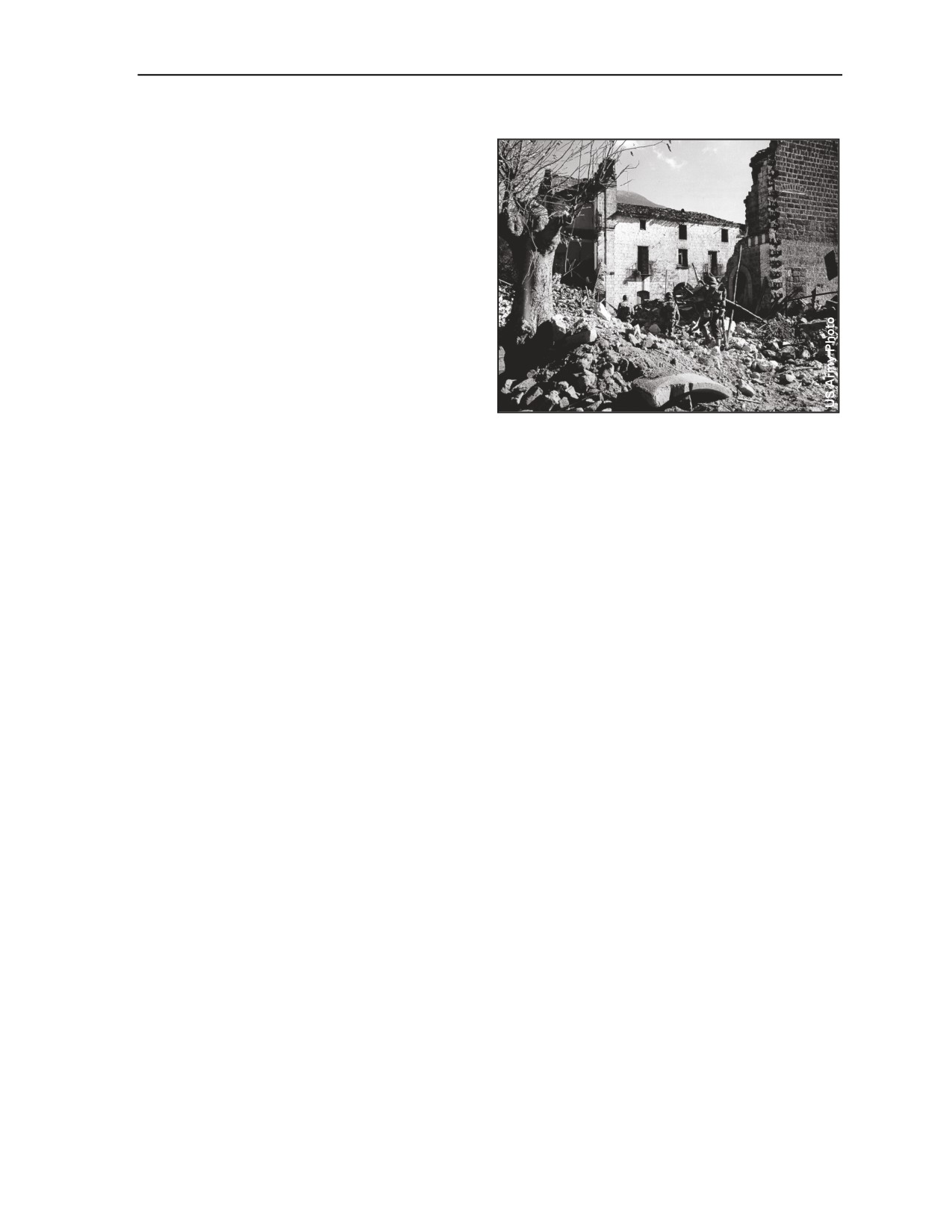
10-50. The unforgiving urban terrain will invariably increase damage to man-portable weapons and
equipment, particularly electronic equipment
sensitive to jarring. More frequent jarring can also
translate
into
more frequent calibration
requirements. Although by definition man-
portable weapons and equipment are easier to
transport, evacuating these systems may prove as
difficult as evacuating vehicles and larger, heavier
equipment. Therefore, field support maintenance
support teams
(MSTs) will frequently need to
repair equipment at (or as near as possible to) the
point where it was damaged. Equipment operators
are responsible to properly diagnose the fault or
damage. Such action ensures that the correct
repair parts and maintenance personnel are sent
forward to complete necessary repairs. In UO,
particularly offensive and defensive operations,
units may need to replace rather than repair equipment. Subsequently, sustainment personnel may need to
plan for increased replacement of what might normally be repairable equipment, as well as plan for
increased repair parts for man-portable items.
Add-On Protection Increases Wear
10-51. To increase protection against small arms, mines, rocket-propelled grenades, and lightweight
antiarmor weapons, units may need to attach additional armor and improvised wire-mesh screens and cages
to both wheeled and tracked vehicles operating in an urban environment. (Units can also sandbag vehicles
to achieve a degree of increased protection.) These modifications, however, increase wear on brakes,
springs, suspension, and tires, all of which are already vulnerable to the increased amount of debris present
in the urban environment. Over time, this wear will begin to increase failure rates in major assemblies,
such as engines, transmissions, and transfers. To offset the increase in wear and, subsequently repair parts
requirements, commanders conducting UO should consider emphasizing these aspects during daily
operator PMCS and increasing the frequency of scheduled services.
Increased Battle Damage Assessment and Repair
10-52. In UO, operators, crews, MSTs, and recovery teams execute BDAR far more than in other
environments. BDAR quickly restores minimum essential combat capabilities for a specific mission
(normally of short duration) or allows the equipment to self-recover by expediently fixing or bypassing
components. Commanders may need to authorize supervised battlefield cannibalization and controlled
exchange when units lack critical parts or cannot bring them forward. Sustainment commanders should
consider the use of BDAR kits, specifically designed for the systems they support. The use of these kits,
though providing only temporary repair, will extend the availability of combat systems until full repair
capability is accessible.
Potential Urban Maintenance Resources
10-53. Although urban areas can complicate maintenance, they may contribute to this sustainment
function. Analyzing the urban area in the commander’s AO may reveal potential sources of parts, tools,
equipment, and facilities, and the expertise necessary to fix equipment, repair components, and fabricate
critical parts. Sites of potential value may include automotive repair shops, foundries, car dealerships, parts
stores, junkyards, scrap-metal dealers, and machine shops. Urban areas may also serve as key sources for
parts and facilities
(and theater support contractor personnel) to repair automation and network
communication equipment.
26 October 2006
FM 3-06
10-13

Chapter 10
Host Nation Repair Operations: OPERATION IRAQI FREEDOM
During operations in Mosul, Iraq in the summer months of 2003, elements of the 2nd
Brigade Combat Team (BCT), 101st Airborne Division (Air Assault) suffered from a
decline in combat power that outpaced the ability of the distribution-based
sustainment system to provide repair parts. As readiness across the BCT threatened
to degrade operational capability, sustainment personnel from the brigade’s forward
support battalion (FSB)—drawing on lessons learned from the 1990-1991 Gulf War—
scoured the local populace for repair parts, facilities, and expertise in an attempt to
offset the losses suffered due to supply shortfalls.
Initially, local retailers provided limited repair parts and facilities to the FSB, but the
effect was significant and readiness rates began to stabilize. As time passed,
however, the continued wear on equipment operating in the urban environment,
coupled with the harsh summer weather, began to take a toll on reparable
components and major assemblies. With limited availability in theater, and order-ship
times as long as 60 days, requisitions would not be filled before the effect on combat
fleet readiness reached a critical point.
Recognizing a trend that threatened the success of the BCT’s urban operations in
Mosul, the FSB established a contract maintenance facility in the brigade support
area, used its contingency contracting officer to hire a group of local mechanics
certified through General Motors, and opened the first host nation repair facility in
Iraq. The group repaired major assemblies and reparable components and systems,
maintaining a failure rate consistent with major CONUS rebuild facilities. The effect
was immediate: during the first four months of the program, a full two-thirds of the
combat platforms repaired and returned to service operated with components or
assemblies rebuilt in the host nation facility.
Over time, the program was expanded to support other divisional units in northern
Iraq. This effort provided maneuver commanders with responsive maintenance
support and demonstrated the effect of sustainment flexibility and sustainability in
urban operations. Furthermore, this action met the division commander’s intent of
infusing much-needed funds into the local economy while strengthening American-
Iraqi relations in the region.
TRANSPORTATION SUPPORT
10-54. Transportation supports the concept of the urban operation by moving and transferring units,
Soldiers, equipment, and supplies. Transportation incorporates military, commercial, host-nation, and
urban area capabilities to establish a flexible system that expands to meet the needs of the force.
Transportation includes movement control, terminal operations, and mode operations.
10-55. Urban areas are often critical to
transportation operations. These areas may serve
as a lodgment or support area for entry of Army
forces and sustainment supplies. The existing
transportation and distribution infrastructure may
be essential to reception, staging, and onward
movement. Theater support contracts, as well as
host-nation support agreements, may greatly
increase the ability of Army forces to use the
urban area’s facilities, which may include docks,
airfields, warehouses, and cargo handling
equipment. Urban support may also include skilled
urban workers, such as longshoremen, truck
drivers, and MHE operators.
10-14
FM 3-06
26 October 2006
Urban Sustainment
Urban Terminals
10-56. In addition to serving as major seaports and aerial ports of debarkation, urban areas may provide
additional terminals in the AO. Forces may use these terminals for further staging, loading, discharging,
and transferring the handling between various inland transportation modes and carriers (motor, air, rail, and
water). These urban terminals—with synchronized movement control—permit commanders to rapidly shift
transportation modes and carriers. This increases flexibility and ensures the continued forward movement
of equipment and supplies to support ongoing operations. Movement control, particularly in urban areas,
relies heavily on support from military police in their maneuver and mobility support role. Without this
support, urban LOCs may become congested, hinder movement and maneuver, and degrade force
effectiveness (see FM 3-19.4). Urban commanders may need to establish multiple checkpoints, roadblocks,
and traffic control points; restrict selected roads to military traffic; and reroute movement to unaffected
road networks when civil support and refugee control operations compete for available routes. Again,
military police operations are critical in this regard and will require continuous, close coordination with
urban civilian police (if available).
Obstacles to Ground Transportation
10-57. Although urban areas can contribute to transportation operations, rubble and other damage can
become obstacles to ground movement. Even in an undamaged urban environment, road and bridge weight
restrictions, barriers and medians, steep embankments, large drainage systems, and other urban structures
may limit transportation operations. Urban route maintenance, to include reinforcing bridges and
constructing bypasses, may become a priority task for engineer units. Bypassed pockets of resistance and
ambushes pose a constant threat along urban supply routes and routes in close proximity to urban areas.
Urban convoy and resupply operations will often require increased security in the form of continuous route
security operations, regular (daily, if necessary) mine and improvised explosive device (IED) clearance
operations, numerous observation posts, attack helicopter support, a larger, more mobile tactical combat
force, and adequate communications capabilities among convoy vehicles and with supporting forces and
higher headquarters. While the level of security and force protection may vary, convoy operations are
never considered an “administrative” operation (see FM 4-01.45). Security needs may increase manpower
requirements for sustaining operations and potentially reduce resources from decisive operations. Moving
critical supplies may require heavily armed convoys and armored vehicles. Drivers must be well trained in
convoy operations, rehearsed, and alert. They must recognize and avoid potential mines and IEDs
(stationary and vehicle-borne) and be able to react rapidly to ambushes. Additionally, commanders may
need to institute deception measures such as randomly closing and opening supply routes to confuse threat
pattern analysis. As before, aerial resupply can alleviate problems due to ground obstacles, but the air
defense threat and proximity of threat forces may preclude their routine use.
Population Effects
10-58. The ability of Army forces to use vital urban transportation facilities depends largely on the
civilians and the threat. The civilian population can affect the transportation system if they do not support
the goals of Army operations. Urban transportation systems—such as ports, railroads, and rivers—require
many specialists to operate. Without these specialists, the system’s utility is degraded and may not function
at all. In urban stability or civil support operations, Army forces will share the system with civilians and
other agencies. Civilian authorities may refuse to allow Army forces to use any portions of an urban area’s
transportation system. Negotiating for access to that system under these circumstances then becomes a
command priority.
Threat Effects
10-59. The threat can significantly affect urban transportation systems. Many are composed of smaller
subsystems. Each subsystem is vulnerable to attack, which in turn often shuts down the whole system. A
large canal system, for example, may have entrance and exit facilities, the canal itself, a means to pull the
vessel along such as a locomotive engine, and the civilians that run each of these subsystems. Both an
attacker and defender understand the components of the particular transportation system. If important to
26 October 2006
FM 3-06
10-15
Chapter 10
current or subsequent operations, defending forces then develop plans and allocate forces to protect these
subsystems. Attacking forces, on the other hand, often avoid collateral damage to the system, while
simultaneously preventing enemy destruction of the facilities.
FORCE HEALTH PROTECTION
10-60. Force health protection
(FHP) consists of all services performed, provided, or arranged to
promote, improve, conserve, or restore the mental or physical well-being of personnel in the Army and, as
directed, for other services, agencies, and organizations. FHP conserves the force by—
Preventing DNBIs and controlling combat stress.
Clearing the urban area of casualties.
Providing forward medical treatment and hospitalization and en route care during medical
evacuation.
Providing required veterinary, dental, and laboratory services.
Ensuring that adequate Class VIII supplies, medical equipment, and blood are available.
10-61. FHP operations minimize the effects of wounds, injuries, disease, urban environmental hazards,
and psychological stresses on unit effectiveness, readiness, and morale. Effective UO require acclimated
Soldiers trained in specific urban tactics, techniques, and procedures. FHP helps maintain the health of
urban forces, thereby conserving that trained manpower. Historically, urban combat operations have
generated three- to six-times greater casualty rates than operations in any other type environment. (Greater
enemy wounded and a need to provide care for them will also exacerbate this situation.) FHP operations
that maintain the health and readiness of Army forces reduce the strain on the replacement and evacuation
systems. Such care allows Soldiers to concentrate on the task at hand instead of the increased risks
associated with UO.
10-62. As part of the overall LPT, commanders and medical planners must analyze and continuously
assess the urban area. They must identify medical threats, required medical resources, and the quality and
availability of medical facilities and resources (to include civilian medical personnel). This assessment
prevents duplicated services and permits more effectively and efficiently organized medical resources.
10-63. FHP analysis also identifies available hospitals, clinics, medical treatment facilities, and medical
supplies and equipment (including production facilities) in the urban area. It may also identify NGOs
capable of providing medical services and supplies. (However, stringent federal regulations, standards of
medical care, and a need for unavailable advanced technologies may limit their use by Army forces. But,
this analysis will still be crucial in determining whether urban medical facilities can support civilian
requirements.) FHP personnel keep abreast of the operational situation and its impact on FHP and the
urban population. Peace operations, for example, may rapidly transition to high-intensity offensive and
defensive operations requiring medical support able to handle potential mass casualty scenarios which may
include civilians.
Care of Civilians
10-64. During combat operations, the military normally does not provide injured civilians with medical
care, instead relying on civilian medical personnel to provide this service. However, based on METT-TC
and requirements under Geneva Conventions, commanders may need to recover, evacuate, and treat
numerous civilians (particularly in urban civil support or stability operations) until local civilian medical
personnel and facilities can be reconstituted and supplied. In urban civil support operations involving
weapons of mass destruction, the primary focus of Army support may be FHP.
10-65. If commanders provide civilian medical support, they adhere to the UO fundamental of
transitioning control and transferring responsibilities for medical care of civilians to another agency or into
civilian hands as soon as is practical. In UO, commanders consider and address the medical treatment of
civilians
(enemy and friendly) early in the planning process. Any initial assessment or survey teams
therefore contain medical representatives. Of significant concern, commanders may need to ensure that
adequate supplies and equipment are on hand to treat the urban population’s children as combat health
service support is normally focused on the treatment of adult Soldiers. Additionally, follow-on military
10-16
FM 3-06
26 October 2006
Urban Sustainment
care for civilians after treatment at a combat support hospital is often nonexistent or extremely limited to a
case-by-case basis necessitating the quick restoration of civilian hospital capabilities. Finally, military
health practitioners must also assess and consider cultural factors related to civilian medical treatment. (For
example, male doctors may not be able to examine or treat indigenous women.) To alleviate confusion and
preclude avoidable negative repercussions and unrealistic expectations, commanders may need to develop
specific medical policies, directives, and standing operating procedures. These
“medical rules of
engagement” (ROE) ensure that subordinates know how much medical care they may provide to—
The urban population.
Other host-nation and third-country civilians.
Coalition and host-nation forces.
Contractor personnel.
10-66. Commanders should also consider that medical aid to the local urban population and other
civilians can be a powerful influential tool. Properly planned and executed, its potential benefits for Army
forces include enhanced security and intelligence collection created by increasing the willingness of
civilians to interact with Soldiers. These effects cannot be left to happenstance. They should be a conscious
part of the information operations campaign nested within the overall UO plan. Consideration must also be
given, however, to mitigating the potential negative consequences involved in the inevitable reduction or
curtailing of medical assistance by Army FHP personnel. As with any aspect of UO, providing care
without considering the longer-term consequences could result in far greater disadvantages than benefits.
Disease and Nonbattle Injury
10-67. DNBI is a major medical threat during all operations and presents additional risk during UO.
Urban pollution hazards and potential exposure to TIM may increase the risk to soldier health. Some urban
areas, particularly those in developing countries, are already large sources of communicable diseases, such
as tuberculosis, cholera, typhus, hepatitis, malaria, dengue, and acquired immune deficiency syndrome
(AIDS). Other factors that increase the number of disease vectors and the potential for the transmission of
infectious diseases might include—
Physical damage or deterioration of urban infrastructure—such as electricity, water, and sewage
services.
Industries that use or produce hazardous materials.
Increased habitats for rodents and other pests due to rubble, debris, and uncollected trash.
Inability for the threat or local authorities to recover and dispose of human remains and animal
carcasses.
Greater threat of animal diseases transmittable to humans due to larger numbers of animals
wounded or injured by the effects of UO.
Greater susceptibility of urban civilians to infectious diseases—increasing the potential of
person-to-person disease transmission—due to declining public health capabilities and nutrition
levels.
10-68. The density of the environment extends these urban medical risks to Army forces. Commanders
should establish a medical epidemiological surveillance system early to assess the health of the force and
promptly identify unusual or local occurrences that may signal preventive medicine problems or the
influence of biological or chemical agents. These potential hazards, particularly the release of TIM, will
influence the type of medical supplies needed by medical personnel and will also necessitate critical
planning and preparation for potential mass casualties (civilian as well as military).
10-69. Adhering to the UO fundamental of preserving critical infrastructure will likely prevent surges in
DNBI. Preventive medicine personnel must identify the diseases and recommend control and preventive
measures. In urban areas, they may also conduct civilian health screening, health education, and
immunization programs. Medical screening of military personnel, particularly multinational forces, may be
required to prevent introducing new diseases (especially drug-resistant strains) into an urban area. A new
disease may tax the medical system and introduce a new medical problem into an area already in crisis.
Lastly, field sanitation training (to include a general emphasis on hand washing; training in the use of
26 October 2006
FM 3-06
10-17
Chapter 10
barrier protection such as latex gloves when rendering care to any person; and animal, rodent, and pest
control), equipment, and supplies are part of overall preventive medicine measures and considerations.
Combat Stress
10-70. Stress occurs in every operation and type of environment; while limited stress levels are beneficial,
too much is harmful. Controlled combat stress can invoke positive, adaptive reactions such as loyalty,
selflessness, and heroism. On the other hand, uncontrolled combat stress can result in negative, harmful
behavior and combat stress casualties. Such behaviors and casualties—battle fatigue, misconduct stress
behaviors, and post-traumatic stress disorder—can interfere with the unit’s mission. Physical and mental
factors leading to combat stress result from the environment and the deliberate enemy actions aimed at
killing, wounding, or demoralizing Soldiers. However, many stressors are also generated from the
Soldier’s own leaders and mission demands.
Combat Stress: Chechnya - 1994 to 1996
Russia’s 1994-1996 conflict with Chechnya, a republic in the southwestern part of the
Russian Federation, produced an increased number of psychological trauma and
combat stress casualties. One medical survey found 72 percent of the soldiers
screened had some sort of psychological disorder symptoms. Of that, 46 percent
exhibited asthenic depression (a weak, apathetic, or retarded motor state). The other
26 percent exhibited psychotic reactions such as high states of anxiety, excitement,
or aggressiveness and a deterioration of moral values or interpersonal relations. The
statistics showed more troops experienced combat stress disorders than during their
1980s war in Afghanistan. One primary difference was that in Chechnya, Russian
forces conducted combat mostly in cities rather than in mountains, valleys, and other
rural areas.
Combat always invokes fear in soldiers. However, poor training and planning,
uncertainty in their cause, and urban populations that resented their presence
exacerbated the psychological climate for the Russian forces in Chechnya. Acts of
subversion and terrorism by Chechen guerrillas kept the Russians in a constant, high
state of readiness and anxiety; the soldiers viewed every civilian—young or old, male
or female—as a potential enemy. This psychological pressure was not simply a by-
product, but an objective of information operations and a prime reason for taking the
fight into the close confines of Chechnya’s urban areas. Torture and mutilation of
prisoners; immediate execution of captured pilots; imitative electromagnetic
deception (Chechens mimicked Russian radio transmissions and directed Russian
close air support against their own forces); and propaganda to convince civilians that
Russia’s actions had a religious bias against Muslims and Islam were conducted to
exert intense, unremitting psychological pressure on Russian forces—with great
success.
The characteristics of urban areas combined with Chechen insurgent activities and
information operations, civilians that did not welcome foreigners, and an unpopular
and poorly supported conflict with an open-ended mission reinforced the need for a
national will to strengthen and support the urban fight. These characteristics also
reinforce the need for clear objectives, proper leadership and training, and available
medical assets able to properly diagnose and treat combat stress casualties.
10-71. During UO, compartmented urban combat leads to physical isolation while difficulties
in
transmitting radio signals lead to communications isolation; together, they create an overwhelming sense of
loneliness. Snipers, mines, and IEDs combined with the closeness and high intensity of urban combat
contribute to an unremitting fear of attack from any quarter that further increases stress casualties.
Additionally, seeing and perhaps accidentally inflicting casualties on civilians (especially women and
children) increase battle fatigue. If civilians are hostile or a threat uses the population as cover and
concealment, then the potential for misconduct stress behaviors often increases. Urban areas may provide
10-18
FM 3-06
26 October 2006
Urban Sustainment
temptations for looting, alcohol and substance abuse, black marketeering, and harmful social interactions;
these temptations may increase misconduct stress behaviors. Leaders can prevent or rapidly identify,
successfully manage, and treat stress-related casualties
(see FM 22-51 and FM 6-22.5) and prevent
misconduct stress behaviors as well as potential violations of the law of war. To reduce the number of
stress casualties, commanders must—
Provide tough, realistic training in urban combat (and combat stress management).
Plan for rotation of forces and adequate rest and relaxation opportunities.
Establish effective ROE.
Create unit cohesion.
Ensure adequate mental health support is available.
Provide strong, capable leadership. Leaders, forward on the battlefield, will determine whether
the necessary discipline perseveres.
Evacuation
10-72. Transportation restrictions may preclude the medical evacuation (MEDEVAC) of urban casualties.
MEDEVAC by air ambulance remains the preferred method; however, it may not be feasible. The threat
from small arms fire, rocket-propelled grenades, and other shoulder-fired weapons may prohibit the
employment of helicopters. Aeromedical evacuation can also be hampered by the lack of landing zones due
to narrow streets, heavily damaged buildings, and barricaded or booby-trapped roofs. If the employment of
air ambulances is not feasible, a ground evacuation operation will be necessary. In UO, ground ambulances
should often be—
Hardened to improve the safety of the crew and patients as well as to increase the survivability
of the evacuation platform.
Field-sited as close to the operation as is tactically and physically possible.
Maneuverable in tight spaces and narrow streets.
10-73. Evacuation by ground ambulance may have their own set of obstacles to surmount such as rubble;
debris; barricades; mines, booby-traps, and IEDs; damaged or destroyed vehicles, and flooded or snow-
filled streets. If enough ground ambulances are unavailable due to increased casualties or the tactical
situation does not allow, units will need to execute casualty evacuation (CASEVAC) operations.
10-74. In UO, CASEVAC may entail evacuation by litter and the expedient use of a vehicle of
opportunity or other military vehicle not dedicated for medical evacuation. Based on the threat situation,
CASEVAC may also be limited to armored vehicles, conducted only during limited visibility, or both. For
evacuation by litter, units may require more litter bearers to move the injured to a point where they can be
further evacuated by ground or air ambulance. Lengthy evacuation routes require more litter bearers, as
multiple litter relay teams will be necessary to conserve energy and expedite evacuation. However, unless
augmented or relieved of this responsibility by another unit, these litter bearers will come from the
casualties’ own unit thereby diminishing the unit’s strength levels necessary to accomplish its primary
mission. Instead, tactical commanders may need to wait until a lull in or a cessation of the battle occurs.
Depending on projected casualty rates, higher-level commanders may augment units with additional
personnel to perform evacuation or may assign maneuver units this mission. Evacuation personnel will
require specific training in urban evacuation techniques
(moving casualties from subsurface and
supersurface levels to and along the surface level).
10-75. Overall, urban commanders at all echelons must develop detailed casualty evacuation plans that
include the establishment of treatment facilities as far forward as the situation allows. Engineers are critical
to clear routes for medical resupply and evacuation. Based on the threat situation, additional armored
vehicles may need to accompany ambulances in a multi-vehicle convoy not only to and from the patient
pickup point but also through to a higher level of care. Army forces may also need to plan for and acquire
unique capabilities, equipment, and skills now typically seen in civilian urban search-and-rescue teams to
clear debris and search for urban casualties. For example, specially trained dogs may play a vital role in
locating victims among urban rubble.
26 October 2006
FM 3-06
10-19
Chapter 10
Treatment
10-76. First aid training will have increased significance in UO. The compartmented nature of UO,
transportation restrictions, communications difficulties, and the low density of trauma specialists (combat
medics) may limit the urban casualty’s initial treatment administered by nonmedical personnel or to self-
treatment measures. To mitigate this risk, units identify and train combat lifesavers (CLS) to perform in the
absence of trauma specialists. Since the likelihood of Army forces performing UO continues to increase,
commanders strive to meet or exceed Army standards for the number of fully trained CLS required for
their specific unit. CLS (and trauma specialist) training must be realistic, hands-on, and conducted at
appropriate intervals to ensure CLS can perform lifesaving tasks to include starting intravenous lines. This
increase in self, buddy, and CLS care, as well as longer delays in evacuation, may also increase
requirements for additional first aid, CLS, and trauma specialist-carried supplies. (Ultimately, commanders
may have to consider weighting the main effort with greater overall FHP support for units conducting UO
than for units conducting operations in other environments.)
10-77. The increased potential for delayed evacuation during UO mandates that Army trauma specialists
be skilled in prolonged casualty care. During the 3-4 October 1993 battle in Somalia, for example, seven
trauma specialists managed
39 casualties for more than
14 hours before they could be evacuated.
Evacuation delays significantly increase the potential for infection; therefore, trauma specialists should also
be trained to administer antibiotics on the battlefield.
10-78. FHP personnel must be capable of recognizing and treating injuries due to IEDs and incendiary or
thermobaric weapons (fuel-air explosives)—favored, urban-oriented threat weapons
(see Chapter
3).
Thermobaric weapons explode; create a cloud of volatile gases, liquids, or powders; and then ignite,
creating an immense fireball consuming oxygen and creating enormous overpressure. When employed in
an urban structure, the blast wave or overpressure of any explosive is greatly amplified. Injuries resulting
from these weapons are massive burns, broken or crushed bones, concussions and traumatic brain injuries,
missile injuries, and internal injuries. To counter this threat, medical personnel must be aware of the
capabilities of these blast weapons, wounding patterns, and treatment methods.
10-79. The increased use of body armor during UO will help prevent penetrating chest and abdomen
wounds. As such, FHP personnel should expect more groin, pelvis, head, and extremity injuries.
Furthermore, when fighting soldiers that are known to use body armor, a threat (particularly snipers) can be
expected to target the head and face more often than other anatomic areas resulting in more head injuries.
Medical personnel must also anticipate and be prepared to treat an increase in hearing loss due to the firing
of weapons (particularly recoilless) in enclosed spaces with little ventilation. Medical personnel (and
engineers) should also be trained on how to properly remove rubble that has fallen on a Soldier or civilian
so as not to increase the extent of his injuries. Lastly, FHP personnel will need to research and develop
unique treatments for injuries due to an ever-increasing arsenal of nonlethal weapons.
EXPLOSIVE ORDNANCE DISPOSAL SUPPORT
10-80. Explosive ordnance disposal (EOD) support provides the capability to neutralize domestic or
foreign conventional explosive hazards which include unexploded explosive ordnance (UXO), booby
traps, IEDs, captured enemy ammunition (CEA), and bulk explosives. Such material and devices threaten
military operations and military and civilian facilities, equipment, and personnel. Explosive hazards create
a much greater risk during UO than operations in any other environment. Confined spaces, hard surfaces,
and more personnel (both Soldiers and civilians) in the vicinity may magnify the detonating effects of
explosives. Dense terrain makes all types of explosive hazards more difficult to locate. Moreover, terrorists
select urban settings for their booby traps and IEDs to potentially kill and destroy more, thus gaining
greater visibility for their message.
10-81.
10-81.
EOD units detect, mark, identify, render safe, and dispose of explosive hazards.
Importantly, EOD specialists will work closely with unit intelligence personnel to conduct explosive
forensics—technical intelligence collection and exploitation—to help identify the makers of the devices as
well as their ever-evolving methods of construction, placement, concealment, and detonation. Chemical
reconnaissance with their array of chemical sensors will also work closely with EOD units to reduce the
10-20
FM 3-06
26 October 2006
Urban Sustainment
uncertainty of the chemical threat. This integrated forensic approach is a proactive method to take the
advantage away from a terrorist or insurgent threat that seeks to employ these devices as a primary tactic.
10-82. Urban operations will increase EOD specialists’ role as advisors and instructors on explosive
hazards, protection measures, and disposal techniques. They will advise and train other Army forces, other
services, multinational partners, and civilian authorities. EOD specialists will also work closely with public
affairs and psychological operations personnel to increase public awareness of the horrific effects of these
munitions and devices. This education process is designed not only to teach the urban population to
identify and avoid explosive hazards, especially UXO, booby traps, and IEDs, but to gain civilian
assistance in reporting their locations. (In this regard, rewards for information leading to the discovery of
unexploded ordnance may be beneficial. However, the largest reward should normally be reserved for
information leading to the arrest or capture of bomb makers.)
10-83. In an urban environment where there are large amounts of UXO, IEDs, and CEA, the sheer
amount of explosives may overwhelm the capabilities of available EOD personnel. Because of their
training in demolitions and explosives, commanders will often use combat engineers to augment the
destruction and clearance effort. Engineers are normally given responsibility for UXO clearance and
disposal while EOD teams use their technical skills for IEDs. Commanders may also consider embedding
EOD expertise within engineer units to provide the knowledge necessary to determine the correct amount
and type of explosive necessary to detonate UXO and to understand potential risks and effects of
detonation of various munitions. For example, EOD specialists would better understand the second-order
effects and risk reduction measures necessary to detonate a large missile containing numerous
submunitions.
10-84. Unfortunately, there is no single device or technique that can eliminate every explosive hazard
encountered. Clearance operations are dangerous and time-consuming. Based on METT-TC, commanders
may consider the following options when dealing with these explosive hazards:
Report, mark, and bypass the hazard.
Employ tactical breaching procedures.
Self-extract to alternate routes or positions.
Restrict routes or positions from further use.
Clear specific areas or positions, or conduct an extensive route clearance.
Lastly, accept risk of casualties and continue with the assigned mission.
10-85. Effective tactics, techniques, and procedures (TTP) for addressing explosive hazards must be
captured and shared with friendly forces and coalition partners. Commanders recognize, however, that
adaptive threats will continually modify their own techniques to counter the unit’s response. See FM 3
34.119, FM 20-32, FM 3-100.38, FM 4-30.51, and FM 4-30.16.
HUMAN RESOURCES SUPPORT
10-86. Human resources support
(HRS) encompasses the following functions: manning the force,
personnel support, and personnel services. These activities include personnel readiness; replacement
operations; personnel accounting; personnel information management; casualty operations; essential
personnel services; postal operations; morale, welfare, and recreation; and band support provided to
Soldiers, their families, Department of Army civilians, and contractors.
10-87. Successful UO require HRS functions. Clearly, HRS focuses on caring for the needs of people:
Soldiers and civilians who support them. Since a critical component of the urban environment is the
population, these activities, when required, may also support them. For example, HRS elements, in
conjunction with mortuary affairs, military police, and CA, may provide administrative support to assist in
the accountability of displaced persons and civilian internees and the establishment of other populace and
resources control measures. This support may include the provision of identification and registration cards,
travel permits, and other documents, and administrative support to casualty operations. Human resources
managers may also assist with community activities and coordination with the Red Cross. If necessary, a
postal platoon may assist urban officials in training and reestablishing civilian postal operations. Overall,
26 October 2006
FM 3-06
10-21
Chapter 10
this type of assistance and support helps to care for the immediate needs of the urban population and,
ultimately, speed transition back to legitimate civilian responsibility and control.
10-88. In offensive and defensive UO, HRS personnel will need to account for more casualties and more
frequent reconstitution. In all UO, success relies on training individual replacements. Urban combat
requires Soldiers skilled in specific urban combat TTP. They understand the societal aspects of the urban
population and have training in crowd control to avoid escalating potentially volatile situations. Training
these replacements prior to their actual deployment or while in the replacement system frees urban
commanders from having to do so. It also helps reduce Soldier (and supporting civilian) isolation, anxiety,
and fear associated with urban areas and operations.
FINANCIAL MANAGEMENT SUPPORT
10-89. Money and its management are often critical to the success of UO. As such, financial management
support makes resources available when and where they are needed and assist the urban commander in
maintaining fiscal responsibilities. Financial management operations are necessary to conduct the
contracting necessary to restore and rebuild infrastructure and provide real-time information, accounting,
and services. Financial management operations ensure that urban operational policies and procedures
adhere to laws and regulations, develop command resource requirements, and leverage appropriate fund
sources to meet them.
10-90. UO will likely include other U.S. military services, governmental agencies, and contractors;
multinational forces; NGOs; and various elements of the host nation. So many actors complicate financial
accounting, resource management, and cost capturing. Yet, these activities are vital to accomplishing UO
and maintaining legal requirements. Army forces will receive support from and provide support to these
participants. Financial managers provide crucial expertise to the urban commander on the obligation
authority. They also furnish the documentation necessary to obtain and pay for local goods and services
using contract or commercial vendor services. However, commanders
(with financial management
assistance) must assess the economic impact of UO on the economy. An appropriate analysis includes how
well the urban economics and commerce infrastructure can support the deployed force and how an influx
of U.S. currency may affect the overall economy either positively or negatively.
Labor, Reward, and Solatia Programs
10-91. Financial management elements can also provide joint pay support and non-U.S. pay support for
host-nation employees and day laborers supporting UO, as well as for civilian internees. These units can
support reward programs and solatia (financial compensation). Commanders can use reward programs to
purchase weapons, radios, information, and other items from the urban inhabitants. However, they must
use caution when paying for critical human intelligence. First, they must ensure that multiple collection
agencies in the command avoid paying the same source for the same information and interpreting these
repeated inputs as validation that information is accurate and reliable. Second, they must establish a price
or pay scale so subordinate units (particularly in multinational UO) equally compensate their sources for
information. Commanders may also need to make solatia to alleviate grief, suffering, and anxiety resulting
from injuries and property or personal loss resulting from some aspect of UO. At other times, commanders
make solatia to meet cultural expectations of the urban population. These payments are nominal in amount
and made without an admission of liability by the Army. Significantly, they may help maintain the
legitimacy of the operation and preserve the support of the urban populace.
Financial Support to Civil-Military Projects
…[I]n an endeavor like that in Iraq, money is ammunition. In fact, depending on the
situation, money can be more important than real ammunition—and that has often been
the case in Iraq since early April 2003 when Saddam’s regime collapsed and the focus
rapidly shifted to reconstruction, economic revival, and restoration of basic services.
Once money is available, the challenge is to spend it effectively and quickly to rapidly
achieve measurable results. This leads to a related observation that the money needs to
10-22
FM 3-06
26 October 2006
Urban Sustainment
be provided as soon as possible to the organizations that have the capability and
capacity to spend it in such a manner.
Lieutenant General David H. Petraeus
Commander, 101st Airborne Division (Air Assault) and, later,
Commander, Multi-National Security Transition Command-Iraq
during OPERATION IRAQI FREEDOM
10-92. Other financial resources separate from operational funds may be appropriated to support civil-
military operations (CMO) projects during stability operations. (During OPERATION IRAQI FREEDOM,
these funds were referred to as commander’s emergency response program [CERP] funds.) These funds are
typically disbursed as bulk currency to tactical units, where the funds are allocated against lower-cost,
high-impact projects that support the immediate needs of civil authorities and their citizens. As such,
commanders must be prepared to receive, account, secure, and properly disburse these resources in
accordance with established procedures. Commanders have an inherent responsibility for ensuring the
proper use and disbursement of these funds and must execute appropriate judgment, fiscal responsibility,
and supervisory oversight of any resources appropriated in support of CMO. While commanders establish
appropriate guidelines to accomplish this fiscal responsibility, they must provide their subordinate
commanders—who have the need, capacity, and capability to put these funds to use—reasonable flexibility
in how they spend at least a portion of the money, so that they can address emerging needs within their
AO.
Contracting Expertise
10-93. Due to the nature of UO, tactical-level units will be likely required to plan and initiate contracts
not only for reconstruction projects but to supplement their own sustainment needs. Therefore, higher-level
commands must be prepared to assist tactical-level units with contracting expertise. This expertise is
required to overcome difficulties in delineating the scope of work, defining construction standards, and
establishing viable delivery dates. For small projects and purchases, a standard contractual format may be
sufficient. However, for large projects, commanders must provide their subordinates with knowledgeable
contracting personnel, who can write contracts with clearly-understood specifications, create purchase
orders that specify quality and delivery times, and help monitor work for quality control and assurance.
Payment guidelines and standards among all services and members of a coalition are essential to eliminate
competition and potential overpayment. Translators will be also essential to accurately translate
requirements and standards in addition to trusted local agents to assist in selecting quality engineering and
construction firms and workers. Overall, subordinate commanders need adequate contracting support and
expertise to meet civilian needs as well as their expectations for timeliness and quality. Without it,
commanders may risk losing critical opportunities to positively influence civilian perceptions. (See also
Legal Support to Operations below.)
RELIGIOUS SUPPORT
10-94. Religious support entails providing and performing religious support operations for commanders
to protect the free exercise of religion for Soldiers, family members, and authorized civilians. This includes
personal delivery of rites, sacraments, ordinances, pastoral and spiritual care, and religious education. Such
support also consists of:
Advising the commander on matters of religion, morals, and morale as affected by religion.
The impact of local religions on threat courses of action, the urban society, and, subsequently,
the mission.
The ethical impact of command decisions.
Moral and Ethical Climate
10-95. Chaplains can help commanders sense the moral and ethical climate in Army units and understand
potential moral dilemmas associated with planned UO. The urban environment affects Soldiers’ mental
health and can increase combat stress casualties, especially misconduct stress behaviors. Chaplains are an
important part of combat stress support. The chaplain’s presence and faith can sustain Soldiers throughout
26 October 2006
FM 3-06
10-23
Chapter 10
periods of great trauma. Religious support contributes to the total well being of Soldiers and aids in their
return to combat readiness. Chaplains help bolster Soldiers’ moral and ethical behaviors through spiritual
fitness training so that Soldiers may better cope with ambiguous moral and ethical situations. Chaplains can
help identify ethical concerns before they become critical command problems. To this end, their
observations help develop and modify ROE, which—due to ambiguity or overly restraining rules—may be
part of the problem.
Influence of Local Religions
10-96. Chaplains advise commanders on matters of religion as it affects the Soldiers within their units.
They also explain the influences of local religions on threat courses of action and the urban populace and,
subsequently, their potential effects on Army forces and UO. Religion is a crucial aspect of assessing the
societal component of the urban environment. Understanding the major tenets and concepts of the religions
and the impact of faith on civilians’ lives may help commanders understand what motivates the threat and
the urban populace. (Historically, when religion was a critical factor in armed conflict, the level of lethality
has been significantly higher.) To understand threat strategy and tactics, commanders understand their
ideology, which, in many cases, involves strong religious beliefs. This understanding also helps
commanders to appreciate the inhabitants’ attitudes toward other races, religions, and cultures and to
identify unacceptable kinds of social interaction (particularly between Soldiers and civilians). Failure to
recognize and respect religious beliefs can rapidly erode the perceived legitimacy of the mission and
increase the length of the operation. In addition to its influence on threat courses of action, a thorough
analysis of the urban environment also includes the degree of influence religion and religious leaders have
on the area’s government and economy.
LEGAL SUPPORT TO OPERATIONS
10-97. Legal support provides operational law support in all legal disciplines (including military justice,
international law, civil law—composed of contract, fiscal, and environmental law, claims, and legal
assistance). This support assists in command and control, sustainment, and HRS of UO. Legal
considerations are important in any operation; they take on added significance during UO. They form the
foundation for establishing ROE and are critical in the targeting process. (For example, with the increased
likelihood that the threat will use the media in an attempt to categorize Army attacks as unlawful, legal
support will be critical in determining the protected status of targets.) Adequate legal instruction and
training may help subordinate commanders and their Soldiers better understand some aspects ROE and,
with this understanding, help them make the rapid decisions often required in a complex urban
environment.
10-98. Legal considerations also affect how units acquire goods and services from urban areas and
provide support to other agencies and organizations operating in an area. The environment’s complex
nature requires commanders and their staffs to review and closely consider applicable legal constraints
when developing and executing friendly courses of action. Most urban areas have a highly developed legal
system nested within county, provincial, state, and national systems. The SJA support to commanders
addresses this urban system in conjunction with other legal systems and their potential to affect, positively
or negatively, the success of UO.
10-99. International, host-nation, and U.S. law and other regulatory guidelines may vary in their
applicability by time and place; actions permissible in one situation may be prohibited in another. These
exceptions and complexities increase requirements for SJA, often working with CA personnel, to identify
and resolve technical legal issues. Therefore, the SJA must actively advise and participate in all aspects of
UO from predeployment training and initial planning through transition and redeployment. FM 27-100
contains detailed legal guidelines affecting UO.
International and Host-Nation Law
10-100. International law consists primarily of agreements, treaties, and customary law to include the law
known as the law of war (see FM 27-10). The law of war consists of four general principles applicable
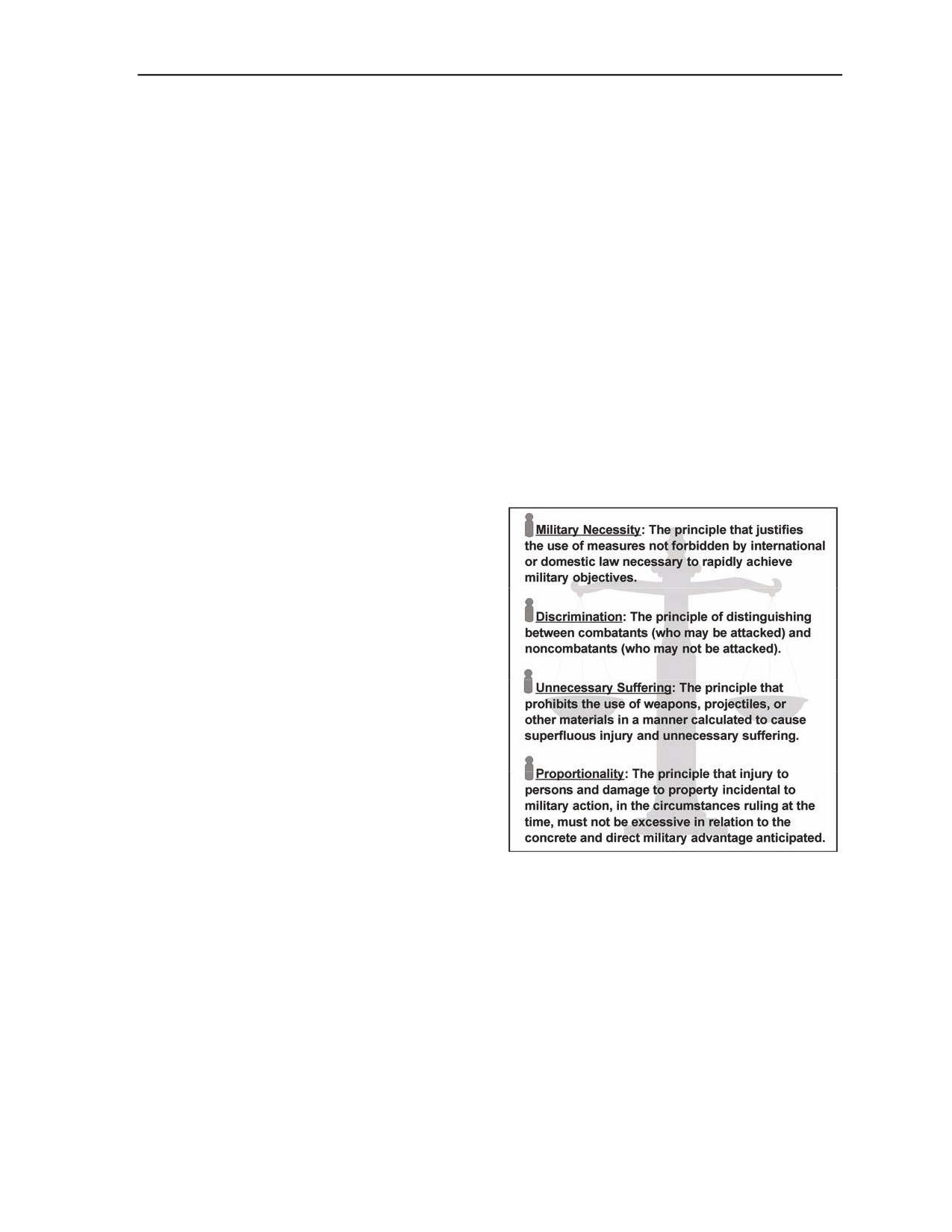
when conducting any operation but requiring particular attention during UO. Figure
10-4 lists and
10-24
FM 3-06
26 October 2006
Urban Sustainment
describes the four principles: military necessity, discrimination (or distinction), unnecessary suffering (or
humanity), and proportionality.
10-101. International law may affect urban operational issues, such as the right of entry, base operations,
use of urban infrastructure, and overflight and landing rights. Status-of-forces agreements (SOFAs) exist or
can be negotiated to resolve legal issues, such as the status of Soldiers (and, as necessary, contractors)
operating in foreign areas to include criminal and civil jurisdictions, taxation concerns, and claims for
damages and injuries. Unless a SOFA or other convention exists, Soldiers operating in foreign urban areas
have the same legal status as tourists; they are subject to the laws and judicial process of the host nation.
(During armed conflict, however, Soldiers always have the rights afforded to them by the Geneva
Conventions). Commanders are responsible for understanding the international and host-nation agreements
and laws that influence foreign UO. If local law hinders the operation, commanders may be able to inform
the local U.S. diplomatic mission and request that it negotiate a solution.
10-102. Commanders may encounter civilian resistance groups whose actions may range from providing
enemies with sustainment support to actively fighting Army and coalition forces. Members of such
resistance groups must be dealt with in accordance with applicable provisions of the law of war.
Commanders should seek legal guidance concerning detention and disposition of persons participating in
various acts harmful to friendly forces and detrimental to the mission.
U.S. Law
10-103. Commanders conducting UO must also comply with U.S. law whether it is in the form of a statute,
executive order, regulation, or other directive from
a federal branch or agency. U.S. law influences UO
by governing the acquisition of supplies and
services for Army forces, regulating the assistance
that can be rendered to foreign nations, and
controlling intelligence activities. The Posse
Comitatus Act, for example, makes it a crime for
Army forces to enforce civil law. Similarly,
portions of the Foreign Assistance Act prohibit
Soldiers from performing law enforcement
activities in foreign urban areas. However,
circumstances—expressly authorized by the
Constitution, acts of Congress, and other
exceptions to these statutes—exist that allow the
Army to support civilian law enforcement.
Although not nearly all-inclusive, the above
demonstrates how U.S. law further complicates
urban operations, particularly stability operations,
and increases the need for proactive SJA advice
and counsel in all facets of UO.
Figure 10-4. General principles of the law of
war
Legal Aspects of Nonlethal Force
10-104. Nonlethal capabilities can augment the means of deadly force and extend urban firepower options.
They enhance the commander’s ability to apply force in proportion to the threat and to allow
discrimination in its use. The range of nonlethal capabilities includes offensive information operations,
smoke and obscurants, irritants (such as chemical riot control agents), nonpenetrating projectiles, high-
pressure water devices, and directed-energy weapons. These continually expanding capabilities give
commanders more options to confront situations that do not warrant deadly force but require Soldiers to
employ overwhelming decisive power. However, nonlethal capabilities are subject to the same legal
constraints as lethal force
(in fact, some nonlethal capabilities can cause serious injury and death,
26 October 2006
FM 3-06
10-25
Chapter 10
particularly if not employed properly) and undergo the same legal review. Like lethal force, nonlethal
capabilities show military necessity, distinguish between combatants and noncombatants, distinguish
between military objectives and protected property, are used proportionally, and do not result in
unnecessary suffering.
10-105. Of special note, commanders cannot employ chemical herbicides or riot control agents as a
method of warfare without prior Presidential approval. However, the Secretary of Defense and regional
combatant commanders have authority to use herbicides and riot control agents in limited circumstances
during armed conflict and in peacetime operations. Considering the complexity of this issue, commanders
of major operations must streamline the approval process so that subordinate commanders do not discount
use of these agents simply because of the high-level approval authority. Subordinate commanders must,
however, be able to anticipate and clearly justify their potential use in UO. Also, any approval does not
mean that these agents must be employed.
Civilians Accompanying the Force
10-106. LOGCAP personnel and other civilian support contractors provide a variety of sustainment
functions for the Army. These functions may range from providing unskilled labor, transportation support,
and health care to technical support of sophisticated equipment and weapons systems. Commanders must
ensure that civilians providing support in their AO are not placed in positions of jeopardy, but if they are,
these civilians must understand the risks that they assume when they engage in activities that might be
misconstrued as direct or active participation in hostilities.
10-107. This last caution indicates an important legal consideration for commanders. They must try to
ensure that threat forces can distinguish civilian support contractors from combatants and thereby remove
any justification for them to be targeted or attacked. (As Army forces seek to work closely with the
members of governmental and nongovernmental agencies and organizations in urban stability operations,
commanders may need to take steps necessary to mitigate the risk of attack caused by their involvement
with Army forces.) In the event that threat forces capture civilian support contractors, this same concern
helps to ensure that, as lawful civilians accompanying the force, they will be afforded prisoner of war
status. As the role of contractor support to Army operations continues to expand, commanders must stay
abreast of changes in the law (to include evolving interpretative distinctions) as it affects the use of
contractors on the urban battlefield. Other important considerations for commanders with civilian
contractors supporting their force are—
Minimize Exposure to Harm. Civilian contractors should be assigned duties at locations that
minimize their exposure to harm. Commanders will need to periodically review these locations
since they are likely to change as the urban operation evolves and transitions.
Prohibit the Performance of Combat Functions. Civilian support personnel should not be
working in situations that involve combat operations where they might be conceived as
combatants. As an example, they should not perform force protection for Army forces such as
fortification construction and checkpoint security.
Prohibit the Use of Arms. Civilians should not be armed, unless approved by the combatant or
service component commander on a limited, by-exception basis for personal defense.
Provide Identification Cards. Civilians should be provided, and carry on their person, a
Geneva Convention identification card identifying them as civilians authorized to accompany
military forces and entitling them to be treated, if captured, as prisoners of war.
Restrict the Wear of Military Uniforms. Civilians should not normally wear distinctive U.S.
military uniforms unless the combatant or service component commander authorizes them to do
so. Regardless of their clothing, however, civilians will wear a symbol that establishes their
civilian status.
GENERAL ENGINEERING SUPPORT
10-108. General engineering support will be essential during UO. This support helps assess, construct,
maintain, and restore essential LOCs and urban facilities to sustain Army forces, the urban population, or
both. Using civilian resources and investing Army general engineering resources requires careful
10-26
FM 3-06
26 October 2006
Urban Sustainment
consideration by commanders and staff planners. Since all
elements of the urban infrastructure interconnect, general
engineering support touches each category to some degree.
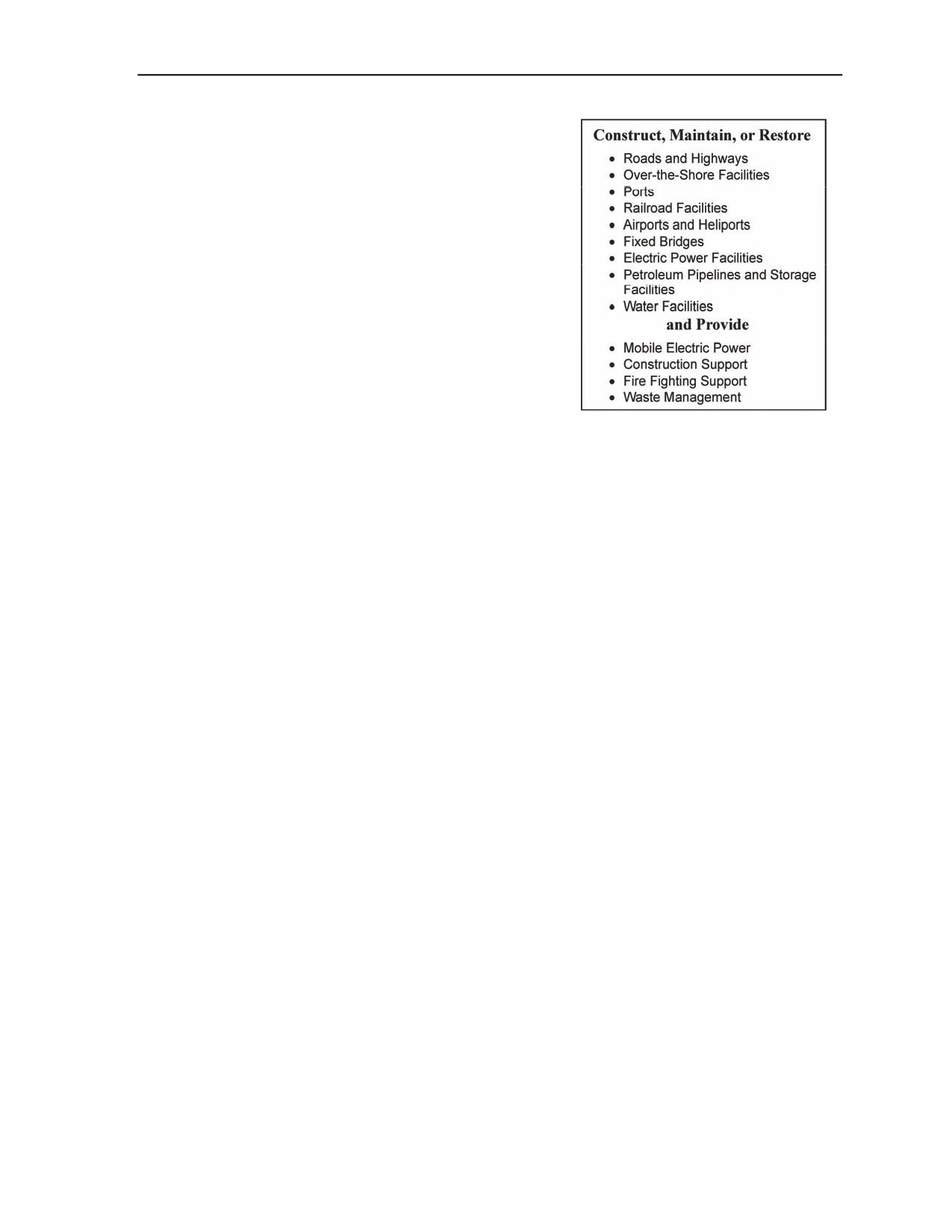
Figure 10-5 illustrates how urban-specific, general engineering
tasks align primarily with the transportation and distribution,
energy, and administration and human services components of
the urban infrastructure. These engineering tasks are
significant and readily apply to UO. The last two, providing
fire fighting support and waste management, have not been
previously addressed and require more specific consideration.
Figure 10-5. General engineering
support tasks
The Use or Investment of Resources
10-109. During urban offensive and defensive operations, Army engineer units accomplish tasks to sustain
or improve movement and mobility, protection, and sustainment of U.S. and allied forces. These units
should maximize the existing urban facilities, host-nation support, civilian contractors, and joint engineer
assets. However, commanders should consider how using urban facilities to support military forces may
negatively affect the population. On the other hand, construction and repair may benefit both Army units
and the urban inhabitants. Restoring the urban transportation network not only improves military LOCs,
but may also allow needed commerce to resume. Repairing urban airfields or ports increases throughput
capabilities for military supplies, facilitates medical evacuation operations to the support base, accelerates
needed relief efforts, and allows international commerce to proceed. Commanders may first invest
resources and conduct general engineering tasks to restore facilities for civilian use. Such actions stem
future drains on operational resources or facilitate later transition of control back to civilian authorities. For
example, repairing police stations, detention facilities, and marksmanship ranges may help urban
governments reestablish law and order after completing urban offensive or defensive operations. During
stability or civil support operations, the focus of general engineering will often be to support and assist the
urban population rather than Army forces.
Fire Fighting Support
10-110. Fire protection and prevention, as well as fire fighting, takes on added significance during UO,
particularly offensive and defensive operations. Most ordnance produces heat and flame. This, coupled
with an abundance of combustible material (buildings, furniture, gasoline, oil, and propane), poses a
serious risk to Soldiers, civilians, and the urban operation. Large shantytowns can exacerbate this problem.
In highly combustible areas, commanders may even need to limit or preclude the use of small-arms tracer
ammunition. Fire threats to urban areas can be categorized as—
Isolated Fires. These are restricted to a single structure or a specific area within a structure.
Area Fires. These fires consume two or more structures and may extend to encompass an entire
block. Generally, streets will serve as firebreaks and help contain the fire within a single block.
Firestorms. These are the most violent and dangerous fires capable of rapidly consuming large
areas by creating windstorms and intense heat. Firestorms are often inextinguishable until they
have consumed all available combustible materials.
26 October 2006
FM 3-06
10-27
Chapter 10
Explosive Hazards. These are present in areas containing fuels and chemicals as well as
military explosive hazards.
10-111. When analyzing the administration and human services component of the infrastructure,
commanders must determine the adequacy of existing civilian fire fighting support. A deteriorated or
nonexistent infrastructure that cannot support the urban area will likely fail to handle the increased risk due
to military operations. Commanders may need to provide fire fighting teams to support their own forces
and civilians.
10-112. A military force task organized with multiple fire fighting teams (even with maximum use of
available civilian fire-fighting assets) will only be able to fight some fires in the AO. Water distribution
systems damaged during operations, chemical and other TIM, and hostile activities will further complicate
and limit fire fighting capabilities. Commanders must develop priorities for equipment, facility, and
infrastructure protection. All Soldiers need training in fire prevention and initial or immediate response fire
fighting. Such training includes planning covered and concealed movement, withdrawal, and evacuation
routes. Soldiers should be trained to identify and remove ignition and fuel sources and provided additional
fire fighting material such as extinguishers, sand, and blankets (see FM 5-415 and the U.S. Department of
Transportation’s current version of the Emergency Response Guidebook).
Waste Management
10-113. Management of all forms of waste, particularly human, putrescible (such as food), and medical,
may become a critical planning consideration for Army forces. This particularly applies if the urban waste
management infrastructure was previously inadequate or damaged during UO or natural disasters, the
Army force is operating in the urban area for an extended period of time, and a significant number of the
urban population remains. Failure to adequately consider this aspect, possibly coupled with the decaying
remains of humans and animals and an inadequate or tainted water supply (such as may be caused by
flooding), may create unacceptable sanitary and hygiene conditions and subsequently increase DNBIs as
well as civilian casualties.
10-28
FM 3-06
26 October 2006
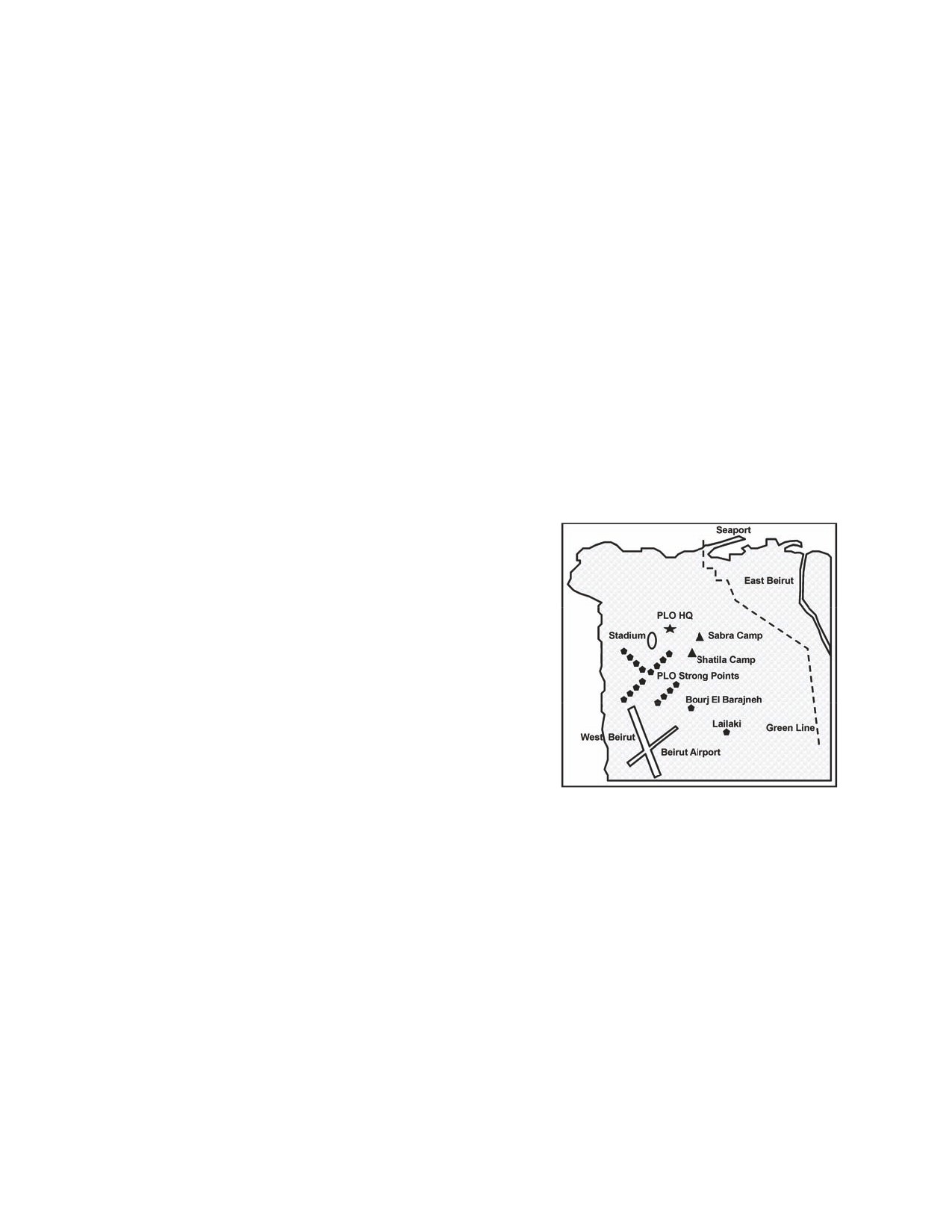
Appendix A
Siege of Beirut: An Illustration of the Fundamentals of
Urban Operations
The [Israeli Defense Forces] IDF had neither the strategy nor the experience nor the
configuration of forces to fight and sustain a house-to-house campaign in Beirut.
Richard A. Gabriel
Operation Peace for Galilee: The Israeli-PLO War in Lebanon
OVERALL STRATEGIC SITUATION
A-1. In 1982, Israel launched OPERATION PEACE FOR GALILEE designed to destroy the Palestine
Liberation Organization (PLO) presence in southern Lebanon. On 1 June, the IDF launched a massive
assault across the border into southern Lebanon. The Israeli attack focused on the PLO, but the operations
quickly involved major ground and air combat between Israel and Syrian forces.
A-2. In the first few weeks, Israeli forces quickly pushed
back both the Syrians and the PLO. However, except for
some PLO forces isolated in bypassed urban areas, such as
Tyre and Sidon, most of the PLO fell back into Beirut (see
Figure A-1). By 30 June, Israeli forces had reached the
outskirts of southern Beirut, occupied East Beirut, isolated
the city from Syria and the rest of Lebanon, and blockaded
the sea approaches to the city. Even so, with most of the
PLO intact inside and with significant military and political
capability, the Israelis had yet to achieve the objective of
OPERATION PEACE FOR GALILEE. The Israeli
command had to make a decision. It had three choices:
permit the PLO to operate in Beirut; execute a potentially
costly assault of the PLO in the city; or lay siege to the city
and use the siege to successfully achieve the objective. The
Israelis opted for the latter.
Figure A-1. The city of Beirut
Israeli Military Position
A-3. The Israelis had an excellent position around Beirut. They occupied high ground to the south and
west, virtually dominating the entire city. Israeli naval forces controlled the seaward approaches to Beirut.
The Israelis’ position was also strong defensively, capable of defeating any attempt to break out of or into
the city from northern Lebanon or Syria. The Israeli air force had total and complete air superiority. The
Israelis controlled the water, fuel, and food sources of West Beirut. Although the PLO forces had
stockpiles of food and supplies, the Israelis regulated the food, water, and generating power for the civil
population.
A-4. Despite the superior positioning of Israeli forces, the IDF faced significant challenges to include the
combat power of the PLO, Syria, and other threats in Beirut. Israeli doctrine and training did not emphasize
urban operations. Additionally, Israel was constrained by its desire to limit collateral damage and friendly
and noncombatant casualties. Organizationally, the Israeli army was not optimized to fight in urban terrain.
26 October 2006
FM 3-06
A-1
Appendix A
Armor and self-propelled artillery formations dominated the Israeli forces, and most Israeli infantry was
mechanized. The Israeli forces had only a few elite formations of traditional dismounted infantry.
PLO MILITARY POSITION
A-5. Despite being surrounded and cut off from support, the PLO position in Beirut offered numerous
advantages in addition to the characteristic advantages of urban defense. The PLO had long anticipated an
Israeli invasion of southern Lebanon; it had had months to prepare bunkers, obstacles, and the defensive
plan of Beirut and other urban areas. Approximately 14,000 Arab combatants in West Beirut readied to
withstand the Israeli siege. This was done with the advice of Soviet, Syrian, and east European advisors.
The preparation included stockpiling essential supplies in quantities sufficient to withstand a six-month
siege. Also, the PLO fighters integrated into the civil populations of the urban areas. Often their families
lived with them. The civil population itself was friendly and provided both information and concealment
for PLO forces. PLO fighters were experienced in urban combat and knew the urban terrain intimately.
PLO forces had been involved in urban fighting against Syrian conventional forces and Christian militias
in Beirut several years prior to the Israeli invasion. Finally, the organization of the PLO—centered on
small teams of fighters armed with machine-guns and antitank weapons, and trained in insurgent, hit-and
run tactics—was ideally suited to take maximum advantage of the urban environment.
ROLE OF CIVILIANS
A-6. Various ethnic and religious groups make up the civil population of southern Lebanon. However,
West Beirut’s population was heavily Palestinian and Lebanese. The civil population of West Beirut was
between 350,000 and 500,000. The Palestinian population supported the PLO. The Lebanese population
may be described as friendly neutral to the Israelis. Although unhappy under Palestinian dominance, this
population was unwilling to actively support Israel. The civilian population was a logistic constraint on the
PLO, which would have become significant had the siege lasted longer. The civilians in West Beirut were
an even larger constraint on the Israelis. The presence of civilians significantly limited the ability of the
Israelis to employ firepower. However, the Palestine refugee camps located in West Beirut were both
civilian centers and military bases. The Israeli constraints on artillery and other systems against these parts
of the city were much less restrictive than in other parts of West Beirut where the population was mostly
Lebanese and where fewer key military targets existed.
A-7. The PLO knew of the Israeli aversion to causing civil casualties and purposely located key military
centers, troop concentrations, and logistics and weapons systems in and amongst the population—
particularly the refugee Palestinian population in the southern part of West Beirut. Tactically, they used the
civilians to hide their forces and infiltrate Israeli positions.
A-8. The friendly Palestinian population provided intelligence to the PLO while the friendly Lebanese
population provided intelligence for the IDF. Throughout the siege, the IDF maintained a policy of free
passage out of Beirut for all civilians. This policy was strictly enforced and permitted no weapons to leave
the city. Some estimates are that as many as 100,000 refugees took advantage of this policy.
INFORMATION OPERATIONS
A-9. The siege of Beirut involved using information operations (IO) to influence the media. PLO
information operations were aimed at controlling the media and hence the international perception of the
operation. This was done by carefully cultivating a select group of pro-PLO media years before hostilities
even began. Once hostilities started, only these media sources were permitted to report from the besieged
portions of the city, and they were only shown activities that portrayed the IDF negatively. The IDF did not
vigorously counter the PLO plan. In fact, the IDF contributed to it by limiting media access to their
activities. The PLO information operations had a successful impact. The international community was
constantly pressuring the Israeli government to end hostilities. This put pressure on the IDF to conduct
operations rapidly and to limit firepower and casualties.
A-2
FM 3-06
26 October 2006
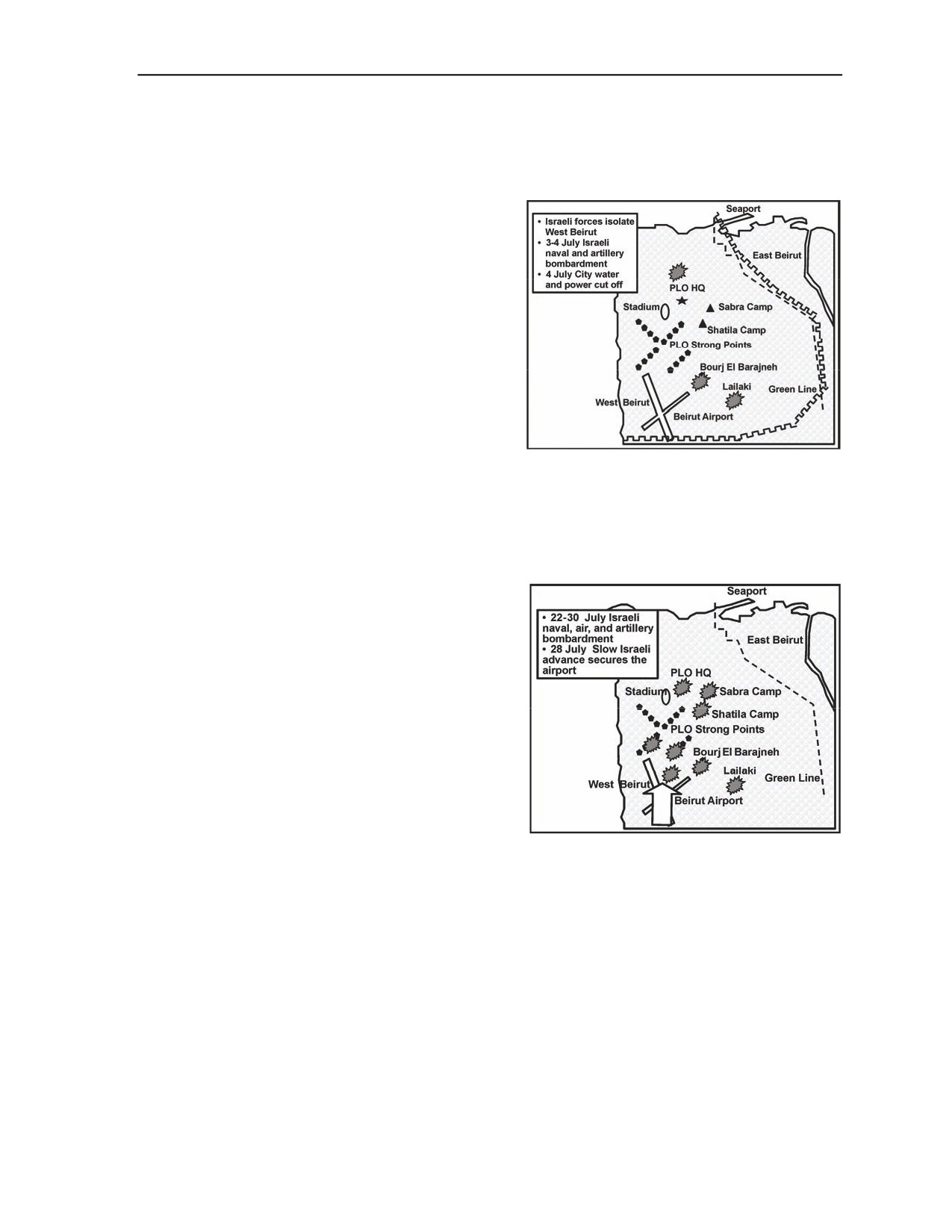
Siege of Beirut: An Illustration of the Fundamentals of Urban Operations
CONDUCT OF THE URBAN OPERATIONS
A-10. The siege of Beirut began 1 July (see Figure A-2). By 4 July, Israeli forces occupied East Beirut, the
Green Line separating East and West Beirut, and dominating positions south of the airport. IDF naval
forces also controlled the sea west and north of Beirut.
On 3 and 4 July, IDF artillery and naval fire began a
regular campaign of firing on military targets
throughout West Beirut. On 4 July, the IDF cut power
and water to the city.
A-11. From 5 to 13 July, the Israeli fires continued to
pound PLO targets in West Beirut. The PLO gave one
significant response, firing on an Israeli position south
of the city and causing several casualties. On 7 July,
reacting to international pressure, the IDF returned
power and water to West Beirut’s civil population. On
11 July, the IDF launched its first attack, probing the
southern portion of the airport with an armored task
force (see Figure A-3). The PLO repulsed this attack
and destroyed several IDF armored vehicles.
Figure A-2. Initial conduct of the urban
operation
A-12. On 13 July, both sides entered into a cease-fire that lasted until 21 July. They began negotiations,
mediated by international community, to end the siege. The PLO used this period to continue to fortify
Beirut. The Israelis used the time to train their infantry
and other arms in urban small unit tactics in Damour, a
town the Israeli paratroopers had captured.
A-13. The cease-fire ended on 21 July as PLO forces
launched three attacks on IDF rear areas. The Israelis
responded with renewed and even more vigorous
artillery, naval, and air bombardment of PLO positions
in the city. The IDF attacks went on without respite
until 30 July. On 28 July, the IDF renewed its ground
attack in the south around the airport (see Figure A-4).
This time IDF forces methodically advanced and
captured a few hundred meters of ground establishing
a toehold.
Figure A-3. Israeli probe of PLO defenses
26 October 2006
FM 3-06
A-3
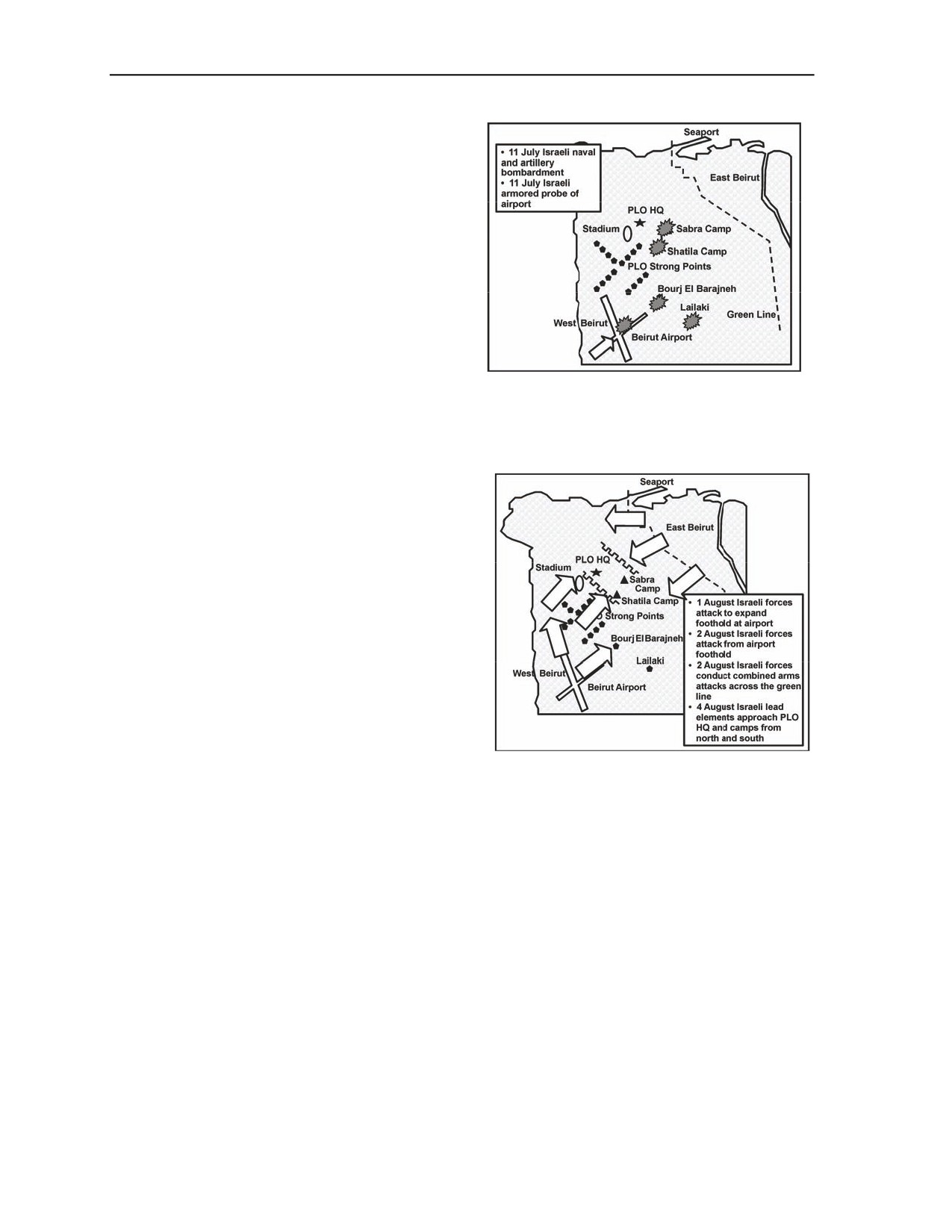
Appendix A
A-14. The Israeli bombardment stopped on 31 July.
However, on 1 August the IDF launched its first
major ground attack, successfully seizing Beirut
airport in the south (see Figure A-5). Israeli armored
forces began massing on 2 August along the green
line, simultaneously continuing the attack from the
south to the outskirts of the Palestinian positions at
Ouzai. On 3 August, the Israeli forces continued to
reinforce both their southern attack forces and forces
along the green line to prepare for continuing
offensive operations. On 4 August, the IDF attacked
at four different places. This was the much-
anticipated major Israeli offensive.
Figure A-4. Initial Israeli attack
A-15. The Israeli attack successfully disrupted the coherence of the PLO defense. The southern attack was
the most successful: it pushed PLO forces back to their camps of Sabra and Shatila and threatened to
overrun PLO headquarters. Along the green line the
IDF attacked across three crossing points. All three
attacks made modest gains against stiff resistance.
For this day’s offensive, the Israelis suffered 19 killed
and 84 wounded, the highest single day total of the
siege, bringing the total to 318 killed. Following the
major attacks on 4 August, Israeli forces paused and,
for four days, consolidated their gains and prepared to
renew the offensive. Skirmishes and sniping
continued, but without significant offensive action.
On 9 August, the IDF renewed air and artillery
attacks for four days. This activity culminated on 12
August with a massive aerial attack that killed over a
hundred and wounded over 400—mostly civilians. A
cease-fire started the next day and lasted until the
PLO evacuated Beirut on 22 August.
Figure A-5. Final Israeli attack
LESSONS
A-16. The Israeli siege of West Beirut was both a military and a political victory. However, the issue was
in doubt until the last week of the siege. Military victory was never in question; the issue in doubt was
whether the Israeli government could sustain military operations politically in the face of international and
domestic opposition. On the other side, the PLO faced whether they could last militarily until a favorable
political end could be negotiated. The answer was that the PLO’s military situation became untenable
before the Israeli political situation did.
A-17. This favorable military and political outcome stemmed from the careful balance of applying military
force with political negotiation. The Israelis also balanced the type of tactics they employed against the
domestic aversion to major friendly casualties and international concern with collateral damage.
PERFORM AGGRESSIVE INFORMATION OPERATIONS
A-18. The PLO devoted considerable resources and much planning on how to use IO to their best
advantage. They chose to focus on media information sources as a means of influencing international and
domestic opinion.
A-4
FM 3-06
26 October 2006
Siege of Beirut: An Illustration of the Fundamentals of Urban Operations
A-19. The PLO’s carefully orchestrated misinformation and control of the media manipulated international
sentiment. The major goal of this effort was to grossly exaggerate the claims of civilian casualties, damage,
and number of refugees—and this was successfully accomplished. Actual casualties among the civilians
were likely half of what the press reported during the battle. The failure of the IDF to present a believable
and accurate account of operations to balance PLO efforts put tremendous pressure on the Israeli
government to break off the siege. It was the PLO’s primary hope for political victory.
A-20. In contrast to the overall weak performance in IO, the IDF excelled in psychological operations. IDF
psychological operations attacked the morale of the PLO fighter and the Palestinian population. They were
designed to wear down the will of the PLO to fight while convincing the PLO that the IDF would go to any
extreme to win. Thus defeat was inevitable. The IDF used passive measures, such as leaflet drops and
loudspeaker broadcasts. They used naval bombardment to emphasize the totality of the isolation of Beirut.
To maintain high levels of stress, to deny sleep, and to emphasize their combat power, the IDF used
constant naval, air, and artillery bombardment. They even employed sonic booms from low-flying aircraft
to emphasize the IDF’s dominance. These efforts helped to convince the PLO that the only alternative to
negotiation on Israeli terms was complete destruction.
MAINTAIN A CLOSE COMBAT CAPABILITY
A-21. The ground combat during the siege of Beirut demonstrated that the lessons of tactical ground
combat learned earlier in the twentieth century were still valid. Small combined arms teams built around
infantry, but including armor and engineers, were the key to successful tactical combat. Artillery firing in
direct fire support of infantry worked effectively as did the Vulcan air defense system. The Israeli tactical
plan was sound. The Israelis attacked from multiple directions, segmented West Beirut into pieces, and
then destroyed each individually. The plan’s success strongly influenced the PLO willingness to negotiate.
Tactical patience based on steady though slow progress toward decisive points limited both friendly and
noncombatant casualties. In this case, the decisive points were PLO camps, strong points, and the PLO
headquarters.
A-22. The Israeli willingness to execute close combat demonstrated throughout the siege, but especially in
the attacks of 4 August, was decisive. Decisive ground combat was used sparingly, was successful and
aimed at decisive points, and was timed carefully to impact on achieving the political objectives in
negotiations. The PLO had hoped that their elaborate defensive preparations would have made Israeli
assaults so costly as to convince the Israelis not to attack. That the Israelis could successfully attack the
urban area convinced the PLO leadership that destruction of their forces was inevitable. For this reason
they negotiated a cease-fire and a withdrawal on Israeli terms.
AVOID THE ATTRITION APPROACH
A-23. The Israelis carefully focused their attacks on objects that were decisive and would have the greatest
impact on the PLO: the known PLO headquarters and refugee centers. Other areas of West Beirut were
essentially ignored. For example, the significant Syrian forces in West Beirut were not the focus of Israeli
attention even though they had significant combat power. Selectively ignoring portions of the urban area
allowed the Israelis to focus their combat power on the PLO and limit both friendly casualties and
collateral damage.
CONTROL THE ESSENTIAL AND PRESERVE CRITICAL INFRASTRUCTURE
A-24. The Israeli siege assured Israeli control of the essential infrastructure of Beirut. The initial Israeli
actions secured East Beirut and the city’s water, power, and food supplies. The Israelis also dominated
Beirut’s international airport, closed all the sea access, and controlled all routes into and out of the city.
They controlled and preserved all that was critical to operating the city and this put them in a commanding
position when negotiating with the PLO.
26 October 2006
FM 3-06
A-5
Appendix A
MINIMIZE COLLATERAL DAMAGE
A-25. The Israeli army took extraordinary steps to limit collateral damage, preserve critical infrastructure,
and put in place stringent rules of engagement (ROE). They avoided randomly using grenades in house
clearing, limited the use of massed artillery fires, and maximized the use of precision weapons. With this
effort, the Israelis extensively used Maverick missiles because of their precise laser guidance and small
warheads.
A-26. The strict ROE, however, conflicted with operational guidance that mandated that Israeli
commanders minimize their own casualties and adhere to a rapid timetable. The nature of the environment
made fighting slow. The concern for civilian casualties and damage to infrastructure declined as IDF
casualties rose. They began to bring more field artillery to bear on Palestinian strong points and
increasingly employed close air support. This tension underscores the delicate balance that Army
commanders will face between minimizing collateral damage and protecting infrastructure while
accomplishing the military objective with the least expenditure of resources—particularly soldiers. ROE is
but one tool among many that a commander may employ to adhere to this UO fundamental.
UNDERSTAND THE HUMAN DIMENSION
A-27. The Israelis had a noteworthy (although imperfect and at times flawed) ability to understand the
human dimension during their operations against the PLO in Beirut. This was the result of two
circumstances. First, the PLO was a threat with which the Israeli forces were familiar after literally decades
of conflict. Second, through a close alliance and cooperation with Lebanese militia, the Israelis understood
a great deal regarding the attitudes and disposition of the civil population both within and outside Beirut.
SEPARATE NONCOMBATANTS FROM COMBATANTS
A-28. Separating combatants from noncombatants was a difficult but important aspect of the Beirut
operation. The Israelis made every effort to positively identify the military nature of all targets. They also
operated a free passage system that permitted the passage of all civilians out of the city through Israeli
lines. The need to impose cease-fires and open lanes for civilians to escape the fighting slowed IDF
operations considerably. Additionally, Israeli assumptions that civilians in urban combat zones would
abandon areas where fighting was taking place were incorrect. In many cases, civilians would try to stay in
their homes, leaving only after the battle had begun. In contrast, the PLO tied their military operations
closely to the civilian community to make targeting difficult. They also abstained from donning uniforms
to make individual targeting difficult.
A-29. Earlier in OPERATION PEACE FOR GALILEE when the IDF attacked PLO forces located in Tyre,
Israeli psychological operations convinced 30,000 Lebanese noncombatants to abandon their homes and
move to beach locations outside the city. However, the IDF was subsequently unable to provide food,
water, clothing, shelter, and sanitation for these displaced civilians. IDF commanders compounded the
situation by interfering with the efforts by outside relief agencies to aid the displaced population (for fear
that the PLO would somehow benefit). Predictably, many civilians tried to return to the city complicating
IDF maneuver and targeting—that which the separation was designed to avoid. IDF commanders learned
that, while separation is important, they must also adequately plan and prepare for the subsequent control,
health, and welfare of the noncombatants they displace.
RESTORE ESSENTIAL SERVICES
A-30. Since essential services were under Israeli command, and had been since the beginning of the siege,
the Israelis had the ability to easily restore these resources to West Beirut as soon as they adopted the
cease-fire.
TRANSITION CONTROL
A-31. In the rear areas of the Israeli siege positions, the Israeli army immediately handed over civic and
police responsibility to civil authorities. This policy of rapid transition to civil control within Israeli lines
A-6
FM 3-06
26 October 2006
Siege of Beirut: An Illustration of the Fundamentals of Urban Operations
elevated the requirement for the Israeli army to act as an army of occupation. The Israeli army believed the
efficient administration of local government and police and the resulting good will of the population more
than compensated for the slightly increased force protection issues and the increased risk of PLO
infiltration.
A-32. Upon the cease-fire agreement, Israeli forces withdrew to predetermined positions. International
forces under United Nations (UN) control supervised the evacuation of the PLO and Syrian forces from
Beirut. These actions were executed according to a meticulous plan developed by the Israeli negotiators
and agreed to by the PLO. Israeli forces did not take over and occupy Beirut as a result of the 1982 siege
(an occupation did occur later but as a result of changing situations).
SUMMARY
A-33. The Israeli siege of West Beirut demonstrates many of the most demanding challenges of urban
combat. Apart from Israel’s poor understanding of the strategic influence of the media on operations (a
lesson that they learned and subsequently applied to future operations), the IDF’s successful siege of Beirut
emerged from their clear understanding of national strategic objectives and close coordination of
diplomatic efforts with urban military operations. A key part of that synchronization of capabilities was the
understanding that the efforts of the IDF would be enhanced if they left an escape option open to the PLO.
This option was the PLO’s supervised evacuation that occurred after the siege. Although the PLO was not
physically destroyed, the evacuation without arms and to different host countries effectively shattered the
PLO’s military capability. Had Israel insisted on the physical destruction of the PLO in Beirut, the overall
operation might have failed because that goal may not have been politically obtainable in view of the costs
in casualties, collateral damage, and international opinion.
26 October 2006
FM 3-06
A-7
This page intentionally left blank.
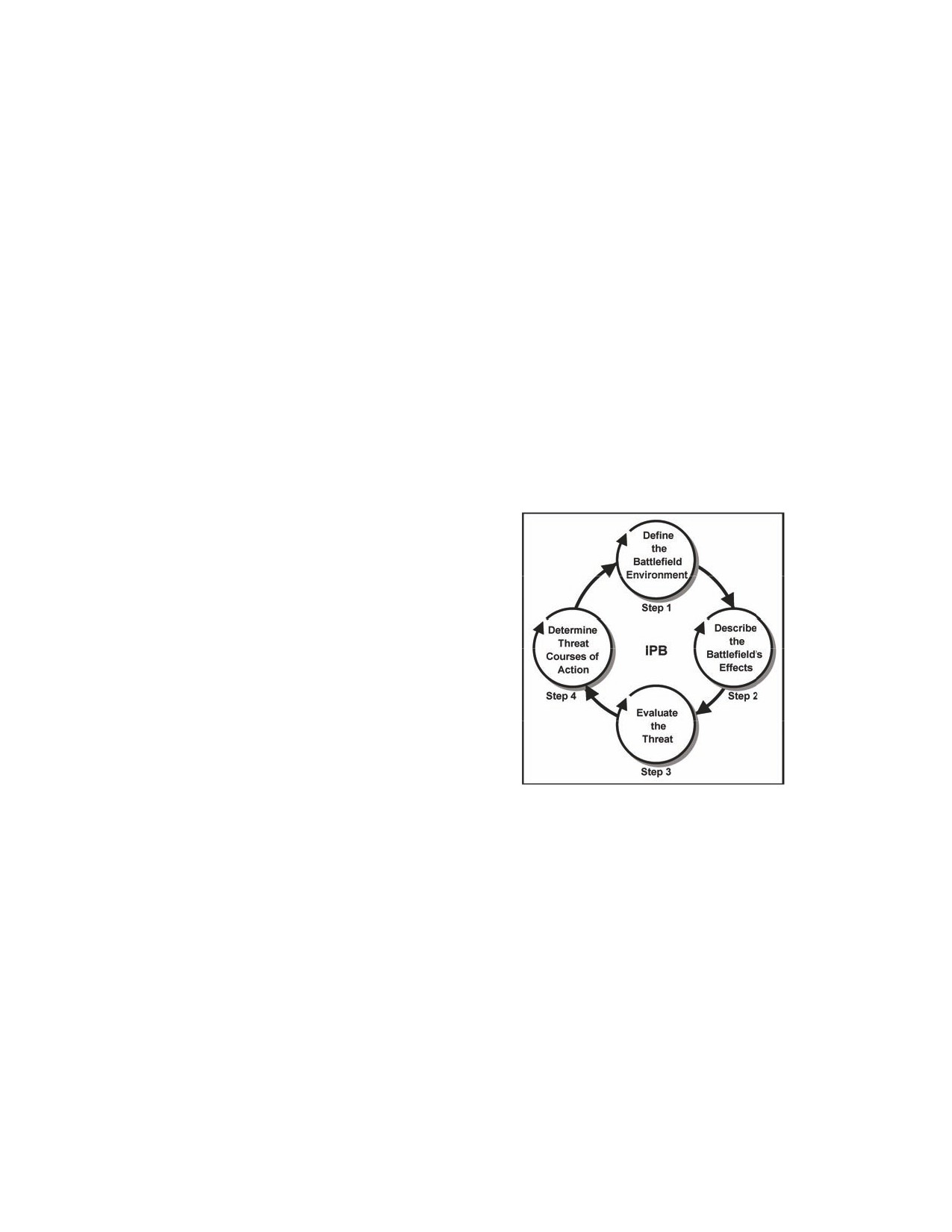
Appendix B
An Urban Focus to the Intelligence Preparation of the
Battlefield
Maneuvers that are possible and dispositions that are essential are indelibly written on
the ground. Badly off, indeed, is the leader who is unable to read this writing. His lot
must inevitably be one of blunder, defeat, and disaster.
Infantry in Battle
The complexity of the urban environment and increased number of variables (and
their infinite combinations) increases the difficulty of providing timely, relevant, and
effective intelligence support to urban operations
(UO). Conducted effectively,
however, the intelligence preparation of the battlefield (IPB) allows commanders to
develop the situational understanding necessary to visualize, describe, and direct
subordinates in successfully accomplishing the mission.
IPB is the systematic process of analyzing
the threat and environment in a specific
geographic area—the area of operations
(AO) and its associated area of interest (see
figure B-1). It provides the basis for
intelligence support to current and future
UO, drives the military decision-making
process, and supports targeting and battle
damage assessment. The procedure (as well
as each of its four steps) is performed contin
uously throughout the planning, preparation,
and execution of an urban operation.
Figure
B-1. The steps of IPB
UNAFFECTED PROCESS
B-1. The IPB process is useful at all echelons and remains constant regardless of the operation or environ
ment. However, an urban focus to IPB stresses some aspects not normally emphasized for IPBs conducted
for operations elsewhere. The complex urban mosaic is composed of the societal, cultural, or civil dimen
sion of the urban environment; the overlapping and interdependent nature of the urban infrastructure; and
the multidimensional terrain. This mosaic challenges the conduct of an urban-focused IPB. There is
potential for full spectrum operations to be executed near-simultaneously as part of a single major
operation occurring in one urban area with multiple transitions. Such multiplicity stresses the importance of
a thorough, non-stop IPB cycle aggressively led by the commander and executed by the entire staff.
Overall, the art of applying IPB to UO is in properly employing the steps to the specific operational
environment. In UO, this translates to analyzing the significant characteristics of the environment, the role
that its populace has in threat evaluation, and understanding how these affect the planning and execution of
UO. FM 2-01.3 details how to conduct IPB; FM 34-3 has the processes and procedures for producing all-
source intelligence. This appendix supplements the information found there; it does not replace it.
26 October 2006
FM 3-06
B-1
Appendix B
INCREASED COMPLEXITY
B-2. Uncovering intricate relationships takes time, careful analysis, and constant refinement to determine
actual effects on friendly and threat courses of action (COAs). These relationships exist among—
Urban population groups.
The technical aspects of the infrastructure.
The historical, cultural, political, or economic significance of the urban area in relation to
surrounding urban and rural areas or the nation as a whole.
The physical effects of the natural and man-made terrain.
B-3. A primary goal of any IPB is to accurately predict the threat’s likely COA (step four—which may
include political, social, religious, informational, economic, and military actions). Commanders can then
develop their own COAs that maximize and apply combat power at decisive points. Understanding the
decisive points in the urban operation allows commanders to select objectives that are clearly defined,
decisive, and attainable.
Reducing Uncertainty and Its Effects
B-4. Commanders and their staffs may be unfamiliar with the intricacies of the urban environment and
more adept at thinking and planning in other environments. Therefore, without detailed situational under
standing, commanders may assign missions that their subordinate forces may not be able to achieve. As
importantly, commanders and their staffs may miss critical opportunities because they appear
overwhelming or impossible (and concede the initiative to the threat). They also may fail to anticipate
potential threat COAs afforded by the distinctive urban environment. Commanders may fail to recognize
that the least likely threat COA may be the one adopted precisely because it is least likely and, therefore,
may be intended to maximize surprise. Misunderstanding the urban environment’s effect on potential
friendly and threat COAs may rapidly lead to mission failure and the unnecessary loss of Soldiers’ lives
and other resources. A thorough IPB of the urban environment can greatly reduce uncertainty and
contribute to mission success.
Training, Experience, and Functional Area Expertise
B-5. Not all information about the urban environment is relevant to the situation and mission—hence the
difficulty and the reason for IPB and intelligence analysis. Although it may appear daunting, institutional
education, unit training, and experience at conducting intelligence support to UO will improve the ability
to rapidly sort through all the potential information to separate the relevant from merely informative. (This
applies to any new or difficult task.) The involvement and functional expertise of the entire staff will allow
commanders to quickly identify the important elements of the environment affecting their operations.
Fortunately, IPB as part of the entire intelligence process (plan, prepare, collect, process, and produce) is
comprehensive enough to manage the seemingly overwhelming amounts of information coming from many
sources. Accomplished properly, it allows commanders to recognize opportunities often without complete
information.
B-6. As in any operational environment, tension exists between the desire to be methodical and the need
to create the tempo necessary to seize, retain, and exploit the initiative necessary for decisive UO. Quickly
defining the significant characteristics of the urban environment requiring in-depth evaluation (not only
what we need to know but what is possible to know) allows rapid identification of intelligence gaps (what
we know versus what we don’t know). Such identification leads to information requirements and will drive
the intelligence, surveillance, and reconnaissance (ISR) plan (how will we get the information we need).
Commanders must carefully consider how to develop focused priority information requirements (PIR) to
enable collectors to more easily weed relevant information from the plethora of information. Commanders
can then make better decisions and implement them faster than urban threats can react.
B-2
FM 3-06
26 October 2006
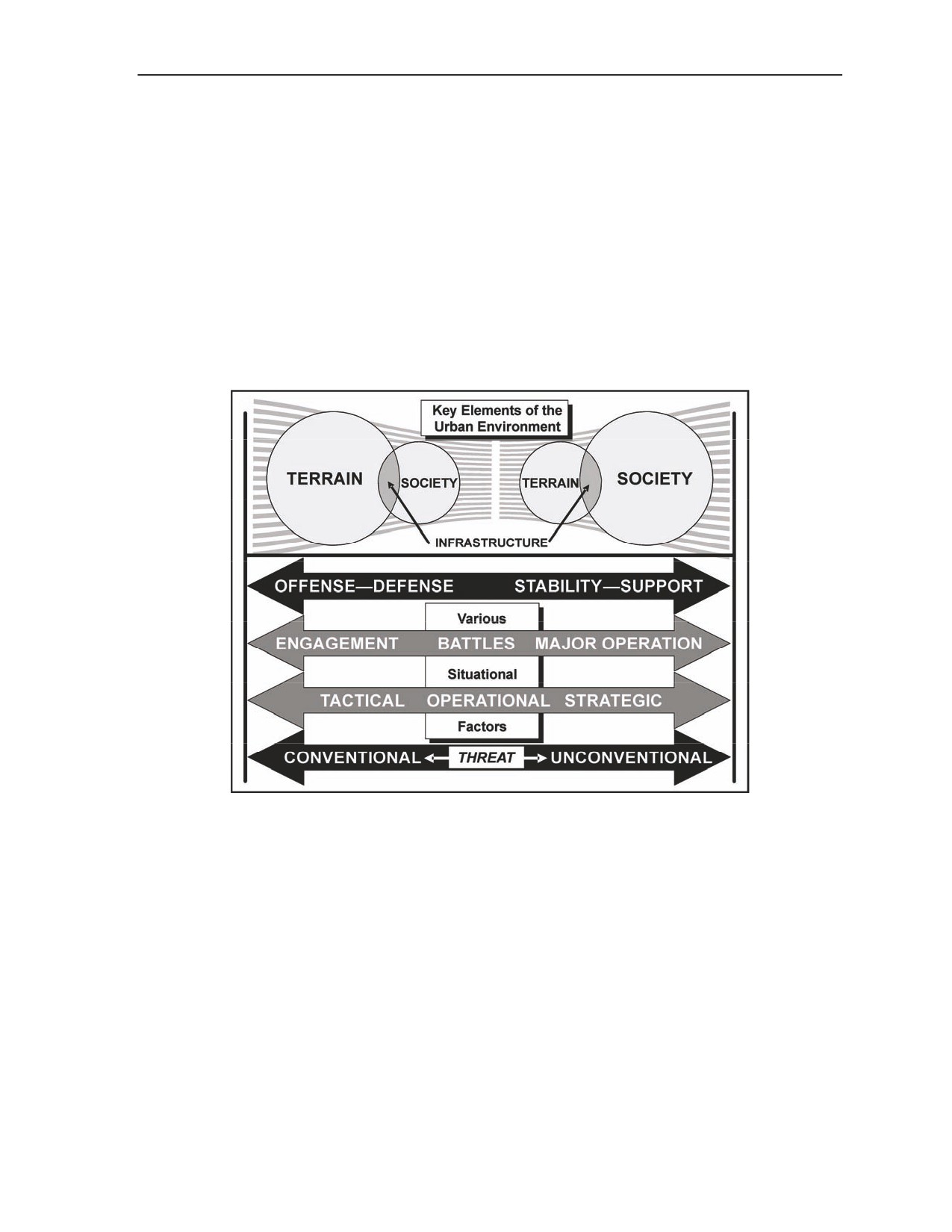
An Urban Focus to the Intelligence Preparation of the Battlefield
AMPLIFIED IMPORTANCE OF CIVIL (SOCIETAL) CONSIDERATIONS
B-7. The Army focuses on warfighting. The experiences in urban operations gained at lower echelons
often center on the tactics of urban offensive and defensive operations where the influences of terrain and
enemy frequently dominate. At higher echelons, the terrain and enemy are still essential considerations, but
the societal component of the urban environment is considered more closely and throughout the operational
process. Moreover, the human or civil considerations gain importance in civil support or stability
operations regardless of the echelon or level of command. In addition to the echelon and the type of
operation, a similar relationship exists between the key elements of the urban environment and other
situational factors. These factors can include where the operation lies within the range of operations or the
level of war and the conventional or unconventional nature of the opposing threat. Figure B-2 graphically
represents the varying significance of these elements to urban IPB. Overall, population effects are
significant in how they impact the threat, Army forces, and overall accomplishment of strategic and
operational goals.
Figure B-2. Relativity of key urban environment elements
B-8. Describing the battlefield’s effects—step two in IPB—ascribes meaning to the characteristics
analyzed. It helps commanders understand how the environment enhances or degrades friendly and threat
forces and capabilities. It also helps commanders understand how the environment supports the population.
It also explains how changes in the “normal” urban environment (intentional or unintentional and because
of threat or friendly activities) may affect the population. Included in this assessment are matters of
perception. At each step of the IPB process, commanders must try to determine the urban society’s
perceptions of ongoing activities to ensure Army operations are viewed as intended. Throughout this
process, commanders, staffs, and analysts cannot allow their biases—cultural, organizational, personal, or
cognitive—to markedly influence or alter their assessment (see FM 34-3). This particularly applies when
they analyze the societal aspect of the urban environment. With so many potential groups and varied
interests in such a limited area, misperception is always a risk.
26 October 2006
FM 3-06
B-3
Appendix B
SIGNIFICANT CHARACTERISTICS
B-9. Urban intelligence analysis must include consideration of the urban environment’s distinguishing
attributes—man-made terrain, society, and infrastructure—as well as the underlying natural terrain (to
include weather) and the threat. Because the urban environment is so complex, it is often useful to break it
into categories. Then commanders can understand the intricacies of the environment that may affect their
operations and assimilate this information into clear mental images. Commanders can then synthesize these
images of the environment with the current status of friendly and threat forces and develop a desired end
state. Then they can determine the most decisive sequence of activities that will move their forces from the
current state to the end state. Identifying and understanding the environment’s characteristics (from a
friendly, threat, and noncombatant perspective) allows commanders to establish and maintain situational
understanding. Then they can develop appropriate COAs and rules of engagement that will lead to decisive
mission accomplishment.
B-10. Figures B-3, B-4, and B-5 are not intended to be all-encompassing lists of urban characteristics.
Instead, they provide a starting point or outline useful for conducting an urban-focused IPB and analysis
that can be modified to fit the specific operational environment and meet the commander’s requirements.
Commanders and staffs can compare the categories presented with those in the civil affairs area study and
assessment format found in FM 41-10 and the IPB considerations for stability and civil support operations
found in ST 2-91.1.
INTERCONNECTED SYSTEMS
B-11. Since the urban environment comprises an interconnected “system of systems,” considerations
among the key elements of the environment will overlap during an urban intelligence analysis. For
example, boundaries, regions, or areas relate to a physical location on the ground. Hence, they have urban
terrain implications. These boundaries, regions, or areas often stem from some historical, religious,
political, administrative, or social aspect that could also be considered a characteristic of the urban society.
Overlaps can also occur in a specific category, such as infrastructure. For instance, dams are a
consideration for their potential effects on transportation and distribution (mobility), administration and
human services (water supply), and energy (hydroelectric).
B-12. This overlap recognition is a critical concern for commanders and their staffs. In “taking apart” the
urban environment and analyzing the pieces, commanders and staffs cannot lose perspective of how each
piece interacts with any other and as part of the whole. Otherwise, their vision will be shortsighted, and
they will fail to recognize the second- and third-order effects of their proposed COAs; the actual end state
differing dramatically from the one envisioned by the commander. The increased density of combatants
and noncombatants, infrastructure, and complex terrain means that a given action will likely have
unintended consequences—positive or negative. Those consequences will be more widely felt and their
impact will spread in less time than in other environments. These unintended results may have important
strategic and operational consequences. The multiple ways these dynamic urban elements and
characteristics combine make it necessary to approach each urban environment as a unique challenge for
intelligence analysis.
URBAN TERRAIN AND WEATHER
Terrain
B-13. Earlier admonitions that civil considerations are more closely considered in UO do not necessarily
mean that consideration for urban terrain is de-emphasized. In every urban operation, terrain and its effects
on both threat and friendly forces must be assessed and understood. Then commanders can quickly choose
and exploit the terrain (and weather conditions) that best supports their missions. Effective terrain analysis
thoroughly assesses urban structures as well as the ground on which they stand (see figure B-3 and FM 5
33). An analysis of urban terrain first considers broader urban characteristics and effects and then
progresses to a more detailed examination.
B-4
FM 3-06
26 October 2006
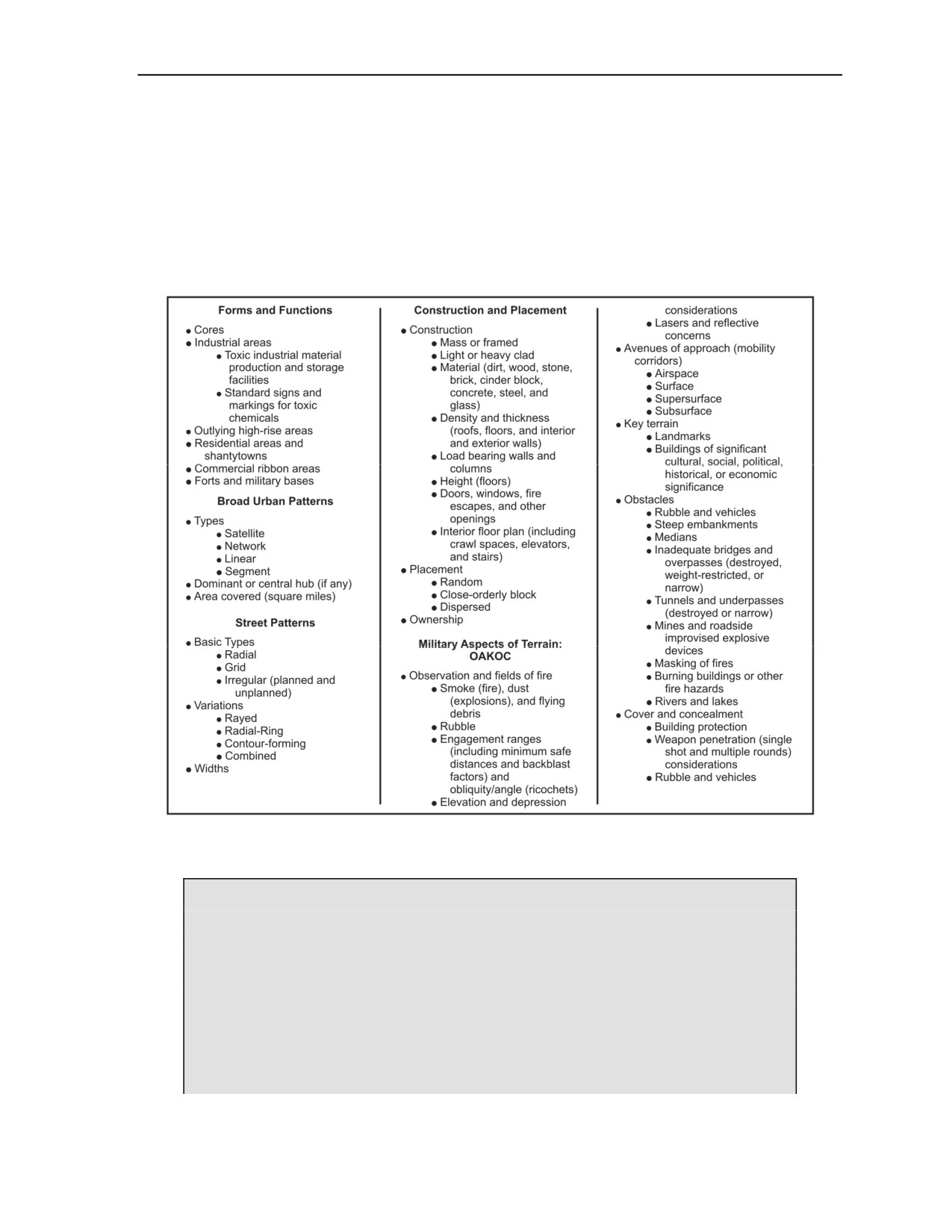
An Urban Focus to the Intelligence Preparation of the Battlefield
Natural Terrain
B-14. The natural terrain features beyond the urban area and beneath urban structures significantly
influence unit operations. They dictate where buildings can be constructed, the slope and pattern of streets,
and even the broad urban patterns that develop over longer periods of time, thereby influencing a unit’s
scheme of maneuver. The military aspects of terrain—observation and fields of fire, avenues of approach,
key terrain, obstacles, and cover and concealment (OAKOC)—remain critical to the analysis of natural
terrain in, under, and around urban areas. Fortunately, commanders and their staffs are normally
accustomed to this type of analysis.
Figure B-3. Significant urban terrain characteristics
Analysis of an Urban Area’s Underlying Terrain:
Mitrovica, Kosovo - 1999
An urban area’s underlying terrain provides many clues into its history, economy,
society, and current situation. Mitrovica, Kosovo is an illustrative example. The Ibar
River creates a natural line of communications through the middle of the city as well
as an obstacle that bisects the urban area. This bisection naturally divides the two
resident ethnic groups: Albanians and Serbs. The separation became significant at
both the strategic and tactical levels during 1999 deployments to Kosovo. Army
forces had to ensure that the Orthodox Church located south of the Ibar was
accessible to Serbs residing in the north. North Atlantic Treaty Organization (NATO)
26 October 2006
FM 3-06
B-5
Appendix B
peacekeepers built a footbridge across the river that allowed reliable, safe passage.
The natural feature separating the two groups assisted NATO troops in maintaining
stability in the region.
Man-Made Terrain
B-15. Building composition, frontages, placement, forms and functions, size, floor plans, and window and
door locations affect maneuver, force positioning, and weapons deployment considerations. Angles,
displacement, surface reflection, and antenna locations influence command and control. Structures also
influence ISR operations. The increased density and volume created by man-made structures increases how
much information commanders and their staffs collect and assess as well as the number of forces required.
Building materials and construction will also influence force structures to include weapons and equipment
required. Heavily constructed buildings combined with hot and cold extremes may affect target
identification for thermal sights. Thick walls, for example, may make combat vehicle identification
difficult by distorting hotspots. Additionally, the increased use of heaters and warming fires may clutter
thermal sights with numerous hotspots. The ability to maneuver through the urban dimensions—airspace,
supersurface, surface, and subsurface—and shoot through walls, ceilings, and floors also creates increased
psychological stress. The physical characteristics of man-made terrain can also be analyzed using OAKOC.
Weather
B-16. Weather and its effects are often considered when examining the military aspects of terrain. Military
aspects of weather include temperature (heat and cold), light conditions, precipitation (cloud cover, rain,
snow, fog, and smog), and wind. Their military effects during UO are similar to any operational
environment (see FM 34-81 and FM 34-81-1). Extremes of heat and cold affect weapon systems and the
Soldiers that operate them. The extra luminescence provided by the ambient light of an urban area, unless
controlled, may affect night vision capabilities and the ability of the Army to “own the night.” Precipitation
affects mobility and visibility. Smog inversion layers are common over cities. An inversion layer may trap
smoke and chemicals in the air and increase ground and air temperatures to the detriment of Soldiers’
health. (If the conditions are severe enough, it might require the use of protective masks.) Changes in
temperature as a result of air inversions can also affect thermal sights during crossover periods of warm to
cold and vice versa. Winds, which may increase as they are funneled through urban canyons, may—
Increase other weather effects (for example, wind chill).
Decrease visibility (blowing debris, sand, rain, and snow).
Spread radiation, biological, and chemical hazards.
Adversely affect low-altitude air mobility and airborne ISR platforms.
B-17. Commanders also analyze weather for its potential effect on civilians and civilian infrastructure as
well as Soldiers and military equipment. Rain might create sewage overflow problems in urban areas with
collapsed sewage infrastructure and in refugee camps, increasing disease and even creating panic. Rain and
flooding may also make some subsurface areas impassable or extremely hazardous to civilian and military
forces alike. Chemical agents and TIM may be washed into underground systems creating toxic hotspots.
These effects become more pronounced as chemical agents or TIM are absorbed by brick and unsealed
concrete sewers. Other weather effects on UO can include—
Heavy snowfall in an urban area that may paralyze area transportation and distribution
infrastructure, hindering the urban administration’s ability to provide vital human services
(police, fire fighting, medical, and rescue). Heavy rains and flooding may have similar effects
especially on poorly designed and constructed roads or roads that have been damaged by tracked
vehicles.
Extreme hot and cold weather climates that increase the dependence (and military significance)
of many elements of the infrastructure. For example, the energy infrastructure may be critical;
without it, civilians may not be adequately cooled or heated or they may not be able to cook
their food.
B-6
FM 3-06
26 October 2006
An Urban Focus to the Intelligence Preparation of the Battlefield
In urban areas located in tropical regions, it can rain at the same time each day during the wet
season. Threat forces may attack during these periods knowing aircraft will have difficulty
responding. Bad weather also reduces the effectiveness of surveillance, direct and indirect fire,
and logistic support.
Inclement weather may preclude demonstrations or rallies by threats. Good weather may mean a
maximum turnout of civilians for events such as festivals, sporting events, and other social,
cultural, or religious activities.
Severe weather may affect psychological, civil-military and humanitarian assistance operations.
Heavy rains and severe dust storms may disrupt leaflet drops, construction projects, food and
water distribution, and medical and veterinary assistance programs.
URBAN SOCIETY
B-18. This manual shows that societal considerations take on added importance in UO. Critical to
operational success is knowing and understanding which groups live in an urban area, what relationships
exist among them, and how each population group will respond to friendly and threat activities. Often
determining any of this is very difficult. Cultural acuity is also essential in helping commanders and their
staffs to view the urban area as the residents view it. The demographics presented depict what conditions
exist, while the other categories help to explain the root causes or why conditions exist (see figure B-4 on
page B-8). Other categories besides basic demographics that are important to gain this understanding
include health, history, leadership, ethnicity and culture, religion, and government and politics.
From Cultural Awareness to Understanding and Competence
B-19. This societal understanding must go beyond a superficial awareness of gestures and taboos to
developing a thorough understanding of the organizing principles that make the urban society hold together
and function as a coherent entity—or not. In UO, particularly longer-term stability operations, commanders
use this knowledge and insight to design and plan operations that work effectively within that society. For
example in OPERATION IRAQI FREEDOM, Army units, as they shifted to long-term stability operations,
were required to recruit, organize, equip, and train indigenous security forces in order to be able to
transition security responsibility from U.S. forces to the burgeoning Iraqi government. Army commanders
were successful—to a point. The first units that they built and trained attained a remarkable level of unity
and tactical ability in a relatively short period of time. The newly formed units effectively fought alongside
Army forces. However when prodded into conducting operations with minimal Army supervision, many
Iraqi units lost unity and coherence. Army commanders initially failed to account for a basic Iraqi societal
consideration: their society is patriarchal—each member or organization in Iraqi society always seeks a
patron or sponsor to support them and provide for their needs. When Iraqi units trained and operated with
Army forces, this relationship was satisfied. Operating on their own, however, Iraqi commanders and units
lost this patronage without an equivalent Iraqi replacement. In hindsight, the establishment of an effective
and more robust ministry of defense, either as a precursor or simultaneously with the establishment of
tactical units, may have provided the Iraqi security forces the patronage that their culture required.
Resource the Societal Analysis
B-20. Aside from friendly and threat forces, the society is the only thinking component of the urban
environment able to rapidly impact the urban operation. (Even people going about their daily routines can
unwittingly hamper the mission.) Urban residents create conditions for restrictive rules of engagement,
increase stress on Soldiers and logistic capabilities, and confuse threat identification
(see Threat
Considerations in this appendix). Demographic, health, safety, ethnic, and cultural concerns will be
essential considerations in most UO. Other situational factors—the mission, enemy, and time available—
dictate the balance between the level of detail and analysis to support the overall urban operation with the
level of detail that commanders and their staffs can achieve. However, an analysis that fails to devote
enough time and resources to understanding the urban society can find large elements of the population
turned against the Army force. Detailed analysis of the urban society will help save time and ISR
resources. While not necessarily a resource saver in the short term, a thorough understanding of the urban
society and its culture ultimately contributes to faster achievement of strategic goals.
26 October 2006
FM 3-06
B-7
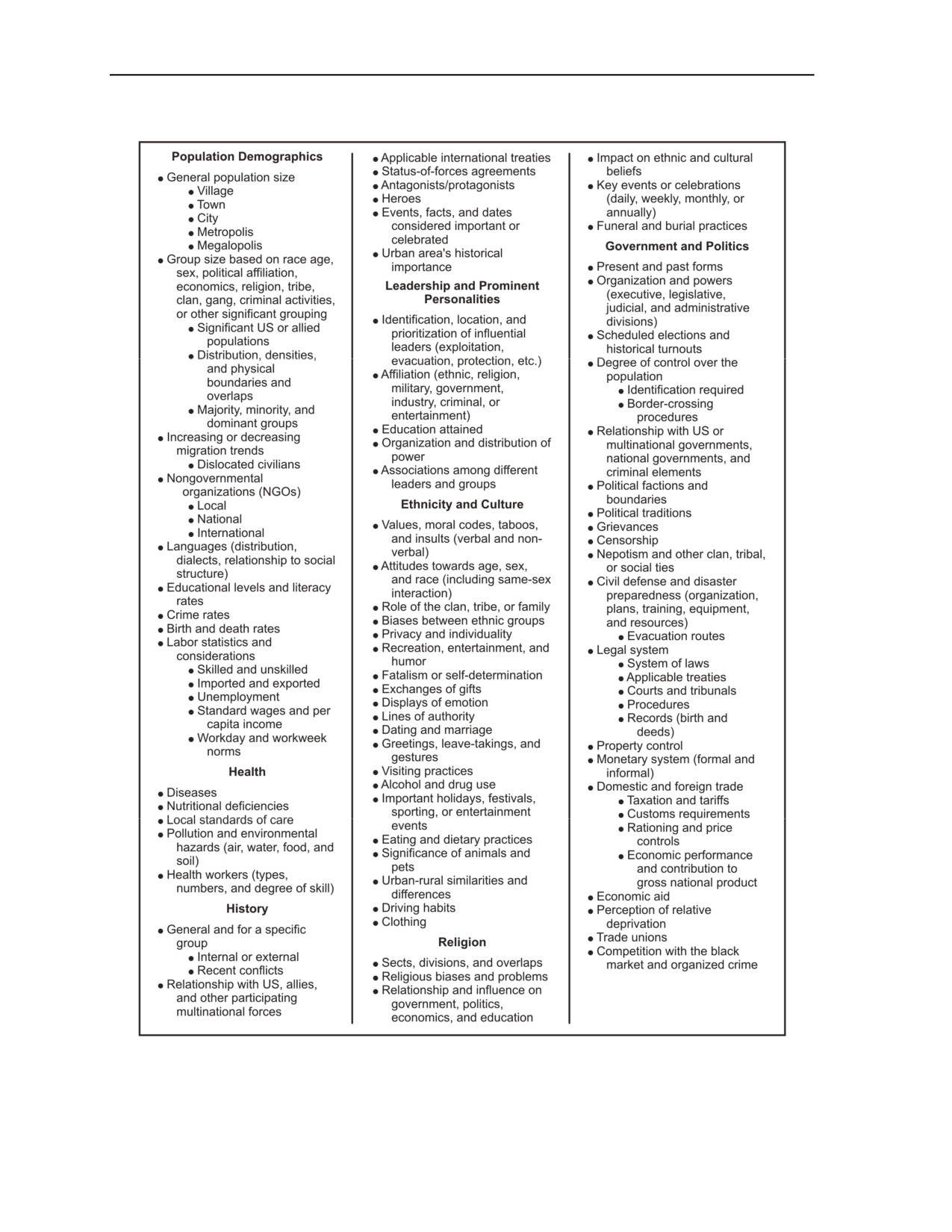
Appendix B
Figure B-4. Significant urban societal characteristics
B-8
FM 3-06
26 October 2006
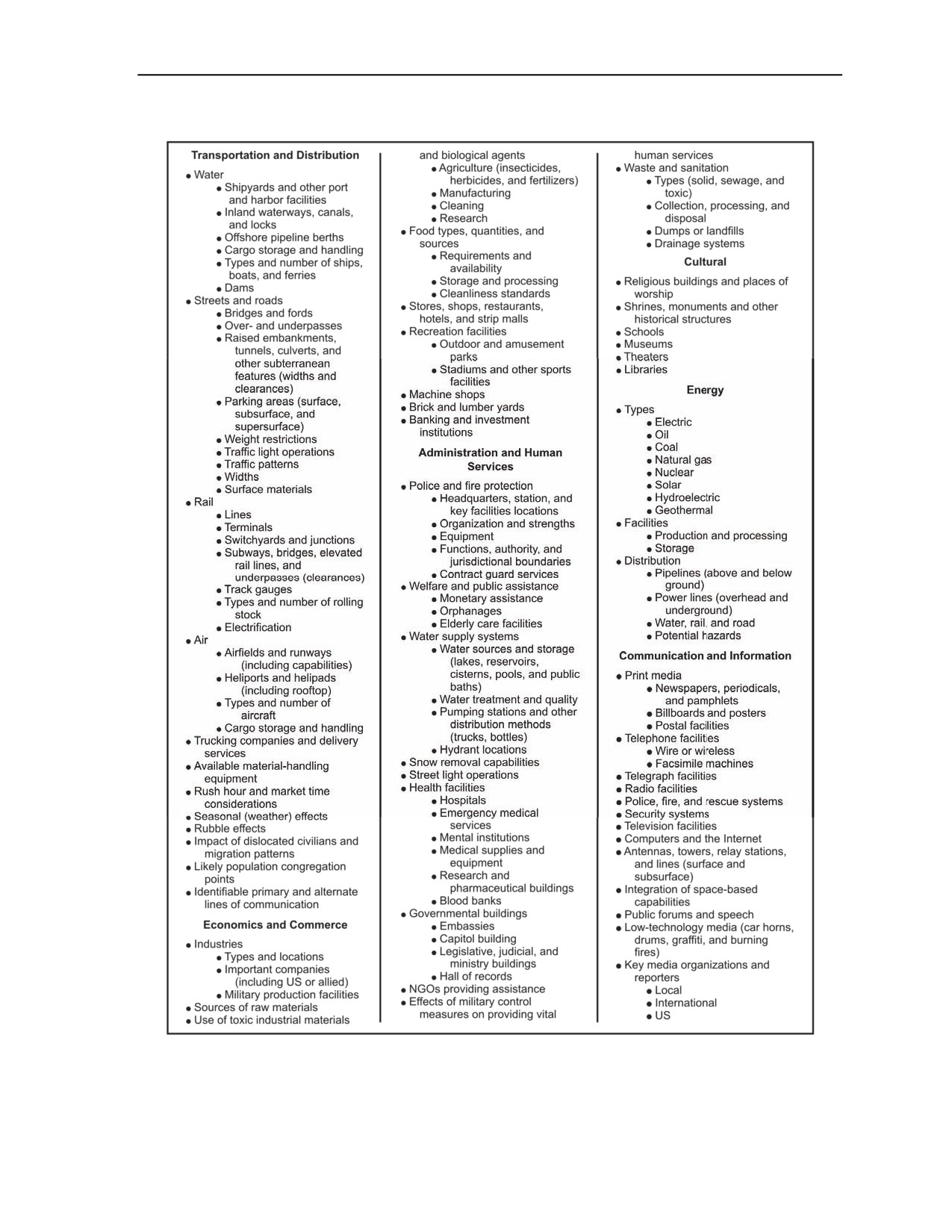
An Urban Focus to the Intelligence Preparation of the Battlefield
Figure B-5. Significant urban infrastructure characteristics
26 October 2006
FM 3-06
B-9
Appendix B
URBAN INFRASTRUCTURE
B-21. Functional and analytical interdependence is readily apparent when examining urban infrastructures
(see figure B-5 on page B-9). They are composed of physical structures or facilities and people. Hence,
much of the analysis conducted for terrain and society can apply when assessing the urban infrastructure.
For example, commanders, staffs, and analysts could not effectively assess the urban economic and
commercial infrastructure without simultaneously considering labor. All aspects of the society relate and
can be used to further analyze the urban work force since they are a sub-element of the urban society.
Similarly, the OAKOC aspects used to evaluate terrain may also apply to the urban infrastructure,
especially considerations of key terrain. Depending on the mission, elements of the urban infrastructure
may become key terrain. While infrastructure analysis is not an engineer-specific task, Army engineers
may provide the general and geospatial engineering expertise necessary to better understand the urban
terrain and infrastructure.
THREAT CONSIDERATIONS
… [T]he adversaries of freedom
… send arms, agitators, aid, technicians and
propaganda to every troubled area.… [S]ubversives and saboteurs and insurrectionists .
… [possess] the power to conscript talent and manpower for any purpose. and long
experience in the techniques of violence and subversion….It is a contest of will and
purpose as well as force and violence—a battle for minds and souls as well as lives and
territory.
John F. Kennedy
Message to Congress, 5 May 1961
B-22. Chapter 3 outlines the instability and uncertainty of the strategic environment. Commanders, staffs,
and analysts identify and analyze the threat’s composition, strength, disposition, leadership, training,
morale, weapons and capabilities, vulnerabilities, internal logistics and external support, doctrine (if any),
strategy or modus operandi, and tactics. The threat can take a variety of forms:
Conventional military forces.
Paramilitary forces.
Guerrillas and insurgents.
Terrorists.
Militia or special police organizations.
B-23. A general study of guerrilla and insurgent tactics, techniques, and procedures may prove beneficial
to many types of operations regardless of the actual composition or type of threat forces. Insurgent
strategies and tactics may work especially well in this complex environment and will likely be a part of any
threat COA. Particularly, commanders should understand how a threat might restrict itself by the laws of
land warfare and similar conventions, or exploit the use of these conventions to its own gain. Commanders
can refer to FM 31-20-3 and FMI 3-07.22 for more information. For many of the above threats, no
doctrinal templates may exist. Intelligence staffs will need to identify and track common threat patterns and
tactics, techniques, and procedures as they develop and change during the course of the operation.
Understanding culture will be critical to determining threat motives that drive decisions.
Comman415081ders, staffs, and analysts must evaluate, update (or create), and manage threat databases
early (and continuously) during the operational process.
URBAN ENVIRONMENTAL THREATS
B-24. While threats vary, they share a common characteristic: the capability and intent to conduct violence
against Army forces to negatively influence mission accomplishment. These threats are often the most
recognizable for forces trained for warfighting—these are often the enemy. In order for Army units to be
able to conduct full spectrum urban operations, commanders broaden their concept of the threat when
analyzing the urban environment’s terrain, societal, and infrastructure characteristics. This analysis
B-10
FM 3-06
26 October 2006
An Urban Focus to the Intelligence Preparation of the Battlefield
includes many environmental dangers
(potentially affecting both sides of a conflict as well as
noncombatants) such as—
Natural disasters
(earthquakes, tornados, hurricanes, volcanic eruptions, fires, floods, tidal
waves or tsunamis, and heavy snows).
Food shortages.
Water shortages (both quantity and quality).
Rampant disease.
Pollution and toxic industrial materials.
B-25. A critical difference between the latter forms of threat and the former is the lack of intent to do harm.
The latter may stand alone as threats, or these conditions may be created, initiated, or used by the enemy or
a hostile civilian group as a weapon or tool. Threat analysis includes identifying and describing how each
relevant characteristic of the area of operations can hinder mission accomplishment. This analysis,
particularly during stability or civil support operations, will require extensive coordination and cooperation
with urban civil authorities, law enforcement, and numerous governmental and nongovernmental
organizations.
CIVILIANS
B-26. In a major combat operation or campaign where offensive and defensive operations are conducted
against a conventional enemy, threat identification is more readily accomplished. However, adaptation may
be necessary to even further broaden the threat concept to include specific elements of the urban society
and, in some instances, nongovernmental organizations (NGOs) and other civilian agencies working in the
urban area. In many stability operations, this modification can account for opposing armed forces that are
not an enemy but are a threat to the mission. As discussed in Chapter 9, Army forces in many stability or
civil support operations must avoid classifying or thinking of these threats as the enemy. Further,
commanders ensure that Soldiers do not shift the animosity that they feel toward urban threats onto the
civilian population. In OPERATION IRAQI FREEDOM, for example, some Soldiers began to refer to
Iraqi civilians as “hajjis” in reference to the annual pilgrimage—the Hajj—that forms one of the tenets or
pillars of Islamic faith. Those who have completed the pilgrimage are entitled to add the phrase al-Hajj or
hajji (pilgrim) to their name. However, the Soldiers were not using the term in its proper context but rather
to denigrate. In response, commanders prohibited the inappropriate use of this term as one of many
measures to stress and develop cultural understanding and respect for the people that Army forces were
there to assist.
Need for More Accurate Categories
B-27. Urban commanders recognize that threat evaluation is not solely a straightforward assessment of the
capabilities of a known, armed enemy. Instead, they develop a system of categories that mitigates potential
situational uncertainty and better indicates the level of threat (or utility) that civilian groups pose for Army
forces conducting UO. Categories can range from a simple construct—threat, neutral, or friendly—to a
more refined one (see figure B-6 on page B-12). In most UO, a more intricate approach is necessary to
detect and monitor shifts in key relevant relationships. While this analysis is important in any urban
operations, it is especially critical when Army forces are opposed by urban insurgent and guerrilla forces.
B-28. In any system, commanders consider that the classification of a group is relative to the perspective
from which it is viewed. This is an especially important consideration in multinational and interagency UO.
During operations in Somalia, for example, U.S. Army forces may have viewed a particular clan as a
hostile element. The United Nations’ Italian contingent, with their colonial background in the region, may
have considered the same clan as neutral or even an ally.
Shifting and Overlapping Groups
B-29. Commanders recognize that no system of categorization will precisely classify any given group; no
system can reflect the overall nature and complexity of the urban society. A single group may fit in a
particular category. It may also have components in two or more categories simultaneously. Often, it can
26 October 2006
FM 3-06
B-11
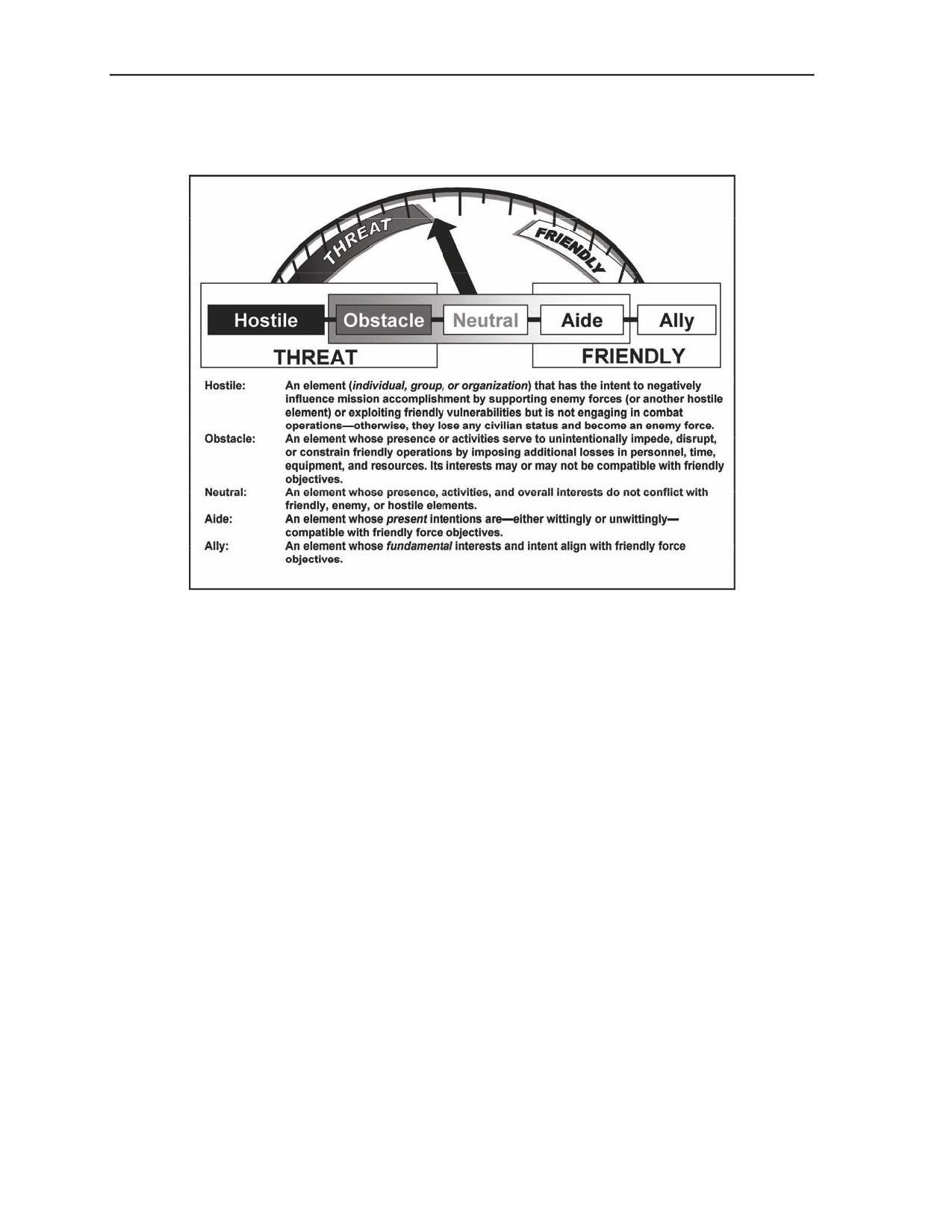
Appendix B
shift among categories during an operation. A given group may have individuals in it who have interests
identical to or different from that group and these individual interests may change over time.
Figure B-6. A refined approach to civilian allegiance
B-30. A peace enforcement operation illustrates the varying nature of groups. An identified criminal group
might be classified as an obstacle to the commander’s mission because its illegal activities impede unit
progress. Its compelling interest, however, is to make money rather than resist the actions of friendly
forces. In the same operation, one of the armed belligerents may be intent on disrupting the peace process
and would be, therefore, classified as a hostile. (Again, they are not an enemy unless the belligerents are
engaged in planned combat operations against the peacekeeping force. Commanders should consider,
however, that under international law, if any civilian takes a direct or active role in hostilities, that civilian
can be subject to attack.) The belligerent force may finance the criminal organization to assist in further
obstructing the peace mission. In this case, the criminal organization moves from being an obstacle to
being a hostile.
B-31. This classification effort, therefore, is not a one-time undertaking; commanders must constantly
review and update it. Groups or individuals can be influenced into assisting either the friendly or opposing
force. People will also act opportunistically, shifting support and alliances as perceived advantages arise.
Even seemingly passive and law abiding members of the urban society may conduct themselves in
unexpected ways given the right conditions (mob violence, for example).
B-12
FM 3-06
26 October 2006
An Urban Focus to the Intelligence Preparation of the Battlefield
Shifting Civilian Interests and Intent
Among other applicable lessons (see also the vignette in Chapter 9), the Los
Angeles riots of 1992 illustrate how urban population groups can shift their relative
positions due to changing conditions in an urban AO. Several gangs exist in the Los
Angeles area. Usually, these gangs are hostile to one another. During the riots,
however, several rival gangs formed a “united front” against what was seen as a
larger obstacle to their own interests: law enforcement. As a result, the hostile gangs
became one another’s aides during that time.
Similarities, Differences, Capabilities, and Vulnerabilities
B-32. Similarities and differences in interests and interdependencies between groups are often focal points
for analysis (and the allocation of ISR assets). They may indicate how commanders may influence, coerce,
or align civilian interests and intentions with mission objectives. Simultaneously, commanders should
consider an analysis of the civilian element’s (individual, group, or organization) capability to influence the
accomplishment of friendly objectives. They should also consider civilians’ vulnerabilities and
dependencies. If a civilian group’s fundamental interests align with friendly objectives and this group has
the intent to assist friendly forces, it is clearly an ally. However, with limited or no capability, a specific
group will not help move the commander any closer to achieving his desired end state and accomplishing
the mission. Then the commander would normally limit the resources expended on this group to those
necessary for maintaining their commitment to common goals and objectives.
B-33. In contrast, commanders may provide a group with resources to enhance or create the capability to
assist in mission accomplishment. They may do this if they felt that the assistance gained (or reduction to
threat support) exceeds the potential diminishment of their own force’s capabilities from losing those same
resources. Commanders would also consider the group’s dependencies (such as food, infrastructure, and
protection) and overall vulnerability to outside influence. If vulnerable to friendly influence or control
(understanding urban societal considerations and matters of perception are critical in this regard), then
forces are likely susceptible to enemy or hostile manipulation. Even if commanders can generate extra
resources (and not significantly affect their own force’s capabilities), they should still conduct this same
cost-benefit analysis to determine which civilian group (if any) should receive resources.
Greatest Potential Nearer the Center
B-34. The most critical population sectors often are those nearest the middle of the spectrum shown in
figure B-6, particularly if their capabilities
(or potential) significantly degrade or enhance mission
accomplishment. These are the obstacle, neutral, or aide categories. If their beliefs and interests can be
adequately understood, commanders may have great chance to influence the population segment and
significantly contribute to mission accomplishment. In the fight for information superiority, persuading a
neutral population to become an aide may provide critical information required about the urban
environment and threat forces operating within.
Political and Strategic Concerns
B-35. The aide category may be of significant political or strategic concern. An aide group may be
invaluable for accomplishing intermediate objectives but become a vulnerability to accomplishing a larger
stability operation. (Even an urban offensive or defensive operation is likely to transition to a stability
operation.) For example, commanders may provide resources to a criminal organization to assist in
defeating insurgent forces during urban combat operations. Once these forces have been subdued, the
interests
(monetary gain and defeat of the threat) linking friendly forces with this criminal element
disappear. What may remain is a criminal organization with more power than a reconstituted or newly
established law enforcement agency and a truly destabilizing force. This also illustrates the second- and
third-order thinking that will be required of commanders and their staffs during UO.
26 October 2006
FM 3-06
B-13