FM 3-06 URBAN OPERATIONS (OCTOBER 2006) - page 4
Chapter 6
infrastructure, and the human dimension including the capabilities of the Panamanian
military.
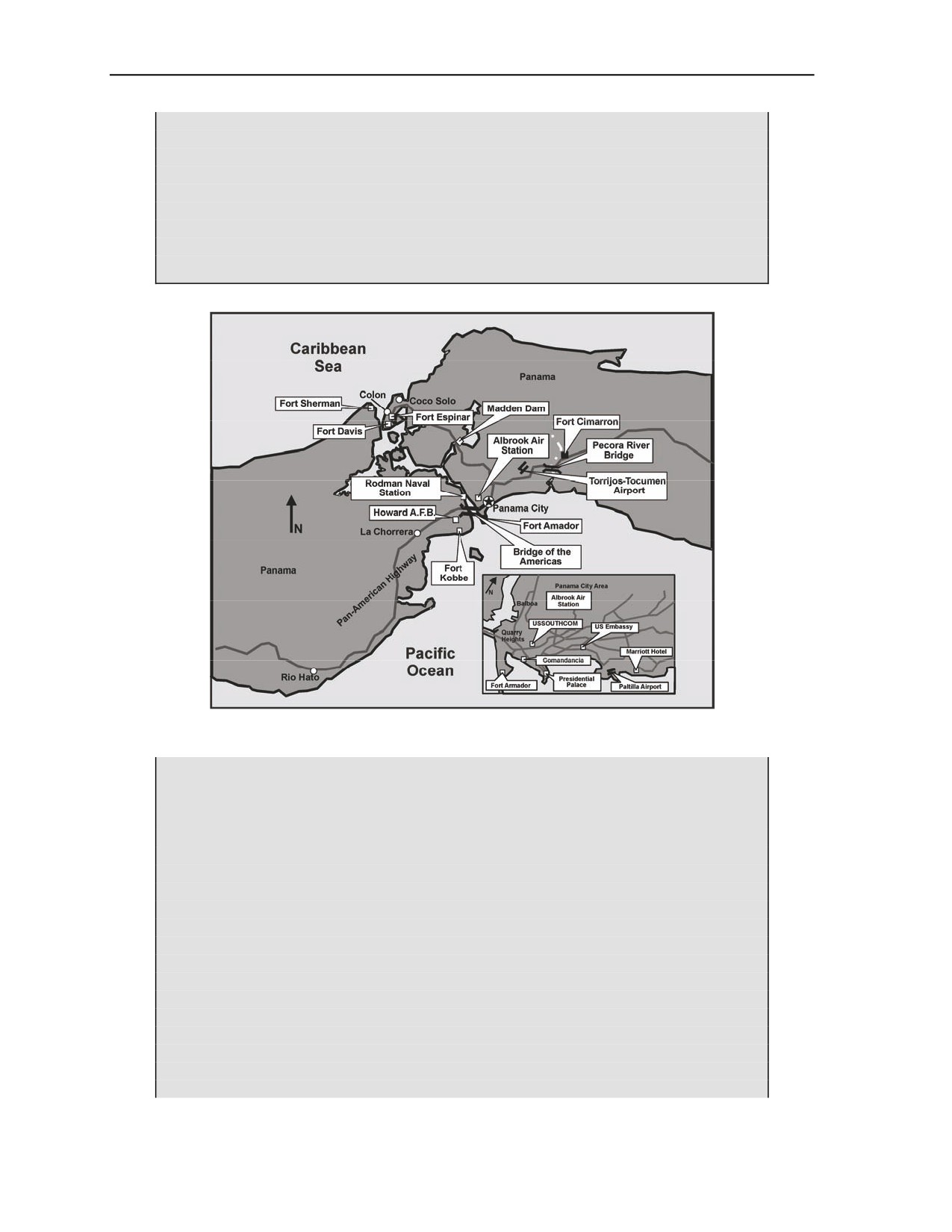
Because Army forces had a long history in Panama, commanders clearly understood
the physical challenges and layout of critical urban areas
(see Figure
6-3),
particularly Panama City. They also understood how the infrastructure in each urban
area functioned and which parts was a key element to success. Examples of key
portions of the infrastructure included the Madden Dam, which controlled the water
flow through the Panama Canal, and the Cerro Azul television tower, which was the
main Panamanian broadcast tower.
Figure 6-3. Panama
Collecting information and developing intelligence on the human elements of the
urban environment was critical to operational success and a challenge. Because the
Panamanian Defense Force (PDF) had traditionally been an ally of the United States,
Army forces did not have a systemic database that adequately depicted their order of
battle and their true capabilities. Additionally, much of the situation in Panama was
colored in political terms making it more difficult for traditional military sources to
evaluate the status of PDF forces. For example, Army planners needed to know if
PDF military units (when faced with a formidable U.S. force) would fight at all for
Noriega and if they did fight, how hard and long would they fight. The answers
depended largely on their political loyalty to Noriega and on the individual loyalty of
the unit officers to the Panamanian president. Thus, Army commanders needed to
understand the military characteristics of PDF units and their political affiliations and
tendencies.
Because transition from combat to noncombat tasks would be critical to achieving all
objectives, particularly the restoration of democracy, Army forces also needed an
accurate assessment of the political opposition to Noriega—including that
opposition’s capabilities and vulnerabilities. Again, Army forces were required to
make assessments outside those needed solely for combat operations. Ultimately,
assessing the political opposition’s vulnerabilities led to assigning Army units to
6-8
FM 3-06
26 October 2006
Foundations for Urban Operations
protect them throughout the operation so that they could serve as a foundation for a
new democratic government.
Finally, the commander’s assessment included an evaluation (often subjective) of the
attitudes and disposition of the Panamanian people. Human intelligence (HUMINT)
was the primary source of information on the population. Army forces had good
access to the population because of their close proximity and historical ties to
Panama. Many Soldiers were married to Panamanians, and the Army had total
access to local media and to prominent individuals.
National imagery and special operations forces (SOF) also contributed to the ability
of Army forces to assess the urban environments of JUST CAUSE. All units
executing operations had detailed satellite photos of objective areas. Additionally,
key objectives were placed under SOF surveillance well in advance. This
surveillance revealed unit readiness, vulnerabilities, detailed disposition, and other
patterns critical to mission success. The combination of the two capabilities allowed
units to plan and achieve the synchronization necessary for such a complex urban
operation.
Shape
During OPERATION JUST CAUSE, commanders conducted numerous shaping
operations to establish the conditions for the decisive operations. Many operations
were designed to control information, such as an assault on the Azul television tower
identified during the assessment of the infrastructure. Planners designed many
shaping operations to isolate various garrisons and PDF units. An example of tactical
isolation was the plan for the Pacora River Bridge to prevent reinforcements from
reaching the garrison at Torrijos-Tocumen Airport.
Operational isolation was achieved through the Ranger Regiment’s and
82nd
Airborne Division’s assault on targets at Rio Hato in the west and Fort Cimarron in
the east. These actions in conjunction with the securing of Maddam Dam had the
primary objective of isolating Panama City. They were also the largest of the major
actions occurring during OPERATION JUST CAUSE. The airborne assault was also
the largest airborne operation conducted by U.S. forces since World War II. This
large-scale shaping operation demonstrates that shaping operations are critical to
mission success and can be more resource intensive than the actual operations that
achieve domination.
Engage
U.S. Army forces achieved successful engagement in OPERATION JUST CAUSE by
establishing unchallenged military control over Panama City and eliminating
Noriega’s capability to challenge that control. Toward this end, the operation attacked
two decisive points. The first was the assault on the PDF headquarters located in
Panama City: the Comandancia. The second was the operation undertaken to locate
and seize Noriega himself.
Three battalions of task force (TF) Bayonet (5-87th Infantry, 1-508 Infantry [Airborne],
and 4-6th Infantry [Mechanized]) executed the attack on the Comandancia and Fort
Amador. They were also tasked to protect the American Embassy in downtown
Panama City. To execute these missions, they moved from various staging areas
located throughout the city to their assigned objectives using air assault, mounted,
and dismounted approaches. The ground movement through the city proved to be
the most difficult and hazardous part of the mission due to the vulnerability of the
troops in their armored personnel carriers and trucks. The dismounted movement
was slower than the mounted movement but allowed the Soldiers greater cover and
concealment.
The strongest opposition to TF Bayonet occurred at the Comandancia. Elements of
three PDF companies and two public order companies held out for three hours. The
troops moving to Comandancia were subject to a large volume of sniper fire, and in
the assault, unidentified indirect fire caused significant casualties among the
mechanized forces. TF Bayonet forces, supported by airborne armored
reconnaissance vehicles and Hellfire missiles from Apache helicopters, captured the
26 October 2006
FM 3-06
6-9
Chapter 6
Comandancia. Commanders noted in particular the precision of the supporting fires
from attack helicopters. The assault by fire from supporting AC
130 gunships
severely damaged much of the reinforced Comandancia building.
Simultaneously, SOF attacked several targets where Noriega might be located.
These initial attacks were unsuccessful. However, many subsequent actions
neutralized Noriega’s influence and eventually resulted in his apprehension on 3
January 1990. These actions included the well-organized and relentless manhunt
conducted by SOF units, the isolation of Panama City itself, population control
efforts, sophisticated IO, and cooperation with other U.S. agencies.
Consolidate and Transition
OPERATION JUST CAUSE demonstrated the vital need for a thought-out plan that
adequately addresses consolidation and the transition from combat to noncombat
before commanders initiate operations. Normally in complex UO, commanders
cannot leave the details of transition until after the operation has begun without
unacceptable risk to overall mission accomplishment. The follow-on stability
operation, OPERATION BLIND LOGIC (later renamed OPERATION PROMOTE
LIBERTY) began 24 hours after the initial assault and thus both operations were
occurring simultaneously. This simultaneity of different types of operations is typical
in major operations conducted in a large urban area. The stability operation involved
more time than the combat operation and continued well after the close of
OPERATION JUST CAUSE and after most of the major combat units had
redeployed. It involved significant resources without the same level of risk to U.S.
forces as the combat operations.
Civil affairs
(CA) were a dominant part of the transition from combat to stability
operations. The 96th Civil Affairs battalion was central to this operation. CA forces
established a civil police force, emergency food distribution, property protection,
production and distribution of newspapers, cleanup of the city, and building support
for a new civil government. Most tasks were coordinated through Army CA forces
and executed by other Army forces under the supervision of CA.
IO were also a major aspect of affecting a stable transition and successful
postcombat operations. These operations built support for the U.S. operation among
the population. They emphasized that the U.S. conflict was with Noriega and not the
Panamanian people and that the U.S. forces would depart as soon as a new
Panamanian government could take over.
Other U.S. agencies played critical roles in stability operations in Panama. The U.S.
Drug Enforcement Agency and Justice Department were important to the
negotiations that led to Noriega’s capture. The U.S. State Department helped to
negotiate for Noriega and develop military policies and plans during stability
operations. The American Embassy advised commanders regarding the large
diplomatic community that existed in Panama City.
FUNDAMENTALS OF URBAN OPERATIONS
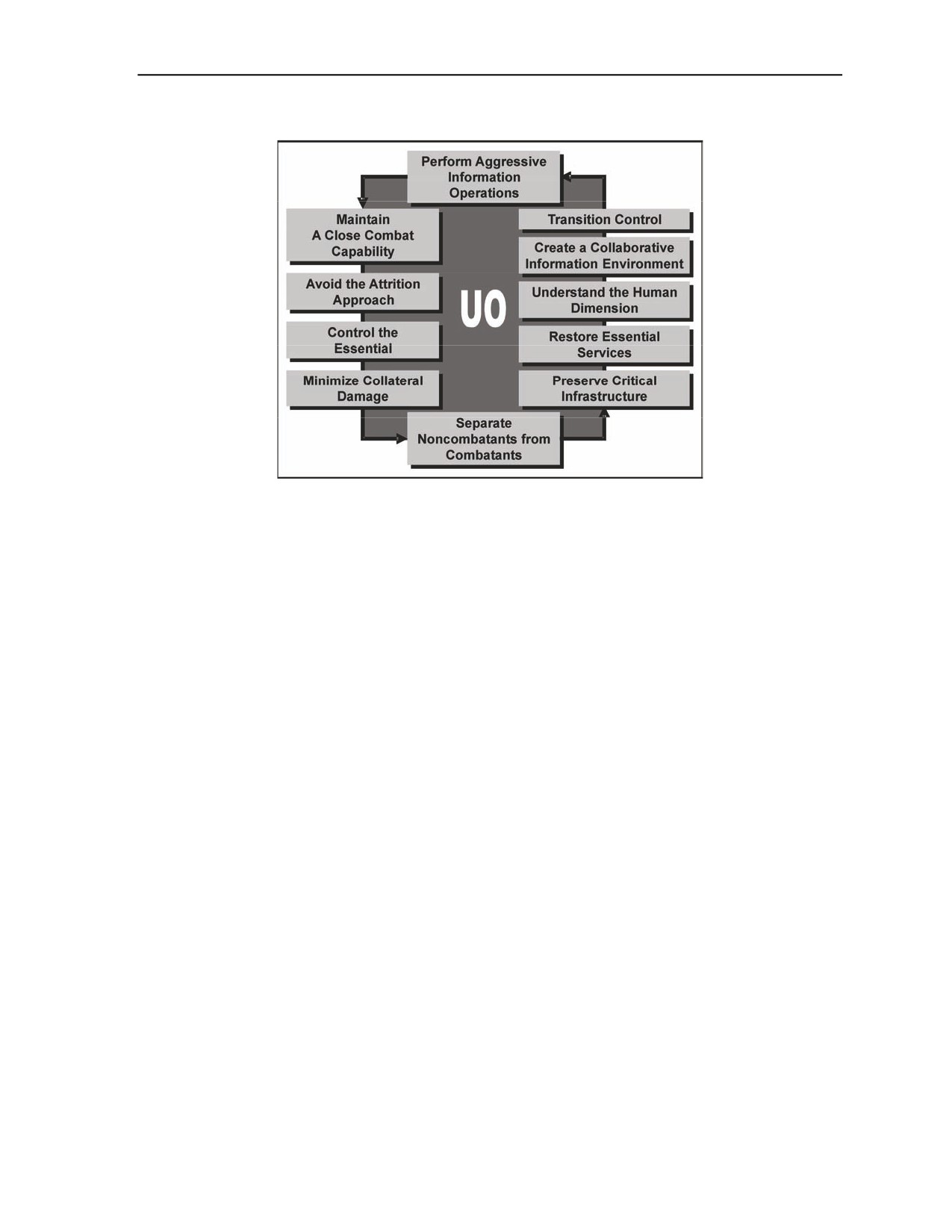
6-28. UO often differ from one operation to the next. However, some fundamentals apply to UO regardless
of the mission, geographical location, or level of command. Some of these fundamentals are not exclusive
to urban environments. Yet, they are particularly relevant to an environment dominated by man-made
structures and a dense noncombatant population (see figure 6-4). Appendix A provides an historical
example of how many of these fundamentals applied to an actual conflict situation. Vitally, these
fundamentals help to ensure that every action taken by a commander operating in an urban environment
contributes to the desired end-state of the major operation.
6-10
FM 3-06
26 October 2006
Foundations for Urban Operations
Figure 6-4. Fundamentals of urban operations
PERFORM AGGRESSIVE INFORMATION OPERATIONS
6-29. Information operations aimed at influencing non-Army sources of information are critical in UO
across the spectrum of operations. Because of the density of noncombatants and information sources, the
media, the public, allies, coalition partners, neutral nations, and strategic leadership will likely scrutinize
how Army forces participate in UO. The proliferation of cell phones, video cameras, Internet capability,
and media outlets ensure close observation of the activities of Army forces. With information sources
rapidly expanding, public information of Army operations will often be available faster than the internal
military INFOSYS can process it. Army forces should aggressively integrate IO into every facet and at all
levels of the operation to manage perceptions and mitigate unintended consequences. Under media
scrutiny, the actions of one Soldier may have significant strategic implications. IO aim to make the
information accurate; placed in the proper context of the Army’s mission; and available to all interested
parties: the public, the media, and other agencies. Ensuring that the urban population understands how they
and their urban area fit within the commander’s vision, intent, and end state will be a critical task.
MAINTAIN A CLOSE COMBAT CAPABILITY
6-30. Close combat is required in all offensive and defensive UO. This core capability must also be present
and visible in urban stability operations and may be required in urban civil support operations. Close
combat in any urban operation is resource intensive, requires properly trained and equipped forces, and has
the potential for high casualties. However, the ability to decisively close with and destroy enemy forces as
a combined arms team remains essential. Potential threats respect strength and, instead, seek to attack ill-
prepared or complacent Army forces—not necessarily forces that are better protected or armored, but those
less likely or capable of inflicting casualties against them. In stability and civil support operations, a lack of
respect and fear of Army forces can hinder recovery as much as the ill-advised use of forces. Hence, all
Soldiers, regardless of branch or military occupational specialty, must be properly equipped and trained to
fight in an urban environment. This ability allows Army forces to deter aggression, compel compliance,
morally and physically dominate a threat and destroy his means to resist, and terminate urban conflicts on
the Army commander’s terms.
26 October 2006
FM 3-06
6-11
Chapter 6
AVOID THE ATTRITION APPROACH
6-31. Previous Army doctrine was inclined towards a systematic linear approach to urban combat. This
approach emphasized standoff weapons and firepower. Army force structure does not support this
approach towards UO. It can result in significant collateral damage, a lengthy operation, and an
inconsistency with the political situation and strategic objectives. Enemy forces that defend urban areas
want Army forces to adopt this approach because of the likely costs in resources. Commanders should only
consider this approach to urban combat as an exception and justified by unique circumstances. Instead,
commanders should seek to achieve precise, intended effects against multiple decisive points that
overwhelm a threat’s ability to react effectively.
CONTROL THE ESSENTIAL
I’m talking about attacking those things from which the regime draws power but being
very careful about it so that we don’t get large bodies of young Americans caught up in
house-to-house Berlin, World War II-type scenario.
Lt. Gen. William C. Wallace
Commander, V Corps
OPERATION IRAQI FREEDOM
6-32. Many modern urban areas are too large to be completely occupied or even effectively controlled
without an enormous force. Therefore, Army forces focus their efforts on controlling only the essentials to
mission accomplishment. At a minimum, this requires control of key terrain. Key terrain is terrain whose
possession or control provides a marked advantage to one side or another. In the urban environment,
commanders determine key terrain based on its functional, political, economic, or social significance. A
power station or a place of worship may be key terrain.
6-33. All principles of war can apply to UO. The principle of mass and the principle of economy of force
(in addition to the principle of unity of command discussed in the previous chapter) are particularly
important in guiding UO and providing mission focus. Army forces mass combat power only to control
those requirements essential for mission success. This permits conservation of combat power. It also
implies economy of force and associated risk in those areas where Army forces choose not to exercise
control.
MINIMIZE COLLATERAL DAMAGE
6-34. Forces should integrate precision fires, IO, and nonlethal tactical systems consistent with mission
accomplishment while decreasing the potential for collateral damage. Commanders develop unique rules of
engagement (ROE) for each urban operation and provide necessary firepower constraints. IO and nonlethal
systems may compensate for some restrictions, especially in stability or civil support operations.
Commanders continually assess the short- and long-term effects of operations and firepower on the
population, infrastructure, subsequent missions, and national and strategic objectives. They must also
consider what, if any, provisions should be made to amend or address potential collateral damage. Overall,
commanders must balance restraint and precision with speed and overwhelming combat power. By
avoiding unnecessary harm to all elements of the urban environment, commanders retain the moral high
ground and help sustain legitimacy for their operations. Minimization of collateral damage allows civilians
to continue to provide for their own needs or the rapid return of the urban area to civilian self-sufficiency.
SEPARATE NONCOMBATANTS FROM COMBATANTS
6-35. Promptly separating noncombatants from combatants (psychologically and physically) may make the
operation more efficient and diminish some of the threat’s potential asymmetrical advantages. This
separation also may reduce restrictions on the use of firepower, enhance force protection, and strip the
threat from its popular support base. This important task becomes more difficult when the threat is an
unconventional force that can mix with civilians.
6-12
FM 3-06
26 October 2006
Foundations for Urban Operations
6-36. In more recent operations, threats have sought to integrate their military capabilities as closely as
possible into the civilian population and infrastructure. In these conditions, commanders must increase
their efforts to discriminate between the two. Soldiers managing violence in this setting require the highest
level of individual and organizational discipline and judgment. Soldiers will require the mental agility to
separate their aggression toward threats from the noncombatant civilian population. The training, effort,
and command emphasis in this area is as important as fully successful results. Such efforts strongly impact
national and international perceptions of the operation.
PRESERVE CRITICAL INFRASTRUCTURE
6-37. Commanders should analyze the urban area to identify critical infrastructure. They should attempt to
preserve and protect the critical elements for postcombat sustainment operations, stability or civil support
operations, or the overall health and well-being of the indigenous population. Urban areas remain in the
AO after combat operations have ceased. Postcombat UO are unavoidable. Different from simply avoiding
collateral damage, Army forces may have to initiate actions to prevent an enemy or a hostile civilian group
from removing or destroying critical infrastructure and assets. This may include cultural infrastructure such
as religious and historical places. In some cases, preserving the infrastructure and the urban society’s
sources of economic and cultural wealth may be the assigned objective of the urban operation.
RESTORE ESSENTIAL SERVICES
6-38. Army forces plan to restore essential services that may fail to function before or during an operation.
Essential services include power, food, water, sewage, medical care, and security and law enforcement.
When planning for and conducting Army UO, units can use nonlethal and less destructive munitions and
capabilities to keep potentially vital infrastructure intact. Initially, Army forces may be the only force able
to restore or provide essential services and commanders must plan accordingly. Failure to do so can result
in serious health problems for the civilians, which can affect the health of Army forces and negatively
impact overall mission success. Army forces seek to transfer responsibility for providing essential services
to other agencies, NGOs, or the local government as quickly and effectively as possible. Despite the
potential causes for the failure or destruction of essential services, commanders also seek to ensure that
civilians continually perceive Army restoration activities as assistance rather than an Army requirement.
Otherwise, the civilian populace may be slow to accept or resume responsibility for their urban area.
UNDERSTAND THE HUMAN DIMENSION
Do not try to do too much with your own hands. Better the Arabs do it tolerably than that
you do it perfectly. It is their war, and you are to help them, not to win it for them.
Actually, also, under the very odd conditions of Arabia, your practical work will not be
as good as, perhaps, you think it is. It may take them longer and it may not be as good as
you think, but if it is theirs, it will be better.
T. E. Lawrence
“Twenty-Seven Articles”
6-39. Commanders carefully consider and manage the perceptions, allegiance, and morale of the civilians.
Their assessment of the environment needs to accurately identify the attitudes of the people toward Army
forces. Operational guidance to subordinates—including ROE, protection, sustainment operations, and
fraternization—is based on this assessment. Commanders expect and consider the demographic variance in
the attitudes of an urban population. They cannot inadvertently apply Western cultural norms to a non-
Western urban population. Commanders can only make reliable assessments based on a thorough
understanding and appreciation of the local society and their culture. Developing this ability also requires
the additional ability to effectively share information among all echelons of command.
6-40. Sound policies, proper discipline, adequate consideration for local culture, and rapid engagement of
local urban leaders will positively affect the attitudes of the population toward Army forces. Additionally,
well-conceived and executed IO will enhance the position of Army forces relative to the urban population.
Even during high-intensity urban combat, heightened awareness of and sensitivity toward the civilians can
26 October 2006
FM 3-06
6-13
Chapter 6
lead to a better postcombat situation than if civil considerations were unobserved or diminished in
importance. An improved postcombat situation enhances transition. As the environment of conflict
becomes more complex, the human dimension (and associated moral aspects) takes on greater importance
and may have the greatest potential for affecting the successful outcome of UO. Therefore, the human
aspect and development of cultural acuity creates a discrete planning factor.
CREATE A COLLABORATIVE INFORMATION ENVIRONMENT
6-41. The complexity of the urban environment, particularly the human dimension, requires rapid
information sharing—providing and receiving—from the national level to the tactical level, among Army
headquarters at each echelon, with sister services and coalition partners, and with participating
governmental and (at appropriate times) nongovernmental agencies. The analysis of urban information into
the relevant intelligence necessary to refine and deepen a commander’s understanding of the urban
environment and its infrastructure of systems also demands collaboration among the various information
sources and consumers. Therefore, commanders seek to establish streamlined procedures, develop
commonality among databases, and make best use of existing information systems to disseminate and
receive the necessary intelligence and relevant information for subordinates and partner organizations and
agencies to exercise effective leadership and decision making and establish synergistic unity of effort in
this multifaceted environment.
TRANSITION CONTROL
6-42. Because UO are resource intensive, commanders should plan to end them as quickly as possible, yet
consistently with successful mission accomplishment. (Depending on the factors of METT-TC, successful
transition may take a few days or many years to achieve.) The end state of all UO transfers control of the
urban area to another agency or returns it to legitimate civilian control and responsibility. Rapid transition
releases Army resources for use elsewhere and improves the civilian morale and disposition toward Army
forces. This requires the successful completion of the Army force mission and a thorough transition plan.
The transition plan may include returning control of the urban area to another agency a portion at a time as
conditions permit. A successful transition plan should consider early alignment of military capabilities with
existing urban governmental and administrative organizations, agencies, structures, and districts. Transition
planning must be conducted before the onset of operations and continually adjusted as the situation
develops.
6-14
FM 3-06
26 October 2006
Chapter 7
Urban Offensive Operations
… Capture Suez City “provided it does not become a Stalingrad situation.”
Order to the Adan Armored Division
prior to its 1973 attack on Suez City
On the Banks of the Suez
Offensive urban operations (UO) are one of the most challenging operations that
military forces can undertake. Campaigns and wars have sometimes hinged on their
success or failure. Costly in resources, even when successful, they are not lightly
entered into. Once engaged, they are executed rapidly and decisively. For reasons
already discussed, threat forces defending in UO may gain advantages from the
environment while Army force capabilities may diminish. Despite the challenges,
Army forces conduct successful urban offensive operations by combining the Army’s
existing offensive doctrine with a thorough understanding of the environment.
PURPOSE OF URBAN OFFENSIVE OPERATIONS
7-1. Like all offensive operations, urban offensive operations are designed to impose the will of
commanders on the threat. The urban offense often aims to destroy, defeat, or neutralize a threat force.
However, the purpose may be to achieve some effect relating to the population or infrastructure of the
urban area. Army forces may conduct offensive operations to secure a port or a communications center, to
eliminate a threat to a friendly government or the urban population, or to deny the threat use of urban
infrastructure. No matter the purpose, commanders must use a combined arms approach for successful
urban offensive operations.
OFFENSIVE CHARACTERISTICS APPLIED TO URBAN
OPERATIONS
7-2. All offensive operations, including those in urban areas, contain the characteristics of surprise,
concentration, tempo, and audacity
(see FM
3-0). Commanders consider and incorporate these
characteristics in their offensive UO plans.
SURPRISE
7-3. Army forces can achieve offensive surprise at two levels: operational and tactical. In urban offensive
operations, operational surprise can be decisive. The goal is to attack the urban area before the threat
expects it, from a direction he doesn’t expect, or in a manner he doesn’t expect. In UO, this requires an
attack against urban areas that the threat believes will provide sanctuary from the technological advantages
of Army forces. Usually, urban areas that meet this criterion are not easily accessible. Army forces launch
an attack against these urban complexes in different ways: through a vertical assault using airborne or air
assault forces, through an amphibious assault, or through a penetration followed by a rapid and deep
advance. All three attacks aim to achieve surprise and to deny the threat time to prepare and establish a
defense. Surprise in a major urban operation prevents a threat from falling back to occupy prepared
positions in and around an urban area.
7-4. At lower tactical levels, forces achieve surprise by attacking asymmetrically. An asymmetric method
attacks the threat so he cannot respond effectively. This may be achieved by using special operations forces
26 October 2006
FM 3-06
7-1
Chapter 7
(SOF) against a threat prepared for a conventional attack, by attacking decisively with heavy forces when
the threat expects an effort by light forces or SOF, or by leveraging Army forces’ extensive information
operations (IO) capability. Offensive IO—primarily using IO elements of deception, electronic warfare,
and operations security (OPSEC)—can help achieve surprise at all levels (see Chapter 4). Attacking at
night surprises the threat and maximizes the Army forces’ training, command and control (C2), and
technological advantages. Attacking from unexpected or multiple directions achieves surprise by
leveraging Army information systems (INFOSYS) and superior synchronization of combat power and
capabilities.
CONCENTRATION
7-5. In UO, the attacking force creates a major advantage by concentrating the effects of combat power at
the point and time of its choosing. The area and its compartmented effects naturally disperse and dissipate
combat capability. Often commanders must position considerable amounts of stay-behind forces to protect
hard-fought gains. The environment also hinders repositioning forces rapidly. Such effects can work
equally against defending and attacking forces. However, in a well-prepared defense, the defender often
has the advantage of interior lines. The defender can reinforce or reposition forces more quickly using
covered and concealed routes (such as, sewers, tunnels, or prepared holes made in walls). Successful UO
need synchronized air and ground maneuver with overwhelming effects from fires at decisive points on the
urban battlefield. To achieve proper synchronization and precise effects, commanders should consider the
unique time and distance relationships set by the environment.
TEMPO
7-6. Tempo is the rate of military action; it differs between UO and operations in more open terrain.
Often, the primary purpose of the threat’s urban defense is to take advantage of that differential to disrupt
the rapidity and overall tempo of the Army’s major operation. Additionally, the complexity and the
potential for increased risk in an urban environment may invoke a cautious and methodical response on the
part of commanders and their staffs thereby exacerbating tempo differences. While careful and meticulous
preparation and planning are required in UO, commanders conducting major operations that include urban
areas must strive to maintain an active tempo in offensive operations through synchronization of combat
power and anticipation of threat reactions. A high tempo allows Army forces to achieve surprise and
quickly gain positions of advantage. Controlling operational tempo and not allowing the different tempo of
UO to adversely affect other operations is a challenge that commanders of major operations must
overcome.
Operational Context of Urban Operations: Brittany Ports - 1944
The plan for the invasion of Normandy, France, in June 1944 was meticulously
developed. The plan not only addressed the invasion itself, but also contained
detailed planning for the campaign to follow. A major concern of the detailed
campaign planning was logistics. To address this critical concern, and specifically the
problem of ports to supply the allied armies once ashore, the pre-invasion planning
called for the major ports of the French province of Brittany—Brest, Lorient, and Saint
Nazaire—to be objectives of General Patton’s Third Army, once it was activated.
Early August 1944, almost two months after the successful Normandy invasion, the
operational situation significantly differed from that envisioned by the D-Day
planners. General Montgomery’s Twenty-first Army Group was still fighting in the
Bocage of Normandy. In contrast, General Bradley’s Twelfth Army Group had just
achieved a major breakthrough at Saint Lo, secured the Cotentin Peninsula, and
reached the city of Avranches. Here was a decision point. Bradley and Eisenhower
had to decide whether to adhere to the original plan and turn west with Patton’s
forces to secure the peninsula or to take advantage of the breakout at Saint Lo and
turn east to exploit the disruption of the German defenses.
7-2
FM 3-06
26 October 2006
Urban Offensive Operations
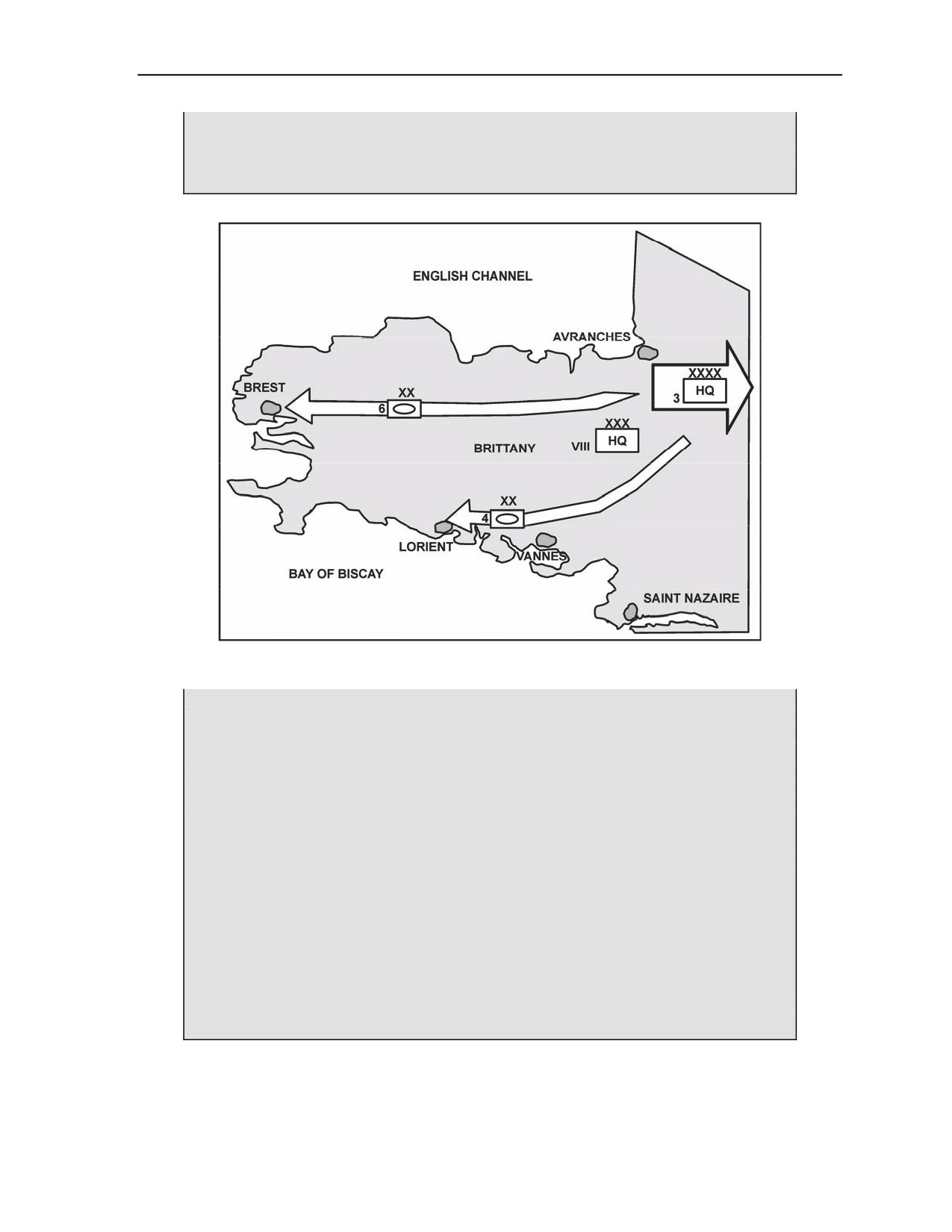
Ultimately they reached a compromise. General Middleton’s VIII Corps was tasked to
secure the peninsula, and the bulk of Patton’s Army, three Army corps, was turned
northeast to exploit the operational collapse of the main German defenses. (See
figure 7-1.)
Figure 7-1. Initial attack in Brittany
Middleton’s corps sprinted into the peninsula with the 4th and 6th Armored Divisions
leading the way. However, poor communications, disagreements between
commands, and contradictory orders caused the corps to hesitate before pushing the
two divisions to continue to exploit toward the ports. The result: the 6th Armored
Division missed an opportunity to seize Brest against light resistance by one day.
The 4th Armored Division, after capturing the smaller port of Vannes, was also
frustrated on the approaches to Lorient. The American reaction to the inability to
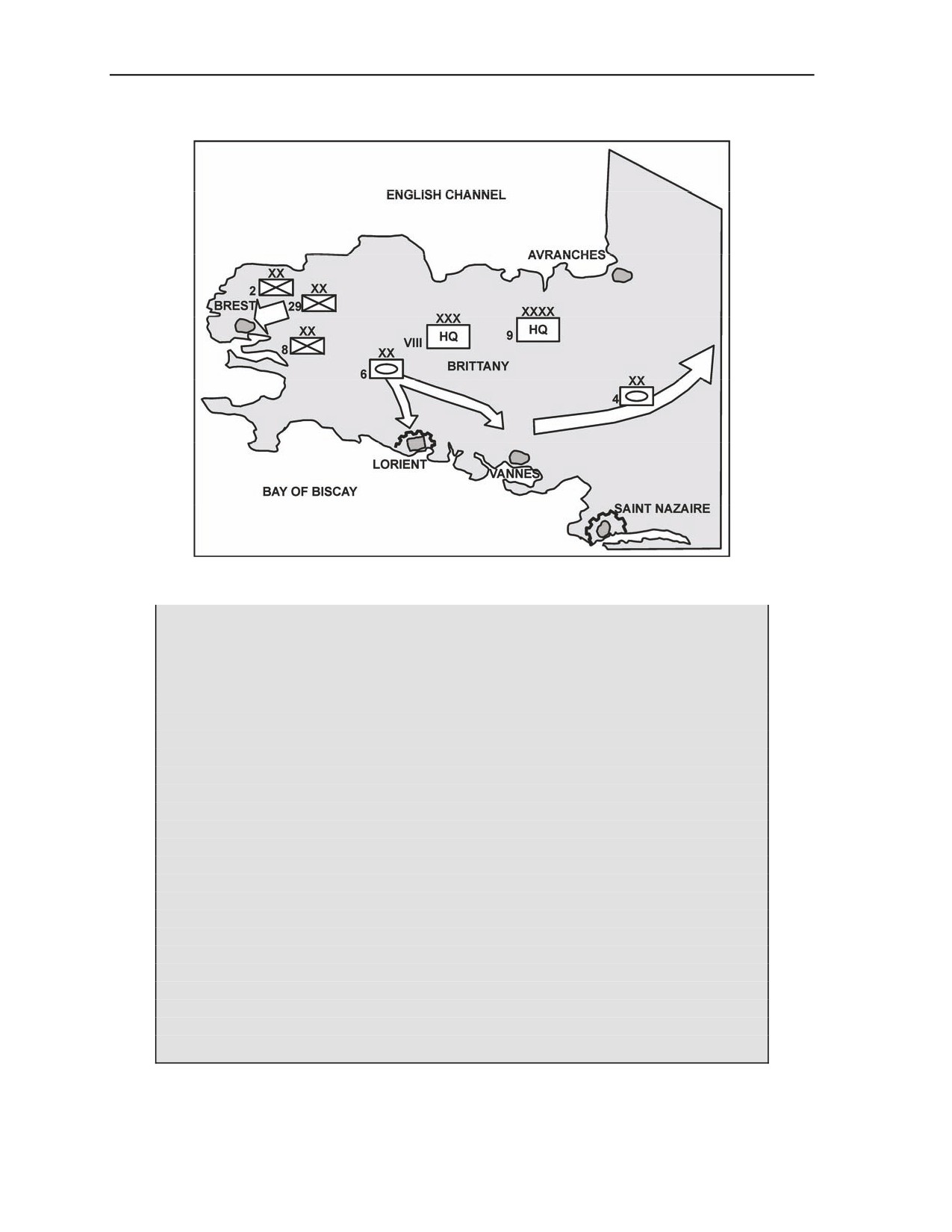
rapidly seize the ports demonstrated an understanding of changing circumstances.
The 6th Armored Division turned the attack at Brest to the 8th Infantry Division and
then relieved the 4th Armored Division at Lorient. The 4th Armored was moved to
rejoin the rest of Third Army exploiting to the east and north. Ultimately Brest fell to
VIII Corps on 19 September after a 43-day siege by three infantry divisions. The
victory yielded
36,000 German prisoners of war (POWs). However, the German
defense and demolitions of the port left the port without an impact on the logistic
situation of the allies. Brest cost the U.S. Army almost 10,000 casualties and the
commitment of significant supplies. The experience convinced commanders to
surround and bypass the other major Brittany ports. Lorient and Saint Nazaire
remained under German control, deep in allied territory, until the war ended ten
months later (see figure 7-2).
26 October 2006
FM 3-06
7-3
Chapter 7
Figure 7-2. Subsequent disposition of forces in Brittany
The operational lessons of the Brittany campaign are numerous. First, commanders
are responsible to continually assess assumptions and decisions made during
planning based on the changing circumstances of the battlefield. This includes the
planning decision to conduct urban offensive operations. When the allies arrived at
the Brittany Peninsula, the focus of the operational maneuver was no longer securing
logistics facilities but exploiting the breakthrough at Saint Lo and the disintegrating
the German defense. The bulk of Third Army then was turned to the north and east
rather than west into the peninsula.
The Brest experience also demonstrates that the costs of urban offensive operations
are continually assessed against the operational value of the objective. This lesson
was applied to the cities of Lorient and Saint Nazaire. The cities were never seized
from the Germans because their logistic value failed to warrant the required
resources to take them. German retention of the ports had no major adverse effect
on the overall campaign.
Another lesson is that commanders cannot allow urban operations to disrupt the
tempo of other offensive operations. One German goal of defending the ports was to
disrupt the rapid tempo of the U.S. exploitation. They failed to achieve this goal
because General Bradley continued the exploitation with the bulk of Third Army and
executed the original plan with only a single corps.
Finally, commanders cannot allow emotion to color their decision to conduct or
continue UO. The failure of 6th Armored Division to seize Brest rapidly caused some
commanders to believe that Brest had to be captured because the prestige of the
Army was committed to the battle. Costs of the continuing combat operations to seize
Brest were significant. These resources might have been better committed
elsewhere in the theater.
7-7. Tactical tempo is also important in urban combat. Because of the complex terrain, defending forces
can rapidly occupy and defend from a position of strength. Once Army forces initiate tactical offensive
7-4
FM 3-06
26 October 2006
Urban Offensive Operations
operations, they cannot allow the threat to set the tempo of the operation. Instead, attacking forces seek to
maintain a high tempo of operations. However, the tactical tempo of urban operations differs from
operations in other terrain. Not necessarily slow, it requires a careful balance of preparation, speed, and
security. In terms of unit fatigue, resource consumption, and contact with the threat, the tempo of most
urban offensive operations may be rated as very high. On the other hand, in distances traveled and time
consumed to achieve objectives, the tempo of many urban offensive operations might be rated as slow. The
urban battlefield’s density concentrates activity and consumes resources in a relatively small area. The lack
of terrain seized or secured is not to be construed to mean a low tempo in the battle. Although the tempo
may seem excruciatingly slow at higher levels of command and exceeding fast at lower, tactical levels, in
reality, the natural tempo of urban operations is not faster or slower than other types of operations, merely
different. Creating and operating at a tempo faster than an opponent can maintain, however, can favor
forces which are better led, trained, prepared, and resourced.
7-8. A high tactical tempo in urban offensive operations challenges logisticians to provide for the
increased consumption of munitions and degrades soldiers’ physical capabilities. Commanders must
anticipate these challenges and develop the means and abilities to overcome them. In the past, these
challenges forced commanders to conduct urban offensives cyclically. They used night and other periods
of limited visibility to resupply, rest, and refit forces. The environment influenced the tempo of their
operations. This type of “battle rhythm” resulted in the forces spending each new day attacking a rested
threat that was in a well-prepared position.
7-9. Army forces must maintain the tempo. Offensive operations continue even during darkness.
Moreover, Army forces increase the tempo of operations at night to leverage the limited visibility
capabilities, increased situational understanding, training, and INFOSYS that give an advantage to Army
forces in all environments. To overcome the physical impact of the environment on soldiers, commanders
can retain a large reserve to rotate, continuing offensive operations at night. The force that fights in
daylight becomes the reserve, rests, and conducts sustaining operations while another force fights at night.
Army forces can then maintain the tempo of operations and leverage technological advantages in urban
offensive combat.
7-10. Tempo in UO does not necessarily mean speed. Offensive operations balance speed, security, and
adequate firepower. Commanders must plan for the complex tactical environment and the requirements to
secure flanks and airspace as the operation progresses. Mission orders allow subordinate units to make the
most of tactical advantages and fleeting opportunities.
AUDACITY
7-11. Audacity is a simple plan of action, boldly executed. Superb execution and calculated risk exemplify
it. In an urban attack, a thorough understanding of the physical terrain can mitigate risk. The terrain’s
complexity can be studied to reveal advantages to the attacker. Audacity can also be embodied in an
operation by inventively integrating and coordinating the direct action tasks of SOF throughout the
operation. Combining SOF actions with conventional attacks can asymmetrically unhinge a threat’s
defensive plan. Well trained Soldiers confident in their ability to execute urban offensive operations foster
audacity.
URBAN OFFENSIVE OPERATIONS AND BATTLEFIELD
ORGANIZATION
7-12. Urban offensive operations, like all operations, are arranged using the overall battlefield organization
of decisive, shaping, and sustaining operations. Each operation is essential to the success of an urban
offensive, and usually two or more of these operations occur simultaneously. Decisive operations are
attacks that conclusively determine the outcome of UO. These attacks strike at a series of decisive points
and directly lead to neutralizing the threat’s center of gravity. Shaping operations in urban offensive
operations create the conditions for decisive operations. In UO, much of the shaping effort focuses on
isolation, which is critical in both major operations and tactical battles and engagements. Sustaining
26 October 2006
FM 3-06
7-5
Chapter 7
operations in urban offensive operations ensure freedom of action. They occur throughout the area of
operations (AO) and for the duration of the operation.
DECISIVE OPERATIONS
7-13. A tactical commander fights decisive urban combat, whereas commanders conducting a larger major
operation influence urban combat by setting the conditions for tactical success. Higher commanders may
directly influence urban offensive operations by operational maneuver, by coordinating joint fires, by
closely coordinating conventional forces, or with SOF.
7-14. Tactical urban offensive operations quickly devolve into small-unit tactics of squads, platoons, and
companies seizing their objectives. The compartmented effect of the terrain and the obstacles to command
and control of small units, especially once they enter close combat inside buildings or underground, often
restricts the higher commander’s ability to influence operations. Commanders can influence the actions of
subordinates by clearly identifying the decisive points leading to the center of gravity; using mission orders
(as discussed in Chapter 5); developing effective task organizations; synchronizing their decisive, shaping,
and sustaining operations; and managing transitions.
7-15. Like all operations, successful decisive operations in UO depend on identifying the decisive points
so the forces can destroy or neutralize the threat’s center of gravity. Seizing a key structure or system that
makes the threat’s defense untenable; interdicting a key resupply route that effectively isolates the threat
force from his primary source of support; or isolating the threat so that his force can no longer influence
friendly activity may be more effective than his outright destruction.
7-16. Commanders must select the right subordinate force for the mission and balance it with appropriate
attachments. Higher commanders do not direct how to organize the small tactical combined arms teams,
but they must ensure that subordinates have the proper balance of forces from which to form these teams.
Successful urban offensive operations require small tactical combined arms teams. Urban offensive
operations require abundant infantry as the base of this force. However, successful urban combat requires a
combined arms approach adjusted for the conditions of the environment. In urban offensive operations, it
will normally not be a question of whether include armor and mechanized elements but, rather, how best to
accomplish this task organization. Precision-capable artillery systems generally support urban operations
better than unguided rocket artillery.
7-17. Divisions entering urban combat may require additional resources. These resources include military
intelligence support in the form of linguists, human intelligence (HUMINT) specialists, and unmanned
aircraft systems (UAS). Engineering assets will be at a premium; the task organization of a task force
executing the decisive operation may require a one-to-one ratio of engineer units to combat units. Corps
and higher engineering support may be necessary to meet these requirements and to repair vital and
specialized infrastructure. A tailored and dedicated support battalion or group may need to assist in
providing anticipated support to a displaced and stressed civil population. Finally, divisional CA units may
require augmentation to deal with NGOs and civilian government issues.
7-18. Successfully conducting decisive operations in the urban environment requires properly
synchronizing the application of all available combat power. Army forces have a major advantage in the
command and control of operations. Commanders can use this advantage to attack numerous decisive
points simultaneously or in rapid succession. They also use it to attack each individual decisive point from
as many directions and with as many different complementary capabilities as possible. Commanders must
completely understand urban environmental effects on warfighting functions to envision and execute the
bold and imaginative operations required. Significantly, these operations require that C2 systems account
for the mitigating effects of the environment as execution occurs.
7-19. Properly synchronized actions considerably enhance the relative value of the combat power applied
at the decisive points. They present to the threat more requirements than he has resources with which to
respond. Synchronized IO and multiple maneuver actions paralyze the threat’s decision-making capacity
with information overload combined with attacks on his C2 systems. Additionally, well-synchronized
actions limit the time the threat has to make decisions and forces him into bad decisions. In the urban
7-6
FM 3-06
26 October 2006
Urban Offensive Operations
environment, these effects are enhanced because C2 systems are already strained, poor decisions are harder
to retrieve, and units that do not react effectively are more easily isolated and destroyed.
SHAPING OPERATIONS
7-20. Shaping operations that support the urban attack separate into those focused on isolating the threat
and all others. Army forces isolate the threat to ensure successful urban offensive operations. Depending
on the threat reaction to isolation efforts and the nature of the threat center of gravity, this task may become
decisive. Other shaping operations include those common to all offensive operations and others unique to
urban operations. Unique urban shaping operations may include securing a foothold in a well-fortified
defensive sector, securing key infrastructure, or protecting noncombatants. Because of the nature of UO,
shaping operations may consume a much larger proportion of the force than during other operations and
may take place both inside and outside the urban area (see Applying the Urban Operational Framework:
Panama in Chapter 5). By successfully isolating a threat force, the force needed to conduct the decisive
operation may be relatively small.
SUSTAINING OPERATIONS
7-21. Commanders conducting urban offensive operations must ensure security of the sustaining operation
and bases; in many situations, protecting lines of communications (LOCs) and sustaining operations may
be the greatest vulnerability of the attacking force. Those supporting an urban offensive are tailored to the
urban environment and are well forward. Ideally, the supporting forces closely follow the combat forces
and move within or just outside the urban area as soon as they secure an area. Operating in the urban area
during offensive operations allows the sustaining operation to take advantage of the defensive attributes of
the environment for security purposes.
7-22. Counterattacks against sustaining operations may take the form of special operations activities aimed
at LOCs leading to or within the urban area. Choke points—such as bridges, tunnels, and mountain
passes—are vulnerable to these attacks and may require combat forces to protect them. Threat forces attack
the LOC to blunt the Army’s combat power advantage in the urban area.
7-23. Attacks against the LOC into the urban area may also attempt to isolate the attacking Army forces
from its sustainment base. Isolated forces in an urban area are greatly disadvantaged. Commanders must
plan and aggressively execute strong measures to protect their LOC, even if it requires reduced combat
power to execute their offensive operation.
7-24. Sustaining operations anticipate the volume and unique logistics requirements of urban operations.
Specialized individual equipment—such as grappling hooks, ladders, and pads—is identified and provided
to troops in quantity before they are needed. Forces stockpile and distribute their attacking units’ special
munitions requirements including small arms, explosives, and grenades of all types, precision artillery
munitions, and mortar ammunition. Forces also supply transport to move the resources rapidly forward,
both to and through the urban environment. Sustaining operations cannot rely on “operational pauses” to
execute their tasks. Commanders must plan to continuously supply resources and capabilities to the most
forward combatants as offensive operations advance.
7-25. Sustaining operations also anticipate the growth of sustainment requirements as Army forces secure
and take responsibility for large portions of the urban area. The success of Army urban offensive
operations will often uncover the civil population in former threat occupied areas. It may attract the civil
population from sections of the urban area where the Army is not operating to areas occupied by Army
forces. Rural populations may migrate to the urban area as the result of successful Army offensive
operations.
7-26. Army forces may be required to take initial responsibility to provide for the urban population. This
consideration is integrated into logistics planning and organization from the start of the planning process.
To be successful and efficient in such a situation, sustainment planning includes Army civil affairs (CA)
specialists and local government representatives. It also integrates and consults with the international
community and nongovernmental organizations
(NGOs) that might augment or supplement Army
sustainment capabilities.
26 October 2006
FM 3-06
7-7
Chapter 7
FORMS AND TYPES OF URBAN
OFFENSE
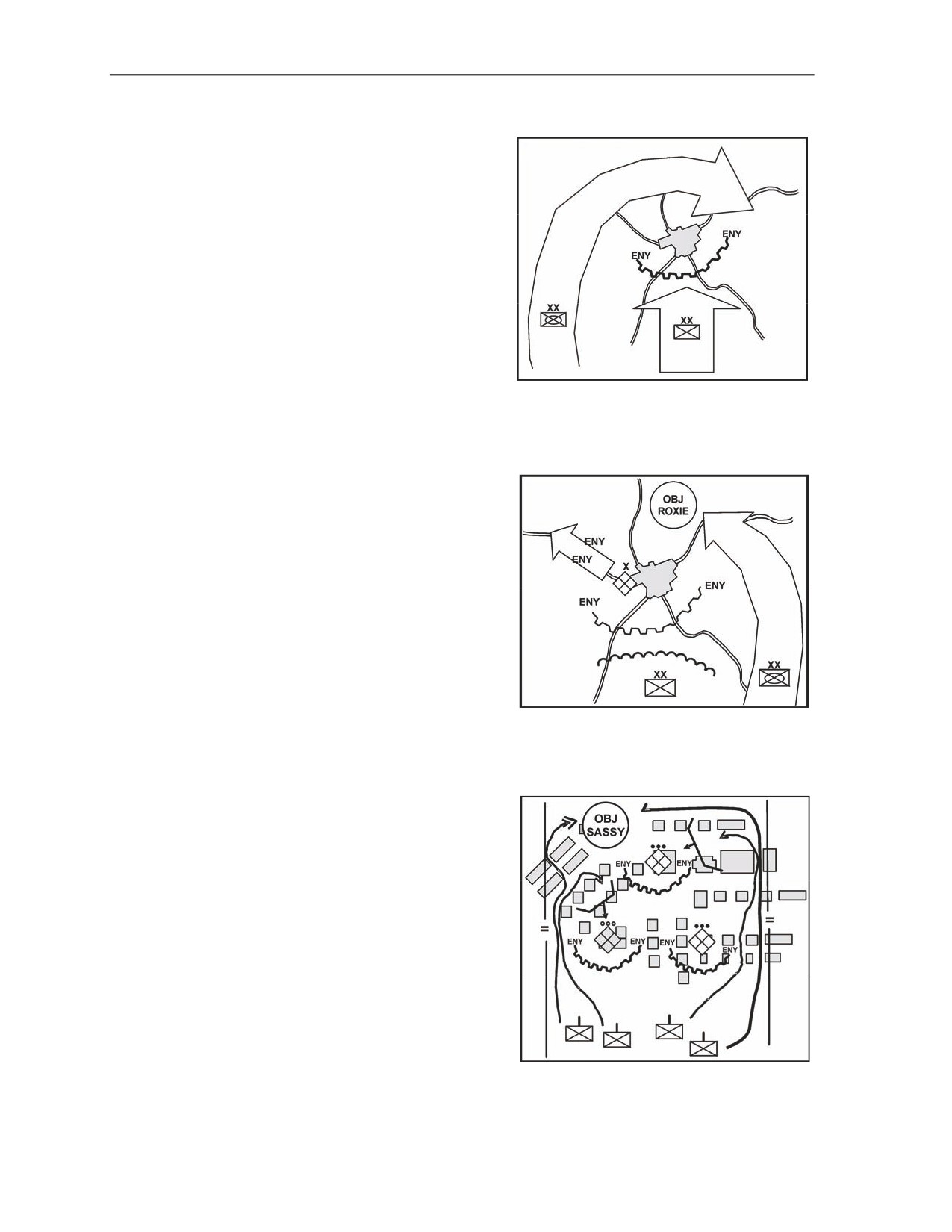
7-27. Traditional forms of offensive maneuver include
envelopment, turning movement, infiltration, penetration,
and frontal attack. Traditional types of offensive
operations are movement to contact, attack, exploitation,
and pursuit. These traditional forms and types listed
apply to urban combat. Some have greater application to
an urban environment than others do. Moreover, success
will belong to commanders who imaginatively combine
and sequence these forms and types throughout the
depth, breadth, and height of the urban battlefield. This is
true at the lowest tactical level and in major operations.
Figure 7-3. Envelopment isolates an
urban area
FORMS OF OFFENSIVE MANEUVER
Envelopment
7-28. The envelopment is the ideal maneuver for
isolating threat elements in the urban area or isolating the
area itself. A deep envelopment effectively isolates the
defending forces and sets the conditions for attacking the
urban area from the flank or rear. Yet, enveloping an
objective or threat force in the urban area is often harder
since achieving speed of maneuver in the environment is
so difficult
(see figure
7-3). Vertical envelopment,
however, works effectively if Army fires can effectively
suppress or neutralize the threat air defense.
Figure 7-4. Turning movement
Turning Movement
7-29. Turning movements can also be extremely
effective in major operations
(see figure
7-4). By
controlling key LOCs into the urban area, Army forces
can force the threat to abandon the urban area entirely.
These movements may also force the threat to fight in
the open to regain control of LOCs.
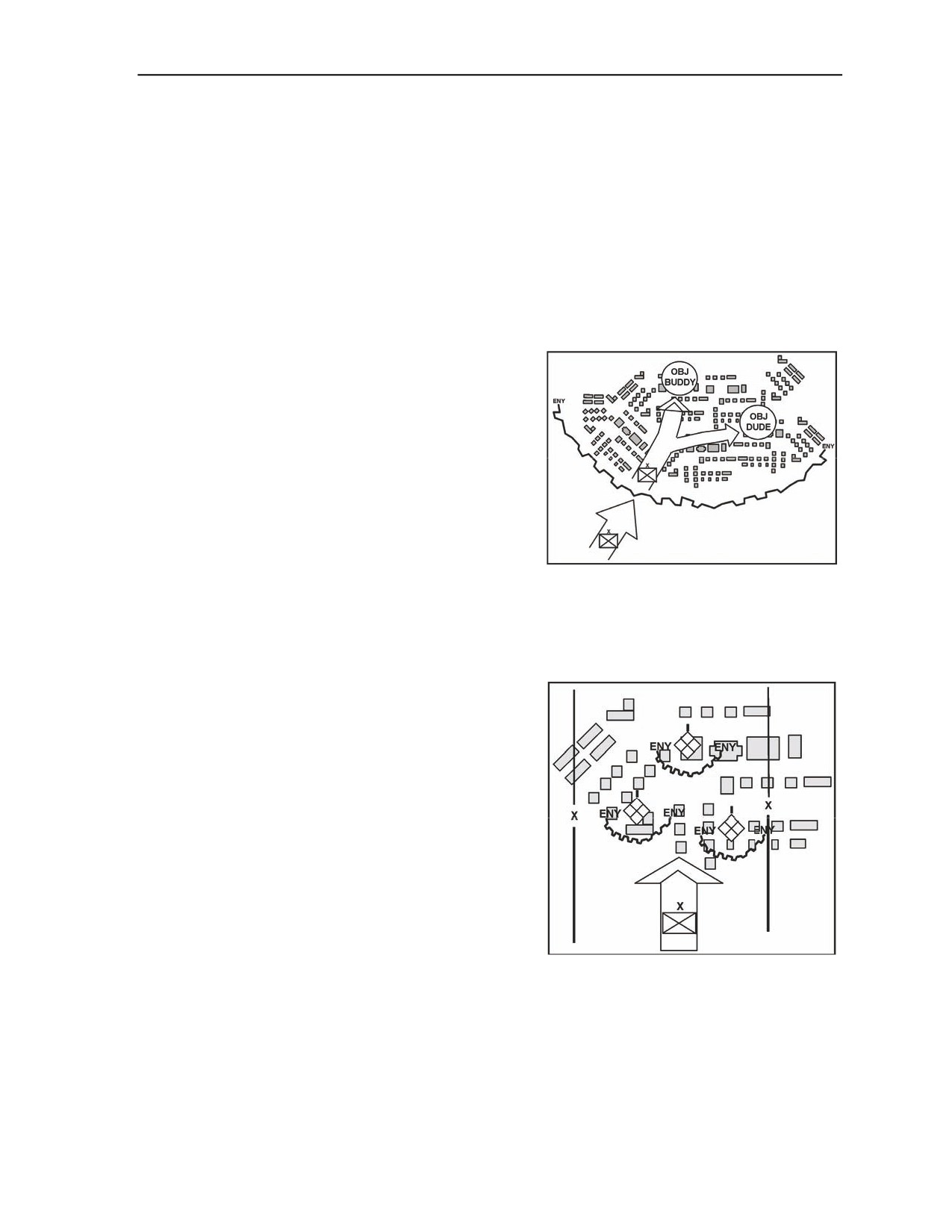
Infiltration
7-30. Infiltration secures key objectives in the urban
area while avoiding unnecessary combat with threat
defensive forces on conditions favorable to them (see
figure 7-5). This technique seeks to avoid the threat’s
defense using stealthy, clandestine movement through
all dimensions of the urban area to occupy positions of
F
igure 7-5. Infiltration
7-8
FM 3-06
26 October 2006
Urban Offensive Operations
advantage in the threat’s rear (or elsewhere).It depends on the careful selection of objectives that threaten
the integrity of the threat’s defense and a superior common operational picture (COP). Well-planned and
resourced deception operations may potentially play a critical role in masking the movement of infiltrating
forces. The difficulty of infiltration attacks increases with the size and number of units involved. It is also
more difficult when Army forces face a hostile civilian population. Under such circumstances, infiltration
by conventional forces may be impossible. Armored forces are generally inappropriate for infiltration
operations. However, they may infiltrate large urban areas if the threat is not established in strength and
had insufficient time to prepare defenses.
Penetration
7-31. Penetration is often the most useful form of attack against a prepared and comprehensive urban
defense (see figure
7-6). It focuses on successfully attacking a decisive point or on segmenting or
fragmenting the defense—thereby weakening it and
allowing for piecemeal destruction. (The decisive point
may be a relatively weak or undefended area that allows
Army forces to establish a foothold for attacks on the
remainder of the urban area.) Ideally in urban combat,
multiple penetrations in all dimensions are focused at the
same decisive point or on several decisive points
simultaneously. In urban combat, the flanks of a
penetration attack are secure, and resources are
positioned to exploit the penetration once achieved.
Although always a combined arms team, rapid
penetrations are enhanced by the potential speed,
firepower, and shock action of armored and mechanized
forces.
Figure 7-6. Penetration
7-32. Importantly, commanders must consider required actions and resources that must be applied
following a successful (or unsuccessful) penetration. A penetration may result in the rapid collapse and
defeat of the threat defense and complete capitulation. On
the other hand, success may cause threat forces to
withdraw but leave significant stay-behind forces
(or
disperse into the urban population as an insurgent-type
force) which may necessitate methodical room-to-room
clearance operations by significant dismounted forces.
Additionally, securing portions (or all) of an urban area
requires occupation by Army forces to prevent re-
infiltration of threat forces thereby further increasing
manpower requirements. Based on the factors of the
situation, commanders may conclude that over time
methodical clearance operations conducted from the
outset,
while frontloading time and resource
requirements, will be less costly than a penetration
followed by systematic clearing operations.
Figure 7-7. Frontal attack
Frontal Attack
7-33. For the commander of a major operation, the frontal attack is generally the least favorable form of
maneuver against an urban area unless the threat is at an obvious disadvantage in organization; numbers,
training, weapons capabilities, and overall combat power (see figure 7-7). Frontal attacks require many
26 October 2006
FM 3-06
7-9
Chapter 7
resources to execute properly, risk dispersing combat power into nonessential portions of the area, and risk
exposing more of the force than necessary to threat fires. In urban offensive combat, forces most
effectively use the frontal attack at the lowest tactical level once they set conditions to ensure that they
have achieved overwhelming combat power. Then the force of the frontal attack overwhelms the threat
with speed and coordinated and synchronized combat power at the point of attack. The assigned frontage
for units conducting an attack on an urban area depends upon the size and type of the buildings and the
anticipated threat disposition. Generally, a company attacks on a one- to two-block front and a battalion on
a two- to four-block front (based on city blocks averaging 175 meters in width).
Forms of Attack in the Urban Offense: Metz - 1944
In November 1944, the U.S. Third Army launched its final effort to take the French
city of Metz from the defending Germans. This was the Army’s third attempt. The first
attempt had been a surprise, mounted attack. This was followed by a series of
piecemeal infantry assaults on the surrounding fortresses. Finally, a deliberate effort
was made to take the city in a coordinated effort by XX Corps.
The initial failures stemmed from a shortage of resources on the U.S. side, to include
fuel and units—especially infantry. This added to the ad-hoc nature of the first two
efforts. The third effort, though more deliberate, was still constrained by resources.
XX Corps could only muster three nearly full-strength infantry divisions to attack the
German’s defending with four under-strength divisions.
The third attempt to take Metz demonstrates how a corps operates with multiple
divisions using various forms of attack to achieve its objective in urban offensive
operations.
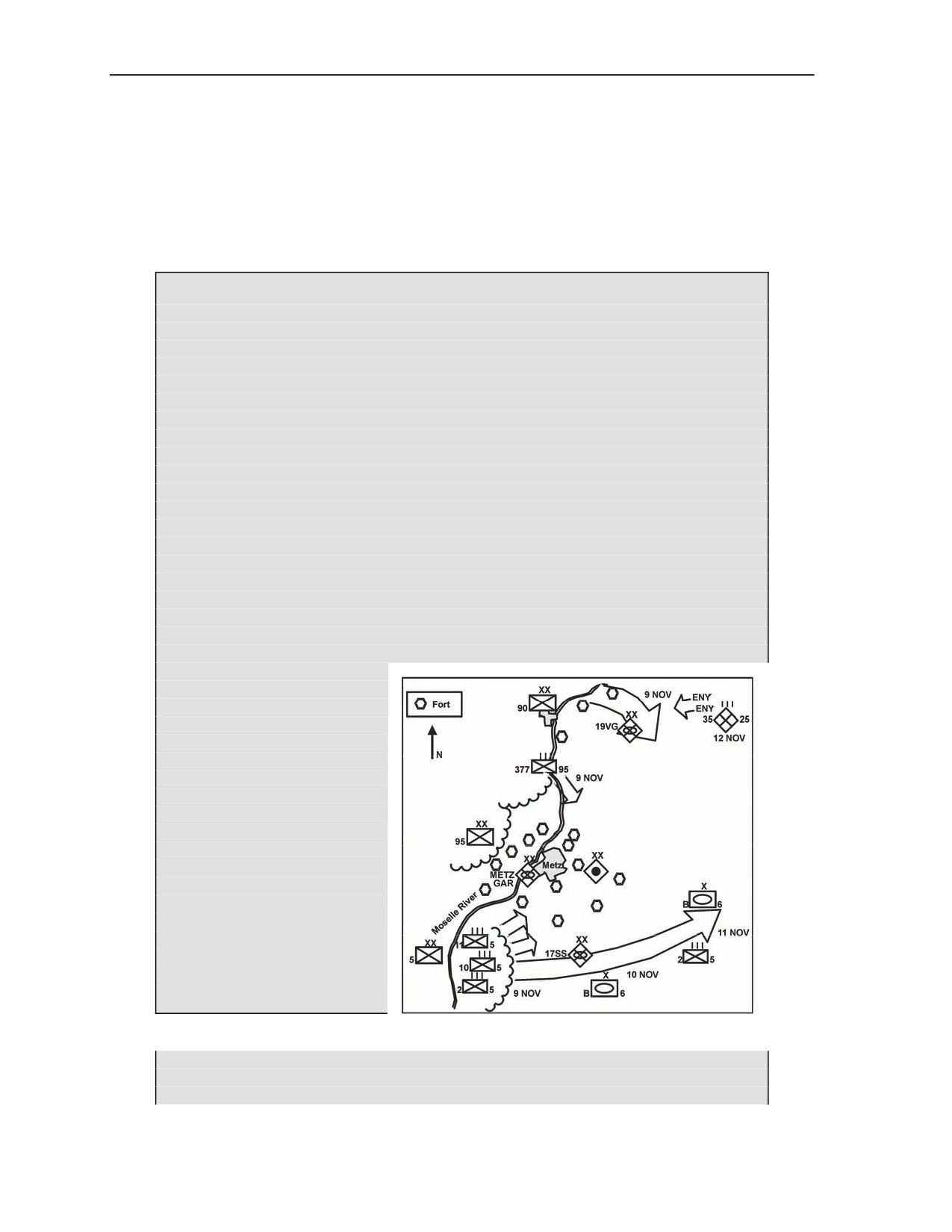
The opening phase of the Metz battle had attacks by the 90th and 5th Infantry
Divisions to envelop the city from the north and south (see figure 7-8). This isolated
the city and ensured the garrison could not escape nor be reinforced. The garrison
was under orders from Hitler not to conduct a breakout and to resist to the last man;
thus, German forces strongly counterattacked both wings of the envelopment to
prevent isolation.
The second phase of the
operation was the penetration
of the city defenses from
multiple directions. The
5th
Infantry Division penetrated
into the city with the 10th and
11th Infantry Regiments from
the south. The
95th Infantry
Division penetrated into the city
from the north with the 377th
Infantry Regiment and TF
Bacon. Simultaneously, the
95th Infantry Division infiltrated
battalions through the string of
fortress positions guarding the
western approaches into the
city, isolated, and bypassed
these positions with its other
two regiments.
Figure 7-8. Metz envelopment
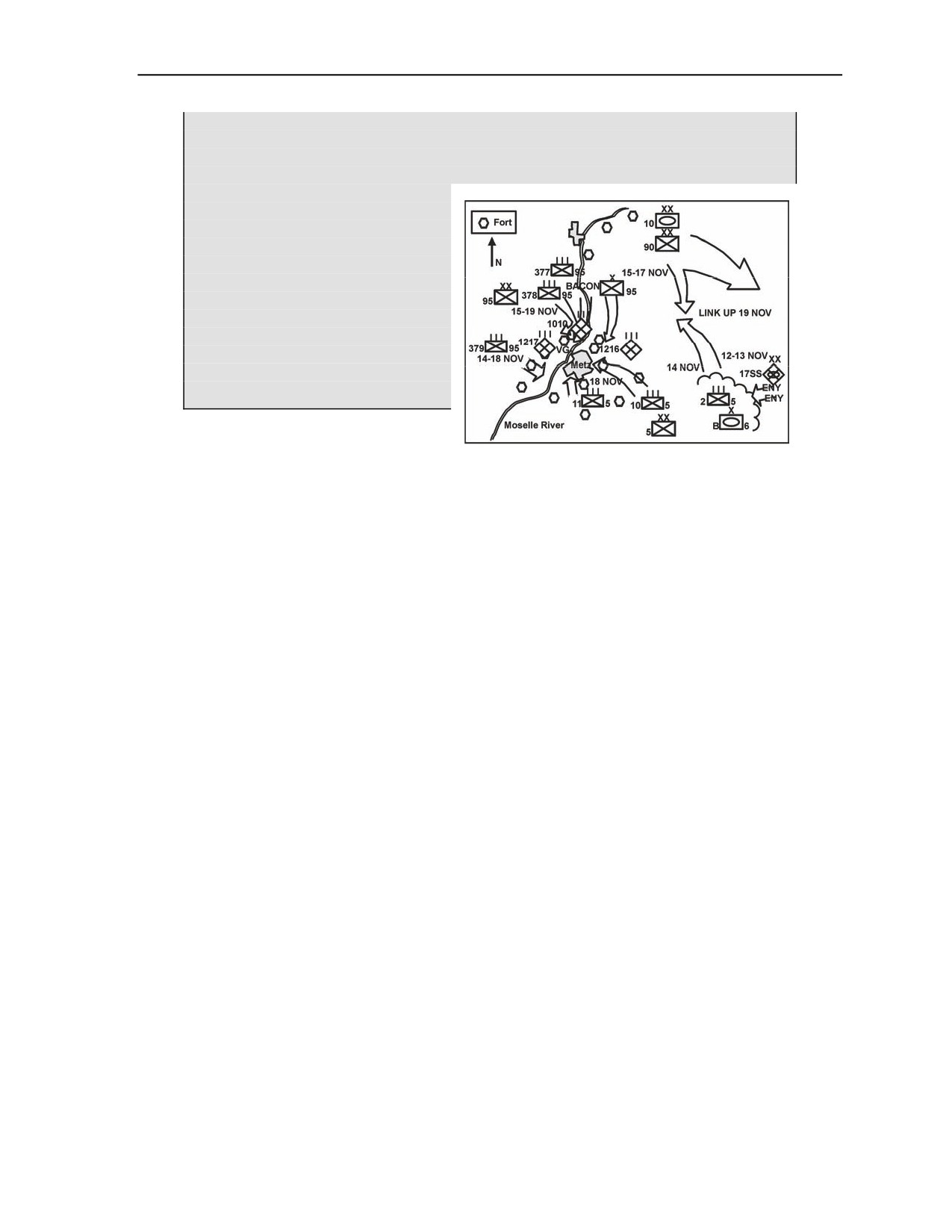
The final reduction of the defense was a series of battalion frontal attacks, which took
place against the last remaining strongholds within the city. Even in these final
7-10
FM 3-06
26 October 2006
Urban Offensive Operations
engagements, however, the infantry battalions isolated, bypassed, and then attacked
from the flanks and rear whenever possible (see figure 7-9).
The city was declared secured on 19 November. However, at that point more than a
half-dozen of the fortresses had yet to be reduced. The 95th Infantry Division, after a
four-day rest, quickly moved forward
to rejoin the still rapidly advancing
corps forward elements. Elements
of the 5th Infantry Division remained
in siege posture around the
remaining strong points, the last of
which surrendered on 19 December
1944 when it ran out of food. U.S.
forces made no efforts to attempt to
assault these bypassed fortresses
although extensive psychological
operations (PSYOP) were used.
Figure 7-9. Metz final assault
TYPES OF OFFENSIVE OPERATIONS
Movement to Contact
7-34. In an urban area where the threat situation is vague, Army forces will often conduct a movement to
contact to establish or regain threat contact and develop the situation. A movement to contact in an urban
area occurs as both sides try to establish their influence or control over a contested urban area. The
situation determines whether the movement to contact or its specific technique, the search and attack, is
appropriate. A conventional force-oriented movement to contact will likely take place when friendly and
threat conventional forces attempt to establish control simultaneously. Initially, neither side is defensive.
The friendly force aims to quickly locate and fix the threat while establishing control of the urban area and
its key infrastructure. The search and attack technique works well when a smaller threat has established a
noncontiguous defense in an urban area. This operation is characterized by the friendly point defense of
key infrastructure, robust reconnaissance, and rapidly concentrated combat power to fix and defeat or
destroy threat resistance once located.
7-35. A meeting engagement often results from the movement to contact. It occurs when a moving force
that is partially deployed for battle collides with and engages a threat at an unexpected time and place. In a
meeting engagement in an urban area, the unit that reacts most quickly and decisively will likely win.
Rapid and accurate decision making depends heavily on understanding the nature of the urban area and its
impact on operations. Thus, in a meeting engagement, commanders should quickly assess the impact and
role of all components of the urban environment (terrain, infrastructure, and society) on the operation. To
this end, responsive reconnaissance is important. This permits accurate decision making regarding where to
attack, where to defend, and how to allocate resources. Situational understanding enhanced by robust
digital INFOSYS that provide an accurate COP also facilitates the rapid reaction of Army units and a
synchronized response. This reaction and response allow Army forces to seize the initiative and dominate
the threat.
Attack
7-36. The attack is the most common and likely offensive operation that Army forces will conduct in an
urban environment. Commanders conducting major operations and commanders of large tactical units
usually execute deliberate attacks. In the urban environment, units larger than battalion-size rarely conduct
26 October 2006
FM 3-06
7-11
Chapter 7
hasty attacks. Hasty attacks are common below company level as units use their initiative to take advantage
of tactical opportunities. However, larger units will conduct hasty attacks when threat defenses are
disrupted or unprepared, to take advantage of an unexpected situation, and to prevent the threat from
establishing or re-establishing a coherent defense.
Exploitation
7-37. Exploitation follows a successful attack to disrupt the threat in depth. Commanders of major
operations should consider focusing exploitation attacks on urban areas. A threat defeated in an attack will
attempt to rally units, reinforce with reserves, and reorganize his defense. With its information and
communications capability, transportation network, and defensive attributes, the urban area is the natural
focal point to reestablish a disrupted defense. By establishing urban centers as the objectives of the
exploitation, commanders deny the threat the sanctuary needed to reorganize and reestablish his defense.
The exploitation focuses on the urban area as well as on the remnants of the threat. A successful
exploitation to seize an urban area works efficiently because the attack preempts the defense and denies the
threat the full advantages of urban terrain.
7-38. Commanders conducting exploitation must acknowledge the vulnerability of their forces to
counterattack and ambush in urban areas. An urban area provides ideal cover and concealment to hide
threat reserves, reinforcements, or reorganized forces. Constrictions of routes into and through the urban
area make exploitation forces a potentially dense target and limit maneuver options. Robust and well-
coordinated reconnaissance, tactical dispersal, and use of advance guard security forces protect against this
threat (see Defensive Combat Power: Suez City vignette in Chapter 8).
Pursuit
7-39. The pursuit is designed to destroy threat forces attempting to escape. It focuses on the threat and not
on urban areas. When conducting a pursuit, Army forces move through undefended urban areas and, if
possible, bypass those in which threat forces successfully take refuge. The threat will likely attempt to use
urban areas to disrupt the pursuit and permit the threat main body to escape. Commanders can prevent
escape by denying the threat the time to establish forces in urban areas that cannot be bypassed. The agility
of Army aviation forces for attack, reconnaissance, and transportation is essential to execute a successful
pursuit around and through urban areas.
URBAN OFFENSIVE CONSIDERATIONS
7-40. The urban operational framework (understand, shape, engage, consolidate, and transition) provides a
structure for developing considerations unique to urban offensive operations. The considerations vary
depending on the situation and scale of the operation. Some considerations applicable to major operations
that include an urban area will also be considerations at the tactical level focused in the urban area.
However, no set rules exist. All urban operations are unique. Issues addressed at the operational level in
one situation may be addressed in a new situation only at the tactical level. Under the right circumstances, a
consideration may become an operational issue, a tactical issue, or a combination of the two. The following
identifies some planning and execution issues that commanders conducting major operations should
address.
UNDERSTAND
7-41. The first requirement, and a continuing requirement throughout the conduct of urban operations, is
the assessment and understanding of the situation. Commanders should base this understanding on detailed
information regarding the particular urban area. Since the threat will likely dominate or control most of the
urban area during the planning phase of offensive operations, achieving an accurate understanding of the
urban environment will be difficult. A comprehensive intelligence, surveillance, and reconnaissance (ISR)
effort in support of a rigorous intelligence preparation of the battlefield (IPB) process overcomes this
obstacle.
7-12
FM 3-06
26 October 2006
Urban Offensive Operations
Integrated Intelligence, Surveillance, and Reconnaissance
7-42. The commander of a major operation that includes an urban area, unlike his subordinate
commanders, can target reconnaissance deep into his AO and area of interest. This begins the application
of ISR resources against the urban area that may lead to decisive ground operations. This ISR effort and
the understanding it supports continue as long as the urban area remains in the AO. Commanders of major
operations initially direct ISR assets on those information requirements that support determining whether
or not to conduct urban offensive operations. Once decided, ISR resources shift to support the planning and
execution of the operation in the urban area.
7-43. The first resources that a senior commander can use are national and strategic sensors. He requests
them through the appropriate joint force commander. The commander aggressively pursues full use of
these systems to begin building an initial database for analyzing the significant aspects of the terrain; key
infrastructure considerations; the status and disposition of the population; and the size, type, disposition,
and intentions of threat forces in the area.
7-44. Simultaneously, multiple intelligence sources contribute to the database. The sources collect,
process, store, display, and disseminate the relevant information on large urban areas through open and
classified resources. These information sources include—
Historical research.
Travel brochures that include cultural information and recent maps.
Classified debriefings of diplomats, businesses, DOD personnel, and allies.
Military maps and special geospatial products of the urban area.
Previous intelligence assessments of the country, government, and population.
Reachback to appropriate economic, political, cultural, and infrastructure subject matter experts
not in the commanders AO.
The gathering and analysis of HUMINT plays a critical part of this process and assists commanders in
understanding ethnic, cultural, religious, economic, political, and other societal and infrastructural facets of
the environment.
7-45. As the intelligence and the national reconnaissance and surveillance efforts progress, commanders
will insert, if available and feasible, Special Forces reconnaissance assets into the urban environment.
These elements will seek to confirm or deny the information received from imagery intelligence (IMINT),
signals intelligence (SIGINT), and HUMINT sources. Among many factors, using SOF depends on their
availability, the particular urban area, the area’s ethnic composition, and the relationship between the urban
population and the threat. Other joint operational reconnaissance and surveillance assets that higher-
echelon commanders may have available might include the Joint Surveillance Target Attack Radar System,
Guard Rail targeting aircraft, UAS, and space-based systems.
7-46. The commander’s staff will use all sources of information—IMINT and SIGINT sensors, HUMINT,
historical research, and reconnaissance—to refine his ability to understand the urban environment.
Digitally linking subordinate commanders with information sources helps to develop a COP essential to
their situational understanding of the urban environment. The IPB process guides this assessment. As
operations progress, additional reconnaissance and surveillance assets may become available. These may
include UAS, long-range reconnaissance and surveillance units, counterfire radar, and air and ground
cavalry. As these assets are employed, they are linked into the net of sources sharing information and
further refine a common situational understanding of the environment.
Focused Assessment Efforts
7-47. In urban offensive operations, the tactical commander’s assessment focuses on defeating the threat in
the urban area within the constraints of the environment. Toward this end, identifying and assessing
decisive points to attack is a commander’s priority assessment task. Some unique aspects of the urban
environment also require the focus of the commander’s assessment efforts. These include the character of
the urban defense, collateral damage considerations, and the effects of the environment on friendly and
threat courses of action.
26 October 2006
FM 3-06
7-13
Chapter 7
Character of the Urban Defense
7-48. To be both efficient and effective, Army urban offensive operations focus on what is decisive.
Decisive points for an urban attack depend primarily on the mission within the urban area. They can vary
widely in composition and size. Since commanders only focus on the essential, they may determine the
decisive point to be a single building or a limited sector of an urban area. It could be an entire system
within the urban infrastructure such as communications and information, or a limited subsystem of the
transportation and distribution infrastructure such as a single airfield. Sometimes what is decisive in the
urban area is the threat military capability, but even this large an objective, when carefully analyzed, may
not require destruction of all threat forces or control of the entire urban area. Decisive points relate directly
to the threat’s center of gravity and to mission success. Some decisive points related to the urban threat’s
center of gravity may be physically located outside the urban area.
7-49. To gain specifics on threat dispositions within the urban area requires reconnaissance capability to
see into the depths of the area and the intelligence capability to determine the threat’s likely defensive
course of action. With this information, commanders can determine decisive points and apply Army
combat power discretely against them. Effective urban offensive operations require detailed situational
understanding of an area of interest that extends well beyond the perimeter of the urban area.
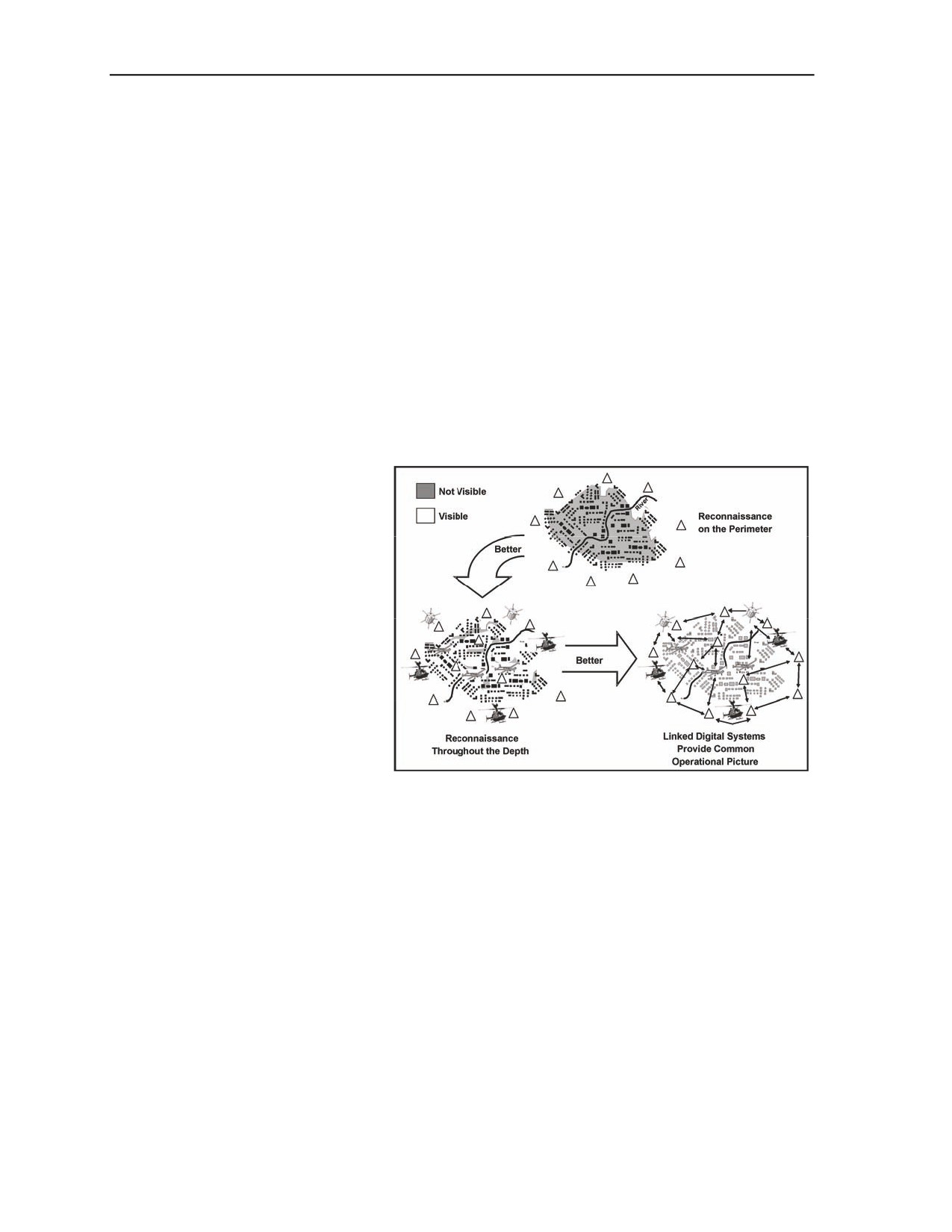
7-50. Commanders see throughout the depth of the urban area using several actions (see figure 7-10). First,
they evaluate sensor data and
imagery. This guides targeting of
special
reconnaissance.
Simultaneously,
HUMINT is
conducted using any persons who
might know the urban area and threat.
This includes civilians (allies, aides,
neutrals, obstacles, and hostiles) and
POWs. Finally, tactical conventional
reconnaissance
assets
including
reconnaissance
forces,
aviation,
artillery radar, signals intelligence,
and UAS are directed at the urban
area. All these sources and data are
linked through digital INFOSYS to
provide commanders and their
subordinates
with
improved
situational understanding and a COP.
Figure 7-10. Required urban reconnaissance capabilities
Collateral Damage Considerations
7-51. Commanders must also assess the collateral damage risks that their operations may include. This
assessment helps to initially determine the viability of a course of action. However, commanders should
reassess their courses of action at frequent intervals in urban offensive operations based on known
information to determine if the original evaluations remain valid. This reassessment minimizes potential
collateral damage from a change in mission or a change in a course of action. Many aspects of the
environment can change during mission execution.
The Environment’s Effects on Courses of Action
7-52. The urban environment’s unique aspects can significantly impact the course of action chosen by
Army forces and the threat. Commanders must assess these effects in planning, but they must also verify
and monitor these effects as forces execute offensive missions. In particular, commanders will want to
confirm the civilian population’s locations, beliefs, and actions and to monitor any changes. They will need
to validate terrain considerations and monitor the effects of any changes due to rubble and other damage to
7-14
FM 3-06
26 October 2006
Urban Offensive Operations
structures. In urban terrain, dead space, cover, and concealment can only be identified physically and may
change considerably as operations are executed.
SHAPE
7-53. Commanders of major operations have a primary contribution to urban operations: the planning and
conduct of effective shaping operations that set the conditions for subordinate tactical success. In urban
operations, isolation will be a critical condition. Effective isolation will require persistent, continuous
surveillance and reconnaissance, innovative use of fires and maneuver (including effective force allocation
decisions), and well-established sensor-to-shooter links. These efforts—combined and synchronized with
SOF direct actions, IO that minimize noncombatant influences, and necessary shaping attacks (particularly
the seizure of a foothold)—establish the conditions necessary for the subsequent offensive domination of
the area.
Isolation is Essential
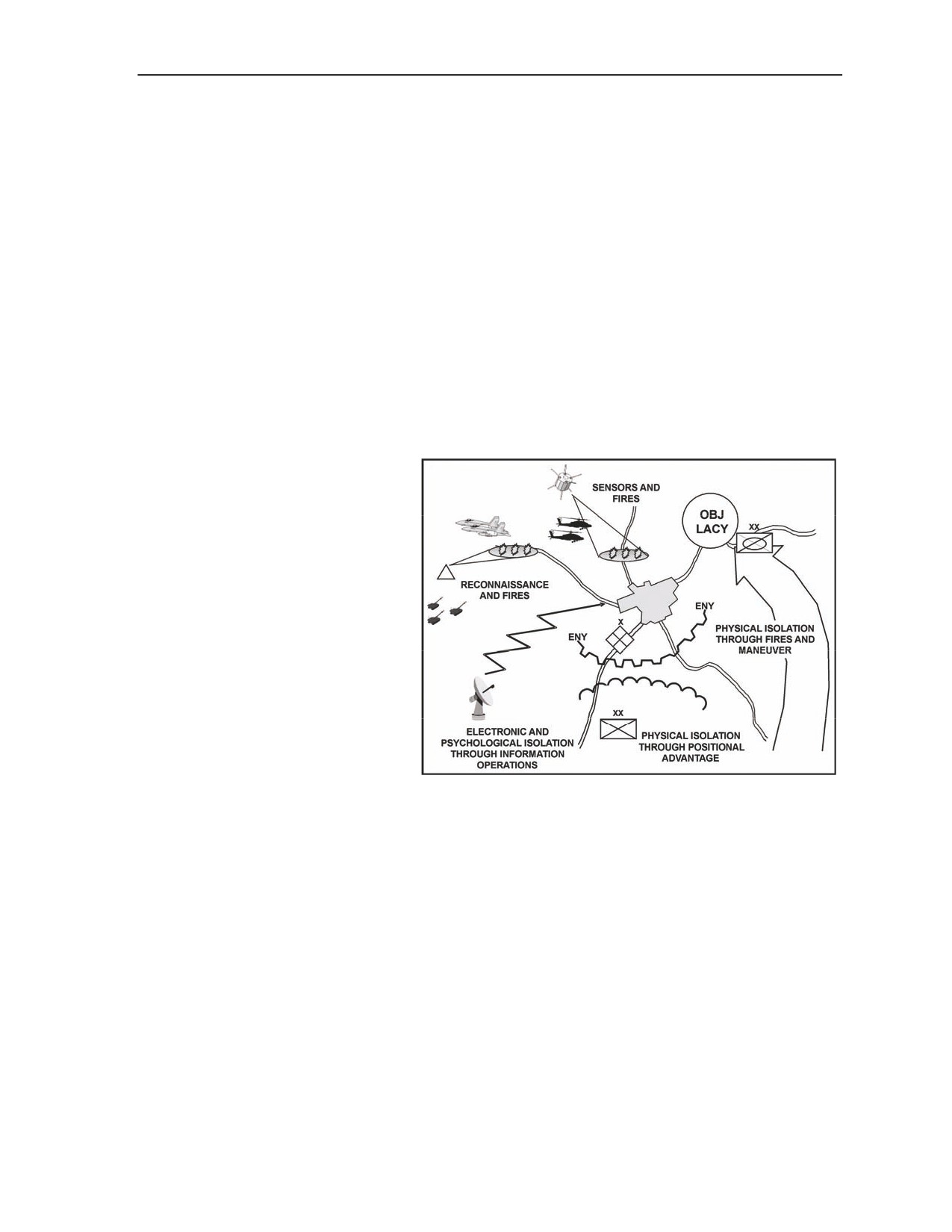
7-54. One key to success in the history of urban operations has been the effective isolation of the threat
force (see figure 7-11). This applies today and equally well to major urban offensive operations as it does
to smaller-unit attacks. This isolation not only denies access to the urban area from outside but also
contains threat forces within. In a
modern metropolis or megalopolis,
this can appear a daunting task.
Operational
isolation
requires
dominating
all
physical
and
electronic contact between the threat
in the urban area and supporting
threat forces outside the urban area.
This does not necessarily require
physically encircling the urban area,
but it does require that Army forces
be able to exert control over the
area’s entire perimeter, as well as
decisive points within. For a
sprawling urban area, successful
isolation
may require
the
commitment of a large amount of
resources.
Figure 7-11. Shaping through isolation
7-55. Successful isolation of the urban area depends as much on the nature of the threat as it does on any
other factor. A conventional threat in a large urban area may be much easier to isolate than an insurgent
threat in a much smaller urban area. The forces needed in the former situation may be less than those
needed in the latter. The more the characteristics of the threat are conventional in nature generally the
easier it will be to isolate him using standard combat methods and equipment. Isolating a more
unconventional force requires many of the same techniques as used against conventional forces. However,
it also requires a much greater ability to simultaneously conduct offensive IO, to integrate CA units and
civil-military operations
(CMO), and to work with allies, nongovernmental organizations, and local
authorities. Fundamentally, isolating a less conventional threat puts increased emphasis on separating
combatants from noncombatants.
Offensive Isolation Objectives
7-56. Isolation seeks to achieve two primary objectives with respect to defeating a threat’s urban defense:
Weaken the overall coherence of his defense.
Limit or manipulate his maneuver options.
26 October 2006
FM 3-06
7-15
Chapter 7
Isolating the threat in the urban area from external support, as well as isolating him from sources of support
within the urban area, weakens his overall defense. The defense is weakened through a combination of
attrition (the threat cannot replace his losses) and the diversion of his combat power from the defense to
operations to counter the isolation effort. Isolation can also prevent the threat from shifting his forces to
reinforce decisive points in the urban area or to conduct counterattacks.
7-57. Commanders may choose not to isolate the urban area completely—or at least make it appear so to
threat forces. Instead, they may afford the threat an apparent means of escape, create the conditions for its
use through effective fire and maneuver against the defenders, and then destroy the threat through various
ambush methods. While friendly forces may be able to move undetected to appropriate ambush sites, it is
more likely that this technique will necessitate rapidly mobile air and ground forces moving along carefully
chosen routes through the urban area. Commanders must consider maintaining the ability to complete the
isolation of the urban area to prevent reinforcement and escape of urban threat forces—particularly if the
ambush attack does not achieve desired effects.
Persistent Surveillance
7-58. Persistent surveillance of the urban area is essential to all types of actions used to isolate an urban
area and as complete as resources will allow. Surveillance of the urban area relies on either reconnaissance
forces or sensors continuously observing or monitoring urban avenues of approach. This network of ISR
assets updates the commander’s situational understanding and provides the means to quickly identify and,
if necessary, attack threat elements as they move. However, particularly with sensors, commanders must
consider that each detection is not necessarily an enemy to be attacked. Noncombatant activity clutters the
environment making it easier for threats to disguise themselves and increases the burden (and the number
of resources required) on Army forces to distinguish friend from foe.
Fires and Maneuver
7-59. Fires and maneuver may be used to achieve isolation, either singly or in combination. (As always,
effective obstacles, monitored by sensors or observation, are integral to any isolation technique.) First,
attacking forces can pre-position themselves along avenues of approach to deny entry and exit through
positional advantage. Relying primarily on this method of isolation, particularly around a large urban area
with multiple avenues of approach, can be overly resource intensive. Instead, the pairing of fires and
maneuver provides attacking commanders more flexibility and allows them to isolate several avenues of
approach with fewer resources. Highly mobile attack helicopters, operating outside threat-controlled
portions of the urban area, are ideal for this purpose. Inside threat-controlled areas, it is more difficult to
identify, eliminate, or effectively suppress the air defense threat. The threats may have numerous man-
portable air defense weapons and enhanced effects of small arms used for air defense. Therefore, the risk to
using this equipment may outweigh the potential benefits. However, mobile ground units—such as an air
assault (subject to the same air defense threat considerations as attack aviation), armored, or mechanized
forces—can also rapidly move to attack and destroy a threat moving in or out of an urban area. Potential
disadvantages of the combined, fires and maneuver, option are that—
Critical assets, on standby and dedicated to isolation efforts, may be unavailable for other
missions.
The attacking force may not locate the threat in time to complete its mission (an inherent risk to
any attack).
7-60. Another alternative relies on indirect or joint fires alone to destroy the threat force. Its disadvantage
is that fires alone often cannot completely destroy or stop a determined force from moving into or out of an
urban area. Although targets and avenues of approach will require continual surveillance, it is usually a less
resource-intensive option than those that include maneuver. It also does not normally require fires assets to
remain on standby to accomplish the mission. However, fires must be able to reliably and quickly respond.
For Army field artillery units and naval gunfire, the units must also be in range, which requires careful
positioning. A skilled threat can avoid interdiction fires by using the geometry of the area to identify gaps
due to obstructing terrain or the firing unit’s range limitations. It can also use concealment and weather to
avoid observation. However, effective sensor-to-shooter links throughout the urban battlefield will reduce
7-16
FM 3-06
26 October 2006
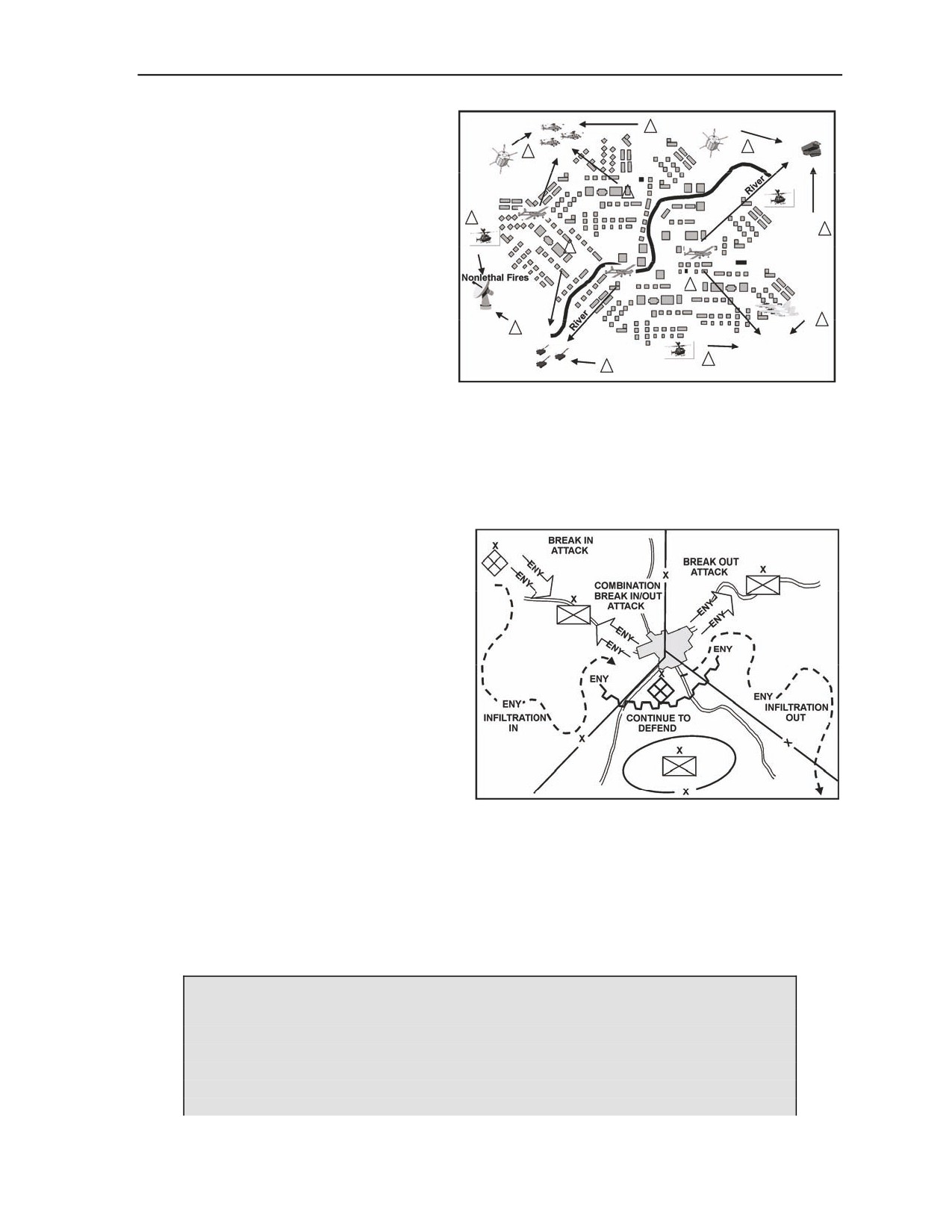
Urban Offensive Operations
the threat’s ability to hide (see figure 7-12).
A resolute threat may risk significant losses
to fires to prevent isolation or may attempt
to use noncombatants as a shield.
Ultimately, commanders should use
innovative combinations of all techniques
discussed. Some units will physically block
key avenues of approach. Surveillance will
monitor less important routes and avenues.
Artillery fires, joint fires, and maneuver
units will then respond to the results of
surveillance
depending
on
the
circumstances.
Figure 7-12. Critical sensor-to-shooter links
Threat Reactions
7-61. The reaction of the threat to the effects of isolation will depend on his mission, morale, force
structure, and overall campaign plan. The threat may recognize isolation actions early and withdraw from
the urban area before isolation is completed
instead of risking destruction. On the other
hand, the threat, based on a different or flawed
assessment (perhaps a perception shaped by
the Army force commander), may choose to—
Continue to defend (or hide) and
conduct local ambushes and
counterattacks.
Attack to break into the urban area
or infiltrate forces and supplies in.
Attack to break out of the urban
area or infiltrate forces out.
Execute any combination of the
above (see figure 7-13).
Figure 7-13. Reactions to isolation
7-62. Attacking commanders must consider how the threat leadership’s subsequent actions will affect the
continuance of overall offensive operations. They deliberate many considerations, to include—
The allocation of more forces to the shaping operations to isolate the urban area.
The allocation of more combat power to achieve rapid penetration and seizure of objectives to
take advantage of developing threat dispositions in the urban area.
Isolating an Urban Area: Hue, Vietnam - 1968
On 31 January 1968, the 4th and 6th North Vietnamese Army (NVA) regiments and
attached NVA and Vietcong (VC) sapper battalions attempted to seize control of Hue
from the South Vietnamese Army’s
(ARVN) 1st Division as part of the North
Vietnamese Tet Offensive. The attack, which was launched with complete surprise,
successfully established temporary control over most of the city and facilitated the
26 October 2006
FM 3-06
7-17
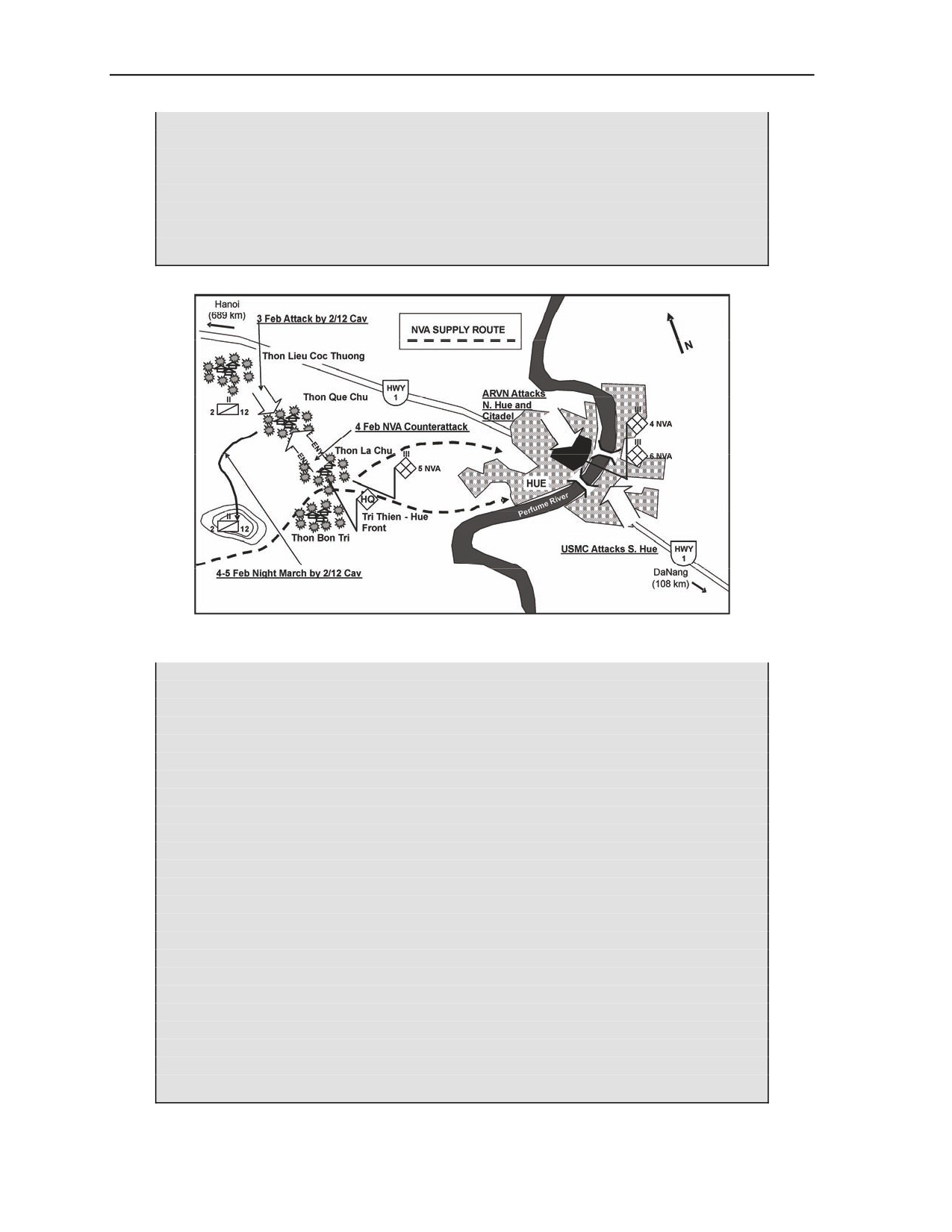
Chapter 7
occupation of strong defensive positions within the city’s ancient fortress known as
the Citadel. However, it did not lead to the capture of the headquarters of the ARVN
1st Division located in the Citadel nor the U.S. military assistance command—
Vietnam compound located in the southeast part of the city.
Both ARVN and U.S. forces swiftly reacted to the NVA attack. Within 24 hours,
ARVN infantry and cavalry units counterattacked to recapture the Citadel. South of
the Perfume River, the 1st Marine Division began attacking to clear the southern
portion of the city (see figure 7-14).
Figure 7-14. Initial attack to isolate Hue
On 2 February, the first Army unit was committed to Hue. The 2-12th Cavalry (an
infantry battalion) was ordered to attack southeast along Highway 1 and clear enemy
interdicting that route. On 3 February, 2-12th Cavalry began their attack moving
along the south side of the highway. The plan was to clear a series of small hamlets
in succession en route to the city itself. The first hamlet, Thon Lieu Coc Thuong, was
cleared easily. Moving toward the second hamlet, Thon Que Chu, the battalion
encountered a strong enemy force that was well entrenched. Air and artillery
supported the battalion as it attacked and captured the hamlet against strong
resistance. The battalion dug in for the night and prepared to resume the attack
against the third hamlet, Thon La Chu, on 4 February.
Unknown to the 2-12th Cavalry, Thon La Chu was the headquarters of the Tri Thien-
Hue Front, and it was defended by the NVA’s 5th Infantry Regiment. Also important,
the hamlet sat astride the NVA’s primary supply route to the regiments fighting in
Hue. The NVA was determined that 2-12th Cavalry’s attack would not succeed; the
NVA was determined to destroy the threat to its LOCs.
As the 2-12th Cavalry prepared to resume the attack on 4 February, the NVA fiercely
counterattacked with all three battalions of the 5th NVA Regiment. It soon became
apparent that 2-12th Cavalry could not continue to attack. As the day continued and
the NVA pressure steadily increased, the battalion began to lose its position in Thon
Que Chu. To avoid destruction, the battalion broke contact.
As darkness fell on 4 February, 2-12th Cavalry finally broke contact with the NVA.
However, instead of retreating north back to its start line, the battalion moved west
and then south to good defensive high ground deeper in the NVA AO. Eleven hours
later the battalion was set in its new defensive position.
7-18
FM 3-06
26 October 2006
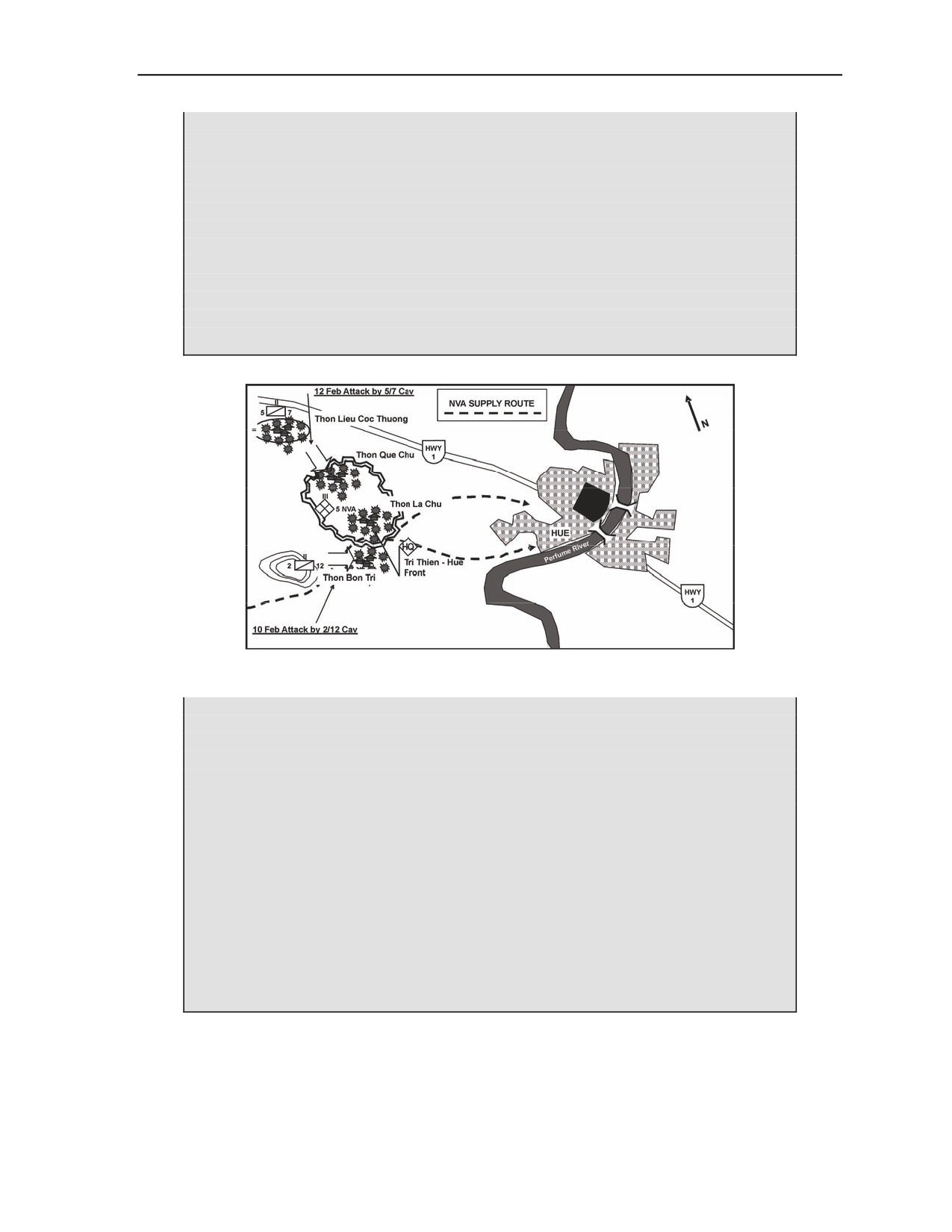
Urban Offensive Operations
At dawn on 5 February, 2-12th Cavalry was established 5 kilometers west of Hue.
The battalion soon observed enemy forces and supplies moving toward Hue. From
its high ground position, the battalion directed artillery and air strikes against the NVA
forces. By its bold move to bypass the 5th NVA Regiment, the battalion now held
excellent position to direct fires on the primary NVA supply line into Hue. These fires
were the first step toward isolating the NVA in Hue.
The fires controlled by the 2-12th Cavalry shut down the NVA LOCs into Hue during
the daytime. However, under the cover of darkness supplies and reinforcements
were still entering the city (see figure 7-15). It became apparent that the isolation of
the NVA in Hue would require the capture of Thong La Chu. The problem facing
American forces was concentrating combat power against the NVA. All U.S. units at
this time were actively engaged against the numerous NVA attacks that constituted
the NVA’s 31 January Tet Offensive.
Figure 7-15. Subsequent attack to isolate Hue
The first additional American unit was not available until 12 February when the 5 7th
Cavalry attacked Thong Que Chu much like the 2-12th Cavalry had attacked
previously. The 5-7th Cavalry had even less success against the alert 5th NVA. The
5-7th Cavalry was forced to occupy defensive positions in Thon Lieu Coc Thuong
and await the build up of combat power before it could continue to attack. In the
interval, 2-12th Cavalry had moved off the high ground and captured the hamlet of
Thon Bon Tri, south of the 5th NVA Regiment.
On 21 February, the 1st Cavalry Division had moved enough resources to the area to
launch an effective attack to isolate Hue (see figure 7-16). In addition to the 5-7th
and 2-12th Cavalry, the 1-7th Cavalry arrived in the AO and the 2-501st Airborne
Infantry of the
101st Airborne Division was attached. On
21 February, after a
combined artillery, air, and naval gunfire bombardment, the four battalions attacked
the Thon La Chu stronghold. Elements of the 5th NVA Regiment were either
destroyed in place or fled northeast. The next day resistance in Hue was noticeably
lighter. U.S. Marine and ARVN units began the last phase of fighting to recapture the
Imperial Palace. On 26 February, the North Vietnamese flag was removed from the
Citadel and the ARVN I Corps declared the city secured.
26 October 2006
FM 3-06
7-19
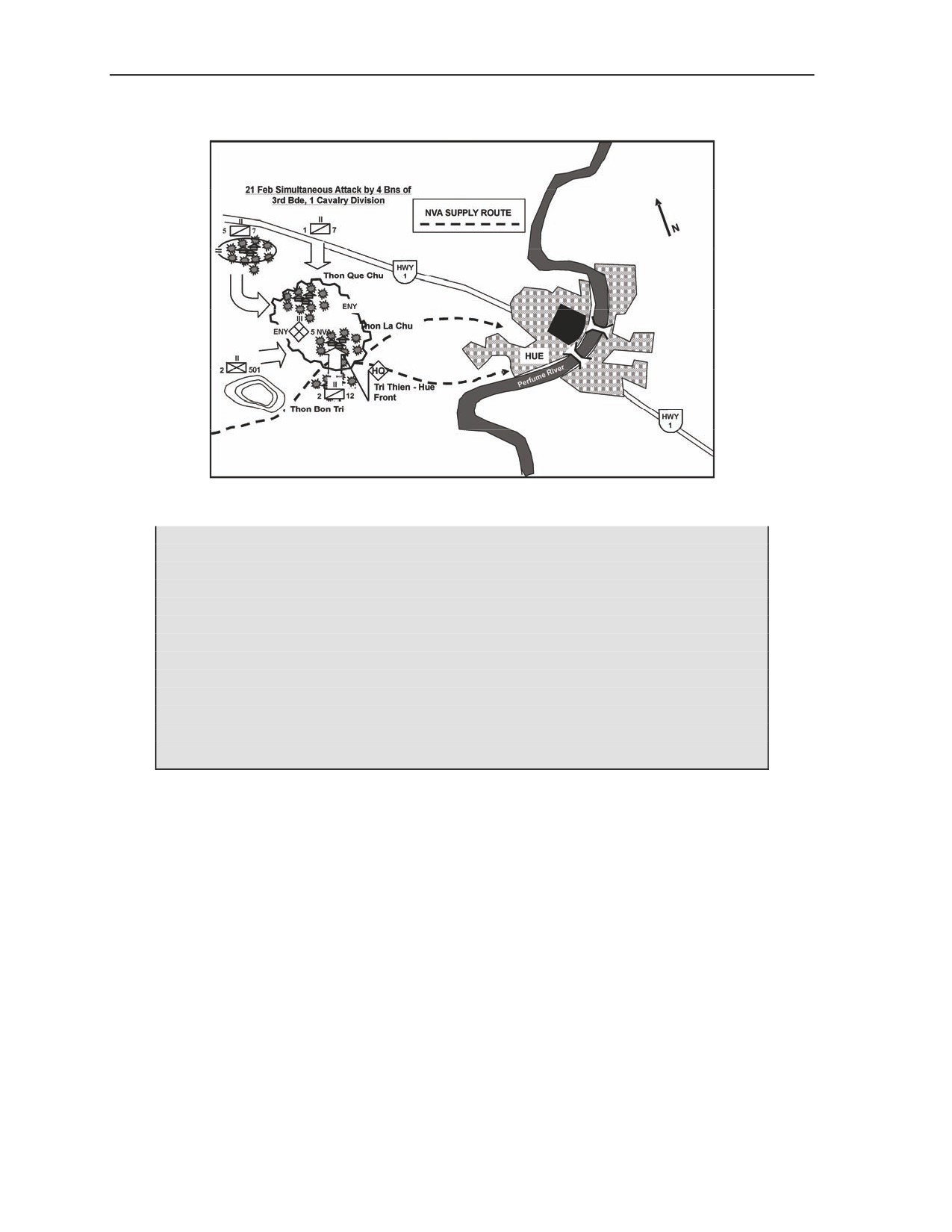
Chapter 7
Figure 7-16. Final attack to isolate Hue
The actions of the 1st Cavalry Division forces northwest of Hue demonstrated the
importance and the difficulty of isolating an enemy fighting in an urban area. Isolating
Hue was difficult not only because of the dispersion and surprise with which the Tet
Offensive caught U.S. forces, but also because of the tenacity of the NVA. At least
one-third of the combat power of the NVA in the Hue AO was focused on maintaining
access to the city.
Although only one aspect of this urban battle, Hue’s isolation had an immediate and
important, if not decisive, impact on operations. It not only resulted in restriction and
then elimination of supplies and reinforcements, but it also immediately impacted the
conduct of the defending NVA forces. Isolation caused an immediate drop in NVA
morale and changed the nature of the defense. Once the enemy was isolated from
external support and retreat, the objective of the NVA in the city changed from
defending to avoiding destruction and attempting to infiltrate out of the city.
Civilian Reactions
7-63. Commanders must also consider the potential effects on and reactions and perceptions of the
population living in the urban areas that they choose to isolate and bypass—either as a direct effect or as a
response of the threat force being isolated. Isolation to reduce the threat’s ability to sustain itself will likely
have similar (and worse) effects on the civilian population remaining in the isolated area. (If food and
water are in short supply, threat forces may take from noncombatants to satisfy their needs, leaving
civilians to starve.) Isolation may also create a collapse of civilian authority within an urban area as it
becomes apparent that the military arm of their government is suffering defeat. Due to their isolation,
elements of the population may completely usurp the governmental and administrative functions of the
former regime and establish their own local control, or the population may lapse into lawlessness.
Returning later, Army commanders may find that these self-governing residents are proud of their
accomplishments and, in some instances, less willing to allow Army forces to assume control since they
may be perceived as having done nothing to earn that privilege. Alternatively, as witnessed in some urban
areas during OPERATION IRAQI FREEDOM in 2003, a power vacuum may lead to intra-urban conflicts
among rival factions coupled with general public disorder, looting, and destruction of the infrastructure
(see also the discussion of Competing Power Structures in Chapter 3).
7-20
FM 3-06
26 October 2006
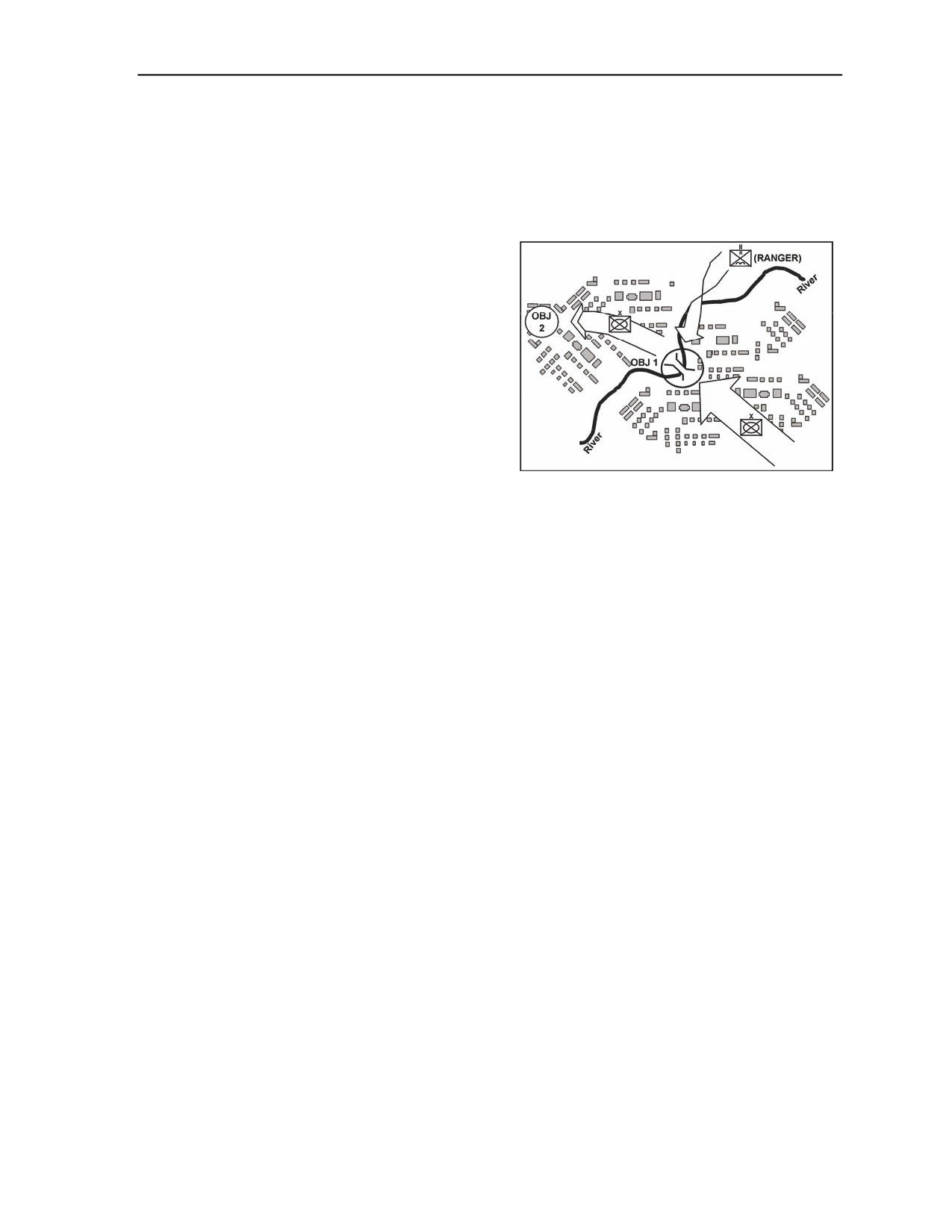
Urban Offensive Operations
Direct Action by Special Operations Forces
7-64. Although SOF in urban offensive operations will likely conduct essential reconnaissance, they also
have a direct action capability to shape the offensive operation (see figure 7-17). Special Forces and
Rangers can use direct action capabilities to attack targets to help isolate the urban area or to directly
support decisive actions subsequently or simultaneously executed by conventional forces. Successful
attacks against urban infrastructure, such as transportation or communications centers, further the area’s
physical and electronic isolation. Direct action
against command centers, logistics bases, and air
defense assets can contribute to the success of
conventional attacks by destroying or disrupting key
threat capabilities. Direct action can also secure key
targets such as airports, power stations, and
television stations necessary for subsequent
operations. Direct action by Special Forces and
Rangers in these operations can help achieve
precision and reduce potential damage to the target or
noncombatant casualties.
Figure 7-17. Coordination of SOF and
conventional capabilities
Information Operations
7-65. Regardless of how Army forces physically isolate the urban area, they combine physical isolation
with offensive IO to electronically isolate the threat and undermine his morale. Electronic isolation will cut
off communications between forces in the urban area from their higher command to deny both from
knowing the other’s status. IO combined with isolation may persuade the threat’s higher command or
leadership that its forces located in the urban area are defeated. Thus, the command or leadership’s
intentions to break through to the besieged threat forces may be affected. PSYOP can undermine the
morale of the threat in the area and reinforce electronic isolation and perceptions of abandonment. IO can
be used to reduce any loyalty the civil population may have to the threat. IO can also ensure that civilians
have the information that minimizes their exposure to combat and, as a result, overall noncombatant
casualties. In addition, IO aim to deceive the threat regarding the time and place of Army force operations
and intentions.
Detailed Leader Reconnaissance
7-66. Army commanders must clearly see the urban environment to understand the challenges facing their
brigades, battalions, companies, platoons, and squads. Urban terrain can be deceptive until viewed from the
soldier’s perspective. Commanders are responsible to intimately know the conditions to allocate resources
effectively to subordinate units. Often, particularly at battalion level and above, commanders will not be
able to command and control dispersed forces from positions forward, but be forced by the terrain to rely
on semifixed command posts. Detailed leader reconnaissance of the AO by commanders, their staff, and
their subordinates before the mission can compensate for this challenge. This reconnaissance will give
commanders a personal feel for the challenges of the terrain and will facilitate more accurate planning and
better decision making during operations.
Mission Orders
Often what seems to be the correct decision at one level of command may be otherwise at
other echelons. It is essential that leaders consider not only the perspective of their own
26 October 2006
FM 3-06
7-21
Chapter 7
unit, but that of other relevant participants as well, to include the enemy, adjacent
friendly units, higher headquarters, and noncombatants.
Lesson Number 18
An Attack on Duffer’s Downtown
7-67. Before contact, commanders can mitigate some terrain challenges to effective C2 using mission
orders. Subordinates have mission orders to take advantage of opportunities before C2 systems can
adversely impact the environment. To see the battle and provide effective and timely direction, tactical
leaders will follow closely behind units as they assault buildings, floors, and rooms. Thus, only the most
mobile INFOSYS can accompany tactical leaders into combat, and they will suffer the degrading effects of
the environment. Mission orders permit rapid and decisive execution without commanders intervening at
battalion level and above. Higher-level commanders can facilitate mission orders through their
subordinates by articulating their desired end state, clearly stating their intent, and building flexibility into
the overall plan.
Effective Task Organization
7-68. Commanders can shape urban offensive operations through effective and innovative task
organization. Combined arms, often starting with an infantry base, are essential to success and may be the
Army’s asymmetric means of defeating an urban threat. Urban attacks will quickly break down into
noncontiguous firefights between small units. To achieve the tactical agility for mission success in this
nonlinear environment, many Army capabilities are task organized down to the company, platoon, and
squad levels. Infantry provides the decisive capability to enter buildings and other structures to ensure
threat destruction. Tanks, gun systems, and fighting vehicles provide additional speed and mobility, direct
firepower, and protection. Combat engineers provide specialized breaching and reconnaissance capability.
Field artillery provides the indirect (and if necessary, direct) firepower. Such mobility and firepower create
the conditions necessary for the dismounted infantry to close with and destroy a covered threat in an urban
defense. When a threat skillfully uses the urban area to limit ground maneuver, vertical envelopment or
aerial attack using precision-guided munitions from Army aviation may circumvent his defenses and
achieve necessary effects. Generally, ground systems used within the urban area will not be able to operate
independently from dismounted infantry. The infantry will be required to protect armor and mechanized
systems from close antiarmor weapons, particularly when those weapons are in well-prepared positions
located throughout the urban area but especially on rooftops and in basements.
7-69. In urban offensive operations, direct fire support can be critical. Armor vehicle munitions types do
not always achieve decisive effects against some urban structures. In some cases, field artillery high
explosive munitions work better than armor for direct fire support of infantry. Large caliber (105 or
155mm) high explosives directly fired at a structure often produce a more severe shock effect than tank
and fighting vehicle cannon and machine guns produce. Artillery is also able to achieve higher elevation
than armor and engage threats located at greater heights.
7-70. However, commanders must view artillery as not just a weapon but a weapon system. As such,
artillery should normally be placed under tactical control (TACON) of maneuver commanders, such as a
platoon of three guns TACON to a company or a battery to a battalion, not just one gun to a company or
other maneuver unit. Self-propelled artillery has some of the mobility characteristics of armor; however, it
provides minimal ballistic protection from fragmentation for the crew. Although these systems seem
formidable, they provide less crew protection than a Bradley fighting vehicle, for example, and contain
large amounts of onboard ammunition and propellant. They are susceptible to catastrophic destruction by
heavy automatic weapons, light cannon, and antitank fire. Therefore, infantry units must carefully secure
and protect these systems (even more so than armored vehicles) when employed in urban offensive
operations, particularly when forward in the direct fire role.
Creative Task Organization: Using Artillery in the Direct Fire Role
Task organizing artillery to permit its use in a direct fire role demonstrates the
innovative task organization required for urban operations. The following provides
7-22
FM 3-06
26 October 2006
Urban Offensive Operations
three historical examples of task organizing and using field artillery for a direct fire
role.
————————————————————
In 1944, U.S. Army units of the 1st Infantry Division were assigned to attack and
seize the German city of Aachen. The city’s internal defense included bunkers
designed to serve as air raid shelters. These positions, buildings of stone, seemed
impervious to direct fire tank weapons, demolitions, and small arms. To reduce the
positions, the 1st Infantry Division relied on the artillery’s direct fire.
Field artillery used this way had physical and psychological effects on the defenders.
The 26th Regimental Combat Team’s history of the battle describes the German
reaction to the artillery pieces:
The chief shock to the defenders, Colonel Wilck (Aachen defense commander) said,
came from the self-propelled 155s and tanks. The colonel spoke with considerable
consternation of the 155mm self-propelled rifles. A shell from one of the guns, he
said, pierced three houses completely before exploding and wrecking a fourth.
The 26th Infantry Regiment also described how the artillery, one piece attached to
each assaulting infantry battalion, helped the infantry to penetrate buildings.
With solid blocks of buildings comprising most of the city, there wasn’t any easy way
to get at the Germans in the buildings. The eight-inch gun solved the problem.
Beginning on the eastern outskirts the gun would plow a round into the side of the
built up block of buildings at about ground level. One shell would usually open an
entrance into the first tier of floors, i.e. the first building. Then several more shells
were fired through the first hole. Thus a tunnel would be rapidly made all the way to
the next cross street. Soldiers could then rush the newly formed entrance, clear the
upper floors with hand grenades and rifles and then move on to the next building to
repeat the process. When a block or square, was thus completely cleared of
Germans—soldiers, skulkers, or even snipers—the next square was treated in the
same way, working forward square by square, right and left, thereby avoiding nearly
all exposure in the streets.
————————————————————
In
1982, Israeli forces invaded southern Lebanon to destroy base camps of the
Palestine Liberation Organization (PLO). This operation involved significant fighting
in urban areas including major operations in Beirut. Artillery, firing in a direct fire role,
played a major part of the tactical solution. Artillery was particularly effective in the
33-day siege of Beirut. During this siege, Israeli forces used artillery in its traditional
role as well as in the direct fire role.
The Israeli army was committed to a policy of disproportionate response during the
Beirut siege. When fired on with small arms, crew-served weapons, tanks, or indirect
artillery, the Israeli forces responded with intense, high-caliber direct and indirect fire
from tanks and artillery positioned around the city. Many firing positions were on
heights to the south and southwest that dominated much of the city. These positions
had almost unrestricted fields of view. Israeli artillery fired from these positions
directly into high-rise buildings concealing PLO gunners and snipers. The artillery,
using direct fire, destroyed entire floors, collapsed floors on top of each other, and
completely removed some upper floors. Such a response, as in Aachen in 1944, had
as much a psychological impact as it did a physical impact on the PLO defenders.
————————————————————
In the early hours of 20 December 1989, the United States launched OPERATION
JUST CAUSE. One of this operation’s objectives was removing the Panamanian
dictator, Manuel Noriega. U.S. forces carefully planned using all fires before the
operation to minimize casualties and collateral damage. Part of this detailed fire
planning called for applying artillery in a direct fire role.
The Panamanian Defense Force’s (PDF) 5th Rifle Company based at Fort Amador
was one of the key objectives of U.S. forces at the start of hostilities. This unit was
high priority because it was the closest PDF unit to Noriega’s headquarters, the
Comandancia. U.S. forces expected the
500-man company to react first to
26 October 2006
FM 3-06
7-23
Chapter 7
OPERATION JUST CAUSE by reinforcing the defense of the Comandancia. It also
posed a threat to U.S. military dependents housed at Fort Amador.
To quickly neutralize this force, the United States assembled a three-company force
composed of A, B, and headquarters elements of
1-508th Infantry
(Airborne),
supported by 105mm towed howitzers of 320th Field Artillery and M113 armored
personnel carriers. The howitzers and the personnel carriers were covertly pre-
positioned at the fort. At approximately
0100, helicopters transported the two
airborne rifle companies into position. The howitzers then suppressed any personnel
in the PDF-controlled buildings on Fort Amador while demonstrating the firepower of
the U.S. task force. They used direct fire into the PDF barracks. The impact of the
105mm high explosives and .50-caliber fire from the M113s convinced the PDF
infantry to give up after token resistance. Following the direct fire, U.S. infantry
assaulted and cleared the dozen PDF buildings, finding that most occupants had fled
or surrendered. For more details of OPERATION JUST CAUSE, see Applying the
Urban Operational Framework: Panama in Chapter 5.
————————————————————
The three examples cited indicate the importance of the situation-dependent and
innovative task organization of artillery and its use in the direct fire role. Using artillery
helps overcome some challenges of offensive operations in the urban environment,
and it has an important psychological effect on a defending threat. Such task
organization takes a traditional tool of a higher-level tactical commander and uses it
to directly influence the company-level battle. This philosophy of task organization
can be applied to other types of forces—not just artillery. PSYOP teams, interpreters,
CA specialists, armor, engineers, and reconnaissance teams may require task
organization different from traditional organization. The compartmented urban
environment drives the requirements for these assets lower in the tactical scheme
than in open operations. Consequently, commanders must understand and account
for more of these assets for UO than for operations in less restrictive environments.
7-71. Army aviation may also be inventively task organized. It can support urban operations with lift,
attack, and reconnaissance capabilities. Tactical commanders down to company may use all these
capabilities to positively influence ground close combat. Army attack and reconnaissance aircraft can
provide flank security for attacking ground forces. Attack aircraft may also provide direct fire support to
individual platoons or squads. Lift may move entire battalions as part of brigade operations, or it may move
single squads to a position of advantage (such as a roof) as part of a small unit assault. Army aviation can
assist with C2 by providing airborne retransmission capability, airborne command posts, and the confirmed
status and position of friendly forces. However, Army aviation is a limited and high-value asset;
commanders should review its use in innovative task organizations. It is particularly vulnerable to urban air
defense threats unless used over terrain secured by ground forces. From these positions, aircraft can use
enhanced sensors to conduct reconnaissance and use precision weapons with standoff capability.
Shaping Attacks
7-72. In a large urban area, the defending threat cannot be strong everywhere. Shaping operations can also
take the form of attacks against vulnerable positions to force the threat to maneuver and redeploy his forces
in the urban area. This prevents him from merely defending from prepared positions. Forcing the threat to
move negates many of the defensive advantages of urban terrain, confirms his dispositions, exposes
vulnerable flanks, and permits target acquisition and engagement with precision standoff fires.
7-73. A critical shaping operation in urban offensive operations is usually an initial attack to seize a
foothold. Once Army forces establish this foothold, they accrue some of the defensive advantages of urban
terrain. From this protected location, Army forces continue offensive operations and have a position of
advantage against neighboring threat defensive positions.
7-24
FM 3-06
26 October 2006
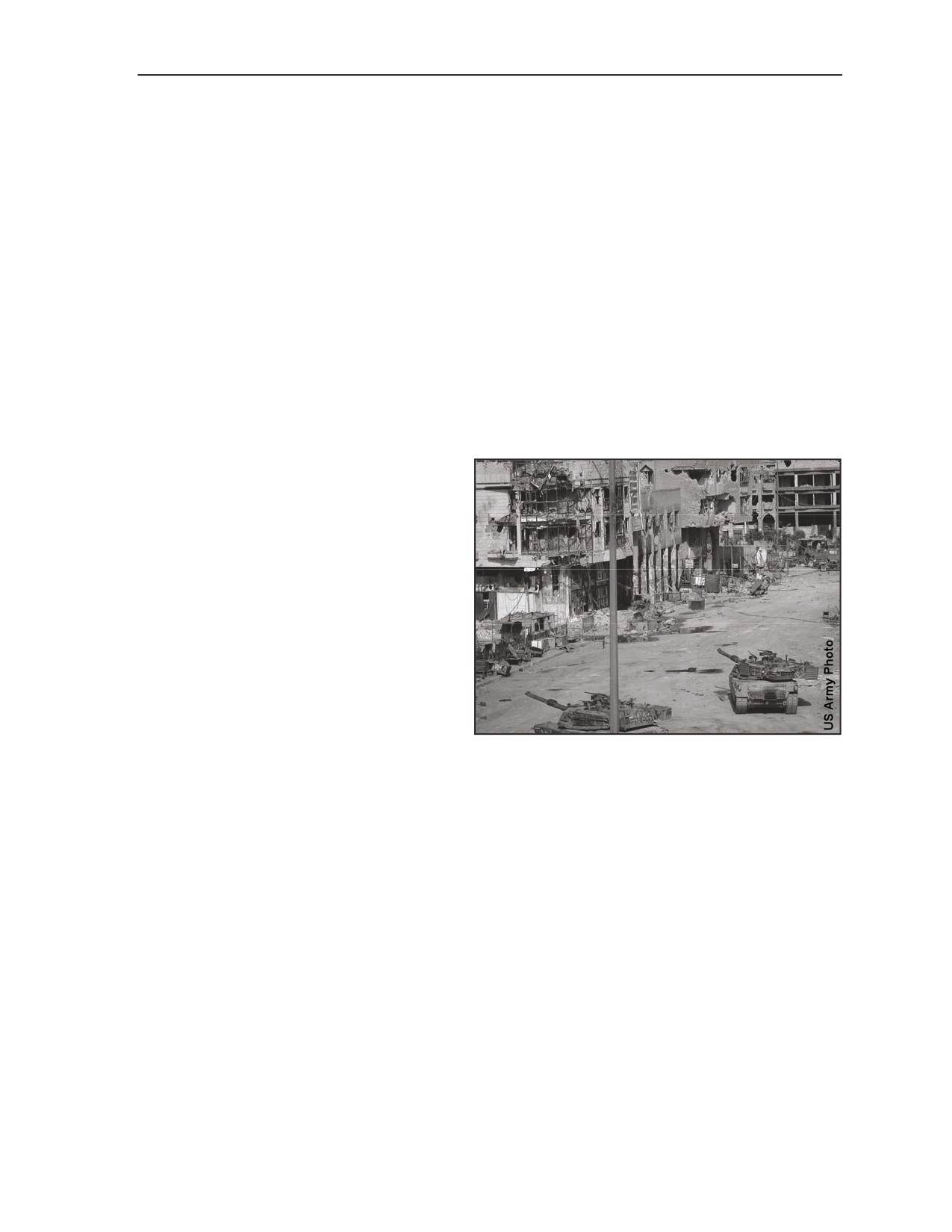
Urban Offensive Operations
ENGAGE
7-74. Commanders may employ several methods to decisively engage elements of the urban area during
offensive operations. These include—
Rapid maneuver.
Appropriate use of SOF.
Precise application of fires and effects.
Proper balance of speed and security.
7-75. None is unique to UO. Their effective execution, however, allows Army commanders to dominate in
this challenging environment by effectively using resources with the least amount of collateral damage.
Overall, decisive engagement results from urban offensive operations when forces achieve the objective of
the assigned mission and establish preeminent control over the necessary terrain, population, and
infrastructure. Largely, the Army commander’s ability to engage is based on superior situational
understanding and the correct application of unit strengths to the challenges found in the urban
environment.
Rapid and Bold Maneuver
7-76. Commanders of major operations may
have or create the opportunity to seize an
urban area with rapid and bold maneuver.
Such maneuver requires striking while the
area
remains relatively
undefended—
essentially preempting an effective defense.
This opportunity occurs when the urban area is
well to the rear of defending threat forces or
before the onset of hostilities. Under such
conditions, an attack requires striking deep
behind threat forces or striking quickly with
little time for the threat to make deliberate
preparations. Attacks under such conditions
may entail significant risk; however, the
potential benefit of audacious offensive
operations may be well worth possible losses.
Three potential ways to accomplish such attacks (and their combinations) are:
Airborne or air assault.
Amphibious assault.
Rapid penetration followed by an exceptionally aggressive exploitation, for example, a heavy
force using shock, armor protection, and mobility.
7-77. Commanders should analyze all potential urban operations to seek an opportunity or advantage to
apply rapid and bold operational maneuver to the task. Using operational maneuver to avoid urban combat
against an established threat defense potentially marks a significant operational achievement and can have
decisive strategic consequences. Just influencing the threat’s morale can positively affect all future
operations. However, commanders must evaluate the challenges of such a course of action. These
challenges may include—
Sustaining the operation.
Avoiding isolation and piecemeal destruction.
Successfully conducting shaping attacks.
Achieving the necessary tactical, operational, and strategic surprise.
7-78. Commanders can also build on the shaping effects of isolating the urban area internally and
externally by attacking urban decisive points from multiple directions. They can attack multiple decisive
points either simultaneously or in a systematic, synchronized manner. This complicates the threat’s
26 October 2006
FM 3-06
7-25
Chapter 7
situational understanding of the urban environment, further impedes his decision making, and allows Army
commanders to dictate the tempo.
Bold Operational Maneuver to Seize an Urban Area:
Inchon and Seoul, Korea - 1950
In August 1950, UN forces in Korea were desperately attempting to stave off defeat
by establishing a viable defense in southern Korea. This defense, known as the
Pusan Perimeter, was the focus of the world’s attention. The commander of U.S.
Forces Far East, General Douglas MacArthur, was not focused on the U.S. Eighth
Army in Pusan. Instead, he focused on how to dramatically and decisively transition
to the offense—the recapture of the South Korean capital of Seoul.
Seoul was more than just the South Korean political capital, although that was an
important consideration. Seoul was the key to the Korean transportation system, the
hub of the national communications system, and the center of the country’s economy
and culture. It was also strategically placed astride maneuver corridors to the north,
south, and northeast. It had been Korea’s capital since 1394 when King Taejo Yi
Sung-Gye established it as the center of the Chosun dynasty. It had been captured
by the surprise communist invasion of the south in June 1950, and the key to
success in Korea was its recapture. The question was how.
The obvious military solution to the Korean situation in August 1950 was to build
military strength within the Pusan Perimeter and then, when sufficiently strong, to
breakout and counterattack north and recapture Seoul. The disadvantage of this
course of action was that the counterattack would be through hundreds of miles of
mountainous terrain, through several other major cities, and across numerous rivers.
The North Korean People’s Army (NKPA) would be able to fall back from one
mountain defense and one river line to another and would have weeks or months to
prepare the defenses of Seoul.
MacArthur’s solution was to delay a conventional counterattack, boldly maneuver by
sea deep into the flanks of the NKPA, land on the Korean west coast at Inchon, and
rapidly seize Seoul before the enemy could react (see figure 7-18). This course of
action had numerous disadvantages: achieving surprise; assembling a landing force
trained in amphibious operations; few good landing sites; supplying a large force
once landed; and needing to simultaneously continue to defend and prepare a
counterattack with the Eighth Army from Pusan. MacArthur understood the
challenges of the operation but believed that the potential value compensated for the
risk.
The potential value of a rapid assault on Seoul through a deep amphibious operation
was immense. The operation would trap the bulk of the NKPA in South Korea and
facilitate its destruction. It would also capture Seoul before the NKPA could prepare a
defense. The quick recapture would immeasurably impact the morale of UN forces
and South Korea. MacArthur felt the payoff of success justified the risks and
challenges of the operation.
On 15 September, elements of the 1st Marine Division landed in Inchon taking the
NKPA completely by surprise. On D+1 they were joined by elements of the 7th
Infantry Division, both divisions under the control of U.S. X Corps. Naval gunfire and
Marine close air support flying from Navy aircraft carriers supported the landings.
Seven days later, the 5th Marine Regiment had battled 25 miles to the outskirts of
Seoul and began attacking the city from the north. Three days later, on
25
September, the 1st Marine Division and elements of the 7th Infantry Division had
defeated the 10,000 defenders of the NKPA’s 18th Rifle Division.
7-26
FM 3-06
26 October 2006
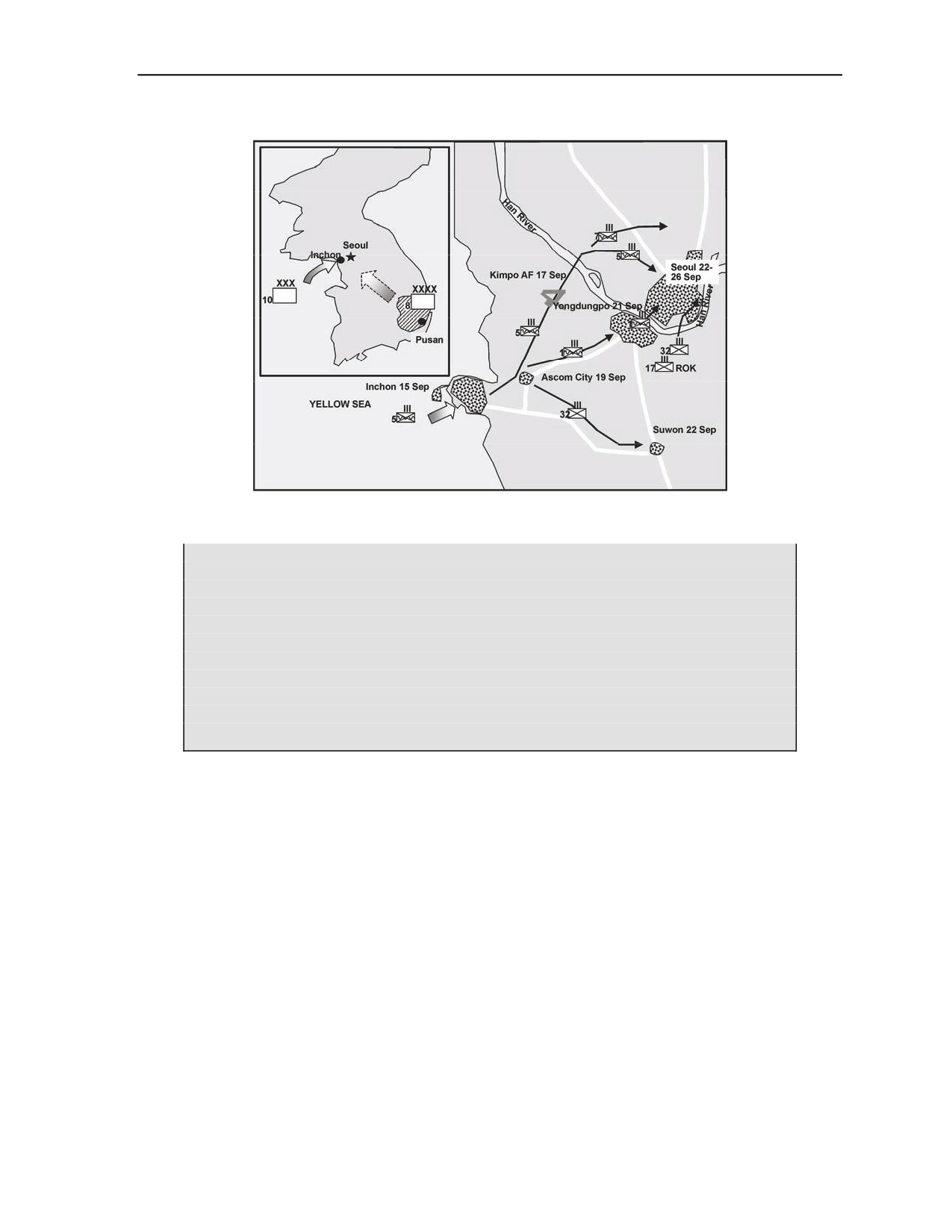
Urban Offensive Operations
Figure 7-18. Inchon-Seoul campaign, September 1950
Most of MacArthur’s predictions for the Inchon-Seoul campaign were accurate.
Superb staff work, excellent logistics operations, and unmatched training permitted
the UN forces to assemble a trained landing force, land it over one of the most
difficult shores in the history of military amphibious operations, and keep it supported.
More importantly, the operation achieved total strategic and operational surprise.
Seoul was recaptured quickly and, although resistance was fierce, the NKPA could
not react fast enough to influence the outcome. In conjunction with the Eighth Army
counterattack from Pusan, 75 percent of the NKPA was destroyed. The Inchon-Seoul
campaign was an important turning point in the war, and had not the Chinese
People’s Army intervened two months later, it would have been the decisive
campaign of the war.
Appropriate Use of Special Operations Forces
7-79. Sometimes Army forces can decisively engage (instead of simply shape) the urban area using the
direct action capability of SOF. When the threat fails to develop a comprehensive defense and does not
possess large, capable conventional forces, then Army forces can achieve operational surprise.
Commanders, by synchronizing conventional and SOF effects, may actively control offensive operations to
dominate the area. Importantly, however, conventional ground forces must be available to quickly assume
the mission because SOF units acting as the primary striking force have limited logistic capability to
sustain long-term operations. OPERATION JUST CAUSE offers several examples of this type of
synchronization (see Applying the Urban Operational Framework: Panama in Chapter 6).
Precise Application of Fires and Effects
7-80. Precisely applied fires and the massed effects of combat power characterize successful urban attacks.
The fires can be direct fire from combined heavy or light ground teams; direct or indirect fires from
supporting Army aviation standing off from the target and any possible air defense threat; precision
indirect fires from conventional tube artillery; or direct and indirect fires from supporting joint assets
including Air Force and naval assets. All efforts strive to reduce collateral damage around the point of
attack, consistent with mission success. Forces use fires to deny the threat the ability to maneuver in the
26 October 2006
FM 3-06
7-27
Chapter 7
urban area and to destroy the threat when he attempts to maneuver. When the threat exposes himself by
moving, the environment no longer protects him, and fires can effectively engage him. Overall, precise
fires and effects demonstrate the power of Army forces and help the urban population understand that only
legitimate military targets are the focus of attacks, potentially building public support of Army UO.
Proper Balance of Speed and Security
7-81. Attacking units balance speed and security. Forces secure flanks as units advance, control
dominating terrain
(buildings), evacuate civilians, and keep the integrity and synchronization of the
combined arms team. Obstacles are anticipated and rapidly breached. Commanders can choose avenues of
approach to—
Provide cover and concealment for following aviation and support units.
Permit travel by all classes of vehicles.
Easily defend from counterattack.
Avoid nonessential centers of threat resistance.
Avoid population concentrations.
7-82. Army aviation is a critical resource to protect flanks. Another important resource is engineers who
seal off surface and subsurface entries and avenues along the flanks of the attack. Finally, as in all
offensive operations, ground and air cavalry are ideal mobile forces to perform security in an economy of
force role along flanks allowing decisive forces more freedom of maneuver.
CONSOLIDATE
7-83. Commanders, at all levels, must consolidate to strengthen their position during urban offensive
operations without loss of momentum. They take the steps necessary to make permanent any temporary
battlefield successes while maintaining relentless pressure on threat forces. Consolidation provides security
and protection, facilitates reorganization, and allows forces to prepare for counterattack.
Repositioning of Forces
7-84. Following seizure of the objective, commanders normally consolidate by adjusting and repositioning
forces. While UO are likely to be noncontiguous, commanders reposition ISR assets (including observation
posts and reconnaissance patrols) to maintain contact with the threat, to establish contact with nearby
friendly units and ensure that there are no exploitable gaps or seams, and to help maintain freedom of
action. Physical occupation of the terrain (as well as continued reconnaissance) will provide commanders
with a fuller understanding of the urban environment. With this enhanced understanding, commanders may
need to adjust boundaries and other control measures to better adapt to the effects of urban terrain features
such as canals, subway tunnels, raised roadways, and tall buildings. As necessary, commanders may also
need to reposition communications assets and C2 facilities to enable subsequent operations.
7-85. Immediately after the conduct of successful urban operations, units must also be alert to the potential
for rapid and violent counterattacks. Defenders may launch a quick counterattack to regain terrain before
the offensive forces have consolidated and fully assumed the defensive advantages of the urban terrain.
Delaying a counterattack in UO, even for a few minutes, permits the environment’s advantages to shift to
the successful attacker. Thus, attacking units anticipate this reaction and reposition forces such that they are
prepared to defeat it.
7-86. As necessary, commanders should reposition armor and artillery (and other fire support assets) to
account for the changing situation and battlefield geometry. Commanders should also consider
consolidating and repositioning armored and artillery forces in positions—either inside or outside the urban
area—to add significant combat power to a hasty defense, to defeat threat counterattacks, or to allow for
quick resumption of the attack. If integrated into a hasty defense inside the urban area, these forces will
require continued infantry protection. As a mobile counterattack force positioned inside the urban area,
armored forces will also require careful selection of attack positions and counterattack routes. Damage to
buildings and infrastructure may limit maneuver and the use of direct and indirect weapon systems.
7-28
FM 3-06
26 October 2006
Urban Offensive Operations
Repositioning forces outside the urban area may contribute to strengthening or reestablishing the isolation
of the urban area and will make better use of range and standoff capability, allow them to take full
advantage of their speed and mobility, and decrease their need for additional protective support.
Eliminating Pockets of Resistance
7-87. Focusing on controlling the essential and attacking decisive points means that attacking units will
have bypassed some elements of the threat’s defense. Within the bounds of the initial plan and current
situation, commanders should consider whether it is necessary to devote the time and resources to
immediately clear and eliminate remaining threat forces and pockets of resistance with all or parts of the
attacking force or leave the task to follow-on forces. In their deliberations, commanders should determine
if remaining threat forces are capable of consolidating and mounting effective counterattacks before
follow-on units can engage the remaining threat and take advantage of their dispersion and disunity. As
another part of their deliberations, commanders should also consider if remaining threat forces will likely
(and immediately) endanger—
The urban inhabitants.
Lines of communications.
Critical resources within the urban area necessary to support the inhabitants or subsequent
operations.
Reorganization
7-88. Reorganization includes all measures taken by the commander to maintain combat effectiveness or
return to a specified level of combat capability. As necessary, these actions include—
Redistributing or cross-leveling supplies and equipment until resupply can be accomplished.
Replacing key personnel and combining units or crews to form mission-capable ones.
Integrating replacement soldiers and systems into the unit and matching operational systems
with available crews.
Recovering, treating, and evacuating casualties, enemy prisoners of war, and damaged
equipment.
Conducting training and disseminating critical lessons learned.
Other actions to reestablish unit cohesion.
TRANSITION
7-89. Effective transitioning allows commanders to continue full spectrum operations in the urban area and
elsewhere in the AO without unnecessary delays. Commanders can accomplish this by thorough
planning—including appropriate branches and sequels (revised as the situation changes)—that gives
adequate consideration to post-offensive organizational, training, psychological, and civilian requirements.
If properly prepared, commanders can anticipate rather than react to potential mission changes.
Early and Concurrent Transition Planning
7-90. Commanders can ensure smooth transitions of urban offensive operations by planning for post-
offensive operations early. Based on the mission envisioned, they determine which subordinates and what
type of force structure to use. Post-offensive missions, like all urban operations, encompass full spectrum
operations. At the successful conclusion of offensive operations, Army forces transition to some type of
stability or civil support operation. Commanders may leave the subordinate unit in place to execute the new
mission, may reorganize the subordinate unit for the mission, or relieve the unit that just completed
offensive operations with a new unit.
Changes to Task Organization
7-91. Commanders should consider the organization of forces following offensive operations. Hostile
civilians may require significant combat forces or military police forces to maintain stability. On the other
26 October 2006
FM 3-06
7-29
Chapter 7
hand, friendly civilians may require a minimum of military police or combat forces, but significant logistic
support. Commanders must carefully consider the urban situation before deciding how to use combat
forces that recently participated in a high-intensity offensive operation.
Training and Psychological Considerations
7-92. Many Army combat tasks may not support follow-on stability or civil support operations without
considerable modification (if at all). Often, noncombat skills—not normally part of a unit’s mission
essential task list such as negotiating or mediating skills—will be required. However, the greatest
modification required applies to each soldier’s mental outlook. Forces that transition directly from combat
to stability operations may not be psychologically prepared for a rapid and drastic change of mission.
Commanders cannot expect troops who have just completed high-intensity offensive operations to rapidly
adjust and exercise the sensitivity and judgment required in most stability operations. This especially
applies if the population is hostile to Army forces. If possible, combat forces assisting in stability
operations, particularly in hostile civilian situations, should not have had recent experience in high-
intensity urban operations and they should have trained for the mission.
Return to Civil Agencies
7-93. Commanders of major operations also have the critical role of transitioning aspects of the urban
offensive operation to civil, allied, NGOs, and other agencies as appropriate. Transition planning is
detailed and aims to quickly return as much civil control of the area as is feasible after the attack. Beyond
local civil control, outside civil agencies and NGOs assume tasks as completely and as rapidly as possible.
These organizations are consulted and integrated into the planning process as early as possible.
Commanders should begin planning for transition simultaneously with planning for offensive operations.
They consider the feasibility of relinquishing control of urban areas to civil government, law enforcement,
or NGOs even before completing offensive operations. During the conduct of urban operations, these
transition operations are closely synchronized with the execution of the attack.
Transition to a New Mission
7-94. In urban offensive operations, like other offensive missions, the change in mission after a successful
urban attack may be to a hasty defense or a continuation of offensive operations outside the area. However,
in urban offensive operations the mission will just as likely rapidly change to a civil support or stability
mission. This is particularly true if the unit has had special training and is task organized for urban
operations. Transition to stability or civil support operations is often accompanied by a transition in roles
from supported to supporting.
7-95. Even more challenging than transition at the end of the mission is transition during the conduct of
the mission. Soldiers may have a difficultly transitioning from stability or civil support to offense and
defense, and back again multiple times during an urban offensive operation. Soldiers may apply the tactics,
techniques, and procedures of urban offensive operations directly to the stability or civil support missions
with potentially disastrous results. Commanders need to segregate missions in time and space, and, if
sufficient forces exist, by unit. To this end, commanders should consider permanently designating specific
units to conduct civil-military and humanitarian support tasks and avoid rapid mission changes that rotate
units
(particularly at company level and below) between violent and nonviolent tasks. However,
commanders may not have that luxury and may need to rely heavily on preparatory training (including the
inculcation of Army values) and strong unit leadership to mitigate potential difficulties.
7-30
FM 3-06
26 October 2006
Chapter 8
Urban Defensive Operations
Generally, a modern city magnifies the power of the defender and robs the attacker of his
advantages in firepower and mobility. A city can ingest an invading army, paralyze it for
weeks on end, and grind it down to a state of ineffectiveness.
“Military Operations on Urbanized Terrain:
The 2d Battalion, 26th Infantry, at Aachen, October 1944”
The skillful defense of an urban area can decisively affect a campaign. The urban
area offers many advantages to defending forces. An adroit defender can use the
advantages of the urban environment to negate combat power disparities, blunt the
tempo of an attack, attrit threat forces, and sap the morale of attacking troops. The
defender gains an opportunity to concentrate resources, reconstitute attrited units, and
transition to the offense. A successful defense of an urban area can also deny the
threat vital resources. Defense in the urban environment is an essential Army
capability and can significantly affect the outcome of entire campaigns and the
achievement of national objectives.
PURPOSE OF URBAN DEFENSIVE OPERATIONS
8-1. Army forces defend urban areas for various reasons: defeating a threat attack, buying time,
economizing forces, protecting an ally’s political institutions and economic infrastructure, protecting an
urban population, shaping conditions for decisive offensive operations, and shaping conditions for
executing stability or civil support operations. During force projection operations, urban areas may be used
as initial lodgment areas that Army commanders may need to defend at the outset until they build sufficient
combat power. Usually two or more of these purposes apply to the urban defense. Urban defensive
operations provide commanders great opportunities to turn the environment’s characteristics to the
advantage of Army forces. Urban areas are ideal for defensive operations and greatly enhance the combat
power of defending units.
DEFENSIVE CHARACTERISTICS APPLIED TO URBAN
OPERATIONS
8-2. There are five general characteristics of the successful defense: preparation, security, disruption,
massing effects, and flexibility. All apply to the successful urban defense and to the higher commander
supporting a subordinate defending in the urban area.
PREPARATION
8-3. The urban area suits the defense since the area’s physical characteristics naturally enhance the
combat power of defending units. These characteristics include protection, obstacles, and concealment.
Urban terrain provides superb defensive positions with minimum preparation. With deliberate preparation,
urban defensive positions can rapidly become strong points.
8-4. One primary characteristic of urban terrain that enhances the defense is protection. With little or no
advance preparation, buildings, subsurface structures, and walls protect Soldiers from direct and indirect
fire, interdict indirect fire, limit observation, and limit engagement ranges (requiring Soldiers to be skilled
at combat in close quarters and quick-fire techniques). Nearly all buildings provide some ballistic
26 October 2006
FM 3-06
8-1
Chapter 8
protection from direct and indirect fire. Mason and stone buildings with basements and cellars can protect
Soldiers from most fires except the largest caliber or tonnage bomb. Minimal additional preparation turns
them into formidable, defensive strong points.
8-5. Buildings in urban areas, because of their height and close proximity, also can protect Soldiers by
masking them from indirect fire. The height of a building may interdict the flight path of an artillery round,
rocket, missile, or bomb at a point short of the intended target. Masking protects static defending forces
and protects forces moving along routes bordered with tall buildings that form urban “canyons”. These
protected routes can be used for sustainment, counterattacks, and maneuver.
8-6. Structurally significant buildings in an urban area can create major obstacles to maneuver. These
obstacles immediately canalize maneuver into existing streets and routes without any preparation by the
defense. These obstacles then become kill zones for well-positioned and sited defensive forces. Minimal
obstacle construction as point obstacles blocking streets and routes can further restrict the maneuver
options of the attacking force. Rubble from structures collapsing into streets after fires (intentional or
unintentional) can also block routes.
8-7. Buildings also conceal the location, disposition, and intent of the defense. They limit visual
observation to the external perimeter of the urban area. They degrade radar and electronic position
identifiers and decrease the utility of overhead imagery. The physical aspect of the urban environment
greatly enhances the defense by degrading the opposition’s intelligence, surveillance, and reconnaissance
(ISR) capabilities. Buildings can conceal static defensive positions and the maneuver of defensive forces in
the urban area. Although the environment constrains defensive mobility in much the same manner as
offensive mobility, the defender has the time and opportunity to conduct careful reconnaissance and select
and prepare routes. This gives the defender the ability to move reserves, maneuver counterattack forces,
and plan sustainment without observation. Careful preparation provides the defender a mobility advantage
over attacking forces.
SECURITY
8-8. The urban area can be an advantage or a disadvantage to the security of defending forces. This
largely depends on the nature of the human dimension of the environment. If the population is evacuated or
allied with Army forces, then the environment may assist in the security of defending Army forces.
However, if the population is present and hostile, then the environment may make security difficult.
8-9. The physical aspects of the urban environment, uninfluenced by the human dimension, may assist in
the security of defending Army forces. The combat power of small security forces manning observation
posts is greatly enhanced. Forces can more easily restrict and monitor avenues of approach for threat
reconnaissance. Defending forces positioned mostly in structures are difficult to locate.
8-10. The physical aspects of the environment may also present some security challenges, primarily with
observation. The compartmented terrain limits the field of observation from any one point. The defense
may require more security forces to adequately observe the mounted and dismounted avenues to prevent
infiltration. Threat forces that successfully infiltrate will be more difficult to locate. These forces will gain
numerous hide positions for small reconnaissance units in complex terrain and the effect the terrain has in
masking electronic signatures.
8-11. Friendly civilians in the urban area can help identify threat forces attempting to conduct
reconnaissance. Civilian activity will also help to mask defense preparations. However, a hostile element of
the population may pass intelligence information to the threat. They may assist threat reconnaissance to
infiltrate the urban area or provide guides, manpower, or resource support for threat forces. Commanders
should take measures to ensure strict control of hostile populations. If resources permit, commanders may
consider removing potentially hostile civilians from the area.
DISRUPTION
8-12. The urban environment’s attributes assist defending Army forces to disrupt the attacker. It does this
through compartmentalization, inhibiting command and control (C2), and facilitating counterattacks.
8-2
FM 3-06
26 October 2006
Urban Defensive Operations
8-13. The physical aspects of the urban area force the attacking threat into compartmented urban canyons
that make mutual support between attacking threat columns difficult. Shifting resources from one portion
of the threat attack to another is also difficult. Physically, the urban area disrupts tactical communications
making synchronization of combat power difficult.
8-14. The urban terrain hinders the mobility capabilities of the defense. However, careful planning,
preparation, and rehearsals can facilitate more rapid movement of larger forces. Defending forces can
assemble counterattacks undetected, move them along covered and concealed routes, and achieve surprise
at the point of the counterattack. Attacking forces, using the compartmented terrain, often leave forward
elements in position to be isolated or expose long and vulnerable flanks to friendly counterattack and
interdiction.
MASSING EFFECTS
8-15. The urban environment allows defenders to better protect their centers of gravity and decisive points.
The restrictive terrain reduces the attacker’s maneuver options. Defenders can position forces in protected
and mutually supportive positions oriented on deadly engagement areas. Relatively few well-positioned
defenders can generate significant combat power. Without the positional advantage and the corresponding
protective effects of the terrain, attacking forces often mass numbers to achieve the necessary combat
power.
8-16. Knowing the complex terrain permits defending forces to plan engagement areas that maximize the
effects of their combat power. Defending forces can remove fences, walls, rooftops, and even entire
buildings to facilitate fields of fire and unmask indirect fire flight paths. Forces carefully choose firing
positions for indirect fire systems so that flight paths travel between buildings into engagement areas. By
leveraging this knowledge of the terrain, numerically inferior defenders can synchronize devastating fires
on offensive forces that are forced by terrain and reinforcing obstacles to mass in confined spaces where
fires can have the greatest effect.
FLEXIBILITY
8-17. Defensive flexibility results from detailed planning and mental agility. Commanders develop
defensive flexibility by ensuring that plans adequately address branches and sequels that include alternate
and subsequent positions and emphasize counterattack options. The urban area facilitates defensive
flexibility because the urban terrain can be quickly adapted for defensive operations with little or no
preparation. The effect is similar to having multiple, prepared positions on nearly every possible approach.
The urban area can also permit rapid, covered movement on interior lines. This permits swift movement to
and occupation of strong defensive positions with little or no preparation. The defense also has more
flexibility since defenders often know and better understand the urban terrain’s effects on operations.
Normally, defenders will not get lost as easily, will know complex lines of sight and masking effects, and
will best understand the ballistic characteristics of individual structures.
8-18. Mental agility allows commanders to see that the best urban defense may actually be to defend
outside of the area. Such a defense mitigates the danger to the urban population and potentially reduces
collateral damage. It takes advantage of Army long-range engagement capabilities and denies the threat the
opportunity to “hug” Army forces or noncombatants as protection from fires. This defense may be
appropriate when Army forces have enough resources to defend more open terrain, when time permits
deploying extensive obstacles and constructing protected positions, and when natural terrain such as river
obstacles aids the defense.
URBAN DEFENSIVE OPERATIONS AND BATTLEFIELD
ORGANIZATION
8-19. Urban defensive operations are organized within the overall battlefield organization of sustaining,
shaping, and decisive operations. The success of urban defense depends on each operation, but
commanders must synchronize these simultaneous operations as one action. Sustaining operations in
defensive urban operations (UO) ensure freedom of action. Critically, urban sustaining operations ensure
26 October 2006
FM 3-06
8-3