FM 3-06 URBAN OPERATIONS (OCTOBER 2006) - page 2
Chapter 2
this element may become extremely important. In this instance, the urban commander may need to adjust
his IO (to include PSYOP), public affairs (PA) activities, and CMO to counter this propaganda while
diverting other combat power to control the populace. Overall, commanders must understand and account
for second, third, and higher order effects of their actions and decisions.
Understanding the Effects of Unit and Soldier Actions in Iraq
During OPERATION IRAQI FREEDOM, an armor task force commander described
his methodology as that of plotting and measuring everything. After a positive or
negative event, he would have his staff evaluate all actions they had conducted
before, during, and after the event. This would allow him to correlate activities with
outcomes and develop tactics, techniques, and procedures for future success. While
not all actions easily correlated to events, this methodological approach helped
establish a base line of comparative success for his task force.
Some units assessed the Iraqi culture and developed practical guidelines or rules of
interaction for their soldiers to follow as they conducted their missions. These
guidelines encompassed a list of actions that their Soldiers should and should not do
when dealing with the Iraqi populace. The guiding principle behind these actions was
not only to “win the hearts and minds” of the Iraqi people but, more accurately, to
establish legitimacy and credibility through appropriate Soldier actions that reflected
a combined understanding of the mission and the Iraqi culture.
DO:
• Separate the men from the women and children during cordon and searches.
• Talk to the oldest or most senior male when civilian cooperation is needed.
• Bring something (for example, water, food, or replacement locks) to give residents
to compensate for damages when the search ends up being a “dry hole.”
• Learn Arabic phrases; say hello and greet people on the street.
• Use female Soldiers to search and talk to Iraqi females.
• Cordon and knock whenever possible instead of kicking in doors needlessly.
• Understand that in Iraq, women do not have the same social status as men.
DO NOT:
• Force a detainee’s head to the ground or use your feet to hold someone to the
ground.
• Stare at or touch Iraqi women.
• Show obvious disrespect to suspects in front of family members.
• Manhandle the Koran or other religious objects.
• Commit to anything; instead of agreeing to (or denying) an Iraqi’s request, it is
good practice to say “In’sha Allah” (If God wills it).
URBAN INFRASTRUCTURE
2-59. Urban infrastructures are those systems that support urban inhabitants and their economy. They form
the essential link between the physical terrain and the urban society. During urban stability and civil
support operations, restoration or repair of urban infrastructure will often be decisive to mission
accomplishment. During urban combat operations, destroying, controlling, or protecting vital parts of the
infrastructure may be a necessary shaping operation that can isolate a threat from potential sources of
support. A threat force operating in an urban area may rely on the area’s water, electricity, and sources of
2-18
FM 3-06
26 October 2006
Understanding the Urban Environment
bulk fuel to support his forces. This is true particularly when his bases or facilities are physically located in
or near the area. Isolating this threat from these sources may require him to generate his own electricity and
transport his own water and fuel from outside the urban area. To transport supplies, the threat may rely on
roads, airfields, sea or river lanes, and rail lines. Controlling these critical transportation nodes may prevent
the threat from resupplying his forces. The control of key radio, television, and newspaper facilities may
isolate him from the urban populace (another potential source of support).
INTERDEPENDENCE
2-60. Commanders must understand that destroying or disrupting any portion of the urban infrastructure
can have a cascading effect (either intentional or unintentional) on the other elements of the infrastructure.
Yet, they may be able to gain an operational advantage while minimizing unwanted and unintended effects.
Commanders can control, seize, or secure an essential facility or structure by using precision munitions,
electronic disruption of communications, or SOF and conventional ground forces. To gain this advantage,
commanders will rely more on the expertise of Army engineer and civil affairs units; local urban engineers,
planners, and public works employees; and others with infrastructure-specific expertise. After
understanding the technical aspects of the area’s systems and subsystems, commanders can then develop
the best course of action.
A SYSTEM OF SYSTEMS
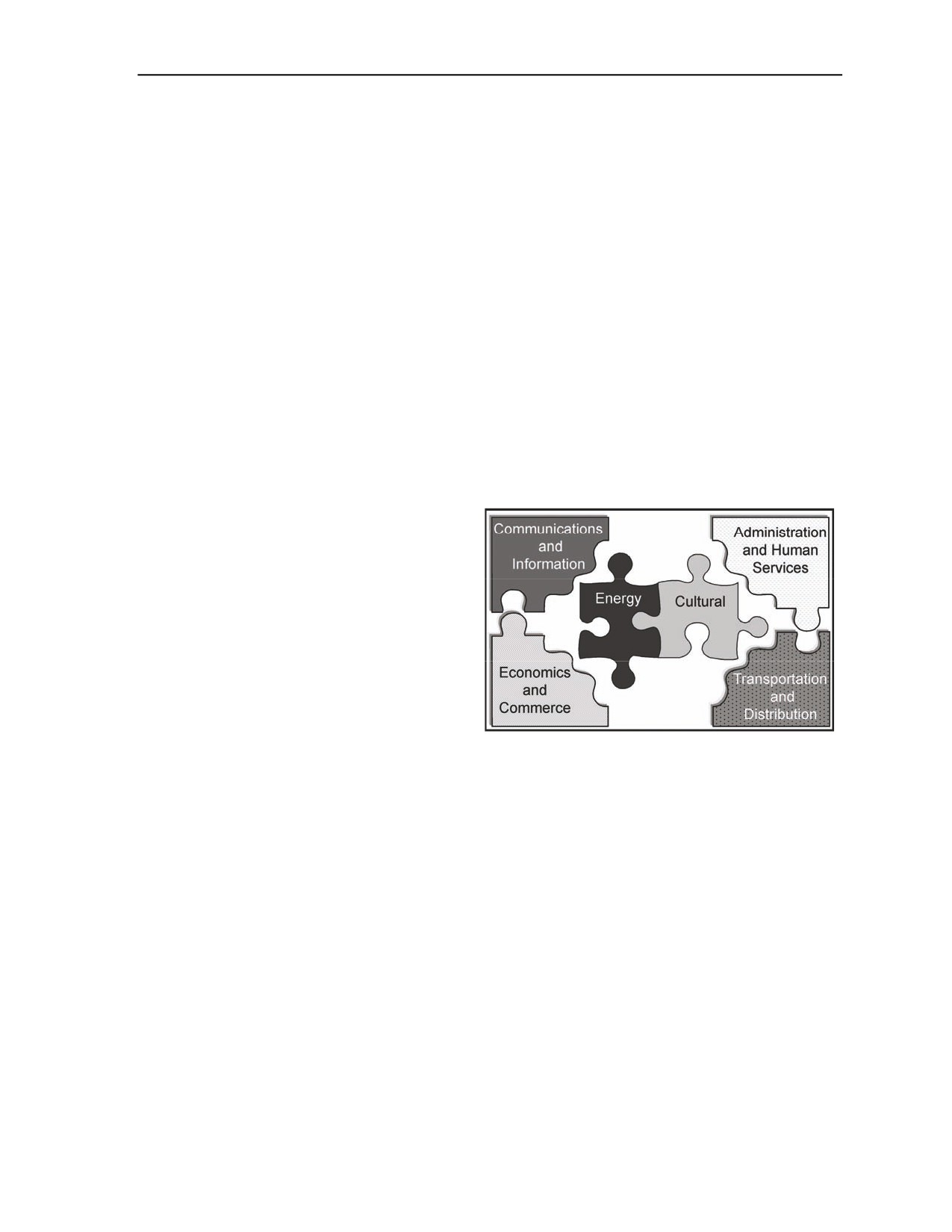
2-61. Hundreds of systems may exist. Each system has a critical role in the smooth functioning of the
urban area. Simple or complex, all systems fit
into six broad categories
(see figure
2-11).
Commanders should analyze key facilities in
each category and determine their role and
importance throughout all phases of the urban
operation. As there is much overlap between
infrastructure systems, this analysis considers
each system individually and in relation to
others to determine an appropriate course of
action toward it.
Figure 2-11. Urban infrastructure
A COMBINATION OF STRUCTURES AND PEOPLE
2-62. As depicted earlier in figure 2-1, each element of the infrastructure consists of both a physical (ter
rain) and human component. For example, the physical component of the electrical segment of the energy
infrastructure consists of power stations, substations, a distribution network of lines and wires, and
necessary vehicles and repair supplies and equipment. The human component of this same segment
consists of the supervisors, engineers, linemen, electricians, and others who operate the system.
Commanders must understand and recognize the physical and human components in their assessments.
POTENTIAL IMPACT ON FUTURE OPERATIONS
2-63. Destroying or incapacitating of any of these elements may impact future operations and inhabitants
of the urban area. Destroying urban infrastructure during initial phases of an operation may require
commanders to assume responsibility for repair, maintenance and clean up, and operation of those same
facilities later. Although exceptions will exist, commanders cannot destroy or significantly damage the
infrastructure of a foreign urban center during operations and expect the population to remain friendly to
U.S. or allied forces. On the other hand, early repair or restoration of critical or essential infrastructure may
improve civil-military relations, speed transition back to competent civilian authorities, and, overall, aid in
26 October 2006
FM 3-06
2-19
Chapter 2
successful mission accomplishment. Still, support from the urban society (albeit of increased importance in
UO) is only one factor that commanders weigh while developing appropriate courses of action.
RESOURCE INTENSIVE
2-64. Requirements to protect, restore, or maintain critical infrastructure may divert substantial amounts of
resources and manpower needed elsewhere and place additional constraints on subordinate commanders.
Civilian infrastructure is often more difficult to secure and defend than military infrastructure. The
potentially large and sprawling nature of many systems (such as water, power, transportation, communica
tions, and government), make their protection a challenge. Yet, the infrastructure of an urban area may
provide commanders with essential logistics and support. Therefore, the initial expenditure of time and
other resources may be necessary to support concurrent or future operations. Legal considerations,
however, may affect using the infrastructure and acquiring the urban area’s goods and services.
Commanders, their staffs, and subordinates (often down to the individual soldier) must know their limits
concerning Army authority to commandeer civilian supplies or equipment to facilitate mission accom
plishment (see the legal support discussion in Chapter 9). In stability and civil support operations, the safe
guard or restoration of critical urban infrastructure for military or civilian use may be a decisive point in
the overall operation.
2-65. Keys to understanding the magnitude of the resources and manpower required to restore the
infrastructure are an initial infrastructure assessment and, as soon as practical afterward, a detailed
infrastructure survey. An initial assessment provides the commander immediate feedback concerning the
status of basic services needed to meet the urgent needs of the urban population. The systems assessed are
based on mission, enemy, terrain and weather, troops and support available, time available, civil
considerations, and the commander’s vision of the overall end state. The infrastructure assessment, while
typically performed by engineers, may be accomplished by, or in conjunction with, others with sufficient
expertise to provide the type and quality of information required. These others may include civil affairs,
medical, and chemical personnel. Those tasked with this assessment should routinely consult other Army
and coalition forces and governmental and nongovernmental agencies currently operating in the urban area
as well as the urban civilian leadership for their informed input.
2-66. While an infrastructure assessment functions to support the resolution of immediate challenges to
urban reconstruction and restoration, it also provides the initial basis for determining the conditions for
successful transition. However, commanders and planners must continually expand and refine their
understanding. As a necessary follow-on, commanders initiate a detailed infrastructure survey. This survey
is normally conducted by U.S. Army Corps of Engineers personnel assigned to forward engineer support
teams. As with the assessment, the commander should incorporate other technical specialty personnel in
the survey team to enhance the quality and accuracy of the product (see FM 3-34.250).
COMMUNICATIONS AND INFORMATION
2-67. This system is comprised of the facilities and the formal and informal means to transmit information
and data from place to place. Understanding communication and information infrastructure of an urban
area is important because it ultimately controls the flow of information to the population and the enemy. It
includes—
Telecommunications, such as telephone (to include wireless), telegraph, radio, television, and
computer systems.
Police, fire, and rescue communications systems.
Public address, loudspeaker, and emergency alert systems.
The postal system.
Newspapers, magazines, billboards and posters, banners, graffiti, and other forms of print
media.
The informal human interaction that conveys information such as messengers, open-air speeches
and protests, and everyday conversations.
Other inventive informal means such as burning tires and honking horns.
2-20
FM 3-06
26 October 2006
Understanding the Urban Environment
2-68. Perhaps more than any other element of the infrastructure, communications and information link all
the other elements in an interdependent “system of systems.” It is a critical enabler that helps coordinate,
organize, and manage urban activities and influence and control the urban society. Army commanders are
acutely aware of the impact that a loss or degradation in communications has on their own operations. The
urban environment experiences similar impacts to communication failures; however, urban governments
and administrations are generally less prepared to deal with a collapsed communications and information
infrastructure than are trained Army forces.
2-69. Militarily, a functioning urban communications and information system can serve as an alternate for
both friendly and threat forces and can be easily secured with civilian, off-the-shelf technologies. Threats
may make use of commercial systems intertwined with legitimate civilian users, making it unpalatable to
prevent use of these assets. Forces can also use these systems to influence public opinion, gain intelligence
information, support deception efforts, or otherwise support IO.
Increasing Impact of Computers
2-70. In many urban areas, computers link other elements of the urban infrastructure. They link functions
and systems in the urban area and connect the area to other parts of the world. This latter aspect creates
important implications for commanders of a major operation. Operations involving this cybernetic function
may produce undesirable effects on a greater scale than initially intended. For example, commanders may
be able to close or obstruct an urban area’s banking system; however, this system may impact the interna
tional monetary exchange with unwanted or even unknown effects. The authority to conduct these types of
IO will often be retained at the strategic level.
Pervasive Media
2-71. The media is central to the communications and information infrastructure and a critical operational
concern. Compared to other operational environments (jungles, deserts, mountains, and cold weather
areas), the media has more access to urban operations. This is due largely to airports, sea and river ports,
and major road networks; ready access to power sources and telecommunications facilities; as well as
access to existing local media structures. Hence, media presence may be pervasive and IO even more
critical to success in UO than operations in many other environments.
A Complex Relationship
2-72. A complex relationship exists among information, the public, and policy formulation. Although the
degree and manner in which public opinion shapes government policy are difficult to accurately determine,
negative visual images of military operations presented by the media can change political objectives and,
subsequently, military objectives. As important, media reporting can influence civilian activity in an urban
AO to either the advantage or disadvantage of the commander.
Whoever coined the phrase ‘The Theatre of Operations’ was very prescient. We are
conducting operations now as though we are on a stage, in an amphitheatre, or Roman
arena; there are at least two producers and directors working in opposition to each
other, the players, each with their own idea of the script, are more often than not mixed
up with the stage hands, ticket collectors and ice cream vendors, while a factional
audience, its attention focused on that part of the auditorium where it is noisiest, views
and gains an understanding of events by peering down the drinking straws of their soft
drink packs.
General Sir Rupert Smith
Deputy Supreme Allied Commander Europe
Induce Cooperation Through Credibility
2-73. Commanders do not control the media; however, they monitor the flow of information that the news
media receives and subsequently reports. Consequently, commanders should plan and execute PA
operations that will induce cooperation between the media and Army forces. Successful relations between
26 October 2006
FM 3-06
2-21
Chapter 2
urban Army forces and the news media evolve from regular interaction based on credibility and trust. More
information is usually better than less, except when the release of such information may jeopardize security
and the success of the operations and threaten the safety of Soldiers. However, commanders cannot simply
withhold information to protect the command from embarrassment. They consider media interests as part
of the normal planning process and work to ensure that information presented to the news media is
accurate, timely, and consistent with operations security. Since the media will likely arrive in the urban
area before the conduct of operations, early deployment of PA assets may be critical. Commanders should
synchronize PA activities with CMO and PSYOP. Such action eliminates duplicated effort and ensures a
unity of purpose consistent with the IO concept of support (see Chapter 4).
2-74. Failure to provide sufficient information can hamper a commander’s ability to conduct the mission.
Commanders cannot refuse to deal with particular news media because they consistently report a negative
image of Army forces and operations. Poor relationships with any media can result in inaccurate and even
biased reporting. Such reporting can cause a public reaction that influences the ability to achieve
operational objectives. During the Russian 1994-95 battle against Chechen separatists in Grozny, for
example, the Russian military refused to communicate with reporters. The media reported primarily from
the perspective of the Chechen rebels. This encouraged both local and international support for the rebels.
It also allowed the Chechens, who lacked sophisticated information systems, to use the media to broadcast
operational guidance to their forces. (During their second Chechnya campaign of 1999-2000, Russia
learned this lesson well and the Russian view of the war dominated domestic public opinion.) On the other
hand, successfully engaging the media can serve as a force multiplier. The Army’s open and responsive
interaction with the media during peacekeeping operations in Bosnian urban areas helped to explain the
challenges and successes of Army forces in the Balkans to the public. This helped maintain domestic,
international, and local political support for NATO operations and, with a successful command information
program, helped maintain Soldiers’ morale.
TRANSPORTATION AND DISTRIBUTION
2-75. This element of the infrastructure consists of—
Networked highways and railways to include bridges, subways and tunnels, underpasses and
overpasses, ferries, and fords.
Ports, harbors, and inland waterways.
Airports, seaplane stations, and heliports.
Mass transit.
Cableways and tramways.
Transport companies and delivery services that facilitate the movement of supplies, equipment,
and people.
Similar to communications and information, this facet provides the physical link to all other elements of
the infrastructure.
2-76. Army forces deploying into a theater of operations depend on ports and airfields; seizure and
protection of these critical transportation nodes may impact the projection of combat power. Once in
theater, transportation and distribution systems in the urban area can contribute greatly to the movement of
forces, maneuver, and logistic operations throughout the entire AO. Control of decisive points in this infra
structure may be important to the military operation and to the normal functioning of the urban area (and
surrounding rural areas). Supplies traveling through the transportation and distribution system may be
military-specific supplies (such as ammunition and repair parts) and supplies for both the military and
urban population (such as food, medicine, oil, and gas). The system may also support the movement of
military forces and the urban area’s population (for which it was designed). Therefore, commanders of a
major operation may have to develop innovative methods that limit the transit of threat supplies and
reinforcements while facilitating the movement of their own resources and those of civilians. This last
consideration attempts to minimize hardship and promote normalcy in the urban area and will increase in
significance as the need for legitimacy increases.
2-22
FM 3-06
26 October 2006
Understanding the Urban Environment
2-77. Most urban areas (particularly in developing countries) have two forms of transportation and
distribution systems that exist simultaneously: a formal system and an informal or paratransit system. Large
organizations, bureaucracy, imported technology, scheduled services, and fixed fares or rates characterize
formal systems. Low barriers to entry; family and individual entrepreneur organizations; adapted
technology; flexible routes, destinations, and times of service; and negotiated prices characterize the infor
mal system. The informal system is more decentralized and covers a much greater portion of the urban area
than the formal system. The informal transportation and distribution system often includes a waterborne
element, is more likely to function through turbulence and conflict, and can extend hundreds of kilometers
beyond the urban area. Accordingly, commanders should understand both systems to establish effective
movement control.
ENERGY
2-78. The energy system provides the power to run the urban area. It consists of the industries and
facilities that produce, store, and distribute electricity, coal, oil, wood, and natural gas. This area also
encompasses alternate energy sources, such as nuclear, solar, hydroelectric, and geothermal power. Energy
is needed for industrial production and is therefore vital to economics and commerce. Among many other
things, this system also provides the fuels to heat, cool, and light homes and hospitals, cook and preserve
food, power communications, and run the transportation necessary to move people and their supplies
throughout the urban area. Loss of an important energy source such as electricity or gasoline, especially for
those accustomed to having it, will become an immense area of discontent that the commander of a major
urban operation will need to quickly address. Therefore some threats, particularly terrorists and insurgents,
may actively target this element of the urban area’s infrastructure to erode support for civilian authorities
and Army forces.
2-79. Sources of energy may be tens or hundreds of miles away from the urban area itself. Therefore,
commanders may exert control without applying combat power directly to the urban area itself by
controlling or destroying the source (power generation or refinement plant) or the method of distribution
(pipelines or power lines). With electrical energy that cannot be stored in any sizable amount, the latter
may be the best means as most major urban areas receive this energy from more than one source in a
network of power grids. However, control may be as simple as securing a power station or plant and
turning off switches or removing a vital component that could later be restored. On the other hand, lengthy
pipelines and power lines may compound security and protection of this element of the infrastructure.
2-80. The number of nations that have invested in nuclear power and nuclear research is increasing. With
this increase, the potential for Army forces to operate in urban areas that include (or are near) these facili
ties also increases. Damage to one of these facilities and potential radiation hazards will present special
challenges to commanders of a major operation. To safeguard friendly forces and civilians, commanders
will need to employ a blend of peacetime and tactical nuclear contamination avoidance principles (see FM
3-11.14).
ECONOMICS AND COMMERCE
2-81. This system encompasses—
Business and financial centers to include stores, shops, restaurants, hotels, marketplaces, banks,
trading centers, and business offices.
Recreational facilities such as amusement parks, golf courses, and stadiums.
Outlying industrial, mineral, and agricultural features to include strip malls, farms, food
processing and storage centers, manufacturing plants, mines, and mills.
2-82. An essential aspect of this area during operations may be the political sensitivity of U.S. or allied
industries investing and operating in a foreign country, particularly during stability operations. An enemy
or a disgruntled civilian population may attack or disrupt commercial activities as a political statement
against the United States or our allies. Food production facilities also may assist commanders in Army food
services and may be an essential concern during relief operations. During long-term stability operations,
26 October 2006
FM 3-06
2-23
Chapter 2
visible, material, and tangible economic progress consisting of the creation or restoration (and protection)
of businesses, agriculture, and overall jobs will often be critical to—
Generating or maintaining the urban population’s support to Army forces and operations.
Reducing support to threat forces and operations to include eliminating civilians as a potential
manpower pool for insurgent or terrorist organizations and activities.
Lowering other hostile civilian activities such as protests and riots.
Transitioning the urban area back to legitimate civilian responsibility and control.
2-83. This element of the infrastructure also consists of the production and storage of toxic industrial
chemicals used in agriculture
(insecticides, herbicides, and fertilizers), manufacturing, cleaning, and
research (to include biological agents). Fertilizer plants may be of specific concern as they contribute to
providing a key material in terrorist and insurgent bomb-making activities. A thorough analysis of this
element of the infrastructure may also be essential to understanding how urban insurgencies are funded and
supported. This helps commanders to understand the true organization of the insurgency as well as to
suggest methods to isolate insurgents from their economic or financial support. In their overall assessment
of this area of the infrastructure, commanders should also consider the activities and influence of criminal
organizations or elements.
ADMINISTRATION AND HUMAN SERVICES
2-84. This wide-ranging system covers urban administrative organizations and service functions concerned
with an urban area’s public governance, health, safety, and welfare. Together, it encompasses—
Governmental services that include embassies and diplomatic organizations.
Activities that manage vital records, such as birth certificates and deeds.
The judicial system.
Hospitals and other medical services and facilities.
Public housing and shelter.
Water supply systems.
Waste and hazardous material storage and processing facilities.
Emergency and first-responder services such as police, fire, and rescue.
Prisons.
Welfare and social service systems.
CULTURAL
2-85. This system encompasses many organizations and structures that provide the urban populace with its
social identity and reflect its culture. (This infrastructure system overlaps with many recreational facilities
included under the economics and commerce infrastructure. For example, an urban society may radically
follow soccer matches and teams. Hence, soccer stadiums relate to the society’s cultural infrastructure.)
Some of these facilities, particularly religious structures, will be protected targets and others may require
security and law enforcement protection from looting and pilferage. However, commanders will need to
quickly educate, inform, and continually remind the urban populace
(and the media) that cultural
infrastructure may lose its protected status when used by threats for military purposes. Cultural
infrastructure may include—
Religious organizations, places of worship, and shrines.
Schools and universities.
Museums and archeological sites.
Historic monuments.
Libraries.
Theaters.
2-24
FM 3-06
26 October 2006
Understanding the Urban Environment
RESTORING AND PROTECTING ESSENTIAL SERVICES
2-86. Losing the support of essential elements of the infrastructure will have an immediate, destabilizing,
and life-threatening impact on the inhabitants of the urban area. In stability and civil support operations,
numerous parts of the administrative and human services and energy infrastructure often rise to critical
importance before all other elements. Again, however, complete restoration of these essential services is
often a lengthy, resource-intensive civil-military operation. (Following the end of major combat operations
of OPERATION IRAQI FREEDOM, most units developed one or more of their logical lines of operations
oriented along the restoration or improvement of urban infrastructure and essential services. An acronym
used by many units to focus and track critical activities within this line of operation was sewer, water,
electricity, and trash (SWET). Later, other units modified this acronym to SWEAT and then SWEAT-MS
to include concerns for restoring academics [or schools], revitalizing medical facilities, and establishing
security
[police and host-nation security forces].) Of critical importance will be a simultaneous IO
campaign that includes efforts to help ensure that the urban population develops realistic expectations
about Army abilities to restore their essential urban infrastructure.
Understanding the Urban Environment: Paris - 1944
The summer of 1944 confronted German General Dietrich von Choltitz with a
dilemma. As military commander of greater Paris, he was to eliminate French
Resistance internal to the city while defending against approaching Allied units,
missions for which he had insufficient forces. (Notably, General Eisenhower, the
commander of the Allied forces, wanted to bypass Paris to sustain the offensive.
Seizing the French capital would task his forces with the support of tens of thousands
of civilians. Eisenhower was nevertheless ordered to capture the city. A political
decision resulted in civilian assistance taking precedence over combat operations.)
Choltitz’s situation was further complicated by Hitler’s demand that he destroy the
city, an action the general saw as needlessly destructive (and infeasible given his
scant resources). Choltitz’s seniors directed the preparation, and later the
destruction, of Paris’s 45 Seine River bridges. They were the only remaining crossing
points over that waterway given Allied bombing of others outside the French capital.
Premature destruction would trap German forces defending to their north, a second-
order effect that Choltitz used to justify his disobedience of orders demanding the
bridges’ demolition.
The German general also recognized that some mission-critical elements were part
of Paris’s social rather than physical infrastructure: the leadership of the various
resistance groups and the relationships between them. Choltitz understood that he
lacked resources to defeat the many separate factions; he therefore chose the
unorthodox (asymmetric) approach of accepting an intermediary’s offer of a truce
with these groups. Such an agreement provided some measure of the stability
needed while Choltitz awaited promised reinforcements. Further, he realized that the
resistance factions were by no means united in their goals. Communist elements
sought a much different end than those looking toward a de Gaulle-led postwar
government. A truce thus set the French Communists (who sought an uprising so as
to legitimize their claims to power) against others trying to buy time until Allied forces
arrived, forces that included Free French units supportive of de Gaulle.
Although his defense of the capital failed, Choltitz succeeded in harboring his
available resources, reducing the effectiveness of the resistance organizations
fighting his soldiers, and maintaining withdrawal routes for units north of the Seine.
The German commander’s analysis in support of these efforts was effective in part
because of his insightful (1) identification of critical points that included elements of
terrain, citizenry, and infrastructure; (2) understanding of the relationships between
these parts; and (3) use of an asymmetric approach to address his lack of sufficient
force to otherwise handle the urban densities that challenged him.
26 October 2006
FM 3-06
2-25
This page intentionally left blank.
Chapter 3
Understanding the Urban Threat
… [T]he United States could be forced to intervene in unexpected crises against
opponents with a wide range of capabilities. Moreover, these interventions may take
place in distant regions where urban environments, other complex terrain, and varied
climatic conditions present major operational challenges.
Quadrennial Defense Review Report, 30 September 2001
As the strategic environment has become less stable, more uncertain, and more
dangerous, Army forces must be trained and ready to address persistent and evolving
urban threats. These threats range from regional conventional military forces,
paramilitary forces, guerrillas, and insurgents to terrorists, criminal groups, and angry
crowds. These threats can hide in plain sight and become indistinguishable from the
noncombatant urban population that may help shield, protect, and sustain them.
Although uncertain about events, Army forces can be clear about trends. Increasingly,
the Army will face threats that severely differ in doctrine, organization, and
equipment, are skilled at developing and adapting techniques to counter Army tactics,
techniques, and procedures
(TTP), and can fully interact with the three other
components of the urban battlefield—terrain, society, and infrastructure. In urban
operations, commanders must broaden their concept of the threat to include natural
disasters, hunger and starvation, and rampant disease. Further, commanders must
plan to contend with many passive urban threats, such as psychological illnesses and
toxic industrial materials (TIM). These threats may be found in isolation, but most
likely commanders will encounter them in various combinations. Moreover, each
new threat will pose a different combination and likely have new capabilities that
previous opponents lacked.
ASYMMETRICAL AND ADAPTIVE
3-1. An emphasis on asymmetry to offset U.S. military capabilities has emerged as a significant trend
among potential threats and become an integral part of threat objectives and tactics (discussed below).
Though, this is not to imply that all future urban threats will fight and operate asymmetrically. Some may
be asymmetrical; others may not. Future threats may be a symmetric conventional military; others may be
paramilitary, insurgent, or even a nonmilitary threat such as a criminal organization. Asymmetry results
when one opponent has dissimilar capabilities—values, organization, training, or equipment—that the
other cannot immediately counter. It is not a new concept. It naturally evolves from a sound mission,
enemy, terrain and weather, troops and support available, time available, civil considerations (METT TC)
analysis by an intelligent, freethinking, and adaptive threat. These asymmetric approaches will include the
most advanced, commercially-available technology innovatively applied and mixed with crude, simple, and
unsophisticated weapons and TTP. The success of these approaches often depends upon the predictability
of the forces on which they are employed. Thus, Army commanders must consider whether their operations
and activities lend themselves to pattern analysis by threat forces and, if so, they may need to vary their
battle rhythm and take other steps necessary to become less predictable.
26 October 2006
FM 3-06
3-1
Chapter 3
WEAPONS OF MASS DESTRUCTION
3-2. A chief asymmetric means of engaging the national power of the United States is to employ weapons
of mass destruction (WMD) against the United States or its allies. These weapons can be used against
military forces and include high-yield explosives as well as nuclear, biological, and chemical weapons.
Operations in urban areas may require concentrating forces and may create a lucrative target for a threat
that possesses fewer numbers and less equipment.
3-3. A threat’s WMD use will adversely affect the Army’s abilities to conduct urban operations (UO) to
various degrees. For example, the intervening structures and the effects of urban microclimates complicate
the ability to detect and identify radiological, chemical, or biological attacks from a standoff distance. Also,
the individual Soldier’s ability to recognize his leaders, understand oral and visual commands, and operate
increasingly sophisticated equipment is difficult when wearing protective clothing and equipment—
particularly if his training proficiency is low. Despite the increased challenges and complexity, Army
forces have the best (or better) training and equipment necessary to respond to such an attack compared
with most armies around the world or with any civilian organization.
3-4. Although initial casualties could be high, the public can accept military casualties before those of
civilians. Therefore, threats may gain an initial tactical advantage but would achieve less asymmetric
benefit by directly attacking Army forces. Instead, they may attempt to achieve a strategic advantage by
employing WMD against U.S. or allied civilian populations. In doing so, threats hope to use political
sensitivity to high civilian casualties to reduce popular support for the United States or its allies. The
chance of these attacks occurring in an urban area increases because—
The area facilitates weapon effects and camouflages delivery means.
The dense civilian population ensures a high casualty rate.
The attack (or even the threat of attack) often will receive more publicity and public attention.
The urban infrastructure is especially vulnerable to WMD, (particularly the systems of the
economics and commerce infrastructure located in large urban areas) and may have far-reaching
national and global effects.
THREAT OBJECTIVES
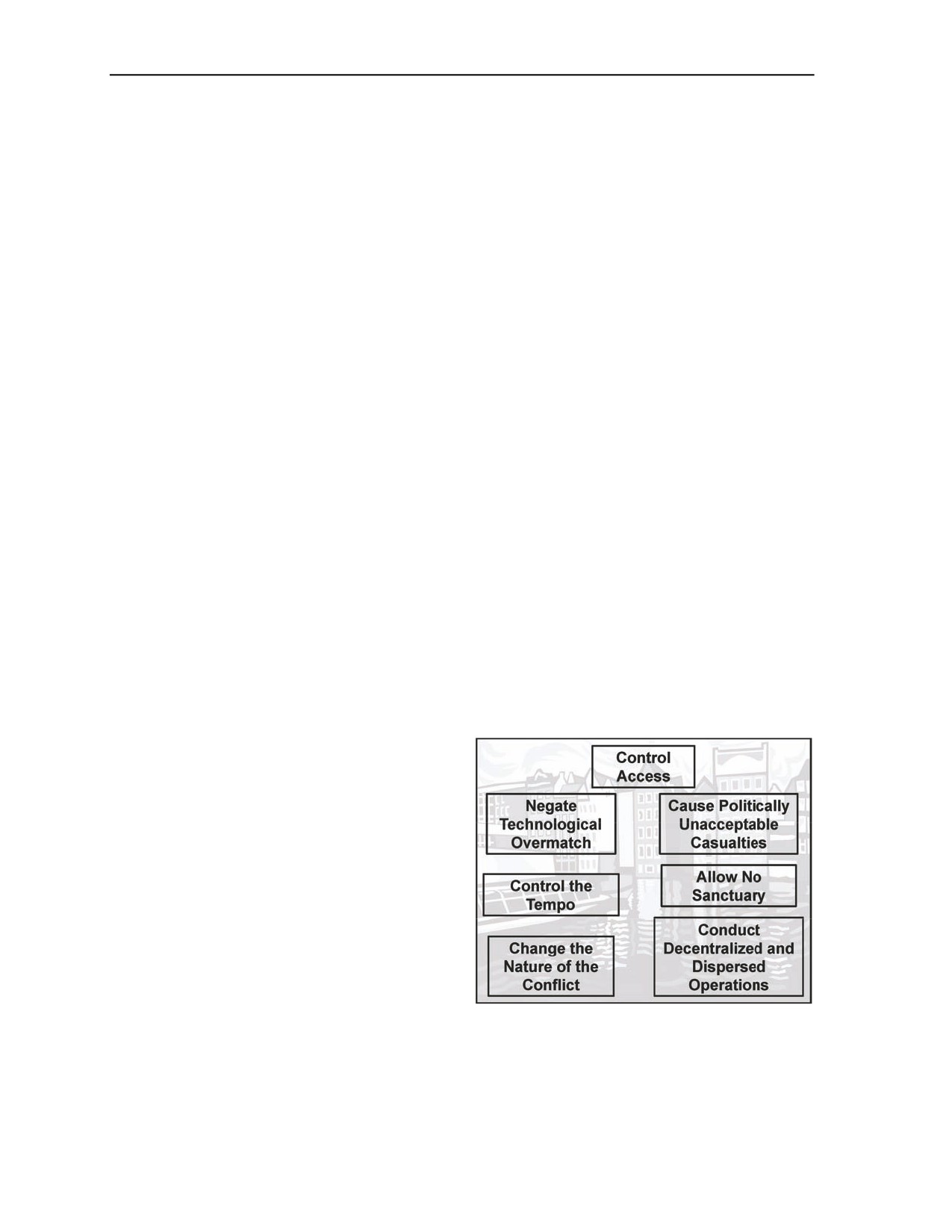
3-5. The threat will seek to achieve several key objectives when opposing Army forces operating in an
urban environment (see figure 3-1). These objectives focus more on how a threat might fight in an urban
area rather than specifically who the threat might
be or in what region of the world the conflict
might occur. These objectives are more easily
achieved in an urban environment due to—
The high costs in time, material, and
manpower involved in UO.
The limiting effects of urban areas on
many technological advantages.
The proximity of airfields and ports to
urban areas.
The potential moral dilemmas created
by exposing numerous civilians to harm
or injury.
The ability of the media to observe and
report the threat’s version of events.
Figure 3-1. Threat objectives
3-6. These objectives complement and overlap each other; however, at their core is the threat need to
defeat an enemy of superior numbers, technology, or both.
3-2
FM 3-06
26 October 2006
Understanding the Urban Threat
CONTROL ACCESS
… Iraq made no direct effort to impede the buildup in the theater. Planners should
consider what might have happened if Iraq had attempted a strategy based on denying
access to the region. Planners might also wonder what the outcome would have been if
Iraq had attacked US forces in Kuwait before they were ready for the running start. The
point is that the conditions in
[US Central Command] in 2003 are unlikely to be
replicated elsewhere.
On Point: The United States Army
in Operation IRAQI FREEDOM
3-7. The Army may not be located where future conflicts are fought. Thus, the Army maintains the ability
to rapidly project and sustain combat power over long distances and time spans. This capability demands
that Army forces quickly gain and maintain control of seaports or aerial ports of embarkation or
debarkation, particularly where the density of U.S. basing and en route infrastructure is low. Commanders
gain control of these ports by unopposed (assisted or unassisted) or forcible entry operations. In either case,
these phased-entry operations may present potential vulnerabilities, particularly—
Unsuitable composition of initial or early entry forces lacking necessary combat power for
immediate decisive operations.
Initial command and control difficulties and an immature situational understanding.
Weak initial port or base defenses without the necessary integration of naval and air component
forces.
Lack of developed logistic support.
3-8. Consequently, threats may attack during initial force projection operations to oppose, delay, disrupt,
or otherwise manipulate the build-up of essential combat power into a theater of operations. These attacks
may occur anywhere deploying Army forces are located, at overseas bases, at home stations, and even in
military communities. Increasingly, deployment facilities such as airfields and ports exist as integral
components of urban areas. Threats will invariably use the complex and concealing nature of these urban
areas, coupled with the vulnerabilities, to create favorable conditions for their attacks.
NEGATE TECHNOLOGICAL OVERMATCH
3-9. Threats will always strive to force engagements at a time and place most advantageous to them. They
may locate military forces and vital military capabilities in urban areas to achieve sanctuary from the
effects of Army capabilities and make Army forces and systems more vulnerable to less-sophisticated
weapons.
3-10. The clutter of the physical structures, electromagnetic radiation, and population diminishes Army
capabilities. This clutter makes it difficult for Army forces to acquire and effectively engage targets at long
ranges. In urban areas, the terrain often allows a threat to operate in closer proximity to friendly forces.
Therefore, the threat may “hug” friendly forces to avoid the effects of high-firepower standoff weapon
systems and degrade their ability to gain or maintain a thorough common operational picture. Additionally,
this threat tactic attempts to inhibit friendly commanders from employing some weapon systems and
munitions for fear of fratricide. Threats will also seek to hide and operate in culturally sensitive areas and
sites, such as places of worship and schools, to establish temporary safe havens and refuge from Army
forces operating within the urban environment.
CONTROL THE TEMPO
3-11. Threats will try to achieve a decisive advantage by setting and controlling the tempo. To prevent the
Army’s entry into theater, threats may try to create a high operational tempo to take advantage of the
inherent weaknesses in power projection operations outlined earlier. As other efforts deny entry, threats
may seize the initiative, achieve surprise, and exploit the tempo differential by attacking with heavy
conventional forces potentially possessing greater firepower and more rapid ground mobility than the
Army’s initial-entry forces.
26 October 2006
FM 3-06
3-3
Chapter 3
3-12. If they cannot deny entry or end the conflict quickly, threats may use any preparations made in the
initial high-tempo period to prolong the event, aiming to degrade U.S. or allied commitment. (Some threats
may conduct operationally planning in terms of decades rather than years.) The complex nature of the
urban environment slows operations conducted in, around, and over these areas. Threats may maximize
this characteristic by fighting
(conventionally or unconventionally) for key urban complexes and
infrastructure, forcing friendly forces to operate within these areas. If Army operations focus on one or
more urban areas, the overall campaign slows. However, even when UO make up only one component of a
much larger campaign, they may consume valuable resources needed for other operations and delay the
entire campaign. (See also the discussion of Tempo in Chapter 7.)
Tempo
The battle for Aachen, Germany, in the fall of 1944, developed during the U.S. First
Army’s offensive to breach the Westwall fortifications. Aachen, the ancient capital of
Charlemagne, had symbolic political and psychological significance for the Germans
and Americans. Furthermore, it was the first city on German soil to face an assault by
the Allies. Consequently, the symbolic importance of this first major battle in
Germany ensured bitter resistance against American attackers. The Germans
surrendered only after the city was destroyed. Expected to take a few days, instead,
the battle took weeks. Although the Army had achieved a clear tactical victory, the
German defense of Aachen cost the First Army valuable time and resources, and
delayed the planned attack to the Rhine River.
CHANGE THE NATURE OF THE CONFLICT
3-13. Threats may attempt to change the fundamental nature of the urban conflict to exploit ambiguous or
tenuous political-military objectives. Many nations must gain and maintain domestic popular support to use
their armies for political objectives. The threat may attempt to change the nature of the conflict by
modifying its strategy and tactics, the environment, or any combination, ultimately hoping to reduce
friendly popular support. For example, introducing an urban terrorist threat to U.S. civilians or Soldiers not
directly engaged in operations changes the nature of the conflict. This type of threat may not have been an
initial consideration, and this change may reverse public support for the operation. Another example,
growing U.S. coalition combat power may cause the threat to switch from open maneuver warfare to urban
insurgency operations to avoid decisive combat with superior forces and achieve a stalemate. Originally
expecting a quick solution or victory, the political leadership may now envision a longer deployment with
less chance of lasting success.
CAUSE POLITICALLY UNACCEPTABLE CASUALTIES
3-14. Threat forces may gain an advantage against superior friendly forces by capitalizing on a perceived
weakness of many Western nations: the inability to endure continuous losses or casualties for other than
vital national interests or losses for which they are psychologically unprepared. A secondary U.S. interest
may equate to national survival on the part of a threat. Therefore, the threat (particularly with fanatical
leadership) may willingly sacrifice excessive amounts of money, equipment, and people (soldiers and
civilians) to achieve victory. Threats may attempt to weaken U.S. resolve and national will to sustain the
deployment or conflict by inflicting highly visible, embarrassing, and if possible, large losses on Army
forces, even at the cost of similar losses to themselves. Many threat forces will use UO to inflict mass
casualties and destroy premier Army weapon and information systems. The physical characteristics of the
urban environment support these ambush techniques. Light infantry or insurgents with readily obtainable,
hand-held antiarmor weapons can effectively attack armored vehicles and helicopters, no matter how
sophisticated, in an urban area.
3-4
FM 3-06
26 October 2006
Understanding the Urban Threat
ALLOW NO SANCTUARY
3-15. Threats will attempt to deny Army forces safe haven anytime and anywhere. Terrorism and
insurgency may be some of the tactics used to deny sanctuary to Army forces. They will attack Army
forces anywhere, particularly while operating in urban areas where the fear from being attacked from any
quarter is often greater. Threats may be or employ state-sponsored or independent terrorists, well equipped
and motivated to accomplish their assigned missions.
3-16. Military buildings, facilities, and installations in urban areas are particularly vulnerable to high-yield
explosive munitions as well as other clever means to create large explosions. The close-in nature of urban
areas, large populations, and high volume of vehicle traffic provide a good environment for target
reconnaissance, explosives positioning (conventional or high-yield), and cover for an attack. These attacks
will likely be preceded by extensive, careful reconnaissance, necessitating a solid friendly
counterterrorism, counterinsurgency, and counterintelligence effort.
CONDUCT DECENTRALIZED AND DISPERSED OPERATIONS
3-17. To a certain extent, decentralized and dispersed operations are an integral part of all threat
objectives. However, this concept warrants separate emphasis as an objective since threat forces will likely
place great significance on it on future urban battlefields. Both dispersed and decentralized approaches
seek to reduce threat vulnerabilities to air power and precision-guided munitions (PGM) while increasing
their agility, flexibility, and overall maneuverability in an urban environment.
3-18. Urban terrain tends to fragment and separate forces that operate in it. Threat forces recognize this
characteristic, accept it, and make it work to their advantage. They conduct operations from dispersed
urban locations to reduce their vulnerability to friendly decisive operations and massed firepower.
Although separated, threat forces will attempt to retain the ability to assemble and mass quickly so to strike
as opportunities present themselves. Once threat forces complete the operation, they will return to separate
locations to avoid potential counterattack. The fluidity and seemingly disjointed appearance of these UO
threats will challenge friendly efforts to conduct templating and pattern analysis. Ambushes (air and
ground) will be used to deny friendly ground and air reconnaissance of their dispersed locations.
3-19. Dispersed operations normally depend on good command and control to achieve synchronization
and massed effects. Threat forces also understand the debilitating effects of the urban terrain on
communications and the execution of operations. When they cannot mass their forces or effects, they will
depend on decentralized operations to achieve their objectives. They will operate autonomously, guided
only by a higher authority’s purpose and intent. These operations make them even less vulnerable to
massed attacks and PGM as smaller threat forces do not present an objective or target that will allow
friendly decisive operations. Again, pattern analysis and templating, although essential, will be extremely
difficult. This objective may prolongs the conflict but is central to achieving the other threat objectives.
3-20. When the threat employs decentralized operations, is effectively isolated, or both, Army and
coalition forces are much more likely to be able to share lessons learned and emergent TTP than a
dispersed threat. Threat isolation, either imposed by Army forces or as a result of the threat’s desire to
remain concealed from Army intelligence, surveillance, and reconnaissance (ISR) capabilities, reduces the
threat’s ability to freely and easily exchange information and quickly adapt. As learning organizations, this
allows Army forces to develop dominance over a threat’s weapons and tactics for longer, albeit temporary,
periods of time. This ability to rapidly train and learn is an advantage the Army and coalition forces must
maintain while denying the same to future threats.
URBAN THREAT TACTICS
3-21. Urban areas provide a potentially casualty-producing and stress-inducing environment ideally suited
for using specific urban tactics. Moreover, urban areas can provide threats with an unmatched degree of
cover and concealment from friendly ISR and firepower systems. Understanding how these tactics will be
used often requires a concurrent understanding of the threat’s culture, customs, language, and
philosophical ideals. While active urban threats may vary widely, many techniques will be common to all.
26 October 2006
FM 3-06
3-5
Chapter 3
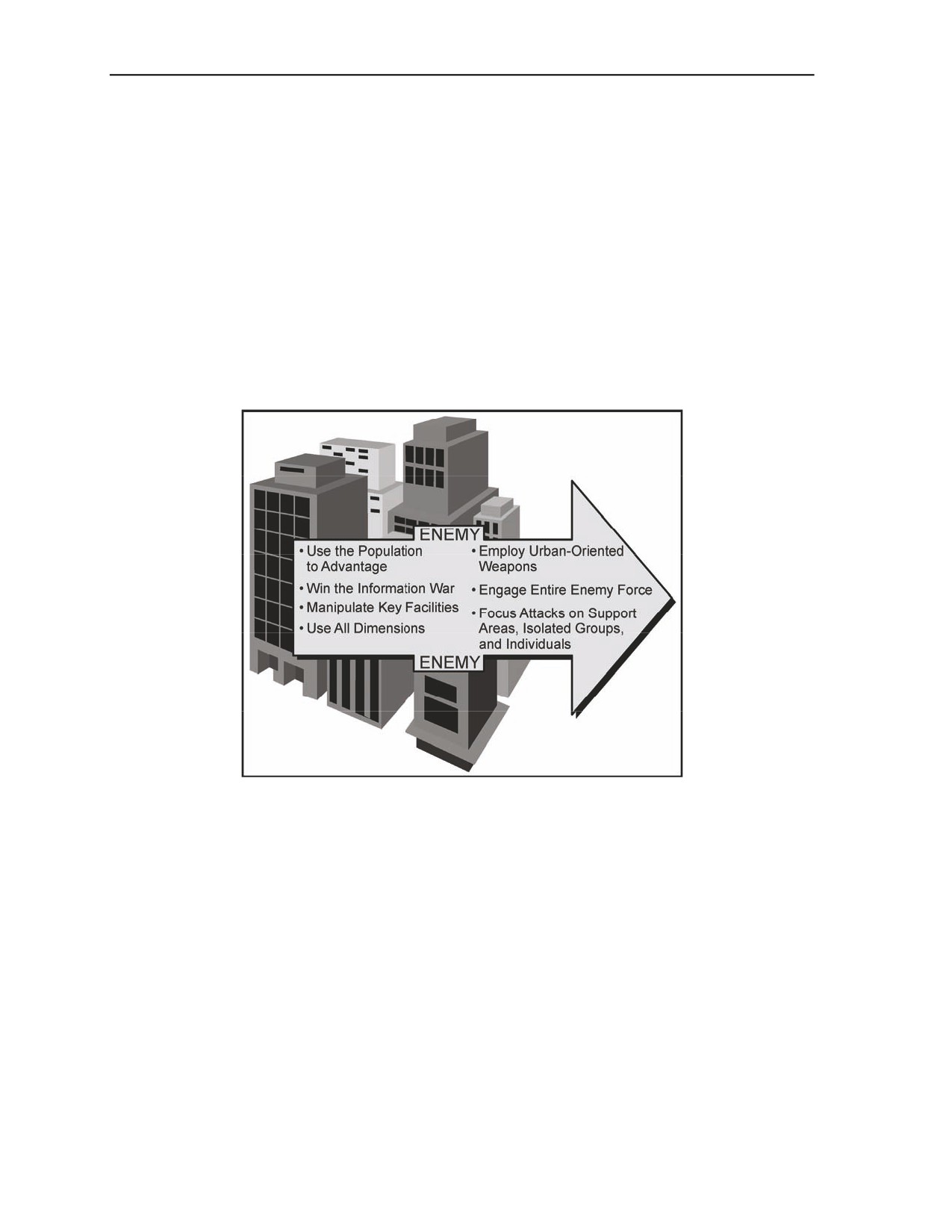
Figure 3-2 outlines a set of tactics available to potential threats opposing mission accomplishment in urban
areas. Army forces may use many of these tactics, except those that violate the law, ethics, and morals, to
defeat urban threats. Moreover, using asymmetric means is not the sole domain of the threat. Army
commanders can also leverage capabilities, create conditions, and plan operations to develop their own
asymmetric advantages to accomplish the mission.
USE THE POPULATION TO ADVANTAGE
3-22. Many urban areas may be too large to evacuate completely (if at all). Even if desirable, a military
force may have no place to safeguard and secure the inhabitants. Therefore, future UO may see large
segments of the populace remain. Offensive and defensive operations may be constrained not only by the
terrain, but also by the presence of many civilians. Army forces involved in urban stability and civil
support operations will certainly conduct missions in and amongst the residents. These residents may
restrict operations and, when gathered in large numbers, may (even without initial hostile intent) present a
critical force protection issue for the commander.
Figure 3-2. Urban threat tactics
Use as Key Terrain and Concealment
Chechen fighters sometimes disguised themselves as Red Cross workers, donning the
identifying armbands. They also passed themselves off as civilians and offered to guide
Russian forces through the city, instead leading them into ambushes.
Olga Oliker
Russia’s Chechen Wars 1994-2000
3-23. From the threat standpoint, the populace is similar to key terrain: the side that manages it best has an
advantage. Threat forces may gain this advantage by using civilians as camouflage, concealment, and a
means of deception. Guerrilla and terrorist elements may look no different from any other member of the
community. Many foreign conventional and paramilitary troops—in addition to terrorists and insurgents—
often have a “civilian” look. Western military forces originally adopted the clean-shaven and close-cut hair
standards to combat disease and infection, but future opponents may not adhere to those standards. Instead,
they may adopt grooming standards, civilian-looking clothing, and other “nonmilitary” characteristics to
3-6
FM 3-06
26 October 2006
Understanding the Urban Threat
make themselves indistinguishable from the civilians. To avoid defeat or capture, threats will often throw
down their weapons and attempt to blend into the urban population. Therefore, commanders must adopt
effective populace and resource control measures to limit, identify, and track threat movements through the
urban area of operation.
Identifying Threats from Noncombatants
During Russia’s
1994-95 conflict with Chechnya, Russian forces had difficulty
identifying Chechen guerrilla forces from Grozny’s noncombatant population.
Because their dress and ethnic appearance was identical to that of the urban
populace, Chechen soldiers could freely walk around the city, suddenly disappear,
and then abruptly reappear firing their weapons from basements, windows, or dark
alleyways. To distinguish fighters from peaceful city dwellers, Russian forces began
looking at men’s shoulders to see if they were bruised (from firing weapons) and their
forearms to see if there was burned hair or flesh (from the extraction of cartridges).
They closely examined their clothing and smelled for gunpowder residue. To identify
a Chechen artilleryman, Russian soldiers checked for glossy spots left by artillery
and mortar rounds on the bends and cuffs of sleeves. They also turned pockets
inside out to check for a shiny, silvery-leaden hue indicating the former presence of
small arms ammunition. Russian forces also recognized a grenade launcher operator
or mortar man from fibers and crumpled pieces of gun cotton on their clothing. U.S.
Army commanders may need to develop similar, imaginative techniques and rapidly
integrate technological means to identify and track threat forces such as—
• Military working dogs, ion spray, and electronic vapor tracers to locate explosives
(or their former presence).
• Biometrics—measurable biological characteristics—such as fingerprints,
voiceprints, facial scans, and retina scans.
• Electronic and chemical tagging devices.
• Monitoring hospitals for injuries that indicate participation in combat activities. For
example, improper use of rocket-propelled grenade launchers may result in
significant burns to the lower part of the body due to the back blast.
Gain Cover, Protection, and Increased Mobility
3-24. Threat forces may attempt to gain cover by using the urban inhabitants as human shields. With this
increase in protection, they simultaneously increase their mobility. They recognize the Army’s focus on
developing and applying rules of engagement (ROE). They will take advantage of the restraining effects of
international law and the Army ethical values to enhance their mobility in proximity to friendly positions.
Knowing the Army’s reluctance to cause noncombatant casualties and collateral damage, threats may
operate in areas containing civilians and essential facilities to restrict the Army’s use of massed or
nonprecision firepower. For example, they may use school buses and ambulances to transport fighters and
equipment about the urban battlefield. They may also employ “rent-a-crowds”—civilians paid or incited to
demonstrate against military forces—armed only with sticks, stones, and Molotov cocktails (a potential
asymmetric challenge). Threats can also hide military equipment within sensitive infrastructure—for
example, caching weapons in places of worship, schools, or medical facilities. As Army and coalition
forces potentially respond by targeting and firing upon these locations, threats will make use of these
reactions for their possible propaganda value.
Make Moral Responsibilities a Weakness
3-25. Depending on their successes, threats may use these tactics and skillful information operations that
attack national will and coalition sensitivities in an attempt to force the Army to establish more restrictive
ROE. For example, a teenaged fighter coerced or enticed to fire a rifle or rocket-propelled grenade
26 October 2006
FM 3-06
3-7
Chapter 3
launcher can be quickly stripped of his weapon once dead and displayed at the local hospital as a child
victim of coalition forces. Threat forces may also take advantage of the Army’s moral responsibilities. By
herding refugees into friendly controlled areas, threat forces try to make the civilians a burden on the
Army’s logistic and security resources. Similarly, some threats may attack to kill NGOs and force the
remainder of them out of the area to achieve the same burden effect. At the same time, these threats hope to
cause the population to lose confidence in the Army’s (and potentially the government’s) ability to protect
and provide them essential services.
3-26. Threat forces, on the other hand, may not abide by international agreements, such as the Geneva
conventions. Threats may not take prisoners unless they can be ransomed or made part of a local prisoner
exchange. They may even execute friendly prisoners in front of the media to show their “strength” and,
more importantly, to cause friendly forces to overreact and lose their legitimacy. Threat forces can then use
such an overreaction to unite others with their cause. Pretending to be civilian noncombatants, they may
also feign injury or pretend to need assistance (such as a disabled taxi) with the primary motive of luring
Army forces into a deliberate ambush. While the threat may gain a short-term advantage by using ethical
responsibilities as a weapon, the Army commander’s strict adherence to moral principles will, in the long
run, contribute greatly to threat defeat—particularly during long-term urban stability operations.
Acquire Intelligence and Logistic Support
3-27. Indigenous threat forces can normally use the local population for intelligence and logistic support
far more effectively than can an alien army. Threat forces may manipulate local hires serving among U.S.
Soldiers, such as those contracted by the Army for base operation purposes or translator duties. In addition,
refugees moving through friendly controlled sectors may provide the threat with information on friendly
dispositions, readiness, and intent. (Women and children may be specifically used for this purpose since
U.S. Soldiers’ cultural bias can create an incorrect perception that these noncombatants pose no threat to
security.) Even friendly residents may become unwitting or unwilling informants, providing an enemy or a
hostile with vital information on friendly activities, dispositions, and capabilities. However, a threat
employing particularly cruel, abusive, or repressive measures may easily turn certain groups in the urban
area against them, even when they share a common history, culture, and ethnicity with the civilians. This is
more likely in those areas with higher population densities.
3-28. Threat forces may also seek to use some nongovernmental organizations (NGOs). They may try to
obtain relief supplies either through the organizations’ legitimate relief operations or as a target for theft.
Some organizations may even be fronts for weapons, food, ammunition, money, and fighters. For example,
during Russia’s second conflict in Chechnya (1999-2000), documents purportedly found in Grozny by the
Russians listed nations such as Sudan, Nigeria, Niger, and Ivory Coast as sending fighters to Chechnya
under the guise of the International Islamic Relief Organization.
(Chechen fighters also disguised
themselves as Red Cross workers.) This deception increases the need for strict security and force protection
measures, close coordination with NGOs operating in urban areas, and closer monitoring of suspect
organizations’ activities by civil affairs personnel.
WIN THE INFORMATION WAR
3-29. Threat forces will try to win the information war as much as they will directly oppose Army UO.
Threat urban campaigns need not be tactical military successes. They need only to weaken legitimacy and
make the opposition’s campaign appear unpalatable to domestic, U.S., and world support. As a critical part
of a threat’s overall information operations, they will use the ever-present media to tell their story. Portable
video cameras, commercial radios, and cellular telephones, available and easily concealed, will be as
important to many threat actors as weapons and ammunition. Internet access, already firmly established in
many urban areas, provides the means to easily disseminate threat propaganda, misinformation, and
disinformation through web sites and electronic mail. The internet also allows threats to conduct their own
distance learning and education. Threats will make good use of the instantaneity and global reach of
television and radio broadcasts, particularly local and international media, to obtain information of
immediate tactical value and broadcast their own operational and tactical guidance. Hackers, covered and
3-8
FM 3-06
26 October 2006
Understanding the Urban Threat
concealed in the interior spaces of the urban area, may gain access to U.S. sites to manipulate and obtain
information to the threat’s advantage.
Information and the Media
The media coverage of the urban battle for Hue, South Vietnam, although only one of
hundreds of different attacks of the Tet Offensive, affected the will of both the
American people and their political leadership. On January 31, 1968, two North
Vietnamese Army (NVA)/Vietcong (VC) regiments and two sapper battalions, moving
rapidly and with the element of surprise, attacked and seized part of the walled city
(Citadel) of Hue. It was the third largest city in South Vietnam, the former capital of a
united Vietnam, the capital of Thua Thien province, and a spiritual and cultural
center. Initially intending to hold the city for seven days, the NVA/VC retained
portions of the city for approximately three weeks against determined U.S. and South
Vietnamese attempts to retake it.
Hue marked a revolution in the coverage of war by modern media. It was the first
time Americans could sit at home and watch an ongoing battle on the evening news.
One of the most intense and savage battles of the Vietnam conflict, it was televised
every evening for almost a month. Although the battle for Hue was a tactical victory
for the United States, the North Vietnamese clearly achieved strategic success by
searing the American consciousness with the high costs of urban warfare. Had U.S.
leaders made winning the information war a central part of the overall campaign
plan—for example, exposing the American people to the NVA’s brutality by
publicizing the civilian executions in Hue—civilian support for the war may have been
bolstered and a different outcome achieved. See Chapter 7 for a more detailed
account of the battle for Hue.
MANIPULATE KEY FACILITIES
3-30. Threat forces will attempt to identify and quickly seize control of critical components of the urban
area to help shape the operational environment. Urban telephone exchanges can provide threats with
simple and reliable communications that can be easily secured with off-the-shelf technologies. Existing
public address and loudspeaker systems can be used to incite riots or openly command and control
dispersed threat forces. (Local language may provide threats with a measure of communications security.)
Sewage treatment plants and flood control machinery can be used to implement WMD strategies or to
make sections of the urban area uninhabitable. Media stations significantly improve the information
operations abilities of the controlling force. Power generation and transmission sites provide means to
control significant aspects of civilian society over a large area. Insurgents will attempt to destroy key
facilities and critical infrastructure in order to shape the populace’s perception that the existing government
is incapable of providing for their safety and meeting their basic needs.
USE ALL DIMENSIONS
3-31. Threats will think and operate throughout the depth, breadth, and height (including supersurface and
subsurface areas) of the urban environment. However, threats will often choose to fight from within
interior spaces rather than out in the streets and other open areas. Conventional lateral boundaries will
often not apply as threat forces control some stories of the same building while friendly forces control
others. The use of all three dimensions of an urban area makes identification, reporting, and targeting of
enemy locations more difficult for forces accustomed and trained to acquire and engage targets in primarily
two dimensions. Because of these target identification and acquisition difficulties, threats will likely use
decoys in the urban area to cause erroneous assessments of their combat capabilities, strength, and
disposition. They will also attempt to use these decoys to absorb expensive and limited precision-guided
munitions as well as cause misallocation of other critical Army resources.
26 October 2006
FM 3-06
3-9
Chapter 3
3-32. Roofs and other supersurface areas provide urban threats with excellent observation points and battle
positions above the maximum elevation of many weapons. Shots from upper floors strike armored vehicles
in vulnerable points. Basements and other subsurface areas also provide firing points below many
weapons’ minimum depressions and strike at another weakness in most armor. Sewers and subways may
provide covered and concealed access throughout the area of operations.
EMPLOY URBAN-ORIENTED WEAPONS
3-33. Whether purpose-built or adapted, many weapons are more useful in an urban environment while
others may have significant disadvantages. Urban threat weapons are much like the nature of urbanization
and the urban environment: inventive and varied. Many threats will integrate widely available off-the-shelf
technologies into their weapon systems and armed forces. However, sniper rifles and small, man-portable,
fire-and-forget weapons and demolitions and other improvised explosive devices (IEDs), to include suicide
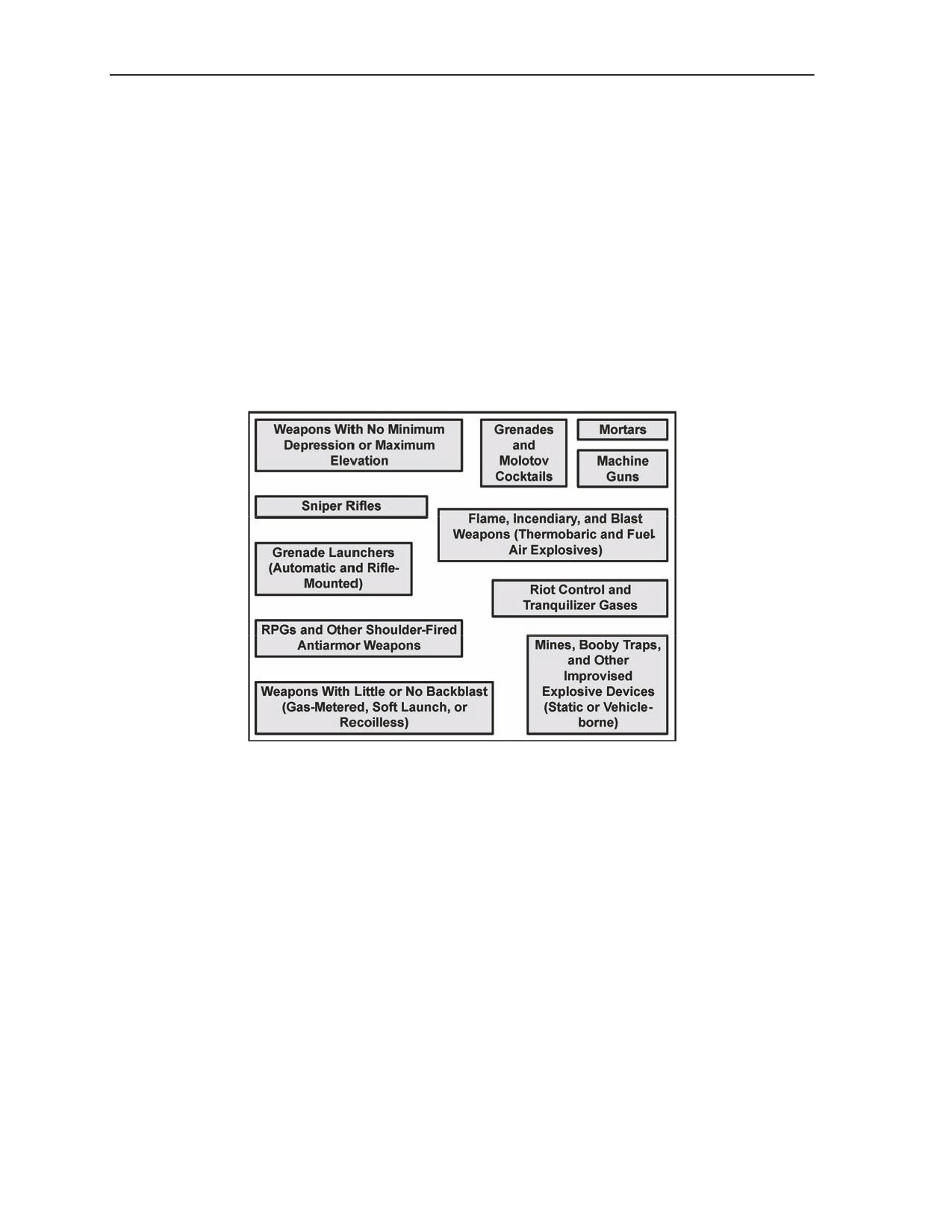
and car bombs, will likely dominate the urban environment. Figure 3-3 lists examples of threat weapons
favored in UO.
Figure 3-3. Favored threat weapons
ENGAGE ENTIRE ENEMY FORCE
3-34. Threats may attempt to keep all or significant portions of Army forces engaged in continuous
operations to increase their susceptibility to stress induced illnesses. UO, by their nature, produce an
inordinate number of combat-stress casualties. Continuous operations exacerbate this problem. Threat
forces that employ this tactic will often maintain a large reserve or achieve respite by hiding among the
civilian population to minimize the psychological impacts on their own forces.
3-35. To accomplish this key tactic, threat UO will likely involve decentralized maneuver, precision fires,
and simultaneous operations involving unconventional and special purpose forces and guerilla, insurgent,
and terrorist tactics. Threats may also attempt to bait Army forces by ambush or other means with a
primary focus of attacking response or reaction forces. Overall, threat forces will take advantage of any
exposed weakness in weapons, equipment, and TTP and they will cultivate the flexibility to engage in
battles as favorable opportunities present themselves.
3-10
FM 3-06
26 October 2006
Understanding the Urban Threat
FOCUS ATTACKS ON SUPPORT AREAS, ISOLATED GROUPS, AND INDIVIDUALS
3-36. To supplement the previous tactic, threat forces will seek to target support areas, small groups,
leaders and their headquarters, and unaware Soldiers. Their focus on resupply and convoy operations,
casualty evacuation, and other sustainment activities, coupled with the compartmented terrain, navigational
challenges, and multiple three-dimensional avenues of approach often makes these locations and Soldiers
more susceptible to surprise raids and ambushes. Attacks on these areas and groups are conducted to erode
the Army’s ability to sustain UO, to inflict maximum casualties, and to induce psychological stress. These
attacks can be mitigated by careful, regular evaluation of choke points and other restrictive terrain, regular
awareness training for units and individuals operating in or transiting through potential incident-prone
areas, well-planned and protected convoys, and thorough after-action analysis of incidents.
NEGATIVE EFFECTS OF URBANIZATION
3-37. Many urban areas are the engines for increased industrialism and economic growth as an expanding
population provides the labor for manufacturing and service needs. However, rapid and inadequately
planned growth can result in undesirable consequences. Uncontrolled urbanization may result in an
infrastructure and economic base unable to support the growing population. A large transient, ill-housed,
and idle population in a close geographic space may produce strife. Classes, cultures, ethnic groups, and
races that might otherwise peacefully coexist can clash under the stress of survival. Uncontrolled urban
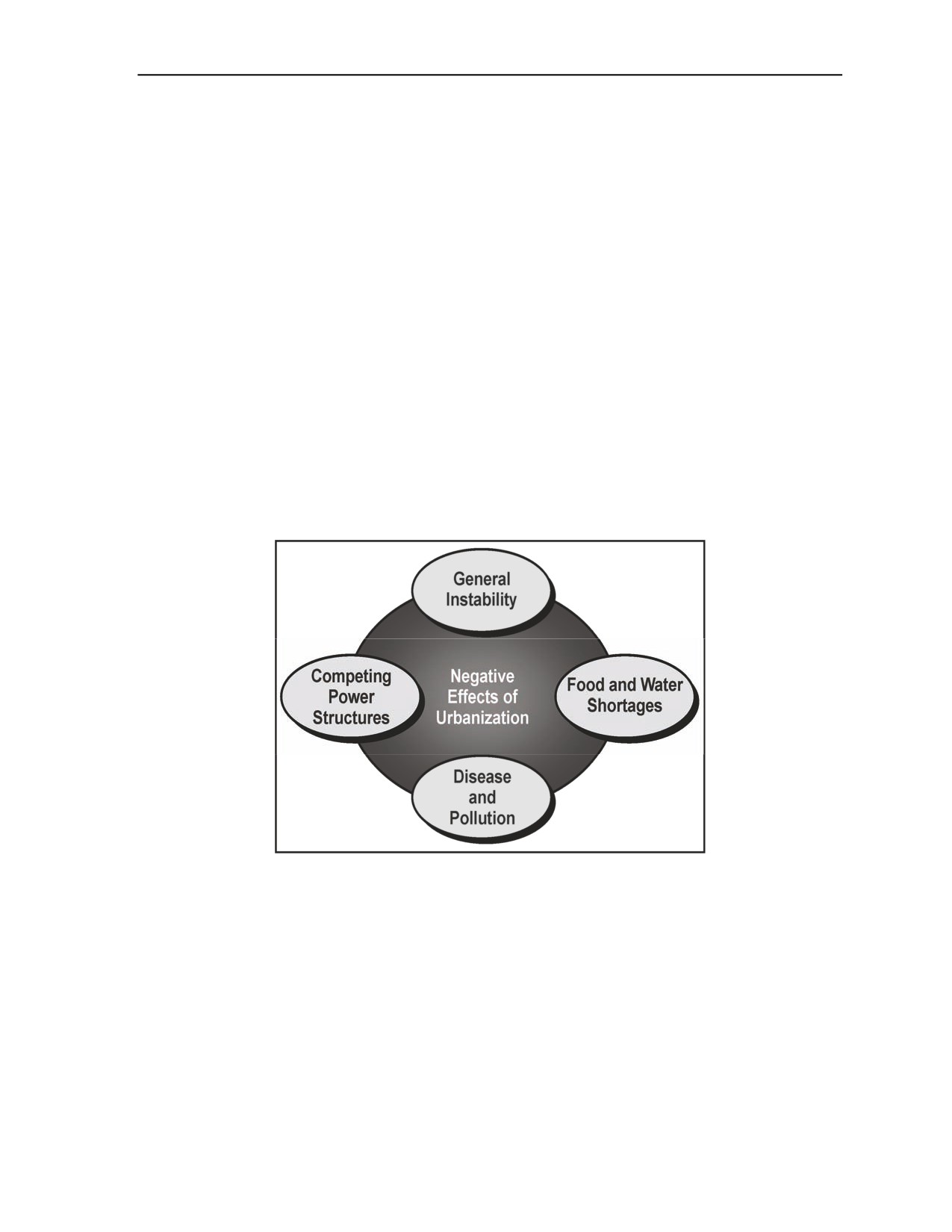
growth has resulted in the negative effects listed in figure 3-4. In many urban stability and civil support
operations, these may be the primary “threats” to mission accomplishment.
Figure 3-4. Negative effects of urbanization
3-38. Not all urban areas prevail as inherently unstable or hotbeds for unrest. Urban growth due to
migration may remove sources of conflict, or it may provide the catalyst for violence. Commanders should
recognize the possible effects of uncontrolled urbanization. During their intelligence preparation of the
battlefield (IPB), they should determine if these conditions exist. Throughout mission analysis and the
development of courses of action, commanders should consider the impact (if any) on their operations. At
the same time, they must recognize that UO may create similar problems that may affect the current
operation as well as the overall campaign.
26 October 2006
FM 3-06
3-11
Chapter 3
GENERAL INSTABILITY
3-39. Urbanization can enhance stability by generating industrialization and economic growth resulting in
more jobs, a higher overall standard of living, and an educated, relatively satisfied populace. However, the
population dynamics associated with urbanization can also have an opposite, destabilizing effect. Radical
population growth may create overcrowding and generate or aggravate resource and quality of life issues.
Intense and destructive competition for employment, housing, and social status may develop in this climate
of economic deprivation. The inability of some governments to handle these problems—
Makes their urban areas potential sources of unrest.
Increases the likelihood of the Army’s involvement in stability operations.
Complicates all operations conducted in such an urban environment.
Weak civil administrations—perhaps weakened by the effects of previous UO—have difficulty controlling
their society, safeguarding their military armaments, and preventing their urban areas from serving as
sanctuaries to terrorists, insurgents, and criminal organizations.
3-40. Urbanization in developing countries warrants more concern. Intense migration and growth, coupled
with the forced closeness of people once separated by the rural countryside, may stress already struggling
institutions, hasten conflict, and lead to overall instability. Commanders must understand that UO,
depending on the operation, may either cause massive population movement out of or into urban areas.
3-41. Urban areas with a large youth population may also help to generate conditions for instability. Rural-
to-urban migrants tend to be relatively young. In 1999, Cairo, for example, had more than 40 percent of its
population younger than 15 years. Young urban populations generate enormous demands for social
resources, primarily education and jobs. Even a strong urban economy may fold under the economic
expectations of a tremendous influx of young migrants. Disorder and violence may result as hostiles (many
nonstate actors) easily mobilize and manipulate the idle young to act politically and criminally.
Urbanization and population growth are more dangerous when they combine to produce a cohort of young
urban dwellers separated from traditional social controls, such as village elders and clan leaders.
Cultural and Religious Instability
The 1992 bombing of the Babri Masid Mosque in Ayodya, India, enflamed an already
intense cultural and religious rivalry between Hindus and Muslims and led to rioting
throughout many Indian urban areas. Of the 1,500 who died in conflicts and riots,
almost 95 percent died in urban areas. The violence struck Ahmedabab and Bombay
most seriously, with related acts of murder, gang rapes, and arson occurring months
after the destruction of the mosque.
3-42. Ethnic, religious, and other social issues may become the vents for anger and frustration produced by
the high tension of urban life. Major acts of violence and destruction, such as occurred in 1992 in India,
can directly threaten a nation’s security. Army forces may have to conduct large-scale, stability operations
to promote peace and protect national interests. In these cases, all levels of command will be particularly
concerned with maintaining impartiality and perceived legitimacy.
FOOD AND WATER SHORTAGES
3-43. Rapid urbanization, primarily in developing nations, may lead to severe food shortages that could
influence Army forces (or lead to their use). Such shortages may cause instability, massive migration,
revolts, or increased support of armed opposition groups. Armed factions may target NGOs that supply aid
as a means of furthering dissatisfaction among the populace. In effect, food may become a weapon.
Deployed troops may need to provide or support humanitarian food aid networks to keep the humanitarian
situation from escalating.
3-44. However, planners must be wary of the unintended consequences of well-intentioned humanitarian
assistance operations. For example, providing free, safe food may alleviate starvation, but could also
3-12
FM 3-06
26 October 2006
Understanding the Urban Threat
undercut the local agricultural system by reducing demand in the market. If the food is distributed through
urban centers, urbanization could increase, further reducing the food supply and adding to the existing
strains on the infrastructure. Unless they are trying to use them as a means to separate combatants from
noncombatants, commanders should normally use centralized feeding centers as a last resort. Instead,
Army forces should bring the food closest to the population to encourage civilians to stay in their homes. If
safe areas or camps are created, they should be designed for use over as short a time as is feasible. The
general rule should be to return the urban population to their homes as soon as possible. Army forces
conducting domestic support or foreign humanitarian assistance operations that cannot maintain the safe
food supplies may find the frustrations and hostility of the local population focused on them.
3-45. Water shortages (and quality) are becoming a serious problem in many regions. Sewage, industrial
waste, other forms of pollution and deliberate contamination pose threats to existing water supplies.
Commanders operating in an urban environment need to know the water supply origins and its treatment,
purification, distribution, and vulnerabilities. Before beginning operations, commanders must know if they
are providing water for the noncombatants as well as their own forces. Across the spectrum of operations,
controlling and protecting a limited water supply is, or may become, an essential operational consideration
during UO.
Food and Water Shortages
Countries as varied as Indonesia and Algeria exported their food surpluses only two
generations ago but now import up to two-thirds of their basic staples. This cycle has
resulted in many countries, which once exported agricultural products, facing the
growing cost of imports to feed their urban populations. Estimates predict that in the
2010 timeframe, at least 65 countries (including 30 of Africa’s 51 countries) may
depend completely on food imports. For some countries, the outlook is even worse.
The Democratic Republic of Congo (Zaire), once a net food exporter, faces severe
malnutrition and utter starvation for a large portion of its population.
Other estimates predict that by 2025, 2.7 to 3.5 billion people will live in water-
deficient countries. Even now in urban areas such as Jakarta, Indonesia, for
example, urban authorities cannot provide the necessary water to support its growing
population. Less than half of Jakarta’s population is supplied by the urban area’s
water infrastructure; the remainder of the area’s residents rely on water from wells
and other groundwater supplies that lie only a few feet below the surface. These
alternate sources need to be sufficiently boiled or residents risk increased disease. In
the northern part of Jakarta, land is actually sinking as the urban area’s groundwater
supply is overused by its residents. Houses on low-lying areas have to be rebuilt
every few years to keep them above sea level. Meanwhile, saltwater from the Java
Sea is seeping into the land polluting the remaining groundwater and further
exacerbating the situation.
DISEASE AND POLLUTION
3-46. Urban areas frequently spawn epidemics; therefore, widespread disease may pose a significant threat
to Army forces that operate there. In many developing nations, rapid urbanization has occurred without a
corresponding upgrade, expansion, or even development of adequate sewage and water systems. Some
urban areas have only one toilet for every 750 people or more. In these areas, hundreds of thousands live
much as they would in poor villages, yet so confined as to ensure high transmission rates for airborne,
waterborne, sexually transmitted, and contact-transmitted microbes.
3-47. In urban areas lacking adequate trash and waste management infrastructure, insect-spread diseases
proliferate. Mosquitoes that breed in polluted water, open water tanks, and irrigated urban gardens carry
malaria and dengue fever—the leading causes of sickness and death from infectious disease in Latin
America and Africa. The problem compounds with growing numbers of bacteria resistant to various
26 October 2006
FM 3-06
3-13
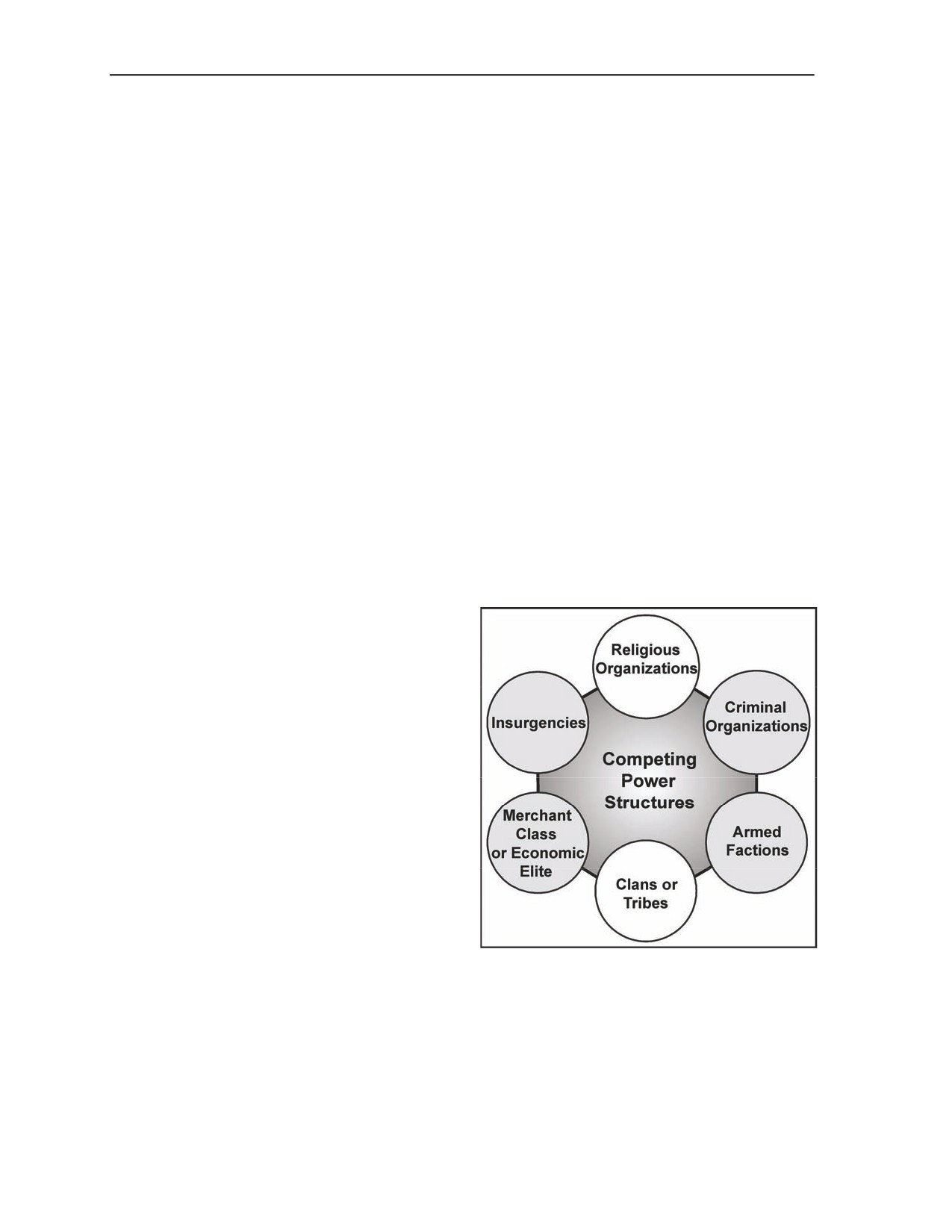
Chapter 3
antibiotics, a shortage of trained medical personnel, inadequate or insufficient medical facilities and
supplies, and unclean agricultural and food-processing practices.
3-48. Pollution also creates critical health problems in developing areas and a potential health risk for
intervening Army forces. For example, urban areas in China have recorded five to ten times the levels of
sulfur dioxide found in the air of urban areas in the developed world. In parts of Poland, toxic waste has so
polluted the land and water that ten percent of the babies have birth defects. Pollution may cause immediate
health problems but more often, the insidious effects appear months or years after exposure. As discussed
earlier, UO may contribute, either intentionally or unintentionally, to an increase in pollution. Destruction
of industrial complexes that use, produce, and store hazardous material may produce toxic gas and smoke
pollutants and create significant health concerns to exposed Soldiers and civilians. Soldiers forced to fight
within the confines of subsurface areas such as sewers and drainage systems further increases their
exposure to contaminants.
3-49. Commanders should initiate force health protection planning early, including analysis of the medical
threat and other critical medical information requirements during the IPB process. A medical surveillance
system should monitor the daily status of Army personnel throughout the operation. In preparation, all
personnel must receive a predeployment medical examination. This exam establishes an accurate baseline
health status of the force and ensures that Army forces do not introduce new diseases to an urban area,
possibly exacerbating the situation. Conversely, Soldiers not immune to native viruses or possessing a
weakened immune system due to continuous operations and the stress associated with UO may put Army
forces at a significant disadvantage. An outbreak of plague during an operation would have an effect
similar to a chemical or biological attack. The closer that Army forces operate to civilians
(the
humanitarian assistance operations conducted in Port-au-Prince, Haiti, and Mogadishu, Somalia, for
example), the more probable that these situations may occur. (See Chapter 9.)
COMPETING POWER STRUCTURES
3-50. Many groups can exist that become strong
enough to rival the power of the governing officials
and eventually turn the urban area into a system of
divergent and competing power structures. These
groups can consist of insurgent forces, a merchant
class or an economic elite, criminal organizations,
or some other significant source of power such as
religious organizations (see Chapter 10), clans, or
tribes (figure 3-5). In the absence of a legitimate
authority, armed factions headed by
“warlords”
may vie to fill the power void. Sometimes these
groups or organizations, normally at odds with
each other, may form alliances to achieve specific
goals. Commanders must recognize, identify, and
understand these alternate urban power bases and,
if necessary, develop engagement strategies to
neutralize or harness them to accomplish the Army
mission. Four of these groups, not previously
covered or covered in a subsequent chapter, are
discussed in greater detail below.
Figure 3-5. Competing power structures
Urban Insurgencies
3-51. As urban migration increases in the developing world, rural guerrillas appear to follow. This
transition of insurgencies from rural to urban areas occurs because urban areas offer a rich field of targets
for insurgent attacks. People immediately notice any disruption of urban infrastructure, thus having great
3-14
FM 3-06
26 October 2006
Understanding the Urban Threat
propaganda value. A concentrated urban population whose allegiance and support are critical to the success
of an insurgency is often more susceptible to propaganda, political organization, and terrorism. Insurgents
can easily arrange mass demonstrations using available communications facilities, both overt and covert.
Travel is effortless and large urban populations provide cover and concealment. On the whole, urban areas,
particularly those suffering the effects of general instability outlined earlier, may provide a fertile
environment for guerrillas to apply formerly rural insurgent strategies. However, even with a primarily
rural-based insurgency, operations in urban areas will often be essential to the insurgents’ strategy as they
offer them distinct opportunities to disrupt, discredit, and demoralize the government (see FM 3-05.20 and
FMI 3-07.22).
Insurgencies and the Urban Society
The goal of modern warfare is control of the populace, and terrorism is a particularly
appropriate weapon, since it aims directly at the inhabitant. In the street, at work, at
home, the citizen lives continually under the threat of violent death. In the presence
of this permanent danger surrounding him, he has the depressing feeling of being an
isolated and defenseless target. The fact that public authority and the police are no
longer capable of ensuring his security adds to his distress. He loses confidence in
the state whose inherent mission is to guarantee his safety. He is more and more
drawn to the side of the [insurgents], who alone are able to protect him.
Roger Trinquier
Modern Warfare
Merchant Class or Economic Elite
3-52. Urban areas normally possess a merchant class or economic elite as part of their social structure. In
some urban areas, they may carry more power than the local or central state government. They may isolate
themselves physically and socially from the sprawling poor yet wield enormous power over the country’s
political and economic activities. The degree of economic separation between the merchant class and the
poor may be small but still socially or politically significant.
3-53. In a vastly impoverished area where the economy of the urban area is severely disrupted, the
merchant class will often continue to operate and function and, as a result, achieve a measure of influence.
To continue to operate under acute economic turmoil, they may form alliances in criminal organizations
and secure loyalties within the government. Outside resources introduced into a crisis area (such as food,
water, fuel, and pharmaceuticals) take on increased value, may replace currency as the medium for
exchange, and often become the means to amass and hold wealth. One primary way to obtain wealth is to
steal it.
3-54. In some turbulent situations that lead to the need for stability operations, commanders may harness
the power of the merchant class as a force for peace and stability instead of one that uses crime to achieve
economic goals. For example, in a relief situation, instead of competing with the merchant class by
distributing food directly to the needy and possibly creating an environment of looting and black
marketeering, it may be possible to monetize food. Food assistance from donor governments could be sold
to merchants at an attractive price so they have a reliable source of supply. This could, in turn, create a
healthy economic system and separate merchants from criminals and gangs.
Criminal Organizations
3-55. Organized criminal groups have grown common in urban areas; have also become an important part
of the urban social structure (gangs for example); and can exert considerable influence on governments,
people, and military forces conducting UO. These organizations can threaten the successful completion of
urban operations both directly and indirectly. Criminals and criminal organizations may directly target
Army forces, stealing supplies and extorting money or contracts. Criminals may also violently confront
Army forces during mission execution. During many UO, particularly during or following combat, civil
disturbances, or large natural disasters, looting (organized or unorganized) may become of critical concern.
26 October 2006
FM 3-06
3-15
Chapter 3
For a portion of the population, crime may be the only reliable source of income and resources to support
their families. Therefore, UO will often require a combined law enforcement and military response.
3-56. Some large criminal organizations relying on international connections often have better resources
and equipment than their insurgent counterparts. (A prime example is drug traffickers.) Their large
financial resources, long-reaching connections, and ruthlessness provide them the means to corrupt or
intimidate local officials and government institutions. Their tactics parallel those of insurgents. They have
developed an intuitive cultural understanding of slum neighborhoods and the ability to lure civilians into
criminal activities. They have also mastered the management of mobs. They recruit teenagers and young
adults in their efforts against rivals and authorities, just as insurgents muster armies from the youth of rural
villages. In many developing nations, there exists an alliance between insurgents and organized criminal
groups. In these alliances, the insurgents defend the criminals and the criminals fund the insurgents.
3-57. Excessive criminal activity can undermine the commander’s efforts to establish a sense of security
among the remainder of the urban populace. Commanders will rely on the ability of their military police
(MP) units to assess and understand the potential influence that crime and criminal organizations may have
on UO. MPs—in coordination with local police—will need to quickly identify law enforcement gaps to
include dysfunctional police organizations and stations and inadequate prison systems. Urban police
records may be an important intelligence database to assist in this assessment and may be particularly
useful in counterterrorism and counterinsurgency operations. Success in ensuring that law and order is
maintained or reestablishing law and order will directly affect the population’s perceptions and support of
Army operations. Also, MP intelligence operations will contribute immeasurably to the overall IPB effort
and aid in understanding of the complexities of the urban society (see FM 3-19.50).
Crime and Criminal Organizations
Crime and poverty plague urban areas such as Rio de Janeiro, Brazil’s second
largest urban area, and would affect military operations conducted in their limits. Rio
has some of the nation’s highest negative urban indicators: the largest number of
slum dwellers (1 million), the highest murder rate (1 of 700 residents per year), and
the highest kidnapping rate (4 per week). In 1989, the homicide rate of the urban
area was three times higher than New York City’s, and the rate of urban violence has
continued to rise. Therefore, law enforcement management may be a critical issue
for Army forces operating in urban environments similar to that of Rio de Janeiro.
However, criminal elements or organizations may not always work against Army
commanders. They can be co-opted or influenced to serve friendly objectives. For
example, during World War II the U.S. Navy worked covertly with the Mafia in New
York City to secure the New York harbor from German U-boats believed to be
torpedoing ships there. The Mafia controlled most dock activities in New York harbor
and was perfectly positioned to monitor other subversive waterfront activity. This
capability provided needed information to the Navy for its counterintelligence and
security tasks. New York civil authorities, therefore, agreed to permit a Navy-Mafia
alliance to operate at the port for the greater good of the country. Although the Mafia
was not the preferred ally of the Navy, it had the capability to protect U.S. ships and
the interest
(patriotism) to help in the war effort. In those circumstances, the
temporary alliance worked (see also the civilian threat discussion in Appendix B).
Armed Factions
3-58. A characteristic of some stability operations has been the deterioration or complete collapse of
political authority in the country or urban area in crisis. In some cases, “warlords” or the leaders of various
armed factions have attempted to fill the power vacuum (see Appendix C for an example). These
individuals often have no particular claim to legitimacy. Their power issues from their weapons, not
necessarily from their political skills, human services provided, or popular consent (although they have
some popular support to remain in their relative position of authority). Others, however, may already have
3-16
FM 3-06
26 October 2006
Understanding the Urban Threat
a substantial base of support (for example, a religious base) and then seek to achieve their goals through
violent means. In dealing with the leaders of these armed factions during stability operations, it may appear
that there are three general courses of action. The first is to aggressively locate and target the leaders and
their forces militarily. The second is to ignore them completely, and the third is to meet and work with
them diplomatically. Depending on METT-TC, commanders may reduce some of the risks involved in
these first three courses of action by combining the last two to create a fourth approach. Nevertheless, the
technique chosen must clearly support political and military objectives and lead to the desired end state.
3-59. In some cases, the leaders of armed factions pose a direct threat to Army forces, the urban populace,
and the overall accomplishment of the mission. Therefore, it may become necessary to target them and
their forces for capture or destruction. Yet, commanders should generally avoid framing the success of a
major operation on the death or capture of one or more individuals. Even with increased ISR capabilities,
commanders may find an individual manhunt difficult or impossible to achieve. Instead, it may be better to
seek to isolate warlords and their forces militarily, while simultaneously seeking to marginalize their
influence through a combination of political, economic, and informational means. This does not necessarily
mean that commanders must abandon the search if the death or capture the faction leader will contribute to
achieving the mission. However, commanders must maintain the capability to strike with speed and
precision if the threat leader’s location is discovered in the clutter of the complex urban environment.
3-60. In some situations, commanders may attempt to marginalize warlords by ignoring them. However,
refusal to acknowledge warlords may increase the threat to Army forces and NGOs. Their militias may
attack Army forces to achieve recognition or simply due to misunderstanding or inherent friction between
armed forces. On the other hand, dealing with them may provide legitimacy to the exclusion of other
elements of the urban population such as professional groups (for example, doctors or teachers), religious
leaders, and traditional clan or tribal chiefs—which may have a greater claim to legitimacy and better form
the foundation for a reconstituted urban society.
3-61. A compromise between the last two options may offer the best chance for success. In this fourth
course of action, commanders can generally recognize these warlords and work with them diplomatically
to decrease the risk of armed conflict and civilian casualties; however, this recognition can be kept at staff
levels to avoid bestowing any perceived legitimacy on them. Instead, commanders themselves may visibly
meet the other elements of society that have a more legitimate claim to political, social, or economic
leadership. Inevitably, commanders may need to meet with warlords. In those circumstances, clan or tribal
elders, and others who represent traditional authority, should attend the meetings. Moreover, commanders
should ask for and give deliberate consideration to their opinions above those of the leaders of the armed
factions.
26 October 2006
FM 3-06
3-17
This page intentionally left blank.
Chapter 4
Understanding the Urban Environment’s Effects on
Warfighting Functions and Tactics
War is, above all things, an art, employing science in all its branches as its servant, but
depending first and chiefly upon the skill of the artisan. It has its own rules, but not one
of them is rigid and invariable. As new implements are devised, new methods result in its
mechanical execution; but over and above all its mechanical appliances, it rests upon the
complex factors of human nature, which cannot be reduced to formulas and rules.
Captain Francis V. Greene, 1883
Commanders of major operations should understand the potential effects that the
urban environment may have on warfighting functions. They should also understand
the possible effects that the urban environment may have on lower-level tactics to
properly plan, prepare, and execute major operations that may include UO.
Otherwise, commanders may ask their subordinates to achieve effects, accomplish
objectives, or adhere to a timetable that is unsupportable due to the constraints
imposed by the urban environment. Commanders and their staffs must do more than
simply understand the impossible; rather, they must apply the art and science of
warfighting to the urban environment and determine what it will take to make it
possible.
WARFIGHTING FUNCTIONS
4-1. Understanding the potential effects of the urban
WARFIGHTING FUNCTIONS
environment on warfighting functions permits the urban
commander to better visualize his operational environment.
• Intelligence
With this appreciation, he can conduct a more thorough
• Movement and maneuver
assessment and thereby determine the most efficient and
• Fire support
effective means of employing Army forces. The staff should be
• Protection
intimately familiar with effects in their area of expertise and
• Sustainment
use that knowledge to understand the problem and develop
• Command and control
creative and innovative solutions to achieve their commander’s
intent.
INTELLIGENCE
4-2. The intelligence function facilitates understanding of the threat and the environment. The urban
environment affects this critical function in many ways. Impacts of the environment on the intelligence
function include degraded reconnaissance capability; more difficult IPB process; and an increased
importance of credible HUMINT (including the contribution of local civilian liaisons), and an established
intelligence reach capability. The Army forces’ response to these effects can result in timely, accurate, and
actionable intelligence that permits the effective application of other warfighting functions to the mission
within the urban environment (see FM 2-0).
26 October 2006
FM 3-06
4-1
Chapter 4
Degraded Reconnaissance and Surveillance Capability
4-3. The physical environment creates a major challenge to the intelligence function. The man-made
construction in the urban areas provides nearly complete cover and concealment for threats. Although
improving many sensor capabilities cannot penetrate the subsurface facilities and much of the space within
supersurface areas. The mass of buildings can also defuse electronic signatures. Tall buildings shield
movement within urban canyons from aerial observation except from directly overhead. Urban threats may
be less technology dependent and may thwart some signals intelligence efforts simply by turning off their
radios and using messengers. Threat forces will likely use elements of the civilian telecommunications
infrastructure for C2. These systems may include traditional landline phones, cellular telephones, and
computer-to-computer or Internet data communications. Most urban telecommunications systems use
buried fiber or cables or employ modern digital signaling technology. Such systems are difficult to
intercept and exploit at the tactical level.
4-4. From the above, it is evident that these characteristics make it more difficult for the intelligence
function to use electronic means to determine threat dispositions and, in offensive and defensive UO,
identify decisive points leading to centers of gravity. While the environment limits some typical collection
methods, all enemy electronic and human activity creates some form of observable signature and exposes
the enemy to potential collection. Seeking ways to take advantage of these vulnerabilities will provide the
commander an information advantage over his opponent.
Challenging IPB Process
4-5. The sheer complexity of the environment also challenges the intelligence function. The intelligence
function applies the IPB process to the urban environment in accordance with Army doctrine (see
Appendix B). With more data points for the IPB process to identify, evaluate, and monitor, this application
becomes more demanding. The human and societal aspects of the environment and the physical complexity
primarily cause this difference. Relationships between aspects of the environment, built on an immense
infrastructure of formal and informal systems connecting the population to the urban area, are usually less
familiar to analysts. Thus, the urban environment often requires more specifically-focused intelligence
resources to plan, prepare for, execute, and assess operations than in other environments.
4-6. Compounding the challenges is the relative incongruity of all urban environments. No two urban
areas are alike physically, in population, or in infrastructure. Thus, experience in one urban area with a
particular population and pattern of infrastructure does not readily transfer to another urban area. Any
experience in UO is valuable and normally serves as a starting point for analysis, but the intelligence
function cannot assume (and treat as fact) that patterns of behavior and the relationships in one urban area
mirror another urban area. The opposite is as likely to hold true. The intelligence function will have to
study each urban area individually to determine how it works and understand its complex relationships.
4-7. Each characteristic of the urban environment—terrain, society, and infrastructure—is dynamic and
can change radically in response to UO or external influences. Civilian populations pose a special
challenge to commanders conducting UO. Civilians react to, interact with, and influence to varying degrees
Army forces. Commanders must know and account for the potential influence these populations may have
on their operations. Intelligence analysts must revisit or continuously monitor the critical points looking for
changes, relationships, and patterns.
4-8. The actions of Army forces will affect, positively or negatively, their relationship with the urban
population and, hence, mission success. NGOs may deliberately or inadvertently influence civilians. The
intelligence function can monitor and predict the reactions of the civil population. However, accurate
predictive analysis of a large population requires specific training and extensive cultural and regional
expertise.
4-2
FM 3-06
26 October 2006
Understanding the Urban Environment’s Effects on Warfighting Functions and Tactics
Increased Importance of Human Intelligence
HUMINT is the collection of foreign information—by a trained HUMINT collector—from
people and multimedia to identify elements, intentions, composition, strength, dispositions,
tactics, equipment, personnel, and capabilities. It uses human sources as a tool, and a variety of
collection methods, both passively and actively, to collect information. FM 2-0
4-9. The intelligence function adjusts to the degradation of its technical intelligence gathering systems by
increasing emphasis on HUMINT in UO. HUMINT operations may be the primary and most productive
intelligence source in UO. In urban offensive and defensive operations, HUMINT gathers information
from refugees, immigrants and former citizens
(especially previous civil administrators), civilian
contractors, and military personnel who have operated in the area. Credible intelligence of this type can
help meet requirements, provide more detail, and alleviate some of the need to physically penetrate the
urban area with reconnaissance forces. In many urban operations where HUMINT is the primary source of
intelligence, acting on single-source reporting is a constant pitfall. Yet, situations may arise where
commanders must weigh the consequences of inaction against any potential negative consequences
resulting from acting on uncorroborated, single-source information. (See also the Human Capabilities
discussion under the Urban ISR portion of Chapter 5.)
4-10. In urban stability operations, HUMINT identifies threats and monitors the intentions and attitudes of
the population. A chief source of information contributing to the development of accurate HUMINT,
particularly at the tactical level, is reconnaissance forces—especially small-unit dismounted patrols. Urban
reconnaissance forces and patrols should be thoroughly and routinely debriefed by unit intelligence
personnel to obtain information that aids in developing a clearer picture of the threat and the urban
environment. Reliable and trustworthy HUMINT is particularly important in foreign internal defense,
counterterrorism, and support to counterdrug operations. Leaders must organize intelligence resources
appropriately, and learn and apply valuable techniques, such as pattern and link analysis (see FM 34-3).
Additionally, Soldiers, as part of reconnaissance and patrolling training, should be taught to handle
captured documents, weapons, material, and equipment as legal evidence much like military and civilian
police. Proper
“evidence” handling is often a critical intelligence concern in counterterrorism and
counterinsurgency operations.
Developing Local Liaisons
4-11. Whenever Soldiers encounter the urban populace, the resulting interaction may become an important
source of information the commander can use to answer questions about the threat and the urban
environment. While military intelligence units are the primary collectors and processors of HUMINT,
commanders are not likely to have enough trained HUMINT Soldiers to satisfy their requirements—
particularly in a larger urban environment and during longer-term stability operations. Therefore,
commanders may need to cultivate and establish local civilian associations to provide relevant information
for decision making and to support the overall HUMINT effort.
4-12. Urban liaisons can be developed through positive civil-military interaction with the urban populace.
Critical information may be acquired through interface with the urban leadership
(both formal and
informal), administration officials, business owners, host-nation support workers, inhabitants along a unit’s
patrol route, pedestrians at a checkpoint, civilian detainees, or any other human source willing to volunteer
information to Army forces or who respond positively to tactical questioning. (Noncombatants are never
coerced to provide information.) Commanders may also direct unit leaders to conduct liaisons with specific
local leaders and key members of the community to obtain command directed information. Critical
information may also come from other U.S. and coalition forces and intelligence organizations operating
near or within the commander’s AO. To this end, commanders should ensure that collectors operating in an
urban area coordinate and deconflict activities and, if possible, outbrief subordinate, geographically-
responsible commanders with any relevant information that may affect their current operations. Any
relevant information obtained incident to civilian liaison activities should be routinely provided to
26 October 2006
FM 3-06
4-3
Chapter 4
intelligence staffs not only to gain assistance in verifying the credibility of the information but to share the
information with all affected echelons and units.
4-13. NGOs operating in urban areas can also be especially beneficial resources for credible and relevant
information about the urban environment. (However, they are generally not a good source for information
about the threat since providing such information can violate their neutrality thereby making it difficult for
them to achieve their humanitarian aid objectives.) During the 1999 fighting in Kosovo, for example, the
Red Cross provided the most accurate figures regarding the number of Kosovar refugees, helping U.S. and
other coalition forces to estimate the appropriate level of support required to handle their needs. In addition
to a developed understanding of the current needs of the local urban populace, NGOs may also have—
A network of influential associations.
Historical archives.
Extensive understanding of the urban infrastructure.
Key knowledge of political and economic influences.
A keen awareness of significant changes in the urban environment.
Insight into the current security situation.
Up-to-date web sites and maps.
4-14. While productive civilian associations may become long term, they should not be confused with
HUMINT source operations. Only trained HUMINT personnel can recruit and task sources to seek out
threat information. Information obtained from these societal connections is normally incidental to other
civil-military relationships. For example, as part of infrastructure repair in an urban stability operation, a
commander may be instrumental in obtaining a generator for a local hospital. Within the context of this
relationship, the commander may develop a rapport with one or more of the hospital’s administrators or
health practitioners. These civilians may be inclined to provide valuable information about the threat and
the urban environment—often on a continuing basis. In any civil-military relationship, however,
commanders ensure that the information provided is not tied to promises of assistance or that such
assistance is in any way perceived as a means to purchase civilian loyalty.
4-15. Commanders also understand that repeated interaction with any one individual may put that
individual and his family in danger from threat forces. Before this potential danger becomes a reality, they
should refer their civilian connections to trained HUMINT personnel for protection and continued
exploitation. In addition to civilian protection considerations, commanders may also deem it necessary to
turn their civilian associations over to trained HUMINT collectors anytime during the relationship if they
consider the information that the contact is providing (or may provide) is credible, relevant, and—
Provides essential threat information on a repetitive basis.
Helps answer higher-level CCIR.
Affects operations in another AO.
Requires interrogation or monetary compensation to obtain.
However, turning a liaison over to trained HUMINT teams does not necessarily preclude maintaining a
continued, albeit a more guarded, relationship with the individual.
4-16. In developing these civilian liaisons essential to understanding the urban environment, commanders
must avoid the distinct possibility of conducting unofficial source operations by non-HUMINT Soldiers.
While prohibited by regulatory guidance (see Defense Intelligence Agency Manual 58-11 for requirements
and restrictions for source operations), such actions also run the additional risks of—
Obtaining unevaluated information that cannot be crosschecked with and verified by other
sources of information.
Creating inequities that result from illegally rewarding contracts which can undermine
HUMINT Soldiers who are constrained by intelligence contingency fund regulations.
Disrupting ongoing HUMINT operations when different sources are seen to be treated
differently by non-HUMINT Soldiers vice HUMINT Soldiers.
Providing non-HUMINT and HUMINT Soldiers with the same information potentially leading
to a false confirmation of information.
4-4
FM 3-06
26 October 2006
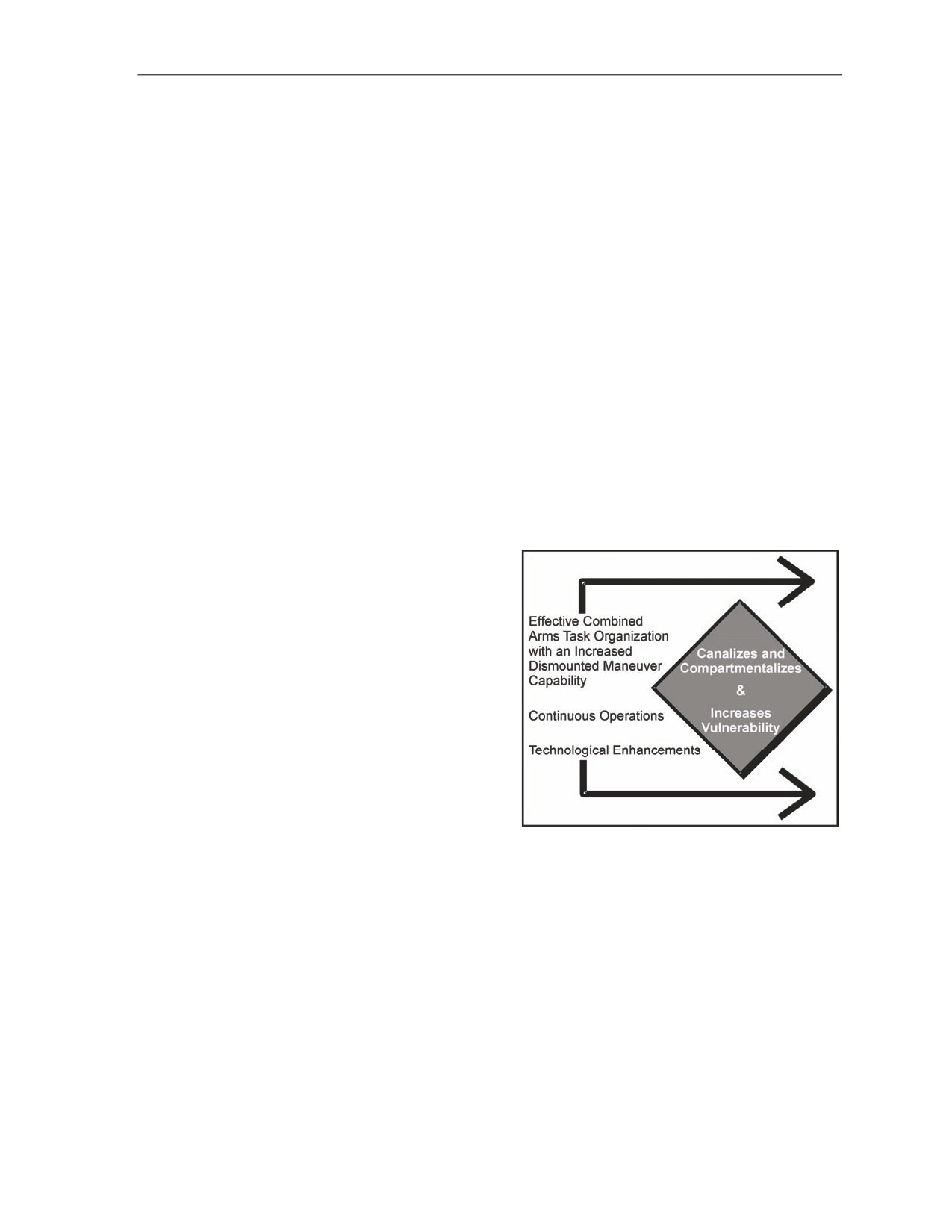
Understanding the Urban Environment’s Effects on Warfighting Functions and Tactics
Increasing the likelihood that untrained Soldiers may fall victim to a threat deception and
misinformation.
Established Intelligence Reach
4-17. Understanding the complex urban environment, particularly the infrastructure and the society, will
require more sources of information beyond a unit’s organic intelligence capabilities. Therefore,
commanders will have to make extensive use of intelligence reach to access information and conduct
collaboration and information sharing with other units, organizations, and individual subject matter
experts. Before deployment
(and throughout the operation), units should establish a comprehensive
directory of intelligence reach resources. These resources may include national, joint, Army, foreign,
commercial, and university research programs. (Prior to deployment for OPERATION IRAQI FREEDOM,
some units established contacts within the local community outside their bases such as police, fire
department, and government officials that expanded their reach once in theater—particularly for
information regarding civilian infrastructure and urban administration.) Once deployed, intelligence reach
includes effective information sharing and collaboration among adjacent units, sister services, coalition
partners, and other governmental and nongovernmental agencies operating in the area. Effective
information sharing and collaboration requires common network analysis software and databases to be
used among all Army forces and, if possible, other governmental agencies.
MOVEMENT AND MANEUVER
4-18. Army maneuver forces—infantry, armor, cavalry, and attack aviation—move to achieve a position of
advantage. Entire urban areas or specific threat forces located within may be isolated from affecting other
operations and then bypassed. However, when the
situation requires entering the urban area to
accomplish the mission—such as when bypassed
urban threat forces interdict critical lines of
communications
(LOCs), the environment will
significantly affect the Army’s ability to move and
maneuver (see figure
4-1). These negative effects
include canalization, compartmentalization, and
increased vulnerability. However, tactics and
techniques equip Army forces to overcome these
challenges and maneuver successfully. One tactic,
effective combined arms task organization, includes
an increased dismounted maneuver capability
combined with armor and combat engineers,
continuous
operations,
and
technological
enhancements.
Figure 4-1. Urban maneuver challenges
and means to overcome them
4-19. In all UO, mobility operations may allow civilian traffic and commerce to resume, letting the urban
area return to some semblance of normalcy (often a critical objective). In stability operations, mobility
often focuses on keeping lines of communications open and reducing the threat of explosive hazards to
Soldiers and civilians. In civil support operations, mobility may focus on removing storm debris or
reducing obstacles caused by destroyed property.
Canalization and Compartmentalization
4-20. The urban terrain will often canalize and compartment forces—and their fires—moving and
maneuvering through it. Buildings pose obstacles to both mounted and dismounted movement, forcing
units to be canalized along streets. The buildings also block movement between streets, thus
compartmenting units. Fires are canalized into open and unmasked areas where vision is unobstructed,
26 October 2006
FM 3-06
4-5
Chapter 4
producing concentrated fire zones and areas, especially at road intersections and in front of defended
positions. Hence, changing directions, repositioning committed forces, reinforcing forces in contact,
bypassing threats, and maneuvering to the threat flank become extremely difficult. Units often breach
obstacles to help solve this problem. Using helicopters to quickly move forces, both forward into contact
and to rear areas as part of repositioning, also permits Army forces to overcome some terrain constraints.
4-21. The canalized and compartmented effects can slow movement and maneuver considerably. However,
slowed movement also results from the physically demanding soldier tasks required in an urban
environment. Soldiers operate dismounted across rubble and hard surfaces. Operating in three dimensions,
they constantly move up the supersurface areas of building interiors and down into basements, cellars, and
other subsurface areas. They breach many obstacles and use upper-body strength, ropes, and ladders to
scale heights. The inability to see into the next room, floor, or building magnifies stress. The resulting
fatigue slows the overall rate of Army force movement and maneuver.
Increased Vulnerability
4-22. The urban environment increases the vulnerability of Army forces executing movement and
maneuver in offensive, defensive, and stability or civil support operations. Both the physical terrain and the
urban population provide threat cover and concealment. Air movement and maneuver is vulnerable for
many of the same reasons. In offensive or defensive operations, enemy forces can remain undetected in
buildings and in position to ambush Army forces. Consistent with METT-TC, Army forces should clear
buildings along maneuver routes prior to mounted movement along those axes. Failure to clear routes (and
effectively mark cleared portions) may expose mounted movement to ambush at close range. Movement
back across streets and obstacles may be difficult particularly if the element of surprise was essential in the
initial crossing or breach. The same buildings also provide cover and concealment to enemy air defense
capabilities—particularly man-portable air defense systems that can be fired from multiple positions hidden
amongst the clutter of fires, lights, smoke and dust, and easily concealed and transported in civilian
vehicles throughout the urban area. In all operations, but especially stability operations, civilians can
conceal threat elements. The threat can then initiate offensive operations against Army forces from close
range and where ROE will hamper applying combat power. Thus, maneuver through a dense population
can be a high-risk operation.
Combined Arms Task Organization
4-23. Effective combined arms task organization ensures that forces are task organized with infantry—the
essential building block for all organizations conducting UO. Infantry protects mounted elements as the
combined arms unit moves and maneuvers through the urban area. (In some urban situations, mechanized
infantry may not be able to provide dismounted support beyond support to its own vehicles—tanks may
require the support of additional light infantry). The infantry destroys the enemy in buildings, bunkers, and
subsurface areas where they cannot be defeated by mounted forces and prevents infiltration of threat forces
back into hard-won urban terrain. Field artillery aids in dismounted and mounted (to include air) maneuver
by suppressing known and suspected enemy positions with precision fires. Attack aviation make best use
of their standoff capabilities (see later fire support discussion) and aircraft speed to conduct running and
diving fires; in UO, hovering fire is generally avoided. Armored elements protect Soldiers from small arms
fire and destroy or suppress enemy positions with precise, direct fire. Carefully protected artillery may also
be used in this direct fire role. Armored forces and attack helicopters also can facilitate maneuver through
shock action that can have a psychological effect, particularly against less well-trained threats and, in
discrete instances, hostile crowds. (Although, commanders consider that the “intimidation” value of any
method erodes quickly with its repetitive use.)
4-24. Combined arms also ensure that combat engineers support dismounted maneuver by assisting in
covered and concealed maneuver through buildings and off exposed streets. In addition to combat
engineers, explosive ordnance disposal teams, military police, chemical personnel, and other with essential
expertise to conduct mobility missions significantly reduces mobility and maneuver challenges (see FM 3
34.2). Urban buildings are often obstacles to movement and mobility. Combat engineers, trained and
equipped for UO, can turn these obstacles into an advantage by breaching them with “mouse holes” made
by explosives, sledgehammers, bulldozers or armored vehicles, or high-strength (diamond or carbide
4-6
FM 3-06
26 October 2006
Understanding the Urban Environment’s Effects on Warfighting Functions and Tactics
tipped) cutting devices. These breaches permit dismounted movement through buildings under both cover
and concealment.
4-25. Combat engineers must also be trained and equipped to facilitate mounted mobility in the urban
environment. Generally, buildings restrict mounted movement to the compartmented and canalized streets.
Threats can block streets with roadblocks ranging from sophisticated log and concrete cribs reinforced with
antitank and antipersonnel mines to the expedient use of cars, buses, and trucks to create obstacles. Combat
engineers must be capable of breaching these obstacles to maintain the coherence of the combined arms
team (mounted and dismounted). Combat engineers should be forward, often task organized down to
platoon level, and have the expertise and equipment to rapidly reduce point obstacles. It even may be
necessary that every armored vehicle (or section of two vehicles) be task organized with an associated
engineer squad and vehicle. Because of the increased density and hardness of many urban building and
construction materials, heavy engineer equipment (such as the D9 bulldozer) will be in great demand to
accomplish mobility (and countermobility, and survivability) functions in an urban environment. However,
commanders will need to consider increased protection requirements and the availability of equipment
transport to move these slower-moving engineer assets around the urban battlefield.
4-26. A major difference of UO combined arms is in proportion and organization. Although based an
accurate METT-TC assessment, UO will often require an increased proportion of dismounted infantry and
engineer capabilities; armor may not be required in the same high numbers. As significant, genuine
combined arms urban operations are required at lower tactical levels where small, well trained and led units
will dominate. Commonly, company level will require true combined arms capability and may include
combat engineers, military intelligence, reconnaissance, and artillery. Combined arms teams can then form
at platoon and squad levels. Because of this, larger units will need more CA, military intelligence, and
combat engineers than habitually attached for combat in more open or less restrictive terrain.
4-27. In determining the appropriate task organization, commanders consider a suitable span of control for
subordinate commanders. They also consider the potential of dissipating a unit’s combat power,
capabilities, and synergy by breaking a unit up into smaller units in an attempt to ensure subordinate
maneuver units have a complete combined arms capability. For example, an additional engineer battalion
may be task organized to a brigade combat team. In turn, the brigade combat team may task organize this
battalion into engineer companies under the control of their subordinate maneuver battalions. If this type of
organization continues, maneuver companies may end up with an engineer platoon and, in the end;
maneuver platoons each having an engineer squad. Ultimately, a combined arms capability may have been
established at lower tactical levels but the parent maneuver unit (in this example, the brigade combat team)
may have lost the ability to conduct larger engineer operations without having to re-task organize and
potentially disrupt current operations and established relationships. As a guide, urban commanders may
consider task organizing to create combined arms organizations at lower tactical levels when operations are
predominately offensive or defensive, and bringing those assets back under their own control when the
operation transitions to predominately stability or civil support operations.
Continuous Operations and Technology Enhancements
4-28. Two other means to improve Army forces’ ability to move and maneuver in urban terrain is through
continuous operations and the leveraging of technology, such as the Army’s night operations capability.
Historically, urban battles have been fought primarily during daylight because of technological limitations
and fatigue. By utilizing night vision technologies, accurate situational understanding, a common
operational picture (COP), training, and rotated units, Army forces can defeat threats who use the same
soldiers in day and night operations and who are less well-equipped and adept at night operations. Night
operations are also a means of mitigating the air defense threat against air maneuver. Continuous
operations through night maneuver with fresh forces are challenging, but it can overcome many advantages
that a stationary force has against maneuver in the urban environment. However, commanders should also
consider that streetlights, fires, background illumination (as well as dark building interiors without ambient
light), the increased heat absorption of many urban structures, and the skillful use of searchlights by threat
forces may limit the effectiveness of night vision devices and make thermal imagery identification difficult.
26 October 2006
FM 3-06
4-7
Chapter 4
Countermobility
4-29. Countermobility capabilities in urban terrain are also an essential consideration in all UO. In
defensive operations, commanders use countermobility capability to control where the enemy moves in the
urban area. Repositioning defensive forces in the urban area can be difficult and obstacles are essential to
limiting the enemy’s maneuver options. During offensive operations, countermobility protects exposed
flanks and air assaulting forces from counterattack. In stability and civil support operations,
countermobility operations may take the form of constructing barriers to assist in populace and resources
control at critical urban locations.
FIRE SUPPORT
4-30. The fire support function includes the collective and coordinated use of several means to attack
targets in the urban area (see Appendix D for joint capabilities). These means include target acquisition
data, indirect fire weapons, rotary- and fixed-wing aircraft, offensive information operations (IO), and
other lethal and nonlethal means. The urban environment affects these components of the fires function and
their employment.
Target Acquisition
4-31. Target acquisition in an urban environment faces several challenges. First, forces have difficulty
penetrating the urban environment’s increased cover and concealment using sensors and reconnaissance.
Acquiring targeting information and tracking targets throughout the depth of the urban area may prove
challenging. Moving personnel or vehicular targets are normally easiest to acquire. However, the cover and
concealment provided by urban terrain gives moving targets short exposure times requiring firing systems
to act rapidly on targeting data. Targeting of opposing indirect fire units by acquisition radar may work
more effectively in urban terrain because of the necessary high angles of indirect fire. The urban
environment presents similar difficulties for battle damage assessment.
4-32. Targeting challenges are met by innovatively integrating reconnaissance capabilities. These
capabilities include SOF, cavalry, unmanned aircraft systems, and aerial observers as well as the standard
reconnaissance assets. More artillery systems may need to be used to ensure the responsiveness (rather than
the weight) of fires. Positioning numerous artillery systems reduces the dead space (as discussed below)
and permits units to establish more direct sensor-to-shooter links.
The Targeting Process
4-33. Heightened concerns for collateral damage will require that commanders pay particular attention to
their targeting process. This process ensures that all available combat power, both lethal and nonlethal
(including offensive IO), is effectively integrated and synchronized to accomplish the mission.
Commanders ensure that techniques and procedures are in place, rehearsed, and understood by all members
of their staffs. Additionally, the C2 system must be responsive and agile; otherwise, an elusive and
adaptable threat will likely disappear before units can employ the appropriate weapon systems. In an urban
area, even 10-digit grid coordinates may not be sufficient to accurately identify targets as buildings may be
connected to each other—often throughout the entire block. Target locations, in addition to grid
coordinates, may need to routinely include the street address, number of stories, shape, color, or any other
distinguishing characteristic essential for ground and air forces to achieve targeting precision. A common
urban reference system with graphics, reference points, and other control measures adequate for both
ground and air forces may also help facilitate identification of targets and facilitate the rapid clearance of
fires.
4-34. Greater concerns exist for the safety and health (environmental matters) of the urban populace and
the protection of critical infrastructure and cultural structures. Hence, CA and staff judge advocates (see
Chapters 5 and 10 respectively) will play a greater role for the expert advice they can provide regarding
these elements of the urban environment. Nonetheless, all members of the staff ensure that operations
minimize collateral damage. That responsibility does not end with identifying potential collateral damage;
the goal, as always, is successful mission accomplishment. Again, staffs are guided by the commander’s
4-8
FM 3-06
26 October 2006
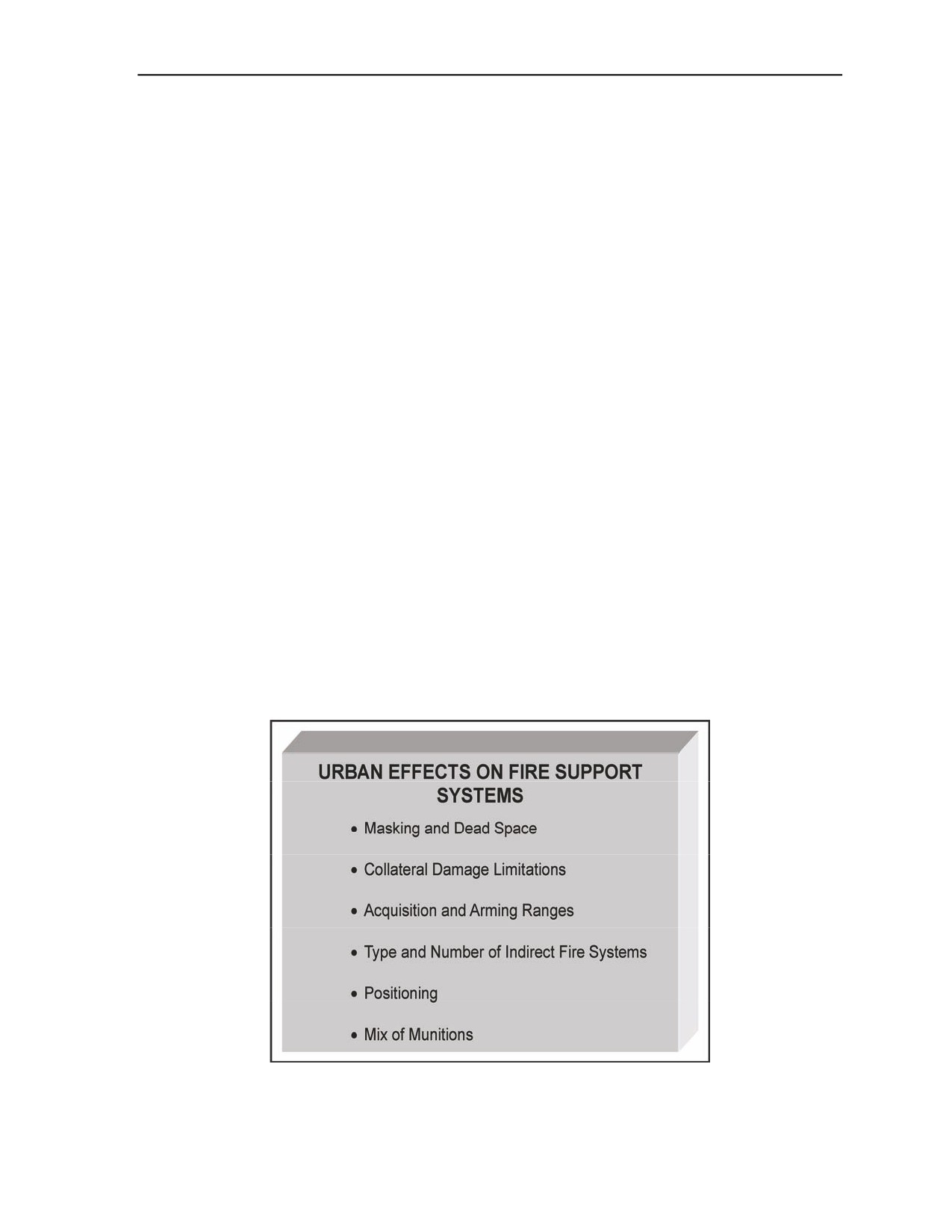
Understanding the Urban Environment’s Effects on Warfighting Functions and Tactics
intent and work to develop courses of action that incorporate collateral damage concerns (short- and long-
term) yet accomplish the mission. This requires a keen understanding of the legal issues and both friendly
and enemy weapon systems’ effects in an urban environment.
Urban Effects on Fire Support Systems
4-35. Both the physical and human components of the urban area affect how units use fire support weapon
systems. The physical aspects of the urban environment, such as the heights and concentration of buildings,
may cause significant masking and dead space (see figure 4-2). Intervening buildings that stand three or
more stories tall hinder close indirect fire support. Tall buildings can potentially mask several blocks of
area along the gun-target line of artillery. (For low-angle artillery fire, dead space is about five times the
height of the building behind which the target sits.) The potential for collateral damage to adjacent
buildings may also prevent engagement with artillery. Such damage might cause noncombatant and
friendly troop casualties and unintentional (and unwanted) rubbling. Commanders can offset these effects
by carefully placing artillery positions, repositioning artillery as targets change, and using mortars. Mortars
have a steep angle of fall and short minimum ranges as a high-angle alternative to field artillery fire. (In
comparison to artillery, dead space for mortar fire is only about one-half the height of the building.) For
fixed-winged aircraft, precision munitions and weapons with low explosive yields and near-vertical impact
angles resulting in bomb burial can significantly reduce collateral damage. Collateral damage concerns
may also cause commanders to—
Maintain approval authority for some sensitive or protected targets (churches or mosques, for
example) at higher echelons of command.
Restrict attacks to certain times of day.
Give warning prior to an attack so that noncombatants can evacuate the area.
Incorporate indigenous forces into the operation.
Abort an attack unless the required level of precision effects can be achieved.
Prepare specific branches and sequels to the IO plan to inform the populace why the collateral
damage was justified. These plans may include filming or otherwise documenting the operation
to thwart threat propaganda and claims of excessive collateral damage.
Develop and rehearse detailed staff battle drills that address clearance of fires in an urban
environment.
Figure 4-2. Urban effects on fire support systems
26 October 2006
FM 3-06
4-9
Chapter 4
4-36. Vertical structures interrupt line of sight (LOS) and create corridors of visibility along street axes.
The result is thereby shortened acquisition and arming ranges for supporting fires from attack helicopters
and subsequently affected engagement techniques and delivery options. Pilots maintain LOS long enough
to acquire targets, achieve weapons delivery solutions, and fly to those parameters. For example, tube-
launched, optically tracked, wire-guided heavy antitank missile systems require
65 meters to arm.
Similarly, the Hellfire missile requires at least 500 meters to reliably arm and stabilize on the intended
target. Thus, attack helicopters firing from longer ranges actually improve the probability of a hit. Poor
weather and heavy smoke and dust rising from urban fires and explosions may hinder target identification,
laser designation, and guidance for rotary- and fixed-winged aircraft. Poor air-to-ground communications
may also hinder effective use of airpower. The close proximity of friendly units and noncombatants
requires units to agree on, thoroughly disseminate, and rehearse clear techniques and procedures for
marking target and friendly locations. The ability for ground units to “talk-on” aircraft using a common
reference system described earlier helps expedite aerial target acquisition (and helps mitigate potential
fratricide). FM 3-06.1 details other aviation TTP in an urban environment.
4-37. The urban environment also affects the type and number of indirect fire weapon systems employed.
Commanders may prefer high-angle fire because of its ability to fire in close proximity to friendly occupied
buildings. Tactically, commanders may consider reinforcing units in UO with mortar platoons from reserve
units. This will increase the number of systems available to support maneuver units. Unguided Multiple
Launch Rocket Systems (MLRSs) may be of limited use in urban areas due to their exceptional destructive
capabilities and the potential for collateral damage. However, commanders may use unguided MLRSs to
effectively isolate the urban area from outside influence. Commanders may also employ field artillery
systems as independent sections, particularly self-propelled systems, in the direct-fire role; decreasing
volume and increasing precision of artillery fire helps minimize collateral damage. While discretely
applying the effects of high-explosive and concrete-piercing munitions, these self-propelled systems take
advantage of the mobility and limited protection of their armored vehicles.
4-38. The urban area may also affect the positioning of artillery. Sufficient space may not exist to place
battery or platoon positions with the proper unmasked gun line. This may mandate moving and positioning
artillery in sections while still massing fires on specific targets. Commanders must protect artillery systems,
particularly when organized into small sections. Threats to artillery include raids and snipers. Therefore,
maneuver and firing units will have to place increased emphasis on securing their positions and other
appropriate force protection measures.
4-39. The mix of munitions used by indirect fire systems will change somewhat in urban areas. Units will
likely request more precision-guided munitions
(PGM) for artillery systems to target small enemy
positions, such as snipers or machine guns, while limiting collateral damage. Currently, only conventional
tube artillery, not mortars, has this capability. However, large expanses of polished, flat reflective surfaces
common in urban areas may degrade laser designation for these munitions (as well as attack helicopter
PGM). The vertical nature amplifies the geometrical constraints of many precision munitions. Remote
designators need to be close enough to accurately designate but far enough away not to be acquired by the
PGM during its flight path. PGMs based on the global positioning system (for instance, guided MLRS or
the Air Force’s joint direct attack munitions) or other optically guided PGMs may be more effective if
urban terrain hinders laser designation.
4-40. The urban environment greatly affects the use of nonprecision munitions. Building height may cause
variable time fuses to arm prematurely. Tall buildings may also mask the effects of illumination rounds.
Units may choose not to use dual-purpose conventional munitions if (similar considerations apply to Air
Force cluster bombs)—
The enemy has several building floors for overhead protection.
Dismounted friendly units need rapid access to the area being fired on.
Large numbers of civilians will operate in the target areas soon after combat operations have
ceased.
4-41. Depending on the building construction, commanders may prohibit or limit illumination, smoke, and
other munitions because of fire hazards. In particular instances, they may specifically use them for that
effect. Structure fires in an urban area are difficult to control and may affect friendly units. Conventional
4-10
FM 3-06
26 October 2006
Understanding the Urban Environment’s Effects on Warfighting Functions and Tactics
high-explosive munitions may work best against concrete, steel, stone, and other reinforced structures.
When not used in the direct-fire role, a greater mass of indirect fire is often required to achieve desired
effects. Commanders balance firepower and collateral damage since the rubbling caused by massive
indirect fires may adversely affect a unit’s ability to maneuver and provide a threat with additional cover
and concealment.
4-42. Nonlethal weapons, munitions, and devices can help commanders maintain the desired balance of
force protection, mission accomplishment, and safety of noncombatants by expanding the number of
options available when deadly force may be problematic. As additional nonlethal capabilities are
developed, they are routinely considered for their applicability to UO. In determining their use and
employment, commanders, in addition to any previous experience at using these weapons, munitions, and
devices, consider—
Risk. The use of nonlethal weapons in situations where lethal force is more appropriate may
drastically increase the risk to Army forces.
Threat Perspective. A threat may interpret the use of nonlethal weapons as a reluctance to use
force and embolden him to adopt courses of action that he would not otherwise use.
Legal Concerns. Laws or international agreements may restrict or prohibit their use (see
Chapter 10).
Environmental Concerns. Environmental interests may also limit their use.
Public Opinion. The apparent suffering caused by nonlethal weapons, especially when there are
no combat casualties with which to contrast it, may arouse adverse public opinion.
PROTECTION
4-43. The protection function includes those tasks and systems that preserve the force so that commanders
can apply maximum combat power. Preserving the force includes enhancing survivability and properly
planned and executed air and missile defense as well as defensive IO (see IO discussion in Chapter 5) and
chemical, biological, radiological, nuclear, and high-yield explosive (CBRNE) counterproliferation and
consequence management activities (see CBRNE discussion in Chapter 9).
Survivability
4-44. Survivability in the urban environment is a significant force multiplier. Properly positioned Army
forces can take advantage of the increased survivability afforded by the physical terrain. Even a limited
engineer effort can significantly enhance the combat power of small Army forces. In stability operations,
properly planned and constructed survivability positions can enable small groups of Soldiers to withstand
the assaults of large mobs, sniping, and indirect fire. Well-protected support bases are often critically
essential to minimizing casualties during long-term stability operations and can become a key engineer
task.
4-45. While executing major combat operations or campaigns, in particular defensive operations, well
planned and resourced engineer efforts can enhance the survivability characteristics of the urban area.
These efforts, though still requiring significant time and materiel, can establish defensive strong points
more quickly and with greater protection than can be done in more open terrain. Skillfully integrating the
strong point into the urban defense greatly increases the overall effectiveness of the defense
disproportionately to the number of forces actually occupying the strong point (see Chapter 8).
4-46. Commanders increase survivability by ensuring that all Soldiers have necessary protective
equipment and are trained and disciplined in their use. In addition to standard equipment such as helmets,
gloves, boots, and chemical protective overgarments, commanders should ensure, as necessary, availability
of other protective equipment and material such as—
Body armor.
Goggles or ballistic eye protection.
Knee and elbow protectors.
Riot control equipment such as batons, face masks, and shields.
26 October 2006
FM 3-06
4-11
Chapter 4
Barrier material such as preformed concrete barriers, wire, sandbags, and fencing material.
Up-armored or hardened vehicles.
Fire extinguishers and other fire-fighting equipment.
Immunizations.
4-47. The Army’s urban survivability operations can become complex if the Army is tasked to support
survivability operations for civilians. Such operations can range from constructing civil defense shelters or
evacuating the population to assisting the population in preparing for or reacting to the use of weapons of
mass destruction. However, Army forces are not organized or equipped to support a major urban area’s
requirements as well as its own mission needs. Normally, Army forces can render this type of support only
as a focused mission using a unique, specially equipped task organization.
Air and Missile Defense
4-48. The air and missile defense protects the force from air surveillance and air and missile attack. This
system uses—
The careful massing of air and missile defense combat power at points critical to the urban
operation.
The proper mix of air defense weapon and sensor systems.
Matched (or greater) mobility to the supported force.
The integration of the air defense plan into the overall urban operation.
The integration of Army systems with those of joint and multinational forces.
4-49. Properly planned and executed air and missile defense prevents air threats from interdicting friendly
forces and frees the commander to synchronize maneuver and other elements of firepower. Even in a major
combat operation or campaign, the enemy will likely have limited air and missile capabilities and so seek
to achieve the greatest payoff for the use of these systems. Attacking Army forces and facilities promises
the greatest likelihood of achieving results, making urban areas the most likely targets for air and missile
attack.
Rotary- and Fixed-Winged Aircraft
4-50. Enemy rotary-wing aircraft can be used in various roles to include air assault, fire support, and
combat service support. Some threats may use unmanned aircraft systems to obtain intelligence and target
acquisition data on friendly forces. Increased air mobility limitations and targeting difficulties may cause
enemy fixed-wing aircraft to target key logistics, C2 nodes, and troop concentrations outside the urban
area, simultaneously attacking key infrastructure both in and out of the urban area.
Increased Missile Threat
4-51. The intermediate range missile capability of potential threats has increased to be the most likely air
threat to an urban area. Urban areas, particularly friendly or allied, make the most attractive targets because
of the sometimes-limited accuracy of these systems. By firing missiles at an urban area, a threat seeks three
possible objectives:
Inflict casualties and materiel damage on military forces.
Inflict casualties and materiel damage on the urban population.
Undermine the confidence or trust of the civil population (particularly if allied) in the ability of
Army forces to protect them.
4-52. If facing a missile threat, commanders conducting UO work closely with civil authorities (as well as
joint and multinational forces) to integrate the Army warning system with civil defense mechanisms.
Similarly, Army forces may support urban agencies reacting to a missile attack with medical and medical
evacuation support, survivor recovery and assistance in damaged areas, and crowd control augmentation of
local police forces. Before such an attack, Army engineers might assist and advise urban officials on how
to construct shelters.
4-12
FM 3-06
26 October 2006
Understanding the Urban Environment’s Effects on Warfighting Functions and Tactics
Increased Security of Assets
4-53. When defending against an air or missile threat in a neutral or hostile urban environment, air defense
assets are concerned with security. Separating air defense locations from high population and traffic
centers, as well as augmenting these positions with defending forces, can prevent or defeat threat efforts to
neutralize them. Additionally, increased density of UO means increased concentration of all friendly and
enemy systems engaged in air and counter-air operations. This density may increase friend and foe
identification challenges, air space management challenges, and the overall risk in the conduct of air
operations. Finally, limited air defense assets, difficulties in providing mutual support between systems,
potential mobility limitations, and other effects of the urban environment increase the need for (and
effectiveness of) a combined arms approach to air defense (see FM 44-8).
SUSTAINMENT
4-54. The sustainment function incorporates support activities and technical service specialties, to include
maximizing available urban infrastructure and contracted logistics support. It provides the physical means
with which forces operate. Properly conducted, the sustainment function ensures freedom of action,
extends operational reach, and prolongs endurance. Commanders conducting sustainment to support full
spectrum operations must understand the diverse logistic requirements of units conducting UO. They must
also understand how the environment (to include the population) can impact sustainment support. These
requirements range from minimal to extensive, requiring Army forces to potentially provide or coordinate
all life support essentials to a large urban population.
4-55. Commanders and staffs consider and plan for Army sustainment operations that are based in a major
urban area. These operations are located in major urban areas to exploit air- and seaports, maintenance and
storage facilities, transportation networks, host-nation contracting opportunities, and labor support. These
operations are also UO. The commander gains additional factors to consider from basing the sustainment
operation in an urban environment. See Chapter 10 for a detailed discussion of urban sustainment
considerations.
COMMAND AND CONTROL
Fighting in a city is much more involved than fighting in the field. Here the “big chiefs”
have practically no influence on the officers and squad leaders commanding the units
and subunits.
Soviet General Vasili Chuikov
during the 1942-43 Battle for Stalingrad
4-56. The command and control function is the related tasks and systems that support the commander in
exercising authority and direction. The urban environment influences both the commander and his C2
system (which includes INFOSYS). The leader’s ability to physically see the battlefield, his interaction
with the human component of the environment, and his intellectual flexibility in the face of change all
impact the mission. The C2 system faces difficulties placed on the tactical Internet and system hardware by
the urban environment, by the increased volume of information, and by requirements to support the
dynamic decision making necessary to execute successful UO.
Unity of Command
4-57. Although severely challenged, the principle of unity of command remains essential to UO. However,
the number of tasks and the size of the urban area often require that Army forces operate noncontiguously.
Noncontiguous operations stress the C2 system and challenge the commander’s ability to unify the actions
of his subordinates, apply the full force of his combat power, and achieve success. To apply this crucial
principle in an urban environment requires centralized planning, mission orders, and highly decentralized
execution. The method of C2 that best supports UO is mission command (see FM 6-0). Mission command
permits subordinates to be innovative and operate independently according to clear orders and intent as
well as clearly articulated ROE. These orders and ROE guide subordinates to make the right decision when
facing—
26 October 2006
FM 3-06
4-13