FM 3-06 URBAN OPERATIONS (OCTOBER 2006) - page 3
Chapter 4
A determined, resolute, and adaptive threat.
A complex, multidimensional battlefield.
Intermittent or complete loss of communications.
Numerous potentially hostile civilians close to military operations.
The constant critique of the media and military pundits.
4-58. Decentralized execution allows commanders to focus on the overall situation—a situation that
requires constant assessment and coordination with other forces and agencies—instead of the numerous
details of lower-level tactical situations. Fundamentally, this concept of C2 requires commanders who can
accept risk and trust in the initiative, judgment, and tactical and technical competence of their subordinate
leaders. Many times, it requires commanders to exercise a degree of patience as subordinate commanders
and leaders apply mental agility to novel situations.
Political and Media Impact
4-59. Commanders of a major operation consider how the need to maintain a heightened awareness of the
political situation may affect their exercise of C2. A magnified political awareness and media sensitivity
may create a desire to micromanage and rely solely on detailed command. Reliance on this method may
create tactical leaders afraid to act decisively and with speed and determination—waiting instead for
expected guidance from a higher-level commander. Threats may capitalize on this hesitation by conducting
operations faster than Army forces can react. Mission orders that express the overarching political
objectives and the impact of inappropriate actions, combined with training and trust, will decrease the need
for detailed command. Leaders must reduce a complex political concept to its simplest form, particularly at
the small-unit level. Even a basic understanding will help curtail potentially damaging political actions and
enable subordinates to make the often instantaneous decisions required in UO—decisions that support
military and political objectives.
Commander’s Visualization
I heard small-arms fire and RPG explosions and felt shrapnel hit the vehicle…. Land
navigation at this time was impossible; every time I tried to look out, I was thrown in a
different direction…. At this time, I was totally disoriented and had not realized we were
on our own.
Captain Mark Hollis
“Platoon Under Fire”
4-60. Leaders at all levels need to see the battlefield to lead Soldiers, make effective decisions, and give
direction. Sensors and other surveillance and reconnaissance assets alone cannot provide all the
information regarding the urban environment that commanders will need. The focus of lead elements
narrows rapidly once in contact with a hostile force limiting their assessment to the local area. Therefore,
tactical commanders will not be able to observe operations from long, stand-off ranges. Their personal
observation remains as critical in urban areas as elsewhere and helps to preclude commanders from
demanding their subordinates accomplish a task or advance at a rate inconsistent with the immediate
situation. In urban offensive and defensive operations, seeing the battlefield requires that commanders
move themselves and their command posts forward to positions that may be more exposed to risk. Thus,
commanders modify their C2 system capabilities to make them smaller, reduce their signature, and increase
their mobility. Because of the greater threat to C2, security efforts may be more intense.
4-61. In stability operations, commanders often intervene personally to reassure the urban population and
community and faction leaders about the intentions of Army forces. In these type operations, threats may
attack leaders to gain the greatest payoff with the least expenditure of resources. Commanders carefully
evaluate risk and potential benefits of such exposure. These risks however, cannot stop them from seeing
the battlefield, personally intervening in situations as appropriate, and leading their Soldiers.
4-62. Commander’s visualization also requires having an accurate understanding of friendly and enemy
locations, detailed maps, other appropriate intelligence products, and INFOSYS that accurately depict the
urban environment and help establish a COP. The reliability of these items is as important to planning
4-14
FM 3-06
26 October 2006
Understanding the Urban Environment’s Effects on Warfighting Functions and Tactics
major operations as it is to tactical-level operations. The commander of the major operation ensure that
subordinate tactical-level commanders have the necessary products to achieve accurate situational
understanding and dominate the urban environment as subordinate commands often lack the personnel or
assets to develop these products. Frequently, satellite or aerial imagery is requested to compensate for the
drastic changes that can occur due to UO, natural disasters, and outdated or imprecise maps. (Even maps
developed and maintained by urban area’s administrative activities may not be up-to-date. Extensive and
continually expanding shantytowns, for example, may not be mapped at all. Maps may have even been
purposefully distorted or critical detail intentionally omitted. The systems used to transliterate some
languages such as Arabic and Chinese to Anglicized alphabets often result in the same location being
spelled several—and frequently considerably different—ways. Maps may also assign names to features
that are completely different than those used by locals to refer to them.)
4-63. Other critical intelligence products needed in the COP include overlays or gridded reference
graphics.
(Whenever possible, gridded reference graphics should conform to standard military grid
reference system formats to reduce the probability of error when entering target coordinates into targeting
systems that use global positioning systems.) These products should be developed and distributed to all
participants prior to the UO. Overall, their focus should be on ease of reference and usefulness for all
forces—ground and air (see Appendix B). Overlays and graphics can also portray important societal
information or urban infrastructure, such as—
Religious, ethnic, racial, or other significant and identifiable social divisions.
Locations of police, fire, and emergency medical services and their boundaries or zones of
coverage.
Protected structures such as places of worship, hospitals, or other historical and culturally
significant buildings or locations.
Underground subway, tunnel, sewer, or water systems.
Bridges, elevated roadways, and rail lines.
Electrical generation (to include nuclear) and gas storage and production facilities and their
distribution lines.
Water and sewage treatment facilities.
Telephone exchanges and television and radio stations.
Toxic industrial material locations.
Mental Flexibility
4-64. Commanders conducting UO must remain mentally flexible. Situations can change rapidly because
of the complexity of the human dimension. Typical of the change is a stability operation that suddenly
requires the use of force. Commanders must be capable of quickly adjusting their mental focus from a
noncombat to combat situation. Equally important is dealing with populations during combat operations.
Consequently, commanders must also be capable of rapidly adjusting plans and orders for sudden stability
or civil support tasks that emerge during or soon after a combat mission. In developing their vision,
commanders must consider the second- and third-order effects of UO.
Information Systems
4-65. The urban environment also challenges INFOSYS that support the commander, especially
communications. Urban structures, materials, densities, and configurations (such as urban canyons) and
power constraints associated with man-portable radios significantly degrade frequency modulation (FM)
communications. This causes problems at brigade-level and below where commanders rely heavily on
constant FM radio contact with subordinates. Tactical communication problems might also cause an
inability to maintain a COP, to give orders and guidance, to request support, or to coordinate and
synchronize elements of the combined arms team. Communication problems in urban areas can prevent the
achievement of information superiority and contribute directly to mission failure. In UO, allocating critical
or high-value communication assets will be significant and essential to the main effort.
26 October 2006
FM 3-06
4-15
Chapter 4
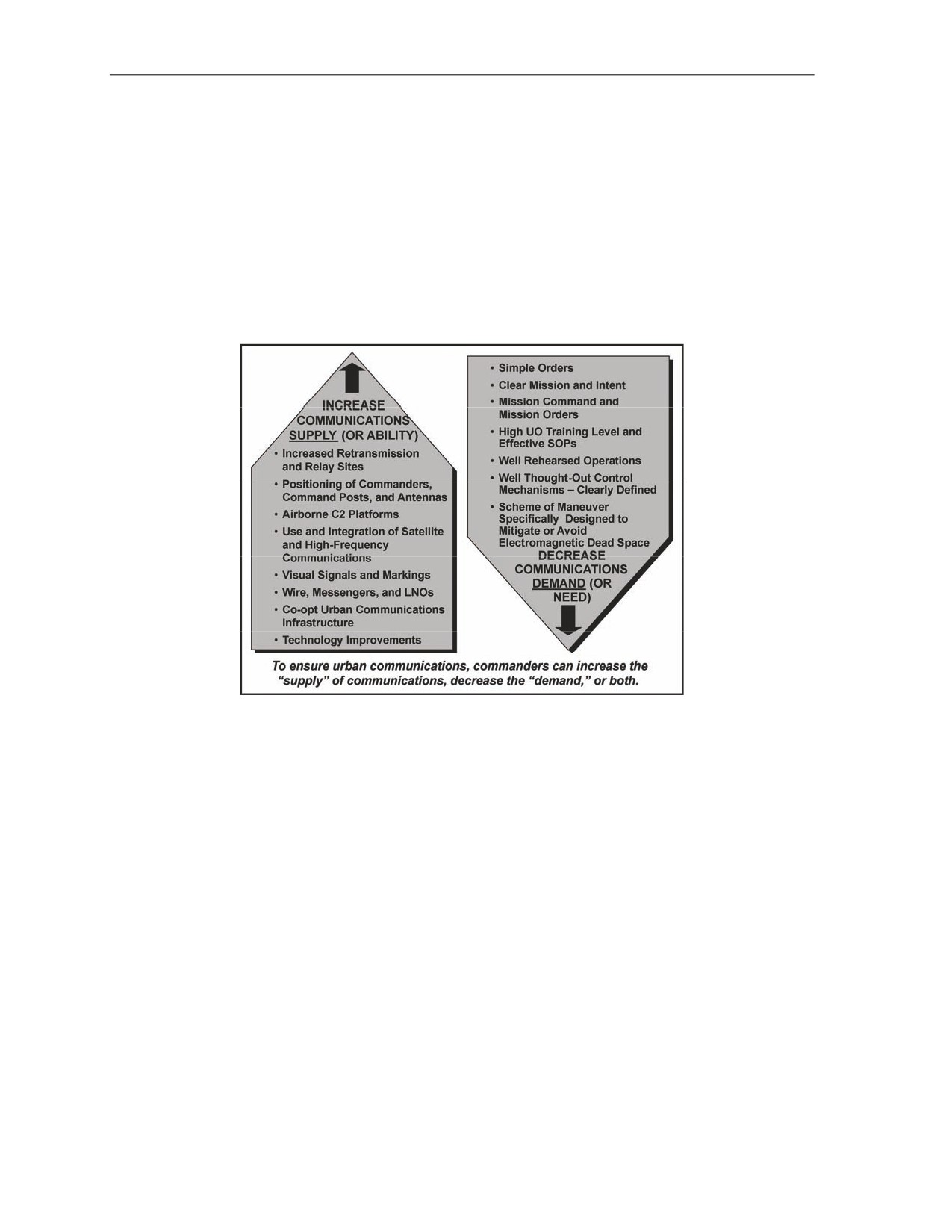
4-66. In an urban environment, units and staffs properly prepare for and mitigate the communication
problems in urban areas (see figure 4-3). Adequate communications, in most cases, are ensured by—
Training in and use of retransmission and relay sites and equipment, which may include
unmanned aircraft systems (UAS).
Airborne command posts, satellite communications, high-frequency radios, and other redundant
communication platforms and systems.
Careful positioning of commanders, command posts, and antennas to take advantage of urban
terrain characteristics.
Detailed communications analysis for movement from one AO to another due to the likely
density of units operating in the urban environment.
Figure 4-3. Methods to overcome urban communications challenges
4-67. Standing operating procedures (SOPs) for visual markings (both day and night) may assist in
command and control. These SOPs indicate unit locations and other essential information. They coordinate
with units across common boundaries. Given adequate consideration to limitations on multinational
capabilities, these SOPs may assist in command and control and preclude fratricide incidents resulting from
loss of FM communications. However, visual signals, including pyrotechnics, are less effective in
buildings and enclosed spaces.
4-68. In defensive, stability, or civil support operations, positions often do not change as frequently as in
offensive operations. Urban commanders then rely more on military wire (properly camouflaged amongst
the civilian communications infrastructure), commercial communications, and messengers. Even in
combat, some if not all of the urban area’s organic communications structure remains intact for Army use.
For example, every building may have one or more telephone distribution boxes that can control hundreds
of individual telephone lines. Setting up wire communications using these points is relatively simple but,
like all wire communications, is susceptible to wire-tapping. Cellular telephones can usually work well in
urban areas; however, locating and destroying the repeater stations or other land-based elements of the
cellular telephone system (or the effects of natural disasters) can easily disable them. (Cell phones may be a
critical and only means to rapidly communicate with key civilian organizations and important community
leaders.) Consequently, the C2 system may use these alternatives to FM communications but with proper
operations and physical security procedures in place.
4-16
FM 3-06
26 October 2006
Understanding the Urban Environment’s Effects on Warfighting Functions and Tactics
Example of Simple Communications Innovation:
Israel’s Six-Day War - 1967
In the 1967 battle for Jerusalem, the Israeli Defense Force placed flags on top of
cleared buildings so that aircraft providing close air support could monitor the Israeli
forward line of troops. They also used a spotlight during the night to mark specific
buildings as close air support targets.
4-69. Units will likely use multiple means to communicate throughout the urban area. Hence, commanders
emphasize proper operations security procedures (OPSEC) despite the level of security provided by the
communications system. This emphasis helps to lessen the probability that Soldiers will inadvertently
compromise essential information as they switch from one mode of communications to another (for
example, from secure FM radio to unsecured cellular telephones or from classified to unclassified Internet
domains).
4-70. Command posts above brigade-level ensure that they can communicate in an urban area without
significant disruption. In stability and civil support operations, immediate and reliable communications
between tactical and strategic levels may be necessary. Higher commanders anticipate that although the
urban area does not significantly challenge their INFOSYS, the area may severely challenge systems at the
lower tactical levels. For this reason, information flow from lower to higher may take longer. If the
situation is not acceptable, the higher headquarters takes steps to mitigate it, such as increasing the number
of liaison officers operating with units engaged in decisive operations. In some instances, the scheme of
maneuver may be specifically designed to account for communications interference, propagation
characteristics, and electromagnetic dead space. (However, this will require more time, resources, and a
detailed urban communications IPB.)
4-71. Finally, urban areas can overload the INFOSYS with information. UO across the spectrum of
operations can generate large volumes of information when crises threaten. This sheer volume can easily
overwhelm UO commanders and command posts, and the information conduit connecting the two.
Training prepares command posts to handle this volume of information and to filter the critical from the
merely informative. Staffs must create products (visual or textual) that help their commanders understand
the urban environment, not just present them information to know.
KEY TACTICAL CONSIDERATIONS
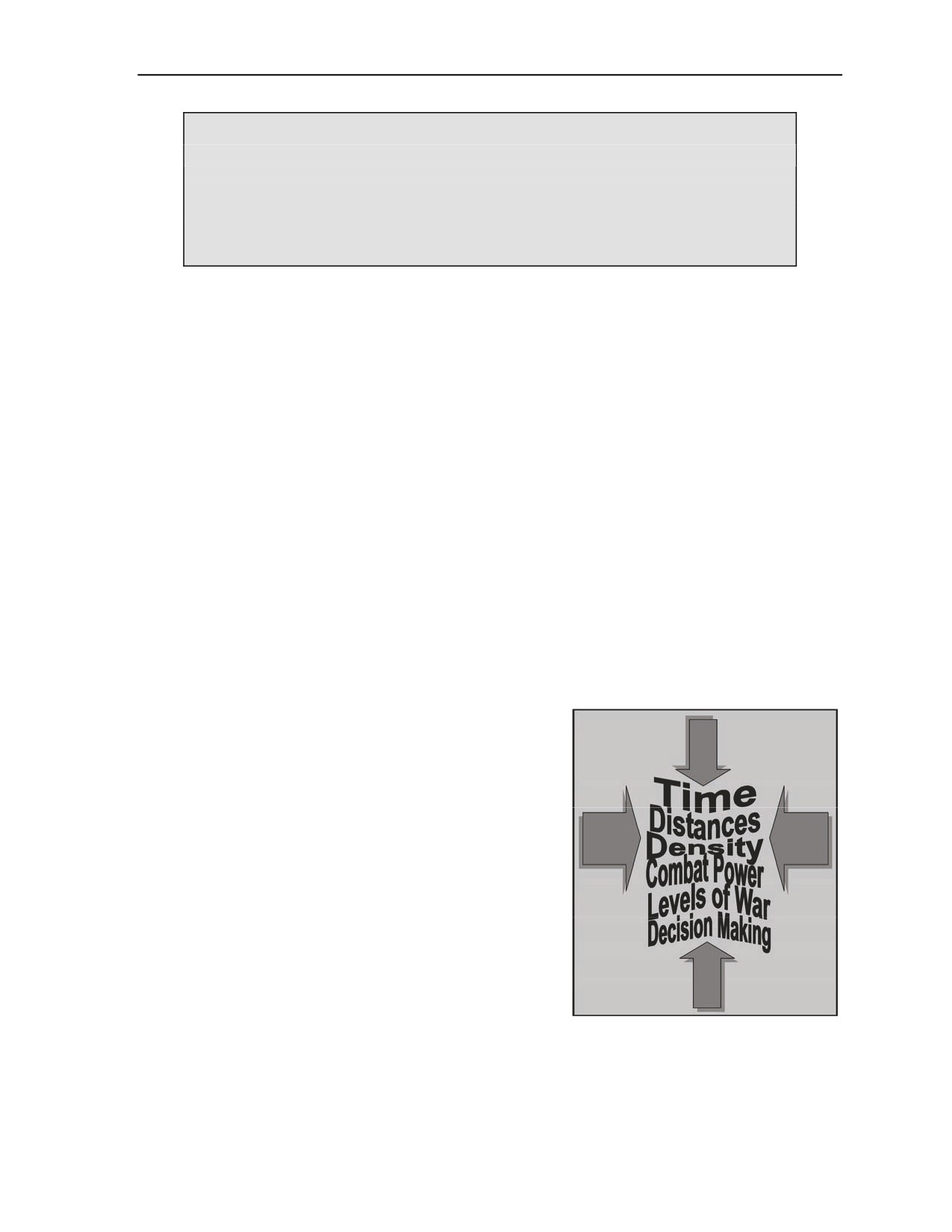
4-72. Commanders and planners of major UO must
thoroughly understand the tactical urban battle. Especially,
they must understand the effects of the environment on men,
equipment, and systems. The complexity of urban
environment changes and often compresses many tactical
factors typically considered in the planning process. Figure 4
4 shows some of these compressed factors, however,
commanders and their staffs should carefully review FM 3
06.11 for doctrine to support tactical urban operations.
Figure 4-4. Compressed tactical
factors
26 October 2006
FM 3-06
4-17
Chapter 4
TIME
4-73. The time available to think and act is compressed in urban combat operations. The tactical
engagements that comprise battles and major UO are often quick and decisive; therefore, higher-level
commanders require the ability to conduct battle command on the move so that their decision making
remains correspondingly fast. The impact of decisions (or lack of) and the outcome of battle can occur in
mere minutes. Often the amount of information and the number of decisions can overwhelm the overall
ability of INFOSYS to respond. Commanders have little time to influence tactical actions with resources
kept in reserve. Reserves and fire support assets are close to the point of decision so that they can respond
in time to make a difference. The terrain causes C2 challenges that further inhibit commanders from
responding quickly to changes in the situation. Small unit leaders receive training that emphasizes
understanding the commander’s intent so that they can recognize tactical opportunities and can act quickly
to take advantage of them.
DISTANCES AND DENSITY
4-74. Distances in UO are compressed to correspond to the density of threat forces and noncombatants. In
open terrain, squads, platoons, and companies may be able to control or influence thousands of meters of
space. In UO, large buildings can absorb the efforts of several companies or battalions. Crowds of
thousands can assemble in areas of a few hundred meters requiring correspondingly large forces for
control. Maximum engagement ranges, as influenced by the urban terrain, are usually closer. Units may
require field artillery for direct fire at targets ranging fewer than a hundred meters. Commanders and staffs
understand the telescoping nature of the battlefield, the density of threat forces, and the density of
noncombatants. In addition to the actual conduct of urban tactical operations, these factors will directly
affect training, planning, force deployment, and strength.
4-75. Time-distance considerations are especially important throughout planning cycles. Though distances
may be short, the physical nature of the environment can drastically change the planning factors for unit
movements. The advance of a battalion may be measured in hundreds of meters per day. Thus, all time and
distance calculations that relate to sequencing of forces, synchronizing combat power and other capacities,
and making decisions require reevaluation based on the urban conditions.
4-76. Although it may appear counterintuitive, airspace above the urban area may be also be severely
compressed as multiple fixed-wing, rotary-wing, and indirect fires (including multinational assets) compete
for the same space. Increasing this density is the use of airspace by civilian aircraft and the proliferation of
tactical UAS. Due to the potential for a high volume of air traffic, commanders and planers pay close
attention to the integration and deconfliction of airspace over urban areas. Commanders should consider
specific techniques and procedures for UAS which may include—
Defining airspace control areas.
Regulating flight times.
Creating altitude restrictions.
Including UAS on the air tasking order.
COMBAT POWER
4-77. The urban terrain can also compress combat power. This terrain increases the utility and effects of
some weapons and systems, increasing overall combat power. One system that dramatically demonstrates
this effect is the sniper. In open terrain, snipers slightly influence operations. In UO, snipers—well
concealed, positioned, and protected—can take on significance disproportionate to their combat capability
in other situations (see FM 23-10).
4-78. The density of ground combat power in a given size area is also increased because of the effect of
the terrain on ranges. The complex terrain precludes standoff engagement from extended ranges by
dispersed forces. Commanders often position weapon systems closer together and at shorter ranges to mass
effects on the same target. Thus, commanders may position armored vehicles, which typically position
themselves Hundreds of meters from friendly troops and other vehicles, within a few meters of each other
4-18
FM 3-06
26 October 2006
Understanding the Urban Environment’s Effects on Warfighting Functions and Tactics
to provide mutual support. Targets, which in open terrain are engaged at thousands of meters, are engaged
in tens of meters on the urban battlefield.
4-79. The dense clutter of the urban environment also affects target acquisition. Systems, such as radar
optimized for open terrain, will not be able to acquire targets as effectively. Decreased acquisition
capability equates to diminished combat power. It may also require increasing the density of acquisition
systems to compensate for reduced capability.
4-80. Finally, the density of combat power may also increase the vulnerability of Army forces. Many
Army systems are protected from enemy systems at longer ranges. The number of enemy systems that can
threaten Army forces at a short range increases dramatically. Lack of dispersal will make it more likely that
multiple Army systems can be targeted by a single enemy threat.
LEVELS OF WAR
4-81. The levels of war are also compressed in the urban area. The tactical actions of individuals and small
units can directly influence operational and even national and strategic objectives. Conversely, the
decisions of the President can directly affect the conduct of tactical operations. UO have short cause and
effect links between the tactical, operational, and strategic levels of operations. Because of the close media
scrutiny of UO, the President can sometimes observe the actions of platoons in real time. For example, the
media may film a platoon applying nonlethal force for crowd control. The President can view that film on
the nightly news before the platoon even disengages from the action, much less reports formally through
the various levels of command. If appropriate, the President can decide and direct the strategic and
operational commanders to adjust ROE before the platoon has reported. Therefore, commanders at all
levels must understand the urban environment’s potential compressive effects on the levels of war. A major
impact of these effects can be a lower tolerance for tactical errors and a greater need for detailed planning
and precision in execution and weapons’ effects (lethal and nonlethal).
DECISION MAKING
4-82. The nature of the urban environment compresses the time available to make decisions and increases
the number of decisions to make. This is particularly true at the lower tactical levels. Units observing an
urban AO face more potential unknowns than in other situations. A large structure presents many more
potential firing positions that are observed than simpler terrain. Movement in one of those windows forces
the soldier or unit to quickly make a decision regarding
the nature of the target—deciding whether it is a threat or
a noncombatant. Incorporating combatant and
noncombatant discriminatory considerations into all live-
fire training will improve Soldiers’ ability to make these
critical
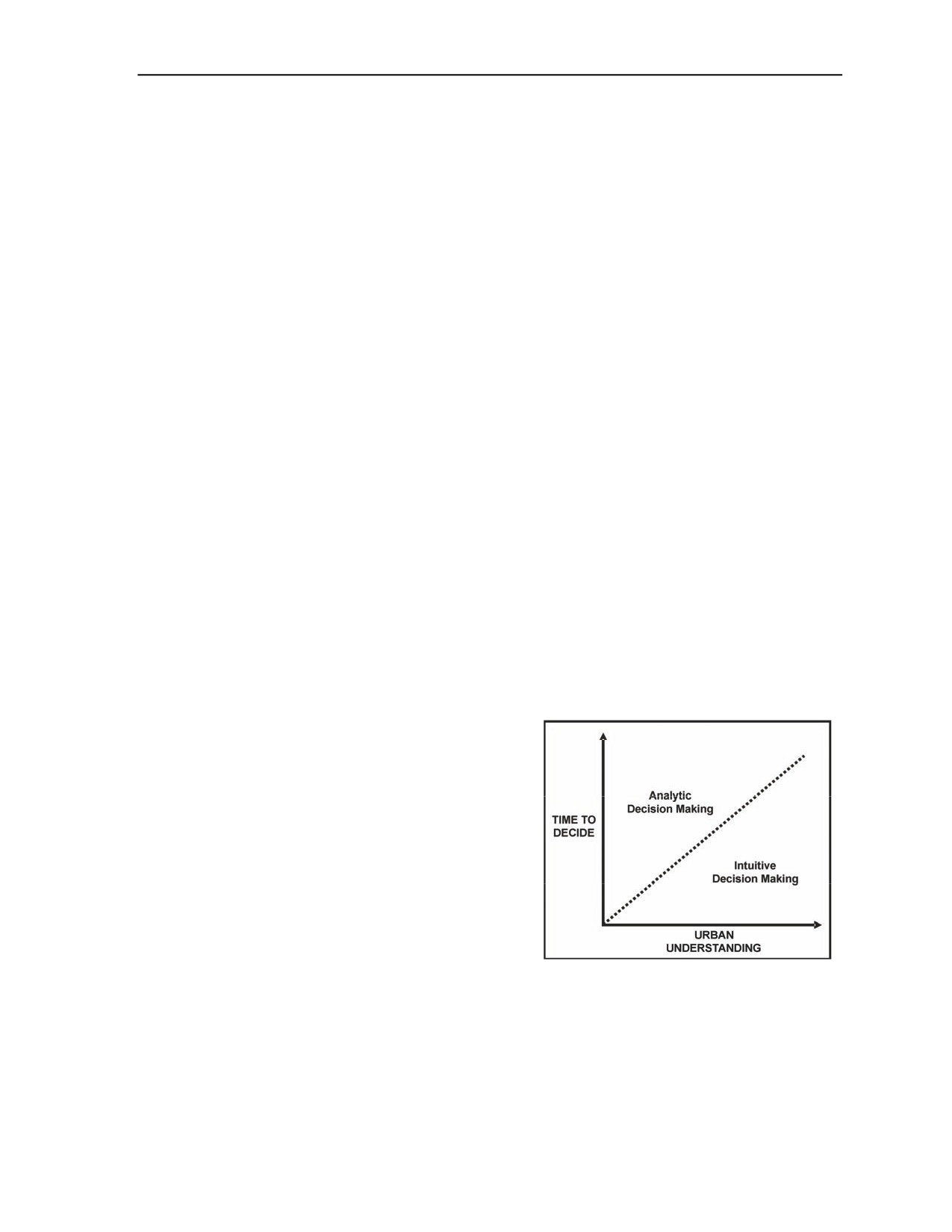
judgment decisions. Overall, lack of
understanding regarding the urban environment requires
commanders to rely more on analytic decision making,
while greater understanding facilitates adaptability and
allows commanders to make rapid and intuitive decisions
while still accounting for second, third, and higher-order
effects
(see Figure
4-5 and FM
6-0). Realistically,
however, all decisions made during urban operations will
likely require a combination of analytic and intuitive
decision-making abilities.
Figure 4-5. Urban understanding and
decision making
26 October 2006
FM 3-06
4-19
This page intentionally left blank.
Chapter 5
Contemplating Urban Operations
We based all our further calculations on the most unfavorable assumptions: the
inevitability of heavy and prolonged fighting in the streets of Berlin, the possibility of
German counter-attacks from outside the ring of encirclement from the west and south-
west, restoration of the enemy’s defence to the west of Berlin and the consequent need to
continue the offensive.
General of the Army, S. M. Shtemenko
describing operational level planning for taking Berlin
The Soviet General Staff at War
In any potential situation and in any area, Army commanders will likely need to
assess and understand the relevance and impact of one or more urban areas on their
operations. They will also need to determine whether full spectrum urban operations
(UO) will be essential to mission accomplishment. UO may be the commander’s sole
focus or only one of several tasks nested in an even larger operation. Although UO
potentially can be conducted as a single battle, engagement, or strike, they will more
often be conducted as a major operation requiring joint resources. Such actions result
from the increasing sizes of urban areas. Army commanders of a major urban opera
tion must then ensure that UO clearly support the operational objectives of the joint
force commander
(JFC), requesting and appropriately integrating critical joint
resources. Whether the urban operation is the major operation itself or one of many
tasks in a larger operation, Army commanders must understand and thoroughly shape
the conditions so subordinate tactical commanders can engage and dominate in this
complex environment.
A major operation is a series of tactical actions (battles, engagements, strikes) conducted by
various combat forces of a single or several services, coordinated in time and place, to
accomplish operational, and sometimes strategic objectives in an operational area.
DETERMINING THE NECESSITY OF URBAN OPERATIONS
5-1. Early in planning, commanders of a major operation must address the necessity and feasibility of
conducting operations in urban areas located throughout their areas of operations (AOs). Chapter 1 dis
cussed strategic and operational considerations that compel forces to operate in urban areas. These reasons
include the location and intent of the threat force; critical infrastructure or capabilities that are operationally
or strategically valuable; the geographic location of an urban area; and the area’s political, economic, or
cultural significance. Additionally, humanitarian concerns may require the control of an urban area or
necessitate operations within it. Several considerations exist, however, that may make UO unnecessary,
unwarranted, or prohibitively inefficient. When determining whether to operate in an urban environment,
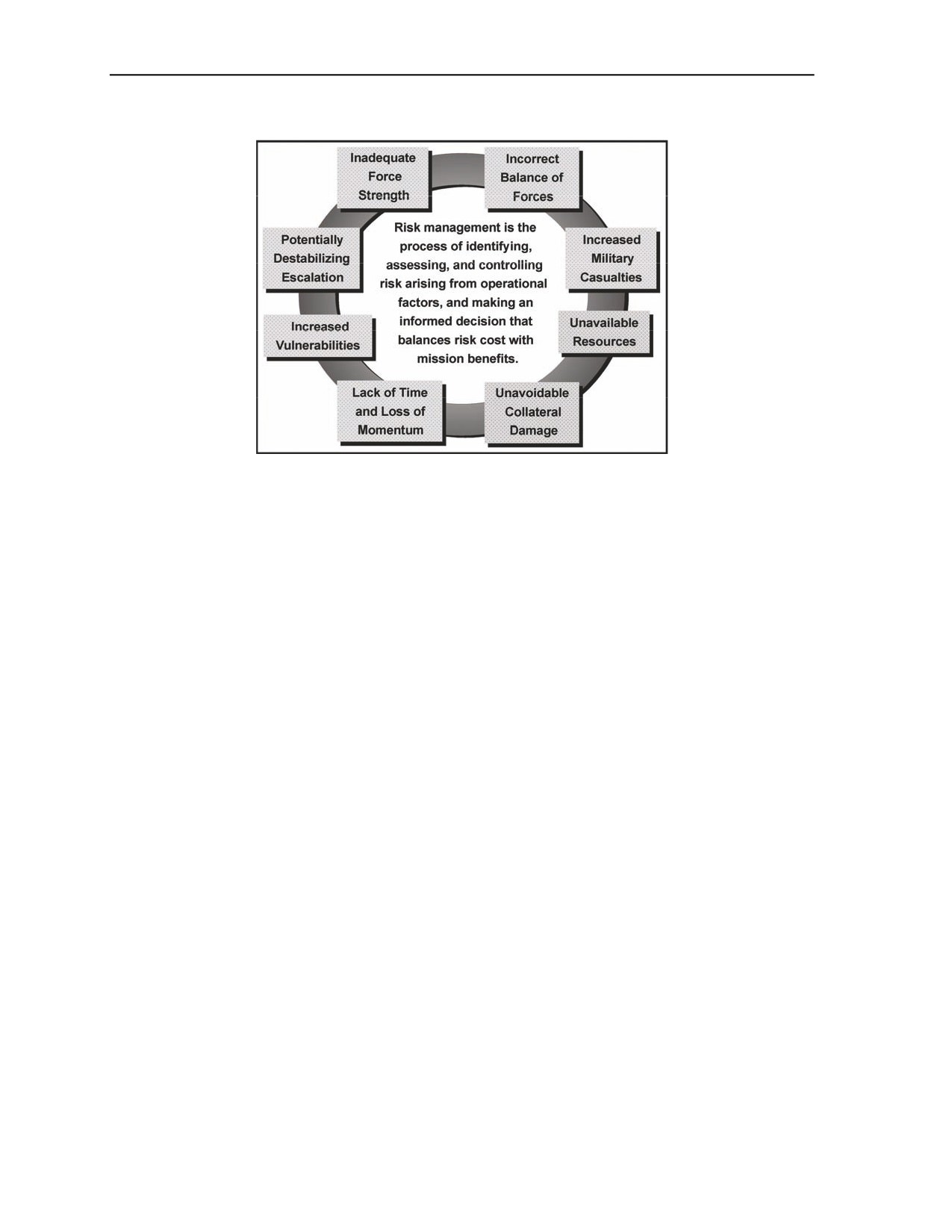
commanders must consider the operational (and accidental) risks and balance them with mission benefits.
The factors shown in Figure 5-1 highlight some measures to evaluate the risks associated with UO.
26 October 2006
FM 3-06
5-1
Chapter 5
Figure 5-1. Risk management and the associated risks with urban operations
INADEQUATE FORCE STRENGTH
5-2. When facing prospective UO, commanders must consider if they have the necessary troops available
to conduct the operation properly and within acceptable risk. Under normal circumstances, large urban
areas require many forces merely to establish control. The New York City police department has over forty
thousand officers and hundreds of support staff simply to conduct peacetime law enforcement. Major UO,
particularly those that are opposed, will often require a significant number of forces. Offensive missions,
for example, can require three to five times greater troop density than for similar missions in open terrain.
If commanders lack sufficient force to conduct effective operations, they may postpone or consider not
initiating those operations until they have the necessary strength. Commanders should also add to their
analysis the requirements for troop strength elsewhere in the AO. Additionally, commanders must consider
the number (and type) of forces required to make the transition from urban offensive and defensive to
stability or civil support operations when determining overall force requirements—not just the number of
forces required to realize objectives for major combat operations.
INCORRECT BALANCE OF FORCES
5-3. Along with force strength, commanders must consider the type and balance of forces available. This
consideration includes an assessment of their level of training in urban operations. Generally, UO put a
premium on well-trained, dismounted infantry units. The operational or tactical necessity to clear threat
forces from the dense urban environment, hold hard-won terrain, and interact with the urban population
greatly increase dismounted requirements. Therefore, Army forces conducting UO are often force tailored
to include a larger infantry component. In addition, special operations forces (SOF) are invaluable in UO.
SOF include psychological operations (PSYOP) and civil affairs (CA) forces. They should always be
considered as part of the task organization.
5-4. UO must include combined arms to ensure tactical success in combat. Although masses of heavy
forces may not be required, successful UO require the complementary effects of all Army forces. Even if
an urban operation is unlikely to involve offensive and defensive operations, armor, combat engineers, and
field artillery may be essential to mobility and force protection. In urban stability and civil support opera
tions, successful mission accomplishment requires more robust CA organizations. They are also valuable in
urban offensive and defensive operations. While commanders may have sufficient combat and combat sup
port forces, they may lack enough sustainment forces to provide the support necessary to maintain the
5-2
FM 3-06
26 October 2006
Contemplating Urban Operations
tempo. Again, commanders without balanced types of forces, to include their proficiency in operating in
urban environments, should consider alternatives to UO or delaying UO until proper force types are trained
and available in sufficient numbers.
INCREASED MILITARY CASUALTIES
5-5. Casualties in UO are more likely than in operations in other environments. In urban offense and
defense, friendly and threat forces often engage at close range with little space to maneuver. The urban ter
rain provides numerous advantages to the urban defender; higher casualties occur among troops on the
offensive, where frontal assaults may be the only tactical option. Conversely, defenders with limited ability
to withdraw can also suffer high casualties when isolated and attacked. Casualties can be more difficult to
prevent in urban stability operations because of the dense complex terrain, the close proximity of the urban
population, and the possible difficulty in distinguishing friend from foe. The potential for high casualties
and the subsequent need for casualty evacuation under difficult circumstances make the positioning and
availability of adequate medical resources another important consideration. Additionally, high-intensity
urban combat and the potential for increased stress casualties may require additional units to allow for
adequate unit rotations so that Soldiers receive the rest they require.
5-6. Though casualties occur in all operations, commanders should recognize the likelihood of more
casualties during large-scale or high-intensity UO. During the battle for Hue in 1968, for example, many
company-size units suffered more than 60 percent casualties in only a few days of offensive operations.
Commanders conducting urban stability operations must know the casualty risk and how it relates to
national and strategic objectives. While a lower risk normally exists in stability operations than in offensive
and defensive operations, just one casualty may adversely impact the success of the stability mission. A
realistic understanding of the risk and the nature of casualties resulting from UO critically affect the
decision-making process. If commanders assess the casualty risk as high, they must ensure that their higher
headquarters understands their assessment and that the objectives sought within the urban area are
commensurate with the anticipated risk.
UNAVAILABLE RESOURCES
5-7. Offensive and defensive operations in an urban environment put a premium on certain types of
munitions and equipment. Forces may want to use vast amounts of precision munitions in the urban
environment. At the tactical level, they will likely use more munitions than during operations in other
environments. These munitions include—
Grenades (fragmentation, concussion, stun, riot control, and smoke).
Mortar ammunition (due to its rate of fire, responsiveness, and high-angle fire characteristic).
Explosives.
Small arms.
5-8. Soldiers need access to special equipment necessary to execute small-unit tactics effectively. In
urban stability and civil support operations, this equipment may include antiriot gear, such as batons,
protective clothing, and other nonlethal crowd-control devices. In urban offensive and defensive
operations, special equipment can include sniper rifles, scaling ladders, knee and elbow pads, and
breaching equipment such as door busters, bolt cutters, and sledgehammers. Soldiers can conduct UO with
standard clothing and military equipment. However, failure to equip them with the right types and
quantities of munitions and special equipment will make mission success more difficult and costly. When
commanders consider whether to conduct UO, they must evaluate the ability of logistics to provide the
necessary resources (see Chapter 10). Considerations must include the ability to supply all Soldiers
regardless of branch or military occupational specialty with urban-specific equipment.
UNAVOIDABLE COLLATERAL DAMAGE
5-9. UO require an expanded view of risk assessment. When considering risk to Army, joint, and
multinational forces, commanders must also analyze the risk to the area’s population and infrastructure.
This comprehensive analysis includes the second- and third-order effects of significant civil casualties and
26 October 2006
FM 3-06
5-3
Chapter 5
infrastructure damage. Collateral damage can influence world and domestic opinion of military operations
and thus directly affect ongoing operations. It also influences the postconflict physical environment and
attitudes of the population. Negative impressions of the civilian population caused by collateral damage
can take generations to overcome. Destroying an urban area to save it is not a viable course of action for
Army commanders. The density of civilian populations in urban areas and the multidimensional nature of
the environment make it more likely that even accurate attacks with precision weapons will injure
noncombatants. Unavoidable collateral damage of sufficient magnitude may justify avoiding UO, which,
though it may be tactically successful, may run counter to national and strategic objectives.
LACK OF TIME AND LOSS OF MOMENTUM
5-10. Commanders conducting major operations must analyze the time required to conduct UO
successfully. UO can be time consuming and can require larger quantities of resources. The density of the
environment, the need for additional time to conduct a thorough reconnaissance, the additional stress and
physical exertion imposed on Army forces operating in urban areas, and the potential requirements to care
for the needs of the urban population consume time and slow momentum. Commanders cannot permit UO
conducted as a shaping operation to divert resources from the decisive operation. Nor can they allow UO to
interrupt critical time lines, unnecessarily slow tempo, or delay the overall operation. Threat forces may
conduct UO with the primary purpose of causing these effects. Commanders must recognize that time
generally works against political and military objectives and, hence, they must develop plans and
operations to avoid or minimize UO that might unacceptably delay or disrupt the larger, decisive operation.
Once commanders achieve major combat objectives, however, they will likely need to shift resources and
focus on the urban areas that they previously isolated and bypassed.
INCREASED VULNERABILITIES
5-11. Commanders must weigh the potential for increased vulnerabilities when executing UO. The density
of the environment makes protection (safety, field discipline, force protection, and especially fratricide
avoidance) much more difficult. Forces operating in a large urban area increase their risk of isolation and
defeat in detail. Joint capabilities, such as air power, may work less effectively to support a close urban
battle than in some other environments. Thus, responding to unexpected situations or augmenting
disadvantageous force ratios when applying joint capabilities is significantly more difficult. Although
organized, trained, and equipped for success in any environment, the Army vulnerability to weapons of
mass destruction (WMD) increases when forces concentrate to conduct UO. Commanders may consider
not committing forces or limiting the size of a force committed to an urban area because of increased
vulnerability to (and likelihood of) attack by WMD.
5-12. Fratricide avoidance is a matter of concern for commanders in all operations. The complex urban
terrain and density of participating forces coupled with typical battlefield effects—smoke, dust, burning
fires—and weather effects—fog, snow, rain, and clouds—immensely increase the potential for urban
fratricide. Additionally, safety requirements make it difficult to fully replicate training conditions that
allow leaders to become more aware of the conditions that contribute to fratricide. The effects of fratricide
can be devastating to UO and spread deeply within the Army force. Critical effects include—
Needless loss of combat power.
Decreased confidence in leadership, weapons, and equipment. These lead to a loss in initiative
and aggressiveness, failure to use supporting combat systems, and hesitation to conduct limited
visibility operations.
Disrupted operations and decreased tempo.
General degradation of cohesion and morale.
5-13. Therefore, commanders should increase fratricide awareness and emphasis on prevention measures
during UO. Causes can be procedural, technical, or a combination of the two and include—
Combat identification failures due to poor situational understanding, lack of communication,
failure to effectively coordinate, and short engagement ranges coupled with the need for quick
reaction.
5-4
FM 3-06
26 October 2006
Contemplating Urban Operations
Location errors involving either the target or enemy forces due to poor situational
understanding.
Inappropriate command and control and fire support coordinating measures; a failure to receive,
understand, or adhere to these measures.
Imprecise weapons and munitions effects such as, an antitank round that penetrates several walls
before exploding near friendly forces.
Exacerbating these difficulties will be the likelihood of Army forces conducting operations with (or within
proximity of) SOF, coalition forces, and indigenous security forces including local police.
(During
OPERATION IRAQI FREEDOM, the head of the Australian Defence Forces SOF in Iraq made it a point
to carefully coordinate with U.S. Army forces—down to the company level—whenever his personnel
would be in an American AO. He felt the danger of fratricide was a much greater risk than the loss of
operational security.)
POTENTIALLY DESTABILIZING ESCALATION
5-14. In the urban environment, Army forces cannot avoid close contact with enemy forces and civilians
that may potentially become hostiles. In urban stability and civil support operations, commanders should
consider the chance of this contact escalating into confrontation and violence, which may become
destabilizing. This consideration may delay, limit, or altogether preclude UO using Army forces.
CONSIDER ALTERNATIVES AND RISK REDUCTION MEASURES
5-15. Since UO are often high risk, commanders should consider courses of action that provide
alternatives. When the objective of an urban operation is a facility, commanders should consider
replicating that facility outside of the urban area. For example, a critical requirement for an airfield to
sustain operations may lead commanders to consider UO to seize or secure one located in an urban area.
However, if adequate resources exist (especially time and adequate general engineering support), Army
forces may build an airfield outside of the urban area and eliminate the need to conduct the urban
operation. Similarly, logistics over-the-shore operations may be an alternative to seizing a port facility. In
some situations, the objective of UO may be to protect a political organization such as a government.
Relocating the government, its institutions, and its personnel to a safer area may be possible. Commanders
can also design an operation to avoid an urban area. For example, if an urban area dominates a particular
avenue of approach, use a different avenue of approach. Using a different avenue of approach differs from
isolating and bypassing because the entire operation specifically makes the urban area irrelevant.
5-16. If commanders execute UO, they must assess potential hazards, and then they develop controls to
either eliminate or reduce the risks to Army forces. The first means to offset risk is always to ensure a
thorough understanding of the urban environment and its effects on operations by all members of the force.
Other measures to mitigate risk may include—
Detailed planning to include thorough intelligence preparation of the battlefield and the
development of appropriate branches and sequels.
Integrated, accurate, and timely intelligence, surveillance, and reconnaissance (ISR).
Clear missions and intent, which includes a well-articulated end state that looks beyond the
cessation of combat operations.
Sufficient reserves and rotation of forces.
Vigilant physical security precautions to include increased use of barriers and other defenses,
particularly when urban areas are used as support areas.
Operative communications and other information systems (INFOSYS).
Effective populace and resources control measures.
Comprehensive and flexible rules of engagement (ROE) continuously reviewed to ensure they
remain adequate for the situation.
Sufficient control measures
(which often include a common urban reference system) and
standard marking and identification techniques that adequately consider limited visibility
concerns for both air and ground forces. Measures should allow commanders to satisfactorily
26 October 2006
FM 3-06
5-5
Chapter 5
control UO and minimize fratricide without unreasonably restricting subordinate commanders’
ability to accomplish assigned missions. Commanders must ensure that all subordinate units
thoroughly disseminate any approved nonstandard reference systems.
Proper targeting procedures
(including effective fire support coordinating measures and a
streamlined legal review of targets), positive identification of targets, and controlled clearance of
fires. The goal is achievement of precise (yet rapid) effects with both lethal and nonlethal
means. In close air support, positive air-to-ground communications are essential to coordinate
and authenticate markings.
Well-synchronized information operations (IO) that begin before introducing Army forces into
the urban environment and well through transition. Commanders should emphasize vigilant
operations security
(OPSEC) particularly when operating closely with the media,
nongovernmental organizations (NGOs), and elements of the civilian population.
Active and effective integrating, synchronizing, and coordinating among all forces, agencies,
and organizations involved in the operation. Commanders should allow adequate planning and
rehearsal time for subordinates.
Responsive, sustainable, and flexible urban sustainment.
Forces well trained in joint, interagency, multinational, and combined arms UO.
The creation of adaptable, learning organizations. This requires thorough after-action analyses
conducted during actual operations as well as after training exercises. In addition to official
Army sites (such as the Center for Army Lessons Learned and the Battle Command Knowledge
System), commanders must create a unit-level system to allow hard-won, lessons learned and
tactics developed to be immediately passed on to other units and soldiers—even in the midst of
an operation. This system may be technology-based, procedural, or both. (During OPERATION
IRAQI FREEDOM, the 1st Cavalry Division developed an effective web-based knowledge
network—called CAVNET—that allowed them to actively capture and share lessons learned
among subordinate units.)
INTEGRATION INTO LAND OPERATIONS
5-17. The commander of the major operation, after determining that urban operations are required, will
then integrate the urban operation into his overall operation. He does this by articulating his intent and
concept for the urban operation to his subordinates. The commander of the major operation must also set
the conditions for successful tactical urban operations by his subordinates. He should define ROE, focus
ISR efforts, task organize his capabilities, ensure information superiority, design the operational
framework, and initiate and sustain effective coordination with other agencies and organizations (see FM
6-0).
CONCEPT OF THE OPERATION
5-18. The commander’s concept of the operation should address all operationally important urban areas in
his AO. It should also articulate his vision of the urban operation through directions to his staff and
subordinates. Subordinate commanders should address urban areas that the higher commander does not
specifically address. The commander’s concept should discuss each urban area in terms of task and
purpose (see FM 5-0). The commander should also describes his vision of the situation’s end state in terms
of—
The threat.
The urban environment (terrain, society, and infrastructure).
Friendly forces.
The conditions necessary to transition control of urban areas within his AO to another agency or
back to legitimate civilian control.
5-6
FM 3-06
26 October 2006
Contemplating Urban Operations
RULES OF ENGAGEMENT
5-19. National- or joint-level command authorities may develop urban-specific ROE. If not, Army
commanders, as part of their assessment, must determine if urban-specific ROE are required for their
situation and provide supplemental ROE. However, commanders must forward any conflicts or incongrui
ties to their higher headquarters for immediate resolution.
5-20. Developing effective ROE relies on thoroughly understanding the national and strategic environment
and objectives. It also relies on understanding how to conduct urban operations at the tactical level
including weapons effects. For example, broad ROE may result in significant collateral damage and
civilian casualties. Even in a major operation or campaign, significant collateral damage caused during UO
can make postcombat operations difficult. Such damage may even change national and international public
opinion or threaten the achievement of national and strategic objectives. In contrast, restrictive ROE can
hamper tactical operations causing mission failure, higher friendly casualties, or both. ROE are often part
of essential elements of friendly information
(EEFI), protected to reduce the potential for threat
exploitation. Even in a limited urban operation, ROE will frequently need to change as circumstances
warrant. Therefore, commanders should plan ROE “branches” for anticipated changes in the operational
environment.
5-21. In urban operations, ROE are flexible, detailed, and understandable. They should preclude the
indiscriminate use of deadly force while allowing soldiers latitude to finish the mission and defend them
selves. ROE should recognize that the urban area is not homogenous and may vary according to the key
elements of the threat and environment: terrain, society, and infrastructure. To be effective, ROE are
consistent throughout the force (an increased challenge in multinational urban operations), and soldiers are
thoroughly trained and familiar with them.
Enemy Considerations
5-22. The nature of an urban enemy affects ROE as well. Commanders must consider the type of enemy
weapon systems, the degree of defensive preparation, the ability to target enemy vulnerabilities with
precision systems, and the ability to distinguish combatant from noncombatant.
Terrain Considerations
5-23. ROE may vary according to the terrain or physical attributes of an urban area. Physical factors may
drive the ROE to preclude certain types of munitions. For example, if the construction of a portion of the
area is sensitive to fire, then ROE may preclude using incendiary munitions in that area. The ROE may lift
this prohibition when units move into areas of masonry construction. Toxic industrial chemicals or
radiological contaminants in an industrial area may also affect ROE.
Societal Considerations
5-24. The societal or human dimension of the urban environment will often affect ROE the most.
Commanders must base the ROE development on a thorough understanding of the civilian population and
threat. They evaluate the loyalty of the population, its dynamic involvement in activities that affects the
operation, and its size and physical location. A population that is present and supports Army forces will
likely elicit more restrictive ROE than a hostile population actively supporting forces opposing the Army
forces. A neutral population, not actively involved in behavior affecting Army forces, supports
consideration of more restrictive ROE. In all cases, ROE conforms to the law of war. However, ROE may
be much more restrictive than the law of war requires.
5-25. The location of the population also affects ROE. The evacuation or consolidation of noncombatants
into controlled, safe areas may result in less restrictive ROE. A U.S. or allied population that remains in the
urban area conducting routine business in and amongst Army forces during noncombat UO will normally
require the most stringent ROE.
26 October 2006
FM 3-06
5-7
Chapter 5
Infrastructure Considerations
5-26. Commanders must consider the urban infrastructure when developing ROE. Urban infrastructure
vital to current or future Army operations may dictate that commanders adjust ROE to ensure that critical
elements of the infrastructure remain intact during the conduct of operations. If Army forces conduct an
urban operation to capture port facilities, for example, the ROE should address damage to the key facilities
that are the objective of the operation.
RESOURCE ALLOCATION
5-27. Commanders of a major operation must ensure that subordinate tactical commanders have the
resources necessary to conduct UO effectively. They assign appropriate forces to subordinate commanders
tasked to conduct UO; support them with Army forces at the operational level; and request and coordinate
their support by joint resources.
Task Organization
5-28. Task organizing subordinate units for urban operations will depend largely on the nature of the
operation. Some units, however, are always part of the task organization to ensure the success of UO.
Infantry, CA, aviation, military police, PSYOP, military intelligence, and engineers are units required for
all urban operations across full spectrum operations. Other type forces—such as armor, artillery, and
chemical—have essential roles in specific types of urban operations but may be less applicable across the
spectrum of operations. Commanders and staffs of a major operation must understand their mission, the
particular urban environment in which they operate, and the general effects of the environment across the
warfighting functions to allocate the appropriate forces to their tactical commanders. See Chapter 4 for
details.
Operational-Level Support
5-29. Commanders of a major operation should also support the tactical commander with forces remaining
under their direct control. These forces can include Army SOF, such as CA, PSYOP, and Special Forces,
ground and air cavalry, aviation, logistics, engineers, and communications support. These forces may not
be under operational control of the supported command, but their efforts are synchronized and coordinated.
Coordinating and Requesting Joint Support
5-30. Commanders of a major operation will often provide forces to the JFC as well as receive assets.
They will also coordinate for and integrate joint assets to support the tactical battle. These assets will
usually include air support, such as close air support, tactical airlift, and aerial reconnaissance and
surveillance. Intelligence support comes in the form of reach to strategic and national intelligence
capabilities and to space-based systems. This reach to space assets provides reliable, robust long-range
communications, environmental monitoring, ISR, positioning and navigation, and warning of enemy
missile launch. Special operations capabilities can assist the tactical mission with special reconnaissance
and direct action (including special operations aviation) against high-payoff targets. Joint resources also
provide the Army forces augmentation by Marine ground forces. In coastal areas, Navy forces and Coast
Guard elements assist Army forces with security, sealift, and fire support. Additionally, the potential
agility, reach, and power projection provided by Navy forces and platforms, combined with their self-
sustaining capability, can play a vital role in supporting UO. This is especially true when UO are
conducted in the littorals, require forcible entry operations, and when host nation infrastructure is severely
taxed or destroyed. Commanders of a major operation will coordinate with the JFC regarding available
joint resources and their allocation. They then ensure that their efforts coordinate with and complement
those of tactical Army forces in the urban area. Appendix D discusses the potential contribution of joint
capabilities to Army UO.
5-8
FM 3-06
26 October 2006
Contemplating Urban Operations
URBAN ISR
5-31. Commanders at all levels require accurate and timely information to conduct assessments for
successful urban operations. This is critical to planning and execution. Senior commanders have a large
role in coordinating the urban ISR effort. National strategic sources (as well as open sources) provide most
of the information that commanders and staffs require on the characteristics of the human dimension, the
physical properties of the terrain, and the infrastructure. The general characteristics of these aspects of the
urban environment do not change drastically over time, with one exception. Military operations or natural
disasters can change physical characteristics radically. Analysts can obtain crucial information through
diligent research of intelligence databases and open sources. However, the disposition and composition of
the urban threat is time sensitive and not likely to be discovered through this type of investigation. Due to
the effects of the urban environment, deceptive efforts may influence the threat more easily. The urban
population is dynamic and critical aspects of this dimension must be updated or confirmed as a prelude to
urban operations. Surveillance and reconnaissance
(including geospatial assets) provide relevant
information regarding threat dispositions, composition and the state of the population, and the specifics of
the urban terrain. Successful urban operations depend on the successful conduct of urban reconnaissance.
(See also the earlier discussion of effects on the intelligence and command and control warfighting
functions in Chapter 4. While counterintelligence (CI) is an essential ISR component, it will be covered
later in this chapter under IO.)
Challenges
5-32. The most significant challenge to urban ISR is physical. The physical organization and complexity of
the urban terrain, both man-made and natural, challenges national strategic, operational, and tactical ISR
capabilities. Commanders should understand the challenges when planning and allocating time and
resources to their ISR efforts. They acknowledge that subordinate commanders will face similar
challenges. Therefore, commanders consider subordinate capabilities, limitations, and needs when
planning, requesting, allocating, and prioritizing ISR assets and capabilities.
Imagery Capabilities
5-33. A significant national, strategic, and operational ISR capability is imagery. Even at the tactical level,
units employ unmanned aircraft systems (UAS) and vehicle and dismounted electro-optics, commercial
cameras
(still and video), and co-opt existing civilian surveillance systems to gain situational
understanding. However, the structures of the urban area significantly degrade the information that
imagery acquires and may make it susceptible to physical deception measures.
5-34. Imagery, however, is an excellent source regarding the arrangement and nature of many other
physical aspects. It can be used to create updated mapping products and provide significant detail of major
portions of the infrastructure. Imagery can also reveal what may be happening in structures through
detailed study of patterns and other exterior indicators. Yet, the bulk of a skillful threat’s forces, well
positioned and concealed inside or underneath structures in the urban area, are largely immune from rapid
detection by overhead imaging systems. The volume of civilian movement in an urban area will itself
provide a degree of camouflage and increase the difficulty of employing pattern analysis. The success in
1999 of the Yugoslavian army concealing heavy forces when confronting NATO indicates the limits of
these assets to penetrate an urban area. This leaves a requirement to supplement overhead imagery in the
urban environment with a reliable vehicle-mounted or handheld imaging system. For example, thermal
sights on a vehicle patrolling an urban street during limited visibility may note the hot engine of a vehicle
on the side of the road, possibly indicating suspicious activity. Simply providing patrols with digital
cameras or video cameras can also help provide needed information and fill in information gaps.
5-35. The requirement for high altitude and low oblique imagery in more open terrain has been
supplemented by a growing need for detailed, close-up, and nearly vertical overhead shots of specific
portions of the urban area. This forces collection managers and system operators to move expensive and
scarce imagery collection systems closer to the target or to employ flight profiles that place them at greater
risk from threat air defense systems. While gun-camera images from aircraft can provide a stand-off
reconnaissance platform, UAS imagery may be one of the fastest, least risky methods by which
26 October 2006
FM 3-06
5-9
Chapter 5
commanders can conduct reconnaissance to update and verify current maps of the urban area and
determine routes, obstacles such as damaged and destroyed buildings, and intact and destroyed bridges and
other significant infrastructure. Increased UAS proliferation will require greater attention to airspace
command and control procedures as well as the movement and protection of ground control stations.
5-36. As the media will likely be present in the urban environment, commanders may consider devoting
intelligence resources (to include linguists) to monitoring the various local, national and international
sources, particularly the medium of television. The media coverage of threat forces may provide important
intelligence and relevant information of immediate tactical value. Commanders, however, should always be
cognizant that threats may recognize that Army forces will be using this as a source of intelligence and,
feeling no compulsion to be truthful, may use it for their own deception means.
Electronic Capabilities
5-37. The physical attributes of the urban area also diminish the effectiveness of electronic ISR
capabilities. Buildings and other structures significantly disrupt radio communications in an urban area.
Buildings not only make tactical radio communications difficult for the user, they also make them difficult
to locate, intercept, and jam. The range and clarity of frequency modulation (FM) signals significantly
diminish when antennas are located inside buildings or when buildings block line of sight between the
source and receiving station. To mitigate this effect on signals intelligence means, detection capabilities
often move closer to the transmission source. Thus, the threat’s vulnerability to compromise by means of
his FM and other wireless communications in an urban environment is much less than in many other
environments.
5-38. Without losing tactical surprise and increasing risk, units cannot effectively use many electronic
detection and surveillance capabilities until urban combat is imminent or perhaps already begun. Ground
surveillance radars will have limited uses in urban areas because of the lack of wide-open spaces in which
they best operate, but can be used along the periphery of urban areas to detect infiltration and exfiltration
of threat forces. However, remote systems such as the remotely monitored battlefield sensor system and the
platoon early warning device may have great utility in monitoring many of the numerous avenues of
approach that cannot be kept under human surveillance due to manpower constraints. Among many urban
applications, remote sensors and early warning devices can be used to monitor subsurface passageways, the
entrances and exits to buildings, fire escapes, the perimeters of sustainment bases, and covert foot trails
between urban and rural areas.
Human Capabilities
5-39. The limits on imagery and electronic ISR capabilities place a premium on human-based visual
reconnaissance. Commanders have three types of human reconnaissance assets to augment electronic
reconnaissance resources: special reconnaissance, conventional combat reconnaissance, and human
intelligence (HUMINT) gathered by military intelligence from individuals and multimedia. The urban
environment poses several challenges to these capabilities.
5-40. The urban area challenges special reconnaissance in several ways. First is the access to the urban
area. Although avenues of approach may be numerous, concealed avenues of approach into a defended
urban area may be limited and thoroughly covered. Air access is also more difficult because aircraft are
detected more easily, airspace is smaller, drop and landing zones are limited or not secure, and more air
defense systems probably exist. Still, special reconnaissance efforts to penetrate the urban area can be
successful using unconventional techniques including high-altitude low-opening parachutes or underwater
penetration.
5-41. Special reconnaissance then faces a second challenge: moving in and identifying targets in the urban
area. Stealth movement in an occupied urban area is exceptionally difficult. Repositioning to new or
alternate positions is also dangerous. The soldiers’ ability to conceal themselves among the civil population
can mitigate some of these challenges but includes inherent risks of a different nature. Also difficult is
establishing observation positions that provide a field of view of several targets.
5-10
FM 3-06
26 October 2006
Contemplating Urban Operations
5-42. Lastly, special reconnaissance may face navigational and reporting challenges. Special
reconnaissance’s ability to locate themselves and communicate critical locations and routes are challenged
by—
Differences in language and numbering systems. Road signs, if they exist at all, may be removed
or deliberately altered to confuse.
Irregular street patterns.
Outdated maps.
Intervening structures that impede communications and global positioning systems.
Changes to the landscape due to the effects of UO or natural disasters.
Featureless shantytowns.
5-43. Conventional reconnaissance faces many of the same challenges as special reconnaissance.
Conventional reconnaissance also may lack the advantage of surprise and the special equipment and
training that provides special reconnaissance stealth capability. Conventional reconnaissance is not likely
to operate undetected by the civilian population. Given the constraints discussed above on other sources,
conventional reconnaissance units will likely begin their mission with much less information than they
would have on threat dispositions in a less complex environment. Commanders may choose to have their
reconnaissance elements fight for information in the urban area. While this high-risk option is more
favorable under fluid conditions, it can be used at any time. It requires careful planning, rehearsal, and
formulation of information requirements.
5-44. As previously indicated, human intelligence will be one of the most valuable sources for information
regarding the situation inside an urban area. HUMINT may take advantage of the proximity and large
numbers of potential informants to gather information about threat activities and capabilities. It is
especially valuable because it can address all elements of the environment. HUMINT sources can describe
political and religious nuances that may be significant to commanders. Such information is useful for
insights regarding the human dimension but extremely difficult to obtain from other means. This
intelligence also can describe the infrastructure uncovering essential details of how the infrastructure
functions. Obtaining good HUMINT requires skilled interrogators and linguists—often in large numbers.
Commanders must know and account for some of the possible shortcomings of HUMINT:
It is susceptible to the influence of the threat; the threat can threaten and influence the source as
well as local interpreters. Commander may need to consider that people may not want to talk
through a local interpreter because they are providing information they might not want others to
know; anonymity may be essential. On the other hand, a local interpreter may provide
community access. Yet, those trusted by the locals may not be truthful with Army forces.
Conversely, those truthful with Army forces may not be trusted by the indigenous population
particularly if these interpreters come from another country, region, or demographic group. In
such cases, commanders may need more than one interpreter.
It is limited by the accuracy of the source and interpreter’s perceptions. A local interpreter may
have difficulty understanding and translating military topics or the intricacies of urban
infrastructure. Some local translators may want to please both participants, so they may shade
the conversation, telling each side what they want to hear. Finally, accuracy may be affected by
the collector’s own perceptions if not firmly grounded in an understanding of social, cultural,
and other local conditions.
Multiple echelons collecting from a given area may inadvertently collect from the same sources
and thereby give the false impression of independent sources confirming the same data. To help
mitigate this possibility, commanders should ensure that all HUMINT sources are properly
recorded on intelligence source registers.
It may not be timely. The process of identifying and cultivating a source (particularly in an
environment where most civilians support threat forces), gathering information, analyzing the
information, and providing the intelligence to commanders can be extremely time consuming.
Some informants may come from unscrupulous or sordid elements of the urban society and may
also have their own agenda. They may attempt to use protection afforded them by their
relationship with Army forces to conduct activities
(even atrocities) that will compromise
26 October 2006
FM 3-06
5-11
Chapter 5
political and military objectives. In some cases, a local interpreter’s own agenda may influence
his translation.
(For example, a local schoolteacher used as a translator may report to the
collector that the source believes that repairing schools in their urban area is critical, when
actually the source may have said that potable water is most needed.)
Conducting Urban ISR
5-45. To be successful, ISR efforts
(national to tactical level) are exceptionally comprehensive and
synchronized. Moreover, success necessitates the integration of all ISR sources into operational and tactical
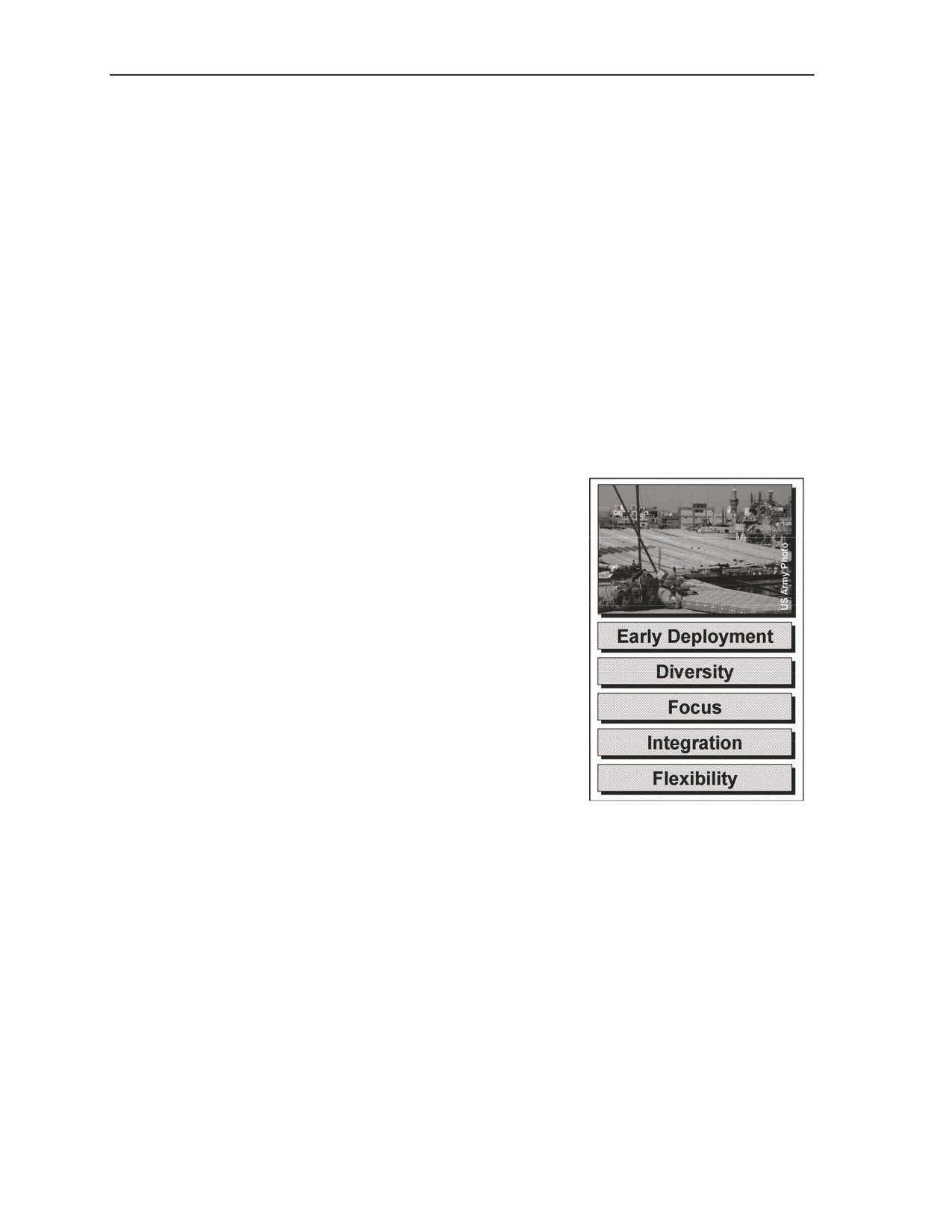
planning. This requires that ISR assets deploy and execute early, diversify, properly focus, and integrate
under a comprehensive ISR plan. Successful ISR also requires flexibility to adapt to the operational and
tactical needs of the commander
(see Figure
5-2). Commanders must ensure that the appropriate
intelligence architecture (including robust links to joint and multinational elements) is established and
tested prior to execution of ISR effort.
Early Deployment
5-46. One of the first requirements for effective urban ISR is the early deployment and employment of
assets. The complex urban terrain presents a significant challenge. Commanders should consider that ISR
assets will normally take longer to gather data amid the complexity.
5-47. Limited national, strategic, and operational imagery intelli
gence (IMINT) and signals intelligence (SIGINT) capabilities should
be considered and quickly requested. If they are approved, they are
tasked and deployed or repositioned to begin urban ISR operations.
This takes time. Fortunately, spacing the ISR effort over time
permits the analysis of the information or data as it is received. Such
time also permits subsequently refining the ISR effort before all
assets are committed.
5-48. SOF or conventional units will require significantly more time
to execute reconnaissance missions and maintain an acceptable
survivability rate. Urban reconnaissance operations require addi
tional time for stealthy insertion into the urban area. IMINT and
SIGINT capabilities are used to identify possible locations of high-
value targets and corresponding observation positions; this helps
minimize time-consuming and high-risk repositioning in the urban
area. Again, reconnaissance units may require extensive time to
observe from observation positions for indicators of threat activity
and disposition and identify patterns.
Figure 5-2. Urban ISR
considerations
5-49. As conventional combat forces prepare to commit to the urban area, conventional reconnaissance
precedes their actions. Conventional reconnaissance will often be a slow and methodical effort. Such forces
may need time to reconnoiter the interior of structures for snipers and other small threat teams. They may
also need time to deploy and destroy snipers and small delaying elements and to breach harassing
obstacles. If necessary, they may need time to mass the combat power necessary to fight through enemy
security and continue the reconnaissance.
Diversity
5-50. No single ISR capability can solve the riddle of the urban defense. In order to gain an accurate
common operational picture of the complex urban terrain necessary to focus combat power on decisive
points, commanders must employ diverse ISR capabilities. These capabilities will each contribute pieces of
relevant information to permit identifying operational objectives and leveraging tactical combat power to
5-12
FM 3-06
26 October 2006
Contemplating Urban Operations
achieve those objectives quickly. Higher-level commanders should understand that tactical reconnaissance
capabilities alone often cannot provide all the tactical information required for success at lower echelons.
5-51. Using diverse capabilities challenges the threat’s ability to conduct deception and otherwise defeat
the friendly ISR effort. A threat that focuses on minimizing his vulnerability to overhead imagery (for
example, satellites) may increase his reliance on communications and thus his vulnerability to SIGINT. At
the same time, he may decrease his ability to detect the actions of ground reconnaissance units. Conversely,
a threat that actively campaigns to detect ground reconnaissance may make himself more vulnerable to
SIGINT and IMINT. Moreover, as Army forces enter urban areas, threat activity and susceptibility to
SIGNINT often increases.
5-52. Diverse capabilities also facilitate the tactical ISR effort. Tactical reconnaissance units often consist
of small dismounted teams and small combined arms teams with a dismounted element and an armor-
protected mounted element. Combat engineers with their technical expertise and breaching capability are
essential to the combined arms reconnaissance effort. The teams’ movements are synchronized and
coordinated with other assets, such as UAS and air cavalry reconnaissance. These teams use several move
ment techniques including infiltration, with the primary objective of conducting zone reconnaissance along
key axes that support brigade and battalion actions against decisive points. To accomplish this mission,
reconnaissance reconnoiters the proposed routes and alternate approaches. This supports deception and
contingency planning.
(Reconnaissance of alternate routes and objectives also applies to aerial
reconnaissance; helicopters and UAS are not invisible. They can alert a threat to impending operations.)
Infiltration of dismounted reconnaissance is made easier when a threat focuses on combined arms
reconnaissance teams. Aerial reconnaissance, such as air cavalry and UAS, provides early warning of
threat elements to ground reconnaissance, identifies obstacles and ambush sites, and helps select the routes
for ground reconnaissance. Air elements may also reduce the mobility of counterreconnaissance forces.
Focus
5-53. Another key to successful ISR is the ability to focus the assets on commander’s critical information
requirements (CCIR). This focus begins with mission analysis and the commander’s initial planning
guidance. It is incrementally refined throughout planning and execution as each ISR effort provides infor
mation and permits more specific focus in subsequent efforts. The size and complexity of the urban
environment require that the ISR effort center strictly on decisive points or centers of gravity (COGs).
Therefore, the overall ISR effort will have two major focuses. The first is to uncover and confirm infor
mation on the decisive points and COG. The second is to determine the approaches
(physical,
psychological, or both) leading to the decisive points. The first focus will likely drive ISR in support of
major operations. The second focus will likely provide the impetus for tactical ISR efforts. For example,
special operations reconnaissance might focus on a major command center that controls the entire urban
area and that is one of the higher-echelon command’s CCIR. Tactical reconnaissance might focus on the
nature of the defense along a particular avenue of approach to the objective.
Integration
5-54. Another important aspect of urban ISR is integration. All reconnaissance capabilities provide both
distinctive information as well as information that confirms and adds to that coming from other sources.
Essential to urban ISR is the link between all of these sources, either directly or through an integrating
headquarters.
5-55. ISR operations must be vertically and horizontally linked. Vertical links ensure that ISR operations
among the various levels of command are complementary and that the information flow between these
levels is rapid. Horizontal links ensure that forces operating in close proximity (particularly adjacent units),
where areas of interest overlap, can rapidly share results of their individual ISR efforts. Together, this helps
ensure that all Army forces share a common operational picture and permits the greatest flexibility and sur
vivability of ISR resources.
5-56. ISR operations also are integrated into the planning system, especially the targeting process. As part
of targeting, positioned reconnaissance and surveillance elements may become the trigger and terminal
control for applying precision fires when appropriate and after considering the risks of compromise of the
26 October 2006
FM 3-06
5-13
Chapter 5
position or platform. ISR operations and plans must also be synchronized with the air tasking order, as
many surveillance platforms are coordinated on the same timeline.
Flexibility
5-57. The urban ISR effort must be more flexible than in other operations. This flexibility permits the ISR
effort to meet unforeseen circumstances and to deal with the challenges of the urban environment. As
indicated previously, the urban environment is particularly difficult to penetrate. The practical effects of
this characteristic are that—
The initial ISR effort may not be as successful as in other operations.
More intelligence requirements may be discovered later while executing ISR operations than
otherwise.
The threat may be more successful in active counterreconnaissance because of the concealment
advantages of the urban environment
(hiding in structures as well as among the urban
population).
Therefore, tactical and operational commanders should consider requesting greater than usual ISR support
from higher headquarters. Higher headquarters should be proactive in augmenting units conducting urban
operations with additional ISR assets. Additionally, ISR assets remaining under the control of the higher
headquarters must respond more quickly to the CCIR of supported commanders. Sequencing
reconnaissance missions over time provides flexibility by creating uncommitted reconnaissance assets.
5-58. Time sequencing of ISR assets is essential to flexibility. It makes ISR assets more survivable and
allows the intelligence cycle to mature the CCIR. It also creates a ready ISR capability to augment com
mitted forces in critical areas if required or diverts them around centers of threat resistance. If not required,
the original ISR tasks can be executed as envisioned in planning. Cueing allows a high-value ISR asset to
be able to respond to multiple targets based on an ongoing assessment of the overall reconnaissance effort
and the changing CCIR. Redundancy permits the effort to overcome line of sight restrictions, the destruc
tion of an ISR asset, and the ability to combine ISR resources to create combat power if required.
Maximizing the ISR effort requires applying all available ISR assets to support the urban operation.
Additionally, assets—such as air defense artillery and field artillery radars and engineer reconnaissance
teams—are integrated into the ISR effort. In urban operations, units will also commit infantry and armor
elements (plus their organic reconnaissance elements) into the tactical reconnaissance effort. These units
increase the dismount capability and the ability of reconnaissance elements to fight for information and
fight through security zones.
INFORMATION OPERATIONS
5-59. Information operations are an integral part of all Army operations and a critical component in
creating and maintaining information superiority. The information environment is the sum of individuals,
organizations, or systems that collect, process, and disseminate information; it also includes the
information itself. In UO, the information environment is extremely dense due to the proliferation of
INFOSYS and widespread access to those systems. In urban operations, commanders must consider how
the urban environment, particularly the human component, uniquely relates to executing IO. They must
also anticipate the threat’s information operation campaign and preclude successful operations on its part.
Overall in regard to the urban society, commanders must convince the urban inhabitants of the inevitable
success of UO, the legitimacy of Army actions, and the beneficial effects that Army success will eventually
generate.
5-60. Because urban operations are likely to be joint, interagency, and multinational, commanders must
guard against various forms of information fratricide as a multitude of actors plan and conduct IO in the
urban area. For example, the lead governmental agency’s key IO objective may be to establish the
legitimacy of newly formed civilian authorities. In an attempt to develop close relationships with the
civilian populace, Army commanders may continue to work closely with traditional, informal leaders to the
exclusion of the new authority. These actions, while they are often conducted out of practical and
immediate necessity, may run counter to the lead agency’s goal. Overall, Army commanders must nest
their IO campaign objectives and themes within those of the lead agency, aggressively coordinate with
5-14
FM 3-06
26 October 2006
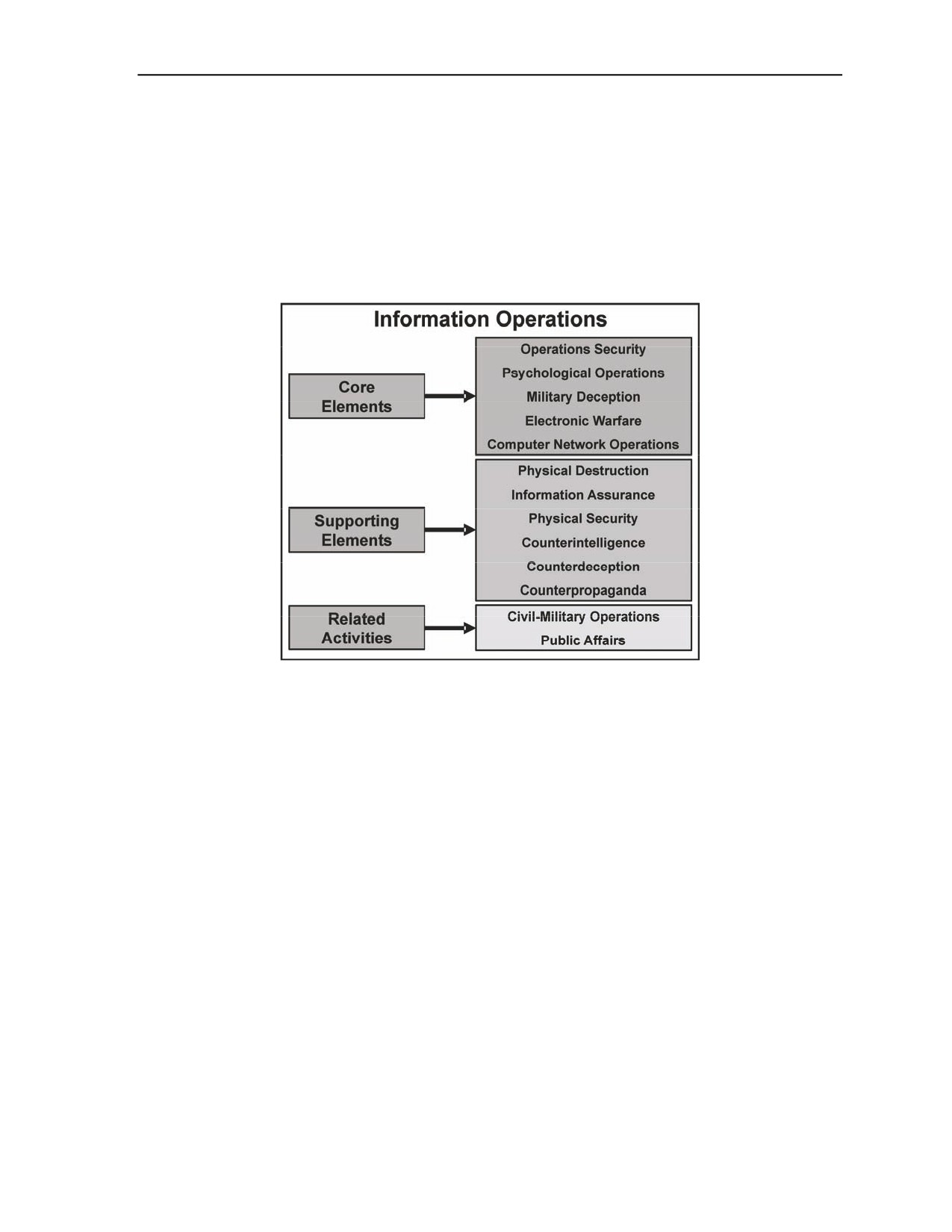
Contemplating Urban Operations
other governmental agencies and coalition partners, and synchronize activities down to the tactical level to
prevent working at odds and avoid information fratricide. However, the process must not be so centralized
and rigid that subordinate units lose the flexibility necessary to develop their own products and themes
essential to addressing their own AO and the particular situation that confronts them.
5-61. IO are executed using core and supporting elements and related activities (see Figure 5-3 and FM 3
13). The elements of IO are employed in either an offensive or defensive role. Many aspects of IO are not
affected differently in an urban environment from any other environment. The following sections outline
some IO considerations unique to urban operations.
Figure 5-3. IO elements and related activities
Operations Security
5-62. In the urban environment, Army forces can leverage existing urban infrastructure, including the
communications and information infrastructure, to enhance Army operations. The danger in integrating
these systems is violating OPSEC. Commands ensure that Army forces use only approved systems and
proper safeguards exist. Commands also supervise subordinate units for inadvertent breaches of OPSEC
policies when using existing urban systems. Finally, established OPSEC procedures must be reasonable
and practical. Overly complicated and stringent procedures increase the likelihood that unintentional
OPSEC violations may occur as Army forces seek to rapidly accomplish the mission.
5-63. Of particular concern are computers (see also the discussion of Computer Network Operations
below). During longer-term UO, commanders will constantly be upgrading and improving the quality of
life for their soldiers through the establishment of well-resourced forward operating and sustainment bases.
This will likely include the provision of unclassified access to the Internet and e-mail allowing Soldiers to
communicate with friends and families around the world. E-mail addresses, facsimile numbers, cell phone
numbers, photographs, and other sensitive (but unclassified) information can be valuable sources of threat
information. Soldiers must be periodically trained and reminded of everyday procedures to combat
potential threat exploitation of these unclassified sources (such as not opening e-mails from unknown
sources as they may harbor Trojan programs and viruses).
5-64. To compound concerns, commanders will also establish protected systems to disseminate tactical
lessons learned to individual soldiers. This creates the potential that Soldiers can inadvertently release
classified information about ongoing operations to threat intelligence systems. In addition to OPSEC
26 October 2006
FM 3-06
5-15
Chapter 5
training and persistent awareness, commanders must establish procedures to shutdown unclassified Internet
and e-mail access immediately, both before and after critical events, to mitigate potential OPSEC
violations. (Commanders may also need to randomly shutdown Internet and e-mail access as part of their
overall OPSEC measures to preclude such information blackouts serving as a potential warning of
impending operations.) Technical surveillance countermeasures—the identification of technical collection
activities conducted by threat intelligence entities—will be an important CI service to identify this and
other technical OPSEC concerns.
5-65. The close proximity of Army operations to a civil population, particularly in stability and civil
support operations, makes Army activities themselves an additional OPSEC concern. Hostile civilians or
other threats integrated into the urban population may have more chances to observe Army activities
closely. Such observations can provide insight into tactics, techniques, and procedures (TTP) and expose
operational vulnerabilities. However, threats may coerce even friendly civilians to provide a threat with
EEFI. Therefore, commanders in an urban environment must ensure that civilians cannot observe critical
TTP. Any observable patterns and TTP vary and are supplemented with deception efforts. Physical security
is increasingly important in urban areas to control civilians’ access. Although many urban operations
require close coordination with NGOs, commanders should screen information provided to these
organizations to protect EEFI. Release of EEFI to NGOs is controlled and done with full recognition and
understanding of potential consequences—the benefits must far outweigh the risks involved. (Even the
best-intentioned NGO might inadvertently compromise security. For example, by revealing that a
commander has closed a particular route the next day, the NGO may unwittingly reveal the objective of a
pending offensive operation.)
Psychological Operations
5-66. PSYOP aim to influence the behavior and attitude of foreign audiences, both military and
noncombatant, in the urban environment. PSYOP are a force multiplier and contribute in many ways to
mission success (see FM 3-05.30). Effective PSYOP focuses on transmitting selected messages to specific
individuals and groups in order to influence their actions. Their ability to influence the attitudes and
disposition of the urban population cannot be overstated. While the complexity of the societal component
of the urban environment can make PSYOP challenging, the urban society also offers many options and
resources. Potentially, PSYOP (with other political and economic actions) may help limit or preclude the
use of military force in urban areas. In some circumstances, UO may be relevant to the major operation
only in terms of their psychological effect.
5-67. The positive influence created by PSYOP is often useful in developing an effective HUMINT
capability particularly in an urban area where many civilians actively or passively support the threat.
Persuading and influencing a few to support friendly forces may pay great dividends. These few supporters
may allow Army forces to penetrate the urban area and obtain essential information. Such information can
apply to threat capabilities, threat intentions, and even the urban environment itself.
5-68. PSYOP, combined with other elements of offensive IO, aid in isolation of a threat—a critical
shaping action for any urban operation. For example, commanders may use PSYOP to inform civilians
about new food distribution points located away from urban combat operations. This action supports the
UO fundamental of separating combatants from noncombatants and helps to further isolate the threat (both
physically and psychologically) from the civilian populace. Aside from projecting a positive image of
friendly forces over threat forces, PSYOP can also isolate the threat by identifying and exploiting ethnic,
cultural, religious, and economic differences between the elements of the civilian populace and threat
forces as well as the differences among supportive and unsupportive civilian factions. The complexity of
the urban environment enables quick changes in opinion or attitude. Commanders must continually
evaluate the results of PSYOP for mission relevance.
Military Deception
5-69. Urban operations present numerous challenges to tactical commanders; however, higher-level
commanders may help to mitigate some challenges through effective military deception Commanders can
use military deception efforts designed to mislead threat decision makers as to friendly force disposition,
5-16
FM 3-06
26 October 2006
Contemplating Urban Operations
capabilities, vulnerabilities, and intentions. Military deception actions may allow commanders to achieve
tactical surprise or improve relative combat power at a selected location. For example, allowing the threat
to observe certain activities on a selected avenue of approach may cause the threat to shift his forces (and
effort) to the area perceived to be threatened. (This movement may also aid in determining the overall
disposition of threat forces and intentions.) Repositioned forces or effort to activities or locations that are
not decisive to the achievement of friendly objectives, combined with other IO designed to overwhelm
threat information and intelligence systems, may create the force and tempo differential necessary to
achieve success. Commanders should tailor urban deception plans to the specific urban area, paying close
attention to the societal characteristics of the target population.
Electronic Warfare
5-70. Electronic warfare (EW) includes all actions that use electromagnetic or directed energy weapons to
control the electromagnetic spectrum or to attack a threat. Conducting EW in urban areas seeks to achieve
much the same results as in other environments. A major consideration in urban areas is collateral effects
on portions of the urban infrastructure that rely on the electromagnetic spectrum for service. Thus,
precision is a major factor in planning for EW operations. For example, EW attacking a threat’s television
broadcasts avoids affecting the television broadcasts of neutral or friendly television. Likewise, EW
attacking military communications in a large urban area avoids adversely affecting the area’s police and
other emergency service communications. Urban offensive and defensive operations will have the least
restrictions on EW operations while urban stability may have significant constraints on using EW
capabilities.
Computer Network Operations
5-71. Computer network operations (CNO) include computer network attack (CNA), computer network
defense (CND), and computer network exploitation (CNE). CNO are not applicable to units at corps and
below. Echelons above corps (EAC) units will conduct CNA and CNE. If tactical units require either of
these network supports, they will request it of EAC units.
Computer Network Defense
5-72. In urban operations, CND will require extreme measures to protect and defend the computers and
networks from disruption, denial, degradation, or destruction. The nature of the urban environment and
configuration of computer networks provides the threat with many opportunities to interdict local area
networks (LANs) unless monitored by military forces. LANs controlled by military forces are normally
more secure than the civilian infrastructure. Commanders should prepare for opportunities by the threat to
insert misinformation.
Computer Network Attack
5-73. Considerations regarding the execution of CNA in urban operations are similar to those of EW:
CNAs that do not discriminate can disrupt vital civilian systems. However, possible adverse effects on the
civilian infrastructure can be much larger—potentially on a global scale. In the short term, CNAs may
serve to enhance immediate combat operations but have a debilitating effect on the efficiency of follow-on
urban stability operations. Because of these far-reaching effects, tactical units do not execute CNA. CNA is
requested of EAC units. EAC units will receive all requests from lower echelons, carefully consider
second- and third-order effects of CNA, and work to ensure its precise application.
Computer Network Exploitation
5-74. CNE consists of enabling operations and intelligence collection to gather data from target or
adversary automated INFOSYS or networks. Tactical units do not have the capability for CNE. CNE
contributes to intelligence collection at EAC. In UO, CNE will be centrally controlled.
26 October 2006
FM 3-06
5-17
Chapter 5
Physical Destruction
5-75. Physical destruction includes those actions—including direct and indirect fires from air, land, sea,
space, and Special Forces—taken with, to augment, or supplement IO actions. Like many other IO
elements, major concerns with employing physical destruction in UO are precision and follow-on effects.
Thus, commanders using physical destruction to support IO must adhere to the same constraints as all other
urban fires.
Information Assurance
5-76. Information assurance in UO takes on an added dimension. As with other operations, availability of
information means timely, reliable access to data and services by authorized users. In UO, the timeliness of
information may be restricted because structures block the transmission waves. The need for
retransmission facilities may overwhelm the signal community. The reliability can be questioned because
of the blockage between units and communications nodes. Unauthorized users may intercept the
communications and input misinformation or disinformation. Commanders must protect the integrity of all
information from unauthorized changes, including destruction. INFOSYS with integrity operate correctly,
consistently, and accurately. The authentication of information may be accomplished by sophisticated elec
tronic means. However, it is more likely that communications-electronics operating instructions
authentication tables will authenticate the information. Commanders should consider the confidential
nature of all information in UO and establish procedures to protect the information from unauthorized
disclosure. Of additional concern, the density of the infrastructure in urban areas may inhibit receipt by the
intended individual or unit. Therefore, commanders must develop alternative means to determine if the
message was received.
Physical Security
5-77. Physical security consists of those actions and measures to safeguard personnel; to prevent
unauthorized access to equipment, installations, material, and documents; and to safeguard them against
espionage, sabotage, damage, and theft. The joint, interagency, and multinational nature of urban
operations increases the need for physical security measures, especially with organizations that do not
emphasize physical and operational security within their own organizations. The potential for locating
sustainment bases in or near urban areas and the use of indigenous personnel on these facilities to
accomplish a multitude of tasks mandates that commanders carefully consider the effectiveness of their
physical security measures. In some stability operations where Army forces must recruit and train security
or police forces, and then conduct joint operations and patrols with them, commanders must examine how
best to establish close working relations while maintaining essential physical (and operations) security.
Counterintelligence
5-78. The urban environment, particularly in stability operations, is ideal for espionage, other intelligence
activities, sabotage, or assassination. Threats can approach, conduct reconnaissance, and escape under the
concealment offered by the urban environment. The dense environment and electromagnetic clutter serves
to hide technological collection means. To counter threat intelligence collection activities, the Army
employs CI forces. They provide analysis of the threat’s human, imagery, signals, and measurement and
signature intelligence capabilities to develop countermeasures against them (see FM 34-60).
5-79. In conjunction with military police, engineers, medical personnel, and other as required, CI help
create urban threat and vulnerability assessments necessary in developing comprehensive force protection
measures and evaluating their effectiveness. CI personnel can also supplement the screening of linguists
and other critical host-nation personnel employed by Army forces. As Soldiers operate in close proximity
to the urban society, threats will attempt to use three, time-tested tools to influence them: money, sex, and
drugs. Periodic CI refresher training remains crucial to decrease the effectiveness of these threat tactics.
5-18
FM 3-06
26 October 2006
Contemplating Urban Operations
Counterdeception
5-80. In UO, threat forces can easily accomplish deception operations. The force that controls the area
above and below ground will have freedom of movement. Deception aimed at friendly commanders will
cause them to deploy combat power at the wrong place and the wrong time. Counterdeception by friendly
commanders will identify and exploit threat attempts to mislead friendly forces. Counterdeception is
difficult. Cultures of certain rhetoric and actions are more predisposed to deception than others. Knowing a
threat’s previous deception methods is important. Dismissing tactical indicators because they conflict with
preconceptions may allow a hostile deception operation that plays on the preconception to succeed.
Counterpropaganda
Four hostile newspapers are more to be feared than a thousand bayonets.
Napoleon Bonaparte
5-81. Because propaganda is aimed at both combatants and noncombatants, UO are especially concerned
with its use. Propaganda can rapidly and dramatically affect the attitudes of the urban population and will
probably occur (or increase significantly) after urban operations have begun. Thus, it can create situations
in the human dimension of the environment quite different from those discovered in the pre-operations
assessment. Counterpropaganda is, therefore, essential to urban operations. To negate, deflect, or destroy
the threat’s propaganda capability, counterpropaganda requires—
Monitoring and evaluating the effectiveness the threat’s propaganda efforts.
Determining innovative methods using all Army force capabilities, especially PSYOP and PA
units.
5-82. In particular, humanitarian assistance, when coupled with an effective information operations
campaign, can be a powerful counterpropaganda tool to sway public support. For example, media coverage
of Army forces directly providing or coordinating NGO humanitarian efforts to feed, shelter, and provide
medical care to the urban population can help counter threat efforts to discredit Army forces as an evil
occupying force. This type of coverage can be used to turn opinion against the threat and could also prove
an effective tool in gaining favorable international support.
Public Affairs
5-83. A closely related activity to IO is public affairs (PA). PA influences urban operations by transmitting
information through the media to internal (urban Army forces as well as the urban civilian populace) and
external audiences. At higher levels of command, PA can help maintain popular national support for the
urban operation by clarifying the links between strategic goals and operational objectives. At both the
operational and tactical levels, it links Army units, the urban inhabitants, the U.S. and international public,
and the media. The media will often focus on the negative actions that are ongoing in an AO; hence, the
urban commander’s challenge will be to publicize his unit’s good news stories. Commanders should not
wait for media inquiries and interview requests. Instead, they should aggressively plan public affairs to get
the Army’s story out to the media and, ultimately, the public.
5-84. PA can help determine potential media issues that may influence planned UO. It can also aid
commanders in understanding the impact of UO on the environment (particularly its citizens) and other
agencies and organizations operating in the urban area. PA also helps to counter rumors, uncertainty, fear,
loneliness, confusion, and other factors that cause stress (to both soldiers and civilians) and undermine
effective UO. If the populace does not understand the mission or the Army forces’ capabilities, false
expectations may be created that Army forces may not be able to meet. PA can help prepare the American
public for the possibility of high casualty rates. Overall, PA supports urban commanders in their goals to
achieve information superiority and preserve public support.
5-85. The density of information sources and reporters in UO ensures that all Army activities will be
subject to media and public scrutiny. Many reporters will congregate in cities for their own comfort and
take advantage of established communications networks. Urban areas are densely populated and, together
with Army forces and NGOs operating there, will present the greatest number of human-interest stories.
26 October 2006
FM 3-06
5-19
Chapter 5
The local urban or host-nation media, however, will often have their own agendas developed over a longer
period of time. This local media may also have a greater influence over the urban population than the
international media. The indigenous media may not follow international norms. Commanders are
responsible for understanding the media (particularly the local media), its role, and its potential for
negative or positive influence.
5-86. Commanders cannot allow themselves to be intimidated by the media. Media sources are going to
get and report their story one way or another. Therefore, commanders should support open and
independent reporting and grant access to their units as early and as far forward as the situation permits.
Successful units often go beyond simply accommodating the media to actually integrating them into their
units. In the future, embedding of media may become the standard for reporting Army operations. Other
considerations for improving urban media relations include:
Encouraging the media to report on all ongoing aspects of the unit’s urban operations—not
exclusively on combat operations. This may create a unit responsibility to protect journalists that
participate in covering suggested activities.
Hosting media luncheons or other events for key journalists. This provides commanders the
ability to get the whole story out to the press from their unit’s perspective. To gain media
interest and unit credibility, this will often require key leadership participation.
Identifying Soldiers that speak the local and international journalists’ native language. Even if
journalists speak English as a second language, they may overlook or misunderstand important
points due to language subtleties. Additionally, people tend to be friendlier to those that speak
their own language.
Identifying selected Soldiers at lower tactical levels to act as PA representatives for their unit as
an additional duty. However, commanders must provide them with appropriate training and
resources to accomplish specific PA tasks.
Writing articles for local newspapers that emphasize the unit’s good news. Depending on the
situation, subordinate units may be tasked to write stories about the good accomplishments in
their AO. Commanders, with appropriate OPSEC considerations, may hire locals to assist in this
effort. However, commanders must take extra precautions to ensure that these efforts are not
perceived as covert propaganda or as undermining free and independent news reporting.
5-87. PA does not distort, direct, or manipulate information. Its effectiveness stems directly from
establishing and maintaining credibility with the urban population and media. PA protects the overall
integrity of the Army as an institution by ensuring that the Army is recognized as the most reliable source
for official information among all other competing sources. Commanders must synchronize PA with the
core and supporting elements of IO (particularly PSYOP and counterpropaganda) to ensure that all Army
sources send only one message. Urban commanders must plan for the media and integrate PA into their
decision-making and (through IO) targeting processes. Similar to lethal targeting, commanders should
consider target audiences and coverage areas for the various new agencies and mediums. They also pay
attention to print media circulation statistics and television and radio broadcast times. For example, an
urban populace may tend to read morning newspapers vice late editions and watch or listen to nightly news
instead of morning or daytime programming. Additionally, low literacy rates among the urban population
may indicate that television and radio are better mediums to use to influence the urban population than
print media such as newspapers, magazines, leaflets, and posters.
5-88. The PA principles listed in Figure 5-4 and addressed in FM 46-1 summarize PA. They serve as
useful guides toward planning and executing PA operations regardless of the environment. However, the
principles of “practice security at the source,” and “truth is paramount” particularly apply to the urban
environment. The compartmented nature of most UO impede commanders’ and their PA officers’ ability to
be at all places where the media will likely be. Friendly inaccuracies, intentional or not, will help fuel the
threat information campaign. Therefore, all soldiers are trained, provided with clear and understandable PA
guidance, and prepared to accurately communicate to the civilian media. The keys at all levels are
understanding, prepared acceptance, and truthfulness tempered with an essential concern for OPSEC.
5-20
FM 3-06
26 October 2006

Contemplating Urban Operations
Figure 5-4. Public affairs principles
Civil-Military Operations
5-89. Civil-military operations (CMO) are critical and will be an essential, implied task of any urban
operation. They are included here as a closely related activity of IO. Commanders use CMO to establish,
maintain, influence, or exploit relations to achieve operational objectives. These relations are among
military forces, civilian authorities and organizations (both governmental and nongovernmental), and the
civilian population. CMO range from support to combat operations to assisting in establishing political,
economic, and social stability. In some instances, commanders may need to be prepared to assume
temporary responsibility for the functions and capacities of the urban government. Like PA, effective CMO
is based on establishing and maintaining credibility and trust with the urban populace and civilian
organizations operating in the urban environment. Because of the potential importance of CMO,
commanders may consider placing an assistant commander, executive officer, or some other senior leader
to monitor, guide, liaise with other units and organizations, and, overall, ensure that the appropriate
command emphasis is placed on these activities.
Civil Affairs
5-90. Civil affairs (CA) units and teams will be critical during UO. While any military force can conduct
CMO, CA units are specifically organized, trained, and equipped to conduct activities in support of CMO.
They have experience in planning and conducting CMO, a regional focus (which includes enhanced cul
tural awareness and language training), civilian technical expertise that parallel common urban government
and administration functions, and experience in negotiation and mediation. Such experience ensures
relevant support to commanders conducting urban operations. (As it is likely that there will not be enough
CA forces to cover all requirements, commanders should survey their Soldiers to determine the whether
any possess civilian expertise that may be beneficial to CMO.) CA units organize their skills into six
functional specialty areas (see Figure 5-5). Commanders should use these skills, often unfamiliar to most
military personnel, to—
Develop their situational understanding of the urban environment (particularly the infrastructure
and society).
Plan CMO to support UO.
Achieve many of the fundamentals of UO.
Note: To ensure optimal integration, commanders must establish clear command and support
relationships between CA and maneuver forces.
26 October 2006
FM 3-06
5-21
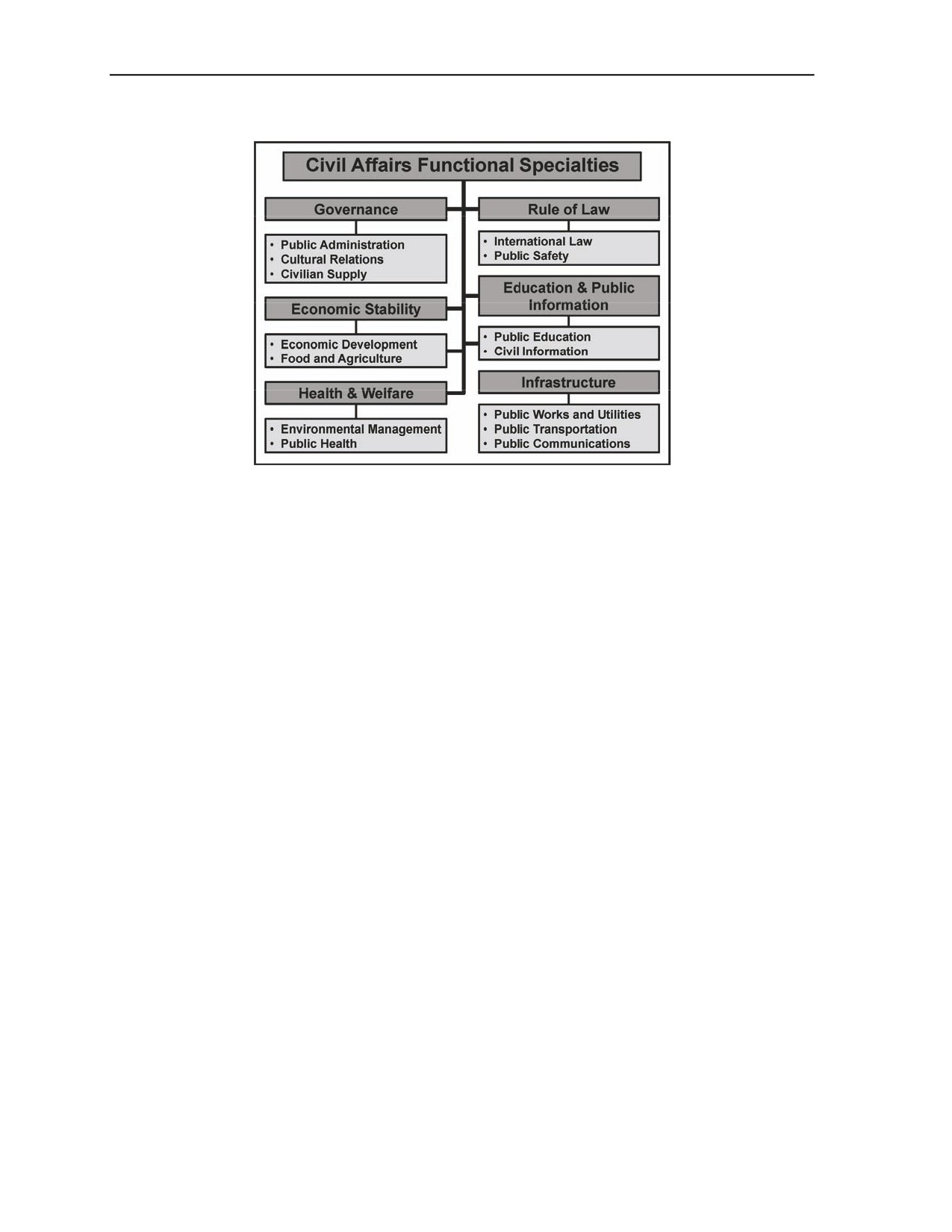
Chapter 5
Figure 5-5. Civil affairs functional specialties
5-91. In addition to providing essential information for understanding the urban environment, CA per
sonnel and activities help shape the battlefield, engage a civil problem, consolidate gains, and transition to
a legitimate civil authority. Specifically, CA teams and CMO help urban commanders—
Minimize civilian interference with UO and the impact of urban operations on the populace and
infrastructure. CA personnel can help establish and run a civil-military operations center
(CMOC), discussed later in this chapter, to coordinate UO with civilian agencies
(both
governmental and nongovernmental), other services, and multinational partners.
Provide advice and assistance to restore or rehabilitate portions of the infrastructure.
Plan, supervise, and execute necessary populace and resources control measures (in close
coordination with military police units) until no longer required or the urban operation is
completed.
When requested or when military necessity or legitimate directives require, establish all or
portions of the urban civil administration.
Determine available supplies and services in the urban area and if necessary assist in negotiating
their acquisition. CA also help commanders assess the capability, dependability, and willingness
of urban sources to provide and sustain identified needs as well as to calculate the impact of
using them on other aspects of the urban environment.
In conjunction with the SJA, fulfill the Army’s responsibilities toward the urban population
under international, host-nation, and U.S. law.
Plan and conduct the transition of control for the urban area or operation to another military or
civilian governmental or nongovernmental organization or agency.
5-22
FM 3-06
26 October 2006
Contemplating Urban Operations
5-92. As part of CMO, stability or civil support operations will be critical as commanders begin to restore
essential services to meet the emergency needs of a potentially devastated urban population. Besides
repairing or restoring vital services and other critical infrastructure, these and other projects may also
stimulate the urban area’s economy and provide work for the unemployed. (Employed workers are less
likely to be co-opted by terrorists, insurgents, and criminal gangs.) As such, they can be a critical
stabilizing tool for commanders as they attempt to transition control and responsibility to other agencies or
to legitimate civilian control. These projects may include—
Providing clean water.
Restoring waste management functions (less-extensive sewer repairs and trash collection and
disposal activities).
Improving medical care.
Rehabilitating schools.
Assisting in the establishment of local governments.
Improving security and emergency services (police, fire, and rescue).
Providing electrical generators for hospitals, clinics, and factories.
Restoring irrigation to surrounding farmland.
Repairing important cultural infrastructure.
5-93. As part of the initial planning process, CA units conduct an area assessment, which can provide
commanders with essential information about the environment (see FM 41-10). Commanders should
integrate this initial assessment into the overall urban-focused IPB process. To help analyze civil con
siderations in any environment, commanders and staffs can consider many characteristics such as areas,
structures, capabilities, organizations, people, and events (ASCOPE). These characteristics easily align
with an urban area’s three main characteristics of terrain, society, and infrastructure; and, like them, they
are overlapped and interdependent (see FM 6-0). Of these, the category of events is a critical addition to
urban characteristics previously categorized and discussed. Significant spikes (and lulls) to threat and
civilian activity can be expected to occur in conjunction with important religious, historic, and political
events
(for example elections). Therefore, commanders should determine, track, and pay particular
attention to these events when planning operations and managing transitions (see also the Key Event Chart
discussion in Appendix B, paragraph B-43).
5-94. Similar to PA operations, CMO are related to information operations. The nature of CMO and the
need for CA personnel to develop and maintain close relationships with the urban population put CA
personnel in a favorable position to collect information. CA personnel work daily with civilians, their
equipment, and their records that may be prime sources of information. If used correctly, CA personnel can
complement the intelligence collection process necessary to understand the dynamic societal component of
the urban environment and detect significant changes. However, CA personnel are not, and cannot appear
as, intelligence agents; otherwise, it will undermine their ability to interact with the civilian community.
Examples of information available to CA units include government documents, libraries, and archives; files
of newspapers and periodicals; industrial and commercial records; and technical equipment, blueprints, and
plans.
5-95. Overall, CA expertise is critical to a commander’s understanding of the complexities of the
infrastructure and societal components of the urban area. These components (together with the terrain or
physical component of the urban area) interconnect. CA forces help identify and understand the
relationships and interactions between these urban components. From this understanding, commanders can
anticipate how specific military actions affect the urban environment and the subsequent reactions. CA
personnel help commanders predict and consider the second- and third-order effects and reactions as well
as the long-term consequences. Understanding these long-term consequences helps in achieving stability
and ensuring a smoother and speedier transition of the urban area back to civilian responsibility and
control. Oppositely, an unconsidered short-term solution may, in the end, turn out to be the solution
requiring the greatest amount of time. Poor solutions may exacerbate the situation. Others may contribute
little to conflict resolution and waste precious resources (particularly time) until a more reasoned approach
is formulated—one that should have been the first solution.
26 October 2006
FM 3-06
5-23
Chapter 5
Civil-Military Reconstruction Efforts
5-96. Reconstruction efforts and activities, an integral part of CMO, should complement NGO efforts and
are conducted in concert with larger urban area and nationwide projects often headed by the U.S. Army
Corps of Engineers (USACE) and the U.S. Agency for International Development (USAID). For example,
extensive, large-scale sewer projects or major repairs to the urban area’s electrical infrastructure would be
left to the USACE and USAID. When planning and conducting urban reconstruction, commanders
should—
Keep expectations realistic. With so much to do, it is easy for Army forces to become
overcommitted. Commanders must focus on the achievable, build off successes, and create
constructive forward process.
Seek opportunities. While commanders think long-term, they should look for catalytic
investment of resources. Minimal resources provided at the right time can generate significant
activities resulting in increased momentum toward the desired end state.
Align resources with local needs. In analyzing the merit of a project, commanders must check
to determine if it is supported and desired by the urban populace. Local participation in the
process reinforces ownership and acceptance and eventual transition of responsibility.
Balance speed and quality. Commanders must balance the achievement of rapid response with
quality construction and repairs.
Ensure efforts do not undermine locals. Army reconstruction efforts should not undermine the
growth and legitimacy of local institutions and authorities.
Integrate in the targeting process. Commanders should routinely include approval of civil-
military reconstruction products as part of the information operation’s contribution to the overall
targeting process.
INTEGRATION OF CONVENTIONAL AND SPECIAL OPERATIONS
FORCES
5-97. One important Army and joint resource that commanders of a major operation can use to influence
urban operations is SOF. Several types of these forces exist (including the CA forces discussed above),
each with unique and complementary capabilities. They can be extremely valuable in UO for their ability
to execute discrete missions with a higher degree of precision than conventional forces, to provide
information, and to enhance cultural understanding. However, the challenges of using SOF include
command and control; integration; coordination with conventional forces that will normally command,
control, and conduct the bulk of UO tasks; and the imprudent inclination to use SOF forces for
conventional purposes. The density and complexity of UO make close coordination and synchronization of
conventional forces and SOF essential to mission success. The nature of the environment dictates that both
forces will work in close proximity to each other; the separation in space and time between SOF and
conventional forces will often be much less in urban areas than in other environments. Overall, the nature
of the environment demands a synergistic combination of capabilities to achieve effects on the threat and
mission success.
5-98. Successfully integrating SOF occurs with proper integration into, or coordination with, the command
structure of the force conducting the UO. SOF within a theater (less CA and tactical PSYOP) ordinarily
falls under joint command and control. Therefore, the commander of the major operation responsible for an
urban area, if he is not a JFC, will have to coordinate through the JFC to integrate SOF capabilities into the
UO. Examples of critical coordination elements include:
Boundaries.
No-fire areas. (If assigned, SOF liaison officers (LNOs) must be routinely included in targeting
meetings.)
Coordination points.
The exchange of key intelligence and information.
Requirements to support personnel recovery contingencies.
5-24
FM 3-06
26 October 2006
Contemplating Urban Operations
Conventional and Special Forces Integration
On 20 April 2003 during OPERATION IRAQI FREEDOM (OIF), an Army Special
Forces (SF) operational detachment alpha (ODA) was patrolling through villages and
secondary roads east-southeast of An Najaf. A local Iraqi approached the team and
volunteered the location of a senior Ba’ath Party official in the nearby town of
Ghamas. Unfortunately, he did not provide an exact location but rather an
approximate location and the name of the family dwelling. The ODA coordinated with
their company commander and nearby elements of the 101st Airborne Division to
conduct a raid on the residence at dawn the next day. Joint planning, preparation,
and rehearsals among the units occurred throughout the night.
At 0430, the raid convoy departed its base en route to Ghamas. The small task force
consisted of an assault team, a security team, a command and control element, and
three blocking forces composed of Soldiers from a scout platoon and antiarmor
company of the 101st. At 0515, the convoy hit the release point outside Ghamas.
The 101st vehicles moved to their blocking positions at three bridges surrounding the
town. The remainder of the task force moved into the town. An interpreter quickly
found a local guide who knew where the house was located. He took the SF team to
a walled two-story dwelling with a courtyard. The security team isolated the objective
and provided overwatch while the assault team forcibly seized the house and
apprehended three adult males. Among them was Abd Hamden, the target of the
raid and a senior Ba’ath Party official from Baghdad.
After a tactical interrogation, one of the men provided the location of a Fedayeen
major nearby. The SF and conventional force raided this house minutes later but only
found the major’s relatives. As the Soldiers left the town with their captives, they were
cheered by the locals throughout the town. Although only one small example, the
extensive coordination between SOF and conventional forces during urban
operations was a tremendous success during OIF.
SYNCHRONIZATION OF ACTIVITIES WITH OTHER AGENCIES
5-99. The population density of the urban environment, its economic and political importance, and its life-
supporting infrastructure attracts many types of organizations. These organizations include—
Other U.S. governmental agencies.
International governmental organizations.
Allied and neutral national governments.
Allied and coalition forces.
Local governmental agencies and politicians.
NGOs.
5-100. Even in a major operation or campaign, many organizations operate in the area as long as possible
before combat or as soon as possible after combat. Therefore, coordination with these organizations
sharing the urban AO will be essential to achieve synchronization; however, effective synchronization is
challenging, time consuming, and manpower intensive. The staffs of larger headquarters (divisions or
higher) normally have the breadth of resources and experience to best conduct the necessary
synchronization. They can effectively use or manage the organizations interested in the urban area and
mitigate their potential adverse effects on UO. By taking on as much of the synchronization requirements
as possible, the operational headquarters permits its tactical subordinates to remain focused on
accomplishing their tactical missions. The higher headquarters should assume as much of the burden of
synchronization as possible. However, the density of the urban environment will often require that smaller
tactical units coordinate and synchronize their activities with other agencies and the local civilian
leadership (formal and informal) simply because of their physical presence in the units’ AOs. In urban
26 October 2006
FM 3-06
5-25
Chapter 5
stability and civil support operations, mission accomplishment will require effective civil-military
coordination and synchronization activities and measures at all levels as either a specified or implied task.
CIVIL-MILITARY OPERATIONS CENTERS
5-101. To coordinate activities among the varied agencies and organizations operating in an urban area
and the local population, urban commanders can establish a CMOC. The CMOC synchronizes Army
activities and resources with the efforts and resources of all others involved (see FM 41-10). This can be
particularly important in stability and civil support operations where combat operations are not the domi
nant characteristic of the major operation. CMOCs can be established at all levels of command. Hence,
more than one CMOC may exist in an AO, particularly large urban areas. CMOCs may be organized in
various ways and include representatives from as many agencies as required to facilitate the flow of
information among all concerned parties. Commanders must still ensure that force protection and OPSEC
requirements are not compromised. Effective CMOCs can serve as clearinghouses for the receipt and vali
dation of all civilian requests for support, can aid in prioritizing efforts and eliminating redundancy, can
decrease the potential for inappropriate displays of wealth by one or more of the participating
organizations, and, most importantly, can reduce wasting the urban commander’s scarce resources.
LIAISON OFFICERS
5-102. LNOs—sufficiently experienced and adequately trained in liaison duties and functions—are
necessary to deal with the other agencies that have interests in the urban area. Army LNOs work with the
lead agency or other organizations (including local civilian agencies such as police) that the commander
has identified as critical to mission success. Together they work to rapidly establish unity of effort and
maintain coordination, often before a CMOC is established. The additional coordination afforded by the
physical presence of LNOs within these organizations may be required even after the CMOC is fully
functional. When commanders lack enough LNOs to meet requirements, they should prioritize and often
assign a single LNO to several organizations. That LNO will then share his time and presence to those
organizations based on the situation and his commander’s guidance.
COMMANDER’S PERSONAL INVOLVEMENT
5-103. Overall, establishing a close relationship with other agencies and the urban civilian population will
often be a major, positive factor in successful mission accomplishment, particularly in urban stability
operations. Despite internally established command and control relationships, commanders that develop a
direct and personal relationship with the leaders and staff of other agencies can often avoid conflict, win
support, foster trust, and help eliminate the “us versus them” mentality that can frustrate cooperation
among Army forces and civilian organizations.
5-26
FM 3-06
26 October 2006
Chapter 6
Foundations for Urban Operations
Utilities such as electricity and water are as much weapons of war as rifles, artillery
pieces or fighter aircraft
In the case of Manila, where there was a noncombatant,
civilian population of one million in place, it was the attacker’s aim to capture the
utilities which the defender planned to destroy.
The Battle for Manila
Commanders conducting major urban operations (UO) use their ability to visualize
how doctrine and military capabilities are applied within the context of the urban
environment. An operational framework is the basic foundation for this visualization.
In turn, this visualization forms the basis of operational design and decision making.
To accurately visualize, describe, and direct the conduct of UO, commanders and
their staffs must understand the basic fundamentals applicable to most UO.
URBAN OPERATIONAL FRAMEWORK
6-1. Army leaders who have an urban area in their area of operations (AO) or are assigned missions in an
urban area follow an urban operational framework. They identify the portion of the urban area essential to
mission success, shape the area, precisely mass the effects of combat power to rapidly dominate the area,
protect and strengthen initial gains without losing momentum, and then transition control of the area to
another agency. This framework divides into five essential components: understand, shape, engage,
consolidate, and transition. These five components provide a means for conceptualizing the application of
Army combat power and capabilities in the urban environment.
6-2. The urban operational framework assists commanders in visualizing urban operations. This
framework is simply an aid to the commander. It is not sequential, nor is it a planner’s tool for phasing an
operation. Commanders should combine the urban operational framework with—
The principles of war.
The tenets of Army operations.
The components of operational design.
Considerations for stability operations and civil support operations.
Sustainment characteristics.
Running estimates.
Commander’s critical information requirements (CCIR).
Each commander’s experience.
The framework contributes to the visualizing, describing, and directing aspects of leadership that make
commanders the catalysts of the operations process (see Figure 6-1). In the same manner, the urban
operational framework contributes to the overall operations process (see FM 3-0).
26 October 2006
FM 3-06
6-1
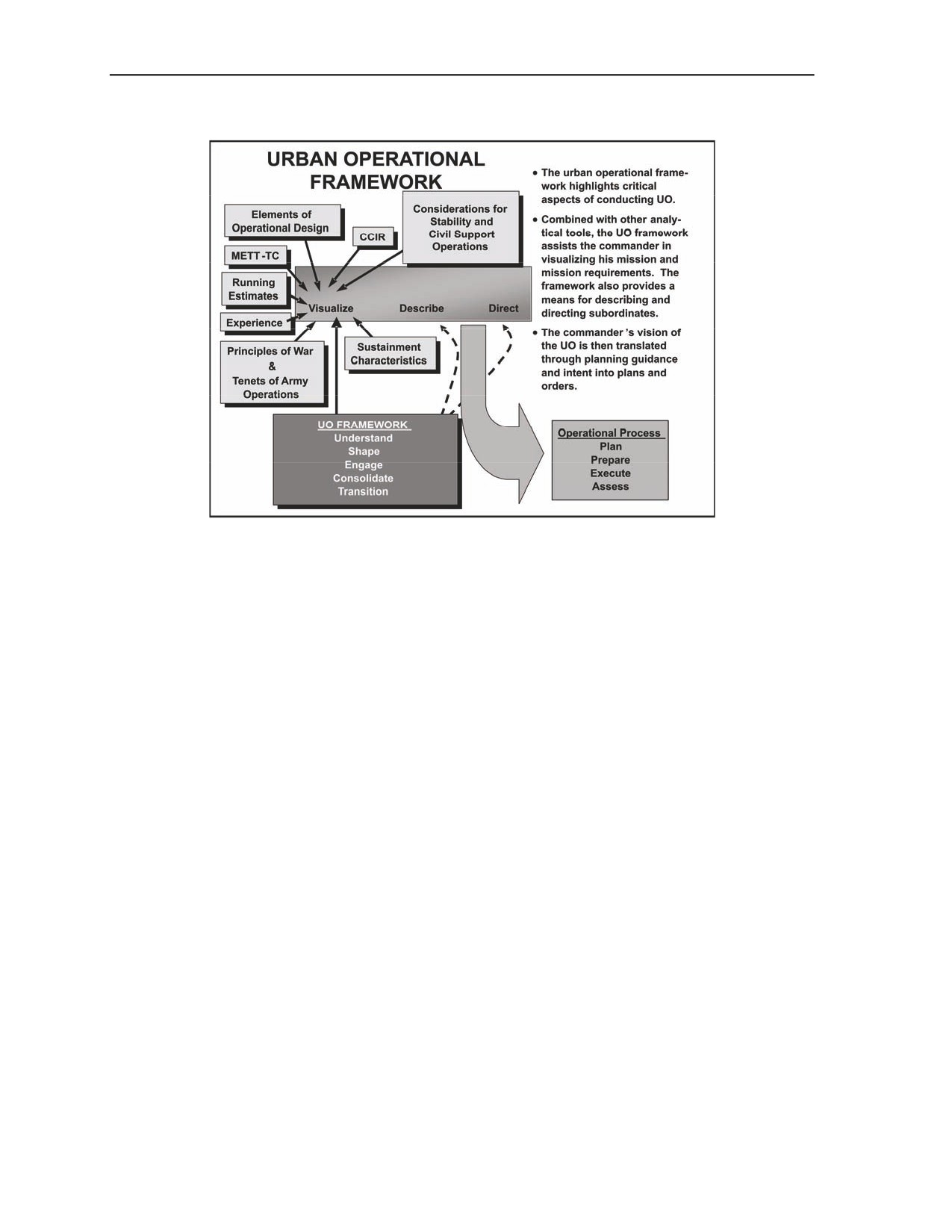
Chapter 6
Figure 6-1. The urban operational framework and battle command
UNDERSTAND
6-3. Understanding requires continuous assessment—throughout planning, preparation, and execution—
of the current situation and progress of an operation, and the evaluation of it against measures of
effectiveness to make decisions and adjustments. Commanders use visualization, staff officers use running
estimates, and all use the intelligence preparation of the battlefield (IPB) process to assess and understand
the urban environment. Commanders and staffs begin to understand by observing and then collecting
information about the situation. They observe and learn about the urban environment (terrain, society, and
infrastructure), and other factors of METT-TC—mission, enemy, weather, troops and support available,
and time available. They use intelligence, surveillance, and reconnaissance means; information systems
(INFOSYS); and reports from other headquarters, services, organizations, and agencies. Then they orient
themselves to the situation and achieve situational understanding based on a common operational picture
(COP) and continuously updated CCIR. Largely, the ability to rapidly and accurately achieve a holistic
understanding of the urban environment contributes to the commanders’ abilities to seize, retain, and
exploit the initiative during UO.
Disproportionately Critical
6-4. The Army operations process requires continuous assessment and understanding; it precedes and
guides every activity. In UO, however, in-depth understanding is disproportionately critical for several
reasons. First, each urban environment is unique. Other environments can be studied and their
characteristics quantified in a general manner with accuracy. This is fundamentally not true of different
urban areas. The characteristics and experience in one urban area often have limited value and application
to an urban area elsewhere. This characteristic sets UO apart from operations in other environments.
Extremely Dynamic
6-5. The urban environment is also extremely dynamic. Either deliberate destruction or collateral damage
can quickly alter physical aspects of the urban environment. The human aspect is even more dynamic and
potentially volatile. A friendly civil population, for example, can become hostile almost instantaneously.
6-2
FM 3-06
26 October 2006
Foundations for Urban Operations
These dynamics (combined with initial difficulty of understanding and describing this unique environment)
make it difficult for commanders and staffs to initially develop and maintain a COP and establish
situational understanding. Furthermore, public reaction to media coverage of the urban operation and
political changes influence national security strategy and objectives. Such changes can affect the basic
nature of an operation, especially after it has commenced. Anticipating these potential effects and
developing appropriate branches and sequels based on an accurate understanding often determines how
quickly commanders can achieve the desired end state.
Risk Assessment
6-6. As in any environment, UO pose both tactical and accident risks. However, the level of uncertainty,
ambiguity, and friction can often be higher than that of many other environments. Such challenges increase
the probability and severity of a potential loss due to the presence of the enemy, a hostile civilian group, or
some other hazardous condition within the urban environment (see Determining the Necessity of Urban
Operations in Chapter 5). Therefore, commanders must—
Identify, assess, and understand hazards that may be encountered in executing their missions.
Develop and implement clear and practical control measures to eliminate unnecessary risk.
Continuously supervise and assess to ensure measures are properly understood, executed, and
remain appropriate as the situation changes.
6-7. Risk decisions are commanders’ business. However, staffs, subordinate leaders, and even individual
Soldiers must also understand the risk management process and continuously look for hazards at their level
or within their area of expertise. Any risks identified (with recommended risk reduction measures) must be
quickly elevated to the appropriate level within the chain of command (see FM 3-100.12 and FM 5-19).
Complex and Resource Intensive
6-8. The urban environment is the most complex of all the environments in which the Army conducts
operations. It is often comprised of a diverse civil population and complex, ill-defined physical
components. A sophisticated structure of functional, social, cultural, economic, political, and informational
institutions unites it. Thus, the analysis to understand the environment is also complex and time and
resource intensive. The nuances of the urban environment can take years to uncover. Hence, constant
analysis of the environment requires greater command attention and resources. Accurately understanding
the environment is a prerequisite to shaping it, and both understanding and shaping activities are crucial to
effectively engage the elements of the urban environment critical to success.
SHAPE
6-9. Shaping operations, part of all Army operations, are essential to successful UO. They set the
conditions for decisive operations at the tactical level in the urban area. Rapid action, minimum friendly
casualties, and acceptable collateral damage distinguish this success when the AO is properly shaped.
Failure to adequately shape the urban AO creates unacceptable risk. The commander of a major urban
operation has several resources with which to begin shaping the AO. Important capabilities include—
Fires.
Information operations.
Special operations capabilities.
The maneuver of major subordinate units.
6-10. Critical urban shaping operations may include actions taken to achieve or prevent isolation,
understand the environment, maintain freedom of action, protect the force, develop cooperative
relationships with the urban population, and train Army forces for sustained UO.
Isolation
6-11. Isolation of an urban environment is often the most critical component of shaping operations.
Commanders who’s AO includes operationally significant urban areas often conduct many shaping
26 October 2006
FM 3-06
6-3

Chapter 6
operations to isolate, or prevent isolation of, those areas from other parts of the AO. Likewise, commanders
operating in the urban area focus on isolating decisive points and objectives in the urban area or averting
isolation of points that are critical to maintaining their own freedom of action. Isolation is usually the key
shaping action that affects UO. It applies across full spectrum operations. Most successful UO have
effectively isolated the urban area. Failure to do so often contributed to difficult or failed UO. In fact, the
relationship between successful isolation and successful UO is
so great that the threat often opposes external isolation actions
more strongly than operations executed in the urban area (or
critical areas within). In some situations, the success of isolation
efforts has been decisive. This occurs when the isolation of the
urban area compels a defending enemy to withdraw or to
surrender before beginning or completing decisive operations. In
UO that are opposed, Army forces attempt to isolate the threat
three ways: physically, electronically, and, as a resultant
combination of these first two, psychologically (see Figure 6-2).
Figure 6-2. Urban isolation
Physical Isolation
6-12. In offensive UO, physical isolation keeps the threat from receiving information, supplies, and
reinforcement while preventing him from withdrawing or breaking out. Conversely, a defending Army
force attempts to avoid its own physical isolation. Simultaneously, this force conducts operations to isolate
the threat outside, as they enter, or at selected locations in the urban area. Physical isolation can occur at all
levels. In many situations, the commander of a major combat operation may attempt to isolate the entire
urban area and all enemy forces defending or attacking it. At the tactical level, forces isolate and attack
individual decisive points often using a cordon technique. In stability operations, physical isolation may be
more subtly focused on isolating less obvious decisive points, such as a hostile civilian group’s individual
leaders. In many operations, isolation may be temporary and synchronized to facilitate a decisive operation
elsewhere. To effectively isolate an urban area, air, space, and sea forces are often necessary additions to
the capabilities of ground forces.
Electronic Isolation
6-13. Electronic isolation is achieved through offensive information operations (IO). Electronic warfare
(particularly two of its components: electronic warfare support and electronic attack) and computer
network attack are critical to electronic isolation (see FM 3-13 and the Information Operations discussion
in Chapter 5). At the operational level, offensive IO aims to quickly and effectively control the information
flow into and out of an urban area. This isolation separates the threat’s command and control (C2) system
in the urban area from its operational and strategic leadership outside the urban area. Offensive IO also
focuses on preventing the threat from communicating with civilians through television, radio, telephone,
and computer systems. At the tactical level, IO aim to isolate the threat’s combat capability from its C2 and
leadership within the urban area, thus preventing unity of effort within the urban area. Defensive IO can
prevent isolation of friendly forces defending in an urban area.
Psychological Isolation
6-14. Psychological isolation is a function of physical actions, electronic warfare, and other forms of IO,
especially military deception and psychological operations. Psychological isolation denies the threat
political and military allies. It separates the enemy or hostile civilian group from the friendly population,
nongovernmental organizations (NGOs) operating in the urban area, and from political leaders who may
consider supporting Army forces. Psychological isolation destroys the morale of individual enemy soldiers
or hostile civilians. It creates a feeling of isolation and hopelessness in the mind of the threat. It undermines
6-4
FM 3-06
26 October 2006
Foundations for Urban Operations
the threat leadership’s ability to think, plan, decide, and act. As such, it undermines the confidence of the
threat in their leadership. On the other hand, IO, as well as the disciplined conduct of Army personnel, can
help to forge legitimacy for Army operations. In stability operations, psychologically isolating the threat
can result in the friendly urban population and NGOs positively supporting Army operations.
Other Shaping Actions
6-15. Other shaping actions can include the proper sequencing and deployment of forces, reconnaissance
operations, and force protection. These actions contribute equally to the success of any urban operation.
Commanders must understand how the urban environment affects their ability to accomplish these shaping
actions. However, civil-military operations (CMO), another closely related activity of IO, are important to
shaping the urban operational environment for decisive operations. The specific civil-military task can vary
greatly and may include affecting a cooperative relationship with the civil political system, protecting
portions of the civil population or infrastructure, or establishing refugee camps or safe areas for
noncombatants. This is most true in stability and civil support operations. Successful CMO also can
contribute to the psychological isolation of the threat. (See Civil-Military Operations in Chapter 5 for a
more detailed discussion.)
Training and Education
6-16. Finally, Army commanders must consider that critical shaping actions often occur prior to the urban
operation in the form of professional education, and home-station and in-theater training. Commanders can
enhance training through joint, interagency, multinational, and combined arms exercises and effective
rehearsals.
ENGAGE
6-17. In UO, Army forces engage by appropriately applying their full range of capabilities against decisive
points leading to centers of gravity. Successful engagement takes advantage of the Army force’s superior
training, leadership, and, within the constraints of the environment, equipment and technology. Successful
engagement also requires the establishment of necessary levels of control and influence over all or portions
of the urban environment until responsibilities can be transferred to other legitimate military or civilian
control. Engagement may range from the overwhelming, yet precise, application of combat power to defeat
a threat, to large-scale humanitarian assistance operations, to unobtrusive advice and assistance to the
urban security forces. It may require brief engagement in a relatively small portion of an urban area or with
small segments of the population to long-term engagement throughout multiple, large urban areas and with
vast sectors of the population. The commander’s ability to engage in a specific urban operation depends, as
always, on the situation and the assigned mission.
Offense: Attack Decisive Points
6-18. In offensive UO, forces successfully engage by striking at the enemy’s center of gravity using
multiple offensive actions from unexpected directions and throughout all dimensions. Army forces aim to
engage identifiable decisive points. Successful efforts against decisive points lead to effects on the center
of gravity. The center of gravity will differ in each offensive situation. It may be an individual enemy
leader, the enemy’s combat power, the enemy’s communications capability, or a physical structure of
cultural, political, or economic significance.
Defense: Deny Vital Functions and Critical Infrastructure
6-19. In defensive UO, engage translates into denying the enemy control of the vital functions and critical
infrastructure of the urban area. Forces achieve this by leveraging the defensive advantages of the urban
terrain, defending essential areas in depth, using economy of force in nonessential areas, controlling the
enemy direction of attack with natural and man-made obstacles, and retaining the initiative through
counterattacks.
26 October 2006
FM 3-06
6-5
Chapter 6
Stability and Civil Support: Apply Innovation and Imagination
6-20. The ability to engage in urban stability operations hinges on the type of stability operation
commanders execute. In a noncombatant evacuation operation, forces limit engagement to finite
geographic areas and times. In contrast, a peace operation may require engagement of a large urban area
for an extended time. In this operation, engage is defined as using the array of Army capabilities to create
specific conditions among the belligerents. Thus, the techniques used for engagement in stability
operations vary according to the situation and as situations mature during long-term operations.
6-21. In urban civil support operations, engagement is accomplished by innovative and subtle application
of Army capabilities. Since Army forces usually support other agencies that lead the operation, effective
engagement results from carefully and discretely applying Army capabilities to the tasks assigned by the
lead agency. In a humanitarian relief situation, Army forces may be tasked to transport supplies in the
urban area. Successful engagement in this activity then becomes the goal of Army forces and may be
achieved by providing, managing, and protecting transportation assets and clearing and maintaining
sufficient lines of communications (LOCs).
CONSOLIDATE
6-22. Army forces consolidate to protect and strengthen initial gains and ensure retention of the initiative.
Consolidation includes actions taken to eliminate or neutralize isolated or bypassed threat forces (including
the processing of enemy prisoners and civilian detainees) to increase security and protect LOCs. It includes
the rapid repositioning and, as necessary, reorganization of forces and intelligence, reconnaissance, and
surveillance (ISR) assets. Consolidation may also include activities in support of the civilian population
such as relocating displaced civilians, reestablishing law and order, humanitarian assistance and relief
operations, and restoration of key urban infrastructure. A significant consolidation effort may be the
reduction or elimination numerous explosive hazards resulting from previous urban combat operations.
During consolidation, commanders often coordinate with NGOs to establish unity of effort in the execution
of stability or civil support operations. Consolidation begins with the initiation of the urban operation and
follows each critical activity.
TRANSITION
6-23. When planning UO, commanders ensure that they plan, prepare for, and manage transitions.
Transitions are movements from one phase of an operation to another or a change in responsibility for all
or portions of the urban environment from one unit, organization, or agency to another. They involve
significant changes in the type of operation, concept of the operation, mission, situation, task organization,
forces, resource allocation and support arrangements, or C2. Transitions occur in all operations, but in UO
they occur with greater frequency and intensity, are more complex, and often involve agencies other than
U.S. military organizations. For example, a successful attack may transition to a defend mission that
includes not only defense tasks but also stability tasks. All operations will likely include a transition of
responsibility for some aspect of the urban environment to (or back to) a legitimate civilian authority.
Unless planned and executed effectively, transitions can reduce the tempo of the urban operation, slow its
momentum, and cede the initiative to the threat.
Mental and Physical Preparation
6-24. Transitions occur as conditions warrant. They can be carefully planned and controlled, or they can be
quick and dramatic, such as the swift transformation of a stability operation into offense or defense—and
back again. Units prepare mentally and physically to address rapid transitions. Accordingly, plans include
branches and sequels that address anticipated or possible transition points. When the dominant type of
operation changes from an offense to stability or civil support, the types of units originally conducting the
UO may no longer be appropriate. A large mobile reserve may permit increased flexibility to react to
unplanned transition requirements. Operations or units in one part of an urban area may transition before
operations or units in a different part of the same urban area. This will require commanders to exercise
careful command and control and execute various types of operations and associated tasks simultaneously.
6-6
FM 3-06
26 October 2006
Foundations for Urban Operations
Transition to Legitimate Civilian Authorities or Agencies
6-25. Combat operations are not an end to themselves. They are inevitably a means of transition, an
activity for moving from an unsatisfactory state of affairs to an improved end (as determined by national
objectives). In UO, a distinct aspect of transition is the requirement to quickly and efficiently transition the
major portions of Army responsibilities to civil agencies. Some tasks to which units will transition are not
traditional combat tasks but rather stability tasks more closely associated with CMO. In stability or civil
support operations this is often a near-term critical mission objective. In these operations, commanders aim
to alleviate the circumstances requiring Army forces and ensure that other civilian agencies assume the
functions provided by Army forces. Following combat operations, civilian agencies are assisted and
encouraged to quickly resume specific support activities—such as providing sanitary services, food
services, law enforcement, and health services—because of their high demand on Army resources.
6-26. Transitioning responsibility for the urban environment (or selected portions) to legitimate civilian
agencies or authorities requires commanders to make an accurate assessment and develop an in-depth
understanding of the civilian organization’s ability to accept and handle the responsibility. Commanders
consider not only resources available but whether the organization has the appropriate leadership and
technical expertise as well as a vision in consonance with U.S. objectives. Commanders should avoid
forcing a transition only to alleviate the burden on Army forces. On the other hand, they may need to
encourage acceptance of responsibility while continuing to provide “behind-the-scenes” advice, assistance,
and resources. Transitioning responsibility prematurely may alleviate the commander’s immediate resource
concerns but may, in the longer term, negatively impact the achievement of strategic objectives.
Clearly Visualize and Describe the End State
6-27. Army UO conclude when Army forces depart and have no further mission requirements in the urban
area. At the outset, commanders visualize and describe the intended end state of a unit’s execution of UO.
Commanders then clarify and update this visualization as the political or strategic situation is refined or
changes. Importantly, commanders must create a command climate and procedures that allow their staffs
and subordinate commanders the ability to ask questions that will enable all to share in an accurate
perception of the commander’s visualization. This enables subordinate units to identify likely transitions
and ensures that current operational planning takes into account second- and third-order effects. As long as
an active Army AO contains an urban area, some type of urban operation will exist. After urban combat
successfully ends, combat forces may move on. Support forces conducting sustaining operations may then
occupy the area and continue to conduct a different form of UO.
Applying the Urban Operational Framework: Panama - 1989
The U.S. conducted OPERATION JUST CAUSE in December 1989 to remove the
illegal ruler of Panama, Manuel Noriega, and to restore that country to a democracy.
It also conducted the operation to ensure the safety of a substantial number of U.S.
personnel as well as the security of U.S. interests in Panama. The major focus of
JUST CAUSE was in Panama City, the country’s capital. Most operations occurred in
this large urban area, one of the numerous smaller urban areas, or the urban-like
military bases. These bases increased the AO and were directly linked to operations
in the capital city. This successful operation illustrates how commanders can apply
the urban operational framework to visualize, describe, and direct the critical aspects
of urban operations.
Understand
The synchronization achieved during the operation may have obscured the
challenges faced in the initial assessment process in Panama. However, it was not
as simple as it may have seemed. Using the framework of the urban environment,
U.S. forces required details of the physical characteristics of the environment, the
26 October 2006
FM 3-06
6-7