FM 3-06 URBAN OPERATIONS (OCTOBER 2006) - page 5
Chapter 8
security of the lines of communications and establish effective movement control. Shaping operations in
defensive UO create the conditions for decisive operations. Shaping operations vary greatly depending on
the type of defense. For example, in a mobile defense the shaping operation may be the fixing force. In
contrast, in an area defense the fixed defense may be the decisive operation. In the urban defense, decisive
operations focus on accomplishing the commander’s mission. The decisive operation may not defeat the
threat’s main effort, and it may not prevent threat occupation of large portions of the urban area if those
tasks are not essential to mission accomplishment. For example, if the defense’s objective is to protect a
critical communications node, then, depending on the commander’s overall intent, threat actions to secure
an airfield elsewhere may not be important.
TYPES OF URBAN DEFENSE
8-20. Commanders can view urban area defensive operations two ways: as conducting a major defensive
operation with an urban area in their area of operations (AO) and as defending entirely in an urban area.
AREA DEFENSE
8-21. At the operational level, an area defense may include both urban areas and open maneuver areas. The
most common defense in an urban area and the most suitable for the characteristics of this distinct
environment is the area defense. As a defensive operation, the area defense concentrates on denying threat
forces access to designated terrain for a specific time rather than destroying the threat outright. Although
an area defense in an urban area does not directly seek to destroy or defeat attacking threat forces, as an
objective it does aim to force culmination of the threat’s attack. The urban area defense often works
effectively to exhaust threat resources and shape conditions for a transition to offensive operations. The
urban area may also be used as a strong point to force threat movement in a different direction or to fix
threat forces as part of a large, mobile defense taking place in the AO outside the urban area.
MOBILE DEFENSE
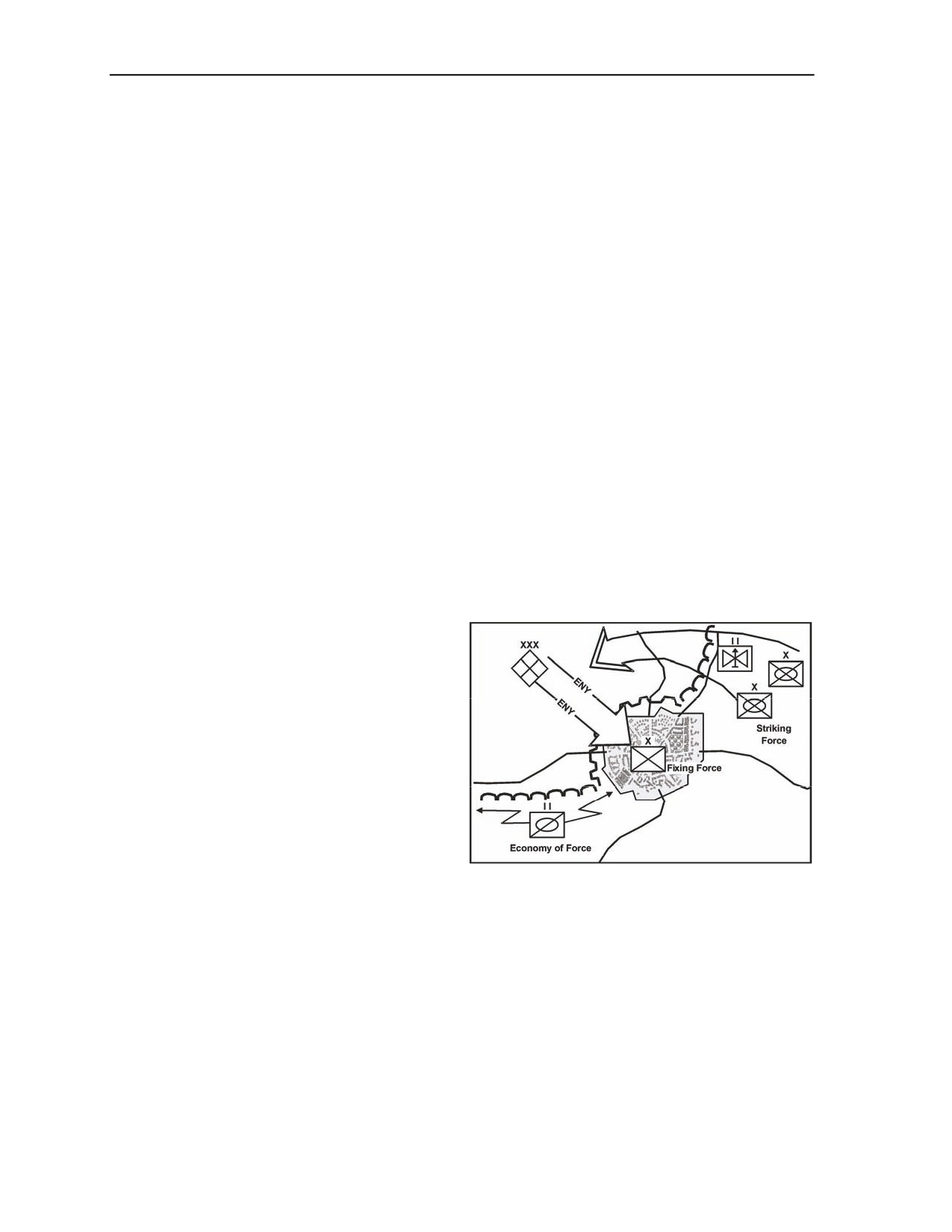
8-22. A mobile defense can operate in an urban
area but only under specific conditions. It focuses
on destroying or defeating the threat through a
decisive attack by a striking force. It requires the
defender to have greater mobility than the
attacker. To shape a mobility advantage, the
urban defender effectively uses the terrain and
correctly task organizes his forces’ mobility. The
principles of applying the mobile defense in the
urban area remain the same: a small fixing force
stops the threat and limits any ability to maneuver
while a striking force quickly maneuvers and
counterattacks to destroy him.
Figure 8-1. An urban area incorporated into a
larger mobile defense
8-23. One key to executing a mobile defense in the urban area is to entice a threat force into the depths of
the urban area where it begins to lose mobility options. A well-placed fixing force augmented with man-
made obstacles and taking advantage of the naturally constrictive terrain can stop a much larger force. If
the attacking force is largely mounted and armored, its mobility in the urban area may be reduced to less
than that of dismounted infantry. In addition, if the attacking force’s movement into the urban area is
mounted and rapid, the commander’s situational understanding also diminishes. Then the striking force,
consisting of dismounted infantry forces, can execute the counterattack with surprise from multiple
directions and dimensions
(subsurface, surface, supersurface, and airspace). Man-portable antiarmor
weapons—firing from flanks and top down and supported by precision indirect fires from both organic and
joint systems—can rapidly destroy the threat.
8-4
FM 3-06
26 October 2006

Urban Defensive Operations
8-24. From the perspective of commanders of the major operation, the urban environment can help
defending forces achieve a mobility advantage over an attacker in a broader sense. Defending commanders
can attempt to shape the battlefield so that the attacker commits significant resources into an urban area,
where his maneuver capabilities are reduced (see figure 8-1). A disproportionately small defending force,
which relies on the defensive combat power advantages of the urban environment, reduces and fixes the
attacker’s maneuver capabilities. Other defending forces mass outside the urban area then strike the threat
with a combined mobility and firepower advantage.
Urban Defense in a Major Operation: Stalingrad - 1942 to 1943
The German and Soviet battle for Stalingrad in late 1942 and into early 1943
illustrates how a tactical urban area defense integrates into a larger mobile defense.
Stalingrad was a battle fought on a huge scale: it involved army groups on both sides
and thousands of square kilometers. Though the city was relatively small, it remained
the focus of both German and Soviet offensive and defensive operations during the
six-month battle.
In the summer of 1942, the Germans launched a strategic offensive in southern
Russia. Its goal was the valuable oil fields of the Caucasus. German forces turning
south into the Caucasus exposed a vulnerable flank to Soviet forces positioned
between the Don and Volga Rivers. For the German Caucasus operation to succeed,
it had to destroy Soviet forces between the Don and Volga, establish a good
defensive line, and capture Stalingrad. This city would anchor the German defense
and interdict the critical flow of supplies
from the Caspian Sea via the Volga
River into central Russia. Stalingrad, by
virtue of its name, also had important
political and cultural value to the
Germans and Soviets.
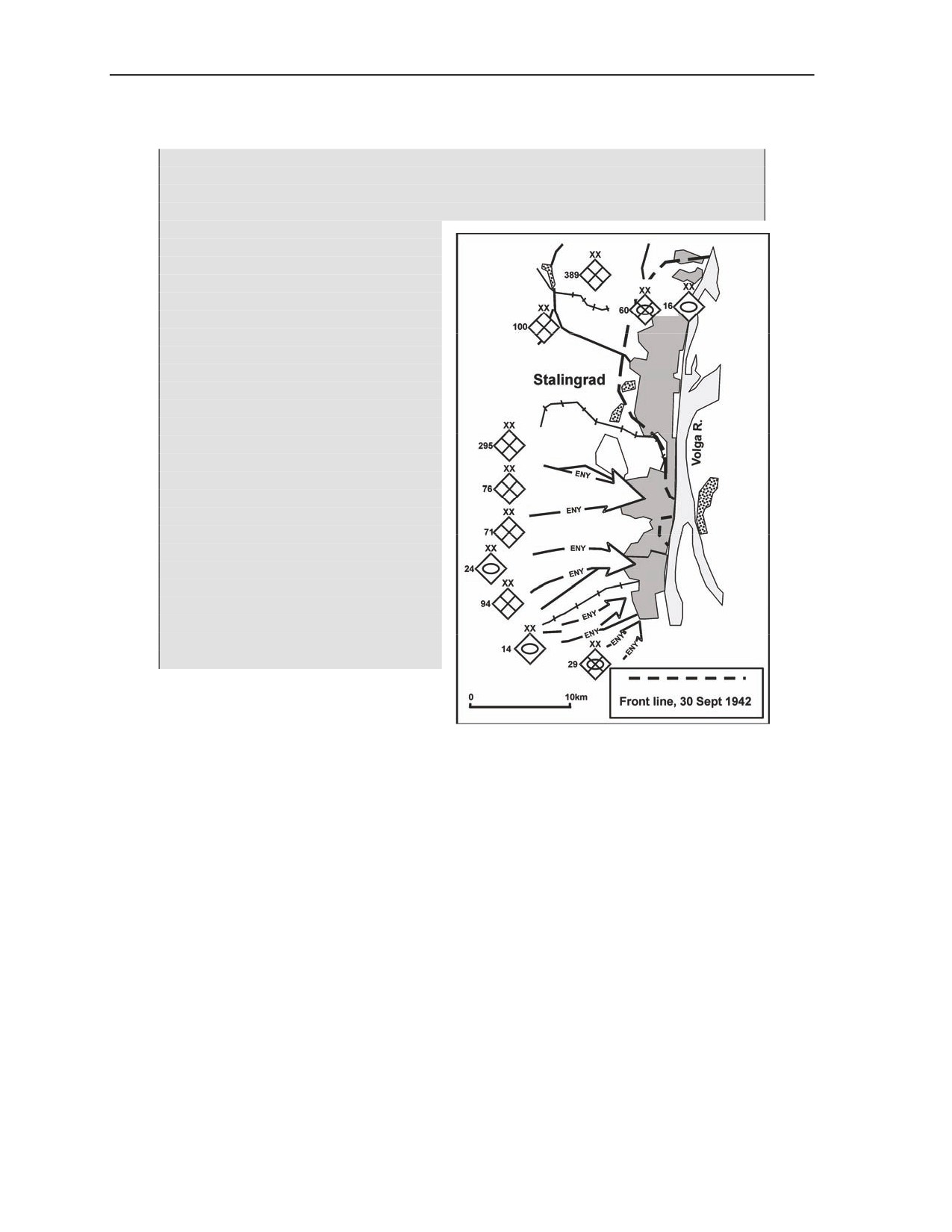
The opening phases of the German
offensive were successful; German
forces—the 6th Army and 4th Panzer
Army—entered the outskirts
of
Stalingrad in late August
1942
(see
figure 8-2).
Figure 8-2. German attacks to seize
Stalingrad
26 October 2006
FM 3-06
8-5
Chapter 8
After a month of intense fighting, the Germans possessed nearly 90 percent of the
city. At this point, the
6th Army commanded all German forces in and around
Stalingrad. The Soviet 62nd Army’s defense was reduced to a front only a few
hundred meters deep and a couple of kilometers long on the banks of the Volga. The
Soviet defenses hinged on fortress-like
concrete industrial buildings and the
fanatical bravery and tenacity of
soldiers and civilians fighting in the
city’s remains (see figure 8-3 on page
8-6).
Beginning in mid-September, the
Soviet command began looking at how
to convert the defense of Stalingrad
into an operational opportunity. During
October and November, the
62nd
Army held on to its toehold in
Stalingrad. While maintaining the
defense of the 62nd Army, the Soviets
secretly began to build up strength on
both flanks of the German 6th Army.
The Germans increased their
vulnerability by securing the German
6th Army’s flanks with less capable
Romanian, Hungarian, and Italian
armies. Also, the
6th Army moved
powerful German divisions into the city
and rotated with German divisions that
were exhausted by urban combat.
Figure 8-3. German attacks to seize
Stalingrad, September 1942
8-6
FM 3-06
26 October 2006

Urban Defensive Operations
On 19 November, the Soviets launched Operation Uranus that attacked two
Romanian armies with seven Soviet armies. Simultaneously, the 8th Russian Army
attacked to aid the 62nd Army in further fixing the German 6th Army. Within five
days, the Soviet armies of the Don Front, Southwest Front, and Stalingrad Front met
near the city of Kalach and sealed the fate of the German 6th Army’s 300,000 troops
in Stalingrad (see figure 8-4).
On the third day of the Soviet offensive, when encirclement seemed inevitable but
not yet complete, the 6th Army commander asked permission to withdraw from the
trap. The German high command denied permission believing that the Army could be
supplied by air and then a renewed
offensive could break through to the
city. On
12 December, the German
LVII Panzer Corps launched an
offensive north to break through to
Stalingrad. This offensive made
progress until another Soviet offensive
on
16
December forced its
cancellation. This ended any hope of
recovering Stalingrad and the
6th
Army. On 31 January 1943, the 6th
Army surrendered after sustaining
losses of almost two-thirds of its
strength. The Soviets took over
100,000 prisoners.
Figure 8-4. Soviet attacks trap German 6th
Army
Many lessons emerge from the successful defense of Stalingrad. Tactically, the
defense showed how using the terrain of a modern industrial city wisely could
increase the combat power of an inferior, defending force and reduce the maneuver
options of a mobile, modern attacking force. Another element in the Soviet’s tactical
success was the Germans’ inability to isolate the defenders. The Germans never
threatened the Soviet supply bases east of the Volga and, despite German air
superiority, the Soviets continuously supplied and reinforced the 62nd Army across
the Volga River. Also, Soviet artillery west of the river was able to fire in support of
Soviet forces and was never threatened with ground attack.
At the operational level, the Soviets demonstrated a keen understanding of using an
urban area within the context of a mobile defense. The 62nd Army’s stubborn area
defense of Stalingrad drew the bulk of the German combat power into the urban area
where they were fixed by a smaller and quantitatively inferior defending force. This
allowed the Soviets to build combat power outside the urban area. The Soviets set
the conditions for a mobile defense by positioning powerful Soviet armor forces in
open terrain outside the urban area against quantitatively inferior German allied
forces. In OPERATION URANUS, the mobile defense’s strike force destroyed the
enemy outside the urban area and trapped the greater part of the best enemy
formations inside the urban area. The trapped units were then subjected to dwindling
resources and extensive psychological operations, further isolated into pockets, and
defeated in detail.
RETROGRADE
8-25. A retrograde involves organized movement away from the threat. Retrograde operations include
withdrawals, delays, and retirements. These defensive operations often occur in an urban environment. The
26 October 2006
FM 3-06
8-7
Chapter 8
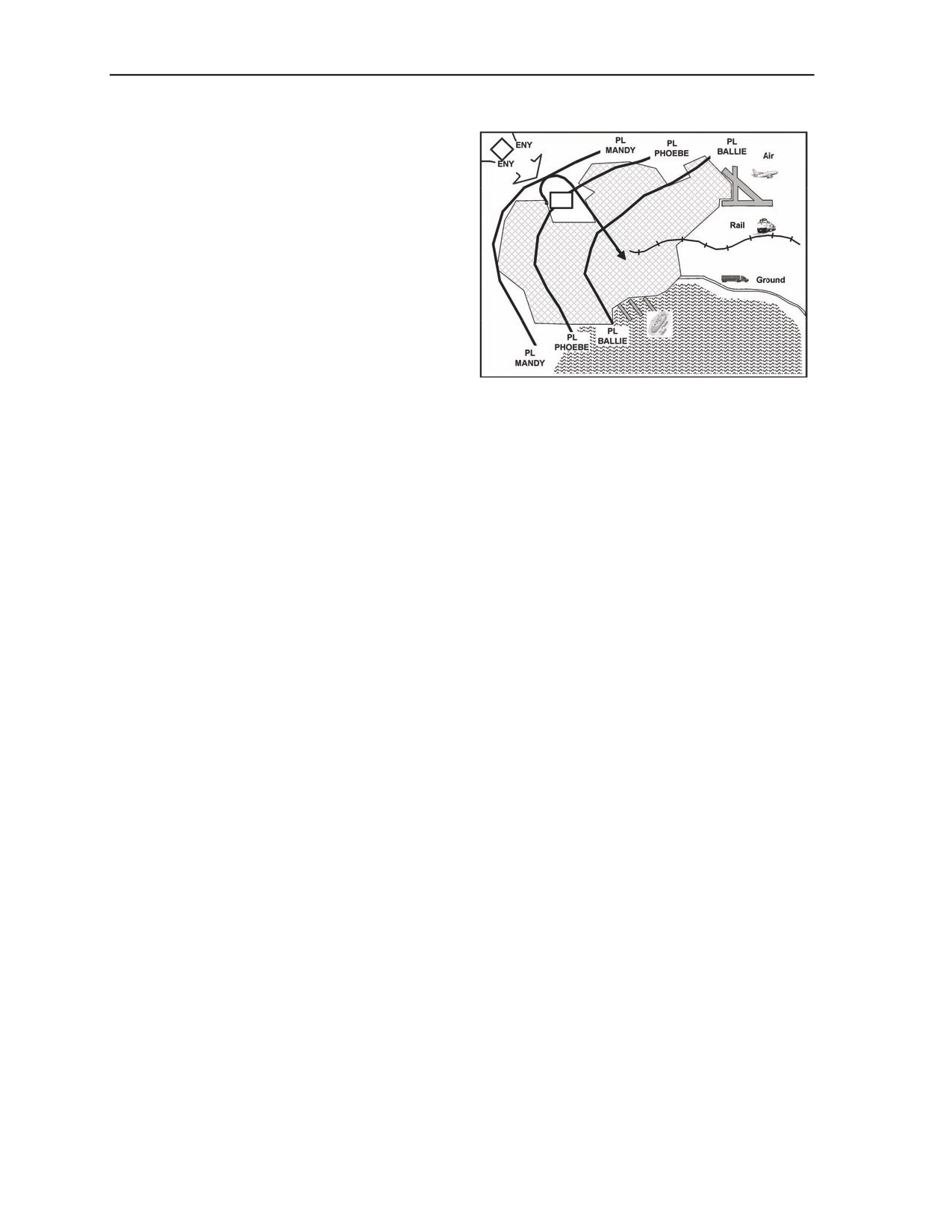
urban environment enhances the defending force’s ability to conduct retrograde operations successfully
(see figure 8-5).
8-26. The cover and concealment afforded by the
urban environment facilitates withdrawals where
friendly forces attempt to break contact with the
threat and move away. The environment also
restricts threat reconnaissance, which is less able to
detect friendly forces moving out of position, and
presents excellent opportunities for deception
actions. Finally, a small security force’s ability to
remain concealed until contact in the urban
environment significantly slows threat attempts to
regain contact once Army forces have broken
contact and begun to move.
Figure 8-5. Retrograde through an urban area
8-27. The urban environment’s natural cover and concealment, as well as the compartmented effects,
facilitates delays. Delays can effectively draw the threat into the urban area for subsequent counterattack or
as an integral part of a withdrawal under threat pressure. Delaying units can quickly displace from one
covered and concealed position to another; the repositioning options are vast. Compartmented effects force
the attacking threat to move on well-defined and easily interdicted routes and limit the threat’s ability to
flank or bypass delaying positions.
8-28. The urban area’s transportation and distribution network facilitates retiring forces that are not in
contact. Properly used, the urban transportation system can quickly move large forces and associated
resources, using port facilities, airfields, railheads, and well-developed road networks.
8-8
FM 3-06
26 October 2006
Urban Defensive Operations
URBAN DEFENSIVE CONSIDERATIONS
What is the position about London? I have a very clear view that we should fight every
inch of it, and that it would devour quite a large invading army.
Winston Churchill
War in the Streets
8-29. The urban operational framework—understand, shape, engage, consolidate, and transition—provides
structure to developing considerations for defensive operations. The considerations can vary depending on
the level of war at which the operation is conducted, the type of defense, and the situation. Most issues
discussed may, in the right circumstances, apply to both commanders conducting major UO and
commanders at lower tactical levels of command.
UNDERSTAND
8-30. The commander defending in the urban area must assess many factors. His mission statement and
guidance from higher commanders help him focus his assessment. If the mission is to deny a threat access
to port facilities in an urban area, the commander’s assessment will be focused much differently than if the
mission is to deny the threat control over the entire urban area. The mission, enemy, terrain and weather,
troops and support available, time available, civil considerations
(METT TC) structure guides the
commander’s assessment. Of these, the impacts of the threat and environment—to include the terrain,
weather, and civil considerations—are significant to the commander’s understanding of urban defensive
operations.
The Threat
8-31. In the urban defense, a key element is the commander’s understanding of the threat. One of his
primary concerns is to determine the attacker’s general scheme, methodology, or concept. Overall, the
attacker may take one of two approaches. The most obvious would be a direct approach aimed at seizing
the objectives in the area by a frontal attack. A more sophisticated approach would be indirect and begin by
isolating Army forces defending the urban area. Innumerable combinations of these two extremes exist, but
the threat’s intentions toward the urban area will favor one approach over another. The defending Army
commander (whose AO includes but is not limited to the urban area) conducts defensive planning,
particularly his allocation of forces, based on this initial assessment of threat intentions. This assessment
determines whether the commander’s primary concern is preventing isolation by defeating threat efforts
outside the area or defeating a threat attacking the urban area directly. For the higher commander, this
assessment determines how he allocates forces in and outside the urban area. For the commander in the
urban area, this assessment clarifies threats to sustainment operations and helps shape how he arrays his
forces.
The Environment’s Defensive Characteristics
8-32. A second key assessment is the defensive qualities of the urban environment. This understanding, as
in any defensive scenario, is based on mission requirements and on a systemic analysis of the terrain in
terms of observation and fields of fire, avenues of approach, key terrain, obstacles, and cover and
concealment (OAKOC). It is also based on potential chemical, biological, radiological, nuclear and fire
hazards that may be present in the urban area. This understanding accounts for the unique characteristics of
urban terrain, population, and infrastructure as discussed in Chapter 2.
8-33. Generally, units occupy less terrain in urban areas than more open areas. For example, an infantry
company, which might occupy 1,500 to 2,000 meters in open terrain, is usually restricted to a frontage of
300 to 800 meters in urban areas. The density of building in the urban area, building sizes and heights,
construction materials, rubble, and street patterns will dictate the actual frontage of units; however, for
initial planning purposes, figure 8-6 provides approximate frontages and depths for units defending in an
urban area.
26 October 2006
FM 3-06
8-9

Chapter 8
Figure 8-6. Approximate defensive frontages and depths
SHAPE
8-34. Commanders of a major operation shape the urban battle according to the type of defense they are
attempting to conduct. If conducting an area defense or retrograde, they use shaping actions like those for
any defensive action. Important shaping actions that apply to all defensive UO include—
Preventing or defeating isolation.
Separating attacking forces from supporting resources.
Creating a mobility advantage.
Applying economy of force measures.
Effectively managing the urban population.
Planning counterattacks.
Preventing or Defeating Isolation
8-35. Failure to prevent isolation of the urban area can rapidly lead to the failure of the entire urban
defense. Its importance cannot be overstated. In planning the defense, commanders must anticipate that the
threat will attempt to isolate the urban area. Defensive planning addresses in detail defeating threat attacks
aimed at isolation of the urban area. Commanders may defeat this effort by allocating sufficient defending
forces outside the urban area to prevent its isolation. Defensive information operations (IO) based on
deception can also be used to mislead the threat regarding the defensive array in and outside the urban area.
Such information can convince the threat that a direct attack against the urban area is the most favorable
approach.
8-36. If the threat has successfully isolated the urban area, commanders of a major operation have several
courses of actions. Three options are an exfiltration, a breakout attack by forces defending the urban area,
or an attack by forces outside the urban area to relieve the siege. A fourth option combines the last two:
counterattacks from both inside and outside the urban area to rupture the isolation (see breakout operations
in FM 3-90). Time is critical to the success of either operation. Commanders should plan for both
contingencies to ensure rapid execution if necessary. Delay permits threat forces surrounding the urban
area to prepare defenses, reorganize their attacking force, retain the initiative, and continue offensive
operations. The passage of time also reduces the resources of defending forces and their ability to breakout.
Therefore, commanders and staff of a major operation must vigilantly avoid isolation when Army forces
are defending urban areas in their AO.
Separating Attacking Forces from Supporting Resources
8-37. Commanders of the major operation primarily use fires and IO for separating in space and time
threat forces attacking the urban area from echelons and resources in support. The purpose of this shaping
action is the same as for any conventional area defense. It aims to allow the defending forces to defeat the
threat piecemeal as they arrive in the urban area without support and already disrupted by deep fires and IO
against information systems. This separation and disruption of the threat also sets the conditions for a
mobile defense if commanders choose to execute that type of defense. These operations also prevent the
threat commander from synchronizing and massing his combat power at the decisive point in the close
battle.
8-10
FM 3-06
26 October 2006
Urban Defensive Operations
8-38. If the urban area is part of a major mobile defense operation, the urban defense becomes the fixing
force. Commanders can shape the defense to encourage the threat to attack into the urban area. They can
lure the threat using a combination of techniques depending on the situation. They may make the urban
area appear only lightly defended while other alternative courses of action appear strongly defended by
friendly forces. Placing the bulk of the defending forces in concealed positions well within the urban area
and positioning security forces on the periphery of the urban area portray a weak defense. In other
situations, the opposite is true. If the urban area is an important objective to the threat, friendly forces can
make the urban area appear heavily defended, thus ensuring that he commits sufficient combat power to the
urban area to overwhelm the defense. Both cases have the same objective: to cause a major commitment of
threat forces in the urban area. Once this commitment is made, the mobile defense striking force attacks
and defeats the threat outside the urban area. This isolates the threat in the urban area and facilitates its
destruction.
8-39. In the urban tactical battle, many shaping actions mirror those in all defensive operations. The size
and complexity of the urban area prevent defending forces from being strong everywhere; shaping
operations designed to engage the threat on terms advantageous to the defense have particular importance.
Shaping actions include reconnaissance and security operations, passages of lines, and movement of
reserve forces prior to their commitment. In addition, shaping operations critical to urban defense include
mobility and countermobility operations, offensive IO, economy of force operations, and population
management operations.
Creating a Mobility Advantage
8-40. In urban terrain, countermobility operations can greatly influence bringing the threat into the
engagement areas of defending forces. Countermobility operations—based on understanding the urban
transportation system, design, and construction characteristics—can be unusually effective (see Chapter 2).
Demolitions can have important implications for creating impassable obstacles in urban canyons as well as
for clearing fields of fire where necessary. Careful engineer planning can make the already constrictive
terrain virtually impassable to mounted forces where appropriate, thus denying the threat combined arms
capabilities. Countermobility operations in urban terrain drastically increase the defense’s ability to shape
the attacker’s approach and to increase the combat power ratios in favor of the defense. As with all aspects
of UO, countermobility considers collateral damage and the second- and third-order effects of obstacle
construction.
8-41. Well-conceived mobility operations in urban terrain can provide defending forces mobility
superiority over attacking forces. This is achieved by carefully selecting routes between primary, alternate,
and subsequent positions, and for moving reserves and counterattack forces. These routes are
reconnoitered, cleared, and marked before the operation. They maximize the cover and concealment
characteristics of the terrain. Using demolitions, lanes, and innovative obstacles denies the defense of these
same routes.
Applying Economy of Force Measures
8-42. Economy of force is extremely important to effective tactical urban defense. A megalopolis is too
large and too easily accessible for defending forces to be strong everywhere. Economy of force enables the
defending force to mass effects at decisive points. Forces used in an economy of force role execute security
missions and take advantage of obstacles, mobility, and firepower to portray greater combat power than
they actually possess. They prevent the threat from determining the actual disposition and strength of the
friendly defense. If, contrary to expectations, they are strongly attacked, their mobility—stemming from a
mounted maneuver capability, planning, and an intimate knowledge of the terrain—allows them to delay
until reserves can meet the threat. Security forces in an economy of force role take position in parts of the
urban area where the threat is less likely to attack.
26 October 2006
FM 3-06
8-11
Chapter 8
Defensive Combat Power: Suez - 1973
At the end of October, the Israeli Army was in the midst of effective counterattack
against the Egyptian Army. The Israelis had success attacking west across the Suez
Canal. Their armored divisions were attempting to achieve several objectives, to
include destroying Egyptian air defense sites and completing the encirclement of the
Egyptian 3rd Army, which was trapped on the canal’s east side.
To completely encircle the Egyptian 3rd Army, the Israelis had to seize all possible
crossing sites to it from the canal’s west bank and the Red Sea. Also, as international
negotiations towards a cease-fire progressed, the Israeli government wanted to
capture as much Egyptian territory as possible to improve their negotiating position
after hostilities.
Consequently, the Israeli Adan Armored Division was tasked to seize the Egyptian
Red Sea port of Suez on the morning of 24 October. A cease-fire was to begin at
0700, and the Israeli intent was to be decisively engaged in the city by that time and
then consolidate their position as part of the cease-fire compliance.
The Adan Division plan to seize Suez was a two-part operation. Each of the
division’s armored brigades would have a role. The 460th Brigade would attack west
of the city and complete the city’s encirclement. Simultaneously, the 217th Brigade
would attack in columns of battalions through the city to seize three key intersections
in the city. This was in accordance with standard Israeli armored doctrine for fighting
in an urban area. The 217th Brigade would seize its objectives through speed,
firepower, and shock action. Once the objectives were seized, infantry and armored
teams would continue attacking from the secured objectives to mop up and destroy
pockets of resistance. The Israeli commanders expected to demoralize the defending
Egyptians—two infantry battalions and one antitank company—by this rapid attack.
The armored division commander was specifically advised by his commander to
avoid a “Stalingrad” situation.
The attack got off to an ominous beginning as mist greatly inhibited a scheduled
aerial bombardment in support of the attack. The 217th Brigade began its attack
without infantry support and was quickly stopped by antitank missiles and antitank
fire. Infantry was quickly integrated into the brigade and the attack resumed.
At the first objective, the Israelis encountered their first problems. A withering barrage
of small arms, antitank missiles, and antitank fire hit the lead tank battalion, including
direct fire from SU-23 anti-aircraft guns. Virtually all the officers and tank
commanders in the tank battalion were killed or wounded, and several tanks were
destroyed. Disabled vehicles blocked portions of the road, and vehicles that turned
on to secondary roads were ambushed and destroyed. The battalion, however,
successfully fought its way through the first brigade objective and on to the final
brigade objective.
Hastily attached paratroop infantry in company strength were next in column
following the tanks. They were traveling in buses and trucks. As the lead tank
battalion took fire, the paratroopers dismounted, and attempted to secure adjacent
buildings. The tank battalion’s action of fighting through the objective caused the
paratroopers to mount up and also attempt to move through the objective. Because
of their soft skinned vehicles the paratroopers were unable to remain mounted and
again dismounted, assaulted, and secured several buildings that they could defend.
Once inside the buildings, the paratroopers found they were cut off, pinned down,
and unable to evacuate their considerable casualties, which included the battalion
commander. The paratroopers were on the initial brigade objective but were unable
to maneuver and were taking casualties.
A second paratroop company also dismounted and quickly became stalled in house-
to-house fighting. The brigade reconnaissance company in M113 personnel carriers
brought up the rear of the brigade column and lost several vehicles and was also
unable to advance.
8-12
FM 3-06
26 October 2006
Urban Defensive Operations
By 1100 the Israeli attack culminated. Elements of the 217th Brigade were on all
three of the brigade’s objectives in the city. However, the armored battalion, which
had achieved the deepest penetration, was without infantry support and under
severe antitank fire. Both paratroop companies were isolated and pinned down. In
addition, an attempt to link up with the paratroopers had failed. At the same time, the
civilian population of the city began to react. They erected impromptu barriers,
ambushed isolated Israeli troops, and carried supplies and information to Egyptian
forces.
The Israeli division commander ordered the brigade to break contact and fight its way
out of the city. The armored battalion was able to fight its way out in daylight. The
paratroop companies were forced to wait until darkness and then infiltrated out of the
city carrying their wounded with them. Israeli casualties totaled
88 killed and
hundreds wounded in addition to 28 combat vehicles destroyed. Egyptian casualties
were unknown but not believed to be significant.
The fight for Suez effectively demonstrates numerous urban defensive techniques. It
also vividly demonstrates the significant effect on defensive combat power of the
urban environment.
The Egyptian defense demonstrates how the compartmented urban terrain restricts
the mobility and the massing of firepower of armored forces. Trapped in column on
the road, the Israelis were unable to mass fire on particular targets nor effectively
synchronize and coordinate their fires. The short-range engagement, also a
characteristic of urban combat, reduced the Israeli armor protection and eliminated
the Israeli armor’s ability to keep out of small arms range. Thus, hand-held antiarmor
weapons were more effective in an urban area. Additionally, Egyptian small arms
and sniper fire critically affected Israeli C2 by successfully targeting leaders.
The Egyptian defenders effectively isolated the mounted Israelis by defending and
planning engagement areas in depth. The Egyptians synchronized so that they
engaged the entire Israeli force simultaneously. This forced the Israelis to fight in
multiple directions. It also separated the Israeli infantry from the armor and prevented
the formation of combined arms teams necessary for effective urban offensive
operations.
Suez also demonstrated how civilians come to the advantage of the defense. After
the battle was joined, the population—by threatening isolated pockets of Israelis and
building barricades—helped prevent the Israelis from reorganizing while in contact
and hindered the Israelis breaking contact. The population was also a valuable
source of intelligence for the Egyptians and precluded covert Israeli movement in
daytime.
Suez shows the ability of a well-placed defense in depth to fix a superior force in an
urban area. Despite the Israeli commander’s caution to avoid a “Stalingrad,” the
Israeli division, brigade, and battalion commanders were quickly trapped and unable
to easily break contact. Even a successful defense on the perimeter of the city would
not have been nearly as effective, as the Israelis would have easily broken contact
once the strength of the defense was recognized.
Another key to the success of the Egyptian defense was the Israelis’ inadequate
reconnaissance. While the Israelis knew the approximate size of the defending
forces, they had no idea of the Egyptian dispositions. In this case, time prevented
adequate reconnaissance. Key to a successful defense is adequate security to
obscure defense dispositions, which permits surprise and shock effect.
The Suez defense was a decisive defeat of elite Israeli forces by regular infantry
units inferior in training, morale, and numbers. Total disaster was averted only
because of the professionalism of the Israeli armored forces and paratroopers that
permitted them to continue to fight and eventually exfiltrate the urban trap. The Israeli
forces thus escaped total destruction. Suez strongly demonstrates how the
enhancing effects of the urban environment on defensive combat power are
significant enough to permit inferior regular forces to defeat elite formations. Since
26 October 2006
FM 3-06
8-13
Chapter 8
the 1973 Suez battle, U.S. forces in Mogadishu, Somalia, and Russian forces in
Grozny, Chechnya have faced similar urban defensive ambushes.
Effectively Managing the Urban Population
8-43. Another way to shape the urban defensive battle is population management. In most cases, defending
force commanders are in the urban area before combat. This time gives them the chance to manage
civilians. Consequently, they can better manage and protect the population (a legal requirement) and gain
more freedom of action for their forces.
8-44. Managing the civilians during the defense is a function of the size, disposition, and needs of the
population and the resources available to the commander. Requesting higher support or coordinating with
nongovernmental organizations and the local civil leadership for support may make up shortages of
resources. Resources devoted to population management are carefully weighed against availability,
military mission requirements, and possible collateral damage affecting tactical, operational, or strategic
success. It may prove impractical to evacuate an urban area’s population; still, commanders should attempt
to create and move most civilians to protected areas. Moving the population allows defending forces to
more liberally apply fires, emplace obstacles, and relieve combat units and support units of requirements to
continue life support for civilians while executing combat operations. Overall, effective civil-military
operations can turn a friendly (or a neutral) population into an effective force multiplier providing support
to every warfighting function.
Planning Counterattacks
8-45. Counterattacks are also an important tool in shaping the battlefield for defensive success.
Counterattacks as a shaping tool have two applications: retaining the initiative and separating forces.
However, opportunity for effective counterattacks will be brief and, therefore, timing will be critical. If
conducted too soon, the counterattack may expend resources required later; if conducted too late, it may
not be effective. Commanders should understand the effect of the urban environment on time-distance
relationships; otherwise, the timing of the attack may be upset and the operation desynchronized.
Additionally, commanders should develop plans beyond the counterattack to exploit potential success.
ENGAGE
8-46. Engaging the urban area in a defensive operation requires decisively defeating the threat’s attacks.
Defensive forces use the terrain to their advantage, employ precision supporting fires, and use direct fire
from protected positions aligned against carefully selected avenues of approaches and kill zones. The
combat power of the defense augmented by shaping actions and the characteristics of urban terrain force
culmination of the threat attack. Like urban offensive operations, effective engagement in urban defensive
operations typically results from successful actions at the tactical level of war. These actions include—
Performing aggressive ISR.
Creating depth.
Executing an effective obstacle plan.
Conducting coordinated counterattacks.
Performing Aggressive ISR
8-47. ISR efforts of the defender are focused initially on identifying relevant information about the
location and nature of the threat’s main effort. Once identified, the defender’s ISR focus shifts to assessing
the rate at which the threat attack moves to its culminating point. Indicators of culmination may be physical
fatigue of Soldiers, a breakdown in C2 capability, difficulty providing logistics support, or the increasing
time required to reorganize small units to attack. When that culmination is achieved, friendly forces
counterattack before the threat has a chance to transition to a hasty defense.
8-14
FM 3-06
26 October 2006
Urban Defensive Operations
Creating Depth
8-48. Depth in the defense is the key to forcing the threat to culminate. The urban defense cannot allow
itself to be penetrated nor permit forward elements to be destroyed. The defense is designed with the
greatest depth possible. Defending forces weaken the threat to the fullest extent possible by attack from
each position but not permit themselves to be destroyed by fires or close assault. Instead, as threat combat
power builds up against individual positions, the use of mission orders permits subordinate leaders to
disengage on their own initiative and move on preplanned routes to subsequent positions. Positions are
designed to be mutually supporting—withdrawing from one position to a subsequent one while supporting
positions cover by fires. The attacker is constantly forced to deploy and reorganize without being able to
achieve decisive effects against the defender.
Executing an Effective Obstacle Plan
8-49. Obstacles in the urban defense are designed to break up the threat’s combined arms capability.
Separating dismounted forces from mounted forces disrupts the cohesion of the attacker and reduces his
combat power. It also exposes his individual elements to the effects of asymmetric counterattack. The
leading threat dismounted force can be effectively counterattacked by a friendly combined arms element
while the threat armored force remains vulnerable to antiarmor attack by dismounted forces.
Conducting Coordinated Counterattacks
8-50. The counterattack is one of the key actions of the urban defense. However, commanders do not
counterattack unless there is a reasonable chance of success. As the attacker moves into the depth of the
urban area, his forces become fatigued, attrited, and increasingly disorganized. He likely also creates an
increasingly long and exposed flank. At all levels, forces defending in urban terrain look for opportunities
to counterattack. As the offensive force reaches the culmination point where it can no longer continue to
attack with the available forces, the defensive commander executes a planned and coordinated
counterattack. The counterattack aims to regain the initiative and to make the threat fight in multiple
directions. Infiltration using superior knowledge of the terrain (including supersurface and subsurface
capabilities) and the skillful use of stay-behind forces permits attacking the threat throughout the depth of
his formations. Small-scale counterattacks focus on C2 and sustainment capabilities. These counterattacks
can set the conditions for a deliberate attack leading to the ultimate destruction of the attacking threat force.
CONSOLIDATE
8-51. Consolidation is as important to urban defensive operations as to offensive operations. Many of the
same consolidation considerations for the urban offense apply equally well to the defense. Commanders
should reinforce or reposition maneuver forces and fire support assets on the urban battlefield based on
weaknesses uncovered during rehearsals and opportunities discovered during actual execution. While
maximizing the many advantages of the urban defense, the commander of the urban defense aggressively
seeks ways of attriting and weakening enemy forces before they enter the urban area and close combat is
initiated. Commanders should combine the static and mobile elements of the defense to strengthen their
positions in relation to the enemy while seeking every opportunity to transition to urban offensive
operations. As in urban offensive operations, commanders should conduct any necessary reorganization
actions that they were unable to accomplish during execution.
TRANSITION
8-52. Transitions in urban defensive operations occur at all levels. As with offensive operations,
commanders of major operations should address which units are assigned to continue to operate in the area
after defensive operations have ceased. In defensive UO, this task is not as challenging as an occupation
mission during urban offensive operations. The psychology of troops defending an urban area differs from
those attacking into it. Defending forces become accustomed to the environment, having experience in the
environment before combat. In terms of training, it is easier for follow-on missions to be assigned to a unit
that has successfully defended the urban area. This course of action takes advantage of the defending unit’s
experience in the area and its relationships with other agencies—agencies that were operating alongside the
26 October 2006
FM 3-06
8-15
Chapter 8
units before and possibly during the defense. In defensive operations, regardless of the civilians’ attitudes,
policies regarding that population are established before the successful defense, and the command likely
has experience executing operations with civil authorities and other agencies. Thus, these relationships are
neither new nor as significant an issue as in offensive operations. Therefore, commanders must be prepared
to execute various stability or civil support operations or use a successful defense to springboard into more
decisive offensive operations elsewhere in the commanders’ AO.
Transition Emphasis to Stability or Civil Support Operations
8-53. At the end of a successful urban defense, operational commanders should generally expect civil
authority, control, and jurisdiction to increase. Additionally, the civil population may be anxious to return.
Defensive combat will require virtually complete military control of the urban area; however, after the
successful defense, a rapid transition will occur from military control to civil or joint military and civil
control afterward. Although the full spectrum of Army operations will often be conducted simultaneously
in UO, commanders will transition emphasis to stability or civil support operations. Important transition
tasks will include demilitarizing munitions, clearing obstacles, and searching for isolated threat pockets of
resistance. Conclusion of the defensive operations will also require transition to joint civil-military tasks,
such as evaluating structures for safety, restoring essential services, and possibly creating joint law
enforcement. Commanders of major operations, using a civil-military operations center and G9, should
anticipate these requirements and begin early preparations to ensure a smooth, successful transition.
Transition to Offensive Operations
8-54. Units that have successfully defended the urban area may then transition to offensive operations. A
rapid transition to offensive operations will require identification, preparation, and training of units
designated to assume missions as the defending units leave the urban area. This preparation emphasizes
continuity of policies and relationships already established. A relief in place occurs. The new occupying
units provide not only a continuity of policy, but also a continuity of attitude toward the urban area, its
population, and its institutions.
8-16
FM 3-06
26 October 2006
Chapter 9
Urban Stability and Civil Support Operations
The Rangers were bound by strict rules of engagement. They were to shoot only at
someone who pointed a weapon at them, but already this was unrealistic. It was clear
they were being shot at, and down the street they could see Somalis with guns. But those
guns were intermingled with the unarmed, including women and children. The Somalis
were strange that way. Most noncombatants who heard gunshots and explosions would
flee. Whenever there was a disturbance in Mogadishu, people would throng to the
spot…. Rangers peering down their sights silently begged the gawkers to get the hell out
of the way.
Black Hawk Down
The fundamental shared aims between stability and civil support operations and any
operation conducted in an urban environment are the increased significance and
influence of the civil population and nonmilitary organizations. Often, no military
victory is to be achieved. The center of gravity for these operations normally cannot
be attacked through military means alone; the Army (and the military in general) is
often but one tool supporting a larger, civil-focused effort. When conducted, military
defeat of an armed adversary is only a phase in a larger campaign, the overall
objectives of which will be to bring about a more satisfactory political, social,
diplomatic, economic, and military situation than existed prior to the conflict.
Without a tightly coordinated civil-military effort, overall success will be difficult or
impossible to achieve. Commanders who can understand and cope with the
complexities of stability or civil support operations gain insights that directly apply
to executing any urban operation. Urban stability or civil support operations may
complement urban offensive and defensive operations, or may dominate the overall
operation. Army forces may need to conduct offensive and defensive operations to
defend themselves or destroy urban threats seeking to prevent the decisive stability or
civil support mission. During hostilities, urban stability operations may keep armed
conflict from spreading, encourage coalition and alliance partners, and secure the
civilian population’s support in unstable urban areas (and the surrounding rural areas
under their influence). Following hostilities, urban stability operations may provide a
secure environment for civil authorities to rebuild. Urban civil support operations can
range from transporting, feeding, and sheltering the population made homeless as a
result of man-made or natural disasters to conducting civil search and rescue and
providing urgent medical care.
PURPOSE OF URBAN STABILITY AND CIVIL SUPPORT
OPERATIONS
9-1. Army forces conduct stability and civil support operations to deter war, resolve conflict, promote
peace, strengthen democratic processes, retain U.S. influence or access abroad, assist U.S. civil authorities,
and support moral and legal imperatives. Stability operations promote and sustain regional and global
stability. Civil support operations meet the urgent needs of designated U.S. civilians until civil authorities
can accomplish these tasks without military assistance. Nearly every urban operation will involve some
26 October 2006
FM 3-06
9-1
Chapter 9
type or form of stability operation or civil support operation combined and sequenced with offensive and
defensive operations.
CHARACTERISTICS OF URBAN STABILITY AND CIVIL SUPPORT
OPERATIONS
9-2. Worldwide urbanization, migration trends from rural to urban areas, and more centralized
populations in urban areas increase the chance that Army forces will conduct stability or civil support
operations in or near urban areas. Simply put, many people live in urban areas, and their welfare will be the
primary reason for conducting these operations. Urban areas that serve as economic and government
centers (the ideal location for U.S. and allied embassies)
are often the focal point for many threat activities.
Therefore, Army forces may need to conduct stability
operations in these foreign cities to counter those threats.
Additionally, urban areas may contain the resources and
infrastructure to support both types of operations,
regardless of whether the overall focus is in urban or rural
areas. Repairing or restoring the infrastructure may be a
critical task in accomplishing either type of operation.
Supported governmental and nongovernmental agencies
are not as logistically self-sufficient as the Army. As such,
these agencies will often need to center their operations in
and around urban areas to use the area’s infrastructure to
support themselves and their objectives. These agencies
may require military protection to accomplish their
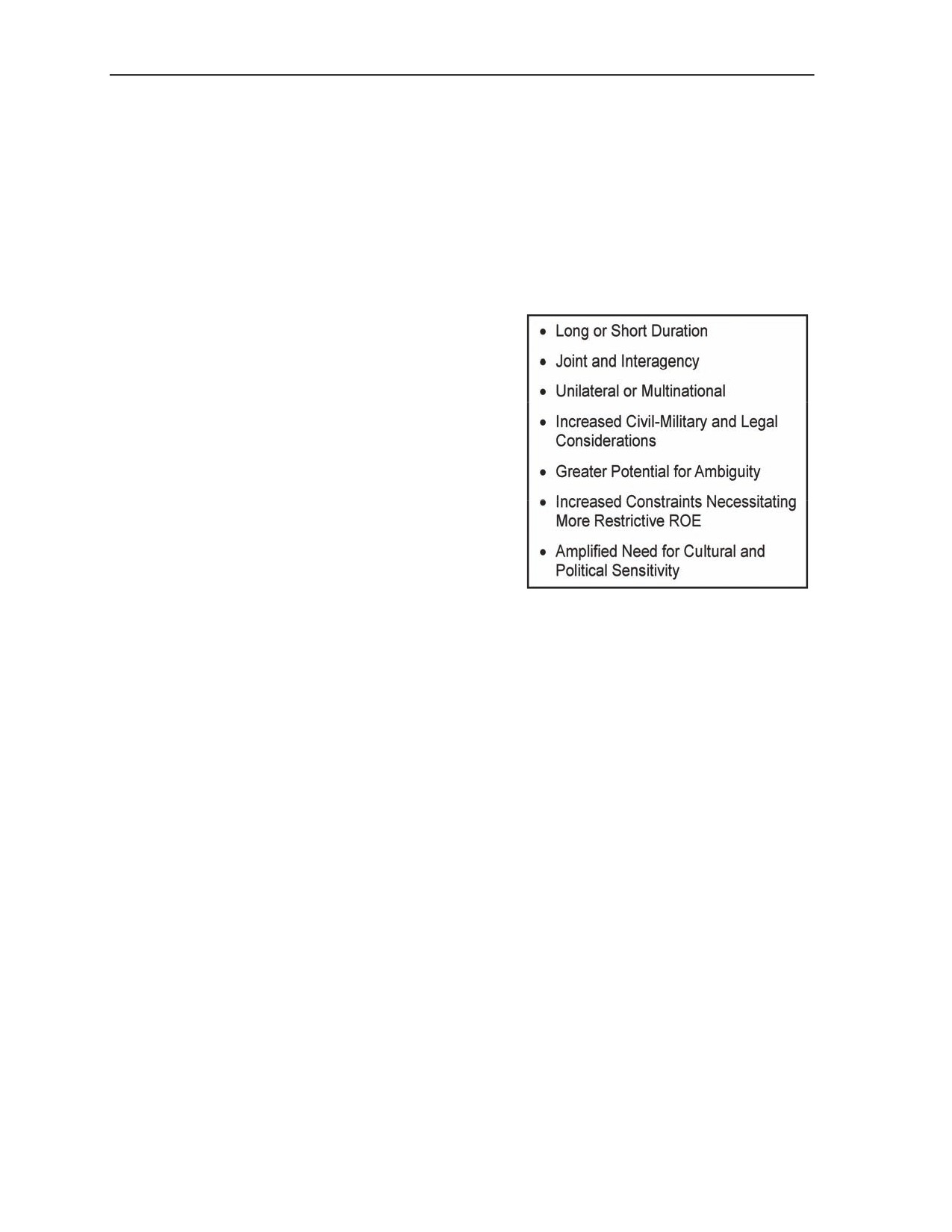
missions. Figure 9-1 lists some defining characteristics of
these wide-ranging operations.
Figure 9-1. Characteristics of stability
and reconstruction and support
operations
9-3. Stability and civil support operations are diverse, varied in duration, and unilateral or multinational.
Stability operations are conducted overseas as part of a campaign or major operation, while civil support
operations are conducted within the United States as part of homeland security. Like all urban operations
(UO), they are usually joint. Unlike urban offensive and defensive operations, they are more often
interagency operations and require more restrictive rules of engagement (ROE). The multiplicity of actors
involved usually increases the scope and scale of required coordination and communication. In urban
stability or civil support operations, adverse conditions arising from natural or man-made disasters or other
endemic conditions—such as human suffering, disease, violations of human rights, or privation—will
significantly modify the urban environment. Unresolved political issues and tenuous agreements,
difficulties discriminating combatants from noncombatants or between parties of a dispute, and the absence
of basic law and order all serve to complicate an already complex and uncertain environment. Civil-
military and legal considerations take on added significance in all urban operations (see Civil-Military
Operations and Legal Support in Chapters 5 and 10 respectively), but even more so in urban stability and
civil support operations. Finally, recognizing, defining, and achieving the desired end state is often more
difficult than in offensive and defensive operations.
9-4. Overall, commanders of major operations involving urban stability and civil support operations
should not expect clear guidance. They must learn, adapt, and live with ambiguity. They cannot expect to
operate in a political vacuum (even commanders at the tactical level); rather, they should expect to work
alongside both governmental and nongovernmental leaders and organizations. Commanders conducting
UO should not expect an easily identifiable enemy located across a clearly demarcated line. In fact in many
peace operations, they and their Soldiers must resist the need to have an enemy—difficult at best when one
side or another (or both) may be sniping at them. Commanders should also expect changing and additional
9-2
FM 3-06
26 October 2006
Urban Stability and Civil Support Operations
missions and tasks, without being allowed to use every means at their disposal to carry out those missions.
Many tasks required may be ones for which their units have never, or rarely, trained. Finally, commanders
should expect to show restraint with a keen sensitivity to political considerations and to alien cultures,
either or both of which they might find confusing or even repugnant.
URBAN STABILITY AND CIVIL SUPPORT OPERATIONS AND
BATTLEFIELD ORGANIZATION
9-5. Each urban stability operation or civil support operation will be distinct from one another. These
operations differ even more when applied to a specific urban area. Due to the complexity of the
environment, commanders must carefully arrange their forces and operations according to purpose, time,
and space to accomplish the mission. In most UO the terrain, the dense population (military and civilian),
and the participating organizations will further complicate this arrangement.
9-6. The support and assistance that Army forces will provide during these operations is only temporary
(although it may be of long duration) and this facet requires particular emphasis. Commanders should plan
and execute both of these types of operations with that essential consideration always in mind. Eventually,
the government and administration—either foreign or domestic—must secure and support their population
by themselves. Therefore, commanders must envision and set the conditions that allow for the transition of
control and responsibility to shift to legitimate civilian authorities. While commanders may only provide
assistance and support based on specific and well planned civilian requests, more often commanders will
need to determine requirements in collaboration with competent civilian authorities and agencies or, in
some cases, with little or no initial civilian assistance at all. Ultimately, transition planning should occur as
an integral part of the overall operational planning and include collaboration with appropriate civilian
agencies and organization as early as possible to ensure a seamless transition to civilian control without
major setbacks and loss of forward momentum.
STABILITY OPERATIONS
9-7. Stability operations establish, sustain, and exploit security and control over foreign areas,
populations, and resources. Urban areas will be decisive to accomplishing many types of stability
operations because urban areas are the centers of population, culture, economy, and government. Much of
the support provided by Army forces will aim to assist local, regional, or national governments to restore
essential services and infrastructure and reestablish civil order and authority. The location of civilian
authorities in urban areas will, by necessity, be a dominating factor in accomplishing the mission. As
importantly, many stability operations—enforcing peace in Bosnia for example—will require interacting
with, influencing, controlling, or protecting all or parts of the civilian population. Assessing,
understanding, and gaining the support of civilians in key economic, cultural, or political urban areas may
influence surrounding regions (smaller urban areas and the rural countryside) and may be decisive to
achieving overall stability objectives.
9-8. Stability operations may involve both coercive and cooperative actions. They are conducted in
situations in which legitimate civil authority is unable to provide the necessary security and control for the
urban population as a result of—
Deliberate operations to influence a regime change.
Offensive or defensive operations or natural disasters resulting in ineffective civil authorities,
conditions beyond the capabilities of the foreign urban government, or both.
CIVIL SUPPORT OPERATIONS
9-9. Civil support operations are an integral part of homeland security which aim to protect U.S. citizens
and infrastructure from conventional and unconventional threats and mitigate the effects of man-made and
natural disasters. (The other part to homeland security is homeland defense.) Army forces conduct civil
support operations by providing Army resources, expertise, and capabilities in support of a lead agency—
which may be to Department of Defense—to address the consequences of man-made or natural accidents
beyond the capabilities of local or regional U.S. civilian authorities. Such a situation could result from a
26 October 2006
FM 3-06
9-3
Chapter 9
chemical, biological, radiological, nuclear, and high-yield explosive (CBRNE) incident, hurricane, flood,
or civil disturbance in a domestic urban area.
CBRNE INCIDENTS
9-10. CBRNE incidents can be disastrous and are of particular concern for both stability and civil support
UO. In urban areas, the potential for catastrophic loss of life and property is enormous. The Army
categorizes CBRNE incidents separately from other natural and man-made disasters because it has specific
expertise with these weapons. CBRNE incidents usually result from a military or terrorist threat (adding a
law enforcement dimension to the disaster). Other urban CBRNE considerations include the following:
Subways and other subsurface areas offer ideal areas for limited chemical or biological attacks.
Nuclear attack (and high-yield explosives) can produce tragic results due to the effects of
collapsing structures, flying debris, and fires. Dispersion patterns are affected by the urban
terrain and are more difficult to predict and monitor. Large-scale incidents may produce
hundreds of thousands of casualties, but even a limited attack may require evacuating and
screening large numbers of civilians. Requirements for medical support, basic life support, and,
if necessary, decontamination may quickly overwhelm the Army force’s capabilities even with
augmentation.
Similar to natural disasters, panic and disorder may accompany the CBRNE event. Fleeing
civilians may clog elements of the transportation and distribution infrastructure. Physical
destruction may also affect other components of the infrastructure of critical and immediate
concern, such as energy and administration and human services (water, sanitation, medical, fire
fighting, and law enforcement). Because all elements of the infrastructure may be affected, the
overall recovery time may be lengthened and the effects broadened to include much of the
surrounding area. The effects of a single urban CBRNE event potentially could be felt nationally
or globally.
DECISIVE OPERATIONS
9-11. In urban stability operations, decisive operations may take many years and include multiple actions
before achieving the desired end state. This particularly applies to the strategic and operational levels.
Oppositely, decisive operations involved in an urban civil support operation for mitigating or reducing
disease, hunger, privation, and the effects of disasters normally achieve faster results. However, any
operation that attacks the underlying cause and seeks to prevent or relieve such conditions will usually take
longer. In urban areas, establishing law and order to protect critical infrastructure and the inhabitants from
lawlessness and violence is often critical and also the decisive operation.
SHAPING OPERATIONS
9-12. Shaping operations establish and maintain the conditions for executing decisive operations. In urban
stability or civil support operations, shaping operations always include information operations (IO) that
influence perceptions and maintain legitimacy. Often, various participants, and their potentially divergent
missions and methods, are involved. Army commanders must coordinate their planning and efforts (early
and continuously) to ensure that their decisive, shaping, or sustaining operations are not working against
other agencies’ efforts and operations—agencies that may have the lead role in the operation. Thus, a
critical shaping operation may be to establish the coordination to help develop a common purpose and
direction among agencies, particularly those that may experience continuous personnel turnover during the
conduct of a lengthy operation. In some instances and with some organizations and agencies, particularly
nongovernmental organizations
(NGOs), genuine unity of effort may not be achievable; however,
recognizing the differences in aims and goals will allow Army commanders to conduct operations with less
friction. Commanders should actively request and include NGOs and appropriate governmental agencies in
mission readiness exercises or any other training for stability or civil support operations.
9-4
FM 3-06
26 October 2006
Urban Stability and Civil Support Operations
SUSTAINING OPERATIONS
9-13. Sustaining operations enable decisive and shaping operations and include logistics, rear area and
base security, movement control, terrain management, and infrastructure development. Sustainment bases,
especially those located in urban areas, become an attractive target for hostile civilians; therefore,
commanders must actively and aggressively protect these bases as well as lines of communications (see
Chapter 10).
CONSIDERATIONS FOR URBAN STABILITY AND CIVIL SUPPORT
OPERATIONS
In wars of intervention the essentials are to secure a general who is both a statesman
and a soldier; to have clear stipulations with the allies as to the part to be taken by each
in the principal operations; finally, to agree upon an objective point which shall be in
harmony with the common interests.
Lieutenant General Antoine-Henri,
Baron de Jomini
9-14. The urban operational framework (understand, shape, engage, consolidate, and transition) provides a
structure for developing considerations unique to urban stability and civil support operations. Many
considerations presented in urban offensive and defensive operations apply to urban stability and civil
support operations, particularly those that address how to understand the urban and overall operational
environment. Because the situations in which stability and civil support operations normally occur share
strong similarities with any urban environment, many of these considerations are closely linked to the
urban fundamentals presented in Chapter 5. Taken together, commanders will often find them useful in
conducting UO throughout full spectrum operations. Appendix C has a historical example of how to apply
the urban operational framework to a stability operation.
UNDERSTAND
9-15. In urban stability or civil support operations, commanders must carefully assess and understand the
political dimension of the operational environment, as well as their role and the media’s part in managing
information. These operations are inherently tied to the exercise of diplomatic power. All operations in
urban areas are often the focus of the media and thus gain considerable public and political attention.
Therefore, military objectives in urban stability or civil support operations are more directly linked with
political objectives. The relationship between the levels of war—strategic, operational, and tactical—is
often closer than in urban offensive and defensive operations. Military objectives must be carefully nested
within political objectives. Commanders must ensure that the ways and means to accomplish their
objectives, to include security and force protection measures, will hold up to media scrutiny and are
appropriate for the situation and environment. All levels of command must understand the link between
political and military objectives, to include a basic understanding at the Soldier level. One uncoordinated,
undisciplined, or inappropriate action, even at the lowest level, could negate months or years of previous,
disciplined effort. Commanders must balance security and force protection measures with mission
accomplishment. Ineffective measures can put Soldiers at too great a risk and jeopardize the mission.
Conversely, overly stringent measures may make it difficult for forces to interact with the population
closely—essential in many of these operations. Finally, commanders will need a thorough assessment of
the governmental and nongovernmental organizations and agencies that will be operating in or near urban
areas that fall within their area of operations.
Political and Military Objectives
9-16. Commanders must translate political objectives into military objectives that are clear and achievable
(clear tasks and purposes) and can lead to the desired end state. (In most stability operations, defeat of a
threat is not the ultimate desired end state.) Political objectives may be vague making it difficult for
commanders to conduct their mission analysis. This applies to tactical- and even operational-level
commanders, unskilled at higher level, strategic political-military assessments. Each type of stability
26 October 2006
FM 3-06
9-5
Chapter 9
operation or civil support operation is distinct, often unfamiliar to the executing unit, and unique to the
specific situation. These factors often make it difficult to confidently determine the specific tasks that will
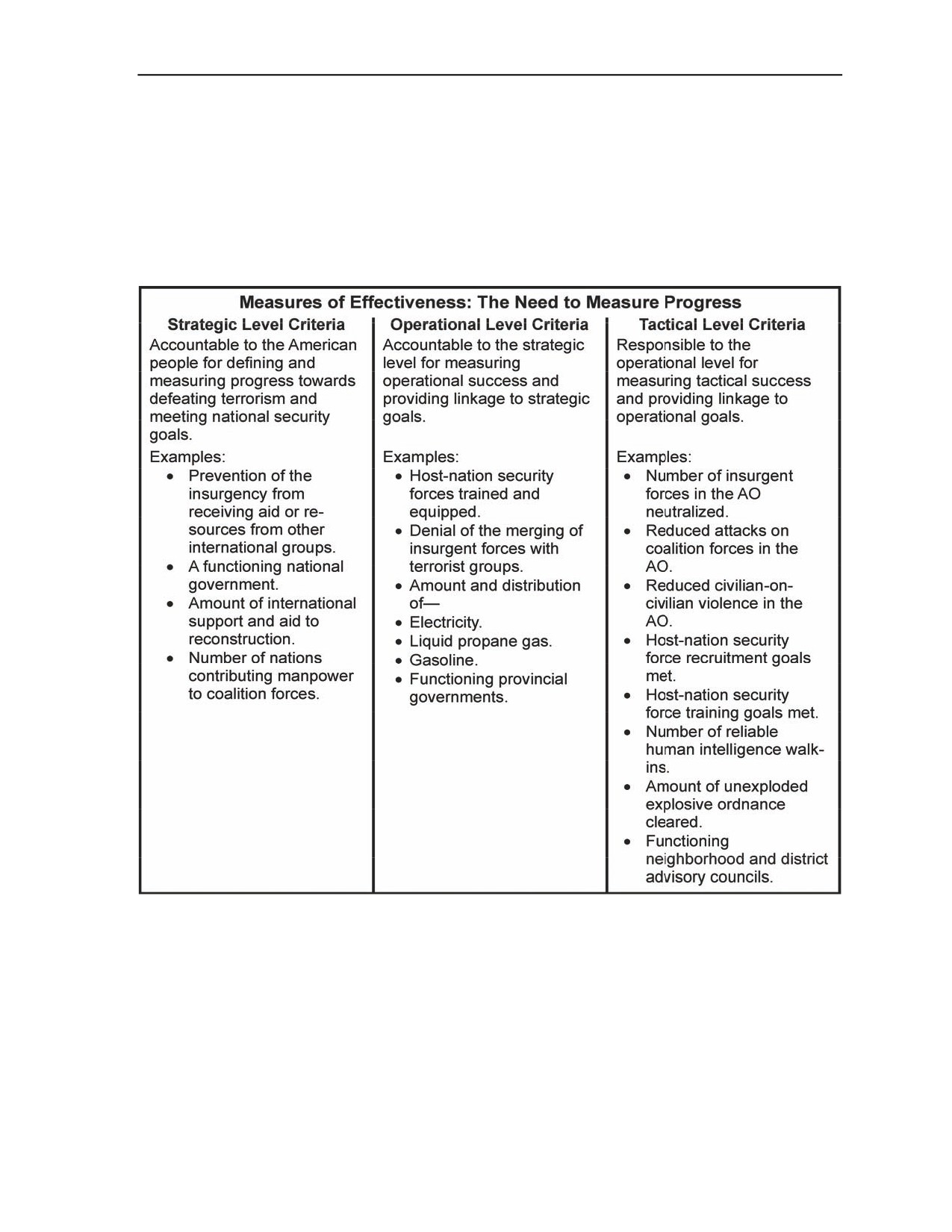
lead to mission success. Therefore, commanders must also establish measures of effectiveness that aid in
understanding and evaluating progress and help gauge mission accomplishment.
Note: Commanders should consult the US Agency for International Development’s (USAID)
Field Operations Guide for Disaster Assessment and Response when conducting their
assessments and developing measures of effectiveness for many urban relief operations.
9-17. These measures should be quantifiable (in some circumstances, a qualitative assessment may be most
appropriate) and link cause with effect. They help determine the changes required and are essential to the
assessment cycle required for urban stability or civil support operations. In a humanitarian relief operation
to aid the starving, commanders could determine that the decisive effort is delivering safe food to the urban
area. To judge success or effectiveness, they could determine that the appropriate measure is the number of
food trucks dispatched daily to each distribution site; the more trucks, the more effective the efforts.
However, this measure must correlate with the overarching measure of effectiveness: decline in the
mortality rate. If no significant decrease in deaths due to starvation occurs, they may need to reassess and
modify the tasks or measures of effectiveness. A better measure may be to track the amount of food
consumed by those in need instead of simply counting the number of trucks dispatched. Areas around
which measures of effectiveness can be formed for many stability or civil support operations (including the
example above) and which will help return most societies to some degree of normalcy and self-sufficiency
include:
Restoring law and order.
Decreasing morbidity and mortality rates.
Securing safe food and water.
Restoring critical infrastructure.
Resettling the population.
Reestablishing economic activity.
Commanders can often develop measures of effectiveness to address these areas in terms of establishing or
restoring security and providing logistics. (Figure 9-2 provides example measures of effectiveness from the
strategic to tactical levels for a possible stability operation.)
9-18. Political objectives are fluid and modified in response to new domestic and international events or
circumstances. Thus, assessment is continuous, and commanders must adjust their own objectives and
subsequent missions accordingly. In urban stability or civil support operations, commanders often develop
military objectives that support or align with the objectives of another agency that has overall responsibility
for the urban operation. In this supporting role, commanders may receive numerous requests for Soldier
and materiel assistance from the supported agency and other supporting agencies operating in the urban
area (to include elements of the urban population). With such unclear lines of authority and areas of
responsibility, they must ensure that the tasks, missions, or requested Army resources fall clearly in the
intended scope and purpose of the Army’s participation in the operation. They must not develop or execute
missions based on inadequate or false assumptions, misinterpreted intent, or well-meaning but erroneously
interpreted laws or regulations by any organization, to include even the lead agency. When missions appear
outside their scope, commanders must quickly relay their assessment to their higher headquarters for
immediate resolution. The commander’s goal is not to limit or slow military participation but to contribute
as intended and in consonance with political objectives and the law.
Security and Force Protection Measures
9-19. Commanders must plan for and continually assess the security of their forces operating in an urban
area as well as constantly review protection measures. Establishing a robust intelligence—particularly
human intelligence (HUMINT)—network that can determine the intentions and capabilities of the threat
and the urban populace is the basis for establishing force protection for Army forces operating in the urban
9-6
FM 3-06
26 October 2006
Urban Stability and Civil Support Operations
environment. However, many such operations, particularly stability operations, require extra time to forge
a lasting change. Over time, and particularly in peacetime when objectives center on helping others and
avoiding violence, even the complex urban environment may seem benign. Without continued, aggressive
command emphasis, Soldiers may become lulled into complacency. Also, during periods of transition or
transfer of authority from one unit or organization to another, departing Soldiers’ focus often shifts to
redeployment activities and away from force protection concerns. It is usually then that Army forces are
most vulnerable to terrorist and insurgent tactics, such as bombings, kidnappings, ambushes, raids, and
other forms of urban violence.
Figure 9-2. Example measures of effectiveness
9-20. Although force protection will not ensure successful urban stability or civil support operations,
improper assessment and inadequate force protection measures can cause the operation to fail. In either
operation, keeping a neutral attitude toward all elements of the urban population, while maintaining the
appropriate defensive posture, enhances security. One threat principle discussed in Chapter 3 was that
threats would seek to cause politically unacceptable casualties. An improper threat assessment and a lapse
in security at the tactical level could result in casualties. That result could affect strategy by influencing
domestic popular support and subsequently national leadership decisions and policy.
26 October 2006
FM 3-06
9-7

Chapter 9
9-21. Emphasizing security and force
protection measures does not mean isolating
Soldiers from contact with the urban
population. On the contrary, commanders
should balance survivability with mobility
according to the factors of METT-TC—
mission, enemy, terrain and weather, troops
and support available, time available, civil
considerations. Survivability measures—
such as sandbagging, hardening, or
fortifying
buildings and installations,
particularly where large numbers of Soldiers
are fed and billeted—will be necessary and
require considerable command attention. On
the other hand, mobility operations are
essential in preserving freedom of action and
denying a threat the opportunity to observe, plan, and attack urban forces. Continual Army presence in the
urban area may provide the urban population a sense of security and allow Soldiers to develop a detailed
knowledge of the “patterns of life” in their assigned area of operation (AO). Armed with this knowledge,
they can detect the absence of the normal or the presence of the abnormal that might indicate a potential
threat. Overall, mission degradation and increased risk to the force can result if force protection measures
prevent Army forces from conducting prudent missions and establishing an active and capable presence.
Assessment of Security and Force Protection:
Belfast, Northern Ireland
Since
1969, Belfast has significantly affected the British military campaign for
stabilizing the area. British operations in Belfast illustrate the difficulty of balancing
the security and protection of forces with maintaining the stabilizing presence
necessary to uphold law and order, minimize violence, and control the urban
population.
British successes in protecting Belfast’s infrastructure and government facilities from
terrorist attacks compelled various terrorist cells, especially the Irish Republican
Army and the Provisional Irish Republican Army, to attack more military targets.
At the time, British soldiers and bases presented relatively unprotected targets to
these factions, and attacks against them solidified their legitimacy as an “army.” In
response, British commanders implemented extreme security and force protection
measures—from ballistic protection vests and helmets to fortress-like operational
bases and large unit patrols. These protection measures successfully decreased the
violence against British soldiers in Belfast. However, they also decreased the
soldiers’ interaction with the population and their ability to stabilize the city. The large
patrols protected the soldiers, but also inhibited effective saturation of
neighborhoods. These patrols, coupled with fortress-like bases and bulky protective
clothing, created an “us-versus-them” mentality among civilians and soldiers.
As force protection increased and stabilizing effects decreased, the terrorists were
provided more targets of opportunity among the civilians and infrastructure. British
commanders reassessed the situation, identified this “see-saw” effect, and adapted
to strike a better balance between force protection and effective presence patrols.
For example, British forces switched to four-man patrols to enable greater mobility
and wore berets instead of helmets to appear less aggressive.
While the above historical example illustrates a critical aspect of stability and civil
support operations, it subtly reveals another important lesson for Army commanders.
Many of our future coalition partners and assisting governmental and
nongovernmental organizations will bring key insights to UO (particularly dealing with
9-8
FM 3-06
26 October 2006
Urban Stability and Civil Support Operations
urban societies) based on their historical and operational experience. Army
commanders and their staffs should seek out and remain open to others’ unique
understandings that are based on hard-earned and well-analyzed lessons learned.
Participating Organizations and Agencies
9-22. Across the spectrum of urban operations, but more so in these operations, numerous NGOs may be
involved in relieving adverse humanitarian conditions. Dense populations and infrastructure make an urban
area a likely headquarters location for them. (In 1994 during OPERATION UPHOLD DEMOCRACY, for
example, over
400 civilian agencies and relief organizations were operating in Haiti.) Therefore,
commanders should assess all significant NGOs and governmental agencies operating (or likely to operate)
in or near the urban area to include their—
Functions, purposes, or agendas.
Known headquarters and operating locations.
Leadership or senior points of contact (including telephone numbers).
Communications capabilities.
Potential as a source for critical information.
Financial abilities and constraints.
Logistic resources: transportation, energy and fuel, food and water, clothing and shelter, and
emergency medical and health care services.
Law enforcement, fire fighting, and search and rescue capabilities.
Refugee services.
Engineering and construction capabilities.
Other unique capabilities or expertise.
Previous military, multinational, and interagency coordination experience and training.
Rapport with the urban population.
Relationship with the media.
Biases or prejudices (especially towards participating U.S. or coalition forces, other civilian
organizations, or elements of the urban society).
Commanders can then seek to determine the resources and capabilities that these organizations may bring
and the possible problem areas to include resources or assistance they will likely need or request from
Army forces. These organizations will be critical to meeting the population’s immediate needs and
minimizing the effects of collateral damage or disaster. However, commanders should consider whether a
close relationship with any of these organizations will compromise the organization’s appearance of
neutrality (particularly threat perceptions) and adversely affect their ability to assist the population.
SHAPE
9-23. Commanders conduct many activities to shape the conditions for successful decisive operations. In
urban stability and civil support operations, two activities rise to the forefront of importance: aggressive IO
and security operations.
Vigorous Information Operations
9-24. IO, particularly psychological operations (PSYOP) and the related activities of civil affairs (CA) and
public affairs, are essential to shape the urban environment for the successful conduct of stability or civil
support operations. Vigorous IO can influence the perceptions, decisions, and will of the threat, the urban
population, and other groups in support of the commander’s mission. IO objectives are translated to IO
tasks that are then executed to create the commander’s desired effects in shaping the battlefield. These
operations can isolate an urban threat from his sources of support; neutralize hostile urban populations or
gain the support of neutral populations; and mitigate the effects of threat IO, misinformation, rumors,
confusion, and apprehension. Developing effective measures of effectiveness is essential to a good IO
26 October 2006
FM 3-06
9-9
Chapter 9
campaign strategy. One of the most valuable methods for obtaining data for use in this process is face-to
face encounters with targeted audiences by unit patrols and HUMINT, PSYOP, and CA teams. A valuable
technique may be to conduct periodic, unbiased surveys or opinion polls of the civilian population to
determine changes in their perceptions and attitudes.
Security Operations
Protecting Civilians and Critical Infrastructure
9-25. Security for NGOs and civilians may also be an important shaping operation, particularly for
stability and civil support operations. Commanders may need to provide security to civil agencies and
NGOs located near or operating in the urban area so that these agencies can focus their relief efforts
directly to the emergency. Commanders may also need to protect the urban population and critical
infrastructure to maintain law and order if the urban area’s security or police forces are nonexistent or
incapacitated, or the urban area’s security situation has undergone drastic change (such as the result of a
natural disaster) and security or police forces require additional augmentation. (See also the discussion of
the legal aspects of Civilians Accompanying the Force in Chapter 10.)
Preserving Resources
9-26. Just as forces may be at risk during urban stability or civil support operations, so may their
resources. In urban areas of great need, supplies and equipment are extremely valuable. Criminal elements,
insurgent forces, and people in need may try to steal weapons, ammunition, food, construction material,
medical supplies, and fuel. Protecting these resources may become a critical shaping operation. Otherwise,
Army forces and supporting agencies may lack the resources to accomplish their primary objectives or
overall mission.
Prioritize Resources and Efforts
9-27. During UO, commanders will always face limited resources with which to shape the battlefield,
conduct their decisive operations, and accomplish their objectives. They must continually prioritize,
allocate, and apply those resources to achieve the desired end state. To this end, they may develop an order
of merit list for proposed projects and constantly update it over time. To some degree, the local urban
population will usually need to be protected and sustained by Army forces. Hence, commanders must tailor
their objectives and shape their operations to achieve the greatest good for the largest number.
Commanders first apply the urban fundamental of preserving critical infrastructure to reduce the disruption
to the residents’ health and welfare. Second, they apply the urban fundamental of restoring essential
services, which includes prioritizing their efforts to provide vital services for the greatest number of
inhabitants possible. In operations that include efforts to alleviate human suffering, the criticism for any
participating organization is likely to be there is not enough being done or Army forces are not being
responsive enough. Therefore, commanders must develop clear measures of effectiveness not only to
determine necessary improvements to operational plans but also to demonstrate their Soldiers’ hard work
and sacrifice and U.S. commitment to the operation.
Improve the Urban Economy
9-28. When conducting reconstruction and infrastructure repair, commanders should consider using such
activities to simultaneously improve the urban economy. Hiring local civilians and organizations to do
reconstruction work helps satisfies urban job requirements, may inspire critical elements of the urban
society to assume responsibility for the success or failure of urban restoration efforts, and may potentially
reduce threat influence by diminishing their civilian sources of aid. Hiring indigenous personnel for short-
term projects does not replace the need for long-term economic planning and the development of stable
jobs. The overall reconstruction effort must be guided by the commander’s vision of the end state.
However, the commander’s guidance and intent should be broad and expansive enough to allow responsive
decision making by subordinate commanders based on their analysis of the urban population’s needs in
their assigned AO.
9-10
FM 3-06
26 October 2006
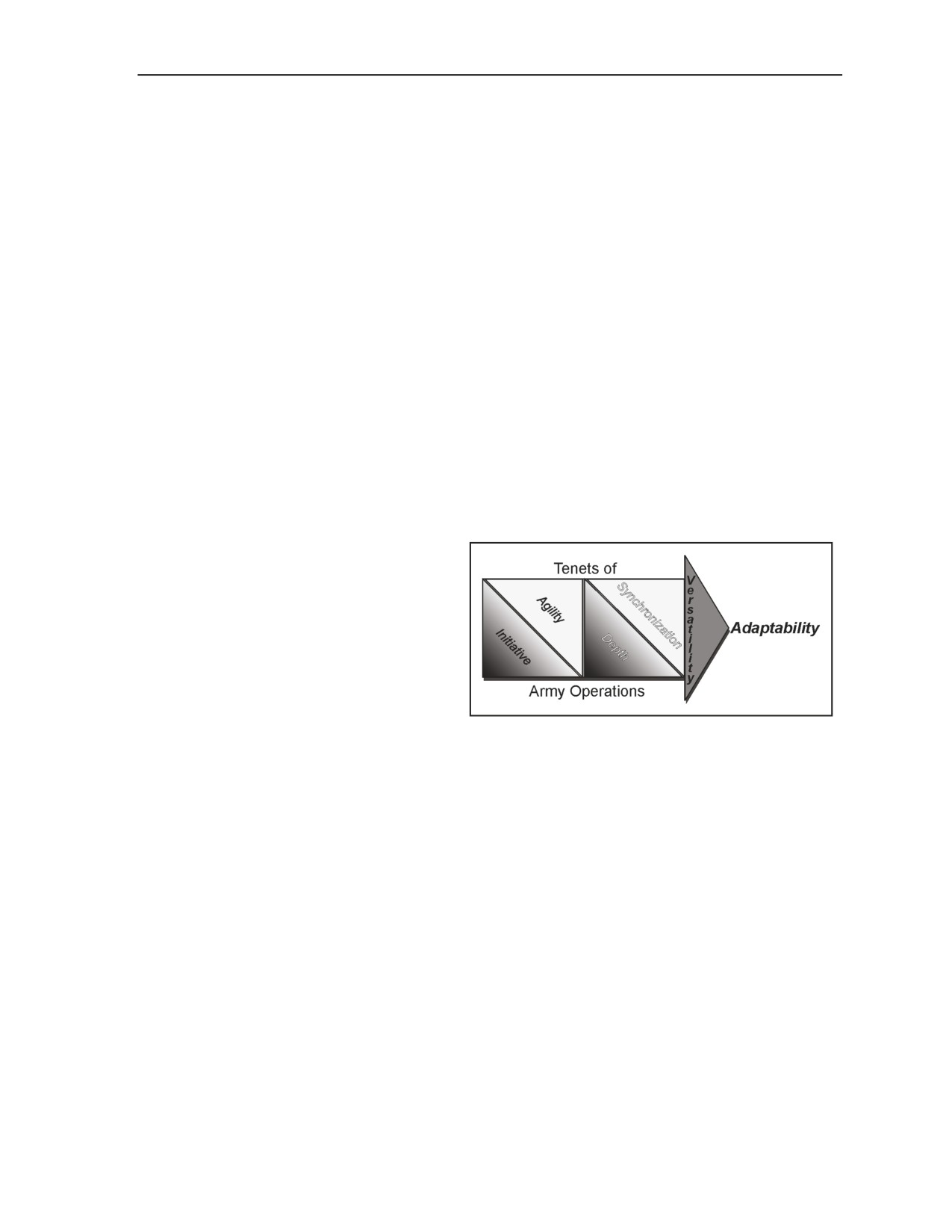
Urban Stability and Civil Support Operations
ENGAGE
If there is any lesson to be derived from the work of the regular troops in San Francisco,
it is that nothing can take the place of training and discipline, and that self-control and
patience are as important as courage.
Brigadier General Frederick Funston
commenting on the Army’s assistance following
the 1906 San Francisco earthquake and fire
9-29. The focus of the Army is warfighting. Therefore, when Army commanders conduct many urban
stability and civil support operations, they must adjust their concept of success. Commanders will most
often find themselves in a supporting role and less often responsible for conducting decisive operations.
They must accept this supporting function and capitalize on the professional values they have instilled in
each Soldier, particularly the sense of duty to do what needs to be done despite difficulty, danger, and
personal hardship. Commanders must also put accomplishing the overall mission ahead of individual
desires to take the lead—desire often fulfilled by being the supported rather than supporting commander. In
many stability and civil support operations, success may be described as settlement and compromise rather
than victory. Yet, the Army’s professionalism and values—combined with inherent adaptability, aggressive
coordination, perseverance, and reasonable restraint—will allow Army forces to engage purposefully and
dominate during complex urban stability or civil support operations.
Adaptability
9-30. Adaptability is particularly critical to urban stability or civil support operations because these
operations relentlessly present complex
challenges to commanders for which no
prescribed solutions exist. Commanders often
lack the experience and training that provide
the basis for creating the unique solutions
required for these operations. Since the
primary purpose for the Army is to fight and
win the nation’s wars, the challenge then is to
adapt urban warfighting skills to the unique
stability or civil support situation.
Figure 9-3. Adaptability
9-31. Doctrine (joint and Army) provides an inherent cohesion among the leaders of the Army and other
services. Still, Army commanders conducting urban stability or civil support operations will often work
with and support other agencies that have dissimilar purposes, methods, and professional languages. Army
commanders must then capitalize on three of the five doctrinal tenets of Army operations: initiative, agility,
and versatility (see figure 9-3 and FM 3-0). Commanders must bend as each situation and the urban
environment demand without losing their orientation. They must thoroughly embrace the mission
command philosophy of command and control addressed in FM 6-0 and Chapter 5 to encourage and allow
subordinates to exercise creative and critical thinking required for planning and executing these UO.
Commanders must also be alert to and recognize “good ideas,” and effective tactics, techniques, and
procedures, regardless of their source—other services, coalition partners, governmental and
nongovernmental organizations, and even the threat—and adapt them for their own purposes in UO.
9-32. Adaptability also springs from detailed planning that carefully considers and realistically accounts
for the extent of stability and civil support operations. Although no plan can account for every contingency
and completely eliminate the unexpected, good plans—which include detailed civil considerations—
provide platforms from which to adjust course more readily. Adequate planning allows commanders not
only to react more effectively, but also to be forward-thinking and take actions that favorably steer the
course of events.
26 October 2006
FM 3-06
9-11
Chapter 9
Aggressive Coordination and Synchronization
9-33. In urban stability and civil support operations, the increased number of participants (both military
and nonmilitary) and divergent missions and methods create a significant coordination and synchronization
challenge. Significant potential for duplicated effort and working at cross-purposes exists. The success of
UO often depends on establishing a successful working relationship with all groups operating in the urban
area. The absence of unity of command among civil and military organizations does not prevent
commanders from influencing other participants not under his direct command through persuasion, good
leadership, and innovative ideas.
9-34. Commanders may consider establishing, as necessary, separate organizations for combat operations
and for stability operations or civil support operations to increase coordination and enhance local, NGO,
and international support. Further, aligning the unit or subordinate units with NGOs may contribute to
establishing popular legitimacy for the operation and place greater pressure on threat forces. In some
instances, commanders may consider organizing part of their staff around government, administrative, and
infrastructure functions that mirror the urban area in which their forces are operating. Development of a
mirror urban area organization may give greater legitimacy to the urban government or administration and
ease transition of responsibility once the end state is achieved. Commanders must be mindful, however,
that local groups seen as allying themselves with Army or coalition authorities will likely experience
pressure to demonstrate their independence as established dates for redeployment or other critical events
approach. In some instances that demonstration of independence may be violent.
Civil Support and Coordination with Civilian Authorities:
Los Angeles - 1992
During the spring of 1992, Soldiers from the 40th Infantry Division, California National
Guard were among the forces deployed to Los Angeles County to assist the
California Highway Patrol, Los Angeles County Sheriffs, and civilian law
enforcement. They worked to quell the riots that were sparked by the “not guilty”
verdicts concerning four police officers who, following a lengthy high-speed chase
through Los Angeles, were accused of brutally beating Rodney King.
Successful accomplishment of this civil support operation was attributed to the
exercise of strong Army leadership and judgment at lower tactical levels, particularly
among the unit’s noncommissioned officers. An essential component of combat
power, it was especially critical in executing noncontiguous and decentralized
operations in the compartmented terrain of Los Angeles. As important, however, was
the clear understanding that Army forces were to support civilian law enforcement—
and not the other way around. The
40th Infantry Division aligned its area of
operations with local law enforcement boundaries and relied heavily on police
recommendations for the level at which Soldiers be armed (the need for magazines
to be locked in weapons or rounds chambered).
One incident emphasized the need for coordination of command and control
measures with civilian agencies even at the lowest tactical levels. To civilian law
enforcement and Army forces, the command “Cover me” was interpreted the same:
be prepared to shoot if necessary. However, when a police officer responding to a
complaint of domestic abuse issued that command to an accompanying squad of
Marines, they responded by immediately providing a supporting base of fire that
narrowly missed some children at home. However, the Marines responded as they
had been trained. This command meant something entirely different to them than for
Army Soldiers and civilian law enforcement. Again, coordination at all levels is critical
to the success of the operation (see also the vignette in Appendix B).
9-35. In the constraints imposed by METT-TC and operations security (OPSEC), commanders should seek
to coordinate all tactical stability operations with other agencies and forces that share the urban
environment. Importantly, they should seek to coordinate appropriate information and intelligence sharing
9-12
FM 3-06
26 October 2006
Urban Stability and Civil Support Operations
with participating organizations. Commanders must strive to overcome difficulties, such as mutual
suspicion, different values and motivations, and varying methods of organization and execution.
Frequently, they must initiate cooperative efforts with participating civilian agencies and determine where
their objectives and plans complement or conflict with those agencies. Commanders can then match Army
force capabilities to the needs of the supported agencies. In situations leading to many urban civil support
operations, confusion may initially make it difficult to ascertain specific priority requirements.
Reconnaissance and liaison elements—heavily weighted with CA, engineers, and health support
personnel—may need to be deployed immediately to determine what type of support Army forces provide.
Overall, aggressive coordination will foster trust and make unity of effort possible in urban stability or civil
support operations where unity of command is difficult or impossible to achieve.
Perseverance
9-36. The society is a major factor responsible for increasing the overall duration of urban operations. This
particularly applies to urban stability operations where success often depends on changing people’s
fundamental beliefs and subsequent actions. Modifying behavior requires influence, sometimes with
coercion or control, and perseverance. The urban population often must be convinced or persuaded to
accept change. Necessary change may take as long as or longer than the evolution of the conflict. Decades
of problems and their consequences cannot be immediately corrected. Frequently, the affected segments of
the urban society must see that change is lasting and basic problems are being effectively addressed.
9-37. In most stability operations, success will not occur unless the host nation, not Army forces,
ultimately prevails. The host urban administration must address the underlying problem or revise its
policies toward the disaffected portions of the urban population. Otherwise, apparent successes will be
short lived. The UO fundamental of understanding the human dimension is of paramount importance in
applying this consideration. After all Army forces, particularly commanders and staff of major operations,
understand the society’s history and culture, they can begin to accurately identify the problem, understand
root causes, quickly engage and assist key civilian leadership, and, overall, plan and execute successful
Army UO.
Reasonable Restraint
9-38. Unlike offensive and defensive operations where commanders seek to apply overwhelming combat
power at decisive points, restraint is more essential to success in urban stability and civil support
operations. It involves employing combat power selectively, discriminately, and precisely (yet still at
decisive points) in accordance with assigned missions and prescribed legal and policy limitations. Similar
to the UO fundamentals of minimizing collateral damage and preserving critical infrastructure, restraint
entails restrictions on using force. Commanders of major operations should issue or supplement ROE to
guide the tactical application of combat power. Excessively or arbitrarily using force is never justified or
tolerated by Army forces. Even unintentionally injuring or killing inhabitants and inadvertently destroying
their property and infrastructure lessens legitimacy and the urban population’s sympathy and support.
Collateral damage may even cause some inhabitants to become hostile. In urban stability or civil support
operations, even force against a violent opponent is minimized. Undue force often leads to commanders
applying ever-increasing force to achieve the same results.
9-39. Although restraint is essential, Army forces, primarily during urban stability operations, must always
be capable of decisive (albeit in some circumstances, limited) combat operations. This is in accordance
with the UO fundamental of maintaining a close combat capability. This capability must be present and
visible, yet displayed in a nonthreatening manner. A commander’s intent normally includes demonstrating
strength and resolve without provoking an unintended response. Army forces must be capable of moving
quickly through the urban area and available on short notice. When necessary, Army forces must be
prepared to apply combat power rapidly, forcefully, and decisively to prevent, end, or deter urban
confrontations. Keeping this deterrent viable requires readiness, constant training, and rehearsals. It also
requires active reconnaissance, superb OPSEC, a combined arms team, and timely and accurate
intelligence.
26 October 2006
FM 3-06
9-13
Chapter 9
Restraint: An Najaf, Iraq - 2003
On 31 March 2003, during OPERATION IRAQI FREEDOM, The 101st Airborne (Air
Assault) Division transitioned from isolating An Najaf—among the holiest places for
Shia Muslims in Iraq and the home of one of their leading holy men, the Grand
Ayatollah Ali Hussein Sistani—to an attack to clear Iraqi fighters from the town. The
decision to attack was made in response to increasing attacks against 101st forces
situated near An Najaf and due to alarming reports that the Fedayeen were killing
Iraqi family members to force adult males to fight coalition forces. Since An Najaf had
an airfield, control of the town would also allow the
101st to obtain needed
hardstands for their aircraft.
Ultimately, the division used two brigades to attack and clear the town. The 2nd
Brigade Combat Team (BCT) attacked from the north and the 1st BCT—responsible
for the initial penetration—attacked from the southwest. Using tanks, infantry fighting
vehicles, and light infantry, the commander of the 1st BCT formed effective combined
arms teams supported by artillery and air that successfully fought their way into the
city.
On 3 April 2003, Soldiers of TF 2-327 Infantry turned a street corner to face a group
of civilian men blocking their way and shouting in Arabic, “God is great.” The crowd
quickly grew into hundreds as they mistakenly thought the Soldiers were trying to
capture Sistani and seize the Imam Ali Mosque. Someone in the crowd threw a rock
at the Soldiers, which started a hailstorm of rocks; even the battalion commander
was hit on the head, chest, and the corner of his sunglasses.
Based on information from a Free-Iraqi Fighter accompanying the battalion and his
own observations during the attack, the commander of TF 2-327 believed that most
of the people in An Najaf neither wanted to fight nor obstruct his unit’s efforts.
Consequently, he ordered his Soldiers to position themselves on one knee, smile,
and point their weapons toward the ground. At this gesture, many of the Iraqis
backed off and sat down, enabling the commander to identify the true troublemakers.
He identified eight. In case these agitators were to produce weapons and start to
shoot, the commander wanted to make sure that the remainder of the crowd would
know from where the shooting would originate. Next, he ordered his Soldiers to
withdraw to allow the tension to subside. With his own rifle pointed toward the
ground, the battalion commander bowed to the crowd and led his Soldiers away.
When tempers had calmed, the Grand Ayatollah Sistani issued a decree (fatwa)
calling on the people of Najaf to welcome the American Soldiers.
The attack on An Najaf by the 101st provides an excellent example of well-led
Soldiers capable of understanding cultural differences and possessing the discipline
and mental flexibility to transition from the aggressive mindset required for high-
intensity urban combat to the restraint essential for the initiation of stability
operations. In his weekly radio address, President George W. Bush commented:
“This gesture of respect helped defuse a dangerous situation and made our peaceful
intentions clear.”
CONSOLIDATE
9-40. As urban operations will often be full spectrum, many of the consolidation activities necessary to
secure gains in urban offensive and defensive operations will be applicable to urban stability and civil
support operations. However, the greatest obstacles to attaining strategic objectives will come after major
urban combat operations. Therefore, emphasis will appropriately shift from actions to ensure the defeat of
threat forces to those measures that address the needs of the urban population, manage their perceptions,
and allow responsibility to shift from Army forces to legitimate indigenous civilian control (or the
intermediate step to other military forces, governmental agencies, and organizations).
9-14
FM 3-06
26 October 2006
Urban Stability and Civil Support Operations
Continued Civilian and Infrastructure Protection
9-41. Following urban offensive or defensive operations, there will likely be a need to secure and protect
the civilian population and much of the civilian infrastructure from the civilians themselves. After having
minimized collateral damage and preserved critical infrastructure, commanders must implement measures
to preclude looting and destruction of critical and essential infrastructure by the urban population and
civilian-on-civilian violence. This may be as relatively simple as allowing the urban police force to return
to work or may be as difficult as hiring, vetting, and training an indigenous police force. In the latter case
commanders may need to determine—
Number and operability of police stations.
Responsibility for recruiting, hiring, training, and equipping the urban security or police force.
The accountable unit, organization, or agency will need to consider a vetting process, suitable
salaries and wages, and appropriate training standards.
The appropriate responses toward those civilians who threaten, oppose, or harm the new police
force.
9-42. Alternatively, civilian security firms (from inside or outside the urban area or country) can provide
supplemental protection until indigenous police forces are fully functional. Further, the commander of the
major urban operation may plan to manage expected instability primarily with Army forces. Often, this will
require larger numbers of infantry, military police, and dismounted forces. Other populace and resource
control measures such as curfews may also assist in civilian
(including NGOs) and infrastructure
protection. Previous shaping operations aimed at improving the local economy can also assist in this
regard.
Resolute Legitimacy
9-43. Closely linked to the restraint described previously is legitimacy or the proper exercise of authority
for reasonable purposes. Achieving or maintaining legitimacy during urban stability or civil support
operations is essential in gaining and maintaining the support of the urban population. Commanders can
ensure legitimacy by building consent among the population, projecting a credible force, and appropriately
using that force. Perceptions play a key role in legitimacy, and skillful IO can shape perceptions.
Commanders must send messages that are consistent with the actions of their forces. Generally, the urban
population will accept violence for proper purposes if that force is used impartially. Perceptions that force
is excessive or that certain groups are being favored over others can erode legitimacy and generate
resentment, resistance, and, in some situations, violent acts of revenge.
9-44. In stability operations against an elusive insurgent threat, commanders may need to explain to urban
residents why damage was necessary, apologize, or make near-instant restitution for some unsuccessful
Army operations that may have been planned based on inaccurate or incomplete intelligence. (Soldiers may
even make it a point to thank homeowners for allowing the search of their homes during cordon and search
operations.) During urban operations, a single Soldier’s misbehavior can significantly degrade a
commander’s ability to project an image of impartiality and legitimacy. Fortunately, disciplined Soldiers
can contribute immeasurably to gaining and maintaining legitimacy, mitigating ill will, or otherwise
winning the urban population’s trust and confidence. In stability operations, the greater fight will often be
to win the battle of perceptions and ideas instead of one to seize terrain and triumph over an enemy.
Inconsistencies in message and behavior will provide threats with raw material for their propaganda and
precipitate doubt in the minds of the urban populace who might otherwise support Army objectives.
TRANSITION
9-45. Commanders of major operations are the focal point for synchronizing tactical stability operations or
civil support operations with strategic diplomatic and political issues. They are also the critical links
between national intelligence resources and the tactical commander. Because strategic, diplomatic, and
political changes can quickly transition the type of urban operation, they must keep subordinate tactical
commanders abreast of changes in intelligence, policy, and higher decisions. The potential to rapidly
transition to urban combat operations emphasizes the need to maintain the capability to conduct close,
26 October 2006
FM 3-06
9-15
Chapter 9
urban combat. Failure to recognize changes and transition points may lead to UO that do not support the
attainment of the overall objective and needlessly use resources, particularly Soldiers’ lives. Therefore,
Army forces on the ground in an urban stability operation must be more aware of the strategic environment
than the threat and the civilian population, each of whom will have their own means of monitoring the
national and international situation.
Legitimate and Capable Civilian Control
I met immediately with the [special operations forces liaison officer] to discuss how we
would establish a new government that would be able to make instant progress. We
decided to select a city council with the following departments: commerce, public works,
social services, health, emergency services, education, public relations, and agriculture.
A city council director would lead the council, and each department would also have a
director in charge of its respective services. A critical step in selecting the city council
was ensuring that there was a balance on the council between Altun Kupri’s three major
ethnic groups. An ethnic imbalance on the council or perceived favoritism would have
decreased the legitimacy of the Coalition forces’ efforts in the city and served as fuel for
the fire of competition for power between the Turkomen and Kurds.
Captain Jeffrey B. Van Sickle
“Stability Operations in Northern Iraq”
9-46. Commanders must maintain or enhance the credibility and legitimacy of the government and police
of the urban area and, in the case of stability operations, of the host nation’s military forces operating there.
In accordance with the urban fundamental of transitioning control, urban commanders must conclude UO
quickly and successfully, often to use assets elsewhere in their area of operations. This entails returning the
control of the urban area back to civilian responsibility as soon as feasible. The host nation’s military and
the urban area’s leadership and police are integrated into all aspects of the urban stability or civil support
operations to maintain their legitimacy. They must be allowed
(or influenced) to take the lead in
developing and implementing solutions to their own problems. This requires commanders to transition
from “leading from the front” to “leading from behind” in an advisory and assistance role. Effective
transition to civilian control and responsibility requires commanders at all echelons who understand the
basic operation of civil governments and the administration and management of key urban infrastructure.
9-47. If the host nation’s leadership, military, and police are not up to the task, commanders can take steps
to increase its capabilities through training, advice, and assistance by CA units or by other
nongovernmental or governmental organizations and agencies. Sometimes, new leadership and a
restructured police force may be required, particularly when corrupt and no longer trusted by the
population. This candid assessment of the urban leadership’s ability to govern, protect, and support itself is
made early in the planning process. Only then can commanders ensure that resources and a well thought-
out and coordinated plan (particularly with civilian organizations and agencies) are available for a speedy
transition. IO will be paramount in these instances to ensure that the urban population sees the training and
rebuilding process itself as legitimate. Throughout urban stability or civil support operations, commanders
shape the conditions to successfully hand over all activities to urban civilian authorities.
Longer-Term Commitment
Maintain the Focus
9-48. Many stability operations often require perseverance and a longer-term U.S. commitment requiring
operational endurance and the establishment of a sustainable battle rhythm. Lengthy operations will also
require a transitional rotation of Army units into the area of operations to continue the mission.
Considerations for these transitions are similar to a relief in place and battle handover (see FM 3-90)
combined with considerations for deployment and redeployment. FM 41-10 contains comprehensive
guidance on transition planning and coordination activities applicable to UO. In addition to any threat
considerations, planning for urban transitions between units will often include emphasis and understanding
of—
9-16
FM 3-06
26 October 2006
Urban Stability and Civil Support Operations
Formal and informal civilian leadership and relationships.
Government institutions and administrative functions.
On-going reconstruction projects.
The urban economy.
Participating governmental and nongovernmental organizations and established relationships
and cooperation activities, particularly information sharing.
Significant key events affecting (or likely to affect) operations.
Significant cultural lessons learned as a result of the outgoing unit’s operations.
9-49. The commander of the major operation must ensure that the incoming unit also understands the
political and strategic objectives behind the tasks that they will be required to accomplish. Otherwise, the
new unit may begin to plan operations that are similar to those conducted by the previous unit without
achieving the desired end state or accomplishing the mission.
Transition Trust
9-50. If units are successful in establishing and cultivating relationships with the urban populace and their
leadership, and have built an effective level of trust, their anticipated departure from the AO as part of a
unit rotation schedule may have detrimental effects on working relationships. As a result, local leaders may
develop deep anxieties about the replacement force and their ability to “be as good” as the current
command. Therefore, incumbent forces must take steps to identify successful and ongoing efforts and
activities in which the new unit can continue to achieve success. In some instances, the current unit may
delay a project or activity whose scheduled completion is close to the date of relief or the transfer of
authority so as to allow the new unit immediate success. In other instances, projects or activities can be
backward planned to ensure that the completion date is scheduled soon after the new unit arrives. The goal
for the outgoing unit is to ensure that the new unit is readily accepted and that both units execute a
seamless relief in place.
Modify Objectives to Match the Current Environment
9-51. While it is important that incoming commanders create a seamless transition with their outgoing
counterparts, they must make full use of the opportunity to review the current political, strategic, and local
urban environment to determine potential modifications to logical lines of operations and unit objectives.
Otherwise, units may fall into the trap of executing a series of six-month to one-year rotations that do not
significantly contribute to solidifying the conditions required to ultimately transition the urban environment
back to legitimate civilian control. In operations that involve longer-term commitments, the potential exists
for the same unit to conduct two (or more) rotations back into the same AO. Commanders must resist the
desire to simply continue with previous lines of operations that, at the time, were deemed successful. The
urban environment will change in response to Army actions and this change will necessitate subsequent
operational adaptations.
Provide an End State Not an End Date
9-52. Though it may not be feasible, due to political constraints, commanders of major urban operations
should fight the public desire to establish a fixed transition timetable. Instead, they should plan urban
stability operations based on an attainable end state and not on a specified withdrawal or end date. Progress
toward strategic (and operational) goals is susceptible to many changes and delay, particularly in coalitions
which will likely be a part of most future urban operations. As such, an end date will only serve to unduly
constrain commanders in the attainment of their urban operational objectives. Having set and announced a
firm timetable, American and coalition publics will expect withdrawal to commence as scheduled and will
not easily be convinced of the need to stay longer even if the situation changes drastically. In general, the
public can understand and accept a logical and clearly articulated end state as long as commanders can
demonstrate adequate progress based on well developed measures of effectiveness. As important, a
timetable allows threats to adjust their plans to the anticipated withdrawal date. Instead of yielding to
relentless diplomatic, informational, military, and economic pressure backed by firm political resolve,
threats will likely exercise strategic and operational patience.
26 October 2006
FM 3-06
9-17
This page intentionally left blank.

Chapter 10
Urban Sustainment
Even supply is different. While deliveries do not need to be made over great distances,
soft vehicles are extremely vulnerable in an environment where it is hard to define a
front line and where the enemy can repeatedly emerge in the rear. All soldiers will be
fighters, and force and resource protection will be physically and psychologically
draining. Urban environments can upset traditional balances between classes of
supply…[a] force may find itself required to feed an urban population, or to supply
epidemic-control efforts…[a]ll [sustainment] troops are more apt to find themselves
shooting back during an urban battle than in any other combat environment.
Ralph Peters
“Our Soldiers, Their Cities”
Sustainment activities exist to enable the Army to initiate and sustain full spectrum
operations. Inseparable from decisive and shaping operations, logistics is the central
component of sustaining operations and provides the means for commanders to
generate and maintain combat power and extend the operational reach of the force. In
offensive and defensive operations, sustainment activities are not by themselves
likely to be decisive or shaping, yet significantly contribute to those operations. In
stability and civil support operations, when the critical objectives may be restoring
the infrastructure and the welfare of civilians, sustainment activities will often be
decisive. Their success will allow Army forces to dominate this complex
environment. However, like all urban operations (UO), sustainment activities affect
and are affected by the environment. The urban terrain, infrastructure, and existing
resources, coupled with supportive civilians, may facilitate sustainment activities. In
contrast, a poorly designed or damaged infrastructure and a hostile population may
severely hamper sustainment activities. In the latter case, critical Army resources
required elsewhere in the area of operations (AO) may be diverted to repair facilities
and control and support the inhabitants of the urban areas.
URBAN SUSTAINMENT
CHARACTERISTICS
10-1. Fundamental sustainment characteristics (see
figure
10-1) guide prudent sustainment planning
regardless of the environment. They provide
commanders an excellent framework to analyze and
help develop urban sustainment requirements,
assess the impact of the environment on the
provision of logistics, and gauge the effectiveness
of urban sustainment activities.
Figure 10-1. Sustainment characteristics
26 October 2006
FM 3-06
10-1
Chapter 10
RESPONSIVENESS AND SUSTAINABILITY
10-2. UO require responsiveness and sustainability to establish and maintain the tempo necessary for
success. Responsiveness—providing the right support in the right place at the right time—is the essential
sustainment characteristic. It requires that sustainment commanders and planners accurately forecast urban
operational requirements. Continuous urban operations will drain personnel, equipment, and supplies at
rates vastly different than in other environments. Therefore, sustainability—the ability to maintain
continuous support throughout all phases of the operation—will be a significant concern. Anticipation is
critical to both responsiveness and sustainability. It requires that sustainment commanders and planners
comprehend the potential effects that components of the urban environment (terrain, infrastructure, and
society) may have on operations and sustainment, either benefiting or impeding UO. Effective urban
operational and sustainment planning cannot be accomplished separately. Operational and sustainment
planners, as well as sustainment operators, must be closely linked to aid in synchronizing and attaining
responsiveness and sustainability. The key is often the right balance between efficiency and effectiveness.
ECONOMY AND ATTAINABILITY
10-3. A thoughtful assessment and understanding of the urban environment can also help determine how
specific urban areas can contribute to or frustrate the achievement of economy and attainability. Economy
is providing the most efficient support at the least cost to accomplish the mission. Attainability means
generating the minimum essential supplies and services necessary to begin operations. If available,
obtaining support in the AO costs less than purchasing the supplies outside the area and then transporting
them there. Critical resources may be available in urban areas to support the operation. However, relying
on sources outside the established military sustainment system may create conflict with other sustainment
characteristics. A strike by longshoremen, for example, may shut down port operations
(at least
temporarily) lowering responsiveness and sustainability.
SURVIVABILITY
10-4. Survivability is being able to protect support functions from destruction or degradation.
Commanders often choose to locate sustainment functions in an urban area because the buildings may
better protect and conceal equipment, supplies, and people. Urban industrial areas and airports are
frequently chosen as support areas because they offer this protection as well as sizeable warehouses, large
parking areas, and materials handling equipment (MHE). Such areas facilitate the storage and movement of
equipment and supplies. They may also provide readily available water, electricity, and other potentially
useful urban resources and infrastructure. However, these areas may also contain toxic industrial materials
(TIM) (see Chapter 2). These materials and chemicals in close proximity to support areas may unjustifiably
increase the risk to survivability. Sustainment activities in any environment will always be targeted by
threat forces. Furthermore, sustainment activities located in any type of confined urban area can offer
lucrative targets for terrorists, insurgents, or even angry crowds and mobs. Therefore, no sustainment
activity should be considered safe from attack during UO.
(During OPERATION JUST CAUSE,
Panamanian paramilitary forces and deserters even attacked marked ambulances). Although host-nation
support may include assets to assist in defending sustainment units, bases, and lines of communications
(LOCs), sustainment commanders must carefully consider if adequate protection measures can ensure
survivability. The sustainment commander’s greatest challenge to force protection may be complacency
born of routine.
Base Security: Tan Son Nhut, Vietnam - 1968
Colonel Nam Truyen was the commander of the 9th Vietcong Division who planned
and conducted the attack on the U.S. airbase at Tan Son Nhut during the 1968 Tet
Offensive. He had previously entered the airbase during the 1967 Christmas cease-
fire using forged identity papers to conduct his own personal and highly thorough
reconnaissance.
10-2
FM 3-06
26 October 2006
Urban Sustainment
UO increase the likelihood that the indigenous population will be utilized as a
workforce to supplement Army sustainment activities. Hence, strict operations
security will be paramount. Commanders will need to carefully screen potential
workers to determine their relative trustworthiness. Human intelligence (HUMINT)
and counterintelligence (CI) assets will likely be required to assist in this effort.
However, higher-level commanders should seek to take on as much of this burden
as possible so that lower-level, tactical commanders can use their limited intelligence
assets to accomplish other critical intelligence collection and analysis activities.
All commanders with base protection responsibilities should implement random,
changing force protection measures that focus on civilians—even those civilians who
have, over time, earned a perceived measure of trust. (Civilians can be co-opted and
coerced by threat forces.) As such, all civilian activity that seems out of the ordinary
should be promptly investigated regardless of whether a specific force protection
measure is in effect. Although leaders and Soldiers seek to establish mutual trust
and respect between themselves and the local populace, commanders should
normally err on the side of protecting their Soldiers.
SIMPLICITY
10-5. Simplicity is required in both planning and executing sustainment activities in this complex
environment. Developing standard procedures among the Army, other services, and especially civilian
governmental and nongovernmental agencies, liaison and open channels of communication, simple plans
and orders, and extensive rehearsals contribute immeasurably to attaining this necessary characteristic.
INTEGRATION
10-6. The need for sustainment integration increases in UO due to its joint and multinational nature and
greater numbers of other governmental and nongovernmental organizations
(NGOs) and agencies
operating in or near urban areas. More NGOs will likely exist because urban areas often contain most of a
region’s population. Most NGOs focus on people. Army forces and other military and nonmilitary groups
must cooperate and coordinate their actions. Much of their coordination will revolve around sustainment
activities. Cooperation and coordination will take advantage of each group’s sustainment capabilities, help
to avoid duplicated effort (contributing to economy), and create sustainment synergy. It will also help to
curtail competition for the same urban resources and assist in developing a unified list of priorities. Such
coordination will help ensure that other operations by one force or agency will not disrupt or destroy
portions of the urban infrastructure critical to another’s sustainment operations and the overall mission.
10-7. Success in UO requires combined arms and innovative task organizations. As such, UO will often
result in the integration of heavy and light units necessitating a simultaneous integrated approach to
sustainment. Gaining units must integrate forces into their maintenance systems and carefully consider
potentially increased resource requirements. (For example, armor units consume greater amounts of Class
III—bulk and petroleum—than a similar-sized light unit.) When integrating into a light unit, armored and
mechanized units should bring as much of their critical parts and supplies as possible and immediately
integrate into the gaining unit’s logistical reporting system to ensure adequate resupply.
FLEXIBILITY
10-8. Lastly, commanders must develop flexibility. Although they and their staffs must thoroughly
understand the urban environment essential to planning sustainment operations, they cannot possibly
anticipate every eventuality. Urban commanders must possess the ability to exploit fleeting opportunities.
Knowledge of the environment, particularly its infrastructure, can aid in developing innovative solutions to
sustainment acquisition and distribution problems. Flexibility enables sustainment personnel to remain
adaptive and responsive to the force commander’s needs. Key to maintaining flexibility is the constant
assessment of the sustainment situation and the readiness to modify or change procedures to adapt to the
current conditions confronting Army forces operating within the urban environment.
26 October 2006
FM 3-06
10-3
Chapter 10
10-9. Maneuver and sustainment commanders should consider and prioritize these characteristics as they
visualize UO. Each characteristic does not affect every operation and urban area in the same way. The
sustainment characteristics seldom exert equal influence, and their importance varies according to mission,
enemy, terrain and weather, troops and support available, time available, civil considerations (METT-TC).
Like the principles of war, commanders must not ignore the potential impact of sustainment characteristics
and how their influence changes as the operation evolves (see FM 4-0).
LOGISTICS PREPARATION OF THE THEATER
[Sustainment] planning accounts for increased consumption, increased threats to lines of
communications, and anticipated support to noncombatants…Urban operations place a
premium on closely coordinated, combined arms teams and carefully protected
[sustainment activities]. Urban operations are
[logistic]-intensive, demanding large
quantities of material and support for military forces and noncombatants displaced by
operations.
FM 3-0
10-10. A thorough logistics preparation of the theater (LPT) is critical for an adaptable UO support plan.
Sustainment planners conduct the LPT to understand the situation from a sustainment perspective and
determine how best to support the maneuver commander’s plan. However, decisions that impact the urban
environment and the political situation require a combined operational and sustainment perspective.
Sustainment planners must understand the urban environment, the fundamentals of UO, the proposed
course of action, and the urban environment’s effects on sustainment (as well as the other warfighting
functions). Such knowledge allows the planners to develop a detailed estimate of support requirements. A
thorough LPT helps commanders determine the most effective method of providing adequate, responsive
support to meet support estimates while minimizing the sustainment footprint. Overall, it helps tie together
UO requirements with acquisition and distribution. As with all operations, but particularly in a dynamic
urban environment, this assessment process is continuous since requirements will change as the urban
operation unfolds and matures.
SUPPORT TO INTELLIGENCE
10-11. The LPT resembles and runs parallel to the intelligence preparation of the battlefield (IPB).
Products generated under IPB may be useful in the sustainment analysis. Conversely, the LPT may
contribute to the IPB by identifying critical resources and infrastructure and assessing their potential to
influence (positively or negatively) the operational plan. This information may warrant a course of action
that includes offensive or defensive operations to seize, secure, or destroy those critical resources. In UO
initially planned for other than sustainment reasons, the information may require altering the plan or
imposing additional constraints to protect the identified resources. While these resources may or may not
be critical to current operations, they are usually important to set or shape the conditions necessary for
Army forces to consolidate and transition to subsequent missions or redeploy. This close relationship
between IPB and LPT underscores the need to quickly and continuously involve sustainment personnel for
their sustainment expertise and perspective in planning UO.
10-12. As sustainment units are among the most dispersed and omnipresent in any AO, sustainment
Soldiers are potentially valuable intelligence collectors. Soldiers working in and around urban sustainment
bases and executing frequent convoys through urban areas quickly become very familiar with the urban
terrain and the routine associated with that terrain. As with all Soldiers, sustainment personnel must be
incorporated into a comprehensive human intelligence collection system.
URBAN SUSTAINMENT INFORMATION
10-13. Figure 10-2 illustrates that a thorough analysis of the key components of urban areas in the
commander’s AO provides the data for an accurate LPT and subsequent UO sustainment plan (see Chapter
2 and Appendix B). Analyzing the urban terrain and infrastructure helps to determine—
10-4
FM 3-06
26 October 2006
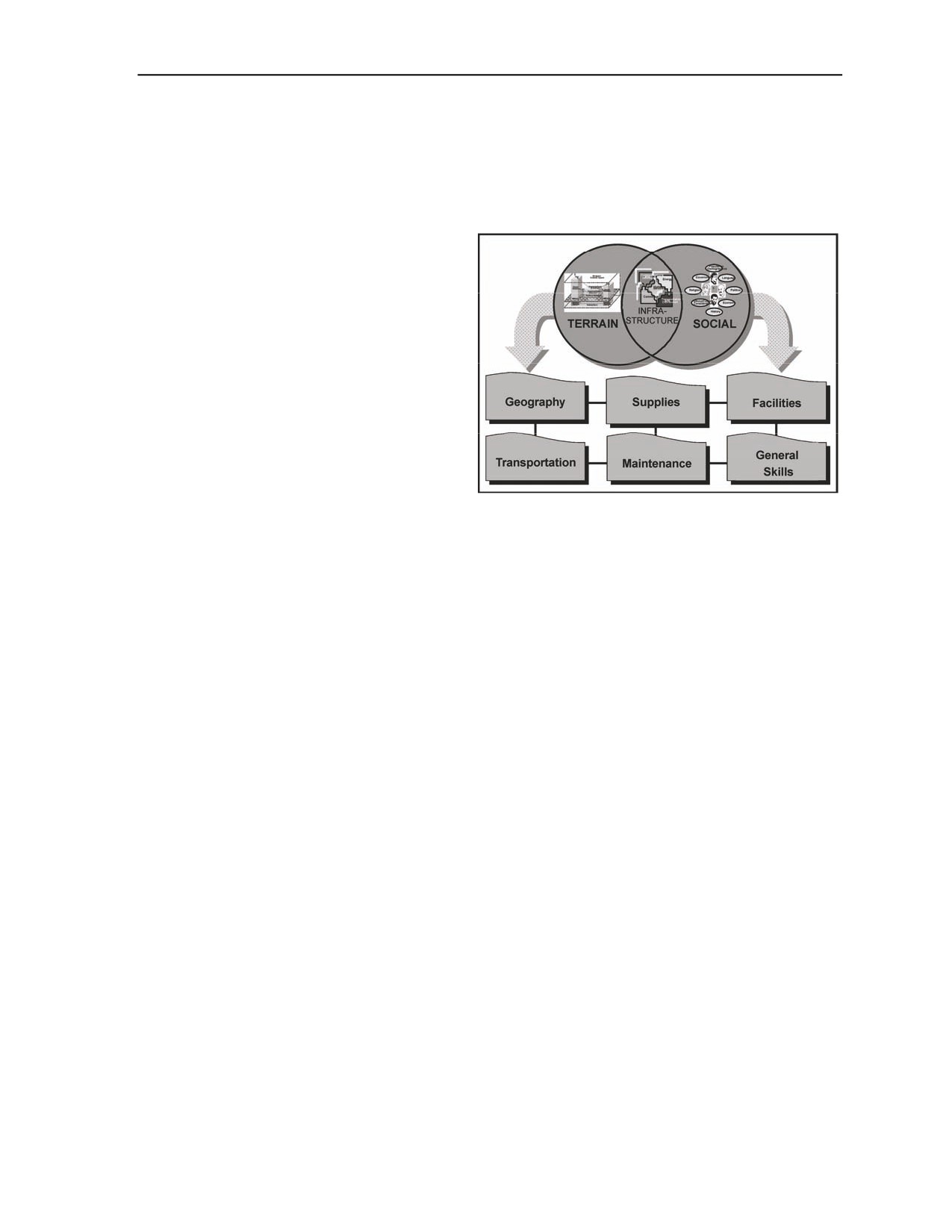
Urban Sustainment
Geographic influences on consumption factors and on the provision of support (weather,
climate, and topography).
The availability of supplies, such as safe food, potable water, petroleum, electrical energy,
barrier material, and compatible repair parts.
The location of facilities, such as warehouses, cold-storage sites, water treatment facilities,
manufacturing plants, hospitals, hotels for billeting, and waste treatment facilities.
Transportation information, such as
seaport and harbor facilities,
airfields, rail and road networks,
traffic flow patterns, choke points,
and control problems.
Locations and accessibility of
maintenance
facilities
and
equipment, and machine works for
the possible fabrication of parts.
The available general skills among
the urban population, such as
linguists, drivers, mechanics, MHE
operators, longshoremen, and other
vital trade skills.
Figure 10-2. Urban environment and essential
elements of sustainment information
POTENTIAL RESTRICTIONS
10-14. Commanders must be aware of restrictions that apply to the use of some non-U.S. resources.
Security and requirements for U.S. national control dictate that only U.S. assets may perform certain
services and functions. Therefore, some foreign urban-area capabilities, even if abundantly available, may
not be used. These might include—
Command and control of medical supply, service, maintenance, replacements, and
communications.
Triage of casualties for evacuation.
Treatment of chemical, biological, radiological, nuclear, and nuclear (CBRN) casualties, as well
as the decontamination of U.S. equipment, personnel, and remains.
Identification and burial of deceased U.S. personnel.
Veterinary subsistence inspection.
Law and order operations over U.S. forces and U.S. military prisoner confinement operations, as
well as accountability and security of enemy prisoners of war in U.S. custody.
URBAN SOCIETAL CONSIDERATIONS
10-15. As in all aspects of UO, the urban society is a critical element of the LPT analysis. Sustainment
planners must assess whether they can acquire and use urban resources and infrastructure without overly
disrupting the urban society and their environment. If the resources are only sufficient for the urban area’s
inhabitants (and dependent populations in outlying areas), and the facilities cannot increase production to
accommodate the needs of Army forces, then commanders may not be able to rely on those resources to
support their operations. In fact, the opposite may be true. The effects of UO on the inhabitants,
particularly during offensive and defensive operations, may place increased burdens on the Army’s
resources. For example, commanders may require civilians to evacuate all or parts of an urban area to
safeguard them from the effects of planned combat operations. This precautionary measure may require
Army forces to support civilian evacuees with temporary housing, food, water, clothing, and medical and
26 October 2006
FM 3-06
10-5
Chapter 10
sanitary facilities. It will also require carefully planned evacuation routes to ensure that the movement does
not interfere with sustainment of the fight.
10-16. Sustainment planners must take into account the potential effects that the provision of supplies to
the urban population may have on the operational environment (provided by Army forces or not). For
example, an embargo on petroleum products was lifted after Army forces entered Haiti in the 1990s and a
less repressive regime assumed governmental control. Few civilian vehicles had moved on the streets of
the Port-au-Prince, the capital city, when fuel was scarce and the movement of mounted forces through the
urban area was virtually unimpeded. This changed almost overnight once fuel supplies became available,
initially making it very difficult for forces to move where required (unless transported by helicopter).
10-17. Sustainment planners must also consider the urban society’s ability to restore their own facilities
and provide for themselves (if necessary with assistance from Army forces). Throughout this analysis, civil
affairs
(CA) units can advise and assist in identifying and assessing urban supply systems, services,
personnel, resources, and facilities. Critically, commanders must understand that purchasing local goods
and services may have the unintended negative consequence of financially sustaining the most disruptive
and violent factions in the area. Army forces must seek to purchase urban products and services that will
not contribute to prolonging the conflict or crisis. In many stability or civil support operations, they must
also attempt to distribute the contracts for goods and services purchased locally as fairly as possible among
urban factions and ethnic groups to maintain impartiality and legitimacy. As part of their coordination
efforts, commanders should attempt to achieve the cooperation of relief agencies and other NGOs in this
endeavor.
10-18. Finally, sustainment planners must also identify potential threats and increased protection
requirements that the urban society (criminals, gangs, and riotous mobs) may present, particularly when
support units and activities are positioned in urban areas. The disposition or allegiance of the urban
population is also important to consider. The infrastructure of an urban area may exhibit great potential to
support the sustainment efforts of Army forces, but if the population is hostile or unreliable, use of the
facilities and resources may be unfeasible.
URBAN SUPPORT AREAS AND BASES
10-19. A major influence on the operation plan and its subsequent execution is often the proper
identification and preparation of support areas and bases. The LPT helps commanders determine the need,
advantages, and disadvantages of using urban areas in the AO as bases from which to provide support and
conduct distribution operations. Ideally, these areas should support reception, staging, onward movement,
and integration operations. They should also allow easy sea and air access, offer adequate protection and
storage space, increase the throughput of supplies and equipment, and be accessible to multiple LOCs.
Consequently, commanders often establish support areas and bases near seaports and airports that are part
of a larger urban area. However, threats recognize the Army’s need for ports and airfields and may devote
substantial resources and combat power to defend them. Army commanders also face the challenge of
integrating airfield and port defensive operations with air and naval component commanders to deny
threats the ability to conduct stand-off attacks against aircraft and ships. Only an integrated, joint approach
can ensure persistent air and sea support- essential not only to sustainment but to firepower as well—is not
degraded by the threat. Therefore, planners may determine during the LPT that the risks of seizing or
establishing urban lodgment areas may be too high (see Chapter 4). Instead, they may recommend building
an airfield, conducting logistics over-the-shore operations, or constructing sustainment bases in more
isolated—but more easily secured—locations.
OVERALL ASSESSMENT
10-20. As shown above, the LPT process and analysis help to determine if urban areas in the AO—
Are suitable as areas and bases for support.
Can contribute sufficient quantities of and are a dependable source for resources for the overall
operation.
May additionally drain the supported commander’s resources.
10-6
FM 3-06
26 October 2006
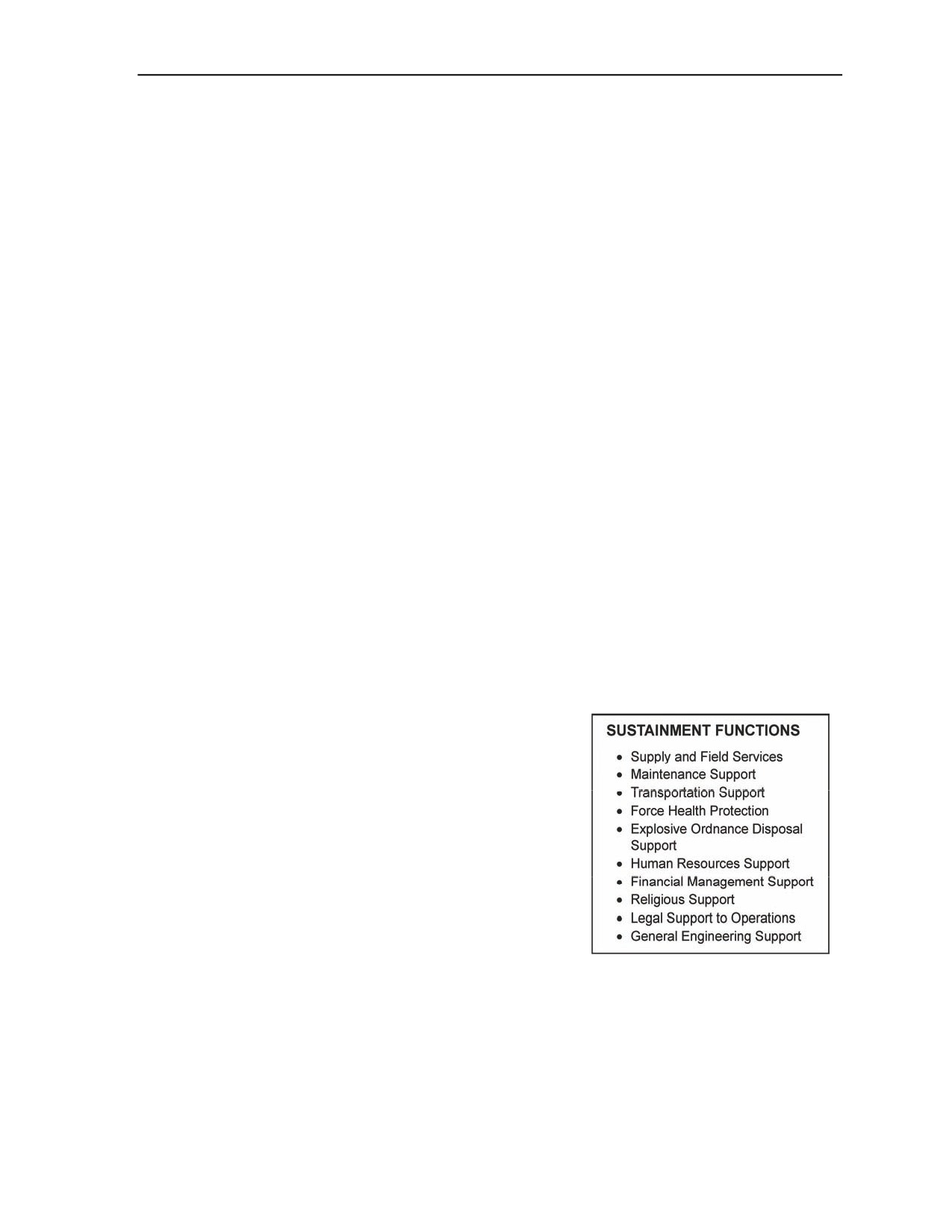
Urban Sustainment
10-21. The results of this process often serve as a basis for reviewing requirements for civilian contract
support and host-nation support and for developing sustainment input into time-phased force and
deployment data. This chapter focuses on the effects urban areas may have on accomplishing sustainment
functions and related activities, particularly when sustainment units and activities are in urban areas.
ACHIEVING FORCE AGILITY
10-22. To maintain the responsiveness necessary to support full spectrum operations against a wide array
of threats and operational environments, sustainment forces must remain agile, possessing the mental and
physical agility to transition within or between types of operation with minimal augmentation, no break in
contact, and no significant additional training. Responsiveness, flexibility, and economy are key
characteristics that enable sustainment forces to support a dynamic combat force; they represent the
capability of sustainment forces to provide the resources to initiate, sustain, and extend UO. Agile
sustainment forces are characterized by modular force designs, the ability to tailor sustainment
organizations for the supporting mission, and the ability to conduct split-based operations. These
sustainment aspects are critical to achieving the agility necessary for Army forces to succeed in UO.
MODULAR DESIGN
10-23. Sustainment units are structured as modular organizations, or must possess the ability to
modularize in order to conduct decentralized sustainment operations required in UO. At the company level,
modularity enables each major company sub-element to assume a cross-section of the company's total
capabilities, allowing commanders to employ individual modules to provide a support function, while the
rest of the unit remains operational. Modularity enhances responsiveness while enabling support forces to
project capabilities as far forward as possible into urban areas, yet with the minimum forward footprint
necessary to sustain operations.
FORCE TAILORING
10-24. Sustainment force tailoring refers to the process of determining and deploying the right mix of
capabilities to support the force or mission. Sustainment commanders may task organize specific
capabilities into functional elements in order to maximize effectiveness and efficiency, and to minimize the
sustainment footprint. During UO, the sustainment commander can tailor the support element required to
accomplish a specific mission or task, thereby mitigating the risk
associated with deploying a larger, more robust capability
package forward into the urban area.
SPLIT-BASED OPERATIONS
10-25. Split-based operations refer to performing certain
sustainment administrative and management functions outside
the area of operations. During UO, Soldiers and civilians can
perform personnel, materiel, and distribution management
functions without deploying forward into the urban area if the
information systems are adequate. This is essential to
minimizing risk to support forces and the sustainment footprint
in the urban area, and still ensures that all support requirements
are met.
Figure 10-3. Sustainment
functions
SUSTAINMENT FUNCTIONS
10-26. Sustainment consists of eleven functions that must be carefully planned, managed, and
synchronized to provide responsive and efficient support to maneuver commanders (see figure 10-3).
26 October 2006
FM 3-06
10-7
Chapter 10
Similar to the components of the urban environment, particularly its infrastructure, they overlap and are
interdependent. The success of one function depends on the success of several others. Like urban
infrastructure, they have two components: a physical component (supplies, equipment, and facilities) and a
human component (the Soldiers and civilians who execute these functions). Like city mayors, commanders
must plan, manage, and synchronize these functions to provide responsive and efficient sustainment to UO.
10-27. Commanders and planners should consider two essential aspects when addressing these
sustainment functions. One aspect looks outward and one looks inward. The first aspect is how these
functions can best support full-spectrum UO—the outward analysis. The second aspect is how the urban
area affects the conduct of sustainment functions, particularly when those functions are located or
performed in an urban area—the inward analysis.
SUPPLY AND FIELD SERVICES
Greater friendly force density would appear to make the providers’ tasks easier. Logic
would seem to dictate that more supported units in less space would translate to less
distance between a similar number of nodes than would be found on more open terrain.
But the [logistician] frequently finds the opposite is the case…one position is often not
directly accessible from another because of enemy fires or physical barriers.
Urban Combat Service Support Operations: The Shoulders of Atlas
10-28. The supply function involves acquiring, managing, receiving, storing, protecting, maintaining,
salvaging, and distributing all classes of supply (except Class VIII) required to equip and sustain Army
(and joint) forces. For UO, commanders may need to decide early in the planning cycle whether to
stockpile resources forward or to rely on distribution-based sustainment management to satisfy
requirements. Some specialized items identified below may not be available through the normal military
supply system and may take sustainment personnel much longer to obtain or fabricate. Operation planners
must quickly identify the special equipment and increased supply requirements for UO to give sustainment
personnel the time necessary to acquire them.
10-29. Field services are those essential services required to enhance a Soldier’s quality of life. They
consist of clothing exchange, laundry and shower support, textile repair, mortuary affairs, preparation for
aerial delivery, food services, billeting, and sanitation. The urban commander determines the need and
priority of each service after careful METT-TC analysis. Some facilities such as shower, laundry, and cold
storage may be available in the urban area through theater support contracting or provided by external
support contracts such as the logistics civilian augmentation program
(LOGCAP). Additionally,
requirements to care for the urban population will increase requirements for field services immensely. In
some circumstances, most notably urban stability or civil support operations, adequately protected field
service units or activities will be critical and may be the only support provided.
Increased Urban Supply Requirements
Water
10-30. Water production and distribution will become more difficult for sustainment forces during UO.
(Many parts of an urban area can become virtual deserts if public water supplies are cut off or
contaminated due to deliberate military action or natural disasters.) Consequently, sustainment managers
will be called upon to find more efficient and effective means of moving and distributing potable water,
especially when bulk storage of water within the urban area may not be possible or feasible. In sustainment
bases that do not have access to urban or other water sources, the transportation and storage of non-potable
water may be as great a concern as potable water. Unless adequate storage is available for both potable and
non-potable water, units may be forced to rely solely on potable water for all bulk requirements to mitigate
health risk. Due to the compartmented nature of many urban operations, planners may need to ensure that
additional containers for water (and fuel) are available to support dispersed stock at small-unit level, and
that man-portable systems are available in sufficient quantities to ensure timely replenishment.
10-8
FM 3-06
26 October 2006
Urban Sustainment
Class II
10-31. Clothing and individual equipment exposed to the urban environment (concrete, glass, and steel)
experience wear and damage at accelerated rates. Units will also require items such as rope, grappling
hooks, crowbars, ladders, chain saws, elbow- and kneepads, special vehicle and personnel body armor,
fire-fighting equipment, packboards, carpentry tools, and other specialized items to conduct UO. Planners
must recognize this and plan accordingly to ensure operations are not interrupted due to equipment
shortfalls.
Class III (Bulk)
10-32. With the potential exception of aviation fuel, bulk Class III requirements for UO generally
decrease at the maneuver unit level. However, increased fuel requirements for engineer and power-
generation equipment attached to or operating with forward units may offset these decreases. Generally,
fuel sources within the urban area (refinement facilities, gas stations, garages, and airfields) should not be
utilized unless tested and approved for use by a fuel laboratory.
Class IV
10-33. Requirements for construction and barrier material (and the power tools to cut it) during UO will
likely far exceed the capability of the sustainment force to provide. Commanders must prioritize
distribution, defensive projects, and construction and repair efforts in order to maximize the efficient use of
available Class IV. Every effort should be made to obtain supplemental Class IV material from the local
economy, as long as that effort does not adversely affect operations or the restoration and improvement of
critical urban infrastructure. Of note, specialized, prefabricated road barriers will also be in great demand
to block roads, create checkpoints, reinforce defensive positions, and protect headquarters and sustainment
activities.
Class V
10-34. Urban combat operations will often increase requirements for Class V. Ammunition consumption
rates for urban environments have been as much as five to ten times greater than operations in other
environments. Urban offensive and defensive operations will often increase overall requirements for
certain types of ammunition (crew-served and small arms ammunition, mortars, antitank rounds, grenades,
mines, and demolitions) while others may typically decrease (tank, artillery, attack helicopter). Since forces
operating on urban terrain may not be capable of storing ammunition, an established system of distribution
is vital to ensuring a constant flow of ammunition necessary to sustain continuous operations and retain the
initiative.
Class IX
10-35. Requirements for repair parts generally decrease in UO, with the notable exception of those
systems that experience increased ammunition consumption. The heavy use of crew-served and small arms,
mortar, and antitank systems in the urban area causes wear and failure at significantly increased rates.
Additionally, wheeled-vehicle tires and armored-vehicle track pads and road arms, road wheels, center
guides, wedge bolts, and track blocks may wear rapidly on urban streets, rubble, and debris. Based on the
tempo of operations, it may be more feasible to replace whole sets of tracks rather than have crews replace
individual track pads. Hence, commanders may consider resourcing all wheeled vehicles with spare tires
and creating containerized and rapidly transportable sets of track and track parts for speedy delivery to
urban sustainment bases. On the whole, planners should consider the use of repair parts packages
specifically configured for UO that can be transported by tailored, modular sustainment elements that
directly support operations within the urban environment. During long-term stability operations, outgoing
units may leave large portions of their prescribed load list in theater to ensure that relieving units have
adequate supplies to maintain the tempo of operations.
26 October 2006
FM 3-06
10-9