FM 3-21.75 The Warrior Ethos and Soldier Combat Skills (JANUARY 2008) - page 7
Chapter 13
ELECTROMAGNETIC PULSE
13-53. An EMP is a massive surge of electrical power. It is created the instant a nuclear detonation
occurs, and it travels at the speed of light in all directions. It can damage solid state components of
electrical equipment, such as radios, radar, computers, vehicles--and weapon systems. You can protect
equipment by disconnecting it from its power source and placing it in or behind some type of shielding
material, such as an armored vehicle or dirt wall, out of the line of sight from the burst. Without warning,
there is no way for you to protect your equipment.
DETECTION
13-54. Radiation is the only direct nuclear effect that lingers after the explosion. As it cannot be detected
by the senses, use radiac equipment to detect its presence (FM 3-11.3).
RADIAC SET AN/VDR 2
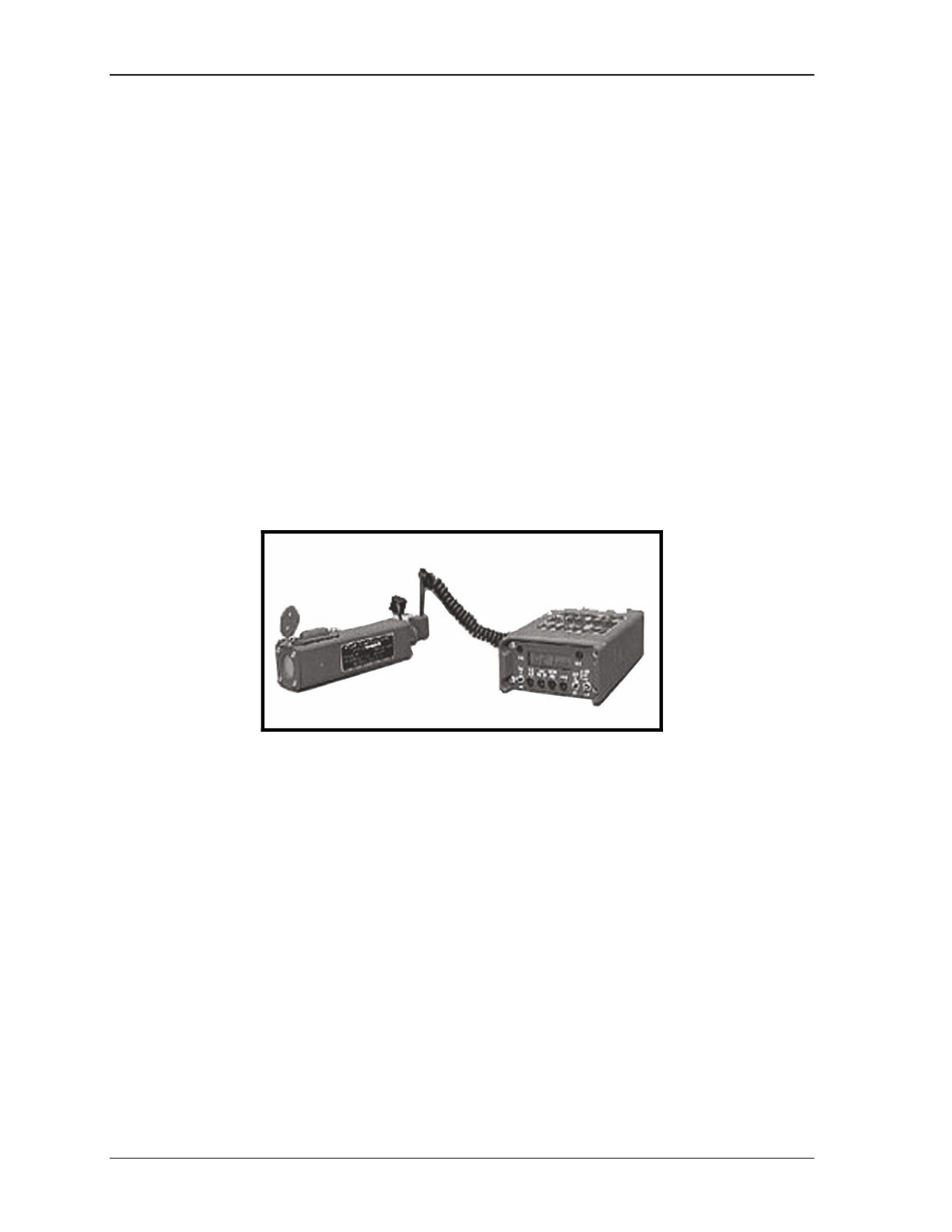
13-55. The AN/VDR 2 is used to perform ground radiological surveys in vehicles or in the dismounted
mode by individual Soldiers as a handheld instrument (Figure 13-12). The set can also provide a
quantitative measure of radiation to decontaminate personnel, equipment, and supplies. The set includes an
audible and/or visual alarm that is compatible with vehicular nuclear, biological, and chemical protective
systems in armored vehicles and also interfaces with vehicular power systems and intercoms.
Figure 13-12. Radiac Set AN/VDR 2.
13-18
FM 3-21.75
28 January 2008
Chemical, Biological, Radiological, or Nuclear Weapons
RADIAC SET AN/UDR 13
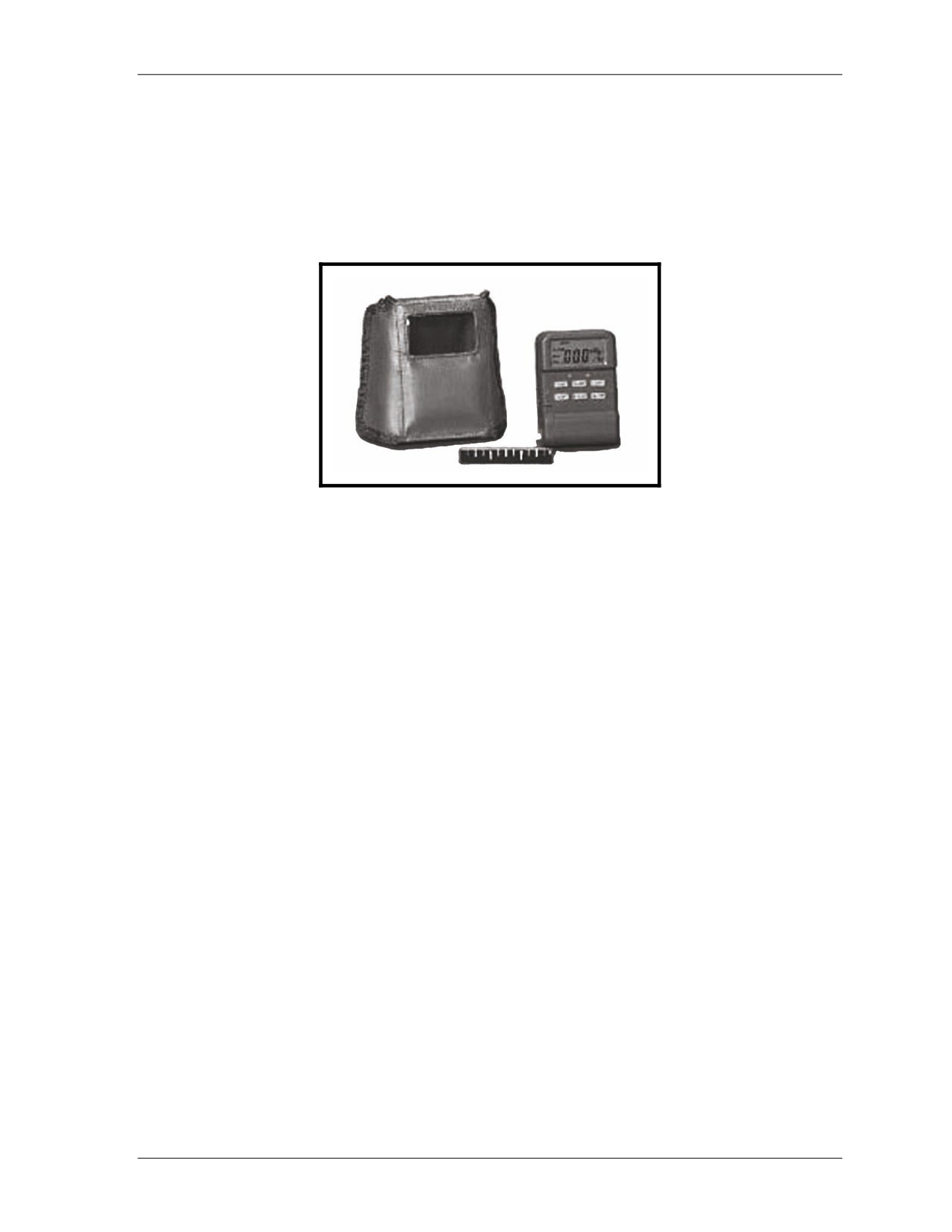
13-56. The AN/UDR 13 is a compact, handheld, or pocket carried, tactical device that can measure
prompt gamma/neutron doses from a nuclear event, plus gamma dose and dose rate from nuclear fallout
(Figure 13-13). A push-button pad enables mode selection, functional control, and the setting of audio and
visual alarm thresholds for both dose rate and mission dose. A sleep mode with automatic wakeup
lengthens battery life. The LCD provides data readout and warning and mode messages.
Figure 13-13. Radiac set AN/UDR 13.
13-57. If detection equipment is unavailable and you suspect that you are contaminated, decontaminate as
required. Procedures for decontamination operations can be found in FM
3-11.5. Radiological
contamination can usually be removed by brushing or scraping. When feasible, move out of the
contaminated area.
13-58. If your unit must remain in the contaminated area, you should stay in a dug-in position with OHC.
If you have time, brush or scoop away the top inch of soil from your fighting position to lower the amount
of radiological contamination affecting you. When time does not permit constructing a well prepared OHC,
use a poncho. Stay under cover. When the fallout is over, brush contamination off yourself and your
equipment. Use water to flush away radiological contamination. However, control the runoff by using
drainage ditches that flow into a sump. As soon as mission permits, wash yourself and your equipment.
Remember, you have not destroyed the contamination; you have just moved it. The runoff will still
be hazardous.
DECONTAMINATION
13-59. Blasts, and thermal and nuclear radiation causes nuclear casualties. Except for radiation casualties,
treat nuclear casualties the same as conventional casualties. Wounds caused by blast are similar to other
combat wounds. Thermal burns are treated as any other type of burn. The exposure of the human body to
nuclear radiation causes damage to the cells in all parts of the body. This damage is the cause of "radiation
sickness." The severity of this sickness depends on the radiation dose received, the length of exposure, and
the condition of the body at the time. The early symptoms of radiation sickness will usually appear 1 to 6
hours after exposure. Those symptoms may include headache, nausea, vomiting, and diarrhea. Early
symptoms may then be followed by a latent period in which the symptoms disappear. There is no first aid
for you once you have been exposed to nuclear radiation. The only help is to get as comfortable as possible
while undergoing the early symptoms. If the radiation dose was small, the symptoms, if any, will probably
go away and not recur. If the symptoms recur after a latent period, you should go to an aid station. A blast
can crush sealed or partly sealed objects like food cans, barrels, fuel tanks, and helicopters. Rubble from
buildings being knocked down can bury supplies and equipment. Heat can ignite dry wood, fuel,
tarpaulins, and other flammable material. Light can damage eyesight. Radiation can contaminate food and
water.
28 January 2008
FM 3-21.75
13-19
Chapter 13
PROTECTION
13-60. An attack occurring without warning is immediately noticeable. The first indication will be very
intense light. Heat and initial radiation come with the light, and the blast follows within seconds. Nuclear
attack indicators are unmistakable. The bright flash, enormous explosion, high winds, and mushroom
shaped cloud clearly indicate a nuclear attack. An enemy attack would normally come without warning.
Initial actions must, therefore, be automatic and instinctive. The best hasty protection against a nuclear
attack is to take cover behind a hill or in a fighting position, culvert, or ditch. Time available to take
protective action will be minimal. When in a fighting position, you can take additional precautions. The
fighting position puts more earth between you and the potential source of radiation. You can curl up on one
side, but the best position is on the back with knees drawn up to the chest. This position may seem
vulnerable, but the arms and legs are more radiation resistant and will protect the head and trunk. However,
if you’re exposed while in the open when a detonation occurs, you should do the following:
• Drop face down immediately, with your feet facing the blast. This will lessen the possibility of
heat and blast injuries to your head, face, and neck. A log, a large rock, or any depression in the
earth’s surface provides some protection.
• Close eyes.
• Protect exposed skin from heat by putting hands and arms under or near the body and keeping
the helmet on.
• Remain facedown until the blast wave passes and debris stops falling.
• Remain calm, check for injury, check weapons and equipment for damage, and prepare to
continue the mission.
13-20
FM 3-21.75
28 January 2008
Chapter 14
Mines, Demolitions, and Breaching Procedures
A unit may use mines during security, defensive, and offensive operations in order to
reduce the enemy’s mobility. In such operations, you must emplace the mines and,
when required, retrieve them. In order to breach minefields and wire obstacles; there
will be times when you have to physically detect and clear them. You must be
proficient at correctly and safely handling demolition firing systems. This chapter
will help you gain a true appreciation of the requirements and time it takes to perform
an actual mine-warfare mission.
Section I. MINES
This section discusses antipersonnel and antitank mines. Some mines are "smart." That is, they contain RF
receivers, which allow for remote or automatic self-destruction or self-deactivatation via a remote control unit
(RCU), on demand, after a period of time, or at a particular time. The default self-destruct time, once the mines
are dispensed, is four hours.
28 January 2008
FM 3-21.75
14-1
Chapter 14
ANTIPERSONNEL MINES
14-1.
Antipersonnel mines are designed specifically to reroute, block, or protect friendly obstacles
These mines are designed to kill or disable their victims, and are activated by command detonation.
US NATIONAL POLICY
ON
ANTIPERSONNEL LAND MINES
On May 16, 1996, the President of the United States implemented a phased restriction and
elimination of antipersonnel land mines. Implementation began with non-self-destructing mines,
but will eventually include all types of antipersonnel mines. This policy applies to all Infantry
units either engaged in or training for operations worldwide. The use of non-self-destructing
antipersonnel land mines is restricted to specific areas:
•
Within internationally recognized national borders.
•
In established demilitarized zones such as to defend South Korea.
Mines approved for use must be emplaced in an area with clearly marked perimeters. They
must be monitored by military personnel and protected by adequate means to ensure the
exclusion of civilians.
US policy also forbids US forces from using standard or improvised explosive devices as
booby traps.
Except for South Korea-based units, and for units deploying to South Korea for training
exercises, this policy forbids training with and employing inert M14 and M16 mines. This
applies to units' home stations as well as at Combat Training Centers, except in the context of
countermine or mine removal training.
•
Training with live M14 mines is UNAUTHORIZED!
•
Training with live M16 mines is authorized only for Soldiers on South Korean soil.
Exceptions:
This policy does not apply to standard use of antivehicular mines. Nor does it apply to training
and using the M18 Claymore mine in the command-detonated mode.
When authorized by the appropriate commander, units may still use self-destructing
antipersonnel mines such as the ADAM.
Authorized units may continue to emplace mixed minefields containing self-destructing
antipersonnel land mines and antivehicular land mines such as MOPMS or Volcano.
The terms mine, antipersonnel obstacle, protective minefield, and minefield do not refer to an
obstacle that contains non-self-destructing antipersonnel land mines or booby traps.
Any references to antipersonnel mines and the employment of minefields should be considered
in the context of this policy.
M18A1 ANTIPERSONNEL MINE (CLAYMORE)
14-2.
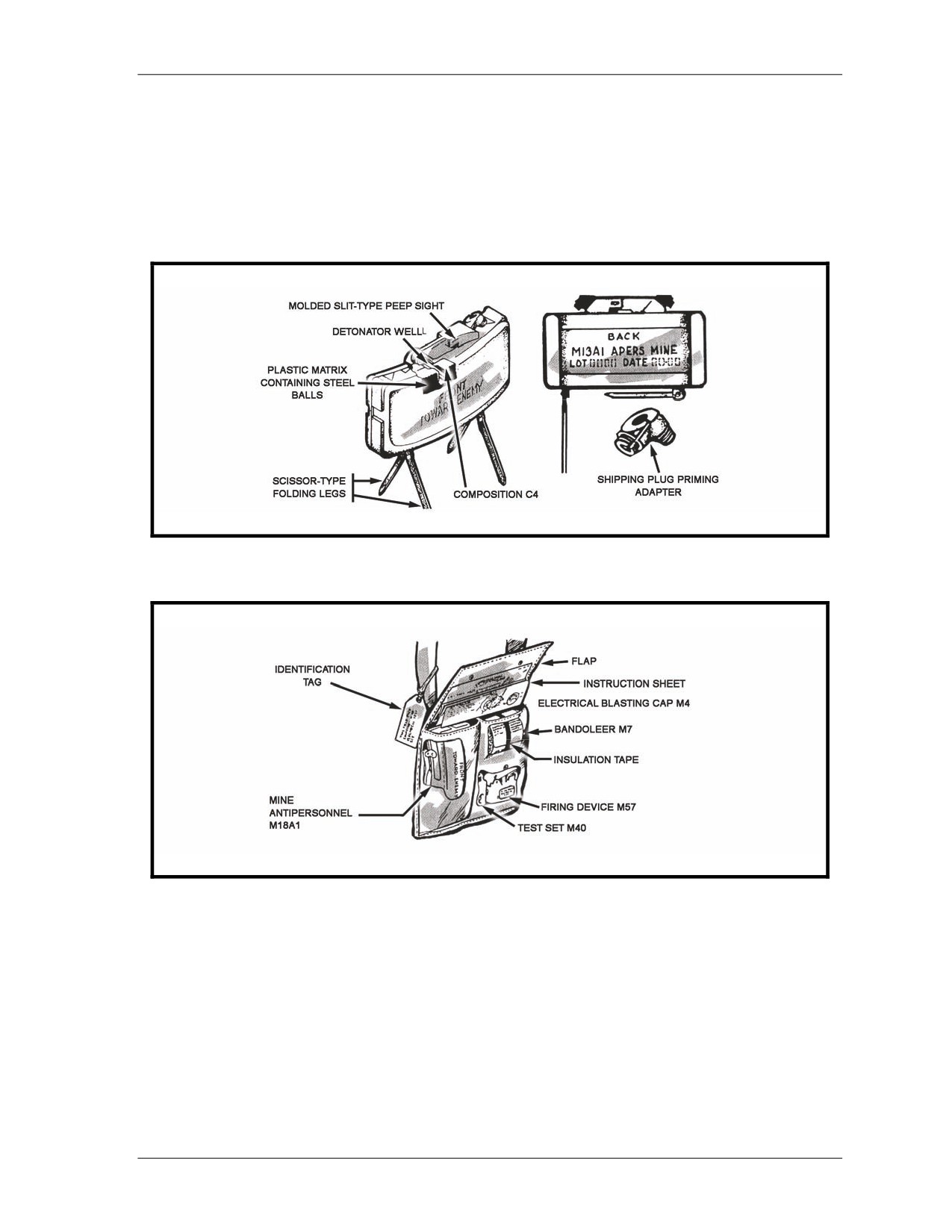
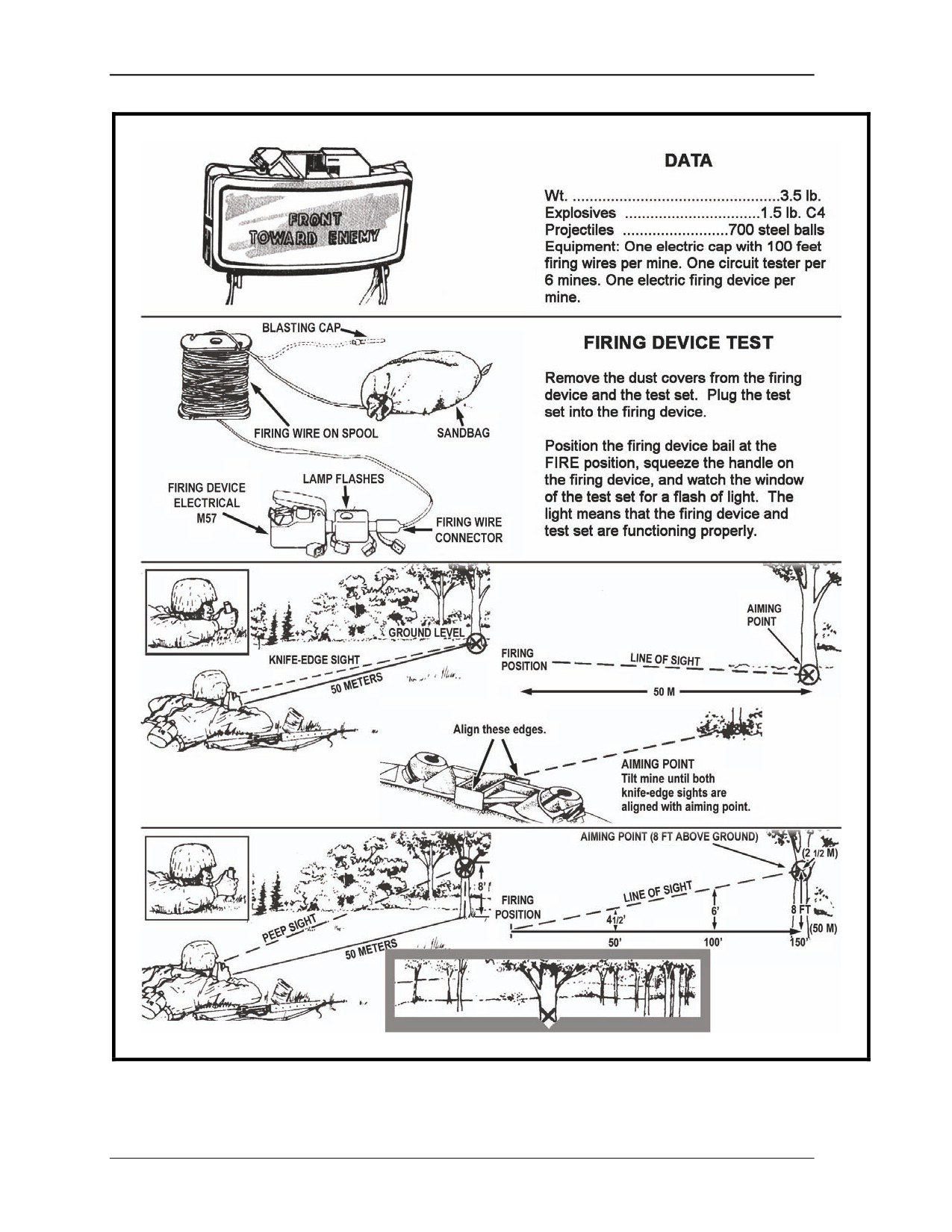
The M18A1, also known as the Claymore mine, is a directional, fragmentating (one-time use)
antipersonnel mine
(Figure 14-1, Figure 14-2, and Figure 14-3
[page 14-4]). The Claymore weighs
1.6 kilograms (3.5 pounds), 0.68 kilograms (1.5 pounds) of which is C4 (explosive) and steel sphere
projectiles. One Claymore and its accessories are carried in the M7 bandoleer (Figure 14-2). When
detonated, the Claymore projects steel fragments over a
60-degree, fan-shaped pattern about 6 feet
(1.8 meters) high and 164 feet (50 meters) wide, at a range of 50 meters. This pattern of distribution is very
14-2
FM 3-21.75
28 January 2008
Mines, Demolitions, and Breaching Procedures
effective up to 50 meters, moderately effective to 100 meters, and still dangerous out to 250 meters. It has
the following features:
• A fixed plastic sight.
• Folding, adjustable legs.
• Two detonator wells.
• Olive-drab plastic case.
Figure 14-1. M18A1 antipersonnel mine.
Figure 14-2. M7 bandoleer.
28 January 2008
FM 3-21.75
14-3
Chapter 14
Figure 14-3. M18A1 antipersonnel mine data.
14-4
FM 3-21.75
28 January 2008
Mines, Demolitions, and Breaching Procedures
Employment
14-3.
The Claymore is mainly a defensive weapon used to support other weapons in a unit's final
protective fires. The Claymore may also be employed in some phases of offensive operations. Complete
instructions for installing, arming, testing, and firing the Claymore are attached to the flap of the bandoleer.
If possible, read the directions before employing the mine.
Emplacement for Command Detonation
14-4.
Inventory the M7 bandoleer, ensuring all components of the M18A1 Claymore mine are present
and in serviceable condition. Components consist of an M18A1 Claymore mine, M57 firing device, M40
test set, and a firing wire with blasting cap.
•
Conduct a circuit test, with the blasting cap secured under a sandbag.
•
Install the M18A1 Claymore mine.
•
Aim the mine.
•
Arm the mine.
•
Recheck the aim.
•
Recheck the circuit.
•
Fire the M18A1 Claymore mine.
Recovery
•
Check the firing device safety bail to ensure it is on SAFE.
•
Disconnect the firing device from the wire.
•
Replace the shorting plug dustcover on the firing wire connector.
•
Replace the dustcover on the firing device connector.
•
Keep possession of the M57 firing device.
•
Untie the firing wire from the firing site stake.
•
Move to the mine.
•
Remove the shipping plug before priming.
•
Separate the blasting cap from the mine.
•
Reverse the shipping plug.
•
Screw the shipping plug end into the detonator well.
•
Remove the firing wire from the site stake.
•
Place the blasting cap into the end of the wire connector.
•
Roll the firing wire on the wire connector.
•
Lift the mine from its emplacement.
•
Secure the folding legs.
•
Repack the mine and all the accessories in the M7 bandoleer.
M-131 MODULAR PACK MINE SYSTEM
14-5.
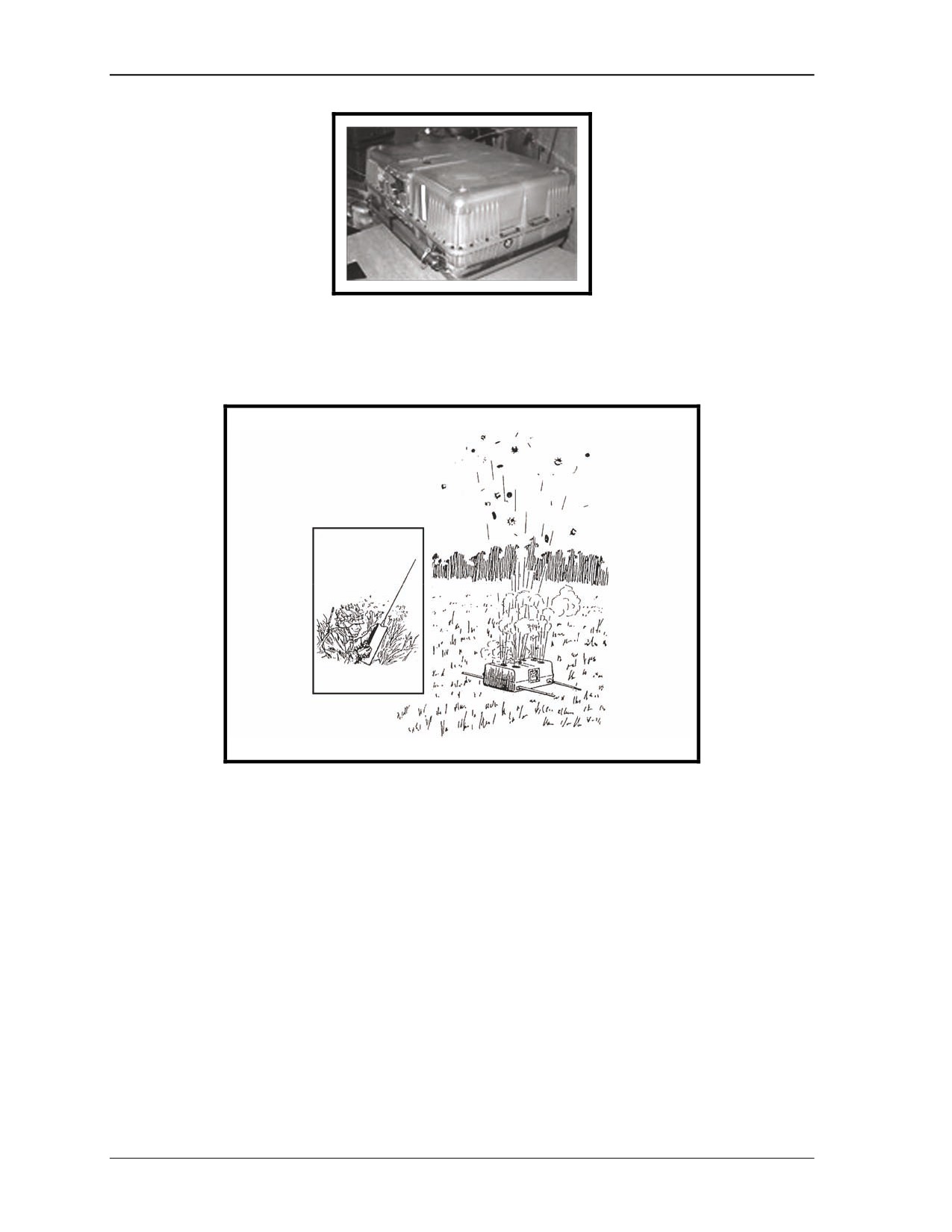
The MOPMS is a man-portable antitank and antipersonnel mine system (Figure 14-4). The M-131
module weighs about 165 pounds (75 kilograms), and contains a mix of 17 M78 antiarmor and 4
M77 antipersonnel mines. The MOPMS module may be initiated by hardwire or radio control. The
hardwire capability uses wire and electrical firing devices. The M-71 handheld radio control unit (RCU)
allows one Soldier to control as many as 15 groups of MOPMS modules from a remote location.
28 January 2008
FM 3-21.75
14-5
Chapter 14
Figure 14-4. M-131 Modular Pack Mine System (MOPMS).
14-6.
This mine deploys four trip wires upon ejection. These wires trip a fragmenting kill mechanism
(Figure 14-5).
Figure 14-5. M-131 MOPMS deployed.
14-7.
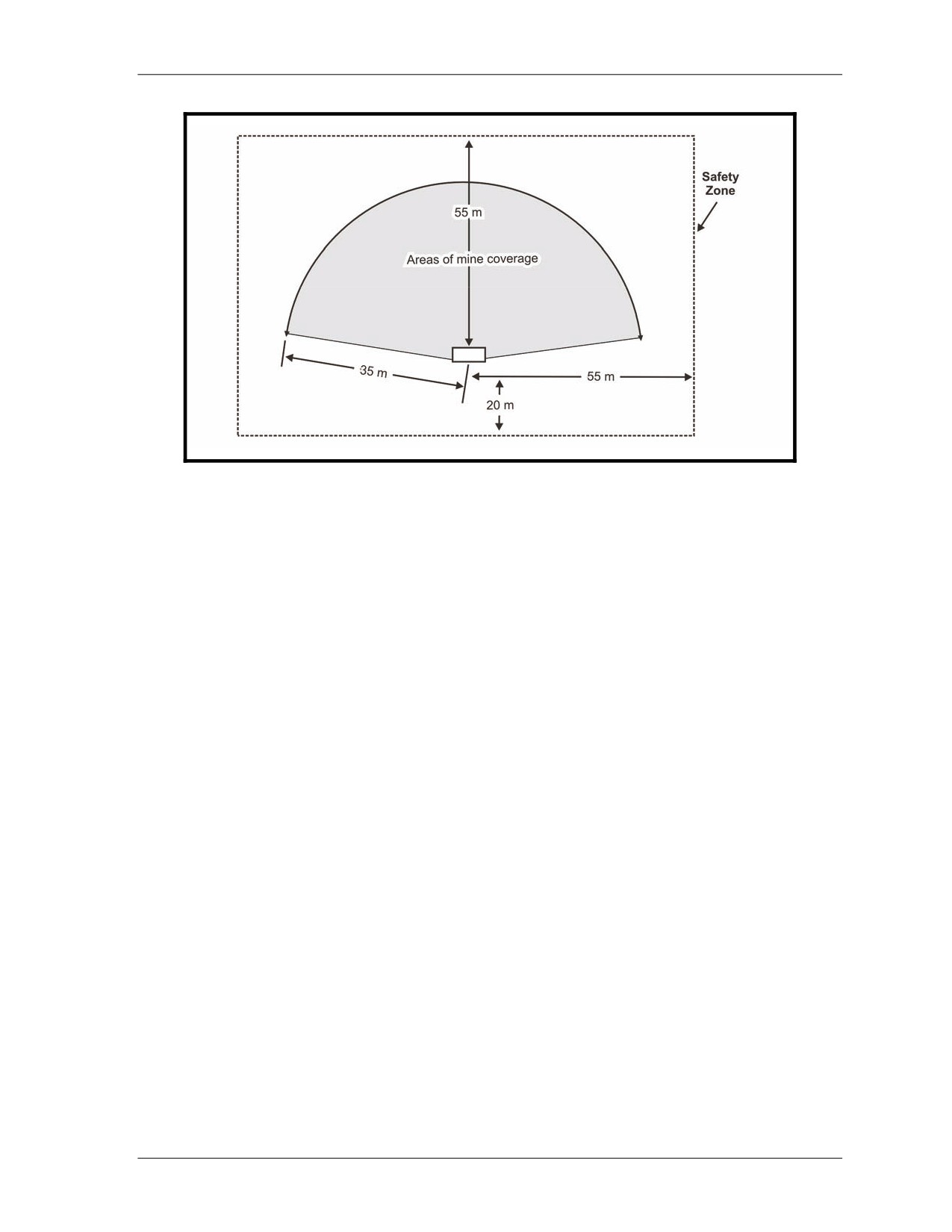
Each dispenser contains seven tubes; three mines are located in each tube. When dispensed, an
explosive propelling charge at the bottom of each tube expels mines through the container roof. Mines are
propelled 115 feet (35 meters) from the container in a 180-degree semicircle (Figure 14-6). The resulting
density is 0.01 mine per square meter. The safety zone around one container is 180 feet (55 meters) to the
front and sides and 66 feet (20 meters) to the rear.
14-6
FM 3-21.75
28 January 2008
Mines, Demolitions, and Breaching Procedures
Figure 14-6. MOPMS emplacement and safety zone.
14-8.
You can disarm and recover the container for later use, if mines are not dispensed. The RCU can
recycle the 4-hour self-destruct time of the mines three times, for a total duration of 16 hours (4 hours after
initial launch and three 4-hour recycles). This feature makes it possible to keep the minefield in place for
longer periods, if necessary. The RC can also self-destruct mines on command. However, once the mines
are dispensed they cannot be recovered or reused.
M21 ANTITANK MINE
14-9.
Antitank mines are pressure activated, but are typically designed so that the force of a footstep
will not detonate them. Most antiarmor mines require an applied pressure of 348 to 745 pounds (158 to
338 kilograms) in order to detonate. Most tanks and other military vehicles apply that kind of pressure.
Most antiarmor mines go off on contact, but some are designed to count a preset number of pressures
before going off. By delaying detonation, a large number of enemy vehicles and troops might travel deep
within the minefield before knowing the area is dangerous. The US policy for the use of
non-self-destructing antitank mines applies until 2010, when these mines must be replaced by models that
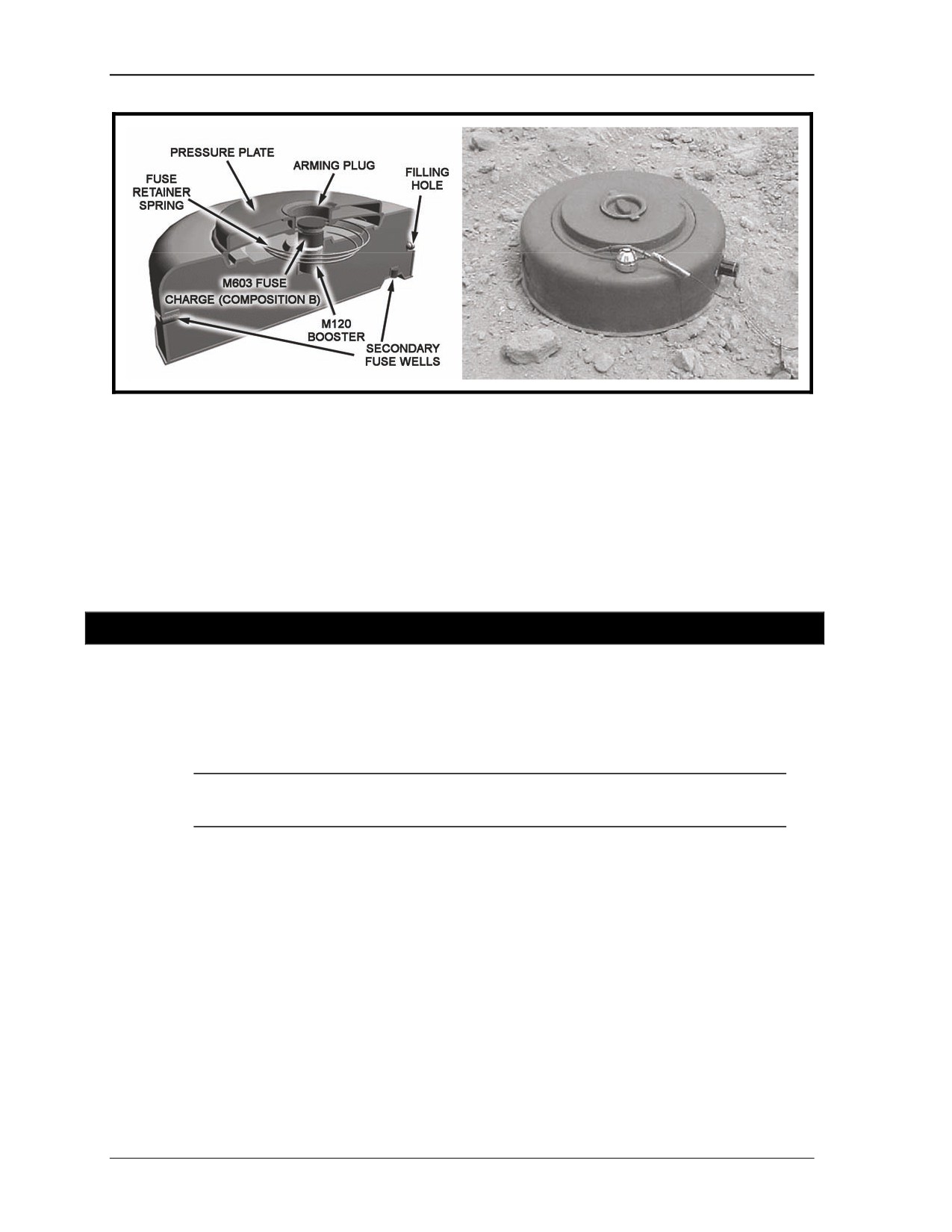
either self-destruct or at least self-deactivate. The M21 is a circular, steel bodied, antiarmor mine designed
to damage or destroy vehicles by a penetrating effect (Figure 14-7). The bottom of the mine is crimped to
the upper mine body. An adjustable cloth carrying handle is attached to the side of the mine body and a
large filler plug is positioned between the handle connection points. A booster well is centered on the
bottom. The mine has a small diameter fuse cavity and a stamped radial pattern centered on top. The M21
is 9 inches (23 centimeters) in diameter and 4 1/2 inches (11 centimeters) high. It weighs a total of 17
pounds (8 kilograms) with 11 pounds (5 kilograms) of high explosives. The M607 fuse protrudes from the
top. This mechanical fuse can be used with or without a tilt rod. Without the tilt rod, it works like a normal
pressure fuse.
28 January 2008
FM 3-21.75
14-7
Chapter 14
Figure 14-7. M21 antitank mine and components.
14-10. The M21 is activated by 1.8 kilograms (4 pounds) of pressure against a 21-inch (53-centimeter)
long extension rod or, without the rod, by 290 pounds (132 kilograms) of vertical pressure on top of the
M607 fuse. Once the fuse is triggered, it releases a firing pin, which is driven into the M46 detonator,
which in turn sets off a small, black powder charge. This charge blows off the top of the mine, exposing a
convex steel plate. It also drives another firing pin into an M42 primer, which in turn fires the main charge.
The main charge blows the body apart and blasts the steel plate upwards through the belly armor of the
tank. Unlike most antiarmor mines, this one can actually kill a tank, not just disable it. It uses a
Miznay-Schardin plate as a directed-energy warhead; a kill mechanism for belly-kill and track-breaking
capability. The M21 produces a kill against heavy tanks, unless the mine is activated under the track.
Section II. DEMOLITION FIRING SYSTEMS
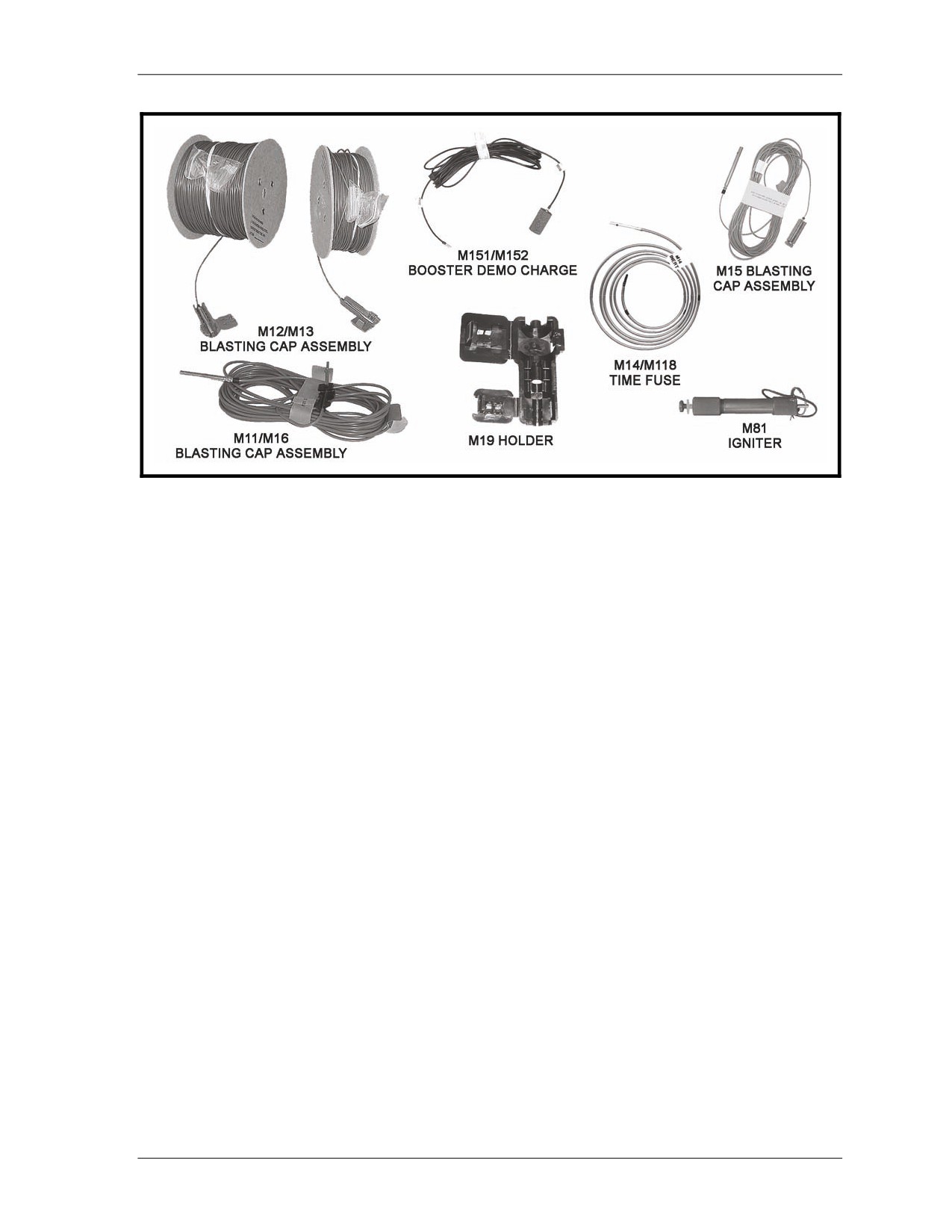
The moderized demolition initiator (MDI) is a suite of initiating components used to activate all standard
military demolitions and explosives (Figure 14-8). The MDI consists of nonelectric blasting cap assemblies
(M11/12/13/14/15/16/18) each with an integral time-delay initiator; a time fuse or shock tube; and a "J" hook
for attachment to a detonating cord. These MDIs will eventually replace all electric and nonelectric firing
systems for conventional forces, while maintaining compatibility with existing Army systems.
Note: Information on the preparation and placement of demolition charges for electric and
nonelectric firing systems separate from MDI is in FM 3-34.214.
BOOSTER ASSEMBLIES
14-11. The MDI includes a pair of booster assemblies (M151/M152), consisting of a detonator (det) and
a length of low-strength detonation cord, were added to MDI. Since they contain no sensitive initiating
element, they can be used to safely initiate underground charges. The MDI’s blasting cap assemblies
consist of five high-strength blasting caps and two high strength booster assemblies. These cap assemblies
can be used to prime standard military explosives, or to initiate the shock tube or detonation cord of other
MDI components. MDI also contains an igniter (M81) that can activate either time fuse or shock tube.
With MDI, you can successfully complete demolition missions in a safe, quick, and easy manner. It is also
flexible enough that any unit conducting demolition activities can use it. Timing can be set to fire
immediately or up to a 20-minute delay. It is nonelectrical, so it is impervious to EMP.
14-8
FM 3-21.75
28 January 2008
Mines, Demolitions, and Breaching Procedures
Figure 14-8. MDI components.
PRIMING OF EXPLOSIVES
14-12. The two methods of priming explosive charges are nonelectric (MDI) and detonating cord. MDI
priming is safer and more reliable than the current nonelectric cap priming methods. However, detonating
cord is the most preferred method of priming charges since it involves fewer blasting caps and makes
priming and misfire investigation safer.
14-13. MDI blasting caps are factory-crimped to precut lengths of shock tube or time-blasting fuse.
Because the caps are sealed, they are resistant to moisture and will not misfire in damp conditions. Splicing
compromises the integrity of the system, and moisture will greatly reduce reliability. Also, the human
factor in incorrect crimping is removed, making MDI blasting caps extremely reliable.
PRIMING OF NONELECTRIC MDI
14-14. Use only high-strength MDI blasting caps (M11, M16, M14, M15, or M18) to prime explosive
charges. M12 and M13 relay-type blasting caps have too little power to reliably detonate most explosives.
Use them only as transmission lines in firing systems. You can use MDI blasting caps with priming
adapters, or you can insert them directly into the explosive charge, and then secure them with black
electrical tape. If you use priming adapters, place them on M11 blasting caps as follows:
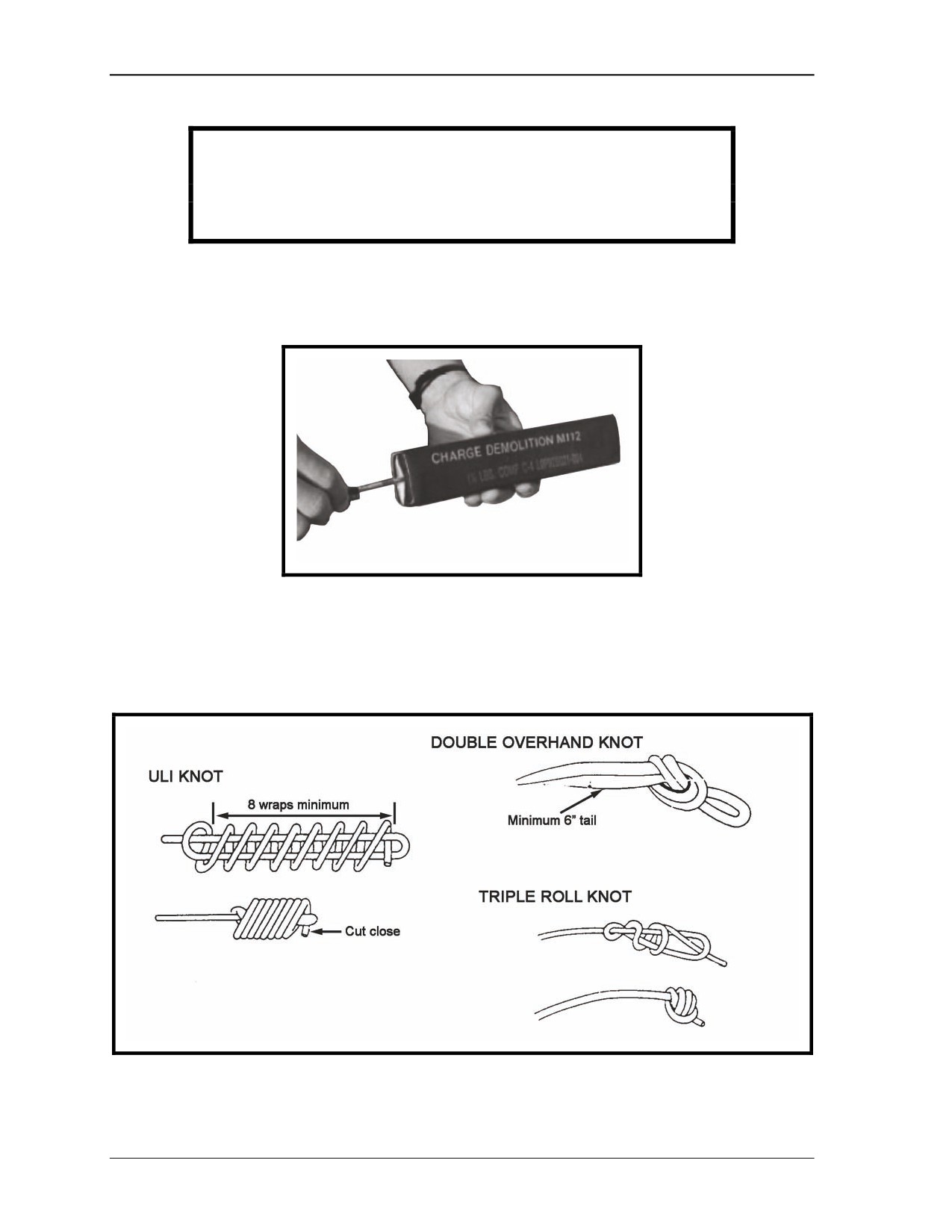
Priming Plastic Explosives with Nonelectric MDI--(See Figure 14-9.)
1. Use M2 crimpers or other nonsparking tools to make a hole in one end or on the side (at the
midpoint) of the M112 (C4) demolition block. The hole should be large enough to hold an
M11, M16, M14, M18, or M15 blasting cap.
2. Insert an M11, M16, M14, M18, or M15 blasting cap into the hole produced by the
M2 crimpers.
28 January 2008
FM 3-21.75
14-9
Chapter 14
WARNING
If the blasting cap does not fit, do not force it!
Instead, make the hole larger.
3. Anchor the blasting cap in the demolition block by gently squeezing the C4 plastic explosive
around the blasting cap.
4. Use tape to secure the cap in the charge M112.
Figure 14-9. Priming of C4 demolition blocks with MDI.
PRIMING OF DETONATING CORD
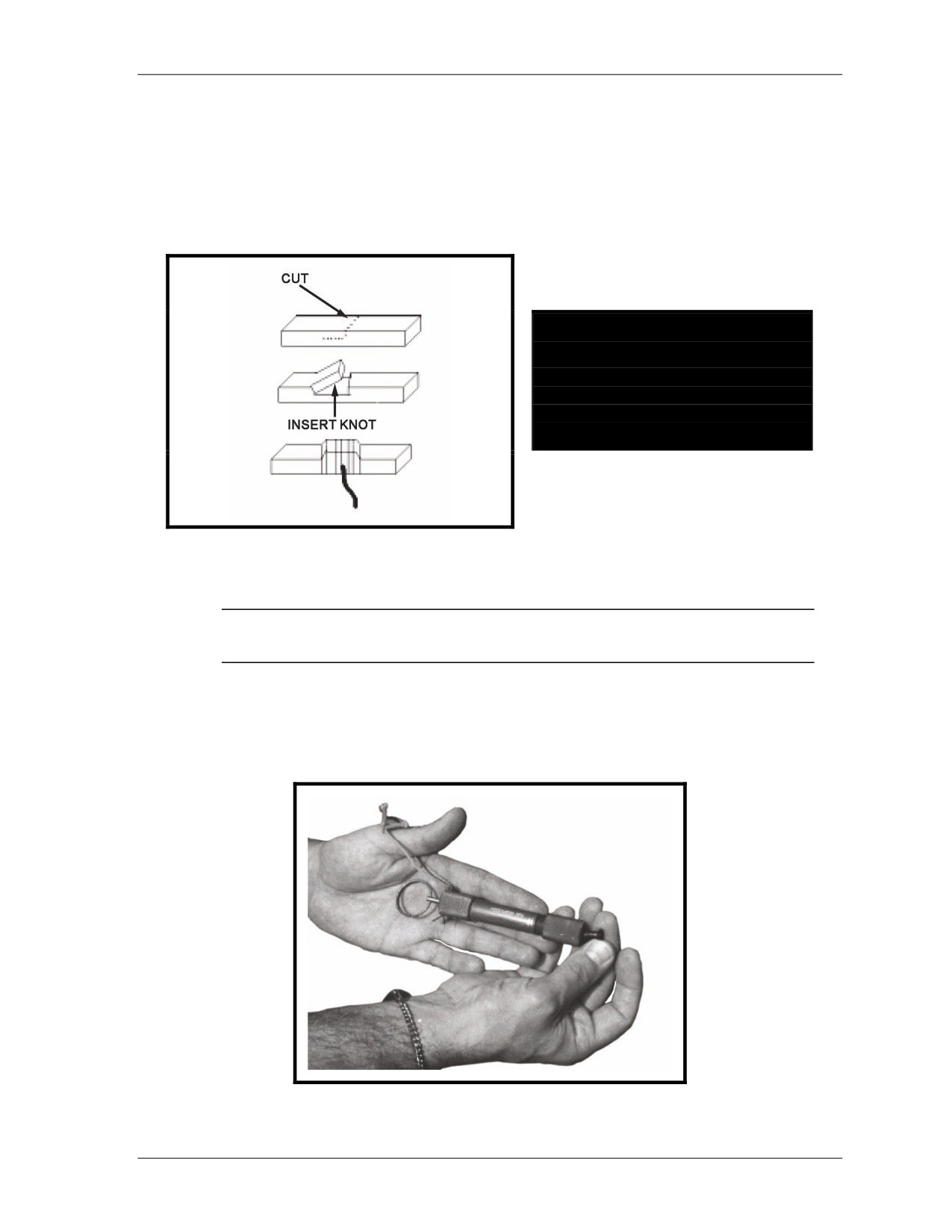
1. Form either a uli knot, double overhand knot, or triple roll knot as shown in Figure 14-10.
Figure 14-10. Priming of C4 demolition blocks with detonating cord.
14-10
FM 3-21.75
28 January 2008
Mines, Demolitions, and Breaching Procedures
2. Cut an L-shaped portion of the explosive, still leaving it connected to the explosive. Ensure
the space is large enough to insert the knot you formed (Figure 14-11).
3. Place the knot in the L-shaped cut.
4. Push the explosive from the L-shaped cut over the knot. Ensure there is at least 1 centimeter
(1/2 inches) of explosive on all sides of the knot.
5. Strengthen the primed area by wrapping it with tape.
DANGER
To cut explosives,
use a sharp, nonsparking knife
on a nonsparking surface.
Figure 14-11.
Priming of C4 with L-shaped charge.
Note: Do not prime plastic explosives by wrapping them with detonating cord, since wraps
will not properly detonate the explosive charge.
CONSTRUCTION OF NONELECTRIC INITIATING ASSEMBLY WITH MDI
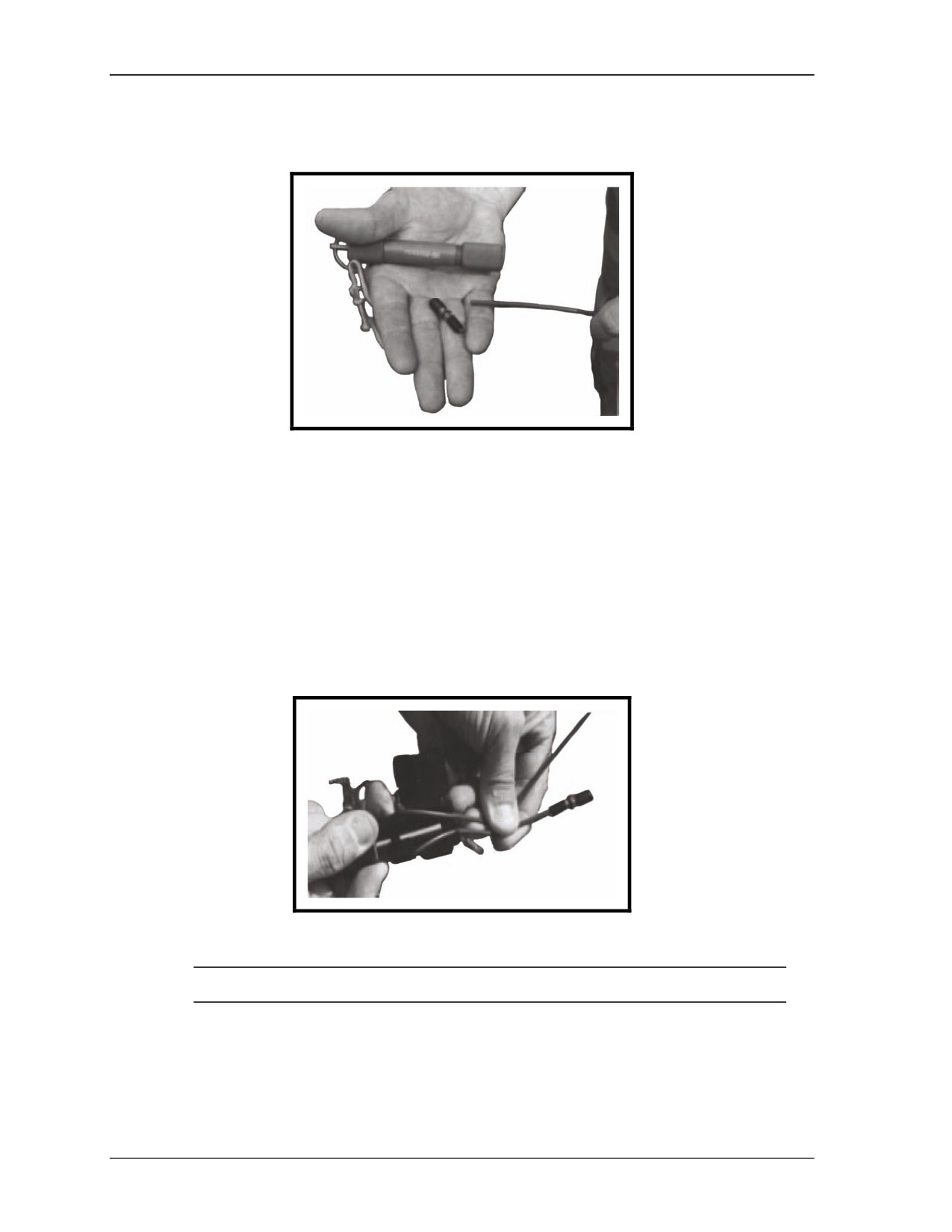
1. Turn the end cap of the M81 fuse igniter a half-turn counterclockwise, and remove both the
shipping plug and the shock tube adapter from the igniter (Figure 14-12).
Figure 14-12. Preparation of M81 fuse igniter.
28 January 2008
FM 3-21.75
14-11
Chapter 14
2. Cut off the sealed end of the M14 time-delay fuse (Figure 14-13), and insert it into the end
cap of the M81. Tighten (finger-tight) by turning the end cap clockwise.
Figure 14-13. M81 fuse igniter with the M14 time fuse delay.
3. Attach the blasting-cap end of the M14 time-delay fuse to the existing detonating-cord
ring/line main using either an M9 holder or adhesive tape. If using tape, ensure it is at least 6
inches from the end of the detonating cord.
a. Attach the M14 blasting cap using the M9 holder (the preferred method).
b. Open both hinged flaps of the M9 holder.
c. Insert the blasting cap into the M9 holder and close the small hinged flap.
d. Form a bight 6 inches from the end of the detonating cord, lay it in the M9 holder, and
close the hinged flap.
e. Secure the detonating cord into the M9 holder (Figure 14-14). Secure the door with
adhesive tape.
Figure 14-14. M81 fuse igniter with the M9 holder.
Note: Do not loop more than two shock tubes in the M9 holder.
4. Construct a nonelectric initiating assembly using the M11 branch line and the M12
transmission line.
a. Place the M11 branch line’s blasting cap under a sandbag near the detonating-cord firing
system.
14-12
FM 3-21.75
28 January 2008
Mines, Demolitions, and Breaching Procedures
b. Attach the M11 branch line to the M12 transmission line by forming a bight at the end of
the M11, laying it in the attached M9 holder on the M12, and closing the hinged flap.
Tape and secure the M11 into place. Place the M9 holder, along with the M12, under the
same sandbag as the M11 blasting cap.
c. Retrieve the M11 blasting cap from under the sandbag. Attach it to the detonating-cord
firing system using an M9 holder as described above using either the M14 or adhesive
tape. Ensure the tape is at least 6 inches from the end of the detonating cord.
d. Secure the transmission line to a nearby anchor point and run the M12 transmission line
back to the initiating point.
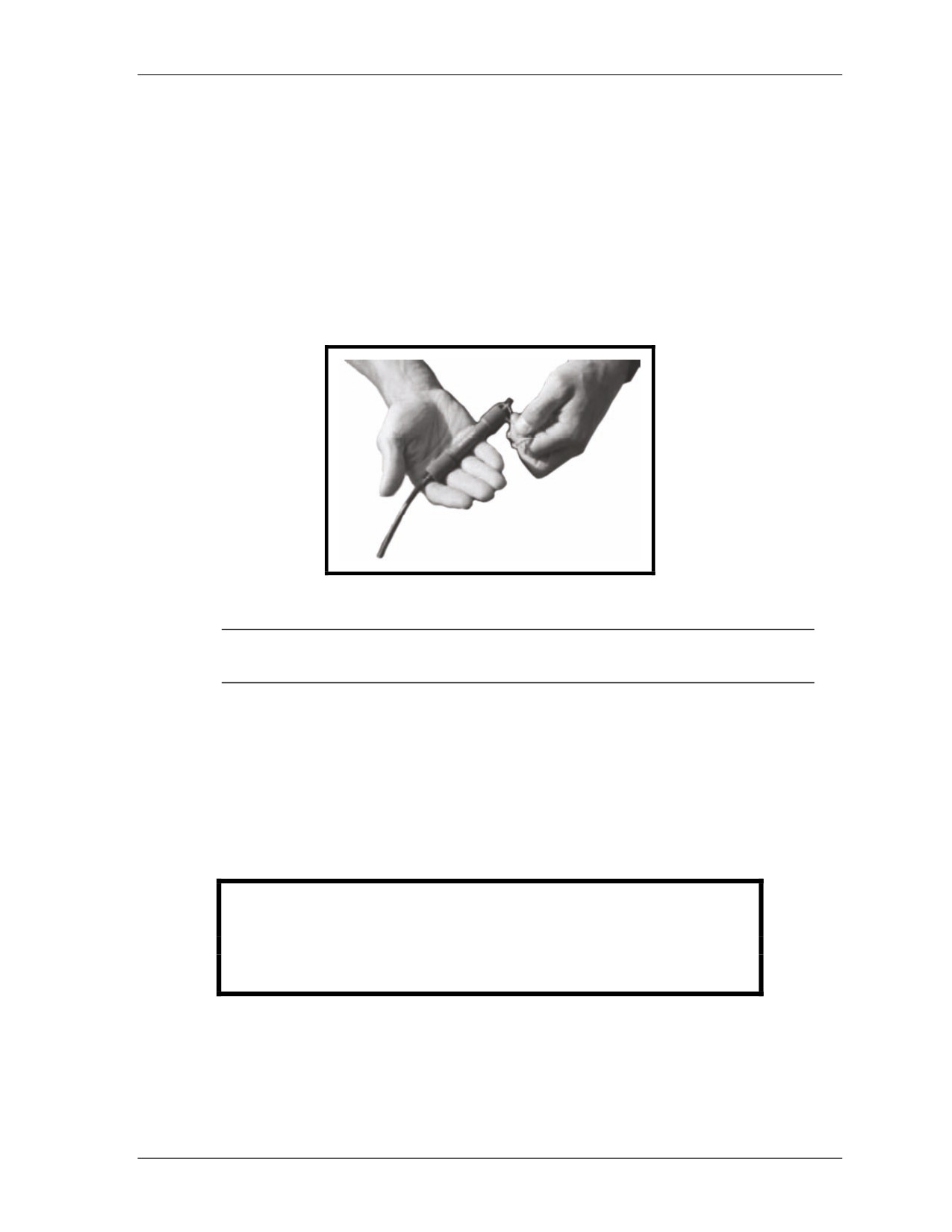
5. Cut the sealed end of the M12 transmission line at the initiating point, and attach an M81 fuse
igniter as described above for the M14 time-delay fuse (Figure 14-15).
Figure 14-15. M81 fuse igniter with the M14 time fuse delay.
Note: MDI systems come with short clear plastic tubes used for repair. The shock tube
repair procedure is outlined in TM 9-1375-213-12, Army Demolition.
6. Firing procedure for a nonelectric initiating assembly with MDI.
a. Squeeze the spread legs of the safety cotter pin together.
b. Use the safety pin’s cord to remove the safety cotter pin from the igniter’s body.
c. Grasp the igniter body firmly with one hand, with the pull ring fully accessible to the
other hand. To actuate, sharply pull the igniter’s pull ring. The igniter can burn at
extremely high temperatures.
d. Ensuring that smoke is coming from the fuse (or out of the vent hole in the igniter),
remove the igniter and withdraw to a safe distance or to appropriate cover.
WARNING
When using MDI in extreme cold temperatures and/or high
altitudes, dual prime and dual initiate the charges.
MISFIRES
14-15. The most common cause of a misfire in a shock-tube firing system is the initiating element,
usually an M81 igniter. However, the most common failure with the M81 is primer failure to fire. To
28 January 2008
FM 3-21.75
14-13
Chapter 14
correct this, recock the M81 by pushing in on the pull rod to reengage the firing pin and then actuate the
igniter again. If, after two retries, the M81 does not result in firing, cut the shock tube, replace the igniter
with a new one, and repeat the firing procedure.
14-16. Another misfire mode with the M81 is the primer fires but blows the shock tube out of its securing
mechanism without it firing. (This is usually due to the shock tube not being properly inserted and secured
in the igniter.) To correct this problem, cut about 91 centimeters (3 feet) from the end of the shock tube,
replace it with a new igniter, and repeat the firing procedure.
Note: Your supervisor needs to be involved to identify and correct any additional misfire
problems. The correct procedure to implement for all possible misfires is in
FM 3-34.214.
Section III. OBSTACLES
This section discusses how to breach and cross a minefield or wire obstacle.
BREACH AND CROSS A MINEFIELD
14-17. In combat, enemy units use obstacles to stop slow or channel their opponent’s movement. Because
of that, you may have to bypass or breach (make a gap through) those obstacles in order to continue your
mission. There are many ways to breach a minefield. One way is to probe for and mark mines to clear a
footpath through the minefield.
PROBING FOR MINES
1. Leave your rifle and LCE with another Soldier in the team.
2. Leave on your Kevlar helmet and vest to protect you from possible blasts.
3. Get a wooden stick about 30 centimeters (12 inches) long for a probe and sharpen one of the
ends. Do not use a metal probe.
DANGER
Do not use a metal probe.
4. Place the unsharpened end of the probe in the palm of one hand with your fingers extended
and your thumb holding the probe.
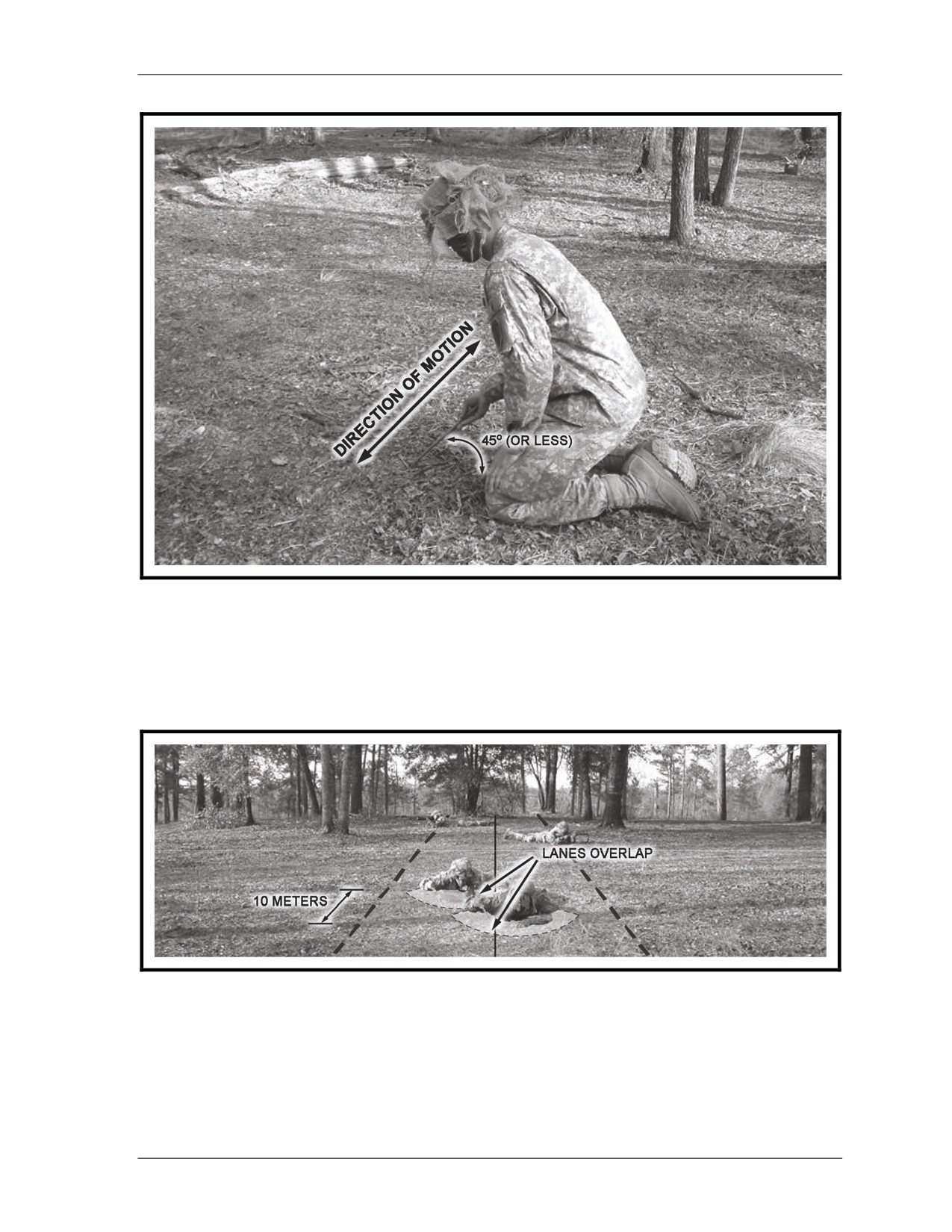
5. Probe every 5 centimeters (2 inches) across a l-meter front. Push the probe gently into the
ground at an angle less than 45 degrees (Figure 14-16).
6. Kneel (or lie down) and feel upward and forward with your free hand to find tripwires and
pressure prongs before starting to probe.
7. Put just enough pressure on the probe to sink it slowly into the ground. If the probe does not
go into the ground, pick or chip the dirt away with the probe and remove it by hand.
14-14
FM 3-21.75
28 January 2008
Mines, Demolitions, and Breaching Procedures
Figure 14-16. Mine probe.
8. Stop probing when the probe hits a solid object.
9. Remove enough dirt from around the object to find out what it is.
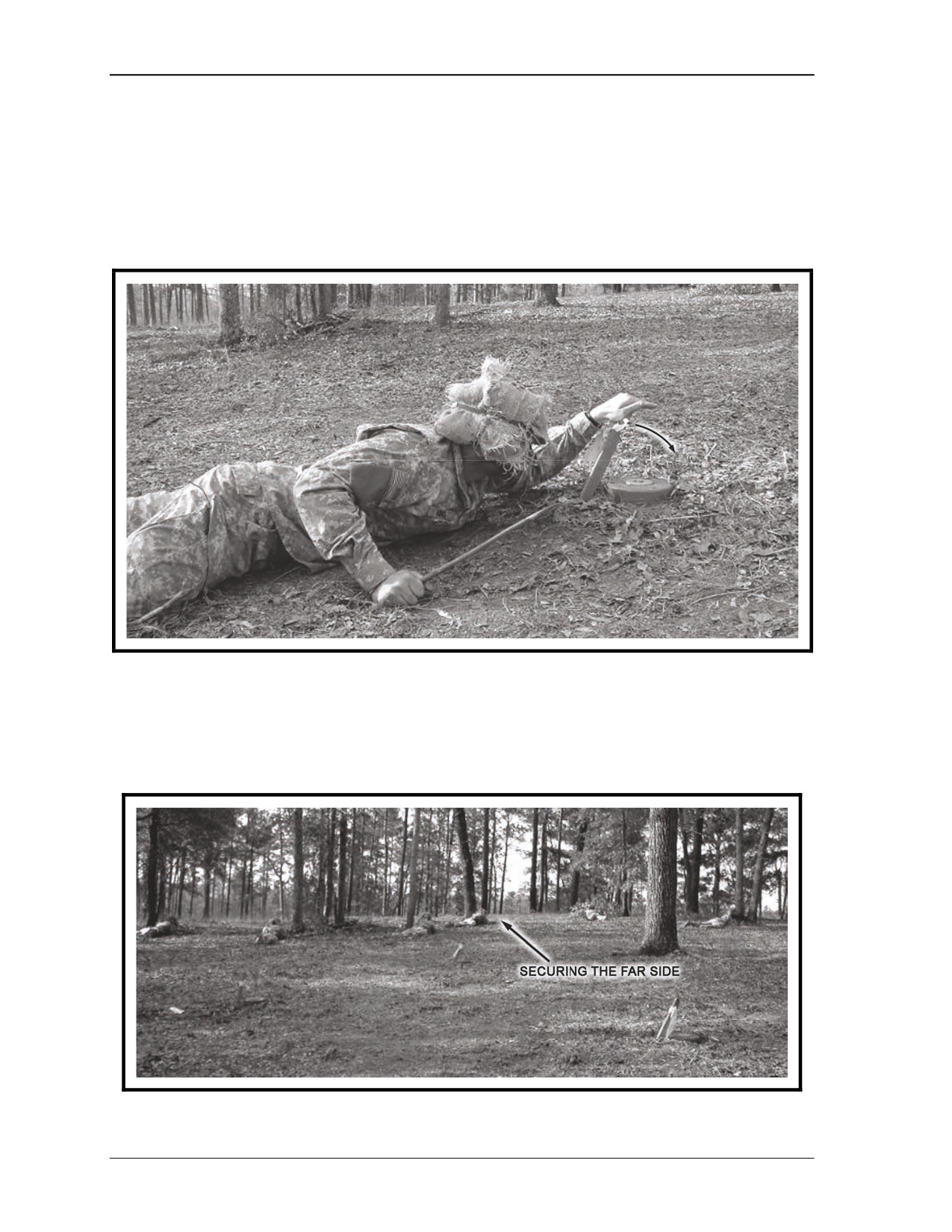
10. Clear a lane in depth of 10-meter (33 feet) intervals and ensure the lane overlaps
(Figure 14-17).
Figure 14-17. Lanes.
28 January 2008
FM 3-21.75
14-15
Chapter 14
MARKING THE MINE
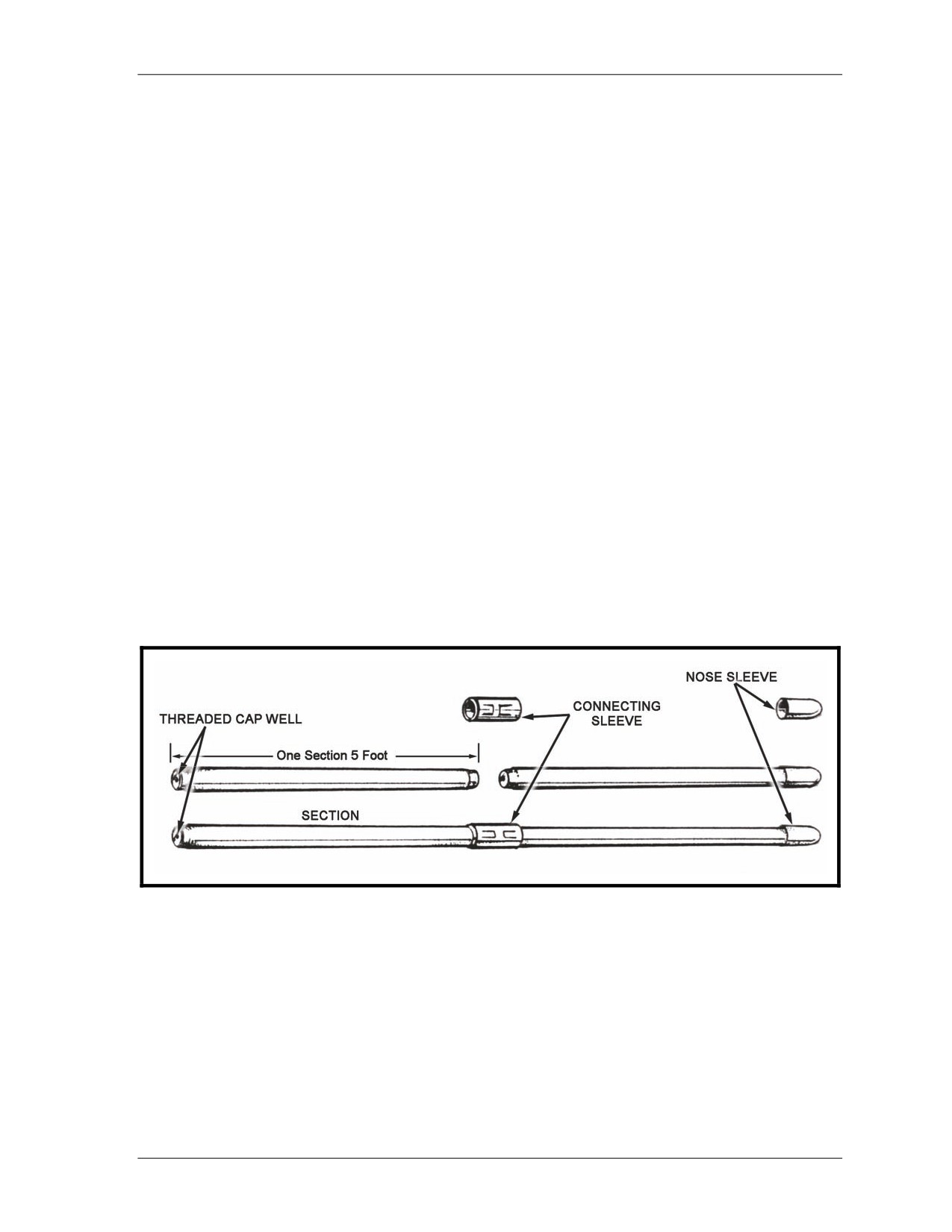
14-18. Remove enough dirt from around it to see what type of mine it is.
1. Mark it and report its exact location to your leader. There are several ways to mark a mine.
How it is marked is not as important as having others understand the marking. A common
way to mark a mine is to tie a piece of paper, cloth, or engineer tape to a stake and put the
stake in the ground by the mine (Figure 14-18).
Figure 14-18. Knot toward mine.
CROSSING THE MINEFIELD
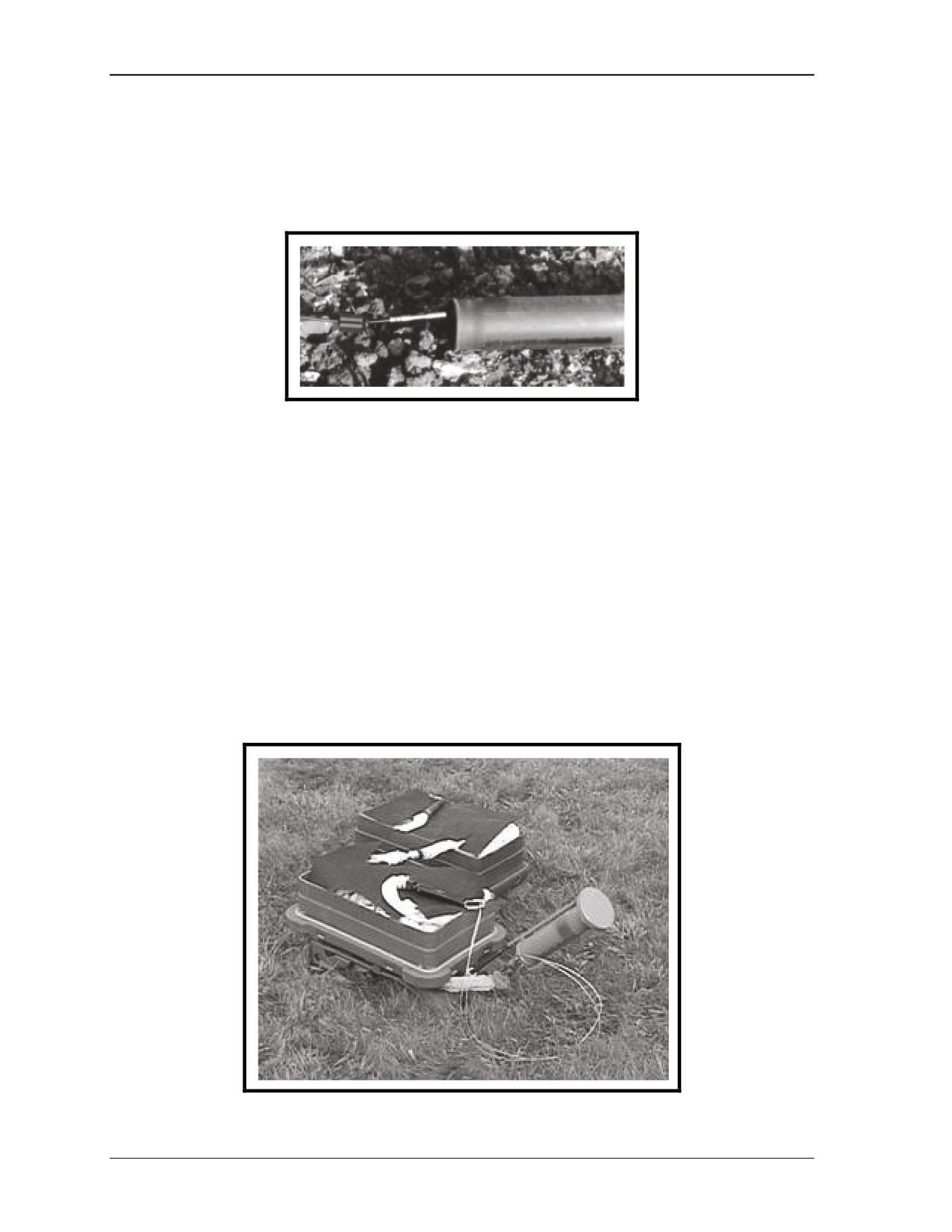
14-19. Once a footpath has been probed and the mines marked, a security team should cross the
minefield to secure the far side (Figure 14-19). After the far side is secure, the rest of the unit should cross.
Figure 14-19. Marked mines.
14-16
FM 3-21.75
28 January 2008
Mines, Demolitions, and Breaching Procedures
BREACH AND CROSS A WIRE OBSTACLE
14-20. Breaching a wire obstacle may require stealth; for example, when done by a patrol. It may not
require stealth during an attack. Breaches requiring stealth are normally done with wire cutters. Other
breaches are normally done with bangalore torpedoes and breach kits. This paragraph discusses how to
probe for and mark mines, as well as cross minefields:
CUTTING THE WIRE
14-21. This paragraph discusses how to cut and cross wire.
To cut through a wire obstacle with stealth--
1. Cut only the lower strands and leave the top strand in place; this decreases the likelihood that
the enemy will discover the gap.
2. Cut the wire near a picket. To reduce the noise of a cut, have another Soldier wrap cloth
around the wire and hold the wire with both hands. Cut part of the way through the wire
between the other Soldier’s hands and have him bend the wire back and forth until it breaks.
If you are alone, wrap cloth around the wire near a picket, partially cut the wire, and then
bend and break the wire.
To breach an obstacle made of concertina:
1. Cut the wire and stake it back to keep the breach open.
2. Stake the wire back far enough to allow room for Soldiers to move through the obstacle.
USING A BANGALORE TORPEDO
14-22. A bangalore torpedo comes in a kit that has ten torpedo sections, ten connecting sleeves, and
one nose sleeve (Figure 14-20). Use only the number of torpedo sections and connecting sleeves needed.
Figure 14-20. Bangalore torpedo.
14-23. All torpedo sections have a threaded cap well at each end so they may be assembled in any order.
Use the connecting sleeves to connect the torpedo sections together. To prevent early detonation of the
entire bangalore torpedo, should you actually hit a mine while pushing the bangalore through the obstacle,
attach an improvised (wooden) torpedo section to its end. That section can be made out of any wooden
pole or stick equal to the size of a real torpedo section. Attach the nose sleeve to the end of the wooden
section.
28 January 2008
FM 3-21.75
14-17
Chapter 14
14-24. After the bangalore torpedo has been assembled and pushed through the obstacle, prime it with
either detonation cord or with the MDI nonelectric firing system (Figure 14-21); only the MDI method will
be described. The bangalore torpedo is primed using an M11, M16, M14, or M18 blasting cap. Insert the
blasting cap into the cap well in the end section of the charge and secure it with a priming adapter. If a
priming adapter is unavailable, use tape to hold the blasting cap firmly in place.
Figure 14-21. Priming of bangalore torpedo with MDI.
14-25. Before the bangalore torpedo is fired, ensure you seek available cover (at least 35 meters away)
from the safety danger zone. You will use wire cutters to cut away any wire not cut by the explosion.
USING A MK7 ANTIPERSONNEL OBSTACLE-BREACHING SYSTEM
14-26. The APOBS is an explosive line charge system that allows safe breaching through complex
antipersonnel obstacles
(Figure 14-22). The APOBS is used to conduct deliberate or hasty breaches
through enemy antipersonnel minefields and multistrand wire obstacles. A lightweight
125 pound
(57 kilogram) system with delay and command firing modes, it can be carried by two Soldiers with
backpacks and can be deployed within 30 to 120 seconds.
14-27. Once set in place, the APOBS rocket is fired from a 35-meter standoff position, sending the line
charge with fragmentation grenades over the minefield and/or wire obstacle. The grenades neutralize or
clear the mines and sever the wire, effectively clearing a footpath 2 to 3 feet (0.6 to 1 meter) wide by
148 feet (50 yards or 45 meters) long.
Figure 14-22. MK7 Antipersonnel Obstacle-Breaching System (APOBS).
14-18
FM 3-21.75
28 January 2008
Mines, Demolitions, and Breaching Procedures
14-28. The APOBS has significant advantages over the bangalore torpedo, which weighs 145 kilograms
(320 pounds) more, takes significantly longer to set up, and cannot be deployed from a standoff position. It
also reduces the number of Soldiers required to carry and employ the system from 12 Soldiers to two.
28 January 2008
FM 3-21.75
14-19
Chapter 15
Unexploded Ordnance and Improvised Explosive Devices
Unexploded ordnance (UXO) and IEDs pose deadly and pervasive threats to Soldiers
and civilians in operational areas all over the world. Soldiers at all levels must know
about these hazards, as well as how to identify, avoid, and react to them properly. Use
the information in this chapter to learn about the UXO and IED hazards you could
face and the procedures you can use to protect yourself.
Section I. UNEXPLODED ORDNANCE
Being able to recognize a UXO is the first and most important step in reacting to a UXO hazard. There is a
multitude of ordnance used throughout the world, and it comes in all shapes and sizes. This chapter explains
and shows some of the general identifying features of the different types of ordnance, both foreign and US. To
learn more about UXOs, see FM 4-30.51. In this chapter, ordnance is divided into four main types: dropped,
projected, thrown, and placed.
DROPPED ORDNANCE
15-1.
Regardless of its type or purpose, dropped ordnance is dispensed or dropped from an aircraft.
Dropped ordnance is divided into three subgroups: bombs; dispensers, which contain submunitions; and
submunitions.
BOMBS
15-2.
Bombs can be general purpose or chemical-agent filled.
General Purpose Bombs
15-3.
General purpose bombs come in many shapes and sizes depending on the country that made them
and how they are to be used. Most of these bombs are built the same and consist of a metal container, a
fuse, and stabilizing device. The metal container (called the bomb body) holds an explosive or chemical
filler. The body may be in one or multiple pieces.
Chemical-Agent Filled Bombs
15-4.
Chemical-agent filled bombs are built the same as general purpose bombs. They have a chemical
filler in place of an explosive filler. Color codes and markings may be used to identify chemical bombs.
For example, the US and NATO color code for chemical munitions is a gray background with a dark green
band. The former Soviet Union uses a combination of green, red, and blue markings to the nose and tail
sections to indicate chemical agents. Soviet bombs all have a gray background.
28 January 2008
FM 3-21.12
15-1
Chapter 15
Fuses
15-5.
Fuses used to initiate bombs are either mechanical or electrical, and are generally placed in the
bomb's nose or tail section, internally or externally. They may be hidden, as when covered by a fin
assembly. As shipped, fuses are in a safe (unarmed) condition and function only once armed.
Mechanical--Mechanical fusing, whether in the nose or in the tail, is generally armed by some type of
arming vane. The arming vane assembly operates like a propeller to line up all of the fuse parts so
the fuse will become armed.
Electrical--Electrical fuses have an electric charging assembly in place of an arming vane. They are
armed by using power from the aircraft. Just before the pilot releases the bomb, the aircraft supplies
the required electrical charge to the bomb’s fuse. Action of the fuse may be impact, proximity, or
delay. Impact fuses function when they hit the target. Proximity fuses function when bombs reach a
predetermined height above the target.
Delay--Delay fuses contain an element that delays explosion for a fixed time after impact. To be safe,
personnel should consider that all bombs have the most dangerous kind of fusing, proximity or
delay. Approaching a proximity or delay-fused bomb causes unnecessary risk to personnel and
equipment. Although it should function before it hits the target, proximity fusing may not always do
so. Once the bomb hits the ground, the proximity fuse can still function. It can sense a change in the
area around the bomb and detonate. Delay fusing can be mechanical, electrical, or chemical.
Mechanical and electrical-delay fuses are nothing more than clockwork mechanisms. The
chemical-delay fuse uses a chemical compound inside the fuse to cause a chemical reaction with the
firing system. Delay fusing times can range from minutes to days.
DISPENSERS
15-6.
Dispensers may be classified as another type of dropped ordnance. Like bombs, they are carried
by aircraft. Their payload, however, is smaller ordnance called submunitions. Dispensers come in a variety
of shapes and sizes depending on the payload inside. Some dispensers are reusable, and some are
one-time-use items.
SUBMUNITIONS
15-7.
Submunitions are classified as bomblets, grenades, or mines. They are small explosive-filled or
chemical-filled items designed for saturation coverage of a large area. Each of these delivery systems
disperses its payload of submunitions while still in flight, and the submunitions drop over the target. On the
battlefield, submunitions are widely used in both offensive and defensive missions. Submunitions are used
to destroy an enemy in place (impact) or to slow or prevent enemy movement away from or through an
area (area denial). Impact submunitions go off when they hit the ground.
ANTIPERSONNEL BALL-TYPE SUBMUNITIONS
15-8.
Area-denial submunitions, including FASCAM, have a limited active life and self-destruct after
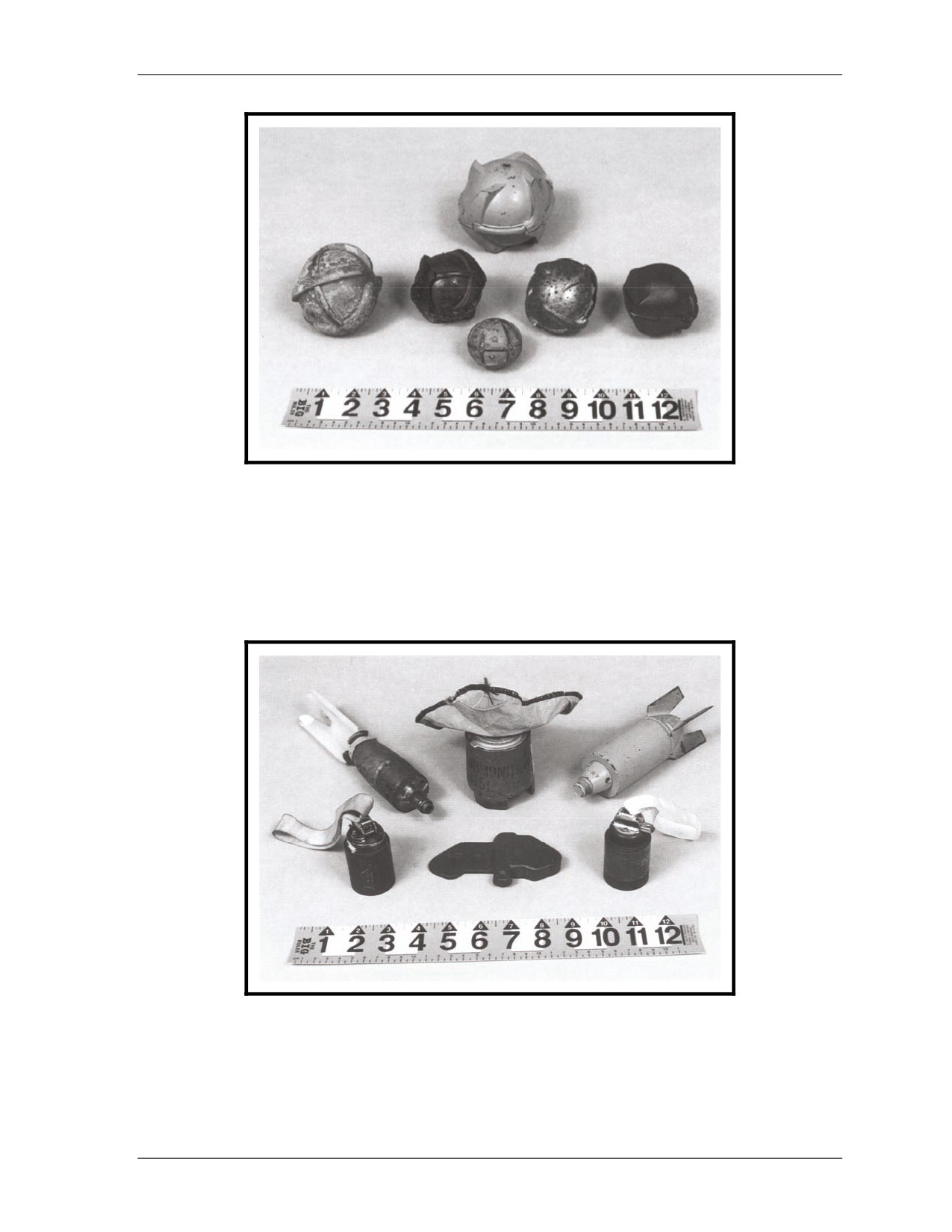
their active life has expired. The ball-type submunitions shown in Figure 15-1 are antipersonnel. They are
very small and are delivered on known concentrations of enemy personnel.
Note: Never approach a dispenser or any part of a dispenser you find on the battlefield.
The payload of submunitions always scatters in the area where the dispenser hit
the ground.
15-2
FM 3-21.12
28 January 2008
Unexploded Ordnance and Improvised Explosive Devices
Figure 15-1. Antipersonnel, ball-type submunitions.
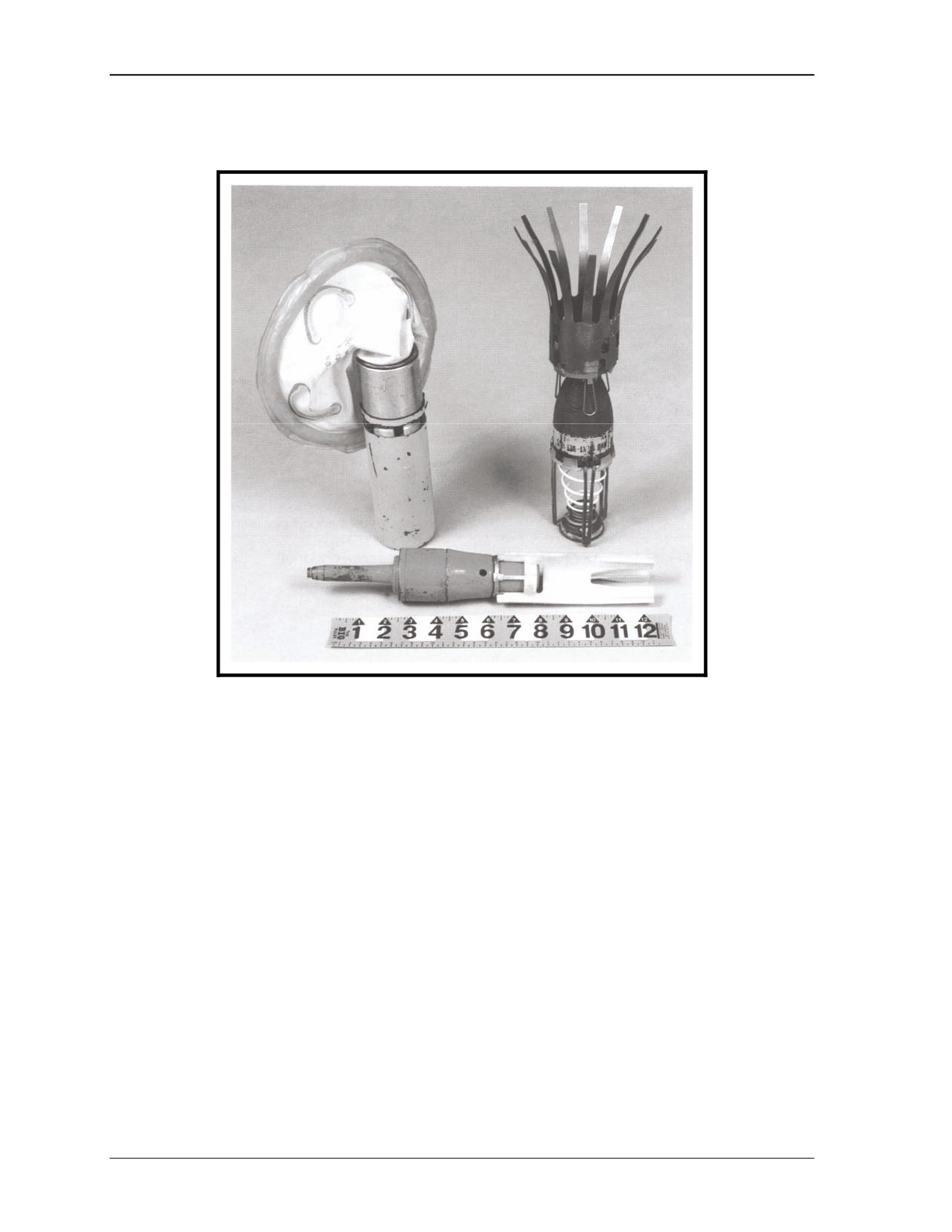
Area-Denial Submunitions--The submunition shown in Figure 15-2 is scattered across an area and,
like a land mine, it will not blow up until pressure is put on it. They are area-denial, antipersonnel
submunitions (FASCAM). These submunitions are delivered into areas for use as mines. When they
hit the ground, trip wires kick out up to 20 feet from the mine. All area-denial submunitions use
anti-disturbance fusing with self-destruct fusing as a backup. The self-destruct time can vary from a
couple of hours to as long as several days.
Figure 15-2. Area-denial submunitions (conventional).
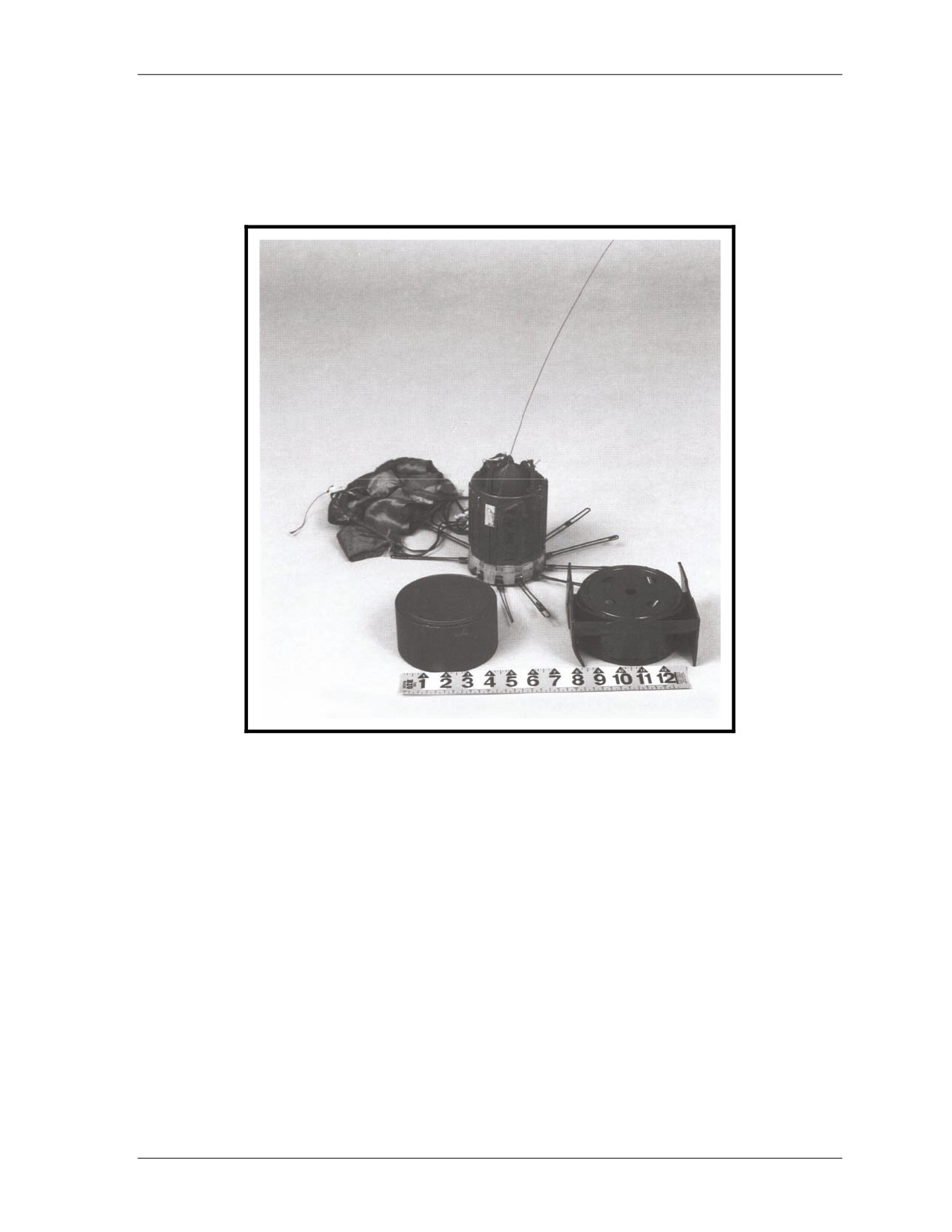
Antipersonnel and Anti-Materiel (AMAT) Submunitions--The DP submunition shown in Figure 15-3
has a shaped charge for penetrating hard targets but is also used against personnel. These
submunitions are delivered by artillery or rockets. The arming ribbon serves two purposes, as it
28 January 2008
FM 3-21.12
15-3
Chapter 15
arms the fuse as the submunition comes down and also stabilizes the submunition so that it hits the
target straight on.
Figure 15-3. Antipersonnel/AMAT submunitions (conventional).
15-4
FM 3-21.12
28 January 2008
Unexploded Ordnance and Improvised Explosive Devices
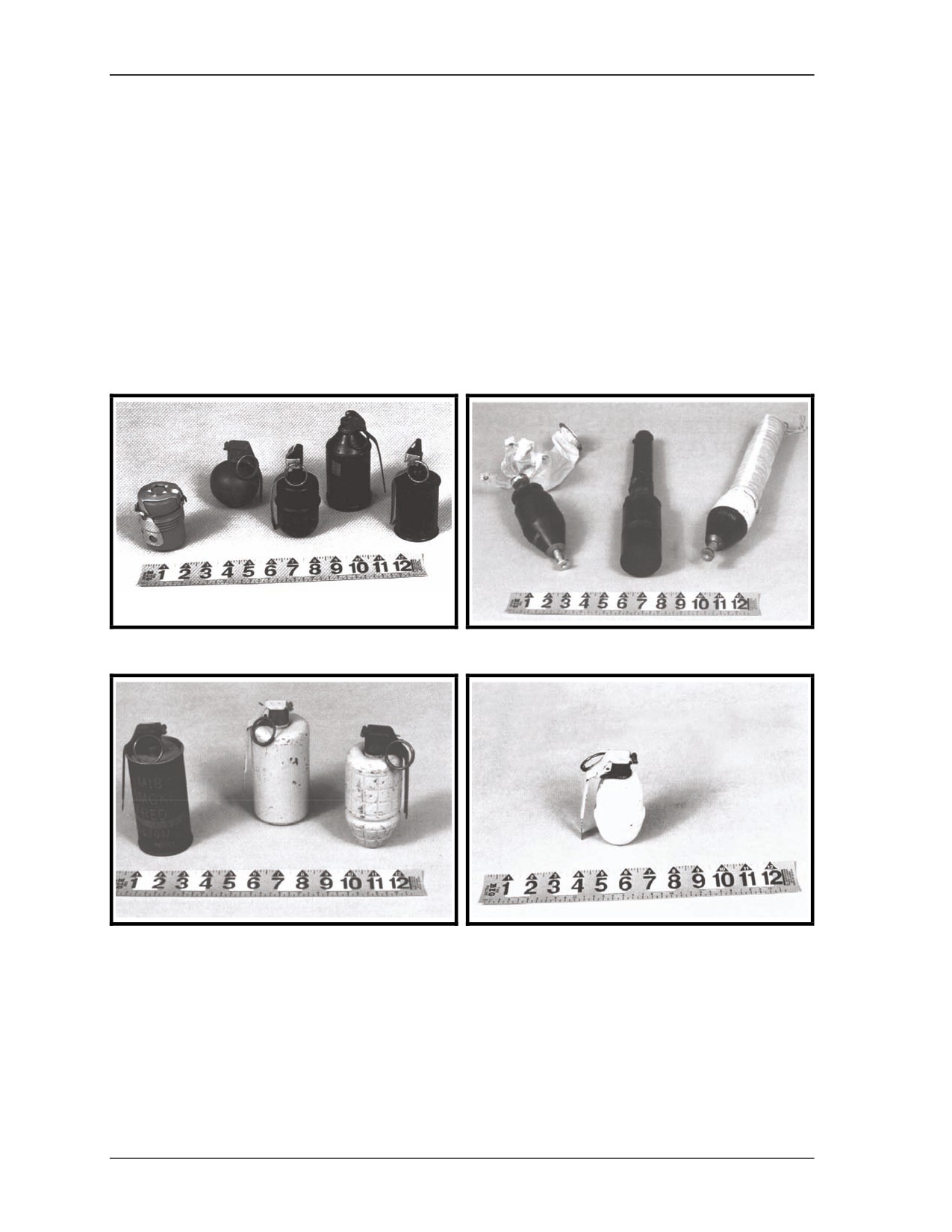
AMAT and Antitank Submunitions--The AMAT or antitank submunitions shown in Figure 15-4 are
designed to destroy hard targets such as vehicles and equipment. They are dispersed from an
aircraft-dropped dispenser and function when they hit a target or the ground. Drogue parachutes
stabilize these submunitions in flight so they hit their targets straight on. Others have a fin assembly
that stabilizes the submunition instead of the drogue parachute.
Figure 15-4. AMAT/antitank submunitions (conventional).
Antitank Area-Denial Submunitions--Antitank area-denial submunitions can be delivered by aircraft,
artillery, and even some engineer vehicles. These FASCAMs have magnetic fusing and function
when they receive a signal from metallic objects. These submunitions, similar to the antipersonnel
area-denial submunitions, also have anti-disturbance and self-destruct fusing. Antitank and
antipersonnel area-denial mines are usually found deployed together.
28 January 2008
FM 3-21.12
15-5
Chapter 15
PROJECTED ORDNANCE
15-9.
All projected ordnance is fired from some type of launcher or gun tube. Projected ordnance falls
into the following five subgroups:
• Projectiles.
• Mortars.
• Rockets.
• Guided missiles.
• Rifle grenades.
PROJECTILES
15-10. Projectiles range from 20 millimeters to 16 inches in diameter and from 2 inches to 4 feet in
length. They can be filled with explosives, chemicals (to include riot-control agents such as CS), white
phosphorus (WP), illumination flares, or submunitions. Projectile bodies can be one piece of metal or
multiple sections fastened together.
15-11. Projectiles, like bombs, can have impact or proximity fusing. They can also be fused with
time-delay fusing that functions at a preset time after firing. For safety reasons, all projectiles should be
considered as having proximity fusing. Getting too close to proximity fusing will cause the fuse to
function, and the projectile will blow up. Depending on the type of filler and design of the projectile, the
fuse can be in the nose or base.
15-12. There are two ways projectiles are stabilized— by spin or fin. Spin-stabilized projectiles use
rotating bands near the rear section to stabilize the projectile. Riding along the internal lands and grooves
of the gun tube, these bands create a stabilizing spin as the projectile is fired. Fin-stabilized projectiles may
have either fixed fins or folding fins. Folding fins unfold after the projectile leaves the gun tube to stabilize
the projectile.
MORTARS
15-13. Mortars range from 45 millimeters to 280 millimeters in diameter. Like projectiles, mortar shells
can be filled with explosives, toxic chemicals, WP, or illumination flares. Mortars generally have thinner
metal bodies than projectiles but use the same kind of fusing. Like projectiles, mortars are stabilized in
flight by fin or spin. Most mortars are fin stabilized.
ROCKETS
15-14. A rocket may be defined as a self-propelled projectile. Unlike guided missiles, rockets cannot be
controlled in flight. Rockets range in diameter from 37 millimeters to over 380 millimeters. They can range
in length from 1 foot to over 9 feet. There is no standard shape or size for rockets. All rockets consist of a
warhead section, motor section, and fuse. They are stabilized in flight by fins, or canted nozzles, that are
attached to the motor.
15-15. The warhead is the portion of the rocket that produces the desired effect. It can be filled with
explosives, toxic chemicals, WP, submunitions, CS, or illumination flares. The motor propels the rocket to
the target. The fuse is the component that initiates the desired effect at the desired time. Rockets use the
same type of fusing as projectiles and mortars. The fuse may be located in the nose or internally between
the warhead and the motor.
15-16. Generally, the rocket motor will not create an additional hazard, because the motor is usually
burned out shortly after the rocket leaves the launcher.
15-6
FM 3-21.12
28 January 2008
Unexploded Ordnance and Improvised Explosive Devices
GUIDED MISSILES
15-17. Guided missiles are like rockets, as they consist of the same parts; however, missiles are guided to
their target by various guidance systems. Some of the smaller missiles, such as the tube-launched, optically
tracked, wire-guided (TOW) and Dragon missiles, are wire-guided by the gunner to their targets.
15-18. Larger missiles, such as the phased-array, tracking radar intercept on target (PATRIOT) and the
Sparrow are guided by radar to their target. Guided missiles use internal, proximity fusing and therefore,
do not approach any guided missile you find laying on the battlefield.
RIFLE GRENADES
15-19. Rifle grenades look like mortars and are fired from a rifle that is equipped with a grenade launcher
or an adapter. Many countries use rifle grenades as an Infantry direct-fire weapon. Some rifle grenades are
propelled by specially designed blank cartridges, while others are propelled by standard ball cartridges.
Rifle grenades may be filled with HEs, WP, CS, illumination flares, or colored screening smoke. They
range in size from the small antipersonnel rifle grenade to the larger antitank rifle grenade. Antipersonnel
rifle grenades use impact fusing. Some rifle grenades, such as the antitank version, have internal fusing
behind the warhead; this type of fusing still functions on impact with the target.
THROWN ORDNANCE (HAND GRENADES)
15-20. Hand grenades are small items that may be held in one hand and thrown. All grenades have three
main parts: a body, a fuse with a pull ring and safety clip assembly, and a filler. Never pick up a grenade
you find on the battlefield, even if the spoon and safety pin are still attached. All grenades found laying on
a battlefield should be considered booby-trapped. Thrown ordnance, commonly known as hand grenades,
can be classified by use as follows:
• Fragmentation (also called defensive)
• Offensive
• Antitank
• Smoke
• Illumination
FRAGMENTATION GRENADES
15-21. Fragmentation grenades are the most common type of grenade and may be used as offensive or
defensive weapons (see Figure 15-5). They have metal or plastic bodies that hold explosive fillers. These
grenades produce casualties by high-velocity projection of fragments when they blow up. The
fragmentation comes from the metal body or a metal fragmentation sleeve that can be internal or attached
to the outside of the grenade. These grenades use a burning delay fuse that functions 3 to 5 seconds after
the safety lever is released.
OFFENSIVE GRENADES
15-22. Offensive grenades have a plastic or cardboard body and are not designed to have a lot of
fragmentation. Their damage is caused from the over pressure of the explosive blast. These grenades use a
burning-delay fuse that functions 3 to 5 seconds after the safety lever is released.
ANTITANK GRENADES
15-23. Antitank grenades are designed to be thrown at tanks and other armored vehicles. They have a
shaped-charge explosive warhead and are stabilized in flight by a spring-deployed parachute or a cloth
streamer (Figure 15-6). These grenades use impact fuses.
28 January 2008
FM 3-21.12
15-7
Chapter 15
SMOKE GRENADES
15-24. The two types of smoke grenades are bursting and burning (Figure 15-7). They may be made of
rubber, metal, or plastic. Bursting-type smoke grenades are filled with WP and blow up when the fuse
functions. These grenades use a burning delay fuse that functions 3 to 5 seconds after the safety lever is
released. Burning-type smoke grenades produce colored smoke and use an instant-action fuse. There is no
delay once the spoon is released. This is the same type of grenade that is used to dispense riot-control
agents such as CS.
ILLUMINATION GRENADES
15-25. Illumination grenades are used for illuminating, signaling, and as an incendiary agent
(Figure 15-8). The metal body breaks apart after the fuse functions and dispenses an illumination flare.
This type of grenade uses a burning-delay fuse that functions 3 to 5 seconds after the safety lever is
released.
Figure 15-5. Fragmentation grenades.
Figure 15-6. Antitank grenades.
Figure 15-7. Smoke grenades.
Figure 15-8. U.S. illumination grenade.
15-8
FM 3-21.12
28 January 2008
Unexploded Ordnance and Improvised Explosive Devices
Section II. IMPROVISED EXPLOSIVE DEVICES
IEDs are nonstandard explosive devices that target both Soldiers and civilians. IEDs range from crude
homemade explosives to extremely intricate remote-controlled devices. They instill fear and diminish the
resolve of our forces by escalating casualties. The sophistication and range of IEDs continue to increase as
technology improves, and as our enemies gain experience.
TYPES
15-26. IEDs include explosive devices, impact-detonated devices, and vehicle-borne bombs:
TIMED EXPLOSIVE DEVICES
15-27. These can either be detonated by electronic means, possibly even by a cell phone; or by a
combination of wire and either a power source or timed fuse.
IMPACT-DETONATED DEVICES
15-28. These detonate after any kind of impact such as after being dropped or thrown.
VEHICLE-BORNE BOMBS
15-29. Also known as car bombs, these explosive-laden vehicles are detonated via electronic command
wire, wireless remote control, or a timed device(s). A driver is optional. Anything from a small sedan to a
large cargo truck or cement truck (Figure 15-9) can be used. The size of the vehicle limits the size of the
device. Bigger vehicles can carry much more explosive material, so they can cause more damage than
smaller ones. Device functions also vary. Some possible signs of a car bomb include--
• A vehicle riding low, especially in the rear, and especially if the vehicle seems empty.
However, because explosive charges can be concealed in the side panels, the weight may be
distributed evenly. Even so, the vehicle may still ride low, indicating excessive weight.
• Large boxes, satchels, bags, or any other type of container in plain view such as on, under, or
near the front seat of the vehicle.
• Wires or rope-like material coming out the front of the vehicle and leading to the rear passenger
or trunk area.
• A timer or switch in the front of a vehicle. The main charge is usually out of sight, and as
previously stated, often in the rear of the vehicle.
• Unusual or very strong fuel-like odors.
• An absent or suspiciously behaving driver.
28 January 2008
FM 3-21.12
15-9
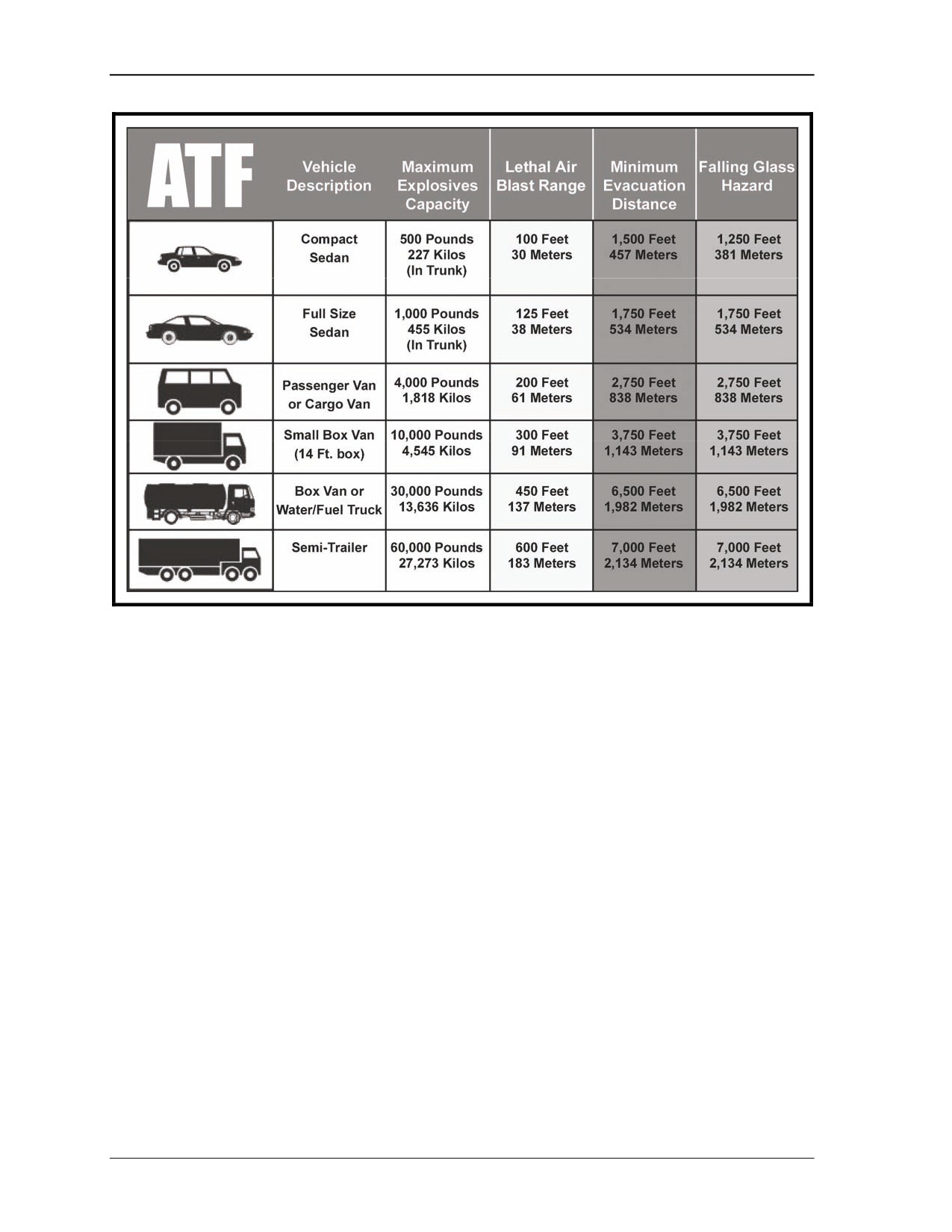
Chapter 15
Figure 15-9. Vehicle IED capacities and danger zones.
IDENTIFICATION
15-30. The following are tell-tale signs of IEDs:
• Wires
• Antennas
• Detcord (usually red in color)
• Parts of ordinance exposed
COMPONENTS
15-31. The following are components of an IED:
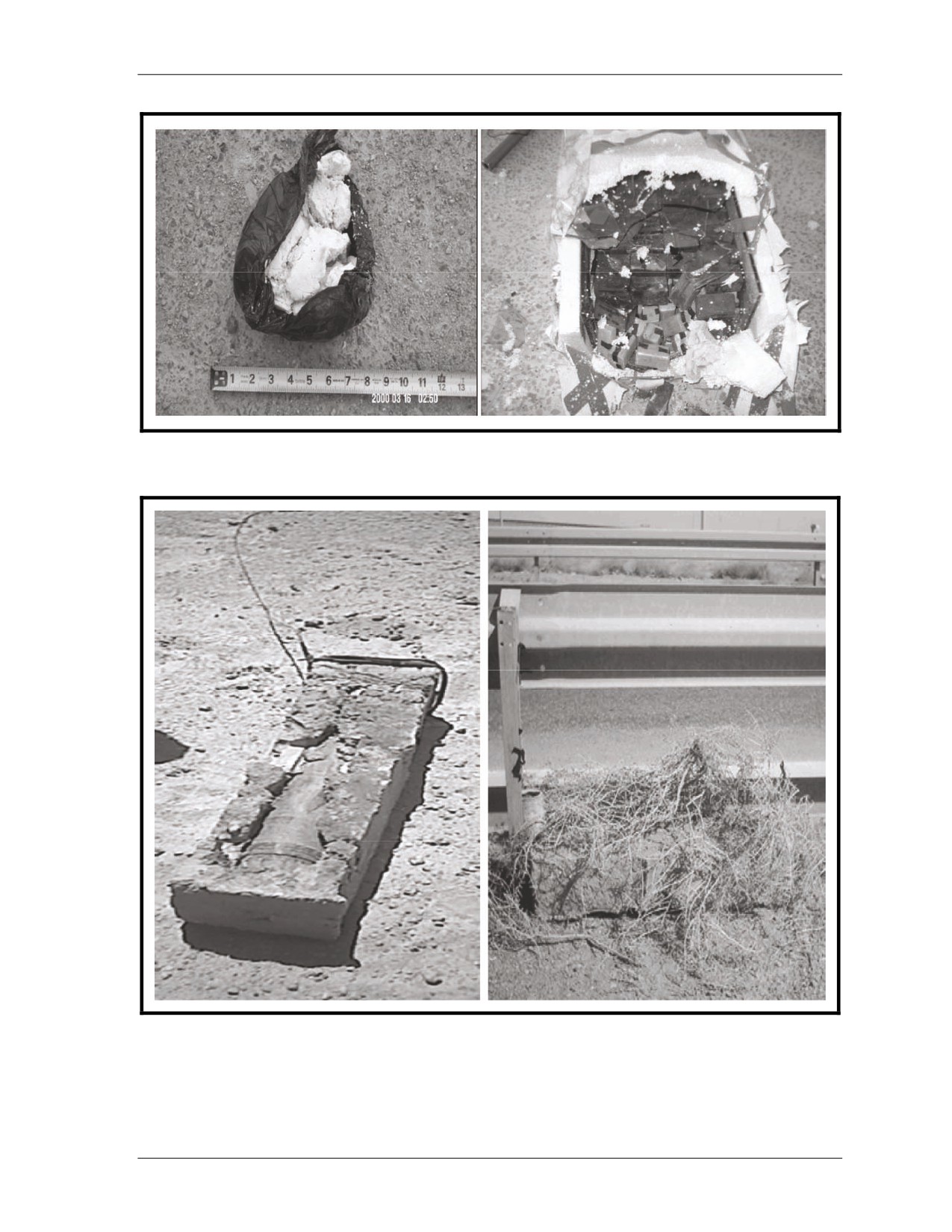
• Main Charge (Explosives) (Figure 15-10).
• Casing (material around the explosives; Figure 15-11).
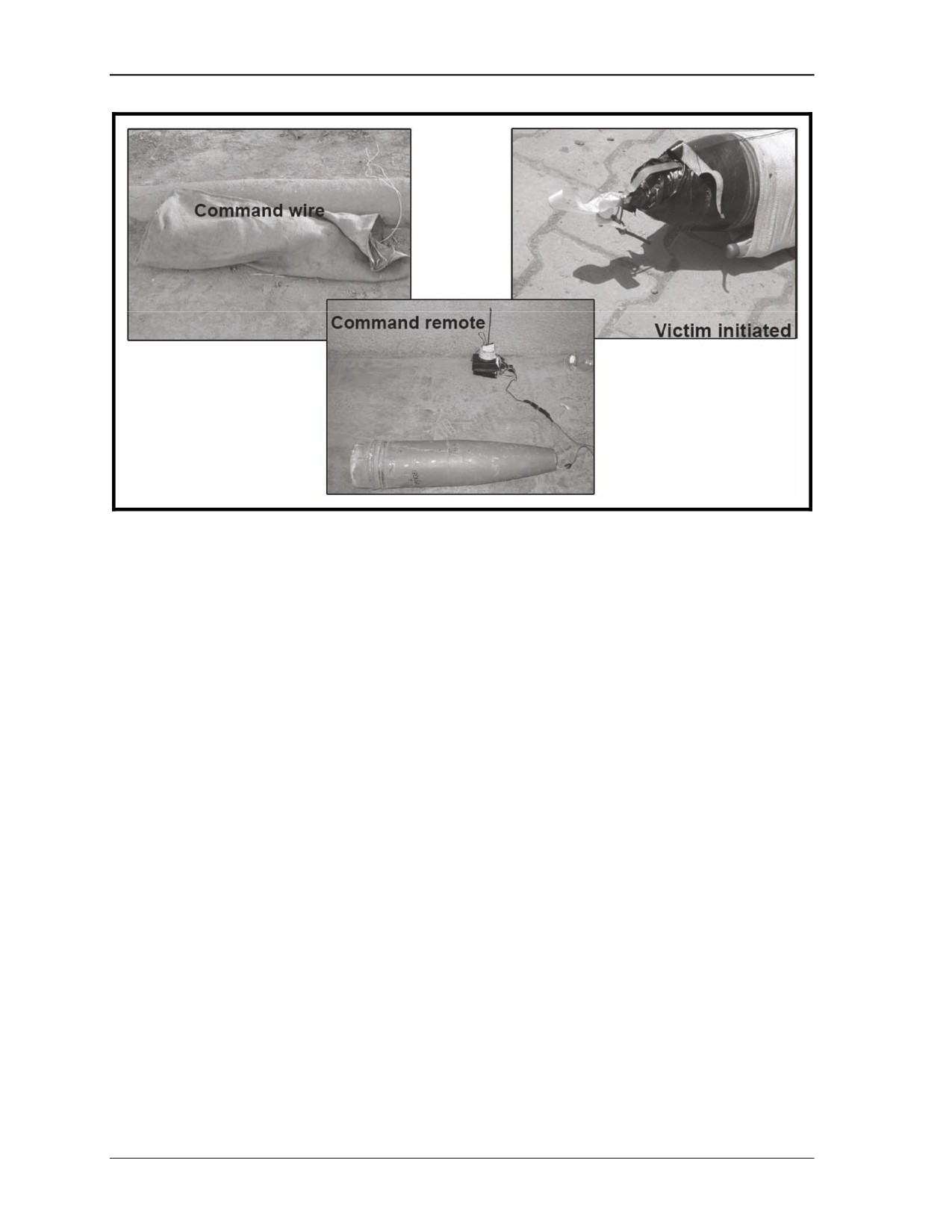
• Initiators (command detonated, victim activated, and timer; Figure 15-12).
15-10
FM 3-21.12
28 January 2008
Unexploded Ordnance and Improvised Explosive Devices
Figure 15-10. Main charge (explosives).
Figure 15-11. Casing (material around the explosives).
28 January 2008
FM 3-21.12
15-11
Chapter 15
Figure 15-12. Initiators (command detonated, victim activated, with timer).
EXAMPLES
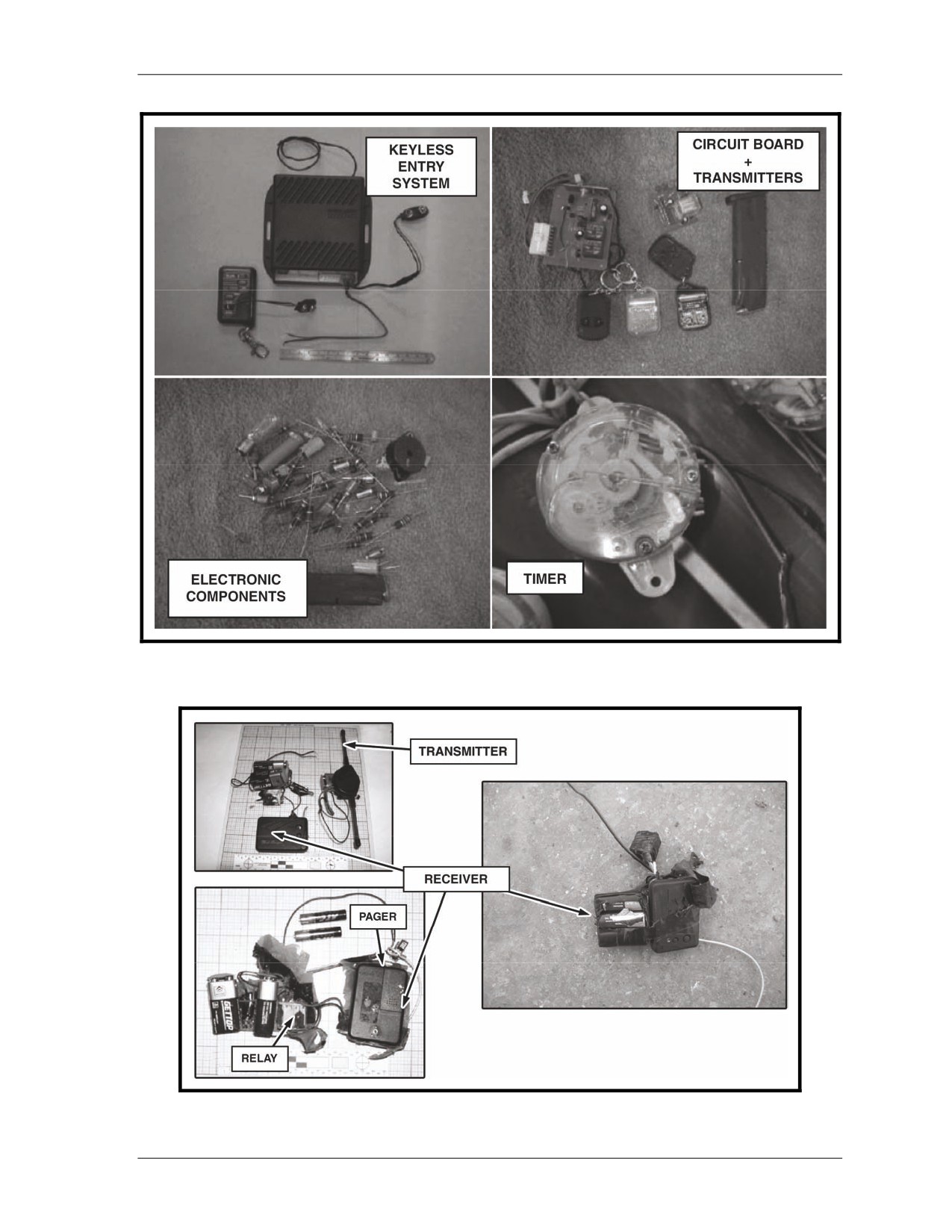
15-32. Figures 15_13 through 15-18, this page through page 15-16, show example IED types and
components. These photos are examples to train Soldiers to recognize components of IEDs. Recognition is
needed when Soldiers conduct operations, such as raids, traffic control points, convoys, and come across
suspicious items.
15-12
FM 3-21.12
28 January 2008
Unexploded Ordnance and Improvised Explosive Devices
Figure 15-13. IED components.
Figure 15-14. IED transmitters and receivers.
28 January 2008
FM 3-21.12
15-13
Chapter 15
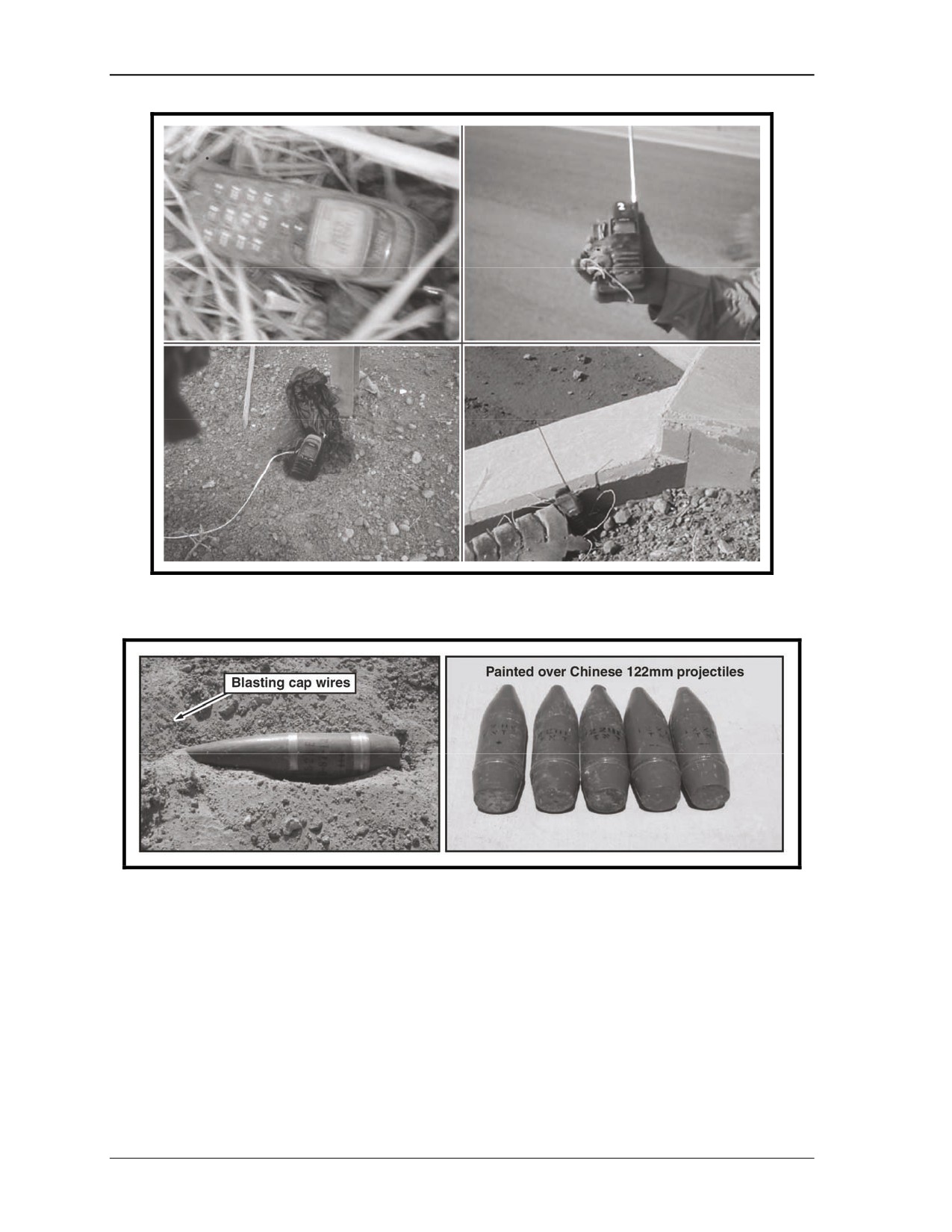
Figure 15-15. Common objects as initiators.
Figure 15-16. Unexploded rounds as initiators.
15-14
FM 3-21.12
28 January 2008
Unexploded Ordnance and Improvised Explosive Devices
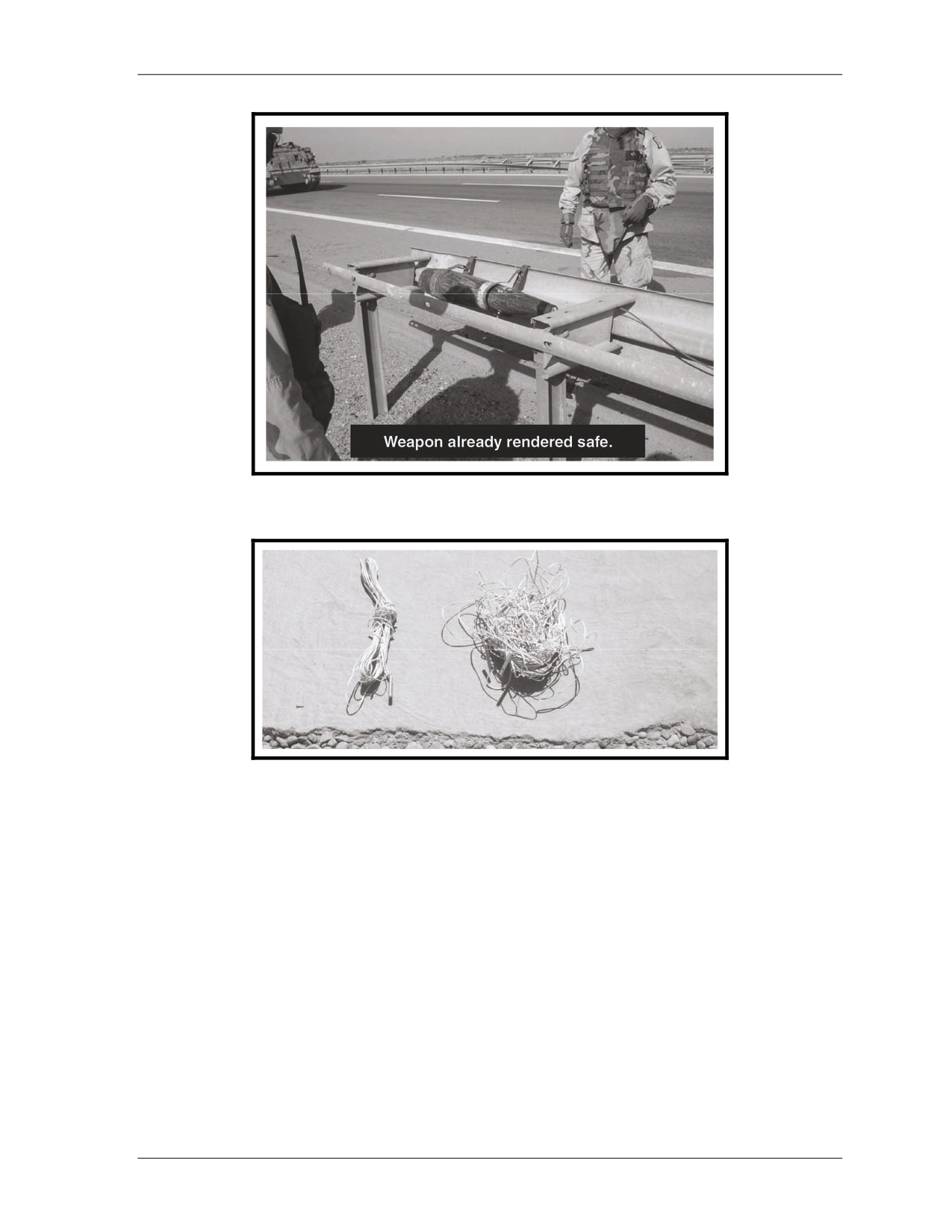
Figure 15-17. Emplaced IED with initiator.
Figure 15-18. Electric blasting caps.
ACTIONS ON FINDING UXO
15-33. Many areas, especially previous battlefields, may be littered with a wide variety of sensitive and
deadly UXO. Soldiers should adhere to the following precautions upon discovering a suspected UXO:
• Do not move toward the UXO. Some types of ordnance have magnetic or motion-sensitive
fusing.
• Never approach or pick up UXO even if identification is impossible from a distance. Observe
the UXO with binoculars if available.
• Send a UXO report (Figure 15-19) to higher HQ (see special segment below). Use radios at
least 100 meters away from the ordnance. Some UXO fuses might be set off by radio
transmissions.
• Mark the area with mine tape or other obvious material at a distance from the UXO to warn
others of the danger. Proper markings will also help explosive ordnance disposal (EOD)
personnel find the hazard in response to the UXO report.
28 January 2008
FM 3-21.12
15-15
Chapter 15
• Evacuate the area while carefully scanning for other hazards.
• Take protective measures to reduce the hazard to personnel and equipment. Notify local
officials and people in the area.
Nine-Line UXO Incident Report
1. DTG: Date and time UXO was discovered.
2. Reporting Unit or Activity, and UXO Location: Grid coordinates.
3. Contact Method: How EOD team can contact the reporting unit.
4. Discovering Unit POC: MSE, or DSN phone number, and unit frequency or
call sign.
5. Type of UXO: Dropped, projected, thrown, or placed, and number of items
discovered.
6. Hazards Caused by UXO: Report the nature of perceived threats such as a
possible chemical threat or a limitation of travel over key routes.
7. Resources Threatened: Report any equipment, facilities, or other assets
threatened by the UXO.
8. Impact on Mission: Your current situation and how the UXO affects your
status.
9. Protective Measures: Describe what you have done to protect personnel and
equipment such as marking the area and informing local civilians.
Figure 15-19. Nine-Line UXO Incident Report.
ACTIONS ON FINDING IEDS
15-34. Follow these basic procedures when IEDs are found:
• Maintain 360-degree security. Scan close in, far out, high, and low.
• Move away. Plan for 300 meters distance minimum (when possible) and adapt to your
METT-TC. Make maximum use of available cover. Get out of line of sight of IEDs.
• Always scan your immediate surroundings for more IEDs. Report additional IEDs to the
on-scene commander.
• Try to confirm suspect IED. Always use optics. Never risk more than one person. Stay as far
back as possible. When in doubt, back away and avoid touching.
• Cordon off the area. Direct people out of the danger area and do not allow anyone to enter
besides those responsible for responding, such as EOD. Question, search, and detain suspects
as needed. Check any and all locations that you move to for other IEDs.
• Report the situation to your higher command. Use the IED spot report shown in Figure 15-20.
15-16
FM 3-21.12
28 January 2008
Unexploded Ordnance and Improvised Explosive Devices
IED SPOT REPORT
LINE 1. DATE-TIME-GROUP: [State when the item was discovered.]
LINE 2. UNIT:
LINE 3. LOCATION OF IED: [Describe as specifically as possible.]
LINE 4. CONTACT METHOD: [Radio frequency, call sign, POC.]
LINE 5. IED STATUS: [Detonation or no detonation.]
LINE 6. IED TYPE: [Disguised static / Disguised moveable / Thrown / Placed on
TGT.]
LINE 7. NUMBER OF IEDs:
LINE 8. PERSONNEL STATUS:
LINE 6. EQUIPMENT STATUS:
LINE 7. COLLATERAL DAMAGE OR POTENTIAL FOR COLLATERAL DAMAGE:
LINE 8. TACTICAL SITUATION: [Briefly describe current tactical situation.]
LINE 9. REQUEST FOR: [QRF / EOD / MEDEVAC].
LINE 10. LOCATION OF L/U WITH REQUESTED FORCE (S):
Figure 15-20. IED Spot Report.
28 January 2008
FM 3-21.12
15-17
This page intentionally left blank.