FM 3-21.75 The Warrior Ethos and Soldier Combat Skills (JANUARY 2008) - page 6
Chapter 11
Communications
Command and control is a vital function on the battlefield. Effective communications
are essential to command and control. Information exchanged by two or more parties
must be transmitted, received, and understood. Without it, units cannot maneuver
effectively and leaders cannot command and control their units, which may result in
lives being lost on the battlefield. The user must understand the equipment and
employ it effectively and within its means.
Section I. MEANS OF COMMUNICATIONS
Each of the several means of communication has its own advantages and disadvantages
(Table 11-1,
page 11-2).
MESSENGERS
ADVANTAGES
• Messengers are the most secure means of communication.
• Messengers can hand carry large maps with overlays.
• Messengers can deliver supplies along with messages.
• Messengers are flexible (can travel long/short distances by foot or vehicle).
DISADVANTAGES
• Messengers are slow, especially if traveling on foot for a long distance.
• Messengers might be unavailable, depending on manpower requirements (size of element
delivering message).
• Messengers can be captured by enemy.
WIRE
ADVANTAGES
• Wire reduces radio net traffic.
• Wire reduces electromagnetic signature.
• Wire is secure and direct.
• Wire can be interfaced with a radio.
DISADVANTAGES
• Wire has to be carried (lots of it).
• Wire must be guarded.
• Wire is time consuming.
28 January 2008
FM 3-21.75
11-1

Chapter 11
Table 11-1. Comparison of communication methods.
Method
Advantages
Disadvantages
Messengers
•
Messengers are the most secure
•
Messengers are slow, especially if
means of communication.
traveling on foot for a long distance.
•
Messengers can hand carry large
•
Messengers might be unavailable,
maps with overlays.
depending on manpower
requirements (size of element
•
Messengers can deliver supplies
delivering message).
along with messages.
•
Messengers can be captured by
•
Messengers are flexible (can travel
enemy.
long/short distances by foot or
vehicle).
Wire
•
Wire reduces radio net traffic.
•
Wire has to be carried (lots of it).
•
Wire reduces electromagnetic
•
Wire must be guarded.
signature.
•
Wire is time consuming.
•
Wire is secure and direct.
•
Wire can be interfaced with a radio.
Visual Signals
•
Visual signals aid in identifying
•
Visual signals can be confusing.
friendly forces.
•
Visual signals are visible from far
•
Visual signals allow transmittal of
away.
prearranged messages.
•
The enemy might see them, too.
•
Visual signals are fast.
•
Visual signals provide immediate
feedback.
Sound
•
Sound can be used to attract
•
The enemy hears it also.
attention.
•
Sound gives away your position.
•
Sound can be used to transmit
prearranged messages.
•
Sound can be used to spread alarms.
•
Everyone can hear it at once.
•
Sound provides immediate feedback.
Radio
•
Radios are the most frequently used
•
Radio is the least secure means of
means of communication.
communication.
•
Radios are fast.
•
Radios require batteries.
•
Radios are light.
•
Radios must be guarded or
monitored.
•
Radios can be interfaced with
telephone wire.
11-2
FM 3-21.75
28 January 2008
Communications
VISUAL SIGNALS
ADVANTAGES
• Visual signals aid in identifying friendly forces.
• Visual signals allow transmittal of prearranged messages.
• Visual signals are fast.
• Visual signals provide immediate feedback.
• Visual signals are visible from far away.
DISADVANTAGES
• Visual signals can be confusing.
• The enemy might see them, too.
SOUND
ADVANTAGES
• Sound can be used to attract attention.
• Sound can be used to transmit prearranged messages.
• Sound can be used to spread alarms.
• Everyone can hear it at once.
• Sound provides immediate feedback.
DISADVANTAGES
• The enemy hears it also.
• Sound gives away your position.
RADIO
ADVANTAGES
• Radios are the most frequently used means of communication.
• Radios are fast.
• Radios are light.
• Radios can be interfaced with telephone wire.
DISADVANTAGES
• Radio is the least secure means of communication.
• Radios require batteries.
• Radios must be guarded or monitored.
28 January 2008
FM 3-21.75
11-3
Chapter 11
Section II. RADIOTELEPHONE PROCEDURES
Radio, the least secure means of communication, speeds the exchange of messages and helps avoid errors.
Proper radio procedures must be used to reduce the enemy’s opportunity to hamper radio communications.
Each time you talk over a radio, the sound of your voice travels in all directions. The enemy can listen to your
radio transmissions while you are communicating with other friendly radio stations. You must always assume
that the enemy is listening to get information about you and your unit, or to locate your position to destroy you
with artillery fire.
RULES
11-1.
Radio procedure rules, listed below, will help you use transmission times efficiently and avoid
violations of communications.
• Prior to operation, assure equipment is properly configured. The TM is a good place to begin.
Examples of items to check include tuning, power settings, and connections.
• Change frequencies and call signs IAW unit signal operating instructions (SOI).
• Use varied transmission schedules and lengths.
• Use established formats to expedite transmissions such as sending reports.
• Encode messages or use secure voice.
• Clarity of radio communications varies widely, so use the phonetic alphabet and numbers.
• Transmit clear, complete, and concise messages. When possible, write them out beforehand.
• Speak clearly, slowly, and in natural phrases as you enunciate each word. If a receiving
operator must write the message, allow time for him to do so.
• Listen before transmitting to avoid interfering with other transmissions.
• Long messages risk becoming garbled and create increased electronic signature. The use of
prowords is essential in reducing transmission time and avoiding confusion.
• Minimize transmission time.
TYPES OF NETS
11-2.
Stations are grouped into nets according to requirements of the tactical situation. A Net is two or
more stations in communications with each other, operating on the same frequency. Nets can be for voice
and/or data communications. The types of nets follow:
Command Net (Command and control the unit's maneuver).
Intelligence Net (Communicate enemy information and develop situational awareness).
Operations and Intelligence Net
Administration and Logistics Net (Coordinate sustainment assets).
PRECEDENCE OF REPORTS
Flash (For initial enemy contact reports).
Immediate (Situations which greatly affect the security of national and allied forces).
Priority (Important message over routine traffic).
Routine (All types of messages that are not urgent).
11-4
FM 3-21.75
28 January 2008
Communications
MESSAGE FORMAT
Heading--A heading consists of the following information:
1. Identity of distant station and self.
2. Transmission instructions (Relay To, Read Back, Do Not Answer).
3. Precedence.
4. FROM/TO.
Text--Text is used to--
1. Separate heading from message with Break.
2. State reason for message.
Ending--An ending consists of--
Final Instructions (Correction, I Say Again, More to Follow, Standby, Execute, Wait).
OVER or OUT (never use both together).
COMMON MESSAGES
11-3.
Soldiers should know how to prepare and use the Nine-Line MEDEVAC Request and the call
for fire.
Nine-Line MEDEVAC Request--For a more detailed description (Table 4-3, FM 4-02.2):
Line 1 Location of pickup site.
Line 2 Radio frequency, call sign, and suffix.
Line 3 Number of patients by precedence.
Line 4 Special equipment required.
Line 5 Patient type.
Line 6 Security of pickup sight (wartime).
Line 6 Number and type of wound, injury, or illness (peacetime).
Line 7 Method of marking pickup site.
Line 8 Patient nationality and status.
Line 9 CBRN contamination (wartime).
Line 9 Terrain description (Peacetime).
Call for Fire--The normal call for fire is sent in three parts, each of which has the following six
elements. The six elements, detailed in the sequence in which they are transmitted, follow: For a
more detailed explanation for calling for fire, see FM 6-30, Chapter 4:
• Observer identification.
• Warning order.
• Target location.
• Target description.
• Method of engagement.
• Method of fire and control.
28 January 2008
FM 3-21.75
11-5
Chapter 11
PROWORDS
11-4.
The following paragraphs discuss common, strength, and readability prowords, as well as
radio checks:
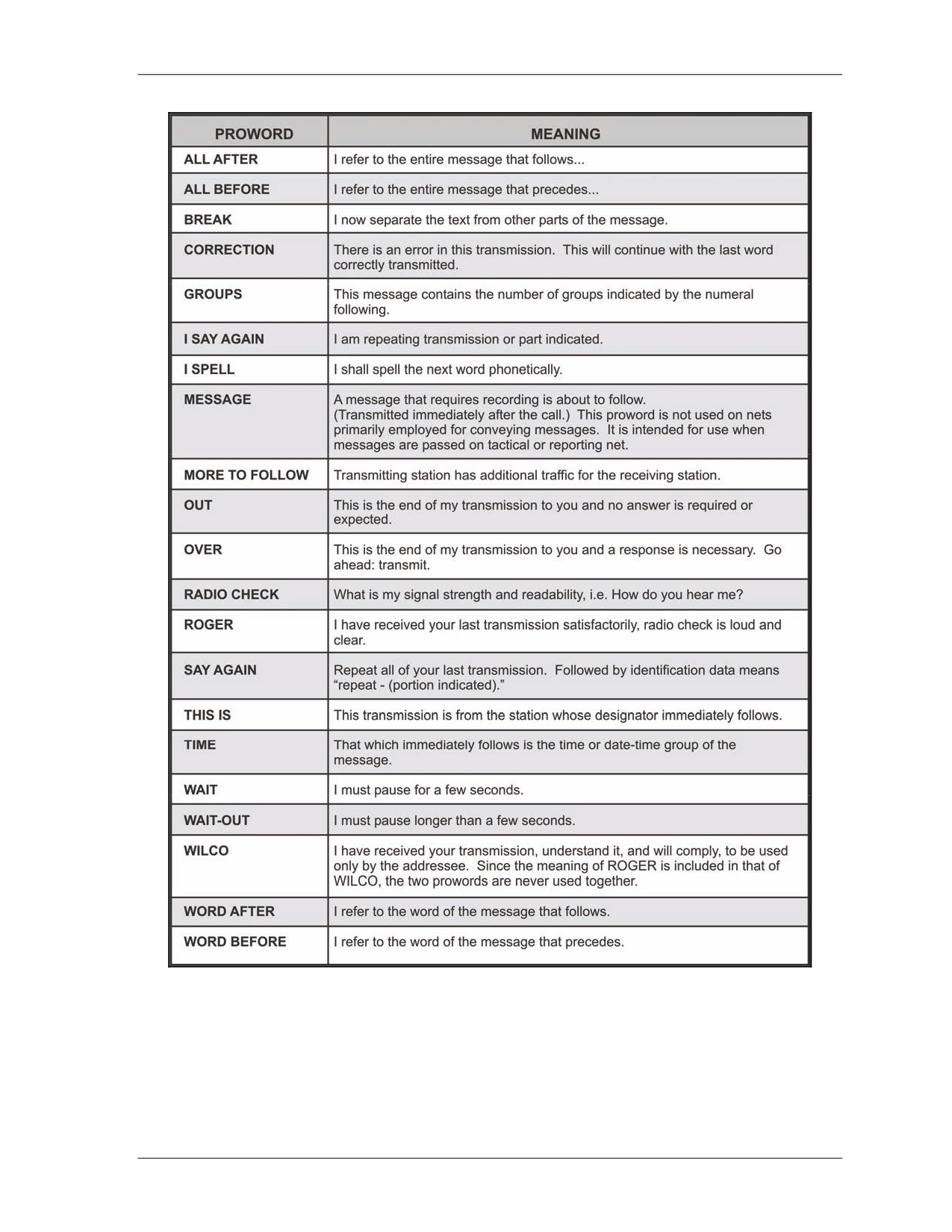
Common Prowords--Common prowords are those words used on a regular basis while conducting
radio operations. They are NOT interchangeable, as the meanings are specific and clear to the
receiver. An example is "Say Again" versus "Repeat." "Say Again" means to repeat the last
transmission, while "Repeat" refers to fire support, and means to fire the last mission again
(Figure 11-1).
Strength and Readability Prowords--Certain strength and readability prowords must be used during
radio checks:
Strength Prowords
• Loud.
• Good.
• Weak.
• Very Weak.
• Poor.
Readability Prowords
• Clear.
• Readable.
• Unreadable.
• Distorted.
• With Interference.
• Intermittent.
Radio Checks--Rating signal strength and readability. An example radio check follows:
Radio Check What is my strength and readability?
Roger
I received your transmission satisfactorily.
11-6
FM 3-21.75
28 January 2008
Communications
Figure 11-1. Common prowords.
28 January 2008
FM 3-21.75
11-7
Chapter 11
OPERATION ON A NET
Preliminary Calls
Bulldog 19, this is Bulldog 29. Over.
Bulldog 29, this is Bulldog 19. Over.
Bulldog 19, this is Bulldog 29. Message. Over.
Bulldog 29, this is Bulldog 19. Send your message. Over.
Correction
Bulldog 19, this is Bulldog 29. Convoy Romeo 3, correction: Romeo 4 should arrive 1630z. Over.
Read Back
Bulldog 19, this is Bulldog 29. Read back. Convoy has arrived. Time 1630z. Over.
Say Again
Bulldog 19, this is Bulldog 29. Request a recovery vehicle to grid 329966. Over.
Bulldog 29, this is Bulldog 19. Say again, all before grid. Over.
Bulldog 19, this is Bulldog 29. I say again. Request a recovery vehicle. Over.
Roger versus Wilco
Bulldog 19, this is Bulldog 29. Request a recovery vehicle to grid 329966. Over.
Bulldog 29, this is Bulldog 19. Roger. Over.
Bulldog 19, this is Bulldog 29. MOVE TO GRID 329966. Over.
Bulldog 29, this is Bulldog 19. WILCO. Over
Bulldog 29, this is Bulldog 19. Roger. Over.
Section III. COMMUNICATIONS SECURITY
Communications security
(COMSEC) consists of measures and controls to deny unauthorized persons
information from telecommunications and ensure authenticity of such telecommunication. COMSEC
material includes--
• Cryptographic security.
• Transmission security.
• Emission security.
• Physical security.
CLASSIFICATIONS
11-5.
Classified material, protected against unauthorized access, is information produced and owned by
the US Government. Authorized access to
(clearance to view) classified material requires a
NEED-TO-KNOW designation and the appropriate security clearance. Responsibility to protect security of
the material rests with the individual handling it. No person is authorized based solely on their rank, title,
or position. They are only authorized by their classification level. The three levels of security classification
(clearances) follow:
Top Secret--This classification applies to material that could cause exceptionally grave damage to
national security.
Secret--This classification applies to material that could cause serious damage to national security.
Confidential--This classification applies to material that could cause damage to national security.
Note: "For official use only" (FOUO) is a handling instruction, not a classification.
11-8
FM 3-21.75
28 January 2008
Communications
SIGNAL OPERATING INSTRUCTIONS
11-6.
The SOI is a COMSEC aid designed to provide transmission security by limiting and impairing
enemy intelligence collection efforts. The SOI is a series of orders issued for technical control and
coordination of a command or activity. It provides guidance needed to ensure the speed, simplicity, and
security of communications.
Types
• Training SOI
Unclassified or FOUO.
• Operation SOI
Used only when deployed for mission.
• Exercise SOI
Used for field training exercises.
Components
• Call signs.
• Frequencies.
• Pyrotechnics.
• Challenge and password.
AUTOMATED NET CONTROL DEVICE
11-7.
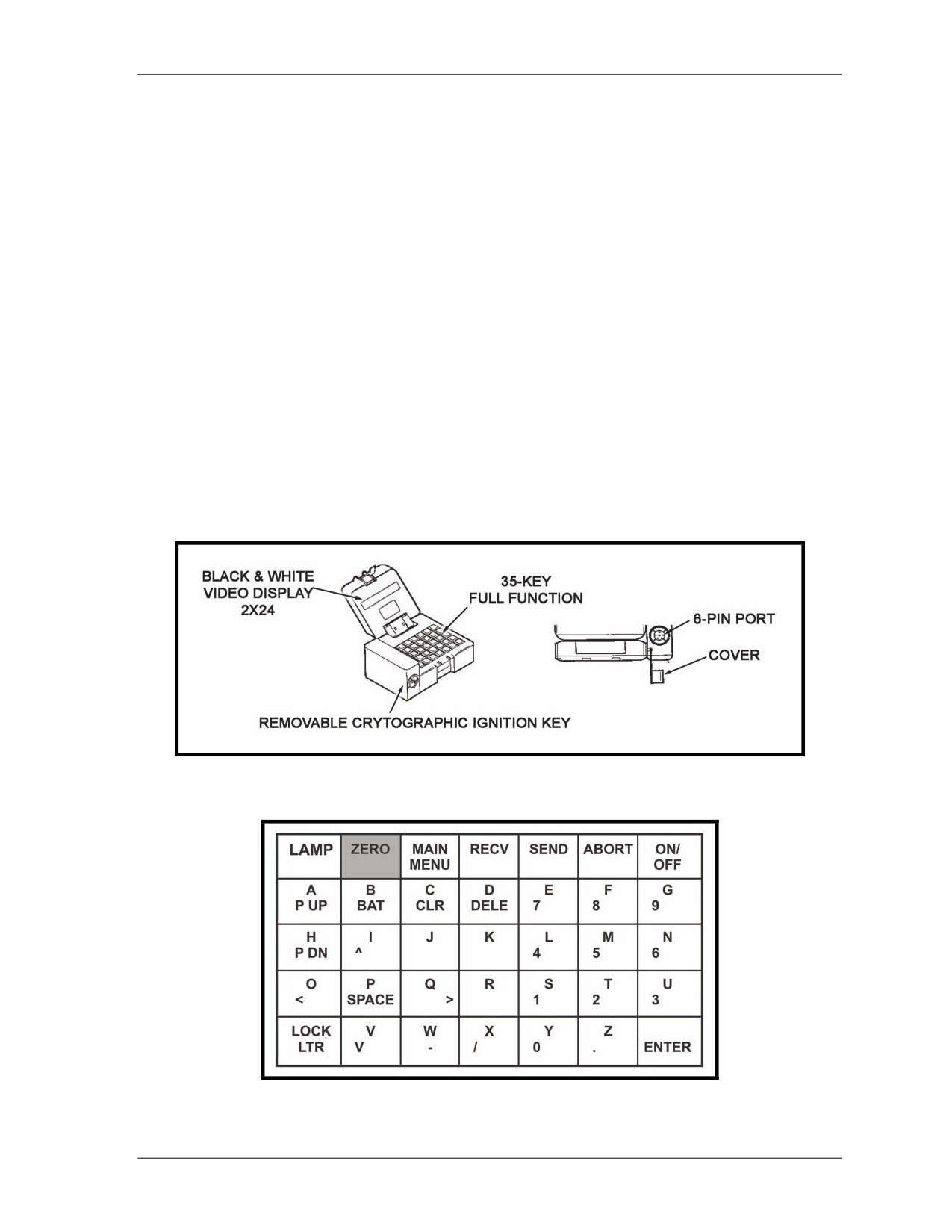
The ANCD (Figures 11-2 and 11-3) is a handheld device that allows users to store/transmit data
via cable and retrieve COMSEC. It is enabled for night viewing. It also features a water resistant case and
sufficient backup memory.
Figure 11-2. Automated net control device.
Figure 11-3. Automated net control device keypad.
28 January 2008
FM 3-21.75
11-9
Chapter 11
MAIN MENU
11-8.
The main menu has three choices:
• SOI pertains to SOI Information.
• Radio pertains to COMSEC keys/FH data to be loaded into the radio.
• Supervisor pertains to areas performed by the supervisor only.
11-9.
To select areas of the main menu--
1. Use the ARROW key function by pressing
either the left or right arrow keys, and then
press the ENTER key.
2. Press the corresponding capital letter on
ANCD MAIN MENU
the keyboard to take you directly to
SOI Radio sUpervisor
a specific topic:
S Signal operating instructions
R Radio
U Supervisor
CALL SIGNS
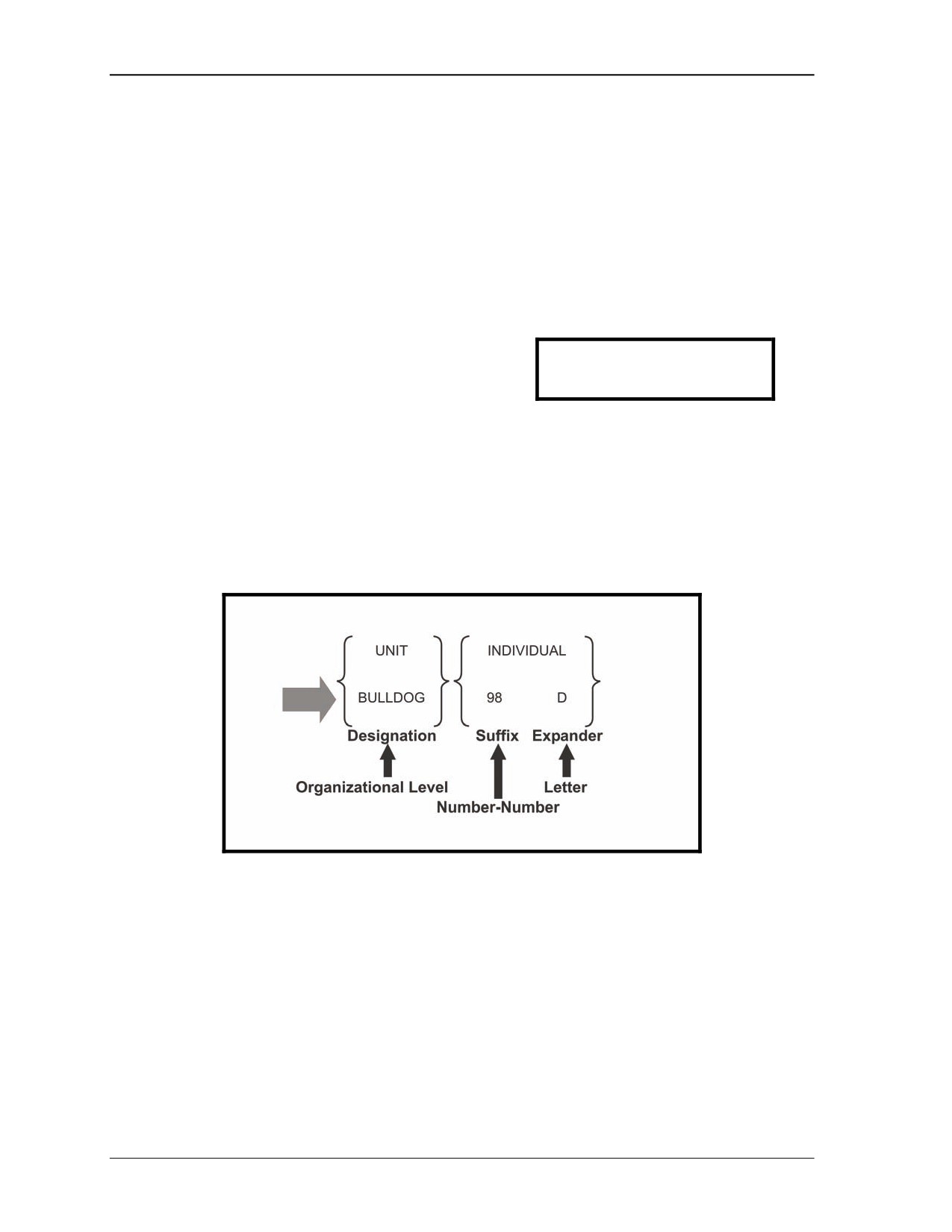
11-10. Call signs have two parts (Figure 11-4):
• Designation call sign identifies the major unit (corps, division, brigade, or battalion).
• Suffix and expanders identify individuals by position.
Figure 11-4. Call signs.
TIME PERIODS
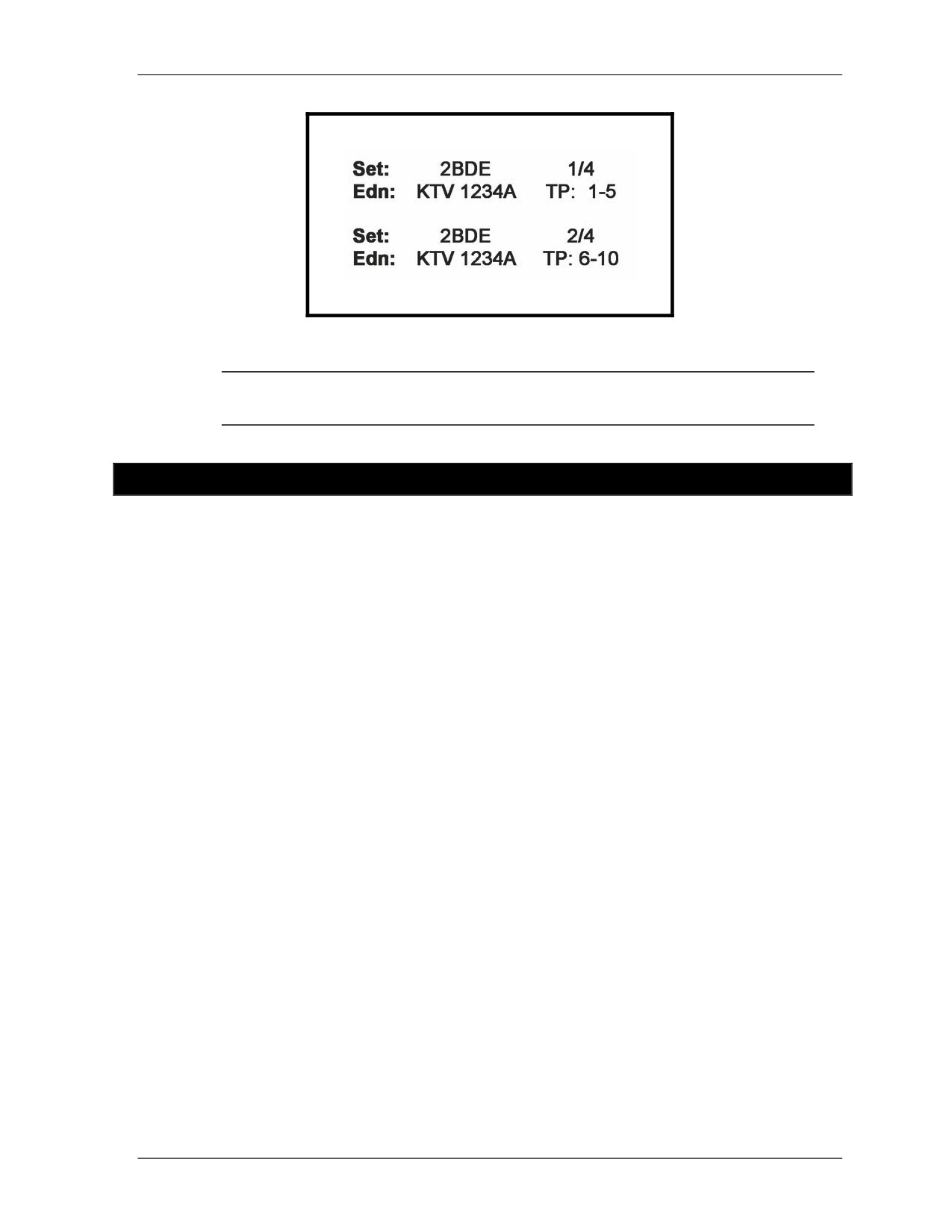
11-11. Set times (Figure 11-5).
• Ten time periods in an SOI, which change by calendar day at a designated time
(typically 2400Z).
• Each time period has a different call sign and frequency for each unit.
• ANCD breaks them into 2 SETS: TP: 1-5 and TP: 6-10.
11-10
FM 3-21.75
28 January 2008
Communications
Figure 11-5. Time periods.
Note: Follow unit SOP for preventive and immediate action measures for capture or
compromise of SOI or systems.
Section IV. EQUIPMENT
This section discusses radio, wire, and telephone equipment.
RADIOS
11-12. Radios are particularly suited for use when you are on-the-move and need a means of maintaining
command and control. Small handheld or backpacked radios that communicate for only short distances are
found at squad and platoon level. As the need grows to talk over greater distances and to more units, the
size and complexity of radios are increased. The enhancement in modern radio technology is based upon
three basic radio systems, each with its own capabilities and characteristics: improved high frequency radio
(IHFR), single-channel ground and airborne radio systems (SINCGARS), and single-channel tactical
satellite communications (SATCOM). A radio set has a transmitter and receiver. Other items necessary for
operation include a battery for a power source, and an antenna for radiation and reception of radio waves.
The transmitter contains an oscillator that generates radio frequency (RF) energy in the form of alternating
current (AC). A transmission line or cable feeds the RF to the antenna. The antenna converts the AC into
electromagnetic energy, which radiates into space. Many radio antennas can be configured or changed to
transmit in all directions or in a narrow direction to help minimize the enemy’s ability to locate the
transmitter. A keying device is used to control the transmission.
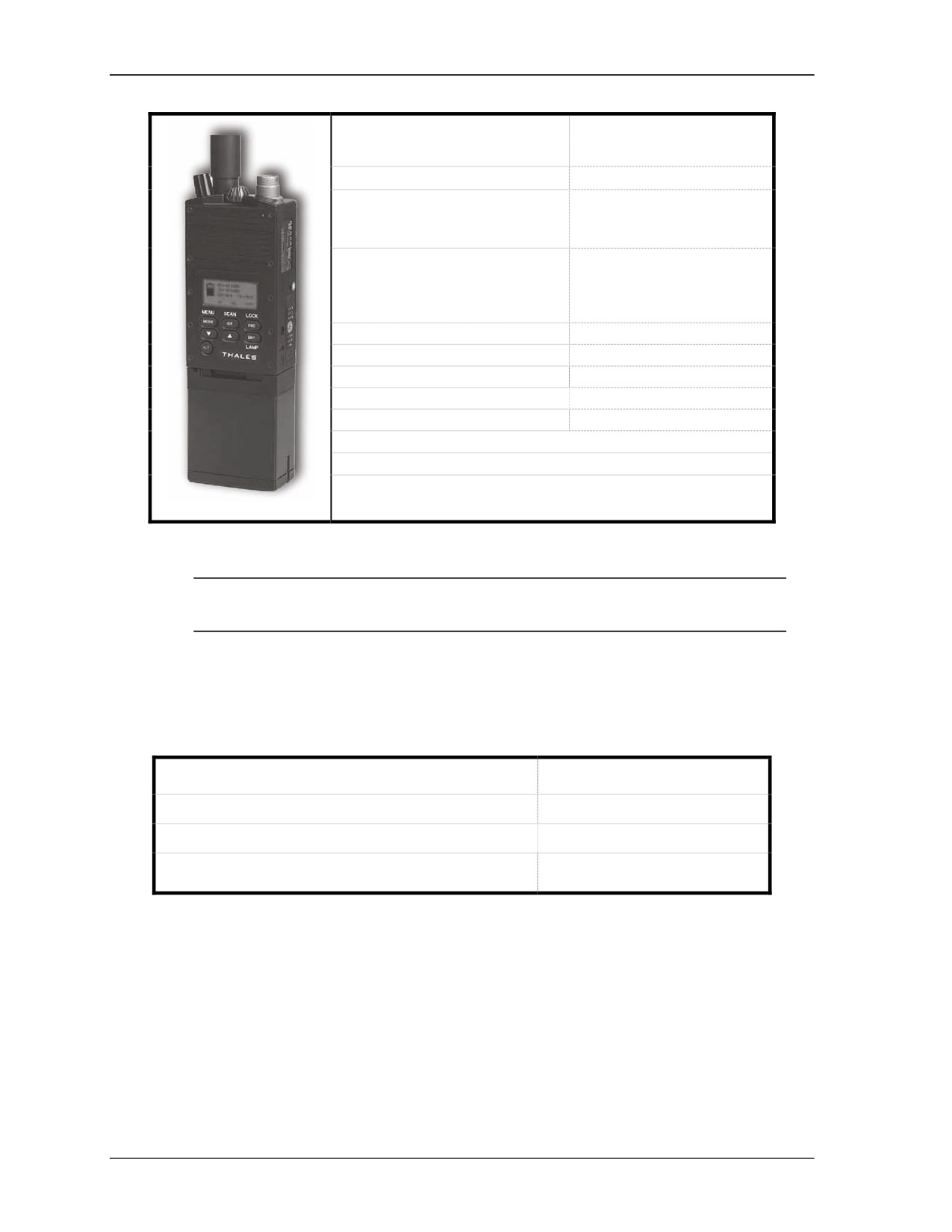
AN/PRC-148 MULTIBAND, INTRATEAM RADIO
11-13. See Figure 11-6.
28 January 2008
FM 3-21.75
11-11
Chapter 11
Receiver Transmitter Unit (RTU)
Range
5 kilometers
Antennas
30-90 MHz
30-512 MHz (reduced gain
below 90 MHz)
Batteries
Rechargeable Lithium-Ion
(2)
Nonrechargeable (2) and
case
Optimal battery life
10 hrs
Weight
2 pounds
Interoperability
AN/PRC-119 SINCGARS
Transceiver/battery holster
System carrying bag
Figure 11-6. AN/PRC-148 multiband intrateam radio (MBITR).
Note: Actual battery life depends upon radio settings, environmental considerations, and
battery age.
IC-F43
11-14. The IC-F43 portable UHF transceiver is a two-way, intersquad, land-mobile radio with squad
radio voice communications and secure protection (Figure 11-7).
Range
2.5 kilometers (2,500 meters)
Optimal battery life
10 hours
Weight
Less than 1 pound
Interoperability
AN/PRC-119 SINCGARS
Figure 11-7. IC-F43 portable UHF transceiver.
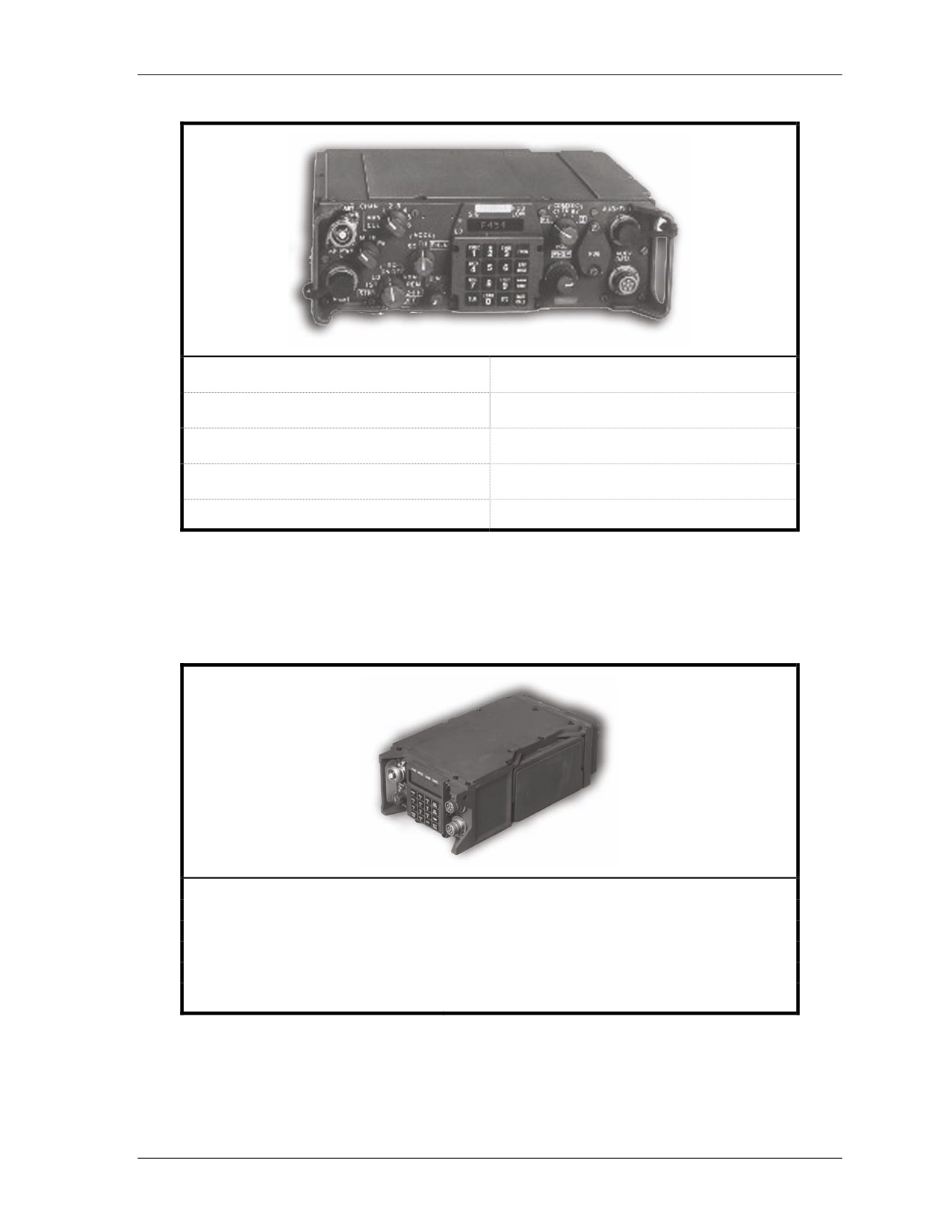
RT 1523A-D (SIP)
11-15. Running the self-test in the system improvement program (SIP) with COMSEC set to PT will
produce a FAIL5 message. Change COMSEC to CT to clear the error message (Figure 11-8).
11-12
FM 3-21.75
28 January 2008
Communications
Optimal battery life
10 to 30 hours
Weight
13.7 pounds
Battery box
CY-8523C
Dumb handset
H-250
Control knobs
Figure 11-8. AN/PRC-119A-D SIP.
RT 1523E
11-16. See Figure 11-9 for more information about the advanced system improvement program (ASIP).
Internal battery
Optimal battery life
33 hours
Weight
8 pounds
Smart handset
HRCRD
New keypad
Control knob
Figure 11-8. AN/PRC-119E advanced system improvement program (ASIP).
28 January 2008
FM 3-21.75
11-13
Chapter 11
WIRE
11-17. The decision to establish wire communications depends on the need; time required and available
to install and use; and capability to maintain. The supply of wire on-hand, the expected resupply, and
future needs must also be considered. Wire communications can be used in most terrain and tactical
situations. When in the defense, units normally communicate by wire and messenger instead of by radio.
Your leaders will often have you lay the wire, and install and operate the field phones.
11-18. A surface line is field wire laid DR-8 laid on the ground. Lay surface lines loosely with plenty of
slack. Slack makes installation and maintenance easier. Surface lines take less time and fewer Soldiers to
install. When feasible, dig small trenches for the wire to protect it from shell fragments of artillery or
mortar rounds. Conceal wire routes crossing open areas from enemy observation. Tag all wire lines at
switchboards, and at road, trail, and rail crossings to identify the lines and make repair easier if a line is cut.
An overhead line is field wire laid above the ground. Lay overhead lines near command posts, in assembly
areas, and along roads where heavy vehicular traffic may drive off the road. Also, lay them at road
crossings where trenches cannot be dug, if culverts or bridges are unavailable. Those lines are the least
likely to be damaged by vehicles or weather.
TELEPHONE EQUIPMENT
11-19. The telephone set TA-1 is a sound-powered phone with both visual and audible signals. Its range
is 4 miles using WD-1 wire. Telephone set TA-312 is a battery-powered phone. Its range is 14 miles using
WD-1 wire.
TA-1 TELEPHONE
11-20. To install the TA-1 telephone--
• Strip away half an inch of insulation from each strand of the WD-1 wire line.
• Press the spring-loaded line binding posts and insert one strand of the wire into each post.
• Adjust the signal volume-control knob to LOUD.
• Press the generator lever several times to call the other operator
• Listen for the buzzer sound.
• Turn the buzzer volume-control knob to obtain the desired volume.
• See if the indicator shows four white luminous markings.
• If so, press the push-to-talk switch to reset the visual indicator.
TA-312 TELEPHONE
11-21. To install the TA-312 telephone--
• Strip away 1/2 inch of insulation from each strand of the WD-1 wire line.
• Press the spring-loaded line binding posts and insert one strand of the wire into each post.
• Adjust the buzzer volume-control knob to LOUD.
• Turn the INT-EXT switch to INT.
• Turn the circuit selector switch to LB.
• Insert two BA-30 batteries into the battery compartment (one up and one down).
• Seat the handset firmly in the retaining cradle.
• Turn the hand crank rapidly a few turns.
• Remove the handset from the retaining cradle and wait for the other operator to answer.
• Press the push-to-talk switch to talk.
• Release the push-to-talk switch to listen.
11-14
FM 3-21.75
28 January 2008
Communications
CE-11 REEL
11-22. The CE-11 reel is a lightweight, portable unit used to lay and pick up short wire lines. It includes
the RL-39 band cable-reeling machine, axle, crank, carrying handles, straps ST-34 and ST-35, and
telephone set TA-1/PT, all of which may be authorized as a unit or listed separately in the TOE. The DR-8
reel cable and the WD-1/TT field wire (400 feet) are always listed separately from the RL-39 and
each other.
28 January 2008
FM 3-21.75
11-15
Chapter 12
Survival, Evasion, Resistance, and Escape
Continuous operations and fast-moving battles increase your chances of either
becoming temporarily separated from your unit or captured. Whether you are
separated from your unit or captured, your top priority should be rejoining your unit
or making it to friendly lines. If you do become isolated, every Soldier must continue
to fight, evade capture, and regain contact with friendly forces. If captured, detained,
or held hostage, individual Soldiers must live, act, and speak in a manner that leaves
no doubt they adhere to the traditions and values of the US Army and the Code
of Conduct.
SURVIVAL
12-1. The acrostic SURVIVAL can help guide your actions in any situation (Figure 12-1 [short list] and
Figure 12-2 [explanations]). Learn what each letter represents, and practice applying these guidelines when
conducting survival training:
28 January 2008
FM 3-21.75
12-1

Chapter 12
Size up the Situation (Surroundings, Physical Condition, Equipment).
In combat, conceal yourself from the enemy. Security is key. "Size up" the battlespace (situation, surroundings, physical
condition, and equipment). Determine if the enemy is attacking, defending, or withdrawing. Make your survival plan,
considering your basic physical needs—water, food, and shelter.
Surroundings--Figure out what is going on around you and find the rhythm or pattern of your environment. It includes
animal and bird noises, and movements and insect sounds. It may also include enemy traffic and civilian movements.
S
Physical Condition--The pressure of the previous battle you were in (or the trauma of being in a survival situation) may
have caused you to overlook wounds you received. Check your wounds and give yourself first aid. Take care to
prevent further bodily harm. For instance, in any climate, drink plenty of water to prevent dehydration. If you are in a
cold or wet climate, put on additional clothing to prevent hypothermia.
Equipment--Perhaps in the heat of battle, you lost or damaged some of your equipment. Check to see what equipment you
have and its condition.
Use All Your Senses: Undue Haste Makes Waste
Evaluate the situation. Note sounds and smells. Note temperature changes. Stay observant and act carefully. An unplanned
action can result in your capture or death. Avoid moving just to do something. Consider all aspects of your situation before
U
you do anything. Also, if you act in haste, you might forget or lose some of your equipment. You might also get disoriented
and not know which way to go. Plan your moves. Stay ready to move out quickly, but without endangering yourself, if the
enemy is near.
Remember Where You Are
Find out who in your group has a map or compass. Find yourself on a map and continually reorient yourself on your location
and destination. Ensure others do the same. Rely on yourself to keep track of your route. This will help you make intelligent
decisions in a survival or evasion situation. Always try to determine, as a minimum, how your location relates to--
R
• Enemy units and controlled areas.
• Friendly units and controlled areas.
• Local water sources (especially important in the desert).
• Areas that will provide good cover and concealment.
Vanquish Fear and Panic
Fear and panic are your greatest enemies. Uncontrolled, they destroy the ability to make intelligent decisions, or they cause
V
you to react to feelings and imagination rather than the situation. They will drain your energy, and lead to other negative
emotions. Control them by remaining self-confident and using what you learned in your survival training.
Improvise
Americans are unused to making do. This can hold you back in a survival situation. Learn to improvise. Take a tool designed
I
for a specific purpose and see how many other uses you can find for it. Learn to use natural objects around you for different
needs, for example, use a rock for a hammer. When your survival kit inevitably wears out, you must use your imagination. In
fact, when you can improvise suitable tools, do so, and save your survival kit items for times when you have no such options.
Value Living
When faced with the stresses, inconveniences, and discomforts of a survival situation, Soldiers must maintain a high value
V
on living. The experience and knowledge you have gained through life and Army training will have a bearing on your will to
live. Perseverance, a refusal to give in to problems and obstacles that face you, will give you the mental and physical
strength to endure.
Act like the Natives
Locals (indigenous people and animals) have already adapted to an environment that is strange to you.
•
Observe daily routines of local people. Where do they get food and water? When and where do they eat? What time do
they go to bed and get up? The answers to these questions can help you avoid capture.
A
•
Watch animals, who also need food, water, and shelter, to help you find the same.
•
Remember that animals may react to you, revealing your presence to the enemy.
•
In friendly areas, gain rapport with locals by showing interest in their customs. Studying them helps you learn to respect
them, allows you to make valuable friends, and, most importantly, helps you adapt to their environment. All of these will
increase your chance of survival.
Live by your Wits, but for Now Learn Basic Skills
Having basic survival and evasion skills will help you live through a combat survival situation. Without these skills, your
chance of survival is slight.
•
Learn these skills now—not en route to, or in, battle. Know the environment you are going into and practice basic skills
L
geared to the environment. Equipping yourself for the environment beforehand will help determine whether you survive.
For instance, if you are going to a desert, know how to get--and purify--water.
•
Practice basic survival skills during all training programs and exercises. Survival training reduces fear of the unknown,
gives you self-confidence, and teaches you to live by your wits.
Figure 12-1. SURVIVAL.
12-2
FM 3-21.75
28 January 2008
Survival, Evasion, Resistance, and Escape
THREE-PHASE SURVIVAL KIT
12-2. A useful technique for organizing survival is the three-phase individual survival kit. The content of
each phase of the kit depends on the environment in the AO and available supplies. An example of the
contents of a three-phase survival kit is as follows:
Phase 1 (Extreme)
12-3. Soldier without any equipment (load-bearing equipment or rucksack). Items to be carried (and their
suggested uses) include--
• Safety pins in hat (fishing hooks or holding torn clothes).
• Utility knife with magnesium fire starter on 550 cord wrapped around waist (knife, making
ropes, and fire starter).
• Wrist compass (navigation).
Phase 2 (Moderate)
12-4. Soldiers with load-bearing equipment. Load-bearing equipment should contain a small survival kit.
Kit should be tailored to the AO and should only contain basic health and survival necessities:
•
550 cord, 6 feet (cordage, tie down, fishing line, weapons, and snares).
• Waterproof matches or lighter (fire starter).
• Iodine tablets (water purification, small cuts).
• Fish hooks or lures (fishing).
• Heavy duty knife with sharpener, bayonet type (heavy chopping or cutting).
• Mirror (signaling).
• Tape (utility work).
• Aspirin.
• Clear plastic bag (water purification, solar stills).
• Candles (heat, light).
• Surgical tubing (snares, weapons, drinking tube).
• Tripwire (traps, snares, weapons).
• Dental floss (cordage, fishing line, tie down, traps).
• Upholstery needles (sewing, fish hooks).
Phase 3 (Slight)
12-5. Soldier with load-bearing equipment and rucksack. Rucksack should only
contain
minimal
equipment. The following are some examples:
• Poncho (shelters, gather water such as dew).
• Water purification pump.
• Cordage (550), 20 feet.
• Change of clothes.
• Cold and wet weather jacket and pants.
• Poncho liner or lightweight sleeping bag.
Note: Items chosen for survival kits should have multiple uses. The items in the above list
are only suggestions.
28 January 2008
FM 3-21.75
12-3
Chapter 12
EVASION
12-6. Evasion is the action you take to stay out of the enemy’s hands when separated from your unit and in
enemy territory. There are several courses of action you can take to avoid capture and rejoin your unit. You
may stay in your current position and wait for friendly troops to find you, or you may try to move and find
friendly lines. Below are a few guidelines you can follow.
PLANNING
12-7. Planning is essential to achieve successful evasion. Follow these guidelines for successful evasion:
• Keep a positive attitude.
• Use established procedures.
• Follow your EPA (evasion plan of action).
• Be patient.
• Drink water.
• Conserve strength for critical periods.
• Rest and sleep as much as possible.
• Stay out of sight.
ODORS
12-8. Avoid the following odors (they stand out and may give you away):
• Scented soaps and shampoos.
• Shaving cream, after-shave lotion, or other cosmetics.
• Insect repellent (camouflage stick is least scented).
• Gum and candy (smell is strong or sweet).
• Tobacco (odor is unmistakable).
• Mask scent using crushed grasses, berries, dirt, and charcoal.
EVASION PLAN OF ACTION
12-9. Establish--
• Suitable area for recovery.
• Selected area for evasion.
• Neutral or friendly country or area.
• Designated area for recovery.
SHELTERS
12-10. Keep the following guidelines in mind concerning shelters:
• Use camouflage and concealment.
• Locate carefully (BLISS, Figure 12-2).
• Choose an area.
-- Least likely to be searched (for example drainages, rough terrain) and blends with the
environment.
-- With escape routes (do not corner yourself).
-- With observable approaches.
• Locate entrances and exits in brush and along ridges, ditches, and rocks to keep from forming
paths to site.
12-4
FM 3-21.75
28 January 2008
Survival, Evasion, Resistance, and Escape
• Be wary of flash floods in ravines and canyons.
• Conceal with minimal to no preparation.
• Take the radio direction finding threat into account before transmitting from shelter.
• Ensure overhead concealment.
B Blend
L Low silhouette
I
Irregular shape
S Small
S Secluded location
Figure 12-2. Tool for remembering shelter locations.
MOVEMENT
12-11.
Remember, a moving object is easy to spot. If travel is necessary--
•
Mask with natural cover.
•
Stay off ridgelines and use the military crest (2/3 of the way up) of a hill.
•
Restrict to periods of low light, bad weather, wind, or reduced enemy activity.
•
Avoid silhouetting.
•
Do the following at irregular intervals:
-- Stop at a point of concealment.
-- Look for signs of human or animal activity (such as smoke, tracks, roads, troops, vehicles,
aircraft, wire, and buildings). Watch for trip wires or booby traps, and avoid leaving
evidence of travel. Peripheral vision is more effective for recognizing movement at night and
twilight.
-- Listen for vehicles, troops, aircraft, weapons, animals, and so forth.
-- Smell for vehicles, troops, animals, fires, and so forth.
•
Use noise discipline; check clothing and equipment for items that could make noise during
movement and secure them.
•
Break up the human shape or recognizable lines.
•
Camouflage evidence of travel. Route selection requires detailed planning and special
techniques (irregular route/zigzag).
•
Concealing evidence of travel. Using techniques such as:
•
Avoid disturbing vegetation.
•
Do not break branches, leaves, or grass. Use a walking stick to part vegetation and push it back
to its original position.
•
Do not grab small trees or brush. (This may scuff the bark or create movement that is easily
spotted. In snow country, this creates a path of snow-less vegetation revealing your route.)
•
Pick firm footing (carefully place the foot lightly but squarely on the surface to avoid slipping).
•
Try not to--
-- Overturn ground cover, rocks, and sticks.
-- Scuff bark on logs and sticks.
-- Make noise by breaking sticks. (Cloth wrapped around feet helps muffle noise.)
-- Mangle grass and bushes that normally spring back.
•
Mask unavoidable tracks in soft footing.
-- Place tracks in the shadows of vegetation, downed logs, and snowdrifts.
28 January 2008
FM 3-21.75
12-5
Chapter 12
-- Move before and during precipitation, allows tracks to fill in.
-- Travel during windy periods.
-- Take advantage of solid surfaces (such as logs and rocks) leaving less evidence of travel.
-- Tie cloth or vegetation to feet, or pat out tracks lightly to speed their breakdown or make
them look old.
• Secure trash or loose equipment and hide or bury discarded items. (Trash or lost equipment
identifies who lost it.)
• If pursued by dogs, concentrate on defeating the handler.
-- Travel downwind of dog/handler, if possible.
-- Travel over rough terrain and/or through dense vegetation to slow the handler.
-- Travel downstream through fast moving water.
-- Zigzag route if possible, consider loop-backs and "J" hooks.
• Penetrate obstacles as follows:
-- Enter deep ditches feet first to avoid injury.
-- Go around chain-link and wire fences. Go under fence if unavoidable, crossing at damaged
areas. Do not touch fence; look for electrical insulators or security devices.
-- Penetrate rail fences, passing under or between lower rails. If this is impractical, go over the
top, presenting as low a silhouette as possible.
-- Cross roads after observation from concealment to determine enemy activity. Cross at points
offering concealment such as bushes, shadows, or bends in the road. Cross in a manner
leaving footprints parallel (cross step sideways) to the road.
RESISTANCE
12-12. Figure 12-3 shows the Code of Conduct, which prescribes how every Soldier of the US armed
forces must conduct himself when captured (or faced with the possibility of capture).
12-6
FM 3-21.75
28 January 2008
Survival, Evasion, Resistance, and Escape
I.
I am an American, fighting in the forces which guard my country and
our way of life. I am prepared to give my life in their defense.
II.
I will never surrender of my own free will. If in command, I will never
surrender the members of my command while they still have the
means to resist.
III. If I am captured, I will continue to resist by all means available. I will
make every effort to escape and aid others to escape. I will accept
neither parole nor special favors from the enemy.
IV. If I become a prisoner of war, I will keep faith with my fellow prisoners.
I will give no information or take part in any action which might be
harmful to my comrades. If I am senior, I will take command. If not, I
will obey the lawful orders of those appointed over me, and will back
them up in every way.
V. When questioned, should I become a prisoner of war, I am required
to give only name, rank, service number, and date of birth. I will
evade answering further questions to the utmost of my ability. I will
make no oral or written statements disloyal to my country (and its
allies) or harmful to their cause.
VI. I will never forget that I am an American, fighting for freedom,
responsible for my actions, and dedicated to the principles that made
my country free. I will trust in my God and in the United States of
America.
Figure 12-3. Code of Conduct.
Article I--Soldiers have a duty to support US interests and oppose US enemies regardless of the
circumstances, whether located in a combat environment or OOTW (operations other than war)
resulting in captivity, detention, or a hostage situation. Past experience of captured Americans
reveals that honorable survival in captivity requires that the Soldier possess a high degree of
dedication and motivation. Maintaining these qualities requires knowledge of, and a strong belief in,
the following:
• The advantages of American democratic institutions and concepts.
• Love and faith in the US and a conviction that the US cause is just.
• Faith and loyalty to fellow POWs.
Article II--Members of the Armed Forces may never surrender voluntarily. Even when isolated and no
longer able to inflict casualties on the enemy or otherwise defend themselves, Soldiers must try to
evade capture and rejoin the nearest friendly force. Surrender is the willful act of members of the
Armed Forces turning themselves over to enemy forces when not required by utmost necessity or
extremity. Surrender is always dishonorable and never allowed. When there is no chance for
meaningful resistance, evasion is impossible, and further fighting would lead to death with no
significant loss to the enemy. Members of Armed Forces should view themselves as "captured"
against their will, versus a circumstance that is seen as voluntarily "surrendering." Soldiers must
remember the capture was dictated by the futility of the situation and overwhelming enemy
strengths.
Article III--The misfortune of capture does not lessen the duty of a member of the Armed Forces to
continue resisting enemy exploitation by all means available. Contrary to the Geneva Conventions,
enemies whom US forces have engaged since 1949 have regarded the POW compound as an
extension of the battlefield. The POW must be prepared for this fact. In the past, enemies of the US
have used physical and mental harassment, general mistreatment, torture, medical neglect, and
political indoctrination against POWs. POWs must not seek special privileges or accept special
favors at the expense of fellow POWs. POWs must be prepared to take advantage of escape
28 January 2008
FM 3-21.75
12-7
Chapter 12
opportunities whenever they arise. The US does not authorize any Military Service member to sign
or enter into any such parole agreement.
Article IV--Officers and NCOs shall continue to carry out their responsibilities and exercise their
authority in captivity. Informing on, or any other action detrimental to a fellow POW, is despicable
and expressly forbidden. POWs especially must avoid helping the enemy to identify fellow POWs
who may have knowledge of value to the enemy and who may be made to suffer coercive
interrogation. Strong leadership is essential to discipline. Without discipline, camp organization,
resistance, and even survival may be impossible. Personal hygiene, camp sanitation, and care of the
sick and wounded are imperative. Wherever located, POWs should organize in a military manner
under the senior military POW eligible for command. The senior POW (whether officer or enlisted)
in the POW camp or among a group of POWs shall assume command according to rank without
regard to Military Service.
Article V--When questioned, a POW is required by the Geneva Conventions and the Code of Conduct,
and is permitted by the Uniform Code of Military Justice (UCMJ), to give name, rank, service
number, and date of birth. The enemy has no right to try to force a POW to provide any additional
information. However, it is unrealistic to expect a POW to remain confined for years reciting only
name, rank, service number, and date of birth. If a POW finds that, under intense coercion, he
unwillingly or accidentally discloses unauthorized information, the Service member should attempt
to recover and resist with a fresh line of mental defense. The best way for a POW to resist is to keep
faith with the US, fellow POWs, and oneself to provide the enemy with as little information as
possible.
Article VI--A member of the Armed Forces remains responsible for personal actions at all times.
Article VI is designed to assist members of the Armed Forces to fulfill their responsibilities and
survive captivity with honor. The Code of Conduct does not conflict with the UCMJ, which
continues to apply to each military member during captivity or other hostile detention. Failure to
adhere to the Code of Conduct may subject Service members to applicable disposition under the
UCMJ. A member of the Armed Forces who is captured has a continuing obligation to resist all
attempts at indoctrination and must remain loyal to the US.
ESCAPE
12-13. Escape is the action you take to get away from the enemy if you are captured. The best time for
escape is right after capture as you will be in a better physical and mental condition. Bad food and bad
treatment during capture add to the already stressful fact of captivity. When detained, you will be given
minimal rations that are barely enough to sustain life and certainly not enough to build up a reserve of
energy. The physical treatment, medical care, and rations of prison life quickly cause physical weakness,
night blindness, and loss of coordination and reasoning power. Once you have escaped, it may not be easy
to contact friendly troops or get back to their lines, even when you know where they are. Learn and use the
information in this chapter to increase your chance of survival on today’s battlefield. For more information,
see FM 3-05.70 and FM 3-50.3. Other reasons for escaping early include--
• Friendly fire or air strikes may cause enough confusion and disorder to provide a chance
to escape.
• The first guards usually have less training in handling prisoners than the next set. You have a
better chance of getting away from the first ones.
• You might know something about the area where you were first captured. You might even
know the locations of nearby friendly units.
• The way you escape depends on what you can think of to fit the situation.
• The only general rules are to escape early and when the enemy is distracted.
12-8
FM 3-21.75
28 January 2008
Chapter 13
Chemical, Biological, Radiological, or Nuclear Weapons
The threat or use of chemical, biological, radiological, and nuclear (CBRN) is a
possible condition of future warfare. You could encounter chemical and biological
(CB) weapons in the early stages of war to disrupt US operations and logistics. In
many regions where the US is likely to deploy forces, potential adversaries may use
CB weapons. To meet this challenge, you must be properly trained and equipped to
operate effectively and decisively in the face of any CBRN attacks.
Section I. CHEMICAL WEAPONS
A toxic chemical agent is any toxic chemical that, through its chemical action on life processes, can cause
death, temporary incapacitation, or permanent harm to humans. Additionally, you can experience significant
physiological effects. Chemical agents, further divided into chemical warfare (CW) agents, are classified
according to their physical states, physiological actions, and uses. Chemical agents may appear in the field in
the forms of vapors, aerosols, or liquids. The terms persistent and nonpersistent describe the time chemical
agents remain in an area and do not classify the agents technically. The persistent chemical agents may last
anywhere from hours up to days and will necessitate future decontamination and the wearing of protective
equipment in that area; whereas nonpersistent chemical agents will last for only a matter of minutes to hours,
but are usually more lethal. Chemical agents having military significance are categorized as nerve, blister,
blood, incapacitating, or choking agents.
TYPES
13-1.
These chemical agents kill, seriously injure, or incapacitate unprotected personnel when employed
as discussed in the following paragraphs.
NERVE AGENTS
13-2.
If you are in a contaminated area, protective clothing and a mask are the only sufficient protection
against nerve agents. Nerve agents act quickly: effects can occur seconds, minutes, or hours after exposure.
Symptoms
• Difficulty breathing.
• Drooling.
• Nausea.
• Vomiting.
• Convulsions.
• Dim vision (sometimes).
Convulsant Antidote for Nerve Agents
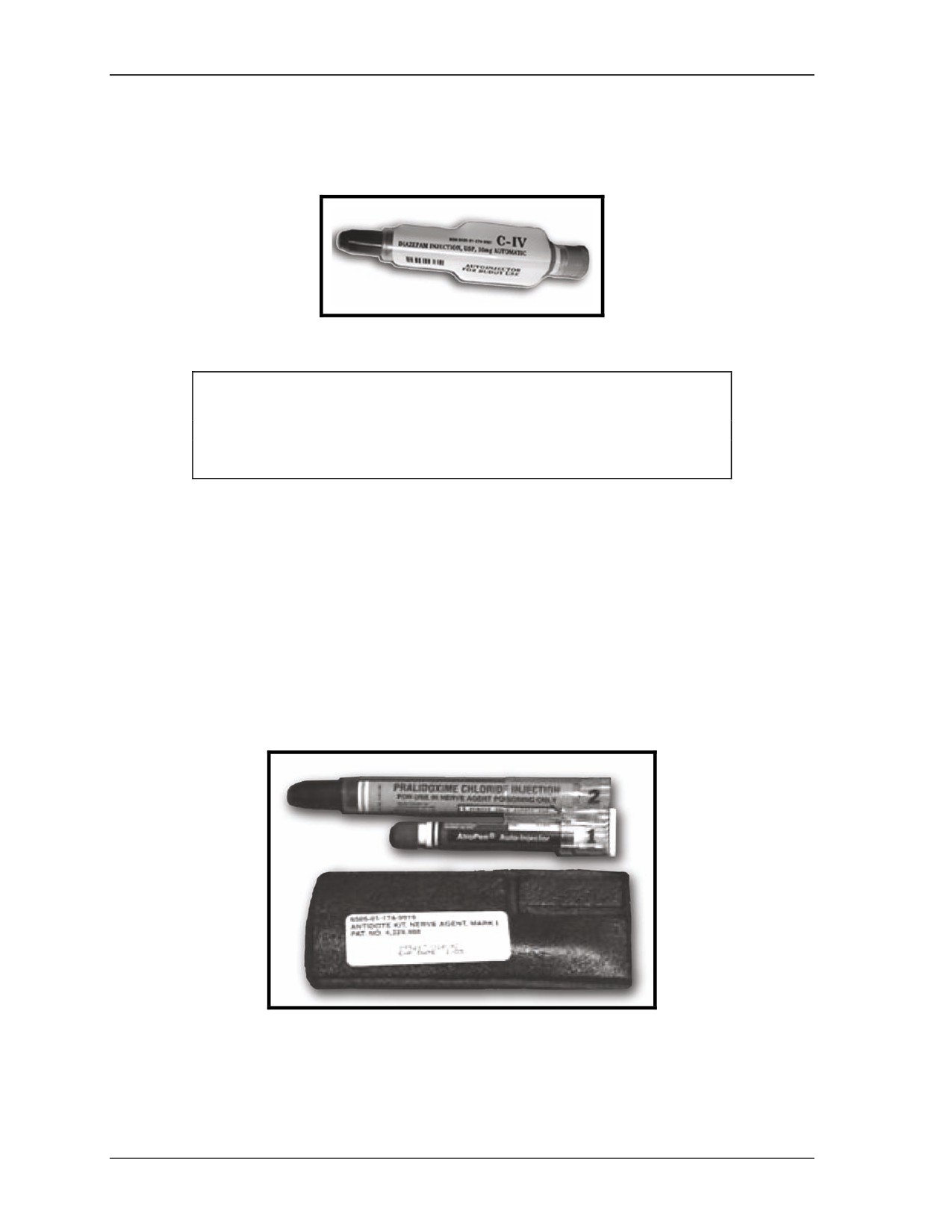
13-3.
The CANA is an autoinjector containing
10 milligrams of diazepam for intramuscular
administration to control nerve agent induced seizures (Figure 13-1). Administration of atropine and 2
28 January 2008
FM 3-21.75
13-1
Chapter 13
PAM alone often does not prevent the occurrence of severe and long lasting convulsions after nerve agent
exposure. The CANA, designed for buddy aid administration and not self administration, is intended to
terminate the convulsions.
Figure 13-1. CANA.
CAUTION
Use the casualty's CANA when providing aid. Do not use your own. If you do,
you might not have any antidote available when you need it.
Antidote Treatment, Nerve Agent, Autoinjector System--When Mark I supplies are exhausted, use the
antidote treatment, nerve agent, autoinjector (ATNAA) system. A single ATNAA delivers both
atropine and two Pam CL. See FM 4-25.11 (FM 21-11) and FM 8-285 for more information.
Self-Aid--If you have symptoms of nerve agent poisoning, inject one NAAK in your thigh. If
symptoms persist, inject a second one. Allow at least 15 minutes between injections, and do not
exceed three NAAK injections. First aid measures include (Figure 13-2)--
-- Atropine.
-- Two PAM nerve agent antidote kits (NAAKs).
-- Mark I.
-- Artificial respiration.
-- Protective clothing.
-- Mask.
Figure 13-2. NAAK, Mark I.
Buddy-Aid--If a Soldier is so incapacitated that he cannot treat himself, then a buddy must inject three
NAAKs at once, IAW the instructions in the kit, and without waiting 15 minutes between
injections. Then, he immediately gives artificial respiration. (The maximum number of NAAK
13-2
FM 3-21.75
28 January 2008
Chemical, Biological, Radiological, or Nuclear Weapons
injections you may receive is three.) If that does not help, he must administer Mark I. Then, he
masks the casualty and quickly seeks medical aid for him. Administer the CANA with the third
Mark I to prevent convulsions. Do not administer more than one CANA.
WARNING
The maximum number of NAAK injections is three. Do not exceed
this amount. Giving yourself a second set of injections may
create a nerve agent antidote overdose, which could cause
incapacitation.
CAUTION
Use the casualty's own antidote autoinjectors when providing aid. Do not use
your injectors on a casualty. If you do, you might not have any antidote
available when needed for self aid.
BLISTER AGENTS
13-4.
The symptoms of blister agent poisoning are burning sensations in the skin, eyes, and nose. The
symptoms may be immediate or delayed for several hours or days, depending on the type of agent used. If
blister agents come in contact with the eyes or skin, decontaminate the areas at once. Decontaminate the
eyes by flushing them repeatedly with plain water. If burns or blisters develop on the skin, cover them with
sterile gauze or a clean cloth to prevent infection. If you are in a contaminated area, your protective
clothing and mask are the only sufficient protection. Seek medical aid quickly.
BLOOD AGENTS
13-5.
The symptoms of blood agent poisoning are nausea, dizziness, throbbing headache, red or pink
skin/lips, convulsions, and coma. Blood agents cause immediate casualties when absorbed by breathing
and inhibits the red blood cells ability to deliver oxygen to the body’s organs and tissue. Breathing may
become difficult or stop, and death will usually occur within 15 minutes. If you are in a contaminated area,
your protective mask is the only sufficient protection. Seek medical aid quickly.
CHOKING AGENTS
13-6.
The symptoms of choking agent poisoning are coughing, choking, tightness of the chest, nausea,
headache, dry throat, and watering of the eyes. Lungs fill with liquid known as dry land drowning and
death results from the lack of oxygen. If you are in a contaminated area, your protective mask is the only
sufficient protection. If you have these symptoms immediately, seek medical aid.
INCAPACITATING AGENTS
13-7.
Incapacitating agents differ from other chemical agents in that the lethal dose is theoretically
many times greater than other agents are. That is, it takes much more of an incapacitating agent to kill
someone (FM 3-11.4).
28 January 2008
FM 3-21.75
13-3
Chapter 13
TOXIC INDUSTRIAL MATERIALS
13-8.
See FM 4-02.7, FM 3-11.4, FM 3-11.19, and TRADOC G2 Handbook No. 1.04 for more
information.
Characteristics
• TIMs are produced to prescribed toxicity levels.
• TIMs are administered through inhalation (mostly), ingestion, or absorption.
• MOPP gear may or may not protect against TIMs and other vapor or contact hazards.
• TIMs may be stored or used in any environment and for any tactical purpose, including
industrial, commercial, medical, military, or domestic purposes.
Forms
13-9.
TIMs may take any of these three forms:
• Chemical (toxic industrial chemicals, or TIC).
• Biological (toxic industrial biological, or TIB).
• Radioactive (toxic industrial radiological, or TIR).
Examples
13-10.
Some examples of TIM include--
• Fuels.
• Oils.
• Pesticides.
• Radiation sources.
• Arsenic.
• Cyanide.
• Metals such as mercury and thallium.
• Phosgene.
DETECTION
13-11. Your senses may be unable to detect chemicals. Most agents are odorless, colorless, tasteless, and
invisible in battlefield concentrations. However, by using unit-level chemical agent alarms and detection
kits, you can detect chemical agents yourself.
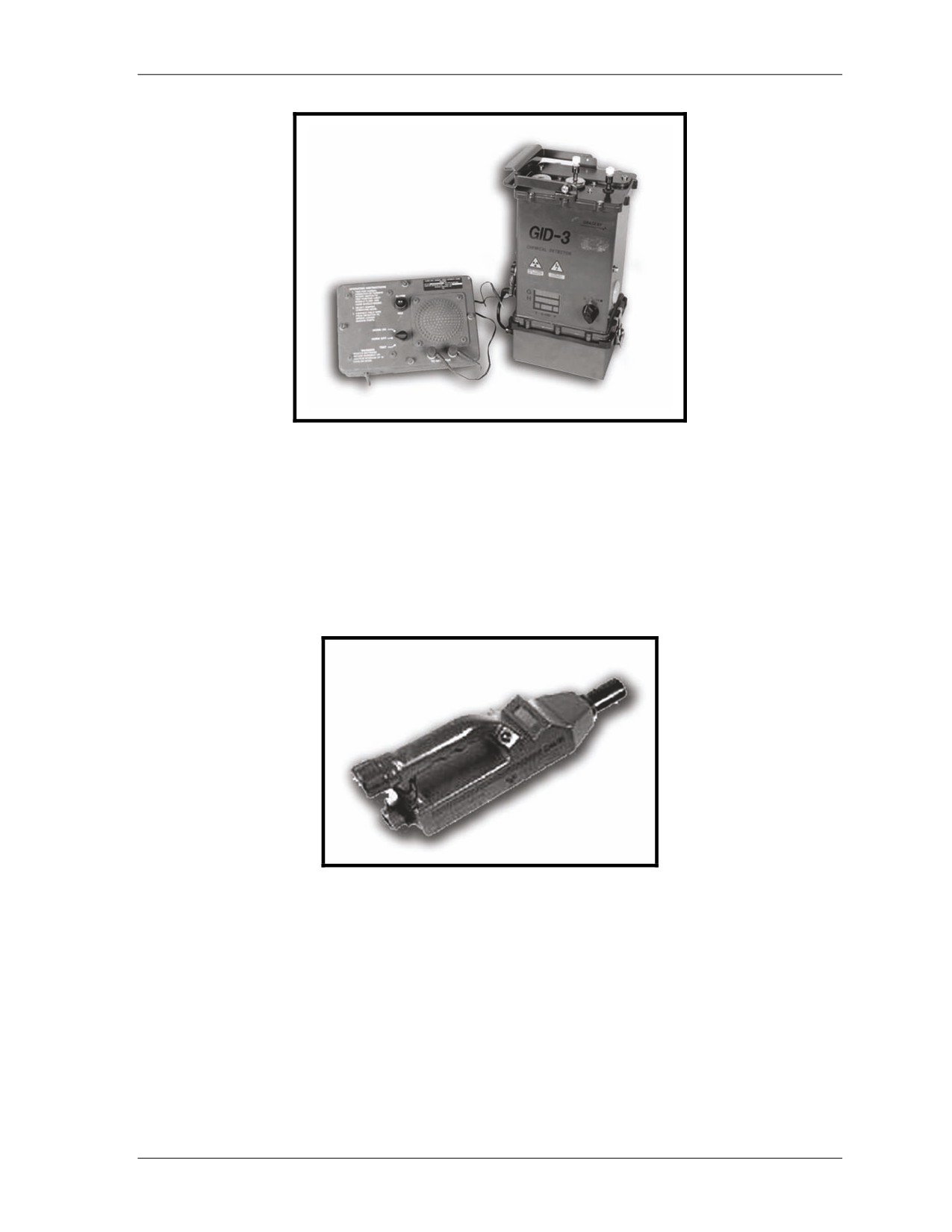
M22 AUTOMATIC CHEMICAL AGENT DETECTION ALARM
13-12. The M22 ACADA detects and warns of the presence of standard blister and nerve agents
(Figure 13-3). The M22 ACADA system is man-portable, operates independently after system startup, and
produces an audible and visual alarm. The M22 system also has a communications interface that
automatically provides battlefield warning and reporting. The system monitors the air in all environmental
conditions, within standard wheeled and tracked vehicles, and within collective protection shelters.
13-4
FM 3-21.75
28 January 2008
Chemical, Biological, Radiological, or Nuclear Weapons
Figure 13-3. M22 ACADA.
IMPROVED CHEMICAL AGENT MONITOR
13-13. The ICAM identifies nerve and blister agent contamination on personnel and equipment
(Figure 13-4). The ICAM is a handheld, individually operated, post-attack tool for monitoring chemical
agent contamination on personnel and equipment. It detects and discriminates between vapors of nerve and
mustard agents. The ICAM gives you instant feedback of chemical hazard levels, and quickly identifies the
presence of contamination.
Figure 13-4. M22 ICAM.
M8 CHEMICAL AGENT DETECTOR PAPER
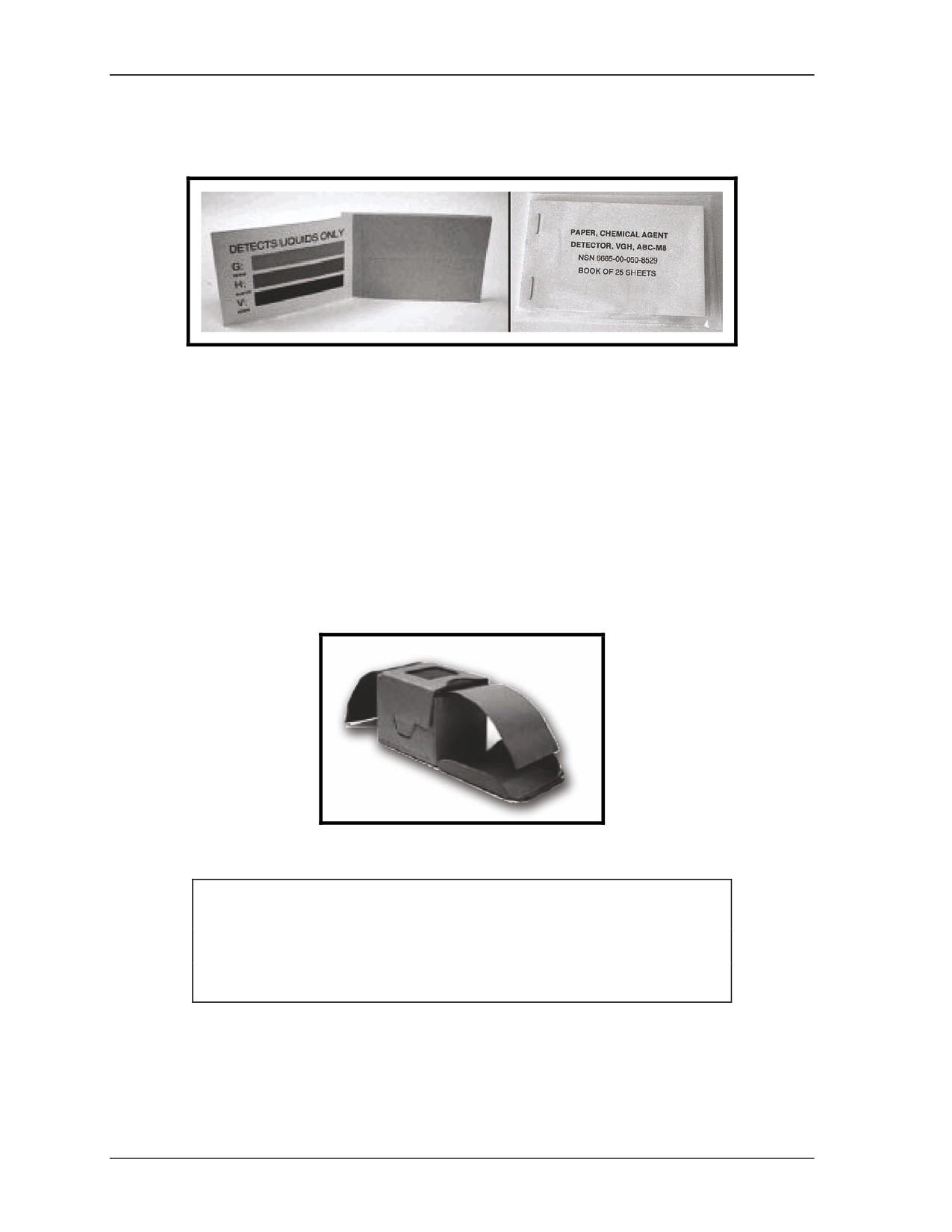
13-14. The M8 detector paper is the only means of identifying the type of chemical agent present in
liquid form on the battlefield (Figure 13-5). You will carry one booklet of 25 sheets of M8 paper in the
interior pocket of the protective mask carrier. Once you encounter an unknown liquid suspected of being a
chemical agent, you must don and check your mask within 9 seconds, and then quickly don the attached
hood. Next, alert others who are nearby and don all the rest of your chemical protective clothing. Remove
the booklet of M8 paper from your mask carrier, tear a half sheet from the booklet, and, if you can, affix
the sheet to a stick. Using the stick as a handle, blot the paper onto the unknown liquid and wait 30 seconds
for a color change. To identify the type of agent, compare the resulting color to those on the inside front
28 January 2008
FM 3-21.75
13-5
Chapter 13
cover of the booklet. The paper sheets turn dark green, yellow, or red on contact with liquid V-type nerve
agents, G-type nerve agents, or blister (mustard) agents. Unfortunately, they cannot detect vapors.
Figure 13-5. M8 chemical agent detector paper.
M9 CHEMICAL AGENT DETECTOR PAPER
13-15. M9 chemical agent detector paper is the most widely used tool used to detect liquid chemical
agents (Figure 13-6). M9 paper contains a suspension of an agent-sensitive, red indicator dye in a
paper base. It detects and turns pink, red, reddish brown, or red purple when exposed to liquid nerve and
blister agents, but it cannot identify the specific agent. Confirm the results of the M9 paper by using the
M256 kit. Carry one 30-feet long by 2-inch wide roll of M9 paper with adhesive backing. This will make it
easier to wrap a strip of the paper around a sleeve and trouser leg of your protective overgarment. Place the
M9 detector paper on opposite sides of your body. If you are right handed, place a strip of M9 paper
around your right upper arm, left wrist, and right ankle, and vice versa if you are left handed. You should
also attach M9 paper to large pieces of equipment such as shelters or vehicles.
Figure 13-6. M9 chemical agent detector paper.
CAUTION
When attaching M9 chemical paper to equipment, first place the equipment in
an area free from dirt, grease, and oil. This is especially important since
petroleum products will discolor the paper.
13-6
FM 3-21.75
28 January 2008
Chemical, Biological, Radiological, or Nuclear Weapons
M256 CHEMICAL AGENT DETECTOR KIT
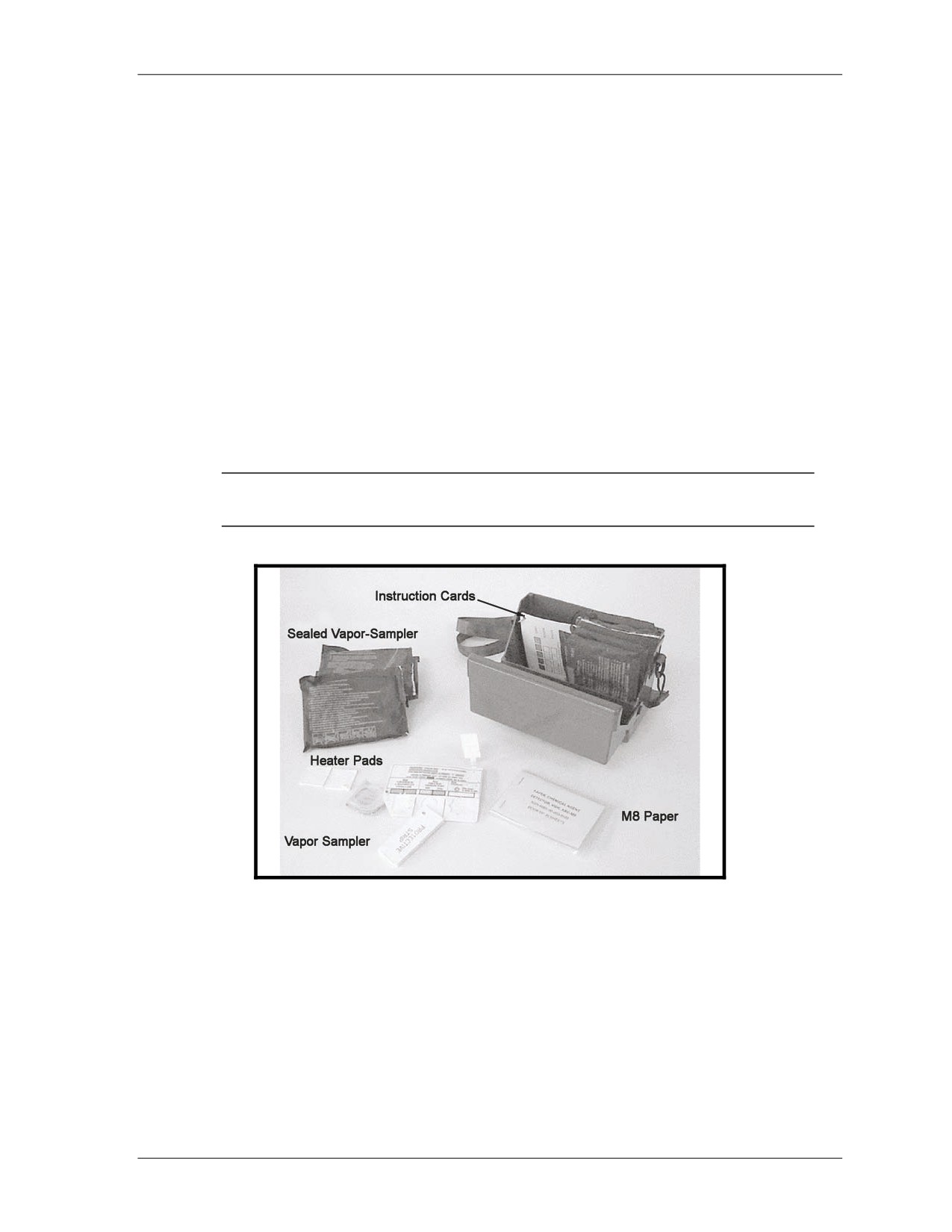
13-16. The M256 has a carrying case, a booklet of M8 paper,
12 disposable sampler-detectors
individually sealed in a plastic laminated foil envelope, and a set of instruction cards attached by lanyard to
the plastic carrying case (Figure 13-7). The case has a nylon carrying strap and belt attachment. Use this kit
to detect and identify blood, blister, and nerve agents, in liquid and vapor forms. You can use it to
determine when you can safely unmask, to locate and identify chemical hazards during reconnaissance, and
to monitor decontamination effectiveness. Each sampler-detector has a square, impregnated spot for blister
agents, a round test spot for blood agents, a star test spot for nerve agents, a lewisite-detecting tablet, and
a rubbing tab.
13-17. Of the eight glass ampoules, six contain reagents for testing, and an attached chemical heater
contains the other two. When you crush the ampoules between your fingers, formed channels in the plastic
sheets direct the flow of liquid reagent, wetting the test spots. Each test spot or detecting tablet develops a
distinctive color to show whether a chemical agent is present in the air.
13-18. Follow the directions on the foil packets or in the instruction booklet, and in about 20 minutes,
you can conduct a complete test using the liquid-sensitive M8 paper and the vapor-sensitive
sampler-detector.
Note: The M256 is not an alarm. It is just a tool for Soldiers to use after they receive other
warnings about the possible presence of chemical agents.
Figure 13-7. M256 chemical agent detector kit.
28 January 2008
FM 3-21.75
13-7
Chapter 13
PROTECTIVE ACTIONS
13-19.
Take these steps to protect against a chemical attack:
• Identify automatic masking criteria.
• Don your protective mask when there is a high probability of a chemical attack, such as when--
-- A chemical alarm sounds.
-- A positive reading is obtained on detector paper.
-- Individuals exhibit symptoms of CB agent poisoning.
-- You observe a contamination marker.
-- Your leader tells you to mask.
-- You see personnel wearing protective masks.
• Respond to the commander’s policy of automatic masking.
Note: When chemical weapons have been employed, commanders may modify policy by
designating additional events as automatic masking criteria.
• Don, clear, and check your assigned protective mask to protect yourself from CB
contamination.
• Give the alarm by yelling "Gas" and giving the appropriate hand and arm signal.
• Take cover to reduce exposure, using whatever means are readily available.
• Decontaminate exposed skin using the individual decontaminating kit, as necessary.
• Assume MOPP4.
-- Cover all skin (head and shoulders already protected by mask and overgarment).
-- Put on the gloves with liners.
-- Zip and fasten the overgarment jacket.
-- Secure the hood, and then secure the overgarment to increase protection.
-- Put on the overboots.
PROTECTIVE EQUIPMENT
MASK
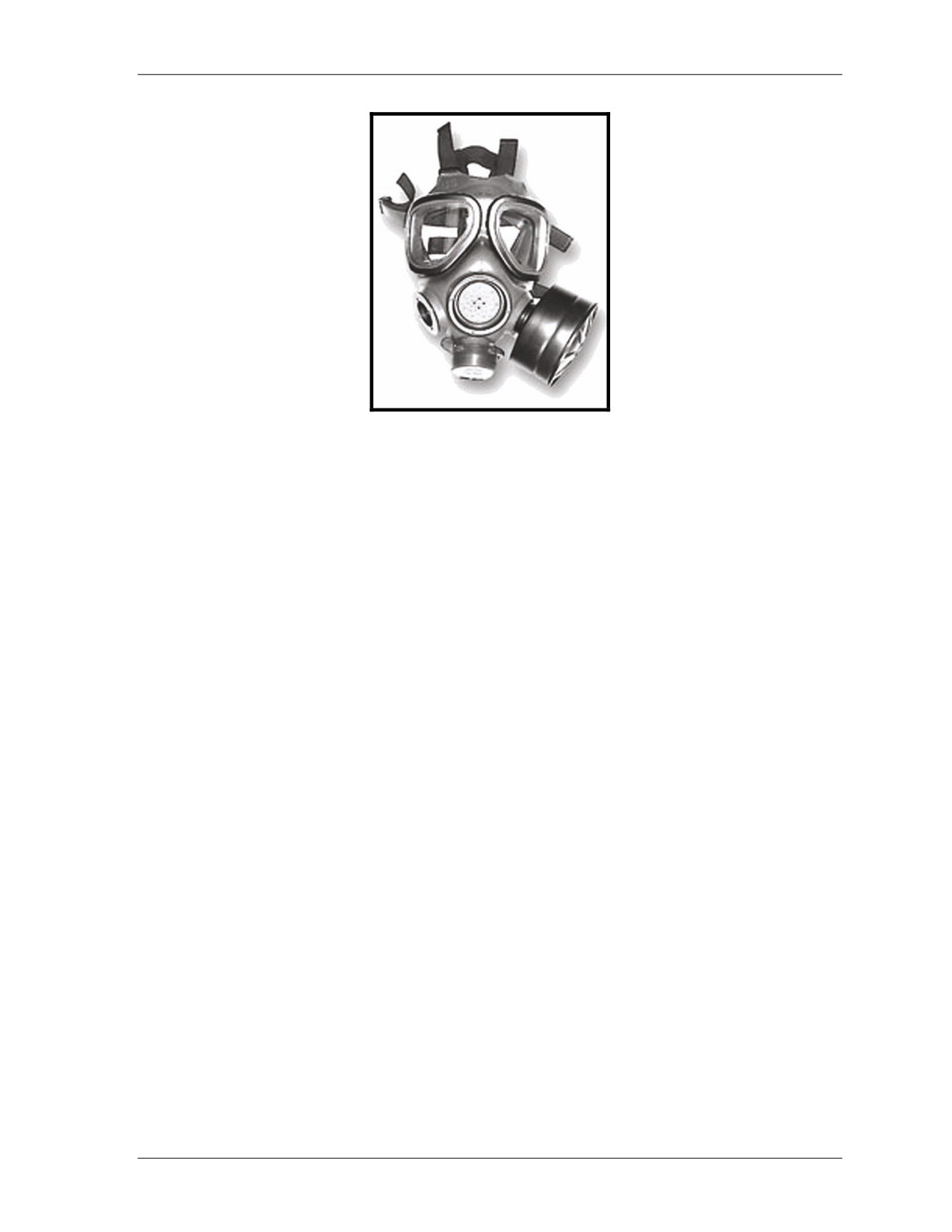
13-20. Your main protection against a CB attack is your protective mask. The M40A1/A2 series mask
provides respiratory, eye, and face protection against CB agents, radioactive fallout particles, and
battlefield contaminants. The M42A2 combat vehicle crew (CVC) CB mask has the same components as
the M40 A1/A2 (Figure 13-8). In addition, the M42A2 CVC mask has a detachable microphone for wire
communications. The canister on the M42A2 mask is attached to the end of a hose and has an adapter for
connection to a gas particulate filter unit (GPFU).
13-8
FM 3-21.75
28 January 2008
Chemical, Biological, Radiological, or Nuclear Weapons
Figure 13-8. Protective mask M40A1/A2 and M42A2 CVC.
PROTECTIVE CLOTHING
13-21. Additionally, protective clothing will provide protection from liquid agents. Protective clothing
includes the chemical protective suit, boots, gloves, and helmet cover. The protective clothing is referred to
as the joint service lightweight integrated suit technology (JSLIST), which has replaced the battle dress
overgarment (BDO). The JSLIST has a service life of 120 days of which 45 days is the maximum wear
time. The JSLIST service life begins when the garment is removed from the factory vacuum sealed bag. It
can be laundered up to six times for personal hygiene purposes and provides 24 hours of protection against
liquid, solid, and/or vapor CB attacks. It also provides protection against radioactive alpha and beta
particles.
CHEMICAL PROTECTIVE GLOVES
13-22. The chemical protective gloves protect you against CB agents and alpha and beta radioactive
particles as long as they remain serviceable. The glove sets come in three levels of thicknesses (7, 14, and
25 mil). The 7 mil glove set is used for tasks that require extreme sensitivity and will not expose the gloves
to harsh treatment. The 14 mil glove set is used by personnel such as vehicle mechanics and weapon crews
whose tasks require tactility and will not expose the gloves to harsh treatment. The more durable, 25 mil
glove set is used by personnel who perform close combat tasks and other types of heavy labor. If the 14
and 25 mil glove sets become contaminated with liquid chemical agents, decontaminate or replace them
within 24 hours after exposure. If the 7 mil glove set becomes contaminated, replace or decontaminate
them within 6 hours after exposure.
CHEMICAL PROTECTIVE FOOTWEAR
13-23. Chemical protective footwear includes the green vinyl overshoe (GVO), black vinyl overshoe
(BVO), and multi purpose lightweight overboot (MULO). The GVO is a plain, olive drab (OD) green,
vinyl overshoe with elastic fasteners. The BVO is very similar to the GVO, except for the color and
enlarged tabs on each elastic fastener. You can wear the GVO, BVO, or MULO over your combat boots to
protect your feet from contamination by all known agents, vectors, and radioactive alpha and beta particles
for a maximum of 60 days of durability and 24 hours of protection against CB agents.
28 January 2008
FM 3-21.75
13-9

Chapter 13
CHEMICAL PROTECTIVE FOOTWEAR COVER
13-24. The chemical protective footwear cover (CPFC) is impermeable and protects your feet from CB
agents, vectors, and radioactive alpha and beta particles for a minimum of 24 hours, as long as it remains
serviceable.
CHEMICAL PROTECTIVE HELMET COVER
13-25. The chemical protective helmet cover (CPHC) is a one piece configuration made of butyl coated
nylon cloth and gathered at the opening by elastic webbing enclosed in the hem. The cover comes in one
size and is OD green color. The helmet cover protects your helmet from CB contamination and radioactive
alpha and beta particles.
MISSION-ORIENTED PROTECTIVE POSTURE
13-26. Mission oriented protective posture (MOPP) is a flexible system of protection against chemical
agents. Your leader will specify the level of MOPP based on the chemical threat, work rate, and
temperature prior to performing a mission. Later, he may direct a change in MOPP according to the
changing situation. The MOPP level determines what equipment you must wear and carry. Your unit may
increase this level as necessary, but they may not decrease it. The standard MOPP levels are shown in the
following chart.
Table 13-1. MOPP levels.
MOPP
Mask
Equipment
Ready
MOPP0
MOPP1
MOPP2
MOPP3
MOPP4
Only
Mask
Carried
Carried
Carried
Carried
Worn
Worn
Worn***
JSLIST
Ready*
Avail**
Worn
Worn
Worn
Worn
Overboots
Ready*
Avail**
Avail**
Worn
Worn
Worn
Gloves
Ready*
Avail**
Avail**
Avail**
Avail**
Worn
Helmet
Ready*
Avail**
Avail**
Worn
Worn
Worn
Cover
* Item must be available to Soldier within two hours, with replacement available within six hours.
** Item must be positioned within arm's reach of the Soldier.
*** Soldier Never "mask only" if a nerve or blister agent has been used in the AO.
DECONTAMINATION
13-27. Contamination forces your unit into protective equipment that degrades performance of individual
and collective tasks. Decontamination restores combat power and reduces casualties that may result from
exposure, allowing your unit to sustain combat operations.
PRINCIPLES--THE FOUR PRINCIPLES OF DECONTAMINATION OPERATIONS ARE--
1. Decontaminate as soon as possible.
2. Decontaminate only what is necessary.
13-10
FM 3-21.75
28 January 2008
Chemical, Biological, Radiological, or Nuclear Weapons
3. Decontaminate as far forward as possible.
4. Decontaminate by priority.
LEVELS AND TECHNIQUES--
13-28. The following decontamination levels and techniques are shown in tabular format in Table 13-2
(FM 3-11.4):
1. Immediate decontamination is a basic Soldier survival skill and is performed IAW
STP 21-1-SMCT. Personal wipedown removes contamination from exposed skin and
individual equipment.
2. Operational decontamination involves MOPP gear exchange and vehicle spraydown. When a
thorough decontamination cannot be performed, MOPP gear exchange should be performed
within six hours of contamination.
3. Thorough decontamination involves detailed troop decontamination (DTD) and detailed
equipment decontamination (DED). Thorough decontamination is normally conducted by
company size elements as part of restoration or during breaks in combat operations. These
operations require support from a chemical decontamination platoon and a water source
or supply.
4. Clearance decontamination provides decontamination to a level that allows unrestricted
transport, maintenance, employment, and disposal.
28 January 2008
FM 3-21.75
13-11

Chapter 13
Table 13-2. Decontamination levels and techniques.
Levels
Techniques1
Purpose
Best Start Time
Performed By
Immediate
Skin
Saves lives
Before 1 minute
Individual
decontamination
Personal wipe
Stops agent from
Within 15 minutes
Individual or buddy
down
penetrating
Within 15 minutes
Individual or crew
Operator wipe
Limits agent spread
Within 15 minutes
Individual or crew
down Spot
Limits agent spread
decontamination
Operational
MOPP gear
Provides temporary
Within 6 hours
Unit
exchange2
relief from MOPP4
Limits agent spread
Within 1 hour (CARC)
Battalion crew or
Vehicle wash down
or within 6 hours
decontamination
(nonCARC)
platoon
Thorough
DED and DAD DTD
Provides probability
When mission allows
Decontamination
of long-term MOPP
reconstitution
platoon
reduction
Contaminated unit
Clearance
Unrestricted use of
METT-TC
When mission permits
Supporting strategic
resources
depending on the
resources
type of equipment
contaminated
1 The techniques become less effective the longer they are delayed.
2 Performance degradation and risk assessment must be considered when exceeding 6 hours.
DECONTAMINATING KITS
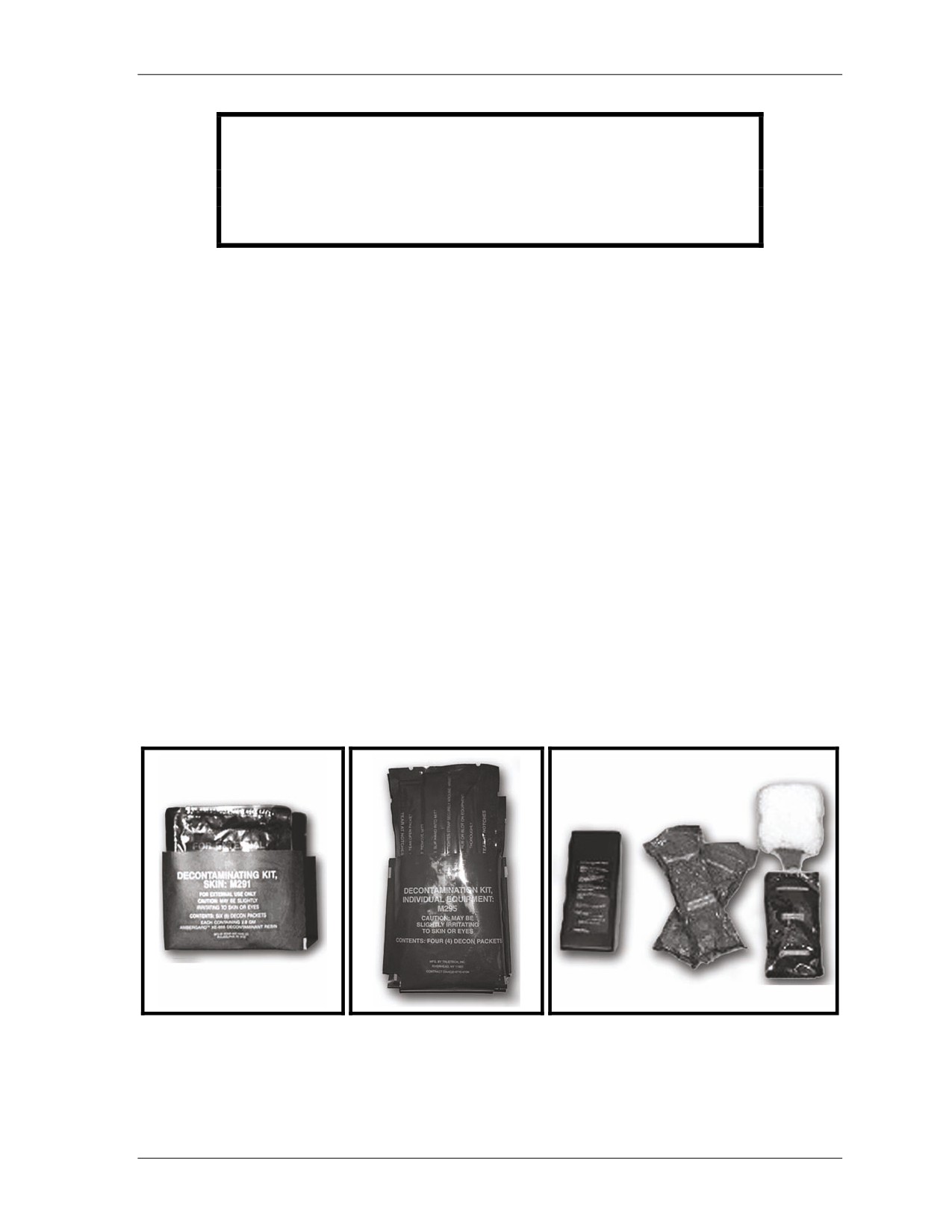
M291 Skin Decontaminating Kit--The M291 Skin Decontamination Kit has a wallet like carrying
pouch containing six individual decontamination packets, enough to perform three complete skin
decontaminations (Figure 13-9). Instructions for use are marked on the case and packets. Each
packet contains an applicator pad filled with decontamination powder. Each pad provides you with
a single step, nontoxic/nonirritating decontamination application. Decontamination is accomplished
by application of a black decontamination powder contained in the applicator pad. The M291 can be
used on the skin, including the face and around wounds as well as some personal equipment such as
your rifle, mask, and gloves. The M291 allows you to completely decontaminate yourself and
equipment skin through physical removal, absorption, and neutralization of toxic agent with no long
term harmful effects.
13-12
FM 3-21.75
28 January 2008
Chemical, Biological, Radiological, or Nuclear Weapons
WARNING
This kit is for external use only. It may be slightly irritating to eyes
or skin. Be sure to keep the decontamination powder out of eyes,
cuts, or wounds, and avoid inhalation of the powder.
M295 Equipment Decontamination Kit--The M295 is issued in boxes of 20 kits (Figure 13-10). The
M295 kit has a pouch containing four individual wipe down mitts; each enclosed in a soft,
protective packet. The packet is designed to fit comfortably within a pocket of the JSLIST. The
M295 allows you to decontaminate through the physical removal and absorption of chemical
agents. Each individual wipe down mitt in the kit is comprised of a decontaminating powder
contained within a pad material and a polyethylene film backing. In use, powder from the mitt is
allowed to flow freely through the pad material. Decontamination is accomplished by adsorption of
the liquid agent by the resin and the pad.
M100 Sorbent Decontamination System--The M100 Sorbent Decontamination System (SDS) replaces
the M11 and M13 decontamination apparatuses portable (DAPs) and the DS2 used in operator
spraydown (immediate decontamination) with a sorbent powder (Figure 13-11). The M100 SDS
uses a reactive sorbent powder to remove and neutralize chemical agent from surfaces. Use of the
M100 SDS decreases decontamination time and eliminates the need for water. Decontaminate key
weapons with M100 SDS or slurry. After decontamination, disassemble weapons and wash, rinse,
and oil them to prevent corrosion. Decontaminate ammunition with M100 SDS, wipe with gasoline
soaked rags, and then dry it. If M100 SDS is unavailable, wash ammunition in cool, soapy water,
then dry it thoroughly. Decontaminate optical instruments by blotting them with rags, wiping with
lens cleaning solvent, and then letting them dry. Decontaminate communication equipment by
airing, weathering, or hot air (if available). The M100 SDS includes--
• Two 0.7 lb packs of reactive sorbent powder
• Two wash mitt-type sorbent applicators
• Case
• Straps
• Detailed instructions.
• Chemical agent-resistant mounting bracket (optional).
Figure 13-9.
Figure 13-10.
Figure 13-11.
M291 skin
M295 equipment
M100 SORBENT
decontaminating kit.
decontamination kit.
Decontamination System.
28 January 2008
FM 3-21.75
13-13
Chapter 13
Section II. BIOLOGICAL WEAPONS
Biological agents are microorganisms that cause disease in personnel, plants, or animals or cause the
deterioration of material. They create a disease hazard where none exists naturally. They may be dispersed as
sprays by generators, or delivered by explosives, bomblets, missiles, and aircraft. They may also be spread by
the release of germ carrying flies, mosquitoes, fleas, and ticks. Biological agents can be classified as toxins or
pathogens.
TYPES
13-29. Biological agents are classified as toxins or pathogens.
Toxins--Toxins are biologically derived poisonous substances produced as by products of
microorganisms, fungi, plants, or animals. They can be naturally or synthetically produced.
Pathogens--Pathogens are infectious agents that cause disease in man, animals, or plants and include
bacteria, viruses, rickettsias, protests, fungi, prions or other biologically derived products.
DETECTION
13-30. Biological agents may be disseminated as aerosols, liquid droplets, or dry powder. Attacks with
biological agents can be very subtle or direct, if favorable weather conditions prevail. In nearly all
circumstances, you will not know a biological attack has occurred. Symptoms can appear from minutes to
days after an attack has occurred. Indicators may include -
• Mysterious illness (many individuals sick for unknown reasons).
• Large numbers of vectors, such as insects or unusual insects.
• Large numbers of dead or strange acting (wild and domestic) animals.
• Mass casualties with flu like symptoms—fever, sore throat, skin rash, mental abnormalities,
pneumonia, diarrhea, dysentery, hemorrhaging, or jaundice.
• Artillery shells with less powerful explosions than HE rounds.
• Aerial bombs that pop rather than explode.
• Mist or fog sprayed by aircraft or aerosol generators.
• Unexploded bomblets found in the area.
DECONTAMINATION
13-31. Soldiers can use household bleach for biological decontamination.
•
Dilute for use on equipment.
•
Apply undiluted in the general area of contamination.
PROTECTION
13-32. If threat forces attack with biological agents, you may have little--if any--warning. When a high
probability of an attack exists, your unit might assume MOPP4 to protect against contamination. MOPP
gear generally protects you against biological agents, but an agent can gain entry through openings such as
buttonholes; zippers; stitches; poor seal at ankles, wrists, and neck; or through minute pores in the clothing
fabric. Some toxins, however, require the same amount of protection as chemical agents. Consider any
unknown agent cloud as a sign of a biological attack and take the same actions prescribed for a chemical
attack. Protective measures can be accomplished long before a biological attack happens as follows:
13-14
FM 3-21.75
28 January 2008
Chemical, Biological, Radiological, or Nuclear Weapons
UP-TO-DATE IMMUNIZATIONS
13-33. Immunizations reduce the chances of becoming biological casualties. Proper immunizations
protect against many known disease producing biological agents. You should receive basic immunizations.
Medical personnel will periodically screen your records and keep them up to date. When your unit deploys
to areas where specific diseases are prevalent, readiness preparation may include providing additional
immunizations for needed protection.
GOOD HYGIENE
13-34. The best defense against biological agents is good personal hygiene, which means keeping your
body as clean as possible. This not only means washing your face and hands, but all parts of your body—
particularly your feet and exposed skin. Shaving may seem unimportant in the field, but it is necessary to
achieve a proper seal with your mask. You should clean any small nicks, scratches, and cuts with soap and
water followed by first aid treatment.
FIELD SANITATION
13-35. Another way to stop the spread of disease is to keep the area clean. Use field sanitation facilities
properly. Latrine facilities should include soap and water for hand washing. Avoid leaving such facilities
open to help control the insects and rodents. This is also essential in preventing the spread of disease.
PHYSICAL CONDITION
13-36. Good physical conditioning requires that you keep your body well-rested, well-fed, and healthy.
Get as much exercise and rest as the situation permits, and remember to eat properly. You may have to eat
smaller portions, but at more frequent intervals. For you to be able to fight off germs, you must
remain healthy.
DEPARTMENT OF DEFENSE INSECT REPELLENT SYSTEM
13-37. Proper implementation of the DOD insect repellent system will provide you protection from
insects and ticks, which can serve as vectors, spreading biological agents.
REINFORCEMENT TRAINING
13-38. Training in an CBRN environment should be integrated into all areas of your unit training.
Reinforcement training both individual and collective tasks should be performed to standard through
continuous training, thereby instilling your individual confidence. Your life and the lives of your fellow
Soldiers could depend on it.
Section III. RADIOLOGICAL WEAPONS
A radiological dispersal device (RDD) is a conventional bomb, not a yield producing nuclear device. An RDD
disperses radioactive material to destroy, contaminate, and injure. An RDD can be almost any size.
TYPES
13-39. The types of radiological dispersal devices (RDDs) follow:
PASSIVE
13-40. A passive RDD is unshielded radioactive material dispersed or placed manually at the target.
28 January 2008
FM 3-21.75
13-15
Chapter 13
EXPLOSIVE
13-41. The main employment of RDDs is explosives, which can cause serious injuries and property
damage. An explosive RDD, often called "dirty bomb," is any system that uses the explosive force of
detonation to disperse radioactive material. A dirty bomb uses dynamite or other explosives to scatter
radioactive dust, smoke, or other materials in order to cause radioactive contamination.
13-42. A simple explosive RDD, commonly called a pig, has a lead-shielded container with a kilogram of
explosive attached. A pig can easily fit into a backpack. The radioactive materials in an RDD probably
produces too little exposure to cause immediate serious illness, except to those who are very close to the
blast site. However, radioactive dust and smoke, when spread farther away, could endanger health if
inhaled. Terrorist use of RDDs could cause health, environmental, political, social, and economic effects.
It could also cause fear, and could cost much money and time to clean up.
ATMOSPHERIC
13-43. An atmospheric RDD is any device that converts radioactive materials into a form that is easily
transported by air currents.
DETECTION
13-44. Because you cannot see, smell, feel, or taste radiation, you may not know whether you have been
exposed. Low levels of radiation exposure--like those expected from a dirty bomb--cause no symptoms.
Higher levels may produce symptoms such as nausea, vomiting, diarrhea, and swelling and redness of
the skin.
DECONTAMINATION
13-45. Decontaminate and treat casualties the same as you would for exposure to nuclear radiation.
PROTECTION
13-46. Should you know when an incident occurs, take immediate steps to protect yourself:
OUTSIDE
• Cover your nose and mouth with a cloth to reduce the risk of breathing in radioactive dust
or smoke.
• Don’t touch objects thrown off by an explosion as they might be radioactive.
• Quickly go into a building where the walls and windows have not been broken. This area will
shield you from radiation that might be outside.
• Once you are inside, take off your outer layer of clothing and seal it in a plastic bag if available.
Put the cloth you used to cover your mouth in the bag as well. Removing outer clothes may get
rid of up to 90% of radioactive dust.
• Shower or wash with soap and water. Be sure to wash your hair. Washing will remove any
remaining dust.
INSIDE
• If the walls and windows of the building are not broken, stay in the building and do not leave.
• To keep radioactive dust or powder from getting inside, shut all windows and outside doors.
Turn off fans and heating and air conditioning systems that bring in air from the outside. It is
not necessary to put duct tape or plastic around doors or windows.
13-16
FM 3-21.75
28 January 2008
Chemical, Biological, Radiological, or Nuclear Weapons
• If the walls and windows of the building are broken, go to an interior room and do not leave. If
the building has been heavily damaged, quickly go into a building where the walls and
windows have not been broken. If you must go outside, be sure to cover your nose and mouth
with a cloth. Once you are inside, take off your outer layer of clothing and seal it in a plastic
bag if available. Store the bag where others will not touch it.
• Shower or wash with soap and water, removing any remaining dust. Be sure to wash your hair.
IN A VEHICLE
• Close the windows and turn off the air conditioner, heater, and vents.
• Cover your nose and mouth with a cloth to avoid breathing radioactive dust or smoke.
• If you are close to a building, go there immediately and go inside quickly.
• If you cannot get to another building safely, pull over to the side of the road and stop in the
safest place possible. If it is a hot or sunny day, try to stop under a bridge or in a shady spot.
• Turn off the engine.
Section IV. NUCLEAR WEAPONS
When a nuclear explosion occurs, blast radiation, and heat or thermal effects will occur. When a nuclear
weapon detonates at low altitudes, a fireball results from the sudden release of immense quantities of energy.
The initial temperature of the fireball ranges into millions of degrees, and the initial pressure ranges to millions
of atmospheres. Characteristics of nuclear explosions and their effects on Soldiers, equipment, and supplies,
and hasty measures for protection against nuclear attacks will be discussed in this section.
CHARACTERISTICS
13-47. Nuclear explosions are comprised of the following:
BLAST (INTENSE SHOCK WAVE)
13-48. Blast produces an intense shock wave and high winds, causing debris to fly. The force of a
nuclear blast can collapse shelters and fighting positions.
THERMAL RADIATION (HEAT AND LIGHT)
13-49. Thermal radiation starts fires and causes burns. The bright flash at the time of the explosion can
cause a temporary loss of vision or permanent eye damage if you look at the explosion, especially at night.
NUCLEAR RADIATION (RADIOACTIVE MATERIAL)
13-50. Nuclear radiation can cause casualties and delay movements. It may last for days and cover large
areas of terrain. It occurs in two stages:
Initial Radiation
13-51. This type of radiation emits directly from the fireball in the first minute after the explosion. It
travels at the speed of light along straight lines and has high penetrating power.
Residual Radiation
13-52. This type of radiation lingers after the first minute. It comes from the radioactive material
originally in a nuclear weapon or from material, such as soil and equipment, made radioactive by the
nuclear explosion.
28 January 2008
FM 3-21.75
13-17