FM 3-21.75 The Warrior Ethos and Soldier Combat Skills (JANUARY 2008) - page 4
This page intentionally left blank.
Chapter 7
Movement
Normally, you will spend more time moving than fighting. The fundamentals of
movement discussed in this chapter provide techniques that all Soldiers must learn.
Even seasoned troops should practice these techniques regularly, until they become
second nature.
INDIVIDUAL MOVEMENT TECHNIQUES
7-1.
Your leaders base their selection of a particular movement technique by traveling, traveling
overwatch, or bounding overwatch on the likelihood of enemy contact and the requirement for speed.
However, your unit is ability to move depends on your movement skills and those of your fellow Soldiers.
Use the following techniques to avoid being seen or heard:
• Stop, look, listen, and smell (SLLS) before moving. Look for your next position before leaving
a position.
• Look for covered and concealed routes on which to move.
• Change direction slightly from time-to-time when moving through tall grass.
• Stop, look, and listen when birds or animals are alarmed (the enemy may be nearby).
• Smell for odors such as petroleum, smoke, and food; they are additional signs of the enemy’s
presence.
• Cross roads and trails at places that have the most cover and concealment (large culverts, low
spots, curves, or bridges).
• Avoid steep slopes and places with loose dirt or stones.
• Avoid cleared, open areas and tops of hills and ridges. Walking at the top of a hill or ridge will
skyline you against the sun or moon, enabling the enemy to see you.
INDIVIDUAL MOVEMENT TECHNIQUES
7-2.
In addition to walking, you may move in one of three other methods known as individual
movement techniques (IMT) — low crawl, high crawl, or rush.
Low Crawl
7-3.
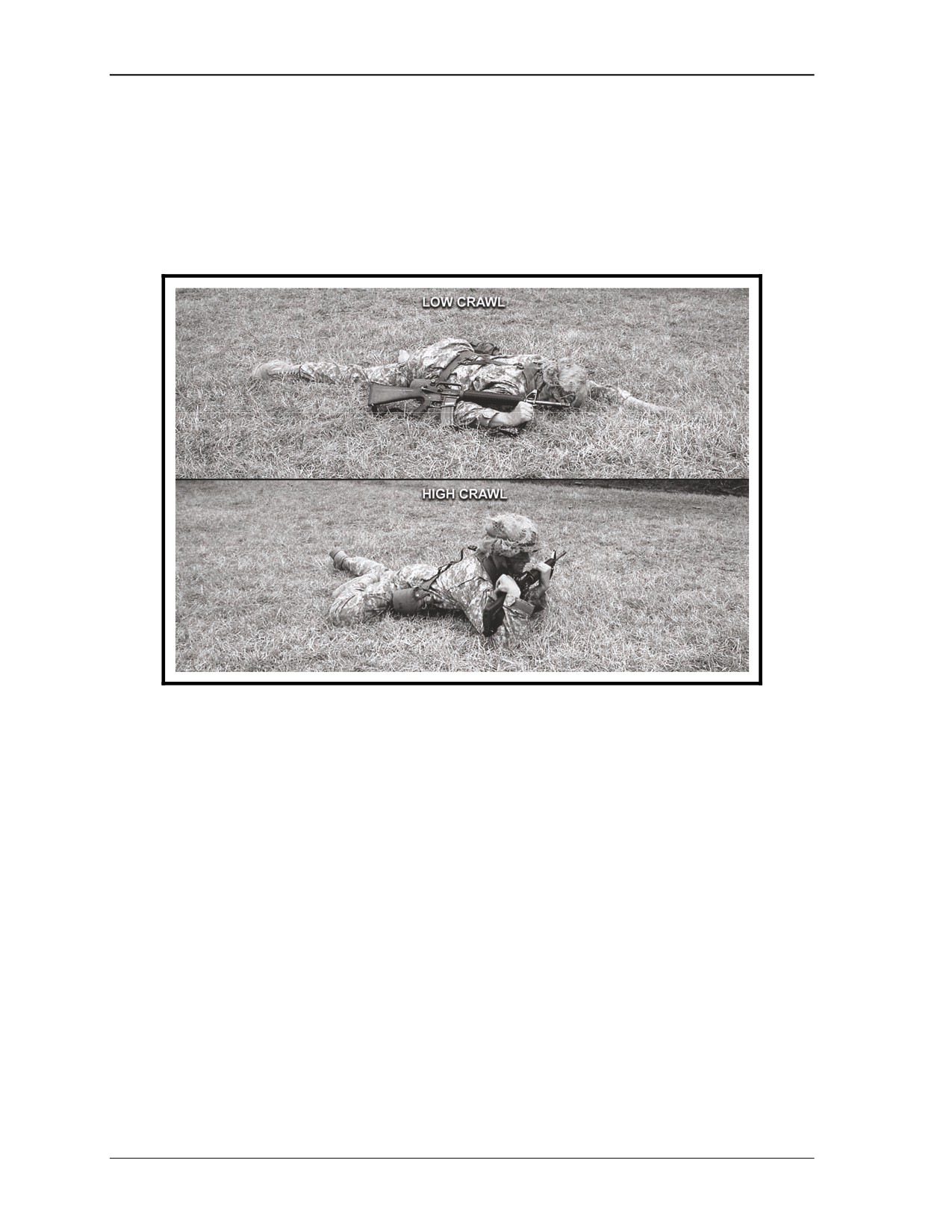
The low crawl gives you the lowest silhouette. Use it to cross places where the cover and/or
concealment are very low and enemy fire or observation prevents you from getting up. Keep your body flat
against the ground. With your firing hand, grasp your weapon sling at the upper sling swivel. Let the front
hand guard rest on your forearm (keeping the muzzle off the ground), and let the weapon butt drag on the
ground. To move, push your arms forward and pull your firing side leg forward. Then pull with your arms
and push with your leg. Continue this throughout the move (Figure 7-1).
28 January 2008
FM 3-21.75
7-1
Chapter 7
High Crawl
7-4.
The high crawl lets you move faster than the low crawl and still gives you a low silhouette. Use
this crawl when there is good cover and concealment but enemy fire prevents you from getting up. Keep
your body off the ground and resting on your forearms and lower legs. Cradle your weapon in your arms
and keep its muzzle off the ground. Keep your knees well behind your buttocks so your body will stay low.
To move, alternately advance your right elbow and left knee, then your left elbow and right knee
(Figure 7-1).
Figure 7-1. Low and high crawl.
7-5.
When you are ready to stop moving:
• Plant both of your feet.
• Drop to your knees (at the same time slide a hand to the butt of your rifle).
• Fall forward, breaking the fall with the butt of the rifle.
• Go to a prone firing position.
7-6.
If you have been firing from one position for some time, the enemy may have spotted you and
may be waiting for you to come up from behind cover. So, before rushing forward, roll or crawl a short
distance from your position. By coming up from another spot, you may fool an enemy who is aiming at one
spot and waiting for you to rise. When the route to your next position is through an open area, use the 3 to
5 second rush. When necessary, hit the ground, roll right or left, and then rush again.
Rush
7-7.
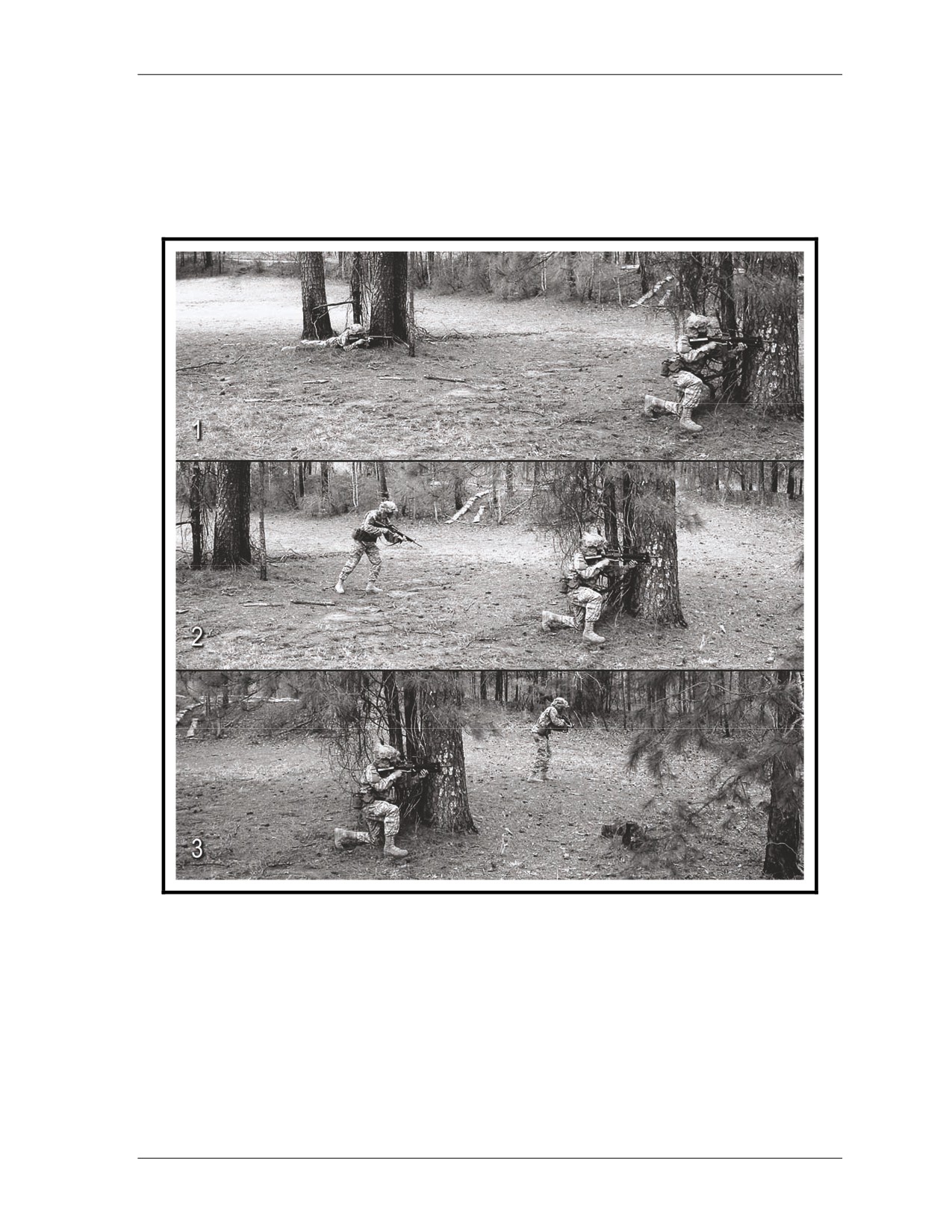
The rush is the fastest way to move from one position to another (Figure 7-2). Each rush should
last from 3 to 5 seconds. Rushes are kept short to prevent enemy machine gunners or riflemen from
tracking you. However, do not stop and hit the ground in the open just, because 5 seconds have passed.
Always try to hit the ground behind some cover. Before moving, pick out your next covered and concealed
position and the best route to it. Make your move from the prone position as follows:
• Slowly raise your head and pick your next position and the route to it.
• Slowly lower your head.
7-2
FM 3-21.75
28 January 2008
Movement
• Draw your arms into your body (keeping your elbows in).
• Pull your right leg forward.
• Raise your body by straightening your arms.
• Get up quickly.
• Rush to the next position.
Figure 7-2. Rush.
Movement With Stealth
7-8.
Moving with stealth means moving quietly, slowly, and carefully. This requires great patience. To
move with stealth, use the following techniques:
• Ensure your footing is sure and solid by keeping your body’s weight on the foot on the ground
while stepping.
• Raise the moving leg high to clear brush or grass.
28 January 2008
FM 3-21.75
7-3
Chapter 7
• Gently let the moving foot down toe first, with your body’s weight on the rear leg.
• Lower the heel of the moving foot after the toe is in a solid place.
• Shift your body’s weight and balance the forward foot before moving the rear foot.
• Take short steps to help maintain balance.
7-9.
At night, and when moving through dense vegetation, avoid making noise. Hold your weapon
with one hand, and keep the other hand forward, feeling for obstructions. When going into a prone
position, use the following techniques:
• Hold your rifle with one hand and crouch slowly.
• Feel for the ground with your free hand to make sure it is clear of mines, tripwires, and other
hazards.
• Lower your knees, one at a time, until your body’s weight is on both knees and your free hand.
• Shift your weight to your free hand and opposite knee.
• Raise your free leg up and back, and lower it gently to that side.
• Move the other leg into position the same way.
• Roll quietly into a prone position.
7-10.
Use the following techniques when crawling:
• Crawl on your hands and knees.
• Hold your rifle in your firing hand.
• Use your nonfiring hand to feel for and make clear spots for your hands and knees.
• Move your hands and knees to those spots, and put them down softly.
MOVEMENT WITHIN A TEAM
7-11.
Movement formations are used for control, security, and flexibility. These formations are the
actual arrangements for you and your fellow Soldiers in relation to each other.
Control
7-12.
Every squad and Soldier has a standard position. You must be able to see your fire team leader.
Fire team leaders must be able to see their squad leaders. Leaders control their units using
arm-and-hand signals.
Security
7-13.
Formations also provide 360-degree security and allow the weight of their firepower to the flanks
or front in anticipation of enemy contact.
Flexibility
7-14.
Formations do not demand parade ground precision. Your leaders must retain the flexibility
needed to vary their formations to the situation. The use of formations allows you to execute battle drills
more quickly and gives the assurance that your leaders and buddy team members are in their expected
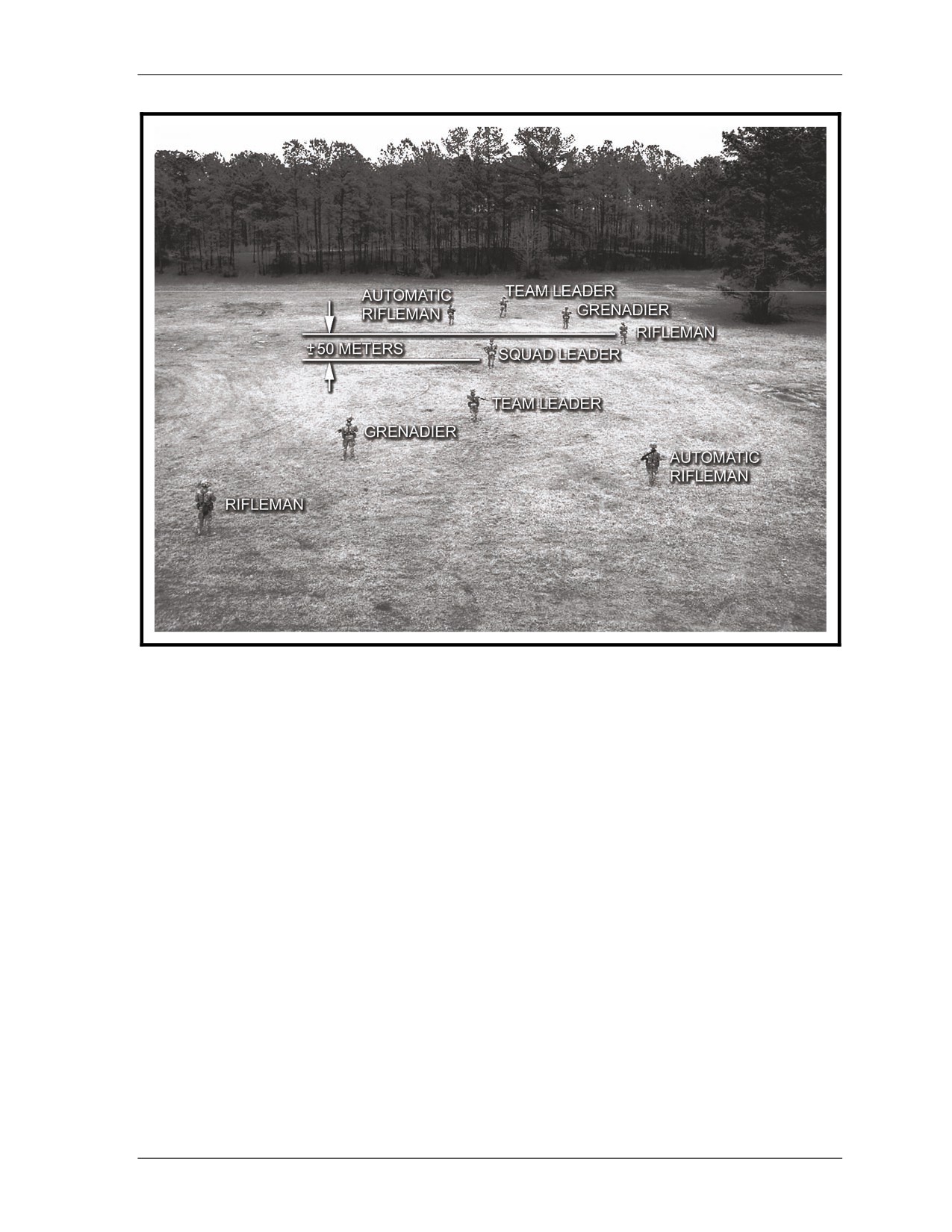
positions and performing the right tasks. You will usually move as a member of a squad/team. Small teams,
such as Infantry fire teams, normally move in a wedge formation. Each Soldier in the team has a set
position in the wedge, determined by the type of weapon he carries. That position, however, may be
changed by the team leader to meet the situation. The normal distance between Soldiers is 10 meters. When
enemy contact is possible, the distance between teams should be about 50 meters. In very open terrain such
as the desert, the interval may increase. The distance between individuals and teams is determined by how
much command and control the squad leader can still exercise over his teams and the team members
(Figure 7-3).
7-4
FM 3-21.75
28 January 2008
Movement
Figure 7-3. Fire team wedge.
7-15.
You may have to make a temporary change in the wedge formation when moving through close
terrain. The Soldiers in the sides of the wedge close into a single file when moving in thick brush or
through a narrow pass. After passing through such an area, they should spread out, forming the wedge
again. You should not wait for orders to change the formation or the interval. You should change
automatically and stay in visual contact with the other team members and the team leader. The team leader
leads by setting the example. His standing order is, FOLLOW ME AND DO AS I DO. When he moves to
the left, you should move to the left. When he gets down, you should get down. When visibility is limited,
control during movement may become difficult. To aid control, for example, the helmet camouflage band
has two,
1-inch horizontal strips of luminous tape sewn on it. Unit SOPs normally address the
configuration of the luminous strips.
IMMEDIATE ACTIONS WHILE MOVING
7-16.
This section furnishes guidance for the immediate actions you should take when reacting to enemy
indirect fire and flares. These Warrior Drills are actions every Soldier and small unit should train for
proficiency.
REACTING TO INDIRECT FIRE
7-17.
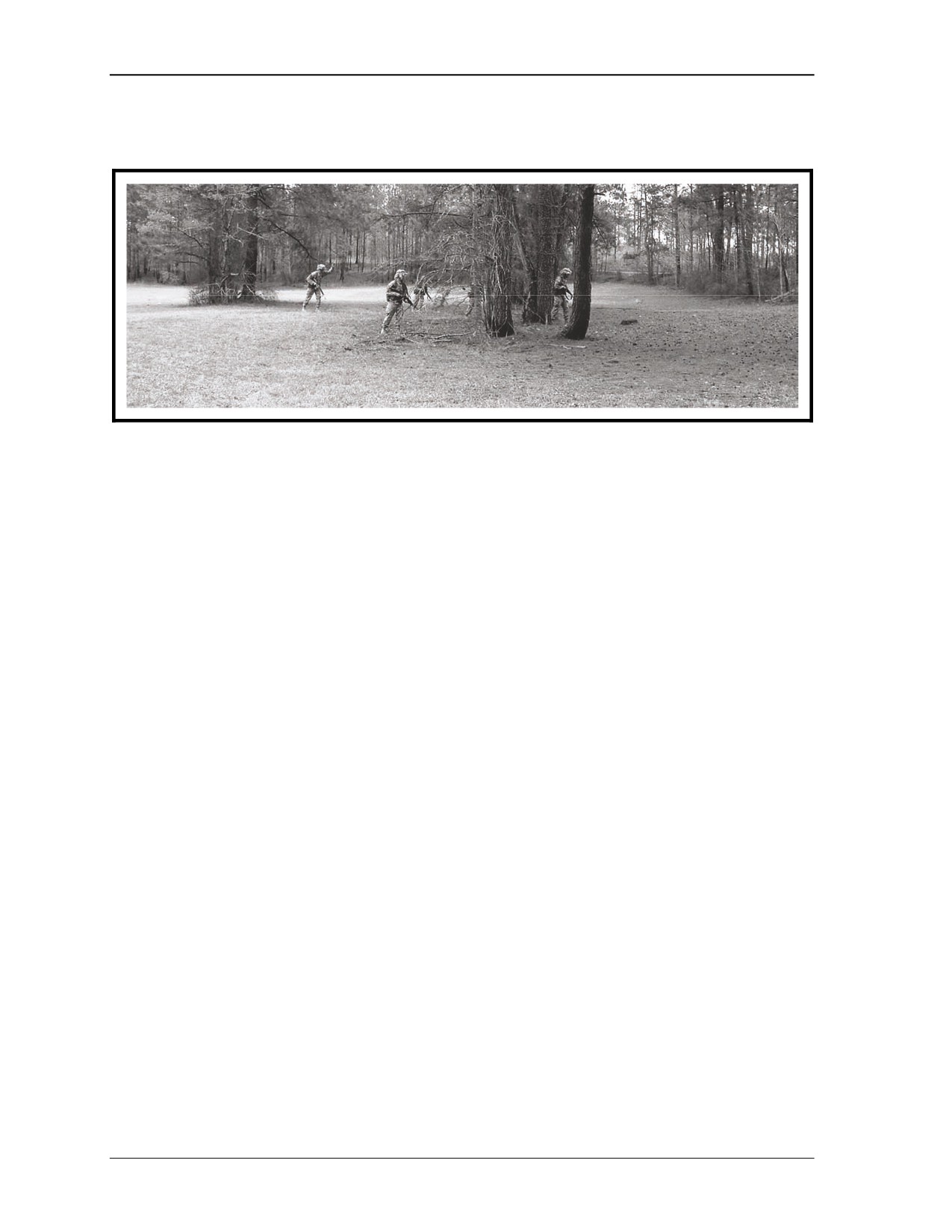
If you come under indirect fire while moving, immediately seek cover and follow the commands
and actions of your leader. He will tell you to run out of the impact area in a certain direction or will tell
you to follow him (Figure 7-4). If you cannot see your leader, but can see other team members, follow
28 January 2008
FM 3-21.75
7-5
Chapter 7
them. If alone, or if you cannot see your leader or the other team members, run out of the area in a direction
away from the incoming fire.
Figure 7-4. Following of team leader from impact area.
7-18.
It is hard to move quickly on rough terrain, but the terrain may provide good cover. In such
terrain, it may be best to take cover and wait for the fires to cease. After they stop, move out of the area
quickly.
REACTING TO GROUND FLARES
7-19.
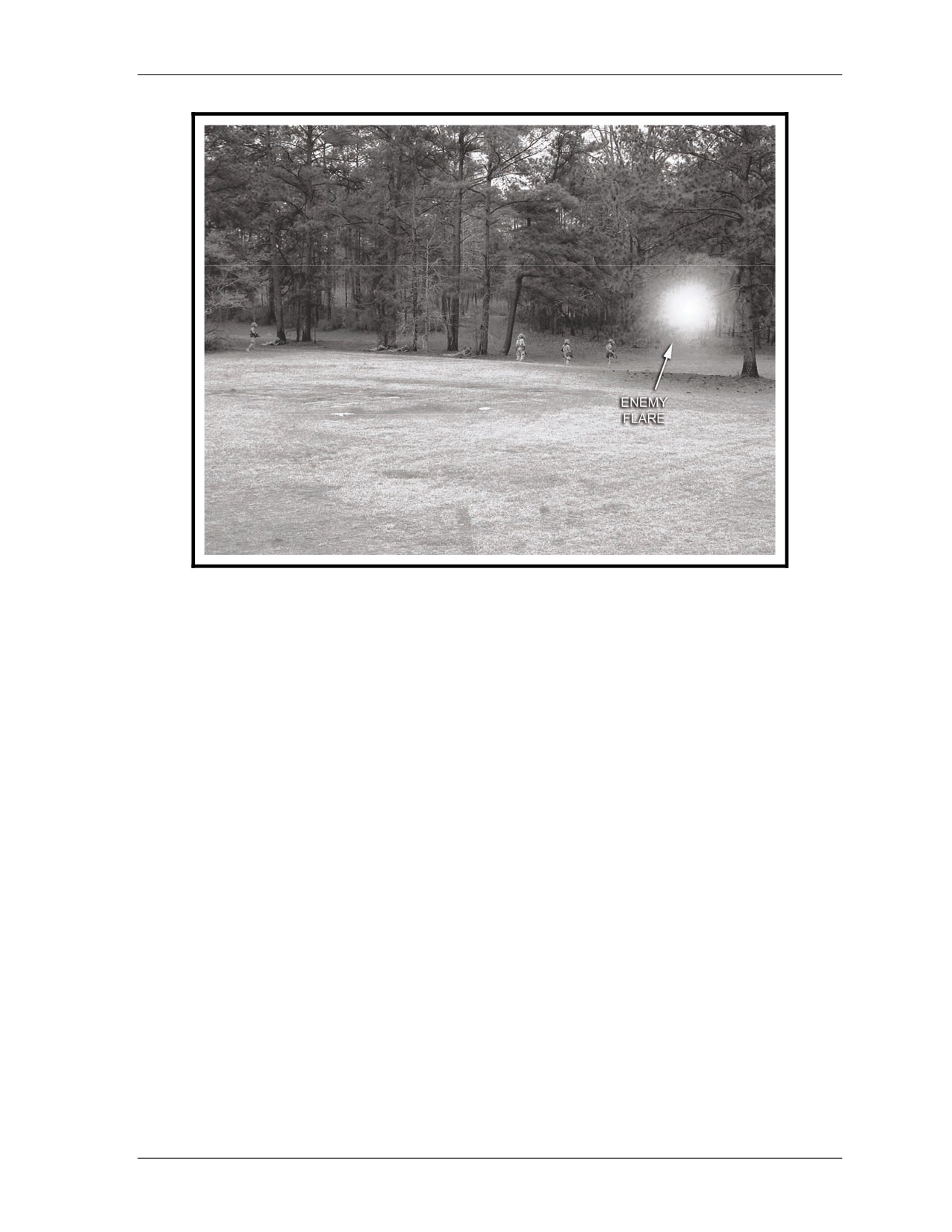
The enemy puts out ground flares as warning devices. He sets them off himself or attaches
tripwires to them for you to trip on and set off. He usually puts the flares in places he can watch
(Figure 7-5).
7-6
FM 3-21.75
28 January 2008
Movement
Figure 7-5. Reaction to ground flares.
7-20.
If you are caught in the light of a ground flare, flip up your NVD and move quickly out of the
lighted area. The enemy will know where the ground flare is and will be ready to fire into that area. Move
well away from the lighted area. While moving out of the area, look for other team members. Try to follow
or join them to keep the team together.
28 January 2008
FM 3-21.75
7-7
Chapter 7
REACTING TO AERIAL FLARES
7-21.
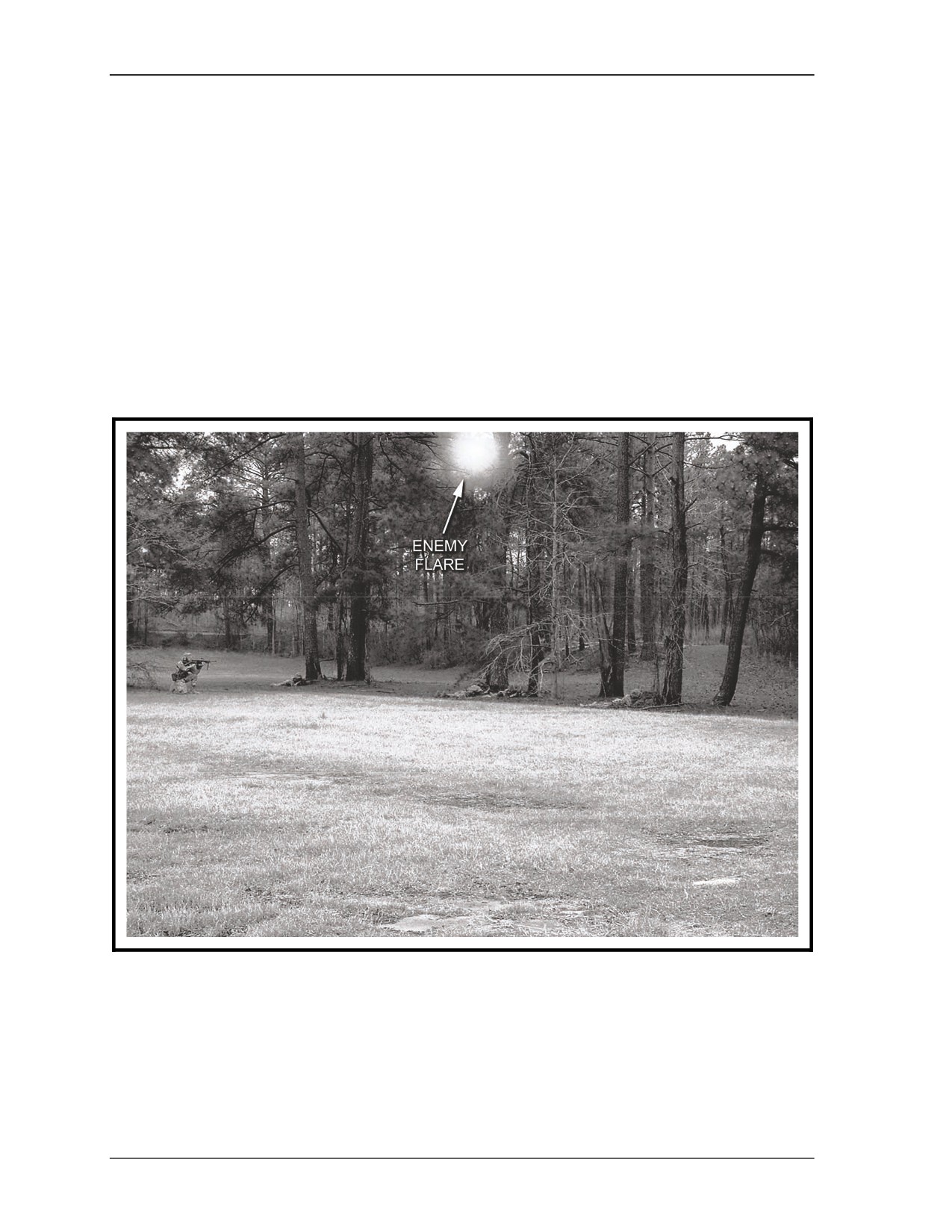
The enemy uses aerial flares to light up vital areas. They can be set off like ground flares; fired
from hand projectors, grenade launchers, mortars, and artillery; or dropped from aircraft. If you hear the
firing of an aerial flare while you are moving, flip up your NVD and hit the ground (behind cover if
possible) while the flare is rising and before it bursts and illuminates. If moving where it is easy to blend
with the background, such as in a forest, and you are caught in the light of an aerial flare, freeze in place
until the flare burns out.
7-22.
If you are caught in the light of an aerial flare while moving in an open area, immediately crouch
low or lie down. If you are crossing an obstacle, such as a barbed-wire fence or a wall, and are caught in
the light of an aerial flare, crouch low and stay down until the flare burns out. The sudden light of a
bursting flare may temporarily wash out your NVD, blinding both you and the enemy. When the enemy
uses a flare to spot you, he spoils his own night vision. To protect your night vision, flip up your NVD and
close one eye while the flare is burning. When the flare burns out, the eye that was closed will still have its
night vision and you can place your NVD back into operation (Figure 7-6).
Figure 7-6. Reaction to aerial flares.
FIRE AND MOVEMENT
7-23.
When a unit makes contact with the enemy, it normally starts firing at and moving toward the
enemy. Sometimes the unit may move away from the enemy. This technique is called fire and movement -
7-8
FM 3-21.75
28 January 2008
Movement
one element maneuvers (or moves) while another provides a base of fire. It is conducted to both close with
and destroy the enemy, or to move away from the enemy to break contact with him.
7-24.
The firing and moving takes place at the same time. There is a fire element and a movement
element. These elements may be buddy teams, fire teams, or squads. Regardless of the size of the elements,
the action is still fire and movement.
• The fire element covers firing at and suppressing the enemy. This helps keep the enemy from
firing back at the movement element.
• The movement element moves either to close with the enemy or to reach a better position from
which to fire at him. The movement element should not move until the fire element is firing.
7-25.
Depending on the distance to the enemy position and on the available cover, the fire element and
the movement element switch roles as needed to keep moving. Before the movement element moves
beyond the supporting range of the fire element (the distance in which the weapons of the fire element can
fire and support the movement element), it should take a position from which it can fire at the enemy. The
movement element then becomes the next fire element and the fire element becomes the next movement
element. If your team makes contact, your team leader should tell you to fire or to move. He should also
tell you where to fire from, what to fire at, or where to move. When moving, use the low crawl, high crawl,
or rush IMTs.
MOVEMENT ON VEHICLES
7-26.
Soldiers can ride on the outside of armored vehicles; however, this is not done routinely.
Therefore, as long as tanks and Infantry are moving in the same direction and contact is not likely, Soldiers
may ride on tanks.
GUIDELINES FOR RIDING ON ALL ARMORED VEHICLES
7-27.
The following must be considered before Soldiers mount or ride on an armored vehicle.
• When mounting an armored vehicle, Soldiers must always approach the vehicle from the front
to get permission from the vehicle commander to mount. They then mount the side of the
vehicle away from the coaxial machine gun and in view of the driver. Maintain three points of
contact and only use fixed objects as foot and handholds. Do not use gun or optic system.
• If the vehicle has a stabilization system, the squad leader obtains verification from the vehicle
commander that it is OFF before the vehicle starts to move.
• The Infantry must dismount as soon as possible when tanks come under fire or when targets
appear that require the tank gunner to traverse the turret quickly to fire.
• All Soldiers must be alert for obstacles that can cause the tank to turn suddenly and for trees
that can knock riders off the tank.
GUIDELINES FOR RIDING ON SPECIFIC ARMORED VEHICLES
7-28.
The following information applies to specific vehicles.
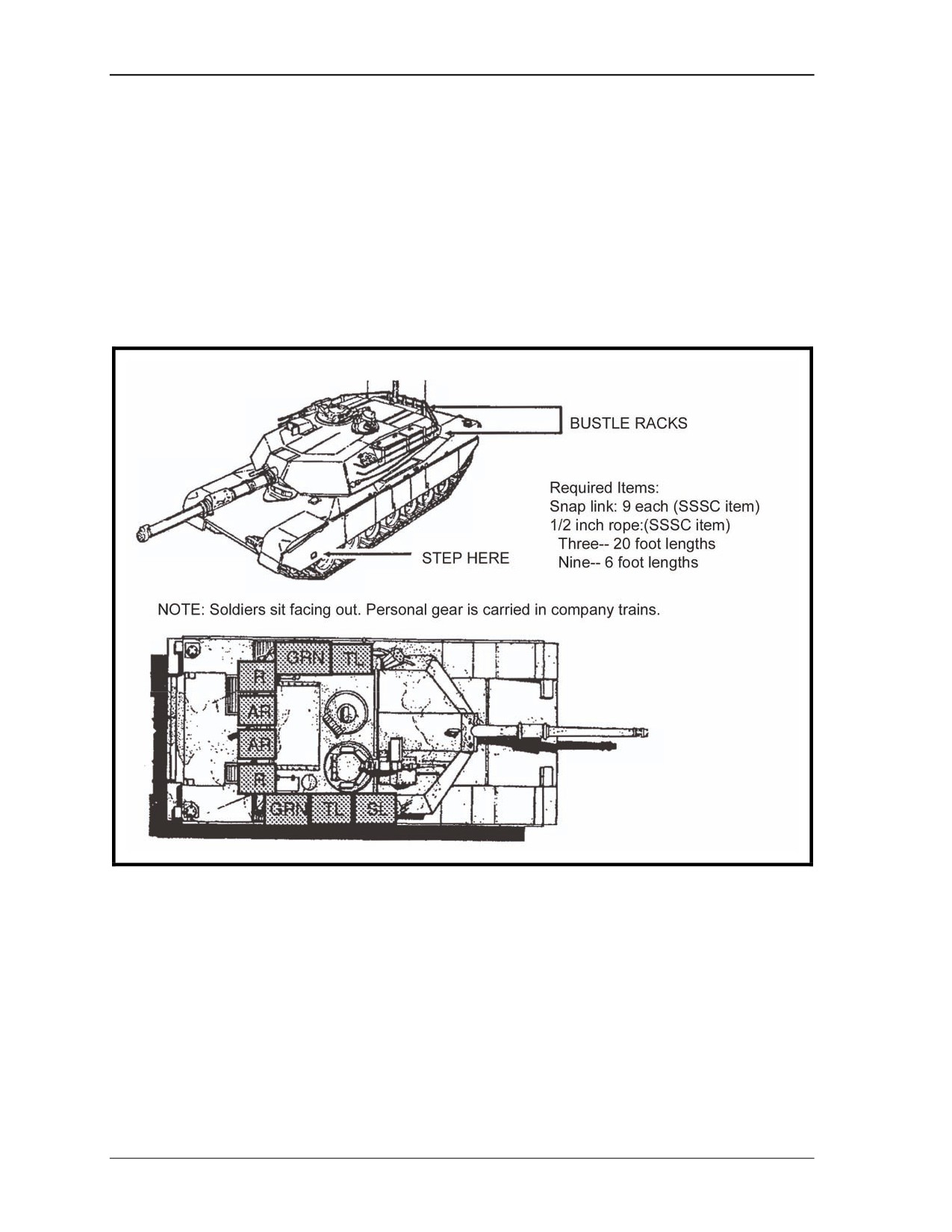
• The Ml tank is not designed to carry riders easily. Riders must NOT move to the rear deck.
Engine operating temperatures make this area unsafe for riders (Figure 7-7).
• One Infantry squad can ride on the turret. The Soldiers must mount in such a way that their legs
cannot become entangled between the turret and the hull by an unexpected turret movement.
Rope and equipment straps may be used as a field-expedient Infantry rail to provide secure
handholds. Soldiers may use a snap link to assist in securing themselves to the turret.
28 January 2008
FM 3-21.75
7-9
Chapter 7
• Everyone must be to the rear of the smoke grenade launchers. This automatically keeps
everyone clear of the coaxial machine gun and laser range finder.
• The Infantry must always be prepared for sudden turret movement.
• Leaders should caution Soldiers about sitting on the turret blowout panels, because 250 pounds
of pressure will prevent the panels from working properly. If there is an explosion in the
ammunition rack, these panels blow outward to lessen the blast effect in the crew compartment.
• If enemy contact is made, the tank should stop in a covered and concealed position, and allow
the Infantry time to dismount and move away from the tank. This action needs to be rehearsed
before movement.
• The Infantry should not ride with anything more than their battle gear. Excess gear should be
transported elsewhere.
Figure 7-7. Mounting and riding arrangements.
7-10
FM 3-21.75
28 January 2008
Chapter 8
Urban Areas
The rapid growth of the number and size of urban centers, especially in regions of
political instability, increases the likelihood that Soldiers will be called upon to
conduct operations in urban areas. Keep in mind that the urban battlefield
environment is rapidly exhausting, both physically and mentally, and may look even
more chaotic than it is. Successful combat operations in urban areas require skills that
are unique to this type of fighting. You must be skilled in moving, entering buildings,
clearing rooms, and selecting and using fighting positions to be effective while
operating in this type of environment
Section I. MOVEMENT TECHNIQUES
Movement in urban areas is the first skill you must master. Movement techniques must be practiced until they
become second nature. To reduce exposure to enemy fire, you should avoid open areas, avoid silhouetting
yourself, and select your next covered position before movement. The following paragraphs discuss how to
move in urban areas:
AVOIDING OPEN AREAS
8-1.
Open areas, such as streets, alleys, and parks, should be avoided. They are natural kill zones for
enemy, crew-served weapons, or snipers. They can be crossed safely if the individual applies certain
fundamentals, including using smoke from hand grenades or smoke pots to conceal movement. When
employing smoke as an obscurant, keep in mind that thermal sighting systems can see through smoke.
Also, when smoke has been thrown in an open area, the enemy may choose to engage with suppressive
fires into the smoke cloud.
• Before moving to another position, you should make a visual reconnaissance, select the
position offering the best cover and concealment, and determine the route to get to that
position.
• You need to develop a plan for movement. You should always select the shortest distance to
run between buildings and move along covered and concealed routes to your next position,
reducing the time exposed to enemy fire.
MOVING PARALLEL TO BUILDINGS
8-2.
You may not always be able to use the inside of buildings as routes of advance and must move on
the outside of the buildings. Smoke, suppressive fires, and cover and concealment should be used as much
as possible to hide movement. You should move parallel to the side of the building, maintaining at least 12
inches of separation between yourself and the wall to avoid rabbit rounds (ricochets and rubbing or
bumping the wall). Stay in the shadows, present a low silhouette, and move rapidly to your next position. If
an enemy gunner inside the building fires, he exposes himself to fire from other squad members providing
overwatch.
28 Januaary 2008
FM 3-21.75
8-1
Chapter 8
MOVING PAST WINDOWS
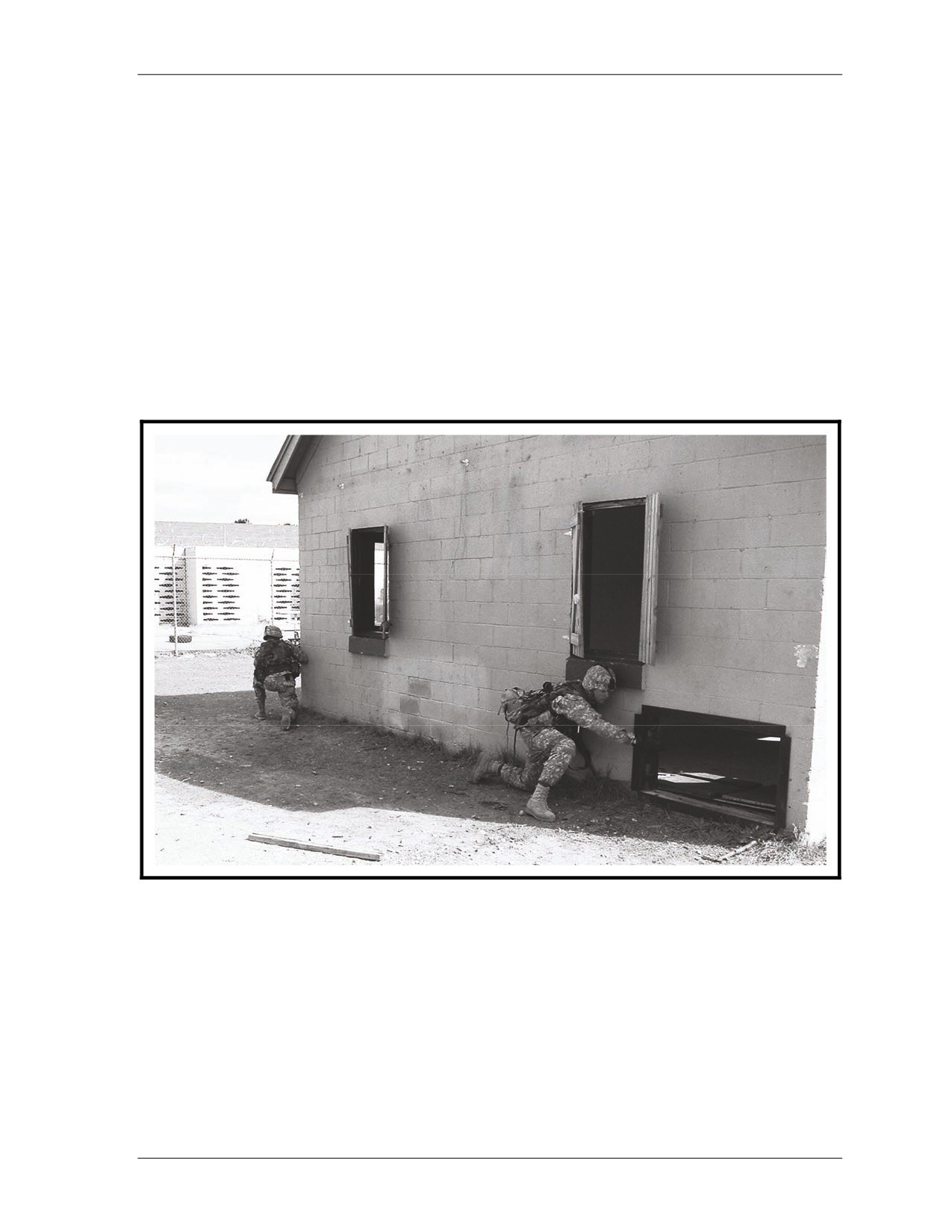
8-3.
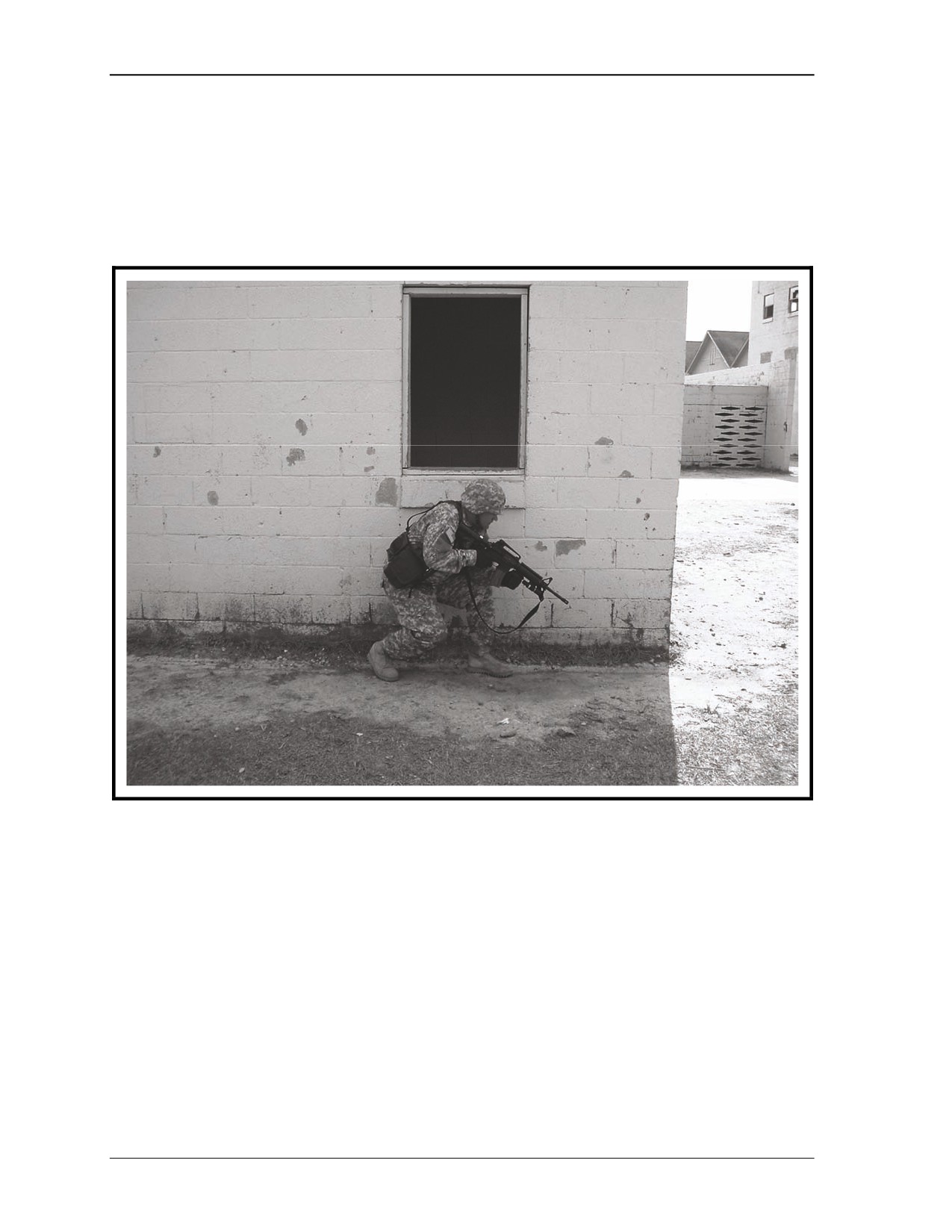
Windows present another hazard to the Soldier. The most common mistakes are exposing the head
in a first-floor window and not being aware of basement windows. When using the correct technique for
passing a first-floor window, you must stay below the window level and near the side of the building
(Figure 8-1). Ensure you do not silhouette yourself in the window. An enemy gunner inside the building
would have to expose himself to covering fires if he tries to engage you.
Figure 8-1. Soldier moving past windows.
8-4.
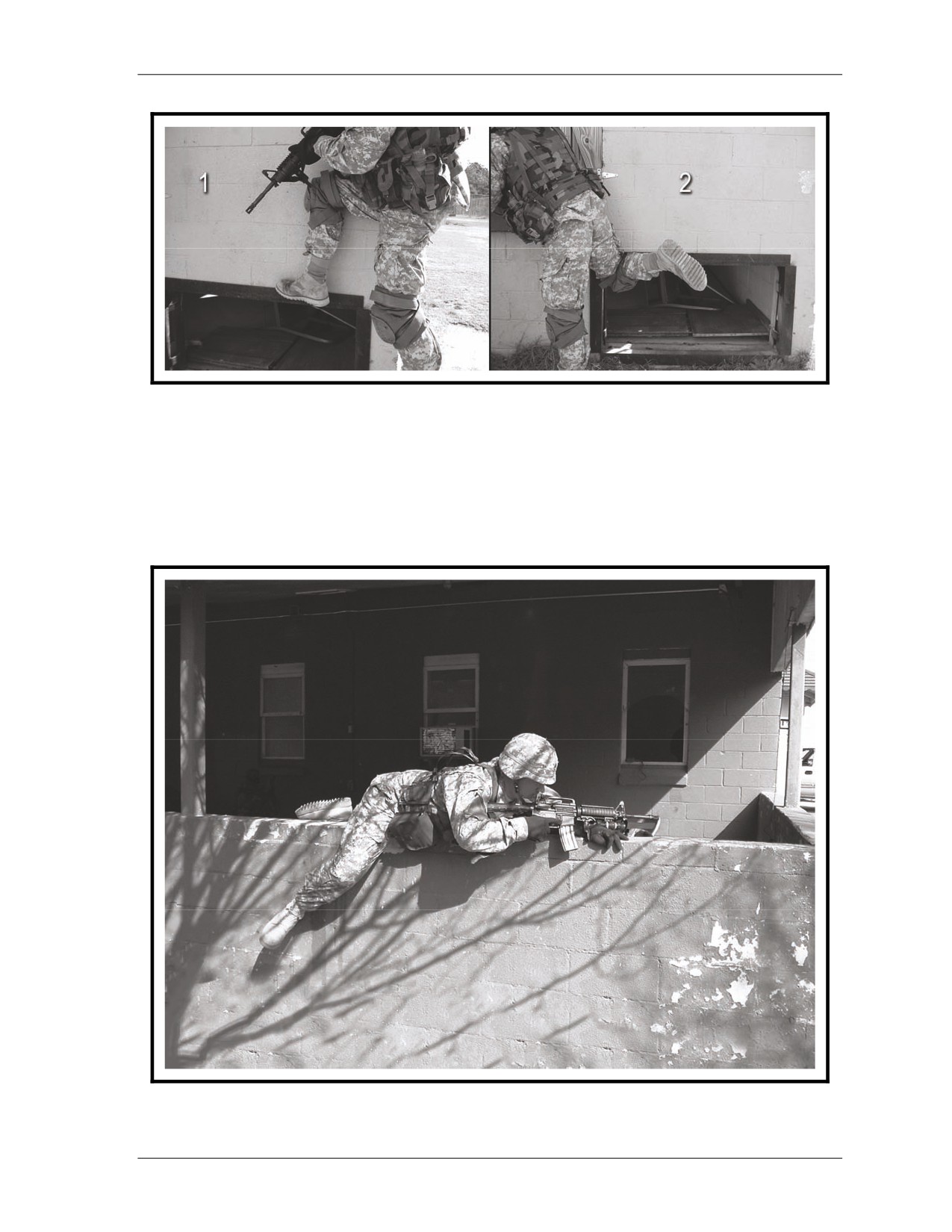
The same techniques used in passing first-floor windows are used when passing basement
windows. You should not walk or run pass a basement window, as this will present a good target for an
enemy gunner inside the building. Ensure you stay close to the wall of the building and step or jump pass
the window without exposing your legs (Figure 8-2).
8-2
FM 3-21.75
28 January 2008
Urban Areas
Figure 8-2. Soldier passing basement windows.
CROSSING A WALL
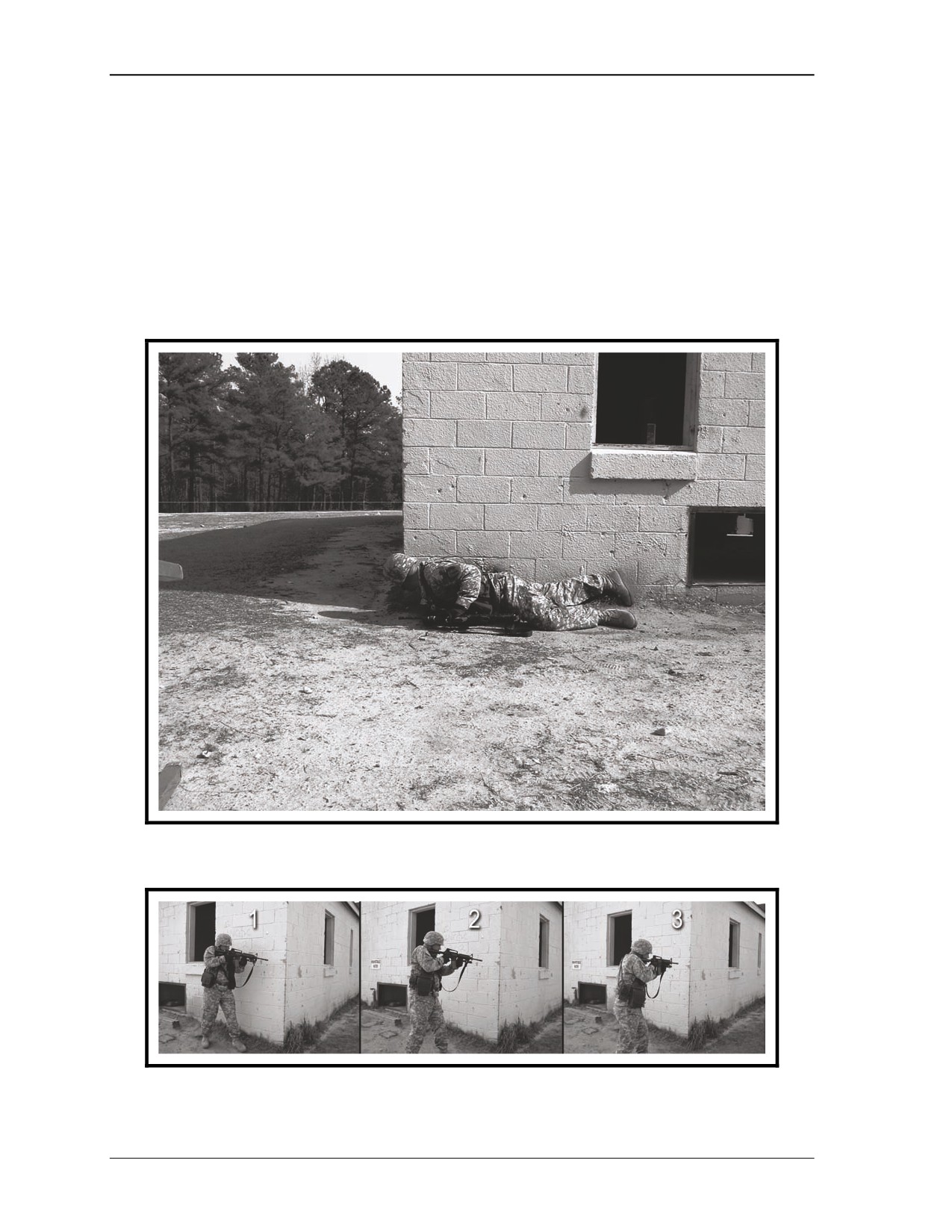
8-5.
You must learn the correct method of crossing a wall (Figure 8-3). After you have reconnoitered
the other side, quickly roll over the wall and keep a low silhouette. Your speed of movement and low
silhouette denies the enemy a good target.
Figure 8-3. Soldier crossing a wall.
28 January 2008
FM 3-21.75
8-3
Chapter 8
MOVING AROUND CORNERS
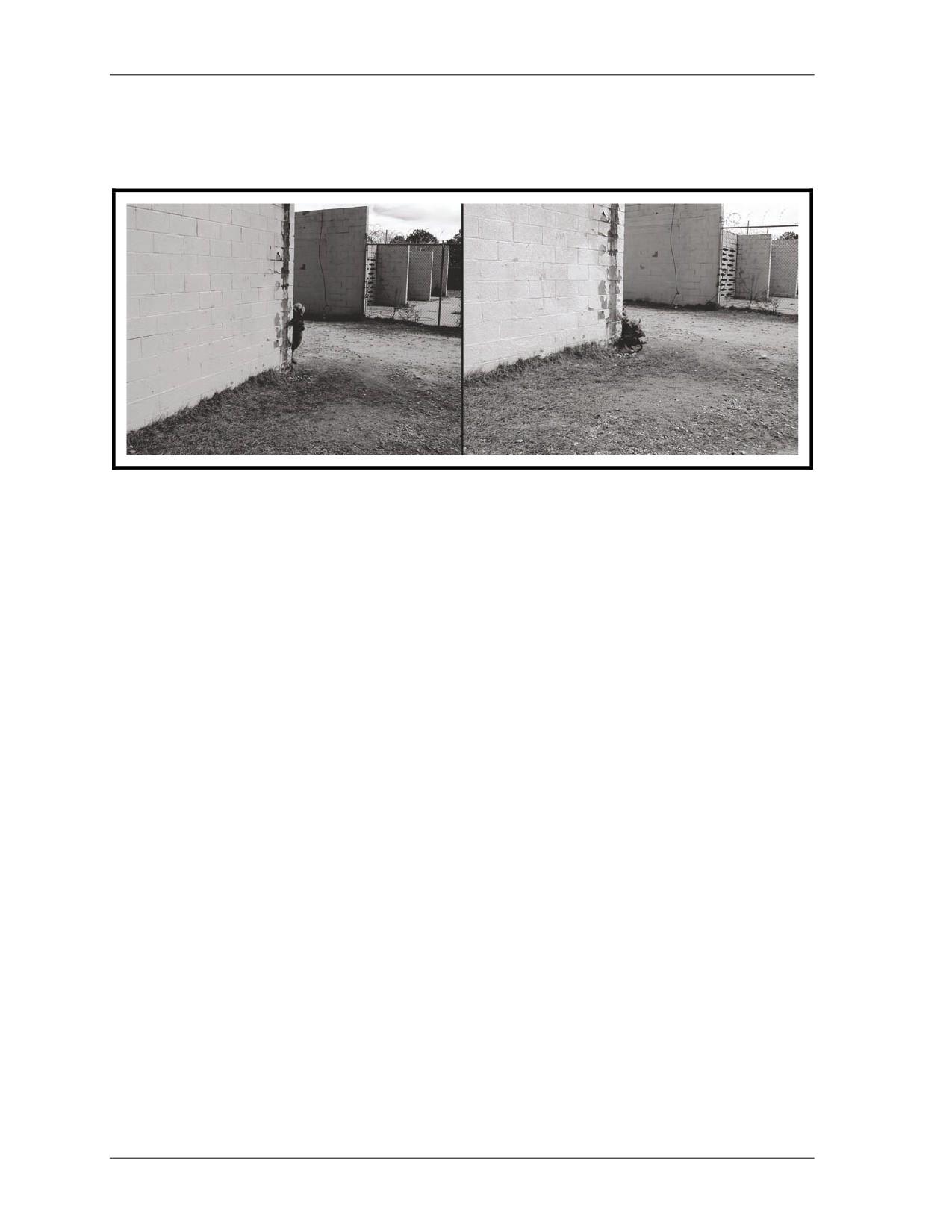
8-6.
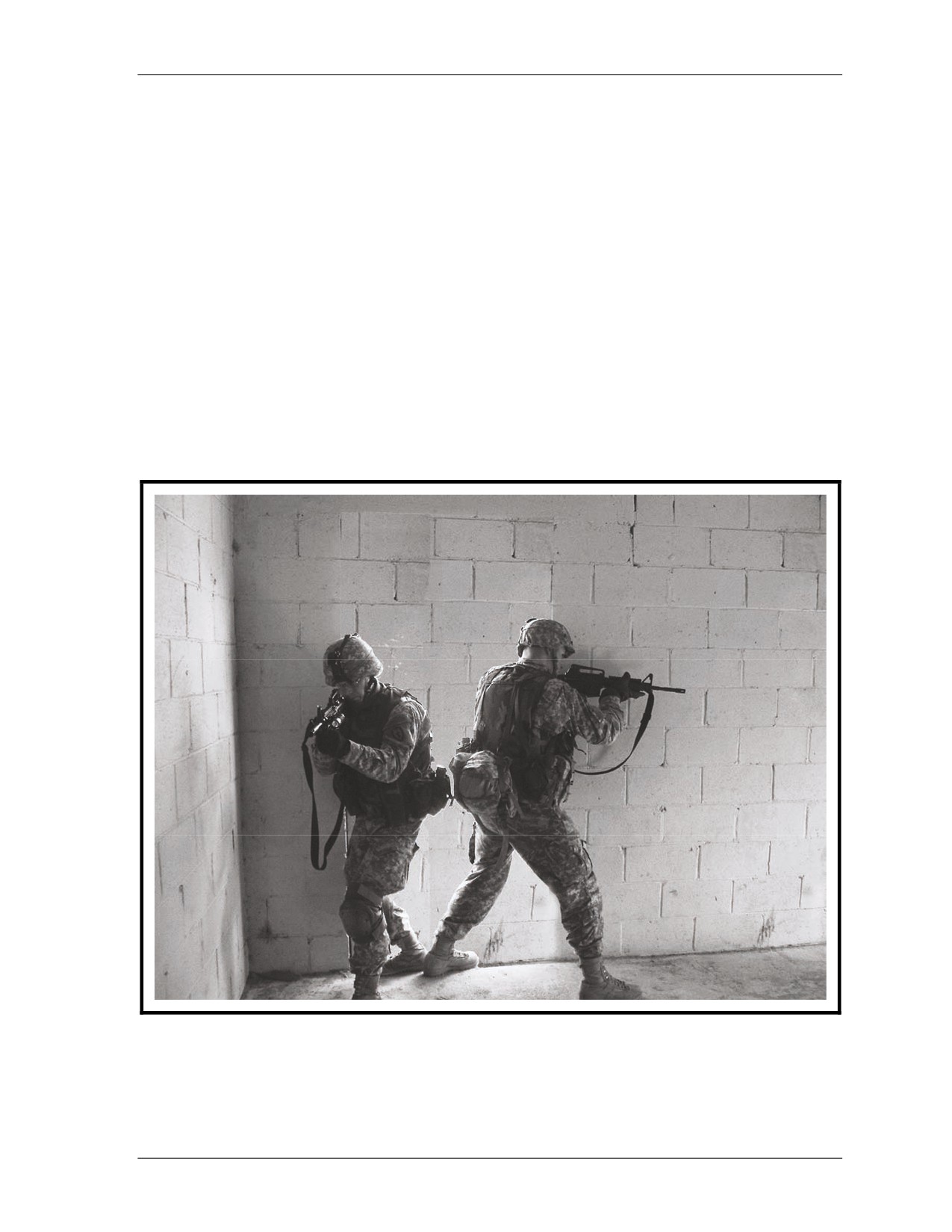
The area around a corner must be observed before the Soldier moves. The most common mistake
you can make at a corner is allowing your weapon to extend beyond the corner, exposing your position;
this mistake is known as flagging your weapon. You should show your head below the height an enemy
would expect to see it. You must lie flat on the ground and not extend your weapon beyond the corner of
the building. Only expose your head (at ground level) enough to permit observation (Figure 8-4). You can
also use a mirror, if available, to look around the corner. Another corner-clearing technique that is used
when speed is required is the pie-ing method. This procedure is done by aiming the weapon beyond the
corner into the direction of travel (without flagging) and side-stepping around the corner in a circular
fashion with the muzzle as the pivot point (Figure 8-5).
Figure 8-4. Correct technique for looking around a corner.
Figure 8-5. Pie-ing a corner.
8-4
FM 3-21.75
28 January 2008
Urban Areas
MOVING WITHIN A BUILDING
8-7.
Once you have entered a building (see Section II), follow these procedures to move around in it:
DOORS AND WINDOWS
8-8.
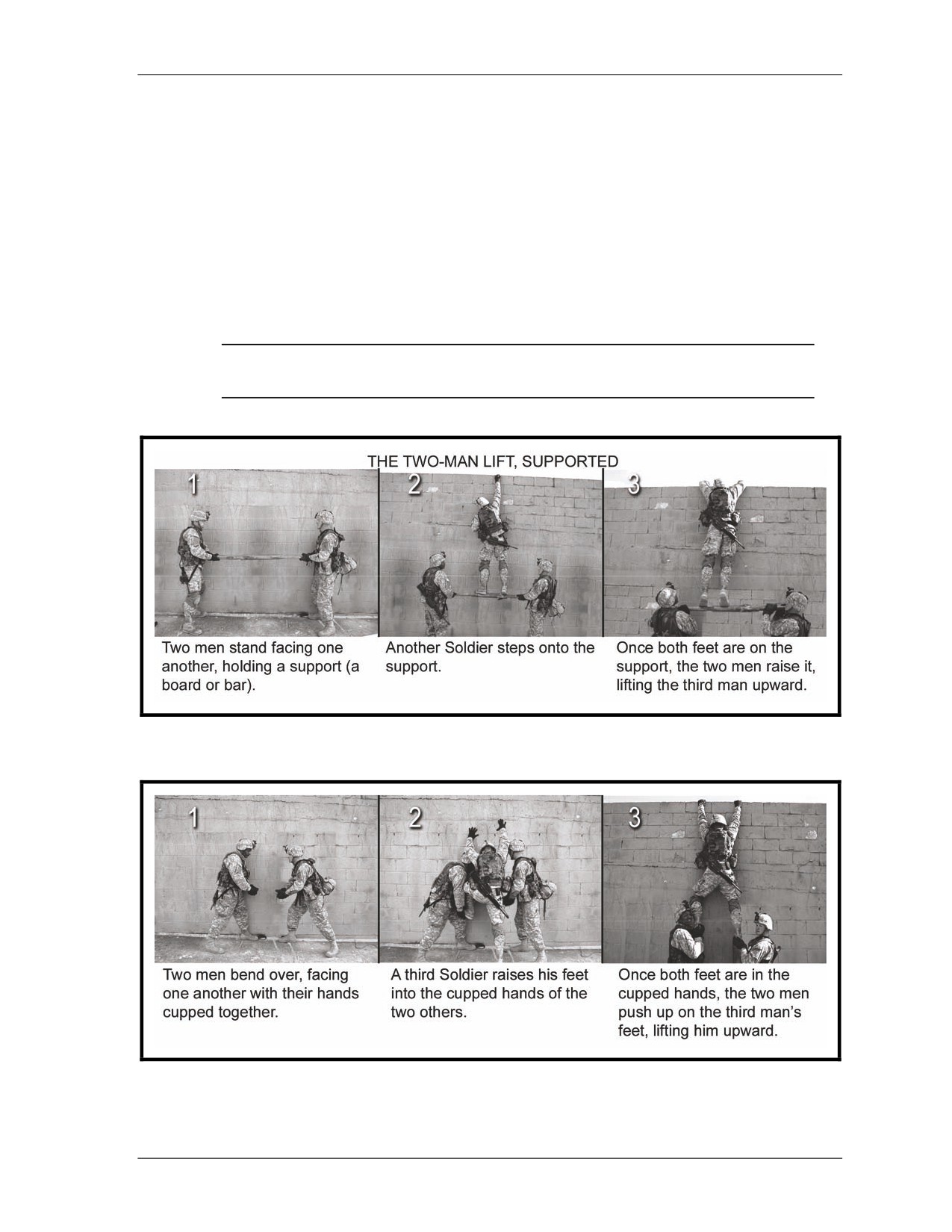
Avoid silhouetting yourself in doors and windows (Figure 8-6).
HALLWAYS
8-9.
When moving in hallways, never move alone—always move with at least one other Soldier
for security.
WALLS
8-10.
You should try to stay 12 to 18 inches away from walls when moving; rubbing against walls may
alert an enemy on the other side, or, if engaged by an enemy, ricochet rounds tend to travel parallel to
a wall.
Figure 8-6. Movement within a building.
28 January 2008
FM 3-21.75
8-5
Chapter 8
Section II. OTHER PROCEDURES
This section discusses how to enter a building, clear a room, and use fighting positions.
ENTERING A BUILDING
8-11.
When entering buildings, exposure time must be minimized. Before moving toward the building,
you must select the entry point. When moving to the entry point use smoke to conceal your advance. You
must avoid using windows and doors except as a last resort. Consider the use of demolitions,
shoulder-launched munitions (SLMs), close combat missiles (CCMs), tank rounds, and other means to
make new entrances. If the situation permits, you should precede your entry with a grenade, enter
immediately after the grenade explodes, and be covered by one of your buddies. Entry should be made at
the highest level possible.
ENTER UPPER LEVEL
8-12.
Entering a building from any level other than the ground floor is difficult. However, clearing a
building from the top down is best, because assaulting and defending are easier from upper floors. Gravity
and the building’s floor plan help when Soldiers throw hand grenades and move between floors. An enemy
forced to the top of a building may be cornered and fight desperately, or escape over the roof. An enemy
who is forced down to ground level may withdraw from the building, exposing himself to friendly fires
from the outside. Soldiers can use several means, including ladders, drainpipes, vines, helicopters, or the
roofs and windows of adjacent buildings, to reach the top floor or roof of a building. One Soldier can climb
onto the shoulders of another and reach high enough to pull himself up. Ladders are the fastest way to
reach upper levels. If portable ladders are unavailable, Soldiers can construct them from materials available
through supply channels. They can also build ladders using resources available in the urban area. For
example, they can use the lumber from inside the walls of buildings. Although ladders do not permit access
to the top of some buildings, they do offer security and safety through speed. Soldiers can use ladders to
conduct an exterior assault of an upper level, provided exposure to enemy fire can be minimized.
SCALE WALLS
8-13.
When you must scale a wall during exposure to enemy fire, use all available concealment. Use
smoke and other diversions to improve your chance of success. When using smoke for concealment, plan
for wind direction. Use suppressive fire, shouting, and distractions from other positions to divert the
enemy’s attention. You are vulnerable to enemy fire when scaling an outside wall. Ideally, move from
building to building and climb buildings only under cover of friendly fire. Properly positioned friendly
weapons can suppress and eliminate enemy fire. If you must scale a wall with a rope, avoid silhouetting
yourself in windows of uncleared rooms, and avoid exposing yourself to enemy fires from lower windows.
Climb with your weapon slung over your firing shoulder so you can bring it quickly to a firing position.
If the rules of engagement (ROE, which are the rules governing the use of force) permit, engage the
objective window and any lower level windows in your path with grenades (hand or launcher) before you
ascend. Enter the objective window with a low silhouette. You can enter head first, but the best way is to
hook a leg over the window sill and enter sideways, straddling the ledge.
8-6
FM 3-21.75
28 January 2008
Urban Areas
ENTER AT LOWER LEVELS
8-14.
Buildings are best cleared from the top down. However, you might not be able to enter a building
from the top. Entry at the bottom or lower level is common, and might be the only way. When entering at
lower levels, avoid entering through windows and doors, since either is easily booby trapped, and both are
usually covered by enemy fire (Figure 8-7 Figure 8-8, this page; and Figure 8-9 and Figure 8-10 on
page 8-8). Use these techniques when you can enter the building without receiving effective enemy fire.
When entering at lower levels, use demolitions, artillery, tank fire, SLMs, CCMs, ramming of an armored
vehicle into a wall, or similar means to create a new entrance and avoid booby traps. This is the best
technique, ROE permitting. Once you use these means, enter quickly to take advantage of the effects of the
blast and concussion. Door breaching is the best way to enter at the lower level. Before entering, you may
throw a hand grenade into the new entrance to reinforce the effects of the original blast.
Note: Armored vehicles can be positioned next to a building, so Soldiers can use them as a
platform for entering a room or gaining access to a roof.
Figure 8-7. Lower-level entry technique with support bar.
Figure 8-8. Lower-level entry technique without support bar.
28 January 2008
FM 3-21.75
8-7
Chapter 8
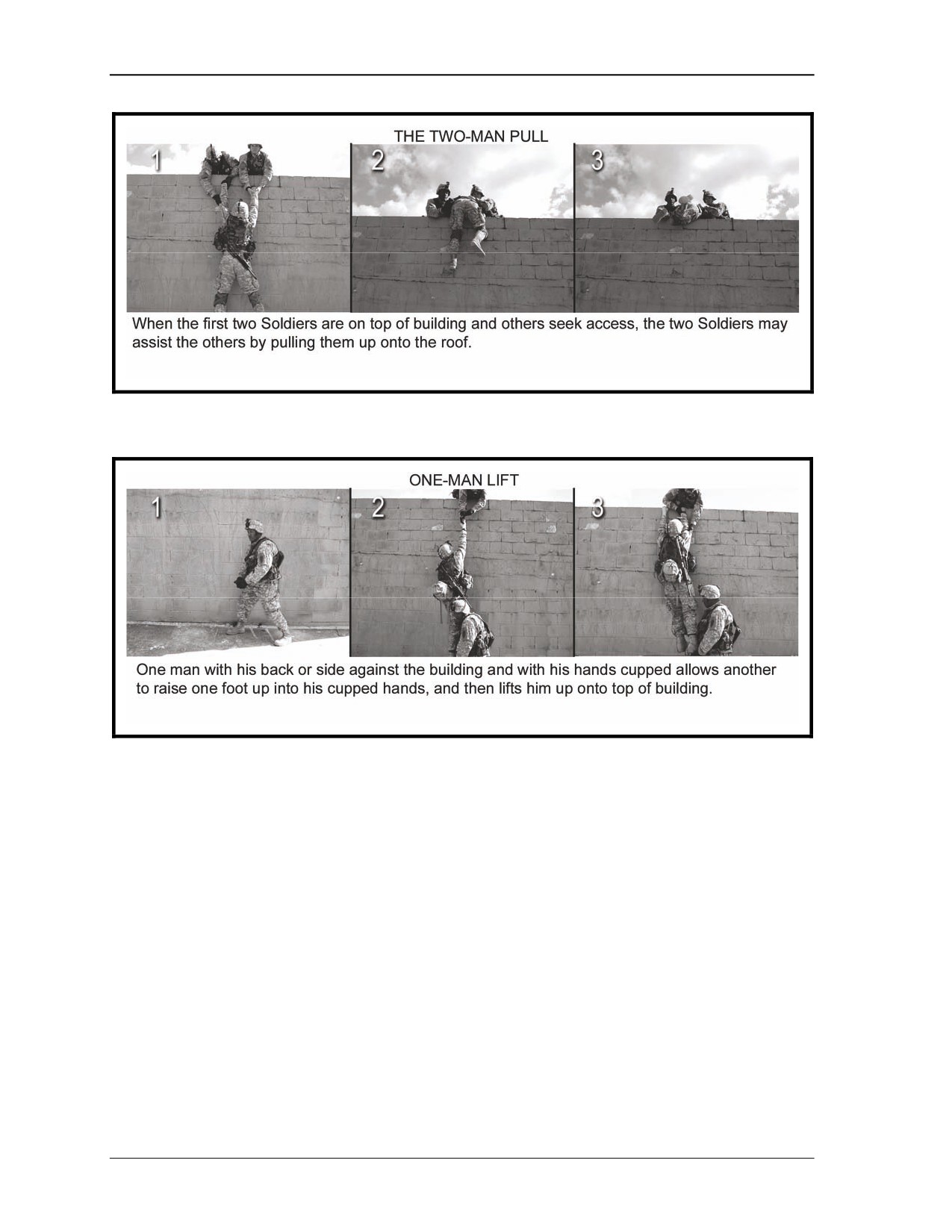
Figure 8-9. Lower-level entry two-man pull technique.
Figure 8-10. Lower-level entry one-man lift technique.
8-15.
Blow or cut breach holes through walls to allow you to enter a building. Such entrances are safer
than doors, because doors are easily booby trapped, and should be avoided, unless you conduct an
explosive breach on the door.
• Throw a grenade through the breach before entering. Use available cover, such as the lower
corner of the building, for protection from fragments.
• Use stun and concussion grenades when engaging through thin walls.
8-16.
When a door is your only way into a building, beware of booby traps and fire from enemy soldiers
inside the room. You can breach (force open) a locked door using one of four breaching methods:
• Mechanical.
• Ballistic.
• Explosive.
• Thermal.
8-8
FM 3-21.75
28 January 2008
Urban Areas
8-17.
If none of these methods is available, you may kick the door open. This is worst method, since it
is difficult and tiring. Also, it rarely works the first time, giving any enemy inside ample time to shoot you
through the door.
• When opening an unlocked door by hand, make sure you and the rest of the assault team avoid
exposing themselves to enemy fire through the door. To reduce exposure, stay close to one side
of the doorway.
• ROE permitting, once you get the door open, toss in a hand grenade. Once it explodes, enter
and clear the room.
EMPLOY HAND GRENADES
8-18.
Combat in urban areas often requires extensive use of hand grenades. Unless the ROE or orders
prevent it, use grenades before assaulting defended areas, moving through breaches, or entering unsecured
areas. Effective grenade use in urban areas may require throwing overhand or underhand, with either the
left or right hand.
Note: To achieve aboveground detonation or near-impact detonation, remove the grenade’s
safety pin, release the safety lever, count "One thousand one, one thousand two,"
and throw the grenade. This is called cooking-off. Cooking off takes about 2 seconds
of the grenade’s 4- to 5-second delay, and it allows the grenade to detonate above
ground or shortly after impact with the target.
Types
8-19.
Three types of hand grenades can be used when assaulting an urban objective: stun, concussion,
and fragmentation. The type of construction materials used in the objective building influence the type of
grenades that can be used.
M84 Stun Hand Grenade--This grenade is a flash-bang distraction device that produces a brilliant
flash and a loud bang to briefly surprise and distract an enemy force. The M84 is often used under
precision conditions and when the ROE demand use of a nonlethal grenade. The use of stun hand
grenades under high intensity conditions is usually limited to situations where fragmentation and
concussion grenades pose a risk to friendly troops or the structural integrity of the building.
Concussion Grenade--The concussion grenade causes injury or death to persons in a room by blast
overpressure and propelling debris within the room. While the concussion grenade does not discard
a dangerous fragmentation from its body, the force of the explosion can create debris fallout that
may penetrate thin walls.
Fragmentation Grenade--The fragmentation grenade produces substantial overpressure when used
inside buildings, and coupled with the shrapnel effects, can be extremely dangerous to friendly
Soldiers. If the walls of a building are made of thin material, such as sheetrock or thin plywood, you
should either lie flat on the floor with your helmet towards the area of detonation, or move away
from any wall that might be penetrated by grenade fragments.
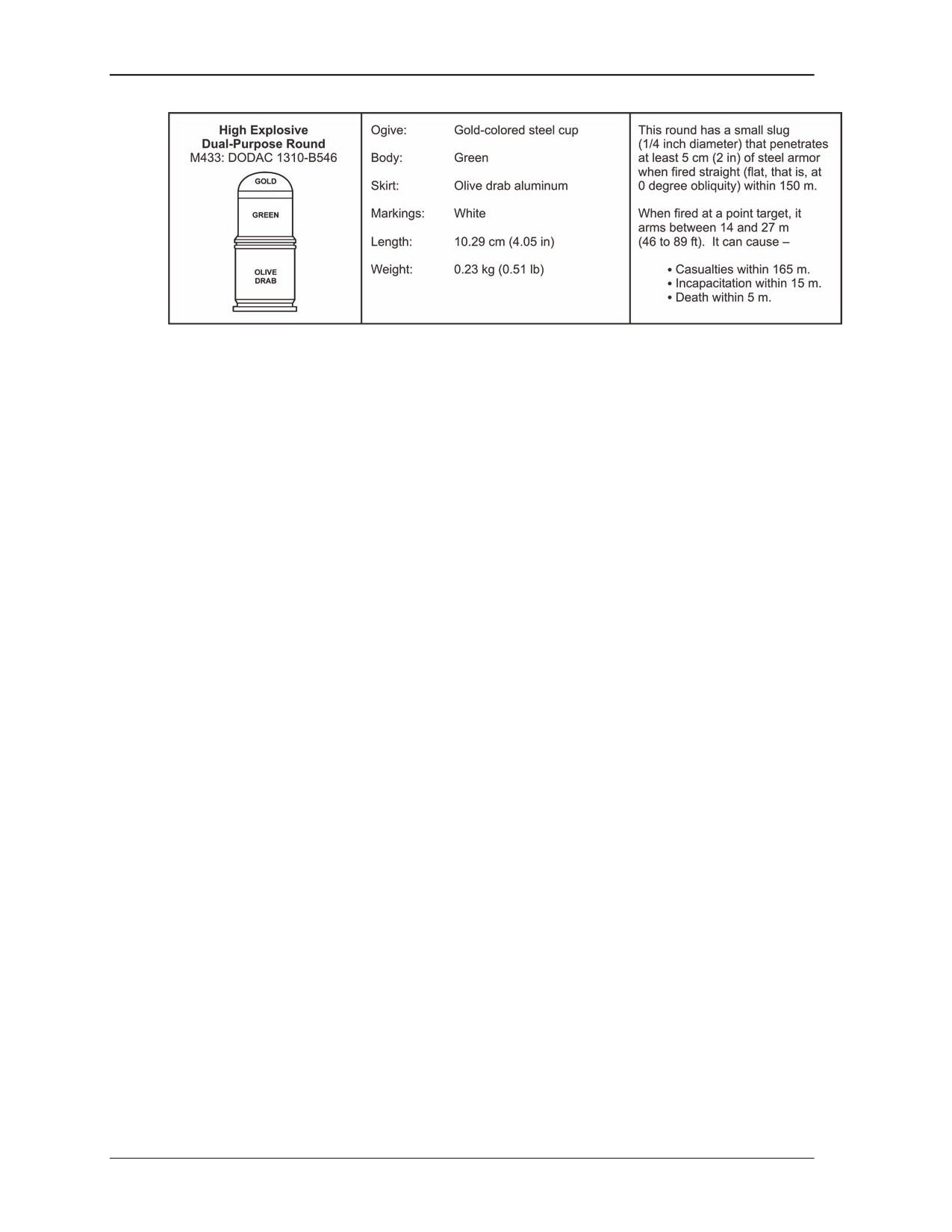
High-Explosive, Dual-Purpose Grenade--The best round for engaging an urban threat is the M433
high-explosive, dual-purpose cartridge (FM 3-22.31 and Figure 8-11).
28 January 2008
FM 3-21.75
8-9
Chapter 8
Figure 8-11. M433 HEDP grenade.
Safety
8-20.
It is easier to fire a grenade into an upper-story window using an M203 grenade launcher than it is
to do throw it by hand.
• When someone must throw a hand grenade into an upper-story opening, he stands close to the
building, using it for cover. He should only do this if the window opening has no glass or
screening.
• He allows the grenade to cook off for at least 2 seconds, and then steps out far enough to lob
the grenade into the upper-story opening. He keeps his weapon in his non-throwing hand, to
use if needed. He never lays down his weapon, either outside or inside the building.
• The team must locate the nearest cover, in case the grenade falls back outside with them,
instead of landing inside the building.
• Once a Soldier throws a grenade into the building, and it detonates, the team must move swiftly
to enter the building or room.
CLEARING A ROOM
8-21.
This paragraph discusses how to enter and clear a room:
SQUAD LEADER
1. Designates the assault team and identifies the location of the entry point for the team.
2. Positions the follow-on assault team to provide overwatch and supporting fires for the initial
assault team.
ASSAULT TEAM
3. Moves as near the entry point as possible, using available cover and concealment.
4. If a supporting element is to perform an explosive or ballistic breach, remains in a covered
position until after the breach. If necessary, provides overwatch and fire support for the
breaching element.
5. Before moving to the entry point, team members signal each other that they are ready.
6. Avoids using verbal signals, which could alert the enemy.
7. To reduce exposure to fire, moves quickly from cover to the entry point.
8. Enters through the breach and, unless someone throws a grenade before the team enters,
[the team] avoids stopping outside of the point of entry.
8-10
FM 3-21.75
28 January 2008
Urban Areas
TEAM LEADER (SOLDIER NO. 2)
9. Has the option of throwing a grenade into the room before entry. Grenade type
(fragmentation, concussion, or stun type) depends on the ROE and the building structure.
10. If stealth is moot (not a factor), sounds off when he throws grenade, for example, Frag out,
Concussion out, or Stun out.
11. If stealth is a factor, uses visual signals when he throws a grenade.
ASSAULT TEAM
12. On the signal to go, or immediately after the grenade detonates, moves through the entry
point and quickly takes up positions inside the room. These positions must allow the team to
completely dominate the room and eliminate the threat. Unless restricted or impeded, team
members stop moving only after they clear the door and reach their designated point of
domination. In addition to dominating the room, all team members identify possible loopholes
and mouseholes in the ceiling, walls, and floor.
Note: Where enemy forces may be concentrated and the presence of noncombatants is
unlikely, the assault team can precede their entry by throwing a fragmentation or
concussion grenade
(structure dependent) into the room, followed by aimed,
automatic small-arms fire by the number-one Soldier as he enters.
SOLDIER NO. 1 (RIFLEMAN)
13. Enters the room and eliminates the immediate threat. Goes left or right, normally along the
path of least resistance, toward one of two corners. When using a doorway as the point of
entry, determines the path of least resistance based on the way the door opens.
• If it opens outward, he moves toward the hinged side.
• If it opens inward, he moves away from the hinges.
14. On entering, gauges the size of the room, the enemy situation, and any furniture or other
obstacles to help him determine his direction of movement.
ASSAULT TEAM
15. Avoids planning where to move until the exact layout of the room is known. Then, each
Soldier goes in the opposite direction from the Soldier in front of him. Every team member
must know the sectors and duties of each position.
SOLDIER NO. 1
16. As the first Soldier goes through the entry point, he can usually see into the far corner of the
room. He eliminates any immediate threat and, if possible, continues to move along the wall
to the first corner. There he assumes a dominating position facing into the room.
TEAM LEADER (SOLDIER NO. 2)
17. Enters about the same time as Soldier No. 1, but as previously stated, moves in the opposite
direction, following the wall and staying out of the center. He clears the entry point, the
immediate threat area, and his corner, and then moves to a dominating position on his side of
the room.
28 January 2008
FM 3-21.75
8-11
Chapter 8
GRENADIER (SOLDIER NO. 3)
18. Moves opposite Soldier No. 2 (team leader), at least 1 meter from the entry point, and then to
a position that dominates his sector.
SAW GUNNER (SOLDIER NO. 4)
19. Moves opposite Soldier No. 3, and then to a position that dominates his sector.
Points of Domination
If the path of least resistance takes the first Soldier to the left, then all points of
domination mirror those in the diagrams. Points of domination should be away
from doors and windows to keep team members from silhouetting themselves.
ASSAULT TEAM
20. Ensures movement does not mask anyone's fire. On order, any member of the assault team
may move deeper into the room, overwatched by the other team members. Once the team
clears the room, the team leader signals to the squad leader that the room has been cleared.
The squad leader marks the room IAW unit SOP. The squad leader determines whether his
squad can continue to clear through the building. The squad reorganizes as necessary.
Leaders redistribute the ammunition. The squad leader reports to the platoon leader when the
room is clear.
Section III. FIGHTING POSITIONS
How do you find and use a fighting position properly? You have to know this: whether you are attacking or
defending, your success depends on your ability to place accurate fire on the enemy--with the least exposure to
return fire (Figure 8-12).
• Make maximum use of available cover and concealment.
• Avoid firing over cover; when possible, fire around it.
• Avoid silhouetting against light-colored buildings, the skyline, and
so on.
• Carefully select a new fighting position before leaving an old one.
• Avoid setting a pattern. Fire from both barricaded and
non-barricaded windows.
• Keep exposure time to a minimum.
• Begin improving your hasty position immediately after occupation.
• Use construction material that is readily available in an urban area.
• Remember: positions that provide cover at ground level may not
provide cover on higher floors.
Figure 8-12. Some considerations for selecting and occupying individual fighting positions
8-12
FM 3-21.75
28 January 2008
Urban Areas
HASTY FIGHTING POSITION
8-22.
A hasty fighting position is normally occupied in the attack or early stages of defense. It is a
position from which you can place fire upon the enemy while using available cover for protection from
return fire. You may occupy it voluntarily or be forced to occupy it due to enemy fire. In either case, the
position lacks preparation before occupation. Some of the more common hasty fighting positions in an
urban area are corners of buildings, behind walls, windows, unprepared loopholes, and the peak of a roof.
CORNERS OF BUILDINGS
8-23.
You must be able to fire your weapon (both right and left-handed) to be effective around corners.
• A common error made in firing around corners is firing from the wrong shoulder. This exposes
more of your body to return fire than necessary. By firing from the proper shoulder, you can
reduce exposure to enemy fire (Figure 8-13).
Figure 8-13. Soldier firing left or right handed.
28 January 2008
FM 3-21.75
8-13
Chapter 8
• Another common mistake when firing around corners is firing from the standing position. If the
Soldier exposes himself at the height the enemy expects, then he risks exposing the entire
length of his body as a target for the enemy (Figure 8-14).
Figure 8-14. Soldier firing around a corner.
WALLS
8-24.
When firing from behind walls, you must fire around cover and not over it.
WINDOWS
8-25.
In an urban area, windows provide convenient firing ports. Avoid firing from the standing
position, which would expose most of your body to return fire from the enemy, and which could silhouette
you against a light-colored interior background. This is an obvious sign of your position, especially at night
when the muzzle flash can be easily observed. To fire from a window properly, remain well back in the
room to hide the flash, and kneel to limit exposure and avoid silhouetting yourself.
LOOPHOLES
8-26.
You may fire through a hole created in the wall and avoid windows. You must stay well back
from the loophole so the muzzle of the weapon does not protrude beyond the wall, and the muzzle flash is
concealed.
ROOF
8-27.
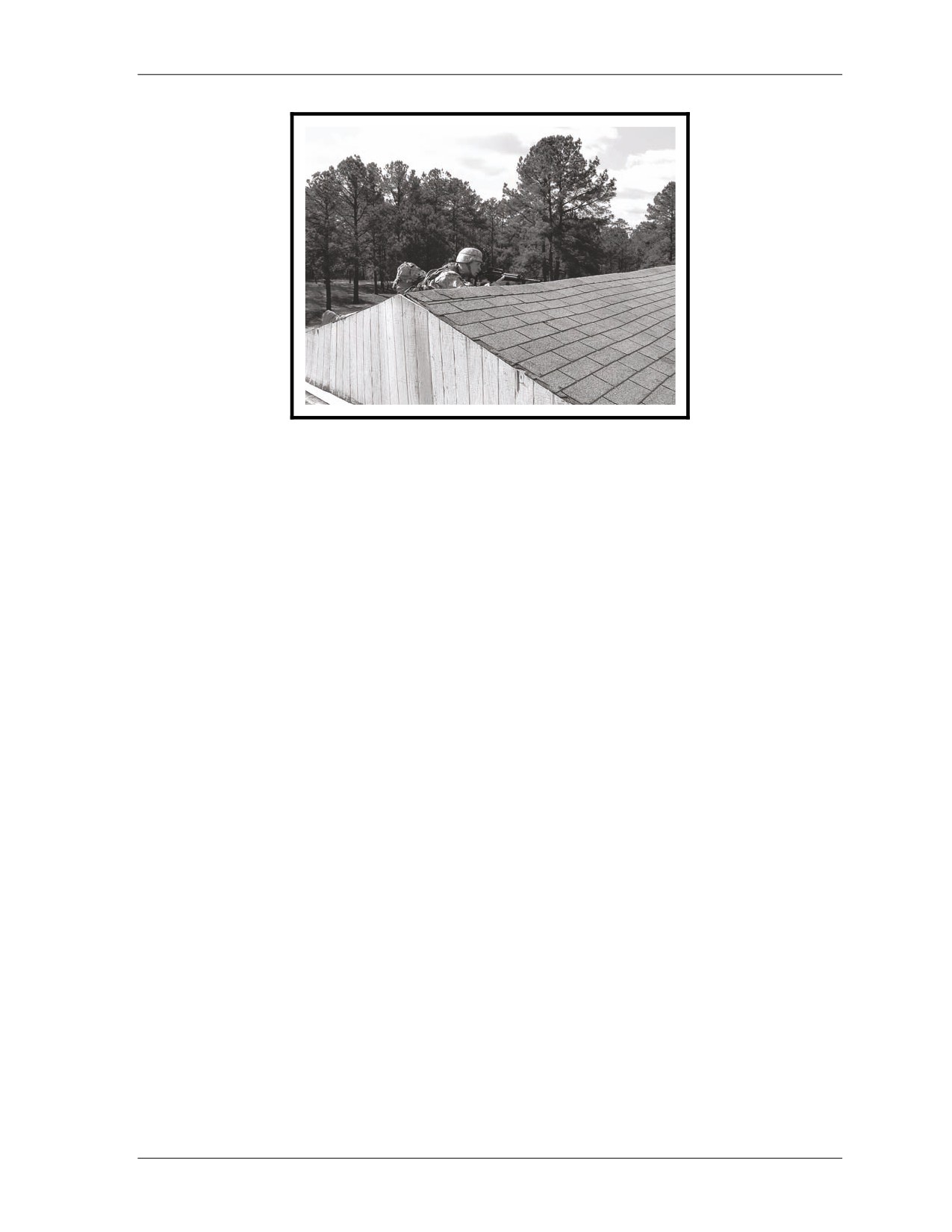
The peak of a roof provides a vantage point that increases field of vision and the ranges at which
you can engage targets (Figure 8-15). A chimney, smokestack, or any other object protruding from the roof
of a building should be used to reduce the size of the target exposed.
8-14
FM 3-21.75
28 January 2008
Urban Areas
Figure 8-15. Soldier firing from peak of a roof.
NO POSITION AVAILABLE
8-28.
When subjected to enemy fire and none of the positions mentioned above are available, you must
try to expose as little of yourself as possible. You can reduce your exposure to the enemy by lying in the
prone position as close to a building as possible, on the same side of the open area as the enemy. In order to
engage you, the enemy must then lean out the window and expose himself to return fire.
NO COVER AVAILABLE
8-29.
When no cover is available, you can reduce your exposure by firing from the prone position, by
firing from shadows, and by presenting no silhouette against buildings.
PREPARED FIGHTING POSITION
8-30.
A prepared firing position is one built or improved to allow you to engage a particular area,
avenue of approach, or enemy position, while reducing your exposure to return fire. Examples of prepared
positions include barricaded windows, fortified loopholes, and sniper, antiarmor, and machine gun
positions.
BARRICADED WINDOWS
8-31.
The natural firing port provided by windows can be improved by barricading the window, leaving
a small hole for you to use. Materials torn from the interior walls of the building or any other available
material may be used for barricading.
8-32.
Barricade all windows, whether you intend to use them as firing ports or not. Keep the enemy
guessing. Avoid making neat, square, or rectangular holes, which clearly identify your firing positions to
the enemy. For example, a barricaded window should not have a neat, regular firing port. The window
should remain in its original condition so that your position is hard to detect. Firing from the bottom of the
window gives you the advantage of the wall because the firing port is less obvious to the enemy. Sandbags
are used to reinforce the wall below the window and to increase protection. All glass must be removed
from the window to prevent injury. Lace curtains permit you to see out and prevent the enemy from seeing
in. Wet blankets should be placed under weapons to reduce dust. Wire mesh over the window keeps the
enemy from throwing in hand grenades.
28 January 2008
FM 3-21.75
8-15
Chapter 8
LOOPHOLES
8-33.
Although windows usually are good fighting positions, they do not always allow you to engage
targets in your sector. To avoid establishing a pattern of always firing from windows, alternate positions,
for example, fire through a rubbled outer wall, from an interior room, or from a prepared loophole. The
prepared loophole involves cutting or blowing a small hole into the wall to allow you to observe and
engage targets in your sector. Use sandbags to reinforce the walls below, around, and above the loophole.
Protection--Two layers of sandbags are placed on the floor to protect you from an explosion on a
lower floor (if the position is on the second floor or higher). Construct a wall of sandbags, rubble,
and furniture to the rear of the position as protection from explosions in the room. A table, bedstead,
or other available material can provide OHC for the position. This cover prevents injury from
falling debris or explosions above your position.
Camouflage--Hide the position in plain sight by knocking other holes in the wall, making it difficult
for the enemy to determine which hole the fire is coming from. Remove exterior siding in several
places to make loopholes less noticeable. Due to the angled firing position associated with
loopholes, you can use the same loophole for both primary and supplementary positions. This
allows you to shift your fire easily onto a sector that was not previously covered by small arms fire.
Backblast--SLM and CCMs crews may be hampered in choosing firing positions due to the backblast
of their weapons. They may not have enough time to knock out walls in buildings and clear
backblast areas. They should select positions that allow the backblast to escape such as corner
windows where the round fired goes out one window and the backblast escapes from another. When
conducting defensive operations the corner of a building can be improved with sandbags to create a
firing position.
Shoulder-Launched Munitions and Close Combat Missiles--Various principles of employing SLM
and CCMs weapons have universal applications. These include using available cover, providing
mutual support, and allowing for backblast. However, urban areas require additional considerations.
Soldiers must select numerous alternate positions, particularly in structures without cover from
small-arms fire. Soldiers must position their weapons in the shadows and within the building.
-- A gunner firing an AT4 or Javelin from the top of a building can use a chimney for cover, if
available. He should reinforce his position by placing sandbags to the rear so they do not
interfere with the backblast.
-- When selecting firing positions for his SLM or CCM, he uses rubble, corners of buildings, or
destroyed vehicles as cover. He moves his weapon along rooftops to find better angles for
engaging enemy vehicles. On tall buildings, he can use the building itself as overhead cover. He
must select a position where backblast will not damage or collapse the building, or injure him.
DANGER
When firing within an enclosure, ensure that it measures at least
10 feet by 15 feet (150 square feet); is clear of debris and other
loose objects; and has windows, doors, or holes in the walls
where the backblast can escape.
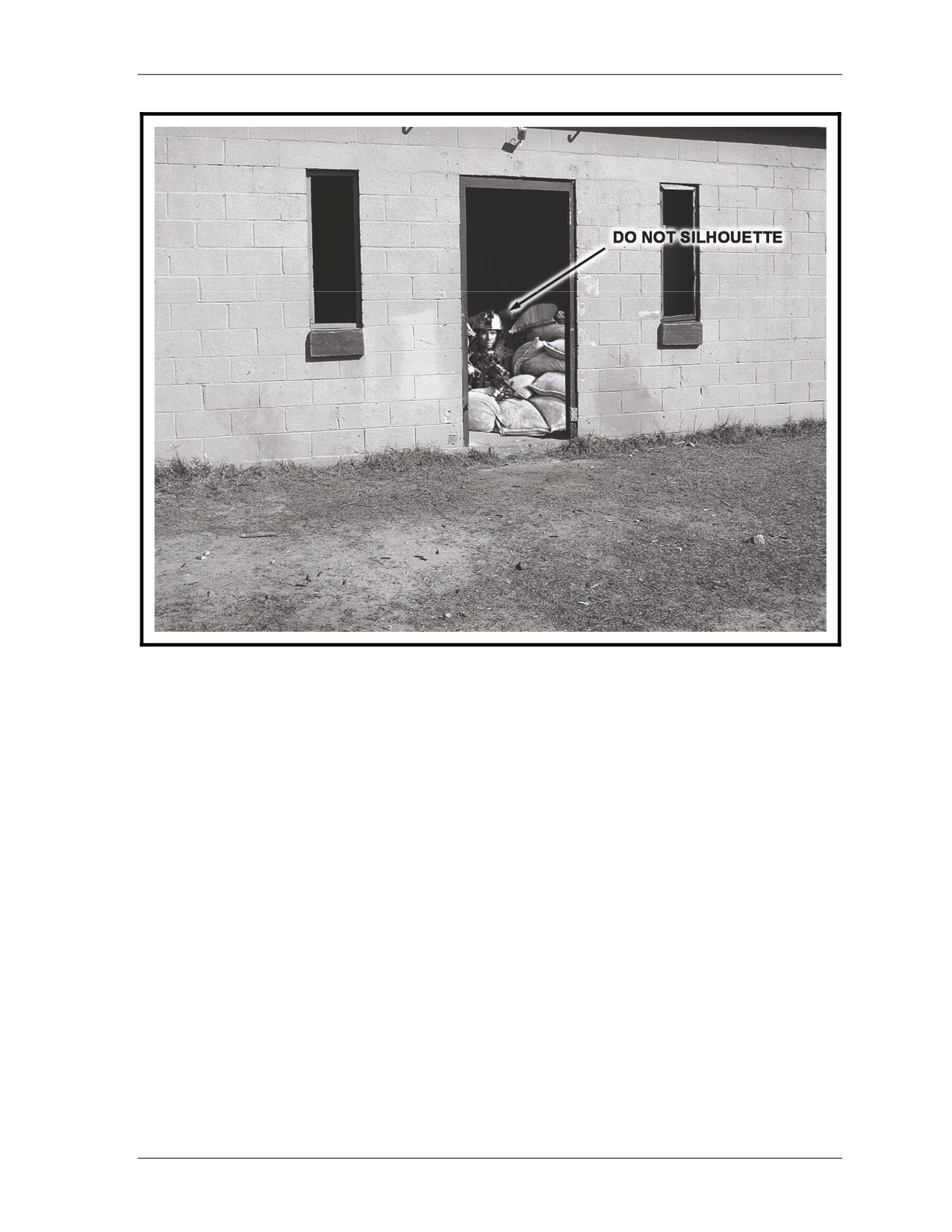
-- The machine gunner can emplace his weapon almost anywhere. In the attack, windows and doors
offer ready-made firing ports (Figure 8-16). For this reason, avoid windows and doors, which
the enemy normally has under observation and fire. Use any opening created in walls during the
fighting. Small explosive charges can create loopholes for machine gun positions. Regardless of
the openings used, ensure machine guns are inside the building and that they remain in the
shadows.
8-16
FM 3-21.75
28 January 2008
Urban Areas
Figure 8-16. Emplacement of machine gun in a doorway.
-- Upon occupying a building, board up all windows and doors. Leave small gaps between the
boards so you can use windows and doors as alternate positions.
-- Use loopholes extensively in the defense. Avoid constructing them in any logical pattern, or all at
floor or tabletop levels. Varying height and location makes them hard to pinpoint and identify.
Make dummy loopholes and knock off shingles to aid in the deception. Construct loopholes
behind shrubbery, under doorjambs, and under the eaves of a building, because these are hard to
detect. In the defense, as in the offense, you can construct a firing position so as to use the
building for OHC.
-- You can increase your fields of fire by locating the machine gun in the corner of the building or
in the cellar. To add cover and concealment, integrate available materials, such as desks,
overstuffed chairs, couches, and other items of furniture, into the construction of bunkers.
-- Grazing fire is ideal, but sometimes impractical or impossible. Where destroyed vehicles, rubble,
and other obstructions restrict the fields of grazing fire, elevate the gun to allow you to fire over
obstacles. You might have to fire from second or third story loopholes. You can build a firing
platform under the roof, and then construct a loophole. Again, conceal the exact location of the
position. Camouflage the position by removing patches of shingles over the entire roof.
28 January 2008
FM 3-21.75
8-17
Chapter 9
'Every Soldier is a Sensor'
Every Soldier, as a part of a small unit, can provide useful information and is an
essential component to the commanders achieving situational understanding. This
task is critical, because the environment in which Soldiers operate is characterized by
violence, uncertainty, complexity, and asymmetric methods by the enemy. The
increased situational awareness that you must develop through personal contact and
observation is a critical element of the friendly force’s ability to more fully
understand the operational environment. Your life and the lives of your fellow
Soldiers could depend on reporting what you see, hear, and smell.
DEFINITION
9-1.
The 'Every Soldier is a Sensor' (ES2) concept ensures that Soldiers are trained to actively observe
for details for the commander’s critical information requirement (CCIR) while in an AO. It also ensures
they can provide concise, accurate reports. Leaders will know how to collect, process, and disseminate
information in their unit to generate timely intelligence. They should establish a regular feedback and
assessment mechanism for improvement in implementing ES2. Every Soldier develops a special level of
exposure to events occurring in the AO and can collect information by observing and interacting with the
environment. Intelligence collection and development is everyone’s responsibility. Leaders and Soldiers
should fight for knowledge in order to gain and maintain greater situational understanding.
RESOURCES
9-2.
As Soldiers develop the special level of exposure to the events occurring in their operating
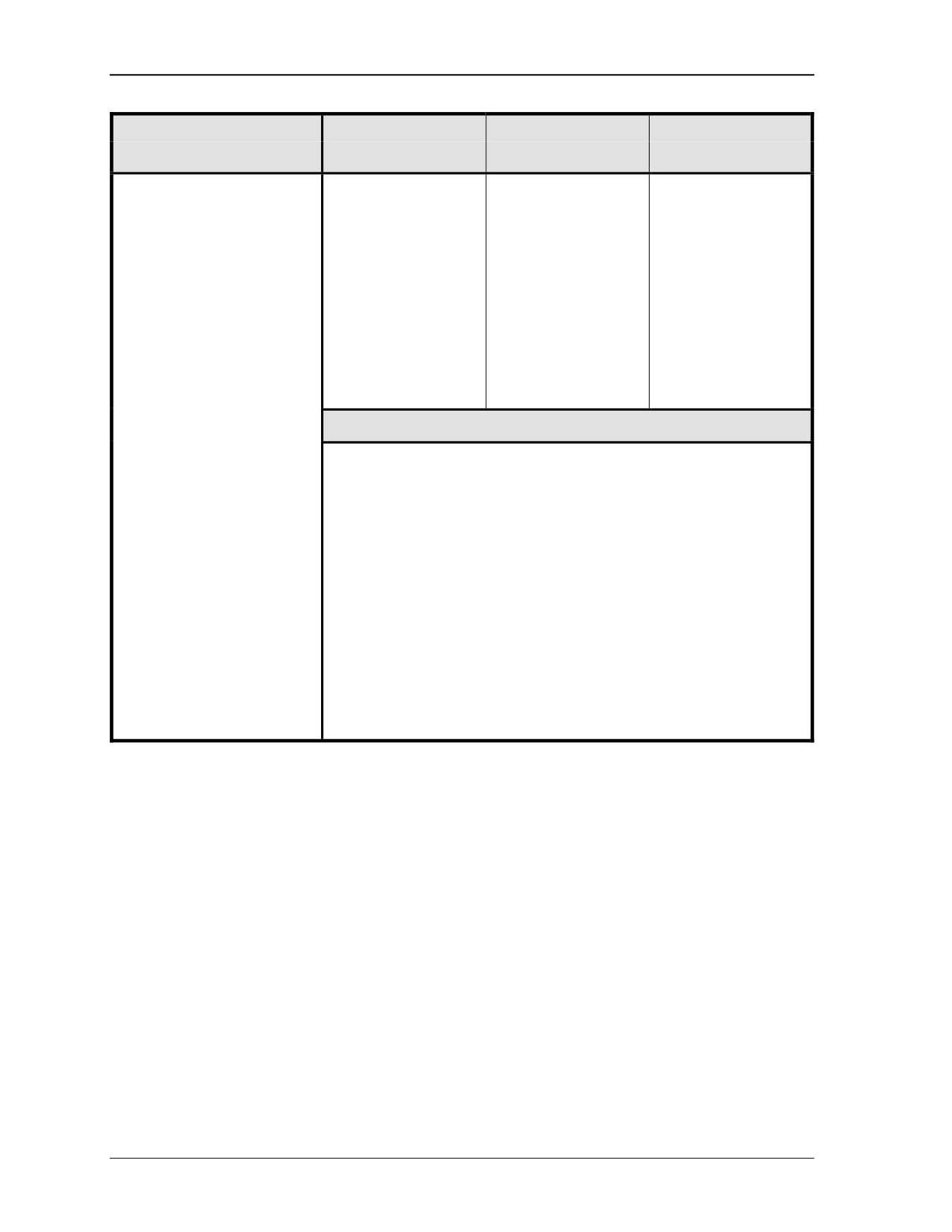
environment, they should keep in mind certain potential indicators as shown in Figure 9-1, page 9-2.
These indicators are information on the intention or capability of a potential enemy that commanders need
to make decisions. You will serve as the commander’s "eyes and ears" when--
• Performing traditional offensive or defensive missions.
• Patrolling in a stability and reconstruction or civil support operation.
• Manning a checkpoint or a roadblock.
• Occupying an observation post.
• Passing through areas in convoys.
• Observing and reporting elements of the environment.
• Observing and reporting activities of the populace in the area of operations.
28 January 2008
FM 3-21.75
9-1
Chapter 9
SIGHT
SOUND
TOUCH
SMELL
Look for--
Listen for--
Feel for--
Smell for--
• Enemy personnel, vehicles,
• Running engines or
• Warm coals and
• Vehicle exhaust
and aircraft
track sounds
other materials
• Burning petroleum
in a fire
• Sudden or unusual
• Voices
products
movement
• Fresh tracks
• Metallic sounds
• Food cooking
• Age of food or trash
• New local inhabitants
• Gunfire, by weapon
• Aged food in trash
type
• Smoke or dust
• Human waste
• Unusual calm or
• Unusual movement of farm
silence
or wild animals
• Dismounted
• Unusual activity--or lack of
movement
activity--by local
inhabitants, especially at
• Aircraft
times or places that are
normally inactive or active
OTHER CONSIDERATIONS
• Vehicle or personnel tracks
Armed Elements
Locations of factional forces, mine fields, and
• Movement of local
potential threats.
inhabitants along uncleared
Homes and Buildings Condition of roofs, doors, windows, lights, power
routes, areas, or paths
lines, water, sanitation, roads, bridges, crops, and
• Signs that the enemy has
livestock.
occupied the area
Infrastructure
Functioning stores, service stations, and so on.
• Evidence of changing
People
Numbers, gender, age, residence or DPRE status,
trends in threats
apparent health, clothing, daily activities, and
• Recently cut foliage
leadership.
Contrast
Has anything changed? For example, are there
• Muzzle flashes, lights, fires,
new locks on buildings? Are windows boarded up
or reflections
or previously boarded up windows now open,
• Unusual amount (too much
indicating a change in how a building is expected
or too little) of trash
to be used? Have buildings been defaced with
graffiti?
Figure 9-1. Potential indicators.
9-3.
Commanders get information from many sources, but you are his best source. You can in turn
collect information from the following sources:
• Enemy prisoners of war (EPWs)/detainees are an immediate source of information. Turn
captured Soldiers over to your leader quickly. Also, tell him anything you learn from them.
• Captured enemy documents (CEDs) may contain valuable information about present or future
enemy operations. Give such documents to your leader quickly.
• Captured enemy equipment (CEEs) eliminates an immediate threat. Give such equipment to
your leader quickly.
• Enemy activity (the things the enemy is doing) often indicates what the enemy plans to do.
Report everything you see the enemy do. Some things that may not seem important to you may
be important to your commander.
• Tactical questioning, observation, and interaction with displaced persons, refugees, or evacuees
(DPRE), during the conduct of missions, can yield important information.
• Local civilians, however often have the most information about the enemy, terrain, and weather
in a particular area. Report any information gained from civilians. However, you cannot be sure
9-2
FM 3-21.75
28 January 2008
'Every Soldier is a Sensor'
which side the civilians are trying to help, so be careful when acting on information obtained
from them. If possible, try to confirm the information by some other means.
FORMS OF QUESTIONING
9-4.
Questioning may be achieved by tactical or direct methods. The following paragraphs detail
both methods:
Tactical Questioning--Tactical questioning is the initial questioning for information of immediate
value. When the term applies to the interaction with the local population, it is not really questioning
but is more conversational in nature. The task can be designed to build rapport as much, and collect
information and understand the environment. You will conduct tactical questioning based on your
unit is SOPs, ROE, and the order for that mission. Your leaders must include specific guidance for
tactical questioning in the operation order (OPORD) for appropriate missions. Information reported
because of tactical questioning is passed up through your chain of command to the battalion/brigade
intelligence officers (S-2) and assistant chief of staff for intelligence (G-2), which forms a vital part
of future planning and operations. Additionally, you are not allowed to attempt any interrogation
approach techniques in the course of tactical questioning.
Direct Questioning--Direct questioning is an efficient method of asking precise questions according to
a standard pattern. The goal is to obtain the maximum amount of intelligence information in the
least amount of time. Direct questions must clearly indicate the topic being questioned as they
require an effective narrative response (i.e., be brief, simple, but specific). Clearly define each
subject using a logical sequence. Basic questions are used to discourage "yes" or "no" answers.
Direct questioning is the only technique authorized for ES2 tactical questioning. Soldiers who are
not trained and certified interrogators are forbidden to attempt to apply any interrogation approach
techniques. When it is clear that the person being questioned has no further information, or does not
wish to cooperate further, tactical questioning must stop.
9-5.
Various AOs will have different social and regional considerations that can affect communications
and the conduct of operations (i.e., social behaviors, customs, and courtesies). You must also be aware of
the following safety and cultural considerations:
• Know the threat level and force protection (FP) measures in your AO.
• Know local customs and courtesies.
• Avoid using body language that locals might find rude.
• Approach people in normal surroundings to avoid suspicion.
• Behave in a friendly and polite manner.
• Remove sunglasses when speaking to those people with whom you are trying to create a
favorable impression.
• Know as much as possible about the local culture, including a few phrases in the local
language.
• If security conditions permit, position your weapon in the least intimidating position as
possible.
REPORT LEVELS
9-6.
All information collected by patrols, or via other contact with the local population, is reported
through your chain of command to the unit S-2. The S-2 is responsible for transmitting the information
through intelligence channels to the supported military intelligence elements, according to unit intelligence
tasks and the OPORD for the current mission. Therefore, if everyone is involved in the collection of
combat information, then everyone must be aware of the priority intelligence requirements (PIR). All
Soldiers who have contact with the local population and routinely travel within the area must know the
CCIR, and their responsibility to observe and report. The four levels of mission reports follow:
28 January 2008
FM 3-21.75
9-3
Chapter 9
LEVEL 1
9-7.
Information of critical tactical value is reported immediately to the S-2 section, while you are still
out on patrol. These reports are sent via channels prescribed in the unit SOP. The size, activity, location,
uniform, time, equipment (SALUTE) format is an example of Level I reporting.
LEVEL 2
9-8.
Immediately upon return to base, the patrol will conduct an after-action review (AAR) and write a
patrol report. The format may be modified to more thoroughly capture mission-specific information. This
report is passed along to the S-2 section prior to a formal debriefing. Your leaders must report as
completely and accurately as possible since this report will form the basis of the debriefing by the
S-2 section.
LEVEL 3
9-9.
After receiving the initial patrol report, the S-2 section will debrief your patrol for further details
and address PIR and CCIR not already covered in the patrol report.
LEVEL 4
9-10.
Follow-up reporting is submitted as needed after the unit S-2 section performs the debriefing.
Note: Any patrols or activities should be preceded by a prebriefing, which is a
consolidated summary of the AOs historical activities.
SALUTE FORMAT
9-11.
These four levels help the unit S-2 section record and disseminate both important and subtle
details of for use in all-source analysis, future planning, and passing on to higher S-2/G-2. This information
helps them analyze a broad range of information and disseminate it back to your level and higher. Report
all information about the enemy to your leader quickly, accurately, and completely. Such reports should
answer the questions who, what, and where after when. Use the SALUTE format when reporting. Make
notes and draw sketches to help you remember details. Table 9-1 shows how to use the SALUTE format.
9-4
FM 3-21.75
28 January 2008

'Every Soldier is a Sensor'
Table 9-1. SALUTE format line by line.
Line
Type Info
Description
No.
1
(S)ize/Who
Expressed as a quantity and echelon or size. For example, report "10 enemy
Infantrymen" (not "a rifle squad").
If multiple units are involved in the activity you are reporting, you can make multiple entries.
2
(A)ctivity/What
Relate this line to the PIR being reported. Make it a concise bullet statement.
Report what you saw the enemy doing, for example, "emplacing mines in
the road."
3
(L)ocation/Where
This is generally a grid coordinate, and should include the 100,000-meter grid
zone designator. The entry can also be an address, if appropriate, but still
should include an eight-digit grid coordinate. If the reported activity involves
movement, for example, advance or withdrawal, then the entry for location will
include "from" and "to" entries. The route used goes under "Equipment/How."
4
(U)nit/Who
Identify who is performing the activity described in the "Activity/What" entry.
Include the complete designation of a military unit, and give the name and
other identifying information or features of civilians or insurgent groups.
5
(T)ime/When
For future events, give the DTG for when the activity will initiate. Report
ongoing events as such.
Report the time you saw the enemy activity, not the time you report it. Always
report local or Zulu (Z) time.
6
(E)quipment/How
Clarify, complete, and expand on previous entries. Include information about
equipment involved, tactics used, and any other essential elements of
information (EEI) not already reported in the previous lines.
HANDLING AND REPORTING OF THE ENEMY
9-12.
The following paragraphs detail adequate protocol for handling enemy documents, EPWs, and
equipment:
CAPTURED ENEMY DOCUMENTS
9-13.
A CED is defined as any piece of recorded information obtained from the threat. CEDs are
generally created by the enemy, but they can also be US or multinational forces documents that were once
in the hands of the enemy. CEDs can provide crucial information related to answering the commander’s
PIR or even be exploited to put together smaller pieces of an overall situation.
9-14.
Every confiscated or impounded CED must be tagged and logged before being transferred
through the appropriate channels. The tag contains the specifics of the item, and the log is a simple
transmittal document used to track the transfer of CEDs between elements. Your leaders are responsible for
creating the initial CED log.
9-15.
While the information required is formatted, any durable field-expedient material can be used as a
CED tag if an official tag is unavailable. Ensure that the writing is protected from the elements by covering
it with plastic or transparent tape. The importance of the tag is that it is complete and attached to the CED it
28 January 2008
FM 3-21.75
9-5
Chapter 9
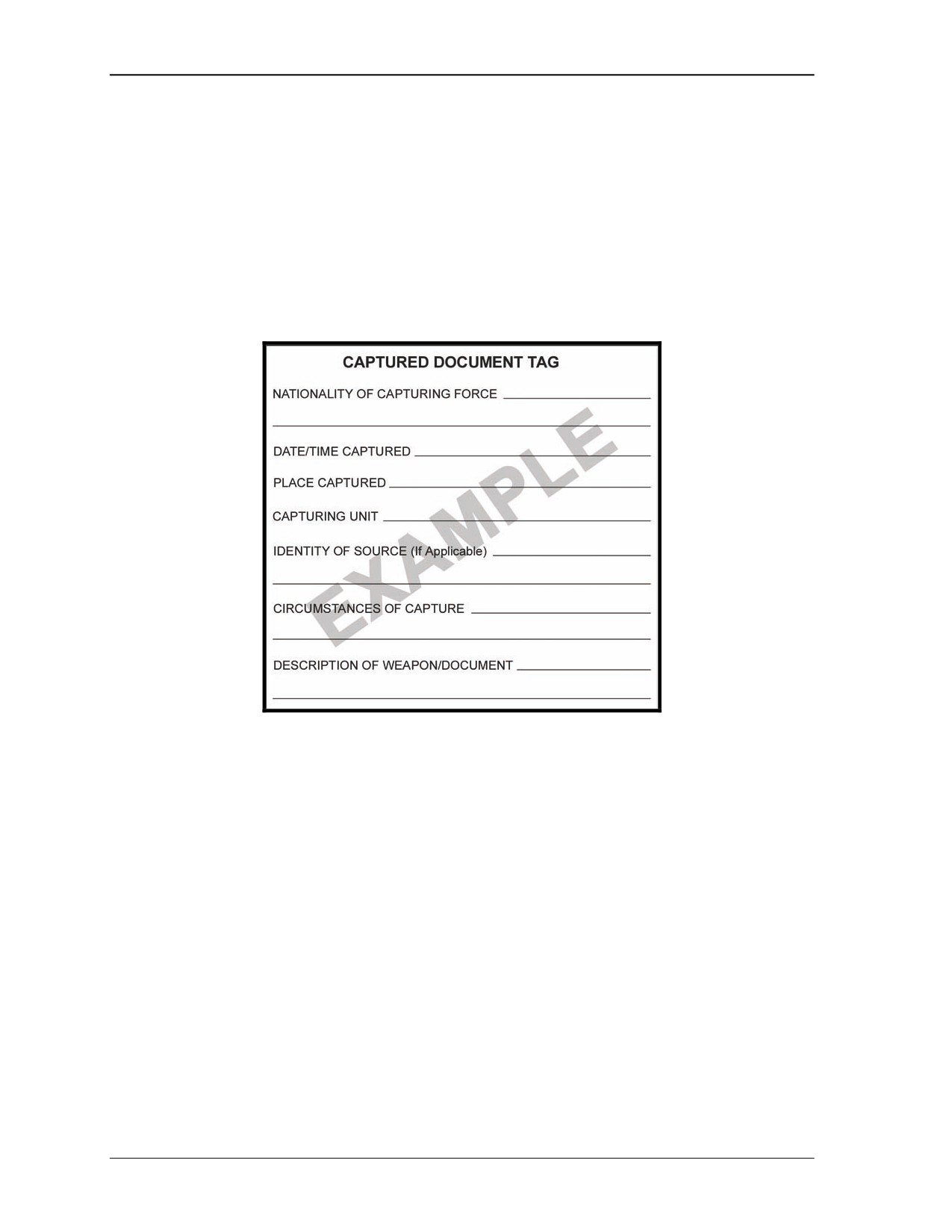
represents. The following information, at a minimum, should be recorded on a CED tag. Instructions for
filling out the tag follow (Figure 9-2):
Nationality--Detail the country of origin of the unit that captured the enemy document.
Date-Time Group--Include date and time of capture.
Place--Include a six-to eight-digit grid coordinate and describe the location where the document
was captured.
Identity--Define where the CED came from, its owner, and so on.
Circumstances--Describe how the CED was obtained.
Description--Briefly describe the CED. Enough information should be annotated for quick
recognition.
Figure 9-2. Example captured document tag.
TREATMENT OF EPWS AND DETAINEES
9-16.
EPWs/detainees are a good source of information. They must be handled without breaking
international law and without losing a chance to gain intelligence. Treat EPWs humanely. Do not harm
them, either physically or mentally. The senior Soldier present is responsible for their care. If EPWs cannot
be evacuated in a reasonable time, give them food, water, and first aid. Do not give them cigarettes, candy,
or other comfort items. EPWs who receive favors or are mistreated are poor interrogation subjects.
In handling EPWs/detainees, follow the procedure of search, segregate, silence, speed, safeguard, and tag
(the 5 Ss and T). It implies the legal obligation that each Soldier has to treat an individual in custody of, or
under the protection of, US Soldiers humanely. The 5 Ss and T are conducted as follows:
Search--This indicates a thorough search of the person for weapons and documents. You must search
and record the EPWs/detainees equipment and documents separately. Record the description of
weapons, special equipment, documents, identification cards, and personal affects on the capture
tag.
Silence--Do not allow the EPWs/detainees to communicate with one another, either verbally or with
gestures. Keep an eye open for potential troublemakers, both talkers or quiet types, and be prepared
to separate them.
9-6
FM 3-21.75
28 January 2008
'Every Soldier is a Sensor'
Segregate--Keep civilians and military separate, and then further divide them by rank, gender,
nationality, ethnicity, and religion. This technique helps keep them quiet.
Safeguard--Provide security for and protect the EPWs/detainees. Get them out of immediate danger
and allow them to keep their personal chemical protective gear, if they have any, and their
identification cards.
Speed--Information is time sensitive. It is very important to move personnel to the rear as quickly as
possible. The other thing to consider is that an EPW/detainee’s resistance to questioning grows as
time goes on. The initial shock of being captured or detained wears off and they begin to think
of escape.
Note: Exercising speed, in this instance, is critical because the value of information erodes
in a few hours. Human intelligence (HUMINT) Soldiers who are trained and who
have the appropriate time and means will be waiting to screen and interrogate these
individuals.
PERSONNEL AND EQUIPMENT TAGS
9-17.
Use wire, string, or other durable material to attach Part A, DD Form 2745, Enemy Prisoner of
War (EPW) Capture Tag, or a field-expedient alternative, to the detainee’s clothing. Tell him not to
remove or alter the tag. Attach another tag to any confiscated property. On each tag, write the following,
making sure that your notes clearly link the property with the person from whom you confiscated it:
• Date and time of capture.
• Location of the capture (grid coordinates).
• Capturing unit.
• Circumstances of capture (why person was detained).
-- Who?
-- What?
-- Where?
-- Why?
-- Witnesses?
OPERATIONS SECURITY
9-18.
Operations security (OPSEC) is the process your leaders follow to identify and protect essential
elements of friendly information (EEFI). The Army defines EEFI as critical aspects of a friendly operation
that, if known by the enemy, would subsequently compromise, lead to failure, or limits success of the
operation and therefore must be protected from detection. All Soldiers execute OPSEC measures as part
of FP. Effective OPSEC involves telling Soldiers exactly why OPSEC measures are important, and what
they are supposed to accomplish. You must understand that the cost of failing to maintain effective OPSEC
can result in the loss of lives. Understanding why you are doing something and what your actions are
supposed to accomplish, allows you and your fellow Soldiers to execute tasks more effectively. However,
this means that you and your fellow Soldiers must--
• Avoid taking personal letters or pictures into combat areas.
• Avoid keeping diaries in combat areas.
• Practice camouflage principles and techniques.
• Practice noise and light discipline.
• Practice field sanitation.
• Use proper radiotelephone procedure.
• Use the challenge and password properly.
• Abide by the Code of Conduct (if captured).
• Report any Soldier or civilian who is believed to be serving with or sympathetic to the enemy.
• Report anyone who tries to get information about US operations.
28 January 2008
FM 3-21.75
9-7
Chapter 9
• Destroy all maps or important documents if capture is imminent.
• Avoid discussing military operations in public areas.
• Discuss military operations only with those persons having a need to know the information.
• Remind fellow Soldiers of their OPSEC responsibilities.
OBSERVATION TECHNIQUES
9-19.
During all types of operations, you will be looking for the enemy. However, there will be times
when you will be posted in an OP to watch for enemy activity. An OP is a position from which you watch
an assigned sector of observation and report all activity seen or heard in your sector.
DAY OBSERVATION
9-20.
In daylight, use the visual search technique to search terrain. You must visually locate and
distinguish enemy activity from the surrounding terrain features by using the following scanning
techniques:
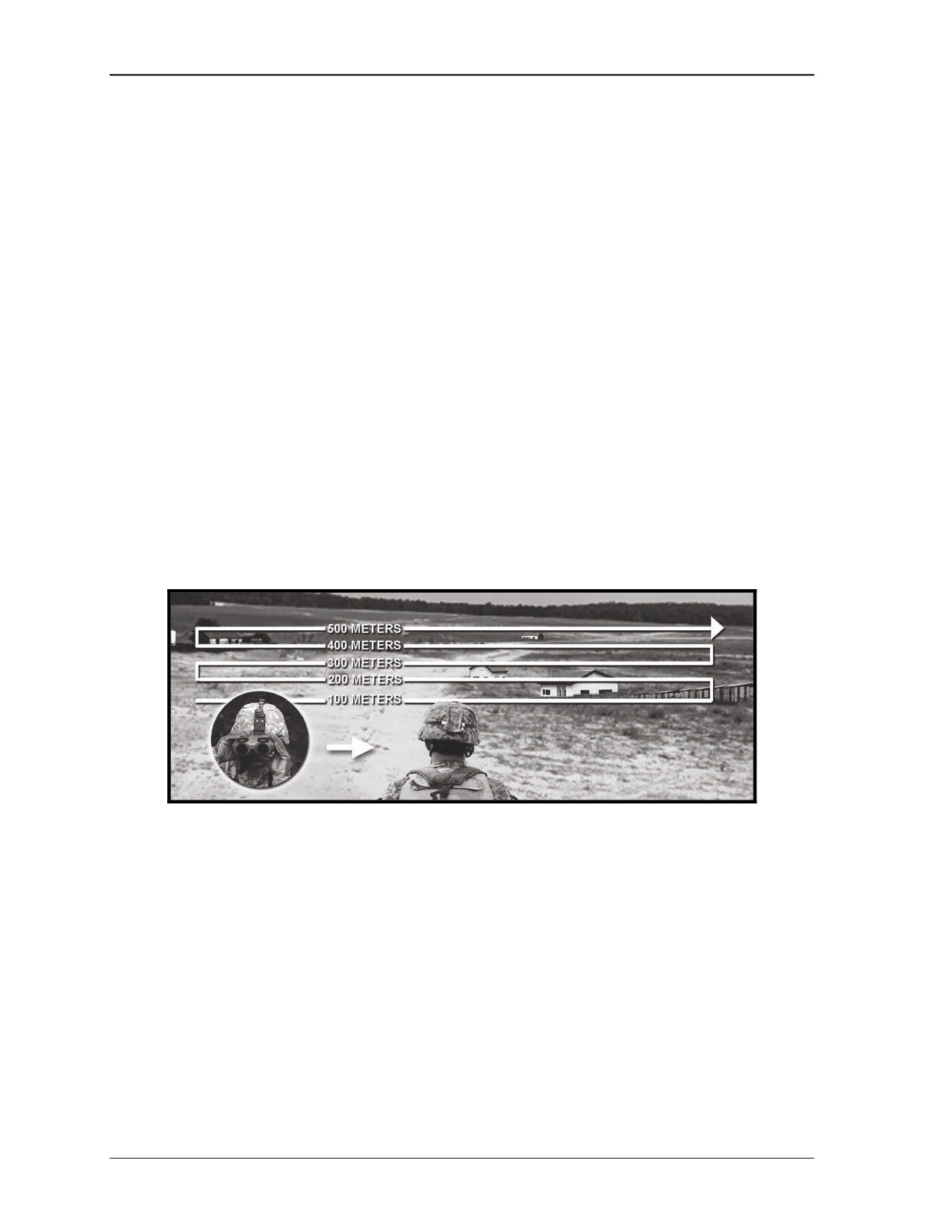
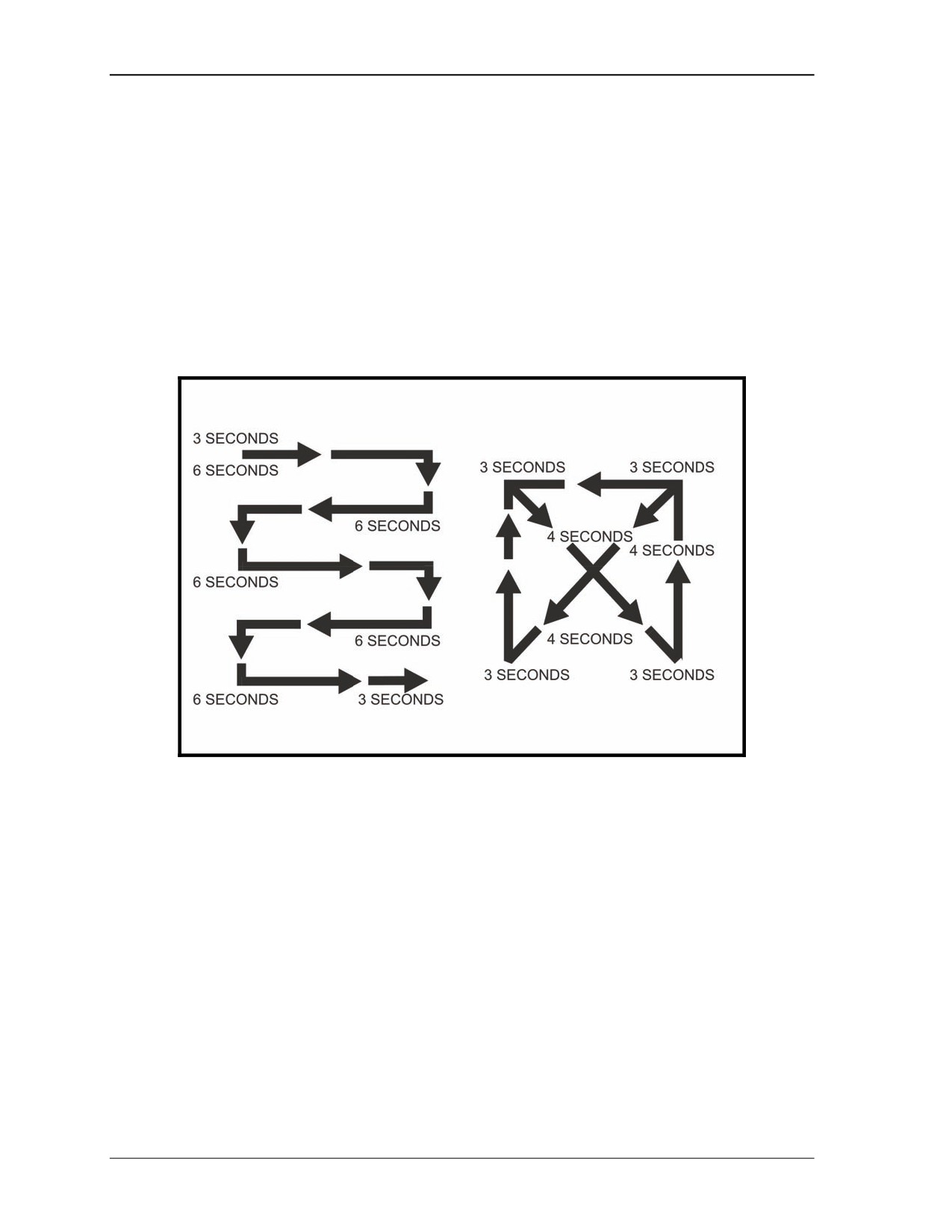
Rapid Scan--This is used to detect obvious signs of enemy activity. It is usually the first method you
will use (Figure 9-3). To conduct a rapid scan--
• Search a strip of terrain about 100 meters deep, from left-to-right, pausing at short intervals.
• Search another 100-meter strip farther out, from right-to-left, overlapping the first strip scanned,
pausing at short intervals.
• Continue this method until the entire sector of fire has been searched.
Slow Scan--The slow scan search technique uses the same process as the rapid scan but much more
deliberately, which means a slower, side-to-side movement and more frequent pauses (Figure 9-5).
Figure 9-3. Rapid/slow-scan pattern.
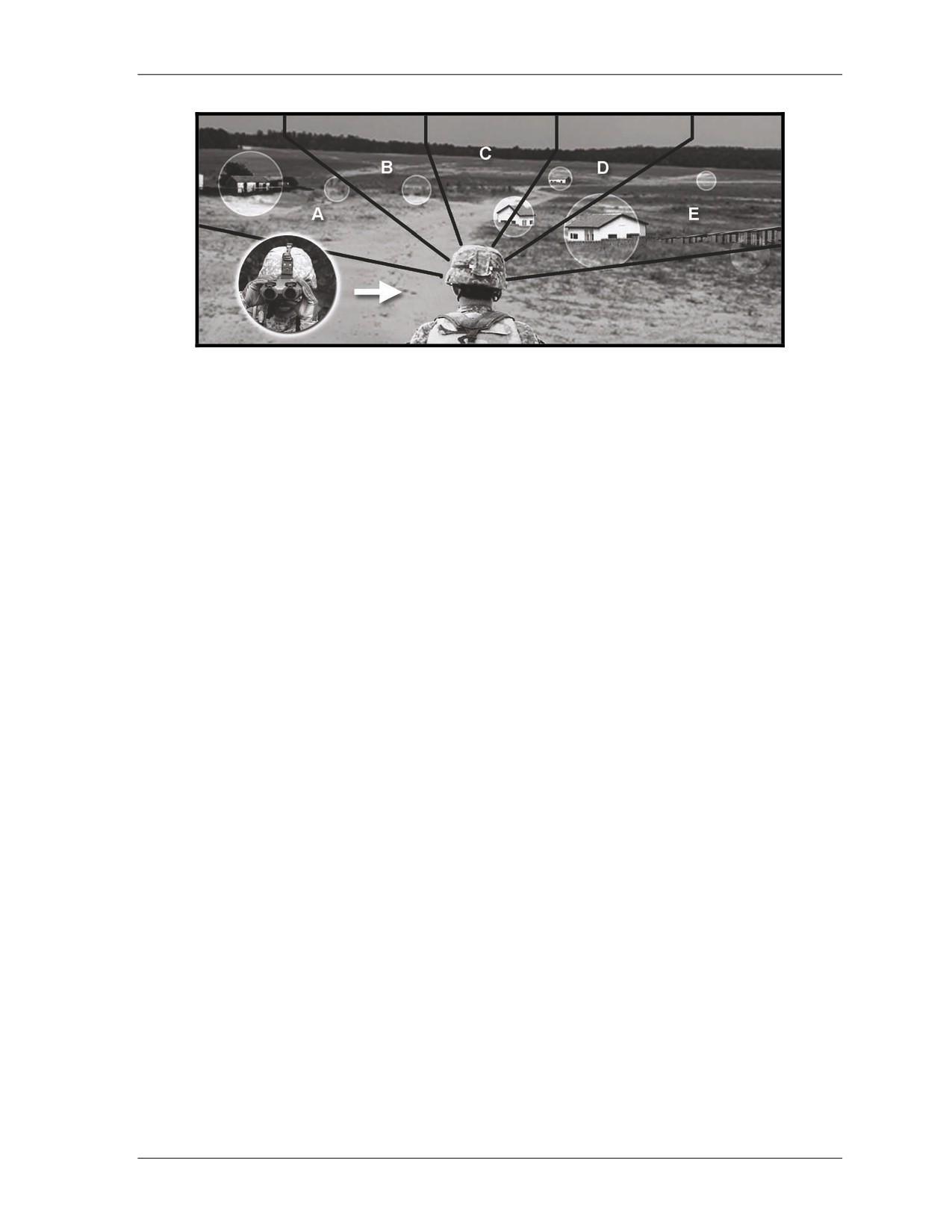
Detailed Search--If you find no targets using either the rapid or slow scan techniques, make a careful,
detailed search of the target area using M22 binoculars. The detailed search is like the slow scan,
but searching smaller areas with frequent pauses and almost incremental movement. The detailed
search, even more than the rapid or slow scan, depends on breaking a larger sector into smaller
sectors to ensure everything is covered in detail and no possible enemy positions are overlooked
(Figure 9-4). You must pay attention to the following:
-- Likely enemy positions and suspected vehicle/dismounted avenues of approach.
-- Target signatures, such as road junctions, hills, and lone buildings, located near prominent terrain
features.
-- Areas with cover and concealment, such as tree lines and draws.
9-8
FM 3-21.75
28 January 2008
'Every Soldier is a Sensor'
Figure 9-4. Detailed search.
LIMITED VISIBILITY OBSERVATION
9-21.
Although operating at night has definite advantages, it is also difficult. Your eyes do not work as
well as during the day, yet they are crucial to your performance. You need to be aware of constraints your
eyes place upon you at night, because 80 percent of your sensory input comes through them. Your ability
to see crisp and clear images is significantly reduced.
Dark Adaptation
9-22.
Dark adaptation is the process by which the human body increases the eye’s sensitivity to low
levels of light. Adaptation to darkness occurs at varying degrees and rates. During the first 30 minutes in
the dark, eye sensitivity increases about 10,000 times. Dark adaptation is affected by exposure to bright
light such as matches, flashlights, flares, or vehicle headlights. Full recovery from these exposures can take
up to 45 minutes. Your color perception decreases at night. You may be able to distinguish light and dark
colors depending on the intensity of reflected light. At night, bright warm colors such as reds and oranges
are hard to see and will appear dark. In fact, reds are nearly invisible at night. Unless a dark color is
bordered by two lighter colors, it is invisible. On the other hand, greens and blues will appear brighter,
although you may not be able to determine their color. Since visual sharpness at night is one-seventh of
what it is during the day, you can see only large, bulky objects, so you must recognize objects by their
general shape or outline. Knowing the design of structures common in the AO will help you determine
shape or silhouette. Darkness also reduces depth perception.
Normal Blind Spots--The normal blind spot is always present, day and night. It is caused by the lack
of light receptors where the optic nerve inserts into the back of the eye. The normal blind spot
occurs when you use just one eye. When you close the other eye, objects about 12 to 15 degrees
away from where you are looking will disappear. When you uncover your eye, the objects will
reappear.
Night Blind Spots--When you stare at an object at night, under starlight or lower levels of
illumination, it can disappear or fade away. This is a result of the night blind spot. It affects both
eyes at the same time and occurs when using the central vision of both eyes. Consequently, larger
and larger objects are missed as the distances increase. In order to avoid the night blind spots, look
to all sides of objects you are trying to find or follow. Do not stare. This is the only way to
maximize your night vision.
28 January 2008
FM 3-21.75
9-9
Chapter 9
Night Observation Techniques
9-23.
The following paragraphs detail night observation techniques:
Dark Adaptation Technique--First, let your eyes become adjusted to the darkness. Do so by staying
either in a dark area for about 30 minutes, or in a red-light area for about 20 minutes followed by
about 10 minutes in a dark area. The red-light method may save time by allowing you to get orders,
check equipment, or do some other job before moving into darkness.
Night Vision Scans--Dark adaptation is only the first step toward making the greatest use of night
vision. Scanning enables you to overcome many of the physiological limitations of your eyes
(Figure 9-5). It can also reduce confusing visual illusions or your eyes playing tricks on you. This
technique involves looking from right to left or left to right using a slow, regular scanning
movement. At night, it is essential to avoid looking directly at a faintly visible object when trying to
confirm its presence.
Figure 9-5. Typical scanning pattern.
Off-Center Vision--The technique of viewing an object using central vision is ineffective at night.
Again, this is due to the night blind spot that exists during low illumination (Figure 9-6). You must
learn to use off-center vision. This technique requires viewing an object by looking 10 degrees
above, below, or to either side of it rather than directly at it. Additionally, diamond viewing is very
similar in that you move your eyes just slightly, a few degrees, in a diamond pattern around the
object you wish to see. However, the image of an object bleaches out and becomes a solid tone
when viewed longer than 2 or 3 seconds. You do not have to move your head to use your peripheral
vision. By shifting your eyes from one off-center point to another, you can continue to pick-up the
object in your peripheral field of vision.
9-10
FM 3-21.75
28 January 2008
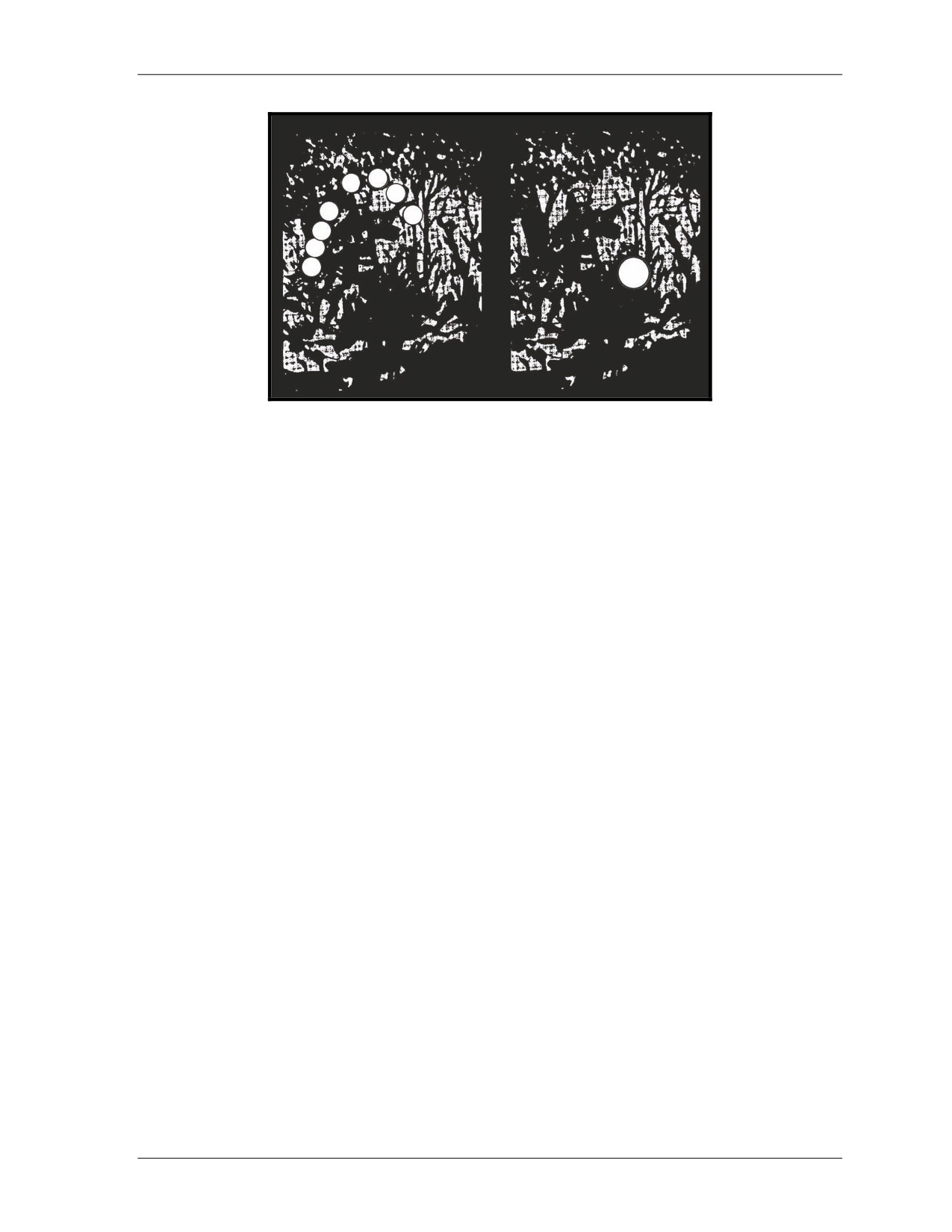
'Every Soldier is a Sensor'
Figure 9-6. Off-center viewing.
LIMITED VISIBILITY DEVICES
9-24.
The three devices used to increase lethality at night include night vision devices (NVDs), thermal
weapon sights, and aiming lasers. Each provides different views of the infrared (IR) spectrum, which is
simple energy. The electromagnetic spectrum is simply energy (light). Before you can fully operate these
devices, you must know how they work in the IR range, and you must know the electromagnetic (light)
spectrum. You should also know the advantages and disadvantages of each piece of equipment. This is the
only way to know when to employ which.
Image-Intensification Devices--An image intensifier captures ambient light, and then amplifies it
thousands of times electronically, allowing you to see the battlefield through night vision goggles
(NVGs). Ambient light comes from the stars, moon, or sky glow from distant man-made sources
such as cities. Humans can only see part of this spectrum of light with the naked eye. Just beyond
red visible light is infrared (IR) light, which is broken down into three ranges--near, middle, and far
infrared. Leaders can conduct combat missions with no active illumination sources, just image
intensifiers. However, the main advantages of image intensifiers as NVDs are their small sizes, light
weights, and low power requirements. Image intensifiers increase vision into the IR range. They
rely on ambient light and energy in the near IR range. This energy emits from natural and artificial
sources such as moonlight, starlight, and city lights. Image intensifiers include the following
(Figure 9-7):
-- AN/PVS-7A/B/C/D.
-- AN/PVS-14.
28 January 2008
FM 3-21.75
9-11
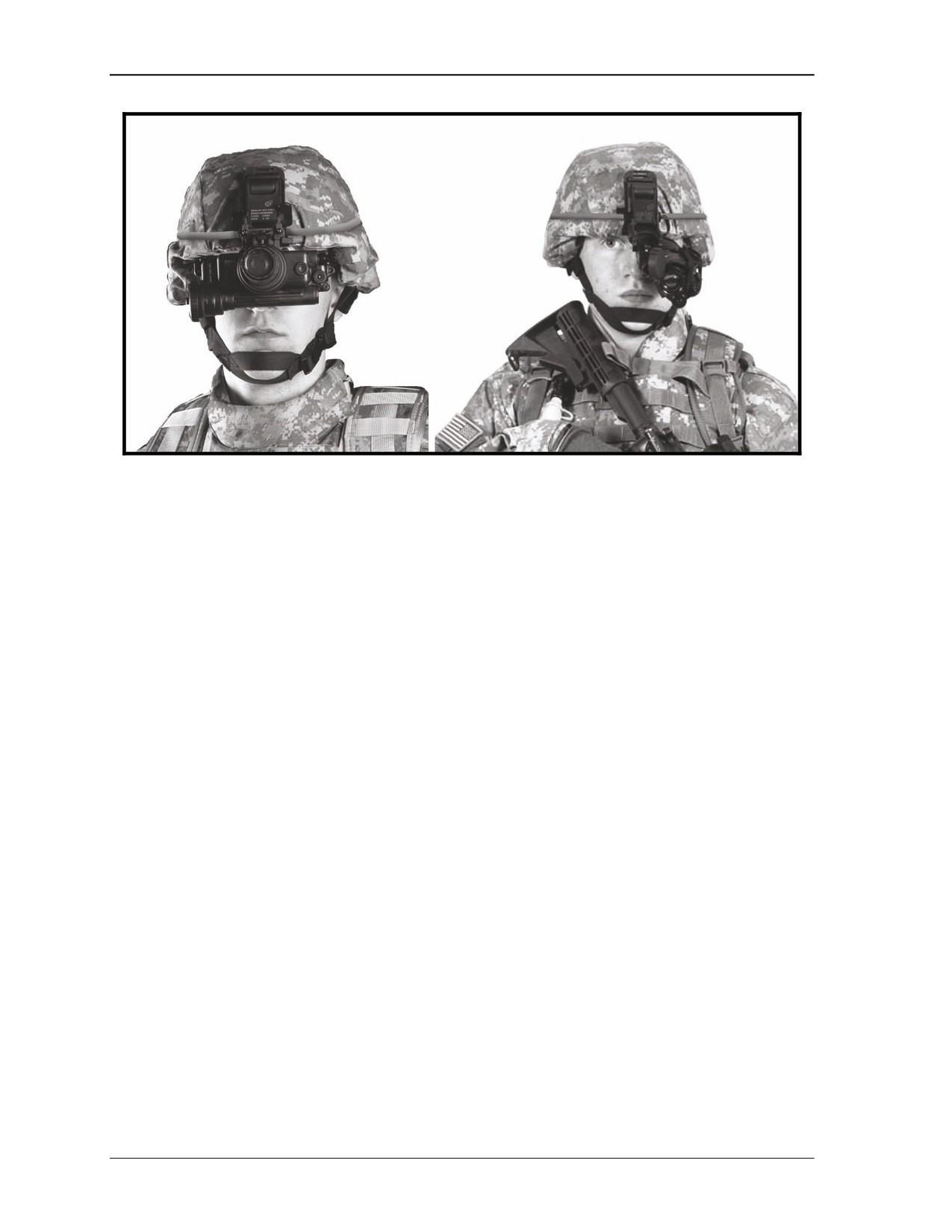
Chapter 9
Figure 9-7. AN/PVS-7 and AN/PVS-14.
Thermal Imaging Devices
9-25.
The second type of device that uses IR light is the thermal imaging device (Figure 9-8). This type
of device detects electromagnetic radiation (heat) from humans and man-made objects, and translates that
heat into an electronic image. Thermal imagers operate the same regardless of the level of ambient light.
Thermal weapon sights (TWSs) operate in the middle to far IR ranges. These sights detect IR light emitted
from friction, from combustion, or from any objects that are radiating natural thermal energy. Since the
TWS and other thermal devices operate within the middle/far IR range, they cannot be used with image
intensifiers. Thermal devices can be mounted on a weapon or handheld. The TWS works well day or night.
It has excellent target acquisition capabilities, even through fog, haze, and conventional battlefield smoke.
• AN/PAS-13(V1) light weapon thermal sight (LWTS).
-- M16- and M4-series rifles and carbines
-- M136 (AT4) light antiarmor weapon
• AN/PAS-13(V2) medium weapon thermal sight (MWTS)
-- M249 machine gun
-- M240B series medium machine gun
• AN/PAS-13(V3) heavy weapon thermal sight (HWTS)
-- M24 Sniper rifle
-- M107 Sniper rifle
-- M2 (50 Cal.) HB machine gun
-- MK 19 machine gun
9-12
FM 3-21.75
28 January 2008