FM 3-21.75 The Warrior Ethos and Soldier Combat Skills (JANUARY 2008) - page 3
Chapter 5
Section II. CONCEALMENT
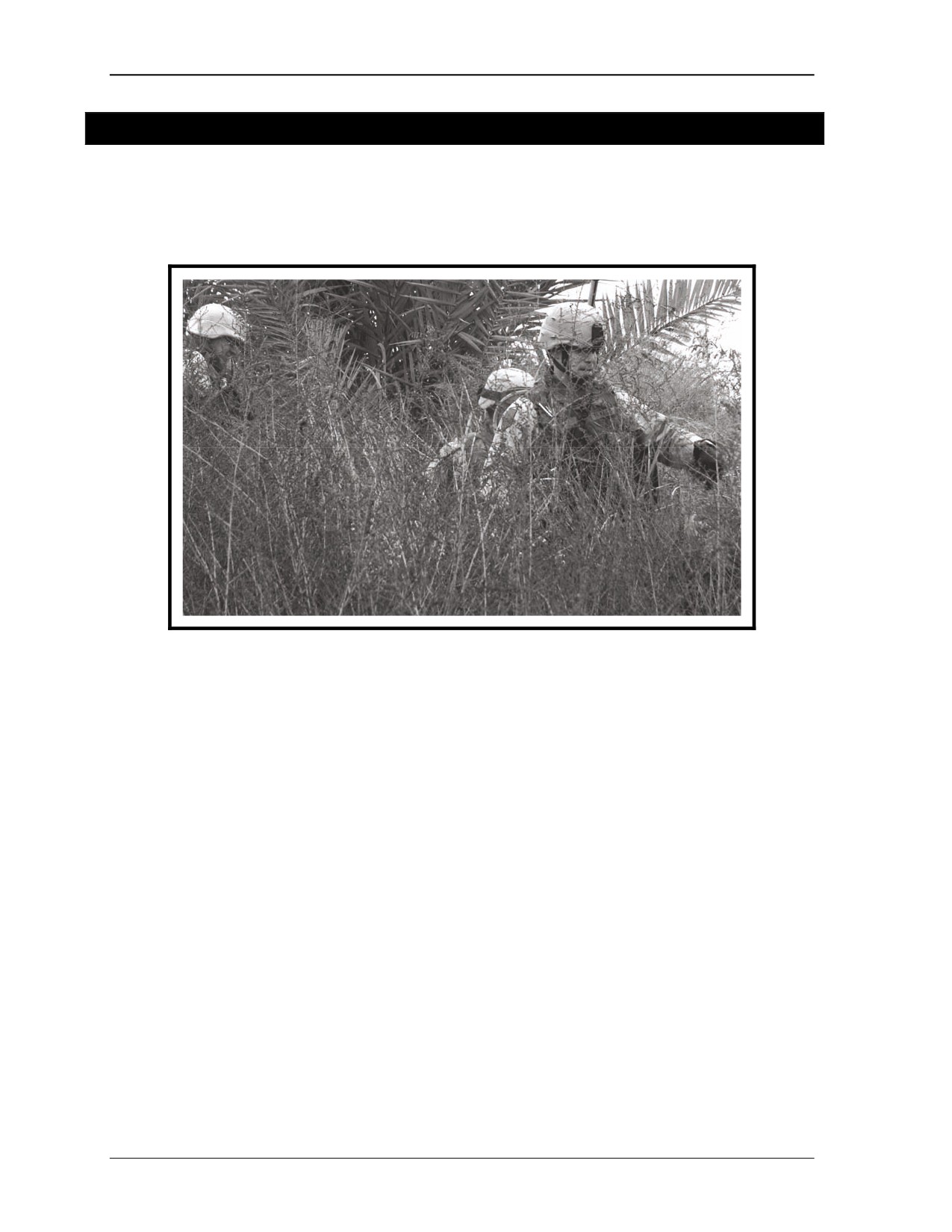
Concealment is anything that hides you from enemy observation (Figure 5-6). Concealment does not protect
you from enemy fire. Do not think that you are protected from the enemy’s fire just, because you are concealed.
Concealment, like cover, can also be natural or Soldier made. (Chapter 6 discusses techniques for concealing
fighting positions.)
Figure 5-6. Concealment.
NATURAL CONCEALMENT
5-6.
Natural concealment includes bushes, grass, and shadows. If possible, natural concealment should
not be disturbed. Man-made concealment includes Army combat uniforms (ACUs), camouflage nets, face
paint, and natural materials that have been moved from their original location. Man-made concealment
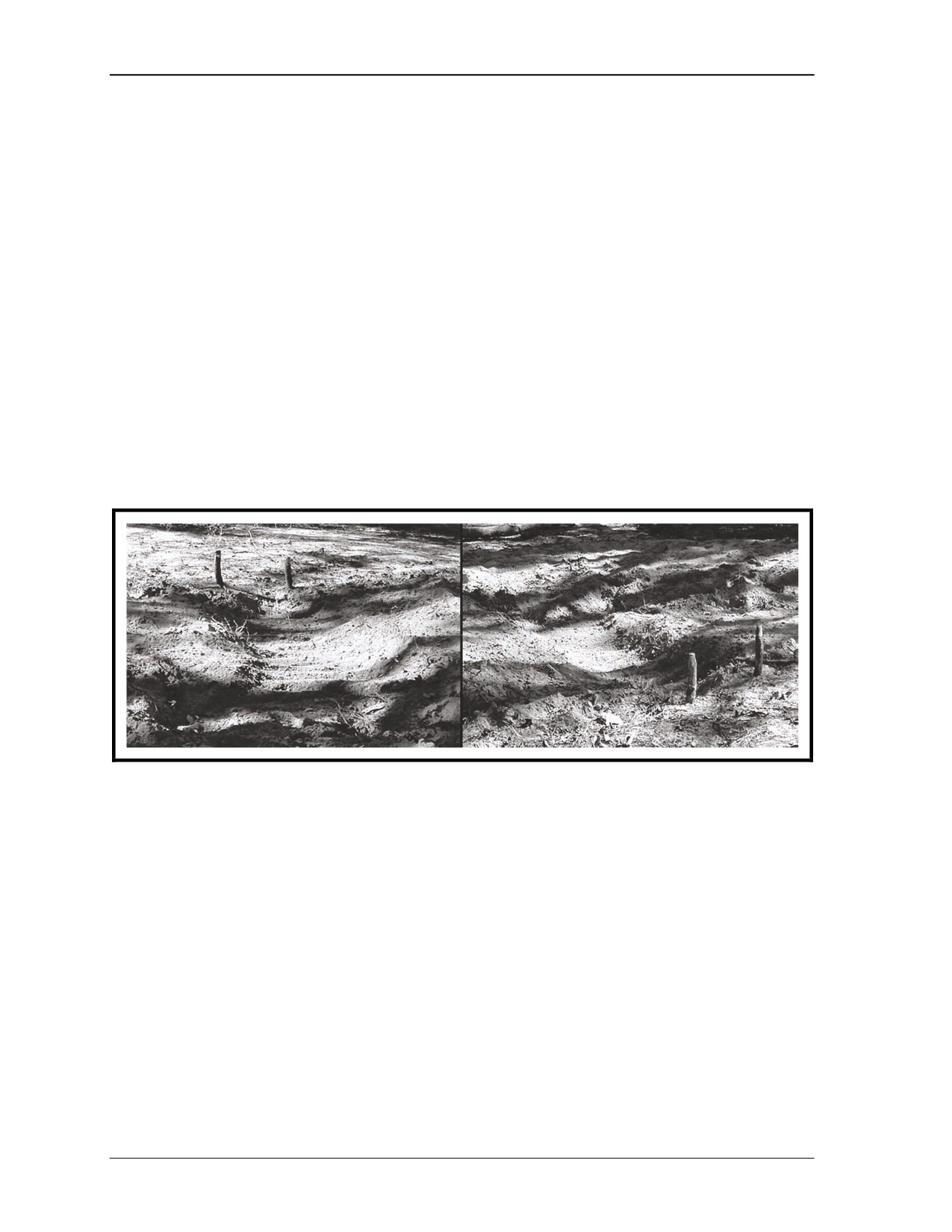
must blend into natural concealment provided by the terrain.
ACTIONS AS CONCEALMENT
5-7.
Light, noise, and movement discipline, and the use of camouflage, contributes to concealment.
Light discipline is controlling the use of lights at night by such things as not smoking in the open, not
walking around with a flashlight on, and not using vehicle headlights. Noise discipline is taking action to
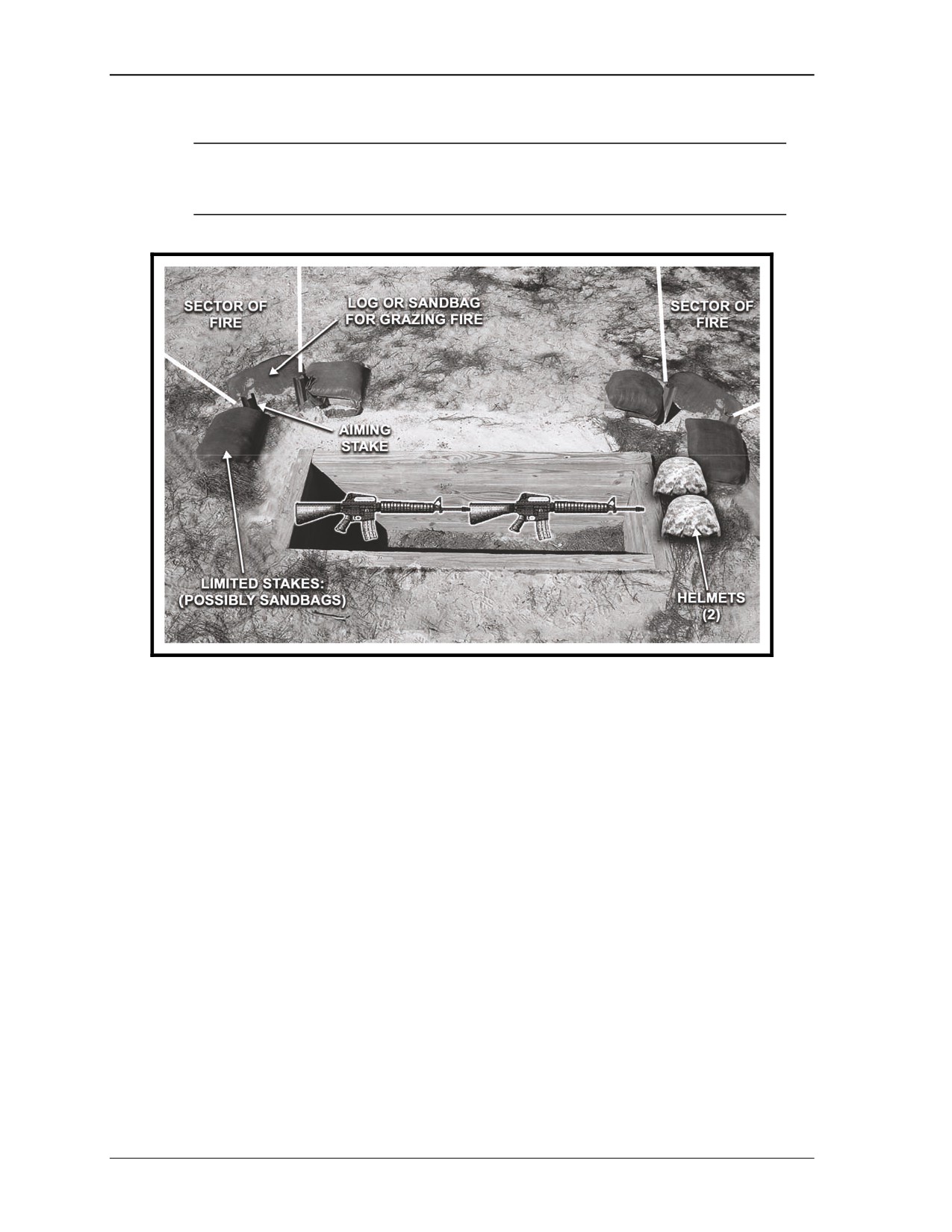
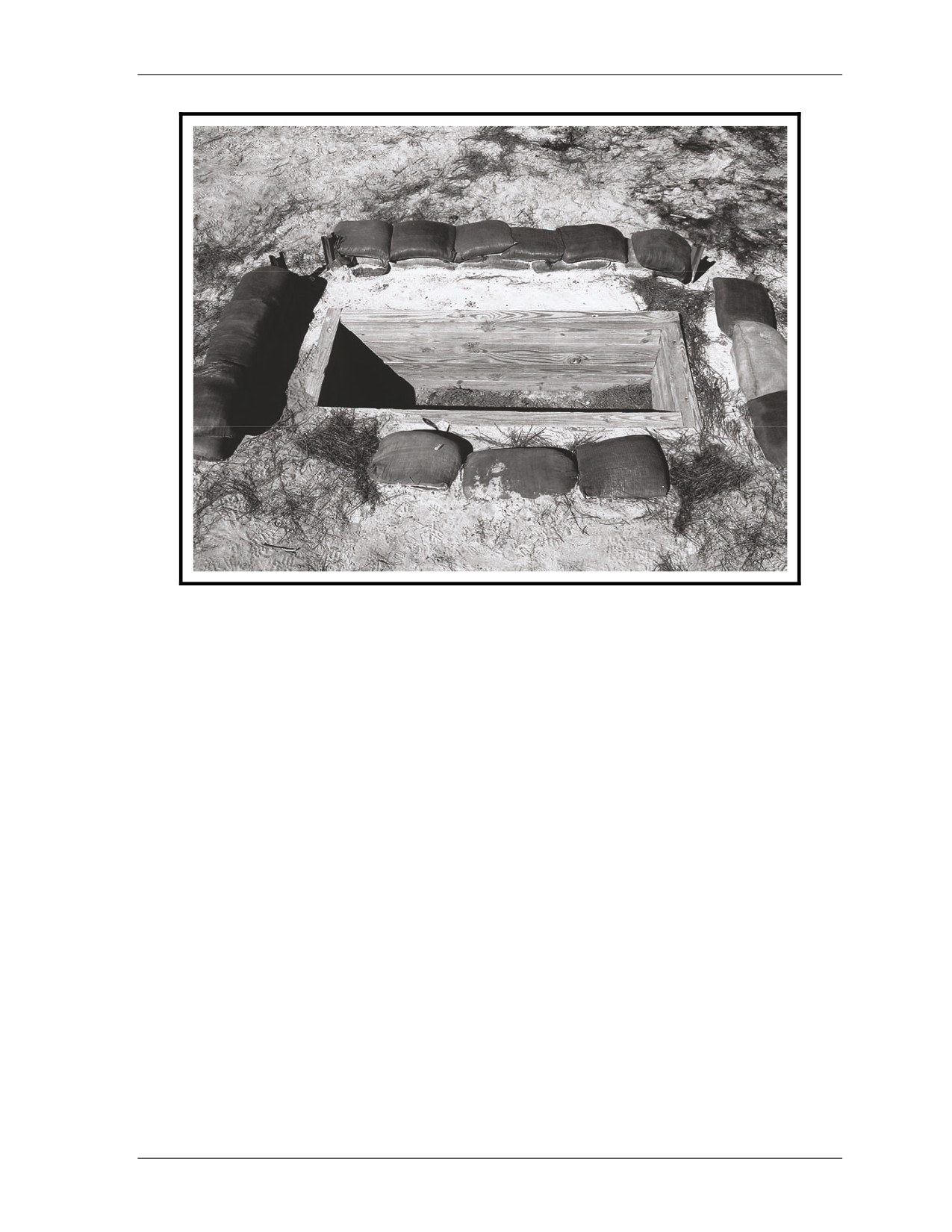
deflect sounds generated by your unit (such as operating equipment) away from the enemy and, when
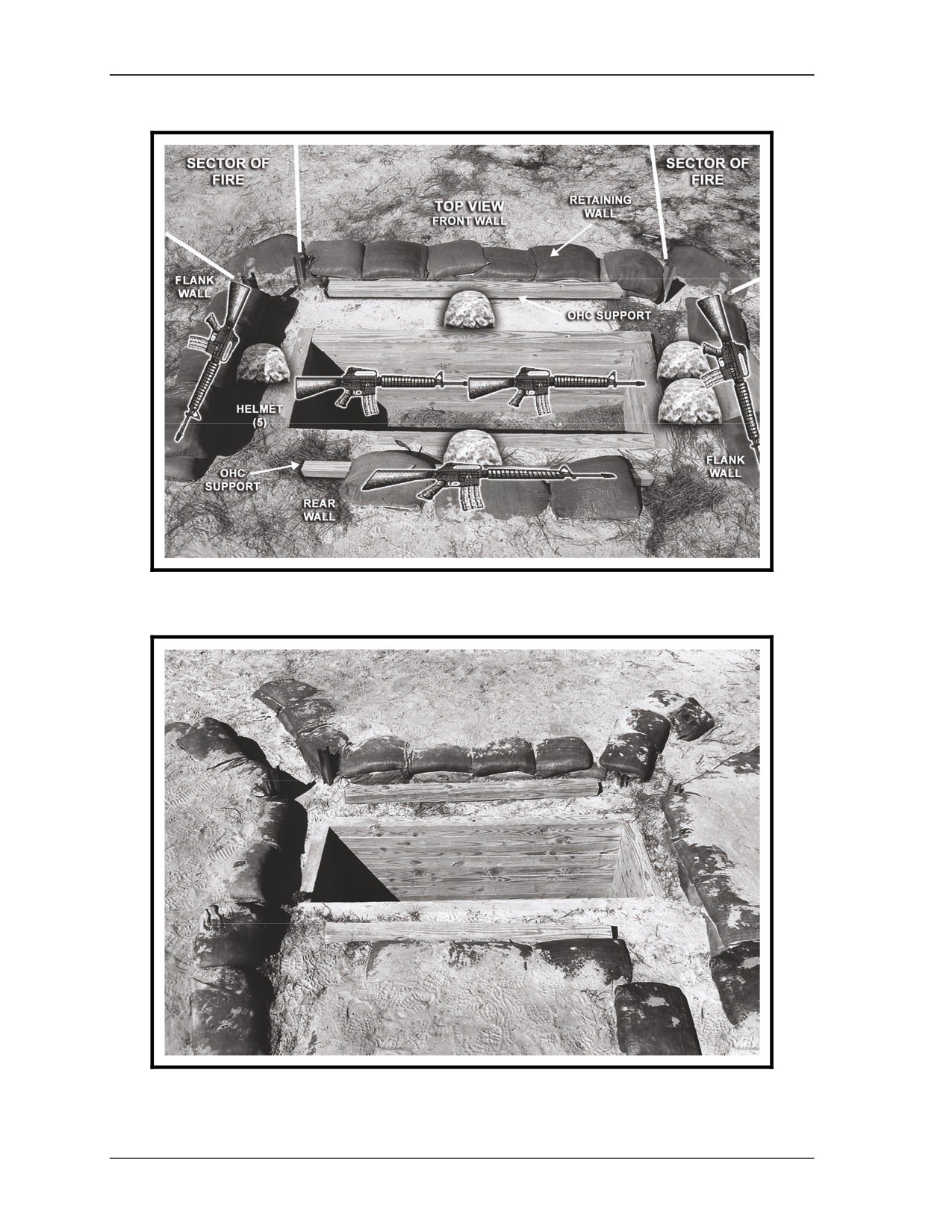
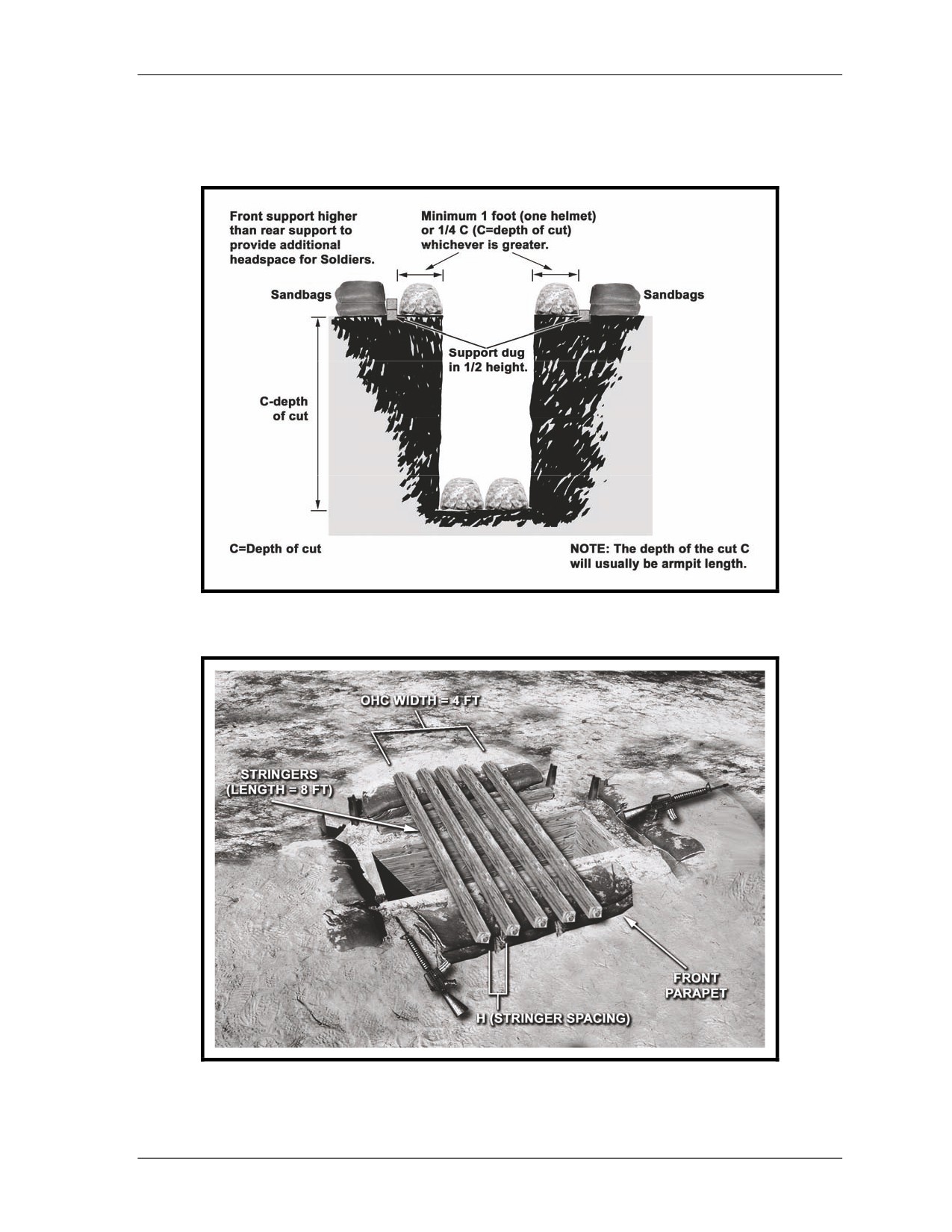
possible, using methods to communicate that do not generate sounds (arm-and-hand signals). Movement
discipline includes not moving about fighting positions unless necessary and not moving on routes that
lack cover and concealment. In the defense, build a well-camouflaged fighting position and avoid moving
about. In the offense, conceal yourself and your equipment with camouflage, and move in woods or on
terrain that gives concealment. Darkness cannot hide you from enemy observation in either offense or
defense situations. The enemy’s night vision devices (NVD) and other detection means allow them to find
you in both daylight and darkness.
5-4
FM 3-21.75
28 January 2008
Cover, Concealment, and Camouflage
Section III. CAMOUFLAGE
Camouflage is anything you use to keep yourself, your equipment, and your position from being identified.
Both natural and man-made material can be used for camouflage. Change and improve your camouflage often.
The time between changes and improvements depends on the weather and on the material used. Natural
camouflage will often die, fade, or otherwise lose its effectiveness. Likewise, man-made camouflage may wear
off or fade and, as a result, Soldiers, their equipment, and their positions may stand out from their surroundings.
To make it difficult for the enemy to spot them, Soldiers should remember the following when using or wearing
camouflage. (Chapter 6 discusses techniques for camouflaging fighting positions.):
MOVEMENT
5-8.
Movement and activity draw attention. When you give arm-and-hand signals or walk about your
position, your movement can be seen by the naked eye at long ranges. In the defense, stay low. Move only
when necessary. In the offense, move only on covered and concealed routes.
POSITIONS
5-9.
Avoid putting anything where the enemy expects to find it. Build positions on the side of a hill,
away from road junctions or lone buildings, and in covered and concealed places. Avoid open areas.
OUTLINES AND SHADOWS
5-10.
These can reveal your position or equipment to an air or ground observer. Break up outlines and
shadows with camouflage. When moving, try to stay in the shadows.
SHINE
5-11.
A shine will naturally attract the enemy’s attention. In the dark, a burning cigarette or flashlight
will give you away. In daylight, reflected light from any polished surface such as shiny mess gear, a worn
helmet, a windshield, a watch crystal and band, or exposed skin will do it. Any light, or reflection of light,
can help the enemy detect your position. To reduce shine, cover your skin with clothing and face paint.
Dull equipment and vehicle surfaces with paint, mud, or other camouflaging material or substance.
WARNING
In a nuclear attack, darkly painted skin can absorb more thermal
energy and may burn more readily than bare skin.
SHAPE
5-12.
Certain shapes, such as a helmet or human being, are easily recognizable. Camouflage, conceal,
and break up familiar shapes to make them blend in with their surroundings, but avoid overdoing it.
28 January 2008
FM 3-21.75
5-5
Chapter 5
COLORS
5-13.
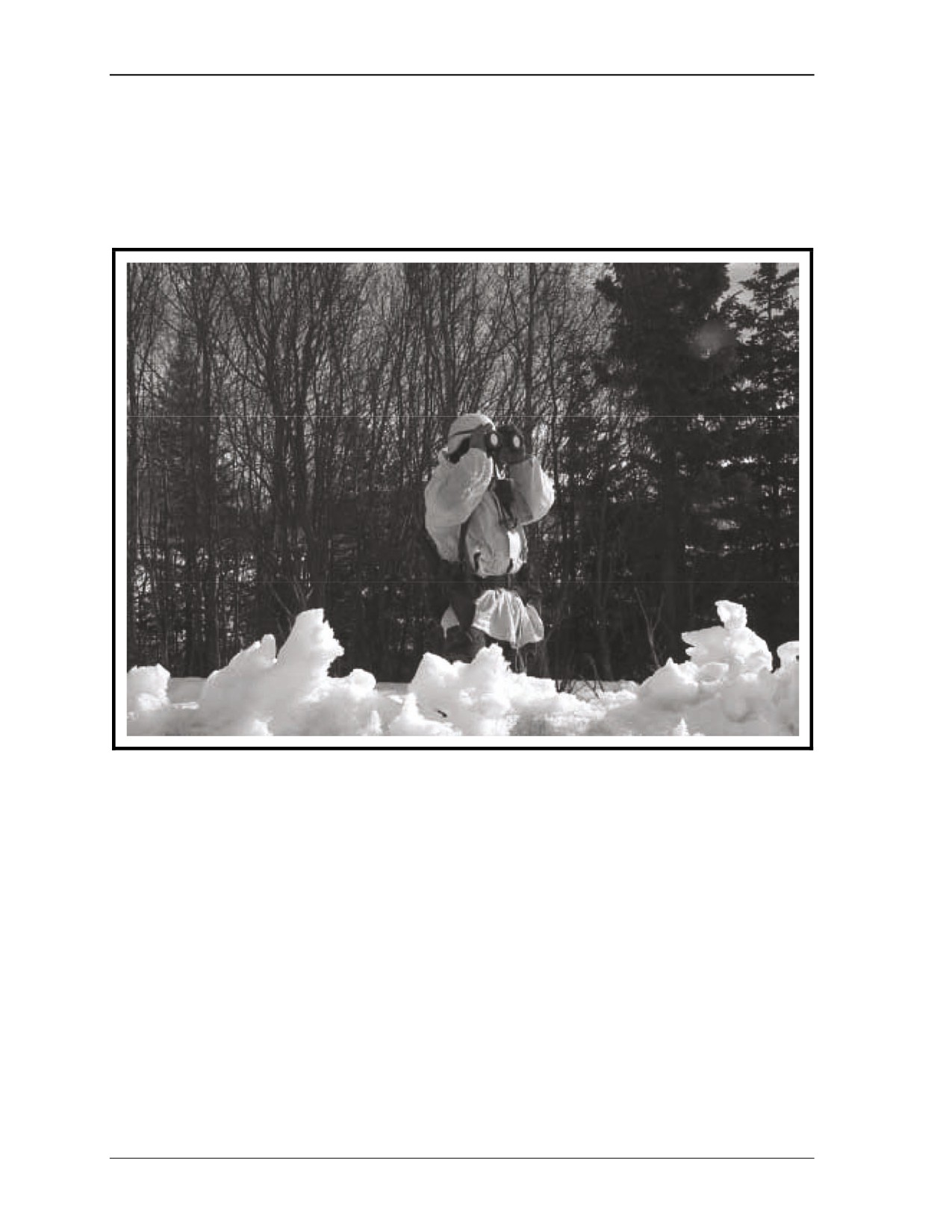
If your skin, uniform, or equipment colors stand out against the background, the enemy can
obviously detect you more easily than he could otherwise. For example, ACUs stand out against a
backdrop of snow-covered terrain. Once again, camouflage yourself and your equipment to blend with the
surroundings (Figure 5-7).
Figure 5-7. Soldier in arctic camouflage.
DISPERSION
5-14.
This means spreading Soldiers, vehicles, and equipment over a wide area. The enemy can detect a
bunch of Soldiers more easily than they can detect a lone Soldier. Spread out. Unit SOP or unit leaders
vary distances between you and your fellow Soldiers depending on the terrain, degree of visibility, and
enemy situation.
PREPARATION
5-15.
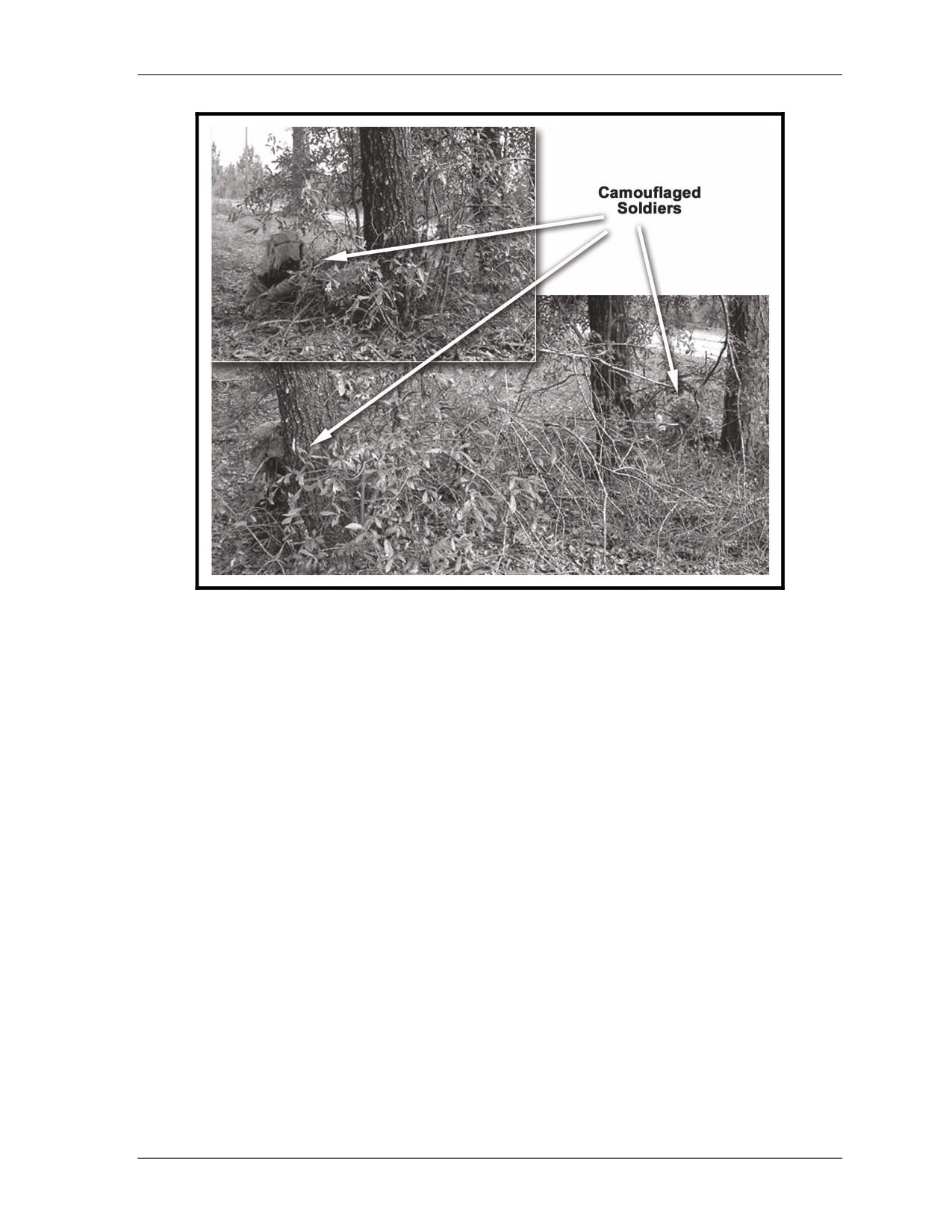
Before camouflaging, study the terrain and vegetation of the area in which you are operating.
Next, pick and use the camouflage material that best blends with the area (Figures 5-8). When moving
from one area to another, change camouflage as needed to blend with the surroundings. Take grass, leaves,
brush, and other material from your location and apply it to your uniform and equipment, and put face
paint on your skin.
5-6
FM 3-21.75
28 January 2008
Cover, Concealment, and Camouflage
Figure 5-8. Camouflaged Soldiers.
INDIVIDUAL TECHNIQUES
HELMET
5-16.
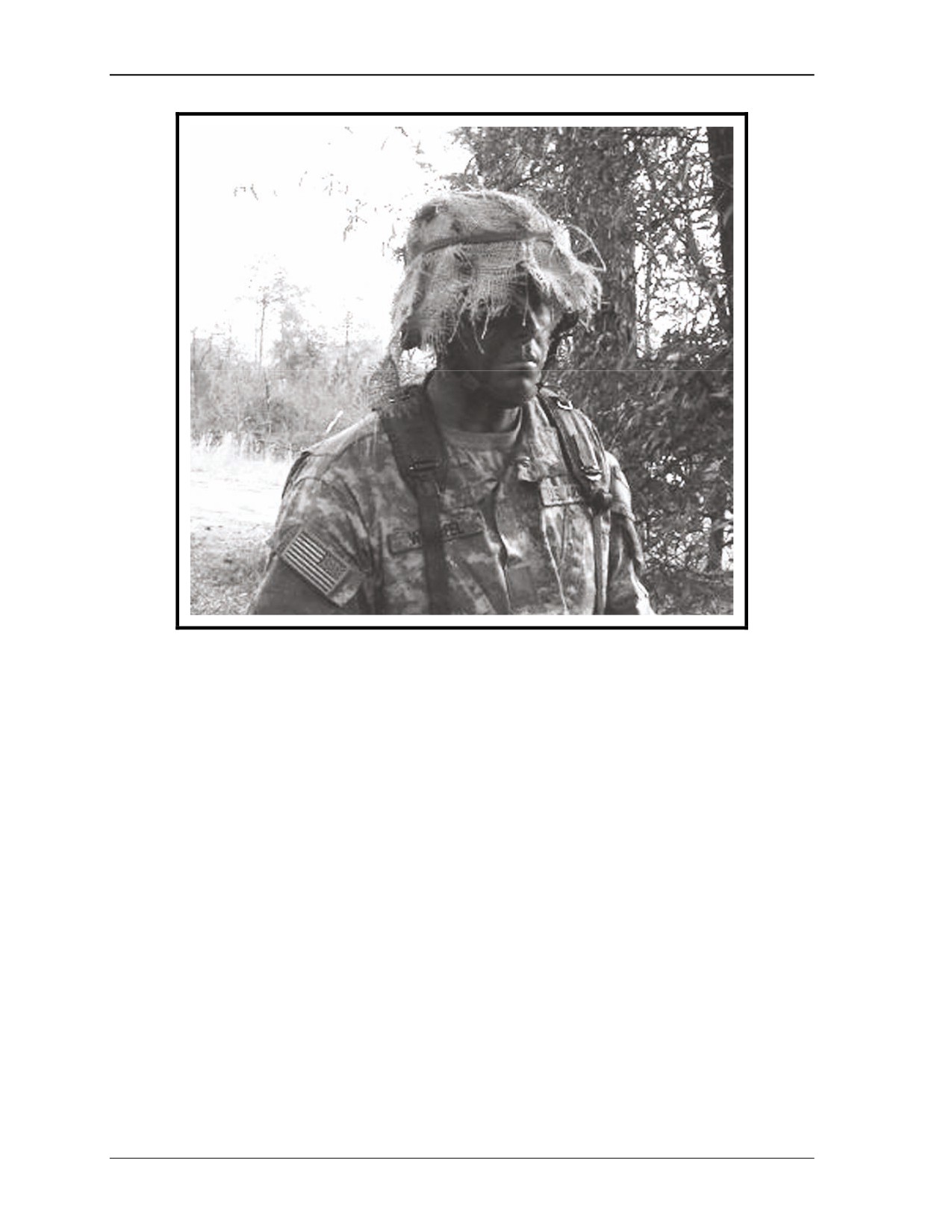
Camouflage your helmet with the issue helmet cover or make a cover of cloth or burlap that is
colored to blend with the terrain (Figure 5-9). Leaves, grass, or sticks can also be attached to the cover. Use
camouflage bands, strings, burlap strips, or rubber bands to hold those in place. If you have no material for
a helmet cover, disguise and dull helmet surface with irregular patterns of paint or mud.
28 January 2008
FM 3-21.75
5-7
Chapter 5
Figure 5-9. Camouflaged helmet.
UNIFORM
5-17.
The ACU has a jacket, trousers, and patrol cap in a new universal camouflage pattern. However, it
may be necessary to add more camouflage to make the uniform blend better with the surroundings. To do
this, put mud on the uniform or attach leaves, grass, or small branches to it. Too much camouflage,
however, may draw attention. When operating on snow-covered ground wear overwhites (if issued) to help
blend with the snow. If overwhites are not issued, use white cloth, such as white bed sheets, to get the
same effect.
SKIN
5-18.
Exposed skin reflects light and may draw the enemy’s attention. Even very dark skin, because of
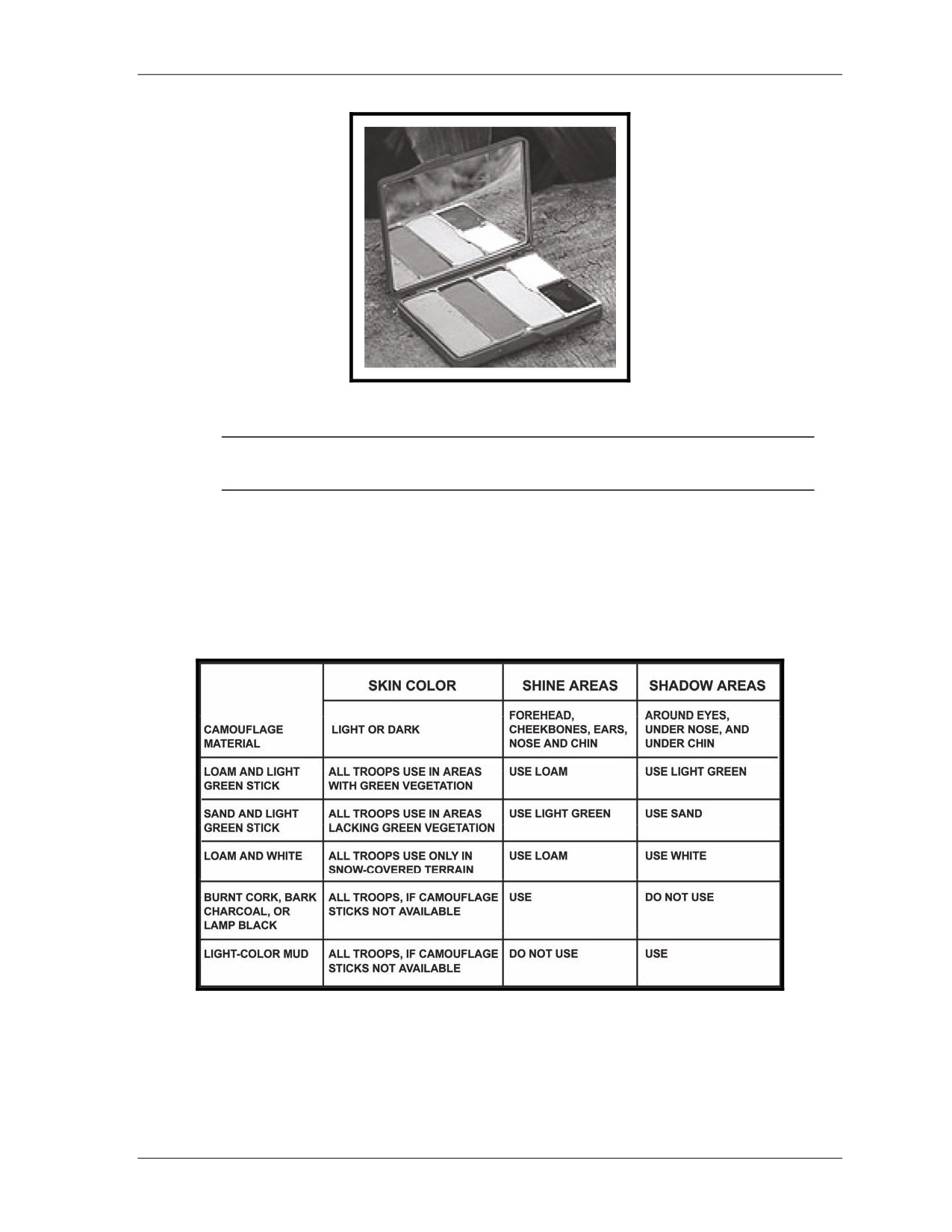
its natural oil, will reflect light. The advanced camouflage face paint in compact form comes both with and
without insect repellent. The active ingredient of the repellant is N, N-diethyl-m-toluamide (commonly
known as DEET). The camouflage face paint provides visual and near-IR camouflage protection. The
version with DEET also repels insects for eight hours. Both are furnished in compact form, and contain a
full-sized, unbreakable, stainless steel mirror. Both compacts contain five compartments of pigmented
formulations (green, loam, sand, white, and black). The compacts provide sufficient material for 20
applications of green, loam, and sand, and 10 applications of black and white. The compact is suitable for
multi-terrain environmental conditions from arctic to desert. Face paints with insect repellent are supplied
in a tan colored compact, while the non-repellent face paints are furnished in an olive drab compact for
quick identification (Figure 5-10). When applying camouflage to your skin, work with a buddy (in pairs)
and help each other. Apply a two-color combination of camouflage pigment in an irregular pattern. Do not
apply camouflage paint if there is a chance of frostbite. The pigment may prevent other Soldiers from
recognizing the whitish discoloration, the first symptoms of the skin freezing.
5-8
FM 3-21.75
28 January 2008
Cover, Concealment, and Camouflage
Figure 5-10. Advanced camouflage face paint.
Note: Advanced camouflage face paint with insect repellent, national stock number (NSN)
6840-01-493-7334, or without insect repellent, NSN 6850-01-493-7309.
5-19.
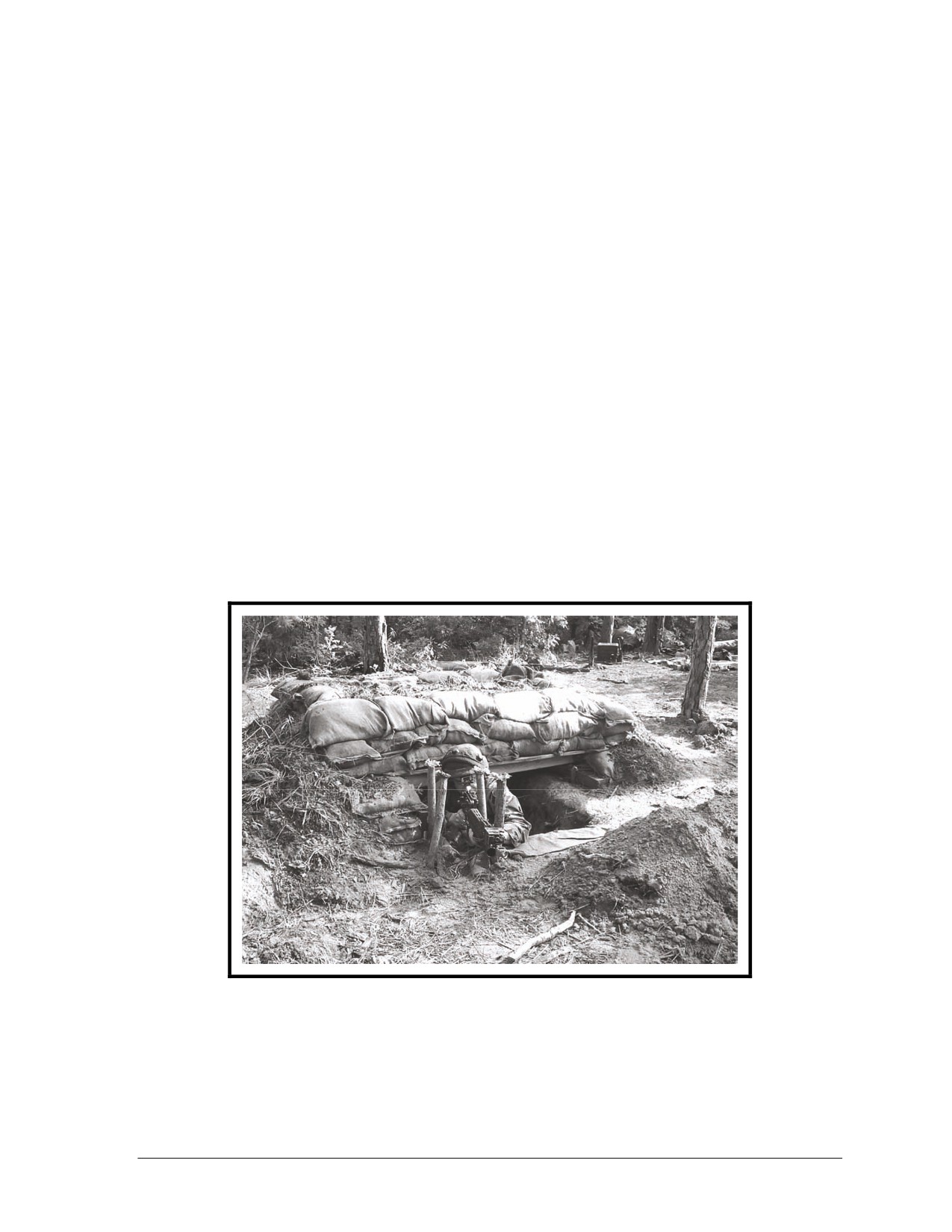
Paint shiny areas (forehead, cheekbones, nose, ears, and chin) with a dark color. Paint shadow
areas (around the eyes, under the nose, and under the chin) with a light color. In addition to the face, paint
the exposed skin on the back of the neck, arms, and hands. Palms of hands are not normally camouflaged if
arm-and-hand signals are to be used. Remove all jewelry to further reduce shine or reflection. When
camouflage sticks/compacts are not issued, use burnt cork, bark, charcoal, lamp black, or light-colored mud
(Table 5-1).
Table 5-1. Application of camouflage face paint to skin.
28 January 2008
FM 3-21.75
5-9
This page intentionally left blank.
Chapter 6
Fighting Positions
Whether your unit is in a defensive perimeter or on an ambush line, you must seek
cover from fire, and concealment from observation. From the time you prepare and
occupy a fighting position, you should continue to improve it. How far you get
depends on how much time you have, regardless of whether it is a hasty position or a
well-prepared one with overhead cover (OHC). This chapter discusses--
• Cover and concealment.
• Sectors and fields of fire.
• Hasty and deliberate fighting positions.
COVER
6-1.
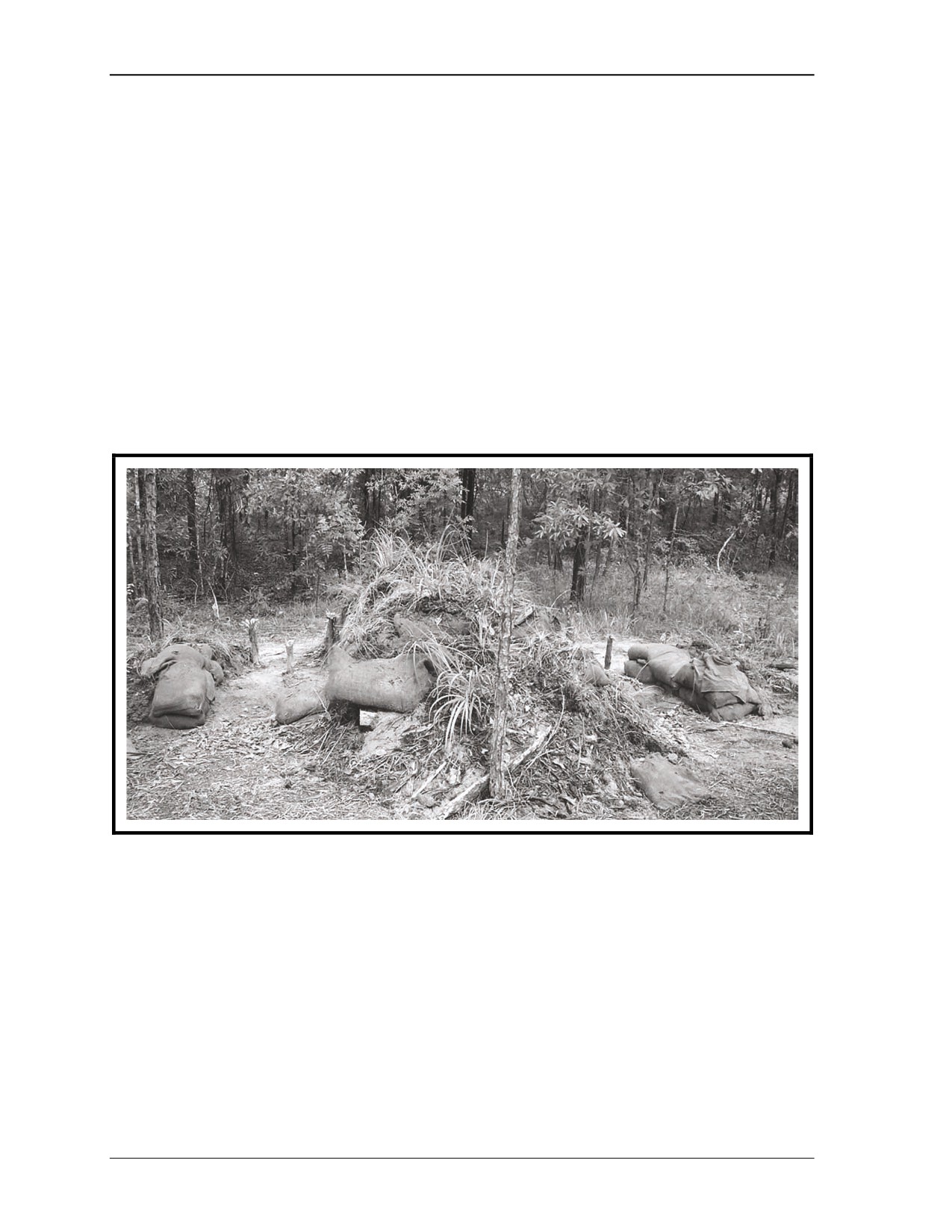
To get this protection in the defense, build a fighting position to add to the natural cover afforded
by the terrain (Figure 6-1). The cover of your fighting position will protect you from small arms fire and
indirect fire fragments, and place a greater thickness of shielding material or earth between you and the
blast wave of nuclear explosions.
Figure 6-1. Man-made cover.
6-2.
Three different types of cover—overhead, frontal, and flank/rear cover—are used to make
fighting positions. In addition, positions can be connected by tunnels and trenches. These allow Soldiers to
move between positions for engagements or resupply, while remaining protected. (Chapter 5 discussed
cover in general.)
28 January 2008
FM 3-21.75
6-1
Chapter 6
OVERHEAD COVER
6-3.
Your completed position should have OHC, which enhances survivability by protecting you from
indirect fire and fragmentation.
FRONTAL COVER
6-4.
Your position needs frontal cover to protect you from small arms fire to the front. Frontal cover
allows you to fire to the oblique, as well as to hide your muzzle flash.
FLANK AND REAR COVER
6-5.
When used with frontal and overhead cover, flank and rear cover protects you from direct enemy
and friendly fire (Figure 6-2). Natural frontal cover such as rocks, trees, logs, and rubble is best, because it
is hard for the enemy to detect. When natural cover is unavailable, use the dirt you remove to construct the
fighting position. You can improve the effectiveness of dirt as a cover by putting it in sandbags. Fill them
only three-quarters full.
Figure 6-2. Cover.
6-2
FM 3-21.75
28 January 2008
Fighting Positions
CONCEALMENT
6-6.
If your position can be detected, it can be hit by enemy fire. Therefore, your position must be so
well hidden that the enemy will have a hard time detecting it, even after he reaches hand-grenade range.
(Chapter 5 discussed cover in general.)
NATURAL, UNDISTURBED MATERIALS
6-7.
Natural, undisturbed concealment is better than man-made concealment. While digging your
position, try not to disturb the natural concealment around it. Put the unused dirt from the hole behind the
position and camouflage it. Camouflage material that does not have to be replaced (rocks, logs, live bushes,
and grass) is best. Avoid using so much camouflage that your position looks different from its
surroundings. Natural, undisturbed concealment materials--
• Are already prepared.
• Seldom attract enemy attention.
• Need no replacement.
MAN-MADE CONCEALMENT
6-8.
Your position must be concealed from enemy aircraft as well as from ground troops. If the
position is under a bush or tree, or in a building, it is less visible from above. Spread leaves, straw, or grass
on the floor of the hole to keep freshly dug earth from contrasting with the ground around it. Man-made
concealment must blend with its surroundings so that it cannot be detected, and must be replaced if it
changes color or dries out.
CAMOUFLAGE
5-20.
When building a fighting position, camouflage it and the dirt taken from it. Camouflage the dirt
used as frontal, flank, rear, and overhead cover (OHC). Also, camouflage the bottom of the hole to prevent
detection from the air. If necessary, take excess dirt away from the position (to the rear).
• Too much camouflage material may actually disclose a position. Get your camouflage material
from a wide area. An area stripped of all or most of its vegetation may draw attention. Do not
wait until the position is complete to camouflage it. Camouflage the position as you build.
• Hide mirrors, food containers, and white underwear and towels. Do not remove your shirt in
the open. Your skin may shine and be seen. Never use fires where there is a chance that the
flame will be seen or the smoke will be smelled by the enemy. Also, cover up tracks and other
signs of movement. When camouflage is complete, inspect the position from the enemy’s side.
This should be done from about 38 feet (35 meters) forward of the position. Then check the
camouflage periodically to ensure it is natural-looking and conceals the position. When the
camouflage no longer works, change and improve it.
SECTORS AND FIELDS OF FIRE
6-9.
Although a fighting position should provide maximum protection for you and your equipment, the
primary consideration is always given to sectors of fire and effective weapons employment. Weapons
systems are sited where natural or existing positions are available, or where terrain will provide the most
protection while maintaining the ability to engage the enemy. You should always consider how best to use
available terrain, and how you can modify it to provide the best sectors of fire, while maximizing the
capabilities of your weapon system.
28 January 2008
FM 3-21.75
6-3
Chapter 6
SECTOR OF FIRE
6-10.
A sector of fire is the area into which you must observe and fire. When your leader assigns you a
fighting position, he should also assign you a primary and secondary sector of fire. The primary sector of
fire is to the oblique of your position, and the secondary sector of fire is to the front.
FIELD OF FIRE
6-11.
To be able to see and fire into your sectors of fire, you might have to "clear a field" of vegetation
and other obstructions. Fields of fire are within the range of your weapons. A field of fire to the oblique
lets you hit the attackers from an unexpected angle. It also lets you support the positions next to you. When
you fire to the oblique, your fire interlocks with that of other positions, creating a wall of fire that the
enemy must pass through. When clearing a field of fire--
• Avoid disclosing your position by careless or excessive clearing.
• Leave a thin, natural screen of vegetation to hide your position.
• In sparsely wooded areas, cut off lower branches of large, scattered trees.
• Clear underbrush only where it blocks your view.
• Remove cut brush, limbs, and weeds so the enemy will not spot them.
• Cover cuts on trees and bushes forward of your position with mud, dirt, or snow.
• Leave no trails as clues for the enemy.
HASTY AND DELIBERATE FIGHTING POSITIONS
6-12.
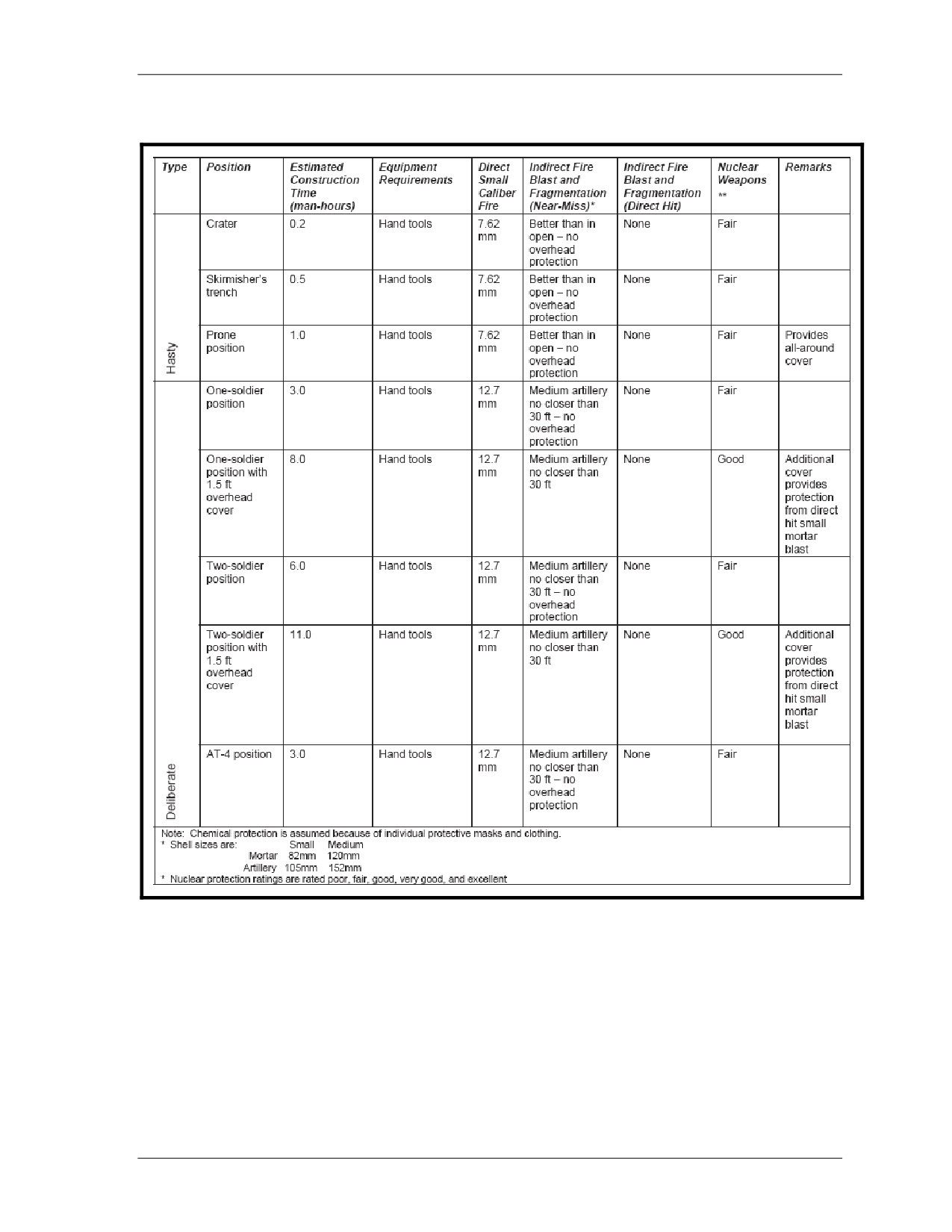
The two types of fighting position are hasty and deliberate. Which you construct depends on time
and equipment available, and the required level of protection. Fighting positions are designed and
constructed to protect you and your weapon system. Table 6-1 shows the characteristics and planning
considerations for fighting positions.
6-4
FM 3-21.75
28 January 2008
Fighting Positions
Table 6-1. Characteristics of individual fighting positions.
28 January 2008
FM 3-21.75
6-5
Chapter 6
HASTY FIGHTING POSITION
6-13.
Hasty fighting positions, used when there is little time for preparation, should be behind whatever
cover is available. However, the term hasty does not mean that there is no digging. If a natural hole or ditch
is available, use it. This position should give frontal cover from enemy direct fire but allow firing to the
front and the oblique. When there is little or no natural cover, hasty positions provide as much protection
as possible. A shell crater, which is 2 to 3 feet (0.61 to 1 meter) wide, offers immediate cover (except for
overhead) and concealment. Digging a steep face on the side toward the enemy creates a hasty fighting
position. A small crater position in a suitable location can later develop into a deliberate position. A
skirmisher’s trench is a shallow position that provides a hasty prone fighting position. When you need
immediate shelter from enemy fire, and there are no defilade firing positions available, lie prone or on your
side, scrape the soil with an entrenching tool, and pile the soil in a low parapet between yourself and the
enemy. In all but the hardest ground, you can use this technique to quickly form a shallow, body-length pit.
Orient the trench so it is oblique to enemy fire. This keeps your silhouette low, and offers some protection
from small-caliber fire.
6-14.
The prone position is a further refinement of the skirmisher’s trench. It serves as a good firing
position and provides you with better protection against the direct fire weapons than the crater position or
the skirmisher’s trench. Hasty positions are further developed into deliberate positions that provide as
much protection as possible. The hole should be about 18 inches (46 centimeters) deep and use the dirt
from the hole to build cover around the edge of the position (Figure 6-3).
Figure 6-3. Prone position (hasty).
DELIBERATE FIGHTING POSITION
6-15.
Deliberate fighting positions are modified hasty positions prepared during periods of relaxed
enemy pressure. Your leader will assign the sectors of fire for your position's weapon system before
preparation begins. Small holes are dug for automatic rifle bipod legs, so the rifle is as close to ground
level as possible. Continued improvements are made to strengthen the position during the period of
occupation. Improvements include adding OHC, digging grenade sumps, adding trenches to adjacent
positions, and maintaining camouflage.
TWO-MAN FIGHTING POSITION
6-16.
Prepare a two-man position in four stages. Your leader must inspect the position at each stage
before you may move to the next stage (Table 6-2).
6-6
FM 3-21.75
28 January 2008
Fighting Positions
Table 6-2. Construction of two-man fighting position.
Parapets
Overhead Cover
Enable you to engage the enemy within your
Protect you from indirect fires. Your leaders will
assigned sector of fire.
identify requirements for additional OHC based on
threat capabilities.
Provide you with protection from direct fire.
Construct parapets--
Thickness:
Minimum 18 inches (46 cm) (length of open
Thickness:
entrenching tool)
Minimum 39 in (1m, length of M16 rifle)
Concealment:
Height:
Use enough to make your position undetectable.
10 to 12 inches (25 to 30 centimeters, length of a
bayonet) to the front, flank, and rear.
Note: If assigned an M4 rather than an M16-series weapon, add 7 inches (18 centimeters)
to each dimension, on all positions that refer to the M16, or to two and a half
M4 lengths.
Overhead Cover
6-17.
Overhead cover may be built up or down.
Built-Up Overhead Cover
6-18.
Built-up OHC has cover that is built up to
18 inches
(46 centimeters) to maximize
protection/cover of the fighting position.
Stage 1
6-19.
Establish sectors and decide whether to build OHC up or down. Your leaders must consider the
factors of mission, enemy, terrain, troops and equipment, time available, and civil considerations
(METT-TC) in order to make a decision on the most appropriate fighting position to construct. For
example due to more open terrain your leader may decide to use built-down OHC (Figure 6-4 and
Figure 6-5):
1. Check fields of fire from the prone position.
2. Assign sector of fire (primary and secondary).
3. Emplace sector stakes (right and left) to define your sectors of fire. Sector stakes prevent
accidental firing into friendly positions. Items such as tent poles, metal pickets, wooden
stakes, tree branches, or sandbags will all make good sector stakes. The sector stakes must be
sturdy and stick out of the ground at least 18 inches (46 centimeters); this will prevent your
weapon from being pointed out of your sector.
4. Emplace aiming and limiting stakes to help you fire into dangerous approaches at night and at
other times when visibility is poor. Forked tree limbs about 12 inches (30 centimeters) long
make good stakes. Put one stake (possibly sandbags) near the edge of the hole to rest the
stock of your rifle on. Then put another stake forward of the rear (first) stake/sandbag toward
each dangerous approach. The forward stakes are used to hold the rifle barrel.
5. Emplace grazing fire logs or sandbags to achieve grazing fire 1 meter above ground level.
6. Decide whether to build OHC up or down, based on potential enemy observation of position.
7. Scoop out elbow holes to keep your elbows from moving around when you fire.
8. Trace position outline.
28 January 2008
FM 3-21.75
6-7
Chapter 6
9. Clear primary and secondary fields of fire.
Note: Keep in mind that the widths of all the fighting positions are only an approximate
distance. This is due to the individual Soldier's equipment such as the IBA and the
modular lightweight load-carrying equipment.
Figure 6-4. Establishment of sectors and building method.
6-8
FM 3-21.75
28 January 2008
Fighting Positions
Figure 6-5. Two-man fighting position (Stage 1).
Stage 2
6-20.
Place supports for OHC stringers and construct parapet retaining walls
(Figure 6-6
and Figure 6-7):
1. Emplace OHC supports to front and rear of position.
2. Ensure you have at least 12 inches (30 centimeters). which is about 1-helmet length distance
from the edge of the hole to the beginning of the supports needed for the OHC.
3. If you plan to use logs or cut timber, secure them in place with strong stakes from 2 to 3
inches (5 to 7 centimeters) in diameter and 18 inches (46 centimeters) long. Short U-shaped
pickets will work.
4. Dig in about half the height.
a. Front retaining wall--At least 10 inches (25 centimeters) high.
(two filled sandbags) deep, and two M16s long.
b. Rear retaining wall--At least 10 inches (25 centimeters) high, and one M16 long.
c. Flank retaining walls--At least 10 inches (25 centimeters) high, and one M16 long.
5. Start digging hole; use soil to fill sandbags for walls.
28 January 2008
FM 3-21.75
6-9
Chapter 6
Figure 6-6. Placement of OHC supports and construction of retaining walls.
Figure 6-7. Two-man fighting position (Stage 2).
6-10
FM 3-21.75
28 January 2008
Fighting Positions
Stage 3
6-21.
Dig position and place stringers for OHC (Figure 6-8, Figure 6-9, and Figure 6-10):
Figure 6-8. Digging of position (side view).
Figure 6-9. Placement of stringers for OHC.
28 January 2008
FM 3-21.75
6-11
Chapter 6
Figure 6-10. Two-man fighting position (Stage 3).
1. Ensure maximum depth is armpit deep (if soil conditions permit).
2. Use spoil from hole to fill parapets in the order of front, flanks, and rear.
3. Dig walls vertically.
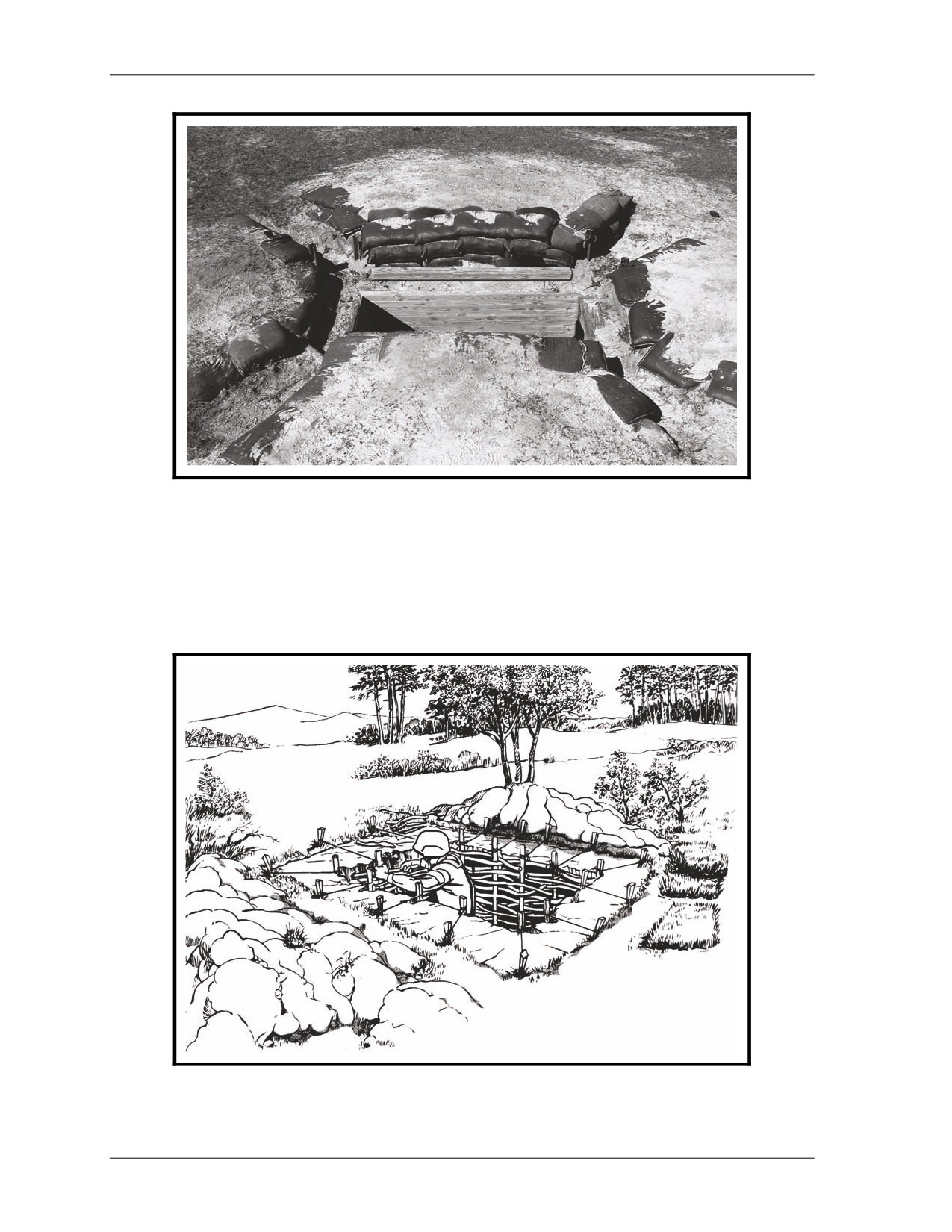
4. If site soil properties cause unstable soil conditions, construct revetments (Figure 6-11) and
consider sloping walls.
Figure 6-11. Revetment construction.
6-12
FM 3-21.75
28 January 2008
Fighting Positions
5. For sloped walls, first dig a vertical hole, and then slope walls at 1::4 ratio (move 12 inches
[30 centimeters] horizontally for each 4 feet [1.22 meters] vertically).
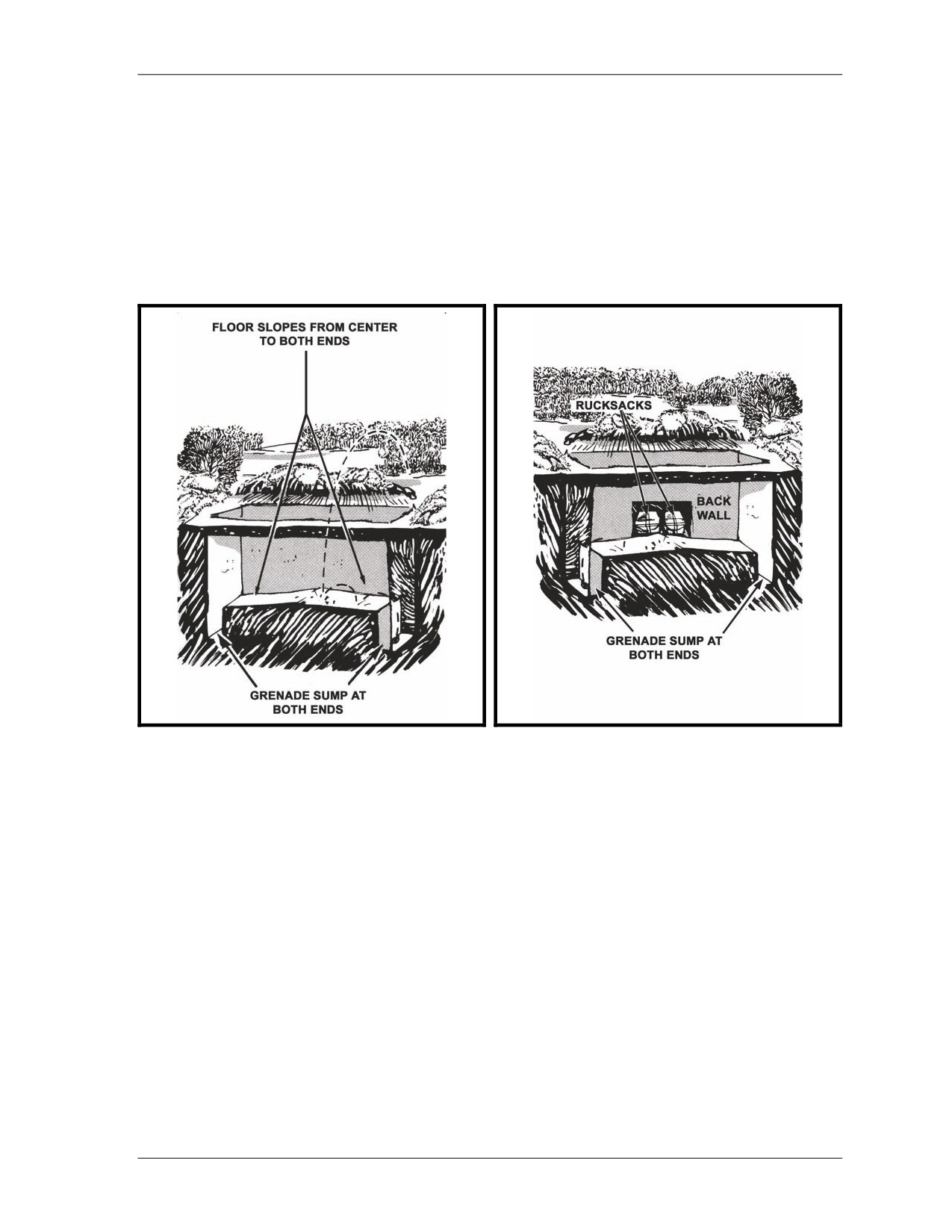
6. Dig two grenade sumps in the floor (one on each end). If the enemy throws a grenade into the
hole, kick or throw it into one of the sumps. The sump will absorb most of the blast. The rest
of the blast will be directed straight up and out of the hole. Dig the grenade sumps as wide as
the entrenching tool blade; at least as deep as an entrenching tool and as long as the position
floor is wide (Figure 6-12).
7. Dig a storage compartment in the bottom of the back wall; the size of the compartment
depends on the amount of equipment and ammunition to be stored (Figure 6-13).
Figure 6-12. Grenade sumps.
Figure 6-13. Storage compartments.
8. Install revetments to prevent wall collapse/cave-in:
a. Required in unstable soil conditions.
b. Use plywood or sheeting material and pickets to revet walls.
c. Tie back pickets and posts.
d. Emplace OHC stringers:
e. Use 2x4s, 4x4s, or pickets ("U" facing down).
f. Make OHC stringers standard length, which is 8 feet (2.4 meters). This is long enough to
allow sufficient length in case walls slope.
g. Use "L" for stringer length and "H" for stringer spacing.
9. Remove the second layer of sandbags in the front and rear retaining walls to make room for
the stringers. Place the same sandbags on top of the stringers once you have the stringers
properly positioned.
28 January 2008
FM 3-21.75
6-13
Chapter 6
Stage 4
6-22.
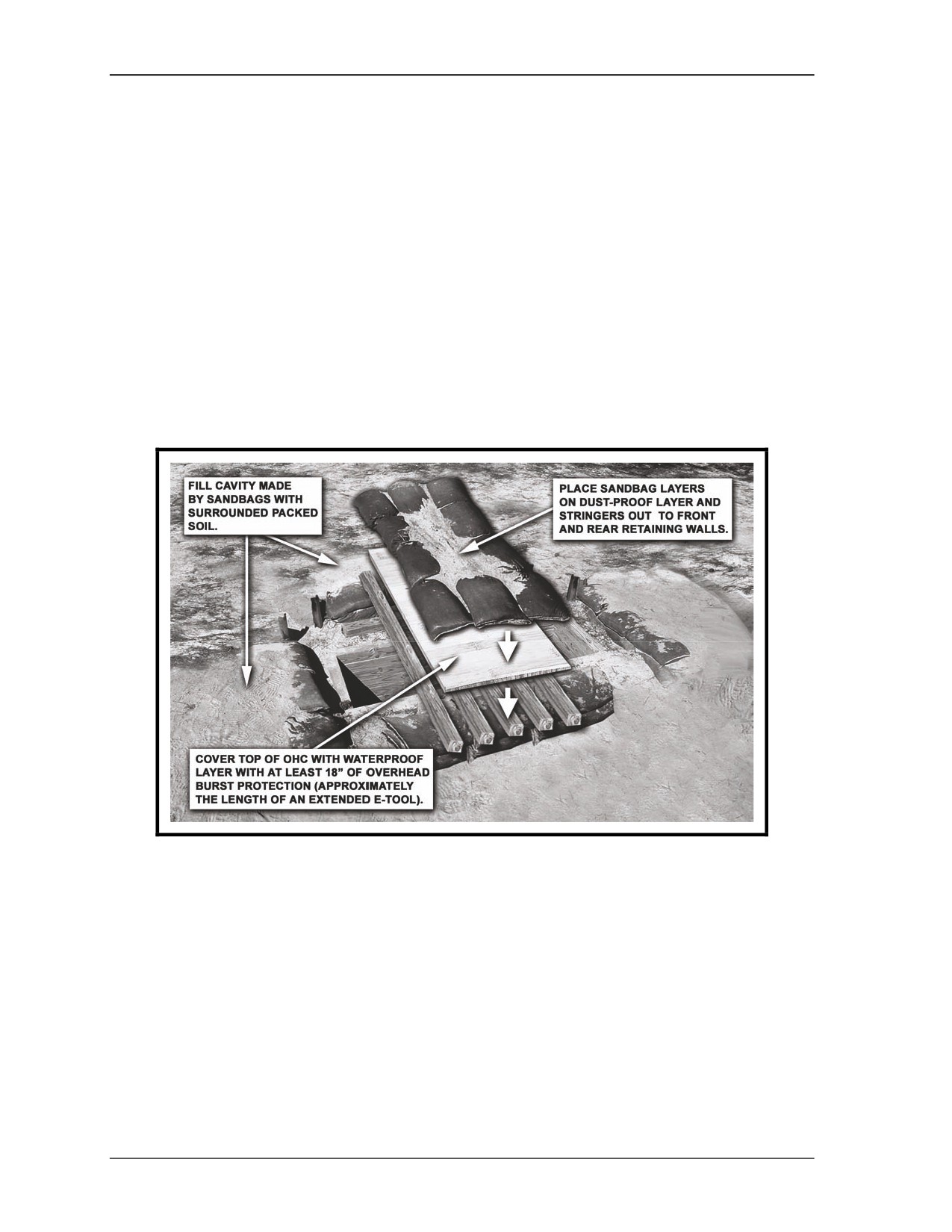
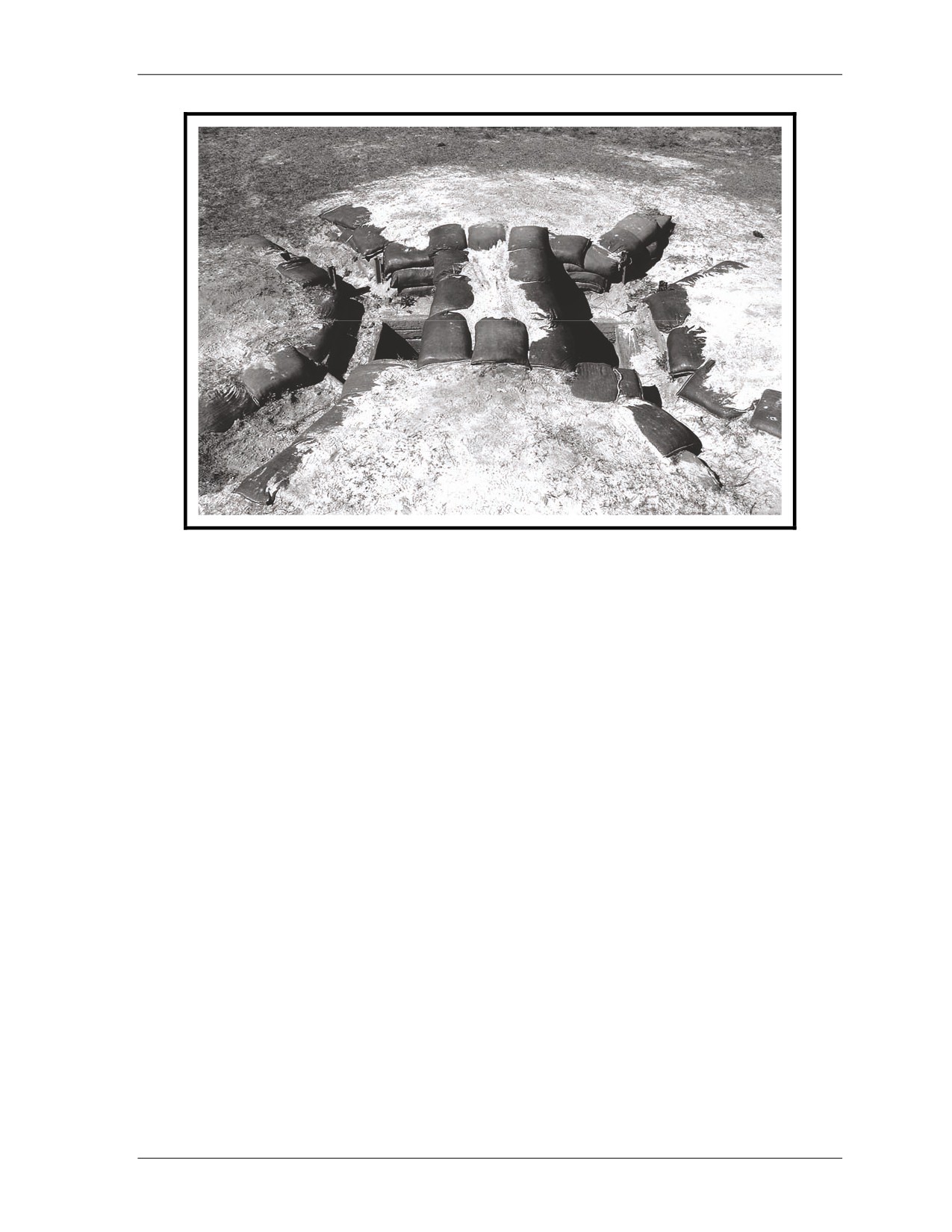
Install OHC and camouflage (Figure 6-14 and Figure 6-15):
1. Install overhead cover
2. Use plywood, sheeting mats as a dustproof layer (could be boxes, plastic panel, or interlocked
U-shaped pickets). Standard dustproof layer is 4’x4’ sheets of ¾-inch plywood centered over
dug position.
3. Nail plywood dustproof layer to stringers.
4. Use at least 18 inches (46 centimeters) of sand-filled sandbags for overhead burst protection
(four layers). At a minimum, these sandbags must cover an area that extends to the sandbags
used for the front and rear retaining walls.
5. Use plastic or a poncho for waterproofing layer.
6. Fill center cavity with soil from dug hold and surrounding soil.
7. Use surrounding topsoil and camouflage screen systems.
8. Use soil from hole to fill sandbags, OHC cavity, and blend in with surroundings.
Figure 6-14. Installation of overhead cover.
6-14
FM 3-21.75
28 January 2008
Fighting Positions
Figure 6-15. Two-man fighting position with built-up OHC (Stage 4).
Built-Down Overhead Cover
6-23.
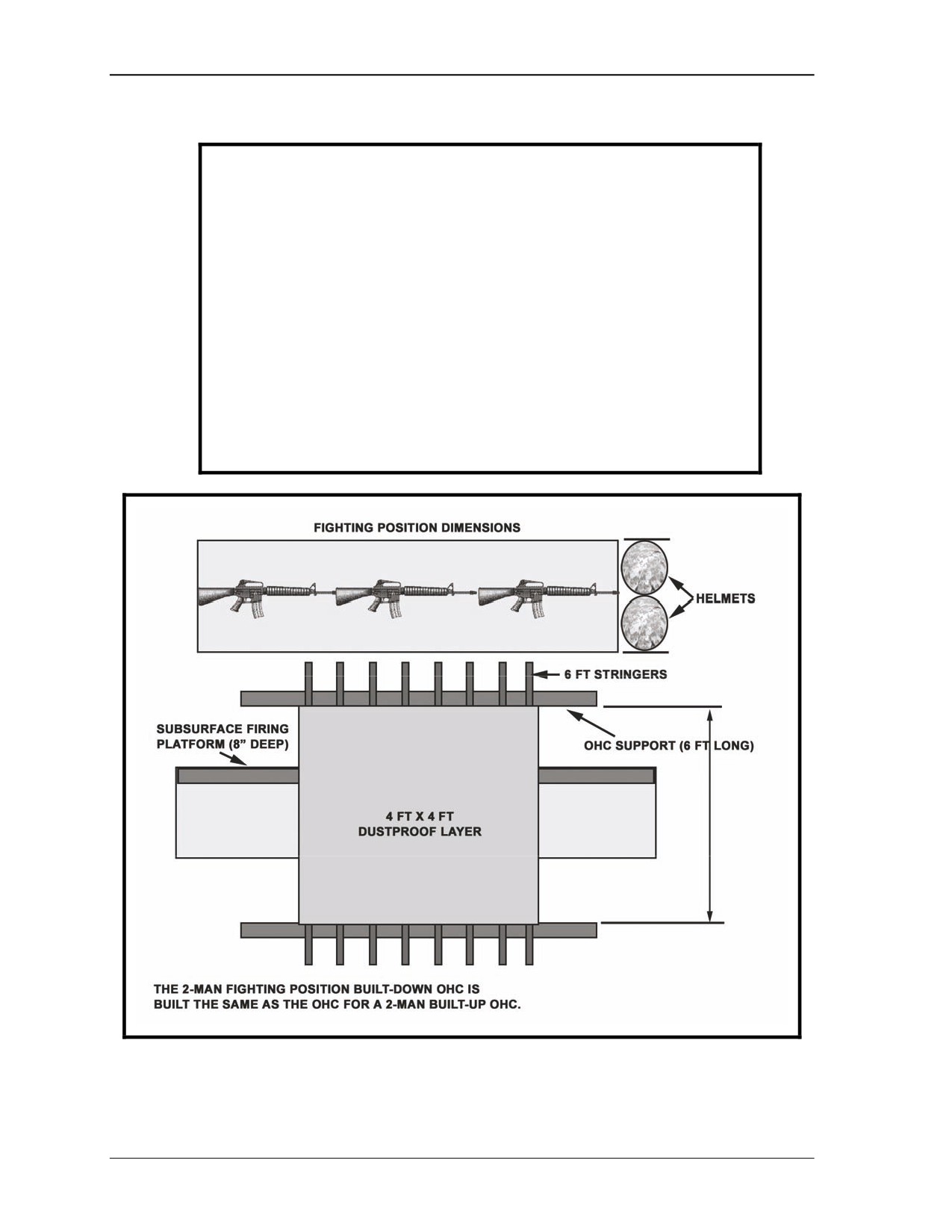
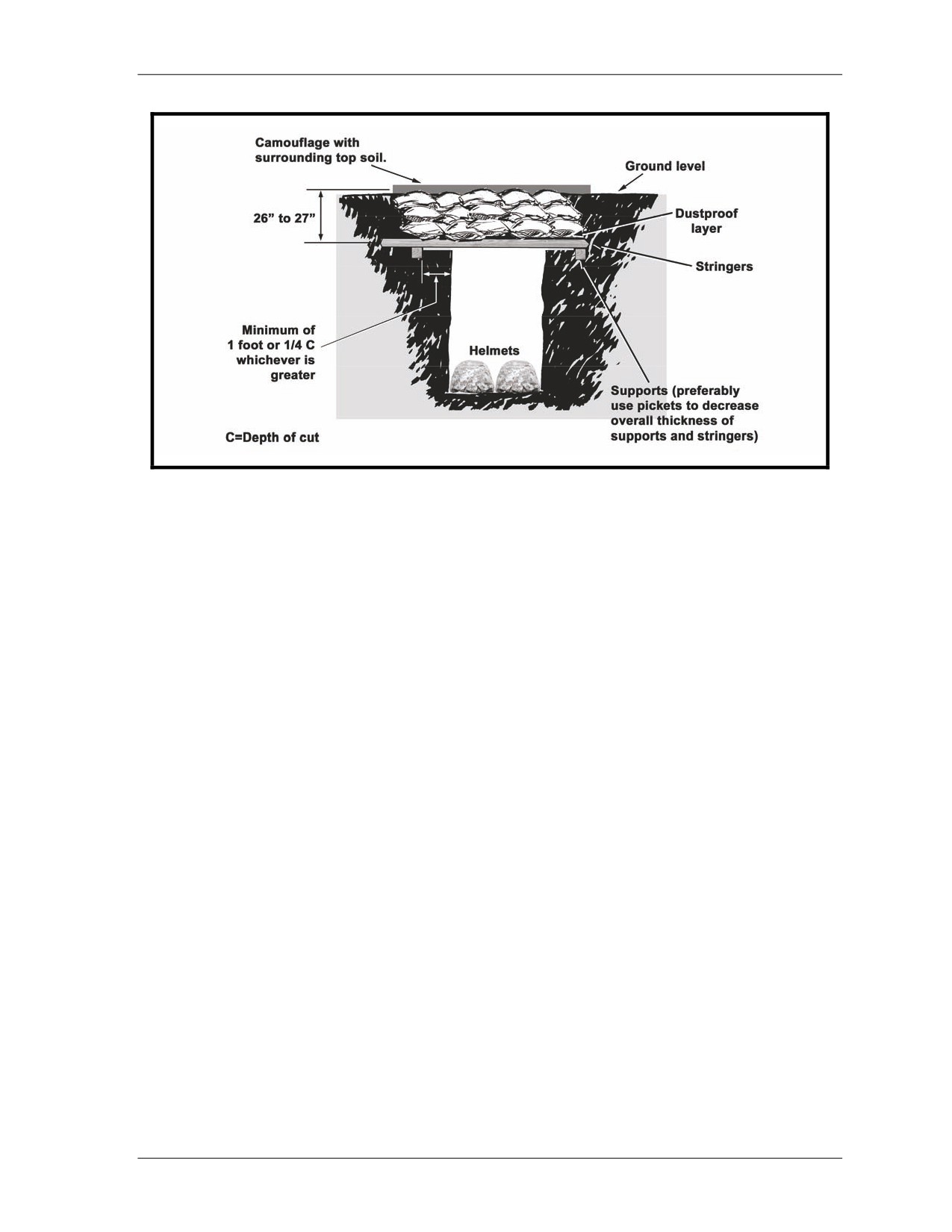
This should not exceed 12 inches (30 centimeters). This lowers the profile of the fighting position,
which aids in avoiding detection. Unlike a built-up OHC, a built-down OHC has the following traits
(Table 6-3, Figure 6-16, and Figure 6-17):
28 January 2008
FM 3-21.75
6-15
Chapter 6
Table 6-3. Specifications for built-down overhead cover.
Maximum 12 inches (30 centimeters) High
• You can build parapets up to 30 centimeters. Taper the overhead
portions and parapets above the ground surface to conform to the
natural lay of the ground.
Minimum Three M16s Long
• This gives you adequate fighting space between the end walls of the
fighting position and the overhead cover. This takes 2.5 hours longer
to dig in normal soil conditions.
Firing Platform for Elbows
• You must construct a firing platform in the natural terrain upon which
to rest your elbows. The firing platform will allow the use of the natural
ground surface as a grazing fire platform.
Figure 6-16. Two-man fighting position with built-down OHC (top view).
6-16
FM 3-21.75
28 January 2008
Fighting Positions
Figure 6-17. Two-man fighting position with built-down OHC (side view).
ONE-MAN FIGHTING POSITION
6-24.
Sometimes you may have to build and occupy a one-man fighting position, for example, an
ammunition bearer in a machine gun team. Except for its size, a one-man position is built the same way as
a two-man fighting position. The hole of a one-man position is only large enough for you and your
equipment. It does not have the security of a two-person position; therefore, it must allow a Soldier to
shoot to the front or oblique from behind frontal cover.
MACHINE GUN FIGHTING POSITION
6-25.
Construct fighting positions for machine guns so the gun fires to the front or oblique. However,
the primary sector of fire is usually oblique so the gun can fire across your unit is front. Two Soldiers
(gunner and assistant gunner) are required to Soldier the weapon system. Therefore, the hole is shaped so
both the gunner and assistant gunner can get to the gun and fire it from either side of the frontal protection.
The gun’s height is reduced by digging the tripod platform down as much as possible. However, the
platform is dug to keep the gun traversable across the entire sector of fire. The tripod is used on the side
with the primary sector of fire, and the bipod legs are used on the side with the secondary sector. When
changing from primary to secondary sectors, the machine gun is moved but the tripod stays in place. With
a three-Soldier crew for a machine gun, the (ammunition bearer) digs a one-Soldier fighting position to the
flank. From this position, the Soldier can see and shoot to the front and oblique. The ammunition bearer’s
position is connected to the gun position by a crawl trench so the bearer can transport ammunition or
replace one of the gunners.
6-26.
When a machine gun has only one sector of fire, dig only half of the position. With a three-man
crew, the third Soldier (the ammunition bearer) digs a one-man fighting position. A one-man position is
built the same as a two-man fighting position. The hole of a one-man position is only large enough for you
and your equipment. Usually, his position is on the same side of the machine gun as its FPL or PDF. From
that position, he can observe and fire into the machine gun’s secondary sector and, at the same time, see the
gunner and assistant gunner. The ammunition bearer’s position is connected to the machine gun position by
a crawl trench so that he can bring ammunition to the gun or replace the gunner or the assistant gunner.
28 January 2008
FM 3-21.75
6-17
Chapter 6
Stage 1
6-27.
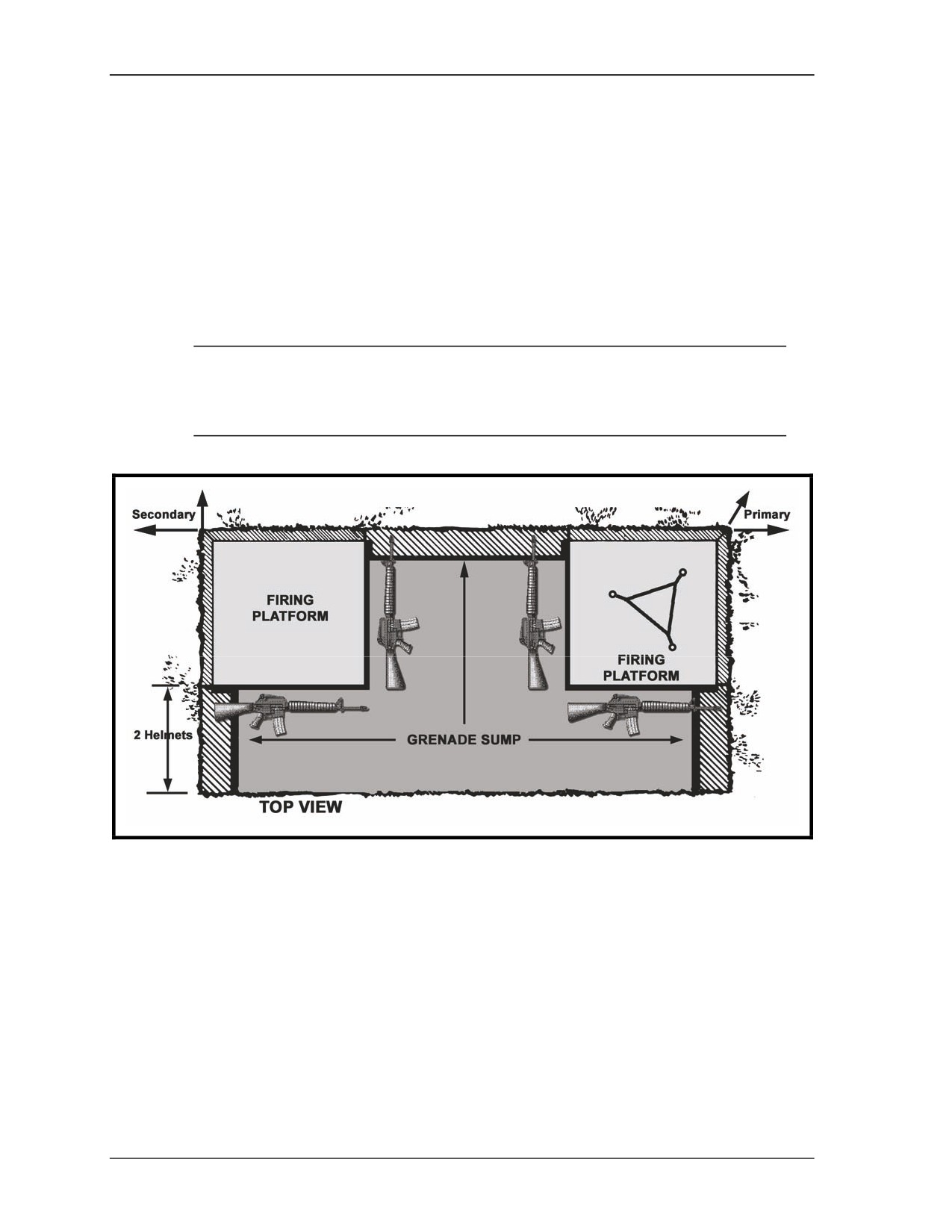
Establish sectors (primary and secondary) of fire, and then outline position (Figure 6-18):
1. Check fields of fire from prone.
2. Assign sector of fire (primary and secondary) and final protective line (FPL) or principal
direction of fire (PDF).
3. Emplace aiming stakes.
4. Decide whether to build OHC up or down, based on potential enemy observation of position.
5. Trace position outline to include location of two distinct firing platforms.
6. Mark position of the tripod legs where the gun can be laid on the FPL or PDF.
7. Clear primary and secondary fields of fire.
Note: The FPL is a line on which the gun fires grazing fire across the unit is front. Grazing
fire is fired
1 meter above the ground. When an FPL is not assigned, a PDF is
assigned. A PDF is a direction toward which the gun must be pointed when not
firing at targets in other parts of its sector.
Figure 6-18. Position with firing platforms.
Stage 2
6-28.
Dig firing platforms and emplace supports for OHC stringers, and then construct the parapet
retaining walls:
1. Emplace OHC supports to front and rear of position.
2. Center OHC in position, and place supports as you did for Stage 2, two-man
fighting position.
3. Construct the same as you did for Stage 2, two-man fighting position.
4. Dig firing platforms 6 to 8 inches (15 to 20 centimeters) deep and then position machine gun
to cover primary sector of fire.
5. Use soil to fill sandbags for walls.
6-18
FM 3-21.75
28 January 2008
Fighting Positions
Stage 3
6-29.
Dig position and build parapets, and then place stringers for the OHC (Figure 6-19):
1. Dig the position to a maximum armpit depth around the firing platform.
2. Use soil from hole to fill parapets in order of front, flanks, and rear.
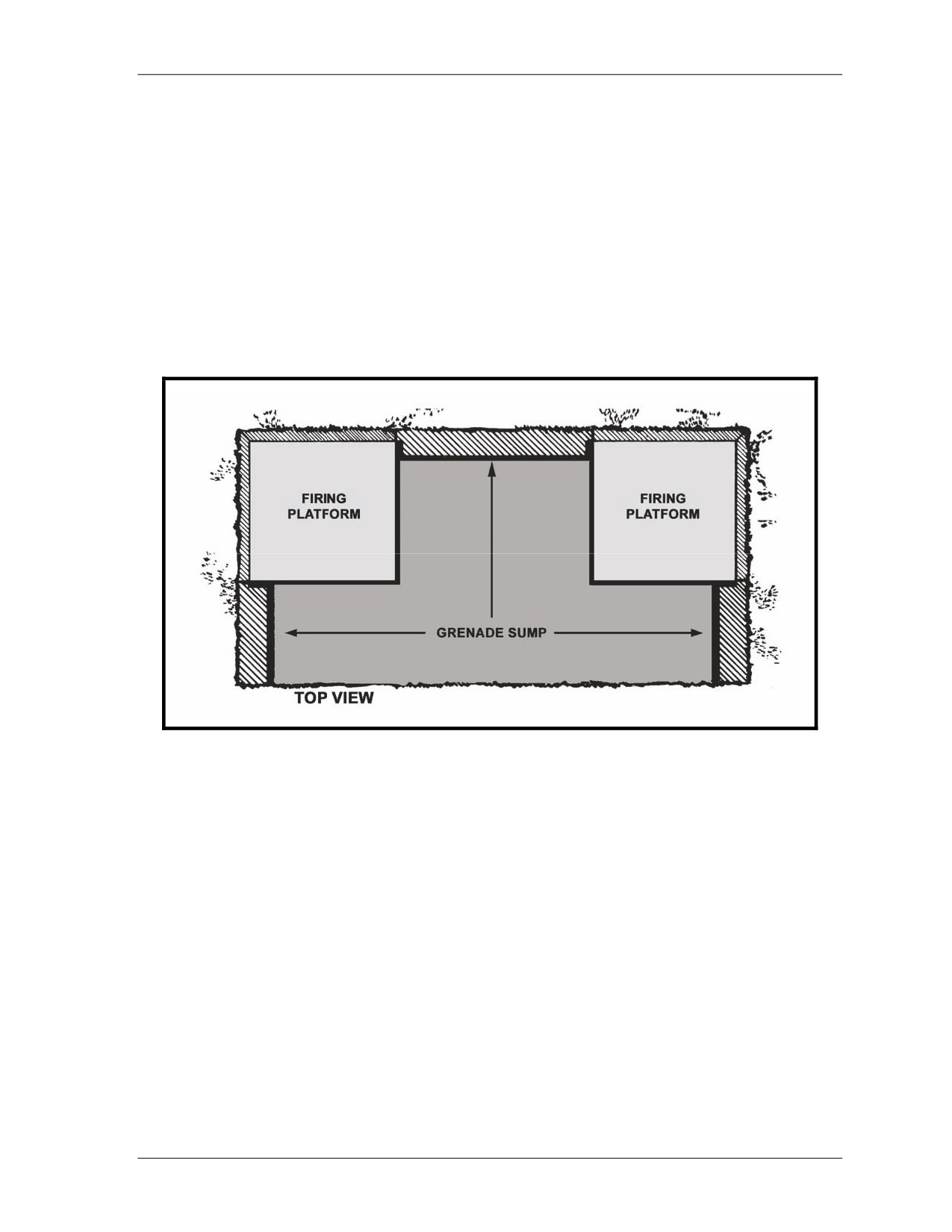
3. Dig grenade sumps and slope floor toward them.
4. Install revetment if needed.
5. Follow same steps as for two-man fighting position.
6. Place stringers for OHC.
7. Follow same steps established for two-man fighting position.
8. Make stringers at least 8 feet (2.44 meters) long.
Figure 6-19. Grenade sump locations.
Stage 4
6-30.
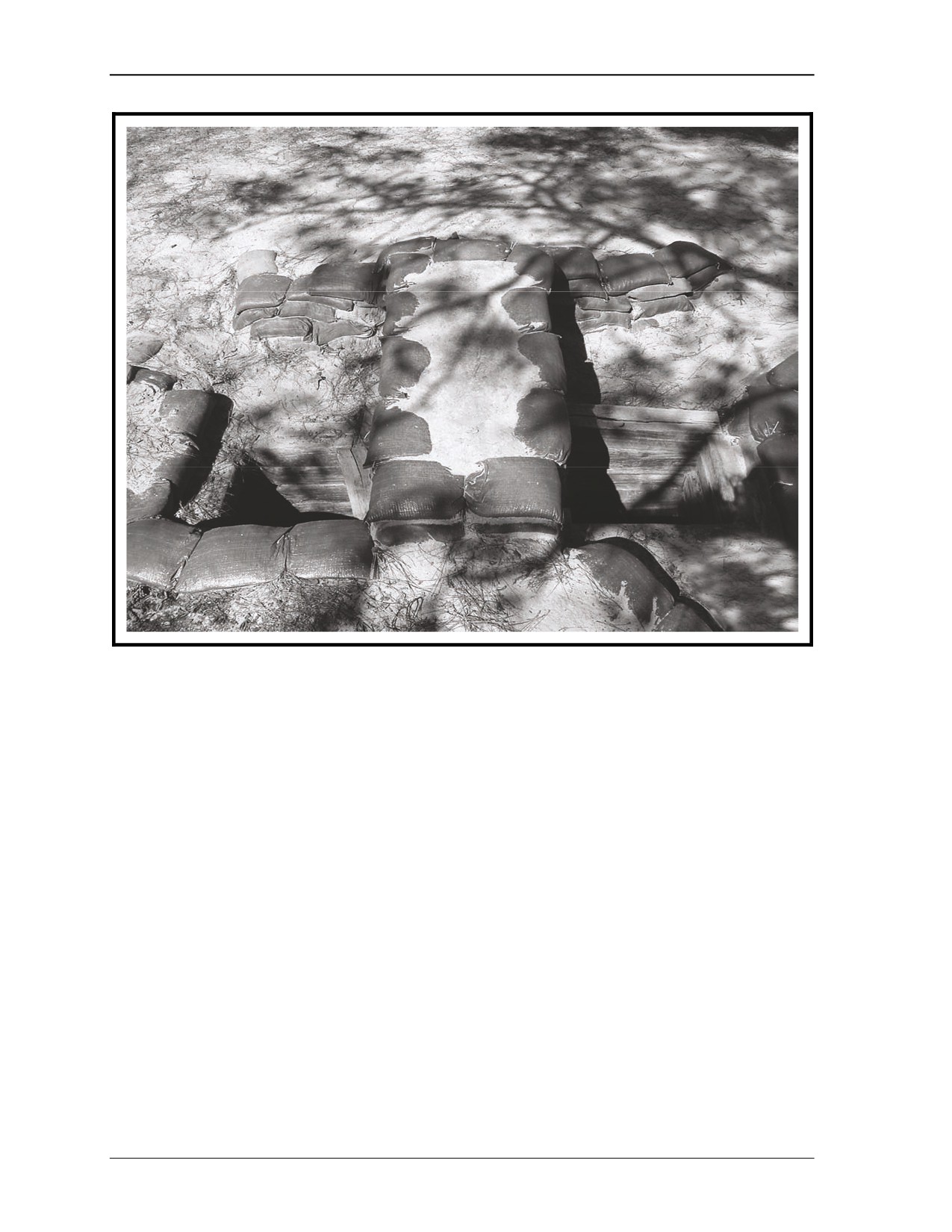
Install overhead cover (OHC) and camouflage (Figure 6-20):
1. For a machine gun position, build the OHC the same as you would for a two-man
fighting position.
2. Use surrounding topsoil and camouflage screen systems.
3. Ensure no enemy observation within 115 feet (35 meters) of position.
4. Use soil from hole to fill sandbags and OHC cavity, or to spread around and blend position in
with surrounding ground.
28 January 2008
FM 3-21.75
6-19
Chapter 6
Figure 6-20. Machine gun fighting position with OHC.
CLOSE COMBAT MISSILE FIGHTING POSITIONS
6-31.
The following paragraphs discuss close combat missile fighting positions for the AT4 and Javelin:
AT4 POSITION
6-32.
The AT4 is fired from the fighting positions previously described. However, backblast may cause
friendly casualties of Soldiers in the position’s backblast area. You should ensure that any walls, parapets,
large trees, or other objects to the rear will not deflect the backblast. When the AT4 is fired from a
two-Soldier position, you must ensure the backblast area is clear. The front edge of a fighting position is a
good elbow rest to help you steady the weapon and gain accuracy. Stability is better if your body is leaning
against the position’s front or side wall.
6-20
FM 3-21.75
28 January 2008
Fighting Positions
STANDARD JAVELIN FIGHTING POSITION WITH OVERHEAD COVER
6-33.
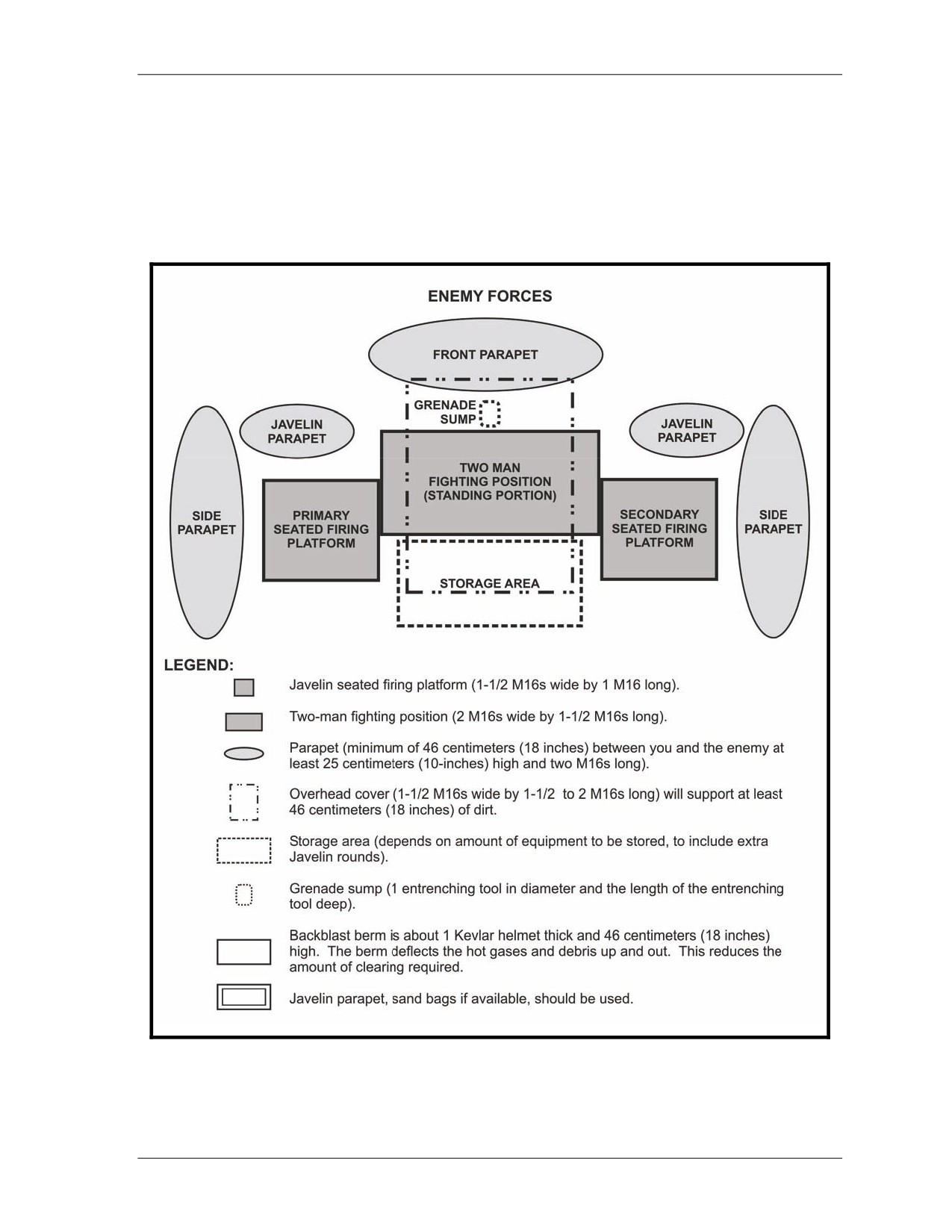
The standard Javelin fighting position has cover to protect you from direct and indirect fires
(Figure 6-21). The position is prepared the same as the two-man fighting position with two additional
steps. First, the back wall of the position is extended and sloped rearward, which serves as storage area.
Secondly, the front and side parapets are extended twice the length as the dimensions of the two-man
fighting position with the javelin’s primary and secondary seated firing platforms added to both sides.
Figure 6-21. Standard Javelin fighting position.
28 January 2008
FM 3-21.75
6-21
Chapter 6
Note: When a Javelin is fired, the muzzle end extends 6 inches (15 centimeters) beyond the
front of the position, and the rear launcher extends out over the rear of the position.
As the missile leaves the launcher, stabilizing fins unfold. You must keep the
weapon at least 6 inches (15 centimeters) above the ground when firing to leave
room for the fins. OHC that would allow firing from beneath it is usually built if the
backblast area is clear.
RANGE CARDS
6-34.
A range card, a rough plan of the terrain around a weapon position, is a sketch of the assigned
sector that a direct fire weapon system is intended to cover. Range cards are prepared immediately upon
arrival in a position, regardless of the length of stay, and updated as necessary. Two copies of the range
card are prepared. One copy stays at your position and the other is sent to the platoon headquarters.
COMPONENTS
6-35.
A range card is comprised of the following.
Sectors of Fire--A sector of fire is an area to be covered by fire that is assigned to an individual, a
weapon, or a unit. You are normally assigned a primary and secondary sector of fire. Fire into your
secondary sector of fire only if your primary sector has no targets, or if ordered to do so. Your gun’s
primary sector includes a FPL and a PDF.
Principal Direction of Fire --A PDF is a direction of fire assigned priority to cover an area that has
good fields of fire or has a likely dismounted avenue of approach. The gun is positioned to fire
directly down this approach rather than across the platoon’s front. It also provides mutual support to
an adjacent unit. Machine guns are sighted using the PDF if an FPL has not been assigned. If a PDF
is assigned and other targets are not being engaged, machine guns remain on the PDF.
Final Protective Line--An FPL is a predetermined line along which grazing fire is placed to stop an
enemy assault. Where terrain allows, your leader assigns an FPL to your weapon. An FPL becomes
the machine gun's part of the unit is final protective fires. The FPL will be assigned to you only if
your leader determines there is a good distance of grazing fire. If there is, the FPL will then dictate
the location of the primary sector. The FPL will become the primary sector limit (right or left)
closest to friendly troops. When not firing at other targets, you will lay your gun on the FPL or
PDF.
Dead Space--Dead space is an area that direct fire weapons cannot hit. The area behind houses and
hills, within orchards or defilades for example, is dead space. The extent of grazing fire and dead
space may be determined in two ways. In the preferred method, the machine gun is adjusted for
elevation and direction. Your assistant gunner walks along the FPL while you aim through the
sights. In places where his waist (midsection) falls below your point of aim, dead space exists.
Arm-and-hand signals must be used to control the Soldier who is walking and to obtain an accurate
account of the dead space and its location. Another method is to observe the flight of tracer
ammunition from a position behind and to the flank of the weapon.
AUTOMATIC WEAPON RANGE CARD
6-36.
To prepare this range card--
1.
Orient the card so both the primary and secondary sectors of fire (if assigned) can fit on it.
2.
Draw a rough sketch of the terrain to the front of your position. Include any prominent natural and
man-made features that could be likely targets.
3.
Draw your position at the bottom of the sketch. Do not put in the weapon symbol at this time.
4.
Fill in the marginal data to include--
5.
Gun number (or squad).
6-22
FM 3-21.75
28 January 2008
Fighting Positions
6.
Unit (only platoon and company) and date.
7.
Magnetic north arrow.
8.
Use the lensatic compass to determine magnetic north; and sketch in the magnetic north arrow on the
card with its base starting at the top of the marginal data section.
9.
Determine the location of your gun position in relation to a prominent terrain feature, such as a hilltop,
road junction, or building. If no feature exists, place the eight-digit map coordinates of your position
near the point where you determined your gun position to be. If there is a prominent terrain feature
within 1,094 yards (1,000 meters) of the gun, use that feature. Do not sketch in the gun symbol at
this time.
10. Using your compass, determine the azimuth in degrees from the terrain feature to the gun position.
(Compute the back azimuth from the gun to the feature by adding or subtracting 180 degrees.)
11. Determine the distance between the gun and the feature by pacing or plotting the distance on a map.
12. Sketch in the terrain feature on the card in the lower left or right hand corner (whichever is closest to its
actual direction on the ground) and identify it.
13. Connect the sketch of the position and the terrain feature with a barbed line from the feature to the gun.
14. Write in the distance in meters (above the barbed line).
15. Write in the azimuth in degrees from the feature to the gun (below the barbed line).
Final Protective Fires
6-37.
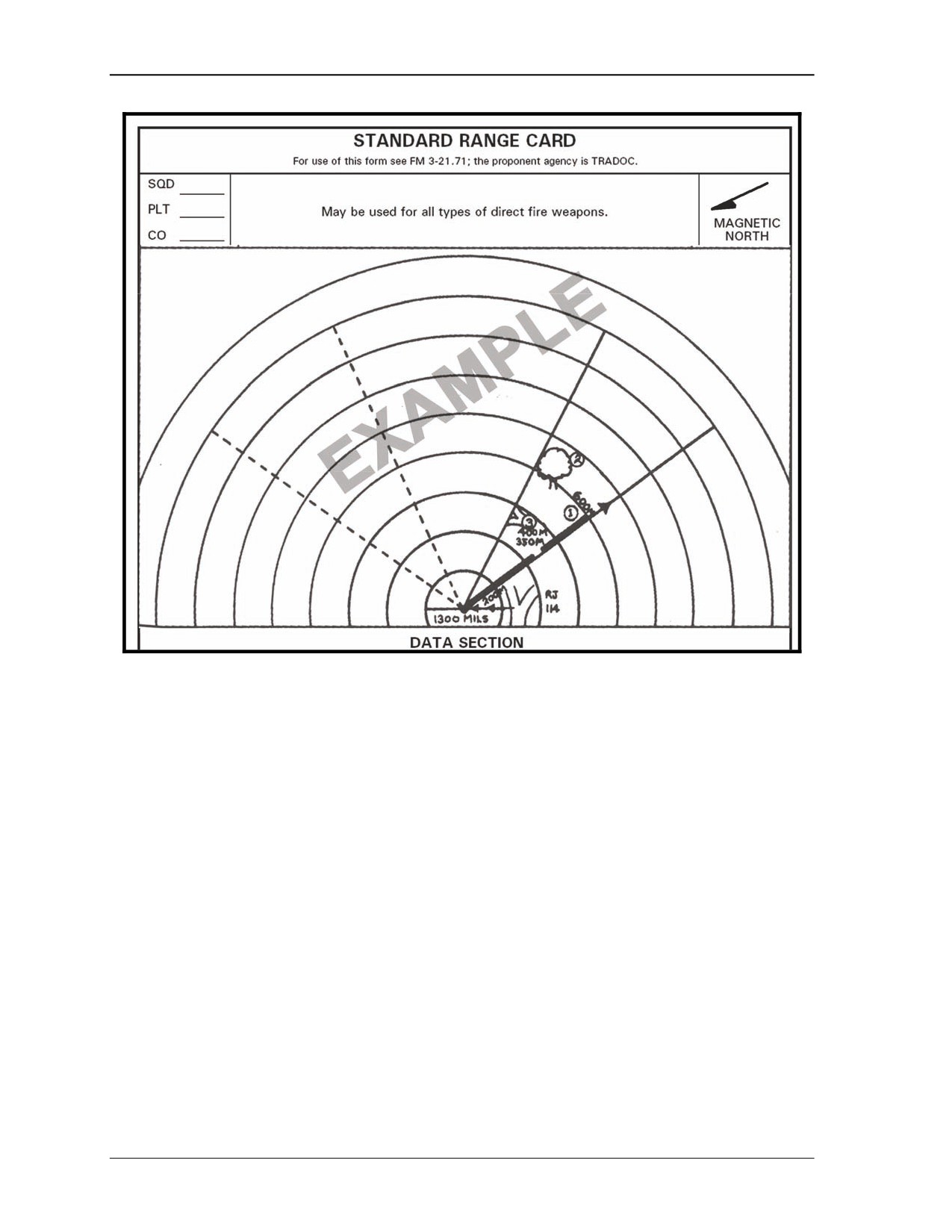
To add an FPL to your range card (Figure 6-22):
1.
Sketch in the limits of the primary sector of fire as assigned by your leader.
2.
Sketch in the FPL on your sector limit as assigned.
3.
Determine dead space on the FPL by having your AG walk the FPL. Watch him walk down the line and
mark spaces that cannot be grazed.
4.
Sketch dead space by showing a break in the symbol for an FPL, and write in the range to the beginning
and end of the dead space.
5.
Label all targets in your primary sector in order of priority. The FPL is number one.
28 January 2008
FM 3-21.75
6-23
Chapter 6
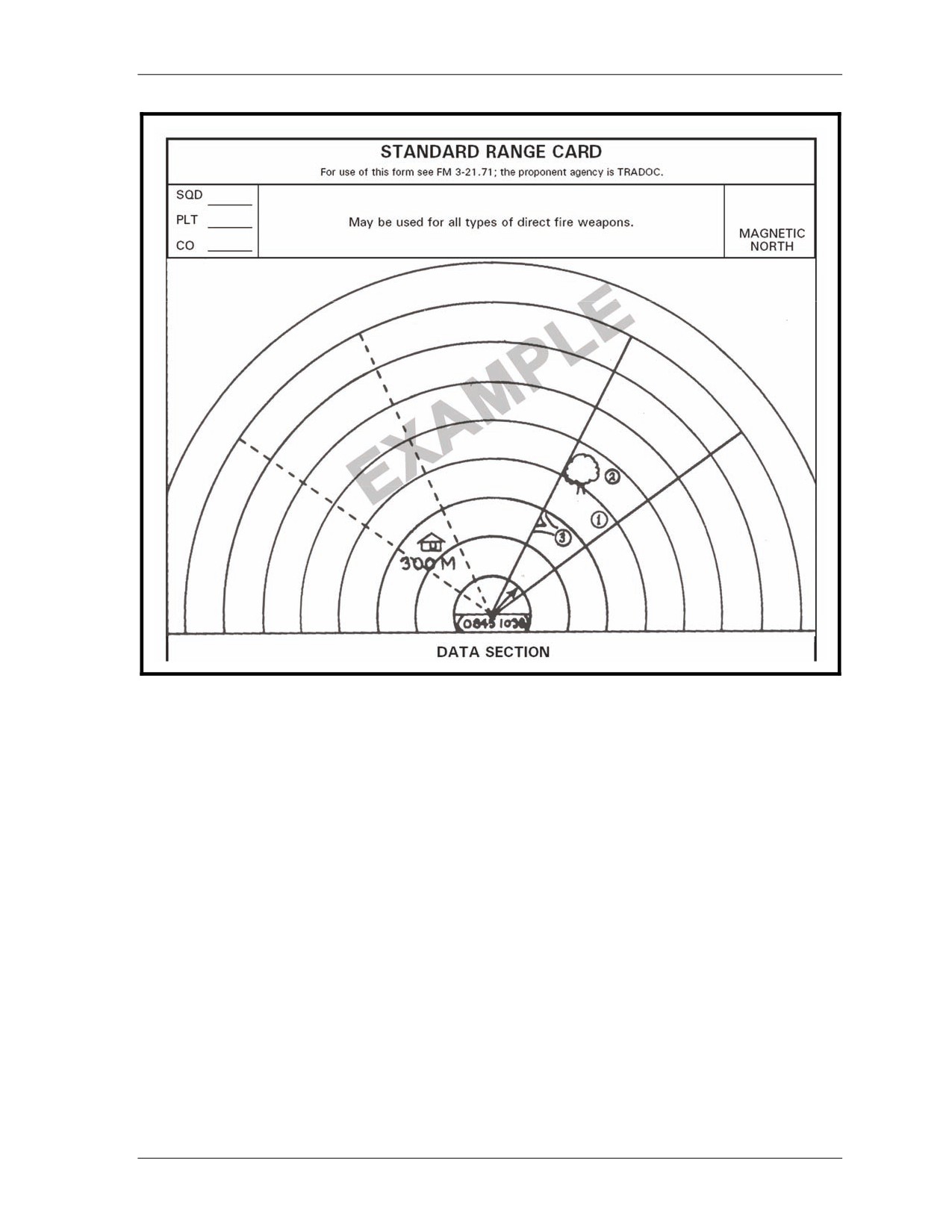
Figure 6-22. Primary sector with an FPL.
Primary Direction of Fire
6-38.
To prepare your range card when assigned a PDF instead of an FPL (Figure 6-23):
1. Sketch in the limits of the primary sector of fire as assigned by your leader (sector should not
exceed 875 mils, the maximum traverse of the tripod-mounted machine gun).
2. Sketch in the symbol for an automatic weapon oriented on the most dangerous target within
your sector (as designated by your leader). The PDF will be target number one in your sector.
All other targets will be numbered in priority.
3. Sketch in your secondary sector of fire (as assigned) and label targets within the secondary
sector with the range in meters from your gun to each target. Use the bipod when it is
necessary to fire into your secondary sector. The secondary sector is drawn using a broken
line. Sketch in aiming stakes, if used.
6-24
FM 3-21.75
28 January 2008
Fighting Positions
Figure 6-23. Complete sketch with PDF.
Data Section
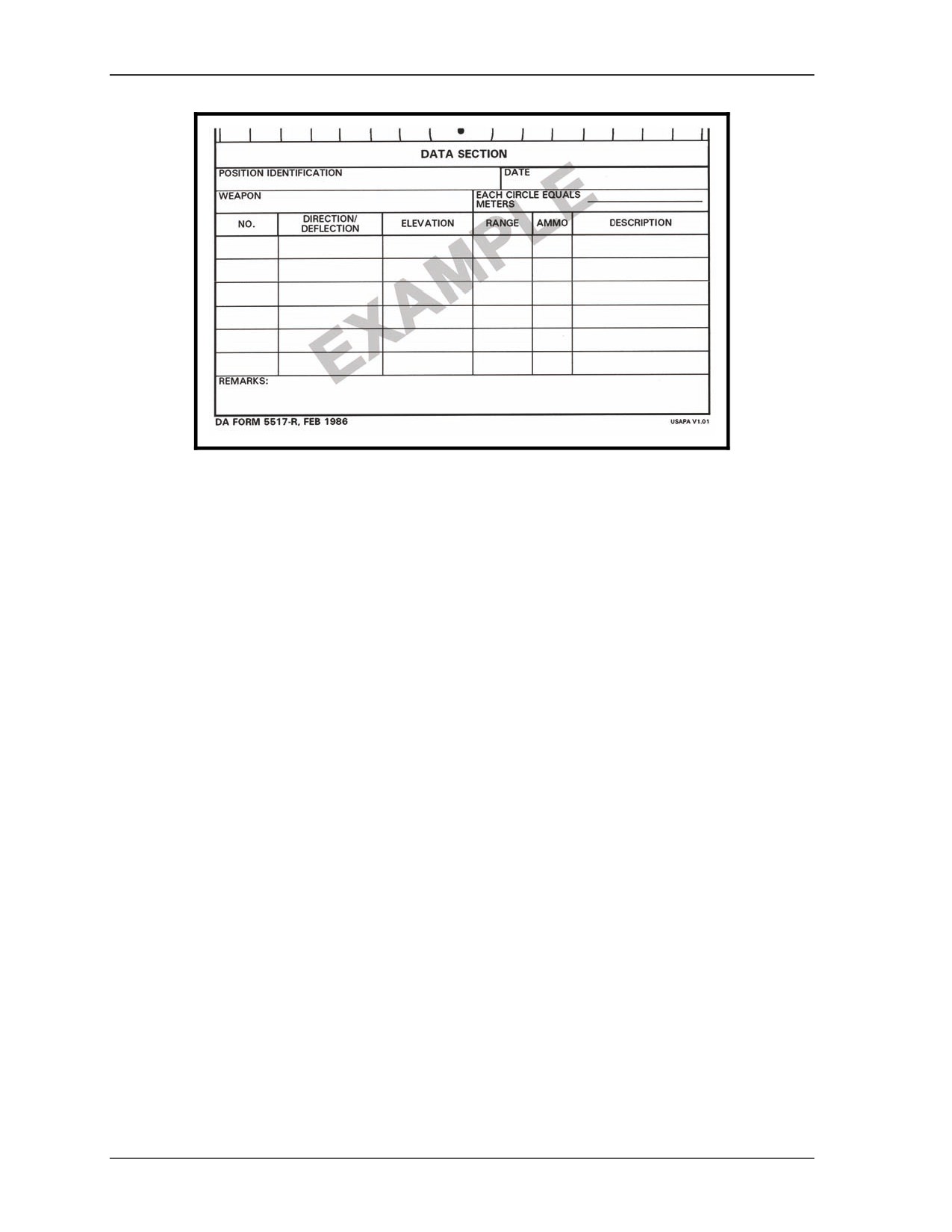
6-39.
The data section (Figure 6-24) of the range card lists the data necessary to engage targets
identified in the sketch. The sketch does not have to be to scale, but the data must be accurate. The data
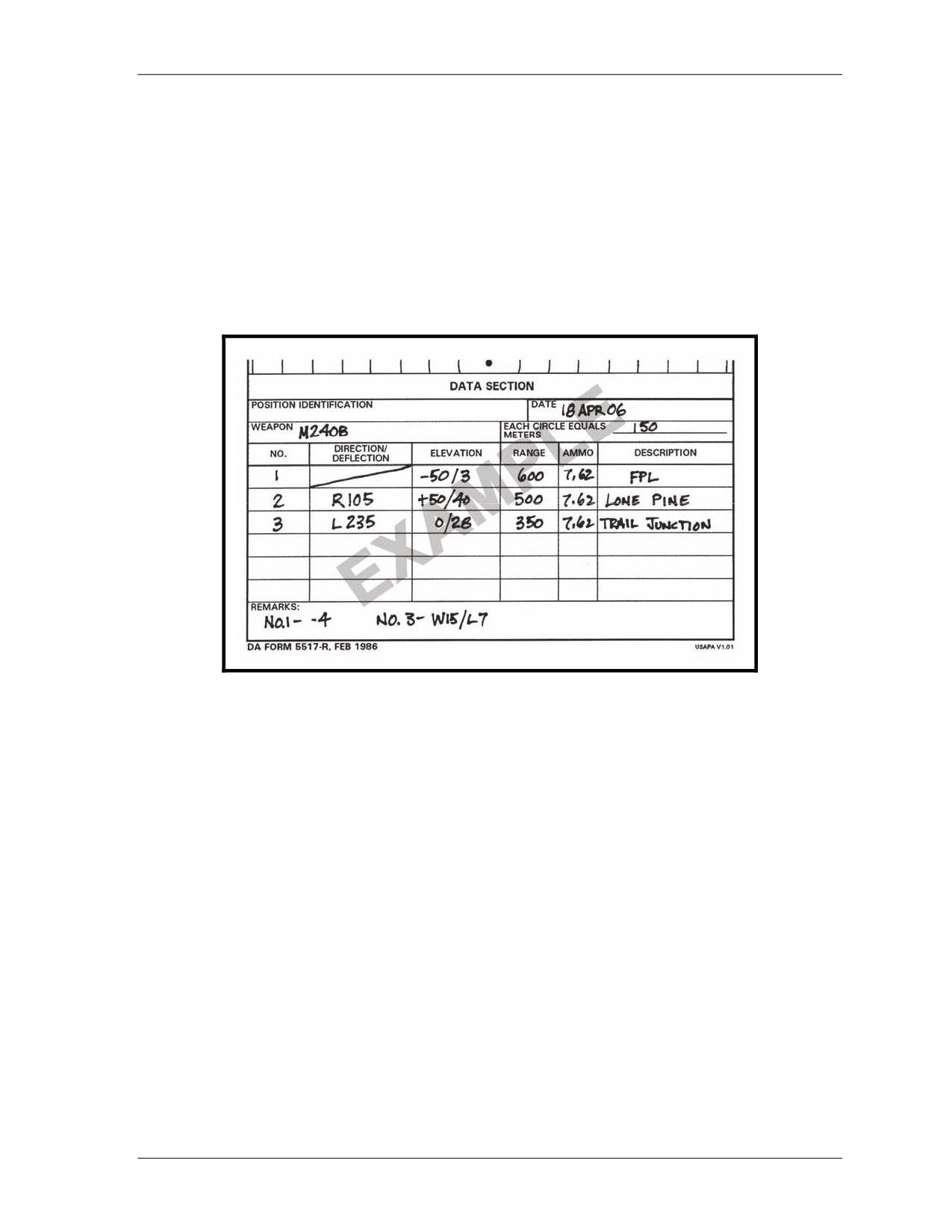
section of the card can be placed on the reverse side or below the sketch if there is room. (Figure 6-25
shows an example completed data section.) Draw a data section block (if you do not have a printed card)
with the following items:
28 January 2008
FM 3-21.75
6-25
Chapter 6
Figure 6-24. Data section.
Prepare
1. Center the traversing hand wheel.
2. Lay the gun for direction.
3. When assigned an FPL, lock the traversing slide on the extreme left or right of the bar,
depending on which side of your primary sector the FPL is on.
4. Align the barrel on the FPL by moving the tripod legs. Do not enter a direction in the data
section for the FPL.
5. When assigned a PDF, align your gun on the primary sector by traversing the slide to one
side and then move the tripod to align the barrel on your sector limit. Align the PDF by
traversing the slide until your gun is aimed at the center of the target.
6. Fix the tripod legs in place by digging in or sandbagging them. Once you emplace the tripod
to fire into the primary sector, leave it there--do not move it.
Read Direction to Target
1. Lay your gun on the center of the target.
2. Read the direction directly off the traversing bar at the left edge of the traversing bar slide.
3. Enter the reading under the direction column of your range card data section.
4. Determine the left or right reading based on the direction of the barrel, just the opposite
of the slide.
5. Lay your gun on the base of the target by rotating the elevating handwheel.
6. Read the number, including a plus or minus sign, except for "0" above the first visible line on
the elevating scale. The sketch reads "-50."
7. Read the number on the elevating handwheel that is in line with the indicator. The sketch
reads "3."
8. Enter this reading under the ELEVATION column of your range card data section. Separate
the two numbers with a solidus, also known as a slash ("/"). Always enter the reading from
the upper elevating bar first. The sketch reads "-50/3."
9. Enter the range to each target under the appropriate column in the data section.
10. Enter your ammunition type under the appropriate column in the data section.
11. Describe each target under the appropriate column in the data section.
6-26
FM 3-21.75
28 January 2008
Fighting Positions
Complete Remarks Section
1. Enter the width and depth of linear targets in mils. The "-4" means that if you depress the
barrel 4 mils, the strike of the rounds will go down to ground level along the FPL.
2. When entering the width of the target, be sure to give the width in mils, and express it as two
values. For example, the illustration shows that target number three has a width of 15 mils.
The second value, L7, means that once the gun is laid on your target, traversing 7 mils to the
LEFT will lay the gun on the left edge of the target.
3. Enter aiming stake if one is used for the target.
4. No data for the secondary sector will be determined since your gun will be fired in the
bipod role.
Figure 6-25. Example completed data section.
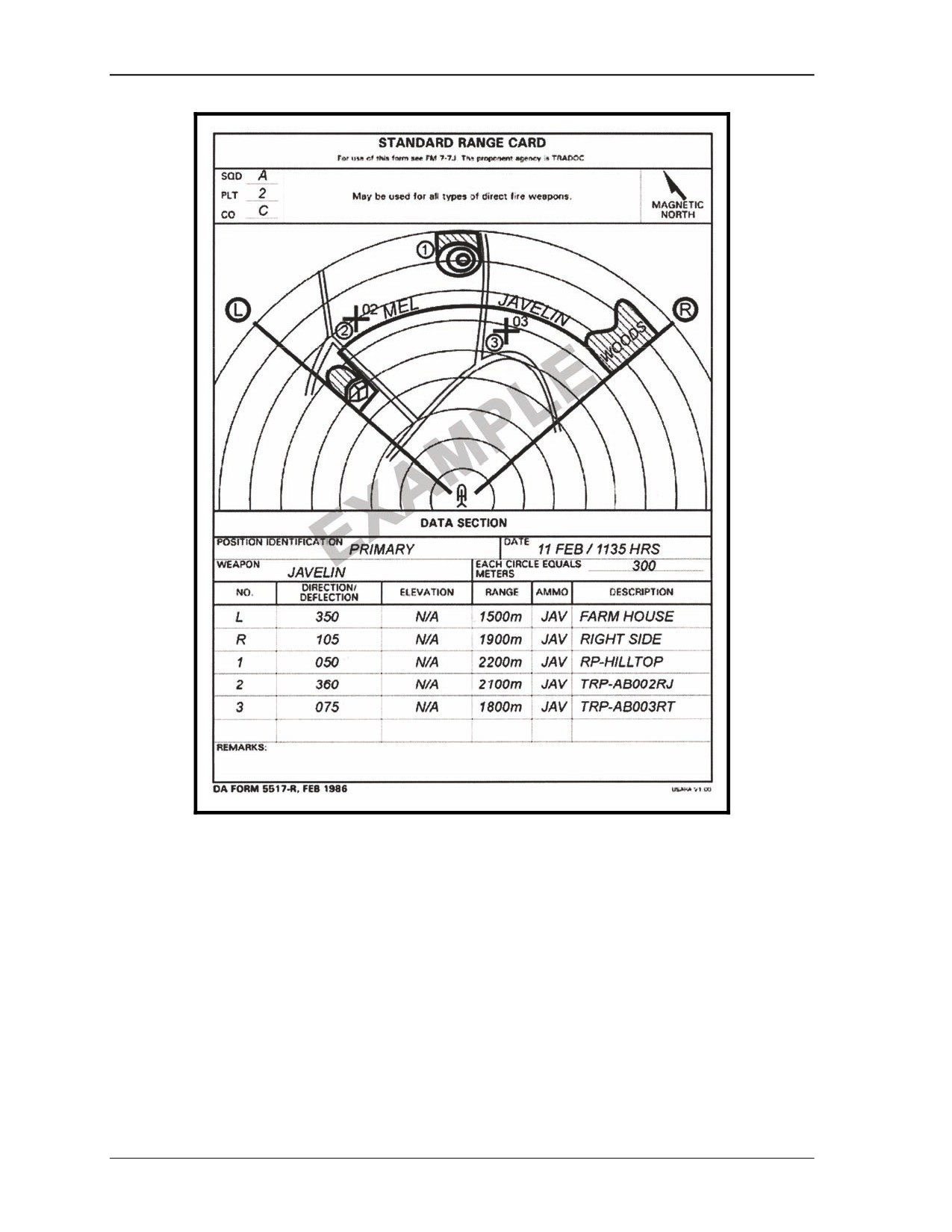
CLOSE COMBAT MISSILE RANGE CARD
6-40.
The purpose of this card is to show a sketch of the terrain a weapon has been assigned to cover by
fire. By using a range card, you can quickly and accurately determine the information needed to engage
targets in your assigned sector (Figure 6-26 for a completed range card). Before you prepare a range card,
your leader will show you where to position your weapon so you can best cover your assigned sector of
fire. He will then, again, point out the terrain you are to cover. He will do this by assigning you a sector of
fire or by assigning left or right limits indicated by either terrain features or azimuths. If necessary, he may
also assign you more than one sector of fire and will designate the sectors as primary and secondary.
28 January 2008
FM 3-21.75
6-27
Chapter 6
Figure 6-26. Example completed range card.
Target Reference Points
6-41.
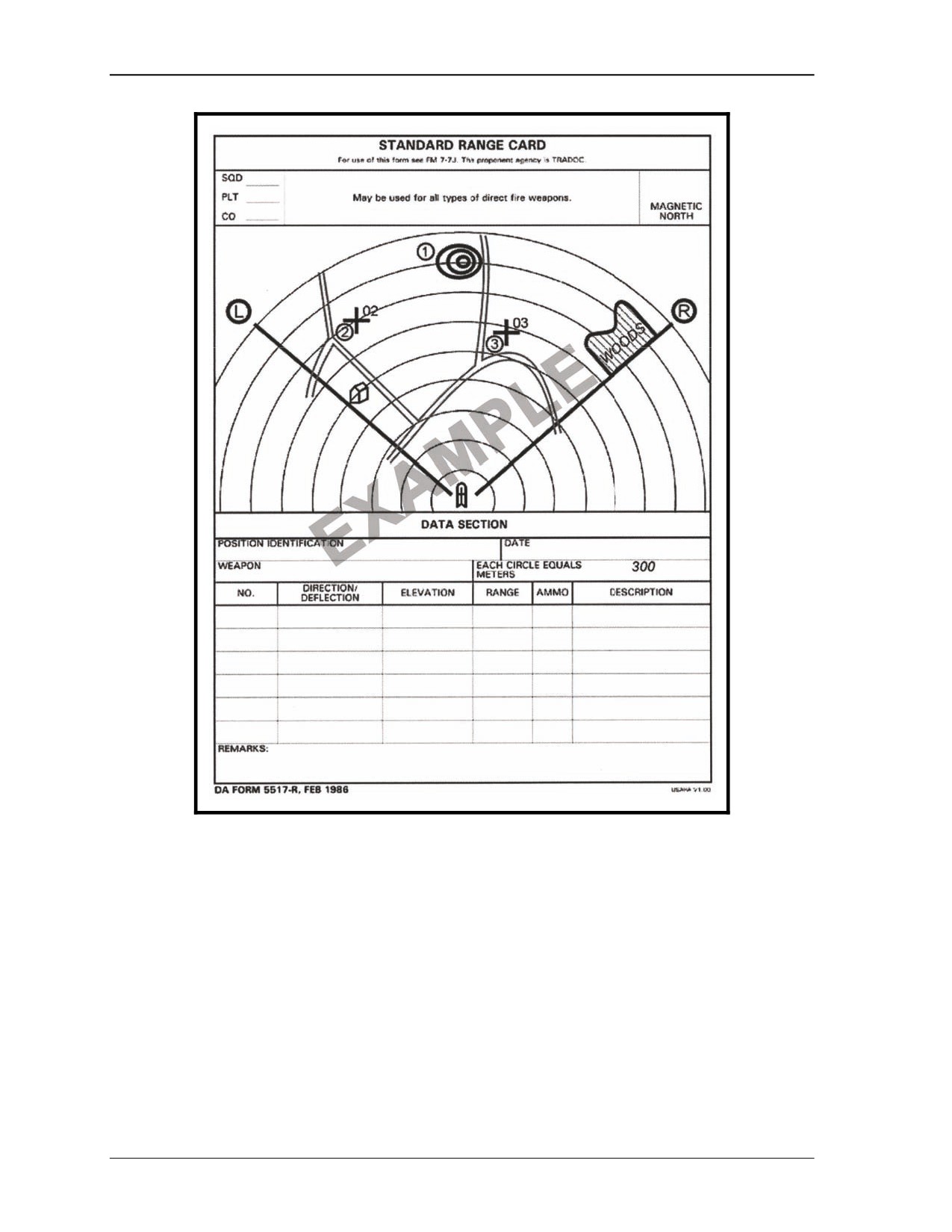
TRPs are natural or man-made features within your sector that you can use to quickly locate
targets (Figure 6-27). TRPs are used mainly to control direct fire weapons. However, TRPs should appear
on the company target list.
Maximum Engagement Line
6-42.
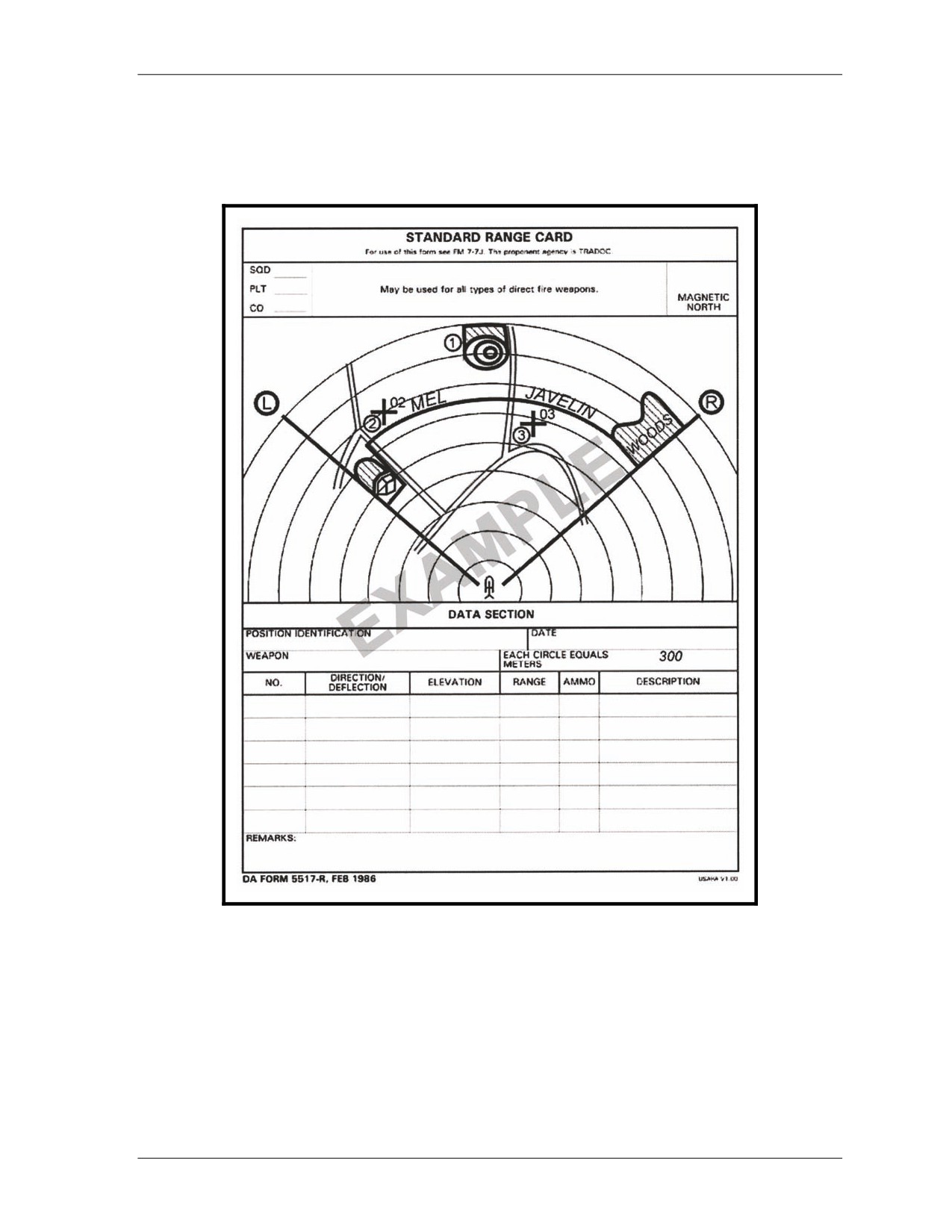
The maximum engagement line (MEL) is a line beyond which you cannot engage a target. This
line may be closer than the maximum engagement range of your weapon. Both the terrain and the
maximum engagement range of your weapon will determine the path of the MEL.
6-28
FM 3-21.75
28 January 2008
Fighting Positions
Preparation
6-43.
Draw the weapon symbol in the center of the small circle.
Sector Limits
6-44.
Draw two lines from the position of the weapons system extending left and right to show the
limits of the sector. The area between the left and right limits depicts your sector of fire or area of
responsibility. Number the left limit as No. 1, number the right limit No. 2, and place a circle around each
number. Record the azimuth and distance of each limit in the data section. Determine the value of each
circle by finding a terrain feature farthest from the position and within the weapon system’s capability.
Determine the distance to the terrain feature. Round off the distance to the next even hundredth, if
necessary. Determine the maximum number of circles that will divide evenly into the distance. The result is
the value of each circle. Draw the terrain feature on the appropriate circle on the range card. Clearly mark
the increment for each circle across the area where DATA SECTION is written. For example, suppose you
use a hilltop at 2,565 yards (2,345 meters). Round the distance to 2,625 yards (2,400 meters) and divide by
8. The result is 300, so now each circle has a value of 300 meters.
Reference Points
Draw all reference points (RP) and TRPs in the sector. Mark each with a circled number beginning with 1.
Draw hilltop as RP1, a road junction as RP2, and road junction RP3. Sometimes, a TRP and RP are the
same point such as in the previous example. When this happens, mark the TRP with the first designated
number in the upper right quadrant, and mark the RP in the lower left quadrant of the cross. This occurs
when a TRP is used for target acquisition and range determination.
Road Junction--For a road junction, first determine the range to the junction, then draw the
junction, and then draw the connecting roads from the road junction.
Dead Space--Show dead space as an irregular circle with diagonal lines inside. Any object that
prohibits observation or coverage with direct fire will have the circle and diagonal lines extend
out to the farthest MEL. If you can engage the area beyond the dead space, then close the
circle.
28 January 2008
FM 3-21.75
6-29
Chapter 6
Figure 6-27. Reference points and target reference points.
6-30
FM 3-21.75
28 January 2008
Fighting Positions
Maximum Engagement Line
6-45.
Draw the MEL at the maximum effective engagement range for the weapon, but draw it around
(inside) the near edge of any dead spaces (Figure 6-28). Do not draw the MEL through dead spaces.
Figure 6-28. Maximum engagement lines.
28 January 2008
FM 3-21.75
6-31
Chapter 6
Weapon Reference Point
6-46.
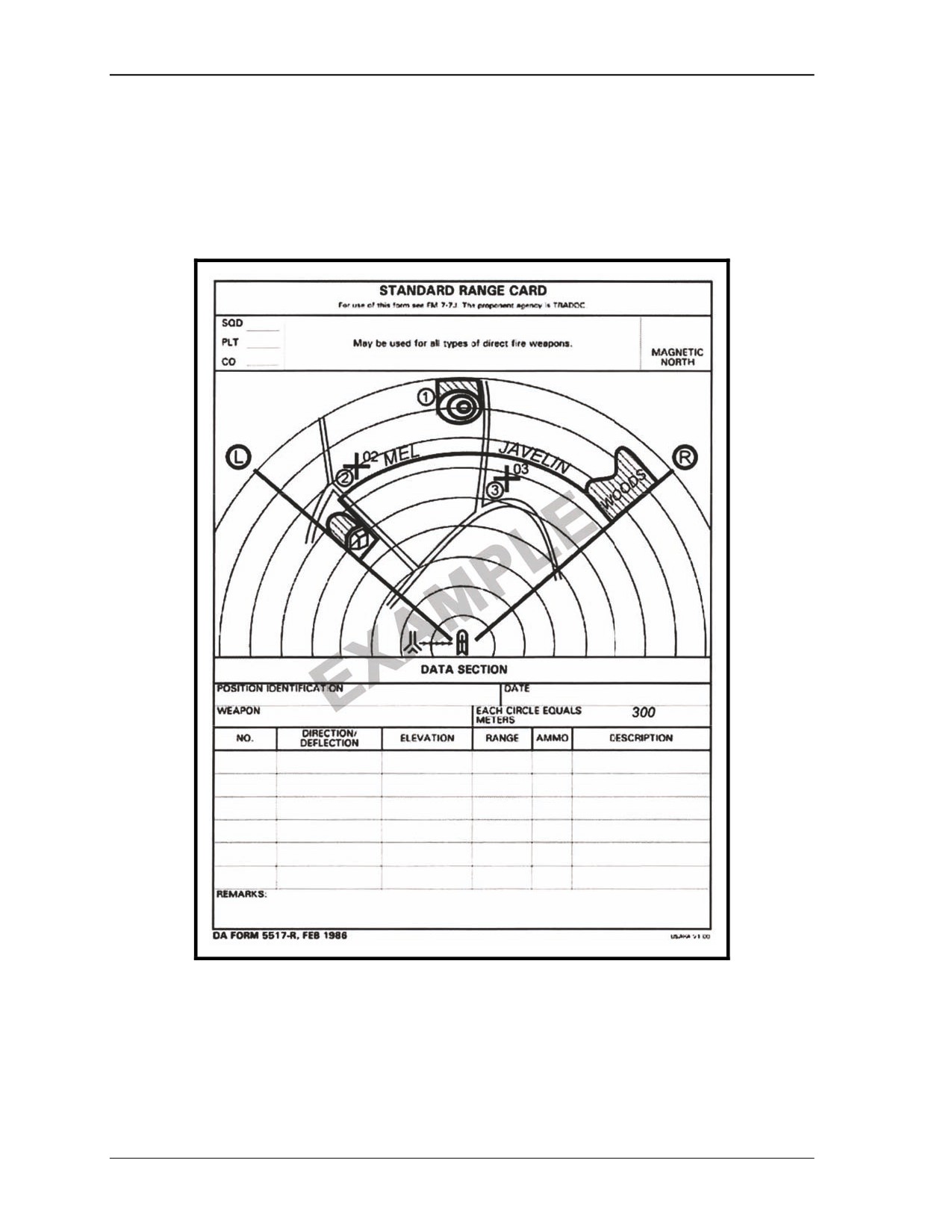
Show the WRP as a line with a series of arrows, extending from a known terrain feature, and
pointing in the direction of the weapon system symbol (Figure 6-29). Number this feature last. The WRP
location is given a six-digit grid. When there is no terrain feature to be designated as the WRP, show the
weapon’s location as an eight-digit grid coordinate in the Remarks block of the range card. Complete the
data section as follows:
Figure 6-29. Weapon reference point.
6-32
FM 3-21.75
28 January 2008
Fighting Positions
Position Identification--List primary, alternate, or supplementary positions. Alternate and
supplemental positions must be clearly identified.
Date--Show date and time the range card was completed. Range cards, like fighting positions, are
constantly updated. The date and time are vital in determining current data.
Weapon--The weapon block indicates weapon type.
Each Circle Equals ____ Meters--Write in the distance, in meters, between circles.
NO (Number)--Start with L and R limits, then list TRPs and RPs in numerical order.
Direction/Deflection--The direction is listed in degrees. The deflection is listed in mils.
Elevation--The elevation is listed in mils.
Range--This is the distance, in meters, from weapon system position to L and R limits and TRPs
and RPs.
Ammunition--List types of ammunition used.
Description--List the name of the object (for example, farmhouse, wood line, or hilltop).
Remarks--Enter the WRP data. As a minimum, WRP data describes the WRP and gives its
six-digit or eight digit grid coordinate, magnetic azimuth, and distance to the position.
Complete the marginal information at the top of the card.
Unit Description--Enter unit description such as squad, platoon, or company. Never indicate a unit
higher than company.
Magnetic North--Orient the range card with the terrain, and draw the direction of the magnetic
North arrow.
28 January 2008
FM 3-21.75
6-33