FM 3-21.75 The Warrior Ethos and Soldier Combat Skills (JANUARY 2008) - page 2
Chapter 3
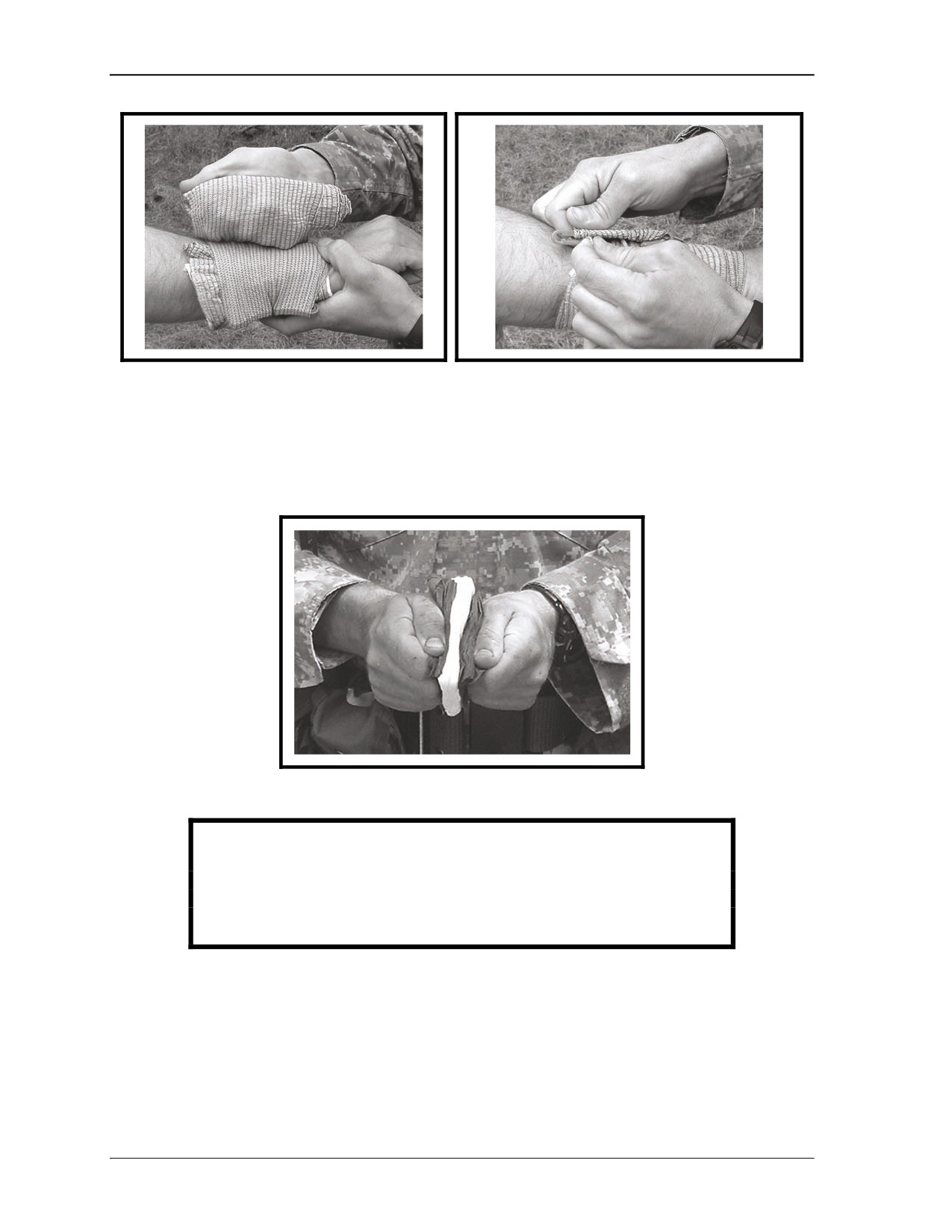
Figure 3-20.
Figure 3-21.
Wrapping of bandage over pressure bar.
Securing of bandage.
Field Dressing
3-29.
Remove the casualty’s field dressing from the wrapper, and grasp the tails of the dressing with
both hands (Figure 3-22).
Figure 3-22. Grasping of dressing tails with both hands.
WARNING
Do not touch the white (sterile) side of the dressing.
Do not allow that side of the dressing to touch any surface other
than the wound.
3-16
FM 3-21.75
28 January 2008
Combat Casualty Care and Preventive Medicine
3-30.
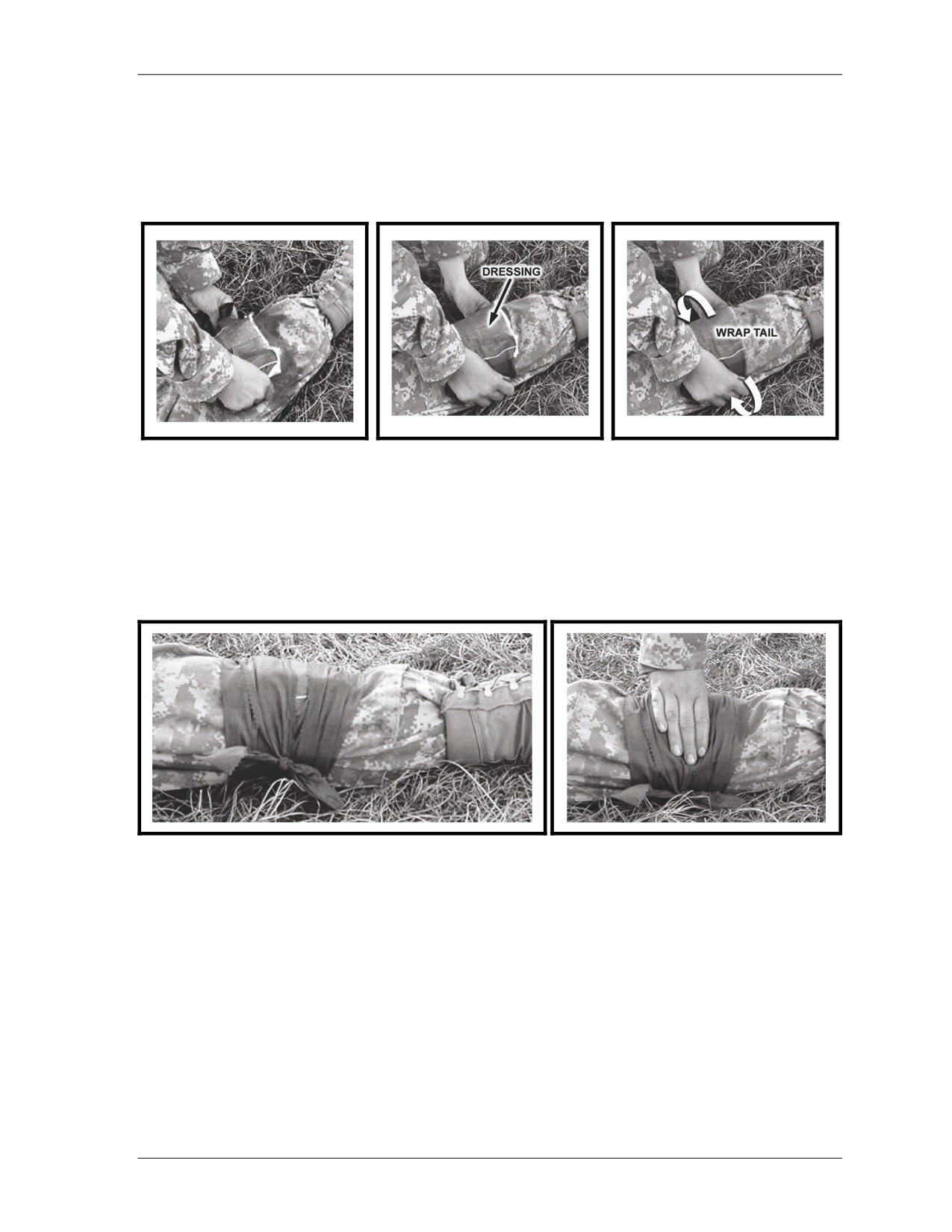
Hold the dressing directly over the wound with the white side down. Open the dressing
(Figure 3-23), and place it directly over the wound (Figure 3-24). Hold the dressing in place with one hand.
Use the other hand to wrap one of the tails around the injured part, covering about half the dressing
(Figure 3-25). Leave enough of the tail for a knot. If the casualty is able, he can help by holding the
dressing in place.
Figure 3-23.
Figure 3-24. Placement of
Figure 3-25. Wrapping of
Pulling open of dressing.
dressing directly on wound.
dressing tail around injured part.
3-31.
Wrap the other tail in the opposite direction until the rest of the dressing is covered. The tails
should seal the sides of the dressing to keep foreign material from getting under it. Tie the tails into a
nonslip knot over the outer edge of the dressing (Figure 3-26). Do not tie the knot over the wound. In order
to allow blood to flow to the rest of the injured limb, tie the dressing firmly enough to prevent it from
slipping, but without causing a tourniquet effect. That is, the skin beyond the injury should not become
cool, blue, or numb.
Figure 3-26. Tails tied into nonslip knot.
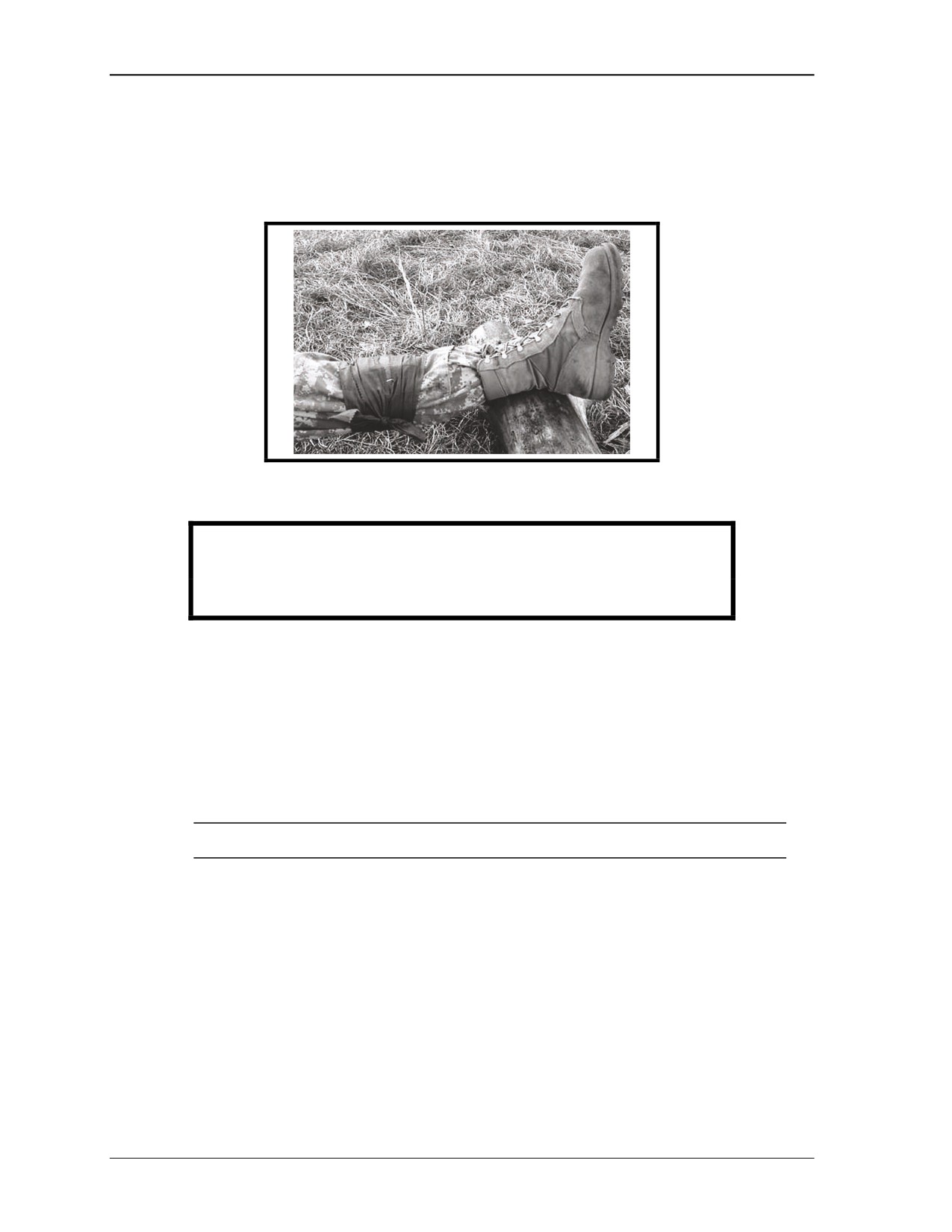
Figure 3-27.
Application of direct manual pressure.
28 January 2008
FM 3-21.75
3-17
Chapter 3
Manual Pressure
3-32.
If bleeding continues after you apply the sterile field dressing, apply direct pressure to the
dressing for five to ten minutes (Figure 3-27). If the casualty is conscious and can follow instructions, you
can ask him to do this himself. Elevate an injured limb slightly above the level of the heart to reduce the
bleeding (Figure 3-28).
Figure 3-28. Elevation of injured limb.
WARNING
Elevate a suspected fractured limb only after properly splinting it.
3-33.
If the bleeding stops, check for shock, and then give first aid for that as needed. If the bleeding
continues, apply a pressure dressing.
Pressure Dressing
3-34.
If bleeding continues after you apply a field dressing, direct pressure, and elevation, then you
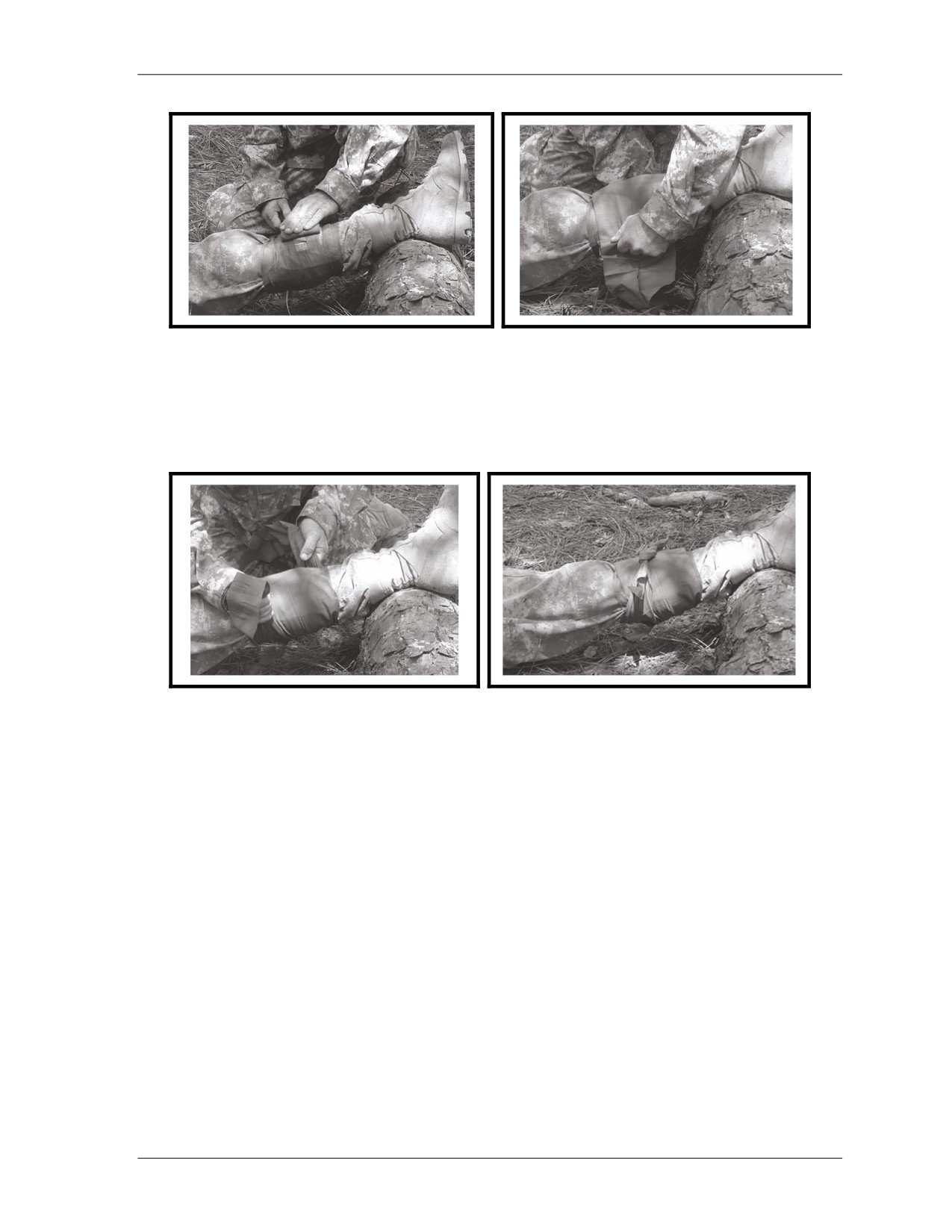
must apply a pressure dressing. This helps the blood clot, and it compresses the open blood vessel. Place a
wad of padding on top of the field dressing directly over the wound (Figure 3-29). Keep the injured
extremity elevated.
Note: Improvise bandages from strips of cloth such as tee shirts, socks, or other garments.
3-35.
Place an improvised dressing (or cravat, if available) over the wad of padding (Figure 3-30). Wrap
the ends tightly around the injured limb, covering the original field dressing (Figure 3-31).
3-18
FM 3-21.75
28 January 2008
Combat Casualty Care and Preventive Medicine
Figure 3-29. Wad of padding on top of field
Figure 3-30. Improvised dressing over wad of
dressing.
padding.
3-36.
Tie the ends together in a nonslip knot, directly over the wound site (Figure 3-32). Do not tie so
tightly that it has a tourniquet-like effect. If bleeding continues and all other measures fail, or if the limb is
severed, then apply a tourniquet, but do so only as a last resort. When the bleeding stops, check for shock,
and give first aid for that, if needed.
Figure 3-31. Ends of improvised dressing
Figure 3-32. Ends of improvised dressing tied
wrapped tightly around limb.
together in nonslip knot.
3-37.
Check fingers and toes periodically for adequate circulation. Loosen the dressing if the extremity
becomes cool, blue, or numb. If bleeding continues, and all other measures fail--application of dressings,
covering of wound, direct manual pressure, elevation of limb above heart level, application of pressure
dressing while maintaining limb elevation--then apply digital pressure.
Digital Pressure
3-38.
Use this method when you are having a hard time controlling bleeding, before you apply a
pressure dressing, or where pressure dressings are unavailable. Keep the limb elevated and direct pressure
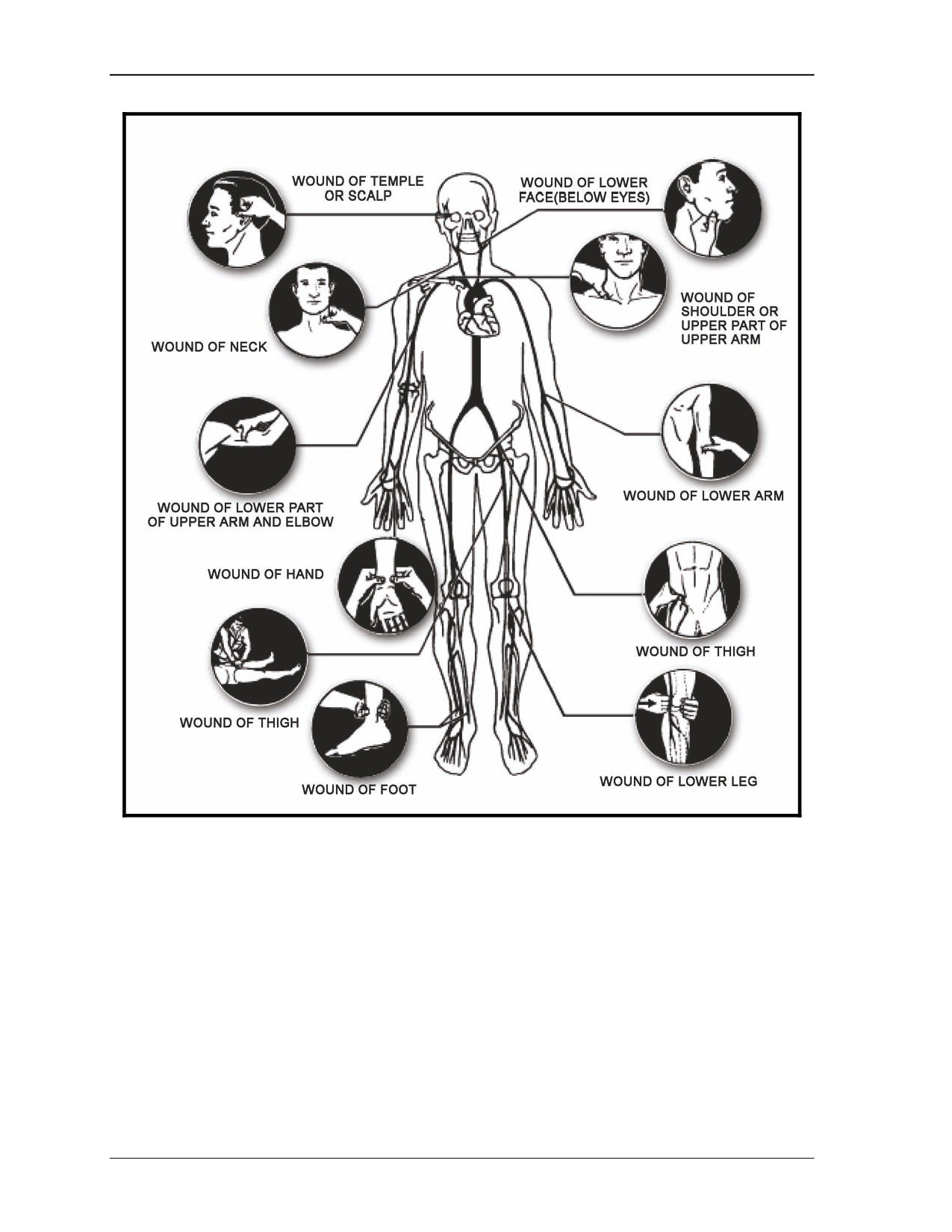
on the wound. At the same time, press your fingers, thumbs, or whole hand where a main artery supplying
the wounded area lies near the surface or over bone (Figure 3-33). This might help shut off, or at least
slow, the flow of blood from the heart to the wound.
28 January 2008
FM 3-21.75
3-19
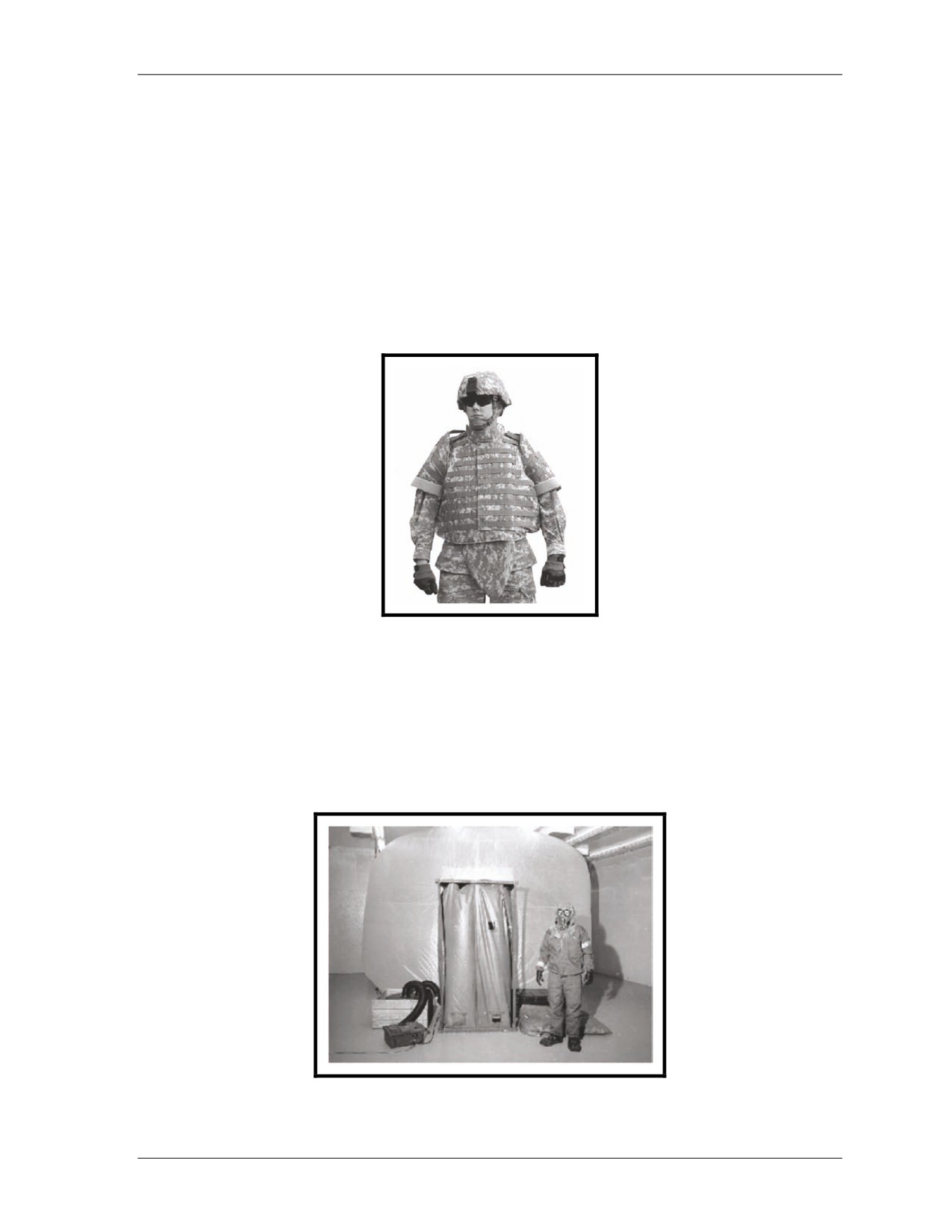
Chapter 3
Figure 3-33. Digital pressure (fingers, thumbs, or hands).
Tourniquet
3-39.
A tourniquet is a constricting band placed around an arm or leg to control bleeding. A Soldier
whose arm or leg has been completely amputated might not be bleeding when first discovered, but you
should apply a tourniquet anyway. The body initially stops bleeding by contracting or clotting the blood
vessels. However, when the vessels relax, or if a clot is knocked loose when the casualty is moved, the
bleeding can restart. Bleeding from a major artery of the thigh, lower leg, or arm, and bleeding from
multiple arteries, both of which occur in a traumatic amputation, might be more than you can control with
manual pressure. If even under firm hand pressure the dressing gets soaked with blood, and if the wound
continues to bleed, then you must apply a tourniquet.
3-20
FM 3-21.75
28 January 2008
Combat Casualty Care and Preventive Medicine
DANGER
Use a tourniquet only on an arm or leg and if the casualty is in
danger of bleeding to death.
WARNING
Continually monitor the casualty for the development of any
conditions that could require basic life-saving measures such as
clearing his airway, performing mouth-to-mouth breathing,
preventing shock, or controlling bleeding.
Locate points of entry and exit on all open and penetrating
wounds, and treat the casualty accordingly.
3-40.
Avoid using a tourniquet unless a pressure dressing fails to stop the bleeding, or unless an arm or
leg has been cut off. Tourniquets can injure blood vessels and nerves. Also, if left in place too long, a
tourniquet can actually cause the loss of an arm or leg. However, that said, once you apply a tourniquet,
you have to leave it in place and get the casualty to the nearest MTF ASAP. Never loosen or release a
tourniquet yourself after you have applied one, because that could cause severe bleeding and lead to shock.
Combat Application Tourniquet
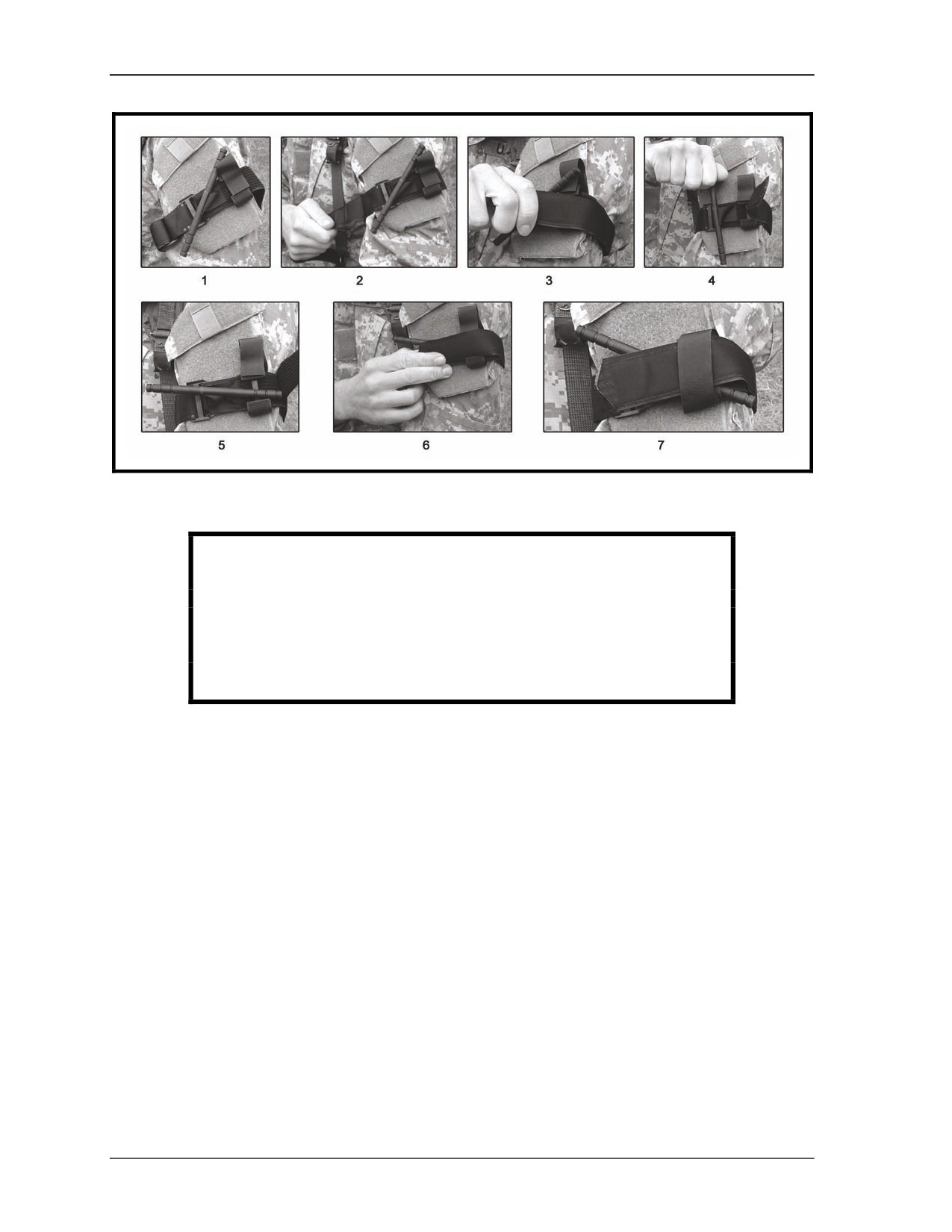
1. The C-A-T is packaged for one-handed use. Slide the wounded extremity through the loop of
the C-A-T tape (1, Figure 3-34).
2. Position the C-A-T 2 inches above a bleeding site that is above the knee or elbow. Pull the
free running end of the tape tight, and fasten it securely back on itself (2, Figure 3-34).
3. Do not affix the band past the windlass clip (3, Figure 3-34).
4. Twist the windlass rod until the bleeding stops (4, Figure 3-34).
5. Lock the rod in place with the windlass clip (5, Figure 3-34).
6. For small extremities, continue to wind the tape around the extremity and over the windlass
rod (6, Figure 3-34).
7. Grasp the windlass strap, pull it tight, and adhere it to the hook-pile tape on the windlass clip
(7, Figure 3-34). The C-A-T is now ready for transport.
28 January 2008
FM 3-21.75
3-21
Chapter 3
Figure 3-34. Band pulled tight.
WARNING
The one-handed method for upper extremities may not be
completely effective on lower extremities.
Ensure everyone receives familiarization and training on both
methods of application.
3-41.
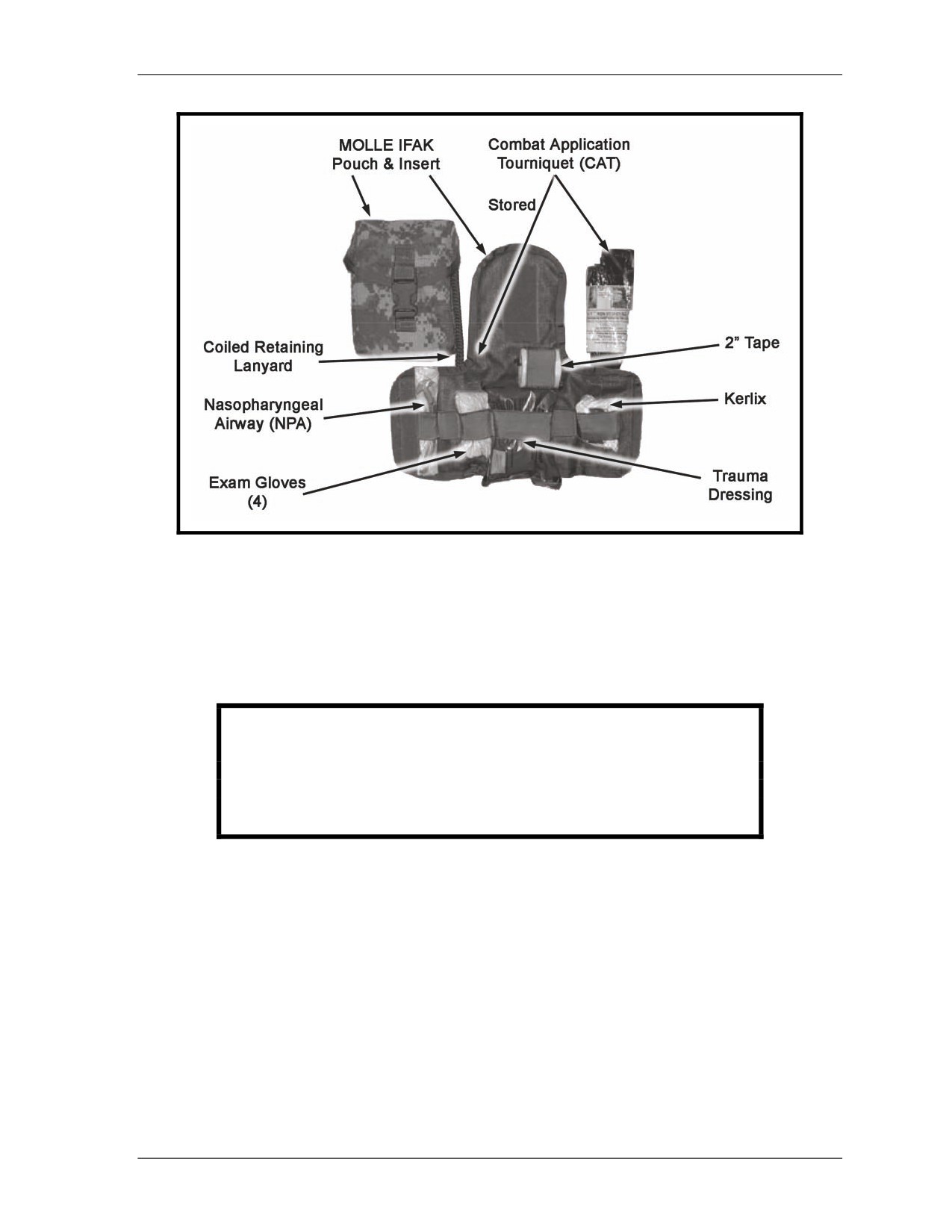
The improved first-aid kit (IFAK) allows self-aid and buddy aid (SABA) interventions for
extremity hemorrhages and airway compromises (Figure 3-35). The pouch and insert are both Class II
items. Expendables are Class VIII.
3-22
FM 3-21.75
28 January 2008
Combat Casualty Care and Preventive Medicine
Figure 3-35. Improved first aid kit.
Improvised Tourniquet
3-42.
In the absence of a specially designed tourniquet, you can make one from any strong, pliable
material such as gauze or muslin bandages, clothing, or cravats. Use your improvised tourniquet with a
rigid, stick-like object. To minimize skin damage, the improvised tourniquet must be at least 2 inches wide.
WARNING
The tourniquet must be easily identified or easily seen.
Do not use wire, shoestring, or anything else that could cut into
flesh, for a tourniquet band.
Placement
3-43.
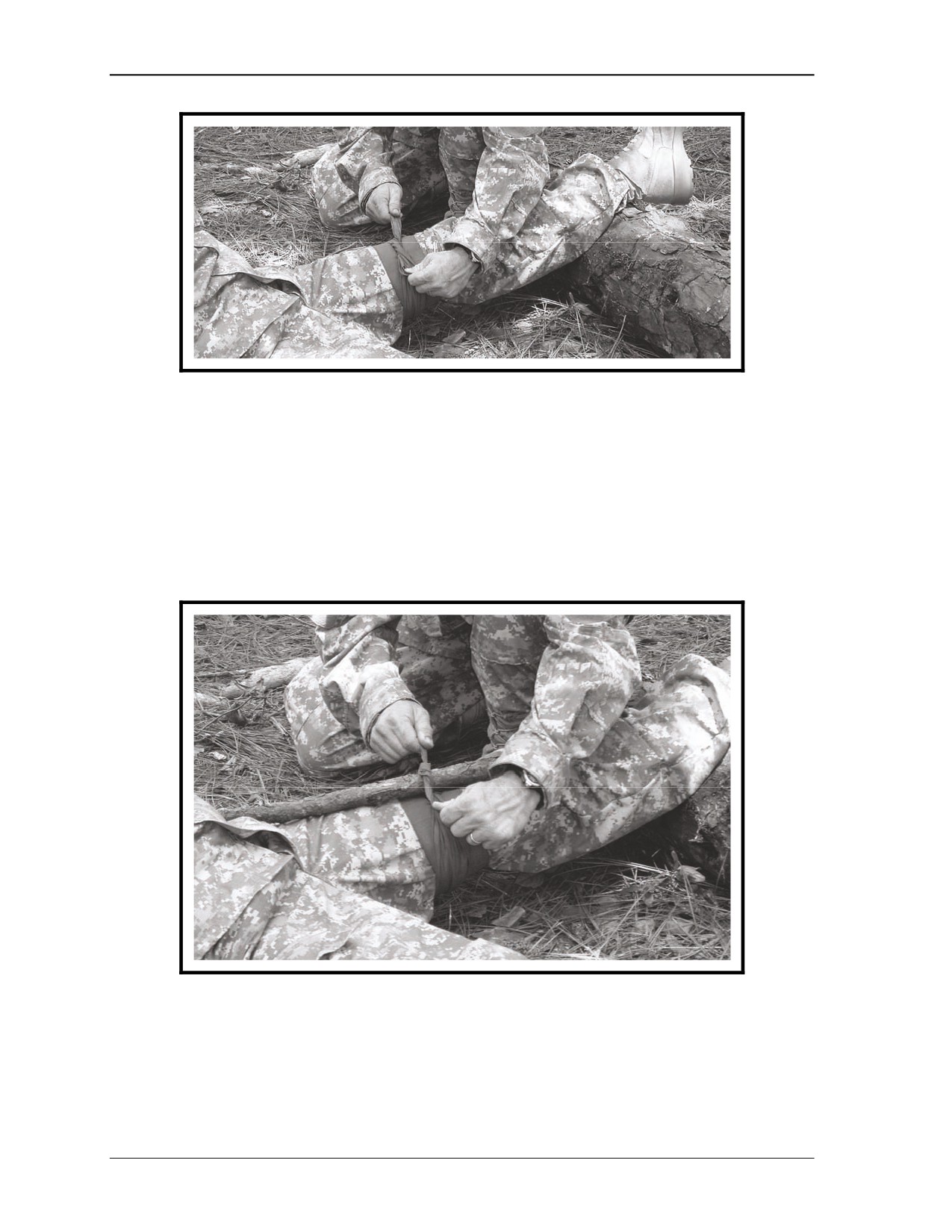
To position the makeshift tourniquet, place it around the limb, between the wound and the body
trunk, or between the wound and the heart. Never place it directly over a wound, a fracture, or joint. For
maximum effectiveness, place it on the upper arm or above the knee on the thigh (Figure 3-36).
28 January 2008
FM 3-21.75
3-23
Chapter 3
Figure 3-36. Tourniquet above knee.
3-44.
Pad the tourniquet well. If possible, place it over a smoothed sleeve or trouser leg to keep the skin
from being pinched or twisted. If the tourniquet is long enough, wrap it around the limb several times,
keeping the material as flat as possible. Damaging the skin may deprive the surgeon of skin required to
cover an amputation. Protecting the skin also reduces the casualty's pain.
Application
3-45.
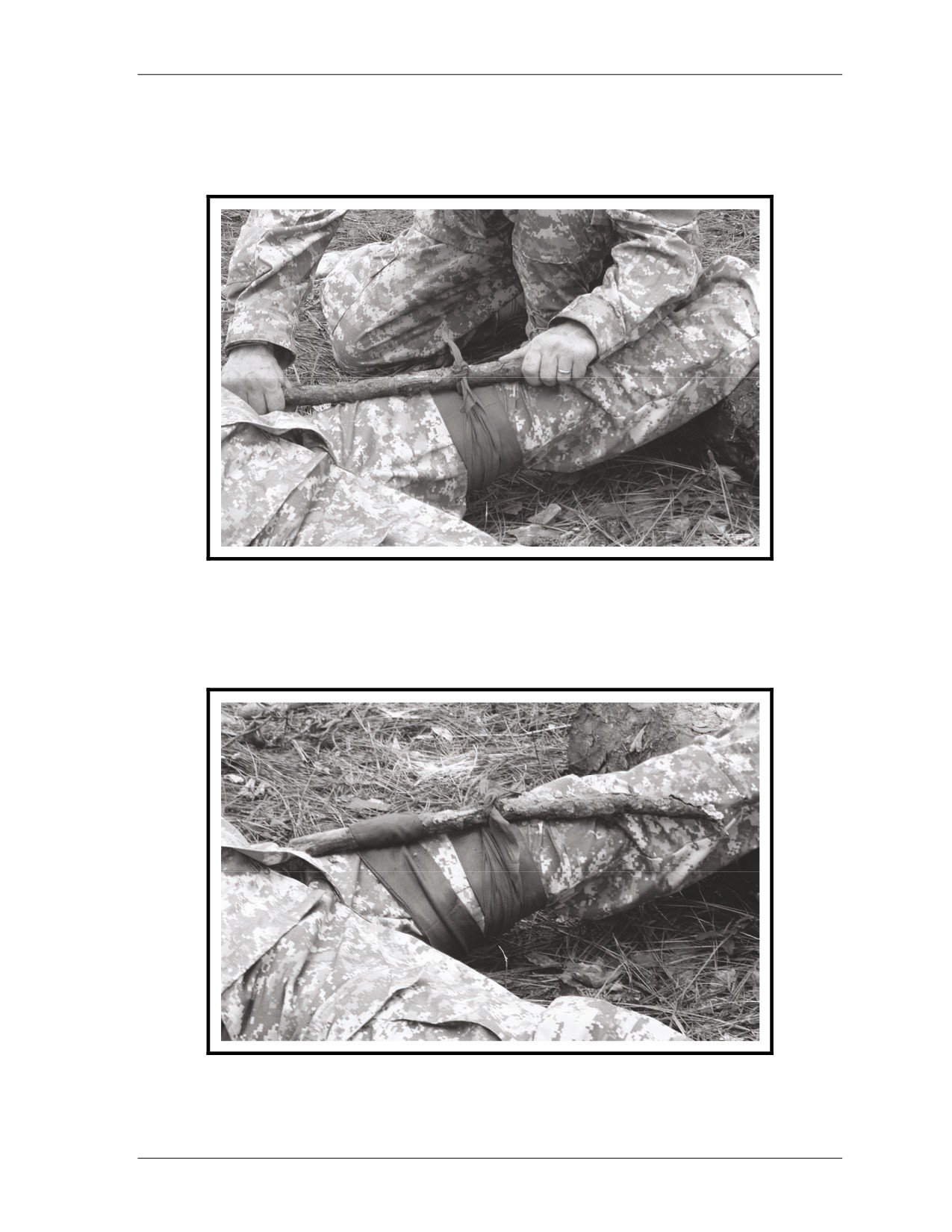
To apply the tourniquet, tie a half knot, which is the same as the first part of tying a shoe lace.
Place a stick, or other rigid object, on top of the half knot (Figure 3-37).
Figure 3-37. Rigid object on top of half knot.
3-24
FM 3-21.75
28 January 2008
Combat Casualty Care and Preventive Medicine
3-46.
Tie a full-knot over the stick, and twist the stick until the tourniquet tightens around the limb or
the bright red bleeding stops (Figure 3-38). In the case of amputation, dark oozing blood may continue for
a short time. This is the blood trapped in the area between the wound and tourniquet.
Figure 3-38. Tourniquet knotted over rigid object and twisted.
3-47.
To fasten the tourniquet to the limb, loop the free ends of the tourniquet over the ends of the stick.
Bring the ends around the limb to keep the stick from loosening. Tie the ends together on the side of the
limb (Figure 3-39).
Figure 3-39. Free ends tied on side of limb.
28 January 2008
FM 3-21.75
3-25
Chapter 3
3-48.
You can use other means to secure the stick. Just make sure the material remains wound around
the stick, and that no further injury is possible. If possible, save and transport any severed (amputated)
limbs or body parts with (but out of sight of) the casualty. Never cover the tourniquet. Leave it in full view.
If the limb is missing (total amputation), apply a dressing to the stump. All wounds should have a dressing
to protect the wound from contamination. Mark the casualty’s forehead with a "T" and the time to show
that he has a tourniquet. If necessary, use the casualty’s blood to make this mark. Check and treat for
shock, and then seek medical aid.
CAUTION
Do not remove a tourniquet yourself. Only trained medical personnel may
adjust or otherwise remove or release the tourniquet, and then only in the
appropriate setting.
SHOCK
3-49.
The term shock means various things. In medicine, it means a collapse of the body’s
cardiovascular system, including an inadequate supply of blood to the body’s tissues. Shock stuns and
weakens the body. When the normal blood flow in the body is upset, death can result. Early recognition
and proper first aid may save the casualty’s life.
Causes and Effects of Shock
3-50.
The three basic effects of shock are--
• Heart is damaged and fails to pump.
• Blood loss (heavy bleeding) depletes fluids in vascular system.
• Blood vessels dilate (open wider), dropping blood pressure to dangerous level.
3-51.
Shock might be caused by--
• Dehydration.
• Allergic reaction to foods, drugs, insect stings, and snakebites.
• Significant loss of blood.
• Reaction to sight of wound, blood, or other traumatic scene.
• Traumatic injuries.
-- Burns.
-- Gunshot or shrapnel wounds.
-- Crush injuries.
-- Blows to the body, which can break bones or damage internal organs.
-- Head injuries.
-- Penetrating wounds such as from knife, bayonet, or missile.
Signs and Symptoms of Shock
3-52.
Examine the casualty to see if he has any of the following signs and symptoms:
• Sweaty but cool (clammy) skin.
• Weak and rapid pulse.
•
(Too) rapid breathing.
• Pale or chalky skin tone.
• Cyanosis (blue) or blotchy skin, especially around the mouth and lips.
3-26
FM 3-21.75
28 January 2008
Combat Casualty Care and Preventive Medicine
• Restlessness or nervousness.
• Thirst.
• Significant loss of blood.
• Confusion or disorientation.
• Nausea, vomiting, or both.
First-Aid Measures for Shock
3-53.
First-aid procedures for shock in the field are the same ones performed to prevent it. When
treating a casualty, always assume the casualty is in shock, or will be shortly. Waiting until the signs of
shock are visible could jeopardize the casualty’s life.
Casualty Position
3-54.
Never move the casualty, or his limbs, if you suspect he has fractures, and they have not yet
been splinted. If you have cover and the situation permits, move the casualty to cover. Lay him on his back.
A casualty in shock from a chest wound, or who is having trouble breathing, might breathe easier sitting
up. If so, let him sit up, but monitor him carefully, in case his condition worsens. Elevate his feet higher
than the level of his heart. Support his feet with a stable object, such as a field pack or rolled up clothing, to
keep them from slipping off.
WARNINGS
1.
Do not elevate legs if the casualty has an unsplinted broken
leg, head injury, or abdominal injury.
2.
Check casualty for leg fracture(s), and splint them, if needed,
before you elevate his feet. For a casualty with an abdominal
wound, place his knees in an upright (flexed) position.
3-55.
Loosen clothing at the neck, waist, or wherever it might be binding.
CAUTION
Do not loosen or remove protective clothing in a chemical environment.
3-56.
Prevent the casualty from chilling or overheating. The key is to maintain normal body
temperature. In cold weather, place a blanket or like item over and under him to keep him warm and
prevent chilling. However, if a tourniquet has been applied, leave it exposed (if possible). In hot weather,
place the casualty in the shade and protect him from becoming chilled; however, avoid the excessive use of
blankets or other coverings. Calm the casualty. Throughout the entire procedure of providing first aid for a
casualty, you should reassure the casualty and keep him calm. This can be done by being authoritative
(taking charge) and by showing self-confidence. Assure the casualty that you are there to help him. Seek
medical aid.
Food and Drink
3-57.
When providing first aid for shock, never give the casualty food or drink. If you must leave the
casualty, or if he is unconscious, turn his head to the side to prevent him from choking if he vomits.
28 January 2008
FM 3-21.75
3-27
Chapter 3
Casualty Evaluation
3-58.
Continue to evaluate the casualty until medical personnel arrives or the casualty is transported to
an MTF.
CASUALTY EVACUATION
3-59.
Medical evacuation of the sick and wounded (with en route medical care) is the responsibility of
medical personnel who have been provided special training and equipment. Therefore, wait for some
means of medical evacuation to be provided unless a good reason for you to transport a casualty arises.
When the situation is urgent and you are unable to obtain medical assistance or know that no medical
evacuation assets are available, you will have to transport the casualty. For this reason, you must know
how to transport him without increasing the seriousness of his condition.
3-60.
Transport by litter is safer and more comfortable for a casualty than manual carries. It is also
easier for you as the bearer(s). However, manual transportation might be the only feasible method, due to
the terrain or combat situation. You might have to do it to save a life. As soon as you can, transfer the
casualty to a litter as soon as you find or can improvise one.
MANUAL CARRIES
3-61.
When you carry a casualty manually, you must handle him carefully and correctly to prevent more
serious or possibly fatal injuries. Situation permitting, organize the transport of the casualty, and avoid
rushing. Perform each movement as deliberately and gently as possible. Avoid moving a casualty until the
type and extent of his injuries are evaluated, and the required first aid administered. Sometimes, you will
have to move the casualty immediately, for example, when he is trapped in a burning vehicle. Manual
carries are tiring, and can increase the severity of the casualty’s injury, but might be required to save his
life. Two-man carries are preferred, because they provide more comfort to the casualty, are less likely to
aggravate his injuries, and are less tiring for the bearers. How far you can carry a casualty depends on
many factors, such as--
• Nature of the casualty’s injuries.
• Your (the bearer's or bearers') strength and endurance.
• Weight of the casualty.
• Obstacles encountered during transport (natural or manmade).
• Type of terrain.
ONE-MAN CARRIES
3-62.
Use these carries when only one bearer is available to transport the casualty:
Fireman’s Carry
3-63.
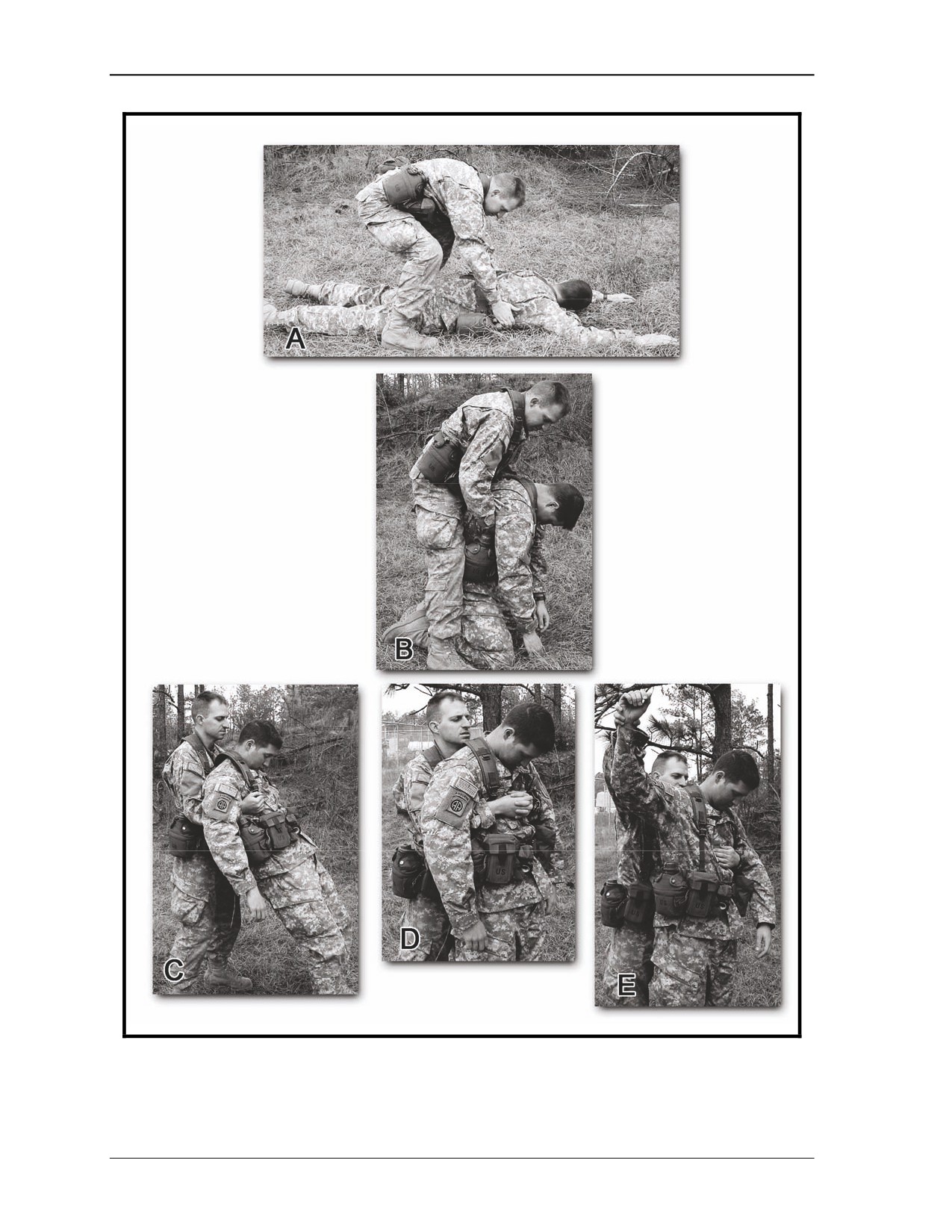
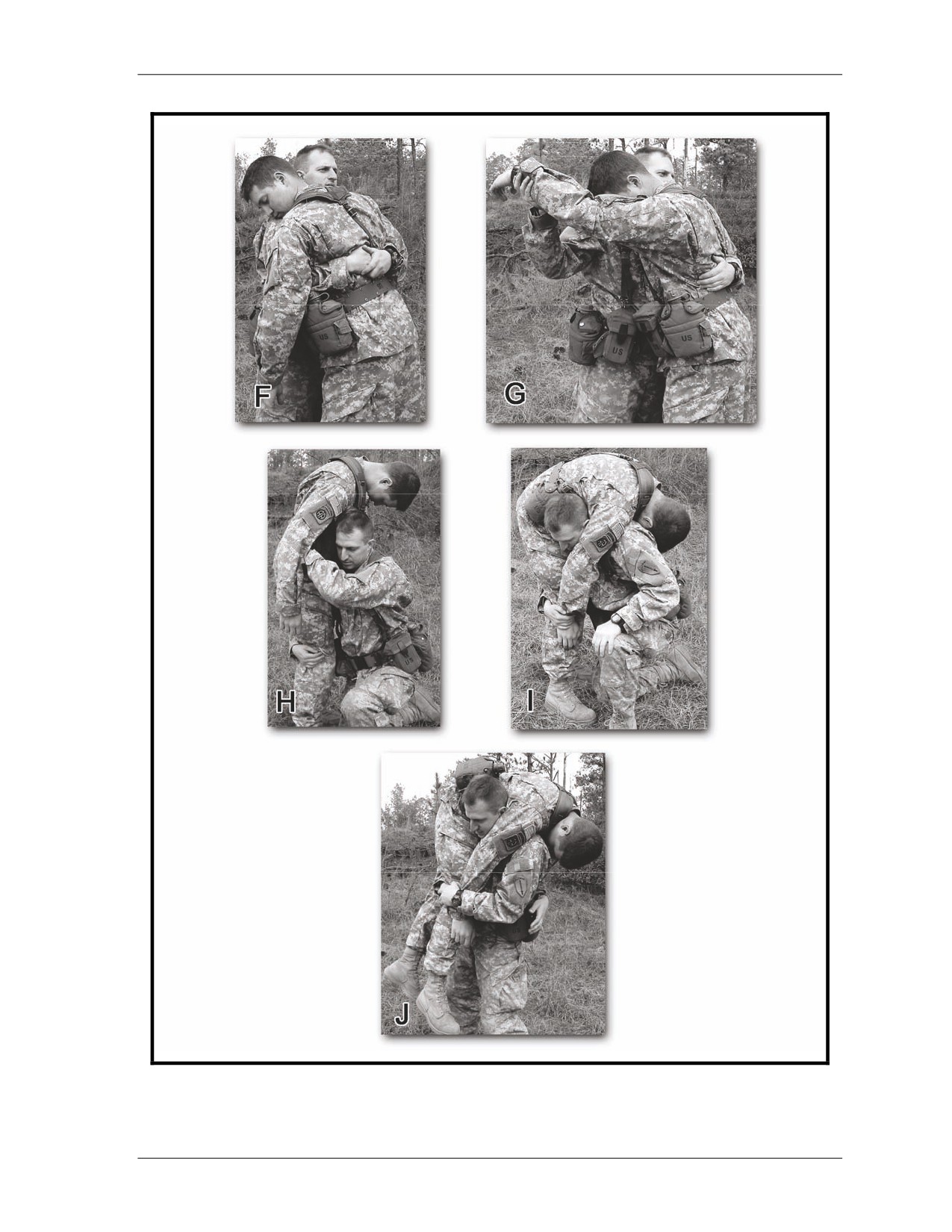
This is one of the easiest ways for one person to carry another. After an unconscious or disabled
casualty has been properly positioned (rolled onto his abdomen), raise him from the ground, and then
support him and place him in the carrying position (Figure 3-40). Here's what you do:
A. Position the casualty by rolling him onto his abdomen and straddle him. Extend your hands
under his chest and lock them together (A, Figure 3-40).
B. Lift him to his knees as you move backward (B, Figure 3-40).
C. Continue to move backward, straightening his legs and locking his knees (C, Figure 3-40).
D. Walk forward, bringing him to a standing position. Tilt him slightly backward to keep his
knees from buckling (D, Figure 3-40).
3-28
FM 3-21.75
28 January 2008
Combat Casualty Care and Preventive Medicine
E. Keep supporting him with one arm, and then free your other arm, quickly grasp his wrist, and
raise his arm high. Immediately pass your head under his raised arm, releasing the arm as you
pass under it (E, Figure 3-40).
F. Move swiftly to face the casualty and secure your arms around his waist. Immediately place
your foot between his feet, and spread them apart about 6 to 8 inches (F, Figure 3-40).
G. Grasp the casualty’s wrist, and raise his arm high over your head (G, Figure 3-40).
H. Bend down and pull the casualty’s arm over and down on your shoulder, bringing his body
across your shoulders. At the same time, pass your arm between his legs (H, Figure 3-40).
I.
Grasp the casualty’s wrist with one hand, and place your other hand on your knee for support
(I, Figure 3-40).
J.
Rise with the casualty positioned correctly. Your other hand should be free (J, Figure 3-40).
28 January 2008
FM 3-21.75
3-29
Chapter 3
Figure 3-40. Fireman’s carry.
3-30
FM 3-21.75
28 January 2008
Combat Casualty Care and Preventive Medicine
Figure 3-40. Fireman’s carry (continued).
28 January 2008
FM 3-21.75
3-31
Chapter 3
Alternate Fireman's Carry
3-64.
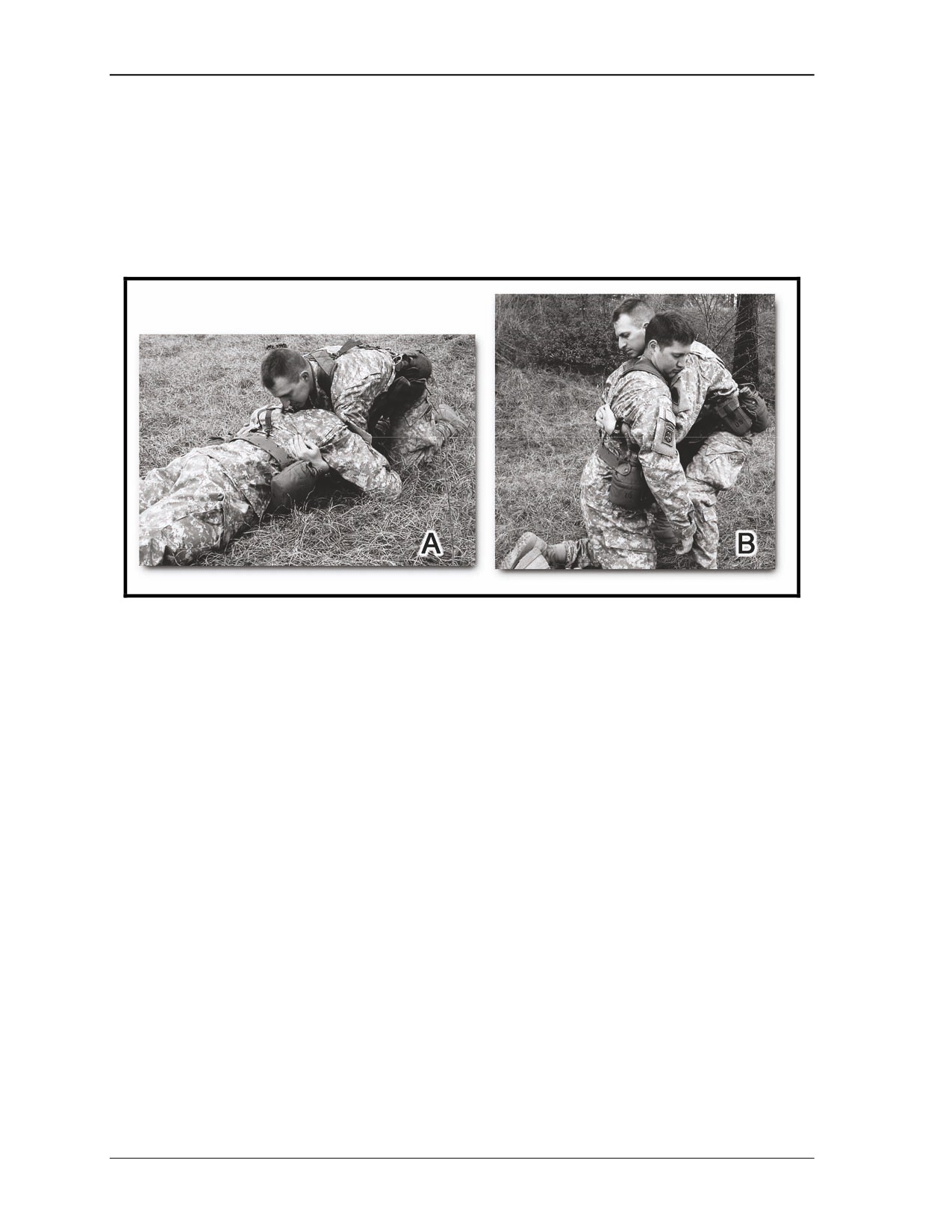
Use this carry only when you think it is safer due to the location of the casualty's wounds. When
you use the alternate carry, take care to keep the casualty’s head from snapping back and injuring his neck.
You can also use this method to raise a casualty from the ground for other one-man carries. First, kneel on
both knees at the casualty’s head and face his feet. Extend your hands under his armpits, down his sides,
and across his back (A, Figure 3-41). Second, as you rise, lift the casualty to his knees. Then secure a lower
hold and raise him to a standing position with his knees locked (B, Figure 3-41).
Figure 3-41. Alternate fireman’s carry.
Supporting Carry
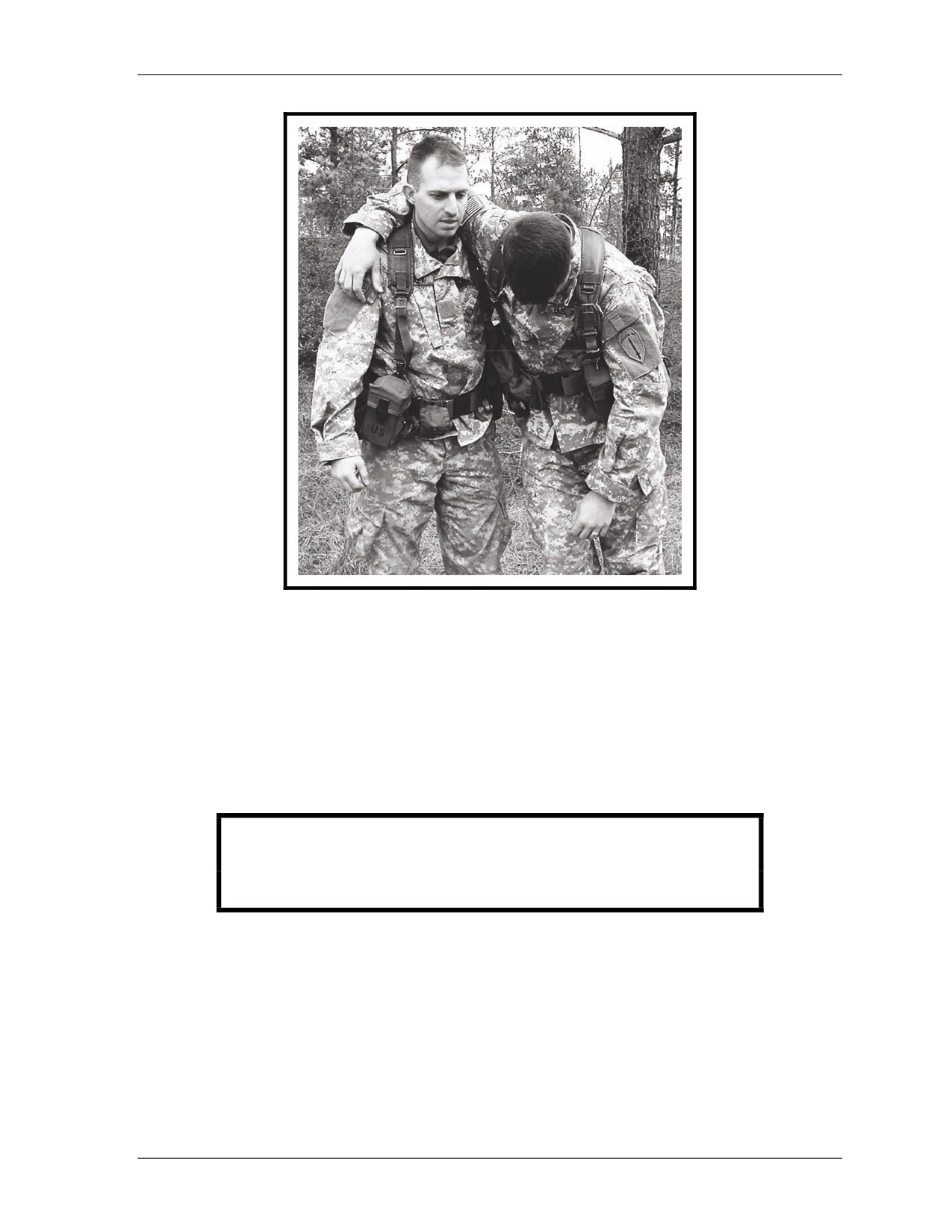
3-65.
With this method (Figure 3-42), the casualty must be able to walk or at least hop on one leg, with
you as a crutch. You can use this carry to help him go as far as he can walk or hop. Raise him from the
ground to a standing position using the fireman’s carry. Grasp his wrist, and draw his arm around your
neck. Place your arm around his waist. This should enable the casualty to walk or hop, with you as
a support.
3-32
FM 3-21.75
28 January 2008
Combat Casualty Care and Preventive Medicine
Figure 3-42. Supporting carry.
Neck Drag
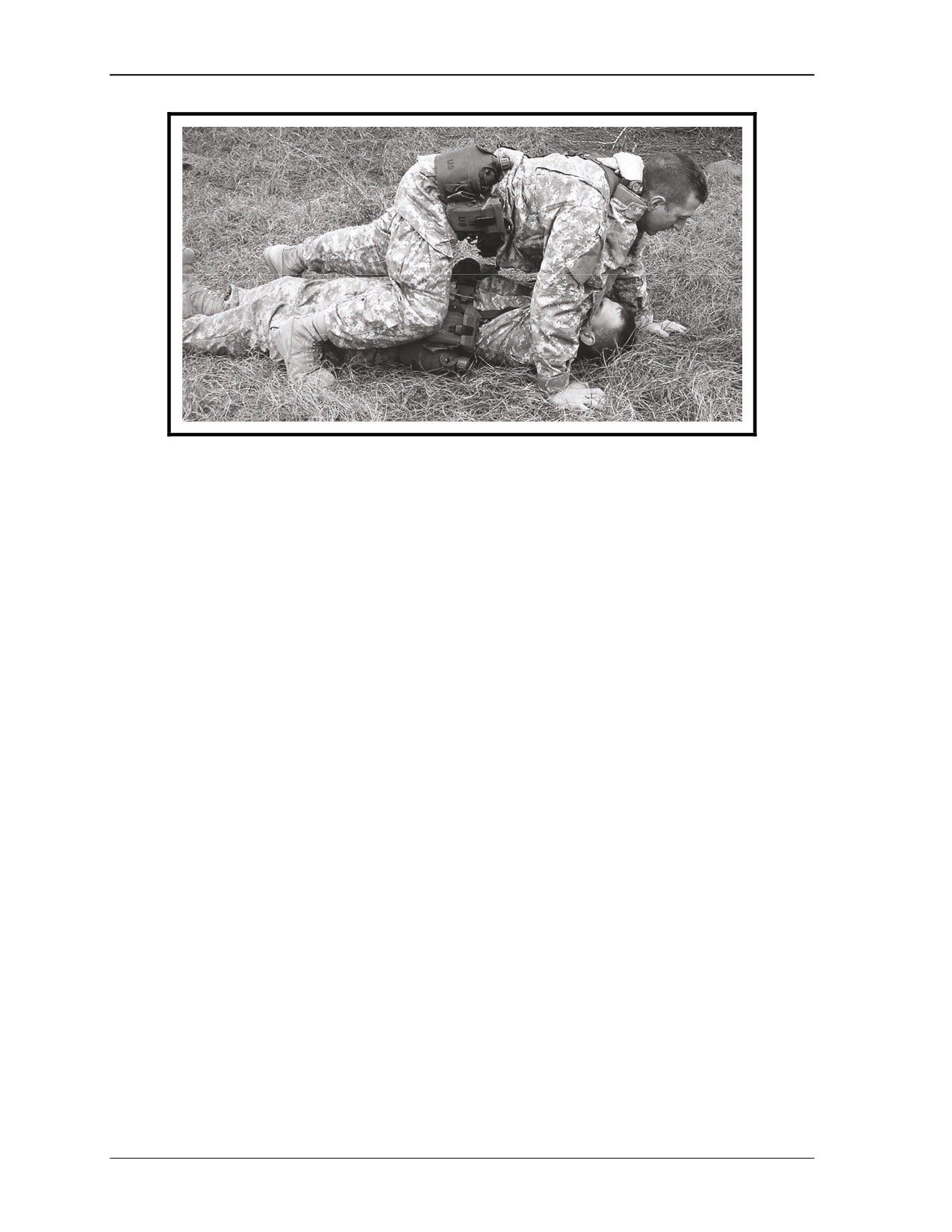
3-66.
This method (Figure 3-43) is useful in combat, because you can carry the casualty as he creeps
behind a low wall or shrubbery, under a vehicle, or through a culvert. If the casualty is conscious, let him
clasp his hands together around your neck. To do this, first tie his hands together at the wrists, and then
straddle him. You should be kneeling, facing the casualty. Second, loop his tied hands over and around
your neck. Third, crawl forward and drag the casualty with you. If he is unconscious, protect his head from
the ground.
WARNING
Avoid using this carry if the casualty has a broken arm.
28 January 2008
FM 3-21.75
3-33
Chapter 3
Figure 3-43. Neck drag.
Cradle-Drop Drag
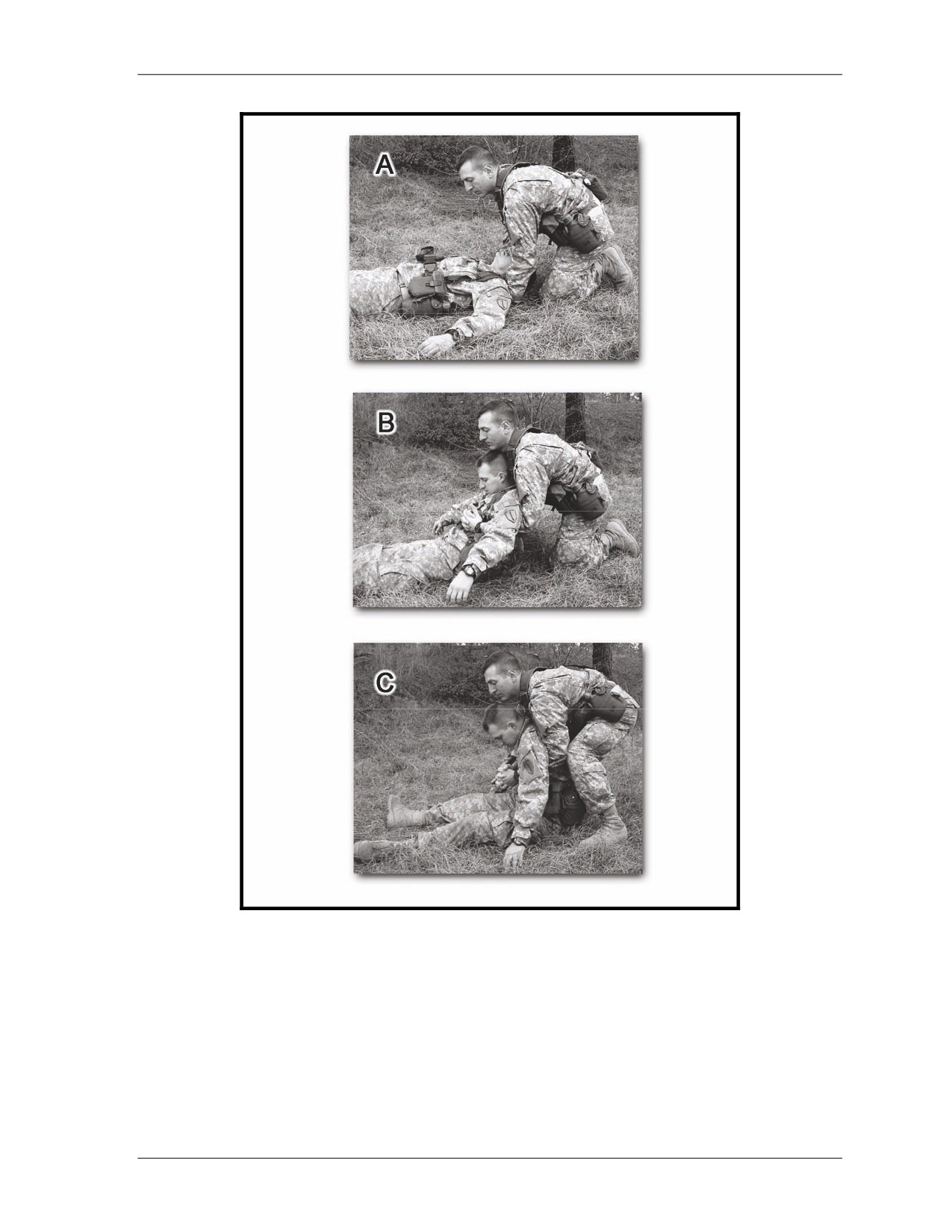
3-67.
Use this method to move a casualty up or down steps. Kneel at the casualty’s head (with him on
his back). Slide your hands, with palms up, under the casualty’s shoulders. Get a firm hold under his
armpits (A, Figure 3-44). Rise partially while supporting the casualty’s head on one of your forearms
(B, Figure 3-44). You may bring your elbows together and let the casualty’s head rest on both of your
forearms. Rise and drag the casualty backward so he is in a semi-seated position (C, Figure 3-44).
3-34
FM 3-21.75
28 January 2008
Combat Casualty Care and Preventive Medicine
Figure 3-44. Cradle drop drag.
28 January 2008
FM 3-21.75
3-35
Chapter 3
TWO-MAN CARRIES
3-68.
Use these when you can. They are more comfortable to the casualty, less likely to aggravate his
injuries, and less tiring for you.
Two-Man Support Carry
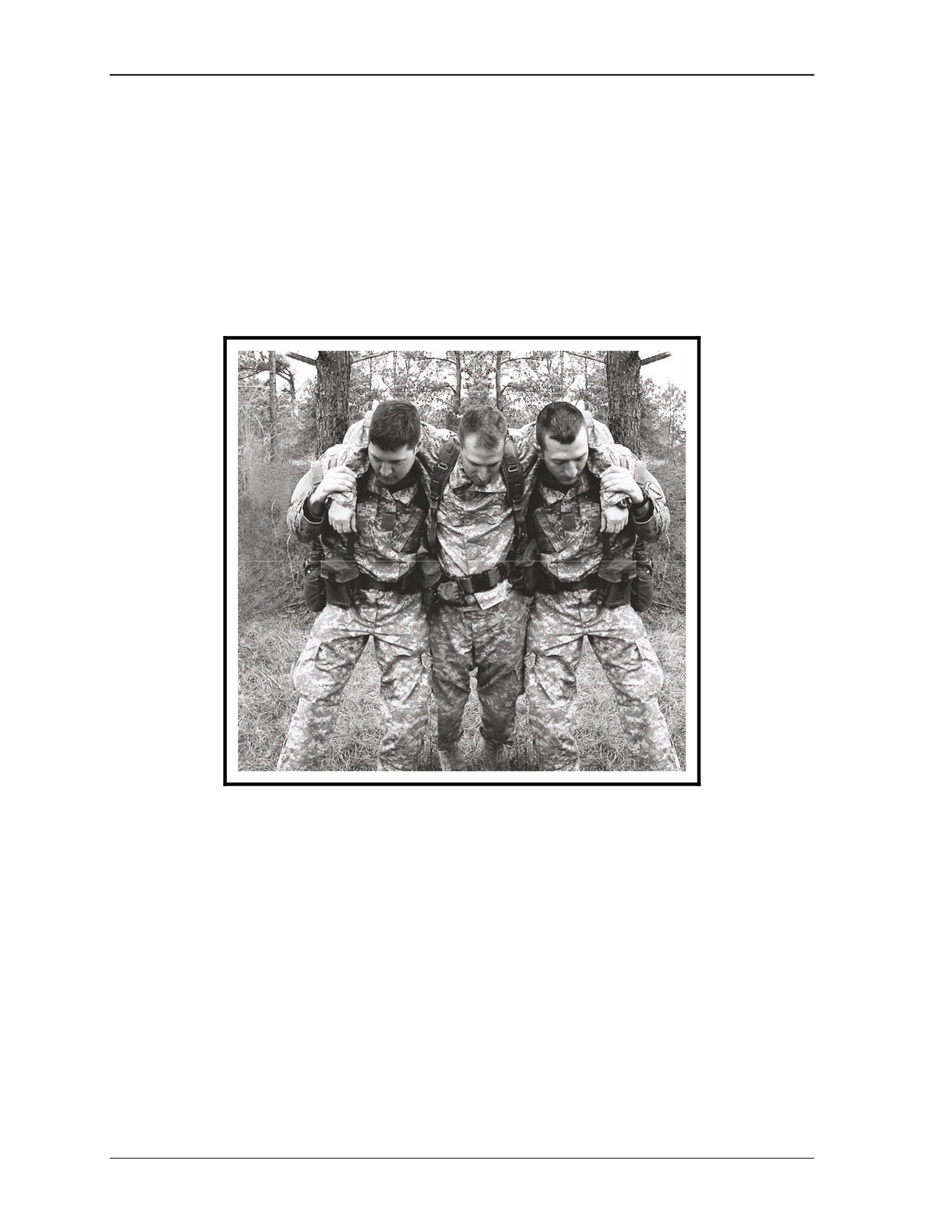
3-69.
Use this method to transport either conscious or unconscious casualties. If the casualty is taller
than you (the bearers), you might have to lift his legs and let them rest on your forearms. Help him to his
feet, and then support him with your arms around his waist (A, Figure 3-45). Then, grasp the casualty’s
wrists and draw his arms around your necks (B, Figure 3-45).
Figure 3-45. Two-man support carry.
Two-Man Fore-and-Aft Carry
3-70.
You can use this to transport a casualty for a long distance, say, over 300 meters. The taller of the
you (the two bearers) should position yourself at the casualty’s head.
3-71.
The shorter of you spreads the casualty’s legs and kneels between them, with your back to the
casualty. Position your hands behind the casualty’s knees. The taller of you kneels at the casualty’s head,
slides your hands under his arms and across his chest, and locks your hands together (A, Figure 3-46).
Both of you should rise together, lifting the casualty (B, Figure 3-46). If you alter this carry so that both of
you are facing the casualty, you can use it to place him on a litter.
3-36
FM 3-21.75
28 January 2008
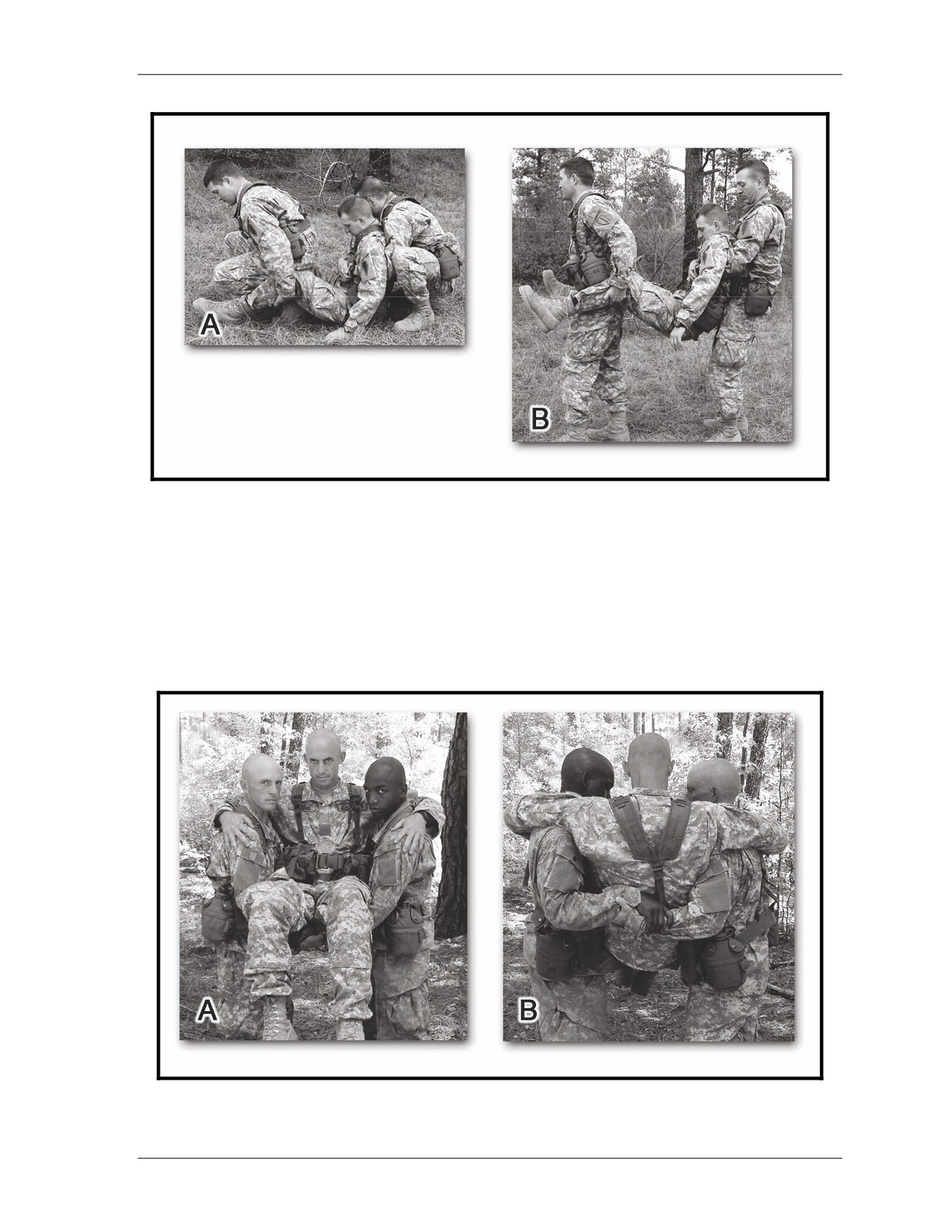
Combat Casualty Care and Preventive Medicine
Figure 3-46. Two-man fore-and-aft carry.
Two-Hand Seat Carry
3-72.
You can use this method to carry a casualty for a short distance or to place him on a litter. With
the casualty lying on his back (A, Figure 3-47), one of you should kneel on one side of the casualty at his
hips, and the other should kneel on the other side. Each of you should pass your arms under the casualty’s
thighs and back, and grasp the other bearer’s wrists. Both of you then rise, lifting the casualty
(B, Figure 3-47).
Figure 3-47. Two-hand seat carry.
28 January 2008
FM 3-21.75
3-37

Chapter 3
IMPROVISED LITTERS
3-73.
Two men can support or carry a casualty without equipment for only short distances. By using
available materials to improvise equipment, two or more rescuers can transport the casualty over
greater distances.
1. Sometimes, a casualty must be moved without a standard litter. The distance might be too
great for a manual carry, or the casualty might have an injury, such as a fractured neck, back,
hip, or thigh, that manual transportation would aggravate. If this happens, improvise a litter
from materials at hand. Construct it well to avoid dropping or further injuring the casualty.
An improvised litter is an emergency measure only. Replace it with a standard litter as soon
as you can.
2. You can improvise many types of litters, depending on the materials available. You can make
a satisfactory litter by securing poles inside such items as ponchos, tarps, jackets, or shirts.
You can improvise poles from strong branches, tent supports, skis, lengths of pipe, or other
objects. If nothing is available to use as a pole, then roll a poncho or similar item from both
sides toward the center, so you can grip the roll(s) and carry the casualty. You can use most
any flat-surfaced object as long as it is the right size, for example, doors, boards, window
shutters, benches, ladders, cots, or chairs. Try to find something to pad the litter for the
casualty’s comfort. You can use either the two-man fore-and-aft carry (Figure 3-46) or the
two-hand seat carry (Figure 3-47) to place the casualty on a litter.
3. Use either two or four service members (head/foot) to lift a litter. Everybody should raise the
litter at the same time to keep the casualty as level as possible.
DANGER
Unless there is an immediate life-threatening situation (such as
fire or explosion), NEVER move a casualty who has a suspected
back or neck injury. Instead, seek medical personnel for guidance
on how to transport him.
WARNING
Use caution when transporting on a sloping incline/hill.
Section II. PREVENTIVE MEDICINE
Personal hygiene and cleanliness practices
(Figure 3-48) safeguard your health and that of others.
Specifically, they--
• Protect against disease-causing germs that are present in all environments.
• Keep disease-causing germs from spreading.
• Promote health among Soldiers.
• Improve morale.
3-38
FM 3-21.75
28 January 2008
Combat Casualty Care and Preventive Medicine
•
Never consume foods and beverages from unauthorized sources.
•
Never soil the ground with urine or feces. Use a latrine or "cat hole."
•
Keep your fingers and contaminated objects out of your mouth.
•
Wash your hands--
-- After any contamination.
-- Before eating or preparing food.
-- Before cleaning your mouth and teeth.
•
Wash all mess gear after each meal or use disposable plastic ware once.
•
Clean your mouth and teeth at least once each day.
•
Avoid insect bites by wearing proper clothing and using insect repellents.
•
Avoid getting wet or chilled unnecessarily.
•
Avoid sharing personal items with other Soldiers, for example--
-- Canteens.
-- Pipes.
-- Toothbrushes.
-- Washcloths.
-- Towels.
-- Shaving gear.
•
Avoid leaving food scraps lying around.
•
Sleep when possible.
•
Exercise regularly.
Figure 3-48. Rules for avoiding illness in the field.
CLOTHING AND SLEEPING GEAR
3-74.
Situation permitting, wash or exchange your clothing when it gets dirty. Do the same with your
sleeping gear. When you cannot do this, at least shake everything out and air it regularly in the sun. This
will reduce the number of germs on them.
CARE OF THE FEET
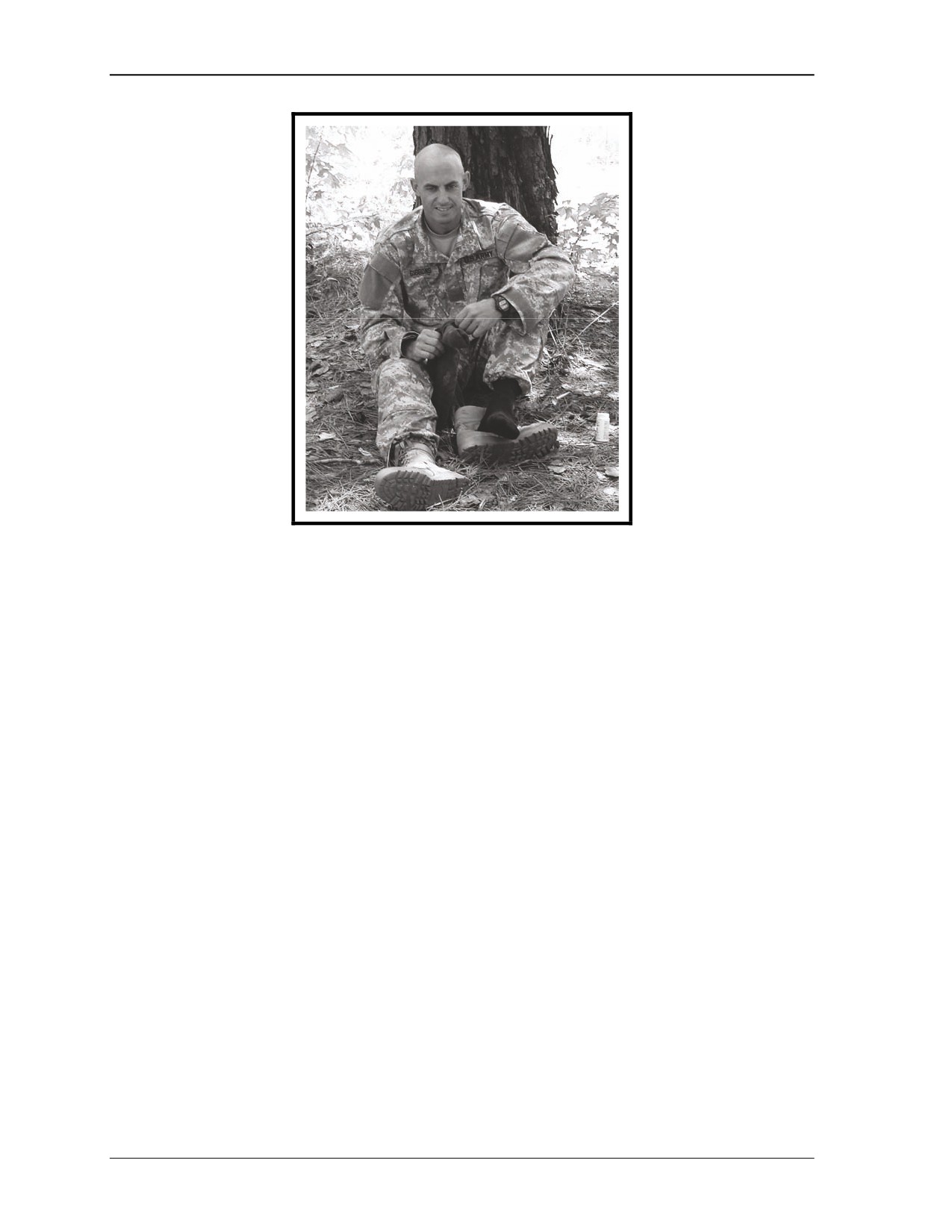
3-75.
Wash and dry your feet at least daily. Use foot powder on your feet to help kill germs, reduce
friction on the skin, and absorb perspiration. Change your socks daily. As soon as you can after you cross a
wet area, dry your feet, put on foot powder, and change socks (Figure 3-49).
28 January 2008
FM 3-21.75
3-39
Chapter 3
Figure 3-49. Care of the feet.
FOOD AND DRINK
3-76.
For proper development, strength, and survival, your body requires proteins, fats, and
carbohydrates. It also requires minerals, vitamins, and water. Issued rations have those essential food
substances in the right amounts and proper balance. So, primarily eat those rations. When feasible, heat
your meals. This will make them taste better and will reduce the energy required to digest them. Avoid
overindulging in sweets, soft drinks, alcoholic beverages, and other non-issued rations. They have little
nutritional value, and are often harmful. Eat food only from approved sources. Drink water only from
approved sources, or treat it with water purification tablets. To do this--
1. Fill your canteen with water, keeping trash and other objects out.
2. Add one purification tablet to a quart of clear water or
3. Add two tablets to a quart of cloudy or very cold water.
4. In the absence of purification tablets, boil water for 5 minutes.
5. Replace the cap loosely.
6. Wait 5 minutes.
7. Shake the canteen well, and let some of the water to leak out.
8. Tighten the cap.
9. Wait 20 more minutes before drinking the water.
MENTAL HEALTH AND MORALE
3-77.
To maintain mental health and self confidence--
MENTAL HYGIENE
3-78.
The way you think affects the way you act. If you know your job, you will probably act quickly
and effectively. If you are uncertain or doubtful of your ability to do your job, you may hesitate and make
3-40
FM 3-21.75
28 January 2008
Combat Casualty Care and Preventive Medicine
wrong decisions. Positive thinking is a necessity. You must enter combat with absolute confidence in your
ability to do your job. Keep in mind that--
• Fear is a basic human emotion. It is mental and physical. In itself, fear is not shameful,
if controlled. It can even help you, by making you more alert and more able to do your job. For
example, a fear-induced adrenaline rush might help you respond and defend yourself or your
comrades quickly during an unpredicted event or combat situation. Therefore, fear can help
you--use it to your advantage.
• Avoid letting your imagination and fear run wild. Remember, you are not alone. You are part
of a team. Other Soldiers are nearby, even though you cannot always see them. Everyone must
help each other and depend on each other.
• Worry undermines the body, dulls the mind, and slows thinking and learning. It adds to
confusion, magnifies troubles, and causes you to imagine things that really do not exist. If you
are worried about something, talk to your leader about it. He might be able to help solve the
problem.
• You might have to fight in any part of the world and in all types of terrain. Therefore, adjust
your mind to accept conditions as they are. If mentally prepared for it, you should be able to
fight under almost any conditions.
EXERCISE
3-79.
Exercise your muscles and joints to maintain your physical fitness and good health. Without
exercise, you might lack the physical stamina and ability to fight. Physical fitness includes a healthy body,
the capacity for skillful and sustained performance, the ability to recover from exertion rapidly, the desire
to complete a designated task, and the confidence to face any possible event. Your own safety, health, and
life may depend on your physical fitness. During lulls in combat, counteract inactivity by exercising. This
helps keep your muscles and body functions ready for the next period of combat. It also helps pass the
time.
REST
3-80.
Your body needs regular periods of rest to restore physical and mental vigor. When you are tired,
your body functions are sluggish, and your ability to react is slower than normal, which makes you more
susceptible to sickness, and to making errors that could endanger you or others. For the best health, you
should get 6 to 8 hours of uninterrupted sleep each day. As that is seldom possible in combat, use rest
periods and off-duty time to rest or sleep. Never be ashamed to say that you are tired or sleepy. However,
never sleep on duty.
28 January 2008
FM 3-21.75
3-41
This page intentionally left blank.
Chapter 4
Environmental Conditions
In today’s Army, Soldiers may deploy and fight anywhere in the world. They may go
into the tropical heat of Central America, the deserts of the Middle East, and the
frozen tundra of Alaska. Each environment presents unique situations concerning a
Soldiers’ performance. Furthermore, physical exertion in extreme environments can
be life threatening. While recognizing such problems are important, preventing them
is even more important; and furthermore, requires an understanding of the
environmental factors that affect performance and how the body responds to
those factors.
Section I. DESERT
Desert terrain, demanding and difficult to traverse, often provides very few landmarks. Furthermore, with cover
and concealment highly limited, the threat of exposure to the enemy is constant. Most arid areas have several
types of terrain.
TYPES
4-1.
The five basic desert types are--
• Mountainous (high altitude).
• Rocky plateaus.
• Sand dunes.
• Salt marshes.
• Broken, dissected terrain (gebels or wadis).
MOUNTAINOUS DESERTS
4-2.
Scattered ranges or areas of barren hills or mountains separated by dry, flat basins characterize
mountainous deserts. High ground may rise gradually or abruptly from flat areas to several
thousand meters above sea level. Most of the infrequent rainfall occurs on high ground and runs off rapidly
in the form of flash floods. These floodwaters erode deep gullies and ravines, and deposit sand and gravel
around the edges of the basins. Water rapidly evaporates, leaving the land as barren as before, although
there may be short-lived vegetation. If enough water enters the basin to compensate for the rate of
evaporation, shallow lakes may develop, such as the Great Salt Lake in Utah or the Dead Sea. Most of
these lakes have a high salt content.
ROCKY PLATEAU DESERTS
4-3.
Rocky plateau deserts have relatively slight relief interspersed with extensive flat areas with
quantities of solid or broken rock at or near the surface. There may be steep-walled, eroded valleys, known
as wadis in the Middle East and arroyos or canyons in the US and Mexico. Although their flat bottoms
may be superficially attractive as assembly areas, the narrower valleys can be extremely dangerous to men
and material due to flash flooding after rains. The Golan Heights is an example rocky plateau desert.
28 January 2008
FM 3-21.75
4-1
Chapter 4
SAND DUNES
4-4.
Sand dune deserts are extensive flat areas covered with sand or gravel. "Flat" is a relative term, as
some areas may contain sand dunes that are over 1,000 feet (300 meters) high and 10 to 15 miles (16 to
24 kilometers) long. Traffic ability in such terrain will depend on the windward or leeward slope of the
dunes and the texture of the sand. However, other areas may be flat for 10,000 feet (3,000 meters) and
more. Plant life may vary from none to scrub over 7 feet (2 meters) high. Examples of this type of desert
include the edges of the Sahara, the empty quarter of the Arabian Desert, areas of California and New
Mexico, and the Kalahari in South Africa.
SALT MARSHES
4-5.
Salt marshes are flat, desolate areas sometimes studded with clumps of grass, but devoid of other
vegetation. They occur in arid areas where rainwater has collected, evaporated, and left large deposits of
alkali salts and water with a high salt concentration. The water is so salty it is undrinkable. A crust that
may be 1 to 12 inches (2.5 to 30 centimeters) thick forms over the saltwater. Arid areas may contain salt
marshes as many as hundreds of kilometers square. These areas usually support many insects, most of
which bite. Avoid salt marshes, as this type of terrain is highly corrosive to boots, clothing, and skin. A
good example salt marsh is the Shatt al Arab waterway along the Iran-Iraq border.
BROKEN AND DISSECTED TERRAIN
4-6.
All arid areas contain broken or highly dissected terrain. Rainstorms that erode soft sand and
carve out canyons form this terrain. A wadi may range from 10 feet (3 meters) wide and 7 feet (2 meters)
deep to several hundred meters wide and deep. The direction a wadi takes varies as much as its width and
depth. It twists and turns in a maze-like pattern. A wadi will give you good cover and concealment, but be
cautious when deciding to try to move through it, because it is very difficult terrain to negotiate.
PREPARATION
4-7.
Surviving in an arid area depends on what you know and how prepared you are for the
environmental conditions.
FACTORS
4-8.
In a desert area, you must consider--
• Low rainfall.
• Intense sunlight and heat.
• Wide temperature range.
• Sparse vegetation.
• High mineral content near ground surface.
• Sandstorms.
• Mirages.
Low Rainfall
4-9.
Low rainfall is the most obvious environmental factor in an arid area. Some desert areas receive
less than 4 inches (10 centimeters) of rain annually. When they do, it comes as brief torrents that quickly
run off the ground surface.
4-2
FM 3-21.75
28 January 2008
Environmental Conditions
Intense Sunlight And Heat
4-10.
Intense sunlight and heat are present in all arid areas. Air temperature can rise as high as 140º F
(60º C) during the day. Heat gain results from direct sunlight, hot blowing sand-laden winds, reflective
heat (the sun’s rays bouncing off the sand), and conductive heat from direct contact with the desert sand
and rock. The temperature of desert sand and rock typically range from 30 to 40º F (16 to 22º C) more than
that of the air. For example, when the air temperature is 110º F (43º C), the sand temperature may be
140º F (60º C). Intense sunlight and heat increase the body’s need for water. Radios and sensitive
equipment items exposed to direct intense sunlight can malfunction.
Wide Temperature Range
4-11.
Temperatures in arid areas may get as high as 130º F (55º C) during the day, and as low as 50º F
(10º C) at night. The drop in temperature at night occurs rapidly and will chill a person who lacks warm
clothing and is unable to move about. The cool evenings and nights are the best times to work or travel.
Sparse Vegetation
4-12.
Vegetation is sparse in arid areas; therefore, you will have trouble finding shelter and
camouflaging your movements. During daylight hours, large areas of terrain are easily visible. If traveling
in hostile territory, follow the principles of desert camouflage:
• Hide or seek shelter in dry washes (wadis) with thick vegetation and cover from oblique
observation.
• Use the shadows cast from brush, rocks, or outcroppings. The temperature in shaded areas will
be 52 to 63º F (11 to 17º C) cooler than the air temperature.
• Cover objects that will reflect the light from the sun.
4-13.
Before moving, survey the area for sites that provide cover and concealment. Keep in mind that it
will be difficult to estimate distance. The emptiness of desert terrain causes most people to underestimate
distance by a factor of three: what appears to be
1/2 mile
(1 kilometer) away is really
1.75 miles
(3 kilometers) away.
Sandstorms
4-14.
Sandstorms (sand-laden winds) occur frequently in most deserts. The Seistan desert wind in Iran
and Afghanistan blows constantly for up to 120 days. In Saudi Arabia, winds can reach 77 mph (128 kph)
in early afternoon. Major sandstorms and dust storms occur at least once a week. The greatest danger is
getting lost in a swirling wall of sand. Wear goggles and cover your mouth and nose with cloth. If natural
shelter is unavailable, mark your direction of travel, lie down, and wait out the storm. Dust and
wind-blown sand interfere with radio transmissions. Therefore, plan to use other means of signaling such
as pyrotechnics, signal mirrors, or marker panels, whichever you have.
Mirages
4-15.
Mirages are optical phenomena caused by the refraction of light through heated air rising from a
sandy or stony surface. Mirages occur in the desert’s interior about 6 miles (10 kilometers) from the coast.
They make objects that are 1 mile (1.5 kilometers) or more away appear to move. This mirage effect makes
it difficult for you to identify an object from a distance. It also blurs distant range contours so much that
you feel surrounded by a sheet of water from which elevations stand out as "islands." The mirage effect
makes it hard for a person to identify targets, estimate range, and see objects clearly. However, if you can
get to high ground 10 feet [3 meters] or more above the desert floor), you can get above the superheated air
close to the ground and overcome the mirage effect. Mirages make land navigation difficult, because they
obscure natural features. You can survey the area at dawn, dusk, or by moonlight when there is little
likelihood of mirage. Light levels in desert areas are more intense than in other geographic areas. Moonlit
28 January 2008
FM 3-21.75
4-3
Chapter 4
nights are usually clear, with excellent visibility, because daytime winds die down and haze and glare
disappear. You can see lights, red flashlights, and blackout lights at great distances. Sound carries very far
as well. Conversely, during nights with little moonlight, visibility is extremely poor. Traveling is extremely
hazardous. You must avoid getting lost, falling into ravines, or stumbling into enemy positions. Movement
during such a night is practical only if you have a means to determine direction and have spent the day
resting; observing and memorizing the terrain; and selecting your route.
NEED FOR WATER
4-16.
Since the early days of World War II, when the US Army was preparing to fight in North Africa,
the subject of Soldier and water in the desert has generated considerable interest and confusion. At one
time, the US Army thought it could condition men to do with less water by progressively reducing their
water supplies during training. This practice of water discipline has caused hundreds of heat casualties. A
key factor in desert survival is understanding the relationship between physical activity, air temperature,
and water consumption. The body requires a certain amount of water for a certain level of activity at a
certain temperature. For example, a person performing hard work in the sun at 109º F (43º C) requires 19
liters
(5 gallons) of water daily. Lack of the required amount of water causes a rapid decline in an
individual’s ability to make decisions and to perform tasks efficiently. Your body’s normal temperature is
98.6º F (36.9º C). Your body gets rid of excess heat (cools off) by sweating. The warmer your body
becomes—whether caused by work, exercises, or air temperature—the more you sweat. The more you
sweat the more moisture you lose. Sweating is the principal cause of water loss. If you stop sweating
during periods of high-air temperature, heavy work, or exercise, you will quickly develop heat stroke and
require immediate medical attention. Understanding how the air temperature and your physical activity
affect your water requirements allows you to take measures to get the most from your water supply. These
measures are--
• Find shade and get out of the sun!
• Place something between you and the hot ground.
• Limit your movements!
• Conserve your sweat. Wear your complete uniform to include T-shirt. Roll the sleeves down,
cover your head, and protect your neck with a scarf or similar item. These steps will protect
your body from hot-blowing winds and the direct rays of the sun. Your clothing will absorb
your sweat, keeping it against your skin so that you gain its full cooling effect.
4-17.
Thirst is not a reliable guide for your need for water. A person who uses thirst as a guide will
drink only two thirds of his daily water requirement. Drinking water at regular intervals helps your body
remain cool and decreases sweating. Even when your water supply is low, sipping water constantly will
keep your body cooler and reduce water loss through sweating. Conserve your fluids by reducing activity
during the heat of day if possible. To prevent this voluntary dehydration, use the following guide:
4-4
FM 3-21.75
28 January 2008
Environmental Conditions
• Below 100º F (38º C), drink 0.5 liter of water every hour.
• Above 100º F (38º C), drink 1 liter of water every hour.
HAZARDS
4-18.
Several hazards are unique to the desert environment. These include insects, snakes, thorny plants
and cacti, contaminated water, sunburn, eye irritation, and climatic stress. Insects of almost every type
abound in the desert. Man, as a source of water and food, attracts lice, mites, wasps, and flies. Insects are
extremely unpleasant and may carry diseases. Old buildings, ruins, and caves are favorite habitats of
spiders, scorpions, centipedes, lice, and mites. These areas provide protection from the elements and attract
other wildlife. Therefore, take extra care when staying in these areas. Wear gloves at all times in the desert.
Do not place your hands anywhere without first looking to see what is there. Visually inspect an area
before sitting or lying down. When you get up, shake out and inspect your boots and clothing. All desert
areas have snakes. They inhabit ruins, native villages, garbage dumps, caves, and natural rock outcroppings
that offer shade. Never go barefoot or walk through these areas without carefully inspecting them for
snakes. Pay attention to where you place your feet and hands. Most snakebites result from stepping on or
handling snakes. Avoid them. Once you see a snake, give it a wide berth.
Section II. JUNGLE
The jungle comprises a substantial portion of the earth’s land mass. Jungle environments consist of tall
grasslands; mountains; swamps; blue and brown water; and single/double-canopy vegetation. Jungle
environments are prominent in South America, Asia, and Africa. High temperatures, heavy rainfall, and
oppressive humidity characterize equatorial and subtropical regions, except at high altitudes. At low altitudes,
temperature variation is seldom less than 50º F (10º C) and is often more than 95º F (35º C). At altitudes over
4,921 feet (1,500 meters), ice often forms at night. The rain has a cooling effect, but stops when the temperature
soars. Rainfall is heavy, often with thunder and lightning. Sudden rain beats on the tree canopy, turning trickles
into raging torrents and causing rivers to rise. Just as suddenly, the rain stops. Violent storms may occur,
usually toward the end of the summer months. The dry season has rain once a day and the monsoon has
continuous rain. In Southeast Asia, winds from the Indian Ocean bring the monsoon but the area is dry when
the wind blows from the landmass of China. Tropical day and night are of equal length. Darkness falls quickly
and daybreak is just as sudden. Leaders must consider several jungle subtypes and other factors when
performing duty and surviving in the jungle:
TYPES
4-19.
There is no standard type of jungle. Jungle can consist of any combination of the following terrain
subtypes:
28 January 2008
FM 3-21.75
4-5
Chapter 4
• Rain forests.
• Secondary jungles.
• Semi-evergreen seasonal and monsoon forests.
• Scrub and thorn forests.
• Savannas.
• Saltwater swamps.
• Freshwater swamps.
TROPICAL RAIN FORESTS
4-20.
The climate varies little in rain forests. You find these forests across the equator in the Amazon
and Congo basins, parts of Indonesia, and several Pacific islands. Up to 144 inches (365.8 centimeters) of
rain falls throughout the year. Temperatures range from about 90º F (32º C) in the day to 70º F (21º C) at
night. There are five layers of vegetation in this jungle. Sometimes still untouched by humans, jungle trees
rise from buttress roots to heights of 198 feet (60 meters). Below them, smaller trees produce a canopy so
thick that little light reaches the jungle floor. Seedlings struggle to reach light, and masses of vines twine
their way to the sun. Ferns, mosses, and herbaceous plants push through a thick carpet of leaves, and fungi
adorn leaves and fallen trees. The darkness of the jungle floor limits growth, which aids in movement.
Little undergrowth is present to hamper movement, but dense growth limits visibility to about 55 yards
(50 meters). You can easily lose your sense of direction in a tropical rain forest, and aircraft have a hard
time seeing you.
SECONDARY JUNGLES
4-21.
Secondary jungle is very similar to rain forest. Prolific growth, where sunlight penetrates to the
jungle floor, typifies this type of forest. Such growth happens mainly along riverbanks, on jungle fringes,
and where Soldiers have cleared rain forested areas. When abandoned, tangled masses of vegetation
quickly reclaim these cultivated areas. You can often find cultivated food plants among secondary jungles.
SEMI-EVERGREEN SEASONAL AND MONSOON FORESTS
4-22.
The characteristics of the American and African semi-evergreen seasonal forests correspond with
those of the Asian monsoon forests:
• Their trees fall into two stories of tree strata.
-- Upper story
60 to 79 feet (18 to 24 meters)
-- Lower story 23 to 43 feet (7 to 13 meters)
• The diameter of the trees averages 2 feet (0.5 meter).
• Their leaves fall during a seasonal drought.
4-23.
Except for the sago, nipa, and coconut palms, the same edible plants grow in these areas as in the
tropical rain forests. You find these forests in portions of Columbia and Venezuela and the Amazon basin
in South America; in southeast coastal Kenya, Tanzania, and Mozambique in Africa; in northeastern India,
much of Burma, Thailand, Indochina, Java, and parts of other Indonesian islands in Asia.
TROPICAL SCRUB AND THORN FORESTS
4-24.
Tropical scrub and thorn forests exist on the West coast of Mexico, on the Yucatan peninsula, in
Venezuela, and in Brazil; on the Northwest coast and central parts of Africa; and (in Asia) in Turkistan and
India. Food plants are scarce during the dry season, and more abundant during the rainy season. The chief
characteristics of tropical scrub and thorn forests include--
4-6
FM 3-21.75
28 January 2008
Environmental Conditions
• They have a definite dry season.
• Trees are leafless during the dry season.
• Ground is bare, except for a few tufted plants in bunches
• Grasses are uncommon.
• Plants with thorns predominate.
• Fires occur frequently.
TROPICAL SAVANNAS
4-25.
South American savannas occur in parts of Venezuela, Brazil, and Guiana. In Africa, they occur
in the southern Sahara (North central Cameroon and Gabon, and Southern Sudan); Benin; Togo; most of
Nigeria; the Northeastern Republic of Congo; Northern Uganda; Western Kenya; and parts of Malawi and
Tanzania, Southern Zimbabwe, Mozambique, and Western Madagascar. A savanna generally--
• Exists in the tropical zones of South America and Africa.
• Looks like a broad, grassy meadow, with trees spaced at wide intervals.
• Has lots of red soil.
• Grows scattered, stunted, and gnarled trees (like apple trees) as well as palm trees.
SALTWATER SWAMPS
4-26.
Saltwater swamps are common in coastal areas subject to tidal flooding. Mangrove trees thrive in
these swamps, and can grow to 39 feet (12 meters). In saltwater swamps, visibility is poor, and movement
is extremely difficult. Sometimes, raftable streams form channels, but foot travel is usually required.
Saltwater swamps exist in West Africa, Madagascar, Malaysia, the Pacific islands, Central and South
America, and at the mouth of the Ganges River in India. Swamps at the mouths of the Orinoco and
Amazon Rivers, and of the rivers of Guyana, offer plenty of mud and trees, but little shade. Tides in
saltwater swamps can vary as much as 3 feet (0.9 meter). Advice for this terrain is, try to avoid the leeches,
the various insects, including no-see-ums, and crocodiles and caimans. If you can, avoid saltwater swamps.
However, if they have suitable water channels, you might be able to traverse them by raft, canoe, or rubber
boat.
FRESHWATER SWAMPS
4-27.
Freshwater swamps exist in some low-lying inland areas. They have masses of thorny
undergrowth, reeds, grasses, and occasional short palms. These all reduce visibility and make travel
difficult. Freshwater swamps are dotted with large and small islands, allowing you to get out of the water.
Wildlife is abundant in freshwater swamps.
PREPARATION
4-28.
Success in the jungle depends on your level of applicable knowledge and preparation.
TRAVEL THROUGH JUNGLE AREAS
4-29.
With practice, you can move through thick undergrowth and jungle efficiently. Always wear long
sleeves to avoid cuts and scratches.
"Jungle Eye"
4-30.
To move easily, you must develop a "jungle eye." That is, look through the natural breaks in
foliage rather than at the foliage itself. Stoop down occasionally to look along the jungle floor.
28 January 2008
FM 3-21.75
4-7
Chapter 4
Game Trails
4-31.
You may find game trails you can follow. Stay alert and move slowly and steadily through dense
forest or jungle. Stop periodically to listen and reorient on your objective. Many jungle and forest animals
follow game trails. These trails wind and cross, but frequently lead to water or clearings. Use these trails if
they lead in your desired direction of travel. However, they may also be favorite enemy points for
ambushes and booby traps.
Machete
4-32.
Use a machete to cut through dense vegetation, but avoid cutting too much, or you will tire
quickly. If using a machete, stroke upward when cutting vines to reduce noise, because sound carries long
distances in the jungle.
Stick
4-33.
Use a stick to part the vegetation and to help dislodge biting ants, spiders, or snakes. Never grasp
brush or vines when climbing slopes, because they may have irritating spines, sharp thorns, biting insects,
and snakes.
Power and Telephone Lines
4-34.
In many countries, electric and telephone lines run for miles through sparsely inhabited areas.
Usually, the right-of-way is clear enough to allow easy travel. When traveling along these lines, be careful
as you approach a transformer and relay stations, because they may be guarded.
WATER PROCUREMENT
4-35.
Although water is abundant in most tropical environments, you may have trouble finding it, and
when you do, it may not be safe to drink. Vines, roots, palm trees, and condensation are just a few of the
many sources of water. You can sometimes follow animals to water. Often you can get nearly clear water
from muddy streams or lakes by digging a hole in sandy soil about 3 feet (1 meter) from the bank. Water
will then seep into the hole. Remember, you must purify any water you get this way.
POISONOUS PLANTS
4-36.
The proportion of poisonous plants in tropical regions is no greater than in any other area of the
world. However, it may appear that most plants in the tropics are poisonous, due to preconceived notions
and the density of plant growth in some tropical areas.
4-8
FM 3-21.75
28 January 2008
Environmental Conditions
Section III. ARCTIC
Cold regions include arctic and subarctic areas, and areas immediately adjoining them. About 48 percent of the
Northern hemisphere’s total land mass is a cold region, due to the influence and range of air temperatures.
Ocean currents affect cold weather and cause large areas normally included in the temperate zone to fall within
the cold regions during winter periods. Elevation also has a marked effect on defining cold regions. Within the
cold weather regions, you may face two types of cold weather environments—wet or dry. Knowing which
environment your area of operation
(AO) falls in will affect planning and execution of a cold
weather operation.
TYPES
4-37.
The two types of arctic climates are wet-cold and dry-cold.
WET-COLD WEATHER ENVIRONMENTS
4-38.
Wet-cold weather conditions exist when the average temperature in a 24-hour period is 14º F
(-10º C) or above. Characteristics of this condition include freezing temperatures at night and slightly
warmer temperatures during the day. Although temperatures in a wet-cold environment are warmer than
those in a dry-cold environment, the terrain is usually very sloppy due to slush and mud. Protect yourself
from the wet ground, freezing rain, and wet snow.
DRY-COLD WEATHER ENVIRONMENTS
4-39.
Dry-cold weather conditions exist when the average temperature in a 24-hour period remains
below 14º F (-10º C). Even though these temperatures are much lower than normal, you can avoid freezing
and thawing. In temperatures down to -76º F (-60º C), wear extra layers of inner clothing. Wind and low
temperatures are an extremely hazardous combination.
PREPARATION
4-40.
Success in the arctic begins with preparedness:
WIND CHILL
4-41.
Wind chill increases the hazards in cold regions. It is the effect of moving air on exposed flesh.
For example, with a 15 knot (27.8 kmph) wind and a temperature of -14º F (-10º C), the equivalent wind
chill temperature is -9º F (-23 degrees C). Remember, even when no wind is blowing, your own movement,
such as during skiing, running, creates "apparent" wind, will create the equivalent wind by skiing, running,
being towed on skis behind a vehicle, or working around aircraft that produce windblasts.
TRAVEL
4-42.
Soldiers will find it almost impossible to travel in deep snow without snowshoes or skis.
Traveling by foot leaves a well-marked trail for pursuers to follow. If you must travel in deep snow, avoid
snow-covered streams. The snow, which acts as an insulator, may have prevented ice from forming over
the water. In hilly terrain, avoid areas where avalanches appear possible. On ridges, snow gathers on the
lee side in overhanging piles called cornices. These often extend far out from the ridge and may break
loose if stepped on.
28 January 2008
FM 3-21.75
4-9
Chapter 4
WATER
4-43.
Many sources of water exist in the arctic and subarctic. Your location and the season of the year
will determine where and how you obtain water. Water sources in arctic and subarctic regions are more
sanitary than in other regions due to the climatic and environmental conditions. However, always purify
water before drinking it. During the summer months, the best natural sources of water are freshwater lakes,
streams, ponds, rivers, and springs. Water from ponds or lakes may be slightly stagnant but still usable.
Running water in streams, rivers, and bubbling springs is usually fresh and suitable for drinking.
4-10
FM 3-21.75
28 January 2008
PART TWO
Soldier Combat Skills
Chapter 5
Cover, Concealment, and Camouflage
If the enemy can see you and you are within range of his weapon system, he can
engage and possibly kill you. So, you must be concealed from enemy observation
and have cover from enemy fire. When the terrain does not provide natural cover and
concealment, you must prepare your cover and use natural and man-made materials
to camouflage yourself, your equipment, and your position. This chapter provides
guidance on the preparation and use of cover, concealment, and camouflage, except
for fighting positions, which are covered in Chapter 6.
Section I. COVER
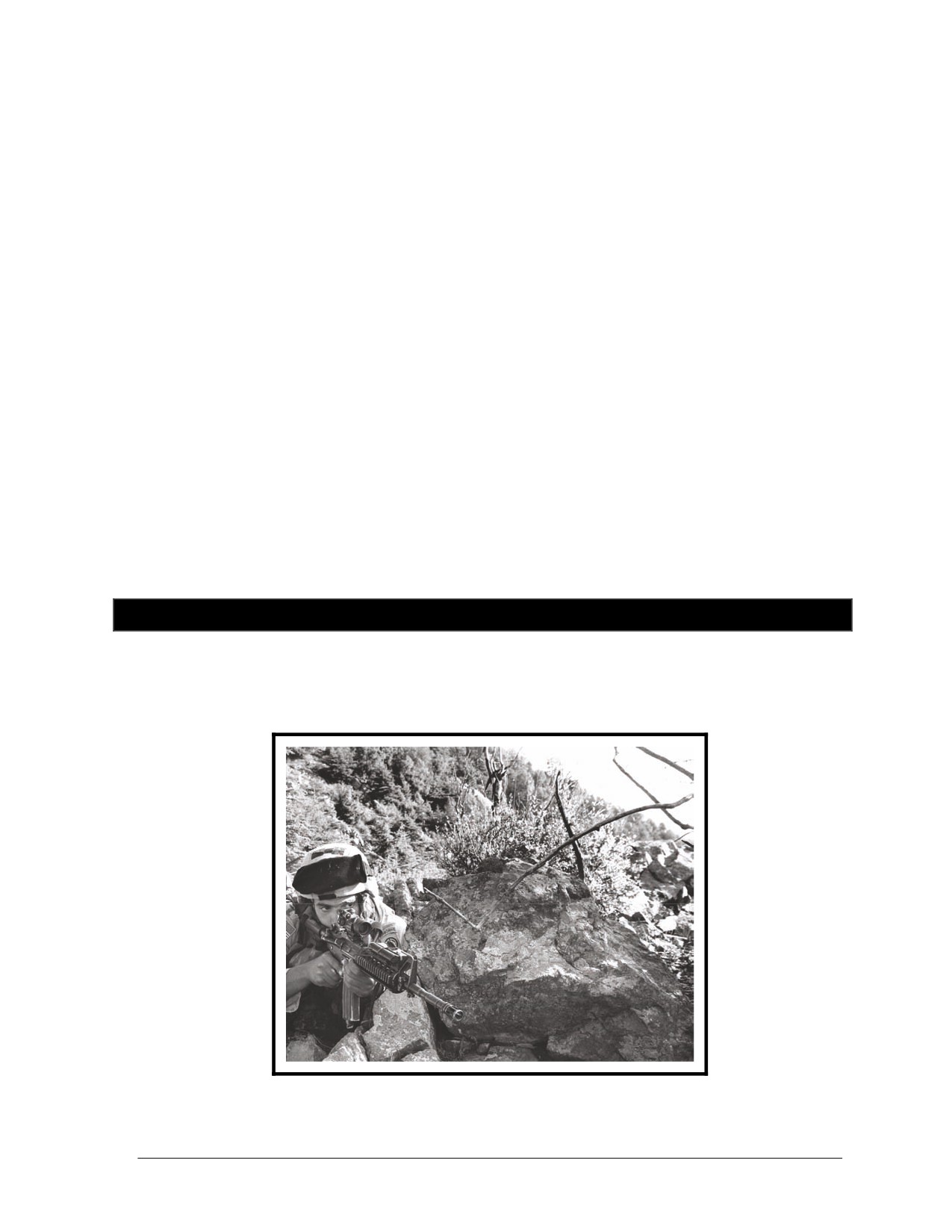
Cover, made of natural or man-made materials, gives protection from bullets, fragments of exploding rounds,
flame, nuclear effects, biological and chemical agents, and enemy observation
(Figure 5-1).
(Chapter 6
discusses cover for fighting positions.)
Figure 5-1. Natural cover.
28 January 2008
FM 3-21.75
5-1
Chapter 5
NATURAL COVER
5-1.
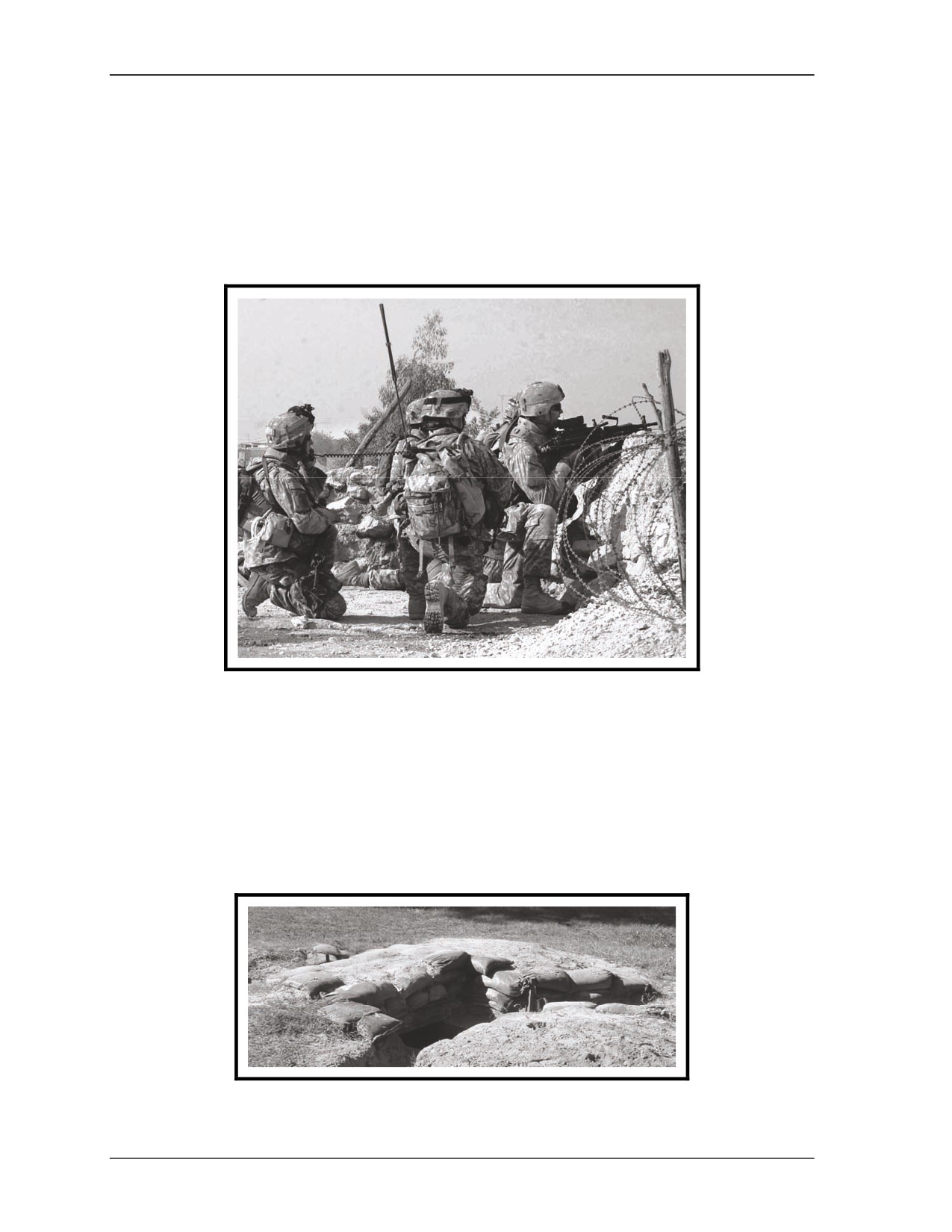
Natural cover includes logs, trees, stumps, rocks, and ravines; whereas, man-made cover includes
fighting positions, trenches, walls, rubble, and craters. To get protection from enemy fire in the offense or
when moving, use routes that put cover between you and the enemy. For example, use ravines, gullies,
hills, wooded areas, walls, and any other cover that will keep the enemy from seeing and firing at you
(Figure 5-2). Avoid open areas. Never skyline yourself on a hilltop or ridge. Any cover--even the smallest
depression or fold in the ground--can help protect you from direct and indirect enemy fire.
Figure 5-2. Cover along a wall.
MAN-MADE COVER
5-2.
Man-made cover includes fighting positions and protective equipment.
FIGHTING POSITION
5-3.
See Chapter 6 for a detailed discussion of fighting positions (Figure 5-3).
Figure 5-3. Man-made cover.
5-2
FM 3-21.75
28 January 2008
Cover, Concealment, and Camouflage
PROTECTIVE EQUIPMENT
5-4.
Man-made cover can also be an article of protective equipment that can be worn such as body
armor and helmet (Figure 5-4). Body armor is protective equipment that works as a form of armor to
minimize injury from fragmentation and bullets. The interceptor body armor (IBA) system has an outer
tactical vest (OTV) which is lined with finely woven Kevlar that will stop a 9-mm round and other slower
moving fragments. It also has removable neck, throat, shoulder, and groin protection. Two small-arms
protective inserts may also be added to the front and back of the vest, with each plate designed to stop
7.62-mm rounds. The plates are constructed of boron carbide ceramic with a shield backing that breaks
down projectiles and halts their momentum. The vest also meets stringent performance specifications
related to flexibility and heat stress requirements. The advanced combat helmet (ACH) provides protection
against fragmentation and bullets, as well as heat and flame in a balanced and stable configuration.
Figure 5-4. Body armor and helmet.
SIMPLIFIED COLLECTIVE PROTECTION EQUIPMENT
5-5.
The M20 simplified collective protection equipment (SCPE) is an inflatable shelter that provides
cover against chemical/biological warfare agents and radioactive particles
(Figure 5-5). The SCPE
provides a clean-air environment in a structure where you can perform your duties, without wearing
individual protective equipment.
Figure 5-5. Protective cover against chemical/biological warfare agents.
28 January 2008
FM 3-21.75
5-3