FM 3-21.75 The Warrior Ethos and Soldier Combat Skills (JANUARY 2008) - page 1
*FM 3-21.75 (FM 21-75)
Headquarters
Field Manual
Department of the Army
No. 3-21.75 (21-75)
Washington, DC, 28 January 2008
The Warrior Ethos
and
Soldier Combat Skills
Contents
Page
Preface
xii
Summary of Change
xiii
PART ONE. WARRIOR ETHOS
Chapter 1
INTRODUCTION
1-1
Operational Environment
1-1
Army Values
1-2
Law of Land Warfare
1-3
Warrior Culture
1-3
Battle Drill
1-3
Warrior Drills
1-3
Chapter 2
INDIVIDUAL READINESS
2-1
Predeployment
2-1
Legal Assistance
2-1
Personal Weapon
2-3
Chapter 3
COMBAT CARE AND PREVENTIVE MEDICINE
3-1
Section I. COMBAT CASUALTY CARE
3-1
Combat Lifesaver
3-1
Lifesaving Measures (First Aid)
3-2
Casualty Evacuation
3-28
Section II. PREVENTIVE MEDICINE
3-38
Clothing and Sleeping Gear
3-39
Mental Health and Morale
3-40
Distribution Restriction: Approved for public release; distribution is unlimited.
*This publication supersedes FM 21-75, 3 August 1984.
FM 3-21.75
i
Contents
Chapter 4
ENVIRONMENTAL CONDITIONS
4-1
Section I. DESERT
4-1
Types
4-1
Preparation
4-2
Section II. JUNGLE
4-5
Types
4-5
Preparation
4-7
Section III. ARCTIC
4-9
Types
4-9
Preparation
4-9
PART TWO. SOLDIER COMBAT SKILLS
Chapter 5
COVER, CONCEALMENT, AND CAMOUFLAGE
5-1
Section I. COVER
5-1
Natural Cover
5-2
Man-Made Cover
5-2
Section II. CONCEALMENT
5-4
Natural Concealment
5-4
Actions as Concealment
5-4
Section III. CAMOUFLAGE
5-5
Movement
5-5
Positions
5-5
Outlines and Shadows
5-5
Shine
5-5
Shape
5-5
Colors
5-6
Dispersion
5-6
Preparation
5-6
Individual Techniques
5-7
Chapter 6
FIGHTING POSITIONS
6-1
Cover
6-1
Concealment
6-3
Camouflage
6-3
Sectors and Fields of Fire
6-3
Hasty and Deliberate Fighting Positions
6-4
Two-Man Fighting Position
6-6
One-Man Fighting Position
6-17
Close Combat Missile Fighting Positions
6-20
Range Cards
6-22
Chapter 7
MOVEMENT
7-1
Individual Movement Techniques
7-1
Immediate Actions while Moving
7-5
Fire and Movement
7-8
Movement on Vehicles
7-9
ii
FM 3-21.75
28 January 2008
Contents
Chapter 8
URBAN AREAS
8-1
Section I. MOVEMENT TECHNIQUES
8-1
Avoiding Open Areas
8-1
Moving Parallel to Buildings
8-1
Moving Past Windows
8-2
Crossing a Wall
8-3
Moving Around Corners
8-4
Moving Within a Building
8-5
Section II. OTHER PROCEDURES
8-6
Entering a Building
8-6
Clearing a Room
8-10
Section III. FIGHTING POSITIONS
8-12
Hasty Fighting Position
8-13
Prepared Fighting Position
8-15
Chapter 9
'EVERY SOLDIER IS A SENSOR'
9-1
Definition
9-1
Resources
9-1
Forms of Questioning
9-3
Report Levels
9-3
SALUTE Format
9-4
Handling and Reporting of the Enemy
9-5
Operations Security
9-7
Observation Techniques
9-8
Limited Visibility Observation
9-9
Range Estimation
9-14
Chapter 10
COMBAT MARKSMANSHIP
10-1
Safety
10-1
Administrative Procedures
10-1
Weapons
10-2
Fire Control
10-14
Combat Zero
10-16
Mechanical Zero
10-16
Battlesight Zero
10-17
Shot Groups
10-19
Borelight Zero
10-21
Misfire Procedures and Immediate Action
10-31
Reflexive Fire
10-33
Chapter 11
COMMUNICATIONS
11-1
Section I. MEANS OF COMMUNICATIONS
11-1
Messengers
11-1
Wire
11-1
Visual Signals
11-3
Sound
11-3
Radio
11-3
28 January 2008
FM 3-21.75
iii
Contents
Section II. RADIOTELEPHONE PROCEDURES
11-4
Rules
11-4
Types of Nets
11-4
Precedence of Reports
11-4
Message Format
11-5
Common Messages
11-5
Prowords
11-6
Operation on a Net
11-8
Section III. COMMUNICATIONS SECURITY
11-8
Classifications
11-8
Signal Operating Instructions
11-9
Automated Net Control Device
11-9
Section IV. EQUIPMENT
11-11
Radios
11-11
Wire
11-14
Telephone Equipment
11-14
Chapter 12
SURVIVAL, EVASION, RESISTANCE, AND ESCAPE
12-1
Survival
12-1
Evasion
12-4
Resistance
12-6
Escape
12-8
Chapter 13
CHEMICAL, BIOLOGICAL, RADIOLOGICAL, OR NUCLEAR WEAPONS
13-1
Section I. CHEMICAL WEAPONS
13-1
Types
13-1
Detection
13-4
Protective Actions
13-8
Protective Equipment
13-8
Mission-Oriented Protective Posture
13-10
Decontamination
13-10
Section II. BIOLOGICAL WEAPONS
13-14
Types
13-14
Detection
13-14
Decontamination
13-14
Protection
13-14
Section III. RADIOLOGICAL WEAPONS
13-15
Types
13-15
Detection
13-16
Decontamination
13-16
Protection
13-16
Section IV. NUCLEAR WEAPONS
13-17
Characteristics
13-17
Detection
13-18
Decontamination
13-19
Protection
13-20
iv
FM 3-21.75
28 January 2008
Contents
Chapter 14
MINES, DEMOLITIONS, AND BREACHING PROCEDURES
14-1
Section I. MINES
14-1
Antipersonnel Mines
14-2
M21 Antitank Mine
14-7
Section II. DEMOLITION FIRING SYSTEMS
14-8
Booster Assemblies
14-8
Misfires
14-13
Section III. OBSTACLES
14-14
Breach and Cross a Minefield
14-14
Breach and Cross a Wire Obstacle
14-17
Chapter 15
UXO AND IEDS
15-1
Section I. UNEXPLODED ORDNANCE
15-1
Dropped Ordnance
15-1
Projected Ordnance
15-6
Thrown Ordnance (Hand Grenades)
15-7
Section II. IMPROVISED EXPLOSIVE DEVICES
15-9
Types
15-9
Identification
15-10
Components
15-10
Examples
15-12
Actions on Finding UXO
15-15
Actions on Finding IEDs
15-16
Appendix A
CHECKLISTS AND MEMORY AIDS
A-1
Glossary
Glossary-1
References
References-1
Index
Index-1
Figures
Figure 1-1. Army Values
1-2
Figure 1-2. Warrior drills
1-4
Figure 2-1. Example personal predeployment checklist
2-2
Figure 3-1. Assessment
3-3
Figure 3-2. Airway blocked by tongue
3-4
Figure 3-3. Airway opened by extending neck
3-4
Figure 3-4. Jaw-thrust technique
3-5
Figure 3-5. Head-tilt/chin-lift technique
3-5
Figure 3-6. Check for breathing
3-6
Figure 3-7. Rescue breathing
3-7
Figure 3-8. Placement of fingers to detect pulse
3-8
Figure 3-9. Abdominal thrust on unresponsive casualty
3-10
Figure 3-10. Hand placement for chest thrust
3-11
Figure 3-11. Breastbone depressed 1 1/2 to 2 inches
3-11
28 January 2008
FM 3-21.75
v
Contents
Figure
3-12. Opening of casualty’s mouth, tongue-jaw lift
3-12
Figure
3-13. Opening of casualty’s mouth, crossed-finger method
3-12
Figure
3-14. Use of finger to dislodge a foreign body
3-13
Figure
3-15. Emergency bandage
3-14
Figure
3-16. Application of pad to wound
3-15
Figure
3-17. Insertion of bandage into pressure bar
3-15
Figure
3-18. Tightening of bandage
3-15
Figure
3-19. Pressure of bar into bandage
3-15
Figure
3-20. Wrapping of bandage over pressure bar
3-16
Figure
3-21. Securing of bandage
3-16
Figure
3-22. Grasping of dressing tails with both hands
3-16
Figure
3-23. Pulling open of dressing
3-17
Figure
3-24. Placement of dressing directly on wound
3-17
Figure
3-25. Wrapping of dressing tail around injured part
3-17
Figure
3-26. Tails tied into nonslip knot
3-17
Figure
3-27. Application of direct manual pressure
3-17
Figure
3-28. Elevation of injured limb
3-18
Figure
3-29. Wad of padding on top of field dressing
3-19
Figure
3-30. Improvised dressing over wad of padding
3-19
Figure
3-31. Ends of improvised dressing wrapped tightly around limb
3-19
Figure
3-32. Ends of improvised dressing tied together in nonslip knot
3-19
Figure
3-33. Digital pressure (fingers, thumbs, or hands)
3-20
Figure
3-34. Band pulled tight
3-22
Figure
3-35. Improved first aid kit
3-23
Figure
3-36. Tourniquet above knee
3-24
Figure
3-37. Rigid object on top of half knot
3-24
Figure
3-38. Tourniquet knotted over rigid object and twisted
3-25
Figure
3-39. Free ends tied on side of limb
3-25
Figure
3-40. Fireman’s carry
3-30
Figure
3-41. Alternate fireman’s carry
3-32
Figure
3-42. Supporting carry
3-33
Figure
3-43. Neck drag
3-34
Figure
3-44. Cradle drop drag
3-35
Figure
3-45. Two-man support carry
3-36
Figure
3-46. Two-man fore-and-aft carry
3-37
Figure
3-47. Two-hand seat carry
3-37
Figure
3-48. Rules for avoiding illness in the field
3-39
Figure
3-49. Care of the feet
3-40
Figure
5-1. Natural cover
5-1
Figure
5-2. Cover along a wall
5-2
Figure
5-3. Man-made cover
5-2
vi
FM 3-21.75
28 January 2008
Contents
Figure
5-4. Body armor and helmet
5-3
Figure
5-5. Protective cover against chemical/biological warfare agents
5-3
Figure
5-6. Concealment
5-4
Figure
5-7. Soldier in arctic camouflage
5-6
Figure
5-8. Camouflaged Soldiers
5-7
Figure
5-9. Camouflaged helmet
5-8
Figure
5-10. Advanced camouflage face paint
5-9
Figure
6-1. Man-made cover
6-1
Figure
6-2. Cover
6-2
Figure
6-3. Prone position (hasty)
6-6
Figure
6-4. Establishment of sectors and building method
6-8
Figure
6-5. Two-man fighting position (Stage 1)
6-9
Figure
6-6. Placement of OHC supports and construction of retaining walls
6-10
Figure
6-7. Two-man fighting position (Stage 2)
6-10
Figure
6-8. Digging of position (side view)
6-11
Figure
6-9. Placement of stringers for OHC
6-11
Figure
6-10. Two-man fighting position (Stage 3)
6-12
Figure
6-11. Revetment construction
6-12
Figure
6-12. Grenade sumps
6-13
Figure
6-13. Storage compartments
6-13
Figure
6-14. Installation of overhead cover
6-14
Figure
6-15. Two-man fighting position with built-up OHC (Stage 4)
6-15
Figure
6-16. Two-man fighting position with built-down OHC (top view)
6-16
Figure
6-17. Two-man fighting position with built-down OHC (side view)
6-17
Figure
6-18. Position with firing platforms
6-18
Figure
6-19. Grenade sump locations
6-19
Figure
6-20. Machine gun fighting position with OHC
6-20
Figure
6-21. Standard Javelin fighting position
6-21
Figure
6-22. Primary sector with an FPL
6-24
Figure
6-23. Complete sketch with PDF
6-25
Figure
6-24. Data section
6-26
Figure
6-25. Example completed data section
6-27
Figure
6-26. Example completed range card
6-28
Figure
6-27. Reference points and target reference points
6-30
Figure
6-28. Maximum engagement lines
6-31
Figure
6-29. Weapon reference point
6-32
Figure
7-1. Low and high crawl
7-2
Figure
7-2. Rush
7-3
Figure
7-3. Fire team wedge
7-5
Figure
7-4. Following of team leader from impact area
7-6
Figure
7-5. Reaction to ground flares
7-7
28 January 2008
FM 3-21.75
vii
Contents
Figure
7-6. Reaction to aerial flares
7-8
Figure
7-7. Mounting and riding arrangements
7-10
Figure
8-1. Soldier moving past windows
8-2
Figure
8-2. Soldier passing basement windows
8-3
Figure
8-3. Soldier crossing a wall
8-3
Figure
8-4. Correct technique for looking around a corner
8-4
Figure
8-5. Pie-ing a corner
8-4
Figure
8-6. Movement within a building
8-5
Figure
8-7. Lower-level entry technique with support bar
8-7
Figure
8-8. Lower-level entry technique without support bar
8-7
Figure
8-9. Lower-level entry two-man pull technique
8-8
Figure
8-10. Lower-level entry one-man lift technique
8-8
Figure
8-11. M433 HEDP grenade
8-10
Figure
8-12. Some considerations for selecting and occupying individual fighting positions
8-12
Figure
8-13. Soldier firing left or right handed
8-13
Figure
8-14. Soldier firing around a corner
8-14
Figure
8-15. Soldier firing from peak of a roof
8-15
Figure
8-16. Emplacement of machine gun in a doorway
8-17
Figure
9-1. Potential indicators
9-2
Figure
9-2. Example captured document tag
9-6
Figure
9-3. Rapid/slow-scan pattern
9-8
Figure
9-4. Detailed search
9-9
Figure
9-5. Typical scanning pattern
9-10
Figure
9-6. Off-center viewing
9-11
Figure
9-7. AN/PVS-7 and AN/PVS-14
9-12
Figure
9-8. AN/PAS-13, V1, V2, and V3
9-13
Figure
9-9. AN/PAQ-4-series and the AN/PEQ-2A
9-13
Figure
9-10. Mil-relation formula
9-16
Figure
10-1. M9 pistol
10-3
Figure
10-2. M16A2 rifle
10-4
Figure
10-3. M4 carbine
10-5
Figure
10-4. M203 grenade launcher
10-6
Figure
10-5. M249 squad automatic weapon (SAW)
10-7
Figure
10-6. M240B machine gun
10-8
Figure
10-7. M2 .50 caliber machine gun with M3 tripod mount
10-9
Figure
10-8. MK 19 grenade machine gun, Mod 3
10-10
Figure
10-9. Improved M72 LAW
10-11
Figure
10-10. M136 AT4
10-12
Figure
10-11. M141 BDM
10-13
Figure
10-12. Javelin
10-14
Figure
10-13. M16A2/A3 rifle mechanical zero
10-17
viii
FM 3-21.75
28 January 2008
Contents
Figure
10-14. M16A4 and M4 carbine rifle mechanical zero
10-17
Figure
10-15. M16A2/A3 rifle battlesight zero
10-18
Figure
10-16. M16A4 rifle battlesight zero
10-18
Figure
10-17. M4 rifle battlesight zero
10-19
Figure
10-18. Final shot group results
10-20
Figure
10-19. Example zeroing mark
10-22
Figure
10-20. Borelight in the start point position
10-23
Figure
10-21. Borelight in the half-turn position
10-23
Figure
10-22. Examples of start point, half-turn, and reference point
10-24
Figure
10-23. Blank 10-meter boresight target and offset symbols
10-25
Figure
10-24. Backup iron sight
10-25
Figure
10-25. M68 close combat optic
10-26
Figure
10-26. Example TWS zeroing adjustments
10-28
Figure
10-27. Example shot group adjustment with strike zone
10-29
Figure
10-28. Ready positions
10-34
Figure
11-1. Common prowords
11-7
Figure
11-2. Automated net control device
11-9
Figure
11-3. Automated net control device keypad
11-9
Figure
11-4. Call signs
11-10
Figure
11-5. Time periods
11-11
Figure
11-6. AN/PRC-148 multiband intrateam radio (MBITR)
11-12
Figure
11-7. IC-F43 portable UHF transceiver
11-12
Figure
11-8. AN/PRC-119A-D SIP
11-13
Figure
11-8. AN/PRC-119E advanced system improvement program (ASIP)
11-13
Figure
12-1. SURVIVAL
12-2
Figure
12-2. Tool for remembering shelter locations
12-5
Figure
12-3. Code of Conduct
12-7
Figure
13-1. CANA
13-2
Figure
13-2. NAAK, Mark I
13-2
Figure
13-3. M22 ACADA
13-5
Figure
13-4. M22 ICAM
13-5
Figure
13-5. M8 chemical agent detector paper
13-6
Figure
13-6. M9 chemical agent detector paper
13-6
Figure
13-7. M256 chemical agent detector kit
13-7
Figure
13-8. Protective mask M40A1/A2 and M42A2 CVC
13-9
Figure
13-9. M291 skin decontaminating kit
13-13
Figure
13-10. M295 equipment decontamination kit
13-13
Figure
13-11. M100 SORBENT Decontamination System
13-13
Figure
13-12. Radiac Set AN/VDR 2
13-18
Figure
13-13. Radiac set AN/UDR 13
13-19
Figure
14-1. M18A1 antipersonnel mine
14-3
28 January 2008
FM 3-21.75
ix
Contents
Figure
14-2. M7 bandoleer
14-3
Figure
14-3. M18A1 antipersonnel mine data
14-4
Figure
14-4. M-131 Modular Pack Mine System (MOPMS)
14-6
Figure
14-5. M-131 MOPMS deployed
14-6
Figure
14-6. MOPMS emplacement and safety zone
14-7
Figure
14-7. M21 antitank mine and components
14-8
Figure
14-8. MDI components
14-9
Figure
14-9. Priming of C4 demolition blocks with MDI
14-10
Figure
14-10. Priming of C4 demolition blocks with detonating cord
14-10
Figure
14-11. Priming of C4 with L-shaped charge
14-11
Figure
14-12. Preparation of M81 fuse igniter
14-11
Figure
14-13. M81 fuse igniter with the M14 time fuse delay
14-12
Figure
14-14. M81 fuse igniter with the M9 holder
14-12
Figure
14-15. M81 fuse igniter with the M14 time fuse delay
14-13
Figure
14-16. Mine probe
14-15
Figure
14-17. Lanes
14-15
Figure
14-18. Knot toward mine
14-16
Figure
14-19. Marked mines
14-16
Figure
14-20. Bangalore torpedo
14-17
Figure
14-21. Priming of bangalore torpedo with MDI
14-18
Figure
14-22. MK7 Antipersonnel Obstacle-Breaching System (APOBS)
14-18
Figure
15-1. Antipersonnel, ball-type submunitions
15-3
Figure
15-2. Area-denial submunitions (conventional)
15-3
Figure
15-3. Antipersonnel/AMAT submunitions (conventional)
15-4
Figure
15-4. AMAT/antitank submunitions (conventional)
15-5
Figure
15-5. Fragmentation grenades
15-8
Figure
15-6. Antitank grenades
15-8
Figure
15-7. Smoke grenades
15-8
Figure
15-8. U.S. illumination grenade
15-8
Figure
15-9. Vehicle IED capacities and danger zones
15-10
Figure
15-10. Main charge (explosives)
15-11
Figure
15-11. Casing (material around the explosives)
15-11
Figure
15-12. Initiators (command detonated, victim activated, with timer)
15-12
Figure
15-13. IED components
15-13
Figure
15-14. IED transmitters and receivers
15-13
Figure
15-15. Common objects as initiators
15-14
Figure
15-16. Unexploded rounds as initiators
15-14
Figure
15-17. Emplaced IED with initiator
15-15
Figure
15-18. Electric blasting caps
15-15
Figure
15-19. Nine-Line UXO Incident Report
15-16
Figure
15-20. IED Spot Report
15-17
x
FM 3-21.75
28 January 2008
Contents
Tables
Table 3-1. First aid
3-2
Table 5-1. Application of camouflage face paint to skin
5-9
Table 6-1. Characteristics of individual fighting positions
6-5
Table 6-2. Construction of two-man fighting position
6-7
Table 6-3. Specifications for built-down overhead cover
6-16
Table 9-1. SALUTE format line by line
9-5
Table 9-2. Appearance of a body using appearance-of-objects method
9-16
Table 11-1. Comparison of communication methods
11-2
Table 13-1. MOPP levels
13-10
Table 13-2. Decontamination levels and techniques
13-12
28 January 2008
FM 3-21.75
xi
Preface
This field manual provides all Soldiers the doctrinal basis for the Warrior Ethos, Warrior Tasks, and other
combat-critical tasks. It also updates weapon, equipment, and munitions information. This FM is not intended
to serve as a stand-alone publication. It should be used with other Army publications that contain more in-depth
information.
The target audience for this publication includes individual Soldiers and noncommissioned officers throughout
the Army.
This book applies to the Active Army, the Army National Guard (ARNG)/National Guard of the United States
(ARNGUS), and the US Army Reserve (USAR) unless otherwise stated.
The Summary of Change lists major changes from the previous edition by chapter and appendix.
Changes include lessons learned.
The proponent for this publication is the US Army Training and Doctrine Command. The preparing agency is
the US Army Infantry School. You may send comments and recommendations by any means, US mail, e-mail,
fax, or telephone, as long as you use the format of DA Form 2028, Recommended Changes to Publications and
Blank Forms.
E-mail
BENN.CATD.Doctrine@conus.army.mil
Phone/Fax
COM 706-545-7114/7500 (DSN 835-)
US Mail
Commandant, USAIS
ATTN: ATSH-ATD
6751 Constitution Loop
Fort Benning, GA 31905-5593
Uniforms shown in this manual were drawn without camouflage for clarity of the illustration.
Unless this publication states otherwise, masculine nouns and pronouns may refer to either men or women.
xii
FM 3-21.75
28 January 2008

Summary of Change
FM 21-75
FM 3-21.75
Warrior Ethos and
2008
Soldier Combat Skills
1984
Combat Skills of the Soldier
Chapter
1
Introduction (new)
--
Chapter
2
Individual Readiness (new)
--
Chapter
3
Renamed "Combat Care and
Chapter
8
First Aid and Personal Hygiene
Preventive Medicine"
Chapter
4
Environmental Conditions (new)
--
Chapter
5
Cover, Concealment, and
Chapter
1
Cover, Concealment, and
Camouflage
Camouflage
Chapter
6
Fighting Positions
Chapter
2
Fighting Positions
Includes former Appendix I,
Appendix I
Range Cards
Range Cards, and updates the
range card
Chapter
7
Movement
Chapter
3
Movement
Appendix
E
Tracking
Chapter
8
Urban Areas; content updated
Appendix
D
Urban Areas
considerably
Chapter
9
'Every Soldier is a Sensor';
Chapter
4
Observation
incorporates former Chapter 4
(Observation) and Chapter 6 (Combat
Chapter
6
Combat Intelligence and
Intelligence and Counterintelligence);
Counterintelligence
updates report criteria and limited
visibility observation and devices
Chapter
10
Combat Marksmanship
Appendix
G
Weapons and Fire Control
Chapter
11
Communications
Chapter
7
Communications
Chapter
12
Survival, Evasion, Resistance, and
Appendix
F
Survival, Evasion, and Escape
Escape; adds Resistance
Chapter
13
CBRN Weapons
Chapter
5
NBC Warfare
Chapter
14
Mines, Demolitions, and Breaching
Appendix
A
Mines
Procedures; consolidates former
B
Demolitions
Appendixes--
C
Obstacles
A (Mines),
B (Demolitions), and
C (Obstacles)
Chapter
15
UXO and IEDs (new)
---
---
Appendix
H
Field Expedient Antiarmor Devices
28 January 2008
FM 3-21.75
xiii
Introduction
Modern combat is chaotic, intense, and shockingly destructive. In your first battle, you will experience the
confusing and often terrifying sights, sounds, smells, and dangers of the battlefield—but you must learn to
survive and win despite them.
1. You could face a fierce and relentless enemy.
2. You could be surrounded by destruction and death.
3. Your leaders and fellow soldiers may shout urgent commands and warnings.
4. Rounds might impact near you.
5. The air could be filled with the smell of explosives and propellant.
6. You might hear the screams of a wounded comrade.
However, even in all this confusion and fear, remember that you are not alone. You are part of a
well-trained team, backed by the most powerful combined arms force, and the most modern technology in
the world. You must keep faith with your fellow Soldiers, remember your training, and do your duty to the
best of your ability. If you do, and you uphold your Warrior Ethos, you can win and return home
with honor.
This is the Soldier’s FM. It tells the Soldier how to perform the combat skills needed to survive on the
battlefield. All Soldiers, across all branches and components, must learn these basic skills.
Noncommissioned officers (NCOs) must ensure that their Soldiers receive training on--and know—these
vital combat skills.
xiv
FM 3-21.75
28 January 2008
PART ONE
Warrior Ethos
What is Warrior Ethos? At first glance, it is just four simple lines embedded in the
Soldier's Creed. Yet, it is the spirit represented by these four lines that--
• Compels Soldiers to fight through all adversity, under any circumstances, in
order to achieve victory.
• Represents the US Soldier's loyal, tireless, and selfless commitment to his
nation, his mission, his unit, and his fellow Soldiers.
• Captures the essence of combat, Army Values, and Warrior Culture.
Sustained and developed through discipline, commitment, and pride, these four lines
motivate every Soldier to persevere and, ultimately, to refuse defeat. These lines go
beyond mere survival. They speak to forging victory from chaos; to overcoming fear,
hunger, deprivation, and fatigue; and to accomplishing the mission:
THE SOLDIER'S CREED
I am an American Soldier.
I am a Warrior and a member of a team.
I serve the people of the United States and live the Army Values.
I will always place the mission first.
I will never accept defeat.
I will never quit.
I will never leave a fallen comrade.
I am disciplined, physically and mentally tough, trained and proficient in my Warrior tasks and drills.
I always maintain my arms, my equipment, and myself.
I am an expert and I am a professional.
I stand ready to deploy, engage, and destroy the enemies of the United States of America in close
combat.
I am a guardian of freedom and the American way of life.
I am an American Soldier.
28 January 2008
FM 3-21.75
This page intentionally left blank.
Chapter 1
Introduction
Military service is more than a "job." It is a profession with the enduring purpose to
win wars and destroy our nation’s enemies. The Warrior Ethos demands a dedication
to duty that may involve putting your life on the line, even when survival is in
question, for a cause greater than yourself. As a Soldier, you must motivate yourself
to rise above the worst battle conditions—no matter what it takes, or how long
it takes. That is the heart of the Warrior Ethos, which is the foundation for your
commitment to victory in times of peace and war. While always exemplifying the
four parts of Warrior Ethos, you must have absolute faith in yourself and your team,
as they are trained and equipped to destroy the enemy in close combat. Warrior drills
are a set of nine battle drills, consisting of individual tasks that develop and manifest
the Warrior Ethos in Soldiers.
OPERATIONAL ENVIRONMENT
1-1.
This complex operational environment offers no relief or rest from contact with the enemy across
the spectrum of conflict. No matter what combat conditions you find yourself in, you must turn your
personal Warrior Ethos into your commitment to win. In the combat environment of today, unlike conflicts
of the past, there is little distinction between the forward and rear areas. Battlefields of the Global War on
Terrorism, and battles to be fought in the US Army’s future, are and will be asymmetrical, violent,
unpredictable, and multidimensional. Today’s conflicts are fought throughout the whole spectrum of the
battlespace by all Soldiers, regardless of military occupational specialty (MOS). Every Soldier must think
as a Warrior first; a professional Soldier, trained, ready, and able to enter combat; ready to fight--and
win--against any enemy, any time, any place.
28 January 2008
FM 3-21.75
1-1

Chapter 1
ARMY VALUES
1-2.
US Army Values reminds us and displays to the rest of the world—the civilian governments we
serve, the nation we protect, other nations, and even our enemies—who we are and what we stand for
(Figure 1-1). The trust you have for your fellow Soldiers, and the trust the American people have in you,
depends on how well you live up to the Army Values. After all, these values are the fundamental building
blocks that enable you to understand right from wrong in any situation. Army Values are consistent and
support one another; you cannot follow one value and ignore the others. Figure 1-1 shows the Army
Values, which form the acrostic LDRSHIP.
Bear true faith and allegiance to the Constitution,
Loyalty
the Army, your unit, and other Soldiers.
Duty
Fulfill your obligations.
Respect
Treat people with dignity as they should be treated.
Put the welfare of the nation, the Army, and your
Selfless Service
subordinates before your own.
Honor
Live up to all the Army Values.
Integrity
Do what's right, legally and morally.
Personal Courage
Face fear, danger, or adversity.
(Physical or Moral)
Figure 1-1. Army Values.
1-3.
Performance in combat, the greatest challenge, requires a basis, such as Army Values, for
motivation and will. In these values are rooted the basis for the character and self-discipline that generates
the will to succeed and the motivation to persevere. From this motivation derived through tough realistic
training and the skills acquired, which will make you successful, a Soldier who "walks the walk."
1-4.
Army Values, including policies and procedures, form the foundation on which the Army’s
institutional culture stands. However, written values are useless unless practiced. You must act correctly
with character, complete understanding, and sound motivation. Your trusted leaders will aid you in
adopting such values by making sure their core experiences validate them. By this method, strategic
leadership embues Army Values into all Soldiers.
1-2
FM 3-21.75
28 January 2008
Introduction
LAW OF LAND WARFARE
1-5.
The conduct of armed hostilities on land is regulated by FM 27-10 and the Law of Land Warfare.
Their purpose is to diminish the evils of war by protecting combatants and noncombatants from
unnecessary suffering, and by safeguarding certain fundamental human rights of those who fall into the
hands of the enemy, particularly enemy prisoners of war (EPWs), detainees, wounded and sick, and
civilians. Every Soldier adheres to these laws, and ensures that his subordinates adhere to them as well,
during the conduct of their duties. Soldiers must also seek clarification from their superiors of any unclear
or apparently illegal order. Soldiers need to understand that the law of land warfare not only applies to
states, but also to individuals, particularly all members of the armed forces.
WARRIOR CULTURE
1-6.
The Warrior Culture, a shared set of important beliefs, values, and assumptions, is crucial and
perishable. Therefore, the Army must continually affirm, develop, and sustain it, as it maintains the
nation’s existence. Its martial ethic connects American warriors of today with those whose previous
sacrifices allowed our nation to persevere. You, the individual Soldier, are the foundation for the Warrior
Culture. As in larger institutions, the Armed Forces’ use culture, in this case Warrior Culture, to let people
know they are part of something bigger than just themselves; they have responsibilities not only to the
people around them, but also to those who have gone before and to those who will come after them. The
Warrior Culture is a part of who you are, and a custom you can take pride in. Personal courage, loyalty to
comrades, and dedication to duty are attributes integral to putting your life on the line.
BATTLE DRILL
1-7.
A battle drill--
• Is a collective action, executed by a platoon or smaller element, without the application of a
deliberate decision-making process. The action is vital to success in combat or critical to
preserve life. The drill is initiated on a cue, such as an enemy action or your leader’s order, and
is a trained response to the that stimulus. It requires minimum leader orders to accomplish, and
is standard throughout the Army. A drill has the following advantages:
-- It is based on unit missions and the specific tasks, standards, and performance measures
required to support mission proficiency.
-- It builds from simple to complex, but focuses on the basics.
-- It links how-to-train and how-to-fight at small-unit level.
-- It provides an agenda for continuous coaching and analyzing.
-- It develops leaders, and builds teamwork and cohesion under stress.
-- It enhances the chance for individual and unit survival on the battlefield.
WARRIOR DRILLS
1-8.
The Warrior drills--
• Are a set of core battle drills for small units from active and reserve component organizations
across the Army, regardless of branch.
• Describe a training method for small units. This method requires training individual, leader,
and collective tasks before the conduct of critical wartime missions.
• Provide a foundation for the development of specific objectives for combat. The expanded list
of Warrior Drills helps place the individual Soldiers’ tasks (as well as the team) in sufficient
context to identify meaningful consequences of individual behavior.
28 January 2008
FM 3-21.75
1-3
Chapter 1
• Have individual tasks that develop and manifest the Warrior Ethos. A barrier, for example, is
an element that impedes a response or behavior. Barrier control can focus on points that are
most sensitive to the behavior of individuals such as choices, actions, and interactions; and on
those with the most serious consequences such as effects on other individuals and success of
the mission.
• Create opportunities to develop the Warrior Ethos. The nine drills follow:
1. React to Contact (visual, improvised explosive device [IED], direct fire).
2. React to Ambush (Near).
3. React to Ambush (Far).
4. React to Indirect Fire.
5. React to a Chemical Attack.
6. Break Contact.
7. Dismount a Vehicle.
8. Evacuate Wounded Personnel from Vehicle.
9. Establish Security at the Halt.
Figure 1-2. Warrior drills.
1-4
FM 3-21.75
28 January 2008
Chapter 2
Individual Readiness
The US Army is based on our nation's greatest resource-you, the individual fighting
Soldier. Success in the defense of our nation depends on your individual readiness,
initiative, and capabilities. You are cohesive, integral parts of the whole. Your
mission is to deter aggression through combat readiness and, when deterrence fails,
to win the nation’s wars. This mission must not be compromised. You must be ready.
Deployment is challenging and stressful--both on you and on your family. You will
be away from the comforts of home. This is not easy. Preparedness can reduce the
stress and increase your focus and confidence once you are deployed.
PREDEPLOYMENT
2-1.
What could or would happen if you were a long way from your family for an indefinite period of
time, and unable to communicate with them? The losing organization will complete a DA Form 7425,
Readiness and Deployment Checklist, on you, but it is not designed for your use. Figure 2-1 shows an
example checklist that you might create for your own use.
LEGAL ASSISTANCE
2-2.
Your installation legal assistance center can provide a great number of services. Army legal
assistance centers provide answers and advice to even the most complex problems. Such legal assistance
usually does not include in-court representation. Some of the issues that your installation’s legal assistance
center may be able to help with follow:
• Marriage and divorce issues.
• Child custody and visitation issues.
• Adoptions or other family matters (as expertise is available).
• Wills.
• Powers of attorney.
• Advice for designating SGLI beneficiaries.
• Landlord-tenant issues.
• Consumer affairs such as mortgages, warranties.
• Bankruptcies.
• Garnishments and indebtedness.
• Notarizations.
• Name changes, as expertise is available.
• Bars to reenlistment (as available).
• Hardship discharges.
• Taxes.
28 January 2008
FM 3-21.75
2-1
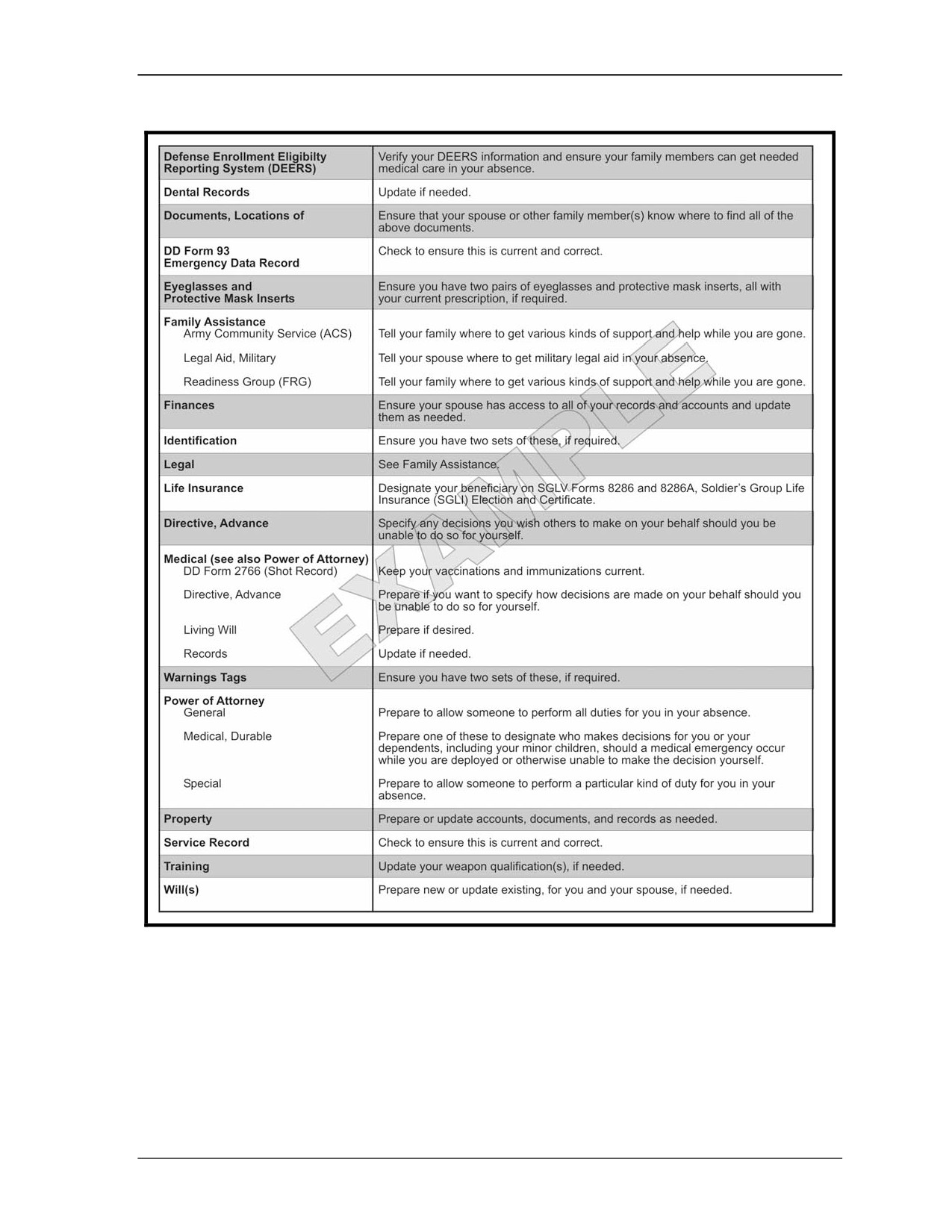
Chapter 2
Figure 2-1. Example personal predeployment checklist.
2-2
FM 3-21.75
28 January 2008
Individual Readiness
PERSONAL WEAPON
2-3.
Your personal weapon is vital to you in combat. Take care of it, and it will do the same for you.
Seems obvious, right? Apparently not. Multiple reports from the opening days of Operation Iraqi Freedom
revealed that faulty weapons training and maintenance were the main causes of US casualties and captures:
"These malfunctions may have resulted from inadequate individual maintenance and the environment."
Soldiers had trouble firing their personal and crew-served weapons, and the main reason cited was poor
preventive maintenance. Few things will end a firefight faster and more badly than a weapon that will
not shoot! The complex M16A2 rifle needs cleaning and proper lubrication at least once a day in order to
properly function. Follow these procedures and those in the technical manual (TM):
CLEANING
2-4.
Use only the cleaning supplies listed in the Expendable and Durable Items List in the back of
the TM.
Abrasives and Harsh Chemicals
2-5.
Avoid using abrasive materials such as steel wool or commercial scrubbing pads, and harsh
chemicals not intended for use on your weapon. This can ruin the finish of the weapon. It can also remove
rifling and damage internal parts, either of which can make your weapon inaccurate and ineffective during
the mission.
Water
2-6.
Never clean your weapon under running water, which can force moisture into tight places,
resulting in corrosion.
Frequency
2-7.
In the field, clean your weapon often, at least daily. Even just taking every chance to wipe the
weapon’s exterior with a clean cloth will help ensure operability.
Disassembly
2-8.
Do any cleaning that involves disassembly at your level in an enclosed area. Blowing sand and
other debris can not only affect your weapon, it can also cause you to lose the parts of the weapon.
For parts that must be disassembled beyond your level, such as the trigger assembly, just blow out the dirt
or debris.
Magazines and Ammunition
2-9.
Clean your magazines, but avoid using any lubrication in them or on ammunition. Unload and
wipe off your ammunition daily, then disassemble and run a rag through the magazine to prevent jamming.
LUBRICATING
2-10.
Lubrication reduces friction between metal parts.
Lubricant
2-11.
You may only use authorized, standard military lubricant for small arms such as cleaner lubricant
preservative (CLP). Also, lubricate only internal parts.
28 January 2008
FM 3-21.75
2-3
Chapter 2
Moving Parts
2-12.
Pay special attention to moving parts like the bolt carrier. Wipe the outside of the weapon dry.
Covers and Caps
2-13.
Use rifle covers and muzzle caps to keep blowing debris and dust out of the muzzle and ejection
port area. Cover mounted machine guns when possible. Keep your rifle's ejection port cover closed and a
magazine inserted.
Humid Environments
2-14.
Keep in mind that, in more humid environments such as jungles and swamps, you will need to use
more lubrication, more often, on all metal parts. Temperature and other extreme weather conditions also
factor in.
Desert Environments
2-15.
Corrosion poses little threat in the desert. Avoid using too much lubrication, because it
attracts sand.
Note: Maintain all issued equipment and clothing based on the specific care and
maintenance instructions provided.
2-4
FM 3-21.75
28 January 2008
Chapter 3
Combat Casualty Care and Preventive Medicine
Combat casualty care is the treatment administered to a wounded Soldier after he has
been moved out of an engagement area or the enemy has been suppressed. This level
of care can help save life and limb until medical personnel arrive. Soldiers might
have to depend upon their own first-aid knowledge and skills to save themselves
(self-aid) or another Soldier (buddy aid or combat lifesaver skills). This knowledge
and training can possibly save a life, prevent permanent disability, or reduce long
periods of hospitalization. The only requirement is to know what to do--and what not
to do--in certain instances.
Personal hygiene and preventive medicine are simple, common-sense measures that
each Soldier can perform to protect his health and that of others. Taking these
measures can greatly reduce time lost due to disease and nonbattle injury.
Section I. COMBAT CASUALTY CARE
The Army warfighter doctrine, developed for a widely dispersed and rapidly moving battlefield, recognizes that
battlefield constraints limit the number of trained medical personnel available to provide immediate,
far-forward care. This section defines combat lifesaver, provides life-saving measures (first aid) techniques, and
discusses casualty evacuation.
COMBAT LIFESAVER
3-1.
The role of the combat lifesaver was developed to increase far-forward care to combat Soldiers.
At least one member--though ideally every member of each squad, team, and crew--should be a trained
combat lifesaver. The leader is seldom a combat lifesaver, since he will have less time to perform those
duties than would another member of his unit.
3-2.
So what exactly is a combat lifesaver? He is a nonmedical combat Soldier. His secondary mission
is to help the combat medic provide basic emergency care to injured members of his squad, team, or crew,
and to aid in evacuating them, mission permitting. He complements, rather than replaces, the
combat medic. He receives training in enhanced first aid and selected medical procedures such as initiating
intravenous infusions. Combat lifesaver training bridges the first aid training (self-aid or buddy aid, or
SABA) given to all Soldiers in basic training, and the more advanced medical training given to Medical
Specialists (MOS 91W), also known as combat medics.
3-3.
The Academy of Health Sciences developed the Combat Lifesaver Course as part of its continuing
effort to provide health service support to the Army. The current edition of the Combat Lifesaver Course
lasts three days. The first day tests the buddy-aid tasks, and the other two days teach and test specific
medical tasks.
28 January 2008
FM 3-21.75
3-1
Chapter 3
LIFESAVING MEASURES (FIRST AID)
3-4.
When a Soldier is wounded, he must receive first aid immediately. Most injured or ill Soldiers can
return to their units to fight or support. This is mainly, because they receive appropriate and timely first aid,
followed by the best possible medical care. To help ensure this happens, every Soldier should have combat
lifesaver training on basic life-saving procedures (Table 3-1).
Table 3-1. First aid.
1
Check for BREATHING
Lack of oxygen, due either to a compromised airway or inadequate
breathing, can cause brain damage or death in just a few minutes.
2
Check for BLEEDING
Life can continue only with sufficient blood to carry oxygen to tissues.
3
Check for SHOCK
Unless shock is prevented, first aid performed, and medical treatment
provided, death may result, even with an otherwise nonfatal injury.
CHECK FOR BREATHING
3-5.
Check first to see if the casualty's heart is beating, then to see if he is breathing. This paragraph
discusses what to do in each possible situation.
React to Stoppage of Heartbeat
3-6.
If a casualty’s heart stops beating, you must immediately seek medical help. Seconds count!
Stoppage of the heart is soon followed by cessation of respiration, unless that has already happened.
Remain calm, but think first, and act quickly. When a casualty’s heart stops, he has no pulse. He is
unconscious and limp, and his pupils are open wide. When evaluating a casualty, or when performing the
preliminary steps of rescue breathing, feel for a pulse. If you do not detect a pulse, seek medical help.
Open Airway and Restore Breathing
3-7.
All humans need oxygen to live. Oxygen breathed into the lungs gets into the bloodstream. The
heart pumps the blood, which carries the oxygen throughout the body to the cells, which require a constant
supply of oxygen. Without a constant supply of oxygen to the cells in the brain, we can suffer permanent
brain damage, paralysis, or death.
Assess and Position Casualty
3-8.
To assess the casualty, do the following:
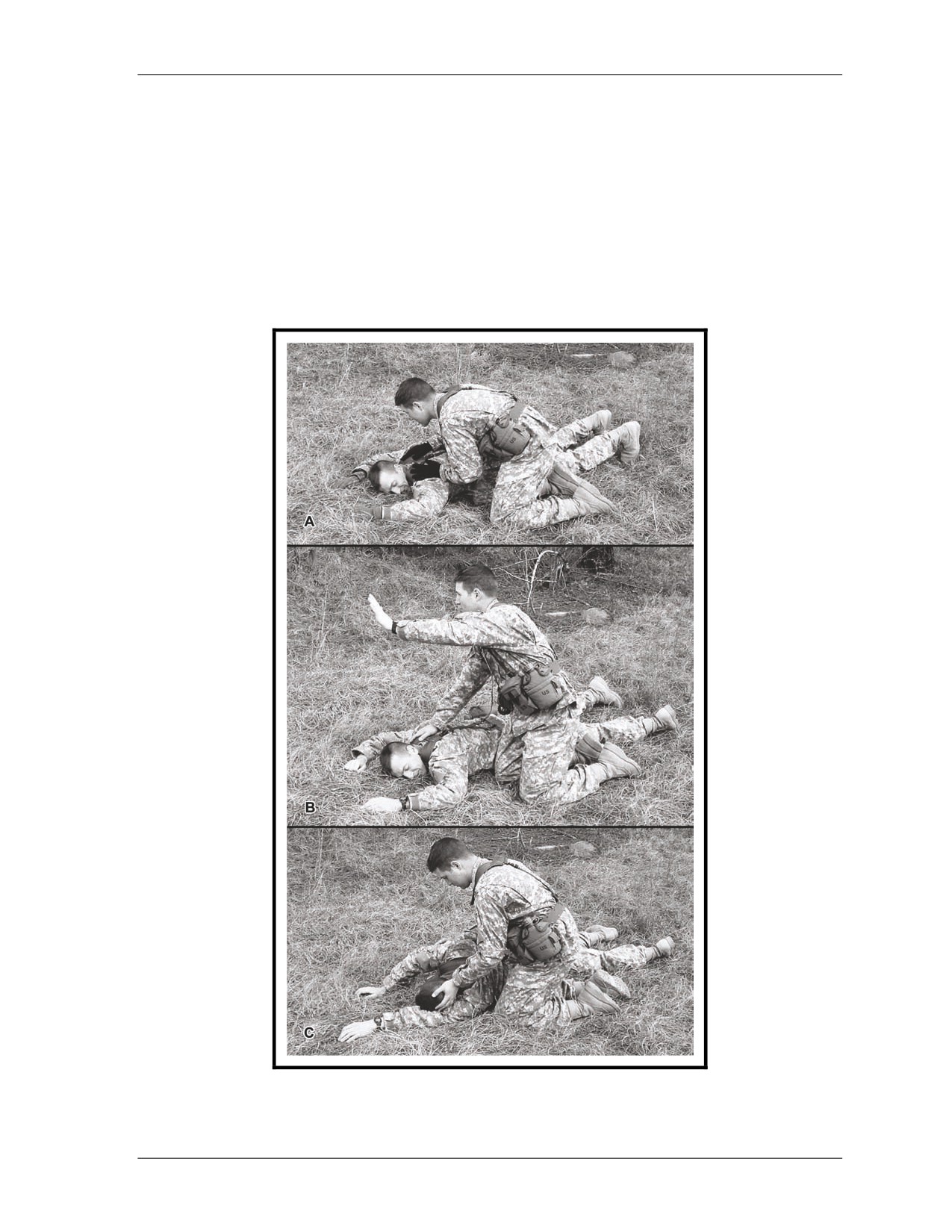
1. Check for responsiveness (A, Figure 3-1). Establish whether the casualty is conscious by
gently shaking him and asking, "Are you OK?"
2. Call for help, if appropriate (B, Figure 3-1).
3. Position the unconscious casualty so that he is lying on his back and on a firm surface
(C, Figure 3-1).
WARNING
If the casualty is lying on his chest (prone), cautiously roll him as
a unit, so that his body does not twist. Twisting him could
complicate a back, neck, or spinal injury.
3-2
FM 3-21.75
28 January 2008
Combat Casualty Care and Preventive Medicine
4. Straighten his legs. Take the arm nearest to you, and move it so that it is straight and above
his head. Repeat for the other arm.
5. Kneel beside the casualty with your knees near his shoulders. Leave room to roll his body
(B, Figure 3-1). Place one hand behind his head and neck for support. With your other hand,
grasp him under his far arm (C, Figure 3-1).
6. Roll him towards you with a steady, even pull. Keep his head and neck in line with his back.
7. Return his arms to his side. Straighten his legs, and reposition yourself so that you are
kneeling at the level of his shoulders.
8. If you suspect a neck injury, and you are planning to use the jaw-thrust technique, then kneel
at the casualty’s head while looking towards his feet.
Figure 3-1. Assessment.
28 January 2008
FM 3-21.75
3-3
Chapter 3
Open Airway of Unconscious or Nonbreathing Casualty
3-9.
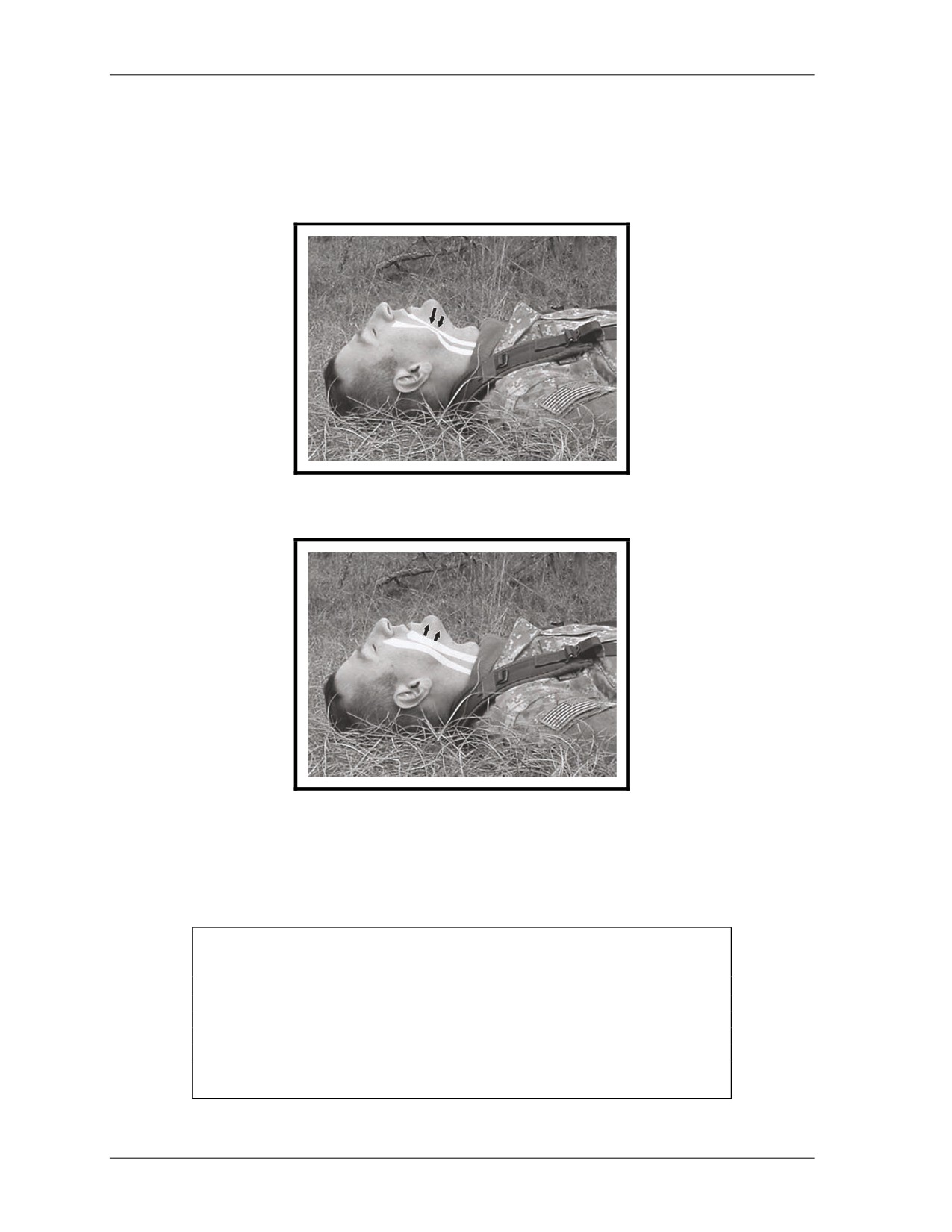
The tongue is the single most common airway obstruction (Figure 3-2). In most cases, just using
the head-tilt/chin-lift technique can clear the airway. This pulls the tongue away from the air passage
(Figure 3-3).
Figure 3-2. Airway blocked by tongue.
Figure 3-3. Airway opened by extending neck.
3-10.
Call for help, and then position the casualty. Move (roll) him onto his back (C, Figure 3-1).
Perform a finger sweep. If you see foreign material or vomit in the casualty's mouth, promptly remove it,
but avoid spending much time doing so. Open the airway using the jaw-thrust or
head-tilt/chin-lift technique.
CAUTION
Although the head-tilt/chin-lift technique is an important procedure in opening
the airway, take extreme care with it, because using too much force while
performing this maneuver can cause more spinal injury. In a casualty with a
suspected neck injury or severe head trauma, the safest approach to opening
the airway is the jaw-thrust technique because, in most cases, you can do it
without extending the casualty's neck.
3-4
FM 3-21.75
28 January 2008
Combat Casualty Care and Preventive Medicine
Perform Jaw-Thrust Technique
3-11.
Place your hands on both sides of the angles of the casualty’s lower jaw, and lift with both hands.
Displace the jaw forward and up (Figure 3-4). Your elbows should rest on the surface where the casualty is
lying. If his lips close, you can use your thumb to retract his lower lip. If you have to give mouth-to-mouth,
then close his nostrils by placing your cheek tightly against them. Carefully support his head without tilting
it backwards or turning it from side to side. This technique is the safest, and thus the first, to use to open
the airway of a casualty who has a suspected neck injury. Why? Because, you can usually do it without
extending his neck. However, if you are having a hard time keeping his head from moving, you might have
to try tilting his head back very slightly.
Figure 3-4. Jaw-thrust technique.
Perform Head-Tilt/Chin-Lift Technique
3-12.
Place one palm on the casualty’s forehead and apply firm, backward pressure to tilt his head back.
Place the fingertips of your other hand under the bony part of his lower jaw, and then lift, bringing his chin
forward. Avoid using your thumb to lift his chin (Figure 3-5).
Figure 3-5. Head-tilt/chin-lift technique.
WARNING
Avoid pressing too deeply into the soft tissue under the
casualty's chin, because you might obstruct his airway.
28 January 2008
FM 3-21.75
3-5
Chapter 3
Check for Breathing while Maintaining Airway
3-13.
After opening the casualty's airway, you must keep it open. Often this is enough to let the casualty
breathe properly. Failure to maintain the open airway will keep the casualty from receiving sufficient
oxygen. While maintaining an open airway, check for breathing by observing the casualty’s chest, and
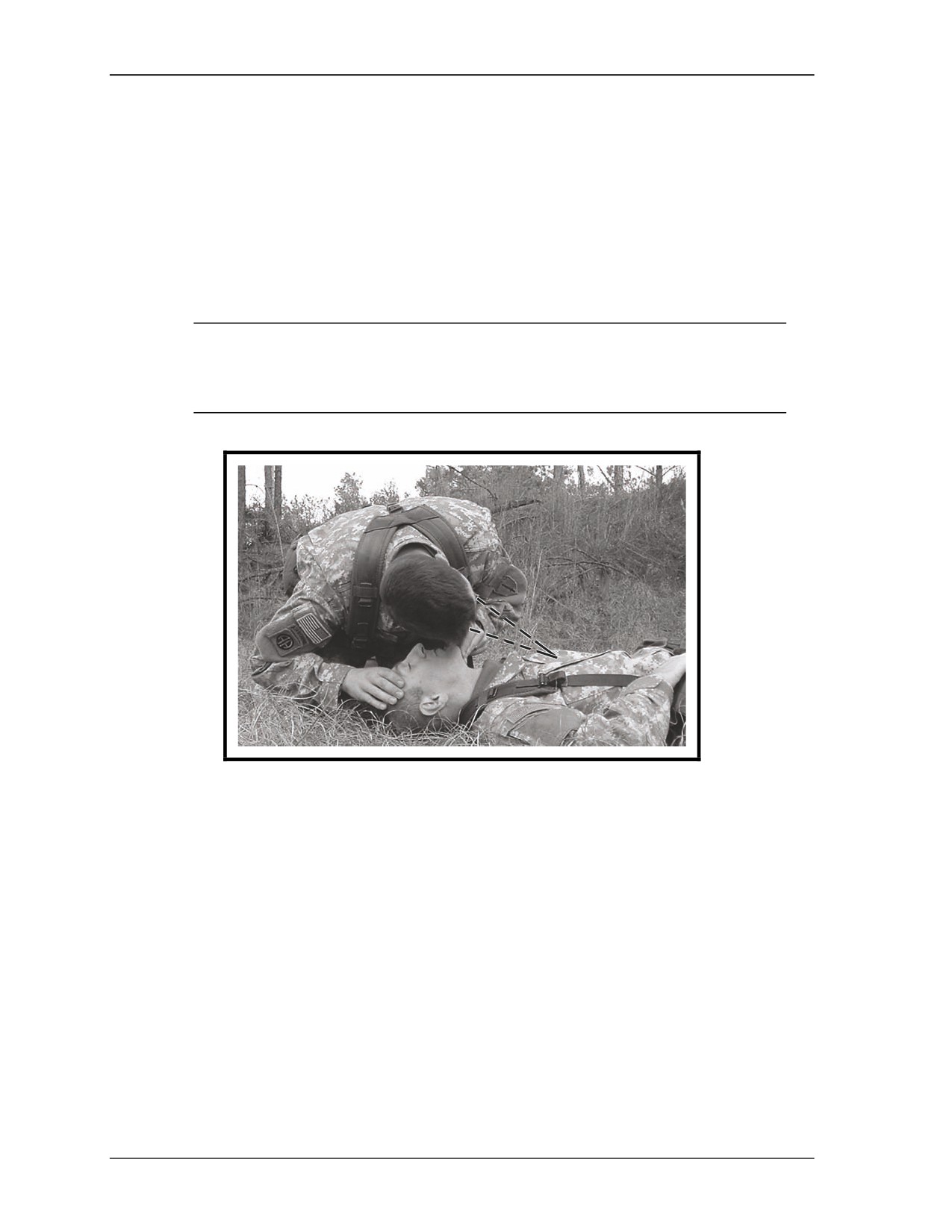
then, within a period of three to five seconds (Figure 3-6)--
1. Look for his chest to rise and fall.
2. Listen for sound of breathing by placing your ear near his mouth.
3. Feel for the flow of air on your cheek.
4. Perform rescue breathing if he fails to resume breathing spontaneously.
Note: If the casualty resumes breathing, monitor and maintain the open airway. Ensure he
is transported to a medical treatment facility as soon as possible. Although the
casualty might be trying to breathe, his airway might still be obstructed. If so, open
his airway (remove the obstruction) and keep the airway open (maintain his airway).
Figure 3-6. Check for breathing.
Perform Rescue Breathing or Artificial Respiration
3-14.
If the casualty fails to promptly resume adequate spontaneous breathing after the airway is open,
you must start rescue breathing (artificial respiration, or mouth-to-mouth). Remain calm, but think and act
quickly. The sooner you start rescue breathing, the more likely you are to restore his breathing. If you are
not sure if the casualty is breathing, give him artificial respiration anyway. It cannot hurt him. If he is
breathing, you can see and feel his chest move and, if you put your hand or ear close to his mouth and
nose, you can hear him expelling air. The preferred method of rescue breathing is mouth-to-mouth, but you
cannot always use it. For example, if the casualty has a severe jaw fracture or mouth wound, or if his jaws
are tightly closed by spasms, you should use the mouth-to-nose method instead.
3-6
FM 3-21.75
28 January 2008
Combat Casualty Care and Preventive Medicine
Use Mouth-to-Mouth Method
3-15.
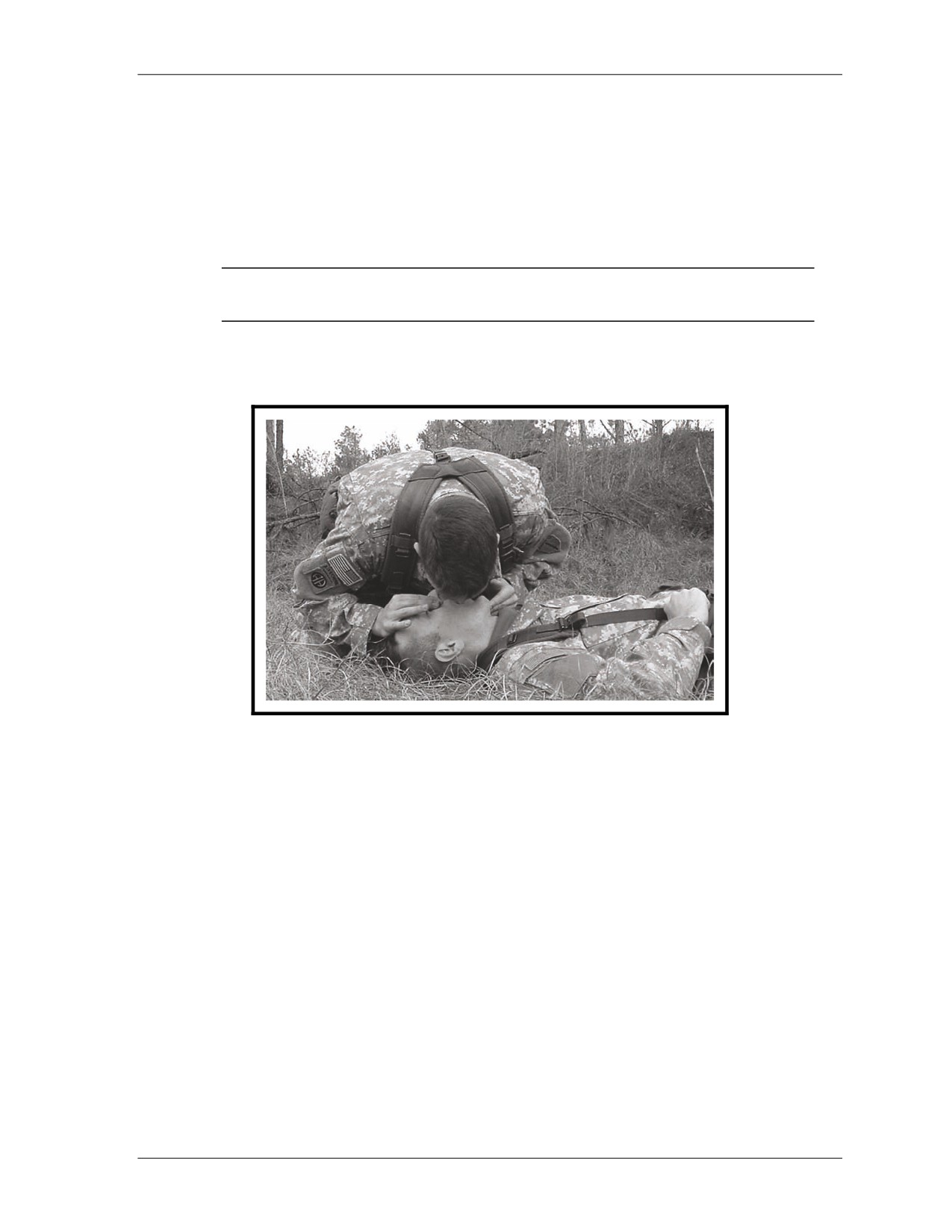
In this best known method of rescue breathing, inflate the casualty’s lungs with air from yours.
You can do this by blowing air into his mouth. If the casualty is not breathing, place your hand on his
forehead, and pinch his nostrils together with the thumb and index finger of the hand in use. With the same
hand, exert pressure on his forehead to keep his head tilted backwards, and to maintain an open airway.
With your other hand, keep your fingertips on the bony part of his lower jaw near his chin, and lift
(Figure 3-5).
Note: If you suspect the casualty has a neck injury and you are using the jaw-thrust
technique, close his nostrils by placing your cheek tightly against them.
3-16.
Take a deep breath, and seal your mouth (airtight) around the casualty’s mouth (Figure 3-7). If he
is small, cover both his nose and mouth with your mouth, and then seal your lips against his face.
Figure 3-7. Rescue breathing.
3-17.
Blow two full breaths into the casualty’s mouth (1 to 1 1/2 seconds each), taking a fresh breath of
air each time, before you blow. Watch from the corner of your eye for the casualty’s chest to rise.
If it does, then you are getting enough air into his lungs. If it fails to rise, then do the following:
1. Take corrective action immediately by reestablishing the airway. Ensure no air is leaking
from around your mouth or from the casualty’s pinched nose.
2. Try (again) to ventilate him.
3. If his chest still fails to rise, take the necessary action to open an obstructed airway.
4. If you are still unable to ventilate the casualty, reposition his head, and repeat rescue
breathing. The main reason ventilation fails is improper chin and head positioning. If you
cannot ventilate the casualty after you reposition his head, then move on to foreign-body
airway obstruction maneuvers.
5. If, after you give two slow breaths, the casualty's chest rises, then see if you can find a pulse.
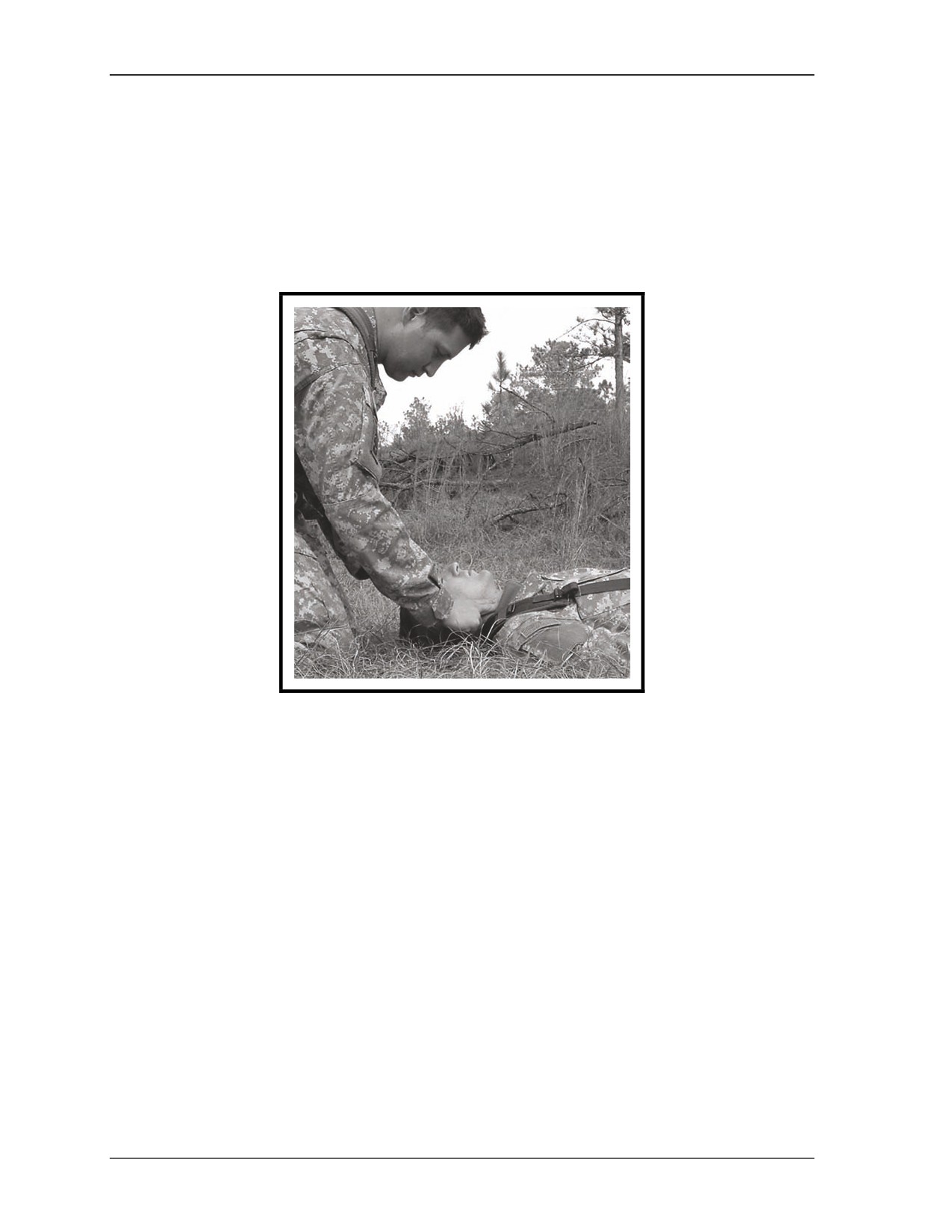
Feel on the side of his neck closest to you by placing the index and middle fingers of your
hand on the groove beside his Adam's apple (carotid pulse; Figure 3-8). Avoid using your
thumb to take a pulse, because that could cause you to confuse your own pulse for his.
28 January 2008
FM 3-21.75
3-7
Chapter 3
6. Maintain the airway by keeping your other hand on the casualty’s forehead. Allow 5 to 10
seconds to determine if there is a pulse.
7. If you see signs of circulation and you find a pulse, and the casualty has started breathing—
a. Stop and allow the casualty to breathe on his own. If possible, keep him warm and
comfortable.
b. If you find a pulse, and the casualty is unable to breathe, continue rescue breathing until
told to cease by medical personnel.
c. If you fail to find a pulse, seek medical personnel for help as soon as possible.
Figure 3-8. Placement of fingers to detect pulse.
Use Mouth-to-Nose Method
3-18.
Use this method if you cannot perform mouth-to-mouth rescue breathing. Normally, the reason
you cannot is that the casualty has a severe jaw fracture or mouth wound, or, because his jaws are tightly
closed by spasms. The mouth-to-nose method is the same as the mouth-to-mouth method, except that you
blow into the nose while you hold the lips closed, keeping one hand at the chin. Then, you remove your
mouth to let the casualty exhale passively. You might have to separate the casualty’s lips to allow the air to
escape during exhalation.
React to Airway Obstructions
3-19.
For oxygen to flow to and from the lungs, the upper airway must be unobstructed. Upper airway
obstruction can cause either partial or complete airway blockage. Upper airway obstructions often
occur because--
1. The casualty’s tongue falls back into his throat while he is unconscious.
2. His tongue falls back and obstructs the airway.
3. He was unable to swallow an obstruction.
4. He regurgitated the contents of his stomach, and they blocked his airway
5. He has suffered blood clots due to head and facial injuries.
3-8
FM 3-21.75
28 January 2008
Combat Casualty Care and Preventive Medicine
Note: For an injured or unconscious casualty, correctly position him, and then create and
maintain an open airway.
Determine Degree of Obstruction
3-20.
The airway may be partially or completely obstructed.
Partial
3-21.
The person might still have an air exchange. If he has enough, then he can cough forcefully, even
though he might wheeze between coughs. Instead of interfering, encourage him to cough up the object on
his own. If he is not getting enough air, his coughing will be weak, and he might be making a high-pitched
noise between coughs. He might also show signs of shock. Help him and treat him as though he had a
complete obstruction.
Complete
3-22.
A complete obstruction (no air exchange) is indicated if the casualty cannot speak, breathe, or
cough at all. He might clutch his neck and move erratically. In an unconscious casualty, a complete
obstruction is also indicated if, after opening his airway, you cannot ventilate him.
Open Obstructed Airway, Casualty Lying Down or Unresponsive
3-23.
Sometimes you must expel an airway obstruction in a casualty who is lying down, who becomes
unconscious, or who is found unconscious (cause unknown; Figure 3-9):
1. If a conscious casualty, who is choking, becomes unresponsive--
a. Call for help.
b. Open the airway.
c. Perform a finger sweep.
d. Try rescue breathing. If an airway blockage prevents this,
e. Remove the airway obstruction.
2. If a casualty is unresponsive when you find him (cause unknown)--
a. Assess or evaluate the situation.
b. Call for help.
c. Position the casualty on his back.
d. Open the airway.
e. Establish breathlessness.
f. Try to perform rescue breathing. If still unable to ventilate the casualty,
g. Perform six to ten manual (abdominal or chest) thrusts.
28 January 2008
FM 3-21.75
3-9
Chapter 3
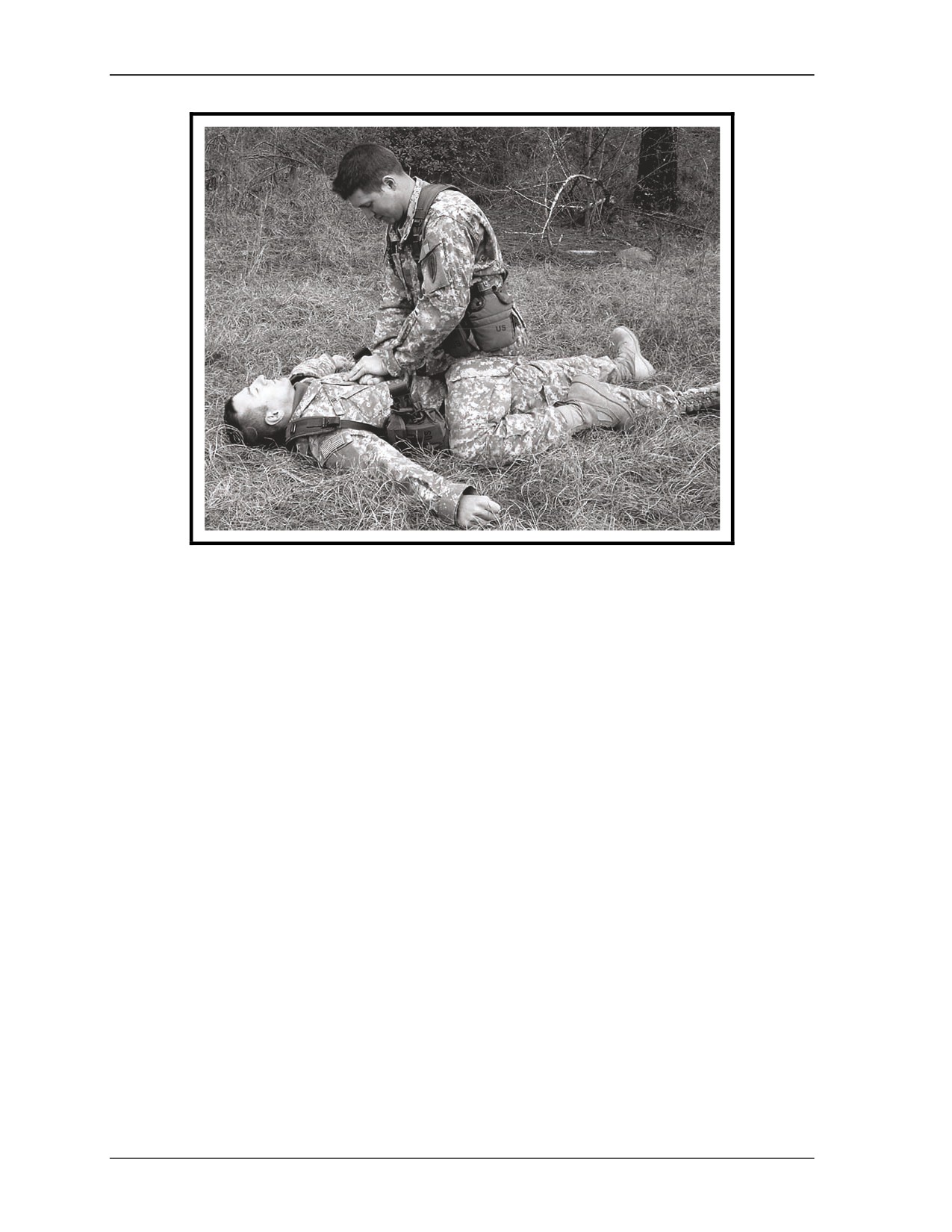
Figure 3-9. Abdominal thrust on unresponsive casualty.
3.
To perform the abdominal thrusts--
a. Kneel astride the casualty’s thighs.
b. Place the heel of one hand against the casualty’s abdomen, in the midline slightly above
the navel, but well below the tip of the breastbone.
c. Place your other hand on top of the first one.
d. Point your fingers toward the casualty’s head.
e. Use your body weight to press into the casualty’s abdomen with a quick, forward and
upward thrust.
f. Deliver each thrust quickly and distinctly.
g. Repeat the sequence of abdominal thrusts, finger sweep, and rescue breathing (try to
ventilate) as long as necessary to remove the object from the obstructed airway.
h. If the casualty’s chest rises, check for a pulse.
4.
To perform chest thrusts--
a. Place the unresponsive casualty on his back, face up, and open his mouth.
b. Kneel close to his side.
c. Locate the lower edge of his ribs with your fingers.
d. Run your fingers up along the rib cage to the notch (A, Figure 3-10).
e. Place your middle finger on the notch, and your index finger next to your middle finger,
on the lower edge of his breastbone.
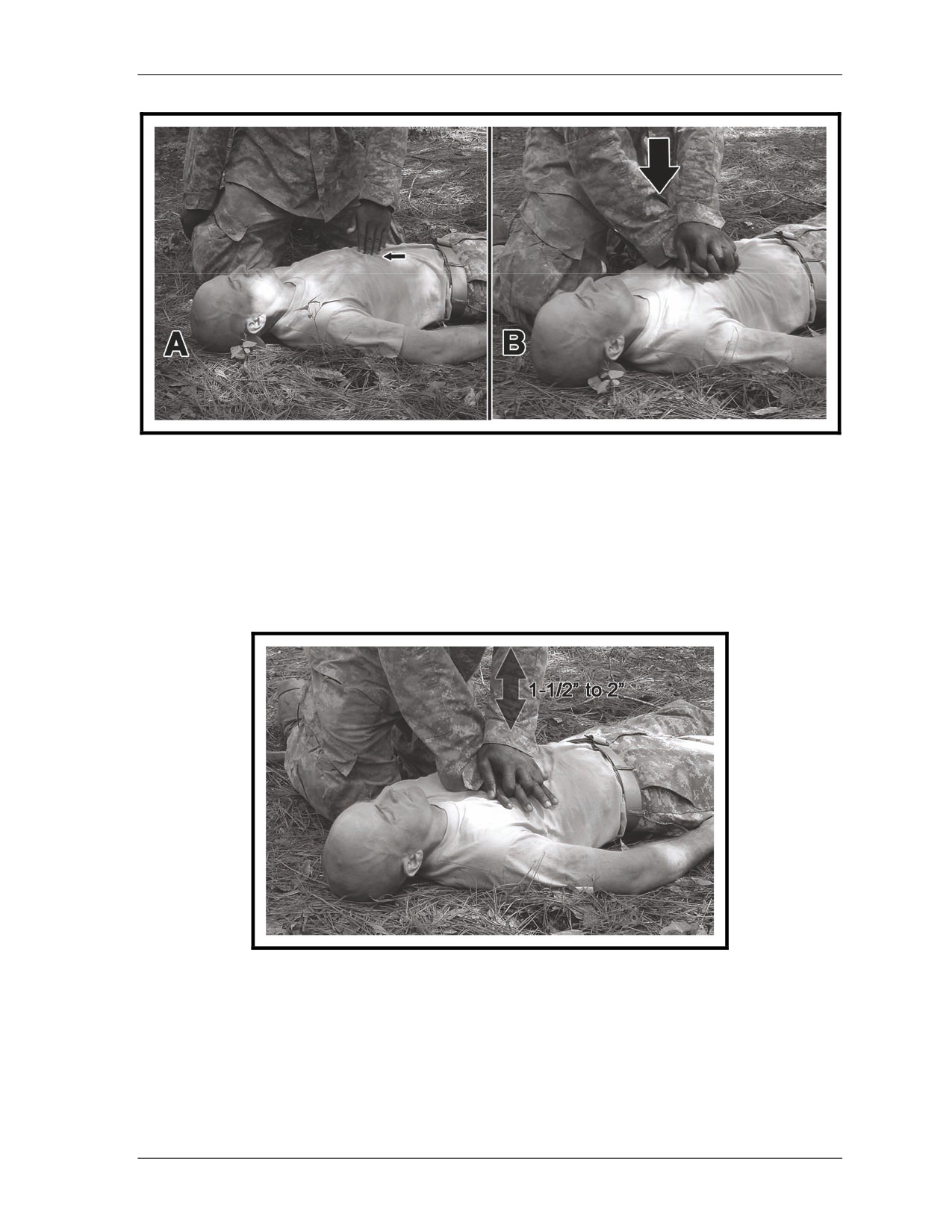
f. Place the heel of your other hand on the lower half of his breastbone, next to your two
fingers (B, Figure 3-10).
3-10
FM 3-21.75
28 January 2008
Combat Casualty Care and Preventive Medicine
Figure 3-10. Hand placement for chest thrust.
g. Remove your fingers from the notch and place that hand on top of your hand on his
breastbone, extending or interlocking your fingers.
h. Straighten and lock your elbows, with your shoulders directly above your hands. Be
careful to avoid bending your elbows, rocking, or letting your shoulders sag. Apply
enough pressure to depress the breastbone 1 1/2 to 2 inches, and then release the pressure
completely. Repeat six to ten times. Deliver each thrust quickly and distinctly. Figure 3-11
shows another view of the breastbone being depressed.
Figure 3-11. Breastbone depressed 1 1/2 to 2 inches.
i. Repeat the sequence of chest thrust, finger sweep, and rescue breathing as long as
necessary to clear the object from the obstructed airway.
j. If the casualty’s chest rises, check his pulse.
28 January 2008
FM 3-21.75
3-11
Chapter 3
5. If you still cannot administer rescue breathing due to an airway obstruction, remove the
obstruction:
a. Place the casualty on his back, face up.
b. Turn him all at once (avoid twisting his body).
c. Call for help.
d. Perform finger sweep.
e. Keep him face up.
f. Use the tongue-jaw lift to open his mouth.
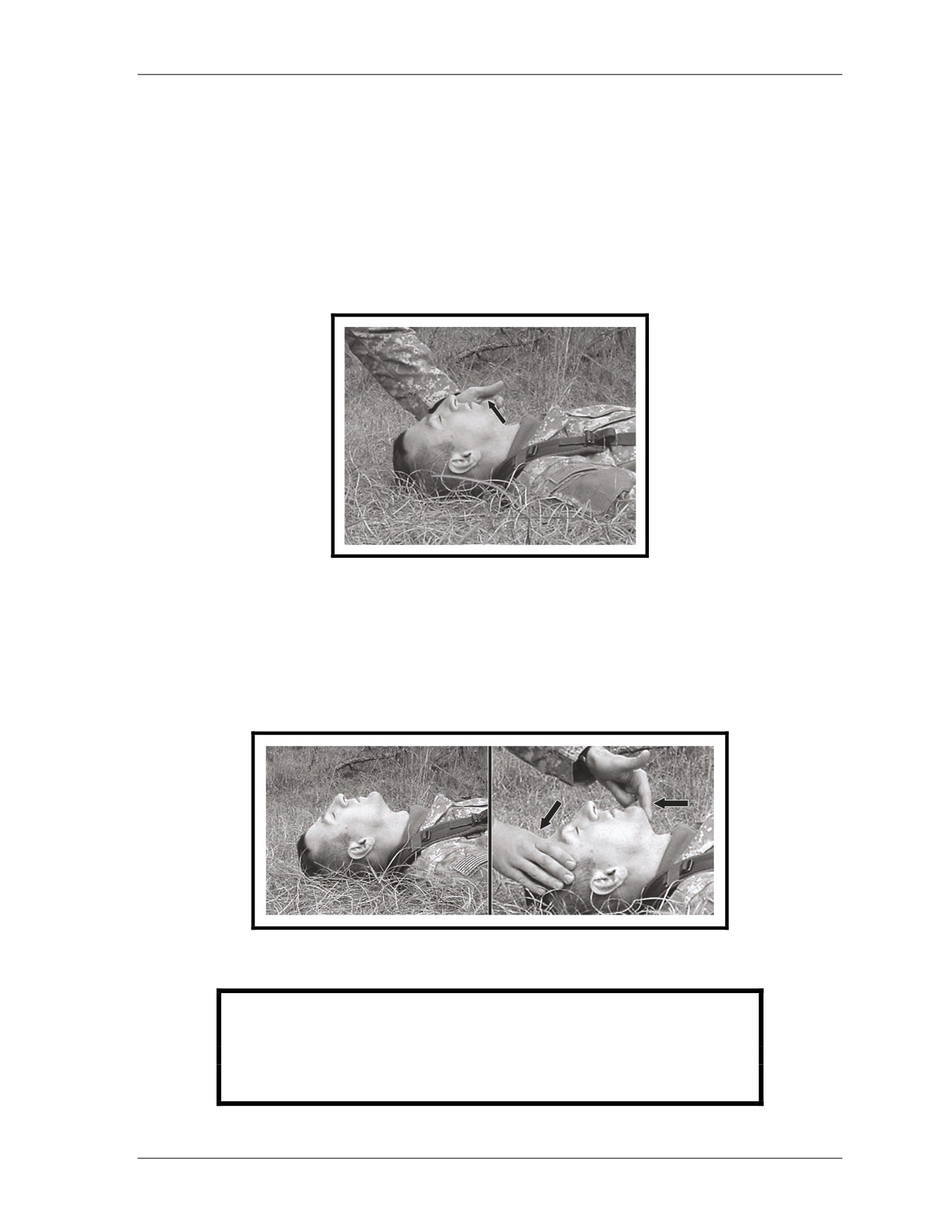
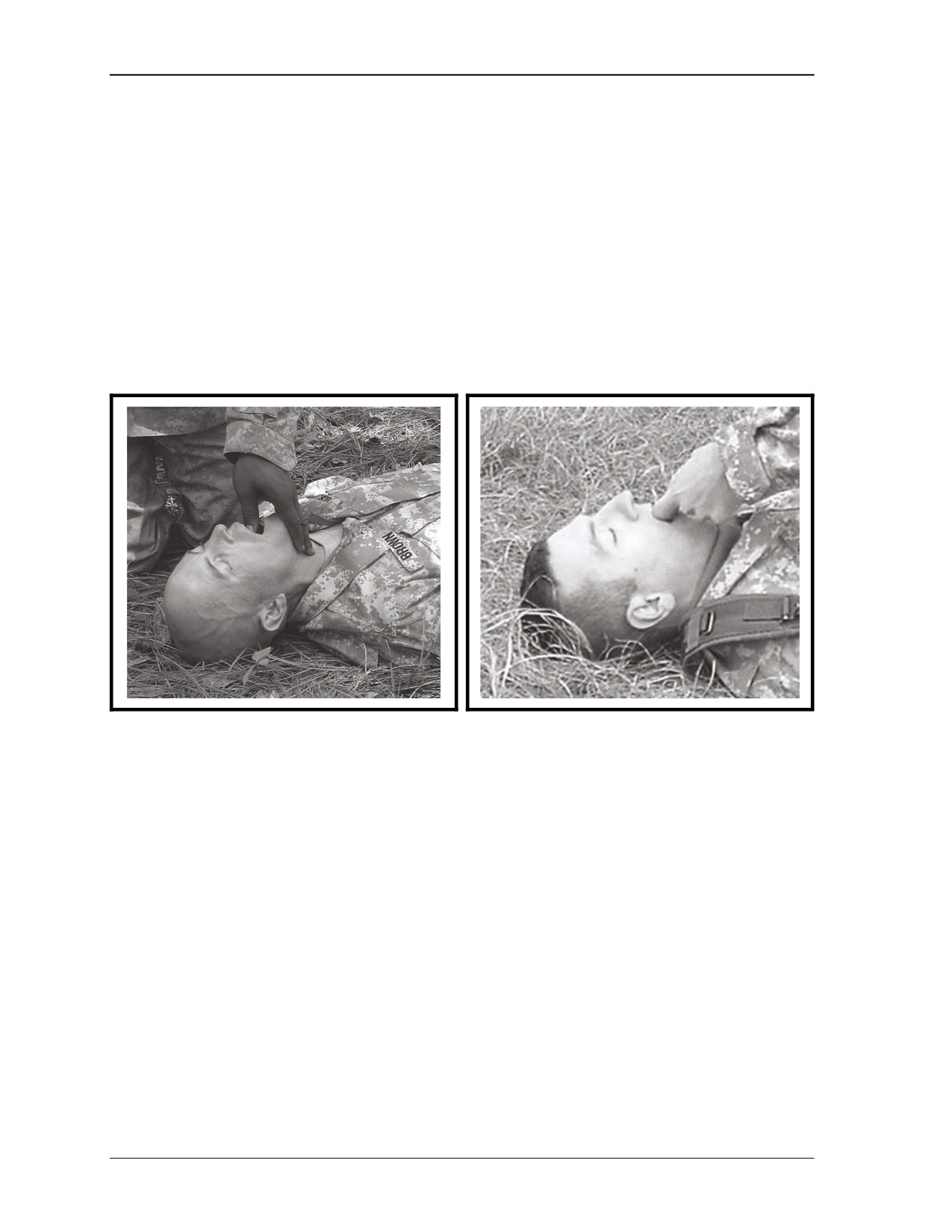
g. Open his mouth by grasping both his tongue and lower jaw between your thumb and
fingers, and lift (tongue-jaw lift; Figure 3-12).
h. If you cannot open his mouth, cross your fingers and thumb (crossed-finger method), and
push his teeth apart. To do this, press your thumb against his upper teeth, and your finger
against his lower teeth (Figure 3-13).
Figure 3-12. Opening of casualty’s mouth,
Figure 3-13. Opening of casualty’s mouth,
tongue-jaw lift.
crossed-finger method.
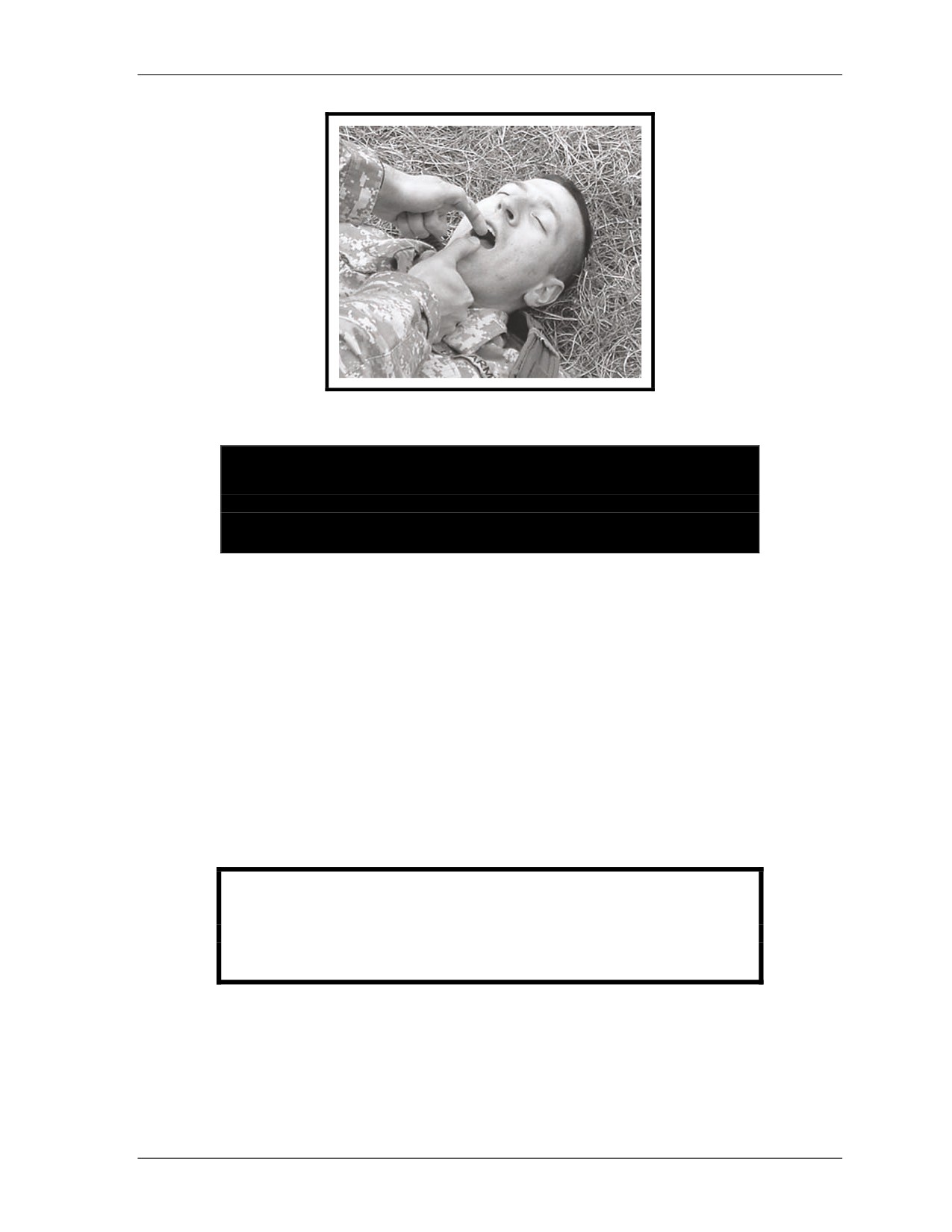
i. Insert the index finger of your other hand down along the inside of his cheek to the base
of his tongue. Use a hooking motion from the side of the mouth toward the center to
dislodge the foreign body (Figure 3-14).
3-12
FM 3-21.75
28 January 2008
Combat Casualty Care and Preventive Medicine
Figure 3-14. Use of finger to dislodge a foreign body.
DANGER
Take care not to force the object deeper into the airway by
pushing it with your finger.
CHECK FOR BLEEDING
Stop Bleeding and Protect Wound
3-24.
The longer a Soldier bleeds from a major wound, the less likely he will survive it. (FM 4-25.11
covers first aid for open, abdominal, chest, and head wounds.) You must promptly stop the
external bleeding.
Clothing
3-25.
In evaluating him for location, type, and size of wound or injury, cut or tear the casualty's clothing
and carefully expose the entire area of the wound. This is necessary to properly visualize the injury and
avoid further contamination. To avoid further injury, leave in place any clothing that is stuck to the wound.
Do not touch the wound, and keep it as clean as possible.
WARNING
In a chemical environment, leave a casualty's protective clothing
in place. Apply dressings over the protective clothing.
28 January 2008
FM 3-21.75
3-13
Chapter 3
Entrance and Exit Wounds
3-26.
Before applying the dressing, carefully examine the casualty to determine if there is more than one
wound. A missile may have entered at one point and exited at another point. An exit wound is usually
larger than its entrance wound.
DANGER
If the missile lodges in the body (fails to exit), DO NOT try
to remove it, and DO NOT probe the wound. Apply a dressing.
If an object is extending from (impaled in) the wound, leave it.
DO NOT try to remove it. Instead, take the following steps to
prevent further injury:
1. In order to prevent the object from embedding more deeply, or
from worsening the wound, use dressings or other clean,
bulky materials to build up the area around the object.
2. Apply a supporting bandage over the bulky materials to hold
them in place.
Monitor the casualty continually for development of conditions
that may require you to perform basic life-saving measures such
as clearing his airway and performing mouth-to-mouth
resuscitation.
Check all open (or penetrating) wounds for a point of entry and
exit, with first aid measures applied accordingly.
Emergency Trauma Dressing
3-27.
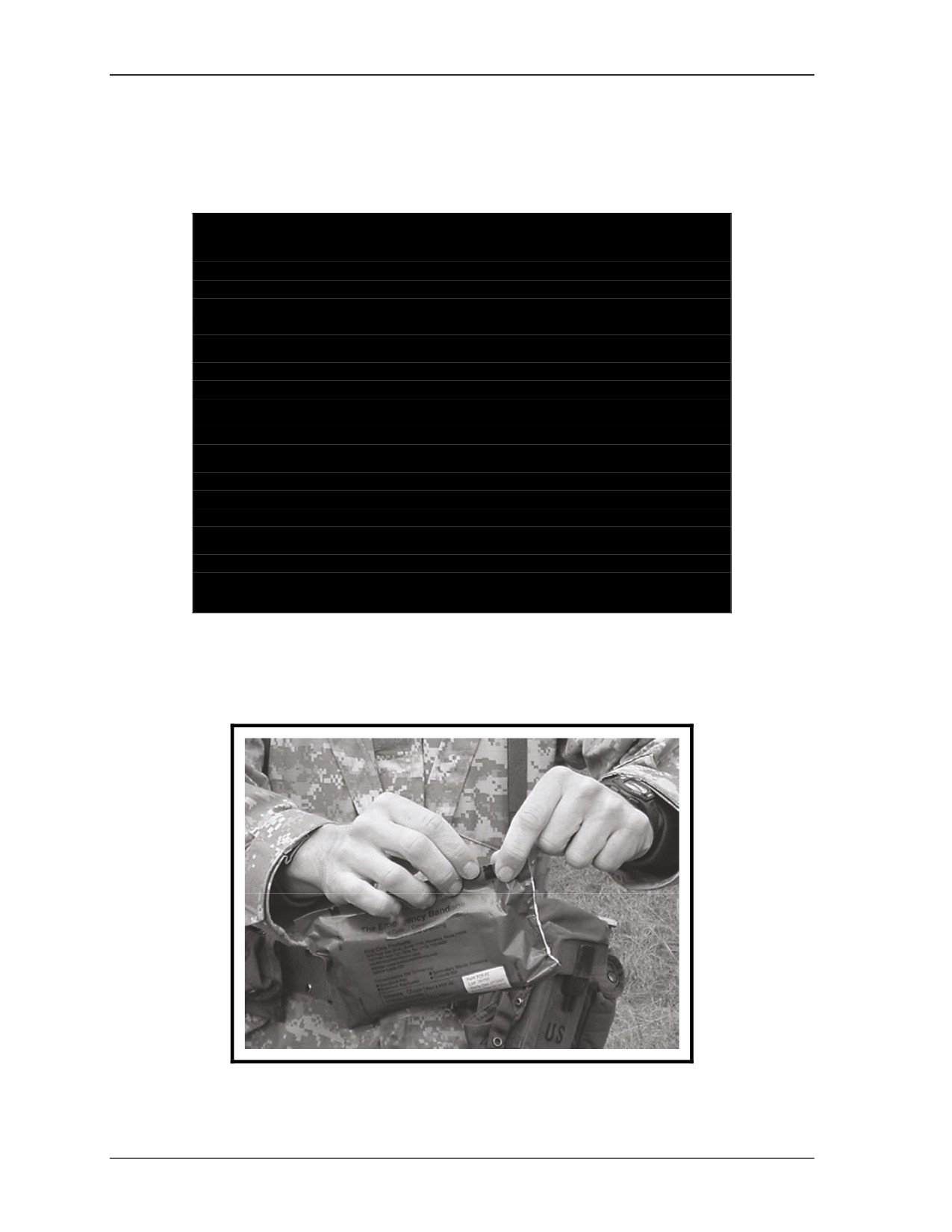
Remove the emergency bandage from the wounded Soldier’s pouch (Figure 3-15). (Do not use the
one in your pouch.)
Figure 3-15. Emergency bandage.
3-14
FM 3-21.75
28 January 2008
Combat Casualty Care and Preventive Medicine
3-28.
Place the pad on the wound, white side down, and wrap the elastic bandage around the injured
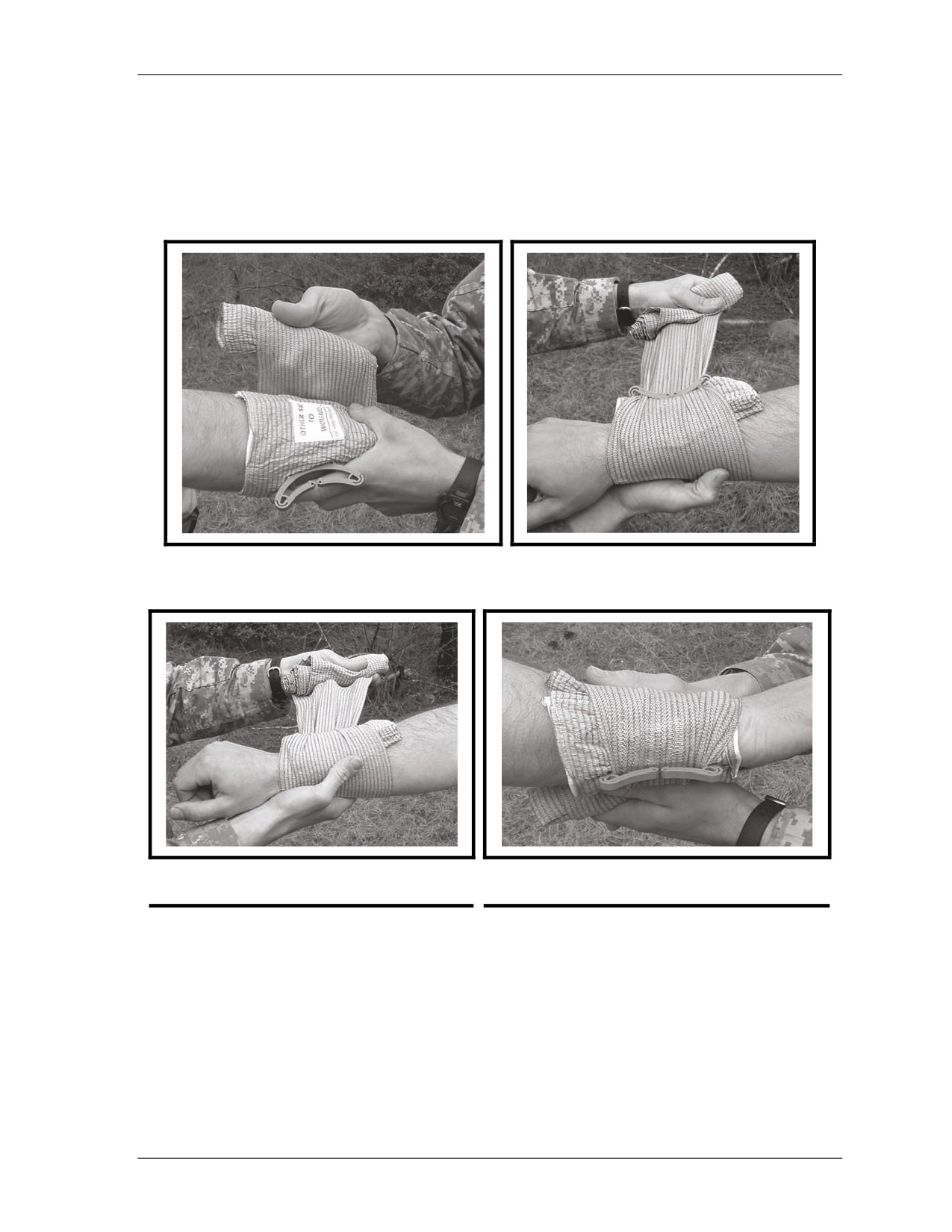
limb or body part (A, Figure 3-16). Insert the elastic bandage into the pressure bar (B, Figure 3-17).
Tighten the elastic bandage (C, Figure 3-18). Pull back, forcing the pressure bar down onto the pad
(D, Figure 3-19). Wrap the elastic bandage tightly over the pressure bar, and wrap over all the edges of the
pad (E, Figure 3-20). Secure the hooking ends of the closure bar into the elastic bandage. Do not create a
tourniquet-like effect (F, Figure 3-21).
Figure 3-16. Application of pad to wound.
Figure 3-17. Insertion of bandage into
pressure bar.
Figure 3-18. Tightening of bandage.
Figure 3-19. Pressure of bar into bandage.
28 January 2008
FM 3-21.75
3-15
///////////////////////////////////////