FM 3-21.75 The Warrior Ethos and Soldier Combat Skills (JANUARY 2008) - page 5
'Every Soldier is a Sensor'
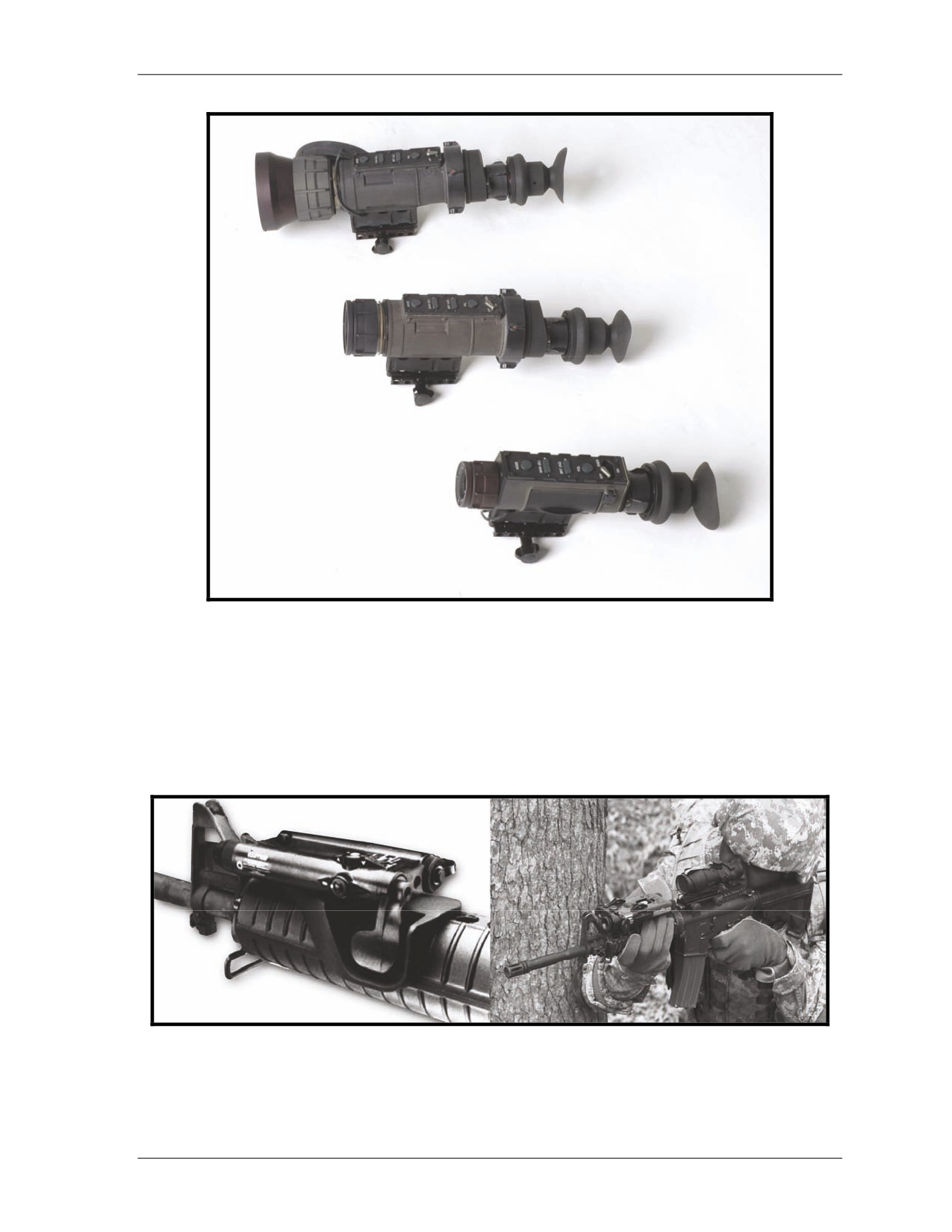
Figure 9-8. AN/PAS-13, V1, V2, and V3.
Aiming Lasers
9-26.
Aiming lasers--both the AN/PAQ-4-series and the AN/PEQ-2A (Figure 9-9)--also operate in the
electromagnetic spectrum, specifically in the near IR range.
[These lasers] are seen through
image-intensification devices. The aiming lasers cannot be used in conjunction with the TWS, because the
latter operates in the middle to far IR spectrum.
Figure 9-9. AN/PAQ-4-series and the AN/PEQ-2A.
28 January 2008
FM 3-21.75
9-13
Chapter 9
PROPER ADJUSTMENTS TO THE IMAGE INTENSIFIERS
9-27.
You must make the proper adjustments to the image intensifiers in order to get the best possible
picture. The aiming lasers cannot be seen with the unaided eye; they can only be seen with image
intensification devices. You must know how these devices work to maximize the quality of what is being
viewed by making the proper adjustments to these devices.
Scanning
9-28.
The NVDs have a 40-degree field of view (FOV) leaving the average shooter to miss easy targets
of opportunity, more commonly the 50-meter left or right target. You must train to aggressively scan your
sector of fire for targets. Target detection at night is only as good as you practice. Regular blinking during
scanning, which must be reinforced during training, relieves some of the eyestrain from trying to spot far
targets. After you have mastered the art of scanning, you will find that targets are easier to detect by
acknowledging the flicker or movement of a target.
Walking
9-29.
Once a target has been located, you must be aware of the placement of the aiming laser. Laser
awareness is necessary. If you activate your laser and it is pointing over the target into the sky, you will
waste valuable time trying to locate exactly where your laser is pointing. Also, it increases your chances of
being detected and fired upon by the enemy. When engaging a target, aim the laser at the ground just in
front of the target, walk the aiming laser along the ground and up the target until you are center mass, and
then engage the target. Walking your laser to the target is a quick and operationally secure means of
engaging the enemy with your aiming laser.
IR Discipline
9-30.
Once a target has been located and engaged with the aiming laser, the laser must be deactivated.
On the range, IR discipline means actively scanning with the laser off. Once a target is located, walk the
laser to the target and engage. After the target has been engaged, the laser goes off.
RANGE ESTIMATION
9-31.
You must often estimate ranges. You must accurately determine distance and prepare
topographical sketches or range cards. Your estimates will be easier to make and more accurate if you
know various range-estimation techniques.
FACTORS
9-32.
Three factors affect range estimates:
Nature of the Object
Outline
An object of regular outline, such as a house, appears closer than one
of irregular outline, such as a clump of trees.
Contrast
A target that contrasts with its background appears to be closer than it
actually is.
Exposure
A partly exposed target appears more distant than it actually is.
9-14
FM 3-21.75
28 January 2008
'Every Soldier is a Sensor'
Nature of Terrain
Contoured terrain
Looking across contoured terrain makes an object seem farther.
Smooth terrain
Looking across smooth terrain, such as sand, water, or snow, makes
a distant object seem nearer.
Downhill
Looking downhill at an object makes it seem farther.
Uphill
Looking uphill at an object makes it seem nearer.
Light Conditions
Sun behind observer
A front-lit object seems nearer.
Sun behind object
A back-lit object seems farther away.
ESTIMATION METHODS
9-33.
Methods of range estimation include--
• The 100-meter unit-of-measure method.
• The appearance-of-objects method.
• The flash-and-sound method.
• The mil-relation method.
• A combination of these.
100-Meter-Unit-of-Measure Method--
9-34.
Picture a distance of 100 meters on the ground. For ranges up to 500 meters, count the number of
100-meter lengths between the two points you want to measure. Beyond 500 meters, pick a point halfway
to the target, count the number of 100-meter lengths to the halfway point, and then double that number to
get the range to the target. The accuracy of the 100-meter method depends on how much ground is visible.
This is most true at long ranges. If a target is at a range of 500 meters or more, and you can only see part of
the ground between yourself and the target, it is hard to use this method with accuracy. If you know the
apparent size and detail of troops and equipment at known ranges, then you can compare those
characteristics to similar objects at unknown ranges. When the characteristics match, the range does also.
Appearance-of-Object Method
9-35.
To use the appearance-of-objects method, you must be familiar with characteristic details of
objects as they appear at various ranges. As you must be able to see those details to make the method work,
anything that limits visibility (such as weather, smoke, or darkness) will limit the effectiveness of this
method. If you know the apparent size and detail of troops and equipment at known ranges, then you can
compare those characteristics to similar objects at unknown ranges. When the characteristics match, the
range does also. Table 9-2 shows what is visible on the human body at specific ranges.
28 January 2008
FM 3-21.75
9-15
Chapter 9
Table 9-2. Appearance of a body using appearance-of-objects method.
RANGE
(in meters)
WHAT YOU SEE
200
Clear in all detail such as equipment, skin color
300
Clear body outline, face color good, remaining detail blurred
400
Body outline clear, other details blurred
500
Body tapered, head indistinct from body
600
Body a wedge shape, with no head apparent
700
Solid wedge shape (body outline)
Flash-and-Sound Method
9-36.
This method is best at night. Sound travels through air at 1,100 feet (300 meters) per second. That
makes it possible to estimate distance if you can both see and hear a sound-producing action. When you
see the flash or smoke of a weapon, or the dust it raises, immediately start counting. Stop counting when
you hear the sound associated with the action. The number at which you stop should be multiplied by three.
This gives you the approximate distance to the weapon in hundreds of meters. If you stop at one, the
distance is about 300 meters. If you stop at three, the distance is about 900 meters. When you must count
higher than nine, start over with one each time you hit nine. Counting higher numbers throws the timing
off.
Mil-Relation Formula
9-37.
This is the easiest and best way to estimate range. At 1,000 meters, a 1-mil angle equals 1 meter
(wide or high). To estimate the range to a target, divide the estimated height of the target in meters
(obtained using the reticle in the M22 binoculars) by the size of the target in mils. Multiply by 1,000 to get
the range in meters (Figure 9-10).
estimated height (meters)
x
1,000
= estimated range (meters)
size of target in mils
Figure 9-10. Mil-relation formula.
Combination of Methods
9-38.
Battlefield conditions are not always ideal for estimating ranges. If the terrain limits the use of the
100-meter unit-of-measure method, and poor visibility limits the use of the appearance-of-objects method,
you may have to use a combination of methods. For example, if you cannot see all of the terrain out to the
target, you can still estimate distance from the apparent size and detail of the target itself. A haze may
obscure the target details, but you may still be able to judge its size or use the 100-meter method. By using
either one or both of the methods, you should arrive at a figure close to the true range.
9-16
FM 3-21.75
28 January 2008
Chapter 10
Combat Marksmanship
Combat marksmanship is essential to all Soldiers—not only to acquire the expert
skills necessary for survival on the battlefield, but, because it enforces teamwork and
discipline. In every organization, all members must continue to practice certain skills
to remain proficient. Marksmanship is paramount.
This chapter discusses several aspects of combat marksmanship, including safety,
administrative, weapons,
SAFETY
This paragraph describes procedures and requirements for handling all organic and special weapons. These
procedures are designed to prevent safety-related accidents and fratricide. They are intended for use in both
training and combat, and apply to all assigned weapons of a unit. In all cases, strict self-discipline is the most
critical factor for the safe handling of weapons. The procedures for weapons handling may vary based on
METT-TC, but the following procedures are generally recommended:
• As soon as you are issued a weapon, immediately clear it, and place it on safe IAW the
appropriate Soldier’s or operator’s manual.
• Keep the weapon on safe, except--
-- When it is stored in an arms room.
-- Immediately before target engagement.
-- When directed by the chain of command.
• At all times, handle weapons as if they are loaded.
• Never point a weapon at anyone, unless a life-threatening situation justifies the use of
deadly force.
• Always know where you are pointing the muzzle of the weapon.
• Always know if the weapon is loaded.
• Always know if the weapon is on safe.
• Insert magazines or belts of ammunition only on the direction of your chain of command.
Note: The chain of command determines when to load the weapon and chamber a round in
reference to METT-TC in a combat environment. Generally, weapons remain on
safe until ready to fire.
ADMINISTRATIVE PROCEDURES
10-1.
Administrative procedures include weapons clearing, grounding of weapons, and aircraft and
vehicle movement. Soldiers must know how to handle their weapons and have a clear understanding of fire
control.
28 January 2008
FM 3-21.75
10-1
Chapter 10
ADMINISTRATIVE WEAPONS CLEARING
10-2.
Administrative weapons clearing is performed following the completion of the tactical phase of all
live fires and range qualifications, or upon reentry of a secure area in combat. Magazines or belts are
removed from all weapons. The chain of command inspects all chambers visually, using red filtered light if
at night, and verifies that each weapon and magazine is clear of ammunition. Weapons should also be
rodded. Magazines are not reinserted into weapons.
GROUNDING OF WEAPONS
10-3.
If grounded with equipment, all weapons are placed on SAFE and arranged off the ground with
the open chamber visible, if applicable. Bipod-mounted weapons are grounded on bipods with all muzzles
facing downrange and away from nearby Soldiers.
AIRCRAFT AND VEHICLE MOVEMENT
10-4.
Weapons should always be cleared and on SAFE when conducting movement in aircraft and
vehicles, unless leaders issue specific instructions to do otherwise. Keep weapon muzzles pointed
downward when traveling on aircraft. Weapons are locked and loaded only after exiting the aircraft or
vehicle, or upon command of the leader.
Note: Take extra care to correctly handle the pistol, especially the M9 with its double
action (fire from the hammer down) feature. Removing the pistol from the holster
can accidentally move the safety lever to fire, permitting immediate double action
mode of fire. Only chamber a round in a pistol when a specific threat warrants doing
so.
WEAPONS
10-5.
Weapons include the M9 pistol; M16-series rifles; M4 carbine rifles; M203 grenade launcher;
M249 squad automatic weapon (SAW); M240B machine gun; M2 .50 caliber machine gun; MK 19
grenade machine gun, Mod 3; improved M72 light antiarmor weapon; M136 AT4; M141 bunker defeat
munition (BDM); and Javelin shoulder-fired munition:
M9 PISTOL
10-6.
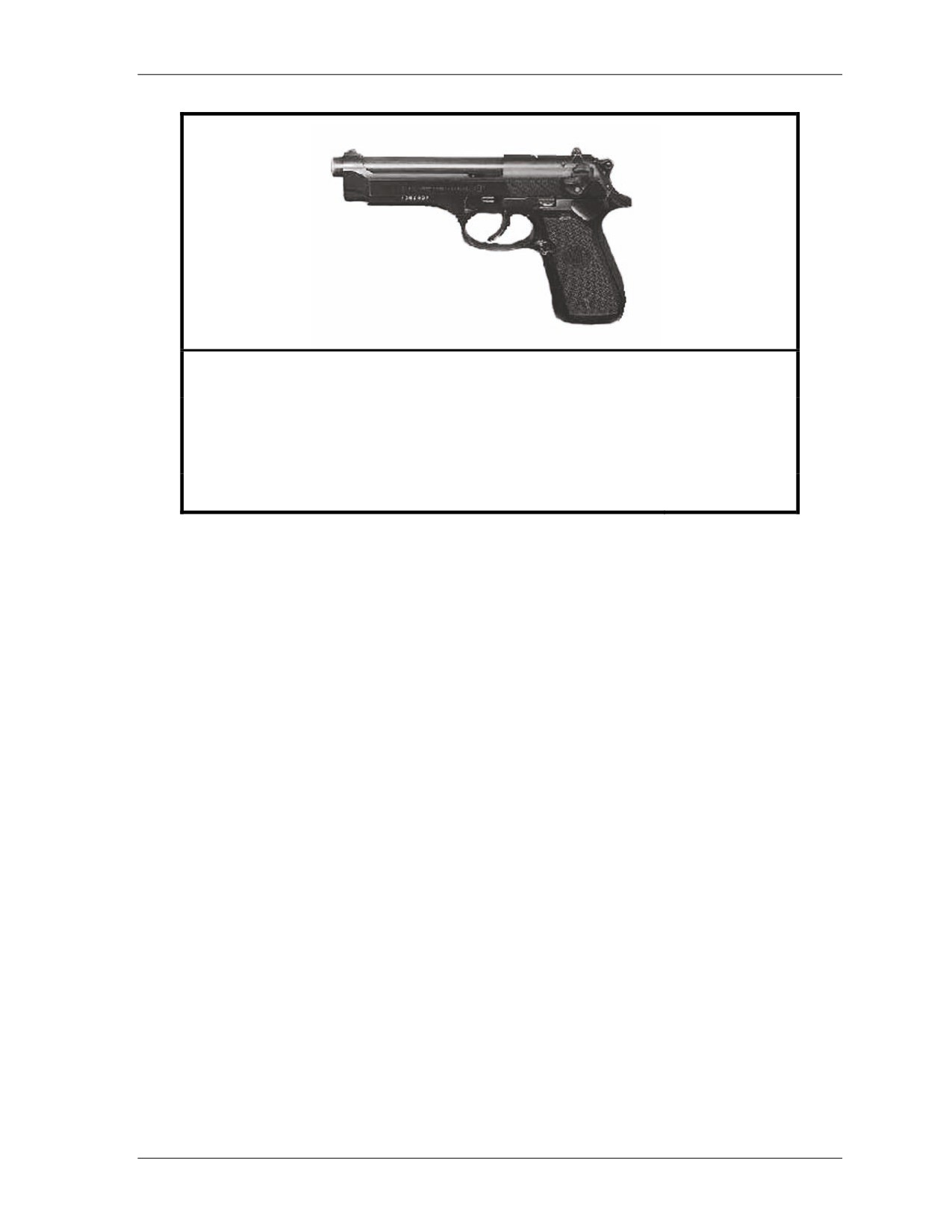
A lightweight, semiautomatic, single-action/double-action pistol can be unloaded without
activating the trigger while the safety is in the "on" position (Figure 10-1). The M9 has a 15-round
staggered magazine. The reversible magazine release button that can be positioned for either right-or
left-handed shooters. This gun may be fired without a magazine inserted. The M9 is only authorized for
9-mm ball or dummy ammunition that is manufactured to US and NATO specifications. On this weapon,
the hammer may be lowered from the cocked, "ready-to-fire" position to the uncocked position without
activating the trigger. This is done by placing the thumb safety "ON."
10-2
FM 3-21.75
28 January 2008
Combat Marksmanship
Caliber
9 mm
Weight
Unloaded
2.1 lb
Fully loaded
2.6 lb
Maximum effective range
50 meters
Figure 10-1. M9 pistol.
M16-SERIES RIFLES
10-7.
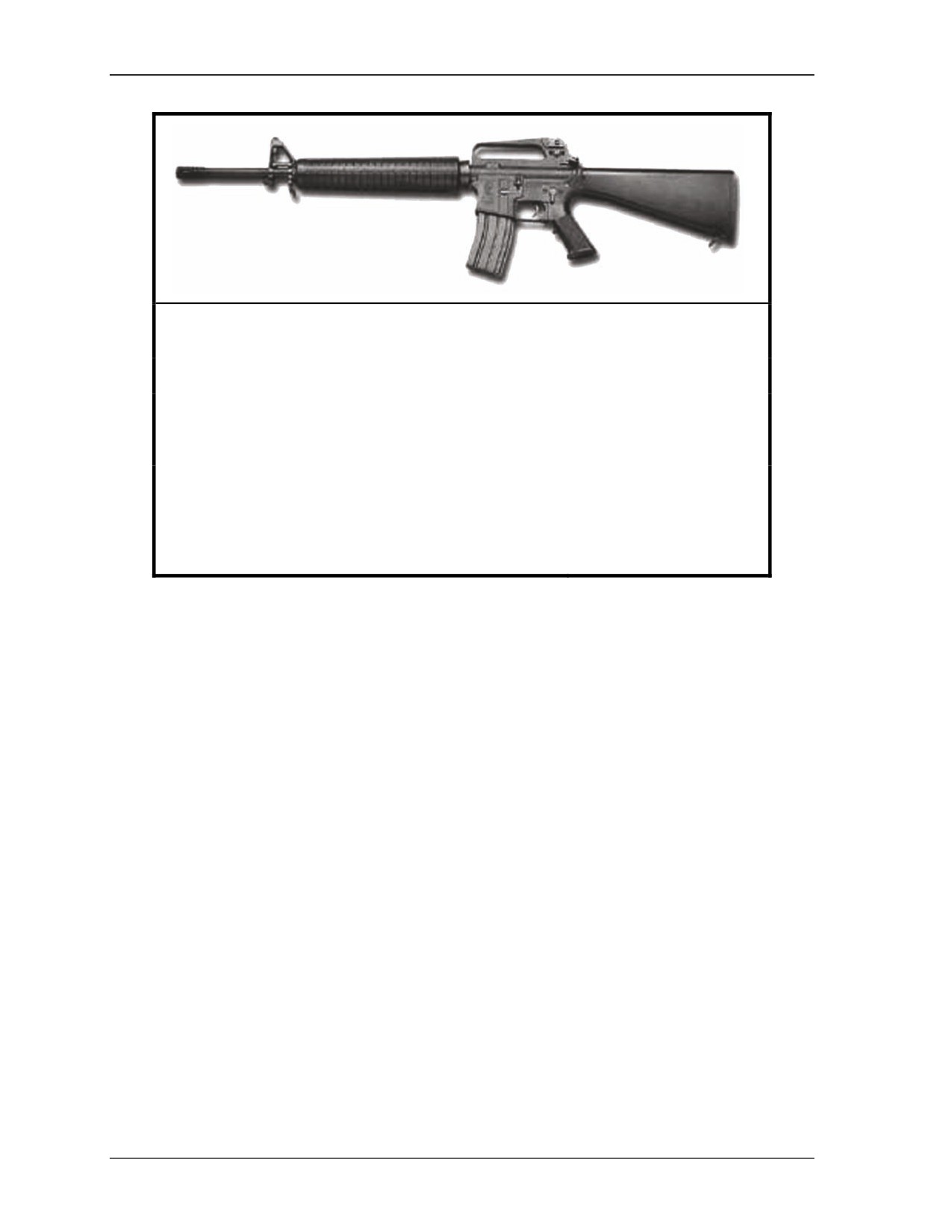
A lightweight, air-cooled, gas-operated, magazine-fed rifle designed for either burst or
semiautomatic fire through use of a selector lever. There are three models:
M16A2
10-8.
The M16A2 incorporates improvements in iron sight, pistol grip, stock, and overall combat
effectiveness (Figure 10-2). Accuracy is enhanced by an improved muzzle compensator, a three-round
burst control, and a heavier barrel; and by using the heavier NATO-standard ammunition, which is also
fired by the squad automatic weapon (SAW).
28 January 2008
FM 3-21.75
10-3
Chapter 10
Caliber
5.56 mm
Weight
8.8 lb (with sling and one
loaded magazine)
Maximum effective range
Area target
800 meters
Point target
550 meters
Rate of fire
Semiautomatic
45 rounds per min
Burst
90 rounds per min
Figure 10-2. M16A2 rifle.
M16A3
10-9.
The M16A3 is identical to the M16A2, except the A3 has a removable carrying handle mounted
on a picatinny rail (for better mounting of optics).
M16A4
10-10. The M16A4 is identical to the M16A3, except for the removable carrying handle mounted on a
picatinny rail. It has a maximum effective range of 600 meters for area targets. Like the M4-series
weapons, the M16-series rifles use ball, tracer, dummy, blank, and short-range training ammunition
(SRTA) manufactured to US and NATO specifications.
10-4
FM 3-21.75
28 January 2008
Combat Marksmanship
M4 CARBINE
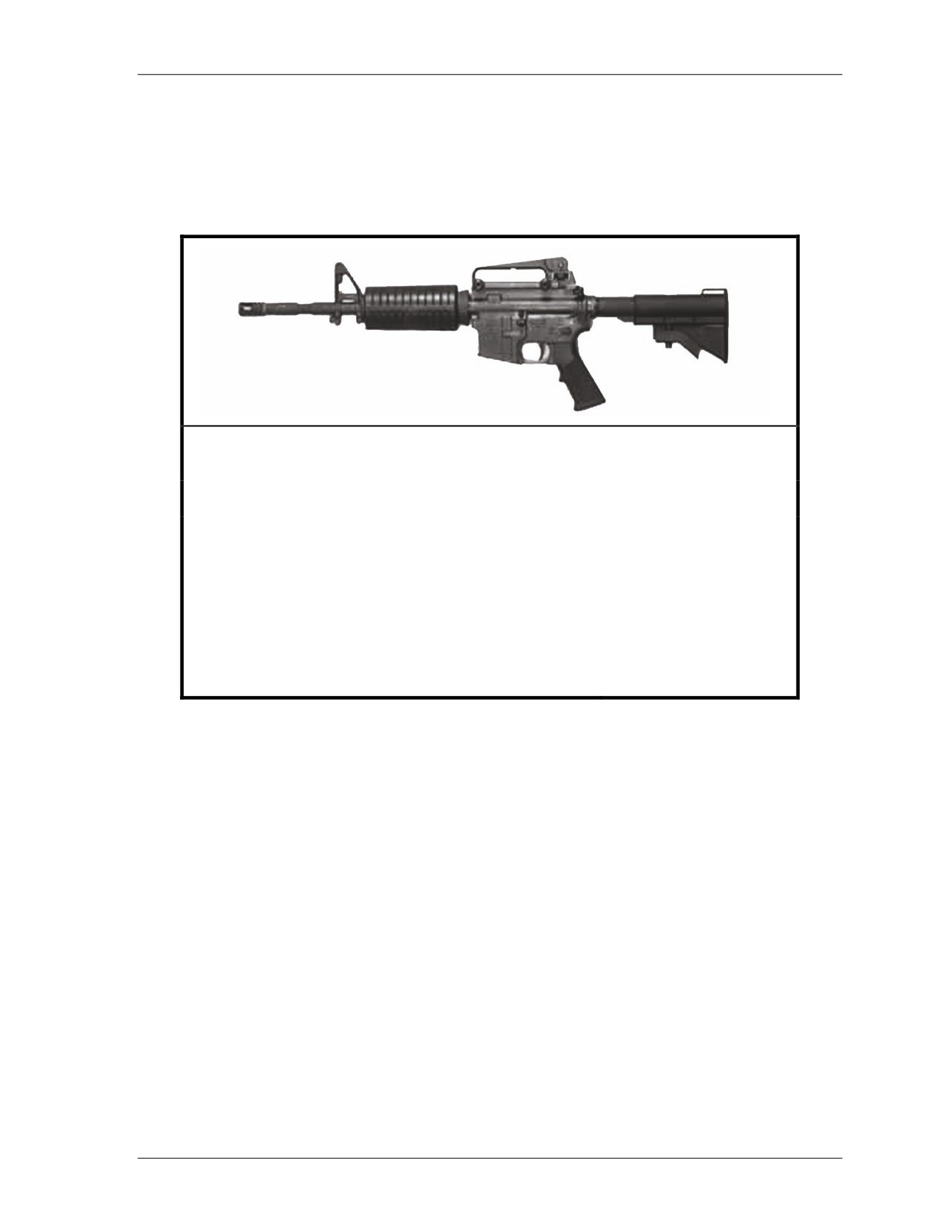
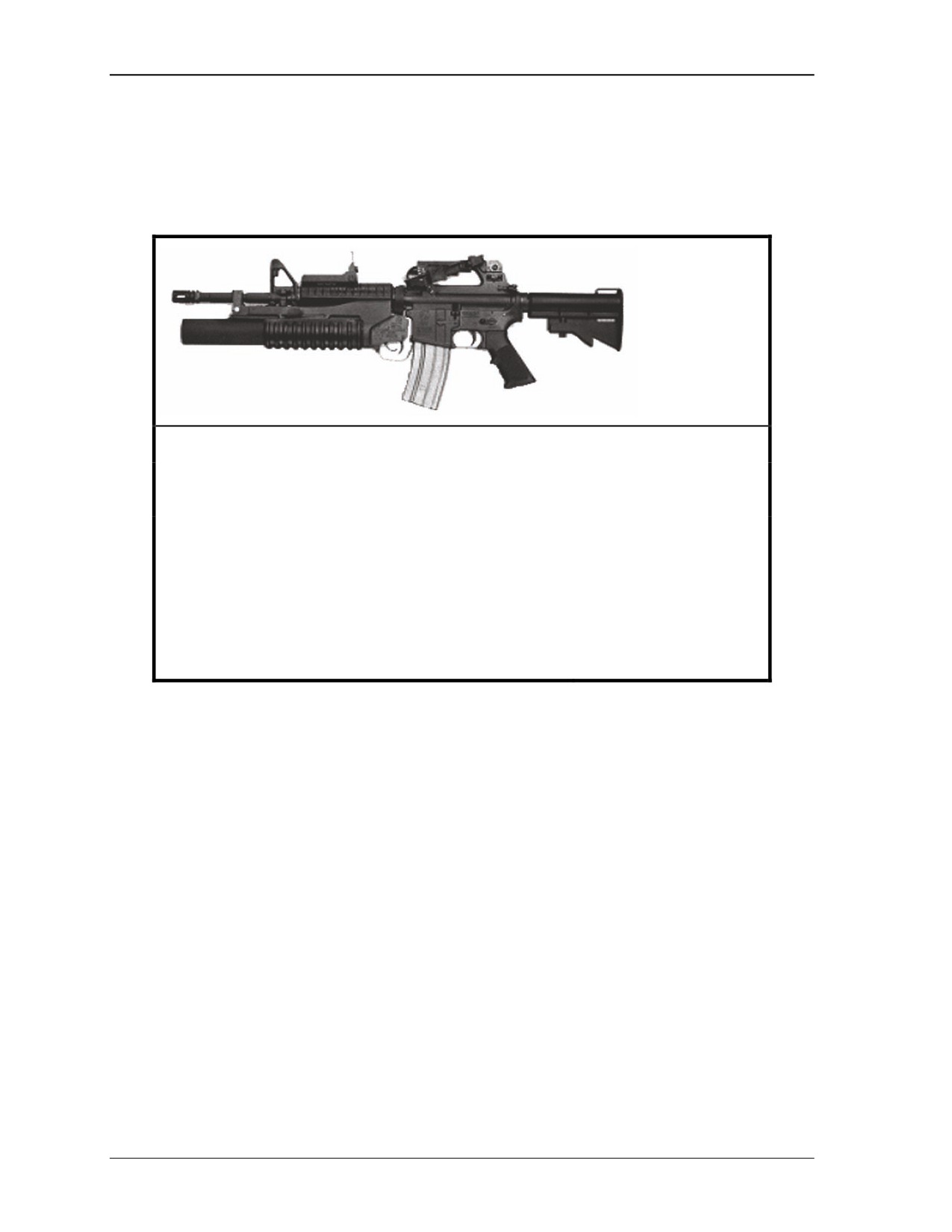
10-11. The M4 is a compact version of the M16A2 rifle, with collapsible stock, flat-top upper receiver
accessory rail, and detachable handle/rear aperture site assembly (Figure 10-3). This rifle enables a Soldier
operating in close quarters to engage targets at extended ranges with accurate, lethal fire. It achieves more
than 85 percent commonality with the M16A2 rifle.
Caliber
5.56 mm
Weight
7.5 lb (loaded weight with
sling and one magazine)
Maximum effective range
Area target
600 meters
Point target
500 meters
Rate of fire
Semiautomatic
45 rounds per minute
Burst
90 rounds per minute
Figure 10-3. M4 carbine.
28 January 2008
FM 3-21.75
10-5
Chapter 10
M203 GRENADE LAUNCHER
10-12. The M203A1 grenade launcher is a single-shot weapon designed for use with the M4 series
carbine. It fires a 40-mm grenade (Figure 10-4). Both have a leaf sight and quadrant sight. The M203 fires
high-explosive
(HE), high-explosive dual-purpose
(HEDP) round, buckshot, illumination, signal,
CS (riot control), and training practice (TP) ammunition. Two M203s are issued per Infantry squad.
Caliber
40 mm
Weight
3.0 lb (empty)
3.6 lb (loaded)
Maximum effective range
Area target
350 meters
Point target
150 meters
Rate of fire
5 to 7 rounds per minute
Figure 10-4. M203 grenade launcher.
10-6
FM 3-21.75
28 January 2008
Combat Marksmanship
M249 SQUAD AUTOMATIC WEAPON
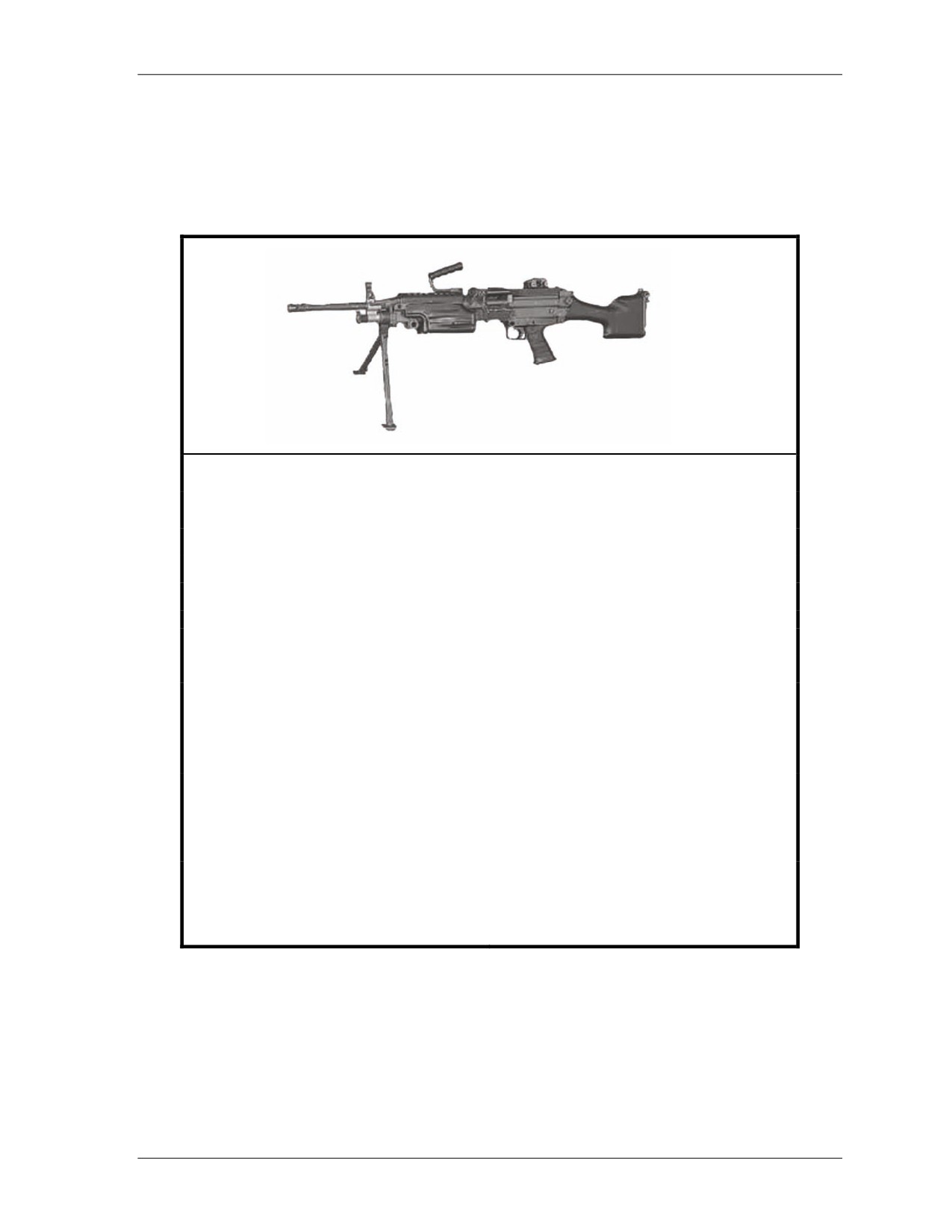
10-13. A lightweight, gas-operated, air-cooled belt or magazine-fed, one-man-portable automatic weapon
that fires from the open-bolt position (Figure 10-5). This gun can be fired from the shoulder, hip, or
underarm position; from the bipod-steadied position; or from the tripod-mounted position. Two M249s are
issued per Infantry squad.
Caliber
5.56 mm
Weight
16.5 lb
Maximum effective range
Area target
Tripod
1,000 m
Bipod
800 m
Point target
Tripod
800 m
Bipod
600 m
Rate of fire
Sustained
100 rounds per min
6- to 9-round bursts
4 to 5 seconds between bursts
Barrel change every 10 minutes
Rapid
200 rounds per minute
6- to 9-round bursts
2 to 3 seconds between bursts
Barrel change every 2 minutes
Cyclic
650 to 850 rounds per minute
Continuous burst
Barrel change every minute
Figure 10-5. M249 squad automatic weapon (SAW).
28 January 2008
FM 3-21.75
10-7
Chapter 10
M240B MACHINE GUN
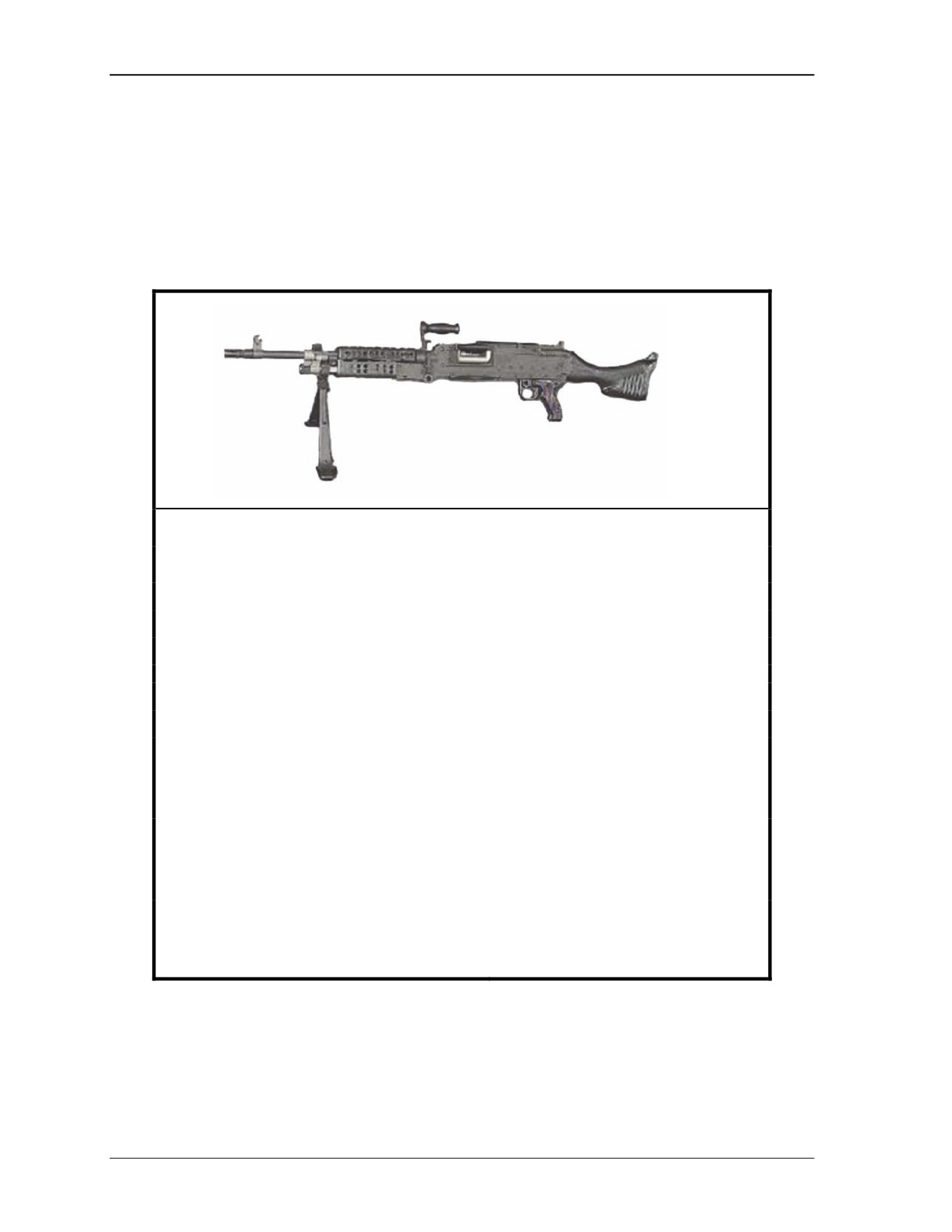
10-14. A medium, belt-fed, air-cooled, gas-operated, crew-served, fully automatic weapon that fires from
the open bolt position (Figure 10-6). Ammunition is fed into the weapon from a 100-round bandoleer
containing ball and tracer (4:1 mix) ammunition with disintegrating metallic split-link belt. Other types of
ammunition available include armor-piercing, blank, and dummy rounds. It can be mounted on a bipod,
tripod, aircraft, or vehicle. A spare barrel is issued with each M240B, and barrels can be changed quickly
as the weapon has a fixed head space. It is being issued to Infantry, armor, combat engineer, special
force/rangers, and selected field artillery units that require medium support fires.
Caliber
7.62 mm
Weight
27.6 lb
Maximum effective range
Area target
Tripod
1,100 m
Bipod
800 m
Point target
Tripod
800 m
Bipod
600 m
Rate of fire
Sustained
100 rounds per minute
6- to 9-round bursts
4 to 5 seconds between bursts
Barrel change every 10 minutes
Rapid
200 rounds per minute
10- to 13-round bursts
2 to 3 seconds between bursts
Barrel change every 2 minute
Cyclic
650 to 950 rounds per minute
Continuous bursts
Barrel change every minute
Figure 10-6. M240B machine gun.
10-8
FM 3-21.75
28 January 2008
Combat Marksmanship
M2 (.50 CALIBER) MACHINE GUN
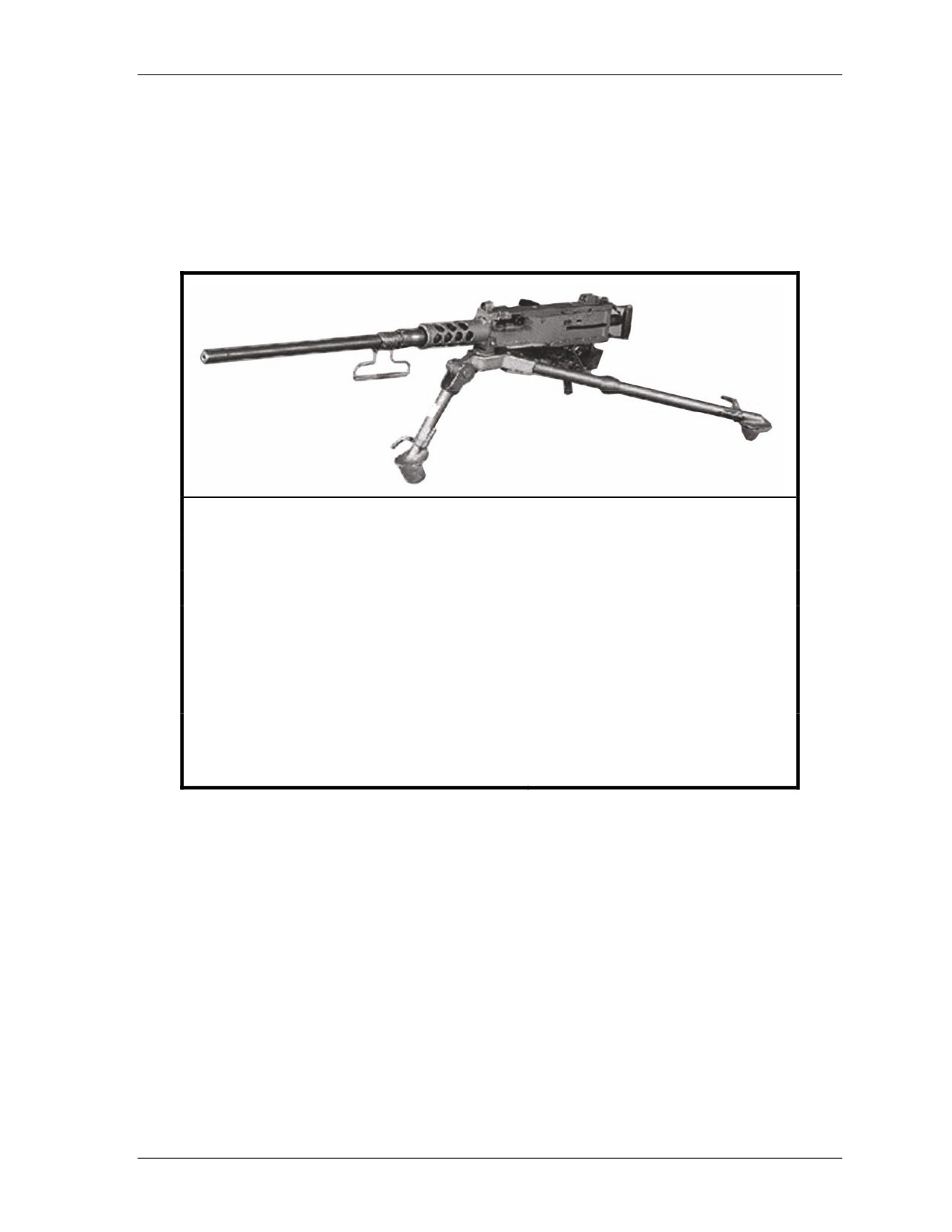
10-15. A heavy (barrel), recoil operated, air-cooled, crew-served, and transportable fully automatic
weapon with adjustable headspace (Figure 10-7). A disintegrating metallic link belt is used to feed the
ammunition into the weapon. This gun may be mounted on ground mounts and most vehicles as an
antipersonnel and antiaircraft/light armor weapon. The gun is equipped with leaf-type rear sight, flash
suppressor and a spare barrel assembly. Associated components are the M63 antiaircraft mount and the M3
tripod mount.
Caliber
50
Ammunition
12.7 x 99-mm NATO
Weight
84 lb (44 lb for tripod)
Maximum effective range
Antiaircraft mount
1,400 meters
Tripod mount
2,000 meters
Rate of fire
Cyclic
400 to 500 rounds per minute
Figure 10-7. M2 .50 caliber machine gun with M3 tripod mount.
28 January 2008
FM 3-21.75
10-9
Chapter 10
MK 19 GRENADE MACHINE GUN, MOD 3
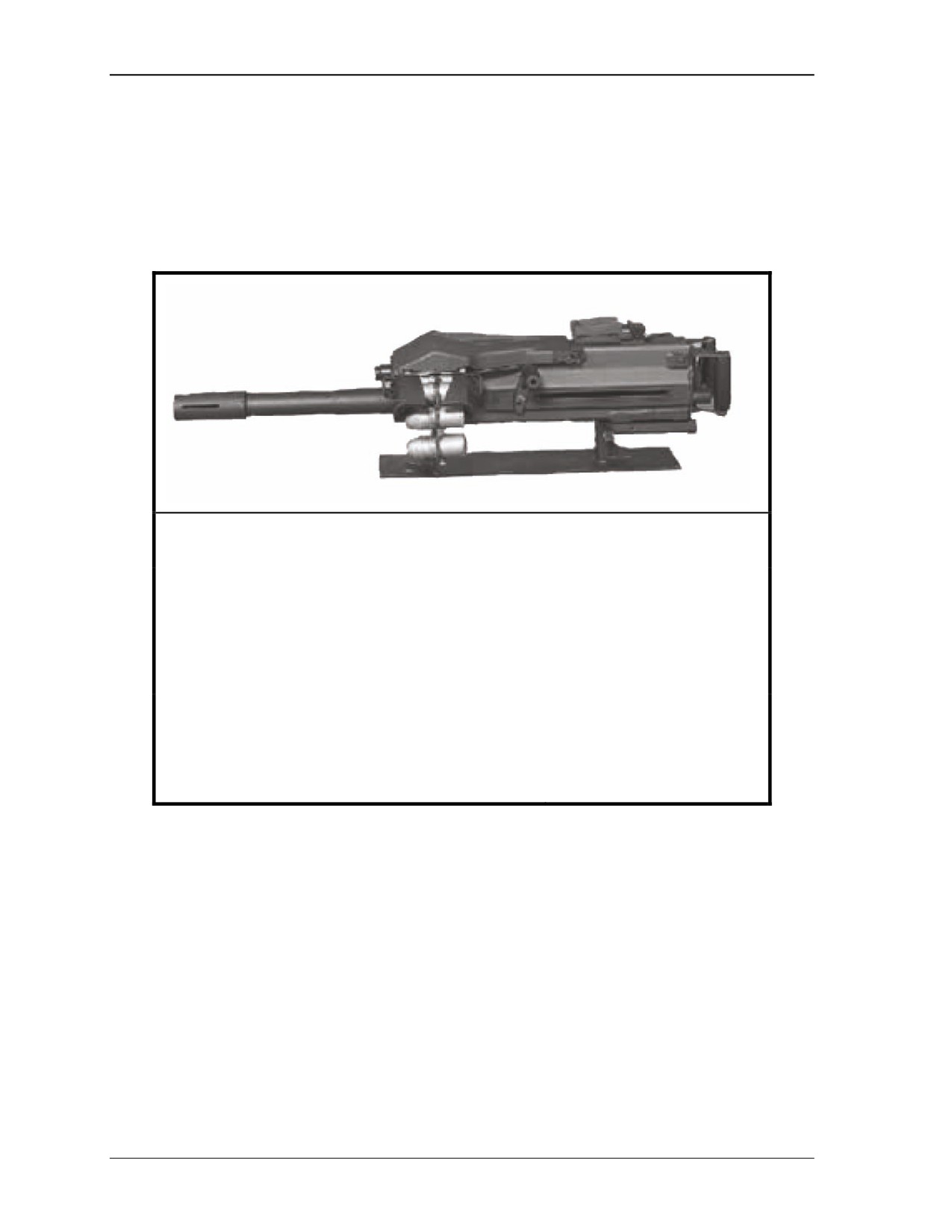
10-16. A self-powered, air-cooled, belt-fed, blowback-operated weapon designed to deliver decisive
firepower against enemy personnel and lightly armored vehicles (Figure 10-8). A disintegrating metallic
link belt feeds either HE or HEDP ammunition through the left side of the weapon. It replaces the M2
heavy machine guns in selected units, and will be the main suppressive weapon for combat support and
combat service support units. The MK 19 Mod 3 can be mounted on the HMMWV M113 family of
vehicles, on 5-ton trucks, and on some M88A1 recovery vehicles.
Caliber
40 mm
Weight
72.5 lb
Maximum effective range
Area target
2,212 meters
Point target
1,500 meters
Rate of fire
Sustained
40 rounds per minute
Rapid
60 rounds per minute
Cyclic
325 to 375 rounds per minute
Figure 10-8. MK 19 grenade machine gun, Mod 3.
10-10
FM 3-21.75
28 January 2008
Combat Marksmanship
IMPROVED M72 LIGHT ANTIARMOR WEAPON
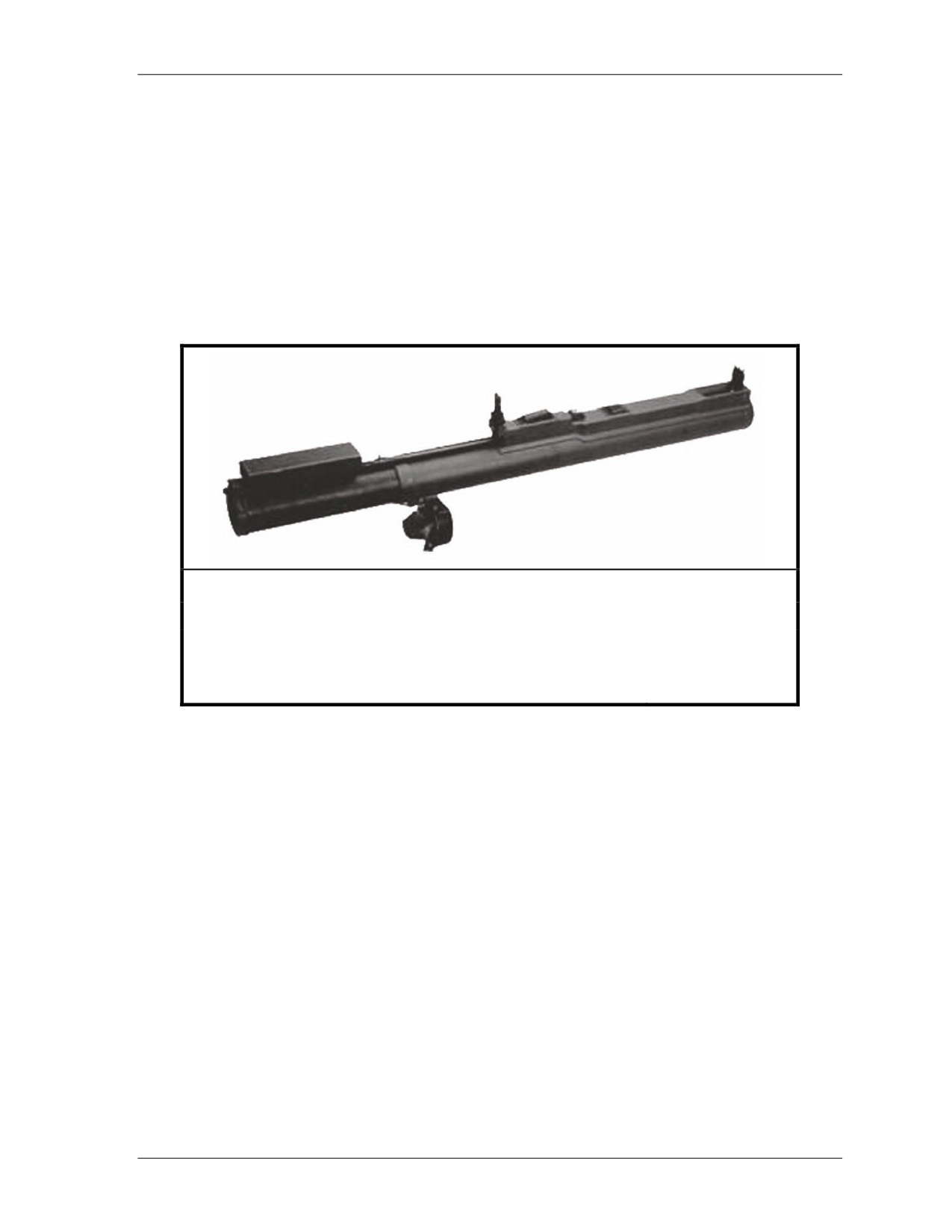
10-17. A compact, lightweight, single shot, and disposable weapon with a family of warheads optimized
to defeat lightly armored vehicles and other hard targets at close-combat ranges (Figure 10-9). Issued as a
round of ammunition, it requires no maintenance. The improved M72 light antiarmor weapon systems offer
significantly enhanced capability beyond that of the combat-proven M72A3. The improved M72 light
antiarmor weapon system consists of an unguided high-explosive antiarmor rocket prepackaged in a
telescoping, throw-away launcher. The system performance improvements include a higher velocity rocket
motor that extends the weapon effective range, increased lethality warheads, lower more consistent trigger
release force, rifle type sight system, and better overall system reliability and safety. The improved M72 is
transportable by tactical wheeled and tracked vehicles, without any safety constraints, and is air deliverable
by individual parachutist or by pallet.
Caliber
66 mm
Weight
2.2 lb
Maximum effective range
220 meters
Minimum arming range
10 meters
Figure 10-9. Improved M72 LAW.
28 January 2008
FM 3-21.75
10-11
Chapter 10
M136 AT4
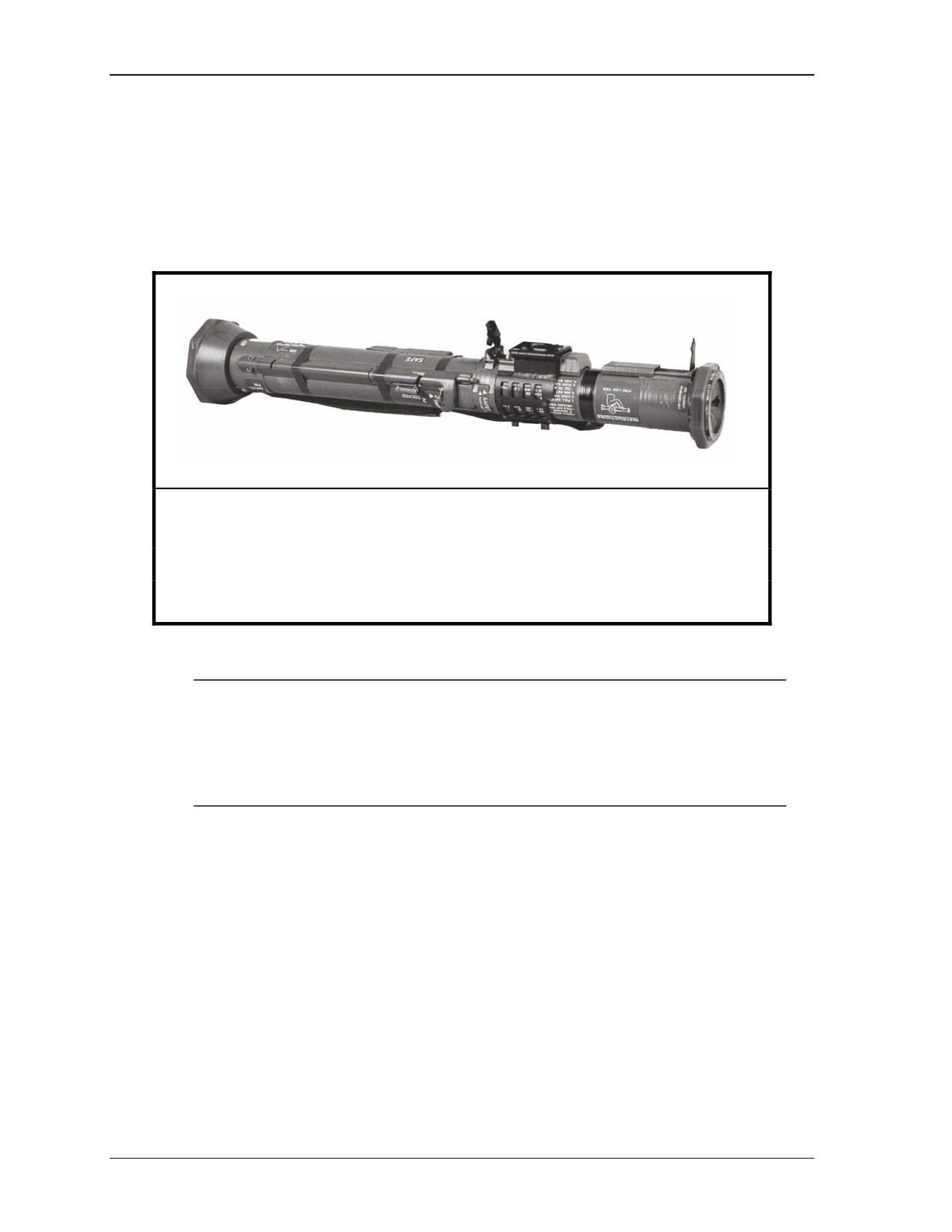
10-18. The M136 AT4 is a lightweight, self-contained antiarmor weapon
(Figure 10-10). It is
man-portable and fires (only) from the right shoulder. The M136 AT4 is used primarily by Infantry forces
to engage and defeat armor threats. The weapon accurately delivers a high-explosive antitank (HEAT)
warhead with excellent penetration capability (more than 15 inches of homogenous armor) and lethal
after-armor effects. The weapon has a free-flight, fin-stabilized, rocket-type cartridge packed in an
expendable, one-piece, fiberglass-wrapped tube.
Caliber
84 mm
Weight
4 lb
Maximum effective range
300 meters
Minimum arming range
15 meters
Figure 10-10. M136 AT4.
Note: Both the high penetration (HP) and reduced sensitivity (RS) versions of the AT4
Confined Space (CS) weapon offer improved safety. Unlike the original AT4, these
models can be fired safely from within a room or other protected enclosure. They
also have much less backblast and launch signature. Both the AT4 CS-HP and
CS-RS consist of shock resistant, fiberglass-reinforced launching tubes fitted with
firing mechanisms, popup sights, carrying slings, protective covers, and bumpers.
10-12
FM 3-21.75
28 January 2008
Combat Marksmanship
M141 BUNKER DEFEAT MUNITION
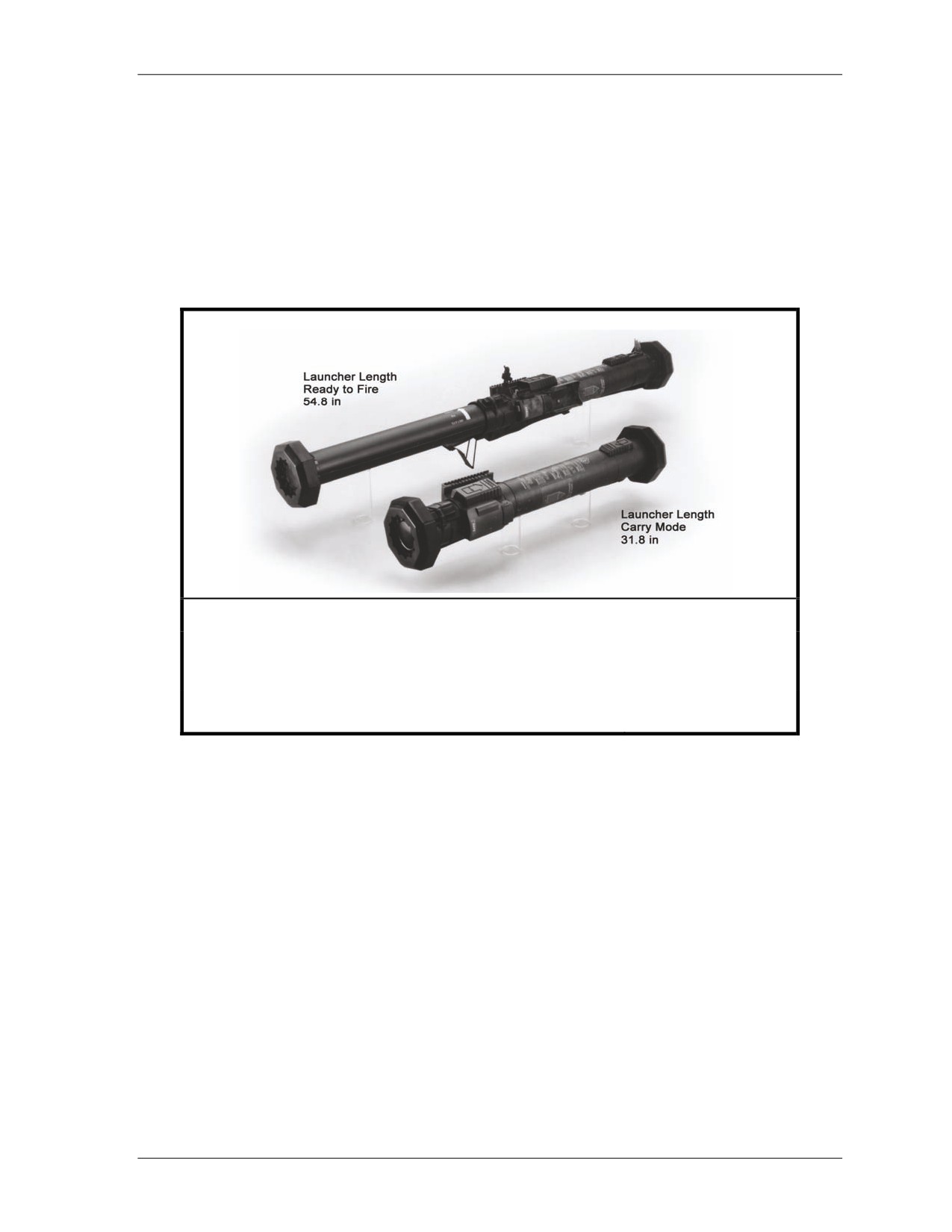
10-19. A lightweight, self-contained, man-portable, high-explosive, disposable, shoulder-launched,
multipurpose assault weapon-disposable
(SMAW-D) that contains all gunner features and controls
necessary to aim, fire, and engage targets (Figure 10-11). It can defeat fortified positions (bunkers) made of
earth and timber; urban structures; and lightly armored vehicles. The M141 BDM is issued as an 83-mm,
high-explosive, dual-mode, assault rocket round. It requires no maintenance. It fires (only) from the right
shoulder. The weapon system structure consists of inner and outer filament-woven composite tubes, stored
one inside the other to reduce carry length. Unlike the M136 AT4 launcher, the M141 BDM must be
extended before firing.
Caliber
83 mm
Weight
15.7 lb
Maximum effective range
300 meters
Minimum arming range
15 meters
Figure 10-11. M141 BDM.
28 January 2008
FM 3-21.75
10-13
Chapter 10
JAVELIN
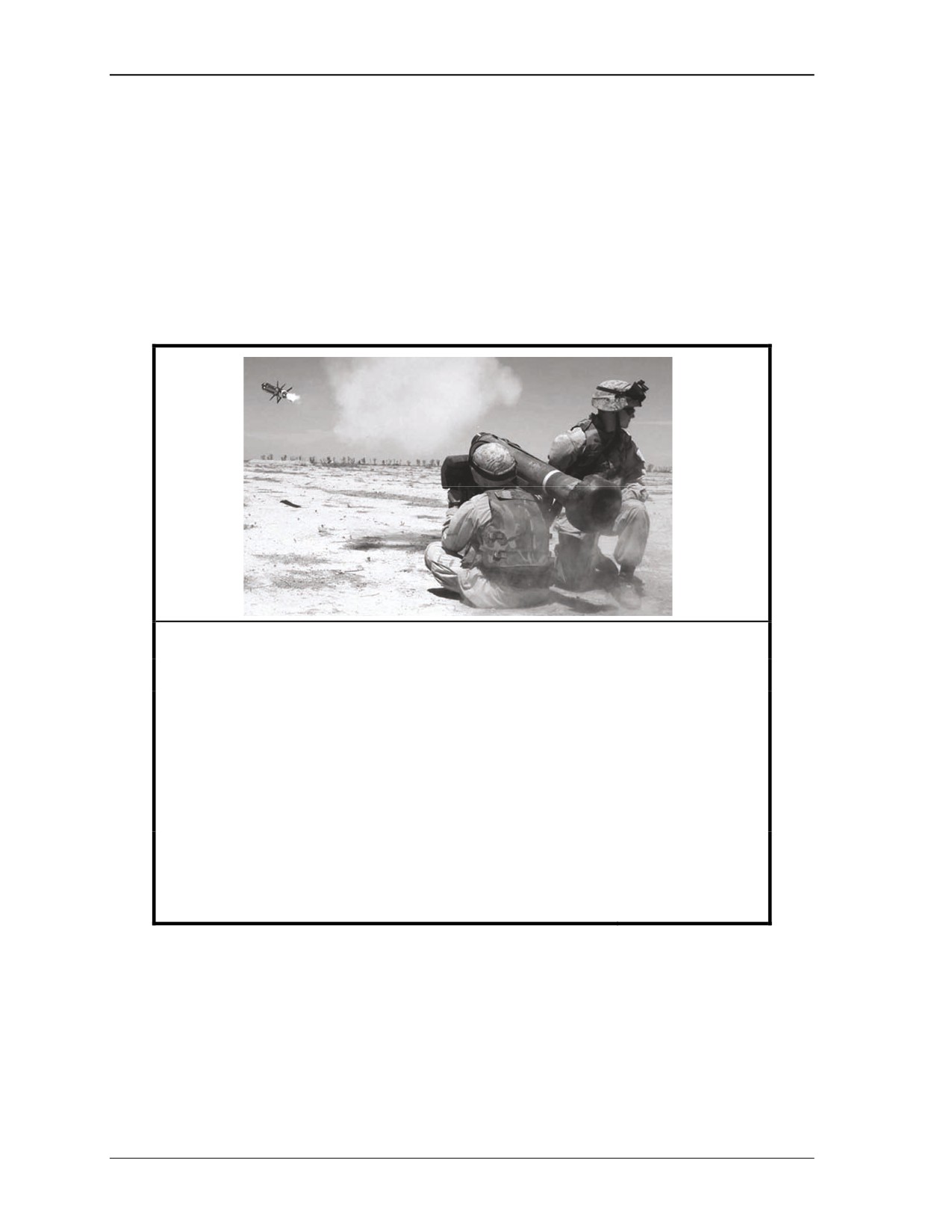
10-20. The Javelin is the first fire-and-forget, crew-served antitank missile
(Figure 10-12). Its
fire-and-forget guidance mode enables gunners to fire and then immediately take cover. This greatly
increases survivability. The Javelin’s two major components are a reusable command launch unit (CLU)
and a missile sealed in a disposable launch tube assembly. The CLU’s integrated daysight/nightsight allows
target engagements in adverse weather and in countermeasure environments. The CLU may also be used
by itself for battlefield surveillance and reconnaissance. Special features include a selectable top-attack or
direct-fire mode (for targets under cover or for use in urban terrain against bunkers and buildings), target
lock-on before launch, and a very limited backblast. These features allow gunners to fire safely from within
enclosures and covered fighting positions. The Javelin can also be installed on tracked, wheeled, or
amphibious vehicles.
Caliber
126 mm
Weight (missile+CLU)
49.5 lb
Maximum effective range
2,000 meters
(direct and
top-attack)
Minimum effective engagement range
Direct attack
65 meters
Top attack
150 meters
Minimum enclosure
Length
15 feet
Width
12 feet
Height
7 feet
Figure 10-12. Javelin.
FIRE CONTROL
10-21. Fire control includes all actions in planning, preparing, and applying fire on a target. Your leader
selects and designates targets. He also designates the midpoint and flanks or ends of a target, unless they
are obvious for you to identify. When firing, you should continue to fire until the target is neutralized or
until signaled to do otherwise by your leader. The noise and confusion of battle will limit the use of some
methods of control, so he will use the method, or combination of methods, that does the job.
10-14
FM 3-21.75
28 January 2008
Combat Marksmanship
WAYS TO COMMUNICATE FIRE CONTROL
10-22. The following paragraphs discuss methods to correspond fire control.
Sound Signals
10-23. This includes both voice and devices such as whistles. Sound signals are good only for short
distances. Their range and reliability are reduced by battle noise, weather, terrain, and vegetation. Voice
communications may come directly from your leader to you or they may be passed from Soldier-to-Soldier.
Trigger Points/Lines
10-24. This method is prearranged fire; your leader tells you to start firing once the enemy reaches a
certain point or terrain feature. When using this method of fire control, you do not have to wait for an order
to start firing. Prearranged fire can also be cued to friendly actions.
Visual Signals
10-25. In this method, your leader gives a prearranged signal when he wants you to begin, shift, and
cease firing. This can be either a visual signal or a sound signal. Start firing immediately when you get the
signal.
Time
10-26. You may be instructed to begin, shift, and cease firing at a set time. Additionally, Soldier-initiated
fire is used when there is no time to wait for orders from your leader.
Standing Operating Procedure
10-27. Using an SOP can reduce the number of oral orders needed to control fire. However, everyone in
the unit must know and understand the SOP for it to work. Three widely used SOP formats are the
search-fire-check, return-fire, and rate-of-fire SOPs. Procedures for issuing fire commands for direct fire
weapons should also be covered in an SOP.
Search-Fire-Check SOP
1. Search your assigned sectors for enemy targets.
2. Fire at any targets (appropriate for your weapon) seen in your sectors.
3. While firing in your sectors, visually check with your leader for specific orders.
Return-Fire SOP
10-28. This SOP tells each Soldier in a unit what to do in case the unit makes unexpected contact with
the enemy (in an ambush, for example).
Rate-Of-Fire SOP
10-29. This SOP tells each Soldier how fast to fire at the enemy. The rate of fire varies among weapons,
but the principle is to fire at a maximum rate when first engaging a target and then slow the rate to a point
that will keep the target suppressed. This helps to keep weapons from running out of ammunition.
28 January 2008
FM 3-21.75
10-15
Chapter 10
THREAT-BASED FIRE CONTROL MEASURES
10-30. The following paragraphs discuss threat-based fire control measures:
Engagement Priorities
10-31. Engagement priorities are the target types, identified by your leader, that offer the greatest payoff
or present the greatest threat. He then establishes these as a unit engagement priority. Your leader refines
these priorities within your unit, such as employing the best weapons for targets, as well as fire
distribution.
Range Selection
10-32. Range selection is a means by which your leader will use their estimate of the situation to specify
the range and ammunition for the engagement. Range selection is dependent on the anticipated engagement
range. Terrain, visibility, weather, and light conditions affect range selection, and the amount and type of
ammunition.
Weapons Control Status
10-33. The three levels of weapons control status outline the conditions, based on target identification
criteria, under which friendly elements may engage. Your leader will set and adjust the weapons control
status based on the friendly and enemy situation, and the clarity of the situation. The three levels, in
descending order of restriction, follow:
WEAPONS HOLD Engage only if engaged or ordered to engage.
WEAPONS TIGHT Only engage targets that are positively identified as enemy.
WEAPONS FREE
Engage any targets that are not positively identified as friendly.
Rules of Engagement
10-34. ROE are the commander’s rules for use of force and specify the circumstances and limitations in
which you may use your weapon. They include definitions of combatant and noncombatant elements, and
prescribe the treatment of noncombatants. Factors influencing ROE are national command policy, the
mission, operational environment, and the law of war.
COMBAT ZERO
10-35. Combat readiness makes it essential for you to zero your individual weapon whenever it is issued.
Additionally, each rifle in the unit arms room, even if unassigned, should be zeroed by the last Soldier it
was assigned to. For more detailed information see FM 3-22.9.
Note: Only the M16/M4-series weapons will be discussed for zeroing procedures and
aided-vision device combinations. For other weapons such as M249 SAW and the
M240B, see the appropriate FMs.
MECHANICAL ZERO
10-36. Mechanical zero is the process of alignment of the weapons sighting systems to a common start
point. Conduct the following procedures for these specific weapons:
10-16
FM 3-21.75
28 January 2008
Combat Marksmanship
M16A2/A3
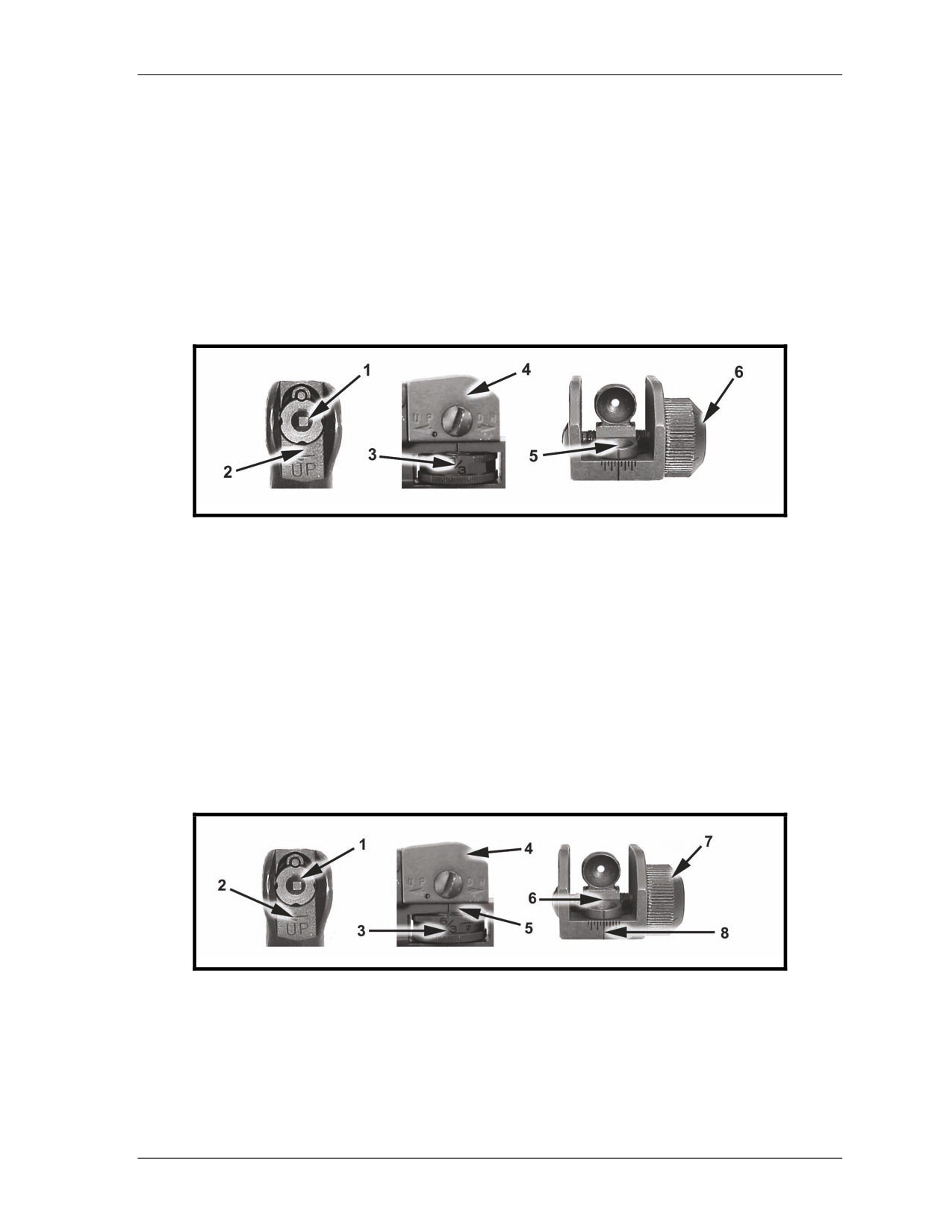
10-37. Numbers in parentheses refer to the callouts in Figure 10-13.
1. Adjust the front sight post (1) up or down until the base of the front sight post is flush with
the front sight post housing (2).
2. Adjust the elevation knob (3) counterclockwise, as viewed from above, until the rear sight
assembly (4) rests flush with the carrying handle and the 8/3 marking is aligned with the
index line on the left side of the carrying handle.
3. Position the apertures (5) so the unmarked aperture is up and the 0 to 200 meter aperture is
down. Rotate the windage knob (6) to align the index mark on the 0 to 200 meter aperture
with the long center index line on the rear sight assembly.
Figure 10-13. M16A2/A3 rifle mechanical zero.
M16A4 AND M4 CARBINE
10-38. Numbers in parentheses refer to the callouts in Figure 10-14.
1. Adjust the front sight post (1) up or down until the base of the front sight post is flush with
the front sight post housing (2).
2. Adjust the elevation knob (3) counterclockwise, when viewed from above, until the rear sight
assembly (4) rests flush with the detachable carrying handle and the 6/3 marking is aligned
with the index line (5) on the left side of the carrying handle.
3. Position the apertures (6) so the unmarked aperture is up and the 0 to 200 meter aperture is
down. Rotate the windage knob (7) to align the index mark (8) on the 0 to 200 meter aperture
with the long center index line on the rear sight assembly.
Figure 10-14. M16A4 and M4 carbine rifle mechanical zero.
BATTLESIGHT ZERO
10-39. Battlesight zero is the alignment of the sights with the weapon’s barrel given standard issue
ammunition. It provides the highest probability of hitting most high-priority combat targets with minimum
28 January 2008
FM 3-21.75
10-17
Chapter 10
adjustment to the aiming point 300 meter sight setting as on the M16A2/3/4 and M4 series weapons. For
each of the following weapons, ensure the rear sights are set for battlesight zero (25-meter zero):
M16A2/A3
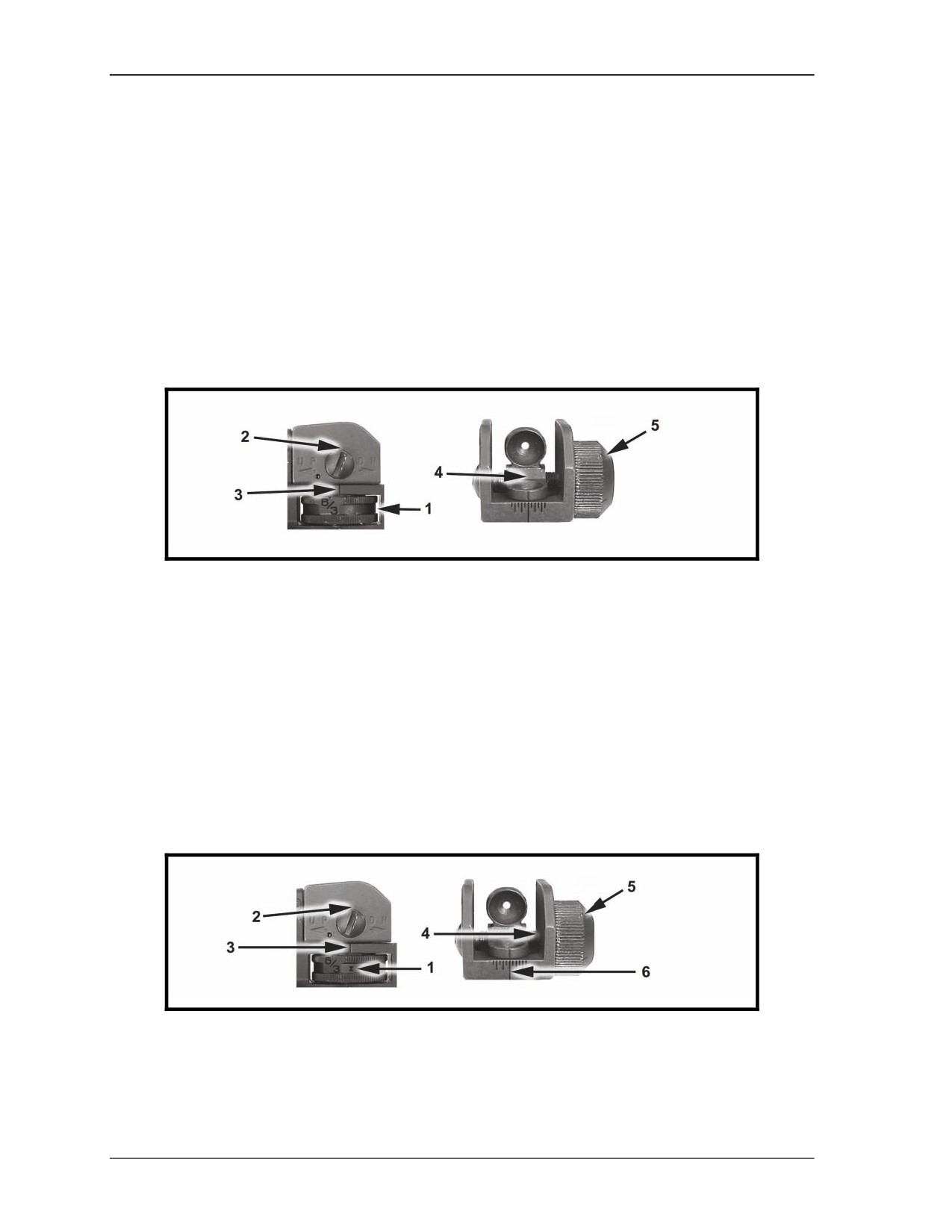
10-40. Numbers in parentheses refer to the callouts in Figure 10-15.
1. Adjust the elevation knob (1) counterclockwise, as viewed from above, until the rear sight
assembly (2) rests flush with the carrying handle and the 8/3 marking is aligned with the
index line (3) on the left side of the carrying handle. Then, turn the elevation knob one more
click clockwise.
2. Position the apertures (4) so the unmarked aperture is up and the 0 to 200 meter aperture is
down. Rotate the windage knob (5) to align the index mark on the 0 to 200 meter aperture
with the long center index line on the rear sight assembly.
Figure 10-15. M16A2/A3 rifle battlesight zero.
M16A4
10-41. Numbers in parentheses refer to the callouts in Figure 10-16.
1. Adjust the elevation knob (1) counterclockwise, when viewed from above, until the rear sight
assembly (2) rests flush with the detachable carrying handle and the 6/3 marking is aligned
with the index line (3) on the left side of the detachable carrying handle. To finish the
procedure, adjust the elevation knob two clicks clockwise so the index line on the left side of
the detachable carrying handle is aligned with the "Z" on the elevation knob.
2. Position the apertures (4) so the unmarked aperture is up and the 0 to 200 meter aperture is
down. Rotate the windage knob (5) to align the index mark on the 0 to 200 meter aperture
with the long center index line (6) on the rear sight assembly.
Figure 10-16. M16A4 rifle battlesight zero.
10-18
FM 3-21.75
28 January 2008
Combat Marksmanship
M4
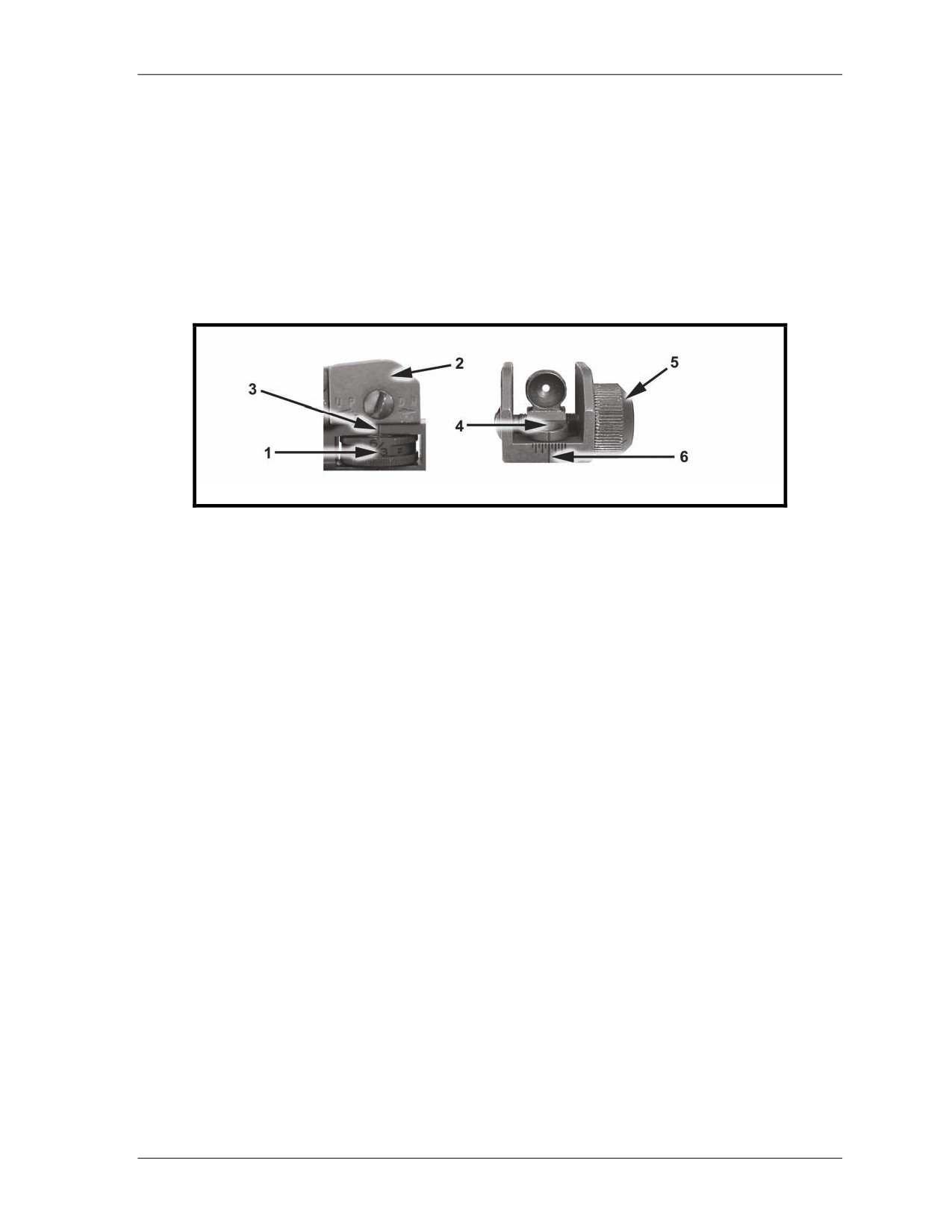
10-42. Numbers in parentheses refer to the callouts in Figure 10-17.
1. Adjust the elevation knob (1) counterclockwise, when viewed from above, until the rear sight
assembly (2) rests flush with the detachable carrying handle and the 6/3 marking is aligned
with the index line (3) on the left side of the detachable carrying handle. The elevation knob
remains flush.
2. Position the apertures (4) so the unmarked aperture is up and the 0 to 200 meter aperture is
down. Rotate the windage knob (5) to align the index mark (6) on the 0 to 200 meter aperture
with the long center index line on the rear sight assembly.
Figure 10-17. M4 rifle battlesight zero.
SHOT GROUPS
10-43. To ensure proper and accurate shot group marking--
1. Apply the four fundamentals of marksmanship deliberately and consistently. Establish a
steady position allowing observation of the target. Aim the rifle at the target by aligning the
sight system, and fire your rifle without disturbing this alignment by improper breathing or
during trigger squeeze.
2. Initially, you should fire two individual shot groups before you consider changing the sight.
Fire each shot at the same aiming point (center mass of the target) from a supported firing
position. You will fire a three-round shot group at the 25-meter zero target.
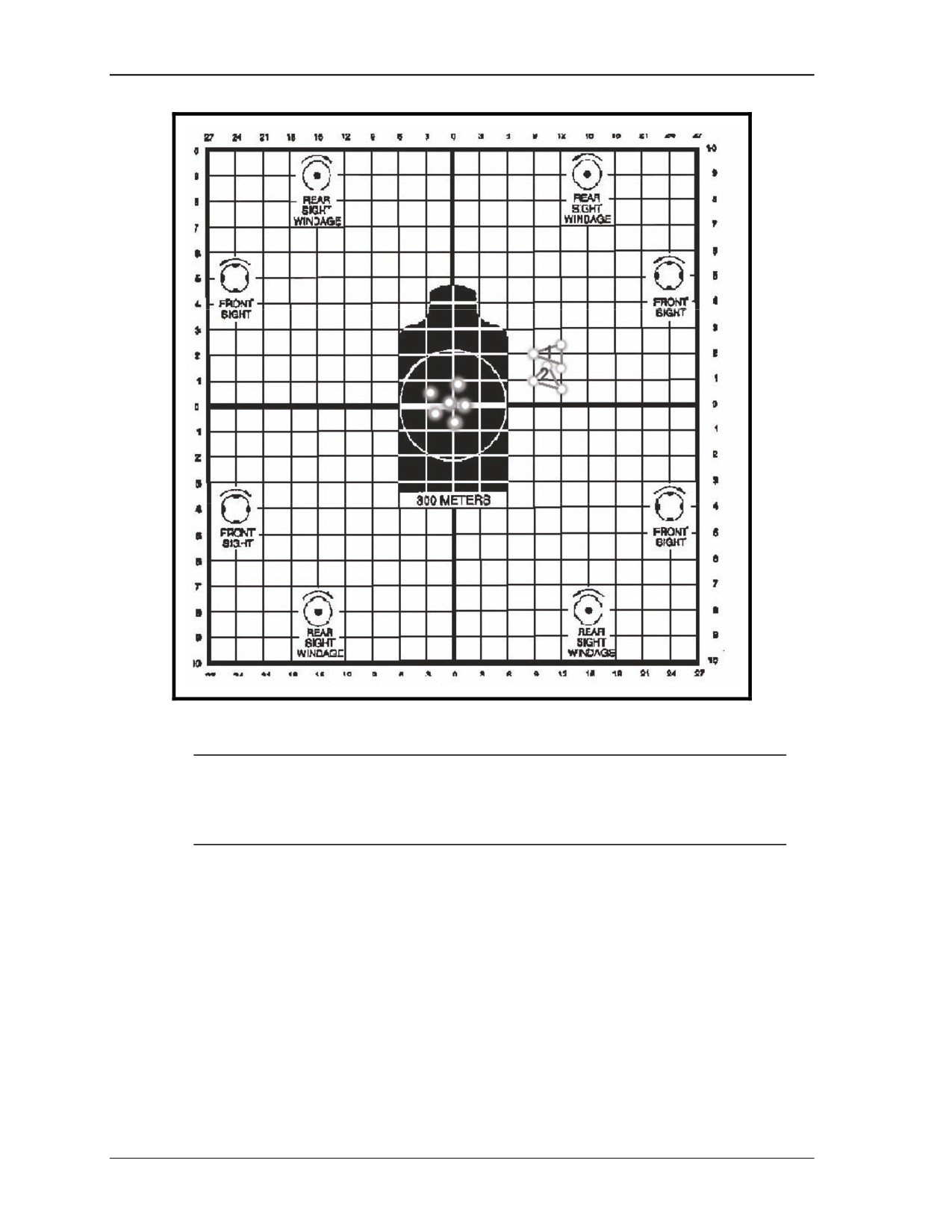
3. You will triangulate each shot group and put the number "1" in the center of the first shot
group and a number "2" on the second. Group the two shot groups and mark the center of the
two shot groups with an X. If the two shot groups fall within a 4-centimeter circle then
determine what sight adjustments need to be made, then identify the closest horizontal and
vertical lines to the X, and then read the 25-meter zero target to determine the proper sight
adjustments to make. A proper zero is achieved if five out of six rounds fall within the
4-centimeter circle (Figure 10-18).
28 January 2008
FM 3-21.75
10-19
Chapter 10
Figure 10-18. Final shot group results.
Note: The M16A2 zero target squares are .96 centimeter in size while the M4 zero target
squares are 1.3 centimeters in size. Two single shots on a 25-meter zero target that
are 2 centimeters apart does not equate to two squares from each other on the M4
zero target.
10-20
FM 3-21.75
28 January 2008

Combat Marksmanship
BORELIGHT ZERO
10-44. The borelight is an accurate means of zeroing weapons and most aided-vision equipment without
the use of ammunition. Time and effort must be applied to ensure a precise boresight, which will in turn
save time and ammunition. Both the M16A2 and the M4/MWS can be zeroed using the borelight and each
of the following five aided vision devices:
• Backup iron sight (which can also be boresighted).
• AN/PAQ-4B/C.
• AN/PEQ-2A.
• AN/PAS-13.
• M68 CCO.
Note: Precisely boresighting a laser allows direct engagement of targets without a 25-meter
zero. If a borelight is unavailable, you must use a 25-meter zero to zero the device.
All optics must be 25-meter zeroed. A borelight only aids in zeroing.
DANGER
1. DO NOT STARE INTO THE VISIBLE LASER BEAM.
2. DO NOT LOOK INTO THE VISIBLE LASER BEAM THROUGH
BINOCULARS OR TELESCOPES.
3. DO NOT POINT THE VISIBLE LASER BEAM AT BEAM
THROUGH BINOCULARS OR TELESCOPES.
4. DO NOT SHINE THE VISIBLE LASER BEAM INTO OTHER
INDIVIDUAL’S EYES.
WARNINGS
1.
Make sure the weapon is CLEAR and on SAFE before using
the borelight.
2.
Ensure the bolt is locked in the forward position.
3.
When rotating the borelight to zero it, ensure the mandrel is
turning counter clockwise (from the gunners point of view)
to avoid loosening the borelight from the mandrel.
10-45. Boresighting is a simple procedure if the steps are strictly followed. The visible laser of the
borelight must be aligned with the barrel of your assigned weapon. Then, using a 10-meter boresight target,
the weapon can be boresighted with any optic, laser, or iron sight.
10-46. Before you boresight your weapon, the borelight must first be zeroed to the weapon. To zero the
borelight to the weapon, align the visible laser with the barrel of the weapon. Stabilizing the weapon is
crucial. The weapon can be stabilized in a rifle box rest or in a field location by laying two rucksacks side
by side. Lay the weapon on the rucksacks and then lay another rucksack on top of the weapon to stabilize
it.
28 January 2008
FM 3-21.75
10-21
Chapter 10
ZEROING THE BORELIGHT
WARNING
Avoid overadjusting the laser or pointing it at other Soldiers or
reflective material.
10-47. The weapon need not be perfectly level with the ground during boresighting Conduct the
following steps to zero the borelight:
1. Attach the 5.56-mm mandrel to the borelight.
2. Insert the mandrel into the muzzle of the weapon. The borelight is seated properly
when the mandrel cannot be moved any further into the muzzle and the mandrel spins freely.
Stabilize the weapon so it will not move.
3. Measure 10 meters with the 10-meter cord that comes with the borelight or pace off
eleven paces.
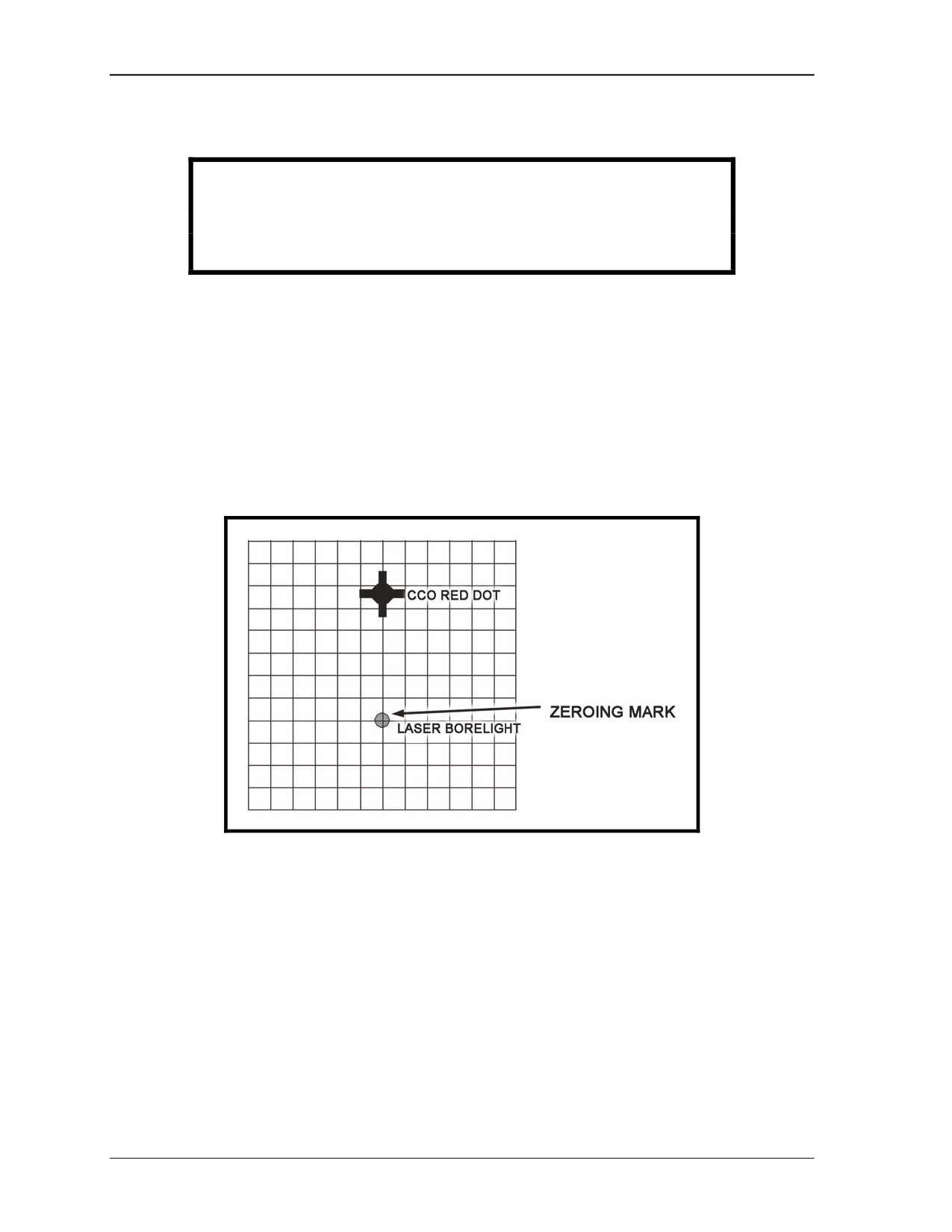
4. The zeroing mark is a small dot drawn on a piece of paper, tree bark, or the borelight RP
on the 10-meter boresight target (Figure 10-19).
Figure 10-19. Example zeroing mark.
10-22
FM 3-21.75
28 January 2008
Combat Marksmanship
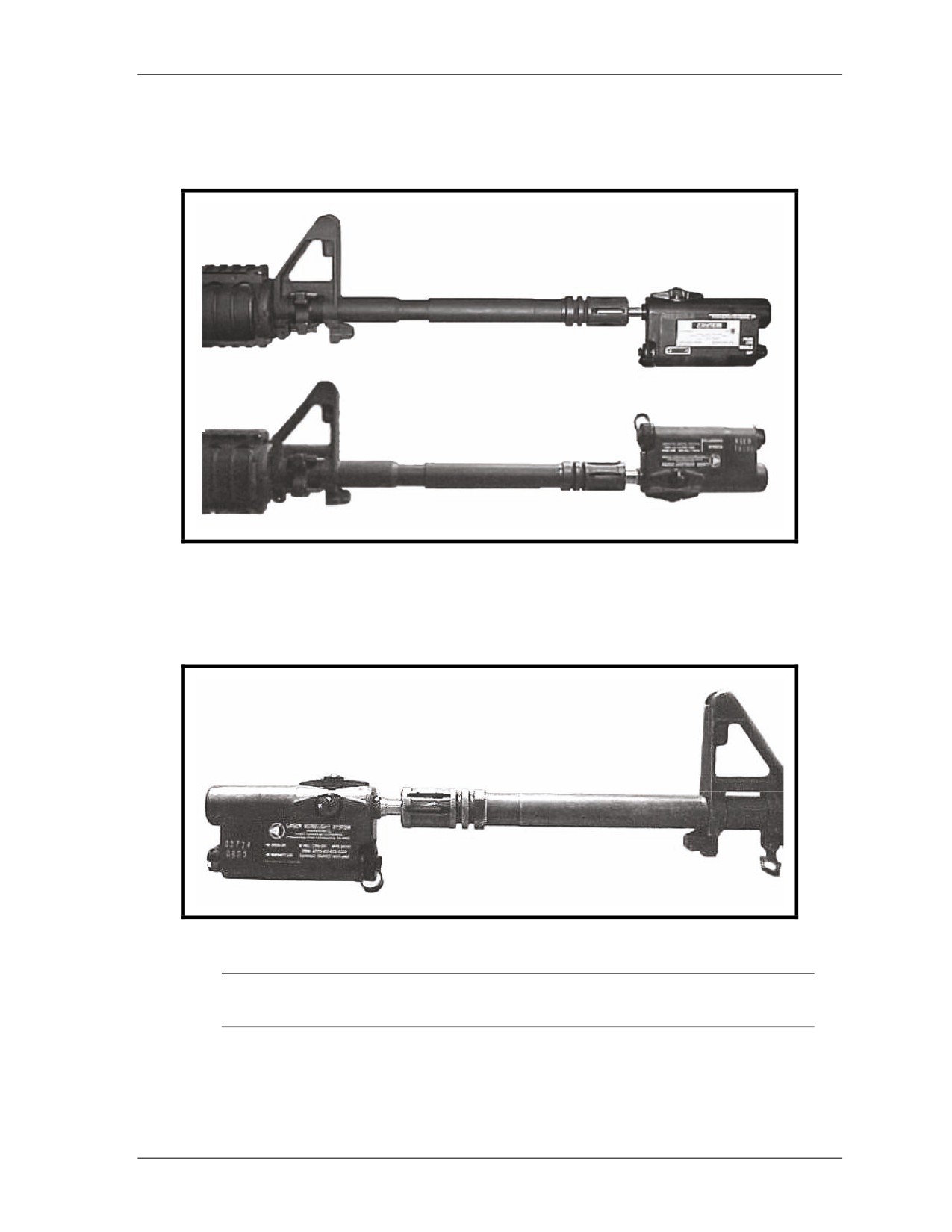
5. Rotate the borelight until the battery compartment is facing upward and the adjusters are on
the bottom (Figure 10-20). This position of the borelight, and where the visible laser
is pointing, is the start point.
Figure 10-20. Borelight in the start point position.
6. Rotate the borelight until the battery compartment is down and the adjusters are on top to
allow for easy access to the adjusters (Figure 10-21). This position of the borelight, and
where the visible laser is pointing, is identified as the half-turn position.
Figure 10-21. Borelight in the half-turn position.
Note: Use the commands START POINT and HALF TURN to ensure clear communication
between you and your buddy/assistant at the boresight target.
28 January 2008
FM 3-21.75
10-23
Chapter 10
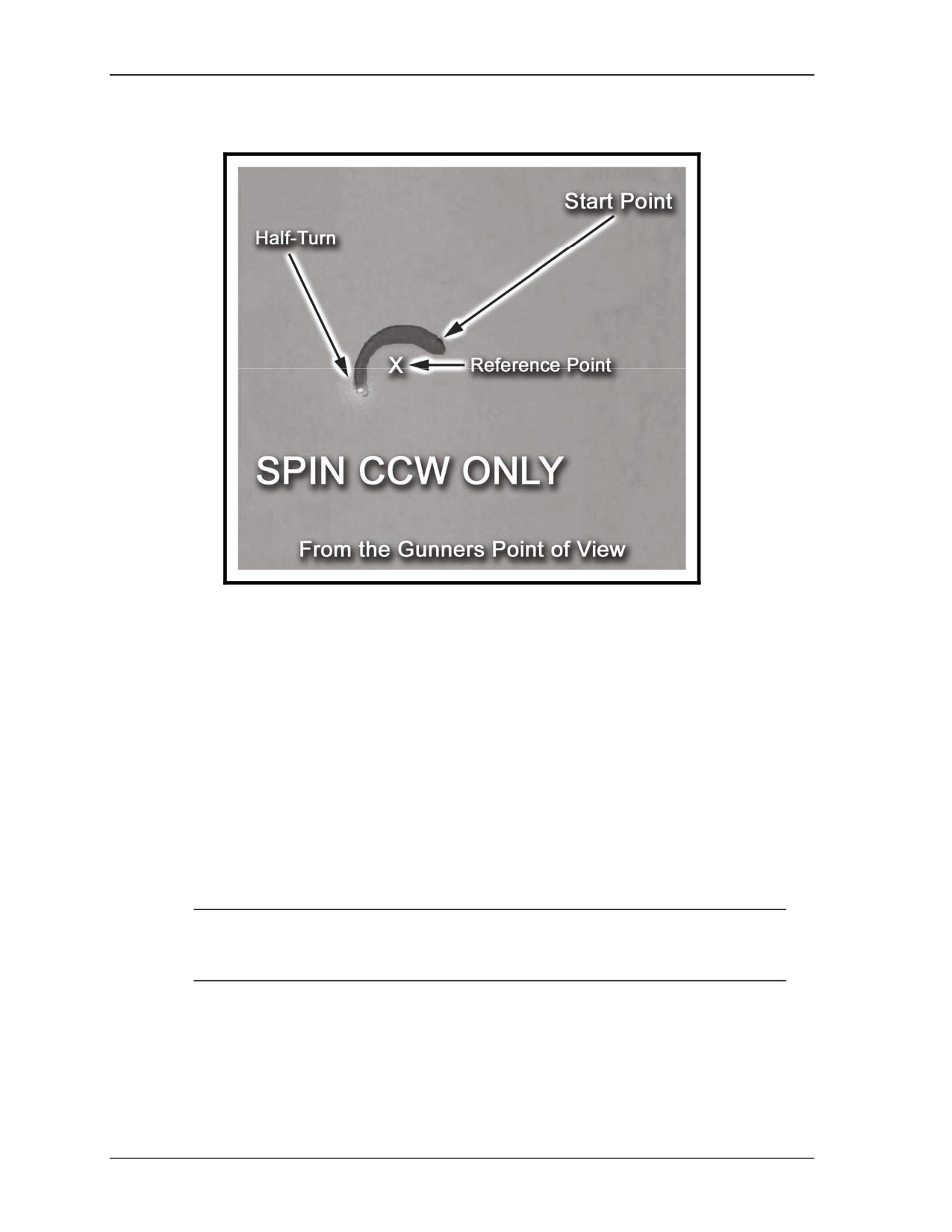
7. The RP is about halfway between the start point and the half-turn point (Figure 10-22).
Figure 10-22. Examples of start point, half-turn, and reference point.
8. Turn the borelight on and spin it until it is in the start point position. Place the zeroing mark
about 10 meters from the end of the barrel so that the visible laser strikes the zeroing mark.
9. Slowly rotate the borelight 180 degrees while watching the visible laser made by the
borelight. If the visible laser stops on the zeroing mark, the borelight is zeroed to the
weapon.
10. If the borelight does not stop on the zeroing mark, elevation and windage adjustments
must be made to the borelight.
11. From the start point, realign the zeroing mark with the visible laser, rotate the borelight 180
degrees to the half-turn position, and identify the RP. Using the adjusters on the borelight,
move the visible laser to the RP. Rotate the borelight back to the start point; move the zeroing
mark to the visible laser. If the visible laser cannot be located when you spin the borelight to
the half-turn position, start this procedure at 2 meters instead of 10 meters. When the visible
laser is adjusted to the RP at 2 meters, then start the procedure again at 10 meters.
12. Repeat Step 11 above until the visible laser spins on itself.
Note: Every barrel is different; therefore, steps (8) through (10) must be performed with
every weapon to ensure that the borelight is zeroed to that barrel. If the borelight is
zeroed, then go directly to the boresighting procedures.
10-24
FM 3-21.75
28 January 2008
Combat Marksmanship
10-48. During boresighting, your weapon should be in the "bolt forward" position and must not be canted
left or right. As a firer, you will need a target holder in order to properly boresight a weapon. The
duties follow:
1. The firer’s primary duty is to zero the borelight and make all adjustments on the aided-vision
device being used.
2. The target holder secures the 10-meter, (1-centimeter square grid) boresight target (Figure
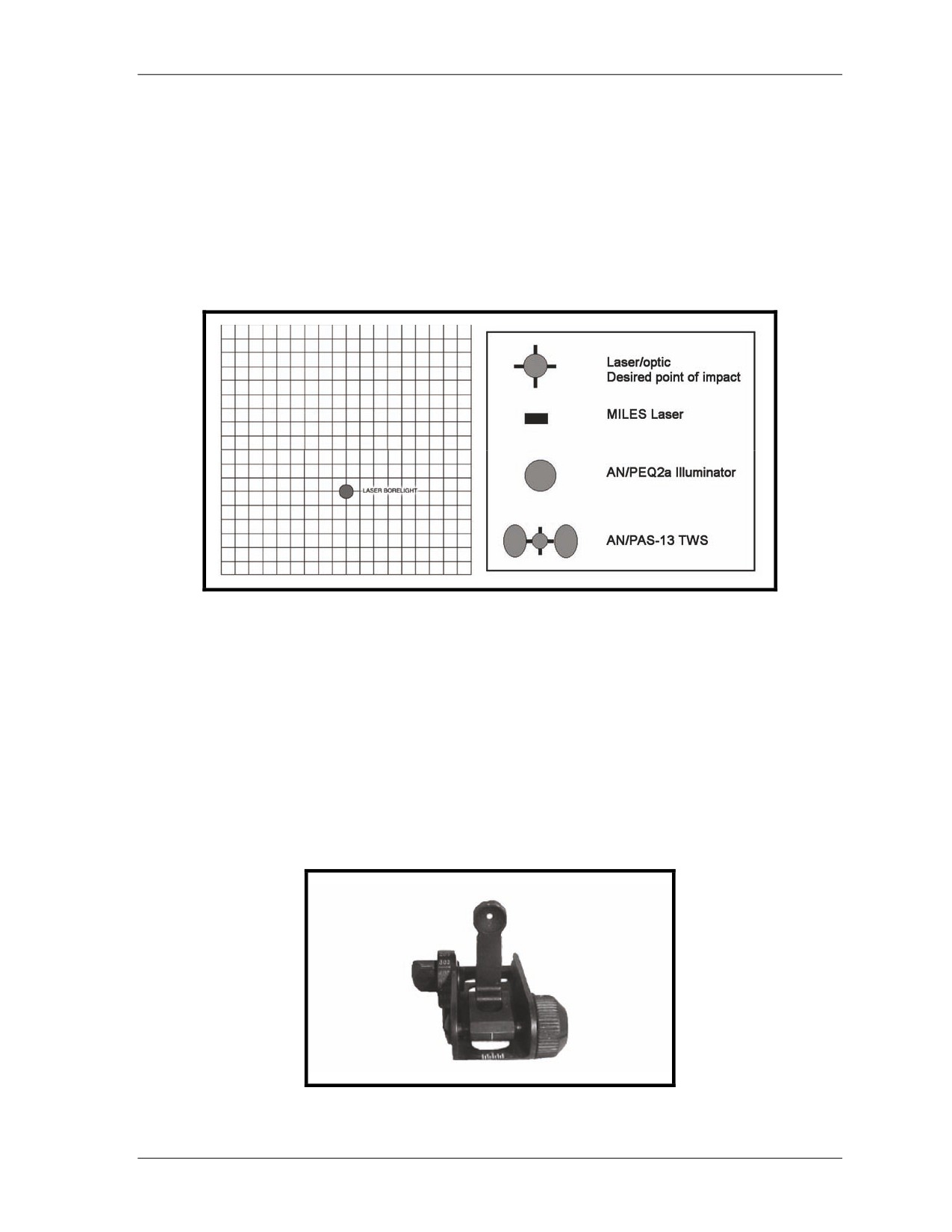
10-23) straight up and down 10 meters from the borelight, and directs the firer in making
necessary adjustments to the aiming device. The target holder must wear NVGs when
boresighting IR aiming lasers.
Figure 10-23. Blank 10-meter boresight target and offset symbols.
BORESIGHTING THE BACKUP IRON SIGHT
10-49. The backup iron sight (BIS) can be boresighted to a new user to expedite 25-meter zeroing
(Figure 10-24). To boresight using the BIS, align the iron sights with the (Canadian bull) on the 10-meter
boresight target. Adjust the windage and elevation of the iron sights until the borelight is centered with the
circle on the boresight target.
10-50. The BIS is adjusted for a 300-meter battlefield zero to provide backup in the event an optic or
laser device fails to function. The BIS is zeroed on the M4/M4A1 target on the backside of the M16A2
zero targets. The 25-meter zeroing procedures are the same as for conventional rear sight assembly on the
M16-/M4-series weapons.
Figure 10-24. Backup iron sight.
28 January 2008
FM 3-21.75
10-25
Chapter 10
BORESIGHTING THE M68 CLOSE COMBAT OPTIC
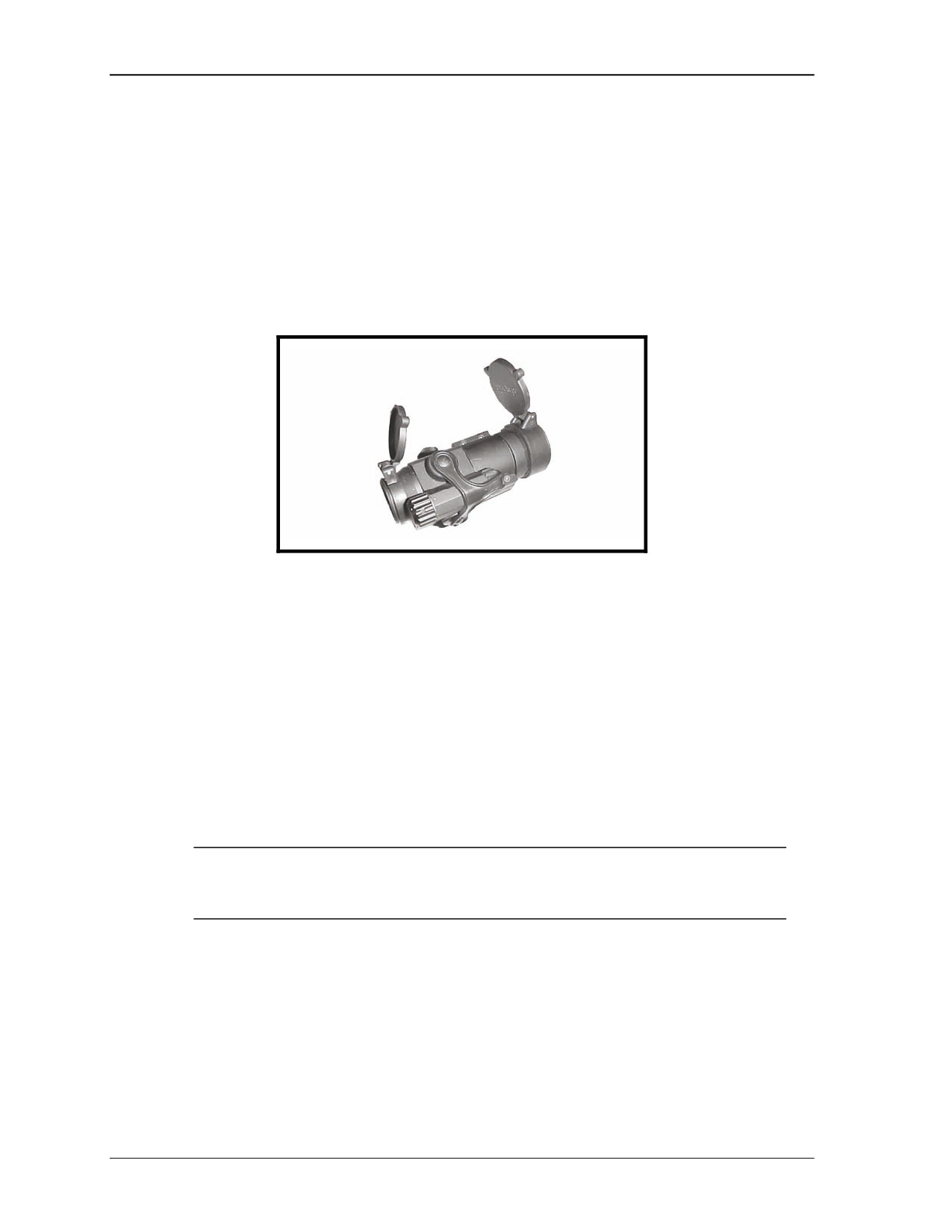
10-51. The M68 CCO is a reflex (nontelescopic) sight (Figure 10-25). It uses a red-aiming reference
(collimated dot) and is designed for the sighting with both eyes open. Position your head so that one eye
can focus on the red dot and the other eye can scan downrange. Place the red dot on the center of mass of
the target and engage. With your nonfiring eye closed, look through the M68 to ensure you can see the red
dot clearly. Place the red dot center mass of the target, and then engage. If you zero your weapon with the
one-eye-open method, then you must engage targets using this method for zero accuracy. The dot follows
the horizontal and vertical movement of your eye while remaining fixed on the target. No centering or
focusing is required. The more accurately you boresight the M68 to your weapon, the closer it will be to a
battlesight zero.
Figure 10-25. M68 close combat optic.
25-Meter Zero Procedure with Borelight
1. Select the proper 10-meter boresight target for your weapon and M68 configuration. With the
help of an assistant, place the boresight target 10 meters in front of the weapon.
2. Turn the M68 to the desired setting (position number 4). Assume a stable supported firing
position behind your weapon, and look through the M68. Aim the red dot of the M68 on the
crosshair of the 10-meter boresight target. Adjust the M68 until the borelight's visible laser
centers on the borelight circle on the 10-meter boresight target.
3. Turn the borelight off. Move your weapon off the crosshair, realign the red dot of the M68 on
the crosshair, and turn the borelight back on. If the borelight is on the circle and the red dot of
the M68 is on the crosshair, your weapon system is now boresighted.
Note: The M68 is parallax free beyond 50 meters. Boresight at 10 meters. In order to get a
solid boresight, acquire the same sight picture and cheek-to-stock weld position
each time.
4. Turn the laser off. To avoid damaging the borelight device, carefully remove it, and the
mandrel, from the weapon.
10-26
FM 3-21.75
28 January 2008
Combat Marksmanship
25-Meter Zero Procedure without Borelight
10-52. If the borelight is unavailable, conduct a 25-meter zero--
1. Use the same standards as with iron sights.
2. Starting from center mass of the 300-meter silhouette on the 25-meter zero target, count down
1.4 centimeters and make a mark. This is now the point of impact.
3. Make a 4-by-4 square box around the point of impact. This box is now the offset and is the
designated point of impact for the M68.
4. Aim center mass of the 300-meter silhouette and adjust to the M68 so that the rounds impact in
the 4-by-4 square box, 1.4 centimeters down from the point of aim.
- Two clicks = 1 cm at 25 m for windage and elevation.
- One click clockwise on elevation moves bullet strike down.
- One click clockwise on windage moves bullet strike left.
5. Zero only on the M16A2 25-meter zero target.
Note: At ranges of 50 meters and beyond, parallax is minimal. However, at ranges of
50 meters and closer, keep the red dot centered while zeroing. Use the same aiming
method (one or both eyes open) for zeroing that you plan to use to engage targets.
WARNING
Check the light for proper intensity before opening the front lens
cover. Close the front lens cover before turning the rotary switch
counterclockwise to the OFF position. Failure to follow this
warning could reveal your position to the enemy.
BORESIGHTING AN/PAS-13 (V2) AND (V3) THERMAL WEAPON SIGHTS
10-53. Boresight and zero both the narrow and wide FOVs. Zero at 25 meters to ensure you have zeroed
the TWS properly:
1. Select the proper 10-meter boresight target for the weapon/TWS configuration and, with the
help of an assistant, place the boresight target 10 meters in front of the weapon.
2. Ensure the M16/M4 reticle displays. Assume a stable supported firing position behind your
weapon, and look through the TWS.
3. Place a finger on each oval of the 10-meter boresight target. Aim between your fingers with the
300-meter aiming point. Adjust the TWS until the borelight's visible laser centers on the
borelight circle’s 10-meter boresight target.
4. Have gunner move off the aiming block, realign the TWS to the center of the heated block,
and then turn the borelight back on. Ensure you still have the proper boresight alignment. Now
you are boresighted.
5. Change the FOV on the sight by rotating the FOV ring, and repeat steps (1) through (4).
6. Turn the laser off. To avoid damaging the borelight device, carefully remove it and the mandrel
from the weapon.
28 January 2008
FM 3-21.75
10-27
Chapter 10
25-METER ZERO PROCEDURE
10-54. Ensure you zero both FOVs.
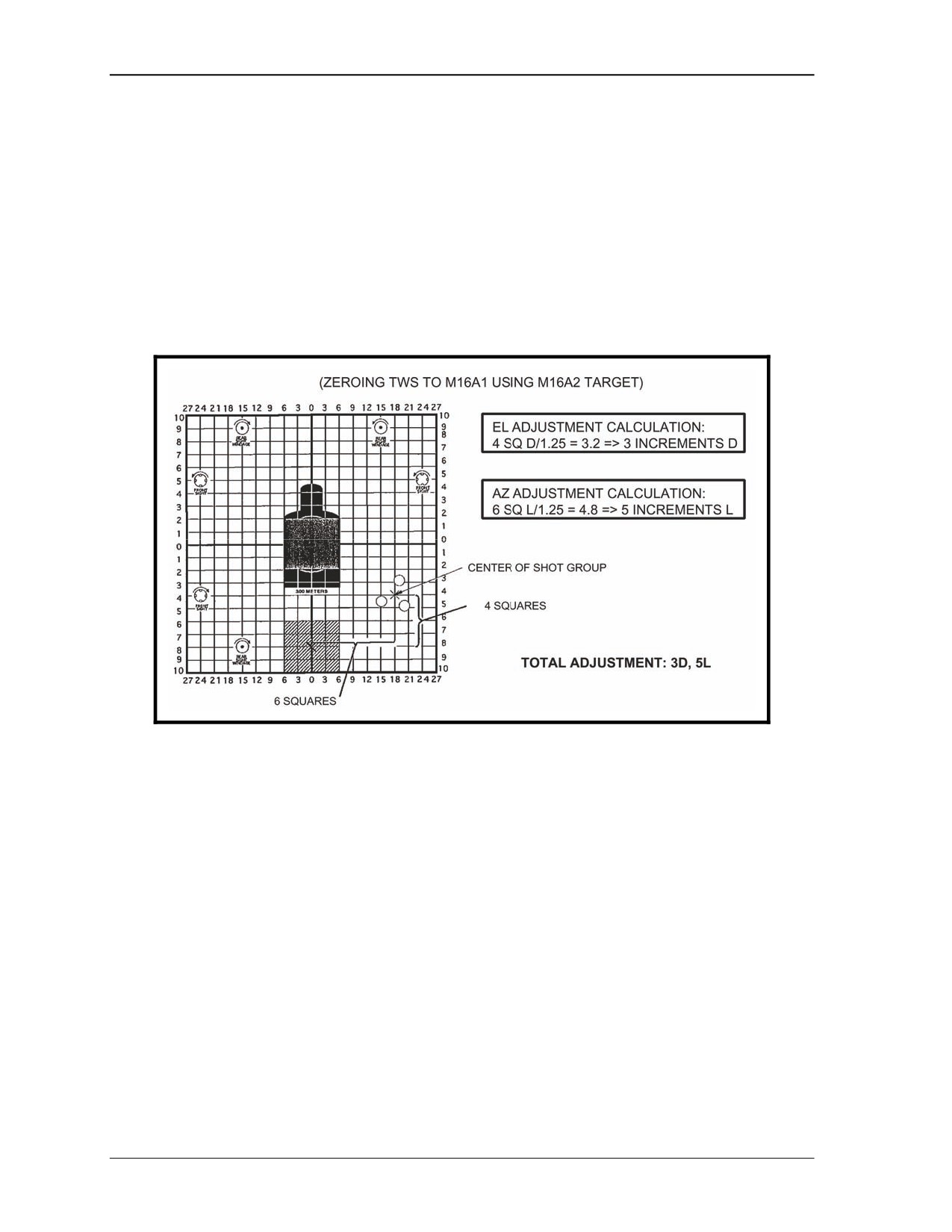
1. Use the same procedures and standards as with iron sights (Figure 10-26).
2. At the 25-meter range, each increment of azimuth or elevation setting moves the strike of the
round as follows:
-- 1 1/4 centimeters for medium TWS on wide FOV.
-- 3/4 centimeter for MTWS on narrow FOV.
-- 3/4 centimeter for heavy TWS on WFOV.
-- 1/4 centimeter for HTWS on NFOV.
3. Retighten the rail grabber after you fire the first three rounds.
Figure 10-26. Example TWS zeroing adjustments.
BORESIGHTING AN/PAQ-4B/C
1. Select the proper 10-meter boresight target for the weapon-to-AN/PAQ-4B/C configuration
and, with the help of an assistant, place the boresight target 10 meters in front your weapon.
2. Install the borelight filter and turn on the AN/PAQ-4B/C. Align the 10-meter boresight target
with the visible laser of the borelight.
3. Adjust the adjusters on the AN/PAQ-4B/C until the IR laser is centered on the crosshair located
on the 10-meter boresight target.
-- Keep the boresight target and zeroing mark stable during the boresight procedure.
-- Do not turn the adjustment screws too much or they will break. Regardless of the mounting
location, the adjuster that is on top or bottom will always be the adjuster for elevation and
the one on the side will be the windage adjuster.
-- Elevation adjustment screw—one click at 25 meters = 1 centimeter.
-- Windage adjustment screw—one click at 25 meters = 1 centimeter.
10-28
FM 3-21.75
28 January 2008
Combat Marksmanship
25-Meter Zero Procedures
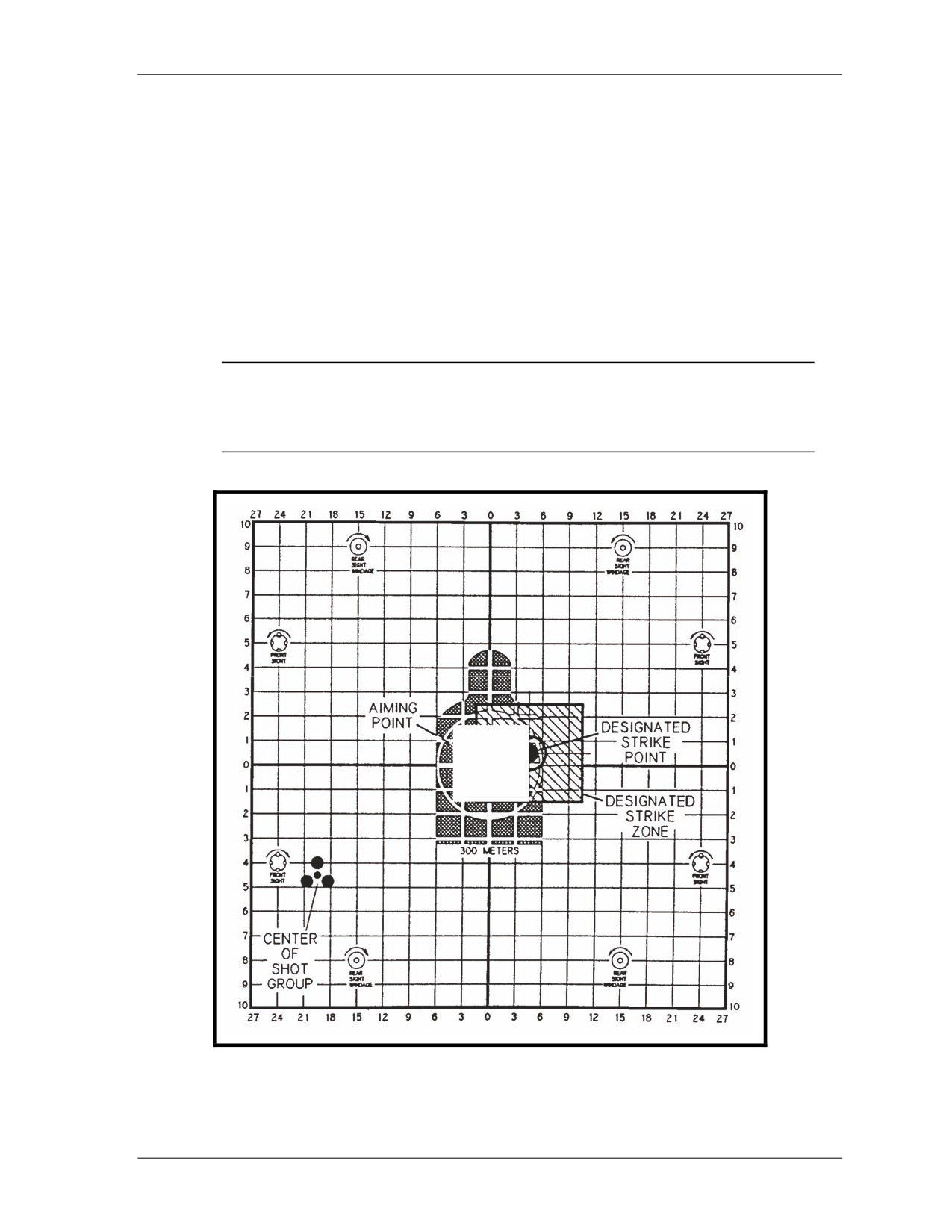
10-55. If the borelight is unavailable, conduct a 25-meter zero (Figure 10-27) as follows:
1. Use the same standards as for the iron sights.
2. Preset the adjusters IAW TM 11-5855-301-12&P.
3. Prepare 25-meter zero target by cutting a 3x3-centimeter square out of the center of
the silhouette.
Elevation Adjustment Screw—one click at 25 m = 1 cm (clockwise = up).
Windage Adjustment Screw—one click at 25 m = 1 cm (clockwise = left).
4. Retighten rail grabber after the first three rounds are fired.
Note: When cutting the 3-centimeter square out of the target, some of the strike zone may
be cut out. Exercise care when annotating the impact of the rounds. When the
weapon is close to being zeroed, some of the shots may be lost through the hole in
the target.
Figure 10-27. Example shot group adjustment with strike zone.
28 January 2008
FM 3-21.75
10-29
Chapter 10
BORESIGHTING AN/PEQ-2A
1. Select the proper 10-meter boresight target for the weapon and AN/PEQ-2A configuration and,
with the help of an assistant, place the boresight target 10 meters in front your weapon.
2. Install the filter on the aiming laser and turn on the AN/PEQ-2A. Align the 10-meter boresight
target with the visible laser of the borelight.
3. Adjust the adjusters on the AN/PEQ-2A until the IR laser centers on the crosshair located on
the 10-meter boresight target.
4. Adjust the illuminator in the same manner.
5. Turn the laser off. To avoid damaging the borelight device, carefully remove the borelight and
the mandrel from the weapon.
-- Each click of elevation and windage is
1 centimeter. For ease, round up one square.
However, each square of the 25-meter zero target is 0.9 centimeter, which affects large
adjustments.
-- Do not turn the adjustment screws too much, or they will break. Regardless of the mounting
location, the adjuster that is on top or bottom will always be the adjuster for elevation and
the one on the side will be the windage adjuster.
25-METER ZERO PROCEDURES
10-56.
If a borelight is unavailable, you must conduct a 25-meter zero:
1. Follow the same standards as you did with iron sights.
2. Preset the adjusters IAW TM 11-5855-308-12&P.
3. Prepare the 25-meter zero target by cutting out a 3x3-centimeter square in the center of the
target and E-type silhouette.
4. Turn the aiming beam on in the low power setting (AIM LO). Install aim point filter to
eliminate excessive blooming. The adjustments for the AN/PEQ-2A (top mounted) follow:
Aiming Point
Elevation Adjustment Screw--One click at 25 m = 1 cm or one square (clockwise = up).
Windage Adjustment Screw--One click at 25 m = 1 cm or one square (clockwise = right).
Target Illuminator
Elevation Adjustment Screw--One click at 25 m = 1 cm or one square (clockwise = down).
Windage Adjustment Screw--One click at 25 m = 1 cm or one square (clockwise = right).
5. Retighten rail grabber and AN/PEQ-2A.
6. Once you have zeroed the aiming beam, rotate the selector knob to the DUAL LO, DUAL
LO/HI, or DUAL HI/HI mode, and observe both aiming and illumination beams. Rotate the
illumination beam adjusters to align the illumination beam with the aiming beam.
10-30
FM 3-21.75
28 January 2008
Combat Marksmanship
Note: To ensure zero retention--
1. Ensure you fully tighten the mounting brackets and the AN/PEQ-2A
thumbscrew prior to zeroing.
2. Remove the TPIAL and rail grabber as a whole assembly, and then place it back
onto the same notch.
MISFIRE PROCEDURES AND IMMEDIATE ACTION
MISFIRE
10-57. A misfire is the failure of a chambered round to fire. Ammunition defects and faulty firing
mechanisms can cause misfires.
STOPPAGE
10-58. A stoppage is a failure of an automatic or semiautomatic firearm to complete the cycle of
operation. You may apply immediate or remedial action to clear the stoppage. Some stoppages cannot be
cleared by immediate or remedial action and may require weapon repair to correct the problem. Immediate
action involves quickly applying a possible correction to reduce a stoppage without looking for the actual
cause. Remedial action is the action taken to reduce a stoppage by looking for the cause and to try to clear
the stoppage once it has been identified. To reduce a stoppage--
M9 Pistol
Immediate Action
10-59. Take immediate action is taken within 15 seconds of a stoppage.
1. Ensure the decocking/safety lever is in the FIRE position.
2. Squeeze the trigger again.
3. If the pistol does not fire, ensure the magazine is fully seated, retract the slide to the rear,
and release.
4. Squeeze the trigger.
5. If the pistol does not fire again, remove the magazine and retract the slide to eject the
chambered cartridge. Insert a new magazine, retract the slide, and release to chamber
another cartridge.
6. Squeeze the trigger.
7. If the pistol still does not fire, perform remedial action.
Remedial Action
10-60. Remedial action is taken to reduce a stoppage by looking for the cause.
1. Clear the pistol.
2. Inspect the pistol for the cause of the stoppage.
3. Correct the cause of the stoppage, load the pistol, and fire.
4. If the pistol fails to fire again, disassemble it for closer inspection, cleaning, and lubrication.
28 January 2008
FM 3-21.75
10-31
Chapter 10
M16A2/3/4 And M4 Carbine Rifles
Immediate Action
10-61. Use the key word SPORTS to help you remember the steps to apply immediate action:
S P O R T S
S LAP
gently upward on the magazine to ensure it is fully seated and
the magazine follower is not jammed.
P ULL
the charging handle fully to the rear.
O BSERVE for the ejection of a live round or expended cartridge. *
R ELEASE the charging handle (do not ride it forward).
T AP
the forward assist assembly to ensure bolt closure.
S QUEEZE the trigger and try to fire the rifle.
* If the weapon fails to eject a cartridge, perform remedial action.
Remedial Action
10-62. To apply the corrective steps for remedial action, first try to place the weapon on SAFE, then
remove the magazine, lock the bolt to the rear, and place the weapon on safe.
M249 SAW and M240B Machine Guns
Immediate Action
10-63. If either weapon stops firing, the same misfire procedures will apply for both. You will use the
keyword POPP, which will help you remember the steps in order. While keeping the weapon on your
shoulder, Pull and lock the charging handle to the rear while Observing the ejection port to see if a
cartridge case, belt link, or round is ejected. Ensure the bolt remains to the rear to prevent double feeding if
a round or cartridge case is not ejected. If a cartridge case, belt link, or round is ejected, Push the charging
handle to its forward position, take aim on the target, and Press the trigger. If the weapon does not fire,
take remedial action. If a cartridge case, belt link, or round is not ejected, take remedial action.
Remedial Action
10-64. If immediate action does not remedy the problem, the following actions may be necessary to
restore the weapon to operational condition:
10-32
FM 3-21.75
28 January 2008
Combat Marksmanship
Cold Weapon Procedures
10-65. When a stoppage occurs with a cold weapon, and if immediate action has failed--
1. While in the firing position, grasp the charging handle with your right hand, palm up;
pull the charging handle to the rear, locking the bolt. While keeping resistance on the
charging handle, move the safety to SAFE and return the cocking handle.
2. Place the weapon on the ground or away from your face. Open the feed cover and perform the
five-point safety check. Reload and continue to fire.
3. If the weapon fails to fire, clear it, and inspect the weapon and the ammunition.
Hot Weapon Procedures
10-66. If the stoppage occurs with a hot weapon (200 or more rounds in less than 2 minutes, or as noted
previously for training)--
1. Move the safety to SAFE and wait 5 seconds. During training, let the weapon cool for 15
minutes.
2. Use Cold Weapon Procedures 1 through 3 above.
Jammed Charging Handle
10-67. If a stoppage occurs and the charging handle cannot be pulled to the rear by hand (the bolt may be
fully forward and locked or only partially forward) take the following steps:
1. Try once again to pull the charging handle by hand.
2. If the weapon is hot enough to cause a cook-off, move all Soldiers a safe distance from the
weapon and keep them away for 15 minutes.
3. After the gun has cooled, open the cover and disassemble the gun. Ensure rearward pressure is
kept on the charging handle until the buffer is removed. (The assistant gunner can help you
do this.)
4. Remove the rounds or fired cartridges. Use a cleaning rod or ruptured cartridge extractor if
necessary.
-- In a training situation, after completing the remedial action procedures, do not fire the gun
until an ordnance specialist has conducted an inspection.
-- In a combat situation, after the stoppage has been corrected, you may change the barrel and
try to fire. If the weapon fails to function properly, send it to the unit armorer.
REFLEXIVE FIRE
10-68. Reflexive fire is the automatic trained response to fire your weapon with minimal reaction time.
Reflexive shooting allows little or no margin for error. Once you master these fundamentals, they will be
your key to survival on the battlefield:
• Proper firing stance.
• Proper weapon ready position.
• Aiming technique.
• Aim point.
• Trigger manipulation.
28 January 2008
FM 3-21.75
10-33
Chapter 10
PROPER FIRING STANCE
10-69. Regardless of the ready position used, always assume the correct firing stance to ensure proper
stability and accuracy when engaging targets. Keep your feet about shoulder-width apart. Toes are pointed
straight to the front (direction of movement). The firing side foot is slightly staggered to the rear of the
nonfiring side foot. Knees are slightly bent and the upper body is leaned slightly forward. Shoulders are
square and pulled back, not rolled over or slouched. Keep your head up and both eyes open. When
engaging targets, hold the weapon with the butt of the weapon firmly against your shoulder and the firing
side elbow close against the body.
PROPER WEAPON READY POSITION
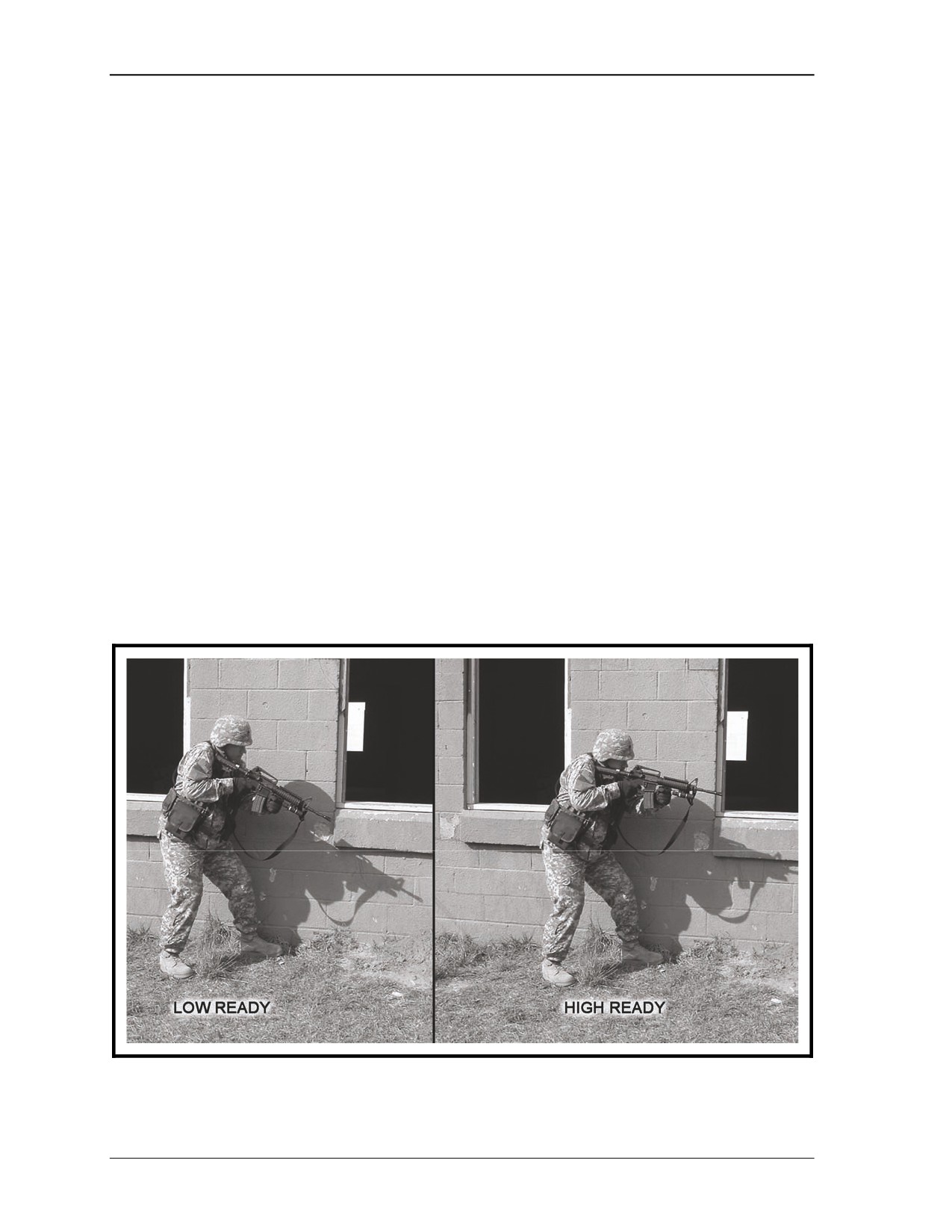
10-70. The two weapon ready positions are the high ready and low ready (Figure 10-28).
Low Ready Position--Place the butt of the weapon firmly in the pocket of your shoulder with the
barrel pointed down at a 45-degree angle. With your nonfiring hand, grasp the handguards
toward the front sling swivel, with your trigger finger outside the trigger well, and the thumb of
your firing hand on the selector lever. To engage a target from this position, bring your weapon
up until you achieve the proper sight picture. This technique is best for moving inside
buildings.
High Ready Position--Hold the butt of the weapon under your armpit, with the barrel pointed
slightly up so that the top of the front sight post is just below your line of sight, but within your
peripheral vision. With your nonfiring hand, grasp the handguards toward the front sling
swivel. Place your trigger finger outside the trigger well, and the thumb of your firing hand on
the selector lever. To engage a target from this position, just push the weapon forward as if to
bayonet the target and bring the butt stock firmly against your shoulder as it slides up your
body. This technique is best suited for the lineup outside of a building, room, or bunker
entrance.
Figure 10-28. Ready positions.
10-34
FM 3-21.75
28 January 2008
Combat Marksmanship
AIMING TECHNIQUES
10-71. The four aiming techniques with iron sights all have their place during combat in urban areas, but
the aimed quick-kill technique is often used in precision room clearing. You need to clearly understand
when, how, and where to use each technique.
Slow Aimed Fire--This technique is the slowest but most accurate. Take a steady position,
properly align your sight picture, and squeeze off rounds. Use this technique only to engage
targets beyond 25 meters when good cover and concealment is available, or when your need for
accuracy overrides your need for speed.
Rapid Aimed Fire--This technique uses an imperfect sight picture. Focus on the target and raise
your weapon until the front sight post assembly obscures the target. Elevation is less critical
than windage when using this technique. This aiming technique is extremely effective on
targets from 0 to 15 meters and at a rapid rate of fire.
Aimed Quick Kill--The aimed quick kill technique is the quickest and most accurate method of
engaging targets up to 12 meters and greater. When using this technique, you must aim over the
rear sight, down the length of the carry handle, and place the top 1/2 to 3/4 of an inch of the
front sight post assembly on the target.
Instinctive Fire--This is the least accurate technique and should only be used in emergencies.
It relies on your instinct, experience, and muscle memory. In order to use this technique,
first concentrate on the target and point your weapon in the general direction of the target.
While gripping the handguards with your nonfiring hand, extend your index finger to the front,
automatically aiming the weapon on a line towards the target.
AIM POINT
10-72. Short-range engagements fall into two categories based on the mission and hostile threat.
Lethal Shot Placement--The lethal zone of the target is center mass between the waist and the
chest. Shots in this area maximize the hydrostatic shock of the round.
Incapacitating Shot Placement --The only shot placement that guarantees immediate and total
incapacitation is one roughly centered in the face. Shots to the side of the head should be
centered between the crown of the skull and the middle of the ear opening, and from the center
of the cheekbones to the middle of the back of the head.
TRIGGER MANIPULATION
10-73. Due to the reduced reaction time, imperfect sight picture, and requirement to effectively place
rounds into threat targets, you must fire multiple rounds during each engagement in order to survive.
Multiple shots may be fired using the controlled pair, automatic weapons fire, and the failure drill methods.
Controlled Pair--Fire two rounds rapid succession. When you fire the first, let the shot move the
weapon in its natural arc and do not fight the recoil. Rapidly bring the weapon back on target
and fire the second round. Fire controlled pairs at an individual target until he goes down.
When you have multiple targets, fire a controlled pair at each target, and then reengage any
targets left standing.
Automatic Fire--You might need automatic weapons fire to maximize violence of action or when
you need fire superiority to gain a foothold in a room, building, or trench. You should be able
to fire six rounds (two three-round bursts) in the same time it takes to fire a controlled pair. The
accuracy of engaging targets can be equal to that of semiautomatic fire at 10 meters.
Failure Drill--To make sure a target is completely neutralized, you will need to be trained to
execute the failure drill. Fire a controlled pair at the lethal zone of the target, and then fire a
single shot to the incapacitating zone. This increases the probability of hitting the target with
the first shot, and allows you to incapacitate him with the second shot.
28 January 2008
FM 3-21.75
10-35
This page intentionally left blank.