FM 3-22.90 Mortars (December 2007) - page 7
This page intentionally left blank.
Chapter 9
Gunner’s Examination
The gunner’s examination tests the proficiency of the gunner in five areas:
mounting the mortar, making small deflection change, referring the sight and
realigning aiming posts, making large deflection and elevation changes, and
reciprocally laying the mortar. It is also a test of the three qualified assistants the
candidate is allowed to choose. The candidate’s success in the examination
depends mainly on his ability to work harmoniously with these assistants. The
examining board must consider this factor and ensure uniformity during the test.
Units should administer the gunner’s examination at least semiannually to certify
crew proficiency.
SECTION I. PREPARATION
Preparation for the gunner’s examination teaches the Soldier how to properly and accurately perform the
gunner’s duties. The squad leader is responsible for this preparation. In table of organization and equipment
(TOE) units, squad members should be rotated within the squad so that each member can become proficient
in all squad positions. Individual test scores should be maintained and consolidated to determine each
squad’s score. These squad scores can then be compared to build esprit de corps.
METHODS OF INSTRUCTION
9-1. The conditions and requirements of each step of the qualification course are explained and
demonstrated. Then each candidate is given practical work and is constantly supervised by his squad
leader to ensure accuracy and speed—accuracy is stressed from the start; speed is attained through
repetition. The platoon leader/platoon sergeant monitors the instruction given by the squad leaders
within the platoon. Demonstrations are usually given to the entire group. Squads also perform practical
work under the supervision of the squad leader.
PRIOR TRAINING
9-2. A Soldier must be proficient in mechanical training, crew drill, and fire commands and their
execution before he qualifies to take the examination.
PREPARATORY EXERCISES
9-3. The preparatory exercises for the gunner’s examination consist of training in those steps found in
the qualification course. After sufficient preparatory exercises, candidates are given the gunner’s
examination. Those failing the examination should be retrained for testing at a later date.
EXAMINING BOARD
9-4. The examining board consists of one officer and two senior NCOs who are proficient with the
weapon. No more than one member is selected from the candidate’s organization. (The commander
who has authority to issue special orders appoints the board.) Scores are recorded on
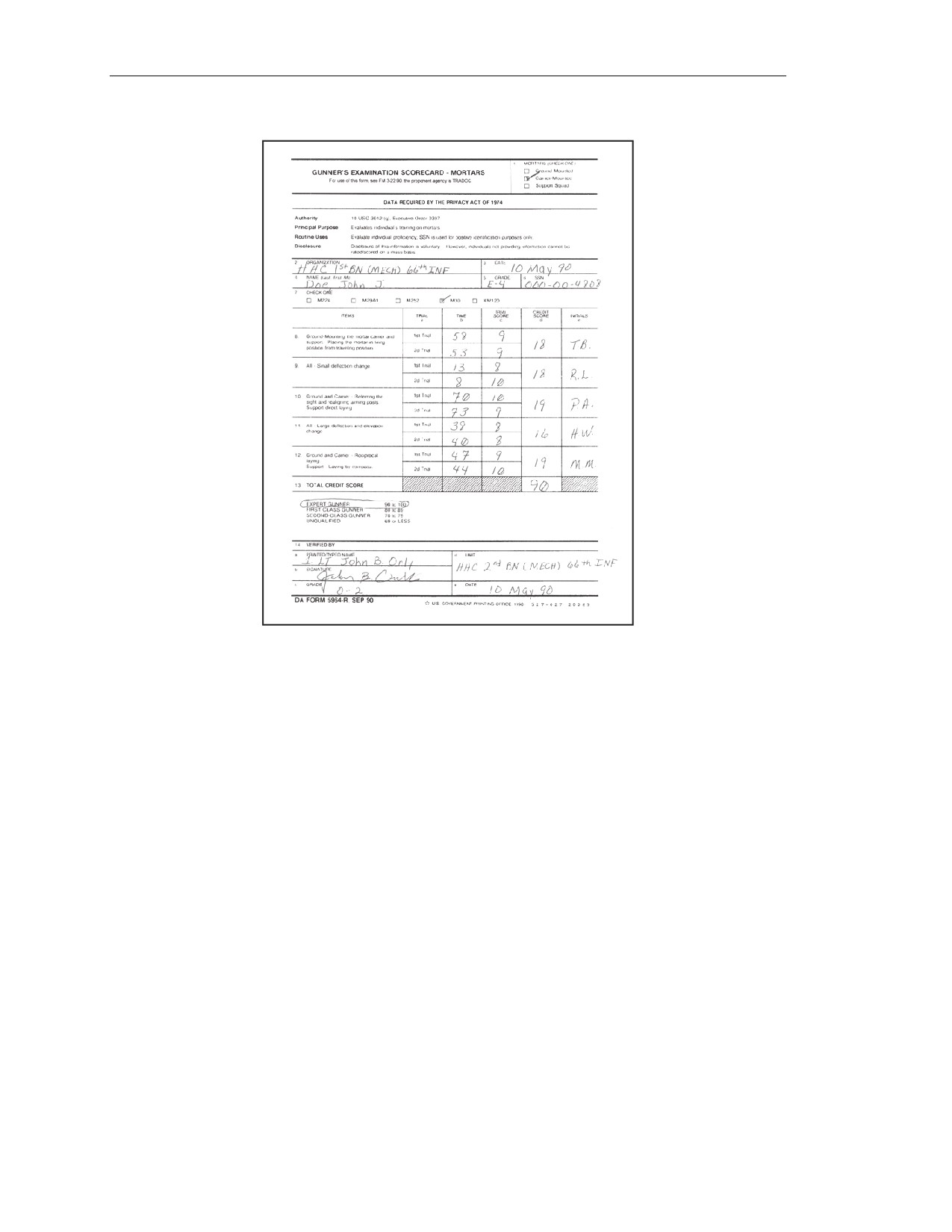
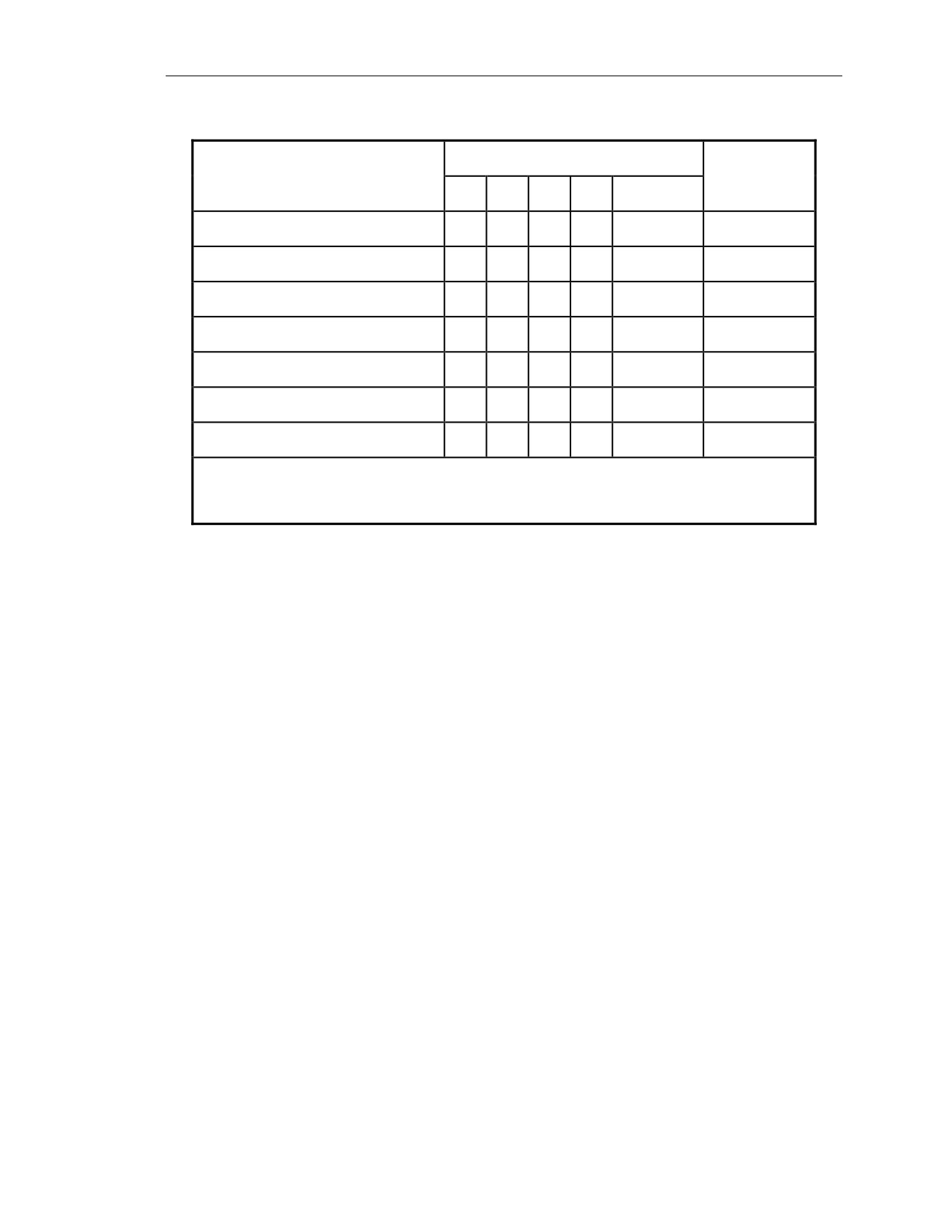
DA Form 5964-R, (Figure 9-1). A blank copy of this form is located in the back of this publication for
local reproduction on 8 1/2- by 11-inch paper.
7 December 2007
FM 3-22.90
9-1
Chapter 9
Figure 9-1. Example of completed DA Form 5964-R.
LOCATION AND DATE
9-5. Each unit armed with a mortar weapon system gives examinations semiannually. Other units
may conduct examinations or allow their eligible members to take the qualification tests at nearby
stations. (The commander authorized to issue special orders determines the date of the examination.)
The area selected should be on flat terrain consisting of soil that allows for aiming posts to be easily
positioned at 50 and 100 meters from the station position.
ELIGIBLE PERSONNEL
9-6. The following personnel are eligible to take the examination:
Commissioned officers, NCOs, and enlisted men assigned to a mortar unit.
Commissioned officers, NCOs, and enlisted men whose duties require them to maintain
proficiency in the use of mortars, as determined by battalion and higher commanders.
QUALIFICATION SCORES
9-7. A candidate’s earlier qualification ends when he is administered a record course with the mortar.
He is classified according to his latest examination score as follows:
Expert gunner
90 - 100
First-class gunner
80 - 89
Second-class gunner70 - 79
Unqualified
69 or less
9-2
FM 3-22.90
7 December 2007
Gunner’s Examination
GENERAL RULES
9-8. Conditions should be the same for all candidates during the test. The examining board ensures
that information obtained by a candidate during testing is not passed to another candidate, and that
candidates do not receive sight settings or laying of mortars left by a previous candidate.
9-9. Unit equipment should be used in the examination; however, it should be the best available.
Sight settings are considered correct when any part of the index coincides with any part of the line of
graduation of the required setting.
9-10. The left side of the aiming post is used for alignment. The elevation and cross-level bubbles are
considered centered when the bubbles are resting entirely within the outer etched lines on the vials.
9-11. The candidate is permitted to traverse the mortar to the middle point of traverse before each trial
at laying the mortar, except at Station No. 5.
9-12. In any test that calls for mounting or emplacing the mortar, either by the candidate or the board,
the surface emplacement is used. Digging is not allowed, and the rear of the baseplate assembly is not
staked.
9-13. In time trials, the candidate does not receive credit for the trial if he performs any part of it after
announcing, “Up.”
9-14. The candidate selects his assistants from within his squad to participate in the test. When squad
members are unavailable for testing, the candidate may select his assistants from outside the squad but
from within his organization. The board makes sure that no unauthorized assistance is given the
candidate during the examination.
9-15. A candidate is given three trials—one for practice and two for record. If he takes the first trial
for record, then he must take the second trial for record even if he fails it. His credit score is the total of
the two record trials. When he fails in any trial through the fault of an examiner, defective sight,
mortar, mount, or other instrument used, that trial is void and the candidate is given another trial as
soon as possible. If his actions cause the mortar to function unsatisfactorily during testing, he receives
no credit for that portion of the test.
9-16. When a mechanical failure occurs and a mortar fails to maintain the lay after the candidate
announces,
“Up,” a board member twists or pushes the mortar
(taking up the play without
manipulation) until the cross-level bubble is within the two outer etched lines. He then looks through
the sight and, if the vertical line is within two mils of the correct sight picture, the candidate is given
credit for that trial, as long as other conditions are met.
9-17. The candidate must repeat all commands. Commands should be varied between trials, using
even and odd numbers, and right and left deflections.
7 December 2007
FM 3-22.90
9-3

Chapter 9
SECTION II. GUNNER’S EXAMINATION WITH THE GROUND-MOUNTED
MORTAR
This examination tests the gunner’s ability to perform basic mortar gunnery tasks with the ground-mounted
mortar system.
SUBJECTS AND CREDITS
9-18. The examination consists of the following tests with maximum credit scores as shown.
Mounting the mortar
20 points
Small deflection change
20 points
Referring the sight and realigning aiming posts
20 points
Large deflection and elevation changes
20 points
Reciprocal laying
20 points
EQUIPMENT
9-19. The recommended equipment needed for the five stations includes five mortars, five sights, one
aiming circle, eight aiming posts, and five stopwatches.
ORGANIZATION
9-20. The organization prescribed in Table 9-1 is recommended for the conduct of the gunner’s
examination. Variations are authorized, depending on local conditions and the number of Soldiers
being tested.
PROCEDURE
9-21. The candidate carries his scorecard (Figure 9-1) from station to station. The evaluator at each
station fills in the time, trial scores, and credit score, and initials the appropriate spaces.
Table 9-1. Organization for conducting gunner’s examination (ground-mounted).
EQUIPMENT
STATION
PHASE
FOR EXAMINING
FOR CANDIDATE
OFFICER
1 mortar
1
Mounting the mortar.
1 sight
1 stopwatch
1 baseplate stake
1 mortar
2
Small deflection change.
1 sight
1 stopwatch
2 aiming posts
1 mortar
3
Referring the sight.
1 sight
1 stopwatch
2 aiming posts
1 mortar
Large deflection and
4
1 sight
1 stopwatch
elevation change.
2 aiming posts
1 mortar
1 stopwatch
5
Reciprocal laying.
1 sight
1 aiming circle
2 aiming posts
MOUNTING OF THE MORTAR
9-22. The candidate is tested at Station No. 1 on his ability to perform the gunner’s duties in mounting
the mortar.
9-4
FM 3-22.90
7 December 2007
Gunner’s Examination
EQUIPMENT
9-23. Prescribed in Table 9-1.
CONDITIONS
9-24. The candidate is directed to mount the mortar with his authorized assistants. The conditions of
the test are as follows:
All Mortars
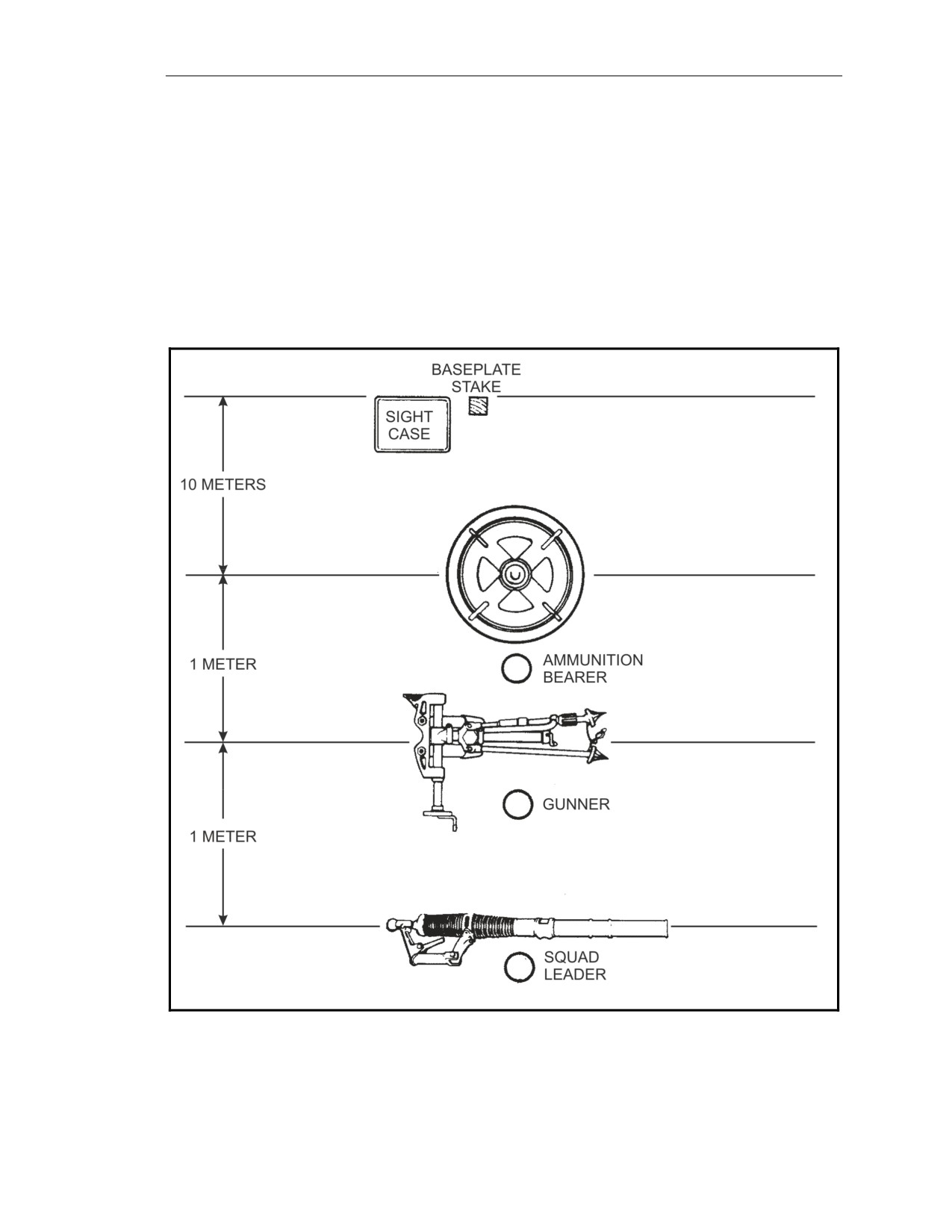
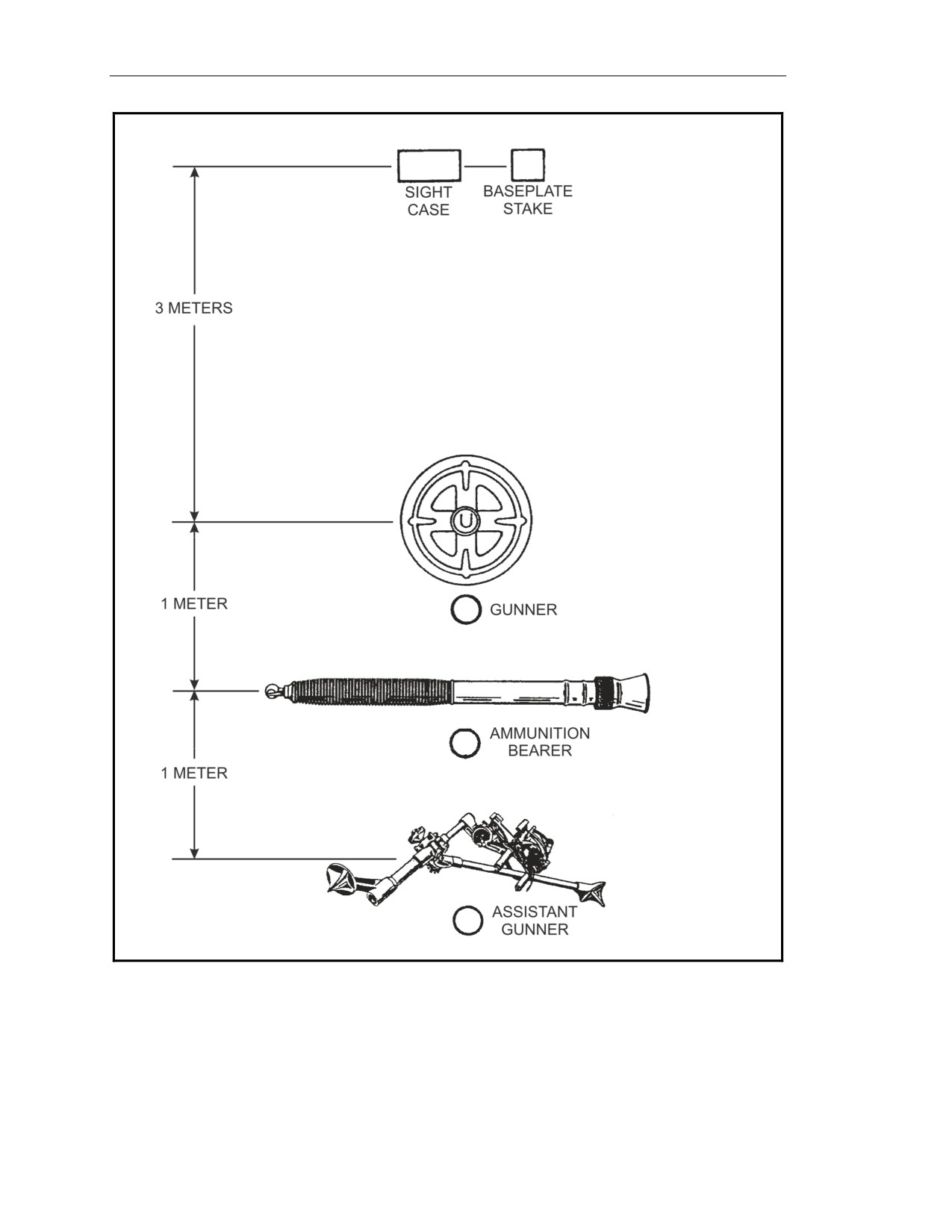
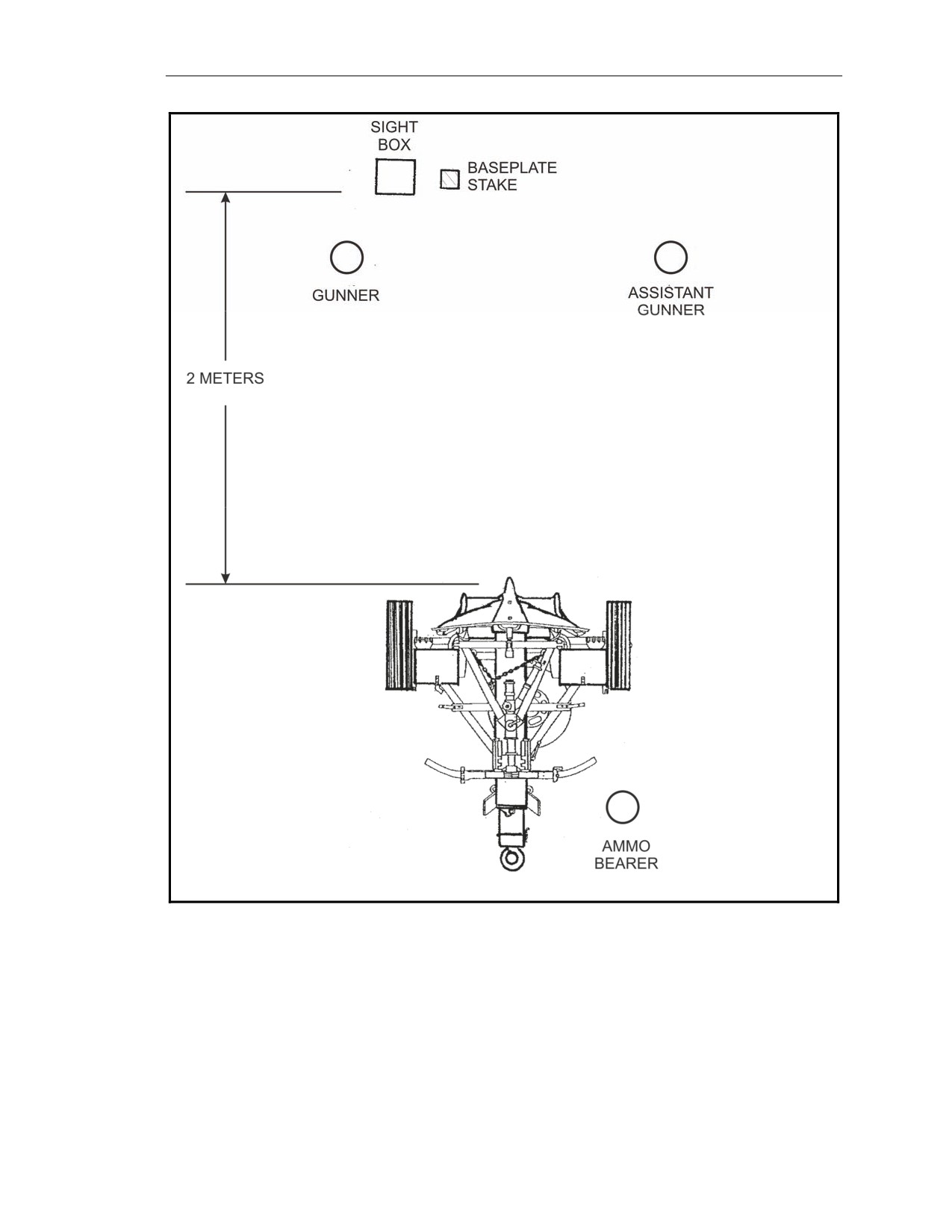
9-25. The candidate arranges his equipment as outlined in Figures 9-2 through 9-4. The emplacement
is marked before the examination.
Figure 9-2. Diagram of equipment layout and position of personnel for the gunner’s
examination (60-mm mortar).
7 December 2007
FM 3-22.90
9-5
Chapter 9
Figure 9-3. Diagram of equipment layout and position of personnel for the gunner’s
examination (81-mm mortar, M252).
9-6
FM 3-22.90
7 December 2007
Gunner’s Examination
Figure 9-4. Diagram of equipment layout and position of personnel for the gunner’s
examination (120-mm mortar).
9-26. The mortar sight is seated in its case with 3800 mils set on the deflection scale and 1100 mils set
on the elevation scale, and the sight box is closed and latched.
120-mm Only
9-27. Traverse extension is locked and centered.
7 December 2007
FM 3-22.90
9-7
Chapter 9
PROCEDURE
9-28. The candidate is given three trials. If he chooses to use the first (practice) as record, he must use
the second as record. If he chooses to use the first trial as practice, he must use the second and third
trials as record. His credit score for the test is the total of the two record trials.
(1) The candidate and his assistants take their positions. The candidate is instructed to mount
the mortar at 3200 mils deflection and 1100 mils elevation.
(2) The evaluator points to the exact spot where the mortar is to be mounted. He indicates the
initial direction of fire by pointing in that direction and gives the command ACTION, at
which time the candidate begins mounting the mortar. After mounting the mortar, he should
have 3200 mils deflection 1100 mils elevation.
(3) The assistants may manipulate the sight mount knob/cross-level handwheel and elevation
hand crank. They may center the connection for the mortar locking pin assembly, but they
MUST NOT manipulate the sight for deflection or elevation settings. After the sight is
mounted, only the gunner may manipulate the elevation cross-level handwheel/ hand crank
for deflection or elevation settings.
(4) When the test is completed, the candidate announces, “Up.” Time is charged against him
from the command ACTION to the announcement “Up.”
SCORING
9-29. Scoring procedures are as follows:
(1) The candidate receives no credit when the—
Time exceeds 1 minute and 15 seconds for the 120-mm or 90 seconds for all other
mortars.
Sight is not set correctly for deflection and elevation.
Cross-level and elevation bubbles are not centered.
Mortar locking pin, or the clevis lock pin is not fully locked.
Connection for the mortar locking pin assembly (buffer carrier, 60-mm mortar) or the
traversing slide assembly is off center more than two turns.
Assistant manipulates the sight for a deflection or elevation setting.
Baseplate is not positioned correctly in relation to the baseplate stake.
Selector switch on the barrel is not on D for drop-fire (60-mm mortar only).
Collar assembly is not positioned on the lower saddle (60-mm mortar only).
Firing pin recess is not facing upwards on the barrel (81-mm mortar, M252 only).
Traverse is more than four turns (120-mm only).
Barrel clamp is not locked (120-mm only).
Cross-level lock is not tight (120-mm only).
Leg-locking handwheel is not wrist-tight (81-mm mortar, M252 only).
Coarse cross-level nut is not wrist-tight (60-mm mortar only).
Collar locking knob is not secured (hand-tight) to the barrel (60-mm and 81-mm
mortars only).
Bipod legs are not fully extended and the spread cable or chain is not taut (60-mm and
120-mm mortars only).
9-8
FM 3-22.90
7 December 2007
Gunner’s Examination
(2) When the mortar is correctly mounted within the prescribed limits, credit is given as
follows:
Time (Seconds)
Point Credit for Each Trial
120-mm
60-/81-mm
51 or less
65 or less
10
52 to 57
66 to 70
9
58 to 63
71 to 75
8
64 to 69
76 to 80
7
70 to 75
81 to 85
6
86 to 90
5
76 or over
91 or over
0
SMALL DEFLECTION CHANGE
9-30. The candidate is tested at Station No. 2 on his ability to perform the gunner’s duties when he is
given commands that require a change in deflection.
EQUIPMENT
9-31. Prescribed in Table 9-1.
CONDITIONS
9-32. A mortar is mounted with the sight installed. The sight is laid on two aiming posts (placed out 50
to 100 meters from the mortar) on a referred deflection of 2800 mils and 1100 mils elevation. The
mortar is center of traverse, and the vertical line of sight is on the left edge of both aiming posts.
(1) The candidate is allowed to check the deflection set on the sight before each trial.
(2) He is allowed to start each trial with his hand on the deflection knob
(3) The change in deflection does not involve movement of the bipod assembly but causes the
candidate to traverse the mortar at least 20 mils and not more than 60 mils
(4) Traversing extension is locked and centered (120-mm).
PROCEDURE
9-33. The candidate is given three trials. If he chooses to use the first (practice) as record, he must use
the second as record. If he chooses to use the first trial as practice, he must use the second and third
trials as record. His credit score for the test is the total of the two record trials.
(1) The candidate is given one assistant. A different command is given for each trial. The
evaluator records the time and checks the candidate’s work after each command has been
executed.
(2) The evaluator announces an initial command requiring a change in deflection of 20 to 60
mils and an elevation change of 35 to 90 mils. The candidate may proceed with the exercise
as soon as the deflection element is announced. The evaluator announces the command in
normal sequence and cadence.
(3) No manipulation by the assistant is allowed.
(4) Time is charged against the candidate from the announcement of the last digit of the
elevation element until the candidate announces, “Up.”
7 December 2007
FM 3-22.90
9-9
Chapter 9
SCORING
9-34. Scoring procedures are as follows:
(1) The candidate receives no credit when the—
Time is 36 seconds or greater.
Sight is not set correctly for deflection or elevation.
Elevation bubble is not centered.
Cross-level bubble is not centered.
Assistant manipulates the mortar or sight for elevation or deflection.
Vertical cross line of the sight is more than 2 mils off the correct sight picture.
(2) When the mortar is laid correctly within the prescribed limits, credit is given as follows:
Time (Seconds)
Point Credit for
All Mortars
Each Trial
20 or less
10
21 to 23
9
24 to 26
8
27 to 31
7
32 to 35
6
36 or over
0
REFERRING OF THE SIGHT AND REALIGNMENT OF AIMING
POSTS
9-35. The candidate is tested at Station No. 3 on his ability to perform the gunner’s duties in referring
the sight and realigning the aiming posts.
EQUIPMENT
9-36. Prescribed in Table 9-1.
CONDITIONS
9-37. The mortar is mounted with the correct sight installed. The sight is laid on two aiming posts
(placed out 50 and 100 meters from the mortar) on a referred deflection of 2800 mils and 1100 mils
elevation.
(1) The mortar is within two turns of center of traverse (four turns for the 120-mm). The
candidate receives an administrative command with a deflection of 2860 or 2740 mils. The
mortar is then re-laid on the aiming posts using the traversing crank.
(2) The candidate checks the conditions before each trial and is allowed to start the test with his
hand on the deflection knob of the sight.
(3) The change in deflection in the command must be less than 25 mils but greater than 5 mils.
The elevation remains constant at 1100 mils.
(4) The candidate is allowed two assistants—one to place out aiming posts and one to move the
bipod (mount). The assistants do not manipulate the sight or mortar for elevation or
deflection.
(5) Traverse extension will not be used. It will remain locked in the center position.
PROCEDURE
9-38. The candidate is given three trials. If he chooses to use the first (practice) as record, he must use
the second as record. If he chooses to use the first trial as practice, he must use the second and third
trials as record. His credit score for the test is the total of the two record trials.
9-10
FM 3-22.90
7 December 2007
Gunner’s Examination
(1) A different command is given for each trial. The evaluator records the time and checks the
candidate’s work after each command has been executed.
(2) When the candidate is ready, he is given a command—for example, REFER,
DEFLECTION TWO EIGHT EIGHT ZERO (2880), REALIGN AIMING POSTS.
(3) The candidate repeats each element of the command, sets the sight with the data given in the
command, and directs one assistant in realigning the aiming posts. Then he centers his
traversing assembly and, with the help of the assistant gunner, moves the bridge or bipod
(mount) assembly and re-lays on his aiming posts. After he lays the mortar on the realigned
posts, he announces, “Up.”
NOTE: This procedure ensures that, after a registration mission (using a parallel sheaf),
the mortars have matching deflections.
(4) Time is taken from the announcement of refer and align aiming post to the candidate’s
announcement of “Up.”
(5) The candidate’s assistant may not leave the mortar position until he hears the word POSTS
in the command REALIGN AIMING POSTS.
SCORING
9-39. Scoring procedures are as follows:
(1) No credit is given when the—
Time exceeds 1 minute 15 seconds.
Traversing crank is turned before the aiming posts are realigned.
Sight is not set correctly for deflection or elevation.
Mortar is not cross-leveled or correctly laid for elevation.
Vertical line of the sight is more than 2 mils off the correct sight picture.
Traversing assembly slide is more than two turns (four turns for the 120-mm) to the left
or right of the center position.
Assistant manipulates the sight or mortar for elevation or deflection.
(2) When the mortar is found to be correctly laid within the prescribed limits, credit is given as
follows:
Time (Seconds)
Point Credit for
All Mortars
Each Trial
60 or less
10
61 to 65
9
66 to 70
8
71 to 75
7
76 or over
0
LARGE DEFLECTION AND ELEVATION CHANGES
9-40. The candidate is tested at Station No. 4 on his ability to perform the gunner’s duties when he is
given commands requiring a large change in deflection and elevation.
EQUIPMENT
9-41. Prescribed in Table 9-1.
7 December 2007
FM 3-22.90
9-11
Chapter 9
CONDITIONS
9-42. A mortar is mounted with the sight installed. The sight is laid on two aiming posts placed out 50
to 100 meters from the mortar on a referred deflection of 2800 mils and elevation of 1100 mils. The
elevation change will be greater than 100 mils but less than 200 mils. The mortar is within two turns of
center of traverse (four turns for the 120-mm).
(1) The candidate is allowed to check the deflection and elevation setting before each trial. He
is allowed to start each trial with his hand on the deflection knob.
(2) The change in deflection involves movement of the bipod assembly and causes the
candidate to shift the barrel not less than 200 mils and not more than 300 mils. The change
in elevation causes him to elevate or depress the barrel from low range to high range, or vice
versa.
(3) Traverse extension is locked and centered (for the 120-mm).
PROCEDURE
9-43. The candidate is given three trials. If he chooses to use the first (practice) as record, he must use
the second as record. If he chooses to use the first trial as practice, he must use the second and third
trials as record. His credit score for the test is the total of the two record trials.
(1) The candidate is given two assistants—one assistant may visually align the mortar, while
the other shifts the bipod. The assistants neither manipulate the sight nor lay the mortar for
deflection. A different command is given for each trial. The evaluator records the time and
checks the candidate’s mortar after each command has been executed.
(2) The evaluator announces a command for a change in deflection and elevation, that requires
the movement of the bipod assembly and a change in the elevation range—for example:
NUMBER ONE, HE QUICK, ONE ROUND, DEFLECTION THREE ZERO FOUR FIVE
(3045), CHARGE, FOUR (4), ELEVATION, ONE ONE FOUR ZERO (1140).
(3) The candidate repeats each element of the command. As soon as the deflection element is
given, he places the data on the sight and re-lays on the aiming point with a compensated
sight picture. As soon as the mortar is laid, he announces, “Up.” The assistants must remain
in their normal positions until the deflection element is given.
(4) Time is taken from the announcement of the last digit of the elevation element of the fire
command until the candidate announces, “Up.”
SCORING
9-44. Scoring procedures are as follows:
(1) The candidate receives no credit when the—
Time exceeds time exceeds 55 seconds for the 120-mm or 60 seconds for all other
mortars.
Sight is not set correctly for deflection or elevation.
Mortar is not correctly laid for elevation.
Mortar is not cross-leveled.
Vertical line is more than 2 mils off the compensated or aligned sight picture.
Traversing assembly slide is more than two turns (four turns for the 120-mm) to the left
or right of the center position.
Assistants make unauthorized movements or manipulations.
Collar assembly is not positioned on the correct saddle for the announced elevation
(60-mm).
Traverse extension is not locked and centered (for the 120-mm).
9-12
FM 3-22.90
7 December 2007
Gunner’s Examination
(2) When the mortar is laid correctly within the prescribed limits, credit is given as follows:
Point Credit for
Time (Seconds)
Each Trial
120-mm
60-/81-mm
35 or less
35 or less
10
36 to 40
36 to 40
9
41 to 45
41 to 45
8
46 to 50
46 to 50
7
51 to 55
51 to 55
6
-
56 to 60
5
56 or over
61 or over
0
RECIPROCAL LAYING
9-45. The candidate is tested at Station No. 5 on his ability to perform the gunner’s duties in laying a
mortar for direction.
EQUIPMENT
9-46. Prescribed in Table 9-1.
STATION SETUP
9-47. The evaluator sets up the aiming circle about 25 meters to the left front of the station. He levels
the instrument and orients the aiming circle so that the 0-3200 line is in the general direction the mortar
is mounted. A direction stake is placed out about 25 meters in front of the mortar position.
CONDITIONS
9-48. The candidate is given one assistant to shift the bipod assembly. The assistant does not
manipulate the sight or mortar in laying for elevation or deflection. The conditions of the test are as
follows:
(1) All mortars are mounted at 3200 mils deflection and 1100 mils elevation. The mortar is laid
on a direction stake on the initial mounting azimuth with the traversing mechanism
centered.
(2) The mounting azimuth on which the candidate is ordered to lay the mortar is not less than
150 mils or more than 200 mils away from the initial mounting azimuth.
(3) The evaluator sets up the aiming circle about 25 meters to the left front of the mortar, with
the instrument leveled and the 0-3200 line already on the mounting azimuth on which the
mortar is to be laid.
(4) The candidate is allowed to start the test with his hand on the deflection knob. The assistants
must remain in their normal positions until the evaluator gives the first deflection element.
(5) Traverse extension is locked and centered (120-mm).
PROCEDURE
9-49. The candidate is given three trials. If he chooses to use the first (practice) as record, he must use
the second as record. If he chooses to use the first trial as practice, he must use the second and third
trials as record. His credit score for the test is the total of the two record trials.
(1) The evaluator operates the aiming circle during this test. He lays the vertical line on the
mortar sight and commands AIMING POINT THIS INSTRUMENT.
(2) The candidate refers his sight to the aiming point and replies AIMING POINT
IDENTIFIED.
7 December 2007
FM 3-22.90
9-13
Chapter 9
(3) The evaluator then announces the deflection—for example, “Number one, deflection two
three one five (2315).”
(4) The candidate repeats the announced deflection, sets it on his sight, and lays the mortar on
the center of the aiming circle lens. He then announces, “Number one ready for recheck.”
The evaluator announces the new deflection immediately so that there is no delay.
(5) The operation is completed when the candidate announces, “Number one, zero (or one)
mil(s), mortar laid.”
(6) Time is taken from the last digit of elevation first announced by the evaluator until the
candidate announces, “Number one, zero (or one) mil(s), mortar laid.”
SCORING
9-50. Scoring procedures are as follows:
(1) The candidate receives no credit when the—
Time exceeds 1 minute, 55 seconds.
Sight is not set correctly for deflection or elevation.
Elevation bubble is not centered.
Cross-level bubble is not centered.
Vertical line of the sight is not centered on the aiming circle lens.
The mortar sight and the aiming circle deflection difference exceed 1 mil.
Assistant performs unauthorized manipulations or movements.
Traversing mechanism is more than two turns (four turns for the 120-mm) from center
of traverse. Traverse extension is not locked in the center position.
(2) When the mortar is laid correctly within the prescribed limits, credit is given as follows:
Time (Seconds)
Point Credit for
All Mortars
Each Trial
55 or less
10
56 to 67
9
68 to 79
8
80 to 91
7
92 to 103
6
104 to 115
5
116 or over
0
SECTION III. GUNNER’S EXAMINATION WITH THE TRACK-MOUNTED
MORTAR, M121
This examination tests the gunner’s ability to perform basic mortar gunnery tasks with the track-mounted
120-mm mortar system.
SUBJECTS AND CREDITS
9-51. The examination consists of the following tests with maximum credit scores as shown.
Placing the mortar into a firing position from the traveling position
20 points
Small deflection change
20 points
Referring the sight and realigning the aiming posts
20 points
Large deflection and elevation changes
20 points
Reciprocally laying
20 points
9-14
FM 3-22.90
7 December 2007

Gunner’s Examination
EQUIPMENT
9-52. The minimum equipment needed for the five stations includes five mortars, five
M1064A3-series carriers, five sights, one aiming circle, eight aiming posts, and five stopwatches.
ORGANIZATION
9-53. The organization prescribed in Table 9-2 is recommended for the conduct of the gunner’s
examination. Variations are authorized, depending on local conditions and the number of men being
tested.
Table 9-2. Organization for conducting gunner’s examination (carrier-mounted).
EQUIPMENT
STATION
PHASE
FOR EXAMINING
FOR CANDIDATE
OFFICER
Placement of the mortar into
1 mortar carrier
1
firing position from the
1 mortar
1 stopwatch
traveling position.
1 sight
1 mortar carrier
1 mortar
2
Small deflection change.
1 stopwatch
1 sight
2 aiming posts
1 mortar carrier
Referring of the sight and
1 mortar
3
realignment of the aiming
1 stopwatch
1 sight
posts.
2 aiming posts
1 mortar carrier
Large deflection and
1 mortar
4
1 stopwatch
elevation changes.
1 sight
2 aiming posts
1 mortar carrier
1 mortar
1 stopwatch
5
Reciprocal laying.
1 sight
1 aiming circle
2 aiming posts
PROCEDURE
9-54. The candidate carries his scorecard from station to station. The evaluator at each station fills in
the time, trial scores, and credit score, and initials the appropriate spaces.
PLACEMENT OF MORTAR INTO A FIRING POSITION FROM
TRAVELING POSITION, 120-mm MORTAR
9-55. The candidate is tested at Station No. 1 on his ability to perform quickly and accurately the
gunner’s duties in placing the mortar into the firing position from the traveling position.
EQUIPMENT
9-56. Prescribed in Table 9-2.
CONDITIONS
9-57. The mortar is secured in the traveling position by the mortar tie-down strap.
(1) The sight is in its case, and the case is in its stowage position.
(2) The candidate selects an assistant gunner.
(3) The BAD is removed and stored properly for the 120-mm mortar system.
7 December 2007
FM 3-22.90
9-15
Chapter 9
(4) The mortar hatch covers are closed and locked (the ramp may be in the up or down
position).
(5) The gunner and assistant gunner are seated in their traveling positions.
(6) The evaluator ensures that the candidate understands the requirement of the test and
instructs him to report I AM READY before each trial.
PROCEDURE
9-58. The candidate is given three trials. If he chooses to use the first (practice) as record, he must use
the second as record. If he chooses to use the first trial as practice, he must use the second and third
trials as record. His credit score for the test is the total of the two record trials.
NOTE: The traverse extension is not used during the gunner’s examination. It remains
locked in the center position.
(1) The evaluator positions himself inside or outside the carrier where he can best observe the
action of the candidate. The evaluator’s position should not interfere with the action of the
candidate.
(2) The trial is complete when the candidate announces, “Up.”
SCORING
9-59. Scoring procedures are as follows:
(1)
The candidate receives no credit when the—
Time exceeds 1 minute 15 seconds.
Sight is not set at 3200 mils deflection and 1100 mils elevation
Elevation and cross-level bubbles are not centered (within outer red marks).
Turntable and traversing assembly slide are not centered. The traverse extension must
also be centered and locked.
The traversing lock handle is not locked.
The white line on the barrel is not aligned with the white line on the buffer housing
assembly.
The mortar carrier rear hatch covers are not securely latched.
The safety mechanism is not set on FIRE (F showing)
The cross-level locking knob is not hand-tight.
The buffer housing assembly is not positioned against the lower collar stop.
The BAD knob is not hand-tight.
The assistant manipulates the sight and/or mortar for elevation and/or deflection.
(2)
When the mortar is found to be in the correct firing position within the prescribed limits,
credit is given as follows:
Time
Point Credit for
(Seconds)
Each Trial
50 or less
10
51 to 57
9
58 to 63
8
64 to 69
7
70 to 75
6
76 or over
0
9-16
FM 3-22.90
7 December 2007
Gunner’s Examination
SMALL DEFLECTION CHANGE
9-60. The candidate is tested at Station No. 2 on his ability to perform the gunner’s duties when he is
given commands that require a change in deflection.
EQUIPMENT
9-61. Prescribed in Table 9-2.
CONDITIONS
9-62. The mortar is prepared for action with sight installed.
(1) The sight is laid on two aiming posts placed out 50 and 100 meters from the mortar on a
referred deflection of 2800 mils and 1100 mils elevation. The turntable is centered, and the
traversing mechanism is within four turns of center of traverse, and the traverse extension is
centered and locked. The vertical line of the sight is on the left edge of both aiming posts.
(2) The change in deflection causes the candidate to traverse the mortar 20 to 60 mils for
deflection and 30 to 90 mils for elevation.
(3) The candidate is allowed to begin the test with his hand on the deflection knob.
PROCEDURE
9-63. The candidate is given three trials. If he chooses to use the first (practice) as record, he must use
the second as record. If he chooses to use the first trial as practice, he must use the second and third
trials as record. His credit score for the test is the total of the two record trials.
(1) The evaluator announces an initial command requiring a change in deflection.
(2) The candidate repeats each element of the command, sets the sight with the data given, and
traverses and cross-levels the mortar until he obtains the correct sight picture.
(3) Time is charged against the candidate from the announcement of the last digit of the
elevation element until the candidate’s announcement of “Up.”
SCORING
9-64. Scoring procedures are as follows:
(1) The candidate receives no credit when—
The time exceeds 35 seconds.
The deflection is not indexed correctly.
The elevation and cross-level bubbles are not centered within the outer lines.
The vertical cross line of the sight is not within 2 mils of the left edge of the aiming
post.
The traverse extension is centered and locked in position.
(2) When the mortar is laid correctly within the prescribed limits, credit is given as follows:
Time
Point Credit for
(Seconds)
Each Trial
20 or less
10
21 to 23
9
24 to 26
8
27 to 31
7
32 to 35
6
36 or over
0
7 December 2007
FM 3-22.90
9-17
Chapter 9
REFERRING OF THE SIGHT AND REALIGNMENT OF AIMING
POSTS
9-65. The candidate is tested at Station No. 3 on his ability to perform the gunner’s duties in referring
the sight and realigning the aiming posts.
EQUIPMENT
9-66. Prescribed in Table 9-2.
CONDITIONS
9-67. The sight is laid on two aiming posts (placed out 50 and 100 meters from the mortar) on a
referred deflection of 2800 mils and 1100 mils elevation. The ramp is down with ammunition bearer in
or outside the vehicle.
(1) The mortar is within four turns of center of traverse. The candidate receives an
administrative command with a deflection of 2860 or 2740 mils. The mortar is then re-laid
on the aiming posts using the traversing crank.
(2) The candidate checks the conditions before each trial. He is allowed to start the test with his
hand on the deflection knob of the sight.
(3) The change in deflection in the command must be less than 25 mils but greater than 5 mils.
The elevation remains constant at 1100 mils.
(4) The candidate selects two assistants—one assistant realigns the aiming posts and the other
assists in moving the turntable and cross-leveling. The assistants do not manipulate the sight
or mortar for elevation or deflection.
(5) The traversing extension will not be used. It will remain locked in the center position.
PROCEDURE
9-68. The candidate is given three trials. If he chooses to use the first (practice) as record, he must use
the second as record. If he chooses to use the first trial as practice, he must use the second and third
trials as record. His credit score for the test is the total of the two record trials.
(1) A different command is given for each trial. The evaluator records the time and checks the
candidate’s work after each command has been executed.
(2) When the candidate is ready, he is given a command—for example, REFER,
DEFLECTION TWO EIGHT EIGHT ZERO (2880), REALIGN AIMING POSTS.
(3) The candidate repeats each element of the command, sets the sight with the data given in the
command, and directs one assistant in realigning the aiming posts. Upon completion of
these actions, the candidate centers the traversing assembly and, with the help of the other
assistant, moves the turntable and re-lays on the aiming posts. After he lays the mortar on
the realigned aiming posts, he announces, “Up.”
(4) Time is taken from the announcement of REFER, DEFLECTION TWO EIGHT EIGHT
ZERO (2880), REALIGN AIMING POSTS until the candidate announces, “Up.”
(5) The candidate’s assistants are not permitted to leave the carrier until the command
REALIGN AIMING POSTS is given.
SCORING
9-69. Scoring procedures are as follows:
(1) The candidate receives no credit when the—
Time exceeds 1 minute, 20 seconds.
Traversing assembly slide is turned before the aiming posts are realigned.
Traverse extension and turntable are not locked in the center position.
Sight is set incorrectly for deflection or elevation.
9-18
FM 3-22.90
7 December 2007
Gunner’s Examination
Elevation and deflection bubbles are not centered.
Sight picture is not correct.
Traversing assembly slide is more than four turns to the left or right of the center
position.
Assistant manipulates the sight or mortar for elevation or deflection.
(2) When the mortar is laid correctly within the prescribed limits, credit is given as follows:
Time
Point Credit for
(Seconds)
Each Trial
60 or less
10
61 to 65
9
66 to 70
8
71 to 75
7
76 to 80
6
81 or over
0
NOTE: If for any reason either of the aiming posts fall before the candidate announces,
“Up,” the trial will be terminated and re-administered.
LARGE DEFLECTION AND ELEVATION CHANGES
9-70. The candidate is tested at Station No. 4 on his ability to perform the gunner’s duties when he is
given commands requiring a large change in deflection and elevation.
EQUIPMENT
9-71. Prescribed in Table 9-2.
CONDITIONS
9-72. The evaluator selects a deflection change that is at least 200 but not more than 300 mils off the
referred deflection of 2800 mils and 1100 mils elevation.
(1) The change in deflection involves movement of the turntable. The change in elevation
causes the candidate to elevate or depress the barrel from low range to high range, or vice
versa. The change in elevation is not less than 100 mils and not more than 200 mils.
(2) The candidate selects two assistants.
(3) Traversing extension and turntable are locked at the center position.
(4) The candidate is allowed to check the deflection and elevation settings before each trial.
(5) The candidate is allowed to begin the test with his hand on the deflection knob.
PROCEDURE
9-73. The candidate is given three trials. If he chooses to use the first (practice) as record, he must use
the second as record. If he chooses to use the first trial as practice, he must use the second and third
trials as record. His credit score for the test is the total of the two record trials. He selects two
assistants—one assistant may visually align the mortar, while the other elevates or depresses the
standard assembly and assists in moving the turntable. The assistant does not manipulate the sight or
lay the mortar for deflection.
(1) The evaluator announces a command that requires a change in deflection involving
movement of the turntable and an elevation change involving movement of the elevating
mechanism cam.
(2) The candidate is allowed to start the test with his hand on the deflection knob. He repeats
each element of the fire command and sets the sight with the data given in the command.
7 December 2007
FM 3-22.90
9-19
Chapter 9
(3) As soon as the deflection element is announced, he can immediately place the data on the
sight. The assistants must remain in their normal positions until the elevation element is
given.
(4) The evaluator times the candidate from the announcement of the last digit of the elevation
command to the candidate’s announcement of “Up.”
(5) A different deflection and elevation are given in the second trial.
SCORING
9-74. Scoring procedures are as follows:
(1) The candidate receives no credit when the—
Time exceeds 65 seconds.
Sight is not indexed correctly for deflection or elevation.
Elevation and cross-level bubbles are not centered.
Vertical line of the sight is more than 2 mils off the correct compensated sight picture.
Traversing mechanism is more than four turns off center of traverse.
Turntable is not in the locked position.
Assistants make any unauthorized manipulation of the mortar or sightunit for elevation
or deflection.
Traversing extension is not locked in the center position.
(2) When the mortar is laid correctly within the prescribed limits, credit is given as follows:
Time
Point Credit for
(Seconds)
Each Trial
45 or less
10
46 to 50
9
51 to 55
8
56 to 60
7
61 to 65
6
66 or over
0
RECIPROCAL LAYING
9-75. The candidate is tested at Station No. 5 on his ability to quickly and accurately perform the
gunner’s duties in reciprocally laying the mortar.
EQUIPMENT
9-76. Prescribed in Table 9-2.
CONDITIONS
9-77. The mortar is prepared for action and laid on an initial azimuth by the evaluator and his
assistants.
(1) The sight is set at 3200 mils deflection and 1100 mils elevation.
(2) The evaluator sets up the aiming circle about 75 meters from the carrier where it is visible to
the gunner.
(3) The evaluator orients the aiming circle on an azimuth of not less than 150 mils or not more
than 200 mils away from the initial azimuth.
(4) The candidate is allowed to begin the test with his hand on the deflection knob with the
carrier engine running.
(5) A relay man is positioned halfway between the aiming circle and carrier to relay commands.
9-20
FM 3-22.90
7 December 2007
Gunner’s Examination
(6) The traversing mechanism is centered and the traversing extension is locked in the center
position.
PROCEDURE
9-78. The candidate is given three trials. If he chooses to use the first (practice) as record, then he must
use the second as record. If he chooses to use the first trial as practice, then he must use the second and
third trials as record.
(1) The evaluator operates the aiming circle during the test.
(2) Once the candidate identifies the aiming point, the evaluator announces the deflection.
(3) Time is started from the last digit of the first deflection announced by the evaluator.
(4) When the candidate announces, “Ready for recheck,” the evaluator immediately announces
the new deflection.
(5) The trial is complete when the gunner announces, “Zero mils (or one mil), mortar laid.”
SCORING
9-79. Scoring procedures are as follows:
(1) The candidate receives no credit when the—
Time exceeds 1 minute, 35 seconds.
Difference between the deflection setting on the sight and the last deflection reading
from the aiming circle is more than 1 mil.
Elevation and cross-level bubbles are not centered.
Vertical reticle line of the sight is not centered on the lens of the aiming circle.
Traversing extension is not locked in the center position.
The mortar sight and the aiming circle are not sighted on each other with a difference
of more than 1 mil between deflection readings.
Turntable is not centered and locked.
(2) When the mortar is laid correctly, credit is given as follows:
Time
Point Credit for
(Seconds)
Each Trial
55 or less
10
56 to 67
9
68 to 79
8
80 to 90
7
91 to 95
6
96 or over
0
SUPPORT SQUAD
9-80. Support squads are located in cavalry units, task units, and infantry units. The gunner’s
examination for the support squad is the same as that used by the mortar section, except for the
reciprocal laying, and refer and realign stations. The tests below are substituted respectively for the
reciprocal laying and for the refer and realign stations. The entire refer and realign station is
eliminated, and the procedures for direct lay are used.
RECIPROCAL LAYING
9-81. In this test (120-mm mortar only) the compass is substituted for the aiming circle.
7 December 2007
FM 3-22.90
9-21
Chapter 9
Conditions
9-82. The mortar is prepared for action and laid on an initial azimuth by the evaluator and his
assistants.
The turntable is centered with the sight set at 3200 mils deflection and 1100 mils elevation.
The evaluator places the M2 compass on a stake about 75 meters from the mortar carrier
and measures the azimuth to the mortar sight. He then selects a mounting azimuth from the
azimuth measured to the mortar sight.
The candidate selects an assistant gunner and driver.
The evaluator ensures that the candidate understands the requirements of the test and
instructs him to report I AM READY before each trial.
Procedure
9-83. The candidate is given three trials. If he chooses to use the first (practice) as record, he must use
the second as record. If he chooses to use the first trial as practice, he must use the second and third
trials as record. His credit score for the test is the total of the two record trials.
The evaluator operates the compass during the test.
When the candidate identifies the aiming point, the evaluator announces the deflection.
When the gunner is laid back on the aiming point, he announces, “Up,” and the evaluator
commands REFER, DEFLECTION TWO EIGHT ZERO ZERO (2800), PLACE OUT
AIMING POSTS.
The ammunition bearer moves out as soon as the initial deflection has been announced by
the evaluator and places out the aiming posts as directed by the gunner.
The trial is complete when the gunner announces, “Up,” after the aiming posts are in
position.
Scoring
9-84. The scoring procedures are as follows:
The candidate receives no credit when the—
Time exceeds 2 minutes, 5 seconds.
Deflection placed on the sight is incorrect.
Elevation and cross-level bubbles of the sight are not centered.
Turntable is not centered.
Aiming posts are not properly aligned.
Mortar is not within four turns of center of traverse.
When the mortar is laid correctly, credit is given as follows:
Time
Point Credit for
(Seconds)
Each Trial
70 or less
10
71 to 81
9
82 to 92
8
93 to 103
7
104 to 114
6
115 to 125
5
126 or over
0
9-22
FM 3-22.90
7 December 2007
Gunner’s Examination
RECIPROCAL LAYING (INFANTRY BRIGADE COMBAT TEAM MORTARS)
9-85. In this test, the sight-to-sight method is used to reciprocally lay the mortar.
Conditions
9-86. The mortar is prepared for action on an azimuth by the evaluator and his assistants.
The sight is set at 3200 mils deflection and 1100 mils elevation.
The evaluator sets up the base mortar about 35 meters from the test mortars where it is
visible to the gunner.
The evaluator orients the base mortar on an azimuth of not less than 150 mils or more than
200 mils away from the initial azimuth.
The candidate selects an assistant gunner (optional for the 60-mm mortar).
The candidate is allowed to begin the test with his hand on the deflection micrometer knob.
The evaluator ensures that the candidate understands the requirements of the test, and he
instructs him to report I AM READY before each trial.
Procedure
9-87. The candidate is given three trials. If he chooses to use the first (practice) as record, he must use
the second as record. If he chooses to use the first trial as practice, he must use the second and third
trials as record. His credit score for the test is the total of the two record trials.
The evaluator positions himself at the base mortar and commands AIMING POINT THIS
INSTRUMENT.
The gunner refers his sight to the aiming point and replies, “Aiming point identified.”
The evaluator reads the deflection from the sight of the base mortar. He determines the back
azimuth of that deflection by adding/subtracting 3200 mils and announces the deflection—
for example, the deflection on the base mortar is 1200 mils. The evaluator adds 3200 mils to
this deflection (1200 + 3200 = 4400 mils) and announces, “NUMBER ONE, DEFLECTION
FOUR FOUR ZERO ZERO (4400).”
The candidate repeats the announced deflection, sets it on the sight, and, with the help of his
assistant gunner, lays the mortar on the center of the base mortar sight lens. He then
announces, “Number one ready for recheck.” The evaluator announces the new deflection as
soon as possible so that there is no delay.
The operation is completed when the candidate announces, “Number one, zero (or one)
mil(s), mortar laid.”
Scoring
9-88. The scoring procedures are as follows:
The candidate receives no credit when the—
Time exceeds 1 minute, 55 seconds.
Deflection placed on the sight is incorrect.
Elevation and cross-level bubbles of the sight are not centered.
Mortar is not within two turns of center of traverse.
The sight and the base mortar sight are not sighted on each other with a difference of
not more than 1 mil between deflection readings.
7 December 2007
FM 3-22.90
9-23
Chapter 9
When the mortar is laid correctly, credit is given as follows:
Time (Seconds)
Point Credit for Each Trial
IBCT
55 or less
10
56 to 67
9
68 to 79
8
80 to 91
7
92 to 103
6
104 to 115
5
116 or over
0
9-24
FM 3-22.90
7 December 2007
Appendix A
Mortar Training Strategy
This appendix provides a comprehensive unit training strategy for training
mortarmen. Leaders have the means to develop a program for training their
mortar units to full mission proficiency. This training strategy applies to all
mortars in all organizations of the U.S. Army. It must be adapted to a unit’s
mission, commander’s guidance, local training resources, and unit training status.
TRAINING PHILOSOPHY
A-1. This training strategy synchronizes institutional and unit components to produce units that are
trained to win on the battlefield. It includes the training documents, institutional training, unit training,
and training resources needed to achieve and sustain the required outcome. It covers the skills required
for individual, crew, leader, and collective proficiency and ensures that the strategy is linked
horizontally within the career management field (CMF) and vertically between officer and enlisted.
This strategy integrates information from several publications, including this manual, into a single-
source document (see References).
UNIT MORTAR TRAINING
A-2. Technical and tactical proficiency is based on sound training. The importance of training the
complete indirect fire team (skilled and proficient mortarmen and observers) must not be overlooked
within the context of the battalion’s overall training strategy. Unless leaders have a mortar background,
they may not understand the distinct training requirements and tactical role of mortars. This ensures
that they allocate priorities and resources required for effective training to mortars. Furthermore,
leaders may also require training. This can be achieved by officer professional development (OPD) and
noncommissioned officer professional development (NCOPD) instruction on mortars, which include
both technical and tactical mortar subjects, and the call for and adjustment of indirect fires.
A-3. Once mortarmen and observers have mastered their own tasks, they must be fully integrated into
the training exercises of the company, battalion, or both. However, mortars suffer from not having a
training device (such as MILES) to simulate the terminal effects of mortar rounds. As a result,
maneuver units tend to under-employ their supporting mortars. Despite the current absence of such
devices, there are other techniques to assess the effects of indirect fire. (These are outlined FM 25-4.)
Fire missions not specifically using enemy targets, such as registration and adjusting FPF, should also
be routinely conducted in maneuver exercises.
A-4. A training plan that employs mortarmen or FIST personnel only as OPFOR riflemen is not
effective for many reasons. Firstly, the indirect fire team is not being trained in the technical and
tactical tasks pertinent to their mission. Secondly, riflemen are deprived of a valid training experience
as OPFOR. Thirdly, maneuver units are not trained to employ their mortar for indirect fire support.
MORTAR TRAINING AT TRAINING BASE
A-5. The mortar unit training strategy begins with the training base. Leaders must know what skills
mortarmen bring with them when they report to their unit. This forms the base to build mortar training
in the unit. The career pattern for NCOs and officers is depicted in individual training. It entails
alternating between the training base and units with progressively advanced levels of training and
responsibility. Mortar training in the institution focuses on preparing the Soldier for these positions.
Depending on the course, the training focus includes technical training in mortar skills, mortar
familiarization, and mortar issues update (Table A-1).
7 December 2007
FM 3-22.90
A-1
Appendix A
ONE-STATION UNIT TRAINING (11C)
A-6. One-station unit training (OSUT) trains new Soldiers for their initial assignment in IBCT or
HBCT units. Training is divided into two phases. Phase I (seven weeks) teaches common entry-level
infantry tasks. Phase II continues to foster the self-discipline, motivation, physical readiness, and
proficiency in combat survivability started in Phase I. The 11C Soldiers receive instruction in mortar
systems to prepare them for their specific unit assignments. Soldiers receive familiarization on FDC
and FO procedures and are required to pass a mortar gunner’s examination to be awarded their MOS.
BASIC NONCOMMISSIONED OFFICER COURSE (11C)
A-7. Basic Noncommissioned Officer Course (BNCOC) teaches junior NCOs to lead, train, and direct
subordinates in the maintenance, operation, and employment of weapons and equipment. The
instruction includes FDC procedures, fire planning, tactical employment of mortars, and maintenance.
MANEUVER ADVANCED NONCOMMISSIONED OFFICER COURSE
A-8. Maneuver Advanced Noncommissioned Officer Course (MANCOC) prepares NCOs to lead a
mortar platoon in combat as part of the battalion team. This includes fostering an understanding of the
battalion task force concept and how it fights. Training that applies to mortars includes fire planning,
FDC, and FO procedures.
INFANTRY MORTAR LEADER COURSE
A-9. Infantry Mortar Leader Course (IMLC) provides lieutenants and NCOs (sergeant through master
sergeant) with the knowledge to supervise and direct the fire of a mortar platoon. Instructions include
tactical employment of the mortar platoon, graphics, fire planning, mechanical training, FO
procedures, and fire direction control procedures. Officers are awarded the additional skill identifier of
3Z. Commanders must ensure that IMLC graduates fill mortar leadership positions. The skills
personnel have learned are complex and perishable and must be sustained in the unit.
INFANTRY BASIC OFFICER LEADER'S COURSE
A-10. Infantry Basic Officer Leader's Course (IBOLC) trains lieutenants in weapons, equipment,
leadership, and tactics. It also teaches them how to instruct their subordinates in the maintenance,
operation, and employment of weapons and equipment for combat. Students receive instruction in
mechanical operation of the mortar as well as detailed instruction on FO procedures.
INFANTRY CAREER CAPTAIN'S COURSE
A-11. Infantry Career Captain's Course (ICCC) trains first lieutenants and captains in leadership, war
fighting, and sustainment skills required to serve as company commanders and staff officers at
battalion and brigade levels. Mortar training focuses on supervisory tasks.
PRE-COMMAND COURSE
A-12. Pre-command Course (PCC) is intended for field-grade officers
(majors through colonel)
designated for battalion and brigade command. Training consists of a review and update on mortar
issues such as new equipment; tactics, techniques, and procedures (TTPs); battle drills; and safety.
A-2
FM 3-22.90
7 December 2007
Mortar Training Strategy
Table A-1. Institution courses.
SKILL LEVEL
COURSE
COURSE
FOCUS
1
2
3
4
OTHER
One-Station Unit Training
X
X
A
Basic NCO Course
X
X
C,D
Advanced NCO Course
X
C,D
Infantry Mortar Leader Course
X
X
X
B,C,D
Infantry Officer Basic Course
X
C
Infantry Career Captain Course
X
D
Pre-Command Course
X
C,D
A = MOS-PRODUCING
B = ADDITIONAL SKILL IDENTIFIER FOR OFFICERS
C = FAMILIARIZATION
D = REVIEW/UPDATE
TRAINING IN UNITS
A-13. A unit training program consists of initial and sustainment training. Both may include individual
and collective skills. Resources, such as devices, simulators, simulations, ranges, and ammunition,
further develop skills learned in the institution. The critical aspect of unit training is to integrate
Soldiers into a collective, cohesive effort as a mortar squad or platoon member. Drills, situational
training exercises (STXs), and live-fire drills develop these collective skills.
TRAINING PLAN DEVELOPMENT
A-14. Training plans are developed at higher headquarters and published in the form of command guidance
so that subordinate units can develop their plans. The process begins with identifying the unit’s mission-
essential task list (METL). The METL contains all the collective tasks that a unit must perform to be
successful in combat. (FM 7-0 contains specific information on the METL development process.)
Mission-Essential Task List Tasks
A-15. Commanders assess the unit’s proficiency level in each METL task. Information for this
assessment is obtained by reviewing past gunner and FDC examinations, ARTEP results, external
evaluation, after-action reviews (AARs), and by observing the execution of current training.
A-16. Once the assessment is complete, the commander lists the tasks in priority. Tasks that are
identified as untrained (U) and are critical to the mission have training priority, followed by tasks that
need practice (P) and tasks that are trained (T) to standard. Resources (ranges, ammunition, equipment,
and time) are requested to train those tasks that do not meet the standard (U and P), while sustaining
the proficiency of the tasks that do meet the standard (T). The commander refines his plan in the form
of a training guidance and training schedules. (FM 7-1 contains specific information on the training
plan development process.)
Initial Training
A-17. Initial training trains Soldiers and units to a high degree of proficiency. Initial training ensures
that each Soldier, squad, and platoon has the basic core skills proficiency for his skill level or the
7 December 2007
FM 3-22.90
A-3
Appendix A
collective team. Initial training must be trained correctly to a rigid standard so that proficiency will be
retained longer. Decay in skill proficiency will occur due to a lack of available training time, skill
difficulty, or personnel turnover.
Sustainment Training
A-18. Sustainment training reduces skill decay and maintains proficiency within the band of excellence
described in FM 7-0. Retraining may be required if a long period elapses between initial and
sustainment training. Once proficiency is demonstrated in a task or collective event, more difficult
scenarios and exercises should be developed to train to a higher level of proficiency, while sustaining
previously learned skills.
INTEGRATED TRAINING STRATEGY
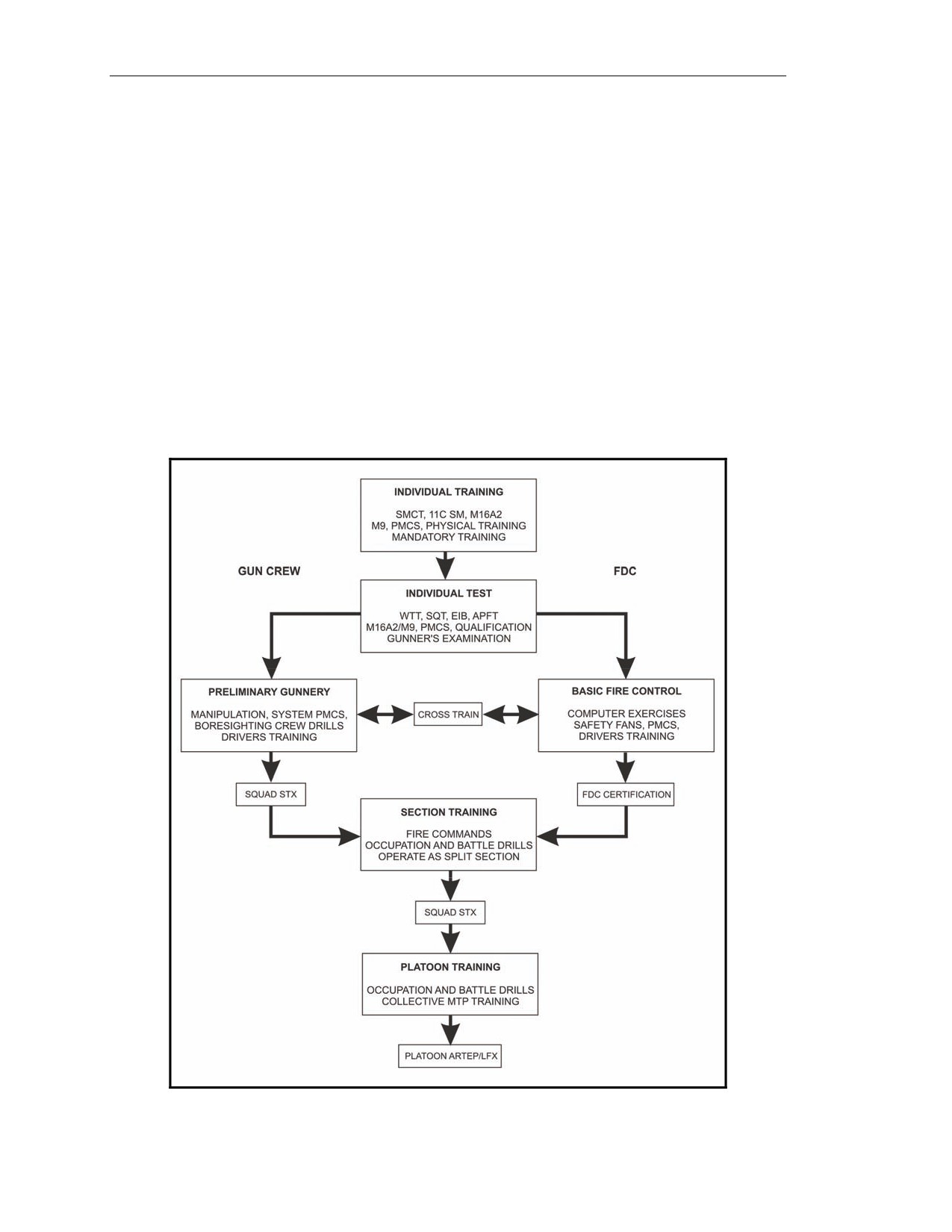
A-19. Figure A-1 outlines a logical progression of events that a mortar platoon can adapt to their
training strategy. Mortar squads and the FDC are dual-tracked to focus on their specific training needs.
Both tracks must be integrated to develop a mortar platoon that fights as one unit. Individual and
collective training must be evaluated against specific standards and discussed in AARs. Objective
evaluations provide readiness indicators and determine future training requirements.
Figure A-1. Integrated training strategy.
A-4
FM 3-22.90
7 December 2007
Mortar Training Strategy
Common Tasks
A-20. These tasks are found in STP 7-11B1-SM-TG, Skill Level 1 and in STP 7-11B24-SM-TG, Skill
Levels 2, 3, and 4. These manuals contain the common tasks that all Soldiers must know, regardless of
MOS or duty position, to help them fight, survive, and win in combat. Mastery of these common tasks
is a prerequisite for individual training specific to mortars. The communications and land navigation
common tasks are vital.
MOS 11C Tasks
A-21. These tasks are found in STP 7-11C14-SM-TG, Skill Levels 1-4 for MOS 11C. This manual
contains the individual tasks specific to mortarmen. The trainer’s guide provides leaders the
information to develop the individual portions of a unit training plan. Each 11C task is listed in this
guide, along with the following.
Training Extension Courses
A-22. Service schools use training extension courses (TECs) to provide their expertise directly to units
in the field. This is accomplished through lessons in the form of booklets, video slides, audio tapes,
videotapes, and Electronic Information Delivery System (EIDS) machines. These lessons focus on
individual tasks and are stocked in unit learning centers and the local training support centers. TEC
materials provide standardized instruction, which is helpful to Soldiers as they move from unit to unit.
Preparation time is also saved. However, trainers must ensure the lessons directly and fully support the
training objectives.
Army Correspondence Course Program
A-23. The Army Correspondence Course Program (ACCP) provides printed training courses through
the mail to Soldiers. It is a valuable program for training the trainer, skill progression, and functional
training for a specific specialty, MOS, or duty position. However, planning is needed. Leaders must
identify courses that support the goals of the long-range training plan; Soldier’s enrollment must then
be arranged. (ACCP includes the infantry mortar platoon leaders’ course.)
CROSS TRAINING
A-24. A Soldier’s individual training tends to focus on his duty position. The assistant computer
concentrates on FDC tasks while the squad leader concentrates on mortar mechanical tasks and leading
the squad. However, this focus should not exclude other mortar training. Continuous training in duty-
specific tasks can become boring to Soldiers and deprive them of gaining broad proficiency in their
MOS. Casualties (whether in war or in training) can quickly render the mortars ineffective if key
personnel are lost. These variables make cross training essential. For example, cross training ensures
that a squad leader can assume the duties of a computer and that subordinates are ready to assume the
roles of their supervisors.
COLLECTIVE TRAINING
A-25. Collective training includes squad, section, and platoon drills and exercises.
Squad Training
A-26. The core of squad training is crew drill. Squad-level mortar tasks are in the infantry MTP. This
training can be performed in garrison (using devices or live ammunition). Once these tasks are
mastered, performing them under different conditions (urbanized terrain, limited visibility, CBRN)
increases the challenge. Cross training is accomplished at this level by rotating Soldiers among duty
positions, such as squad leader and FDC positions, while providing coaching.
A-27. The foundation of squad training is sound individual training. If individual proficiency is
effectively sustained, new Soldiers can be readily integrated into the unit during collective training.
7 December 2007
FM 3-22.90
A-5
Appendix A
They arrive at the unit proficient in specific tasks learned in the training base. These new Soldiers learn
additional tasks while training with their experienced peers and their squad leaders.
Section and Platoon Training
A-28. The core section and platoon tasks are found in the ARTEP MTP. This training usually consists
of an exercise in the field: live-fire exercise (LFX), STX (either alone or with a rifle company), or field
training exercises (FTX) as part of the battalion. LFXs may involve subcaliber, full-range training
cartridge (FRTC), short-range training round (SRTR), or service ammunition. STXs and FTXs may
entail dry-fire, live-fire, or devices, either alone or in combination.
A-29. The FIST must be a part of this training. An LFX must never take place without the FISTs who
typically deploy with the supported companies. The complete indirect fire team (see Chapter 1) must
train together for maximum efficiency. This teaches the capabilities, limitations, and unique
requirements of operating mortars.
A-30. Another important area is the mortar’s role in overall task force operations. This collective
training mainly involves leaders in an FTX. However, mortars must be considered along with other fire
support assets when conducting a map exercise (MAPEX), command field exercise (CFX), tactical
exercise without troops (TEWT), or command post exercise (CPX).
Collective Training Resources
Drill Books
A-31. Crew and battle drills are published in a pocket-sized ARTEP manual called a drill book for each
unit organized under a different TOE. (See ARTEP 7-90-Drill.)
Battle drills are a specific category of collective tasks performed at squad, section, or
platoon level. They are vital to the mortar’s success in combat. Battle drills are mostly
independent of mission, enemy, terrain and weather, troops and support available, time
available, civil considerations (METT-TC) and require minimal leader actions to execute.
They are usually executed or initiated on a cue such as an enemy action or a simple leader
order. Battle drills are standardized throughout the U.S. Army and may not be modified in
training. The mortar unit is required to be proficient in all battle drills contained in the drill
book. Less critical drills are published in other sources such as training circulars or field
manuals.
Mortar drills are divided into two general areas. The first are those battle drills that
previously were termed “crew drills.” These focus on the mechanical manipulation of the
mortar such as small deflection changes or removing a misfire. Full proficiency in these
tasks is a prerequisite for performing fire support missions. The second area encompasses
those battle drills essential to combat survival. These include such tasks as React to
Chemical Attack, React to Indirect Fire, or React to Nuclear Attack.
Mission Training Plan
A-32. The mission training plan (MTP) is a descriptive ARTEP document for training mortarmen to
critical wartime mission proficiency. It gives the mortar platoon or section a clear description of
“what” and “how” to train. This is achieved through comprehensive, detailed training and evaluation
outlines (T&EOs); guidance on training exercises; and other related training management aids. While
its focus is on collective training, the MTP also provides matrixes that identify individual tasks,
common 11C SM tasks, and Military Qualification Standard (MQS) tasks. Like the drill book, the
mortar MTP applies to platoons or sections organized under a specific TOE (see ARTEP 7-90-MTP).
Battalion-Level Training Model
A-33. The battalion-level training model (BLTM) is a means to quantify the cost of maintaining
training readiness. This cost is expressed in terms of types of training events, their annual frequency,
and the equipment miles/hours expended. This model is used to forecast and resource requirements to
A-6
FM 3-22.90
7 December 2007
Mortar Training Strategy
support the unit’s specified training readiness level. It does not, however, prescribe what training a unit
must conduct to maintain this level. Rather, the BLTM provides a basis for understanding the trade-off
between a unit’s training resources and its training strategy. This helps leaders program training
alternatives to achieve and maintain combat readiness. The frequency of training events under the
BLTM is reflected in the battalion’s long-range training plan.
EXAMPLE ANNUAL MORTAR TRAINING PROGRAMS
A-34. Figure A-2 depicts an example IBCT battalion mortar training program, and Figure A-3 depicts
an example HBCT battalion mortar training program.
JANUARY
FEBRUARY
MARCH
IND WPN QUAL/SUST
SQD/SEC/FDC DRILL (LITR)
POST SUPPORT/BN CPX
CREW WPN QUAL/SUST
PLT FTX
SQD/SEC/FDC DRILL
MAINTENANCE
CO FTX
(SRTR)
SQD/SEC/FDC DRILL
BN FTX
ITEP/CMT
(SRTR)
DEPEX
CO TEWT
PLT/SEC LFX
MAINTENANCE
GUNNER’S EXAM
PLT STX (81-mm ONLY)
FDC CERTIFICATION
SUPPORT CO STX
APRIL
MAY
JUNE
IND WPN QUAL/SUST
SQD DRILL
POST SUPPORT
CREW WPN SUST
PLT STXs
BN CPX
MAINTENANCE
CO FTXs
CO MAPEX
SQD/SEC/FDC DRILL (LITR)
DEPEX
ITEP (EIB)
SEC/PLT LFX
BN FTX
SQD/SEC/FDC DRILL (LITR)
MAINTENANCE
SUPPORT CO FTX
JULY
AUGUST
SEPTEMBER
NG & ROTC SUPPORT
IND WPN QUAL/SUST
SQD DRILL
SQD/SEC/FDC DRILL
CREW WPN QUAL/SUST
MAINTENANCE
(SRTR)
BN FTX
CO FTXs
CALFEX/LFX
BN CFX
MAINTENANCE
BN FTX (EXT EVAL)
FDC EXAM
SQD/SEC/FDC DRILL
GUNNER’S EXAM
(SRTR/LITR)
SQD/SEC/FDC DRILL (LITR)
PLT STX (81-mm)
DEPEX
OCTOBER
NOVEMBER
DECEMBER
POST SUPPORT
IND WPN QUAL/SUST
POST SUPPORT
ITEP (WTT) CMT
CREW WPN/SUST
ITEP
BN TEWT
DEPEX
CMT
CO MAPEXs
MAINTENANCE
SQD/SEC/FDC DRILL (LITR)
CPX (81-mm)
SQD/SEC/FDC DRILL
SQD/SEC/FDC DRILL (LITR)
(SRTR)
GUNNER’S EXAM
FDC CERTIFICATION
Figure A-2. Example training program for IBCT battalion.
7 December 2007
FM 3-22.90
A-7
Appendix A
JANUARY
FEBRUARY
MARCH
CMT
MAINTENANCE
MAINTENANCE
ITEP
CO FTX
POST SUPPORT/CO
BN CPX
BN FTX
MAPEX
MAINTENANCE
DEPEX
BN TEWT
SQD DRILLS
SQD/SEC/FDC DRILL
ITEP
PLT STX
PLT FTX
CMT
SQD/SEC FDC DRILL
IND WPN QUAL/SUST
(SRTR)
SQD/SEC/FDC DRILL
IND WPN QUAL/SUST
(SRTR)
FDC CERTIFICATION
APRIL
MAY
JUNE
GUNNERY QUAL (MTA)
ITEP
CO FTX
CALFEX (MTA)
BN CPX
BN FCX
MAINTENANCE
PLT STX
BN DEPEX
GUNNER’S EXAM
MAINTENANCE
BN FTX (EXT EVAL [HTA])
LFX (M60, .50-CAL,
SQD/SEC BATTLE DRILLS
MAINTENANCE
120-mm)
(SRTR/LITR)
SQD/SEC/FDC DRILL
CALFEX/LFX DRILL
GUNNER’S EXAM
BN EXT EVAL/LFX
(60-mm SUBCAL)
JULY
AUGUST
SEPTEMPER
POST SUPPORT
IG INSPECTION
CO FTX
ITEP (EIB)
ITEP
MAINTENANCE
BN MAPEX
BN CPX
BN DEPEX
IND WPN QUAL/SUST
MAINTENANCE
BN FTX-(REFORGER)
CMT
SQD/SEC/FDC DRILL
SQD/SEC/FDC DRILL
SQD/SEC/FDC DRILL
(60-mm SUBCAL)
(SRTR)
(SRTR)
PLT STX
PLT STX
MAINTENANCE
FDC EXAM
GUNNER’S EXAM
OCTOBER
NOVEMBER
DECEMBER
MAINTENANCE
IND WP QUAL/SUST
MAINTENANCE
POST SUPPORT
GUNNERY QUAL (MTA)
DEPEX
CO TEWT
MAINTENANCE
POST SUPPORT
ITEP (WTT)
BN CFX
ITEP
CMT
SQD/SEC/FDC DRILL
IND WPN QUAL/SUST
SQD/SEC/FDC DRILL
(SRTR)
CMT
FDC EXAM
SQD/SEC/FDC DRILL
GUNNERY QUAL
(.50-CAL, M60)
LFX
Figure A-3. Example training program for HBCT battalion.
A-8
FM 3-22.90
7 December 2007
Mortar Training Strategy
TRAINING EVALUATION
A-35. Evaluation cannot be separated from effective training. It occurs during the top-down analysis
when planners develop the training plan. Planners use various sources of information to assess their
unit’s individual and collective training status. Evaluation is continuous during training. Soldiers
receive feedback through coaching and AARs. Leaders also assess their own training plan and the
instructional skills of their subordinate leaders. After training, leaders evaluate by sampling training or
reviewing AARs. Much of this evaluation is conducted informally. Formal evaluations occur under the
Individual Training and Evaluation Program (ITEP) and the Army Training and Evaluation Program
(ARTEP) to assess individual and collective training respectively.
INDIVIDUAL TRAINING
Commander’s Evaluation
A-36. The commander’s evaluation is routinely conducted in units. Commanders select and evaluate
individual tasks that support their unit mission and contribute to unit proficiency. This may be
performed through local tests or assessments of Soldier proficiency on crucial MOS tasks or common
tasks. The commander’s evaluation is based on year-round, constant evaluation by the chain of
command. It is supported by the MOS 11C Soldier’s manuals, trainer’s guides, and job books.
Warrior Task Test
A-37. The warrior task test (WTT) is a hands-on test that evaluates basic survival and combat tasks. It
is taken directly from STP 7-11B1-SM-TG, STP 7-11B24-SM-TG, and STP 7-llCl4-SM-TG. The
WTT gives the unit commander regular, objective feedback on common task proficiency.
Gunner’s Examination
A-38. The gunner’s examination is a continuation of the mortar-based drills in which a mortarman’s
proficiency as a gunner is established. The examination is contained in Chapter 9 of this manual. It
includes tests, equipment, conditions, testing procedures, scoring, and administrative procedures. It
focuses on the individual qualification of the Soldier in the role of a gunner. However, the gunner’s
success also depends on the collective performance of his assistants. Within these limitations,
evaluators should try to standardize the examination. The BLTM specifies that the squad leader,
gunner, and assistant gunner should pass the gunner’s exam semiannually. All gunners should have a
current qualification before an LFX (whether using service or subcaliber ammunition).
FDC Certification
A-39. This provides commanders a means to verify that their FDC mortarmen have the knowledge and
skills for their positions: squad leader, FDC computer, section sergeant, platoon sergeant, and platoon
leader. Certification helps ensure that ammunition is wisely expended and that training is conducted
safely and effectively. Mortarmen are certified when they receive a passing score on the two-part
examination. (See FM 3-22.91 for FDC certification.)
COLLECTIVE TRAINING
Army Training and Evaluation Program
A-40. The aim of collective training is to provide units the skills required to perform unit-level tasks.
The ARTEP is the overall program for this collective training. It prescribes the collective tasks that a
unit must successfully perform to accomplish its mission and to survive in combat. These tasks include
conditions and performance standards, and they are located in MTPs and drill books.
7 December 2007
FM 3-22.90
A-9
Appendix A
External Evaluation
A-41. The commander formally determines the status of his collective training through external
evaluation. The external evaluation gives the commander an objective appraisal of this status by using
mortar expertise found outside the normal chain of command. The external evaluation is not a test in
which a unit passes or fails; it is a diagnostic tool for identifying training strengths and weaknesses. It
must be emphasized that an external evaluation is not a specific training event but a means to evaluate
a training event. Mortar units undergo external evaluations during an LFX, FTX, or a combination
thereof. The unit may be evaluated alone, as part of its parent unit, or with other mortar units. The
MTP provides guidance on planning, preparing, and conducting an external evaluation.
Evaluation of the Indirect Fire Team
A-42. The members of the indirect fire team must train and correctly execute their respective tasks to
successfully complete any fire mission. However, only as a last resort should the fire mission be
deleted from the evaluation. Evaluators should determine the reason why any fire mission fails to meet
standards in order to determine where additional training is required. The indirect fire team should be
given the opportunity to successfully complete the fire mission. This can be accomplished in the
following ways:
Allow the mission to continue if the detected error will still result in the rounds impacting
within the safety limits. The team must train to accomplish the mission by finding and
correcting any errors based on the round’s impact. The appropriate evaluator should
intervene only if the team prepares to fire incorrect data that is out of the safety area or
when ammunition is constrained.
Start the fire mission over. Although ammunition constraints during live-fire may not permit
this, tasks can be repeated using devices or, less preferably, dry-fire.
The evaluator corrects the error when the mission data would result in rounds fired out of
the safety area. The FO evaluator at the observation post can change the CFF or correction
to reflect proper procedures. The FDC evaluator may correct the improperly computed
firing data while the mortar squad evaluator may correct improperly set data or a faulty sight
picture.
A-10
FM 3-22.90
7 December 2007
Appendix B
Training Devices
The most efficient and direct method of teaching conduct of fire is by firing
service ammunition under field conditions. However, ammunition training
allowances and range limitations often restrict such training. When properly
used, mortar training devices provide realistic training at reduced costs and at
more accessible locations.
SECTION I. FULL-RANGE TRAINING CARTRIDGE, M931
The full-range training cartridge (FRTC) provides realistic training for all members of the indirect fire team
at a reduced cost.
DESCRIPTION
B-1. The M931 FRTC is a non-dud producing 120-mm training cartridge used to simulate the M934
HE cartridge for M120 and M121 120-mm mortars.
B-2. The weight, charges, fuzing, and ballistic characteristics of the cartridge are similar to those of
the HE cartridge. The M781 fuze for the M931 produces a flash, a bang, and a smoke signature that
provide audio and visual feedback to the mortar crew and FO. The M931 has the following general
characteristics:
Maximum range: 7,200 meters.
Minimum range: 200 meters.
Maximum rate of fire: 16 rounds per minute (first minute).
Sustained rate of fire: 4 rounds per minute.
B-3. The cartridge allows the entire mortar team—FO, FDC, and guns—to practice the actions
required for a fire mission. These actions include—
FO CFF and adjustment.
FDC calculations and procedures.
Gun crew preparation of the round, and the manipulation and firing of the mortar.
B-4. A major advantage of using the M931 FRTC is the elimination of the time required to retrieve
and clean training devices such as the short-range training cartridge (SRTC). It also does not exceed 75
percent of the M934 cartridge’s unit production cost.
B-5. A disadvantage of using the FRTC is the need to treat it as a regular service mortar cartridge
when firing; it has the same range and firing restrictions as a service round.
B-6. The M931 consists of the following major components:
Projectile body assembly.
M233 propelling charges (with M47 propellant).
M1005 ignition cartridge (with M44 propellant).
M34 fin assembly.
M781 point detonating practice fuze.
PROCEDURES
B-7. The procedures to fire the FRTC are the same as for the M934 service cartridge.
7 December 2007
FM 3-22.90
B-1
Appendix B
SECTION II. SHORT-RANGE TRAINING ROUND, M880
The M880 SRTR cartridge provides an economical means of realistically training personnel in all phases of
mortar gunnery. The SRTR enables units to train in locations where mortar training facilities are limited or
do not exist. Trainers should exercise imagination and ingenuity in developing training situations for
employing the SRTR. This section provides the technical information required to employ the SRTR.
TRAINING WITH THE SHORT-RANGE TRAINING ROUND, M880
B-8. The M880 SRTR is a training round for the 81-mm mortar (M29 and M252) and the 120-mm
mortar (when used with M303 and M313 81-mm subcaliber inserts). It can be fired, recovered,
refurbished, and refired. When fired, the SRTR travels from 47 to 458 meters, according to its charge
and elevation. Upon impact, the SRTR emits a flash, a bang, and smoke discharge, but no
fragmentation.
TRAINING
B-9. The SRTR is effective for training all elements of the indirect fire team. It provides the FO with
an audio and visual signal by which he can spot rounds and make adjustments. The FDC computes
data received from the FO, who observes the impact of the SRTR on a 1:10 scaled range. The gunner
places data obtained from the FDC on the mortar and the assistant gunner drops an SRTR down the
barrel. The entire indirect fire team functions the same as if they were firing service ammunition with
one exception—the FO observes the SRTR impact on a 1:10 scaled range instead of the service
ammunition at a normal distance in an impact area.
CHARACTERISTICS
B-10. The characteristics of the SRTR are as follows:
Overall length: 14.5 inches.
Firing weight: 6.84 pounds.
Maximum range: 458 meters.
Minimum range: 47 meters.
NOTE: The 1:10 scale is based on 81-mm 300-series ammunition.
ADVANTAGES
B-11. The SRTR is used with all 81-mm mortars and 120-mm mortars (when used with M303 and
M313 81-mm subcaliber inserts). It also accommodates prescribed crew drill procedures, and it can be
used by both HBCT and IBCT elements. The SRTR has the following advantages:
Can be fired in training areas where firing service ammunition is prohibited.
Saves time by eliminating long-distance travel to suitable mortar ranges.
Saves in the cost of firing service ammunition.
Requires only a brief period of time for personnel to learn proper operation and
maintenance.
Allows the indirect fire team to use the same procedures required to fire service
ammunition, excluding appropriate charge and fuze settings.
Uses all of the equipment required to fire service ammunition.
RANGE
B-12. A scale of 1:10 is used to relate the range and deviation between the SRTR projectile and the
standard 81-mm service projectile. The minimum range requirement for firing, through charge 3, is an
area 700 to 900 meters in depth and 300 meters in width. This is necessary to accommodate the desired
number of targets and provide a maneuver area to operate in. When using 81-mm mortars, the mortars
B-2
FM 3-22.90
7 December 2007
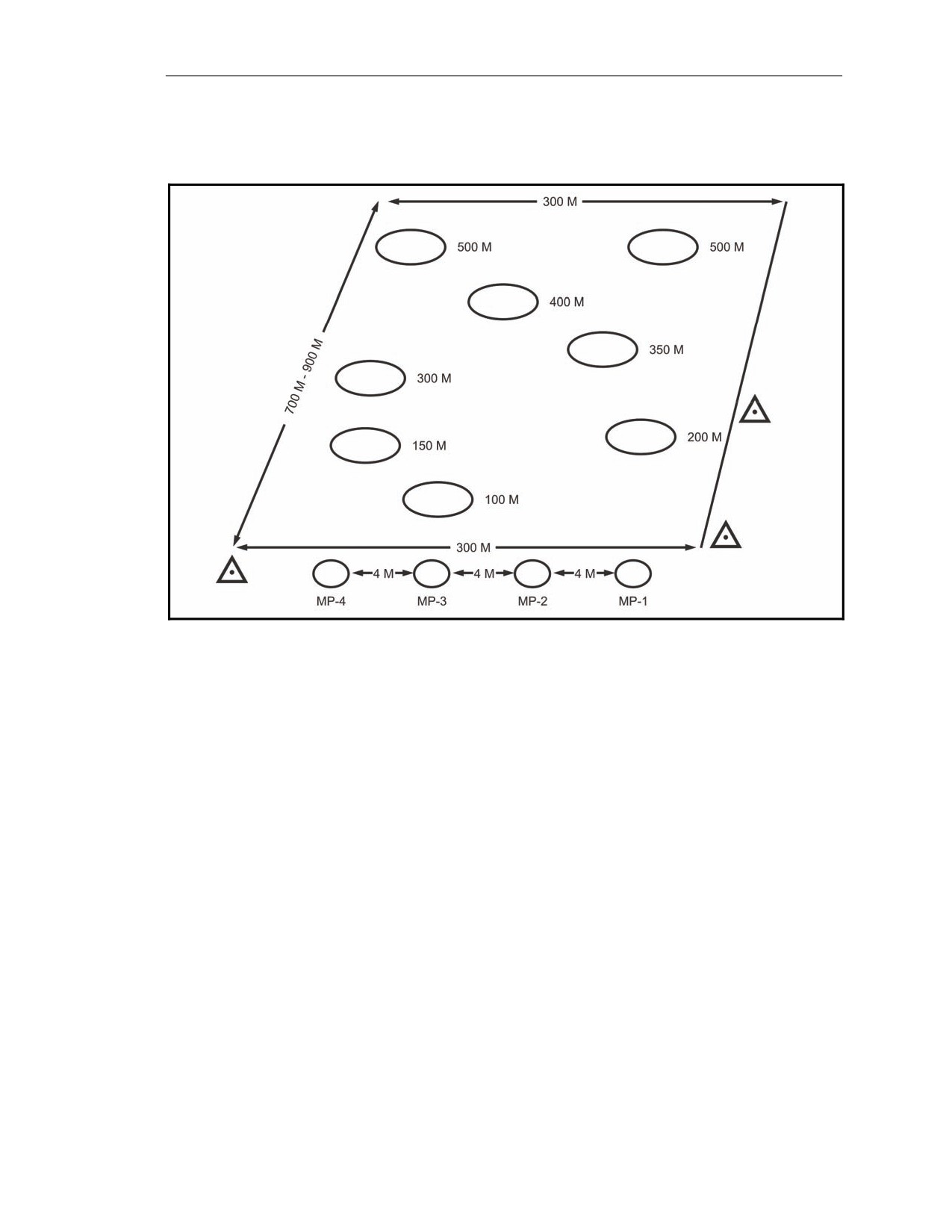
Training Devices
can be no closer than 4 meters apart, but can be as far apart as the range permits (check with the local
range control regulations). The range must be cleared of all unexploded ammunition, concrete, and
steel objects (Figure B-1).
Figure B-1. Scaled range for short-range training round, M880.
COMPONENTS
B-13. The SRTR consists of eight major components (Figure B-2).
Fuze, point detonating M775.
Projectile body.
Obturator band.
Plastic charge plugs.
Dud plugs.
Fin assembly.
Ignition cartridge, M987.
Breech plug assembly.
7 December 2007
FM 3-22.90
B-3
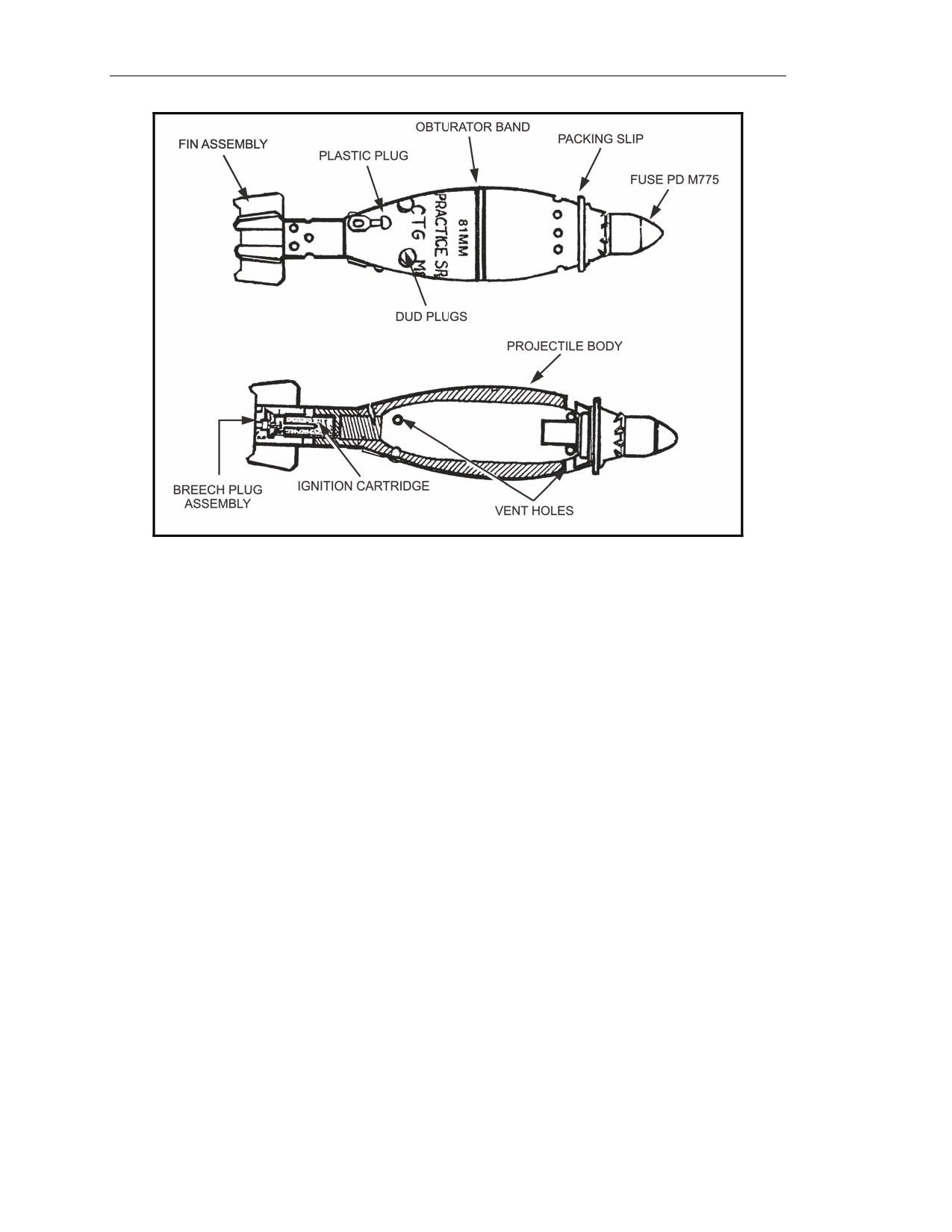
Appendix B
Figure B-2. Short-range training round, M880—practice round.
PROJECTILE BODY
B-14. The projectile body is made from cast iron and is machined to accept the M775 fuze, the tail fin,
three charge plugs, three dud plugs, and the obturator band. It is painted blue with white lettering and
one brown band to identify it as a practice round. The charge and dud plugs are fitted into holes drilled
in the base of the projectile body. The obturator band is plastic and shaped like a split ring so that it
will expand to fit over the projectile body and will seat into the band groove. The M775 fuze assembly
includes a pyrotechnic spotting cartridge, which is retained in the fuze body by a threaded aluminum
cup. This assembly is threaded into the nose of the projectile body.
FUZE, M775
B-15. The M775 fuze replicates the M734 multioption fuze used with service ammunition. Even
though the M775 has four fuze settings for ammunition bearer training, it will only function upon
impact. The tail fin assembly is threaded onto the stud at the base of the projectile body. Inside the tail
fin is the propellant cartridge, which is a primed 12-gauge shotgun shell casing loaded with a double
base propellant. The breech plug/firing pin is threaded into the rear of the tail fin and retains the
propellant cartridge in the fin cavity.
B-4
FM 3-22.90
7 December 2007
Training Devices
PREPARATION
B-16. The M880 is issued ready to fire. When the round is unpacked, ensure the following:
No red is showing at the top of the fuze.
The packing clip is in place.
The obturator band is present and flush with the body.
The three plastic charge plugs are seated in the body.
The three dud plugs are seated in the body.
The ignition cartridge is inside the fin assembly.
The breech plug is seated in the fin assembly.
WARNINGS
If any red can be seen above the fuze windshield, place the
fuze in the dud pit and dispose of the fuze in accordance with
the unit SOP.
If the packing clip is loose, attempt to place the packing clip
back into the fuze. If it will not go back into the fuze, place the
fuze into the dud pit and dispose of the fuze in accordance
with the unit SOP.
Inspect the breech plug firing pin for freedom of movement. If
it does not move freely, a misfire could occur or premature
ignition of the ignition cartridge could take place when
assembling the round.
B-17. To prepare a newly issued round for firing, set the desired charge by pulling one of the plastic
charge plugs from the body of the round. Set the desired fuze setting by rotating the multioption fuze
clockwise or counterclockwise until the desired fuze setting is lined up with the notch on the body of
the round. Present the round to the squad leader for his inspection. When the assistant gunner is ready
to fire the round, pull the packing clip from the round and hand it to him.
WARNING
Do not pull the packing clip from the round until the assistant
gunner is ready to fire the round.
NOTE: The fuze setting is for training only and will not affect the functioning of the
fuze.
B-18. Charge settings for the round are as follows:
Charge 0—pull all the plastic charge plugs from the body.
Charge 1—pull two of the plastic charge plugs from the body.
Charge 2—pull one of the plastic charge plugs from the body.
Charge 3—do not pull any of the plastic charge plugs from the body.
7 December 2007
FM 3-22.90
B-5