FM 3-22.90 Mortars (December 2007) - page 8
Appendix B
REFURBISH THE ROUND
B-19. To refurbish a previously fired round, ensure that the round is clean. All portholes must be free
of dirt to allow the gas to escape, and all of the threads must be clean.
(1)
Inspect the refurbishing kit to ensure that all equipment is present.
Three plastic charge plugs.
One obturator band.
One M987 ignition cartridge.
One breech plug.
One M775 point detonating fuze.
Three dud plugs.
(2)
Assemble the round as follows:
Install the three plastic plugs with the tangs pointed to the rear of the projectile body.
Install the three dud plugs.
Secure the fin assembly onto the projectile body hand-tight.
Install the obturator band onto the projectile body.
CAUTION
If the obturator band does not seat flush or below the surface of
the projectile body, send the body back to the maintenance table
for further cleaning. If the obturator band still does not seat flush,
the body must be disposed of.
Install the fuze assembly hand-tight and flush with the top of the round.
With the round laying horizontally on the table, install the M987 ignition cartridge into
the tail fin assembly.
WARNING
Do not force the ignition cartridge into the tail fin assembly.
Install the breech plug by hand and use the breech plug wrench to secure the breech
plug hand-tight.
(3)
Place the round back into its canister until it is ready to be fired.
NOTE: Do not refurbish the M880 round if it will not be fired that same day.
(4) To fire the round, follow the same procedures as if the round was newly issued.
CLEAN AND SERVICE THE ROUND
B-20. Use the following procedures to clean and service the SRTR.
(1) Fill two trash cans with water and leave another trash can empty.
(2) Dip the spent M880 into the first water bucket and scrub off the heavy dirt with a wire
brush.
(3) Place the M880 round on the work table and secure the projectile body with the strap
wrench.
(4) Remove the fuze (if necessary, use the long handle pliers), check to see that it was
detonated, and discard.
B-6
FM 3-22.90
7 December 2007
Training Devices
WARNING
When the fuze is removed from the body, it must be inspected
to ensure that it has detonated by inspecting the coin to see if
it is missing.
(5) Using the breech plug wrench, unscrew the breech plug and discard.
(6) Using the fin wrench, unscrew the fin assembly from the projectile body.
(7) Place the tail fin assembly upright on the cartridge block, place the punch into the tail fin
assembly, strike the punch with the ball peen hammer, and drive out the spent ignition
cartridge. Discard the spent ignition cartridge.
(8) Place the tail fin assembly into the second wash bucket and clean it with a wire brush for the
final cleaning. Ensure that all dirt and residue are removed from the round.
(9) Remove and discard all remaining plastic plugs and the obturator band from the projectile
body.
(10) Place the projectile body into the second wash bucket and remove all dirt and residue. Take
the M16 bore brush and thoroughly clean the vent holes and the thread.
(11) With a clean, dry rag, dry both components of the M880. Ensure no dirt or residue is present
on the projectile body and tail fin assembly.
(12) Examine the M880 for cracks and any type of damage that may prevent the projectile from
being refired. If there is evidence of cracks or some type of damage, discard the entire
projectile body and tail fin assembly.
(13) If the M880 is not going to be fired the same day, lightly oil the projectile body and tail fin
assembly. Screw the tail fin assembly back on the body and store it in its canister.
NOTE: The M880 must be recovered, cleaned, and serviced within 24 hours after it is
fired.
RECOVERY PROCEDURES
B-21. Perform the following to recover a previously fired M880 round from downrange.
WARNING
Failure to follow the proper recovery procedures may result in
personal injury.
(1) Ensure the range is closed and all weapon systems have ceased firing.
(2) Issue a shovel, a grappling hook, heavy duty leather work gloves, and an ammunition box to
the assistants.
(3) Walk down range with the assistants and locate the M880 round.
(4) Pick up the round and verify that the round has functioned by observing that all of the dud
plugs on the body are missing. Have a second Soldier verify that all of the dud plugs are
missing.
7 December 2007
FM 3-22.90
B-7
Appendix B
WARNING
When picking up the M880, ensure that your hand and fingers
are not covering the vent holes.
(5) If all of the dud plugs are missing, place the round in the ammunition box.
WARNING
If any of the dud plugs are present and the fuze has not
functioned, place the round in a marked pit and follow the
defuzing procedures outlined in paragraph B-22.
NOTE: Digging the round out with the shovel may be necessary. The grappling hook
may also be used to assist in recovering the round.
(6) Ensure that each hole left by the M880 round is filled.
(7) Once the M880 rounds have been recovered, transport them to the maintenance table.
DEFUZE A DUD ROUND
B-22. A dud M880 round may be defuzed when first located or at the end of that day’s firing as long as
it is recovered within 24 hours after it has been fired. To defuse a dud M880 round—
(1) Set the defusing device (boom box) on the platform with the holes facing downrange and
away from the troops. Pull out the four retaining pins that secure the top portion of the boom
box, and then pull the top off the base of the boom box.
(2) Turn the round until the packing clip portion of the round is facing upward.
(3) With the chisel over the fuze, secure the top portion of the boom box to the base, and then
attach the four retaining pins.
(4) Kneeling on the opposite side of the holes on the boom box, strike the chisel with the
4-pound hammer until the chisel moves freely from the base of the boom box to the top of
the boom box.
WARNINGS
All personnel must be on the solid side of the boom box
before the chisel is struck with the hammer.
When defuzing an M880 round, ear plugs and goggles must
be worn.
(5) Remove the cover of the boom box and inspect the fuze to verify that the spotting charge
has functioned.
B-8
FM 3-22.90
7 December 2007

Training Devices
WARNING
If the spotting charge has not functioned or the fuze has
pulled away from the thread well, transport it to the dud pit
and dispose of it in accordance with the unit SOP.
(6) Remove the M880 round from the boom box and return the cartridge to the firing line for
cleaning.
PARTS
B-23. The equipment shown in Table B-1 is available.
Table B-1. Supply data for short-range training round, M880.
NATIONAL
DESCRIPTION
PART NO.
DODIC NO.
STOCK NO.
Cartridge, 81-mm
1315-01-216-7070
1315-C876
Practice: M880
Refurbishment kit, M80
1315-01-219-3936
19200
1315-C045
TRAINING CONSIDERATIONS
B-24. SRTR training enables the unit commander to observe the actions of the indirect fire team and
the tasks being performed by the indirect fire team. This enhances the ability of the commander to
evaluate the proficiency of all elements of the training, to identify and isolate problems, and to begin
corrective training. All members of the team can view the overall operation to understand each
member’s part.
B-25. The time used for preparation determines the benefits gained from training with the SRTR.
Three steps must be accomplished before training begins:
(1) Build a scaled firing range (permanent, semi-permanent, or temporary).
(2) Construct a map of the firing range.
(3) Train the personnel with the SRTR. Personnel should be trained in the recovery,
refurbishment, and maintenance of the M880 before range firing begins.
B-26. Gunners should not be allowed to observe the impact of the SRTR, unless firing a direct-lay
mission. Normally, mortars are mounted in a defilade position so that mask exists between the impact
area and the firing position. If mask does not exist, using a referred deflection of 0700 when firing is
recommended.
B-27. When positioning 81-mm mortars, the lateral distance between the center of each baseplate
should have a minimum distance of 4 meters (40 meters when firing service ammunition, 1:10 scale
for the SRTR = 4 meters).
B-28. The SRTR can also be fired from the 120-mm mortar using the M303 81-mm subcaliber insert
(see section III) and the M313 81-mm subcaliber insert (see section IV). When positioning 120-mm
mortars, the lateral distance between the center of each baseplate should be a minimum of 6 meters (60
meters when firing service ammunition, 1:10 scale for the SRTR = 6 meters).
CONSTRUCTION OF A SCALED MAP
B-29. The range limitations associated with the M880 SRTR make a standard 1:50,000-scale military
map difficult to use. Therefore, a new map 1/10 the size (1:5,000) must be constructed (Figure B-3)
using the following procedures.
7 December 2007
FM 3-22.90
B-9
Appendix B
(1) Use a blank sheet of paper to draw grid squares the same size as the 1:50,000-scale map and
renumber them based on 100 meters per square.
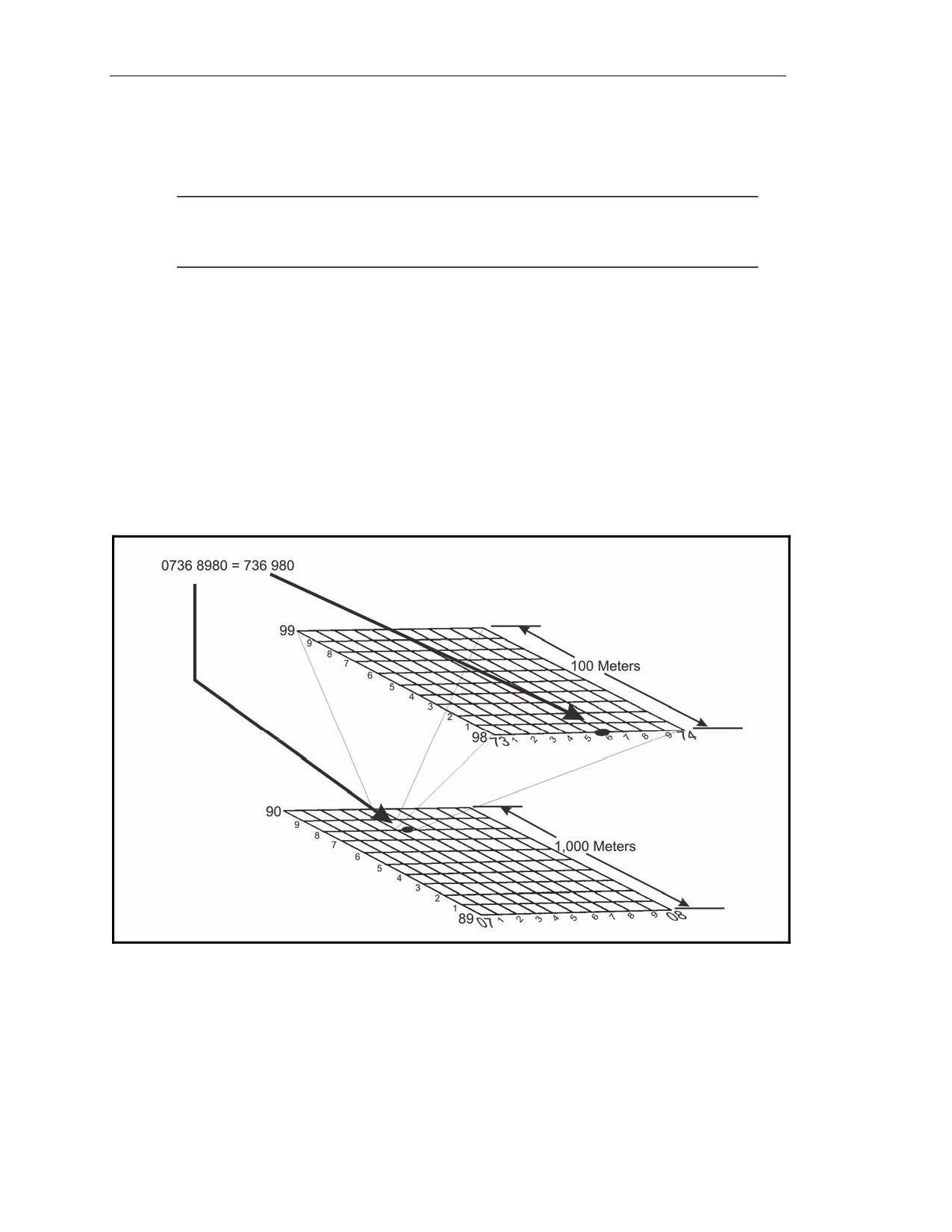
(2) Determine the 8-digit grid coordinates to the mortar position on a 1:50,000-scale military
map and convert it to a 1:5,000 scale (Figure B-3).
NOTE: The first number of a grid coordinate is the 10,000-meter designator; the second
number is the
1,000-meter designator; the third number is the
100-meter
designator; and the fourth number is the 10-meter designator.
To make a
1:5,000-scale map, drop the
10,000-meter designator and use the
1,000-meter designator as the first number for each grid. For example, a mortar
location of 07368980 becomes 736980. The 7 and the 9 will precede each grid location
since they identify the 1,000-meter increments. To make an 8-digit grid from this 6
digit grid, add a 0 at the end of the easting and northing grid location. For example, the
mortar grid becomes 73609800. The last 0 is the 1-meter designator.
Before constructing the 1:5,000-scale map, determine the direction of fire from the
mortar position to the RP. (Surveying a point on the range should be done at least one
day before training. If a point on the range has already been surveyed, it can be used to
make the map.) For example, if the direction of fire is southeast, the mortar position
would be in the northwest corner of the grid sheet. Using the example grid coordinates,
the most westerly grid line would be 73 and the second most northerly grid line would
be 98. Number the rest of the grid lines accordingly.
Figure B-3. Converting 1:50,000 grid to 1:5,000 grid.
(3) To plot the mortar position on the 1:5,000-scale map, use the same protractor that is used for
the
1:50,000-scale map, but instead of the protractor measuring
1,000 meters, it will
measure 100 meters.
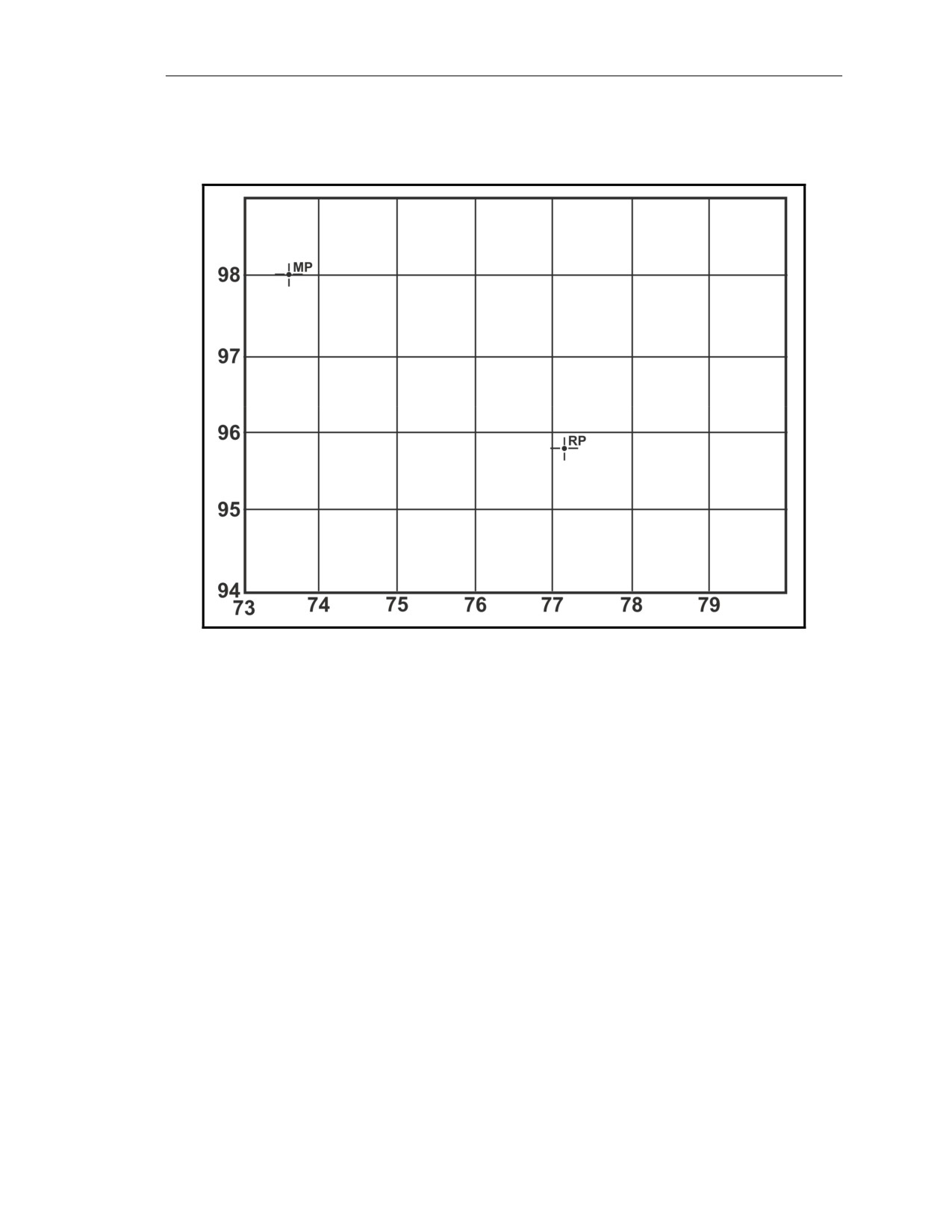
(4) To determine the direction of fire, place a target downrange, set up the M2 aiming circle at
the base gun position, and measure an azimuth to the target. To accurately plot targets on
the map, measure the distance by pace count from the basepiece to the target and then plot it
on the map. This procedure allows the creation of a surveyed firing chart. The FO’s location
B-10
FM 3-22.90
7 December 2007
Training Devices
can be plotted in the same manner. After all plotting is done, give a copy of the map to the
FO (Figure B-4). He can call for fire using this map the same as if firing service
ammunition.
Figure B-4. Plotting targets on the 1:5,000-scale map.
(5) Before putting the map on the M16 plotting board, determine the grid intersection to
represent the pivot point in the same manner as if firing service ammunition.
Place the grid system on the plotting board the same as if firing service ammunition.
Number every other black line. Every small green square equals 5 meters and every
black square equals 50 meters.
Place the mortar position and target on the plotting board the same as if firing service
ammunition. The grids plotted are to the nearest 1 meter instead of 10 meters.
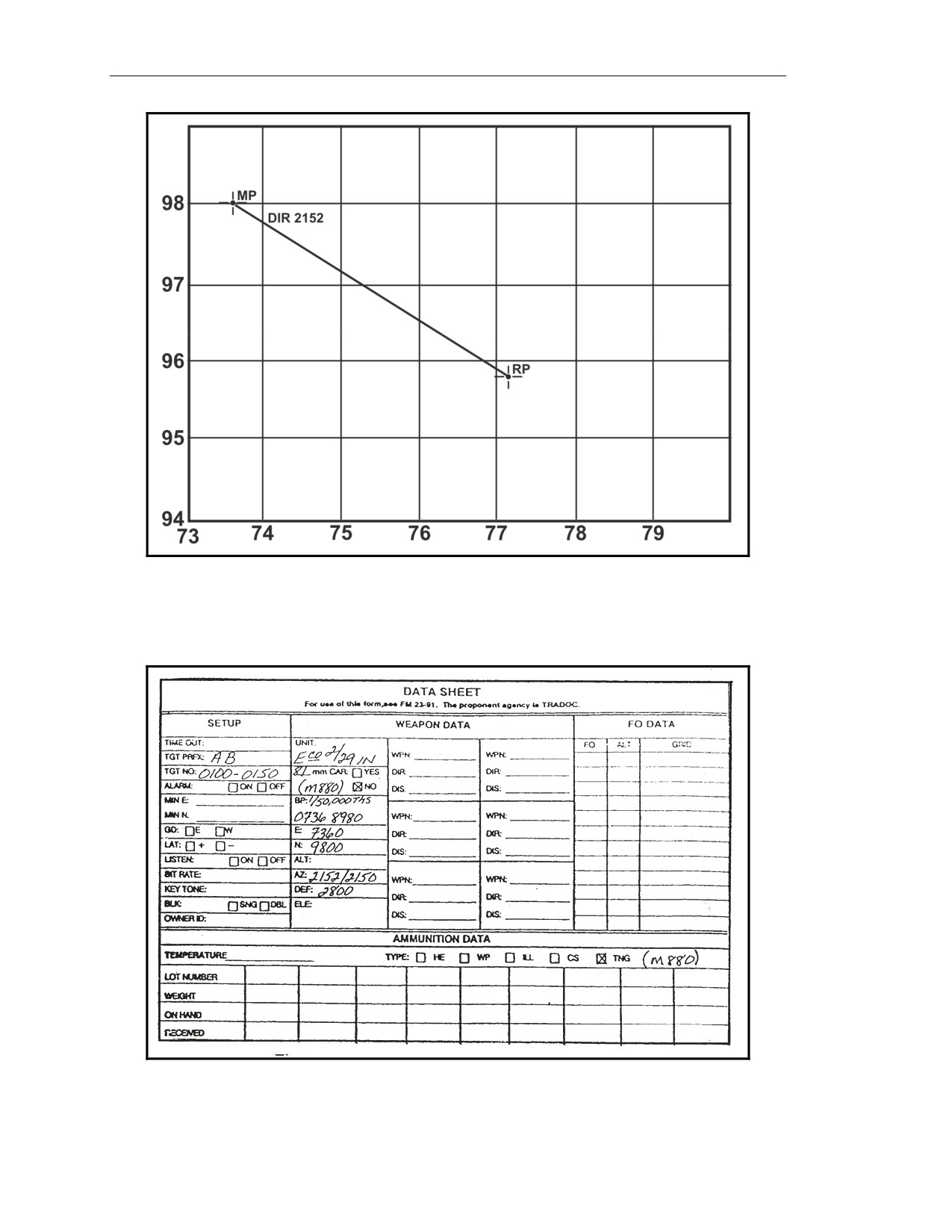
(6) To determine the mounting azimuth, line up the mortar position and the RP. Read the
azimuth on the azimuth scale at the top of the plotting board. Round off the azimuth to the
nearest 50 mils, and superimpose this azimuth over the referred deflection. Number the
azimuth scale every hundred mils using the LARS rule (Figure B-5).
7 December 2007
FM 3-22.90
B-11
Appendix B
Figure B-5. Determining direction from mortar position to the registration point.
(7) When firing the M880 SRTR, range control must know exactly where the firing position is.
The 1:50,000-scale grid must be annotated on DA Form 2188-R, labeled, and placed in the
battle position (BP) box (Figure B-6).
Figure B-6. Example completed DA Form 2188-R.
B-12
FM 3-22.90
7 December 2007
Training Devices
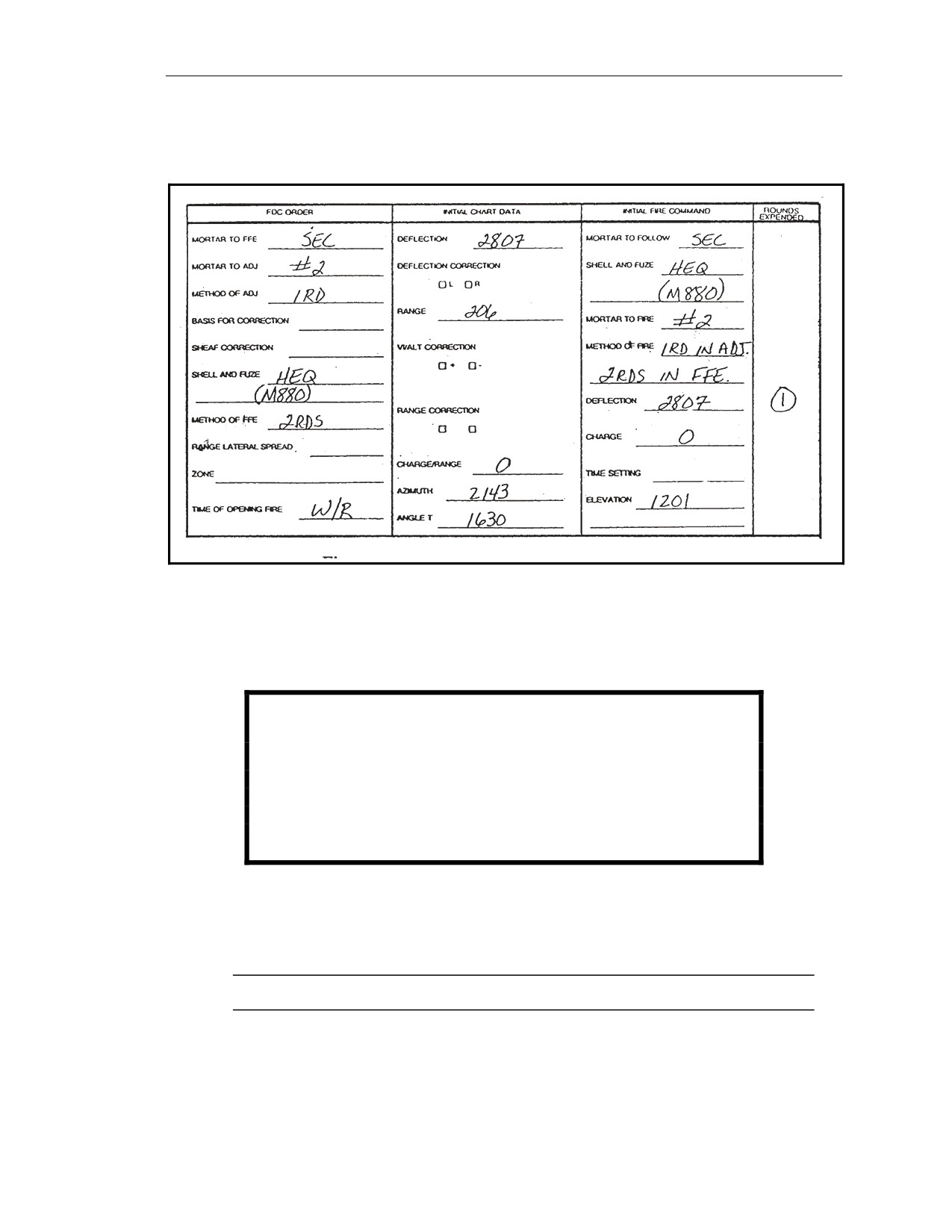
(8) DA Form 2399 is also altered. For safety, as well as range control’s information, “M880”
should be placed in the “SHELL AND FUZE” spaces in both the FDC ORDER and
INITIAL FIRE COMMAND (Figure B-7).
Figure B-7. Example completed DA Form 2399 showing SHELL AND FUZE entries in the
FDC ORDER and INITIAL FIRE COMMAND columns.
SAFETY
B-30. Although the SRTR is safe to handle and fire, the following safety precautions must be enforced:
WARNING
The SRTR is inert and can be stored and handled as a weapon
until it is loaded with the refurbishment kit at which time it will
be handled as a live mortar round. When loaded and ready to
fire, all safety precautions used during handling of service
ammunition are observed.
The SRTR refurbishment kit contains a propellant and smoke charge, and is always stored
and handled as live ammunition.
Practice ammunition is never fired over the heads of troops.
Personnel never go forward of the firing line until a cease fire has been called by the range
OIC or safety officer.
NOTE: Duds are disposed of as prescribed in paragraph B-22.
MALFUNCTIONS AND REMOVAL OF A MISFIRE
B-31. After failure to fire, misfire removal procedures are followed to remove the round from the
weapon. Misfire procedures for live rounds also apply when firing the SRTR. (See Chapter 3,
paragraphs 3-37 to 3-40 for a detailed discussion of malfunctions.)
7 December 2007
FM 3-22.90
B-13
Appendix B
B-32. If the primer cap of the SRTR is dented, the whole round is placed in the dud pit for disposal in
accordance with the local SOP.
B-33. If the primer is not dented, the round can be refired upon determination of the cause of the
misfire.
SECTION III. SUBCALIBER INSERT, M303
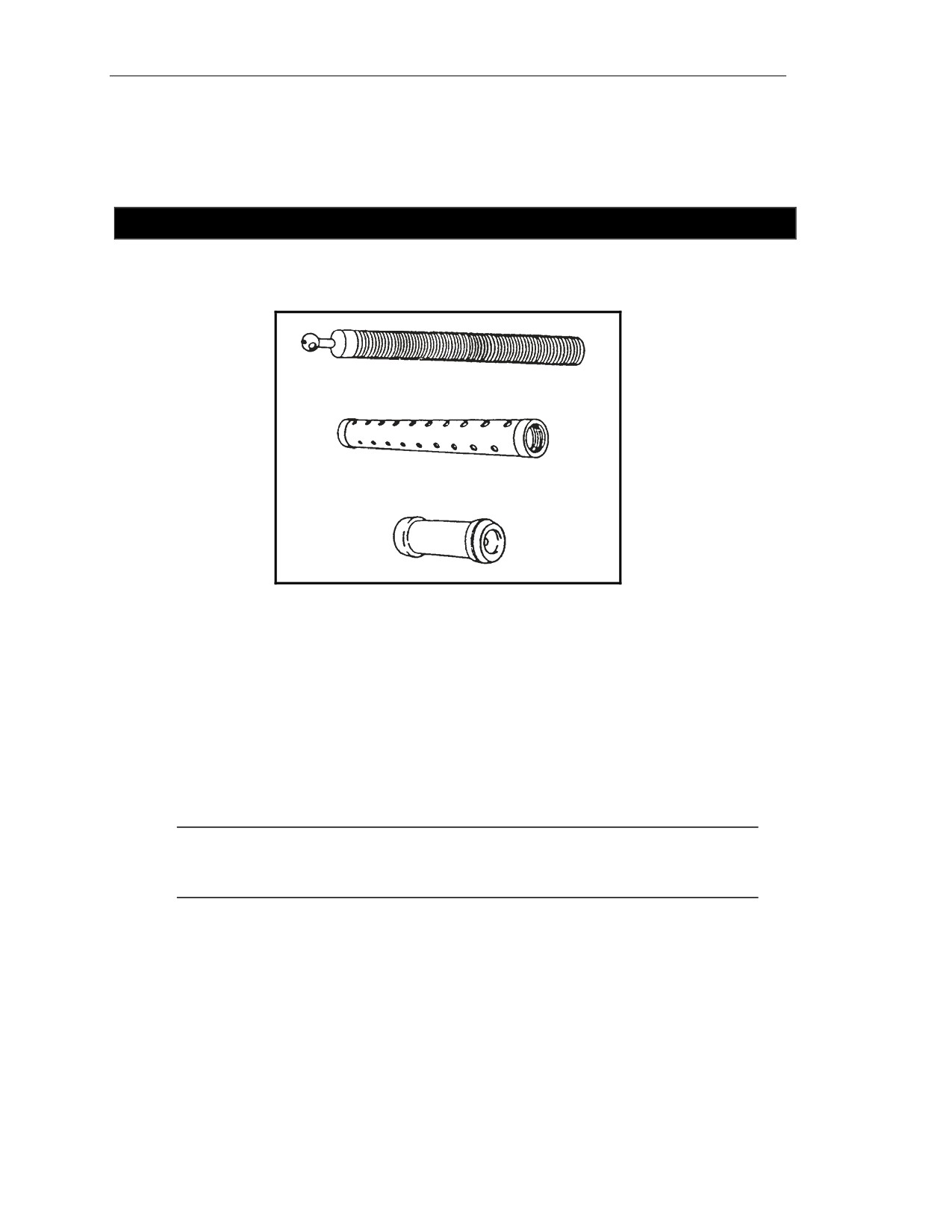
The M303 subcaliber insert (Figure B-8) provides realistic live-fire training at a relatively low cost to the
120-mm indirect fire team while firing 81-mm mortar ammunition. It uses 300-series HE, WP, and ILLUM
ammunition. Currently, the FDC uses the M16 plotting board for plotting.
Figure B-8. Subcaliber insert, M303.
CHARACTERISTICS
B-34. The cannon is an M29A1 cannon assembly that has been refurbished. This is the only M29
cannon approved to use the M303 subcaliber insert. The cannon is 51 inches long and weighs 28
pounds. It has a smooth bore with one circular cooling ring and a removable firing pin.
B-35. The insert sleeve is 42 inches long and weighs 5.9 pounds. It is tubular shaped with cooling
holes. It has a threaded end on top and a smooth end on the bottom. The sleeve slides over the cannon
and is threaded onto the cannon until it is flush with the breech cap. It is held in place by three hex
screws on the muzzle end. Approximately 2 inches of the M29 cannon will be showing at the muzzle
end.
NOTE: After every fire mission, the hex screws on the upper sleeve ring should be
checked for tightness to ensure the interior of the
120-mm cannon is not
damaged.
B-36. The filler block is 15.9 inches long and weighs 17 pounds. It is tubular shaped with the top and
bottom the same diameter as the interior of the 120-mm cannon. The top and bottom have a concave
slope with a threaded hole, which is used in the removal of the filler block.
B-37. The M303 subcaliber insert comes with a filler block adapter, a 0.0625-inch hex wrench, and a
firing pin wrench.
B-38. The 300-series ammunition has a minimum range of 73 meters and a maximum range of 4,789
meters. It can be fired at a sustained rate of three (charge 8) or five (charge 6) rounds per minute. It can
be fired indefinitely at a periodic rate of fire. The 300-series ammunition has a maximum rate of fire of
12 (charge 8) for two minutes and 12 (charge 6) for five minutes.
B-14
FM 3-22.90
7 December 2007
Training Devices
MAINTENANCE
B-39. Maintenance must be performed on the M303 subcaliber insert before, during, and after firing.
Use the following procedures to perform this maintenance. (For more detail, see TM 9-1015-254
13&P.)
BEFORE
Cannon
B-40. Update the DA Form 2408-4 to reflect the day’s firing. Ensure that all standards for bore scope
and pullover gauging have not been exceeded (within the past 180 days).
B-41. Check the M120/M121 mortar for cracks, broken welds, rust, and missing or damaged parts.
B-42. Check the M29A1 cannon for foreign matter in the barrel, then wipe dry. Clean and lubricate the
exterior surface. Check for bulges, dents, and visible cracks. Check for evidence of gas leakage
(grayish color) around the firing pin located in the base of the spherical projectile.
B-43. Check the insert sleeve for cracks, broken welds, rust, and missing or damaged parts. Check that
the insert sleeve assembles onto the cannon assembly, can be secured with set screws, and is free of
any nicks and burrs.
Filler Block
B-44. Check the filler block for cracks, broken welds, rust, and nicks or burrs.
B-45. Check that the filler block fits with breech plug of the M29A1 cannon, seats in the base of the
120-mm bore, and can be employed or retrieved using the adapter tool.
DURING
B-46. Check the bore after approximately every 50 rounds for bulges, dents, and visible cracks. Check
for evidence of gas leakage around the firing pin (grayish discoloration).
B-47. Dry swab the cannon bore after firing every 10 rounds or after every end of mission (EOD).
AFTER
B-48. Check DA Form 2408-4 to ensure it reflects the day’s firing.
B-49. Ensure rifle bore cleaning compound (RBC) is used to thoroughly clean the cannon bore after
firing and for two consecutive days thereafter. Be sure to wipe dry and lubricate with general purpose
lubricant (GPL) after each cleaning.
NOTE: For nonfiring periods, clean and lubricate the cannon on a weekly basis.
B-50. Check the insert sleeve for cracks, broken welds, rust, nicks, burrs, and damaged parts.
B-51. Check the filler block for cracks, broken welds, rust, nicks, burrs, and damaged threads.
B-52. Intervals are based on usual conditions. For unusual operating conditions, lubricate more often.
When the weapon is not being used, the intervals may be extended if proper lubrication procedures
have been followed. Clean the cannon bore weekly with RBC, and lubricate the cannon, firing pin,
insert sleeve, and filler block weekly with GPL.
7 December 2007
FM 3-22.90
B-15
Appendix B
WARNING
Dry cleaning solvent is flammable. Do not clean parts near an
open flame or in a smoking area. Dry cleaning solvent
evaporates quickly and has a drying effect on the skin. When
used without protective gloves, this chemical may cause
irritation to, or cracking of, the skin.
NOTE: Before firing, dry swab the cannon bore of the M29A1 and the 120-mm cannon.
Wipe dry the exterior of all components of the subcaliber insert.
MISFIRE PROCEDURES
B-53. See TM 9-1015-254-13&P for M303 misfire procedures.
SECTION IV. SUBCALIBER TRAINER, M313
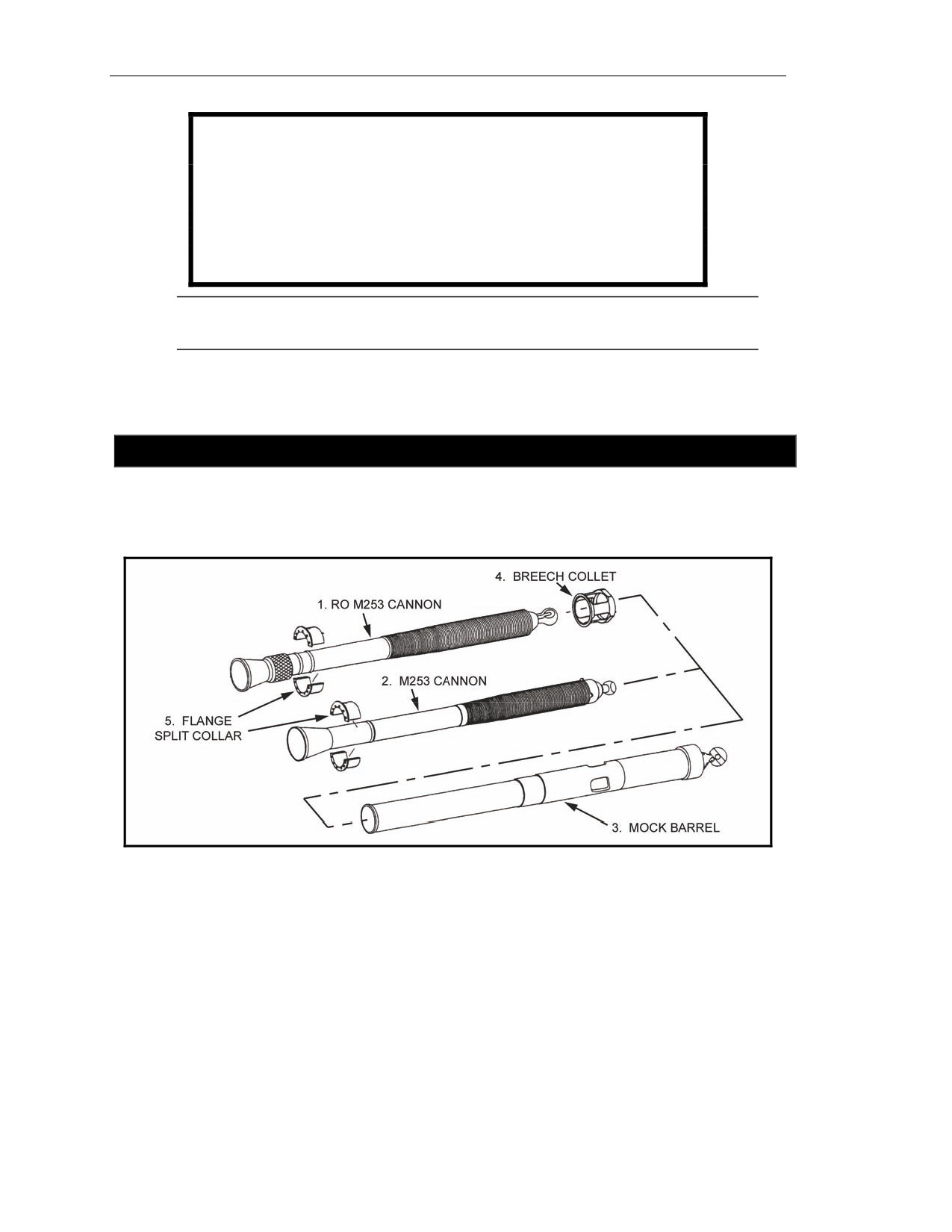
The M313 subcaliber trainer (Figure B-9) allows the 120-mm fire team to conduct low cost, realistic live-
fire training. This trainer fires 81-mm mortar ammunition and uses 300- and 800-series HE, smoke, and
ILLUM ammunition and 300-series WP. When using this trainer, the FDC plots targets using an M16
plotting board.
Figure B-9. Subcaliber trainer, M313.
CHARACTERISTICS
B-54. The M313 120-mm subcaliber trainer consists of an 81-mm mortar cannon, a 120-mm mock
barrel, a breech collet, and a flange split collar. This paragraph describes the characteristics of the
M313 subcaliber trainer and its components.
CANNON TUBE
B-55. Two types of 81-mm cannon tubes are authorized for use with the M313: the RO M253 (Figure
B-9, 1) and the M253 cannon (Figure B-9, 2) assemblies. The RO M253 cannon is 55 inches long and
weighs 35 pounds. The M253 cannon is 55 inches long and weighs 29.5 pounds. Both types have a
smooth bore with a circular cooling ring and a removable firing pin.
B-16
FM 3-22.90
7 December 2007
Training Devices
MOCK BARREL
B-56. The mock barrel (Figure B-9, 3) replaces the M298 cannon tube in the 120-mm mortar system.
The barrel is 77.7 inches long and weighs 84 pounds.
BREECH COLLET
B-57. Exclusive to the RO M253 cannon, the breech collet (Figure B-9, 4) centers and stabilizes the
tube in the mock barrel. The breech collet is 7 inches long and weighs 5 pounds.
FLANGE SPLIT COLLAR
B-58. The flange split collar (Figure B-9, 5) is used with both cannons to center the cannon in the
mock barrel.
ASSEMBLY
B-59. The mock barrel is mounted on a 120-mm mortar baseplate and bipod assembly. The breech
collet is installed in the mock barrel (RO M253 only). The flange split collar is placed around the
muzzle of the 81-mm cannon, and the cannon is lowered into the mock barrel until it is seated on the
mortar filler block. Ensure that the breech cap of the cannon tube seats correctly in the concave breech
surface of the mortar filler block. The assistant gunner dry swabs the bore of the 81-mm mortar
cannon; the gunner installs the sightunit and levels the mortar; and the crew awaits a fire mission.
OTHER COMPONENTS
B-60. The M313 subcaliber trainer comes with a tool bag, two cleaning brushes, a wire mesh cleaning
pad, an M25 fuze setter, a pair of gloves, a head section cleaning tool, a firing pin, a copy of TM 9
1015-255-13&P, a firing pin wrench, an M18 fuze wrench, a 1-3/4 inch fuze setting wrench, and a pipe
strap wrench.
MINIMUM AND MAXIMUM RANGE
B-61. The 300-series ammunition has a minimum range of 73 meters and a maximum range of 4,789
meters. It can be fired indefinitely at a sustained rate of fire of 3 (charge 8), 5 (charge 6), or 4 (charge 4
with the M374A3/M375A3) rounds per minute. The 300-series ammunition has a maximum rate of
fire of 12 (charge 8) rounds per minute for two minutes and 12 (charge 6) rounds per minute for five
minutes.
B-62. The 800-series ammunition has a maximum range of 5,608 meters. It can be fired at a sustained
rate of fire of 15 rounds per minute indefinitely and has a maximum rate of fire of 30 rounds per
minute for two minutes.
MAINTENANCE
B-63. Preventive maintenance must be performed on the M313 subcaliber trainer before, during, and
after firing to ensure that the trainer is in good operating condition and ready for its primary mission.
Use the following procedures to perform this maintenance. (For more detail, see TM 9-1015-255
13&P.)
BEFORE
Cannon
B-64. Before firing, dry swab the cannon bore of the mock barrel, and wipe dry the exterior of all
components of the 81-mm subcaliber insert.
7 December 2007
FM 3-22.90
B-17
Appendix B
B-65. Review DA Form 2408-4 or DA Form 5988-E (Equipment Inspection Maintenance Worksheet
[EGA]) to ensure that it reflects previous firings. Before firing the cannon, ensure that it has been bore
scoped and pullover gauged within the past 180 days, and be sure that these procedures are performed
every 180 days during the firing period. Notify field-level maintenance if bore scoping and pullover
gauging are needed.
B-66. Check for cracks, broken welds, rust, and missing, loose, or damaged parts.
B-67. Check the cannon/BAD for foreign matter in the barrel, and then wipe dry. Clean and lubricate
the exterior surface. Check for bulges, broken welds, dents, rust, and visible cracks. Check for
evidence of gas leakage (grayish discoloration) around the firing pin or breech cap.
Mock Barrel
B-68. Check for cracks, broken welds, rust, nicks, burrs, and missing or damaged parts.
Flange Split Collar
B-69. Check for cracks, rust, nicks, and burrs.
Breech Collet
B-70. Check for cracks, rust, nicks, and burrs.
NOTE: When firing subcaliber training rounds, bore scope the M313 every 100 rounds.
Record your inspections using DA Form 2408-4 or DA Form 5988-E.
DURING
B-71. Remove the 81-mm mortar cannon from the mock barrel after every 50 rounds (approximately),
and check for bulges, dents, and visible cracks. Check for evidence of gas leakage
(grayish
discoloration) around the firing pin or breech cap.
B-72. Dry swab the cannon bore after firing every 10 rounds (approximately) or at the end of every fire
mission.
AFTER
Cannon
B-73. Update DA Form 2408-4 or DA Form 5988-E to reflect the day’s firing. Have the weapon bore
scoped once 5,000 rounds have been fired and every 500 rounds thereafter.
B-74. Check the cannon for bulges, dents, and visible cracks. Check for evidence of gas leakage
(grayish discoloration) around the firing pin or breech cap.
B-75. Use RBC to thoroughly clean the cannon bore after firing and for two consecutive days
thereafter. Once clean, wipe it dry and lightly coat it with GPL.
NOTE: For nonfiring periods, clean and lubricate the cannon weekly.
Mock Barrel
B-76. Check for cracks, broken welds, rust, nicks, burrs, and missing or damaged parts.
Flange Split Collar
B-77. Check for cracks, rust, nicks, and burrs.
B-18
FM 3-22.90
7 December 2007
Training Devices
Breech Collet
B-78. Check for cracks, rust, nicks, and burrs.
WARNING
1.Dry cleaning solvent is flammable. Do not clean parts near
an open flame or in a smoking area.
2.Dry cleaning solvent evaporates quickly and has a drying
effect on the skin. When used without protective gloves,
this chemical may cause irritation to, or cracking of, the
skin.
3.Cleaner, lubricant, and preservative (CLP) is not authorized
for use on the M313 trainer.
MISFIRE PROCEDURES
B-79. See TM 9-1015-255-13&P for M313 misfire procedures.
7 December 2007
FM 3-22.90
B-19
Glossary
AAR
after-action review
AC
alternating current
ACA
airspace coordination area
ACCP
Army Correspondence Course Program
ACU
Army combat uniform
ADR
address
AFATDS
Advanced Field Artillery Tactical Data System
AR
Army regulation
ARTEP
Army Training and Evaluation Program
ASP
ammunition supply point
AZ
azimuth
BAD
blast attenuator device
BIT
built-in test
BLTM
battalion-level training model
BNCOC
Basic Noncommissioned Officer Course
BP
battle position
CBRN
chemical, biological, radiological, nuclear
CFF
call for fire
CFL
coordinating fire line
CFX
command field exercise
CH
charge
CHN
channel
CI
commander’s interface
CLP
cleaner, lubricant, and preservative
CMF
career management field
COMSEC
communications security
CONUS
continental United States
CPX
command post exercise
DA
Department of the Army
DAP
distant aiming point
DC
direct current
DD
driver’s display
DEF
deflection
DLY
delay
DOF
direction of fire
DMD
digital messaging device
EDC
error detection and correction
EIDSA
Electronic Information Delivery System
EL
elevation
EOD
explosive ordnance disposal
FC
fires cell
FDC
fire direction center
FFE
fire for effect
FH
frequency hopping
FIST
fire support team
FLOT
forward line of own troops
FM
field manual
FO
forward observer
7 December 2007
FM 3-22.90
Glossary-1
Glossary
FOS
Forward Observer System
FP
firing point
FPF
final protective fire
FRTC
full-range training cartridge
FSCM
fire support coordination measure
FT
firing table
FTX
field training exercise
GD
gunner’s display
G-M
grid-magnetic
GPL
general purpose lubricant
GPS
Global Positioning System
GT
gun-target
GUI
graphic user interface
HBCT
heavy brigade combat team
HE
high-explosive
HMMWV
high-mobility multipurpose wheeled vehicle
IBCT
infantry brigade combat team
ICCC
Infantry Career Captain's Course
ILLUM
illumination
IMLC
Infantry Mortar Leader Course
IMP
impact
IMU
inertial measurement unit
IBOLC
Infantry Basic Officer Leader's Course
IP
Internet protocol
IR
infrared
ITEP
Individual Training and Evaluation Program
LARS
left, add; right, subtract
LCD
liquid crystal display
LED
light-emitting diode
LFX
live-fire exercise
LWCMS
Lightweight Company Mortar System
MANCOC
Manuever Advanced Noncommissioned Officer Course
MAPEX
map exercise
MBC
mortar ballistics computer
MET
meteorological data
METL
mission-essential task list
METT-TC
mission, enemy, terrain and weather, troops and support available, time available,
civil considerations
MFCS
Mortar Fire Control System
MILES
Multiple Integrated Laser Engagement System
mm
millimeter
MOC
method of control
MOF
method of fire
MOS
military occupational specialty
MQS
Military Qualification Standard
MT
mechanical time
MTO
message to observer
MTP
mission training plan
MTSQ
mechanical time superquick
NA
not applicable
Glossary-2
FM 3-22.90
7 December 2007
Glossary
NAD
net access delay
NATO
North Atlantic Treaty Organization
NCO
noncommissioned officer
NCOPD
noncommissioned officer professional development
NFA
no fire area
NiMh
nickel metal hydride
NSB
near-surface burst
OBSNUM
observer number
OIC
officer in charge
OpACK
operationally acknowledge
OPD
officer professional development
OPFOR
opposing force
OpRDY
operationally ready
OSUT
one-station unit training
OT
observer-target
PCC
Pre-Command Course
PD
point detonating; pointing device
PDA
power distribution assembly
PED
probable errors deflection
PER
probable errors range
PLGR
precision lightweight GPS receiver
PROX
proximity
PRN
printer
PRX
proximity (used on fuze settings)
PTM
plain text message
QWERTY
the most common keyboard layout on English language-typing
computers
and
keyboards; takes its name from the first six letters in the keyboard’s top row of
letters
RTO
radio-telephone operator
RBC
rifle bore cleaning compound
RDX
cyclonite
RP
red phosphorus; reference point
RPO
range patrol officer
S3
battalion/brigade level plans, training, and operations office/officer
SDZ
surface danger zone
SEL
select
SINCGARS
Single Channel Ground and Airborne Radio System
SM
Soldier’s manual
SOP
standing operating procedure
SQ
superquick
SRTC
short-range training cartridge
SRTR
short-range training round
STANAG
Standardized NATO Agreement
STP
Soldier’s training publication
STX
situational training exercise
7 December 2007
FM 3-22.90
Glossary-3
Glossary
T&EO
training and evaluation outline
TCIM
tactical communication interface modem
TEC
Training Extension Course
TEWT
tactical exercise without troops
TG
trainer’s guide
TM
technical manual
TNT
trinitrotoluene
TOE
table of organization and equipment
TP
training practice
TTP
tactics, techniques, and procedures
URN
unit reference number
U.S.
United States
USAREUR
U.S. Army Europe
V, v
volt
VMS
vehicle motion sensor
VT
variable time
WP
white phosphorus
WTT
warrior task test
Glossary-4
FM 3-22.90
7 December 2007
References
DOCUMENTS NEEDED
These documents must be available to the intended users of this publication.
ARMY PUBLICATIONS
AR 385-63, Range Safety {MCO 3570.1B}. 19 May 2003.
ARTEP 7-90-Drill, Battle Drills for the Infantry Mortar Platoon, Section, and Squad.
26 July 2002.
ARTEP 7-90-MTP, Mission Training Plan for the Infantry Mortar Platoon, Section, and Squad.
1 April 2005.
DA Pamphlet 385-63, Range Safety. 10 April 2003.
FT 60-P-1, Mortar,
60-mm: M224, Firing Cartridge, HE, M720; Cartridge, HE, M49A4;
Cartridge, HE, XM888; Cartridge, TP, M50A3; Cartridge, WP, M302A1 and Cartridge,
Illuminating M83A3. 22 March 1980.
STP 7-11B1-SM-TG, Soldier’s Manual and Trainer’s Guide, MOS 11B, Infantry, Skill Level 1.
6 Aug 2004.
STP 7-11B24-SM-TG, Soldier’s Manual and Trainer’s Guide, MOS 11B, Infantry, Skill Levels 2,
3, and 4. 6 Aug 2004.
STP 7-11C14-SM-TG, Soldier’s Manual and Trainer’s Guide, MOS
11C, Indirect Fire
Infantryman, Skill Levels 1, 2, 3, and 4. 6 Aug 2004.
TM 9-1010-223-10, Operator’s Manual for Lightweight Company Mortar, 60-mm: M224. 15
September 1998.
TM 9-1015-249-10, Operator’s Manual for: Mortar, 81-mm, M252. 30 October 1987.
TM 9-1015-250-10, Operator’s Manual for Mortar, 120mm: Towed M120 and Mortar, 120mm:
Carrier-Mounted M121. 19 August 1996.
TM 9-1015-254-13&P, Operator’s, Unit, and Direct Support Maintenance Manual with Repair
Parts and Special Tools List for Mortar, Subcaliber Insert: M303. 2 March 1994.
TM 9-1220-248-10, Operator’s Manual for Mortar Fire Control System, M95. 31 October 2005.
TM 9-1290-262-10, Operator’s Manual for Aiming Circle, M2 W/E and M2A2 W/E.
15 April 1981.
TM 9-1290-333-15, Operator’s, Organizational, Direct Support, General Support and Depot
Maintenance Manual
(Including Repair Parts and Special Tools List): Compass,
Magnetic, Unmounted: M2. 7 November 1963.
TM 9-1315-249-12&P, Operator’s and Unit Maintenance Manual (Including Repair Parts and
Special Tools List) for 81-mm Mortar Training Device, 81-mm Sabot (Inert) M1 and 22-
mm Sub-Caliber Practice Cartridges M744, M745, M746, and M747. 1 September 1990.
TM 9-2350-277-10, Operator's Manual for Carrier, Personnel, Full-Tracked, Armored, M113A3;
Carrier, Command Post, Light Tracked, M577A3; Carrier, Smoke Generator, Full
Tracked, M1059A3; Carrier, Mortar, 120-mm M121, Self Propelled, M1064A3; Carrier,
Standardized Integrated Command Post System (SICPS) M1068A3; Carrier, Mechanized
Smoke Obscurant M58. 2 January 2001.
ARMY FORMS
DA Form 2188-R, Data Sheet (LRA).
DA Form 2399-R, Computer’s Record (LRA).
DA Form 2408-4, Weapon Record Data.
DA Form 5964-R, Gunner’s Examination Scorecard-Mortars.
DA Form 5988-E, Equipment Inspection Maintenance Wroksheet (EGA).
READINGS RECOMMENDED
These sources contain relevant supplemental information.
FM 3-22.91, Mortar Gunnery. 18 January 2005.
FM 4-25.11, First Aid {NTRP 4-02.1.1; AFMAN 44-163(I); MCRP 3-02G}. 23 December 2002.
7 December 2007
FM 3-22.90
References-1
References
FM 6-30, Tactics, Techniques, and Procedures for Observed Fire. 16 July 1991 (to be republished
as FM 3-09.30).
FM 7-0, Training the Force. 22 October 2002.
FM 7-1, Battle Focused Training. 15 September 2003.
FM 7-90, Tactical Employment of Mortars. 09 October 1992.
FM 25-4, How to Conduct Training Exercises. 10 September 1984.
FT 81-AR-2, Firing Tables for Mortar, 81mm, M252, Firing Cartridge, HE, M821 Cartridge, HE,
M889 Cartridge, RP, M819 Cartridge, Illum, M853A1 Cartridge, TP, M879 Cartridge,
HE, M821A1 and M821A2 Cartridge, HE, M889A1 and Mortar, 81mm, M29A1 Mortar,
81mm, M252 Mortar, 120mm, M120 and M121 with 81mm, Insert Training Device
Firing Cartridge, TP (SR), M880. 1 June 1997.
TB 43-0250, Ammunition Handling, Storage and Safety. 1 March 2003.
INTERNET WEBSITES
U.S. Army Publishing Agency, http://www.army.mil/usapa
Reimer Doctrine and Training Digital Library, http://www.adtdl.army.mil
References-2
FM 3-22.90
7 December 2007
Index
NUMBERS
careand handling, 4-25 to 4-27,
components, 5-3 to 5-8
4-26 (illus),4-26 (illus)
baseplate, M9(see also baseplate),
60-mm mortar, M224, 3-2 (illus)
cartridge preparation, 4-24
5-8, 5-8 (illus)
ammunition (see also ammunition),
classification and typesof
bipod assembly, M190 (see also
3-16 to 3-22
ammunition, 4-16 to 4-21
bipod assembly), 5-7, 5-7 (illus)
careand handling, 3-22 to 3-23
fuzes, 4-21 to 4-24
bipod assembly, M191 (see also
cartridge preparation, 3-21 to 3-22
components, 4-3 to 4-6
bipod assembly), 5-6, 5-6 (illus)
classification and typesof
baseplate, M3A1(see also
cannon assembly, M298 (see also
ammunition, 3-16 to 3-18
baseplate), 4-6, 4-6 (illus)
cannon assembly),5-4 to 5-5,
fuzes, 3-19 to 3-21
cannon assembly, M253 (see also
5-5 (illus)
components, 3-2 to 3-5
cannon assembly), 4-5, 4-5 (illus)
operation, carrier-mounted, 5-26 to
cannon assembly, M225 (see also
mount, M177 (see also mount,
5-38
cannon assembly), 3-3, 3-3 (illus)
M177), 4-5 to 4-6, 4-5 (illus)
deflection and elevation changes
baseplate(see also baseplate)
operation, 4-7 to 4-16
(see also deflection and elevation
M7, 3-5, 3-5 (illus)
deflection and elevation changes
changes), 5-29 to5-30
M8, 3-5, 3-5 (illus)
(see also deflection and elevation
misfire, removal (see also misfire,
bipod assembly, M170 (see also
changes), 4-10 to4-11
removal), 5-30 to 5-37, 5-33
bipod assembly), 3-3 to 3-4,
dismounting (see also dismounting
(illus)
3-4 (illus)
the mortar), 4-16
mortar carrier, M1064A3 (see
operation, 3-6 to 3-16
malfunctions (see also
also m ortar carrier, M1064A3),
carrying, 3-16
malfunctions),4-12
5-23 to 5-26, 5-23 (illus), 5-24
deflection and elevation changes
misfire, removal (see also misfire,
(illus)
(see also deflection and elevation
removal), 4-12 to 4-16, 4-13
mounting mortar from a carrier- to
changes), 3-8 to 3-9, 3-9 (illus)
(illus), 4-14 (illus), 4-15 (illus)
a ground-mounted position,
dismounting (see also dismounting
mounting of the mortar (see also
5-27 to 5-28
the mortar), 3-15 to3-16
mounting of the mortar), 4-8 to
placing mortar into action,5-26 to
malfunctions (see also
4-9, 4-9 (illus)
5-27
malfunctions),3-10 to 3-11
premountchecks (see also
premountchecks (see also
misfire, removal (see also misfire,
premountchecks), 4-7 to4-8,
premountchecks), 5-26
removal), 3-11 to3-15
4-8 (illus)
reciprocally laying the mortar
mounting of the mortar (see also
referring the sightand realigning
carrier section,5-38
mounting of the mortar), 3-6 to
the aiming posts(see also
safetychecksbeforefiring
3-7
referring the sightand realigning
(see also safety checks
premountchecks (see also
the aiming posts), 4-12
beforefiring), 5-28 to 5-29
premountchecks), 3-6
safetychecks before firing (see
taking out of action, 5-37 to 5-38
referring the sightand realigning
also safetychecks before
operation, ground-mounted, 5-8 to
the aiming posts (see also
firing), 4-10
5-23
referring the sightand
squad and section organization and
deflection and elevation changes
realigning the aiming posts),
duties (see also squad and section
(see also deflection and elevation
3-9 to 3-10, 3-10 (illus)
duties and organization), 4-1 to
changes), 5-12 to5-14
safetychecks before firing (see
4-2, 4-2 (illus)
loading and firing, 5-21 to 5-22
also safetychecks before
tabulated data, 4-4, 4-4 (table)
malfunctions (see also
firing), 3-7 to3-8
malfunctions),5-14
squad and section organization and
120-mm mortars, M120 and M121,
misfire, removal (see also misfire,
duties (see also squad and section
5-3 (illus)
removal), 5-14 to 5-20, 5-16
duties and organization), 3-1
ammunition (see also ammunition),
(illus), 5-17 (illus), 5-18 (illus),
tabulated data, 3-2, 3-2 (table)
5-38 to 5-45
5-20 (illus)
careand handling, 5-44 to 5-45
placing mortar into action,5-10 to
81-mm mortar, M252 , 4-3 (illus)
cartridge preparation, 5-43 to 5-44
5-11
ammunition (see also ammunition),
classification and typesof
premountchecks (see also
4-16 to 4-27
ammunition, 5-38 to 5-40
premountchecks), 5-8 to5-10
fuzes, 5-40 to 5-43
7 December 2007
FM 3-22.90
Index-1
Index
safetychecks before firing (see
use, 2-6
81-mmmortar, M252 (see also
also safetychecks before
azimuth and elevation scales, 2-8
81-mmmortar, M252)
firing), 5-11 to 5-12
levels, 2-8
careand handling, 4-25 to 4-27,
taking out of action, 5-22 to 5-23
magnetic compass needle, 2-8
4-26 (illus)
squad organization and duties (see
notation strip,2-8
cartridge preparation, 4-24 to 4-25
also squad and section duties and
orienting and elevating
classification and typesof
organization), 5-1 to5-2,
mechanisms,2-7
ammunition, 4-16 to 4-21
5-2 (illus)
telescope, 2-8
authorized cartridges, 4-17 to
tabulated data, 5-4, 5-4 (table)
verification of the lay of the platoon,
4-20
2-16, 2-16 (illus)
high-explosive, 4-18, 4-18
A
(table)
aimingposts, M14 and M1A2, 2-30,
illumination, 4-19, 4-19 (table)
aiming circles, M2 and M2A2, 2-5 to
2-30 (illus)
smoke, white phosphorus,
2-18, 2-6 (illus), 2-7 (illus)
4-20, 4-20 (table)
accessoryequipment,2-9
aimingpost lights, M58 and M59, 2-31,
training practice, 4-20, 4-20
aiming circle cover, 2-9
2-31 (illus)
(table)
backplate, 2-9
functioning, 4-17
cloth cover,2-9
ammunition (see also United States
identification, 4-16 to 4-17
instrumentlight,M54, 2-9
mortars), 1-3, 1-13 to 1-16
ammunition lot number, 4-17
lamp holder and remover, 2-9
60-mm mortar, M224 (see also
color code, 4-17
plumb bob, 2-9
60-mmmortar, M224)
markingson container, 4-17
tripod, M24, 2-9
careand handling, 3-22 to 3-23
markingson rounds, 4-17
care and maintenance, 2-18
cartridge preparation, 3-21 to 3-22
fuzes, 4-21 to 4-24
characteristics, 2-5, 2-5 (table)
adjusting the propellantcharge,
dummy fuzes, 4-24
declination constant, 2-11 to 2-13
3-22
fuzewrench, 4-24
declination station,2-11
inspecting fin assemblies, 3-21
mechanical time fuzes,4-23
declinating an aiming circle at
preparing tofire, 3-21
M772A1, 4-23
a declination station, 2-11 to
unfired cartridges, 3-22
M84, 4-23
2-12
unpacking, 3-21
M84A1, 4-23
declinating an aiming circle
classification and typesof
multioption fuzes, 4-23
when a declination station is
ammunition, 3-16 to 3-18
M734, 4-23to4-24
notavailable, 2-12 to 2-13,
high-explosive, 3-17, 3-17(table)
M734A1, 4-24
2-13 (illus)
illumination, 3-17, 3-17 (table)
point-detonating fuzes, 4-21
use of the grid-magneticangle
smoke, white phosphorus, 3-18,
M524-series, 4-21
in a new areawithout a
3-18 (table)
M526-series, 4-21
declination station,2-12
training practice, 3-18, 3-18
M567, 4-21
when todeclinate the aiming
(table)
M935, 4-21
circle, 2-13
fuzes, 3-18 to 3-21
proximity fuzes, 4-22 to 4-23
description, 2-5
mechanical time superquick
burstheight, 4-22
disassembly, 2-17
fuze, M776, 3-20
care, handling, and
measuring of the horizontal angle
multioption fuzes
preservation, 4-22
between two points, 2-14
M734, 3-19, 3-19 (illus)
climatic effects, 4-22
orienting
M734A1, 3-20
crest clearance, 4-22
byorientingangle, 2-17,2-17(illus)
point-detonating fuzes
disposalprecautions, 4-22
of the 0-3200 line on a given grid
M527-series, 3-20
installation, 4-23
azimuth, 2-15, 2-15 (illus)
M745, 3-20
120-mm mortars, M120 and
of the 0-3200 line on a given
M779, 3-20
M121 (see also 120-mm
magnetic azimuth, 2-15 to 2-16
M935, 3-19
mortars, M120 and M121)
of the instrumenton grid north to
M936, 3-20
careand handling, 5-44 to 5-45
measuregrid azimuth to
point-detonating/delay fuze,
cartridge preparation, 5-43 to 5-44
objects, 2-14
M783, 3-20
unpacking, 5-43
setup and leveling, 2-10 to 2-11
practice fuze, M775, 3-20
inspection, 5-43
leveling screws, 2-10 (illus)
time fuze, M65-series, 3-20
preparation to fire, 5-43 to 5-44
set-up distance fromobjects, 2-11
unfired cartridges, 5-44
(table)
Index-2
FM 3-22.90
7 December 2007
Index
classification and typesof
bipod assembly
M298 (see also 120-mm mortars,
ammunition, 5-38 to 5-40
M170 (see also 60-mm mortar,
M120 and M121), 5-4 to 5-5,
high-explosive, 5-39, 5-39(table)
M224), 3-3 to 3-4, 3-4 (illus)
5-5 (illus)
illumination, , 5-39, 5-39 (table)
collar assembly, 3-3
smoke, white phosphorus,
elevating mechanism, 3-4
commander's interface (see also mortar
5-40, 5-40 (table)
leftleg assembly, 3-4
firecontrolsystem), 6-3(illus)
training practice, 5-40, 5-40
locking sleeve, 3-4
battery specifications, 6-9
(table)
finecross-leveling nut, 3-4
keys, controls, and indicators, 6-2 to
fuzes, 5-40 to 5-43
rightleg assembly, 3-4
6-5
mechanical time superquick
shock absorbers, 3-3
battery 1 and battery 2 indicators,
fuze, M776, 5-41,
spread cable, 3-4
6-4
5-41 (illus)
traversing mechanism, 3-3 to 3-4
blackout key, 6-4
resetting, 5-41
M191 (see also 120-mmmortars,
control, alternate, and escape
setting, 5-41
M120 and M121), 5-6, 5-6 (illus)
keys, 6-4
multioption fuzes
M190 (see also 120-mmmortars,
enter key, 6-4
M734, 5-42, 5-42 (illus)
M120 and M121), 5-7, 5-7 (illus)
function keys, 6-2, 6-3 (table)
resetting, 5-42
F1 and F2 , 6-4
setting, 5-42
boresight, 2-24 to 2-30
keyboard backlighting control,
M734A1, 5-42, 5-42 (illus)
boresight method of calibration, 2-26
6-4
point-detonating fuzes
to 2-28
number lock key and indicator,
M745, 5-43, 5-43 (illus)
elevation setting, 2-27
6-4
M935, 5-41, 5-41 (illus)
deflection setting, 2-27 to 2-28,
mouse,6-4
resetting, 5-41
2-28 (illus)
power indicator,6-5
setting, 5-41
removal,2-28
right, left, up, and down arrow
careand handling, 1-13 to 1-14
calibration for deflection M2 aiming
keys, 6-4
burning of unused propellant
circle, 2-28 to2-30
screen brightness intensity buttons,
charges, 1-13 to 1-14
aimingpoint method, 2-29 to
6-4
fuzes, 1-14
2-30, 2-30 (illus)
Windows key, 6-4
projectiles/cartridges, 1-13
angle method, 2-29, 2-29 (illus)
processing capabilities, 6-9
segregation of ammunition lots,
installation, 2-25
1-14
M115, 2-25 to 2-26, 2-26 (illus)
compass, M2, 2-1 to 2-5, 2-1 (illus), 2-3
cartridges,1-4
components, 2-25 to 2-26
(illus), 2-4 (illus)
careand handling, 1-13
body, 2-25
characteristics, 2-1
characteristics, 1-4 (table)
leveling bubbles, 2-25
description, 2-2
color codes, 1-15, 1-15 (table)
second cross-level bubble, 2-26
angle-of-sight mechanism, 2-2
field storage, 1-15 to 1-16,1-16(illus)
telescope, 2-25
azimuth scale and adjuster, 2-2
fuzes, 1-4
tabulated data, 2-26, 2-26 (table)
compass bodyassembly, 2-2
careand handling, 1-14
M45-series, 2-24 to 2-25, 2-25 (illus)
front and rear sight, 2-2
propellant charges, 1-4
components, 2-24
magnetic needleand lifting
burning unused propellant charges,
body, 2-24
mechanism, 2-2
1-13 to 1-14
clamp assembly, 2-24
use, 2-2 to 2-5
elbow telescope, 2-24
declinating froma surveyed
B
strap assemblies, 2-24
declination station freefrom
telescope clamp, 2-24
magnetic attractions, 2-4 to2-5
baseplate
tabulated data, 2-24, 2-24 (table)
measuring an angle of sight or
M3A1 (see also 81-mm mortar,
principles of operation, 2-25
verticalangle from the
M252), 4-6, 4-6 (illus)
sight calibration, 2-26
horizontal, 2-4
M7 (see also 60-mm mortar,
measuring a grid azimuth, 2-4
M224), 3-5, 3-5 (illus)
C
measuring a magnetic azimuth,
M8 (see also 60-mm mortar,
2-3 to 2-4
M224), 3-5, 3-5 (illus)
cannon assembly
using a field-expedientmethod to
M9 (see also 120-mm mortars,
M225 (see also 60-mm mortar,
declinate the M2 compass, 2-5
M120 and M121), 5-8, 5-8 (illus)
M224), 3-3, 3-3 (illus)
reciprocallaying , 2-38 to 2-39
M253 (see also 81-mm mortar,
M252), 4-5, 4-5 (illus)
7 December 2007
FM 3-22.90
Index-3
Index
crew (see also United States mortars),
direct-lay method (see also fire direction
subsequent, 2-46
1-3
center, firing without), 8-9 to 8-10
ceasefiring/checkfire, 2-46
step 1: initial firing data, 8-9
deflection, 2-46
D
step 2: referring the sight, 8-9 to 8-10
elevation, 2-46
step 3: bracketing the target, 8-10
end of mission, 2-46
deflection and elevation changes
step 4: fire for effect, 8-10
60-mm mortar, M224 (see also
fire direction center, firing without, 8-1
60-mmmortar, M224)
dismounting the mortar
to 8-17
large changes, 3-8 to 3-9,
60-mm mortar, M224 (see also
adjustment of range (see also range,
3-9 (illus)
60-mm mortar, M224), 3-15 to
adjustment), 8-11 to8-17
small changes, 3-8
3-16
direct-alignment method (see also
81-mm mortar, M252 (see also
81-mm mortar, M252 (see also
direct-alignmentmethod), 8-10 to
81-mmmortar, M252)
81-mmmortar, M252), 4-16
8-11
largechanges, 4-11
direct-laymethod (see also direct-lay
small changes, 4-10 to 4-11
driver's display (see alsomortar fire
method) , 8-9 to 8-10
120-mm mortars, M120 and M121,
control system), 6-7 to 6-8, 6-7(illus)
fireprocedures (see also fire
carrier-mounted (see also
dimmer knob, 6-8
procedures), 8-1 to8-9
120-mmmortars, M120 and
liquid crystal display, 6-8
M121)
toggle switch, 6-8
fire procedures (see also fire direction
large changes, 5-29 to 5-30
vehicle motion sensor, 6-8,
center, firing without), 8-1 to 8-9
small changes, 5-29
6-8 (illus)
advantages and disadvantages, 8-1
120-mm mortars, M120 and M121,
attack
ground-mounted (see also
E
deep targets, 8-8,8-9 (illus)
120-mmmortars, M120 and
example, 8-8 to 8-9
M121)
errorsin firing, reporting (see also
widetargets, 8-6 to 8-8, 8-7 (illus)
large changes, 5-13 to 5-14
loading and firing), 2-47
firing data, 8-1
small changes, 5-12 to 5-13
fire commands, 8-3 to 8-5
ground-mounted mortar, in the
equipment (see also United States
normal fire commands, 8-3
gunner's examination (see also
mortars), 1-3
direction,8-3
gunner's examination)
elevation (range), 8-3
large changes, 9-11 to 9-13
F
gunner's correction, 8-3
conditions, 9-12
modified fire commands, 8-4
equipment,9-11
fire commands(see also loading and
example, 8-5
procedure, 9-12
firing)
firecontrol, 8-5
scoring,9-12 to 9-13
execution, 2-43 to 2-45
initial fire commands, 8-3
smallchanges,9-9 to 9-10
charge, 2-45
movement to alternate and
conditions, 9-9
deflection, 2-45
supplementarypositions, 8-5
equipment,9-9
elevation, 2-45
observer corrections, 8-2
procedure, 9-9
method of fire, 2-43 to 2-44
forward observer morethan 100
scoring,9-10
at my command, 2-44
metersfrom mortarposition,
track-mounted mortar, M121, inthe
do not fire, 2-44
8-2, 8-2 (illus)
gunner's examination (see also
searching fire, 2-44
example, 8-2
gunner's examination)
section right(left), 2-44
forward observer within 100
small changes, 9-16 to 9-17
traversing fire, 2-44
metersof mortar position, 8-2
conditions, 9-17
volleyfire, 2-43
referenceline,8-6
equipment,9-16
mortar(s) to fire,2-43
squad conduct of fire, 8-5 to 8-6
procedure, 9-17
mortar(s) to follow, 2-43
squad use of smoke and
scoring,9-17
shelland fuze, 2-43
illumination, 8-6
time, 2-45
illumination, 8-6
direct-alignment method (see also fire
repeating and correcting,2-46 to
smoke,8-6
direction center, firingwithout),
2-47
8-10 to 8-11
initial fire command, 2-47
full-range training cartridge, M931
mortar dismounted, 8-10
subsequentfirecommand,2-47
(see also training devices), B-1
mortar mounted,8-10 to 8-11
sequence of transmission, 2-43 (table)
description, B-1
natural objectmethod, 8-11
procedures, B-1
Index-4
FM 3-22.90
7 December 2007
Index
G
scoring,9-14
supportsquad
station setup, 9-13
reciprocallaying, 9-21 to 9-22
general doctrine, 1-1 to 1-2
referring of the sight and realigning
conditions, 9-21
effectivemortar fire, 1-1
the aiming posts, 9-10 to 9-11
procedure, 9-22
mortar positions, 1-1 to 1-2
conditions, 9-10
scoring,9-22
equipment,9-10
gunner's display (see also mortar fire
procedure, 9-10 to 9-11
I
controlsystem), 6-7, 6-7 (illus)
scoring,9-11
BRT and DIM keys, 6-7
subjects and credits, 9-4
indirect fireteam, 1-2 to 1-4, 1-2 (illus)
locking clamp,6-7
with the track-mounted mortar,
applications, 1-2
TEST key, 6-7
M121, 9-14 to 9-23
teammission, 1-2 to 1-3
deflection and elevation changes
United Statesmortars (see also
gunner's examination (see also training
(see also deflection and
United Statesmortars), 1-3 to 1-4 ,
evaluation), 9-1 to 9-23, A-9
elevation changes)
1-4 (table)
preparation, 9-1 to 9-3
large changes, 9-19 to 9-20
DA Form5964-R, 9-2 (illus)
conditions, 9-19
L
eligiblepersonnel, 9-2
equipment,9-19
examining board, 9-1
procedure, 9-19
laying of the section, 2-32 to 2-41
general rules, 9-3
scoring,9-20
parallelsheaf, 2-32 (illus)
location and date, 9-2
small changes, 9-16 to 9-17
placing out aiming posts, 2-39 to 2-41
methods of instruction, 9-1 to 9-3
conditions, 9-17
any direction fire capability, 2-39
preparatory exercises, 9-1
equipment,9-16
arm-and-hand signals, 2-40 to
prior training, 9-1
procedure, 9-17
2-41 (illus)
qualification scores, 9-2
scoring,9-17
procedureswhen aiming posts
with the ground-mounted mortar, 9-4
equipment,9-14
cannot be laid on the prescribed
to 9-14
infantrybrigade combat team
referred deflection, 2-39 to 2-40
deflection and elevation changes
mortars
referred deflection is 2800 mils,
(see also deflection and
reciprocallaying , 9-22 to 9-23
2-39
elevation changes)
conditions, 9-22
referred deflection is not 2800
large changes, 9-11 to 9-13
procedure, 9-23
mils, 2-39
conditions, 9-12
scoring,9-23
reciprocal laying, 2-33 to 2-39,
equipment,9-11
organization, 9-15, 9-15 (table)
2-33 (illus)
procedure, 9-12
placementof mortar into a firing
on a grid azimuth, 2-34 to 2-36,
scoring,9-12 to 9-13
position fromtraveling
2-35 (illus), 2-36 (illus)
small changes , 9-9 to 9-10
position, 120-mmmortar,
on a magneticazimuth, 2-36
conditions, 9-9
9-15 to 9-16
using the M2 compass, 2-38 to
equipment,9-9
conditions, 9-15
2-39
procedure,9-9
equipment,9-15
using the mortar sights, 2-37 to
scoring,9-10
procedure, 9-16
2-38, 2-37 (illus), 2-38 (illus)
equipment,9-4
scoring,9-16
using the orienting angle, 2-37
mounting of the mortar, 9-4 to 9-9
procedure, 9-15
conditions, 9-5
reciprocal laying, 9-20 to 9-21
loading and firing, 2-42 to 2-48
120-mmonly, 9-7
conditions, 9-20
arm-and-hand signals (see also
all mortars, 9-5 to9-7
equipment,9-20
signals, arm-and-hand), 2-45,
equipmentand layout, 9-5
procedure, 9-20 to 9-21
2-46 (illus)
60-mmmortar , 9-5 (illus)
scoring,9-21
execution of firecommands (see
81-mmmortar , 9-6 (illus)
referring of the sight and
also firecommands), 2-43 to 2-45
120-mmmortar, 9-7 (illus)
realignment of aiming posts,
firing of the ground-mounted mortar,
procedure, 9-8
9-17 to 9-19
2-42
scoring,9-8 to 9-9
conditions, 9-18
night firing (see also night firing),
organization, 9-4, 9-4 (table)
equipment,9-17
2-47 to 2-48
procedure, 9-4
procedure, 9-18
repeating and correcting of fire
reciprocallaying, 9-13 to 9-14
scoring,9-18 to 9-19
commands(see also fire
conditions, 9-13
subjects and credits, 9-14
commands), 2-46 to 2-47
equipment,9-13
reporting of errors in firing (see also
procedure, 9-13 to 9-14
errorsin firing, reporting), 2-47
7 December 2007
FM 3-22.90
Index-5
Index
subsequent firecommands (see also
mortar carrier, M1064A3 (see also
navigation to firearea, 7-9 to
firecommands),2-46
120-mm mortars, M120 and
7-10, 7-9 (illus), 7-10 (illus)
target engagement, 2-42 to 2-43
M121), 5-23 to 5-26, 5-23 (illus),
navigation to waypoint, 7-5 to
5-24 (illus)
7-8, 7-6 (illus), 7-7 (illus),
M
description, 5-23 to 5-24
7-8 (illus)
maintenance, 5-26
data initialization and system
malfunctions
mortar and vehicular mount, 5-25
configuration, 6-12 to 6-21
60-mm mortar, M224 (see also
tabulated data, 5-25, 5-25 (table)
"ChannelA" and "Channel B"
60-mm mortar, M224), 3-10 to
screens, 6-20 to 6-21,
3-11
mortar fire control system, 6-1 to 6-30,
6-20 (illus)
cookoff, 3-11
6-2 (illus)
"Configuration"screen, 6-15,
hangfire, 3-11
additional functions, 6-21 to 6-30
6-15 (illus)
misfire,3-11
alerts function, 6-28, 6-28 (illus)
"Data" screen, 6-16, 6-16 (illus)
81-mm mortar, M252 (see also
ammo/status function, 6-21 to 6-24
"Geographic Reference"screen,
81-mmmortar, M252), 4-12
"Ammo FireUnit" screen,
6-17, 6-17 (illus)
120-mm mortars, M120 and M121,
6-22, 6-22 (illus)
"Mounting Azimuth and
ground-mounted (120-mm
"Ammo Roll-up" screen, 6-23,
Reference" screen, 6-19, 6-19
mortars, M120 and M121), 5-14
6-23 (illus)
(illus)
short-range training round, M880
"Status FireUnit" screen, 6-24,
"Position" screen, 6-18, 6-18 (illus)
(see also training devices ), B-13
6-24 (illus)
"Unit List" screen, 6-14, 6-14 (illus)
to B-14
check fire function, 6-25
description, 6-1
plain text messages function, 6-26
driver's display (see also driver's
misfire, removal
to6-27
display), 6-7 to 6-8, 6-7 (illus)
60-mm mortar, M224 (see also
"Read" screen, 6-26, 6-26 (illus)
gunner's display (see also gunner's
60-mmmortar, M224)
"Send" screen, 6-27, 6-27 (illus)
display), 6-7, 6-7 (illus)
conventionalmode, 3-11 to 3-14
plot function, 6-29, 6-29 (illus),
log-in procedures, 6-12, 6-12 (illus)
handheld mode, 3-14 to 3-15
6-30 (illus)
pointing device (see also pointing
81-mm mortar, M252 (see also
commander's interface (see also
device), 6-6, 6-6 (illus)
81-mm mortar, M252), 4-12 to
commander's interface), 6-2 to
power distribution assembly (see
4-16, 4-13 (illus), 4-14 (illus),
6-5, 6-3 (illus)
also power distribution assembly),
4-15 (illus)
common actions, 6-10 to 6-11
6-5 to 6-6, 6-5 (illus)
120-mm mortars, M120 and M121,
conducting fire missions, 7-1 to 7-16
Soldier's graphic user interface, 6-9 to
ground-mounted (see also
pointing device (see also pointing
6-10, 6-11 (illus)
120-mmmortars, M120 and
device), 7-1 to7-4,
startup,6-12
M121)
“Boresight” Screen, 7-4,
using a cartridge extractor, 5-14 to
7-4 (illus)
mortar range safety checklist (see also
5-18, 5-16 (illus), 5-17 (illus),
"Status" screen, 7-2 to 7-3, 7-2
safety procedures), 1-5 to 1-7
5-18 (illus)
(illus)
items to check
using the barrel tip method, 5-18
firecommands, 7-10 to 7-13
afterfiring,1-7
to 5-20, 5-20 (illus)
end of mission, 7-13
before firing, 1-5 to 1-7
120-mm mortars, M120 and M121,
initial fire command, 7-11,
during firing, 1-7
carrier-mounted (see also
7-11 (illus)
120-mmmortars, M120 and
subsequent firecommand,
mount, M177 (see also 81-mm mortar,
M121)
7-12, 7-12 (illus)
M252), 4-5 to 4-6, 4-5 (illus)
using a cartridge extractor, 5-30 to
final protectivefires, 7-14 to 7-16
bipod, 4-6
5-34, 5-33 (illus)
fireastored final protective fire
elevating mechanism, 4-6
using the barrel tip method, 5-34
mission, 7-16, 7-16 (illus)
traversing mechanism, 4-6
to 5-37
fire command for an assigned
finalprotectivefire, 7-14 to
mounting of the mortar
subcaliber insert, M303 (see also
7-15, 7-14 (illus), 7-15 (illus)
60-mmmortar, M224 (see also
subcaliber insert), B-16
navigation and emplacement,7-5
60-mm mortar, M224), 3-6 to 3-7
subcaliber insert , M313 (see also
to 7-10, 7-5 (illus)
81-mmmortar, M252 (see also
subcaliber insert), B-19
81-mm mortar, M252), 4-8 to
4-9, 4-9 (illus)
Index-6
FM 3-22.90
7 December 2007
Index
N
120-mm mortars, M120 and M121,
S
carrier-mounted (see also
night firing (see also loading and firing),
120-mmmortars, M120 and
safety card (see also safety procedures),
2-47 to 2-48
M121), 5-26
1-7
120-mm mortars, M120 and M121,
example, 1-9 (illus)
P
ground-mounted (see also
120-mmmortars, M120 and
safetychecks before firing
pointing device (see also mortar fire
M121), 5-8 to 5-10
60-mm mortar, M224 (see also
control system), 6-6, 7-1 to 7-4,
bipod assembly, 5-9
60-mmmortar, M224), 3-7 to
6-6(illus)
M67 sightunit,5-10
3-8
“Boresight” Screen, 7-4, 7-4 (illus)
M1100 mortar trailer, 5-10
crewman,3-8
"Status" screen, 7-2 to 7-3, 7-2 (illus)
mortar baseplate, 5-9
gunner, 3-7
manuallyupdating pointing
mortar cannon, 5-8 to 5-9
mask and overhead clearance,
device position fields, 7-2 to 7-3
3-7 to 3-8
pointing device data precedence
R
81-mm mortar, M252 (see also
rules,7-3
81-mmmortar, M252), 4-10
after alignment,7-3
range, adjustment(see also fire
ammunition bearer, 4-10
during alignment, 7-3
direction center, firingwithout),
assistantgunner, 4-10
restart, 7-3
8-11 to 8-17
gunner, 4-10
shut down, 7-3
bracketing method, 8-12 to 8-13,
mask and overhead clearance,
pointing device status, 7-2
8-12 (table), 8-13 (illus)
4-10
creeping method of adjustment, 8-13
120-mm mortars, M120 and M121,
power distribution assembly (see also
establishmentof areference line and
ground-mounted (see also
mortar fire control system), 6-5 to
shifting fromthat line, 8-15
120-mmmortars, M120 and
6-6, 6-5 (illus)
example, 8-16 to 8-17, 8-16 (illus)
M121), 5-11 to 5-12
FAULT LED indicator, 6-6
ladder method of adjustment, 8-13 to
120-mm mortars, M120 and M121,
power on switch, 6-5
8-14, 8-14 (illus)
carrier-mounted (see also
switch and LED indicator for
example, 8-15
120-mmmortars, M120 and
commander'sinterface, 6-5
spottings, 8-11 to 8-12
M121), 5-28 to 5-29
switch and LED indicator for driver's
deviation spottings, 8-12
mask and overhead clearance,
display, 6-5
erratic spottings, 8-12
5-28 to 5-29
switch and LED indicator for Global
range spottings, 8-11
Positioning System, 6-5
definiterange spottings, 8-11
safety diagram (see also safety "T"), 1-8
switch and LED indicator for
doubtful, lost, or unobserved
to 1-11
gunner's display, 6-5
range spottings, 8-11
example, 1-9 to 1-11
switch and LED indicator for
for M821 HE, 1-11 (illus)
pointing device, 6-6
referring the sightand realigning
for M853A1 ILLUM, 1-11 (illus)
switch and LED indicator for printer,
the aiming posts
6-6
60-mm mortar, M224 (see also
safety procedures, 1-5 to 1-13
60-mm mortar, M224), 3-9 to
duties of safety officer and
premount checks
3-10
supervisorypersonnel, 1-5 to
60-mm mortar, M224 (see also
81-mm mortar, M252 (see also
1-7
60-mmmortar, M224), 3-6
81-mmmortar, M252), 4-12
before departing for range, 1-5
ammunition bearer, 3-6
example, 4-12
mortar range safety checklist, 1-5
gunner, 3-6
in the gunner's examination (see also
to1-7
squad leader, 3-6
gunner's examination)
items to check
81-mm mortar, M252 (see also
ground-mounted mortars, 9-10 to
afterfiring,1-7
81-mm mortar, M252), 4-7 to
9-11
beforefiring, 1-5 to1-7
4-8
track-mounted mortar, M121,
during firing, 1-7
ammunition bearer, 4-7
9-17 to 9-19
safetycard,1-7
assistantgunner, 4-7
gunner, 4-7
squad leader, 4-7
layoutof equipment, 4-8 (illus)
7 December 2007
FM 3-22.90
Index-7
Index
safety "T" (see also safety diagram), 1-8
identification, 2-23
(see also 120-mm mortars,
to 1-11
storage and shipping, 2-24
M120 and M121)
example, 1-9 to 1-11
warning label, 2-23 (illus)
duties, 5-1 to 5-2
for M821 HE, 1-11 (illus)
ammunitionbearer, 5-2
for M853A1 ILLUM, 1-11 (illus)
signals, arm-and-hand (see also loading
assistantgunner, 5-1
and firing ), 2-45 to 2-46,
gunner, 5-1
short-range training round, M880, B-2
2-46 (illus)
squad leader, 5-1
to B-14, B-4 (illus)
cease firing, 2-45
organization, 5-1
advantages, B-2
fire, 2-45
positions, 5-2 (illus)
characteristics, B-2
ready, 2-45
clean and service round, B-6 to B-7
T
components, B-3
subcaliber insert
fuze M775, B-4
M303 (see also trainingdevices),
target engagement, 2-42 to 2-43, 2-43
projectile body, B-4
B-14 to B-16, B-14 (illus)
(table)
defuze a dud M880 round, B-8 to
characteristics, B-14
B-9
maintenance, B-15 to B-16
training, A-1to A-10
malfunctions and removalof misfire,
misfire procedures, B-16
at training base (see also training, at
B-13 to B-14
M313 (see also trainingdevices),
training base), A-1 to A-2
parts, B-9, B-9 (table)
B-16 to B-19, B-16 (illus)
example annual mortar training
preparation, B-5
assembly, B-17
programs, A-7 to A-8, A-7 (illus),
range, B-2 to B-3, B-3 (illus)
characteristics, B-16 to B-17
A-8 (illus)
recovery procedures, B-7 to B-8
maintenance, B-17 to B-19
in units (see also training, in units),
refurbish round, B-6
minimum and maximum range,
A-3 to A-8
safety, B-13
B-17
philosophy, A-1
scaled map, construction, B-9 to
misfire procedures, B-19
training evaluation (see also training
B-13, B-10 (illus), B-11 (illus),
evaluation), A-9 toA-10
B-12 (illus), B-13 (illus)
surface danger zones, 1-12 to 1-13
unitmortar training, A-1
training, B-2
components, 1-12 to 1-13
training considerations, B-9
areaA, 1-12
training, at training base (see also
areaB, 1-13
training), A-1 toA-2
sightunit , 2-18 to 2-24
buffer zones, 1-12
BasicNoncommissioned
care and maintenance, 2-23
firing position, 1-12
Officer Course (11C), A-2
M64-series, 2-19 to 2-21, 2-20 (illus)
impact area, 1-12
InfantryBasic Officer Leader's
illumination, 2-20
dispersion area, 1-12
Course, A-2
major components, 2-19 to 2-20
target area, 1-12
Infantry Career Captain Course, A-2
dovetail, 2-19
construction, 1-13
Infantry Mortar Leader Course, A-2
locking knobs, 2-19
Maneuver Advanced
micrometer knobs, 2-19
squad and section duties and
NoncommissionedOfficer
scales, 2-20
organization
Course, A-2
tabulated data, 2-21, 2-21 (table)
60-mm mortar, M224 (see also
One-Station Unit Training (11C), A-2
M67, 2-18 to 2-19, 2-18 (illus)
60-mmmortar, M224)
Pre-Command Course, A-2
equipment data, 2-19, 2-19 (table)
duties, 3-1
major components, 2-18 to 2-19
ammunition bearer, 3-1
training, in units (see also training), A-3
elbow telescope, 2-19
gunner, 3-1
toA-8
telescope mount,2-19
squad leader, 3-1
collective training, A-5 to A-7
operation, 2-21 to 2-22
organization, 3-1
collective training resources, A-6
attaching the sightunit, 2-21
81-mm mortar, M252 (see also
toA-7
correct sight picture, 2-22
81-mmmortar, M252)
battalion-leveltraining model,
laying for direction, 2-22
duties, 4-1
A-6 to A-7
placing the sightunit into
ammunition bearer, 4-1
drillbooks, A-6
operation,2-21
assistantgunner, 4-1
mission training plan,A-6
setting the deflection, 2-21
gunner, 4-1
section and platoon training, A-6
setting the elevation, 2-22
squad leader, 4-1
squad training, A-5 to A-6
replacing the sightunit in the
organization, 4-1
cross training, A-5
carrying case, 2-22
positions, 4-2 (illus)
radioactive tritium gas, 2-23
120-mm mortars, M120 and M121
Index-8
FM 3-22.90
7 December 2007
Index
example annual mortar training
short-range training round, M880
firedirection center certification,
programs,A-7 toA-8, A-7 (illus),
(see also short-range training
A-9
A-8(illus)
round, M880), B-2 to B-14,
gunner's examination (see also
training plan development, A-3
B-4 (illus)
gunner's examination), A-9
integrated training strategy, A-4,
subcaliber insert, M303 (see also
Warrior task list, A-9
A-4 (illus)
subcaliber insert) B-14 to B-15,
common tasks,A-5
B-14 (illus)
U
MOS 11C tasks, A-5
subcaliber insert, M313 (see also
Army Correspondence
subcaliber insert) B-16 to B-19,
United States mortars, 1-3 to 1-4, 1-4
Course Program, A-5
B-16 (illus)
(table)
training extension courses,
ammunition, 1-3
A-5
training evaluation (see also training),
cartridges,1-4
mission-essential task list tasks,
A-9 to A-10
fuzes, 1-4
A-3
collective training, A-9 to A-10
propellantcharges, 1-4
initial training, A-3 to A-4
Army Training and Evaluation
crew, 1-3
sustainmenttraining, A-4
program, A-9
equipment,1-3
evaluation of the indirect fireteam,
training devices, B-1 to B-19
A-10
full-range training cartridge, M931
externalevaluation, A-10
(see also full-range training
individual training,A-9
cartridge, M931), B-1
commander'sevaluation,A-9
7 December 2007
FM 3-22.90
Index-9