FM 3-22.90 Mortars (December 2007) - page 6
Chapter 6
“Status Fire Unit” Screen
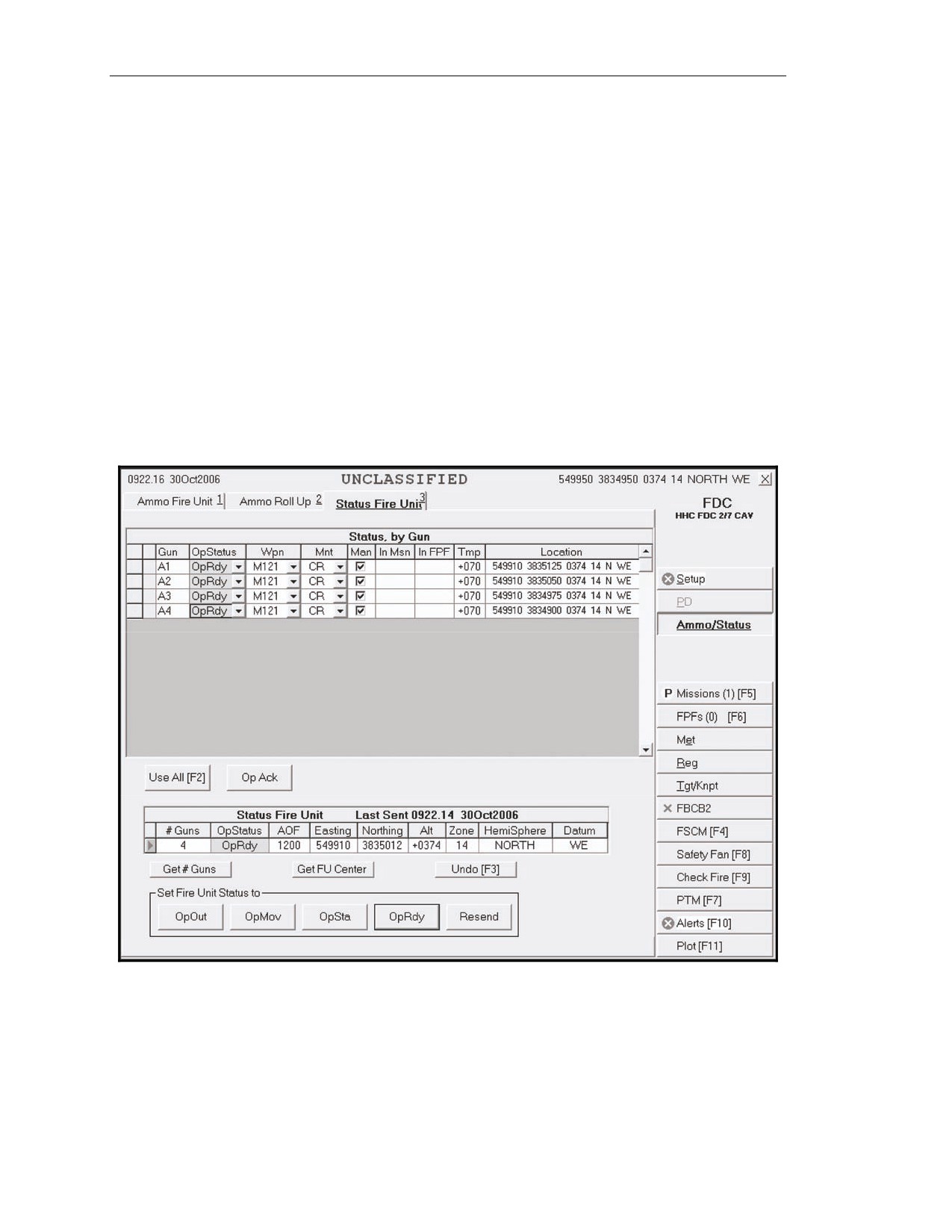
6-80. This screen (Figure 6-19) contains two parts. The upper section displays the status by gun, and
the lower section displays the status of the fire unit.
Status, By Gun
6-81. Status is received digitally from the guns, and the information is automatically filled.
Meteorological data (MET) is automatically sent to the FDC Alerts messages when a gun reports
“OpRdy.” The GUN, IN MSN, IN FPF, and LOCATION fields are “read only.” The operator can
modify the OPSTATUS, WEAPON, and MOUNT fields using the drop-down menu. The operator also
checks the MAN box if the gun is operating on manual position data. Temperature can be changed, but
must override a warning.
Status Fire Unit
6-82. This section displays information about the guns as a fire unit. To enter or change the number of
guns, the user clicks the GET # GUNS button, and the field automatically updates according to the
number of guns enabled. To get the geographical center of the fire unit, the user clicks GET FU
CENTER, which displays the Easting, Northing, and Alt to the center point of all available guns.
Figure 6-19. “Status Fire Unit” screen.
6-24
FM 3-22.90
7 December 2007
Mortar Fire Control System
CHECK FIRE FUNCTION
6-83. The CHECK FIRE button lets the FDC send a message to the guns to immediately cease fire and
preserve data. When a Check Fire command is received, all active fire missions come to a halt, and
inactive fire missions cannot be activated. When the “Check Fire By Target Number” command is
received, the specified fire mission is halted. A “Check Fire” message from the FC or FO is sent as an
alert.
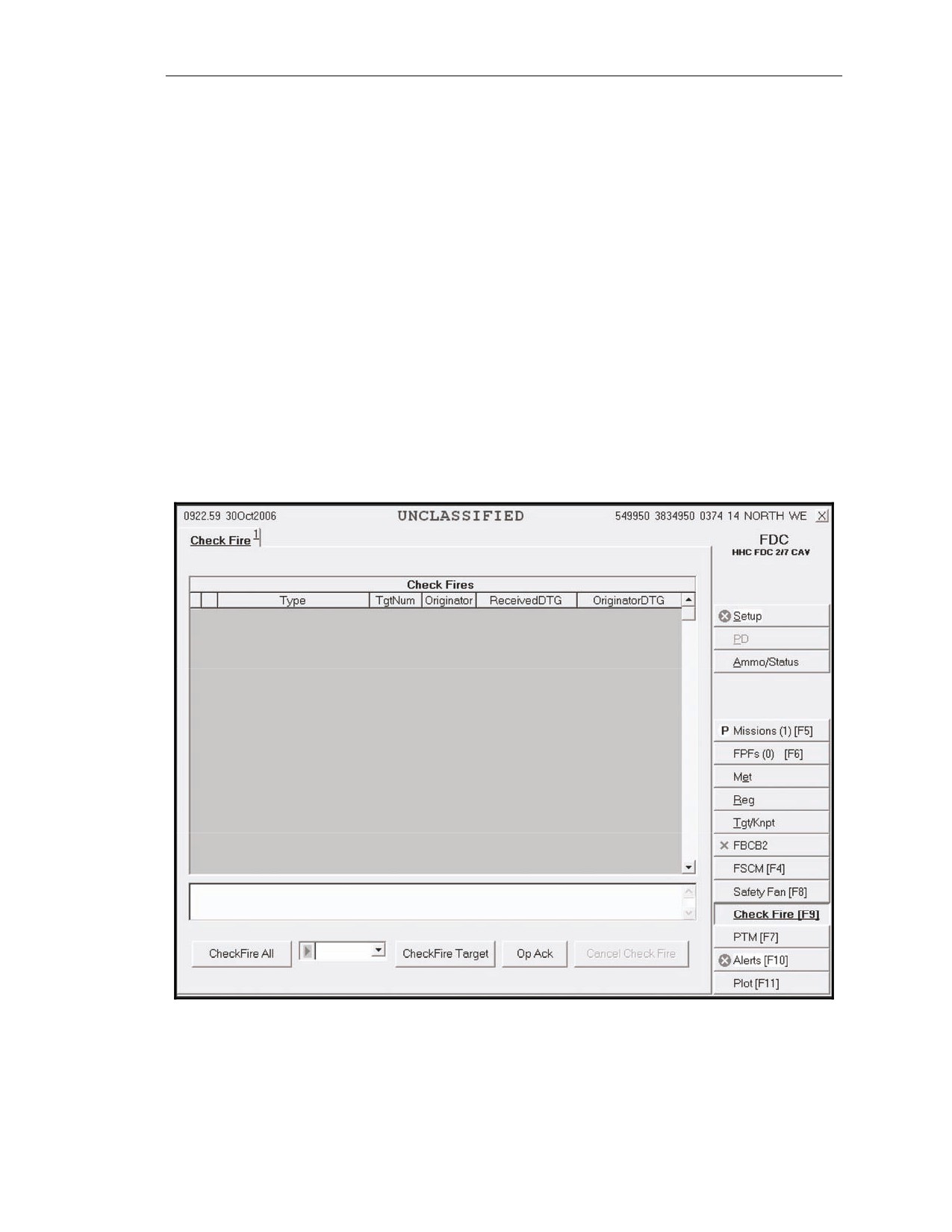
6-84. When the operator receives a “Check Fire” command from the FC, a red “CF” message displays
in the control tab area in front of MISSIONS and CHECK FIRE. He clicks the CHECK FIRE button to
display the “Check Fire” screen (Figure 6-20).
6-85. To initiate or transmit a “Check Fire” message to all guns in the fire unit, the operator clicks the
CHECK FIRE ALL button on the “Check Fire” screen. This sends a “Check Fire” banner message to
all guns and halts the mission until a valid “Cancel Check Fire” command is transmitted.
6-86. To initiate a “Check Fire Target” message, the operator enters the target number and clicks
CHECK FIRE TARGET. This transmits a “Check Fire” banner to the guns engaged in a mission with
the associated target.
6-87. To cancel the “Check Fire” command, the operator clicks the indicator for the appropriate
“Check Fire” message and clicks CANCEL CHECK FIRE. This forwards the “Cancel Check Fire”
message to all units in the fire unit. Fire missions may then continue.
Figure 6-20. “Check Fire” screen.
7 December 2007
FM 3-22.90
6-25
Chapter 6
PLAIN TEXT MESSAGES FUNCTION
6-88. The PTM function allows the FDC to send and receive messages concerning supply,
administration, or other subjects.
“Read” Screen
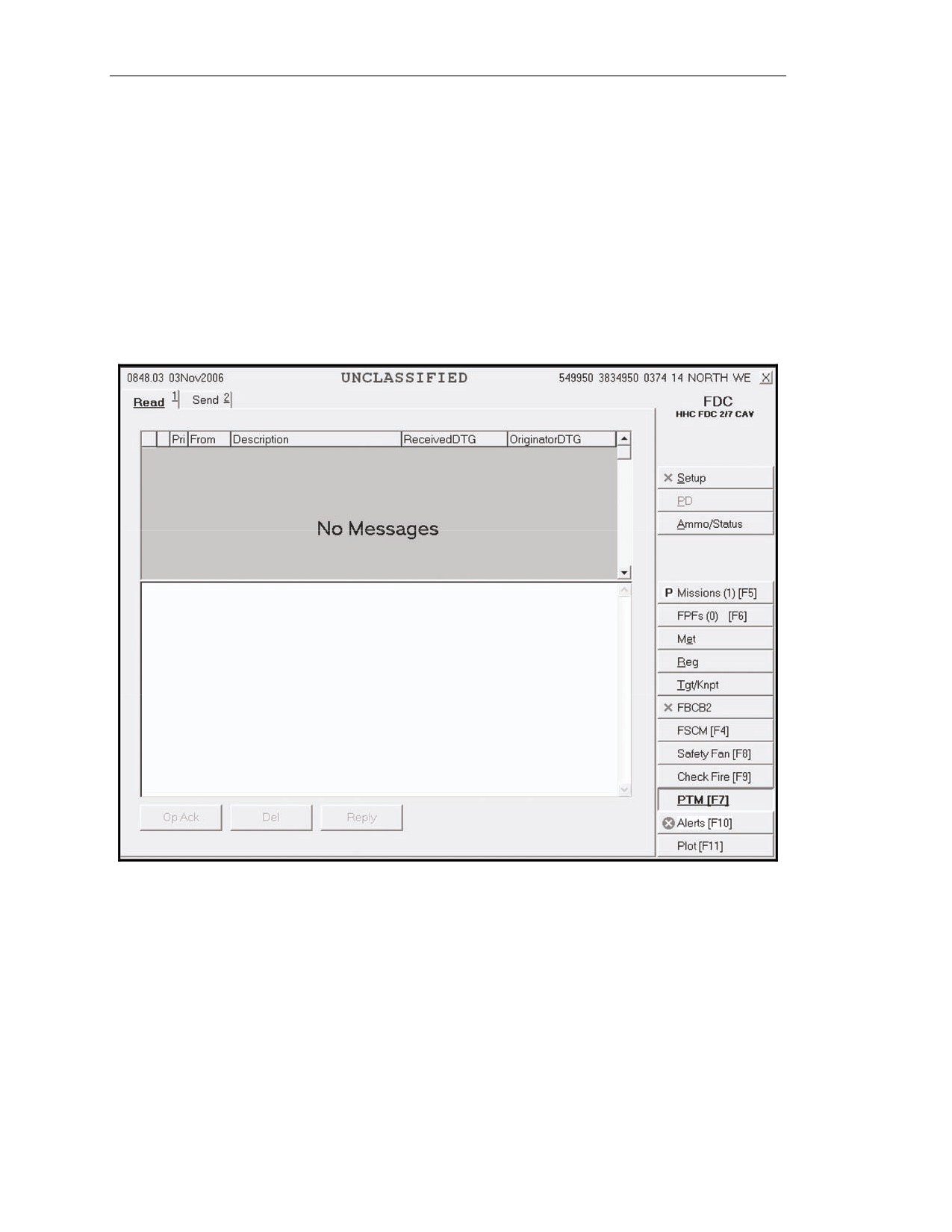
6-89. Upon receipt of a PTM, an indicator displays on the PTM button. The operator clicks the PTM
button to display the “Read” screen (Figure 6-21). The four message categories are—
Flash (F).
Immediate (I).
Priority (P).
Routine (R).
Figure 6-21. “Read” screen.
6-26
FM 3-22.90
7 December 2007
Mortar Fire Control System
“Send” Screen
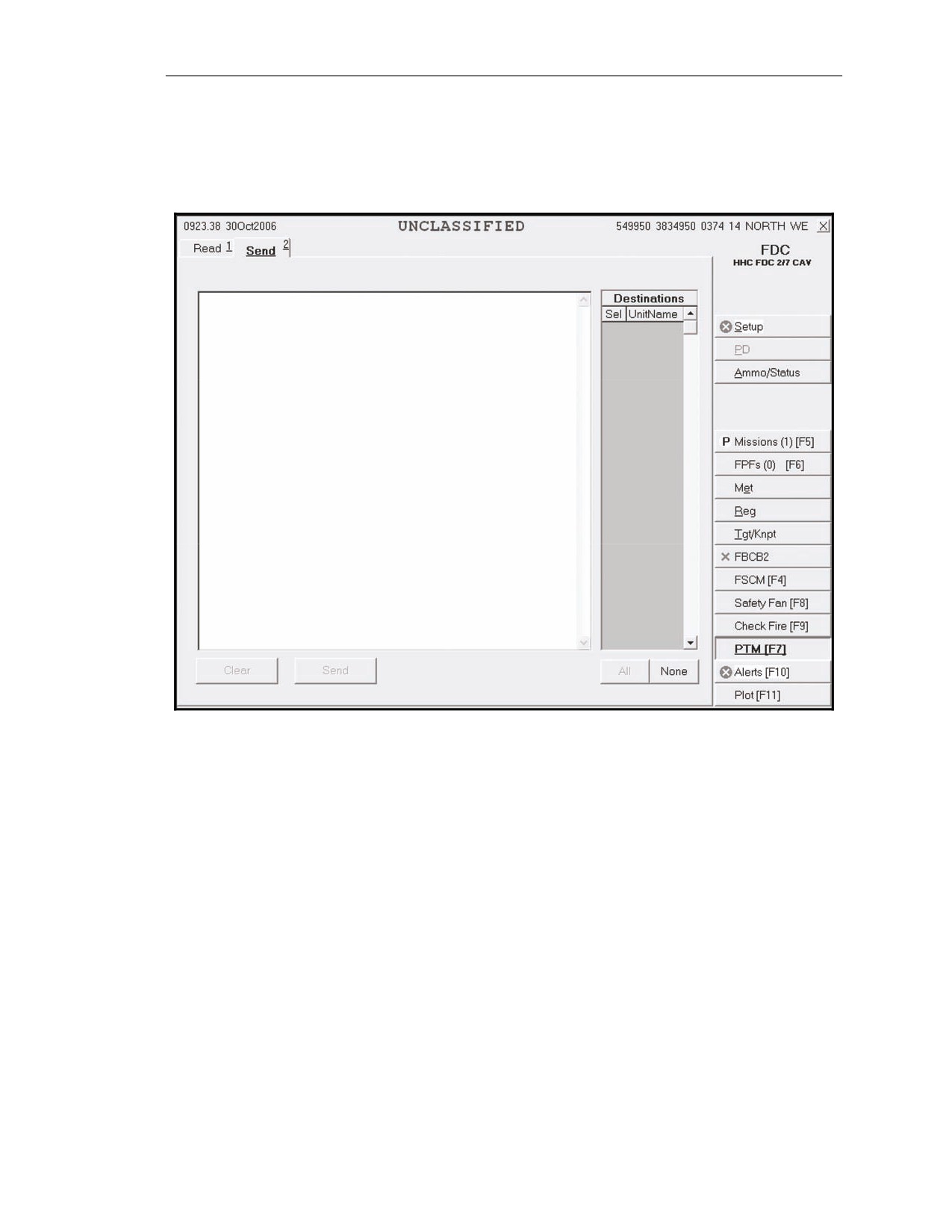
6-90. The operator selects the SEND tab to display the “Send” screen (Figure 6-22). Then, he selects
the units to which he will send the message by clicking SEL in DESTINATIONS, types the message
using the keyboard, and clicks SEND.
Figure 6-22. “Send” screen.
7 December 2007
FM 3-22.90
6-27
Chapter 6
ALERTS FUNCTION
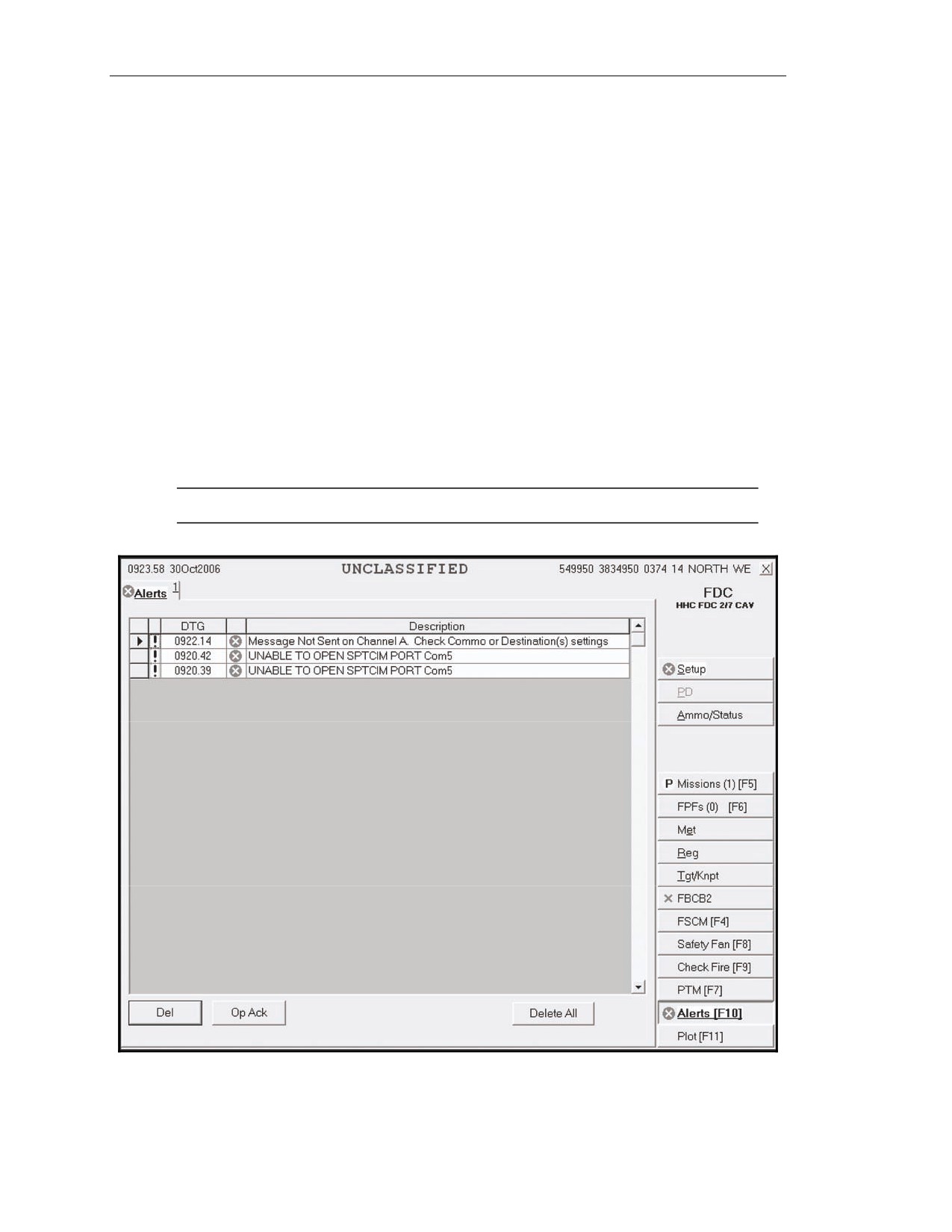
6-91. The Alerts function allows the operator to receive automated system messages (Figure 6-23),
such as information, error, and warning alerts.
Information messages provide the operator with general types of information, such as
“Ammo Updated for Gun A1.” No audio alert sounds.
Error messages display when operator data entries are performed incorrectly. These
messages inform the operator of specific errors and provide information about the correct
input. They must be cleared before the operator can continue. Error messages are generated
for—
Incorrect data entry/combinations/duplications.
Ballistic computation failure.
Hardware and software failures.
Warning messages display when events or conditions produce an unsafe condition, a
potential loss of data, or system degradation. They also signify that—
Digital messages have not been received.
The message queue is full.
Stored digital messages have been deleted.
An FSCM has failed.
NOTE: The operator must respond to a warning message.
Figure 6-23. “Alerts” screen.
6-28
FM 3-22.90
7 December 2007
Mortar Fire Control System
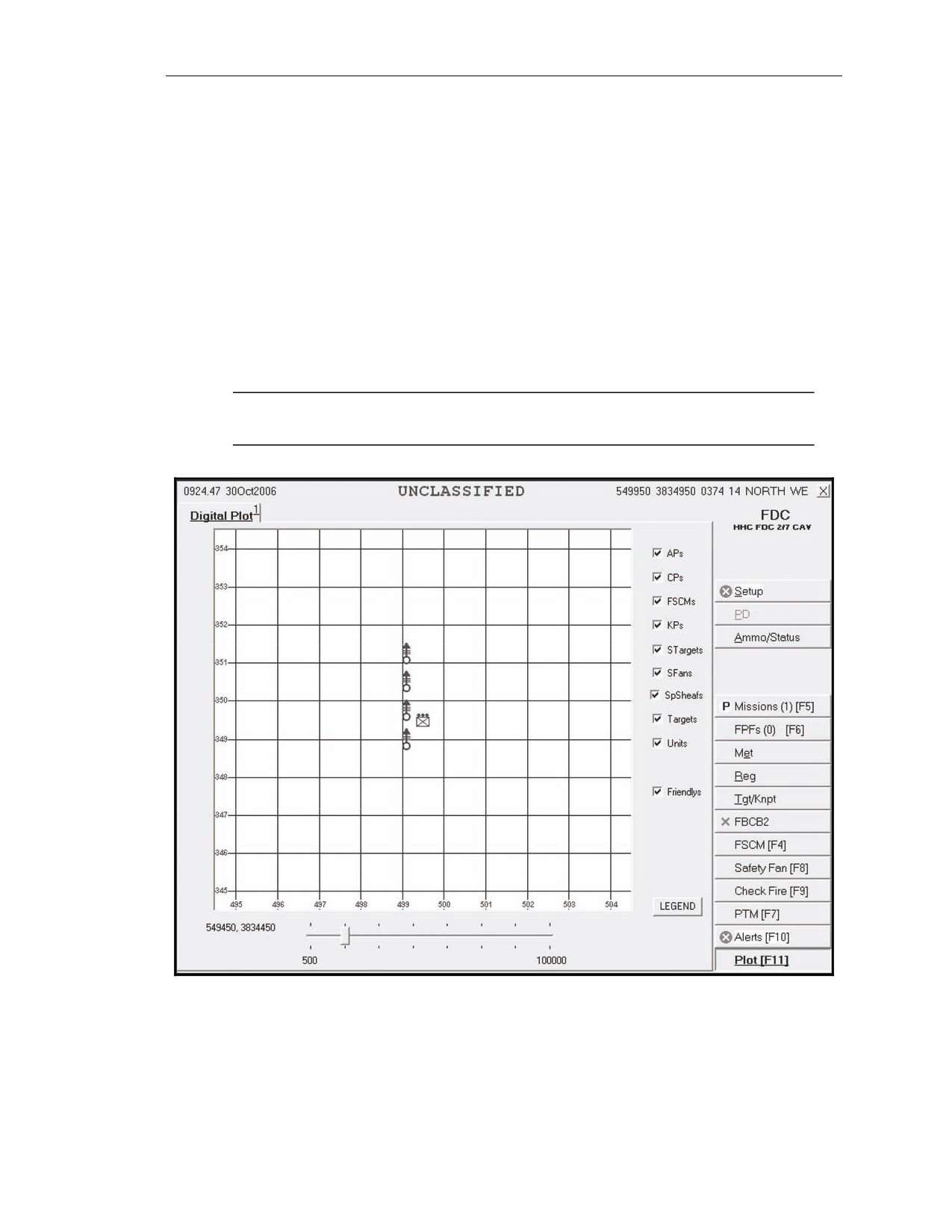
PLOT FUNCTION
6-92. The Plot function provides a graphic representation of the firing mission.
6-93. When the operator accesses this function, a menu of selectable items displays on the right side of
the screen (Figure 6-24). Then, the operator can individually select or deselect items by clicking the
item’s checkbox; the checkbox will indicate an item’s selection status. To obtain specific information
about an object, the operator places the cursor over the object to display a label with the location or
name of the object.
6-94. The Plot function also allows the operator to access information crucial to reading this
representation.
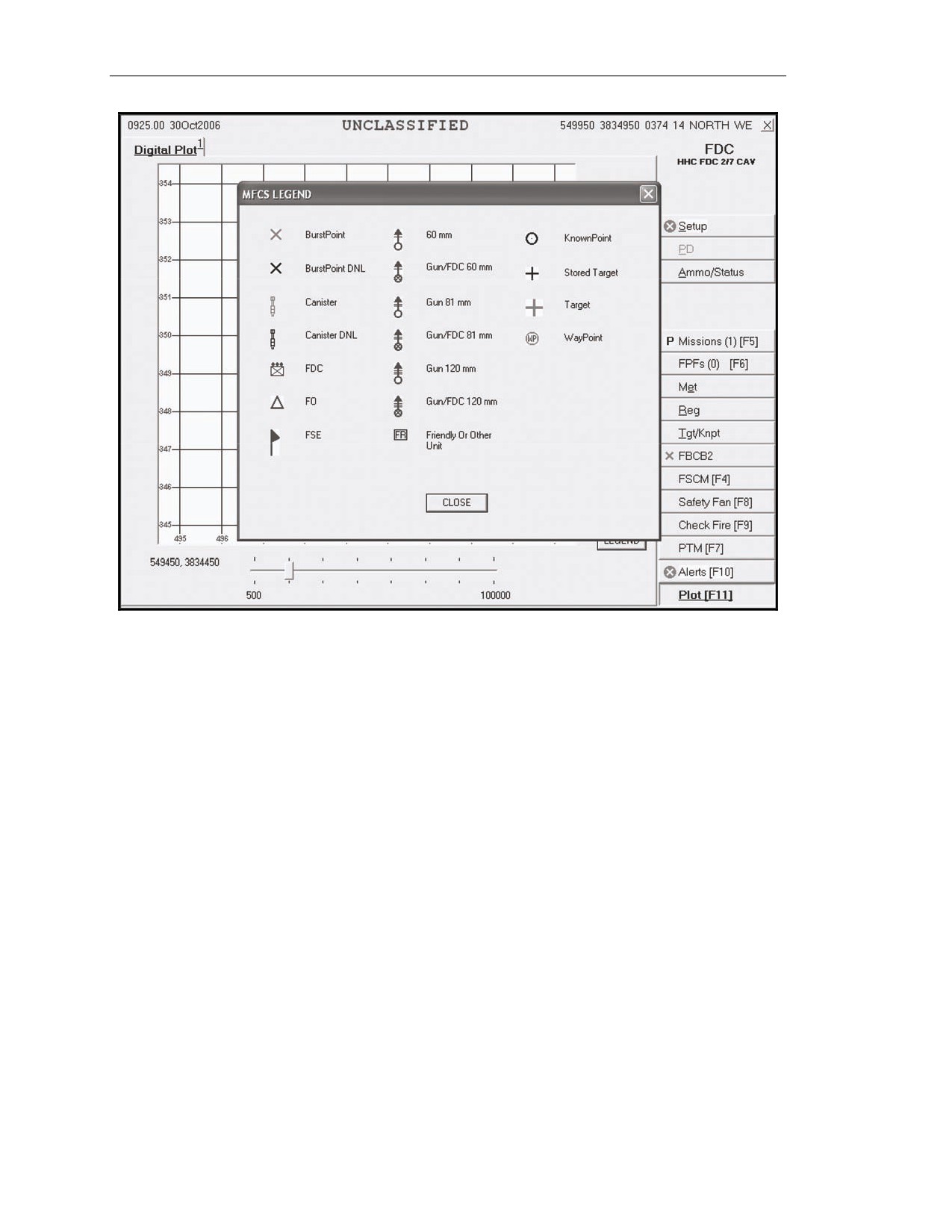
The operator can access a legend of the selectable items by clicking the LEGEND button
(Figure 6-25).
The slider allows the operator to zoom in/out on the “Plot” screen and can center on a given
location when the user double-clicks (only available in Map Mod).
NOTE: Items on the “Plot” screen are not directional. For instance, regardless of the
direction of fire, all mortars appear to be oriented north.
Figure 6-24. “Plot” screen.
7 December 2007
FM 3-22.90
6-29
Chapter 6
Figure 6-25. “Plot” screen legend.
6-30
FM 3-22.90
7 December 2007
Chapter 7
Conduct Fire Missions Using the
Mortar Fire Control System
The purpose of the MFCS is to bring fires quickly and accurately in a fire
mission. This chapter explains how the system assists the gun crew in moving to
designated points, rapidly laying the mortar, and firing the mission. It describes
how the following MFCS functions work: the pointing device, gun navigation
and emplacement, fire missions, and FPFs. (More detailed instructions for these
and the other functions are found in TM 9-1220-248-10.)
POINTING DEVICE
7-1. The pointing device is mounted on the M121 mortar tube in the M1064A3 mortar carrier and
aligns the M121 mortar. It determines the correct gun alignment without survey control points, aiming
circles, or aiming posts so that the gunner can quickly adjust the mortar to the proper elevation and
azimuth to accurately fire the cannon. Throughout the vehicle movement and gun emplacement, the
MFCS receives, calculates, and displays instructions to the driver, gunner, and squad leader. It can
maintain alignment and accuracy within 3 mils of azimuth and 1 mil of elevation in all conditions and
provides pointing and positional performance throughout most of the world. The system uses
information from the GPS and a vehicle motion sensor (VMS). The design of the pointing device
allows for the loss of the GPS, the VMS, or both devices without substantial degradation of overall
performance. Prior to a fire mission, the mortar crew ensures that the pointing device is functioning
and that the mortar is properly boresighted.
7 December 2007
FM 3-22.90
7-1
Chapter 7
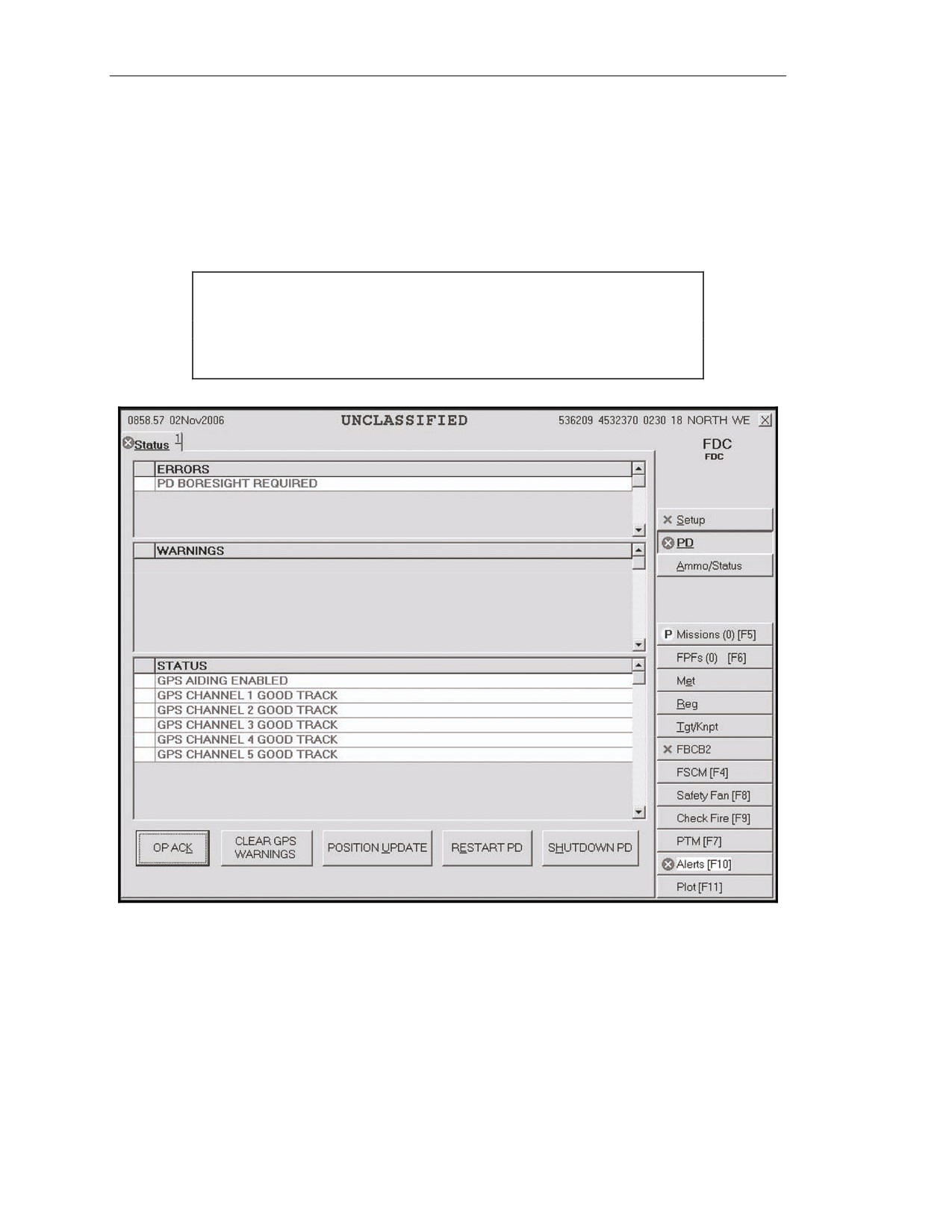
POINTING DEVICE “STATUS” SCREEN
7-2. This screen (Figure 7-1) shows the status of the pointing device, PLGR, and VMS. It also
displays the pointing device update position and permits the manual input of position data.
Pointing Device Status
7-3. The “Status” screen displays errors, warnings, and status messages for the pointing device. An
icon with the word “NEW” appears in front of a new message or a message that has changed.
CAUTION
Errors displayed on the
“Status” screen require immediate
attention to continue the operation.
Figure 7-1. Pointing device “Status” screen.
Manually Update Pointing Device Position Fields
7-4. When the pointing device does not automatically align using PLGR data, it must be manually
updated. If the pointing device has not automatically aligned, the words “PD ALIGNING WAIT 600”
remain in the upper right corner of the “CI” screen, and the numbers will not automatically count
down.
7-2
FM 3-22.90
7 December 2007
Conduct Fire Missions Using the Mortar Fire Control System
CAUTION
To prevent alignment errors, keep movements inside the vehicle to
a minimum.
(1) Click POSITION UPDATE. Highlight the information to be changed, or click CLEAR
POSITION to clear all information in the POSITION UPDATE fields.
(2) To manually update the pointing device position information, enter the correct data into the
EASTING, NORTHING, ALT, ZONE, DATUM, and HEMISPHERE in PD UPDATE
POSITION fields. To display or use the last recorded pointing device position, click the
SETUP button and select the POSITION tab.
(3) Click SEND UPDATE. The upper right corner of the screen changes to either
“ALIGNING:____SECONDS REMAIN” or “POS UPDATE IN PROGRESS,” depending
on whether the pointing device is in need of alignment.
Pointing Device Data Precedence Rules
7-5. The pointing device has a set of rules to determine whether to use the manually input locations
or locations generated by the GPS.
During Alignment
7-6. If the pointing device is aligning using data from a manual position update and the PLGR starts
to acquire accurate satellite data, the pointing device will begin to use the PLGR data to complete
alignment and, within 2 minutes, the GPS Aiding Off box becomes unchecked. When the pointing
device alignment is complete, the pointing device’s current position is displayed in the upper right-
hand corner of the “CI” screen and is automatically sent to the FDC.
After Alignment
7-7. If the PLGR acquires accurate satellite data after the pointing device has been aligned using data
from a manual position update, the GPS Aiding Off box becomes unchecked and the current
coordinates displayed in the upper right-hand corner of the “CI” screen will begin to drift toward
PLGR data. When the drifting is stabilized, the position shown is not automatically sent to the FDC or
updated in This Unit’s Position or Status. The operator must click SEND POSITION UPDATE TO
PD. If the two positions do not agree, click SEND POSITION UPDATE TO PD again.
Restart Pointing Device
7-8. This button restarts the system after it is shut down. It takes approximately 10 minutes to restart.
Shut Down Pointing Device
7-9. Following the proper pointing device shutdown procedures will ensure a quicker alignment at
the next startup, if the vehicle/system has not been moved. To shut down the pointing device without
shutting down the computer, press PERFORM PD SHUTDOWN. This allows the system to shut down
and save its position. It also enables the system to boot up in approximately 2 minutes.
7 December 2007
FM 3-22.90
7-3
Chapter 7
POINTING DEVICE “BORESIGHT” SCREEN
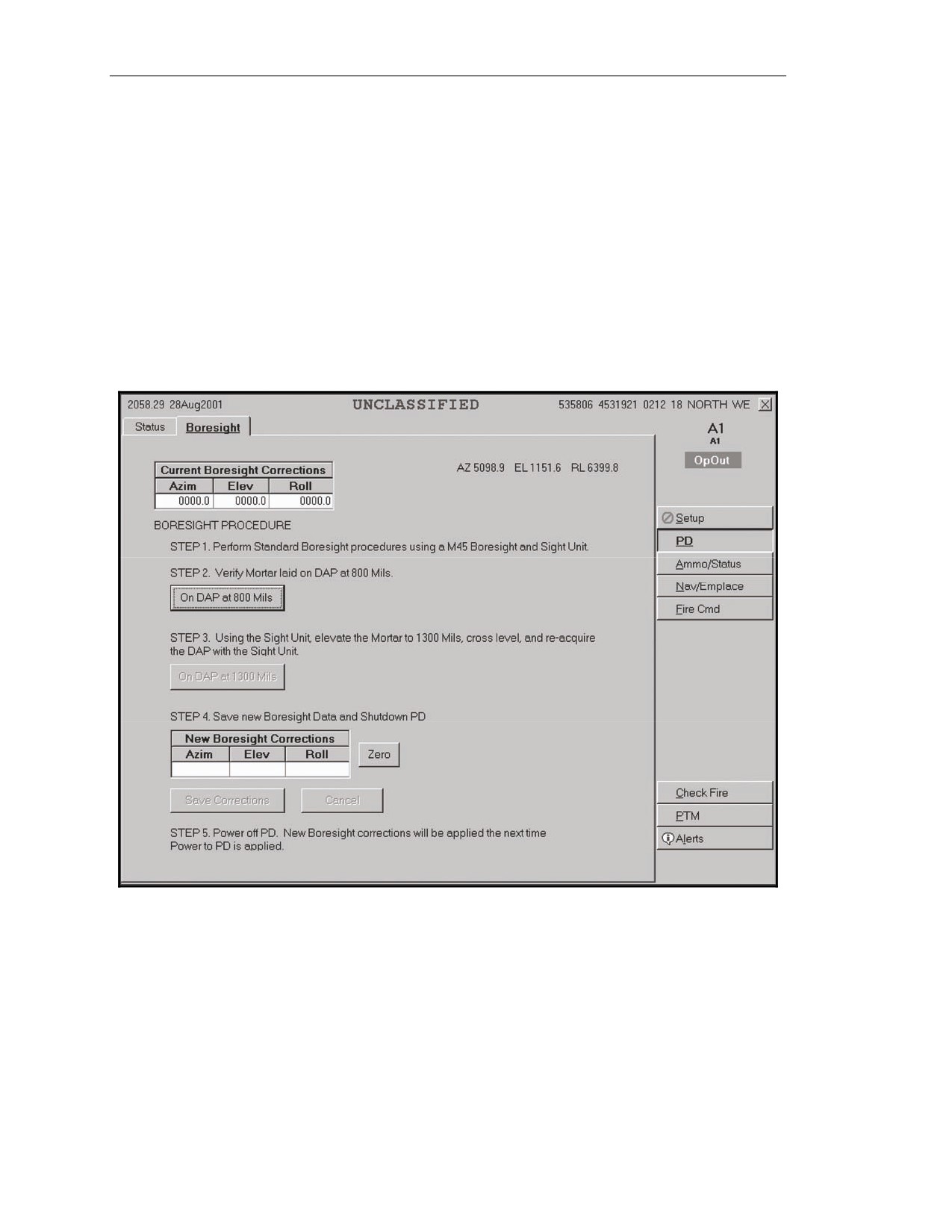
7-10. The pointing device “Boresight” screen (Figure 7-2) allows the operator to compensate for
mechanical alignment errors and must be completed before using the pointing device. Before
beginning, ensure that the power is on and that the pointing device is aligned.
The fields at the top left corner display the azimuth, elevation, and roll of the current
azimuth correction.
Step 1 of the boresighting procedures is to boresight the mortar. (See Chapter 2 for more
details.)
In step 2, the gunner verifies that the mortar is laid on the DAP at an azimuth of 800 mils,
and then clicks the ON DAP AT 800 MILS button.
The gunner completes steps 3 and 4.
The ZERO button is only used if boresighting with a new pointing device for the first time,
when the pointing device bracket has been adjusted/retorqued, or when troubleshooting.
Figure 7-2. “Boresight” screen.
7-4
FM 3-22.90
7 December 2007
Conduct Fire Missions Using the Mortar Fire Control System
NAVIGATION AND EMPLACEMENT
7-11. The squad leader receives movement orders from the FDC via voice radio or PTM and inputs the
destination into his CI. The MFCS then translates the destination into directions displayed on the
driver's display and the CI. These procedures describe how to use waypoints and fire areas for
navigation. A waypoint is any nonfiring destination the gun track is required to go (for example,
refueling). An FP is any location planned as a position to fire the mortar. (TM 9-1220-248-10 includes
detailed procedures for the emplacement of the M1064A3 gun track using the MFCS.)
NAVIGATION TO WAYPOINT
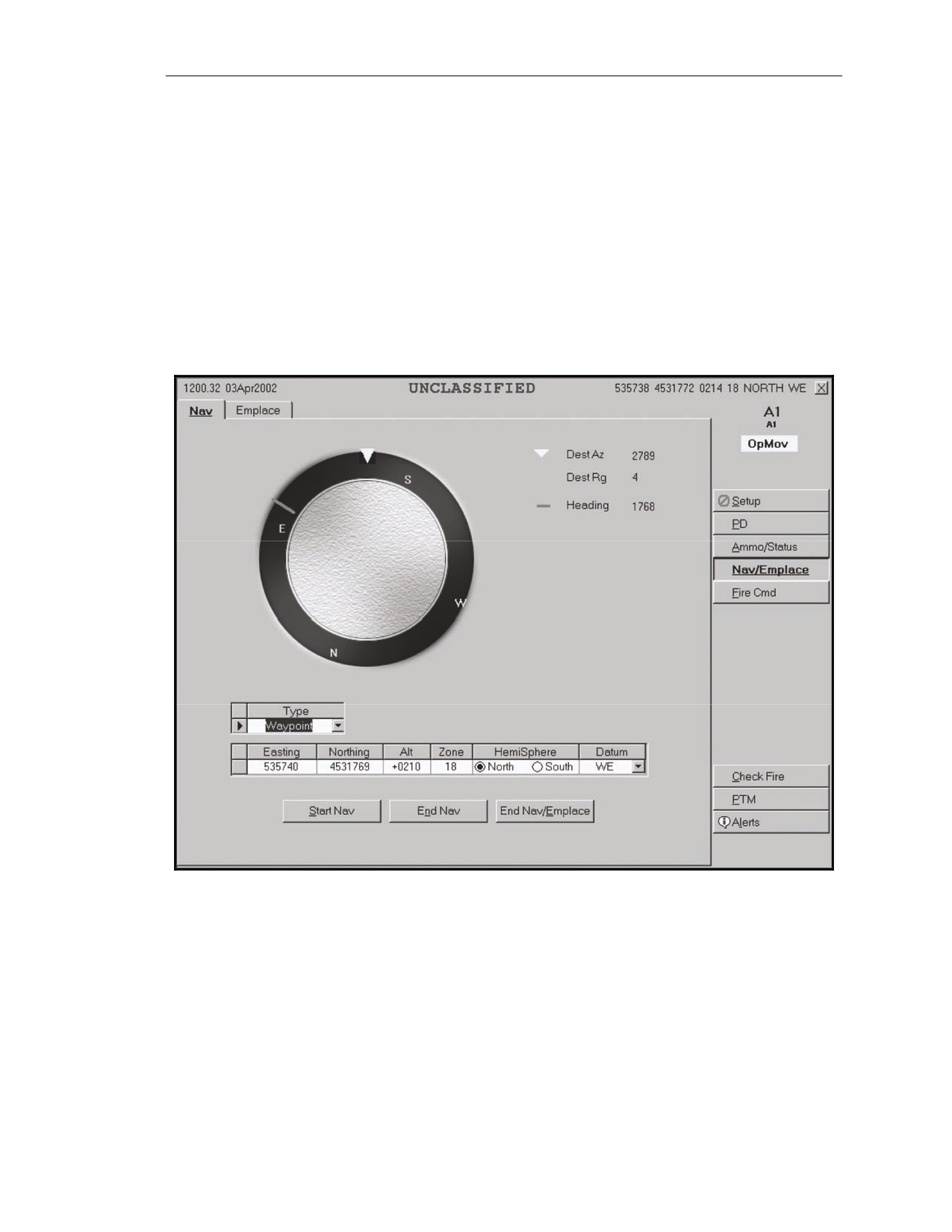
7-12. Upon receipt of a movement order from the FDC, the squad leader selects the NAV/EMPLACE
button in the control button area and clicks the NAV tab to display the “Navigation/Emplacement”
screen (Figure 7-3).
Figure 7-3. “Navigation/Emplacement” screen.
7 December 2007
FM 3-22.90
7-5
Chapter 7
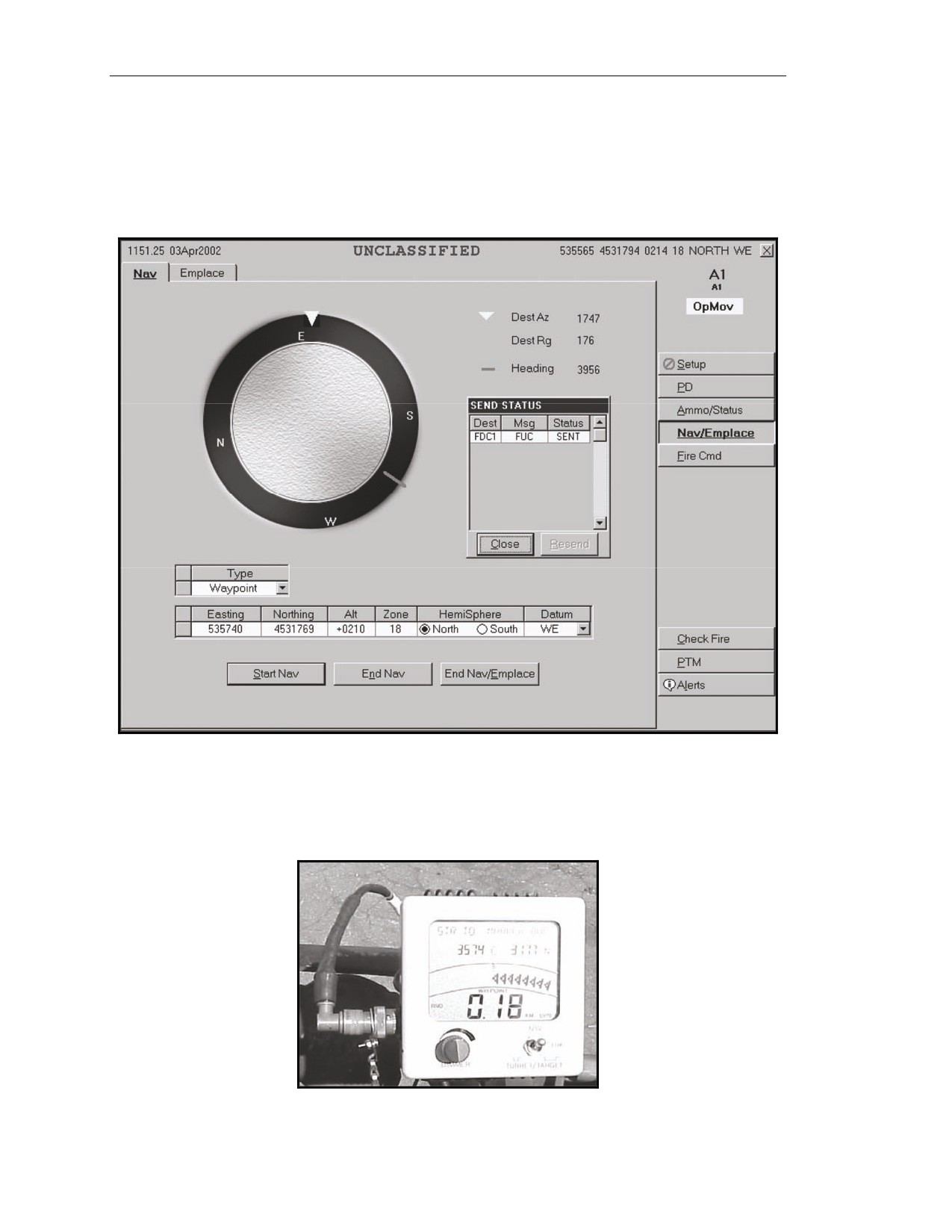
(1) The squad leader enters TYPE by clicking the down arrow and choosing WAYPOINT from
choices of FIRE AREA or WAYPOINT. He also enters or selects data for the following
fields: EASTING, NORTHING, ALTITUDE
(ALT), ZONE, HEMISPHERE, and
DATUM. The squad leader then clicks START NAV, which automatically transmits the
status “Operationally Moving” (OpMov) to the FDC. It also activates the driver's display.
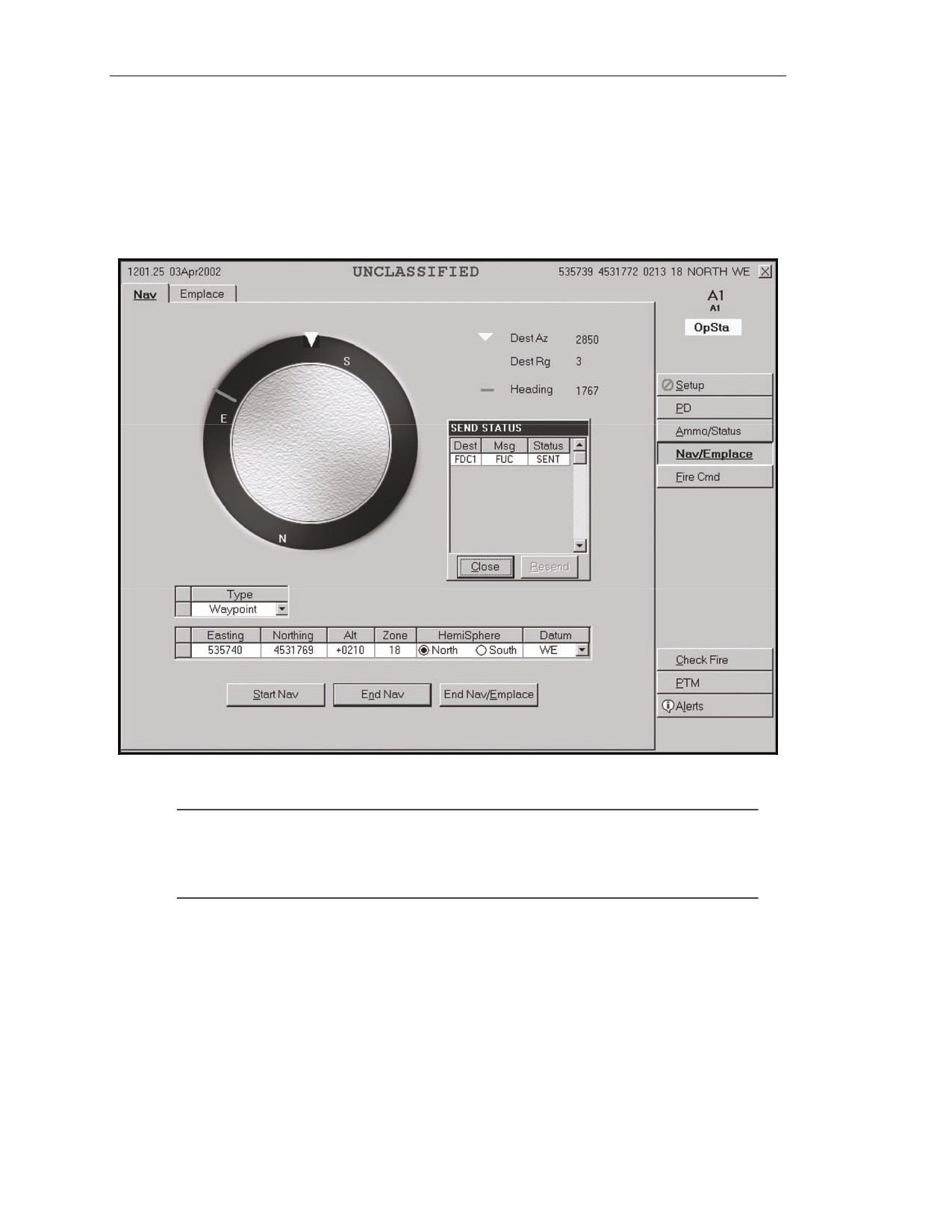
The screen shown in Figure 7-4 is then displayed.
Figure 7-4. “Navigation/Emplacement” screen: Send status.
(2) After activation, the driver's display shows the driving direction and distance (Figure 7-5).
The driver's display shows “Steer To” arrows indicating the direction in which to turn. The
destination range and current position is updated continuously until the vehicle approaches
the specified area.
Figure 7-5. Driver’s display showing steering directions, distance, and position.
7-6
FM 3-22.90
7 December 2007
Conduct Fire Missions Using the Mortar Fire Control System
(3) The squad leader verifies that the gun status is changed to
“Operationally Moving”
(OpMov). The Send Status box also appears, specifying that an “OpMov” status was sent to
the FDC. The CI now includes the destination azimuth
(DestAZ), destination range
(DestRg) and heading (Figure 7-6). If the pointing device is aligned, a position update will
be sent every 1,000 meters.
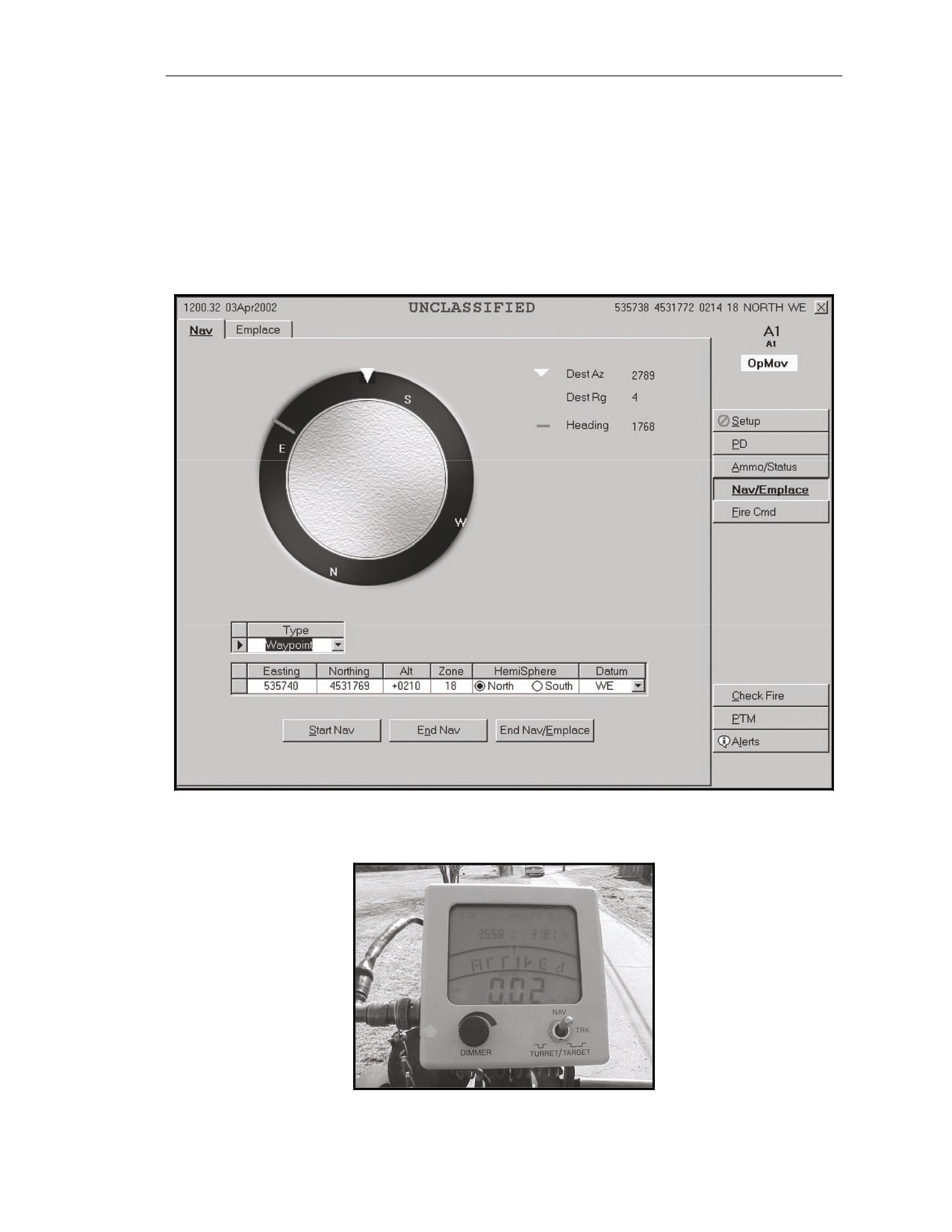
(4) When the vehicle/gun is within 30 meters or less of the waypoint, the driver's display
indicator will display “Arrived” (Figure 7-7). The CI however, may not display “Arrived” if
the CI has been set for a radius other than 30 meters, in which case the squad leader
determines when the vehicle/gun has arrived by the destination range of 30 meters or less.
Figure 7-6. “Navigation/Emplacement” screen: destination azimuth,
destination range, and heading.
Figure 7-7. Driver’s display showing arrival at the waypoint.
7 December 2007
FM 3-22.90
7-7
Chapter 7
(5) The driver continues to maneuver the vehicle left or right until the driver's display indicator
is within a minimum of 20 mils and a maximum of 100 mils of the waypoint.
(6) When the destination is reached, the squad leader clicks END NAV, which sends the FDC
an “Operationally Stationary” (OpSta) status and the gun’s current location. The Send Status
box appears, specifying that the message was transmitted and received by the FDC (Figure
7-8). At the waypoint, the squad leader accomplishes the task given or waits for further
orders.
Figure 7-8. “Navigation/Emplacement” screen:
message transmitted and received by the FDC.
NOTE: The current position, which is shown in yellow on the “Position” screen in Setup
and which has also been sent to the FDC, is the locked-in current position. The
position shown in the upper right-hand corner of the CI may change slightly due
to PLGR drift and may differ from the locked-in position.
7-8
FM 3-22.90
7 December 2007
Conduct Fire Missions Using the Mortar Fire Control System
NAVIGATION TO FIRE AREA
7-13. On receipt of a movement order from the FDC, transmitted through PTM or voice, the squad
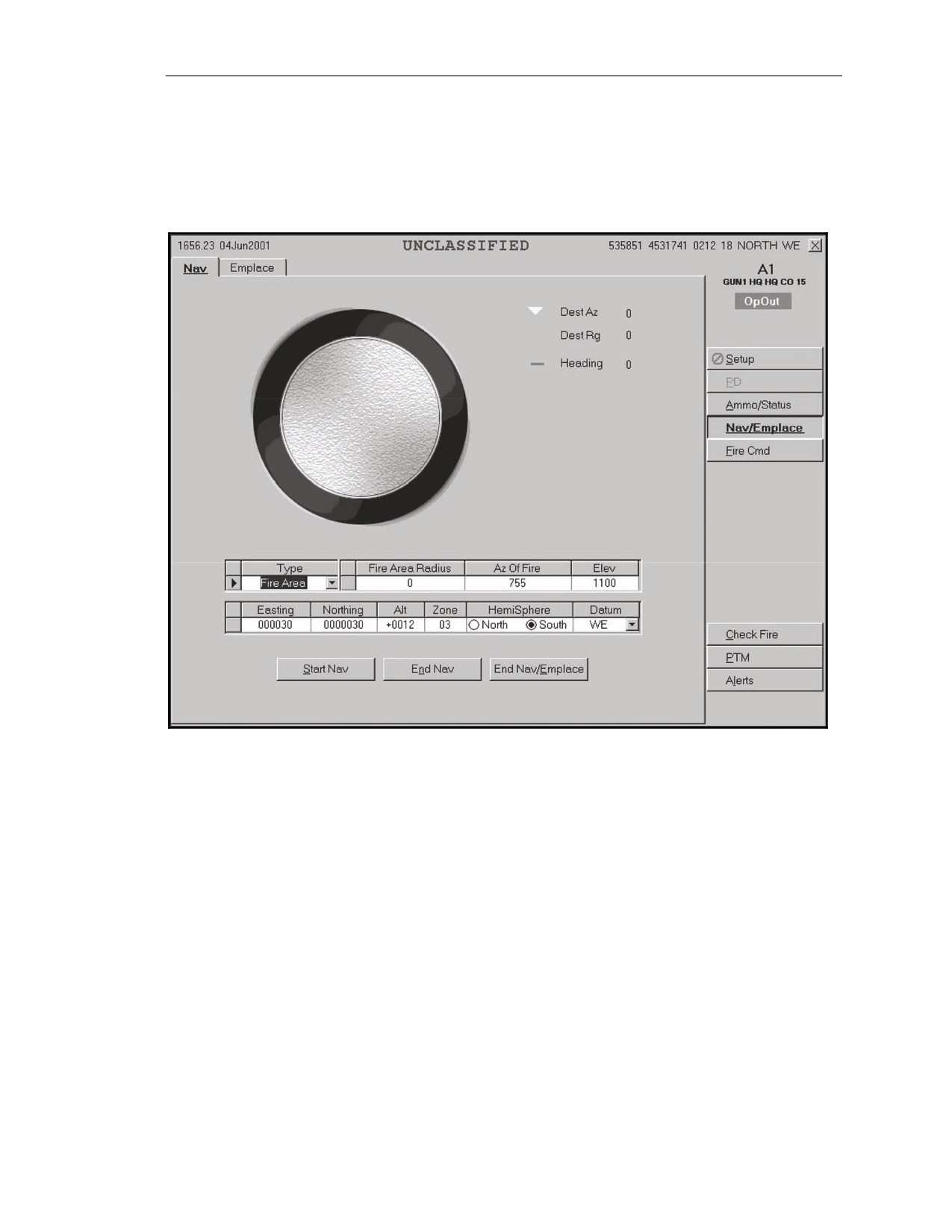
leader selects NAV/EMPLACE button in the control button area and clicks the Nav tab. The “CI”
screen shown in Figure 7-9 is displayed. In addition to the fields in the “Waypoint” screen, this screen
has: FIRE AREA RADIUS, AZIMUTH OF FIRE, and ELEVATION fields.
Figure 7-9. “Navigation/Emplacement” screen: fire area.
(1) The squad leader enters TYPE by clicking the down arrow and choosing FIRE AREA from
choices of FIRE AREA or WAYPOINT, and then enters the received FIRE AREA
RADIUS, AZIMUTH OF FIRE (AZ of Fire), and ELEVATION (Elev). He also enters the
received EASTING, NORTHING, ALTITUDE (Alt), ZONE, HEMISPHERE, and DATUM
data into the applicable fields.
7 December 2007
FM 3-22.90
7-9
Chapter 7
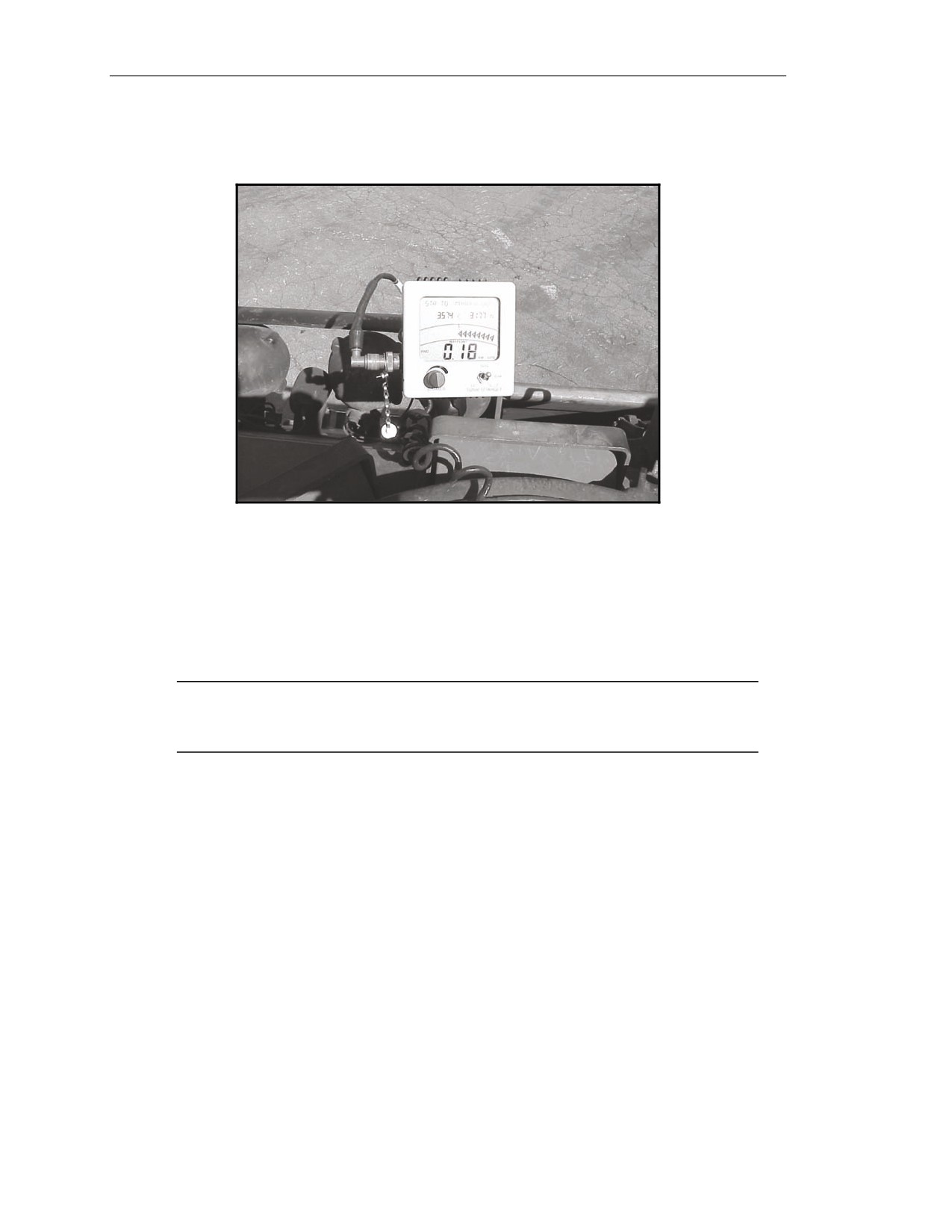
(2) The squad leader clicks START NAV. The driver's display is activated and the driver
begins to navigate to the firing position using the steering arrows and distance displayed on
the screen (Figure 7-10).
Figure 7-10. Driver’s display activated.
(3) On the CI, the gun status is changed to “Operationally Moving” (OpMov). The Send Status
box appears, specifying that an “OpMov” status was sent to and received by the FDC. The
CI now displays destination azimuth (DestAZ), destination range (DestRg) and heading.
(4) If the pointing device is aligned, a position update will be sent every 1,000 meters.
(5) When the vehicle/gun is within 30 meters or less of the fire area, the driver's display
indicator shows “Arrived.” If the FIRE AREA RADIUS of 30 meters was entered, the
squad leader’s CI will also indicate “ARRIVED.”
NOTE: If FIRE AREA RADIUS entered in the CI was more than 30 meters, the CI will
indicate “ARRIVED” before the driver's display does, because the radius is not
changeable in the driver's display.
FIRE COMMANDS
7-14. The FDC uses fire commands to give the mortar sections the information necessary to start,
conduct, and cease fire. The fire commands are used for all types of shell and fuze combinations. The
three phases of the fire command are the initial fire command, subsequent fire command, and the end
of mission.
7-10
FM 3-22.90
7 December 2007
Conduct Fire Missions Using the Mortar Fire Control System
INITIAL FIRE COMMAND
7-15. The squad uses the following procedures when they receive an initial fire command.
(1) The squad leader receives and carries out a movement order from the FDC to proceed to his
waypoint/fire area. The gunner ensures that the turntable and traversing extension are both
centered, and that the traversing mechanism is center of traverse. The squad leader updates
and verifies AMMO and STATUS.
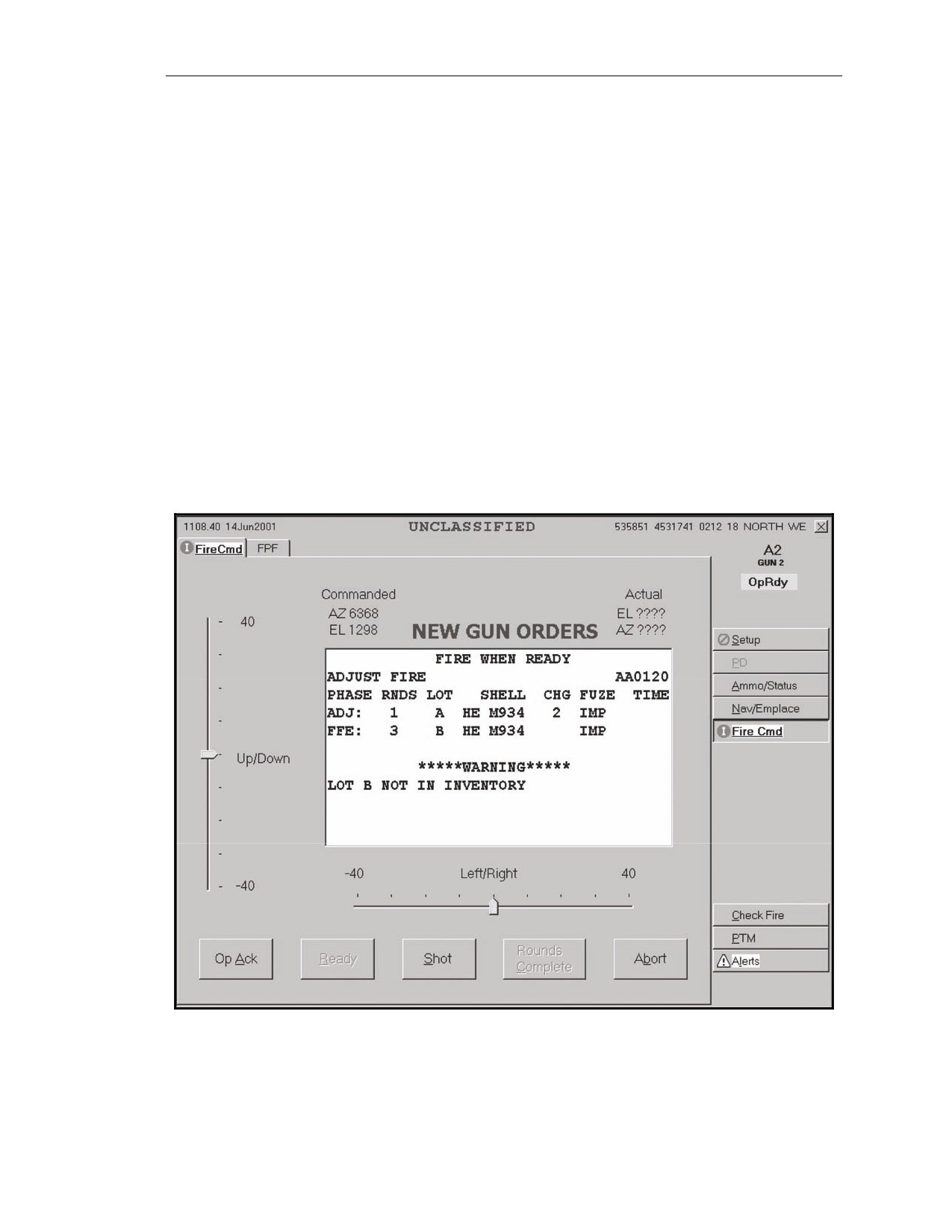
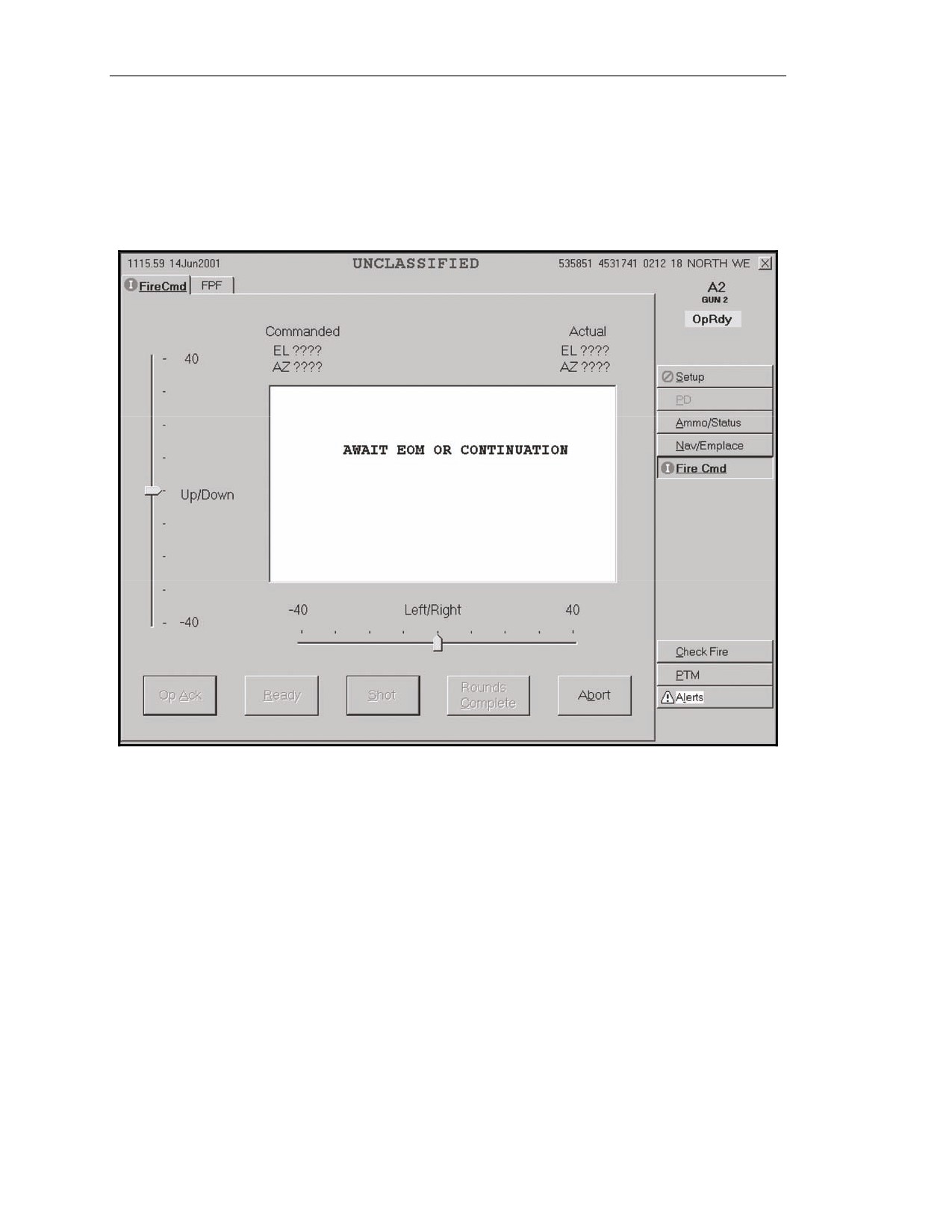
(2) When gun orders are sent from the FDC, the action is indicated by an “I” (immediate) in a
red circle beside the FIRE COMMAND button (Figure 7-11). The “Fire Command” screen
is automatically displayed and the words “NEW GUN ORDERS” appear at the top of the
gun order.
(3) The gun orders include: method of control (MOC), method of fire (MOF), target number,
phase, rounds, lot, shell, charge, fuze, and time (fuze time). The squad leader reads the gun
order and acknowledges receipt by clicking the OpACK button. The gunner’s display and
driver's display are now activated.
(4) If necessary, the driver maneuvers the vehicle so that the mortar tube is pointing a minimum
of 20 mils and a maximum of 100 mils of the azimuth of fire. The gunner and assistant
gunner manipulate the gun system to bring it to the correct azimuth and elevation displayed
on the gunner's display. The gun system is ready to fire when the word “LAID” appears in
both AZ and EL of the gunner's display. After firing, the squad leader clicks SHOT and, if
more than one round is shot, ROUNDS COMPLETE.
Figure 7-11. “Fire Command” screen.
7 December 2007
FM 3-22.90
7-11
Chapter 7
SUBSEQUENT FIRE COMMAND
7-16. The operator uses subsequent
“Fire Command” screen
(Figure
7-12) to receive further
commands. The words “MORTARS LAID” in large blue letters are also displayed. If there is a
SUBSEQUENT ADJUST, the squad leader receives another gun order. The MFCS calculates
solutions, and the gun crew performs the same duties as in the CFF. The crew continues to respond to
commands until the gun is adjusted. Once adjusted, the FDC sends an FFE gun order.
Figure 7-12. Subsequent “Fire Command” screen.
7-12
FM 3-22.90
7 December 2007
Conduct Fire Missions Using the Mortar Fire Control System
END OF MISSION
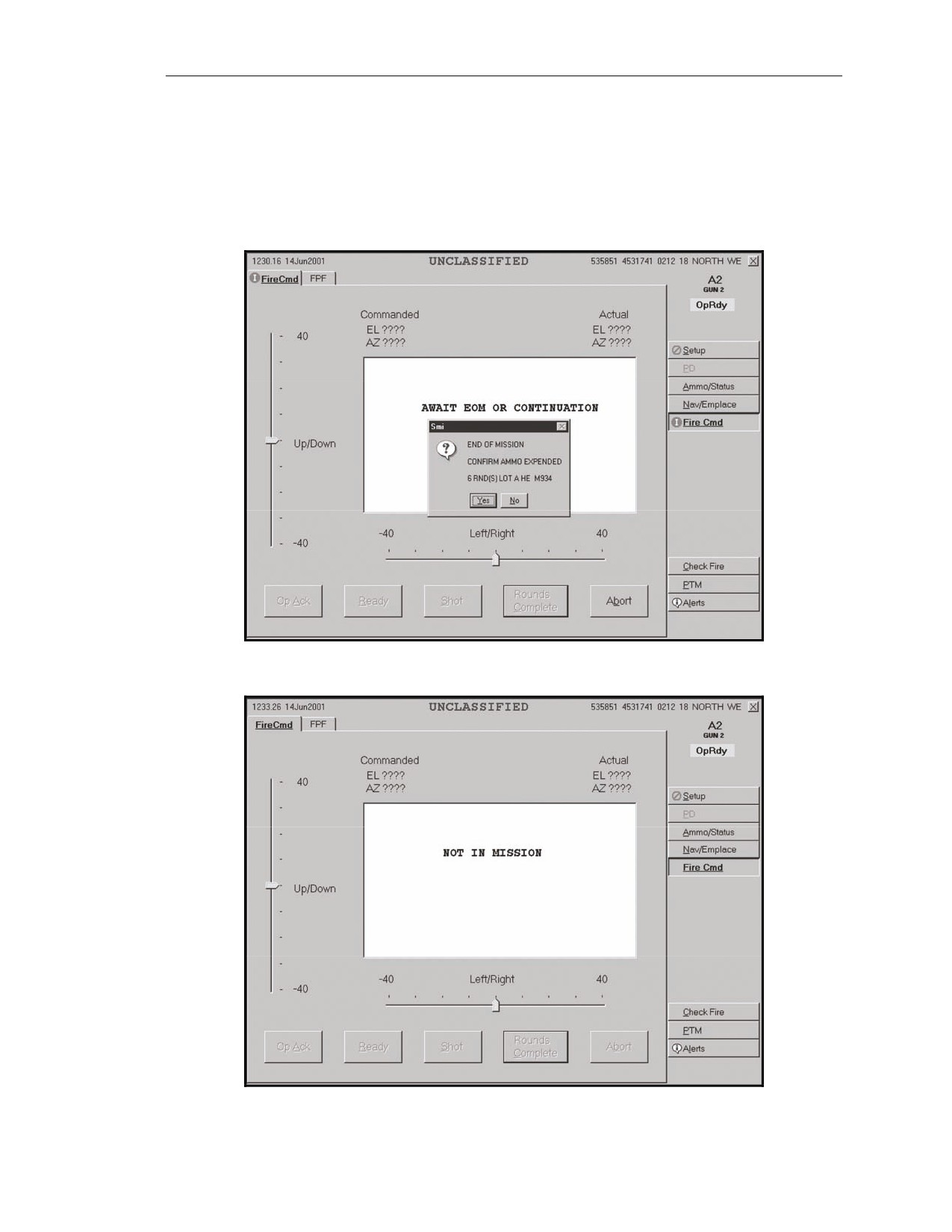
7-17. Upon receipt of the end of mission command, the “End of Mission” screen displays (Figure 7
13), and the operator confirms the amount of ammunition expended. If correct, he clicks YES. If
incorrect, he clicks NO. (When NO is clicked, the “Ammo/Status” screen is displayed and allows a
change to the ammunition status.) When YES is clicked, the “Not In Mission” screen is displayed
(Figure 7-14).
Figure 7-13. “End of Mission” screen.
Figure 7-14. “Not in Mission” screen.
7 December 2007
FM 3-22.90
7-13
Chapter 7
FINAL PROTECTIVE FIRES
7-18. These are the procedures for receiving and carrying out a final protective fire (FPF) mission. The
MFCS differentiates between an assigned FPF, where the guns are adjusted before an FFE, and a
stored FPF, where the guns fire the FPF when ready. The gun MFCS can store only one FPF at a time.
If an active mission is in progress and the order to fire the FPF is received, the FPF mission takes
precedence.
FIRE COMMAND FOR AN ASSIGNED FINAL PROTECTIVE FIRE
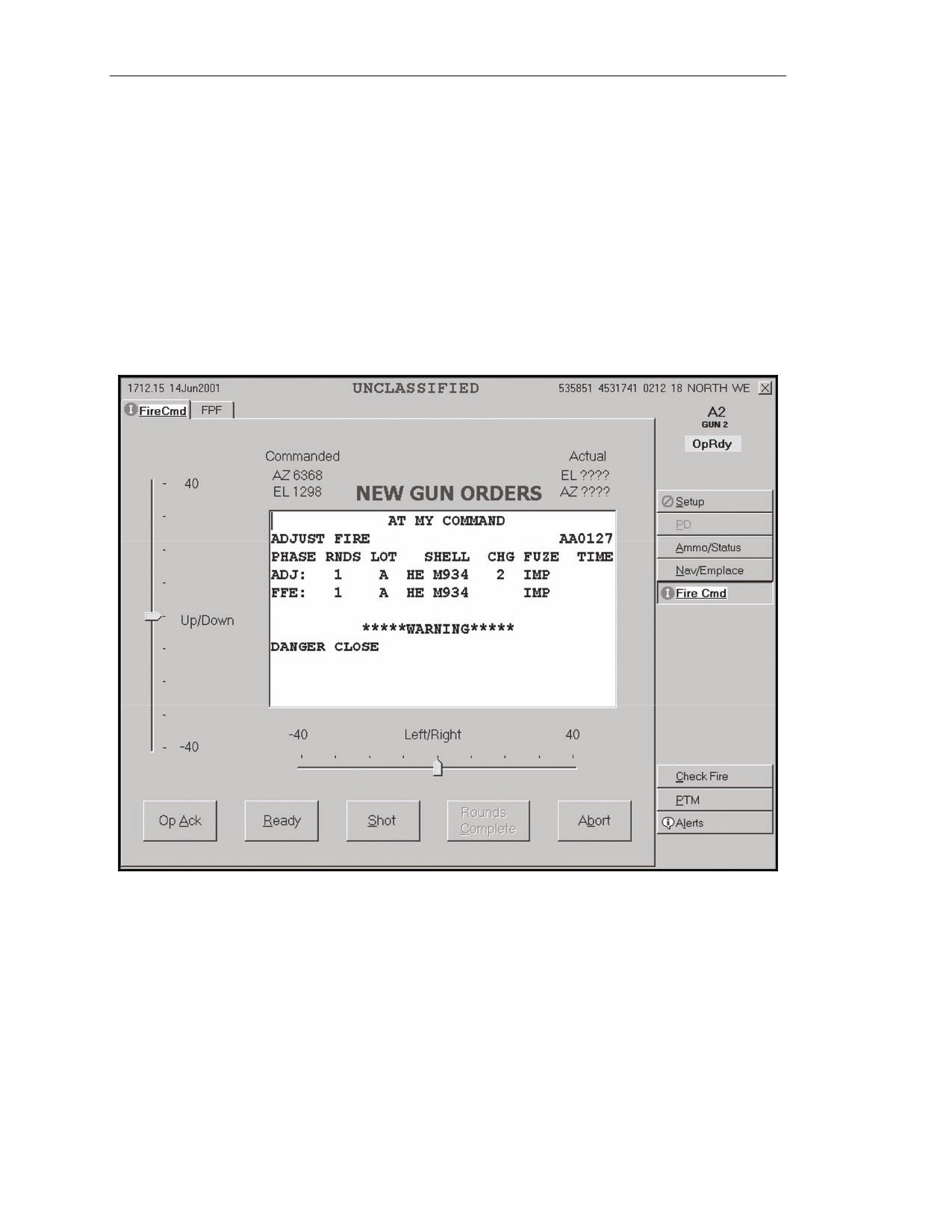
7-19. Gun orders for an FPF mission are indicated by an “I” (immediate) in a red circle beside the
FIRE COMMAND button. The “Fire Command” screen is automatically displayed (Figure 7-15) and
the words “NEW GUN ORDERS” appear at the top of the gun order. The method of control is AT MY
COMMAND, method of fire is ADJUST FIRE and method of attack is DANGER CLOSE.
Figure 7-15. Fire command for an assigned FPF.
(1) The squad leader reads the gun order and acknowledges receipt. The gunner's display and
driver's display are now activated.
(2) If necessary, the driver maneuvers the vehicle to within a minimum of 20 mils and a
maximum of 100 mils of the azimuth of fire. The gunner and assistant gunner manipulate
the gun system. The gun system is ready to fire when the word “LAID” appears in both AZ
and EL of the gunner's display. The squad leader sends a “READY” message to the FDC
and waits for a reply to fire.
(3) After firing the first round, the squad leader sends SHOT. The Send Status box is displayed
and then a screen message displays “Await EOM” or “Continuation.”
7-14
FM 3-22.90
7 December 2007
Conduct Fire Missions Using the Mortar Fire Control System
(4) If there is a SUBSEQUENT ADJUST, the squad leader receives another gun order and
acknowledges the order. The gun squad then follows the same procedures previously
described.
(5) When the gun is adjusted, the FDC sends an FFE gun order. The method of control is AT
MY COMMAND.
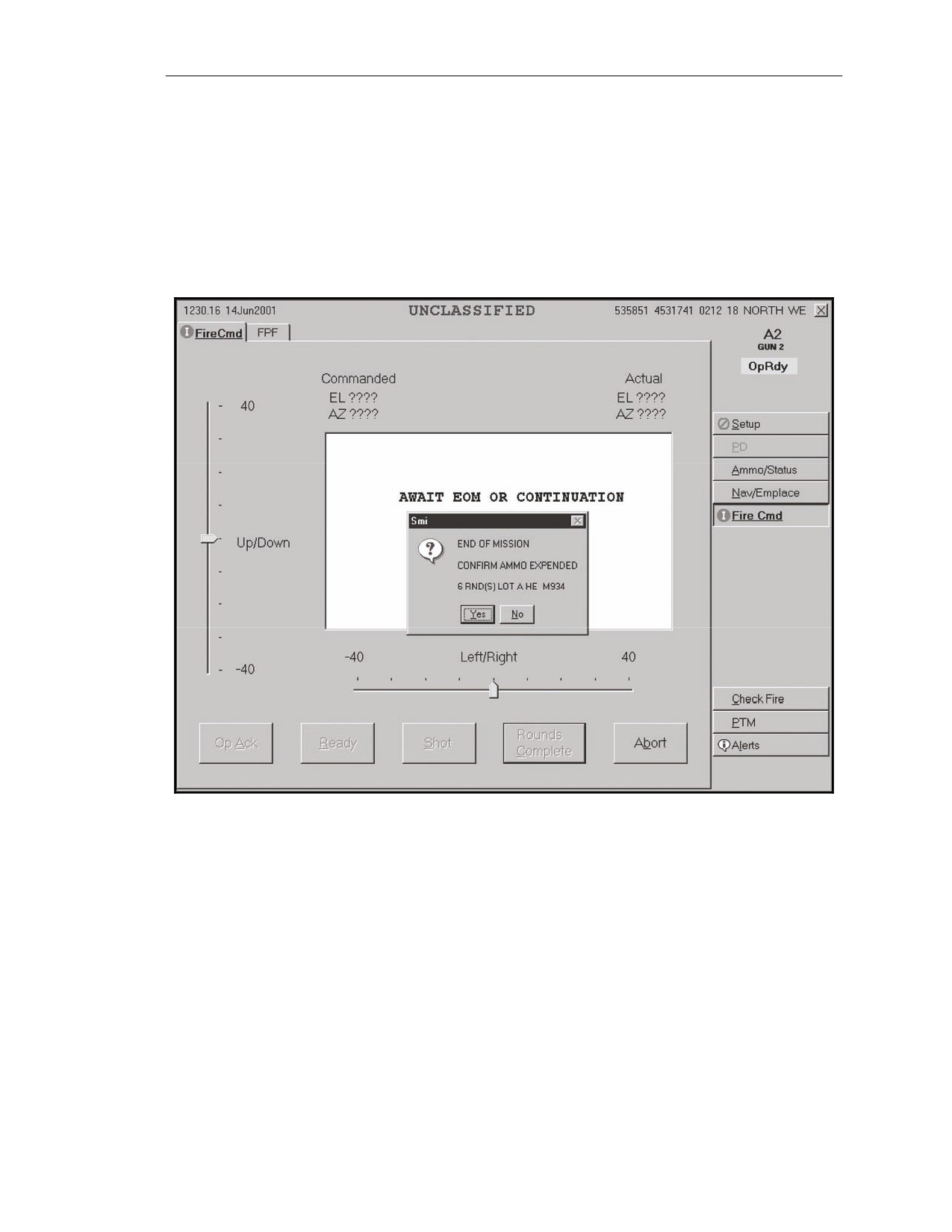
(6) Upon receipt of the end of mission command (Figure 7-16), the operator confirms the
amount of ammunition expended. (He can manually change the amount of ammunition
expended, if necessary.) When YES is clicked, the message “NOT IN MISSION” is
displayed.
Figure 7-16. End of mission.
(7) The FPF is stored in the FPF mission buffer. The operator can click on the FPF tab to verify
that the FPF has been stored.
7 December 2007
FM 3-22.90
7-15
Chapter 7
FIRE A STORED FINAL PROTECTIVE FIRE MISSION
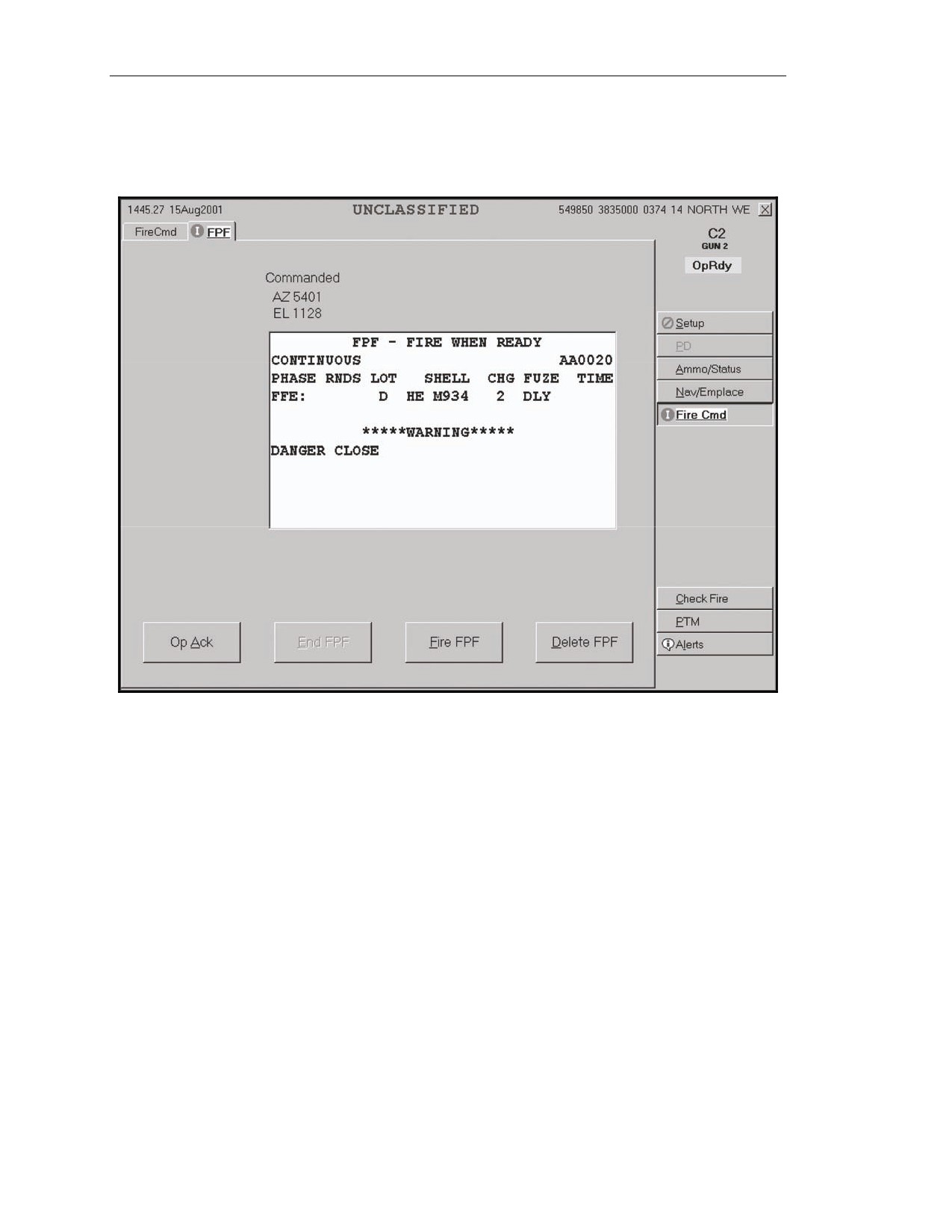
7-20. When the FDC sends the fire the FPF command, the FPF tab is enabled and the “FPF” screen is
displayed (Figure 7-17).
Figure 7-17. Fire the stored FPF.
(1) The squad leader reads the FPF and clicks OpACK to acknowledge receipt. The gunner's
display and driver's display are activated.
(2) If necessary, the gun squad manipulates the gun as previously described until the word
“LAID” appears in both AZ and EL of the gunner's display.
(3) Begin firing and continue until the “END FPF” message is sent. An “END OF MISSION”
message is also sent.
7-16
FM 3-22.90
7 December 2007
Chapter 8
Fire Without a Fire Direction Center
The use of the target-grid method of fire control may not always be possible or
desirable for placing fire on a target. Communications failure, casualties from
enemy fire, lack of equipment, or the tactical situation may require that one or
more mortars be employed without an FDC. Firing without an FDC, however,
greatly increases the vulnerability of the crew and substantially reduces the
capabilities of the weapon.
SECTION I. FIRE PROCEDURES
When the squad is under squad control, the gunner or an FO from the squad observes the target area.
Adjustments and fire commands are sent directly to the mortar crew. The two methods used to fire the
mortar without an FDC are direct lay and direct alignment. In the direct-lay method, the gunner sees the
target through the mortar sight. No directional posts, aiming posts, FO, or FDC are used. In the direct-
alignment method, an FO (usually the squad leader) observes the target near the mortar or the gun-target
(GT) line. He observes the fall of the rounds, makes corrections relative to the GT line, and gives gun
commands directly to the mortar squad.
NOTE: Employment of mortars without an FDC is only temporary—the FDC should be
established as soon as possible.
ADVANTAGES AND DISADVANTAGES
8-1. Advantages of operating without an FDC include—
Speed in engaging a target.
Better response to commanders.
Fewer requirements for personnel and equipment.
8-2. Disadvantages of operating without an FDC include—
Limited movement capability of the FO.
Increased vulnerability to direct and indirect fire.
Difficulty of massing or shifting fires on all targets within the range of the mortar.
Necessity of locating the mortar position too far forward where it is subject to enemy fire
delivered on the friendly frontlines.
Greater ammunition resupply problems.
FIRING DATA
8-3. The direct-alignment or direct-lay methods can be used to lay the mortar for direction. Initial
range can be determined by—
Estimation using the appearance of objects or 100-meter unit of measure methods.
Map, photographic map, or aerial photograph.
Mil-relation formula.
7 December 2007
FM 3-22.90
8-1
Chapter 8
OBSERVER CORRECTIONS
8-4. In direct alignment, the FO makes corrections differently than when operating with an FDC. He
makes all his deviation corrections with respect to the GT line rather than with respect to the observer-
target (OT) line. All deviation corrections are sent in mils or turns of the traversing handwheel (the FO
should consistently use one or the other method and not mix the two).
FORWARD OBSERVER WITHIN 100 METERS OF MORTAR POSITION
8-5. The best FO location for rapid fire adjustment on the mortar is at the mortar position.
8-6. The tactical employment of the mortar usually requires the FO to be in a position other than at
the mortar. However, if the FO is located within 100 meters of the mortar position, the deviation error
he reads in his binoculars can be applied directly to the sight without computation. This is true because
the angle between the observer-burst line and OT line is close to the angle between the mortar-burst
line and GT line. The inherent dispersion of the weapon and the bursting area of the round compensate
for any slight difference between these two angles.
8-7. For example, if the FO from a position within 100 meters of the mortar location observes the
burst to the left of the target and reads that it is 40 mils left on the mil scale of his binoculars, he orders
a correction of RIGHT FOUR ZERO. This correction is sent to the mortar in mils and is not converted
to meters. The gunner applies this correction directly to the previous deflection setting using the LARS
(left add, right subtract) rule.
FORWARD OBSERVER MORE THAN 100 METERS FROM MORTAR POSITION
8-8. The FO cannot always be located within 100 meters of the mortar position.
8-9. When the FO cannot locate within 100 meters of the mortar position, he must be within 100
meters of the GT line (Figure 8-1). If he is not, then making the correct adjustments may be difficult. If
the FO was attacking targets over a wide frontage, he would also be required to move often.
8-10. Since the angle that exists between the mortar-burst line and GT line is not equal to the angle
that exists between the observer-burst line and OT line, computations must be made to correct these
differences. Because the FO is also the FDC, he must use a correction factor to figure the adjustments
from the gun and not from himself.
8-11. The correction factor is a fraction, the numerator of which is the OT distance and the
denominator is the GT distance (OT distance/GT distance). For example, if the FO is halfway between
the mortar and target, the correction to be made on the sight is one-half his deviation spotting; if the
mortar is half-way between the FO and the target, the correction is twice his deviation spotting. As
other distances give other ratios, a correction factor must be applied to the number of mils spotted
before ordering a deflection change. In applying this factor, simplicity and speed are important. The
distances used should be to the nearest 100 meters.
EXAMPLE
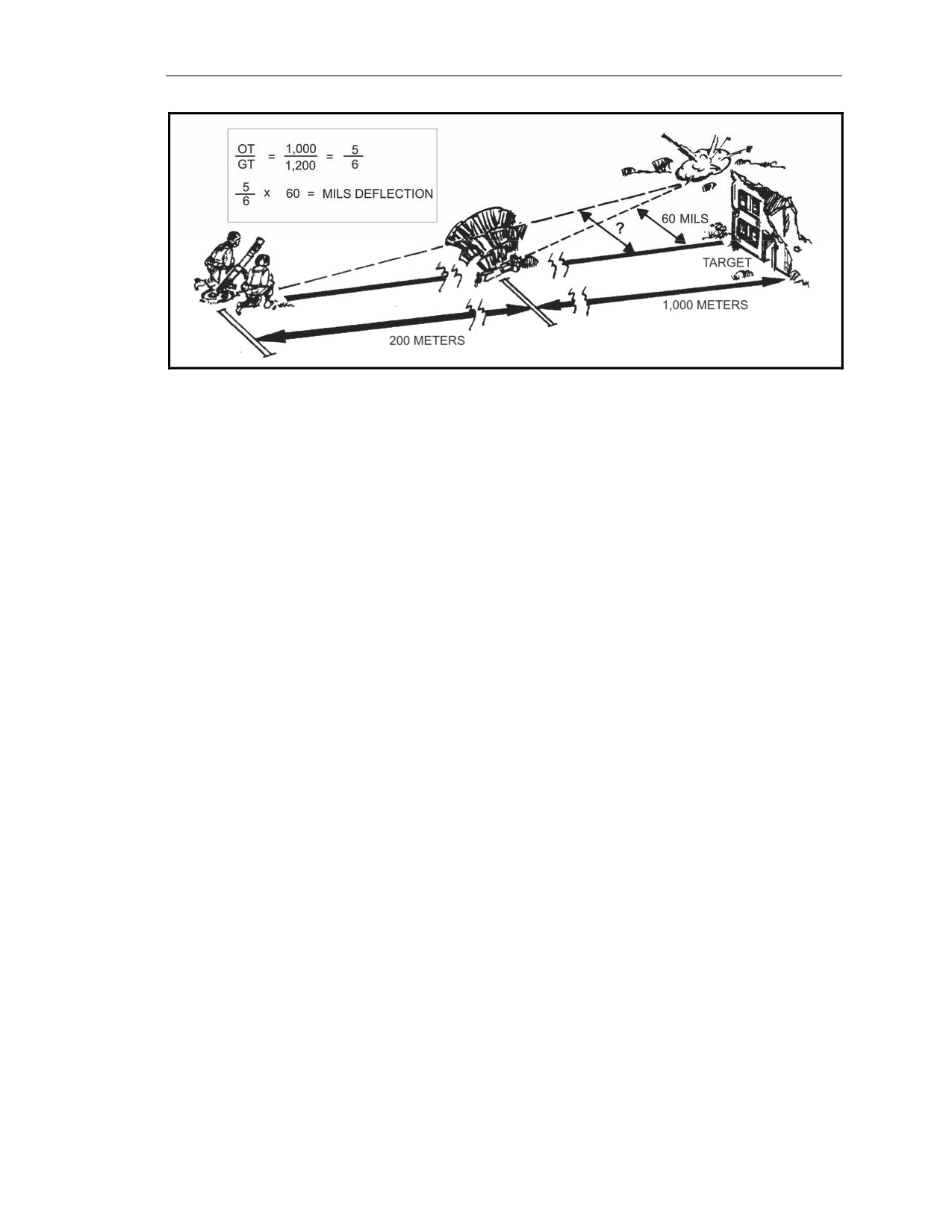
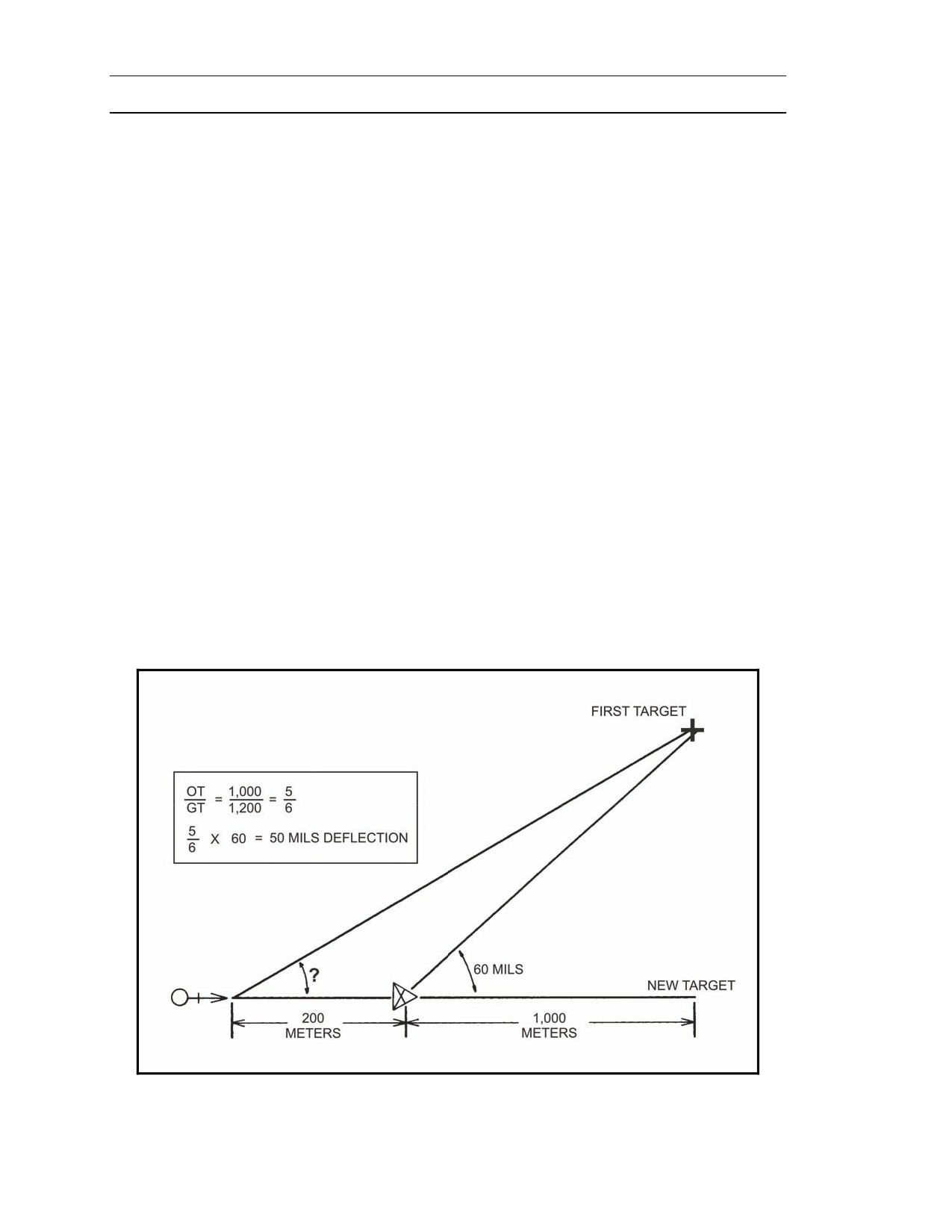
If the distance from the FO to the target is 1,000 meters, the GT distance is 1,200 meters, and the
deviation of the burst from the target, as read by the FO, is 60 mils (Figure 8-1), the correction
is—
1,000 ÷ 1,200 = 5/6
5/6 x 60 mils = 50 mils
8-2
FM 3-22.90
7 December 2007
Fire Without a Fire Direction Center
Figure 8-1. Observer more than 100 meters from mortar but within 100 meters of GT line.
INITIAL FIRE COMMANDS
8-12. Initial fire commands contain the necessary data to lay the mortars and fire the first round. The
sequence for transmission of the initial fire command is as follows:
Mortars to follow.
Type of projectile and fuze.
Mortars to fire.
Method of fire.
Deflection.
Charge.
Time setting.
Elevation.
FIRE COMMANDS
8-13. When mortars are employed without an FDC, fire commands originate with the squad leader at
the observation post.
NORMAL FIRE COMMANDS
8-14. The commands used in observed fire procedures without an FDC follow the procedure outlined
above with the following exceptions.
Direction
8-15. When operating without an FDC, the FO gives the direction as a shift from a known point
(normally the registration point) in the initial fire command. In subsequent commands, he gives the
deflection correction from the last round fired. For example, during an adjustment the FO requests
moving the next burst right 50 mils. Regardless of the sight setting, his command for deflection is
RIGHT FIVE ZERO. The gunner applies the LARS rule to obtain the deflection to be placed on the
sight. The sight has a deflection setting of 20 mils; therefore, the gunner subtracts 50 mils from 20 mils
and obtains the new sight setting of 3170 mils. Normally, when the registration has been completed,
the aiming posts are placed out on a referred deflection.
7 December 2007
FM 3-22.90
8-3
Chapter 8
Elevation (Range)
8-16. The FO may refer to a firing table, determine the charge and elevation (in mils) corresponding to
the GT range, and announce this charge and elevation in his fire command. He may, however,
announce the range in meters and have the gunner refer to a firing table to determine the charge and
elevation.
Gunner’s Correction
8-17. The gunner applies the deflection correction to the previous deflection setting, determines the
charge and elevation for the given range on the firing table (if required by the FO), announces the
charge to the ammunition bearer, sets the elevation on the sight, and then lays for elevation and
deflection.
MODIFIED FIRE COMMANDS
8-18. Modified fire commands differ from normal fire commands only in that the deflection and
elevation changes in subsequent commands are given as turns of the traversing handwheel and
elevating crank. The advantages of modified fire commands are speed and simplicity of execution by
the gunner. One turn of the traversing handwheel is equal to about 10 mils of deflection for the 60- and
81-mm and 5 mils for the 120-mm. The unabridged firing tables have a column for the number of turns
of the elevation crank to change the range 100 meters.
(1) When using modified fire commands, deflection and elevation changes are computed to the
nearest quarter turn. When the FO anticipates using modified fire commands involving turns
of the elevating crank, he must announce the range element of the initial fire command as a
charge and elevation. This ensures that the FO and gunner are working in the same charge
zone, since the number of turns required to move the burst of a round a given distance on
the ground can vary considerably between two charge zones.
(2) The gunner lays the mortar for direction and elevation as given in the initial fire command;
he does not need to refer to a firing table. Following the initial fire command, the gunner
makes no attempt to align the sight on the aiming point or to level the elevation bubble. He
makes the corrections by taking the turns given in the subsequent commands and keeping
the cross-level bubble centered. If the gunner can no longer traverse in the desired direction,
he should be able to align the sight on the aiming point, center the traversing bearing, re-lay
on the aiming point, and resume traverse.
(3) In computing the number of turns of the elevation crank between two elevations in mils
(taken from the firing table), the FO subtracts the smaller elevation from the larger and
divides by 10 (one turn of the elevation crank being equal to about 10 mils of elevation for
the 60- and 81-mm mortars) or by 5 (for the 120-mm mortars). In the ladder and bracketing
methods of adjustment for range, once the FO has obtained a bracket on the target, he does
not need the firing table. He continues the adjustment by halving the number of turns of the
elevating crank that established the preceding bracket. In the following example, the first
round burst between the FO and target.
8-4
FM 3-22.90
7 December 2007
Fire Without a Fire Direction Center
EXAMPLE (for a 60- or 81-mm mortar)
MODIFIED FIRE COMMANDS:
RIGHT FOUR TURNS
DOWN NINE TURNS
LEFT TWO TURNS
UP FOUR AND ONE-HALF TURNS
RIGHT ONE TURN
DOWN TWO
TURNS
THREE ROUNDS
UP ONE TU R N
NORMAL FIRE COMMANDS:
RIGHT FOUR ZERO
ONE SEVEN ZERO ZERO
LEFT TWO ZERO
ONE SIX ZERO ZERO
RIGHT ONE ZERO
ONE SIX FIVE ZERO
THREE ROUNDS
ONE SIX TWO FIVE
In a different example, assume that the first round was fired at a range of 900 meters and burst
beyond the target. The FO wants to DROP ONE ZERO ZERO (100) for the next round and gives
a modified fire command in turns of the elevating crank. Using charge 1, the elevation for the first
round at 900 meters is 1275 mils. The elevation for a range of 800 meters is 1316 mils.
Subtracting 1275 mils from 1316 mils gives a difference in elevation for the two ranges of 41 mils,
or 4 turns. Therefore, the subsequent command to fire the second round is UP FOUR TURNS.
The second round now bursts short of the target, establishing a bracket. The FO wants to split the
bracket and commands, DOWN TWO TURNS, or one-half the number of turns that he previously
gave to bracket the target. With this command, the FO is splitting a 100-meter bracket and could
specify an FFE if he was engaging a tactical area target.
FIRE CONTROL
8-19. The FO controls the fire from an observation post, issuing fire commands directly to the mortar
crew. He may select an observation post close enough to the mortar so that he can give his fire
commands orally to the mortar crew. When the observation post is not close to the mortar position, the
FO uses a telephone or radio to transmit fire commands.
MOVEMENT TO ALTERNATE AND SUPPLEMENTARY
POSITIONS
8-20. When time or the situation dictates, the mortar may be moved to both alternate and
supplementary positions, and registered on the registration point, FPF (in the defense), and as many
targets as possible.
SQUAD CONDUCT OF FIRE
8-21. Conduct of fire includes all operations in placing effective fire on a target. Examples include: the
FO’s ability to open and adjust fires, the ability to distribute fire on the target, shifting fire from one
target to another, and regulating the type and the amount of ammunition to be expended. Quick actions
and teamwork are required to efficiently conduct fires. Training increases the squad’s ability to fire
without an FDC.
7 December 2007
FM 3-22.90
8-5
Chapter 8
8-22. The normal sequence of instruction begins on the training shell range using practice ammunition,
and progresses to field training exercises (FTXs) with practice or combat ammunition. Training
ammunition allocation is outlined in DA Pam 350-38, Standards in Training Commission (STRAC).
8-23. To ensure maximum efficiency, each squad member is acquainted with the principles of
technique of fire for each type of adjustment and FFE. Frequent rotation of duty helps squad members
to better understand this technique of fire. The designated FO (squad member) is trained in all methods
and techniques used in bringing effective fire on a target as quickly as possible.
REFERENCE LINE
8-24. The normal method of establishing the initial direction when operating without an FDC is the
direct-alignment method. After the initial direction has been established, the FO should conduct a
registration on his registration point using only the direction stake as a reference point. After
registration is completed, a reference line should be established by placing out aiming posts on a
referred deflection, which then becomes the registration point or base deflection.
SQUAD USE OF SMOKE AND ILLUMINATION
8-25. Smoke is used to obscure the enemy’s vision for short periods. Illumination is designed to assist
friendly forces with light for night operations.
USE OF SMOKE
8-26. The squad leader must be authorized to employ smoke. The authority to fire smoke rests with the
battlefield commander that the screen will affect. After careful evaluation of the terrain and weather,
the FO locates a point on the ground where he wishes to place the screen. If necessary, the FO adjusts
fire to determine the correct location of this point. For a screening mission, splitting a 100-meter
bracket is normally sufficient.
USE OF ILLUMINATION
8-27. The battalion commander exercises control over the use of infantry mortar illuminating rounds
after coordination with adjacent units through the next higher headquarters. The correct relative
position of the flare to the target depends upon the wind and terrain. The point of burst is placed so as
to give the most effective illumination on the target and to make sure that the final travel of the flare is
not between the FO and target. Adjusting the round directly over the target is not necessary due to the
wide area of illumination.
8-28. If there is a strong wind, the point of burst must be placed some distance upwind from the target
so the flare drifts to the target location. The flare should be slightly to one flank of the target and at
about the same range. When the target is on the forward slope, the flare is placed on the flank and at a
slightly shorter range.
8-29. For adjustment on a prominent target, better visibility is obtained by placing the flare beyond the
target to silhouette it and to prevent adjustment on the target’s shadow. When firing continuous
illumination, a strong wind can decrease the time interval between rounds. For maximum illumination,
the flare is adjusted to burn out shortly before reaching the ground.
ATTACK OF WIDE TARGETS
8-30. To attack wide targets, the FO must use distributed FFE. In distributed FFE, the gunner fires a
specified number of rounds but manipulates the mortar for range or deflection between each round.
Distributed fire on wide targets is called traversing fire. To place traversing fire on a target, the FO
must adjust fire on one end of the target, normally the end nearest to a known point.
8-6
FM 3-22.90
7 December 2007
Fire Without a Fire Direction Center
(1) After adjustment, the FO determines the width of the target in mils by using the mil scale in
the binoculars, or by reading an azimuth to each end and subtracting the smaller from the
larger. He then divides the mil width by 10 for the 60- and 81-mm, and 5 for the 120-mm
(10 and 5 are the number of mils that one turn of the traversing handwheel moves the
mortar). This determines the number of turns needed to traverse across the target (computed
to the nearest one-half turn).
(2) In computing the number of rounds, the FO divides the width of the target by the bursting
area of the round. He then divides the total number of turns by the number of intervals
between the rounds to be fired to determine the number of turns between rounds (computed
to the nearest one-half turn). There will always be one less interval than the number of
rounds fired in the FFE phase.
(3) After adjustment and before issuing the subsequent fire command, the FO must tell the
gunner to prepare to traverse right or left. The gunner traverses the mortar all the way in the
direction commanded and then back two turns (four turns on M120/M121) on the traversing
handwheel. With the aid of the assistant gunner, the gunner moves the bipod legs until he is
approximately re-laid on his direction stake. Using the traversing mechanism, the gunner
then completes realigning the mortar and announces, “Up.”
(4) When the mortar is laid, the FO issues his subsequent fire command, announcing the
number of rounds to be fired and the amount of manipulation between each round.
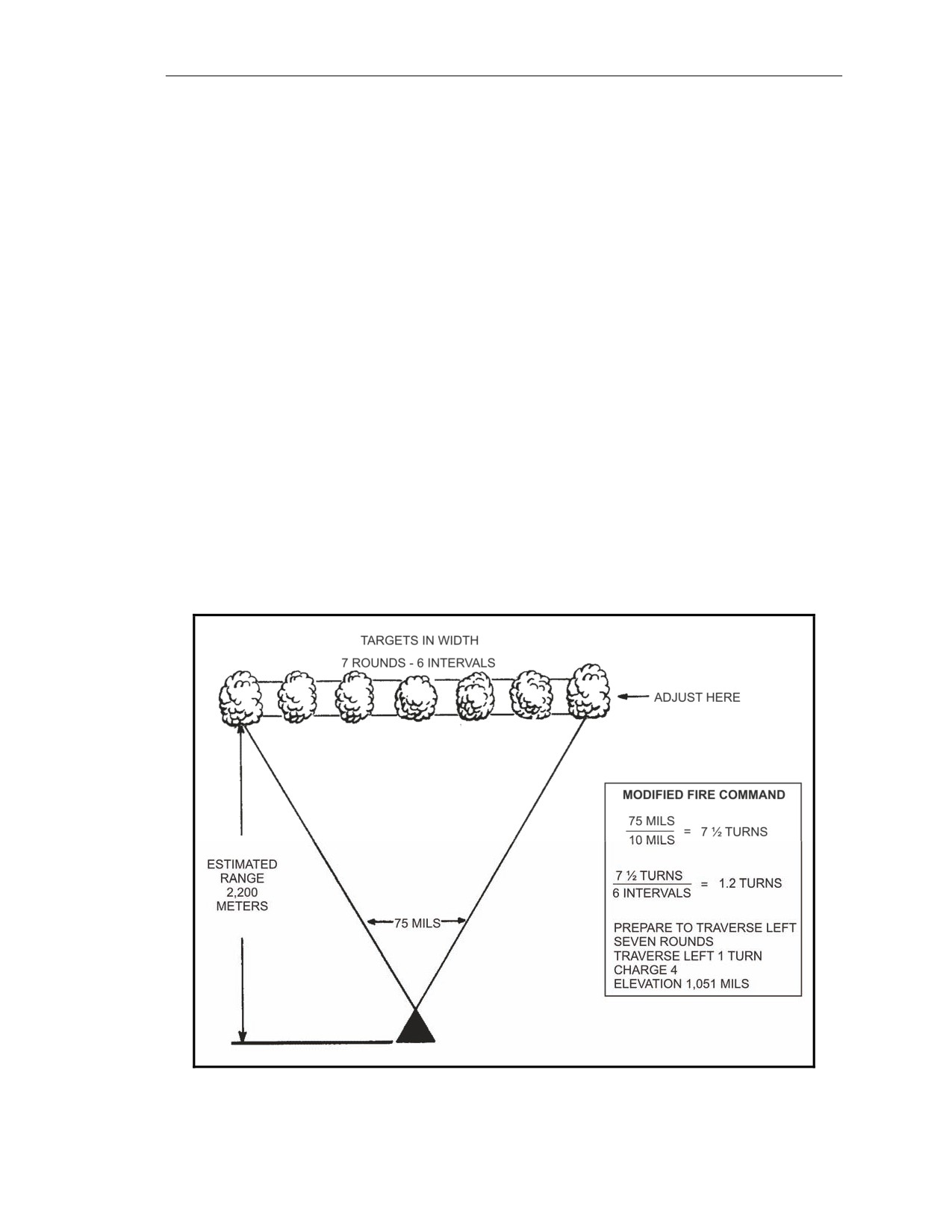
8-31. In the example in Figure 8-2, the FO is located with the 81-mm mortar squad and measures the
width of his target to be 75 mils. Using a map, he estimates the range to be 2,200 meters. Using the
mil-relation formula, he determines the width of the target to be 165 meters and decides to attack the
target with seven rounds. There will be six intervals between the seven rounds. Since the target is 75
mils wide, he determines the number of turns to be 7 1/2. To determine the number of turns between
rounds, he divides the number of turns by the number of intervals (7 1/2 divided by 6 = 1.07). This is
rounded off to the nearest one-half turn (one turn).
Figure 8-2. Traversing fire.
7 December 2007
FM 3-22.90
8-7
Chapter 8
NOTE: When determining the rounds for FFE, the FO applies the following rules:
1. For the 60- and 81-mm mortars, one round for each 30 meters and four
rounds for each 100 meters.
2. For the 120-mm mortar, one round for each 60 meters and two rounds for
each 100 meters.
ATTACK OF DEEP TARGETS
8-32. The FO uses searching fire to place effective fire on deep targets. To engage a deep target, the
FO must adjust on one end of the target, normally the far end. When the FO anticipates using searching
fire, he announces the range as a charge and elevation.
(1) After adjustment is completed on one end of the target, the FO estimates the range to the
other end of the target. He can use the firing table to determine the number of turns of the
elevating crank needed to change the range 100 meters. If the FO does not have this
information, he can decide the number of turns by determining the difference in elevation in
mils that exists between the two ranges. He divides this difference by 5 or 10 to determine
the number of turns needed on the elevating crank to cover the target.
(2) The FO must then determine the number of rounds to be fired. Usually five rounds cover an
area 100 meters deep, except at long ranges where dispersion is greater. Once he has
determined the number of rounds to be fired, he determines the number of intervals between
rounds. There will always be one less interval than the number of rounds fired.
(3) The FO then divides the total number of turns required by the total number of intervals to
determine the number of turns the gunner must make between each round (computed to the
nearest one-half turn).
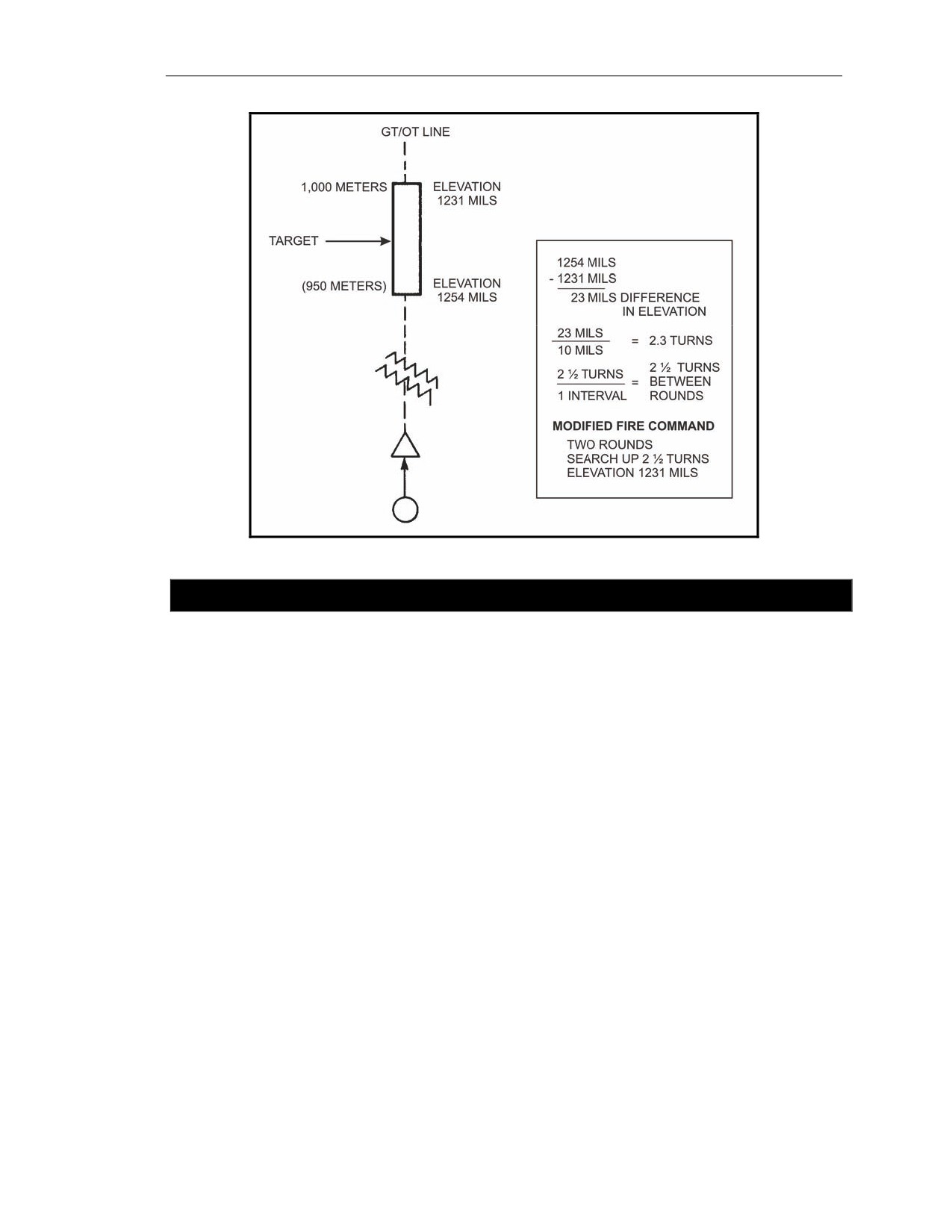
EXAMPLE (Adjustment of an 81-mm mortar, Figure 8-3)
If the FO has adjusted to the far end of the target and found it to be 1,000 meters, he
estimates the near edge of the target to be 950 meters. By using the firing table, he
determines that he must make five turns of the elevating crank to change the range 100
meters. Since the FO only wants to make a 50-meter change, he makes only half of the
turns, which is 2 1/2 turns. If he did not have this information, he would determine that
there is a 23-mil difference in elevation for the two ranges (elevation 1231 mils for range
1,000 meters, and elevation 1254 mils for range 950) and, by dividing by 10, that it would
require two turns of the elevating crank.
The FO has determined that he will use two rounds to attack the target. There will be one
interval between the two rounds fired. Then the FO divides the total number of turns
required by the number of intervals, and rounds off the answer to the nearest one-half
turn.
2 1/2 ÷ 1 (interval) = 2 1/2 turns between rounds
The FO is now ready to send the subsequent fire command to the gunner. The
commands are—
TWO ROUNDS
SEARCH UP TWO AND ONE-HALF TURNS
ELEVATION ONE TWO THREE ONE (1231)
The gunner is told to search in the direction that the barrel moves. For this example, the barrel
moves from 1231 mils to 1254 mils of elevation; therefore, the command is SEARCH UP.
8-8
FM 3-22.90
7 December 2007
Fire Without a Fire Direction Center
Figure 8-3. Searching fire.
SECTION II. DIRECT-LAY METHOD
In the direct-lay method of emplacing a mortar, the gunner sees the target through the mortar sight. No
directional or aiming posts, FO, or FDC are used. The firing table should be used to try to obtain a first-
round hit. If the first-round hit is not achieved, the firing table should be used to obtain a bracket.
Depending on the location of friendly troops to the target, the bracket method, modified ladder method, or
creeping method of adjustment apply.
STEP 1: INITIAL FIRING DATA
8-33. The elevation setting and charge selected should be obtained from a firing table. In the absence
of a firing table, they can be determined through unit SOP or by other expedient techniques such as
memorizing charge and elevation for 1,000, 2,000, and 3,000 meters; and firing with the charge and
elevation setting closest to the estimated target range.
(1) Determine initial range by—
Estimating.
Using maps, photographic maps, and so on.
Intersection.
(2) Place a 3200-mil deflection on the sight, and lay on the center of the target. With the
appropriate elevation setting on the sight, center all bubbles by adjusting the lay of the
barrel. Take appropriate actions to preclude damage to the sight and, with established
charges, fire the first round. Replace the sight, if needed, and observe the burst of the round.
STEP 2: REFERRING THE SIGHT
8-34. Referring the sight centers the vertical line of the sight reticle on the burst.
(1) If the burst is over the target, turn the elevating crank up 4, 8, or 16 turns, depending on the
gunner’s sensing of the round, range to the target, and other possible factors. If the burst is
short, turn the elevating crank down 4, 8, or 16 turns.
7 December 2007
FM 3-22.90
8-9
Chapter 8
(2) Turn the sight elevation micrometer knob to center the elevation bubble. (If the deflection
change requires a bipod displacement, the desired range change is maintained.)
(3) Re-lay the barrel on center of target (centering both bubbles by adjusting the barrel. Fire the
second round and observe the burst.
NOTE: An alternate method of correction for range is to use the firing table.
STEP 3: BRACKETING THE TARGET
8-35. If the second round is a line shot and brackets the target, changing the elevation of the barrel half
the number of turns used in STEP 2 splits the bracket. For example, if in STEP 2 the barrel was
cranked up eight turns, now crank down four and fire the third round.
If the second round is not a line shot but does bracket the target, refer the sight to center of
burst and split the bracket by changing the elevation of the barrel half the number of turns
used in STEP 2. Change the sight to the center elevation bubble, and then re-lay the barrel
on center of target (centering both bubbles by changing the lay of the barrel).
If the second round is not a line shot and does not bracket the target, repeat STEP 2 until a
bracket is obtained.
STEP 4: FIRE FOR EFFECT
8-36. The appropriate actions of STEP 3 are repeated until an effect on the target is seen, then mortars
fire for effect.
8-37. After obtaining hits, change the sight to center the elevation bubble and vertical line of the sight
reticle on the target, and then record these data. Number the target and retain the number along with
appropriate firing data. The mortar can be taken out of action, moved a short distance, and placed back
into action with the mortar able to quickly and accurately attack the recorded target or other close
targets.
8-38. If the mortar crew is fired upon during any of the above steps, the mortar can be displaced 75 to
100 meters with minimal effect on the fires as long as the elevation setting for the last round fired has
been recorded or memorized. Once in the new position, use the recorded/memorized data as a starting
point and then complete the interrupted step.
SECTION III. DIRECT-ALIGNMENT METHOD
When the FO/squad leader prepares the initial firing data, he uses the quickest and simplest method
available. Initial data consist of a direction of fire and mortar-target range.
MORTAR DISMOUNTED
8-39. If the mortar is dismounted, the squad leader moves to a vantage point where he can see the
targets and places out an aiming post. He directs a member of the mortar squad to place out a second
aiming post (to be used as a baseplate assembly stake), aligning it with the first aiming post and target.
The mortar crew mounts the mortar at the baseplate assembly stake, places 3200 mils deflection on the
sight, and traverses the mortar, aligning the sight on the aiming post placed out by the squad leader.
The gunner uses this aiming post as an aiming point or he may place out other aiming posts to be used
as aiming points.
MORTAR MOUNTED
8-40. If the mortar is mounted, the squad leader moves to a vantage point on a line between the mortar
and target. He places out an aiming post (direction stake) on which the gunner lays the mortar with the
deflection set at 3200. The gunner uses this aiming post as an aiming point or he may place out other
aiming posts to be used as aiming points.
8-10
FM 3-22.90
7 December 2007
Fire Without a Fire Direction Center
NOTE: The squad leader can also move to a vantage point behind the gun.
NATURAL OBJECT METHOD
8-41. When the tactical situation does not permit alignment of aiming posts and the mortar is rapidly
placed into action, the squad leader can establish the mounting azimuth as follows: He selects an object
with a clearly defined vertical edge that is situated in the general direction of fire. He directs the gunner
to mount and lay the mortar on the edge of this object with the deflection scale set at 3200 mils. By
using the aiming point as a reference point, he can place fire on a target to the right and left by
determining the angle in mils between the aiming point and target. He directs the gunner to place the
corresponding deflection on the mortar using the LARS rule.
SECTION IV. ADJUSTMENT OF RANGE
When firing without an FDC, the normal procedure for the adjustment of range is the establishment of a
bracket along the GT line. A bracket is established when one group of rounds falls over and one group of
rounds falls short of the adjusting point. The FO must establish the bracket early in the adjustment and then
successively decrease the size of the bracket until it is appropriate to enter FFE.
SPOTTINGS
8-42. A spotting is the FO's determination of the location of the burst with respect to the target.
Spottings are made for the range and the deviation from the GT line. The FO must be able to visualize
the GT line so that he can orient the bursts to it.
RANGE SPOTTINGS
8-43. Definite range spottings are required to make a proper range adjustment. Any range spotting
other than DOUBTFUL, LOST, or UNOBSERVED is definite.
Definite Range Spottings
8-44. Definite range spottings may include—
A burst or group of bursts on or near the GT line.
A burst(s) not on the GT line but located by the FO using his knowledge of the terrain or
drifting smoke, shadows and wind patterns. Use of these spottings requires caution and good
judgment.
The location of the burst fragmentation pattern on the ground.
A burst that appears beyond the adjusting point (over).
A burst that appears between the FO and adjusting point (short).
A round that bursts within the target area (target).
A burst or center of a group of bursts that is at the proper range (range correct).
Doubtful, Lost, or Unobserved Range Spottings
8-45. Range spottings that are doubtful, lost, or unobserved usually cannot be used for adjustments
and a bold shift in deviation or range should be made for the next round. These range spottings
include—
Doubtful. A burst that can be observed but cannot be determined as over, short, target, or
range correct.
Lost. A burst whose location cannot be determined by sight or sound.
Unobserved. A burst not observed but known to have impacted (usually heard).
Unobserved Over or Short. A burst not observed but known to be over or short. This
spotting provides some information to assist the FO in the subsequent adjustment.
7 December 2007
FM 3-22.90
8-11

Chapter 8
DEVIATION SPOTTINGS
8-46. A deviation spotting is the angular measurement from the target to the burst. There are three
possible deviation spottings:
Line. A round that impacts on the GT line
Left. A round that impacts to the left of the GT line.
Right. A round that impacts to the right of the GT line.
ERRATIC SPOTTINGS
8-47. A round that varies greatly from normal behavior is classified as an erratic round.
BRACKETING METHOD
8-48. When the first definite range spotting is obtained, the FO should make a range correction that is
expected to result in a range spotting in the opposite direction—for example, if the first definite range
spotting is SHORT, the FO should add enough to get an OVER with the next round. The inexperienced
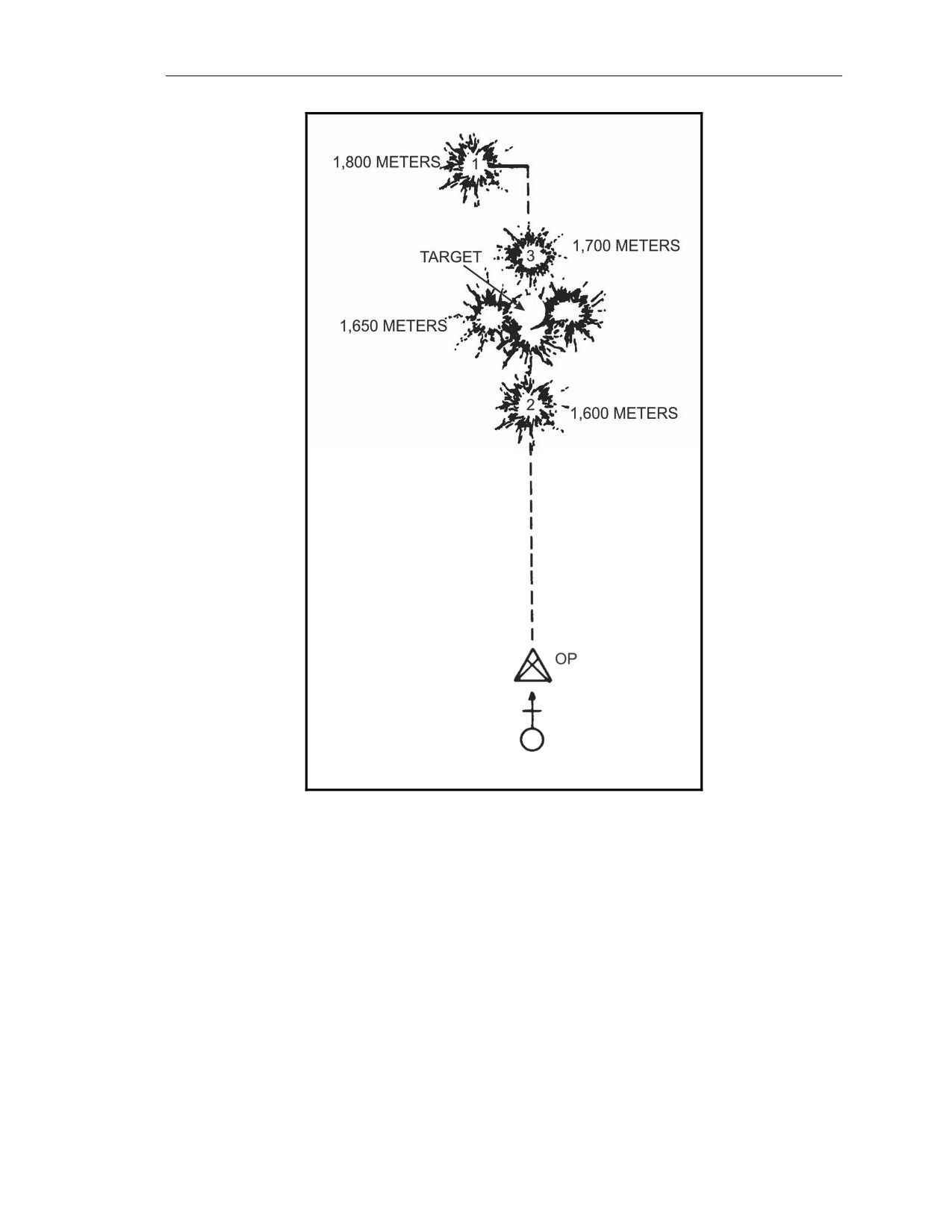
FO should use the guide in Table 8-1 to determine the initial range change needed to establish a
bracket (Figure 8-4).
Table 8-1. Initial range change.
MINIMUM RANGE CHANGE
OT DISTANCE
(ADD or DROP)
Up to 999 meters
100 meters
Over 1,000 to 1,999 meters
200 meters
2,000 meters and over
400 meters
8-49. Once a bracket has been established, it is successively decreased by splitting it in half until it is
appropriate to enter FFE. FFE is usually requested in area fire when a 100-meter bracket is split.
8-50. The FO must use his knowledge and experience in determining the size of the initial and
subsequent range changes. For example, if the FO adds 800 after an initial range spotting of SHORT
and the second range spotting is OVER but the bursts are much closer to the target than the initial
rounds, a range change of DROP 200 would be appropriate.
8-12
FM 3-22.90
7 December 2007
Fire Without a Fire Direction Center
Figure 8-4. Bracketing method.
CREEPING METHOD OF ADJUSTMENT
8-51. When a danger close mission is requested, the creeping method of adjustment is used. When the
FO requests an adjustment on a target that is within 400 meters of friendly troops, he adds a 200-meter
safety factor to ensure that the first round does not fall short. When the initial round is spotted, he
estimates the overage in meters. He then makes the correction for range by dropping half of the
estimated overage. Once he has given a correction in turns equivalent to a drop in range of 50 meters,
OR in the nearest number of half turns equivalent to 50 meters, he continues this same adjustment until
he has a RANGE CORRECT, a TARGET, or a SHORT spotting. If, during the adjustment, a round
falls short of the target, the FO continues the adjustment using the bracket method of adjustment.
LADDER METHOD OF ADJUSTMENT
8-52. Since surprise is an important factor in placing effective fire on a target, any form of adjustment
that reduces the time interval between the burst of the first round for adjustment and FFE is useful. The
7 December 2007
FM 3-22.90
8-13
Chapter 8
ladder method of adjustment, a modification of the bracketing method, reduces the time interval and
permits FFE to be delivered more rapidly. The ladder method may also be used by the FO when firing
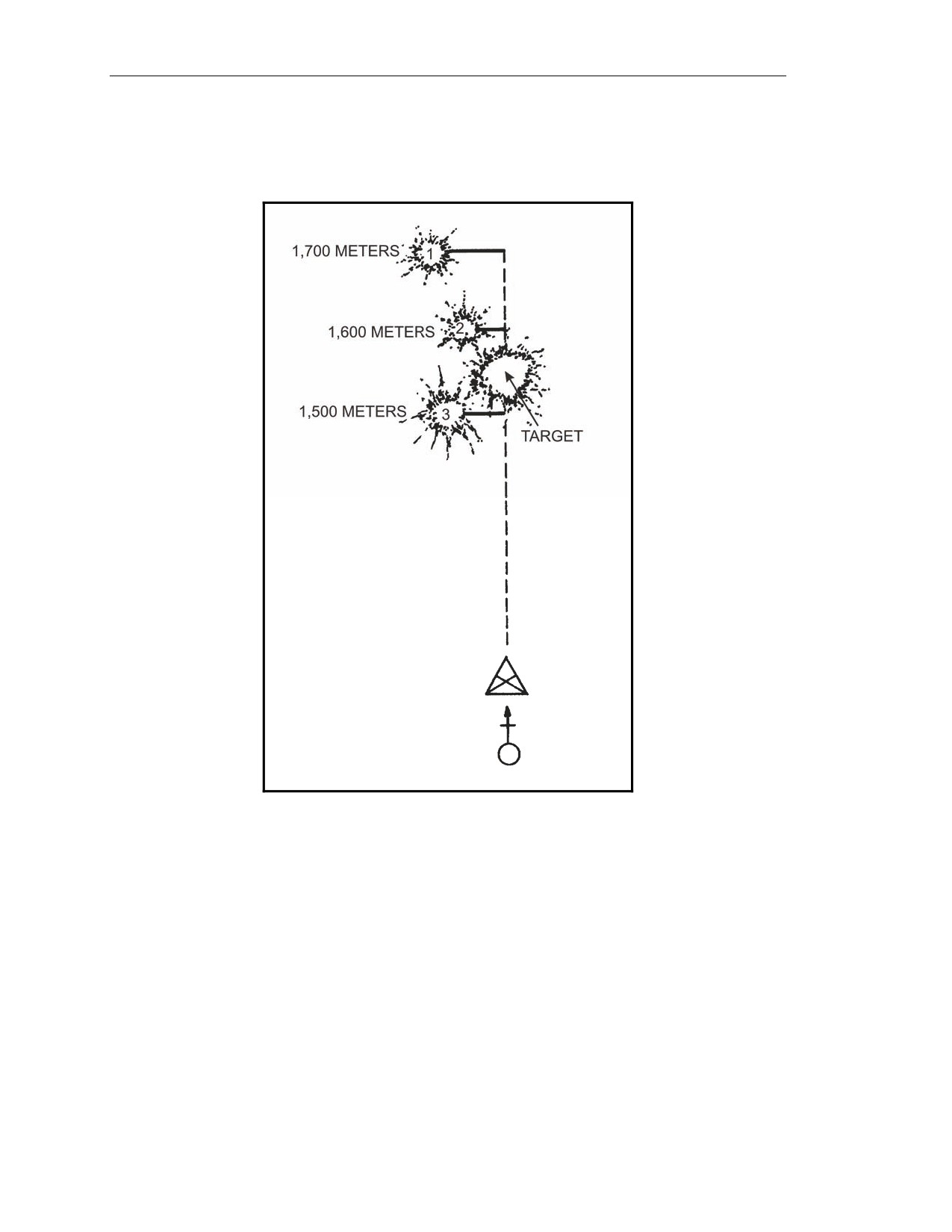
with an FDC (Figure 8-5). In the following example, the FO is located within 100 meters of the mortar
position.
Figure 8-5. Ladder method of fire adjustment.
8-14
FM 3-22.90
7 December 2007
Fire Without a Fire Direction Center
EXAMPLE (Ladder method of adjustment, Figure 8-5)
The FO measures the deviation of a target from the registration point as right 30 mils. He
estimates the GT range to be 1,600 meters. The size of the ladder is based on the minimum
range change guide. To obtain a 200-meter ladder, the FO adds 100 meters to this estimated
range to establish one range limit for the ladder and subtracts 100 meters from the estimated
range to establish the other limit. This should result in a ladder that straddles the target. Three
rounds are fired in this sequence: far, middle, and near at 10-second intervals. This helps the FO
make a spotting, since no burst is obscured by the dust and smoke from a preceding burst. The
FO checks his firing table to obtain the lowest charge and elevation for the far range, 1,700
meters (1098); the middle range, 1,600 meters (1140); and the near range, 1,500 meters (1178)
and issues the following initial fire command:
NUMBER ONE
HE QUICK
CHARGE 1
THREE ROUNDS IN EFFECT
100-METER LADDER
FROM REGISTRATION POINT, RIGHT THREE ZERO (30)
ONE ROUND, ELEVATION, ONE ZERO NINER EIGHT (1098)
ONE ROUND, ELEVATION, ONE ONE FOUR ZERO (1140)
ONE ROUND, ELEVATION, ONE ONE SEVEN EIGHT (1178)
The method-of-fire element in the normal initial fire command for the ladder contains the word
“ladder.” The word “ladder” tells the gunner that three rounds will be fired as follows: the first at
the elevation announced (far range), the second at the announced middle elevation (target
range), and the third at the last announced elevation (near range). The gunner indexes his sight
for deflection at the base deflection minus 30, while the ammunition bearer prepares the rounds
with the designated charge.
The average deviation of all three rounds is left 30 mils. The target is bracketed between the
second and third bursts. The squad leader now has a 100-meter bracket of the target between
1,500 and 1,600 meters, and is ready to FFE. He issues the following subsequent fire command:
THREE ROUNDS
RIGHT THREE TURNS
ELEVATION, ONE ONE SIX ZERO (1160)
ESTABLISHMENT OF A REFERENCE LINE AND SHIFTING
FROM THAT LINE
8-53. The normal method of establishing initial direction when operating without an FDC is the direct-
alignment method. After initial direction has been established, the FO should conduct a registration
using only the direction stake. After he completes this registration, he establishes the GT line as a
reference line. This is accomplished by referring the sight to the desired deflection (usually 3200 or
2800 mils) and then realigning the direction stake on this deflection. The following is an example of
the FO located within 100 meters of the mortar position.
7 December 2007
FM 3-22.90
8-15
Chapter 8
EXAMPLE (Establishment of a Reference Line, Figure 8-6)
A FO has adjusted the fire of his squad on a target. A reference line has been established at
3200 mils on the azimuth scale. The FO observes another target and decides to adjust onto it. He
estimates the GT range to be 1,200 meters, determines with his binoculars that the target is 60
mils to the right of the first target or registration point, and issues an initial fire command:
NUMBER ONE
HE QUICK
ONE ROUND
THREE ROUNDS IN EFFECT
SHIFT FROM RP1, RIGHT FIVE ZERO (50)
RANGE ONE TWO ZERO ZERO (1200)
The gunner sets his sight with a deflection of 3200 mils and applies the LARS rule (50 mils
subtracted from 3200 mils equals a deflection of 3150). Looking at the firing table for HE M821
ammunition, he finds the charge to be 1 at elevation 1278. He announces the charge to the
ammunition bearer and, at the same time, places the elevation on the sight. He lays the mortar
and commands, FIRE.
The FO spots the first round burst as over the target and 25 mils to the left. The squad leader
issues a subsequent fire command correcting the deflection and, using the minimum range
change guide (Table 8-1), decreasing the range 200 meters between himself and the target. In
doing so, the FO establishes a bracket. He then commands, RIGHT TWO ZERO (20), RANGE
ONE ZERO ZERO ZERO (1000).
The second round bursts between the FO and target and on the GT line. The deflection is now
correct, and a 200-meter bracket has been established. The squad leader’s subsequent fire
command is RANGE, ONE ONE ZERO ZERO (1100). The gunner selects the charge and
elevation from his firing table, announces the charge to the ammunition bearer, and when all is
ready he commands, FIRE.
Figure 8-6. Adjusting fire onto a new target with the observer within 100 meters of the GT
line.
8-16
FM 3-22.90
7 December 2007
Fire Without a Fire Direction Center
This third round bursts beyond the target and on the GT line. A 100-meter range bracket has now
been established. In his next fire command, the squad leader combines the adjustment with FFE:
THREE ROUNDS
RANGE, ONE ZERO FIVE ZERO (1050)
The bursting area of these rounds and their normal dispersion cover the target area with casualty-
producing fragments. If the FFE fails to cover the target adequately, the squad leader makes any
necessary changes in deflection or range and again orders FFE. This adjustment can also be
fired using modified fire commands. The initial fire command for this mission would then be:
NUMBER ONE
HE QUICK
ONE ROUND IN ADJUST
THREE ROUNDS IN EFFECT
FROM RP
RIGHT FIVE ZERO (50)
CHARGE 1
ELEVATION ONE TWO SEVEN EIGHT (1278)
7 December 2007
FM 3-22.90
8-17