FM 3-22.90 Mortars (December 2007) - page 4
Chapter 4
High-Explosive Ammunition
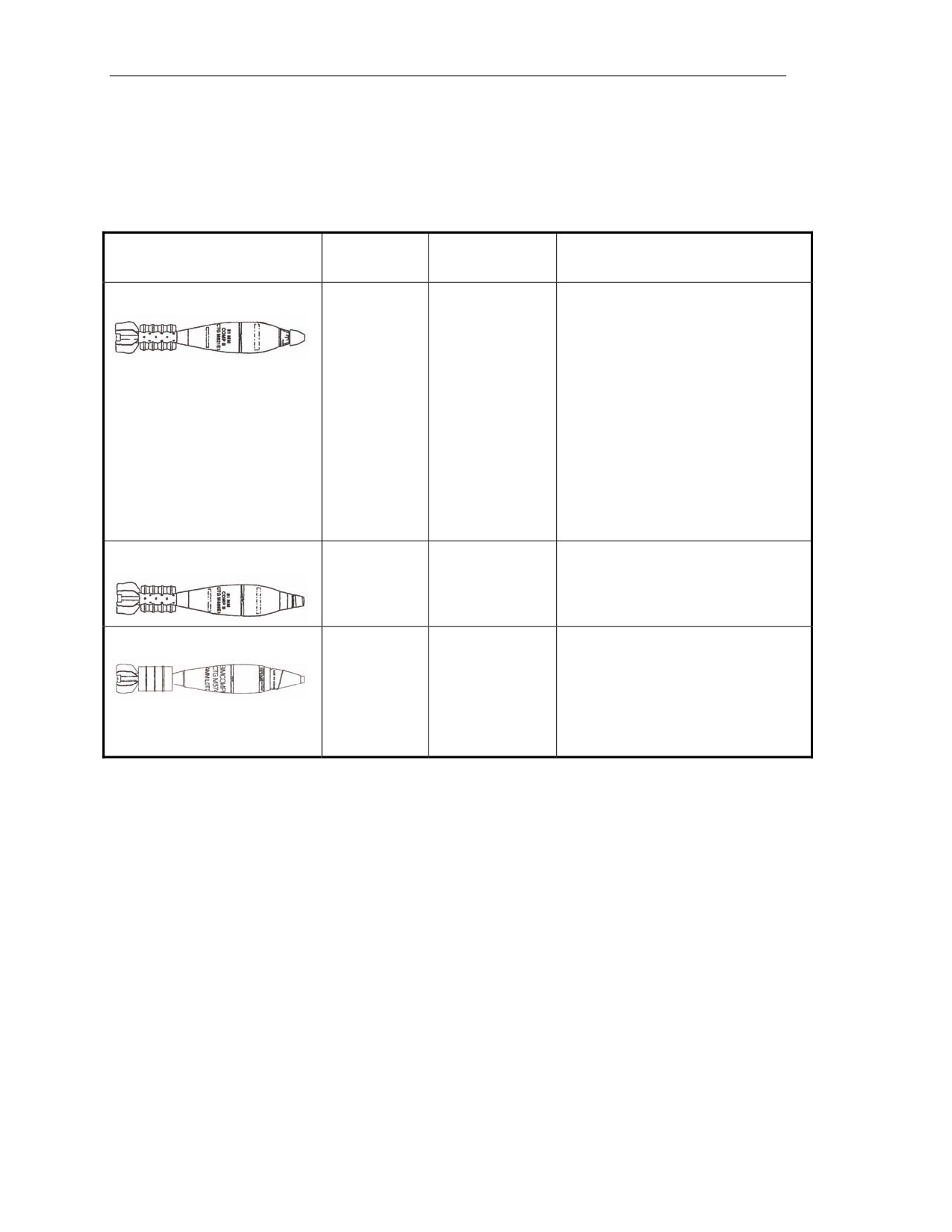
4-44. HE ammunition is used against enemy personnel and light materiel targets for both
fragmentation and blast effects. Table 4-2 details the HE ammunition that can be used when firing the
M252 mortar.
Table 4-2. High-explosive ammunition for the 81-mm mortar, M252.
CARTRIDGE/TYPE
MAXIMUM
FUZE
CHARACTERISTICS
RANGE
AND LIMITATIONS
(METERS)
M821, M821A1, and M821A2
5,608 (M821)
M734 multioption
These cartridges are constructed
HE cartridges
(M821/M821A1)
from ductile cast iron and contain
5,790
fuze
about 1.5 pounds of cyclonite
(M821A1 and
(RDX)/trinitrotoluene (TNT)
M821A2)
M734A1
composition explosive.
multioption
(M821A2) fuze
The aluminum tail assembly has six
integral fins equally spaced around
the rear, which stabilize the round in
flight.
Each cartridge weighs 9.03 pounds
and is provided with the M223
propelling charge, consisting of four
horseshoe-shaped increments fitted
around the tail.
M889 and M889A1 HE
5,540 (M889)
M935 PD fuze
These cartridges are identical to the
cartridges
M821, except that they have M935
5,850
PD fuzes. They both weigh 9.03
(M889A1)
pounds.
M374A2 and M374A3 HE
4,595
M567 PD fuze
These cartridges are constructed from
cartridge
(M374A2)
malleable cast iron and contain about
M524-series PD
2.10 pounds of composition B
4,789
fuze
explosive. The M374A2 weighs 9.12
(M374A3)
pounds, and the M374A3 weighs 9.05
M526 PD fuze
pounds.
M532 PROX fuze
4-18
FM 3-22.90
7 December 2007
81-mm Mortar, M252
Illumination Ammunition
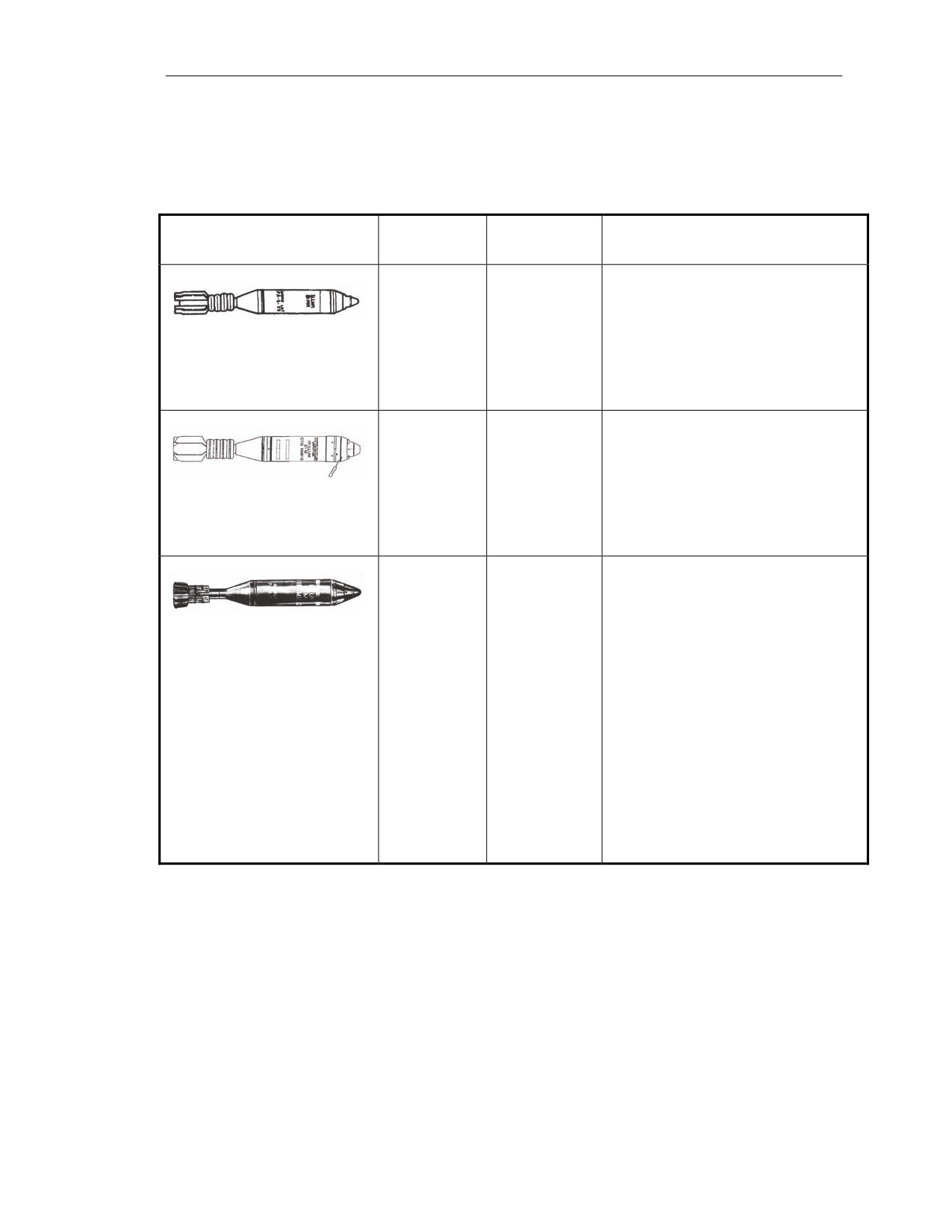
4-45. ILLUM ammunition is used during night missions requiring assistance in observation. Table 4-3
details the ILLUM ammunition that can be used when firing the M252 mortar.
Table 4-3. Illumination ammunition for the 81-mm mortar, M252.
CARTRIDGE/TYPE
MAXIMUM
FUZE
CHARACTERISTICS
RANGE
AND LIMITATIONS
(METERS)
M853A1 ILLUM cartridge
4,900
M772 MTSQ
This cartridge has a cylindrical body
fuze
that contains an illuminating candle
and parachute assembly.
It provides 600,000 candlepower
illumination for 50 to 60 seconds.
It uses the M219 propelling charge and
weighs 9.02 pounds.
M816 IR ILLUM cartridge
4,925
M772 MTSQ
This cartridge is identical to the M853
fuze
cartridge, except that it contains an
infrared illuminant mix for use with
standard night vision devices. It weighs
9.25 pounds.
It is designed to provide infrared
illumination which cannot be detected
by the human eye.
M301-series ILLUM cartridge
2,150
M84-series
This cartridge has a cylindrical body
time fuze
that contains an illuminating candle and
parachute assembly. It weighs 9.1
pounds.
The round has a burst height of 600
meters and illuminates an area of about
1,200 meters for about 60 seconds.
It uses the M185 propelling charge,
which consists of eight increments fitted
into the spaces between the fins and
held by a propellant holder. The
increments are individually wrapped
with waterproof bags that are not to be
removed.
The cartridge must not be fired below
charge 3.
7 December 2007
FM 3-22.90
4-19
Chapter 4
Smoke, White Phosphorus and Red Phosphorus Ammunition
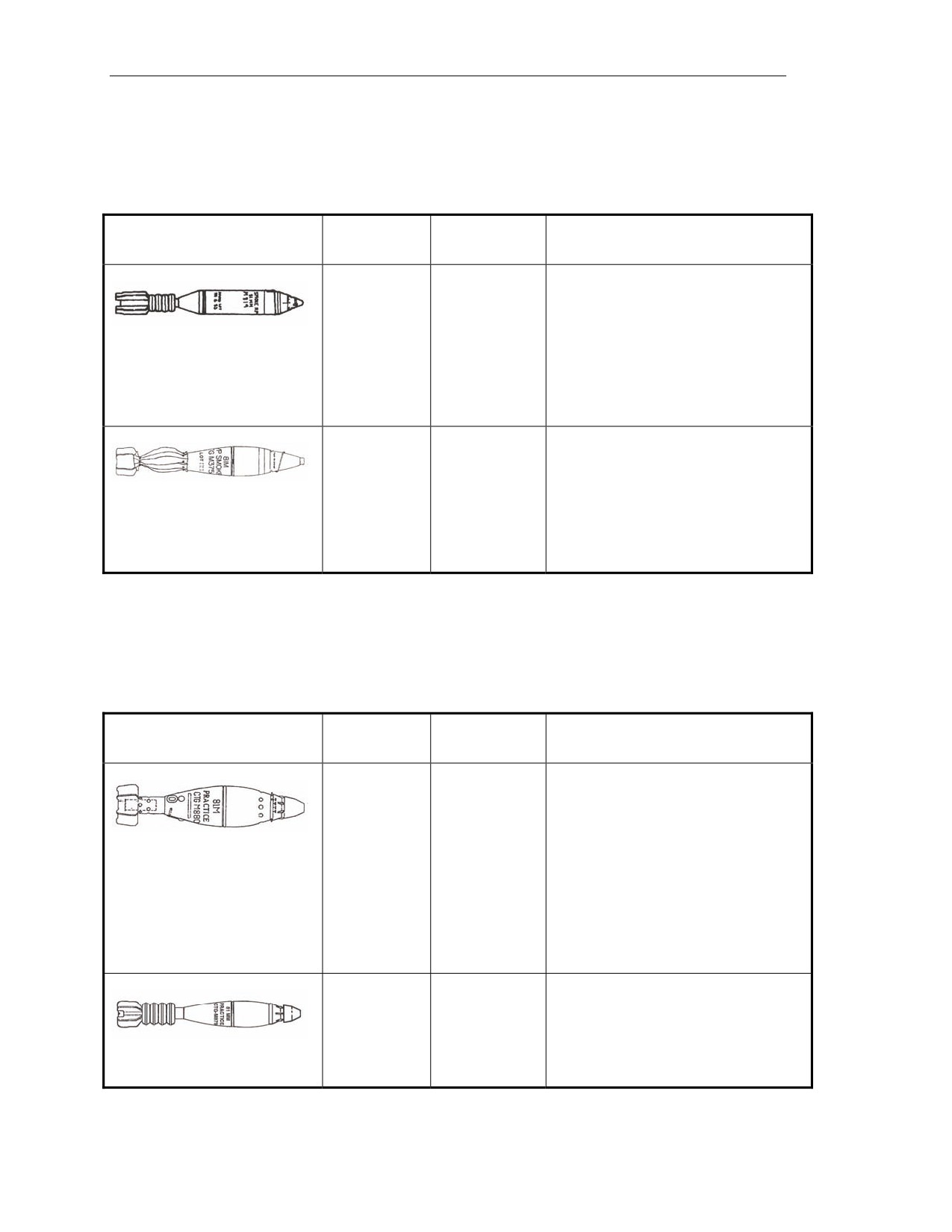
4-46. Smoke, WP and RP ammunition is used as a screening, signaling, or incendiary agent. Table 4-4
details the smoke WP and RP ammunition that can be used when firing the M252 mortar.
Table 4-4. Smoke, white phosphorus ammunition for the 81-mm mortar, M252.
CARTRIDGE/TYPE
MAXIMUM
FUZE
CHARACTERISTICS
RANGE
AND LIMITATIONS
(METERS)
M819 smoke RP cartridge
4,950
M772 PD
This cartridge has a cylindrical body
MTSQ fuze
and contains red phosphorus that
produces smoke on contact with air.
The cartridge uses the M218 propelling
charge, which consists of four
horseshoe-shaped increments fitted
around the tail.
It weighs 10.37 pounds.
M375A2 smoke WP cartridge
4,595
M524-series
The white phosphorus inside this
PD fuze
cartridge produces white smoke on
contact with air.
The cartridge uses the M205 propelling
charge and weighs 9.12 pounds.
This round must be stored in a vertical
position.
Training Practice Ammunition
4-47. TP ammunition is used for training when service ammunition is not available or there are
restrictions on the use of service ammunition for training. Table 4-5 details the TP ammunition that can
be used when firing the M252 mortar.
Table 4-5. Training practice ammunition for the 81-mm mortar, M252.
CARTRIDGE/TYPE
MAXIMUM
FUZE
CHARACTERISTICS
RANGE
AND LIMITATIONS
(METERS)
M880 SRTC
458
M775 PD
This short-range practice cartridge can
practice fuze
be used with the M252 or the 120-mm
mortar (when used with an M303 or
M313 81-mm mortar insert). It weighs
6.8 pounds.
It is used on a 1 to 10 scale range.
The cartridge’s range can be reduced
by removing plastic plugs from the
projectile body.
It can be refurbished and reused.
M879 FRTC
5,600
M751 PD
This cartridge is matched ballistically to
practice fuze
M821A1/889A1 HE cartridges. It weighs
8.98 pounds.
The M751 practice fuze operates like
the M734 multioption fuze. On impact, it
produces a flash, a bang, and smoke.
4-20
FM 3-22.90
7 December 2007
81-mm Mortar, M252
FUZES
4-48. The types of fuzes described in this paragraph are PD, PROX, MT, multioption, and dummy.
POINT-DETONATING FUZES
4-49. All PD fuzes are SQ and, therefore, detonate on impact.
Fuze, M935
4-50. The M935 fuze has two function settings: IMP and a 0.05-second DLY. It is set using the bladed
end of the M18 fuze wrench. The M935 is fitted with a standard pull wire and safety pin that are
removed immediately before firing.
Fuze, M524-Series
4-51. The M524-series fuze has two function settings: SQ and DLY. When set at DLY, the fuze train
causes a 0.05-second delay before functioning. When set at SQ, the fuze functions on point impact or
graze contact. The fuze contains a delayed arming feature that ensures it remains unarmed and
detonator safe for a minimum of 1.25 seconds and a maximum of 2.50 seconds of flight. To prepare for
firing, the slot is aligned in the striker with SQ or DLY using the M18 fuze wrench. The safety pull
wire is removed just before inserting the cartridge into the mortar.
NOTE: If, upon removal of the safety wire, a buzzing sound in the fuze is heard, the
round should not be used. The round is still safe to handle and transport if the
safety wire is reinserted.
WARNING
If the plunger safety pin (upper pin) cannot be reinserted, the
fuze may be armed. An armed fuze must not be fired since it
will be premature. It should be handled with extreme care and
EOD personnel notified immediately. If it is necessary to
handle a round with a suspected armed fuze, personnel must
hold the round vertically with the fuze striker assembly up.
Fuze, M526-Series
4-52. The M526-series fuze has an SQ function only. It is fitted with a safety wire and pin that are
removed immediately before firing.
Fuze, M567
4-53. The M567 is a selective SQ or 0.05-second delay impact fuze. It comes preset to function as SQ,
and the selector slot should align with the "SQ" mark on the ogive. To set for delay, the selector slot
should be rotated clockwise until it is aligned with the “D” mark on the ogive. An M18 fuze wrench is
used to change settings. The fuze has a safety wire that must be removed before firing.
7 December 2007
FM 3-22.90
4-21
Chapter 4
PROXIMITY FUZES
4-54. A PROX fuze is an electronic device that detonates a projectile by means of radio waves sent out
from a small radio set in the nose of the projectile. The M532 fuze is a radio Doppler fuze that has a
PROX or SQ function. An internal clock mechanism provides nine seconds of safe air travel (610 to
2,340 meters along trajectory for charge 0 through 9, respectively). Once set to act as an IMP fuze, the
mechanism cannot be reset for PROX. The fuze arms and functions normally when fired at any angle
of elevation between 0800 and 1406 mils at charges 1 through 9. The fuze is not intended to function at
charge 0. However, at temperatures above 32 degrees Fahrenheit and at angles greater than 1068 mils,
the flight time is sufficient to permit arming. To convert the fuze from PROX to SQ, the top of the fuze
must be rotated 120 degrees (one-third turn) in either direction. This action breaks an internal sheet pin
and internal wire, thereby disabling the proximity function.
Disposal Precautions
4-55. PROX-fuzed short cartridges that are duds contain a complete explosive train and impact
element. They should not be approached for 5 minutes or disturbed for at least 30 minutes after
misfiring. After 30 minutes, the dud is still dangerous but can be approached and removed carefully or
destroyed in place by qualified disposal personnel. If the situation allows for a longer waiting period,
the dud can be considered safe for handling after 40 hours.
Burst Height
4-56. The principal factors affecting height of burst are the angle of approach to the target and the
reflectivity of the target terrain. The air burst over average types of soil ranges from 1 to 6 meters,
depending on the angle of approach. High angles of approach (near vertical) give the lowest burst
heights. Light tree foliage and light vegetation affect the height of burst only slightly, but dense tree
foliage and dense vegetation increase the height of burst. Target terrain such as ice and dry sand gives
the lowest burst heights, whereas water and wet ground give the highest burst heights.
Crest Clearance
4-57. Close approach to crests, trees, towers, large buildings, parked aircraft, mechanized equipment,
and similar irregularities causes functioning at heights greater than average level. When targets are
beyond such irregularities, a clearance of at least 30 meters should be allowed to ensure maximum
effect over the target area.
Climatic Effects
4-58. The fuzes may be used for day or night operations. They function normally in light rain;
however, heavy rain, sleet, or snow can cause an increase in the number of early bursts. At extreme
temperatures (below -40 degrees Fahrenheit and above 125 degrees Fahrenheit), it is not unusual to
experience an increase in malfunctions proportionate to the severity of conditions.
Care, Handling, and Preservation
4-59. PROX fuzes withstand normal handling without danger of detonation or damage when in their
original packing containers or when assembled to projectiles in their packing containers.
WARNING
The explosive elements in primers and fuzes are sensitive to
shock and high temperatures. Boxes containing ammunition
should not be dropped, thrown, tumbled, or dragged.
4-22
FM 3-22.90
7 December 2007
81-mm Mortar, M252
Installation
4-60. The fuze should already be fitted to the cartridge. If not, the cartridge is placed on its side, and
the closing plug is removed using an M18 fuze wrench. (The handle of the wrench is turned
counterclockwise.) The fuze threads and fuze well threads are inspected for damage. The fuze is
screwed into the cartridge body, and it is seated and secured using an M18 wrench. No visible gap
should be between the fuze and cartridge body.
WARNING
Do not use the fuze if the thread(s) is damaged. Do not use
the cartridge if the fuze well is damaged or if the explosive is
visible on the thread.
MECHANICAL TIME FUZES
4-61. These fuzes use a clockwork mechanism to delay functioning for a specific time.
Fuze, M772A1
4-62. The M772A1 fuze is an MTSQ. It can be set from 3 to 55 seconds at half-second intervals. The
settings are obtained from the range tables and are applied using a wrench (number 9239539) or a 1
3/4-turn open-end wrench. The safety wire must be removed before firing.
Fuze, M84
4-63. The M84 fuze is a single-purpose, powder-train, MT fuze used with the 81-mm M301A1 and
M301A2 illuminating cartridges. It has a time setting of up to 25 seconds. The fuze consists of a brass
head, body assembly, and expelling charge. The fuze body is graduated from 0 to 25 seconds in 1
second intervals; 5-second intervals are indicated by bosses. The 0-second boss is wider and differs in
shape from the other body bosses; the safe setting position is indicated by the letter “S” on the fuze
body. The adjustment ring has six raised ribs for use in conjunction with fuze setter, M25, and a setting
indicator rib (marked SET) about half the height and width of the other six ribs. Safety before firing is
provided by a safety wire, which must be removed just before firing.
Fuze, M84A1
4-64. The M84A1 fuze is a single-purpose, tungsten-ring, MT fuze used with the 81-mm M301A3
ILLUM cartridge. It has a time setting of up to 50 seconds. All other features are the same as the M84
fuze.
MULTIOPTION FUZES
4-65. The M734 and M734A1 are the only multioption fuzes used with the 81-mm mortar.
Fuze, M734
4-66. This fuze has four function settings:
PRX causes the cartridge to explode between 3 and 13 feet above the ground.
NSB causes the cartridge to explode up to 3 feet above the ground.
IMP causes the cartridge to explode on contact.
DLY incorporates a 0.05-second delay in the fuze train before exploding the cartridge.
7 December 2007
FM 3-22.90
4-23
Chapter 4
4-67. No tools are needed to set the fuze, and the setting can be changed several times without
damaging the fuze. It has no safety pins or wires, which reduces preparation time. If the fuze does not
function as set, it automatically functions at the next lower setting.
Fuze, M734A1
4-68. The air-powered M734A1 multioption fuze has four selectable functions:
PRX 120.
PRX 60/81.
IMP.
DLY.
4-69. In HE PROX mode, the HOB remains constant over all types of targets. The impact mode causes
the round to function on contact with the target and is the first backup function for either PROX
setting. In the DLY mode, the fuze functions about 30 to 200 milliseconds after target contact. The
DLY mode is the backup for the IMP and PRX modes. The IMP and DLY modes have not changed
from the current M734 multioption fuze.
4-70. Radio frequency jamming can affect the functioning of PROX fuzes. Radio frequency jamming
initiates a gradual desensitizing of the fuze electronics to prevent premature fuze function. Once the
fuze is out of jamming range, the fuze electronics recover and function in the PROX mode if the
designed HOB has not been passed. To limit the time of fuze radio frequency radiation, the proximity
turn-on is controlled by an apex sensor that does not allow initiation of the fuze proximity electronics
until after the apex of the ballistic trajectory has been passed.
4-71. In compliance with the safety requirements of military standard 1316C, the M734A1 uses ram
air and setback to provide two independent environment sensors.
DUMMY FUZES
4-72. The M751 and the M775 are used with the 81-mm mortar. There are two types of M751 fuzes:
Type 1 resembles the M734 fuze.
Type 2 resembles the M935 fuze.
4-73. The M751 is fitted with a smoke charge that operates on impact. The safety/packing clip should
be removed when the cartridge is unpacked.
FUZE WRENCH
4-74. The fuze wrench, M18, assembles the fuze to the cartridge, and the bladed tip on the end sets
PD-type fuzes. The fuze setting wrench (NSN: 5120 00 203 4801) sets M772 MT and M768 time
fuzes. It engages the 1 3/4-inch flats on the setting ring or the fuze head. The fuze setter, M25, sets
M84-series time fuzes. Notches in the setter engage ribs in the setting ring of the fuze.
CARTRIDGE PREPARATION
4-75. The propellant train
(except the training cartridge) consists of an ignition cartridge and
propellant charges. The ignition cartridge has a percussion primer and is assembled to the end of the
fin assembly. The propelling charge is contained in four horseshoe-shaped, felt-fiber containers or nine
wax-tested, cotton cloth, bag increments. The propelling charges are assembled around the fin
assembly shaft.
4-76. Cartridges are shipped with a complete propelling charge, an ignition cartridge, and a primer.
Firing tables are used to determine the correct charge for firing. Remaining increments are repositioned
toward the rear of the tail fin assembly when firing the cartridge with horseshoe-shaped increments at
less than full charge.
4-24
FM 3-22.90
7 December 2007
81-mm Mortar, M252
NOTE: Charge 0—Ignition cartridge only.
Charge 1—Ignition cartridge and one increment.
Charge 2—Ignition cartridge and two increments.
Charge 9—Ignition cartridge and nine increments.
4-77. Increments removed from cartridges before firing should be placed in a metal or wooden
container located at least 25 meters away from the firing vehicle or position. Excess increments should
not accumulate near the mortar positions but are removed to a designated place of burning and
destroyed. Units should follow specific range SOPs to dispose of unused increments. The following is
one way to dispose of them.
(1) Select a place at least 100 meters from the mortar position, parked vehicles, and ammunition
points.
(2) Clear all dead grass or brush within 30 meters around the burning place. Do not burn
increments in piles—spread them in a train 1 to 2 inches deep, 4 to 6 inches wide, and as
long as necessary.
(3) From this train, extend a starting train that will burn against the wind of single increments
laid end to end. End this starting train with not less than 1 meter of inert material (dry grass,
leaves, or newspapers).
(4) Ignite the inert material.
(5) Do not leave unused increments unburned in combat operational areas. The enemy will use
them.
CARE AND HANDLING
4-78. Ammunition is made and packed to withstand all conditions ordinarily encountered in the field.
However, since explosives are affected by moisture and high temperature, they must be protected.
4-79. Before-firing checks include the following:
Ammunition should be free of moisture, rust, and dirt.
The fin and fuze assembly must be checked for tightness and damage.
Charges must be kept dry.
Extra increments are removed if the cartridge is to be fired with less than full charge.
With the exception of a few unused increments (within the same ammunition lot number) as
replacements for defective increments, excess powder should be removed from the mortar
position.
The primer cartridge is checked for damage or dampness.
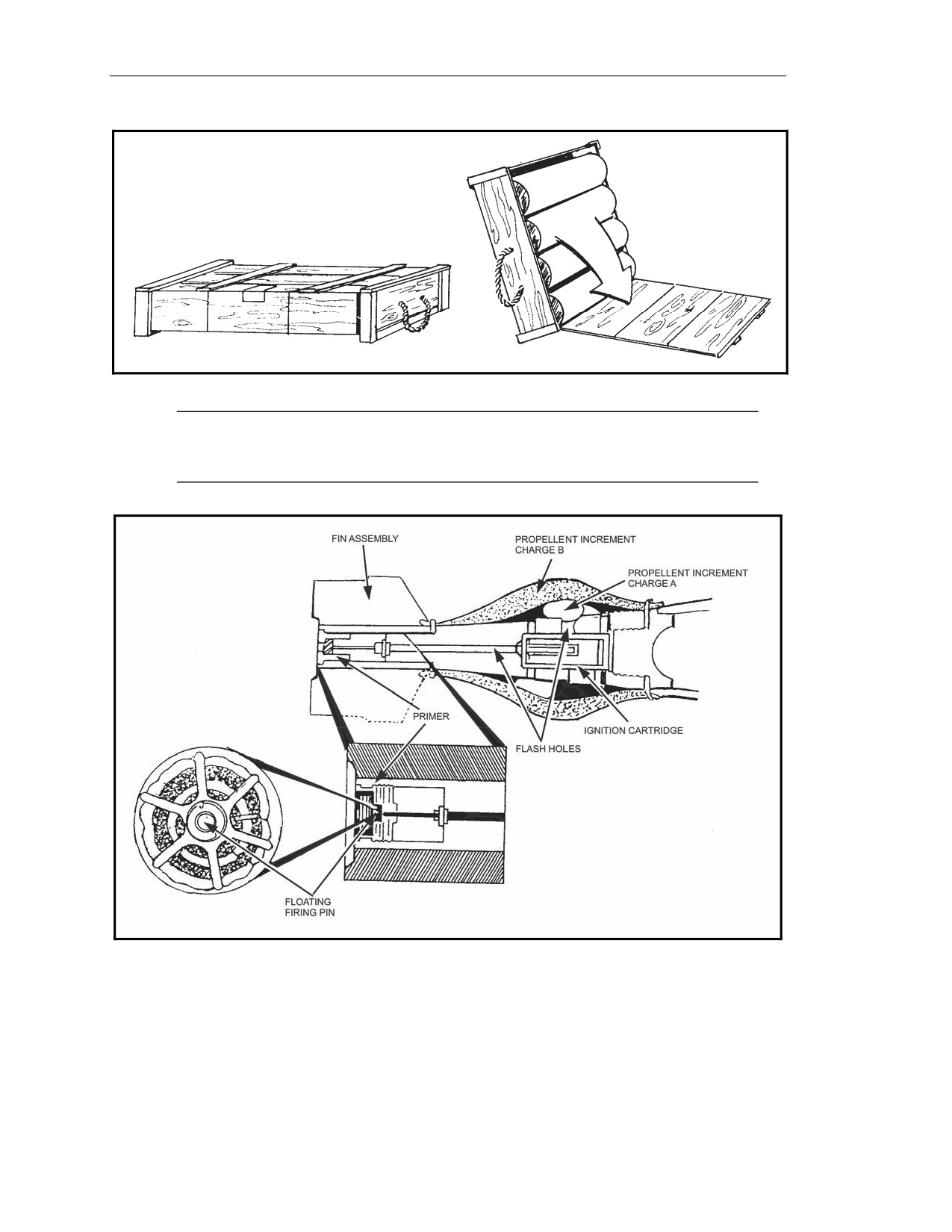
When opening an ammunition box, the ammunition bearer ensures the box is horizontal to
the ground, not nose- or fin-end up. After the bands are broken and the box opened, the
rounds should be removed by allowing them to roll out along the lid of the box (Figure 4
12). After the rounds have been removed, they should always be handled with two hands to
prevent accidental dropping. Dropping may cause the propellant charges to ignite, causing
bodily injuries.
WARNING
Incidents occurring from mishandling 300-series ammunition
have resulted in minor burns to the hands and legs.
7 December 2007
FM 3-22.90
4-25
Chapter 4
Figure 4-12. Correct way to open an ammunition box.
NOTE: The floating firing pin within the primer has approximately 1/16 of an inch to
move around. This may cause the firing pin to ignite the charges if the cartridge
is dropped on the fin end (Figure 4-13).
Figure 4-13. Floating firing pin.
To help minimize the occurrence of short rounds and duds, unpackaged ammunition that has
been dropped should not be fired. It should be destroyed in accordance with standard
procedures.
4-80. Complete cartridges are always handled with care. The explosive elements in primers and fuzes
are sensitive to shock and high temperature.
4-26
FM 3-22.90
7 December 2007
81-mm Mortar, M252
4-81. The moisture-resistant seal of the container is broken when the ammunition is to be used. When
a large number of cartridges are needed for a mission, they may be removed from the containers and
prepared. Propelling charges are covered or protected from dampness or heat.
4-82. The ammunition is protected from mud, sand, dirt, and water. If it gets wet or dirty, it must be
wiped off at once. The powder increments should not be exposed to direct sunlight. Keeping
ammunition at the same temperature results in a more uniform firing.
4-83. The pull wire and safety wire are removed from the fuze just before firing. When cartridges have
been prepared for firing, but are not used, all powder increments and safety wires are replaced. The
cartridges are returned to their original containers. These cartridges are used first in subsequent firing
so that once-opened stocks can be kept to a minimum.
WARNING
Do not handle duds; the fuzes could be armed. Duds are
extremely dangerous. Do not move or turn them. To dispose
of duds, immediately call the nearest EOD unit.
4-84. Ammunition should be stored under cover. If it is necessary to leave the ammunition uncovered,
it should be raised on dunnage at least 6 inches above the ground. The pile is covered with a double
thickness of tarpaulin. Trenches are dug to prevent water from flowing under the pile. Phosphorus
liquefies at 111.4 degrees Fahrenheit; therefore, WP cartridges are stored with the fuze end up to
protect against uneven rehardening of the filler. Otherwise, an air cavity can form on one side of a
cartridge when the filler rehardens and cause instability in flight. RP cartridges (M252 only) are stored
the same as HE cartridges.
WARNING
When firing HE ammunition less than 400 meters, personnel
must have adequate cover for protection from fragments.
7 December 2007
FM 3-22.90
4-27
This page intentionally left blank.
Chapter 5
120-mm Mortars, M120 and M121
The 120-mm mortar provides close-in and continuous indirect fire support to
maneuver forces. The 120-mm mortar also provides increased range and lethality
over 81-mm and 60-mm mortars, but the mortar and ammunition are heavier.
There are three versions of the 120-mm mortar: the towed M120, the vehicle-
mounted M121, and the Stryker-mounted RMS6-L recoilless mortar. This chapter
discusses the organization, capabilities, and operations of the M120 and M121,
120-mm mortars. TM 9-2320-311-10-12 covers the RMS6-L in detail.
SECTION I. SQUAD ORGANIZATION AND DUTIES
A mortar squad maintains and fires a single 120-mm mortar, and each member has principal duties and
responsibilities.
ORGANIZATION
5-1. For the mortar section to operate effectively, each squad member must be proficient in his
individual duties. By performing those duties as a team member, he enables the mortar squad and
section to perform as a fighting team. The squad, section, and platoon leaders trains and leads their
units.
DUTIES
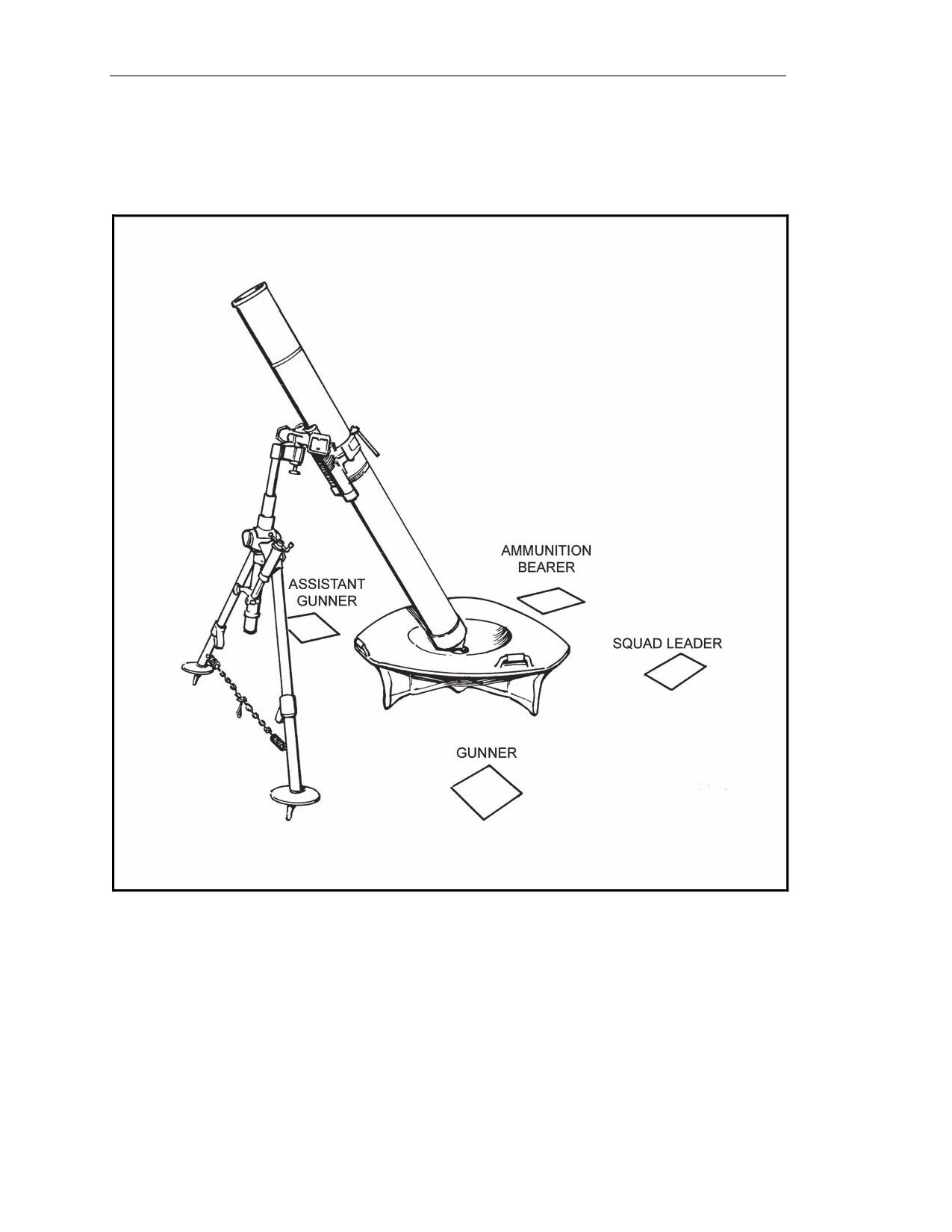
5-2. The mortar squad for the M120 and M121 consists of four men (Figure 5-1):
Squad leader.
Gunner.
Assistant gunner.
Ammunition bearer.
5-3. The following sections address their principal duties.
SQUAD LEADER
5-4. The squad leader stands behind the mortar where he can command and control his squad. He
supervises the emplacement, laying, and firing of the mortar, and all other squad activities.
GUNNER
5-5. The gunner stands to the left side of the mortar where he can manipulate the sight, elevating
handwheel, and traversing handwheel. He places firing data on the sight and lays the mortar for
deflection and elevation. He makes large deflection shifts by shifting the bipod assembly and keeps the
bubbles level during firing.
ASSISTANT GUNNER
5-6. The assistant gunner stands to the right of the mortar, facing the cannon and ready to load. In
addition to loading, he swabs the bore after every 10 rounds or after each fire mission. He assists the
gunner in shifting the mortar when the gunner is making large deflection changes.
7 December 2007
FM 3-22.90
5-1
Chapter 5
AMMUNITION BEARER
5-7. The ammunition bearer stands to the right rear of the mortar. He maintains and prepares the
ammunition for firing, and passes prepared ammunition to the assistant gunner. He also acts as the
squad driver.
Figure 5-1. Position of squad members.
5-2
FM 3-22.90
7 December 2007
120-mm Mortars, M120 and M121
SECTION II. COMPONENTS
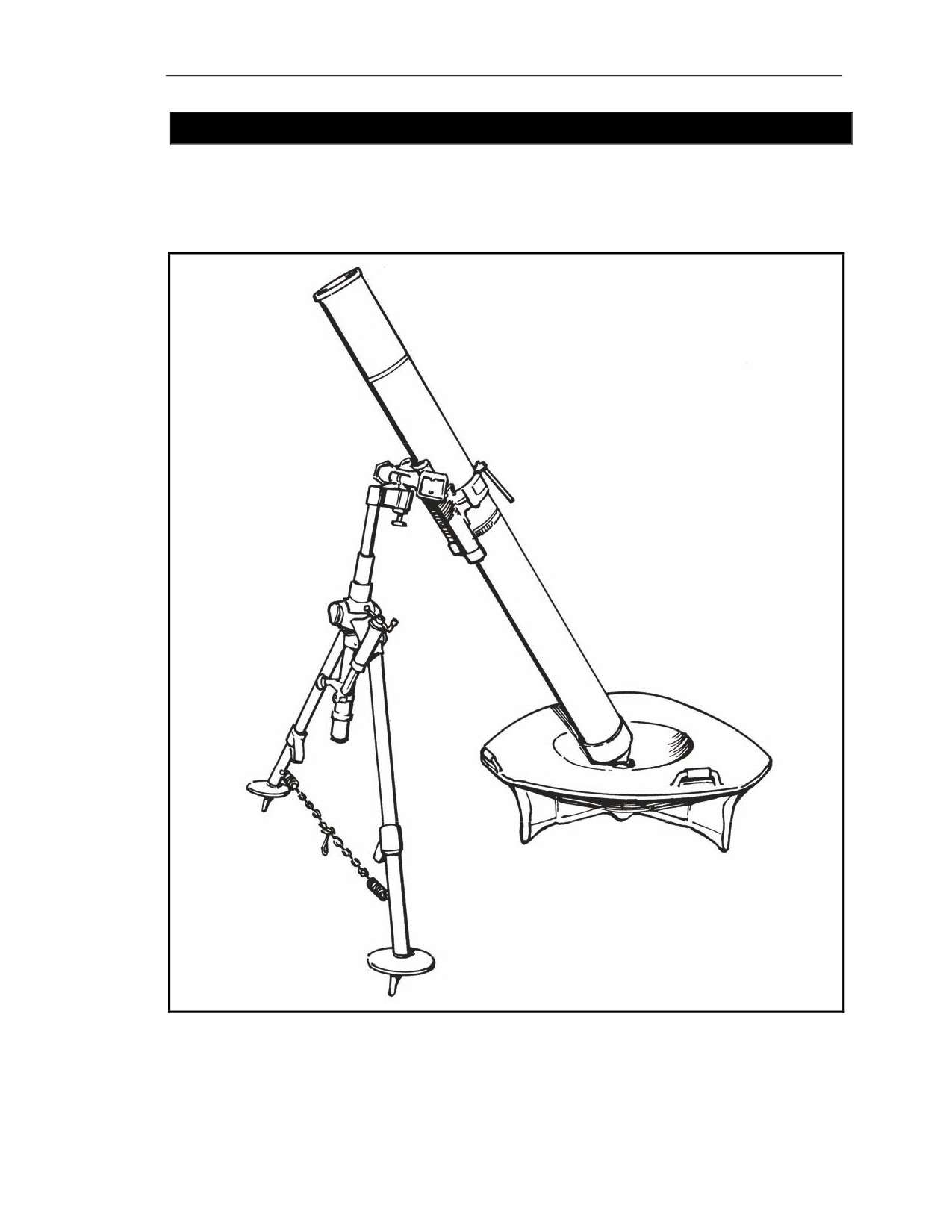
This section contains the technical data and description of each component of the 120-mm mortar (Figure
5-2). The mortar is a smooth-bore, muzzle-loaded, crew-served, high angle-of-fire weapon. It consists of a
cannon assembly, bipod assembly, and baseplate. The 120-mm mortar is designed to be employed in all
phases and types of land warfare, and in all weather conditions. (See TM 9-1015-250-10 for detailed
information.)
Figure 5-2. 120-mm mortar.
7 December 2007
FM 3-22.90
5-3

Chapter 5
TABULATED DATA FOR THE 120-mm MORTAR
5-8.
The tabulated data for the 120-mm mortar are as shown in Table 5-1.
Table 5-1. Tabulated data for the 120-mm mortar.
Weights (pounds)
M298 cannon
110.0
Bipod
M190 (ground-mounted)
70.0
M191 (ground-/carrier-mounted)
68.0
M9 baseplate
136.0
M67 sightunit
2.9
M1100 trailer
399.0
Elevation (approximate mils)
Ground-mounted
0710 to 1510
Carrier-mounted
0750 to 1510
For each turn of elevation crank
5
Traverse (approximate mils)
Right or left from center using
traversing wheel
136
With extension
316
One turn of traversing wheel
5
Range (meters)
Maximum
7,200
Minimum
200
Rate of Fire (rounds per minute)
Maximum
16 (first minute)
Sustained
4 (indefinitely)
Bursting radius (meters)
70
CANNON ASSEMBLY, M298
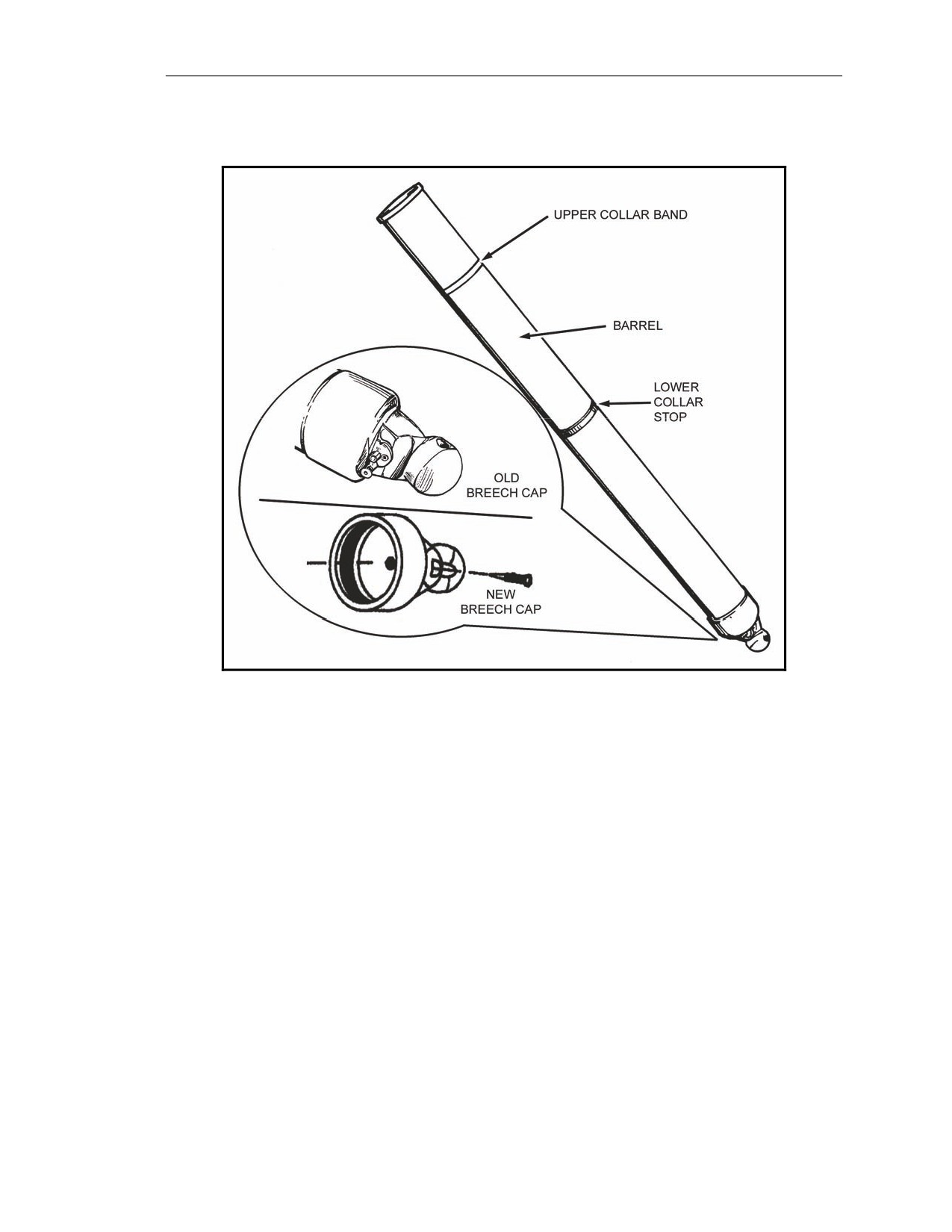
5-9. The cannon assembly consists of two parts: the tube and the breech cap (Figure 5-3). The bottom
end of the tube is threaded to form a seat, which functions as a gas seal and centers the breech cap.
5-10. The breech cap screws into the base end of the tube with the front end of the breech cap mating
to the seat on the tube, forming a gas-tight metal seal. The external rear portion of the breech cap is
tapered and has a ball-shaped end. This end is cross-bored to help the user insert or remove the breech
cap and lock it into firing position.
5-11. The breech cap houses the firing pin, which can be removed during misfire procedures as a
safety measure. The squad leader must physically possess the firing pin before the mortar is considered
safe.
NOTES:
1. The cannon and breech cap are serial-numbered identically. They should
not be interchanged.
2. Currently, two styles of breech cap are fielded with M120 and M121 mortar
systems. The old style of breech cap uses a safety mechanism to place the
weapon in SAFE or FIRE mode. This breech cap must be replaced with the
new style of breech cap, which uses a removable firing pin. The following
paragraph covers procedures for operating the old style of breech cap.
5-4
FM 3-22.90
7 December 2007
120-mm Mortars, M120 and M121
5-12. The old style of breech cap utilizes a safety mechanism that has two positions: “F” for FIRE
(firing pin protrudes) and “S” for SAFE (firing pin is withdrawn).
Figure 5-3. Cannon, M298, with old and new styles of breech cap.
7 December 2007
FM 3-22.90
5-5
Chapter 5
BIPOD ASSEMBLY, M191 (CARRIER-/GROUND-MOUNTED)
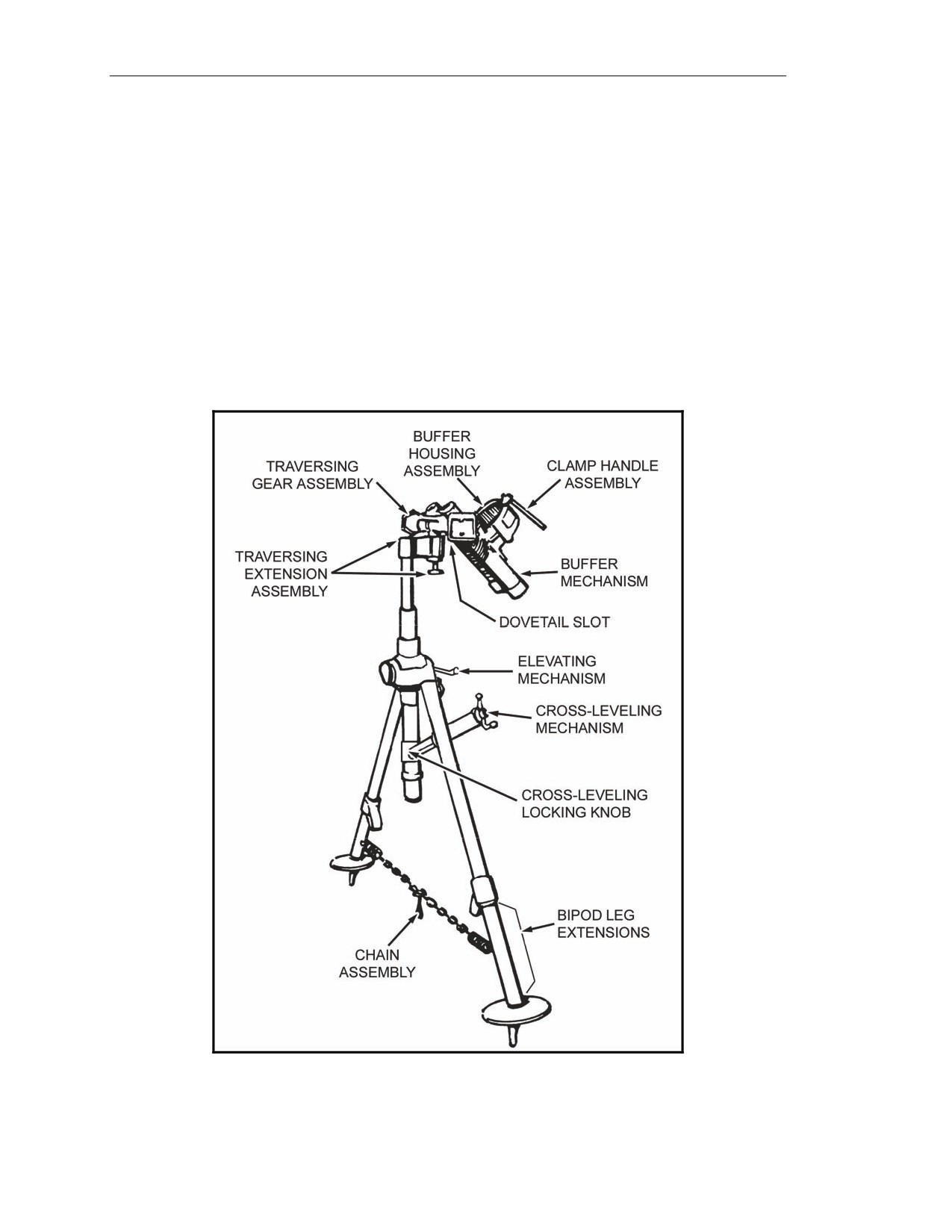
5-13. The bipod assembly, M191, for the carrier-mounted M121 mortar (Figure 5-4) consists of the
following main parts:
Bipod leg extensions.
Cross-leveling mechanism.
Traversing gear assembly.
Traversing extension assembly.
Elevating mechanism.
Buffer housing assembly.
Buffer mechanism.
Clamp handle assembly.
Cross-leveling locking knob.
Chain assembly.
Figure 5-4. Bipod assembly, M191 (carrier-/ground-mounted).
5-6
FM 3-22.90
7 December 2007
120-mm Mortars, M120 and M121
BIPOD ASSEMBLY, M190 (GROUND-MOUNTED)
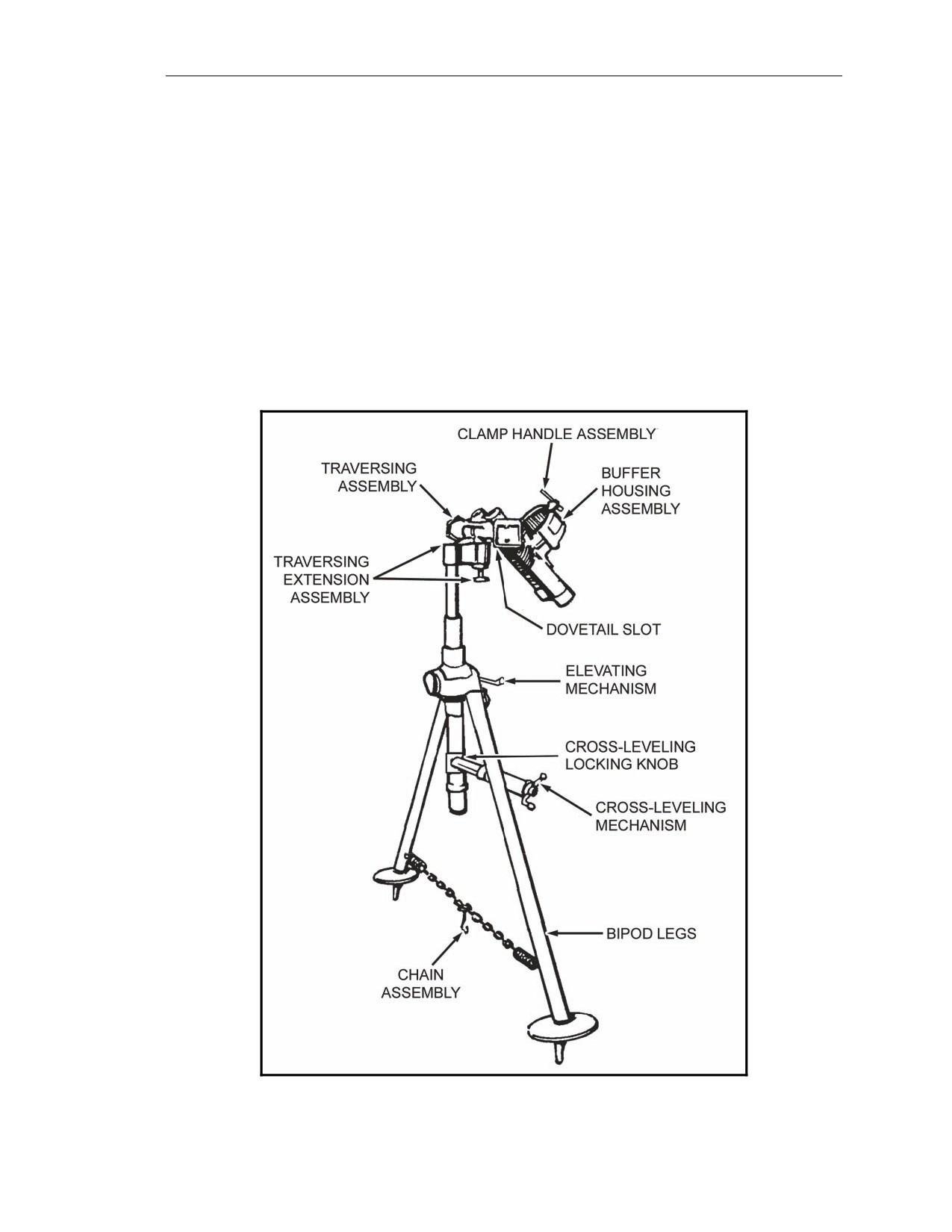
5-14. The bipod assembly, M190, for the ground-mounted M120 mortar (Figure 5-5) consists of the
following main parts:
Clamp handle assembly.
Buffer housing assembly.
Dovetail slot.
Elevating mechanism.
Cross-leveling locking knob.
Cross-leveling mechanism.
Chain assembly.
Traversing extension assembly.
Traversing gear assembly.
Bipod legs.
Figure 5-5. Bipod assembly, M190 (ground-mounted).
7 December 2007
FM 3-22.90
5-7
Chapter 5
BASEPLATE, M9
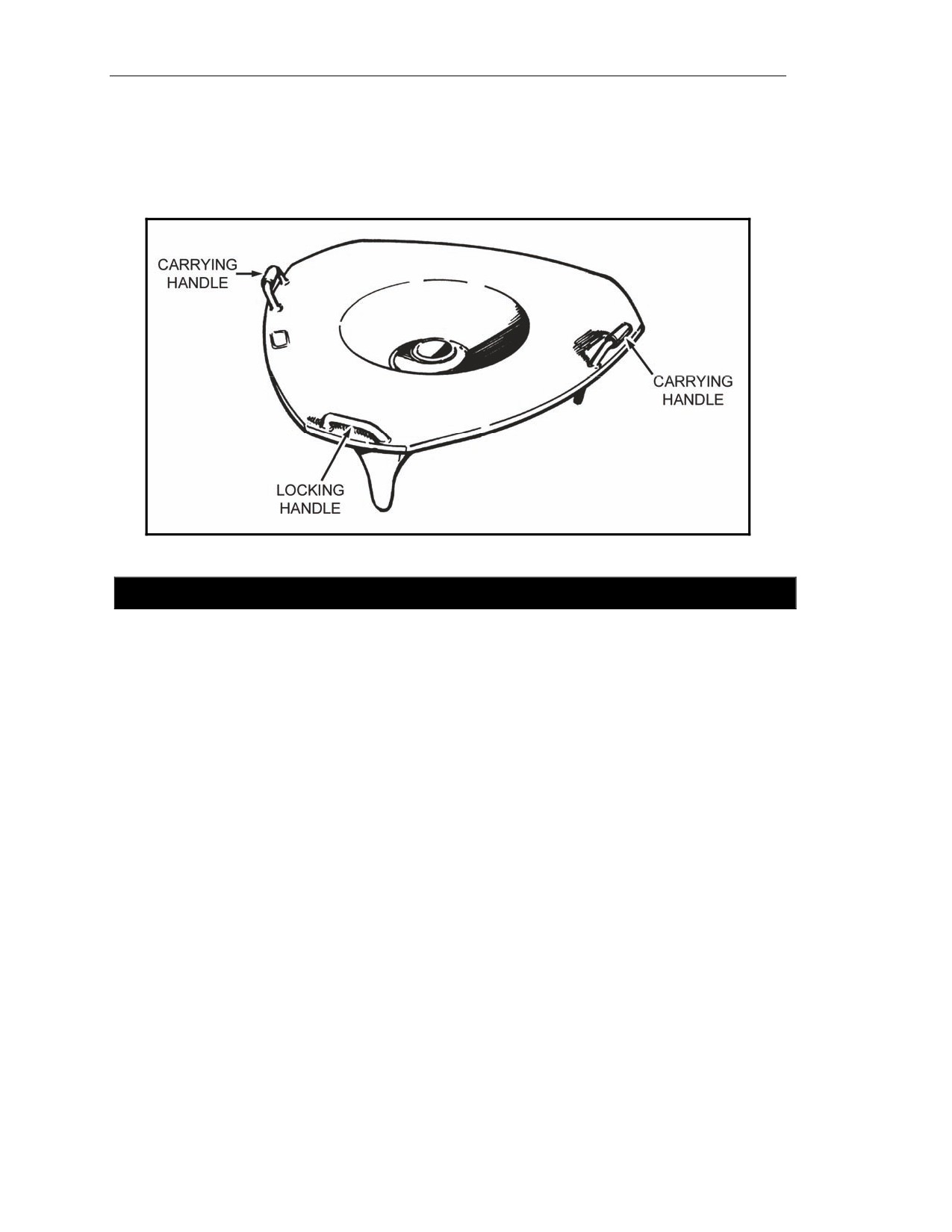
5-15. The baseplate (Figure 5-6) is shaped like a rounded triangle. It has a socket that enables a full
360-degree traverse without moving the baseplate. It also has legs (spades) under the baseplate, two
carrying handles, and one locking handle.
Figure 5-6. Baseplate, M9.
SECTION III. OPERATIONS
This section explains how to place the mortar into action by ground-mounting the weapon system from the
trailer position; how to conduct safety checks; and how to perform misfire procedures.
PREMOUNT CHECKS
5-16. Before the mortar is mounted, the squad performs premount checks.
MORTAR CANNON
5-17. Check—
The BAD for cracks, rust, and missing parts.
The cannon for cracks, rust, and missing, dented, or damaged parts.
The breech assembly to ensure that it is tight.
The white line on the breech cap to ensure that it aligns with the white line on the cannon
when fully assembled.
Around the firing pin or breech cap for evidence of gas leakage.
The serial numbers on the barrel and breech cap to ensure that they match.
The breech assembly for bulges, dents, or visible cracks.
5-18. If the mortar cannon is equipped with the old style of breech cap, check—
The safety mechanism to ensure that it aligns with the white line on the cannon when fully
assembled.
The safety mechanism to ensure that it locks (under spring tension) into the FIRE and SAFE
detents.
Around the safety mechanism for evidence of gas leakage.
5-8
FM 3-22.90
7 December 2007
120-mm Mortars, M120 and M121
WARNING
For M298 mortar cannons equipped with the old style of
breech cap:
Incorrect assembly of the safety mechanism can cause the
firing pin to be exposed when in the SAFE position (“S”
showing) and retracted when in the FIRE position (“F”
showing). This will cause a misfire and may cause the user to
unknowingly expose the firing pin during misfire procedures.
Perform the following steps to check the safety mechanism
for proper operation:
1. Unscrew the breech cap from the barrel.
2. With the safety mechanism in the FIRE position
(“F” showing, the firing pin should be extended), check the
firing pin protrusion height with the firing pin gauge. Do
not use the cannon if the firing pin is defective.
3. Check the retraction of the firing pin with the safety
mechanism in the SAFE position (“S” showing, the firing
pin should be recessed).
4. If the safety mechanism functions properly, keep the
weapon on SAFE and reassemble the cannon. Ensure that
the white stripe on the cannon lines up with the safety
mechanism.
5. If the safety mechanism does not function properly,
disassemble it. If serviceable, reassemble the breech cap
and lubricate, as required.
For more detailed information, refer to TM 9-1015 250-10.)
BIPOD ASSEMBLY
5-19. Check—
The bipod assembly for cracks, broken welds, or loose, missing, or damaged parts.
To ensure the buffer housing assembly operates properly and securely holds the cannon.
To ensure the traversing gear assembly, elevating mechanism, and cross-leveling
mechanism operate smoothly and without binding through their entire range of travel.
The buffer mechanism by pulling down on both housing tubes at the same time and ensuring
that they return to their original position when released.
MORTAR BASEPLATE
5-20. Check—
The socket for broken edges, cracks, and corrosion.
The baseplate for cracks and broken welds.
7 December 2007
FM 3-22.90
5-9
Chapter 5
SIGHTUNIT, M67
5-21. Check—
Sources lit by tritium for proper illumination.
The eyeshield for damage.
Lenses for scratches, smears, moisture, cracks, and other obstructions.
The reticle for clarity.
Level vials to ensure that they are not cracked, broken, or loose in their mountings.
Level vial covers to ensure that they are present.
Elevation and deflection knobs to ensure that they move freely over their entire range of
movement.
All scales and index lines to ensure that they are clear and distinct.
Elevation and deflection knobs for movement after locking knobs are tightened. They
should move no more than ± one mil.
The coarse deflection scale and azimuth control dial to ensure that they rotate freely when
depressed and return to their original position under spring tension when released.
The mortar sight latch to ensure that it secures the sight to the mortar, is not loose, and has
no cracks.
Mounting surfaces to ensure that they are free of burrs and nicks.
Radiation warning data plates to ensure that they are present and are not damaged.
MORTAR TRAILER, M1100
5-22. Check for—
Broken welds and damaged, deformed, or missing parts.
Proper operation of the towing eye, trailer frame, tires, and all mounting assemblies.
PLACING A GROUND-MOUNTED 120-mm MORTAR INTO
ACTION
5-23. The mortar must be ground-mounted within 1 minute and 15 seconds, and the following
conditions met:
The sight is set with a deflection of 3200 mils and an elevation of 1100 mils.
All bubbles are centered within the outer red lines.
The traversing extension is locked in the center position.
The bearing is the center of traverse.
The cannon is locked into the baseplate with the white line up (on top).
The bipod cannon clamp is positioned and locked.
The bipod locking knob is hand-tight.
NOTE: Left and right are in relation to the mortar’s direction of fire.
5-24. The squad uses the following procedures to place a ground-mounted 120-mm mortar into action.
(1) The driver/ammunition bearer exits the mortar carrier and moves to the driver’s side of the
mortar trailer hitch. At the same time, the assistant gunner secures the aiming posts, exits
the vehicle, and moves to the passenger’s side of the mortar trailer hitch.
(2) Together, they unhook the trailer from the vehicle and position the trailer at the firing
position with the baseplate toward the direction of fire. The ammunition bearer then
removes the muzzle plug.
(3) Once in position, the assistant gunner and ammunition bearer raise the trailer until the
baseplate rests on the ground. Then, the assistant gunner releases the trailer, while the
5-10
FM 3-22.90
7 December 2007
120-mm Mortars, M120 and M121
ammunition bearer continues to hold the trailer in place. The assistant gunner moves to the
right side of the mortar to assist in mounting the mortar.
(4) The gunner exits the vehicle with the sight and places it on the left side of the mortar. He
then moves to the left side of the mortar and removes the lock release lever pin. He releases
the mortar baseplate, and unhooks the bipod chain from the eye on the bipod leg and drops
it. He then loosens the cross-leveling locking knob.
WARNING
Stay clear of the mortar baseplate to avoid injury from sudden
release.
(5)
The assistant gunner releases the lock release lever and the clamping catch, and swings the
trailer bridge assembly out of the way. He raises the bipod legs, rotates them 180 degrees,
and spreads them until they are fully extended and the spread cable is taut.
(6)
With the gunner standing on the left and the assistant gunner on the right, they grasp the
traversing mechanism and bipod legs. With the assistant gunner holding the bipod legs just
above the spread cable, they pull and guide the cannon away from the trailer. The gunner
and assistant gunner guide the bipod legs to a point about 2 feet in front of the baseplate and
lower them to the ground.
(7)
Once the bipod is placed on the ground, the assistant gunner tightens the cross-leveling
locking knob. The ammunition bearer moves the trailer away from the mortar position, to a
point selected by the squad leader.
(8)
The gunner unlocks the clamp handle assembly. Now standing to the rear and straddling the
cannon, he grasps under the recoil buffer assembly and pulls down, sliding the cannon
clamp down the cannon until it rests against the lower collar stop.
(9)
The gunner makes sure that the white lines on the cannon and the buffer housing assembly
are aligned. He retightens the clamp handle assembly until it clicks. He then ensures that the
firing pin is properly seated. If the mortar cannon is equipped with the old style of breech
cap, the gunner places the safety mechanism on FIRE (“F” showing). The assistant gunner
checks for slack in the spread cable and ensures that the traversing mechanism is within four
turns of the center of traverse. The assistant gunner also ensures that the traversing
extension is locked in the center position and that the cross-leveling locking knob is hand-
tight.
NOTE: Part of the white line on the buffer housing assembly must overlap the white line
on the cannon.
(10) The gunner removes the sight from the sight box and uses it to index a deflection of 3200
mils and an elevation of 1100 mils. He places the sight in the dovetail slot of the bipod. The
gunner and assistant gunner then level the mortar for elevation and deflection. When the
gunner is satisfied with the lay of the mortar, he announces, “Gun up.” The mortar is now
mounted and ready to be laid.
PERFORMING SAFETY CHECKS ON A GROUND-MOUNTED 120-
mm MORTAR
5-25. Specific safety checks must be performed before firing mortars. Most can be made visually. The
gunner is responsible for physically performing the checks under the squad leader’s supervision.
7 December 2007
FM 3-22.90
5-11
Chapter 5
5-26. To perform safety checks, the gunner—
(1) Checks for mask and overhead clearance.
To determine mask clearance, the gunner lowers the cannon to 0800 mils elevation. He
places his head near the base of the cannon and sights along the top of the cannon for
obstructions through the full range of traverse.
To determine overhead clearance, the gunner raises the cannon to 1511 mils elevation.
He places his head near the base of the cannon and sights along the top of the cannon
for obstructions through the full range of traverse.
NOTE: If at any point in the full range of traverse, both at minimum or maximum
elevation, an obstruction is found, the gunner raises or lowers the cannon until
the round will clear the obstruction when fired. He turns the sight elevation
micrometer knob until the elevation bubble is level. He reads the elevation at
this point and reports the deflection and elevation to the squad leader who, in
turn, reports this information to the FDC.
(2) Ensures the cannon is locked to the baseplate.
He locks the cannon onto the socket of the baseplate with the white line on the cannon
facing up.
He aligns the white line on the cannon with the white line on the clamp handle
assembly.
(3) Checks the buffer housing assembly to ensure that it is locked. He checks this by loosening
the clamp handle assembly about 1/4 of a turn and retightening it until a metallic click is
heard.
(4) Checks the cross-leveling locking knob to ensure it is hand-tight.
(5) Checks the spread cable to ensure that it is taut.
(6) Checks the firing pin to ensure that it is properly installed in the breech cap. If the mortar
cannon is equipped with the old style of breech cap, the gunner checks the safety
mechanism to ensure that it is in the FIRE position (“F” showing).
PERFORMING SMALL DEFLECTION AND ELEVATION
CHANGES ON A GROUND-MOUNTED 120-mm MORTAR
5-27. The gunner receives deflection and elevation changes from the FDC in the form of a fire
command. If a deflection change is required, it precedes the elevation change.
NOTE: Small deflection and elevation changes are greater than 20 mils but less than 60
mils for deflection and greater than 30 mils but less than 90 mils for elevation.
(1) The gunner sets the sight for deflection and elevation.
He places the deflection on the sight by turning the deflection micrometer knob until
the correct 100-mil deflection mark is indexed on the coarse deflection scale. He
continues to turn the deflection micrometer knob until the remainder of the deflection
is indexed on the deflection micrometer scale.
The gunner places the elevation on the sight by turning the elevation micrometer knob
until the correct 100-mil elevation mark is indexed on the coarse elevation scale. He
continues to turn the elevation micrometer knob until the remainder of the elevation is
indexed on the micrometer scale.
(2) The gunner lays the mortar for deflection.
After the deflection and elevation are indexed on the sight, the gunner floats the
elevation bubble.
5-12
FM 3-22.90
7 December 2007
120-mm Mortars, M120 and M121
He turns the elevating hand crank to elevate or depress the mortar until the bubble in
the elevation level vial starts to move. This initially rough lays the mortar for elevation.
The gunner looks through the sight and traverses to realign on the aiming post. He
traverses half the distance to the aiming post, then cross-levels.
Once the vertical cross line is near the aiming posts (about 20 mils), the gunner checks
the elevation vial. If required, he re-lays for elevation by elevating or depressing the
elevating mechanism. He makes final adjustments using the traversing handwheel and
cross-levels by traversing half the distance and cross-leveling.
When the vertical cross line is within 2 mils of the aiming posts, all bubbles are
leveled, and the sight is set on a given deflection, the mortar is laid.
NOTE: If the given deflection exceeds left or right traverse, the gunner may choose to
use the traversing extension assembly. This gives him an added number of mils
in additional traverse to avoid moving the bipod. To use the traversing
extension, the gunner pulls down on the traversing extension locking knob and
shifts the cannon left or right. He re-locks the traversing extension locking knob
by ensuring it is securely seated.
PERFORMING LARGE DEFLECTION AND ELEVATION
CHANGES ON A GROUND-MOUNTED 120-mm MORTAR
5-28. The gunner receives deflection and elevation changes from the FDC in the form of a fire
command. If a deflection change is required, it will always precede the elevation change. The gunner
lays the mortar for large deflection and elevation changes.
NOTE: Large deflection and elevation changes are greater than 200 mils but less than
300 mils for deflection and greater than 100 mils but less than 200 mils for
elevation.
(1) The gunner receives a deflection and elevation change in the form of an initial fire
command.
NOTE: All elements of the fire command are repeated by the gun squad.
(2) As soon as the gunner receives the data, he places it on the sight and elevates or depresses
the mortar to float the elevation bubble.
(3) The assistant gunner positions himself in front of the bipod. He squats slightly with his legs
spread shoulder-width apart and supports his elbows on his knees. He grabs the bipod legs
and lifts them until the bipod clears the ground.
(4) The gunner moves the mortar by placing his right hand over the clamp handle assembly and
his left hand on the bipod leg. He pushes or pulls the bipod in the direction desired until the
vertical cross line is within 20 mils of the aiming posts. Once completed, the gunner directs
the assistant gunner to lower the bipod. He then floats the deflection bubble and looks into
the sight to see if he is within 20 mils of his aiming posts.
(5) The gunner and assistant gunner level the mortar for elevation. If after leveling the mortar
for elevation, the vertical cross line of the M67 sight is within 20 mils of the aiming post, he
would then center the deflection bubble and take up the proper sight picture by traversing
half the distance to the aiming posts and cross-leveling.
(6) The assistant gunner observes the gunner traversing to ensure that he stays within four turns
of center-of-traverse. Should the gunner traverse away from center-of-traverse, the assistant
gunner advises and instructs the gunner to center back up. The gunner center traverses, and
with the help of the assistant gunner, he shifts the bipod again and repeats steps (3) through
(5).
7 December 2007
FM 3-22.90
5-13
Chapter 5
NOTE: After leveling the mortar, if the vertical cross line of the M67 sight is not within
20 mils of the aiming post, then steps (3) through (5) are repeated.
(7) The gunner makes minor adjustments as necessary and does a final check of the bubbles and
center-of-traverse, and announces, “Up.”
MALFUNCTIONS ON A GROUND-MOUNTED 120-mm MORTAR
DURING PEACETIME
5-29. See paragraphs 3-37 to 3-40 of Chapter 3 for a detailed discussion of malfunctions.
REFERRING OF THE SIGHT AND REALIGNMENT OF AIMING
POSTS DURING PEACETIME
5-30. Referring and realigning aiming posts ensures that all mortars are set on the same data. The FDC
has one deflection instead of two or more. During peacetime operations, the squad uses the following
procedures to refer the sight and realign the aiming posts.
(1) The mortar is mounted and the sight is installed. The sight is laid on two aiming posts
(placed out 50 and 100 meters from the mortar) on a referred deflection of 2800 mils and an
elevation of 1100 mils. The mortar is within two turns of center of traverse. The gunner is
given an administrative command to lay the mortar on a deflection of 2860 or 2740 mils.
The mortar is then re-laid on the aiming posts using the traversing crank.
(2) The gunner is given a deflection change between 5 and 25 mils, either increasing or
decreasing from the last stated deflection, and the command to refer and realign aiming
posts.
REMOVAL OF A MISFIRE ON A GROUND-MOUNTED 120-mm
MORTAR
5-31. The following procedures are used when a misfire occurs while using the ground-mounted
mortar.
NOTE: The squad leader immediately alerts the FDC of the misfire. The squad leader
must supervise the removal of the misfire using a printed copy of the current
misfire procedures.
REMOVING A MISFIRED CARTRIDGE USING A CARTRIDGE EXTRACTOR
5-32. The following steps are taken from the time a misfire is identified to the time the misfired
cartridge is extracted using a cartridge extractor.
(1) When a misfire occurs, all crewmembers shout, “MISFIRE!”
WARNING
During peacetime live-fire training, all personnel, except the
gunner, move 100 meters or farther to the rear of the mortar.
(2) The gunner ensures that the cross-leveling locking knob is as tight as possible, stands to the
left rear of the mortar, and kicks the barrel with the heel of his boot in an attempt to dislodge
the round. If the round fires, the mortar is swabbed and re-laid on the aiming point, and the
firing mission continues.
5-14
FM 3-22.90
7 December 2007
120-mm Mortars, M120 and M121
WARNING
During peacetime live-fire training, if the round does not fire
after the gunner kicks the barrel, the gunner joins the crew
and waits one minute to avoid personal injury due to cookoff.
After a minute, the gunner returns to the mortar.
(3) The gunner checks the cannon for heat by touching it with his fingertips, starting just below
the muzzle and working down to the base. If the cannon is too hot to be handled, he cools it
with water or snow and checks it one minute later. If no water or snow is available, the
cannon is air-cooled until it can be easily handled with bare hands.
NOTES:
1. Liquids must never be poured into the cannon.
2. During peacetime live-fire training, the gunner signals the squad to come
forward once the cannon is cool.
(4) When the mortar is cool enough to handle, the gunner removes the firing pin by turning the
firing pin wrench counterclockwise. If necessary to provide easier access to the firing pin,
the gunner depresses the cannon until the firing pin can be completely removed from the
breech cap.
NOTE: Removing the firing pin ensures that the mortar will not fire should the round
slip down the cannon during the subsequent drill.
(5) After removing the firing pin, the gunner shouts, “Firing pin is removed,” and hands the
firing pin to the squad leader. If the mortar cannon is equipped with the old style of breech
cap, the gunner places the safety mechanism on SAFE (“S” showing) and shouts, “The
safety mechanism is in the SAFE position.” The squad leader confirms that the gunner has
performed the correct actions, and misfire procedures continue. The gunner then depresses
the barrel to its lowest elevation and backs off a half turn. The squad leader confirms that
the firing pin has been removed.
WARNING
When depressing the elevation using the elevating
handwheel, ensure that no metal-to-metal contact is made.
WARNINGS
1. Keep your head and body away from the front of the mortar
when removing a misfire.
2. Do not stand directly behind the mortar when removing a
misfire.
3. Do not open the buffer housing assembly when removing a
misfire, except when using the barrel tip method.
7 December 2007
FM 3-22.90
5-15
Chapter 5
(6) When the M67 sight is installed, the gunner locks the deflection/elevation on the sight unit
using the locking knobs and places the sightunit in the carrying case. The squad leader
confirms that the gunner’s actions were performed correctly.
(7) The assistant gunner inspects the catches on the cartridge extractor to ensure that they are in
the latest configuration (as indicated by a 1/8 inch [0.32 cm] hole in the face of the catch)
and to be sure that the catches are free of burrs, wear, rust, or corrosion that would impair
proper function. Then, the assistant gunner tests each catch to ensure free operation and that
each catch will snap into its original position. If the cartridge extractor fails to meet
inspection standards, the cartridge extractor is not mission capable and must not be used.
The squad leader confirms that the assistant gunner’s actions were performed correctly.
NOTE: If the cartridge extractor is not mission capable and there are no other cartridge
extractors available, or if there are no functional artillery cleaning staffs
available, use the barrel tip method to remove the misfired cartridge
(see
paragraphs 5-33 to 5-35).
(8) The assistant gunner ensures that the artillery cleaning staff assembly section sleeves are
fully extended and tightly locked so that the staff assembly will not extend or retract. If the
section sleeves can’t be tightly locked, the cartridge extractor assembly is not mission
capable and must not be used. The squad leader confirms that the assistant gunner’s actions
were performed correctly.
(9) The assistant gunner attaches the cartridge extractor securely to the extended artillery
cleaning staff assembly. The squad leader confirms that the assistant gunner’s actions were
performed correctly.
WARNINGS
1. To avoid serious injury, do not stand in front of or behind
the barrel.
2. When removing the cartridge, do not stand directly in front
of the barrel.
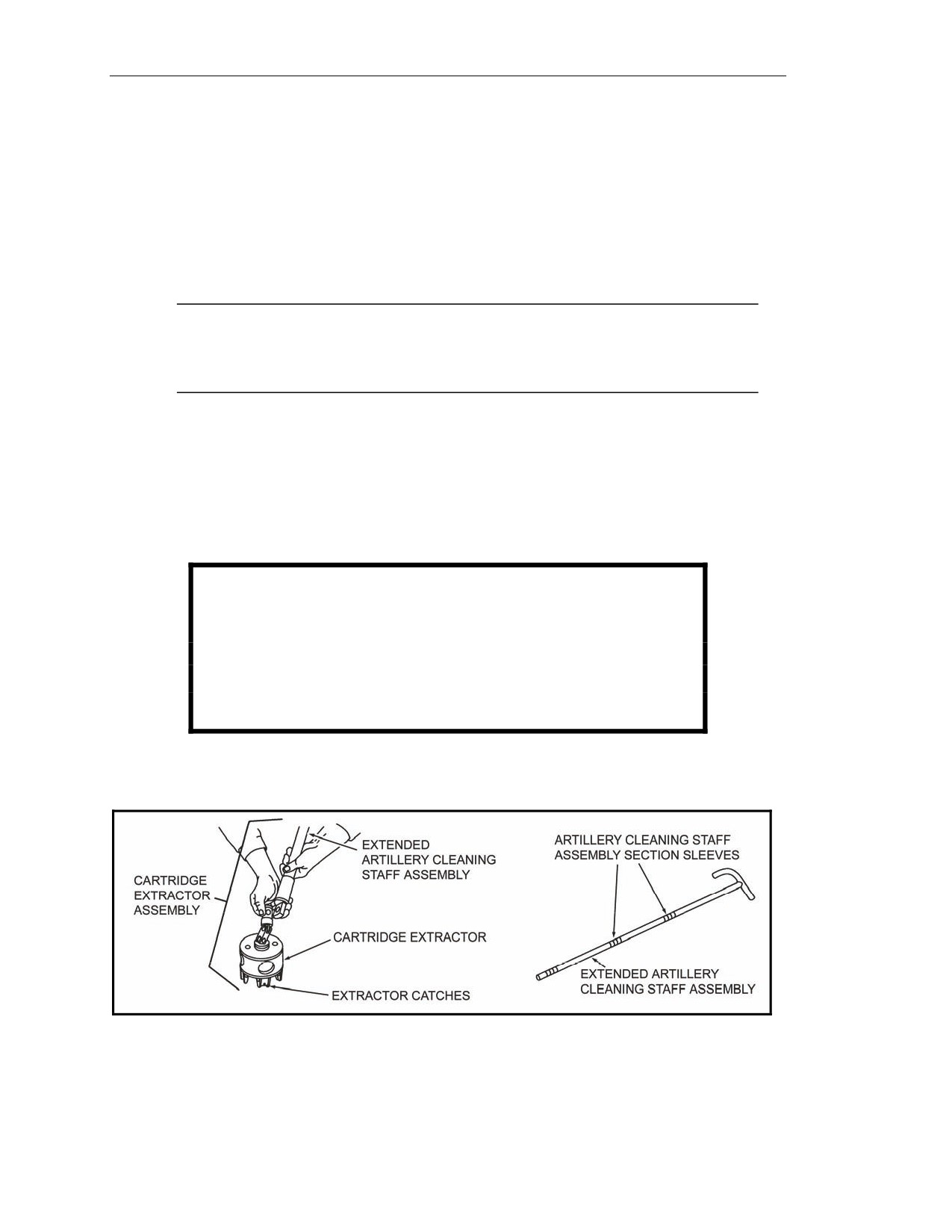
(10) The assistant gunner rotates the artillery cleaning staff assembly until the cartridge extractor
is secure against it (Figure 5-7). Then, he inserts the cartridge extractor into the barrel
slowly (hand to hand) until it rests on the cartridge and will descend no further.
Figure 5-7. Rotating the artillery cleaning staff.
5-16
FM 3-22.90
7 December 2007
120-mm Mortars, M120 and M121
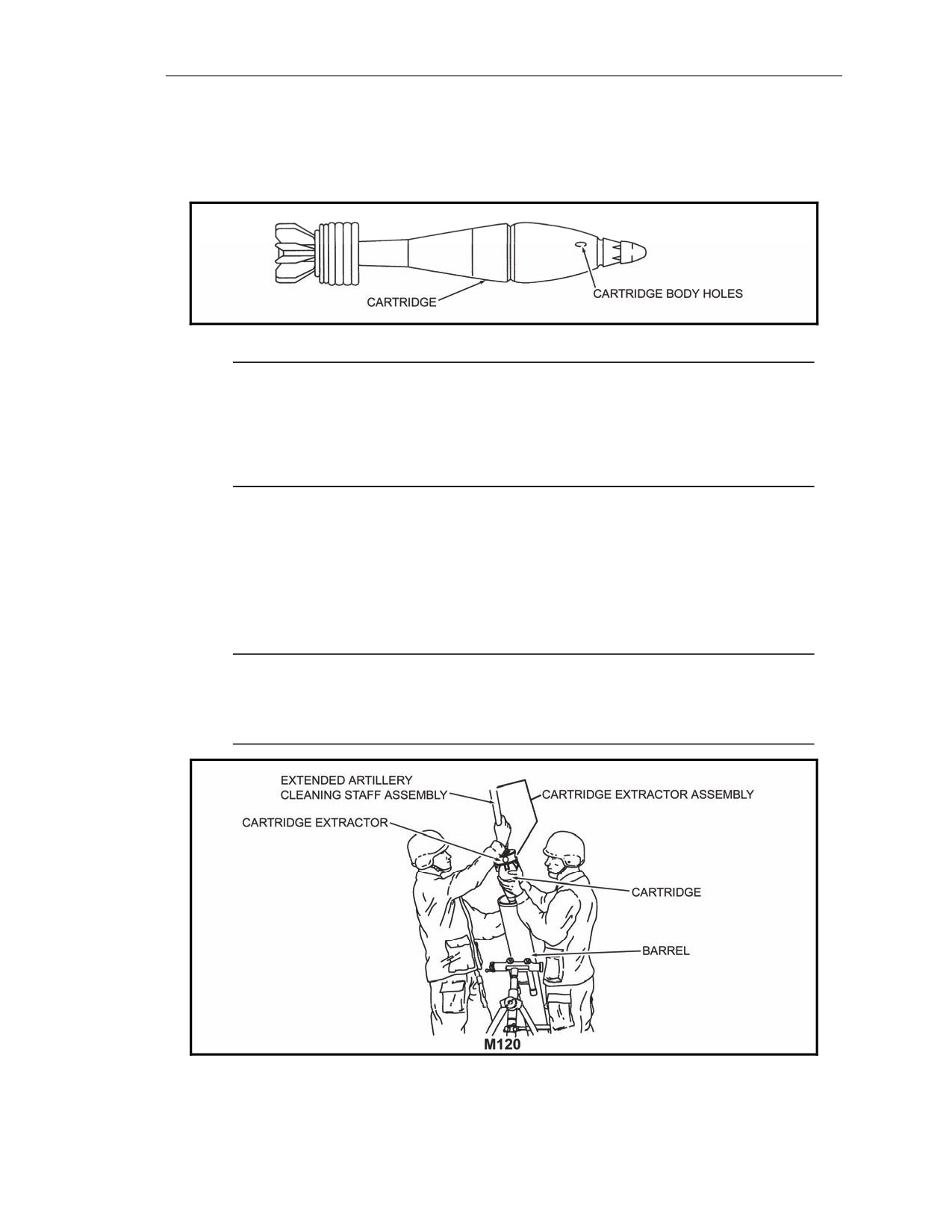
(11) The assistant gunner slowly rotates the cartridge extractor until it grasps the cartridge. As
the cartridge extractor grasps the cartridge, the assistant gunner feels the spring-loaded
catches click into the holes on the cartridge body
(Figure
5-8). The assistant gunner
continues to rotate the cartridge extractor an additional quarter of a turn.
Figure 5-8. Holes in the cartridge body.
NOTE: The assistant gunner should feel much more resistance to rotating the extractor.
If not, the cartridge extractor has not successfully connected to the cartridge, and
the assistant gunner must continue to slowly rotate the cartridge extractor until it
grasps the cartridge. If the assistant gunner still feels no extra resistance, he
removes the extractor assembly from the barrel and uses the barrel tip method to
remove the misfired cartridge (see paragraphs 5-33 to 5-35).
(12) When the assistant gunner feels resistance, he slightly relaxes his grip on the artillery
cleaning staff assembly for a moment. Then, without rotating, he slowly pulls the staff
assembly slightly to ensure that the cartridge is grasped. If the assistant gunner feels
resistance, he, with the gunner’s hands at the muzzle, withdraws the cartridge from the
barrel with the cartridge extractor, pulling the artillery staff with both hands (Figure 5-9).
When the assistant gunner pulls the staff as high as he is able, he slides his lower hand down
the staff and then slides his upper hand to his lower hand (hand to hand), maintaining
positive control at all times. He repeats this action until the cartridge is exposed.
NOTE: If the assistant gunner can grasp the cartridge but can’t withdraw it, he uses the
barrel tip method (see paragraphs 5-33 to 5-35). If the assistant gunner feels no
resistance, he removes the cartridge extractor assembly and uses the barrel tip
method (see paragraphs 5-33 to 5-35).
Figure 5-9. Withdrawing the cartridge from the barrel, M120.
7 December 2007
FM 3-22.90
5-17
Chapter 5
WARNING
1. When removing the cartridge, do not touch the primer.
2. Care must be taken to ensure that the extractor catches are
not depressed while removing the round from the barrel.
NOTE: Due to the weight of the round, the gunner may assist during the entire
extraction process.
(13) The gunner grasps the body of the cartridge as it comes out of the barrel. The gunner and
assistant gunner secure the artillery staff, extractor, and misfired cartridge. The ammunition
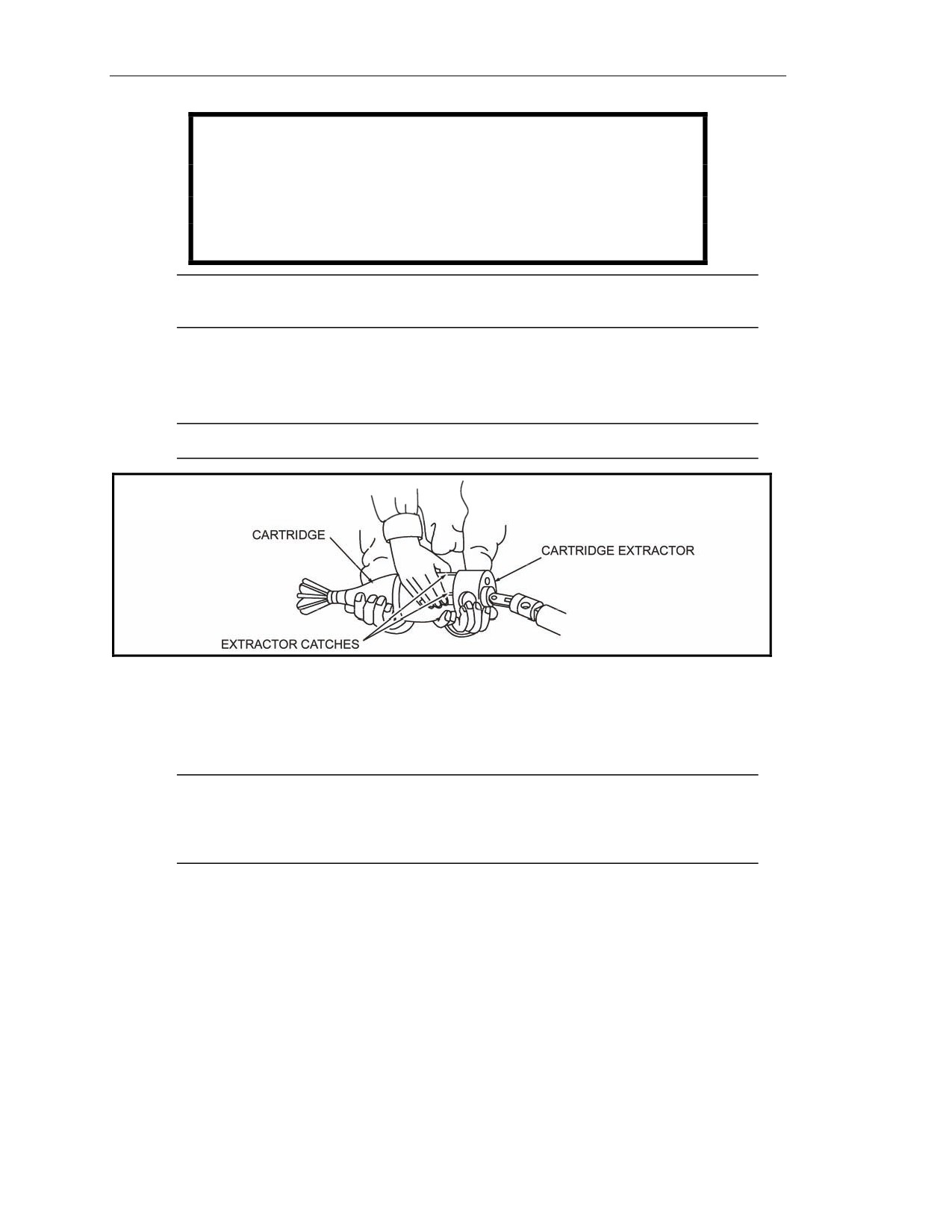
bearer assists in releasing the cartridge from the extractor by pressing all four extractor
catches at the same time (Figure 5-10).
NOTE: Do not place the cartridge on the ground when removing the cartridge extractor.
Figure 5-10. Pressing the extractor catches.
(14) The gunner inspects the cartridge to see if the primer has been dented and gives the
cartridge to the ammunition bearer. The ammunition bearer attempts to replace the safety
wire (if applicable), places the cartridge in the dud pit, and tags the cartridge. The safety
officer notifies EOD.
NOTE: If the primer has been dented, perform steps (4) through (8) of paragraph 5-35
before continuing with step (17). If the primer hasn’t been dented, proceed to the
next step. If two consecutive misfires occur and the primer has not been dented,
perform steps (4) through (8) of paragraph 5-35.
(15) The assistant gunner swabs the barrel; the gunner inserts the firing pin into the breech cap
and rotates the gunner’s display into position; and the mission is continued.
REMOVING A MISFIRED CARTRIDGE USING THE BARREL TIP METHOD
5-33. The barrel tip method is used as circumstances dictate. Follow the steps outlined in paragraph 5
34 only if the extractor assembly is unserviceable or if extractor methods have failed. The steps
outlined in paragraph 5-35 apply when the round is grasped by the cartridge extractor, but can’t be
removed.
5-34. Follow these steps to remove a misfired cartridge if the extractor assembly is unserviceable or if
extractor methods have failed.
(1) The gunner and assistant gunner carefully lower the bipod assembly into the lowest position
in low range.
5-18
FM 3-22.90
7 December 2007
120-mm Mortars, M120 and M121
(2)
The assistant gunner supports the bipod assembly, with his left hand grasping the left side of
the traversing mechanism and his right hand grasping the right side of the traversing
mechanism.
(3)
The gunner cradles the barrel with his right arm near the muzzle.
(4)
The ammunition bearer cradles the barrel with his right arm above the buffer housing
assembly and unlocks the clamp handle assembly with his left hand, releasing the buffer
housing assembly.
WARNING
Once the cannon is horizontal, the rear of the cannon must
not be lowered back down until the round is extracted. If the
round slips down the cannon before extraction, it could ignite,
causing death or personal injury.
(5)
The gunner and ammunition bearer lift (approximately 60 degrees) and then rotate the barrel
so that the white line is in the down position and the breech cap can be removed from the
socket. Then, they carefully remove the barrel from the breech cap socket and raise it to the
horizontal position.
(6)
Keeping the barrel horizontal and pointed in the direction of fire, the gunner, ammunition
bearer, and crewmembers hold the barrel.
(7)
The assistant gunner places the meaty portions of his thumbs over the edges of the muzzle,
grasping the barrel with his fingers.
WARNING
1. When removing the cartridge, do not touch the primer, and
do not stand directly in front of the barrel.
2. Care must be taken to ensure that the extractor catches are
not depressed while removing the round from the barrel.
(8) At the assistant gunner’s command, crewmembers lift the cannon’s breech cap assembly,
causing the cartridge to slide down to the assistant gunner’s hands.
(9) The assistant gunner removes the cartridge, inspects the cartridge to see if the primer has
been dented, attempts to replace the safety wire (if applicable), places the cartridge in the
dud pit, and tags the cartridge. The safety officer notifies EOD.
NOTE: If the primer has been dented, perform steps (4) through (8) of 5-35 before
continuing with step (10). If the primer has not been dented, proceed to the next
step.
(10) The assistant gunner swabs the bore; the gunner inserts the firing pin into the breech cap;
and the barrel is returned to action.
5-35. Follow these steps if the round is grasped by the cartridge extractor, but cannot be removed.
(1) The assistant gunner loosens the sleeve on the artillery cleaning staff assembly, depresses
the ball-bearing spring lock, slowly lowers the upper staff section into the lower staff
section, and tightens the sleeve.
(2) Perform steps (1) through (8) of paragraph 5-34.
7 December 2007
FM 3-22.90
5-19
Chapter 5
(3) Keeping the barrel horizontal and pointed in the direction of fire, the gunner, assistant
gunner, and crewmembers carry the barrel (with the extractor still attached to the round) to
the dud pit. The safety officer notifies EOD.
NOTE: The following steps are part of the breech cap removal. These steps are used
before firing, during firing, if two or more misfires occur, and after firing is
completed. If the primer has been dented and time permits, perform steps (4)
through (8).
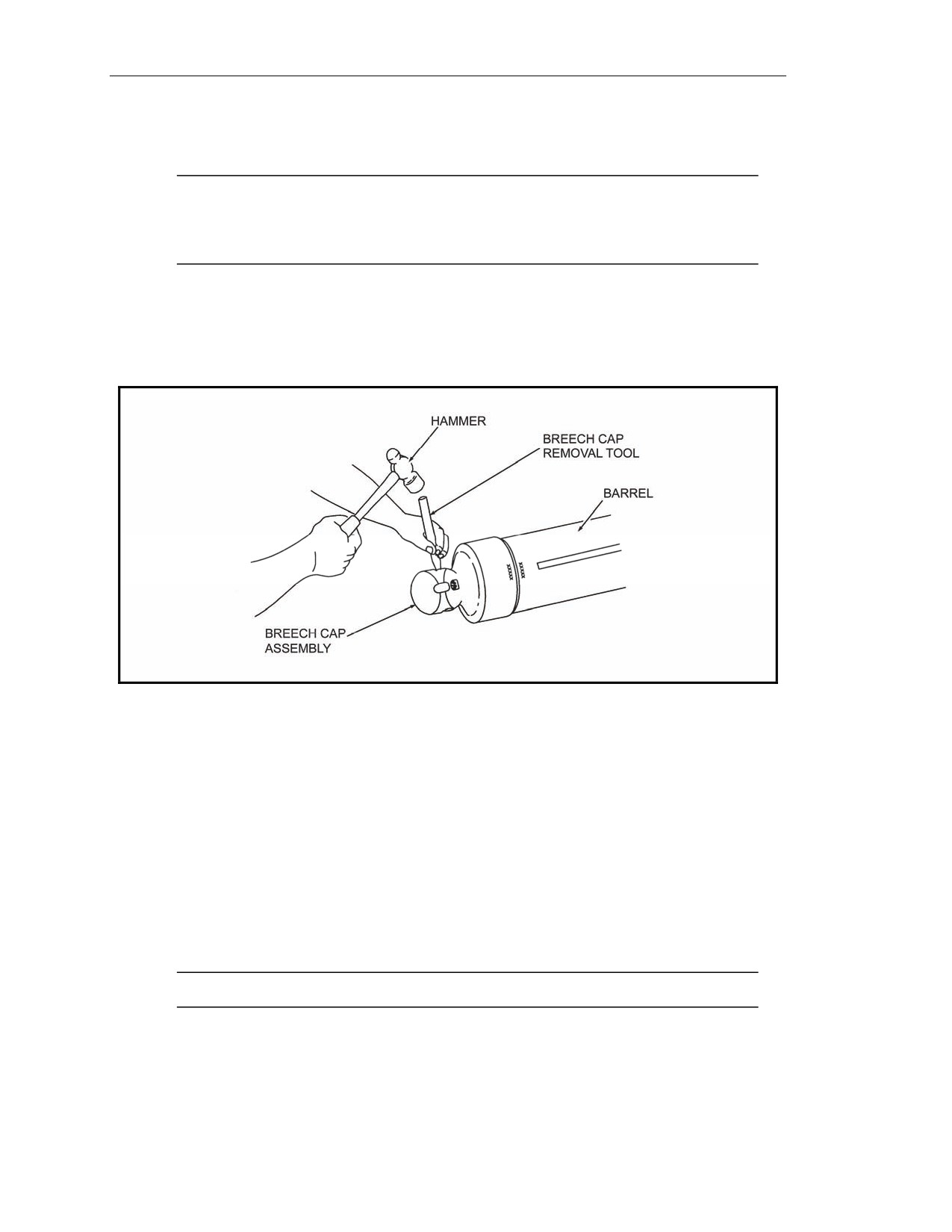
(4) The assistant gunner and ammunition bearer place the barrel on two empty ammunition
boxes and stabilize the barrel. The gunner inserts the breech cap removal tool into the cross
bore of the breech cap and taps the end of the tool with a hammer to turn it clockwise
(Figure 5-11). Then, he unscrews and removes the breech cap assembly from the barrel, and
wipes away any debris from the inner part of the breech cap.
Figure 5-11. Removing the breech cap assembly from the barrel.
(5) The gunner inspects the firing pin housing on the breech cap assembly and removes any dirt
or debris. The gunner replaces the firing pin by hand, ensuring that the threads are aligned;
turns the firing pin clockwise until it is hand tight; and then tightens it further using the
firing pin wrench.
(6) Using the firing pin gauge, the gunner measures the protrusion of the firing pin. The firing
pin must protrude above the MIN and below the MAX cutouts. The gunner replaces the
firing pin if it is defective.
(7) Using a wiping rag, the gunner cleans the inner threads of the breech cap assembly and
outer threads of the barrel. The gunner applies a light coat of grease to the threads of the
breech cap assembly and installs the breech cap on the barrel. He tightens the breech cap
assembly using the breech cap removal tool found in the breech cap bore and backs off a
quarter of a turn using a jerking motion to tighten.
(8) The barrel is returned to action.
NOTE: The white stripe on the barrel must align with the firing pin.
(9) Both the squad leader and section leader confirm that the crew performed the actions
correctly.
(10) The assistant gunner swabs the barrel; the gunner rotates the gunner’s display into position;
and the mission is continued.
5-20
FM 3-22.90
7 December 2007
120-mm Mortars, M120 and M121
LOADING AND FIRING OF THE GROUND-MOUNTED 120-mm
MORTAR
5-36. This paragraph explains the procedures for loading and firing a ground-mounted 120-mm
mortar.
(1) The FDC issues a fire command to the squad leader.
(2) The squad leader records and issues the fire command to the squad.
(3) The squad repeats the fire command.
(4) The ammunition bearer prepares the round in accordance with the fire command.
(5) The squad leader inspects the round before it is passed to the assistant gunner. The
ammunition bearer holds the round with both hands (palms up) near each end of the round
body (not on the fuze or the charges).
(6) The assistant gunner checks the round for correct charges, fuze tightness, and fuze setting.
(7) When both the gun and the round(s) have been determined safe and ready to fire, the squad
leader gives the following command to the FDC: NUMBER (NUMBER OF MORTAR)
GUN, UP.
(8) The ammunition bearer holds the round with the fuze pointed to his left. By pivoting his
body to the left, the assistant gunner accepts the round from the ammunition bearer with his
right hand under the round and his left hand on top of the round.
(9) Once the assistant gunner has the round, he keeps two hands on it until it is fired.
CAUTION
The assistant gunner is the only member of the mortar squad who
loads and fires the round.
(10) The squad leader commands, HANG IT, FIRE in accordance with the method of fire given
by the FDC.
(11) The assistant gunner holds the round in front of the muzzle at about the same angle as the
cannon. At the command, HANG IT, the assistant gunner guides the round into the cannon
(tail end first) to a point beyond the narrow portion of the body (about three-quarters of the
round) being careful not to hit the primer or charges or disturb the lay of the mortar.
(12) Once the round is inserted into the cannon the proper distance, the assistant gunner shouts,
“Number (number of mortar) gun, hanging.”
(13) At the command, FIRE, the assistant gunner releases the round by pulling both hands down
and away from the outside of the cannon. The assistant gunner ensures that he does not take
his hands across the muzzle of the cannon as he drops the round.
(14) Once the round is released, the gunner and assistant gunner take a full step toward the rear
of the weapon while pivoting their bodies so that they are both facing away from the blast.
(15) The assistant gunner pivots to his left and down toward the ammunition bearer, ready to
accept the next round to be fired (unless major movements of the bipod require him to lift
and clear the bipod off the ground).
(16) Subsequent rounds are fired based on the FDC fire commands.
(17) The assistant gunner ensures the round has fired safely before he attempts to load the next
round.
(18) The assistant gunner does not shove or push the round down the cannon. The round slides
down the cannon under its own weight, strikes the firing pin, ignites, and fires.
(19) The assistant gunner and gunner, as well as the remainder of the mortar crew, keep their
upper body below the muzzle until the round fires to avoid muzzle blast.
7 December 2007
FM 3-22.90
5-21
Chapter 5
(20) During an FFE, the gunner tries to level all bubbles between each round ensuring his upper
body is away from the mortar and below the muzzle when the assistant gunner announces,
“Hanging,” for each round fired.
(21) The assistant gunner informs the squad leader when all rounds for the fire mission are
expended, and the squad leader informs the FDC when all of the rounds are completed. For
example, “NUMBER TWO GUN, ALL ROUNDS COMPLETE.”
TAKING THE 120-mm MORTAR OUT OF ACTION
5-37. To take the 120-mm mortar out of action, the squad leader commands, OUT OF ACTION. Then,
each member of the squad does the following:
(1) The ammunition bearer retrieves the aiming posts, places them in their case, and puts the
case on the right side of the mortar.
(2) The gunner places a deflection of 3800 mils and an elevation of 0800 mils on the sight.
(3) The gunner removes the sight from the dovetail slot and places it in the sight case. He places
the sight mount cover back on and secures it with the snap button.
NOTE: Left and right are in relation to the mortar’s direction of fire.
(4) The gunner loosens the clamp handle assembly.
(5) The gunner slides the buffer housing assembly up the cannon until the white line on the
clamp handle assembly is aligned with the white line on the cannon near the muzzle. The
gunner tightens the buffer housing assembly until he hears a metallic click. He continues
turning the handle until it is parallel to the cannon.
(6) The gunner centers the traversing extension and the traversing mechanism.
(7) The gunner lowers the elevation so that about four fingers (three to four inches) of the
elevating mechanism remains exposed.
(8) The assistant gunner loosens the cross-leveling locking knob, while the gunner steadies the
cannon.
(9) The ammunition bearer positions himself behind the trailer. He positions the trailer behind
the baseplate with the towing eye almost straight up. The assistant gunner helps after he
retrieves the aiming posts.
(10) The ammunition bearer holds the trailer in place with the cannon cradle touching the top of
the breech cap. He blocks the wheels so that the trailer cannot roll.
(11) The assistant gunner releases the clamping catch on the trailer bridge assembly and swings
the bridge assembly out of the way.
(12) The gunner and the assistant gunner grasp the traversing mechanism and bipod legs, and
then swing the cannon and bipod over the baseplate and onto the trailer. The assistant
gunner loosens the cross-leveling locking knob and assists in raising the bipod legs. Then,
he joins the legs and rotates them 180 degrees.
(13) With the trailer still in the upright position, the assistant gunner makes sure that the upper
collar stop is placed just forward of the upper cannon bracket on the trailer.
(14) The assistant gunner holds and lifts the baseplate onto the trailer as the ammunition bearer
returns the trailer to the towing position, lifting the entire mortar onto the trailer.
(15) The gunner attaches the hook on the spread cable to the eye on the bipod leg. He adjusts the
elevation so that the bipod legs fit under the trailer bridge assembly. Then, he retightens the
locking knob.
(16) The assistant gunner closes the trailer bridge assembly. He locks the baseplate with the lock
release lever and secures it with the pin. He then secures the trailer bridge assembly with the
clamping catch.
(17) The ammunition bearer emplaces the muzzle cap.
5-22
FM 3-22.90
7 December 2007
120-mm Mortars, M120 and M121
(18) The ammunition bearer moves to the driver’s side of the towing eye. The assistant gunner
moves to the passenger’s side of the towing eye. Together, they move the trailer to the
vehicle and hook the trailer to the towing pintle of the vehicle. They hook up the trailer light
cable and safety chains.
(19) The gunner secures the sight case.
(20) The assistant gunner secures the aiming post case.
(21) The squad leader ensures that all equipment is accounted for and properly secured.
(22) The squad leader announces, “Number two gun, up.”
SECTION IV. MORTAR CARRIER, M1064A3
This section is a guide for training mortar units equipped with the M1064A3-series mortar carrier for
mounting the M121 mortar. The procedures and techniques used for a mounted mortar are different from
the ground-mounted mortar.
DESCRIPTION
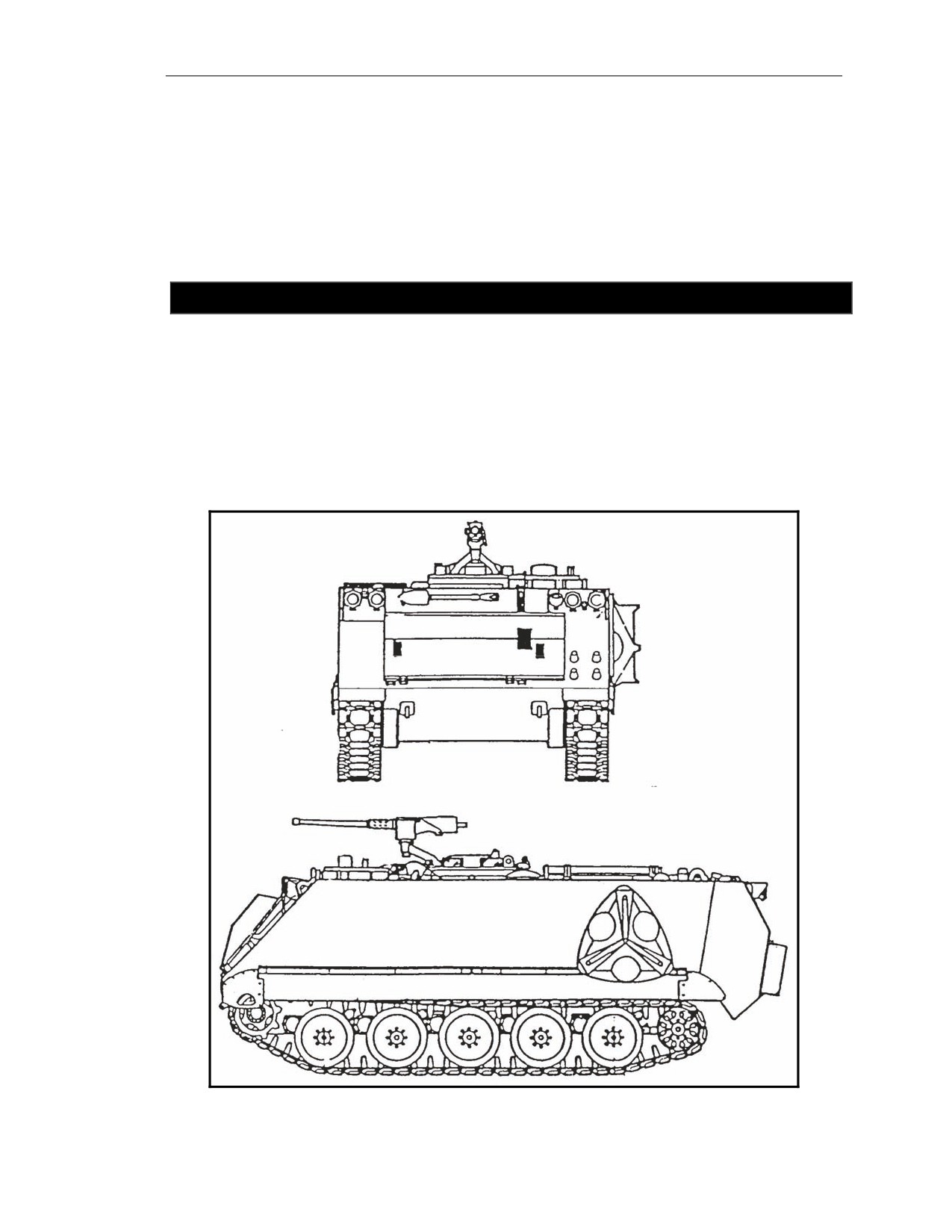
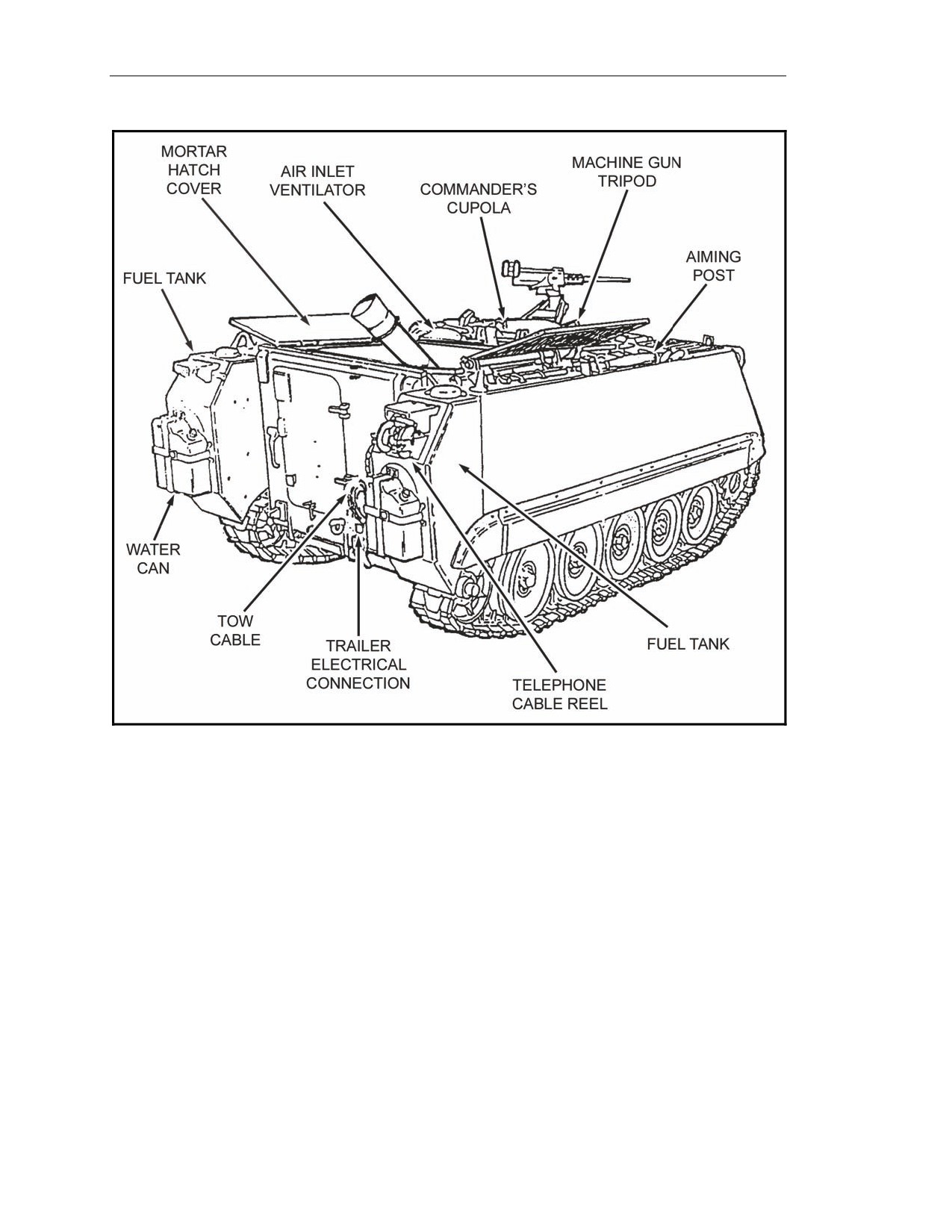
5-38. The M1064A3 carrier (Figure 5-12 and Figure 5-13) is an M113A3 armored personnel carrier
modified to carry the 120-mm mortar, M121, on a specially designed mount. It is fully tracked, highly
mobile, and armor protected. It can be transported by air and is able to propel itself across water
obstacles.
Figure 5-12. Mortar carrier, M1064A3, front and side view.
7 December 2007
FM 3-22.90
5-23
Chapter 5
Figure 5-13. Mortar carrier, M1064A3, rear view.
5-24
FM 3-22.90
7 December 2007
120-mm Mortars, M120 and M121
TABULATED DATA FOR THE M1064A3 CARRIER
5-39. Table 5-2 shows the tabulated data for the M1064A3 carrier and the mortar capabilities when
mounted on a turntable.
Table 5-2. Tabulated data for the mortar carrier, M1064A3.
GENERAL
Weight:
Combat loaded
28,240 pounds
Air transportable
23,360 pounds
Ground pressure, combat loaded
8.97 psi
Personnel capacity
4
Fuel tank capacity
95 gallons
PERFORMANCE
Speed:
On land
40 mph
In water, with track
3.6 mph
Cruising range
300 miles
Turning radius
Pivot to infinite
Slope
60 percent
Side slope
40 percent
Trench crossing
66 inches
Vertical wall climbing
24 inches
Gross horsepower-to-weight ratio
19.6 hp/ton
ARMAMENT
.50 caliber machine gun
2,000 rounds
120-mm mortar
69 ready rounds (45 horizontal, 24
vertical). Type of rounds carried
depends on the tactical mission.
MORTAR CAPABILITIES MOUNTED ON TURNTABLE
TRAVERSING LIMITS
Right of center with traverse extension
858 mils
Left of center with traverse extension
808 mils
TOTAL TRAVERSE
Capability from extreme left to extreme right
Without traversing extension
1486 mils
With traversing extension
1666 mils
ELEVATION LIMITS (LEVEL)
Maximum
1510 mils
Minimum
0750 mils
MORTAR AND VEHICULAR MOUNT
5-40. The mortar is mounted on its vehicular mount, and a clamping support is provided to hold the
mortar during travel. A bipod support assembly provides attachment mounting for the M191 bipod and
secures it in a locking position during travel. The breech socket provides a base in which the weapon
rests. The mortar is provided with a sight extension arm assembly, which is received by the socket of
the coupling and sight mount assembly. The gunner uses the sight extension arm to sight on his aiming
point above the hull of the vehicle. The extension must be removed before moving the mortar to
prevent wear on the sight mount’s coupling gears.
7 December 2007
FM 3-22.90
5-25
Chapter 5
MAINTENANCE
5-41. Care and cleaning of the mortar, instruments, and equipment are the duty and responsibility of
the mortar squad. Care and cleaning of the carrier-mounted mortar are the same as for the ground-
mounted mortar. All maintenance records and lubricating procedures for the 120-mm mortar and the
mount, M191, can be found in TM 9-1015-250-10. (For maintenance procedures for the M1064A3
carrier, see TM 9-2350-277-10.)
SECTION V. OPERATION OF A CARRIER-MOUNTED 120-mm MORTAR
The mortar section is the fire unit for the mortar platoon. When a position is occupied, mortars are
emplaced 75 meters apart making the section front (distance between flank mortars) about 150 meters. The
mortars are numbered 1, 2, and 3 (from right to left) when facing the direction of fire. The squad of the
mortar carrier consists of four members—squad leader, gunner, assistant gunner, and ammunition
bearer/driver.
PREMOUNT CHECKS
5-42. The premount checks for the carrier-mounted mortar are the same as in paragraphs 5-16 to 5-22.
PLACING A CARRIER-MOUNTED 120-mm MORTAR INTO
ACTION
5-43. To place the mortar into action, the crew performs the following actions upon the squad leader’s
command, ACTION.
NOTE: If the weapon system cannot be leveled at any elevation given, the gunner is
authorized to go to high range
(low range) and move the buffer housing
assembly along the cannon between the circular white line and the lower collar
stop without moving past the vertical position until the gun system can be
leveled.
(1)
The gunner pulls the chain on the center cargo hatch releasing and folding it over onto the
right hatch ensuring that the hatch locks into place. He then pulls the chain on the right
cargo hatch releasing and folding it over and secures it.
(2)
Once the gunner has the center and right cargo hatch secured, the assistant gunner pulls the
chain on the left cargo hatch releasing and folding the hatch over ensuring that it is locked
into place.
(3)
The assistant gunner unlocks the clamping support assembly.
(4)
The gunner loosens the clamp handle assembly and grasps the buffer housing assembly and
pulls it down until it is flush with the lower collar stop.
(5)
The gunner ensures that the white line on the cannon aligns with the white line on the buffer
housing assembly. He then tightens the clamp handle assembly until he hears a metallic
click. If the mortar cannon is equipped with the old style of breech cap, the gunner places
the weapon on FIRE (“F” showing).
(6)
The assistant gunner then passes the sight extension to the gunner and removes the muzzle
cover.
(7)
The gunner places the sight extension into the dovetail slot on the bipod and secures it.
(8)
The gunner mounts the sight onto the sight extension, places a deflection of 3200 mils and
an elevation of 1100 mils onto the sight, and levels the deflection bubble with the cross-
leveling handwheel on the bipod.
(9)
The assistant gunner places the BAD onto the cannon and secures it and levels the elevation
bubble.
5-26
FM 3-22.90
7 December 2007
120-mm Mortars, M120 and M121
(10) The gunner then ensures that the traversing mechanism is within four turns of center, and
the traversing extension is centered on the bipod.
(11) When the gunner is satisfied that the mortar is mounted correctly, he announces, “Up” so
that the squad leader can inspect the weapon system.
(12) The carrier-mounted 120-mm mortar is now placed into action and ready to be reciprocally
laid.
MOUNTING OF THE MORTAR FROM A CARRIER- TO A
GROUND-MOUNTED POSITION
5-44. The procedures for placing the mortar into action by mounting it from a carrier- to a ground-
mounted position are described herein.
NOTE: Left and right are in relation to the mortar’s direction of fire.
(1)
The driver lowers the ramp and dismounts from the mortar carrier.
(2)
The gunner pulls down on the chain for the center hatch and folds it over, then secures it to
the right cargo hatch. He pulls down on the chain for the right cargo hatch and folds both
hatches over, then secures them in place. The assistant gunner pulls down on the chain for
the left cargo hatch and folds it over, then secures it in place.
(3)
The squad leader dismounts the carrier and shows the crew where he wants the mortar to be
mounted and indicates the direction of fire.
(4)
The driver/ammunition bearer and assistant gunner release the baseplate by removing the
safety pin and pushing the handle up. Together they tilt the baseplate out and lift it from the
lower brackets.
(5)
The driver/ammunition bearer and assistant gunner place the baseplate at the firing position
while the gunner retrieves the sight and aiming posts and places them on the left side of the
baseplate.
(6)
The assistant gunner holds the bipod while the gunner unlocks the clamp handle assembly.
The assistant gunner lowers the bipod until it rests on the ramp. At the same time, the
driver/ammunition bearer assembles the aiming posts.
(7)
The assistant gunner releases the safety pins and rotates the handles until the arrows are
facing each other and then pulls the handles out, releasing the bipod.
(8)
The assistant gunner installs the bipod leg extensions onto the bipod and secures them with
the safety pins.
(9)
The assistant gunner and driver/ammunition bearer secure the bipod and carry it to the firing
position. They place it about 2 feet in front of the baseplate.
CAUTION
Damage may occur to the turntable socket if the following
procedures are not followed.
(10) The driver/ammunition bearer removes the muzzle plug while the gunner releases the
clamping support assembly. Together they raise the cannon to a 60-degree angle and rotate
it until the white line is facing the turntable. They then lift straight up removing the cannon
from the socket.
(11) The gunner and driver/ammunition bearer carry the cannon to the baseplate. With the white
line on the cannon facing the ground, they tilt the cannon to a 60-degree angle. They
carefully insert the cannon into the baseplate socket. They rotate the cannon until the white
line is facing skyward and then lower it onto the buffer housing assembly ensuring the white
line on the barrel aligns with the white line on the buffer housing assembly. The gunner then
7 December 2007
FM 3-22.90
5-27
Chapter 5
slides the buffer housing assembly down the barrel until it is flush with the lower collar stop
on the cannon.
(12) The gunner tightens the clamp handle assembly until a metallic click is heard.
(13) If the mortar cannon is equipped with the old style of breech cap, the gunner places the
safety mechanism on FIRE (“F” showing).
(14) The gunner places the sight on the weapon and indexes a deflection and elevation.
PERFORMING SAFETY CHECKS ON A CARRIER-MOUNTED
120-mm MORTAR
5-45. Specific safety checks must be performed before firing mortars. Most can be made visually. The
gunner is responsible for physically performing the checks under the squad leader’s supervision.
NOTE: The buffer housing assembly may need to be adjusted to complete this task.
5-46. To perform safety checks on a carrier-mounted 120-mm mortar, the gunner ensures that—
There is no mask and overhead clearance.
The breech assembly is locked in the turntable socket and the white line on the cannon
bisects the white line on the buffer housing assembly.
The M191 bipod assembly is locked to the turntable mount and the arrows on the mount
handles are pointed down (vertical).
The safety pins are installed.
The buffer housing assembly is secured to the cannon by loosening the clamp handle
assembly about a quarter of a turn and tightening the clamp handle assembly until he hears a
metallic click.
The cross-leveling locking knob is hand-tightened.
The bipod support assembly is locked in the high or low position and the safety pin is
installed.
The turntable is in the locked position.
The cargo hatches are open and locked.
The BAD locking knob is hand-tightened.
The firing pin is properly installed. If the mortar cannon is equipped with the old style of
breech cap, the gunner ensures that the safety selector is in the FIRE position (“F” showing).
The bipod is not forward of the vertical position.
MASK AND OVERHEAD CLEARANCE
5-47. To determine mask clearance, the gunner places an elevation of 0800 on the sight and lowers the
cannon until the elevation bubble is level. He places his head against the breech cap and sights along
the barrel to see if any obstructions are in front of the mortars. With the gunner’s head still against the
breech cap, the assistant gunner traverses the mortar through its full range of traverse (traversing
extension) to ensure that no obstructions are in front of the mortar.
5-48. To determine overhead clearance, the gunner places an elevation of 1511 on the sight and raises
the barrel until the elevation bubble is level. He places his head against the breech cap and sights along
the barrel for any obstructions in front of the mortar. With the gunner’s head still against the breech
cap, the assistant gunner moves the mortar through its full range of traverse (traversing extension) to
ensure that no obstructions are in front of the mortar.
5-28
FM 3-22.90
7 December 2007
120-mm Mortars, M120 and M121
NOTE: If obstructions are found at any point in the full range of traverse or elevation,
the mortar is not safe to fire. In a combat situation, however, it may be necessary
to fire the mortar from that position. If this is the situation, traverse and/or
elevate the mortar until it clears the obstruction and level the sight by using the
elevation micrometer knob. Record the deflection and elevation where the
mortar clears the obstruction and report this information to the FDC.
PERFORMING SMALL DEFLECTION AND ELEVATION
CHANGES ON A CARRIER-MOUNTED 120-mm MORTAR
5-49. The gunner receives deflection and elevation changes from the FDC in the form of a fire
command. If a deflection change is required, it precedes the elevation change.
NOTE: Small deflection and elevation changes are greater than 20 mils but less than 60
mils for deflection and greater than 30 mils but less than 90 mils for elevation.
(1) The gunner sets the sight for deflection and elevation.
He places the deflection on the sight by turning the deflection micrometer knob until
the correct 100-mil deflection mark is indexed on the coarse deflection scale. He
continues to turn the deflection micrometer knob until the remainder of the deflection
is indexed on the deflection micrometer scale.
The gunner places the elevation on the sight by turning the elevation micrometer knob
until the correct 100-mil elevation mark is indexed on the coarse elevation scale. He
continues to turn the elevation micrometer knob until the remainder of the elevation is
indexed on the micrometer scale.
(2) The gunner lays the mortar for deflection.
After the deflection and elevation are indexed on the sight, the gunner floats the
elevation bubble.
He turns the elevating hand crank to elevate or depress the mortar until the bubble in
the elevation level vial starts to move. This initially rough lays the mortar for elevation.
The gunner looks through the sight and traverses to realign on the aiming post. He
traverses half the distance to the aiming post, then cross-levels.
Once the vertical cross line is near the aiming posts (about 20 mils), the gunner checks
the elevation vial. If required, he re-lays for elevation by elevating or depressing the
elevating mechanism. He makes final adjustments using the traversing handwheel and
cross-levels by traversing half the distance and cross-leveling.
When the vertical cross line is within 2 mils of the aiming posts, all bubbles are
leveled, and the sight is set on a given deflection, the mortar is laid.
NOTE: If the given deflection exceeds left or right traverse, the gunner may choose to
use the traversing extension assembly. This gives him an added number of mils
in additional traverse to avoid moving the bipod. To use the traversing
extension, the gunner pulls down on the traversing extension locking knob and
shifts the cannon left or right. He re-locks the traversing extension locking knob
by ensuring it is securely seated.
PERFORMING LARGE DEFLECTION AND ELEVATION
CHANGES ON A CARRIER-MOUNTED 120-mm MORTAR
5-50. The squad receives a fire command requiring a deflection change of more than 200 mils but less
than 300 mils and an elevation change of more than 100 mils but less than 200 mils. The gunner must
announce, “Gun up,” within 55 seconds. Time starts when the last digit of the elevation is given. The
7 December 2007
FM 3-22.90
5-29