FM 3-22.90 Mortars (December 2007) - page 3
Chapter 3
SECTION II. COMPONENTS
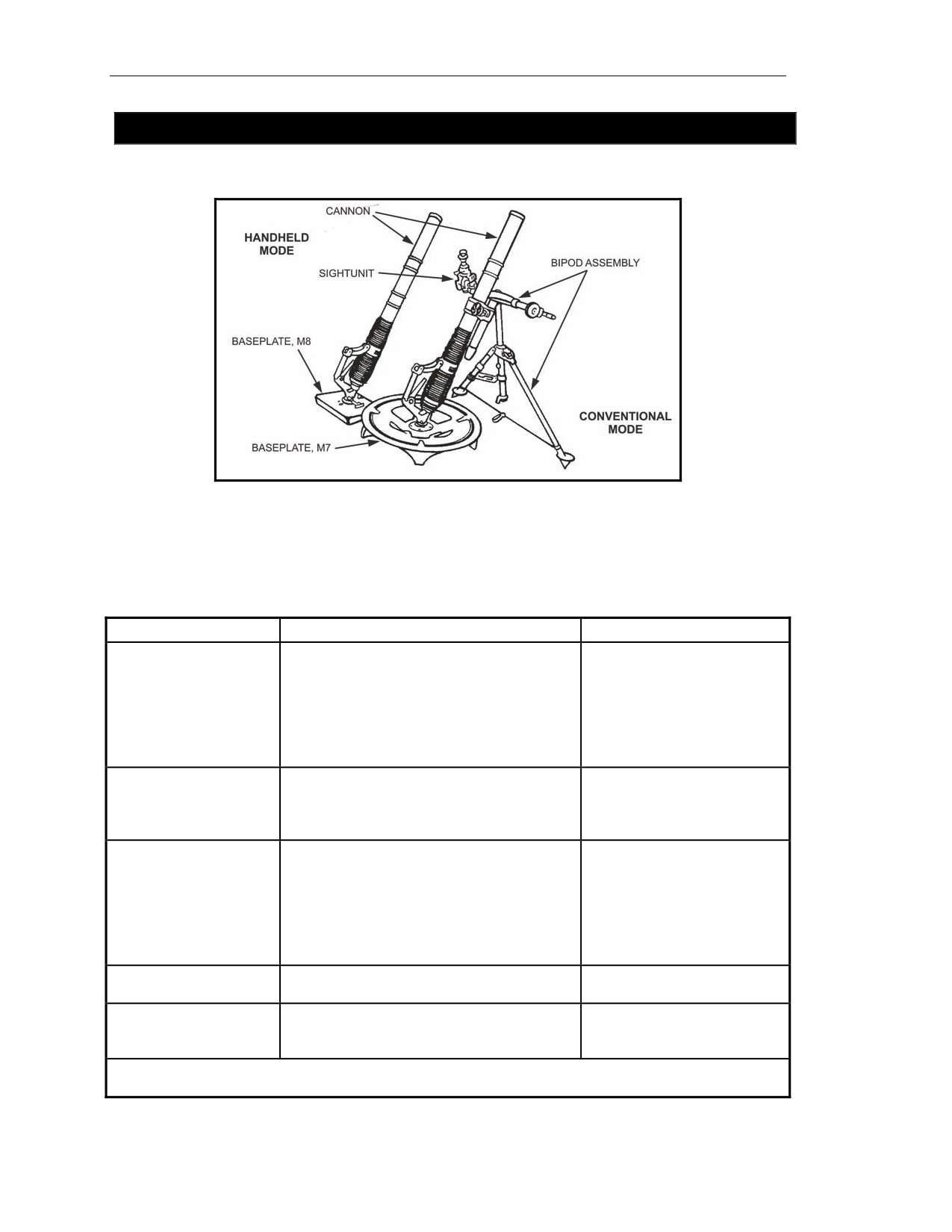
The 60-mm mortar, M224, is a muzzle-loaded, smooth-bore, high-angle-of-fire weapon that can be fired in
the conventional or handheld mode. It can be drop-fired or trigger-fired and has five major components
(Figure 3-1).
Figure 3-1. 60-mm mortar, M224, handheld and conventional mode.
TABULATED DATA
3-6. The tabulated data for the 60-mm mortar are as shown in Table 3-1.
Table 3-1. Tabulated data for the 60-mm mortar, M224.
CONVENTIONAL MODE
HANDHELD MODE
WEIGHTS
Complete mortar
46.5 pounds
18.0 pounds
Cannon, M225
14.4 pounds
14.4 pounds
Bipod Assembly, M170
15.2 pounds
Sightunit, M64A1
2.5 pounds
Baseplate, M7
14.4 pounds
Baseplate, M8
3.6 pounds
RANGE
Cannon, M225
Minimum*
70 meters
75 meters
Maximum
3,490 meters
1,340 meters
RATES OF FIRE
Maximum
M720/M888
30 rounds for first 4 minutes
M49A4
30 rounds for 1 minute; 18 rounds for next 4 minutes
No limit at charges 0 and 1
Sustained
M720/M888
20 rounds per minute indefinitely
M49A4
8 rounds per minute indefinitely
TYPE OF FIRE
Drop-fire
Drop-fire (charges 0 and 1 only)
Trigger-fire
Trigger-fire**
CARRYING OPTIONS
One-man carry
One-man carry
Two-man carry
Three-man carry
*Minimum SAFE range. The specific ammunition minimum ranges are design minimums.
**Do not trigger-fire above charge 1.
3-2
FM 3-22.90
7 December 2007
60-mm Mortar, M224
CANNON ASSEMBLY, M225
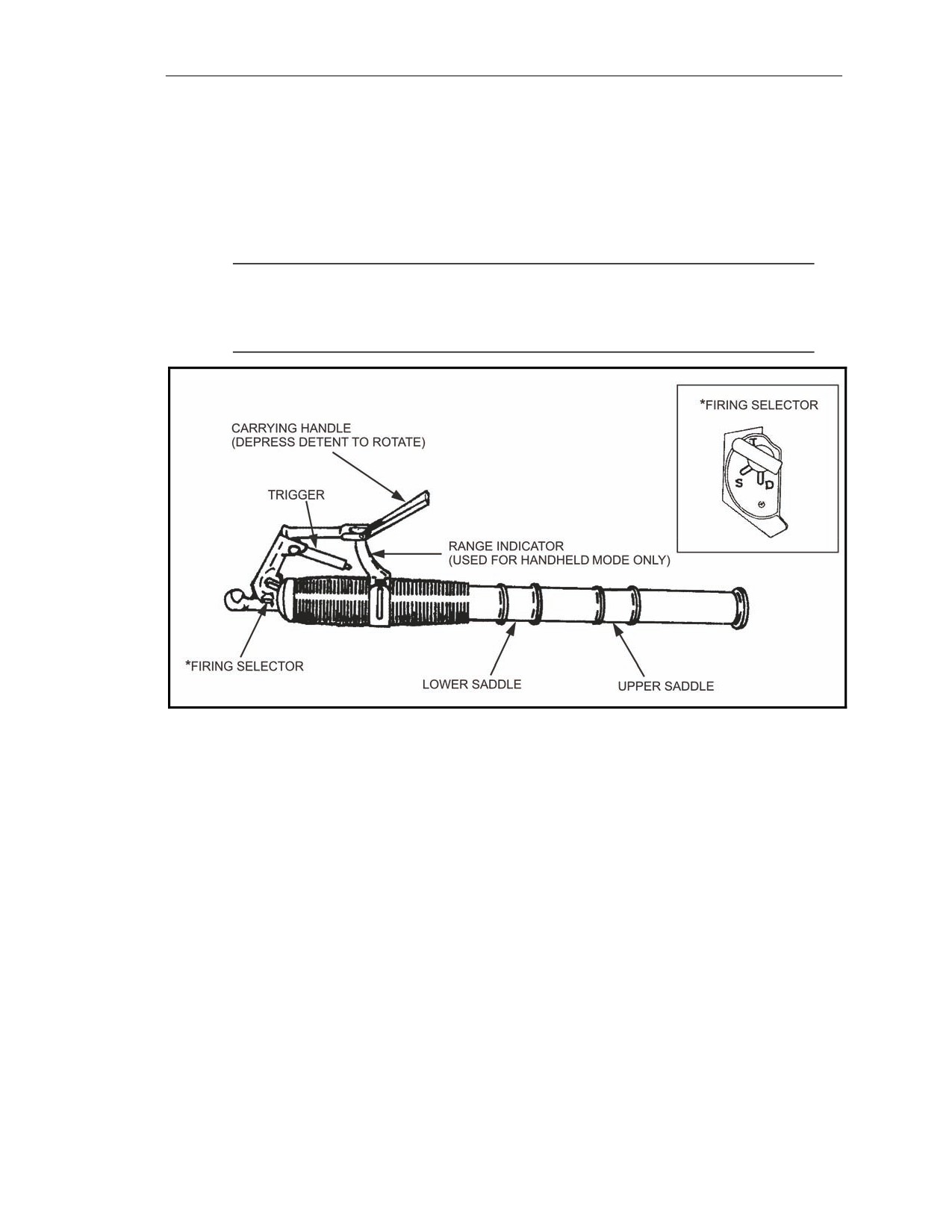
3-7. The cannon assembly (Figure 3-2) has one end closed by a breech cap. The breech cap end of
the cannon has cooling fins on the outside that reduce heat generated during firing. Attached to the
breech cap end is a combination carrying handle and firing mechanism. The carrying handle has a
trigger, firing selector, range indicator, and auxiliary carrying handle. On the outside of the cannon is
an upper and a lower firing saddle. The lower saddle is used when firing at elevations of 1100 to 1511
mils; the upper saddle is used when firing at elevations of 0800 to 1100 mils.
NOTE: When the bipod is positioned in the upper saddle, one turn of the traversing
handwheel will move the cannon 10 mils. When the bipod is positioned in the
lower saddle, one turn of the traversing handwheel will move the cannon 15
mils.
Figure 3-2. Cannon assembly, M225.
BIPOD ASSEMBLY, M170
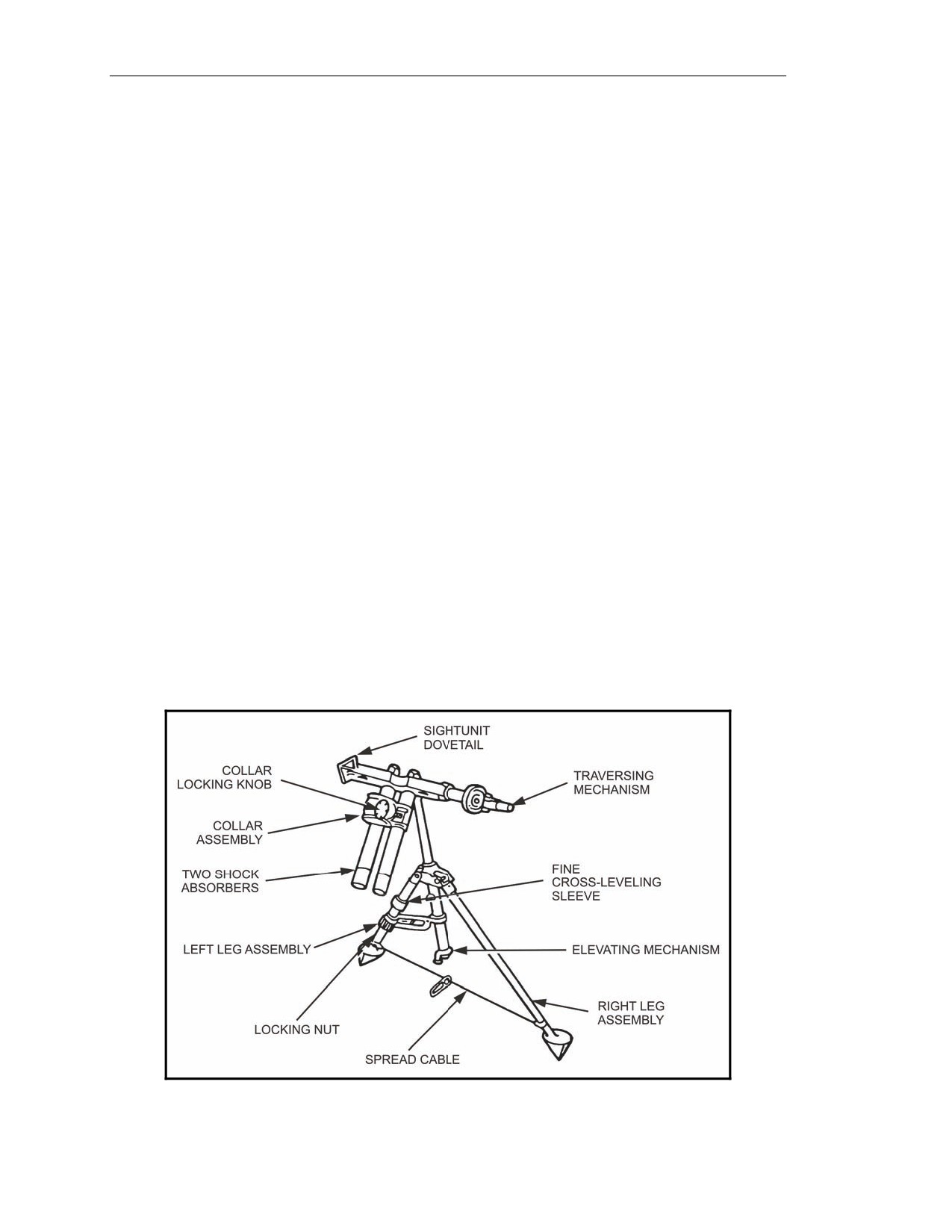
3-8. The bipod assembly (Figure 3-3) can be attached to the cannon either before or after assembly of
the cannon to the baseplate. It consists of seven subassemblies.
COLLAR ASSEMBLY
3-9. The collar assembly, with an upper and lower half, is hinged on the left and secured by a locking
knob on the right. The collar fastens in one of the two firing saddles (depending on the elevation being
fired), securing the bipod to the cannon.
SHOCK ABSORBERS
3-10. Two shock absorbers located on the underside of the collar assembly protect the bipod and sight
from the shock of recoil during firing.
TRAVERSING MECHANISM
3-11. The traversing mechanism moves the collar assembly left or right when the traversing hand
crank is pulled out and turned. The hand crank is turned clockwise to move the cannon to the right, and
7 December 2007
FM 3-22.90
3-3
Chapter 3
counterclockwise to move the cannon to the left. The left side of the traversing mechanism has a
dovetail slot to attach the sight to the bipod.
ELEVATING MECHANISM
3-12. The elevating mechanism is used to elevate or depress the cannon by turning the hand crank at
the base of the elevation guide tube. This assembly consists of an elevating spindle, screw, hand crank,
and housing (elevation guide tube). The housing has a latch to secure the collar and shock absorbers to
the housing for carrying. The hand crank is turned clockwise to depress, and counterclockwise to
elevate.
RIGHT LEG ASSEMBLY
3-13. The right leg assembly has no moving parts. It consists of a foot, tubular steel leg, and hinge
attached to the elevating mechanism housing.
LEFT LEG ASSEMBLY
3-14. The left leg assembly consists of a foot, tubular steel leg, hinge attached to the elevating
mechanism housing, locking nut, and fine cross-leveling sleeve.
Locking Sleeve
3-15. The locking sleeve is near the spiked foot. It is used to lock the elevation housing in place.
Fine Cross-leveling Nut
3-16. The fine cross-leveling nut above the locking sleeve is used for fine leveling.
SPREAD CABLE
3-17. The spread cable is a plastic-coated steel cable attached to the bipod legs, which controls the
spread of the two tubular steel legs. A snap hook is fixed to the cable to secure the bipod legs when
they are collapsed for carrying.
Figure 3-3. Bipod assembly, M170.
3-4
FM 3-22.90
7 December 2007
60-mm Mortar, M224
BASEPLATE, M7
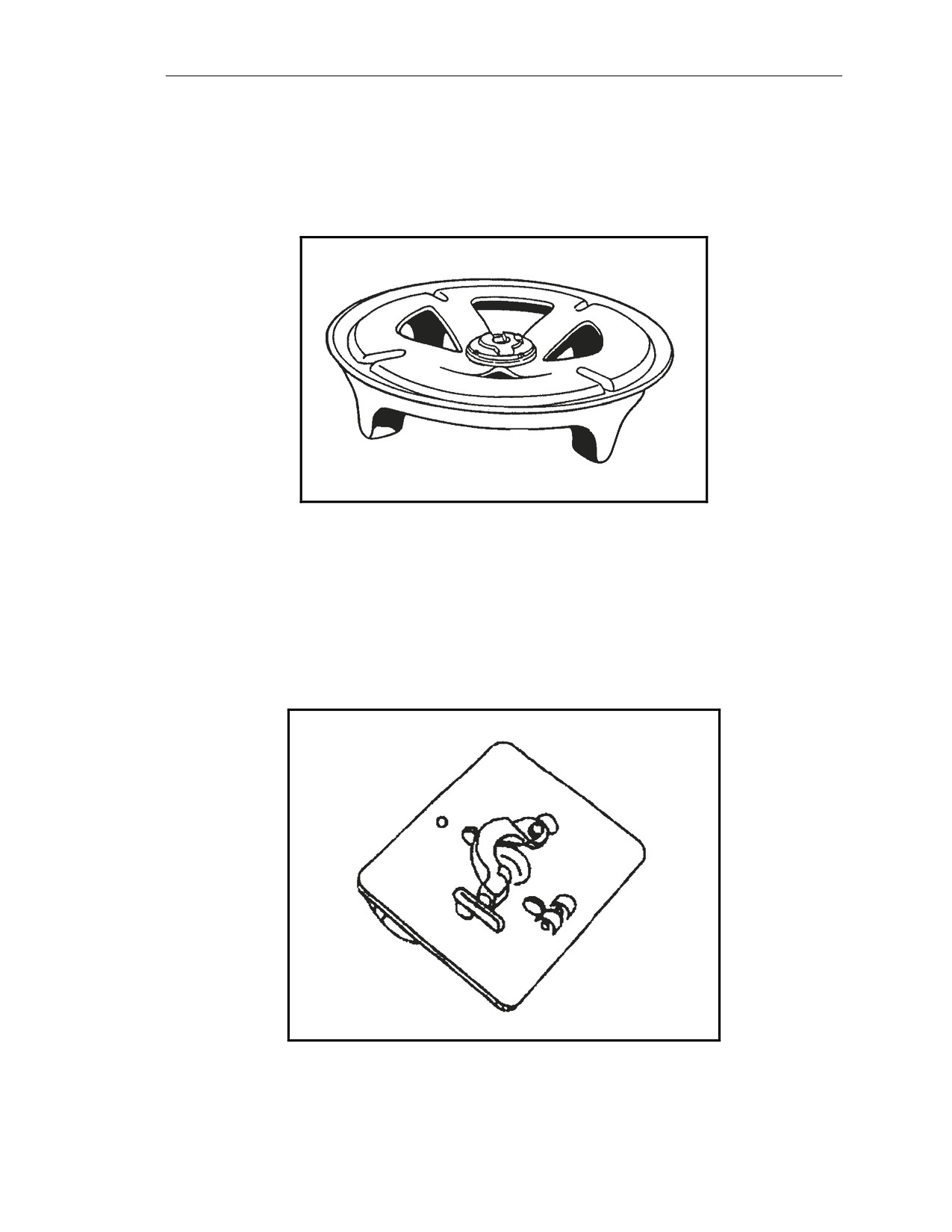
3-18. The baseplate, M7, (Figure 3-4) is a one-piece, circular, aluminum-forged base. It has a ball
socket with a rotating locking cap and a stationary retaining ring held in place by four screws and lock
washers. The locking cap rotates 6400 mils, giving the mortar full-circle firing capability. The
underside of the baseplate has four spades to stabilize the mortar during firing.
Figure 3-4. Baseplate, M7.
BASEPLATE, M8
3-19. The baseplate, M8, (Figure 3-5) is a one-piece, rectangular, aluminum-forged base. It should be
used when the mortar is fired in the handheld mode. The baseplate allows the mortar to be fired 0800
mils left and 0800 mils right of the center of sector for a total sector coverage of 1600 mils. It has a
socket in which the cannon can be locked to the baseplate by securing the locking arm. The underside
of the baseplate has four spades to strengthen and stabilize the mortar during firing. Two spring-loaded
plungers lock the baseplate to the cannon in its carry position.
Figure 3-5. Baseplate, M8.
7 December 2007
FM 3-22.90
3-5
Chapter 3
SECTION III. OPERATION
Safe operation of the
60-mm mortar requires that training include drill practice on tasks for safe
manipulation and effective employment. Crew training achieves the speed, precision, and teamwork needed
to deliver responsive and effective fire on target.
PREMOUNT CHECKS
3-20. Before the mortar is mounted, the squad must perform premount checks. Each squad member
should be capable of performing all the premount checks.
GUNNER
3-21. The gunner performs premount checks on the mount so that—
The spread cable is fixed to both legs and taut.
The clearance on the left leg above the adjusting nut is two fingers in width.
The locking sleeve is neither too loose nor too tight.
The traversing bearing is centered.
3-22. When all pieces of equipment are checked, the gunner notifies the section leader by announcing,
“All correct.”
SQUAD LEADER
3-23. The squad leader performs the premount checks on the cannon so that—
The cannon is clean both inside and outside.
The firing pin is visible.
The spherical projection is clean, and the firing pin is firmly seated.
The selector switch is on drop-fire mode.
AMMUNITION BEARER
3-24. The ammunition bearer is responsible for the premount checks on the baseplate ensuring that—
The rotatable socket cap moves freely and has a light coat of oil.
The ribs and braces are checked for breaks and dents, and the inner ring is secured to the
outer ring.
MOUNTING OF THE MORTAR
3-25. The squad mounts the mortar.
(1) The squad leader picks up and places the sight case and two aiming posts at the exact
position where the mortar is to be mounted.
(2) The ammunition bearer places the outer edge of the baseplate against the baseplate stake. He
aligns the left edge of the cutout portion of the baseplate with the right edge of the baseplate
stake. He then rotates the socket cap so that the open end points in the direction of fire.
(3) The gunner picks up the bipod with his left hand on the traversing hand crank and his right
hand on the dovetail slot. He moves forward of the baseplate about 12 to 15 inches and
faces the baseplate on line with the left edge
(gunner’s viewpoint) of the baseplate.
Dropping down on one knee in front of the bipod, the gunner supports the bipod with his
left hand on the gear case. He then detaches the hook and unwraps the cable assembly. The
gunner places his left hand on the midsection of the traversing slide and his right hand on
the mechanical leg, and he extends the bipod legs the length of the cable assembly. He then
aligns the center of the bipod assembly with the center of the baseplate. He ensures that the
elevation guide cannon is vertical and the locking nut is hand-tight. The gunner moves to
3-6
FM 3-22.90
7 December 2007
60-mm Mortar, M224
the mechanical leg side and supports the bipod with his left hand on the shock absorber. He
unscrews the collar locking knob to open the collar.
(4) The ammunition bearer picks up the cannon and inserts the spherical projection of the base
plug into the socket. He rotates the cannon 90 degrees to lock it to the baseplate. If
performed properly, the carrying handle is on the upper side of the cannon, facing skyward.
(5) The gunner pushes down on the shock absorber and raises the collar assembly. The
ammunition bearer lowers the cannon and places the lower saddle on the lower part of the
collar. The gunner closes the upper part of the collar over the cannon. He replaces the
locking knob to its original position and makes it hand-tight. The ammunition bearer cranks
the elevation hand crank up 15 to 17 turns.
(6) The gunner takes the sight out of the case and sets a deflection of 3200 mils and an
elevation of 1100 mils. He mounts the sight to the mortar by pushing the lock latch on the
sight inward. He slides the dovetail on the sight into the dovetail slot on the bipod until
firmly seated. The gunner releases the latch. He should tap up on the bottom of the sight to
ensure proper seating. He then levels the mortar first for elevation 1100 mils, and then
cross-levels. The gunner announces, “(gun number) up,” to his squad leader.
SAFETY CHECKS BEFORE FIRING
3-26. The entire squad performs safety checks.
GUNNER
3-27. The gunner ensures that—
The cannon is locked to the baseplate and the open end of the socket cap points in the
direction of fire. The bipod should be connected to either the upper or lower saddle of the
cannon.
The cannon is locked on the collar by the locking knob.
The locking nut is wrist tight.
The cable is taut.
The selector switch on the cannon is on drop-fire.
There is mask and overhead clearance.
Mask and Overhead Clearance
3-28. Since the mortar is normally mounted in defilade, there could be a mask such as a hill, trees,
buildings, or a rise in the ground. Roofs or overhanging tree branches can cause overhead interference.
The gunner must be sure the round does not strike any obstruction.
3-29. When selecting the exact mortar position, the squad leader checks quickly for mask and
overhead clearance. After the mortar is mounted, the gunner checks it thoroughly. He determines mask
and overhead clearance by sighting along the top of the cannon with his eye placed near the base plug.
If the line of sight clears the mask, it is safe to fire. If not, he may still fire at the desired range by
selecting a charge zone having a higher elevation for that particular range. When firing under the
control of an FDC, the gunner reports to the FDC that mask clearance cannot be obtained at a certain
elevation.
3-30. Firing is slowed if mask clearance is checked before each firing. Therefore, if the mask is not
regular throughout the sector of fire, the minimum mask clearance is determined to eliminate the need
for checking on each mission. To do this, the gunner depresses the cannon until the top of the mask is
sighted. He then levels the elevation bubble and reads the setting on the elevation scale and elevation
micrometer. That setting is the minimum mask clearance. The gunner notifies the squad leader of the
minimum mask clearance elevation. Any target that requires that elevation or lower cannot be engaged
from that position.
7 December 2007
FM 3-22.90
3-7
Chapter 3
3-31. Placing the mortar in position at night does not relieve the gunner of the responsibility for
checking for mask and overhead clearance.
CREWMAN
3-32. One crewman ensures that the bore is clean; he swabs the bore dry.
3-33. The second crewman ensures that each round is clean, safety pin is present, and ignition
cartridge is in proper condition.
SMALL DEFLECTION AND ELEVATION CHANGES
3-34. With the mortar mounted and the sight installed, the gunner makes small deflection and
elevation changes.
(1) The gunner lays the sight on the two aiming posts (placed out 50 and 100 meters from the
mortar) on a referred deflection of 2800 mils and an elevation of 1100 mils. The mortar is
within two turns of center of traverse. The vertical cross line of the sight is on the left edge
of the aiming post.
(2) The gunner is given a deflection change in a fire command between 20 and 60 mils. The
elevation change announced must be less than 90 mils and more than 35 mils.
(3) As soon as the sight data are announced, the gunner places it on the sight, lays the mortar
for elevation, and then traverses onto the aiming post by turning the traversing handwheel
and the adjusting nut in the same direction. A one-quarter turn on the adjusting nut equals
one turn of the traversing handwheel. When the gunner is satisfied with his sight picture he
announces, “Up.”
NOTE: The gunner repeats all elements given in the fire command.
(4) After the gunner has announced “Up,” the mortar should be checked by the squad leader to
determine if the exercise was performed correctly.
LARGE DEFLECTION AND ELEVATION CHANGES
3-35. With the mortar mounted and the sight installed, the squad makes large deflection and elevation
changes.
(1) The gunner lays the sight on the two aiming posts (placed out 50 and 100 meters from the
mortar) on a referred deflection of 2800 mils and an elevation of 1100 mils.
(2) The gunner is given a deflection and elevation change in a fire command causing the gunner
to shift the mortar between 200 and 300 mils and an elevation change between 100 and 200
mils.
(3) As soon as the sight data are announced, the gunner places it on the sight, elevates the
mortar until the elevation bubble floats freely, and then centers the traversing bearing. If the
elevation is between 1100 to 1511 mils, the cannon is mounted in the lower saddle. If the
elevation is between 0800 to 1100 mils, the high saddle is used. If the saddle is changed, the
squad leader helps the gunner.
(4) The squad leader moves into position to the front of the bipod, kneels on either knee, and
grasps the bipod legs (palms out), lifting until the feet clear the ground enough to permit
lateral movement. The gunner moves the mortar as the squad leader steadies it, attempting
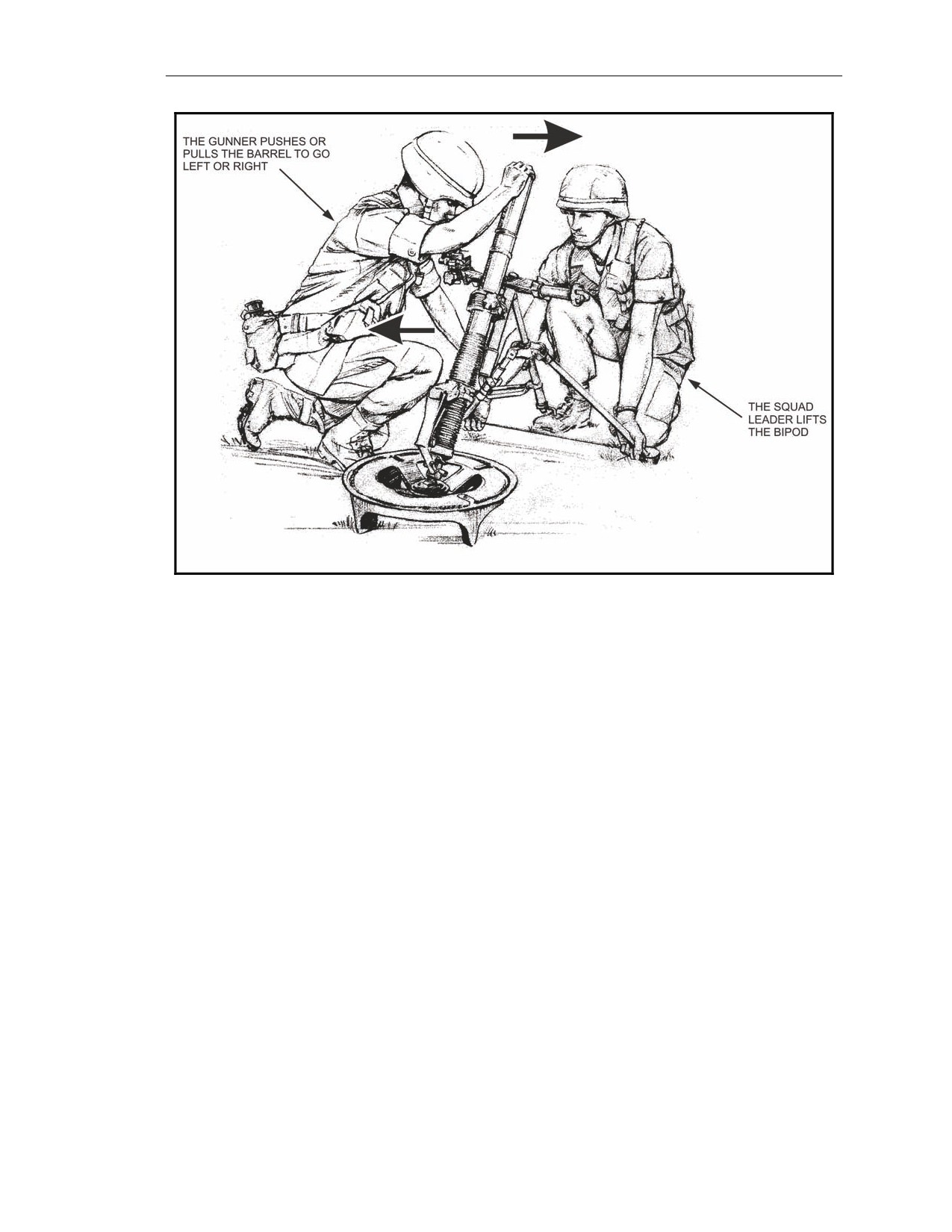
to horizontally maintain the traversing mechanism. To make the shift, the gunner places the
fingers of his right hand in the muzzle (Figure 3-6) and his left hand on the left leg, and
moves the mortar until the vertical line of the sight is aligned approximately on the aiming
post. When the approximate alignment is completed, the gunner signals the squad leader to
lower the bipod by pushing down on the mortar.
3-8
FM 3-22.90
7 December 2007
60-mm Mortar, M224
Figure 3-6. Large deflection and elevation changes.
(5) The gunner levels the mortar for elevation, then cross-levels. He continues to traverse and
cross-level until the correct sight picture is obtained. The mortar should be within two turns
of center of traverse when the exercise is completed.
REFERRING OF THE SIGHT AND REALIGNMENT OF AIMING
POSTS
3-36. Referring the sight and realigning aiming posts ensure that all mortars are set on the same data.
The section leader, acting as the FDC, has one deflection instead of two.
(1) The sheaf is paralleled, and each mortar is laid on the correct data.
(2) The section leader, acting as the FDC, prepares an administrative announcement using the
format for a fire command and the hit data of the basepiece as follows:
“Section.”
“Do not fire.”
“Refer deflection one eight zero zero (1800).”
“Realign aiming posts.”
(3) The gunners refer their sights to the announced deflection. Each gunner checks his sight
picture. If he has an aligned sight picture, no further action is required.
(4) In laying the mortar for direction, the two aiming posts do not always appear as one when
viewed through the sight. This separation is caused by either a large deflection shift of the
cannon or by a rearward displacement of the baseplate assembly caused by the shock of
firing. When the aiming posts appear separated, the gunner cannot correctly use either one
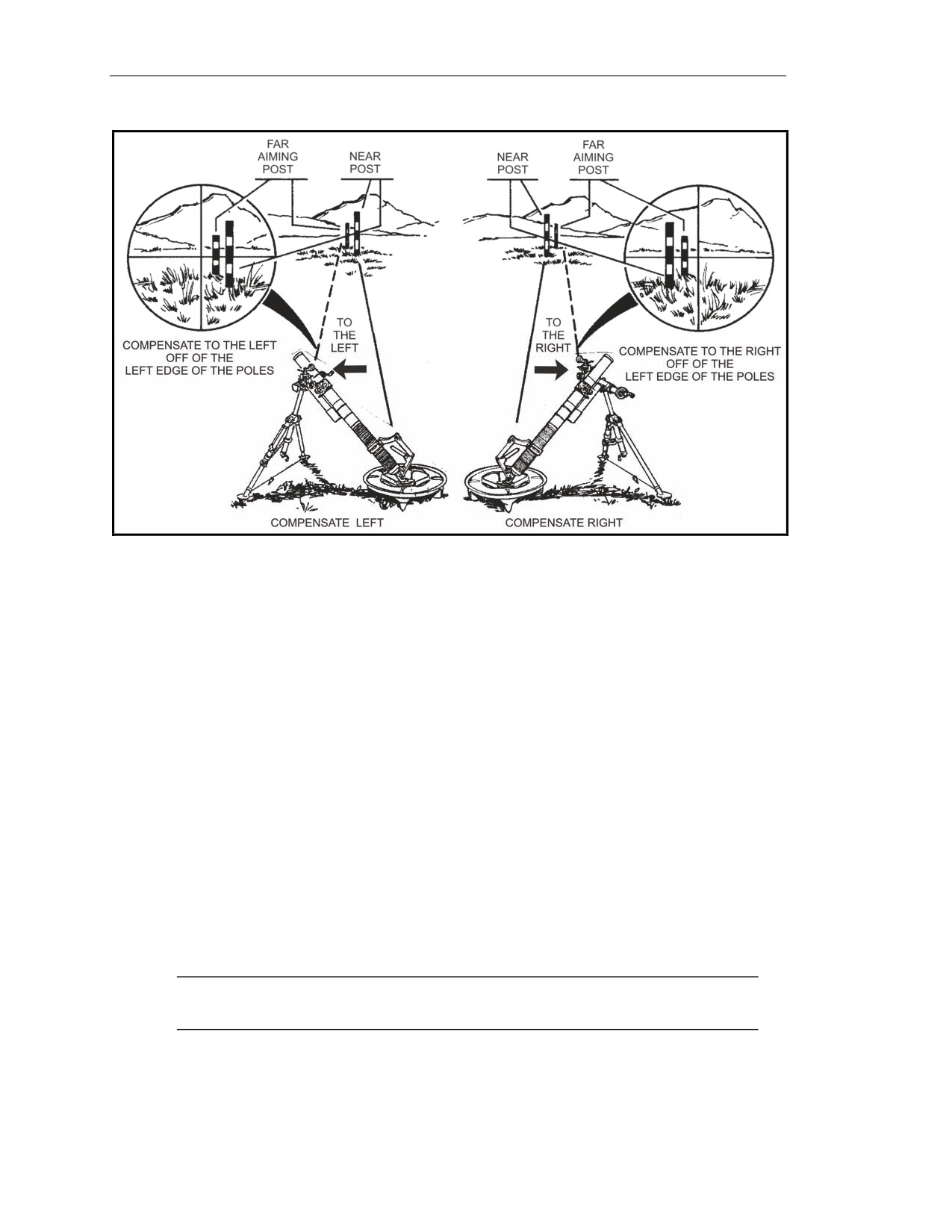
of them as his aiming point. To lay the mortar correctly, he takes a compensated sight
picture (Figure 3-7). He traverses the mortar until the sight picture appears with the left edge
of the far aiming post, which is placed exactly midway between the left edge of the near
aiming post and the vertical line of the sight. This corrects for the displacement.
7 December 2007
FM 3-22.90
3-9
Chapter 3
Figure 3-7. Compensated sight picture.
(5) At the first lull in firing, the gunner must determine whether the displacement is caused by
traversing the mortar or by displacement of the baseplate assembly. To do this, he places the
referred initial deflection on the sight and lays on the aiming posts. If both aiming posts
appear as one, the separation is caused by traversing. In this case, he continues to lay the
mortar as described and does not realign the aiming posts. When the posts still appear
separated, the separation is caused by displacement of the baseplate assembly. He notifies
his squad leader, who in turn requests permission from the section leader to realign the
aiming posts. To realign the aiming posts using the sightunit, the gunner—
Places on the sight the deflection originally used to place out the posts.
Lays the mortar so that the vertical line of the sight is aligned on the left edge of the far
aiming post.
Without shifting the mortar, refers the sight until the vertical cross line falls on the left
edge of the near aiming post. This actually measures the angle between the posts.
With this last deflection set on the sight, re-lays the mortar until the vertical cross line
is aligned on the far aiming post.
Without shifting the mortar, refers the sight again to the original referred deflection
used to place out the aiming posts. The line of sight, through the sight, is now parallel
to the original line established by the aiming posts.
Looking through the sight, directs the ammunition bearer to move the aiming posts so
that they are realigned with the sight’s vertical line. The posts are now realigned to
correct the displacement.
NOTE: This procedure is used only when displacement is so great that it is difficult to
obtain a compensated sight picture.
MALFUNCTIONS
3-37. Mortarmen must be aware of the following malfunctions.
3-10
FM 3-22.90
7 December 2007
60-mm Mortar, M224
MISFIRE
3-38. A misfire is a complete failure to fire. It can be caused by a faulty firing mechanism or faulty
element in the propelling charge explosive train. A misfire cannot be immediately distinguished from a
delay in functioning of the firing mechanism or from a hangfire; therefore, it must be handled with
care. All firing malfunctions should be considered a misfire. Mechanical malfunctions can be caused
by a faulty wiring pin or by rounds lodged in the cannon because of burrs, excess paint, oversized
rounds, or foreign matter in the cannon. Procedures for removing a misfire are discussed in paragraphs
3-41 to 3-43.
HANGFIRE
3-39. A hangfire is a delay in the functioning of a propelling charge explosive train at the time of
firing. In most cases, the delay ranges from a split second to several minutes. Thus, a hangfire cannot
be distinguished immediately from a misfire.
COOKOFF
3-40. A cookoff is a functioning of one or more of the explosive components of a round chambered in
a hot weapon, initiated by the heat of the weapon.
REMOVAL OF A MISFIRE
3-41. The procedures for removing a misfire are different for handheld and conventional modes. The
propelling charge may not function for the following reasons:
Defective ignition cartridge.
Defective, damaged, or loose firing pin.
Fouled firing pin or firing pin obstructed by extraneous material.
Fouled bore.
Excess oil or water in the bore.
Misaligned stabilizing fin.
Foreign matter or excess paint on round.
Selector switch on SAFE or TRIGGER.
CONVENTIONAL MODE
3-42. Use the following procedures to remove a misfire in the conventional mode.
NOTES:
1. A faulty firing pin assembly on a 60-mm mortar, M224, requires that the
firing pin be tightened upon completion of firing when frequent trigger
firing using M720-, M721-, or M722-series ammunition. These type rounds
usually fire when trigger fired.
2. The squad leader must supervise the removal of the misfire using a copy of
the current misfire procedures.
CAUTION
Trigger fire the M720-series rounds with charges 0 and 1 only. If
an emergency requires trigger fire above charge 1, the baseplate
must be well-seated and extreme caution taken.
(1) When a misfire occurs, any member of the squad immediately announces, “Misfire.”
7 December 2007
FM 3-22.90
3-11
Chapter 3
WARNING
During peacetime live-fire training, the ammunition bearer
moves at least 50 meters to the rear of the mortar.
(2) The entire squad stays with the mortar. If it is obvious to the squad leader that the round has
reached the bottom of the cannon and has failed to ignite, the gunner places the selector
switch on trigger fire and squeezes the trigger several times to try to clear the round.
(3) If the round fails on trigger fire, the gunner places the selector switch back on drop fire.
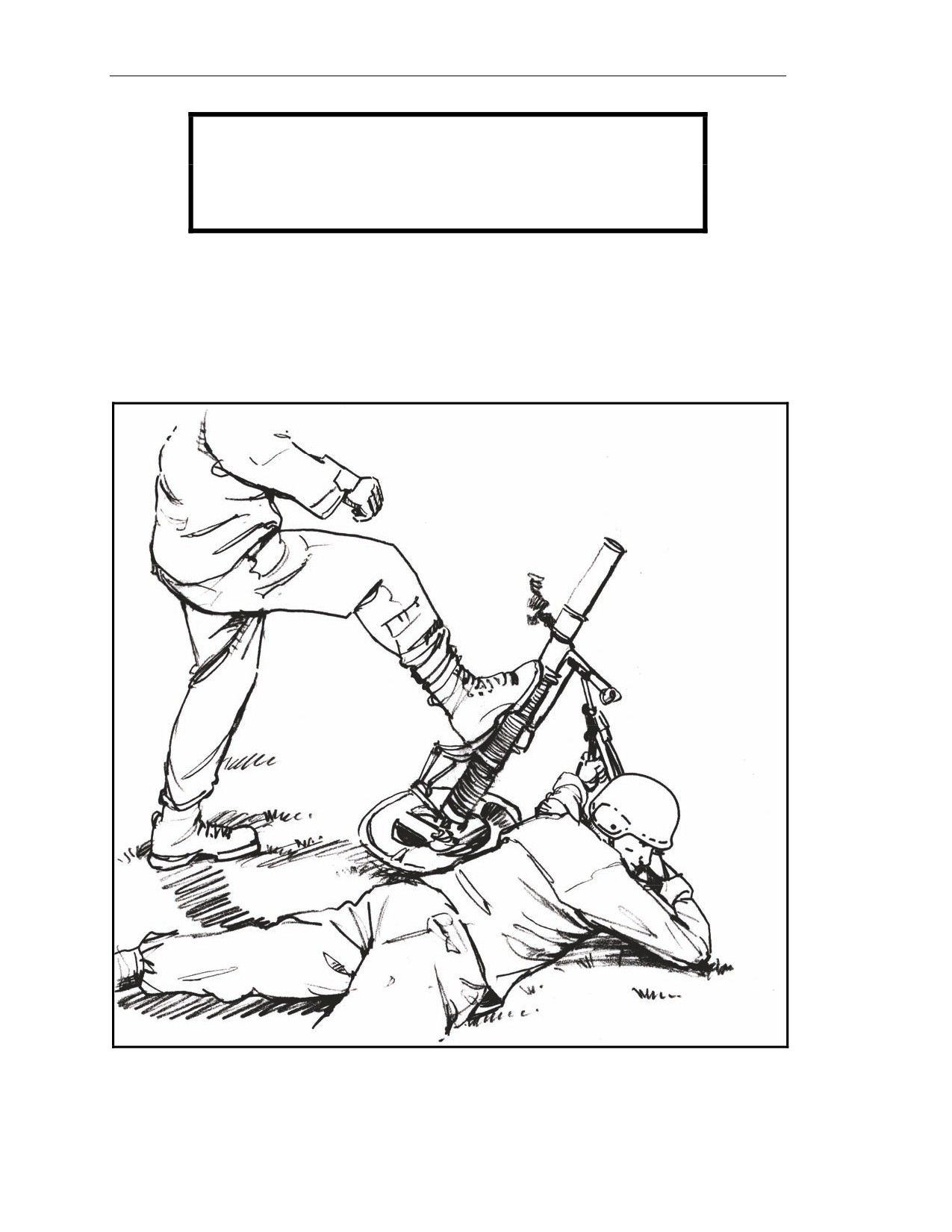
Staying clear of the muzzle at all times, the squad leader holds the bipod legs to prevent
slippage (Figure 3-8). The gunner strikes the cannon sharply several times with the heel of
his boot just above the handle assembly. If the round fails to dislodge after trigger firing and
kicking, the gunner places the selector switch on SAFE.
Figure 3-8. Kicking the mortar to clear a misfire.
3-12
FM 3-22.90
7 December 2007
60-mm Mortar, M224
WARNING
During peacetime live-fire training, the gunner and squad
leader join the ammunition bearer and wait one minute (in
case of a cookoff). After waiting one minute, the gunner
returns to the mortar.
(4) The gunner checks for heat by starting from just below the muzzle and working down to the
base with his fingertips. If the cannon is too hot to be handled, he cools it with water (or
snow) and checks it one minute later. If no water (or snow) is available, the cannon is air-
cooled until it can be easily handled with bare hands.
NOTES:
1. Liquids must never be poured into the cannon.
2. During peacetime live-fire training, the gunner signals the squad to come
forward once the cannon is cool.
(5)
The gunner locks the data down on the sight, then removes the sight and places it in a safe
location. Then, he ensures that the barrel has been lowered to its lowest elevation, leaving
0.25 inches (0.64 cm) of inner elevating sleeve showing.
WARNING
Do not move the bipod legs or change the firing saddle until
the cannon is in the horizontal position.
(6)
The gunner loosens the collar assembly so that the cannon can be rotated. He rotates the
barrel 90 degrees so that the flats on the breech cap ball are aligned with the flats on the
socket cap. The squad leader places his left leg in front of the nonmechanical leg of the
bipod to keep the bipod steady during the misfire removal. After placing his leg in this
position, the ammunition bearer places his left hand near the top of the cannon and his right
hand on the underside, just below the muzzle. He prevents any part of his body from passing
in front of the muzzle.
WARNING
Once the cannon is horizontal, the rear of the cannon must
not be lowered back down until the round is extracted. If the
round slips down the cannon before extraction, it could ignite,
causing death or personal injury.
(7)
The gunner continues to raise the cannon so that the base of the cannon is higher than the
top. With the muzzle pointing toward the ground, the gunner shakes it slightly to help
dislodge the round. As the round starts to clear the muzzle, the ammunition bearer squeezes
with the meaty portion of his thumbs against the body of the round—not the fuze—and
removes it. If the round fails to come out once the cannon is lifted, the cannon is lowered
back to the horizontal. It is removed from the bipod assembly and placed in a designated
dud pit. EOD personnel are notified for removal or disposal.
(8)
Once the round has been removed, the ammunition bearer inspects the cartridge. The
ammunition bearer replaces any safety pins and inspects the primer of the ignition cartridge.
7 December 2007
FM 3-22.90
3-13
Chapter 3
If dented, the round should not be fired. If the primer has not been dented, the firing pin on
the mortar should be checked for proper seating and tightened down if needed.
(9) While the round is being inspected, the gunner lowers the cannon back into the baseplate
and remounts the sight unit to the bipod. The ammunition bearer then swabs the bore, and
the gunner re-lays the mortar on the previous firing data.
NOTE: If the baseplate moved during the misfire procedure, the mortar must be
reciprocally laid.
(10) If the primer on the round has not been dented, the gunner tries to fire the round again. If the
same round misfires, he repeats the misfire procedures. If the primer has been dented, he
notifies range control
(during peacetime) or contacts the unit headquarters for further
guidance (during combat).
HANDHELD MODE
3-43. Use the following procedures to remove a misfire in the handheld mode.
(1) When a misfire occurs, any member of the squad immediately announces, “Misfire.”
(2) The entire crew stays with the mortar, and the gunner immediately pulls the trigger twice. If
the round still fails to function, he announces, “Misfire.” The gunner places the selector
switch on SAFE and bounces the mortar from at least 6 inches off the ground to dislodge the
round. (Disregard if the crew heard the round strike the bottom of the cannon.) The gunner
continues to keep the cannon pointed in a safe direction and elevation.
WARNING
During peacetime live-fire training, the gunner stays with the
mortar and all other crew members move at least 50 meters
behind the mortar.
NOTE: The gunner bounces the mortar only if the round is between the muzzle and
firing pin.
(3) The gunner places the selector switch back on trigger fire and squeezes the trigger twice—
the mortar should fire. If the round does not fire, he places the selector switch on SAFE and
supports the mortar cannon with sand bags, logs, or empty ammunition boxes to keep the
cannon upright and stable. He ensures the cannon is up and pointing downrange.
WARNING
During peacetime live-fire training, the gunner joins the rest of
the squad and waits one minute. After one minute, the gunner
returns to the mortar.
(4) The gunner checks for heat by starting from just below the muzzle and working down to the
base with his fingertips. If the cannon is too hot to be handled, he cools it with water (or
snow) and checks it one minute later. If no water (or snow) is available, the cannon is air-
cooled until it can be easily handled with bare hands.
3-14
FM 3-22.90
7 December 2007
60-mm Mortar, M224
NOTES:
1. Liquids must never be poured into the cannon.
2. During peacetime live-fire training, the gunner signals the squad to come
forward once the cannon is cool.
(5) Once the cannon is cool, the ammunition bearer places his left hand (fingers and thumb
extended and together) near the top of the cannon and his right hand on the underside just
below the muzzle. In one smooth motion, the gunner lifts the base of the mortar with the M8
baseplate to the horizontal position. Once the cannon reaches the horizontal position, the
ammunition bearer extends the meaty portion of his thumbs over the end of the muzzle. The
gunner continues to raise the base of the cannon past the horizontal. With the muzzle
pointing downward, the gunner slightly shakes the cannon to help dislodge the round. As
the round starts to clear the muzzle, the squad leadercatches the round by squeezing his
thumbs against the sides of the body—not the fuze—and removes it. If the fuze has safety
pins (other than the M734), the ammunition bearer tries to replace them.
WARNING
Once the cannon is horizontal, the rear of the cannon must
not be lowered back down until the round is extracted. If the
round slips down the cannon before extraction, it could ignite,
causing death or personal injury.
NOTE: Removing the firing pin ensures that the mortar will not fire should the round
slip down the cannon during the subsequent drill.
(6) The ammunition bearer inspects the primer of the ignition cartridge. If dented, he does not try
to fire the round again. If the pins cannot be replaced, the fuze may be armed. He lays the
round in the designated dud pit and notifies explosive ordnance disposal (EOD) personnel.
(7) If the round does not come out after lifting the cannon up and shaking it, the gunner returns
the cannon to the horizontal. The squad leader places the cannon in the designated dud pit
and notifies EOD personnel.
(8) If the primer on the round has not been dented, the gunner lifts the base as high as possible.
He shakes the cannon to dislodge any debris and swabs the bore. He tries to fire the round
again. If two misfires occur in a row without the primer being dented, the gunner notifies
range control (during peacetime) or contacts the unit headquarters for further guidance
(during combat).
DISMOUNTING AND CARRYING OF THE MORTAR
3-44. To dismount and carry the mortar, the squad leader commands OUT OF ACTION.
DISMOUNTING
3-45. Squads dismount using the following procedures.
(1) The ammunition bearer retrieves the aiming posts. The gunner removes the sight, places an
elevation of 0800 mils and a deflection of 3200 mils on the M64 sightunit, and places it in
the case. Then he lowers the mortar to its minimum elevation and backs off one-quarter
turn. He then centers the traversing mechanism and unlocks the collar with the collar
locking knob.
(2) The squad leader grasps the base of the cannon and turns it 90 degrees (a one-quarter turn),
until the spherical projection is in the unlocked position in the baseplate socket. He then lifts
7 December 2007
FM 3-22.90
3-15
Chapter 3
up on the base end of the cannon and removes it from the collar assembly. The ammunition
bearer secures the baseplate.
(3) The gunner relocks the collar with the collar locking knob. He moves to the front of the
bipod and faces it, kneels on his right knee with his left hand on the gear case, and loosens
the locking nut. He tilts the bipod to his left and closes the bipod legs, placing the cable
around the legs and rehooking the cable. He stands up, placing his right hand on the sight
slot and his left hand on the traversing handwheel.
(4) On the command MARCH ORDER, squad members take the equipment distributed to them
by the squad leader and move.
CARRYING
3-46. The mortar can be carried by one or two men for short distances. When the sight is left mounted
on the mortar, care must be taken to prevent damaging it. Adhere to the following procedures to
properly carry the mortar.
(1) For a one-man carry, the mortar is in the firing position with the mount attached to the
cannon at the lower saddle. The elevating mechanism is fully depressed, and the bipod legs
are together. The mount is folded back underneath the cannon until the elevating mechanism
latches to the collar assembly. The cable is passed through one of the baseplate openings
and wrapped around the cannon. The cable is attached to itself, using its snap hook. The
carrying handle is used to carry the complete mortar.
(2) For a two-man carry, the M7 baseplate is one load, and the cannon/mount combination is
the second load. The mount is attached to the cannon at the lower saddle, and the elevating
mechanism is fully depressed. The bipod legs are together, and the bipod is folded up under
the cannon until the elevating mechanism latches to the collar assembly. The cable is
wrapped around the legs and cannon and hooked onto itself with its snap hook.
NOTE: The carrying position can be in the upper or lower saddle, depending on the
mission or enemy situation.
(3) For the handheld mode, the M8 baseplate is left attached to the cannon. The baseplate is
rotated 90 degrees to the right and rotated up until the two spring plungers on the front edge
of the baseplate body latch onto the protrusion on the right side of the basecap. Then the
auxiliary carrying handle is placed in the carrying position.
SECTION IV. AMMUNITION
This section implements STANAG 2321.
The four types of ammunition for the 60-mm mortar are HE, WP, ILLUM, and training. All 60-mm mortar
cartridges, except training cartridges, have three major components—a fuze, a body, and a tail fin with a
propulsion system assembly.
CLASSIFICATION AND TYPES OF AMMUNITION
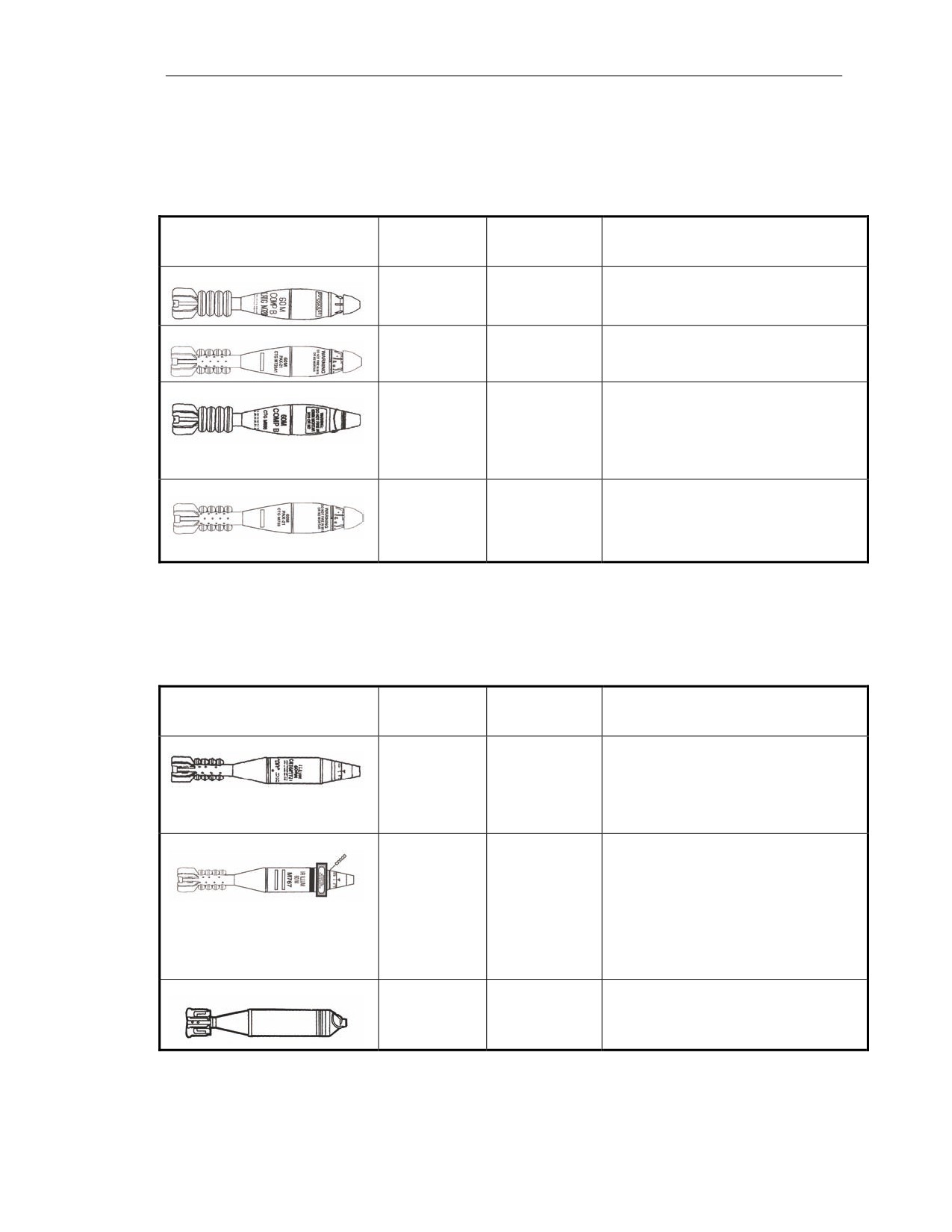
3-47. The ammunition used with the M224 mortar can be classified by its use. See the following tables
for details on each cartridge used with the M224.
NOTE: Firing Table 60-P-1 details all ammunition used with the M224 mortar.
3-16
FM 3-22.90
7 December 2007
60-mm Mortar, M224
HIGH-EXPLOSIVE AMMUNITION
3-48. HE ammunition is used against enemy personnel and light materiel targets. Table 3-2 details the
HE ammunition that can be used when firing the M224 mortar.
Table 3-2. High-explosive ammunition for the 60-mm mortar, M224.
CARTRIDGE/TYPE
MAXIMUM
FUZE
CHARACTERISTICS
RANGE
AND LIMITATIONS
(METERS)
M720 HE cartridge
3,489
M734
This cartridge cannot be fired above
multioption fuze
charge one in the handheld mode and
weighs 3.75 pounds.
M720A1 HE cartridge
3,489
M734A1
This cartridge cannot be fired above
multioption fuze
charge one in the handheld mode and
weighs 3.58 pounds.
M888 HE cartridge
3,520
M935 PD fuze
This cartridge is identical to the M720,
except that it has the M935 PD fuze.
It cannot be fired above charge one in
the handheld mode and weighs 3.75
pounds.
M768 HE cartridge
3,489
M738 PD/ DLY
This cartridge cannot be fired above
fuze
charge one in the handheld mode and
weighs 3.59 pounds.
ILLUMINATION AMMUNITION
3-49. ILLUM ammunition is used during night missions requiring assistance in observation. Table 3-3
details the ILLUM ammunition that can be used when firing the M224 mortar.
Table 3-3. Illumination ammunition for the 60-mm mortar, M224.
CARTRIDGE/TYPE
MAXIMUM
FUZE
CHARACTERISTICS
RANGE
AND LIMITATIONS
(METERS)
M721 ILLUM cartridge
3,200
M776 MTSQ
This cartridge provides an average of
fuze
325,000 candlepower for about 40
seconds.
It cannot be fired at charge zero in the
M224 and weighs 3.75 pounds.
M767 IR ILLUM cartridge
3,489
M776 MTSQ
This cartridge contains an infrared
fuze
illuminant mix that provides
approximately 75 watts/steradian of
infrared (IR) light with less than 350
candlepower of visible light. It weighs
3.76 pounds.
It is intended to be used to support
troops with night vision devices.
M83A3 ILLUM cartridge
951
M65A1-series
This cartridge provides an average of
time fuze
250,000 candlepower for at least 30
seconds. It weighs 3.7 pounds.
7 December 2007
FM 3-22.90
3-17
Chapter 3
SMOKE, WHITE PHOSPHORUS AMMUNITION
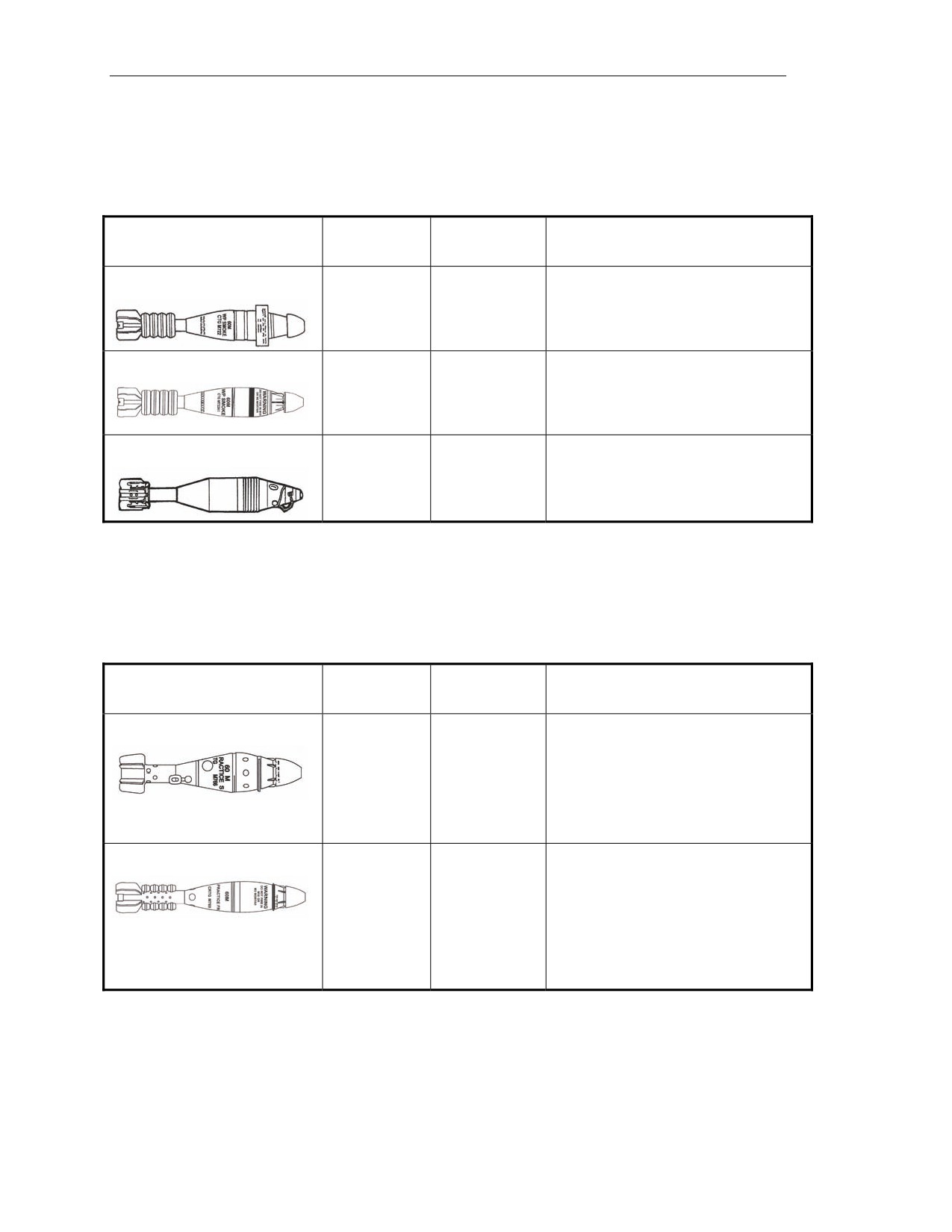
3-50. Smoke, WP ammunition is used as a screening, signaling, or incendiary agent. Table 3-4 details
the smoke WP ammunition that can be used when firing the M224 mortar.
Table 3-4. Smoke, white phosphorus ammunition for the 60-mm mortar, M224.
CARTRIDGE/TYPE
MAXIMUM
FUZE
CHARACTERISTICS
RANGE
AND LIMITATIONS
(METERS)
M722 smoke WP cartridge
3,200
M745 PD fuze
This cartridge is used as bulk WP for
spotting/marking. It weighs 3.7 pounds.
M722A1 smoke WP cartridge
3,200
M783 PD/ DLY
This cartridge is used as bulk WP for
fuze
spotting/marking. It weighs 3.79
pounds.
M302A1/A2 smoke WP
1,629
M527, M935, or
This cartridge is restricted to training
cartridge
M936 PD fuze
use and weighs 4.08 pounds.
TRAINING PRACTICE AMMUNITION
3-51. Training practice (TP) ammunition is used for training when service ammunition is not available
or there are restrictions on the use of service ammunition for training. Table 3-5 details the TP
ammunition that can be used when firing the M224 mortar.
Table 3-5. Training practice ammunition for the 60-mm mortar, M224.
CARTRIDGE/TYPE
MAXIMUM
FUZE
CHARACTERISTICS
RANGE
AND LIMITATIONS
(METERS)
M766 SRTC
525
M779 PD
This cartridge weighs 2.9 pounds. The
practice fuze
range of this cartridge can be reduced
by removing increment plugs from the
projectile body.
This cartridge produces a flash and a
bang on impact. It can also be
recovered, refurbished, and reused.
M769 FRTC
3,500
M775 PD
This non-dud producing training
practice fuze
cartridge is ballistically similar to the
M720-series HE cartridge. It weighs
3.82 pounds.
The M775 practice fuze simulates the
M734-series fuze for realistic
ammunition preparation procedures.
3-18
FM 3-22.90
7 December 2007
60-mm Mortar, M224
FUZES
3-52. A fuze is a device to explode a projectile at the time and under the circumstances required.
Mortar fuzes are located at the top of the cartridge and have four possible actions: SQ acts on impact,
DLY acts 0.05 seconds after impact, variable time (VT) acts a certain distance above the ground, and
MT acts after a preset number of seconds have elapsed after being fired. Many modern fuzes have
more than one action. The following describes the type of fuzes available on ammunition fired by the
M224.
WARNING
Do not try to disassemble any fuze.
MULTIOPTION FUZE, M734
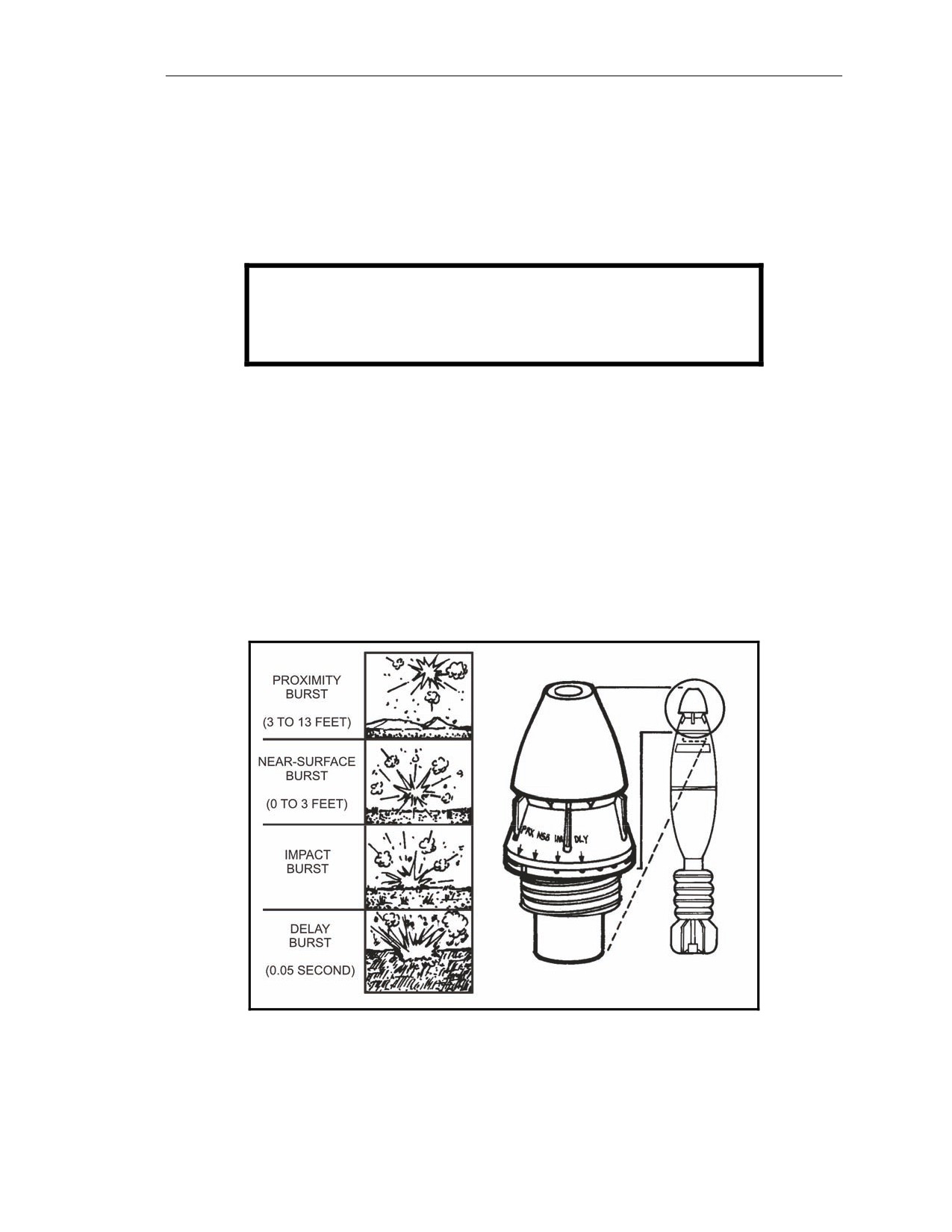
3-53. This fuze (Figure 3-9) can be set to function as a proximity burst (1 to 4 meters above the
surface), near-surface burst (0 to 1 meter above the surface), impact/superquick burst (on the surface),
or delay burst (0.05 seconds).
3-54. It is set by hand without using a tool. Once set, an M734’s setting can be changed many times
before firing without damaging the fuze.
3-55. This fuze has no safety pins or wires.
3-56. If a cartridge set for PROX fails to burst at the proximity distance above the target, it
automatically bursts at 0 to 1 meter (0 to 3 feet) above the target. If a cartridge set for NSB fails to
burst at the near-surface distance above the target, it automatically bursts on impact. If a cartridge set
for impact fails to burst on impact, it automatically bursts 0.05 seconds after impact.
Figure 3-9. Multioption fuze, M734.
7 December 2007
FM 3-22.90
3-19
Chapter 3
MULTIOPTION FUZE, M734A1
3-57. The air-powered M734A1 multioption fuze has four selectable functions:
PRX 120.
PRX 60/81.
IMP.
DLY.
3-58. In HE PROX mode, the height of burst (HOB) remains constant over all types of targets. The
IMP mode causes the round to function on contact with the target and is the first backup function for
either PROX setting. In the DLY mode, the fuze functions about 30 to 200 milliseconds after target
contact. The DLY mode is the backup for the IMP and PROX modes. The IMP and DLY modes have
not changed from the current M734 multioption fuze.
3-59. Radio frequency jamming can affect the functioning of PROX fuzes. Radio frequency jamming
initiates a gradual desensitizing of the fuze electronics to prevent premature fuze function. Once the
fuze is out of jamming range, the fuze electronics recover and function in the PROX mode if the
designed HOB has not been passed. To limit the time of fuze radio frequency radiation, the proximity
turn-on is controlled by an apex sensor that does not allow initiation of the fuze proximity electronics
until after the apex of the ballistic trajectory has been passed.
3-60. In compliance with the safety requirements of military standard 1316C, the M734A1 uses ram
air and setback to provide two independent environment sensors.
POINT-DETONATING FUZE, M935
3-61. The M935 PD fuze can be set to function as SQ or DLY.
3-62. It is preset for the SQ function, and the ammunition handler verifies that the selector slot is
aligned with the "SQ" mark on the ogive. The ammunition handler selects DLY by turning the slot
clockwise until it is aligned with the "D" marking on the ogive.
3-63. Its standard pull-wire safety is removed immediately before firing.
POINT-DETONATING FUZES, M527-SERIES AND M936
3-64. These fuzes act only on impact.
POINT-DETONATING /DELAY FUZE, M783
3-65. This fuze can be set to function as SQ or DLY.
POINT-DETONATING FUZE, M745
3-66. Although there are markings on the fuze for other settings, it acts only on impact.
TIME FUZE, M65-SERIES
3-67. The M65 is a fixed time fuze and has a safety wire.
MECHANICAL TIME SUPERQUICK FUZE, M776
3-68. Using a fuze setter, the ammunition handler sets the time on the fuze, and once fired, the
cartridge explodes after that amount of time has elapsed. If the mechanical time fails, the fuze acts on
impact. The safety wire is removed just before firing.
POINT-DETONATING FUZE, M779, AND PRACTICE FUZE, M775
3-69. These fuzes are used with M766 and M769 training cartridges only.
3-20
FM 3-22.90
7 December 2007
60-mm Mortar, M224
WARNINGS
Do not fire cartridges with M525 or M527 PD fuzes if the fuze
makes a buzzing sound when the safety pins are removed.
Check the fuze for the presence of the bore-riding pin after
removing the safety pin and do not fire the cartridge if it is
missing. Notify EOD.
Adequate fragmentation cover must be taken when firing
cartridges for distances less than 300 meters
Consult the TM on firing temperature limits.
CARTRIDGE PREPARATION
3-70. Cartridges are prepared as close to the actual firing period as possible.
UNPACKING
3-71. Standard A cartridges are individually packed in fiber containers with eight cartridges in a metal
container. Use proper tools to open ammunition containers. Unpack the cartridge and remove any
packing material. The moisture-resistant seal of the shipping container should not be broken until the
ammunition is to be used. When a large number of cartridges (15 or more for each squad) are prepared
before a combat mission, the cartridges may be removed from the shipping container and the
propellant increments adjusted. The fin assemblies should then be reinserted into the container to
protect the propelling charges.
INSPECTING FIN ASSEMBLIES
3-72. Inspect the cartridge fin assembly for any visible damage and retighten loose fin assemblies as
required. Cartridges with damaged fins are turned in to the ammunition supply point (ASP).
PREPARING TO FIRE
3-73. When the ammunition bearer receives information in a fire command, he prepares the
ammunition for firing. The number of cartridges, type of cartridge, fuze setting, and charge are all
included in the fire command. To apply the data, the ammunition bearer selects the proper cartridge,
sets the fuze, and adjusts (removes or replaces) the number of propelling charges on the quantity of
cartridges called for in the fire command. He also inspects each cartridge for cleanliness and
serviceability. Any safety wires are pulled only just before firing.
WARNING
For protection, a cartridge prepared but not fired should be
returned to its container, increment end first. The pull wire on
the M888 fuze must be replaced before returning it to its
container.
7 December 2007
FM 3-22.90
3-21
Chapter 3
ADJUSTING THE PROPELLING CHARGE
3-74. The ammunition bearer adjusts the number of charges immediately in a fire for effect (FFE)
mission. In an adjust-fire mission, he prepares the cartridge and delays adjusting the charges until the
FFE is entered because the charge may change during the subsequent adjustments of fire. Cartridges
are shipped with a complete propelling charge consisting of the ignition cartridge and four charges.
3-75. The fire command includes the number of charges on the cartridge.
3-76. If the cartridge is fired at less than full charge, the ammunition handler removes the number of
charges based on the fire command.
Charge zero is the ignition charge only
Charge 1 has the ignition charge and 1 increment
Charge 2 has the ignition charge and 2 increments
Charge 3 has the ignition charge and 3 increments
Charge 4 has the ignition charge and 4 increments
3-77. If the charge is less than charge 4, slide the remaining increments towards the rear until they are
positioned against the fins.
3-78. Place the excess increments in an empty ammunition box for protection and close the lid during
firing. Dispose of the excess increments in accordance with local range regulations.
WARNINGS
Propelling charges are not interchangeable. Do not substitute
one model for another. Do not mix lots.
Never fire cartridges with a greater number of propelling
charges than authorized for the ammunition and weapon.
UNFIRED CARTRIDGES
3-79. If a cartridge is not fired, replace the safety wire (if it was removed from the fuze) and reset the
fuze. Re-install the propellant increments so that the cartridge has a full charge. Repack the cartridge in
its original packaging.
CARE AND HANDLING
3-80. Ammunition is manufactured and packed to withstand all conditions normally encountered in the
field. However, moisture and high temperature can damage ammunition. Also, explosive elements in
primers and fuzes are sensitive to strong shock and high temperature. Complete cartridges being fired
should be handled with care. Adhere to the following guidelines for proper ammunition care and
handling.
Do not throw or drop cartridges.
WARNING
Do not walk on, tumble, drag, throw, roll, or drop ammunition.
Ensure that ammunition is kept in original container until
ready for use. Do not combine WP and HE in storage.
Maintain compatibility and quantity of ammunition, as
outlined in TB 43-0250.
3-22
FM 3-22.90
7 December 2007
60-mm Mortar, M224
Protect ammunition from mud, dirt, sand, water, snow, and direct sunlight. Cartridges must
be free of such foreign matter before firing. Ammunition that is wet or dirty should be
wiped off at once.
Always store ammunition under cover. When this is not possible, raise it at least 6 inches
(15 centimeters) off the ground and cover with a double thickness of tarpaulin. Dig trenches
around the ammunition pile for drainage. WP cartridges must be stored with the fuze end
up.
In combat, store ammunition underground such as in bunkers.
In the field, use waterproof bags, ponchos, ground cloths, and dunnage to prevent
deterioration of ammunition. Ensure that ammunition does not become water-soaked.
In arctic weather, store the ammunition in wooden boxes or crates. Place the boxes or
crates on pallets and cover them with a double thickness of tarpaulin.
Cover fin assemblies and propelling charges with the fiber container or end cap. Stack
cartridges on top of empty ammunition boxes and cover them with plastic sheets.
WP cartridges must be handled carefully.
Store WP cartridges at temperatures below 111 degrees Fahrenheit to prevent the WP
from melting. When temperatures are above 111 degrees Fahrenheit, store the WP with
the fuze-end up. This prevents the WP filler from forming voids away from the
cartridge’s designed center of mass and causes an erratic flight of the cartridge.
Store WP cartridges away from other types of ammunition.
Do not handle duds. Follow local range procedures to dispose of them.
WARNING
Duds are cartridges that have been fired but have not
exploded. Duds are dangerous and should not be handled by
anyone other than a member of the EOD team.
7 December 2007
FM 3-22.90
3-23
This page intentionally left blank.
Chapter 4
81-mm Mortar, M252
The
81-mm mortar, M252, delivers timely, accurate fires to meet the
requirements of supported troops. This chapter discusses assigned personnel
duties, crew drill, mechanical training, and characteristics of the mortar.
SECTION I. SQUAD AND SECTION ORGANIZATION AND DUTIES
Each member of the infantry mortar squad has principle duties and responsibilities. (See FM 7-90 for a
discussion of the duties of the platoon headquarters.)
ORGANIZATION
4-1. If the mortar squad and section are to operate quickly and effectively in accomplishing their
mission, mortar squad members must be proficient in individually assigned duties. Correctly applying
and performing these duties enables the mortar section to perform as an effective fighting team. The
platoon leader commands the platoon and supervises the training of the elements. He uses the chain of
command to assist him in effecting his command and supervising duties.
DUTIES
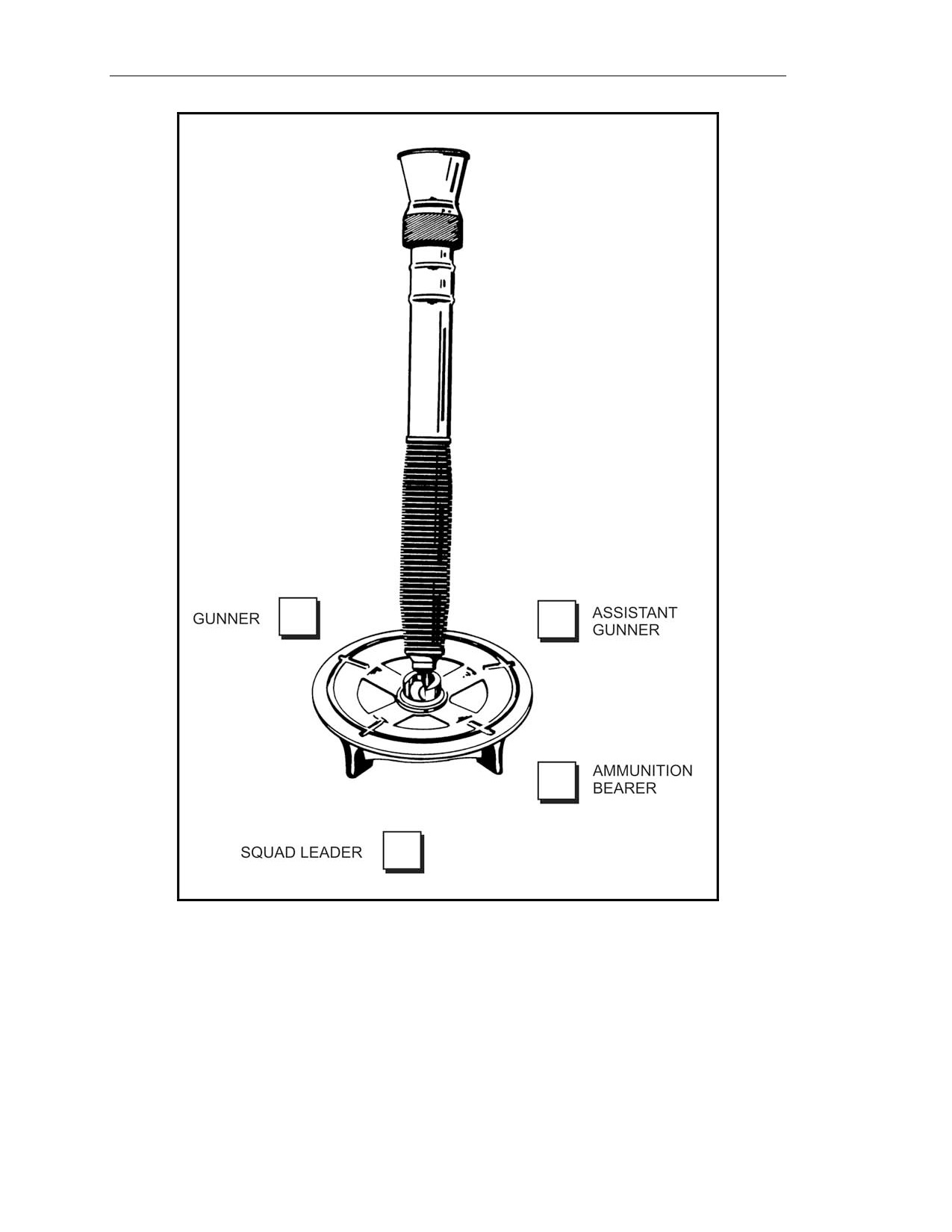
4-2. The mortar squad consists of four men (Figure 4-1):
Squad leader.
Gunner.
Assistant gunner.
Ammunition bearer.
SQUAD LEADER
4-3. The squad leader stands behind the mortar where he can command and control his squad. He
supervises the emplacement, laying, and firing of the mortar, and all other squad activities.
GUNNER
4-4. The gunner stands to the left side of the mortar where he can manipulate the sight, elevating
handwheel, and traversing handwheel. He places firing data on the sight and lays the mortar for
deflection and elevation. He makes large deflection shifts by shifting the bipod assembly and keeps the
bubbles level during firing.
ASSISTANT GUNNER
4-5. The assistant gunner stands to the right of the mortar, facing the cannon and ready to load. In
addition to loading, he swabs the bore after every 10 rounds and after each fire mission. He may assist
the gunner in shifting the mortar when the gunner is making large deflection changes.
AMMUNITION BEARER
4-6. The ammunition bearer stands to the right rear of the mortar. He maintains the ammunition for
firing, prepares the ammunition and passes it to the assistant gunner, and provides local security for the
mortar position. He also acts as the squad driver.
7 December 2007
FM 3-22.90
4-1
Chapter 4
Figure 4-1. Position of squad members.
4-2
FM 3-22.90
7 December 2007
81-mm Mortar, M252
SECTION II. COMPONENTS
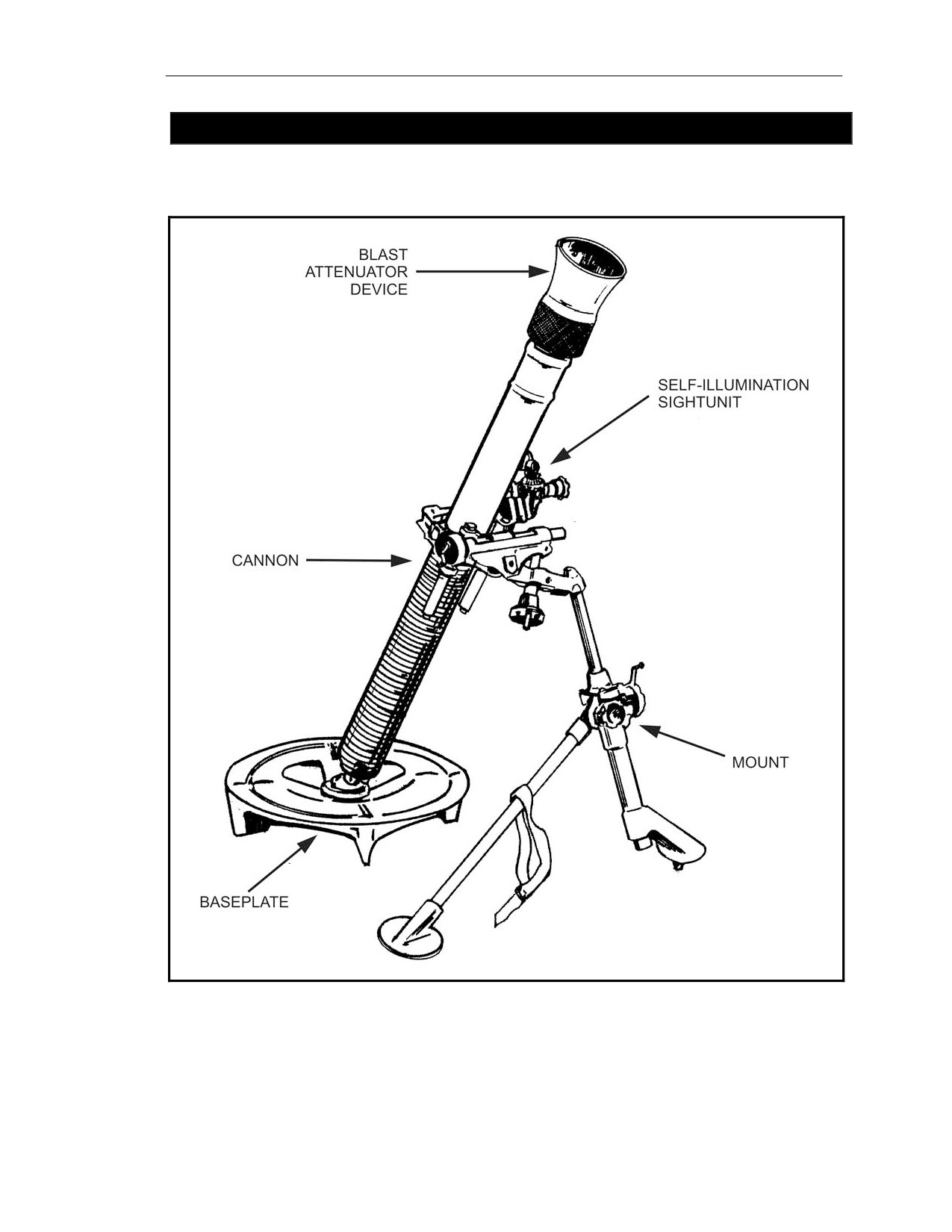
The 81-mm mortar, M252, is a smooth-bore, muzzle-loaded, high angle-of-fire weapon. The components
of the mortar consist of a cannon, mount, and baseplate. This section discusses the characteristics and
nomenclature of each component (Figure 4-2).
Figure 4-2. 81-mm mortar, M252.
7 December 2007
FM 3-22.90
4-3
Chapter 4
TABULATED DATA
4-7. The tabulated data for the 81-mm mortar, M252, are shown in Table 4-1.
Table 4-1. Tabulated data for the 81-mm mortar, M252.
Weight (pounds)
System
93
Cannon (with blast attenuator device)
35
Mount
27
M3A1 Baseplate
29
M64A1 Sightunit
2.25
Ammunition
HE
Smoke
Illum
Practice
Ready to fire
9.4
10.6
9.1
9.4
In single container
12.0
13.8
12.4
12.5
In three-round pack
57.0
63.0
60.0
60.0
Elevation
Elevation (approximate)
800 to 1515 mils
For each turn of elevation drum (approximate)
10 mils
Traverse
Right or left from center (approximate)
100 mils (10 turns)
For each turn of traversing handwheel (approximate)
7 mils
Range
Minimum to maximum
83 to 5,608 meters
Rate of fire (with 800 series ammunition)
Sustained
Maximum
15 rounds per minute indefinitely
30 rounds per minute for 2 minutes
HE fuze options
Sight
M821 w/multioption fuze M734
M889 w/PD fuze M935
M64A1, lightweight, self-Illuminating
4-4
FM 3-22.90
7 December 2007
81-mm Mortar, M252
CANNON ASSEMBLY, M253
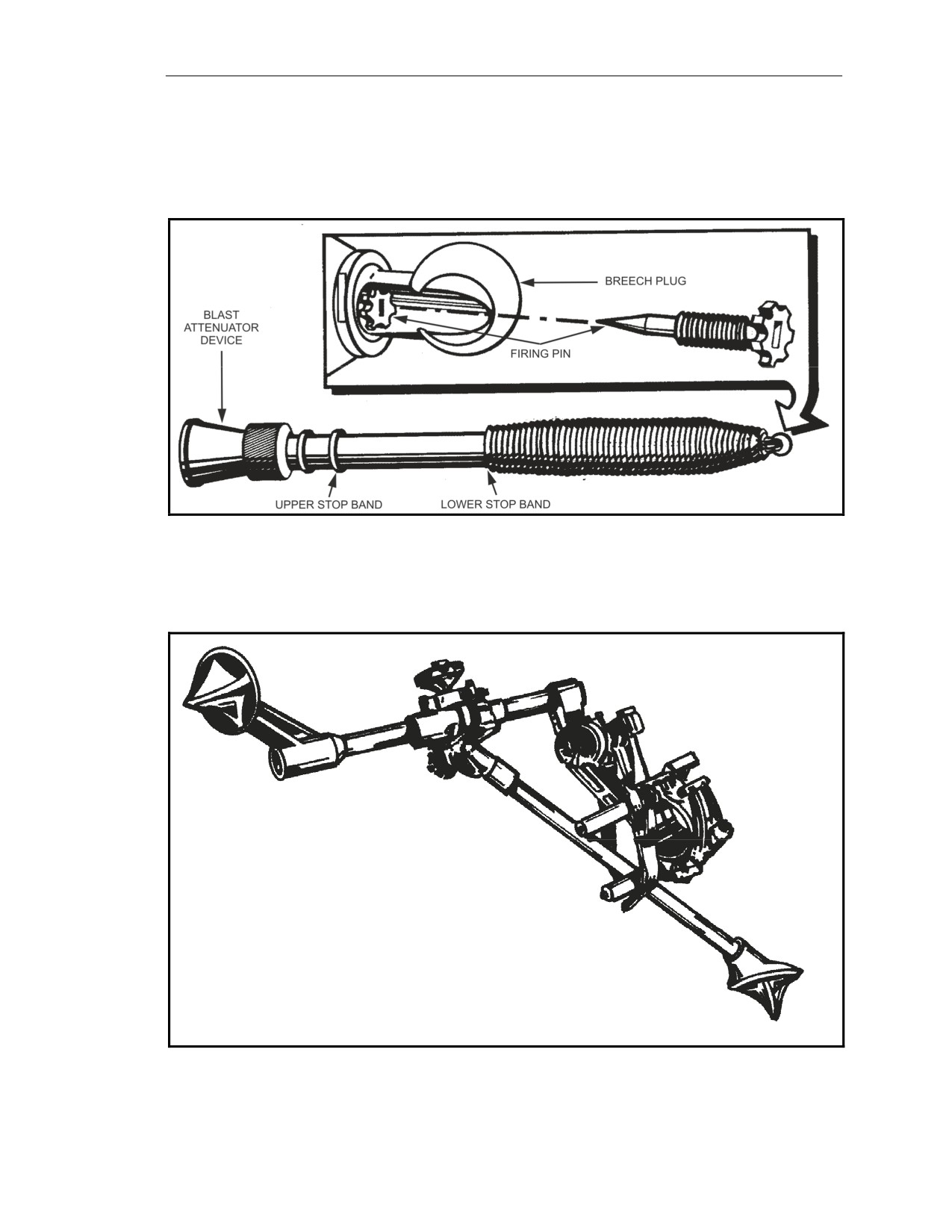
4-8. The cannon assembly consists of the cannon that is sealed at the lower end with a removable
breech plug, which houses a removable firing pin (Figure 4-3). At the muzzle end is a cone-shaped
BAD that is fitted to reduce noise. The BAD is removed only by qualified maintenance personnel.
Figure 4-3. Cannon assembly, M253.
MOUNT, M177
4-9. The mount consists of elevating and traversing mechanisms and a bipod (Figure 4-4).
Figure 4-4. Mount, M177, in folded position.
7 December 2007
FM 3-22.90
4-5
Chapter 4
BIPOD
4-10. The bipod provides front support for the cannon and carries the gears necessary to lay the
mortar. The cannon clamp, which consists of an upper and lower clamp, is situated at the top. The
upper clamp is fitted with a locking arrangement that consists of a curved handle and a spring-loaded
locking rod that is ball-shaped at its lower end. The lower clamp is shaped and bored on each side to
house the buffer cylinders. On the right side, the clamp is recessed to receive the ball end of the
locking rod. A safety latch located at the side of the recess is used to secure the ball.
TRAVERSING MECHANISM
4-11. The sight bracket is attached to the buffer carrier, which is fitted to the traversing screw
assembly. Attached to the right of the screw is the traversing handwheel. The traversing screw
assembly is fitted to the clamp assembly, which is pivoted in the center on an arm attached to the
elevating leg. Attached to the arm is the cross-leveling mechanism, which is attached to the clamp
assembly at its upper end.
ELEVATING MECHANISM
4-12. The elevating shaft is contained in the elevating leg; to the left of the elevating leg is the
elevating handwheel. A plain leg is fitted to a stud on the elevating leg and is secured by a leg-locking
handwheel. A spring-loaded locating catch is behind the elevating gear housing, which locates the
plain leg in its supporting position for level ground. A securing strap is attached to the plain leg for
securing the bipod in the folded position. Both legs are fitted with a disk-shaped foot with a spike
beneath to prevent the mount from slipping.
BASEPLATE, M3A1
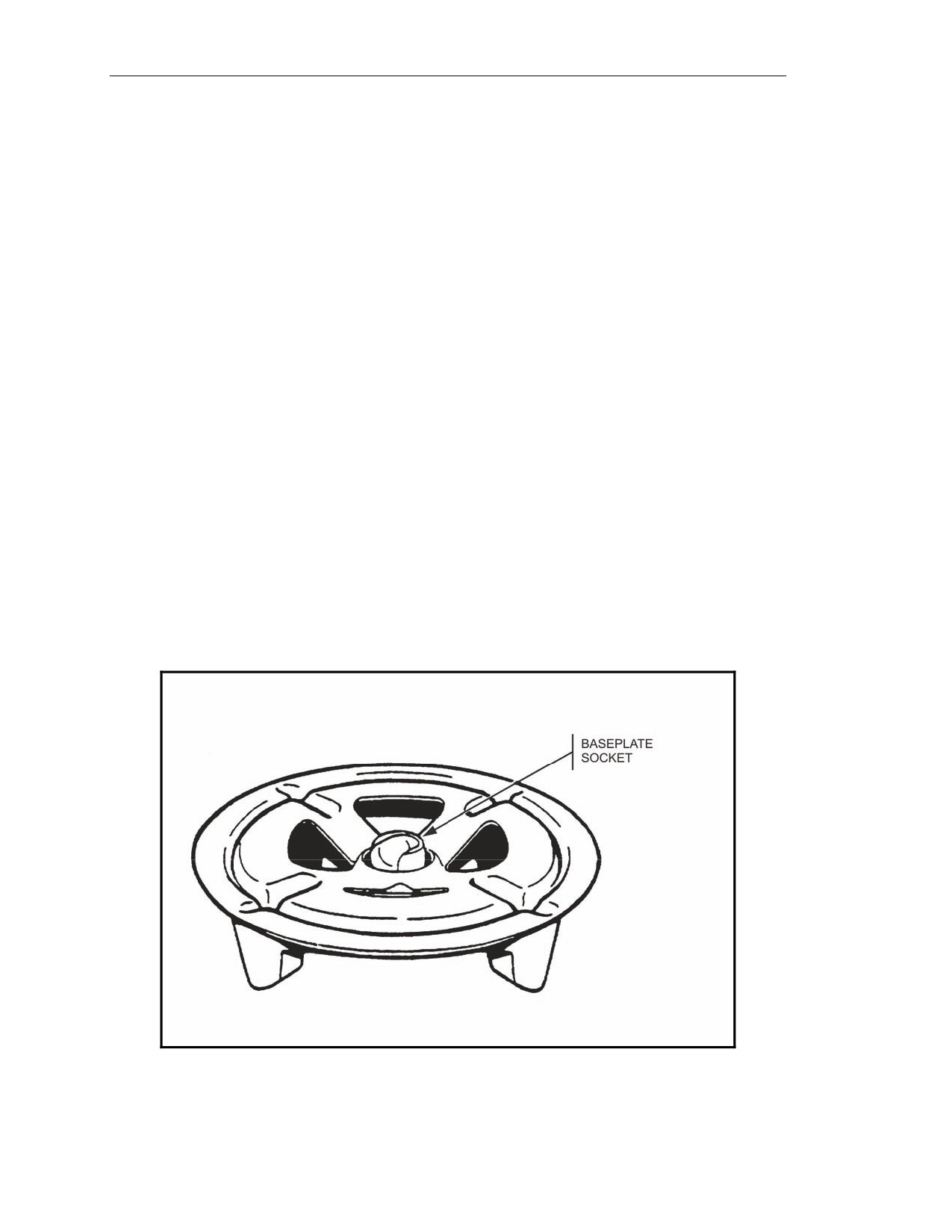
4-13. The baseplate (Figure 4-5) is constructed of one piece and supports and aligns the mortar for
firing. During firing, the breech plug on the cannon is sealed and locked to the rotatable socket in the
baseplate.
Figure 4-5. Baseplate, M3A1.
4-6
FM 3-22.90
7 December 2007
81-mm Mortar, M252
SECTION III. OPERATION
This section contains information on how to prepare the 81-mm mortar, M252, for firing; how to conduct
safety checks; and what actions to apply to remove the cartridge from the cannon if a misfire should occur
during firing.
PREMOUNT CHECKS
4-14. Before the mortar is mounted, the squad must perform premount checks. Each squad member
should be able to perform all of the following premount checks.
GUNNER
4-15. The gunner checks the baseplate and ensures that—
The rotating socket is free to move in a complete circle.
The ribs and braces have no breaks, cracks, or dents.
The retaining ring is correctly located, securing the rotating socket to the baseplate.
ASSISTANT GUNNER
4-16. The assistant gunner checks the bipod and ensures that—
The cannon clamps are clean and dry.
The cannon carrier is centered.
The securing strap is correctly located, securing the cannon clamps and buffers to the plain
leg.
The leg-locking handwheel is hand-tight.
Four inches of elevation shaft are exposed, and the shaft is not bent.
AMMUNITION BEARER
4-17. The ammunition bearer checks the cannon and ensures that—
The cannon is clean and free from grease and oil, both inside and out.
The breech plug is screwed tightly to the cannon.
The firing pin is secured correctly.
The BAD is secured correctly.
SQUAD LEADER
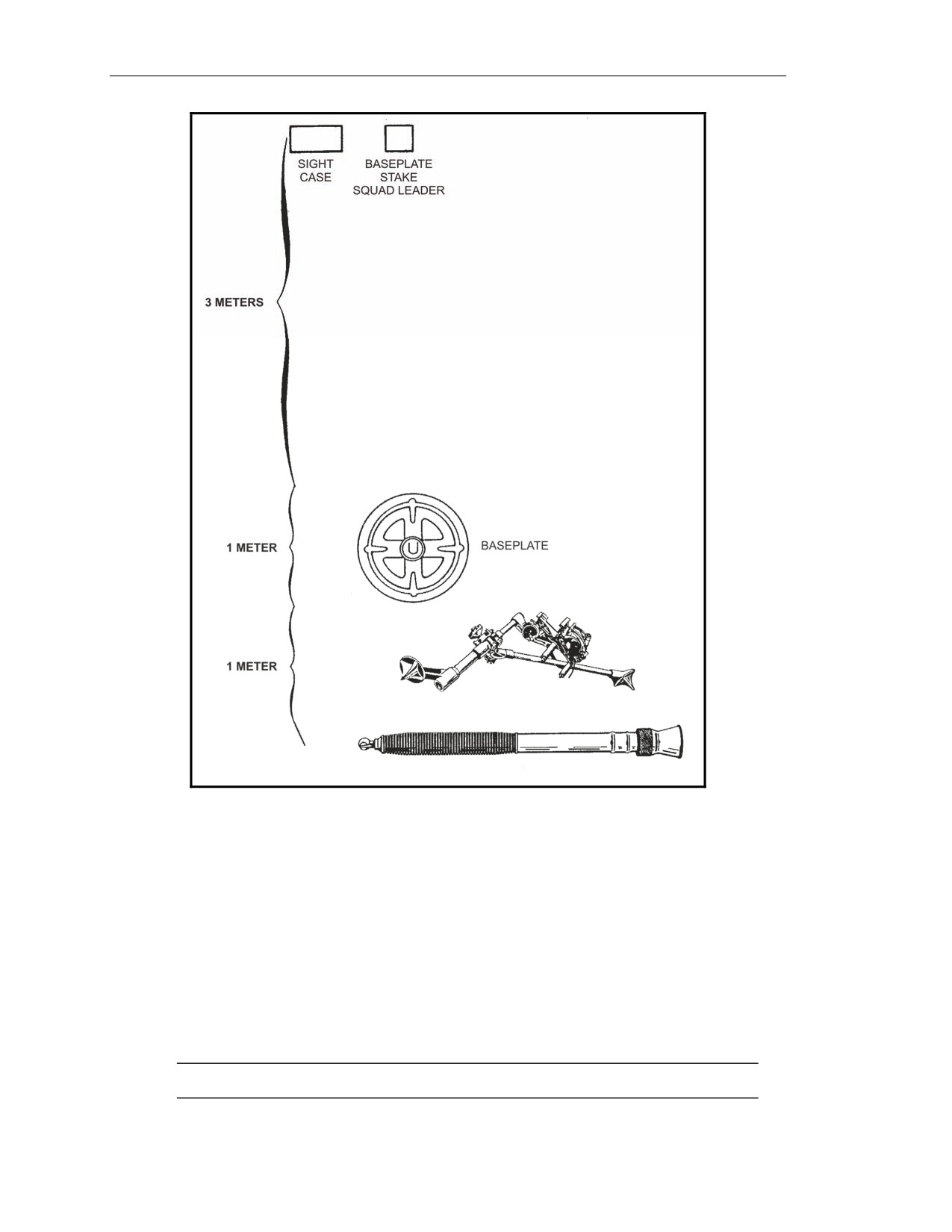
4-18. The squad leader supervises the squad and is responsible for laying out the equipment as shown
in Figure 4-6.
7 December 2007
FM 3-22.90
4-7
Chapter 4
Figure 4-6. Layout of equipment.
MOUNTING OF THE MORTAR
4-19. The squad adheres to the following procedures to mount the mortar.
(1) The squad leader picks up the sight case and the two aiming posts and moves to the exact
position where the mortar is to be mounted. He places the sight case and aiming posts to the
left front of the mortar position. The squad leader points to the exact spot where the mortar
is to be mounted. He indicates the initial direction of fire by pointing in that direction and
commands ACTION.
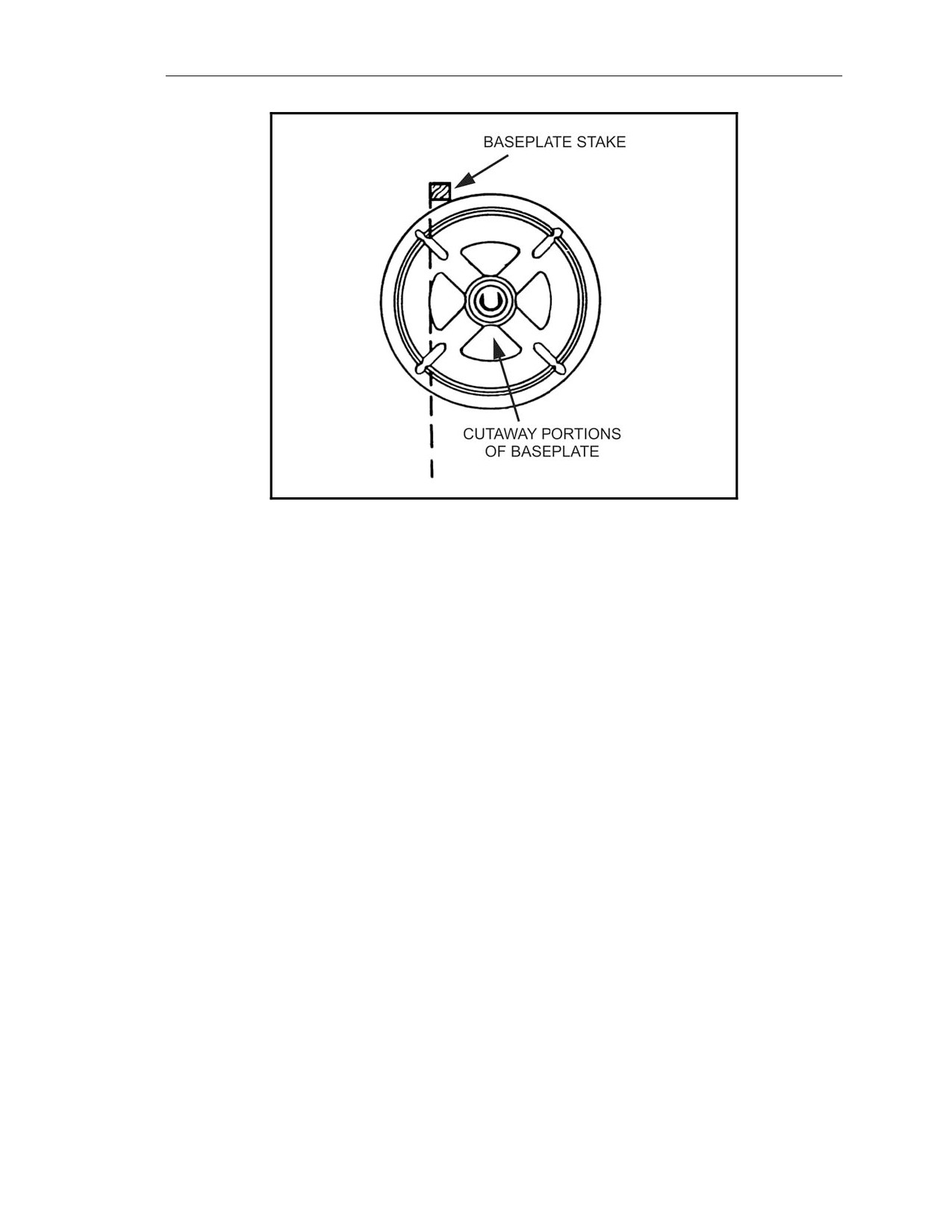
(2) The gunner places the outer edge of the baseplate against the baseplate stake so that the left
edge of the cutaway portion of the baseplate is aligned with the right edge of the stake
(Figure 4-7). He rotates the socket so that the open end is pointing in the direction of fire.
During training, the gunner may use the driving stake from the aiming post case.
NOTE: The squad leader indicates the direction of fire when mounting.
4-8
FM 3-22.90
7 December 2007
81-mm Mortar, M252
Figure 4-7. Baseplate placed against baseplate stake.
(3) When the baseplate is in position, the ammunition bearer lowers the breech plug into the
rotating socket and rotates the cannon a quarter of a turn to lock it. He ensures that the firing
pin recess is facing upward. He stands to the rear of the baseplate and supports the cannon
until the bipod is fitted.
(4) The assistant gunner lifts the bipod and stands it on its elevating leg so that the elevating
handwheel is to the rear and the plain leg is to the front. He releases the securing strap,
loosens the leg-locking handwheel, and lowers the plain leg until the locating catch engages
in the recess. The leg-locking handwheel must then be tightened by hand, ensuring the teeth
on either side are correctly meshed.
(5) The assistant gunner exposes 8 inches (200 millimeters) of elevation shaft, leaving the
elevation handwheel unfolded. He opens the cross-level handwheel, traversing handwheel,
and cannon clamp.
(6) The assistant gunner carries the bipod to the front of the cannon and places the bipod feet on
the ground 12 to 15 inches in front of the baseplate and astride the line of fire. He positions
the lower cannon clamp against the lower stop band on the cannon and secures the upper
cannon clamp. He must ensure that the ball-shaped end of the locking rod is secured in its
recess by the locking latch.
(7) The gunner removes the sight from its case, mounts it on the mortar, and sets a deflection of
3200 mils and an elevation of 1100 mils. He levels all bubbles.
7 December 2007
FM 3-22.90
4-9
Chapter 4
SAFETY CHECKS BEFORE FIRING
4-20. The following safety checks must be enforced before firing the mortar.
GUNNER
4-21. The gunner ensures that—
The cannon is locked to the baseplate, and the open end of the socket points in the direction
of fire.
The firing pin recess faces upwards.
The bipod locking latch is locked, securing the cannon clamps.
NOTE: See TM 9-1015-249-10 for more on loading and firing.
The leg-locking handwheel is tight.
Mask clearance and overhead clearance are sufficient.
Mask and Overhead Clearance
4-22. Since the mortar is normally mounted in defilade, there could be a mask such as a hill, tree,
building, or rise in the ground. Overhead interference can be branches of trees or roofs of buildings. In
any case, the gunner must ensure that the cartridge does not strike an obstacle.
4-23. In selecting the exact mortar position, the leader looks quickly for mask clearance and overhead
interference. After the mortar is mounted, the gunner makes a thorough check.
4-24. The gunner determines mask and overhead clearance by sighting along the cannon with his eye near
the breech plug. If the line of sight clears the mask, it is safe to fire. If not, he may still fire at the desired
range by selecting a charge zone having a higher elevation. When firing under the control of an FDC, he
reports to the FDC that mask clearance cannot be obtained at a certain elevation.
4-25. Firing is slowed if mask clearance must be checked before each firing, but this can be eliminated
if minimum mask clearance is determined. This is accomplished by depressing the cannon until the
highest section of the mask is clear. The gunner levels the elevation bubble by turning the elevation
micrometer knob and reading the setting on the elevation scale and elevation micrometer—this setting
is the minimum mask clearance. The squad leader notifies the FDC of the minimum mask clearance
elevation. Any target that requires that elevation, or a lower one, cannot be engaged from that position.
4-26. If the mask is not regular throughout the sector of fire, the gunner determines the minimum mask
clearance as previously described. Placing the mortar in position at night does not relieve the gunner of
the responsibility of checking for mask clearance and overhead interference.
ASSISTANT GUNNER
4-27. The assistant gunner cleans the bore and swabs it dry.
AMMUNITION BEARER
4-28. The ammunition bearer ensures that each cartridge is clean, the safety pin is present, and the
ignition cartridge is in good condition.
SMALL DEFLECTION AND ELEVATION CHANGES
4-29. With the mortar mounted and the sight installed, the gunner makes small deflection and
elevation changes.
(1) The gunner lays the sight on the two aiming posts (placed out 50 and 100 meters from the
mortar) on a referred deflection of 2800 mils and an elevation of 1100 mils. The mortar is
4-10
FM 3-22.90
7 December 2007
81-mm Mortar, M252
within two turns of center of traverse. The vertical cross line of the sight is on the left edge
of the aiming point.
(2) The gunner is given a deflection change in a fire command between 20 and 60 mils
inclusive. The elevation change announced must be less than 90 mils and more than 35 mils.
(3) As soon as the sight data are announced, the gunner places it on the sight, lays the mortar
for elevation, and traverses onto the aiming post by turning the traversing handwheel and
adjusting nut in the same direction. A one-quarter turn on the adjusting nut equals one turn
of the traversing handwheel. When the gunner is satisfied with his sight picture, he
announces, “Up.”
NOTE: All elements given in the fire command are repeated by the squad.
(4) After the gunner has announced, “Up,” the squad leader checks the mortar to determine if
the crew drill was performed correctly.
LARGE DEFLECTION AND ELEVATION CHANGES
4-30. With the mortar mounted and the sight installed, the squad makes large deflection and elevation
changes.
(1)
The gunner lays the sight on the two aiming posts (placed out 50 and 100 meters from the
mortar) on a referred deflection of 2800 mils and an elevation of 1100 mils.
(2)
The gunner is given a deflection and elevation change in a fire command causing the gunner
to shift the mortar between 200 and 300 mils for deflection and between 100 and 200 mils
for elevation.
(3)
As soon as the sight data are announced, the gunner places it on the sight. The gunner
exposes 8 inches (200 millimeters) of elevation shaft and centers the buffer carrier. This
ensures a maximum traversing and elevating capability after making the movement.
(4)
The assistant gunner moves into position to the front of the bipod on his right knee and
grasps the bipod legs (palms up), lifting until they clear the ground enough to permit lateral
movement. The gunner moves the mortar as the assistant gunner steadies it. The assistant
gunner tries to maintain the traversing mechanism on a horizontal plane. To make the shift,
the gunner places the fingers of his right hand in the muzzle and his left hand on the left leg.
He moves the mortar until the vertical line of the sight is aligned approximately on the
aiming post. When the approximate alignment is completed, the gunner signals the assistant
gunner to lower the bipod by pushing down on the mortar.
(5)
The gunner rough-levels the cross-level bubble by making the bubble float from side to side.
Then, he checks the sight picture. If he is not within 20 mils of a proper sight picture, the
gunner and assistant gunner must make another large shift before continuing.
(6)
The gunner centers the elevation bubble. He lays for deflection, taking the proper sight
picture. The mortar should be within two turns of center of traverse when the task is
complete.
(7)
The open end of the socket must continue to point in the direction of fire. Normally, it can
be moved by hand, although this may be difficult to do if the mortar is moved through a
large arc. If required, the gunner/assistant gunner lowers the cannon so that the breech plug
engages with the open end of the socket, and he uses the cannon as a lever to move the
socket.
(8)
The cannon clamps can be moved along the cannon to counter large changes in elevation,
which may preclude moving the bipod. It is especially useful if the baseplate sinks deep into
the ground during prolonged firing. Upon completion of any bipod movement on the
cannon, the gunner ensures that the firing pin recess is facing upward.
(9)
On uneven ground without a level surface for the bipod, the gunner can adjust the plain leg.
While the assistant gunner supports the cannon, the gunner slackens the leg-locking
handwheel, releases the locating catch, and positions the plain leg. The leg-locking
handwheel must then be tightened, ensuring the teeth are correctly meshed.
7 December 2007
FM 3-22.90
4-11
Chapter 4
REFERRING OF THE SIGHT AND REALIGNMENT OF AIMING
POSTS USING THE M64 SIGHT
4-31. Referring and realigning aiming posts ensure that all mortars are set on the same data. The
section leader, acting as FDC, has one deflection instead of two or more.
(1) The mortar is mounted and the sight is installed. The sight is laid on two aiming posts
(placed out 50 and 100 meters from the mortar) on a referred deflection of 2800 mils and an
elevation of 1100 mils. The mortar is within two turns of center of traverse. The gunner is
given an administrative command to lay the mortar on a deflection of 2860 or 2740 mils.
The mortar is then re-laid on the aiming posts using the traversing crank.
(2) The gunner is given a deflection change between 5 and 25 mils, either increasing or
decreasing from the last stated deflection, and the command to refer and realign aiming
posts.
EXAMPLE
An example of referring and realigning aiming posts begins with the command REFER
DEFLECTION TWO EIGHT SEVEN FIVE (2875), REALIGN AIMING POSTS.
Upon receiving the command REFER, REALIGN AIMING POSTS, the mortar squad
performs two simultaneous actions. The gunner places the announced deflection on the sight
(without disturbing the lay of the weapon) and looks through the sightunit. At the same time,
the ammunition bearer realigns the aiming posts. He knocks down the near aiming post and
proceeds to the far aiming post. Following the arm-and-hand signals of the gunner (who is
looking through the sightunit), he moves the far aiming post so that the gunner obtains an
aligned sight picture. Then, he performs the same procedure to align the near aiming post.
MALFUNCTIONS
4-32. See paragraphs 3-37 to 3-40 of Chapter 3 for a detailed discussion of malfunctions.
REMOVAL OF A MISFIRE
4-33. Use the following procedures to remove a misfire.
NOTE: The squad leader immediately alerts the FDC of the misfire. The squad leader
must supervise the removal of the misfire using a printed copy of the current
misfire procedures.
(1) When a misfire occurs, any member of the squad immediately announces, “Misfire.”
WARNING
During peacetime live-fire training, all personnel, except the
gunner, move 50 meters or farther to the rear of the mortar.
4-12
FM 3-22.90
7 December 2007
81-mm Mortar, M252
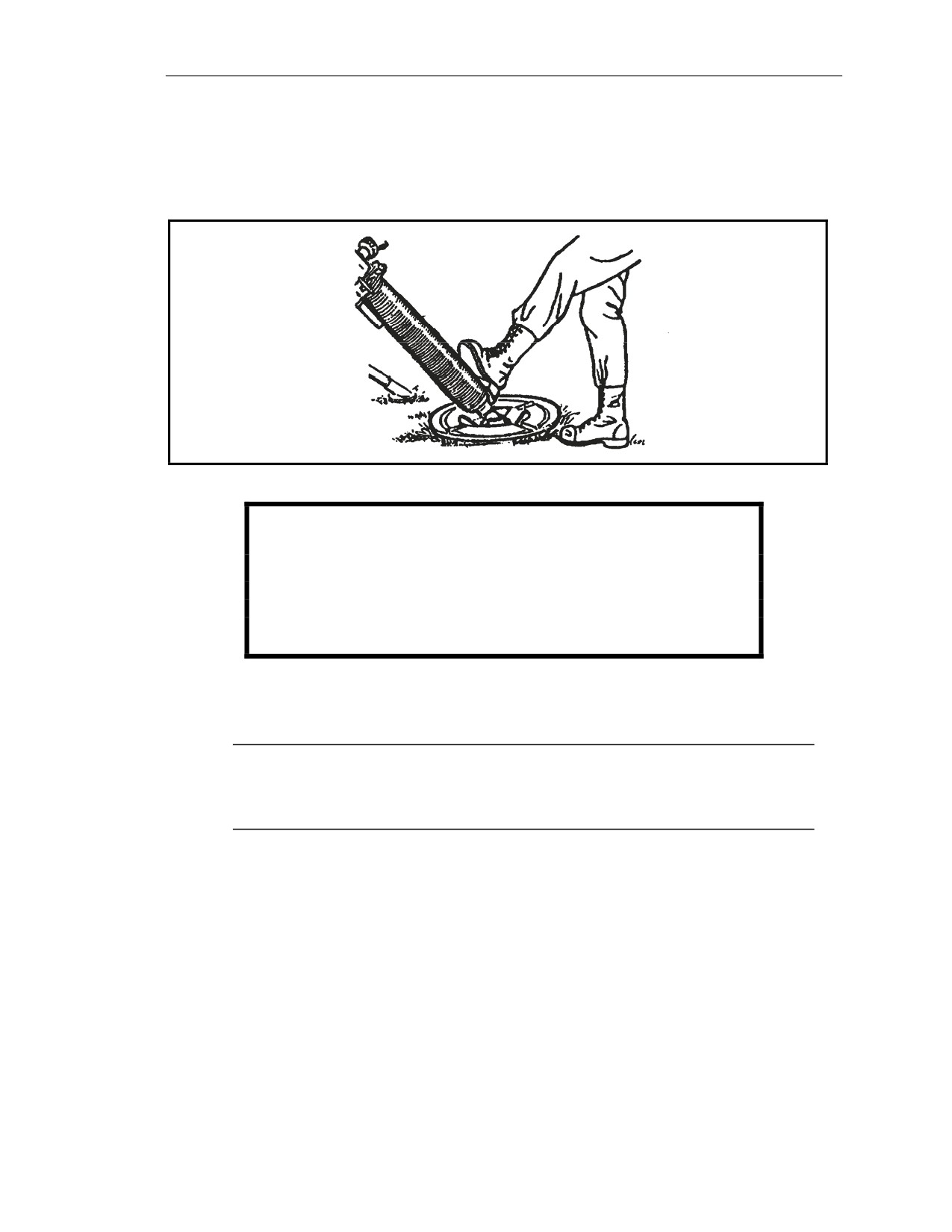
(2) Ensuring that he does not stand directly behind the cannon, the gunner kicks the cannon
several times with his heel in an attempt to dislodge the round (Figure 4-8). If the round
fires, the mortar is re-laid on the aiming point and firing continues. If the round does not
fire, the gunner tests the cannon for heat. If the cannon is cool enough to handle, the crew
removes the round as described below.
Figure 4-8. Kicking the mortar to dislodge the round.
WARNING
During peacetime live-fire training, the gunner joins the squad
members behind the mortar and waits one minute (in case of
a cookoff). After waiting one minute, the gunner returns to the
mortar.
(3) The gunner checks for heat by starting from just below the muzzle and working down to the
base with his fingertips. If the cannon is too hot to be handled, he cools it with water (or
snow) and checks it one minute later. If no water (or snow) is available, the cannon is air-
cooled until it can be easily handled with bare hands.
NOTES:
1. Liquids must never be poured into the cannon.
2. During peacetime live-fire training, the gunner signals the squad to come
forward once the cannon is cool.
7 December 2007
FM 3-22.90
4-13
Chapter 4
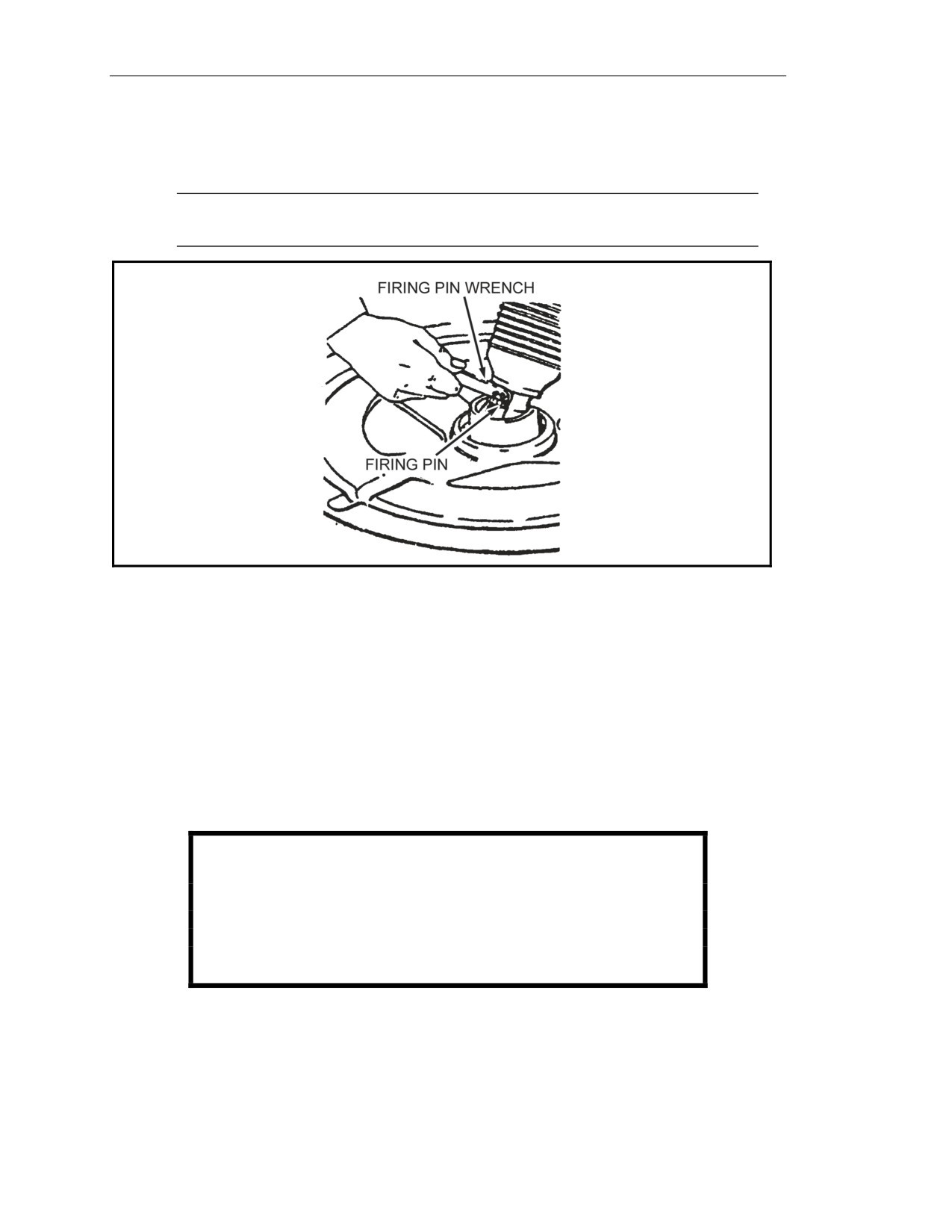
(4) When the mortar is cool enough to handle, the gunner removes the firing pin by turning the
firing pin wrench counterclockwise (Figure 4-9). If necessary to provide easier access to the
firing pin, the gunner depresses the cannon until the firing pin can be completely removed
from the breech cap.
NOTE: Removing the firing pin ensures that the mortar will not fire should the round
slip down the cannon during the subsequent drill.
Figure 4-9. Removing the firing pin.
(5) After removing the firing pin, the gunner shouts, “Firing pin is removed,” and hands the
firing pin to the squad leader. The gunner locks the data down on the sight, then removes the
sight and places it in a safe location. Then, the gunner unlocks and loosens the cannon
clamp just enough to rotate the cannon to unlock the breech plug from the rotating socket of
the baseplate. He then relocks the cannon clamp.
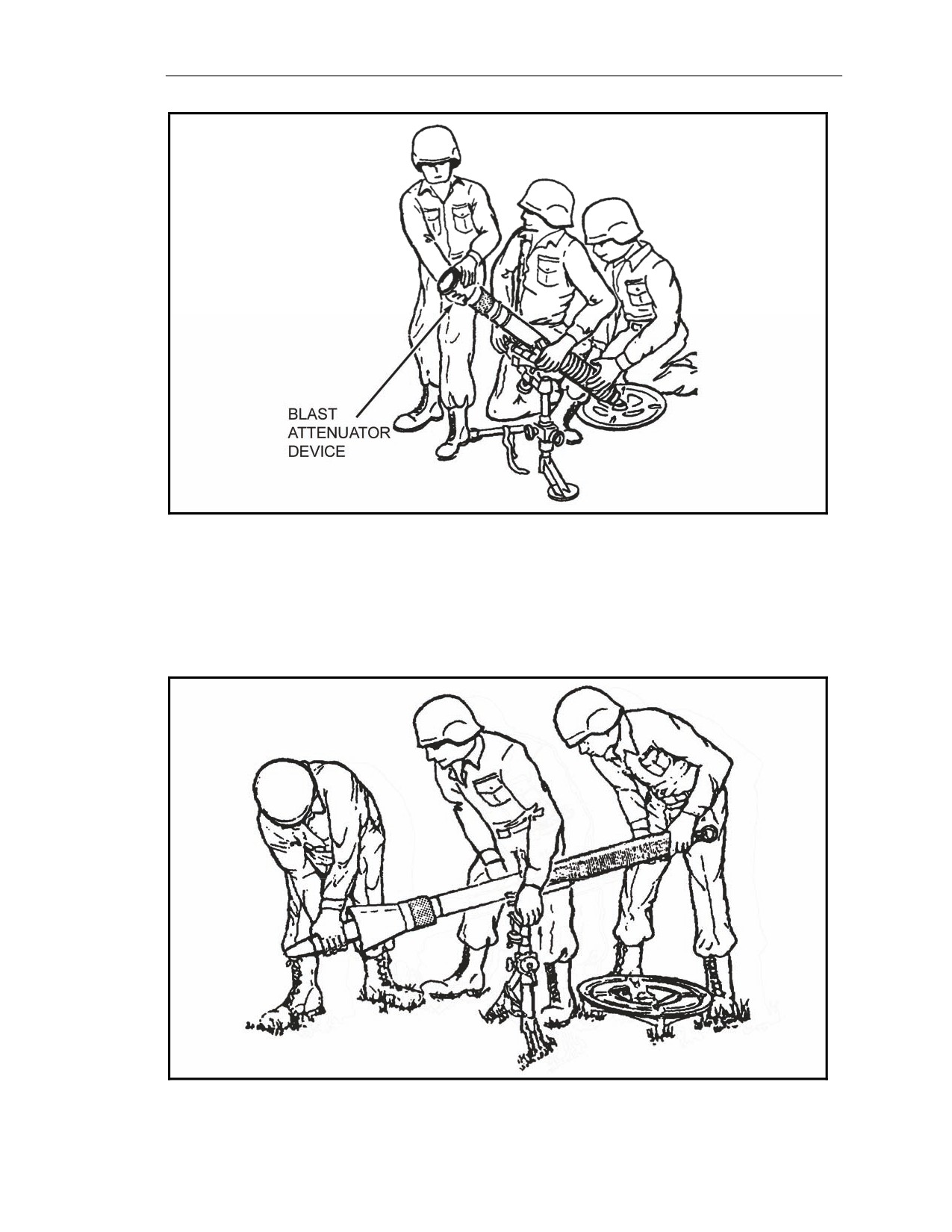
(6) The gunner grasps both ends of the traverse screw assembly and supports the mortar during
the subsequent drill. The assistant gunner places his right hand palm up (1 inch from the
muzzle end) under the BAD and his left hand palm down (1 inch from the muzzle end) on
top (Figure 4-10). He places his thumbs alongside the forefingers, being careful to keep both
hands away from the muzzle. The ammunition bearer puts both hands on the cooling fins
under the cannon and slowly lifts the cannon until it is horizontal. He must not stand directly
behind the mortar.
WARNING
Once the cannon is horizontal, the rear of the cannon must
not be lowered back down until the round is extracted. If the
round slips down the cannon before extraction, it could ignite,
causing death or personal injury.
4-14
FM 3-22.90
7 December 2007
81-mm Mortar, M252
Figure 4-10. Raising the cannon to a horizontal position.
(7) When the cannon reaches the horizontal position, the assistant gunner moves both thumbs
over the muzzle. When the fuze of the misfired round reaches the BAD, the assistant gunner
stops the round with his thumbs (without touching the fuze) and carefully removes it from
the cannon (Figure 4-11). The ammunition bearer shakes the cannon to dislodge any
remnants of the last round fired and lowers the cannon into the rotating socket of the
baseplate.
Figure 4-11. Removing the round from the cannon.
7 December 2007
FM 3-22.90
4-15
Chapter 4
(8) The assistant gunner passes the round to the ammunition bearer, who inspects it for the
cause of the misfire. If the primer of the ignition cartridge is dented, the ammunition bearer
attempts to replace the safety wire and places the round in a marked, safe location for
disposal by ordnance personnel. If the primer is not dented, the round may be used again.
Before attempting to fire, the firing pin must be replaced and the bore swabbed. The sight
unit must then be replaced. The gunner will ensure that the correct firing data is indexed on
the sight and that the mortar is relayed on the aiming posts.
4-34. If the above procedure fails to remove the misfire, the cannon must be kept horizontal, removed
from the bipod, and laid horizontally on the ground in the dud pit until it can be turned over to
ordnance personnel.
DISMOUNTING OF THE MORTAR
4-35. To dismount the mortar, the squad leader commands, OUT OF ACTION. At this command, the
squad proceeds as follows:
(1) The gunner removes the sight and places it in the case with 3200 deflection and 0800
elevation indexed.
(2) The ammunition bearer holds the cannon until the assistant gunner removes the mount.
Then, the ammunition bearer rotates the cannon a quarter of a turn to unlock it from the
socket and places it in an area designated by the squad leader, and retrieves the aiming
posts.
(3) The assistant gunner disengages the cannon clamps and moves the bipod from the
immediate area of the mortar position. The cannon clamps are then closed.
(4) With the clamps facing away from him, the assistant gunner traverses the buffer carrier to
the traversing handwheel and folds the handle. He exposes 1 inch (25 millimeters) of the
cross-level shaft and folds the handle. He exposes
4 inches (100 millimeters) of the
elevation shaft and folds the handle. Finally, the assistant gunner loosens the leg-locking
handwheel, presses the spring-loaded locating catch, and raises the plain leg behind the
buffer cylinders until it touches the traversing handwheel.
(5) He tightens the leg-locking handwheel (ensuring the teeth are correctly meshed) and fastens
the securing strap over the arm and around the buffers.
(6) The gunner returns the baseplate to the area designated by the squad leader.
(7) The squad leader picks up the aiming posts and sight. At the command, MARCH ORDER,
the squad places the mortar, equipment, and ammunition in the squad vehicle and trailer.
SECTION IV. AMMUNITION
This section implements STANAG 2321.
This section describes the ammunition that can be fired from the 81-mm mortar, M252. The four types of
ammunition for the 81-mm mortar are HE, WP or RP smoke, ILLUM, and training.
CLASSIFICATION AND TYPES OF AMMUNITION
4-36. Ammunition for the M252 is typed according to its use.
IDENTIFICATION
4-37. All mortar cartridges are painted to prevent rust and to identify their type.
4-16
FM 3-22.90
7 December 2007
81-mm Mortar, M252
Markings on Container
4-38. The markings on an ammunition container indicate its contents. Additional information is
included on an ammunition data card inside each container.
Color Code
4-39. All rounds are colored according to their type.
Markings on Rounds
4-40. Each round is stenciled with the ammunition lot number, type of round, type of filler, and
caliber.
AMMUNITION LOT NUMBER
4-41. Each ammunition lot is assigned an ammunition lot number, which is marked on each cartridge
and packing container. It is used for records such as reports on condition, malfunctions, and accidents.
FUNCTIONING
4-42. Fins around the tail of each cartridge stabilize it in flight and cause it to strike fuze-end first. The
propelling charge consists of an ignition cartridge and removable propellant increments. The ignition
cartridge (with primer) is fitted into the base of the fin shaft. The removable increments are fitted onto
or around the shaft, depending on their type. When the cartridge is dropped down the cannon (fin-end
first), the ignition cartridge strikes the firing pin and detonates, causing a flash that passes through the
radial holes in the shaft. This ignites the propellant increments, which produce rapidly expanding gases
that force the cartridge from the barrel. The obturator band ensures equal muzzle velocities in hot or
cold cannons by keeping gases inside the cannon until the cartridge has fired. When fired, the cartridge
carries the ignition cartridge with it, leaving the mortar ready for the next cartridge.
AUTHORIZED CARTRIDGES
4-43. The following tables outline the authorized cartridges for the 81-mm mortar, M252.
7 December 2007
FM 3-22.90
4-17