FM 3-22.90 Mortars (December 2007) - page 2
Chapter 2
SETUP AND LEVELING OF THE AIMING CIRCLE
NOTE: The aiming circle must always be level during operation.
2-31. To set up and level the aiming circle—
(1) Remove the strap from the tripod legs, loosen the leg clamp thumbscrews, extend the legs so
that the tripod is about chest high, and tighten the leg clamp thumbscrews. Spread the legs
about 18 inches apart, adjust the legs so the tripod head is about level, and plant the feet
firmly in the ground.
(2) Remove the tripod head cover. Open the baseplate cover of the aiming circle head. Keeping
the baseplate cover pointed toward you, thread the tripod guide screw assembly into the
aiming circle until it is firmly seated. The base of the aiming circle should not protrude over
the machine surface of the tripod head. Pull out and down on the strap latch assembly.
Remove the cover and hang it on the tripod head cover.
(3) If the instrument is to be set up over an orienting point, attach the plumb bob to the hook.
Adjust the tripod legs and aiming circle head until it is over the point.
(4) Loosen the leveling screws to expose sufficient threads (3/8 to 1/2 inch) on the three screws
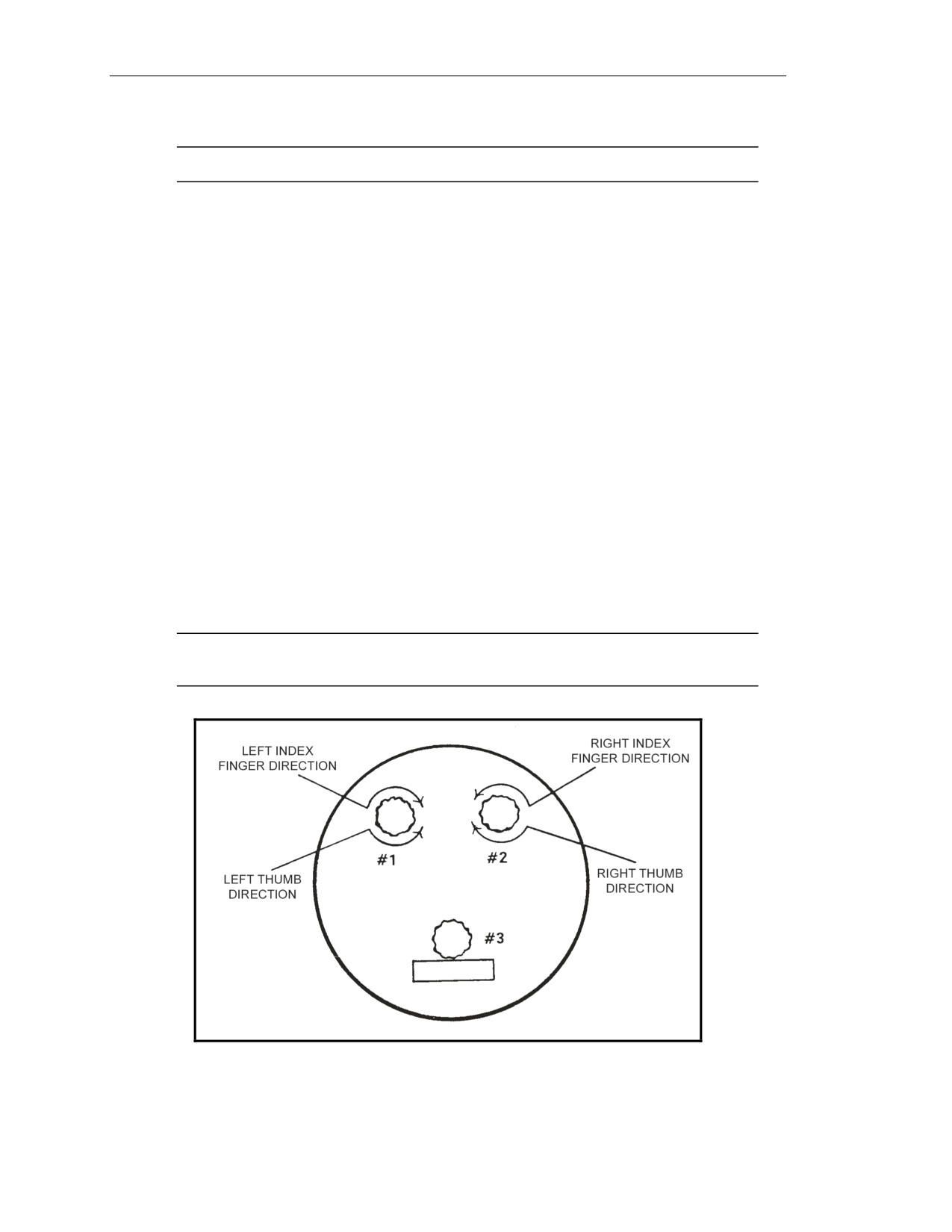
to permit the instrument to be leveled. Number the leveling screws clockwise, 1, 2, and 3
(Figure 2-6). Now place the tubular level vial over the notation pad. Grasp leveling screw
number 1 between the thumb and forefinger of the right hand, and grasp leveling screw
number 2 between the thumb and forefinger of the left hand. Turn the screws so that the
thumbs move toward or away from each other. Using these two leveling screws, center the
bubble. The bubble moves in the same direction as the left thumb.
(5) Rotate the aiming circle head until the magnifier is over the notation pad. Level the tubular
level by turning only level screw number 3. The bubble should now remain level in any
direction that the aiming circle is rotated. A variation of one graduation from the center of
the vial is acceptable. If the bubble does not remain level, repeat this procedure.
NOTE: If the spring plate is bent, the aiming circle cannot be leveled and must be turned
in to the maintenance support activity.
Figure 2-6. Leveling screws.
2-10
FM 3-22.90
7 December 2007

Sighting and Fire Control Equipment
(6) The aiming circle should be set up at the distance indicated by Table 2-2.
Table 2-2. Set-up distance from objects.
OBJECT
DISTANCE (METERS)
High-tension power lines
150
Electronic equipment
150
Railroad tracks
75
Tanks and trucks
75
Vehicles
50
Barbed wire
30
Mortars or telegraph wire
25
Helmets and so forth
10
DECLINATION CONSTANT
2-32. Since the magnetic needle of an aiming circle points toward magnetic north and not the grid
north on a map, it is necessary to correct for this difference by using the declination constant. The
declination constant of an instrument is the clockwise angle between grid north and magnetic north;
that is, the grid azimuth of magnetic north. This constant differs slightly for different instruments and
must be recorded on each instrument. The constant also varies for the same instrument in different
localities. Use the following to determine the declination constant.
DECLINATION STATION
2-33. Declination stations are established by fires battalion survey teams to determine the declination
constants of instruments and to correct for local attractions, annual variations, and instrument errors.
When a unit moves from one locality to another, a station should be established where all instruments
are declinated. If the declination constants for all instruments of a unit are determined at the same
station, grid azimuths measured with each instrument will agree with the map grid, and all instruments
will agree with each other. The point chosen for the declination station must have a view of at least two
distant, well-defined points with a known grid azimuth. Two additional points are desirable, one in
each quadrant, as a check.
PROCEDURE FOR DECLINATING THE AIMING CIRCLE AT A DECLINATION STATION
2-34. Where a declination station is available, the procedure for declinating the aiming circle is as
follows:
(1) Set up and fine level the aiming circle directly over the declination station marker using the
plumb bob.
(2) Place the grid azimuth of the first azimuth marker on the scales using the recording motion.
Place the vertical cross line of the telescope on the azimuth marker using the nonrecording
(orienting) motion. The aiming circle is now oriented on grid north.
(3) With the recording motion, rotate the instrument to zero. Release the magnetic needle and
look through the magnifier. Center the north-seeking needle using the recording motion, and
then relock the magnetic needle.
(4) Notice the new azimuth on the scale, which is the declination constant—record it.
(5) Recheck the aiming circle level and repeat steps 2 through 4 using the remaining azimuth
markers until three readings have been taken. If there is only one marker, repeat the entire
procedure twice using the same marker.
(6) Find the average declination constant using these three readings.
7 December 2007
FM 3-22.90
2-11
Chapter 2
EXAMPLE 1
1st point reading
=
6399 mils
2nd point reading
=
6398 mils
3rd point reading
=
6398 mils
Total
=
19195 mils
19195 ÷ 3 =
6398.3 (rounded off to the nearest whole number) =
6398 mils (average declination constant)
EXAMPLE 2
1st point reading
=
0030 mils
2nd point reading
=
0031 mils
3rd point reading
=
0029 mils
Total
=
0090 mils
0090 ÷ 3 = 0030 mils (average declination constant)
(7) Record the average declination constant in pencil on the notation (strip) pad of the aiming
circle as its declination constant. All readings should be within 2 mils of each other; if not,
repeat steps 2 through 4. Ensure the aiming circle is directly over the station marker to
obtain the 2-mil tolerance. If the desired 2-mil accuracy is not gained after two tries, the
aiming circle is defective and should be turned in for repair.
USE OF THE GRID-MAGNETIC ANGLE
2-35. If an aiming circle is used in a new area without a declination station, a declination constant can
be determined by using the G-M angle from a map. When the G-M angle (converted to mils) is
westerly, it is subtracted from 6400 mils. The remainder is the declination constant. When the G-M
angle is easterly, the angle (in mils) is the declination constant.
PROCEDURE FOR DECLINATING AN AIMING CIRCLE WHEN A DECLINATION STATION IS
NOT AVAILABLE
NOTE: This procedure is the least desirable and should be used only when no other
means are available. It does not compensate for the error that could be inherent
in the aiming circle.
2-36. To declinate an aiming circle when a declination station isn’t available—
(1) Determine the G-M angle from the map of the area in which the aiming circle is to be used.
This G-M angle is used as indicated below.
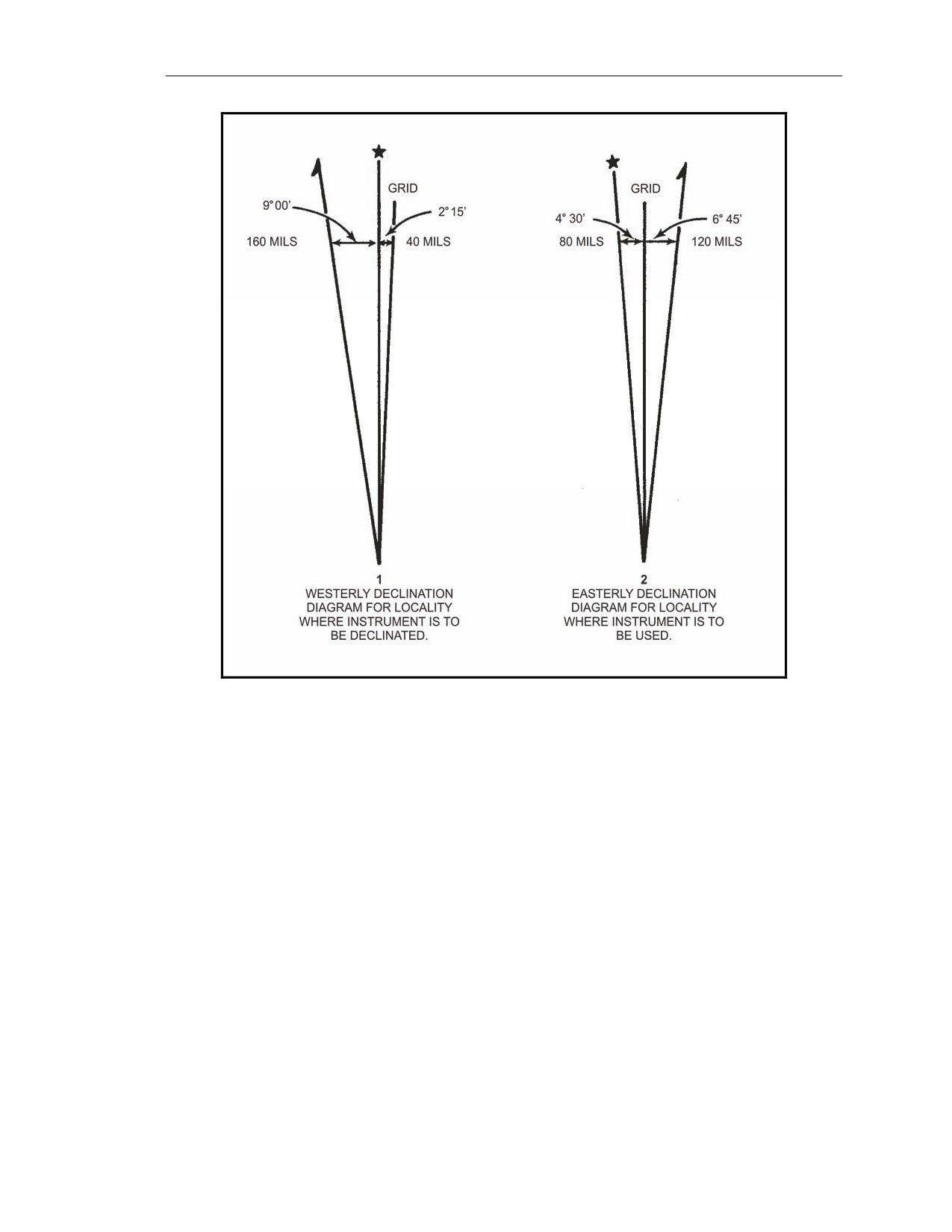
(2) In
1, Figure
2-7, the difference between grid north and magnetic north is
200 mils
(westerly). This total is then subtracted from 6400 mils. The declination constant that can be
used is 6200 mils.
(3) In 2, Figure 2-7, the difference between grid north and magnetic north in a clockwise
direction is 120 mils. This can be used as the declination constant.
2-12
FM 3-22.90
7 December 2007
Sighting and Fire Control Equipment
Figure 2-7. Marginal data from a map.
WHEN TO DECLINATE THE AIMING CIRCLE
2-37. Certain rules prescribe how often and under what circumstances the aiming circle should be
declinated to determine and keep the declination constant current. These rules are as follows:
The aiming circle should be declinated when it is moved 25 miles or more from the area in
which it was last declinated. In some locations, a move of less than 25 miles could require a
redeclination of the aiming circle.
The aiming circle must be declinated after an electrical storm or after receiving a severe
shock, such as a drop from the bed of a truck to the ground. The magnetic needle is a
delicately balanced mechanism, and any shock can cause a significant change in the
declination constant.
The aiming circle should be declinated every 30 days to guard against changes that may
have occurred due to unreported accidents to the instrument. If a radical change is observed,
the instrument should be declinated again within a few days to determine if the observed
change was due to a magnetic storm or is a real change in the characteristics of the
instrument.
The aiming circle should be declinated when it is initially received and when it is returned
from support maintenance repair.
7 December 2007
FM 3-22.90
2-13
Chapter 2
ORIENTING OF THE INSTRUMENT ON GRID NORTH TO
MEASURE GRID AZIMUTH TO OBJECTS
2-38. The procedure to orient the aiming circle on grid north to measure grid azimuth to objects is as
follows:
(1) Level the instrument.
(2) Set the azimuth micrometer and the azimuth scale on the declination constant of the
instrument.
(3) Release the magnetic needle.
(4) With the orienting knob, align the south end of the needle accurately with the center etched
line by using the magnetic needle magnifier.
(5) Lock the magnetic needle and close the orienting knob covers.
(6) Using the throw-out mechanism (azimuth knob), turn the telescope until the vertical line of
the reticle is about on the object.
(7) By rotating the azimuth knob, bring the vertical line exactly on the object.
(8) Read the azimuth to the object on the azimuth and micrometer scales.
MEASURING OF THE HORIZONTAL ANGLE BETWEEN TWO
POINTS
NOTE: To measure the horizontal angle between two points, at least two measurements
should be made.
2-39. To measure the horizontal angle between two points—
(1) Set the azimuth micrometer and the azimuth scale at zero.
(2) Rotate the instrument using the orienting knob throw-out mechanism until the vertical line
of the telescope is about on the left edge of the left-hand object.
(3) Lay the vertical line exactly on the right edge of the left-hand object by rotating the
orienting knob.
(4) Using the throw-out mechanism (azimuth knob), turn the telescope clockwise until the
vertical line is about on the left edge of the right-hand object.
(5) Lay the vertical line exactly on the left edge of the right-hand object by turning the azimuth
knob.
(6) Read the horizontal angle on the scales and record the value to the nearest 0.5 mil. This
completes the first repetition.
(7) Rotate the aiming circle, using the lower motion, until the vertical cross line is again on the
rear station.
NOTE: The value obtained from the first repetition is still on the scales.
(8) Rotate the aiming circle body, using the upper motion, until the vertical cross line is again
on the forward station.
(9) Read and record the accumulated value of the two measurements of the angle to the nearest
0.5 mil. This completes the second repetition.
(10) Divide the second reading by 2 to obtain the mean angle to the nearest 0.1 mil. This mean
angle must be within 0.5 mil of the first reading. If it is not, the measurement is void and the
angle is measured again.
2-14
FM 3-22.90
7 December 2007
Sighting and Fire Control Equipment
ORIENTING OF THE 0-3200 LINE ON A GIVEN GRID AZIMUTH
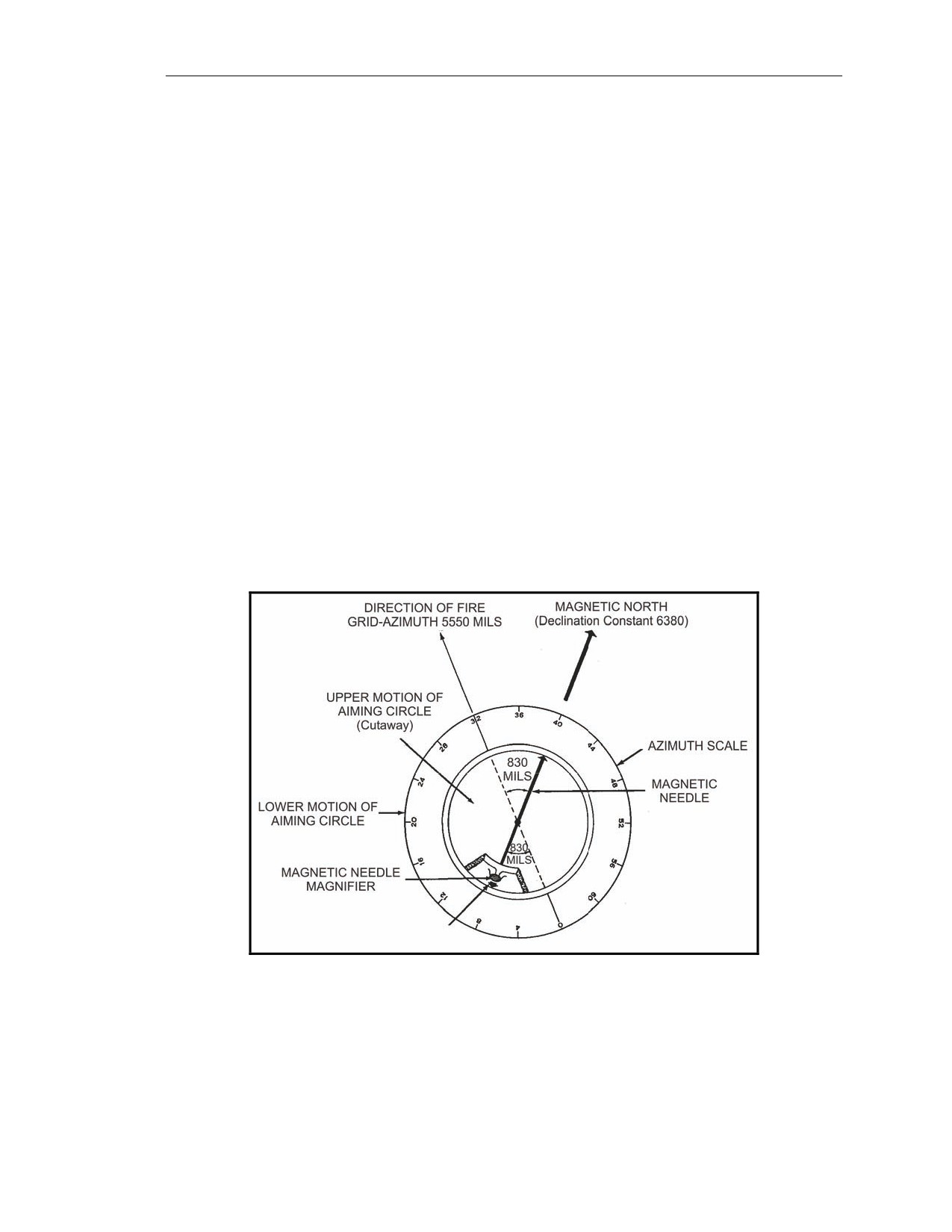
2-40. The procedure for orienting the 0-3200 line of the aiming circle on a given grid azimuth is
illustrated below. In this example, the mounting azimuth is 5550 mils and the aiming circle is assumed
to have a declination constant of 6380 mils.
(1) Set up and level the aiming circle.
(2) Subtract the announced mounting azimuth from the declination constant of the aiming circle
(adding 6400 to the declination constant of the aiming circle if the mounting azimuth is
larger). In this case, subtract the mounting azimuth 5550 from the declination constant 6380.
SOLUTION
Declination constant
6380 mils
Announced mounting
azimuth
-5550 mils
Remainder
830 mils
(3) Set the remainder on the azimuth and micrometer scales of the aiming circle. In this case,
the remainder is 830 mils (recording motion).
(4) Release the compass needle. Look through the window in the cover housing and rotate the
instrument until the needle floats freely using the orienting knob throw-out mechanism. For
fine adjustments, use orienting knobs until the magnetic needle is exactly centered on the
etched marks on the magnifier. Relock the compass needle to orient the 0-3200 line of the
aiming circle on the mounting azimuth. In this case, the grid azimuth is 5550 mils (Figure 2
8).
(5) Do not disturb the lower motion of the aiming circle once it is oriented.
Figure 2-8. Aiming circle oriented in desired direction of fire.
ORIENTING OF THE 0-3200 LINE ON A GIVEN MAGNETIC
AZIMUTH
2-41. The procedure for orienting the 0-3200 line of the aiming circle on a given magnetic azimuth is
as follows:
(1) Subtract the announced magnetic azimuth from 6400.
7 December 2007
FM 3-22.90
2-15
Chapter 2
(2) Set the remainder on the azimuth and micrometer scales of the aiming circle.
(3) Release the compass needle and rotate the orienting knob until the magnetic needle is
exactly centered in the magnetic needle magnifier. Lock the compass needle.
(4) The 0-3200 line of the aiming circle is now oriented on a given magnetic azimuth.
VERIFICATION OF THE LAY OF THE PLATOON
2-42. To verify the lay of the platoon—
(1)
After the section or platoon is laid, the leader verifies the lay by using another M2 aiming
circle, which is referred to as the safety circle.
(2)
The leader or designated safety officer sets up and orients an M2 aiming circle by using the
method that was used with the lay circle (Figure 2-9). The aiming circle must be located
where it can be seen by all mortars and should not be closer than 10 meters to the lay circle.
(3)
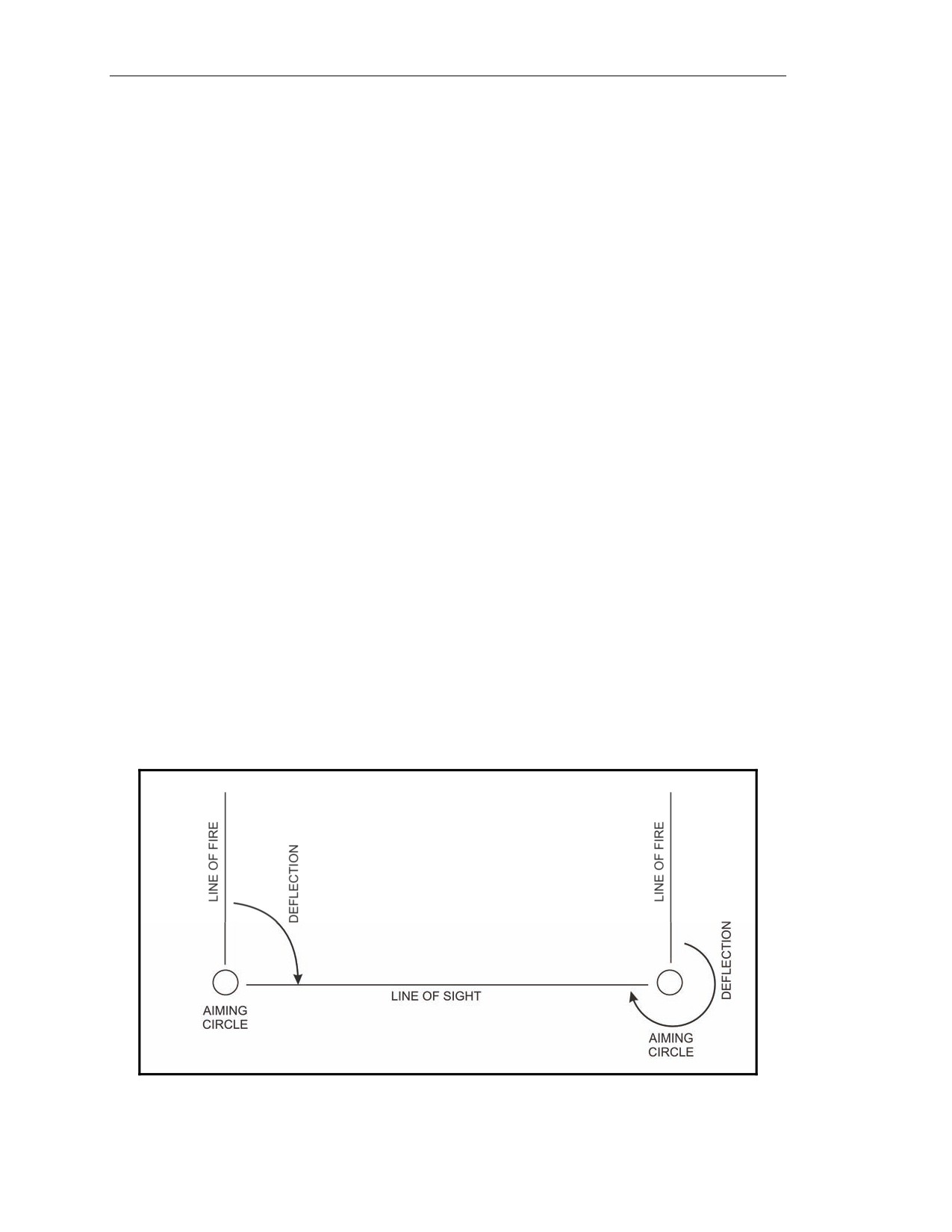
After picking up a line of sight on the lay circle, the safety circle operator commands, LAY
CIRCLE REFER, AIMING POINT THIS INSTRUMENT. The lay circle operator sights his
instrument onto the safety circle by use of the recording motion.
(4)
When the aiming circle is used to orient another aiming circle for direction, the reading
between the two circles will be 3200 mils apart, because both circles measure horizontal
clockwise angles from the line of fire. To prevent confusion, remember that if you see red,
read red. One half of the aiming circle azimuth scale has a second red scale that goes in the
opposite direction of the black scale.
(5)
There should be no more than 10 mils difference between the circles.
(6)
If the lay circle and the safety circle deflection are within the
10-mil tolerance, the
instrument operator on the safety circle places the deflection reading by the lay circle on the
upper motion of the safety circle. With the lower motion, the instrument sights back on the
lay circle. This serves to align the 0-3200 line of the safety circle parallel to the 0-3200 line
of the lay circle.
(7)
The instrument operator on the safety circle commands, PLATOON, REFER AIMING
POINT THIS INSTRUMENT. All gunners refer and announce the deflection to the safety
circle. If the deflection referred by the mortar is within 10 mils, the operator on the safety
circle announces that the mortar is safe. Once the mortars are safe, the operator announces,
“THE PLATOON IS SAFE.”
(8)
The platoon leader walks the gun line and visually checks the guns to ensure they are
parallel. An M2 compass should also be used to ensure the guns are on the azimuth of fire.
Figure 2-9. Method used to orient an aiming circle, M2.
2-16
FM 3-22.90
7 December 2007
Sighting and Fire Control Equipment
ORIENTING BY ORIENTING ANGLE
2-43. Orienting by orienting angle eliminates errors that result from the use of the magnetic needle of
the aiming circle.
NOTE: The magnetic needle is not used to orient the aiming circle.
2-44. An orienting angle is the horizontal clockwise angle from the mounting azimuth to the orienting
line, the vertex being at the orienting station. It is a line of known direction established on the ground
near the firing section, which serves as a basis for laying for direction. This line is established by a
survey team.
2-45. To orient the aiming circle using the orienting angle—
(1) Set the aiming circle over the orienting station and level it.
(2) Place the orienting angle on the azimuth scale.
(3) Sight on the far end of the orienting line, using the lower motion.
NOTE: Before performing the next step, close the orienting knob cover to prevent
unintentional movement of the lower motion.
(4) The 0-3200 line of the aiming circle is now oriented parallel to the mounting azimuth.
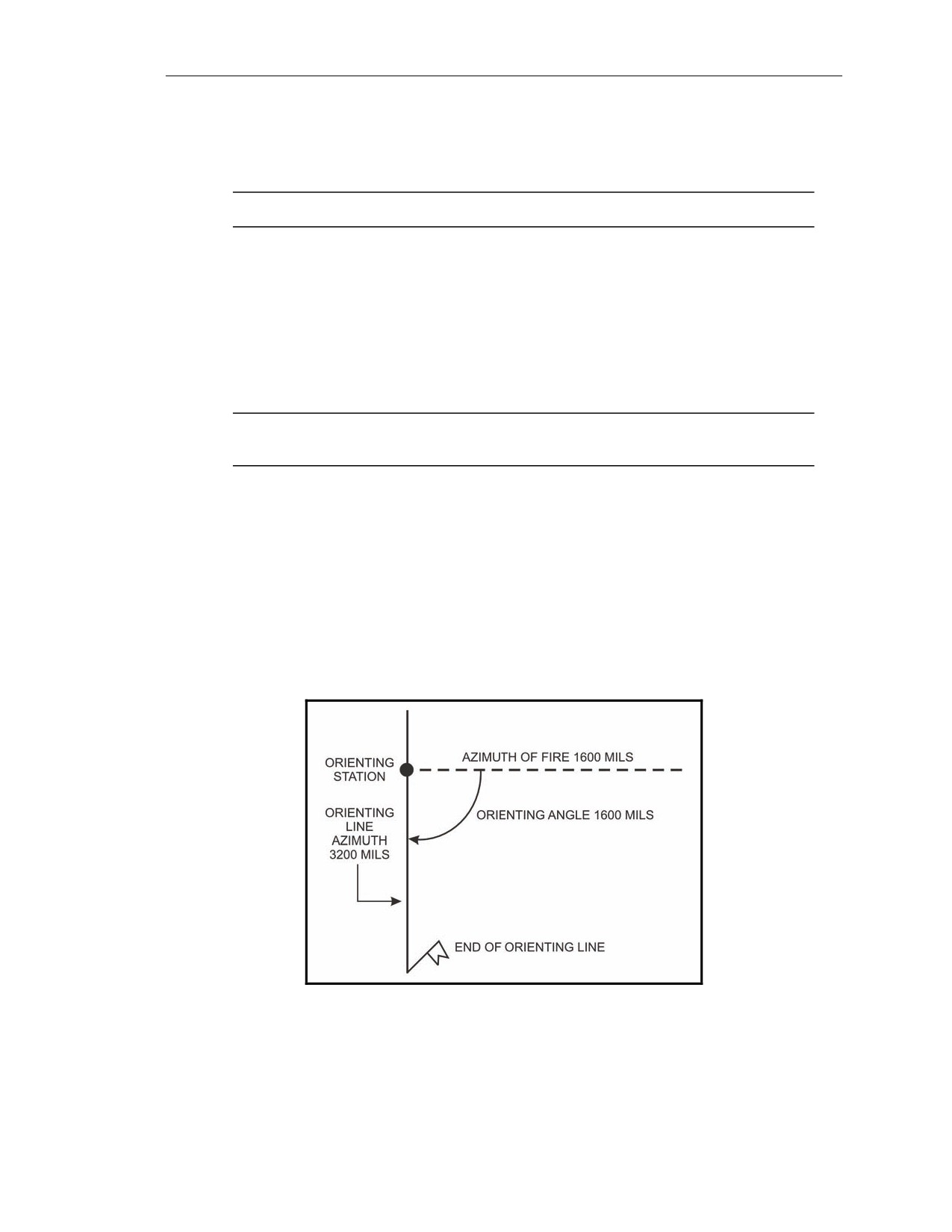
Example: the azimuth of the orienting line is 3200 mils. The azimuth on which the section
leader wishes to lay the section is 1600 mils. The orienting angle is 1600 mils (Figure 2-10).
Azimuth of orienting line
3200 mils
Minus mounting azimuth
− 1600 mils
Orienting angle
1600 mils
(5) The aiming circle is set up over the orienting station using the plumb bob. The upper motion
is used to set off 1600 mils on the aiming circle. The section leader sights on the end of the
orienting line using the lower motion. The 0-3200 line of the aiming circle is now oriented.
Figure 2-10. Orienting by orienting angle.
DISASSEMBLY OF THE AIMING CIRCLE
2-46. Instructions for disassembling the aiming circle are located inside the circle cover.
7 December 2007
FM 3-22.90
2-17
Chapter 2
CARE AND MAINTENANCE
2-47. The aiming circle cannot withstand rough handling or abuse. Proper care prolongs its life and
ensures better results for the user. Inaccuracies or malfunctions result from mistreatment. The
following precautions must be observed:
Since stops are provided on instruments to limit the travel of the moving parts, do not
attempt to force the rotation of any knob beyond its stop limit.
Keep the instrument as clean and dry as possible. If the aiming circle is wet, dry it carefully.
When not in use, keep the equipment covered and protected from dust and moisture.
Do not point the telescope directly at the sun unless a filter is used; the heat of the focused
rays can damage optical elements.
Keep all exposed surfaces clean and dry to prevent corrosion and etching of the optical
elements.
To prevent excessive wear of threads and other damage to the instrument, do not tighten
leveling, adjusting, and clamping screws beyond a snug contact.
NOTE: Only maintenance personnel are authorized to lubricate the aiming circle.
SECTION III. SIGHTUNITS
Sightunits are used to lay mortars for elevation and deflection. M67 and M64-series sightunits are the
standard sighting devices used with mortars.
SIGHTUNIT, M67
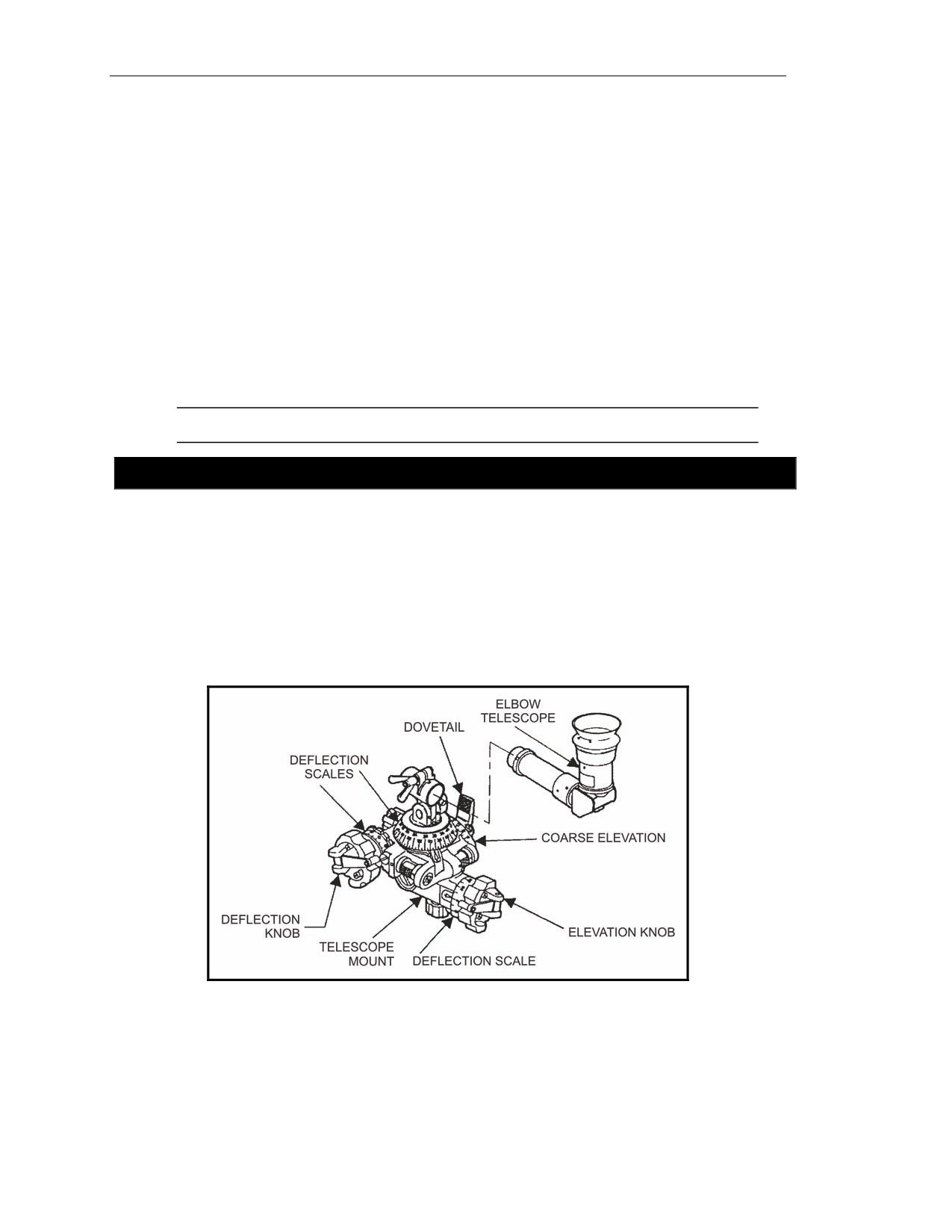
2-48. The M67 sightunit (Figure 2-11) is used to lay all mortars for deflection and elevation. Lighting
for night operations using the sightunit is provided by radioactive tritium gas contained in phosphor-
coated glass vials. The sightunit is lightweight and portable. It is attached to the bipod mount by means
of a dovetail. Coarse elevation and deflection scales and fine elevation and deflection scales are used in
conjunction with elevation and deflection knob assemblies to sight the mortar system.
Figure 2-11. Sightunit, M67.
MAJOR COMPONENTS
2-49. The M67 sightunit consists of two major components: the elbow telescope and the telescope
mount.
2-18
FM 3-22.90
7 December 2007
Sighting and Fire Control Equipment
Elbow Telescope
2-50. The elbow telescope is 4.0-power, hermetically sealed with a tritium illuminated crosshair
reticle.
Telescope Mount
2-51. The telescope mount, provided with tritium back-lighted level vials, indexes, and translucent
plastic scales, is used to orient the elbow telescope in azimuth and elevation.
CAUTION
When not in use, store the sightunit in its carrying case.
EQUIPMENT DATA
2-52. The equipment data for the M67 sightunit are shown in Table 2-3.
Table 2-3. Sightunit, M67, equipment data.
Weight
2.9 pounds (1.3 kilograms)
Field of view
10 degrees
Magnification
4.0 X nominal, 3.5 effective
Length
5 3/8 (13.7 centimeters)
Width
4 3/8 (11.1 centimeters)
Height
8 1/2 inches (21.6 centimeters)
Light source
Self-contained, radioactive tritium gas (H3).
SIGHTUNIT, M64-SERIES
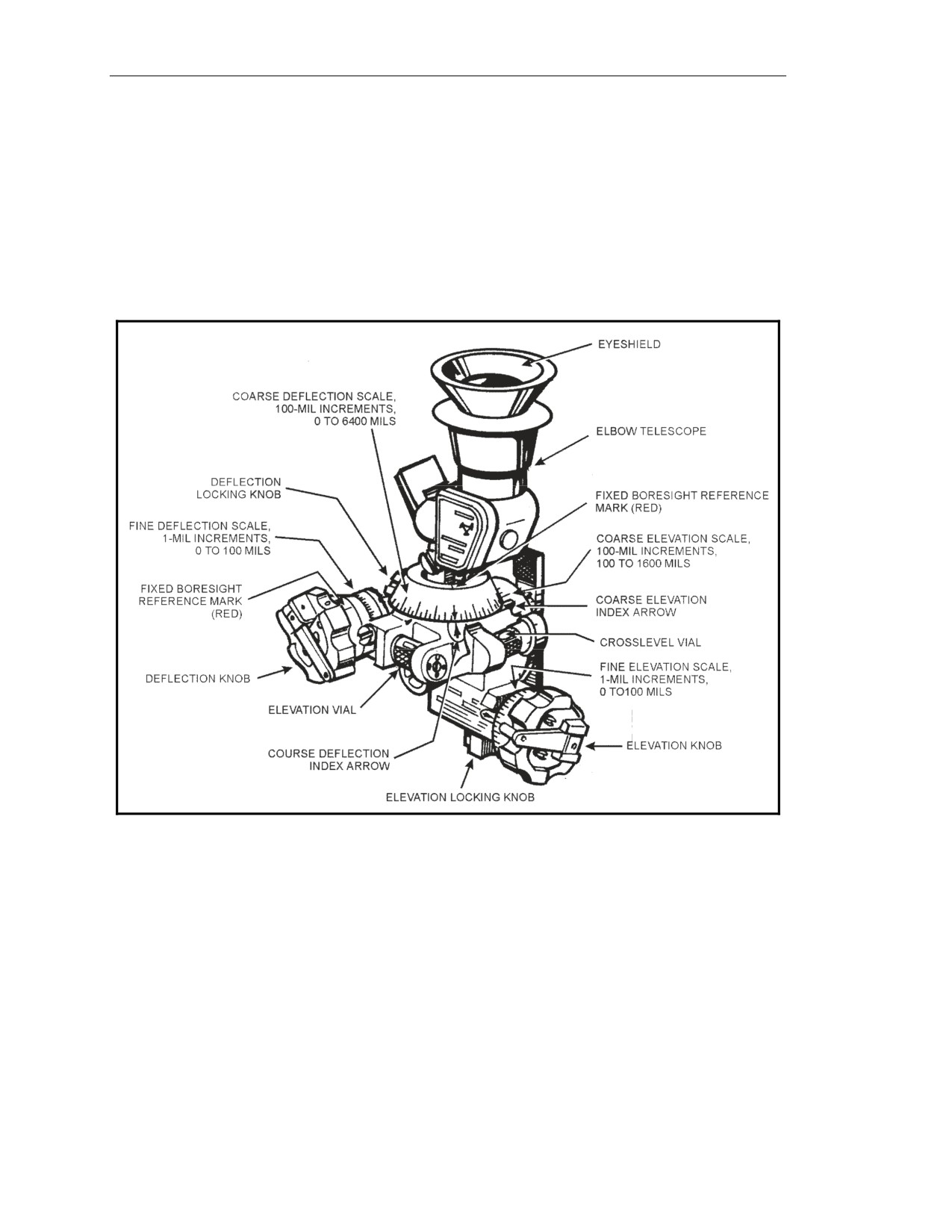
2-53. The sightunit (Figure 2-12) is the device on which the gunner sets deflection and elevation to hit
targets by using the elevation level vial and the cross-level vial. After the sight has been set for
deflection and elevation, the mortar is elevated or depressed until the elevation bubble on the sight is
level. The mortar is then traversed until a proper sight picture is seen (using the aiming posts as the
aiming point) and cross-level bubble is level. The mortar is laid for deflection and elevation when all
bubbles are level. After the ammunition has been prepared, it is ready to be fired.
MAJOR COMPONENTS
2-54. The two major components are the elbow telescope and sight mount. The elbow telescope has an
illuminated cross line. The sight mount has a dovetail, locking knobs, control knobs, scales, cranks,
and locking latch.
Dovetail
2-55. The dovetail is compatible with standard U.S. mortars. When the dovetail is properly seated in
the dovetail slot, the locking latch clicks. The locking latch is pushed toward the barrel to release the
sight from the dovetail slot for removal.
Locking Knobs
2-56. The red locking knobs lock the deflection and elevation mechanisms of the sight during firing.
Micrometer Knobs
2-57. The elevation and deflection micrometer knobs are large for easy handling. Each knob has a
crank for large deflection and elevation changes.
7 December 2007
FM 3-22.90
2-19
Chapter 2
Scales
2-58. All scales can be adjusted to any position. Micrometer scales are white. The elevation
micrometer scale and fixed boresight references (red lines) above the coarse deflection scale and
adjacent to the micrometer deflection scale are slipped by loosening slot-headed screws. Coarse
deflection scales and micrometer deflection scales are slipped by depression and rotation. The coarse
elevation scale is factory set and should not be adjusted at crew level. (If the index does not align with
the coarse elevation scale within ±20 mils when boresighting at 800 mils, field-level maintenance
should be notified.) The screws that maintain the coarse elevation scale are held in place with locking
compound. If the screws are loosened and then tightened without reapplying the locking compound,
the coarse elevation scale can shift during firing.
Figure 2-12. Sightunit, M64-series.
ILLUMINATION
2-59. Instrument lights are not needed when using the sightunit at night. Nine parts of the sight are
illuminated by tritium gas.
Telescope.
Coarse elevation scale.
Coarse elevation index arrow.
Elevation vial.
Fine elevation scale.
Coarse deflection index arrow.
Cross-leveling vial.
Fine deflection scale.
Coarse deflection scale.
2-20
FM 3-22.90
7 December 2007
Sighting and Fire Control Equipment
TABULATED DATA
2-60. The tabulated data of the M64-series sightunit are shown in Table 2-4.
Table 2-4. Sightunit, M64-series, tabulated data.
Weight
2.5 pounds (1.1 kilograms).
Field of view
17 degrees (302 mils).
Magnification
1.5 unity power
Length
4 3/8 inches (11 centimeters).
Width
4 3/4 inches (12 centimeters).
Height
7 3/8 inches (19 centimeters).
Light source
Self-contained, radioactive tritium gas (H3).
CAUTION
When not in use, store the sightunit in its carrying case.
OPERATION OF SIGHTUNITS
2-61. The operation of all the U.S. sightunits is similar.
ATTACHING THE SIGHTUNIT
2-62. Insert the dovetail of the telescope mount into the sight socket. Press the locking lever inward,
seat the mount firmly, and release the locking lever.
NOTE: Until the baseplate is firmly seated, remove the sight from the mortar before
firing each round.
PLACING THE SIGHTUNIT INTO OPERATION
2-63. To place the sightunit into operation, use the following procedures.
Setting the Deflection
2-64. Setting the correct deflection on the sight places the mortar, once the sight is leveled, in the
direction commanded by the FDC.
2-65. To place a deflection setting on the sight, turn the deflection knob. Before attempting to place a
deflection setting on the sightunit, ensure that the deflection locking knob is released. After placing a
setting on the sight, lock the locking knob to lock the data onto the sight and to ensure that the scale
does not slip during firing.
2-66. When setting the deflection, it is necessary to use the red fixed coarse scale and the red fixed
micrometer scale to obtain the desired setting. Set the first two digits of the deflection on the coarse
scale and the last two on the micrometer scale.
NOTE: The black coarse scale and the black micrometer scale are slip scales.
2-67. Setting a deflection on the deflection scale does not change the direction in which the barrel is
pointing (the lay of the mortar). It only moves the vertical line off (to the left or right) the aiming line.
The deflection placed on the sight is the deflection announced in the fire command. Place a deflection
on the sight before elevation.
7 December 2007
FM 3-22.90
2-21
Chapter 2
Setting the Elevation
2-68. Setting the correct elevation on the sight places the mortar, once the sight is leveled, on the angle
of fire commanded by the FDC.
2-69. To set for elevation, turn the elevation knob. This operates both the elevation micrometer and
coarse elevation scales. Both scales must be set properly to obtain the desired elevation. To place an
elevation of 1065 mils for example, turn the elevation knob until the fixed index opposite the moving
coarse elevation scale is between the black
1000- and 1100-mil graduations on the scale
(the
graduations are numbered every 200 mils), and then use the micrometer knob to set the last two digits
(65).
2-70. Setting an elevation on the elevation scale does not change the elevation of the mortar barrel.
2-71. Before setting elevations on the sight, unlock the elevation locking knob. Once the elevation is
placed on the sight, lock the elevation locking knob. This ensures the data placed on the sight do not
accidentally change.
CORRECT SIGHT PICTURE
2-72. Sight the mortar on the aiming posts with the vertical reticle line aligned on the left side of the
aiming post. Check to ensure the bubbles are level. Repeat adjustments until a correct sight picture is
obtained with the bubbles level.
LAYING FOR DIRECTION
2-73. In laying the mortar for direction, the two aiming posts do not always appear as one when
viewed through the sight(s). This separation is caused by one of two things: either a large deflection
shift of the barrel or a rearward displacement of the baseplate assembly caused by the shock of firing.
(See Chapter 3, Figure 3-7 for an example of a compensated sight picture.)
2-74. When the aiming posts appear separated, the gunner cannot use either one as his aiming point.
To lay the mortar correctly, he takes a compensated sight picture. To take a compensated sight picture,
he traverses the mortar until the sight picture appears with the left edge of the far aiming post placed
exactly midway between the left edge of the near aiming post and the vertical line of the sight. This
corrects for the displacement. A memory trick for correcting displacement is: Hey diddle diddle, far
post in the middle.
2-75. The gunner determines if the displacement is caused by traversing the mortar or by displacement
of the baseplate assembly. To do so, he places the referred deflection on the sight and lays on the
aiming posts. If both aiming posts appear as one, the separation is caused by traversing. Therefore, the
gunner continues to lay the mortar as described and does not realign the aiming posts. When the posts
appear separated, the separation is caused by displacement of the baseplate assembly. The gunner
notifies his squad leader, who requests permission from the section/platoon leader to realign the aiming
posts. (For more information, see Chapter 3.)
REPLACING THE SIGHTUNIT IN THE CARRYING CASE
2-76. Before returning the sightunit to the carrying case, close the covers on the level vials and set an
elevation of 800 mils and deflection of 3800 mils on the scales. Place the elbow telescope in the left
horizontal position. All crank handles should be folded into the inoperative position.
2-22
FM 3-22.90
7 December 2007
Sighting and Fire Control Equipment
CARE AND MAINTENANCE OF SIGHTUNITS
2-77. Although sightunits are rugged, the units could become inaccurate or could malfunction if
abused or handled roughly. To properly care for and maintain the sightunit—
Avoid striking or otherwise damaging any part of the sight. Be particularly careful not to
burr or dent the dovetail bracket. Avoid bumping the micrometer knobs, telescope adapter,
and level vials. Except when using the sight, keep the metal vial covers closed.
Keep the sight in the carrying case when not in use. Keep it as dry as possible, and do not
place it in the carrying case while it is damp.
When the sight fails to function correctly, return it to the field-level maintenance unit for
repair. Members of the mortar crew are not authorized to disassemble the sight.
Keep the optical parts of the telescope clean and dry. Remove dust from the lens with a
clean camel’s-hair brush. Use only lens cleaning tissue to wipe these parts. Do not use
ordinary polishing liquids, pastes, or abrasives on optical parts. Use only authorized lens
cleaning compound for removing grease or oil from the lens.
Occasionally oil only the sight locking devices by using a small quantity of light
preservative lubricating oil. To prevent accumulation of dust and grit, wipe off excess
lubricant that seeps from moving parts. Ensure that no oil gets on the deflection and
elevation scales. (Oil removes the paint from the deflection scale.) No maintenance is
authorized.
RADIOACTIVE TRITIUM GAS
2-78. Both the M67 and M64 use radioactive tritium gas (H3) for illumination during night operations.
The gas is sealed in glass tubes and is not hazardous when the glass tubes are intact. If there is no
illumination, the range patrol officer (RPO) or CBRN officer should be notified. (For information on
first aid, see FM 4-25.11.)
WARNING
Do not try to repair or replace the radioactive material. If skin
contact is made with tritium, wash the area immediately with
nonabrasive soap and water.
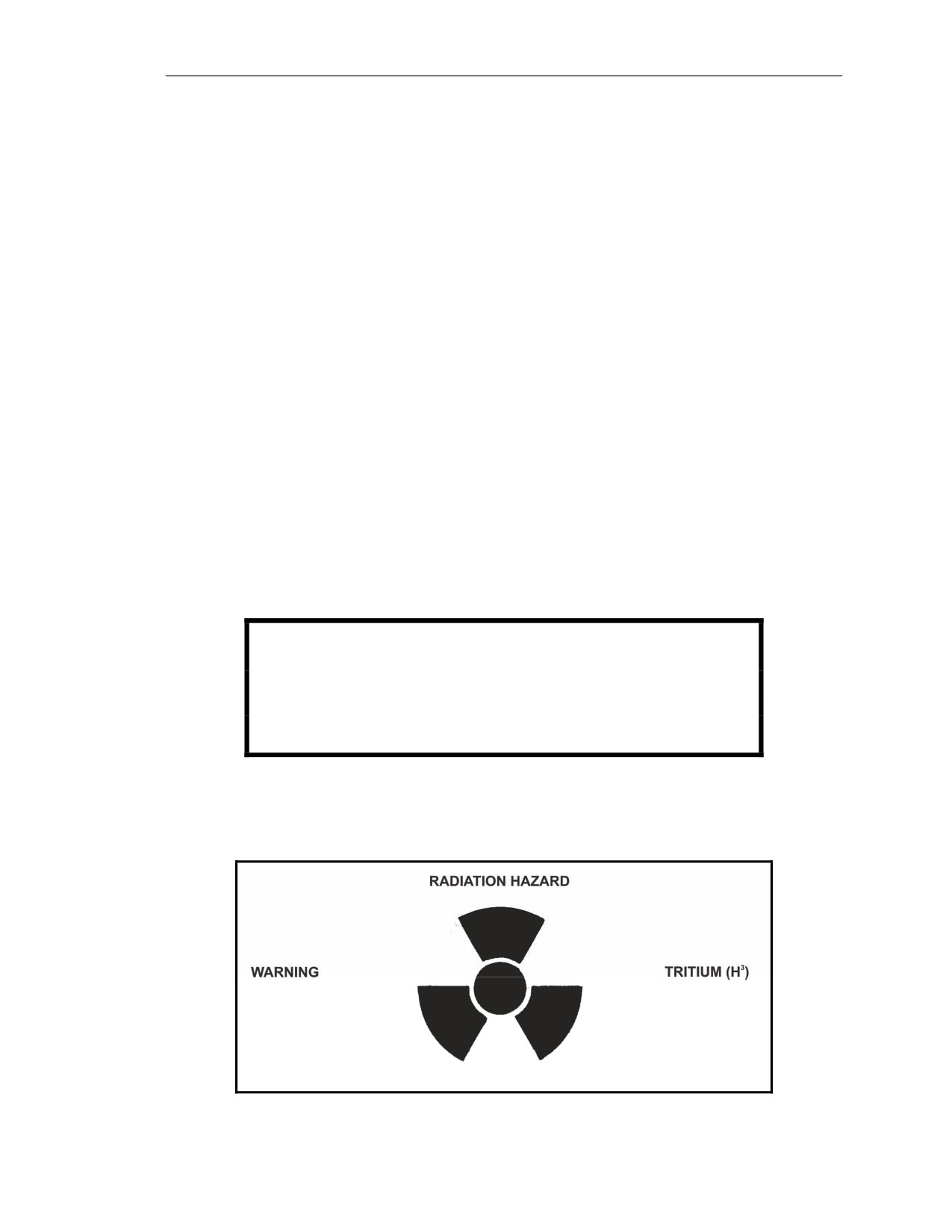
IDENTIFICATION
2-79. Radioactive self-luminous sources are identified by means of warning labels (Figure 2-13),
which should not be defaced or removed. If necessary, they must be replaced immediately.
Figure 2-13. Warning label for tritium gas (H3).
7 December 2007
FM 3-22.90
2-23
Chapter 2
STORAGE AND SHIPPING
2-80. All radioactively illuminated instruments or modules that are defective must be evacuated to a
sustainment-level maintenance activity. Defective items must be placed in a plastic bag and packed in
the shipping container from which the replacement was taken. Spare equipment must be stored in the
shipping container as received until installed on the weapon. Such items should be stored in an outdoor
shed or unoccupied building.
SECTION IV. BORESIGHTS
Boresights are adjusted by the manufacturer and should not require readjustment as a result of normal field
handling.
BORESIGHT, M45-SERIES
2-81. The boresight, M45-series, detects deflection and elevation errors in the sight.
COMPONENTS
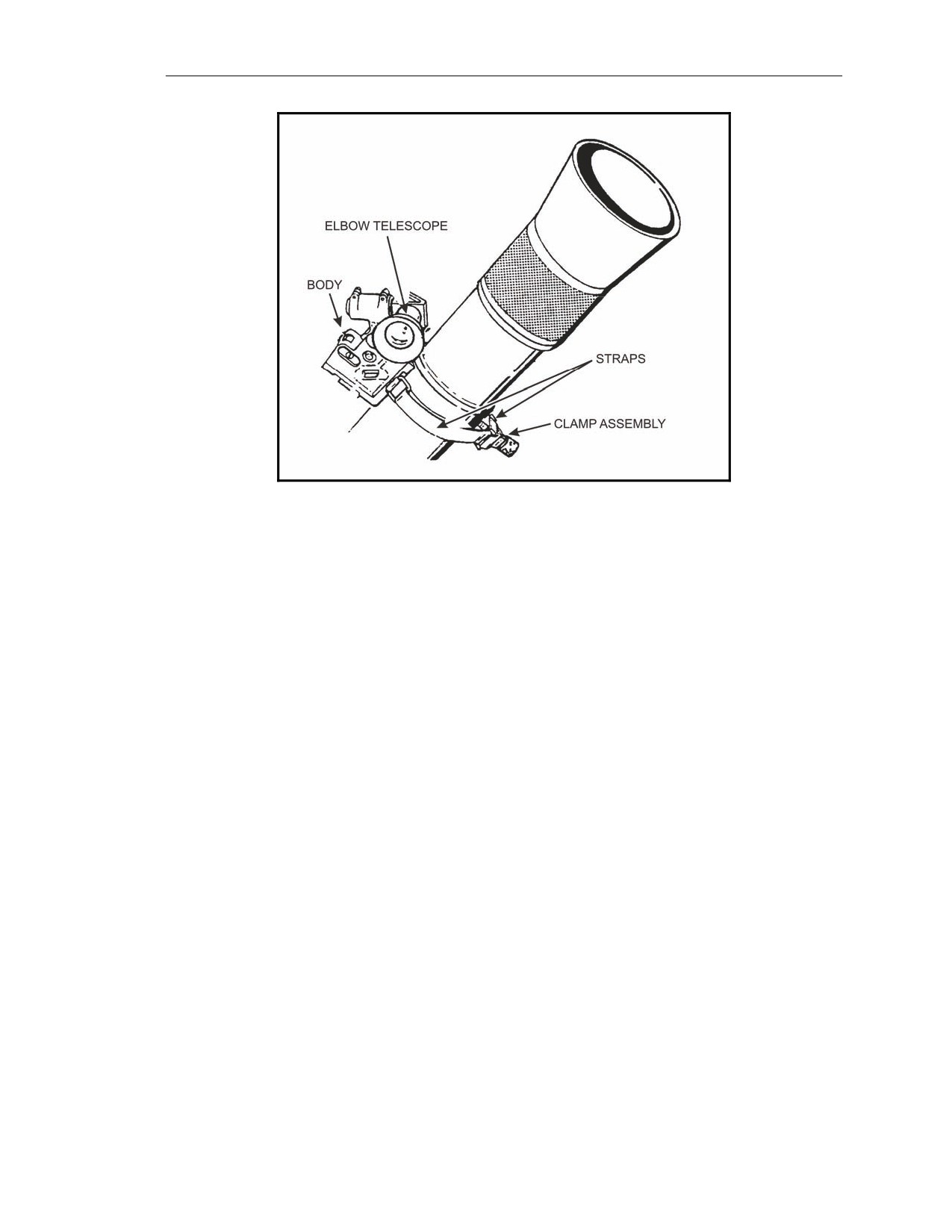
2-82. The boresight, M45, (Figure 2-14) consists of an elbow telescope, telescope clamp, body, two
strap assemblies, and clamp assembly.
Elbow Telescope
2-83. The elbow telescope establishes a definite line of sight.
Telescope Clamp
2-84. The telescope clamp maintains the line of sight in the plane established by the centerline of the
V-slides.
Body
2-85. The body incorporates two perpendicular V-slides. It contains level vials (preset at 800 mils
elevation) that are used to determine the angle of elevation of 800 mils and whether the V-slides are in
perpendicular positions. It also provides the hardware to which the straps are attached.
Strap Assemblies
2-86. Two strap assemblies are supplied with each boresight and marked for cutting in the field to the
size required for any mortar.
Clamp Assembly
2-87. The clamp assembly applies tension to the strap assemblies to secure the boresight against the
mortar barrel.
TABULATED DATA
2-88. The tabulated data of the M45-series boresight are shown in Table 2-5.
Table 2-5. Boresight, M45-series, tabulated data.
Weight
2.5 pounds
Field of view
12 degrees
Magnification
3 power
2-24
FM 3-22.90
7 December 2007
Sighting and Fire Control Equipment
Figure 2-14. Boresight, M45.
INSTALLATION
2-89. Installation procedures for the M45 boresight are as follows:
(1) Remove the boresight, clamp assembly, and straps from the carrying case. Grasp the
boresight by the body to prevent damaging the telescope.
(2) Place the ring over the hook and attach the strap snap to the eye provided on the strap shaft.
(3) If necessary, release the catches and reset the straps to the proper length.
(4) Remove any burrs or projecting imperfections from the seating area of the mortar barrel to
ensure proper seating of the boresight. Attach the boresight to the barrel below and touching
the upper stop band on the M252 mortar. However, attach the boresight about 1 inch from
the muzzle of the barrel on all other mortars.
PRINCIPLES OF OPERATION
2-90. Except for the M115, the boresight is constructed so that the telescope line of sight lies in the
plane established by the center lines of the V-slides. When properly secured to a mortar barrel, the
centerline of the contacting V-slide is parallel to the centerline of the barrel. Further, the cross-level
vial, when centered, indicates that the center lines of both slides, the elbow telescope, and the barrel lie
in the same vertical plane. Therefore, the line of sight of the telescope coincides with the axis of the
barrel, regardless of which V-slide of the boresight is contacting the barrel. The elevation vial is
constructed with a fixed elevation of 800 mils.
BORESIGHT, M115
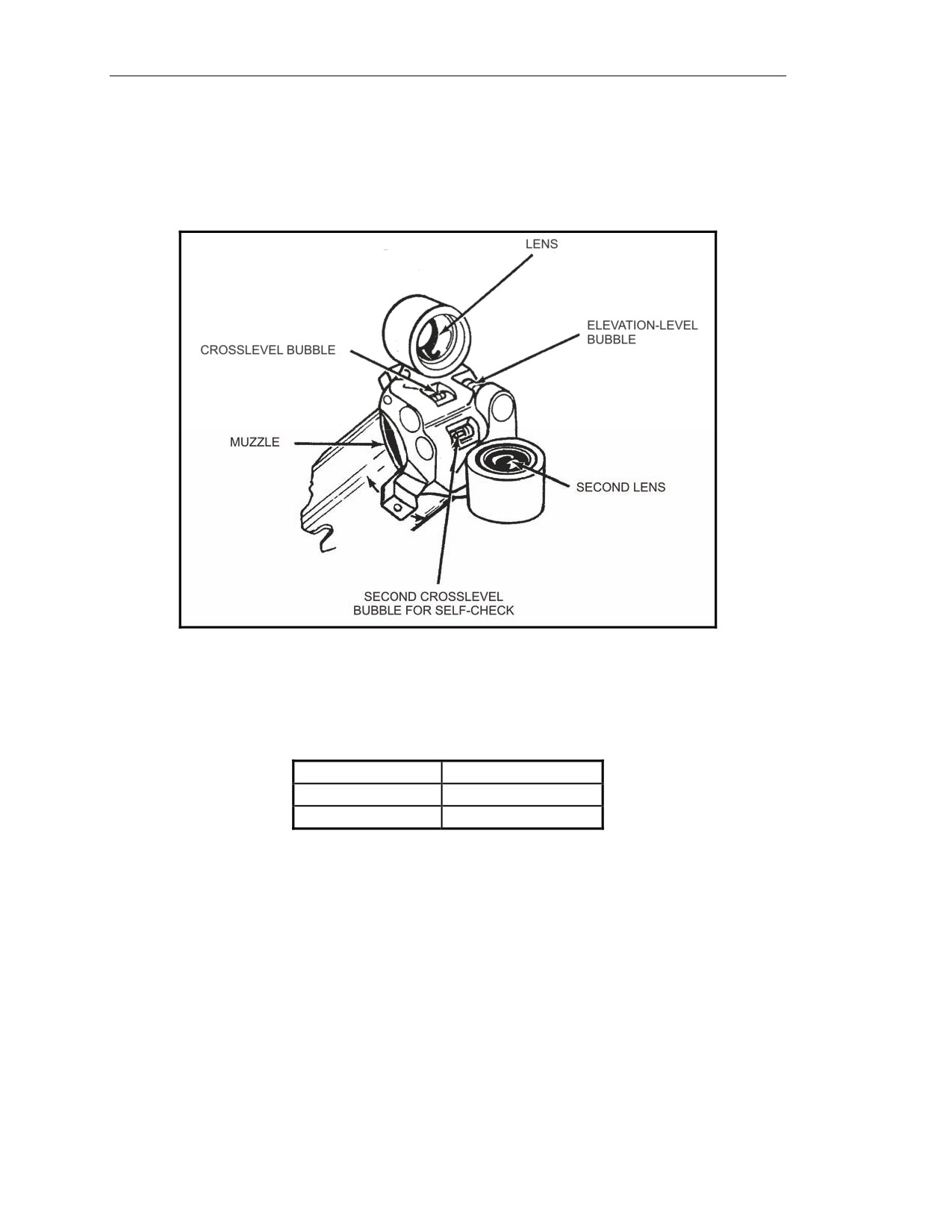
2-91. The boresight, M115, (Figure 2-15) detects deflection and elevation errors in the sight. The
boresight has three plungers that keep it in place when mounted in the muzzle of the barrel. The
telescope has the same field of view and magnification as the M64-series sightunit. The elevation
bubble levels only at 800 mils.
COMPONENTS
2-92. The components of the M115 boresight are the body, telescope, and leveling bubbles (one for
cross-leveling and one for elevation).
7 December 2007
FM 3-22.90
2-25
Chapter 2
Second Cross-Level Bubble
2-93. A second cross-level bubble is used as a self-check of the M115. After leveling and cross-
leveling, the M115 can be rotated 180 degrees in the muzzle until the second cross-level bubble is
centered. The image of the boresight target should not vary in deflection. A large deviation indicates
misalignment between the cross-level bubble and lenses.
Figure 2-15. Boresight, M115.
TABULATED DATA
2-94. The tabulated data of the M115 boresight are shown in Table 2-6.
Table 2-6. M115 boresight tabulated data.
Weight
5 ounces
Field of view
17 degrees
Magnification
1.5 power
SIGHT CALIBRATION
2-95. Always calibrate the mortar sight to the mortar on which it will be mounted. This procedure is
necessary since the sight socket that receives the sightunit is a machined part and varies in accuracy
with each mortar. There is no set rule for frequency of calibration. The sight should be calibrated each
time the mortar is mounted in a new location, since the movement might disturb the setting of the
elevation and deflection scales. Time available and accuracy dictate the frequency of calibration.
BORESIGHT METHOD OF CALIBRATION
2-96. Once the mortar has been mounted, place the M67 or the M64-series sightunit into position in
the sight socket. Place a deflection of 3200 mils and an elevation of 0800 mils on the scales. For the
M252 mortar, place a deflection of 0 mils on the sight. Align the vertical cross line of the sight on an
aiming point (at least 200 meters distant) by shifting the bipod. If necessary, use the traversing
mechanism; however, keep the mortar within two turns of center of traverse (four turns of center of
2-26
FM 3-22.90
7 December 2007
Sighting and Fire Control Equipment
traverse for the 120-mm mortar). Make a visual check of the mortar for cant; if cant exists, remove the
cant and re-lay, if necessary.
ELEVATION SETTING
2-97. Use the following procedures to set the elevation.
(1) Install the boresight on the mortar barrel. Center the cross-level vial by rotating the
boresight slightly around the outside diameter of the mortar barrel. Slight movements are
made by loosening the clamp screw and lightly tapping the boresight body. When the
bubble centers, tighten the clamp screw.
(2) Elevate or depress the mortar barrel until the boresight elevation level vial is centered. The
mortar is now set at 800 mils (45 degrees) elevation.
(3) Using the elevation micrometer knob, elevate or lower the sightunit until the elevation level
bubble is centered. If necessary, cross-level the sightunit.
(4) Recheck all level bubbles.
(5) The reading on the coarse elevation scale of the sightunit should be 800 mils and the reading
on the elevation micrometer scale should be 0. If adjustment is necessary, proceed as
indicated below. Loosen the two screws on the elevation micrometer knob and slip the
elevation micrometer scale until the 0 mark on the micrometer scale coincides with the
reference mark on the housing. Tighten the two screws to secure the micrometer scale.
NOTE: Do not adjust the M64-series sightunit coarse elevation scale. If it does not line
up with the 0800-mil mark, turn it in to field-level maintenance.
(6) Recheck all level bubbles.
DEFLECTION SETTING
2-98. Use the following procedures to set the deflection.
(1) Check again to ensure that the sight setting reads 3200 on the fixed deflection (red) scale
and elevation 800 mils. Set zero deflection for the M252 mortar.
(2) Traverse the mortar no more than two turns of center of traverse (four turns for the 120-mm
mortar) and align the vertical cross line of the boresight on the original aiming point. Adjust
the boresight to keep the cross-level bubble centered since the mortar could cant during
traversing. (If the mortar is initially mounted on the aiming point, it decreases the amount of
traverse needed to align the cross line on the aiming point.) Also, the elevation level bubble
may need to be leveled.
(3) After the boresight is aligned on the aiming point, level the sight by centering the cross-
level bubble. Rotate the deflection micrometer knob until the sight is aligned on the aiming
point. The coarse deflection scale should read 3200 mils and the micrometer scales should
read 0. If adjustment is necessary, loosen the two screws on the deflection micrometer knob
and slip the micrometer deflection scale until the arrow on the index is aligned with the zero
mark on the micrometer scale.
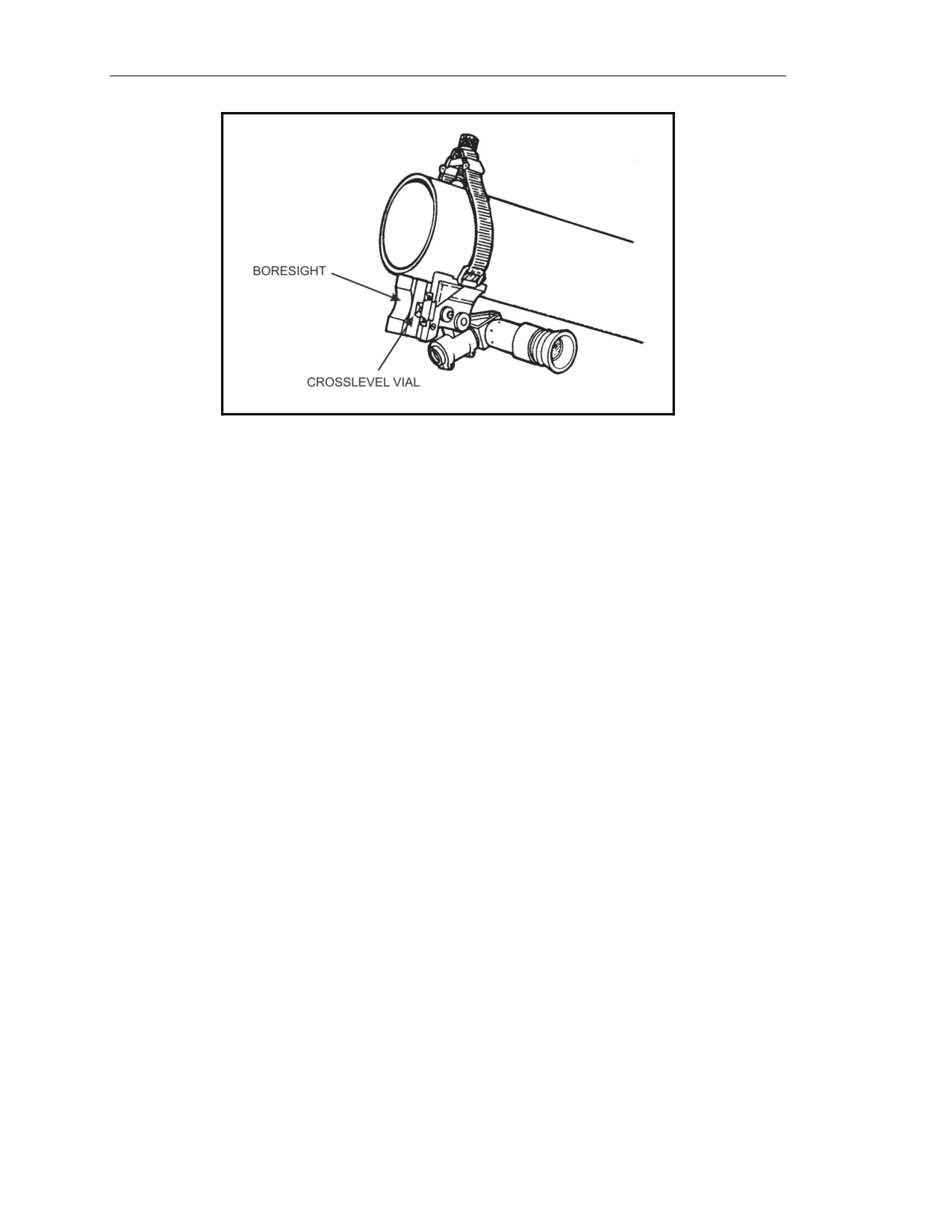
(4) To verify proper alignment, remove the boresight and place it in position on the under side
of the cannon as shown in Figure 2-16. Center the boresight cross-level bubble and check
the vertical cross line to see if it is still on the aiming point. If cant exists, the vertical cross
line of the boresight is not on the aiming point. This indicates that the true axis of the bore
lies halfway between the aiming point and where the boresight is now pointing.
7 December 2007
FM 3-22.90
2-27
Chapter 2
Figure 2-16. Verifying proper alignment of the boresight device.
(5) To correct this error, look through the boresight, traverse the mortar onto the aiming point.
If bubbles are level, use the deflection micrometer knob and place the vertical cross line of
the sight back onto the aiming point. With the sight in this position, index one-half of the
mil variation between the sight and boresight. Slip zero on the micrometer scale to the index
mark—for example, the mil variation is 10 mils and one-half of this value is 5 mils. Loosen
the two screws on the deflection micrometer and index zero.
(6) Check all level bubbles, sightunit, and boresight.
(7) With a deflection on the micrometer scale of half the value of the original mil variation,
both the sightunit and boresight are on the aiming point. If an error exists, repeat the
procedure outlined above.
(8) Using the M64-series sightunit, adjust the deflection scale and micrometer scale of the
sightunit to zero. To do this, loosen the deflection knob screws and slip the scale to zero.
Adjust the deflection micrometer scale to zero by pushing in on the micrometer knob
retaining button and slipping the scale to zero.
(9) Check again all level bubbles, and the lay of the sightunit and the boresight on the aiming
point.
REMOVAL
2-99. Use the following procedures to remove the boresight.
(1) Loosen the clamp screw, releasing the boresight from the barrel.
(2) Swing the elbow telescope until it is about parallel with the elevation level bubble.
(3) Release the clamp assembly and straps by removing the ring from the hook and strap shaft.
(4) Stow the clamp assembly and straps in the corner compartment. Put the boresight in the
center compartment of the carrying case.
CALIBRATION FOR DEFLECTION USING THE M2 AIMING
CIRCLE
2-100. Two methods can be used to calibrate the sight for deflection using the M2 aiming circle: the
angle method and the distant aiming point (DAP) method.
2-28
FM 3-22.90
7 December 2007
Sighting and Fire Control Equipment
CALIBRATION FOR DEFLECTION USING THE ANGLE METHOD
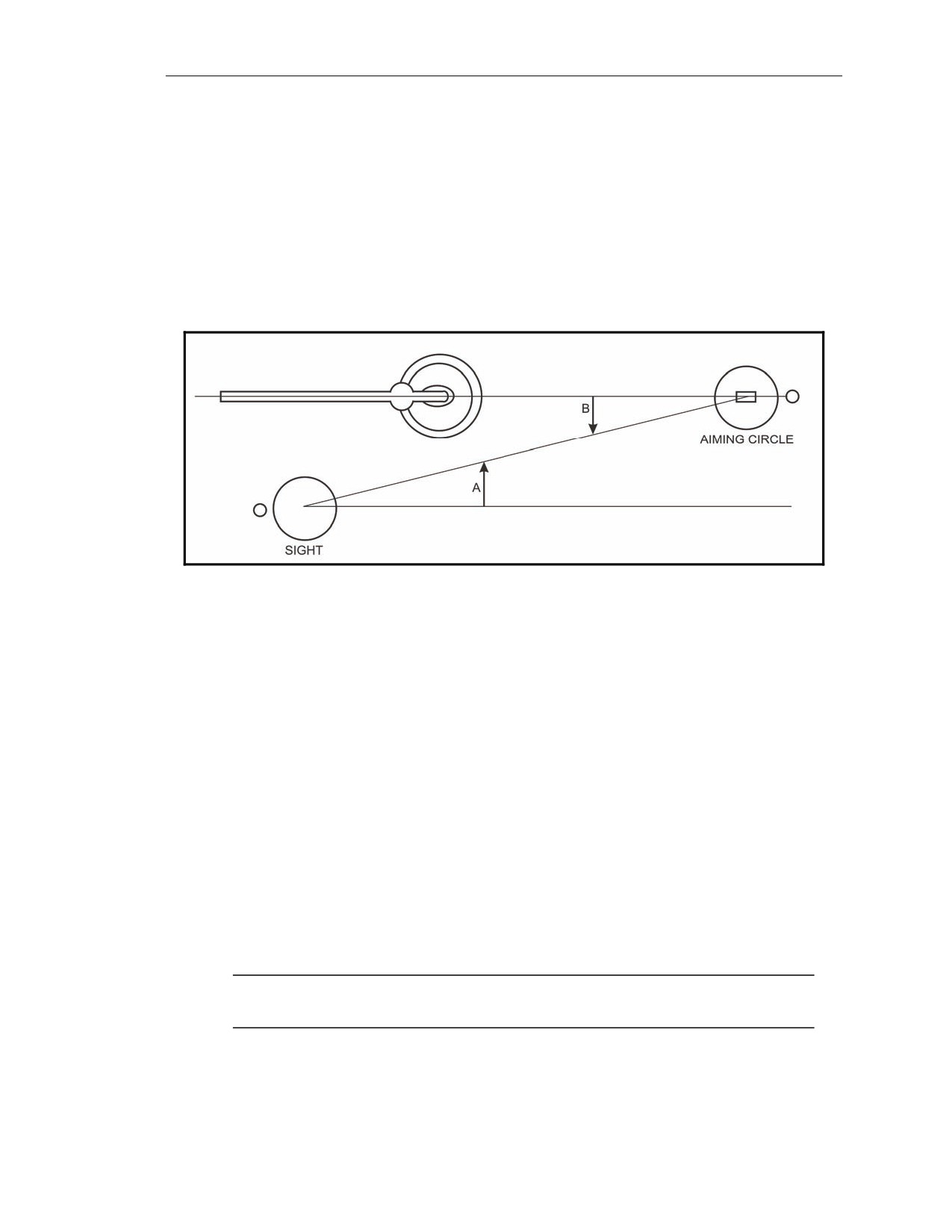
2-101. This method (Figure 2-17) uses the geometric property that the alternate interior angles
formed by a line intersecting two parallel lines are equal.
(1) Set up the aiming circle 25 meters to the rear of the mounted mortar. The mortar is mounted
at 800 mils elevation and at a deflection of 3200 mils.
(2) With the aiming circle fine leveled, index 0 on the azimuth scale and azimuth micrometer
scale. Using the orienting motion (nonrecording motion), align the vertical line of the reticle
of the telescope so that it bisects the baseplate.
(3) Traverse and cross-level the mortar until the center axis of the barrel from the baseplate to
the muzzle is aligned with the vertical line of the aiming circle telescope reticle.
Figure 2-17. Calibration for deflection using the angle method.
(4) Turn the deflection knob of the sight until the vertical line is centered on the lens of the
aiming circle and read angle A, opposite the fixed index.
(5) Turn the azimuth micrometer knob of the aiming circle until the vertical line of the
telescope is laid on the center of the sight lens and read angle B, opposite the azimuth scale
index. If the sight is in calibration, angles A and B will be equal. If they are not equal the
sight is adjusted by loosening the two screws in the face of the deflection knob of the sight
and slipping the micrometer deflection scale until the scale is indexed at the same reading as
angle B of the aiming circle.
CALIBRATION FOR DEFLECTION USING THE AIMING POINT METHOD
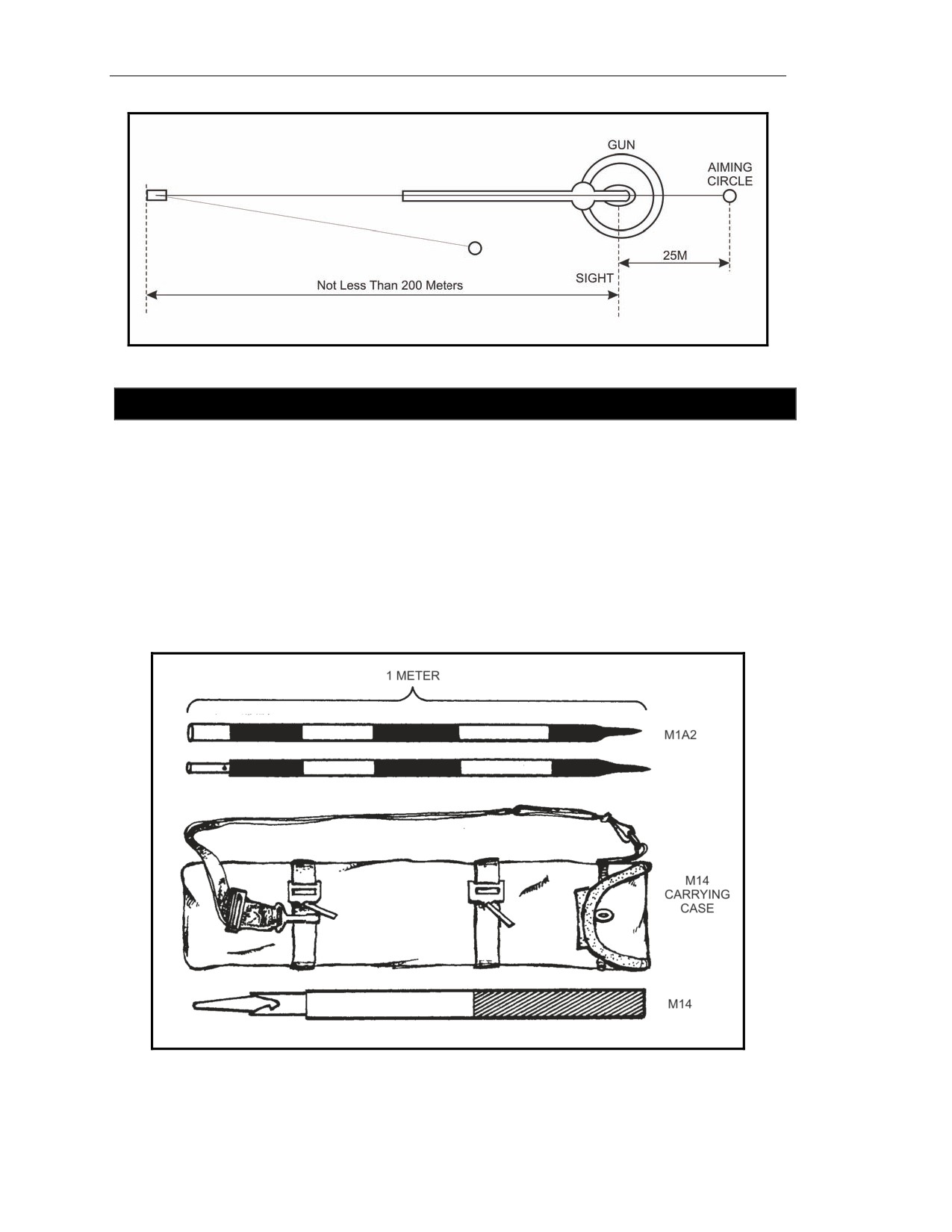
2-102. This method (Figure 2-18) places the aiming circle and the sightunit on essentially the same
line of sight.
(1) Set up the aiming circle and fine level. Align the vertical line of the telescope on a DAP (a
sharp, distinct object not less than 200 meters in distance).
(2) Move the mortar baseplate until the baseplate is bisected by the vertical line of the telescope
of the aiming circle. Mount the mortar at an elevation of 800 mils. Traverse and cross-level
the mortar until the axis of the barrel from the baseplate to the muzzle is bisected by the
vertical line of the aiming circle (the mortar should be mounted about 25 meters from the
aiming circle).
NOTE: Indexing the aiming circle at 0 is not necessary; only the vertical line is used to
align the mortar with the DAP.
(3) The aiming circle operator moves to the mortar and lays the vertical line of the sight on the
same DAP. If the sight is calibrated, the deflection scales of the sight are slipped to a
reading of 3200.
7 December 2007
FM 3-22.90
2-29
Chapter 2
Figure 2-18. Calibration for deflection using the distant aiming point method.
SECTION V. OTHER EQUIPMENT
Other equipment required to operate and employ mortars is discussed in this section.
AIMING POSTS, M14 AND M1A2
2-103. The M14 aiming posts (Figure 2-19) are used to establish an aiming point (reference line)
when laying the mortar for deflection. They are made of aluminum tubing and have a pointed tip on
one end. Aiming posts have red and white stripes so they can be easily seen through the sight. The
M14 aiming post comes in a set of eight segments, plus a weighted stake for every 16 segments to be
used as a driver in hard soil. The stake has a point on each end and, after emplacement, it can be
mounted with an aiming post. The segments can be stacked from tip to tail, and they are carried in a
specially designed case with a compartment for each segment. Four M1A2 aiming posts are provided
with the mortar. They may be stacked up to two high.
Figure 2-19. Aiming posts, M14 and M1A2.
2-30
FM 3-22.90
7 December 2007
Sighting and Fire Control Equipment
AIMING POST LIGHTS, M58 AND M59
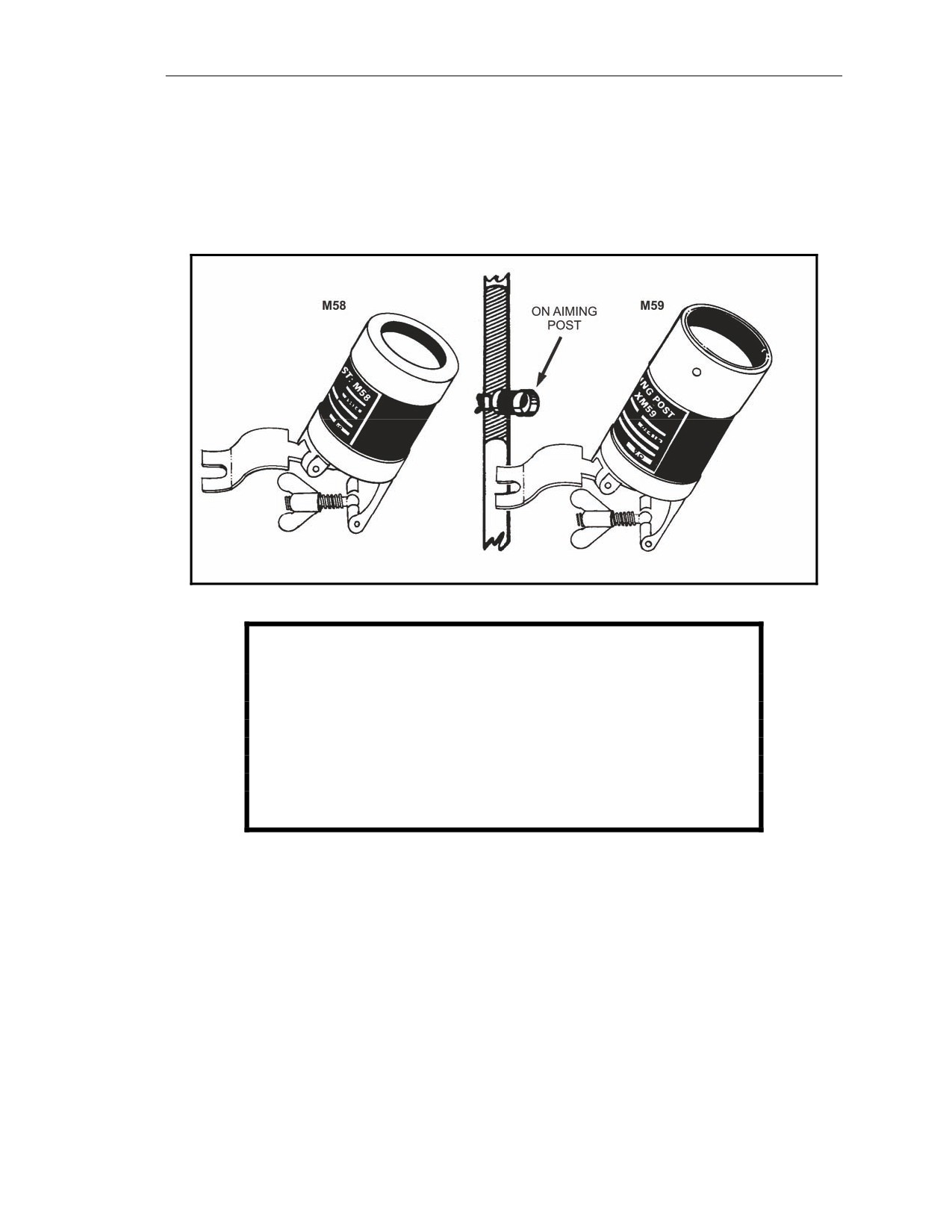
2-104. Aiming post lights (Figure 2-20) are attached to the aiming posts so they can be seen at night
through the sight. The near post must have a different color light than that of the far post. Aiming post
lights come in sets of three—two green (M58) and one orange (M59). An extra third light is issued for
the alternate aiming post. Each light has a clamp, tightened with a wing nut, for attachment to the
aiming post. The light does not have a cover for protection when not in use and does not need batteries.
Figure 2-20. Aiming post lights, M58 and M59.
WARNING
Radioactive material (tritium gas [H3]) is used in the M58 and
M59 aiming post lights. Radioactive leakage may occur if the
M58 and M59 aiming post lights are broken or damaged. If
exposed to a broken or damaged M58 or M59 aiming post
light or if skin contact is made with any area contaminated
with tritium, immediately wash with nonabrasive soap and
water, and notify the local RPO.
7 December 2007
FM 3-22.90
2-31
Chapter 2
SECTION VI. LAYING OF THE SECTION
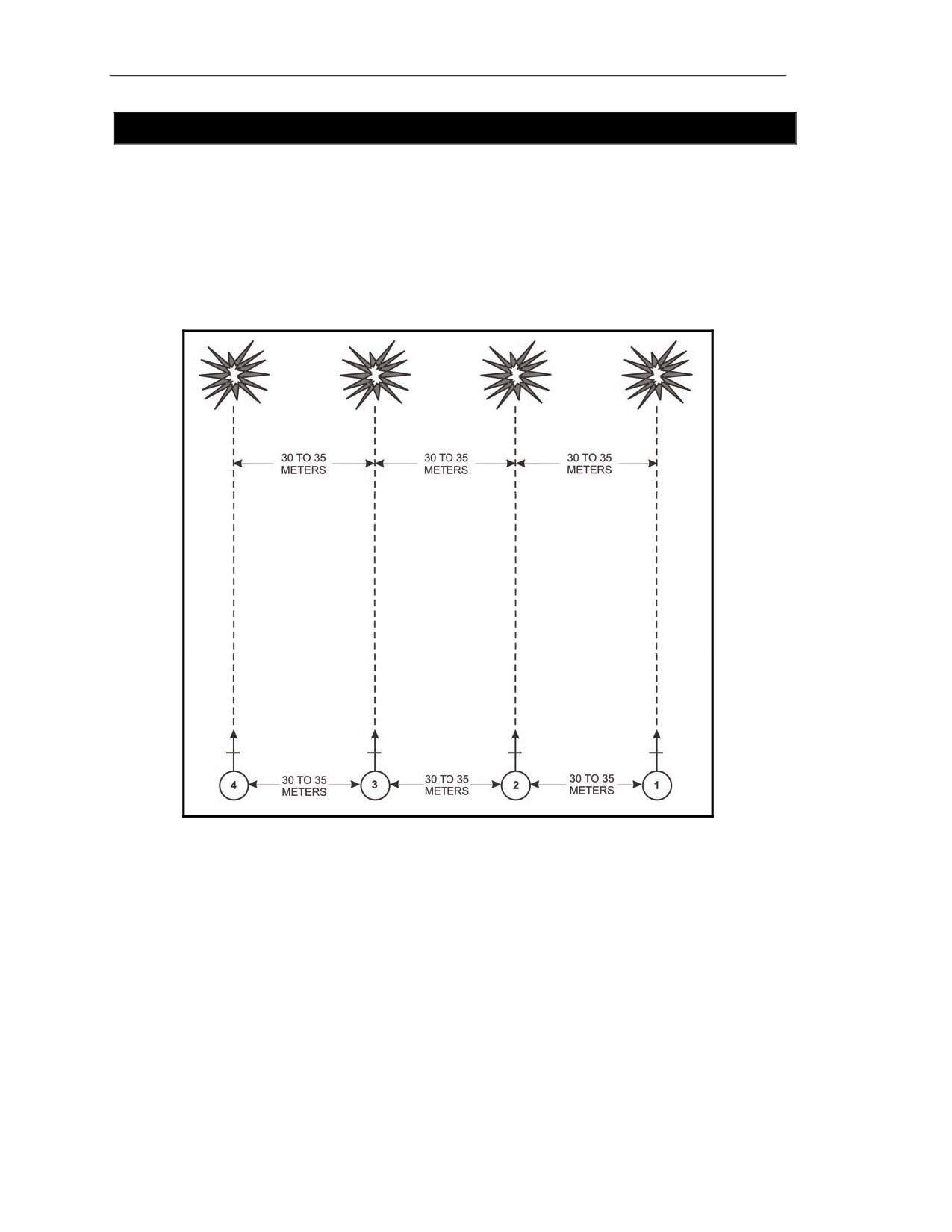
When all mortars in the section are mounted, the section leader lays the section parallel on the prescribed
azimuth with an aiming circle. The mortar section normally fires a parallel sheaf (Figure 2-21). To obtain
this sheaf, it is necessary to lay the mortars parallel. When a section moves into a firing position, the FDC
determines the azimuth on which the section is to be laid and notifies the platoon sergeant (section
sergeant). Before laying the mortars parallel, the section leader must calibrate the mortar sights. All mortars
are then laid parallel using the aiming circle, mortar sight, or compass. The section is normally laid parallel
by the following two steps:
(1) Establish the 0-3200 line of the aiming circle parallel to the mounting azimuth.
(2) Lay the section parallel to the 0-3200 line of the aiming circle (reciprocal laying).
Figure 2-21. Parallel sheaf.
2-32
FM 3-22.90
7 December 2007
Sighting and Fire Control Equipment
RECIPROCAL LAYING
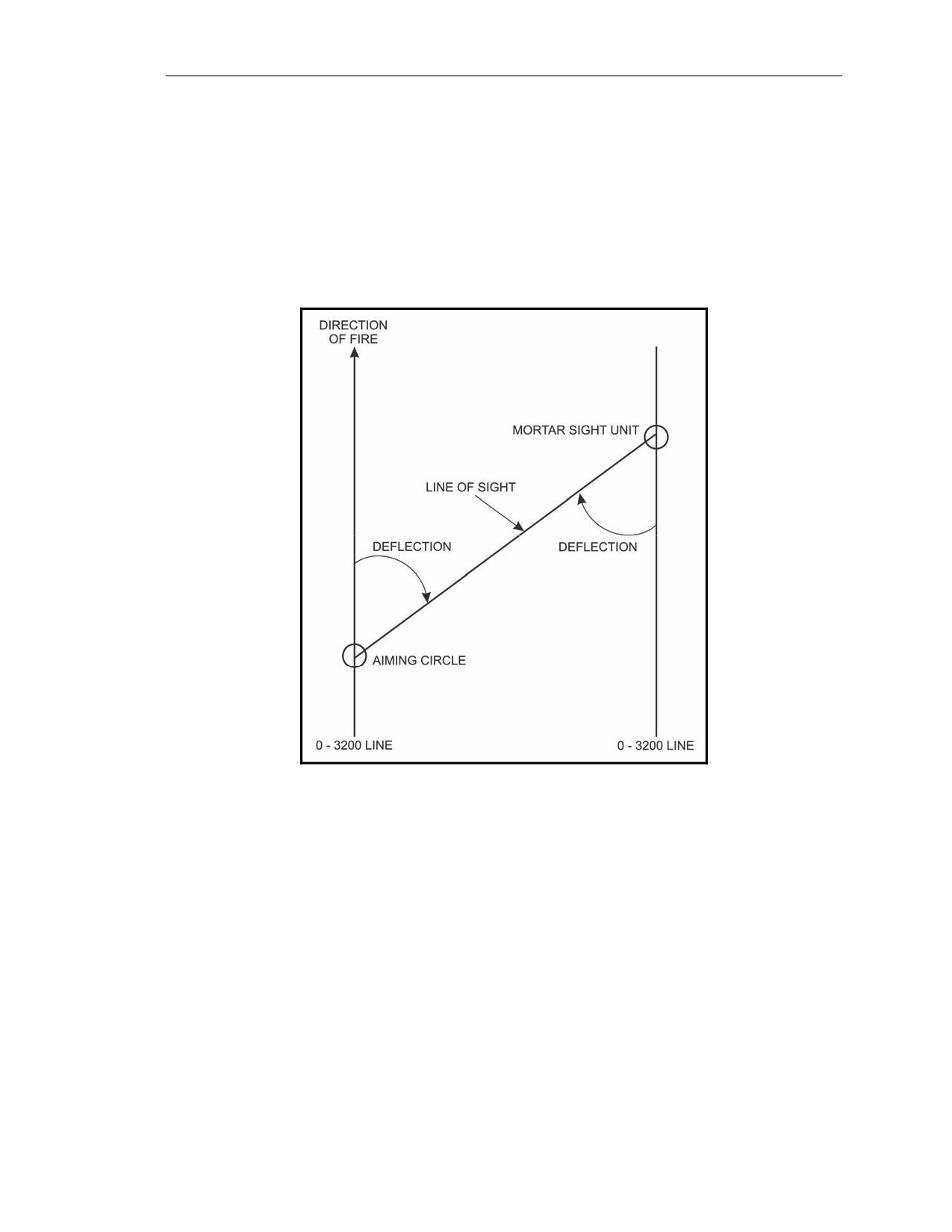
2-105. Reciprocal laying is a procedure by which the 0-3200 line of one instrument (aiming circle)
and the 0-3200 line of another instrument (sightunit) are laid parallel (Figure 2-22). When the 0-3200
lines of an aiming circle and the 0-3200 line of the sightunit are parallel, the barrel is parallel to both 0
3200 lines, if the sight has been properly calibrated. The principle of reciprocal laying is based on the
geometric theorem that states if two parallel lines are cut by a transversal, the alternate interior angles
are equal. The parallel lines are the 0-3200 lines of the instruments, and the transversal is the line of
sight between the two instruments. The alternate interior angles are the equal deflections placed on the
instruments.
Figure 2-22. Principle of reciprocal laying.
2-106. Orient the aiming circle so that the 0-3200 line of the aiming circle is parallel to the mounting
azimuth. The section leader announces to the mortar gunners (either by voice or visual signal),
“Section, aiming point this instrument.” The gunners turn their sights until the vertical cross line of the
sight is sighted on the lens of the aiming circle and the mortar is level. The gunners announce (either
by voice or visual signal), “Number (1, 2, and so on), aiming point identified.” The section leader,
using the upper motion, sights on the lens of the sightunit, reads the deflection on the azimuth
micrometer scales, and announces the deflection to the gunner on the mortar. The gunner sets the
deflection on the sightunit and causes the mortar to be moved until the vertical cross line of the sight is
again sighted on the lens of the aiming circle and the mortar is level.
2-107. When the sight has been sighted on the aiming circle, the gunner reports, “Ready for recheck.”
The platoon sergeant (section sergeant) again sights on the lens of the sightunit, and reads and
announces the deflection. This procedure is repeated until the gunner reports a difference of ZERO (or
ONE) MIL between successive deflections. The mortar has then been laid.
7 December 2007
FM 3-22.90
2-33
Chapter 2
RECIPROCAL LAYING ON A GRID AZIMUTH
2-108. This paragraph discusses the commands and procedures used in reciprocal laying of the
mortar section on a given grid azimuth. The example below illustrates the commands and procedures.
The example uses a mounting azimuth of 5550 mils and an aiming circle with a declination constant of
450 mils.
(1)
The FDC directs the section to lay the mortar parallel on a mounting (grid) azimuth.
(2)
The platoon sergeant (section sergeant) receives the command MOUNTING AZIMUTH
FIVE FIVE FIVE ZERO (5550 mils) from the FDC.
(3)
The section leader calculates the number of mils to set on the aiming circle:
Declination constant
450 mils
+ 6400 mils
Sum
6850 mils
Minus the mounting (grid) azimuth
- 5550 mils
Remainder to set on aiming circle
1300 mils
(4)
The platoon sergeant (section sergeant) mounts and levels the aiming circle at a point from
which he can observe the sights of all the mortars in the section (normally the left front or
left rear of the section).
(5)
He places 1300 mils on the azimuth and micrometer scales of the aiming circle (recording
motion).
(6)
Using the orienting knob, he centers the magnetic needle in the magnetic needle magnifier.
This orients the 0-3200 line of the aiming circle in the desired direction (mounting azimuth
5550 mils).
(7)
The platoon sergeant (section sergeant) announces, “Section, aiming point this instrument.”
(8)
All gunners refer their sights to the aiming circle with the vertical cross line laid on the
center of the aiming circle. The gunner then announces, “Number two (one or three), aiming
point identified.”
(9)
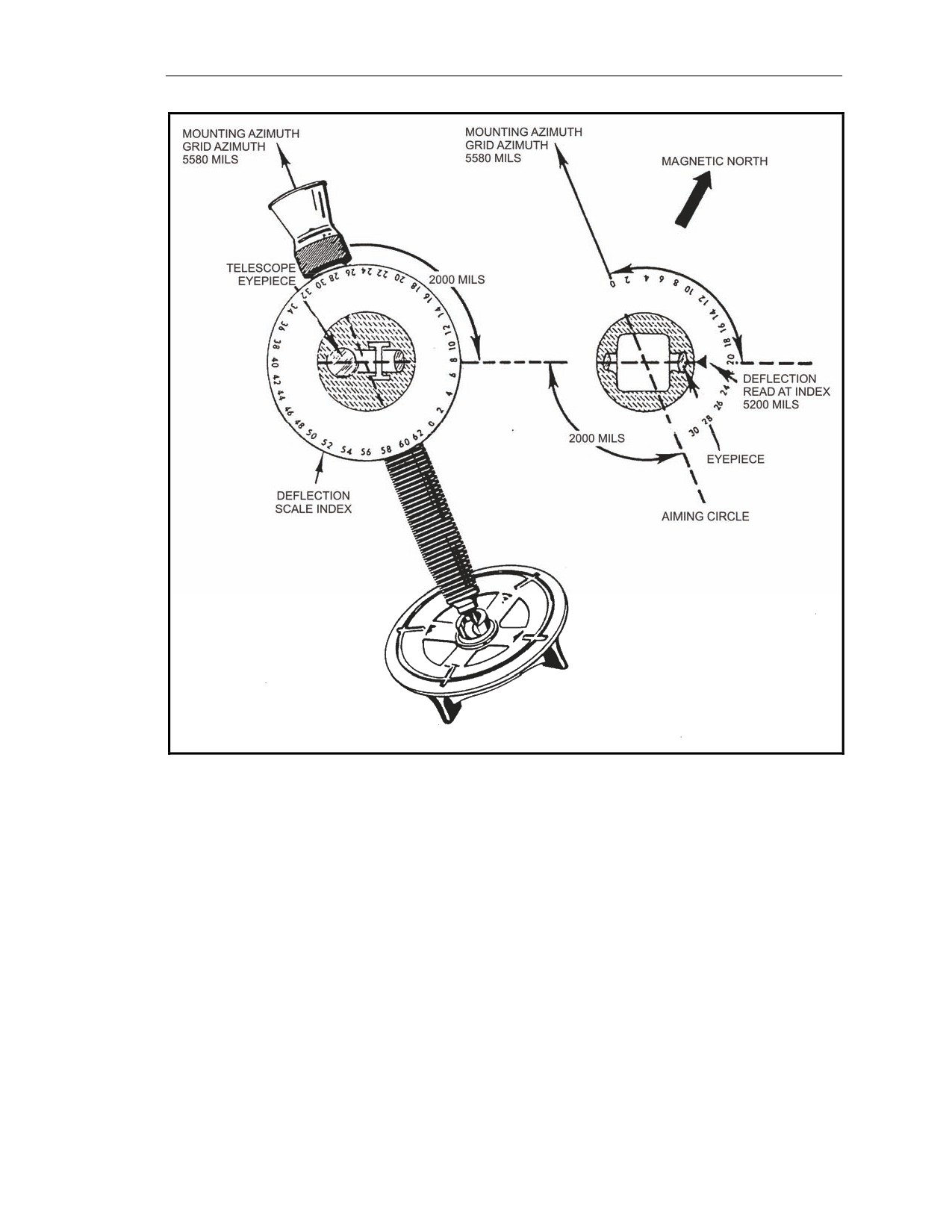
To lay the mortar barrel parallel to the 0-3200 line of the aiming circle (Figure 2-23), the
platoon sergeant (section sergeant) turns the upper motion of the aiming circle until the
vertical cross line is laid on the center of the lens of the mortar sight. He reads the azimuth
and micrometer scales and announces the deflection; for example, “Number two, deflection
one nine nine eight (1998).”
(10) The gunner repeats the announced deflection, “Number two, deflection one nine nine eight,”
and places it on his sight. Assisted by the assistant gunner, he lays the mortar so that the
vertical line is once again laid on the center of the aiming circle after the gunner announces,
“Number two, ready for recheck.”
(11) Using the upper motion, the platoon sergeant (section sergeant) again lays the vertical cross
line of the aiming circle on the lens of the mortar sight. He reads the new deflection from
the azimuth and micrometer scales and announces the reading; for example, “Number two,
deflection two zero zero zero.”
2-34
FM 3-22.90
7 December 2007
Sighting and Fire Control Equipment
Figure 2-23. Mortar laid parallel with the aiming circle.
(12) The gunner repeats the new deflection (Number two, deflection two zero zero zero) and
places it on his sight. Assisted by the assistant gunner, he lays the mortar with the vertical
cross line of the sight on the center of the aiming circle and announces, “Number two, ready
for recheck.”
(13) The above procedure is repeated until the mortar sight and aiming circle are sighted on each
other with a difference of not more than ONE mil between the deflection readings. When so
laid, the gunner announces, “Number two (one or three), zero mils (one mil), mortar laid.”
The mortar barrel is now laid parallel to the 0-3200 line of the aiming circle.
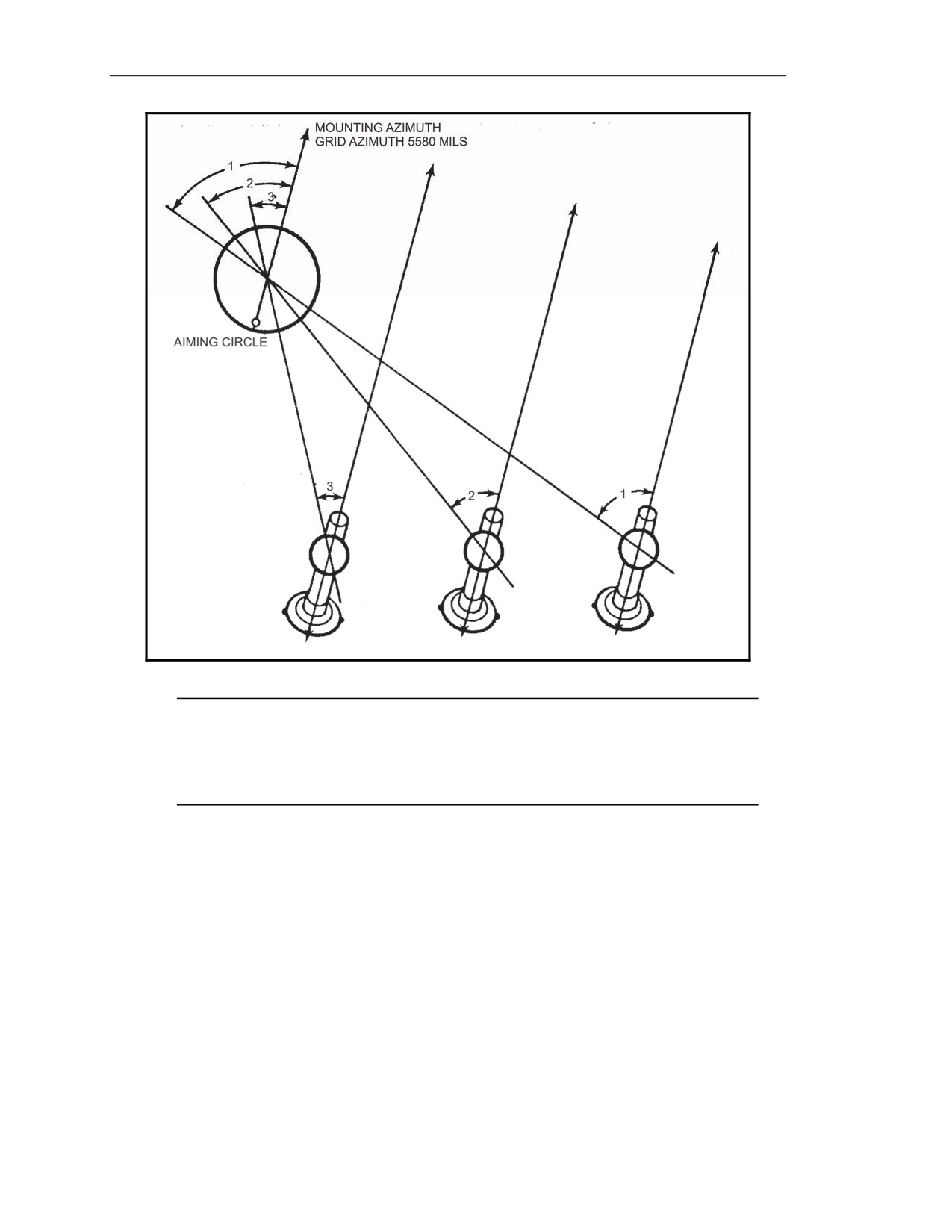
(14) The section leader uses the same procedure to lay each of the other mortars in the section
parallel. When all mortars are parallel to the 0-3200 line of the aiming circle, they are
parallel to each other and laid in the desired azimuth (Figure 2-24).
7 December 2007
FM 3-22.90
2-35
Chapter 2
Figure 2-24. Mortars laid parallel in the desired azimuth.
NOTE: The section can be laid parallel by laying all mortars at the same time. The
instrument operator reads deflections to each of the mortars in turn. As soon as
the gunner of any mortar announces, “Ready for recheck,” the instrument
operator reads the new deflection to that mortar. By laying all mortars at the
same time, the section is quickly ready to fire.
(15) As soon as each mortar is laid, the platoon sergeant
(section sergeant) commands
DEFLECTION TWO EIGHT ZERO ZERO (2800), REFER, PLACE OUT AIMING
POSTS. (The aiming posts are normally placed out on a referred deflection of 2800 mils.)
The gunner, without disturbing the lay of the mortar, places the announced deflection on his
sight and aligns the aiming posts with the vertical line of the mortar sight. He then
announces, “Up.”
(16) When all mortar gunners announce, “Up,” the instrument operator covers the head of the
aiming circle, but leaves the instrument in position to permit a rapid recheck of any mortar,
if necessary.
RECIPROCAL LAYING ON A MAGNETIC AZIMUTH
2-109. Although the section is normally laid parallel on a grid azimuth, it can be laid parallel on a
magnetic azimuth by subtracting the magnetic mounting azimuth from 6400 mils and by setting the
remainder on the azimuth and micrometer scales of the aiming circle. The section leader orients the
instrument and lays the section.
2-36
FM 3-22.90
7 December 2007
Sighting and Fire Control Equipment
RECIPROCAL LAYING USING THE ORIENTING ANGLE
2-110. The mortars of each section can be laid parallel more accurately if the instrument operator lays
the section parallel by using the orienting angle. He sets up and levels the aiming circle; orients the
aiming circle, and lays the section.
RECIPROCAL LAYING USING THE MORTAR SIGHTS
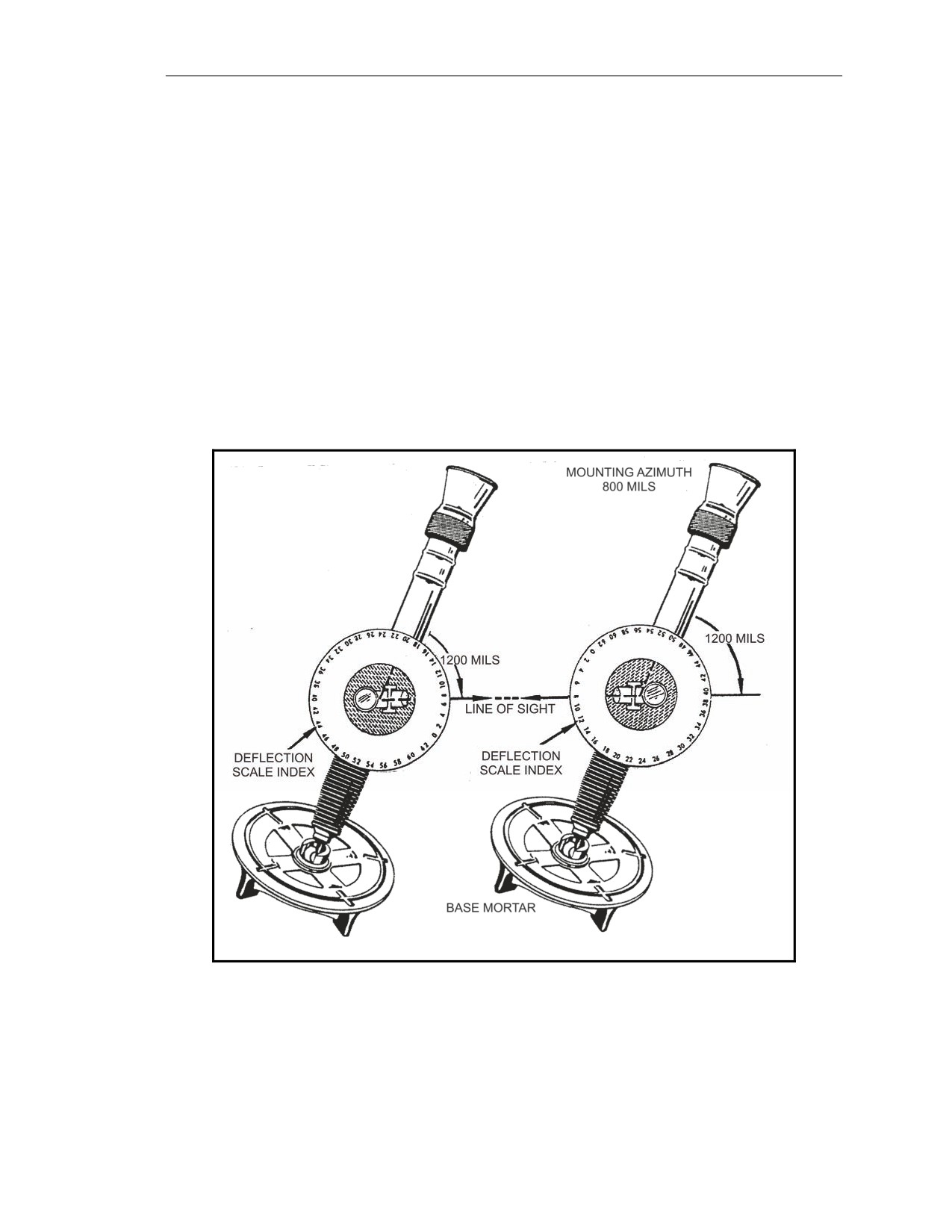
2-111. The mortar section can be laid parallel by using the mortar sights (Figure 2-25). For this
method, it is best to have the mortars positioned so that all sights are visible from the base mortar. The
base mortar (normally No. 2) is laid in the desired direction of fire by compass or by registration on a
known point. After the base mortar is laid for direction, the remaining mortars are laid parallel to the
base mortar as follows:
(1) The section leader moves to the mortar sight of the base mortar and commands SECTION,
AIMING POINT THIS INSTRUMENT. The gunners of the other mortars refer their sights
to the sight of the base mortar and announce, “Aiming point identified.”
(2) The section leader reads the deflection from the red scale on the sight of the base mortar. He
then determines the back azimuth of that deflection and announces it to the other gunners.
Figure 2-25. Mortar laid parallel with sights.
7 December 2007
FM 3-22.90
2-37
Chapter 2
EXAMPLE
Base mortar mounting azimuth:
0800 mils
Base deflection to # 3 gun:
1200 mils
Add or subtract 3200 mils and announce the reciprocal deflection to the gun to be laid: “#3
GUN, DEFLECTION 4400 MILS.”
NOTE: A back azimuth is determined by adding or subtracting 3200 to the initial
deflection—for example, “Number three, deflection one two zero zero.”
(3) Each gunner repeats the announced deflection for his mortar, places the deflection on his
sight, and re-lays on the sight of the base mortar. When the lens of the base mortar sight is
not visible, the gunner lays the vertical cross line of his sight on one of the other three
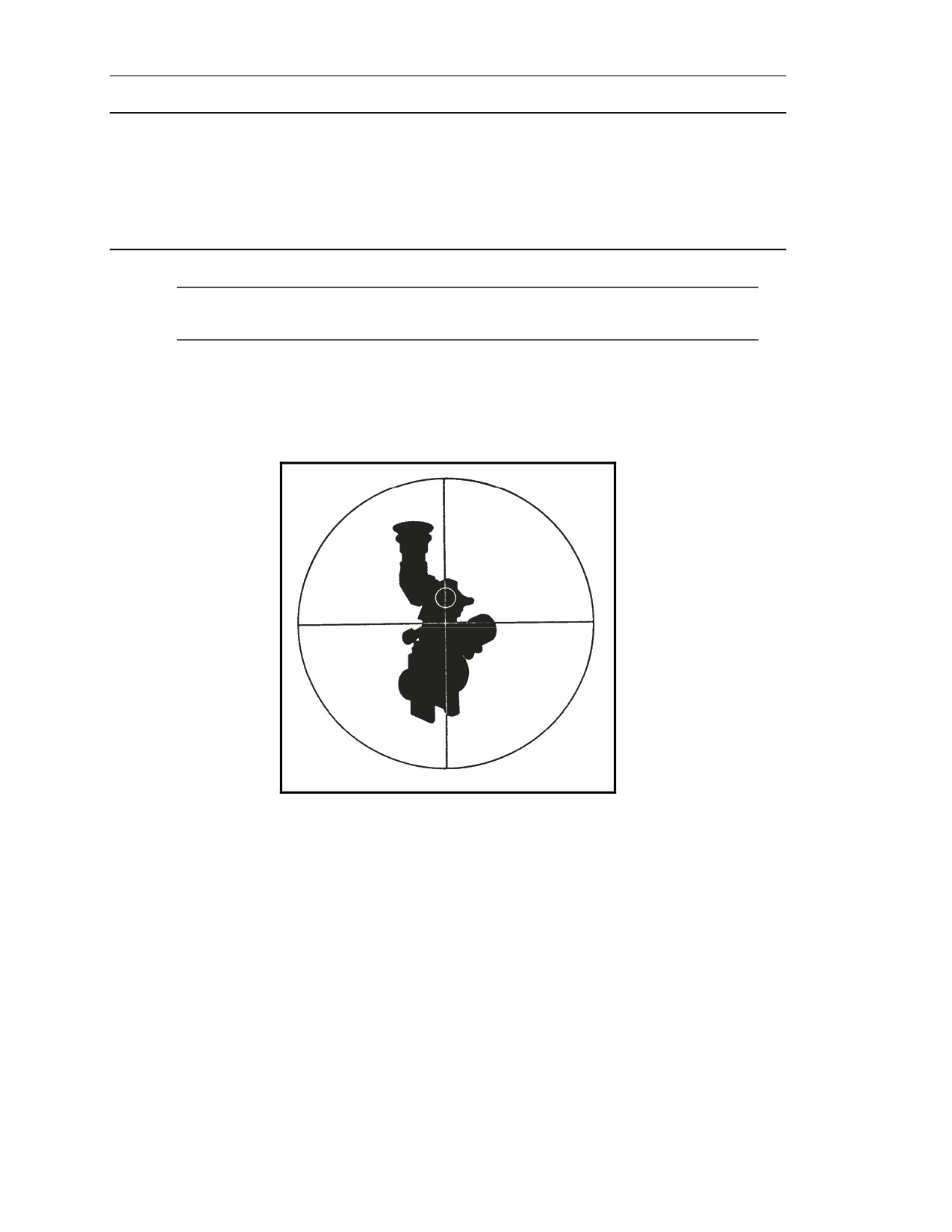
mortar sights (Figure 2-26). He is laid in by this mortar once it is parallel to the base mortar
sightunit. He then announces, “Number one (or three), ready for recheck.”
Figure 2-26. Sighting on the mortar sight.
(4) After each mortar has been laid parallel within zero (or one mil), the mortar barrels are
parallel to the base mortar.
(5) As soon as each mortar is laid, the section leader commands NUMBER THREE, REFER
DEFLECTION TWO EIGHT ZERO ZERO (2800), PLACE OUT AIMING POSTS.
RECIPROCAL LAYING USING THE M2 COMPASS
2-112. A rapid means of laying the section parallel is by using the compass. This is an alternate
means and is used only when an aiming circle is not available or when time dictates. It is not as
accurate as the methods previously described.
(1) Before mounting the mortars, each squad leader places a base stake in the ground to mark
the approximate location of the mortar.
(2) The section leader announces the desired mounting azimuth; for example, “Mount mortars,
magnetic azimuth two two zero zero.”
2-38
FM 3-22.90
7 December 2007
Sighting and Fire Control Equipment
(3) Each squad leader places his compass on the base stake marking the location of his mortar,
and orients the compass on the desired mounting azimuth. By sighting through the compass,
he directs the ammunition bearer in aligning the direction stakes along the mounting
(magnetic) azimuth.
(4) Each mortar is then mounted and laid on the direction stakes with a deflection of 3200
placed on the sight. The mortar barrels are now laid parallel. Once laid for direction, the
referred deflection is announced and the aiming posts are emplaced. The direction stakes
may be used as the aiming posts but this limits the available amount of mils before the
barrel blocks the line of sight.
NOTE: Recognizing the difference in individual compasses, the section leader can
prescribe that all mortars be laid with one compass. This eliminates some
mechanical error. It is also possible to lay only the base mortar as described
above and then lay the remaining mortars parallel using the mortar sight method.
PLACING OUT AIMING POSTS
2-113. When a firing position is occupied, the section leader must determine in which direction the
aiming posts are to be placed out. Factors to consider are terrain, sight blockage, traffic patterns in the
section area, and the mission. After the section leader has laid the section for direction, he commands
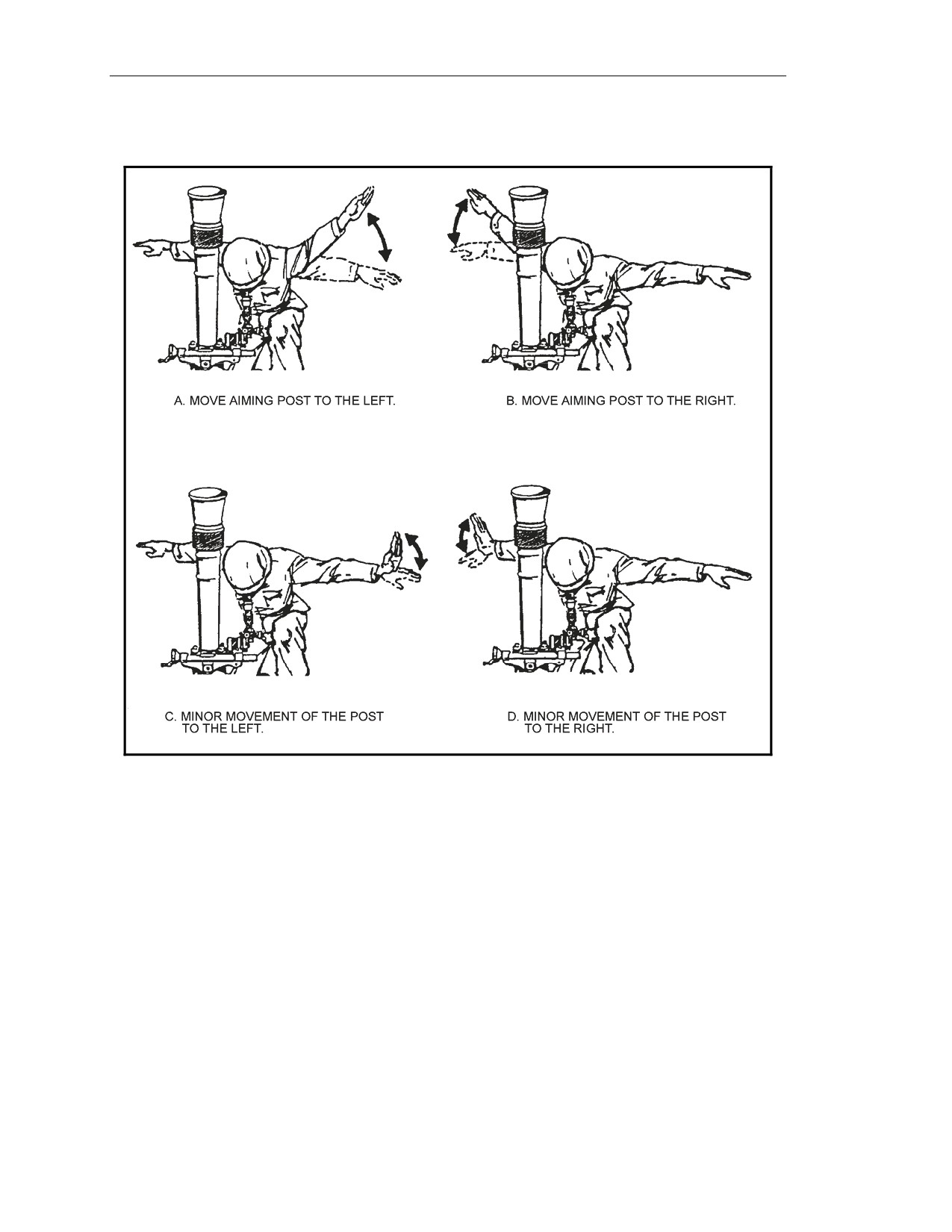
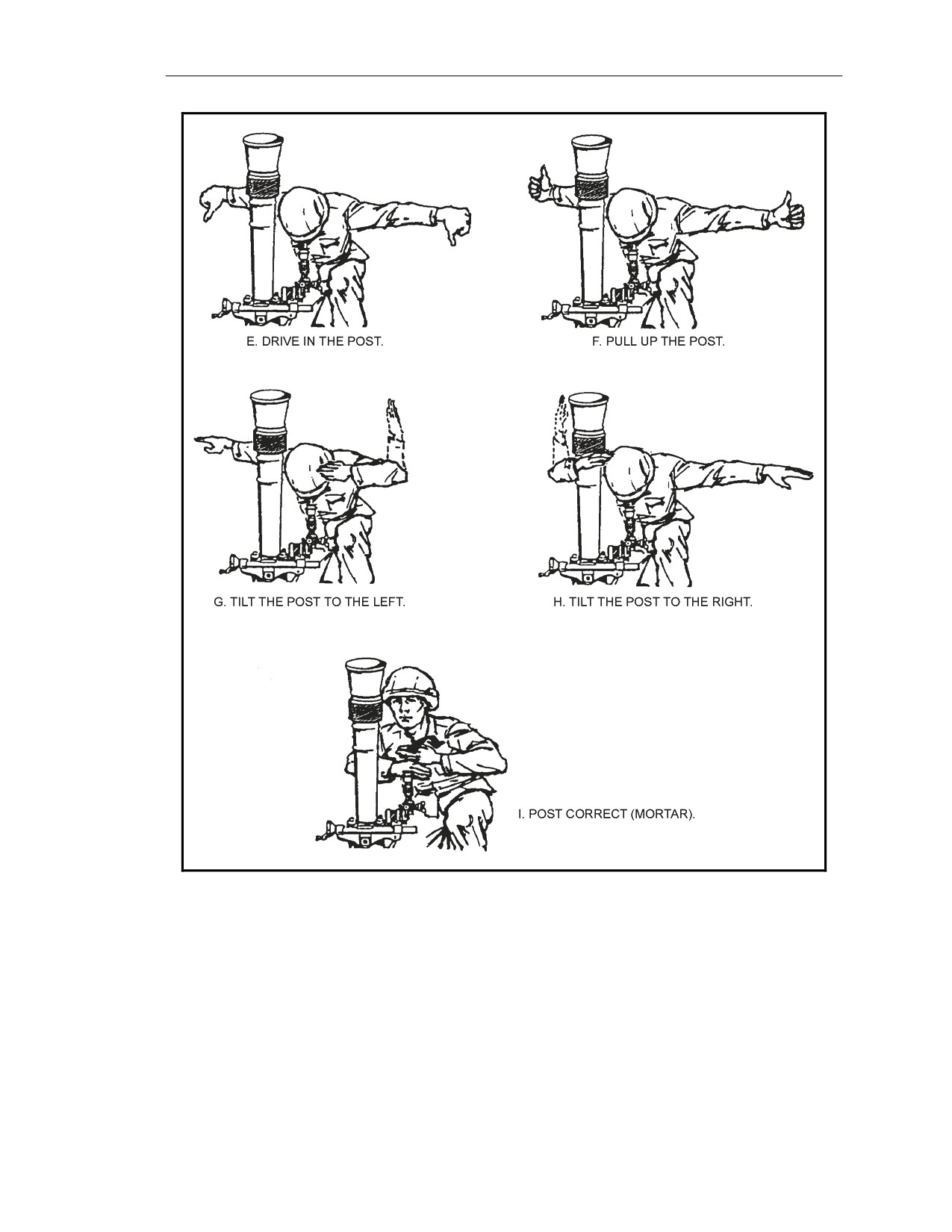
the section to place out aiming posts on a prescribed deflection. The gunner uses the arm-and-hand
signals displayed in Figure 2-27 to direct the ammunition bearer to place out the aiming posts.
REFERRED DEFLECTION IS 2800 MILS
2-114. The section leader commands SECTION, REFER DEFLECTION TWO EIGHT ZERO
ZERO, PLACE OUT AIMING POSTS. If possible, the aiming posts should be placed out to the left
front on a referred deflection of 2800 mils. This direction gives a large latitude in deflection change
before sight blockage occurs. Under normal conditions the front aiming post is placed out 50 meters
and the far aiming post 100 meters.
REFERRED DEFLECTION IS NOT 2800 MILS
2-115. The section leader commands SECTION, REFER DEFLECTION XXX, PLACE OUT
AIMING POSTS. When local terrain features do not permit placing out the aiming posts at a referred
deflection of 2800 mils, the following procedure is used:
(1) The initial steps are the same as those given above. The gunner refers the sight to the back
deflection of the referred deflection and directs the ammunition bearer to place out two
aiming posts 50 and 100 meters from the mortar position.
(2) If the gunner receives a deflection that would be obscured by the barrel, he indexes the
referred back deflection, and lays in on the rear aiming post.
ANY DIRECTION FIRE CAPABILITY
2-116. Two more aiming posts may be placed out to prevent a sight block if the mortar is used in a
6400-mil capability. The section leader must then select an area to the rear of each mortar where
aiming posts can be placed on a common deflection for all mortars. A common deflection of 0700 mils
is preferred; however, any common deflection to the rear may be selected when obstacles, traffic
patterns, or terrain prevent use of 0700 mils.
PROCEDURES WHEN AIMING POSTS CANNOT BE LAID ON THE PRESCRIBED REFERRED
DEFLECTION
2-117. If the gunner cannot lay his aiming posts on the prescribed referred deflection, he will
determine which general direction allows a maximum traverse before encountering a sight block. He
refers the sight to that direction and indexes any deflection to the nearest 100 mils. He then places out
7 December 2007
FM 3-22.90
2-39
Chapter 2
the aiming posts, assisted by the ammunition bearer, and informs the squad leader of his deflection.
The squad leader then supervises the gunner in slipping his scale back to the referred deflection.
Figure 2-27. Arm-and-hand signals used in placing out aiming posts.
2-40
FM 3-22.90
7 December 2007
Sighting and Fire Control Equipment
Figure 2-27. Arm-and-hand signals used in placing out aiming posts (continued).
7 December 2007
FM 3-22.90
2-41
Chapter 2
SECTION VII. LOADING AND FIRING
Upon receiving a fire command from the section leader, the entire gun crew repeats each element of it. The
gunner places the firing data on the sight and, assisted by the assistant gunner, lays the mortar. The
ammunition bearer repeats the charge element when announced by the gunner and prepares the round with
that charge. (If a fuze setting is announced, the ammunition bearer also repeats the setting and places it on
the fuze.) He completes his preparation of the cartridge to include safety checks, removing charges, and
removing any safety wires. The squad leader, for safety purposes, spot-checks the ammunition and the data
on the sight and the lay of the mortar. He then commands FIRE.
FIRING OF THE GROUND-MOUNTED MORTAR
2-118. The crew fires the mortar as follows:
(1) To settle the baseplate, the gunner removes the sight, being careful not to disturb the lay of
the mortar. He continues to remove the sight until the baseplate assembly is settled and there
is no danger of the sight becoming damaged from the recoil of the mortar. The bipod
assembly can slide up the barrel when the gunner fires the 81-mm mortar, M252 or the 120
mm mortar, M120. The gunner must not try to place the sight back into position until the
baseplate is settled.
(2) The ammunition bearer passes a round to the assistant gunner, holding the round with the
palms of both hands up and near each end of the round so that the fuze is pointing in the
general direction of the mortar.
(3) The assistant gunner takes the round from the ammunition bearer with his right hand, palm
up and his left hand, palm down. He grasps the body of the round near the center, guides it
into the barrel to a point beyond the narrow portion of the body of the shell, and releases the
round. He cuts both hands sharply away and down along the barrel. At the same time, he
pivots to the left and bends toward the ammunition bearer, extending his hands to receive
the next round. He is careful not to disturb the lay of the mortar as he loads the round, which
could cause considerable dispersion in the target area and create unsafe conditions due to
erratic fire.
CAUTION
Do not load or fire the mortar while wearing gloves.
TARGET ENGAGEMENT
2-119. Target engagement is achieved through fire commands, which are the technical instructions
issued to mortar crews. The basis for these commands is the data processed in the FDC. There are two
types of commands: initial fire commands, issued to start a fire mission; and subsequent fire
commands, issued to change firing data and to cease firing. The elements of both commands follow the
same sequence. However, subsequent commands include only such elements that are changed, except
for the elevation element, which is always announced. A correct fire command is brief and clear, and
includes all the elements necessary for accomplishing the mission. The commands are sent to the
section leader, or individual squad leaders if the section is dispersed, by the best available means. To
limit errors in transmission, the person receiving the commands at the mortar position repeats each
element as it is received. The sequence for the transmission of fire commands is shown in Table 2-7.
2-42
FM 3-22.90
7 December 2007
Sighting and Fire Control Equipment
Table 2-7. Sequence for transmission of fire commands.
SEQUENCE
EXAMPLE
Mortars to follow
Section
Shell and fuze
HE quick
Mortars to fire
Number two
Method of fire
One round
Deflection
Two eight hundred
Charge
Charge 3
Time
Elevation
One two seven zero
NOTE: All fire commands will follow this sequence. Elements not necessary for the
proper conduct of fire are omitted.
EXECUTION OF FIRE COMMANDS
2-120. The various fire commands are explained in this paragraph.
MORTARS TO FOLLOW
2-121. This element serves two purposes: it alerts the section for a fire mission and it designates the
mortars that are to follow the commands. The command for all mortars in the section to follow the fire
command is SECTION. Commands for individual or pairs of mortars are given a number (ONE, TWO,
and so forth).
SHELL AND FUZE
2-122. This element alerts the ammunition bearers as to what type of ammunition and fuze action to
prepare for firing; for example, HE QUICK; HE DELAY; HE PROXIMITY; and so forth.
MORTAR(S) TO FIRE
2-123. This element designates the specific mortar(s) to fire. If the mortars to fire are the same as the
mortars to follow, this element is omitted. The command to fire an individual mortar or any
combination of mortars is NUMBER(s) ONE (THREE and so forth).
METHOD OF FIRE
2-124. In this element, the mortar(s) designated to fire in the preceding element is told how many
rounds to fire, how to engage the target, and any special control desired. Also included are the number
and type ammunition to be used in the fire-for-effect phase.
Volley Fire
2-125. A volley can be fired by one or more mortars. The command for volley fire is (so many)
ROUNDS. Once all mortars are reported up, they fire on the platoon sergeant’s (section sergeant’s) or
squad leader’s command. If more than one round is being fired by each mortar, the squads fire the first
round on command and the remaining as rapidly as possible consistent with accuracy and safety, and
without regard to other mortars. If a specific time interval is desired, the command is (so many)
ROUNDS AT (so many) SECONDS INTERVAL, or (so many) ROUNDS PER MINUTE. In this
case, a single round for each mortar, at the time interval indicated, is fired at the platoon sergeant’s
(section sergeant’s) or squad leader’s command.
7 December 2007
FM 3-22.90
2-43
Chapter 2
Section Right (Left)
2-126. This is a method of fire in which mortars are discharged from the right (left) one after the
other, normally at 10-second intervals. The command for section fire from the right (left) flank at
intervals of 10 seconds is SECTION RIGHT (LEFT), ONE ROUND. Once all mortars are reported up,
the platoon sergeant (section sergeant) gives the command FIRE; for example, SECTION RIGHT,
ONE ROUND; the platoon sergeant (section sergeant) commands FIRE ONE; 10 seconds later FIRE
TWO, and so forth.
2-127. If the section is firing a section left, the fire begins with the left-most gun and works to the
right. The command LEFT (RIGHT) designates the flank from which the fire begins. The platoon
sergeant (section sergeant) fires a section right (left) at 10-second intervals unless he is told differently
by the FDC; for example, SECTION LEFT, ONE ROUND, TWENTY-SECOND INTERVALS.
2-128. When firing continuously at a target is desired, the command is CONTINUOUS FIRE. When
maintaining a smoke screen is desired, firing a series of sections right (left) may be necessary. In this
case, the command is CONTINUOUS FIRE FROM THE RIGHT (LEFT). The platoon sergeant
(section sergeant) then fires the designated mortars consecutively at 10-second intervals unless a
different time interval is specified in the command.
2-129. Changes in firing data (deflections and elevations) are applied to the mortars in turns of
traverse or elevation so as not to stop or break the continuity of fire; for example, NUMBER ONE,
RIGHT THREE TURNS; NUMBER TWO, UP ONE TURN. When continuous fire is given in the fire
command, the platoon sergeant (section sergeant) continues to fire the section until the FDC changes
the method of fire or until the command END OF MISSION is given.
Traversing Fire
2-130. In traversing fire, rounds are fired with a designated number of turns of traverse between each
round. The command for traversing fire is (so many) ROUNDS, TRAVERSE RIGHT (LEFT) (so
many) TURNS. At the platoon sergeant’s (section sergeant’s) or squad leader’s command FIRE, all
mortars fire one round, traverse the specified number of turns, fire another round, and continue this
procedure until the number of rounds specified in the command have been fired.
Searching Fire
2-131. Searching fire is fired the same as volley fire except that each round normally has a different
range. No specific order is followed in firing the rounds. For example, the assistant gunner does not
start at the shortest range and progress to the highest charge or vice versa, unless instructed to do so.
Firing the rounds in a definite sequence (high to low or low to high) establishes a pattern of fire that
can be detected by the enemy.
At My Command
2-132. If the FDC wants to control the fire, the command AT MY COMMAND is placed in the
method of fire element of the fire command. Once all mortars are reported up, the platoon sergeant
(section sergeant) reports to the FDC: SECTION READY. The FDC then gives the command FIRE.
Do Not Fire
2-133. The FDC can command DO NOT FIRE immediately following the method of fire. DO NOT
FIRE then becomes a part of the method of fire. This command is repeated by the platoon sergeant
(section sergeant). As soon as the weapons are laid, the platoon sergeant (section sergeant) reports to
FDC that the section is laid. The command for the section of fire is the command for a new method of
fire not followed by DO NOT FIRE.
2-44
FM 3-22.90
7 December 2007
Sighting and Fire Control Equipment
DEFLECTION
2-134. This element gives the exact deflection setting to be placed on the mortar sight. It is always
announced in four digits, and the word DEFLECTION always precedes the sight setting; for example,
DEFLECTION, TWO EIGHT FOUR SEVEN (2847). When the mortars are to be fired with different
deflections, the number of the mortar is given and then the deflection for that mortar; for example,
NUMBER THREE, DEFLECTION TWO FOUR ZERO ONE (2401).
CHARGE
2-135. This element gives the charge consistent with elevation and range as determined from the
firing tables; for example, CHARGE FOUR (4). The word CHARGE always precedes the amount; for
example, ONE ROUND, CHARGE FOUR (4).
TIME
2-136. The computer tells the ammunition bearer the exact time setting to place on the PROX,
MTSQ, and MT fuze. The command for time setting is TIME (so much); for example, TIME TWO
SEVEN. The command for a change in time setting is a new command for time.
ELEVATION
2-137. The elevation element is always given in the fire command. It serves two purposes: it gives
the exact elevation setting to place on the mortar sight, and it gives permission to fire when the method
of fire is “when ready.” When the method of fire is “at my command,” the section fires at the section
leader’s command.
ARM-AND-HAND SIGNALS
2-138. When giving the commands FIRE or CEASE FIRING, the section leader or squad leader uses
both arm-and-hand signals and voice commands (Figure 2-28).
READY
2-139. The signal for “I am ready” or “Are you ready?” is to extend the arm toward the person being
signaled. Then, the arm is raised slightly above the horizontal, palm outward.
FIRE
2-140. The signal to start fire is to drop the right arm sharply from a vertical position to the side.
When the section leader wishes to fire a single mortar, he points with his arm extended at the mortar to
be fired, then drops his arm sharply to his side.
CEASE FIRING
2-141. The signal for cease firing is to raise the hand in front of the forehead, palm to the front, and to
move the hand and forearm up and down several times in front of the face.
7 December 2007
FM 3-22.90
2-45
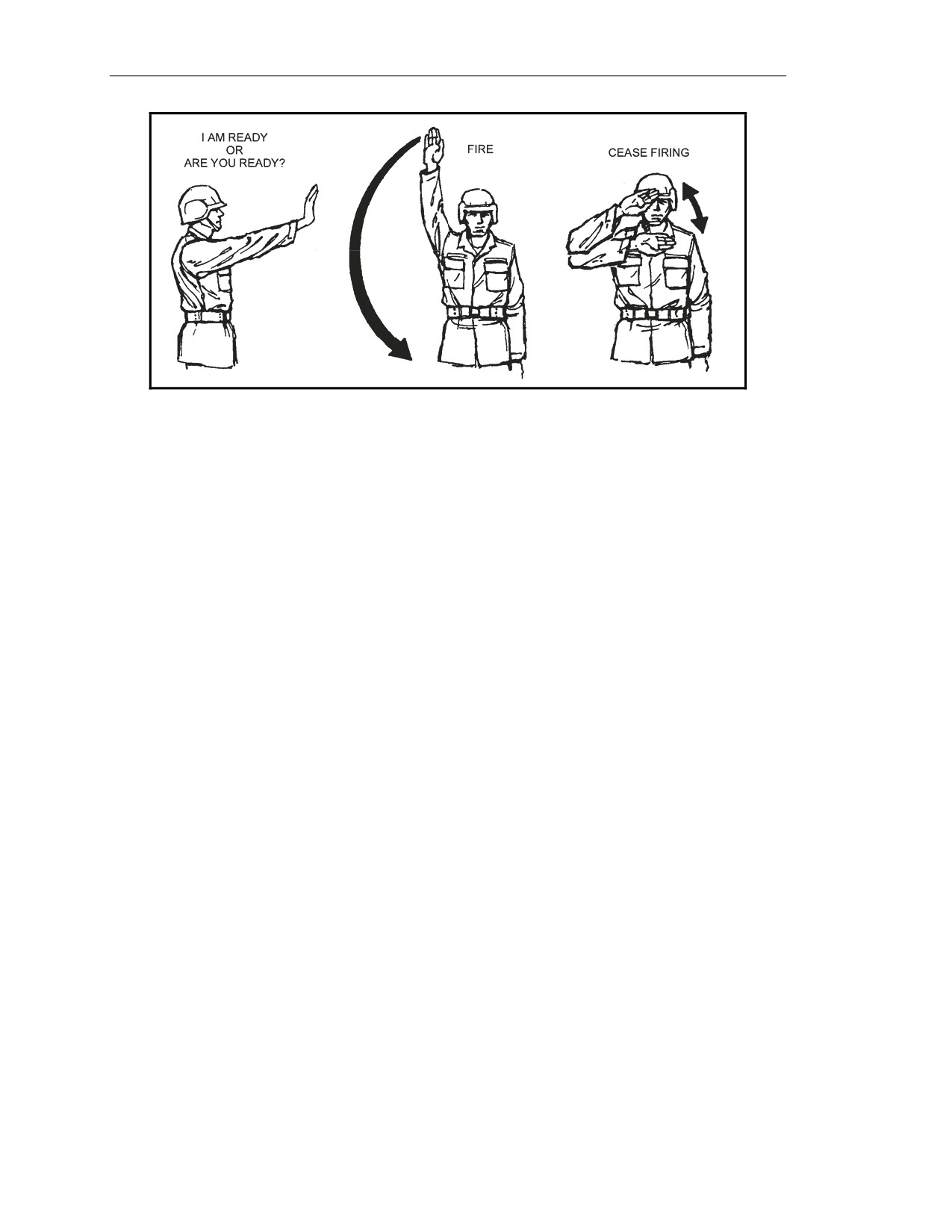
Chapter 2
Figure 2-28. Arm-and-hand-signals for ready, fire, and cease firing.
SUBSEQUENT FIRE COMMANDS
2-142. Only the elements that change from the previous fire command are announced in subsequent
fire commands except for the elevation element (command to fire), which is always announced in
every fire command.
DEFLECTION
2-143. Changes in direction are given in total deflection to be placed on the sight; for example,
DEFLECTION TWO EIGHT ONE TWO (2812).
ELEVATION
2-144. When a change is made in mortars to fire or in the method of fire, the subsequent command
includes one or both of these elements and the elevation. When the elevation does not change, the
command ELEVATION (so many mils) is given (same as that given in the previous command).
CEASE FIRING/CHECK FIRE
2-145. To interrupt firing, CEASE FIRING or CHECK FIRE is commanded.
2-146. CEASE FIRING indicates to the section the completion of a fire mission, but not necessarily
the end of the alert. Firing is renewed by issuing a new initial fire command.
2-147. CHECK FIRE indicates a temporary cessation of firing and allows firing to be resumed with
the same data by the command RESUME FIRING or by a subsequent fire command.
END OF MISSION
2-148. So that the mortar crews can relax between fire missions, the end of the alert is announced by
the command END OF MISSION. All gunners then lay their mortars as directed by the FDC. Upon
completion of a fire mission, all mortars normally lay on final protective fire (FPF) data unless
otherwise directed. The platoon sergeant (section sergeant) is responsible for ensuring that the mortars
are laid on FPF data and that the prescribed amount of ammunition for the FPF is prepared and on
position.
REPEATING AND CORRECTING OF FIRE COMMANDS
2-149. If the platoon sergeant (section sergeant) or squad member fails to understand any elements of
the fire command, he can request that element be repeated by stating, for example, “Say again
2-46
FM 3-22.90
7 December 2007
Sighting and Fire Control Equipment
deflection, elevation,” and so forth. To avoid further misunderstanding, the repeated element is
prefaced with “I say again deflection (repeats mils).”
INITIAL FIRE COMMAND
2-150. In an initial fire command, an incorrect element is corrected by stating, “Correction,” and
giving only the corrected element.
SUBSEQUENT FIRE COMMAND
2-151. In a subsequent command, an incorrect element is corrected by stating, “Correction,” and then
by repeating all of the subsequent commands. (The term “correction” cancels the entire command.)
REPORTING OF ERRORS IN FIRING
2-152. When any squad member discovers that an error has been made in firing, he immediately
notifies his squad leader, who in turn notifies the FDC. Such errors include, but are not limited to,
incorrect deflection or elevation settings, incorrect laying of the mortar, or ammunition improperly
prepared for firing. Misfires are also reported this way. Errors should be promptly reported to the FDC
to prevent loss of time in determining the cause and required corrective action.
NIGHT FIRING
2-153. When firing the mortar at night, the mission dictates whether noise and light discipline are to
be sacrificed for speed. To counteract the loss of speed for night firing, the gunner must consider
presetting both fuze and charge for ILLUM rounds with the presetting of charges for other rounds. The
procedure for manipulating the mortar at night is the same as during daylight operations. To assist the
gunner in these manipulations, the sight reticle is illuminated, and the aiming posts are provided with
lights.
2-154. The instrument lights illuminate the reticle of the sights and make the vertical cross lines
visible. The hand light on the flexible cord is used to illuminate the scales and bubbles.
2-155. An aiming post light is placed on each aiming post to enable the gunner to see the aiming
posts. Aiming posts are placed out at night similar to the daylight procedure. The lights must be
attached to the posts before they can be seen and positioned by the gunner. The gunner must issue
commands such as NUMBER ONE, MOVE RIGHT, LEFT, HOLD, DRIVE IN, POST CORRECT.
Tilt in the posts is corrected at daybreak. Some of the distance to the far post can be sacrificed if it
cannot be easily seen at 100 meters. However, the near post should still be positioned about half the
distance to the far post from the mortar. The far post light should be a different color from the one on
the near post and be positioned so it appears slightly higher. Adjacent squads should alternate post
lights to avoid laying on the wrong posts; for example, 1ST SQUAD, NEAR POST—GREEN LIGHT,
FAR POST—RED LIGHT; 2D SQUAD, NEAR POST—RED LIGHT, FAR POST—GREEN
LIGHT. (The M58 light is green and the M59 light is orange.)
2-156. The mortar is laid for deflection by placing the vertical cross line of the sight in the correct
relation to the center of the lights attached to the aiming posts. The procedure for laying the mortar is
the same as discussed in Section VI.
2-157. The night lights can be used to align the aiming posts without using voice commands.
(1) The gunner directs the ammunition bearer to place out the aiming posts. The ammunition
bearer moves out 100 meters and turns on the night light of the far aiming post. The gunner
holds the instrument night light in his right (left) hand and, by moving the light to the right
(left), directs the ammunition bearer to move to the right
(left). To ensure that the
ammunition bearer sees the light moving only in the desired direction, the gunner places his
thumb over the light when returning it to the starting position. The gunner continues to
direct the ammunition bearer to move the aiming post until it is properly aligned.
7 December 2007
FM 3-22.90
2-47
Chapter 2
(2) The gunner moves the instrument light a shorter distance from the starting position when he
wants the ammunition bearer to move the aiming post a short distance.
(3) The gunner holds the light over his head (starting position) and moves the light to waist
level when he wants the ammunition bearer to place the aiming post into the ground. In
returning the instrument light to the starting position, the gunner covers the light with his
thumb to ensure that the ammunition bearer sees the light move only in the desired
direction.
(4) The gunner uses the same procedure described above when he wants the ammunition bearer
to move the aiming post light to a position corresponding to the vertical hairline in the sight
after the aiming post has been placed into the ground.
(5) The gunner reverses the procedure described above when he wants the ammunition bearer to
take the aiming post out of the ground. The gunner places the uncovered light at waist level
and moves it to a position directly above his head. He then directs alignment as required.
(6) When the gunner is satisfied with the alignment of the aiming posts, he signals the
ammunition bearer to return to the mortar positions by making a circular motion with the
instrument light.
NOTE: When the night light is used to signal, the gunner directs the light toward the
ammunition bearer.
2-48
FM 3-22.90
7 December 2007
Chapter 3
60-mm Mortar, M224
The M224 60-mm Lightweight Company Mortar System (LWCMS) provides
ranger and IBCT companies with effective and lightweight fire support. Its
relatively short range and the small explosive charge of its ammunition can be
compensated for with careful planning and expert handling. The mortar can be
fired accurately with or without an FDC.
SECTION I. SQUAD AND SECTION ORGANIZATION AND DUTIES
This section discusses the organization and duties of the 60-mm mortar squad and section.
ORGANIZATION
3-1. If the mortar section is to operate quickly and effectively in accomplishing its mission, mortar
squad members must be proficient in individually assigned duties. Correctly applying and performing
these duties enables the mortar section to perform as an effective fighting team. The section leader
commands the section and supervises the training of the elements. He uses the chain of command to
assist him in effecting his command and supervising duties.
DUTIES
3-2. The mortar squad consists of three Soldiers. Each squad member is cross-trained to perform all
duties involved in firing the mortar. The positions and principal duties are as follows.
SQUAD LEADER
3-3. The squad leader is in position to best control the mortar squad. He is positioned to the right of
the mortar, facing the cannon. He is also the FDC.
GUNNER
3-4. The gunner is on the left side of the mortar where he can manipulate the sight, elevating gear
handle, and traversing assembly wheel. He places firing data on the sight and lays the mortar for
deflection and elevation. Assisted by the squad leader
(or ammunition bearer), he makes large
deflection shifts by shifting the bipod assembly.
AMMUNITION BEARER
3-5. The ammunition bearer is to the right rear of the mortar. He prepares the ammunition and assists
the gunner in shifting and loading the mortar. He swabs the cannon every 10 rounds or after each end
of mission.
7 December 2007
FM 3-22.90
3-1