FM 3-22.90 Mortars (December 2007) - page 1
*FM 3-22.90
Field Manual
Headquarters
No. 3-22.90
Department of the Army
Washington, DC, 7 December 2007
Mortars
Contents
Page
PREFACE
xiii
Chapter 1
INTRODUCTION
1-1
Section I. General Doctrine
1-1
Effective Mortar Fire
1-1
Mortar Positions
1-1
Section II. Indirect Fire Team
1-2
Applications
1-2
Team Mission
1-2
United States Mortars
1-3
Section III. Safety Procedures
1-5
Duties Of The Safety Officer and Supervisory Personnel
1-5
Safety Diagram and Safety “T”
1-8
Surface Danger Zones
1-12
Section IV. Ammunition
1-13
Ammunition Care and Handling
1-13
Ammunition Color Codes
1-15
Field Storage of Ammunition
1-15
Chapter 2
SIGHTING AND FIRE CONTROL EQUIPMENT
2-1
Section I. Compass, M2
2-1
Characteristics
2-1
Description
2-2
Use
2-2
Section II. Aiming Circles, M2 and M2A2
2-5
Characteristics
2-5
Description
2-5
Use
2-6
Accessory Equipment
2-9
DISTRIBUTION RESTRICTION: Approved for public release; distribution is unlimited.
*This publication supersedes FM 3-22.90, 31 December 2004.
7 December 2007
i
Table of Contents
Setup and Leveling of the Aiming Circle
2-10
Declination Constant
2-11
Orienting of the Instrument on Grid North to Measure Grid Azimuth to
Objects
2-14
Measuring of the Horizontal Angle Between Two Points
2-14
Orienting of the 0-3200 Line on a Given Grid Azimuth
2-15
Orienting of the 0-3200 Line on a Given Magnetic Azimuth
2-15
Verification of the Lay of the Platoon
2-16
Orienting by Orienting Angle
2-17
Disassembly of the Aiming Circle
2-17
Care and Maintenance
2-18
Section III. Sightunits
2-18
Sightunit, M67
2-18
Sightunit, M64-Series
2-19
Operation of Sightunits
2-21
Care and Maintenance of Sightunits
2-23
Radioactive Tritium Gas
2-23
Section IV. Boresights
2-24
Boresight, M45-Series
2-24
Boresight, M115
2-25
Sight Calibration
2-26
Boresight Method Of Calibration
2-26
Calibration for Deflection Using the M2 Aiming Circle
2-28
Section V. Other Equipment
2-30
Aiming Posts, M14 and M1A2
2-30
Aiming Post Lights, M58 and M59
2-31
Section VI. Laying of the Section
2-32
Reciprocal Laying
2-33
Placing Out Aiming Posts
2-39
Section VII. Loading and Firing
2-42
Firing of the Ground-Mounted Mortar
2-42
Target Engagement
2-42
Execution of Fire Commands
2-43
Arm-and-Hand Signals
2-45
Subsequent Fire Commands
2-46
Repeating and Correcting of Fire Commands
2-46
Reporting of Errors in Firing
2-47
Night Firing
2-47
Chapter 3
60-mm MORTAR, M224
3-1
Section I. Squad and Section Organization and Duties
3-1
Organization
3-1
Duties
3-1
ii
FM 3-22.90
7 December 2007
Table of Contents
Section II. Components
3-2
Tabulated Data
3-2
Cannon Assembly, M225
3-3
Bipod Assembly, M170
3-3
Baseplate, M7
3-5
Baseplate, M8
3-5
Section III. Operation
3-6
Premount Checks
3-6
Mounting of the Mortar
3-6
Safety Checks Before Firing
3-7
Small Deflection and Elevation Changes
3-8
Large Deflection and Elevation Changes
3-8
Referring of the Sight and Realignment of Aiming Posts
3-9
Malfunctions
3-10
Removal of a Misfire
3-11
Dismounting and Carrying of the Mortar
3-15
Section IV. Ammunition
3-16
Classification and Types of Ammunition
3-16
Fuzes
3-19
Cartridge Preparation
3-21
Care And Handling
3-22
Chapter 4
81-mm MORTAR, M252
4-1
Section I. Squad and Section Organization and Duties
4-1
Organization
4-1
Duties
4-1
Section II. Components
4-3
Tabulated Data
4-4
Cannon Assembly, M253
4-5
Mount, M177
4-5
Baseplate, M3A1
4-6
Section III. Operation
4-7
Premount Checks
4-7
Mounting of the Mortar
4-8
Safety Checks Before Firing
4-10
Small Deflection and Elevation Changes
4-10
Large Deflection and Elevation Changes
4-11
Referring of the Sight and Realignment of Aiming Posts Using the M64
Sight
4-12
Malfunctions
4-12
Removal of a Misfire
4-12
Dismounting of the Mortar
4-16
7 December 2007
FM 3-22.90
iii
Table of Contents
Section IV. Ammunition
4-16
Classification and Types of Ammunition
4-16
Fuzes
4-21
Cartridge Preparation
4-24
Care and Handling
4-25
Chapter 5
120-mm MORTARS, M120 AND M121
5-1
Section I. Squad Organization and Duties
5-1
Organization
5-1
Duties
5-1
Section II. Components
5-3
Tabulated Data For the 120-mm Mortar
5-4
Cannon Assembly, M298
5-4
Bipod Assembly, M191 (Carrier-/Ground-Mounted)
5-6
Bipod Assembly, M190 (Ground-Mounted)
5-7
Baseplate, M9
5-8
Section III. Operations
5-8
Premount Checks
5-8
Placing a Ground-Mounted 120-mm Mortar Into Action
5-10
Performing Safety Checks on a Ground-Mounted 120-mm Mortar
5-11
Performing Small Deflection and Elevation Changes on a Ground-
Mounted 120-mm Mortar
5-12
Performing Large Deflection and Elevation Changes on a Ground-
Mounted 120-mm Mortar
5-13
Malfunctions on a Ground-Mounted 120-mm Mortar During Peacetime
5-14
Referring of the Sight and Realignment of Aiming Posts During
Peacetime
5-14
Removal of a Misfire on a Ground-Mounted 120-mm Mortar
5-14
Loading and Firing of the Ground-Mounted 120-mm Mortar
5-21
Taking the 120-mm Mortar Out of Action
5-22
Section IV. Mortar Carrier, M1064A3
5-23
Description
5-23
Tabulated Data for the M1064A3 Carrier
5-25
Mortar and Vehicular Mount
5-25
Maintenance
5-26
Section V. Operation of a Carrier-Mounted 120-mm Mortar
5-26
Premount Checks
5-26
Placing a Carrier-Mounted 120-mm Mortar Into Action
5-26
Mounting of the Mortar From a Carrier- to a Ground-Mounted Position
5-27
Performing Safety Checks on a Carrier-Mounted 120-mm Mortar
5-28
Performing Small Deflection and Elevation Changes on a Carrier-
Mounted 120-mm Mortar
5-29
Performing Large Deflection and Elevation Changes on a Carrier-
Mounted 120-mm Mortar
5-29
iv
FM 3-22.90
7 December 2007
Table of Contents
Removal of a Misfire on a Carrier-Mounted 120-mm Mortar
5-30
Taking the Mortar Out of Action (Ground-Mounted to M1064A3 Carrier-
Mounted)
5-37
Reciprocally Laying the Mortar Carrier Section
5-38
Section VI. Ammunition
5-38
Classification and Types of Ammunition
5-38
Fuzes
5-40
Cartridge Preparation
5-43
Care And Handling of Cartridges
5-44
Chapter 6
MORTAR FIRE CONTROL SYSTEM
6-1
Description
6-1
Capabilities
6-8
Soldier Graphic User Interface
6-9
Startup
6-12
Log-In Procedures
6-12
Data Initialization and System Configuration
6-12
Additional Functions
6-21
Chapter 7
CONDUCT FIRE MISSIONS USING THE MORTAR FIRE CONTROL
SYSTEM
7-1
Pointing Device
7-1
Navigation and Emplacement
7-5
Fire Commands
7-10
Final Protective Fires
7-14
Chapter 8
FIRE WITHOUT A FIRE DIRECTION CENTER
8-1
Section I. Fire Procedures
8-1
Advantages and Disadvantages
8-1
Firing Data
8-1
Observer Corrections
8-2
Initial Fire Commands
8-3
Fire Commands
8-3
Fire Control
8-5
Movement to Alternate and Supplementary Positions
8-5
Squad Conduct of Fire
8-5
Reference Line
8-6
Squad Use of Smoke and Illumination
8-6
Attack of Wide Targets
8-6
Attack of Deep Targets
8-8
Section II. Direct-Lay Method
8-9
Step 1: Initial Firing Data
8-9
Step 2: Referring the Sight
8-9
7 December 2007
FM 3-22.90
v
Table of Contents
Step 3: Bracketing the Target
8-10
Step 4: Fire For Effect
8-10
Section III. Direct-Alignment Method
8-10
Mortar Dismounted
8-10
Mortar Mounted
8-10
Natural Object Method
8-11
Section IV. Adjustment of Range
8-11
Spottings
8-11
Bracketing Method
8-12
Creeping Method of Adjustment
8-13
Ladder Method of Adjustment
8-13
Establishment of a Reference Line and Shifting From That Line
8-15
Chapter 9
GUNNER’S EXAMINATION
9-1
Section I. Preparation
9-1
Methods of Instruction
9-1
Prior Training
9-1
Preparatory Exercises
9-1
Examining Board
9-1
Location and Date
9-2
Eligible Personnel
9-2
Qualification Scores
9-2
General Rules
9-3
Section II. Gunner’s Examination with the Ground-Mounted Mortar
9-4
Subjects and Credits
9-4
Equipment
9-4
Organization
9-4
Procedure
9-4
Mounting of the Mortar
9-4
Small Deflection Change
9-9
Referring of the Sight and Realignment of Aiming Posts
9-10
Large Deflection and Elevation Changes
9-11
Reciprocal Laying
9-13
Section III. Gunner’s Examination with the Track-Mounted Mortar, M121
9-14
Subjects and Credits
9-14
Equipment
9-14
Organization
9-15
Procedure
9-15
Placement of Mortar into a Firing Position from Traveling Position,
120-mm Mortar
9-15
Small Deflection Change
9-16
Referring of the Sight and Realignment of Aiming Posts
9-17
Large Deflection and Elevation Changes
9-19
vi
FM 3-22.90
7 December 2007
Table of Contents
Reciprocal Laying
9-20
Support Squad
9-21
Appendix A
MORTAR TRAINING STRATEGY
A-1
Training Philosophy
A-1
Unit Mortar Training
A-1
Mortar Training at Training Base
A-1
Training in Units
A-3
Training Evaluation
A-9
Appendix B
TRAINING DEVICES
B-1
Section I. Full-Range Training Cartridge, M931
B-1
Description
B-1
Procedures
B-1
Section II. Short-Range Training Round, M880
B-2
Training with the Short-Range Training Round, M880
B-2
Components
B-3
Training Considerations
B-9
Construction of a Scaled Map
B-9
Safety
B-13
Malfunctions and Removal of a Misfire
B-13
Section III. Subcaliber Insert, M303
B-14
Characteristics
B-14
Maintenance
B-15
Misfire Procedures
B-16
Section IV. Subcaliber Trainer, M313
B-16
Characteristics
B-16
Maintenance
B-17
Misfire Procedures
B-19
Glossary
Glossary-1
References
References-1
Index
Index-1
Figures
Figure 1-1. Indirect fire team
1-2
Figure 1-2. Example completed safety record or card
1-9
Figure 1-3. Safety diagram for M821 HE and M853A1 ILLUM
1-11
Figure 1-4. Safety “T” for M821 HE
1-11
Figure 1-5. Safety “T” for M853A1 ILLUM
1-11
Figure 1-6. Stacked ammunition
1-16
Figure 2-1. Compass, M2 (top view)
2-1
7 December 2007
FM 3-22.90
vii
Table of Contents
Figure 2-2. Compass, M2 (side view)
2-3
Figure 2-3. Compass, M2 (user’s view)
2-4
Figure 2-4. Aiming circles, M2 and M2A2, and accessory equipment
2-6
Figure 2-5. Aiming circle, M2
2-7
Figure 2-6. Leveling screws
2-10
Figure 2-7. Marginal data from a map
2-13
Figure 2-8. Aiming circle oriented in desired direction of fire
2-15
Figure 2-9. Method used to orient an aiming circle, M2
2-16
Figure 2-10. Orienting by orienting angle
2-17
Figure 2-11. Sightunit, M67
2-18
Figure 2-12. Sightunit, M64-series
2-20
Figure
2-13. Warning label for tritium gas (H3)
2-23
Figure
2-14. Boresight, M45
2-25
Figure
2-15. Boresight, M115
2-26
Figure
2-16. Verifying proper alignment of the boresight device
2-28
Figure
2-17. Calibration for deflection using the angle method
2-29
Figure
2-18. Calibration for deflection using the distant aiming point method
2-30
Figure
2-19. Aiming posts, M14 and M1A2
2-30
Figure
2-20. Aiming post lights, M58 and M59
2-31
Figure
2-21. Parallel sheaf
2-32
Figure
2-22. Principle of reciprocal laying
2-33
Figure
2-23. Mortar laid parallel with the aiming circle
2-35
Figure
2-24. Mortars laid parallel in the desired azimuth
2-36
Figure
2-25. Mortar laid parallel with sights
2-37
Figure
2-26. Sighting on the mortar sight
2-38
Figure
2-27. Arm-and-hand signals used in placing out aiming posts
2-40
Figure
2-27. Arm-and-hand signals used in placing out aiming posts (continued)
2-41
Figure
2-28. Arm-and-hand-signals for ready, fire, and cease firing
2-46
Figure
3-1. 60-mm mortar, M224, handheld and conventional mode
3-2
Figure
3-2. Cannon assembly, M225
3-3
Figure
3-3. Bipod assembly, M170
3-4
Figure
3-4. Baseplate, M7
3-5
Figure
3-5. Baseplate, M8
3-5
Figure
3-6. Large deflection and elevation changes
3-9
Figure
3-7. Compensated sight picture
3-10
Figure
3-8. Kicking the mortar to clear a misfire
3-12
Figure
3-9. Multioption fuze, M734
3-19
Figure
4-1. Position of squad members
4-2
Figure
4-2. 81-mm mortar, M252
4-3
Figure
4-3. Cannon assembly, M253
4-5
Figure
4-4. Mount, M177, in folded position
4-5
Figure
4-5. Baseplate, M3A1
4-6
viii
FM 3-22.90
7 December 2007
Table of Contents
Figure
4-6. Layout of equipment
4-8
Figure
4-7. Baseplate placed against baseplate stake
4-9
Figure
4-8. Kicking the mortar to dislodge the round
4-13
Figure
4-9. Removing the firing pin
4-14
Figure
4-10. Raising the cannon to a horizontal position
4-15
Figure
4-11. Removing the round from the cannon
4-15
Figure
4-12. Correct way to open an ammunition box
4-26
Figure
4-13. Floating firing pin
4-26
Figure
5-1. Position of squad members
5-2
Figure
5-2. 120-mm mortar
5-3
Figure
5-3. Cannon, M298, with old and new styles of breech cap
5-5
Figure
5-4. Bipod assembly, M191 (carrier-/ground-mounted)
5-6
Figure
5-5. Bipod assembly, M190 (ground-mounted)
5-7
Figure
5-6. Baseplate, M9
5-8
Figure
5-7. Rotating the artillery cleaning staff
5-16
Figure
5-8. Holes in the cartridge body
5-17
Figure
5-9. Withdrawing the cartridge from the barrel, M120
5-17
Figure
5-10. Pressing the extractor catches
5-18
Figure
5-11. Removing the breech cap assembly from the barrel
5-20
Figure
5-12. Mortar carrier, M1064A3, front and side view
5-23
Figure
5-13. Mortar carrier, M1064A3, rear view
5-24
Figure
5-14. Withdrawing the cartridge from the barrel, M121
5-33
Figure
5-15. Mechanical time superquick fuze, M776
5-41
Figure
5-16. Point-detonating fuze, M935
5-41
Figure
5-17. Multioption fuze, M734
5-42
Figure
5-18. Point-detonating fuze, M745
5-43
Figure
6-1. Mortar Fire Control System
6-2
Figure
6-2. Commander’s interface
6-3
Figure
6-3. Power distribution assembly
6-5
Figure
6-4. Pointing device
6-6
Figure
6-5. Gunner’s display
6-7
Figure
6-6. Driver’s display
6-7
Figure
6-7. Vehicle motion sensor
6-8
Figure
6-8. Graphic user interface
6-11
Figure
6-9. Log-in screen
6-12
Figure
6-10. “Unit List” screen
6-14
Figure
6-11. “Configuration” screen
6-15
Figure
6-12. “Data” screen
6-16
Figure
6-13. “Geographic Reference” screen
6-17
Figure
6-14. “Position” screen
6-18
Figure
6-15. “Mounting Azimuth and Reference” screen
6-19
Figure
6-16. “Channel A” screen
6-20
7 December 2007
FM 3-22.90
ix
Table of Contents
Figure 6-17. “Ammo Fire Unit” screen
6-22
Figure 6-18. “Ammo Roll-up” screen
6-23
Figure 6-19. “Status Fire Unit” screen
6-24
Figure 6-20. “Check Fire” screen
6-25
Figure 6-21. “Read” screen
6-26
Figure 6-22. “Send” screen
6-27
Figure 6-23. “Alerts” screen
6-28
Figure 6-24. “Plot” screen
6-29
Figure 6-25. “Plot” screen legend
6-30
Figure 7-1. Pointing device “Status” screen
7-2
Figure 7-2. “Boresight” screen
7-4
Figure 7-3. “Navigation/Emplacement” screen
7-5
Figure 7-4. “Navigation/Emplacement” screen: Send status
7-6
Figure 7-5. Driver’s display showing steering directions, distance, and position
7-6
Figure 7-6. “Navigation/Emplacement” screen: destination azimuth, destination
range, and heading
7-7
Figure 7-7. Driver’s display showing arrival at the waypoint
7-7
Figure 7-8. “Navigation/Emplacement” screen: message transmitted and
received by the FDC
7-8
Figure 7-9. “Navigation/Emplacement” screen: fire area
7-9
Figure 7-10. Driver’s display activated
7-10
Figure 7-11. “Fire Command” screen
7-11
Figure 7-12. Subsequent “Fire Command” screen
7-12
Figure 7-13. “End of Mission” screen
7-13
Figure 7-14. “Not in Mission” screen
7-13
Figure 7-15. Fire command for an assigned FPF
7-14
Figure 7-16. End of mission
7-15
Figure 7-17. Fire the stored FPF
7-16
Figure 8-1. Observer more than 100 meters from mortar but within 100 meters of
GT line
8-3
Figure 8-2. Traversing fire
8-7
Figure 8-3. Searching fire
8-9
Figure 8-4. Bracketing method
8-13
Figure 8-5. Ladder method of fire adjustment
8-14
Figure 8-6. Adjusting fire onto a new target with the observer within 100 meters
of the GT line
8-16
Figure 9-1. Example of completed DA Form 5964-R
9-2
Figure 9-2. Diagram of equipment layout and position of personnel for the
gunner’s examination (60-mm mortar)
9-5
Figure 9-3. Diagram of equipment layout and position of personnel for the
gunner’s examination (81-mm mortar, M252)
9-6
Figure 9-4. Diagram of equipment layout and position of personnel for the
gunner’s examination (120-mm mortar)
9-7
x
FM 3-22.90
7 December 2007
Table of Contents
Figure A-1. Integrated training strategy
A-4
Figure A-2. Example training program for IBCT battalion
A-7
Figure A-3. Example training program for HBCT battalion
A-8
Figure B-1. Scaled range for short-range training round, M880
B-3
Figure B-2. Short-range training round, M880—practice round
B-4
Figure B-3. Converting 1:50,000 grid to 1:5,000 grid
B-10
Figure B-4. Plotting targets on the 1:5,000-scale map
B-11
Figure B-5. Determining direction from mortar position to the registration point
B-12
Figure B-6. Example completed DA Form 2188-R
B-12
Figure B-7. Example completed DA Form 2399 showing SHELL AND FUZE
entries in the FDC ORDER and INITIAL FIRE COMMAND columns
B-13
Figure B-8. Subcaliber insert, M303
B-14
Figure B-9. Subcaliber trainer, M313
B-16
Tables
Table 1-1. Selected characteristics of U.S. mortars and ammunition
1-4
Table 1-2. Mortar ammunition color codes
1-15
Table 2-1. Selected characteristics of the aiming circles, M2 and M2A2
2-5
Table 2-2. Set-up distance from objects
2-11
Table 2-3. Sightunit, M67, equipment data
2-19
Table 2-4. Sightunit, M64-series, tabulated data
2-21
Table 2-5. Boresight, M45-series, tabulated data
2-24
Table 2-6. M115 boresight tabulated data
2-26
Table 2-7. Sequence for transmission of fire commands
2-43
Table 3-1. Tabulated data for the 60-mm mortar, M224
3-2
Table 3-2. High-explosive ammunition for the 60-mm mortar, M224
3-17
Table 3-3. Illumination ammunition for the 60-mm mortar, M224
3-17
Table 3-4. Smoke, white phosphorus ammunition for the 60-mm mortar, M224
3-18
Table 3-5. Training practice ammunition for the 60-mm mortar, M224
3-18
Table 4-1. Tabulated data for the 81-mm mortar, M252
4-4
Table 4-2. High-explosive ammunition for the 81-mm mortar, M252
4-18
Table 4-3. Illumination ammunition for the 81-mm mortar, M252
4-19
Table 4-4. Smoke, white phosphorus ammunition for the 81-mm mortar, M252
4-20
Table 4-5. Training practice ammunition for the 81-mm mortar, M252
4-20
Table 5-1. Tabulated data for the 120-mm mortar
5-4
Table 5-2. Tabulated data for the mortar carrier, M1064A3
5-25
Table 5-3. High-explosive ammunition for 120-mm mortars, M120 and M121
5-39
Table 5-4. Illumination ammunition for 120-mm mortars, M120 and M121
5-39
Table 5-5. Smoke, white phosphorus ammunition for 120-mm mortars, M120 and
M121
5-40
7 December 2007
FM 3-22.90
xi
Table of Contents
Table 5-6. Training practice ammunition for 120-mm mortars, M120 and M121
5-40
Table 6-1. Function keys
6-3
Table 8-1. Initial range change
8-12
Table 9-1. Organization for conducting gunner’s examination (ground-mounted)
9-4
Table 9-2. Organization for conducting gunner’s examination (carrier-mounted)
9-15
Table A-1. Institution courses
A-3
Table B-1. Supply data for short-range training round, M880
B-9
xii
FM 3-22.90
7 December 2007
Preface
Preface
This publication prescribes guidance for leaders and crewmen of mortar squads. It concerns mortar crew
training, and it is used with the applicable technical manuals (TMs) and Army Training and Evaluation
Programs (ARTEPs). It presents practical solutions to assist in the timely delivery of accurate mortar fires,
but does not discuss all possible situations. Local requirements may dictate minor variations from the
methods and techniques described herein. However, principles should not be violated by modification of
techniques and methods.
The scope of this publication includes mortar crew training at the squad level. The 60-mm mortar, M224;
81-mm mortar, M252; and 120-mm mortars, M120/M121 are discussed, to include nomenclature, sighting,
equipment, characteristics, capabilities, and ammunition. (For information on the tactics, techniques, and
procedures that mortar sections and platoons use to execute the combat mission, refer to FM 7.90.)
This manual was revised to delete references to obsolete material and systems. In addition to various
editorial corrections, this revision—
Removes all references to M2 and M19 mortar systems, as they are now obsolete.
Removes all references to M29 and M29A1 mortar systems, as they are now obsolete
(except for M29A1 use with the M303 subcaliber insert).
Removes all references to the sabot, as this round is now obsolete.
Replaces all references to the five-man mortar squad with the term “four-man mortar squad”
to reflect the new structure.
Removes all references to the first and second ammunition bearers to reflect the new four-
man mortar squad. All references now read “ammunition bearer.”
Replaces references to common terms with their accepted modifications. These
modifications include—
Replacing the term “nuclear, biological, chemical (NBC)” with “chemical, biological,
radiological, nuclear (CBRN).’
Replacing the term “battle dress uniforms (BDUs)” with “Army combat uniforms
(ACUs).”
Replacing the term “light infantry” with “infantry brigade combat team (IBCT).”
Replacing the terms
“mechanized infantry” and
“armored infantry” with
“heavy
brigade combat team (HBCT).”
The provisions of this publication are the subject of STANAG 2321, NATO Code of Colors for the
Identification of Ammunition (Except Ammunition of a Caliber Below 22 Millimeters).
This publication prescribes DA Form 5964-R (Gunner’s Examination Scorecard-Mortars).
Uniforms depicted in this manual were drawn without camouflage for clarity of the illustration. Unless this
publication states otherwise, masculine nouns and pronouns refer to both men and women.
Terms that have joint or Army definitions are identified in both the glossary and the text. Terms for which
FM 3-22.90 is the proponent FM are indicated with an asterisk in the glossary. This publication applies to
the Active Army, the Army National Guard/Army National Guard of the United States, and the United
States Army Reserve, unless otherwise stated.
The proponent for this publication is the U.S. Army Training and Doctrine Command. The preparing
agency is the U.S. Army Infantry School. Send comments and recommendations to benn.229-S3-doc
lit@conus.army.mil or, using DA Form 2028 (Recommended Changes to Publications and Blank Forms) or
its format, write directly to:
Commandant, U.S. Army Infantry School
ATTN: ATSH-INB
6650 Wilkin Drive, Building 74, Room 102
Fort Benning, Georgia 31905-5593
Telephone: 706-545-8623 or DSN 835-8623
Fax: 706-545-8600 or DSN 835-8600
7 December 2007
FM 3-22.90
xiii
This page intentionally left blank.
Chapter 1
Introduction
Mortars are suppressive indirect fire weapons. They can be employed to
neutralize or destroy area or point targets, screen large areas with smoke, and
provide illumination or coordinated high-explosive/illumination. The mortar
platoon’s mission is to provide close and immediate indirect fire support for
maneuver battalions and companies.
SECTION I. GENERAL DOCTRINE
Doctrine demands the timely and accurate delivery of indirect, high-angle fire to meet the needs of
supported units. All members of the indirect fire team must be trained to quickly execute an effective fire
mission.
EFFECTIVE MORTAR FIRE
1-1. For mortar fire to be effective, it must be dense and must hit the target at the right time with the
right projectile and fuze. Good observation is necessary for effective mortar fire. Limited observation
results in a greater expenditure of ammunition and less effective fire. Some type of observation is
desirable for every target to ensure that fire is placed on the target. Observation of close battle areas is
usually visual. When targets are hidden by terrain features or when great distance or limited visibility
is involved, observation can be achieved by radar or sound. When observation is possible, corrections
can be made to place mortar fire on the target by adjustment procedures; however, lack of observation
must not preclude firing on targets that can be located by other means.
1-2. Mortar fire must be delivered by the most accurate means that time and the tactical situation
permit. When possible, survey data or systems, such as the Mortar Fire Control System (MFCS), are
used to accurately locate the mortar position and target. Under some conditions, only a rapid estimate
of the location of weapons and targets may be possible. To achieve the most effective massed fires, the
MFCS should be used or a survey using accurate maps should be made of each mortar position,
registration point, and target.
1-3. The immediate objective is to deliver a large volume of accurate and timely fire to inflict as
many enemy casualties as possible. The number of casualties inflicted in a target area can usually be
increased by surprise fire. If surprise massed fires cannot be achieved, the time required to bring
effective fires on the target should be kept to a minimum. The greatest demoralizing effect on the
enemy can be achieved by delivering the maximum number of effective rounds from all the mortars in
the shortest possible time.
1-4. Mortar units must be prepared to accomplish multiple fire missions. They can provide an
immediate, heavy volume of accurate fire for sustained periods.
1-5. In heavy brigade combat team (HBCT) companies, mortars are normally fired from mortar
carriers; however, they maintain their capability to be ground-mounted. Firing from carriers permits
rapid displacement and quick reaction. Infantry brigade combat team (IBCT) companies must fire their
mortars from the ground.
MORTAR POSITIONS
1-6. Mortars should be employed in defilade to protect them from enemy direct fire and observation,
and to take the greatest advantage of their indirect fire role. Although the use of defilade precludes
sighting the weapons directly at the target (direct lay), it is necessary for survivability. Because mortars
7 December 2007
FM 3-22.90
1-1
Chapter 1
are indirect fire weapons, special procedures ensure that the weapon and ammunition settings used will
cause the projectile to burst on or above the target. A coordinated effort by the indirect fire team
ensures the timely and accurate engagement of targets.
SECTION II. INDIRECT FIRE TEAM
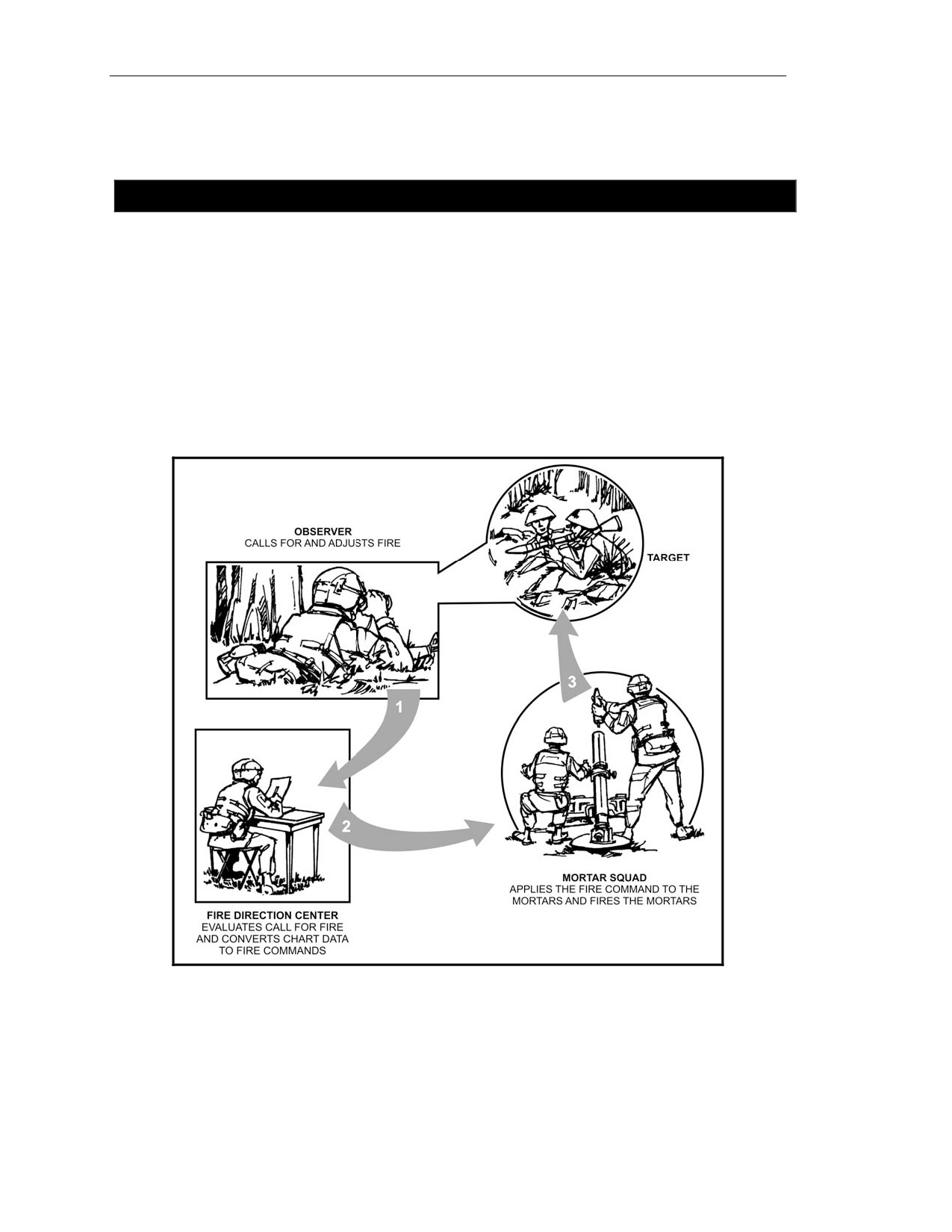
Indirect fire procedure is a team effort (Figure 1-1). Since the mortar is normally fired from defilade, the
indirect fire team gathers and applies the required data. The team consists of a forward observer (FO), a fire
direction center (FDC), and the gun squad.
APPLICATIONS
1-7. To successfully accomplish missions from a defilade position, certain steps must be followed in
applying essential information and engaging targets. These steps include—
Locate targets and mortar positions.
Determine chart data (direction, range, and vertical interval from mortars to targets).
Convert chart data to firing data.
Apply firing data to the mortar and ammunition.
Figure 1-1. Indirect fire team.
TEAM MISSION
1-8. The team mission is to provide accurate and timely response to the unit it supports. Effective
communication is vital to the successful coordination of the efforts of the indirect fire team.
1-2
FM 3-22.90
7 December 2007
Introduction
1-9. The battalion headquarters and headquarters company (HHC) fire support platoon provides the
fire support teams (FISTs) to the battalion’s maneuver companies upon deployment. The FISTs
typically move to and remain with their supported companies and platoons. Each rifle company is
supported by a 10-man FIST consisting of a lieutenant, staff sergeant, radio-telephone operator (RTO),
and a driver with an armored personnel carrier (in HBCTs) or a high mobility multipurpose wheeled
vehicle (HMMWV) (in IBCTs) at company headquarters, and six FOs (one 2-man team for each
infantry platoon in the company). Each armor company is supported by a 4-man FIST consisting of a
lieutenant, staff sergeant, RTO, and a driver with an armored personnel carrier at company
headquarters. The FO’s job is to find and report the location of targets, and to request and adjust fire.
1-10. The FDC has two computer personnel who control the mortar firing. They convert the data in a
call for fire (CFF) from the FO into firing data that can be applied to the mortars and ammunition. The
FDCs for medium and heavy mortars also have a driver.
1-11. A mortar squad consists of three to four mortarmen, depending on the system. The squad lays
the mortar and prepares the ammunition using the data from the FDC fire command. When those data
have been applied, the squad fires the mortar—it must also be able to fire without an FDC. Medium
and heavy mortar squads also have a driver.
UNITED STATES MORTARS
1-12. U.S. mortars are smooth-bore, muzzle-loaded, and high-angle-of-fire weapons. Table 1-1
displays some selected characteristics of U.S. mortars and their ammunition. The mortar squad consists
of three to four men, and the mortar components include the cannon, mount, and baseplate. Mortar
ammunition consists of a fuze, cartridge, and propellant charges.
CREW
1-13. The mortar crew consists of three to four men—
The squad leader is in charge of the squad and supervises the emplacement, laying, and
firing of the mortar.
The gunner manipulates the sight, elevating gear handle, and traversing assembly wheel. He
also places firing data on the sight and lays the mortar for deflection and elevation.
The assistant gunner loads the mortar and assists the gunner in shifting the mortar.
The ammunition bearer prepares the ammunition.
1-14. The number of men assigned to a squad, however, may vary depending on the unit’s mission.
EQUIPMENT
1-15. The mortar can be broken down into three parts—
(1) The cannon assembly consists of the barrel, which is sealed at the lower end with a breech
plug. The muzzle end of the 81-mm and the 120-mm mortar has a cone-shaped blast
attenuator device (BAD) fitted to reduce noise and blast overpressure. The 60-mm has a
combination carrying handle and firing mechanism attached to the breech cap.
(2) The bipod provides front support for the barrel and carries the gears necessary to lay the
mortar. It also has a slot to receive the sightunit. The 60-mm can fire without the bipod.
(3) The baseplate supports and aligns the mortar during firing. It has a large surface area to
prevent the mortar from sinking into the ground during firing and has a socket that enables a
full 360-degree traverse without moving the baseplate.
AMMUNITION
1-16. Mortar ammunition consists of a fuze, a cartridge, and propellant charges.
7 December 2007
FM 3-22.90
1-3

Chapter 1
Fuzes
1-17. U.S. mortars use a variety of fuzes.
Point-detonating (PD), impact (IMP), or superquick (SQ) fuzes detonate the cartridge on
impact with the ground.
Near-surface burst (NSB) fuzes explode on or near the ground.
Proximity (PROX) fuzes explode above the ground. 60/81 PRX detonates two meters above
the ground, and 120 PRX detonates four meters above the ground.
Delay (DLY) fuzes explode 0.05 seconds after impact.
Time fuzes explode after a preselected time has elapsed from the round being fired (usually
used with illumination).
Multioption fuzes combine two or more of the other modes into one fuze.
Cartridge
1-18. The cartridge can contain high-explosive (HE), illumination (ILLUM), or smoke.
HE is used against personnel and light materiel targets.
ILLUM is used in night missions requiring illumination for assistance in observation.
Smoke, with white or red phosphorus (WP, RP) filler, is used as a screening, signaling,
casualty-producing, or incendiary agent.
Propellant Charges
1-19. Propellant charges provide the explosive force to propel the cartridge through the air. Propellant
charges consist of a base charge (Charge 0) and from four to ten incremental charges. The number of
incremental charges used is determined by the range and time of flight.
Table 1-1. Selected characteristics of U.S. mortars and ammunition.
60-mm
81-mm
120-mm
CHARACTERISTIC
M224
M252
M120/121
Weight (pounds):
47
121
319
Handheld:
18
NA
NA
Range (meters)
HE Minimum:
70
83
200
HE Maximum:
3,490
5,608
7,200
Rate of Fire
Maximum:
30 per min for 4 min
30 per min for 2 min
16 per min for 1 min
Sustained:
20 per min
15 per min
4 per min
Crew:
3
4
4
Weight of HE (pounds):
3.7
9.1
29.2
(M720A1/M888)
(M821/M889)
(M933/M934)
Illumination
Candlepower:
300,000
600,000
1,000,000
Duration:
55 secs
50 to 60 secs
46 to 60 secs
IR:
Available
Available
Available
Smoke:
Available
Available
Available
1-4
FM 3-22.90
7 December 2007
Introduction
SECTION III. SAFETY PROCEDURES
Although safety is a command responsibility, each member of the mortar fire team must know safety
procedures and enforce them. Safety is enhanced with MFCS features, such as the ability to view safety
data and situational awareness information, as well as to input fire support coordination measures (FSCMs)
and view them using the digital plot feature. No matter how sophisticated the system, it must be checked
during live-fire exercises (LFXs).
DUTIES OF THE SAFETY OFFICER AND SUPERVISORY
PERSONNEL
1-20. Safety officers must help commanders meet the responsibility of enforcing safety procedures.
The safety officer has two principal duties: first, ensure that the section is properly laid so that, when
rounds are fired, they land in the impact area; second, ensure that all safety precautions are observed at
the firing point (FP).
DUTIES BEFORE DEPARTING FOR RANGE
1-21. The safety officer must read and understand—
AR 385-63, Range Safety. 19 May 2003.
Post range and terrain regulations.
The terrain request of the firing area to know safety limits and coordinates of firing
positions.
Appropriate FMs and TMs pertaining to weapons and ammunition to be fired.
DUTIES OF SUPERVISORY PERSONNEL
1-22. Supervisory personnel must know the immediate action to be taken for firing accidents. The
following is a list of minimum actions that must be taken if an accident occurs.
(1) Administer first aid to injured personnel, and then call for medical assistance.
(2) If the ammunition or equipment presents further danger, move all personnel and equipment
out of the area.
(3) Do not change any settings on, or modify, the position of the mortar until an investigation
has been completed.
(4) Record the ammunition lot number involved in the accident or malfunction and report it to
the battalion ammunition officer. If a certain lot number is suspect, its use should be
suspended by the platoon leader.
MORTAR RANGE SAFETY CHECKLIST
1-23. A mortar range safety checklist can be written for local use. The following is a suggested
checklist (it can also include three columns on the right, titled “Yes,” “No,” and “Remarks”).
Items to Check Before Firing
1-24. Is a range log or journal maintained by the officer in charge (OIC)?
1-25. Is radio or telephone communication maintained with—
Range control?
Unit S3?
Firing crews?
FOs?
Road or barrier guards?
7 December 2007
FM 3-22.90
1-5
Chapter 1
1-26. Are the required emergency personnel and equipment present on the range?
Properly briefed and qualified medical personnel.
A wheeled or tracked ambulance.
Firefighting equipment.
1-27. Are the following range controls and warning devices available, readily visible, and in use
during the firing exercise?
Barrier/road guards briefed and in position.
Road barriers in position.
Red range flag in position.
Blinking red lights for night firing.
Signs warning trespassers to beware of explosive hazards and not to remove duds or
ammunition components from ranges.
Noise hazard warning signs.
1-28. Are current copies of the following documents available and complied with?
AR 385-63, Range Safety.
Technical and field manuals pertinent to the mortar in use.
Appropriate firing tables.
Installation range regulations.
1-29. Are the following personal safety devices and equipment available and in use?
Helmets.
Protective earplugs.
Protective earmuffs (for double hearing protection).
1-30. Is the ammunition the correct caliber, type, and quantity required for the day’s firing? Are the
rounds, fuzes, and charges—
Stored in a location to minimize possible ignition or detonation?
Covered to protect them from moisture and direct sunlight?
Stacked on dunnage to keep them clear of the ground?
Strictly accounted for by lot number?
Exposed only immediately before firing?
Stored separately from ammunition and protected from ignition?
1-31. Has the range safety officer verified the following?
The mortar safety card applies to the unit and exercise.
The firing position is correct and applies to the safety card, and the base mortar is within
100 meters of the surveyed FP.
Boresighting and aiming circle declination are correct.
The plotting board, mortar ballistic computer (MBC), MFCS, or lightweight handheld
mortar ballistic computer (LHMBC) is correct.
The FO has been briefed on the firing exercise and knows the limits of the safety fan.
The lay of each mortar is correct.
The safety stakes (if used) are placed along the right and left limits.
Each safety noncommissioned officer (NCO) and gunner has been informed in writing of —
Right and left limits (deflection).
Maximum elevation and charge.
Minimum elevation and charge.
Minimum time setting for fuzes.
All personnel at the firing position have been briefed on safety misfire procedures.
If the safety card specified overhead fire, firing is in accordance with AR 385-63.
1-6
FM 3-22.90
7 December 2007
Introduction
NOTE: Firing mortars over the heads of unprotected troops by Marine Corps units is not
authorized or recommended for Army units. This restriction applies only during
peacetime; it does not apply during combat.
The mortars are safe to fire by checking—
Prefire safety checks for the specific mortar.
Mask and overhead clearance.
Weapons and ammunition.
Properly seated sights on weapons.
The lights on the sights and aiming stakes for night firing.
The OIC is informed that the range is cleared to fire and that range control has placed it in a
“wet” status.
Items to Check During Firing
1-32. Are the unit personnel adhering to the safety regulations?
1-33. Is each charge, elevation, and deflection setting checked before firing?
1-34. Does the safety NCO declare the mortar safe to fire before the squad leader announces, “Hang it,
fire”?
1-35. Do all gun settings remain at last data announced until a subsequent fire command is issued by
the FDC?
1-36. Are ammunition lots kept separate to avoid the firing of mixed lots?
Items to Check After Firing
1-37. Have the gunners and safety NCO verified that no loose propellants are mixed with the empty
containers?
1-38. Has the safety NCO disposed of the unused propellants?
1-39. Has the unused ammunition been inventoried and repacked properly?
1-40. Have the proper entries been made in the equipment logbook (DA Form 2408-4 [Weapon
Record Date])?
1-41. Has the OIC or safety officer notified range control of range status and other required
information?
1-42. Has a thorough range police been conducted?
SAFETY CARD
1-43. The safety officer receives a copy of the safety card from the OIC or range control—depending
on local regulation—before allowing fire to begin. He constructs a safety diagram based on the
information on the safety card. A safety card should be prepared and approved for each firing position
and type of ammunition used. The form of the card depends upon local regulations (training list,
overlay, range bulletin). Even without a prescribed format, it should contain the following—
Unit firing or problem number.
Type of weapon and fire.
Authorized projectile, fuze, and charge zone.
Grid of the platoon center.
Azimuth of left and right limits.
Minimum and maximum ranges and elevations.
Any special instructions to allow for varying limits on special ammunition or situations.
7 December 2007
FM 3-22.90
1-7
Chapter 1
SAFETY DIAGRAM AND SAFETY “T”
1-44. On receipt of the safety card or safety record, the safety officer constructs a safety diagram. The
safety diagram is a graphic portrayal of the data on the safety card and does not need to be drawn to
scale, but must accurately list the sight settings that delineate the impact area. The safety “T” serves as
a convenient means of checking the commands announced to the gun crews against those commands
that represent the safety limits. The construction of the safety diagram and safety “T” is the same for
all mortars.
1-45. The diagram shows the right and left limits, and deflections corresponding to those limits; the
maximum and minimum elevations; and the minimum fuze settings (when applicable) for each charge
to be fired. The diagram also shows the minimum and maximum range lines, the left and right azimuth
limits, the deflections corresponding to the azimuth limits, and the direction and mounting azimuth on
which the guns are laid. The safety diagram must show only necessary information.
1-46. To accurately complete a safety diagram, the safety officer must use the information supplied by
range control or, in the example in Figure 1-2, the safety card/record to—
(1) Enter the known data (supplied from the safety card) on the safety diagram.
(2) Determine the direction of fire or the center of the sector.
(3) Determine the mounting azimuth.
(4) Determine mils left and right deviations of the mounting azimuth.
(5) Enter the referred deflection.
(6) Determine deflections to left and right limits.
(7) Determine minimum and maximum charges and elevations.
(8) If illumination is to be used, determine, from the appropriate firing tables, the minimum and
maximum charges and ranges to burst and impact for the canister. The minimum range is
used to determine the minimum charge and range to burst. The maximum range is used to
determine the maximum charge and range to impact.
1-47. An example of the preparation of a safety diagram and safety “T” follows.
1-8
FM 3-22.90
7 December 2007
Introduction
EXAMPLE
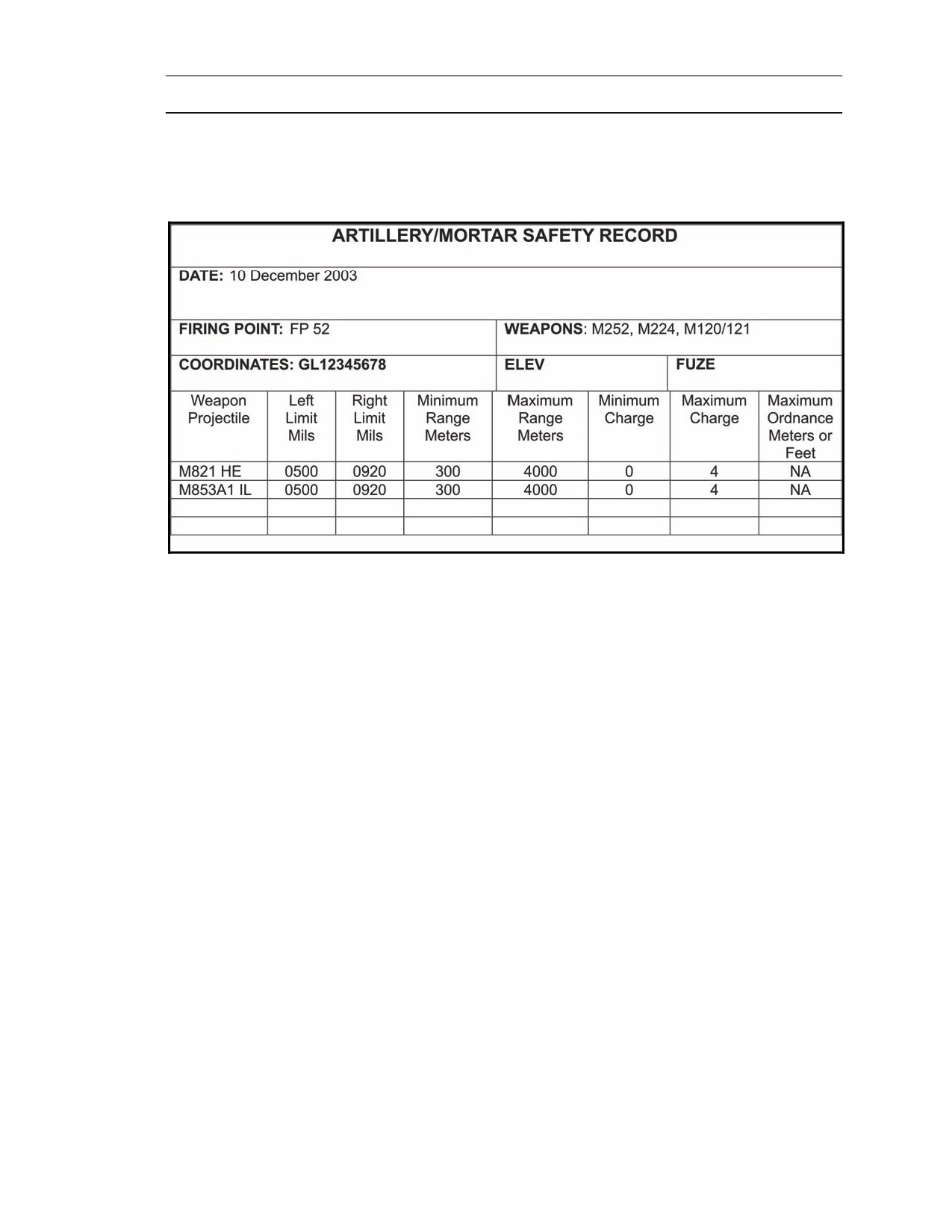
An 81-mm mortar section is firing at FP 52 with M821 HE and M853A1 ILLUM. The safety officer
receives the safety record/card (Figure 1-2) from either range control or the OIC (in accordance
with local range regulations).
Figure 1-2. Example completed safety record or card.
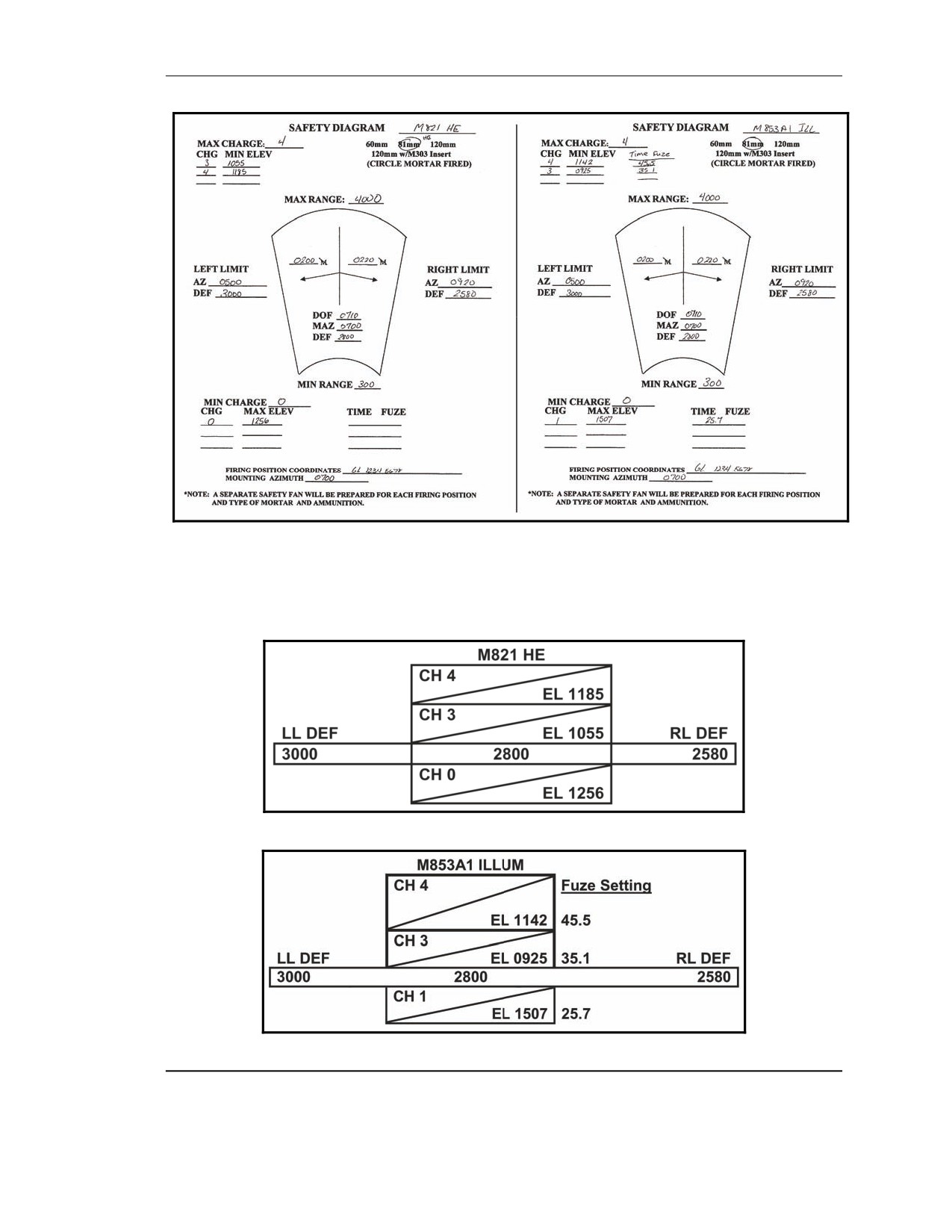
The safety officer calculates the data for the safety diagram and then places the data for each
type of ammunition on separate safety diagrams (Figure 1-3).
Calculate the direction of fire. Left limit is smaller than right limit.
Subtract the left limit azimuth from the right limit azimuth. Divide the result by two, and add that
number to the left limit azimuth.
RIGHT LIMIT
+ 0920
MINUS LEFT LIMIT
- 0500
SUM
420
SUM ÷ 2 =
210
LEFT LIMIT
+ 500
TOTAL
710
The answer, 0710, is the direction of fire or the azimuth center of sector.
(To calculate the direction of fire if the left limit is larger than the right limit, add 6400 to the right
limit, and use the same calculations as above. If the final answer is more than 6400, subtract
6400 to get the direction of fire.)
Round off the direction of fire or mounting azimuth.
For all mortars using the M16 plotting board, round off to nearest 50 mils. In this example, the
safety officer rounds 0710 to 0700.
Enter the referred deflection.
The section sergeant provides the referred deflection. It can be any number, but 2800 is normally
used.
7 December 2007
FM 3-22.90
1-9
Chapter 1
Determine deflection for the left and right limits.
Determine the number of mils from the mounting azimuth to the left limit.
MOUNTING AZIMUTH
0700
LEFT LIMIT
-0500
MILS TO LEFT LIMIT
0200
Using the LARS rule for referred deflection, calculate the left limit deflection.
CENTER OF SECTOR REFERRED DEFLECTION
2800
MILS TO LEFT LIMIT
+ 0200
LEFT LIMIT DEFLECTION
3000
Determine the number of mils from the mounting azimuth to the right limit.
RIGHT LIMIT
0920
MOUNTING AZIMUTH
- 0700
MILS TO RIGHT LIMIT
0220
Using the LARS rule for referred deflection, calculate the right limit deflection.
CENTER OF SECTOR REFERRED DEFLECTION
2800
MILS TO RIGHT LIMIT
+ 0220
RIGHT LIMIT DEFLECTION
2580
Determine minimum and maximum charges and elevations.
Use the firing tables (FTs) for the mortar being fired to determine minimum and maximum
charges and elevations. For the example, the maximum range is 4,000 meters and the minimum
range is 300 meters.
M821 HE. Using FT-81-AR-2 for the M821 HE cartridge, the maximum and
minimum charges and elevations are—
Max or Min
Charge
Elevation (mils)
Maximum
4
1185
Maximum
3
1055
Minimum
0
1256
M853A1 ILLUM. Using FT-81-AR-2 for the M853A1 ILLUM cartridge, the maximum
and minimum charges, elevations, and time settings are—
Max or Min
Charge
Elevation
Time Setting
(mils)
(seconds)
Maximum
4
1142
45.5
Maximum
3
0925
35.1
Minimum
1
1507
25.7
1-10
FM 3-22.90
7 December 2007
Introduction
Figure 1-3. Safety diagrams for M821 HE and M853A1 ILLUM.
A safety “T” is made for each type of cartridge being fired. The requisite data from the safety
diagram is transcribed onto the safety “T” (Figure 1-4 and Figure 1-5), and each gun has a copy.
Figure 1-4. Safety “T” for M821 HE.
Figure 1-5. Safety “T” for M853A1 ILLUM.
7 December 2007
FM 3-22.90
1-11
Chapter 1
SURFACE DANGER ZONES
1-48. The surface danger zone (SDZ) is the ground and airspace designated within the training
complex for vertical and lateral containment of projectiles, fragments, debris, and components
resulting from the firing, launching, or detonation of weapon systems. It is composed of an impact area
and buffer zones.
COMPONENTS
1-49. SDZs are usually pie-shaped, with the target area in the center surrounded by concentric zones.
Components include the firing position, impact areas, and buffer zones.
Firing Position
1-50. The firing position is the point or location at which the mortar is placed for firing.
Impact Area
1-51. The ground and associated airspace within the training complex used to contain fired or
launched ammunition and explosives, and the resulting fragments, debris, and components from
various weapon systems. Indirect fire weapon system impact areas include probable error for range and
deflection.
Target Area
1-52. The target area contains the targets.
Dispersion Area
1-53. The dispersion area, by keeping the rounds inside the impact area, accounts for human error, gun
or cannon tube wear, propellant temperature, and so on. Its width is based on the range and deviation
probable errors for the maximum range of the charge permitted.
The left and right dimensions are eight deflection probable errors (PE D) from the left and
right limits of the target area.
The far dimensions are eight range probable errors (PE R) from the far edge of the target
area.
Buffer Zones
1-54. Buffer zones, or secondary danger areas, contain the fragments, debris, and components from
frangible or explosive projectiles and warheads functioning on the edge of the target area. It has two
parts: Area A and Area B.
Area A
1-55. Area A is the secondary danger area (buffer zone) that laterally parallels the impact area and
dispersion area and contains fragments, debris, and components from frangible or explosive projectiles
and warheads functioning on the right or left edge of the impact area or ricochet area. It starts at a 25
degree angle from the impact area (increased to 70 degrees for ranges at and beyond 600 meters for 60
mm, 940 meters for 81-mm, and 1,415 meters for 120-mm mortars). The width of area A depends on
the mortar:
60-mm: 250 meters
81-mm: 400 meters
120-mm: 600 meters
1-12
FM 3-22.90
7 December 2007
Introduction
Area B
1-56. Area B is the secondary danger area (buffer zone) on the downrange (far) side of the impact area
and contains fragments, debris, and components from frangible or exploding projectiles and warheads
functioning on the far edge of the impact area and area A. The width of area B depends on the mortar:
60-mm: 300 meters
81-mm: 400 meters
120-mm: 600 meters
CONSTRUCTION
1-57. SDZs usually exist for approved FPs and can be found at range control or in the range book for
the FP. If the SDZ has to be constructed, personnel should refer to DA Pam 385-63.
SECTION IV. AMMUNITION
A complete round of mortar ammunition contains all of the components needed to get the round out of the
tube and to burst at the desired place and time. This section discusses the proper care and handling, color
codes, and field storage of ammunition.
AMMUNITION CARE AND HANDLING
1-58. The key to proper ammunition functioning is protection. Rounds prepared but not fired should
be returned to their containers, fin end first. Safety is always a matter of concern for all personnel and
requires special attention where ammunition is concerned. Supervision is critical—improper care and
handling can cause serious accidents, as well as inaccurate fire. Some of the principles of proper
ammunition handling are—
Never tumble, drag, throw, or drop individual cartridges or boxes of cartridges.
Do not allow smoking, open flames, or other fire hazards around ammunition storage areas.
Inspect each cartridge before it is loaded for firing. Dirty ammunition can damage the
weapon or affect the accuracy of the round.
Keep the ammunition dry and cool.
Never make unauthorized alterations or mix components of one lot with another.
NOTE: For care and handling of specific mortar rounds, see corresponding chapters in
this manual.
PROJECTILES/CARTRIDGES
1-59. Each projectile must be inspected to ensure that there is no leakage of the contents and that the
projectile is correctly assembled.
BURNING OF UNUSED PROPELLING CHARGES
1-60. Mortar increments and propelling charges are highly flammable, and they must be handled with
extreme care to prevent exposure to heat, flame, or any spark-producing source, such as the hot residue
from burning increments or propelling charges that float downward after a cartridge leaves the cannon.
Like other types of ammunition, increments and propelling charges must be kept cool and dry. Storing
these items inside metal ammunition boxes until needed is an effective way to prevent premature
combustion.
1-61. Unused charges must not be saved, but should be removed to a storage area until they can be
burned or otherwise disposed of in accordance with local range or installation regulations or standing
operating procedures (SOPs).
1-62. Burning increments create a large flash and lots of smoke. In a tactical environment, the platoon
leader must ensure that burning increments do not compromise camouflage and concealment. The
7 December 2007
FM 3-22.90
1-13
Chapter 1
burning of increments in a dummy position, if established, can aid in the deception effort. The safety
officer, in a range environment, supervises the disposal of unused propellant increments.
FUZES
1-63. Never fire a round with a fuze that is not authorized for that round. Specific fuzes available for
each weapon system are discussed in this manual.
1-64. Fuzes are sensitive to shock and must be handled with care. Before fuzing a round, inspect the
threads of the fuze and fuze well for cleanliness and crossed threads. The fuze should be screwed into
the fuze well slowly until resistance is met and then firmly seated with a sharp twist of the M25 or
M18 fuze wrench, as appropriate.
WARNING
Premature detonation may occur if a fuze is not properly
seated.
1-65. To prevent accidental functioning of the point-detonating elements of M524-series fuzes, the
fuzes must not be dropped, rolled, or struck under any circumstances. Any mechanical time (MT) fuze
that is modified after it is set must be reset to SAFE, and the safety wires (if applicable) must be
replaced before the fuze is repacked in the original carton.
1-66. All primers must be inspected before use for signs of corrosion. If a seal has been broken, it is
likely that the primer has been affected by moisture, and it should be turned in.
SEGREGATION OF AMMUNITION LOTS
1-67. Different lots of propellant burn at different rates and give slightly different effects in the target
area; therefore, the registration corrections derived from one lot do not always apply to another.
Ammunition MUST be segregated by lot and weight zone. In the field storage area, on vehicles, or in a
dump, ammunition lots should be roped off with communications wire or twine and conspicuously
marked with a cardboard sign or other marker.
1-14
FM 3-22.90
7 December 2007

Introduction
AMMUNITION COLOR CODES
1-68. Mortar ammunition is painted and marked with a color code for quick, accurate identification. A
chart (Table 1-2) identifies rounds using NATO and U.S. color codes.
Table 1-2. Mortar ammunition color codes.
NATO COLOR CODE
U.S. COLOR CODE
TYPE OF ROUND
ROUND
MARKINGS
BAND
ROUND
MARKINGS
BAND
HIGH-EXPLOSIVE
(Causes troop casualties
Olive
Yellow
NA
Olive
Yellow
Yellow
and damage to light
Drab
Drab
material)
WHITE PHOSPHORUS
Light
Light
(To screen or signal,
Red
Yellow
Red
Yellow
Green
Green
acts as an incendiary)
RED PHOSPHORUS
Light
Light
(To screen or signal,
Black
Brown
Black
Brown
Green
Green
acts as an incendiary)
ILLUMINATION
(To illuminate, signal,
White
Black
NA
NA
NA
NA
and mark)
TRAINING PRACTICE
Brown
(For training and
Blue
White
Blue
White
Brown
or None
practice)
FIELD STORAGE OF AMMUNITION
1-69. Most ammunition components can be stored at temperatures as low as -80 degrees Fahrenheit for
no longer than three days and as high as 160 degrees Fahrenheit for no longer than four hours.
1-70. Regardless of the method of storage, ammunition in the storage area faces certain hazards. The
greatest hazards are weather; enemy fire; chemical, biological, radiological, nuclear
(CBRN)
contamination; improper handling; and accidental fires. Adhere to the following guidelines to properly
store ammunition.
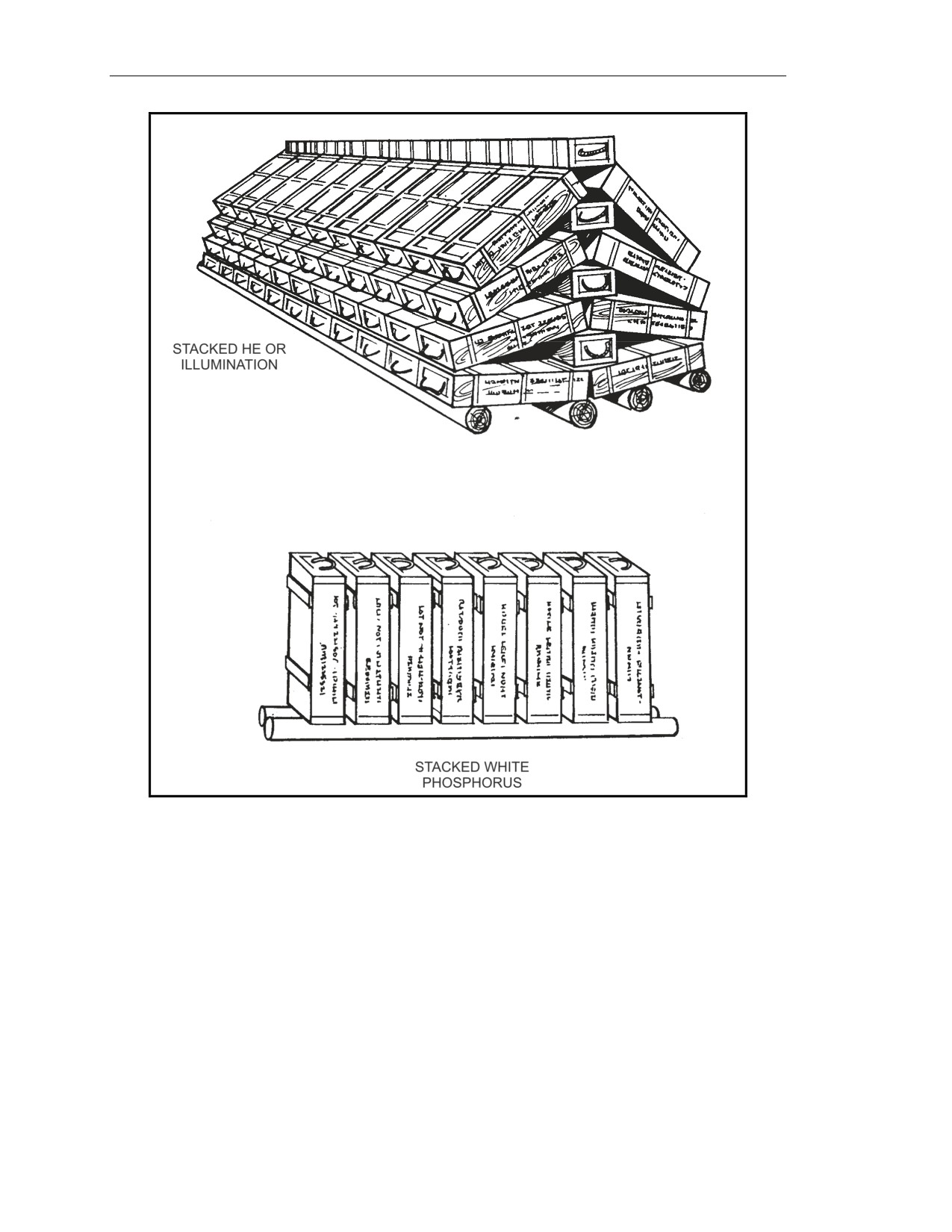
Stack ammunition by type, lot number, and weight zone (Figure 1-6).
NOTE: WP ammunition must be stacked fuze-end up so that melted filler will settle at
the bottom, reducing the chance of voids forming off the long axis of the
cartridge. Voids off the long axis of the cartridge will cause the cartridge to fly
erratically.
7 December 2007
FM 3-22.90
1-15
Chapter 1
Figure 1-6. Stacked ammunition.
If ammunition is stored on the ground, use at least 6 inches of strong dunnage under each
stack.
Keep the ammunition dry and out of direct sunlight by storing it in a vehicle or covering it
with a tarpaulin. Be sure to provide adequate ventilation around the ammunition and
between the covering material and the ammunition.
Protect ammunition (as much as possible) from enemy indirect fires. If sandbags are used
for protection, keep the walls at least 6 inches from the stacks and the roof at least 18 inches
from the stacks to ensure proper ventilation.
1-71. With some PROX fuzes, the number of malfunctions can increase if fired in temperatures below
0 degrees Fahrenheit or above 120 degrees Fahrenheit. Powder temperature affects the muzzle velocity
of a projectile and is of frequent concern to the FDC.
1-16
FM 3-22.90
7 December 2007
Chapter 2
Sighting and Fire Control Equipment
Proper employment of sighting and fire control equipment ensures effective fire
against the enemy. This chapter describes this equipment and its applications.
SECTION I. COMPASS, M2
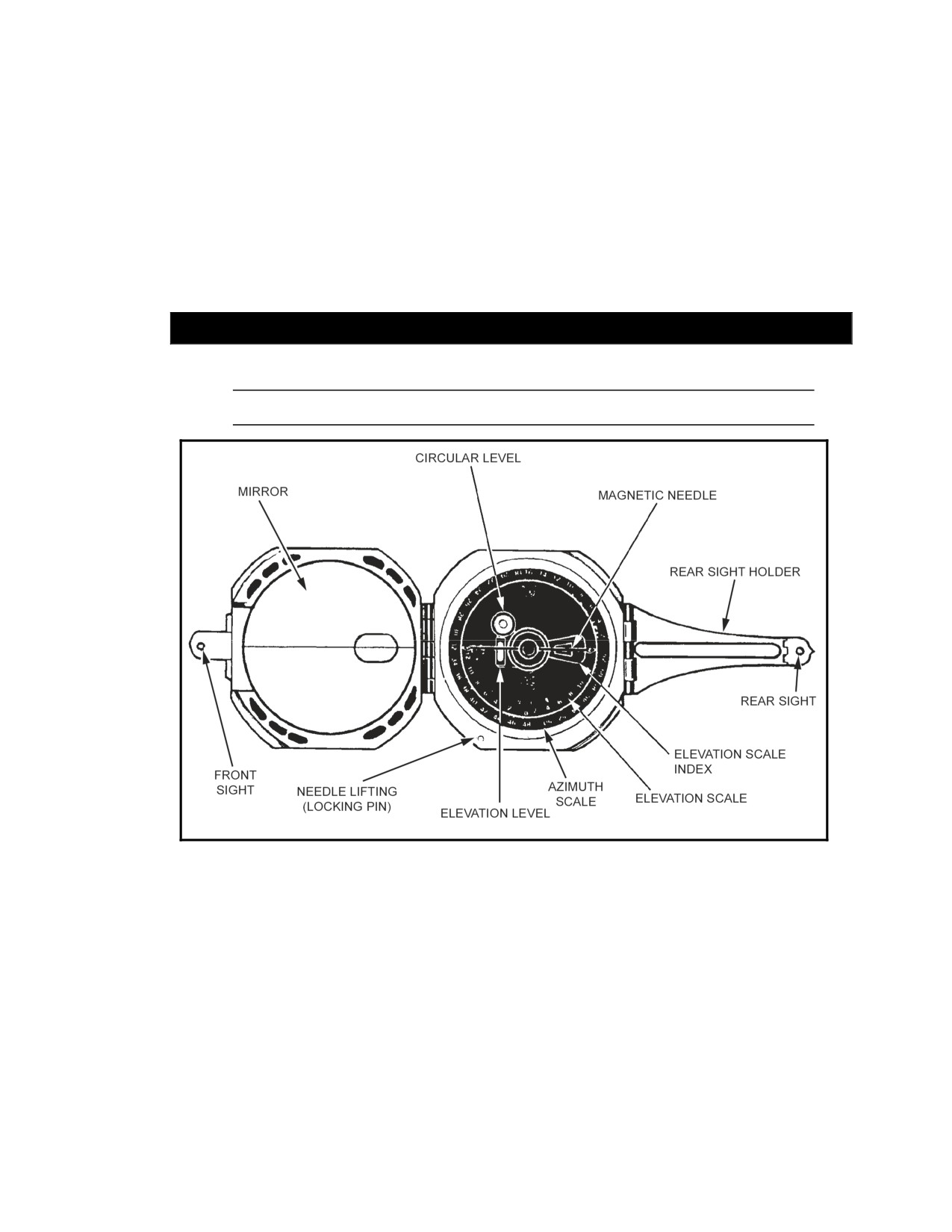
The M2 compass (Figures 2-1 through 2-3) is a multipurpose instrument used primarily to obtain azimuths
and angles of sight. It also measures grid azimuths after the instrument has been declinated for the locality.
NOTE: For detailed information, see TM 9-1290-333-15.
Figure 2-1. Compass, M2 (top view).
CHARACTERISTICS
2-1. The main characteristics of the M2 compass include the following:
Angle-of-sight scale: 1200-0-1200 mils.
Azimuth scale: 0 to 6400 mils.
Dimensions closed: 2 3/4 inches by 1 1/8 inches.
Weight: 8 ounces.
7 December 2007
FM 3-22.90
2-1
Chapter 2
DESCRIPTION
2-2. The principal parts of the compass include—
Compass body assembly.
Angle-of-sight mechanism.
Magnetic needle and lifting mechanism.
Azimuth scale and adjuster.
Front and rear sight.
COMPASS BODY ASSEMBLY
2-3. This assembly consists of a nonmagnetic body and a circular glass window that covers the
instrument and keeps dust and moisture from its interior, protecting the compass needle and angle-of
sight mechanism. A hinge assembly holds the compass cover in the position in which it is placed. A
hole in the cover coincides with a small oval window in the mirror on the inside of the cover. A
sighting line is etched across the face of the mirror.
ANGLE-OF-SIGHT MECHANISM
2-4. The angle-of-sight mechanism is attached to the bottom of the compass body. It consists of an
actuating (leveling) lever located on the back of the compass, a leveling assembly with a tubular
elevation level, and a circular level. The instrument is leveled with the circular level to read azimuths
and with the elevation level to read angles of sight. The elevation (angle -of -sight) scale and the four
points of the compass, represented by three letters and a star, are engraved on the inside bottom of the
compass body. The elevation scale is graduated in two directions; in each direction, it is graduated
from 0 to 1200 mils in 20-mil increments and numbered every 200 mils.
MAGNETIC NEEDLE AND LIFTING MECHANISM
2-5. The magnetic needle assembly consists of a magnetized needle and a jewel housing that serves
as a pivot. The north-seeking end of the needle is white. (The newer compasses have the north and
south ends of the needle marked “N” and “S” in raised, white lettering.) On some compasses, a thin
piece of copper wire is wrapped around the needle for counterbalance. A lifting pin projects above the
top rim of the compass body. The lower end of the pin engages the needle-lifting lever. When the
cover is closed, the magnetic needle is automatically lifted from its pivot and held firmly against the
window of the compass.
AZIMUTH SCALE AND ADJUSTER
2-6. The azimuth scale is a circular dial geared to the azimuth scale adjuster. This permits rotation of
the azimuth scale about 900 mils in either direction. The azimuth index provides a means of orienting
the azimuth scale at 0 or the declination constant of the locality. The azimuth scale is graduated from 0
to 6400 in 20-mil increments and numbered at 200-mil intervals.
FRONT AND REAR SIGHT
2-7. The front sight is hinged to the compass cover. It can be folded across the compass body, and the
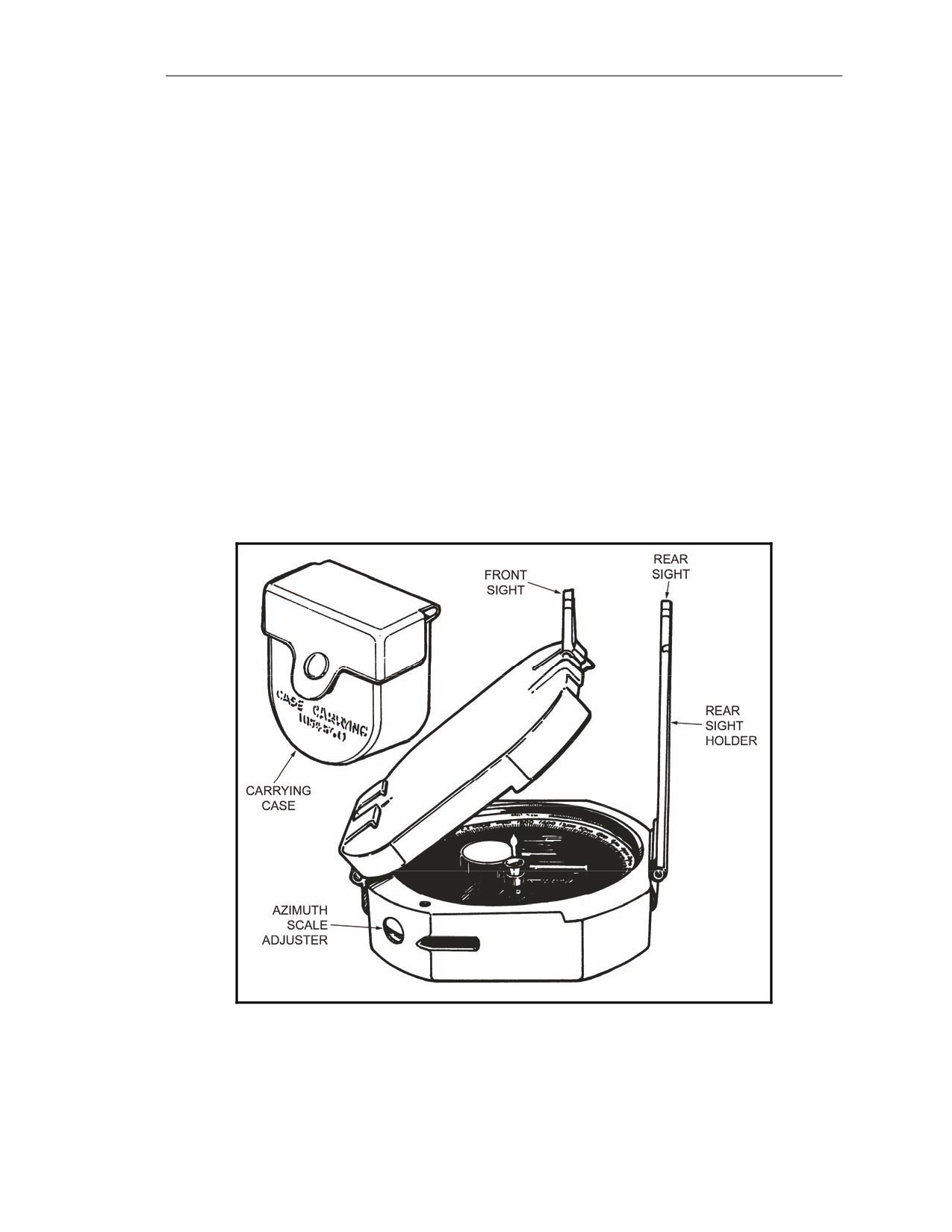
cover closed. The rear sight is made in two parts—a rear sight and a holder. When the compass is not
being used, the rear sight and holder are folded across the compass body and the cover is closed.
USE
2-8. The compass should be held as steadily as possible to obtain accurate readings. The use of a
sitting or prone position, a rest for the hand or elbows, or a solid nonmetallic support helps eliminate
unintentional movement of the instrument. When being used to measure azimuths, the compass must
not be near metallic objects.
2-2
FM 3-22.90
7 December 2007
Sighting and Fire Control Equipment
2-9.
To measure a magnetic azimuth—
(1) Zero the azimuth scale by turning the scale adjuster.
(2) Place the cover at an angle of about 45 degrees to the face of the compass so that the scale
reflection is viewed in the mirror.
(3) Adjust the front and rear sights to the desired position. Sight the compass using any of these
methods:
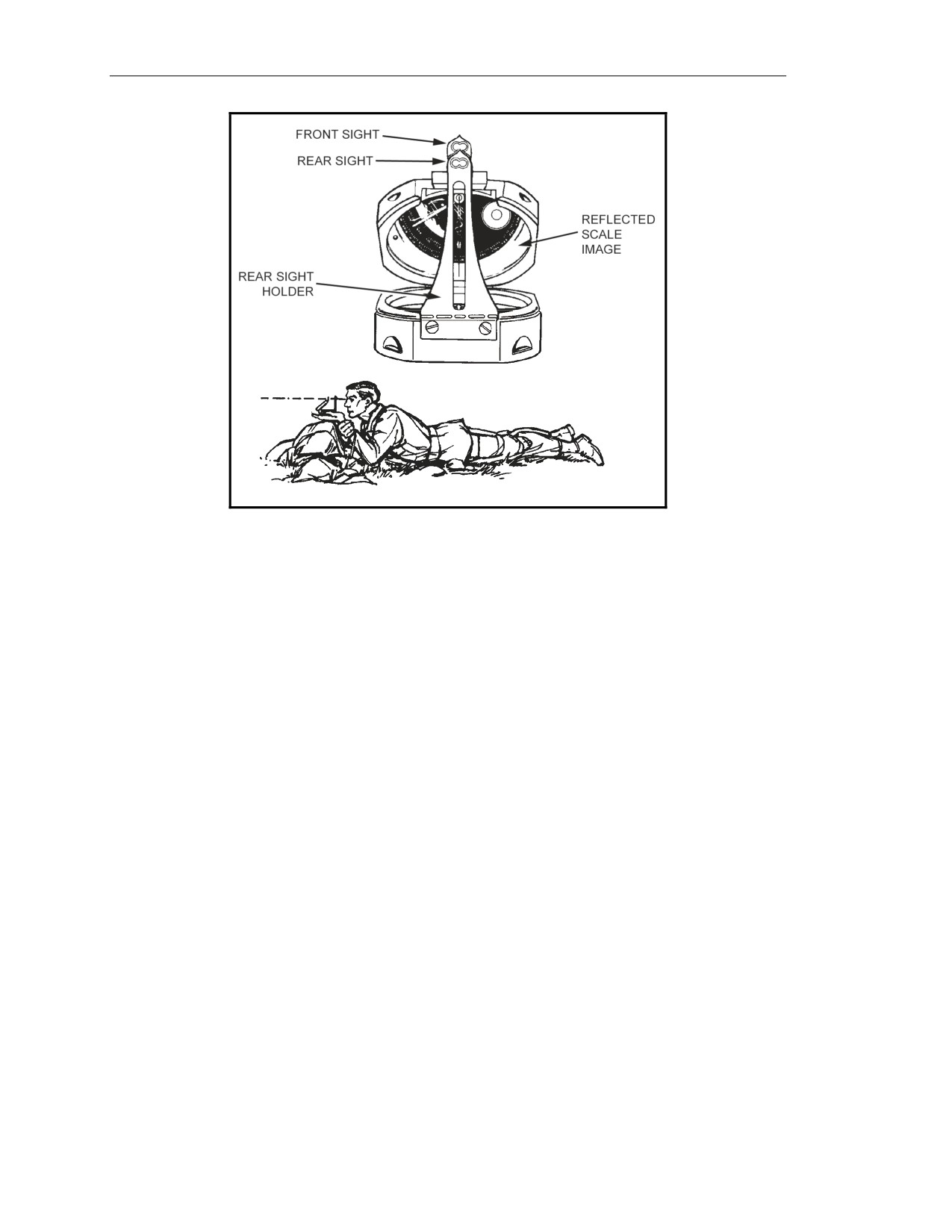
Raise the front sight and the extended rear sight assembly perpendicular to the face of
the compass (Figures 2-2 and 2-3). Sight over the tips of the front and rear sights. If the
object is above the line of sighting, fold the rear sight toward the eye, as needed. The
instrument is correctly aligned when, with the level centered, the operator sees the tips
of the sights and the center of the object at the same time.
Raise the rear sight approximately perpendicular to the face of the compass. Sight on
the object through the opening in the rear sight holder and through the window in the
cover. Keep the compass level, and raise or lower the eye along the opening in the rear
sight holder until the black center line of the window bisects the object and the opening
in the rear sight holder.
Fold the rear sight holder out parallel with the face of the compass with the rear sight
perpendicular to its holder. Sight through or over the rear sight and view the object
through the window in the cover. If the object sighted is at a lower elevation than the
compass, raise the rear sight holder as needed. The compass is correctly sighted when
the compass is level and the operator sees the black center line of the window bisecting
the rear sight and the object sighted.
Figure 2-2. Compass, M2 (side view).
7 December 2007
FM 3-22.90
2-3
Chapter 2
Figure 2-3. Compass, M2 (user’s view).
(4) Hold the compass in both hands, at eye level, with the arms braced against the body and the
rear sight near the eyes. For precise measurements, rest the compass on a nonmetallic stake
or object.
(5) Level the instrument by viewing the circular level in the mirror and moving the compass
until the bubble is centered. Sight on the object, look in the mirror, and read the azimuth
indicated by the black (south) end of the magnetic needle.
2-10. To measure a grid azimuth—
(1) Index the known declination constant on the azimuth scale by turning the azimuth scale
adjuster. Be sure to loosen the locking screw on the bottom of the compass.
(The
lightweight plastic M2 compass has no locking screw.)
(2) Measure the azimuth as described above. The azimuth measured is a grid azimuth.
2-11. To measure an angle of sight or vertical angle from the horizontal—
(1) Hold the compass with the left side down (cover to the left), and fold the rear sight holder
out parallel to the face of the compass, with the rear sight perpendicular to the holder.
Position the cover so that, when looking through the rear sight and the aperture in the cover,
the elevation vial is reflected in the mirror.
(2) Sight on the point to be measured.
(3) Center the bubble in the elevation level vial (reflected in the mirror) with the level lever.
(4) Read the angle on the elevation scale opposite of the index mark. The section of the scale
graduated counterclockwise from 0 to 1200 mils measures plus angles of sight. The section
of the scale graduated clockwise from 0 to 1200 mils measures minus angles of sight.
2-12. To declinate the M2 compass from a surveyed declination station free from magnetic
attractions—
(1) Set the M2 compass on an aiming circle tripod over the orienting station, and center the
circular level.
(2) Sight in on the known, surveyed azimuth marker.
(3) Using the azimuth adjuster scale, rotate the azimuth scale until it indicates the same as the
known, surveyed azimuth.
2-4
FM 3-22.90
7 December 2007

Sighting and Fire Control Equipment
(4) Recheck the sight picture and azimuth to the known point. Once the sight picture is correct
and the azimuth reading is the same as the surveyed data, the M2 is declinated.
2-13. To use the field-expedient method to declinate the M2 compass—
(1) Using the azimuth adjuster scale, set off the grid-magnetic (G-M) angle shown at the bottom
of all military maps.
(2) Once the G-M angle has been set off on the azimuth scale, the M2 compass is declinated.
SECTION II. AIMING CIRCLES, M2 AND M2A2
The aiming circle is used to measure azimuth and elevation angles with respect to a preselected baseline. It
is a low-power telescope that is mounted on a composite body and contains a magnetic compass, adjusting
mechanisms, and leveling screws for establishing a horizontal plane. The instrument is supported by a
baseplate for mounting on a tripod. Angular measurements in azimuth are indicated on graduated scales
and associated micrometers. (For more detailed information, see TM 9-1290-262-10.)
CHARACTERISTICS
2-14. Selected characteristics of the aiming circles are shown in Table 2-1.
Table 2-1. Selected characteristics of the aiming circles, M2 and M2A2.
CHARACTERISTIC
M2
M2A2
Weight (w/o equipment)
9 pounds
9 pounds
Weight (w/equipment less batteries)
21 pounds
21 pounds
Azimuth rotation
6400 mils
6400 mils
Elevation (maximum)
800 mils
1100 mils
Depression (maximum)
400 mils
400 mils
Magnification
4 power
4 power
Field of view
10 degrees
10 degrees
DESCRIPTION
2-15. M2 and M2A2 aiming circles consist of an elbow telescope mounted on orienting and elevating
mechanisms, which are contained within a main housing. The main housing, in turn, is supported by
adjusting screws through the baseplate.
7 December 2007
FM 3-22.90
2-5
Chapter 2
USE
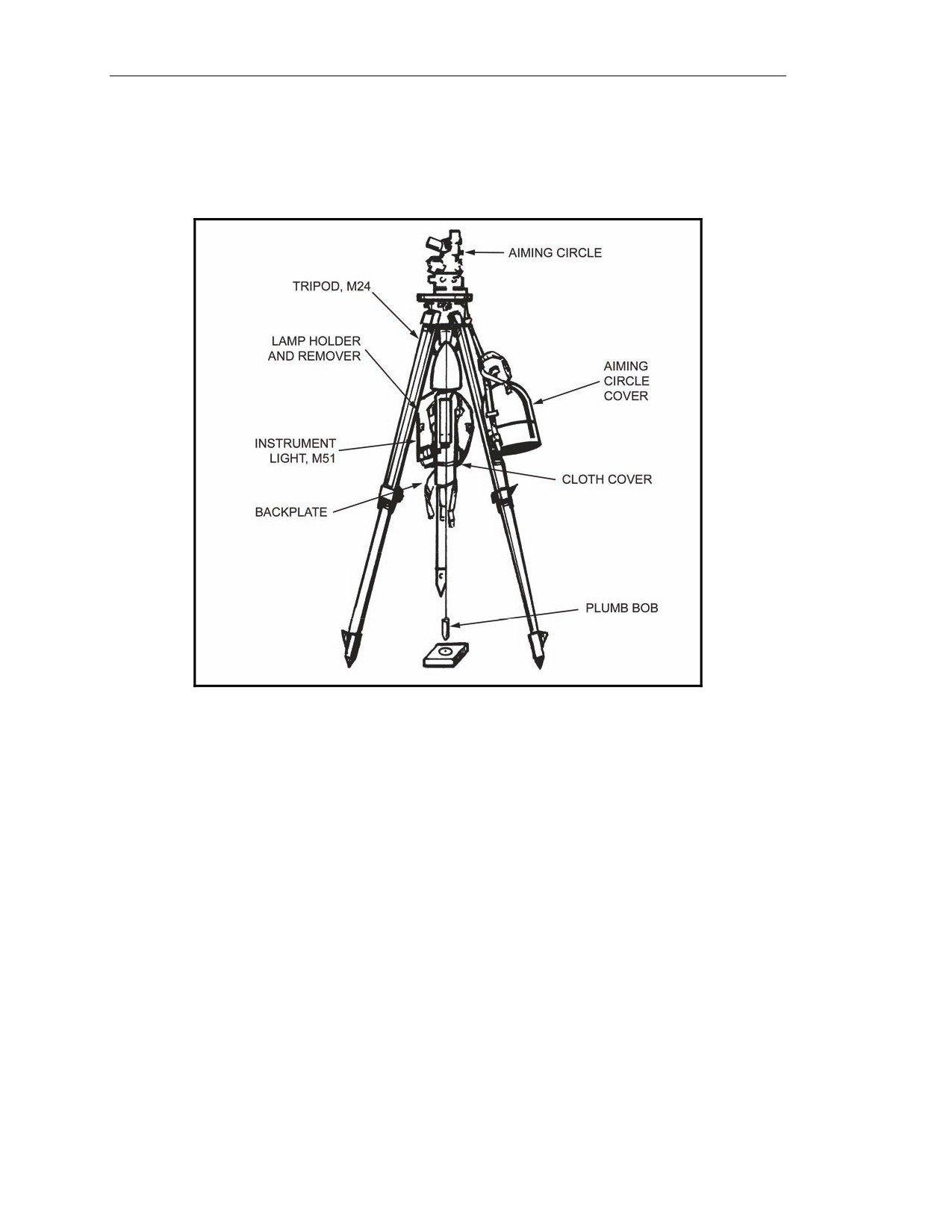
2-16. The M2 or M2A2 aiming circle (Figure 2-4) is used for the precise measurement of the azimuth
and elevation angles of a ground or aerial target with the respect to a preselected baseline as required
for the orientation of indirect fire weapons. It can also be used for general topographical surveying.
Figure 2-4. Aiming circles, M2 and M2A2, and accessory equipment.
2-6
FM 3-22.90
7 December 2007
Sighting and Fire Control Equipment
ORIENTING AND ELEVATING MECHANISMS
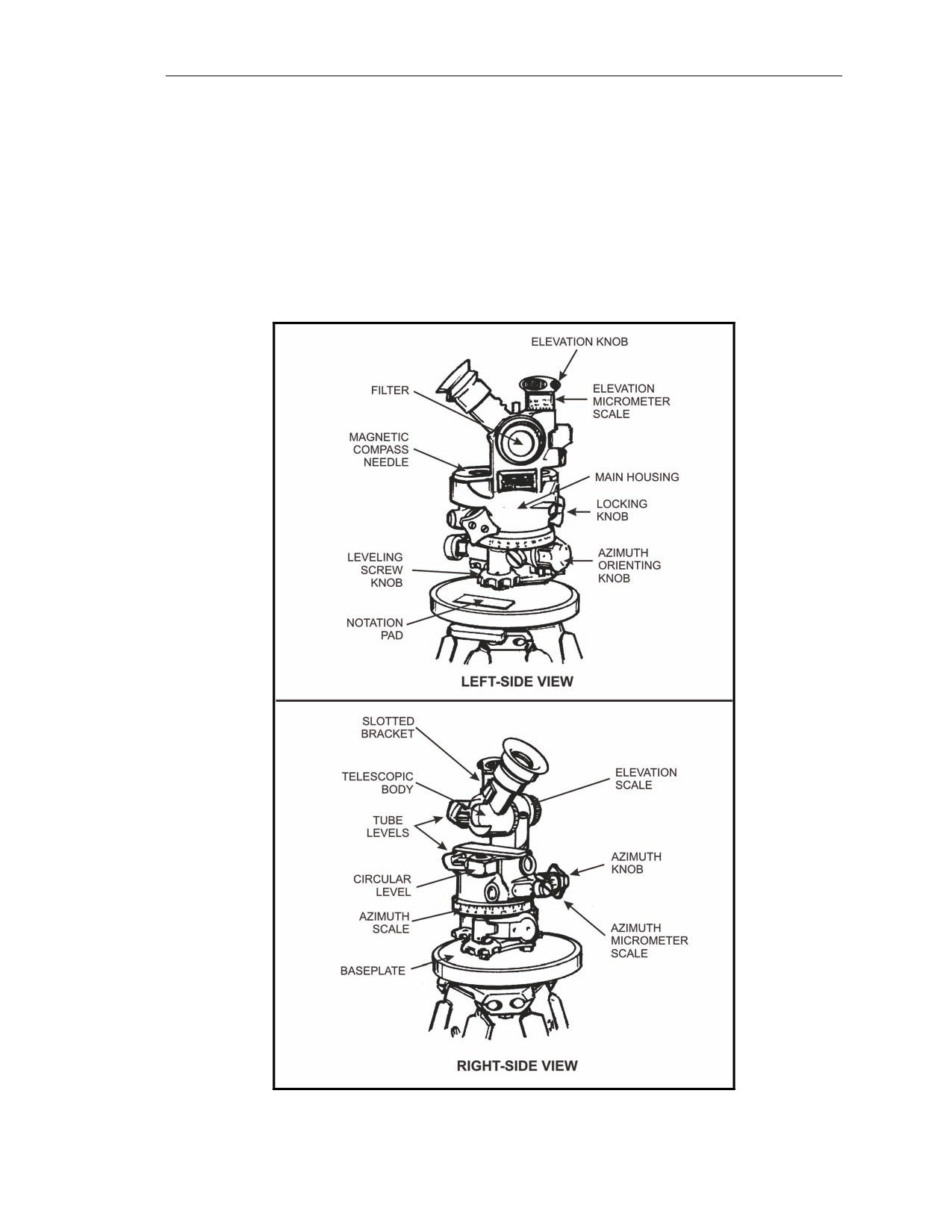
2-17. The orienting and elevating mechanisms permit unlimited azimuth orienting movement (360
degrees [6400 mils]) and limited elevation and depression (M2, 1200 mils; M2A2, 1500 mils). Two
orienting knobs (Figure 2-5) control the azimuth orienting rotation. The azimuth micrometer knob
controls azimuth measurement. The elevation micrometer knob controls elevation and depression
movement. The azimuth micrometer worm can be disengaged to provide rapid azimuth measurement
of movement by exerting pressure on the azimuth micrometer knob against the pressure of an internal
spring-loaded plunger. Releasing the pressure on the azimuth micrometer knob allows the mechanism
to reengage. A similar throw-out mechanism permits the azimuth orienting worm to also be disengaged
to provide rapid azimuth orienting movement.
Figure 2-5. Aiming circle, M2.
7 December 2007
FM 3-22.90
2-7
Chapter 2
TELESCOPE
2-18. The telescope of the aiming circle is a four-power, fixed-focus, elbow-type instrument. The
reticle of the telescope contains cross lines graduated to give azimuth and elevation angular readings
from 0 to 85 mils in 5-mil increments. Thus, the FO can read small angular values directly from the
reticle without referring to the azimuth and elevation micrometer scales. An externally stowed filter is
provided for protection against the rays of the sun. A slotted bracket provides the means of securing
the lamp bracket on one lead wire of the M51 instrument light so that illumination of the reticle during
night operation can be accomplished. The reflector can be illuminated and used in conjunction with the
sightunits on the mortars during night operations to backlight the vertical centerline of the aiming
circle.
LEVELS
2-19. Three levels are contained within the telescope body and main housing of the aiming circle. One
tubular level, held between two bosses on the telescope body, is used to establish a true horizontal line-
of-sight. The two bosses supporting this level are machined to form an open sight for approximate
alignment of the telescope and target, and for quick or emergency sighting. One circular level and one
tubular level are held within bosses on the main housing. The circular level is used for rough leveling
of the aiming circle, and the tubular level is used for fine leveling adjustments. The three leveling
screws on the baseplate are used to level the instrument and each is controlled by a leveling screw
knob.
MAGNETIC COMPASS NEEDLE
2-20. A magnetic compass needle is located in a recess in the top of the housing. A magnifier and
rectangular reticle located at one end of the recess enable the FO to observe the end of the compass
needle and to align the line of sight of the telescope with the needle. The compass needle can be locked
in position by actuating the locking lever on the side of the housing.
AZIMUTH AND ELEVATION SCALES
2-21. Azimuth and elevation scales are employed to measure azimuth or elevation angles. The scales
provide coarse readings and the micrometer provides fine readings. The two readings added together
give the angle. Graduation intervals and numeral scales are graduated into relatively large round
number intervals for convenience in reading. The scale intervals are in graduations of 100 mils.
The azimuth scale is graduated from 0 to 6400 mils (zero equals 6400). The upper series
forms the main azimuth scale, colored black and numbered at 200-mil intervals. The lower
series, colored red, is numbered from 0 to 3200 mils (the large zero in the main scale equals
3200). The red scale should only be used when verifying the lay of the aiming circle with
another aiming circle.
The azimuth micrometer scale is graduated at 1-mil intervals and numbered from 0 to 100 at
ten 10-mil intervals.
The elevation scale is graduated and numbered on both sides of 0. Minus (red) readings
represent depression and plus (black) readings represent elevations at 100-mil intervals from
minus 400 to plus 800 mils.
The elevation micrometer scale is graduated at 1-mil intervals from 0 to 99 mils—large zero
is designated 0 and 100. Red numerals represent depression and black numerals represent
elevation.
NOTATION STRIP
2-22. A notation strip is provided on the baseplate. This strip is a raised and machined surface on
which scale readings, settings, or other data can be recorded for reference.
2-8
FM 3-22.90
7 December 2007
Sighting and Fire Control Equipment
ACCESSORY EQUIPMENT
2-23. The accessory equipment for the M2 aiming circle includes the aiming circle cover, M24 tripod,
and the accessory kit that includes the M51 instrument light, backplate, cloth cover, plumb bob, and a
lamp holder and remover. This equipment is mounted on the M24 tripod when the instrument is set up
for use.
AIMING CIRCLE COVER
2-24. The aiming circle cover is a metal cover that protects and houses the aiming circle when not in
use. It attaches to the baseplate of the aiming circle and can be carried by means of its strap. When the
aiming circle is in use, the cover is placed on the tripod.
TRIPOD, M24
2-25. The M24 tripod comprises three telescoping wooden legs hinged to a metal head, which contains
a captive screw for attaching the aiming circle. When not in use, the tripod cover should be fitted on
the head and the legs retracted and held by a strap. The aiming circle cover and cloth cover with
attached accessory equipment can be mounted on its legs when the aiming circle is set up for use. A
hook is also provided to suspend the plumb bob and attached thread.
INSTRUMENT LIGHT, M51
2-26. The M51 instrument light is used with the M2 aiming circle during night operations and for
certain test and adjustment procedures. The light is powered by two flashlight batteries and contains
two attaching lead wires. A lamp bracket attached to one lead wire can be inserted into the slotted
bracket of the aiming circle telescope for illumination of the telescope reticle, while a hand light is
attached to the other lead wire and used for general-purpose illumination. Rotation of the rheostat knob
turns the two lamps on and off and increases or decreases the intensity of illumination.
BACKPLATE
2-27. The backplate secures and protects the instrument light and lamp bracket, hand light, and lead
wires of the light. The plate with the attached instrument light is stored within the cloth cover.
CLOTH COVER
2-28. The cloth cover is used to store the backplate, its attached instrument light, the plumb bob, and
the lamp holder/remover. When the aiming circle is set up for use, the cloth cover is mounted on one
of the legs of the M24 tripod.
PLUMB BOB
2-29. The plumb bob is used to aid in orienting the aiming circle over an exact point, such as a
declination station marker, on the ground. It is composed of a pointed weight attached to a nylon
thread that can be suspended from the hook under the tripod head when in use. The effective length of
the thread can be adjusted by means of the slide.
LAMP HOLDER AND REMOVER
2-30. A lamp holder and remover are used to hold and remove incandescent lamps for the M51
instrument light.
7 December 2007
FM 3-22.90
2-9
///////////////////////////////////////