FM 3-97.61 MILITARY MOUNTAINEERING (AUGUST 2002) - page 7
FM 3-97.61(TC 90-6-1)
CHAPTER 8
MOUNTAIN WALKING TECHNIQUES
Mountain travel encompasses the full spectrum of techniques used to
negotiate steep, rugged terrain. Mountain walking on rock and snow,
technical rock and ice climbing, skiing or snow shoeing, rappelling, and
stream crossing are the key travel skills a military mountaineer must
possess.
8-1.
BASIC PRINCIPLES
Up scree or talus, through boulder fields or steep wooded mountainsides, over snow or
grass-covered slopes, the basic principles of mountain walking remain the same.
a. The soldier’s weight is centered directly over the feet at all times. He places his
foot flat on the ground to obtain as much (boot) sole-ground contact as possible. Then, he
places his foot on the uphill side of grass tussocks, small talus and other level spots to
avoid twisting the ankle and straining the Achilles tendon. He straightens the knee after
each step to allow for rest between steps, and takes moderate steps at a steady pace. An
angle of ascent or descent that is too steep is avoided, and any indentations in the slope
are used to advantage.
b. In addition to proper technique, pace is adapted to conditions. The mountaineer
sets a tempo, or number of steps per minute, according to the pace of the unit in which he
is moving. (Physical differences mean that the tempos of two people moving at the same
speed will not always be the same.) The soldier maintains tempo and compensates for
changes of slope or terrain by adjusting the length of his stride. Tempo, pace, and rhythm
are enhanced when an interval of three to five paces is kept between individuals. This
interval helps lessen the “accordion” effect of people at the end of the file who must
constantly stop and start.
c. The terrain, weather, and light conditions affect the rate of climb. The more
adverse the conditions, the slower the pace. Moving too fast, even under ideal conditions,
produces early fatigue, requires more rest halts, and results in loss of climbing time. A
soldier can only move as fast as his lungs and legs will allow. The trained, conditioned
and acclimatized soldier has greater endurance and moves more efficiently. Rest, good
nutrition and hydration, conditioning, acclimatization, proper training, and the will to
climb are key to successful mountain operations.
d. Breaks are kept to a minimum. When a moderate pace is set, the need for rest
halts decreases, the chance of personnel overheating is lessened, and a unit can cover a
given distance in a minimal time. If possible, rests should be taken on level ground
avoiding steeper inclines.
(1) During the first half-hour of movement an adjustment halt should be taken.
Soldiers will loosen or tighten bootlaces as needed, adjust packs and add or remove
appropriate layers of clothing.
(2) Following the first halt, a well-conditioned party may take a short rest every 1 to
1.5 hours. If possible, soldiers lean against a tree, rock, or hillside to relieve the shoulders
of pack weight, breathe deeply, hydrate, and snack on trail food. These halts are kept
short enough to avoid muscles stiffening (one to two minutes).
8-1
FM 3-97.61
(3) Later in the march longer halts may be necessary due to fatigue or mission
requirements. At these halts soldiers should immediately put on additional clothing to
avoid chilling—it is much easier to keep a warm body warm than to warm up a cold one.
(4) After a climb, a good rest is needed to revive tired muscles.
e. The rest step is used for steep slopes, snowfields, and higher elevations. It
controls pace and limits fatigue by giving the lungs and legs a moment to recuperate
between steps. Pace is kept slow and rhythmic.
(1) After each step forward, the soldier pauses briefly, relaxing the muscles of the
forward leg while resting his entire bodyweight on the rear leg. The rear leg is kept
straight with the knee locked so that bone, not muscle, supports the weight.
(2) Breathing is synchronized with the rest step. The number of breaths per step will
change depending on the difficulty of the climb. Steeper slopes or higher elevations may
require several breaths per step. When the air thins at altitude it is especially important to
breathe deeply, using the “pressure breathing” technique. The soldier exhales strongly,
enabling an easier, deeper inhale.
(3) This slow, steady, halting rest step is more efficient than spurts of speed, which
are rapidly exhausting and require longer recovery.
f. Downhill walking uses less energy than uphill but is much harder on the body.
Stepping down can hammer the full bodyweight onto the feet and legs. Blisters and
blackened toenails, knee damage, and back pain may follow. To avoid these problems the
soldier should start by tightening bootlaces to ensure a snug fit (also keep toenails
trimmed). A ski pole, ice ax, or walking stick will help take some of the load and give
additional stability. (Refer to Chapter 11 for techniques and use of the ice ax.) Keep a
moderate pace and walk with knees flexed to absorb shock.
g. Side hill travel on any surface should be avoided whenever possible. Weighted
down with a rucksack, the soldier is vulnerable to twisted ankles, back injury, and loss of
balance. If side hill travel is necessary, try to switchback periodically, and use any lower
angle flat areas such as rocks, animal trails, and the ground above grass or brush clumps
to level off the route.
8-2.
TECHNIQUES
Mountain walking techniques can be divided according to the general formation, surface,
and ground cover such as walking on hard ground, on snow slopes and grassy slopes,
through thick brush, and on scree and talus slopes.
a. Hard Ground. Hard ground is firmly compacted, rocky soil that does not give
way under the weight of a soldier’s step. It is most commonly found under mature forest
canopy, in low brush or heather, and areas where animals have beaten out multiple trails.
(1) When ascending, employ the rest step to rest the leg muscles. Steep slopes can be
traversed rather than climbed straight up. To turn at the end of each traverse, the soldier
should step off in the new direction with the uphill foot. This prevents crossing the feet
and possible loss of balance. While traversing, the full sole-to-ground principle is
accomplished by rolling the ankle downhill on each step. For small stretches the
herringbone step may be used—ascending straight up a slope with toes pointed out. A
normal progression, as the slope steepens, would be from walking straight up, to a
herringbone step, and then to a traverse on the steeper areas.
8-2
FM 3-97.61
(2) Descending is best done by walking straight down the slope without traversing.
The soldier keeps his back straight and bends at the knees to absorb the shock of each
step. Body weight is kept directly over the feet and the full boot sole is placed on the
ground with each step. Walking with a slight forward lean and with the feet in a normal
position make the descent easier.
b. Snow Slopes. Snow-covered terrain can be encountered throughout the year
above 1,500 meters in many mountainous areas. Talus and brush may be covered by
hardened snowfields, streams made crossable with snowbridges. The techniques for
ascending and descending moderate snow slopes are similar to walking on hard ground
with some exceptions.
(1) Diagonal Traverse Technique. The diagonal traverse is the most efficient means
to ascend snow. In conjunction with the ice ax it provides balance and safety for the
soldier. This technique is a two-step sequence. The soldier performs a basic rest step,
placing the leading (uphill) foot above and in front of the trailing (downhill) foot, and
weighting the trail leg. This is the in-balance position. The ice ax, held in the uphill hand,
is placed in the snow above and to the front. The soldier shifts his weight to the leading
(uphill) leg and brings the unweighted trail (downhill) foot ahead of the uphill foot. He
shifts weight to the forward (downhill) leg and then moves the uphill foot up and places it
out ahead of the trail foot, returning to the in-balance position. At this point the ax is
moved forward in preparation for the next step.
(2) Step Kicking. Step kicking is a basic technique used when crampons are not
worn. It is best used on moderate slopes when the snow is soft enough to leave clear
footprints. On softer snow the soldier swings his foot into the snow, allowing the leg’s
weight and momentum to carve the step. Fully laden soldiers will need to kick steps,
which take half of the boot. The steps should be angled slightly into the slope for added
security. Succeeding climbers will follow directly in the steps of the trailbreaker, each
one improving the step as he ascends. Harder snow requires more effort to kick steps, and
they will not be as secure. The soldier may need to slice the step with the side of his boot
and use the diagonal technique to ascend.
(3) Descending Snow. If the snow is soft and the slope gentle, simply walk straight
down. Harder snow or steeper slopes call for the plunge step, which must be done in a
positive, aggressive manner. The soldier faces out, steps off, and plants his foot solidly,
driving the heel into the snow while keeping his leg straight. He shifts his weight to the
new foot plant and continues down with the other foot. On steeper terrain it may be
necessary to squat on the weighted leg when setting the plunge step. The upper body
should be kept erect or canted slightly forward.
(4) Tips on Snow Travel. The following are tips for travelling on snow.
(a) Often the best descent is on a different route than the ascent. When looking for a
firmer travel surface, watch for dirty snow—this absorbs more heat and thus hardens
faster than clean snow.
(b) In the Northern Hemisphere, slopes with southern and western exposures set up
earlier in the season and quicker after storms, but are more prone to avalanches in the
spring. These slopes generally provide firm surfaces while northern and eastern
exposures remain unconsolidated.
(c) Travel late at night or early in the morning is best if daytime temperatures are
above freezing and the sun heats the slopes. The night’s cold hardens the snow surface.
8-3
FM 3-97.61
(d) Avoid walking on snow next to logs, trees, and rocks as the subsurface snow has
melted away creating hidden traps.
c. Grassy Slopes. Grassy slopes are usually composed of small tussocks of growth
rather than one continuous field.
(1) When ascending, step on the upper side of each hummock or tussock, where the
ground is more level.
(2) When descending a grassy slope, the traverse technique should be used because of
the uneven nature of the ground. A climber can easily build up too much speed and fall if
a direct descent is tried. The hop-skip step can be useful on this type of slope. In this
technique, the lower leg takes all of the weight, and the upper leg is used only for
balance. When traversing, the climber’s uphill foot points in the direction of travel. The
downhill foot points about
45 degrees off the direction of travel
(downhill). This
maintains maximum sole contact and prevents possible downhill ankle roll-out.
Note: Wet grass can be extremely slippery; the soldier must be aware of ground cover
conditions.
d. Thick Brush. For the military mountaineer, brush is both a help and a hindrance.
Brush-filled gullies can provide routes and rally points concealed from observation; on
the other hand steep brushy terrain is hazardous to negotiate. Cliffs and steep ravines are
hidden traps, and blow downs and thickets can obstruct travel as much as manmade
obstacles. When brush must be negotiated take the most direct route across the obstacle;
look for downed timber to use as raised paths through the obstacle; or create a tunnel
through the obstacle by prying the brush apart, standing on lower branches and using
upper limbs for support.
e. Scree Slopes. Slopes composed of the smallest rocks are called scree slopes.
Scree varies in size from the smallest gravel to about the size of a man’s fist.
(1) Ascending scree slopes is difficult and tiring and should be avoided, if possible.
All principles of ascending hard ground and snow apply, but each step is carefully chosen
so that the foot does not slide down when weighted. This is done by kicking in with the
toe of the upper foot (similar to step-kicking in snow) so that a step is formed in the loose
scree. After determining that the step is stable, weight is transferred to the upper leg, the
soldier then steps up and repeats the process with the lower foot.
(2) The best method for descending scree slopes is to come straight down the slope
using a short shuffling step with the knees bent, back straight, feet pointed downhill, and
heels dug in. When several climbers descend a scree slope together, they should be as
close together as possible (one behind the other at single arm interval) to prevent injury
from dislodged rocks. Avoid running down scree as this can cause a loss of control.
When the bottom of the slope (or run out zone) cannot be seen, use caution because drop-
offs may be encountered.
(3) Scree slopes can be traversed using the ice ax as a third point of contact. Always
keep the ax on the uphill side. When the herringbone or diagonal method is used to
ascend scree, the ax can be used placing both hands on the top and driving the spike into
the scree slope above the climber. The climber uses the ax for balance as he moves up to
it, and then repeats the process.
8-4
FM 3-97.61
f. Talus Slopes. Talus slopes are composed of rocks larger than a man’s fist. When
walking in talus, ascending or descending, climbers should always step on the uphill side
of rocks and stay alert for movement underfoot. Disturbing unstable talus can cause
rockslides. Climbers must stay in close columns while walking through talus so that
dislodged rocks do not reach dangerous speeds before reaching lower soldiers. To
prevent rock fall injuries, avoid traversing below other climbers. All other basics of
mountain walking apply.
8-3.
SAFETY CONSIDERATIONS
The mountain walking techniques presented here are designed to reduce the hazards of
rock fall and loss of control leading to a fall. Carelessness can cause the failure of the
best-planned missions.
a. Whenever a rock is kicked loose, the warning, “Rock!” is shouted immediately.
Personnel near the bottom of the cliff immediately lean into the cliff to reduce their
exposure, and do not look up. Personnel more than 3 meters away from the bottom of the
cliff may look up to determine where the rock is heading and seek cover behind an
obstacle. Lacking cover, personnel should anticipate which way the rock is falling and
move out of its path to the left or right.
b. If a soldier slips or stumbles on sloping terrain (hard ground, grass, snow, or
scree) he must immediately self-arrest, digging into the slope with hands, elbows, knees
and toes. If he falls backwards and rolls over he must immediately try to turn over onto
his stomach with his legs downhill and self-arrest with hands and toes.
c. When traveling through steep terrain, soldiers should be trained in the use of the
ice ax for self-arrest. The ax can be used to arrest a fall on solid ground, grass and scree
as well as snow. It may also be used as a third point of contact on difficult terrain. If not
in use the ice ax is carried in or on the rucksack with its head down and secured.
8-4.
NAVIGATION
Navigation is the process of determining one’s present position, the location of a target
objective, and selecting and following a route between these two points. Navigation
consists of three distinct stages: orientation, navigation, and route finding.
• Orientation is simply figuring out exactly where one is. The use of the map,
compass and identifiable terrain features, assisted by an altimeter and GPS, is
the foundation of good navigation.
• Navigation includes the determination of the objective’s location and the
direction from the soldier’s starting point to the objective. The same skills and
equipment used in orientation are essential for good navigation.
• Route finding is picking the best line of travel that matches the equipment and
capabilities of the team. Good route finding incorporates a comprehensive
awareness of terrain, a solid base of mountaineering experience, good
judgement and sound tactical instincts.
a. Compasses. The magnetic compass is the simplest and most widely used
instrument for measuring directions and angles in the mountains. The lensatic compass is
most commonly used in the military and can be employed in a variety of ways for either
day or night navigation.
8-5
FM 3-97.61
b. Altimeters. The altimeter is a vital piece of navigational equipment that can save
valuable time in determining position through elevation.
(1) The standard altimeter is a modified barometer. A barometer is an instrument that
measures the weight of a column of air above itself and displays the result on a scale
marked in units of pressure, usually inches of mercury, millimeters of mercury, or
millibars. Since air pressure drops uniformly as elevation is gained, it can be used to read
altitude by means of the altimeter’s scale, marked in feet or meters of elevation above sea
level. By measuring air pressure, the altimeter/barometer gives the navigator new
techniques for position finding, route planning, checking progress and terrain
identification. It also gives the navigator valuable weather information specific to his
immediate location.
(2) Changes in the weather are usually accompanied by air pressure changes, which
are reflected in the altimeter. As the air pressure drops due to the approach of inclement
weather for instance, the displayed elevation will rise by a corresponding amount. This
means that a barometric pressure change of one inch of mercury equals roughly 1,000
feet of elevation. If the altimeter displays an elevation gain of
300 feet, a loss of
barometric pressure of .3 inches has occurred, and bad weather should be expected.
(3) Altimeters come in two types: wrist-mounted digital altimeters and analog
altimeters, usually attached to a cord.
(4) Because the altimeter is sensitive to changes in air pressure it must be recalibrated
whenever a point of known elevation (summits, saddles, stream-trail intersections, survey
monuments, and so forth) is reached. This is especially important when weather fronts
are moving rapidly through the area.
(5) The altimeter may expand or contract because of changes in temperature. This can
result in faulty elevation readings. Although some altimeters are temperature-
compensated, rapid ascents or descents sometime overcome the adjustment, causing them
to give poor readings.
(6) Keep the altimeter at a constant temperature. This is best accomplished by storing
the altimeter (analog) in a pocket or on a cord around the neck, or on the wrist under the
parka and hand gear (digital).
(7) Even though altimeters can be precise they are affected by both pressure and
temperature changes and should be monitored carefully. The soldier should become
familiar with the specific altimeter he employs and understand its capabilities and
limitations.
c. Global Positioning System. The GPS is a space-based, global, all-weather,
continuously available radio positioning navigation system. It is highly accurate in
determining position location derived from a satellite constellation system. It can
determine the latitude, longitude and elevation of the individual user. Location
information is also displayed in military grid coordinates.
(1) The GPS provides precise steering information as well as position locations. The
receiver can accept many checkpoints entered in any coordinate system by the user and
convert them to the desired coordinate system. The user then calls up the desired
checkpoint and the receiver will display direction and distance to the checkpoint. It can
also compute travel time to the next checkpoint.
8-6
FM 3-97.61
(2) Because the GPS does not need visible landmarks to operate, it can provide
position (accurate up to 16 meters) in whiteouts or on featureless terrain. It also does not
compound navigational errors as compass use can.
(3) During route planning, after choosing critical checkpoints, start point and
objective, enter their coordinates as way points. The best use of the GPS is to verify these
as they are reached, as a backup to terrain association and compass navigation.
(4) Since the 21-satellite constellation is not yet complete, coverage may be limited to
specific hours of the day in certain areas of the world. The GPS navigational signals are
similar to light rays, so anything that blocks light will reduce or block the effectiveness of
the signals. The more unobstructed the view of the sky, the better the system performs.
Although the GPS can be used in any terrain, it is performs best in more open areas such
as the desert.
(5) Because the GPS requires horizon to horizon views for good satellite reception its
use can be limited in the mountains. Canyons, deep valleys, saddles, and steep
mountainsides are all problematic spots to use for shots. Ridgelines, spurs, summits, open
valleys, or plateaus are better.
(6) When using GPS in regions with questionable surveying and mapping products,
operational datum of the local maps must be reconciled with the datum used in
navigational and targeting systems. Identify the spheroid and datum information on the
pertinent map sheets and then check that the GPS receiver has the compatible datum
loaded. If not then you must contact the S2 for updated datum or maps. Otherwise, the
GPS will show different locations than those on the map.
(7) Extremely cold temperatures (-4 degrees F and below) and high elevations will
adversely affect the operation of the GPS, due to the freezing of the batteries and the
LCD screen. Battery life and overall performance can be improved by placing the GPS
inside the parka or coat.
d. Navigation Techniques. The choice of movement technique often determines the
route and navigational technique. For navigation, three techniques can be used: dead
reckoning, terrain association, or altimeter navigation. The three are not mutually
exclusive and are normally used together, with one chosen as the primary technique. The
GPS can be used to supplement these techniques, but due to the problems associated with
the restricted line of sight in the mountains, it should not be used as the main technique.
(1) Dead Reckoning. Because of the complex nature of mountainous terrain, dead
reckoning is usually of limited value on most movements. The compass is generally
employed more to support terrain association and to orient the map, than as a primary
navigational aid. The main exception is during periods of limited visibility on featureless
terrain. Heavy fog, snowy or whiteout conditions on a snowfield, glacier, large plateau or
valley floor all would call for dead reckoning as a primary navigational technique.
(2) Terrain Association. The standard terrain association techniques all apply.
Handrails, checkpoints, catching features, navigational corridors, boxing-in areas, and
attack points are all used. When a small objective lies near or on an easily identifiable
feature, that feature becomes an expanded objective. This simplifies the navigational
problem by giving a large feature to navigate to first. The altimeter may finalize the
search for the objective by identification through elevation. Rough compass headings are
used to establish a general direction to the next checkpoint; used when the checkpoint
headed toward is a linear feature, and not a precise point. The shape, orientation, size,
8-7
FM 3-97.61
elevation, slope (SOSES) strategy is especially valuable in mountain terrain association
and should be practiced extensively (FM 3-25.26).
(a) After extensive study of the map and all available sources of information it helps
to create a mental image of the route. This will enable the navigator to make the terrain
work in his favor. Avoid brush for speed and ease of movement; the military crest of
spurs and ridgelines generally provides the best route while providing terrain masking
effects. When clear cut, burned-over, or large avalanche slide areas are encountered, it
may be necessary to box or contour around them as they may be full of slash or brushy
second-growth small trees. Old-growth forest provides the easiest travel.
(b) The following situations will result in objects appearing closer than they
actually are:
• When most of the object is visible and offers a clear outline.
• When you are looking across a partially cleared depression.
• When looking down a straight, open road or track.
• When looking over a smooth, uniform surface, such as snow, water, or desert.
• When the light is bright and the sun is shining from behind the observer.
• When the object is in sharp contrast to the background.
• When seen in the clear air of high altitude.
• When looking down from high ground to low ground.
(c) The following situations will result in objects appearing farther away than they
actually are:
• When only part of the object is seen or it is small in relation to its
surroundings.
• When you are looking across an exposed depression.
• When looking up from low ground to high ground.
• When your vision is narrowly confined.
• When the light is poor, such as dawn, dusk, or low visibility weather; or when
the sun is in your eyes, but not behind the object being viewed.
• When the object blends into the background.
(2) Altimeter Navigation. Altimeters provide assistance to the navigator in several
ways. They aid in orientation, in computing rates of ascent or descent, in resection, and in
weather prediction.
(a) When moving along any linear feature such as a ridge, watercourse, or trail which
is shown on the map, check the altimeter. The point where the indicated elevation contour
crosses that feature is your location.
(b) The navigator frequently finds it necessary to determine his position through the
use of resection. A modified resection can be performed by shooting an azimuth to a
known, clearly visible summit or similar feature and then plotting the back azimuth on
the map. By determining your present elevation and finding where that particular contour
crosses the back azimuth you should locate your position. This can be difficult when in
low ground, as mountain summits can rarely be clearly seen from valley floors. In
addition, most mountaintops are so large that there is usually no specific point to shoot at.
In this case, the soldier should take multiple azimuths to known features. If he is located
on a good linear feature he will have a decent idea of where he is. The altimeter can be
used to verify elevation and establish a notional linear feature—a contour line. The point
where the resecting back azimuths cross the contour line is the navigator’s location.
8-8
FM 3-97.61
(c) Using the altimeter to calculate rates of ascent can help in sound decision-making.
Rates of travel, along with weather conditions, light conditions (time of day), and the
physical condition of the team, are all key variables that can influence the success or
failure of the mission.
(d) Altimeters can be used as barometers to assist in weather prediction.
e. Approach Observations. Watch the mountain during the approach march,
studying it for climbing routes. Distant views can reveal large-scale patterns of ridges,
cliffs, snowfields and glaciers. General angles of the large rock masses can be seen from
afar.
(1) Closer viewing displays these patterns and angles on a smaller scale. Fault lines,
gross bedding planes of rock, cliff bands, and crevasse zones become visible. Snowy or
vegetated ledge systems appear. Weaknesses in the mountain walls, such as couloirs or
gullies, may present themselves.
(2) Most of these features repeat themselves at increasingly finer levels, as they are
generally derived from the overall structure of the particular mountain group. A basic
knowledge of mountain geology, combined with the specific geological background of
the operational area, pays off in more efficient travel.
f. Natural Indicators of Direction in the Northern Hemisphere. Southern slopes
are sunnier and drier than northern slopes, with sparser or different types of vegetation.
Northern slopes can be snowier and, because of more intense glaciation in past ages, are
often steeper.
Note: Opposite rules apply in the Southern Hemisphere.
g. Winter Route Selection. The following must be considered when selecting a
route in the winter.
(1) Conduct a thorough map reconnaissance considering the weather, individual ski
abilities, avalanche danger, vegetation, water features, terrain relief, and the size of the
unit.
(2) Weather conditions will affect the chosen route. During calm weather, your rate
of movement will be significantly faster than during periods of inclement weather.
(3) Individual ski abilities will affect your rate of movement, constrain your choice of
terrain, and impact on your route choices.
(4) Avalanche danger zones must be identified by map review and data gathered
during route planning. During movement, snow pits, shovel tests, and ski shear tests must
be conducted prior to crossing an avalanche danger zone. Bottom line: avoid avalanche
danger areas. If you must cross one, cross above the starting zone or below the
run-out zone.
(5) Vegetation can work for you or against you. Thickly forested areas usually have a
deep snow pack. For weaker skiers, forested areas are full of potentially dangerous
obstacles. On slopes with an angle of 30 to 45 degrees that are sparsely vegetated an
avalanche danger is still present. If the weather turns bad, forested areas provide welcome
relief from wind and blowing snow.
(6) Water features provide valuable navigation aids. Under deep snow pack small
creeks and ponds may be hard to locate. Large frozen lakes and rivers can provide
excellent means of increasing your rate of march.
8-9
FM 3-97.61
(7) During ski movements, efficient use of terrain will greatly improve morale and
reduce fatigue. While traveling in mountainous terrain, do not needlessly give up
elevation gained. Maintain a steady climb rate and avoid over exertion. Avoid north, east,
and south facing slopes when the avalanche danger is high. Avoid cornices and be aware
of their probable and improbable fracture lines. Weather and tactical situation permitting,
travel on the windward side of ridgelines. If weak skiers are in the group, stay away from
restrictive terrain with sheer drop-offs. When touring use climbing skins to maintain
control and lessen lost time per hour due to individuals falling.
(8) The following are additional hints for navigation in snowy conditions:
• Keep the compass warm.
• If no terrain features exist for steering marks, use your back azimuth and
tracks to maintain course.
• Limit steering marks to shorter distances since visibility can change quickly.
• Never take azimuths near metallic objects. Hold the compass far enough from
your weapon, ice ax, and so on to get accurate readings.
• Make frequent compass checks.
• Preset azimuths on your compass.
• Use a steady, unshifting wind to aid you in maintaining course.
h. Problems. The following conditions and characteristics of cold weather and
mountainous regions make accurate navigation difficult.
(1) In winter, short hours of daylight, fog, snowfall, blizzards, whiteouts, and drifting
snow, especially above tree line, drastically limit visibility. At times, an overcast sky and
snow-covered terrain create a phenomenon called flat light, which makes recognition of
irregularities in the terrain extremely difficult.
(2) Heavy snow may completely cover existing tracks, trails, outlines of small lakes
and similar landmarks. Because the appearance of the terrain is quite different in winter
from that in summer, particular attention must be paid to identifying landmarks, both on
the ground and from aerial photographs.
(3) Magnetic disturbances, caused by large ore deposits, are frequently encountered
and make magnetic compass readings difficult and sometimes unreliable.
(4) Handling maps, compasses, and other navigation instruments in low temperatures
with bare hands is difficult. Removing hand wear may only be possible for short periods.
(5) Keeping count of pace is extremely difficult in winter and mountain
environments. Thick vegetation and rough, steep slopes hamper attempts at accurate pace
counts. The most reliable method is the use of a 50-meter long piece of field wire or rope.
8-5.
ROUTE PLANNING
Proper route planning can make the difference between success and failure on long
mountain movements. Careful map reconnaissance, knowledge of the enemy situation,
terrain analysis of the operational area, and an accurate assessment of the unit’s
capabilities are all key parts of the planning process.
a. Map Reconnaissance. Topographic maps provide the primary source of
information concerning the area of operations. A 1:25,000 map depicts greater detail than
a 1:50,000 map and should be used whenever possible. Because examination of the
micro-terrain is so important for mountain operations, even larger scale maps are
8-10
FM 3-97.61
desirable. Civilian
1:12,000 maps can be used if available. Aerial, oblique angle,
photographs give details not always shown on maps (crags and overhangs). Sketch maps
supplement other sources of information but should not be relied on for accuracy since
they are seldom drawn to scale. Along with sketch maps, verbal descriptions,
documented information gathered from units previously in the area, or published sources
such as alpine journals or climbing guides may help. Forest service and logging and
mining company maps provide additional information, often showing the most recent
changes to logging trails and mining access roads. Standard military topographic maps
are generally accurate graphic depictions of the operational area.
(1) When conducting a map reconnaissance, pay close attention to the marginal
information. Mountain-specific terrain features may be directly addressed in the legend.
In addition, such facilities as ski lifts, cable and tramways are often found. Check the
datum descriptor (for foreign maps) to ensure compatibility with entered datum in GPS
units. Along with the standard topographic map color scheme, there are some commonly
seen applications for mountainous terrain. White with blue contours indicates glaciers or
permanent snowfields. The outline of the snow or ice is shown by dashed blue lines while
their contour lines are solid blue. High ice cliffs which are equal to or exceed the contour
interval will be shown. Low ice cliffs and ice caves may be indicated if they provide local
landmarks. Brown contour lines on white mean dry areas without significant forest cover.
Areas above tree line, clear cuts, rock or avalanche slide paths and meadows are all
possible. Study the surrounding terrain and the legend for other clues. An important point
to remember is that thick brush in small gullies and streambeds may not be depicted by
green, but should still be expected.
(2) Obstacles, such as rivers and gorges, will require technical equipment to cross if
bridges are not present. Fords and river crossing sites should be identified. Due to the
potential for hazardous weather conditions, potential bivouac sites are noted on the map.
Ruins, barns, sheds and terrain-protected hollows are all possible bivouac sites. Danger
areas in the mountains; isolated farms and hamlets, bridges, roads, trails, and large open
areas above tree line, are factored in, and plans made to avoid them. Use of terrain-
masking becomes essential because of the extended visibility offered by enemy
observation points on the dominant high ground.
(3) Helicopter support, weather permitting, requires identification of tentative landing
zones for insertions, extractions, resupply and medevac. The confined nature of mountain
travel means that crucial passes become significant chokepoints and planners should
designate overwatches/surveillance positions beforehand. Alternate routes should be
chosen with weather imposed obstacles in mind: spring flood or afternoon snowmelt
turns small streams into turbulent, impassable torrents. Avalanche danger prohibits travel
on certain slopes or valley floors.
b. Enemy Situation. Route selection should only be done after reviewing all
available information about the friendly and enemy situation.—Is the enemy force on his
own ground? Are they accustomed to the terrain and the weather? Are they trained
mountain troops with specialized equipment?—Only after answering these and other
questions can an effective route plan be completed. If the enemy force is better prepared
to maneuver in the mountains, they have a marked advantage, and route selection must be
scrutinized.
8-11

FM 3-97.61
c. Analysis of the Operational Area. Not all mountainous terrain is created equal
and not all movement plans have the same expectation of success. Planners must
undertake a thorough analysis of the general terrain to be crossed, including the geology,
mountain structure and forms, and ground cover.
(1) Heavily glaciated granite mountains pose different problems than does
river-carved terrain. The U-shaped valley bulldozed out by a glacier forces maneuver
elements down to the valley floor or up to the ridge tops, while the water-cut V-shape of
river valleys allows movement throughout the compartment.
(2) Routes through granite rock (long cracks, good friction; use of pitons, chocks and
camming units) will call for different equipment and technique than that used for steep
limestone (pockets, smooth rock; bolts, camming units).
(3) Operations above tree line in temperate climates or in the brushy zone of arid
mountains means that material for suspension traverse A-frames must be packed. The
thick brush and krummholtz mats of subalpine zones and temperate forested mountains
can create obstacles that must be bypassed.
(4) Heavy spruce/fir tangles slow progress to a crawl, therefore planners should
ensure routes do not blindly traverse these zones.
d. Unit Assessment. When assessing unit movement capabilities the key indices are
training and conditioning levels. Soldiers who have received basic military mountaineer
training, who know how to move through rough terrain, and who have been hardened
with training hikes through the mountains, will perform better than troops without this
background.
e. Time-Distance Formulas. Computing march rates in the mountains is extremely
difficult, especially when there is snow cover. The following rates are listed as a guide
(Table
8-1). Rates are given for movement over flat or gently rolling terrain for
individuals carrying a rifle and loaded rucksack.
UNBROKEN TRAIL
BROKEN TRAIL
On foot (no snow cover)
2 to 3 kph (cross-country)
3 to 4 kph (trail walking)
On foot (less than 1 foot of
1.6 to 3.2 kph
2 to 3.2 kph
snow)
On foot (more than 1 foot of
.4 to 1.2 kph
2 to 3.2 kph
snow)
Snowshoeing
1.6 to 3.2 kph
3.2 to 4 kph
Skiing
1. to 5.6 kph
4.8 to 5.6 kph
Skijoring
N/A
3 to 24 kph
Table 8-1. Time-distance formulas.
(1) March distances in mountainous terrain are often measured in time rather than
distance units. In order to do this, first measure the map distance. This distance plus 1/3 is
a good estimate of actual ground distance. Add one hour for each 1,000 feet of ascent or
2,000 feet of descent to the time required for marching a map distance.
(2) As Table 8-1 indicates, snow cover will significantly affect rates of march. Since
snow can be expected in the mountains most months of the year, units should have some
experience at basic snow travel.
8-12
FM 3-97.61
(3) Individual loads also affect march rates. Combined soldier loads that exceed 50
pounds per man can be expected to slow movement significantly in mountainous terrain.
Given the increased weight of extra ammunition for crew-served weapons, basic
mountaineering gear, and clothing for mountain travel, it becomes obvious that soldiers
will be carrying weights well in excess of that 50-pound limit. Units should conduct
cross-country movements in the mountains with the expected rucksack and LCE weights
in order to obtain accurate, realistic rates of march.
(4) In the harsh environment of the mountains, helicopter support cannot be relied on.
The process of transporting extra equipment and sustainment supplies will result in vastly
increased movement times. The heavier loads will exhaust soldiers mentally and
physically. Tactical movements, such as patrolling or deliberate assaults, should take this
into account.
8-6.
ROUTE SELECTION
Many variables affect the selection of the proper route. The following guidelines apply to
all situations.
a. Select a Current Map. Check the date of the map for an indication of the
reliability of the map in depicting vegetation, clearings, roads, and trails accurately. The
leader should use all the latest topographic data he can find.
b. Gather Intelligence Information. The most important consideration in every
leader’s mind when plotting a movement is “where is the enemy?” The latest intelligence
reports are essential. Additionally, weather reports, snow condition reports, avalanche
probability, aerial photos, and any past or recent history of operations in the area may be
of help.
c. Select a Route. Identify the starting point and determine the movement objective.
Plot start and end points. Carefully scrutinize the area in between and begin to select the
route. Consider the following:
(1) Trafficability. This includes degree of slopes, vegetation, width of trails, snow
depth, avalanche probability, and the likelihood of crevasses.
(2) Time-Distance Formula. Time allotted and distance to be covered must be
considered.
(3) Required Equipment. Carry enough equipment to move along the route and to
survive if an extended stay becomes necessary. Do not plan a route beyond the means of
your equipment.
(4) Location of Enemy. Plan a route that allows maximum use of the masking effect
of the terrain. Avoid danger areas or areas of recent enemy activity unless required by the
mission. Use vegetation to mask your movement if possible (especially coniferous
forests). Avoid silhouetting on ridgelines.
(5) Communications. Communications will be severely limited in the mountains.
Dead spaces or communications holes are common. Use all available information and
plan accordingly.
(6) Conditions/Capabilities of Unit. The unit must be able to negotiate the route
chosen. Take into consideration their present health, as well as their training level when
selecting your intended route.
(7) Checkpoints/Control Points. When plotting a route on the map, utilize prominent
terrain features on either side of the route as checkpoints. Ensure that when you select
8-13
FM 3-97.61
your checkpoints they are visually significant
(elevation) and that they are easily
identifiable. Avoid the use of manmade features as checkpoints due to their unreliability
and lack of permanence. Select features that are unique to the area.
8-14
FM 3-97.61(TC 90-6-1)
CHAPTER 9
MOUNTAIN STREAM CROSSINGS
Operations conducted in mountainous terrain may often require the
crossing of swift flowing rivers or streams. Such crossings should not be
taken lightly. The force of the flowing water may be extremely great and is
most often underestimated. All rivers and streams are obstacles to
movement. They should be treated as danger areas and avoided whenever
possible. When rivers or streams must be crossed, there are a variety of
techniques the small-unit leader may choose from, depending upon the
type of stream, its width, speed of the current, and depth of the water.
There are limits on the safe use of these techniques. Not all mountain
rivers or streams will be fordable with these techniques. If a water
obstacle is too wide, swift, or deep, an alternate route should be used, or
the crossing will require major bridging by engineers. It may require the
use of rafts or boats. Reconnaissance of questionable crossing sites is
essential. This chapter covers the techniques for crossing mountain
streams that have a depth generally not exceeding waist deep.
9-1.
RECONNAISSANCE
Reconnaissance of the route (map, photo, and or aerial) may not always reveal that a
water obstacle exists. In a swamp, for example, unfordable sloughs may not show on the
map, and they may be concealed from aerial observation by a canopy of vegetation.
Whenever it is possible that a unit will be required to cross a water obstacle, its
commander must plan some type of crossing capability.
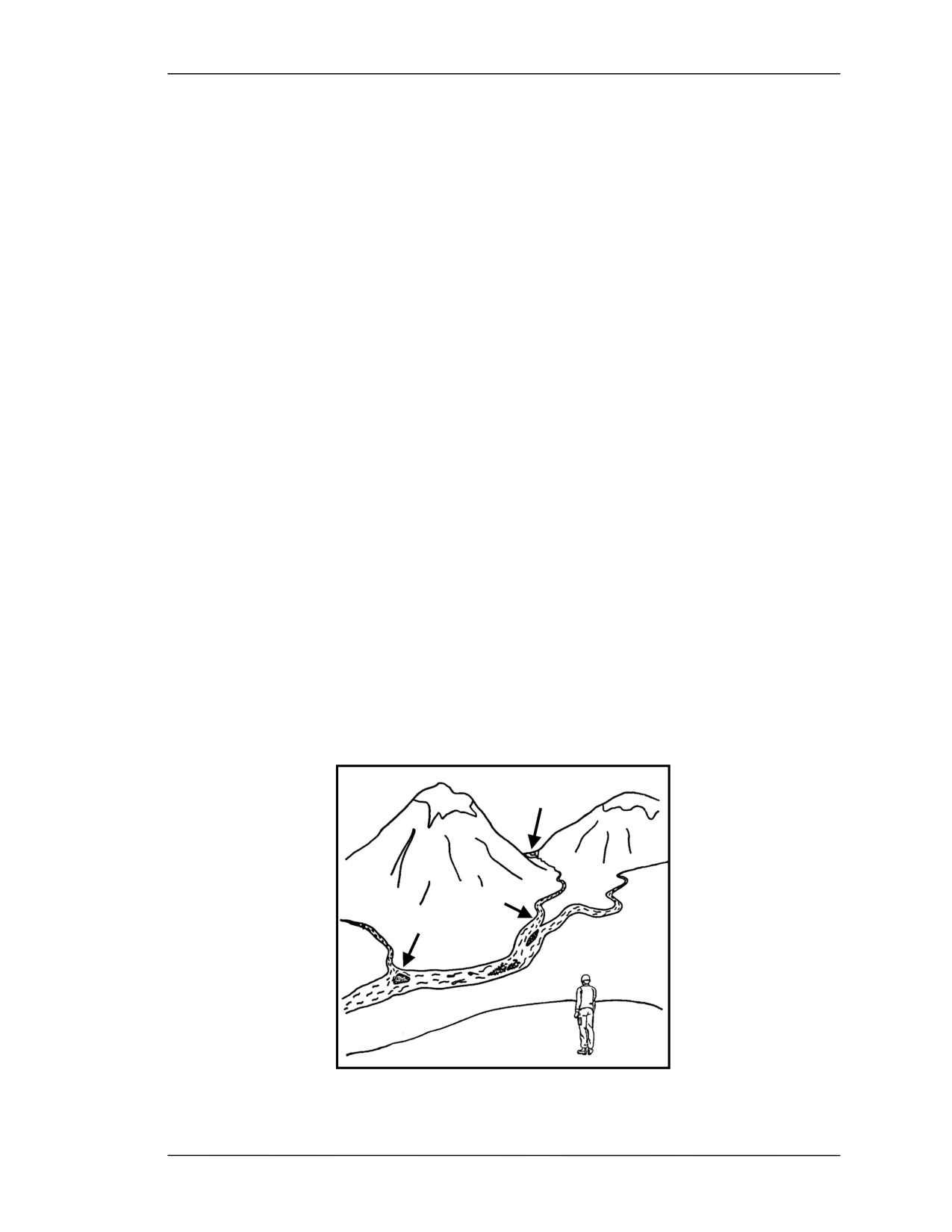
a. Site selection is extremely important once you determine that you must make a
crossing (Figure 9-1). Look for a high place from which you can get a good view of the
obstacle and possible crossing sites. A distant view, perhaps from a ridge, is sometimes
better than a hundred close views from a riverbank. Site selection must be made before
the arrival of the main body.
Figure 9-1. Normal locations of shallowest water and safest crossing sites.
9-1
FM 3-97.61
b. A dry crossing on fallen timber or log jams is preferable to attempting a wet
crossing. Depending upon the time of year, the closer you are to the source, or
headwaters, the better your chances are of finding a natural snow or ice bridge for
crossing. If a dry crossing is unavailable, the following considerations should be made:
(1) The time of day the crossing can be an important factor. Although early morning
is generally best because the water level is normally lower during this period, recent
weather is a big factor; there may have been heavy rain in the last eight hours. As
glaciers, snow, or ice melt during the day, the rivers rise, reaching their maximum height
between mid afternoon and late evening, depending on the distance from the source.
Crossings, if made during the early morning, will also allow clothing to dry more quickly
during the heat of the day.
(2) A crossing point should normally be chosen at the widest, and thus shallowest,
point of the river or stream. Sharp bends in the river should be avoided since the water is
likely to be deep and have a strong current on the outside of the bend. Crossings will be
easiest on a smooth, firm bottom. Large rocks and boulders provide poor footing and
cause a great deal of turbulence in the water.
(3) Many mountain streams, especially those which are fed by glacier run-off, contain
sections with numerous channels. It is often easier to select a route through these braided
sections rather than trying to cross one main channel. A drawback to crossing these
braided channels, however, is the greater distance to the far bank may increase exposure
time and often the sand and gravel bars between the channels will offer little cover or
concealment, if any.
(4) The crossing site should have low enough banks on the near and far side to allow
a man carrying equipment to enter and exit the stream with relative ease. If a handline or
rope bridge is to be constructed, the crossing site should have suitable anchors on the near
and far bank, along with safe loading and unloading areas. Natural anchors are not a
necessity, however the time required to find a site with solid natural anchors will
probably be less than the time required to construct artificial anchors. In some areas,
above the tree line for example, artificial anchors may have to be constructed. Deadman
anchors buried in the ground, or under a large pile of boulders work well.
(5) Log jams and other large obstructions present their own hazards. Logs floating
downstream will generally get hung up in shallower sections creating the jam. Once a log
jam is formed, however, the water forced to flow around it will erode the stream bottom.
Eventually deep drop-offs or holes may develop, especially around the sides and off the
downstream end of the log jam. A log jam that totally bridges a section of the stream may
be the best way to cross. A wet crossing in the vicinity of a log jam should be performed
a good distance below or above it. Some things to consider when crossing near log
jams are:
• Cross well to the downstream side when possible.
• Keep a sharp lookout for floating timber that could knock you off your feet.
• If you must cross on the upstream side, stay well upstream from the log jam.
If a person is swept off his feet and caught in the debris of the jam, he could
easily drown. A handline will greatly increase safety here.
(6) When possible, select a crossing site that has enough natural protection on the
near and far banks so that security teams may be placed out and enough cover and
concealment is available for the size of the element making the crossing. When cover and
9-2
FM 3-97.61
concealment is minimal, as in the higher alpine zones, the crossings must be conducted as
efficiently as possible to minimize exposure to enemy observation.
9-2.
PREPARATION OF TROOPS AND EQUIPMENT
Prepare men and equipment for a crossing as far in advance as feasible. Final preparation
should be completed in a security perimeter on the near side just before crossing.
Preparation includes the following.
a. Waterproof water-sensitive items. Wrap radios, binoculars, SOI, papers, maps and
any extra clothing in waterproof bags (trash bags also work well), if available. These bags
also provide additional buoyancy in case of a fall.
b. Trousers are unbloused and shirts are pulled out of the trousers. All pockets are
buttoned. This allows water to escape through the clothing. Otherwise the clothing would
fill up and retain water, which would weigh the body down. This is especially critical if
an individual must swim to shore. Depending on the circumstances of the crossing (for
example, tactical situation, temperature of the air and water), the crossing can be made in
minimal clothing so that dry clothing is available after the crossing. Boots should be
worn to protect feet from rocks; however, socks and inner soles should be removed. On
the far side, the boots can be drained and dry socks replaced.
c. Load-carrying equipment harness and load-bearing vest (LBV) is unbuckled and
worn loosely. It is extremely difficult to remove a buckled harness in the water in an
emergency.
d. Helmets are normally removed and placed in the rucksack in slow moving
streams with sandy or gravel bottoms. If you have to resort to swimming it is easier done
without the helmet. However, when crossing swift flowing streams, especially those with
large rocks and other debris, the risk of head injury if a person slips is high. In this case
the helmet should be worn with the chinstrap fastened.
e. The rucksack should be worn well up on the shoulders and snug enough so it does
not flop around and cause you to lose your balance. The waist strap MUST be unbuckled
so you can get rid of the pack quickly if you are swept off your feet and have to resort to
swimming. If a pack has a chest strap it must also be unbuckled. Secure everything well
within your pack. It is easier to find one large pack than to find several smaller items.
f. Individual weapons should be attached to the pack or slung over the shoulder.
9-3.
INDIVIDUAL CROSSINGS
Whenever possible, and when the degree of experience permits, streams should be forded
individually for a speedier crossing. The average soldier should be able to cross most
streams with mild to moderate currents and water depths of not much more than knee
deep using proper techniques.
a. The individual should generally face upstream and slightly sideways, leaning
slightly into the current to help maintain balance. At times, he may choose to face more
sideways as this will reduce the surface area of the body against the current, thus
reducing the current’s overall force on the individual.
b. The feet should be shuffled along the bottom rather than lifted, with the
downstream foot normally in the lead. He should take short, deliberate steps. Lunging
steps and crossing the feet result in a momentary loss of balance and greatly increase the
chance of a slip.
9-3
FM 3-97.61
c. The individual should normally cross at a slight downstream angle so as not to
fight the current. There is normally less chance of a slip when stepping off with the
current as opposed to stepping off against the current.
d. The individual must constantly feel for obstacles, holes and drop-offs with the
lead foot and adjust his route accordingly. If an obstacle is encountered, the feet should
be placed on the upstream side of it where the turbulence is less severe and the water
normally shallower.
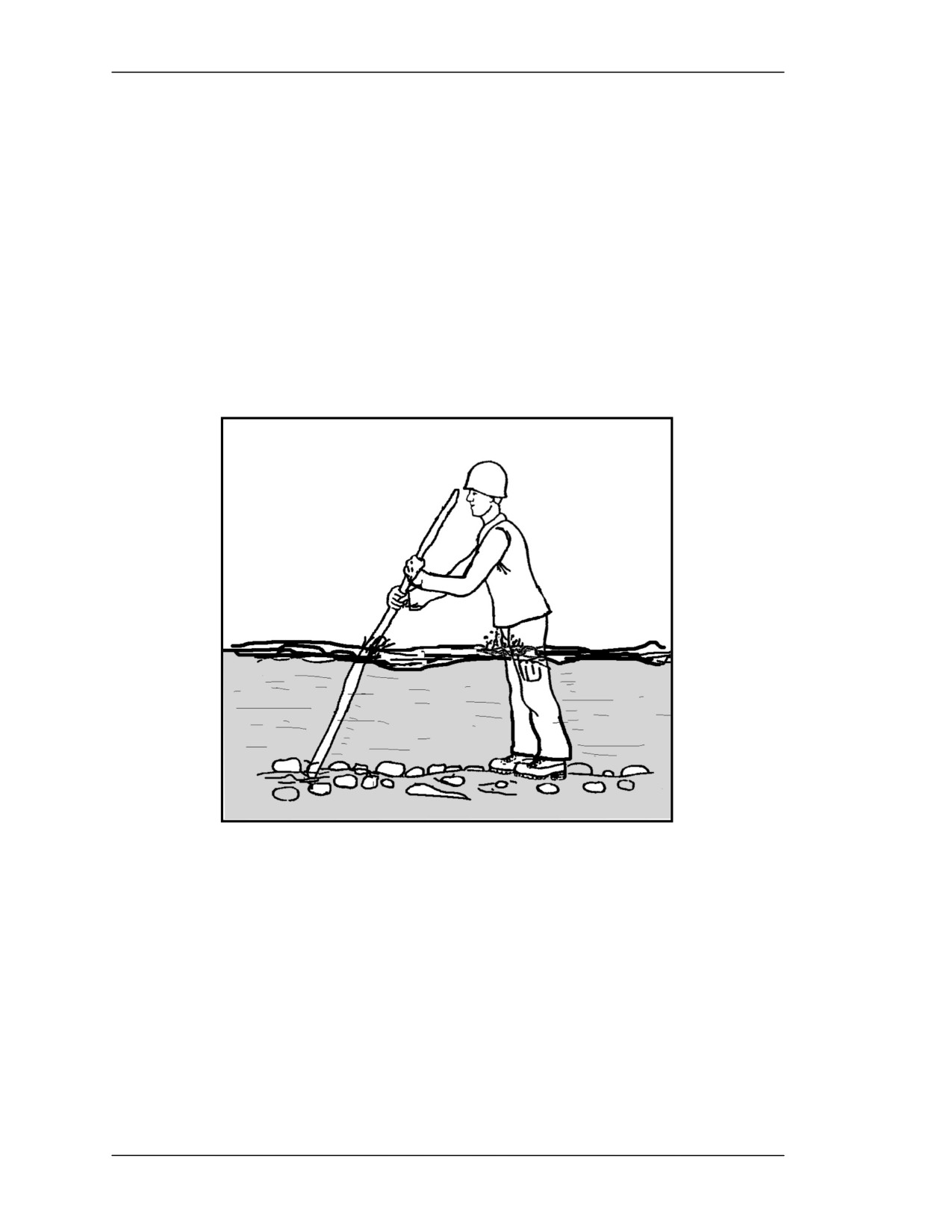
e. To increase balance, and if available, a long ice ax, sturdy tree limb, or other staff
can be used to give the individual a third point of contact (Figure 9-2). The staff should
be used on the upstream side of the individual and slightly leaned upon for support. The
staff should be moved first, then the feet shuffled forward to it. This allows two points of
contact to be maintained with the streambed at all times. The individual still moves at a
downstream angle with the downstream foot in the lead.
Figure 9-2. Individual crossing with staff.
9-4.
TEAM CROSSING
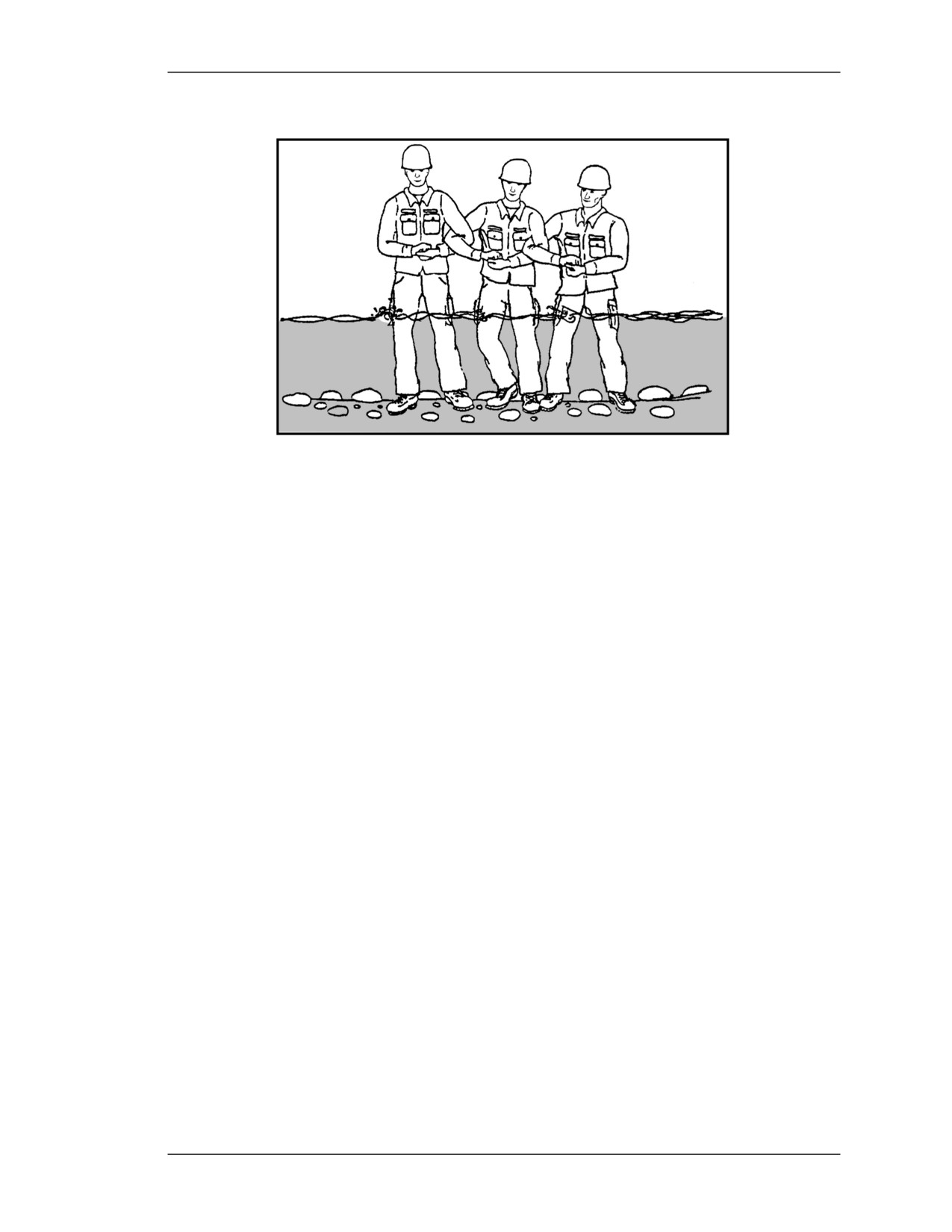
When the water level begins to reach thigh deep, or anytime the current is too swift for
personnel to safely perform an individual crossing, a team crossing may be used. For
chain crossing, two or more individuals cross arms with each other and lock their hands
in front of themselves (Figure 9-3). The line formed faces the far bank. The largest
individual should be on the upstream end of the line to break the current for the group.
The line formed will then move across the stream using the same principles as for
individual crossings, but with the added support of each other. The line should cross
parallel to the direction of the current. The team still moves at a slight downstream angle,
stepping off with the downstream foot in the lead.
9-4
FM 3-97.61
Figure 9-3. Chain method for stream crossing.
9-5.
ROPE INSTALLATIONS
When the water level begins to reach waist deep or the current is too swift for even a
team crossing, the chosen site must be closely examined. The stream at this point may be
impassable. Many times though, a crossing site which may be unsafe for individual or
team crossings can be made safe with the installation of a handline or rope bridge.
Crossing on a handline will still require each individual to enter the water and get wet. If
a one-rope bridge can be constructed, it may require only a couple of individuals to enter
the water. Deciding whether to install a handline or a rope bridge will depend on the
anchors available, height of the anchors above the water, and the distance from the near
and far anchors. The maximum distance a one-rope bridge is capable of spanning is
approximately 1/2 to 2/3 the length of the rope in use.
a. Establishing the Far Anchor. Whether a handline or rope bridge is to be
installed, someone must cross the stream with one end of the rope and anchor it on the far
side. This duty should be performed by the most capable and strongest swimmer in the
party. The swimmer should be belayed across for his own safety. The belay position
should be placed as far above the crossing as possible. In the event that the current is too
strong for the individual, he will pendulum back to the near bank. Rescuers should be
poised on the near bank at points where the individual will pendulum back, should he fail
to reach the far bank. The initial crossing site should be free of obstacles that would snag
the rope and prevent the pendulum back to the bank for an easy recovery.
(1) The individual may attach the belay rope to his seat harness or a swami belt with a
carabiner. He should NEVER tie directly into the rope when being belayed for a stream
crossing. If the swimmer should be swept away and become tangled, he must be able to
release himself quickly from the rope and swim to shore as best he can. The individual
may also choose to tie a fixed loop into the end of the belay rope and hang on to it, where
he can immediately release it in an emergency.
(2) Anytime a crossing site must be used where the swimmer may encounter
problems getting to the far bank, he should have on a life vest or other personal flotation
9-5
FM 3-97.61
device (PFD). If the swimmer must release the rope at any time, he will have to rely on
his own water survival skills and swimming ability to get to shore. A PFD will greatly
increase his own personal safety. A PFD may also be used by the last man across, as he
will release the rope from the anchor and be belayed across as the first man
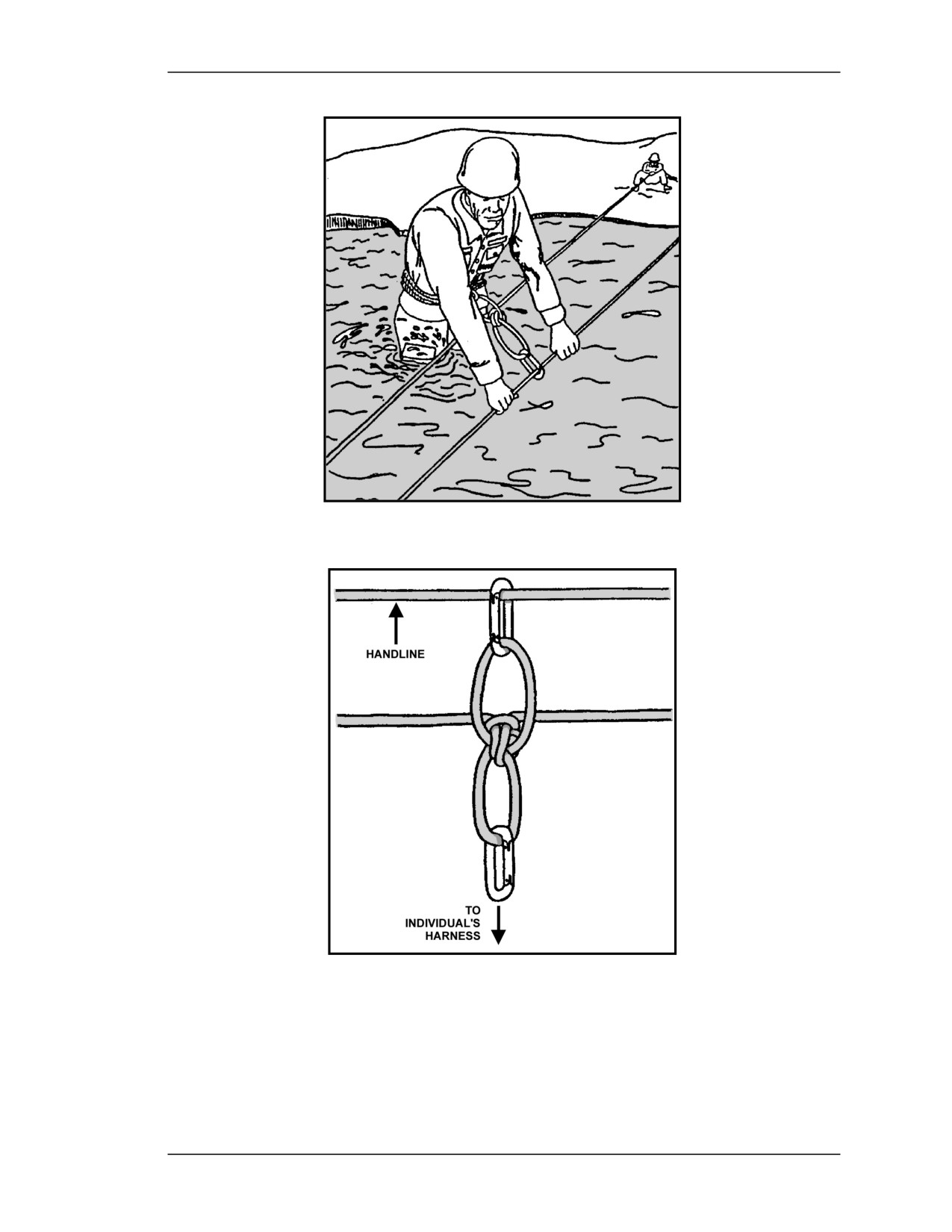
b. Installation of a Handline. If it is possible to use a rope high enough above the
water to enable soldiers to perform a dry crossing, then a rope bridge should be installed
as such. If this is impossible, and the rope must be installed to assist in a wet crossing,
then it should be installed as a handline (Figure 9-4).
(1) The far anchor should be downstream from the near anchor so that the rope will
run at an angle downstream from the near anchor, approximately thirty to forty-five
degrees, rather than straight across the stream. Here again, it is easier to move with the
current as opposed to directly across or against it.
(2) The rope may be anchored immediately on the far bank, pulled tight, and
anchored on the near bank, or it may be installed with a transport tightening system if a
tighter rope is required.
(3) Crossing will always be performed on the downstream side of the handline,
shuffling the feet with the downstream foot in the lead.
(4) A second climbing rope is used as a belay (Figure 9-5). One end of the belay rope
will be on the near bank and the other end on the far bank. It should be sent across with
the strong-swimmer. An appropriate knot is tied into the middle of the belay rope to form
two fixed loops with each loop being approximately 6 inches long. One loop is connected
to the handline with carabiner(s) and the individual crossing connects one loop to
himself. The loops are short enough so the individual is always within arms reach of the
handline should he slip and let go. The individuals are belayed from both the near and far
banks. If a mishap should occur the individual can be retrieved from either shore,
whichever appears easiest. The belay on the opposite shore can be released allowing the
individual to pendulum to the bank. It is important that the belay rope NOT be anchored
or tied to the belayer so that it may be quickly released if necessary.
9-6
FM 3-97.61
Figure 9-4. Stream crossing using a handline.
Figure 9-5. Belay rope for crossing using a handline.
(5) Under most circumstances, the handline should be crossed one person at a time.
This keeps rope stretch and load on the anchors to a minimum.
(6) Rucksacks can be either carried on the back the same way as for individual
crossings, or they can be attached to the handline and pulled along behind the individual.
9-7
FM 3-97.61
(7) If a large amount of equipment must be moved across the stream, especially
heavier weapons, such as mortars, recoilless rifles, and so on, then a site should be
selected to install a rope bridge.
9-6.
SAFETY
River and stream crossings present one of the most hazardous situations faced by the
military mountaineer. The following safety procedures are minimum guidelines that
should be followed when conducting a river or stream crossing.
a. All weak and nonswimmers should be identified before a crossing so that stronger
swimmers may give assistance in crossing.
b. Not every river or stream can be crossed safely. It is always possible to cross at a
different time or place, use a different technique, or choose another route.
c. The technique used is directly dependent upon water depth, speed of the current,
stream bottom configuration, width of the stream, and individual experience.
d. The safest methods of crossing are always with the use of a handline or one-rope
bridge.
e. If the installation of a handline or rope bridge becomes too difficult at a given
crossing site, then that site should be considered too hazardous and another site selected.
f. A lookout should be posted 50 to 100 meters upstream to watch for any obstacles
that may be carried downstream and interfere with the crossing.
g. When conducting individual crossings (those without a handline or rope bridge),
lifeguards should be posted downstream with poles or ropes prepared to throw, for
assistance or rescue.
h. When the unit knows a rope installation will be required for crossing, at least two
life vests or other PFDs should be on hand to provide additional safety for the strong
swimmer who must establish the far anchor, and the last man across who retrieves the
system.
9-7.
SWIMMING
There are times when you might be alone and have no choice but to swim across, or there
may be a time that you find yourself suddenly plunged into a swift river or rapids. In
either case, the following techniques could save your life.
a. Immediately jettison any equipment or clothing that restricts movement.
b. Do not try to fight the current. Maneuver towards shore in a position with the feet
downstream, facing downstream, and fanning the hands alongside the body to add
buoyancy and to fend off submerged rocks. Use the feet to protect the rest of the body
and to fend off submerged rocks.
c. Keep the head above water to observe for obstacles and attempt to maneuver
away from them.
d. Try to avoid backwater eddies and converging currents as they often contain
dangerous swirls. Avoid bubbly water under falls as it has little buoyancy. Breath
between the wave troughs.
e. If the shore is too difficult to reach, seek out the closest and safest spot, such as a
sandbar, to get yourself out of the water as quickly as possible. Hypothermia will set in
quickly in colder waters.
9-8
FM 3-97.61(TC 90-6-1)
CHAPTER 10
MOVEMENT OVER SNOW AND ICE
Movement over snow- and ice-covered slopes presents its own unique
problems. Movement on steeper slopes requires an ice ax, crampons, and
the necessary training for this equipment. Personnel will also have to
learn how to place solid anchors in snow and ice to protect themselves
during these movements if roped. Snow-covered glaciers present crevasse
fall hazards even when the slope is relatively flat, requiring personnel to
learn unique glacier travel and crevasse rescue techniques.
All the principles of rock climbing, anchor placement, belays, and
rope usage discussed throughout the previous chapters apply to snow and
ice climbing as well. This chapter will focus on the additional skills and
techniques required to move safely through snow-covered mountains and
over glaciated terrain.
10-1. MOVEMENT OVER SNOW
The military mountaineer must be equally adept on both snow and ice due to route
necessity and rapidly changing conditions. On steep slopes in deep snow, the climber
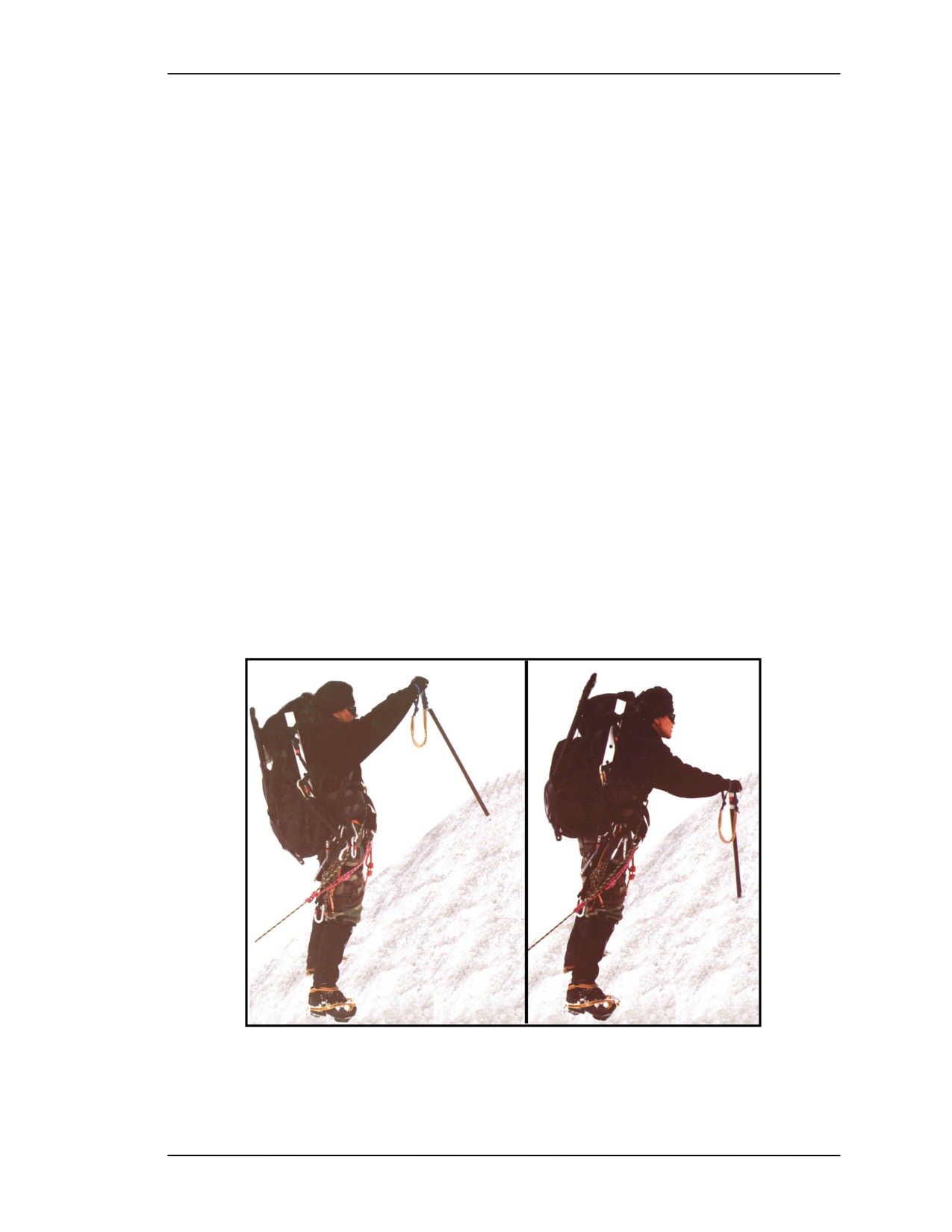
may climb straight up facing the slope. The ice ax shaft, driven directly into the snow,
provides a quick and effective self-belay in case of a slip—the deeper the shaft penetrates
the snow, the better the anchor (Figure 10-1). It is usually best, however, to climb snow-
covered slopes in a traversing fashion in order to conserve energy, unless there is
significant avalanche danger.
Figure 10-1. Self-belay on snow.
10-1
FM 3-97.61
a. The progression from walking on flat terrain to moving on steep terrain is the
same as for moving over snow-free terrain. If the snow is packed the sole of the boot will
generally hold by kicking steps, even on steep slopes. Where it is difficult to make an
effective step with the boot, a cut made with the adze of the ice ax creates an effective
step. In these situations crampons should be used for faster and easier movement.
b. When descending on snow, one can usually come straight downhill, even on steep
terrain. Movement downhill should be slow and deliberate with the climber using an even
pace. The heels should be kicked vigorously into the snow. The body may be kept erect
with the aid of an ice ax, which may be jammed into the snow at each step for additional
safety. Here again, crampons or step cutting may be necessary. A technique known as
glissading may also be used as an easy method of descent and is covered in detail later in
this chapter.
10-2. MOVEMENT OVER ICE
Ice is found in many areas of mountains when snow is present, and during the summer
months also where perennial snowpack exists. Many times an ice area will be downslope
of a snowfield and sometimes the ice pack itself will be lightly covered with snow. Even
if using an ice ax and or crampons, movement will still be difficult without proper
training.
10-3. USE OF ICE AX AND CRAMPONS
Movement over snow and ice is almost impossible without an ice ax and or crampons.
a. Ice Ax. When walking on snow or ice, the ice ax can be used as a third point of
contact. When the terrain steepens, there are a number of ways to use the ice ax for snow
or ice climbing. Some positions are more effective than others, depending on the intended
result. You may find other ways to hold and use the ax, as long the security remains in
effect.
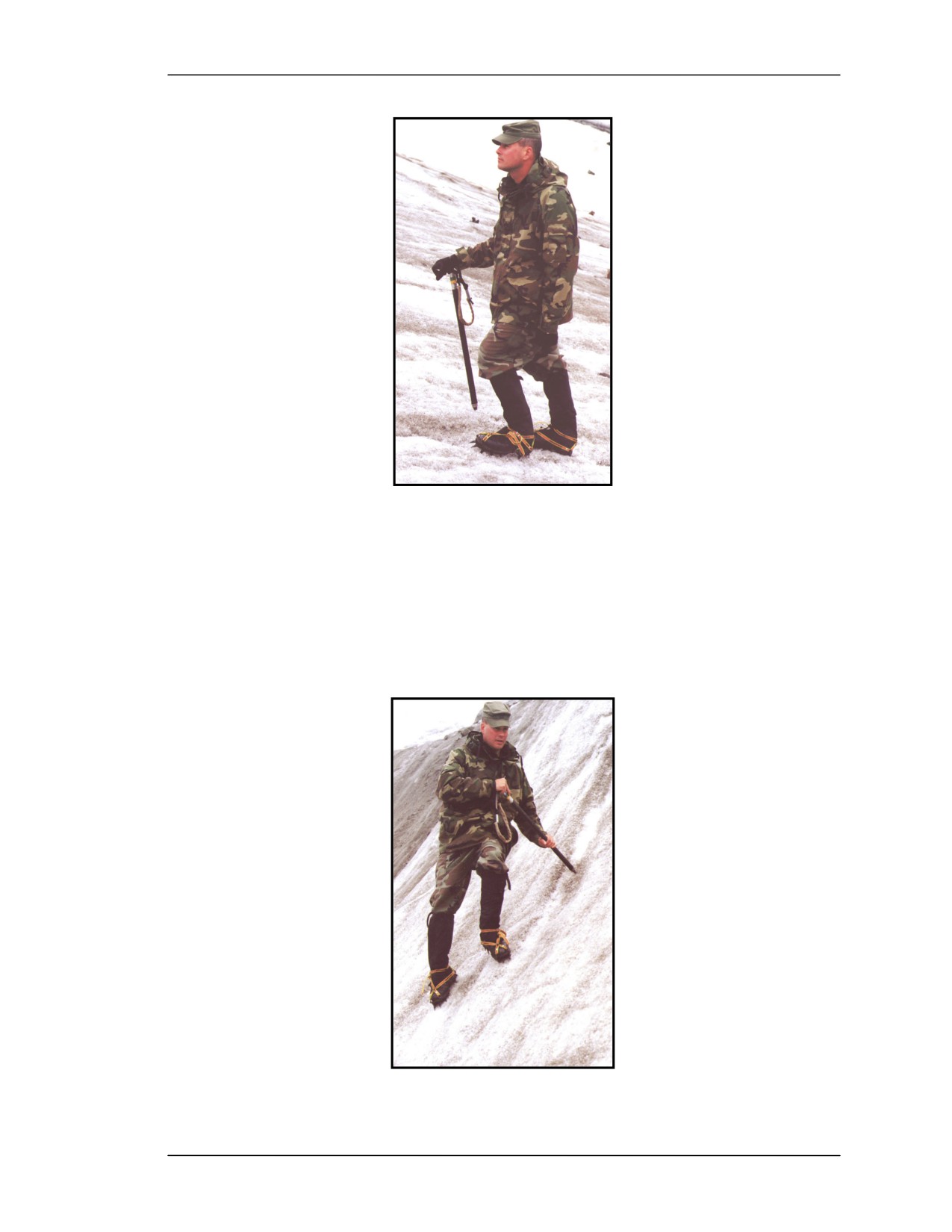
(1) Cane Position. The ice ax can be used on gentle slopes as a walking stick or cane
(Figure 10-2). The ax is held by the head with the spike down and the pick facing to the
rear in preparation for self-arrest. When moving up or down gentle slopes the ice ax is
placed in front as the third point of contact, and the climber moves toward it. When
traversing, the ax is held on the uphill side, in preparation for a self-arrest.
10-2
FM 3-97.61
Figure 10-2. Using the ice ax in the cane position.
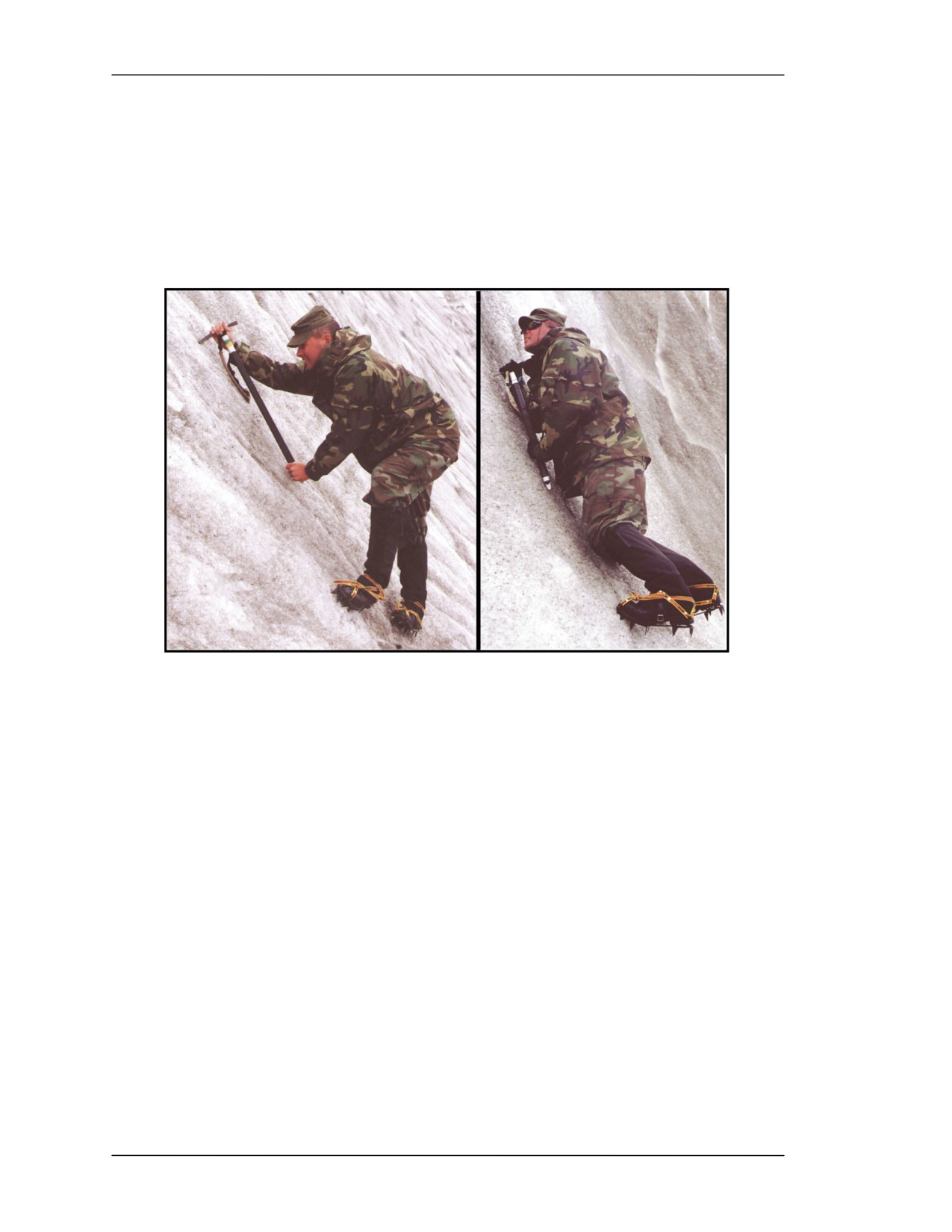
(2) Cross Body Position or Port Arms Position. On steeper slopes the ax can be used
in the port arms position, or cross body position (Figure 10-3). It is carried across the
chest, upslope hand on the shaft, spike towards the slope. The head of the ax is held away
from the slope with the pick to the rear in preparation for self-arrest. Ensure the leash is
connected to the upslope hand, which allows the ax to be used in the hammer position on
the upslope side of the climber. The spike, in this case, is used as an aid for maintaining
balance.
Figure 10-3. Ice ax in the cross body or port arms position.
10-3
FM 3-97.61
(3) Anchor Position. As the slope continues to steepen, the ax may be used in the
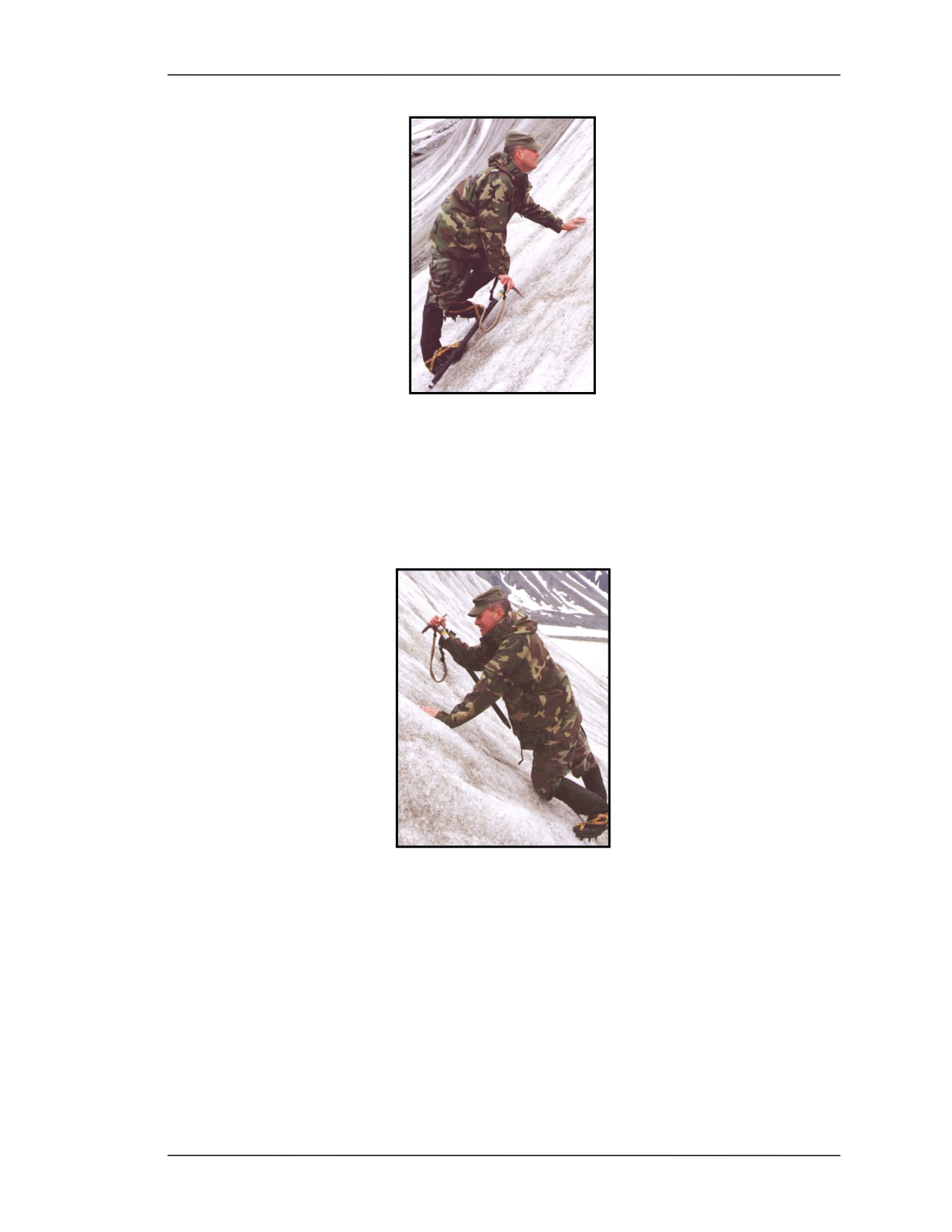
anchor position (Figure 10-4). The head is held in the upslope hand and the pick is driven
into the slope. The spike is held in the downhill hand and pulled slightly away from the
slope to increase the “bite” of the pick into the ice. If the climber is wearing a harness, the
pick can be deeply inserted in the ice or hard snow and the ax leash could be connected to
the tie-in point on the harness for an anchor (ensure the ax is placed for the intended
direction of pull).
Figure 10-4. Ice ax in the anchor position.
(4) Push-Hold Position. Another variation on steep slopes is the push-hold position
(Figure 10-5). The hand is placed on the shaft of the ax just below the head with the pick
forward. The pick is driven into the slope at shoulder height. The hand is then placed on
the top of the ax head for use as a handhold.
10-4
FM 3-97.61
Figure 10-5. Ice ax in the push-hold position.
(5) Dagger Position. The dagger position is used on steep slopes to place a handhold
above shoulder height (Figure 10-6). The hand grasps the head of the ax with the pick
forward and the shaft hanging down. The ax is driven into the surface in a stabbing
action. The hand is then placed on the ax head for use as a handhold.
Figure 10-6. Ice ax in the dagger position.
(6) Hammer Position. The hammer position will set the pick deepest in any snow or
ice condition (Figure 10-7, page 10-6). The ax is used like a hammer with the pick being
driven into the slope. On vertical or near-vertical sections, two axes used in the hammer
position will often be required.
10-5
FM 3-97.61
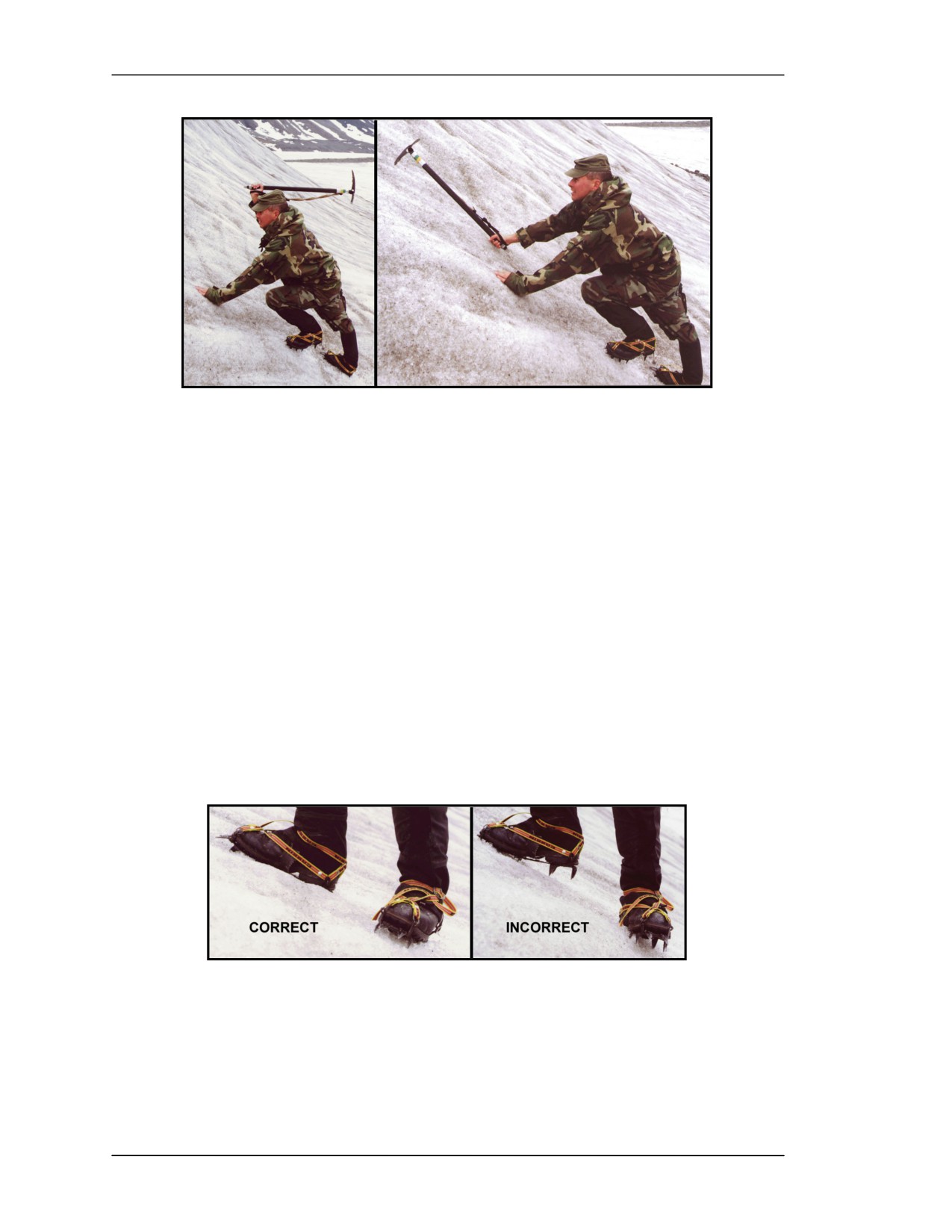
Figure 10-7. Ice ax in the hammer position.
b. Crampons. Walking in crampons is not complicated but it does present
difficulties. When walking in crampons, the same principles are used as in mountain
walking, except that when a leg is advanced it is swung in a slight arc around the fixed
foot to avoid locking the crampons or catching them in clothing or flesh. The trousers
should be bloused to prevent catching on crampons. All straps should be secured to
prevent stepping on them and, potentially, causing a fall. The buckles should be located
on the outside of each foot when the crampons are secured to prevent snagging.
Remember, when the crampon snags on the pants or boots, a tear or cut usually results,
and sometimes involves the skin on your leg and or a serious fall.
(1) Two methods of ascent are used on slopes: traversing and straight up.
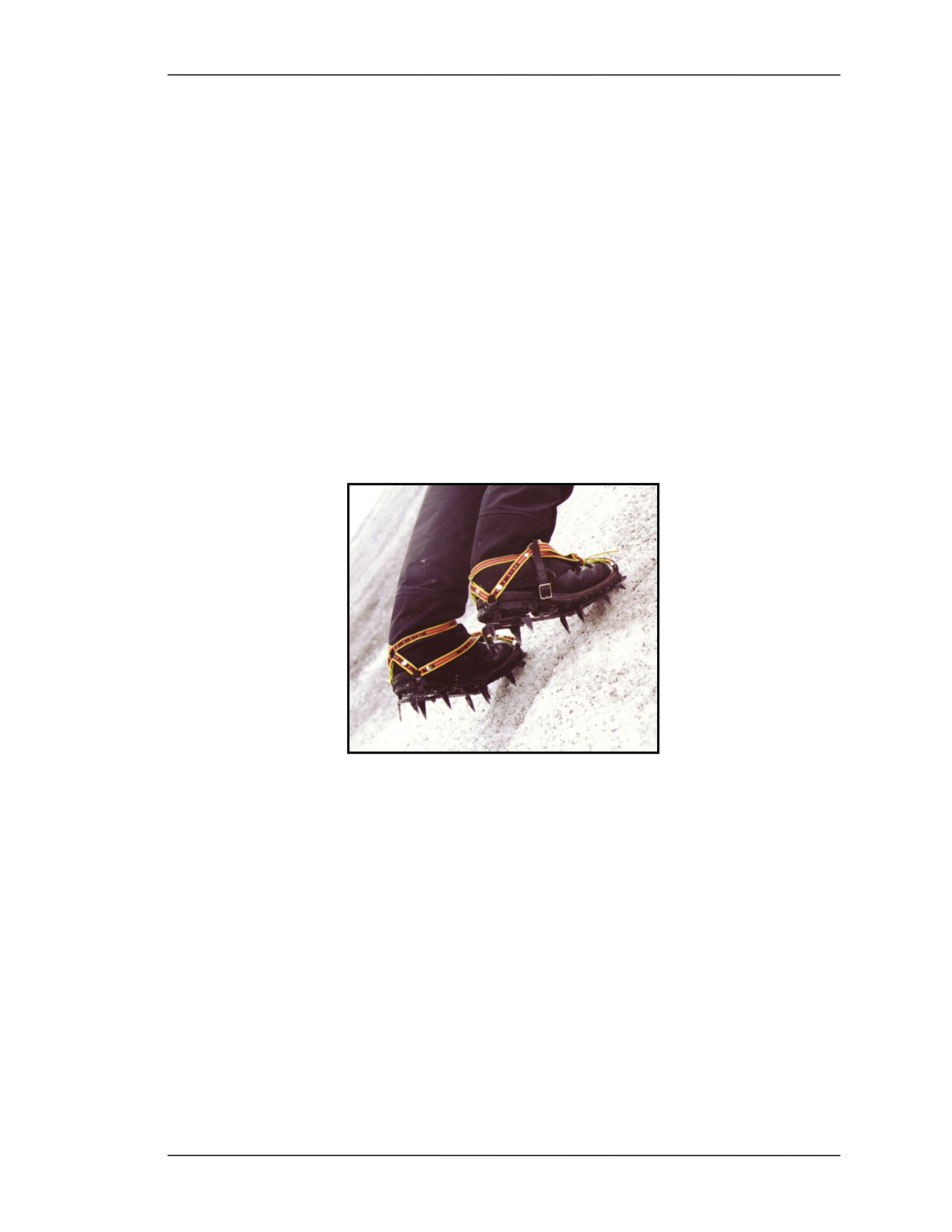
(a) A traverse on ice or snow looks much like any mountain walking traverse, except
that the ankles are rolled so that the crampons are placed flat on the surface (Figure 10-8).
On snow the points penetrate easily; on ice the foot must be pressed or stamped firmly to
obtain maximum penetration. At the turning points of a traverse, direction is changed
with the uphill foot as in mountain walking.
Figure 10-8. Correct and incorrect crampon technique.
(b) A straight up method is for relatively short pitches, since it is more tiring than a
traverse. The climber faces directly up the slope and walks straight uphill. As the slope
steepens, the herringbone step is used to maintain the flatfoot technique. For short steep
pitches, the climber may also face downslope, squatting so the legs almost form a
10-6
FM 3-97.61
90-degree angle at the knees, driving the spike of the ice ax into the slope at hip level,
and then moving the feet up to the ax. By repeating these steps, the ax and crampon
combination can be used to climb short, steep pitches without resorting to step cutting.
This method can be tiring. The technique is similar to the crab position used for climbing
on slab rock and can also be used for short descents.
(2) A technique known as “front-pointing” may be used for moving straight uphill
(Figure 10-9). It is especially useful on steep terrain, in combination with the ice ax in the
push-hold, dagger, or hammer position. Front-pointing is easiest with the use of more
rigid mountain boots and rigid crampons. The technique is similar to doing calf raises on
the tips of the toes and is much more tiring than flat-footing.
(a) The technique starts with the feet approximately shoulder width apart. When a
step is taken the climber places the front points of the crampons into the ice with the toe
of the boot pointing straight into the slope.
(b) When the front points have bitten into the ice the heel of the boot is lowered
slightly so that the first set of vertical points can also bite. The body is kept erect, with the
weight centered over the feet as in climbing on rock.
Figure 10-9. Front-pointing with crampons.
c. Vertical Ice. When a climb on ice reaches the 60- to 70-degree angle, two ice
axes may be helpful, and will become necessary as the angle approaches 90 degrees. The
same basic climbing techniques described in Chapter 6 should be applied. If leashes of
the correct length and fit are attached to both axes, it may be possible to hang completely
from the axes while moving the feet.
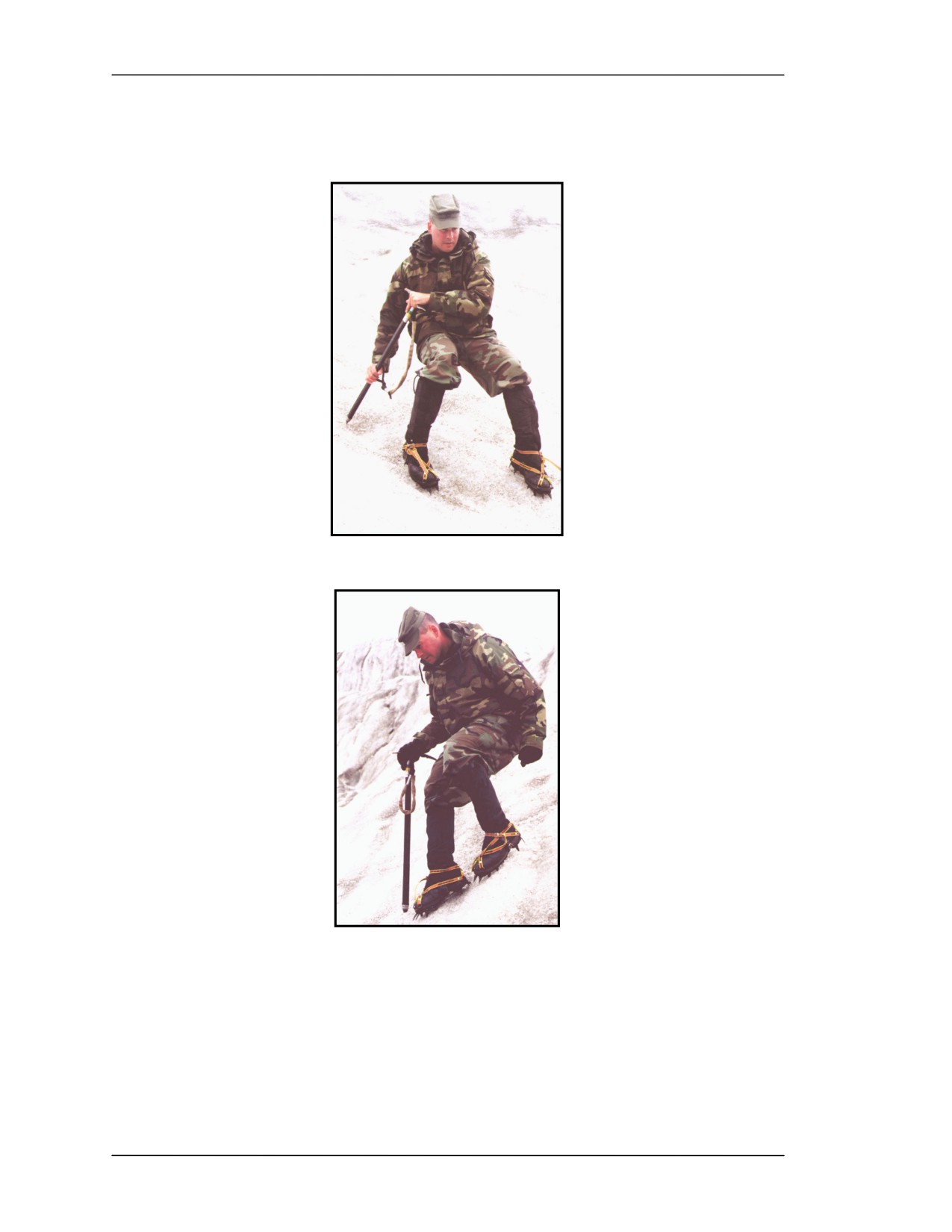
d. Descending with Crampons and Ice Ax. Whenever possible, descend straight
down the fall line. As the slope steepens, gradually turn sideways; on steeper slopes, bend
at the waist and knees as if sitting, keeping the feet flat to engage all vertical crampon
points and keep the weight over the feet as in descending rock slab (Figures 10-10 and
10-11, page 10-8). On steep terrain, assume a cross body or port arms position with the
ax, and traverse. The crab position or front-pointing may also be used for descending.
Regardless of the technique used, always ensure the points of the crampons are inserted
10-7
FM 3-97.61
in the snow or ice and take short, deliberate steps to minimize the chance of tripping and
falling down the slope.
Figure 10-10. Flat-footing in the crab position.
Figure 10-11. Use of ice ax in descent.
e. Normal Progression. The use of the ice ax and crampons follows a simple,
logical progression. The techniques can be used in any combination, dictated by the
terrain and skill of the individual. A typical progression could be as follows:
(1) Crampons. Use crampons in the following situations:
• Walking as on flat ground.
10-8
FM 3-97.61
• Herringbone step straight up the slope.
• Traverse with feet flat.
• Backing up the slope (crab position).
• Front-pointing.
(2) Ice Ax. Use the ice ax in these situations:
• Cane position on flat ground.
• Cane position on uphill side as slope steepens.
• Port arms position with spike on uphill side.
• Anchor position with pick on uphill side.
• Push-hold position using front-pointing technique.
• Dagger position using front-pointing technique.
• Hammer position using front-pointing technique.
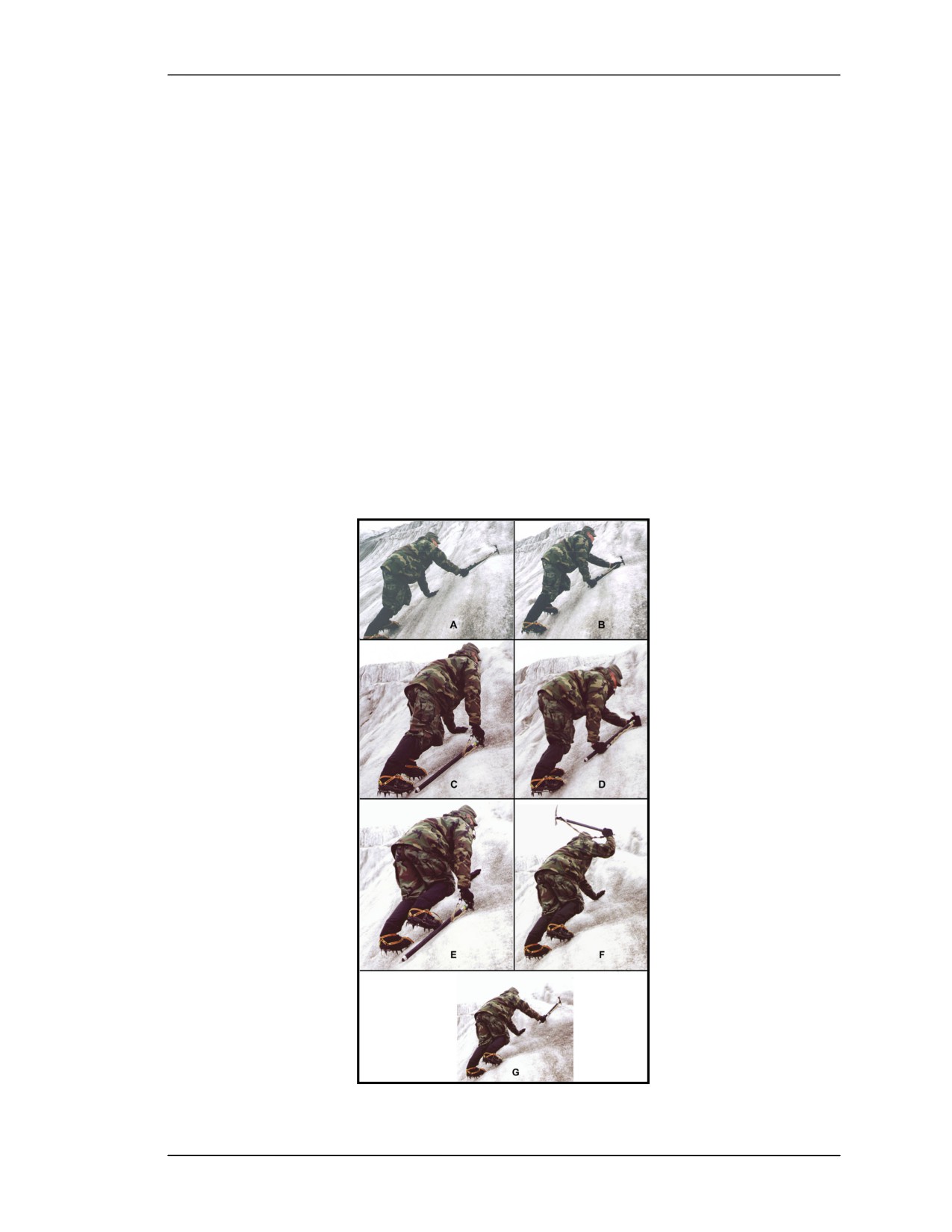
e. Climbing Sequence. Using most of these positions, a single ax can be “climbed”
in steps to move upslope on low-angle to near vertical terrain (Figure 10-12). Begin by
positioning the feet in a secure stance and placing the ax in the hammer position as high
as possible. Slowly and carefully move the feet to higher positions alternately, and move
the hand up the ax shaft. Repeat this until the hand is on top of the head of the ax.
Remove the ax and place it at a higher position and begin again.
Figure 10-12. Climbing sequence.
10-9
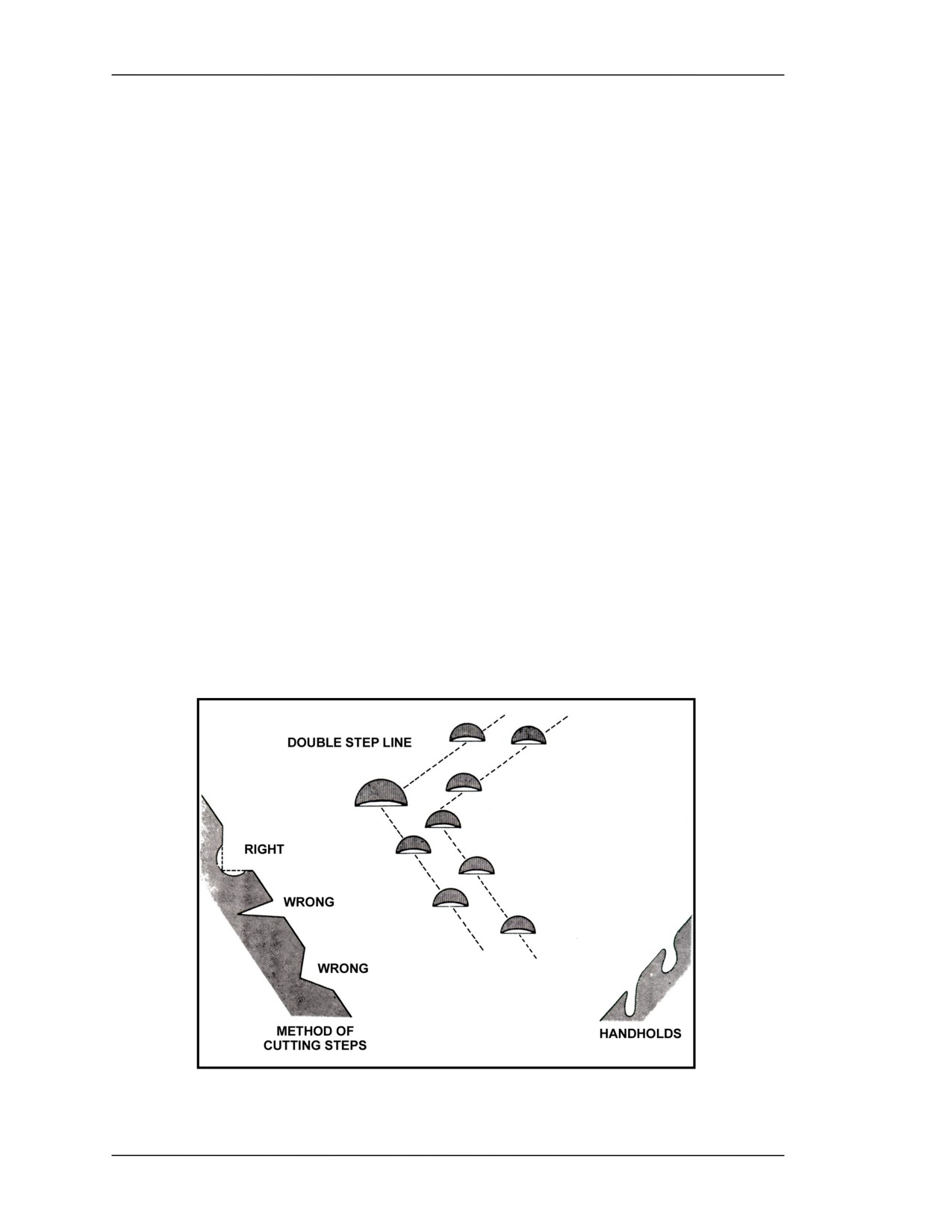
FM 3-97.61
f. Step Cutting. Step cutting is an extremely valuable technique that is a required
skill for any military mountaineer (Figure 10-13). Using cut steps can save valuable time
that would be spent in donning crampons for short stretches of ice and can, in some cases,
save the weight of the crampons altogether. Steps may also have to be cut by the lead
team to enable a unit without proper equipment to negotiate snow- or ice-covered terrain.
As units continue to move up areas where steps have been cut they should continue to
improve each step. In ascending, steps may be cut straight up the slope, although a
traverse will normally be adopted. In descending, a traverse is also the preferred method.
When changing direction, a step large enough for both feet and crampons must be made.
Once the step is formed, the adze is best used to further shape and clean the step.
(1) Snow. On slopes of firm snow and soft ice, steps may be cut by swinging the ax
in a near-vertical plane, using the inside corner of the adze for cutting. The step should be
fashioned so that it slopes slightly inward and is big enough to admit the entire foot.
Steps used for resting or for turning must be larger.
(2) Ice. Hard ice requires that the pick of the ax be used. Begin by directing a line of
blows at right angles to the slope to make a fracture line along the base of the intended
step. This technique will reduce the chance of an unwanted fracture in the ice breaking
out the entire step. Next, chop above the fracture line to fashion the step. When using the
pick it should be given an outward jerk as it is placed to prevent it from sticking in the
ice.
(3) Step Cutting in a Traverse. When cutting steps in a traverse, the preferred cutting
sequence is to cut one step at an arm’s length from the highest step already cut, then cut
one between those two. Cutting ahead one step then cutting an intermediate step keeps all
of the steps relatively close to one another and maintains a suitable interval that all
personnel can use.
(4) Handholds. If handholds are cut, they should be smaller than footholds, and
angled more.
Figure 10-13. Step cutting and handhold cutting.
10-10
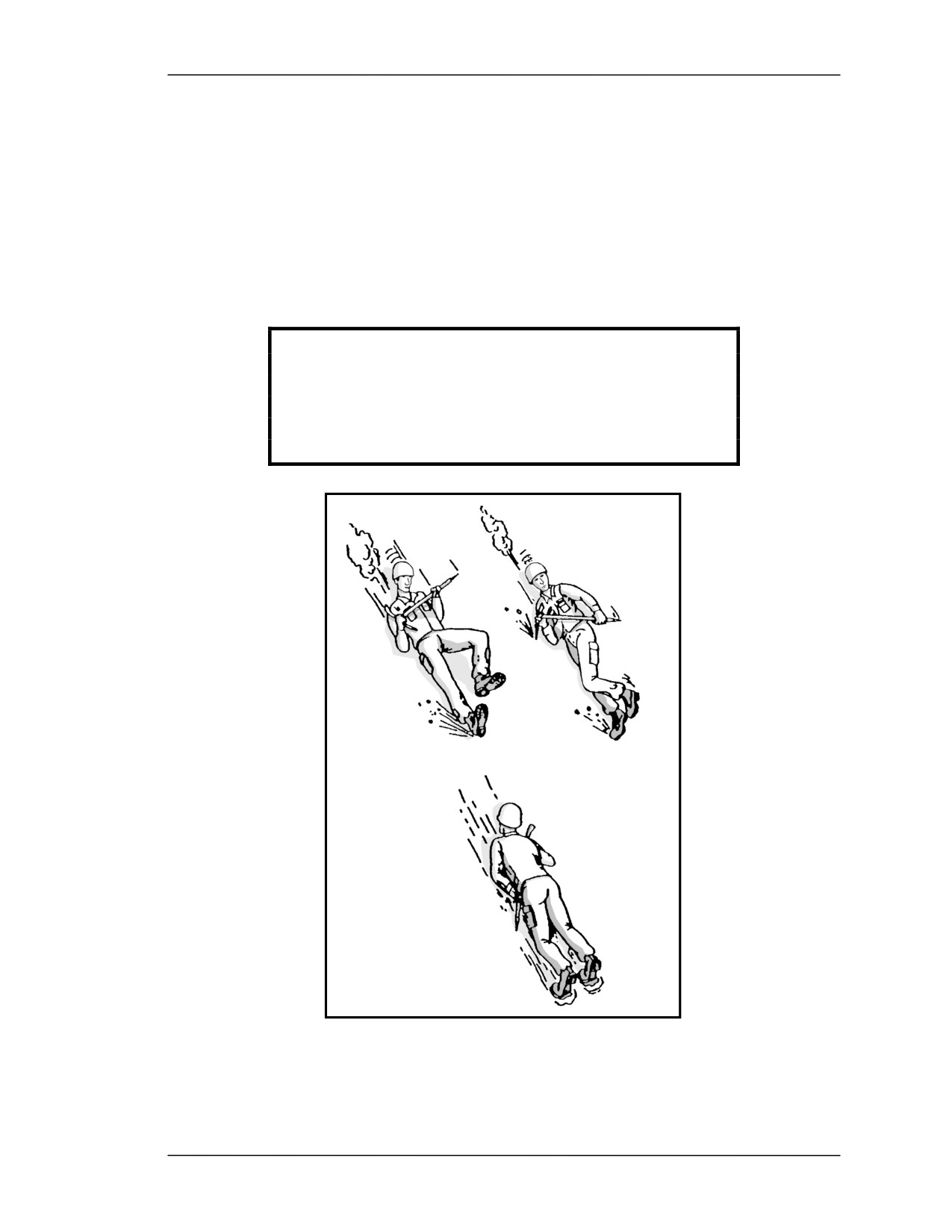
FM 3-97.61
g. Self-Arrest. The large number of climbers injured or killed while climbing on
snow and ice can be attributed to two major failings on the part of the climber: climbing
unroped, and a lack of knowledge and experience in the techniques necessary to stop, or
arrest, a fall (Figure 10-14). A climber should always carry an ice ax when climbing on
steep snow or ice; if a fall occurs, he must retain possession and control of his ice ax if he
is to successfully arrest the fall. During movement on steep ice, the ax pick will be in the
ice solidly before the body is moved, which should prevent a fall of any significance (this
is a self belay not a self-arrest).
CAUTION
Self-arrest requires the ax pick to gradually dig in to
slow the descent. Self-arrest is difficult on steep ice
because the ice ax pick instantly “bites” into the ice,
possibly resulting in either arm or shoulder injury, or
the ax is deflected immediately upon contact.
Figure 10-14. Self-arrest technique.
10-11
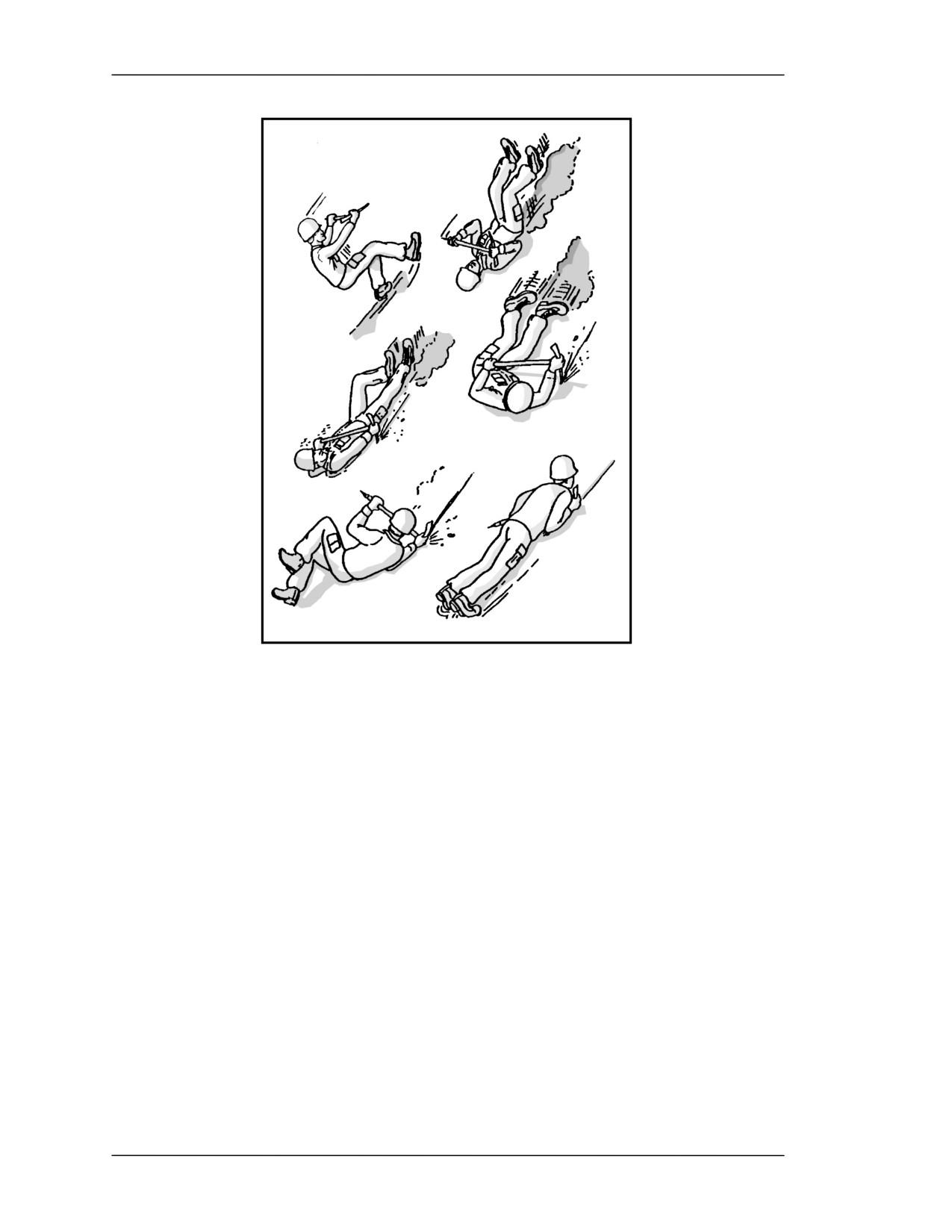
FM 3-97.61
Figure 10-14. Self-arrest technique (continued).
(1) A climber who has fallen may roll or spin; if this happens, the climber must first
gain control of his body, whether it is with his ice ax or simply by brute force. Once the
roll or spin has been controlled, the climber will find himself in one of four positions.
• Head upslope, stomach on the slope, and feet pointed downslope.
• Head upslope, back to the slope, and feet pointed downslope.
• Head downslope, stomach on the slope, and feet pointed upslope.
• Head downslope, back to the slope, and feet pointed upslope.
(2) To place the body in position to arrest from the four basic fall positions the
following must be accomplished.
(a) In the first position, the body is in proper relation to the slope for an arrest.
(b) In the second position, the body must first be rotated from face up to face down
on the slope. This is accomplished by rolling the body toward the head of the ax.
(c) In the third position, the pick of the ice ax is placed upslope and used as a pivot to
bring the body into proper position.
(d) In the fourth position, the head of the ax must be driven into the snow to the
climber’s side. This will cause the body to rotate into a head up, stomach down position.
(3) The final position when the arrest of the fall is completed should be with the head
upslope, stomach on the slope, with the feet pointed downslope. If crampons are not
10-12
FM 3-97.61
worn, the toe of the boots may be dug into the slope to help arrest the fall. The ax is held
diagonally across the chest, with the head of the ax by one shoulder and the spike near the
opposite hip. One hand grasps the head of the ax, with the pick pointed into the slope,
while the other hand is on the shaft near the spike, lifting up on it to prevent the spike
from digging into the slope.
Note: If crampons are worn, the feet must be raised to prevent the crampons from
digging into the snow or ice too quickly. This could cause the climber to tumble
and also, could severely injure his ankles and legs.
(4) When a fall occurs, the climber should immediately grasp the ax with both hands
and hold it firmly as described above. Once sufficient control of the body is attained, the
climber drives the pick of the ice ax into the slope, increasing the pressure until the fall is
arrested. Raising the spike end of the shaft increases the biting action of the pick. It is
critical that control of the ice ax be maintained at all times.
10-4. GLISSADING
Glissading is the intentional, controlled, rapid descent, or slide of a mountaineer down a
steep slope covered with snow (Figure 10-15, page 10-14). Glissading is similar to skiing,
except skis are not used. The same balance and control are necessary, but instead of skis
the soles of the feet or the buttocks are used. The only piece of equipment required is the
standard ice ax, which serves as the rudder, brake, and guide for the glissade. The two
basic methods of glissading are:
a. Squatting Glissade. The squatting glissade is accomplished by placing the body
in a semi-crouched position with both knees bent and the body weight directly over the
feet. The ice ax is grasped with one hand on the head, pick, and adze outboard (away
from the body), and the other hand on the shaft. The hand on the shaft grips it firmly in a
position that allows control as well as the application of downward pressure on the spike
of the ax.
b. Sitting Glissade. Using this method the glissader sits on the snow with the legs
flat, and the heels and feet raised and pointed downslope. The ice ax is firmly grasped in
the same manner as the squatting glissade, with the exception that the hand on the shaft
must be locked against the hip for control. The sitting glissade is slower but easier to
control than the squatting glissade.
c. Safety. A glissade should never be attempted on a slope where the bottom cannot
be seen, since drop-offs may exist out of view. Also, a sitting glissade should not be used
if the snow cover is thin, as painful injury could result.
10-13
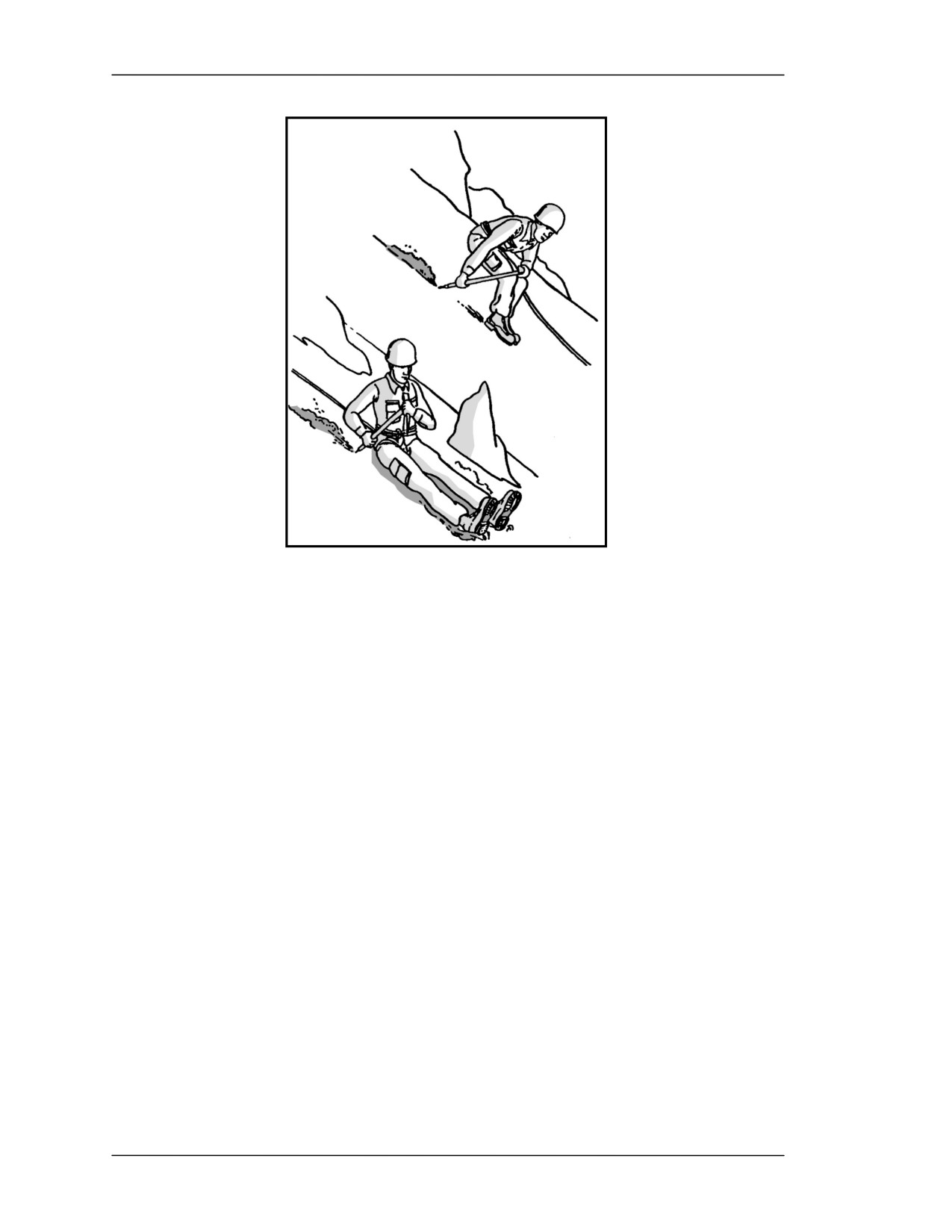
FM 3-97.61
Figure 10-15. Glissading techniques.
10-5. SNOW AND ICE ANCHORS
Ice and snow anchors consist of snow pickets, flukes, deadman-type anchors, ice screws,
and ice pitons. Deadman anchors can be constructed from snowshoes, skis, backpacks,
sleds, or any large items.
a. Ice Pitons. The ice piton is used to establish anchor points. The ice piton is not
seen in modern ice climbing but may still be available to the military. The standard ice
piton is made of tubular steel and is 10 inches in length. Ice pitons installed in pairs are a
bombproof anchor; however, ice pitons have no threads for friction to hold them in the
ice once placed and are removed easily. Safe use of ice pitons requires placement in
pairs. Used singularly, ice pitons are a strong anchor but are easily removed, decreasing
the perceived security of the anchor. Follow the instructions below for placing ice pitons
in pairs.
(1) Cut a horizontal recess into the ice, and also create a vertical surface (two clean
surfaces at right angles to each other).
(2) Drive one piton into the horizontal surface and another into the vertical surface so
that the two pitons intersect at the necessary point (Figure 10-16).
(3) Connect the two rings with a single carabiner, ensuring the carabiner is not cross-
loaded. Webbing or rope can be used if the rings are turned to the inside of the
intersection.
(4) Test the piton pair to ensure it is secure. If it pulls out or appears weak, move to
another spot and replace it. The pair of pitons, when placed correctly, are
multidirectional.
10-14
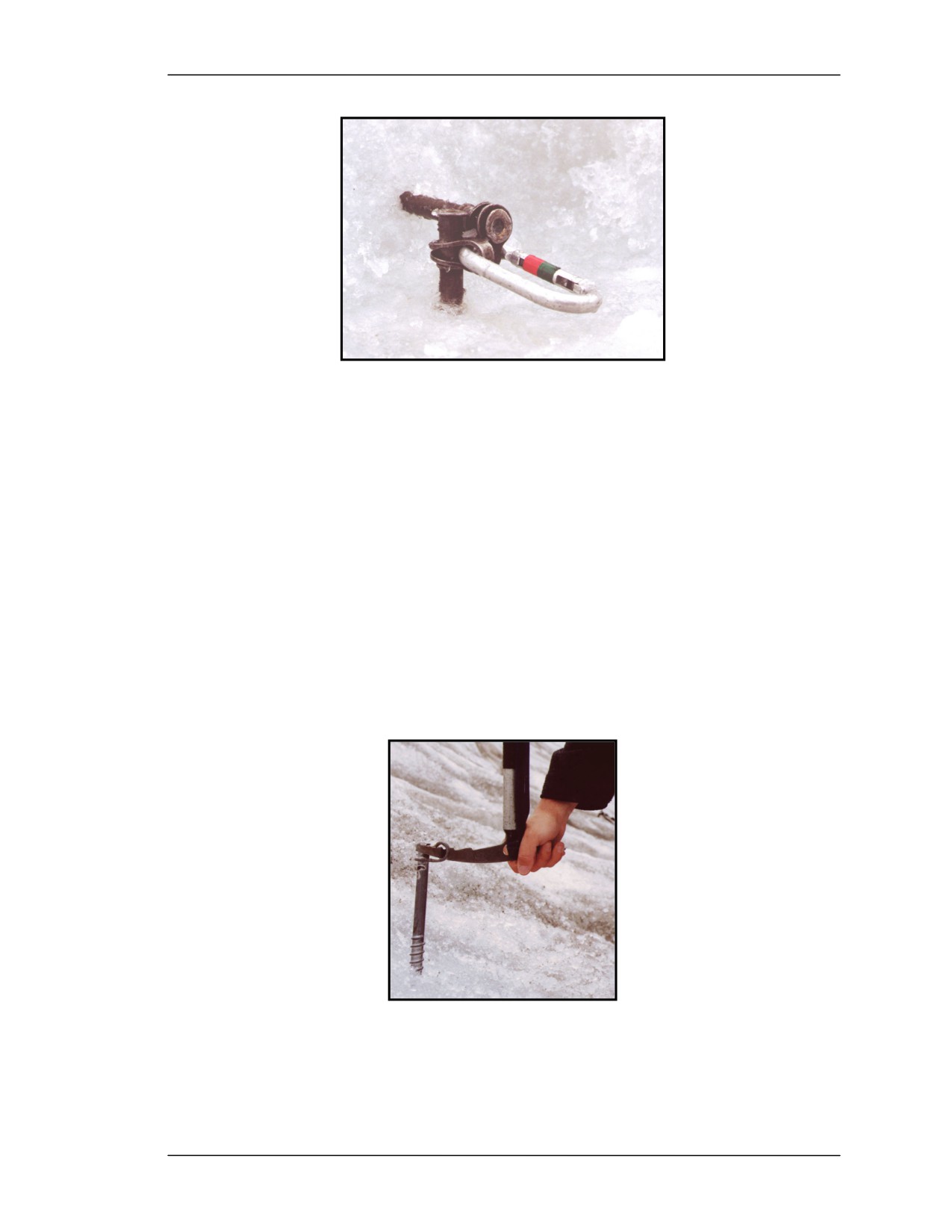
FM 3-97.61
Figure 10-16. Ice piton pair.
(5) The effective time and or strength for an ice piton placement is limited. The piton
will heat from solar radiation, or the ice may crack or soften. Solar radiation can be
nearly eliminated by covering the pitons with ice chips once they have been placed. If
repeated use is necessary for one installation, such as top roping, the pitons should be
inspected frequently and relocated when necessary. When an ice piton is removed, the ice
that has accumulated in the tube must be removed before it freezes in position, making
further use difficult.
c. Ice Screws. The ice screw is the most common type of ice protection and has
replaced the ice piton for the most part
(Figure
10-17). Some screws have longer
“hangers” or handles, which allow them to be easily twisted into position by hand. Place
ice screws as follows:
(1) Clear away all rotten ice from the surface and make a small hole with the ax pick
to start the ice screw in.
(2) Force the ice screw in until the threads catch.
Figure 10-17. Placement of ice screw using the pick.
(3) Turn the screw until the eye or the hanger of the ice screw is flush with the ice
and pointing down. The screw should be placed at an angle 90 to 100 degrees from the
10-15
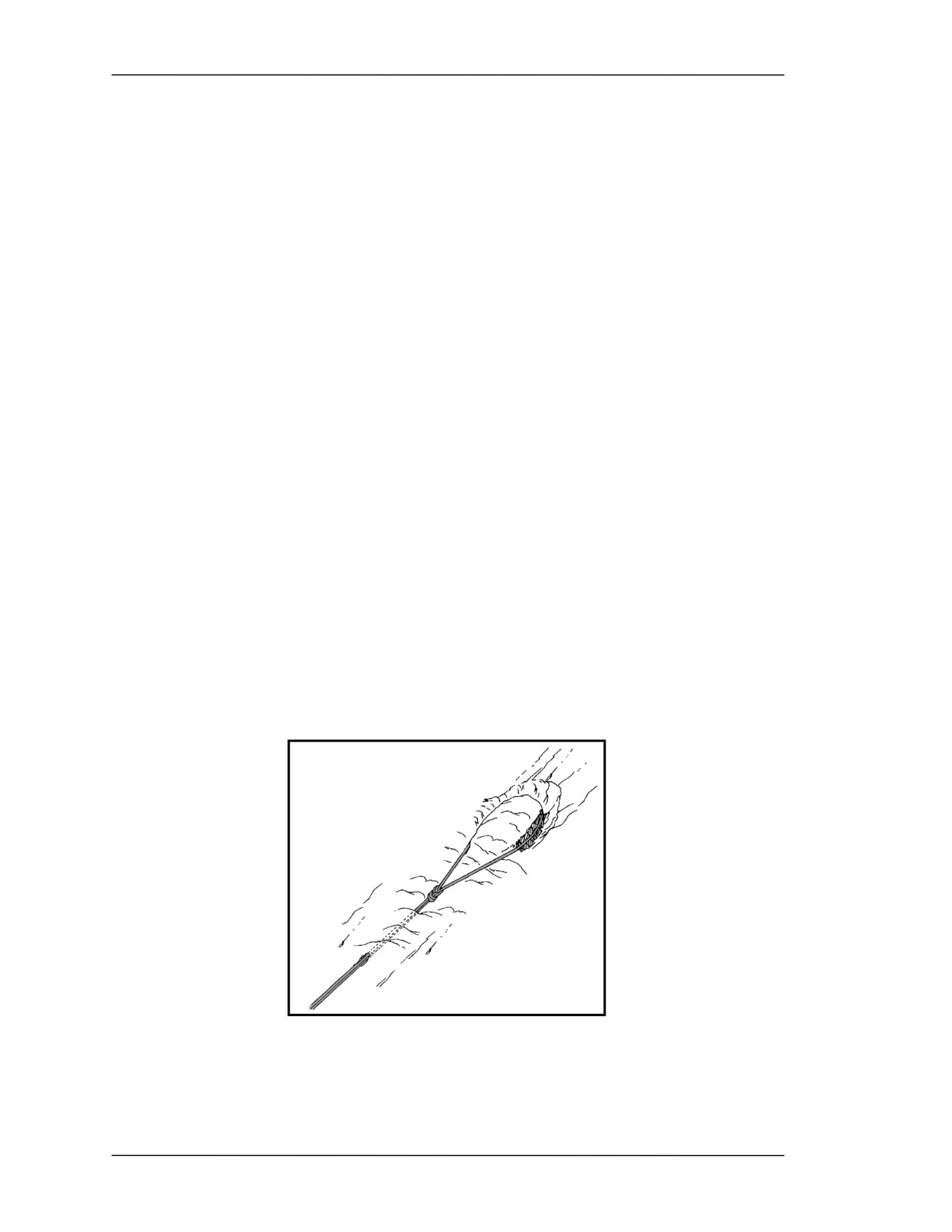
FM 3-97.61
lower surface. Use either your hand or the pick of the ice ax to screw it in. If you have a
short ax (70 centimeters or less), you may be able to use the spike in the eye or hanger to
ease the turning. (Remember that you may only have use of one hand at this point
depending on your stance and the angle of the terrain.)
(4) As with ice pitons, melting of the ice around a screw over a period of time must
be considered. The effective time and or strength of an ice screw placement is limited.
The screw will heat from solar radiation, or the ice may crack or soften. Solar radiation
can be nearly eliminated by covering the screw with ice chips once it has been emplaced.
If repeated use is necessary for one installation, such as top roping, the screws should be
inspected frequently and relocated when necessary. When an ice screw is removed, the
ice that has accumulated in the tube, must be removed before further use.
d. Horseshoe or Bollard Anchor. This is an artificial anchor shaped generally like
a horseshoe (Figure 10-18). It is formed from either ice or snow and constructed by either
cutting with the ice ax or stamping with the boots. When constructed of snow, the width
should not be less than 10 feet. In ice, this width may be narrowed to 2 feet, depending on
the strength of the ice. The length of the bollard should be at least twice the width. The
trench around the horseshoe should be stamped as deeply as possible in the snow and
should be cut not less than 6 inches into the ice after all rotten ice is removed. The
backside of the anchor must always be undercut to prevent the rope from sliding off and
over the anchor.
(1) This type of anchor is usually available and may be used for fixed ropes or
rappels. It must be inspected frequently to ensure that the rope is not cutting through the
snow or ice more than one-third the length of the anchor; if it is, a new anchor must be
constructed in a different location.
(2) A horseshoe anchor constructed in snow is always precarious, its strength
depending upon the prevailing texture of the snow. For dry or wind-packed snow, the
reliability of the anchor should always be suspect. The backside of the bollard can be
reinforced with ice axes, pickets, or other equipment for added strength.
Figure 10-18. Horseshoe or bollard anchor.
10-16
FM 3-97.61
e. Pickets and Ice Axes. Pickets and ice axes may be used as snow anchors as
follows.
(1) The picket should be driven into the snow at 5 to 15 degrees off perpendicular
from the lower surface. If the picket cannot be driven in all the way to the top hole, the
carabiner should be placed in the hole closest to the snow surface to reduce leverage. The
picket may also be tied off with a short loop of webbing or rope as in tying off pitons.
(2) An ice ax can be used in place of a picket. When using an ice ax as a snow
anchor, it should be inserted with the widest portion of the ax shaft facing the direction of
pull. The simplest connection to the ax is to use a sling or rope directly around the shaft
just under the head. If using the leash ensure it is not worn, frayed, or cut from general
use; is strong enough; and does not twist the ax when loaded. A carabiner can be clipped
through the hole in the head, also.
(3) Whenever the strength of the snow anchor is suspect, especially when a picket or
ax cannot be driven in all the way, the anchor may be buried in the snow and used as a
“dead man” anchor. Other items suitable for dead man anchor construction are
backpacks, skis, snowshoes, ski poles, or any other item large enough or shaped correctly
to achieve the design. A similar anchor, sometimes referred to as a “dead guy,” can be
made with a large sack either stuffed with noncompressible items or filled with snow and
buried. Ensure the attaching point is accessible before burying. The direction of pull on
long items, such as a picket or ax, should be at a right angle to its length. The
construction is identical to that of the dead man anchor used in earth.
f. Equalized Anchors. Snow and ice anchors must be constantly checked due to
melting and changing snow or ice conditions.
(1) Whenever possible, two or more anchors should be used. While this is not always
practical for intermediate anchor points on lead climbs or fixed ropes, it should be
mandatory for main anchors at all belay positions, rappel points, or other fixed rope
installations.
(Figure
10-19, page
10-18, shows an example of three snow pickets
configured to an equalized anchor.)
(2) As with multipoint anchors on rock, two or more snow or ice anchors can be
joined together with a sling rope or webbing to construct one solid, equalized anchor. A
bowline on a bight tied into the climbing rope can also be used instead of sling ropes or
webbing.
10-17
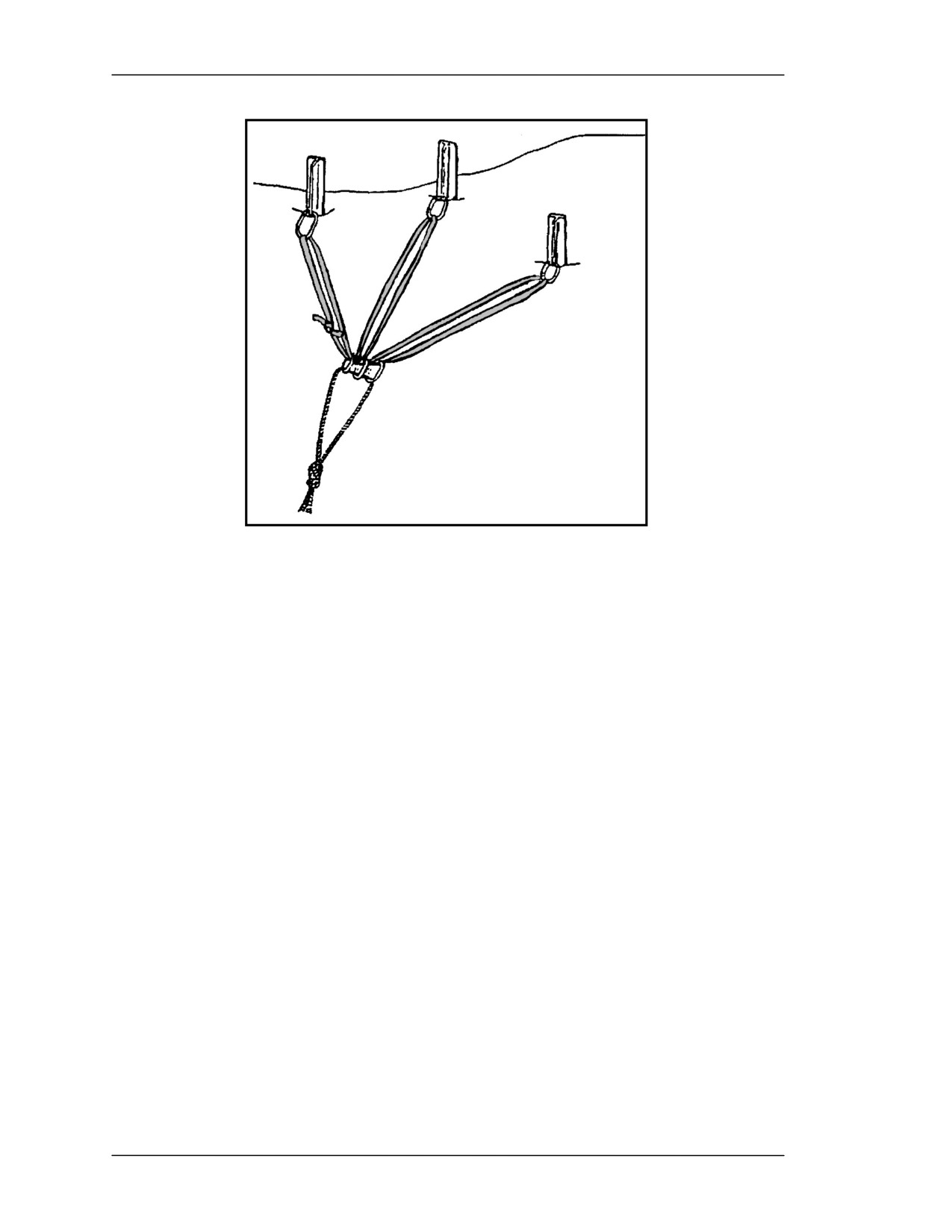
FM 3-97.61
Figure 10-19. Equalized anchor using pickets.
10-6. ROPED CLIMBING ON ICE AND SNOW
When climbing on ice or snow team members tie into a climbing rope the same as when
they climb on rock. When crevasses are expected, a three-man rope team is
recommended.
a. Tie-In Method. For climbing on snow and ice, the tie-in procedure is normally
the same as for rock climbing; however, when moving over snow-covered glaciers, the
tie-in is modified slightly.
(See paragraph
10-7, Movement on Glaciers, for more
information).
b. Movement. For movement on gentle or moderate slopes where there is little
chance of a serious fall, all climbers move simultaneously. Normally the climbers move
in single file using the steps created by the lead climber and improving them when
necessary. The rope between the climbers should be fully extended and kept reasonably
tight. Should any member fall, he immediately yells “FALLING.” The other rope team
members immediately drop into a self-arrest position. The fallen climber also applies the
self-arrest procedure. By using this method, called the “team arrest,” the entire team as a
whole arrests the fall of one member. On steeper slopes, and when crossing snow-
covered crevasses where the snow bridges appear weak, the climbers use belayed
climbing techniques as in rock climbing.
c. Belaying on Snow and Ice. The principles of belaying on ice and snow are the
same as on rock. Generally, the high-force falls found in rock climbing are not present on
snow and ice unless the pitch being climbed is extremely steep.
(1) Boot-Ax Belay. This belay can be useful in areas where the full length of the ice
ax can penetrate the snow. The holding strength of the boot-ax belay is directly related to
the firmness of the snow and to the strength of the ice ax shaft. The shaft of the ax is
10-18