FM 3-97.61 MILITARY MOUNTAINEERING (AUGUST 2002) - page 6
FM 3-97.61
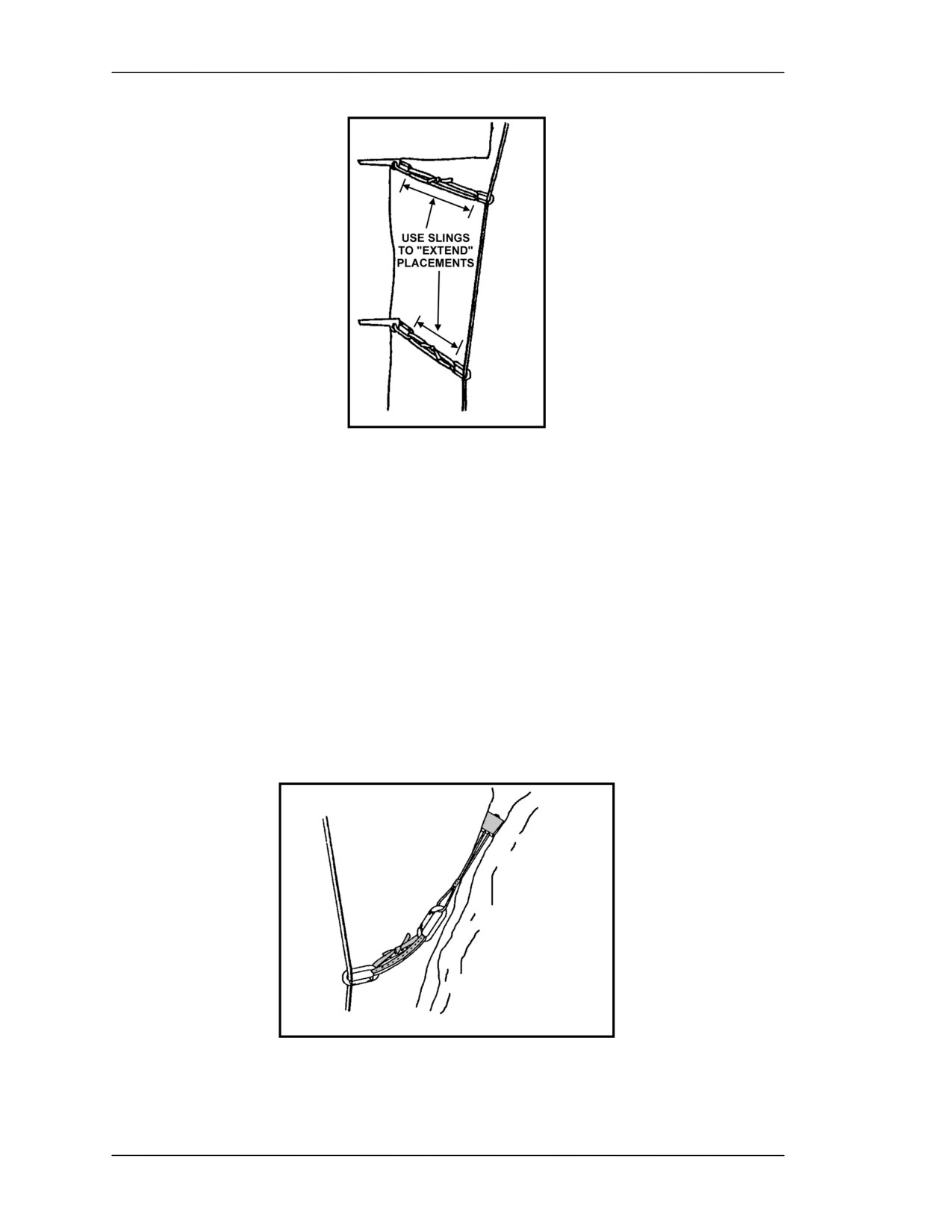
Figure 6-31. Use of slings to extend placement positions.
(b) Not only is rope drag a hindrance, it can cause undue movement of protection as
the rope tightens between any “out of line” placements. Rope drag through chock
placements can be dangerous. As the climber moves above the placements, an outward or
upward pull from rope drag may cause correctly set chocks to pop out, even when used
“actively”. Most all chocks placed for leader protection should be extended with a runner,
even if the line is direct to eliminate the possibility of movement.
(c) Wired chocks are especially prone to wiggling loose as the rope pulls on the stiff
cable attachment. All wired chocks used for leader protection should be extended to
reduce the chance of the rope pulling them out (Figure 6-32). Some of the larger chocks,
such as roped Hexentrics and Tri-Cams, have longer slings pre-attached that will
normally serve as an adequate runner for the placement. Chocks with smaller sling
attachments must often be extended with a runner. Many of today’s chocks are
manufactured with pre-sewn webbing installed instead of cable.
Figure 6-32. Use of sling on a wired stopper.
6-52
FM 3-97.61
(d) When a correctly placed piton is used for protection, it will normally not be
affected by rope drag. A correctly placed piton is generally a multi-directional anchor,
therefore, rope drag through pitons will usually only affect the leader’s movements but
will continue to protect as expected.
(e) Rope drag will quite often move SLCDs out of position, or “walk” them deeper
into the crack than initially placed, resulting in difficult removal or inability to remove
them at all. Furthermore, most cases of SLCD movement result in the SLCD moving to a
position that does not provide protection in the correct direction or no protection at all
due to the lobes being at different angles from those at the original position.
Note: Any placement extended with a runner will increase the distance of a potential fall
by the actual length of the sling. Try to use the shortest runners possible, ensuring
they are long enough to function properly.
f. Belaying the follower is similar to belaying a top-roped climb in that the follower
is not able to fall any farther than rope stretch will allow. This does not imply there is no
danger in following. Sharp rocks, rock fall, and inadequately protected traverses can
result in damage to equipment or injury to the second.
g. Following, or seconding, a leader has a variety of responsibilities. The second has
to issue commands to the leader, as well as follow the leader’s commands. Once the lead
climber reaches a good belay position, he immediately establishes an anchor and
connects to it. When this is completed he can signal “OFF BELAY” to the belayer. The
second can now remove the leader’s belay and prepare to climb. The second must remain
attached to at least one of the original anchors while the leader is preparing the next belay
position. The removed materials and hardware can be organized and secured on the
second’s rack in preparation to climb.
(1) When the leader has established the new belay position and is ready to belay the
follower, the
“new” belayer signals
“BELAY ON.” The second, now the climber,
removes any remaining anchor hardware/materials and completes any final preparations.
The belayer maintains tension on the rope, unless otherwise directed, while the final
preparations are taking place, since removal of these remaining anchors can introduce
slack into the rope. When the second is ready, he can, as a courtesy, signal
“CLIMBING,” and the leader can, again as a courtesy, reply with “CLIMB.”
(2) Upon signaling “BELAY ON,” the belayer must remove and keep all slack from
the rope. (This is especially important as in many situations the belayer cannot see the
follower. A long pitch induces weight and sometimes “drag” on the rope and the belayer
above will have difficulty distinguishing these from a rope with no slack.)
h. When removing protection, the man cleaning the pitch should rack it properly to
facilitate the exchange and or arrangement of equipment at the end of the pitch. When
removing the protection, or “cleaning the pitch”, SLCDs or chocks may be left attached
to the rope to prevent loss if they are accidentally dropped during removal. If necessary,
the hardware can remain on the rope until the second reaches a more secure stance. If
removing a piton, the rope should be unclipped from the piton to avoid the possibility of
damaging the rope with a hammer strike.
(1) The second may need to place full body weight on the rope to facilitate use of
both hands for protection removal by giving the command “TENSION.” The second
6-53
FM 3-97.61
must also ensure that he does not climb faster than the rope is being taken in by the
belayer. If too much slack develops, he should signal “TAKE ROPE” and wait until the
excess is removed before continuing the climb. Once the second completes the pitch, he
should immediately connect to the anchor. Once secured, he can signal “OFF BELAY.”
The leader removes the belay, while remaining attached to an anchor. The equipment is
exchanged or organized in preparation for the next pitch or climb.
(2) When the difficulty of the climbing is within the
“leading ability” of both
climbers, valuable time can be saved by “swinging leads.” This is normally the most
efficient method for climbing multi-pitch routes. The second finishes cleaning the first
pitch and continues climbing, taking on the role of lead climber. Unless he requires
equipment from the belayer or desires a break, he can climb past the belay and
immediately begin leading. The belayer simply adjusts his position, re-aiming the belay
once the new leader begins placing protection. Swinging leads, or “leap frogging,” should
be planned before starting the climb so the leader knows to anchor the upper belay for
both upward and downward pulls during the setup.
6-23. AID CLIMBING
When a route is too difficult to free climb and is unavoidable, if the correct equipment is
available you might aid climb the route. Aid climbing consists of placing protection and
putting full body weight on the piece. This allows you to hang solely on the protection
you place, giving you the ability to ascend more difficult routes than you can free climb.
Clean aid consists of using SLCDs and chocks, and is the simplest form of aid climbing.
a. Equipment. Aid climbing can be accomplished with various types of protection.
Regardless of the type of protection used, the method of aid climbing is the same. In
addition to the equipment for free climbing, other specialized equipment will be needed.
(1) Pitons. Pitons are used the same as for free climbing. Most piton placements will
require the use of both hands. Piton usage will usually leave a scar in the rock just by
virtue of the hardness of the piton and the force required to set it with a hammer.
Swinging a hammer to place pitons will lead to climber fatigue sooner than clean aid.
Since pitons are multidirectional, the strength of a well-placed piton is more secure than
most clean aid protection. Consider other forms of protection when noise could be
hazardous to tactics.
(2) Bolts. Bolts are used when no other protection will work. They are a more
permanent form of protection and more time is needed to place them. Placing bolts
creates more noise whether drilled by hand or by motorized drill. Bolts used in climbing
are a multi-part expanding system pounded into predrilled holes and then tightened to the
desired torque with a wrench or other tool. Bolts are used in many ways in climbing
today. The most common use is with a hanger attached and placed for anchors in face
climbing. However, bolts can be used for aid climbing, with or without the hanger.
(a) Placing bolts for aid climbing takes much more time than using pitons or clean
aid. Bolting for aid climbing consists of consecutive bolts about 2 feet apart. Drilling a
deep enough hole takes approximately thirty minutes with a hand drill and up to two
minutes with a powered hammer drill. A lot of time and work is expended in a short
distance no matter how the hole is drilled. (The weight of a powered hammer drill
becomes an issue in itself.) Noise will also be a factor in both applications. A constant
pounding with a hammer on the hand drill or the motorized pounding of the powered drill
6-54
FM 3-97.61
may alert the enemy to the position. The typical climbing bolt/hanger combination
normally is left in the hole where it was placed.
(b) Other items that can be used instead of the bolt/hanger combination are the
removable and reusable
“spring-loaded removable bolts” such as rivets
(hex head
threaded bolts sized to fit tightly into the hole and pounded in with a hammer), split-shaft
rivets, and some piton sizes that can be pounded into the holes. When using rivets or bolts
without a hanger, place a loop of cable over the head and onto the shaft of the rivet or
bolt and attach a carabiner to the other end of the loop (a stopper with the chock slid back
will suffice). Rivet hangers are available that slide onto the rivet or bolt after it is placed
and are easily removed for reuse. Easy removal means a slight loss of security while in
use.
(3) SLCDs. SLCDs are used the same as for free climbing, although in aid climbing,
full body weight is applied to the SLCD as soon as it is placed.
(4) Chocks. Chocks are used the same as for free climbing, although in aid climbing,
weight is applied to the chock as soon as it is placed.
(5) Daisy Chains. Daisy chains are tied or presewn loops of webbing with small tied
or presewn loops approximately every two inches. The small loops are just large enough
for two or three carabiners. Two daisy chains should be girth-hitched to the tie-in point in
the harness.
(6) Etriers (or Aiders). Etriers (aiders) are tied or presewn webbing loops with four to
six tied or presewn internal loops, or steps, approximately every 12 inches. The internal
loops are large enough to easily place one booted foot into. At least two etriers (aiders)
should be connected by carabiner to the free ends of the daisy chains.
(7) Fifi Hook. A fifi hook is a small, smooth-surfaced hook strong enough for body
weight. The fifi hook should be girth-hitched to the tie-in point in the harness and is used
in the small loops of the daisy chain. A carabiner can be used in place of the fifi hook,
although the fifi hook is simpler and adequate.
(8) Ascenders. Ascenders are mechanical devices that will move easily in one
direction on the rope, but will lock in place if pushed or pulled the other direction.
(Prusiks can be used but are more difficult than ascenders.)
b. Technique. The belay will be the same as in normal lead climbing and the rope
will be routed through the protection the same way also. The big difference is the
movement up the rock. With the daisy chains, aiders, and fifi hook attached to the rope
tie-in point of the harness as stated above, and secured temporarily to a gear loop or gear
sling, the climb continues as follows:
(1) The leader places the first piece of protection as high as can safely be reached and
attaches the appropriate sling/carabiner
(2) Attach one daisy chain/aider group to the newly placed protection
(3) Clip the rope into the protection, (the same as for normal lead climbing)
(4) Insure the protection is sound by weighting it gradually; place both feet, one at a
time, into the steps in the aider, secure your balance by grasping the top of the aider with
your hands.
(5) When both feet are in the aider, move up the steps until your waist is no higher
than the top of the aider.
(6) Place the fifi hook (or substituted carabiner) into the loop of the daisy chain
closest to the daisy chain/aider carabiner, this effectively shortens the daisy chain;
6-55
FM 3-97.61
maintain tension on the daisy chain as the hook can fall out of the daisy chain loop if it is
unweighted.
Note: Moving the waist higher than the top of the aider is possible, but this creates a
potential for a fall to occur even though you are on the aider and “hooked” close
to the protection with the daisy chain. As the daisy chain tie-in point on the
harness moves above the top of the aider, you are no longer supported from above
by the daisy chain, you are now standing above your support. From this height,
the fifi hook can easily fall out of the daisy chain loop if it is unweighted. If this
happens, you could fall the full length of the daisy chain resulting in a static fall
on the last piece of protection placed.
(7) Release one hand from the aider and place the next piece of protection, again, as
high as you can comfortably reach; if using pitons or bolts you may need both hands free-
“lean” backwards slowly, and rest your upper body on the daisy chain that you have
“shortened” with the fifi hook
(8) Clip the rope into the protection
(9) Attach the other daisy chain/aider group to the next piece of protection
(10)
Repeat entire process until climb is finished
c. Seconding. When the pitch is completed, the belayer will need to ascend the
route. To ascend the route, use ascenders instead of Prusiks, ascenders are much faster
and safer than Prusiks. Attach each ascender to a daisy chain/aider group with carabiners.
To adjust the maximum reach/height of the ascenders on the rope, adjust the effective
length of the daisy chains with a carabiner the same as with the fifi hook; the typical
height will be enough to hold the attached ascender in the hand at nose level. When
adjusted to the correct height, the arms need not support much body weight. If the
ascender is too high, you will have difficulty reaching and maintaining a grip on the
handle.
(1) Unlike lead climbing, there will be a continuous load on the rope during the
cleaning of the route, this would normally increase the difficulty of removing protection.
To make this easier, as you approach the protection on the ascenders, move the
ascenders, one at a time, above the piece. When your weight is on the rope above the
piece, you can easily unclip and remove the protection.
CAUTION
If both ascenders should fail while ascending the
pitch, a serious fall could result. To prevent this
possibility, tie-in short on the rope every 10-20 feet by
tying a figure eight loop and clipping it into the
harness with a separate locking carabiner as soon as
the ascent is started. After ascending another 20 feet,
repeat this procedure. Do not unclip the previous
figure eight until the new knot is attached to another
locking carabiner. Clear each knot as you unclip it.
6-56
FM 3-97.61
Notes: 1. Ensure the loops formed by the short tie-ins do not catch on anything below as
you ascend.
2. If the nature of the rock will cause the “hanging loop” of rope, formed by
tying in at the end of the rope, to get caught as you move upward, do not tie
into the end of the rope.
(2) Seconding an aid pitch can be done in a similar fashion as seconding free-climbed
pitches. The second can be belayed from above as the second “climbs” the protection.
However, the rope is unclipped from the protection before the aider/daisy chain is
attached.
d. Seconding Through a Traverse. While leading an aid traverse, the climber is
hanging on the protection placed in front of the current position. If the second were to
clean the section by hanging on the rope while cleaning, the protection will be pulled in
more than one direction, possibly resulting in the protection failing. To make this safer
and easier, the second should hang on the protection just as the leader did. As the second
moves to the beginning of the traverse, one ascender/daisy chain/aider group is removed
from the rope and clipped to the protection with a carabiner, (keep the ascenders attached
to the daisy chain/aider group for convenience when the traverse ends). The second will
negotiate the traverse by leapfrogging the daisy chain/aider groups on the next protection
just as the leader did. Cleaning is accomplished by removing the protection as it is passed
when all weight is removed from it. This is in effect a self-belay. The second maintains a
shorter safety tie-in on the rope than for vertical movement to reduce the possibility of a
lengthy pendulum if the protection should pull before intended.
e. Clean Aid Climbing. Clean aid climbing consists of using protection placed
without a hammer or drill involvement: chocks, SLCDs, hooks, and other protection
placed easily by hand. This type of aid climbing will normally leave no trace of the climb
when completed. When climbing the aiders on clean aid protection, ensure the protection
does not “move” from it’s original position.
(1) Hooks are any device that rests on the rock surface without a camming or
gripping action. Hooks are just what the name implies, a curved piece of hard steel with a
hole in one end for webbing attachment. The hook blade shape will vary from one model
to another, some have curved or notched “blades” to better fit a certain crystal shape on a
face placement. These types of devices due to their passive application, are only secure
while weighted by the climber.
(2) Some featureless sections of rock can be negotiated with hook use, although bolts
can be used. Hook usage is faster and quieter but the margin of safety is not there unless
hooks are alternated with more active forms of protection. If the last twenty foot section
of a route is negotiated with hooks, a forty foot fall could result.
6-24. THREE-MAN CLIMBING TEAM
Often times a movement on steep terrain will require a team of more than two climbers,
which involves more difficulties. A four-man team (or more) more than doubles the
difficulty found in three men climbing together. A four-man team should be broken down
into two groups of two unless prevented by a severe lack of gear.
6-57
FM 3-97.61
a. Given one rope, a three-man team is at a disadvantage on a steep, belayed climb.
It takes at least twice as long to climb an average length pitch because of the third
climber and the extra belaying required. The distance between belay positions will be
halved if only one rope is used because one climber must tie in at the middle of the rope.
Two ropes are recommended for a team of three climbers.
Note: Time and complications will increase when a three-man team uses only one rope.
For example: a 100-foot climb with a 150-foot rope would normally require two
belays for two climbers; a 100-foot climb with a 150-foot rope would require six
belays for three climbers.
b. At times a three-man climb may be unavoidable and personnel should be familiar
with the procedure. Although a team of three may choose from many different methods,
only two are described below. If the climb is only one pitch, the methods will vary.
CAUTION
When climbing with a team of three, protected
traverses will require additional time. The equipment
used to protect the traverse must be left in place to
protect both the second and third climbers.
(1) The first method can be used when the belay positions are not large enough for
three men. If using one rope, two climbers tie in at each end and the other at the mid
point. When using two ropes, the second will tie in at one end of both ropes, and the other
two climbers will each tie in to the other ends. The most experienced individual is the
leader, or number 1 climber. The second, or number 2 climber, is the stronger of the
remaining two and will be the belayer for both number 1 and number 3. Number 3 will be
the last to climb. Although the number 3 climber does no belaying in this method, each
climber should be skilled in the belay techniques required. The sequence for this method
(in one pitch increments) is as follows (repeated until the climb is complete):
(a) Number 1 ascends belayed by number 2. Number 2 belays the leader up the first
pitch while number 3 is simply anchored to the rock for security (unless starting off at
ground level) and manages the rope between himself and number 2. When the leader
completes the pitch, he sets up the next belay and belays number 2 up.
(b) Number 2 ascends belayed by number 1, and cleans the route
(except for
traverses). Number 2 returns the hardware to the leader and belays him up the next pitch.
When the leader completes this pitch, he again sets up a new belay. When number 2
receives “OFF BELAY” from the leader, he changes ropes and puts number 3 on belay.
He should not have to change anchor attachments because the position was already aimed
for a downward as well as an upward pull when he belayed the leader.
(c) Number 3 ascends belayed by number 2. When number 3 receives “BELAY ON,”
he removes his anchor and climbs to number 2’s position. When the pitch is completed he
secures himself to one of number 2’s belay anchors. When number 1’s belay is ready, he
6-58
FM 3-97.61
brings up number 2 while number 3 remains anchored for security. Number 2 again
cleans the pitch and the procedure is continued until the climb is completed.
(d) In this method, number 3 performs no belay function. He climbs when told to do
so by number 2. When number 3 is not climbing, he remains anchored to the rock for
security. The standard rope commands are used; however, the number 2 climber may
include the trailing climber’s name or number in the commands to avoid confusion as to
who should be climbing.
(d) Normally, only one climber would be climbing at a time; however, the number 3
climber could ascend a fixed rope to number 2’s belay position using proper ascending
technique, with no effect on the other two members of the team. This would save time for
a team of three, since number 2 would not have to belay number 3 and could be either
belaying number 1 to the next belay or climbing to number 1. If number 3 is to ascend a
fixed rope to the next belay position, the rope will be loaded with number 3’s weight, and
positioned directly off the anchors established for the belay. The rope should be located
so it does not contact any sharp edges. The rope to the ascending number 3 could be
secured to a separate anchor, but this would require additional time and gear.
(2) The second method uses either two ropes or a doubled rope, and number 2 and
number 3 climb simultaneously. This requires either a special belay device that accepts
two ropes, such as the tuber type, or with two Munter hitches. The ropes must travel
through the belay device(s) without affecting each other.
(a) As the leader climbs the pitch, he will trail a second rope or will be tied in with a
figure eight in the middle of a doubled rope. The leader reaches the next belay position
and establishes the anchor and then places both remaining climbers on belay. One
remaining climber will start the ascent toward the leader and the other will start when a
gap of at least 10 feet is created between the two climbers. The belayer will have to
remain alert for differences in rope movement and the climbers will have to climb at the
same speed. One of the “second” climbers also cleans the pitch.
(b) Having at least two experienced climbers in this team will also save time. The
belayer will have additional requirements to meet as opposed to having just one second.
The possible force on the anchor will be twice that of one second. The second that is not
cleaning the pitch can climb off route, but staying on route will usually prevent a possible
swing if stance is not maintained.
6-59
FM 3-97.61(TC 90-6-1)
CHAPTER 7
ROPE INSTALLATIONS
Obstacles on the battlefield today are inevitable. They can limit the
battlefield and, even worse, prevent a unit from accomplishing its mission.
However, with highly skilled personnel trained on rope installations, leaders
can be assured that even a unit with limited mountain skills and experience
will be able to successfully move and operate in terrain that would otherwise
have been impassable.
Section I. FIXED ROPE
A fixed rope is a rope anchored in place to assist soldiers in movement over difficult
terrain. Its simplest form is a rope tied off on the top of steep terrain. As terrain becomes
steeper or more difficult, fixed rope systems may require intermediate anchors along the
route. Moving on a fixed rope requires minimal equipment. The use of harnesses,
ascenders, and other technical gear makes fixed rope movement easier, faster, and safer,
but adds to total mission weight.
7-1.
INSTALLATION
To install a fixed rope, two experienced climbers rope up for a roped climb. The leader
must have the necessary equipment to rig the anchor at the top of the pitch. Although
leader protection is usually not needed on a typical slope, additional hardware can be
brought along and placed at the leader’s discretion. The second will establish a belay if
protection is being placed. Otherwise, he will stack and manage the rope. He ensures the
rope runs smoothly up the slope and does not get tangled as the climber ascends. Upon
reaching the end of the pitch, the leader will establish the top anchor. Once the anchor is
rigged, the leader will take up any remaining slack between himself and the second. He
will anchor the installation rope and remain tied into the rope. The second unties from his
end of the rope and begins to climb. If the leader placed protection, the second will clean
the pitch on his way up.
7-2.
UTILIZATION
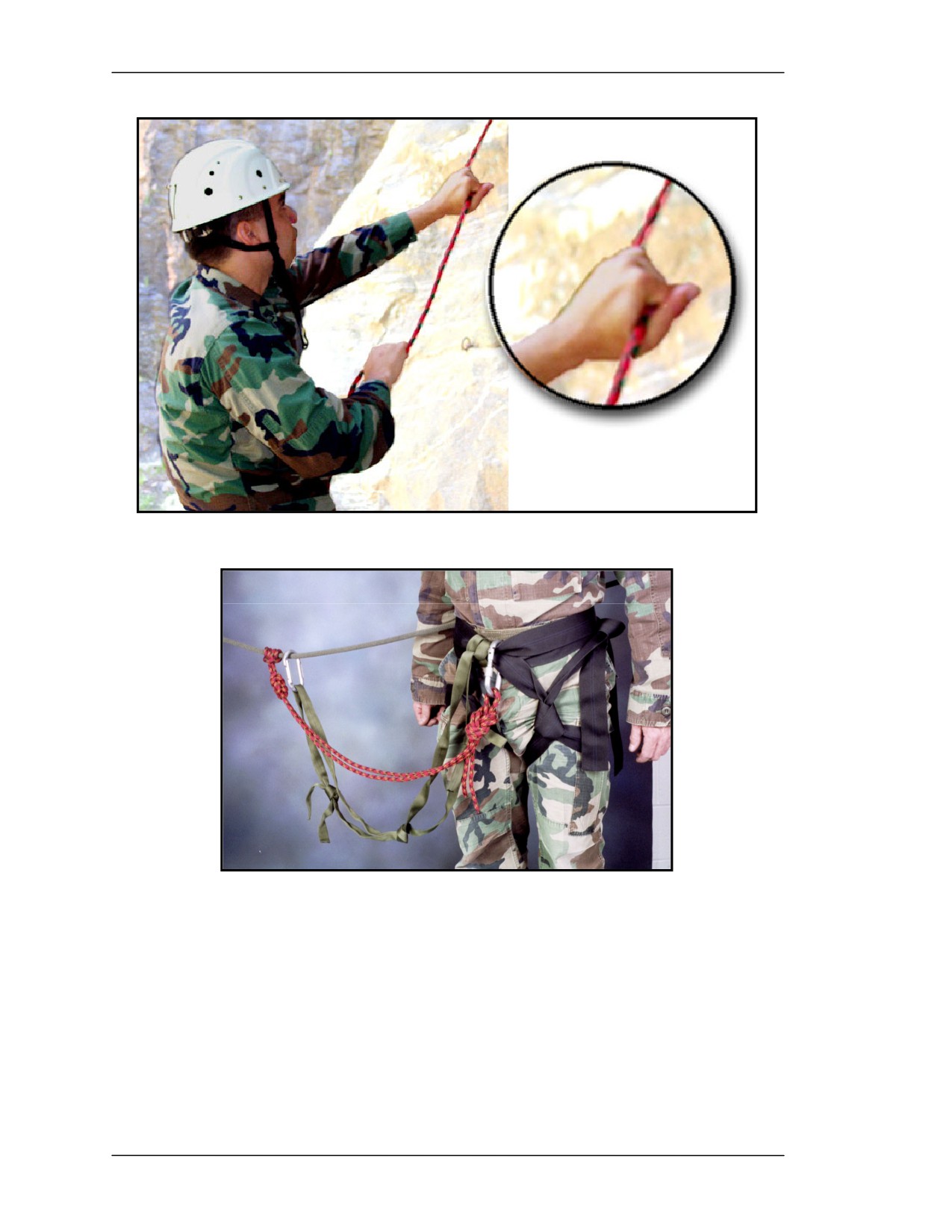
All personnel using the fixed rope grasp the rope with the palm downward and use it for
assistance as they ascend the slope (Figure 7-1, page 7-2). An individual can easily
prevent a long fall by attaching himself to the rope with a sling using a friction knot (for
example, Prusik, autoblock). The knot is slid along the rope as the individual ascends. If
the climber slips and loses control of the rope, the friction knot will grab the rope and
arrest the fall. The friction knot used in this manner is referred to as a self-belay (Figure
7-2, page 7-2).
7-1
FM 3-97.61
Figure 7-1. Using a fixed rope.
Figure 7-2. Using a self-belay.
7-3.
RETRIEVAL
If the fixed rope is to be used on the descent, it can be left in place and recovered after the
last rappel. If not, the last climber will tie into the rope and be belayed from above. The
climber now can easily free the rope if it gets caught on anything as it is taken up from
the belayer.
7-2
FM 3-97.61
7-4.
FIXED ROPE WITH INTERMEDIATE ANCHORS
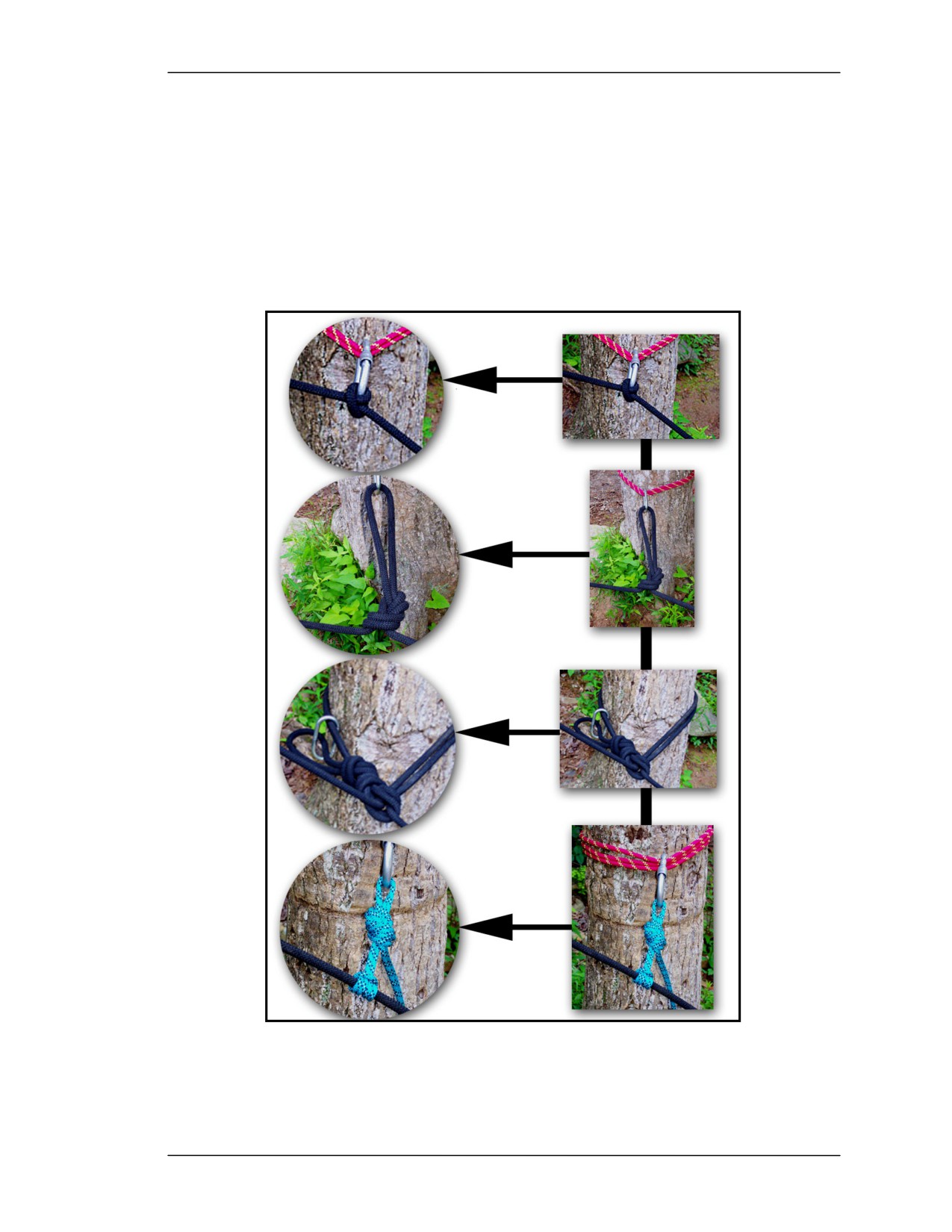
Whenever the route varies from the fall line of the slope, the fixed rope must be anchored
at intermediate anchor points (Figure 7-3). Intermediate anchor points should also be
used on any long routes that exceed the length of a single rope. The use of intermediate
anchor points creates independent sections and allows for changes in direction from one
section to the next. The independent sections allow for more personnel to move on the
fixed rope. This type of fixed rope is commonly used along exposed ridges and narrow
mountain passes.
Figure 7-3. Fixed rope with intermediate anchors.
7-3
FM 3-97.61
a. Installation. Two experienced climbers prepare for a roped climb. The leader will
carry a typical rack with enough hardware to place an adequate number of intermediate
anchor points. The second sets up a standard belay. The route they select must have the
following characteristics:
• Most suitable location, ease of negotiation, avoids obstacles.
• Availability of anchors (natural and artificial).
• Area is safe from falling rock or ice.
• Tactical considerations are met.
• A rope routed between knee and chest height (waist high preferred).
• Rope crossovers should be avoided.
As the leader climbs the route, he will place the anchors and route the climbing rope as in
a typical roped climb. The leader makes use of any available natural anchors.
Note: Sling attachments should be kept as short and snug as possible to ensure that a
load on the fixed rope below the anchor is placed only on that anchor. This will
prevent one section from affecting another section.
(1) The leader places an anchor at all points where a change of direction occurs. He
also makes every attempt to route the rope so personnel will not have to cross back and
forth over the rope between sections.
(2) When the leader reaches the end of the pitch, he temporarily anchors the rope. He
should use a sling to anchor himself if there is any chance of slipping and falling. He then
takes up any excess slack, and attaches the rope to the anchor.
Note: Enough slack must be left in the rope so the second can tie the knots necessary to
fix the rope.
(3) The second unties from the rope and anchors it at the bottom. He attaches himself
to the rope with a sling using a friction knot to create a self-belay. The self-belay will
protect the second as he climbs and fixes the rope to the intermediate anchor points.
When he reaches an anchor point, he unclips the climbing rope so he can advance the
self-belay beyond the anchor point. He then takes the slack out of the section below the
anchor point. He ensures that the fixed rope will be approximately knee to chest level as
climbers negotiate the installation. He then attaches the rope using an anchor knot (for
example, middle-of-the-rope clove hitch, double figure-eight). The second then moves to
next anchor point and repeats the process.
(4) If a long runner is to be used at any anchor point, the second should adjust the
section below it so the runner is oriented in the direction where the load or pull on the
anchor will come from. This will help isolate the section.
(5) The sections are normally adjusted fairly snug between anchor points. A slack
section may be necessary to move around obstacles in the route or large bulges in the
terrain. If clove hitches are used, adjusting the clove hitches at each end of the section can
leave any amount of slack.
(6) A middle-of-the-rope Prusik safetied with a figure eight may be used when utility
ropes are available. These are used to adjust the rope height (either higher or lower).
7-4
FM 3-97.61
(7) In addition to the fixed rope, the second could anchor etriers to be used as
footholds.
(8) When the second reaches the end of the pitch, the rope is removed from the top
anchor and the remaining slack is removed from the last section. The rope is reattached to
the anchor. If additional fixed rope is required the procedure is repeated using another
rope. The second will tie the ropes together before anchoring the next section, creating
one continuous fixed rope.
b. Utilization. Personnel should be attached to the fixed rope during movement for
safety reasons.
(1) If a self-belay is desired, a harness should be worn. A friction knot will be tied to
the installation rope using a short sling. The sling will then be attached to the harness.
Another short sling will be used as a safety line. One end of the sling will be attached to
the harness and the other will have a carabiner inserted. This safety line is also attached
to the fixed rope during movement. Once the climber reaches an anchor point, he
removes his safety line and attaches it to the anchor or attaches it to the next section of
rope. He will then untie the friction knot and tie another friction knot beyond the anchor
point. The use of a mechanical ascender in the place of the friction knot could greatly
speed up movement.
(2) There will be many situations where a self-belay may not be required. In these
situations an individual may attach himself to the fixed rope using only a safety line. The
individual will tie into the middle of a sling rope approximately 12 feet long. Fixed loops
are tied into the running ends and a carabiner is attached into each of the fixed loops. The
individual now has two points of attachments to the fixed rope. Upon reaching an anchor
point, one safety line is removed and advanced beyond the anchor point onto the next
section. Then the next safety is removed and placed on the next section. This way the
individual is always secured to the fixed rope at all times.
(3) Personnel will move one at a time per section during the entire movement. Once
an individual changes over to the next section he signals the next man to climb. When
descending on the fixed rope, personnel can down climb using the installation for
assistance. Another option would be to descend using a hasty rappel.
c. Retrieval. When the installation is retrieved, the next to last man on the system
will untie the knots at the intermediate anchor points and reclips the rope as he ascends.
He will be attached to rope using a self-belay. Once he reaches the top of the pitch, the
rope should be running the same as when the leader initially placed it. The last man will
untie the rope from the bottom anchor and tie into the rope. He will the clean the pitch as
he climbs while being belayed from above.
Section II. RAPPELLING
When an individual or group must descend a vertical surface quickly, a rappel may be
performed. Rappelling is a quick method of descent but it is extremely dangerous. These
dangers include anchor failure, equipment failure, and individual error. Anchors in a
mountainous environment should be selected carefully. Great care must be taken to load
the anchor slowly and to ensure that no excessive stress is placed on the anchor. To
ensure this, bounding rappels should be prohibited, and only walk down rappels used.
Constant vigilance to every detail will guarantee a safe descent every time.
7-5
FM 3-97.61
7-5.
SELECTION OF A RAPPEL POINT
The selection of the rappel point depends on factors such as mission, cover, route, anchor
points, and edge composition (loose or jagged rocks). There must be good anchors (primary
and secondary). The anchor point should be above the rappeller’s departure point. Suitable
loading and off-loading platforms should be available.
7-6.
INSTALLATION OF THE RAPPEL POINT
A rappel lane should have equal tension between all anchor points by establishing primary
and secondary anchor points. The rappel rope should not extend if one anchor point fails.
The following methods of establishing an anchor can be performed with a single or double
rope. A double rope application should be used when possible for safety purposes.
a. If a rappel lane is less than half the rope length, the climber may apply one of the
following techniques:
(1) Double the rope and tie a three-loop bowline around the primary anchor to include
the primary anchor inside two loops and enough rope in the third loop to run to the
secondary anchor (another three-loop bowline secured with an overhand knot).
(2) Bowline secured with an overhand knot (or any appropriate anchor knot).
(3) Double the rope and establish a self-equalizing anchor system with a three-loop
bowline or any other appropriate anchor knot
b. If a rappel lane is greater than half the rope length, the climber may apply one of
the following techniques:
(1) Use two ropes. With both ropes, tie a round turn anchor bowline around a primary
anchor point. Take the remaining rope (the tail from the primary anchor bowline) and tie
another round turn anchor bowline to a secondary anchor point. The secondary anchor point
should be in a direct line behind the primary anchor point. The anchor can be either natural
or artificial.
(2) Use two ropes. Establish a multi-point anchor system using a bowline on a bight or
any other appropriate anchor knot.
c. Situations may arise where, due to the length of the rappel, the rappel rope cannot
be tied to the anchor (if the rope is used to tie the knots, it will be too short to accomplish
the rappel). The following techniques can be used:
(1) When using a natural anchor, tie a sling rope, piece of webbing, or another rope
around the anchor using proper techniques for slinging natural anchors. The rappel rope will
have a fixed loop tied in one end, which is attached to the anchor created.
(2) When using an artificial anchor, tie off a sling rope, piece of webbing, runner, or
another rope to form a loop. Use this loop to create an equalizing or pre-equalized anchor, to
which the rappel rope will be attached.
7-7.
OPERATION OF THE RAPPEL POINT
Due to the inherent dangers of rappelling, special care must be taken to ensure a safe and
successful descent.
a. Communication. Climbers at the top of a rappel point must be able to communicate
with those at the bottom. During a tactical rappel, radios, hand signals, and rope signals are
considered. For training situations use the commands shown in Table 7-1.
7-6

FM 3-97.61
COMMAND
GIVEN BY
MEANING
LANE NUMBER ___,
Rappeller
I am ready to begin
ON RAPPEL
rappelling.
LANE NUMBER ___,
Belayer
I am on belay and you
ON BELAY
may begin your
rappel.
LANE NUMBER ___,
Rappeller
I have completed the
OFF RAPPEL
rappel, cleared the
rappel lane, and am
off the rope.
LANE NUMBER ___,
Belayer
I am off belay.
OFF BELAY
Table 7-1. Rappel commands.
Notes:
1. In a training environment, the lane number must be understood.
2. In a tactical situation, a series of tugs on the rope may be substituted for the oral
commands to maintain noise discipline. The number of tugs used to indicate
each command is IAW the unit SOP.
b.
Duties and Responsibilities.
(1) Duties of the rappel point commander are as follows:
• Ensures that the anchors are sound and the knots are properly tied.
• Ensures that loose rock and debris are cleared from the loading platform.
• Allows only one man on the loading platform at a time and ensures that the
rappel point is run orderly.
• Ensures that each man is properly prepared for the particular rappel: gloves on,
sleeves down, helmet with chin strap fastened, gear prepared properly, and
rappel seat and knots correct (if required). He also ensures that the rappeller is
hooked up to the rope correctly and is aware of the proper braking position.
• Ensures that the proper signals or commands are used.
• Dispatches each man down the rope.
• Is the last man down the rope.
(2) Duties of the first rappeller down are as follows:
• Selects a smooth route, for the rope, that is clear of sharp rocks.
• Conducts a self-belay.
• Clears the route, placing loose rocks far enough back on ledges to be out of the
way, which the rope may dislodge.
• Ensures the rope reaches the bottom or is at a place from which additional
rappels can be made.
• Ensures that the rope will run freely around the rappel point when pulled from
below.
• Clears the rappel lane by straightening all twists and tangles from the ropes.
• Belays subsequent rappellers down the rope or monitors subsequent belayers
• Takes charge of personnel as they arrive at the bottom (off-loading platform).
7-7
FM 3-97.61
Note: A rappeller is always belayed from the bottom, except for the first man down. The
first man belays himself down the rope using a self-belay attached to his rappel seat,
which is hooked to the rappel rope with a friction knot. As the first man rappels
down the rope, he “walks” the friction knot down with him.
(3) Each rappeller down clears the ropes, and shouts, “Off rappel,” (if the tactical
situation permits). After the rope is cleared and the rappeller is off rappel, he acts as the
belayer for next rappeller.
(4) Soldiers wear gloves for all types of rappels to protect their hands from rope
burns.
(5) Rappellers descend in a smooth, controlled manner.
(6) The body forms an L-shape with the feet shoulder-width apart, legs straight, and
buttocks parallel to the ground. When carrying equipment or additional weight, a
modified L-shape is used with the legs slightly lower than the buttocks to compensate for
the additional weight. The rappeller’s back is straight. He looks over the brake shoulder.
The guide hand is extended on the rope with the elbow extended and locked. The rope
slides freely through the guide hand. The guide hand is used to adjust equipment and
assist balance during descent. The rappeller grasps the rope firmly with the brake hand
and places it in the brake position. Releasing tension on the rope and moving the brake
hand regulates the rate of descent. The rappeller never lets go of the ropes with his brake
hand until the rappel is complete.
c. Tying Off During the Rappel. It may be necessary to stop during descent. This can
be accomplished by passing the rope around the body and placing three or more wraps
around the guide-hand-side leg, or by tying off using the appropriate knot for the
rappel device.
7-8.
RECOVERY OF THE RAPPEL POINT
After almost all personnel have descended, only two personnel will remain at the top of
the rappel point. They will be responsible for establishing a retrievable rappel.
a. Establishing the Retrievable Rappel. To set up a retrievable rappel point, a
climber must apply one of the following methods:
(1) Double the rope when the rappel is less than half the total length of the rope. Place
the rope, with the bight formed by the midpoint, around the primary anchor. Join the tails of
the rappel rope and throw the rope over the cliff. Tie a clove hitch around a carabiner, just
below the anchor point, with the locking bar outside the carabiner away from the gate
opening end and facing uphill. Snap the opposite standing portion into the carabiner. When
the rappeller reaches the bottom, he pulls on that portion of the rope to which the carabiner
is secured to allow the rope to slide around the anchor point.
(2) When the length of the rappel is greater than half the length of the rope used, join
two ropes around the anchor point with an appropriate joining knot (except the square
knot). Adjust the joining knot so that it is away from the anchor. Tie a clove hitch around
a carabiner just below the anchor point with the locking bar outside the carabiner away
from the gate opening end and facing uphill. Snap the opposite standing portion into the
carabiner. Upon completion of the rappel, pull the rope to which the carabiner is secured
to allow the rope to slide around the anchor point.
7-8
FM 3-97.61
Notes: 1. When setting up a retrievable rappel, use only a primary point; care is taken in
selecting the point.
2. Ensure the soldiers have a safety line when approaching the rappel point, with
only the rappeller going near the edge.
b. Retrieving the Rappel Rope. The next to last rappeller will descend the lane,
removing any twists, and routes the rope for easiest retrieval. Once he reaches the end of the
rappel, he tests the rope for retrieval. If the rappel is retrievable, the last man will rappel
down. Once he is off rappel, he pulls the lane down.
7-9.
TYPES OF RAPPELS
During military mountaineering operations, many types of rappels may be used. The
following paragraphs describe some these rappels.
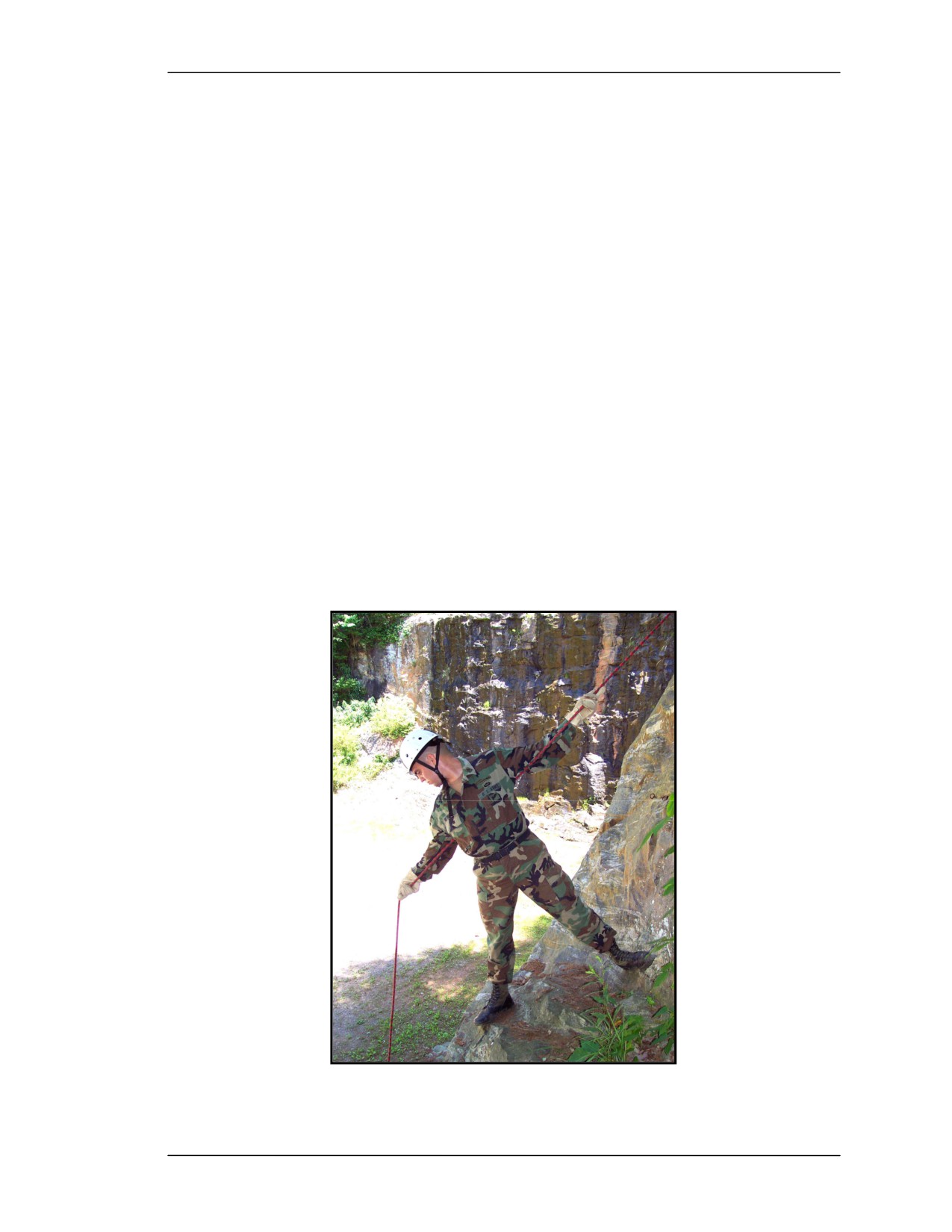
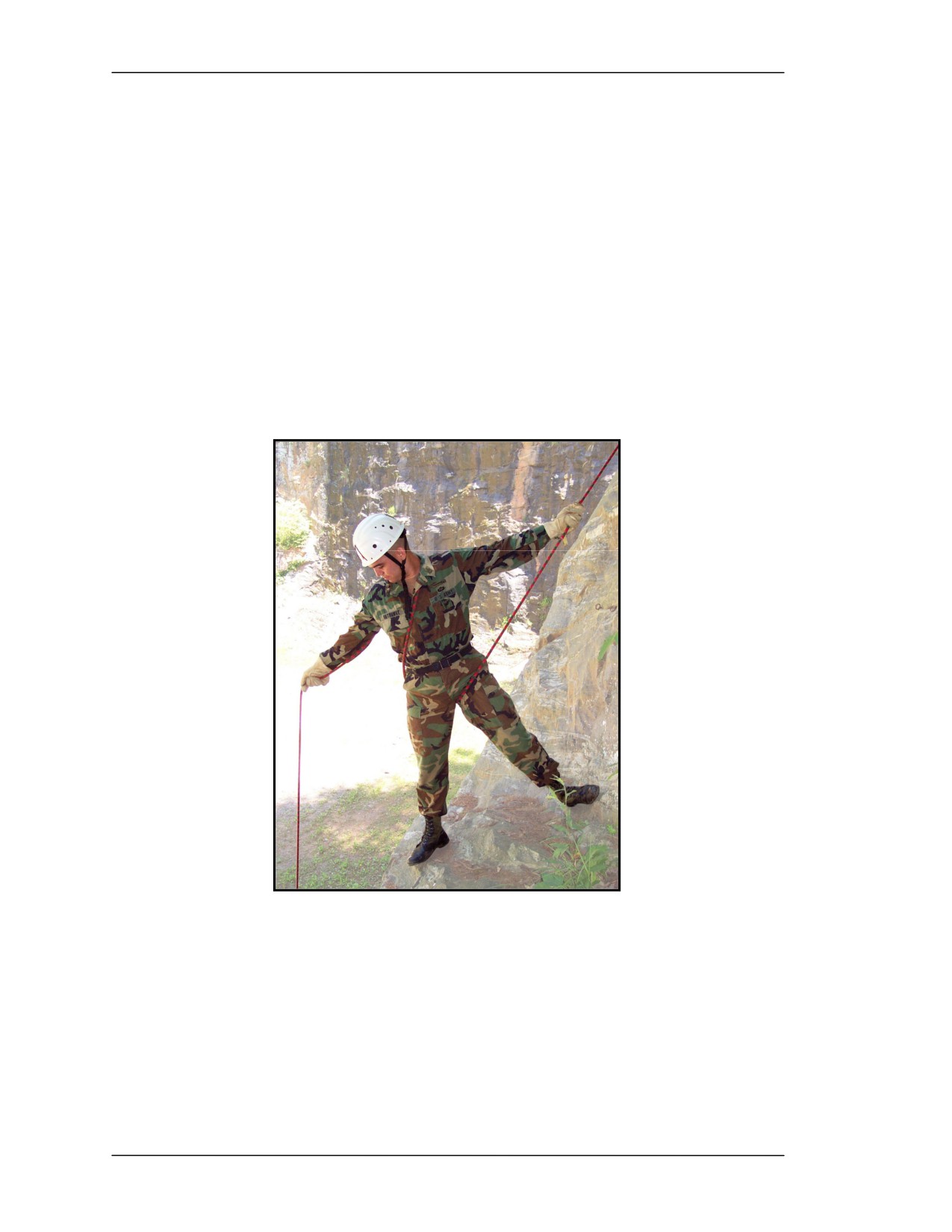
a. Hasty Rappel (Figure 7-4). The hasty rappel is used only on moderate pitches. Its
main advantage is that it is easier and faster than other methods. Gloves are worn to
prevent rope burns.
(1) Facing slightly sideways to the anchor, the rappeller places the ropes horizontally
across his back. The hand nearest to the anchor is his guide hand, and the other is the
brake hand.
(2) To stop, the rappeller brings his brake hand across in front of his body locking the
rope. At the same time, he turns to face up toward the anchor point.
Figure 7-4. Hasty rappel.
7-9
FM 3-97.61
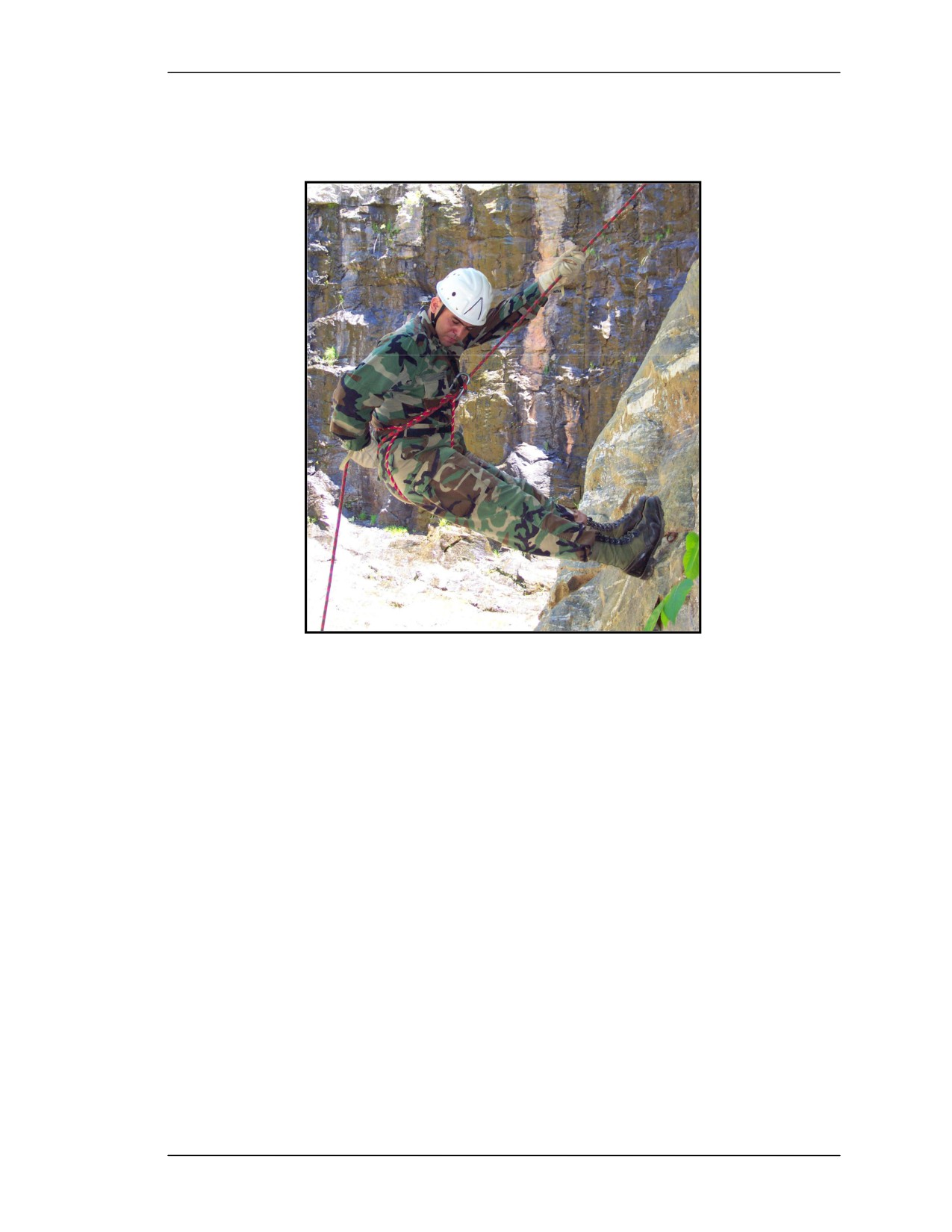
b. Body Rappel (Figure 7-5). The rappeller faces the anchor point and straddles the
rope. He then pulls the rope from behind, and runs it around either hip, diagonally across
the chest, and back over the opposite shoulder. From there, the rope runs to the brake
hand, which is on the same side of the hip that the rope crosses (for example, the right hip
to the left shoulder to the right hand). The rappeller leads with the brake hand down and
faces slightly sideways. The foot corresponding to the brake hand precedes the guide
hand at all times. The rappeller keeps the guide hand on the rope above him to guide
himself--not to brake himself. He must lean out at a sharp angle to the rock. He keeps his
legs spread well apart and relatively straight for lateral stability, and his back straight to
reduce friction. The BDU collar is turned up to prevent rope burns on the neck. Gloves
are worn, and other clothing may be used to pad the shoulders and buttocks. To brake, the
rappeller leans back and faces directly toward the rock area so his feet are horizontal to
the ground.
Figure 7-5. Body rappel.
Notes: 1. Hasty rappels and body rappels are not used on pitches that have overhangs;
feet must maintain surface contact.
2. Hasty rappels and body rappels are not belayed from below.
c. Seat-Hip Rappel (Figure 7-6). The seat rappel differs from the body rappel in
that the friction is absorbed by a carabiner that is inserted in a sling rope seat and fastened
7-10
FM 3-97.61
to the rappeller. This method provides a faster and more frictional descent than other
methods. Gloves can be worn to prevent rope burns.
Figure 7-6. Seat-hip rappel.
(1) An alternate technique is to insert two carabiners opposite and opposed. Then
insert a locking carabiner into the two carabiners with opening gate on brake hand side.
Then run the rope through the single carabiner. This helps to keep the rappel rope away
from the harness.
(2) To hook up for the seat-hip method, stand to one side of the rope. If using a right-
hand brake, stand to the left of the rappel rope facing the anchor; if using a left-hand
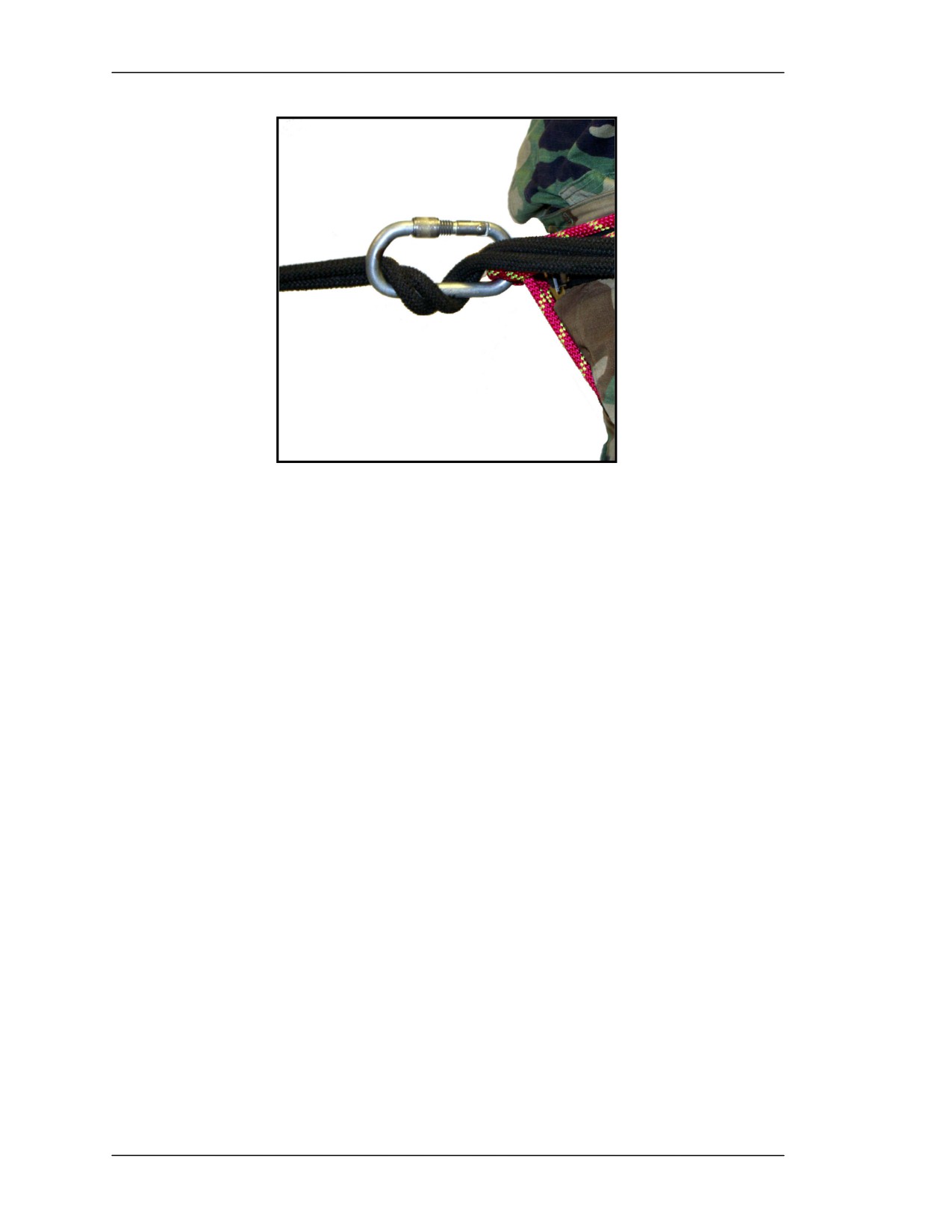
brake, stand to the right of the rappel rope. Place the rappel rope(s) into the locking
carabiner; slack is taken between the locking carabiner and anchor point and wrapped
around the shaft of the locking carabiner and placed into the gate so that a round turn is
made around the shaft of the locking carabiner (Figure 7-7, page 7-12). Any remaining
slack is pulled toward the uphill anchor point. If a single rope is used, repeat this process
to place two round turns around the shaft of the locking carabiner. Face the anchor point
and descend using the upper hand as the guide and the lower hand as the brake. This
method has minimal friction, and is fast and safe. However, care is taken that the rope is
hooked correctly into the carabiner to avoid the gate being opened by the rope. Loose
clothing or equipment around the waist may be accidentally pulled into the locking
carabiner and lock (stop) the rappel. For this reason, the rappeller must tuck in his shirt
and keep his equipment out of the way during his descent.
7-11
FM 3-97.61
Figure 7-7. Proper hookup using carabiner wrap.
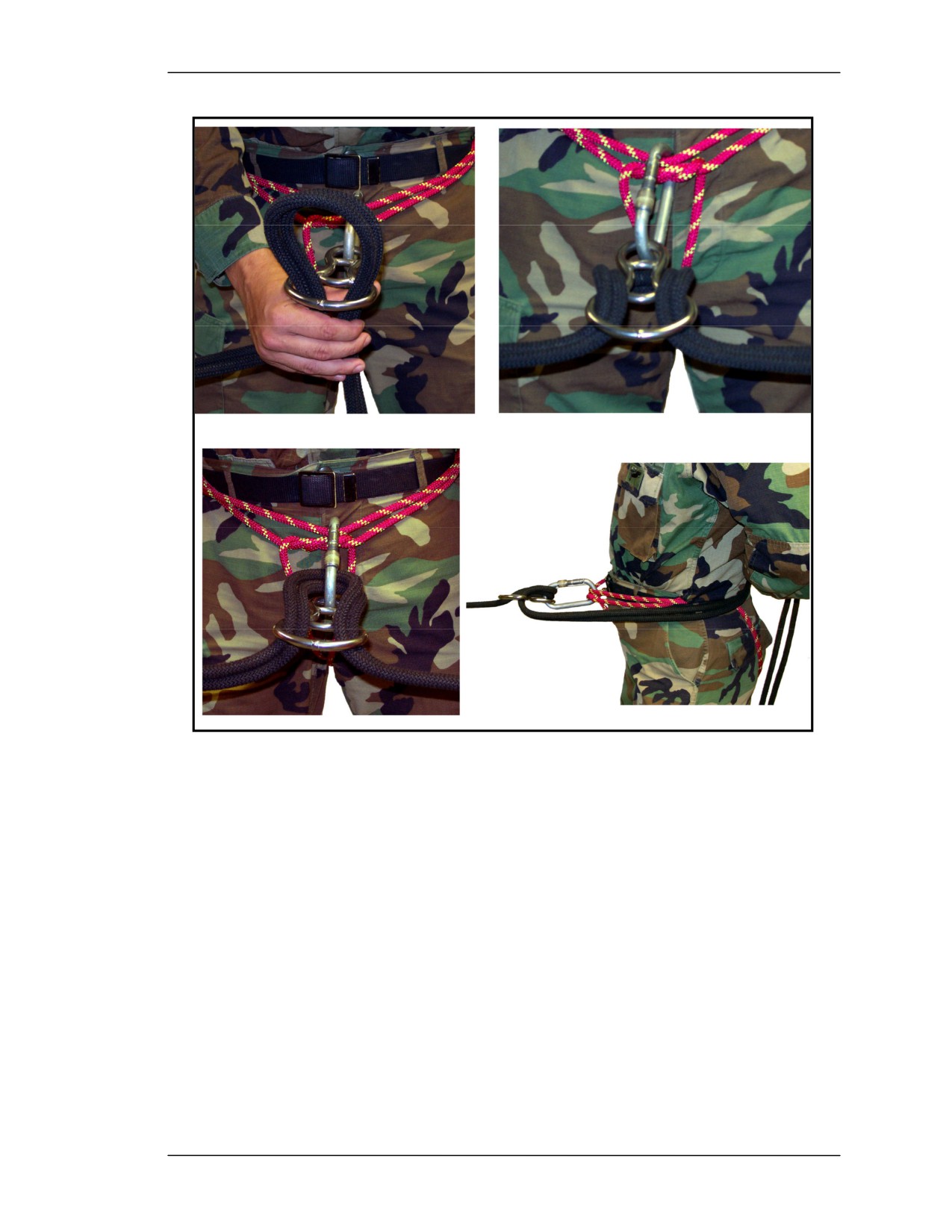
d. Figure-Eight Descender. The figure-eight descender puts less kinks in the rope,
and it can be used with one or two ropes (Figure 7-8).
(1) To use the figure-eight descender, pass a bight through the large eye and then
over the small eye onto the neck. Place the small eye into a locking carabiner. To reduce
the amount of friction on the figure-eight, place the original bight into the carabiner and
not around the neck of the descender. (Less friction requires more braking force from the
rappeller.)
(2) The guide hand goes on the rope that is running from the anchor. The brake hand
goes on the slack rope. The brake is applied by moving the brake hand to the rear or
downward.
7-12
FM 3-97.61
Figure 7-8. Figure-eight descender.
d. Other Devices. Many different types of devices are similar in design and
operation to the basic plate. These include slots or plates and tubers. Most of these
devices can accommodate two ropes not greater than 7/16 of an inch in size. Follow
manufacturer’s directions for using these devices for rappelling.
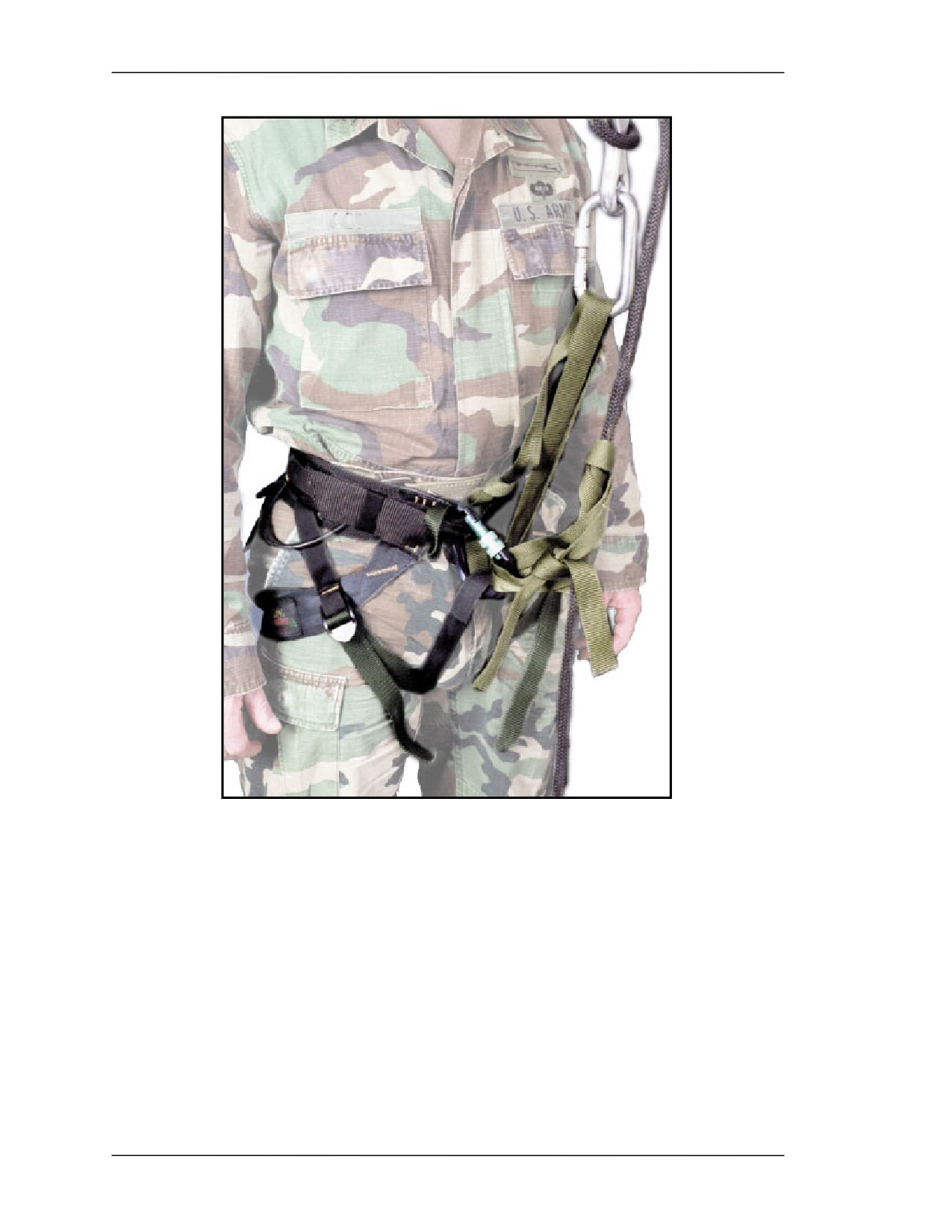
e. Extending the Rappel Device. The rappel device can be extended using either a
piece of webbing or cordage to move the device away from the body and the harness,
preventing accidental damage (Figure 7-9, page 7-14). It also allows for easier self-belay.
f. Self-Belay Techniques. A friction knot can be used as a belay for a rappeller
(Figure 7-9, page 7-14). The knot acts as the brake hand when the rappeller must work or
negotiate an obstacle requiring the use of both hands. The knot acts as a belay if the
rappeller loses control of the rope.
7-13
FM 3-97.61
Figure 7-9. Extended hookup with self-belay.
Section III. ONE-ROPE BRIDGE
The one-rope bridge is constructed using a static rope. The rope is anchored with an
anchor knot on the far side of the obstacle and is tied off at the near end with a tightening
system. A one-rope bridge may be built many ways, depending upon the tactical situation
and area to be crossed (crossing a gorge above the tree line may require constructing
artificial anchors). However, they all share common elements to safely construct and use
the bridge: two suitable anchors; good loading and unloading platforms; a rope about
1-meter (waist) high for loading and unloading; a tightening system; and a rope tight
enough for ease of crossing. Which side the tightening system is utilized, or whether an
anchor knot or retrievable bowline is used, depends on the technique.
7-14
FM 3-97.61
7-10. SITE SELECTION
A suitable crossing site must have “bombproof” anchors on both the near side and far side.
These anchors must be extremely strong due to the amount of tension that will be placed
upon them. Natural anchors, such as large trees and solid rock formations, are always
preferred. The site must also have suitable loading and off-loading platforms to facilitate
safe personnel movement.
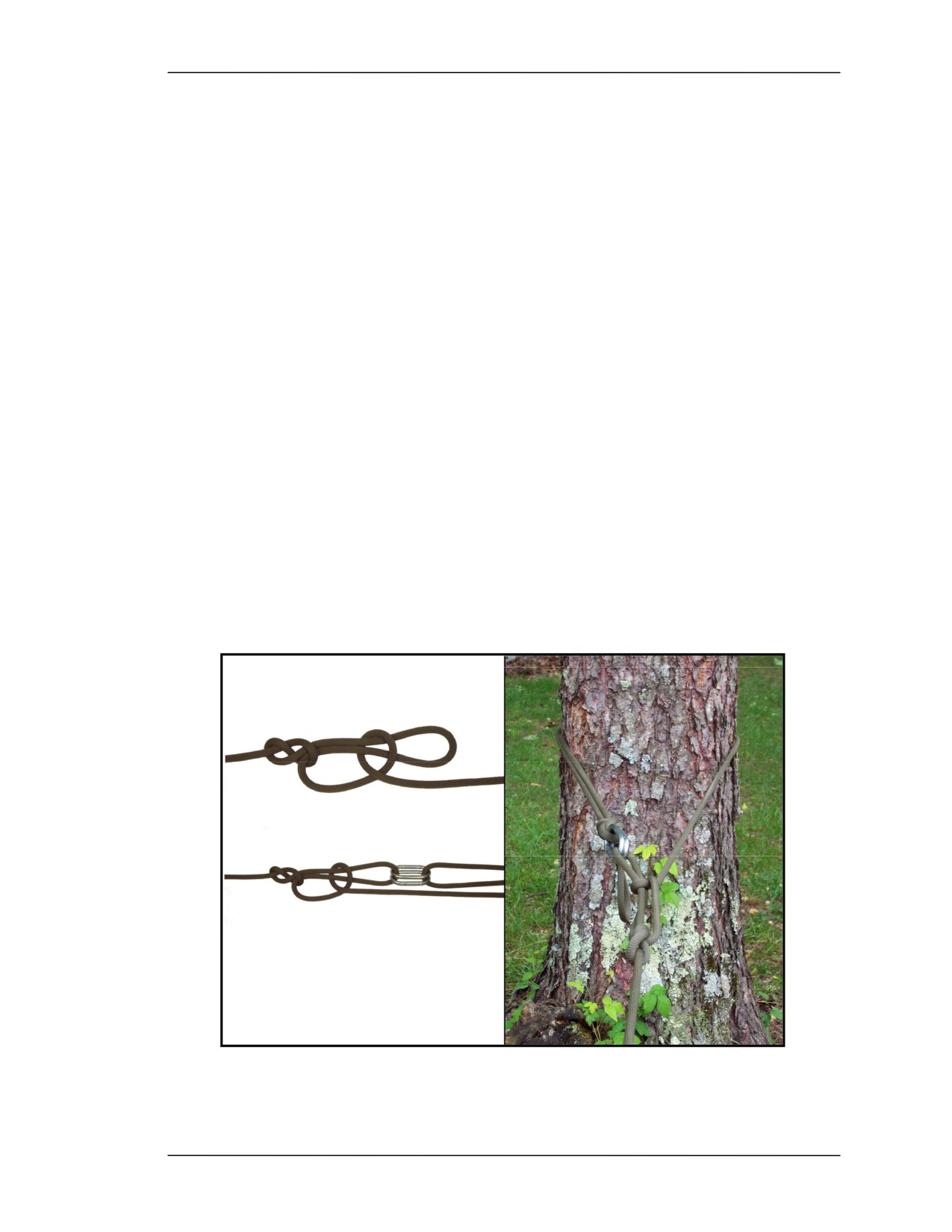
7-11. INSTALLATION USING TRANSPORT TIGHTENING SYSTEM
The transport tightening system provides a mechanical advantage without requiring
additional equipment.
a. The rope must first be anchored on the far side of the obstacle. If crossing a
stream, the swimmer must be belayed across. If crossing a ravine or gorge, crossing may
involve rappelling and a roped climb. Once across, the swimmer/climber will temporarily
anchor the installation rope.
b. One man on the near side ties a fixed-loop knot
(for example, wireman’s,
figure-eight slip knot) approximately 3 feet from the near side anchor and places the
carabiner into the loop of the knot. The opening gate must be up and away from the loop.
If two carabiners are used, the gates will be opposing. At that time, soldiers route the
remainder of the rope around the near side anchor point and hook the rope into the
carabiner. This system is known as a transport-tightening system (Figure 7-10). The man
on the far side pulls the knot out four to six feet from the near anchor.
c. Once the knot has been pulled out, the far side man anchors the rope using a
tensionless anchor. The anchor should be waist high.
Figure 7-10. Transport tightening system.
7-15
FM 3-97.61
d. A three-man pull team on the near side pulls the slack out of the installation rope.
The knot should be close enough to the near side anchor to allow personnel to easily load
the installation.
Note: No more than three personnel should be used to tighten the rope. Using more
personnel can over-tighten the rope and bring the rope critically close to failure.
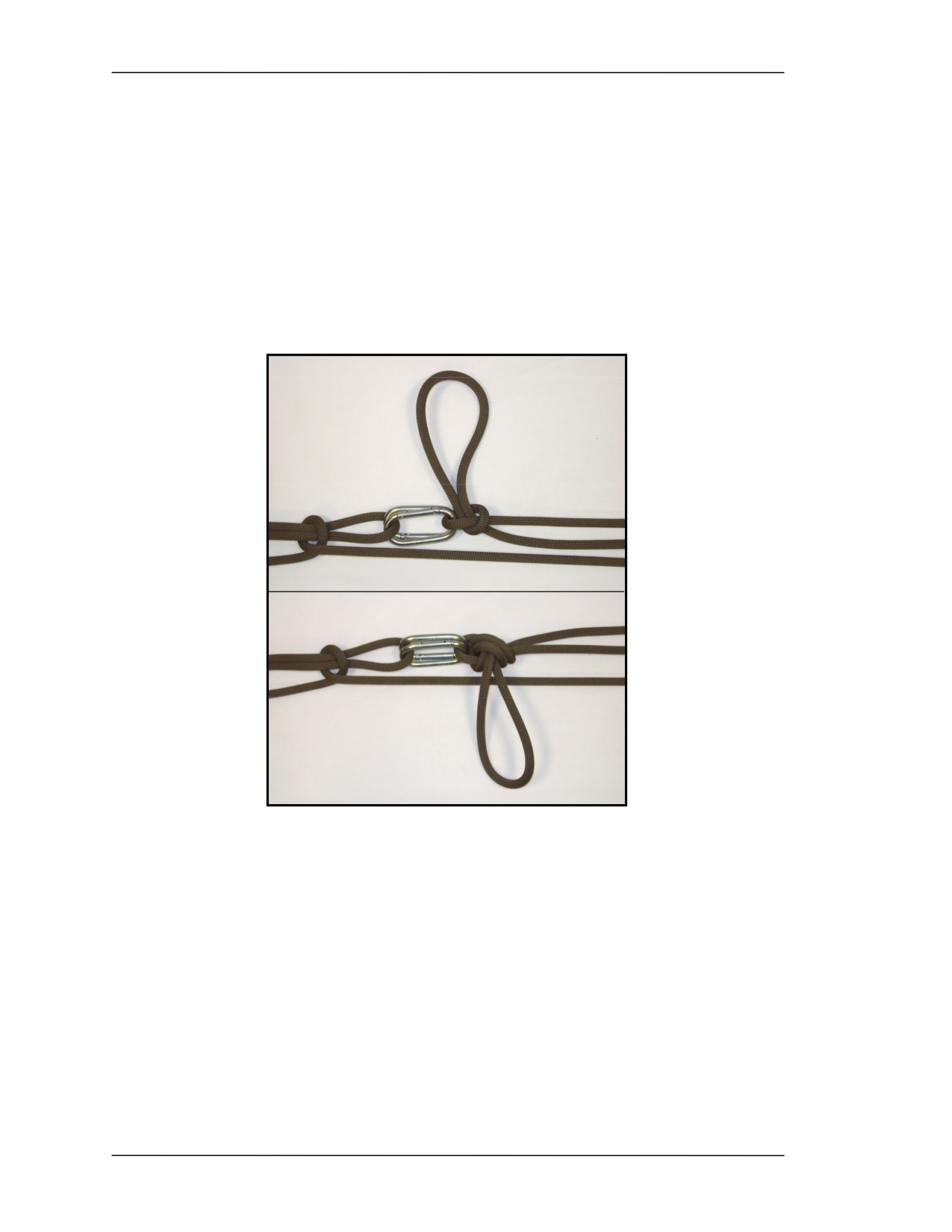
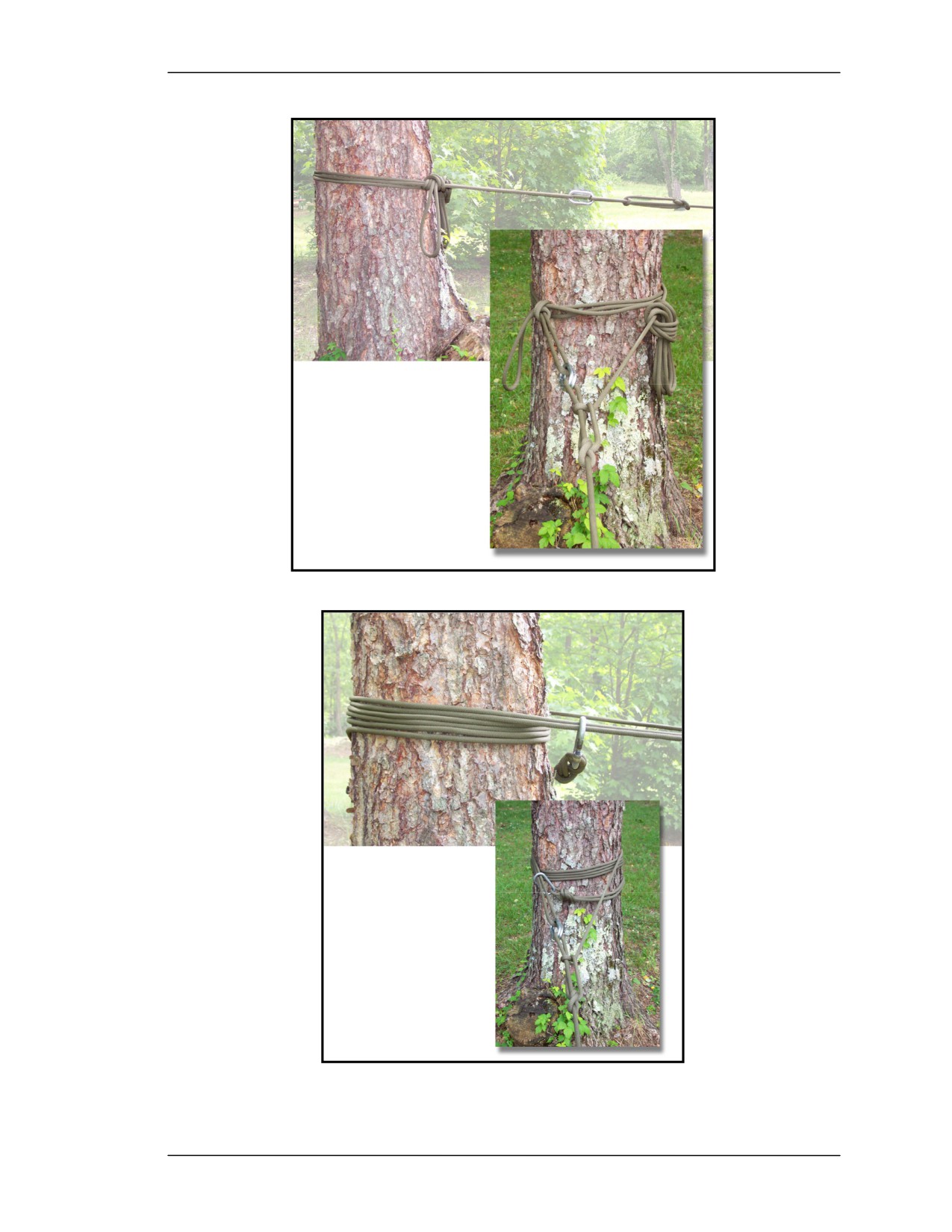
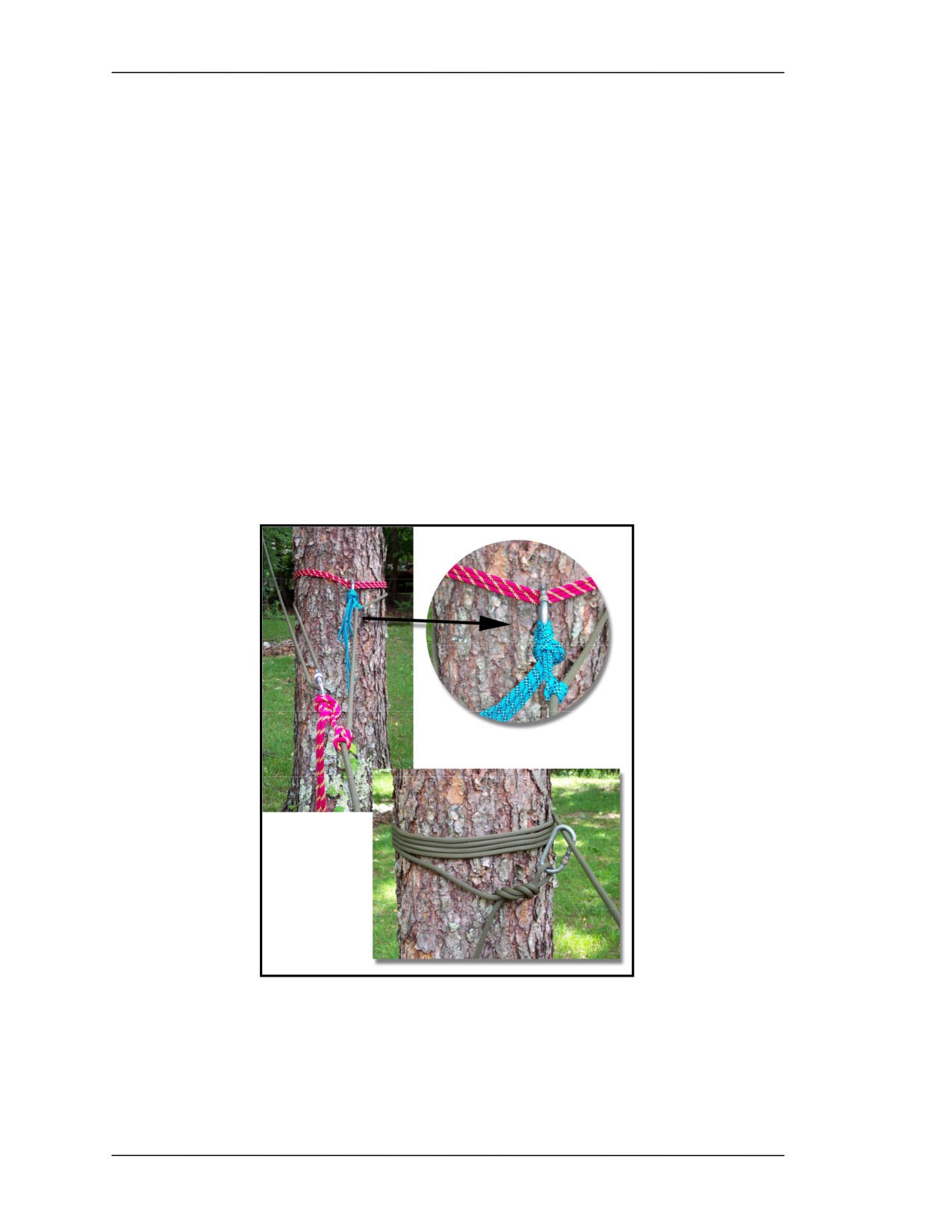
e. The rope the can be secured using one of three methods: transport knot (Figure
7-11), round turn around anchor and two half hitches on a bight (Figure 7-12), or a
tensionless anchor knot (Figure 7-13).
Figure 7-11. Transport knot.
7-16
FM 3-97.61
Figure 7-12. Round turn around anchor and two half hitches on a bight.
Figure 7-13. Tensionless anchor knot.
7-17
FM 3-97.61
Note: During training, a second static rope may be installed under less tension and
alongside the tight rope to increase safety. An individual would clip into both
ropes when crossing, thus having a backup in case of failure of the tighter rope.
7-12. INSTALLATION USING Z-PULLEY TIGHTENING SYSTEM
The Z-pulley tightening system (Figure 7-14) is another method for gaining a mechanical
advantage.
a. The rope is brought across the obstacle the same way as discussed in paragraph
7-10.
b. Once across, the far side man anchors the rope.
c. One soldier ties a friction knot (autoblock, web wrap, Kleimheist) with a sling
rope onto the bridging rope on the near side bank. Two steel carabiners are inserted with
opposing gates into the friction knot.
d. The rope is routed around the near side anchor and through the carabiners, from
inside to outside, and is run back to the near side anchor.
e. A second sling rope is tied to the bridge rope and then anchored to the near side
anchor. This knot will be used as a progress capture device.
Figure 7-14. Z-pulley tightening system.
f. The three-man pull team on the near side then pulls on the rope, creating a pulley
effect that tightens the system. As the rope is pulled tight, one man pushes the friction
knot back toward the far side.
7-18
FM 3-97.61
g. When the rope is tight, it is tied off with a tensionless anchor knot, transport knot,
or round turn around anchor and two half hitches on a bight.
7-13. UTILIZATION
The rope bridge can be used to move personnel and equipment over obstacles. There are
several methods of accomplishing this.
a. Method of Crossing. If dry crossing is impossible, soldiers will use the rope
bridge as a hand line. Preferably, all soldiers will tie a safety line and attach it to the rope
installation as they cross. If the soldier must cross with his rucksack, he may wear it over
both shoulders, although the preferred method is to place another carabiner into the top of
the rucksack frame, attach it to the bridge, and pull the rucksack across. Soldiers will
always cross on the downstream side of the installation. If a dry crossing is possible
soldiers will use one of three methods: commando crawl, monkey crawl, and Tyrolean
traverse.
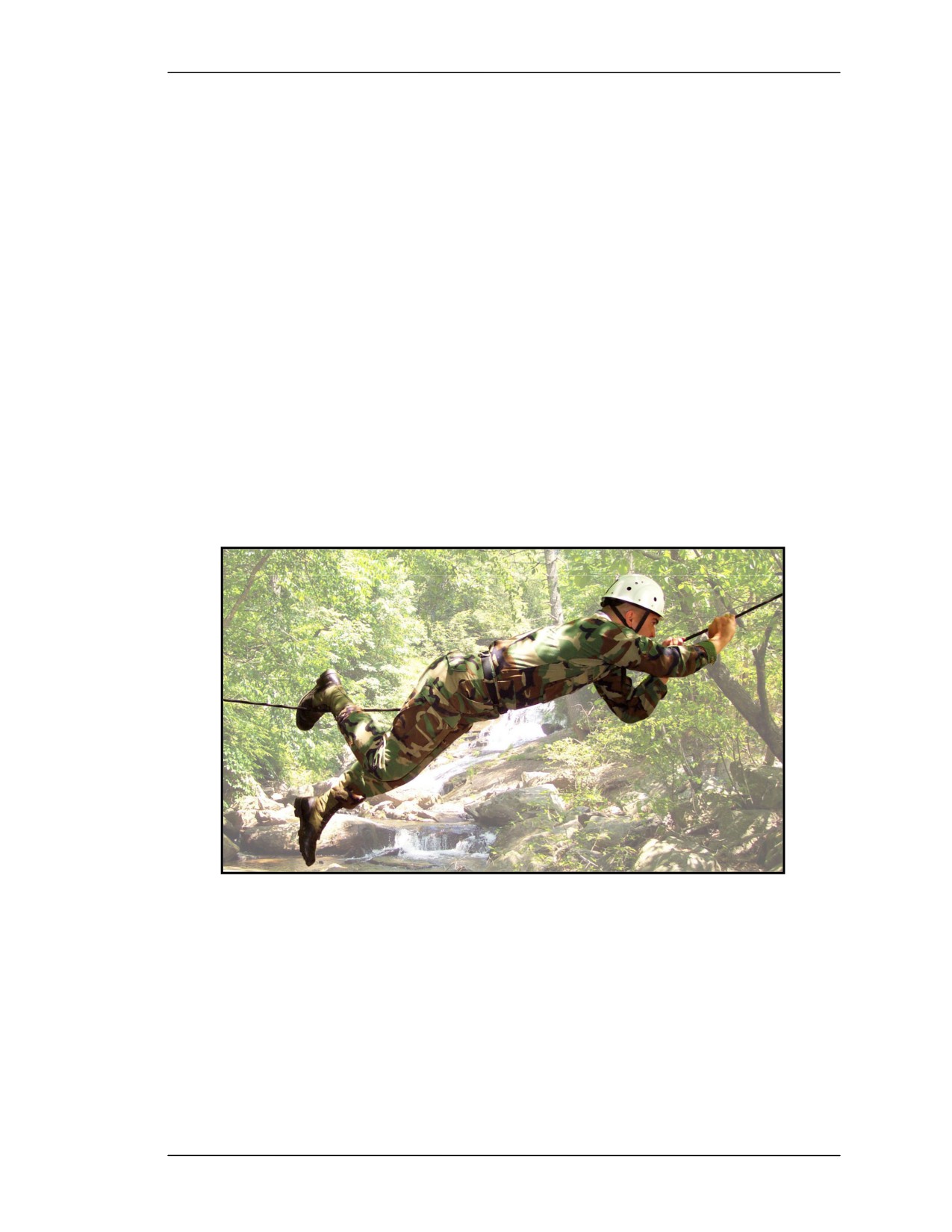
(1) Commando Crawl (Figure 7-15). The soldier lies on top of the rope with the
upstream foot hooked on the rope and the knee bent close to the buttocks; the
downstream leg hangs straight to maintain balance. He progresses by pulling with his
hands and arms. To recover if he falls over, the soldier hooks one leg and the opposite
arm over the rope, and then pushes down with the other hand to regain position.
Figure 7-15. Commando crawl.
Note: Only one man at a time is allowed on the bridge while conducting a commando
crawl.
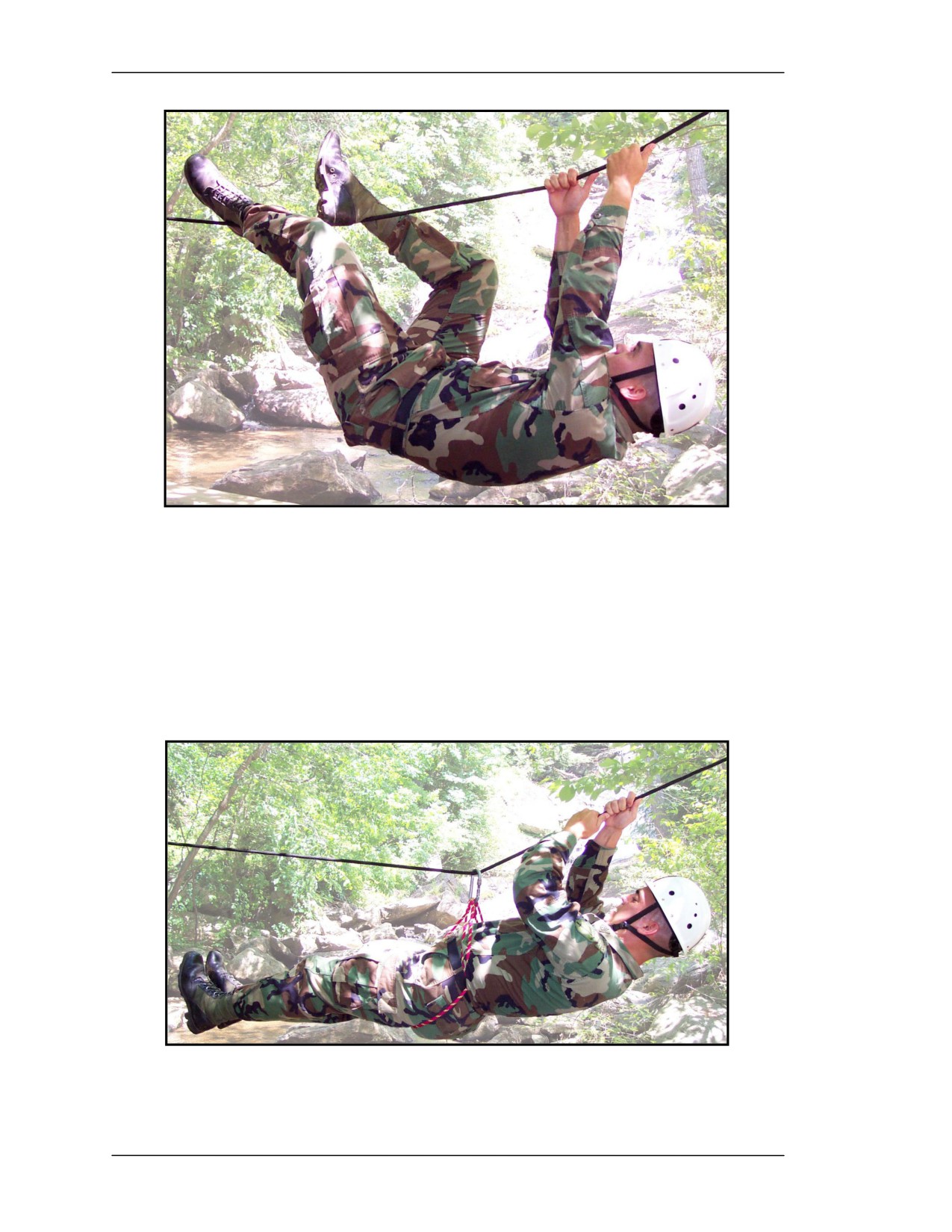
(2) Monkey Crawl (Figure 7-16, page 7-20). The soldier hangs below the rope
suspended by his hands with both heels crossed over the rope. He pulls with his hands
and arms, and pushes with his feet to make progress.
7-19
FM 3-97.61
Figure 7-16. Monkey crawl.
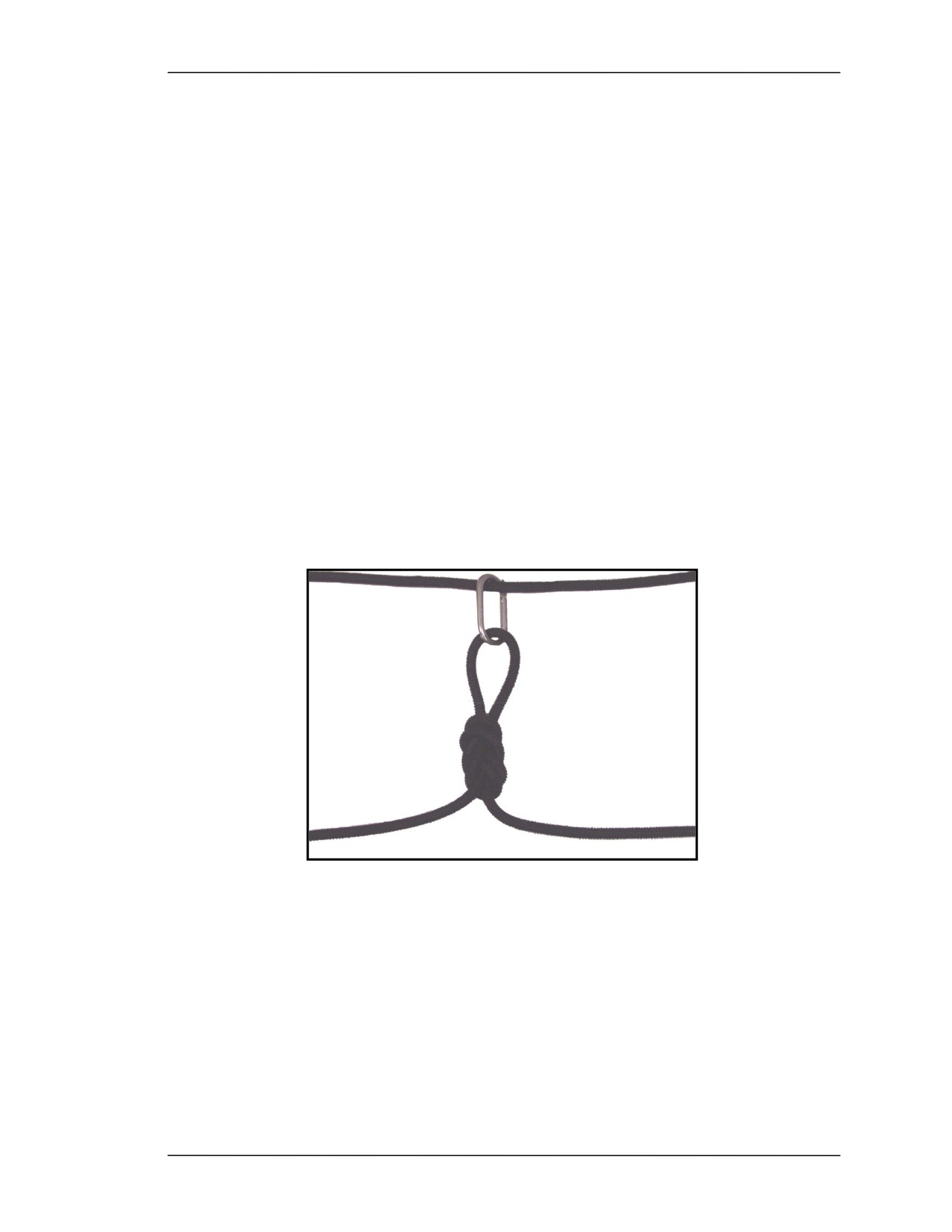
(3) Rappel Seat Method (Figure 7-17). The soldier ties a rappel seat (or dons a seat
harness) with the carabiner facing up and away from his body. He then faces the rope and
clips into the rope bridge. He rotates under the rope and pulls with his hands and arms to
make progress. The rappel seat method is the preferred method. If crossing with
rucksacks, a carabiner is inserted into the frame and attached to the rope bridge. The
soldier the places one or both legs through the shoulder carrying straps and pulls the
rucksack across.
Figure 7-17. Rappel seat method.
7-20
FM 3-97.61
b. Rigging Special Equipment. Any special equipment, such as crew-served
weapons, ammunition, or supplies, must be rigged for movement across the rope bridge.
A unit SOP may dictate the rigging of these items, but many expedient methods exist.
The rigging should use various items that would be readily available to a deployed unit.
Some of these items include tubular nylon webbing, cordage
(various sizes), and
carabiners.
(1) Machine Guns. To rig machine guns, use a sling rope and tie a rerouted figure-
eight around the spine of the front sight post. Then tie two evenly spaced fixed loops.
Finally, anchor the sling rope to the buttstock of the machine gun. Additional tie downs
may be necessary to prevent accidental disassembly of the weapon.
(2) ALICE Packs. ALICE packs can be joined together with a sling to facilitate
moving more than one rucksack at one time.
7-14. HAULING LINE
A hauling line may be used to move rucksacks or casualties across the rope bridge
(Figure 7-18).
a. Construction. An additional rope is brought across the rope bridge and anchored
to the far side. The other end is anchored on the near side. All the slack is pulled to the
near side, and a figure-eight slip knot is tied at the loading platform. A carabiner is
inserted into the loop and clipped onto the rope bridge.
Figure 7-18. Hauling line.
b. Moving Rucksacks. Use carabiners to attach the rucksack frames to the rope
bridge. Then clip the carabiner of the hauling line into the carabiner of the rucksack
closest to the far side. Personnel on the far side pull the rucksacks across using the
hauling line while personnel on the near side manages the slack at all times.
c. Moving Litters. The carabiner of the hauling line will remain on the rope bridge.
On each side of this carabiner, using the hauling line tie a middle-of-the-rope clove hitch
around both of the horizontal lift straps of the litter. Remove the slack between the
carabiners. Then place the carabiners in each of the lift straps onto the rope bridge. The
same technique used for the rucksacks is used to pull the litter across.
7-21
FM 3-97.61
7-15. RETRIEVAL
Once all except two troops have crossed the rope bridge, the bridge team commander
(BTC) chooses either the wet or dry method to dismantle the rope bridge.
a. If the BTC chooses the dry method, he should have anchored his tightening
system with the transport knot.
(1) The BTC back-stacks all of the slack coming out of the transport knot, then ties a
fixed loop and places a carabiner into the fixed loop.
(2) The next to last man to cross attaches the carabiner to his rappel seat or harness,
and then moves across the bridge using the Tyrolean traverse method.
(3) The BTC then removes all knots from the system. The far side remains anchored.
The rope should now only pass around the near side anchor.
(4) A three-man pull team, assembled on the far side, takes the end brought across by
the next to last man and pulls the rope tight again and holds it.
(5) The BTC then attaches himself to the rope bridge and moves across.
(6) Once across, the BTC breaks down the far side anchor, removes the knots, and
then pulls the rope across.
(b) If the BTC chooses a wet crossing, any method can be used to anchor the
tightening system.
(1) All personnel cross except the BTC or the strongest swimmer.
(2) The BTC then removes all knots from the system.
(3) The BTC ties a fixed loop, inserts a carabiner, and attaches it to his rappel seat or
harness. He then manages the rope as the slack is pulled to the far side.
(4) The BTC then moves across the obstacle while being belayed from the far side.
Section IV. SUSPENSION TRAVERSE
The suspension traverse is used to move personnel and equipment over rivers, ravines,
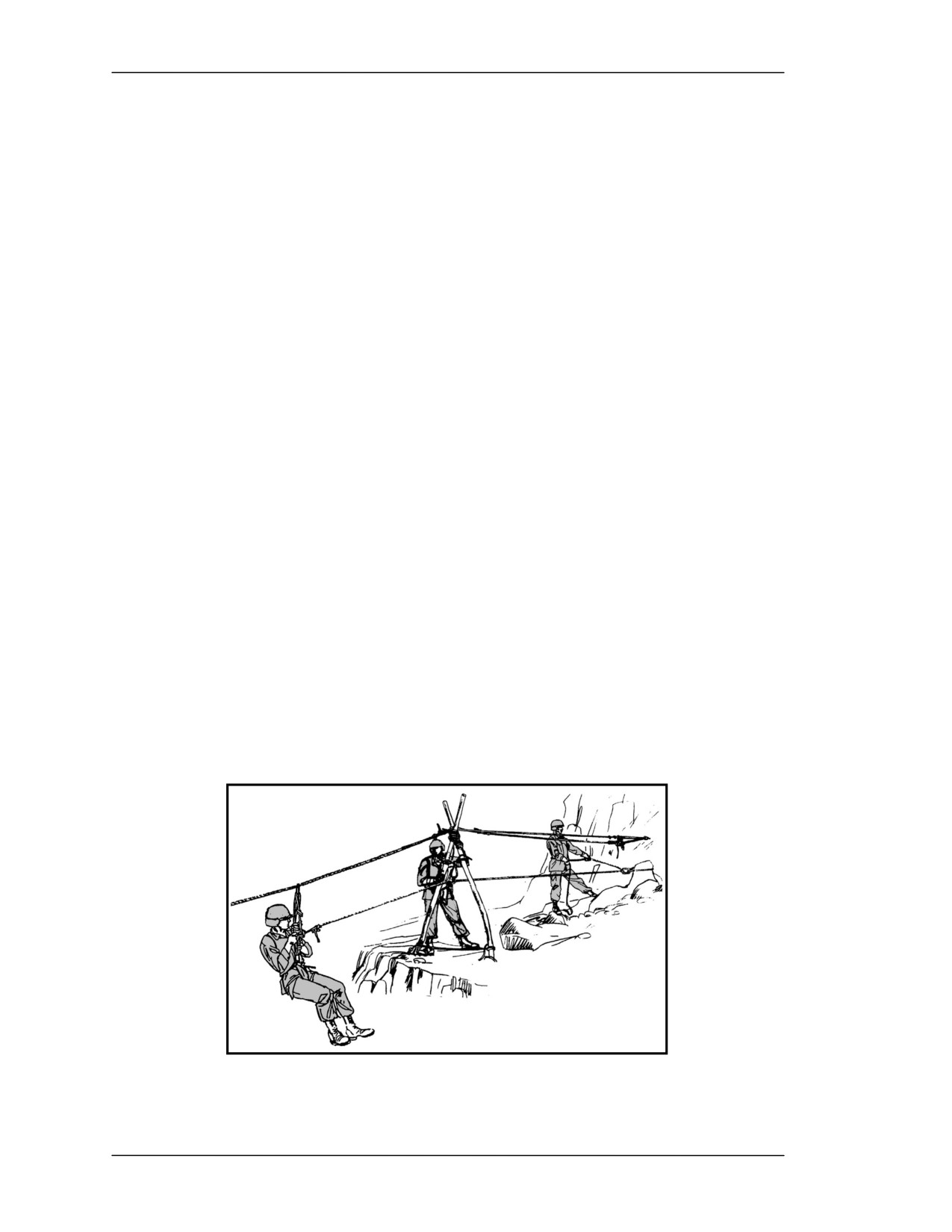
chasms, and up or down a vertical rock face (Figure 7-19). The system may be established
on a plane, varying from horizontal to near vertical.
Figure 7-19. Suspension traverse.
7-22
FM 3-97.61
7-16. SITE SELECTION
The crossing site must have bombproof anchors at the near side and the far side, and
suitable loading and off-loading platforms. If the anchors do not provide sufficient height
to allow clearance, an A-frame must be used.
7-17. INSTALLATION
Installation of a suspension traverse can be time-consuming and equipment-intensive. All
personnel must be well trained and well rehearsed in the procedures.
a. A-frames. Even in wooded mountainous terrain constructing an A-frame may be
necessary due to the lack of height where the installation is needed. Site selection
determines whether more height is needed; mission requirements determine site selection.
The two main installations that use A-frames are the suspension traverse and vertical
hauling line.
b. Equipment. Two sturdy poles are needed. The exact size of the poles depends on
the type of load and location of the installation. The average size A-frame pole should be
at least 3 inches in diameter and 9 to 12 feet long. Three to five 14-foot sling ropes are
needed, depending on the size of the poles used for the A-frame.
c. Construction. Place two poles with the butt ends flush, and mark the apex on
both poles.
(1) Ensure that proper height is attained and that the installation runs in a straight line
between the two anchors. An A-frame placed out of proper alignment can cause the
system to collapse. Try to find natural pockets in which to place the base of the A-frame
poles.
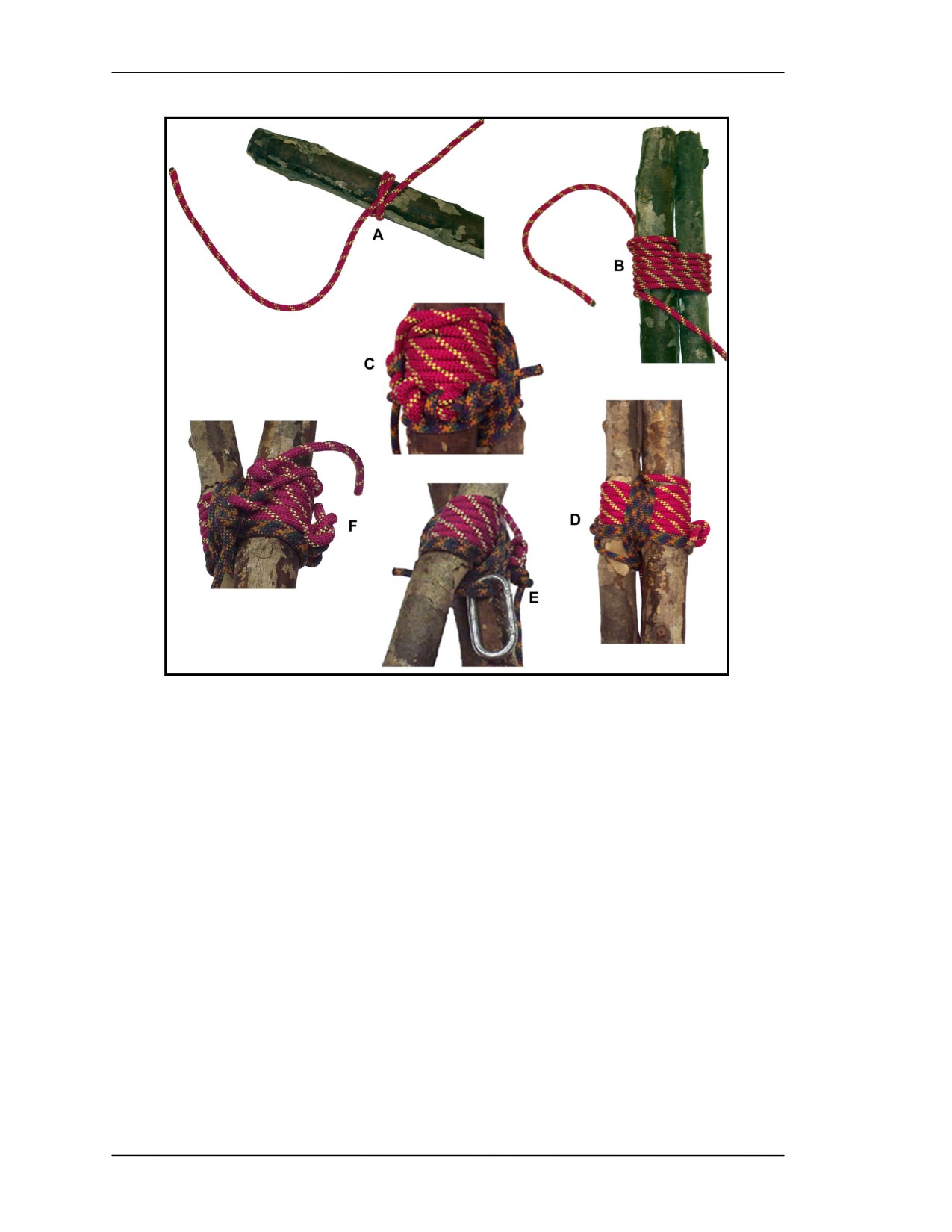
(2) With a sling rope, tie a clove hitch around the left pole (standing at the base of the
poles and facing the top) 3 inches above the apex marking, leaving about 18 inches of the
sling rope free on top of the clove hitch. Place the locking bar on the outside edge of the
pole. Make sure the rope end is pointing down as it is tied.
(See Figure
7-20A,
page 7-24.)
(3) Place the poles side by side and wrap the sling rope horizontally around both poles
six to eight times, wrapping down from the clove hitch (Figure 7-20B, page 7-24). It may be
necessary to join another sling rope to the first by using a square knot secured with overhand
knots. Position this knot on the outside of one of the poles so as not to interfere with the
vertical wraps. Make at least two additional wraps below the joining square knot. (See
Figure 7-20C, page 7-24.)
(4) On the last horizontal wrap (ensure there are at least two wraps below the joining
knot) to which the clove hitch is not tied, pass the rope between the poles below the wraps,
and make four to six tight vertical wraps around the horizontal wraps (Figure 7-20D, page
7-24). Make the wraps as tight as possible. The vertical wraps must be as flat as possible
next to each other. When starting the first vertical wrap, ensure it is in the same direction as
the 18-inch tail on the top of the clove hitch. Insert a carabiner into the last two vertical
wraps (Figure 7-20E, page 7-24).
(5) On the last vertical wrap, pass the rope between the poles above the horizontal
wraps. Tie it off with a square knot in the section of rope coming from the clove hitch.
Secure with overhand knots tied in the tails. (See Figure 7-20F, page 7-24.)
7-23
FM 3-97.61
Figure 7-20. A-frame horizontal and vertical wraps.
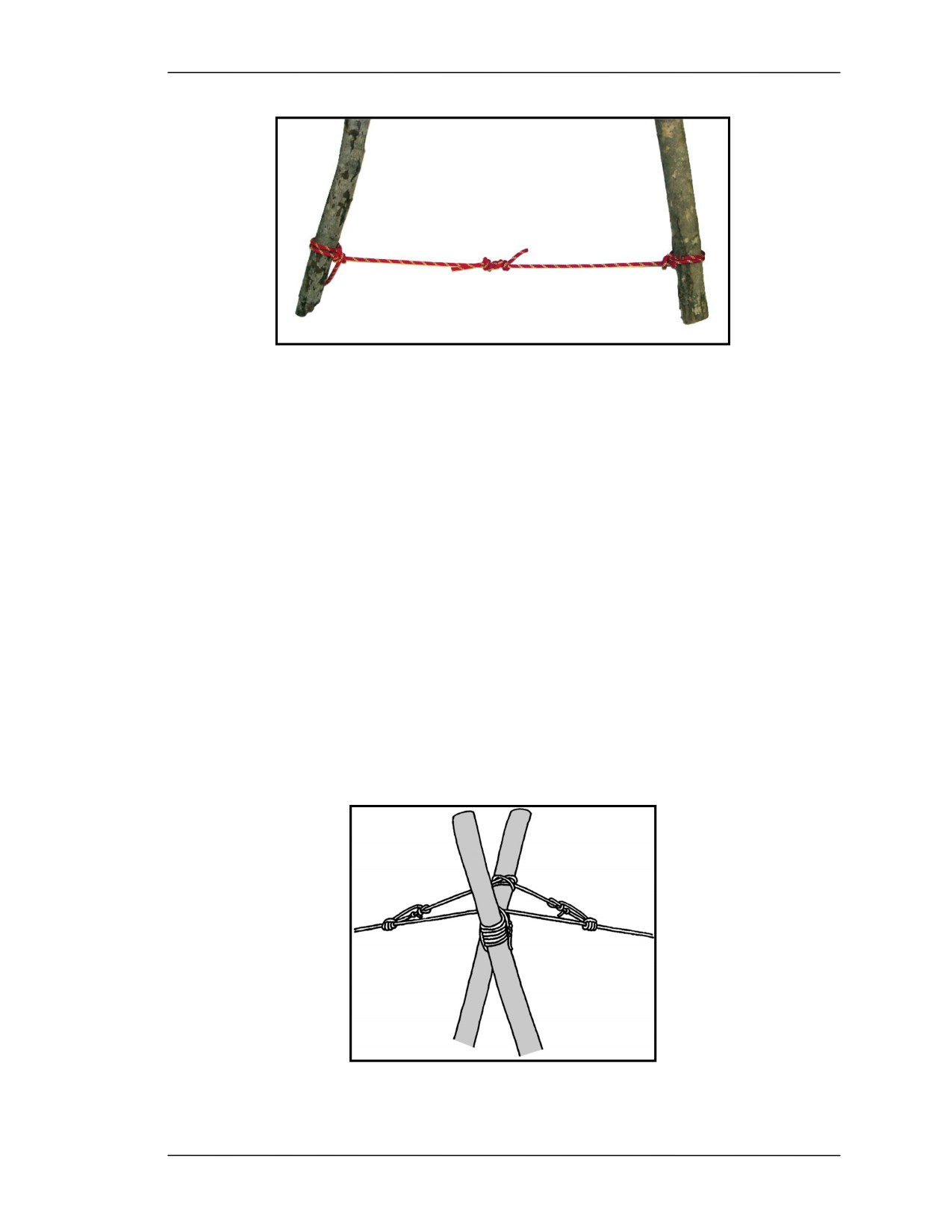
(6) Use a spreader rope to prevent the A-frame from collapsing from pressure applied at
the apex (Figure 7-21). If the ground is soft, dig the legs in about 6 inches. Tie a sling rope
between the legs with a round turn with two half hitches around each leg. Remove all slack
in the rope between the legs.
(7) If the ground is a hard surface, tie end-of-the-rope clove hitches with the locking
portions facing to the rear, the direction of kick. Tie the tails off at a 45-degree angle with
a round turn and two half hitches to a secondary anchor point. The spreader rope should
be no more than 6 inches above ground level. The use of clove hitches and half hitches
permits easy adjustment of the spreader rope. If more than one sling rope is needed, tie
the two ropes together with a square knot and secure with half hitches or overhand knots.
7-24
FM 3-97.61
Figure 7-21. A-frame spreader.
d. Installation Construction. One man rappels down the pitch and secures two
installation
(traverse) ropes to the far anchor with an anchor knot. Place a transport
tightening system in each installation rope at the near (upper) anchor. Run the installation
ropes through or around the anchor in opposite directions and tie off. Anchor the traverse
ropes as close together as possible so that the ropes do not cross.
(1) Place the A-frame (if needed) so that both traverse ropes run over the apex and the
A-frame splits the angle formed between the near (upper) and far (lower) anchors, with the
legs firmly emplaced or anchored with pitons. Ensure that the A-frame is in line with the
anchors. Adjust the A-frame under the traverse ropes after tightening to firmly implant the
A-frame.
(2) Tighten the installation ropes using either the transport tightening system (paragraph
7-11) or the z-pulley tightening system (paragraph 7-12).
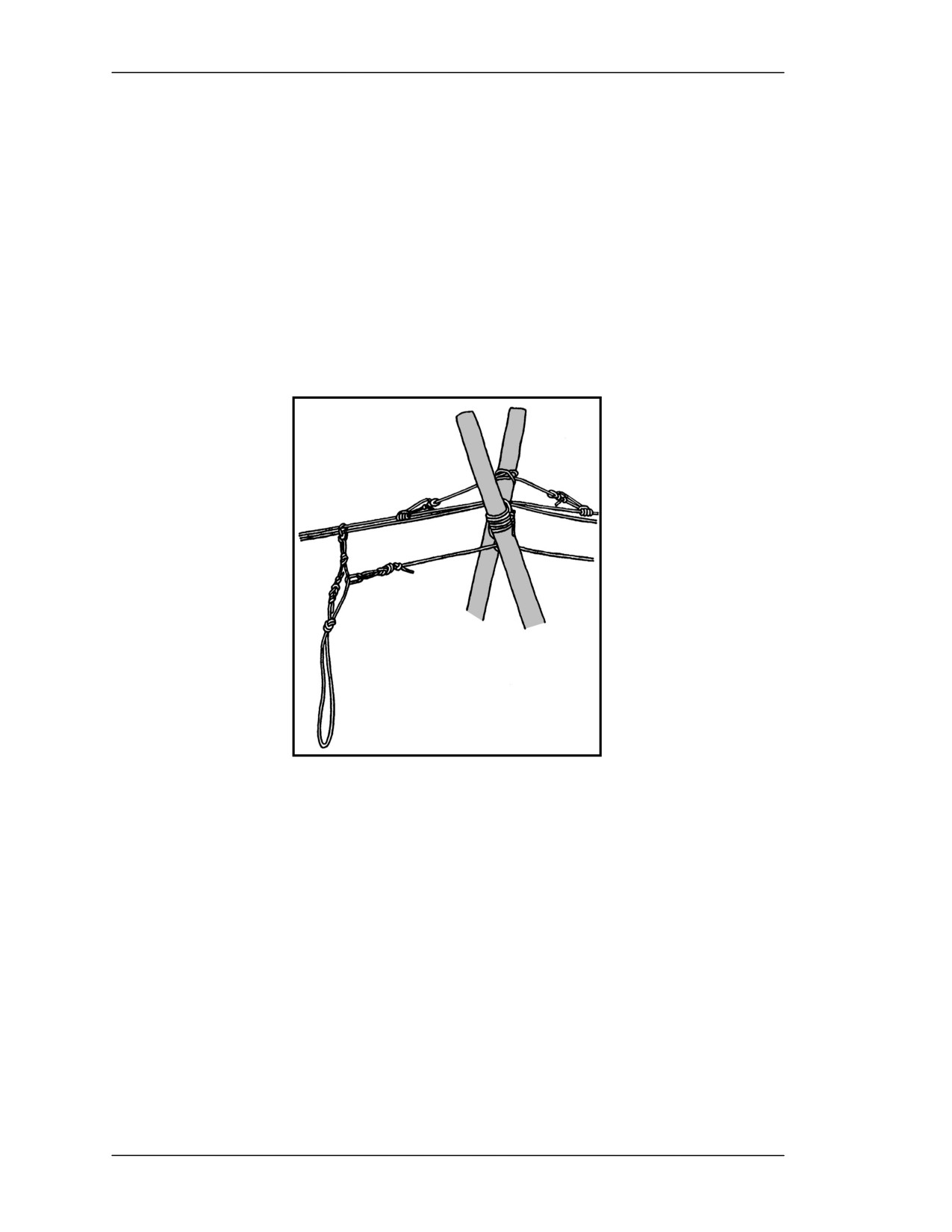
(3) Anchor the A-frame to the traverse rope. Tie a clove hitch at the center of a sling
rope. Place it over one of the poles above the apex and move down to the apex so that the
locking bar of the clove hitch is to the inside of the A-frame. Secure each end of the sling
rope to one of the tightened static lines with two Prusik knots-one forward and one to the
rear of the A-frame on the same static line rope (Figure 7-22).
Figure 7-22. Anchoring the A-frame to the traverse rope.
7-25
FM 3-97.61
Note: The A-frame should be positioned so that the angles created by the A-frame
bisecting the installation rope are approximately equal on both sides. This creates
downward pressure holding the A-frame in position, not forcing it in a lateral
direction. It must also be placed in a straight line between the upper and lower
anchor points.
(4) Use a carrying rope to attach loads to the traverse ropes (Figure 7-23). Join the ends
of a 14-foot sling rope with a square knot and two overhand knots. Displace the knot one-
third of the distance down the loop and tie an overhand knot both above and below the
square knot. This forms two small loops and one large loop that is longer than the two small
loops combined.
Figure 7-23. Carrying rope for use on a traverse.
(5) Attach the carrying rope to the traverse ropes with carabiners (or a pulley) that have
the gates reversed and opening in opposite directions. Attach a belay rope to the center loop
of the carrying rope using a fixed loop or locking carabiner on the side opposite the joining
knot (Figure 7-23). When the suspension traverse is near horizontal, a second rope may be
needed to pull the load across and should be attached to the carrying rope the same as the
first.
(6) Insert second carabiner into the one placed into the wraps of the A-frame. This is
where a belay rope will be attached
(7) With a sling rope, tie a six wrap middle-of-the-rope Prusik knot to both static ropes
near the far side off-loading point. This acts as a stopper knot for the man descending,
preventing him from hitting the lower anchor.
(8) Attach the load by running the long loop of the carrying rope through the load or
through the soldier’s harness and attaching the bottom loop to the traverse rope carabiner.
7-26
FM 3-97.61
Descent must be belayed slowly and be controlled. Soldiers descending should hold onto the
carrying rope and keep their feet high to avoid contact with the ground. Due to the constant
tension maintained on the belayer, use a mechanical belay. If the belayer cannot view the
entire descent route, use a relay man.
7-18. RETRIEVAL
The suspension traverse is not as readily retrievable as the one-rope bridge. Therefore, the
installing unit should dismantle it after it is no longer needed.
Section V. VERTICAL HAULING LINE
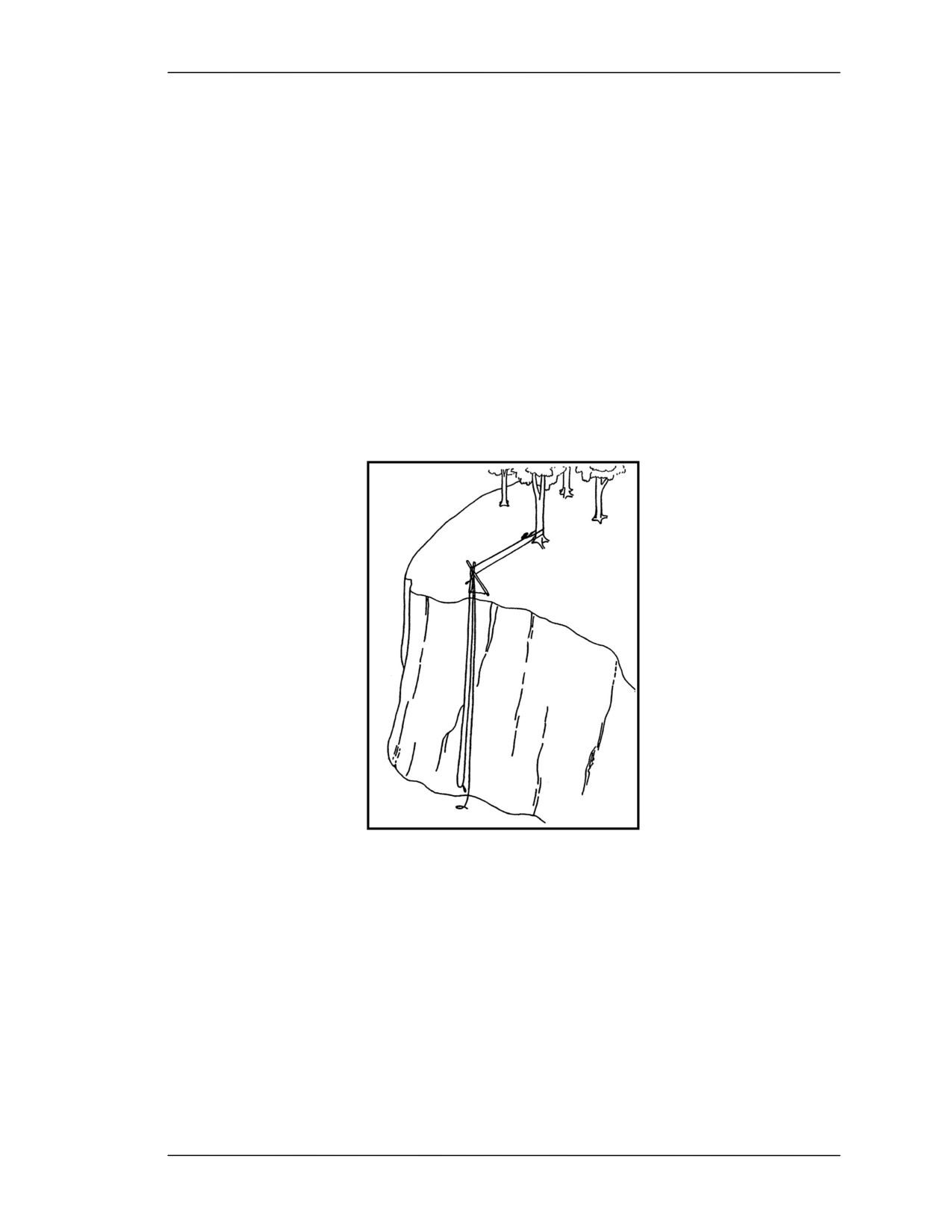
The vertical hauling line is an installation used to move men and equipment up vertical or
near-vertical slopes (Figure 7-24). It is often used with a fixed rope for personnel movement.
The hauling line is used to move equipment, such as mortars or other crew-served weapons,
rucksacks, or supplies
Figure 7-24. Vertical hauling line.
7-19. SITE SELECTION
The first and most important task is to determine where to construct the vertical hauling line.
The site must have an appropriate top anchor that is secure enough to hold the system and
load. Loading and unloading platforms should be easily accessible natural platforms that
provide a safe working area. The ideal platform at the top allows construction of the vertical
hauling line without the use of an A-frame. The site should also have sufficient clearance to
allow for space between the slope and pulley rope for easy hauling of troops or equipment.
7-27
FM 3-97.61
7-20. INSTALLATION
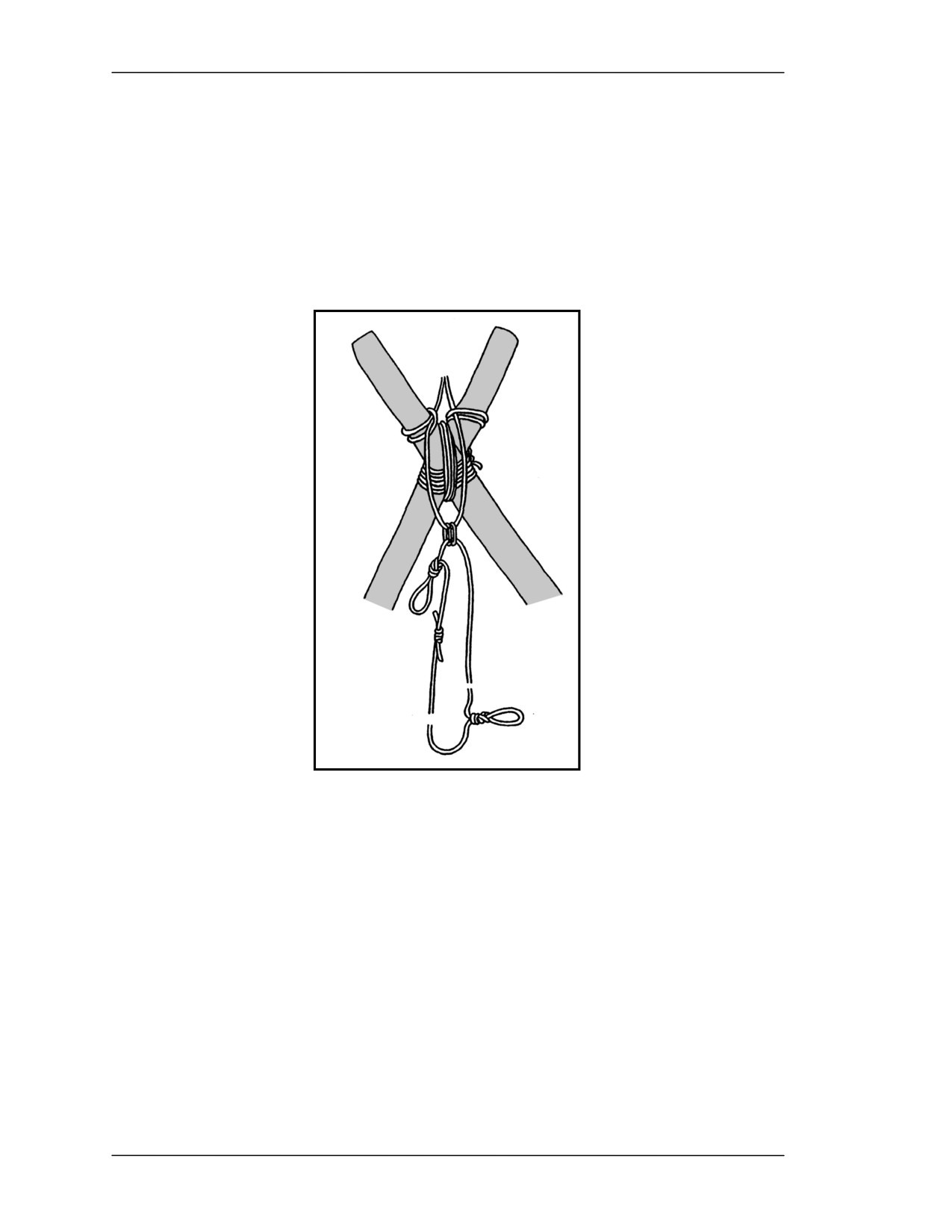
Construct an A-frame, if necessary, and anchor it. Double one installation rope, find the
middle, and lay the middle of the installation rope over the apex of the A-frame; a
30-centimeter (12-inch) bight should hang below the apex.
a. To maintain the 12-inch bight, tie clove hitches above the A-frame lashing on
each side of the apex with the installation rope, ensuring that the locking bars of the clove
hitches are on the inside. Ensure that the portion of the rope that forms the bight comes
out of the bottom of the clove hitch. (See Figure 7-25.)
Figure 7-25. Attaching the anchor rope to the A-frame.
b. To anchor the A-frame, use a transport tightening system with the doubled rope,
which is tied to the A-frame. Tie this off at an anchor point to the rear of the A-frame
installation and adjust the angle of the A-frame so it leans out over the cliff edge. The
angle should be 15 to 25 degrees unloaded. The A-frame should not lean outward more
than 45 degrees once loaded since the legs can lose their position.
c. Tie the ends of another installation rope together with a joining knot to form the
hauling line. Attach the rope to the system by two carabiners with gates up and opposed
or one mountain rescue pulley with a locking steel carabiner in the 12-inch bight hanging
from the apex of the A-frame. Tie fixed loops (wireman’s, directional figure-eight, or
single butterfly) on opposite sides of the endless rope at the loading and unloading
platforms.
d. Attach equipment to the hauling line 12 inches above the joining knot by a
carabiner in the fixed loop.
7-28
FM 3-97.61
e. Additional fixed loops may be tied in the hauling line for more control over the
object when moving large loads. Attach personnel to the hauling line by use of a rappel
seat or seat harness.
Note: Mortar tubes and similar objects are attached to the line by two knots so that the tube
stays parallel and as close to the hauling line as possible.
f. When personnel are moved using a vertical hauling line, make a knotted hand line;
anchor it in line with, or to, the primary anchor (round turn with a bowline); and place it
over the spreader on the legs of the A-frame. Space the overhand knots in the knotted hand
line 12 inches apart, with about 20 feet of rope without knots at one end for the anchor.
Throw the knotted hand line over the A-frame spreader rope and down the side of the cliff.
Personnel ascending the vertical hauling line use this as a simple fixed rope.
g. Use as many men as needed to pull the load to the top by pulling on the rope
opposite the load. If equipment and personnel are only being lowered, belay from the top
using the hauling line. Station two climbers at the unloading platform to retrieve loads.
h. If only equipment is being hauled up, it is not necessary to use the knotted hand line
rope, but it may be necessary to use a belay rope. To move materials or troops up on one
side of the hauling line, pull the other side from below.
Note: Personnel using the hauling line for movement must apply all related principles of
climbing. Always station two operators at the top of the vertical hauling line to aid
men or to retrieve loads when they reach the top. They will always be safetied while
working near the edge. When in use, the A-frame should lean slightly over the edge
of the cliff to prevent excessive wear on the ropes that pass over sharp rocks. Reduce
excessive friction on the system. Remove all obstacles and any loose objects that
could be dislodged by personnel and equipment.
7-21. RETRIEVAL
The vertical hauling line is used along a main supply route. When it is no longer needed, the
installing unit will return and dismantle the system.
Section VI. SIMPLE RAISING SYSTEMS
Moving heavy objects with limited manpower may be necessary in mountainous terrain. To
reduce fatigue of those personnel moving the load, simple rigging techniques can be used to
increase the mechanical advantage of the hauling system.
7-22. Z-PULLEY SYSTEM
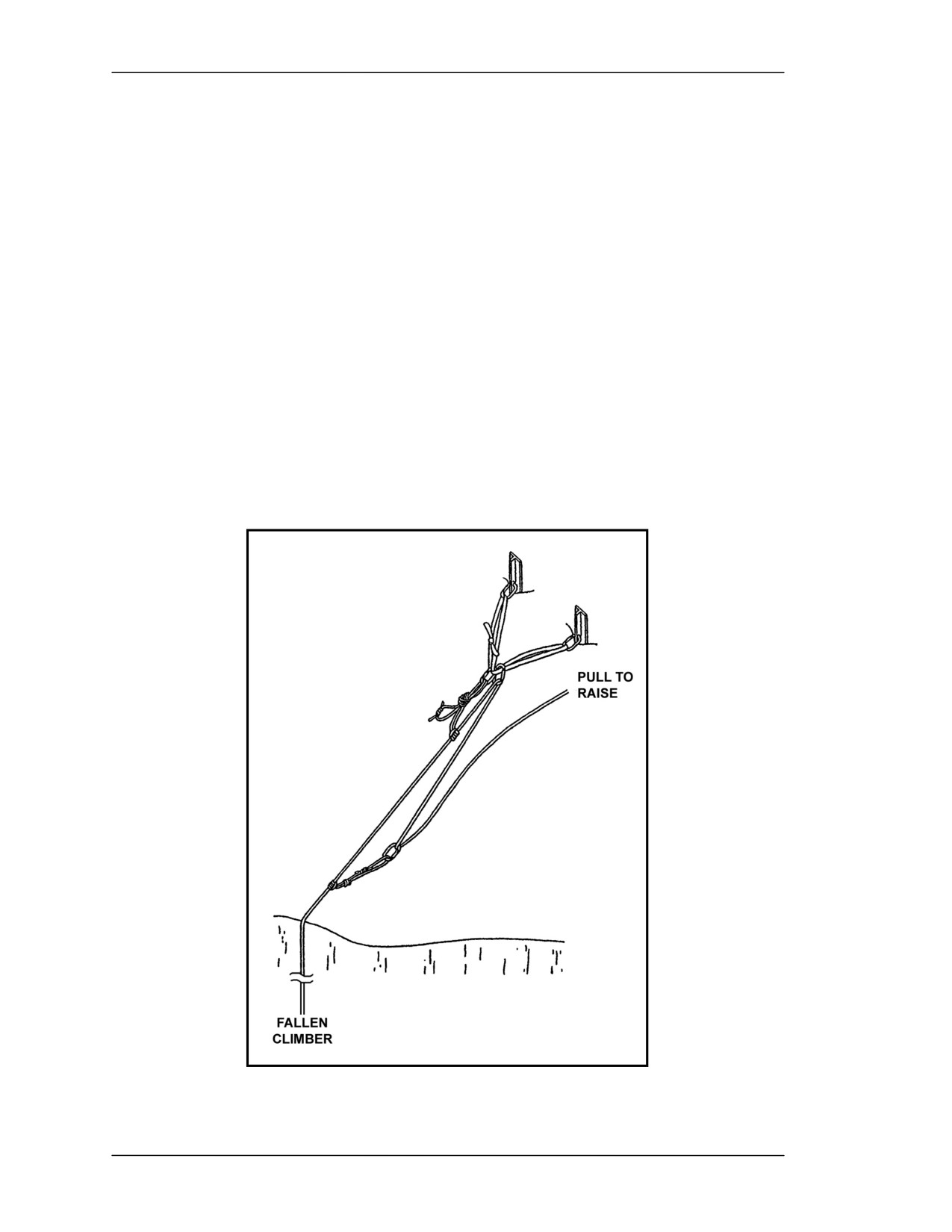
The Z-pulley system is a simple, easily constructed hauling system (Figure 7-26, page 7-30).
a. Considerations. Anchors must be sturdy and able to support the weight of the load.
Site selection is governed by different factors: tactical situation, weather, terrain, equipment,
load weight, and availability of anchors.
b. Theory. Use carabiners as a substitute if pulleys are not available. The mechanical
advantage obtained in theory is 3:1. The less friction involved the greater the mechanical
7-29
FM 3-97.61
advantage. Friction is caused by the rope running through carabiners, the load rubbing
against the rock wall, and the rope condition.
c. Construction. Use the following procedures to construct a Z-pulley system.
(1) Establish an anchor (anchor pulley system [APS]). Place a carabiner on the runner at
the anchor point, place a pulley into the carabiner, and run the hauling rope through the
pulley.
(2) With a sling rope (preferably 7 millimeter), tie a middle-of-rope Prusik knot secured
with a figure-eight knot on the load side of the pulley. This will be used as a progress
capture device (PCD). A mechanical descender may be used in place of the Prusik knot.
Take the tails exiting the figure-eight and tie a Munter hitch secured by a mule knot. Ensure
the Munter hitch is loaded properly before tying the mule knot.
(3) At an angle away from the APS, establish a moveable pulley system (MPS) to create
a “Z” in the hauling rope. Tie another Prusik knot on the load side of the hauling rope.
Secure it with a figure-eight knot. Using the tails tie a double-double figure-eight knot.
Insert a locking carabiner into the two loops formed, then place the working end into the
carabiner. Mechanical ascenders should not be used as an MPS. Move the working end back
on a parallel axis with the APS. Provide a pulling team on the working end with extra
personnel to monitor the Prusik knots.
Figure 7-26. Z-pulley system.
7-30
FM 3-97.61
d. Other Factors. If the two pulleys touch, the “Z” is lost along with the mechanical
advantage. For greater efficiency, the main anchor should be well back from the edge and all
ropes should pull parallel to the load.
Note: Avoid the possibility of overstressing the anchors. Be aware of reduced sensitivity to
the load due to the mechanical advantage. Use belays and backup safeties. Protect
the rope from edges and other abrasive parts of the rock.
7-23. U-PULLEY SYSTEM
The U-pulley system is another simple, easily-constructed hauling system (Figure 7-27,
page 7-32).
a. Considerations. Anchors must be sturdy and able to support the weight of the load.
Site selection is governed by different factors: tactical situation, weather, terrain, equipment,
load weight, and availability of anchors.
b. Theory. Use carabiners as a substitute if pulleys are not available. The mechanical
advantage obtained in theory is 2:1. The less friction involved the greater the mechanical
advantage. Friction is caused by the rope running through carabiners, the load rubbing
against the rock wall, and the rope condition.
c. Construction. Use the following procedures construct a U-pulley system.
(1) Anchor the hauling rope.
(2) Prepare the load or casualty for hauling. Place a locking carabiner the on to the
harness or the rigged load.
(3) Lower a bight to the casualty or the load.
(4) Place the bight into the carabiner; or place the bight on to a pulley and then place
pulley into the carabiner.
(5) Construct a second anchor. Attach a locking carabiner to the anchor.
(6) Tie a middle of the rope Prusik onto the haul rope exiting the pulley. Secure the
Prusik with a double-double figure eight. This is the PCD. Place the fixed loops into
the locking carabiner of the second anchor.
7-31
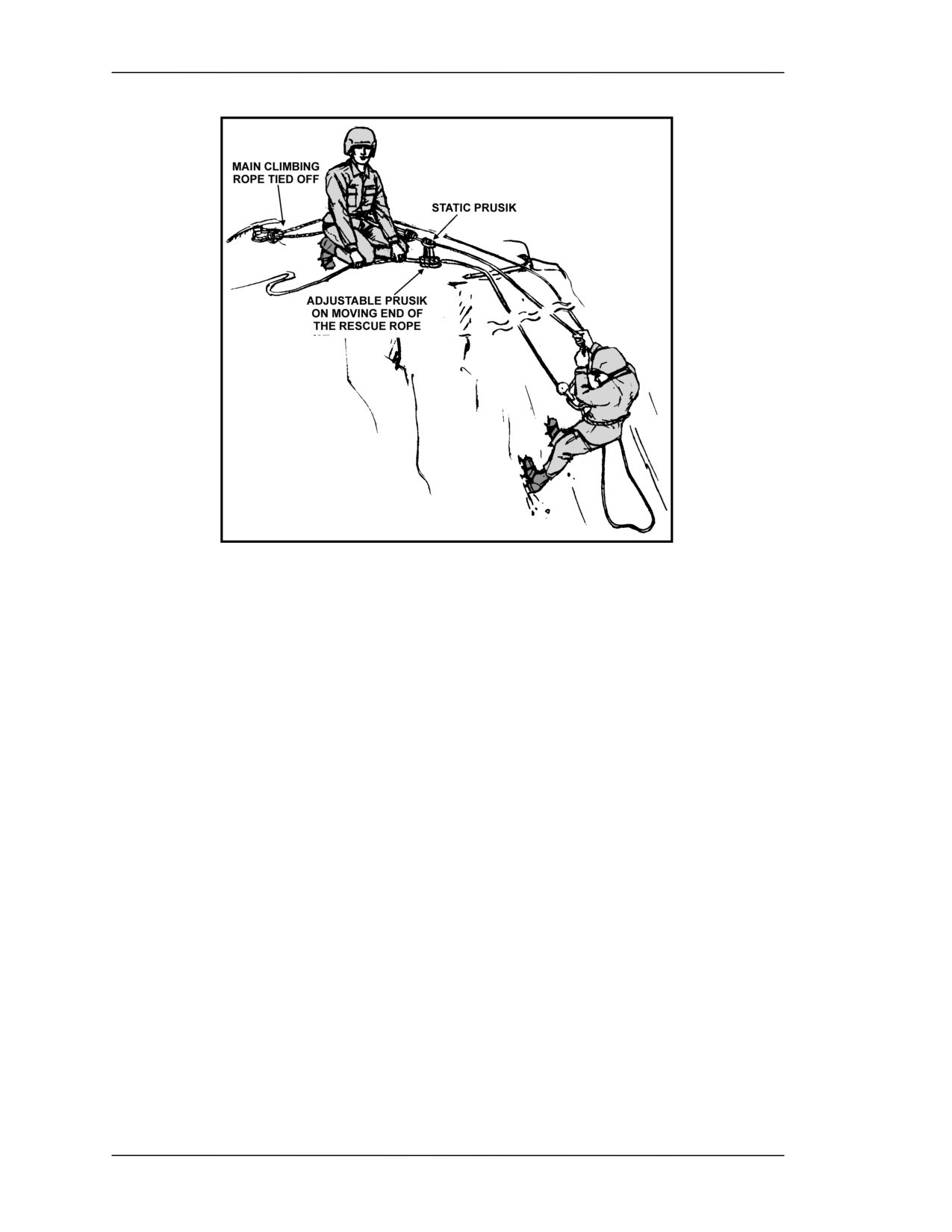
FM 3-97.61
Figure 7-27. U-pulley system.
7-32