FM 3-97.61 MILITARY MOUNTAINEERING (AUGUST 2002) - page 4
FM 3-97.61
STEP 3. With the working end, form another bight and place that bight through
the loop just formed in the left hand.
STEP 4. Hold the bight with the left hand, and place the original bight (moving
toward the left hand) over the knot.
STEP 5. Dress the knot down.
Figure 4-18. Two-loop figure-eight.
b. Checkpoints.
(1) There is a double figure-eight knot with two loops that share a common locking bar.
(2) The two loops must be adjustable by means of a common locking bar.
(3) The common locking bar is on the bottom of the double figure-eight knot.
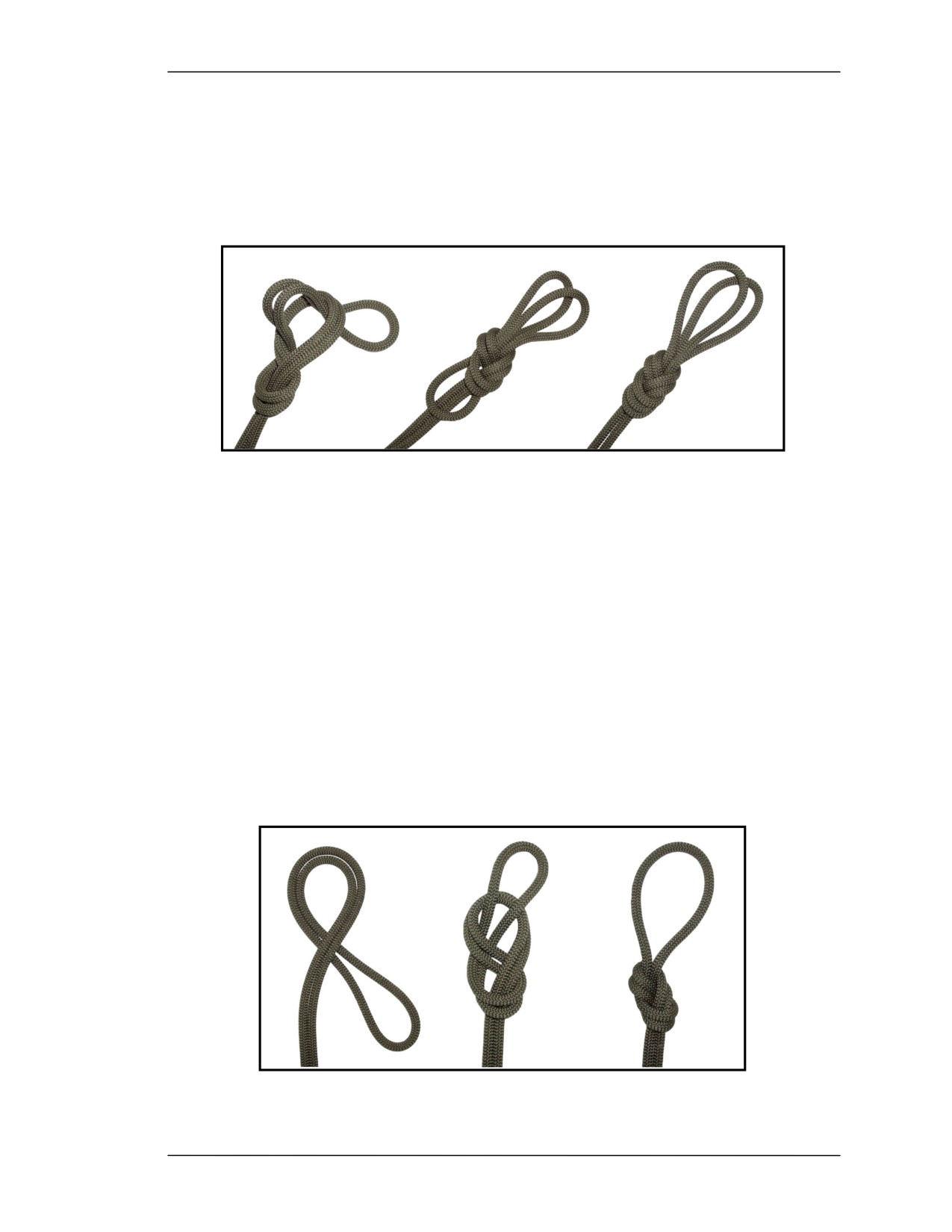
4-20. FIGURE-EIGHT LOOP (FIGURE-EIGHT-ON-A-BIGHT)
The figure-eight loop, also called the figure-eight-on-a-bight, is used to form a fixed loop in
a rope (Figure 4-19). It is a middle of the rope knot.
a. Tying the Knot.
STEP 1. Form a bight in the rope about as large as the diameter of the desired
loop.
STEP 2. With the bight as the working end, form a loop in rope (standing part).
STEP 3. Wrap the working end around the standing part 360 degrees and feed the
working end through the loop. Dress the knot tightly.
Figure 4-19. Figure-eight loop.
4-21
FM 3-97.61
b. Checkpoints.
(1) The loop is the desired size.
(2) The ropes in the loop are parallel and do not cross over each other.
(3) The knot is tightly dressed.
4-21. PRUSIK KNOT
The Prusik knot is used to put a moveable rope on a fixed rope such as a Prusik ascent or a
tightening system. This knot can be tied as a middle or end of the rope Prusik. It is a
specialty knot.
a. Tying the Knot.
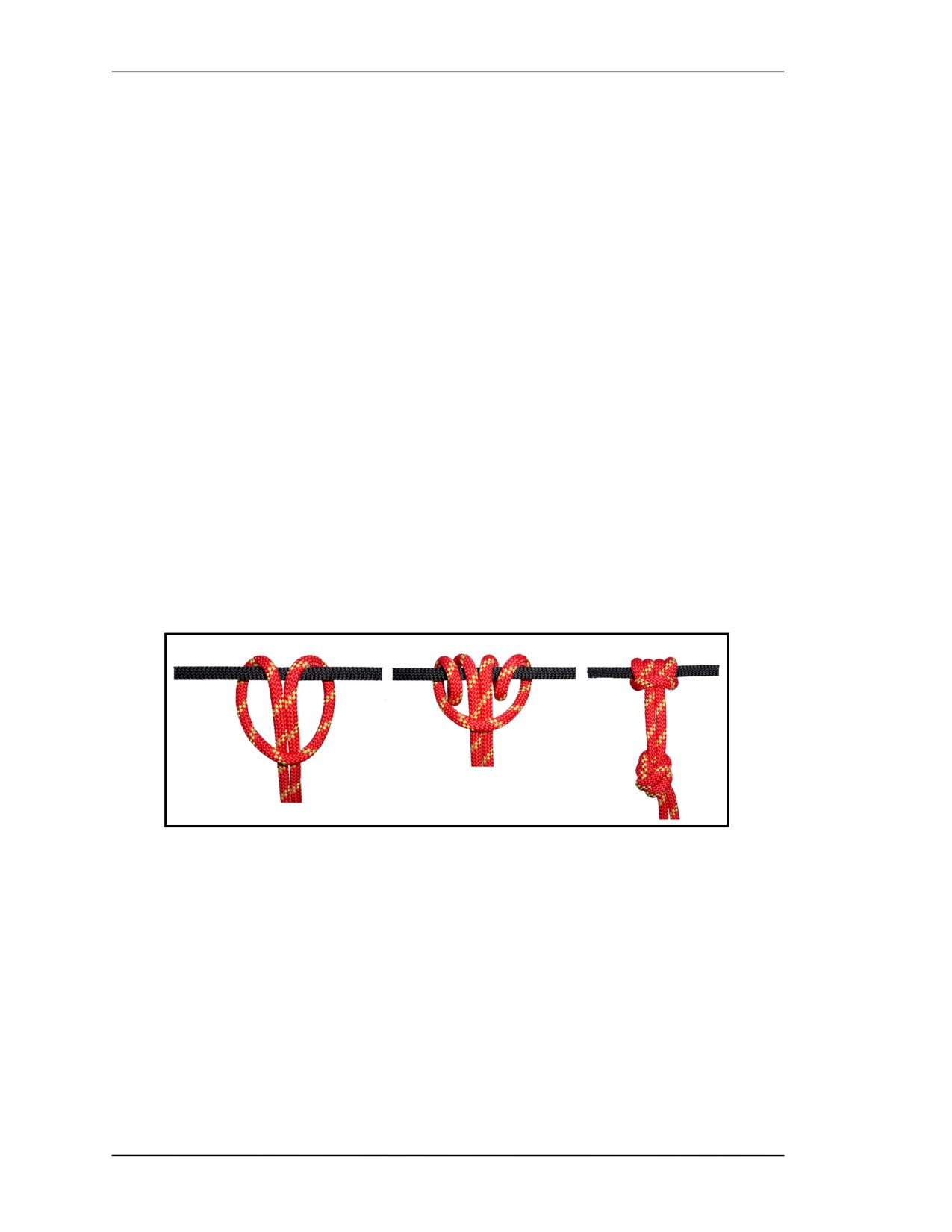
(1) Middle-of-the-Rope Prusik. The middle-of-the-rope Prusik knot can be tied with a
short rope to a long rope as follows (Figure 4-20.):
STEP 1. Double the short rope, forming a bight, with the working ends even. Lay
it over the long rope so that the closed end of the bight is 12 inches
below the long rope and the remaining part of the rope (working ends) is
the closest to the climber; spread the working end apart.
STEP 2. Reach down through the 12-inch bight. Pull up both of the working ends
and lay them over the long rope. Repeat this process making sure that the
working ends pass in the middle of the first two wraps. Now there are
four wraps and a locking bar working across them on the long rope.
STEP 3. Dress the wraps and locking bar down to ensure they are tight and not
twisted. Tying an overhand knot with both ropes will prevent the knot
from slipping during periods of variable tension.
Figure 4-20. Middle-of-the-rope Prusik.
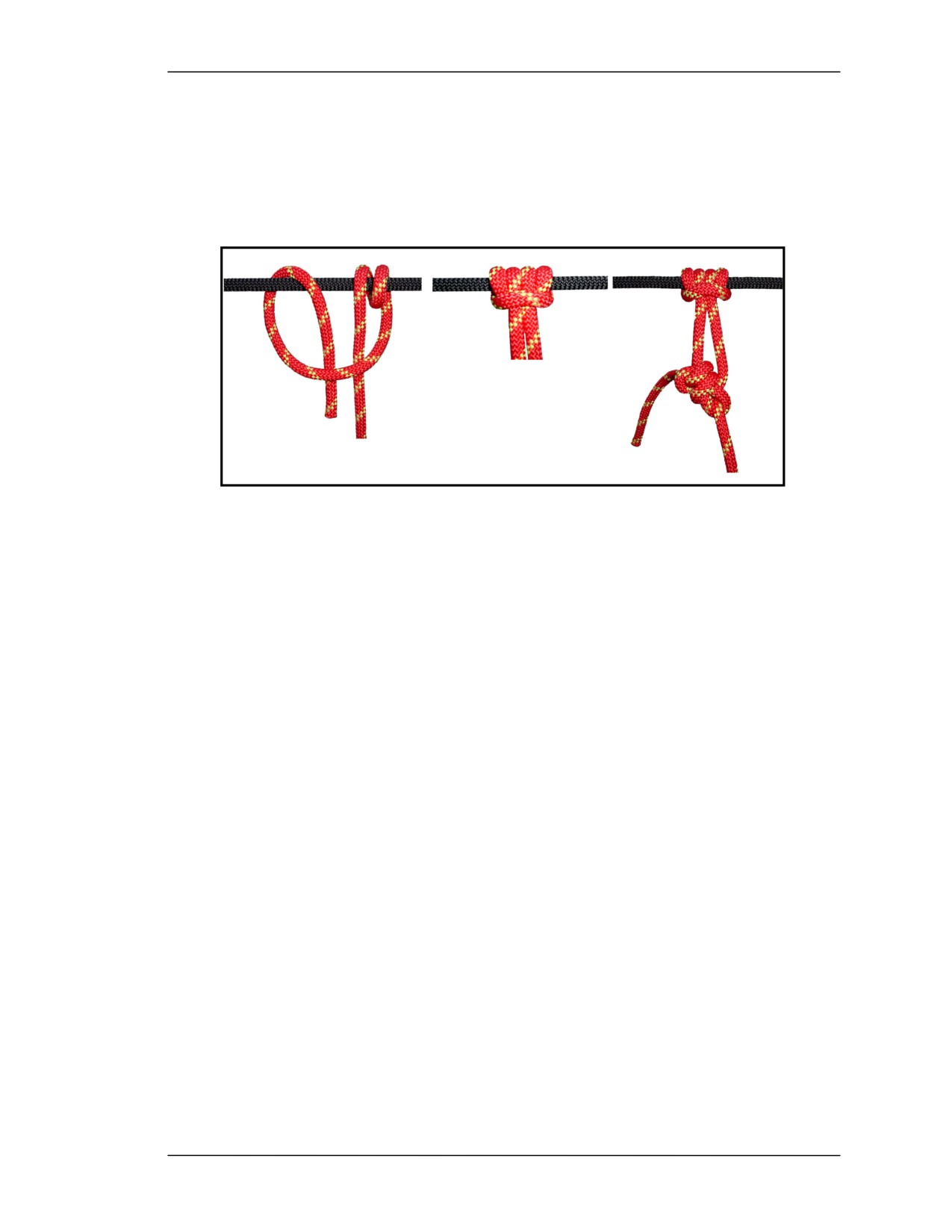
(2) End-of-the-Rope Prusik (Figure 4-21).
STEP 1. Using an arm’s length of rope, and place it over the long rope.
STEP 2. Form a complete round turn in the rope.
STEP 3. Cross over the standing part of the short rope with the working end of the
short rope.
STEP 4. Lay the working end under the long rope.
STEP 5. Form a complete round turn in the rope, working back toward the middle
of the knot.
4-22
FM 3-97.61
STEP 6. There are four wraps and a locking bar running across them on the long
rope. Dress the wraps and locking bar down. Ensure they are tight,
parallel, and not twisted.
STEP 7. Finish the knot with a bowline to ensure that the Prusik knot will not slip
out during periods of varying tension.
Figure 4-21. End-of-the-rope Prusik knot.
b. Checkpoints.
(1) Four wraps with a locking bar.
(2) The locking bar faces the climber.
(3) The knot is tight and dressed down with no ropes twisted or crossed.
(4) Other than a finger Prusik, the knot should contain an overhand or bowline to
prevent slipping.
4-22. BACHMAN KNOT
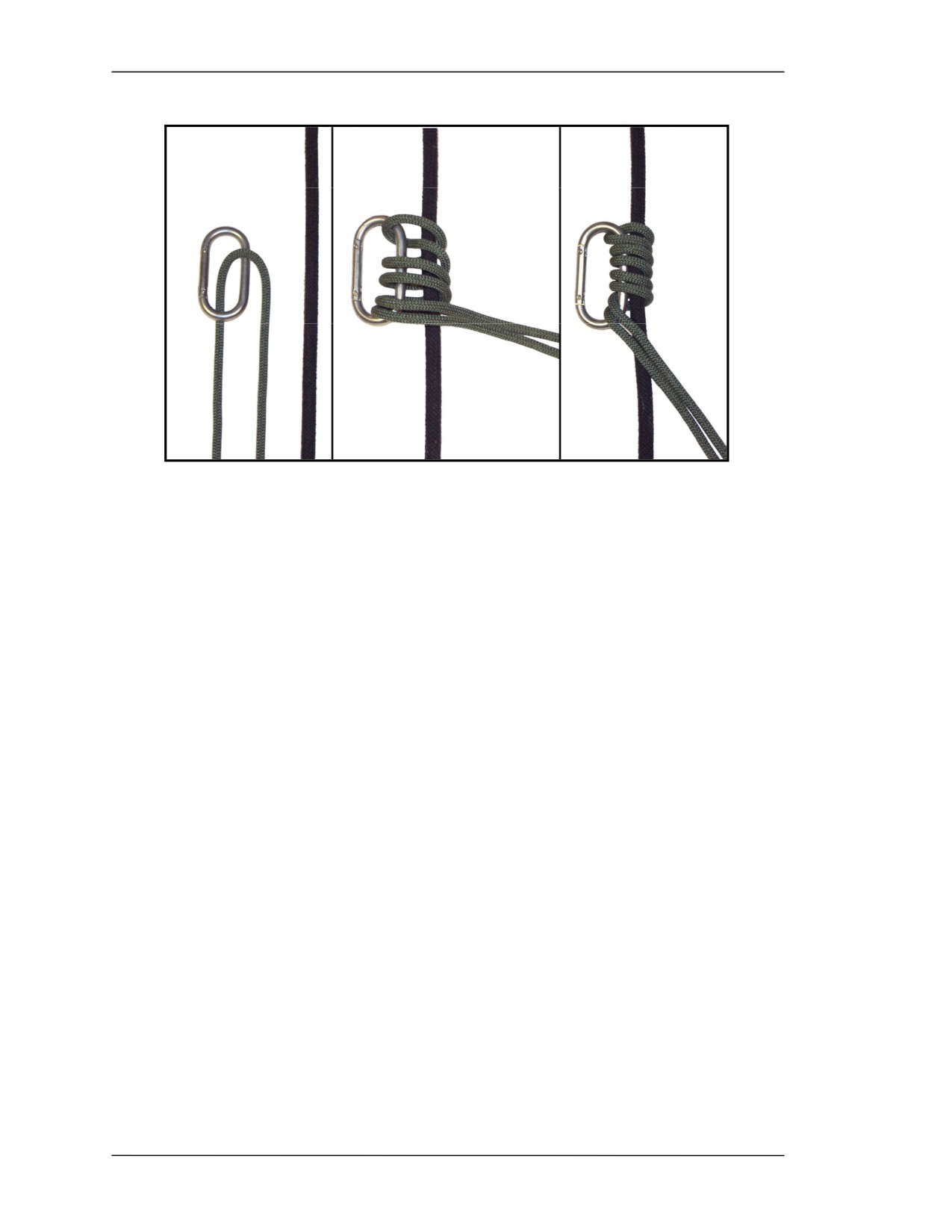
The Bachman knot provides a means of using a makeshift mechanized ascender (Figure
4-22, page 4-24). It is a specialty knot.
a. Tying the Knot.
STEP 1. Find the middle of a utility rope and insert it into a carabiner.
STEP 2. Place the carabiner and utility rope next to a long climbing rope.
STEP 3. With the two ropes parallel from the carabiner, make two or more wraps
around the climbing rope and through the inside portion of the carabiner.
Note: The rope can be tied into an etrier (stirrup) and used as a Prusik-friction principle
ascender.
b. Checkpoints.
(1) The bight of the climbing rope is at the top of the carabiner.
(2) The two ropes run parallel without twisting or crossing.
(3) Two or more wraps are made around the long climbing rope and through the inside
portion of the carabiner.
4-23
FM 3-97.61
Figure 4-22. Bachman knot.
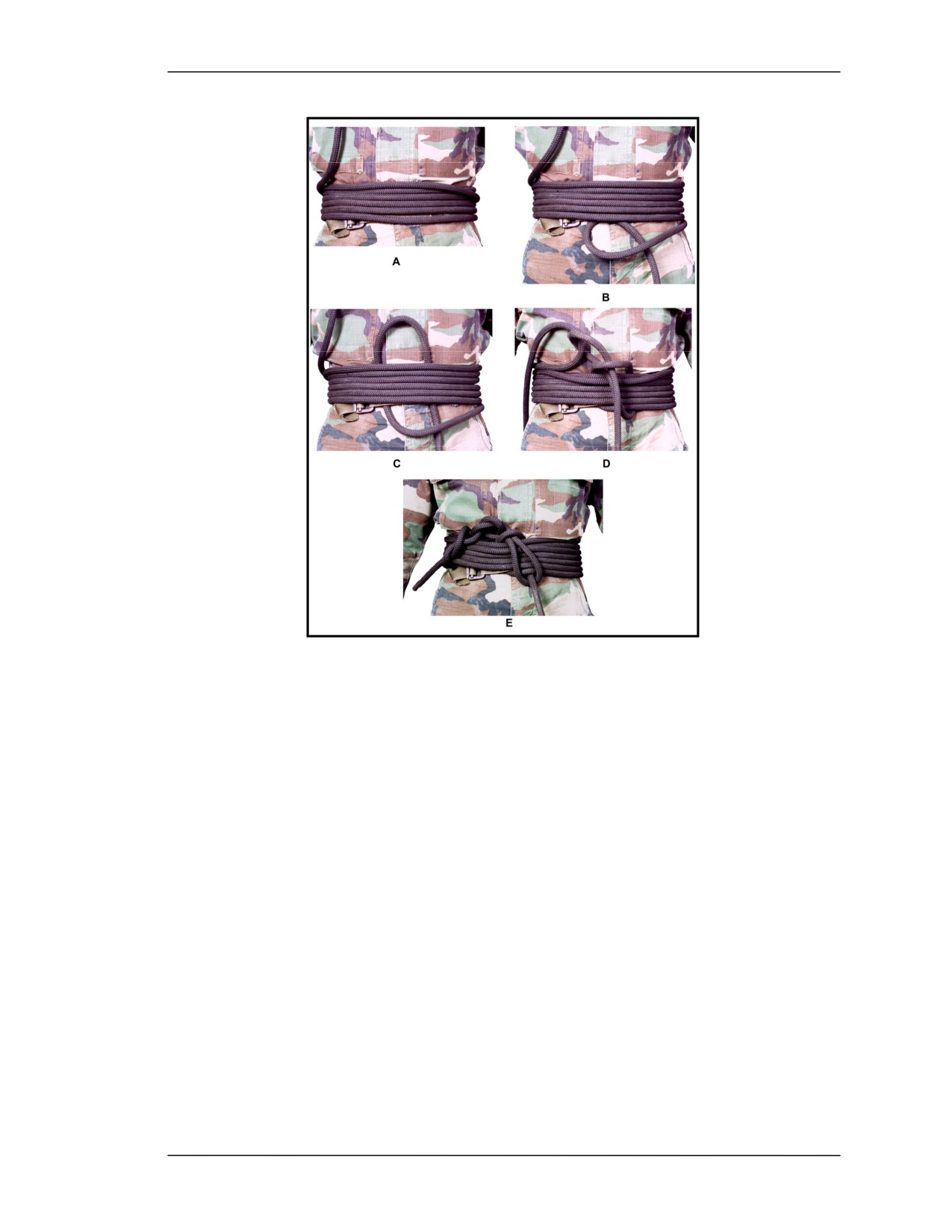
4-23. BOWLINE-ON-A-COIL
The bowline-on-a-coil is an expedient tie-in used by climbers when a climbing harness is
not available (Figure 4-23). It is a specialty knot.
a.
Tying the Knot.
STEP 1. With the running end, place 3 feet of rope over your right shoulder. The
running end is to the back of the body.
STEP 2. Starting at the bottom of your rib cage, wrap the standing part of the
rope around your body and down in a clockwise direction four to eight
times.
STEP 3. With the standing portion of the rope in your left hand, make a clockwise
loop toward the body. The standing portion is on the bottom.
STEP 4. Ensuring the loop does not come uncrossed, bring it up and under the
coils between the rope and your body.
STEP 5. Using the standing part, bring a bight up through the loop. Grasp the
running end of the rope with the right hand. Pass it through the bight
from right to left and back on itself.
STEP 6. Holding the bight loosely, dress the knot down by pulling on the
standing end.
STEP 7. Safety the bowline with an overhand around the top, single coil. Then, tie
an overhand around all coils, leaving a minimum 4-inch pigtail.
b.
Checkpoints.
(1) A minimum of four wraps, not crossed, with a bight held in place by a loop.
(2) The loop must be underneath all wraps.
(3) A minimum 4-inch pigtail after the second overhand safety is tied.
(4) Must be centered on the mid-line of the body.
4-24
FM 3-97.61
Figure 4-23. Bowline-on-a-coil.
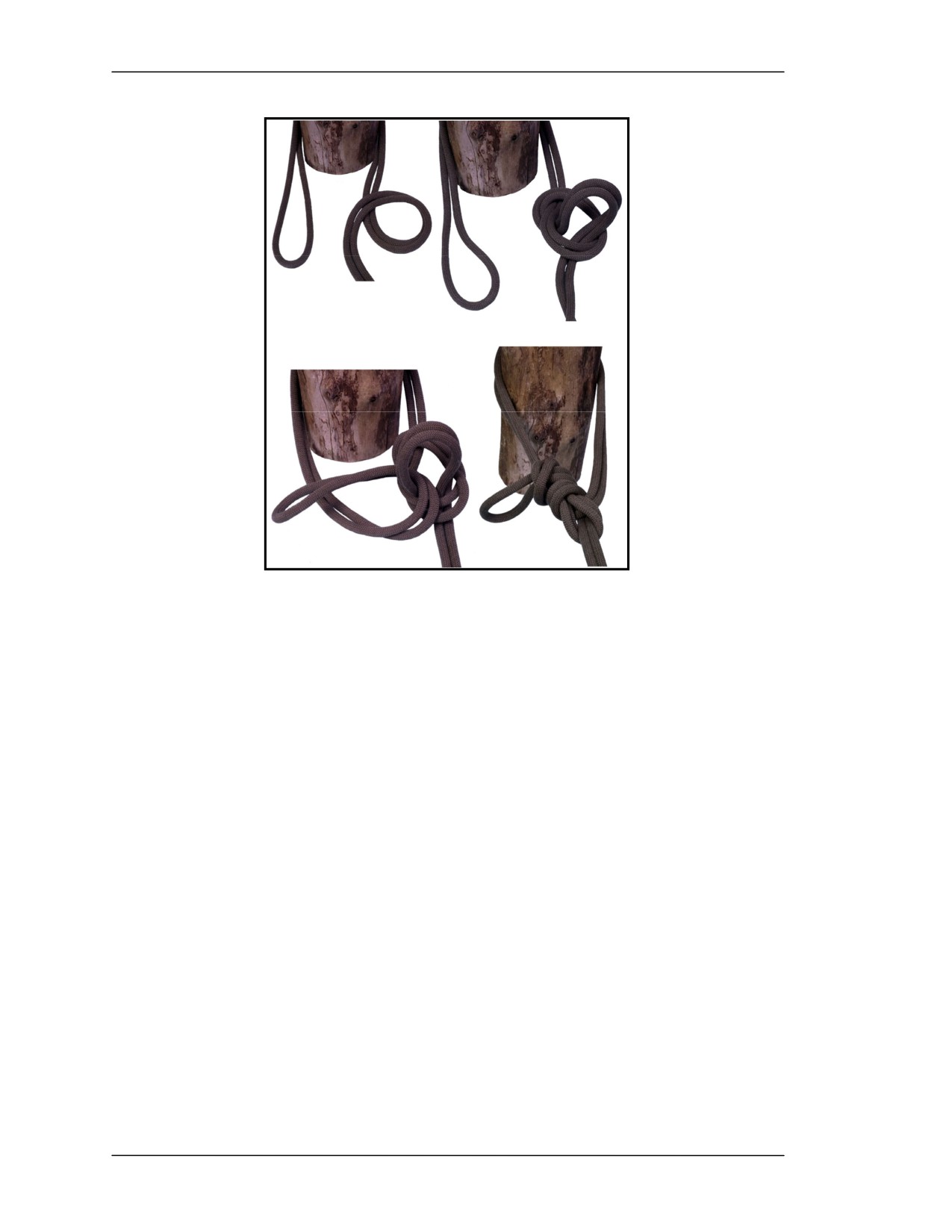
4-24. THREE-LOOP BOWLINE
The three-loop bowline is used to form three fixed loops in the middle of a rope (Figure
4-24, page 4-26). It is used in a self-equalizing anchor system. It is a specialty knot.
a. Tying the Knot.
STEP 1. Form an approximate 24-inch bight.
STEP 2. With the right thumb facing toward the body, form a doubled loop in the
standing part by turning the wrist clockwise. Lay the loops to the right.
STEP 3. With the right hand, reach down through the loops and pull up a doubled
bight from the standing part of the rope.
STEP 4. Place the running end (bight) of the rope (on the left) through the
doubled bight from left to right and bring it back on itself. Hold the
running end loosely and dress the knot down by pulling on the standing
parts.
STEP 5. Safety it off with a doubled overhand knot.
4-25
FM 3-97.61
Figure 4-24. Three-loop bowline.
b. Checkpoints.
(1) There are two bights held in place by two loops.
(2) The bights form locking bars around the standing parts.
(3) The running end (bight) must be on the inside of the fixed loops.
(4) There is a minimum 4-inch pigtail after the double overhand safety knot is tied.
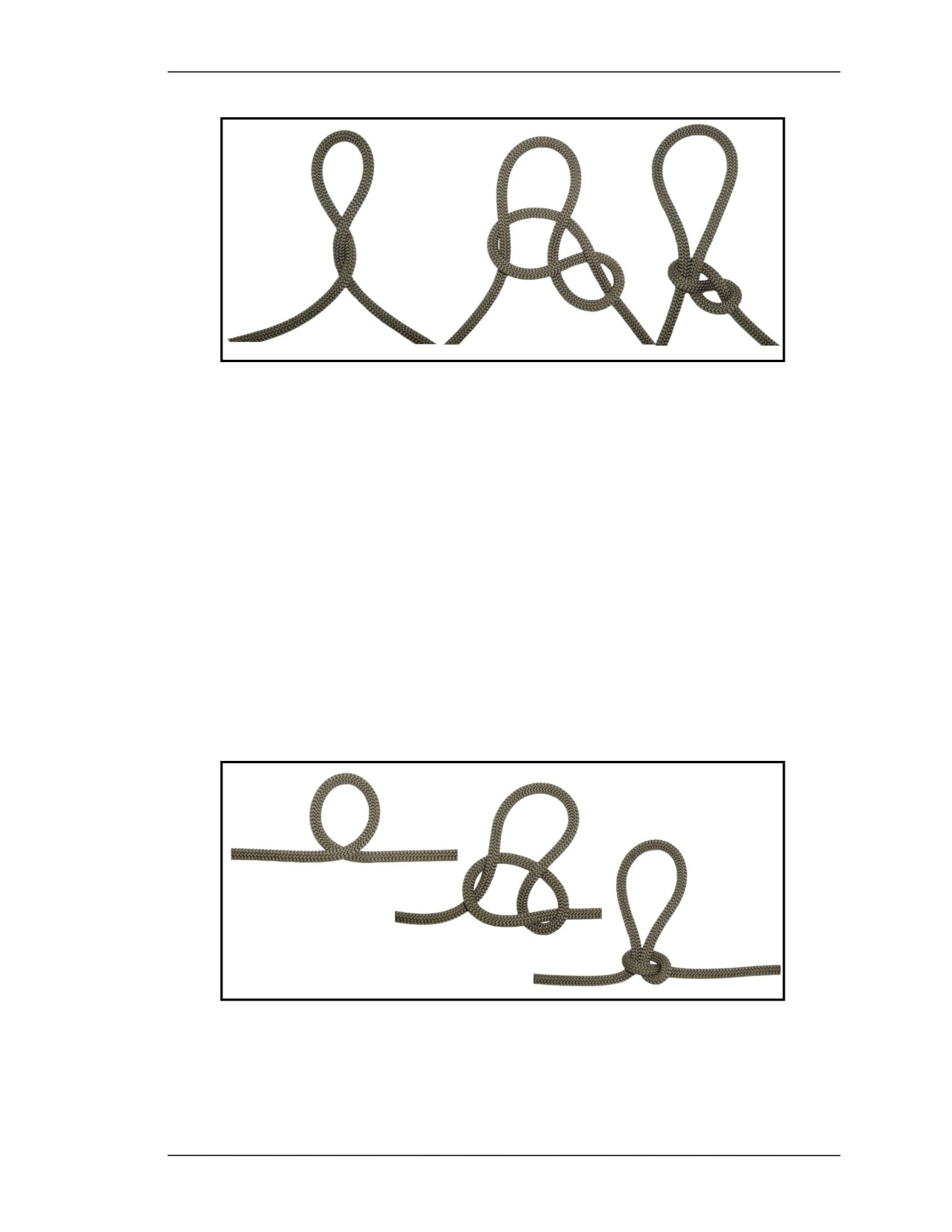
4-25. FIGURE-EIGHT SLIP KNOT
The figure eight slip knot forms an adjustable bight in a rope (Figure 4-25). It is a
specialty knot.
a. Tying the Knot.
STEP 1. Form a 12-inch bight in the end of the rope.
STEP 2. Hold the center of the bight in the right hand. Hold the two parallel ropes
from the bight in the left hand about 12 inches up the rope.
STEP 3. With the center of the bight in the right hand, twist two complete turns
clockwise.
STEP 4. Reach through the bight and grasp the long, standing end of the rope.
Pull another bight (from the long standing end) back through the original bight.
STEP 5. Pull down on the short working end of the rope and dress the knot down.
STEP 6. If the knot is to be used in a transport tightening system, take the
working end of the rope and form a half hitch around the loop of the figure eight knot.
4-26
FM 3-97.61
Figure 4-25. Figure-eight slip knot.
b. Checkpoints.
(1) The knot is in the shape of a figure eight.
(2) Both ropes of the bight pass through the same loop of the figure eight.
(3) The sliding portion of the rope is the long working end of the rope.
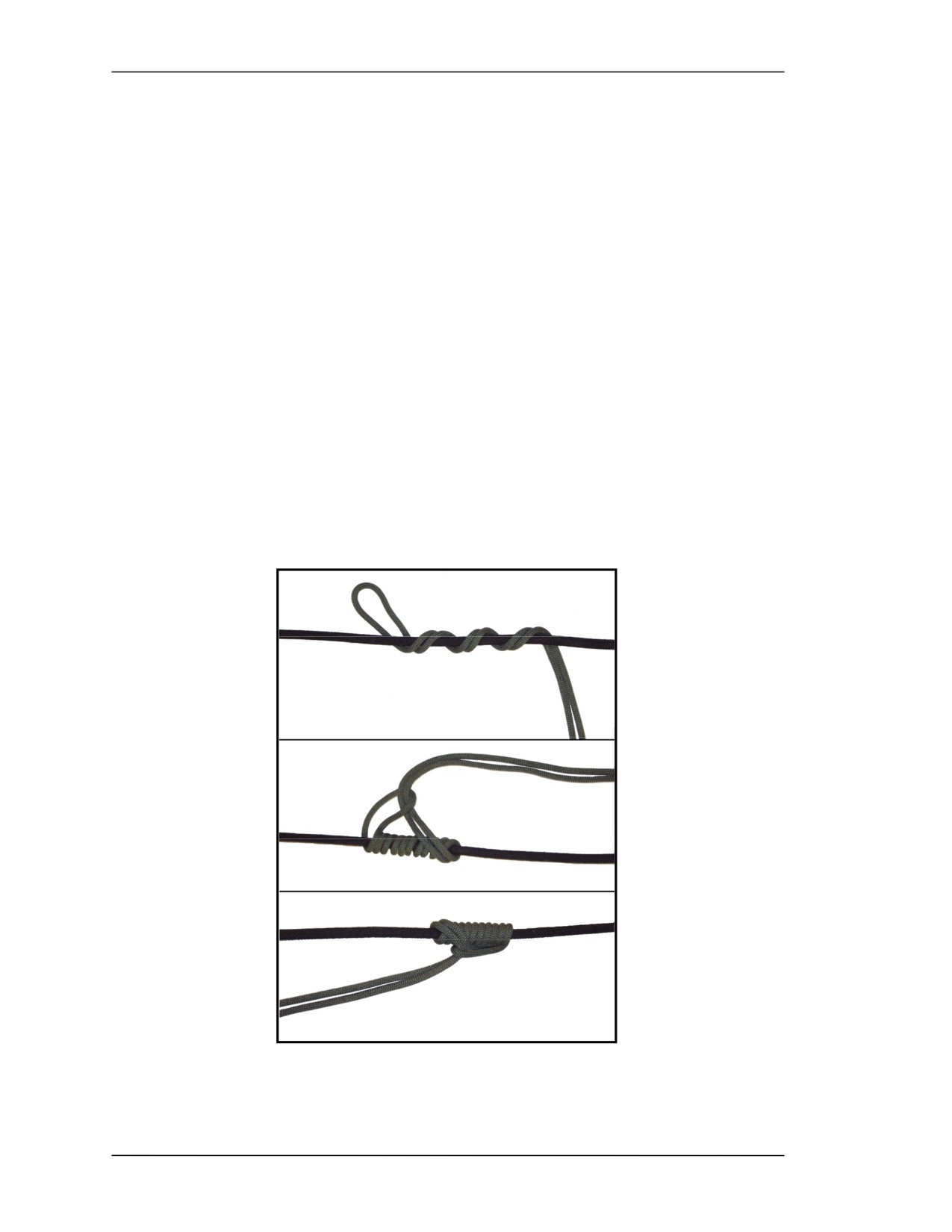
4-26. TRANSPORT KNOT (OVERHAND SLIP KNOT/MULE KNOT)
The transport knot is used to secure the transport tightening system (Figure 4-26, page
4-28). It is simply an overhand slip knot.
a. Tying the Knot.
STEP 1. Pass the running end of the rope around the anchor point passing it
back under the standing portion (leading to the far side anchor) forming a loop.
STEP 2. Form a bight with the running end of the rope. Pass over the standing
portion and down through the loop and dress it down toward the anchor point.
STEP 3. Secure the knot by tying a half hitch around the standing portion with
the bight.
Figure 4-26. Transport knot.
b. Check Points.
(1) There is a single overhand slip knot.
4-27
FM 3-97.61
(2) The knot is secured using a half hitch on a bight.
(3) The bight is a minimum of 12 inches long.
4-27. KLEIMHIEST KNOT
The Kleimhiest knot provides a moveable, easily adjustable, high-tension knot capable of
holding extremely heavy loads while being pulled tight (Figure 4-27). It is a special-purpose
knot.
a. Tying the Knot.
STEP 1. Using a utility rope or webbing offset the ends by 12 inches. With the
ends offset, find the center of the rope and form a bight. Lay the bight
over a horizontal rope.
STEP 2. Wrap the tails of the utility rope around the horizontal rope back toward
the direction of pull. Wrap at least four complete turns.
STEP 3. With the remaining tails of the utility rope, pass them through the bight
(see STEP 1).
STEP 4. Join the two ends of the tail with a joining knot.
STEP 5. Dress the knot down tightly so that all wraps are touching.
Note: Spectra should not be used for the Kleimhiest knot. It has a low melting point and
tends to slip .
Figure 4-27. Kleimhiest knot.
4-28
FM 3-97.61
b. Checkpoints.
(1) The bight is opposite the direction of pull.
(2) All wraps are tight and touching.
(3) The ends of the utility rope are properly secured with a joining knot.
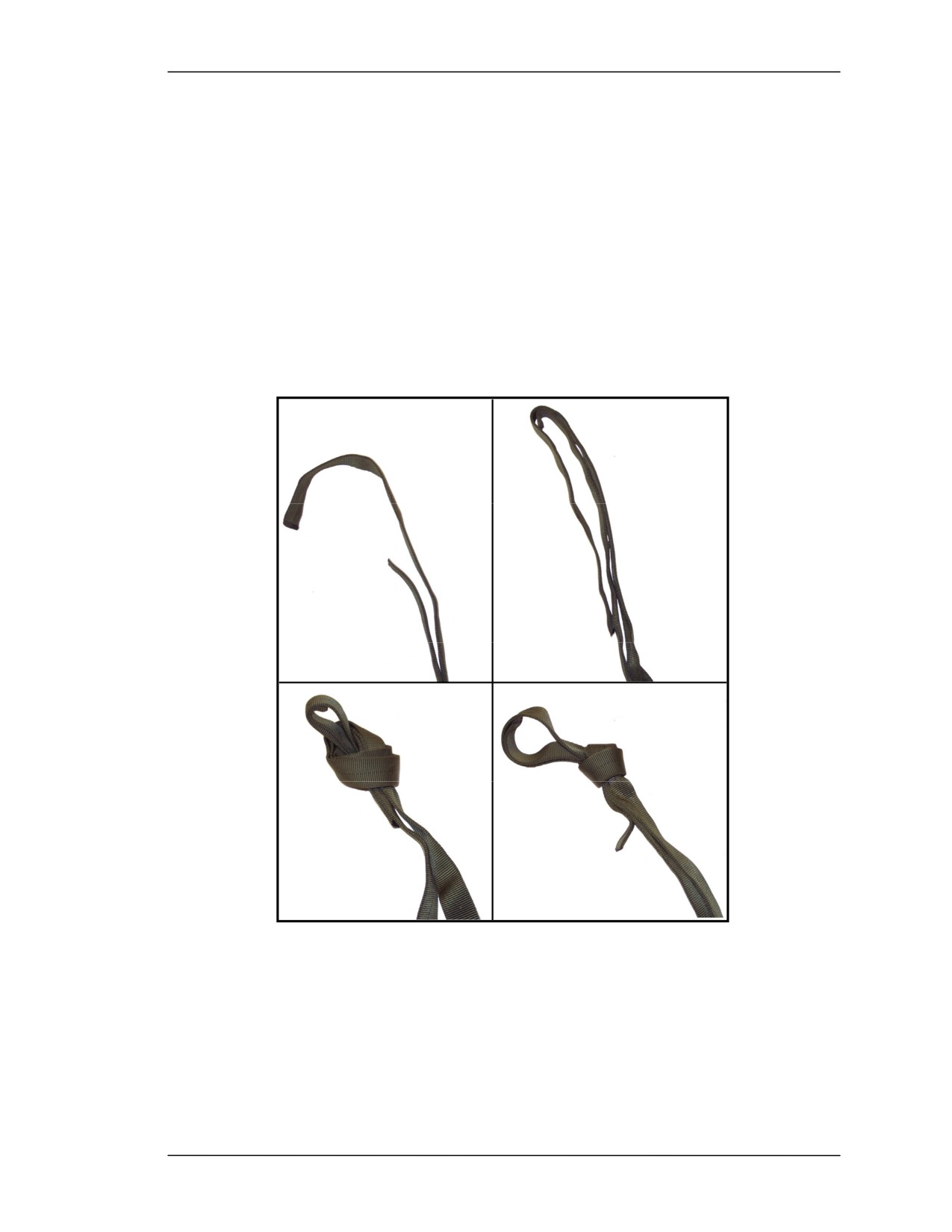
4-28. FROST KNOT
The frost knot is used when working with webbing (Figure 4-28, page 4-30). It is used to
create the top loop of an etrier. It is a special-purpose knot.
a. Tying the Knot.
STEP 1. Lap one end (a bight) of webbing over the other about 10 to 12 inches.
STEP 2. Tie an overhand knot with the newly formed triple-strand webbing; dress
tightly.
Figure 4-28. Frost knot.
b. Checkpoints.
(1) The tails of the webbing run in opposite directions.
(2) Three strands of webbing are formed into a tight overhand knot.
(3) There is a bight and tail exiting the top of the overhand knot.
4-29
FM 3-97.61
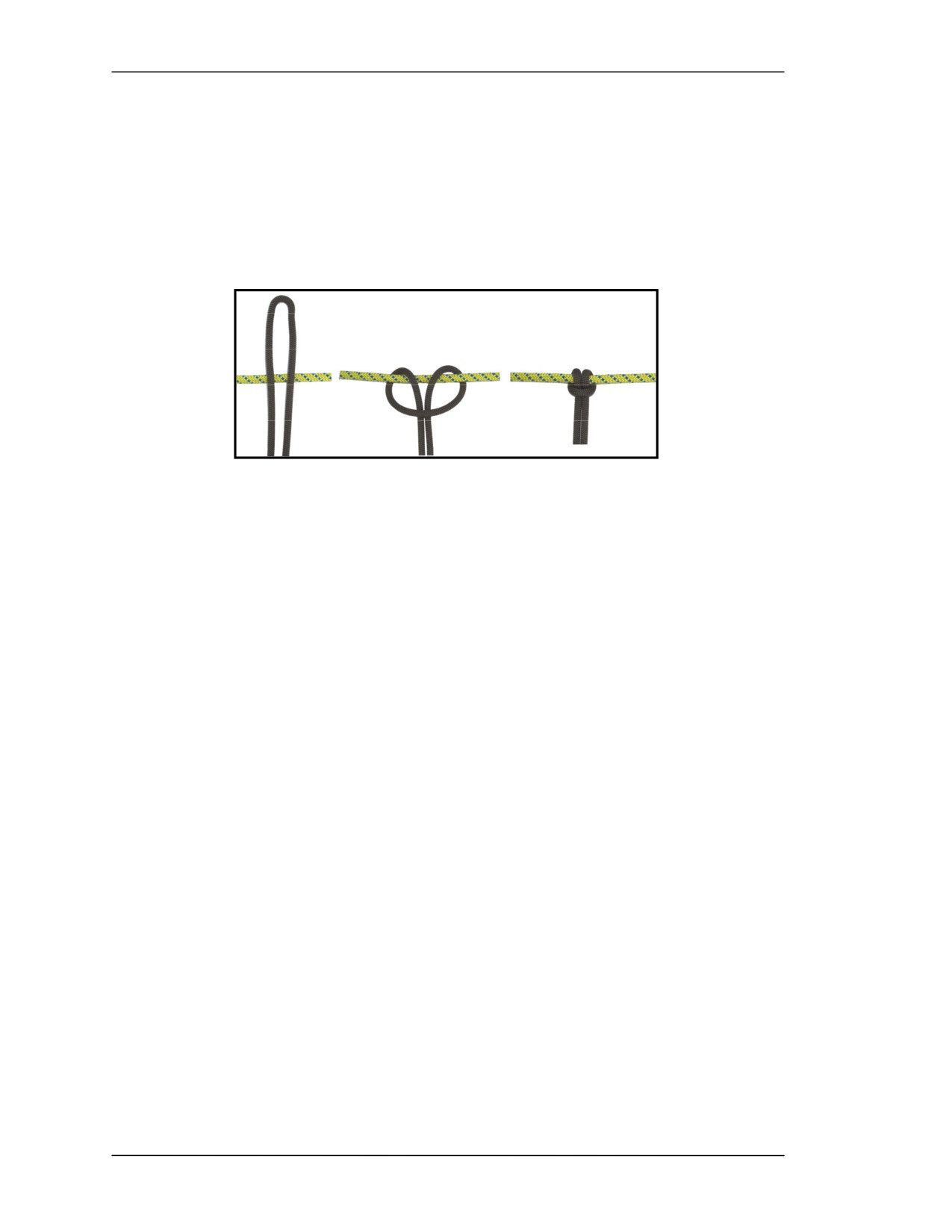
4-29. GIRTH HITCH
The girth hitch is used to attach a runner to an anchor or piece of equipment (Figure 4-29). It
is a special-purpose knot.
a. Tying the Knot.
STEP 1: Form a bight.
STEP 2: Bring the runner back through the bight.
STEP 3: Cinch the knot tightly.
Figure 4-29. Girth hitch.
b. Checkpoint.
(1) Two wraps exist with a locking bar running across the wraps.
(2) The knot is dressed tightly.
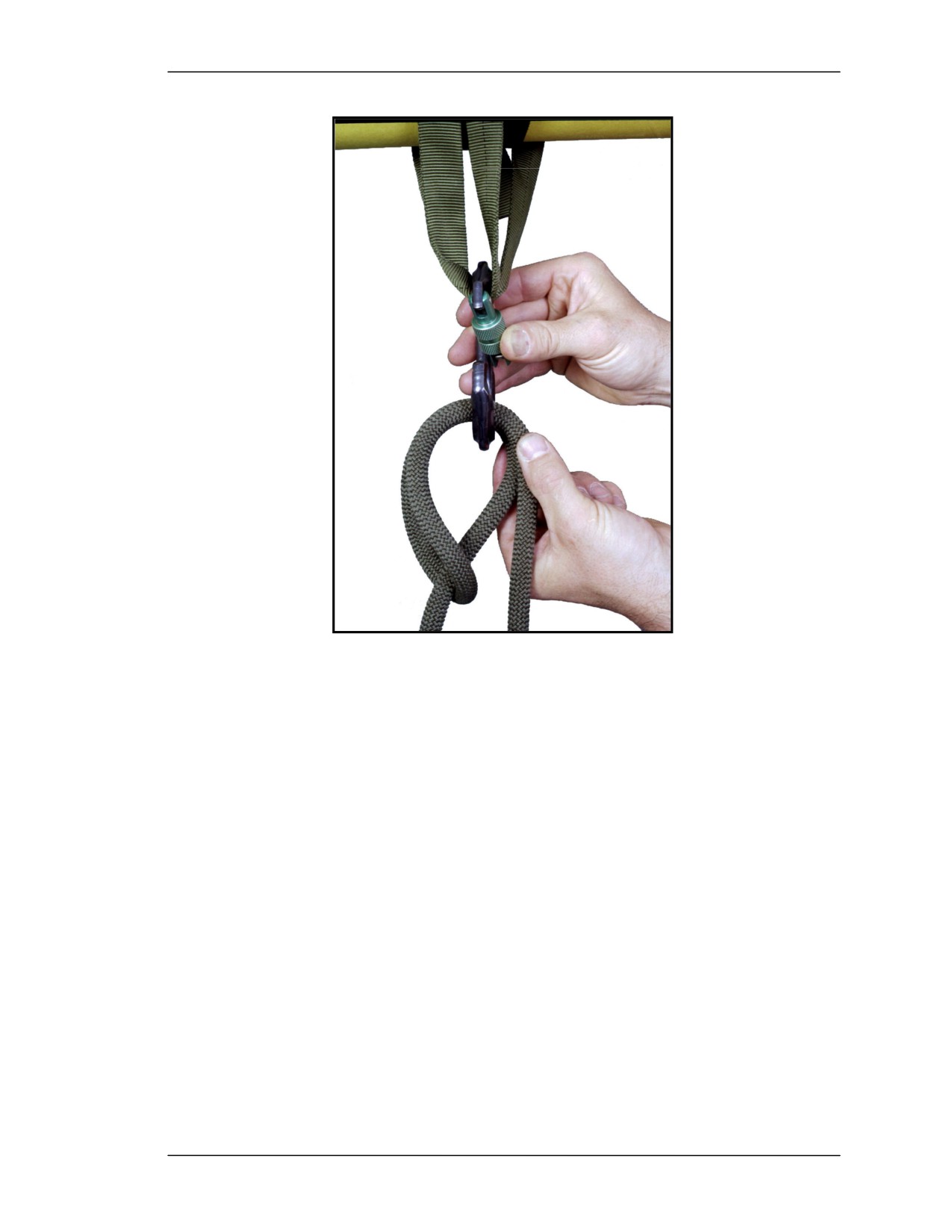
4-30. MUNTER HITCH
The munter hitch, when used in conjunction with a pear-shaped locking carabiner, is used
to form a mechanical belay (Figure 4-30).
a. Tying the Knot.
STEP 1. Hold the rope in both hands, palms down about 12 inches apart.
STEP 2. With the right hand, form a loop away from the body toward the left
hand. Hold the loop with the left hand.
STEP 3. With the right hand, place the rope that comes from the bottom of the
loop over the top of the loop.
STEP 4. Place the bight that has just been formed around the rope into the pear
shaped carabiner. Lock the locking mechanism.
b. Check Points.
(1) A bight passes through the carabiner, with the closed end around the standing or
running part of the rope.
(2) The carabiner is locked.
4-30
FM 3-97.61
Figure 4-30. Munter hitch.
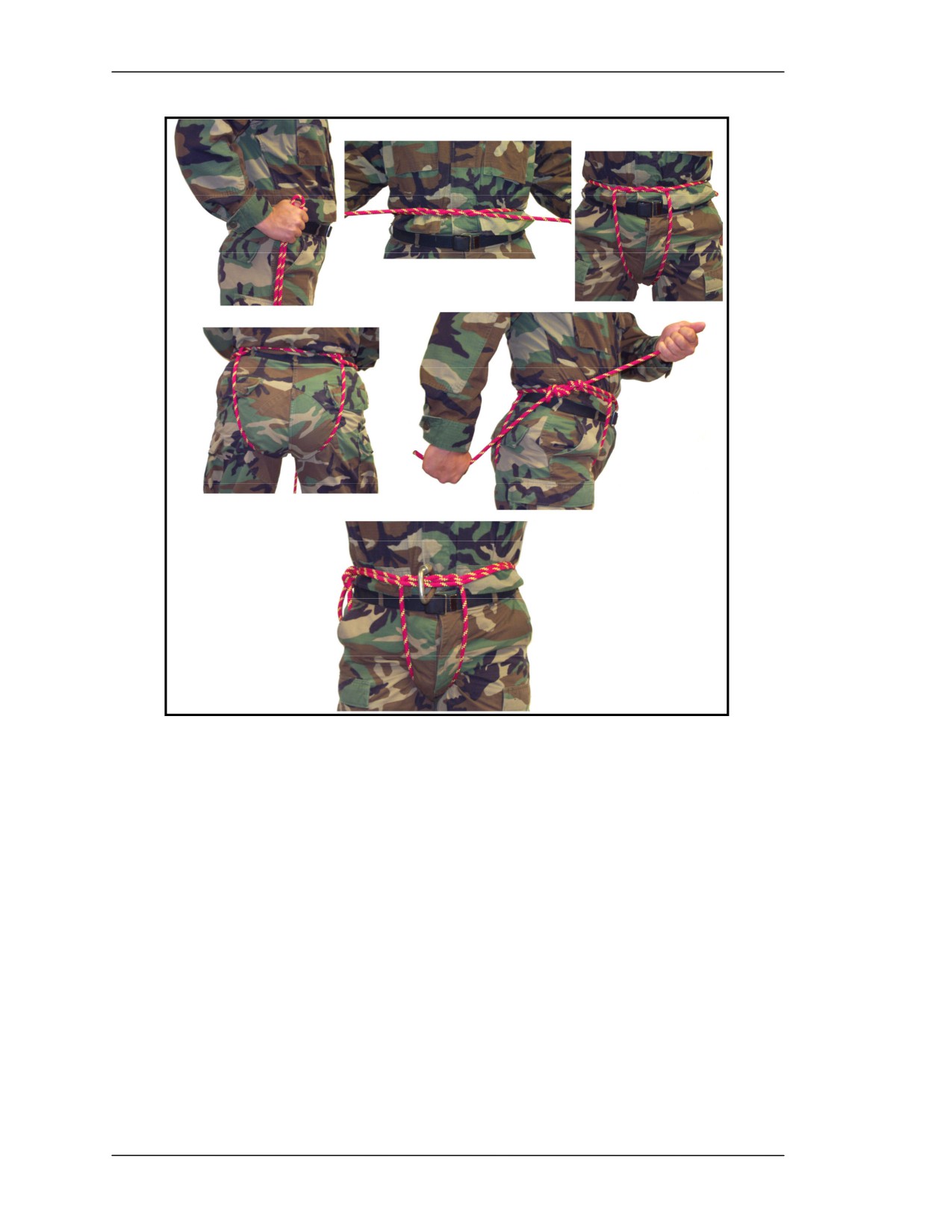
4-31. RAPPEL SEAT
The rappel seat is an improvised seat rappel harness made of rope (Figure 4-31, page
4-32). It usually requires a sling rope 14 feet or longer.
a. Tying the Knot.
STEP 1. Find the middle of the sling rope and make a bight.
STEP 2. Decide which hand will be used as the brake hand and place the bight
on the opposite hip.
STEP 3. Reach around behind and grab a single strand of rope. Bring it around
the waist to the front and tie two overhands on the other strand of rope,
thus creating a loop around the waist.
STEP 4. Pass the two ends between the legs, ensuring they do not cross.
STEP 5. Pass the two ends up under the loop around the waist, bisecting the
pocket flaps on the trousers. Pull up on the ropes, tightening the seat.
STEP 6. From rear to front, pass the two ends through the leg loops creating a
half hitch on both hips.
STEP 7. Bring the longer of the two ends across the front to the nonbrake hand
hip and secure the two ends with a square knot safetied with overhand
knots. Tuck any excess rope in the pocket below the square knot.
4-31
FM 3-97.61
Figure 4-31. Rappel seat.
b. Check Points.
(1) There are two overhand knots in the front.
(2) The ropes are not crossed between the legs.
(3) A half hitch is formed on each hip.
(4) Seat is secured with a square knot with overhand safeties on the non-brake hand
side.
(5) There is a minimum 4-inch pigtail after the overhand safeties are tied.
4-32. GUARDE KNOT
The guarde knot (ratchet knot, alpine clutch) is a special purpose knot primarily used for
hauling systems or rescue (Figure 4-32). The knot works in only one direction and cannot
be reversed while under load.
a. Tying the Knot.
STEP 1. Place a bight of rope into the two anchored carabiners (works best with
two like carabiners, preferably ovals).
4-32
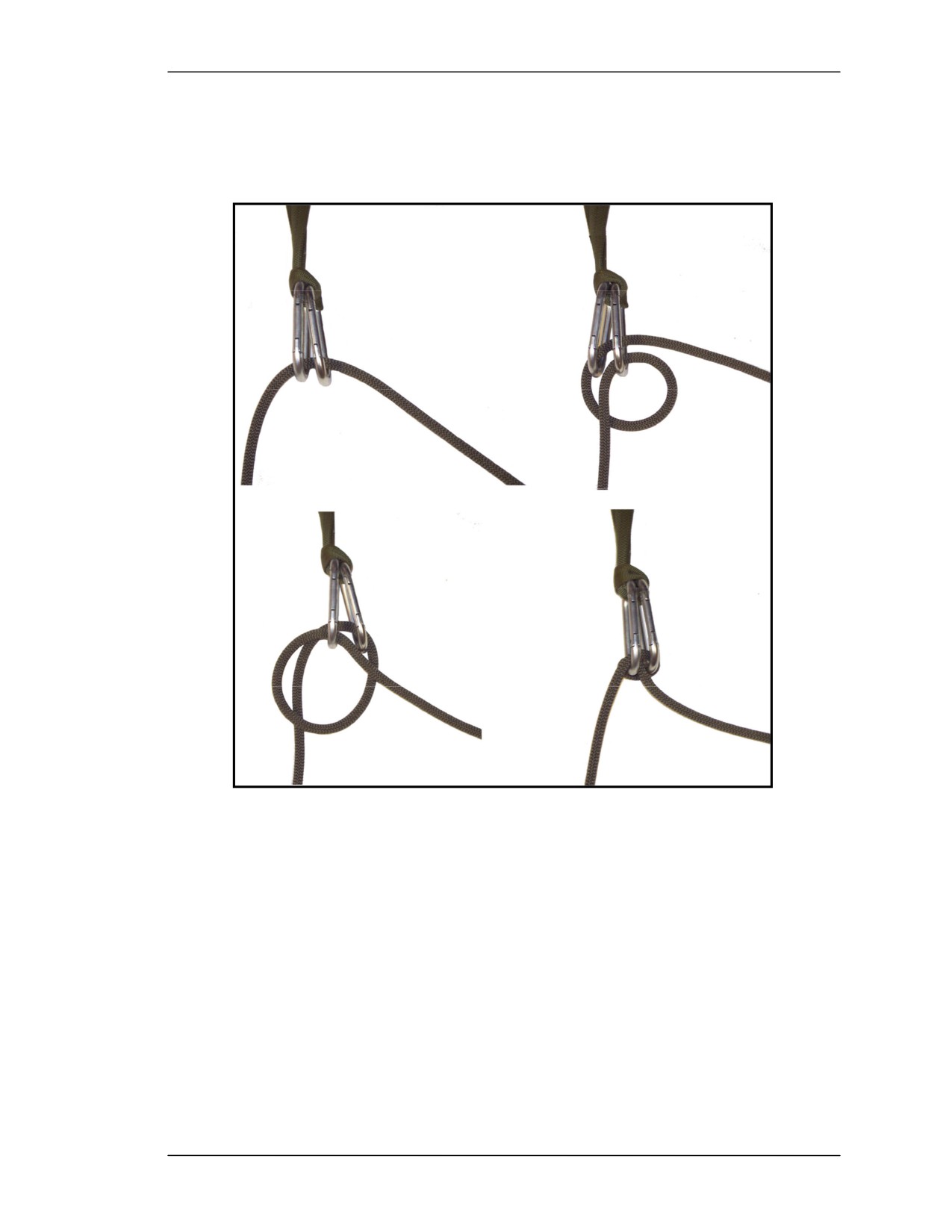
FM 3-97.61
STEP 2. Take a loop of rope from the non-load side and place it down into the
opposite cararabiner so that the rope comes out between the two
carabiners.
Figure 4-32. Guarde knot.
b. Check Points.
(1) When properly dressed, rope can only be pulled in one direction.
(2) The knot will not fail when placed under load.
4-33
FM 3-97.61(TC 90-6-1)
CHAPTER 5
ANCHORS
This chapter discusses different types of anchors and their application
in rope systems and climbing. Proper selection and placement of anchors
is a critical skill that requires a great deal of practice. Failure of any
system is most likely to occur at the anchor point. If the anchor is not
strong enough to support the intended load, it will fail. Failure is usually
the result of poor terrain features selected for the anchor point, or the
equipment used in rigging the anchor was placed improperly or in
insufficient amounts.
When selecting or constructing anchors, always try to make sure the
anchor is
“bombproof.” A bombproof anchor is stronger than any
possible load that could be placed on it. An anchor that has more strength
than the climbing rope is considered bombproof.
Section I. NATURAL ANCHORS
Natural anchors should be considered for use first. They are usually strong and often
simple to construct with minimal use of equipment. Trees, boulders, and other terrain
irregularities are already in place and simply require a method of attaching the rope.
However, natural anchors should be carefully studied and evaluated for stability and
strength before use. Sometimes the climbing rope is tied directly to the anchor, but under
most circumstances a sling is attached to the anchor and then the climbing rope is
attached to the sling with a carabiner(s). (See paragraph 5-7 for slinging techniques.)
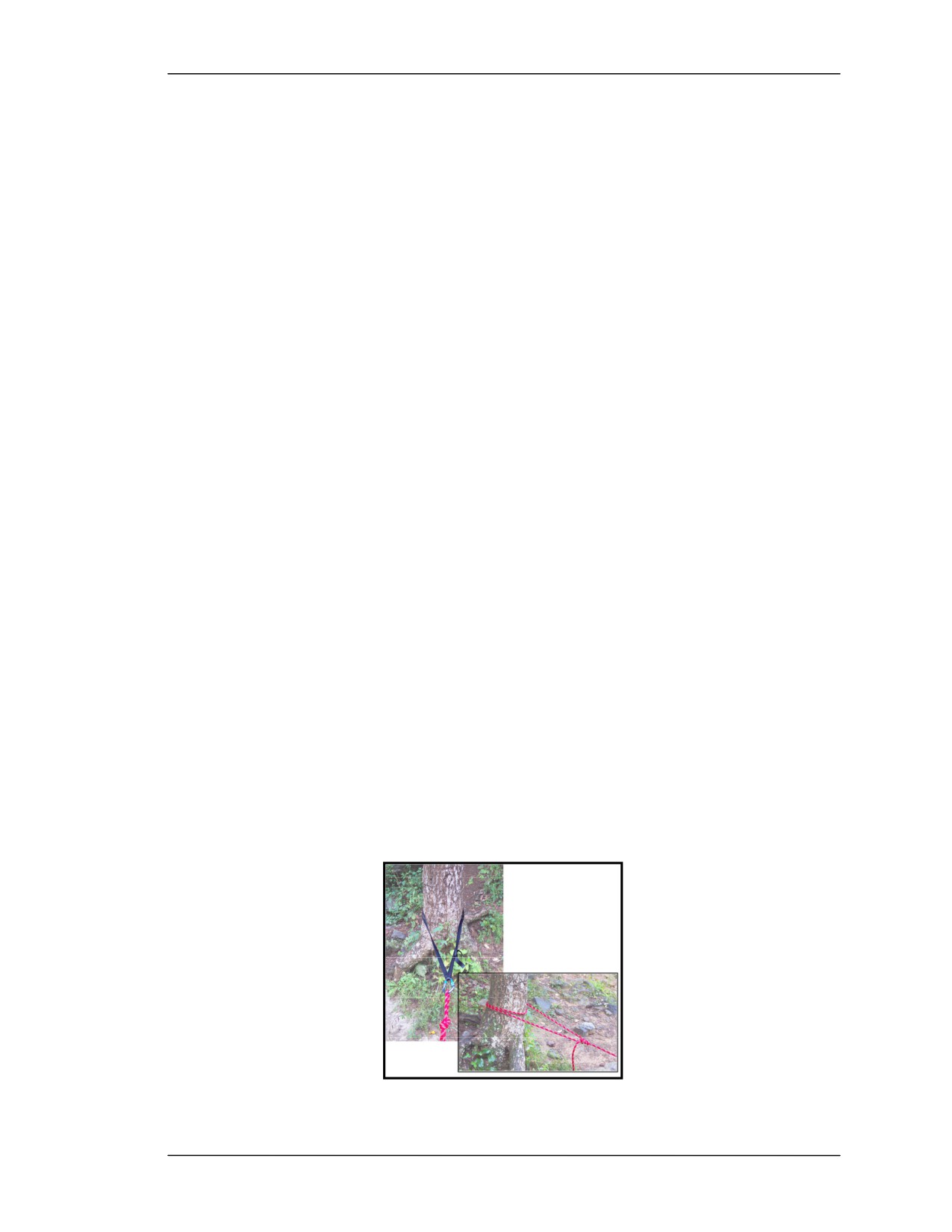
5-1.
TREES
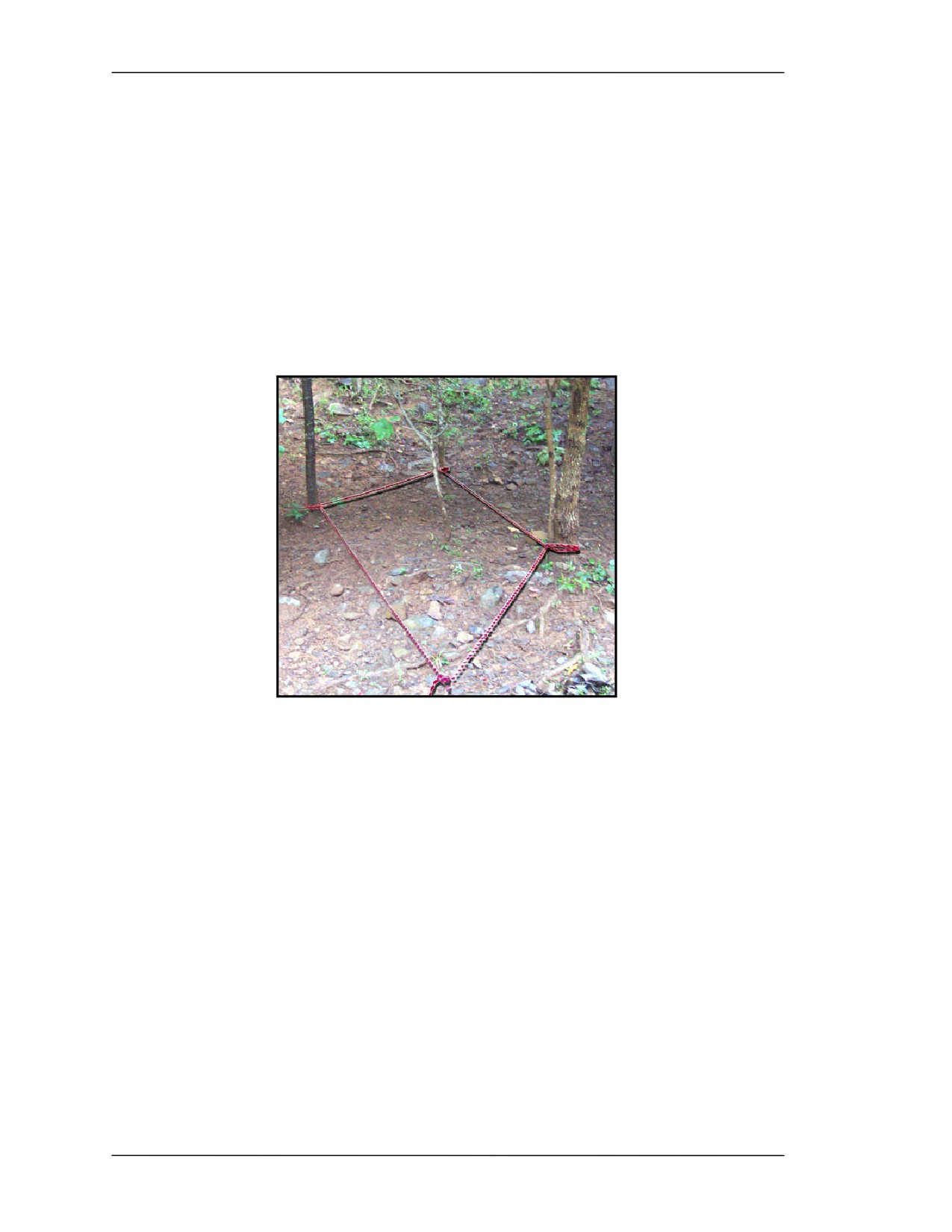
Trees are probably the most widely used of all natural anchors depending on the terrain
and geographical region (Figure 5-1). However, trees must be carefully checked for
suitability.
a. In rocky terrain, trees usually have a shallow root system. This can be checked by
pushing or tugging on the tree to see how well it is rooted. Anchoring as low as possible
to prevent excess leverage on the tree may be necessary.
b. Use padding on soft, sap producing trees to keep sap off ropes and slings.
Figure 5-1. Trees used as anchors.
5-1
FM 3-97.61
5-2.
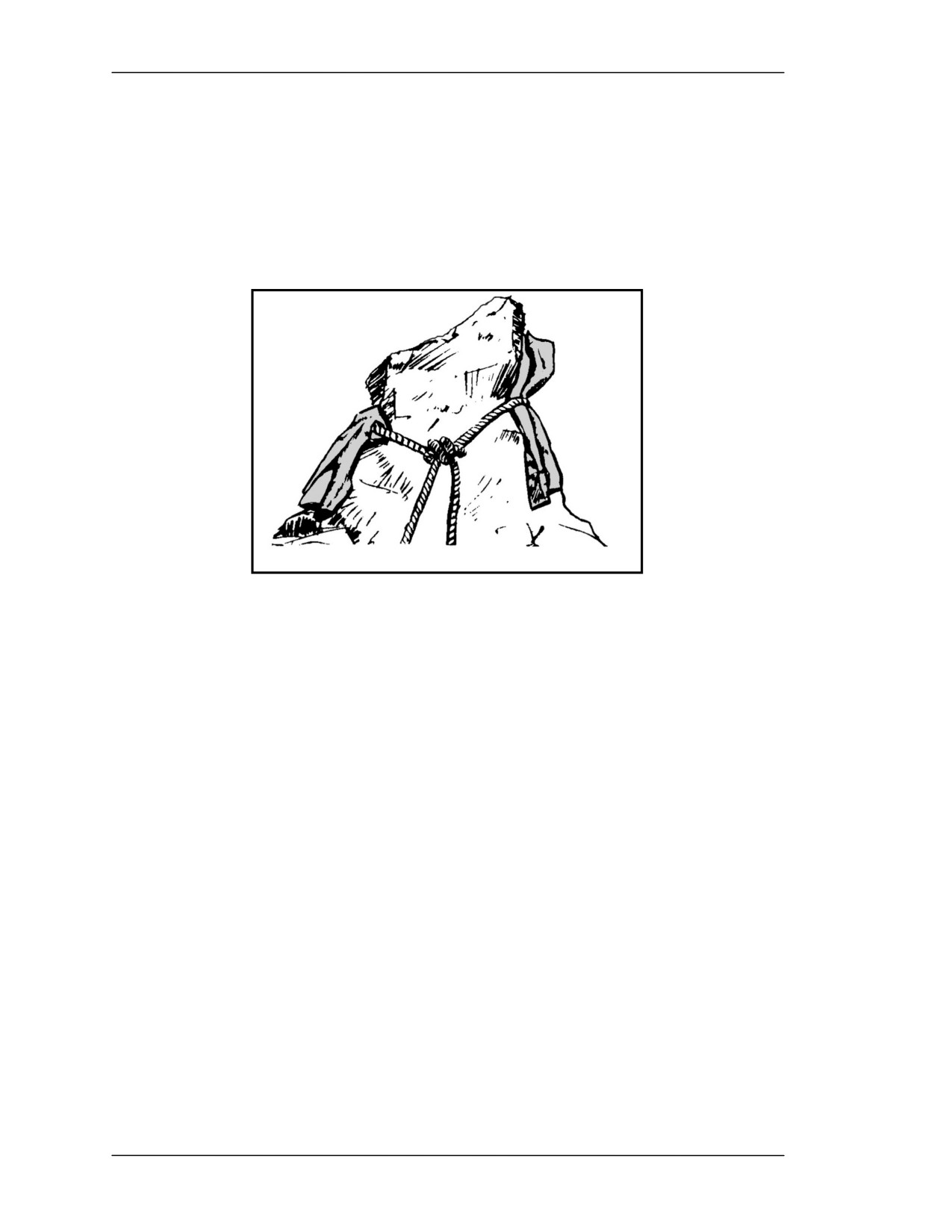
BOULDERS
Boulders and rock nubbins make ideal anchors (Figure 5-2). The rock can be firmly
tapped with a piton hammer to ensure it is solid. Sedimentary and other loose rock
formations are not stable. Talus and scree fields are an indicator that the rock in the area
is not solid. All areas around the rock formation that could cut the rope or sling should be
padded.
Figure 5-2. Boulders used as anchors.
5-3.
CHOCKSTONES
A chockstone is a rock that is wedged in a crack because the crack narrows downward
(Figure 5-3). Chockstones should be checked for strength, security, and crumbling and
should always be tested before use. All chockstones must be solid and strong enough to
support the load. They must have maximum surface contact and be well tapered with the
surrounding rock to remain in position.
a. Chockstones are often directional―they are secure when pulled in one direction
but may pop out if pulled in another direction.
b. A creative climber can often make his own chockstone by wedging a rock into
position, tying a rope to it, and clipping on a carabiner.
c. Slings should not be wedged between the chockstone and the rock wall since a
fall could cut the webbing runner.
5-2
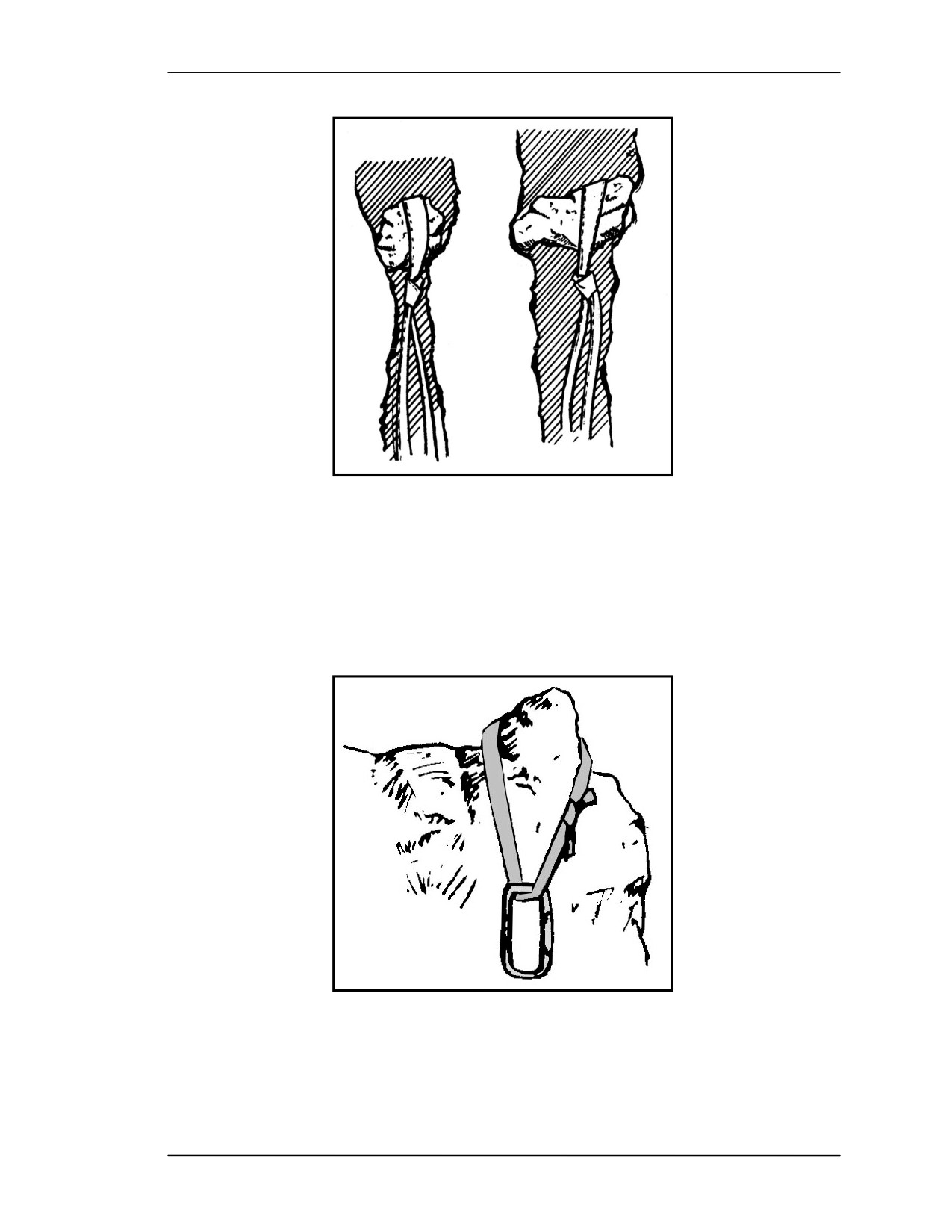
FM 3-97.61
Figure 5-3. Chockstones.
5-4.
ROCK PROJECTIONS
Rock projections (sometimes called nubbins) often provide suitable protection (Figure 5-4).
These include blocks, flakes, horns, and spikes. If rock projections are used, their firmness is
important. They should be checked for cracks or weathering that may impair their firmness.
If any of these signs exist, the projection should be avoided.
Figure 5-4. Rock projections.
5-3
FM 3-97.61
5-5.
TUNNELS AND ARCHES
Tunnels and arches are holes formed in solid rock and provide one of the more secure
anchor points because they can be pulled in any direction. A sling is threaded through the
opening hole and secured with a joining knot or girth hitch. The load-bearing hole must be
strong and free of sharp edges (pad if necessary).
5-6.
BUSHES AND SHRUBS
If no other suitable anchor is available, the roots of bushes can be used by routing a rope
around the bases of several bushes (Figure 5-5). As with trees, the anchoring rope is placed
as low as possible to reduce leverage on the anchor. All vegetation should be healthy and
well rooted to the ground.
Figure 5-5. Bushes and shrubs.
5-7.
SLINGING TECHNIQUES
Three methods are used to attach a sling to a natural anchor―drape, wrap, and girth.
Whichever method is used, the knot is set off to the side where it will not interfere with
normal carabiner movement. The carabiner gate should face away from the ground and
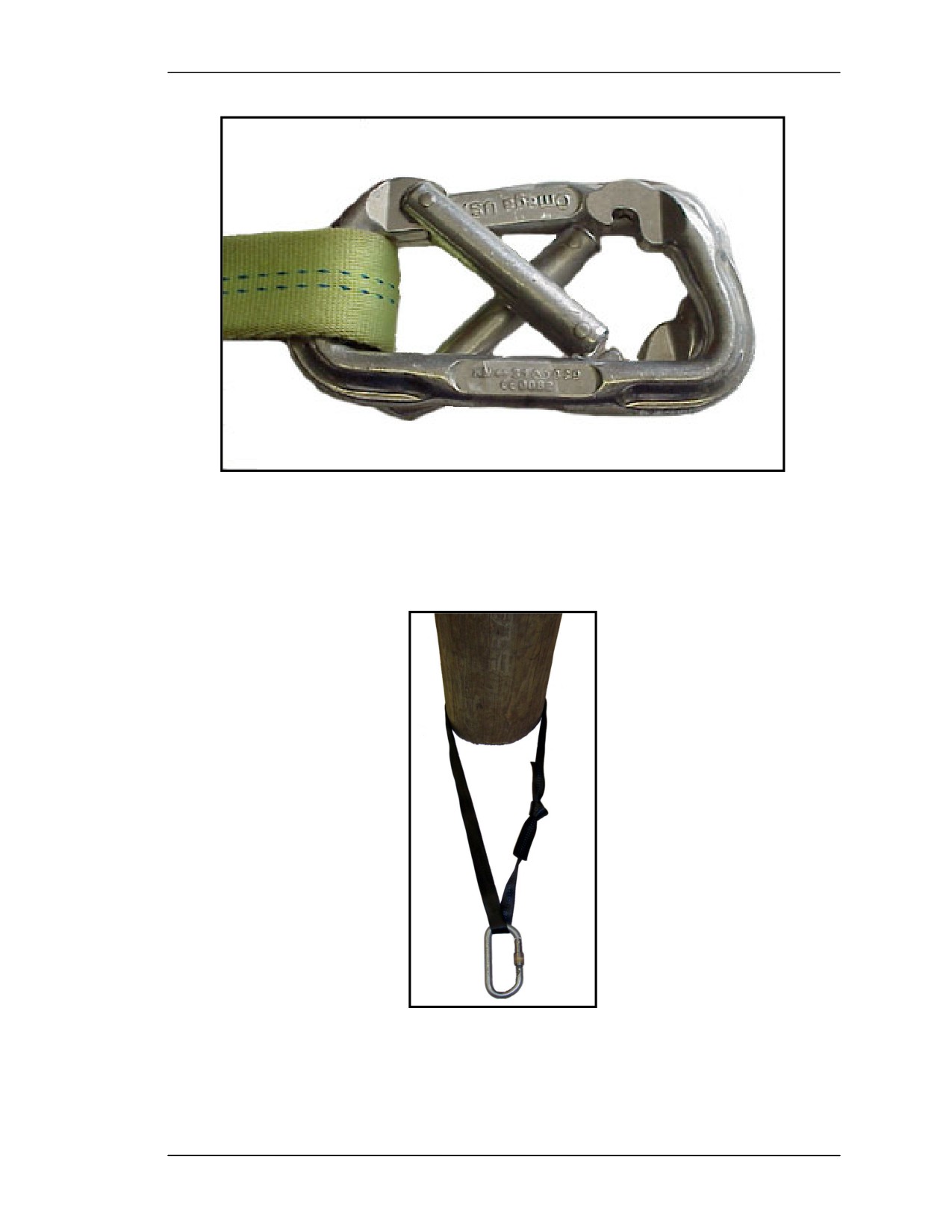
open away from the anchor for easy insertion of the rope. When a locking carabiner
cannot be used, two carabiners are used with gates opposed. Correctly opposed gates
should open on opposite sides and form an “X” when opened (Figure 5-6).
5-4
FM 3-97.61
Figure 5-6. Correctly opposed carabiners.
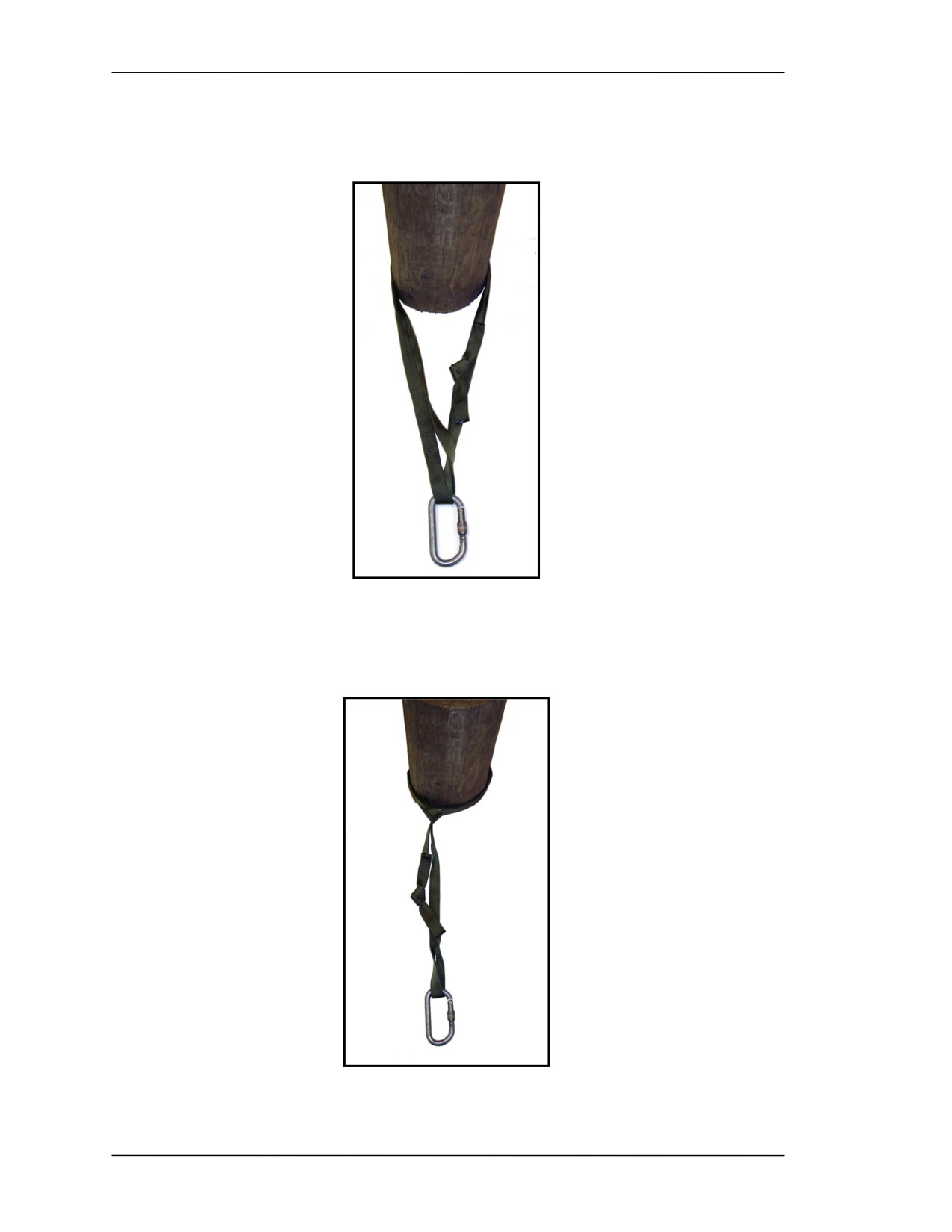
a. Drape. Drape the sling over the anchor (Figure 5-7). Untying the sling and
routing it around the anchor and then retying is still considered a drape.
Figure 5-7. Drape.
5-5
FM 3-97.61
b. Wrap. Wrap the sling around the anchor and connect the two ends together with a
carabiner(s) or knot (Figure 5-8).
Figure 5-8. Wrap.
c. Girth. Tie the sling around the anchor with a girth hitch (Figure 5-9). Although a
girth hitch reduces the strength of the sling, it allows the sling to remain in position and
not slide on the anchor.
Figure 5-9. Girth.
5-6
FM 3-97.61
Section II. ANCHORING WITH THE ROPE
The climbing or installation rope can be tied directly to the anchor using several different
techniques. This requires less equipment, but also sacrifices some rope length to tie the
anchor. The rope can be tied to the anchor using an appropriate anchor knot such as a
bowline or a rerouted figure eight. Round turns can be used to help keep the rope in
position on the anchor. A tensionless anchor can be used in high-load installations where
tension on the attachment point and knot is undesirable.
5-8.
ROPE ANCHOR
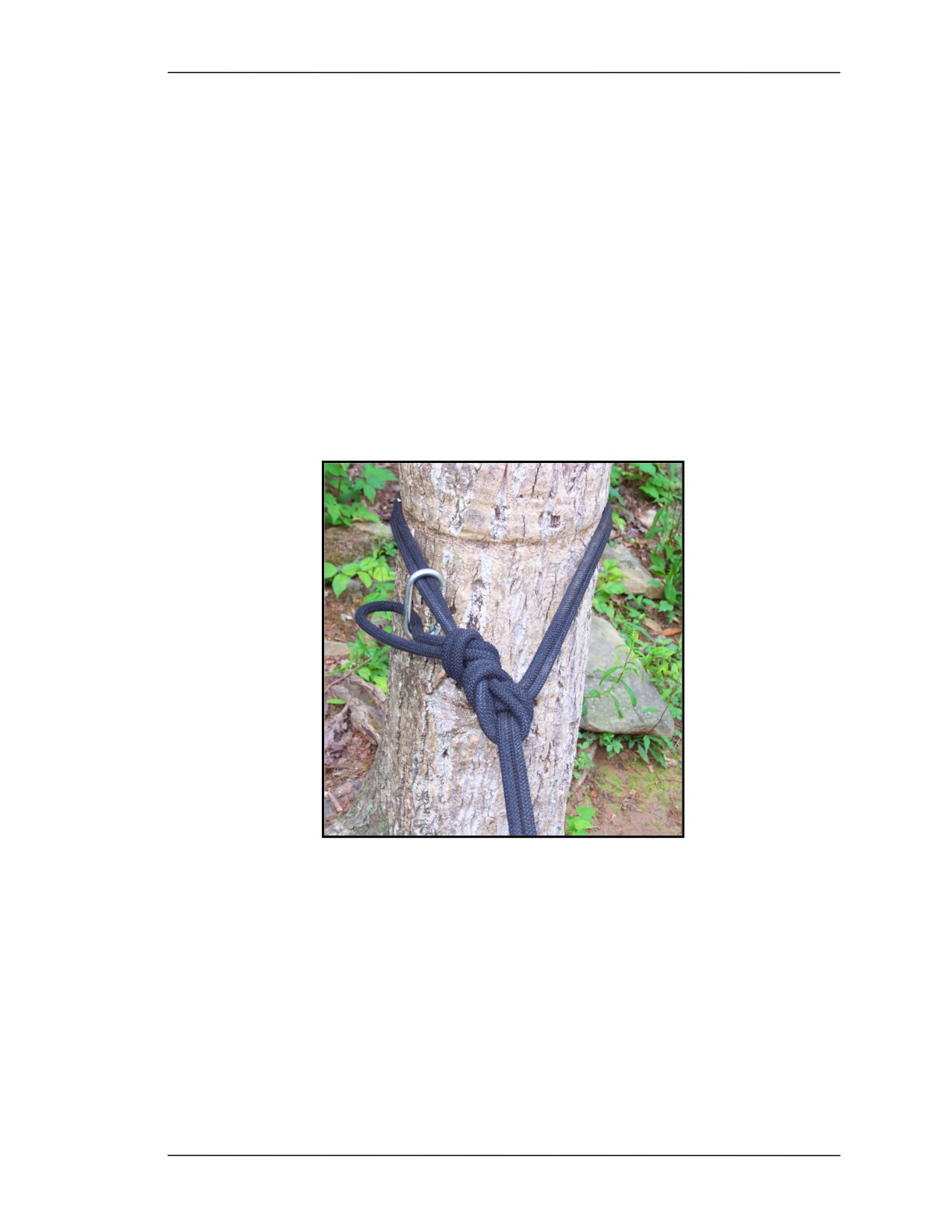
When tying the climbing or installation rope around an anchor, the knot should be placed
approximately the same distance away from the anchor as the diameter of the anchor
(Figure 5-10). The knot shouldn’t be placed up against the anchor because this can stress
and distort the knot under tension.
Figure 5-10. Rope tied to anchor with anchor knot.
5-9.
TENSIONLESS ANCHOR
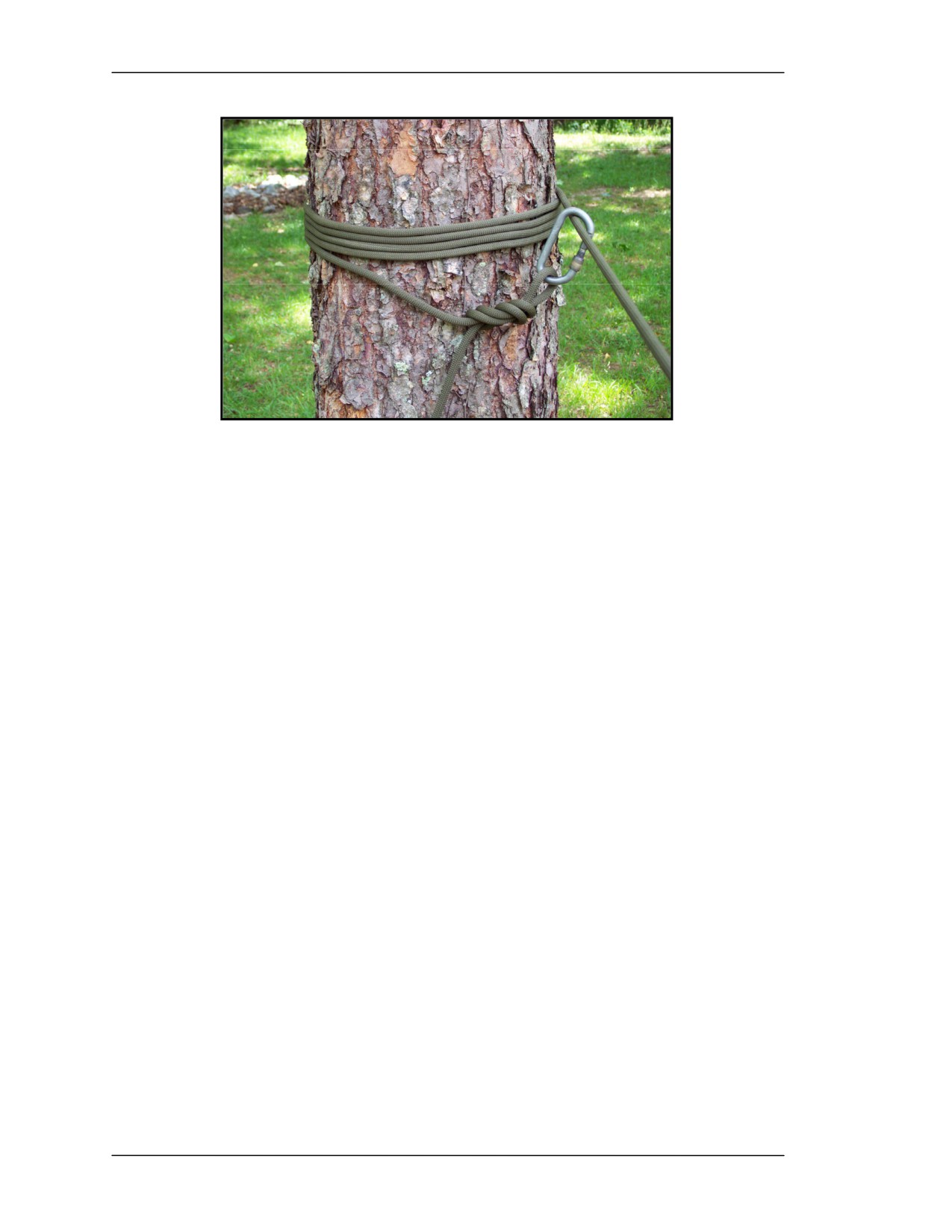
The tensionless anchor is used to anchor the rope on high-load installations such as
bridging and traversing (Figure 5-11, page 5-8). The wraps of the rope around the anchor
absorb the tension of the installation and keep the tension off the knot and carabiner. The
anchor is usually tied with a minimum of four wraps, more if necessary, to absorb the
tension. A smooth anchor may require several wraps, whereas a rough barked tree might
only require a few. The rope is wrapped from top to bottom. A fixed loop is placed into
the end of the rope and attached loosely back onto the rope with a carabiner.
5-7
FM 3-97.61
Figure 5-11. Tensionless anchor.
Section III. ARTIFICIAL ANCHORS
Using artificial anchors becomes necessary when natural anchors are unavailable. The art
of choosing and placing good anchors requires a great deal of practice and experience.
Artificial anchors are available in many different types such as pitons, chocks,
hexcentrics, and SLCDs. Anchor strength varies greatly; the type used depends on the
terrain, equipment, and the load to be placed on it.
5-10. DEADMAN
A “deadman” anchor is any solid object buried in the ground and used as an anchor.
a. An object that has a large surface area and some length to it works best. (A hefty
timber, such as a railroad tie, would be ideal.) Large boulders can be used, as well as a
bundle of smaller tree limbs or poles. As with natural anchors, ensure timbers and tree
limbs are not dead or rotting and that boulders are solid. Equipment, such as skis, ice
axes, snowshoes, and ruck sacks, can also be used if necessary.
b. In extremely hard, rocky terrain (where digging a trench would be impractical, if
not impossible) a variation of the deadman anchor can be constructed by building above
the ground. The sling is attached to the anchor, which is set into the ground as deeply as
possible. Boulders are then stacked on top of it until the anchor is strong enough for the
load. Though normally not as strong as when buried, this method can work well for light-
load installations as in anchoring a hand line for a stream crossing.
Note: Artificial anchors, such as pitons and bolts, are not widely accepted for use in all
areas because of the scars they leave on the rock and the environment. Often they
are left in place and become unnatural, unsightly fixtures in the natural
environment. For training planning, local laws and courtesies should be taken into
consideration for each area of operation.
5-8
FM 3-97.61
5-11. PITONS
Pitons have been in use for over 100 years. Although still available, pitons are not used as
often as other types of artificial anchors due primarily to their impact on the environment.
Most climbers prefer to use chocks, SLCDs and other artificial anchors rather than pitons
because they do not scar the rock and are easier to remove. Eye protection should always be
worn when driving a piton into rock.
Note: The proper use and placement of pitons, as with any artificial anchor, should be
studied, practiced, and tested while both feet are firmly on the ground and there is no
danger of a fall.
a. Advantages. Some advantages in using pitons are:
• Depending on type and placement, pitons can support multiple directions of pull.
• Pitons are less complex than other types of artificial anchors.
• Pitons work well in thin cracks where other types of artificial anchors do not.
b. Disadvantages. Some disadvantages in using pitons are:
• During military operations, the distinct sound created when hammering pitons is
a tactical disadvantage.
• Due to the expansion force of emplacing a piton, the rock could spread apart or
break causing an unsafe condition.
• Pitons are more difficult to remove than other types of artificial anchors.
• Pitons leave noticeable scars on the rock.
• Pitons are easily dropped if not tied off when being used.
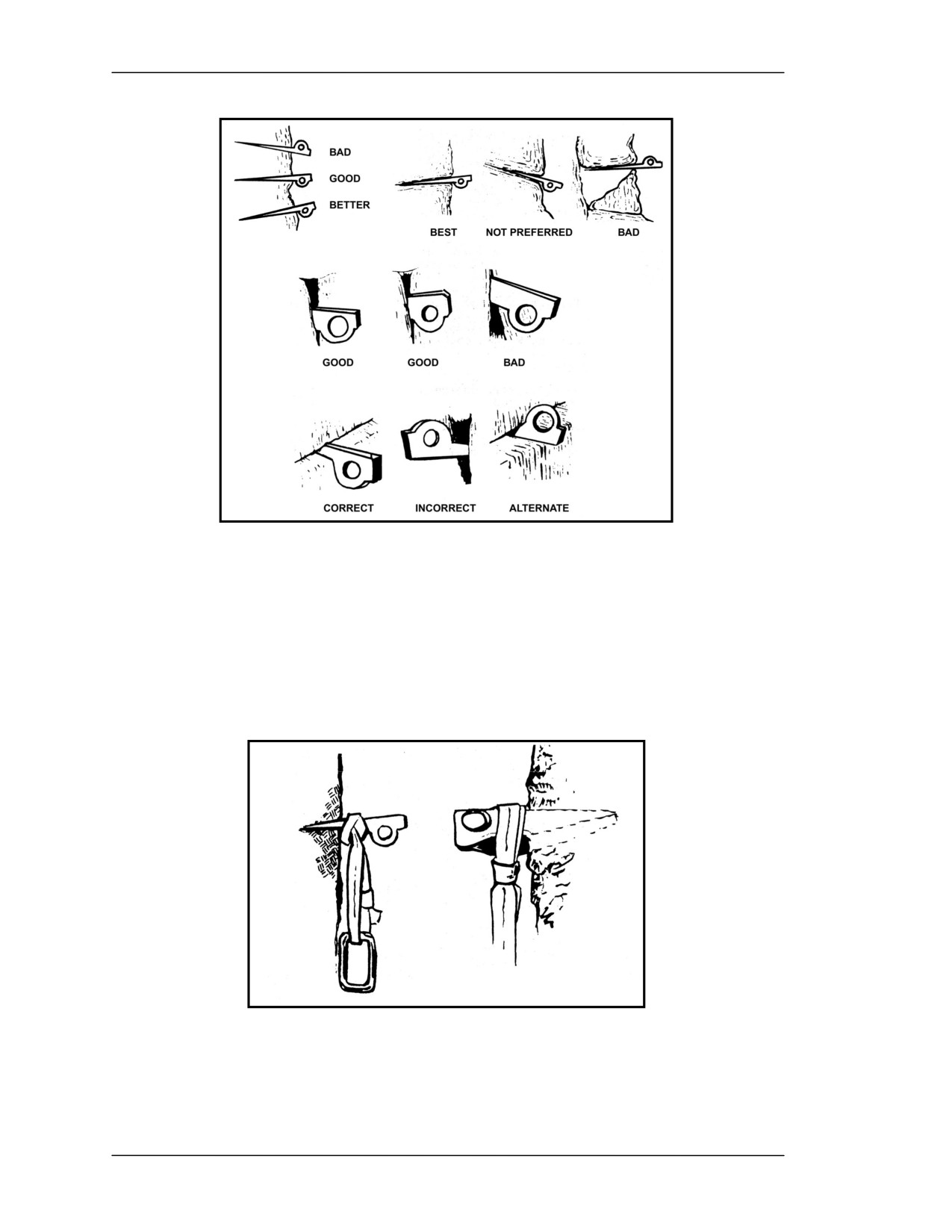
c. Piton Placement. The proper positioning or placement of pitons is critical.
(Figure 5-12, page 5-10, shows examples of piton placement.) Usually a properly sized
piton for a rock crack will fit one half to two thirds into the crack before being driven
with the piton hammer. This helps ensure the depth of the crack is adequate for the size
piton selected. As pitons are driven into the rock the pitch or sound that is made will
change with each hammer blow, becoming higher pitched as the piton is driven in.
(1) Test the rock for soundness by tapping with the hammer. Driving pitons in soft or
rotten rock is not recommended. When this type of rock must be used, clear the loose
rock, dirt, and debris from the crack before driving the piton completely in.
(2) While it is being driven, attach the piton to a sling with a carabiner (an old carabiner
should be used, if available) so that if the piton is knocked out of the crack, it will not be
lost. The greater the resistance overcome while driving the piton, the firmer the anchor will
be. The holding power depends on the climber placing the piton in a sound crack, and on the
type of rock. The piton should not spread the rock, thereby loosening the emplacement.
Note: Pitons that have rings as attachment points might not display much change in sound
as they are driven in as long as the ring moves freely.
5-9
FM 3-97.61
Figure 5-12. Examples of piton placements.
(3) Military mountaineers should practice emplacing pitons using either hand.
Sometimes a piton cannot be driven completely into a crack, because the piton is too
long. Therefore, it should be tied off using a hero-loop (an endless piece of webbing)
(Figure 5-13). Attach this loop to the piton using a girth hitch at the point where the piton
enters the rock so that the girth hitch is snug against the rock. Clip a carabiner into the
loop.
Figure 5-13. Hero-loop.
d. Testing. To test pitons pull up about 1 meter of slack in the climbing rope or use a
sling. Insert this rope into a carabiner attached to the piton, then grasp the rope at least 1/2
5-10
FM 3-97.61
meter from the carabiner. Jerk vigorously upward, downward, to each side, and then
outward while observing the piton for movement. Repeat these actions as many times as
necessary. Tap the piton to determine if the pitch has changed. If the pitch has changed
greatly, drive the piton in as far as possible. If the sound regains its original pitch, the
emplacement is probably safe. If the piton shows any sign of moving or if, upon driving it,
there is any question of its soundness, drive it into another place. Try to be in a secure
position before testing. This procedure is intended for use in testing an omni-directional
anchor (one that withstands a pull in any direction). When a directional anchor (pull in one
direction) is used, as in most free and direct-aid climbing situations, and when using chocks,
concentrate the test in the direction that force will be applied to the anchor.
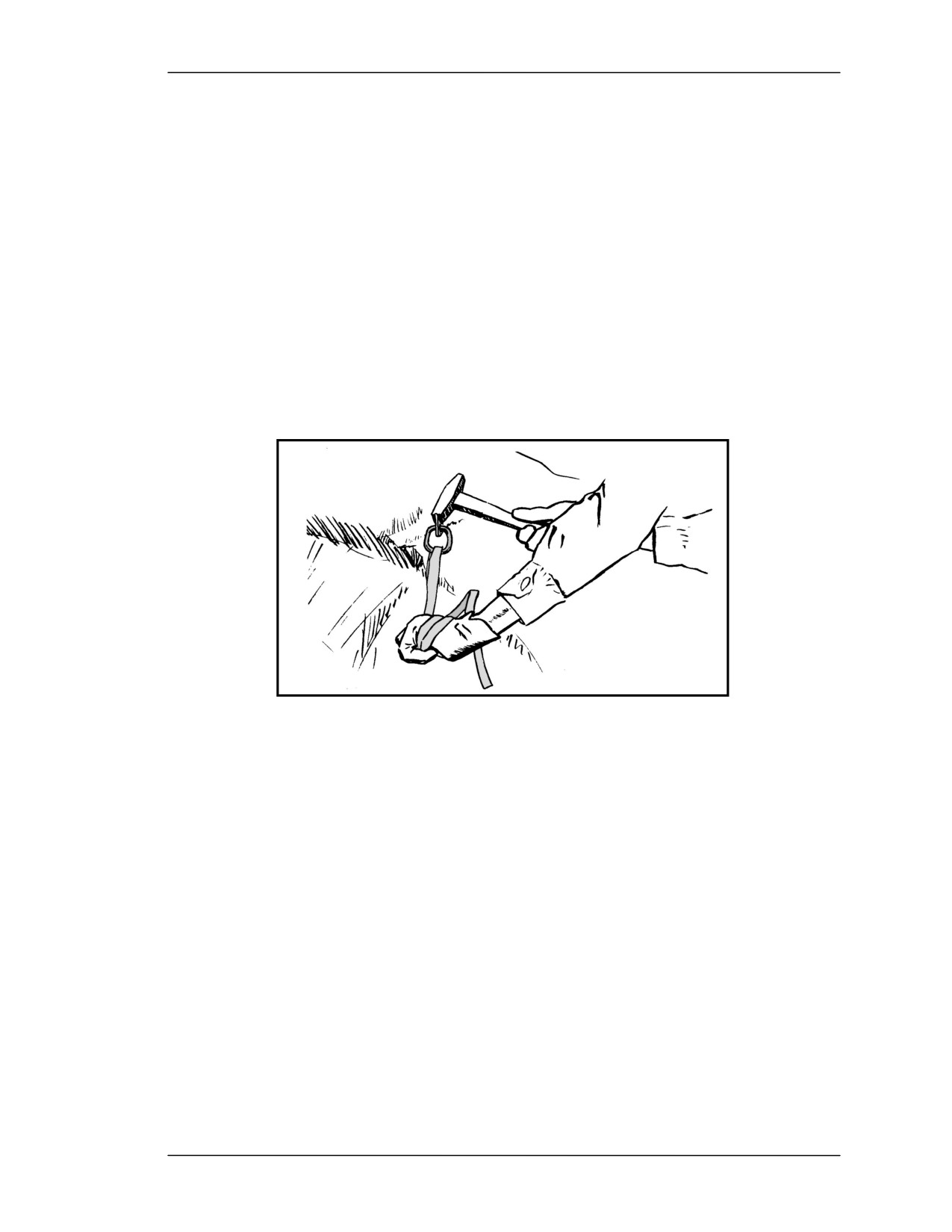
e. Removing Pitons. Attach a carabiner and sling to the piton before removal to
eliminate the chance of dropping and losing it. Tap the piton firmly along the axis of the
crack in which it is located. Alternate tapping from both sides while applying steady
pressure. Pulling out on the attached carabiner eventually removes the piton (Figure 5-14).
Figure 5-14. Piton removal.
f. Reusing Pitons. Soft iron pitons that have been used, removed, and straightened
may be reused, but they must be checked for strength. In training areas, pitons already in
place should not be trusted since weather loosens them in time. Also, they may have been
driven poorly the first time. Before use, test them as described above and drive them again
until certain of their soundness.
5-12. CHOCKS
Chock craft has been in use for many decades. A natural chockstone, having fallen and
wedged in a crack, provides an excellent anchor point. Sometimes these chockstones are in
unstable positions, but can be made into excellent anchors with little adjustment. Chock
craft is an art that requires time and technique to master―simple in theory, but complex in
practice. Imagination and resourcefulness are key principles to chock craft. The skilled
climber must understand the application of mechanical advantage, vectors, and other forces
that affect the belay chain in a fall.
5-11
FM 3-97.61
a. Advantages. The advantages of using chocks are:
• Tactically quiet installation and recovery.
• Usually easy to retrieve and, unless severely damaged, are reusable.
• Light to carry.
• Easy to insert and remove.
• Minimal rock scarring as opposed to pitons.
• Sometimes can be placed where pitons cannot (expanding rock flakes where
pitons would further weaken the rock).
b. Disadvantages. The disadvantages of using chocks are:
• May not fit in thin cracks, which may accept pitons.
• Often provide only one direction of pull.
• Practice and experience necessary to become proficient in proper placement.
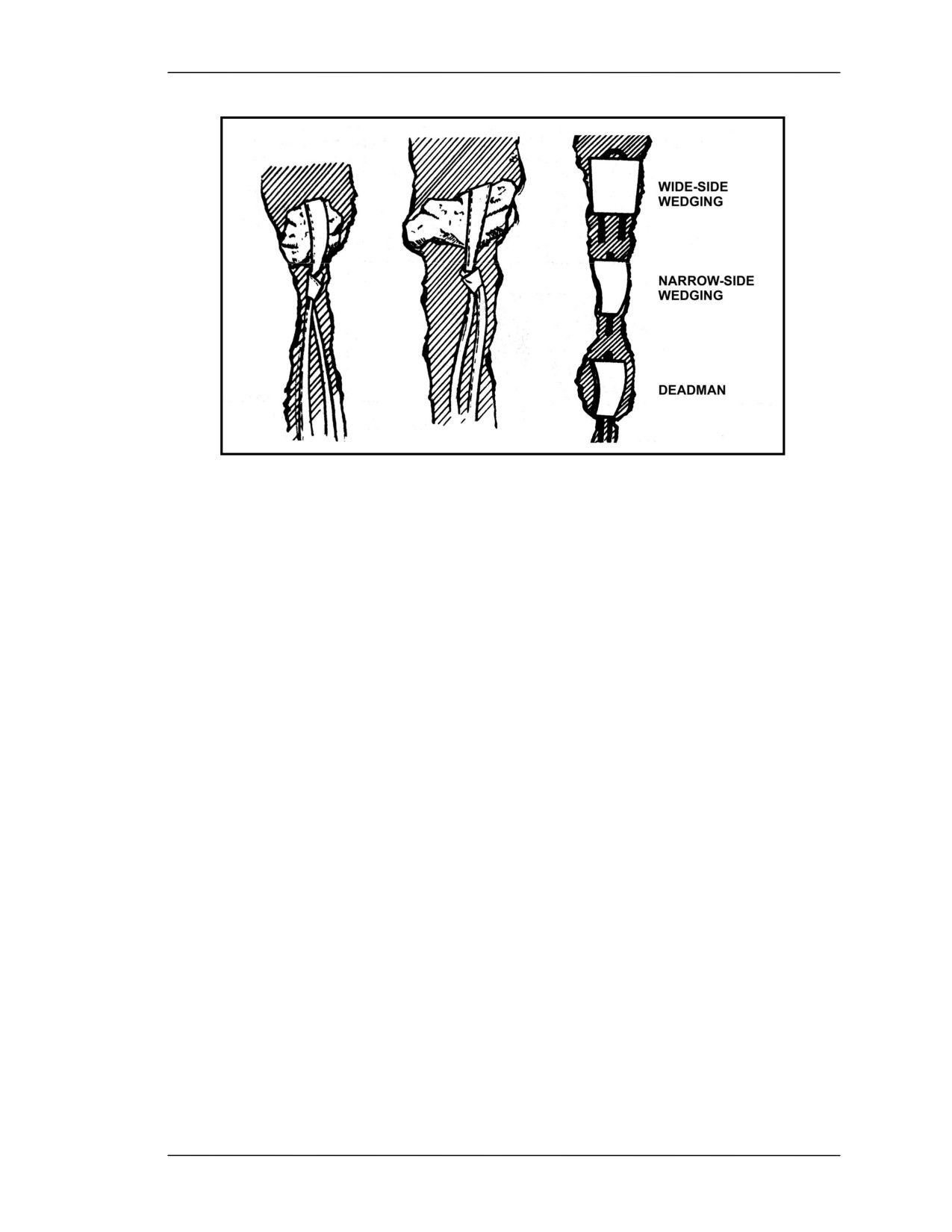
c. Placement. The principles of placing chocks are to find a crack with a constriction
at some point, place a chock of appropriate size above and behind the constriction, and set
the chock by jerking down on the chock loop (Figure 5-15). Maximum surface contact with
a tight fit is critical. Chocks are usually good for a single direction of pull.
(1) Avoid cracks that have crumbly (soft) or deteriorating rock, if possible. Some cracks
may have loose rock, grass, and dirt, which should be removed before placing the chock.
Look for a constriction point in the crack, then select a chock to fit it.
(2) When selecting a chock, choose one that has as much surface area as possible in
contact with the rock. A chock resting on one small crystal or point of rock is likely to be
unsafe. A chock that sticks partly out of the crack is avoided. Avoid poor protection. Ensure
that the chock has a wire or runner long enough; extra ropes, cord, or webbing may be
needed to extend the length of the runner.
(3) End weighting of the placement helps to keep the protection in position. A carabiner
often provides enough weight
(4) Parallel-sided cracks without constrictions are a problem. Chocks designed to be
used in this situation rely on camming principles to remain emplaced. Weighting the
emplacement with extra hardware is often necessary to keep the chocks from dropping out.
(a) Emplace the wedge-shaped chock above and behind the constriction; seat it with a
sharp downward tug.
(b) Place a camming chock with its narrow side into the crack, then rotate it to the
attitude it will assume under load; seat it with a sharp downward tug.
5-12
FM 3-97.61
Figure 5-15. Chock placements.
d. Testing. After seating a chock, test it to ensure it remains in place. A chock that
falls out when the climber moves past it is unsafe and offers no protection. To test it,
firmly pull the chock in every anticipated direction of pull. Some chock placements fail
in one or more directions; therefore, use pairs of chocks in opposition.
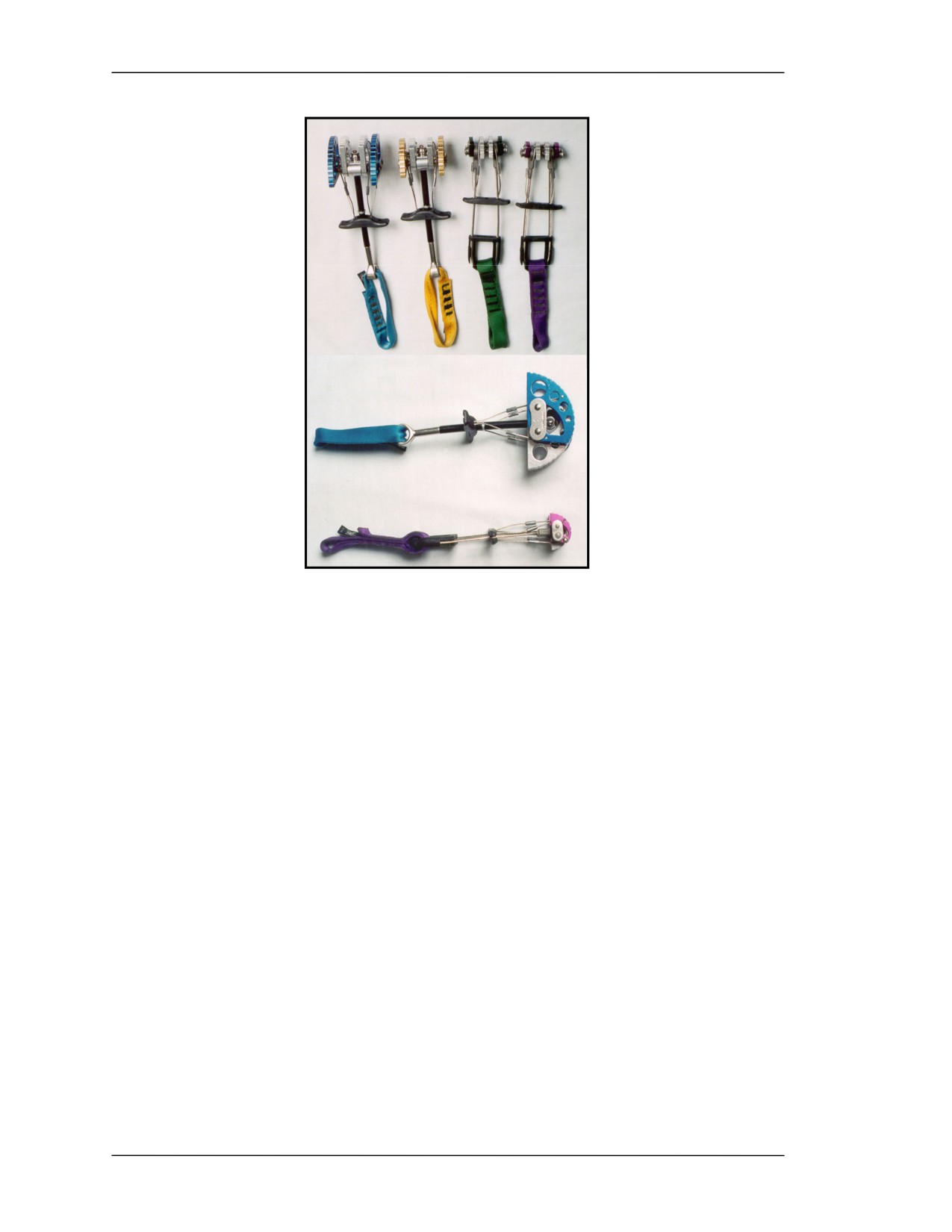
5-13. SPRING-LOADED CAMMING DEVICE
The SLCD offers quick and easy placement of artificial protection. It is well suited in
awkward positions and difficult placements, since it can be emplaced with one hand. It can
usually be placed quickly and retrieved easily (Figure 5-16, page 5-14).
a. To emplace an SLCD hold the device in either hand like a syringe, pull the retractor
bar back, place the device into a crack, and release the retractor bar. The SLCD holds well in
parallel-sided hand- and fist-sized cracks. Smaller variations are available for finger-sized
cracks.
b. Careful study of the crack should be made before selecting the device for
emplacement. It should be placed so that it is aligned in the direction of force applied to it. It
should not be placed any deeper than is needed for secure placement, since it may be
impossible to reach the extractor bar for removal. An SLCD should be extended with a
runner and placed so that the direction of pull is parallel to the shaft; otherwise, it may rotate
and pull out. The versions that have a semi-rigid wire cable shaft allow for greater flexibility
and usage, without the danger of the shaft snapping off in a fall.
5-13
FM 3-97.61
Figure 5-16. SLCD placements.
5-14. BOLTS
Bolts are often used in fixed-rope installations and in aid climbing where cracks are not
available.
a. Bolts provide one of the most secure means of establishing protection. The rock
should be inspected for evidence of crumbling, flaking, or cracking, and should be tested
with a hammer. Emplacing a bolt with a hammer and a hand drill is a time-consuming and
difficult process that requires drilling a hole in the rock deeper than the length of the bolt.
This normally takes more than 20 minutes for one hole. Electric or even gas-powered drills
can be used to greatly shorten drilling time. However, their size and weight can make them
difficult to carry on the climbing route.
b. A hanger (carrier) and nut are placed on the bolt, and the bolt is inserted and then
driven into the hole. A climber should never hammer on a bolt to test or “improve” it, since
this permanently weakens it. Bolts should be used with carriers, carabiners, and runners.
c. When using bolts, the climber uses a piton hammer and hand drill with a masonry
bit for drilling holes. Some versions are available in which the sleeve is hammered and
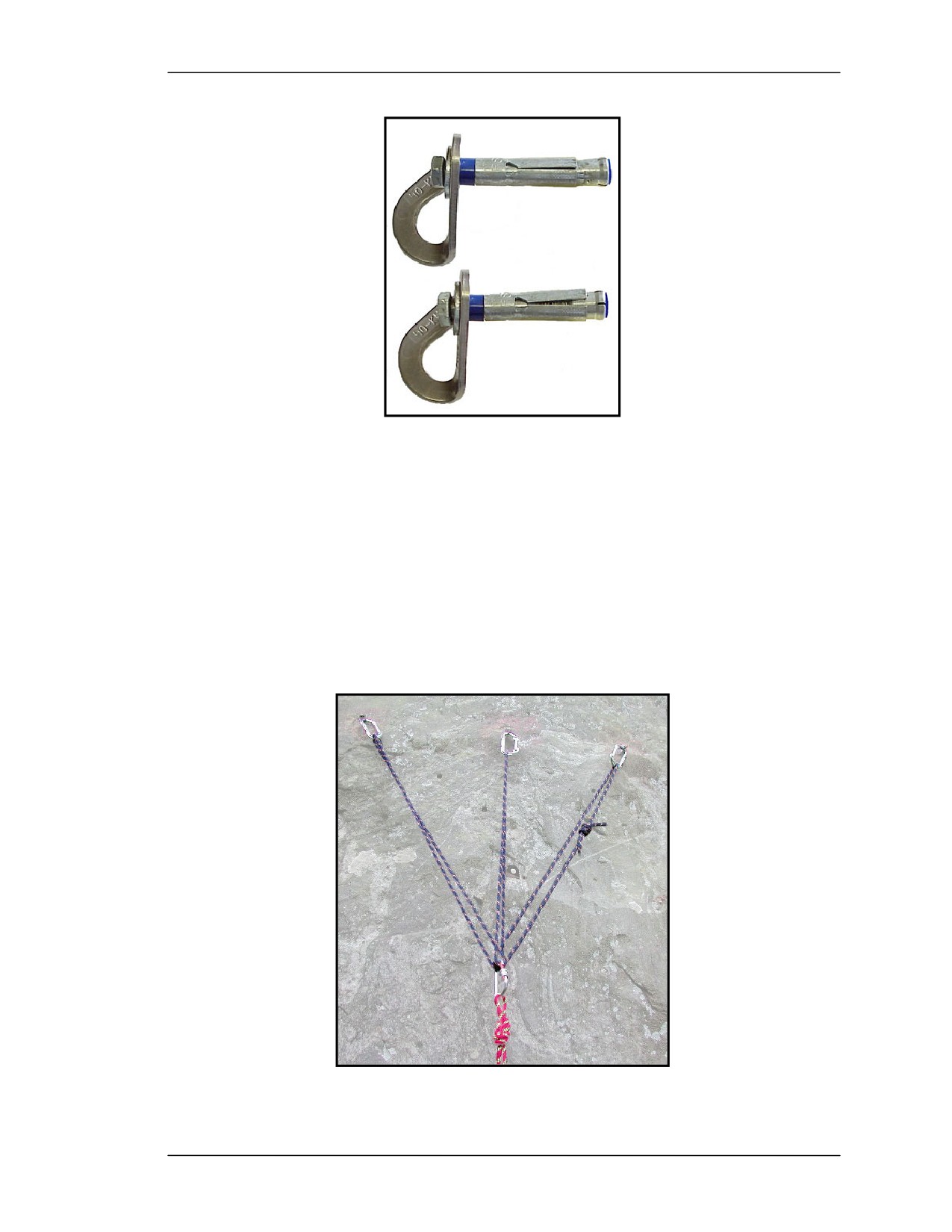
turned into the rock (self-drilling), which bores the hole. Split bolts and expanding sleeves
are common bolts used to secure hangers and carriers (Figure 5-17). Surgical tubing is
useful in blowing dust out of the holes. Nail type bolts are emplaced by driving the nail with
a hammer to expand the sleeve against the wall of the drilled hole. Safety glasses should
always be worn when emplacing bolts.
5-14
FM 3-97.61
Figure 5-17. Bolt with expanding sleeve.
5-15. EQUALIZING ANCHORS
Equalizing anchors are made up of more than one anchor point joined together so that the
intended load is shared equally. This not only provides greater anchor strength, but also
adds redundancy or backup because of the multiple points.
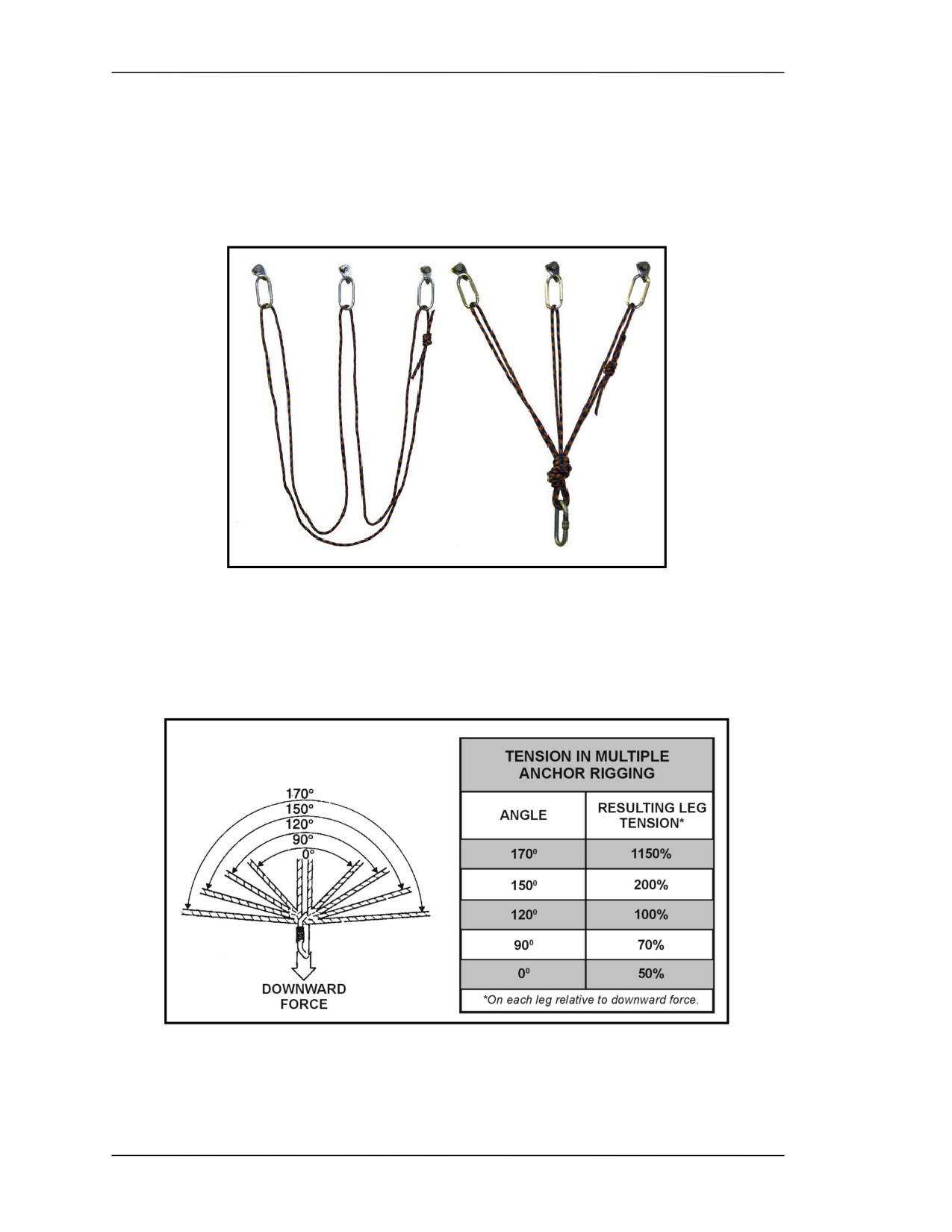
a. Self-equalizing Anchor. A self-equalizing anchor will maintain an equal load on
each individual point as the direction of pull changes (Figure 5-18). This is sometimes
used in rappelling when the route must change left or right in the middle of the rappel. A
self-equalizing anchor should only be used when necessary because if any one of the
individual points fail, the anchor will extend and shock-load the remaining points or even
cause complete anchor failure.
Figure 5-18. Self-equalizing anchors.
5-15
FM 3-97.61
b. Pre-equalized Anchor. A pre-equalized anchor distributes the load equally to
each individual point
(Figure
5-19). It is aimed in the direction of the load. A
pre-equalized anchor prevents extension and shock-loading of the anchor if an individual
point fails. An anchor is pre-equalized by tying an overhand or figure-eight knot in the
webbing or sling.
Figure 5-19. Pre-equalized anchor.
Note: When using webbing or slings, the angles of the webbing or slings directly affect
the load placed on an anchor. An angle greater than 90 degrees can result in
anchor failure (Figure 5-20).
Figure 5-20. Effects of angles on an anchor.
5-16
FM 3-97.61(TC 90-6-1)
CHAPTER 6
CLIMBING
A steep rock face is a terrain feature that can be avoided most of the
time through prior planning and good route selection. Rock climbing can
be time consuming, especially for a larger unit with a heavy combat load.
It can leave the climbing party totally exposed to weather, terrain hazards,
and the enemy for the length of the climb.
Sometimes steep rock cannot be avoided. Climbing relatively short
sections of steep rock (one or two pitches) may prove quicker and safer
than using alternate routes. A steep rock route would normally be
considered an unlikely avenue of approach and, therefore, might be
weakly defended or not defended at all.
All personnel in a unit preparing for deployment to mountainous
terrain should be trained in the basics of climbing. Forward observers,
reconnaissance personnel, and security teams are a few examples of small
units who may require rock climbing skills to gain their vantage points in
mountainous terrain. Select personnel demonstrating the highest degree of
skill and experience should be trained in roped climbing techniques. These
personnel will have the job of picking and “fixing” the route for the rest of
the unit.
Rock climbing has evolved into a specialized “sport” with a wide
range of varying techniques and styles. This chapter focuses on the basics
most applicable to military operations.
Section I. CLIMBING FUNDAMENTALS
A variety of refined techniques are used to climb different types of rock formations. The
foundation for all of these styles is the art of climbing. Climbing technique stresses
climbing with the weight centered over the feet, using the hands primarily for balance. It
can be thought of as a combination of the balanced movement required to walk a
tightrope and the technique used to ascend a ladder. No mountaineering equipment is
required; however, the climbing technique is also used in roped climbing.
6-1.
ROUTE SELECTION
The experienced climber has learned to climb with the “eyes.” Even before getting on the
rock, the climber studies all possible routes, or “lines,” to the top looking for cracks,
ledges, nubbins, and other irregularities in the rock that will be used for footholds and
handholds, taking note of any larger ledges or benches for resting places. When picking
the line, he mentally climbs the route, rehearsing the step-by-step sequence of movements
that will be required to do the climb, ensuring himself that the route has an adequate
number of holds and the difficulty of the climb will be well within the limit of his ability.
6-2.
TERRAIN SELECTION FOR TRAINING
Route selection for military climbing involves picking the easiest and quickest possible
line for all personnel to follow. However, climbing skill and experience can only be
6-1
FM 3-97.61
developed by increasing the length and difficulty of routes as training progresses. In the
training environment, beginning lessons in climbing should be performed CLOSE to the
ground on lower-angled rock with plenty of holds for the hands and feet. Personnel not
climbing can act as “spotters” for those climbing. In later lessons, a “top-rope” belay can
be used for safety, allowing the individual to increase the length and difficulty of the
climb under the protection of the climbing rope.
6-3.
PREPARATION
In preparation for climbing, the boot soles should be dry and clean. A small stick can be
used to clean out dirt and small rocks that might be caught between the lugs of the boot
sole. If the soles are wet or damp, dry them off by stomping and rubbing the soles on
clean, dry rock. All jewelry should be removed from the fingers. Watches and bracelets
can interfere with hand placements and may become damaged if worn while climbing.
Helmets should be worn to protect the head from injury if an object, such as a rock or
climbing gear, falls from climbers above. Most climbing helmets are not designed to
provide protection from impact to the head if the wearer falls, but will provide a minimal
amount of protection if a climber comes in contact with the rock during climbing.
CAUTION
Rings can become caught on rock facial features and
or lodged into cracks, which could cause injuries
during a slip or fall.
6-4.
SPOTTING
Spotting is a technique used to add a level of safety to climbing without a rope. A second
man stands below and just outside of the climbers fall path and helps (spots) the climber
to land safely if he should fall. Spotting is only applicable if the climber is not going
above the spotters head on the rock. Beyond that height a roped climbing should be
conducted. If an individual climbs beyond the effective range of the spotter(s), he has
climbed TOO HIGH for his own safety. The duties of the spotter are to help prevent the
falling climber from impacting the head and or spine, help the climber land feet first, and
reduce the impact of a fall.
CAUTION
The spotter should not catch the climber against the
rock because additional injuries could result. If the
spotter pushes the falling climber into the rock, deep
abrasions of the skin or knee may occur. Ankle joints
could be twisted by the fall if the climber’s foot
remained high on the rock. The spotter might be
required to fully support the weight of the climber
causing injury to the spotter.
6-2
FM 3-97.61
6-5.
CLIMBING TECHNIQUE
Climbing involves linking together a series of movements based on foot and hand
placement, weight shift, and movement. When this series of movements is combined
correctly, a smooth climbing technique results. This technique reduces excess force on
the limbs, helping to minimize fatigue. The basic principle is based on the five body parts
described here.
a. Five Body Parts. The five body parts used for climbing are the right hand, left
hand, right foot, left foot, and body (trunk). The basic principle to achieve smooth
climbing is to move only one of the five body parts at a time. The trunk is not moved in
conjunction with a foot or in conjunction with a hand, a hand is not moved in conjunction
with a foot, and so on. Following this simple technique forces both legs to do all the
lifting simultaneously.
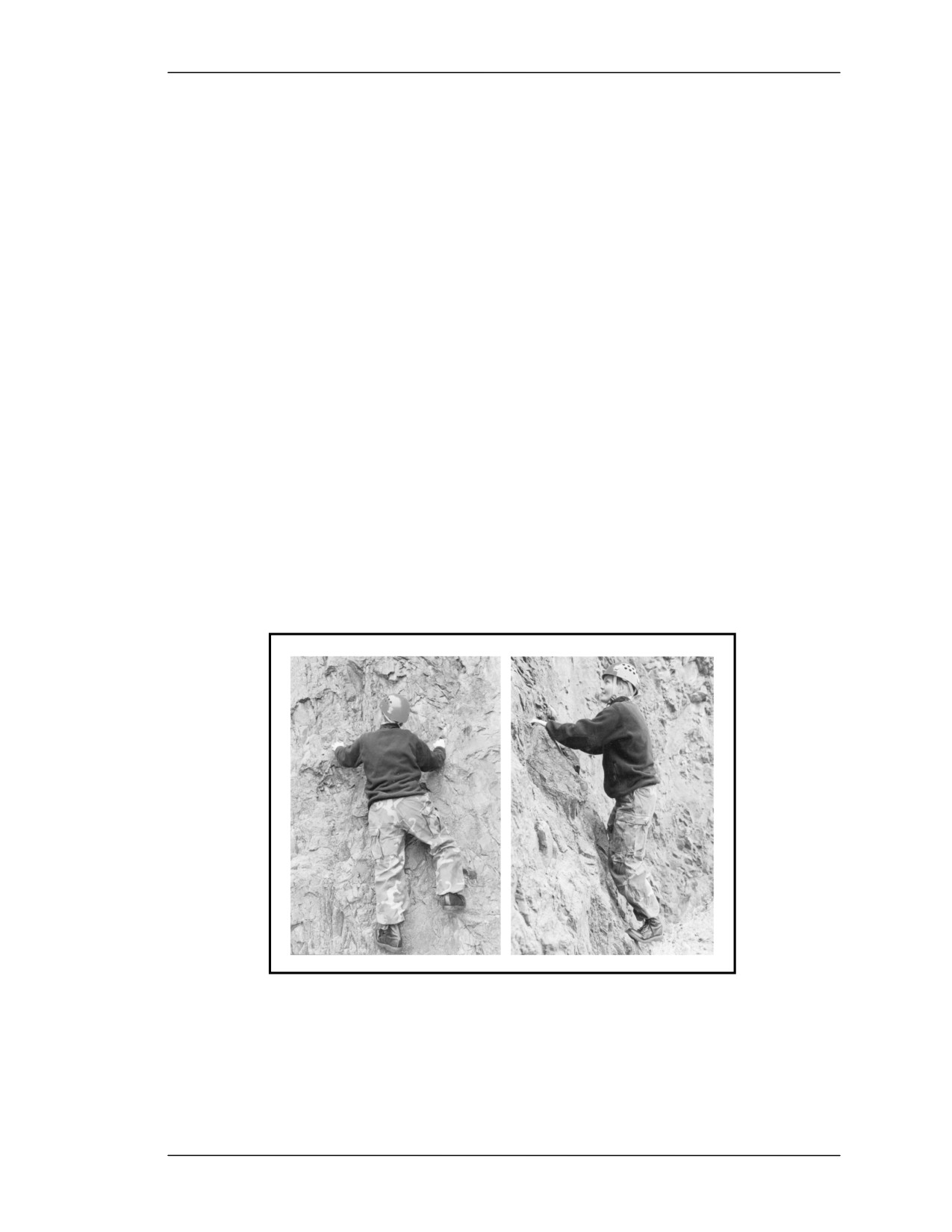
b. Stance or Body Position. Body position is probably the single most important
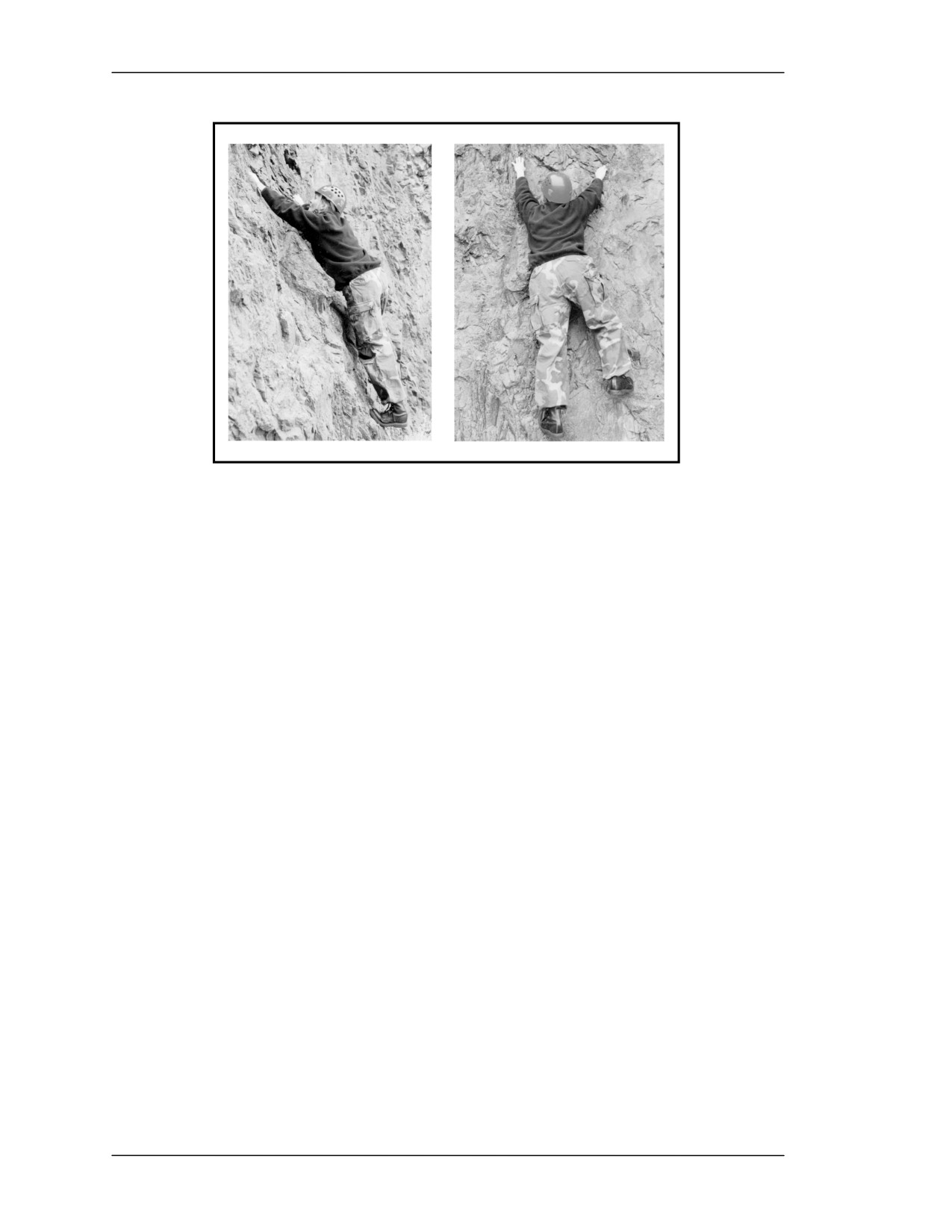
element to good technique. A relaxed, comfortable stance is essential. (Figure 6-1 shows
a correct climbing stance, and Figure 6-2, page 6-4, shows an incorrect stance.) The body
should be in a near vertical or erect stance with the weight centered over the feet. Leaning
in towards the rock will cause the feet to push outward, away from the rock, resulting in a
loss of friction between the boot sole and rock surface. The legs are straight and the heels
are kept low to reduce fatigue. Bent legs and tense muscles tire quickly. If strained for too
long, tense muscles may vibrate uncontrollably. This vibration, known as “Elvis-ing” or
“sewing-machine leg” can be cured by straightening the leg, lowering the heel, or moving
on to a more restful position. The hands are used to maintain balance. Keeping the hands
between waist and shoulder level will reduce arm fatigue.
Figure 6-1. Correct climbing stance—balanced over both feet.
6-3
FM 3-97.61
Figure 6-2. Incorrect stance—stretched out.
(1) Whenever possible, three points of contact are maintained with the rock. Proper
positioning of the hips and shoulders is critical. When using two footholds and one
handhold, the hips and shoulders should be centered over both feet. In most cases, as the
climbing progresses, the body is resting on one foot with two handholds for balance. The
hips and shoulders must be centered over the support foot to maintain balance, allowing
the “free” foot to maneuver.
(2) The angle or steepness of the rock also determines how far away from the rock
the hips and shoulders should be. On low-angle slopes, the hips are moved out away from
the rock to keep the body in balance with the weight over the feet. The shoulders can be
moved closer to the rock to reach handholds. On steep rock, the hips are pushed closer to
the rock. The shoulders are moved away from the rock by arching the back. The body is
still in balance over the feet and the eyes can see where the hands need to go. Sometimes,
when footholds are small, the hips are moved back to increase friction between the foot
and the rock. This is normally done on quick, intermediate holds. It should be avoided in
the rest position as it places more weight on the arms and hands. When weight must be
placed on handholds, the arms should be kept straight to reduce fatigue. Again, flexed
muscles tire quickly.
c. Climbing Sequence. The steps defined below provide a complete sequence of
events to move the entire body on the rock. These are the basic steps to follow for a
smooth climbing technique. Performing these steps in this exact order will not always be
necessary because the nature of the route will dictate the availability of hand and foot
placements. The basic steps are weight, shift, and movement (movement being either the
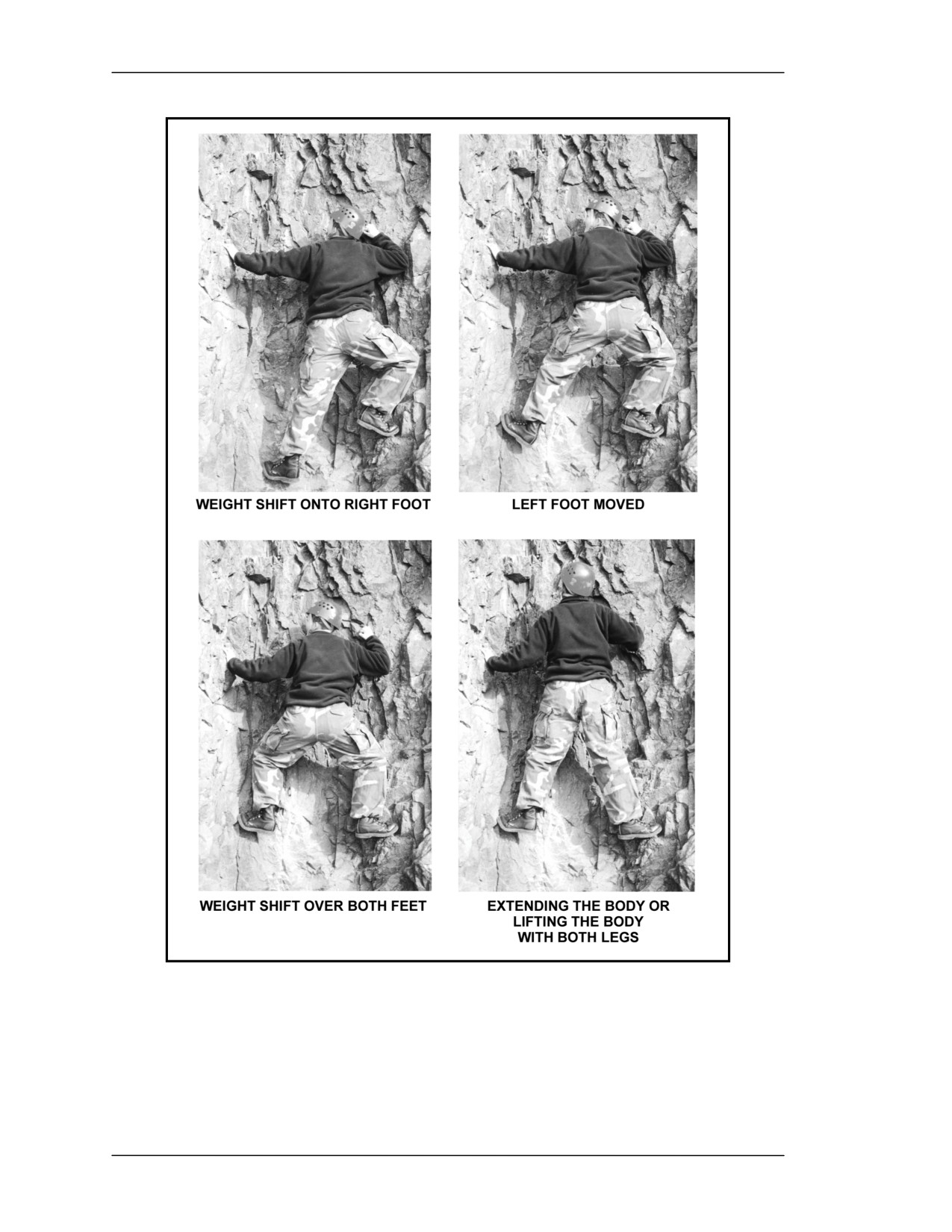
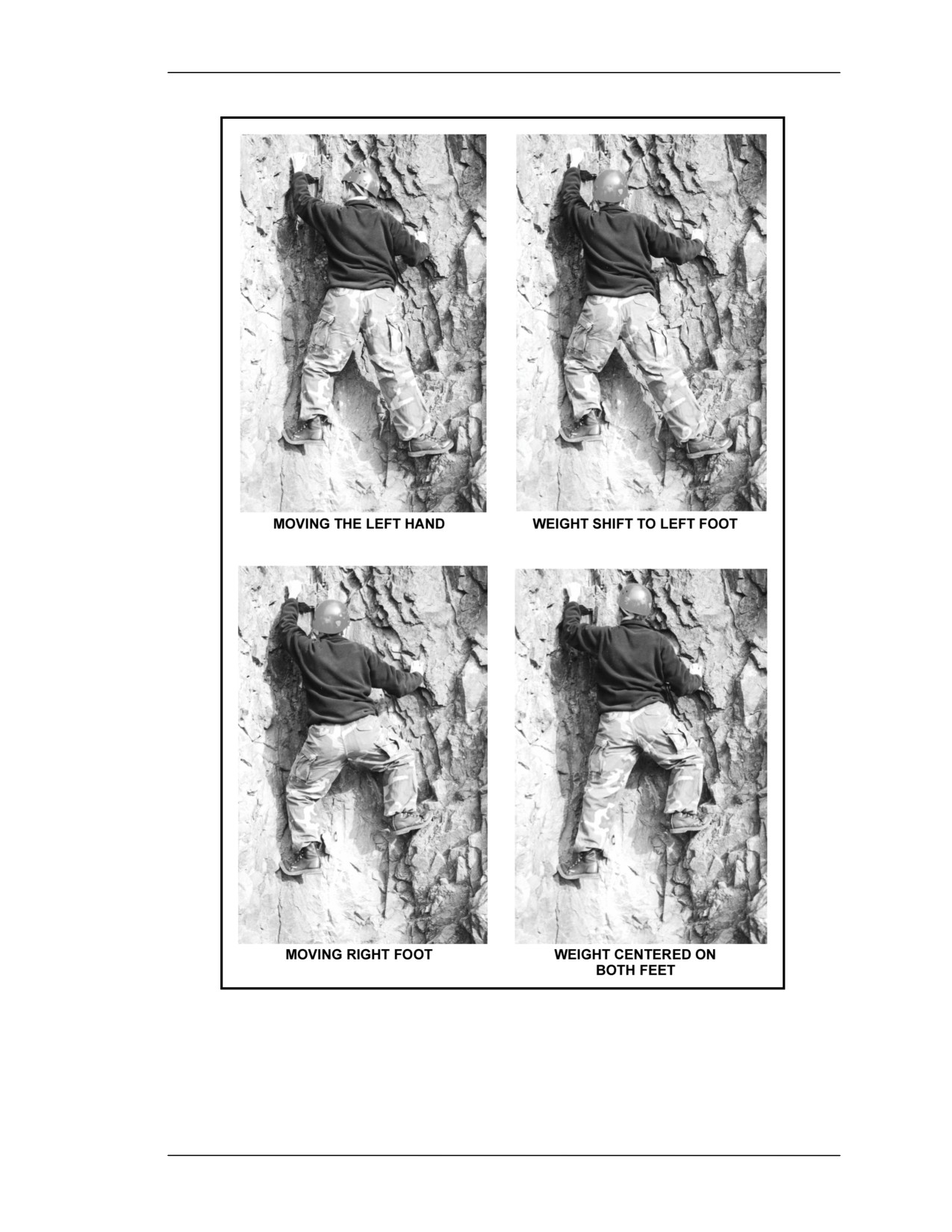
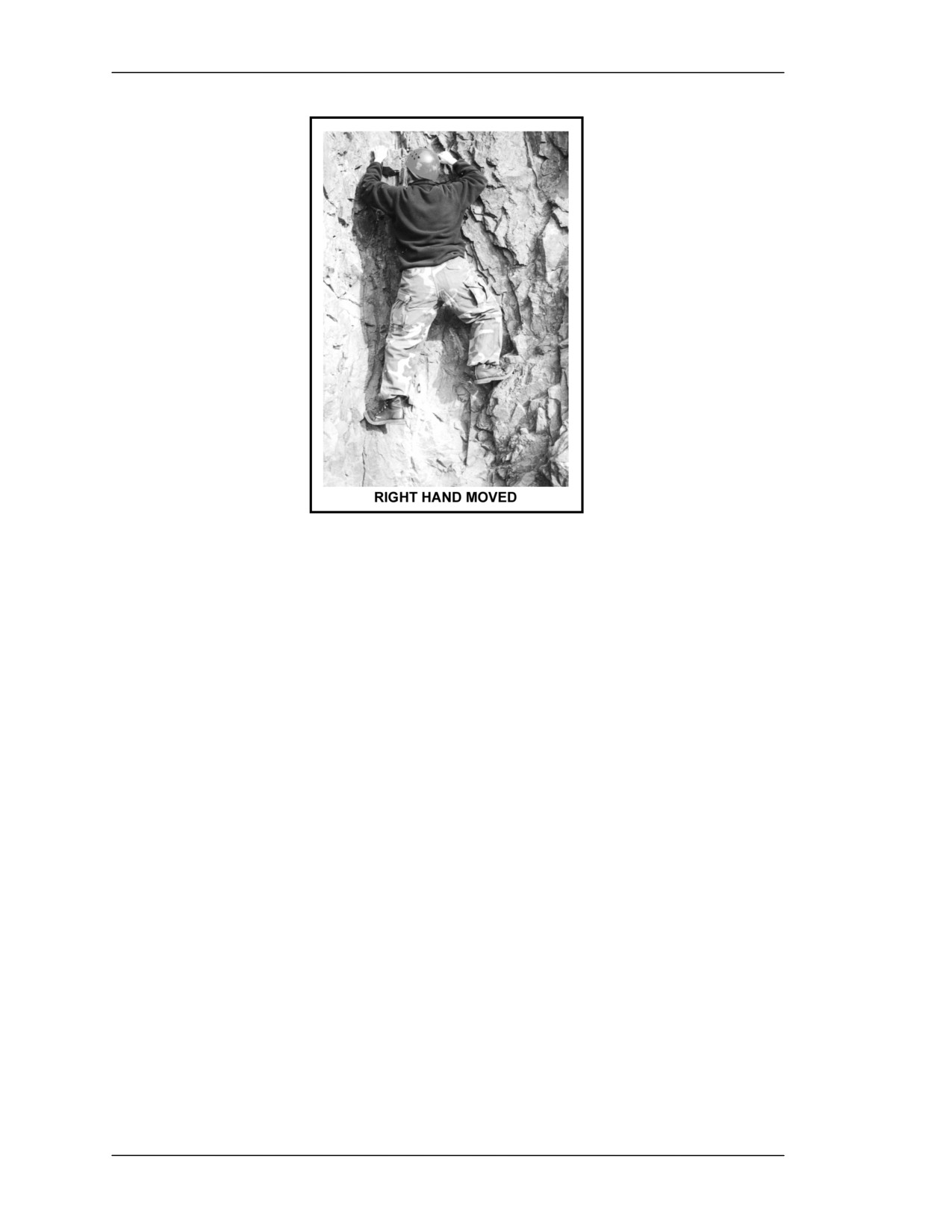
foot, hand, or body). (A typical climbing sequence is shown in Figure 6-3, pages 6-6
through 6-8.)
STEP ONE:
Shift the weight from both feet to one foot. This will allow lifting of
one foot with no effect on the stance.
6-4
FM 3-97.61
STEP TWO:
Lift the unweighted foot and place it in a new location, within one to
two feet of the starting position, with no effect on body position or
balance (higher placement will result in a potentially higher lift for the
legs to make, creating more stress, and is called a high step) The trunk
does not move during foot movement.
STEP THREE: Shift the weight onto both feet.
(Repeat steps
1 through
3 for
remaining foot.)
STEP FOUR: Lift the body into a new stance with both legs.
STEP FIVE:
Move one hand to a new position between waist and head height.
During this movement, the trunk should be completely balanced in
position and the removed hand should have no effect on stability.
STEP SIX:
Move the remaining hand as in Step 5.
Now the entire body is in a new position and ready to start the process again. Following
these steps will prevent lifting with the hands and arms, which are used to maintain
stance and balance. If both legs are bent, leg extension can be performed as soon as one
foot has been moved. Hand movements can be delayed until numerous foot movements
have been made, which not only creates shorter lifts with the legs, but may allow a better
choice for the next hand movements because the reach will have increased.
6-5
FM 3-97.61
Figure 6-3. Typical climbing sequence.
6-6
FM 3-97.61
Figure 6-3. Typical climbing sequence (continued).
6-7
FM 3-97.61
Figure 6-3. Typical climbing sequence (continued).
(1) Many climbers will move more than one body part at a time, usually resulting in
lifting the body with one leg or one leg and both arms. This type of lifting is inefficient,
requiring one leg to perform the work of two or using the arms to lift the body. Proper
climbing technique is lifting the body with the legs, not the arms, because the legs are
much stronger.
(2) When the angle of the rock increases, these movements become more critical.
Holding or pulling the body into the rock with the arms and hands may be necessary as
the angle increases (this is still not lifting with the arms). Many climbing routes have
angles greater than ninety degrees (overhanging) and the arms are used to support partial
body weight. The same technique applies even at those angles.
(3) The climber should avoid moving on the knees and elbows. Other than being
uncomfortable, even painful, to rest on, these bony portions of the limbs offer little
friction and “feel” on the rock.
6-6.
SAFETY PRECAUTIONS
The following safety precautions should be observed when rock climbing.
a. While ascending a seldom or never traveled route, you may encounter
precariously perched rocks. If the rock will endanger your second, it may be possible to
remove it from the route and trundle it, tossing it down. This is extremely dangerous to
climbers below and should not be attempted unless you are absolutely sure no men are
below. If you are not sure that the flight path is clear, do not do it. Never dislodge loose
rocks carelessly. Should a rock become loose accidentally, immediately shout the
warning “ROCK” to alert climbers below. Upon hearing the warning, personnel should
6-8
FM 3-97.61
seek immediate cover behind any rock bulges or overhangs available, or flatten
themselves against the rock to minimize exposure.
b. Should a climber fall, he should do his utmost to maintain control and not panic.
If on a low-angle climb, he may be able to arrest his own fall by staying in contact with
the rock, grasping for any possible hold available. He should shout the warning
“FALLING” to alert personnel below.
CAUTION
Grasping at the rock in a fall can result in serious
injuries to the upper body. If conducting a roped
climb, let the rope provide protection.
c. When climbing close to the ground and without a rope, a spotter can be used for
safety. The duties of the spotter are to ensure the falling climber does not impact the head
or spine, and to reduce the impact of a fall.
d. Avoid climbing directly above or below other climbers (with the exception of
spotters). When personnel must climb at the same time, following the same line, a fixed
rope should be installed.
e. Avoid climbing with gloves on because of the decreased “feel” for the rock. The
use of gloves in the training environment is especially discouraged, while their use in the
mountains is often mandatory when it is cold. A thin polypropylene or wool glove is best
for rock climbing, although heavier cotton or leather work gloves are often used for
belaying.
f. Be extremely careful when climbing on wet or moss-covered rock; friction on
holds is greatly reduced.
g. Avoid grasping small vegetation for handholds; the root systems can be shallow
and will usually not support much weight.
6-7.
MARGIN OF SAFETY
Besides observing the standard safety precautions, the climber can avoid catastrophe by
climbing with a wide margin of safety. The margin of safety is a protective buffer the
climber places between himself and potential climbing hazards. Both subjective
(personnel-related) and objective
(environmental) hazards must be considered when
applying the margin of safety. The leader must apply the margin of safety taking into
account the strengths and weaknesses of the entire team or unit.
a. When climbing, the climber increases his margin of safety by selecting routes that
are well within the limit of his ability. When leading a group of climbers, he selects a
route well within the ability of the weakest member.
b. When the rock is wet, or when climbing in other adverse weather conditions, the
climber’s ability is reduced and routes are selected accordingly. When the climbing
becomes difficult or exposed, the climber knows to use the protection of the climbing
rope and belays. A lead climber increases his margin of safety by placing protection
along the route to limit the length of a potential fall.
6-9
FM 3-97.61
Section II. USE OF HOLDS
The climber should check each hold before use. This may simply be a quick, visual
inspection if he knows the rock to be solid. When in doubt, he should grab and tug on the
hold to test it for soundness BEFORE depending on it. Sometimes, a hold that appears
weak can actually be solid as long as minimal force is applied to it, or the force is applied
in a direction that strengthens it. A loose nubbin might not be strong enough to support
the climber’s weight, but it may serve as an adequate handhold. Be especially careful
when climbing on weathered, sedimentary-type rock.
6-8.
CLIMBING WITH THE FEET
“Climb with the feet and use the hands for balance” is extremely important to remember.
In the early learning stages of climbing, most individuals will rely heavily on the arms,
forgetting to use the feet properly. It is true that solid handholds and a firm grip are
needed in some combination techniques; however, even the most strenuous techniques
require good footwork and a quick return to a balanced position over one or both feet.
Failure to climb any route, easy or difficult, is usually the result of poor footwork.
a. The beginning climber will have a natural tendency to look up for handholds. Try
to keep the hands low and train your eyes to look down for footholds. Even the smallest
irregularity in the rock can support the climber once the foot is positioned properly and
weight is committed to it.
b. The foot remains on the rock as a result of friction. Maximum friction is obtained
from a correct stance over a properly positioned foot. The following describes a few ways
the foot can be positioned on the rock to maximize friction.
(1) Maximum Sole Contact. The principle of using full sole contact, as in mountain
walking, also applies in climbing. Maximum friction is obtained by placing as much of
the boot sole on the rock as possible. Also, the leg muscles can relax the most when the
entire foot is placed on the rock. (Figure 6-4 shows examples of maximum and minimum
sole contact.)
(a) Smooth, low-angled rock (slab) and rock containing large “bucket” holds and
ledges are typical formations where the entire boot sole should be used.
(b) On some large holds, like bucket holds that extend deep into the rock, the entire
foot cannot be used. The climber may not be able to achieve a balanced position if the
foot is stuck too far underneath a bulge in the rock. In this case, placing only part of the
foot on the hold may allow the climber to achieve a balanced stance. The key is to use as
much of the boot sole as possible. Remember to keep the heels low to reduce strain on the
lower leg muscles.
6-10
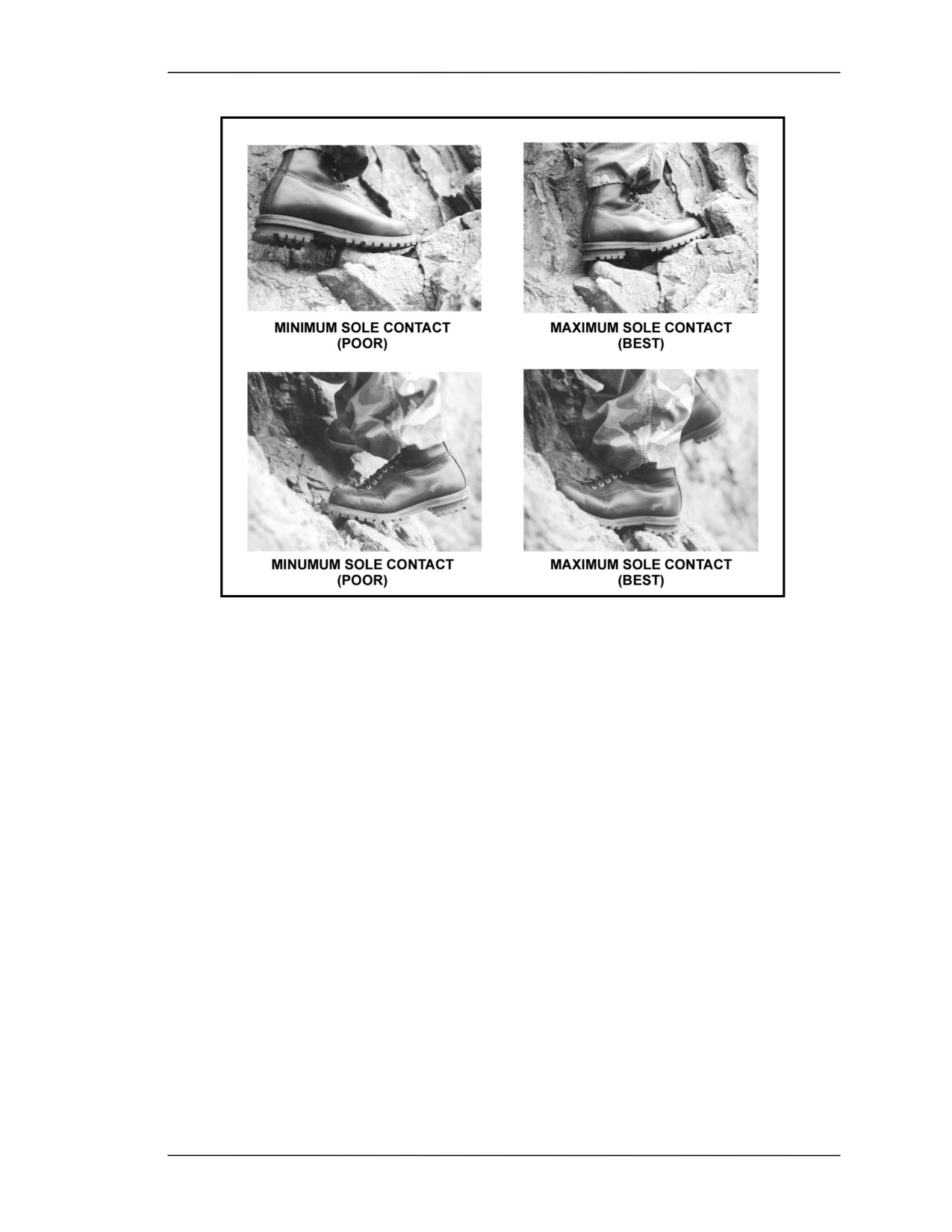
FM 3-97.61
Figure 6-4. Examples of maximum and minimum sole contact.
(2) Edging. The edging technique is used where horizontal crack systems and other
irregularities in the rock form small, well-defined ledges. The edge of the boot sole is
placed on the ledge for the foothold. Usually, the inside edge of the boot or the edge area
around the toes is used. Whenever possible, turn the foot sideways and use the entire
inside edge of the boot. Again, more sole contact equals more friction and the legs can
rest more when the heel is on the rock. (Figure 6-5, page 6-12, shows examples of the
edging technique.)
(a) On smaller holds, edging with the front of the boot, or toe, may be used. Use of
the toe is most tiring because the heel is off the rock and the toes support the climber’s
weight. Remember to keep the heel low to reduce fatigue. Curling and stiffening the toes
in the boot increases support on the hold. A stronger position is usually obtained on small
ledges by turning the foot at about a 45-degree angle, using the strength of the big toe and
the ball of the foot.
(b) Effective edging on small ledges requires stiff-soled footwear. The stiffer the sole,
the better the edging capability. Typical mountain boots worn by the US military have a
relatively flexible lugged sole and, therefore, edging ability on smaller holds will be
somewhat limited.
6-11