FM 3-97.61 MILITARY MOUNTAINEERING (AUGUST 2002) - page 3
FM 3-97.61
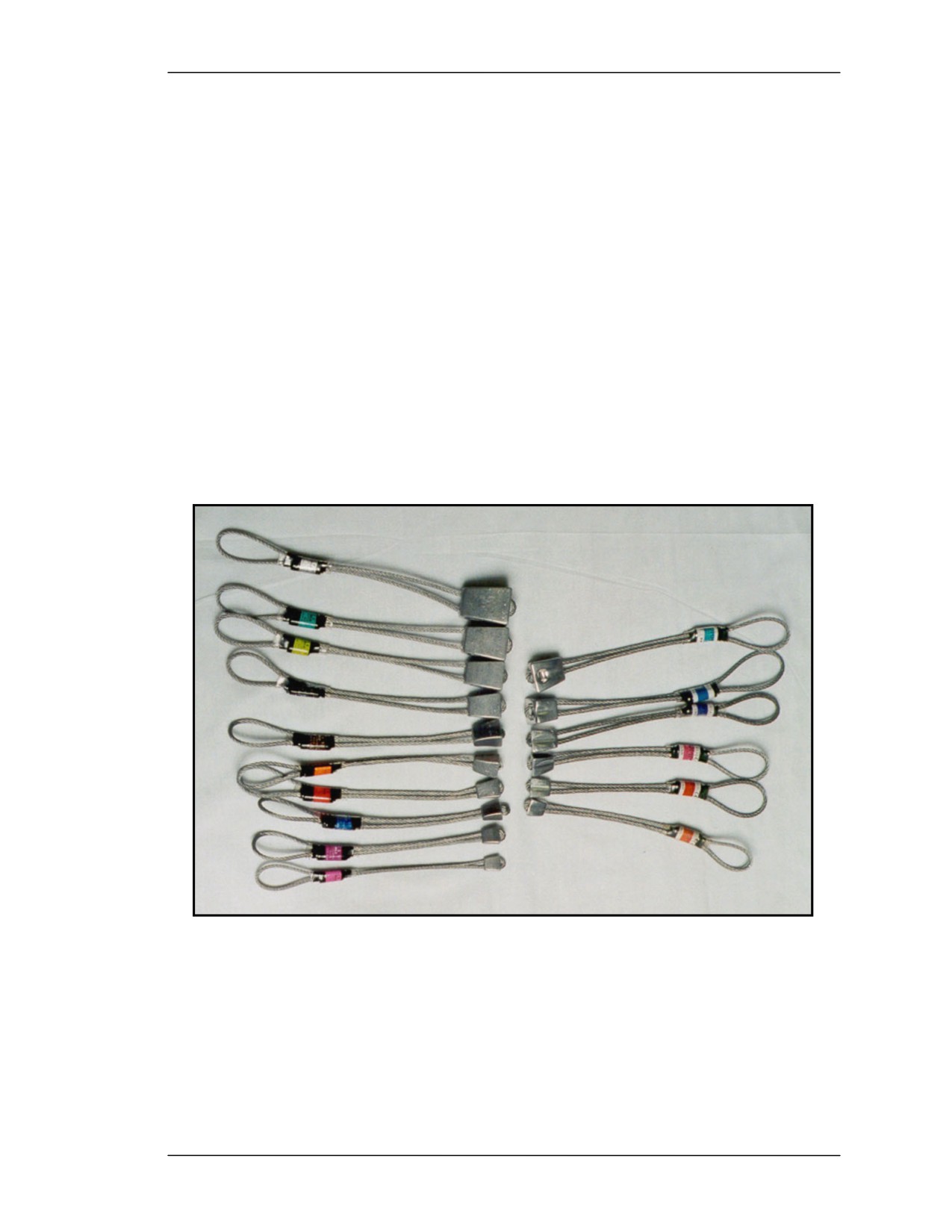
d. Chocks. “Chocks” is a generic term used to describe the various types of artificial
protection other than bolts or pitons. Chocks are essentially a tapered metal wedge
constructed in various sizes to fit different sized openings in the rock (Figure 3-15). The
design of a chock will determine whether it fits into one of two categories―wedges or
cams. A wedge holds by wedging into a constricting crack in the rock. A cam holds by
slightly rotating in a crack, creating a camming action that lodges the chock in the crack
or pocket. Some chocks are manufactured to perform either in the wedging mode or the
camming mode. One of the chocks that falls into the category of both a wedge and cam is
the hexagonal-shaped or “hex” chock. This type of chock is versatile and comes with
either a cable loop or is tied with cord or webbing. All chocks come in different sizes to
fit varying widths of cracks. Most chocks come with a wired loop that is stronger than
cord and allows for easier placement. Bigger chocks can be threaded with cord or
webbing if the user ties the chock himself. Care should be taken to place tubing in the
chock before threading the cord. The cord used with chocks is designed to be stiffer and
stronger than regular cord and is typically made of Kevlar. The advantage of using a
chock rather than a piton is that a climber can carry many different sizes and use them
repeatedly.
Figure 3-15. Chocks.
3-15
FM 3-97.61
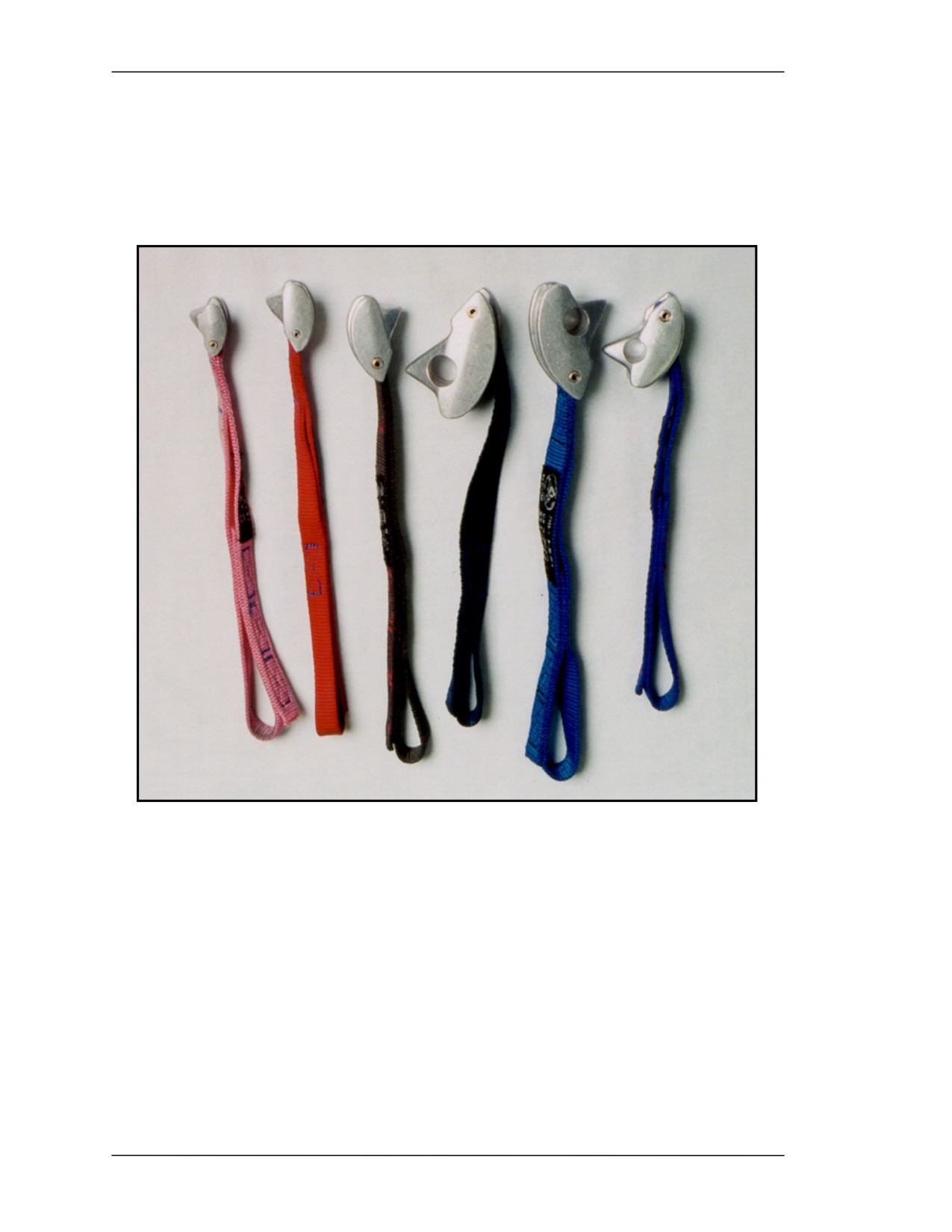
e. Three-Point Camming Device. The three-point camming device’s unique design
allows it to be used both as a camming piece and a wedging piece (Figure 3-16). Because
of this design it is extremely versatile and, when used in the camming mode, will fit a
wide range of cracks. The three-point camming device comes in several different sizes
with the smaller sizes working in pockets that no other piece of gear would fit in.
Figure 3-16. Three-point camming device.
3-16
FM 3-97.61
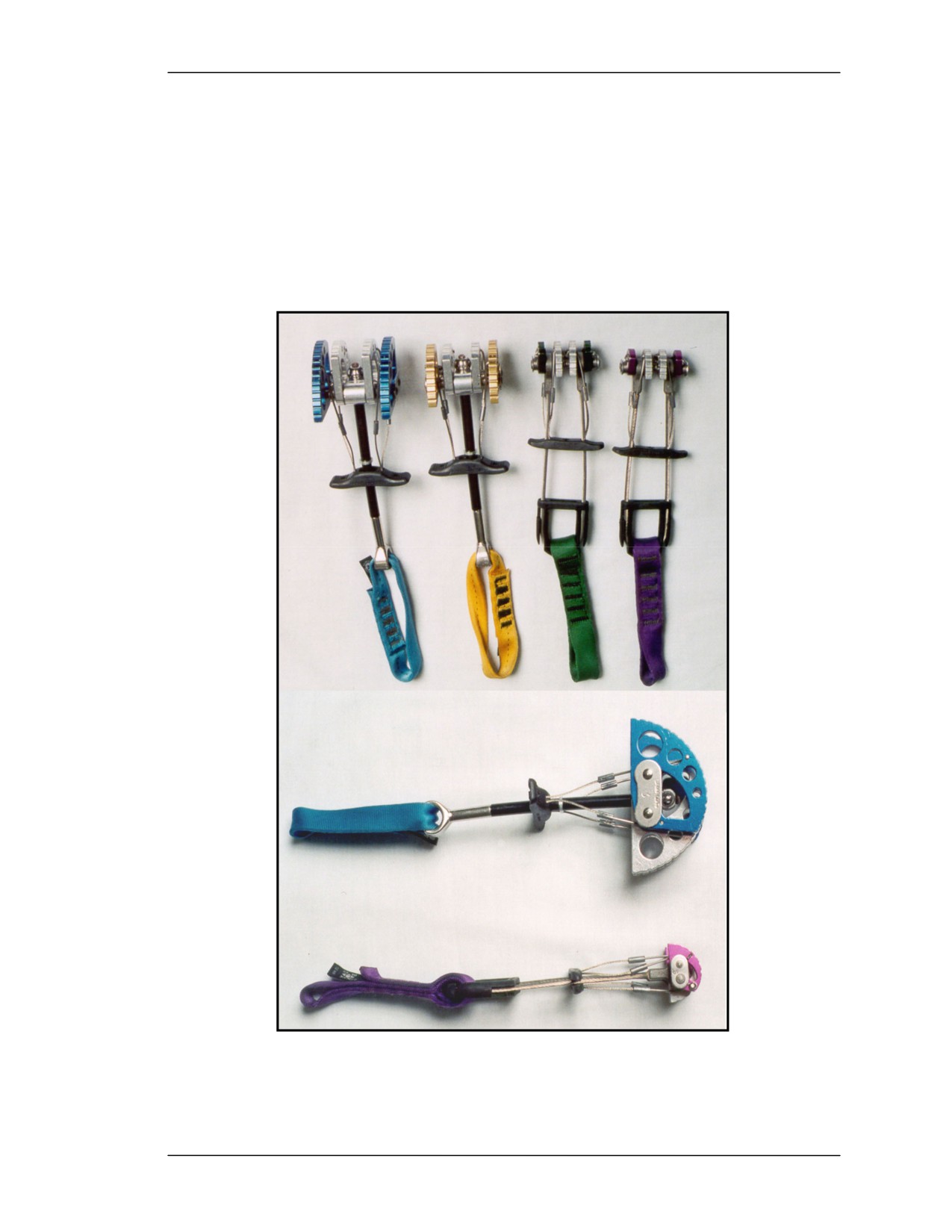
f. Spring-Loaded Camming Devices. Spring-loaded camming devices (SLCDs)
(Figure 3-17) provide convenient, reliable placement in cracks where standard chocks are
not practical (parallel or flaring cracks or cracks under roofs). SLCDs have three or four
cams rotating around a single or double axis with a rigid or semi-rigid point of attachment.
These are placed quickly and easily, saving time and effort. SLCDs are available in many
sizes to accommodate different size cracks. Each fits a wide range of crack widths due to the
rotating cam heads. The shafts may be rigid metal or semi-rigid cable loops. The flexible
cable reduces the risk of stem breakage over an edge in horizontal placements.
Figure 3-17. Spring-loaded camming devices.
3-17
FM 3-97.61
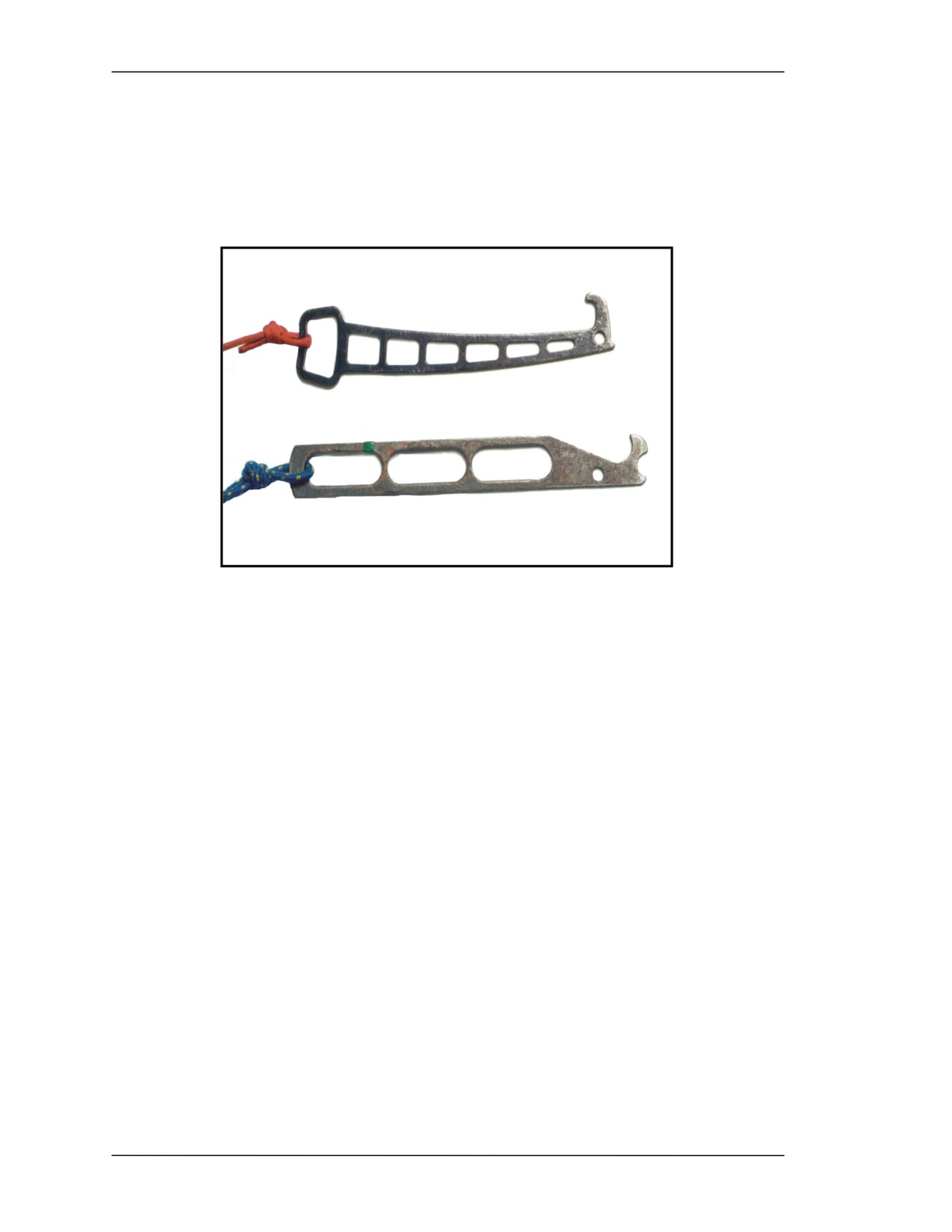
g. Chock Picks. Chock picks are primarily used to extract chocks from rock when
the they become severely wedged (Figure 3-18). They are also handy to clean cracks
with. Made from thin metal, they can be purchased or homemade. When using a chock
pick to extract a chock be sure no force is applied directly to the cable juncture. One end
of the chock pick should have a hook to use on jammed SLCDs.
Figure18. Chock picks.
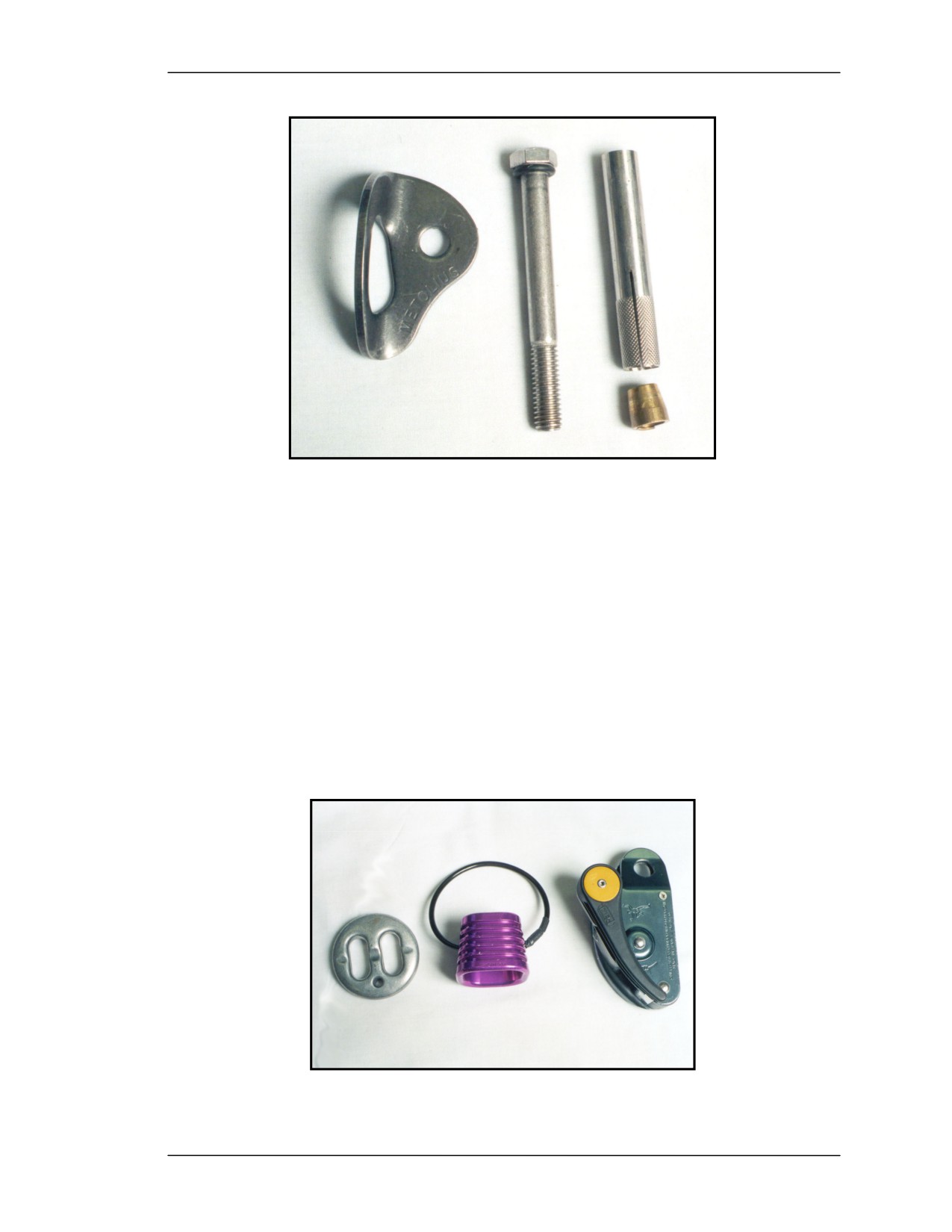
h. Bolts. Bolts are screw-like shafts made from metal that are drilled into rock to
provide protection (Figure 3-19). The two types are contraction bolts and expansion bolts.
Contraction bolts are squeezed together when driven into a rock. Expansion bolts press
around a surrounding sleeve to form a snug fit into a rock. Bolts require drilling a hole
into a rock, which is time-consuming, exhausting, and extremely noisy. Once emplaced,
bolts are the most secure protection for a multidirectional pull. Bolts should be used only
when chocks and pitons cannot be emplaced. A bolt is hammered only when it is the nail
or self-driving type.
(1) A hanger (for carabiner attachment) and nut are placed on the bolt. The bolt is
then inserted and driven into the hole. Because of this requirement, a hand drill must be
carried in addition to a piton hammer. Hand drills (also called star drills) are available in
different sizes, brands, and weights. A hand drill should have a lanyard to prevent loss.
(2) Self-driving bolts are quicker and easier to emplace. These require a hammer, bolt
driver, and drilling anchor, which is driven into the rock. A bolt and carrier are then
secured to the emplaced drilling anchor. All metal surfaces should be smooth and free of
rust, corrosion, dirt, and moisture. Burrs, chips, and rough spots should be filed smooth
and wire-brushed or rubbed clean with steel wool. Items that are cracked or warped
indicate excessive wear and should be discarded.
3-18
FM 3-97.61
Figure 3-19. Bolts and hangers.
i.
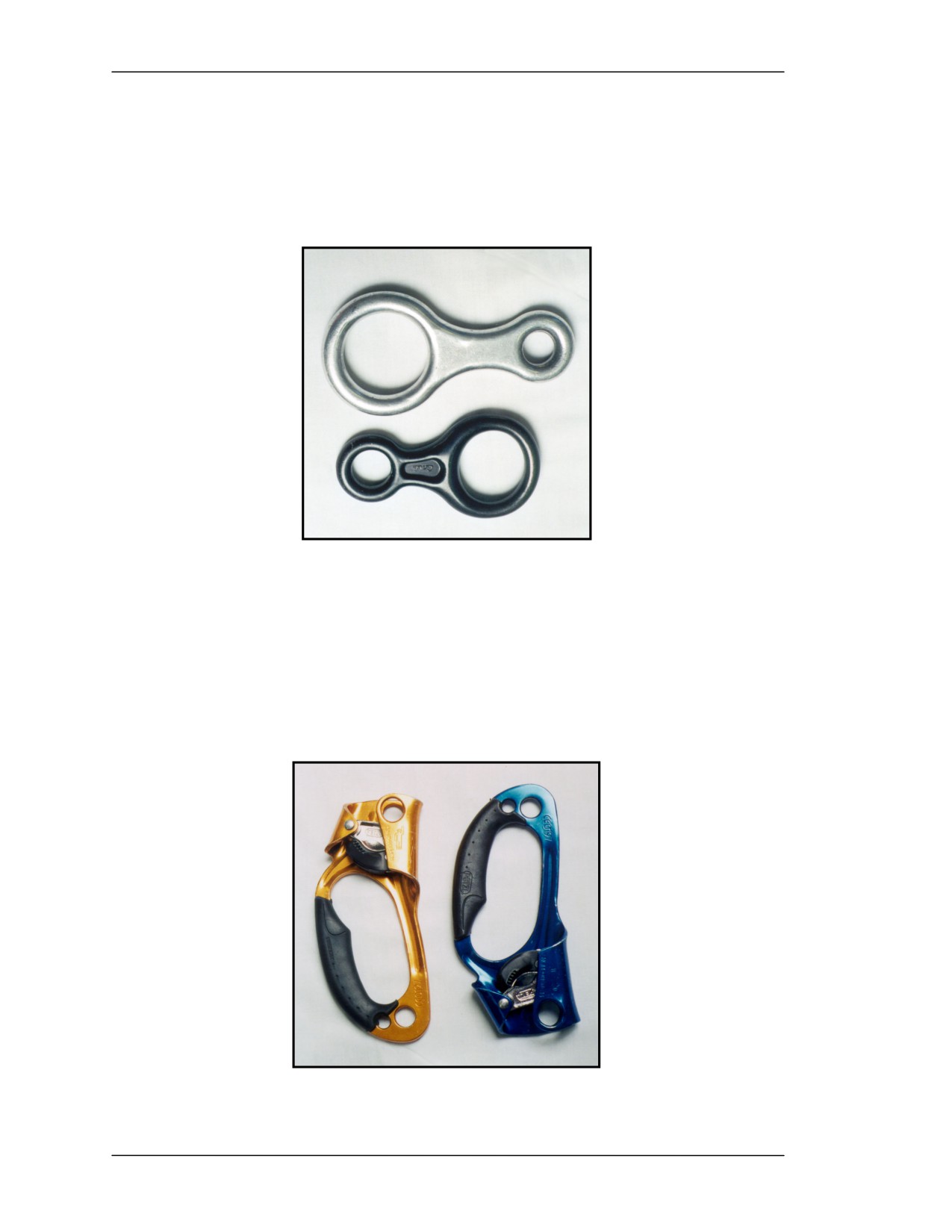
Belay Devices. Belay devices range from the least equipment intensive (the body
belay) to high-tech metal alloy pieces of equipment. Regardless of the belay device
choosen, the basic principal remains the same―friction around or through the belay
device controls the ropes’ movement. Belay devices are divided into three categories: the
slot, the tuber, and the mechanical camming device (Figure 3-20).
(1) The slot is a piece of equipment that attaches to a locking carabiner in the harness;
a bight of rope slides through the slot and into the carabiner for the belay. The most
common slot type belay device is the Sticht plate.
(2) The tuber is used exactly like the slot but its shape is more like a cone or tube.
(3) The mechanical camming device is a manufactured piece of equipment that
attaches to the harness with a locking carabiner. The rope is routed through this device so
that when force is applied the rope is cammed into a highly frictioned position.
Figure 3-20. Slot, tuber, mechanical camming device.
3-19
FM 3-97.61
j.
Descenders. One piece of equipment used for generations as a descender is the
carabiner. A figure-eight is another useful piece of equipment and can be used in
conjunction with the carabiner for descending (Figure 3-21).
Note: All belay devices can also be used as descending devices.
Figure 3-21. Figure-eights.
k. Ascenders. Ascenders may be used in other applications such as a personal safety
or hauling line cam. All modern ascenders work on the principle of using a cam-like
device to allow movement in one direction. Ascenders are primarily made of metal alloys
and come in a variety of sizes (Figure 3-22). For difficult vertical terrain, two ascenders
work best. For lower angle movement, one ascender is sufficient. Most manufacturers
make ascenders as a right and left-handed pair.
Figure 3-22. Ascenders.
3-20
FM 3-97.61
l.
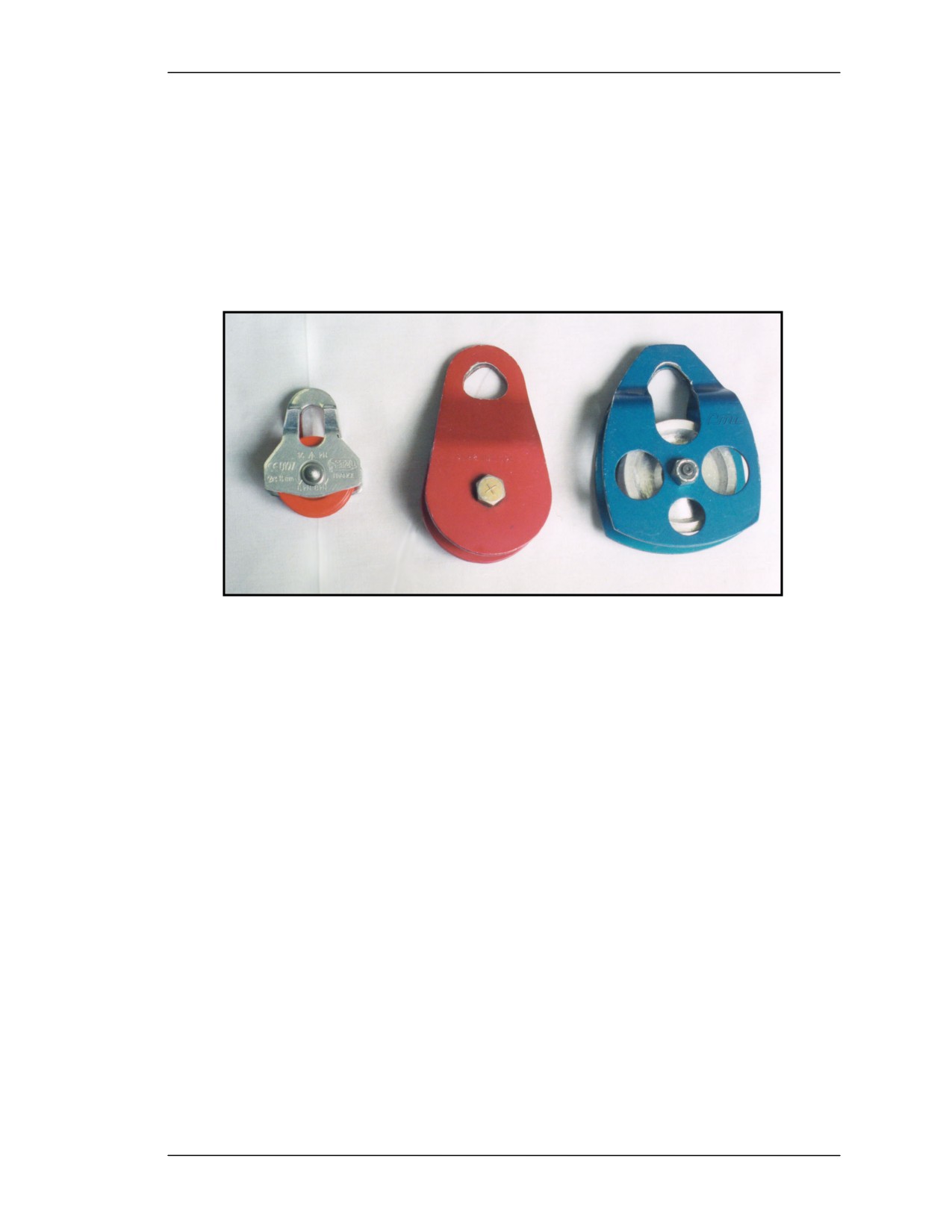
Pulleys. Pulleys are used to change direction in rope systems and to create
mechanical advantage in hauling systems. A pulley should be small, lightweight, and
strong. They should accommodate the largest diameter of rope being used. Pulleys are
made with several bearings, different-sized sheaves (wheel), and metal alloy sideplates
(Figure 3-23). Plastic pulleys should always be avoided. The sideplate should rotate on
the pulley axle to allow the pulley to be attached at any point along the rope. For best
results, the sheave diameter must be at least four times larger than the rope’s diameter to
maintain high rope strength.
Figure 3-23. Pulley.
3-5.
SNOW AND ICE CLIMBING HARDWARE
Snow and ice climbing hardware is the equipment that is particular to operations in some
mountainous terrain. Specific training on this type of equipment is essential for safe use.
Terrain that would otherwise be inaccessible—snowfields, glaciers, frozen waterfalls—
can now be considered avenues of approach using the snow and ice climbing gear listed
in this paragraph.
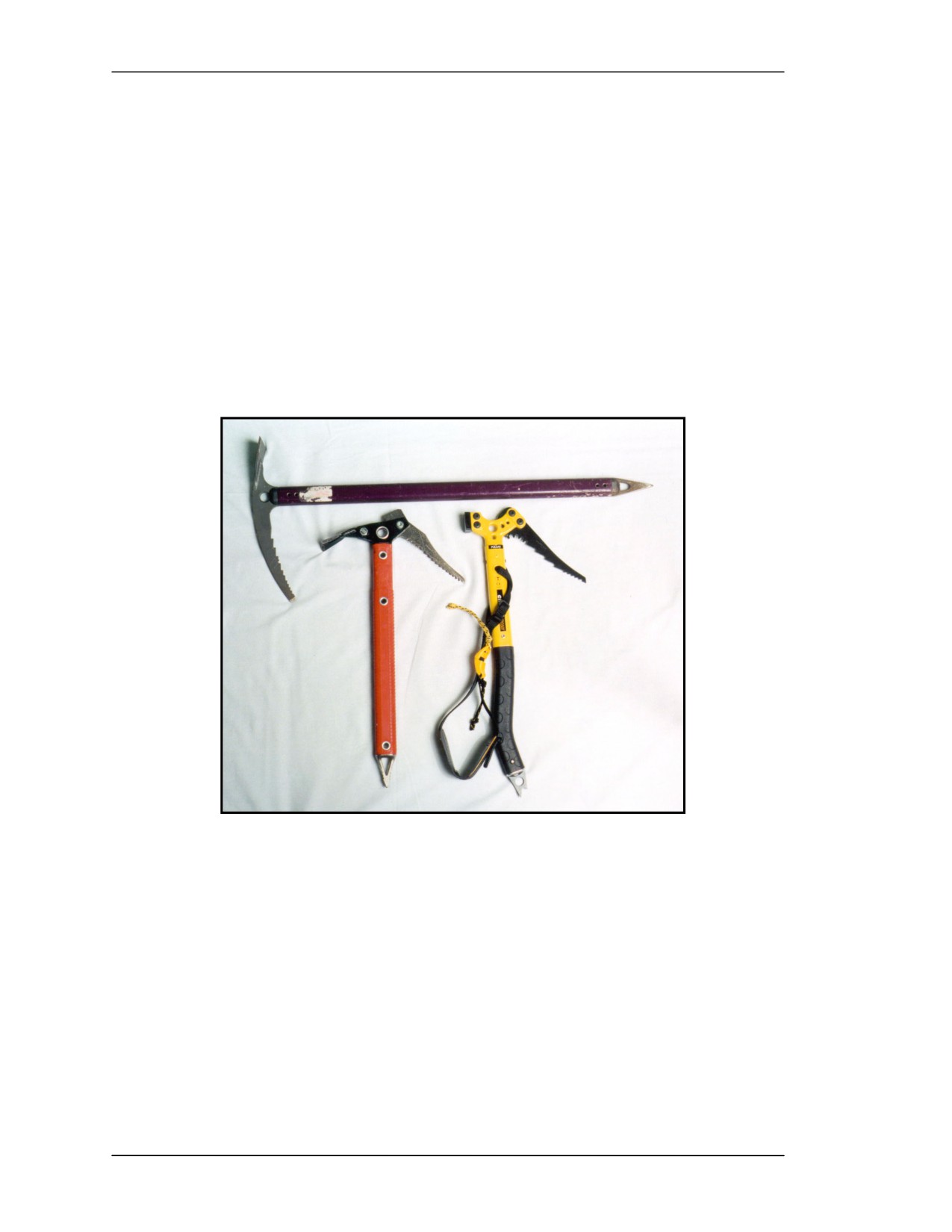
a. Ice Ax. The ice ax is one of the most important tools for the mountaineer
operating on snow or ice. The climber must become proficient in its use and handling.
The versatility of the ax lends itself to balance, step cutting, probing, self-arrest, belays,
anchors, direct-aid climbing, and ascending and descending snow and ice covered routes.
(1) Several specific parts comprise an ice ax: the shaft, head (pick and adze), and
spike (Figure 3-24, page 3-22).
(a) The shaft (handle) of the ax comes in varying lengths (the primary length of the
standard mountaineering ax is 70 centimeters). It can be made of fiberglass, hollow
aluminum, or wood; the first two are stronger, therefore safer for mountaineering.
(b) The head of the ax, which combines the pick and the adze, can have different
configurations. The pick should be curved slightly and have teeth at least one-fourth of its
length. The adze, used for chopping, is perpendicular to the shaft. It can be flat or curved
along its length and straight or rounded from side to side. The head can be of one-piece
3-21
FM 3-97.61
construction or have replaceable picks and adzes. The head should have a hole directly
above the shaft to allow for a leash to be attached.
(c) The spike at the bottom of the ax is made of the same material as the head and
comes in a variety of shapes.
(2) As climbing becomes more technical, a shorter ax is much more appropriate, and
adding a second tool is a must when the terrain becomes vertical. The shorter ax has all
the attributes of the longer ax, but it is anywhere from 40 to 55 centimeters long and can
have a straight or bent shaft depending on the preference of the user.
b. Ice Hammer. The ice hammer is as short or shorter than the technical ax (Figure
3-24). It is used for pounding protection into the ice or pitons into the rock. The only
difference between the ice ax and the ice hammer is the ice hammer has a hammerhead
instead of an adze. Most of the shorter ice tools have a hole in the shaft to which a leash
is secured, which provides a more secure purchase in the ice.
Figure 3-24. Ice ax and ice hammers.
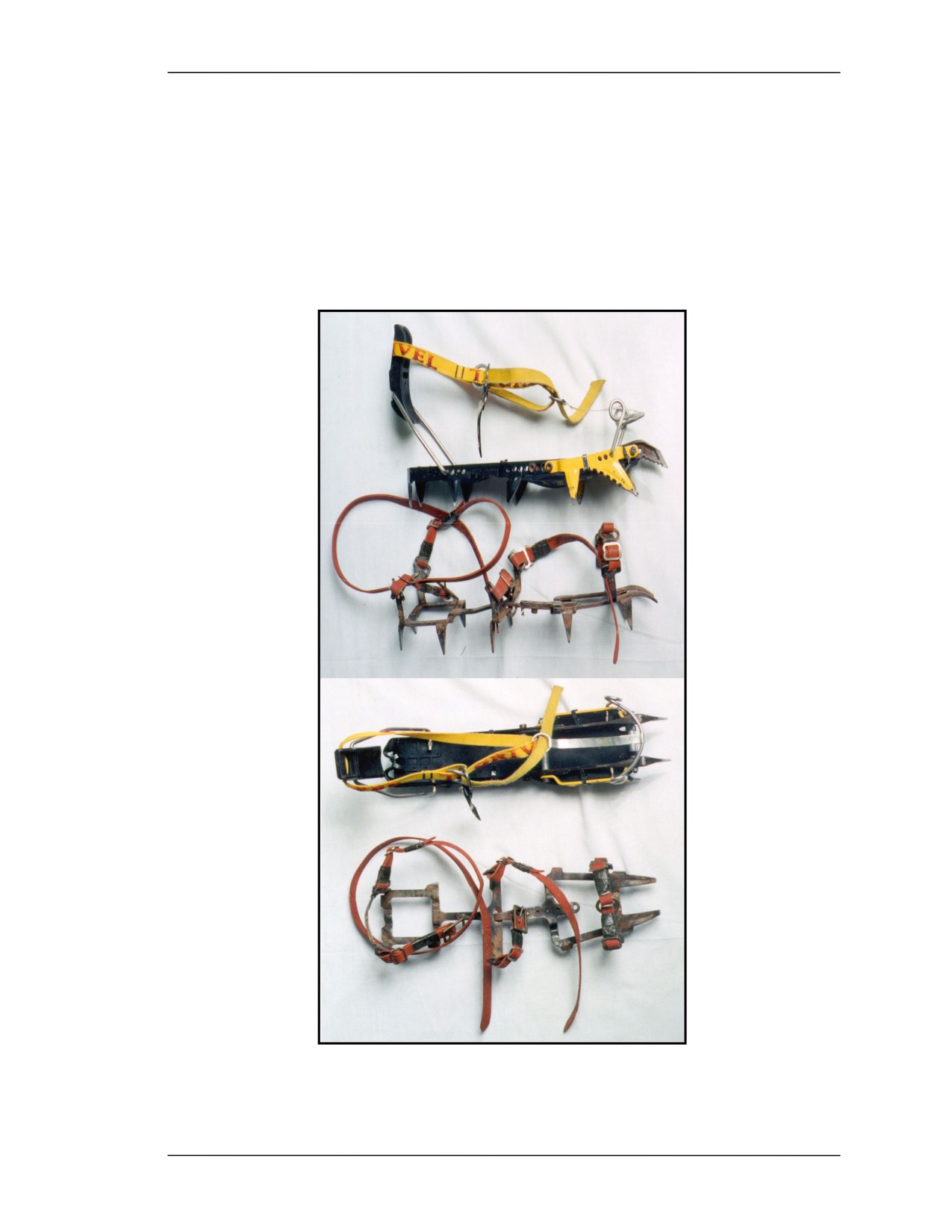
c. Crampons. Crampons are used when the footing becomes treacherous. They have
multiple spikes on the bottom and spikes protruding from the front (Figure 3-25). Two
types of crampons are available: flexible and rigid. Regardless of the type of crampon
chosen, fit is the most important factor associated with crampon wear. The crampon
should fit snugly on the boot with a minimum of 1 inch of front point protruding. Straps
should fit snugly around the foot and any long, loose ends should be trimmed. Both
flexible and rigid crampons come in pairs, and any tools needed for adjustment will be
provided by the manufacturer.
(1) The hinged or flexible crampon is best used when no technical ice climbing will
be done. It is designed to be used with soft, flexible boots, but can be attached to plastic
3-22
FM 3-97.61
mountaineering boots. The flexible crampon gets its name from the flexible hinge on the
crampon itself. All flexible crampons are adjustable for length while some allow for
width adjustment. Most flexible crampons will attach to the boot by means of a strap
system. The flexible crampon can be worn with a variety of boot types.
(2) The rigid crampon, as its name implies, is rigid and does not flex. This type of
crampon is designed for technical ice climbing, but can be used on less vertical terrain.
The rigid crampon can only be worn with plastic mountaineering boots. Rigid crampons
will have a toe and heel bail attachment with a strap that wraps around the ankle.
Figure 3-25. Crampons.
3-23
FM 3-97.61
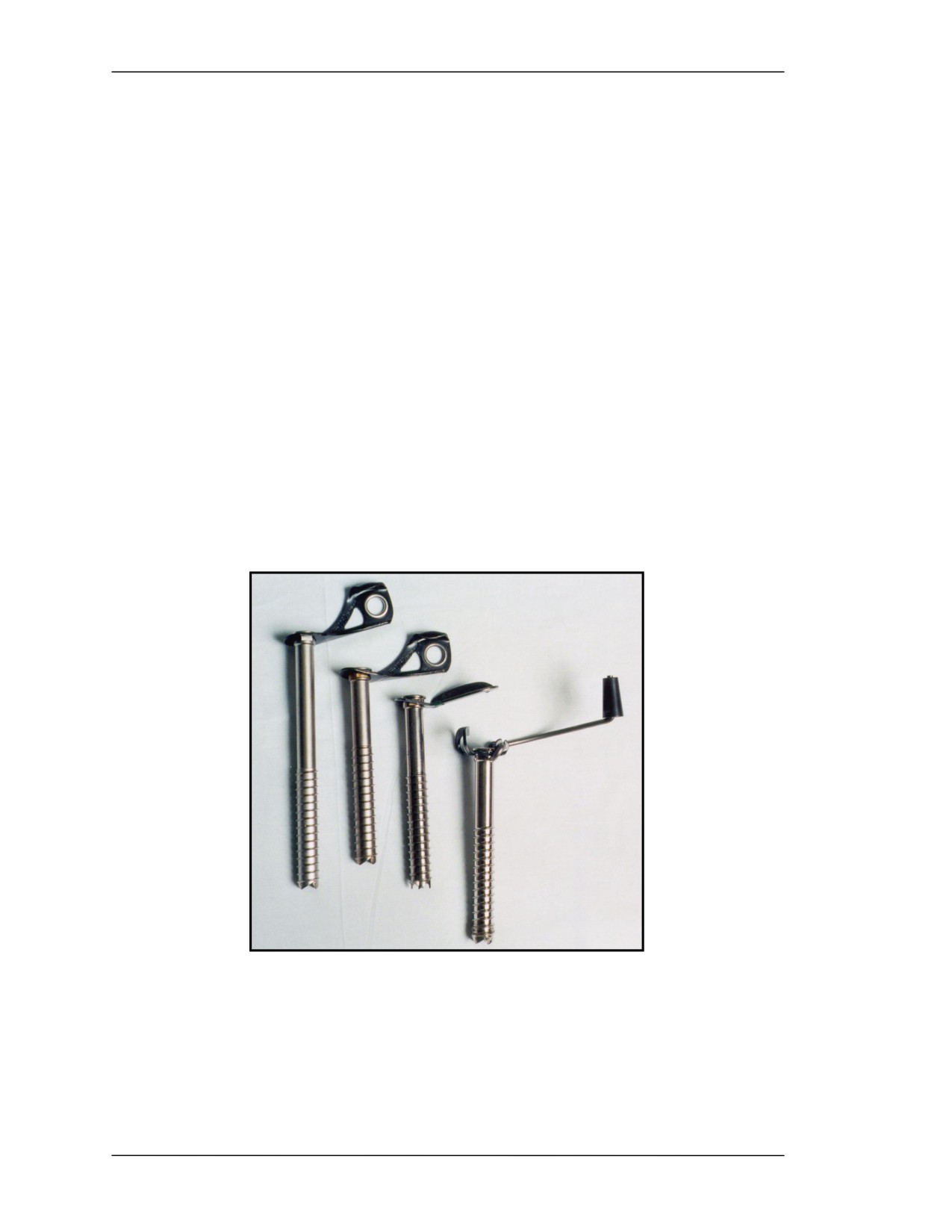
d. Ice Screws. Ice screws provide artificial protection for climbers and equipment for
operations in icy terrain. They are screwed into ice formations. Ice screws are made of
chrome-molybdenum steel and vary in lengths from 11 centimeters to 40 centimeters
(Figure 3-26). The eye is permanently affixed to the top of the ice screw. The tip consists of
milled or hand-ground teeth, which create sharp points to grab the ice when being emplaced.
The ice screw has right-hand threads to penetrate the ice when turned clockwise.
(1) When selecting ice screws, choose a screw with a large thread count and large
hollow opening. The close threads will allow for ease in turning and better strength. The
large hollow opening will allow snow and ice to slide through when turning.
• Type I is 17 centimeters in length with a hollow inner tube.
• Type II is 22 centimeters in length with a hollow inner tube.
• Other variations are hollow alloy screws that have a tapered shank with external
threads, which are driven into ice and removed by rotation.
(2) Ice screws should be inspected for cracks, bends, and other deformities that may
impair strength or function. If any cracks or bends are noticed, the screw should be turned
in. A file may be used to sharpen the ice screw points. Steel wool should be rubbed on
rusted surfaces and a thin coat of oil applied when storing steel ice screws.
Note: Ice screws should always be kept clean and dry. The threads and teeth should be
protected and kept sharp for ease of application.
Figure 3-26. Ice screws.
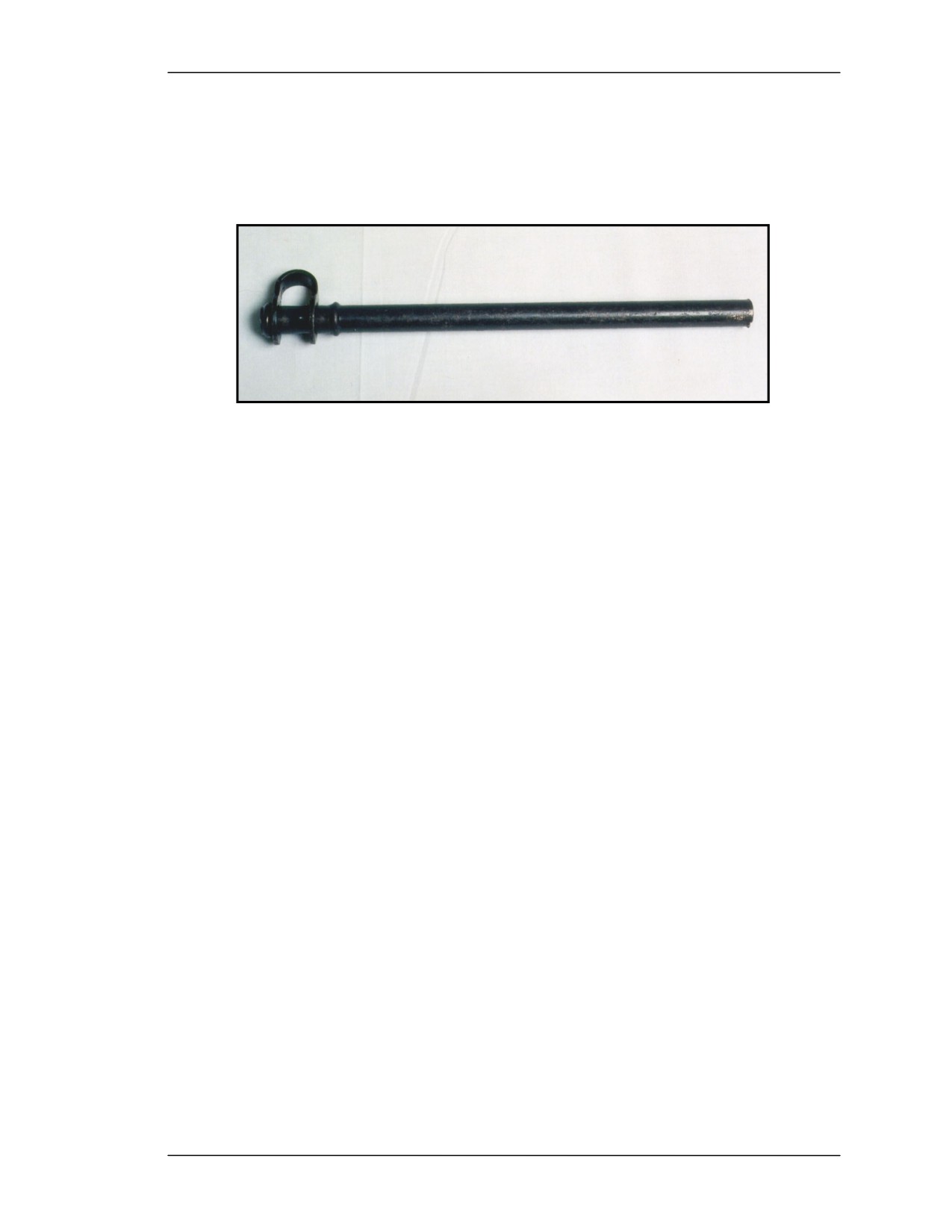
e. Ice Pitons. Ice pitons are used to establish anchor points for climbers and equipment
when conducting operations on ice. They are made of steel or steel alloys (chrome-
molybdenum), and are available in various lengths and diameters (Figure 3-27). They are
tubular with a hollow core and are hammered into ice with an ice hammer. The eye is
3-24
FM 3-97.61
permanently fixed to the top of the ice piton. The tip may be beveled to help grab the ice to
facilitate insertion. Ice pitons are extremely strong when placed properly in hard ice. They
can, however, pull out easily on warm days and require a considerable amount of effort to
extract in cold temperatures.
Figure 3-27. Ice piton.
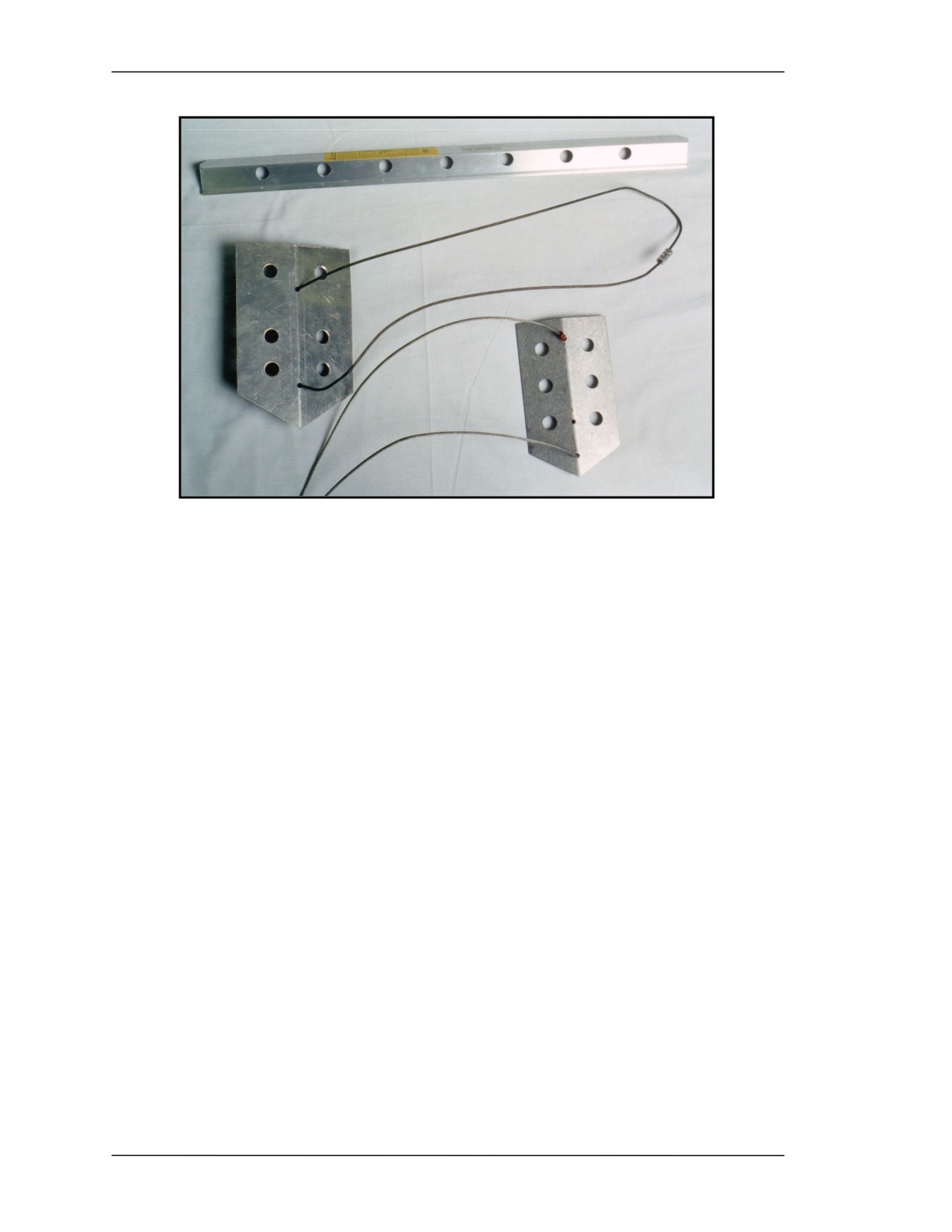
f. Wired Snow Anchors. The wired snow anchor (or fluke) provides security for
climbers and equipment in operations involving steep ascents by burying the snow anchor
into deep snow (Figure 3-28, page 3-26). The fluted anchor portion of the snow anchor is
made of aluminum. The wired portion is made of either galvanized steel or stainless steel.
Fluke anchors are available in various sizes―their holding ability generally increases with
size. They are available with bent faces, flanged sides, and fixed cables. Common types are:
• Type I is 22 by 14 centimeters. Minimum breaking strength of the swaged wire
loop is 600 kilograms.
• Type II is 25 by 20 centimeters. Minimum breaking strength of the swaged wire
loop is 1,000 kilograms.
The wired snow anchor should be inspected for cracks, broken wire strands, and slippage of
the wire through the swage. If any cracks, broken wire strands, or slippage is noticed, the
snow anchor should be turned in.
g. Snow Picket. The snow picket is used in constructing anchors in snow and ice
(Figure 3-28, page 3-26). The snow picket is made of a strong aluminum alloy 3 millimeters
thick by 4 centimeters wide, and 45 to 90 centimeters long. They can be angled or T-section
stakes. The picket should be inspected for bends, chips, cracks, mushrooming ends, and
other deformities. The ends should be filed smooth. If bent or cracked, the picket should be
turned in for replacement.
3-25
FM 3-97.61
Figure 3-28. Snow anchors, flukes, and pickets.
3-6.
SUSTAINABILITY EQUIPMENT
This paragraph describes all additional equipment not directly involved with climbing. This
equipment is used for safety (avalanche equipment, wands), bivouacs, movement, and
carrying gear. While not all of it will need to be carried on all missions, having the
equipment available and knowing how to use it correctly will enhance the unit’s capability
in mountainous terrain.
a. Snow Saw. The snow saw is used to cut into ice and snow. It can be used in step
cutting, in shelter construction, for removing frozen obstacles, and for cutting snow stability
test pits. The special tooth design of the snow saw easily cuts into frozen snow and ice. The
blade is a rigid aluminum alloy of high strength about 3 millimeters thick and 38 centimeters
long with a pointed end to facilitate entry on the forward stroke. The handle is either
wooden or plastic and is riveted to the blade for a length of about 50 centimeters. The blade
should be inspected for rust, cracks, warping, burrs, and missing or dull teeth. A file can
repair most defects, and steel wool can be rubbed on rusted areas. The handle should be
inspected for cracks, bends, and stability. On folding models, the hinge and nuts should be
secure. If the saw is beyond repair, it should not be used.
b. Snow Shovel. The snow shovel is used to cut and remove ice and snow. It can be
used for avalanche rescue, shelter construction, step cutting, and removing obstacles. The
snow shovel is made of a special, lightweight aluminum alloy. The handle should be
telescopic, folding, or removable to be compact when not in use. The shovel should have a
flat or rounded bottom and be of strong construction. The shovel should be inspected for
cracks, bends, rust, and burrs. A file and steel wool can remove rust and put an edge on the
blade of the shovel. The handle should be inspected for cracks, bends, and stability. If the
shovel is beyond repair, it should be turned in.
3-26
FM 3-97.61
c. Wands. Wands are used to identify routes, crevasses, snow-bridges, caches, and
turns on snow and glaciers. Spacing of wands depends on the number of turns, number of
hazards identified, weather conditions (and visibility), and number of teams in the climbing
party. Carry too many wands is better than not having enough if they become lost. Wands
are 1 to 1.25 meters long and made of lightweight bamboo or plastic shafts pointed on one
end with a plastic or nylon flag (bright enough in color to see at a distance) attached to the
other end. The shafts should be inspected for cracks, bends, and deformities. The flag should
be inspected for tears, frays, security to the shaft, fading, and discoloration. If any defects
are discovered, the wands should be replaced.
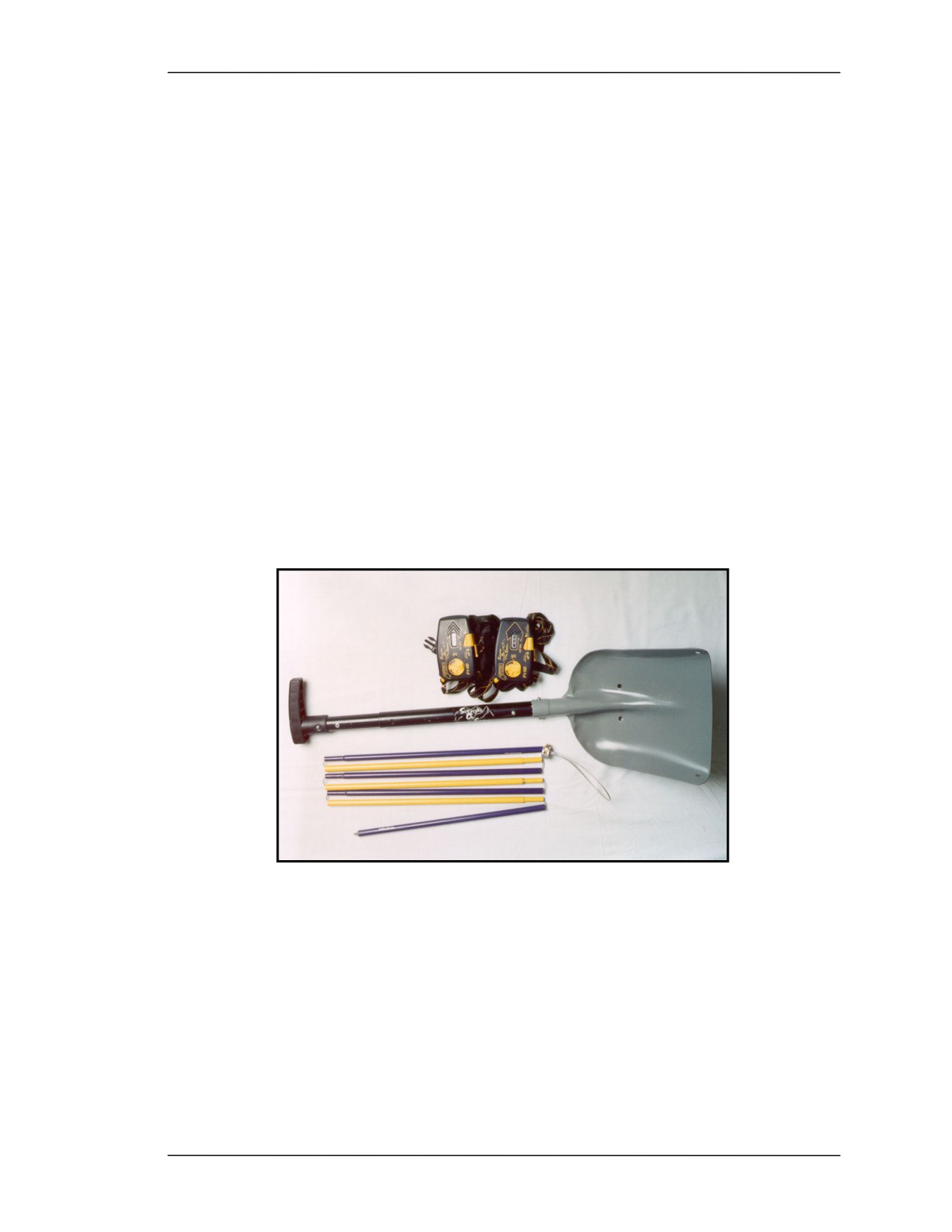
d. Avalanche rescue equipment. Avalanche rescue equipment (Figure 3-29) includes
the following:
(1) Avalanche Probe. Although ski poles may be used as an emergency probe when
searching for a victim in an avalanche, commercially manufactured probes are better for a
thorough search. They are 9-millimeter thick shafts made of an aluminum alloy, which can
be joined to probe up to 360 centimeters. The shafts must be strong enough to probe through
avalanche debris. Some manufacturers of ski poles design poles that are telescopic and mate
with other poles to create an avalanche probe.
(2) Avalanche Transceivers. These are small, compact radios used to identify avalanche
burial sites. They transmit electromagnetic signals that are picked up by another transceiver
on the receive mode.
Figure 3-29. Avalanche rescue equipment.
e. Packs. Many types and brands of packs are used for mountaineering. The two
most common types are internal and external framed packs.
(1) Internal framed packs have a rigid frame within the pack that help it maintain its
shape and hug the back. This assists the climber in keeping their balance as they climb or
ski. The weight in an internal framed pack is carried low on the body assisting with
balance. The body-hugging nature of this type pack also makes it uncomfortable in warm
weather.
3-27
FM 3-97.61
(2) External framed packs suspend the load away from the back with a ladder-like
frame. The frame helps transfer the weight to the hips and shoulders easier, but can be
cumbersome when balance is needed for climbing and skiing.
(3) Packs come in many sizes and should be sized appropriately for the individual
according to manufacturer’s specifications. Packs often come with many unneeded
features. A good rule of thumb is: The simpler the pack, the better it will be.
f. Stoves. When selecting a stove one must define its purpose―will the stove be
used for heating, cooking or both? Stoves or heaters for large elements can be large and
cumbersome. Stoves for smaller elements might just be used for cooking and making
water, and are simple and lightweight. Stoves are a necessity in mountaineering for
cooking and making water from snow and ice. When choosing a stove, factors that should
be considered are weight, altitude and temperature where it will be used, fuel availability,
and its reliability.
(1) There are many choices in stove design and in fuel types. White gas, kerosene,
and butane are the common fuels used. All stoves require a means of pressurization to
force the fuel to the burner. Stoves that burn white gas or kerosene have a hand pump to
generate the pressurization and butane stoves have pressurized cartridges. All stoves need
to vaporize the liquid fuel before it is burned. This can be accomplished by burning a
small amount of fuel in the burner cup assembly, which will vaporize the fuel in the fuel
line.
(2) Stoves should be tested and maintained prior to a mountaineering mission. They
should be easy to clean and repair during an operation. The reliability of the stove has a
huge impact on the success of the mission and the morale of personnel.
g. Tents. When selecting a tent, the mission must be defined to determine the
number of people the tent will accommodate. The climate the tents will be used in is also
of concern. A tent used for warmer temperatures will greatly differ from tents used in a
colder, more harsh environment. Manufacturers of tents offer many designs of different
sizes, weights, and materials.
(1) Mountaineering tents are made out of a breathable or weatherproof material. A
single-wall tent allows for moisture inside the tent to escape through the tent’s material.
A double-wall tent has a second layer of material (referred to as a fly) that covers the tent.
The fly protects against rain and snow and the space between the fly and tent helps
moisture to escape from inside. Before using a new tent, the seams should be treated with
seam sealer to prevent moisture from entering through the stitching.
(2) The frame of a tent is usually made of an aluminum or carbon fiber pole. The
poles are connected with an elastic cord that allows them to extend, connect, and become
long and rigid. When the tent poles are secured into the tent body, they create the shape
of the tent.
(3) Tents are rated by a “relative strength factor,” the speed of wind a tent can
withstand before the frame deforms. Temperature and expected weather for the mission
should be determined before choosing the tent.
h. Skis. Mountaineering skis are wide and short. They have a binding that pivots at
the toe and allows for the heel to be free for uphill travel or locked for downhill.
Synthetic skins with fibers on the bottom can be attached to the bottom of the ski and
allow the ski to travel forward and prevent slipping backward. The skins aid in traveling
uphill and slow down the rate of descents. Wax can be applied to the ski to aid in ascents
3-28
FM 3-97.61
instead of skins. Skis can decrease the time needed to reach an objective depending on
the ability of the user. Skis can make crossing crevasses easier because of the load
distribution, and they can become a makeshift stretcher for casualties. Ski techniques can
be complicated and require thorough training for adequate proficiency.
i.
Snowshoes. Snowshoes are the traditional aid to snow travel that attach to most
footwear and have been updated into small, lightweight designs that are more efficient
than older models. Snowshoes offer a large displacement area on top of soft snow
preventing tiresome post-holing. Some snowshoes come equipped with a crampon like
binding that helps in ascending steep snow and ice. Snowshoes are slower than skis, but
are better suited for mixed terrain, especially if personnel are not experienced with the art
of skiing. When carrying heavy packs, snowshoes can be easier to use than skis.
j.
Ski poles. Ski poles were traditionally designed to assist in balance during skiing.
They have become an important tool in mountaineering for aid in balance while hiking,
snowshoeing, and carrying heavy packs. They can take some of the weight off of the
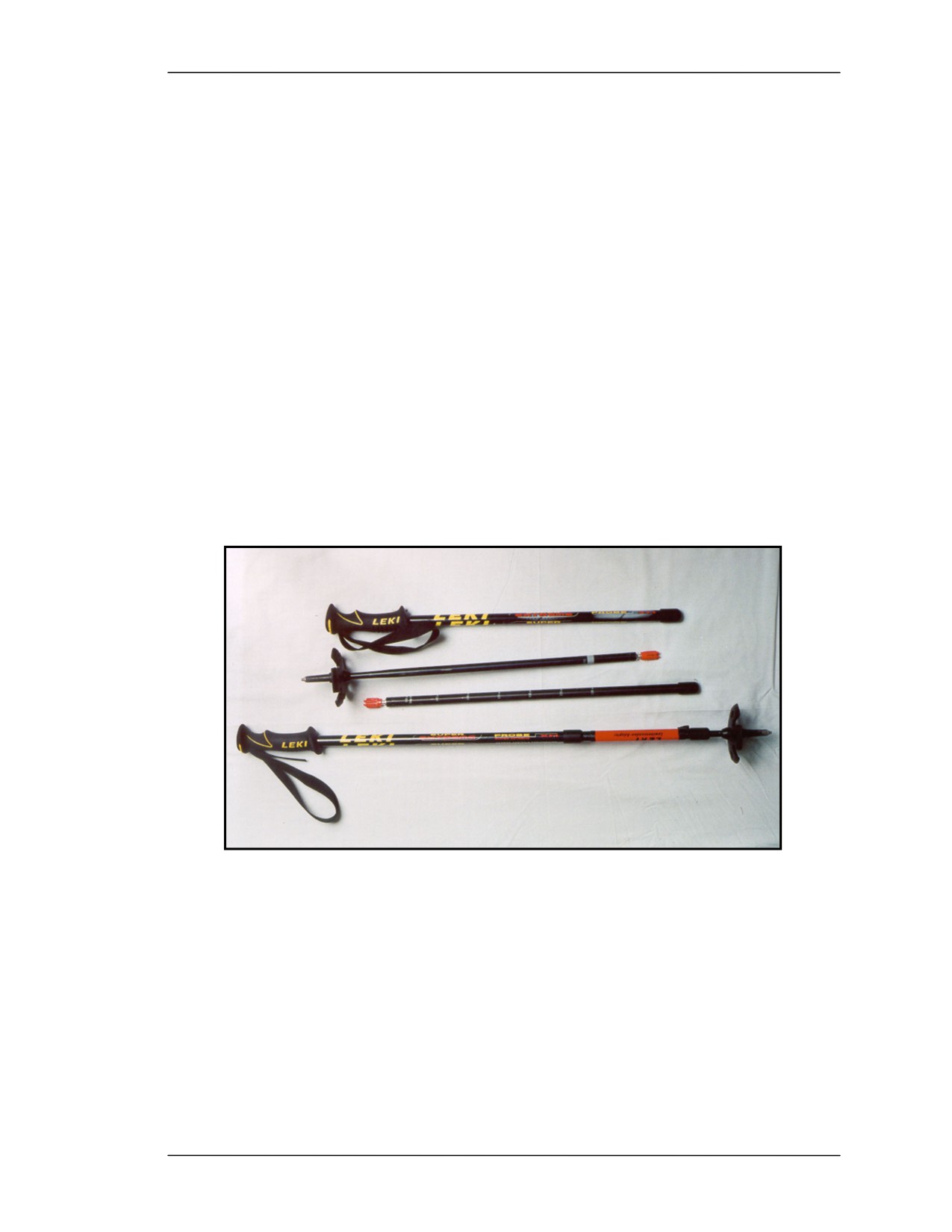
lower body when carrying a heavy pack. Some ski poles are collapsible for ease of
packing when not needed (Figure 3-30). The basket at the bottom prevents the pole from
plunging deep into the snow and, on some models, can be detached so the pole becomes
an avalanche or crevasse probe. Some ski poles come with a self-arrest grip, but should
not be the only means of protection on technical terrain.
Figure 3-30. Collapsible ski poles.
k. Sleds. Sleds vary greatly in size, from the squad-size Ahkio, a component of the
10-man arctic tent system, to the one-person skow. Regardless of the size, sleds are an
invaluable asset during mountainous operations when snow and ice is the primary surface
on which to travel. Whichever sled is chosen, it must be attachable to the person or
people that will be pulling it. Most sleds are constructed using fiberglass bottoms with or
without exterior runners. Runners will aid the sleds ability to maintain a true track in the
snow. The sled should also come with a cover of some sort―whether nylon or canvas, a
cover is essential for keeping the components in the sled dry. Great care should be taken
3-29
FM 3-97.61
when packing the sled, especially when hauling fuel. Heavier items should be carried
towards the rear of the sled and lighter items towards the front.
l.
Headlamps. A headlamp is a small item that is not appreciated until it is needed.
It is common to need a light source and the use of both hands during limited light
conditions in mountaineering operations. A flashlight can provide light, but can be
cumbersome when both hands are needed. Most headlamps attach to helmets by means of
elastic bands.
(1) When choosing a headlamp, ensure it is waterproof and the battery apparatus is
small. All components should be reliable in extreme weather conditions. When the light
is being packed, care should be taken that the switch doesn’t accidentally activate and use
precious battery life.
(2) The battery source should compliment the resupply available. Most lights will
accept alkaline, nickel-cadmium, or lithium batteries. Alkaline battery life diminishes
quickly in cold temperatures, nickel-cadmium batteries last longer in cold but require a
recharging unit, and lithium batteries have twice the voltage so modifications are
required.
Section II. EQUIPMENT PACKING
Equipment brought on a mission is carried in the pack, worn on the body, or hauled in a
sled (in winter). Obviously, the rucksack and sled (or Ahkio) can hold much more than a
climber can carry. They would be used for major bivouac gear, food, water, first aid kits,
climbing equipment, foul weather shells, stoves, fuel, ropes, and extra ammunition and
demolition materials, if needed.
3-7.
CHOICE OF EQUIPMENT
Mission requirements and unit SOP will influence the choice of gear carried but the
following lists provide a sample of what should be considered during mission planning.
a. Personal Gear. Personal gear includes emergency survival kit containing
signaling material, fire starting material, food procurement material, and water
procurement material. Pocket items should include a knife, whistle, pressure bandage,
notebook with pen or pencil, sunglasses, sunblock and lip protection, map, compass and
or altimeter.
b. Standard Gear. Standard gear that can be individually worn or carried includes
cushion sole socks; combat boots or mountain boots, if available; BDU and cap; LCE
with canteens, magazine pouches, and first aid kit; individual weapon; a large rucksack
containing waterproof coat and trousers, polypropylene top, sweater, or fleece top;
helmet; poncho; and sleeping bag.
3-30
FM 3-97.61
CAUTION
Cotton clothing, due to its poor insulating and
moisture-wicking characteristics, is virtually useless in
most mountain climates, the exception being hot,
desert, or jungle mountain environments. Cotton
clothing should be replaced with synthetic fabric
clothing.
c. Mountaineering Equipment and Specialized Gear. This gear includes:
• Sling rope or climbing harness.
• Utility cord(s).
• Nonlocking carabiners.
• Locking carabiner(s).
• Rappelling gloves.
• Rappel/belay device.
• Ice ax.
• Crampons.
• Climbing rope, one per climbing team.
• Climbing rack, one per climbing team.
d. Day Pack. When the soldier plans to be away from the bivouac site for the day on
a patrol or mountaineering mission, he carries a light day pack. This pack should contain
the following items:
• Extra insulating layer: polypropylene, pile top, or sweater.
• Protective layer: waterproof jacket and pants, rain suit, or poncho.
• First aid kit.
• Flashlight or headlamp.
• Canteen.
• Cold weather hat or scarf.
• Rations for the time period away from the base camp.
• Survival kit.
• Sling rope or climbing harness.
• Carabiners.
• Gloves.
• Climbing rope, one per climbing team.
• Climbing rack, one per climbing team.
e. Squad or Team Safety Pack. When a squad-sized element leaves the bivouac
site, squad safety gear should be carried in addition to individual day packs. This can
either be loaded into one rucksack or cross-loaded among the squad members. In the
event of an injury, casualty evacuation, or unplanned bivouac, these items may make the
difference between success and failure of the mission.
• Sleeping bag.
• Sleeping mat.
3-31
FM 3-97.61
• Squad stove.
• Fuel bottle.
f. The Ten Essentials. Regardless of what equipment is carried, the individual
military mountaineer should always carry the “ten essentials” when moving through the
mountains.
(1) Map.
(2) Compass, Altimeter, and or GPS.
(3) Sunglasses and Sunscreen.
(a) In alpine or snow-covered sub-alpine terrain, sunglasses are a vital piece of
equipment for preventing snow blindness. They should filter 95 to 100 percent of
ultraviolet light. Side shields, which minimize the light entering from the side, should
permit ventilation to help prevent lens fogging. At least one extra pair of sunglasses
should be carried by each independent climbing team.
(b) Sunscreens should have an SPF factor of 15 or higher. For lip protection, a total
UV blocking lip balm that resists sweating, washing, and licking is best. This lip
protection should be carried in the chest pocket or around the neck to allow frequent
reapplication.
(4) Extra Food. One day’s worth extra of food should be carried in case of delay
caused by bad weather, injury, or navigational error.
(5) Extra Clothing. The clothing used during the active part of a climb, and
considered to be the basic climbing outfit, includes socks, boots, underwear, pants,
blouse, sweater or fleece jacket, hat, gloves or mittens, and foul weather gear
(waterproof, breathable outerwear or waterproof rain suit).
(a) Extra clothing includes additional layers needed to make it through the long,
inactive hours of an unplanned bivouac. Keep in mind the season when selecting
this gear.
• Extra underwear to switch out with sweat-soaked underwear.
• Extra hats or balaclavas.
• Extra pair of heavy socks.
• Extra pair of insulated mittens or gloves.
• In winter or severe mountain conditions, extra insulation for the upper body
and the legs.
(b) To back up foul weather gear, bring a poncho or extra-large plastic trash bag. A
reflective emergency space blanket can be used for hypothermia first aid and emergency
shelter. Insulated foam pads prevent heat loss while sitting or lying on snow. Finally, a
bivouac sack can help by protecting insulating layers from the weather, cutting the wind,
and trapping essential body heat inside the sack.
(6) Headlamp and or Flashlight. Headlamps provide the climber a hands-free
capability, which is important while climbing, working around the camp, and employing
weapons systems. Miniature flashlights can be used, but commercially available
headlamps are best. Red lens covers can be fabricated for tactical conditions. Spare
batteries and spare bulbs should also be carried.
(7) First-aid Kit. Decentralized operations, the mountain environment―steep, slick
terrain and loose rock combined with heavy packs, sharp tools, and fatigue―requires
each climber to carry his own first-aid kit. Common mountaineering injuries that can be
expected are punctures and abrasions with severe bleeding, a broken bone, serious sprain,
3-32
FM 3-97.61
and blisters. Therefore, the kit should contain at least enough material to stabilize these
conditions. Pressure dressings, gauze pads, elastic compression wrap, small adhesive
bandages, butterfly bandages, moleskin, adhesive tape, scissors, cleanser, latex gloves
and splint material (if above tree line) should all be part of the kit.
(8) Fire Starter. Fire starting material is key to igniting wet wood for emergency
campfires. Candles, heat tabs, and canned heat all work. These can also be used for quick
warming of water or soup in a canteen cup. In alpine zones above tree line with no
available firewood, a stove works as an emergency heat source.
(9) Matches and Lighter. Lighters are handy for starting fires, but they should be
backed up by matches stored in a waterproof container with a strip of sandpaper.
(10)
Knife. A multipurpose pocket tool should be secured with cord to the belt,
harness, or pack.
g. Other Essential Gear. Other essential gear may be carried depending on mission
and environmental considerations.
(1) Water and Water Containers. These include wide-mouth water bottles for water
collection; camel-back type water holders for hands-free hydration; and a small length of
plastic tubing for water procurement at snow-melt seeps and rainwater puddles on bare
rock.
(2) Ice Ax. The ice ax is essential for travel on snowfields and glaciers as well as
snow-covered terrain in spring and early summer. It helps for movement on steep scree
and on brush and heather covered slopes, as well as for stream crossings.
(3) Repair Kit. A repair kit should include:
• Stove tools and spare parts.
• Duct tape.
• Patches.
• Safety pins.
• Heavy-duty thread.
• Awl and or needles.
• Cord and or wire.
• Small pliers (if not carrying a multipurpose tool).
• Other repair items as needed.
(4) Insect Repellent.
(5) Signaling Devices.
(6) Snow Shovel.
3-8.
TIPS ON PACKING
When loading the internal frame pack the following points should be considered.
a. In most cases, speed and endurance are enhanced if the load is carried more by the
hips (using the waist belt) and less by the shoulders and back. This is preferred for
movement over trails or less difficult terrain. By packing the lighter, more compressible
items (sleeping bag, clothing) in the bottom of the rucksack and the heavier gear (stove,
food, water, rope, climbing hardware, extra ammunition) on top, nearer the shoulder
blades, the load is held high and close to the back, thus placing the most weight on
the hips.
3-33
FM 3-97.61
b. In rougher terrain it pays to modify the pack plan. Heavy articles of gear are
placed lower in the pack and close to the back, placing more weight on the shoulders and
back. This lowers the climber’s center of gravity and helps him to better keep his balance.
c. Equipment that may be needed during movement should be arranged for quick
access using either external pockets or placing immediately underneath the top flap of the
pack. As much as possible, this placement should be standardized across the team so that
necessary items can be quickly reached without unnecessary unpacking of the pack in
emergencies.
d. The pack and its contents should be soundly waterproofed. Clothing and sleeping
bag are separately sealed and then placed in the larger wet weather bag that lines the
rucksack. Zip-lock plastic bags can be used for small items, which are then organized into
color-coded stuffsacks. A few extra-large plastic garbage bags should be carried for a
variety of uses―spare waterproofing, emergency bivouac shelter, and water
procurement, among others.
e. The ice ax, if not carried in hand, should be stowed on the outside of the pack
with the spike up and the adze facing forward or to the outside, and be securely fastened.
Mountaineering packs have ice ax loops and buckle fastening systems for this. If not, the
ice ax is placed behind one of the side pockets, as stated above, and then tied in place.
f. Crampons should be secured to the outside rear of the pack with the
points covered.
3-34
FM 3-97.61(TC 90-6-1)
CHAPTER 4
ROPE MANAGEMENT AND KNOTS
The rope is a vital piece of equipment to the mountaineer. When
climbing, rappelling, or building various installations, the mountaineer
must know how to properly utilize and maintain this piece of equipment. If
the rope is not managed or maintained properly, serious injury may occur.
This chapter discusses common rope terminology, management
techniques, care and maintenance procedures, and knots.
SECTION I. PREPARATION, CARE AND MAINTENANCE,
INSPECTION, TERMINOLOGY
The service life of a rope depends on the frequency of use, applications (rappelling,
climbing, rope installations), speed of descent, surface abrasion, terrain, climate, and
quality of maintenance. Any rope may fail under extreme conditions (shock load, sharp
edges, misuse).
4-1.
PREPARATION
The mountaineer must select the proper rope for the task to be accomplished according to
type, diameter, length, and tensile strength. It is important to prepare all ropes before
departing on a mission. Avoid rope preparation in the field.
a. Packaging. New rope comes from the manufacturer in different
configurations―boxed on a spool in various lengths, or coiled and bound in some
manner. Precut ropes are usually packaged in a protective cover such as plastic or burlap.
Do not remove the protective cover until the rope is ready for use.
b. Securing the Ends of the Rope: If still on a spool, the rope must be cut to the
desired length. All ropes will fray at the ends unless they are bound or seared. Both static
and dynamic rope ends are secured in the same manner. The ends must be heated to the
melting point so as to attach the inner core strands to the outer sheath. By fusing the two
together, the sheath cannot slide backward or forward. Ensure that this is only done to the
ends of the rope. If the rope is exposed to extreme temperatures, the sheath could be
weakened, along with the inner core, reducing overall tensile strength. The ends may also
be dipped in enamel or lacquer for further protection.
4-2.
CARE AND MAINTENANCE
The rope is a climber’s lifeline. It must be cared for and used properly. These general
guidelines should be used when handling ropes.
a. Do not step on or drag ropes on the ground unnecessarily. Small particles of dirt
will be ground between the inner strands and will slowly cut them.
b. While in use, do not allow the rope to come into contact with sharp edges. Nylon
rope is easily cut, particularly when under tension. If the rope must be used over a sharp
edge, pad the edge for protection.
c. Always keep the rope as dry as possible. Should the rope become wet, hang it in
large loops off the ground and allow it to dry. Never dry a rope with high heat or in direct
sunlight.
4-1
FM 3-97.61
d. Never leave a rope knotted or tightly stretched for longer than necessary. Over
time it will reduce the strength and life of the rope.
e. Never allow one rope to continuously rub over or against another. Allowing
rope-on-rope contact with nylon rope is extremely dangerous because the heat produced
by the friction will cause the nylon to melt.
f. Inspect the rope before each use for frayed or cut spots, mildew or rot, or defects
in construction (new rope).
g. The ends of the rope should be whipped or melted to prevent unraveling.
h. Do not splice ropes for use in mountaineering.
i.
Do not mark ropes with paints or allow them to come in contact with oils or
petroleum products. Some of these will weaken or deteriorate nylon.
j.
Never use a mountaineering rope for any purpose except mountaineering.
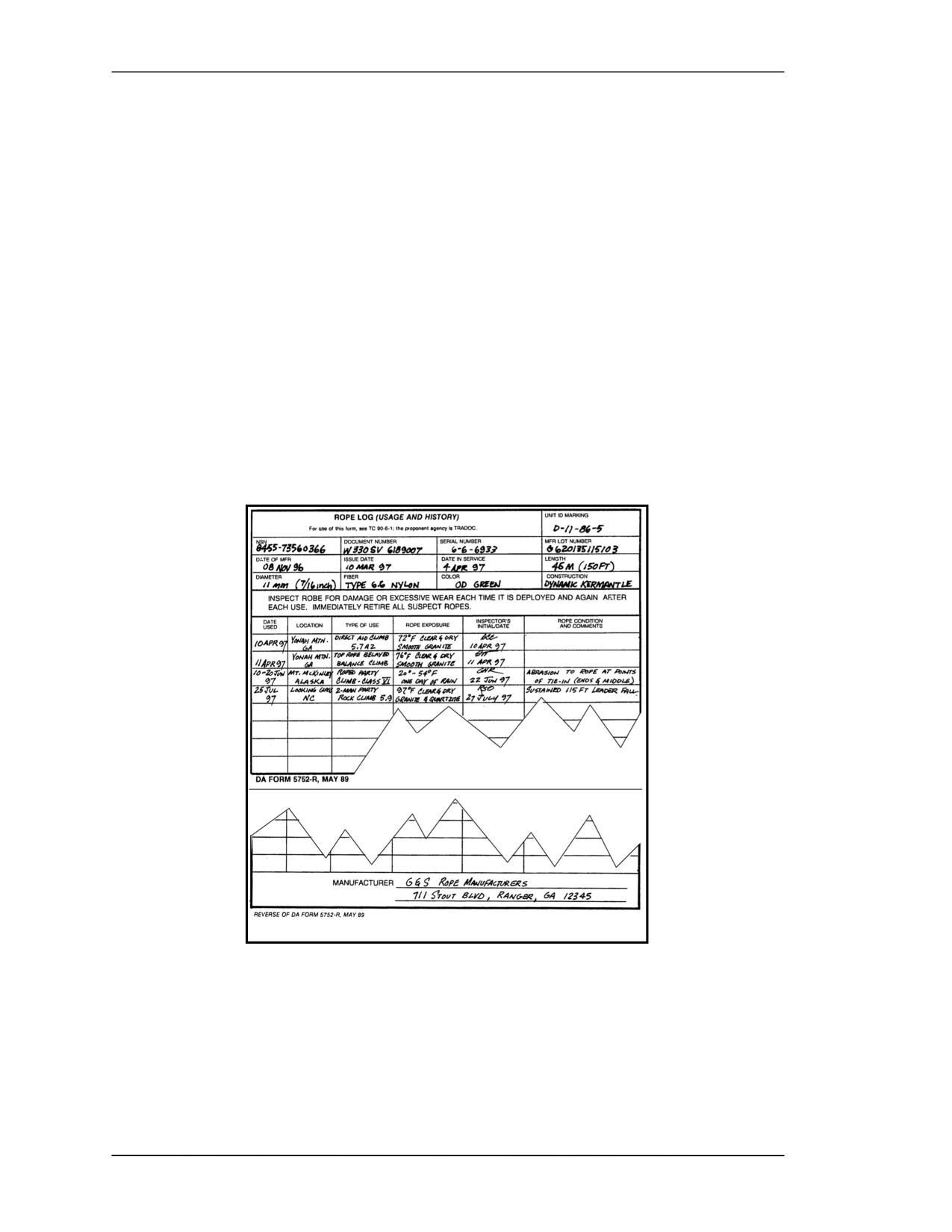
k. Each rope should have a corresponding rope log (DA Form 5752-R, Rope History
and Usage), which is also a safety record. It should annotate use, terrain, weather,
application, number of falls, dates, and so on, and should be annotated each time the rope
is used (Figure 4-1). DA Form 5752-R is authorized for local reproduction on 8 1/2- by
11-inch paper.
Figure 4-1. Example of completed DA Form 5752-R.
l.
Never subject the rope to high heat or flame. This will significantly weaken it.
m. All ropes should be washed periodically to remove dirt and grit, and rinsed
thoroughly. Commercial rope washers are made from short pieces of modified pipe that
connect to any faucet. Pinholes within the pipe force water to circulate around and scrub
the rope as you slowly feed it through the washer. Another method is to machine wash,
4-2
FM 3-97.61
on a gentle cycle, in cold water with a nylon safe soap, never bleach or harsh cleansers.
Ensure that only front loading washing machine are used to wash ropes.
n. Ultraviolet radiation (sunlight) tends to deteriorate nylon over long periods of
time. This becomes important if rope installations are left in place over a number of
months.
o. When not in use, ropes should be loosely coiled and hung on wooden pegs rather
than nails or other metal objects. Storage areas should be relatively cool with low
humidity levels to prevent mildew or rotting. Rope may also be loosely stacked and
placed in a rope bag and stored on a shelf. Avoid storage in direct sunlight, as the
ultraviolet radiation will deteriorate the nylon over long periods
4-3.
INSPECTION
Ropes should be inspected before and after each use, especially when working around
loose rock or sharp edges.
a. Although the core of the kernmantle rope cannot be seen, it is possible to damage
the core without damaging the sheath. Check a kernmantle rope by carefully inspecting
the sheath before and after use while the rope is being coiled. When coiling, be aware of
how the rope feels as it runs through the hands. Immediately note and tie off any lumps or
depressions felt.
b. Damage to the core of a kernmantle rope usually consists of filaments or yarn
breakage that results in a slight retraction. If enough strands rupture, a localized reduction
in the diameter of the rope results in a depression that can be felt or even seen.
c. Check any other suspected areas further by putting them under tension (the weight
of one person standing on a Prusik tensioning system is about maximum). This procedure
will emphasize the lump or depression by separating the broken strands and enlarging the
dip. If a noticeable difference in diameter is obvious, retire the rope immediately.
d. Many dynamic kernmantle ropes are quite soft. They may retain an indention
occasionally after an impact or under normal use without any trauma to the core. When
damage is suspected, patiently inspect the sheath for abnormalities. Damage to the sheath
does not always mean damage to the core. Inspect carefully.
4-4.
TERMINOLOGY
When using ropes, understanding basic terminology is important. The terms explained in
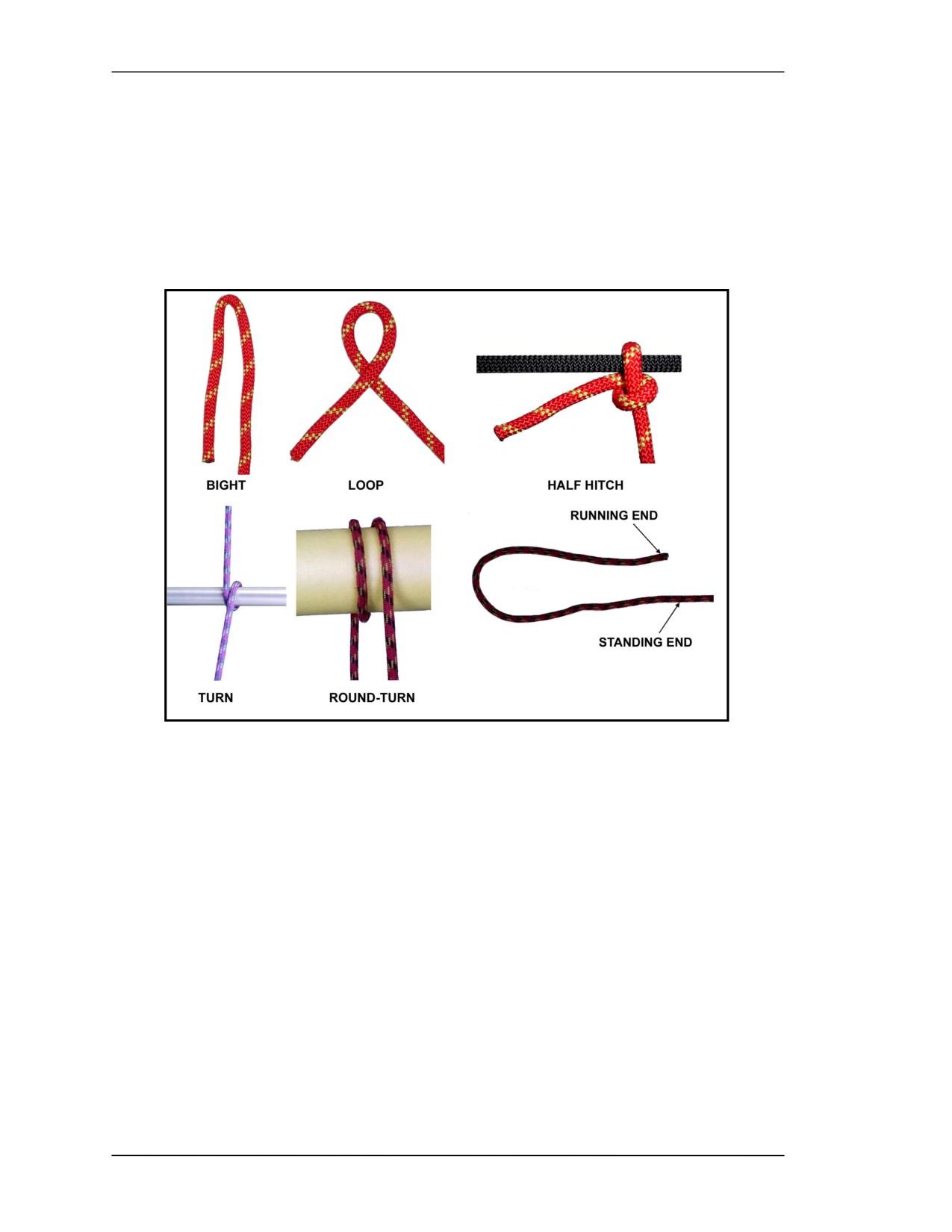
this section are the most commonly used in military mountaineering. (Figure 4-2, page
4-4, illustrates some of these terms.)
a. Bight. A bight of rope is a simple bend of rope in which the rope does not cross
itself.
b. Loop. A loop is a bend of a rope in which the rope does cross itself.
c. Half Hitch. A half hitch is a loop that runs around an object in such a manner as
to lock or secure itself.
d. Turn. A turn wraps around an object, providing 360-degree contact.
e. Round Turn. A round turn wraps around an object one and one-half times. A
round turn is used to distribute the load over a small diameter anchor (3 inches or less). It
may also be used around larger diameter anchors to reduce the tension on the knot, or
provide added friction.
f. Running End. A running end is the loose or working end of the rope.
4-3
FM 3-97.61
g. Standing Part. The standing part is the static, stationary, or nonworking end of
the rope.
h. Lay. The lay is the direction of twist used in construction of the rope.
i.
Pigtail. The pigtail (tail) is the portion of the running end of the rope between the
safety knot and the end of the rope.
j.
Dress. Dress is the proper arrangement of all the knot parts, removing
unnecessary kinks, twists, and slack so that all rope parts of the knot make contact.
Figure 4-2. Examples of roping terminology.
Section II. COILING, CARRYING, THROWING
The ease and speed of rope deployment and recovery greatly depends upon technique
and practice.
4-5.
COILING AND CARRYING THE ROPE
Use the butterfly or mountain coil to coil and carry the rope. Each is easy to accomplish
and results in a minimum amount of kinks, twists, and knots later during deployment.
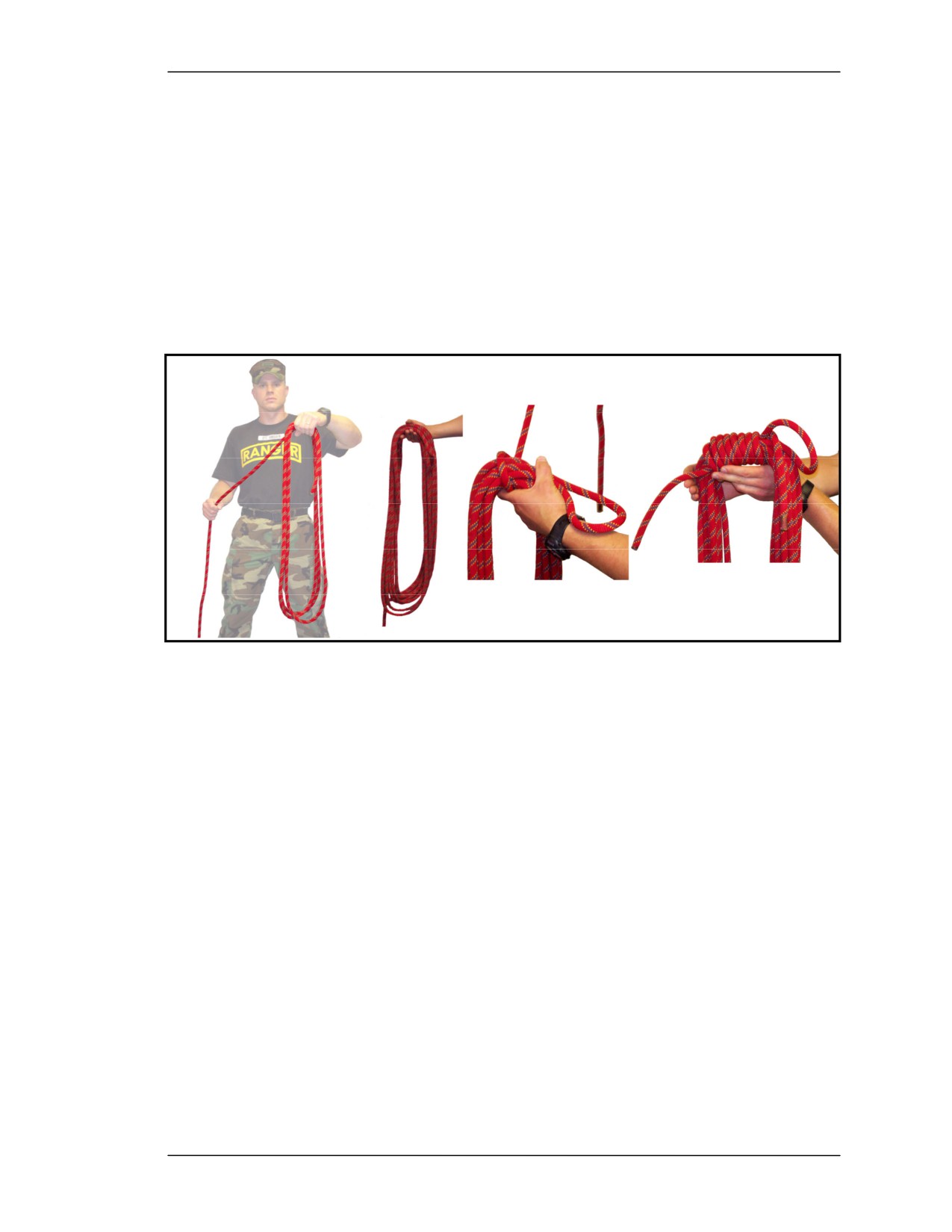
a. Mountain Coil. To start a mountain coil, grasp the rope approximately 1 meter
from the end with one hand. Run the other hand along the rope until both arms are
outstretched. Grasping the rope firmly, bring the hands together forming a loop, which is
laid in the hand closest to the end of the rope. This is repeated, forming uniform loops
that run in a clockwise direction, until the rope is completely coiled. The rope may be
given a 1/4 twist as each loop is formed to overcome any tendency for the rope to twist or
form figure-eights.
4-4
FM 3-97.61
(1) In finishing the mountain coil, form a bight approximately 30 centimeters long
with the starting end of the rope and lay it along the top of the coil. Uncoil the last loop
and, using this length of the rope, begin making wraps around the coil and the bight,
wrapping toward the closed end of the bight and making the first wrap bind across itself
so as to lock it into place. Make six to eight wraps to adequately secure the coil, and then
route the end of the rope through the closed end of the bight. Pull the running end of the
bight tight, securing the coil.
(2) The mountain coil may be carried either in the pack (by forming a figure eight),
doubling it and placing it under the flap, or by placing it over the shoulder and under the
opposite arm, slung across the chest. (Figure 4-3 shows how to coil a mountain coil.)
Figure 4-3. Mountain coil.
4-5
FM 3-97.61
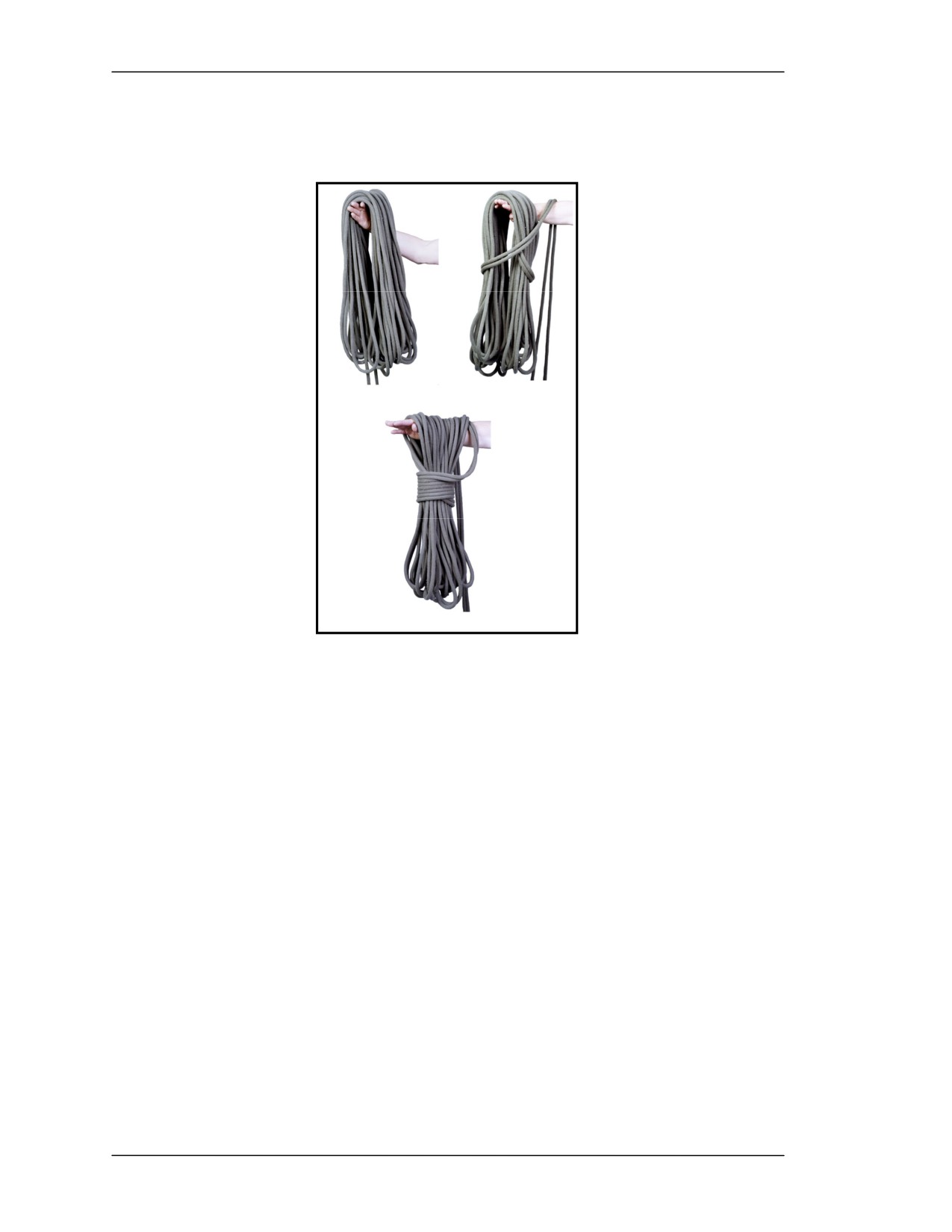
b. Butterfly Coil. The butterfly coil is the quickest and easiest technique for coiling
(Figure 4-4).
Figure 4-4. Butterfly coil.
(1) Coiling. To start the double butterfly, grasp both ends of the rope and begin back
feeding. Find the center of the rope forming a bight. With the bight in the left hand, grasp
both ropes and slide the right hand out until there is approximately one arms length of
rope. Place the doubled rope over the head, draping it around the neck and on top of the
shoulders. Ensure that it hangs no lower than the waist. With the rest of the doubled rope
in front of you, make doubled bights placing them over the head in the same manner as
the first bight. Coil alternating from side to side
(left to right, right to left) while
maintaining equal-length bights. Continue coiling until approximately two arm-lengths of
rope remain. Remove the coils from the neck and shoulders carefully, and hold the center
in one hand. Wrap the two ends around the coils a minimum of three doubled wraps,
ensuring that the first wrap locks back on itself.
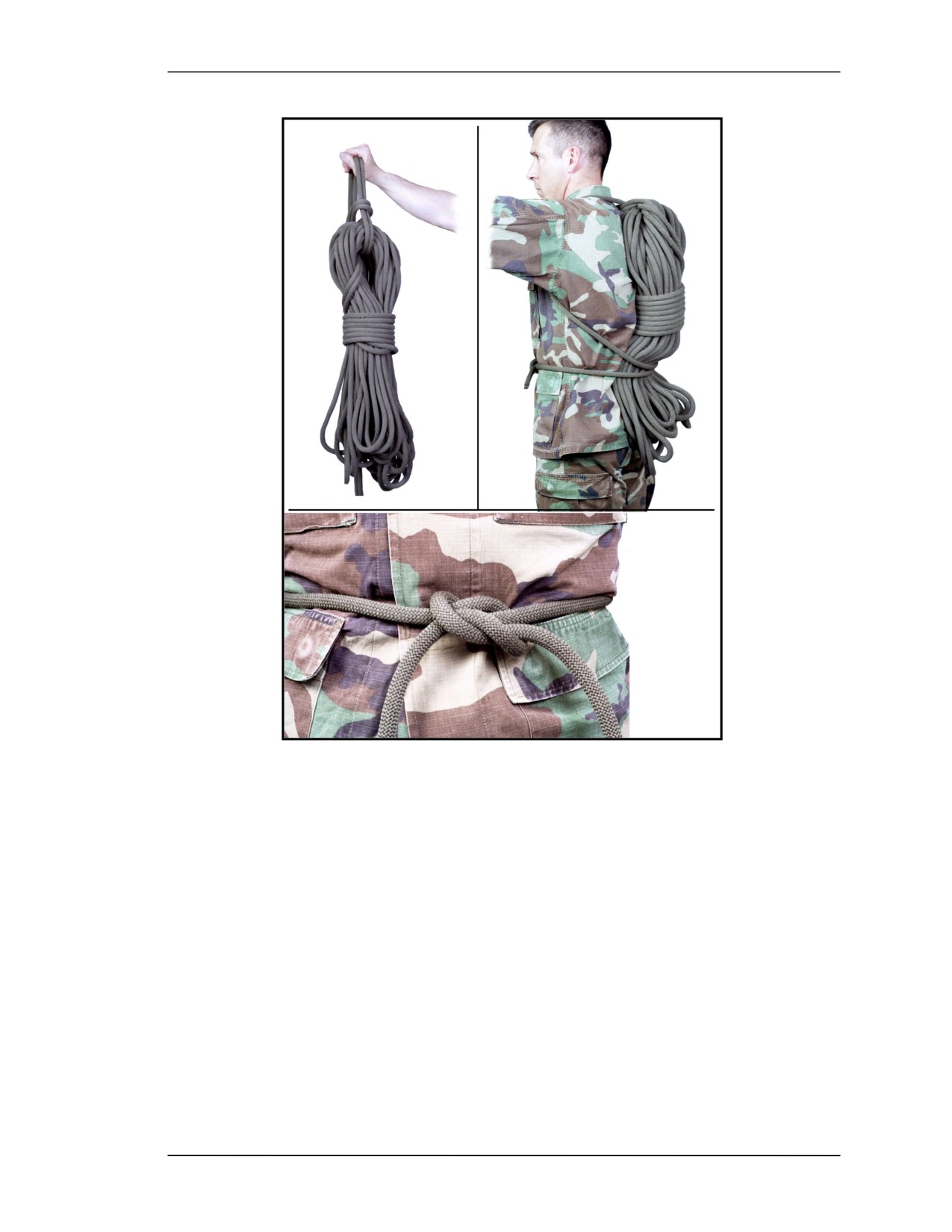
(2) Tie-off and Carrying. Take a doubled bight from the loose ends of rope and pass
it through the apex of the coils. Pull the loose ends through the doubled bight and dress it
down. Place an overhand knot in the loose ends, dressing it down to the apex of the bight
securing coils. Ensure that the loose ends do not exceed the length of the coils. In this
configuration the coiled rope is secure enough for hand carrying or carrying in a
rucksack, or for storage. (Figure 4-5 shows a butterfly coil tie-off.)
4-6
FM 3-97.61
Figure 4-5. Butterfly coil tie-off.
c. Coiling Smaller Diameter Rope. Ropes of smaller diameters may be coiled
using the butterfly or mountain coil depending on the length of the rope. Pieces 25 feet
and shorter (also known as cordage, sling rope, utility cord) may be coiled so that they
can be hung from the harness. Bring the two ends of the rope together, ensuring no kinks
are in the rope. Place the ends of the rope in the left hand with the two ends facing the
body. Coil the doubled rope in a clockwise direction forming 6- to 8-inch coils (coils may
be larger depending on the length of rope) until an approximate 12-inch bight is left.
Wrap that bight around the coil, ensuring that the first wrap locks on itself. Make three or
more wraps. Feed the bight up through the bights formed at the top of the coil. Dress it
down tightly. Now the piece of rope may be hung from a carabiner on the harness.
e. Uncoiling, Back-feeding, and Stacking. When the rope is needed for use, it must
be uncoiled and stacked on the ground properly to avoid kinks and snarls.
(1) Untie the tie-off and lay the coil on the ground. Back-feed the rope to minimize
kinks and snarls. (This is also useful when the rope is to be moved a short distance and
4-7
FM 3-97.61
coiling is not desired.) Take one end of the rope in the left hand and run the right hand
along the rope until both arms are outstretched. Next, lay the end of the rope in the left
hand on the ground. With the left hand, re-grasp the rope next to the right hand and
continue laying the rope on the ground.
(2) The rope should be laid or stacked in a neat pile on the ground to prevent it from
becoming tangled and knotted when throwing the rope, feeding it to a lead climber, and
so on. This technique can also be started using the right hand.
4-6.
THROWING THE ROPE
Before throwing the rope, it must be properly managed to prevent it from tangling during
deployment. The rope should first be anchored to prevent complete loss of the rope over
the edge when it is thrown. Several techniques can be used when throwing a rope.
Personal preference and situational and environmental conditions should be taken into
consideration when determining which technique is best.
a. Back feed and neatly stack the rope into coils beginning with the anchored end of
the rope working toward the running end. Once stacked, make six to eight smaller coils in
the left hand. Pick up the rest of the larger coils in the right hand. The arm should be
generally straight when throwing. The rope may be thrown underhanded or overhanded
depending on obstacles around the edge of the site. Make a few preliminary swings to
ensure a smooth throw. Throw the large coils in the right hand first. Throw up and out. A
slight twist of the wrist, so that the palm of the hand faces up as the rope is thrown,
allows the coils to separate easily without tangling. A smooth follow through is essential.
When a slight tug on the left hand is felt, toss the six to eight smaller coils out. This will
prevent the ends of the rope from becoming entangled with the rest of the coils as they
deploy. As soon as the rope leaves the hand, the thrower should sound off with a warning
of “ROPE” to alert anyone below the site.
b. Another technique may also be used when throwing rope. Anchor, back feed, and
stack the rope properly as described above. Take the end of the rope and make six to
eight helmet-size coils in the right hand (more may be needed depending on the length of
the rope). Assume a “quarterback” simulated stance. Aiming just above the horizon,
vigorously throw the rope overhanded, up and out toward the horizon. The rope must be
stacked properly to ensure smooth deployment.
c. When windy weather conditions prevail, adjustments must be made. In a strong
cross wind, the rope should be thrown angled into the wind so that it will land on the
desired target. The stronger the wind, the harder the rope must be thrown to compensate.
SECTION III. KNOTS
All knots used by a mountaineer are divided into four classes: Class I―joining knots, Class
II―anchor knots, Class III―middle rope knots, and Class IV―special knots. The variety of
knots, bends, bights, and hitches is almost endless. These classes of knots are intended only
as a general guide since some of the knots discussed may be appropriate in more than one
class. The skill of knot tying can perish if not used and practiced. With experience and
practice, knot tying becomes instinctive and helps the mountaineer in many situations.
4-8
FM 3-97.61
4-7.
SQUARE KNOT
The square knot is used to tie the ends of two ropes of equal diameter (Figure 4-6). It is a
joining knot.
a. Tying the Knot.
STEP 1. Holding one working end in each hand, place the working end in the
right hand over the one in the left hand.
STEP 2. Pull it under and back over the top of the rope in the left hand.
STEP 3. Place the working end in the left hand over the one in the right hand and
repeat STEP 2.
STEP 4. Dress the knot down and secure it with an overhand knot on each side of
the square knot.
Figure 4-6. Square knot.
b. Checkpoints.
(1) There are two interlocking bights.
(2) The running end and standing part are on the same side of the bight formed by the
other rope.
(3) The running ends are parallel to and on the same side of the standing ends with
4-inch minimum pig tails after the overhand safeties are tied.
4-8.
FISHERMAN’S KNOT
The fisherman’s knot is used to tie two ropes of the same or approximately the same
diameter (Figure 4-7, page 4-10). It is a joining knot.
a. Tying the Knot.
STEP 1. Tie an overhand knot in one end of the rope.
4-9
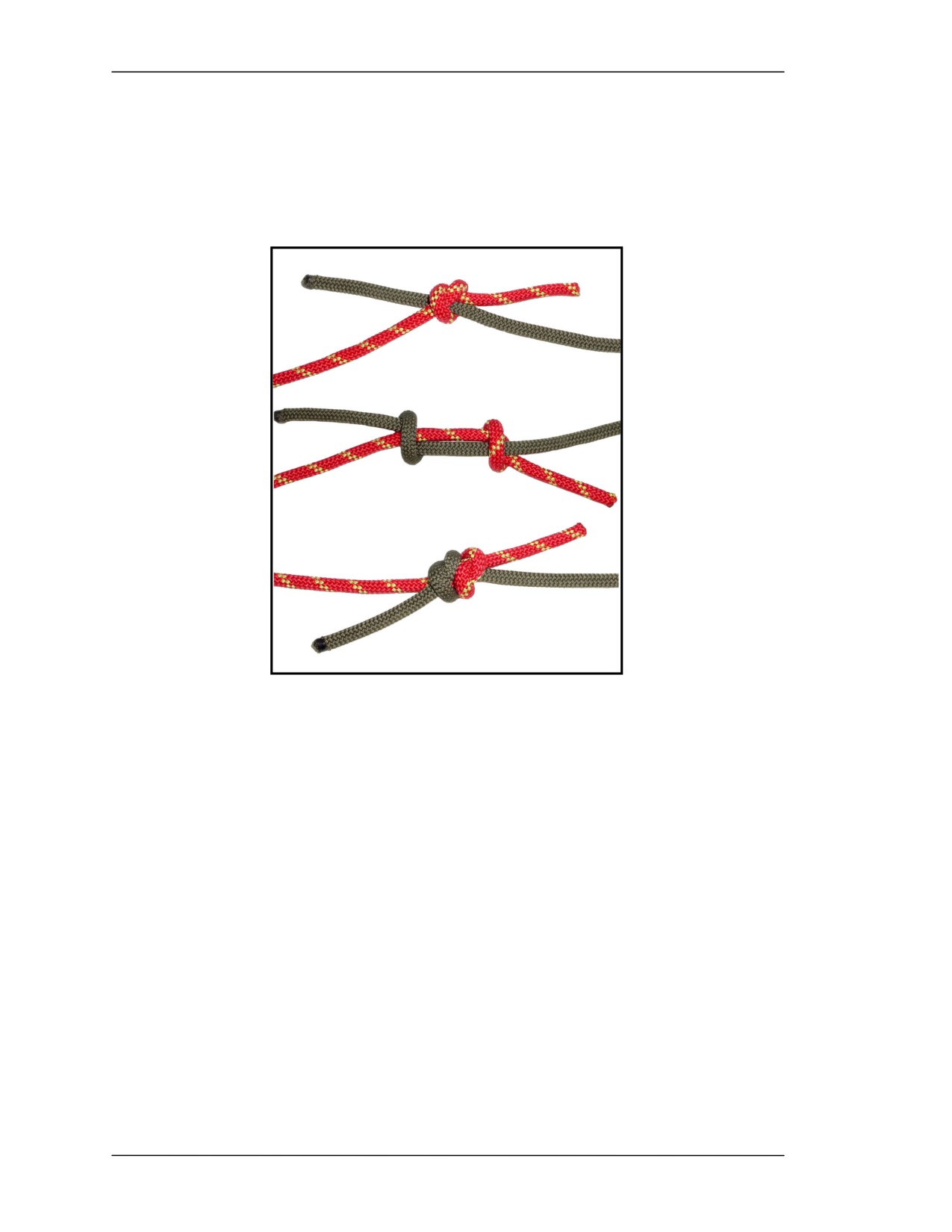
FM 3-97.61
STEP 2. Pass the working end of the other rope through the first overhand knot.
Tie an overhand knot around the standing part of the first rope with the
working end of the second rope.
STEP 3. Tightly dress down each overhand knot and tightly draw the knots
together.
Figure 4-7. Fisherman’s knot.
b. Checkpoints.
(1) The two separate overhand knots are tied tightly around the long, standing part of the
opposing rope.
(2) The two overhand knots are drawn snug.
(3) Ends of rope exit knot opposite each other with 4-inch pigtails.
4-9.
DOUBLE FISHERMAN’S KNOT
The double fisherman’s knot (also called double English or grapevine) is used to tie two
ropes of the same or approximately the same diameter (Figure 4-8). It is a joining knot.
a. Tying the Knot.
STEP 1. With the working end of one rope, tie two wraps around the standing part
of another rope.
STEP 2. Insert the working end (STEP 1) back through the two wraps and draw it
tight.
STEP 3. With the working end of the other rope, which contains the standing part
(STEPS 1 and 2), tie two wraps around the standing part of the other
4-10
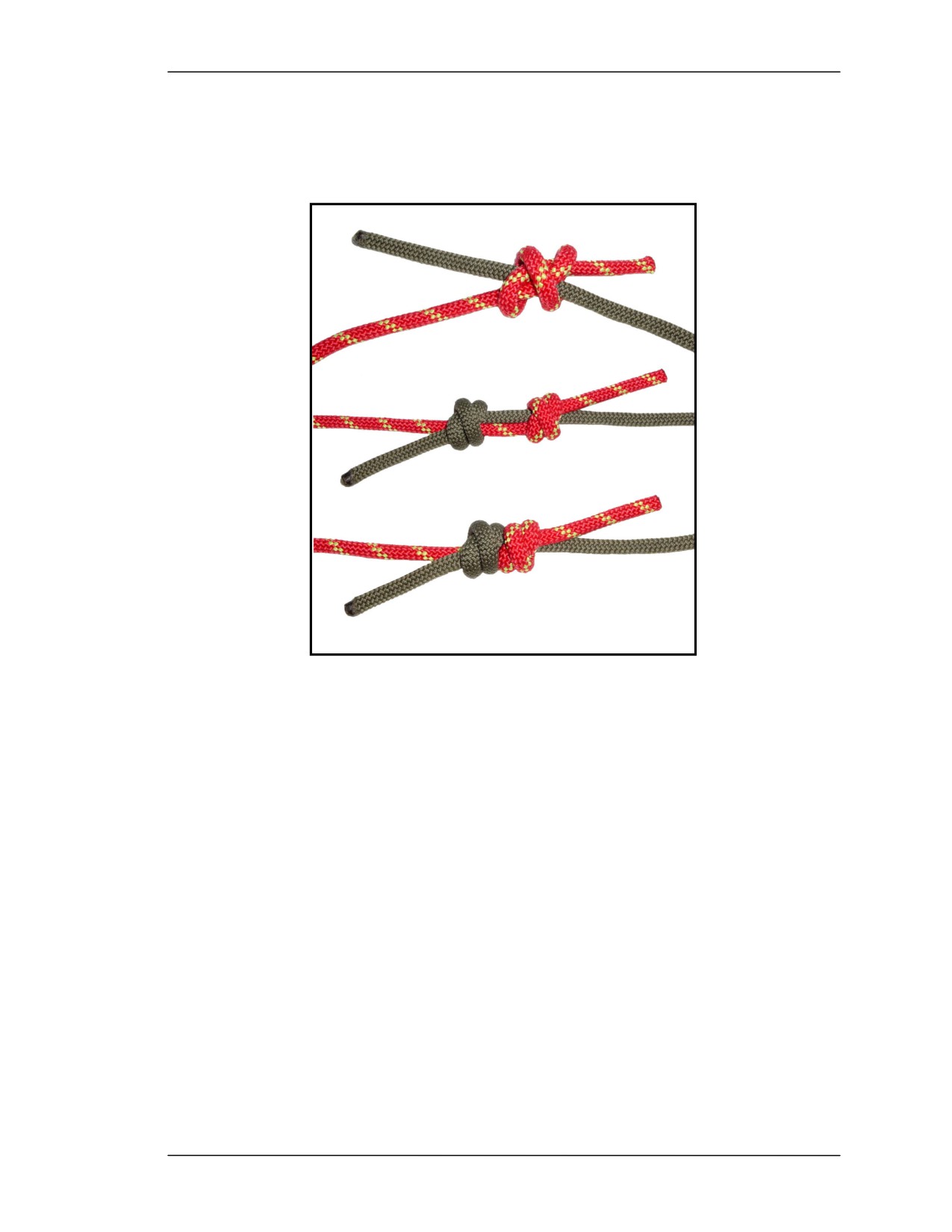
FM 3-97.61
rope (the working end in STEP 1). Insert the working end back through
the two wraps and draw tight.
STEP 4. Pull on the opposing ends to bring the two knots together.
Figure 4-8. Double fisherman’s knot.
b. Checkpoints.
(1) Two double overhand knots securing each other as the standing parts of the rope
are pulled apart.
(2) Four rope parts on one side of the knot form two “x” patterns, four rope parts on the
other side of the knot are parallel.
(3) Ends of rope exit knot opposite each other with 4-inch pigtails.
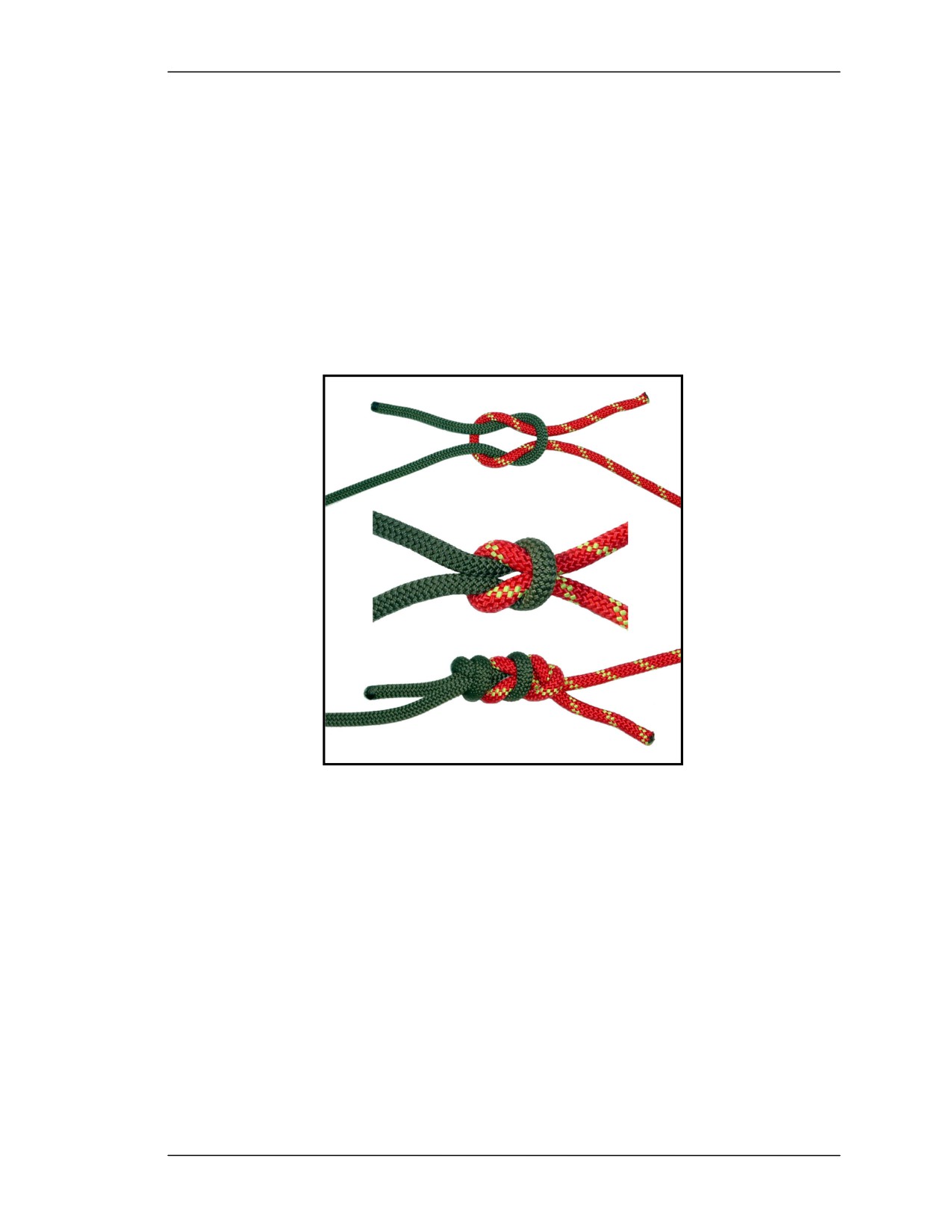
4-10. FIGURE-EIGHT BEND
The figure-eight bend is used to join the ends of two ropes of equal or unequal diameter
within 5-mm difference (Figure 4-9, page 4-12).
a. Tying the Knot.
STEP 1. Grasp the top of a 2-foot bight.
STEP 2. With the other hand, grasp the running end (short end) and make a
360-degree turn around the standing end.
STEP 3. Place the running end through the loop just formed creating an in-line
figure eight.
4-11
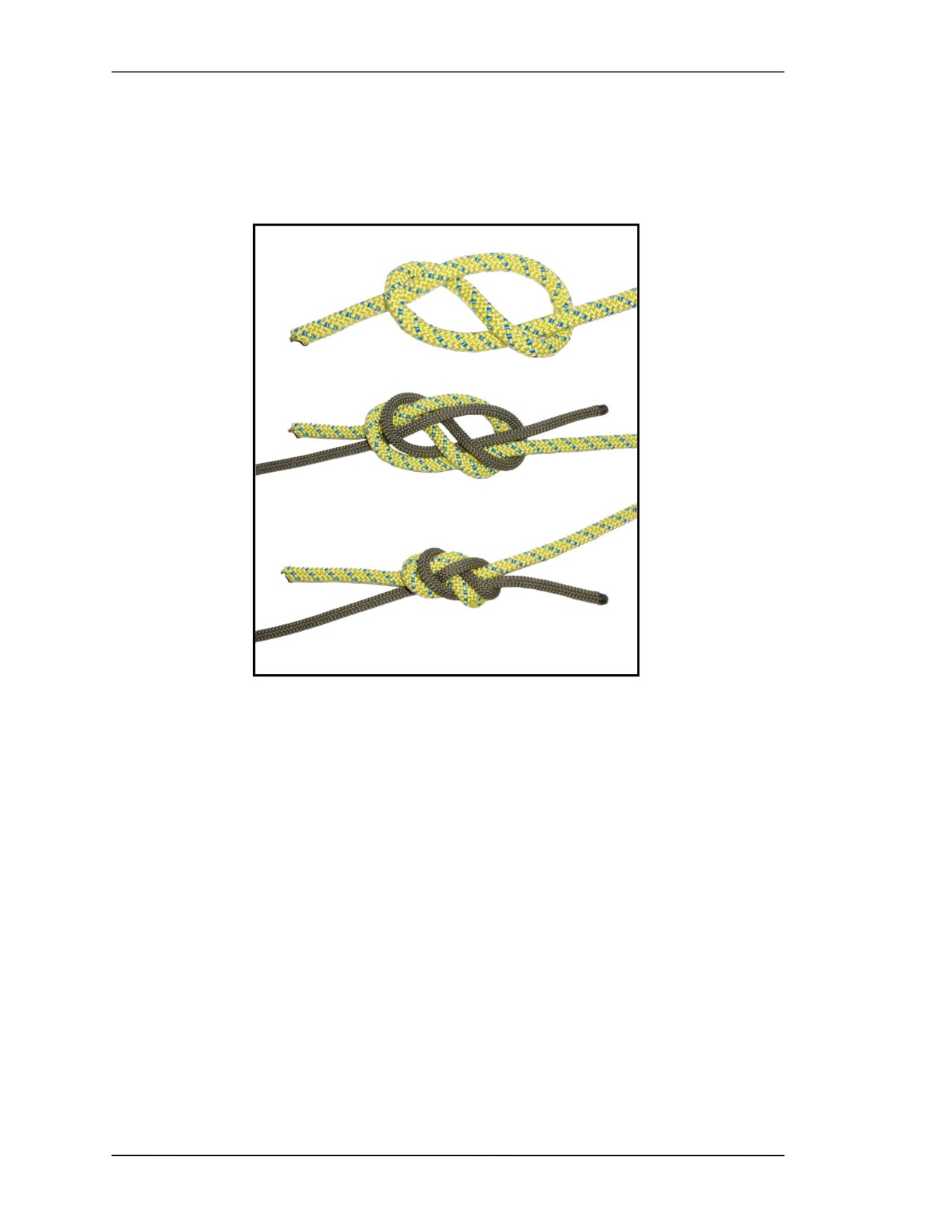
FM 3-97.61
STEP 4. Route the running end of the other ripe back through the figure eight
starting from the original rope’s running end. Trace the original knot to
the standing end.
STEP 5. Remove all unnecessary twists and crossovers. Dress the knot down.
Figure 4-9. Figure-eight bend.
b. Checkpoints.
(1) There is a figure eight with two ropes running side by side.
(2) The running ends are on opposite sides of the knot.
(3) There is a minimum 4-inch pigtail.
4-11. WATER KNOT
The water knot is used to attach two webbing ends (Figure 4-10). It is also called a ring
bend, overhand retrace, or tape knot. It is used in runners and harnesses and is a joining
knot.
a. Tying the Knot.
STEP 1. Tie an overhand knot in one of the ends.
STEP 2. Feed the other end back through the knot, following the path of the first
rope in reverse.
STEP 3. Draw tight and pull all of the slack out of the knot. The remaining tails
must extend at least 4 inches beyond the knot in both directions.
4-12
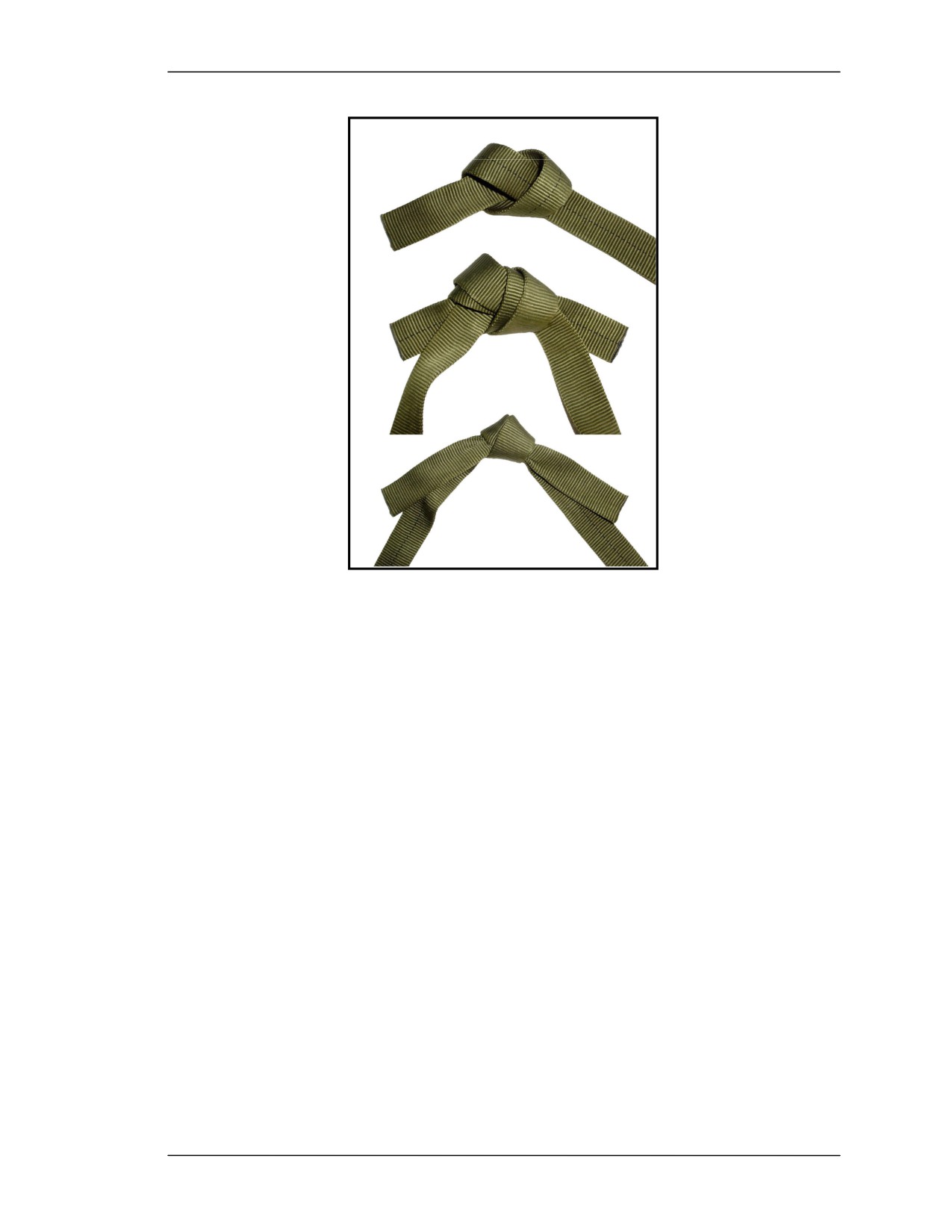
FM 3-97.61
Figure 4-10. Water knot.
b. Checkpoints.
(1) There are two overhand knots, one retracing the other.
(2) There is no slack in the knot, and the working ends come out of the knot in
opposite directions.
(3) There is a minimum 4-inch pigtail.
4-12. BOWLINE
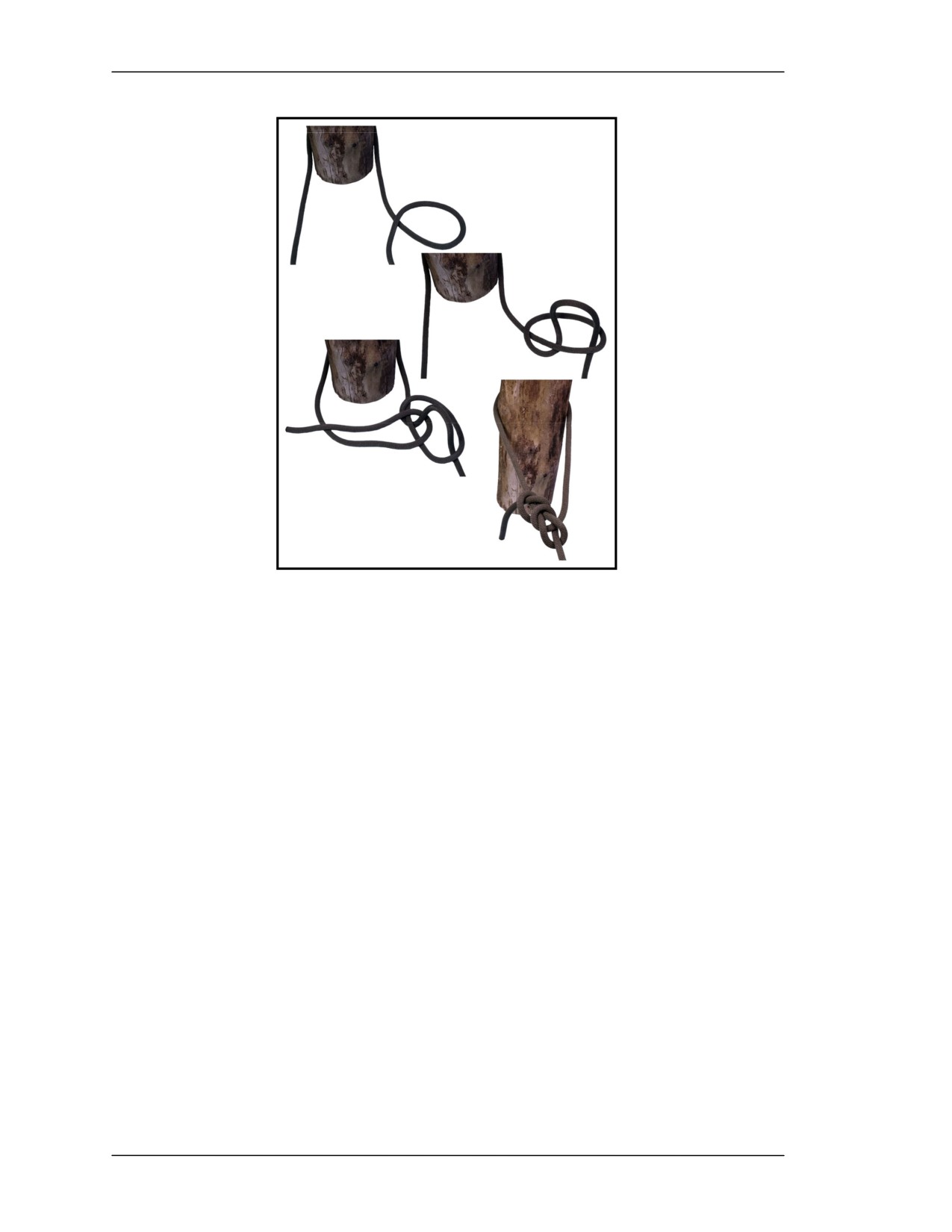
The bowline is used to tie the end of a rope around an anchor. It may also be used to tie a
single fixed loop in the end of a rope (Figure 4-11, page 4-14). It is an anchor knot.
a. Tying the Knot.
STEP 1. Bring the working end of the rope around the anchor, from right to left
(as the climber faces the anchor).
STEP 2. Form an overhand loop in the standing part of the rope (on the
climber’s right) toward the anchor.
STEP 3. Reach through the loop and pull up a bight.
STEP 4. Place the working end of the rope (on the climber’s left) through the
bight, and bring it back onto itself. Now dress the knot down.
STEP 5. Form an overhand knot with the tail from the bight.
4-13
FM 3-97.61
Figure 4-11. Bowline knot.
b. Checkpoints.
(1) The bight is locked into place by a loop.
(2) The short portion of the bight is on the inside and on the loop around the anchor
(or inside the fixed loop).
(3) There is a minimum 4-inch pigtail after tying the overhand safety.
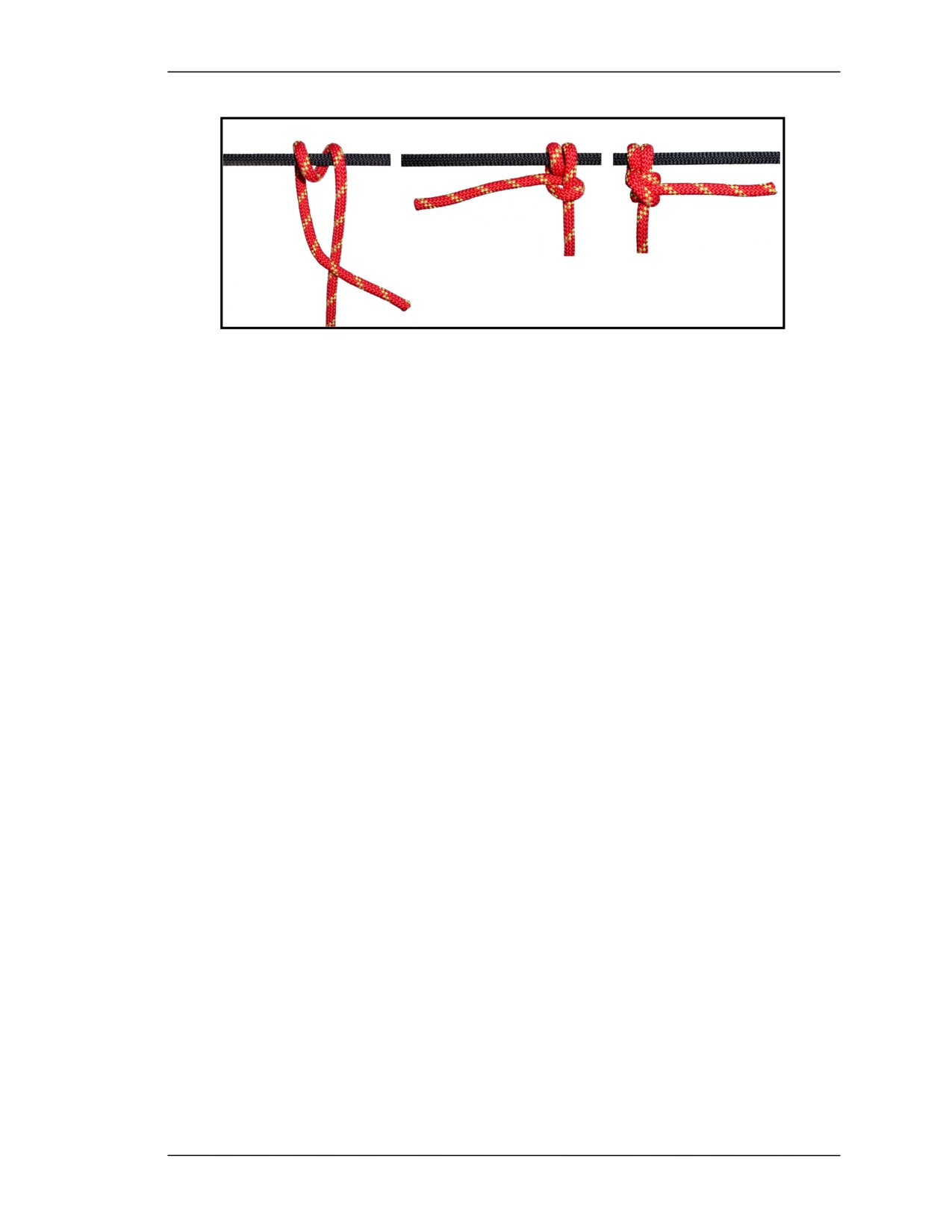
4-13. ROUND TURN AND TWO HALF HITCHES
This knot is used to tie the end of a rope to an anchor, and it must have constant tension
(Figure 4-12). It is an anchor knot.
a. Tying the Knot.
STEP 1. Route the rope around the anchor from right to left and wrap down
(must have two wraps in the rear of the anchor, and one in the front).
Run the loop around the object to provide
360-degree contact,
distributing the load over the anchor.
STEP 2. Bring the working end of the rope left to right and over the standing part,
forming a half hitch (first half hitch).
STEP 3. Repeat STEP 2 (last half hitch has a 4 inch pigtail).
STEP 4. Dress the knot down.
4-14
FM 3-97.61
Figure 4-12. Round turn and two half hitches.
b. Checkpoints.
(1) A complete round turn should exist around the anchor with no crosses.
(2) Two half hitches should be held in place by a diagonal locking bar with no less
than a 4-inch pigtail remaining.
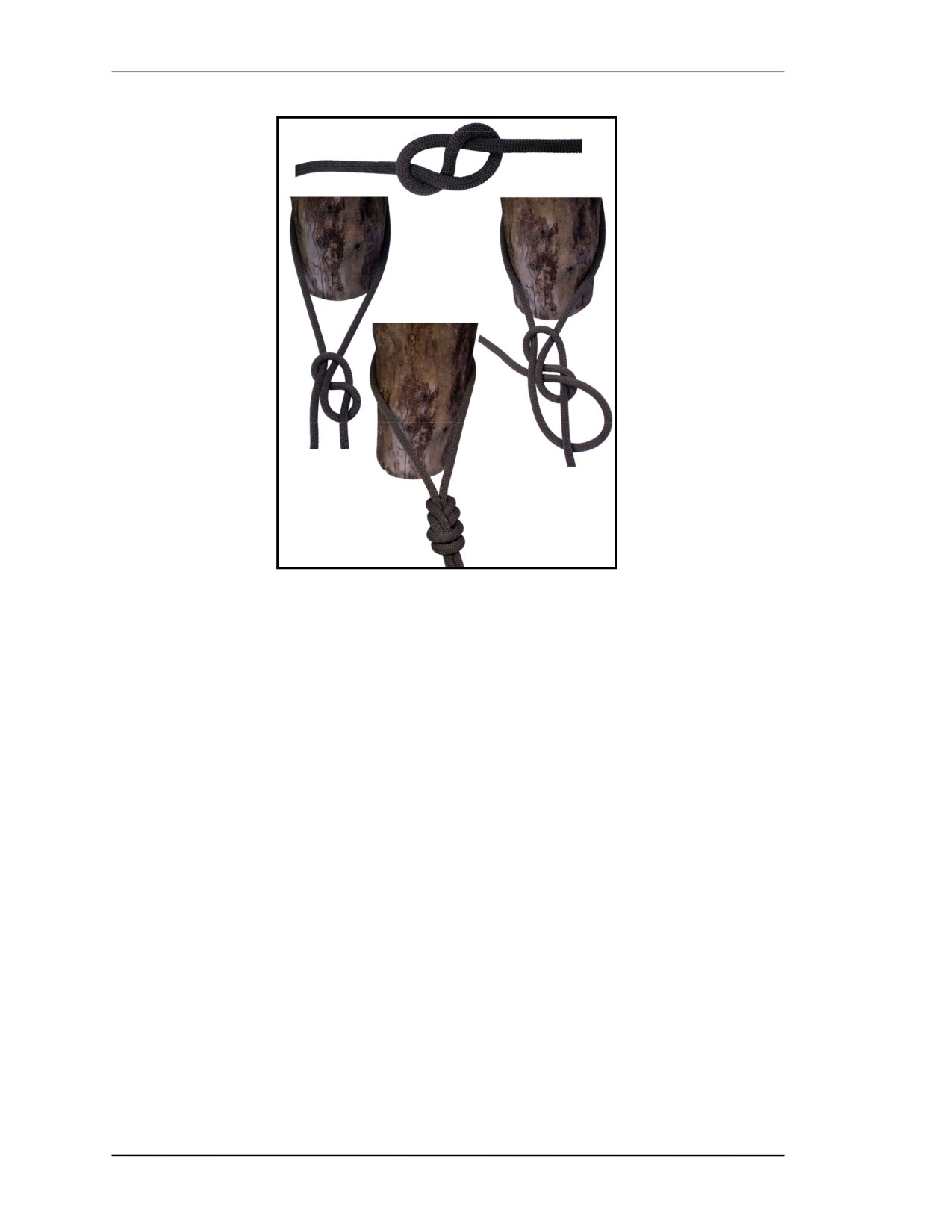
4-14. FIGURE-EIGHT RETRACE (REROUTED FIGURE-EIGHT)
The figure-eight retrace knot produces the same result as a figure-eight loop. However, by
tying the knot in a retrace, it can be used to fasten the rope to trees or to places where the
loop cannot be used (Figure 4-13, page 4-16). It is also called a rerouted figure-eight and is
an anchor knot.
a. Tying the Knot.
STEP 1. Use a length of rope long enough to go around the anchor, leaving
enough rope to work with.
STEP 2. Tie a figure-eight knot in the standing part of the rope, leaving enough
rope to go around the anchor. To tie a figure-eight knot form a loop in
the rope, wrap the working end around the standing part, and route the
working end through the loop. The finished knot is dressed loosely.
STEP 3. Take the working end around the anchor point.
STEP 4. With the working end, insert the rope back through the loop of the knot
in reverse.
STEP 5. Keep the original figure eight as the outside rope and retrace the knot
around the wrap and back to the long-standing part.
STEP 6. Remove all unnecessary twists and crossovers; dress the knot down.
4-15
FM 3-97.61
Figure 4-13. Figure-eight retrace.
b. Checkpoints
(1) A figure eight with a doubled rope running side by side, forming a fixed loop
around a fixed object or harness.
(2) There is a minimum 4-inch pigtail.
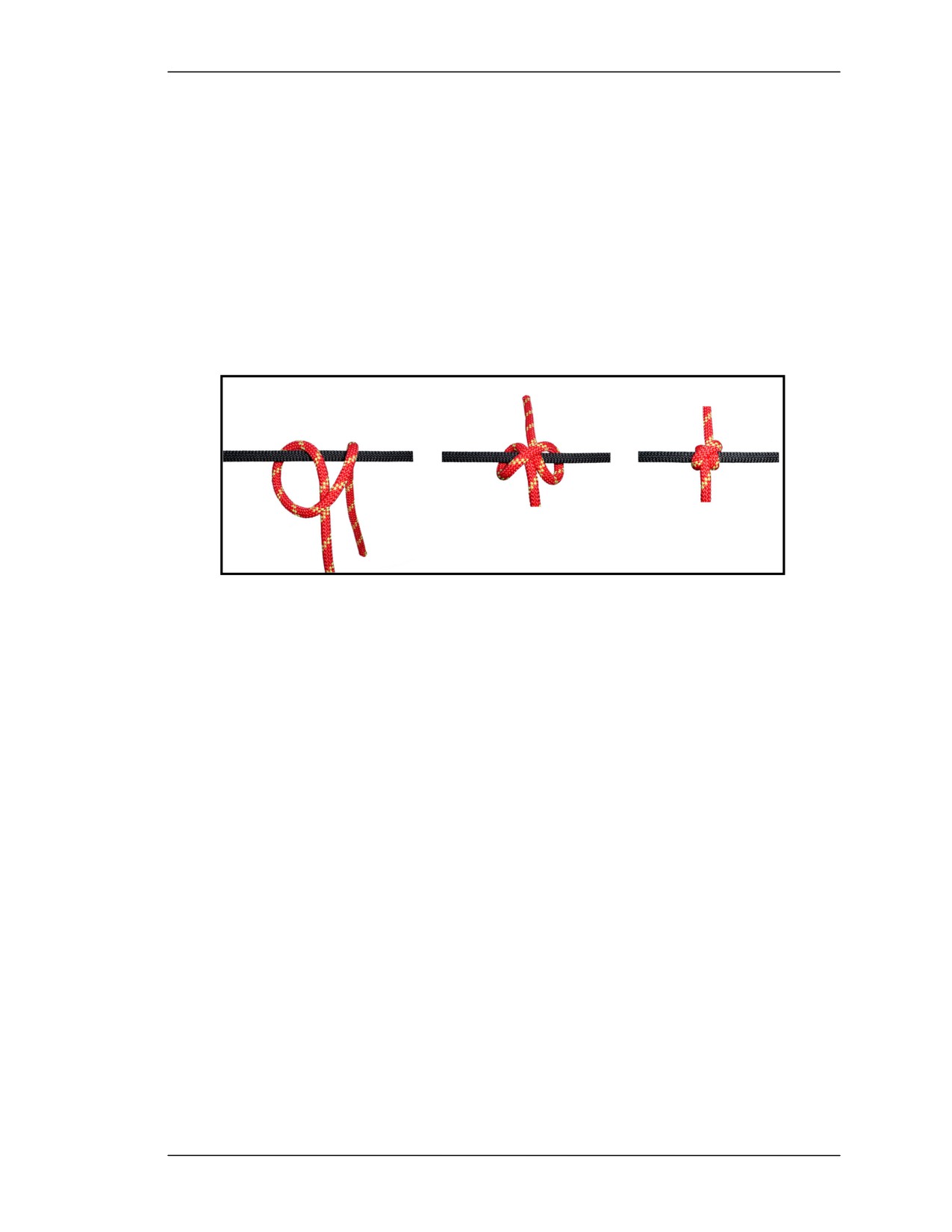
4-15. CLOVE HITCH
The clove hitch is an anchor knot that can be used in the middle of the rope as well as at the
end (Figure 4-14). The knot must have constant tension on it once tied to prevent slipping. It
can be used as either an anchor or middle of the rope knot, depending on how it is tied.
a. Tying the Knot.
(1) Middle of the Rope.
STEP 1. Hold rope in both hands, palms down with hands together. Slide the left
hand to the left from 20 to 25 centimeters.
STEP 2. Form a loop away from and back toward the right.
STEP 3. Slide the right hand from 20 to 25 centimeters to the right. Form a loop
inward and back to the left hand.
STEP 4. Place the left loop on top of the right loop. Place both loops over the
anchor and pull both ends of the rope in opposite directions. The knot is
tied.
(2) End of the Rope.
Note: For instructional purposes, assume that the anchor is horizontal.
4-16
FM 3-97.61
STEP 1. Place 76 centimeters of rope over the top of the anchor. Hold the
standing end in the left hand. With the right hand, reach under the
horizontal anchor, grasp the working end, and bring it inward.
STEP 2. Place the working end of the rope over the standing end (to form a loop).
Hold the loop in the left hand. Place the working end over the anchor
from 20 to 25 centimeters to the left of the loop.
STEP 3. With the right hand, reach down to the left hand side of the loop under
the anchor. Grasp the working end of the rope. Bring the working end up
and outward.
STEP 4. Dress down the knot.
Figure 4-14. Clove hitch.
b. Checkpoints.
(1) The knot has two round turns around the anchor with a diagonal locking bar.
(2) The locking bar is facing 90 degrees from the direction of pull.
(3) The ends exit l80 degrees from each other.
(4) The knot has more than a 4-inch pigtail remaining.
4-16. WIREMAN’S KNOT
The wireman’s knot forms a single, fixed loop in the middle of the rope (Figure 4-15, page
4-18). It is a middle rope knot.
a. Tying the Knot.
STEP 1. When tying this knot, face the anchor that the tie-off system will be tied
to. Take up the slack from the anchor, and wrap two turns around the left
hand (palm up) from left to right.
STEP 2. A loop of 30 centimeters is taken up in the second round turn to create
the fixed loop of the knot.
STEP 3. Name the wraps from the palm to the fingertips: heel, palm, and
fingertip.
STEP 4. Secure the palm wrap with the right thumb and forefinger, and place it
over the heel wrap.
STEP 5. Secure the heel wrap and place it over the fingertip wrap.
STEP 6. Secure the fingertip wrap and place it over the palm wrap.
STEP 7. Secure the palm wrap and pull up to form a fixed loop.
4-17
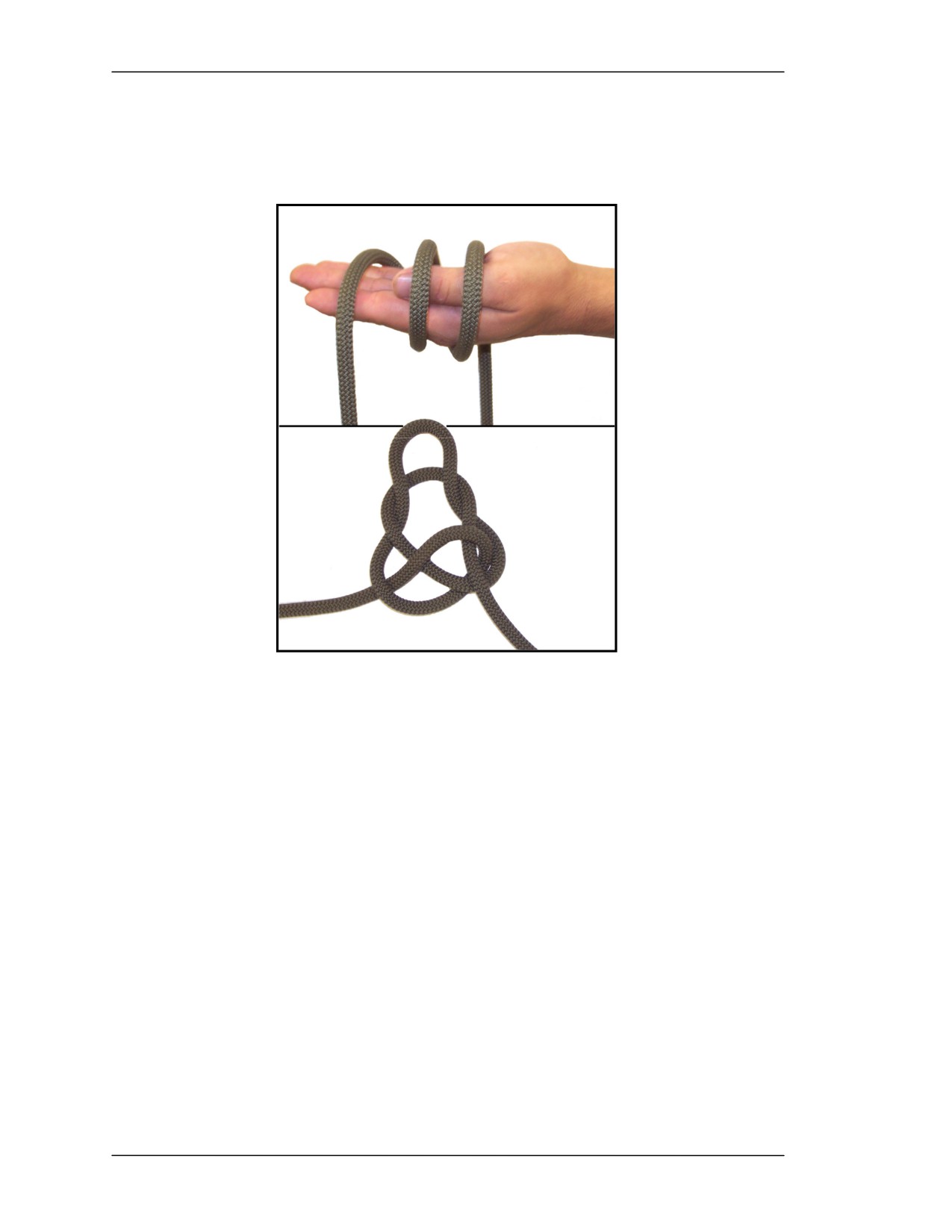
FM 3-97.61
STEP 8. Dress the knot down by pulling on the fixed loop and the two working
ends.
STEP 9. Pull the working ends apart to finish the knot.
Figure 4-15. Wireman’s knot.
b. Checkpoints.
(1) The completed knot should have four separate bights locking down on themselves
with the fixed loop exiting from the top of the knot and laying toward the near side anchor
point.
(2) Both ends should exit opposite each other without any bends.
4-17. DIRECTIONAL FIGURE-EIGHT
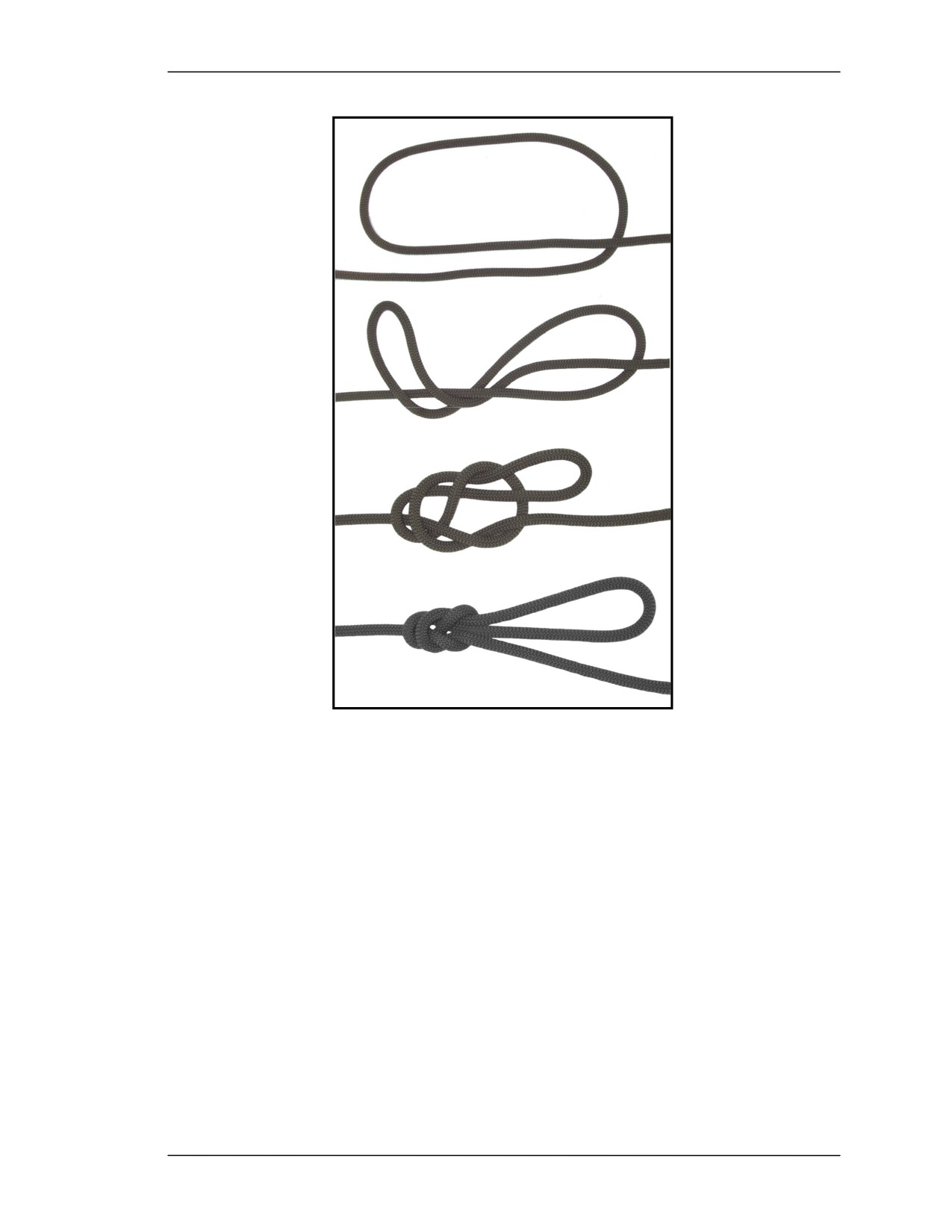
The directional figure-eight knot forms a single, fixed loop in the middle of the rope that
lays back along the standing part of the rope (Figure 4-16). It is a middle rope knot.
a. Tying the Knot.
STEP 1. Face the far side anchor so that when the knot is tied, it lays inward.
STEP 2. Lay the rope from the far side anchor over the left palm. Make one wrap
around the palm.
STEP 3. With the wrap thus formed, tie a figure-eight knot around the standing
part that leads to the far side anchor.
STEP 4. When dressing the knot down, the tail and the bight must be together.
4-18
FM 3-97.61
Figure 4-16. Directional figure-eight.
b. Checkpoints.
(1) The loop should be large enough to accept a carabiner but no larger than a
helmet-size loop.
(2) The tail and bight must be together.
(3) The figure eight is tied tightly.
(4) The bight in the knot faces back toward the near side.
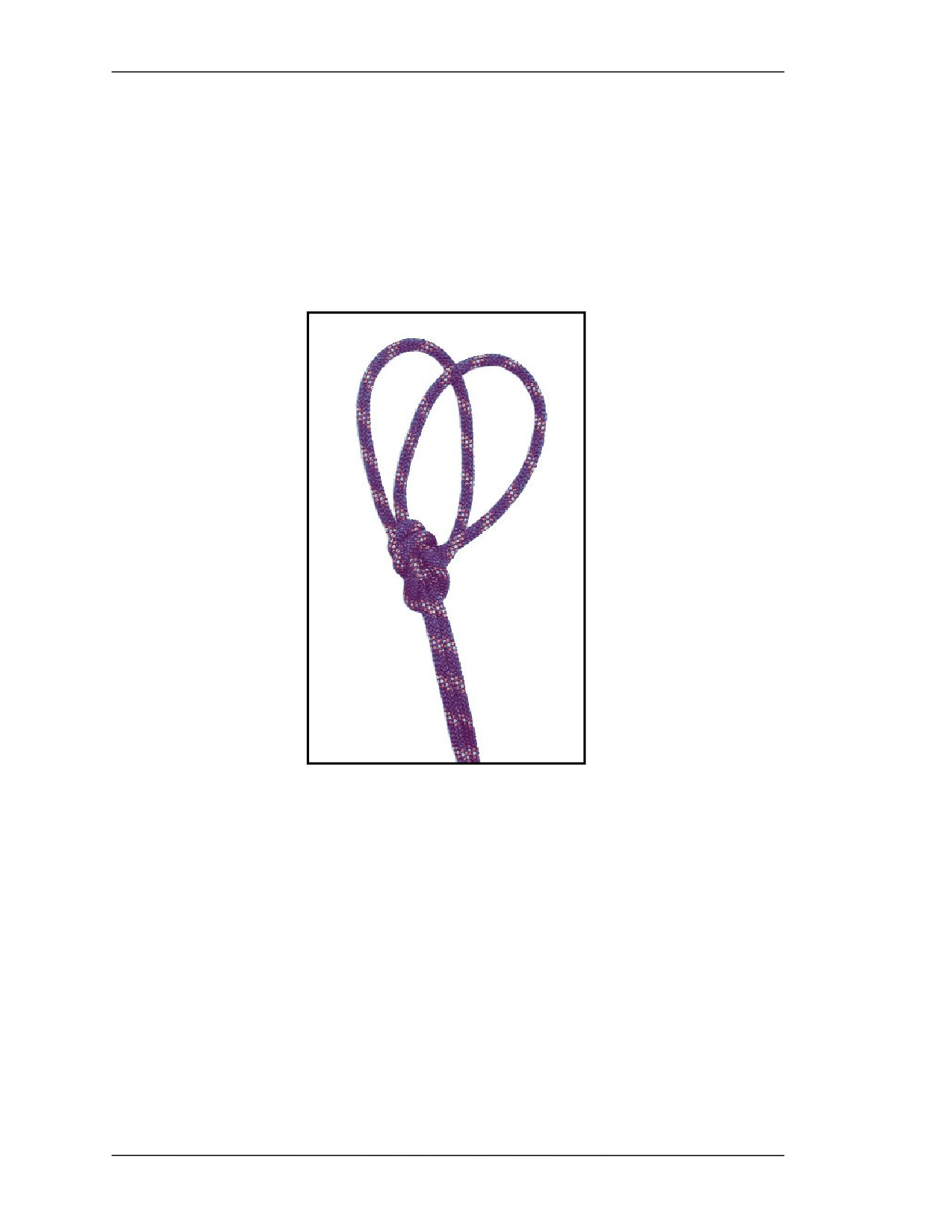
4-18. BOWLINE-ON-A-BIGHT (TWO-LOOP BOWLINE)
The bowline-on-a-bight is used to form two fixed loops in the middle of a rope (Figure 4-17,
page 4-20). It is a middle rope knot.
a. Tying the Knot.
STEP 1. Form a bight in the rope about twice as long as the finished loops will be.
STEP 2. Tie an overhand knot on a bight.
STEP 3. Hold the overhand knot in the left hand so that the bight is running down
and outward.
4-19
FM 3-97.61
STEP 4. Grasp the bight with the right hand; fold it back over the overhand knot
so that the overhand knot goes through the bight.
STEP 5. From the end (apex) of the bight, follow the bight back to where it forms
the cross in the overhand knot. Grasp the two ropes that run down and
outward and pull up, forming two loops.
STEP 6. Pull the two ropes out of the overhand knot and dress the knot down.
STEP 7. A final dress is required: grasp the ends of the two fixed loops and pull,
spreading them apart to ensure the loops do not slip.
Figure 4-17. Bowline-on-a-bight.
b. Checkpoints.
(1) There are two fixed loops that will not slip.
(2) There are no twists in the knot.
(3) A double loop is held in place by a bight.
4-19. TWO-LOOP FIGURE-EIGHT
The two-loop figure-eight is used to form two fixed loops in the middle of a rope (Figure
4-18.) It is a middle rope knot.
a. Tying the Knot.
STEP 1. Using a doubled rope, form an 18-inch bight in the left hand with the
running end facing to the left.
STEP 2. Grasp the bight with the right hand and make a 360-degree turn around
the standing end in a counterclockwise direction.
4-20