FM 3-97.61 MILITARY MOUNTAINEERING (AUGUST 2002) - page 1
FM 3-97.61(TC 90-6-1)
MILITARY
MOUNTAINEERING
AUGUST 2002
HEADQUARTERS
DEPARTMENT OF THE ARMY
DISTRIBUTION RESTRICTION: Approved for public release; distribution is
unlimited.
FM 3-97.61(TC 90-6-1)
PREFACE
Mountains exist in almost every country in the world and almost every war has
included some type of mountain operations. This pattern will not change; therefore,
soldiers will fight in mountainous terrain in future conflicts. Although mountain
operations have not changed, several advancements in equipment and transportation have
increased the soldiers’ capabilities. The helicopter now allows access to terrain that was
once unreachable or could be reached only by slow methodical climbing. Inclement
weather, however, may place various restrictions on the capabilities of air assets available
to a commander. The unit must then possess the necessary mountaineering skills to
overcome adverse terrain to reach an objective.
This field manual details techniques soldiers and leaders must know to cope with
mountainous terrain. These techniques are the foundation upon which the mountaineer
must build. They must be applied to the various situations encountered to include river
crossings, glaciers, snow-covered mountains, ice climbing, rock climbing, and urban
vertical environments. The degree to which this training is applied must be varied to
conform to known enemy doctrine, tactics, and actions. This FM also discusses basic and
advanced techniques to include acclimatization, illness and injury, equipment, anchors,
evacuation, movement on glaciers, and training.
This field manual is a training aid for use by qualified personnel in conjunction with
FM 3-97.6, Mountain Operations, which is used for planning operations in mountainous
terrain. Personnel using FM 3-97.61 should attend a recognized Department of Defense
Mountain Warfare School for proper training. Improper use of techniques and
procedures by untrained personnel may result in serious injury or death. Personnel
should be certified as Level I, Basic Mountaineer; Level II, Assault Climber; or Level III,
Mountain Leader before using FM 3-97.61 for training (see Appendix A).
The measurements in this manual are stated as they are used in training (either metric
or standard). Appendix B contains a measurement conversion chart for your convenience.
The proponent of this publication is HQ TRADOC. Submit changes for improving
this publication to doctrine@benning.army.mil or on DA Form 2028 (Recommended
Changes to Publications and Blank Forms) and forward to the Commander, U.S. Army
Infantry School, ATTN: ATSH-RBO, Fort Benning, GA 31905-5593.
Unless otherwise stated, whenever the masculine gender is used, both men and
women are included.
vii
*FM 3-97.61(TC 90-6-1)
FIELD MANUAL
HEADQUARTERS
No. 3-97.61
DEPARTMENT OF THE ARMY
WASHINGTON, DC, 26 August 2002
MILITARY MOUNTAINEERING
CONTENTS
Page
PREFACE
vii
CHAPTER 1.
MOUNTAIN TERRAIN, WEATHER, AND HAZARDS
Section
I.
Mountain Terrain
1-1
1-1
Definition
1-1
1-2
Composition
1-1
1-3.
Rock and Slope Types
1-1
1-4.
Rock Classifications
1-2
1-5.
Mountain Building
1-4
1-6.
Route Classification
1-5
1-7.
Cross-Country Movement
1-9
1-8.
Cover and Concealment
1-10
1-9.
Observation
1-10
1-10.
Fields of Fire
1-11
Section
II.
Mountain Weather
1-11
1-11. Considerations for Planning
1-11
1-12. Mountain Air
1-12
1-13. Weather Characteristics
1-12
1-14. Wind
1-13
1-15. Humidity
1-14
1-16. Cloud Formation
1-14
1-17. Types of Clouds
1-15
1-18. Fronts
1-23
1-19. Temperature
1-23
1-20. Weather Forecasting
1-24
1-21. Recording Data
1-25
Section
III.
Mountain Hazards
1-27
1-22. Subjective Hazards
1-27
1-23. Objective Hazards
1-27
1-24. Weather Hazards
1-28
1-25. Avalanche Hazards
1-29
DISTRIBUTION RESTRICTION: Approved for public release; distribution is unlimited.
__________________________
*This publication supersedes TC 90-6-1, dated 26 April 1989.
i
FM 3-97.61
Page
CHAPTER 2.
MOUNTAIN LIVING
Section
I.
Survival
2-1
2-1.
Water Supply
2-1
2-2.
Nutrition
2-2
2-3.
Personal Hygiene and Sanitation
2-5
Section
II.
Acclimatization and Conditioning
2-6
2-4.
Symptoms and Adjustments
2-6
2-5.
Physical and Psychological Conditioning
2-7
Section
III.
Medical Considerations
2-9
2-6.
Illness and Injury
2-9
2-7.
Treatment and Evacuation
2-10
2-8.
Solar Injuries
2-10
2-9.
Cold-Weather Injuries
2-11
2-10.
Heat Injuries
2-20
2-11.
Acute Mountain Sickness
2-21
2-12.
Chronic Mountain Sickness
2-22
2-13.
Understanding High-Altitude Illnesses
2-22
2-14.
High-Altitude Pulmonary Edema
2-23
2-15.
High-Altitude Cerebral Edema
2-24
2-16.
Hydration in HAPE and HACE
2-25
CHAPTER 3.
MOUNTAINEERING EQUIPMENT
Section
I.
Equipment Description and Maintenance
3-1
3-1.
Footwear
3-1
3-2.
Clothing
3-2
3-3.
Climbing Software
3-8
3-4.
Climbing Hardware
3-11
3-5.
Snow and Ice Climbing Hardware
3-21
3-6.
Sustainability Equipment
3-26
Section
II.
Equipment Packing
3-30
3-7.
Choice of Equipment
3-30
3-8.
Tips on Packing
3-33
CHAPTER 4.
ROPE MANAGEMENT AND KNOTS
Section
I.
Preparation, Care and Maintenance, Inspection, Terminology
4-1
4-1.
Preparation
4-1
4-2.
Care and Maintenance
4-1
4-3.
Inspection
4-3
4-4.
Terminology
4-3
Section
II.
Coiling, Carrying, Throwing
4-4
4-5.
Coiling and Carrying the Rope
4-4
4-6.
Throwing the Rope
4-8
ii
FM 3-97.61
Page
Section
III.
Knots
.................................................................................................. 4-8
4-7.
Square Knot
4-9
4-8.
Fisherman’s Knot
4-9
4-9.
Double Fisherman’s Knot
4-10
4-10.
Figure-Eight Bend
4-11
4-11.
Water Knot
4-12
4-12.
Bowline
4-13
4-13.
Round Turn and Two Half Hitches
4-14
4-14.
Figure-Eight Retrace (Rerouted Figure-Eight)
4-15
4-15.
Clove Hitch
4-16
4-16.
Wireman’s Knot
4-17
4-17.
Directional Figure-Eight
4-18
4-18.
Bowline-on-a-Bight (Two-Loop Bowline)
4-19
4-19.
Two-Loop Figure-Eight
4-20
4-20.
Figure-Eight Loop (Figure-Eight-on-a-Bight)
4-21
4-21.
Prusik Knot
4-22
4-22.
Bachman Knot
4-23
4-23.
Bowline-on-a-Coil
4-24
4-24.
Three-Loop Bowline
4-25
4-25.
Figure-Eight Slip Knot
4-26
4-26.
Transport Knot (Overhand Slip Knot/Mule Knot)
4-27
4-27.
Kleimhiest Knot
4-28
4-28.
Frost Knot
4-29
4-29.
Girth Hitch
4-30
4-30.
Munter Hitch
4-30
4-31.
Rappel Seat
4-31
4-32.
Guarde Knot
4-32
CHAPTER
5.
ANCHORS
Section
I.
Natural Anchors
5-1
5-1.
Trees
5-1
5-2.
Boulders
5-2
5-3.
Chockstones
5-2
5-4.
Rock Projections
5-3
5-5.
Tunnels and Arches
5-4
5-6.
Bushes and Shrubs
5-4
5-7.
Slinging Techniques
5-4
Section
II.
Anchoring With the Rope
5-7
5-8.
Rope Anchor
5-7
5-9.
Tensionless Anchor
5-7
Section
III.
Artificial Anchors
5-8
5-10. Deadman
5-8
5-11. Pitons
5-9
5-12. Chocks
5-11
iii
FM 3-97.61
Page
5-13. Spring-Loaded Camming Device
5-13
5-14. Bolts
5-14
5-15. Equalizing Anchors
5-15
CHAPTER 6.
CLIMBING
Section
I.
Climbing Fundamentals
6-1
6-1.
Route Selection
6-1
6-2.
Terrain Selection for Training
6-1
6-3.
Preparation
6-2
6-4.
Spotting
6-2
6-5.
Climbing Technique
6-3
6-6.
Safety Precautions
6-8
6-7.
Margin of Safety
6-9
Section
II.
Use of Holds
6-10
6-8.
Climbing With the Feet
6-10
6-9.
Using the Hands
6-13
6-10.
Combination Techniques
6-19
Section
III.
Roped Climbing
6-27
6-11. Tying-in to the Climbing Rope
6-27
6-12. Presewn Harnesses
6-28
6-13. Improvised Harnesses
6-32
Section
IV.
Belay Techniques
6-33
6-14. Procedure for Managing the Rope
6-34
6-15. Choosing a Belay Technique
6-39
6-16. Establishing a Belay
6-40
6-17. Setting Up a Belay
6-43
6-18. Top-Rope Belay
6-43
Section
V.
Climbing Commands
6-43
6-19. Verbal Commands
6-44
6-20. Rope Tug Commands
6-45
Section
VI.
Roped Climbing Methods
6-45
6-21. Top-Roped Climbing
6-45
6-22. Lead Climbing
6-45
6-23. Aid Climbing
6-54
6-24. Three-Man Climbing Team
6-57
CHAPTER 7.
ROPE INSTALLATIONS
Section
I.
Fixed Rope
7-1
7-1.
Installation
7-1
7-2.
Utilization
7-1
7-3.
Retrieval
7-2
7-4.
Fixed Rope With Intermediate Anchors
7-3
iv
FM 3-97.61
Page
Section
II.
Rappelling
7-5
7-5.
Selection of a Rappel Point
7-6
7-6.
Installation of the Rappel Point
7-6
7-7.
Operation of the Rappel Point
7-6
7-8.
Recovery of the Rappel Point
7-8
7-9.
Types of Rappels
7-9
Section
III.
One-Rope Bridge
7-14
7-10. Site Selection
7-15
7-11. Installation Using Transport Tightening System
7-15
7-12. Installation Using Z-Pulley Tightening System
7-18
7-13. Utilization
7-19
7-14. Hauling Line
7-21
7-15. Retrieval
7-22
Section
IV.
Suspension Traverse
7-22
7-16. Site Selection
7-23
7-17. Installation
7-23
7-18. Retrieval
7-27
Section
V.
Vertical Hauling Line
7-27
7-19. Site Selection
7-27
7-20. Installation
7-28
7-21. Retrieval
7-29
Section
VI.
Simple Raising Systems
7-29
7-22. Z-Pulley System
7-29
7-23. U-Pulley System
7-31
CHAPTER 8.
MOUNTAIN WALKING TECHNIQUES
8-1.
Basic Principles
8-1
8-2.
Techniques
8-2
8-3.
Safety Considerations
8-5
8-4.
Navigation
8-5
8-5.
Route Planning
8-10
8-6.
Route Selection
8-13
CHAPTER 9.
MOUNTAIN STREAM CROSSING
9-1.
Reconnaissance
9-1
9-2.
Preparation of Troops and Equipment
9-3
9-3.
Individual Crossings
9-3
9-4.
Team Crossing
9-4
9-5.
Rope Installations
9-5
9-6.
Safety
9-8
9-7.
Swimming
9-8
v
FM 3-97.61
Page
CHAPTER 10. MOVEMENT OVER SNOW AND ICE
10-1. Movement Over Snow
10-1
10-2. Movement Over Ice
10-2
10-3. Use of Ice Ax and Crampons
10-2
10-4. Glissading
10-13
10-5. Snow and Ice Anchors
10-14
10-6. Roped Climbing on Ice and Snow
10-18
10-7. Movement on Glaciers
10-19
10-8. Glacier Bivouac Procedures
10-33
CHAPTER 11. MOUNTAIN RESCUE AND EVACUATION
11-1. Considerations
11-1
11-2. Planning Rescue Operations
11-2
11-3. Mass Casualties
11-3
11-4. Special Training
11-4
11-5. Preparation for Evacuation
11-4
11-6. Manual Carries
11-4
11-7. Litters
11-7
11-8. Rescue Systems
11-9
11-9. Low-Angle Evacuation
11-10
11-10. High-Angle Evacuation
11-12
APPENDIX A. LEVELS OF MILITARY MOUNTAINEERING
A-1
APPENDIX B. MEASUREMENT CONVERSION FACTORS
B-1
APPENDIX C. AVALANCHE SEARCH AND RESCUE TECHNIQUES
C-1
GLOSSARY
Glossary-1
REFERENCES
References-1
INDEX
Index-1
vi
FM 3-97.61(TC 90-6-1)
CHAPTER 1
MOUNTAIN TERRAIN, WEATHER, AND HAZARDS
Commanders must consider the effects terrain and weather will have on
their operations, mainly on their troops and logistics efforts. Weather and
terrain combine to challenge efforts in moving supplies to forward areas.
Spring storms, which may deposit a foot of snow on dry roads, combined
with unprepared vehicles create hazardous situations. Helicopters are a
valuable asset for use in moving men and supplies, but commanders
should not plan to use them as the only means of movement and resupply.
Alternate methods must be planned due to the variability of weather. Units
scheduled for deployment in mountainous terrain should become self-
sufficient and train under various conditions. Commanders must be
familiar with the restraints that the terrain can place on a unit.
Section I. MOUNTAIN TERRAIN
Operations in the mountains require soldiers to be physically fit and leaders to be
experienced in operations in this terrain. Problems arise in moving men and transporting
loads up and down steep and varied terrain in order to accomplish the mission. Chances
for success in this environment are greater when a leader has experience operating under
the same conditions as his men. Acclimatization, conditioning, and training are important
factors in successful military mountaineering.
1-1.
DEFINITION
Mountains are land forms that rise more than 500 meters above the surrounding plain and
are characterized by steep slopes. Slopes commonly range from 4 to 45 degrees. Cliffs
and precipices may be vertical or overhanging. Mountains may consist of an isolated
peak, single ridges, glaciers, snowfields, compartments, or complex ranges extending for
long distances and obstructing movement. Mountains usually favor the defense; however,
attacks can succeed by using detailed planning, rehearsals, surprise, and well-led troops.
1-2.
COMPOSITION
All mountains are made up of rocks and all rocks of minerals (compounds that cannot be
broken down except by chemical action). Of the approximately 2,000 known minerals,
seven rock-forming minerals make up most of the earth’s crust: quartz and feldspar make
up granite and sandstone; olivene and pyroxene give basalt its dark color; and amphibole
and biotite (mica) are the black crystalline specks in granitic rocks. Except for calcite,
found in limestone, they all contain silicon and are often referred to as silicates.
1-3.
ROCK AND SLOPE TYPES
Different types of rock and different slopes present different hazards. The following
paragraphs discuss the characteristics and hazards of the different rocks and slopes.
a. Granite. Granite produces fewer rockfalls, but jagged edges make pulling rope
and raising equipment more difficult. Granite is abrasive and increases the danger of
ropes or accessory cords being cut. Climbers must beware of large loose boulders. After a
1-1
FM 3-97.61
rain, granite dries quickly. Most climbing holds are found in cracks. Face climbing can be
found, however, it cannot be protected.
b. Chalk and Limestone. Chalk and limestone are slippery when wet. Limestone is
usually solid; however, conglomerate type stones may be loose. Limestone has pockets,
face climbing, and cracks.
c. Slate and Gneiss. Slate and gneiss can be firm and or brittle in the same area (red
coloring indicates brittle areas). Rockfall danger is high, and small rocks may break off
when pulled or when pitons are emplaced.
d. Sandstone. Sandstone is usually soft causing handholds and footholds to break
away under pressure. Chocks placed in sandstone may or may not hold. Sandstone should
be allowed to dry for a couple of days after a rain before climbing on it―wet sandstone is
extremely soft. Most climbs follow a crack. Face climbing is possible, but any outward
pull will break off handholds and footholds, and it is usually difficult to protect.
e. Grassy Slopes. Penetrating roots and increased frost cracking cause a continuous
loosening process. Grassy slopes are slippery after rain, new snow, and dew. After long,
dry spells clumps of the slope tend to break away. Weight should be distributed evenly;
for example, use flat hand push holds instead of finger pull holds.
f. Firm Spring Snow (Firn Snow). Stopping a slide on small, leftover snow
patches in late spring can be difficult. Routes should be planned to avoid these dangers.
Self-arrest should be practiced before encountering this situation. Beginning climbers
should be secured with rope when climbing on this type surface. Climbers can glissade
down firn snow if necessary. Firn snow is easier to ascend than walking up scree or talus.
g. Talus. Talus is rocks that are larger than a dinner plate, but smaller than boulders.
They can be used as stepping-stones to ascend or descend a slope. However, if a talus
rock slips away it can produce more injury than scree because of its size.
h. Scree. Scree is small rocks that are from pebble size to dinner plate size. Running
down scree is an effective method of descending in a hurry. One can run at full stride
without worry―the whole scree field is moving with you. Climbers must beware of
larger rocks that may be solidly planted under the scree. Ascending scree is a tedious
task. The scree does not provide a solid platform and will only slide under foot. If
possible, avoid scree when ascending.
1-4.
ROCK CLASSIFICATIONS
Rock is classified by origin and mineral composition.
a. Igneous Rocks. Deep within the earth’s crust and mantle, internal heat, friction
and radioactive decay creates magmas (melts of silicate minerals) that solidify into
igneous rocks upon cooling. When the cooling occurs at depth, under pressure, and over
time, the minerals in the magma crystallize slowly and develop well, making
coarse-grained plutonic rock. The magma may move upward, propelled by its own lower
density, either melting and combining with the overlying layers or forcing them aside.
This results in an intrusive rock. If the melt erupts onto the surface it cools rapidly and
the minerals form little or no crystal matrix, creating a volcanic or extrusive rock.
(1) Plutonic or Intrusive Rocks. Slow crystallization from deeply buried magmas
generally means good climbing, since the minerals formed are relatively large and
interwoven into a solid matrix. Weathering develops protrusions of resistant minerals,
which makes for either a rough-surfaced rock with excellent friction, or, if the resistant
1-2
FM 3-97.61
crystals are much larger than the surrounding matrix, a surface with numerous knobby
holds. Pieces of foreign rock included in the plutonic body while it was rising and
crystallizing, or clusters of segregated minerals, may weather differently than the main
rock mass and form “chicken heads.”
(a) Intrusions are named according to location and size. Large (100 square kilometers
or larger) masses of plutonic rock are called “batholiths” and small ones “stocks.” Most
plutonic rock is in the granite family, differing only in the amounts of constituent
minerals contained. A core of such batholiths is in every major mountain system in the
world. In the Alps, Sierras, North Cascades, Rockies, Adirondacks, and most other ranges
this core is at least partly exposed.
(b) Small plutonic intrusions are stocks, forced between sedimentary strata, and
dikes, which cut across the strata. Many of these small intrusive bodies are quickly
cooled and thus may look like extrusive rock.
(2) Volcanic or Extrusive Rocks. Explosive eruptions eject molten rock so quickly
into the air that it hardens into loose aerated masses of fine crystals and uncrystallized
glass (obsidian). When this ash consolidates while molten or after cooling, it is called
“tuff,” a weak rock that breaks down quickly and erodes easily. Quieter eruptions, where
widespread lava flows from large fissures, produce basalt. Basaltic rocks are fine-grained
and often sharp-edged.
(3) Jointing Rocks. In plutonic rocks, joints or cracks are caused by internal stresses
such as contraction during cooling or expansion when overlying rock erodes or
exfoliates. Some joints tend to follow a consistent pattern throughout an entire mountain
and their existence can often be predicted. Therefore, when a ledge suddenly ends, the
joint―and thus the ledge―may begin again around the corner. When molten rock
extrudes onto the surface as a lava flow or intrudes into a cold surrounding mass as a dike
or sill, the contraction from rapid cooling usually causes so much jointing that climbing
can be extremely hazardous. Occasionally, this jointing is regular enough to create
massed pillars with usable vertical cracks such as Devil’s Tower in Wyoming.
b. Sedimentary Rocks. Sedimentary rocks are born high in the mountains, where
erosion grinds down debris and moves it down to rivers for transportation to its final
deposition in valleys, lakes, or oceans. As sediments accumulate, the bottom layers are
solidified by pressure and by mineral cements precipitated from percolating groundwater.
Gravel and boulders are transformed into conglomerates; sandy beaches into sandstone;
beds of mud into mudstone or shale; and shell beds and coral reefs into limestone or
dolomite.
(1) Though in general sedimentary rocks are much more friable than those cooled
from molten magmas, pressure and cementing often produce solid rocks. In fact, by
sealing up internal cracks cementing can result in flawless surfaces, especially in
limestone.
(2) Most high mountain ranges have some sedimentary peaks. Ancient seafloor
limestone can be found on the summits of the Himalayas and the Alps. The Canadian
Rockies are almost exclusively limestone. With the exception of the Dolomites, in
general sedimentary rocks do not offer high-angle climbing comparable to that of granite.
c. Metamorphic Rocks. These are igneous or sedimentary rocks that have been
altered physically and or chemically by the tremendous heat and pressures within the
earth. After sediments are solidified, high heat and pressure can cause their minerals to
1-3
FM 3-97.61
recrystallize. The bedding planes (strata) may also be distorted by folding and squeezing.
Shale changes to slate or schist, sandstone and conglomerate into quartzite, and limestone
to marble. These changes may be minimal, only slightly altering the sediments, or
extensive enough to produce gneiss, which is almost indistinguishable from igneous rock.
(1) Metamorphic rocks may have not only joints and bedding, but cleavage or
foliation, a series of thinly spaced cracks caused by the pressures of folding. Because of
this cleavage, lower grades of metamorphic rocks may be completely unsuitable for
climbing because the rock is too rotten for safe movement.
(2) Higher degrees of metamorphism or metamorphism of the right rocks provide a
solid climbing surface. The Shawangunks of New York are an excellent example of
high-grade conglomerate quartzite, which offers world class climbing. The center of the
Green Mountain anticline contains heavily metamorphosed schist, which also provides
solid climbing.
1-5.
MOUNTAIN BUILDING
The two primary mechanisms for mountain-building are volcanic and tectonic activity.
Volcanoes are constructed from lava and ash, which begin within the earth as magma.
Tectonic activity causes plates to collide, heaving up fold mountains, and to pull apart
and crack, forming fault-block mountain ranges.
a. Plate Tectonics. The massive slabs composing the outer layer are called tectonic
plates. These plates are made up of portions of lighter, granitic continental crust, and
heavier, basaltic oceanic crust attached to slabs of the rigid upper mantle. Floating slowly
over the more malleable asthenosphere, their movement relative to each other creates
earthquakes, volcanoes, ocean trenches, and mountain ridge systems.
b. Mountain Structure. The different horizontal and vertical stresses that create
mountains usually produce complex patterns. Each type of stress produces a typical
structure, and most mountains can be described in terms of these structures.
(1) Dome Mountains. A simple upward bulge of the crust forms dome mountains
such as the Ozarks of Arkansas and Missouri, New York’s Adirondacks, the Olympics of
Washington, and the High Uintahs of Utah. They are usually the result of the upward
movement of magma and the folding of the rock layers overhead. Erosion may strip away
the overlying layers, exposing the central igneous core.
(2) Fault-Block Mountains. Faulting, or cracking of the crust into large chunks,
often accompanies upwarp, which results in fault-block mountains. Many forms are
created by the motion of these chunks along these faults.
(a) The ranges of the desert country of California, Nevada, and Utah provide the
clearest display of faulting. The breakage extends to the surface and often during
earthquakes―caused by slippage between the blocks―fresh scarps many feet high
develop.
(b) Sometimes a block is faulted on both sides and rises or falls as a unit. More often,
however, it is faulted on one side only. The Tetons of Wyoming and the Sierra Nevada
display this―along the single zone of faults the range throws up impressive steep scarps,
while on the other side the block bends but does not break, leaving a gentler slope from
the base of the range to the crest. An example of a dropped block is California’s Death
Valley, which is below sea level and could not have been carved by erosion.
1-4
FM 3-97.61
(3) Fold Mountains. Tectonic forces, in which continental plates collide or ride over
each other, have given rise to the most common mountain form―fold mountains.
Geologists call folds geosynclines. Upward folded strata are anticlines and downward
folds are synclines. When erosion strips down the overburden of rock from folded
mountain ranges, the oldest, central core is all that remains. The Alps and the
Appalachians are examples of fold mountains. When the squeezing of a range is intense
the rocks of the mountain mass first fold but then may break, and parts of the rocks are
pushed sideways and override neighboring formations. This explains why older rocks are
often found perched on top of younger ones. Isolated blocks of the over thrust mass may
form when erosion strips away links connecting them with their place of origin. Almost
every range of folded mountains in the world exhibits an over thrust of one sort or
another.
(4) Volcanic Mountains. Along convergent plate boundaries volcanic activity
increases. As it is forced underneath an overriding neighbor, continental crust melts and
turns to magma within the mantle. Since it is less dense than the surrounding material it
rises and erupts to form volcanoes.
(a) These volcanoes are found in belts, which correspond to continental margins
around the world. The best known is the “Ring of Fire” encircling the Pacific Ocean from
Katmai in Alaska through the Cascades (Mount Rainier and Mount Saint Helens) down
through Mexico’s Popocatepetl to the smokes of Tierra del Fuego. This belt then runs
west down the Aleutian chain to Kamchatka, south to the volcanoes of Japan and the
Philippines, and then east through New Guinea into the Pacific. Smaller volcanic belts
are found along the Indonesian-SE Asian arc, the Caucasus region, and the
Mediterranean.
(b) Volcanic activity also arises at boundaries where two plates are moving away
from each other, creating deep rifts and long ridges where the crust has cracked apart and
magma wells up to create new surface material. Examples of this are the Mid-Atlantic
Ridge, which has created Iceland and the Azores, and the Rift Valley of East Africa with
Kilimanjaro’s cone.
(5) Complex Mountains. Most ranges are complex mountains with portions that have
been subject to several processes. A block may have been simply pushed upward without
tilting with other portions folded, domed, and faulted, often with a sprinkling of
volcanoes. In addition, these processes occur both at the macro and the micro level. One
massive fold can make an entire mountain peak; however, there are folds measured by a
rope length, and tiny folds found within a handhold. A mountain front may be formed
from a single fault, but smaller faults that form ledges and gullies may also be present.
1-6.
ROUTE CLASSIFICATION
Military mountaineers must be able to assess a vertical obstacle, develop a course of
action to overcome the obstacle, and have the skills to accomplish the plan. Assessment
of a vertical obstacle requires experience in the classifications of routes and
understanding the levels of difficulty they represent. Without a solid understanding of the
difficulty of a chosen route, the mountain leader can place his life and the life of other
soldiers in extreme danger. Ignorance is the most dangerous hazard in the mountain
environment.
1-5
FM 3-97.61
a. In North America the Yosemite Decimal System (YDS) is used to rate the
difficulty of routes in mountainous terrain. The YDS classes are:
• Class 1―Hiking trail.
• Class 2―Off-trail scramble.
• Class 3―Climbing, use of ropes for beginners (moderate scrambling).
• Class 4―Belayed climbing. (This is moderate to difficult scrambling, which
may have some exposure.)
• Class 5―Free climbing. (This class requires climbers to be roped up, belay
and emplace intermediate protection.)
b. Class 5 is further subdivided into the following classifications:
(1) Class 5.0-5.4―Little difficulty. This is the simplest form of free climbing. Hands
are necessary to support balance. This is sometimes referred to as advanced rock
scrambling.
(2) Class 5.5―Moderate difficulty. Three points of contact are necessary.
(3) Class 5.6―Medium difficulty. The climber can experience vertical position or
overhangs where good grips can require moderate levels of energy expenditure.
(4) Class
5.7―Great difficulty. Considerable climbing experience is necessary.
Longer stretches of climbing requiring several points of intermediate protection. Higher
levels of energy expenditure will be experienced.
(5) Class 5.8—Very great difficulty. Increasing amount of intermediate protection is
the rule. High physical conditioning, climbing technique, and experience required.
(6) Class 5.9—Extremely great difficulty. Requires well above average ability and
excellent condition. Exposed positions, often combined with small belay points. Passages
of the difficult sections can often be accomplished under good conditions. Often
combined with aid climbing (A0-A4).
(7) Class 5.10—Extraordinary difficulty. Climb only with improved equipment and
intense training. Besides acrobatic climbing technique, mastery of refined security
technique is indispensable. Often combined with aid climbing (A0-A4).
(8) Class 5.11-5.14—Greater increases of difficulty, requiring more climbing ability,
experience, and energy expenditure. Only talented and dedicated climbers reach this
level.
c. Additional classifications include the following.
(1) Classes are further divided into a, b, c, and d categories starting from 5.10 to 5.14
(for example, 5.10d).
(2) Classes are also further divided from 5.9 and below with +/- categories (for
example, 5.8+).
(3) All class 5 climbs can also be designated with “R” or “X,” which indicates a
run-out on a climb. This means that placement of intermediate protection is not possible
on portions of the route. (For example, in a classification of 5.8R, the “R” indicates
periods of run-out where, if a fall was experienced, ground fall would occur.) Always
check the local guidebook to find specific designation for your area.
(4) All class
5 climbs can also be designated with
“stars.” These refer to the
popularity of the climb to the local area. Climbs are represented by a single “star” up to
five “stars;” a five-star climb is a classic climb and is usually aesthetically pleasing.
d. Aid climb difficulty classification includes:
1-6
FM 3-97.61
(1) A0―“French-free.” This technique involves using a piece of gear to make
progress; for example, clipping a sling into a bolt or piece of protection and then pulling
up on it or stepping up in the sling. Usually only needed to get past one or two more
difficult moves on advanced free climbs.
(2) A1―Easy aid. The placement of protection is straight forward and reliable. There
is usually no high risk of any piece of protection pulling out. This technique requires
etriers and is fast and simple.
(3) A2―Moderate aid. The placement of protection is generally straight forward, but
placement can be awkward and strenuous. Usually A2 involves one or two moves that are
difficult with good protection placement below and above the difficult moves. No serious
fall danger.
(4) A3―Hard aid. This technique requires testing your protection. It involves several
awkward and strenuous moves in a row. Generally solid placements which will hold a
fall and are found within a full rope length. However, long fall potential does exist, with
falls of 40 to 60 feet and intermediate protection on the awkward placements failing.
These falls, however, are usually clean and with no serious bodily harm.
(5) A4―Serious aid. This technique requires lots of training and practice. More like
walking on eggs so none of them break. Leads will usually take extended amounts of
time which cause the lead climber to doubt and worry about each placement. Protection
placed will usually only hold a climber’s weight and falls can be as long as two-thirds the
rope length.
(6) A5―Extreme aid. All protection is sketchy at best. Usually no protection placed
on the entire route can be trusted to stop a fall.
(7) A6―Extremely severe aid. Continuous A5 climbing with A5 belay stations. If the
leader falls, the whole rope team will probably experience ground fall.
(8) Aid climbing classes are also further divided into +/- categories, such as A3+ or
A3-, which would simply refer to easy or hard.
e. Grade ratings (commitment grades) inform the climber of the approximate time a
climber trained to the level of the climb will take to complete the route.
• I―Several hours.
• II―Half of a day.
• III―About three-fourths of a day.
• IV―Long hard day (usually not less than 5.7).
• V―1 1/2 to 2 1/2 days (usually not less than 5.8).
• VI―Greater than 2 days.
f. Climbing difficulties are rated by different systems. Table
1-1 shows a
comparison of these systems.
• YDS (Yosemite Decimal System)―Used in the United States.
• UIAA (Union des International Alpine Association)―Used in Europe.
• British―The British use adjectives and numbers to designate the difficulty of
climbs. This system can be confusing if the climber is not familiar with it.
• French―The French use numbers and letters to designate the difficulty of
climbs.
• Brazilian―Brazil uses Roman Numerals and adjectives to designate
difficulty.
• Australian―Australia uses only numbers to designate difficulty.
1-7

FM 3-97.61
YDS
UIAA
BRITISH
FRENCH
BRAZIL
AUSTRALIA
Class 1
I
easy (E)
Class 2
II
easy (E)
Class 3
III
easy (E)
1a, b, c
Class 4
III-
moderate (MOD)
1a, b, c
5.0
III
moderate (MOD)
2a, b
4
5.1
III+
difficult (DIFF)
2a, b
5
5.2
IV-
hard difficult
2c, 3a
6
5.3
IV
very difficult
3b, c, 4a
7
5.4
IV+
hard very difficult
3b, c, 4a
II
8, 9
5.5
V-
mild severe
3b, c, 4a
IIsup
10, 11
5.6
V
severe, hard severe, 4a
4a, b, c
III
12, 13
5.7
V+
severe, hard severe, 4b
4a, b, c
IIIsup
14
5.8
VI-
hard severe, hard very
5a, b
IV
15
severe, 4c
5.9
VI
5a
5b, c
IVsup
16, 17
5.10a
VII-
E1, 5b
5b, c
V
18
5.10b
VII
E1, 5b
5b, c
Vsup
19
5.10c
VII
E1, 5b
5b, c
VI
20
5.10d
VII+
E1/E2, 5b-5c
5b, c
VIsup
21
5.11a
VIII-
E3, 6a
6a, b, c
VII
22
5.11b
VIII
E3/E4, 6a
6a, b, c
VII
23
5.11c
VIII
E4, 6b
6a, b, c
VIIsup
24
5.12a
IX-
E5, E6/7, 6c
7a
VIII
26
5.12b
IX
E5, E6/7, 6c
7a
VIIIsup
27
5.12c
IX
E5, E6/7, 6c
7a
28
5.12d
IX+
E6/7, 7a
7a
29
Table 1-1. Rating systems.
g.
Ice
climbing ratings can have commitment ratings and technical ratings.
The
numerical ratings are often prefaced with WI (waterfall ice), AI (alpine ice), or M (mixed
rock and ice).
(1) Commitment Ratings. Commitment ratings are expressed in Roman numerals.
• I―A short, easy climb near the road, with no avalanche hazard and a
straightforward descent.
• II―A route of one or two pitches within a short distance of rescue assistance,
with little objective hazard.
• III―A multipitch route at low elevation, or a one-pitch climb with an
approach that takes about an hour. The route requires anywhere from a few
hours to a long day to complete. The descent may require building rappel
anchors, and the route might be prone to avalanche.
• IV―A multipitch route at higher elevations; may require several hours of
approach on skis or foot. This route is subject to objective hazards, possibly
with a hazardous descent.
• V―A long climb in a remote setting, requiring all day to complete the climb
itself. Requires many rappels off anchors for the descent. This route has
sustained exposure to avalanche or other objective hazards.
1-8
FM 3-97.61
• VI―A long ice climb in an alpine setting, with sustained technical climbing.
Only elite climbers will complete it in a day. A difficult and involved
approach and descent, with objective hazards ever-present, all in a remote
area.
• VII―Everything a grade VI has, and more of it. Possibly days to approach the
climb, and objective hazards rendering survival as questionable. Difficult
physically and mentally.
(2) Technical Ratings. Technical ratings are expressed as Arabic numerals.
•
1―A frozen lake or stream bed.
•
2―A pitch with short sections of ice up to 80 degrees; lots of opportunity for
protection and good anchors.
•
3―Sustained ice up to 80 degrees; the ice is usually good, with places to rest,
but it requires skill at placing protection and setting anchors.
•
4―A sustained pitch that is vertical or slightly less than vertical; may have
special features such as chandeliers and run-outs between protection.
•
5―A long, strenuous pitch, possibly 50 meters of 85- to 90-degree ice with
few if any rests between anchors. The pitch may be shorter, but on featureless
ice. Good skills at placing protection are required.
•
6―A full 50-meter pitch of dead vertical ice, possibly of poor quality;
requires efficiency of movement and ability to place protection while in
awkward stances.
•
7―A full rope length of thin vertical or overhanging ice of dubious adhesion.
An extremely tough pitch, physically and mentally, requiring agility and
creativity.
•
8―Simply the hardest ice climbing ever done; extremely bold and gymnastic.
1-7.
CROSS-COUNTRY MOVEMENT
Soldiers must know the terrain to determine the feasible routes for cross-country
movement when no roads or trails are available.
a. A pre-operations intelligence effort should include topographic and photographic
map coverage as well as detailed weather data for the area of operations. When planning
mountain operations, additional information may be needed about size, location, and
characteristics of landforms; drainage; types of rock and soil; and the density and
distribution of vegetation. Control must be decentralized to lower levels because of
varied terrain, erratic weather, and communication problems inherent to mountainous
regions.
b. Movement is often restricted due to terrain and weather. The erratic weather
requires that soldiers be prepared for wide variations in temperature, types, and amounts
of precipitation.
(1) Movement above the timberline reduces the amount of protective cover available
at lower elevations. The logistical problem is important; therefore, each man must be
self-sufficient to cope with normal weather changes using materials from his rucksack.
(2) Movement during a storm is difficult due to poor visibility and bad footing on
steep terrain. Although the temperature is often higher during a storm than during clear
weather, the dampness of rain and snow and the penetration of wind cause soldiers to
chill quickly. Although climbers should get off the high ground and seek shelter and
1-9
FM 3-97.61
warmth, if possible, during severe mountain storms, capable commanders may use
reduced visibility to achieve tactical surprise.
c. When the tactical situation requires continued movement during a storm, the
following precautions should be observed:
• Maintain visual contact.
• Keep warm. Maintain energy and body heat by eating and drinking often;
carry food that can be eaten quickly and while on the move.
• Keep dry. Wear wet-weather clothing when appropriate, but do not overdress,
which can cause excessive perspiration and dampen clothing. As soon as the
objective is reached and shelter secured, put on dry clothing.
• Do not rush. Hasty movement during storms leads to breaks in contact and
accidents.
• If lost, stay warm, dry, and calm.
• Do not use ravines as routes of approach during a storm as they often fill with
water and are prone to flash floods.
• Avoid high pinnacles and ridgelines during electrical storms.
• Avoid areas of potential avalanche or rock-fall danger.
1-8.
COVER AND CONCEALMENT
When moving in the mountains, outcroppings, boulders, heavy vegetation, and
intermediate terrain can provide cover and concealment. Digging fighting positions and
temporary fortifications is difficult because soil is often thin or stony. The selection of
dug-in positions requires detailed planning. Some rock types, such as volcanic tuff, are
easily excavated. In other areas, boulders and other loose rocks can be used for building
hasty fortifications. In alpine environments, snow and ice blocks may be cut and stacked
to supplement dug-in positions. As in all operations, positions and routes must be
camouflaged to blend in with the surrounding terrain to prevent aerial detection.
1-9.
OBSERVATION
Observation in mountains varies because of weather and ground cover. The dominating
height of mountainous terrain permits excellent long-range observation. However, rapidly
changing weather with frequent periods of high winds, rain, snow, sleet, hail, and fog can
limit visibility. The rugged nature of the terrain often produces dead space at midranges.
a. Low cloud cover at higher elevations may neutralize the effectiveness of OPs
established on peaks or mountaintops. High wind speeds and sound often mask the noises
of troop movement. Several OPs may need to be established laterally, in depth, and at
varying altitudes to provide visual coverage of the battle area.
b. Conversely, the nature of the terrain can be used to provide concealment from
observation. This concealment can be obtained in the dead space. Mountainous regions
are subject to intense shadowing effects when the sun is low in relatively clear skies. The
contrast from lighted to shaded areas causes visual acuity in the shaded regions to be
considerably reduced. These shadowed areas can provide increased concealment when
combined with other camouflage and should be considered in maneuver plans.
1-10
FM 3-97.61
1-10. FIELDS OF FIRE
Fields of fire, like observation, are excellent at long ranges. However, dead space is a
problem at short ranges. When forces cannot be positioned to cover dead space with
direct fires, mines and obstacles or indirect fire must be used. Range determination is
deceptive in mountainous terrain. Soldiers must routinely train in range estimation in
mountainous regions to maintain their proficiency.
Section II. MOUNTAIN WEATHER
Most people subconsciously “forecast” the weather. If they look outside and see dark
clouds they may decide to take rain gear. If an unexpected wind strikes, people glance to
the sky for other bad signs. A conscious effort to follow weather changes will ultimately
lead to a more accurate forecast. An analysis of mountain weather and how it is affected
by mountain terrain shows that such weather is prone to patterns and is usually severe,
but patterns are less obvious in mountainous terrain than in other areas. Conditions
greatly change with altitude, latitude, and exposure to atmospheric winds and air masses.
Mountain weather can be extremely erratic. It varies from stormy winds to calm, and
from extreme cold to warmth within a short time or with a minor shift in locality. The
severity and variance of the weather causes it to have a major impact on military
operations.
1-11. CONSIDERATIONS FOR PLANNING
Mountain weather can be either a dangerous obstacle to operations or a valuable aid,
depending on how well it is understood and to what extent advantage is taken of its
peculiar characteristics.
a. Weather often determines the success or failure of a mission since it is highly
changeable. Military operations plans must be flexible, especially in planning airmobile
and airborne operations. The weather must be anticipated to allow enough time for
planning so that the leaders of subordinate units can use their initiative in turning an
important weather factor in their favor. The clouds that often cover the tops of mountains
and the fogs that cover valleys are an excellent means of concealing movements that
normally are made during darkness or in smoke. Limited visibility can be used as a
combat multiplier.
b. The safety or danger of almost all high mountain regions, especially in winter,
depends upon a change of a few degrees of temperature above or below the freezing
point. Ease and speed of travel depend mainly on the weather. Terrain that can be crossed
swiftly and safely one day may become impassable or highly dangerous the next due to
snowfall, rainfall, or a rise in temperature. The reverse can happen just as quickly. The
prevalence of avalanches depends on terrain, snow conditions, and weather factors.
c. Some mountains, such as those found in desert regions, are dry and barren with
temperatures ranging from extreme heat in the summer to extreme cold in the winter. In
tropical regions, lush jungles with heavy seasonal rains and little temperature variation
often cover mountains. High rocky crags with glaciated peaks can be found in mountain
ranges at most latitudes along the western portion of the Americas and Asia.
d. Severe weather may decrease morale and increase basic survival problems. These
problems can be minimized when men have been trained to accept the weather by being
1-11
FM 3-97.61
self-sufficient. Mountain soldiers properly equipped and trained can use the weather to
their advantage in combat operations.
1-12. MOUNTAIN AIR
High mountain air is dry and may be drier in the winter. Cold air has a reduced capacity
to hold water vapor. Because of this increased dryness, equipment does not rust as
quickly and organic material decomposes slowly. The dry air also requires soldiers to
increase consumption of water. The reduced water vapor in the air causes an increase in
evaporation of moisture from the skin and in loss of water through transpiration in the
respiratory system. Due to the cold, most soldiers do not naturally consume the quantity
of fluids they would at higher temperatures and must be encouraged to consciously
increase their fluid intake.
a. Pressure is low in mountainous areas due to the altitude. The barometer usually
drops 2.5 centimeters for every 300 meters gained in elevation (3 percent).
b. The air at higher altitudes is thinner as atmospheric pressure drops with the
increasing altitude. The altitude has a natural filtering effect on the sun’s rays. Rays are
absorbed or reflected in part by the molecular content of the atmosphere. This effect is
greater at lower altitudes. At higher altitudes, the thinner, drier air has a reduced
molecular content and, consequently, a reduced filtering effect on the sun’s rays. The
intensity of both visible and ultraviolet rays is greater with increased altitude. These
conditions increase the chance of sunburn, especially when combined with a snow cover
that reflects the rays upward.
1-13. WEATHER CHARACTERISTICS
The earth is surrounded by an atmosphere that is divided into several layers. The world’s
weather systems are in the lower of these layers known as the “troposphere.” This layer
reaches as high as 40,000 feet. Weather is a result of an atmosphere, oceans, land masses,
unequal heating and cooling from the sun, and the earth’s rotation. The weather found in
any one place depends on many things such as the air temperature, humidity (moisture
content), air pressure (barometric pressure), how it is being moved, and if it is being lifted
or not.
a. Air pressure is the “weight” of the atmosphere at any given place. The higher the
pressure, the better the weather will be. With lower air pressure, the weather will more
than likely be worse. In order to understand this, imagine that the air in the atmosphere
acts like a liquid. Areas with a high level of this “liquid” exert more pressure on an area
and are called high-pressure areas. Areas with a lower level are called low-pressure areas.
The average air pressure at sea level is 29.92 inches of mercury (hg) or 1,013 millibars
(mb). The higher in altitude, the lower the pressure.
(1) High Pressure. The characteristics of a high-pressure area are as follows:
• The airflow is clockwise and out.
• Otherwise known as an “anticyclone”.
• Associated with clear skies.
• Generally the winds will be mild.
• Depicted as a blue “H” on weather maps.
1-12
FM 3-97.61
(2) Low Pressure. The characteristics of a low-pressure area are as follows:
• The airflow is counterclockwise and in.
• Otherwise known as a “cyclone”.
• Associated with bad weather.
• Depicted as a red “L” on weather maps.
b. Air from a high-pressure area is basically trying to flow out and equalize its
pressure with the surrounding air. Low pressure, on the other hand, is building up
vertically by pulling air in from outside itself, which causes atmospheric instability
resulting in bad weather.
c. On a weather map, these differences in pressure are depicted as isobars. Isobars
resemble contour lines and are measured in either millibars or inches of mercury. The
areas of high pressure are called “ridges” and lows are called “troughs.”
1-14. WIND
In high mountains, the ridges and passes are seldom calm; however, strong winds in
protected valleys are rare. Normally, wind speed increases with altitude since the earth’s
frictional drag is strongest near the ground. This effect is intensified by mountainous
terrain. Winds are accelerated when they converge through mountain passes and canyons.
Because of these funneling effects, the wind may blast with great force on an exposed
mountainside or summit. Usually, the local wind direction is controlled by topography.
a. The force exerted by wind quadruples each time the wind speed doubles; that is,
wind blowing at 40 knots pushes four times harder than a wind blowing at 20 knots. With
increasing wind strength, gusts become more important and may be 50 percent higher
than the average wind speed. When wind strength increases to a hurricane force of 64
knots or more, soldiers should lay on the ground during gusts and continue moving
during lulls. If a hurricane- force wind blows where there is sand or snow, dense clouds
fill the air. The rocky debris or chunks of snow crust are hurled near the surface. During
the winter season, or at high altitudes, commanders must be constantly aware of the
wind-chill factor and associated cold-weather injuries (see Chapter 2).
b. Winds are formed due to the uneven heating of the air by the sun and rotation of
the earth. Much of the world’s weather depends on a system of winds that blow in a set
direction.
c. Above hot surfaces, air expands and moves to colder areas where it cools and
becomes denser, and sinks to the earth’s surface. The results are a circulation of air from
the poles along the surface of the earth to the equator, where it rises and moves to the
poles again.
d. Heating and cooling together with the rotation of the earth causes surface winds.
In the Northern Hemisphere, there are three prevailing winds:
(1) Polar Easterlies. These are winds from the polar region moving from the east.
This is air that has cooled and settled at the poles.
(2) Prevailing Westerlies. These winds originate from approximately 30 degrees
north latitude from the west. This is an area where prematurely cooled air, due to the
earth’s rotation, has settled to the surface.
(3) Northeast Tradewinds. These are winds that originate from approximately 30o
north from the northeast.
1-13
FM 3-97.61
e. The jet stream is a long meandering current of high-speed winds often exceeding
250 miles per hour near the transition zone between the troposphere and the stratosphere
known as the tropopause. These winds blow from a generally westerly direction dipping
down and picking up air masses from the tropical regions and going north and bringing
down air masses from the polar regions.
f. The patterns of wind mentioned above move air. This air comes in parcels called
“air masses.” These air masses can vary from the size of a small town to as large as a
country. These air masses are named from where they originate:
• Maritime―over water.
• Continental―over land
• Polar―north of 60o north latitude.
• Tropical―south of 60o north latitude.
Combining these parcels of air provides the names and description of the four types of air
masses:
• Continental Polar―cold, dry air mass.
• Maritime Polar―cold, wet air mass.
• Maritime Tropical―warm, wet air mass.
• Continental Tropical―warm, dry air mass.
g. Two types of winds are peculiar to mountain environments, but do not necessarily
affect the weather.
(1) Anabatic Wind (Valley Winds). These winds blow up mountain valleys to replace
warm rising air and are usually light winds.
(2) Katabatic Wind (Mountain Wind). These winds blow down mountain valley
slopes caused by the cooling of air and are occasionally strong winds.
1-15. HUMIDITY
Humidity is the amount of moisture in the air. All air holds water vapor even if it cannot
be seen. Air can hold only so much water vapor; however, the warmer the air, the more
moisture it can hold. When air can hold all that it can the air is “saturated” or has 100
percent relative humidity.
a. If air is cooled beyond its saturation point, the air will release its moisture in one
form or another (clouds, fog, dew, rain, snow, and so on). The temperature at which this
happens is called the “condensation point”. The condensation point varies depending on
the amount of water vapor contained in the air and the temperature of the air. If the air
contains a great deal of water, condensation can occur at a temperature of 68 degrees
Fahrenheit, but if the air is dry and does not hold much moisture, condensation may not
form until the temperature drops to 32 degrees Fahrenheit or even below freezing.
b. The adiabatic lapse rate is the rate at which air cools as it rises or warms as it
descends. This rate varies depending on the moisture content of the air. Saturated (moist)
air will warm and cool approximately 3.2 degrees Fahrenheit per 1,000 feet of elevation
gained or lost. Dry air will warm and cool approximately 5.5 degrees Fahrenheit per
1,000 feet of elevation gained or lost.
1-16. CLOUD FORMATION
Clouds are indicators of weather conditions. By reading cloud shapes and patterns,
observers can forecast weather with little need for additional equipment such as a
1-14
FM 3-97.61
barometer, wind meter, and thermometer. Any time air is lifted or cooled beyond its
saturation point (100 percent relative humidity), clouds are formed. The four ways air
gets lifted and cooled beyond its saturation point are as follows.
a. Convective Lifting. This effect happens due to the sun’s heat radiating off the
Earth’s surface causing air currents (thermals) to rise straight up and lift air to a point of
saturation.
b. Frontal Lifting. A front is formed when two air masses of different moisture
content and temperature collide. Since air masses will not mix, warmer air is forced aloft
over the colder air mass. From there it is cooled and then reaches its saturation point.
Frontal lifting creates the majority of precipitation.
c. Cyclonic Lifting. An area of low pressure pulls air into its center from all over in
a counterclockwise direction. Once this air reaches the center of the low pressure, it has
nowhere to go but up. Air continues to lift until it reaches the saturation point.
d. Orographic Lifting. This happens when an air mass is pushed up and over a
mass of higher ground such as a mountain. Air is cooled due to the adiabatic lapse rate
until the air’s saturation point is reached.
1-17. TYPES OF CLOUDS
Clouds are one of the signposts to what is happening with the weather. Clouds can be
described in many ways. They can be classified by height or appearance, or even by the
amount of area covered vertically or horizontally. Clouds are classified into five
categories: low-, mid-, and high-level clouds; vertically-developed clouds; and less
common clouds.
a. Low-Level Clouds. Low-level clouds (0 to 6,500 feet) are either cumulus or
stratus (Figures 1-1 and 1-2, page 1-16). Low-level clouds are mostly composed of water
droplets since their bases lie below 6,500 feet. When temperatures are cold enough, these
clouds may also contain ice particles and snow.
(1) The two types of precipitating low-level clouds are nimbostratus and
stratocumulus (Figures 1-3 and 1-4, page 1-17).
(a) Nimbostratus clouds are dark, low-level clouds accompanied by light to
moderately falling precipitation. The sun or moon is not visible through nimbostratus
clouds, which distinguishes them from mid-level altostratus clouds. Because of the fog
and falling precipitation commonly found beneath and around nimbostratus clouds, the
cloud base is typically extremely diffuse and difficult to accurately determine.
(b) Stratocumulus clouds generally appear as a low, lumpy layer of clouds that is
sometimes accompanied by weak precipitation. Stratocumulus vary in color from dark
gray to light gray and may appear as rounded masses with breaks of clear sky in between.
Because the individual elements of stratocumulus are larger than those of altocumulus,
deciphering between the two cloud types is easier. With your arm extended toward the
sky, altocumulus elements are about the size of a thumbnail while stratocumulus are
about the size of a fist.
1-15
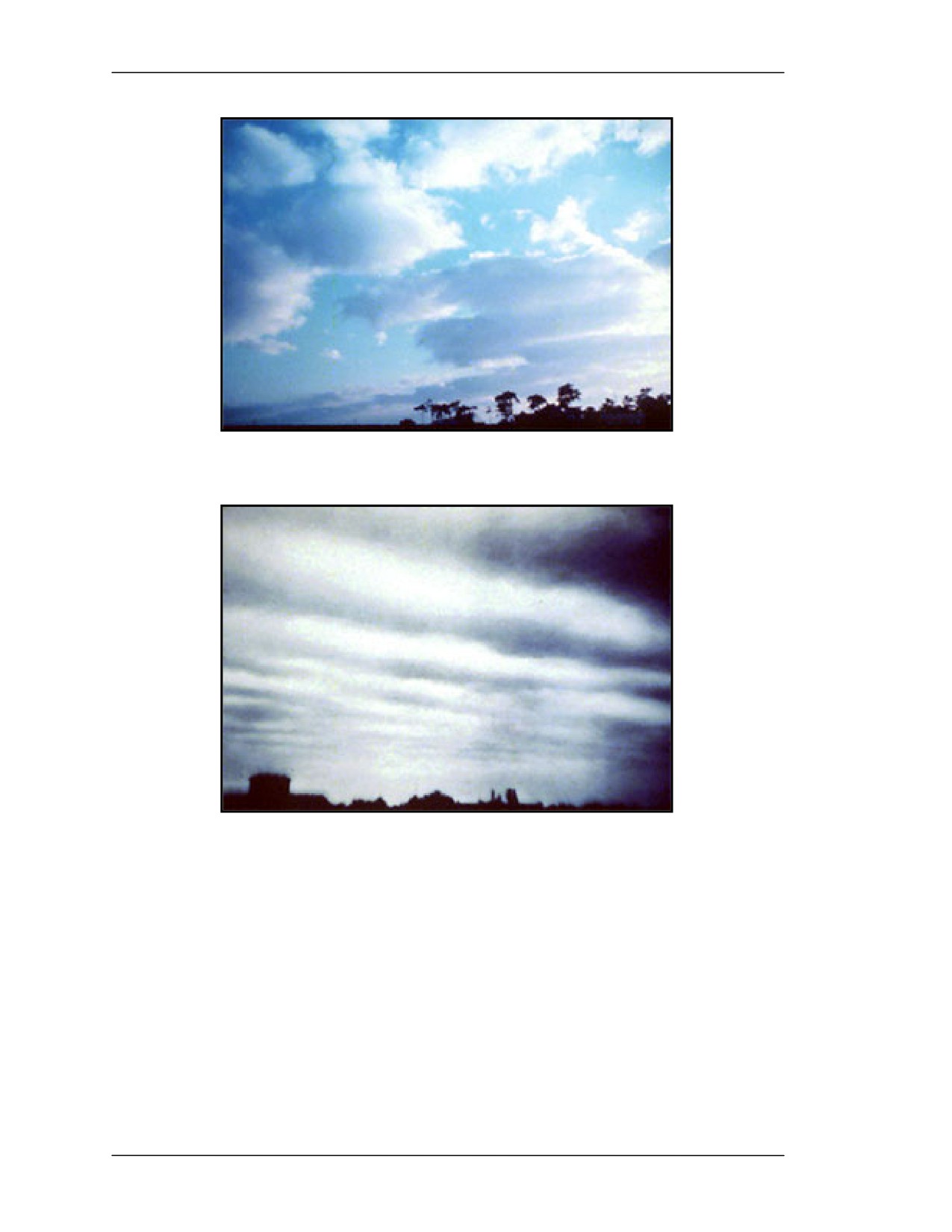
FM 3-97.61
Figure 1-1. Cumulus clouds.
Figure 1-2. Stratus clouds.
1-16
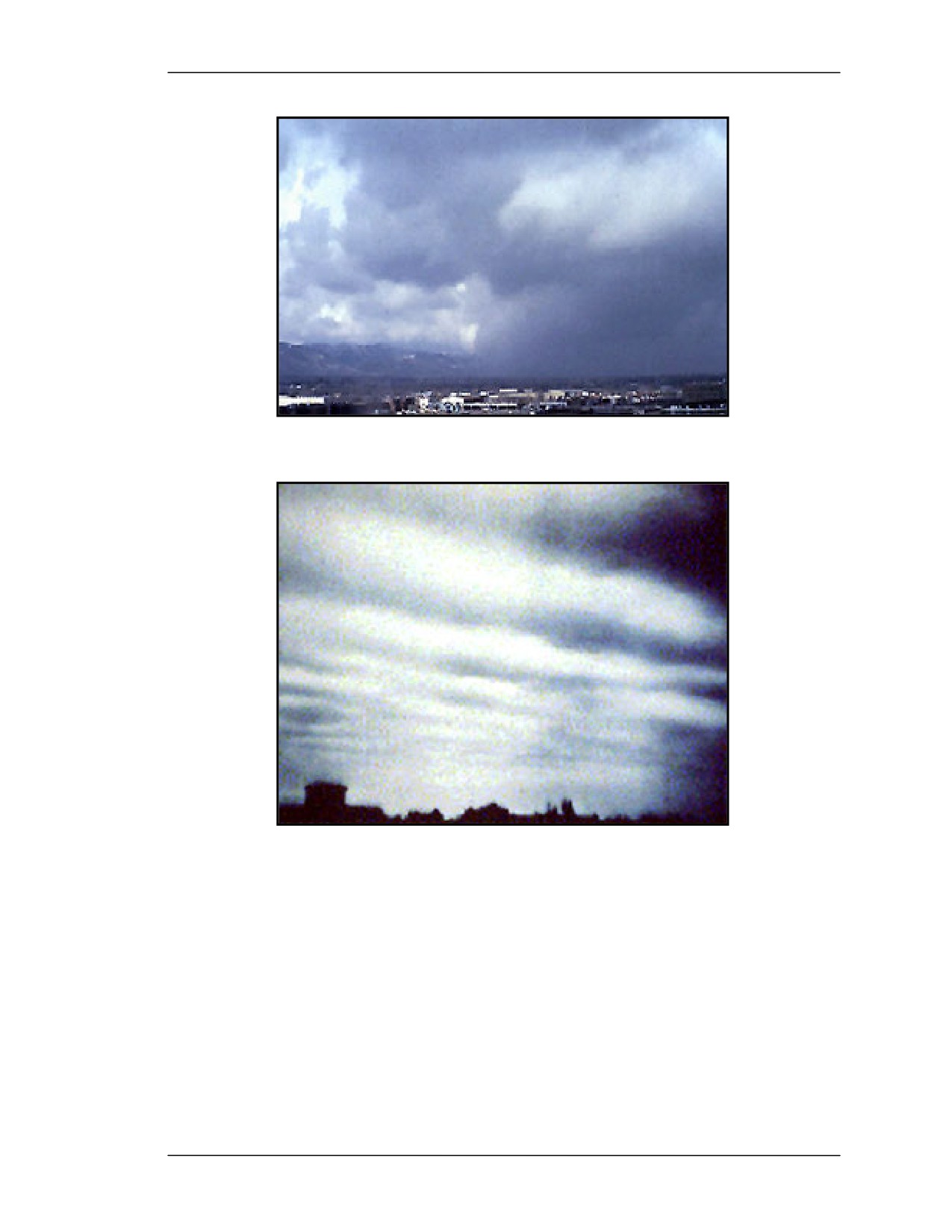
FM 3-97.61
Figure 1-3. Nimbostratus clouds.
Figure 1-4. Stratocumulus clouds.
(2) Low-level clouds may be identified by their height above nearby surrounding
relief of known elevation. Most precipitation originates from low-level clouds because
rain or snow usually evaporate before reaching the ground from higher clouds. Low-level
clouds usually indicate impending precipitation, especially if the cloud is more than 3,000
feet thick. (Clouds that appear dark at their bases are more than 3,000 feet thick.)
b. Mid-Level Clouds. Mid-level clouds (between 6,500 to 20,000 feet) have a prefix
of alto. Middle clouds appear less distinct than low clouds because of their height. Alto
clouds with sharp edges are warmer because they are composed mainly of water droplets.
Cold clouds, composed mainly of ice crystals and usually colder than -30 degrees F, have
distinct edges that grade gradually into the surrounding sky. Middle clouds usually
1-17
FM 3-97.61
indicate fair weather, especially if they are rising over time. Lowering middle clouds
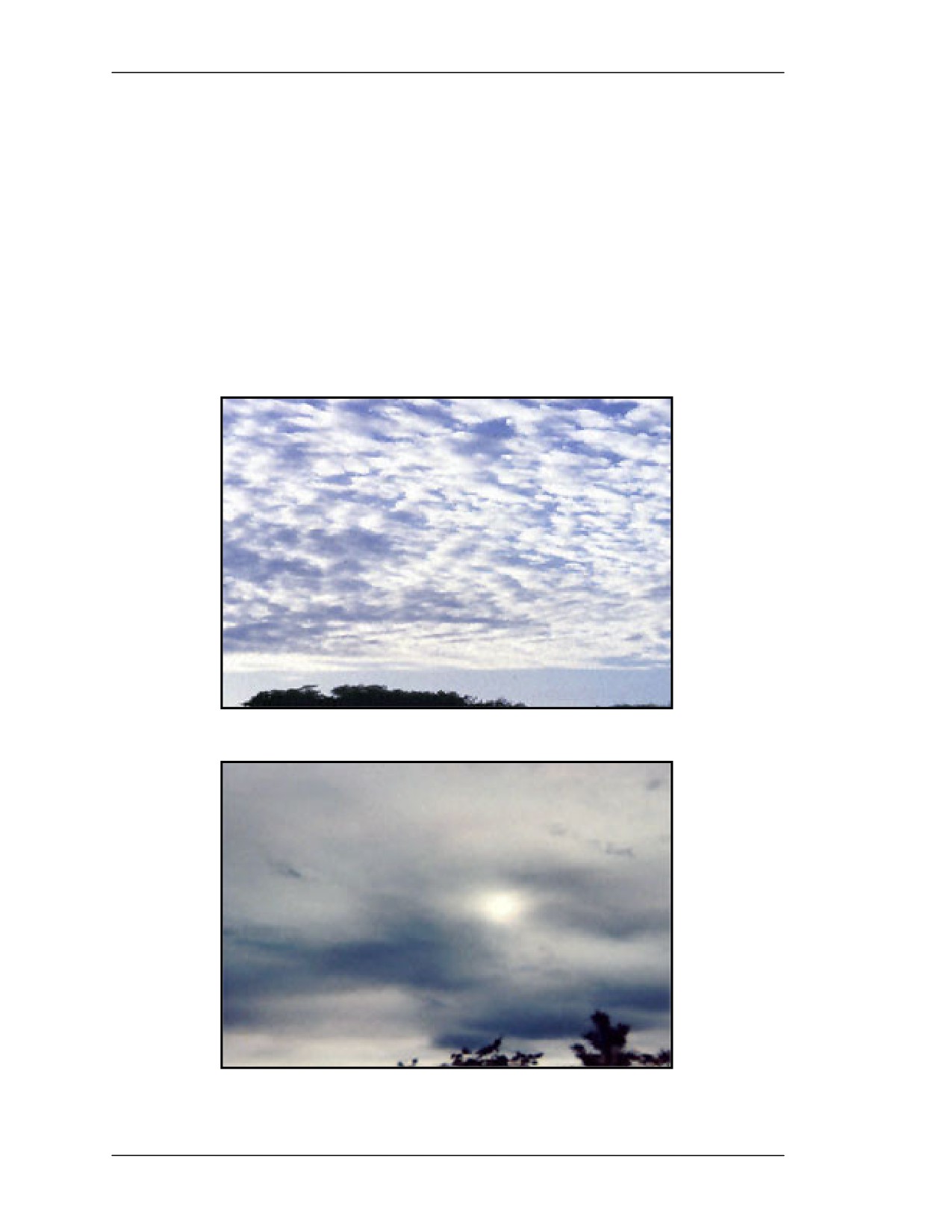
indicate potential storms, though usually hours away. There are two types of mid-level
clouds, altocumulus and altostratus clouds (Figures 1-5 and 1-6).
(1) Altocumulus clouds can appear as parallel bands or rounded masses. Typically a
portion of an altocumulus cloud is shaded, a characteristic which makes them
distinguishable from high-level cirrocumulus. Altocumulus clouds usually form in
advance of a cold front. The presence of altocumulus clouds on a warm humid summer
morning is commonly followed by thunderstorms later in the day. Altocumulus clouds
that are scattered rather than even, in a blue sky, are called “fair weather” cumulus and
suggest arrival of high pressure and clear skies.
(2) Altostratus clouds are often confused with cirrostratus. The one distinguishing
feature is that a halo is not observed around the sun or moon. With altostratus, the sun or
moon is only vaguely visible and appears as if it were shining through frosted glass.
Figure 1-5. Altocumulus.
Figure 1-6. Altostratus.
1-18
FM 3-97.61
c. High-Level Clouds. High-level clouds (more than 20,000 feet above ground
level) are usually frozen clouds, indicating air temperatures at that elevation below -30
degrees Fahrenheit, with a fibrous structure and blurred outlines. The sky is often covered
with a thin veil of cirrus that partly obscures the sun or, at night, produces a ring of light
around the moon. The arrival of cirrus indicates moisture aloft and the approach of a
traveling storm system. Precipitation is often
24 to 36 hours away. As the storm
approaches, the cirrus thickens and lowers, becoming altostratus and eventually stratus.
Temperatures are warm, humidity rises, and winds become southerly or south easterly.
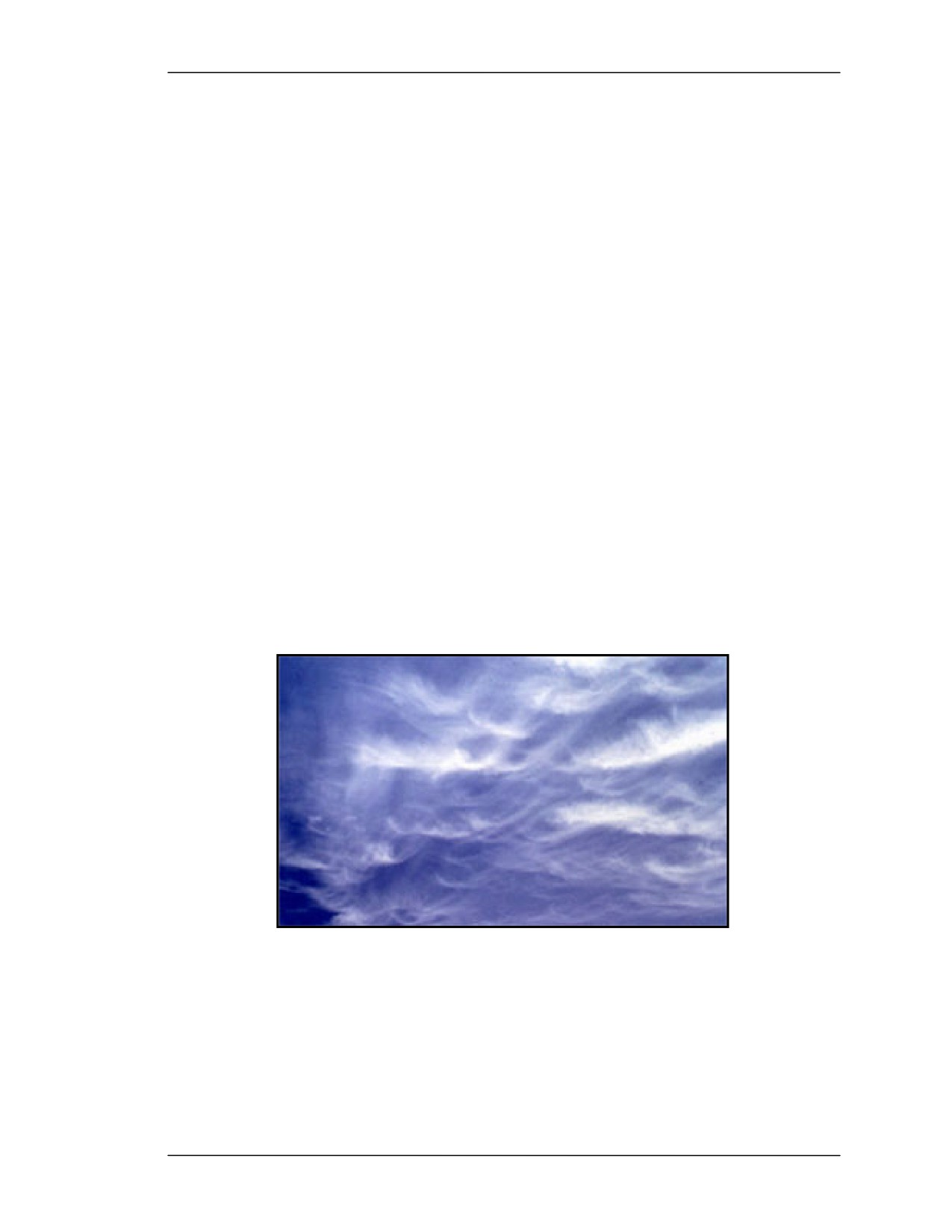
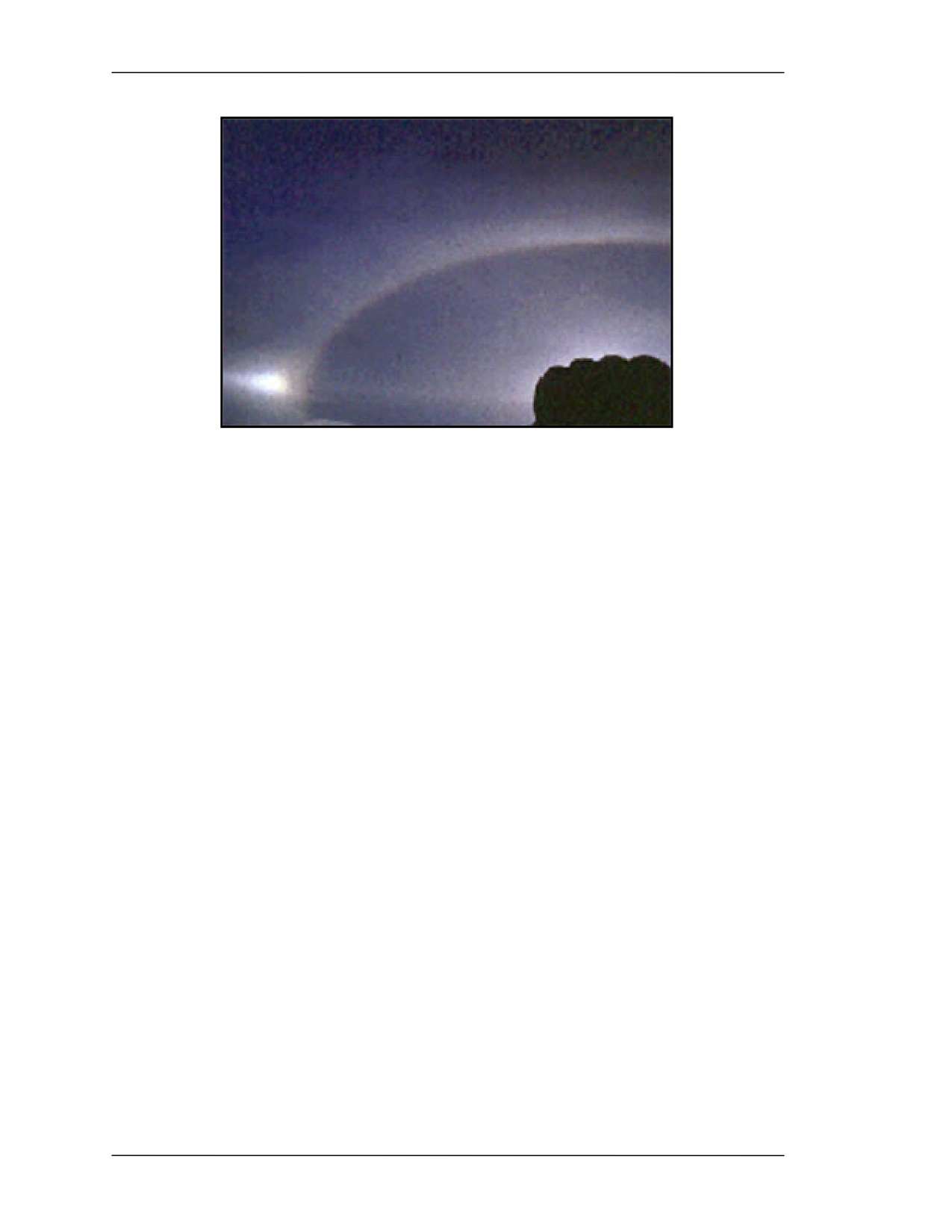
The two types of high-level clouds are cirrus and cirrostratus (Figure 1-7 and Figure 1-8,
page 1-20).
(1) Cirrus clouds are the most common of the high-level clouds. Typically found at
altitudes greater than 20,000 feet, cirrus are composed of ice crystals that form when
super-cooled water droplets freeze. Cirrus clouds generally occur in fair weather and
point in the direction of air movement at their elevation. Cirrus can be observed in a
variety of shapes and sizes. They can be nearly straight, shaped like a comma, or
seemingly all tangled together. Extensive cirrus clouds are associated with an
approaching warm front.
(2) Cirrostratus clouds are sheet-like, high-level clouds composed of ice crystals.
They are relatively transparent and can cover the entire sky and be up to several thousand
feet thick. The sun or moon can be seen through cirrostratus. Sometimes the only
indication of cirrostratus clouds is a halo around the sun or moon. Cirrostratus clouds
tend to thicken as a warm front approaches, signifying an increased production of ice
crystals. As a result, the halo gradually disappears and the sun or moon becomes less
visible.
Figure 1-7. Cirrus.
1-19
FM 3-97.61
Figure 1-8. Cirrostratus.
d. Vertical-Development Clouds. Clouds with vertical development can grow to
heights in excess of 39,000 feet, releasing incredible amounts of energy. The two types of
clouds with vertical development are fair weather cumulus and cumulonimbus.
(1) Fair weather cumulus clouds have the appearance of floating cotton balls and
have a lifetime of 5 to 40 minutes. Known for their flat bases and distinct outlines, fair
weather cumulus exhibit only slight vertical growth, with the cloud tops designating the
limit of the rising air. Given suitable conditions, however, these clouds can later develop
into towering cumulonimbus clouds associated with powerful thunderstorms. Fair
weather cumulus clouds are fueled by buoyant bubbles of air known as thermals that rise
up from the earth’s surface. As the air rises, the water vapor cools and condenses forming
water droplets. Young fair weather cumulus clouds have sharply defined edges and bases
while the edges of older clouds appear more ragged, an artifact of erosion. Evaporation
along the cloud edges cools the surrounding air, making it heavier and producing sinking
motion outside the cloud. This downward motion inhibits further convection and growth
of additional thermals from down below, which is why fair weather cumulus typically
have expanses of clear sky between them. Without a continued supply of rising air, the
cloud begins to erode and eventually disappears.
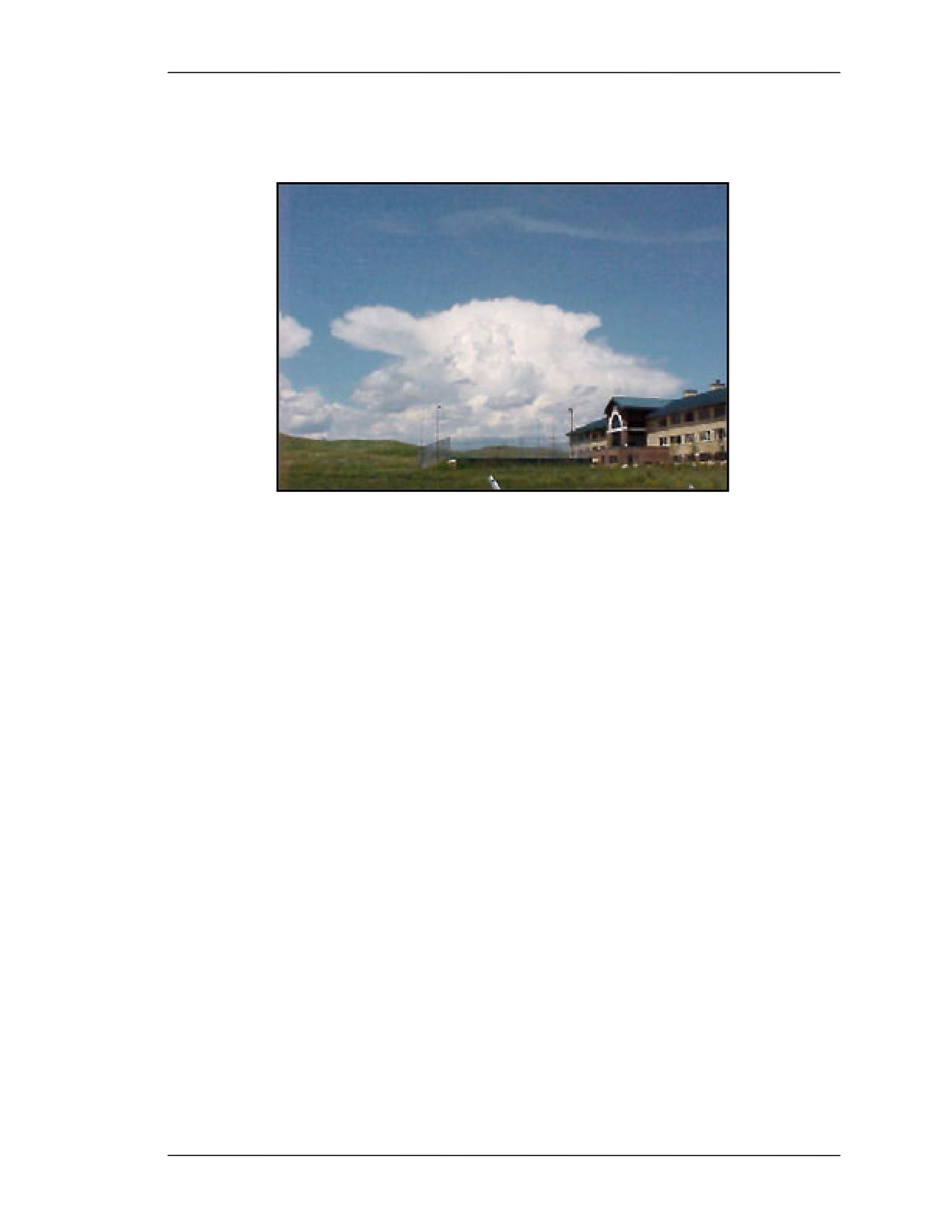
(2) Cumulonimbus clouds are much larger and more vertically developed than fair
weather cumulus (Figure 1-9). They can exist as individual towers or form a line of
towers called a squall line. Fueled by vigorous convective updrafts, the tops of
cumulonimbus clouds can reach 39,000 feet or higher. Lower levels of cumulonimbus
clouds consist mostly of water droplets while at higher elevations, where the
temperatures are well below freezing, ice crystals dominate the composition. Under
favorable conditions, harmless fair weather cumulus clouds can quickly develop into
large cumulonimbus associated with powerful thunderstorms known as super-cells.
Super-cells are large thunderstorms with deep rotating updrafts and can have a lifetime of
several hours. Super-cells produce frequent lightning, large hail, damaging winds, and
1-20
FM 3-97.61
tornadoes. These storms tend to develop during the afternoon and early evening when the
effects of heating from the sun are the strongest.
Figure 1-9. Cumulonimbus.
e. Other Cloud Types. These clouds are a collection of miscellaneous types that do
not fit into the previous four groups. They are orographic clouds, lenticulars, and
contrails.
(1) Orographic clouds develop in response to the forced lifting of air by the earth’s
topography. Air passing over a mountain oscillates up and down as it moves downstream.
Initially, stable air encounters a mountain, is lifted upward, and cools. If the air cools to
its saturation temperature during this process, the water vapor condenses and becomes
visible as a cloud. Upon reaching the mountain top, the air is heavier than the
environment and will sink down the other side, warming as it descends. Once the air
returns to its original height, it has the same buoyancy as the surrounding air. However,
the air does not stop immediately because it still has momentum carrying it downward.
With continued descent, the air becomes warmer then the surrounding air and accelerates
back upwards towards its original height. Another name for this type of cloud is the
lenticular cloud.
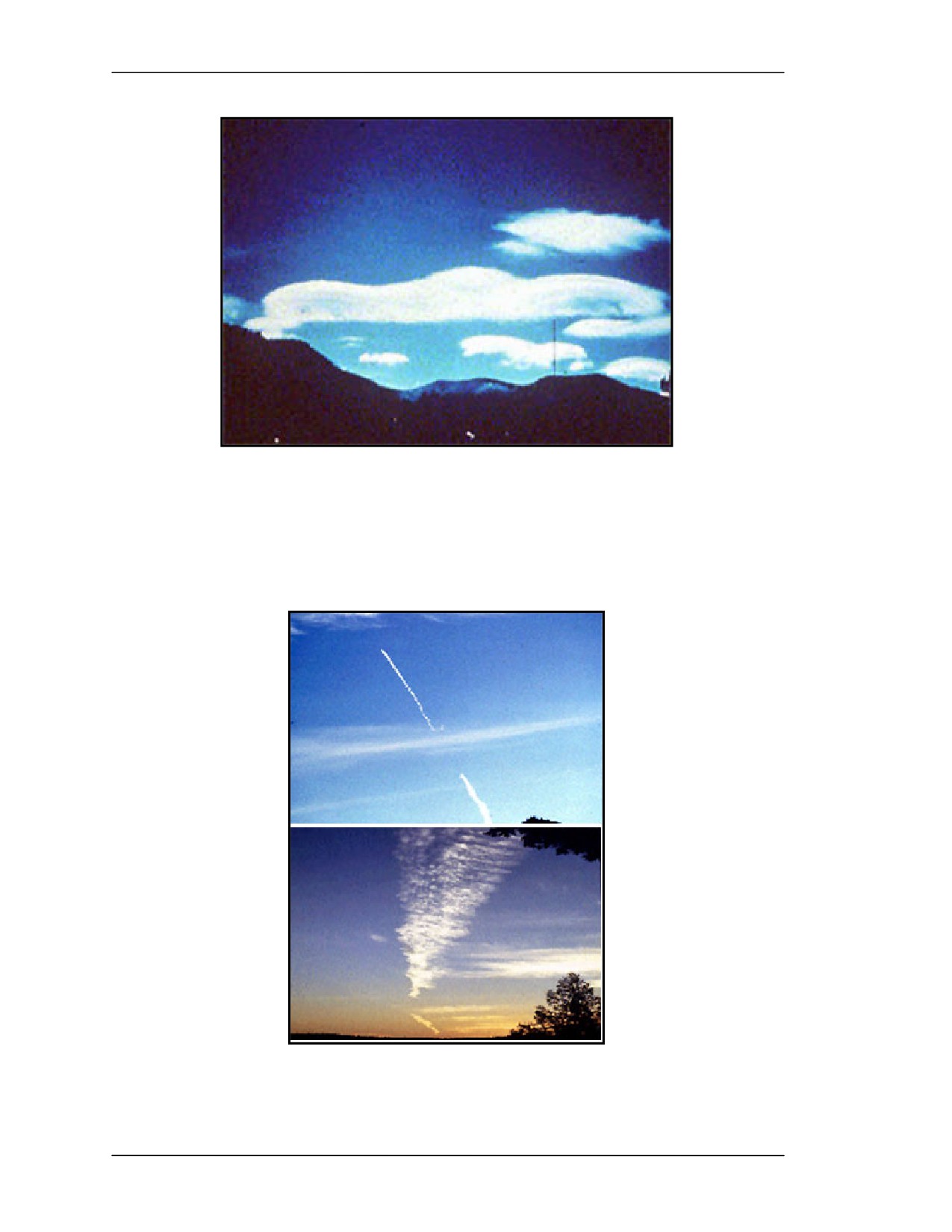
(2) Lenticular clouds are cloud caps that often form above pinnacles and peaks, and
usually indicate higher winds aloft (Figure 1-10, page 1-22). Cloud caps with a lens
shape, similar to a
“flying saucer,” indicate extremely high winds (over 40 knots).
Lenticulars should always be watched for changes. If they grow and descend, bad
weather can be expected.
1-21
FM 3-97.61
Figure 1-10. Lenticular.
(3) Contrails are clouds that are made by water vapor being inserted into the upper
atmosphere by the exhaust of jet engines (Figure 1-11). Contrails evaporate rapidly in fair
weather. If it takes longer than two hours for contrails to evaporate, then there is
impending bad weather (usually about 24 hours prior to a front).
Figure 1-11. Contrails.
1-22
FM 3-97.61
f. Cloud Interpretation. Serious errors can occur in interpreting the extent of cloud
cover, especially when cloud cover must be reported to another location. Cloud cover
always appears greater on or near the horizon, especially if the sky is covered with
cumulus clouds, since the observer is looking more at the sides of the clouds rather than
between them. Cloud cover estimates should be restricted to sky areas more than 40
degrees above the horizon―that is, to the local sky. Assess the sky by dividing the 360
degrees of sky around you into eighths. Record the coverage in eighths and the types of
clouds observed.
1-18. FRONTS
Fronts occur when two air masses of different moisture and temperature contents meet.
One of the indicators that a front is approaching is the progression of the clouds. The four
types of fronts are warm, cold, occluded, and stationary.
a. Warm Front. A warm front occurs when warm air moves into and over a slower
or stationary cold air mass. Because warm air is less dense, it will rise up and over the
cooler air. The cloud types seen when a warm front approaches are cirrus, cirrostratus,
nimbostratus (producing rain), and fog. Occasionally, cumulonimbus clouds will be seen
during the summer months.
b. Cold Front. A cold front occurs when a cold air mass overtakes a slower or
stationary warm air mass. Cold air, being more dense than warm air, will force the warm
air up. Clouds observed will be cirrus, cumulus, and then cumulonimbus producing a
short period of showers.
c. Occluded Front. Cold fronts generally move faster than warm fronts. The cold
fronts eventually overtake warm fronts and the warm air becomes progressively lifted
from the surface. The zone of division between cold air ahead and cold air behind is
called a “cold occlusion.” If the air behind the front is warmer than the air ahead, it is a
warm occlusion. Most land areas experience more occlusions than other types of fronts.
The cloud progression observed will be cirrus, cirrostratus, altostratus, and nimbostratus.
Precipitation can be from light to heavy.
d. Stationary Front. A stationary front is a zone with no significant air movement.
When a warm or cold front stops moving, it becomes a stationary front. Once this
boundary begins forward motion, it once again becomes a warm or cold front. When
crossing from one side of a stationary front to another, there is typically a noticeable
temperature change and shift in wind direction. The weather is usually clear to partly
cloudy along the stationary front.
1-19. TEMPERATURE
Normally, a temperature drop of 3 to 5 degrees Fahrenheit for every 1,000 feet gain in
altitude is encountered in motionless air. For air moving up a mountain with condensation
occurring (clouds, fog, and precipitation), the temperature of the air drops 3.2 degrees
Fahrenheit with every 1,000 feet of elevation gain. For air moving up a mountain with no
clouds forming, the temperature of the air drops 5.5 degrees Fahrenheit for every 1,000
feet of elevation gain.
a. An expedient to this often occurs on cold, clear, calm mornings. During a troop
movement or climb started in a valley, higher temperatures may often be encountered as
altitude is gained. This reversal of the normal cooling with elevation is called temperature
1-23
FM 3-97.61
inversion. Temperature inversions are caused when mountain air is cooled by ice, snow,
and heat loss through thermal radiation. This cooler, denser air settles into the valleys and
low areas. The inversion continues until the sun warms the surface of the earth or a
moderate wind causes a mixing of the warm and cold layers. Temperature inversions are
common in the mountainous regions of the arctic, subarctic, and mid-latitudes.
b. At high altitudes, solar heating is responsible for the greatest temperature
contrasts. More sunshine and solar heat are received above the clouds than below. The
important effect of altitude is that the sun’s rays pass through less of the atmosphere and
more direct heat is received than at lower levels, where solar radiation is absorbed and
reflected by dust and water vapor. Differences of 40 to 50 degrees Fahrenheit may occur
between surface temperatures in the shade and surface temperatures in the sun. This is
particularly true for dark metallic objects. The difference in temperature felt on the skin
between the sun and shade is normally 7 degrees Fahrenheit. Special care must be taken
to avoid sunburn and snow blindness. Besides permitting rapid heating, the clear air at
high altitudes also favors rapid cooling at night. Consequently, the temperature rises fast
after sunrise and drops quickly after sunset. Much of the chilled air drains downward, due
to convection currents, so that the differences between day and night temperatures are
greater in valleys than on slopes.
c. Local weather patterns force air currents up and over mountaintops. Air is cooled
on the windward side of the mountain as it gains altitude, but more slowly (3.2 degrees
Fahrenheit per 1,000 feet) if clouds are forming due to heat release when water vapor
becomes liquid. On the leeward side of the mountain, this heat gained from the
condensation on the windward side is added to the normal heating that occurs as the air
descends and air pressure increases. Therefore, air and winds on the leeward slope are
considerably warmer than on the windward slope, which is referred to as Chinook winds.
The heating and cooling of the air affects planning considerations primarily with regard
to the clothing and equipment needed for an operation.
1-20. WEATHER FORECASTING
The use of a portable aneroid barometer, thermometer, wind meter, and hygrometer help
in making local weather forecasts. Reports from other localities and from any weather
service, including USAF, USN, or the National Weather Bureau, are also helpful.
Weather reports should be used in conjunction with the locally observed current weather
situation to forecast future weather patterns.
a. Weather at various elevations may be quite different because cloud height,
temperature, and barometric pressure will all be different. There may be overcast and rain
in a lower area, with mountains rising above the low overcast into warmer clear weather.
b. To be effective, a forecast must reach the small-unit leaders who are expected to
utilize weather conditions for assigned missions. Several different methods can be used to
create a forecast. The method a forecaster chooses depends upon the forecaster’s
experience, the amount of data available, the level of difficulty that the forecast situation
presents, and the degree of accuracy needed to make the forecast. The five ways to
forecast weather are:
(1) Persistence Method. “Today equals tomorrow” is the simplest way of producing a
forecast. This method assumes that the conditions at the time of the forecast will not
1-24
FM 3-97.61
change; for example, if today was hot and dry, the persistence method predicts that
tomorrow will be the same.
(2) Trends Method. “Nowcasting” involves determining the speed and direction of
fronts, high- and low-pressure centers, and clouds and precipitation. For example, if a
cold front moves 300 miles during a 24-hour period, we can predict that it will travel 300
miles in another 24-hours.
(3) Climatology Method. This method averages weather statistics accumulated over
many years. This only works well when the pattern is similar to the following years.
(4) Analog Method. This method examines a day’s forecast and recalls a day in the
past when the weather looked similar (an analogy). This method is difficult to use
because finding a perfect analogy is difficult.
(5) Numerical Weather Prediction. This method uses computers to analyze all
weather conditions and is the most accurate of the five methods.
1-21. RECORDING DATA
An accurate observation is essential in noting trends in weather patterns. Ideally, under
changing conditions, trends will be noted in some weather parameters. However, this
may not always be the case. A minor shift in the winds may signal an approaching storm.
a. Wind Direction. Assess wind direction as a magnetic direction from which the
wind is blowing.
b. Wind Speed. Assess wind speed in knots.
(1) If an anemometer is available, assess speed to the nearest knot.
(2) If no anemometer is available, estimate the speed in knots. Judge the wind speed
by the way objects, such as trees, bushes, tents, and so forth, are blowing.
c. Visibility in Meters. Observe the farthest visible major terrain or man-made
feature and determine the distance using any available map.
d. Present Weather. Include any precipitation or obscuring weather. The following
are examples of present weather:
• Rain―continuous and steady liquid precipitation that will last at least one
hour.
• Rain showers―short-term and potentially heavy downpours that rarely last
more than one hour.
• Snow―continuous and steady frozen precipitation that will last at least one
hour.
• Snow showers―short-term and potentially heavy frozen downpours that
rarely last more than one hour.
• Fog, haze―obstructs visibility of ground objects.
• Thunderstorms―a potentially dangerous storm. Thunderstorms will produce
lightning, heavy downpours, colder temperatures, tornadoes
(not too
frequently), hail, and strong gusty winds at the surface and aloft. Winds
commonly exceed 35 knots.
e. Total Cloud Cover. Assess total cloud cover in eighths. Divide the sky into eight
different sections measuring from horizon to horizon. Count the sections with cloud
cover, which gives the total cloud cover in eighths. (For example, if half of the sections
are covered with clouds, total cloud cover is 4/8.)
1-25
FM 3-97.61
f. Ceiling Height. Estimate where the cloud base intersects elevated terrain. Note if
bases are above all terrain. If clouds are not touching terrain, then estimate to the best of
your ability.
g. Temperature. Assess temperature with or without a thermometer.
(1) With a thermometer, assess temperature in degrees Celsius (use Fahrenheit only if
Celsius conversion is not available). To convert Fahrenheit to Celsius: C = F minus 32
times .55. To convert Celsius to Fahrenheit: F = 1.8 times C plus 32.
Example:
41 degrees F - 32 x .55 = 5 degrees C.
5 degrees C x 1.8 + 32 = 41 degrees F.
(2) Without a thermometer, estimate temperature as above or below freezing (0oC), as
well as an estimated temperature.
h.
Pressure Trend. With a barometer or altimeter, assess the pressure trend.
(1) A high pressure moving in will cause altimeters to indicate lower elevation.
(2) A low pressure moving in will cause altimeters to indicate higher elevation.
i.
Observed Weather. Note changes or trends in observed weather conditions.
(1) Deteriorating trends include:
• Marked wind direction shifts. A high pressure system wind flows clockwise.
A low pressure system wind flows counterclockwise. The closer the isometric
lines are, the greater the differential of pressure (greater wind speeds).
• Marked wind speed increases.
• Changes in obstructions to visibility.
• Increasing cloud coverage.
• Increase in precipitation. A steady drizzle is usually a long-lasting rain.
• Lowering cloud ceilings.
• Marked cooler temperature changes, which could indicate that a cold front is
passing through.
• Marked increase in humidity.
• Decreasing barometric pressure, which indicates a lower pressure system is
moving through the area.
(2) Improving trends include:
• Steady wind direction, which indicates no change in weather systems in the
area.
• Decreasing wind speeds.
• Clearing of obstructions to visibility.
• Decreasing or ending precipitation.
• Decreasing cloud coverage.
• Increasing height of cloud ceilings.
• Temperature changes slowly warmer.
• Humidity decreases.
• Increasing barometric pressure, which indicates that a higher pressure system
is moving through the area.
j.
Update. Continue to evaluate observed conditions and update the forecast.
1-26
FM 3-97.61
Section III. MOUNTAIN HAZARDS
Hazards can be termed natural (caused by natural occurrence), man-made (caused by an
individual, such as lack of preparation, carelessness, improper diet, equipment misuse), or
as a combination
(human trigger). There are two kinds of hazards while in the
mountains―subjective and objective. Combinations of objective and subjective hazards
are referred to as cumulative hazards.
1-22. SUBJECTIVE HAZARDS
Subjective hazards are created by humans; for example, choice of route, companions,
overexertion, dehydration, climbing above one’s ability, and poor judgment.
a. Falling. Falling can be caused by carelessness, over-fatigue, heavy equipment,
bad weather, overestimating ability, a hold breaking away, or other reasons.
b. Bivouac Site. Bivouac sites must be protected from rockfall, wind, lightning,
avalanche run-out zones, and flooding (especially in gullies). If the possibility of falling
exists, rope in, the tent and all equipment may have to be tied down.
c. Equipment. Ropes are not total security; they can be cut on a sharp edge or break
due to poor maintenance, age, or excessive use. You should always pack emergency and
bivouac equipment even if the weather situation, tour, or a short climb is seemingly low
of dangers.
1-23. OBJECTIVE HAZARDS
Objective hazards are caused by the mountain and weather and cannot be influenced by
man; for example, storms, rockfalls, icefalls, lightning, and so on.
a. Altitude. At high altitudes
(especially over
6,500 feet), endurance and
concentration is reduced. Cut down on smoking and alcohol. Sleep well, acclimatize
slowly, stay hydrated, and be aware of signs and symptoms of high-altitude illnesses.
Storms can form quickly and lightning can be severe.
b. Visibility. Fog, rain, darkness, and or blowing snow can lead to disorientation.
Take note of your exact position and plan your route to safety before visibility decreases.
Cold combined with fog can cause a thin sheet of ice to form on rocks (verglas).
Whiteout conditions can be extremely dangerous. If you must move under these
conditions, it is best to rope up. Have the point man move to the end of the rope. The
second man will use the first man as an aiming point with the compass. Use a route
sketch and march table. If the tactical situation does not require it, plan route so as not to
get caught by darkness.
c. Gullies. Rock, snow, and debris are channeled down gullies. If ice is in the gully,
climbing at night may be better because the warming of the sun will loosen stones and
cause rockfalls.
d. Rockfall. Blocks and scree at the base of a climb can indicate recurring rockfall.
Light colored spots on the wall may indicate impact chips of falling rock. Spring melt or
warming by the sun of the rock/ice/snow causes rockfall.
e. Avalanches. Avalanches are caused by the weight of the snow overloading the
slope. (Refer to paragraph 1-25 for more detailed information on avalanches.)
f. Hanging Glaciers and Seracs. Avoid, if at all possible, hanging glaciers and
seracs. They will fall without warning regardless of the time of day or time of year. One
1-27
FM 3-97.61
cubic meter of glacier ice weighs 910 kilograms (about 2,000 pounds). If you must cross
these danger areas, do so quickly and keep an interval between each person.
g. Crevasses. Crevasses are formed when a glacier flows over a slope and makes a
bend, or when a glacier separates from the rock walls that enclose it. A slope of only two
to three degrees is enough to form a crevasse. As this slope increases from 25 to 30
degrees, hazardous icefalls can be formed. Likewise, as a glacier makes a bend, it is
likely that crevasses will form at the outside of the bend. Therefore, the safest route on a
glacier would be to the inside of bends, and away from steep slopes and icefalls. Extreme
care must be taken when moving off of or onto the glacier because of the moat that is
most likely to be present.
1-24. WEATHER HAZARDS
Weather conditions in the mountains may vary from one location to another as little as 10
kilometers apart. Approaching storms may be hard to spot if masked by local peaks. A
clear, sunny day in July could turn into a snowstorm in less than an hour. Always pack
some sort of emergency gear.
a. Winds are stronger and more variable in the mountains; as wind doubles in speed,
the force quadruples.
b. Precipitation occurs more on the windward side than the leeward side of ranges.
This causes more frequent and denser fog on the windward slope.
c. Above approximately 8,000 feet, snow can be expected any time of year in the
temperate climates.
d. Air is dryer at higher altitudes, so equipment does not rust as quickly, but
dehydration is of greater concern.
e. Lightning is frequent, violent, and normally attracted to high points and
prominent features in mountain storms. Signs indicative of thunderstorms are tingling of
the skin, hair standing on end, humming of metal objects, crackling, and a bluish light
(St. Elmo’s fire) on especially prominent metal objects
(summit crosses and radio
towers).
(1) Avoid peaks, ridges, rock walls, isolated trees, fixed wire installations, cracks that
guide water, cracks filled with earth, shallow depressions, shallow overhangs, and rock
needles. Seek shelter around dry, clean rock without cracks; in scree fields; or in deep
indentations (depressions, caves). Keep at least half a body’s length away from a cave
wall and opening.
(2) Assume a one-point-of-contact body position. Squat on your haunches or sit on a
rucksack or rope. Pull your knees to your chest and keep both feet together. If half way
up the rock face, secure yourself with more than one point―lightning can burn through
rope. If already rappelling, touch the wall with both feet together and hurry to the next
anchor.
f. During and after rain, expect slippery rock and terrain in general and adjust
movement accordingly. Expect flash floods in gullies or chimneys. A climber can be
washed away or even drowned if caught in a gully during a rainstorm. Be especially alert
for falling objects that the rain has loosened.
g. Dangers from impending high winds include frostbite (from increased wind-chill
factor), windburn, being blown about (especially while rappelling), and debris being
1-28
FM 3-97.61
blown about. Wear protective clothing and plan the route to be finished before bad
weather arrives.
h. For each 100-meter rise in altitude, the temperature drops approximately one
degree Fahrenheit. This can cause hypothermia and frostbite even in summer, especially
when combined with wind, rain, and snow. Always wear or pack appropriate clothing.
i.
If it is snowing, gullies may contain avalanches or snow sloughs, which may bury
the trail. Snowshoes or skis may be needed in autumn or even late spring. Unexpected
snowstorms may occur in the summer with accumulations of 12 to 18 inches; however,
the snow quickly melts.
j.
Higher altitudes provide less filtering effects, which leads to greater ultraviolet
(UV) radiation intensity. Cool winds at higher altitudes may mislead one into
underestimating the sun’s intensity, which can lead to sunburns and other heat injuries.
Use sunscreen and wear hat and sunglasses, even if overcast. Drink plenty of fluids.
1-25. AVALANCHE HAZARDS
Avalanches occur when the weight of accumulated snow on a slope exceeds the cohesive
forces that hold the snow in place. (Table 1-2, page 1-32, shows an avalanche hazard
evaluation checklist.)
a. Slope Stability. Slope stability is the key factor in determining the avalanche
danger.
(1) Slope Angle. Slopes as gentle as 15 degrees have avalanched. Most avalanches
occur on slopes between 30 and 45 degrees. Slopes above 60 degrees often do not build
up significant quantities of snow because they are too steep.
(2) Slope Profile. Dangerous slab avalanches are more likely to occur on convex
slopes, but may occur on concave slopes.
(3) Slope Aspect. Snow on north facing slopes is more likely to slide in midwinter.
South facing slopes are most dangerous in the spring and on sunny, warm days. Slopes on
the windward side are generally more stable than leeward slopes.
(4) Ground Cover. Rough terrain is more stable than smooth terrain. On grassy
slopes or scree, the snow pack has little to anchor to.
b. Triggers. Various factors trigger avalanches.
(1) Temperature. When the temperature is extremely low, settlement and adhesion
occur slowly. Avalanches that occur during extreme cold weather usually occur during or
immediately following a storm. At a temperature just below freezing, the snowpack
stabilizes quickly. At temperatures above freezing, especially if temperatures rise
quickly, the potential for avalanche is high. Storms with a rise in temperature can deposit
dry snow early, which bonds poorly with the heavier snow deposited later. Most
avalanches occur during the warmer midday.
(2) Precipitation. About 90 percent of avalanches occur during or within twenty-four
hours after a snowstorm. The rate at which snow falls is important. High rates of snowfall
(2.5 centimeters per hour or greater), especially when accompanied by wind, are usually
responsible for major periods of avalanche activity. Rain falling on snow will increase its
weight and weakens the snowpack.
(3) Wind. Sustained winds of 15 miles per hour and over transport snow and form
wind slabs on the lee side of slopes.
(4) Weight. Most victims trigger the avalanches that kill them.
1-29
FM 3-97.61
(5) Vibration. Passing helicopters, heavy equipment, explosions, and earth tremors
have triggered avalanches.
c. Snow Pits. Snow pits can be used to determine slope stability.
(1) Dig the snow pit on the suspect slope or a slope with the same sun and wind
conditions. Snow deposits may vary greatly within a few meters due to wind and sun
variations. (On at least one occasion, a snow pit dug across the fall line triggered the
suspect slope). Dig a 2-meter by 2-meter pit across the fall line, through all the snow, to
the ground. Once the pit is complete, smooth the face with a shovel.
(2) Conduct a shovel shear test.
(a) A shovel shear test puts pressure on a representative sample of the snowpack. The
core of this test is to isolate a column of the snowpack from three sides. The column
should be of similar size to the blade of the shovel. Dig out the sides of the column
without pressing against the column with the shovel (this affects the strength). To isolate
the rear of the column, use a rope or string to saw from side to side to the base of the
column.
(b) If the column remained standing while cutting the rear, place the shovel face
down on the top of the column. Tap with varying degrees of strength on the shovel to see
what force it takes to create movement on the bed of the column. The surface that
eventually slides will be the layer to look at closer. This test provides a better
understanding of the snowpack strength. For greater results you will need to do this test
in many areas and formulate a scale for the varying methods of tapping the shovel.
(3) Conduct a Rutschblock test. To conduct the test, isolate a column slightly longer
than the length of your snowshoes or skis (same method as for the shovel shear test). One
person moves on their skis or snowshoes above the block without disturbing the block.
Once above, the person carefully places one showshoe or ski onto the block with no body
weight for the first stage of the test. The next stage is adding weight to the first leg. Next,
place the other foot on the block. If the block is still holding up, squat once, then twice,
and so on. The remaining stage is to jump up and land on the block.
d. Types of Snow Avalanches. There are two types of snow avalanches: loose snow
(point) and slab.
(1) Loose snow avalanches start at one point on the snow cover and grow in the shape
of an inverted “V.” Although they happen most frequently during the winter snow
season, they can occur at any time of the year in the mountains. They often fall as many
small sluffs during or shortly after a storm. This process removes snow from steep upper
slopes and either stabilizes lower slopes or loads them with additional snow.
(2) Wet loose snow avalanches occur in spring and summer in all mountain ranges.
Large avalanches of this type, lubricated and weighed down by meltwater or rain can
travel long distances and have tremendous destructive power. Coastal ranges that have
high temperatures and frequent rain are the most common areas for this type of
avalanche.
(3) Slab avalanches occur when cohesive snow begins to slide on a weak layer. The
fracture line where the moving snow breaks away from the snowpack makes this type of
avalanche easy to identify. Slab release is rapid. Although any avalanche can kill you,
slab avalanches are generally considered more dangerous than loose snow avalanches.
1-30
FM 3-97.61
(a) Most slab avalanches occur during or shortly after a storm when slopes are loaded
with new snow at a critical rate. The old rule of never travel in avalanche terrain for a few
days after a storm still holds true.
(b) As slabs become harder, their behavior becomes more unpredictable; they may
allow several people to ski across before releasing. Many experts believe they are
susceptible to rapid temperature changes. Packed snow expands and contracts with
temperature changes. For normal density, settled snow, a drop in temperature of 10
degrees Celsius (18 degrees Fahrenheit) would cause a snow slope 300 meters wide to
contract
2 centimeters. Early ski mountaineers in the Alps noticed that avalanches
sometimes occurred when shadows struck a previously sun-warmed slope.
d. Protective Measures. Avoiding known or suspected avalanche areas is the
easiest method of protection. Other measures include:
(1) Personal Safety. Remove your hands from ski pole wrist straps. Detach ski
runaway cords. Prepare to discard equipment. Put your hood on. Close up your clothing
to prepare for hypothermia. Deploy avalanche cord. Make avalanche probes and shovels
accessible. Keep your pack on at all times—do not discard. Your pack can act as a
flotation device, as well as protect your spine.
(2) Group Safety. Send one person across the suspect slope at a time with the rest of
the group watching. All members of the group should move in the same track from safe
zone to safe zone.
e. Route Selection. Selecting the correct route will help avoid avalanche prone
areas, which is always the best choice. Always allow a wide margin of safety when
making your decision.
(1) The safest routes are on ridge tops, slightly on the windward side; the next safest
route is out in the valley, far from the bottom of slopes.
(2) Avoid cornices from above or below. Should you encounter a dangerous slope,
either climb to the top of the slope or descend to the bottom—well out of the way of the
run-out zone. If you must traverse, pick a line where you can traverse downhill as quickly
as possible. When you must ascend a dangerous slope, climb to the side of the avalanche
path, and not directly up the center.
(3) Take advantage of dense timber, ridges, or rocky outcrops as islands of safety.
Use them for lunch and rest stops. Spend as little time as possible on open slopes.
(4) Since most avalanches occur within twenty-four hours of a storm and or at
midday, avoid moving during these periods. Moving at night is tactically sound and may
be safer.
f. Stability Analysis. Look for nature’s billboards on slopes similar to the one you
are on.
(1) Evidence of Avalanching. Look for recent avalanches and for signs of wind-
loading and wind-slabs.
(2) Fracture Lines. Avoid any slopes showing cracks.
(3) Sounds. Beware of hollow sounds—a “whumping” noise. They may suggest a
radical settling of the snowpack.
g. Survival. People trigger avalanches that bury people. If these people recognized
the hazard and chose a different route, they would avoid the avalanche. The following
steps should be followed if caught in an avalanche.
1-31
///////////////////////////////////////