FM 3-97.61 MILITARY MOUNTAINEERING (AUGUST 2002) - page 5
FM 3-97.61
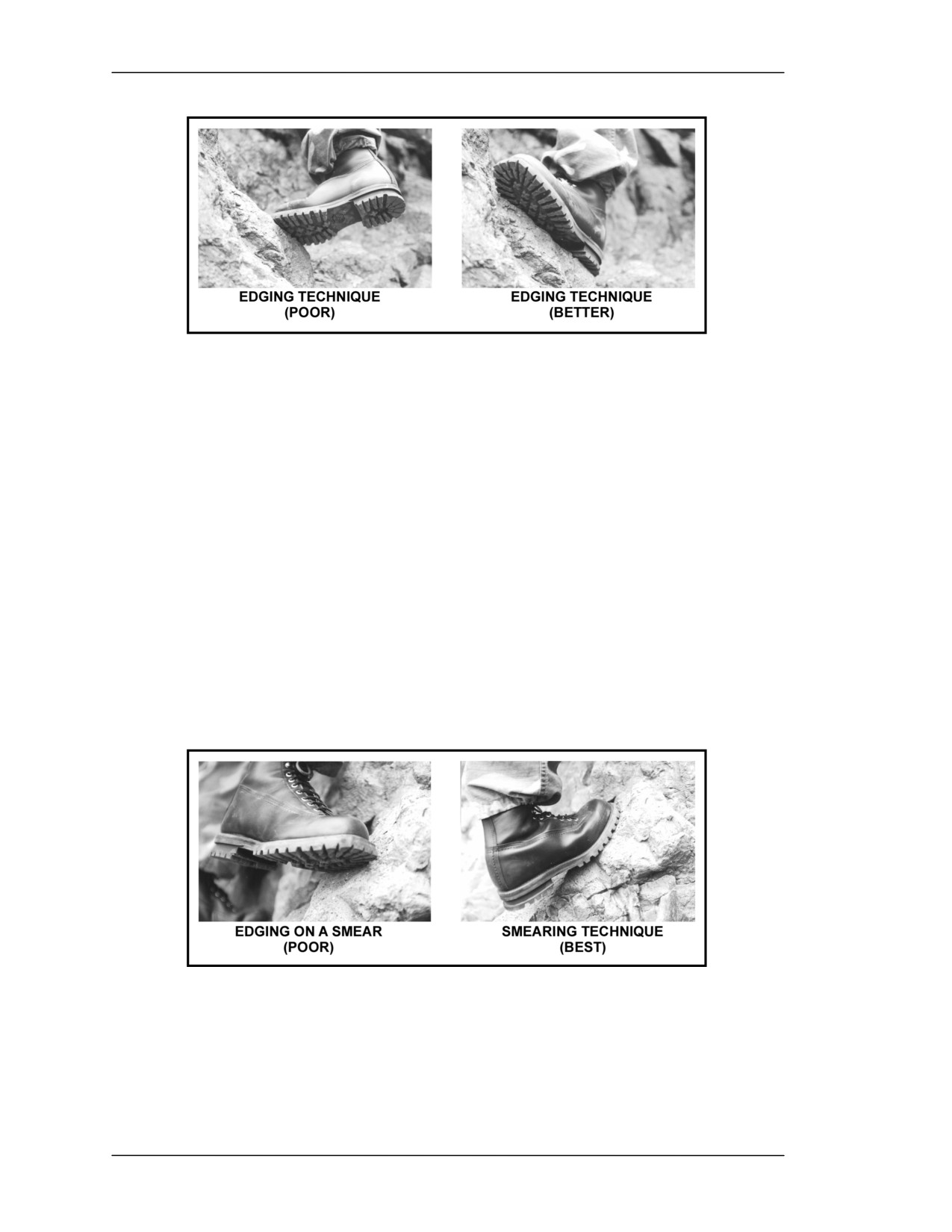
Figure 6-5. Examples of edging technique.
(3) Smearing. When footholds are too small to use a good edging technique, the ball
of the foot can be “smeared” over the hold. The smearing technique requires the boot to
adhere to the rock by deformation of the sole and by friction. Rock climbing shoes are
specifically designed to maximize friction for smearing; some athletic shoes also work
well. The Army mountain boot, with its softer sole, usually works better for smearing
than for edging. Rounded, down-sloping ledges and low-angled slab rock often require
good smearing technique. (Figure 6-6 shows examples of the smearing technique.)
(a) Effective smearing requires maximum friction between the foot and the rock.
Cover as much of the hold as possible with the ball of the foot. Keeping the heel low will
not only reduce muscle strain, but will increase the amount of surface contact between
the foot and the rock.
(b) Sometimes flexing the ankles and knees slightly will place the climber’s weight
more directly over the ball of the foot and increase friction; however, this is more tiring
and should only be used for quick, intermediate holds. The leg should be kept straight
whenever possible.
Figure 6-6. Examples of the smearing technique.
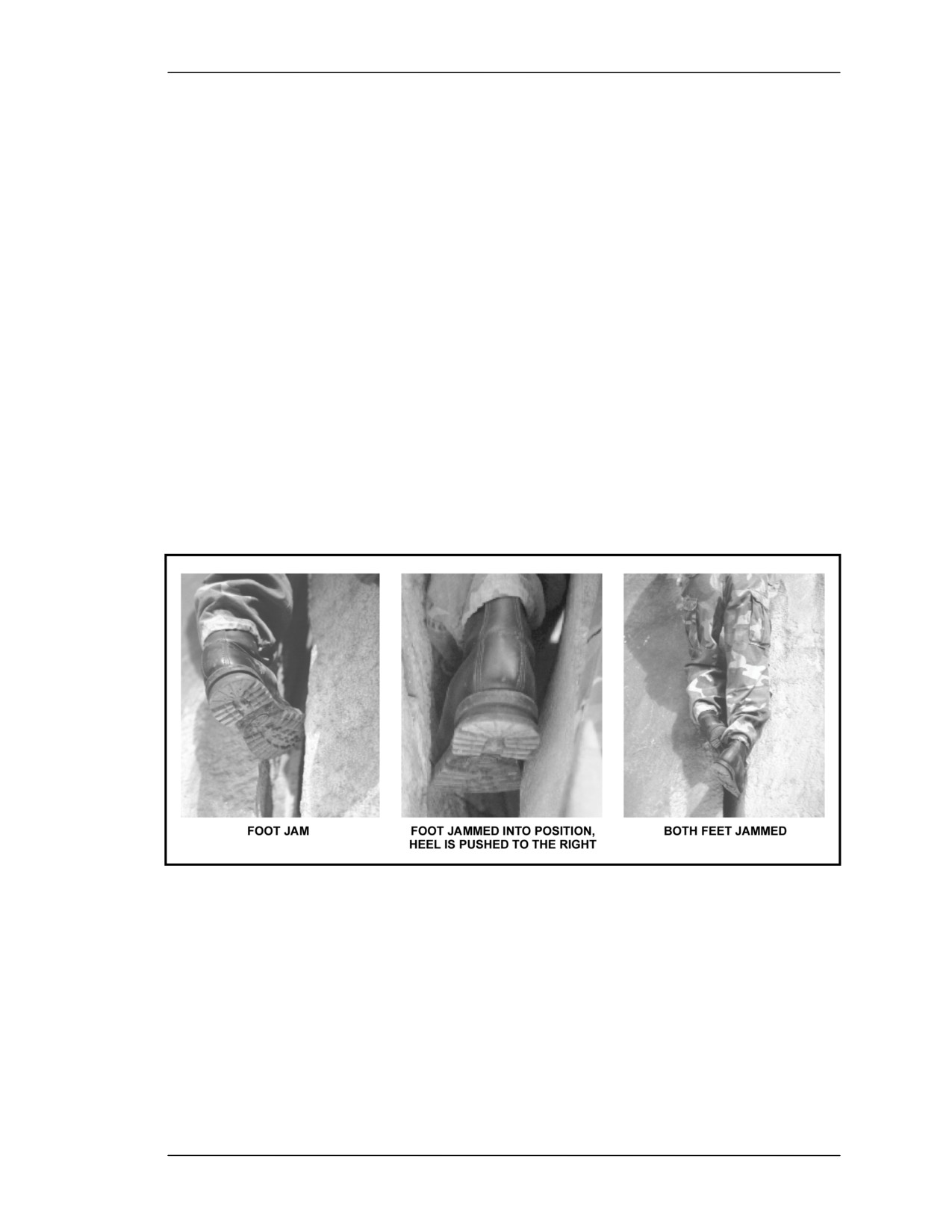
(4) Jamming. The jamming technique works on the same principal as chock
placement. The foot is set into a crack in such a way that it “jams” into place, resisting a
downward pull. The jamming technique is a specialized skill used to climb vertical or
6-12
FM 3-97.61
near vertical cracks when no other holds are available on the rock face. The technique is
not limited to just wedging the feet; fingers, hands, arms, even the entire leg or body are
all used in the jamming technique, depending on the size of the crack. Jam holds are
described in this text to broaden the range of climbing skills. Jamming holds can be used
in a crack while other hand/foot holds are used on the face of the rock. Many cracks will
have facial features, such as edges, pockets, and so on, inside and within reach. Always
look or feel for easier to use features. (Figure 6-7 shows examples of jamming.)
(a) The foot can be jammed in a crack in different ways. It can be inserted above a
constriction and set into the narrow portion, or it can be placed in the crack and turned,
like a camming device, until it locks in place tight enough to support the climber’s
weight. Aside from these two basic ideas, the possibilities are endless. The toes, ball of
the foot, or the entire foot can be used. Try to use as much of the foot as possible for
maximum surface contact. Some positions are more tiring, and even more painful on the
foot, than others. Practice jamming the foot in various ways to see what offers the most
secure, restful position.
(b) Some foot jams may be difficult to remove once weight has been committed to
them, especially if a stiffer sole boot is used. The foot is less likely to get stuck when it is
twisted or “cammed” into position. When removing the boot from a crack, reverse the
way it was placed to prevent further constriction.
Figure 6-7. Examples of jamming.
6-9.
USING THE HANDS
The hands can be placed on the rock in many ways. Exactly how and where to position
the hands and arms depends on what holds are available, and what configuration will best
support the current stance as well as the movement to the next stance. Selecting
handholds between waist and shoulder level helps in different ways. Circulation in the
arms and hands is best when the arms are kept low. Secondly, the climber has less
6-13
FM 3-97.61
tendency to “hang” on his arms when the handholds are at shoulder level and below. Both
of these contribute to a relaxed stance and reduce fatigue in the hands and arms.
a. As the individual climbs, he continually repositions his hands and arms to keep
the body in balance, with the weight centered over the feet. On lower-angled rock, he
may simply need to place the hands up against the rock and extend the arm to maintain
balance; just like using an ice ax as a third point of contact in mountain walking.
Sometimes, he will be able to push directly down on a large hold with the palm of the
hand. More often though, he will need to “grip” the rock in some fashion and then push
or pull against the hold to maintain balance.
b. As stated earlier, the beginner will undoubtedly place too much weight on the
hands and arms. If we think of ourselves climbing a ladder, our body weight is on our
legs. Our hands grip, and our arms pull on each rung only enough to maintain our balance
and footing on the ladder. Ideally, this is the amount of grip and pull that should be used
in climbing. Of course, as the size and availability of holds decreases, and the steepness
of the rock approaches the vertical, the grip must be stronger and more weight might be
placed on the arms and handholds for brief moments. The key is to move quickly from
the smaller, intermediate holds to the larger holds where the weight can be placed back
on the feet allowing the hands and arms to relax. The following describes some of the
basic handholds and how the hand can be positioned to maximize grip on smaller holds.
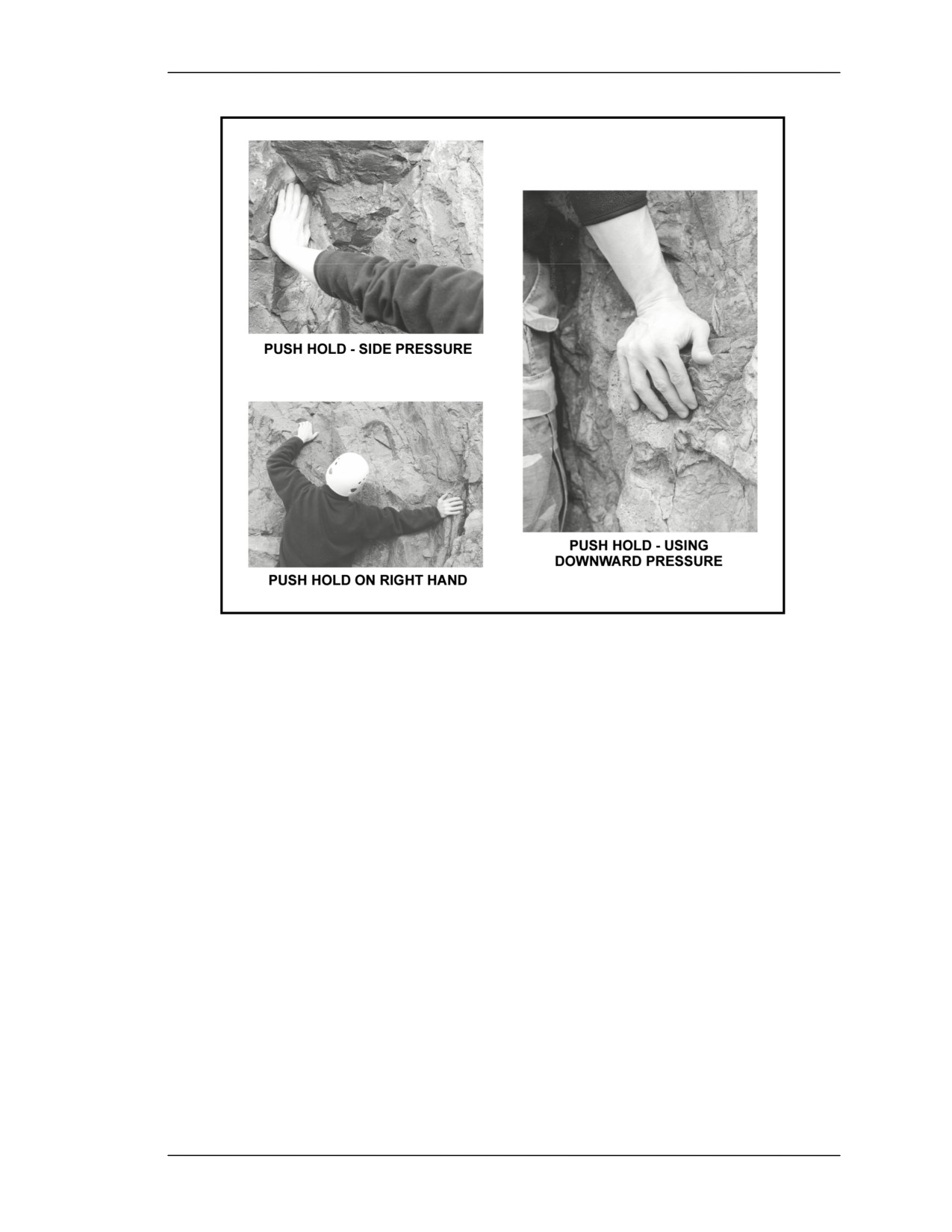
(1) Push Holds. Push holds rely on the friction created when the hand is pushed
against the rock. Most often a climber will use a push hold by applying “downward
pressure” on a ledge or nubbin. This is fine, and works well; however, the climber should
not limit his use of push holds to the application of down pressure. Pushing sideways, and
on occasion, even upward on less obvious holds can prove quite secure. Push holds often
work best when used in combination with other holds. Pushing in opposite directions and
“push-pull” combinations are excellent techniques. (Figure 6-8 shows examples of push
holds.)
(a) An effective push hold does not necessarily require the use of the entire hand. On
smaller holds, the side of the palm, the fingers, or the thumb may be all that is needed to
support the stance. Some holds may not feel secure when the hand is initially placed on
them. The hold may improve or weaken during the movement. The key is to try and
select a hold that will improve as the climber moves past it.
(b) Most push holds do not require much grip; however, friction might be increased
by taking advantage of any rough surfaces or irregularities in the rock. Sometimes the
strength of the hold can be increased by squeezing, or “pinching,” the rock between the
thumb and fingers (see paragraph on pinch holds).
6-14
FM 3-97.61
Figure 6-8. Examples of push holds.
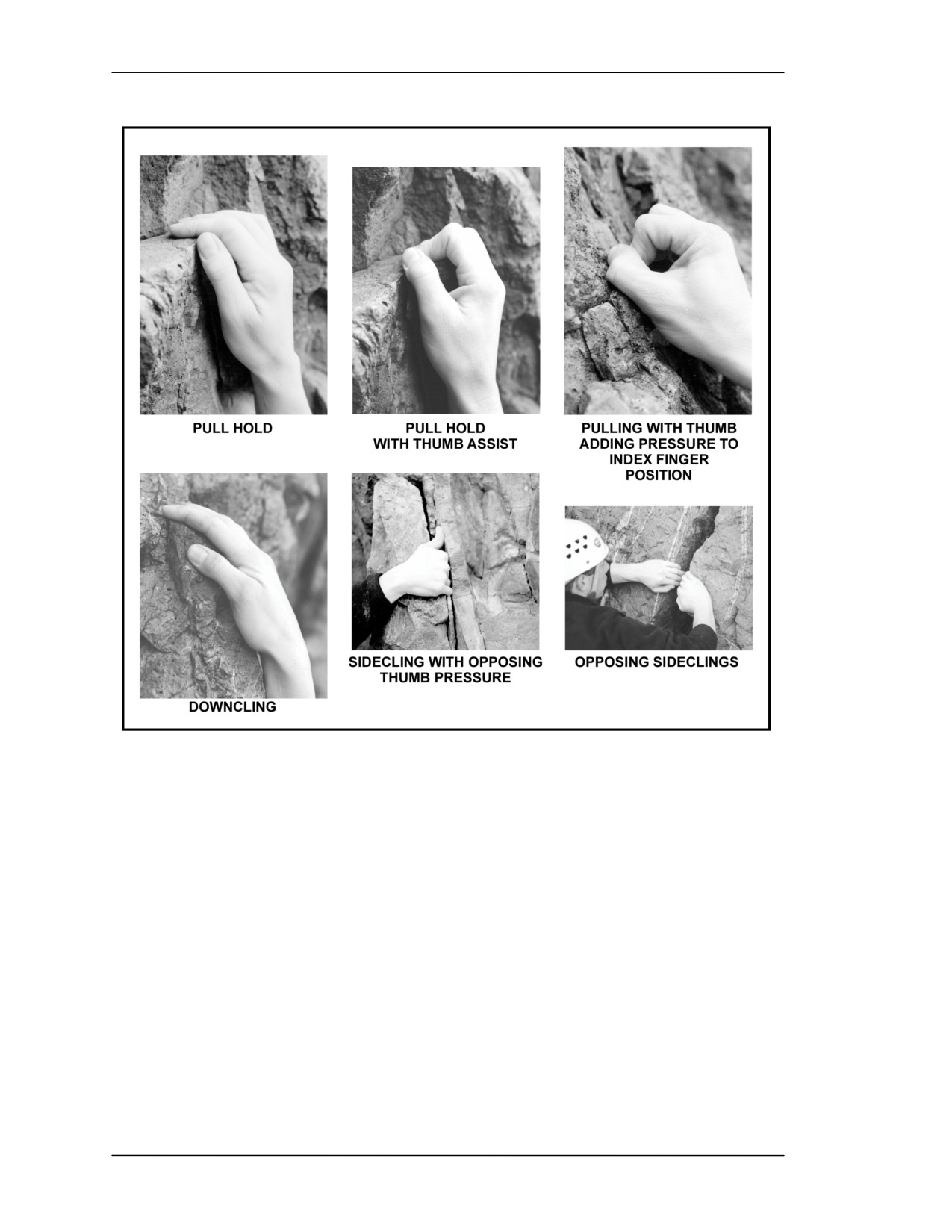
(2) Pull Holds. Pull holds, also called “cling holds,” which are grasped and pulled
upon, are probably the most widely used holds in climbing. Grip plays more of a role in a
pull hold, and, therefore, it normally feels more secure to the climber than a push hold.
Because of this increased feeling of security, pull holds are often overworked. These are
the holds the climber has a tendency to hang from. Most pull holds do not require great
strength, just good technique. Avoid the “death grip” syndrome by climbing with the feet.
(Figure 6-9, page 6-16, shows examples of pull holds.)
(a) Like push holds, pressure on a pull hold can be applied straight down, sideways,
or upward. Again, these are the holds the climber tends to stretch and reach for, creating
an unbalanced stance. Remember to try and keep the hands between waist and shoulder
level, making use of intermediate holds instead of reaching for those above the head.
(b) Pulling sideways on vertical cracks can be very secure. There is less tendency to
hang from “side-clings” and the hands naturally remain lower. The thumb can often push
against one side of the crack, in opposition to the pull by the fingers, creating a stronger
hold. Both hands can also be placed in the same crack, with the hands pulling in opposite
directions. The number of possible combinations is limited only by the imagination and
experience of the climber.
6-15
FM 3-97.61
Figure 6-9. Examples of pull holds.
(c) Friction and strength of a pull hold can be increased by the way the hand grips the
rock. Normally, the grip is stronger when the fingers are closed together; however,
sometimes more friction is obtained by spreading the fingers apart and placing them
between irregularities on the rock surface. On small holds, grip can often be improved by
bending the fingers upward, forcing the palm of the hand to push against the rock. This
helps to hold the finger tips in place and reduces muscle strain in the hand. Keeping the
forearm up against the rock also allows the arm and hand muscles to relax more.
(d) Another technique that helps to strengthen a cling hold for a downward pull is to
press the thumb against the side of the index finger, or place it on top of the index finger
and press down. This hand configuration, known as a “ring grip,” works well on smaller
holds.
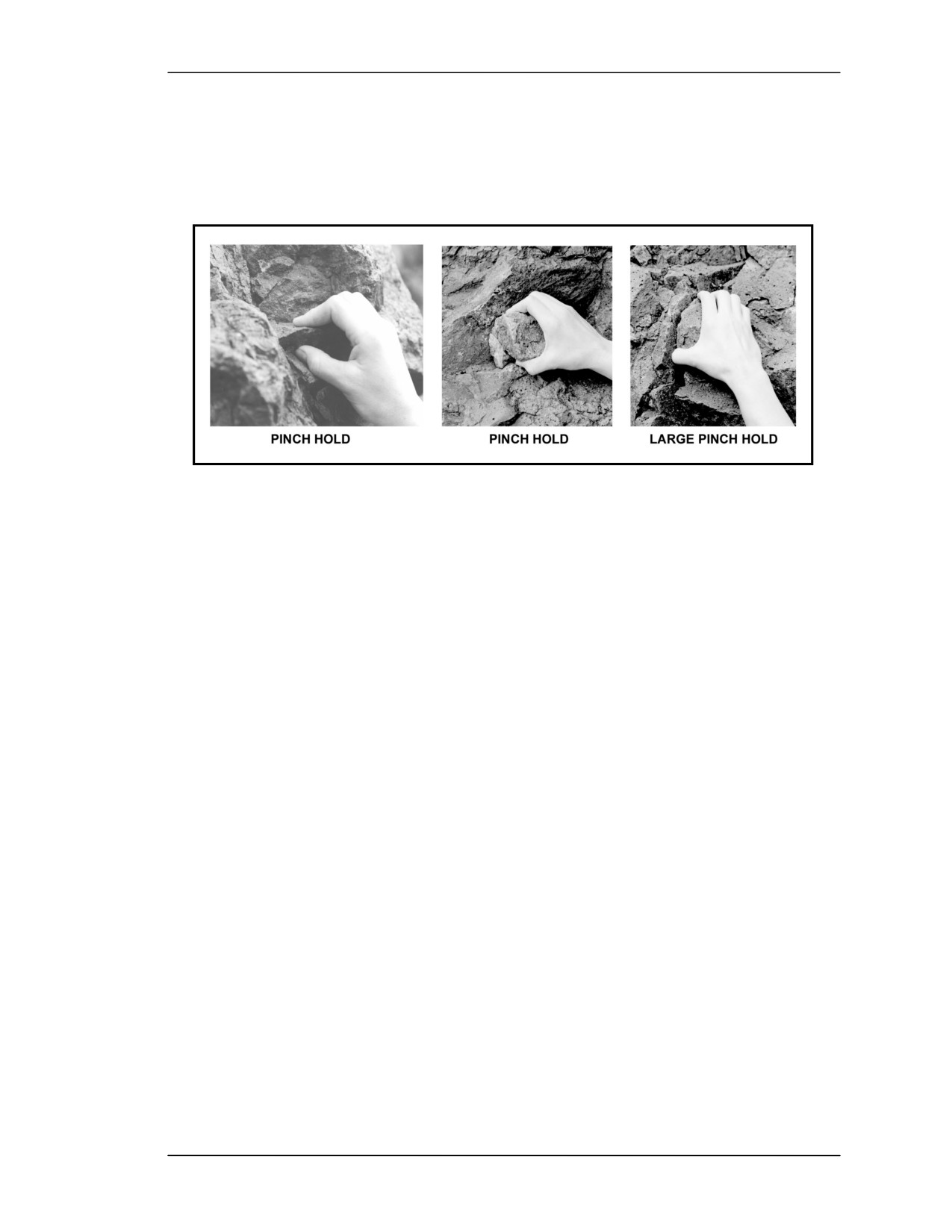
(3) Pinch Holds. Sometimes a small nubbin or protrusion in the rock can be
“squeezed” between the thumb and fingers. This technique is called a pinch hold. Friction
is applied by increasing the grip on the rock. Pinch holds are often overlooked by the
6-16
FM 3-97.61
novice climber because they feel insecure at first and cannot be relied upon to support
much body weight. If the climber has his weight over his feet properly, the pinch hold
will work well in providing balance. The pinch hold can also be used as a gripping
technique for push holds and pull holds. (Figure 6-10 shows examples of pinch holds.)
Figure 6-10. Examples of pinch holds.
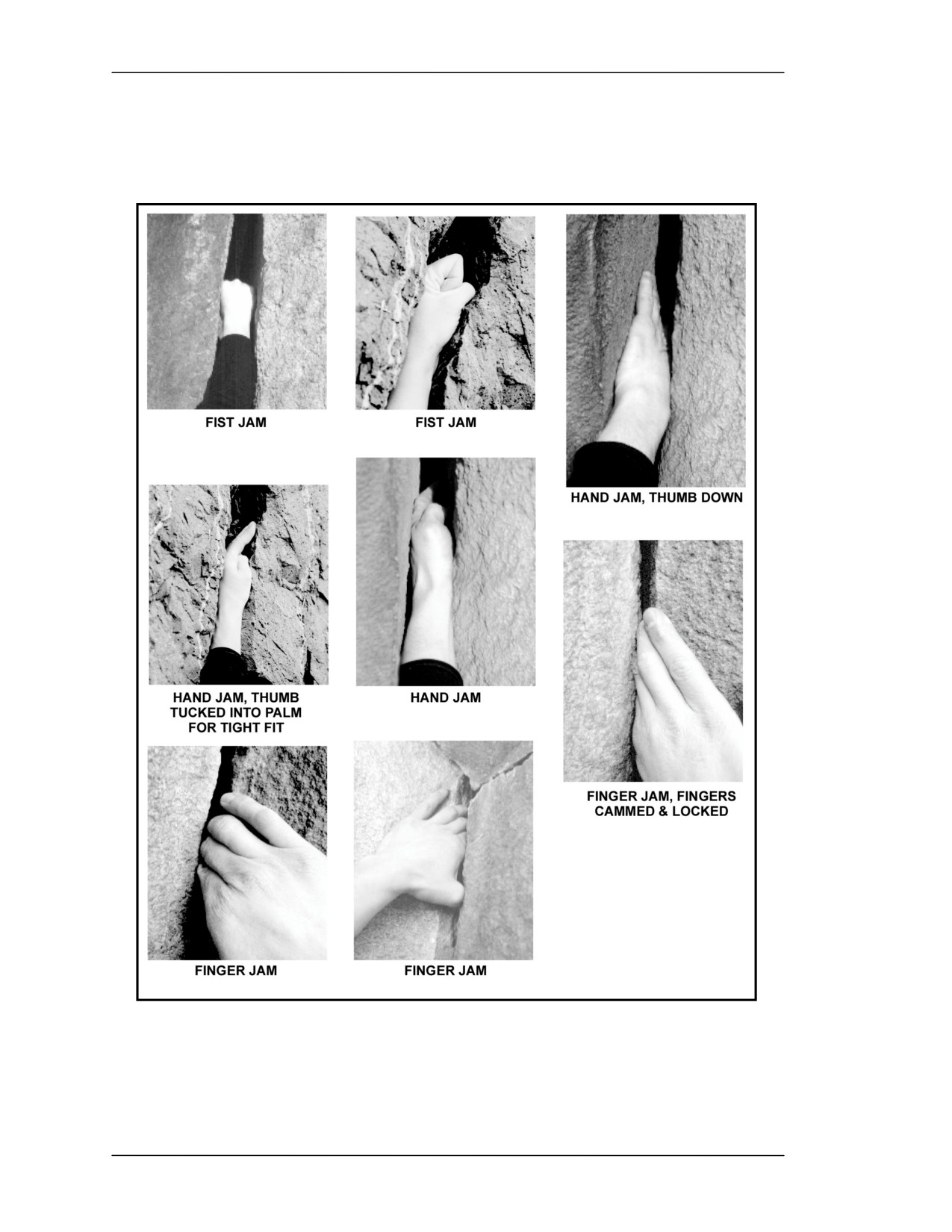
(4) Jam Holds. Like foot jams, the fingers and hands can be wedged or cammed into
a crack so they resist a downward or outward pull. Jamming with the fingers and hands
can be painful and may cause minor cuts and abrasions to tender skin. Cotton tape can be
used to protect the fingertips, knuckles, and the back of the hand; however, prolonged
jamming technique requiring hand taping should be avoided. Tape also adds friction to
the hand in jammed position. (Figure 6-11, page 6-18, shows examples of jam holds.)
(a) The hand can be placed in a crack a number of ways. Sometimes an open hand
can be inserted and wedged into a narrower portion of the crack. Other times a clenched
fist will provide the necessary grip. Friction can be created by applying cross pressure
between the fingers and the back of the hand. Another technique for vertical cracks is to
place the hand in the crack with the thumb pointed either up or down. The hand is then
clenched as much as possible. When the arm is straightened, it will twist the hand and
tend to cam it into place. This combination of clenching and camming usually produces
the most friction, and the most secure hand jam in vertical cracks.
(b) In smaller cracks, only the fingers will fit. Use as many fingers as the crack will
allow. The fingers can sometimes be stacked in some configuration to increase friction.
The thumb is usually kept outside the crack in finger jams and pressed against the rock to
increase friction or create cross pressure. In vertical cracks it is best to insert the fingers
with the thumb pointing down to make use of the natural camming action of the fingers
that occurs when the arm is twisted towards a normal position.
(c) Jamming technique for large cracks, or “off widths,” requiring the use of arm, leg,
and body jams, is another technique. To jam or cam an arm, leg, or body into an off
width, the principle is the same as for fingers, hands, or feet—you are making the
jammed appendage “fatter” by folding or twisting it inside the crack. For off widths, you
may place your entire arm inside the crack with the arm folded and the palm pointing
outward. The leg can be used, from the calf to the thigh, and flexed to fit the crack.
Routes requiring this type of climbing should be avoided as the equipment normally used
6-17
FM 3-97.61
for protection might not be large enough to protect larger cracks and openings. However,
sometimes a narrower section may be deeper in the crack allowing the use of “normal”
size protection.
Figure 6-11. Examples of jam holds.
6-18
FM 3-97.61
6-10. COMBINATION TECHNIQUES
The positions and holds previously discussed are the basics and the ones most common to
climbing. From these fundamentals, numerous combination techniques are possible. As
the climber gains experience, he will learn more ways to position the hands, feet, and
body in relation to the holds available; however, he should always strive to climb with his
weight on his feet from a balanced stance.
a. Sometimes, even on an easy route, the climber may come upon a section of the
rock that defies the basic principles of climbing. Short of turning back, the only
alternative is to figure out some combination technique that will work. Many of these
type problems require the hands and feet to work in opposition to one another. Most will
place more weight on the hands and arms than is desirable, and some will put the climber
in an “out of balance” position. To make the move, the climber may have to “break the
rules” momentarily. This is not a problem and is done quite frequently by experienced
climbers. The key to using these type of combination techniques is to plan and execute
them deliberately, without lunging or groping for holds, yet quickly, before the hands,
arms, or other body parts tire. Still, most of these maneuvers require good technique more
than great strength, though a certain degree of hand and arm strength certainly helps.
b. Combination possibilities are endless. The following is a brief description of some
of the more common techniques.
(1) Change Step. The change step, or hop step, can be used when the climber needs
to change position of the feet. It is commonly used when traversing to avoid crossing the
feet, which might put the climber in an awkward position. To prevent an off balance
situation, two solid handholds should be used. The climber simply places his weight on
his handholds while he repositions the feet. He often does this with a quick “hop,”
replacing the lead foot with the trail foot on the same hold. Keeping the forearms against
the rock during the maneuver takes some of the strain off the hands, while at the same
time strengthening the grip on the holds.
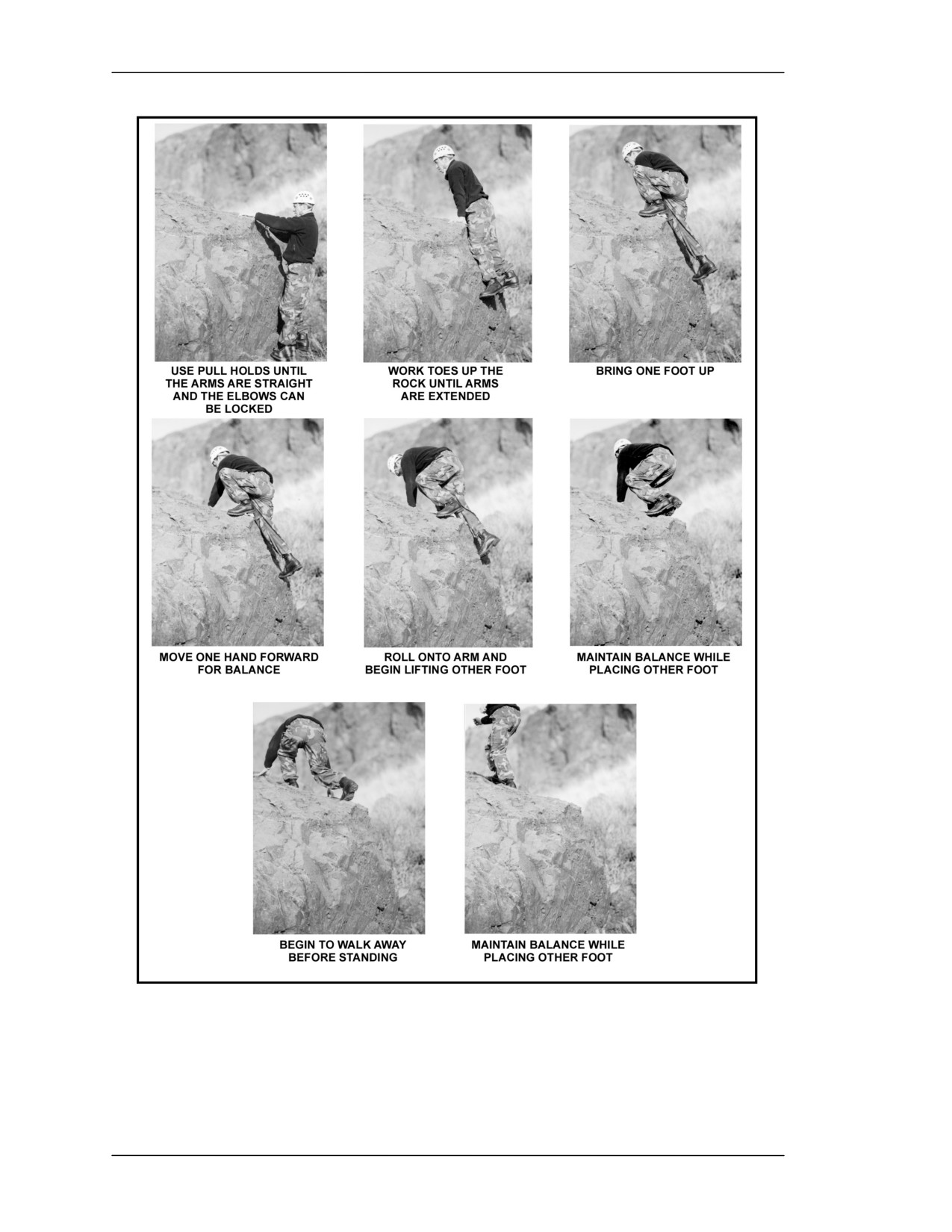
(2) Mantling. Mantling is a technique that can be used when the distance between the
holds increases and there are no immediate places to move the hands or feet. It does
require a ledge (mantle) or projection in the rock that the climber can press straight down
upon. (Figure 6-12, page 6-20, shows the mantling sequence.)
(a) When the ledge is above head height, mantling begins with pull holds, usually
“hooking” both hands over the ledge. The climber pulls himself up until his head is above
the hands, where the pull holds become push holds. He elevates himself until the arms are
straight and he can lock the elbows to relax the muscles. Rotating the hands inward
during the transition to push holds helps to place the palms more securely on the ledge.
Once the arms are locked, a foot can be raised and placed on the ledge. The climber may
have to remove one hand to make room for the foot. Mantling can be fairly strenuous;
however, most individuals should be able to support their weight, momentarily, on one
arm if they keep it straight and locked. With the foot on the ledge, weight can be taken
off the arms and the climber can grasp the holds that were previously out of reach. Once
balanced over the foot, he can stand up on the ledge and plan his next move.
(b) Pure mantling uses arm strength to raise the body; however, the climber can often
smear the balls of the feet against the rock and “walk” the feet up during the maneuver to
take some of the weight off the arms. Sometimes edges will be available for short steps in
the process.
6-19
FM 3-97.61
Figure 6-12. Mantling sequence.
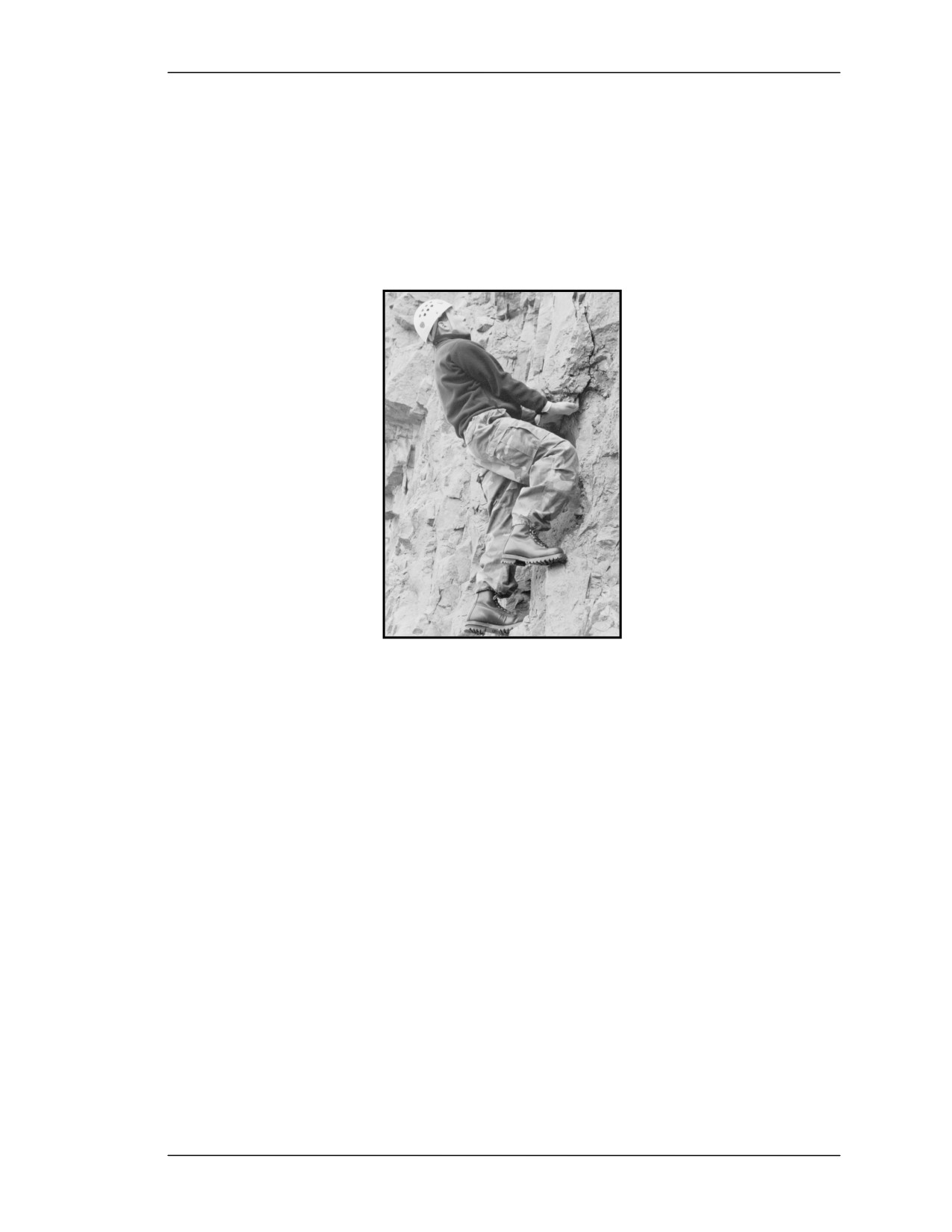
(3) Undercling. An “undercling” is a classic example of handholds and footholds
working in opposition (Figure 6-13). It is commonly used in places where the rock
6-20
FM 3-97.61
projects outward, forming a bulge or small overhang. Underclings can be used in the tops
of buckets, also. The hands are placed “palms-up” underneath the bulge, applying an
upward pull. Increasing this upward pull creates a counterforce, or body tension, which
applies more weight and friction to the footholds. The arms and legs should be kept as
straight as possible to reduce fatigue. The climber can often lean back slightly in the
undercling position, enabling him to see above the overhang better and search for the
next hold.
Figure 6-13. Undercling.
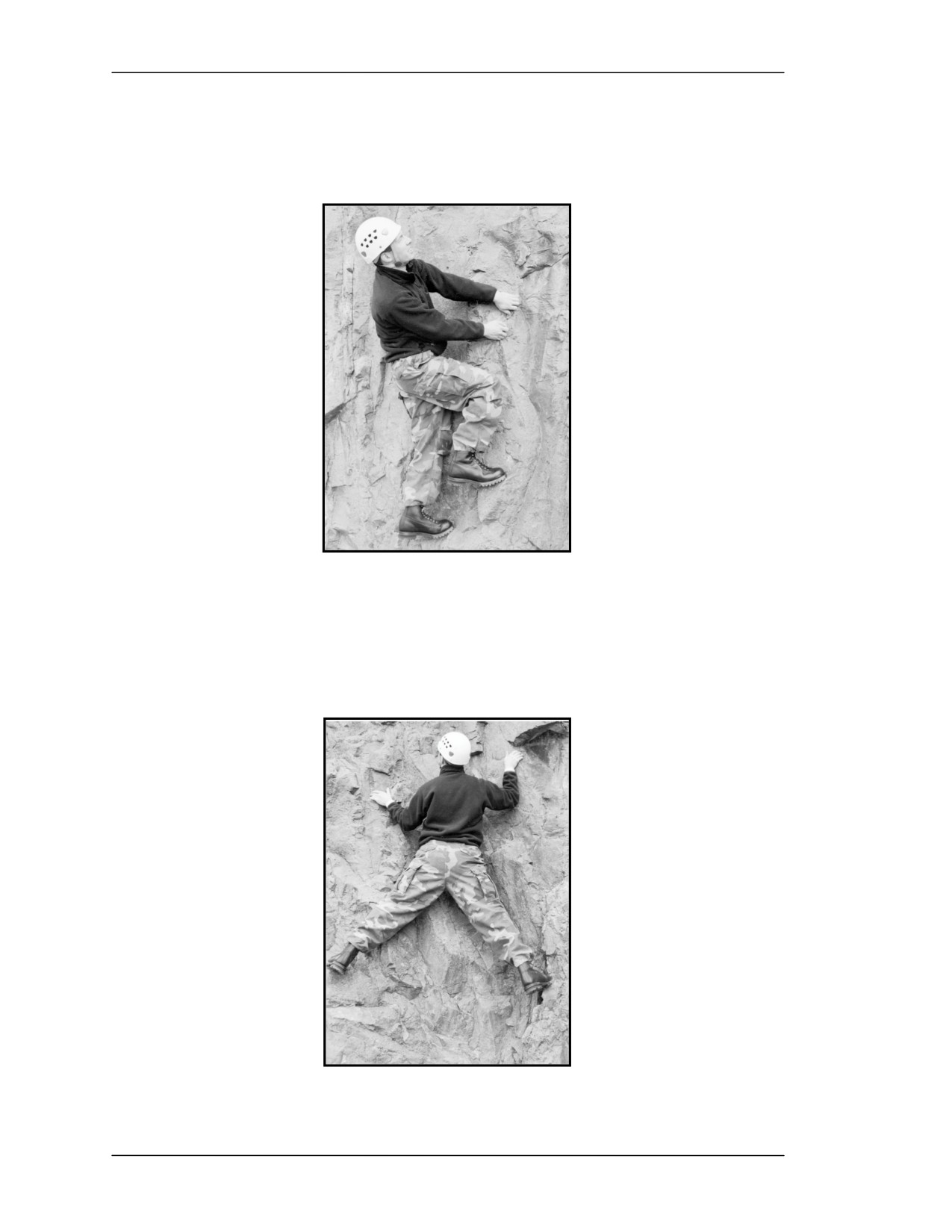
(4) Lieback. The
“lieback” is another good example of the hands working in
opposition to the feet. The technique is often used in a vertical or diagonal crack
separating two rock faces that come together at, more or less, a right angle (commonly
referred to as a dihedral). The crack edge closest to the body is used for handholds while
the feet are pressed against the other edge. The climber bends at the waist, putting the
body into an L-shaped position. Leaning away from the crack on two pull holds, body
tension creates friction between the feet and the hands. The feet must be kept relatively
high to maintain weight, creating maximum friction between the sole and the rock
surface. Either full sole contact or the smearing technique can be used, whichever seems
to produce the most friction.
(a) The climber ascends a dihedral by alternately shuffling the hands and feet
upward. The lieback technique can be extremely tiring, especially when the dihedral is
near vertical. If the hands and arms tire out before completing the sequence, the climber
will likely fall. The arms should be kept straight throughout the entire maneuver so the
climber’s weight is pulling against bones and ligaments, rather than muscle. The legs
should be straightened whenever possible.
(b) Placing protection in a lieback is especially tiring. Look for edges or pockets for
the feet in the crack or on the face for a better position to place protection from, or for a
rest position. Often, a lieback can be avoided with closer examination of the available
6-21
FM 3-97.61
face features. The lieback can be used alternately with the jamming technique, or vice
versa, for variation or to get past a section of a crack with difficult or nonexistent jam
possibilities. The lieback can sometimes be used as a face maneuver (Figure 6-14).
Figure 6-14. Lieback on a face.
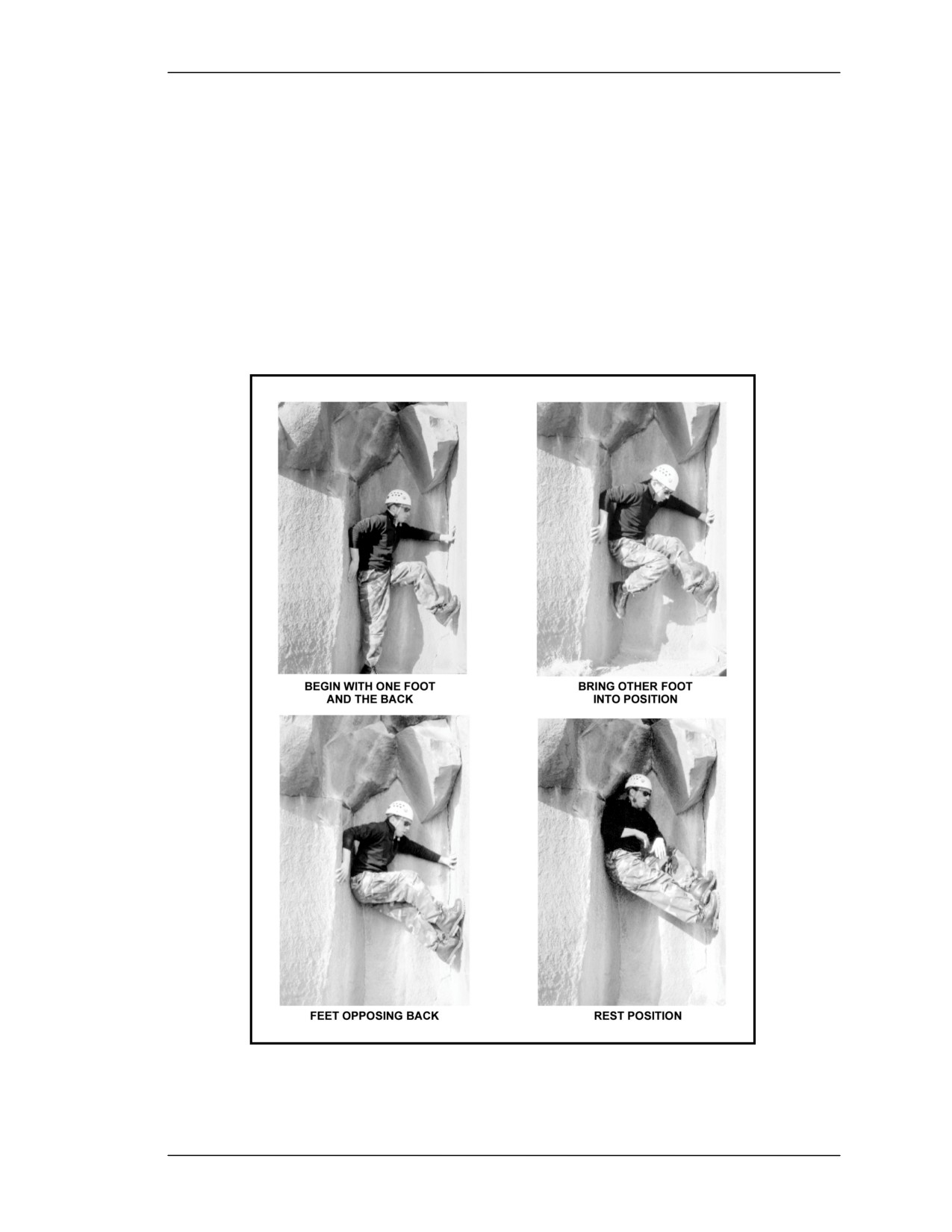
(5) Stemming. When the feet work in opposition from a relatively wide stance, the
maneuver is known as stemming. The stemming technique can sometimes be used on
faces, as well as in a dihedral in the absence of solid handholds for the lieback
(Figure 6-15).
Figure 6-15. Stemming on a face.
6-22
FM 3-97.61
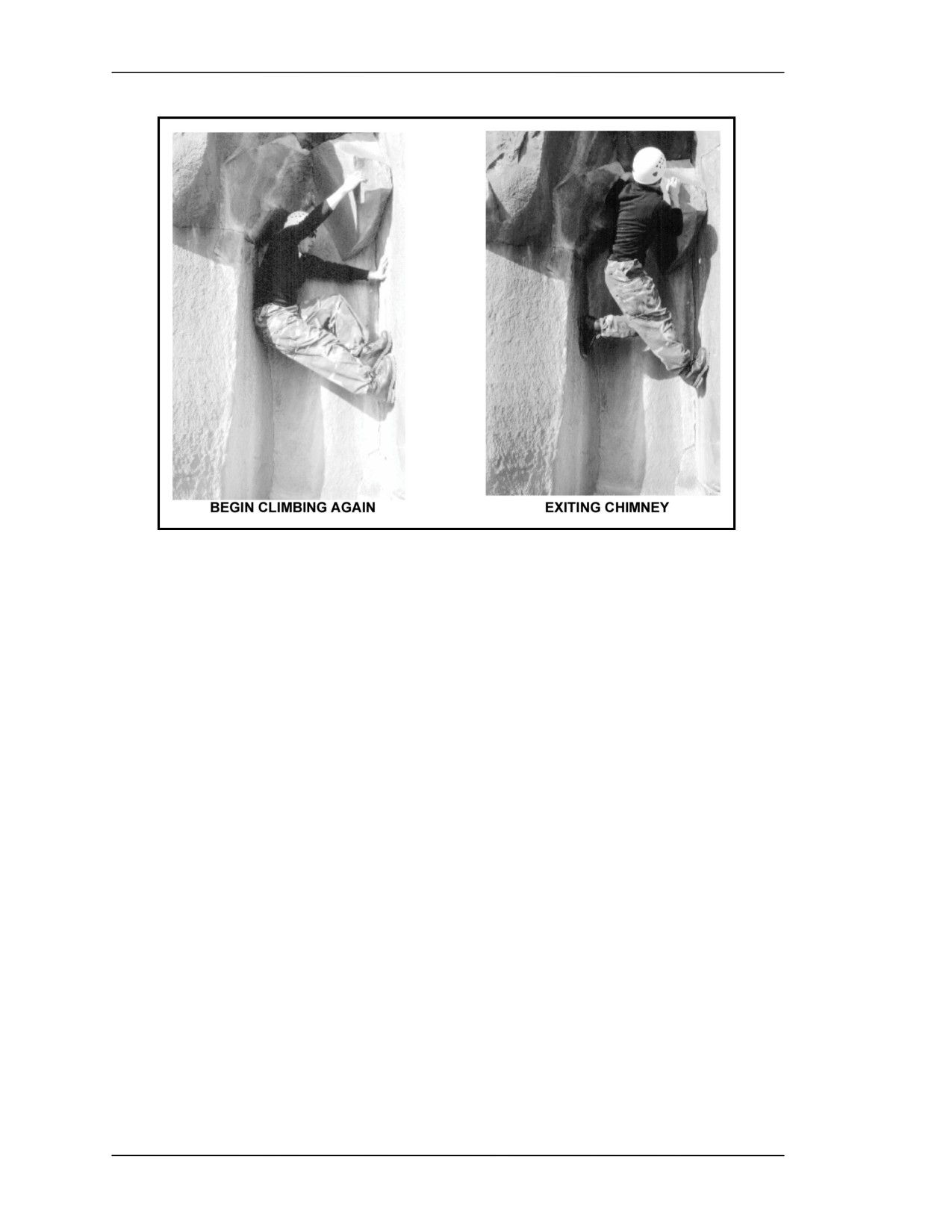
(a) The classic example of stemming is when used in combination with two opposing
push holds in wide, parallel cracks, known as chimneys. Chimneys are cracks in which
the walls are at least 1 foot apart and just big enough to squeeze the body into. Friction is
created by pushing outward with the hands and feet on each side of the crack. The
climber ascends the chimney by alternately moving the hands and feet up the crack
(Figure 6-16). Applying pressure with the back and bottom is usually necessary in wider
chimneys. Usually, full sole contact of the shoes will provide the most friction, although
smearing may work best in some instances. Chimneys that do not allow a full stemming
position can be negotiated using the arms, legs, or body as an integral contact point. This
technique will often feel more secure since there is more body to rock contact.
Figure 6-16. Chimney sequence.
6-23
FM 3-97.61
Figure 6-16. Chimney sequence (continued).
(b) The climber can sometimes rest by placing both feet on the same side of the
crack, forcing the body against the opposing wall. The feet must be kept relatively high
up under the body so the force is directed sideways against the walls of the crack. The
arms should be straightened with the elbows locked whenever possible to reduce muscle
strain. The climber must ensure that the crack does not widen beyond the climbable width
before committing to the maneuver. Remember to look for face features inside chimneys
for more security in the climb.
(c) Routes requiring this type of climbing should be avoided as the equipment
normally used for protection might not be large enough to protect chimneys. However,
face features, or a much narrower crack in one or both corners, may sometimes be found
deeper in the chimney allowing the use of normal size protection.
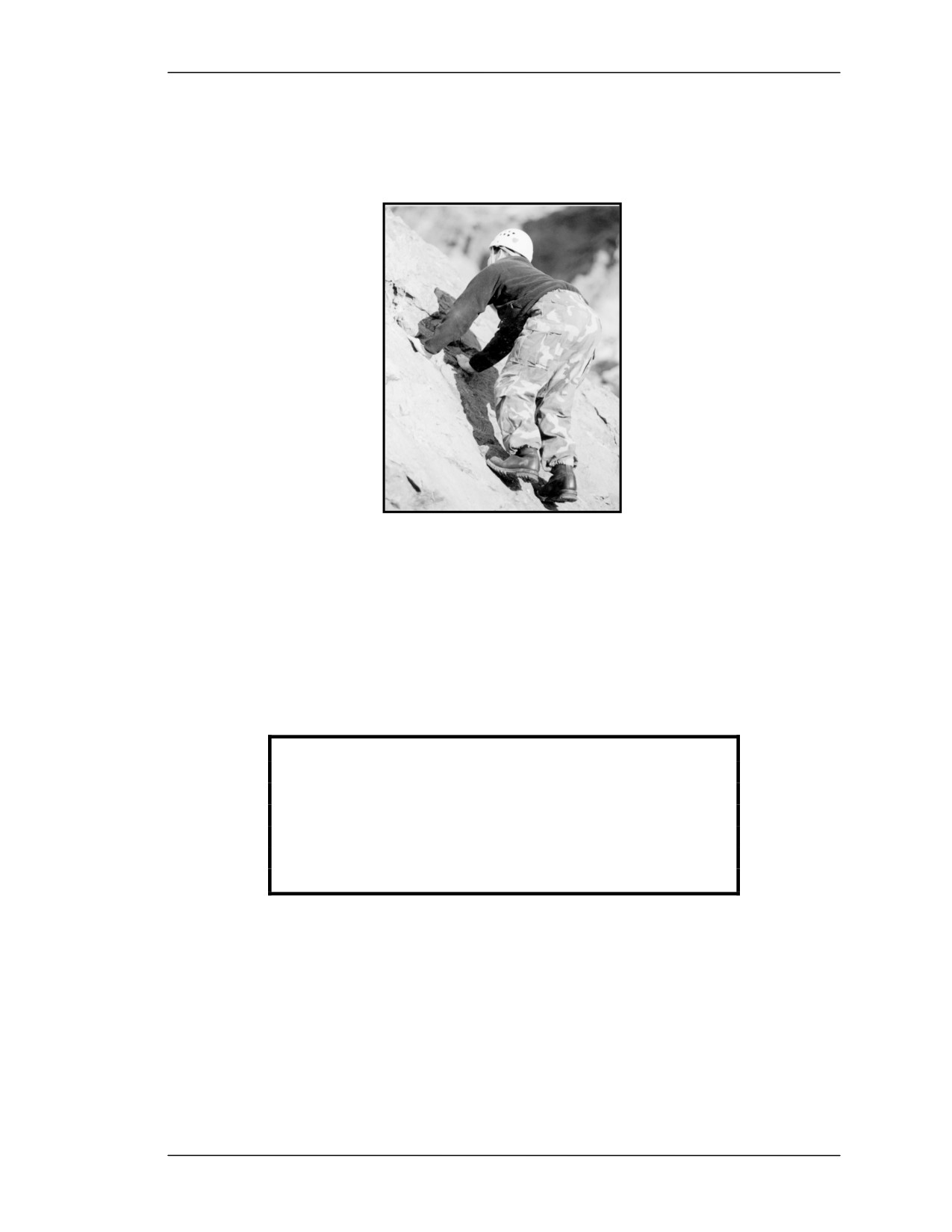
(6) Slab Technique. A slab is a relatively smooth, low-angled rock formation that
requires a slightly modified climbing technique (Figure 6-17). Since slab rock normally
contains few, if any holds, the technique requires maximum friction and perfect balance
over the feet.
(a) On lower-angled slab, the climber can often stand erect and climb using full sole
contact and other mountain walking techniques. On steeper slab, the climber will need to
apply good smearing technique. Often, maximum friction cannot be attained on steeper
slab from an erect stance. The climber will have to flex the ankles and knees so his
weight is placed more directly over the balls of the feet. He may then have to bend at the
waist to place the hands on the rock, while keeping the hips over his feet.
(b) The climber must pay attention to any changes in slope angle and adjust his body
accordingly. Even the slightest change in the position of the hips over the feet can mean
6-24
FM 3-97.61
the difference between a good grip or a quick slip. The climber should also take
advantage of any rough surfaces, or other irregularities in the rock he can place his hands
or feet on, to increase friction.
Figure 6-17. Slab technique.
(7) Down Climbing. Descending steep rock is normally performed using a roped
method; however, the climber may at some point be required to down climb a route. Even
if climbing ropes and related equipment are on hand, down climbing easier terrain is
often quicker than taking the time to rig a rappel point. Also, a climber might find himself
confronted with difficulties part way up a route that exceed his climbing ability, or the
abilities of others to follow. Whatever the case may be, down climbing is a skill well
worth practicing.
CAUTIONS
1. Down climbing can inadvertently lead into an
unforeseen dangerous position on a descent.
When in doubt, use a roped descent.
2. Down climbing is accomplished at a difficulty level
well below the ability of the climber. When in
doubt, use a roped descent.
(a) On easier terrain, the climber can face outward, away from the rock, enabling him
to see the route better and descend quickly. As the steepness and difficulty increase, he
can often turn sideways, still having a good view of the descent route, but being better
able to use the hands and feet on the holds available. On the steepest terrain, the climber
will have to face the rock and down climb using good climbing techniques.
(b) Down climbing is usually more difficult than ascending a given route. Some holds
will be less visible when down climbing, and slips are more likely to occur. The climber
must often lean well away from the rock to look for holds and plan his movements. More
6-25
FM 3-97.61
weight is placed on the arms and handholds at times to accomplish this, as well as to help
lower the climber to the next foothold. Hands should be moved to holds as low as waist
level to give the climber more range of movement with each step. If the handholds are
too high, he may have trouble reaching the next foothold. The climber must be careful
not to overextend himself, forcing a release of his handholds before reaching the next
foothold.
CAUTION
Do not drop from good handholds to a standing
position. A bad landing could lead to injured ankles or
a fall beyond the planned landing area.
(c) Descending slab formations can be especially tricky. The generally lower angle of
slab rock may give the climber a false sense of security, and a tendency to move too
quickly. Down climbing must be slow and deliberate, as in ascending, to maintain perfect
balance and weight distribution over the feet. On lower-angle slab the climber may be
able to stand more or less erect, facing outward or sideways, and descend using good flat
foot technique. The climber should avoid the tendency to move faster, which can lead to
uncontrollable speed.
(d) On steeper slab, the climber will normally face the rock and down climb, using
the same smearing technique as for ascending. An alternate method for descending slab is
to face away from the rock in a “crab” position (Figure 6-18). Weight is still concentrated
over the feet, but may be shifted partly onto the hands to increase overall friction. The
climber is able to maintain full sole contact with the rock and see the entire descent route.
Allowing the buttocks to “drag behind” on the rock will decrease the actual weight on the
footholds, reducing friction, and leading to the likelihood of a slip. Facing the rock, and
down-climbing with good smearing technique, is usually best on steeper slab.
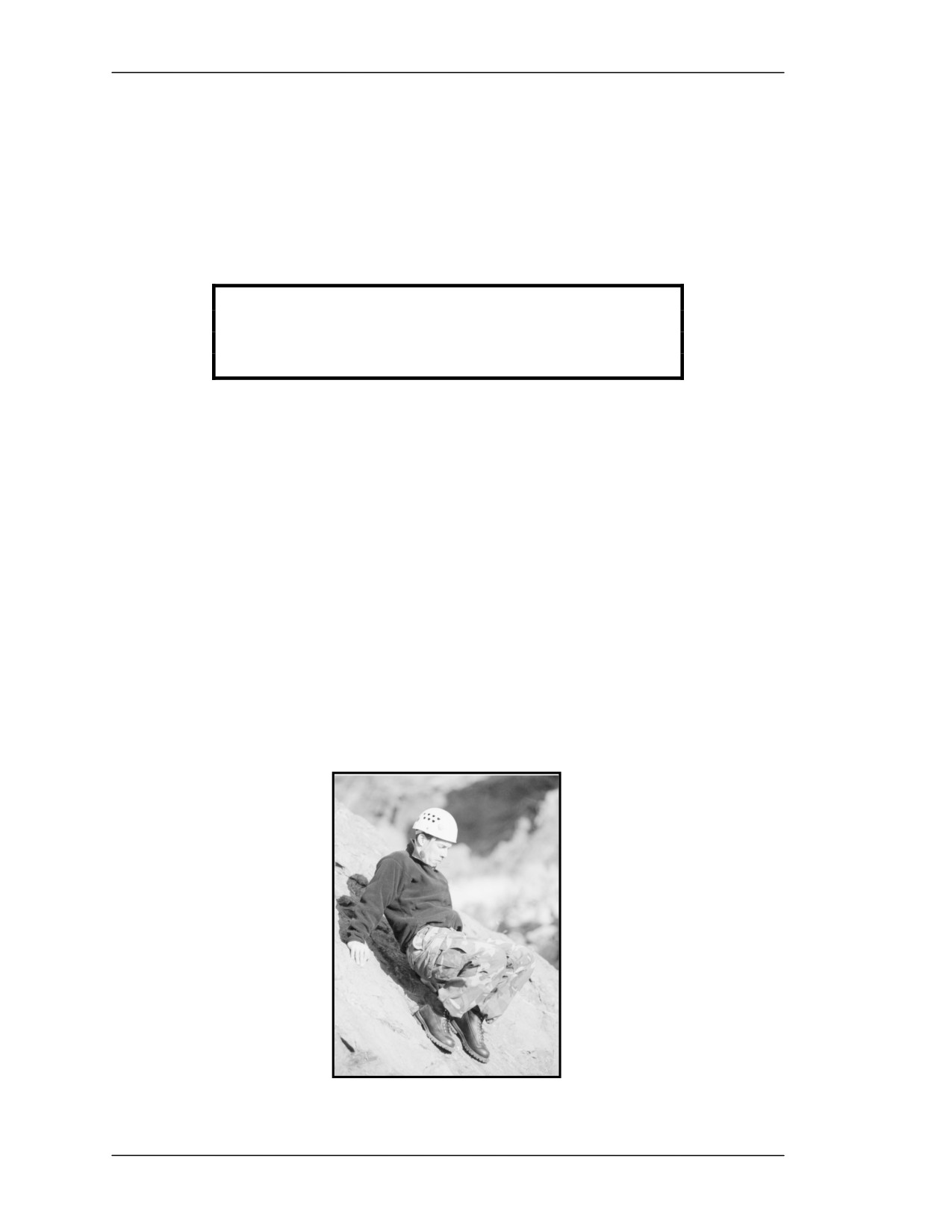
Figure 6-18. Descending slab in the crab position.
6-26
FM 3-97.61
Section III. ROPED CLIMBING
When the angle, length, and difficulty of the proposed climbing route surpasses the
ability of the climbers’ safety margin (possibly on class 4 and usually on class 5 terrain),
ropes must be used to proceed. Roped climbing is only safe if accomplished correctly.
Reading this manual does not constitute skill with ropes—much training and practice is
necessary. Many aspects of roped climbing take time to understand and learn. Ropes are
normally not used in training until the basic principles of climbing are covered.
Note: A rope is completely useless for climbing unless the climber knows how to use it
safely.
6-11. TYING-IN TO THE CLIMBING ROPE
Over the years, climbers have developed many different knots and procedures for
tying-in to the climbing rope. Some of the older methods of tying directly into the rope
require minimal equipment and are relatively easy to inspect; however, they offer little
support to the climber, may induce further injuries, and may even lead to strangulation in
a severe fall. A severe fall, where the climber might fall 20 feet or more and be left
dangling on the end of the rope, is highly unlikely in most instances, especially for most
personnel involved in military climbing. Tying directly into the rope is perfectly safe for
many roped party climbs used in training on lower-angled rock. All climbers should
know how to properly tie the rope around the waist in case a climbing harness is
unavailable.
6-12. PRESEWN HARNESSES
Although improvised harnesses are made from readily available materials and take little
space in the pack or pocket, presewn harnesses provide other aspects that should be
considered. No assembly is required, which reduces preparation time for roped
movement. All presewn harnesses provide a range of adjustability. These harnesses have
a fixed buckle that, when used correctly, will not fail before the nylon materials
connected to it. However, specialized equipment, such as a presewn harness, reduce the
flexibility of gear. Presewn harness are bulky, also.
a. Seat Harness. Many presewn seat harnesses are available with many different
qualities separating them, including cost.
(1) The most notable difference will be the amount and placement of padding. The
more padding the higher the price and the more comfort. Gear loops sewn into the waist
belt on the sides and in the back are a common feature and are usually strong enough to
hold quite a few carabiners and or protection. The gear loops will vary in number from
one model/manufacturer to another.
(2) Although most presewn seat harnesses have a permanently attached belay loop
connecting the waist belt and the leg loops, the climbing rope should be run around the
waist belt and leg loop connector. The presewn belay loop adds another link to the chain
of possible failure points and only gives one point of security whereas running the rope
through the waist belt and leg loop connector provides two points of contact.
(3) If more than two men will be on the rope, connect the middle position(s) to the
rope with a carabiner routed the same as stated in the previous paragraph.
6-27
FM 3-97.61
(4) Many manufactured seat harnesses will have a presewn loop of webbing on the
rear. Although this loop is much stronger than the gear loops, it is not for a belay anchor.
It is a quick attachment point to haul an additional rope.
b. Chest Harness. The chest harness will provide an additional connecting point for
the rope, usually in the form of a carabiner loop to attach a carabiner and rope to. This
type of additional connection will provide a comfortable hanging position on the rope,
but otherwise provides no additional protection from injury during a fall (if the seat
harness is fitted correctly).
(1) A chest harness will help the climber remain upright on the rope during rappelling
or ascending a fixed rope, especially while wearing a heavy pack. (If rappelling or
ascending long or multiple pitches, let the pack hang on a drop cord below the feet and
attached to the harness tie-in point.)
(2) The presewn chest harnesses available commercially will invariably offer more
comfort or performance features, such as padding, gear loops, or ease of adjustment, than
an improvised chest harness.
c. Full-Body Harness. Full-body harnesses incorporate a chest and seat harness into
one assembly. This is the safest harness to use as it relocates the tie-in point higher, at the
chest, reducing the chance of an inverted position when hanging on the rope. This is
especially helpful when moving on ropes with heavy packs. A full-body harness only
affects the body position when hanging on the rope and will not prevent head injury in a
fall.
CAUTION
This type of harness does not prevent the climber
from falling head first. Body position during a fall is
affected only by the forces that generated the fall, and
this type of harness promotes an upright position only
when hanging on the rope from the attachment point.
6-13. IMPROVISED HARNESSES
Without the use of a manufactured harness, many methods are still available for attaching
oneself to a rope. Harnesses can be improvised using rope or webbing and knots.
a. Swami Belt. The swami belt is a simple, belt-only harness created by wrapping
rope or webbing around the waistline and securing the ends. One-inch webbing will
provide more comfort. Although an effective swami belt can be assembled with a
minimum of one wrap, at least two wraps are recommended for comfort, usually with
approximately ten feet of material. The ends are secured with an appropriate knot.
b. Bowline-on-a-Coil. Traditionally, the standard method for attaching oneself to
the climbing rope was with a bowline-on-a-coil around the waist. The extra wraps
distribute the force of a fall over a larger area of the torso than a single bowline would,
and help prevent the rope from riding up over the rib cage and under the armpits. The
knot must be tied snugly around the narrow part of the waist, just above the bony portions
of the hips (pelvis). Avoid crossing the wraps by keeping them spread over the waist
area. “Sucking in the gut” a bit when making the wraps will ensure a snug fit.
6-28
FM 3-97.61
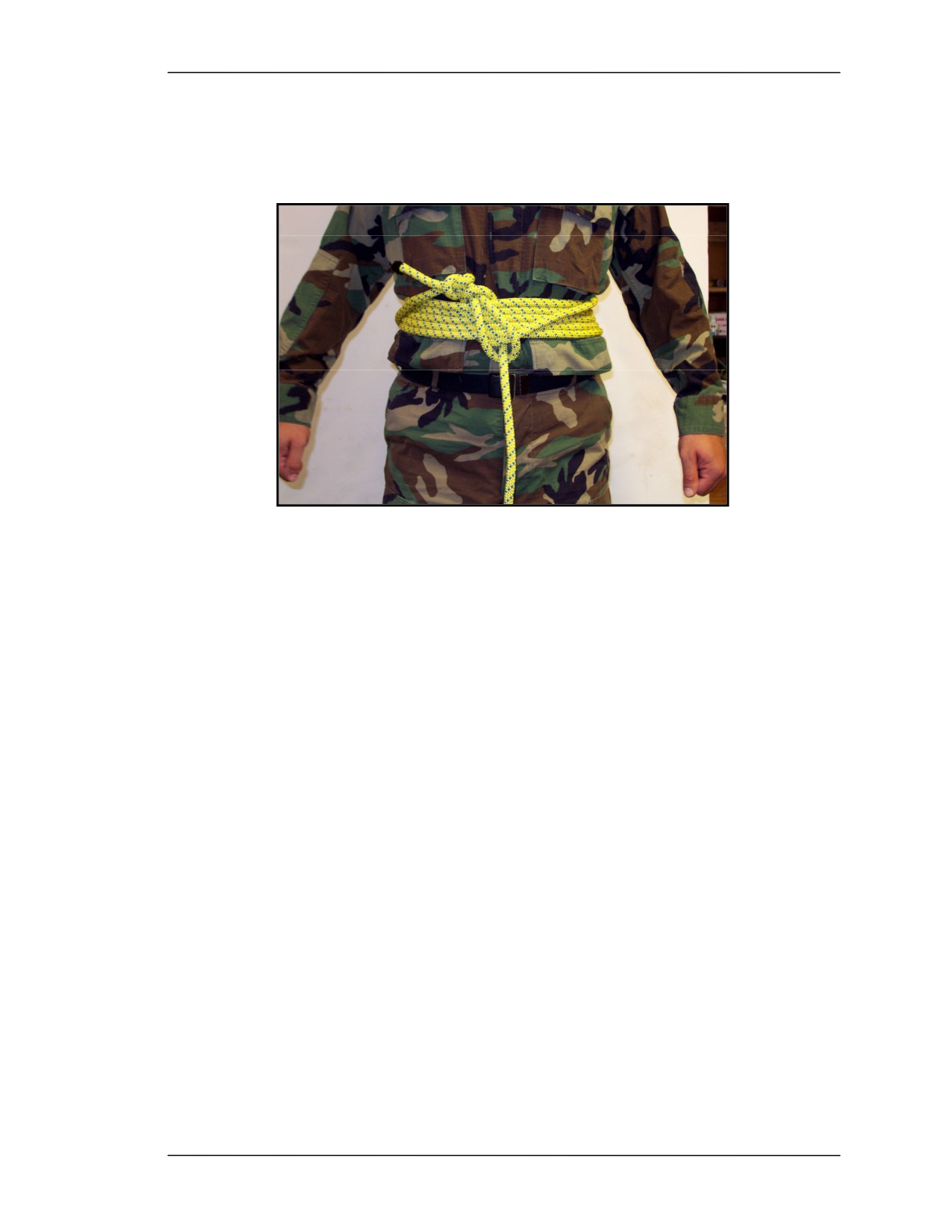
(1) The bowline-on-a-coil can be used to tie-in to the end of the rope (Figure 6-19).
The end man should have a minimum of four wraps around the waist before completing
the knot.
Figure 6-19. Tying-in with a bowline-on-a-coil.
(2) The bowline-on-a-coil is a safe and effective method for attaching to the rope
when the terrain is low-angled, WITHOUT THE POSSIBILITY OF A SEVERE FALL.
When the terrain becomes steeper, a fall will generate more force on the climber and this
will be felt through the coils of this type of attachment. A hard fall will cause the coils to
ride up against the ribs. In a severe fall, any tie-in around the waist only could place a
“shock load” on the climber’s lower back. Even in a relatively short fall, if the climber
ends up suspended in mid-air and unable to regain footing on the rock, the rope around
the waist can easily cut off circulation and breathing in a relatively short time.
(3) The climbing harness distributes the force of a fall over the entire pelvic region,
like a parachute harness. Every climber should know how to tie some sort of improvised
climbing harness from sling material. A safe, and comfortable, seat/chest combination
harness can be tied from one-inch tubular nylon.
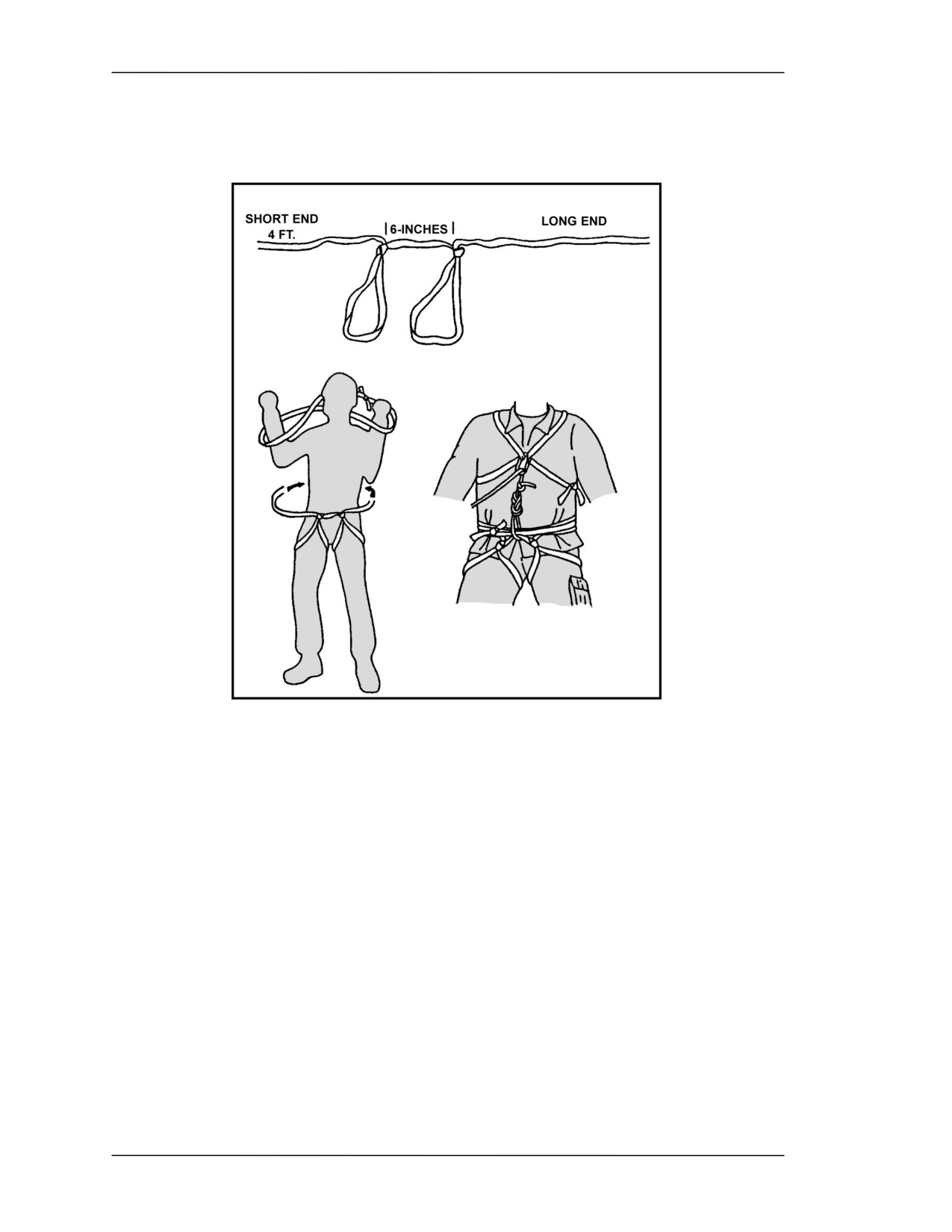
c. Improvised Seat Harness. A seat harness can be tied from a length of webbing
approximately 25 feet long (Figure 6-20, page 6-30).
(1) Locate the center of the rope. Off to one side, tie two fixed loops approximately 6
inches apart (overhand loops). Adjust the size of the loops so they fit snugly around the
thigh. The loops are tied into the sling “off center” so the remaining ends are different
lengths. The short end should be approximately 4 feet long (4 to 5 feet for larger
individuals).
(2) Slip the leg loops over the feet and up to the crotch, with the knots to the front.
Make one complete wrap around the waist with the short end, wrapping to the outside,
and hold it in place on the hip. Keep the webbing flat and free of twists when wrapping.
(3) Make two to three wraps around the waist with the long end in the opposite
direction (wrapping to the outside), binding down on the short end to hold it in place.
Grasping both ends, adjust the waist wraps to a snug fit. Connect the ends with the
6-29
FM 3-97.61
appropriate knot between the front and one side so you will be able to see what you
are doing.
Figure 6-20. Improvised seat and chest harness.
d. Improvised Chest Harness. The chest harness can be tied from rope or webbing,
but remember that with webbing, wider is better and will be more comfortable when you
load this harness. Remember as you tie this harness that the remaining ends will need to
be secured so choose the best length. Approximately 6 to 10 feet usually works.
(1) Tie the ends of the webbing together with the appropriate knot, making a sling 3
to 4 feet long.
(2) Put a single twist into the sling, forming two loops.
(3) Place an arm through each loop formed by the twist, just as you would put on a
jacket, and drape the sling over the shoulders. The twist, or cross, in the sling should be
in the middle of the back.
(4) Join the two loops at the chest with a carabiner. The water knot should be set off
to either side for easy inspection (if a pack is to be worn, the knot will be uncomfortable
if it gets between the body and the pack). The chest harness should fit just loose enough
to allow necessary clothing and not to restrict breathing or circulation. Adjust the size of
the sling if necessary.
6-30
FM 3-97.61
e. Improvised Full-Body Harness. Full-body harnesses incorporate a chest and seat
harness into one assembly.
(1) The full-body harness is the safest harness because it relocates the tie-in point
higher, at the chest, reducing the chance of an inverted hanging position on the rope. This
is especially helpful when moving on ropes with heavy packs. A full-body harness affects
the body position only when hanging on the rope.
CAUTION
A full-body harness does not prevent falling head first;
body position in a fall is caused by the forces that
caused the fall.
(2) Although running the rope through the carabiner of the chest harness does, in
effect, create a type of full-body harness, it is not a true full-body harness until the chest
harness and the seat harness are connected as one piece. A true full-body harness can be
improvised by connecting the chest harness to the seat harness, but not by just tying the
rope into both―the two harnesses must be “fixed” as one harness. Fix them together with
a short loop of webbing or rope so that the climbing rope can be connected directly to the
chest harness and your weight is supported by the seat harness through the connecting
material.
f. Attaching the Rope to the Improvised Harness. The attachment of the climbing
rope to the harness is a CRITICAL LINK. The strength of the rope means nothing if it is
attached poorly, or incorrectly, and comes off the harness in a fall. The climber ties the
end of the climbing rope to the seat harness with an appropriate knot. If using a chest
harness, the standing part of the rope is then clipped into the chest harness carabiner. The
seat harness absorbs the main force of the fall, and the chest harness helps keep the body
upright.
CAUTION
The knot must be tied around all the waist wraps and
the 6-inch length of webbing between the leg loops.
(1) A middleman must create a fixed loop to tie in to. A rethreaded figure-eight loop
tied on a doubled rope or the three loop bowline can be used. If using the three loop
bowline, ensure the end, or third loop formed in the knot, is secured around the tie-in
loops with an overhand knot. The standing part of the rope going to the lead climber is
clipped into the chest harness carabiner.
Note: The climbing rope is not clipped into the chest harness when belaying.
(2) The choice of whether to tie-in with a bowline-on-a-coil or into a climbing
harness depends entirely on the climber’s judgment, and possibly the equipment
6-31
FM 3-97.61
available. A good rule of thumb is: “Wear a climbing harness when the potential for
severe falls exists and for all travel over snow-covered glaciers because of the crevasse
fall hazard.”
(3) Under certain conditions many climbers prefer to attach the rope to the seat
harness with a locking carabiner, rather than tying the rope to it. This is a common
practice for moderate snow and ice climbing, and especially for glacier travel where wet
and frozen knots become difficult to untie.
CAUTION
Because the carabiner gate may be broken or opened
by protruding rocks during a fall, tie the rope directly
to the harness for maximum safety.
Section IV. BELAY TECHNIQUES
Tying-in to the climbing rope and moving as a member of a rope team increases the
climber’s margin of safety on difficult, exposed terrain. In some instances, such as when
traveling over snow-covered glaciers, rope team members can often move at the same
time, relying on the security of a tight rope and “team arrest” techniques to halt a fall by
any one member. On steep terrain, however, simultaneous movement only helps to
ensure that if one climber falls, he will jerk the other rope team members off the slope.
For the climbing rope to be of any value on steep rock climbs, the rope team must
incorporate “belays” into the movement.
Belaying is a method of managing the rope in such a way that, if one person falls, the
fall can be halted or “arrested” by another rope team member (belayer). One person
climbs at a time, while being belayed from above or below by another. The belayer
manipulates the rope so that friction, or a “brake,” can be applied to halt a fall. Belay
techniques are also used to control the descent of personnel and equipment on fixed rope
installations, and for additional safety on rappels and stream crossings.
Belaying is a skill that requires practice to develop proficiency. Setting up a belay
may at first appear confusing to the beginner, but with practice, the procedure should
become “second nature.” If confronted with a peculiar problem during the setup of a
belay, try to use common sense and apply the basic principles stressed throughout this
text. Remember the following key points:
• Select the best possible terrain features for the position and use terrain to your
advantage.
• Use a well braced, sitting position whenever possible.
• Aim and anchor the belay for all possible load directions.
• Follow the “minimum” rule for belay anchors—2 for a downward pull, 1 for
an upward pull.
• Ensure anchor attachments are aligned, independent, and snug.
• Stack the rope properly.
• Choose a belay technique appropriate for the climbing.
6-32
FM 3-97.61
• Use a guide carabiner for rope control in all body belays.
• Ensure anchor attachments, guide carabiner (if applicable), and rope running
to the climber are all on the guidehand side.
• The brake hand remains on the rope when belaying.
CAUTION
Never remove the brake hand from the rope while
belaying. If the brake hand is removed, there is no
belay.
• Ensure you are satisfied with your position before giving the command
“BELAY ON.”
• The belay remains in place until the climber gives the command “OFF
BELAY.”
CAUTION
The belay remains in place the from the time the
belayer commands “BELAY ON” until the climber
commands “OFF BELAY.”
6-14. PROCEDURE FOR MANAGING THE ROPE
A number of different belay techniques are used in modern climbing, ranging from the
basic “body belays” to the various “mechanical belays,” which incorporate some type of
friction device.
a. Whether the rope is wrapped around the body, or run through a friction device,
the rope management procedure is basically the same. The belayer must be able to
perform three basic functions: manipulate the rope to give the climber slack during
movement, take up rope to remove excess slack, and apply the brake to halt a fall.
b. The belayer must be able to perform all three functions while maintaining “total
control” of the rope at all times. Total control means the brake hand is NEVER removed
from the rope. When giving slack, the rope simply slides through the grasp of the brake
hand, at times being fed to the climber with the other “feeling” or guide hand. Taking up
rope, however, requires a certain technique to ensure the brake hand remains on the rope
at all times. The following procedure describes how to take up excess rope and apply the
brake in a basic body belay.
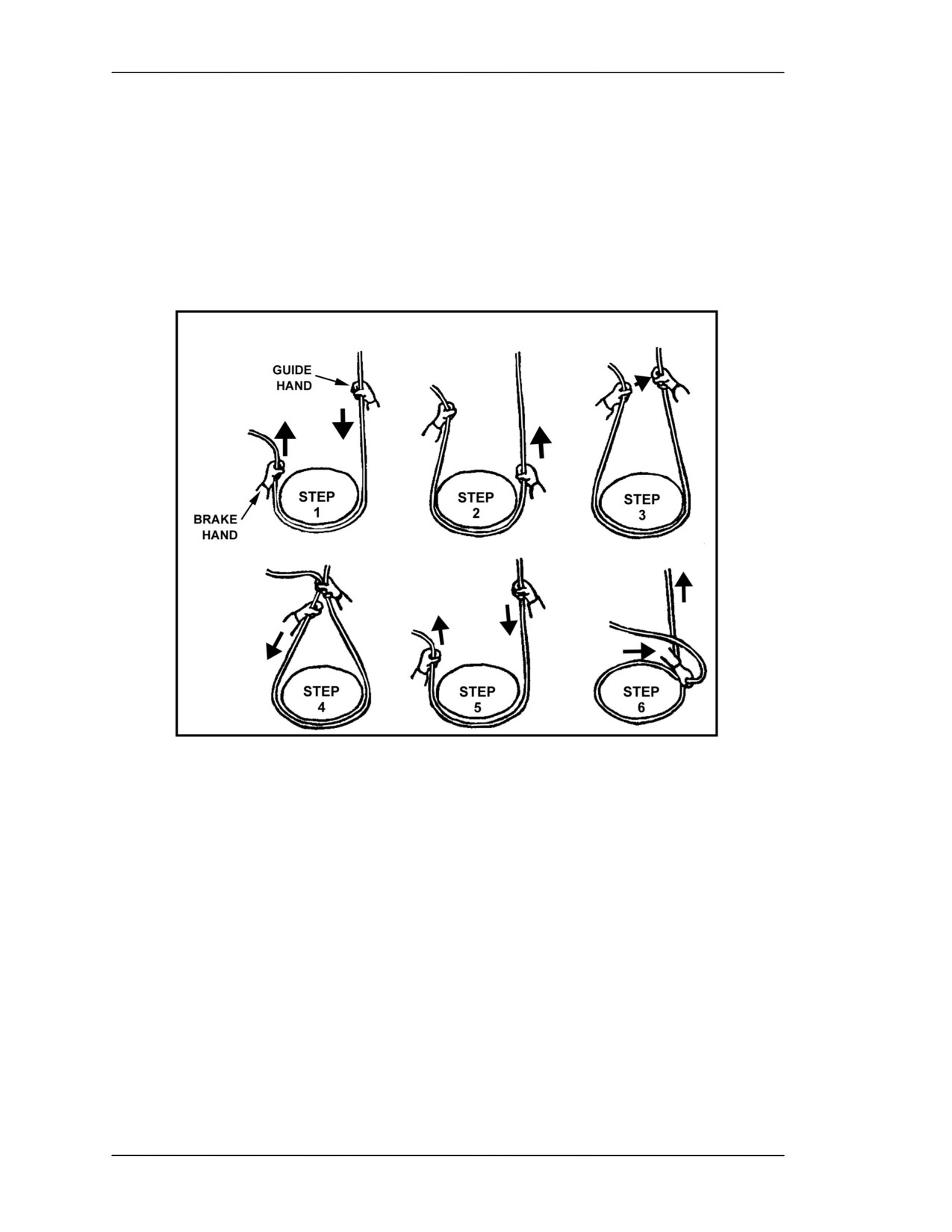
(1) Grasping the rope with both hands, place it behind the back and around the hips.
The hand on the section of rope between the belayer and the climber would be the guide
hand. The other hand is the brake hand.
(2) Take in rope with the brake hand until the arm is fully extended. The guide hand
can also help to pull in the rope (Figure 6-21, step 1, page 6-34).
6-33
FM 3-97.61
(3) Holding the rope in the brake hand, slide the guide hand out, extending the arm so
the guide hand is father away from the body than the brake hand (Figure 6-21, step 2).
(4) Grasp both parts of the rope, to the front of the brake hand, with the guide hand
(Figure 6-21, step 3).
(5) Slide the brake hand back towards the body (Figure 6-21, step 4).
(6) Repeat step 5 of Figure 6-21. The brake can be applied at any moment during the
procedure. It is applied by wrapping the rope around the front of the hips while increasing
grip with the brake hand (Figure 6-21, step 6).
Figure 6-21. Managing the rope.
6-15. CHOOSING A BELAY TECHNIQUE
The climber may choose from a variety of belay techniques. A method that works well in
one situation may not be the best choice in another. The choice between body belays and
mechanical belays depends largely on equipment available, what the climber feels most
comfortable with, and the amount of load, or fall force, the belay may have to absorb.
The following describes a few of the more widely used techniques, and the ones most
applicable to military mountaineering.
a. Body Belay. The basic body belay is the most widely used technique on moderate
terrain. It uses friction between the rope and the clothed body as the rope is pressured
across the clothing. It is the simplest belay, requiring no special equipment, and should be
the first technique learned by all climbers. A body belay gives the belayer the greatest
“feel” for the climber, letting him know when to give slack or take up rope. Rope
management in a body belay is quick and easy, especially for beginners, and is effective
in snow and ice climbing when ropes often become wet, stiff, and frozen. The body
6-34
FM 3-97.61
belay, in its various forms, will hold low to moderate impact falls well. It has been known
to arrest some severe falls, although probably not without inflicting great pain on the
belayer.
CAUTION
The belayer must ensure he is wearing adequate
clothing to protect his body from rope burns when
using a body belay. Heavy duty cotton or leather work
gloves can also be worn to protect the hands.
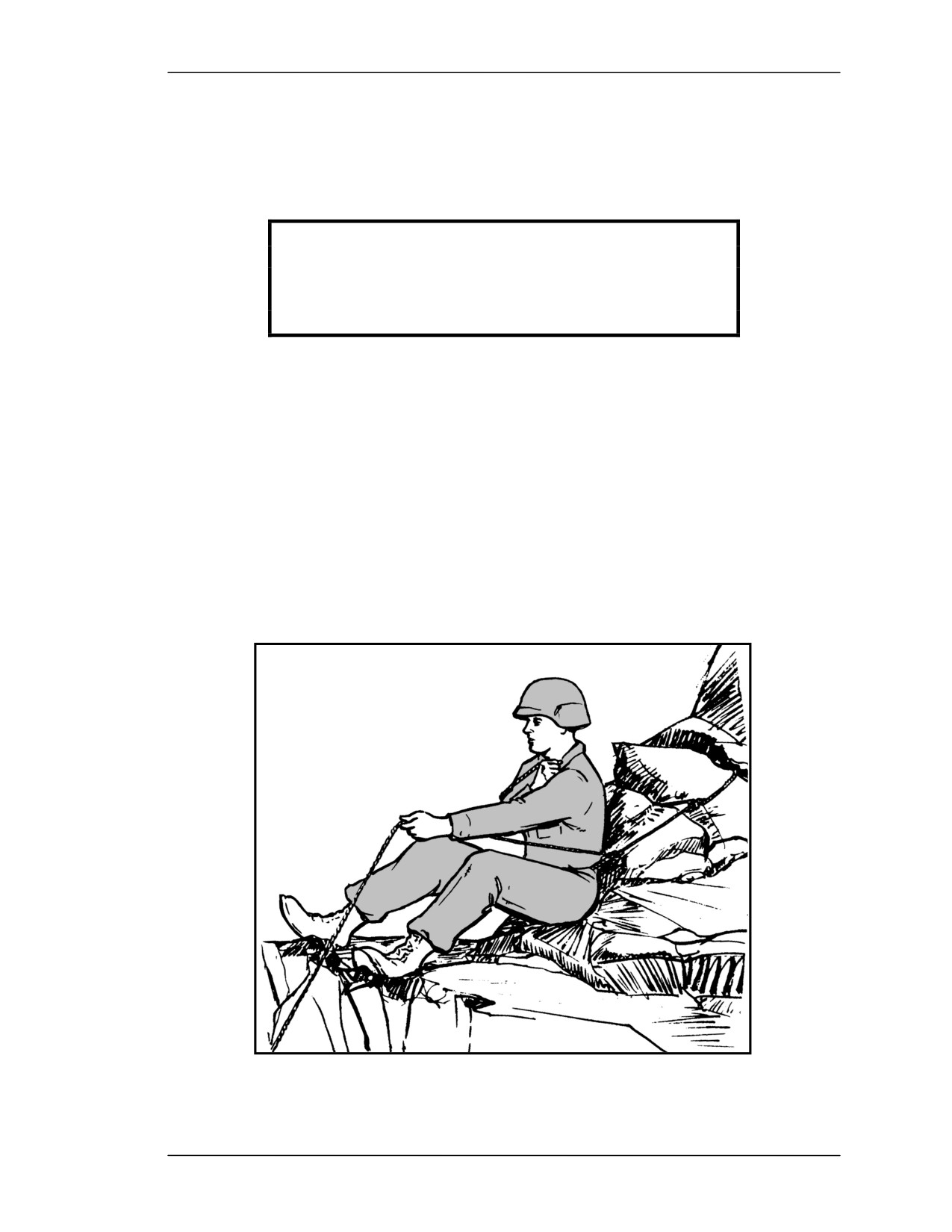
(1) Sitting Body Belay. The sitting body belay is the preferred position and is usually
the most secure (Figure 6-22). The belayer sits facing the direction where the force of a
fall will likely come from, using terrain to his advantage, and attempts to brace both feet
against the rock to support his position. It is best to sit in a slight depression, placing the
buttocks lower than the feet, and straightening the legs for maximum support. When
perfectly aligned, the rope running to the climber will pass between the belayer’s feet,
and both legs will equally absorb the force of a fall. Sometimes, the belayer may not be
able to sit facing the direction he would like, or both feet cannot be braced well. The leg
on the “guide hand” side should then point towards the load, bracing the foot on the rock
when possible. The belayer can also “straddle” a large tree or rock nubbin for support, as
long as the object is solid enough to sustain the possible load.
Figure 6-22. Sitting body belay.
6-35
FM 3-97.61
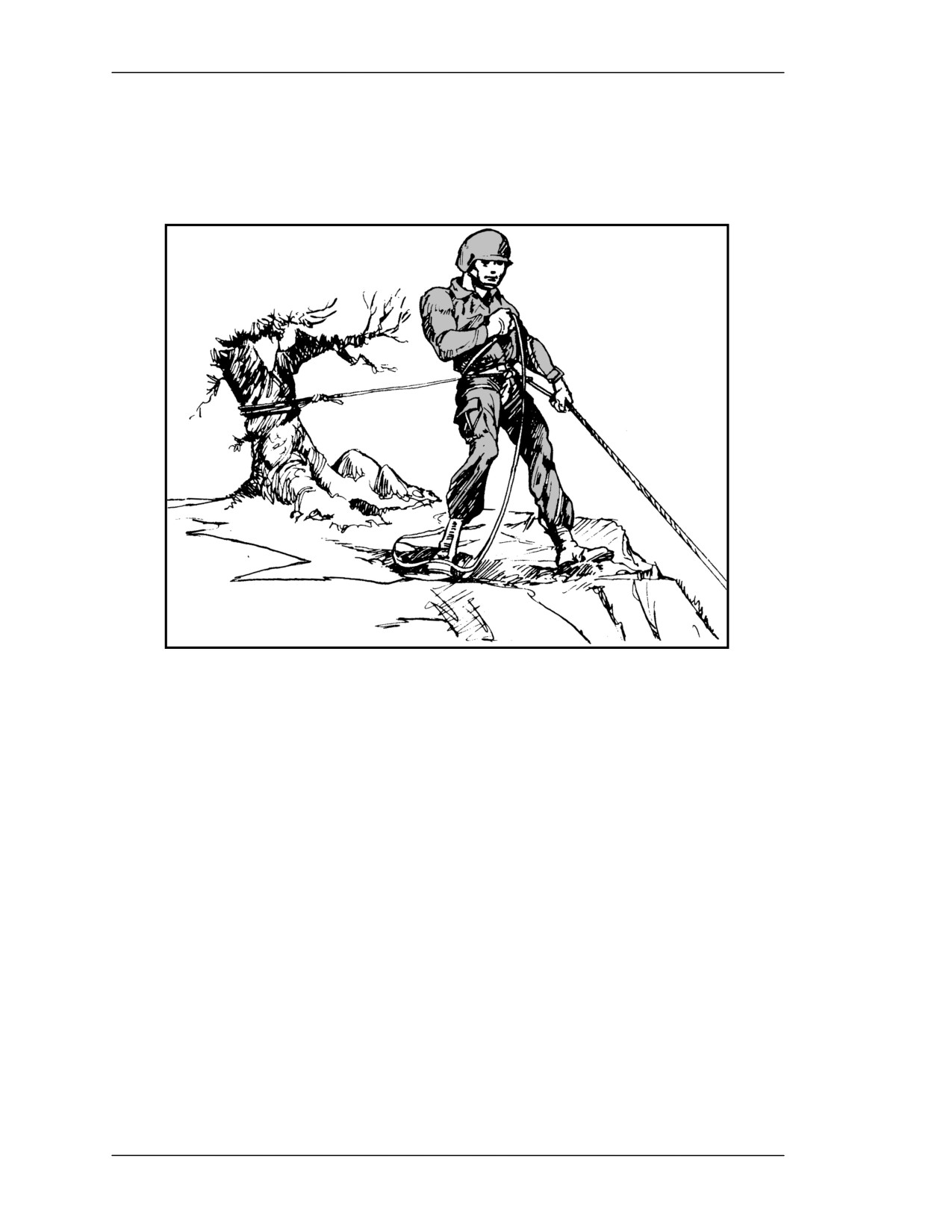
(2) Standing Body Belay. The standing body belay is used on smaller ledges where
there is no room for the belayer to sit (Figure 6-23). What appears at first to be a fairly
unstable position can actually be quite secure when belay anchors are placed at or above
shoulder height to support the stance when the force will be downward.
Figure 6-23. Standing body belay.
(a) For a body belay to work effectively, the belayer must ensure that the rope runs
around the hips properly, and remains there under load when applying the brake. The
rope should run around the narrow portion of the pelvic girdle, just below the bony high
points of the hips. If the rope runs too high, the force of a fall could injure the belayer’s
midsection and lower rib cage. If the rope runs too low, the load may pull the rope below
the buttocks, dumping the belayer out of position. It is also possible for a strong upward
or downward pull to strip the rope away from the belayer, rendering the belay useless.
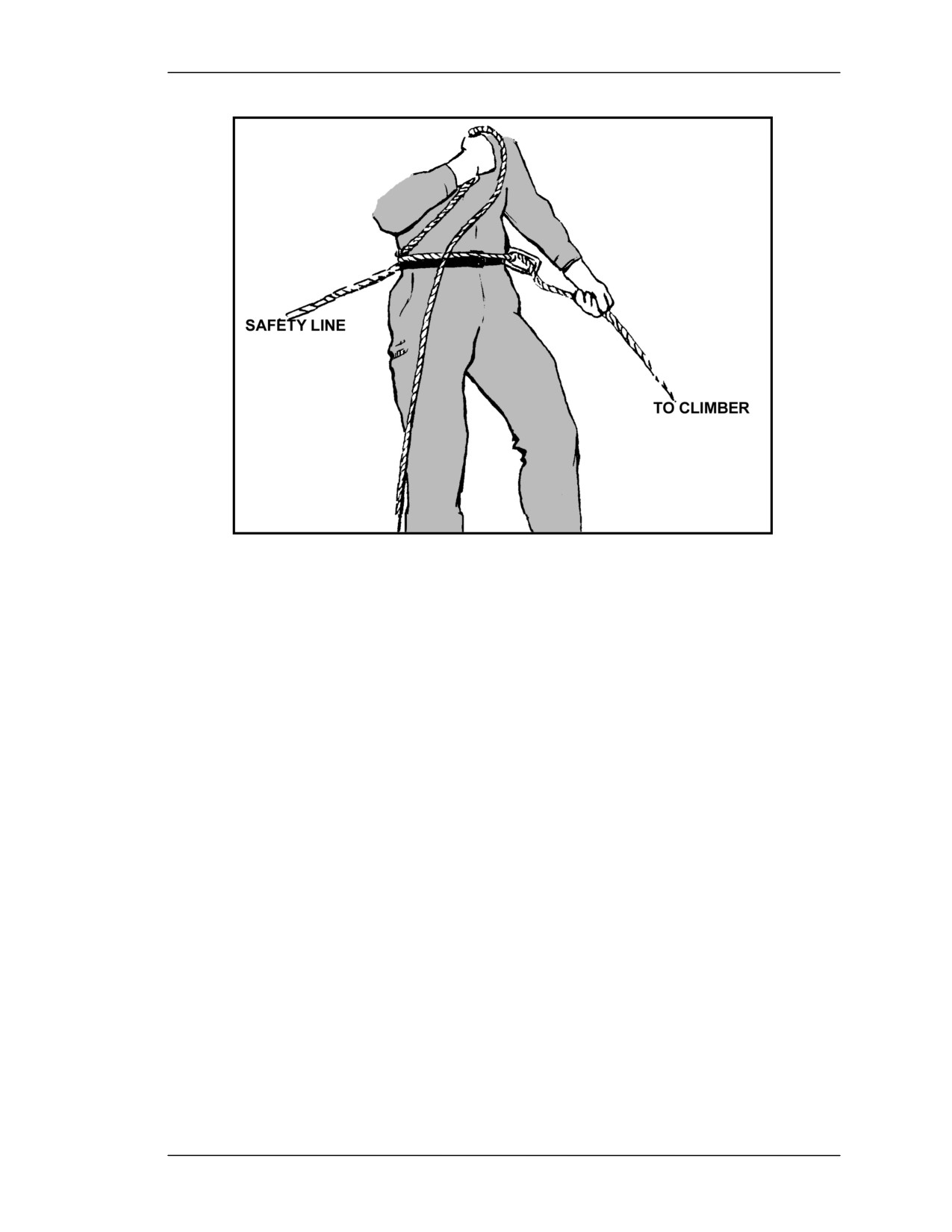
(b) To prevent any of these possibilities from happening, the belay rope is clipped
into a carabiner attached to the guide hand side of the seat harness (or bowline-on-a-coil).
This “guide carabiner” helps keep the rope in place around the hips and prevents loss of
control in upward or downward loads (Figure 6-24).
6-36
FM 3-97.61
Figure 6-24. Guide carabiner for rope control in a body belay.
b. Mechanical Belay. A mechanical belay must be used whenever there is potential
for the lead climber to take a severe fall. The holding power of a belay device is vastly
superior to any body belay under high loads. However, rope management in a mechanical
belay is more difficult to master and requires more practice. For the most part, the basic
body belay should be totally adequate on a typical military route, as routes used during
military operations should be the easiest to negotiate.
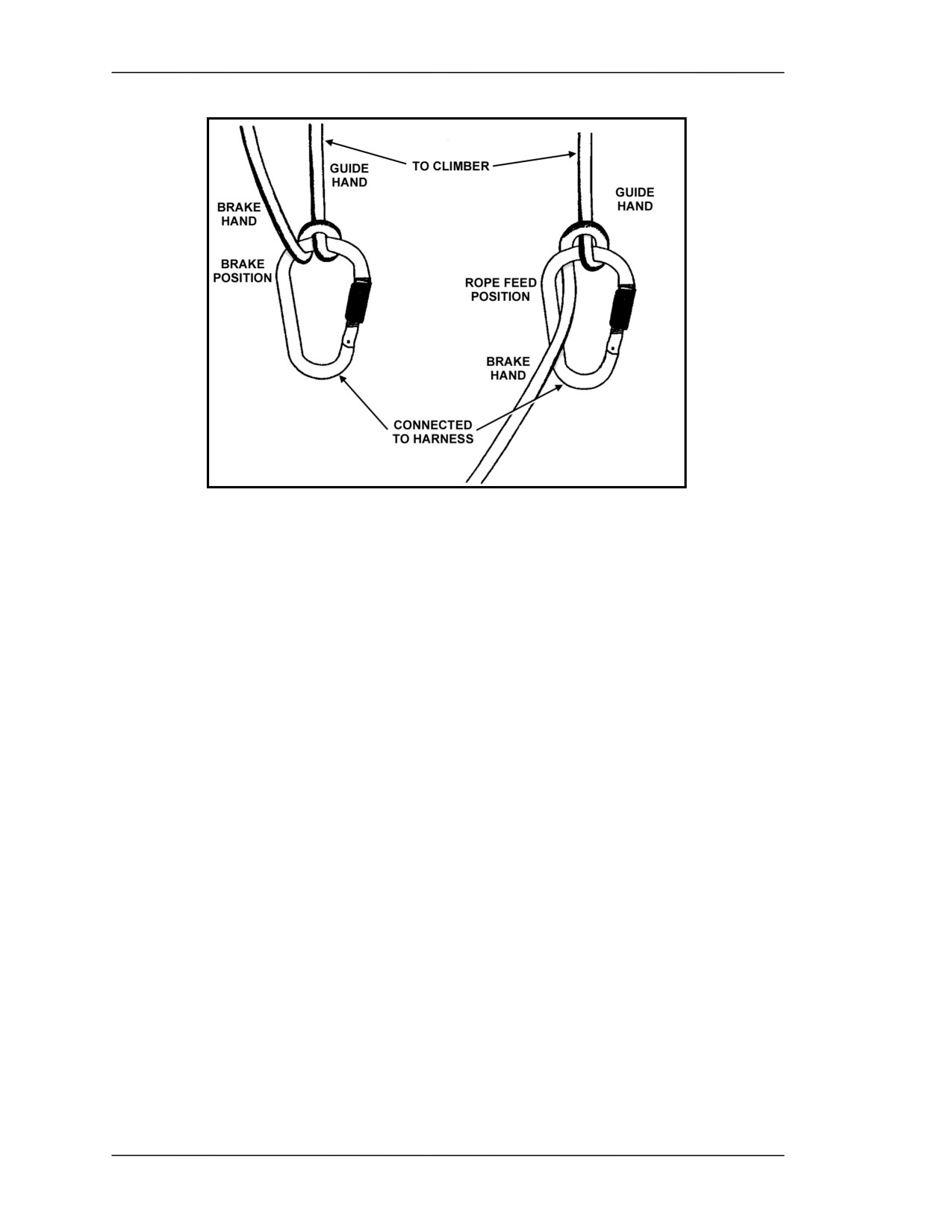
(1) Munter Hitch. The Munter hitch is an excellent mechanical belay technique and
requires only a rope and a carabiner (Figure 6-25, page 6-38). The Munter is actually a
two-way friction hitch. The Munter hitch will flip back and forth through the carabiner as
the belayer switches from giving slack to taking up rope. The carabiner must be large
enough, and of the proper design, to allow this function. The locking pear-shaped
carabiner, or pearabiner, is designed for the Munter hitch.
(a) The Munter hitch works exceptionally well as a lowering belay off the anchor. As
a climbing belay, the carabiner should be attached to the front of the belayer’s seat
harness. The hitch is tied by forming a loop and a bight in the rope, attaching both to the
carabiner. It’s fairly easy to place the bight on the carabiner backwards, which forms an
obvious, useless hitch. Put some tension on the Munter to ensure it is formed correctly, as
depicted in the following illustrations.
(b) The Munter hitch will automatically “lock-up” under load as the brake hand grips
the rope. The brake is increased by pulling the slack rope away from the body, towards
the load. The belayer must be aware that flipping the hitch DOES NOT change the
function of the hands. The hand on the rope running to the climber, or load, is always the
guide hand.
6-37
FM 3-97.61
Figure 6-25. Munter hitch.
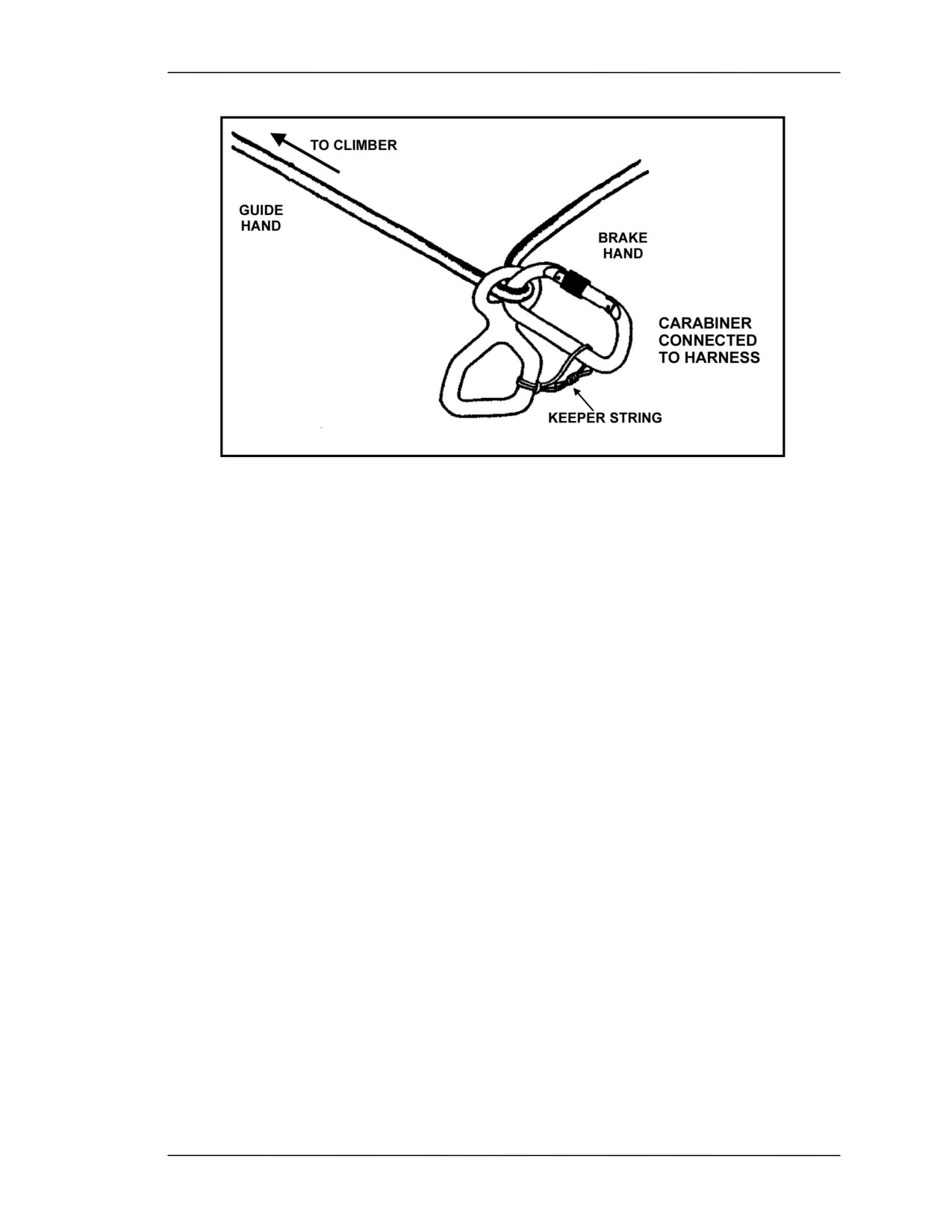
(2) Figure-Eight Device. The figure-eight device is a versatile piece of equipment
and, though developed as a rappel device, has become widely accepted as an effective
mechanical belay device (Figure 6-26). The advantage of any mechanical belay is friction
required to halt a fall is applied on the rope through the device, rather than around the
belayer’s body. The device itself provides rope control for upward and downward pulls
and excellent friction for halting severe falls. The main principle behind the figure-eight
device in belay mode is the friction developing on the rope as it reaches and exceeds the
90-degree angle between the rope entering the device and leaving the device. As a belay
device, the figure-eight works well for both belayed climbing and for lowering personnel
and equipment on fixed-rope installations.
(a) As a climbing belay, a bight placed into the climbing rope is run through the
“small eye” of the device and attached to a locking carabiner at the front of the belayer’s
seat harness. A short, small diameter safety rope is used to connect the “large eye” of the
figure eight to the locking carabiner for control of the device. The guide hand is placed
on the rope running to the climber. Rope management is performed as in a body belay.
The brake is applied by pulling the slack rope in the brake hand towards the body,
locking the rope between the device and the carabiner.
(b) As a lowering belay, the device is normally attached directly to the anchor with
the rope routed as in rappelling.
6-38
FM 3-97.61
Figure 6-26. Figure-eight device.
Note: Some figure-eight descenders should not be used as belay devices due to their
construction and design. Always refer to manufacturer’s specifications and
directions before use.
(3) Mechanical Camming Device. The mechanical camming device has an internal
camming action that begins locking the rope in place as friction is increased. Unlike the
other devices, the mechanical camming device can stop a falling climber without any
input from the belayer. A few other devices perform similarly to this, but have no moving
parts. Some limitations to these type devices are minimum and maximum rope diameters.
(4) Other Mechanical Belay Devices. There are many other commercially available
mechanical belay devices. Most of these work with the same rope movement direction
and the same braking principle. The air traffic controller (ATC), slotted plate, and other
tube devices are made in many different shapes. These all work on the same principle as
the figure-eight device―friction increases on the rope as it reaches and exceeds the
90-degree angle between the rope entering the device and leaving the device.
6-16. ESTABLISHING A BELAY
A belay can be established using either a direct or indirect connection. Each type has
advantages and disadvantages. The choice will depend on the intended use of the belay.
a. Direct Belay. The direct belay removes any possible forces from the belayer and
places this force completely on the anchor. Used often for rescue installations or to bring
a second climber up to a new belay position in conjunction with the Munter hitch, the
belay can be placed above the belayer’s stance, creating a comfortable position and ease
of applying the brake. Also, if the second falls or weights the rope, the belayer is not
locked into a position. Direct belays provide no shock-absorbing properties from the
belayer’s attachment to the system as does the indirect belay; therefore, the belayer is apt
to pay closer attention to the belaying process.
6-39
FM 3-97.61
b. Indirect Belay. An indirect belay, the most commonly used, uses a belay device
attached to the belayer’s harness. This type of belay provides dynamic shock or weight
absorption by the belayer if the climber falls or weights the rope, which reduces the direct
force on the anchor and prevents a severe shock load to the anchor.
6-17. SETTING UP A BELAY
In rock climbing, climbers must sometimes make do with marginal protection placements
along a route, but belay positions must be made as
“bombproof” as possible.
Additionally, the belayer must set up the belay in relation to where the fall force will
come from and pay strict attention to proper rope management for the belay to be
effective. All belay positions are established with the anchor connection to the front of
the harness. If the belay is correctly established, the belayer will feel little or no force if
the climber falls or has to rest on the rope. Regardless of the actual belay technique used,
five basic steps are required to set up a sound belay.
a. Select Position and Stance. Once the climbing line is picked, the belayer selects
his position. It’s best if the position is off to the side of the actual line, putting the belayer
out of the direct path of a potential fall or any rocks kicked loose by the climber. The
position should allow the belayer to maintain a comfortable, relaxed stance, as he could
be in the position for a fairly long time. Large ledges that allow a well braced, sitting
stance are preferred. Look for belay positions close to bombproof natural anchors. The
position must at least allow for solid artificial placements.
b. Aim the Belay. With the belay position selected, the belay must now be “aimed.”
The belayer determines where the rope leading to the climber will run and the direction
the force of a fall will likely come from. When a lead climber begins placing protection,
the fall force on the belayer will be in some upward direction, and in line with the first
protection placement. If this placement fails under load, the force on the belay could be
straight down again. The belayer must aim his belay for all possible load directions,
adjusting his position or stance when necessary. The belay can be aimed through an
anchor placement to immediately establish an upward pull; however, the belayer must
always be prepared for the more severe downward fall force in the event intermediate
protection placements fail.
c. Anchor the Belay. For a climbing belay to be considered bombproof, the belayer
must be attached to a solid anchor capable of withstanding the highest possible fall force.
A solid natural anchor would be ideal, but more often the belayer will have to place
pitons or chocks. A single artificial placement should never be considered adequate for
anchoring a belay (except at ground level). Multiple anchor points capable of supporting
both upward and downward pulls should be placed. The rule of thumb is to place two
anchors for a downward pull and one anchor for an upward pull as a MINIMUM. The
following key points also apply to anchoring belays.
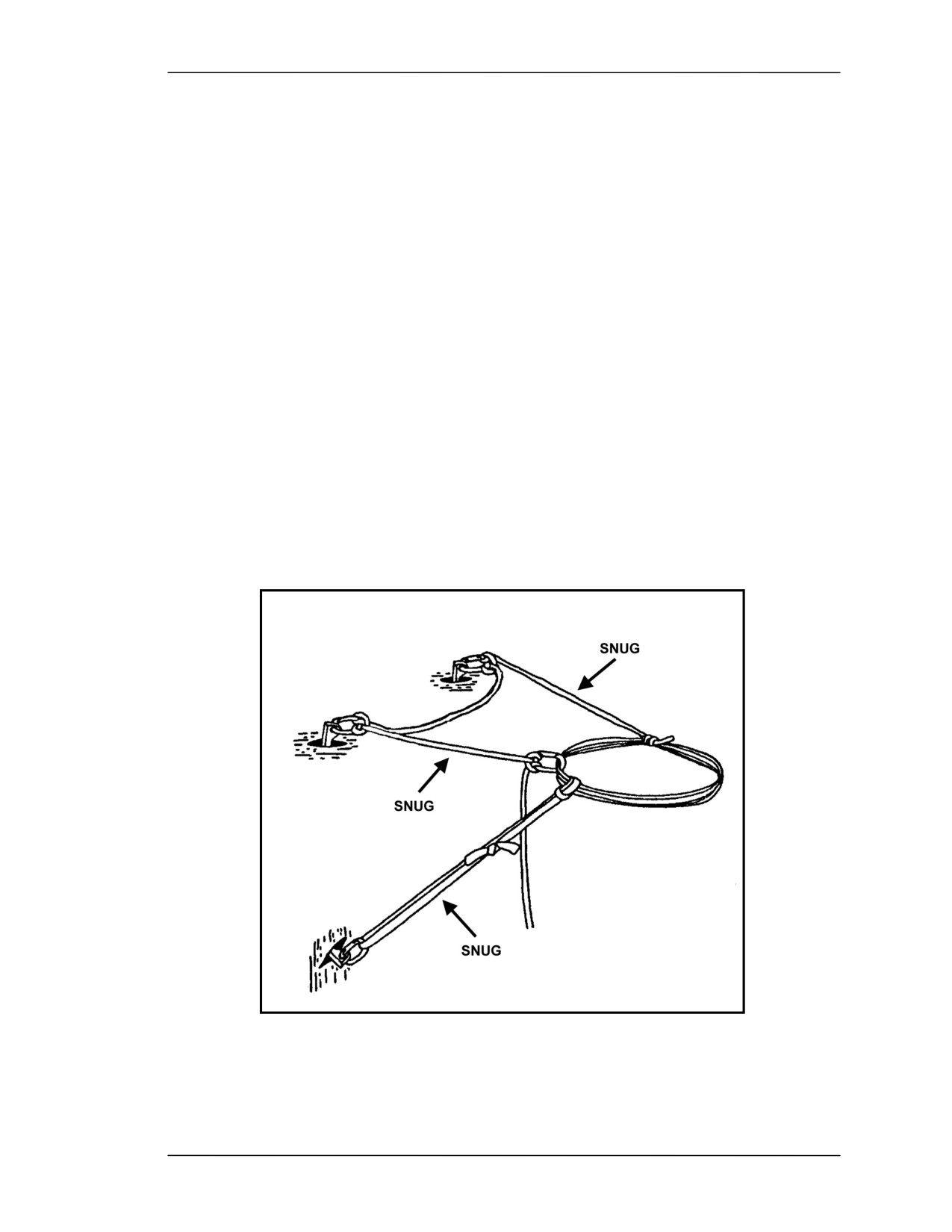
(1) Each anchor must be placed in line with the direction of pull it is intended to
support.
(2) Each anchor attachment must be rigged “independently” so a failure of one will
not shock load remaining placements or cause the belayer to be pulled out of position.
(3) The attachment between the anchor and the belayer must be snug to support the
stance. Both belayer’s stance and belay anchors should absorb the force of a fall.
6-40
FM 3-97.61
(4) It is best for the anchors to be placed relatively close to the belayer with short
attachments. If the climber has to be tied-off in an emergency, say after a severe fall, the
belayer can attach a Prusik sling to the climbing rope, reach back, and connect the sling
to one of the anchors. The load can be placed on the Prusik and the belayer can come out
of the system to render help.
(5) The belayer can use either a portion of the climbing rope or slings of the
appropriate length to connect himself to the anchors. It’s best to use the climbing rope
whenever possible, saving the slings for the climb. The rope is attached using either
figure eight loops or clove hitches. Clove hitches have the advantage of being easily
adjusted. If the belayer has to change his stance at some point, he can reach back with the
guide hand and adjust the length of the attachment through the clove hitch as needed.
(6) The anchor attachments should also help prevent the force of a fall from
“rotating” the belayer out of position. To accomplish this, the climbing rope must pass
around the “guide-hand side” of the body to the anchors. Sling attachments are connected
to the belayer’s seat harness (or bowline-on-a-coil) on the guide-hand side.
(7) Arrangement of rope and sling attachments may vary according to the number and
location of placements. Follow the guidelines set forth and remember the key points for
belay anchors; “in line”, “independent”, and “snug”. Figure 6-27 shows an example of a
common arrangement, attaching the rope to the two “downward” anchors and a sling to
the “upward” anchor. Note how the rope is connected from one of the anchors back to the
belayer. This is not mandatory, but often helps “line-up” the second attachment.
Figure 6-27. Anchoring a belay.
6-41
FM 3-97.61
d. Stack the Rope. Once the belayer is anchored into position, he must stack the
rope to ensure it is free of twists and tangles that might hinder rope management in the
belay. The rope should be stacked on the ground, or on the ledge, where it will not get
caught in cracks or nubbins as it is fed out to the climber.
(1) On small ledges, the rope can be stacked on top of the anchor attachments if there
is no other place to lay it, but make sure to stack it carefully so it won’t tangle with the
anchored portion of the rope or other slings. The belayer must also ensure that the rope
will not get tangled around his legs or other body parts as it “feeds” out.
(2) The rope should never be allowed to hang down over the ledge. If it gets caught in
the rock below the position, the belayer may have to tie-off the climber and come out of
the belay to free the rope; a time-consuming and unnecessary task. The final point to
remember is the rope must be stacked “from the belayer’s end” so the rope running to the
climber comes off the “top” of the stacked pile.
e. Attach the Belay. The final step of the procedure is to attach the belay. With the
rope properly stacked, the belayer takes the rope coming off the top of the pile, removes
any slack between himself and the climber, and applies the actual belay technique. If
using a body belay, ensure the rope is clipped into the guide carabiner.
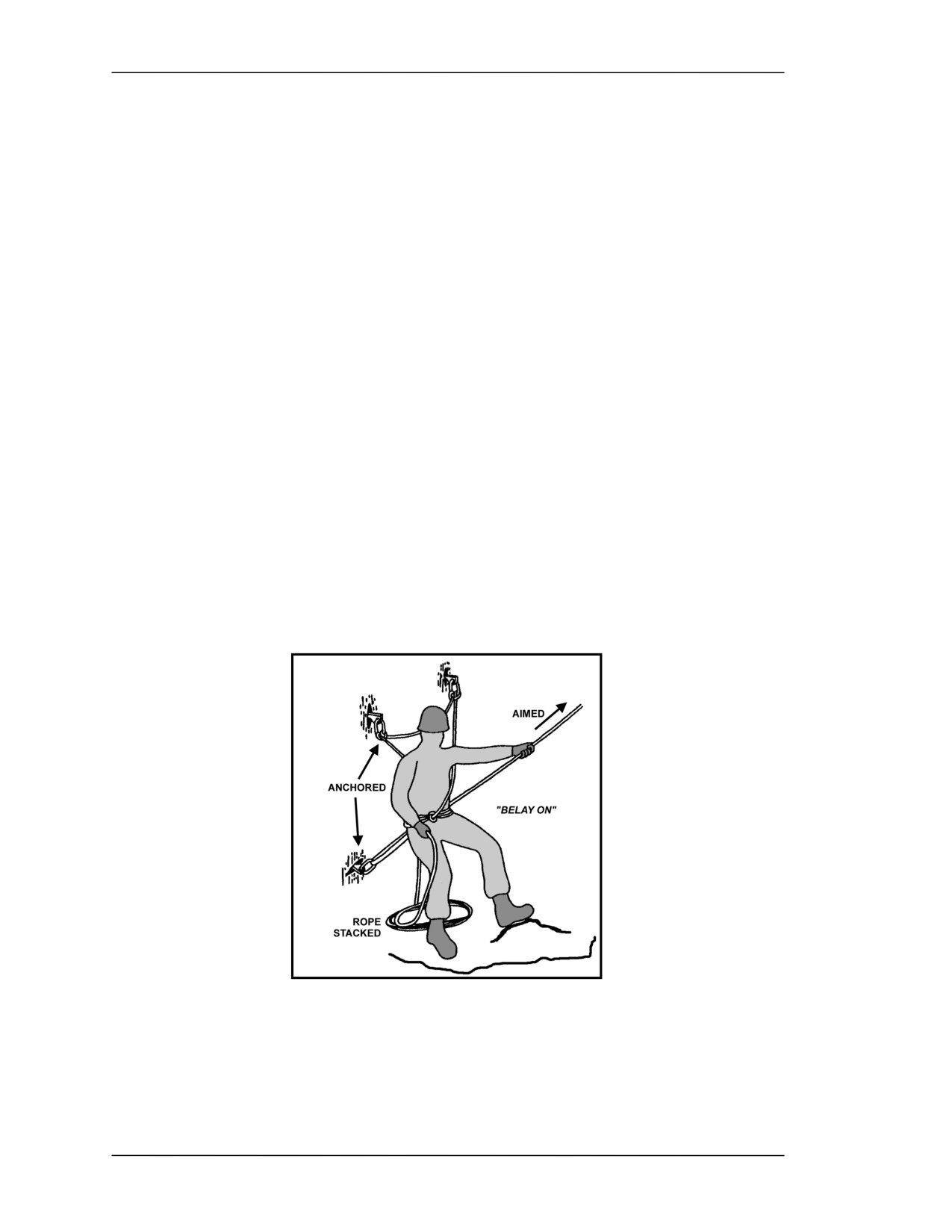
(1) The belayer should make one quick, final inspection of his belay. If the belay is
set up correctly, the anchor attachments, guide carabiner if applicable, and the rope
running to the climber will all be on the “guide hand” side, which is normally closest to
the rock (Figure 6-28). If the climber takes a fall, the force, if any, should not have any
negative effect on the belayer’s involvement in the system. The brake hand is out away
from the slope where it won’t be jammed between the body and the rock. The guide hand
can be placed on the rock to help support the stance when applying the brake.
Figure 6-28. Belay setup.
(2) When the belayer is satisfied with his position, he gives the signal, “BELAY
ON!”. When belaying the “second”, the same procedure is used to set up the belay.
Unless the belay is aimed for an upward pull, the fall force is of course downward and the
6-42
FM 3-97.61
belayer is usually facing away from the rock, the exception being a hanging belay on a
vertical face. If the rope runs straight down to the climber and the anchors are directly
behind the position, the belayer may choose to brake with the hand he feels most
comfortable with. Anchor attachments, guide carabiner, and rope running to the climber
through the guide hand must still be aligned on the same side to prevent the belayer from
being rotated out of position, unless the belayer is using an improvised harness and the
anchor attachment is at the rear.
6-18. TOP-ROPE BELAY
A “top-rope” is a belay setup used in training to protect a climber while climbing on
longer, exposed routes. A solid, bombproof anchor is required at the top of the pitch. The
belayer is positioned either on the ground with the rope running through the top anchor
and back to the climber, or at the top at the anchor. The belayer takes in rope as the
climber proceeds up the rock. If this is accomplished with the belayer at the bottom, the
instructor can watch the belayer while he coaches the climber through the movements.
CAUTION
Do not use a body belay for top-rope climbing. The
rope will burn the belayer if the climber has to be
lowered.
Section V. CLIMBING COMMANDS
Communication is often difficult during a climb. As the distance between climber and
belayer increases, it becomes harder to distinguish one word from another and the
shortest sentence may be heard as nothing more than jumbled syllables. A series of
standard voice commands were developed over the years to signal the essential rope
management functions in a belayed climb. Each command is concise and sounds a bit
different from another to reduce the risk of a misunderstanding between climber and
belayer. They must be pronounced clearly and loudly so they can be heard and
understood in the worst conditions.
6-19. VERBAL COMMANDS
Table 6-1, page 6-44, lists standard rope commands and their meanings in sequence as
they would normally be used on a typical climb. (Note how the critical “BELAY”
commands are reversed so they sound different and will not be confused.)
6-43

FM 3-97.61
BELAYER
CLIMBER
MEANING/ACTION TAKEN
“BELAY ON”
The belay is on; you may climb when ready; the rope will
be managed as needed.
“CLIMBING”
I am ready to climb.
(as a courtesy)
“CLIMB”
Proceed, and again, the rope will be managed as
(as a courtesy)
necessary.
“ROCK”
“ROCK”
PROTECT YOURSELF FROM FALLING OBJECTS.
Signal will be echoed by all climbers in the area. If
multipitch climbing, ensure climbers below hear.
“TAKE ROPE”
Take in excess rope between us without pulling me off
the route.
Belayer takes in rope.
“SLACK”
Release all braking/tension on the rope so I can have
slack without pulling the rope.
Belayer removes brake/tension.
“TENSION”
Take all the slack, apply brake, and hold me. My weight
will be on the rope.
Belayer removes slack and applies brake.
“FALLING”
I am falling.
Belayer applies brake to arrest the fall.
“TWEN-TY-FIVE”
You have approximately 25 feet of rope left. Start
looking for the next belay position.
Climber selects a belay position.
“FIF-TEEN”
You have approximately 15 feet of rope left. Start
looking for the next belay position.
Climber selects a belay position within the next few feet.
“FIVE”
Set up the belay.
You have 5 feet of rope left. Set up the belay position.
You have no more rope.
Climber sets up the belay.
Removes the belay,
“OFF BELAY”
I have finished climbing and I am anchored. You may
remains anchored.
remove the belay.
Prepares to climb.
Belayer removes the belay and, remaining anchored,
prepares to climb.
Table 6-1. Rope commands.
6-20. ROPE TUG COMMANDS
Sometimes the loudest scream cannot be heard when the climber and belayer are far
apart. This is especially true in windy conditions, or when the climber is around a corner,
above an overhang, or at the back of a ledge. It may be necessary to use a series of “tugs”
on the rope in place of the standard voice commands. To avoid any possible confusion
with interpretation of multiple rope tug commands, use only one.
a. While a lead climb is in progress, the most important command is “BELAY ON.”
This command is given only by the climber when the climber is anchored and is prepared
for the second to begin climbing. With the issue of this command, the second knows the
climber is anchored and the second prepares to climb.
b. For a rope tug command, the leader issues three distinct tugs on the rope AFTER
anchoring and putting the second on belay. This is the signal for “BELAY ON” and
signals the second to climb when ready. The new belayer keeps slack out of the rope.
6-44
FM 3-97.61
Section VI. ROPED CLIMBING METHODS
In military mountaineering, the primary mission of a roped climbing team is to “fix” a
route with some type of rope installation to assist movement of less trained personnel in
the unit. This duty falls upon the most experienced climbers in the unit, usually working
in two- or three-man groups or teams called assault climbing teams. Even if the climbing
is for another purpose, roped climbing should be performed whenever the terrain
becomes difficult and exposed.
6-21. TOP-ROPED CLIMBING
Top-roped climbing is used for training purposes only. This method of climbing is not
used for movement due to the necessity of pre-placing anchors at the top of a climb. If
you can easily access the top of a climb, you can easily avoid the climb itself.
a. For training, top-roped climbing is valuable because it allows climbers to attempt
climbs above their skill level and or to hone present skills without the risk of a fall. Top-
roped climbing may be used to increase the stamina of a climber training to climb longer
routes as well as for a climber practicing protection placements.
b. The belayer is positioned either at the base of a climb with the rope running
through the top anchor and back to the climber or at the top at the anchor. The belayer
takes in rope as the climber moves up the rock, giving the climber the same protection as
a belay from above. If this is accomplished with the belayer at the bottom, the instructor
is able to keep an eye on the belayer while he coaches the climber through the
movements.
6-22. LEAD CLIMBING
A lead climb consists of a belayer, a leader or climber, rope(s), and webbing or hardware
used to establish anchors or protect the climb. As he climbs the route, the leader emplaces
“intermediate” anchors, and the climbing rope is connected to these anchors with a
carabiner. These “intermediate” anchors protect the climber against a fall-thus the term
“protecting the climb.”
Note: Intermediate anchors are commonly referred to as “protection,” “pro,” “pieces,”
“pieces of pro,” “pro placements,” and so on. For standardization within this
publication, these specific anchors will be referred to as “protection;” anchors
established for other purposes, such as rappel points, belays, or other rope
installations, will be referred to as “anchors.”
CAUTION
During all lead climbing, each climber in the team is
either anchored or being belayed.
a. Lead climbing with two climbers is the preferred combination for movement on
technically difficult terrain. Two climbers are at least twice as fast as three climbers, and
are efficient for installing a “fixed rope,” probably the most widely used rope installation
6-45
FM 3-97.61
in the mountains. A group of three climbers are typically used on moderate snow, ice, and
snow-covered glaciers where the rope team can often move at the same time, stopping
occasionally to set up belays on particularly difficult sections. A group or team of three
climbers is sometimes used in rock climbing because of an odd number of personnel, a
shortage of ropes (such as six climbers and only two ropes), or to protect and assist an
individual who has little or no experience in climbing and belaying. Whichever technique
is chosen, a standard roped climbing procedure is used for maximum speed and safety.
b. When the difficulty of the climbing is within the
“leading ability” of both
climbers, valuable time can be saved by “swinging leads.” This is normally the most
efficient method for climbing multipitch routes. The second finishes cleaning the first
pitch and continues climbing, taking on the role of lead climber. Unless he requires
equipment from the other rack or desires a break, he can climb past the belay and
immediately begin leading. The belayer simply adjusts his position, re-aiming the belay
once the new leader begins placing protection. Swinging leads, or “leap frogging,” should
be planned before starting the climb so the leader knows to anchor the upper belay for
both upward and downward pulls during the setup.
c. The procedures for conducting a lead climb with a group of two are relatively
simple. The most experienced individual is the
“lead” climber or leader, and is
responsible for selecting the route. The leader must ensure the route is well within his
ability and the ability of the second. The lead climber carries most of the climbing
equipment in order to place protection along the route and set up the next belay. The
leader must also ensure that the second has the necessary equipment, such as a piton
hammer, nut tool, etc., to remove any protection that the leader may place.
(1) The leader is responsible for emplacing protection frequently enough and in such
a manner that, in the event that either the leader or the second should fall, the fall will be
neither long enough nor hard enough to result in injury. The leader must also ensure that
the rope is routed in a way that will allow it to run freely through the protection
placements, thus minimizing friction, or “rope drag”.
(2) The other member of the climbing team, the belayer (sometimes referred to as the
“second”), is responsible for belaying the leader, removing the belay anchor, and
retrieving the protection placed by the leader between belay positions
(also called
“cleaning the pitch”).
(3) Before the climb starts, the second will normally set up the first belay while the
leader is arranging his rack. When the belay is ready, the belayer signals, “BELAY ON”,
affirming that the belay is “on” and the rope will be managed as necessary. When the
leader is ready, he double checks the belay. The leader can then signal, “CLIMBING”,
only as a courtesy, to let the belayer know he is ready to move. The belayer can reply
with “CLIMB”, again, only as a courtesy, reaffirming that the belay is “on” and the rope
will be managed as necessary. The leader then begins climbing.
(4) While belaying, the second must pay close attention to the climber’s every move,
ensuring that the rope runs free and does not inhibit the climber’s movements. If he
cannot see the climber, he must
“feel” the climber through the rope. Unless told
otherwise by the climber, the belayer can slowly give slack on the rope as the climber
proceeds on the route. The belayer should keep just enough slack in the rope so the
climber does not have to pull it through the belay. If the climber wants a tighter rope, it
can be called for. If the belayer notices too much slack developing in the rope, the excess
6-46
FM 3-97.61
rope should be taken in quickly. It is the belayer’s responsibility to manage the rope,
whether by sight or feel, until the climber tells him otherwise.
(5) As the leader protects the climb, slack will sometimes be needed to place the rope
through the carabiner (clipping), in a piece of protection above the tie-in point on the
leaders harness. In this situation, the leader gives the command “SLACK” and the
belayer gives slack, (if more slack is needed the command will be repeated). The leader is
able to pull a bight of rope above the tie-in point and clip it into the carabiner in the
protection above. When the leader has completed the connection, or the clip, the
command “TAKE ROPE” is given by the leader and the belayer takes in the remaining
slack.
(6) The leader continues on the route until either a designated belay location is
reached or he is at the end of or near the end of the rope. At this position, the leader sets
an anchor, connects to the anchor and signals “OFF BELAY”. The belayer prepares to
climb by removing all but at least one of his anchors and secures the remaining
equipment. The belayer remains attached to at least one anchor until the command
“BELAY ON” is given.
d. When the leader selects a particular route, he must also determine how much, and
what types, of equipment might be required to safely negotiate the route. The selected
equipment must be carried by the leader. The leader must carry enough equipment to
safely protect the route, additional anchors for the next belay, and any other items to be
carried individually such as rucksacks or individual weapons.
(1) The leader will assemble, or “rack,” the necessary equipment onto his harness or
onto slings around the head and shoulder. A typical leader “rack” consists of:
• Six to eight small wired stoppers on a carabiner.
• Four to six medium to large wired stoppers on a carabiner.
• Assorted hexentrics, each on a separate carabiner.
• SLCDs of required size, each on a separate carabiner.
• Five to ten standard length runners, with two carabiners on each.
• Two to three double length runners, with two carabiners on each.
• Extra carabiners.
• Nut tool.
Note: The route chosen will dictate, to some degree, the necessary equipment. Members
of a climbing team may need to consolidate gear to climb a particular route.
(2) The belayer and the leader both should carry many duplicate items while
climbing.
• Short Prusik sling.
• Long Prusik sling.
• Cordellette.
•
10 feet of 1-inch webbing.
•
20 feet of 1-inch webbing.
•
Belay device (a combination belay/rappel device is multifunctional).
•
Rappel device (a combination belay/rappel device is multifunctional).
•
Large locking carabiner (pear shape carabiners are multifunctional).
6-47
FM 3-97.61
• Extra carabiners.
• Nut tool (if stoppers are carried).
Note: If using an over the shoulder gear sling, place the items in order from smallest to
the front and largest to the rear.
e. Leading a difficult pitch is the most hazardous task in roped climbing. The lead
climber may be exposed to potentially long, hard falls and must exercise keen judgment
in route selection, placement of protection, and routing of the climbing rope through the
protection. The leader should try to keep the climbing line as direct as possible to the next
belay to allow the rope to run smoothly through the protection with minimal friction.
Protection should be placed whenever the leader feels he needs it, and BEFORE moving
past a difficult section.
CAUTION
The climber must remember he will fall twice the
distance from his last piece of protection before the
rope can even begin to stop him.
(1) Placing Protection. Generally, protection is placed from one stable position to the
next. The anchor should be placed as high as possible to reduce the potential fall distance
between placements. If the climbing is difficult, protection should be placed more
frequently. If the climbing becomes easier, protection can be placed farther apart, saving
hardware for difficult sections. On some routes an extended diagonal or horizontal
movement, known as a traverse, is required. As the leader begins this type of move, he
must consider the second’s safety as well as his own. The potential fall of the second will
result in a pendulum swing if protection is not adequate to prevent this. The danger
comes from any objects in the swinging path of the second.
CAUTION
Leader should place protection prior to, during, and
upon completion of any traverse. This will minimize
the potential swing, or pendulum, for both the leader
and second if either should fall.
(2) Correct Clipping Technique. Once an anchor is placed, the climber “clips” the
rope into the carabiner
(Figure
6-29, page
6-50). As a carabiner hangs from the
protection, the rope can be routed through the carabiner in two possible ways. One way
will allow the rope to run smoothly as the climber moves past the placement; the other
way will often create a dangerous situation in which the rope could become “unclipped”
from the carabiner if the leader were to fall on this piece of protection. In addition, a
6-48
FM 3-97.61
series of incorrectly clipped carabiners may contribute to rope drag. When placing
protection, the leader must ensure the carabiner on the protection does not hang with the
carabiner gate facing the rock; when placing protection in a crack ensure the carabiner
gate is not facing into the crack.
• Grasp the rope with either hand with the thumb pointing down the rope
towards the belayer
• Pull enough rope to reach the carabiner with a bight
• Note the direction the carabiner is hanging from the protection
• Place the bight into the carabiner so that, when released, the rope does not
cause the carabiner to twist.
(a) If the route changes direction, clipping the carabiner will require a little more
thought. Once leaving that piece of protection, the rope may force the carabiner to twist if
not correctly clipped. If the clip is made correctly, a rotation of the clipped carabiner to
ensure that the gate is not resting against the rock may be all that is necessary.
CAUTION
Ensure the carabiner gate is not resting against a
protrusion or crack edge in the rock surface; the rock
may cause the gate to open.
(b) Once the rope is clipped into the carabiner, the climber should check to see that it
is routed correctly by pulling on the rope in the direction it will travel when the climber
moves past that position.
(c) Another potential hazard peculiar to leading should be eliminated before the
climber continues. The carabiner is attached to the anchor or runner with the gate facing
away from the rock and opening down for easy insertion of the rope. However, in a
leader fall, it is possible for the rope to run back over the carabiner as the climber falls
below the placement. If the carabiner is left with the gate facing the direction of the route
there is a chance that the rope will open the gate and unclip itself entirely from the
placement. To prevent this possibility, the climber should ensure that after the clip has
been made, the gate is facing away from the direction of the route. There are two ways to
accomplish this: determine which direction the gate will face before the protection or
runner is placed or once clipped, rotate the carabiner upwards 180 degrees. This problem
is more apt to occur if bent gate carabiners are used. Straight gate ovals or “Ds” are less
likely to have this problem and are stronger and are highly recommended. Bent gate
carabiners are easier to clip the rope into and are used mostly on routes with bolts
preplaced for protection. Bent gate carabiners are not recommended for many climbing
situations.
6-49
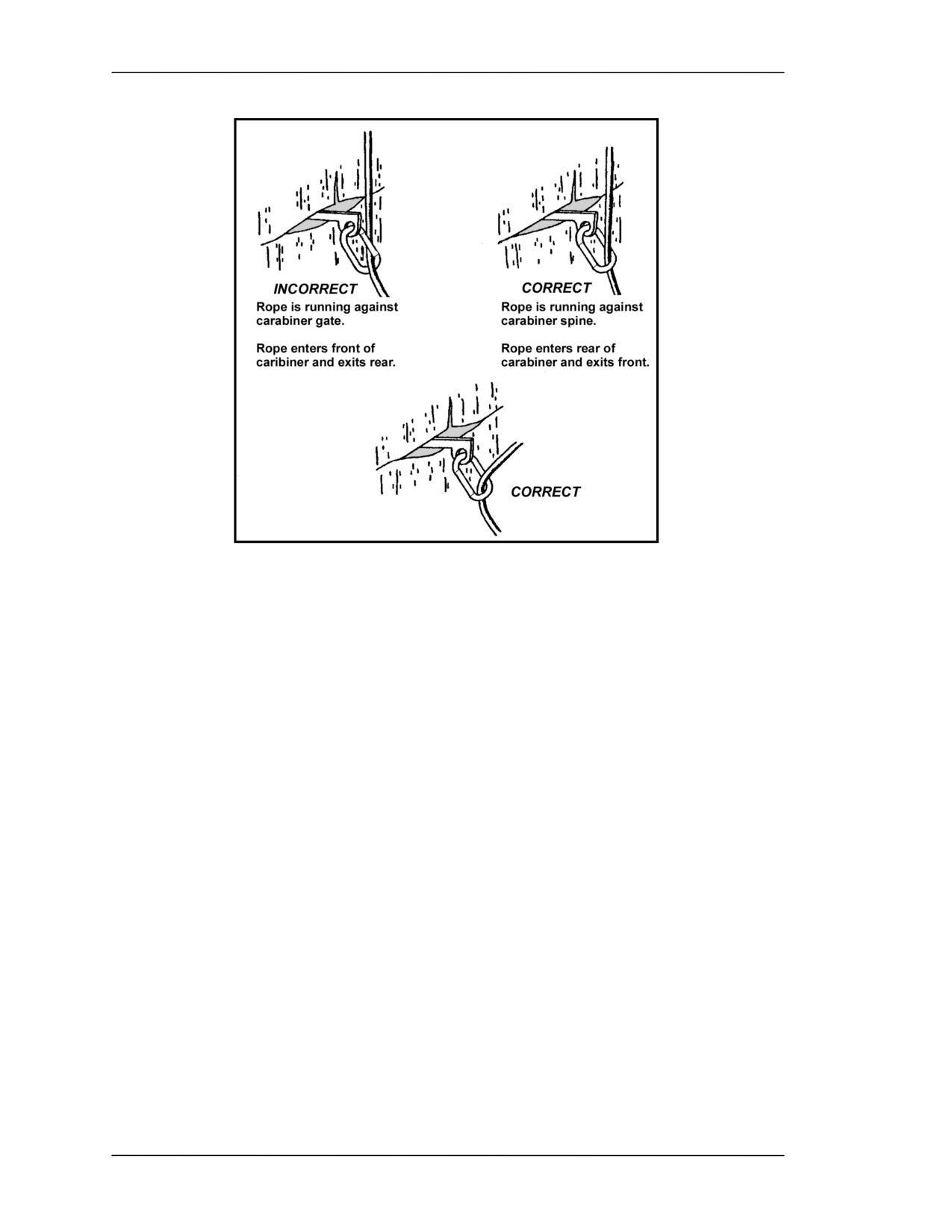
FM 3-97.61
Figure 6-29. Clipping on to protection.
(3) Reducing Rope Drag; Using Runners. No matter how direct the route, the
climber will often encounter problems with “rope drag” through the protection positions.
The friction created by rope drag will increase to some degree every time the rope passes
through a carabiner, or anchor. It will increase dramatically if the rope begins to “zigzag”
as it travels through the carabiners. To prevent this, the placements should be positioned
so the rope creates a smooth, almost straight line as it passes through the carabiners
(Figure 6-30). Minimal rope drag is an inconvenience; severe rope drag may actually pull
the climber off balance, inducing a fall.
6-50
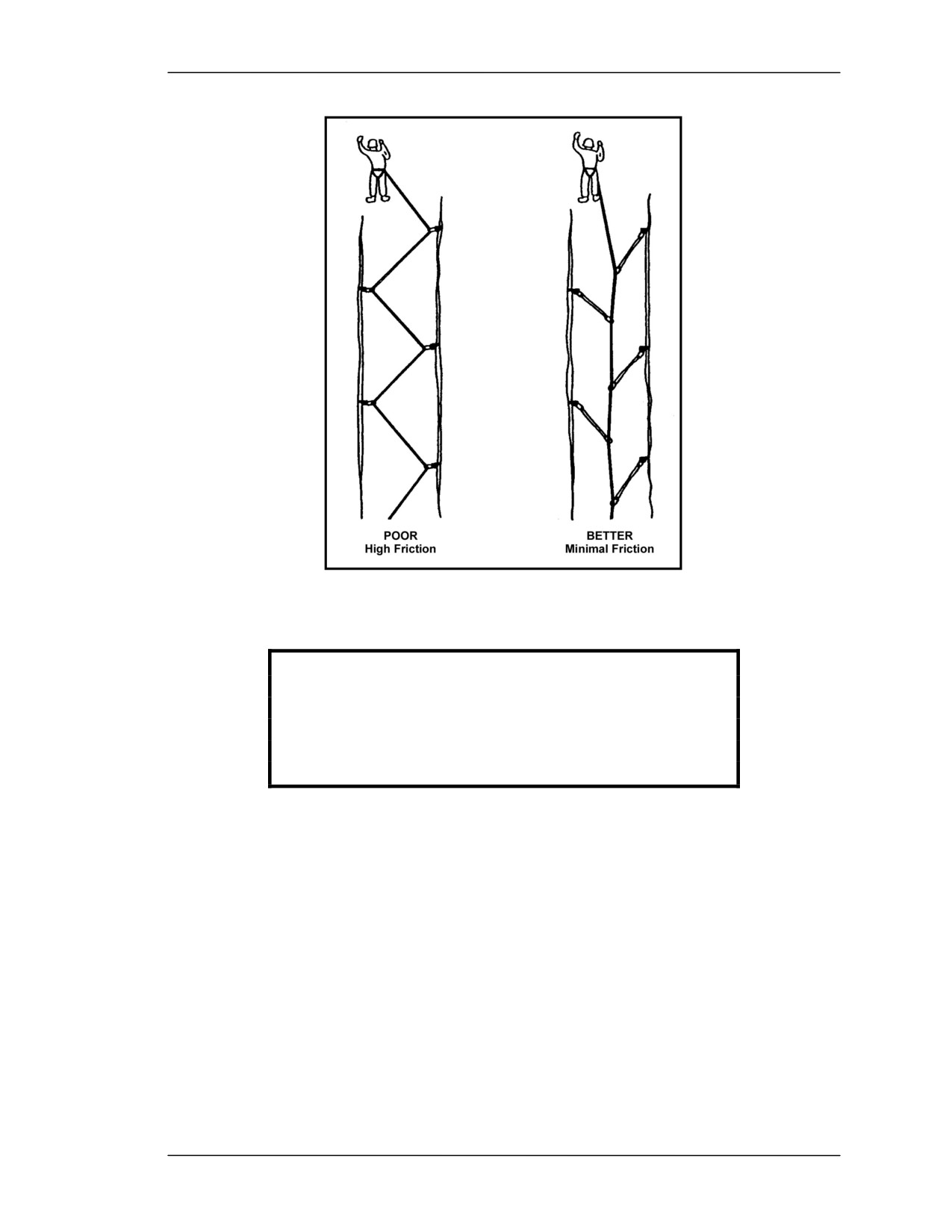
FM 3-97.61
Figure 6-30. Use of slings on protection.
CAUTION
Rope drag can cause confusion when belaying the
second or follower up to a new belay position. Rope
drag can be mistaken for the climber, causing the
belayer to not take in the necessary slack in the rope
and possibly resulting in a serious fall.
(a) If it is not possible to place all the protection so the carabiners form a straight line
as the rope moves through, you should “extend” the protection (Figure 6-31, page 6-52).
Do this by attaching an appropriate length sling, or runner, to the protection to extend the
rope connection in the necessary direction. The runner is attached to the protection’s
carabiner while the rope is clipped into a carabiner at the other end of the runner.
Extending placements with runners will allow the climber to vary the route slightly while
the rope continues to run in a relatively straight line.
6-51