FM 3-97.61 MILITARY MOUNTAINEERING (AUGUST 2002) - page 8
FM 3-97.61
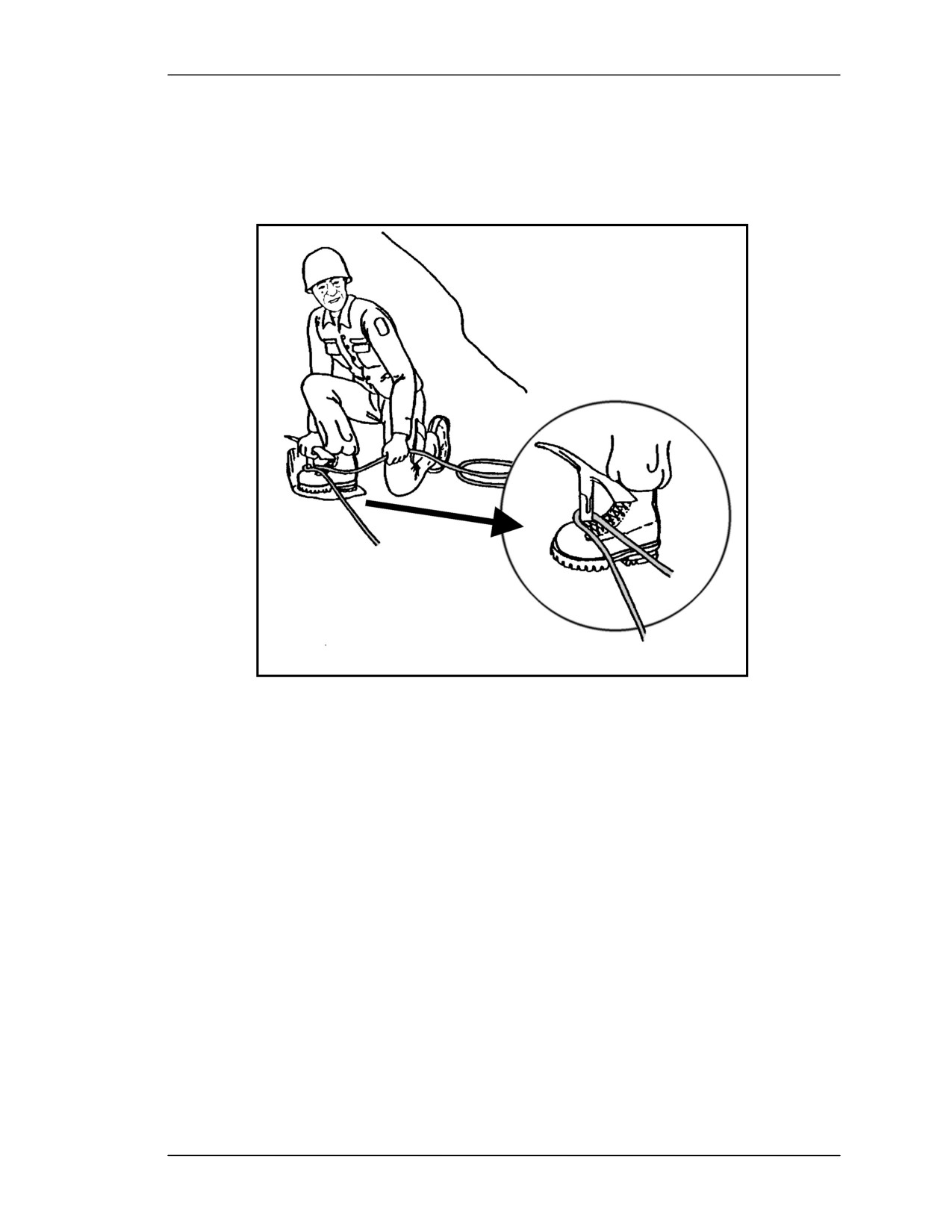
tilted slightly uphill and jammed into the snow. The belayer places his uphill foot against
the downhill side of the ax for support. A bight formed in the rope is placed over the boot
and around the shaft of the ice ax. The brake is applied by wrapping the rope around the
heel of the boot (Figure 10-20).
Figure 10-20. Boot-ax belay.
(2) Body Belay. The body belay can be used on snow and ice, also. The principles are
the same as for belays on rock—solid anchors must be used and a well-braced position
assumed. The position can be improved by digging depressions into the snow or ice for a
seat and footholds. A strong platform should be constructed for the standing body belay.
(3) Munter Hitch. This belay technique is also used on snow and ice. When using the
hitch off of the anchor, a two-point equalized anchor should be constructed as a
minimum.
d. Fixed Ropes. The use of fixed ropes on ice is recommended for moving units
through icefall areas on glaciers or other steep ice conditions. The procedures for
emplacing fixed ropes on ice are basically the same as on rock with the exception that
anchors need more attention, both in initial placement and in subsequent inspection, and
steps may have to be cut to assist personnel.
10-7. MOVEMENT ON GLACIERS
Movement in mountainous terrain may require travel on glaciers. An understanding of
glacier formation and characteristics is necessary to plan safe routes. A glacier is formed
by the perennial accumulation of snow and other precipitation in a valley or draw. The
10-19
FM 3-97.61
accumulated snow eventually turns to ice due to metamorphosis. The
“flow” or
movement of glaciers is caused by gravity. There are a few different types of glaciers
identifiable primarily by their location or activity.
• Valley glacier—resides and flows in a valley.
• Cirque glacier—forms and resides in a bowl.
• Hanging glacier—these are a result of valley or cirque glaciers flowing and or
deteriorating. As the movement continues, portions separate and are
sometimes left hanging on mountains, ridgelines, or cliffs.
• Piedmont glacier—formed by one or more valley glaciers; spreads out into a
large area.
• Retreation glacier—a deteriorating glacier; annual melt of entire glacier
exceeds the flow of the ice.
• Surging glacier—annual flow of the ice exceeds the melt; the movement is
measurable over a period of time.
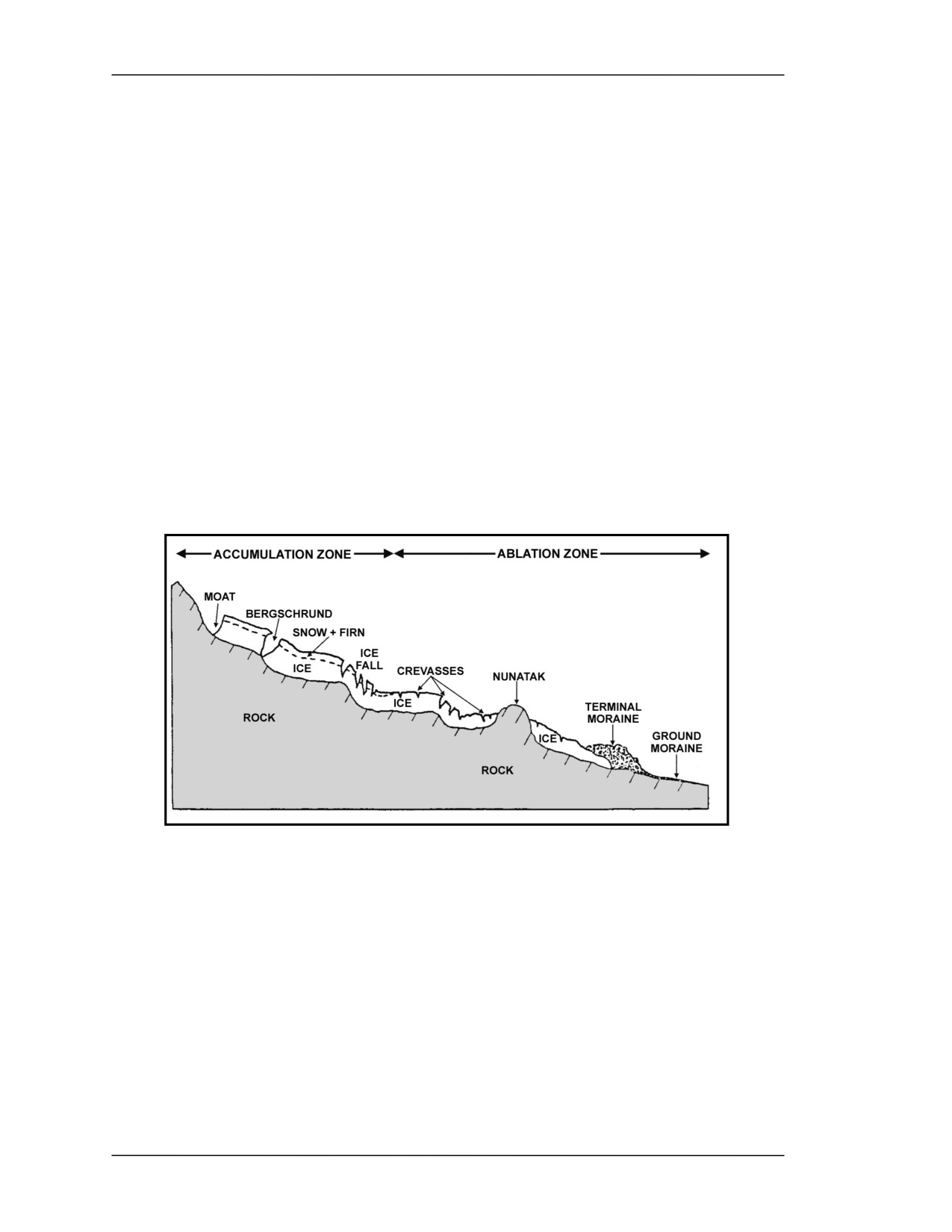
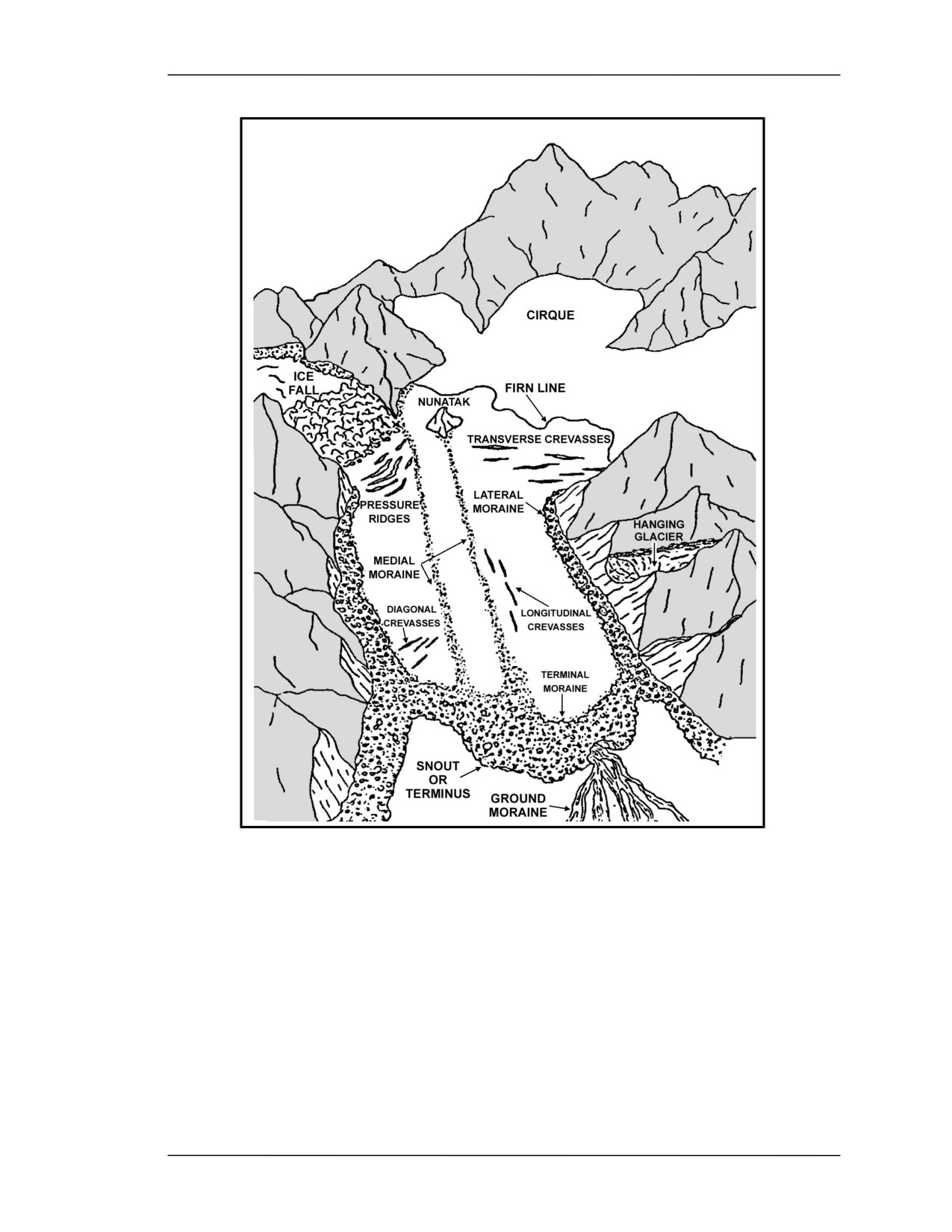
a. Characteristics and Definitions. This paragraph describes the common
characteristics of glaciers, and defines common terminology used in reference to glaciers.
(Figure 10-21 shows a cross section of a glacier, and Figure 10-22 depicts common
glacier features.)
Figure 10-21. Glacier cross section.
10-20
FM 3-97.61
Figure 10-22. Glacier features.
(1) Firn is compacted granular snow that has been on the glacier at least one year.
Firn is the building blocks of the ice that makes the glacier.
(2) The accumulation zone is the area that remains snow-covered throughout the year
because of year-round snowfall. The snowfall exceeds melt.
(3) The ablation zone is the area where the snow melts off the ice in summer. Melt
equals or exceeds snowfall.
(4) The firn line separates the accumulation and ablation zones. As you approach this
area, you may see “strips” of snow in the ice. Be cautious, as these could be snow bridges
remaining over crevasses. Remember that snow bridges will be weakest lower on the
glacier as you enter the accumulation zone. The firn line can change annually.
10-21
FM 3-97.61
(5) A bergschrund is a large crevasse at the head of a glacier caused by separation of
active (flowing) and inactive (stationary) ice. These will usually be seen at the base of a
major incline and can make an ascent on that area difficult.
(6) A moat is a wall formed at the head (start) of the glacier. These are formed by
heat reflected from valley wall.
(7) A crevasse is a split or crack in the glacier surface. These are formed when the
glacier moves over an irregularity in the bed surface.
(8) A transverse crevasse forms perpendicular to the flow of a glacier. These are
normally found where a glacier flows over a slope with a gradient change of 30 degrees
or more.
(9) Longitudinal crevasses form parallel to the flow of a glacier. These are normally
found where a glacier widens.
(10)
Diagonal crevasses form at an angle to the flow of a glacier. These are
normally found along the edges where a glacier makes a bend.
(11)
A snow bridge is a somewhat supportive structure of snow that covers a
crevasse. Most of these are formed by the wind. The strength of a snow bridge depends
on the snow itself.
(12)
Icefalls are a jumble of crisscross crevasses and large ice towers that are
normally found where a glacier flows over a slope with a gradient change of 25 degrees
or more.
(13)
Seracs are large pinnacles or columns of ice that are normally found in icefalls
or on hanging glaciers.
(14)
Ice avalanches are falling chunks of ice normally occurring near icefalls or
hanging glaciers.
(15)
The moraine is an accumulation of rock or debris on a glacier caused by
rockfall or avalanche of valley walls.
(16)
The lateral moraine is formed on sides of glacier.
(17)
The medial moraine is in the middle of the glacier. This is also formed as two
glaciers come together or as a glacier moves around a central peak.
(18)
The terminal moraine is at the base of a glacier and is formed as moraines
meet at the snout or terminus of a glacier.
(19)
The ground moraine is the rocky debris extending out from the terminus of a
glacier. This is formed by the scraping of earth as the glacier grew or surged and exposed
as the glacier retreats.
(20)
A Nunatak is a rock projection protruding through the glacier as the glacier
flows around it.
(21)
An ice mill is a hole in the glacier formed by swirling water on the surface.
These can be large enough for a human to slip into.
(22)
Pressure ridges are wavelike ridges that form on glacier normally after a
glacier has flowed over icefalls.
(23)
A glacier window is an opening at the snout of the glacier where water runs
out of the glacier.
b. Dangers and Obstacles. The principle dangers and obstacles to movement in
glacial areas are crevasses, icefalls, and ice avalanches. Snow-covered crevasses make
movement on a glacier extremely treacherous. In winter, when visibility is poor, the
difficulty of recognizing them is increased. Toward the end of the summer, crevasses are
10-22
FM 3-97.61
widest and covered by the least snow. Crossing snow bridges constitutes the greatest
potential danger in movement over glaciers in the summer. On the steep pitch of a
glacier, ice flowing over irregularities and cliffs in the underlying valley floor cause the
ice to break up into ice blocks and towers, criss-crossed with crevasses. This jumbled
cliff of ice is known as an icefall. Icefalls present a major obstacle to safe movement of
troops on glaciers.
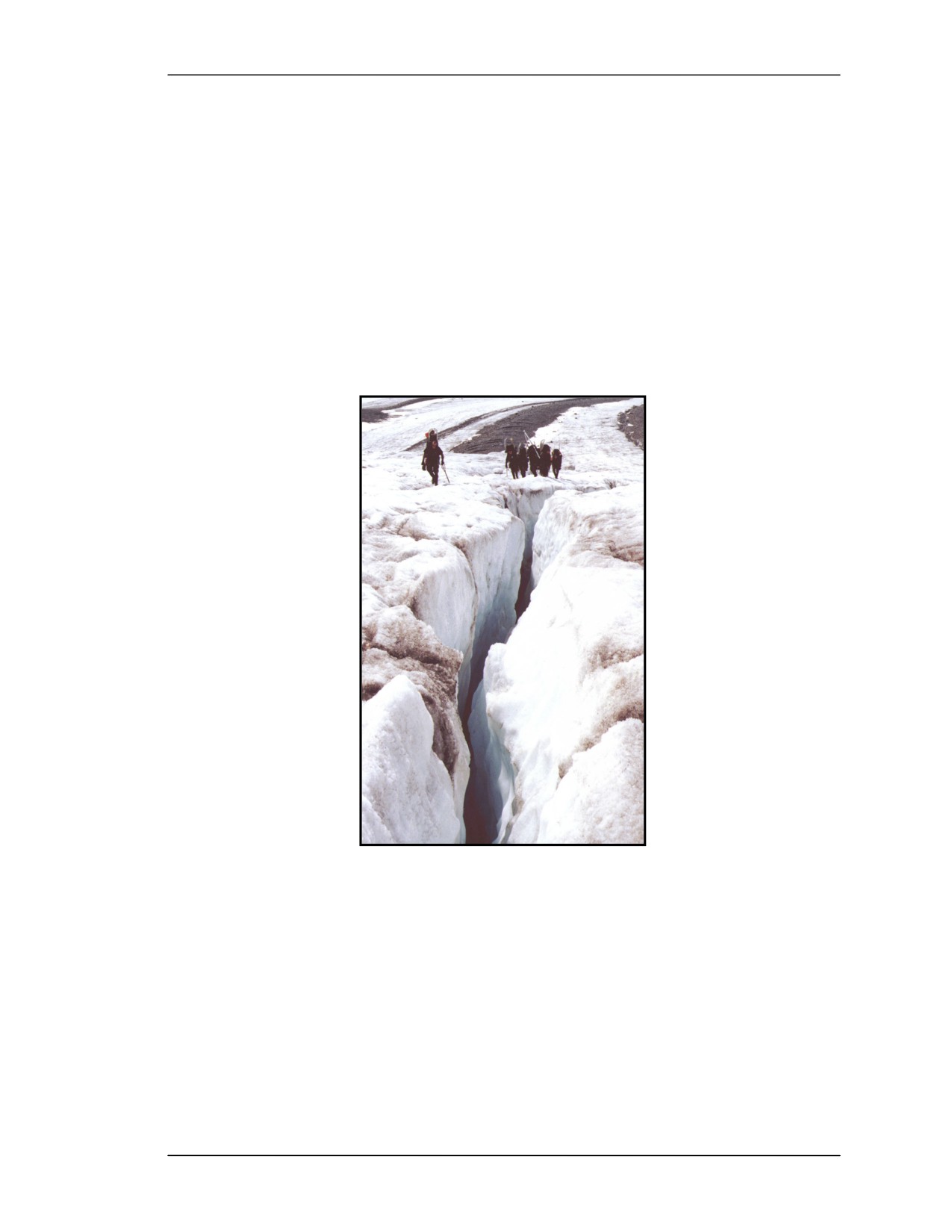
(1) Moving on glaciers brings about the hazard of falling into a crevasse. Although
the crevasses are visible in the ablation zone in the summer
(Figure
10-23), the
accumulation zone will still have hidden crevasses. The risk of traveling in the
accumulation zone can be managed to an acceptable level when ropes are used for
connecting the team members (Figure 10-24, page 10-24). Crampons and an ice ax are all
that is required to safely travel in the ablation zone in the summer.
Figure 10-23. Ablation zone of glacier in summer.
10-23
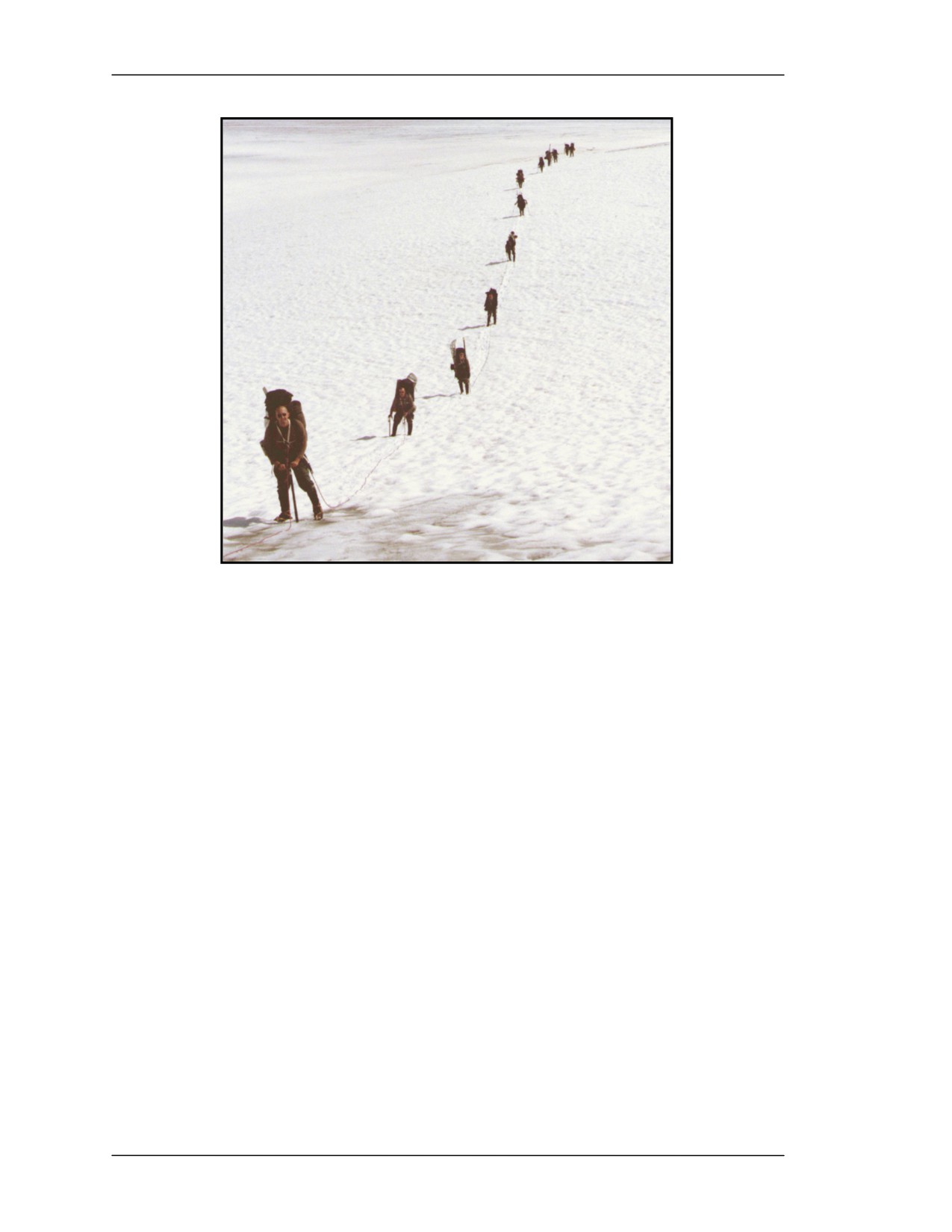
FM 3-97.61
Figure 10-24. Rope teams moving in the accumulation zone of a glacier.
(2) When conditions warrant, three to four people will tie in to one rope at equal
distances from each other. To locate the positions, if three people are on a team, double
the rope and one ties into the middle and the other two at the ends. If four people are on a
team, form a “z” with the rope and expand the “z” fully, keeping the end and the bight on
each “side” of the “z” even. Tie in to the bights and the ends.
(3) Connect to the rope with the appropriate method and attach the Prusik as required.
The rope should be kept relatively tight either by Prusik belay or positioning of each
person. If the team members need to assemble in one area, use the Prusik to belay each
other in.
(4) If a team member falls into a crevasse, the remaining members go into team
arrest, assess the situation, and use the necessary technique to remove the person from the
crevasse. The simplest and most common method for getting someone out of a crevasse
is for the person to climb out while being belayed.
(5) All items should be secured to either the climber or the rope/harness to prevent
inadvertent release and loss of necessary items or equipment. Packs should be secured to
the rope/harness with webbing or rope. If traveling with a sled in tow, secure it not only
to a climber to pull it, but connect it to the rope with webbing or rope also.
(6) If marking the route on the glacier is necessary for backtracking or to prevent
disorientation in storms or flat-light conditions, use markers that will be noticeable
against the white conditions. The first team member can place a new marker when the
last team member reaches the previous marker.
10-24
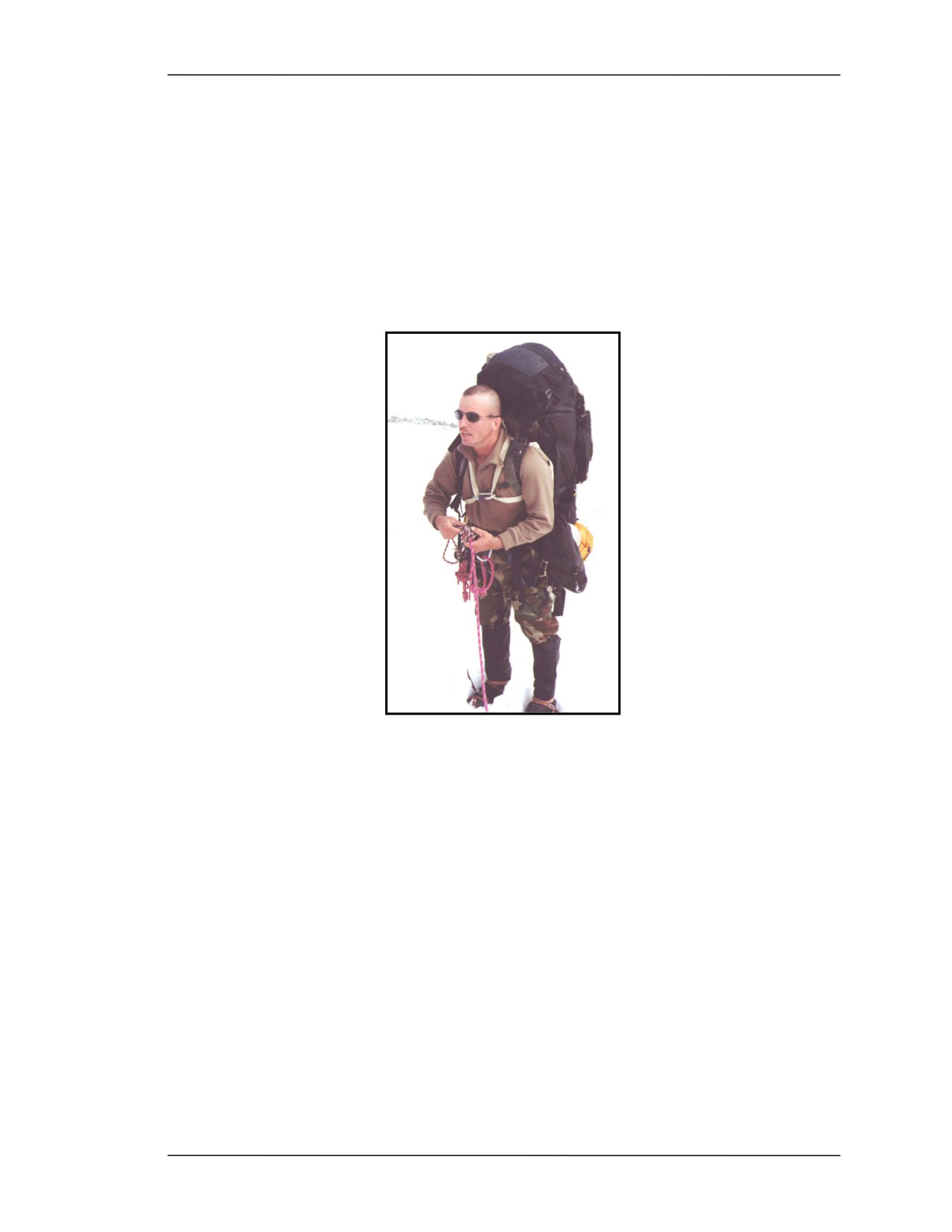
FM 3-97.61
c. Roped Movement. The first rule for movement on glaciers is to rope up (Figure
10-25). A roped team of two, while ideal for rock climbing, is at a disadvantage on a
snow-covered glacier. The best combination is a three-man rope team. Generally, the
rope team members will move at the same time with the rope fully extended and
reasonably tight between individuals, their security being the team arrest. If an individual
should break through a snow bridge and fall into a crevasse, the other members
immediately perform self-arrest, halting the fall. At points of obvious weakness in the
snow bridges, the members may decide to belay each other across the crevasse using one
of the established belay techniques.
Figure 10-25. Preparation for roped movement.
(1) Even with proper training in crevasse rescue techniques, the probability exists that
an individual may remain suspended in a crevasse for a fairly lengthy amount of time
while trying to get himself out or while awaiting help from his rope team members.
Because of this, it is strongly recommended that all personnel wear a seat/chest
combination harness, whether improvised or premanufactured.
(2) Rope team members must be able to quickly remove the climbing rope from the
harness(es) during a crevasse rescue. The standard practice for connecting to the rope for
glacier travel is with a locking carabiner on a figure-eight loop to the harness. This allows
quick detachment of the rope for rescue purposes. The appropriate standing part of the
rope is then clipped to the chest harness carabiner.
(3) If a rope team consists of only two people, the rope should be divided into thirds,
as for a four-person team. The team members tie into the middle positions on the rope,
leaving a third of the rope between each team member and a third on each end of the
rope. The remaining “thirds” of the rope should be coiled and either carried in the
rucksack, attached to the rucksack, or carried over the head and shoulder. This gives each
10-25
FM 3-97.61
climber an additional length of rope that can be used for crevasse rescue, should one of
the men fall through and require another rope. If necessary, this excess end rope can be
used to connect to another rope team for safer travel.
Note: The self-arrest technique used by one individual will work to halt the fall of his
partner on a two-man rope team; however, the chance of it failing is much greater.
Crevasse rescue procedures performed by a two-man rope team, by itself, may be
extremely difficult. For safety reasons, movement over a snow-covered glacier by
a single two-man team should be avoided wherever possible.
d. Use of Prusik Knots. Prusik knots are attached to the climbing rope for all
glacier travel. The Prusiks are used as a self-belay technique to maintain a tight rope
between individuals, to anchor the climbing rope for crevasse rescue, and for self-rescue
in a crevasse fall. The Prusik slings are made from the 7-millimeter by 6-foot and
7-millimeter by 12-foot ropes. The ends of the ropes are tied together, forming endless
loops or slings, with double fisherman’s knots. Form the Prusik knot on the rope in front
of the climber. An overhand knot can be tied into the sling just below the Prusik to keep
equal tension on all the Prusik wraps. Attach this sling to the locking carabiner at the tie
in point on the harness.
Note: An ascender can replace a Prusik sling in most situations. However, the weight of
an ascender hanging on the rope during movement will become annoying, and it
could be stepped on during movement and or climbing.
e. Securing the Backpack/Rucksack. If an individual should fall into a crevasse, it
is essential that he be able to rid himself of his backpack. The weight of the average pack
will be enough to hinder the climber during crevasse rescue, or possibly force him into an
upside down position while suspended in the crevasse. Before movement, the pack
should be attached to the climbing rope with a sling rope or webbing and a carabiner. A
fallen climber can immediately drop the pack without losing it. The drop cord length
should be minimal to allow the fallen individual to reach the pack after releasing it, if
warm clothing is needed. When hanging from the drop cord, the pack should be oriented
just as when wearing it (ensure the cord pulls from the top of the pack).
f. Routes. An individual operating in the mountains must appreciate certain
limitations in glacier movement imposed by nature.
(1) Additional obstacles in getting onto a glacier may be swift glacier streams, steep
terminal or lateral moraines, and difficult mountain terrain bordering the glacier ice. The
same obstacles may also have to be overcome in getting on and off a valley glacier at any
place along its course.
(2) Further considerations to movement on a glacier are steep sections, heavily
crevassed portions, and icefalls, which may be major obstacles to progress. The use of
current aerial photographs in conjunction with aerial reconnaissance is a valuable means
of gathering advance information about a particular glacier. However, they only
supplement, and do not take the place of, on-the-ground reconnaissance conducted from
available vantage points.
10-26
FM 3-97.61
g. Crossing Crevasses. Open crevasses are obvious, and their presence is an
inconvenience rather than a danger to movement. Narrow cracks can be jumped, provided
the take off and landing spots are firm and offer good footing. Wider cracks will have to
be circumvented unless a solid piece of ice joins into an ice bridge strong enough to
support at least the weight of one member of the team. Such ice bridges are often formed
in the lower portion of a crevasse, connecting both sides of it.
(1) In the area of the firn line, the zone that divides seasonal melting from permanent
falls of snow, large crevasses remain open, though their depths may be clogged with
masses of snow. Narrow cracks may be covered. In this zone, the snow, which covers
glacier ice, melts more rapidly than that which covers crevasses. The difference between
glacier ice and narrow snow-covered cracks is immediately apparent; the covering snow
is white, whereas the glacier ice is gray.
(2) Usually the upper part of a glacier is permanently snow covered. The snow
surface here will vary in consistency from dry powder to consolidated snow. Below this
surface cover are found other snow layers that become more crystalline in texture with
depth, and gradually turn into glacier ice. It is in this snow-covered upper part of a glacier
that crevasses are most difficult to detect, for even wide crevasses may be completely
concealed by snow bridges.
h. Snow Bridges. Snow bridges are formed by windblown snow that builds a
cornice over the empty interior of the crevasse. As the cornice grows from the windward
side, a counter drift is formed on the leeward side. The growth of the leeward portion will
be slower than that to the windward so that the juncture of the cornices occurs over the
middle of the crevasse only when the contributing winds blow equally from each side.
Bridges can also be formed without wind, especially during heavy falls of dry snow.
Since cohesion of dry snow depends only on an interlocking of the branches of delicate
crystals, such bridges are particularly dangerous during the winter. When warmer
weather prevails the snow becomes settled and more compacted, and may form firmer
bridges.
(1) Once a crevasse has been completely bridged, its detection is difficult. Bridges are
generally slightly concave because of the settling of the snow. This concavity is
perceptible in sunshine, but difficult to detect in flat light. If the presence of hidden
crevasses is suspected, the leader of a roped team must probe the snow in front of him
with the shaft of his ice ax. As long as a firm foundation is encountered, the team may
proceed, but should the shaft meet no opposition from an underlying layer of snow, a
crevasse is probably present. In such a situation, the prober should probe closer to his
position to make sure that he is not standing on the bridge itself. If he is, he should retreat
gently from the bridge and determine the width and direction of the crevasse. He should
then follow and probe the margin until a more resistant portion of the bridge is reached.
When moving parallel to a crevasse, all members of the team should keep well back from
the edge and follow parallel but offset courses.
(2) A crevasse should be crossed at right angles to its length. When crossing a bridge
that seems sufficiently strong enough to hold a member of the team, the team will
generally move at the same time on a tight rope, with each individual prepared to go into
self-arrest. If the stability of the snow bridge is under question, they should proceed as
follows for a team of three glacier travelers:
10-27
FM 3-97.61
(a) The leader and second take up a position at least 10 feet back from the edge. The
third goes into a self-belay behind the second and remains on a tight rope.
(b) The second belays the leader across using one of the established belay techniques.
The boot-ax belay should be used only if the snow is deep enough for the ax to be
inserted up to the head and firm enough to support the possible load. A quick ice ax
anchor should be placed for the other belays. Deadman or equalizing anchors should be
used when necessary.
(c) The leader should move forward, carefully probing the snow and evaluating the
strength of the bridge, until he reaches firm snow on the far side of the crevasse. He then
continues as far across as possible so number two will have room to get across without
number one having to move.
(d) The third assumes the middle person’s belay position. The middle can be belayed
across by both the first and last. Once the second is across, he assumes the belay position.
Number one moves out on a tight rope and anchors in to a self-belay. Number two belays
number three across.
(3) In crossing crevasses, distribute the weight over as wide an area as possible. Do
not stamp the snow. Many fragile bridges can be crossed by lying down and crawling to
the other side. Skis or snowshoes help distribute the weight nicely.
i.
Arresting and Securing a Fallen Climber. The simplest and most common
method for getting someone out of a crevasse is for the person to climb out while being
belayed. Most crevasse falls will be no more than body height into the opening if the rope
is kept snug between each person.
(1) To provide a quick means of holding an unexpected breakthrough, the rope is
always kept taut. When the leader unexpectedly breaks through, the second and third
immediately go into a self-arrest position to arrest the fall. A fall through a snow bridge
results either in the person becoming jammed in the surface hole, or in being suspended
in the crevasse by the rope. If the leader has fallen only partially through the snow bridge,
he is supported by the snow forming the bridge and should not thrash about as this will
only enlarge the hole and result in deeper suspension. All movements should be slow and
aimed at rolling out of the hole and distributing the weight over the remainder of the
bridge. The rope should remain tight at all times and the team arrest positions adjusted to
do so. It generally is safer to retain the rucksack, as its bulk often prevents a deeper fall.
Should a team member other than the leader experience a partial fall, the rescue
procedure will be same as for the leader, only complicated slightly by the position on
the rope.
(2) When the person falls into a crevasse, the length of the fall depends upon how
quickly the fall is arrested and where in the bridge the break takes place. If the fall occurs
close to the near edge of the crevasse, it usually can be checked before the climber has
fallen more than 6 feet. However, if the person was almost across, the fall will cause the
rope to cut through the bridge, and then even an instantaneous check by the other
members will not prevent a deeper fall. The following scenario is an example of the
sequence of events that take place after a fall by the leader in a three-person team. (This
scenario is for a team of three, each person referred to by position; the leader is
number 1.)
(a) Once the fall has been halted by the team arrest, the entire load must be placed on
number 2 to allow number 3 to move forward and anchor the rope. Number 3 slowly
10-28
FM 3-97.61
releases his portion of the load onto number 2, always being prepared to go back into
self-arrest should number 2’s position begin to fail.
(b) Once number 2 is confident that he can hold the load, number 3 will proceed to
number 2’s position, using the Prusik as a self belay, to anchor the rope. In this way the
rope remains reasonably tight between number 2 and number 3. Number 3 must always
be prepared to go back into self-arrest should number 2’s position begin to fail.
(c) When number 3 reaches number 2’s position he will establish a bombproof
anchor 3 to 10 feet in front of number 2 (on the load side), depending on how close
number 2 is to the lip of the crevasse. This could be either a deadman or a two-point
equalized anchor, as a minimum.
(d) Number 3 connects the rope to the anchor by tying a Prusik with his long Prusik
sling onto the rope leading to number 1. An overhand knot should be tied into the long
Prusik sling to shorten the distance to the anchor, and attached to the anchor with a
carabiner. The Prusik knot is adjusted toward the load.
(e) Number 2 can then release the load of number 1 onto the anchor. Number 2
remains connected to the anchor and monitors the anchor.
(f) A fixed loop can be tied into the slack part of the rope, close to number 2, and
attached to the anchor (to back up the Prusik knot).
(g) Number 3 remains tied in, but continues forward using a short Prusik as a self-
belay. He must now quickly check on the condition of number 1 and decide which rescue
technique will be required to retrieve him.
(3) These preliminary procedures must be performed before retrieving the fallen
climber. If number 3 should fall through a crevasse, the procedure is the same except that
number 1 assumes the role of number 3. Normally, if the middle person should fall
through, number 1 would anchor the rope by himself. Number 3 would place the load on
number 1’s anchor, then anchor his rope and move forward with a Prusik self-belay to
determine the condition of number 2.
j.
Crevasse Rescue Techniques. Snow bridges are usually strongest at the edge of
the crevasse, and a fall is most likely to occur some distance away from the edge. In some
situations, a crevasse fall will occur at the edge of the snow bridge, on the edge of the ice.
If a fall occurs away from the edge, the rope usually cuts deeply into the snow, thus
greatly increasing friction for those pulling from above. In order to reduce friction, place
padding, such as an ice ax, ski, ski pole, or backpack/rucksack, under the rope and at
right angles to the stress. Push the padding forward as far as possible toward the edge of
the crevasse, thus relieving the strain on the snow. Ensure the padding is anchored from
falling into the crevasse for safety of the fallen climber.
(1) Use of Additional Rope Teams. Another rope team can move forward and assist
in pulling the victim out of a crevasse. The assisting rope team should move to a point
between the fallen climber and the remaining rope team members. The assisting team can
attach to the arresting team’s rope with a Prusik or ascender and both rope teams’
members can all pull simultaneously. If necessary, a belay can be initiated by the fallen
climber’s team while the assisting team pulls. The arresting team member closest to the
fallen climber should attach the long Prusik to themselves and the rope leading to the
fallen climber, and the assisting team can attach their Prusik or ascender between this
long Prusik and the arresting team member. As the assisting team pulls, the Prusik belay
will be managed by the arresting team member at the long Prusik.
10-29
FM 3-97.61
Note: Safety in numbers is obvious for efficient crevasse rescue techniques. Additional
rope teams have the necessary equipment to improve the main anchor or establish
new ones and the strength to pull a person out even if he is deep in the crevasse.
Strength of other rope teams should always be used before establishing more
time-consuming and elaborate rescue techniques.
(2) Fixed Rope. If the fallen climber is not injured, he may be able to climb out on a
fixed rope. Number 1 clips number 3’s rope to himself. He then climbs out using number
3’s rope as a simple fixed line while number 2 takes up the slack in number 1’s rope
through the anchor Prusik for a belay.
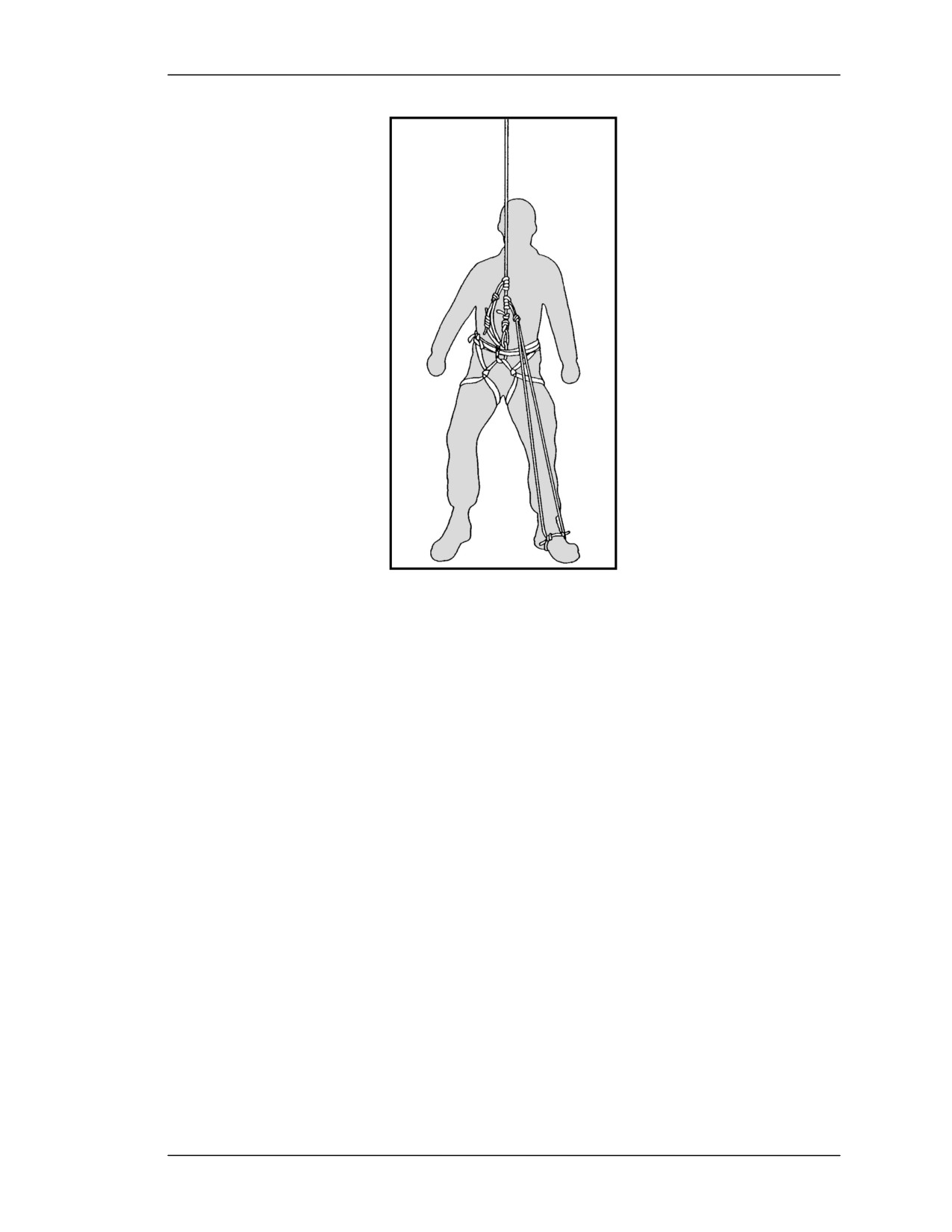
(3) Prusik Ascending Technique. There may be times when the remaining members
of a rope team can render little assistance to the person in the crevasse. If poor snow
conditions make it impossible to construct a strong anchor, the rope team members on top
may have to remain in self-arrest. Other times, it may just be easier for the fallen climber
to perform a self-rescue.
(Figure
10-26 shows the proper rope configuration.) The
technique is performed as follows:
(a) The fallen climber removes his pack and lets it hang below from the drop cord.
(b) The individual slides their short Prusik up the climbing rope as far as possible.
(c) The long Prusik is attached to the rope just below the short Prusik. The double
fisherman’s knot is spread apart to create a loop large enough for one or both feet. The
fallen climber inserts his foot/feet into the loop formed allowing the knot to cinch itself
down.
(d) The individual stands in the foot loop, or “stirrup,” of the long sling.
(e) With his weight removed from the short Prusik, it is slid up the rope as far as it
will go. The individual then hangs from the short Prusik while he moves the long Prusik
up underneath the short Prusik again.
(f) The procedure is repeated, alternately moving the Prusiks up the rope, to ascend
the rope. Once the crevasse lip is reached, the individual can simply grasp the rope and
pull himself over the edge and out of the hole.
(g) Besides being one of the simplest rope ascending techniques, the short Prusik acts
as a self-belay and allows the climber to take as long a rest as he wants when sitting in
the harness. The rope should be detached from the chest harness carabiner to make the
movements less cumbersome. However, it is sometimes desirable to keep the chest
harness connected to the rope for additional support. In this case the Prusik knots must be
“on top” of the chest harness carabiner so they can be easily slid up the rope without
interference from the carabiner. The long Prusik sling can be routed through the chest
harness carabiner for additional support when standing up in the stirrup.
10-30
FM 3-97.61
Figure 10-26. Prusik ascending technique.
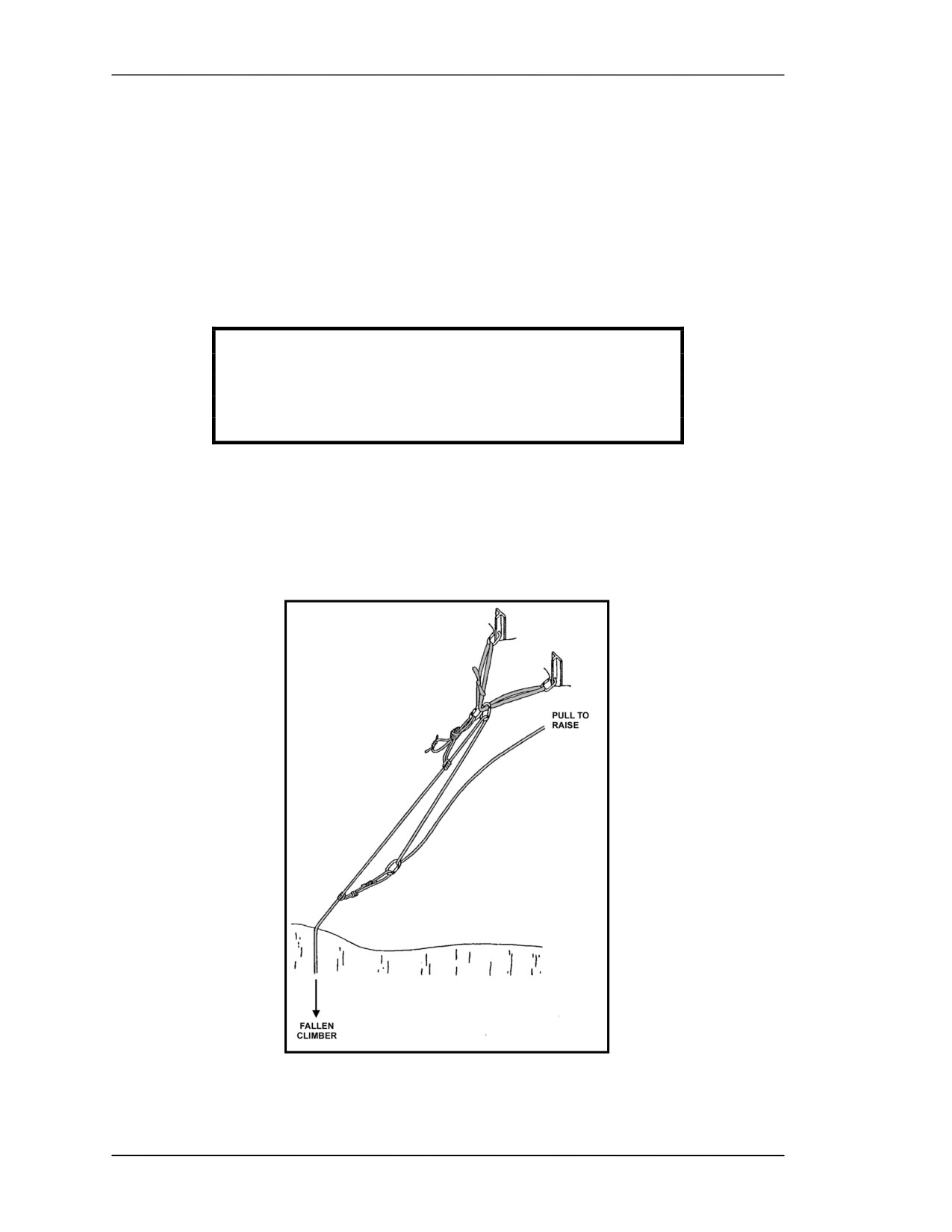
(4) Z-Pulley Hauling System. If a fallen climber is injured or unconscious, he will
not be able to offer any assistance in the rescue. If additional rope teams are not
immediately available, a simple raising system can be rigged to haul the victim out of the
crevasse. The Z-pulley hauling system is one of the simplest methods and the one most
commonly used in crevasse rescue (Figure 10-27, page 10-32). The basic Z rig is a
“3-to-1” system, providing mechanical advantage to reduce the workload on the
individuals operating the haul line. In theory, it would only take about 33 pounds of pull
on the haul rope to raise a 100-pound load with this system. In actual field use, some of
this mechanical advantage is lost to friction as the rope bends sharply around carabiners
and over the crevasse lip. The use of mechanical rescue pulleys can help reduce this
friction in the system. The following describes rigging of the system. (This scenario is for
a team of three, each person referred to by position; the leader is number 1.)
(a) After the rope team members have arrested and secured number 1 to the anchor,
and they have decided to install the Z rig, number 2 will attach himself to the anchor
without using the rope and clear the connecting knot used. Number 3 remains connected
to the rope.
(b) The slack rope exiting the anchor Prusik is clipped into a separate carabiner
attached to the anchor. A pulley can be used here if available.
(c) Number 3 will use number 2’s short Prusik to rig the haul Prusik. He moves
toward the crevasse lip (still on his own self-belay) and ties number 2’s short Prusik onto
number 1’s rope (load rope) as close to the edge as possible.
10-31
FM 3-97.61
(d) Another carabiner (and pulley if available) is clipped into the loop of the haul
Prusik and the rope between number 3’s belay Prusik and the anchor is clipped (or
attached through the pulley). Number 3’s rope becomes the haul rope.
(e) Number 3 then moves towards the anchor and number 2. Number 2 could help
pull if necessary but first would connect to the haul rope with a Prusik just as number 3.
If the haul Prusik reaches the anchor before the victim reaches the top, the load is simply
placed back on the anchor Prusik and number 3 moves the haul Prusik back toward the
edge. The system is now ready for another haul.
CAUTION
The force applied to the fallen climber through use of
the Z-pulley system can be enough to destroy the
harness-to-rope connection or injure the fallen climber
if excess force is applied to the pulling rope.
Notes: 1. The Z-pulley adds more load on the anchor due to the mechanical advantage.
The anchor should be monitored for the duration of the rescue.
2. With the “3-to-1” system, the load (fallen climber) will be raised 1 foot for
every 3 feet of rope taken up during the haul.
Figure 10-27. Z-pulley hauling system.
10-32
FM 3-97.61
10-8. GLACIER BIVOUAC PROCEDURES
When locating a bivouac site or a gathering area where the team might need or want to
unrope, at least one person will need to “probe” the area for hidden crevasses. The best
type of probe will be the manufactured collapsing probe pole, at least eight feet in length.
Other items could be used but the length and strength of the probe is most important.
Other rope team members will belay the probers. The prober is “feeling” for a solid
platform to place the tent by pushing the probe as hard and deep as possible into the
surface. Probing should be in 2-foot intervals in all directions within the site.
a. If the probe suddenly has no resistance while pushing down, a crevasse is present.
Attempts to outline the crevasse can be futile if the crevasse is large. Normally, the best
decision is to relocate the proposed bivouac area far enough away to avoid that crevasse.
(Sometimes only a few feet one way or the other is all that’s needed to reach a good
platform.) Probe the tent site again after digging to the desired surface. Mark boundaries
with wands or other items such as skis, poles, and so on.
b. Occasionally while probing, increased pressure will be noticed without reaching a
solid platform. The amount of snowfall may be such that even after digging into the
snow, the probe still doesn’t contact a hard surface. Try to find a solid platform.
c. There should be no unroped movement outside the probed/marked areas. If a
latrine area is needed, probe a route away from the bivouac site and probe the latrine area
also. If a dugout latrine is necessary, probe again after digging.
d. Multiple tent sites can be connected, which keeps tents closer together. Probe all
areas between the tents if you plan to move in those areas. Closer tents will make
communicating between tent groups and rope teams easier.
e. If there is a chance for severe storms with high winds, snow walls may be
constructed to protect the tent site from wind. The walls can be constructed from loose
snow piled on the perimeter, or blocks can be cut from consolidated snow layers. In deep
soft snow, digging three or four feet to find a consolidated layer will result in enough
snow moved to build up decent walls around the tent site.
(1) For block construction, move the soft snow from the surface into the wall
foundation areas (down to a consolidated layer of snow).
(2) Cut blocks approximately 1 by 1 by 2 feet, and construct the walls by interlocking
the blocks with overlapping placements. The walls should be slightly higher than the tent.
At a minimum, build walls on the windward side of the tent site.
(3) Snow walls can also provide shelter from wind for food preparation.
10-33
FM 3-97.61(TC 90-6-1)
CHAPTER 11
MOUNTAIN RESCUE AND EVACUATION
Steep terrain and adverse weather are common in mountainous
environments. Under these conditions, relatively minor injuries may
require evacuation. The evacuation technique chosen is determined by the
type of injury, distance to be moved, terrain, and existing installations. Air
evacuation is preferred; however, the weather, tactical situation, or
operational ceiling of the aircraft may make this impossible. It is,
therefore, imperative that all personnel are trained in mountain
evacuation techniques and are self-sufficient. Casualties should be triaged
before evacuation. Triage is performed by the most experienced medical
personnel available (physician, physician’s assistant, medic).
Performing a rescue operation can be a significant emotional event.
Rescue scenarios must be practiced and rehearsed until rescue party
members are proficient in the many tasks required to execute a rescue. To
perform most of the high-angle rescues, Level I and Level II mountaineers
are required with a Level III supervising.
11-1. CONSIDERATIONS
The techniques of evacuation are proven techniques. They are, however, all subject to
improvement and should be discarded or modified as better methods of handling victims
are developed.
a. When evacuating a victim from mountainous areas keep in mind that the purpose
of a rescue operation is to save a life, and physical risk to the rescuers must be weighed
against this purpose. However, there is no excuse for failing to make the maximum effort
within this limitation. Work and expense should be no deterrent when a life is at stake.
b. Rescues will be unplanned (improvised) or planned rescue operations. For a
planned rescue, equipment that is especially suited and designed for rescue should be
used. For training missions always have a medical plan developed before an emergency
arises (plan for the worst and hope for the best). Ensure that the MEDEVAC plan is a
comprehensive plan and must be thought out and understood by all that may be involved
in a potential rescue.
c. The following actions will be done immediately at the rescue scene.
(1) Assume command. One person, and one person only, is overall in charge at all
times.
(2) Prevent further injuries to the victim and to others. Use reasonable care in
reaching the victim.
(3) Immediately ensure the victim has an open airway, resume victim’s breathing,
control serious bleeding, and maintain moderate body warmth. If the victim is
unconscious, continually monitor pulse. Protect the patient from environmental hazards.
(4) Do not move the victim until you have ascertained the extent of injuries, unless it
is necessary to prevent further injuries or the victim is located in a dangerous location
(for example, avalanche run-out zone, hanging glacier, possibility of falling rocks).
(5) Do nothing more until you have thoroughly considered the situation. Resist the
urge for action. Speed is less important than correct action.
11-1
FM 3-97.61
(6) Decide whether to evacuate with available facilities or to send for help. Speed in
getting to a hospital must be balanced against the probability of further injury if working
with inexperienced people, lack of equipment or wrong equipment, and terrain at hand.
(7) When the evacuation route is long and arduous, a series of litter relay points or
stations should be established. These stations must be staffed with the minimum medical
personnel to provide proper emergency treatment. When a victim develops signs of shock
or worsens while being evacuated, he should be treated and retained at one of these
stations until his condition allows evacuation.
(8) Helicopters or heated vehicles, if available, should be used for evacuation. While
the use of aircraft or vehicles is preferred and can expedite a rescue operation, evacuation
of a seriously wounded soldier should never be delayed to await aircraft, vehicle, or a
change in weather.
11-2. PLANNING RESCUE OPERATIONS
Every commander should have a medical evacuation plan before undertaking an
operation. This plan should have contingencies included so as not to rely on a
single asset.
a. When rescuing a casualty (victim) threatened by hostile action, environmental
hazard, or any other immediate hazard, the rescuer should not take action without first
determining the extent of the hazard and his ability to handle the situation. THE
RESCUER MUST NOT BECOME A CASUALTY.
b. The rescue team leader must evaluate the situation and analyze the factors
involved. This evaluation can be divided into three major steps:
• Identify the task.
• Evaluate the circumstances of the rescue.
• Plan the action.
c. The task must be identified. In planning a rescue, the rescuer tries to obtain the
following information:
• Who, what, where, when, why, and how the situation happened.
• Number of casualties by precedence
(urgent, priority, routine, tactical
immediate),
• number of casualties by type (litter or ambulatory), and the nature of their
injuries.
• Terrain features and location of the casualties.
• Tactical situation.
• If adequate assistance is available to aid in security, rescue, treatment, and
evacuation.
• If treatment can be provided at the scene; if the victims require movement to a
safer location.
• Equipment required for the rescue operation.
d. Circumstances of the rescue are as follows:
(1) After identifying the task, relate it to the circumstances of the situation.
• Are additional personnel, security, medical, or special rescue equipment
needed?
• Are there circumstances, such as aircraft accidents (mass casualties), that may
require specialized skills?
11-2
FM 3-97.61
• What is the weather condition?
• Is the terrain hazardous?
• How much time is available?
(2) The time element may cause a rescuer to compromise planning stages or
treatment (beyond first aid). Make a realistic estimate of time available as quickly as
possible to determine the action time remaining. The key elements are the casualty’s
condition and environment.
(3) Mass casualties are to be expected on the modern battlefield. All problems or
complexities of rescue are now multiplied by the number of casualties. Time becomes the
critical element.
(4) Considerations for the main rescue group for a planned rescue are as follows:
(a) Carry all needed equipment, hot food and drinks, stove, sleeping bags, tents,
bivouac sacks, warm clothes, ropes, and stretchers.
(b) Prepare the evacuation route (ground transport to hospital, walking trails, fixed
lines, lowering lines, anchor points, and rescue belay points). If the victim is airlifted out,
attach a paper with the medical actions that were performed on the ground (for example,
blood pressure, pulse rate, drugs started, and so on).
(c) When performing all rescues, the rescuers are always tied in for safety. With all
rescue techniques, remember to think things through logically for safety and to prevent
the rescuer from accidentally untying himself or the fallen climber.
(d) Constantly inform the casualty (if they are conscious) as to what you are doing
and what he must do.
e. The rescue plan should proceed as follows:
(1) In estimating time available, the casualties’ ability to endure is of primary
importance. Age and physical condition may vary. Time available is a balance of the
endurance time of the casualty, the situation, and the personnel and equipment available.
(2) Consider altitude and visibility. Maximum use of secure, reliable trails or roads is
essential.
(3) Ensure that blankets and rain gear are available. Even a mild rain can complicate
a normally simple rescue. In high altitudes, extreme cold, or gusting winds, available
time is drastically reduced.
(4) High altitudes and gusting winds reduce the ability of fixed-wing or rotary-wing
aircraft to assist in operations. Rotary-wing aircraft may be available to remove casualties
from cliffs or inaccessible sites, and to quickly transport casualties to a medical treatment
facility. Relying on aircraft or specialized equipment is a poor substitute for careful
planning.
11-3. MASS CASUALTIES
When there are mass casualties, an orderly rescue may involve further planning.
a. To manage a mass casualty rescue or evacuation, separate stages are taken.
• FIRST STAGE: Remove personnel who are not trapped among debris or who
can be easily evacuated.
• SECOND STAGE: Remove personnel who may be trapped by debris, but
whose extraction only requires the equipment on hand and little time.
11-3
FM 3-97.61
• THIRD STAGE: Remove the remaining personnel who are trapped in
extremely difficult or time-consuming situations, such as moving large
amounts of debris or cutting through a wall.
• FOURTH STAGE: Remove dead personnel.
b. Evacuation of wounded personnel is based on the victim’s condition and is
prioritized as follows:
• PRIORITY ONE: Personnel with life-threatening injuries that require
immediate emergency care to survive; first aid and stabilization are
accomplished before evacuation.
• PRIORITY TWO: Personnel with injuries that require medical care but speed
of evacuation is not essential.
• PRIORITY THREE: Injured personnel who can evacuate themselves with
minimal assistance.
• PRIORITY FOUR: The logistics removal of dead personnel.
11-4. SPECIAL TRAINING
Before receiving training in basic mountain evacuation, litter teams should receive
instruction in military mountaineering and basic first aid. Litter bearers and medics must
know the use and care of rope as an item of equipment. The members of litter teams must
be proficient in the techniques of belaying and choosing belay points. Proper support and
protection must be given to victims and litter bearers when evacuating over steep,
difficult terrain.
11-5. PREPARATION FOR EVACUATION
Although the wounded soldier’s life may have been saved by applying first aid, it can be
lost through carelessness, rough handling, or inadequate protection from the elements.
Therefore, before trying to move the wounded soldier, the type and extent of his injury
must be evaluated. Dressings over wounds must be reinforced, and fractured bones must
be properly immobilized and supported. Based upon the evaluation of the type and extent
of the soldier’s injury, the best method of manual transportation is selected.
11-6. MANUAL CARRIES
Personnel who are not seriously injured but cannot evacuate themselves may be assisted
by fellow soldiers. Personnel who are injured and require prompt evacuation should not
be forced to wait for mobile evacuation or special equipment.
a. One-Man Carries. The basic carries taught in the Soldier’s Manual of Common
Tasks (fireman’s carry, two-hand, four-hand, saddleback, piggyback, pistol belt, and
poncho litter) are viable means of transporting injured personnel; however, the
mountainous terrain lends itself to several other techniques. One-man carries include the
sling-rope carry and the rope coil carry.
(1) Sling-Rope Carry. The sling-rope carry (Figure 11-1) requires a 4.5-meter sling
rope and two men—one as the bearer and the other as an assistant to help secure the
casualty to the bearer’s back. Conscious or unconscious casualties may be transported
this way.
(a) The bearer kneels on all fours.
11-4
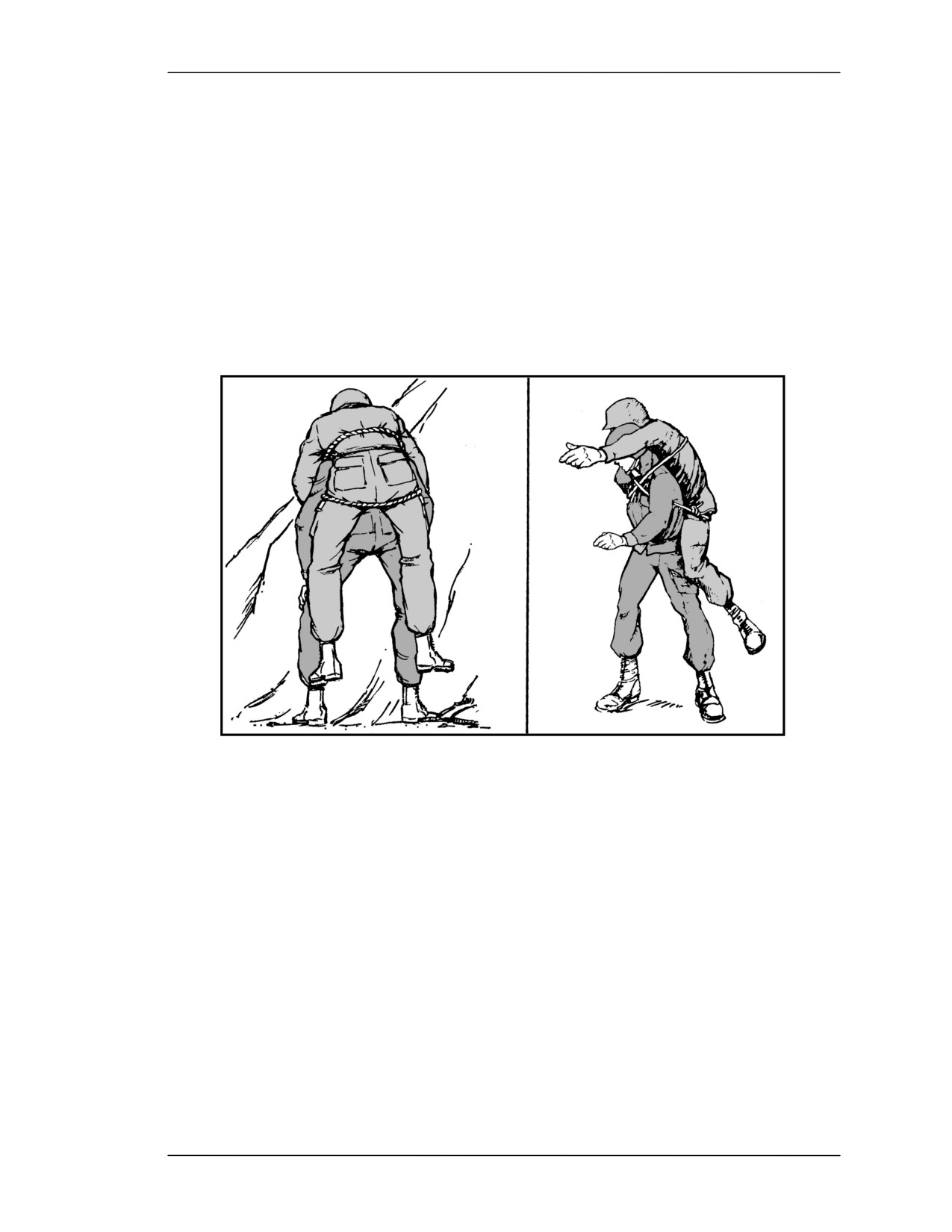
FM 3-97.61
(b) The assistant places the casualty face down on the bearer’s back ensuring the
casualty’s armpits are even with the bearer’s shoulders.
(c) The assistant then finds the middle of the sling rope and places it between the
casualty’s shoulders.
(d) The assistant runs the ends of the sling rope under the casualty’s armpits, crosses
the ends, and runs the ends over the bearer’s shoulders and back under the bearer’s arms.
(e) The assistant runs the ends of the rope between the casualty’s legs, around the
casualty’s thighs, and back around to the front of the bearer. The rope is tied with a
square knot with two overhand knots just above the bearer’s belt buckle.
(f) The rope must be tight. Padding, when available, should be placed where the rope
passes over the bearer’s shoulders and under the casualty’s thighs.
Figure 11-1. Sling-rope carry.
(2) Rope Coil Carry. The rope coil carry requires a bearer and a 36 1/2-meter coiled
rope. It can be used to transport a conscious or unconscious victim.
(a) Place the casualty on his back.
(b) Separate the loops on one end of the coil, forming two almost equal groups.
(c) Slide one group of loops over the casualty’s left leg and the other group over the
right leg. The wraps holding the coil should be in the casualty’s crotch with the loops on
the other end of the coil extending upward toward the armpits.
(d) The bearer lies on his back between the casualty’s legs and slides his arms
through the loops. He then moves forward until the coil is extended.
(e) Grasping the casualty’s arm, the bearer rolls over (toward the casualty’s uninjured
side), pulling the casualty onto his back.
(f) Holding the casualty’s wrists, the bearer carefully stands, using his legs to lift up
and keeping his back as straight as possible.
11-5
FM 3-97.61
(g) A sling rope around both the casualty and bearer, tied with a joining knot at chest
level, aids in keeping an unconscious victim upright. This also prevents the coils from
slipping off the carrier’s chest.
Note: The length of the coils on the rope coil and the height of the bearer must be
considered. If the coils are too long and the bearer is shorter, the rope must be
uncoiled and recoiled with smaller coils. If this is not done, the casualty will hang
too low on the bearer’s back and make it a cumbersome evacuation. A sling-rope
harness can be used around the victim’s back and bearer’s chest, which frees the
bearer’s hands.
b. Buddy Rappel. The carrier can also conduct a seat-hip rappel with a victim
secured to his back. In this case, the rappeller faces the cliff and assumes a modified
L-shape body position to compensate for the weight of the victim on his back. The victim
is top-rope belayed from above, which provides the victim with a point of attachment to a
secured rope. The methods for securing a victim to a rappeller’s back are
described below.
(1) To secure the victim to the carrier’s back with a rope, the carrier ties a standard
rappel seat (brake hand of choice, depending on the injury) and rests his hands on his
knees while the victim straddles his back.
(2) A 4.2-meter sling rope is used. A 45-centimeter tail of the sling is placed on the
victim’s left hip.
(This method describes the procedure for a seat-hip rappel with
right-hand brake.)
(3) The remaining long end of the sling rope is routed under the victim’s buttocks,
and passed over the victim’s and carrier’s right hip. The rope is run diagonally, from right
to left, across the carrier’s chest, over his left shoulder, and back under the victim’s
left armpit.
(4) The rope is then run horizontally, from left to right, across the victim’s back. The
rope is passed under the victim’s right armpit and over the carrier’s right shoulder.
(5) The rope is run diagonally, from right to left, across the carrier’s chest and back
across the carrier’s and victim’s left hip.
(6) The two rope ends should now meet. The two ends are tied together with a square
knot and overhand knots.
(7) The knot is positioned on the victim’s left hip. The carrier’s shoulders may need
to be padded to prevent cutting by the rope.
(8) An alternate method is to use two pistol belts hooked together and draped over the
carrier’s shoulders. The victim straddles the carrier, and the belay man secures the loose
ends of the pistol belts under the victim’s buttocks. Slack in the pistol belt sling should be
avoided, since the carrier is most comfortable when the victim rests high on his back (see
FM 8-35).
(9) A large rucksack can be slit on the sides near the bottom so that the victim can
step into it. The victim is belayed from the top with the carrier conducting a standard
rappel. The carrier wears the rucksack with the victim inside.
(10)
A casualty secured to a carrier, as described above, can be rappelled down a
steep cliff using a seat-shoulder or seat-hip rappel. The casualty’s and rappeller’s
shoulders should be padded where the sling rope and rappel lines cross if a seat-shoulder
11-6
FM 3-97.61
rappel is used. The buddy team should be belayed from above with a bowline tied around
the victim’s chest under his armpits. The belay rope must run over the rappeller’s guide
hand shoulder.
11-7. LITTERS
Many types of litters are available for evacuating casualties in rough mountain terrain.
Casualties may be secured to litters in many different ways, depending on the terrain,
nature of injuries, and equipment available. All casualties must be secured. This should
be done under medical supervision after stabilization. It is also important to render
psychological support to any victim awaiting evacuation.
If the litter must be carried, belayed, and then carried again, a sling rope should be
wound around the litter end and tied off in a l-meter-long loop. This enables the carriers
to hook and unhook the litter from the belay. Slings are available to aid the soldiers with
litter carrying. Utility rope or webbing 6 meters long may be used. The rope is folded in
half, and the loose ends are tied together with an overhand knot. These slings are attached
to the litter rails (two or three to a side, depending on the number of litter bearers) by a
girth hitch, and then routed up along the handling arm, over the shoulder, behind the
neck, and then down along the other arm. The knot can be adjusted to help the outside
arm grip the webbing. These slings help distribute the load more evenly, which is
important if a great distance must be traveled.
a. Manufactured Litters. The following litters are readily available to
mountaineering units.
(1) The poleless, nonrigid litter (NSN 6530-00-783-7510) is best issued for company
medics since it is lightweight, easy to carry, and readily available. Casualties should be
secured with the chest strap and pelvic straps, which are sewn on one side. This litter may
be used when rappelling, on traverse lines, and on hauling lines in the vertical or
horizontal position. It can be improvised with poles.
(2) The poleless semi-rigid litter (NSN 6530-00-783-7600) may be used the same as
the nonrigid litter. It offers more victim protection and back support because of the
wooden slats sewn into it.
(3) The mountain basket-type rigid litter (NSN 6530-00-181-7767) is best suited for
areas where several casualties are to be transported. All other litters may be placed inside
this litter basket and transported across traverse lines. This litter is rectangular and has no
vertical leg divider so that it will accommodate other litters. It is also known as a
modified Stokes litter.
(4) The Stokes metal litter (NSN 6530-00-042-8131) is suited for situations as above;
however, the casualty must be moved in and out of the litter since no other litter will fit
inside it. Some Stokes litter frames have a central weld on the frame end, which is a
potential breaking point. Winding the rope around the frame end will distribute the force
over a wider area and stabilize the system. (See FM 8-10-6 or USAF TO 00-75-5 for
additional information on the Stokes litter.)
(5) The standard collapsible litter (NSN 6530-00-783-7905) (rigid pole folding litter)
is most readily available in all units and, although heavy and unsuited to forward
deployment, may be rigged for movement over rough or mountainous terrain. The folding
aluminum litter (NSN 6530-00-783-7205) is a compact version of the pole litter and is
better suited for forward deployment.
11-7
FM 3-97.61
(6) The UT
2000 is manufactured in Austria and is specifically designed for
mountaineering operations. The litter consists of two parts that join together to form a
rigid litter. Each part has shoulder and waist straps that can be used to man-pack the litter
making it extremely light and portable. When joined together the shoulder and waist
straps are used to secure the casualty to the litter. Strapping is also provided to make a
secure hoist point for aircraft extraction and high-angle rescues. Wheel sets are another
accessory to the UT 2000 litter (either two wheels or one); they attach to the litter for use
during a low-angle rescue.
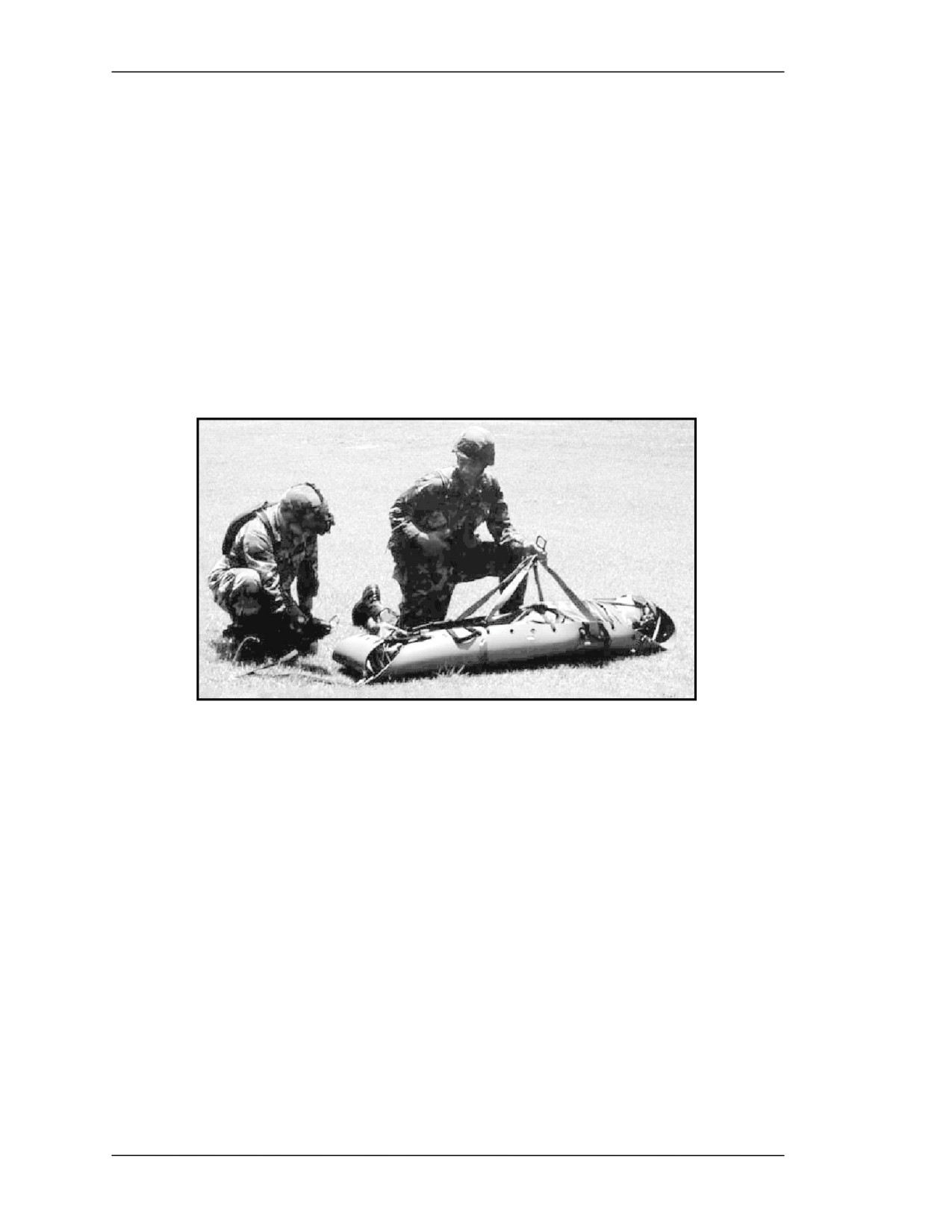
(7) The patient rescue and recovery system
(NSN 6530-01-260-1222) provides
excellent patient support and protection
(Figure
11-2). However, it is not a spinal
immobilization device. A backboard must be used with this system for patients who have
injuries to the shoulder area. This system will accommodate long and short backboards,
scoop stretchers, and most other immobilization equipment.
Figure 11-2. Rescue and recovery system (NSN 6530-01-260-1222).
b. Field-Expedient Litters. A litter can be improvised from many different things.
Most flat-surface objects of suitable size can be used as litters. Such objects include
boards, doors, window shutters, benches, ladders, cots, and poles. Some may need to be
tied together to obtain the required size. If possible, these objects should be padded.
(1) Litters can also be made by securing poles inside blankets, ponchos, shelter
halves, tarpaulin, jackets, shirts, sacks, bags, or mattress covers. Poles can be improvised
from strong branches, tent supports, skis, and other similar items.
(2) If poles cannot be found, a large item, such as a blanket, can be rolled from both
sides toward the center. Then the rolls can be used to obtain a firm grip to carry the
victim. If a poncho is used, the hood must be up and under the victim, not dragging on
the ground.
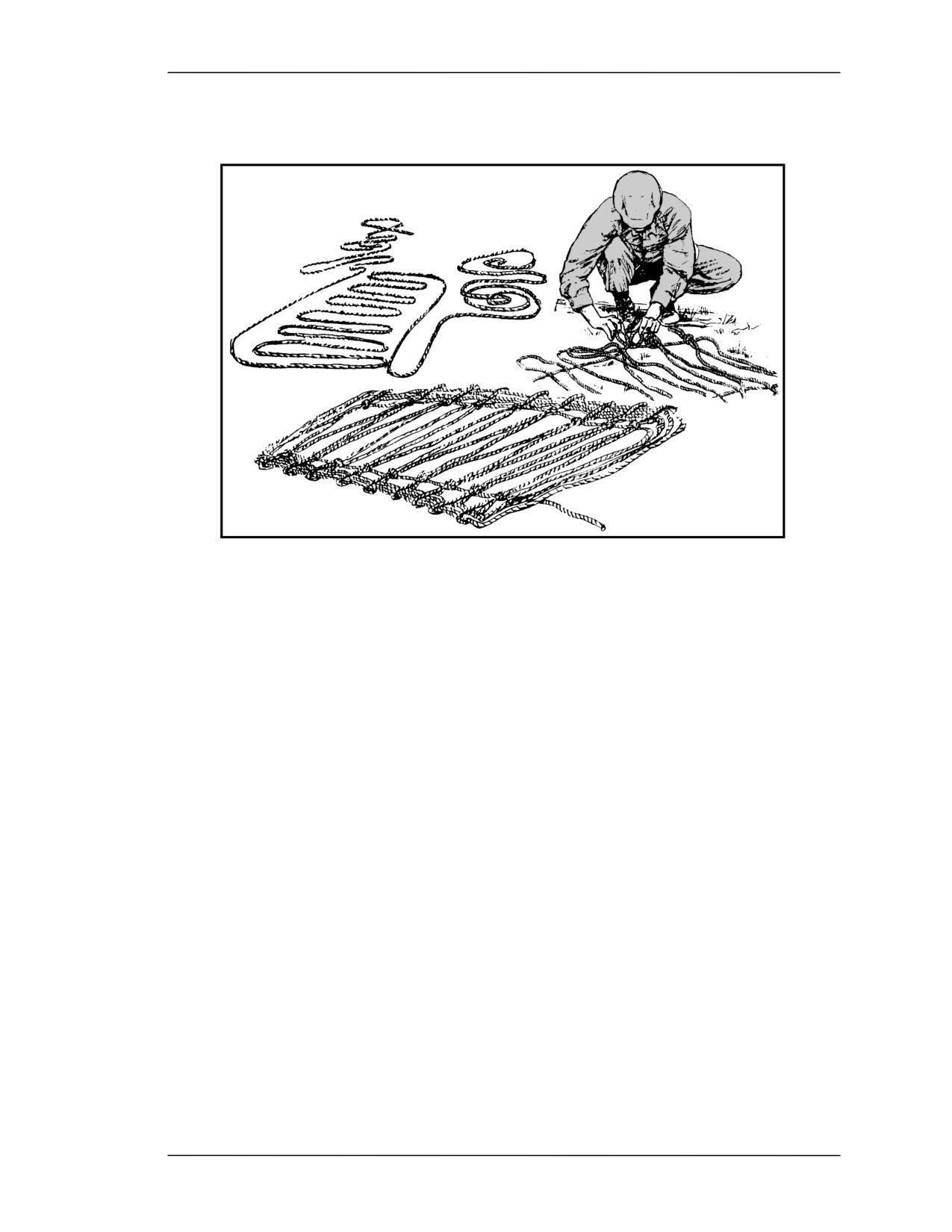
(3) A rope litter is prepared using one rope (Figure 11-3). It requires 20 to 30 minutes
to prepare and should be used only when other materials are not available. Four to six
bearers are required to carry the litter. The rope litter is the most commonly used field-
expedient litter.
11-8
FM 3-97.61
Note: Above the tree line, little material exists to construct litters.
Figure 11-3. Rope litter.
(a) Make 24 bights about 45 to 61 centimeters long, starting in the middle of the rope
so that two people can work on the litter at one time.
(b) With the remainder of the rope, make a clove hitch over each bight. Each clove
hitch should be about 15 centimeters from the closed end of the bight when the litter is
complete.
(c) Pass the remainder of the rope through the bights outside of the clove hitches.
Dress the clove hitches down toward the closed end of the bight to secure the litter and tie
off the ends of the rope with clove hitches.
(d) Line the litter with padding such as clothing, sleeping bags, empty boxes.
(e) Make the rope litter more stable by making it about 6 inches wider. After placing
the clove hitches over the bights, slide them in (away from the closed end) about 15
centimeters. Take two 3- to 4-meter poles, 8 centimeters in diameter at the butt ends, and
slide each pole down through the bights on each side. Dress down the clove hitches
against the poles. Take two 1-meter poles, and tie them off across the head and foot of the
litter with the remaining tails of the climbing rope.
Note: The above measurements may have to be altered to suit the overall length of rope
available.
11-8. RESCUE SYSTEMS
Rescue systems are indispensable when conducting rescue operations. A large number of
soldiers will not always be available to help with a rescue. Using a mechanical advantage
rescue system allows a minimal amount of rescuers to perform tasks that would take a
larger number of people without it.
11-9
FM 3-97.61
a. Belay Assist. This system is used to bring a climber over a section that he is
unable to climb, but will continue climbing once he is past the difficult section.
(1) First, tie off the following climber at the belay with a mule knot.
(2) Tie a Prusik knot with short Prusik cord about 12 inches below the mule knot, and
place a carabiner into the loop. Place the tail from the mule knot into the carabiner in the
Prusik cord.
(3) Untie the mule knot without letting the following climber descend any more than
necessary. Do not remove the belay.
(4) Maintain control of the brake side of the rope and pull all of the slack through the
carabiner in the Prusik cord.
(5) Pull up on the rope. The rope will automatically feed through the belay.
(6) If the leader has to pull for a distance he can tie another mule knot at the belay to
secure the second climber before sliding the Prusik down to get more pulling distance.
(7) After the climber can continue climbing, the leader secures the belay with a mule
knot.
(8) Remove the Prusik cord and carabiner, then untie the mule knot and continue
belaying normally.
Notes: With all rescue techniques make sure that you always think everything through,
and double check all systems to ensure that you don’t accidentally untie the fallen
climber or find yourself without back-up safety. Do not compound the problem!
When doing any rescue work the rescuers will always be tied in for safety.
b. Belay Escape. The belay escape is used when a climber has taken a serious fall
and cannot continue. The belayer is anchored and is performing an indirect belay, and
must assist the injured climber or go for assistance. To accomplish this he must escape
the belay system. The belayer will remain secured to an anchor at all times.
(1) After a climber has been injured, tie off the belay device on your body using a
mule knot. To improve this system, clip a nonlocking carabiner through the loop in the
overhand knot and clip it over the rope.
(2) Attach a short Prusik cord to the load rope and secure it to the anchor with a
releasable knot.
(3) Using a guard knot or Munter mule, attach the climbing rope from the belay
device.
(4) Untie the mule knot in the belay device attached to the harness and slowly lower
the climber, transferring the weight of the climber onto the Prusik.
(5) Remove the climbing rope from the belay device attached to the harness.
(6) Release the mule knot securing the Prusik, transferring the weight to the anchor.
(7) At this point the climber is secured by the rope to the anchor system and the
belayer can now assist the injured climber.
11-9. LOW-ANGLE EVACUATION
Cliffs and ridges, which must be surmounted, are often encountered along the evacuation
path. Raising operations place a greater load on all elements of the system than do
lowering operations. Since all means of raising a victim (pulley systems, hand winches,
and power winches) depend on mechanical advantage, it becomes easy to overstress and
11-10
FM 3-97.61
break anchors and hand ropes. Using mechanical raising systems tends to reduce the
soldier’s sensitivity to the size of the load. It becomes important to monitor the system
and to understand the forces involved.
a. Raising Systems, Belays, and Backup Safeties. Raising systems, belays, and
backup safeties are of special importance in any raising operation. The primary raising
system used is the Z-pulley system, which theoretically gives three pounds of lift for each
pound of force expended. In practice, these numbers decrease due to rope-pulley friction,
rope-edge friction, and other variables. A separate belay rope is attached to the litter and
belayed from a separate anchor. Backup Prusik safeties should be installed in case any
part of the pulley system fails.
(1) Raising System. When considering a raising system for evacuations, the Z-pulley
system is the most adaptable. It can be rigged with the equipment on hand, and can be
modified and augmented to handle heavier loads. Although the vertical or horizontal
hauling lines can also be used, the Z-pulley system offers a mechanical advantage that
requires less exertion by the transport team.
(2) Belays. Whenever ropes are used for an evacuation operation, the overriding
safety concern is damage to the ropes. This is the main reason for two-rope raising
systems (raising rope and belay rope).
(3) Backup Safeties. Because the stresses generated by the Z-pulley system can cause
anchors to fail, backup safety Prusiks are used to safeguard the system. These should be
attached to alternate anchor points, if possible.
b. Raising the Litter. The litter is prepared as already described.
(1) The raising ropes and belay ropes are secured to top anchors and are thrown down
to the litter crew.
(2) Padding is placed at the cliff edge and over any protrusions to protect the ropes
from abrasion.
(3) The litter attendants secure the ropes to the litter.
(4) The raising crew sets up the Z-pulley system.
(5) One member of the crew secures himself to an anchor and moves to the edge of
the cliff to transmit signals and directions. (This is the signalman or relay man.)
Note: If the load is too heavy at this time, another pulley is added to the system to
increase the mechanical advantage.
(6) Attendants guide the litter around obstacles while the crew continues to raise the
system.
(7) As the litter nears the cliff edge, the signalman assists the attendant in moving the
litter over the edge and onto the loading platform, taking care not to jar the casualty.
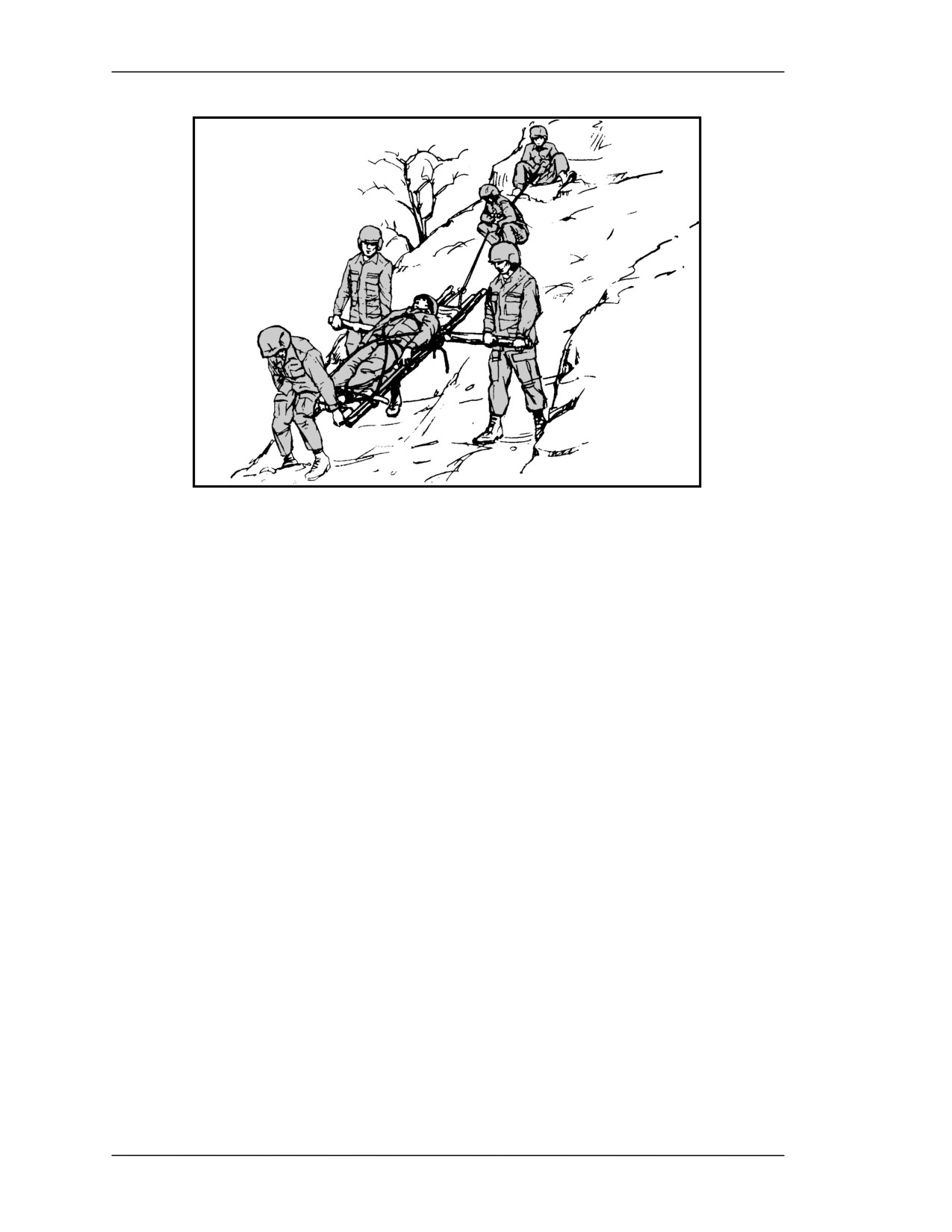
c. Descending Slopes. When descending a moderately steep slope that can be
down-climbed, the litter and victim are prepared as described earlier
(Figure
11-4,
page 11-12).
(1) One man serves as the belay man and another takes his position on the rope in
front of the belay man, assisting him in lowering the litter. The litter bearers take their
positions and move the litter down with the speed of descent controlled by the belay man.
11-11
FM 3-97.61
Figure 11-4. Low-angle evacuation—descending.
(2) The extra man may assist with the litter or precede the team to select a trail,
clearing away shrubs and vines. He reconnoiters so that the team need not retrace its steps
if a cliff is encountered.
(3) The most direct, practical passage should be taken utilizing available natural
anchors as belay positions.
11-10. HIGH-ANGLE EVACUATION
Evacuation down cliffs should be used only when absolutely necessary and only by
experienced personnel. The cliffs with the smoothest faces are chosen for the route. Site
selection should have the following features: suitable anchor points, good loading and
unloading platforms, clearance for the casualty along the route, and anchor points for the
A-frame, if used. There are many ways to lower a casualty down a steep slope. As long as
safety principals are followed, many different techniques can be used. One of the easiest
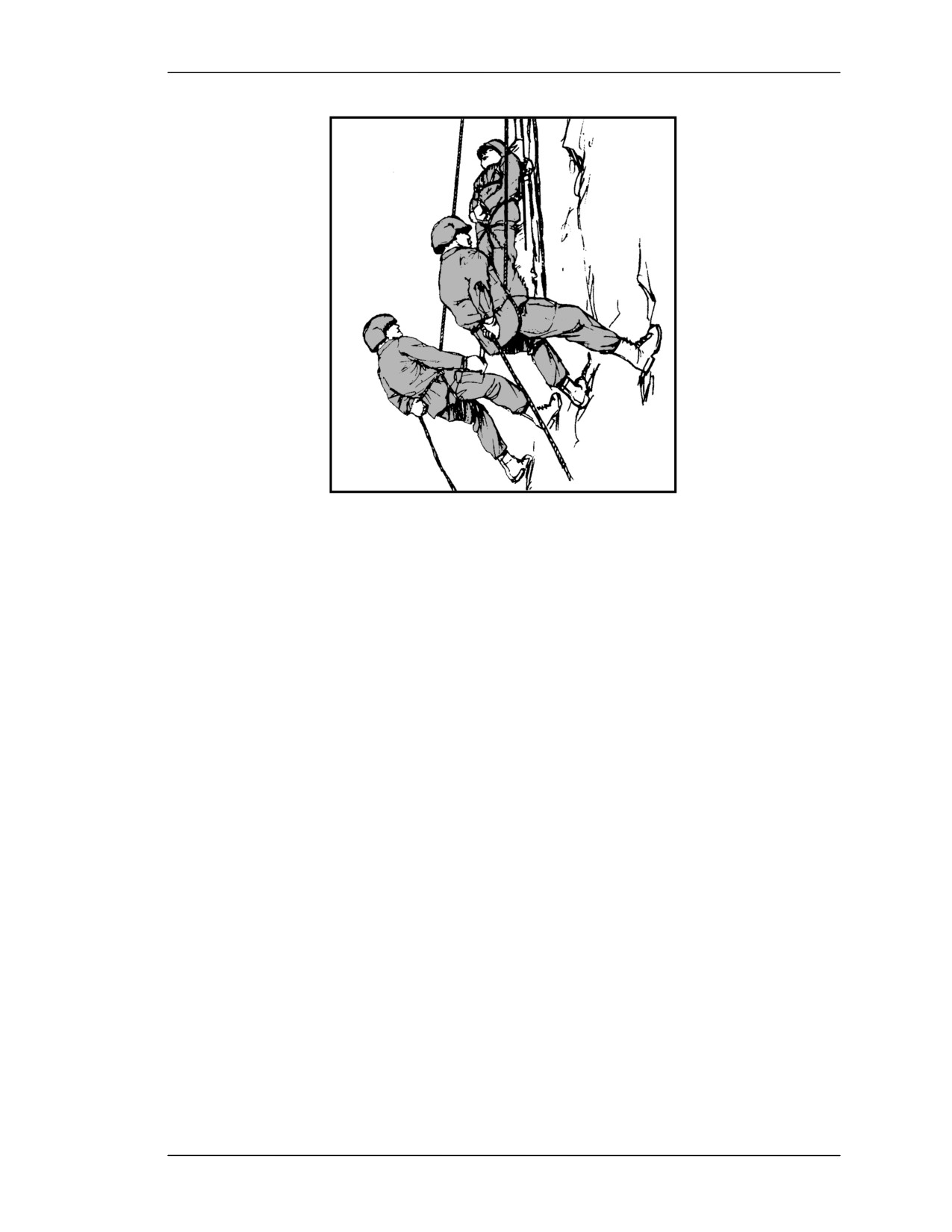
and safest techniques is as follows (Figure 11-5):
a. Use multiple anchors for the litter and litter tenders.
b. Secure the litter to the lowering rope with a minimum of four tie-in points (one at
each corner of the litter). Lengths of sling rope or 7-millimeter cordage work best. Make
the attached ropes adjustable with Prussik knots so that each corner of the litter can be
raised or lowered to keep the litter stable during descent. Tie the top of the ropes with
loops and attach to the lowering rope with a pear shaped locking carabiner.
c. Two litter tenders will descend with the litter to control the descent and to monitor
the casualty. They can be attached to separate anchors and either self-belay themselves or
be lowered by belayers.
d. Once the steep slope has been negotiated, continue the rescue with a low-angle
evacuation.
11-12
FM 3-97.61
Figure 11-5. Cliff evacuation descent.
11-13
FM 3-97.61(TC 90-6-1)
APPENDIX A
LEVELS OF MILITARY MOUNTAINEERING
Military mountaineering training provides tactical mobility in
mountainous terrain that would otherwise be inaccessible. Soldiers with
specialized training who are skilled in using mountain climbing equipment
and techniques can overcome the difficulties of obstructing terrain. Highly
motivated soldiers who are in superior physical condition should be
selected for move advanced military mountaineering training (Levels 2
and 3) conducted at appropriate facilities. Soldiers who have completed
advanced mountaineering training should be used as trainers, guides, and
lead climbers during collective training. They may also serve as
supervisors of installation teams and evacuation teams. Properly used
these soldiers can drastically improve mobility and have a positive impact
disproportionate to their numbers. Units anticipating mountain operations
should strive to have approximately ten percent of their force achieve
advanced mountaineering skills.
A-1. LEVEL 1: BASIC MOUNTAINEER
The basic mountaineer should be a graduate of a basic mountaineering course and have
the fundamental travel and climbing skills necessary to move safely and efficiently in
mountainous terrain. These soldiers should be comfortable functioning in this
environment and, under the supervision of qualified mountain leaders or assault climbers,
can assist in the rigging and use of all basic rope installations.
a. On technically difficult terrain, the basic mountaineer should be capable of
performing duties as the “follower” or “second” on a roped climbing team, and should be
well trained in using all basic rope systems. These soldiers may provide limited
assistance to soldiers unskilled in mountaineering techniques.
b. Particularly adept soldiers may be selected as members of special purpose teams
led and supervised by advanced mountaineers. Figure A-1 lists the minimum knowledge
and skills required of basic mountaineers.
c. In a unit training program, Level 1 qualified soldiers should be identified and
prepared to serve as assistant instructors to train unqualified soldiers in basic
mountaineering skills. All high-risk training, however, must be conducted under the
supervision of qualified Level 2 or 3 personnel.
A-1
FM 3-97.61
• Characteristics of the mountain
• Rope management and knots.
environment (summer and
• Natural anchors.
winter).
• Familiarization with artificial
• Mountaineering safety.
anchors.
• Use, care, and packing of
• Belay and rappel techniques.
individual cold weather clothing
• Use of fixed ropes (lines).
and equipment.
• Rock climbing fundamentals.
• Care and use of basic
• Rope bridges and lowering
mountaineering equipment.
systems.
• Mountain bivouac techniques.
• Individual movement on snow
• Mountain communications.
and ice.
• Mountain travel and walking
• Mountain stream crossings (to
techniques.
include water survival
• Hazard recognition and route
techniques).
selection.
• First aid for mountain illnesses
• Mountain navigation.
and injuries.
• Basic medical evacuation.
Figure A-1. Level 1, basic mountaineering tasks.
A-2. LEVEL 2: ASSAULT CLIMBER
Assault climbers are responsible for the rigging, inspection, use, and operation of all
basic rope systems. They are trained in additional rope management skills, knot tying,
and belay and rappel techniques, as well as using specialized mountaineering equipment.
Assault climbers are capable of rigging complex, multipoint anchors, and high-angle
raising/lowering systems. Level 2 qualification is required to supervise all high-risk
training associated with Level 1. At a minimum, assault climbers should possess the
additional knowledge and skills shown in Figure A-2.
• Use specialized mountaineering
• Move on moderate angle snow
equipment.
and ice.
• Perform multipitch climbing:
• Establish evacuation systems and
_ Free climbing and aid
perform high-angle rescue.
climbing.
• Perform avalanche hazard
_ Leading on class 4 and 5
evaluation and rescue
terrain.
techniques.
• Conduct multipitch rappelling.
• Be familiar with movement on
• Establish and operate hauling
glaciers.
systems.
• Establish fixed ropes with
intermediate anchors.
Figure A-2. Level 2, assault climber tasks.
A-3. LEVEL 3: MOUNTAIN LEADER
Mountain leaders possess all the skills of the assault climber and have extensive practical
experience in a variety of mountain environments in both winter and summer conditions.
Level 3 mountaineers should have well-developed hazard evaluation and safe route
finding skills over all types of mountainous terrain. Mountain leaders are best qualified to
advise commanders on all aspects of mountain operations, particularly the preparation
and leadership required to move units over technically difficult, hazardous, or exposed
A-2
FM 3-97.61
terrain. The mountain leader is the highest level of qualification and is the principle
trainer for conducting mountain operations. Instructor experience at a military
mountaineering center or as a member of a special operations forces (SOF) mountain
team is critical to acquiring Level 3 qualification. Figure A-3 outlines the additional
knowledge and skills expected of mountain leaders. Depending on the specific AO,
mountain leaders may need additional skills such as snowshoeing and all-terrain skiing.
• Recognizing and evaluating
• Performing glacier travel and
peculiar terrain, weather, and
crevice rescue.
hazards.
• Establishing and operating
• Preparing route, movement,
technical high-angle, multipitch
bivouac, and risk management
rescue and evacuation systems.
plans for all conditions and
• Usiing winter shelters and
elevation levels.
survival techniques.
• Using roped movement
• Leading units over technically
techniques on steep snow and
difficult, hazardous, or exposed
ice.
terrain in both winter and summer
• Performing multipitch climbing on
conditions.
mixed terrain (rock, snow, and
ice).
Figure A-3. Level 3, mountaineer leader tasks.
A-3
FM 3-97.61(TC 90-6-1)
APPENDIX B
MEASUREMENT CONVERSION FACTORS
MULTIPLY
BY
TO OBTAIN
Millimeters
.03937
Inches
Centimeters
.3937
Inches
Centimeters
.03281
Feet
Meters
39.37
Inches
Meters
3.281
Feet
Meters
1.0936
Yards
Kilometers
.62137
Miles
Knots
1.1516
MPH
B-1
FM 3-97.61(TC 90-6-1)
APPENDIX C
AVALANCHE SEARCH AND RESCUE TECHNIQUES
The effect of an avalanche can be disastrous. Chances of survival after
burial by an avalanche are approximately 90 percent if the victim is
located within the first 15 minutes. Probability of survival drops rapidly
and, after two hours, chances of survival are remote. Suffocation accounts
for 65 percent of avalanche fatalities, collision with obstacles such as
rocks and trees accounts for 25 percent, and hypothermia and shock
accounts for 10 percent.
The best chance of survival in snow country is to avoid an avalanche;
but, if a member of your group is in an avalanche, they are depending on
you for rescue!
C-1. IMMEDIATE ACTION
Survivors at the avalanche site organize into the first rescue team and immediately start
rescue operations. If any indication of the location of the victim is found, random probing
starts in that vicinity. The tip and edges of the slide are also likely areas to search. A
human body is bulky and is apt to be thrown toward the surface or the sides.
C-2. GENERAL PROCEDURES
Establish from witnesses where the victim was located just before the avalanche to
determine the point where the victim disappeared—the “last seen” point. Using this and
any other information, establish a probable victim trajectory line leading to high priority
search areas. Make a quick but systematic check of the slide area and the deposition area,
and mark all clues. Look for skis, poles, ice axes, packs, gloves, hats, goggles, boots, or
any other article the person may have been carrying—it might still be attached to the
victim.
a. Organize initial searchers and probers. If using avalanche beacons, immediately
select personnel to begin a beacon search. Ensure all other beacons are turned off or to
receive to eliminate erroneous signals. All personnel should have a shovel or other tool
for digging or, if enough personnel are available, a digger can be standing by to assist
when needed. If the initial search reveals items from the victim, make an initial probe
search in that area. This probing should take only a few seconds.
b. Make a coarse probe of all likely areas of burial, and repeat it as long as a live
rescue remains possible. Resort to the fine probe only when the possibility of a live
rescue is highly improbable. Unless otherwise indicated, start the coarse probe at the
deposition area.
C-3. ESTABLISHING THE VICTIM’S MOST PROBABLE LOCATION
In many respects, a moving avalanche resembles a liquid. A human body, with a higher
density than the flowing snow, would be expected to sink deeper and deeper into the
avalanche; however, several factors influence the body’s location. Turbulence, terrain,
and the victim’s own efforts to extricate himself all interact to determine the final burial
position. Study of a large number of case histories leads to the following conclusions.
C-1
FM 3-97.61
•
The majority of buried victims are carried to the place of greatest deposition,
usually the toe of the slide.
•
If two points of the victim’s trajectory can be established, a high probability
exists that the victim will be near the downhill flow line passing through these
two points.
•
Any terrain features that catch and hold avalanche debris are also apt to catch
a victim.
•
If an avalanche follows a wandering gully, all debris deposit areas are likely
burial spots. The likelihood of a victim being buried in a particular bend is
proportional to the amount of debris deposited there.
•
Vegetation, rocks, and other obstacles act as snares. The victim tends to be
retained above the obstacle. An obstacle may simply delay the victim’s
motion, leading to final burial down flow from the obstacle.
•
Maximum speed of the flowing snow occurs at the avalanche center. Friction
reduces flow velocity along the edges. The closer the victim’s trajectory is to
the center of the slide, the greater will be his burial depth.
•
Efforts of the victim to extricate himself by vigorous motion and “swimming”
definitely minimize burial depth. Conversely, the limp body of an unconscious
victim is likely to be buried deeply.
•
An occasional exception to the above is emphasized. The victim may not be
buried but may have been hurled away from the avalanche by wind blast. In
the case of large and violent avalanches, a search of the surrounding terrain is
advisable. Victims have been located in tree tops outside the slide area.
Use of avalanche transceivers is the most efficient method of searching for an avalanche
victim, but only if the victim is wearing an active transceiver. Many models of
transceivers are available, each with its own manufacturer’s instructions for proper use
and care. All currently available transceivers are compatible, although they may operate
differently in the search mode.
C-4. PROBING FOR AVALANCHE VICTIMS
Probing offers the advantage of requiring simple equipment that can be operated by
personnel with no previous training. Although the probers do not need previous training
the search leader must be familiar with the technique to ensure proper execution of the
probe line.
a. Probe Poles. Rigid steel tubing approximately
3/4-inch in diameter and
approximately 10 feet long is recommended for the primary probe pole. Longer poles are
difficult to manage, especially in a high wind. Although this type of pole performs best, it
is difficult to transport to the avalanche site because of its length and weight.
(1) Each person operating in avalanche areas should carry folding sectional poles.
These poles are similar to folding tent poles, but are stronger and are connected with
cable instead of bungee cord. These poles should be carried on the outside of the pack for
immediate access.
(2) If no probing poles are available, initial probing attempts can be started using ski
poles in one of two ways: the ski pole can be reversed, probing with the wrist strap down;
or the basket can be removed so that the point is down (the preferred method), which
allows the ski pole to penetrate the snow more easily.
C-2
FM 3-97.61
b. Probing Lines. For the probing operation to be effective, probing lines must be
orderly and properly spaced. To ensure systematic and orderly probing, the number of
personnel per line should be limited. Twenty per line is satisfactory, while thirty is
normally the upper limit. The number of probers in the line will be dictated by not only
the width of the area to be probed but the number of personnel available. A string may be
used to keep the probe lines aligned, but will require added time to maintain.
(1) The probe line maintains a steady advance upslope. Advancing uphill
automatically helps set the pace and permits easy probing to the full length of the probe.
Probing does not come to a halt when a possible contact is made. The probe is left in
contact and the line continues. A shovel crew follows up on the strike by digging down
along the pole. Extra probes are carried by the shovel crew to replace those left in
contact. Such a plan of operation is especially important when more than one victim is
buried.
(2) Striking a body gives a distinct feel to the probe, which is easily recognizable in
soft snow but less recognizable in hard compacted snow. A common problem is
encountering debris within the snow that can be mistaken for the victim. The only sure
check is by digging.
c. Probing Techniques. Two distinct probing methods are recognized: coarse probe
and fine probe. As evidenced by their names, coarse probing implies a wider spacing of
probe pole insertions with emphasis on speed. Fine probing involves close-spaced
probing with emphasis on thoroughness. Coarse probing is used during initial phases of
the search when live recovery is anticipated. Fine probing is the concluding measure,
which almost guarantees finding the body. The coarse probe technique has a 70-percent
chance of locating the victim on a given pass, while the fine probe has, essentially, a
100-percent chance of locating the body.
(1) The coarse probe functions as follows:
(a) Probers are spaced along a line 30 inches center to center, with feet about 15
inches apart.
(b) A single probe pole insertion is made at the center of the straddle span.
(c) On command of the probe line commander, the group advances 20 inches and
repeats the single probe.
(d) Three commands are used for the complete sequence:
•
“DOWN PROBE.”
•
“UP PROBE.”
•
“STEP FORWARD.”
By using these commands, the leader can maintain closer control of the advancing probe
line. It is important that the commands be adjusted to a rhythm that enforces the
maximum reasonable pace. A string may also be used along the probe line to keep the
probers dressed, although this requires the use of two soldiers to control the string. Strict
discipline and firm, clear commands are essential for efficient probing. The probers
themselves work silently.
(2) The fine probe functions as follows:
(a) Probers are spaced the same as for the coarse probe. Each man probes in front of
his left foot, then in the center of his straddled position, and finally in front of his right
foot.
C-3
FM 3-97.61
(b) On command, the line advances 1 foot and repeats the probing sequence. Each
probe is made 10 inches from the adjacent one.
(c) The commands for the fine probe are:
•
“LEFT PROBE.”
•
“UP PROBE.”
•
“CENTER PROBE.”
•
“UP PROBE.”
•
“RIGHT PROBE.”
•
“UP PROBE.”
•
“STEP FORWARD.”
(d) Good discipline and coordinated probing is even more important in fine probing
than with the coarse probe. Careless or irregular probing can negate the advantages of
fine probing. Use of a string to align the probers is especially important with the fine
probe. The three insertions are made along the line established by the string, which is
then moved ahead 1 foot.
C-4
FM 3-97.61(TC 90-6-1)
GLOSSARY
AI
alpine ice
ALICE
all-purpose, lightweight, individual carrying equipment
AMS
acute mountain sickness
APS
anchor pulley system
ATC
air traffic controller
BDU
battle dress uniform
BTC
bridge team commander
C
Celsius
CE
community Europe
CEN
combined European norm
cm
centimeter
CMS
chronic mountain sickness
CPR
cardio-pulmonary resuscitation
CTA
common table of allowance
DA
Department of the Army
ECWCS
extreme cold weather clothing system
EN
European norm
F
Fahrenheit
FM
field manual
ft
foot; feet
GPS
Global Positioning System
GTA
graphic training aid
HACE
high-altitude cerebral edema
HAPE
high-altitude pulmonary edema
IAW
in accordance with
LBV
load-bearing vest
LCD
liquid crystal diode
LCE
load-carrying equipment
MEDEVAC
medical evacuation
MPH
miles per hour
MPS
moveable pulley system
MRE
meal ready-to-eat
Glossary-1
FM 3-97.61
NSN
national stock number
OP
observation post
PABA
para-amino benzoic acid
PCD
progress capture device
PFD
personal flotation device
RURP
realized ultimate reality piton
SE
southeast
SLCD
spring-loaded camming device
SOF
special operations forces
SOP
standard operating procedure
SOSES
shape, orientation, size, elevation, slope
SPF
sun protection factor
TOE
table of organization and equipment
UIAA
Union des International Alpine Association
U.S.
United States
USAF
United States Air Force
USN
United States Navy
UV
ultraviolet
UVA
ultraviolet A (radiation wavelengths between 320 and 400 nanometers)
UVB
ultraviolet B (radiation wavelengths between 295 and 320 nanometers)
WI
waterfall ice
YDS
Yosemite Decimal System
Glossary-2
FM 3-97.61(TC 90-6-1)
REFERENCES
Documents Needed
These documents must be available to the intended users of this manual.
FM 3-25.26
Map Reading and Land Navigation. 20 July 2001.
*FM 3-97.6
Mountain Operations. 28 November 2000.
FM 8-10-6
Medical Evacuation in a Theater of Operations
Tactics,
Techniques, and Procedures. 14 April 2000.
FM 21-76
Survival. 05 June 1992.
DA Form 2028
Recommended Changes to Publications and Blank Forms.
01 February 1974.
DA Form 5752-R
Rope History and Usage. May 1989.
CTA 50-900
Clothing and Individual Equipment. 01 September 1994.
GTA 05-08-012
Individual Safety Card. 25 February 1999.
STP 21-1-SMCT
Soldier’s Manual of Common Tasks, Skill Level 1.
01 October 2001.
STP 21-24-SMCT
Soldier’s Manual of Common Tasks, Skill Levels 2—4.
01 October 2001.
USAF TO 00-75-5
Use, Inspection and Maintenance Stokes Rescue Litters.
01 April 1979.
Readings Recommended
These readings contain relevant supplemental information.
Mountaineering: Freedom of the Hills, 6th edition, The Mountaineers, Seattle, WA, 1997
Soles, Clyde, Rock and Ice Gear: Equipment for the Vertical World, The Mountaineers,
Seattle, WA, 2000
*This source was also used to develop the manual.
References-1
FM 3-97.61
Internet Web Sites
U.S. Army Publishing Agency
Army Doctrine and Training Digital Library
References-2