MCWP 3-16.3 FM 6-50 TTP for the Field Artillery Cannon Gunnery - page 16
FM 6-50, MCWP 3-1.6.23
APPENDIX J
CRATER ANALYSIS AND REPORTING
J-1. CRATER ANALYSIS TEAM
Although greater reliance should be placed on reports from
trained teams, all personnel should know how to analyze
craters and make the proper report. Since crater analysis
teams are not authorized by TOE, each unit (including units
normally located in rear areas) should select and train at
least one team of two or three members. To adequately
support their maneuver unit, fire support personnel must
know how to analyze and report crater information.
J-2. EQUIPMENT
Three elements—direction, dimensions, and curvature—must
be measured for crater analysis. The equipment used by
the crater analysis team should consist of the following items:
Declinated aiming circle (or M2 compass), stakes, and
communications wire used to obtain the direction from
the crater to the weapon that fired the projectile.
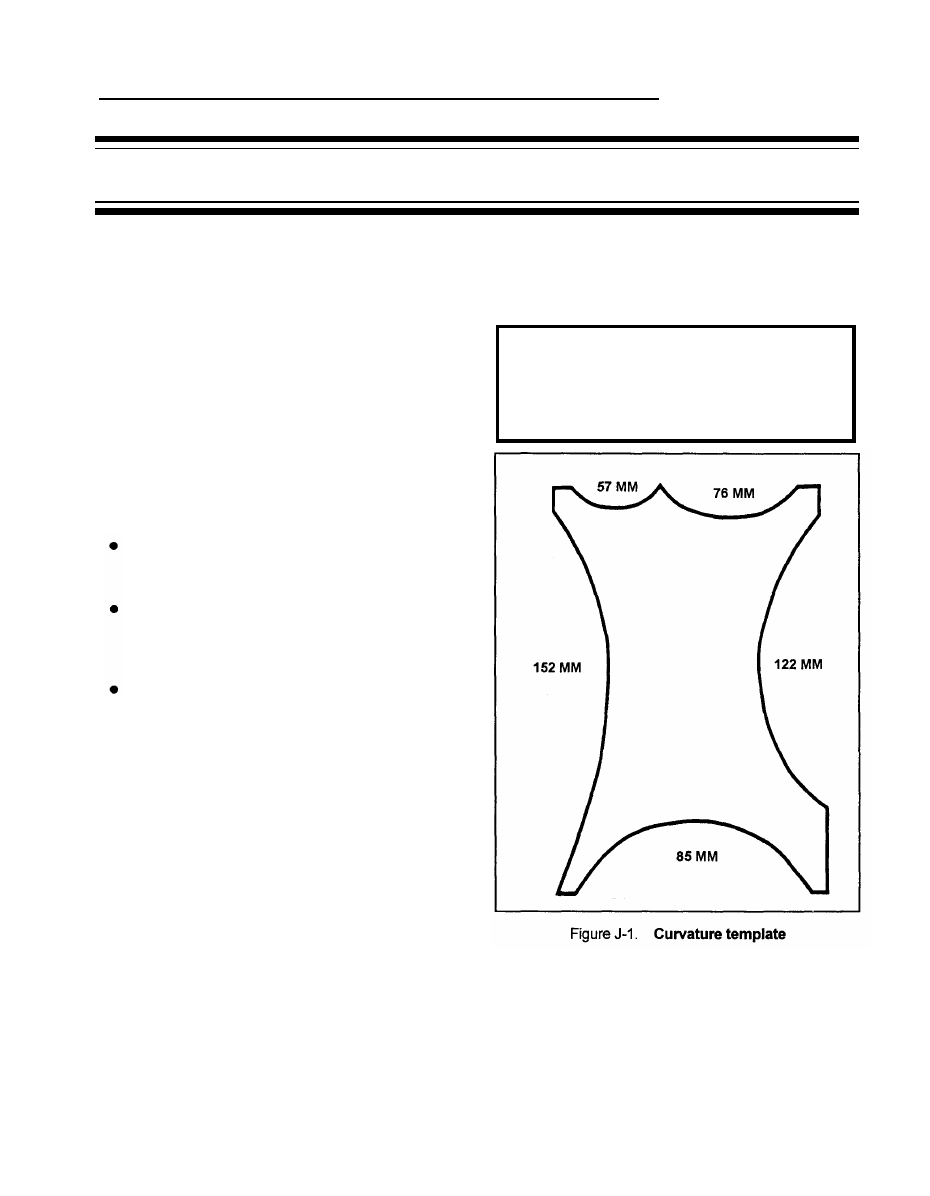
A curvature template (Figure J-1) to measure the
curvature of the fragment to determine the caliber of
the shell. The template can be constructed of heavy
cardboard, acetate, wood, or other appropriate material.
Defense Intelligence Agency Projectile Fragment
Identification
Guide (DST-1160G-029-85) for
measuring fragment dimensions.
J-3. SHELL CRATER ANALYSIS
a.
The projectiles direction of flight can be determined with
reasonable accuracy from its crater of ricochet furrow. By
accurately locating the crater and determining the direction
of flight, it is possible to obtain the azimuth of a ray that
will pass through or near the enemy position. While it is
possible to determine the direction to a battery from one
crater or ricochet furrow, the battery may be located by
plotting the intersection of the average azimuths from at
least three widely separated groups of craters.
b.
In crater analysis, differences in angle of fall, projectile
burst patterns, directions of flight, and time fuze settings
will help to distinguish between enemy batteries firing on
a given area.
Note:
Refer to FM 3-100 for guidance on friendly
troop safety from the effects of craters contaminated
with chemical agents. Refer to STANAG 2002 in FM
3-100 for guidance in marking craters containing
chemical, biological, or radiological contamination.
J-1