MCWP 3-16.3 FM 6-50 TTP for the Field Artillery Cannon Gunnery - page 17
 

  Главная      Manuals     MCWP 3-16.3 FM 6-50 TTP for the Field Artillery Cannon Gunnery


Search            copyright infringement  


Content      ..     15      16      17      18     ..


MCWP 3-16.3 FM 6-50 TTP for the Field Artillery Cannon Gunnery - page 17


FM 6-50, MCWP 3-1.6.23

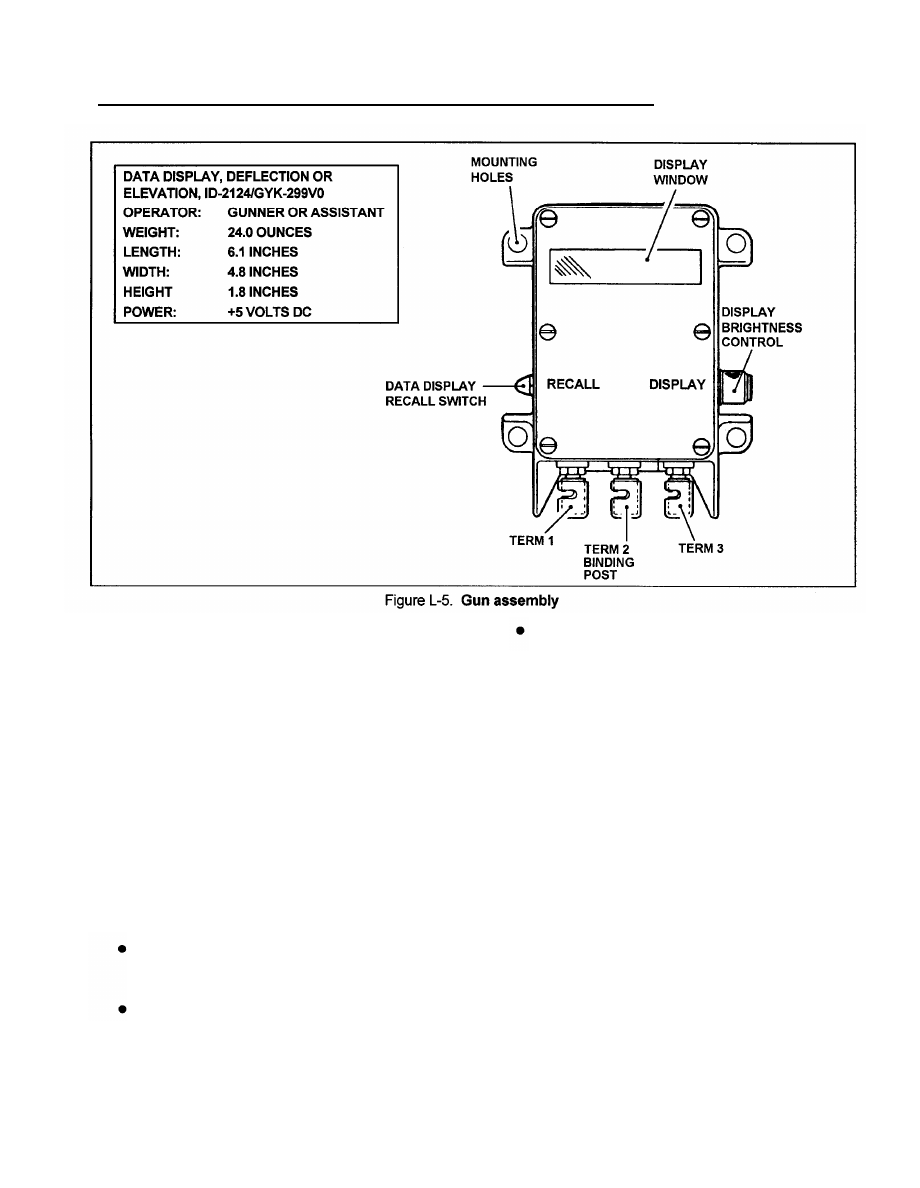
(2) The TERM 2 binding post is used to connect field

wire between the gun assembly and the ground binding post

on the case assembly.

(3) The TERM 3 binding post is used to connect field

wire between the gun assembly and the signal binding post

on the case assembly.
d. 

When the RECALL switch is pressed the display

reappears. The display normally stays in the display window

for 15 seconds. The display also goes blank when the GDU

receives EOM, CEASE LOAD, or CHECKFIRE; and it stays

blank until data for the next mission is received.
e. 

The display brightness control is used to vary the

brightness of the display window data.

L-5. CABLES

The 

following cables are provided for connecting the GDU:

SCA cable(W35) ( 15 feet long), which provides signal

and power connection between the case assembly and

the SCA.

Cable assembly W33 (3 feet long) or W33A (15 feet

long), which provides signal connection between the

case assembly and the AN/PRC 68 or AN/PRC 126

radios.

L-6.

Cable assembly W34 (3 feet long) or W34A (15 feet

long), provides power connection between the case

assembly and the AN/PRC 68 or AN/PRC 126 radios.

BCS - GDU WIRE LINK

a. 

When a unit is not operating with radio, wire is used

to connect the GDU to the BCS.
b. 

The BCS - GDU digital wire link is sensitive and works

best with unspliced wire in good condition. A single poor

splice or multiple splices will hamper data transmission.

Terminal strip TM- 184 should be used when connecting

wire in the BCS - GDU link. The MX-155 has not performed

well. A good lithium battery (BA-5590) should be installed

if a battery is required. Weak or dead batteries may result

in lost data, display problems, and nonacknowledged

messages.
c. 

The TA-312 field telephone and/or the AN/GRA-39

should always be used on separate wire lines from the BCS

- GDU digital data link. Use of this equipment on the same

wire line as the BCS - GDU wire link may hamper

communications and damage the GDU. The ring voltage

on the TA-312 and the AN/GRA-39 can damage the GDU

circuitry.

L-5

-------------------------------------------------------------------------------------------------------------------------------------------------------------

FM 6-50, MCWP 3-1.6.23

L-7. WIRE OPERATIONS

The cable and field wire connections discussed below are

necessary to apply power to and establish wire

communications between the GDU, the chief of section, the

gunner, the assistant gunner, and the BCS. Apply GDU

power by one of the methods described in paragraph L-9.

Notes:

1. Because of the unique characteristics of a digital

wire circuit, its efficiency is seriously impaired by an

electrical leakage through the wire insulation or a bad

splice. Therefore, great care must be taken in laying

the firing battery wire circuits to avoid damage to the

insulation. Wire lines must not be laid in water.

Splices must be carefully made and well insulated to

avoid excessive leakage or possible shorts. Splices

on wire lines must be kept to a minimum to reduce

line resistance.

2. The use of terminal strip TM-184, instead of jack

panel SB-16, is highly recommended.

This will

reduce circuit resistance due to the internal circuit

design of the SB-16.

CAUTION

Ground the GDU to earth ground before starting

cabling operations.

a. Operation With Terminal Strip TM-184. 

Terminal

strip TM- 184 (Figure L-6) is an expendable Class IX item

(NSN 5940-00-238-8493, reference TC 24-20). It is the

preferred device to use in connecting wire lines from the

GDU to the BCS. If no TM-184 is available in the unit,

recommend that the SB-16 be used. The digital wire system

connecting the BCS through the TM-184 terminal strip to

the GDU is shown in Figures L-6 and L-7.

L-6

-------------------------------------------------------------------------------------------------------------------------------------------------------------

FM 6-50, MCWP 3-1.6.23

b. Wire System Construction. 

The wire system is

constructed by laying a wire line of WD-l/TT field wire

between the GDU and the BCS. The modified reel unit

RL-39 (A, Figure L-7) is used. Starting at the TM-184 (B,

Figure L-7), attach the ends of a WD-1/TT wire (NSN

6145-00-226-8812), (C, Figure L-7) on the strip. Continue

laying wire to the gun position, stake it off, and connect

the wire to the binding posts labeled BCU  (D, Figure L-7)

on the GDU. For this connection, prepare both ends of a

short piece of WD-1 wire as shown in of Figure L-8.

Connect one end to the connector labeled M-221 on the

spool DR-8 (E, Figure L-7) and the other end to the binding

posts labeled BCU on the GDU. Using wire from an RL-39

reel, insert the open end in the two binding posts on the

TM- 184 corresponding to the gun number as shown in F,

Figure L-7. Prepare the wire ends according to A, Figure

L-8, and ensure that the TM- 184 is prepared as shown in

Figure L-6. Connect wire circuits for the rest of the guns

in the same manner.

L-7

-------------------------------------------------------------------------------------------------------------------------------------------------------------

FM 6-50, MCWP 3-1.6.23

c. Connector Wire Preparation.

Prepare wire for

connection as follows.

(1) Cut six pieces of field wire about 25 feet long.

Strip about ½ inch of insulation from each end (A, Figure

L-8), leaving a ½ inch strip of insulation on each end of

the wire, and twist the two conductors (B, Figure L-8).

(2) Take three pairs of wire. Tag and mark the two

ends of each pair QE 1, QE 2, and QE 3 (C, Figure L-8).

Connect one end of the pair marked QE 1 to the binding

post labeled QE 1 (G, Figure L-7) on the GDU and the

assembly. Using the same procedure, connect the other two

pairs to the QE 2 and QE 3 binding posts.

(3) Tag and mark the other three cables DEF 1, DEF

2, and DEF 3. Connect one end of the pair marked DEF

1 to the binding post labeled DEF 1 (H, Figure L-7) on the

GDU and the other end to the left binding post labeled 1

on the deflection gun assembly. Using the same procedure,

connect the other two cables to DEF 2 and DEF 3. Run

the GDU self-test to check internal operation. Always use

a separate wire line for voice (TA-312 communications).

Then make a digital communications check using the

other end to the left binding post labeled 1 on the QE gun

BCS;RING and the GDU;RING.

L-8

-------------------------------------------------------------------------------------------------------------------------------------------------------------

FM 6-50, MCWP 3-1.6.23

L-8. M109-SERIES HOWITZERS

a. Internal Battery Power (BA-5590). 

Install the battery

The GDU is mounted in the cab of the M109-series of

in the case assembly as follows (Figure L-10):

howitzers (Figure L-9). Be sure to leave enough slack in

the wire leading outside the cab to the DR-8 to compensate

CAUTION

for traversing.

When putting the new battery in the case assembly,

handle it very carefully. It is easily damaged by rough

L-9. GUN DISPLAY UNIT POWER

handling.

The GDU connected by wire to the BCS can be operated

from one of two power sources:

Loosen the cover fasteners, and remove the cover.

Internal battery power.

Put the new battery in the battery compartment, and

push the battery in to seat the battery connector with

External power by power cable.

the case assembly connector.

L-9

-------------------------------------------------------------------------------------------------------------------------------------------------------------

FM 6-50, MCVVP 3-1.6.23

Install the spare battery in the battery compartment.

Put the cover in place, and lock the fasteners.

WARNING

Lithium organic batteries or cells are used in this

equipment. They are potentially hazardous if

misused or tampered with before, during, or after

discharge. The following precautions must be

strictly observed to prevent possible injury to

personnel or damage to equipment:

Do not heat, incinerate, crush, puncture,

disassemble, or otherwise mutilate the

batteries.

Do not short circuit, recharge, or bypass

internal fuse.
Do not store batteries in equipment during

long periods of nonuse (in excess of 30

days).

Turn off the equipment immediately if you

detect that the battery compartment is too

hot, hear battery cells venting (hissing

sound), or smell irritating sulfur dioxide

gas. Remove and dispose of the battery

only after it is cool (30 to 60 minutes).

b. External Power (W34 or W34A Power Cable).

(1) Use the W34 cable with the M109-series of

self-propelled howitzers and all towed howitzers. Use the

W34A cable only on the Ml10-series self-propelled

howitzers.

(2) Install the BA-5590 battery in the case assembly.

Note: 

Use internal battery power when the W34

(W34A) power cable is connected to the OG-174

AN/VRC. The purpose of the internal battery is to

provide backup power whenever external power

drops below 12 volts direct current (DC). Power will

not be drawn from the internal battery as long as the

prime power source voltage is greater than the

internal battery voltage.

(3) Remove the dust cap from the power connector of

the case assembly.

(4) Join power cable W34 (NSN 7025-01-122-2984)

or W34A (NSN 7025-01-122-2985) connector P2 to the

power connector on the case assembly.

(5) Connect power cable W34 or W34A connector P1

to the Bendix connector on a 24-volt vehicle power cable.

L-10

If you have the AN/PRC 68 or AN/PRC 126 SUT, connect

the W34 (W34A) power cable to the OG-174 AN/VRC

amplifier power supply group instead of directly to the vehicle

power.

L-10. TOWED HOWITZERS

a. 

The following is a safe, accepted and proven method

of remoting power from various vehicles to the GDU when

it is used with a towed howitzer. The Communications -

Electronics Command (CECOM) Equipment Safety Office

agrees that it is a practical solution for the towed howitzer

power problem. The required cable can be fabricated locally.

(1) The cable can be built by using the following Class

IX parts:

Connector, plug, electric, NSN 2910-00-567-0128.

Adapter connector, NSN 5935-00-322-8959.

Cable, power electric, NSN 6145-00-643-3482.

Cable, assembly power, NSN 7025-01-122-2984.

(2) The power electric cable comes in 250-foot spools.

From these, cables can be cut in varying lengths, according

to the needs of the unit. For example, about five 50-foot

cables can be made from one spool; so the cost can be

divided by five.

(3) The assembly power cable is issued with each GDU

but is only 3 feet long, so it has to be modified at no cost

to the using unit. The connector plug on one end (the GDU

end) is all that needs to be used on this cable.

(4) The total cost of each 50-foot cable will be about

$55.09.

(5) Instructions for fabricating the cable are as follows:

Remove the connector plug (GDU end) from the GDU

power cable, and clean old solder from the connections.
Cut the new power cable, NSN 6145-00-643-3482,

into the required lengths, and strip the insulation from

the ends.

Connect both the black and white wires of the new

cable to pin B (+) of the GDU cable connector.

Connect the green, or ground, cable to pin A (-) of

the same connector. One end of the new cable will

be complete.
Connect the other end of the new cable to connector

plug, NSN 2910-00-567-0128. Make sure to observe

the same polarity, black and white parallel and attached

to the positive terminal and green wire, or ground

wire, attached to the negative terminal.

-------------------------------------------------------------------------------------------------------------------------------------------------------------

FM 6-50, MCWP 3-1.6.23

Use electrical ring (crimp-on) connectors to connect

the cable to the terminals on the electric plug connector.

Use a short piece of wire or cable (scrap) to fill in the

extra hole in the electric plug connector. Finally, seal

both holes with RTV (GE silicone caulk).

b. 

Location of the GDU on various howitzers is shown in

Figures L-11 through L-14.

L-11

-------------------------------------------------------------------------------------------------------------------------------------------------------------

FM 6-50, MCWP 3-1.6.23

L-12

-------------------------------------------------------------------------------------------------------------------------------------------------------------

FM 6-50, MCWP 3-1.6.23

L-11. SELF-PROPELLED

HOWITZER POWER SOURCE

a. 

When vehicle power of the SP howitzers is used, firing

data can be lost. This can happen when the 5-horsepower

electrical motor is started; that is, when the loader rammer

is being used, the vehicle is started, or the master switch

for the cab is turned on. The result is that all segments of

the SCA assembly are lit, causing a wagon wheel effect on

the display window. This problem can be solved with the

application of a MWO. All new GDUs will have this MWO

already applied.
b. 

Until your GDUs are retrofitted, this problem can be

avoided or minimized by announcing the fire commands

before operating the loader-rammer.
c. 

Section chiefs should ensure that a good lithium battery

(if available) is in every GDU during operations. Batteries

must be changed every 5 to 7 days, depending on the intensity

of firing.
d. 

If firing data are lost, the howitzer section must ensure

L-12. INOPERATIVE GUN DISPLAY UNIT

If the GDU becomes inoperative, it should be turned in for

repair. If communications cannot be established with the

GDU NORMAL-BITE switch in the NORMAL position,

try placing the switch in the BITE position. If this is

successful, operation can continue until the GDU can be

repaired.

L-13. SMALL UNIT TRANSCEIVERS

The 

AN/PRC-68 or AN/PRC-126 provide an internal FM

voice net. This net will be used for convoy movement,

hasty displacements, emergency occupations, and during the

initial occupation of a prepared position.

Once wire

communications are established, radio will no longer be used

except for emergency notification of an enemy attack.

Despite these radios short planning range, their signal can

still be detected by ground and airborne RDF and/or intercept

stations. This is another reason wire must be used for internal

battery communications as soon as possible after occupation

that-

of a position. The radios use the B-A-l588/U battery (NSN

Power is recycled on the gun display unit.

6135-01-094-6536).

The gun number is reestablished on the section chief’s

a. 

M577 Vehicle FDC Cabling. The system for the

assembly.

AM-1780 in the FDC is cabled as follows (refer to Figure

The firing data are retransmitted from the BCS.

L-15).

L-13

-------------------------------------------------------------------------------------------------------------------------------------------------------------

FM 6-50, MCWP 3-1.6.23

(1) Connect one end of power cable W32 to the

connector labeled J103 on the OG-174 and the other end

to the BCS power distribution unit plug J4.

(2) Connect one end of cable CX-4723 to the

connector labeled J102 on the OG-174 and the other end

to the connector labeled J505 on the AM-1780.

(3) Connect one end of the second cable CX-4723 F

to the connector labeled J101 on the OG-174 and the

other end to the connector labeled J501 on the AM-1780.

(4) Connect one end of the interface cable to the

connector labeled J104 on the OG-174 and the other end

to the connector labeled AUDIO on the AN/PRC 68 or

AN/PRC 126.

(5) Connect one end of the antenna cable to the

connector labeled ANT on the AN/PRC 68 or AN/PRC

126; connect the other end to the connector on the antenna

base.

(6) Connect one end of the data cable to the connector

labeled J105 on the OG-174; connect the other end to

the tactical communications interface module of the LCU

(see Figure 9-4 and paragraph 9-5 of this publication).

b. Weapon Cabling.

Radio sets AN/PRC-68 and

AN/PRC-126 are cabled to the weapon as follows (refer to

Figure L-16):

(1) Connect one end of cable W33 or W34 to the

connector labeled RADIO on the GDU and the other end

to the connector labeled GDU on the OG-174.

(2) Connect the interface cable between the OG-174

(J104) and the connector labeled AUDIO on the

AN/PRC-68 or AN/PRC-126.

(3) Connect power cable CX-4720  to the vehicle

power system (Bendix connector) or the 24-volt DC connector

on the OG-174 case assembly.

L-14. PREVENTIVE MAINTENANCE

a. 

Solder all splices, and wrap them in insulating tape.

b. 

For WD-1/TT wire, ensure all seven strands are intact

at the connections or splices.

c. 

Ensure all electrical equipment is protected from rain

and moisture.

d. 

Inspect all cables and wires for cuts and rotting.

e. 

Ensure all connectors are clean with no bent pins or

corrosion.

f. 

Clean the connectors on the GDU, LCU, wire line adapter,

TM-184 terminal strip, and M-221 connector with cleaning

compound FREON-TF (NSN 6850-00-3084) and a clean

cloth.

g. 

Clean the female end of the connection on the modified

reel RL-39 and the holes in the M-221 connector with cleaning

compound FREON-TF and a Q-tip.

h. 

When splicing WD-1/TT wire to cord CX-231, use either

a standard field wire splice (TC 24-20) or the expedient

method. With either method, be sure to solder and tape the

splice.

i. 

Ensure that personnel do not use solvent to clean the

case assembly. This destroys plastic parts inside the pressure

relief valve, allowing water to enter.

j. 

Ensure that personnel do not use high-pressure water

hoses on the equipment. The pressure relief valve on the

case assembly is designed to open at 3 to 4 pounds of pressure;

thus, pressure from the hose will allow water to enter the

case assembly.

k. 

Inspect the case assembly to ensure that there are no

missing screws and that all screws are tightened securely.

L-14

-------------------------------------------------------------------------------------------------------------------------------------------------------------

FM 6-50, MCWP 3-1.6.23

L-15

-------------------------------------------------------------------------------------------------------------------------------------------------------------

FM 6-50, MCWP 3-1.6.23

APPENDIX N

INTERCHANGEABILITY OF AMMUNITION

N-1. GENERAL

Ammunition interoperability between the US Army and its

allies is important. The purpose of this appendix is to show

the field artillery ammunition components that are authorized

and/or acceptable for exchange between the US and various

allies during training and combat conditions. This has been

done through the use of tables. Countries for which data

are currently available are: Belgium, Canada, Denmark,

France, Germany, Italy, Netherlands, Norway, Turkey,

United Kingdom, Greece, Portugal, Spain, and United States.

N-2. TRAINING

Tables N-1 and N-2 reflect the cartridge-propellant charge

combinations that are authorized for firing by US troops in

training. Tables N-1, N-2 and N-3, page N-2, describe

complete round combinations authorized for exchange by a

memorandum of agreement signed by each nation. A mix

of components of other nations is not authorized for use by

the US. For example, a German projectile cannot be used

with a Canadian propellant charge for training.

Note: 

The following charts cover only authorized

items for NATO countries and US use. if a munitions

item has not been authorized, it is because it has not

yet been determined to be safe to fire or it has been

determined that the munitions items cannot be safely

fired from the US weapon systems.

N-3. COMBAT

Ammunition combinations acceptable for exchange only

during combat are described in the appropriate STANAG

and the Land Forces ammunition Interchangeability

Catalogue (Short Title-Allied Ordnance Publication

[AOP]-6). Table N-3 describes the cartridge and fuze

combinations acceptable for exchange in combat for 105-mm

howitzers. Tables N-4, page N-3, and N-5 page N-4, show

the projectile and propellant charges acceptable for exchange

in combat for 155-mm howitzers. When Tables N-3, N-4,

and N-5 are used in conjunction with Table N-7, page N-5,

complete round combinations which can be exchanged in

combat can be determined.

CAUTION

Do not mix ammunition components of one nation with

those of another. Additionally components in Tables

N-3 through N-7 are to be exchanged only in combat.

N-1

-------------------------------------------------------------------------------------------------------------------------------------------------------------

FM 6-50, MCWP 3-1.6.23

APPENDIX O

SAMPLE TESTS AND REPORTS

O-1. SAMPLE TESTS FOR

THE QUALIFICATION

OF SAFETY PERSONNEL

a. Description. 

The qualification tests presented here are

designed to be used by the commander as a guide in

developing a program that fully qualifies all personnel

involved in firing. The commander may use these tests,

modified as required to meet local requirements, to determine

the level and knowledge of selected personnel concerning

safety regulations and procedures. Also, he may use them

to determine specific areas that require refresher or remedial

training.

b. Format. 

Qualification Test I is designed for those

personnel not ordinarily tasked to compute safety data; for

example, the howitzer section chief, platoon sergeant, and

gunnery sergeant. Test II is designed for all officers and

any other personnel who may be responsible for the

computation of safety data. At the discretion of the examiner,

Test I may also be given with Test II.

c. Test Administration.

(1) Examinees should be allowed about 1 week to

prepare for the examination. During this period, they should

have access to the following references:

AR 385-63.
FM 6-40.
FM 6-50.
TM 43-0001-28.
Local range regulations, SOPs, and any other local

publications pertaining to safety.
Weapon technical and field manuals.

(2) The following should be provided by the examiner

for use by the examinee for Test II, part 4, only:

Applicable tabular and graphical firing tables.
Graphical site table.
AR 385-63.
FM 6-50.
One copy of local range regulations.

d. Grading. 

Table O-1 presents a recommended method

of weighing this examination. Test I is valued at 55 raw

points. Tests I and II together are valued at 196 raw points.

QUALIFICATION TEST I
Part 1: 

True and False

1.

Each section chief must be informed of the

minimum and maximum quadrants and the left and right

deflection limits.

2.

It is safe to fire a projectile without a fuze.

3.

In direct fire, the chief of section must ensure

that minimum elevation limits are not violated.

4.

During heavy rain, the M557 fuze should not

be fired.

.

The chief of section will verify the serviceability

of ammunition.

6.

Chemical and high-explosive projectiles can be

stored together.

O-1

-------------------------------------------------------------------------------------------------------------------------------------------------------------

FM 6-50, MCWP 3-1.6.23

7.

Projectiles (and fuzes) that have been removed

from a cannon by means of extraction should be fired on

the next mission.

8.

Time fuzes previously set but not fired must be

reset to safe.

9.

If the left deflection limit is 3,650 mils, it is

safe to fire a round at deflection 3700.

10.

The maximum and minimum quadrants do not

change even if the charge or type of ammunition changes.

11.

When the firing point changes, so does the safety

diagram.

12.

Once a howitzer is initially laid for direction with

the aiming circle, it should never be traversed before the

primary aiming point is emplaced.

13.

A registration will cause the deflection limits,

minimum time, and maximum and minimum quadrants of

the safety diagram to change.

14.

Before firing a round, the chief of section must

ensure that the correct number and types of remaining charge

increments are held up at the rear of the piece.

15.

The chief of section has final responsibility for

the safety of the crew and the settings on his weapon before

the command to FIRE.
Part 2: 

Multiple Choice

16. 

Who is responsible for ensuring that the proper time

is set on a fuze before a round is loaded into a howitzer?

a. 

platoon sergeant

b. 

platoon leader

c. 

number 1 cannoneer

d. 

section chief

17. 

Who are the individuals specifically responsible for

safety in service practice?

a. 

range officer, OIC, safety officer, chief of

section, and fire direction officer

b. 

platoon leader, safety officer, and battery

commander

c. 

platoon leader, safety officer, unit commander,

and chief of section

d. 

platoon leader, platoon sergeant, and safety

officer

O-2

18. 

What is the proper fuze setting to cause the M564

MTSQ fuze made in 1969 to function on impact?

a. 

90.0 seconds

b. 

Safe

c. 

100.0

d. 

PD

19. 

When the end-for-end test of the gunner’s quadrant

(M1 or M1A1) is performed, the maximum allowable error

is plus or minus-

a. 

4 mils.

b. 

1 mil.

c. 

1 mil.

d. 

0.1 mil.

20. 

The proper command for verifying the lay of number

1 howitzer is-

a. NUMBER 1, REFER AIMING POINT THIS

INSTRUMENT.

b. NUMBER 1, REFERRED DEFLECTION

THIS INSTRUMENT.

c. NUMBER 1, ADJUST.

d. NUMBER 1, ADJUST, AIMING POINT

THIS INSTRUMENT.

21. 

Ammunition will NOT be fired if-

a. 

it is over 6 months old.

b. 

the lot number is not known.

c. 

it is more than 1 year old.

22. 

Which of the following best describes the use of a

safety diagram?

a. 

to check the fire commands against right and

left deflection limits only

b. 

to compare announced fire commands against

the safety limit data

c. 

to graphically check the impact area against the

range limits

d. 

to compare the announced fire commands with

the minimum range limits

-------------------------------------------------------------------------------------------------------------------------------------------------------------

FM 6-50, MCWP 3-1.6.23

23. 

Which of the following constitutes an unsafe act?

a. 

failure to swab the powder chamber after each

round of seperate loading ammunition

b. 

failure of the chief of section to announce ON

THE WAY

c. 

failure of the gunner to announce READY

24. 

Who is authorized to announce CHECK FIRING?

a.

a.
b.
c.
d.

platoon leader only

safety officer only

chief of section or gunnery sergeant only

anyone noticing an unsafe condition

25. 

How long may a round remain chambered in a hot

tube before it should be fired or removed from the weapon?

a. 

1 minute

b. 

2 minutes

c. 

5 minutes

d. 

10 minutes

Part 3: 

Completion

26. 

How are white phosphorus projectiles stored?

Explain why.

b.

27. 

If a VT fuze does not seat properly in the fuze well,

what actions should be taken?

28. 

Describe the method for placing out safety aids.

29. 

Which of the following diagrams illustrate correct

sight pictures? Indicate your answer by placing an X in

the appropriate spaces provided below.

a. 

(1)_(2)_(3)_

b. 

(1)_(2)_(3)_(4)_

30. 

List the actions taken in the event of a misfire on

an M109A2/A4 howitzer (cold tube, charges 2 through 8).

Note: 

Requirements 31 through 33 are based on the

safety T diagram shown below, which was computed

for charge 4.

O-3

-------------------------------------------------------------------------------------------------------------------------------------------------------------

FM 6-50, MCWP 3-1.6.23

State whether the following data are safe or unsafe to fire;

if unsafe, state why.

31. 

Lot XY, chg 4, fz quick, df 3695, QE 347.

32. 

Lot XY, chg 4, fz ti, ti 12.2, df 3472, QE 253.

33. 

Lot XY, chg 4, fz vt, ti 17.0, df 3515, QE 315.

34. 

List the action taken in the event of a misfire on an

M109A2/A4 howitzer (hot tube, charge 3).

35. 

Describe the method for measuring the greatest angle

of site to a crest in front of the howitzer and list the four

methods of determining piece-to-crest range.

SOLUTION TO QUALIFICATION TEST I
Part 1: 

True and False

1. 

True

6. 

False

11. 

True

2. 

False

7. 

False

12. 

True

3. 

True

8. 

True

13. 

True

4. 

True

9. 

False

14. 

True

5. 

True

10. 

False

15. 

True

Part 2: 

Multiple Choice

16. 

d. 18. a. 20. a. 22. b. 24. d.

17. 

c. 19. c. 21. c. 23. a. 25. c.

Part 3. 

Completion

26. 

How are white phosphorus projectiles stored?

Explain why.
They are stored on their bases to prevent improper settling

of the projectile filler, and away from other ammunition.

27. 

If a VT fuze does not seat properly in the fuze well,

what actions should be taken?

The fuze should be removed. Check the round to see if

the supplementary charge is still in the fuze well (M500

series and M728 only). If it is, remove it and install the

fuze. If it still does not seat properly, remove it and turn

it in to the ammunition section.

28. 

Describe the method for placing out safety stakes.

Set on the sight, in turn, the left, intermediate; and right

deflection limits determined from the safety card, and take

up a proper sight picture on the aiming point. Sight through

the breech end of the tube; and, sighting along the left edge

of the tube for the left limit and the right edge of the tube

for the right limit, align the safety stakes.

29. 

Which of the following sight diagrams illustrate

correct sight pictures? Indicate your answer by placing an

X in the appropriate spaces below.

a. 

(2)

b. 

(4)

30. 

List the actions taken in case of a misfire on an

M109A2/A4 howitzer (cold tube, charge 2 through 8).

O-4

-------------------------------------------------------------------------------------------------------------------------------------------------------------


Content      ..     15      16      17      18     ..