MCWP 3-16.3 FM 6-50 TTP for the Field Artillery Cannon Gunnery - page 15
 

  Главная      Manuals     MCWP 3-16.3 FM 6-50 TTP for the Field Artillery Cannon Gunnery


Search            copyright infringement  


Content      ..     13      14      15      16     ..


MCWP 3-16.3 FM 6-50 TTP for the Field Artillery Cannon Gunnery - page 15


FM 6-50, MCWP 3-1.6.23

Phase I 0rientation and Organization

TASK 1: Written test

1.

2.
3.

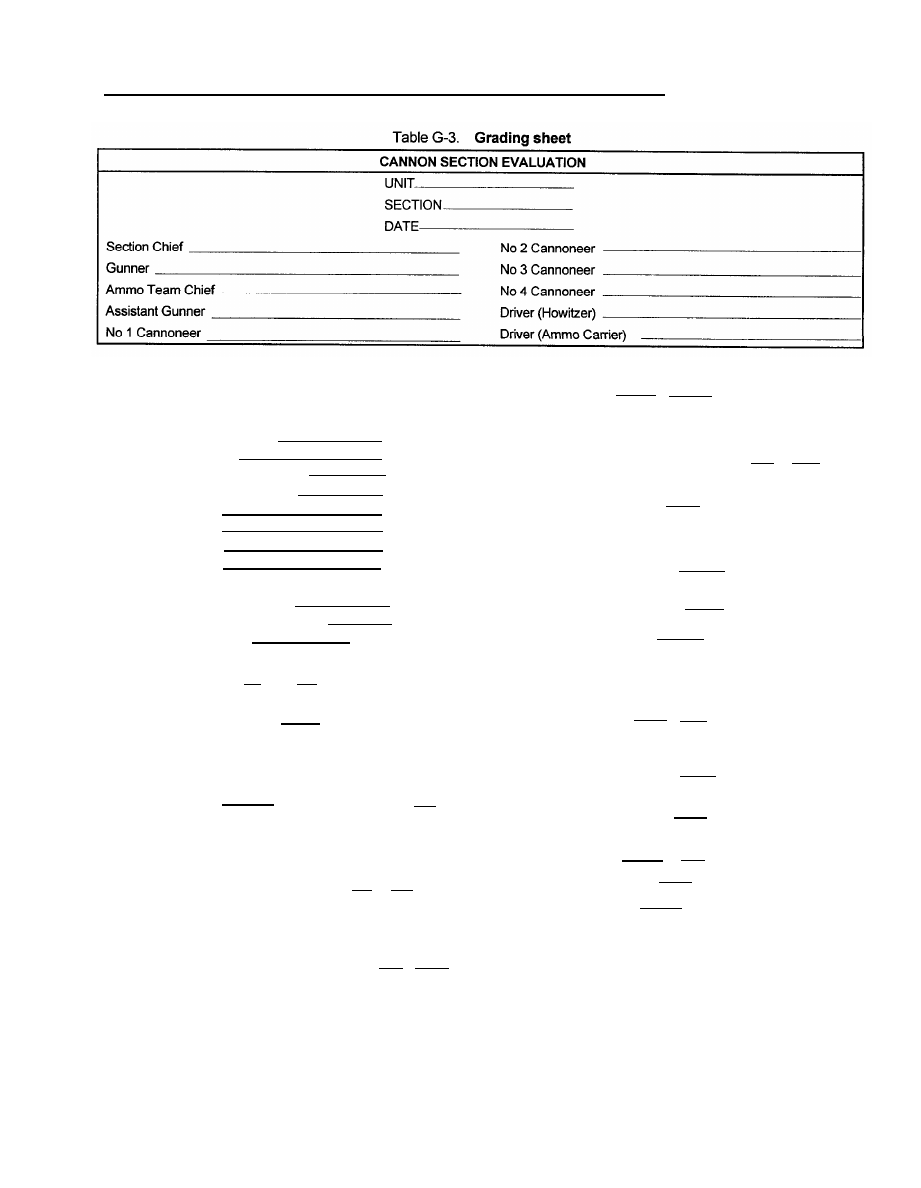
Section member scores:

Section Chief

/25 correct

Gunner

/25 correct

Ammo Team Chief

/25 correct

Assistant Gunner

/25

No 1

/25

No 2

/25

No 3

/25

No 4

/25

(Add other personnel as required)

correct

correct

correct

correct

correct

Driver (Howitzer)

/25 correct

Driver (Ammo Carrier)

/25 correct

Section =

points/25 correct

Section

average     x 2 =     points (maximum

50)

TASK 2:

TASK 3:

TASK 4:

TASK 5:

Total Phase I

points (maximum 50)

Phase II Preparation for Firing Operations

Preparation for deliberate occupation of a

prepared position
9 minus

NO-GOs x 8 points +

points (maximum 72)

TASK 6:

Task 7:

Task 8:

Task 9:

Task 10:

Disassembly of breech mechanism

1. NO-GO awarded? Yes = 0 points

2. If all GOs awarded: Time =

=        points

(maximum 49)

Assembly of breech mechanism

1. NO-GO awarded? Yes = 0 points

2. If all GOs awarded: Time =      =

points (maximum 49)

Performance of micrometer test on the

gunner’s quadrant

1. NO-GO awarded? Yes = 0 points

Task 11:

Task 12:

2. If all GOs awarded:
Time =                        =                     points (maximum 40)

Performance of the end-for-end test

1. NO-GOs awarded? Yes = 0 points

2. If all GOs awarded: Time =

=             points

(maximum 40)

Total Phase II

points (maximum 250)

Phase III - Deliberate Occupation

Preparation of position by gun guide

GO ratings x 10 =

points (maximum 80)

Emplacing the cannon

GO ratings x 27  =                    points (maximum 270)

Total Phase III

points (maximum 350)

Phase IV - Fire Missions

Conduct of an indirect-fire mission using

the GDU

120 minus                =              points (maximum 120)

Preparation of conventional ammunition for

firing

GO ratings x 10 =

 points (maximum 100)

Planned priority targets

GO ratings x 6 =

points (maximum 42)

Conduct of direct fire

88 minus

=          points (maximum 88)

Total Phase IV

points (maximum 350)

Overall total

points (maximum 1000)

Phase V - Critique

During this phase, each problem evaluation area will be

critiqued in detail. It is strongly suggested that the section

chief for each howitzer take notes on each individual in his

section so he will know the strong and weak areas in each

task.

G-3

-------------------------------------------------------------------------------------------------------------------------------------------------------------

FM 6-50, MCWP 3-1 .6.23

G-9.

During

administration of the remaining phases, the following are

done.

PHASE I, ORIENTATION

AND ORGANIZATION

this phase, preferably conducted on a day before

All personnel will be briefed as to the conduct and

purpose of the training.
The scoring system will be explained.
The organization of the training area and general

administrative and safety procedures will be explained.

All questions will be answered.
The written test will be administered to all section

personnel.
The examiner will be provided a copy to the unit SOP

to use during evaluation.

TASK 1:  

Written test.

Conditions
All section members except the section chief will take the

written test. Thirty minutes will be allocated for the test.

Scoring
There is only one correct answer to each question unless

otherwise stated. The score of the section members are

averaged to determine the section score. Each of the 25

questions is worth 2 points.

General Questions

1. 

If any member of the battery observes a dangerous

situation, he can stop a fire mission already in progress by

giving the command--

a. STOP FIRING.
b. CANCEL FIRING.
c. CEASE FIRE.
d. CHECK FIRING.

2. 

For best results, the collimator should be emplaced

how many meters from the howitzer?

a. 

0 to 15

b. 

3 to 10

c. 

3 to 13

d. 

5 to 12

3. 

In a fire command, the number 3167 is pronounced--

a.
b.
c.
d.

thir-tee wun six-tee seven.

thuh-ree thouzand wun six seven.

thuh-ree wun six seven.

three thousand wun hundred six-tee seven.

4. 

Number 2 wants the FDC to repeat the deflection.

Number 2 should say--

a. REPEAT DEFLECTION, NUMBER 2.
b. NUMBER 2, DEFLECTION?.
c. DEFLECTION, NUMBER 2.
d. SAY AGAIN DEFLECTION, NUMBER 2.

5. 

When separate-loading ammunition is being fired, the

fire command for lot includes two letters, XY. The ammunition

component(s) represented by the letter X in lot XY is(are)--

a. 

propellant.

b. 

projectile.

c. 

propellant and projectile.

d. 

propellant, projectile, and fuze.

6. 

When storing ammunition, what is the minimum

number of inches of dunnage that should be under the

ammunition?

a. 

5

b. 

6

c. 

12

7. 

How should a WP projetille be stored?

a. 

On its side and rotated every few hours.

b. 

On its base.

c. 

The same as an HC projectile.

8. 

How should you segregate the ammunition in the firing

battery area?

a. 

by size, color, and weight

b. 

by type, lot, and weight zone

c. 

by fuze type, lot, and zone

9. 

Field artillery cannon ammunition is classified

according to type as--

a. 

fixed and separate.

b. 

separate and separate loading.

c. 

semifixed and separate loading.

d. 

separate loading and fixed.

10. 

To set an M557 PD fuze for delay action, the correct

tool is the--

a.  

M63 fuze setter.

b. 

P-38.

c.   

M 16 fuze wrench.

d.  

M 18 fuze wrench.

11. 

To prepare an M557 PD fuze for delay action, you

must first--

a. rotate the selector setting screw to the horizontal

position.
b.
c.
d.

rotate the fuze body to the proper setting.

put a supplementary charge in the proper setting.

move the interrupter out of the flash channel.

G-4

-------------------------------------------------------------------------------------------------------------------------------------------------------------

FM 6-50, MCWP 3-1.6.23

12. 

A misfire occurs. You have waited 2 minutes before

removing and inspecting the primer. The primer is dented

and has fired. How long must you wait before you open

the breech?

a. 

2 minutes.

b. 

5 minutes.

c. 

8 minutes.

d. 

10 minutes.

13. 

The type of fuze that can detonate the projectile in

the air at a predetermined height above the ground is the--

a. 

superquick fuze.

b. 

concrete-piercing fuze.

c.  

proximity fuze (VT).

14. 

If the MTSQ fuze M564 (dated 1970) is to be used

for superquick impact action, the fuze may be set at--

a. 

90.0.

b. 

95.5.

c. 

98.0.

d. 

S.

15. 

A misfire occurs. You find that the primer is not

dented. You know that the cause of the malfunction is a

defective--

a. 

powder charge.

b. 

firing mechanism.

c. 

primer.

d. 

igniting charge.

16. 

The fuze wrench used to seat and tighten a fuze

into a standard HE projectile is the--

a. 

M18.

b. 

M27.

c. 

M34.

d. 

M63.

17. 

The only primer authorized to be used with the M185

cannon tube is the--

a. 

M82.

b. 

MK2A4.

c. 

M2.

d. 

M18A1.

18. 

The threaded steel plug that facilitates the handling

of separate-loading projectiles is called the--

a. 

closing plug.

b. 

nose plug.

c. 

eyebolt lifting plug.

d. 

fuze plug.

19. 

When the distant aiming point method of boresighting

is used, the minimum distance between the aiming point

and the weapon should be--

a. 

1,300 meters.

b. 

1,400 meters.

c. 

1,500 meters.

d. 

7,200 meters.

20. 

In boresighting by the testing target method, the

testing target must be located at least how many meters in

front of the howitzer?

a. 

4-15

b. 

50

c. 

60

d. 

100

21. 

On a weapon that fires separate-loading ammunition,

excessive blowback around the breechblock may mean the

split rings are less than 180° apart.

a. 

True

b. 

False

22. 

Fire control alignment tests should be performed--

a. 

at the discretion of the battery commander.

b.  every 3 months when firing or once each year if

no firing takes place.
c. 

when fires are inaccurate for no apparent reason.

d.  

at all of the above times.

23. 

When should you record information on the DA Form

4513?

a. 

after each mission

b. 

after the day’s firing is done

c. 

when you get back to the motorpool

d. 

after any fire mission data are received

24. 

Boresight should be verified every-

a. 

mission.

b. 

occupation.

c. 

year.

d. 

week.

25. 

If you can’t emplace aiming posts at 50 and 100

meters, what should you do?

a. 

don’t emplace aiming posts.

b. 

put both out as far as you can.

c. 

emplace the far aiming post as far as you can,

and the near aiming post half that distance.
d. 

use a tree and the near aiming post.

G-5

-------------------------------------------------------------------------------------------------------------------------------------------------------------

FM 6-50, MCWP 3-1.6.23

G-10. PHASE II, PREPARATION

FOR FIRING OPERATIONS

TASK 2: 

Preparation for deliberate occupation of a prepared

position.
Conditions

The chief of section is in the unit motor pool with his crew.

The evaluator reads him the following situation.

YOUR SECTION IS PREPARING TO DEPART THE UNIT

MOTOR POOL FOR A DELlBERATE OCCUPATION OF

A FIRING POSITION. THE GUNNERY SERGEANT HAS

JUST INFORMED YOU THAT THE ADVANCE PARTY

WILL LEAVE IN 15 MINUTES AND THAT HE WANTS

A GUN GUIDE FROM YOUR SECTION READY TO

LEAVE AT THAT TIME. THE PLATOON SERGEANT

HAS ALSO TOLD YOU THAT THE MAIN BODY WILL

DEPART IN 30 MINUTES AND THAT YOUR SECTION

SHOULD MAKE ALL NECESSARY PREPARATIONS

FOR THE MOVEMENT.

TO INCLUDE THE

BEFORE-OPERATION CHECKS AND SERVICES ON

THE CANNON AND PRIME MOVER/CARGO CARRIER.

Evaluation Checklist
Did the section have all section

equipment installed or stowed in

accordance with all applicable manuals

and unit loading plans?

Were all necessary items on hand for

performing the before-operation checks

and services on the cannon and prime

mover or cargo carrier (for example,

basic issue items, operator’s manuals

with changes, lubrication orders with

changes, DA Forms 2404 or DA 5988E,

cleaning materials, and logbooks)?
Were the headings of two DA Forms

2404 or DA 5988E completed properly

for the conduct of a daily inspection on

the cannon and primer mover or cargo

carrier?
Did the chief of section use all crew

members present to inspect both the

cannon and the prime mover or cargo

carrier in accordance with the TM?

Did the section inspect each item listed

in the Before column of the preventive

maintenance checks and services

(PMCS) tables of the operator’s

manuals for the cannon and primer

mover or cargo carrier?
Did the section correct all faults

discovered that they were authorized

to correct in accordance with the PMCS

tables and troubleshooting tables of the

operator’s manuals for the cannon and

primer mover or cargo carrier?

G-6

Did the section use DA Forms 2404

or DA 5988E to list all faults that they

were not able to correct and that were

not already listed on the DA Forms

2408-14 or DA 5988E (Uncorrected

Faults Record) for the cannon and

prime mover or cargo carrier?

Was the gun guide ready to depart with

all necessary equipment according to

SOP at the time prescribed?
Scoring:
For each GO rating, 9 points will be awarded, for a maximum

of 72 points.

For each NO-GO rating, 0 points will be awarded.

TASK 3: 

Disassembly of breech mechanism.

(See

appropriate Tracked Tasks.)
Conditions:

After giving the howitzer section approximately 30 minutes

to complete task 2 above, the evaluator reads the following

situation to the chief of section.

DURING

THE

CONDUCT OF

THE

BEFORE-OPERATION CHECKS AND SERVICES ON

YOUR CANNON, YOU NOTED A MALFUNCTION IN

THE BREECH MECHANISM. TO TROUBLESHOOT

THE EXACT CAUSE, YOU DECIDE THAT YOU MUST

DISASSEMBLE THE BREECH MECHANISM. YOU MAY

SELECT ANY MEMBER(S) OF YOUR SECTION TO

PERFORM THIS TASK. HOWEVER, YOU MAY NOT

PHYSICALLY PERFORM ANY ACTION. YOU HAVE 1

MINUTE TO SELECT THE SECTION MEMBER(S) TO

PERFORM THIS TASK AND ASSEMBLE ALL

REQUIRED TOOLS AND MANUALS.

At the end of 1 minute, the evaluator gives the following

instructions to the section member(s) performing the task:

YOU ARE TO DISASSEMBLE THE BREECH MECHA-

NISM, TO INCLUDE REMOVAL OF BREECHBLOCK, DIS-

ASSEMBLY OF

FIRING

MECHANISM,

AND

DISASSEMBLY OF OBTURATOR GROUP (AS APPLICA-

BLE), EVEN THOUGH THIS IS A TIMED EXERCISE,

PERFORM ALL ACTIONS IN THE PRESCRIBED SAFE

MANNER. ARE YOU READY? . . .. GO!

Evaluation Checklist

Were the breechblock obturator group,

and firing mechanism (as applicable)

disassembled in accordance with the

appropriate operator’s manual?
Scoring
If a GO rating is awarded, the disassembly will be graded

according to speed of execution (Table G-4).
If a NO-GO rating is awarded, 0 points will be awarded for

this task.

.

-------------------------------------------------------------------------------------------------------------------------------------------------------------

FM 6-50, MCWP 3-1.6.23

TASK 4: 

Assembly of breech mechanism, (See appropriate

tracked tasks.)
Conditions
After evaluating task 3, the evaluator should read the following

to the chief of section and the section member(s) previously

selected for disassembly of the breech:

ASSUME THAT YOU HAVE REPAIRED THE

MALFUNCTION IN THE BREECH MECHANISM. AT

THIS TIME, YOU WILL BE EVALUATED ON YOU

ABILITY TO REASSEMBLE THE BREECH MECHANISM

TO ITS ORIGINAL CONFIGURATION.

ARE YOU

READY?... GO!

Evaluation Checklist

Was the breech mechanism properly

assembled in accordance with the

appropriate operator’s manual?
Scoring
If a GO rating is awarded, the assembly will be graded

according to speed of execution (Table G-5 below).

If a NO-GO rating is awarded, 0 points will be awarded for

this task.

G-7

-------------------------------------------------------------------------------------------------------------------------------------------------------------

FM 6-50, MCWP 3-1.6.23

TASK 5: 

Performance of the micrometer test on the gunner’s

quadrant. (061-266-3310).
Conditions
After evaluating task 4, the evaluator reads the following to

the howitzer chief of section:

BECAUSE OF RECENT FIRING INACCURACIES, THE

PLATOON LEADER HAS TOLD EACH HOWITZER

SECTION TO PERFORM THE MICROMETER AND

END-FOR-END TESTS ON THEIR GUNNER’S

QUADRANTS. YOU (OR ANY OF YOUR SECTION

MEMBERS) ARE TO PERFORM THE MICROMETER

TEST AND ANNOUNCE ANY ERROR AND

CORRECTIVE ACTION. AFTER THE MICROMETER

TEST, DO NOT REMOVE THE GUNNER’S QUADRANT

FROM THE BREECH UNTIL TOLD TO DO SO BY THE

EVALUATOR. ARE YOU READY? . .. GO!

Evaluation Checklist
Did the soldiers follow the correct

procedures

in

performing

the

micrometer test?

Was the soldier able to determine if

the micrometer knob was or was not

in error and the action to be taken if

it was in error?
Scoring
If all GO ratings are awarded, the score will be determined

by the speed of execution (Table G-6).
If any NO-GO ratings are awarded, 0 points will be awarded.

TASK 6: 

Performance

of the end-for-end test.

(061-266-3311)
Conditions

After evaluating task 5, the evaluator reads the following to

the section chief

NOW THAT THE MICROMETER TEST HAS BEEN

DONE, YOU (OR ANY MEMBER OF YOUR SECTION)

ARE TO PERFORM THE END-FOR-END TEST ON

YOUR GUNNER’S QUADRANT. AT THE CONCLUSION 

OF THE TEST--

LEAVE THE GUNNER’S QUADRANT ON THE

BREECH.

ANNOUNCE THE ERROR To THE EVALUATOR,

AND
ANNOUNCE To THE EVALUATOR IF THE

QUADRANT IS

SERVICEABLE

OR

UNSERVICEABLE.

ARE YOU READY? . .. GO!

Evaluation Checklist
Did the soldier follow the correct

procedures

in

performing

the

end-for-end test?
Was the correct quadrant error

announced?
Was

the

quadrant

declared

unserviceable if the error exceeded 0.4

mil or declared serviceable if the error

was ±0.4 mil or less?
Scoring

If all GO ratings are awarded, the score for the task will be

determined by the speed of execution (Table G-7).

If any NO-GO ratings are awarded, 0 points will be awarded.

G-11. PHASE III, DELlBERATE

OCCUPATION

During this phase, the gun guide will prepare a designated

location for occupation by the section. The section will

move to this location, make a deliberate occupation, and

prepare for firing.
TASK 7: 

Preparation of position by the gun guide.

(061-266-1101).

G-8

-------------------------------------------------------------------------------------------------------------------------------------------------------------

FM 6-50, MCWP 3-1.6.23

Conditions

The gun guide will be required to prepare a position for a

deliberate occupation. Upon his arrival in position, the gun

guide will be given a detailed briefing to include the following:

The specific location for his howitzer.
The azimuth of fire.
The location of the wirehead.
The track plan.
The defense position.

Upon conclusion of his briefing, he will prepare the position.
Evaluation Checklist
Did the guide--

Perform a security sweep of the

area?
Have all the equipment required

according to Table 2-1 in Chapter

2?

Emplace the pantel marking stakes

in the location designated by the

GSG?
Emplace the guide stakes on the

azimuth of fire within 20 mils?

Establish wire communications with

the aiming circle?

Record the deflection to the pantel

marking stakes and measure and

record the distance from the aiming

circle to his gun position?

Determine site to crest using the M2

compass and piece-to-crest range?
Record and report site to crest to

the GSG?
Establish the track plan as directed

by the GSG?
Take up defensive position as

directed by the GSG?

Scoring
For each GO rating, 8 points will be awarded, for a maximum

of 80 points.
For each NO-GO rating, 0 points will be awarded.
TASK 8: 

Emplacing the cannon. (TLABSPAP)

Conditions

The section is occupying a new position prepared by your

advance party.

Evaluation Checklist
Did the driver follow the gun guide at

a safe speed and distance?

After stopping in position, did the gun

guide report the azimuth of fire and the

initial deflection to the chief of section?

Was the weapon emplaced by following

the standards in the appropriate

technical manual?

Did the gunner use the initial deflection

reported by the gun guide?

Were proper commands used during

laying, according to Chapter 4?

Were the bubbles centered and correct

settings made during laying?
Did the section chief verify the sight

picture, laid deflection, and bubbles

when the howitzer was laid?
Was the howitzer laid to an accuracy

of 0 mils within the time prescribed by

the appropriate evaluation standards?
Were the collimator and aiming posts

prepared for use while the howitzer was

being laid?

Was the collimator emplaced and ready

for use as the primary aiming point

within 2 minutes after the howitzer was

laid for deflection?

Were the aiming posts properly

emplaced within 2 minutes?
Was a DAP selected if applicable?
Was the howitzer boresighted by DAP

or test target according to the TM (or

verified by the use of the appropriate

alignment device)?
Was the lay of the howitzer verified by

a second aiming circle?
Were prefire checks properly performed

in accordance with the appropriate TM?

Was ammunition handled and prepared

according to the TM?

Were angle of site and piece-to-crest

range verified by the section chief?
Did the section chief report when his

section was in order?
Were natural materials, when available,

used to help camouflage the section

position?

G-9

-------------------------------------------------------------------------------------------------------------------------------------------------------------

FM 6-50, MCWP 3-1.6.23

Were the range cards prepared for both

the howitzer and the secondary

armament

for

primay

and

supplementary positions?
Was the section gear arranged

according to the unit SOP?
Did conditions exist which would make

the howitzer unsafe during firing?

Did the howitzer or prime mover driver

follow the proper shutdown procedures

according to the appropriate TM?

Did the section maintain track discipline

and camouflage vehicles, to include all

reflective surfaces?

Was the section in the proper uniform

throughout the occupation?

Did each section member perform his

duty with minimum orders?
Scoring
For each GO rating, 10 points will be awarded, for a maximum

of 270 points.
For each NO-GO rating, 0 points will be awarded.

G-12. PHASE IV, FIRE MISSIONS

TASK 9: 

Conduct of an indirect-fire mission using the GDU

(first fire mission).
Conditions
(See applicable track tasks)

Note: 

Time standards for fire missions are those

listed in the unit MTP, Appendix A.

FDC send data over the GDU.

EXAMPLE

DNL/AMC/FIRE/TEST

GUN 01 Ml

01RDADJ

SH HE

LOT X/Y

CHG 3

FZ QUICK

T1-0

DF 2938

QE 348

SUBSEQUENT COMMANDS

DF (so much)
QE (so much)
For rounds 2 and 3, the size of the deflection and quadrant

shifts from the last round fired are as follows:

G-10

Deflection: 20 to 40 mils.
Quadrant: 20 to 30 mils.

For rounds 4 and 5, high-angle fire is required. The size

of the deflection and quadrant shifts are as follows:

Deflection: 50 to 80 mils.
Quadrant 600 to 800 mils.

Note: 

The tube will be returned to loading elevation

after each round is fired (if applicable).

The time for each test begins when the section chief

states the first word of the command and ends when

the appropriate cannoneer has fired the weapon.

The cannoneers will perform all of the actions

required to fire the weapon, to include using dummy

ammunition, if available. Firing is on the command of

the section chief.

Evaluation Checklist

Were all bubbles exactly centered when

round was fired? (-5 for any unentered

bubble)
Was the pantel correctly aligned on

aiming point when round was fired? (-5

if not aligned) Did the section chief

verify the sight picture before firing?
Were the correct data fired? (-5 for any

incorrect data)

Were correct and complete commands

issued by all sections members (SET,

READY, CLOSE, and so forth)? (-1 for

each incorrect or omitted command)
Scoring
4 missions x 30 points per mission = 120 points possible.
TASK 10: 

Preparation of conventional ammunition for firing.

(061-266-1505/061-266-1506) (second fire mission)
Conditions
Dummy ammunition is available. The section chief is given

four 3- by 5-inch cards that require the section to prepare

selected nonnuclear ammunition for firing.

Standard data: 

Tested section is adjusting piece, shell HE,

lot XY, fz Q.

EXAMPLE

DNL/AMC/FIRE/EST
GUN

01RDADJ

SH HE

LOT XY

01M2

CH 3

FZ QUICK

T1 -O

DF3211

QE 531

-------------------------------------------------------------------------------------------------------------------------------------------------------------

FM 6-50, MCWP 3-1.6.23

SUBSEQUENT COMMANDS
Use a different charge and fuze delay.
Evaluation Checklist,

Cards 1 and 2

Was ammunition sufficiently protected

as dictated by the tactical situation?
Was

ammunition

prepared

in

accordance with fire commands?

Were

PD-fuzed

projectile

and

propellant prepared as announced?

Were delay-fuzed projectile and

propellant prepared as announced?

Was propellant cut to announced

charge?
SUBSEQUENT COMMANDS
Use different charge, fuze VT, and fuze time with appropriate

settings.
Evaluation Checklist,

Cards 3 and 4
Was ammunition sufficiently protected

as dictated by the tactical situation?

Was

ammunition

prepared

in

accordance with fire commands?
Were VT-fuzed projectile and propellant

prepared, and was time set to an

accuracy of 0 seconds?

Were MTSQ-fuzed projectile and

propellant prepared, and was time set

to an accuracy of 0.1?

CARD 1

Was propellant cut to announced

charge?
Scoring

CARD 2

For each GO rating, 10 points will be awarded, for a maximum

of 100 points.
For each NO-GO rating, 0 points will awarded.
TASK 11: 

Planned priority targets (third fire mission).

Conditions

CARD 3

FDC has announced the firing data for planned targets. FDC

has designated a priority target from the planned target list.

FDC announces the section and target number to be fired.
Evaluation Checklist
Has the section prepared a section

data card for planned targets, to include

CARD 4

target numbers, shell, lot,

deflection, and quadrant?

fuze time,

Was the howitzer laid on the priority

target within 30 seconds of the

command from FDC?

Was the charge cut?
Was a fuze with appropriate setting

mated to the announced projectile?

Was the projectile in the loading tray

(if applicable)?

Was the weapon laid for deflection and

elevation (loading elevation, if

necessary)?

Was the weapon fired within 20 seconds

of the command from FDC?

Scoring

For each GO rating, 6 points will be awarded, for a maximum

of 42 points.
For each NO-GO rating, O points will be awarded.
TASK 12: 

Conduct of direct fire. (fourth fire mission)

(see appropriate track tasks).
Conditions

A stationary target will be emplaced 400 to 800 meters from

the howitzer to simulate a moving target. The section chief

will be given a series of 3- by 5-inch cards that will require

the section to use direct laying procedures. The following

sample situation cards may be used for all weapons. The

examiner should prepare situation cards that are varied and

that avoid routine or similar ranges.

A T62 tank is approaching your battery position and

is moving straight toward your howitzer at an estimated

range of 600 meters.

The first round fired by your section went over the tank.

The tank has now turned and is moving from left to

right in front of your position at a speed of 25 mph

and at the initial range of 600 meters.

The second round fired by your section was short of

the tank and on line. The tank has turned again and

is now moving from right to left at a 45° angle going

away from your position at a speed of 20 mph.

The tank was hit by your third round but was only

partially disabled (however, it is still capable of firing).

The gunner and assistant gunner continue to lay and

fire on the target until it is destroyed or a subsequent

fire command is given by the chief of section.

G-11

-------------------------------------------------------------------------------------------------------------------------------------------------------------

FM 6-50, MCWP 3-1.6.23

Evaluation Checklist, Standards, and Scoring
Each situation card is worth a total of 22 points.
Each section should be evaluated on four separate situation

cards, for a total of 88 possible points.
Each situation will be evaluated and penalties assessed as

shown in Table G-8.

G-13. PHASE V, CRITIQUE

During this phase, conducted as soon after phases II through

IV as possible, the following actions are taken:

All section personnel are thoroughly briefed on the

detailed results of the evaluation.
Outstanding performances are recognized

and

highlighted.

Weak areas are critiqued in a constructive manner aimed

at establishing specific tasks requiring further training

emphasis.
All questions are answered.

Section feedback should be encouraged in an effort to

improve the content, organization, or administration of the

evaluation.

G-12

-------------------------------------------------------------------------------------------------------------------------------------------------------------

FM 6-50, MCWP 3-1.6.23

APPENDIX H

UNIT DEFENSE CHECKLIST

Note: 

This sample checklist will help the leaders go

through a mental review of existing battery or platoon

defensive preparations.

H-1. ENTRANCE POINT

The entrance point serves as a means to control traffic flow

into and out of the firing position. It does not necessarily

serve the same fiction as an LP and/or OP.
a. 

Is the sentry properly posted and given guard orders

and special instructions?
b. 

Does the sentry know the current challenge and

password?

c. 

Does the entrance point have communications with the

BOC or POC?
d. 

Does the entrance point restrict movement into and out

of the battery area?
e. 

Who will pick up the sentry in an emergency

displacement?

H-2. PASSIVE DEFENSIVE

TECHNIQUES

Are passive measures being employed by the battery or

platoon?
a. 

After considering factors of METT-T:

(1) What type of THREAT target acquisition assets can

be identified across the FLOT (for example, radar, sound,

and/or flash)? This may influence the selection of charge(s)

to fire.

(2) Is battery or platoon equipment that could be located

by radio direction finding dispersed from those susceptible

to detection by sound and flash or weapons-locating radars?

(3)

used?

(4)
(5)
(6)

Are antennas remoted? Are directional antennas

What is the expected air threat?
What is the expected counterfire threat?
What is the expected ground threat?

b. 

Does the unit display good camouflage discipline?

c. 

Is battery or platoon equipment sited properly?

d. 

Has natural camouflage been enhanced and man-made

camouflage been constructed?
e. 

Is the unit using all available cover and concealment?

f. 

Are the techniques of disguising, hiding, and blending

of equipment within the position being applied?
g. 

Is light and noise discipline being enforced during periods

of limited visibility?
h. 

Is track plan discipline being enforced to limit identifiable

vehicle tracks into the position?
i. 

Are M-8 alarms positioned correctly?

H-3. ACTIVE DEFENSIVE

TECHNIQUES

a. Listening and/or Observation Posts.

(1) Are OPs and/or LPs positioned to afford early

warning?

(2) Are OP and/or LP locations prepared?
(3) Do OPs and/or LPs have binoculars?
(4) Have OPs been briefed on enemy situation and their

responsibilities?

(a) Have range cards been constructed for crew-served

weapons and checked by a unit leader to ensure integrated fields

of fire?

(b) Have two means of communications been

established with the LPs and/or OPs?

(3) Has a system been established to man the OPs and/or

LPs on a 24-hour basis?

(4) Has a prearranged signal been established to recall

the OP and/or LP?
b. Hardening.

(1) Is key battery equipment (such as ammunition and

generators) hardened?

(2) Are available urban terrain, man-made structures,

and/or natural terrain features being used to the maximum

extent possible?

(3) Are available cover and concealment being used?

H-1

-------------------------------------------------------------------------------------------------------------------------------------------------------------

FM 6-50, MCWP 3-1.6.23

c. Fighting Positions.

(1) Have individual fighting positions (IFPs) been

established (if required) for every section?

(2) Are IFPs prepared?

(a) Have range cads been constructed for crew-served

weapons and checked by a unit leader to ensure integration of

frees?

(b) Are individual and section fighting positions dug

in?

(c) Has battle site zero been set on all M16 weapons?

(3) Are the IFPs integrated into the overall defensive

plan?

(4) Are sufficient crew-served weapons (M60, M2)

positioned to provide security for key battery elements?

(a) Are range cards prepared?
(b) Are visibility diagrams prepared?
(c) Have firing stakes been emplaced to identify the

primary and alternate sectors of fire? Are they marked for day

and night and if so, how?

(d) Have traverse and elevation (T&E) mechanism

settings been recorded on range cards?

(e) Have M2 machine guns been headspaced and timed.
(f) Has a final protective line (FPL) been established?
(g) Has a signal been announced for firing the FPL?
(h) Do fields of fire interlock?
(i) Have fields of fire been cleared?

(5) Is the IFP properly camouflaged?

d. Reaction Force.

(1) Has a reaction force been established?

(2) Has a primary and alternate signal and rally point

been disseminated?

(3) Have alternates been identified for members of the

reaction force?

(4) Has the RF been rehearsed?

(5) Does the reaction force have a means of

communication?

(6) Has the reaction force been briefed for the tactical

situation?

H-2

H-4. PERIMETER COMMUNICATIONS

a. 

Have wire communications been established within the

battery perimeter?
b. 

Do key battery elements have wire communications?

c.  

Does the entrance point have communications?

d. 

Does the battery have alarm signals for the following

types of attack?

(1) NBC?
(2) Air?
(3) Counterfire?
(4) Ground?

e. 

Is the wire buried to withstand attack and friendly vehicle

movement?

H-5. ANTIARMOR ASSETS

a. 

Have tank-killer teams been designated?

b. 

Have likely engagement areas and hide positions been

selected?
c. 

Have supplementary positions been reconnoitered and

prepared?
d. 

Has the plan been rehearsed?

e. 

Have the tank-killer teams been briefed for the tactical

situation?

H-6. MOVEMENT

a. 

Has the battery commander or platoon leader planned

mutually supporting indirect frees in support of his movement

plan and provided this information to higher headquarters?

b. 

Has the battery commander or GSG selected and

reconnoitered an alternate position?
c. 

Have rally points been established?

d. 

Have the rally points location and route of egress been

disseminated?
e. 

Has the alternate position been prepared?

f. 

Have organic mine detectors been used during the route

reconnaissance?
g. 

Have convoy signals been established for the following:

(1) Blocked ambush?
(2) Unblocked ambush?
(3) Air attack?

-------------------------------------------------------------------------------------------------------------------------------------------------------------

FM 6-50, MCWP 3-1.6.23

(4) Artillery attack?

(5) Emergency occupation? (See STANAG 2047 on this

topic.)

(6) Are the vehicles prepared for the tactical situation

and is security available?

H-7. LOCAL SECURITY

a. 

Have local patrols been deployed, if necessary? (See

FM 7-8, Chapter 3, on this topic.)
b. 

Have obstacles been integrated into the defensive plan?

c. 

Has a defensive diagram been prepared?

(1) Has prominent terrain been indicated?

(2) Have mines and/or barriers been annotated?

(3) Are primary and supplementary positions marked?

(4) Are direct fire sectors marked? Day and night?

(5) Are interlocking fields of fire and the FPL marked?

(6) Are OPs and LPs with delay and withdrawal plans

included in the defensive diagram?

(7) Is dead space annotated and covered?

(8) Have target reference points (TRPs) been established

and marked? Day and night?

(9) Have avenues of approach been identified?

(10) Have Killer Junior targets been identified; data

computed and disseminated?
d. 

Has the battery commander or platoon leader planned

indirect fires in support of his defensive plan?
e. 

Has the challenge and password been issued to all

personnel?
f. 

Have friendly unit locations been identified and

disseminated to avoid fratricide?
g. 

Does everyone know the threat?

H-8. NUCLEAR, BIOLOGICAL

AND CHEMICAL

a. 

Are chemical agent detectors situated upwind of the

battery position?

b. 

Are detectors placed far enough from the unit to provide

adequate warning?
c. 

Have detectors been relocated as wind direction changed?

d. 

Have detector alarms been tested?

e. 

Have detector alarms been located to afford security and

control?
f. 

Has a MOPP level been established?

g. 

Do sections have complete chemical protective

overgarments (CPOG) on hand? Filter replacements?

M258A1 kits? M256 kits? Chemical agent monitor (CAM)?

h. 

Does the battery have survey and monitoring teams?

Have the teams been rehearsed?
i. 

Are the M256 detection kits being used by trained teams?

Is M8 or M9 paper being used by individual soldiers?

j. 

Are the AN/PDR-27J, IM-174 and IM-93 radiac meters

on hand? Do they work?
k. 

Is the unit prepared to conduct personal decontamination?

Have personnel been designated and trained?
l. 

Is the unit prepared to conduct limited equipment

decontamination? Have personnel been designated and

trained? Does the unit have all authorized Ml3s?

m. 

Does the battery have alarm signals for the NBC attacks?

n. 

Does the unit have an EMP defense plan for electronic

equipment?
o. 

Is the unit maintaining an operational exposure guide

(OEG)?
p. 

Have unmasking procedures been rehearsed?

q. 

Has an alternate soldier been chosen for unmasking

procedures?

H-9. AIR DEFENSE COVERAGE

a. 

Has the S3 established priorities of air defense coverage

to the battalion? Has the air defense warning status/weapon

status been disseminated?
b. 

Has the battery or platoon been integrated into the air

defense coverage?
c. 

What percentage of available M2 machine guns are

deployed in a ground-mount vice ring-mount configuration?
d. 

How does the battery plan on providing air defense

coverage with organic assets while in position?

H-3

-------------------------------------------------------------------------------------------------------------------------------------------------------------

FM 6-50, MCWP 3-1.6.23

e.
f.

Has the battery/platoon plan been rehearsed?

c. 

Has a landing zone been identified for MEDIVAC

What are the primary and alternate signals?

aircraft?
d. 

Are combat service support (CSS) graphics on hand

H-10. MEDICAL

a. 

What is the plan for the evacuation of casualties to the

battalion aid station? Have litter teams and evacuation

vehicles been identified? Has the 1SG or alternate rehearsed

the route (day and night, MOPP IV)? Have maneuver aid

stations/ambulance exchange points been identified and

briefed?
b. 

What is the plan to provide organic first aid during

combat operations? Are combat lifesavers properly trained

and positioned throughout the unit? Has an alternate soldier

been chosen for unmasking procedures? Are litters properly

placed by SOP? Are triage and casualty collection points

established and briefed?

and posted in the BOC/POC? Are they current?
e. 

Where do corpsmen/medics go when the signal for the

reaction force, or any signal, is given?

H-11. ENEMY PRISONERS

OF WAR (EPWs)

a. 

Are EPW collection points established?

b. 

Is there a plan for evacuation/treatment of EPWs?

c. 

Has the plan been rehearsed?

d. 

Who has primary responsibility for the EPWs?

H-4

-------------------------------------------------------------------------------------------------------------------------------------------------------------

FM 6-50, MCWP 3-1.6.23

APPENDIX I

KILLER JUNIOR

I-1.

DESCRIPTION

The following description of killer junior is given by Major

General David Ewing Ott in Vietnam Studies, Field Artillery,

1954-1973 (Washington, D.C., US Government Printing

Office, 1975), page 61, paragraph 4:
“Another effective direct fire technique was Killer Junior.

The technique was designed to defend fire bases against

enemy ground attack and used mechanical time-fuzed

projectiles set to burst approximately 30 feet off the ground

at ranges of 200 to 1,000 meters.” “This technique proved

more effective in many instances than direct fire with Beehive

ammunition because the enemy could avoid Beehive by lying

prone or crawling. Another successful application of the

Killer technique was in clearing snipers from around base

areas. The name Killer came from the radio call sign of

the battalion that perfected the technique. To speed the

delivery of fire, the crew of each weapon used a firing table

containing the quadrant, fuze settings, and charge appropriate

for each range at which direct fire targets could be acquired.”

I-2. TYPES OF TARGETS

The most likely target for which Killer Junior would be

used is dismounted infantry. Careful consideration must be

given to weapon positioning to maximize fields of fire, and

to complement other organic or attached weapon systems.

I-3. AMMUNITION

a. Shell-Fuze Combination. 

Shell HE is fired with

mechanical time super quick fuze M564/M582.

Note: 

Minimum fuze setting authorized for these

fuzes is 2.0 (reference TM 43-0001-28).

b. Charges. 

Minimum authorized charge should be fired

to facilitate the engagement of targets at close range. If the

maximum charge is used, it will serve only to increase the

range-to-fuze function.

I-4. PROCEDURES

a. Sighting.

The three primary methods of sighting

outlined in Chapter 8 are used when firing Killer Junior.
b. Firing data.

(1) 105-mm. Pocket-size firing tables for charge 1, shell

HE, fuze MTSQ can be ordered through normal publication

channels.

Note: 

These tables are incorrect in that they do not

contain the warning shown below.

WARNING

Firing a fuze setting lessthan what corresponds

to a range of 650 meters is restricted to combat

emergency conditions only. Firing a fuze

setting less than this value results in a danger

close hazard to the crew. Also, the fuzes,

except for the M577 and the M582, require

about 400 meters to arm (2.0 seconds). The

M577 and M582 fuzes, when set for a time of

less than 4 seconds, will allow the fuze rotor

to release almost immediately. This fully arms

the fuze, which enables the fuze to explode at

the set time. Any time setting of less than 2

seconds is a danger to the crew and should

not be fired unless firing Killer Junior.

(2) 155-mm. Direct fire tables are not available in

current firing tables; therefore, battery personnel must

compute the data. The data are produced for quadrant

elevation, fuze setting, and 10/R factor (10 divided by range

in thousands) for the minimum authorized charges. The

quadrant elevation, when used with the listed fuze setting,

will produce an airburst of 10 meters above and before the

listed range. Compute data as discussed below.

WARNING

Firing a fuze setting less than what corresponds

to a range of 750 meters for 155-mm is restricted

to combat emergency conditions only. Firing a

fuze setting less than this value results in a danger

close hazard to the crew. (Refer to AR 385-63,

Chapter 11, Table 11-1.) Also, the fuzes require

about 400 meters to arm (2.0 seconds). The M577

and M582 fuzes, when set for a time of less than

4 seconds, will allow the fuze rotor to release

almost immediately. This fully arms the fuze,

which enables the fuze to explode at the set time.

Anytime setting of less than 2 seconds is a danger

to the crew and should not be fired unless firing

Killer Junior.

I-l

-------------------------------------------------------------------------------------------------------------------------------------------------------------

FM 6-60, MCWP 3-1.6.23

Note:

For howitzers firing separate-loading

ammunition, direct fire tables should be produced for

both green bag and white bag propellants.

(a) Format a Killer Junior table as shown in Figure I-1.

Label it with the charge to be fired. Column 1 is range in meters.

Column 2 is quadrant elevation in mils. Column 3 is fuze setting.

Column 4 is 10/R in mils.

(b) Using the appropriate firing table, enter the minimum

authorized charge, Table F.

(c) Enter ranges in column 1 in increments of l00 meters

from--

The minimum range corresponding to 2.0 fuze

setting for graze burst. (Example: 203mm, charge

1 green bag; minimum range used would be 500

meters).
Maximum range is 1,500 meters.

(d) Calculate 10/R factor for listed ranges, and enter it

in column 4.

Note: 

10/R factor should be listed to the nearest

whole mil to simplify uses for howitzer crew members.

(e) Add 10/R factor to the elevation listed in the firing

table, and enter the sum to the nearest whole mil in column 2.

Note: 

An additional value of 10/R should be applied

to compensate for each 10-meter difference in vertical

interval (VI) between the target and the howitzer.

(f) Subtract 0.1 fuze setting increments from the fuze

setting for graze burst. Enter that number in column 3.

EXAMPLE

You are in an M198 (155mm) howitzer firing battery.

Minimum authorized charges are charge 2 green bag

and charge 3 white bag. Authorized firing tables for your

unit are on hand.
Step 1. Format the Killer Junior direct fire table for

charge 2. (An M198 firing charge 2 may result in a round

lodged in the tube or early functioning if using fuze M564.)

Step 2. Compute 10/R factor for ranges 500 to 1,500

meters. Using artiiley expression, express to the nearest

whole mil. Range 500 (when data are input in column 4,

express to the nearest whole mil): 10/0.5=20 mils.

Range: 900 10/0.9 = 11.1 mils. Range 1300 10/1.3=

7.7 mils.
Step 3. Add 10/R factor to elevation corresponding to

listed range. Using artilley expression, express to the

nearest whole mil.
Range 500: 45.4 +20 = 65.4 or 65 mils
Range 900: 82.8 + 11.1 = 93.9 or 94 mils
Range 1300 121.6 + 7.7= 129.3 or 129 mils

Step 4. Subtract 0.1 fuze setting increments from the

listed fuze setting for a graze burst.
Range 500: 2.1 -0.1 = 2.0
Range 900: 3.8- 0.1 = 3.7
Range 1300: 5.6- 0.1 = 5.5

I-2

-------------------------------------------------------------------------------------------------------------------------------------------------------------


Content      ..     13      14      15      16     ..