MCWP 3-16.3 FM 6-50 TTP for the Field Artillery Cannon Gunnery - page 13
 

  Главная      Manuals     MCWP 3-16.3 FM 6-50 TTP for the Field Artillery Cannon Gunnery


Search            copyright infringement  


Content      ..     11      12      13      14     ..


MCWP 3-16.3 FM 6-50 TTP for the Field Artillery Cannon Gunnery - page 13


FM 6-50, MCWP 3-1.6.23

TASK 12

Scoring-

Lay a howitzer for quadrant with the range quadrant.

a. 

Standards of precision (B-2)

Conditions- 

The soldier is given a howitzer in the firing

were met. (If applicable.)

position with the cannon tube at 0 mils elevation. Bubbles

b. 

Correct steps were followed to

will be level and special corrections at 0 mils. The soldier

complete the task.

positions himself as assistant gunner/gunner and announces

when ready. The examiner commands  QUADRANT 215.

c. 

If steps a and b were not

followed, soldier recieves a NO-GO

Time- 

The time will start when the examiner states

and 0 points. If soldier received a

QUADRANT 215 

and will stop when the assistant

GO on steps a and b, use the chart

gunner/gunner states  SET.

below to determine score.

B-27

-------------------------------------------------------------------------------------------------------------------------------------------------------------

FM 6-50, MCWP 3-1.6.23

TASK 13
Measure the quadrant using the range quadrant.
Conditions- 

The soldier is given a howitzer in the firing

position, with the cannon tube at 245 mils. The range

quadrant is at 0 mils and the cross level bubble is centered.

The soldier positions himself as the assistant gunner/gunner

and announces when ready. The examiner states  BEGIN.
Time- 

The time will start when the examiner states BEGIN

and will stop when the assistant gunner/gunner states

QUADRANT 245.

Scoring-
a. 

Standards of precision (B-2)

were met. (If applicable.)
b. 

Correct steps were followed to

complete the task.
c. 

If steps a and b were not

followed, soldier recieves a NO-GO

and 0 points. If soldier received a

GO on steps a and b, use the chart

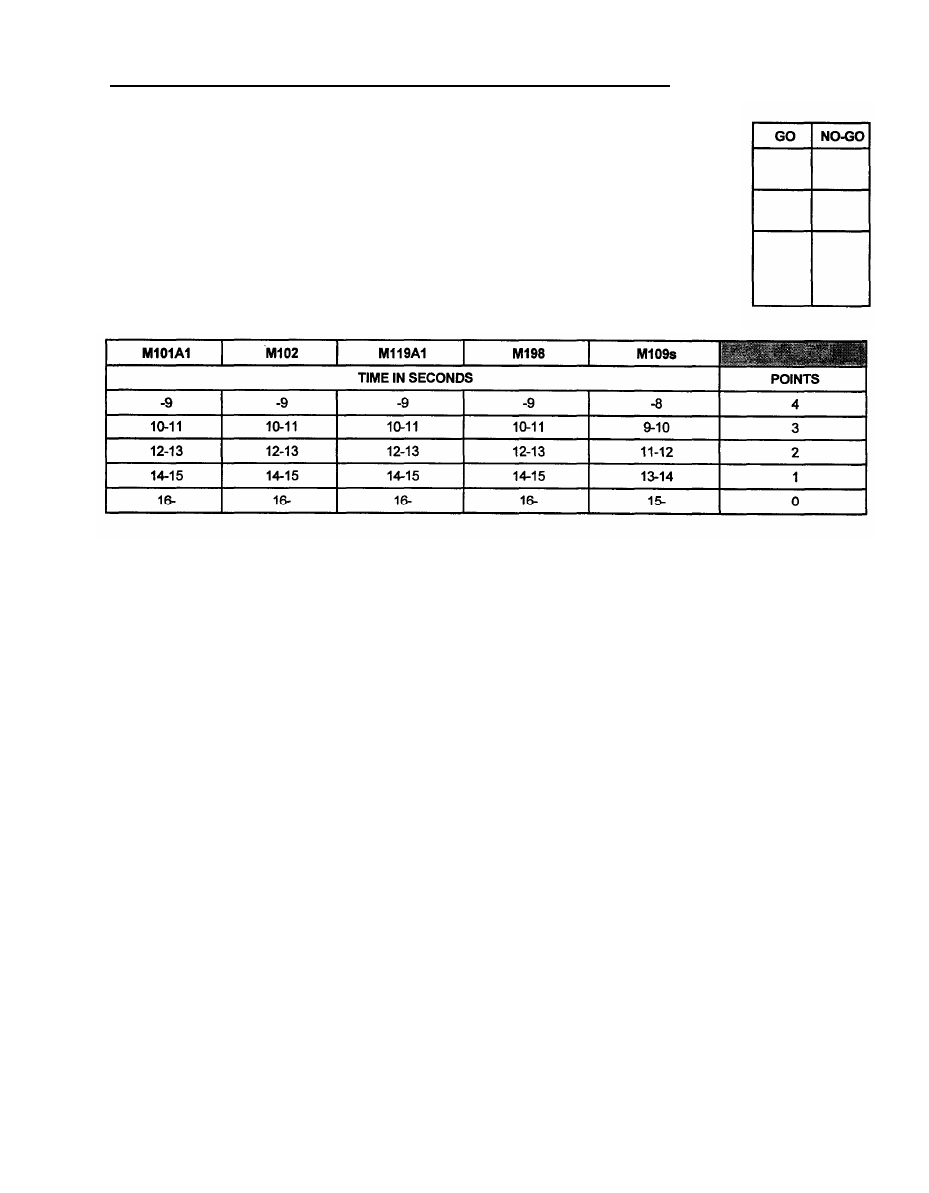
below to determine score.

B-28

-------------------------------------------------------------------------------------------------------------------------------------------------------------

FM 6-50, MCWP 3-1.6.23

TASK 14
Initialize the AFCS.
Conditions– 

The soldier is given a howitzer parked within

1 meter of a survey control point (SCP). The soldier will

receive data for the SCP and initialization data. The soldier

positions himself as chief of section and announce when

ready. The examiner will state BEGIN.

Time- 

The time starts when the examiner states BEGIN and

stops when the soldier announces INITIALIZED.

Scoring-
a. 

Standards of precision (B-2)

were met. (If applicable.)

b. 

Correct steps were followed to

complete the task.
c. 

If steps  a and b were not

followed, soldier recieves a NO-GO

and 0 points. If soldier received a

GO on steps a and b, use the chart

below to determine score.

B-29

-------------------------------------------------------------------------------------------------------------------------------------------------------------

FM 6-50, MCWP 3-1.6.23

TASK 15
Prepare for firing using the AFCS.
Conditions- 

The soldier is given a howitzer, aligned along

the azimuth of fire, and in travel lock. The “Emplace” screen

is displayed on the AFCS. The soldier positions himself

as the chief of section and announces when ready. The

examiner will state BEGIN.
Time- 

The time will start when the examiner states BEGIN

and will stop when the soldier sends the updated piece status.

Scoring-
a. 

Standards of precision (B-2)

were met. (If applicable.)

b. 

Correct steps were followed to

complete the task.
c. 

If steps a and b were not

followed, soldier recieves a NO-GO

and 0 points. If soldier received a

GO on steps a and b, use the chart

below to determine score.

B-30

-------------------------------------------------------------------------------------------------------------------------------------------------------------

FM 6-50, MCWP 3-1.6.23

TASK 16
Conduct a fire mission using the AFCS.
Conditions- 

The soldier is given a howitzer at loading

elevation. The soldier positions himself as the chief of section

and announces when ready. The examiner has a digital call

for fire transmitted to the AFCS.
Time- The 

time starts when the fire mission is received at

the AFCS and stops when the howitzer is laid on the target.

Scoring-
a. 

Standards of precision (B-2)

were met. (If applicable.)
b. 

Correct steps were followed to

complete the task.
c. 

If steps  a and b were not

followed, soldier recieves a NO-GO

and 0 points. If soldier received a

GO on steps a and b, use the chart

below to determine score.

B-31

-------------------------------------------------------------------------------------------------------------------------------------------------------------

FM 6-50, MCWP 3-1.6.23

TASK 17

Scoring-

Perform direct fire using the AFCS.

a. 

Standards of precision (B-2)

Conditions- The 

soldier is given a howitzer, aligned on the

were met. (If applicable.)

azimuth of fire, and out of travel lock. The soldier is shown

b. 

Correct steps were followed to

which target he is to engage and an assistant examiner will

complete the task.

be provided to lay for deflection. The soldier positions

himself as the chief of section and announces when ready.

c. 

If steps a and b were not

followed, soldier recieves a NO-GO

The examiner will state  BEGIN.
Time- 

The time will start when the examiner says

and will stop when the soldier states SET.

and 0 points. If soldier received a

BEGIN

GO on steps a and b, use the chart

below to determine score.

B-32

-------------------------------------------------------------------------------------------------------------------------------------------------------------

FM 6-50, MCWP 3-1.6.23

APPENDIX C

SAMPLE OPERATIONS CHECKLISTS

C-1. DESCRIPTION

To make a tentative plan, the commander must gather

information by focusing on the battery level METT-T. Table

C-1 will assist the commander in this effort.

C-2.  PRECOMBAT CHECKLISTS

Tables C-2 through C-11 provide sample precombat

checklists (PCC) for cannon mission and survivability

preparations a battery will execute. By incorporating some

version of these sample PCCs into a battery SOP, the

commander will have preparation steps to specify to

subordinates based on METT-T. With precombat checklists

in the hands of all battery leaders, the commander can more

efficiently communicate exactly what must be done. For

example, it is easier to direct the section to complete the

copperhead PCC than to individually specify all the subtasks

required.

C-1

-------------------------------------------------------------------------------------------------------------------------------------------------------------

FM 6-50, MCWP 3-1.6.23

C-7

-------------------------------------------------------------------------------------------------------------------------------------------------------------

FM 6-50, MCWP 3-1.6.23

C-6. BATTERY ORDER

Table C-15 is a sample battery order. Once the commander

has completed his plan, he must ensure the sections retain

the minimum essential information.

One successful

technique is the section fill-in-the-blank order. Section chiefs

and other key leaders can use a laminated format to fill in

during the commander’s orders brief. It also helps the section

chief brief his subordinates. More importantly, it forces the

commander to focus on battery level-information only.

C-8

-------------------------------------------------------------------------------------------------------------------------------------------------------------

FM 6-50, MCWP 3-1.6.23

C-9

-------------------------------------------------------------------------------------------------------------------------------------------------------------

FM 6-50, MCWP 3-1.6.23

APPENDIX D

COMMON MISTAKES AND MALPRACTICE

D-1. PROBLEM AREAS

Inaccuracies in cannon artillery fires cause wasted rounds

and a decrease in the effectiveness of fire support. Many

of these inaccuracies can be attributed to careless and/or

improper procedures at the howitzer or aiming circle. The

key to minimizing human error and careless gunnery

procedures is proper training. The problem areas discussed

below give the commander a starting point for evaluating

the training level of his unit.

D-2. PRECUTTING CHARGES

Charges will be cut only after the command CHARGE is

given or, if CHARGE is not announced, after a subsequent

element of the fire commands (fuze, deflection, and quadrant)

is announced. Often, when charges are precut, the increments

are placed in a powder pit. This causes two problems, as

follows:
a. 

The increments are exposed to moisture, direct sunlight,

and so forth. Thus, it is impractical and unsafe to use them

again.
b. 

If placed in a powder pit, the unused increments are

normally burned before the unit leaves the position. If the

fire missions involve the use of various numbered charge

increments, there is a good chance that a wrong charge could

be fired. If the propellent is not used and is missing one

or more increments, it cannot be returned to the ASP because

it is not a complete charge.

A report of survey for

accountability is required.

WARNING

Firing an incorrect charge is the single most

common reason that a unit fires out of safety

limits. This can result in fratricide. Do not place

remaining powder increments for precut charges

in the powder pit until the rounds for which the

charges were cut are fired. For separate-loading

ammunition, keep the remaining increments in

the powder canister with the respective charge.

For semifixed ammunition, dangle the remaining

increments over the lip of each cartridge case

and seat the projectile. However, do not break

the cord until the round is handed to the number

1 man and the chief of section has verified the

charge for each round.

D-3. LAYING ON THE WRONG

AIMING POSTS

This mistake is especially possible at night. Howitzer

sections can color-code their aiming posts to preclude this.

This is an extremely important consideration if the unit is

on a fire base.

D-4. IMPROPER EMPLACEMENT

OF AIMING POINTS

a. 

Aiming points are emplaced at certain distances from

the howitzer so that the proper sight picture may be

established. This is especially important when one considers

the matter of displacement. Displacement is the undesired

movement of the sight caused by traversing the tube or by

the shock of firing. That is to say, if the sight is not centered

over the pivot point of the weapon or if the weapon shifts

backward during firing, it will be oriented toward the aiming

point from a different angle. Corrections for displacement

must be made when using the two close-in aiming points

(collimator and aiming posts).

(1) The primary aiming point is the collimator, which

is normally emplaced 4 to 15 meters to the left or left front

of the weapon. Displacement is corrected by matching the

numbers in the pantel with the corresponding numbers in

the collimator. If the collimator is not emplaced within the

distance stated above, the three graduations visible in the

collimator will not align properly; the picture will be out

of focus. Therefore, it will be impossible to correct for

displacement. If displacement is not corrected, the weapon

will not be oriented in the direction of the target.

(2) The aiming posts are emplaced 100 meters (far post)

and 50 meters (near post) from the pantel. If the far aiming

post cannot be placed at 100 meters, the near aiming post

should be placed half the distance to the far post (for example,

far post, 90 meters; near post, 45 meters). This is very

important for the following reasons:

(a) The distance to the aiming post is in direct

relationship to the angular measurement taken when the

displacement occurs. The farther the aiming post is from the

sight, the smaller the angular measurement. The near post,

because it is closer to the pantel, has the greatest angular

measurement. This is the reason for the use of the near-far-line

rule when correcting for displacement to the aiming posts. To

correct for displacement to the aiming posts, the number of mils

between the near post and the far post must equal the number of

mils between the far post and the line (vertical line of the pantel).

D-1

-------------------------------------------------------------------------------------------------------------------------------------------------------------

FM 6-50, MCWP 3-1.6.23

(b) The rules of geometry and trigonometry tell us that

if two points are on a line and the near point is half the distance

of the far point from the origin, then the angle measured to the

far point from a point that is not on the line is half the angle

measured to the near point. That is to say, the angle measured to

the near post will be twice that of the far post only if the near post

is half the distance to the far post. Therefore, if the near post is

not properly emplaced, displacement will not be properly

accounted for, and the weapon will not be oriented correctly.

(3) To measure the distance from the piece to the aiming

posts, the stadia method may be used. The pantel and the

aiming posts are used as measuring devices.

(a) A cannoneer, in setting out the aiming posts, holds

the upper section of one of the aiming posts in a horizontal position,

perpendicular to the line of sighting. The gunner measures the

length of the section in mils by using the reticle of the pantel. For

example, the upper section of the aiming post is 4 ½ feet long

and measures 14 mils when it is 100 meters from the piece (Figure

D-l). The proper location of the near aiming post, in this case,

would beat the point at which the 4 ½-foot section measures 28

mils (Figure D-2).

-

(b) In many cases, the ideal spacing of 50 and 100

meters cannot be obtained. However, the aiming posts are proprly

separated when the near aiming post is set at a point where the 4

½-foot section measures twice the number of mils it measured

at the far aiming post location. This measurement maybe made

at night by attaching the night lighting device at the 4 ½-foot

marks on the aiming posts.

(4) Delay often occurs during emplacement of

aiming posts when cannoneers move both the near

and far aiming posts to achieve correct alignment.

The procedure discussed below allows accurate

placement of aiming posts in a minimum amount

of time. Use of this method consistently results

in posts requiring no more that 2 mils adjustment

(often 0 mils), even when emplaced by entry level

soldiers.

This method, when used with aiming

post lights, also greatly simplifies and speeds the

night emplacement of aiming posts.

(a) Visually pick a point about 100 meters from the

howitzer, and walk toward it in as straight a line as possible from

the pantel. Place the near post in the ground 50 meters from the

howitzer in as vertical a position as possible.

(b) Walk another 50 meters with the other post. Hold

this post vertically in front of you. Looking toward the pantel,

move the post left or right as directed by the gunner until the far 

post, near post, and the pantel of the howitzer are all on line.

(c) Ensuring the post is aligned with the gig line of your

uniform, grasp the aiming post, raise your hands above your heat

and stick the post vertically in the ground. The post should be

vertical; adjust if necessary. Move to the near post and, with your

right hand, adjust the post (if necessary) as indicated by the gunner.

(5) The DAP, though not emplaced, must be

properly selected. When a single aiming point

(other than the collimator) is used, it is not

possible to correct for displacement. Therefore,

the aiming point must be far enough from the

pantel to ensure that there is no need to correct

for displacement. The principle is very similar 

-

to that involving the aiming posts.

(a) The greater the distance between the sight and the

aiming point, the smaller the angular measurement will be when

displacement occurs. We do not normally fire deflections of less

than 1 mil. Therefore, we must ensure that the angular

measurement caused by displacement is less than 1 mil when

we are using a DAP.

(b) We know that the greatest amount of displacement

possible with any one weapon system is 1.5 meters. That being

the case, we can determine the minimum distance for a DAP by

using the mil relation formula.

.

D-2

-------------------------------------------------------------------------------------------------------------------------------------------------------------

FM 6-50, MCWP 3-1.6.23

b. 

It is important that aiming points are positioned and/or

selected to ensure that the howitzer can be oriented for

direction throughout the various transfer limits. As a

minimum, the aiming point should allow the section to cover

the primary, left, and right sectors.

Note: 

There are eight sectors of fire in a 6,400-mil

circle. These sectors are derived from the theory of

transfer limits (see paragraph D-5c below).

D-5. FAILURE TO COMPUTE

TERRAIN 

GUN 

POSITION

CORRECTIONS

a. 

The digital link between the BCS and the GDUs will

at some point fail to function. The problem may be in the

BCS, one or more of the GDUs, or the wire line. When

the failure occurs, voice fire commands must be transmitted

to one or more of the howitzers. If the failure is at the

BCS, voice commands must be transmitted to each of the

howitzers.

Therefore, it is important that TGPCs be

computed. These corrections, as a minimum, should be

computed for the primary, left, and right sectors.
b. 

TGPCs provide acceptable effects within the transfer

limits for which they are produced. TGPCs can be produced

either manually or with the BCS or LCU. Presently there

are two methods of producing TGPCs with BCS or LCU

(see the applicable job aids for step-by-step procedures).

(1) Calculate data for the center of the transfer limit

for all howitzers in the firing element (during peacetime,

range to center of impact area; in wartime, center range for

the particular charge). From the data derived, calculate the

difference in time, deflection, and quadrant of one of the

howitzers and the rest of the firing element.

(2) Using a converged sheaf, calculate data to the center

of transfer limit for all howitzers and for a ghost gun, whose

location is center of battery. Calculate the difference between

the ghost gun data and those of the firing element. The

ghost gun at battery center uses the average platoon or battery

muzzle velocity. This method is not as desirable as that in

(1) above because all howitzers must carry a TGPC.
c. 

Transfer limits are defined as an area 400 mils left and

right of center and 2,000 meters over and short of the center

range. TGPCs derived for a given transfer limit are effective

as long as all weapons are within 200 meters of battery

center.
d. 

Enemy attack capabilities may be so great and

concealment so poor that the firing element must be spread

over an abnormally large area. This may require that TGPCs

be produced for two or more groups within the firing element

individually. For example, if the howitzers are positioned

about 250 meters apart, it would not be feasible to compute

only one set of TGPCs for a given transfer limit. A solution

to the problem would be to compute TGPCs for sections 1

and 2 and then for sections 3 and 4, both computations

deriving corrections from separate group centers. The FDC

could then transmit the two sets of data rather than four

sets. This would speed up the delivery of fires and ensure

that there would be effects on target.

D-3

-------------------------------------------------------------------------------------------------------------------------------------------------------------

FM 6-50, MCWP 3-1.6.23

Note: 

This consideration is extremely important

when live fire exercises are conducted during

peacetime training. When surface danger areas are

computed, piece displacement factors are included.

In general, all weapons must be located within a

200-meter radius of a firing point marker or a

surveyed grid location. Otherwise, an extended front

must be requested. Consult local range regulations

to determine restrictions of this type.

D-6. USING THE M139 OR M140

ALIGNMENT DEVICE TO VERIFY

BORESIGHT

a. 

Boresighting is the process by which the optical axis

of the weapons sights (the pantel and the elbow or direct

fire telescope) are aligned parallel to the axis of the cannon

tube. When this condition exists, the tube can be oriented

parallel to the azimuth of tire upon occupation of a position.

Thus, a target can be engaged with both indirect and direct

fire.
b. 

When alignment devices were originally developed, it

was intended that they be used to boresight. This was

desirable because DAPs are not always available and

transporting testing targets into a tactical environment is not

practical. However, several problems have since surfaced

which invalidate using an alignment device as a boresighting

device:

Cross hairs in the alignment devices shift.
Locking lever wears and/or loosens.

c. 

Because of the above problems, the M139 or M140 should

be used only to verify or check boresighting performed by

other methods.
d. 

When performing fire control alignment tests, it is

important that comparison tests be performed with the

alignment devices to verify their accuracy.

D-7. OTHER MISTAKES

Other mistakes are as follows:

Failure to correct the gunner’s aid when the corrections

were not needed.
Transposition of numbers.
Failure to center pitch and cross-level bubbles.

Failure to compensate for backlash in the traversing

handwheel by ensuring that the last movement of the

handwheel is in the direction of the greatest resistance.

D-4

D-8. MALPRACTICE

Malpractice include blatant violations of standard procedures

set forth in field manuals, technical manuals, and other

publications. Some of these are as follows:

Failure to have a second, safety qualified person, orient

the verification circle and verify the lay of the howitzers.

Having no system of double checks or leader checks

on the actions taken.
Exceeding the maximum and/or sustained rates of fire.
Improper ramming, which may result in the projectile

falling back on the propellent when the tube is elevated

(separate-loading ammunition). If the projectile falls

back on the propellant, expanding gases pass around

the projectile (blow-by). This may decrease muzzle

velocity. The projectile may be pushed forward towards

the forcing cone. If so, the projectile will flutter and

cause additional and unnecessary wear on the lands at

the forcing cone.
Improper testing of the gunner’s quadrant.

Improper or inconsistent placement of the propellant

in the chamber.
Incomplete and/or improper fire control alignment tests. 

These tests must be conducted in accordance with the

technical manual to ensure that the fire control equipment

is synchronized with the cannon tube.
Cannon tubes improperly secured in travel lock. This

causes damage to the traverse and elevation mechanisms.
Leaving projectiles and/or propellants exposed to direct

sunlight for extended periods. The result is erratic tiring.
Dropping projectiles or pallets of projectiles from the

backs of ammunition trucks or carriers. Damage to

the fuze well or rotating band may result.

Failure to clean dirty projectiles before loading. The

result is increased resistance in the bore, and a dragging

effect on the projectile during flight.
Lifting a round with a hand around the fuze.
Failure to use a fuze wrench when tightening fuzes.

This increases the chance of an in-bore explosion if

gases escape around the projectile, or it may bring about

a low-order burst upon reaching the target area.

Removing the grommet protecting the rotating band

before the round is placed in the bustle rack or on the

loading tray.

-------------------------------------------------------------------------------------------------------------------------------------------------------------

FM 6-50, MCWP 3-1.6.23

Improper procedures when transferring from primary

to alternate aiming points during a tire mission.
Attaching and/or picking up the lanyard before the

proper command is given.

Standing in the path of recoil when priming or

performing misfire procedures.
Failure to segregate propellent by lot.
Failure to perform prefire checks in each position.
Failure to cycle through the GDU on each command,

verifying the number of rounds, charge, fuze, and

projectile. Chiefs of section often look at only the

deflection and quadrant.
Failure to cross-level the collimator.
Firing a round through an oily tube.
Moving an SP howitzer when there is no intercom

communications between the track commander (TC)

and the driver of the howitzer.
Improper shifting of trails on a towed howitzer. (Refer

to -10 TM for that weapon system.)
Failure to perform equipment PMCS on a routine basis,

especially cleaning the tube of the howitzer.

D-9. ERRORS IN SETTING UP AND

ORIENTING THE AIMING CIRCLE

a. 

Some typical errors are as follows:

Failure to tighten the instrument-fixing screw securely.

The head of the aiming circle will turn on the tripod,

causing errors in readings given to the howitzers.
Not clearing the area of magnetic attractions (especially

weapons, steel helmets, and eyeglasses) when the

magnetic needle is used.
Failure to use a plumb bob and properly level the

aiming circle, which could result in incorrect lay data.
Failing to first roughly orient the 0 -3,200 line when

measuring an azimuth or an orienting angle. This could

lead to a 3,200-mil error.

Inadvertently reading the red numbers rather than the

black numbers on the azimuth scale.
Failure to set up the tripod so that one leg is oriented

in the approximate direction of sighting. This puts

one tripod leg in the instrument operator’s way as he

moves around and increases the likelihood he will

knock the aiming circle off level or over.
Inadvertently moving the lower motion when

movement of the upper motion is desired. When this

occurs, the 0 - 3,200 line will be reoriented along a

different azimuth.

Making a 100-mil error in reading or setting deflections,

instrument readings, and so forth on the upper motion.

This is easy to do if one is not careful to read the

numbers on the azimuth scale in a clockwise direction.

When setting readings on the upper motion, it is best

to set off 00 on the azimuth micrometer knob and

then set off the first two digits of the reading on the

azimuth scale.
Using an improper base length to perform subtense

for distance measuring; for example, using the M16

when distance is greater than values listed in the

appropriate table.
Failure to update piece location in the FDC with final

lay deflections or when survey closes.
Verifying lay before the primary aiming point is

emplaced or boresight is verified.
Leaving aiming circles attached to tripods during

movement so they later become unserviceable.

Failure to verify the azimuth to the EOL. To verify

the azimuth to the EOL-

Set off the declination constant on the upper motion.

Float and center the magnetic needle with the lower

motion.

Sight on the EOL with the upper motion, and check

the reading on the scale with that given to the EOL.
Map-spot the grid coordinates.

b. 

The result of an error in determining azimuth can be

computed as it is a function of the mil relation formula.

An error has a direct effect on direction and the accuracy

of the fired round. See Figure D-3 and the example below.

D-5

-------------------------------------------------------------------------------------------------------------------------------------------------------------

FM 6-50, MCWP 3-1.6.23

EXAMPLE

Your unit initially laid on an azimuth of 5900 by using the

grid azimuth method during a hasty occupation. The

rounds fired by your unit are off the target. You

determine, after obtaining accurate survey control for

direction, that you are actually laid on an azimuth of

5880. At a range of 10,000 meters, any initial data would

include a lateral error of 200 meters. This lateral error is

determined by using the mil relation formula as shown in

Figure C-3.

R= 10.000 = 10 (range to target)

1,000

(10,000 is already expressed to the nearest 100.)

= 5900- 5880=20

(Always subtract the smaller value from the larger value)

W= Rx

w= 10x 20= 200 meters

that cause equipment failure and injury or death to personnel.

Some examples of incidents are discussed below.
a. 

During a live-fire exercise involving an M109A3

howitzer battery, unsafe charge data was transmitted from

the BCS to the GDU. Both the FDC and the howitzer crew

failed to catch the error. The round was fired out of safe,

resulting in a fatal injury.

(1) The BCS operator and FDO failed to review the

firing data before sending the commands to the firing battery.

(2) The howitzer crew failed to verify the firing

commands against the safety T.
b. During a live-fire exercise involving an M109A3

howitzer battery, a howitzer misfired. The primer had fired,

but there was no ignition of the propellant. The Number

1 crewman stated “It’s just the primer; let me get it.” As

he stepped behind the breech, the cannon fired. The recoiling

tube caught the Number 1 man in the chest and threw him

to the rear of the cab. Also, fire from the breech recess

engulfed the cab, burning several crewmen. The round fell

short, just inside the buffer zone.

(1) The crew was not properly trained on misfire

procedures.

(2) The Number 1 man had placed the charge in the

powder chamber with the igniter forward, failing to announce

I SEE RED! 

Therefore, the propellant was slow to bum

until the igniter was lit. The M109-series weapons have

breeches that open automatically when the tube is returned

in battery. This resulted in tire escaping out of the breech

recess.

D-10. INCIDENTS

Lack of attention to detail, improper supervision, and failure

to make safety checks lead to mistakes and malpractices

D-6

-------------------------------------------------------------------------------------------------------------------------------------------------------------


Content      ..     11      12      13      14     ..