MCWP 3-16.3 FM 6-50 TTP for the Field Artillery Cannon Gunnery - page 14
 

  Главная      Manuals     MCWP 3-16.3 FM 6-50 TTP for the Field Artillery Cannon Gunnery


Search            copyright infringement  


Content      ..     12      13      14      15     ..


MCWP 3-16.3 FM 6-50 TTP for the Field Artillery Cannon Gunnery - page 14


FM 6-50, MCWP 3-1.6.23

APPENDIX E

LOAD PLANS FOR HOWITZER AMMUNITION

This

appendix

provides

loading

guidance

for

ammunition-carrying vehicles that are peculiar to a specific

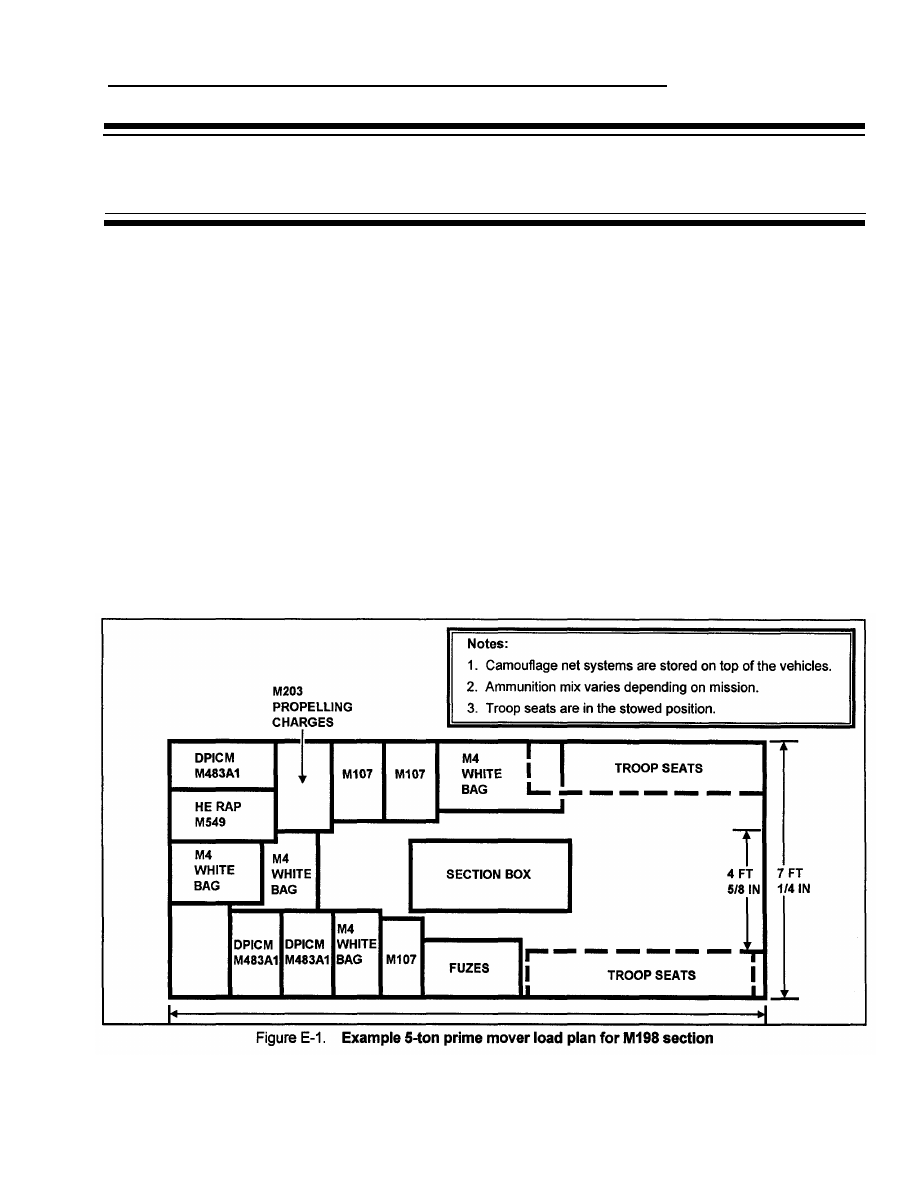
howitzer. A loading plan for a prime mover for a towed

weapon is in Figure E-1.

Standard camouflage

configurations for the M109 howitzers are in Figures E-2

through E-6. General information on the plans follows.
a. 

The load plans are based on the rated load-carrying

capability of the vehicle. Allowance of 200 pounds per

man was made for the crew that would occupy the vehicle.
b. 

The plans illustrated in this appendix are for basic loads.

However, because of mission and allocated amounts of

ammunition, load plans may vary from unit to unit according

to unit SOPs.
c. 

The weight of the load must not exceed the rated

capability of the vehicle.
d. 

Ammunition capabilities and limitations for the M992

are in TM 9-2350-267-10, Chapter 2. Load plans and

capabilities for the M992A2 are in TM 9-2 350-293-10,

Chapter 2.

E-1

-------------------------------------------------------------------------------------------------------------------------------------------------------------

FM 6-50, MCWP 3-1.6.23

E - 2

-------------------------------------------------------------------------------------------------------------------------------------------------------------

FM 6-50, MCWP 3-1.6.23

E - 3

-------------------------------------------------------------------------------------------------------------------------------------------------------------

FM 6-50, MCWP 3-1.6.23

APPENDIX F

SPECIAL OPERATIONS

F-1. OPERATIONS IN

MOUNTAINOUS TERRAIN

a. Fire Support Tasks. 

More ammunition maybe required

to support the maneuver force in mountainous terrain because

of reduced munitions effects. Cross-country restrictions

force the enemy to use roads and trails, which will enhance

interdiction fires.
b. Command and Control. 

The command and control

of the battery are degraded because of decreased effectiveness

of radio communications.

Movement control is more

difficult on winding mountain roads. Emplacement of wire

lines is more difficult and time-consuming.

c. Positioning and Displacement. 

Because of the closeness

of terrain masks, fewer suitable battery positions are available.

High-angle fire may be required to accomplish the mission.

Displacement is limited to the use of available roads, which

generally are narrow and twisting. Terrain march may be

impractical or impossible. Air assault operations are likely.
d. Other Considerations. Logistics resupply is more

difficult because of the limited number of roads and the

slower convoy speeds. Survey may not be as accurate and

target acquisition may be limited by terrain masks.

Emplacing on hills increases the range of howitzer weapons

systems. Ambushes are likely in this type of terrain.

F-2. OPERATIONS IN JUNGLE TERRAIN

a. Fire Support Tasks.

Jungle operations present

problems because of the high humidity and dense vegetation.

Humidity may degrade the ability of propellant to achieve

desired ranges. Also, it may reduce equipment operability.

Measures must be taken to ensure that powder is kept dry.

Dense vegetation degrades munitions effects. In thick

canopy, VT and ICM are ineffective. Fuze PD may be set

on delay to penetrate to the ground and achieve the desired

results. White phosphorus can be used to assist observers

in adjusting fire in dense jungle.
b. Command and Control.  

Communications equipment

is degraded because of high humidity, vegetation density,

and electronic line-of-sight. Antennas may have to be

elevated to

overcome

line-of-sight

restrictions.

Emplacement of wire lines is more time-consuming.

c. Positioning and Displacement. 

High angle fire may

be required to overcome potential site-to-crest problems.

Selection of firing positions is hampered by soft terrain and

thick vegetation. The battery must be prepared to clear fields

of fire. Fire base operations are viable means of providing

for defense of the battery, as well as for 6,400 mil fire

support. Mobility is slowed because the ground on available

roads is soft and use of terrain march is restricted. Air

assault operations are likely.
d. Other Considerations. 

Logistics resupply is hampered

by reduced mobility. Survey control is more difficult to

establish, and survey parties need more time to complete

their tasks. Target acquisition accuracy is degraded because

of heavy foliage. Whether fire-base operations are used or

not, weapon systems should be positioned closer together

to provide for better security of the battery position.

F-3. NORTHERN OPERATIONS

a. Fire Support Tasks.

Northern operations are

characterized by frozen earth, snow-covered terrain, intense

sunlight, and prolonged darkness. Smoke lasts longer and

travels farther in cold weather; however, snow usually

smothers the smoke canisters. White phosphorus gives the

desired results, but the particles will remain active in the

area longer and restrict use of that terrain. Artillery fires

may be used to start snow slides or avalanches as munitions

effects multiplier.
b. Command and Control. 

Radio communications can

be unreliable in extreme cold, and equipment may become

inoperative. Emplacement of wire lines is more difficult

and time-consuming over frozen or snow-covered terrain.
c. Positioning and Displacement.  

Frozen, snow-covered

terrain may limit the number of available positions for battery

emplacement. Mobility is slowed, as wheeled vehicles and

trailers are generally not suited for operations in northern

areas. In extreme cold, metal tends to become brittle and

parts breakage increases. Convoys must travel in closed

column during whiteout conditions and prolonged darkness.

Air assault operations are likely.
d. Other Considerations.  

Logistics resupply is hampered

by reduced mobility and difficulty in determining grid

locations. Target acquisition equipment can be adversely

affected by snowstorms and intense cold. Without the use

of PADS, survey may be more time-consuming.

F-1

-------------------------------------------------------------------------------------------------------------------------------------------------------------

FM 6-50, MCWP 3-1.6.23

F-4. MILITARY OPERATIONS ON

URBANIZED TERRAIN

a. Fire Support Tasks. 

The massive growth of urbanized

areas and man-made changes to the landscape significantly

affect the conduct of future battles. Avoidance of these

areas during periods of conflict is no longer possible.

Therefore, FA commanders at all levels must be aware of

the unique advantages and disadvantages associated with

operations conducted in and around cities, towns, villages,

and similar built-up areas. The special artillery technique

of direct fire may be used more frequently on urbanized

terrain than elsewhere. Within the built-up area, high angle

fires are most effective in attacking the defiladed areas

between buildings.
b. Command and Control. 

Command and control of a

tiring platoon operating in an urban area are demanding.

Decentralization to the maximum feasible extent may be

required. The reduced ability to communicate and extended

platoon frontages necessitate more detailed orders and SOPs.

Tactical communications in the firing platoon area are

severely affected. The height and density of structures will

reduce the planning ranges for all organic radio equipment.

Wire takes on added importance. It is less vulnerable to

disruption if run on existing telephone poles or through

buildings and sewers. More use must be made of messengers

and prearranged audio and visual signals.

Imaginative

positioning of antennas, such as intermingling them with

existing civilian antennas or in treetops, may increase

transmission range and enhance the survivability of the unit.

Existing civilian communication networks should be actively

sought out and used to supplement the organic capabilities

of the unit.
c. Positioning and Displacement.

(1) When field artillery is used in an urban environment,

selected position areas should—

Be free of civilians.
Be away from the center of the built-up area.
Minimize masking.
Have several routes of escape.
Be off the main high-speed avenues.
Afford as much cover and concealment as possible.

(2) The use of existing structures (such as barns, auto

repair shops, and warehouses) as firing or hiding positions

provides maximum protection and minimizes the camouflage

effort.

(3) More time must be allotted for the reconnaissance

of potential position areas. Depending on the density of

F-2

buildings in the area, the reconnaissance party may have to

use infantry techniques for house-to-house fighting to clear

and check the buildings.

(4) Special techniques for the emplacement of howitzers

may be required if the ground is not suitable for normal

emplacement. Consideration should be given to placing

howitzer spades against curbs, rubble, or building walls. Also

concrete or asphalt surfaces may also be softened for howitzer

emplacement by use of shaped charges.

(5) Because of the expanded occupation required in the

urban area, displacement by platoon may be impossible. In

this case, displacement may be by howitzer section.

d. Other Considerations.

(1) Battery personnel must be prepared to use hasty

survey techniques to establish directional and positional

control. Magnetic instruments are impaired when operating

in a built-up area, and their accuracy is degraded.

(2) Plotting of current friendly positions, perhaps down

to platoon or squad level, maybe critical in reducing incidents

of fratricide.

F-5. DESERT OPERATIONS

a. Fire Support Tasks. 

Deserts are arid, barren regions

that cannot support any quantity of life because of lack of

fresh water. They are characterized by temperature extremes

(+136°F in Libya or Mexico to bitter cold in the Gobi Desert)

with fluctuations exceeding 70°. Fire support considerations

vary according to the type of desert; however, considerations

common to all include munitions effects due to the

temperature extremes and a lack of identifiable terrain

features. The three types of deserts are discussed below.

(1) The mountain desert is characterized by barren,

rocky ranges separated by flat basins that may be studded

by deep gullies created during flash floods. Terrain will.

support all types of artillery, but is best suited for SP artillery.

(2) The rocky plateau desert has slight relief with

extended flat areas, and good visibility. It is characterized

by steep-walled eroded valleys (wadis). These are extremely

attractive for artillery positions but are subject to flash

flooding.

(3) The sandy or dune desert has extensive flat areas

covered with dunes subject to wind erosion. The dune size,

the texture of sand, and the leeward gradient may prohibit

terrain movement entirely.

b. Command and Control. 

Map reading is difficult and

resections are impossible unless a number of prominent points

are available. Survey performed by PADS is most useful:

-------------------------------------------------------------------------------------------------------------------------------------------------------------

FM 6-50, MCWP 3-1.6.23

CAUTION

otherwise, a hasty astro or simultaneous observation is a

must for an accurate direction.
c. Positioning and Displacement. 

Lack of vegetation

makes camouflage difficult. In all cases, the artillery battery

will be visible to the ground observer, as the netting

silhouettes against the sky. From about 1,200 feet in the

air the camouflaged installations appear bigger than the

surrounding dunes or mounds of sand and vegetation. If

engineer assets are available, digging in all the battery’s

vehicles below the surface of the desert and stretching the

desert camouflage nets flat or nearly flat over the vehicles

provides not only good concealment from ground observation

but also excellent cover against direct fire weapons.

d. Other Considerations.

High temperature and

ever-present sand cause failures in mechanical and electronic

equipment. Fuel and air filters must be cleaned after each

operation, sometimes twice per day. Optics must be protected

before the glass becomes opaque. Static electricity caused

by the hot winds interferes with refueling operations and

with radio traffic. Turning radius of tracked vehicles is

limited because of the buildup of sand between the idler

wheel and track.

Excess sand built up in this area will throw the track
and/or shear off the idler wheel.

F-6. AMPHIBIOUS ASSAULT

a. Fire Support Tasks. 

Inherent in the concept of an

amphibious assault is the projection of a fighting force into

an area on shore that is assumed to be heavily defended.

The force must be built up in combat power from zero strength

to a point where it is effective and credible. To support

the maneuver element, a battery must be prepared to lay

and fire immediately upon landing. For further information

concerning

amphibious operations, refer to NWP

22-2/FMFM 1-7.

b. Command and Control. 

Initially, command and control

are highly centralized. Battery position areas, displacements,

and fire control are centralized at the battalion level.

Communication between the two platoon main bodies and

battalion operations is critical in effecting movement with

the least disruption of fires.
c. Positioning and Displacement. 

Because of the small

size of the beachhead, positioning coordination with the

supported maneuver forces is of extreme importance. Units

must remain flexible to change the predetermined positions

on the basis of events within the beachhead. Get off the

beach as soon as possible.

d. Other Considerations. 

Units must plan to embark and

debark with all available MTOE equipment. Vehicles must

be prepared for fording. Vehicle tires may be partially

deflated for improved performance on beach sand. Survey

generally is not present during the first stages of the landing.

Survey must be established forward as early as possible.

Salt water and sand increase the need for preventive and

corrective maintenance. Unit basic loads must be transported

forward with the unit. An adequate ship-to-shore resupply

of ammunition must be coordinated by the maneuver unit

S4.

F-7. AIR ASSAULT OPERATIONS

a. Movement. 

Entire firing batteries are moved to quickly

project FA fire support into a battle area, to attack special

targets, to bypass enemy concentrations or untrafficable

terrain, and to facilitate future operations.

Sustained

operations may be conducted from the new battery position.

Detailed planning and coordination, aggressive execution,

and speed of emplacement are essential to mission success.

b. Capability. 

Because of the diversity of the aviation

mission and demand for aviation assets in a tactical

environment, it is imperative that proper aircraft be used to

perform various air assault missions. Aircraft available for

external load operations are the UH-1H Huey, UH-60

Blackhawk, and CH-47 Chinook (A-D models).
c. Mission Planning.

(1) Many factors influence the commander’s planning

for an air assault mission. The commander must plan more

extensively than for a conventional operation. In planning

he considers the following:

M: 

Mission.

E: 

Enemy.

T: 

Terrain and Weather.

T: 

Troops available.

A: 

Aircraft available.

L: 

Load requirements (equipment which will be

taken). Ensure cross-loading of critical equipment and

identification ofthe aircraft and personnel bump plans.

These actions are critical to ensure minimum mission-

essential equipment arrives on the LZ.

(2) Firing elements are moved by air in four phases:

Planning and preparation.
Rigging and loading.
Movement.
Occupation of position.

F-3

-------------------------------------------------------------------------------------------------------------------------------------------------------------

FM 6-50, MCWP 3-1.6.23

(3) Thorough and timely planning for an air assault

operation is critical to the success of the mission.

(4) The commander plans the operation by using the

reverse planning sequence. The sequence of planning for

an air assault operation are as follows:

Ground tactical plan.
Landing.
Air movement.
Loading.
Staging.

(5) Coordination is made through the S3 AIR, with final

coordination being made at the air mission brief (AMB).
d. Air Mission Brief. 

The AMB is a coordinating meeting

attended by the ground commander and a representative of

the aviation element(s) that will provide the aviation support

for the mission.

(1) The AMB sequence established below applies to

ideal situations, when adequate time is available. At times,

the situation or the mission may preclude a formal meeting.

Then the AMB will consist of an exchange of information

between the ground commander and the lift commanders

on the pickup zone (PZ).

(2) The recommended sequence for the brief is as

follows:

Brief the mission.
Brief the threat and the weather/light data.
Brief the execution as follows:

Primary and alternate PZ and landing zone (LZ)

locations, times, configurations, markings, and

pathfinder support.
Planned fires (preparation, suppression of enemy

air defenses [SEAD], and/or extraction) and

available supporting fires.
Troop and equipment loads.
Air cavalry, attack helicopter, tactical air

employment.
Abort criteria.
Code words.

Coordinate for the following.

Aircraft linkup points.
Air control points.

Hand-off points.
Downed aviator pickup points.
Gun target line.

Primary and alternate routes and penetration points,

to include deception measures.
Aircraft formations, altitude, and speed.
Aircraft crank time.
Aircraft ordnance.
Exchange of call signs, frequencies, SOI edition in

effect, IFF information, key list information, and

challenge and password.
Synchronization of watches.

e. Mission Execution.

(1) Pickup zone selection. The PZ should be at least

500 meters from the battery position, because the battery

position may have been targeted by enemy target acquisition

assets. At a minimum, the PZ should meet the following

requirements:

Free of obstructions that would hinder flight operation.
Trafficable terrain.
Adequate concealment is available for equipment and

personnel while awaiting aircraft arrival.

Note: 

A terrain sketch should be made of the PZ, if

possible, and used to brief the XO/platoon leader and

the PZ team before they occupy the PZ.

(2) Landing zone reconnaissance and selection. A

daylight visual reconnaissance of the intended LZ area is

made whenever possible, with the flight being oblique to

the area rather than directly over the area. If this is not

possible, the commander will make a map recon and use

all available electronic and photo surveillance assets. If it

is necessary to use pathfinders, coordination must be made

through the S3. As a minimum the following must be done:

Determine if the LZ is large enough.
Determine if firing positions that will support the

mission are available nearby.

Note the enemy routes of advance into the LZ area

and any enemy activity.
Note location of friendly forces.
Select alternate LZs.

(3) Pickup zone occupation.

F-4

-------------------------------------------------------------------------------------------------------------------------------------------------------------

FM 6-50, MCWP 3-1.6.23

(a) The commander takes an advance party to the PZ.

Its mission is to conduct a security sweep and to familiarize the

ground guides with the proposed layout of the equipment on the

ground.

(b) The battery displaces from the position and occupies

the PZ. The minimum time necessary is allowed to rig equipment

before the aircraft arrive.

(4) Pickup zone organization.

(a) Equipment should be placed so that after the first

loads are lifted following loads are lifted sequentially (either left

to right or front to rear along the line of flight).

(b) Sections must provide security of the PZ while their

equipment is being rigged. The PZ security must be coordinated

and areas of responsibility designated.

(5) Personnel responsibilities in the pickup zone.

(a) The battery XO or platoon leader is the officer in

charge of the pickup zone.

(b) Normally, the advance party for the LZ is the same

party that sets up the PZ.

(c) The PZ party consists of the hookup team. The

composition of the party depends on the number of aircraft

available for the lift. To more easily move the party to the LZ,

the last lift should bean internal load.

(d) All remaining section members makeup the rigging

party and main element. They rig their equipment and provide

security as required.

(6) Landing zone organization. The LZ must be secured

upon arrival of the advance party. The battery commander

selects landing positions on the basis of his reconnaissance

and lift sequence. If simultaneous loads are to be delivered

to the LZ, the LZ is to be occupied as a tiring position,

and the LZ size will not accommodate all aircraft, the

commander may have to stagger the lift sequence on the

PZ so adjacent howitzers are not delivered to the LZ at the

same time.

(7) Landing zone execution. Signalmen identify

themselves and their landing point by holding a road-guard

vest or an orange panel. When the aircraft identifies the

signalmen, the guide directs the load to the landing point

and direct unhooking of the load and landing of the aircraft.

After the aircraft departs, the crew de-rigs the load and moves

the equipment to the point specified in the ground tactical

plan. When all equipment has been delivered, the unit

reestablishes contact with and support of the maneuver force.

F-8. ARTILLERY RAIDS

The artillery raid is the rapid movement of artillery assets

by air or ground into a position to attack a high-priority

target with artillery fires. It could involve operations across

the forward edge of the battle area (FEBA). Normally, the

raid is extremely short and should not involve sustained

operations.

Detailed planning, surprise, and speed in

execution are the key factors in the successful conduct of

a raid.
a. Planning and preparation. 

Most standard air assault

procedures apply in the conduct of an artillery raid, with

some additional considerations. Because the target is likely

to be perishable, the planning phase must be very short.

Effective SOPs are essential. Pilots must understand load

composition

and

configuration.

Some planning

considerations are as follows:

(1) Only bare necessities should be taken.

(2) Ammunition for an M102/M119 raid may be hand

carried on the aircraft (combat only). Ammunition for an

M198 raid may be strapped to the firing platform (combat

only) or suspended from the howitzer in an A-22 bag.

(3) A mixture of HE, W/P, and ICM provides excellent

munitions effects for a raid.

(4) An M198 raid may include FASCAM and DPICM.

(5) Firing data can be precomputed and given to the

XO before he leaves the PZ. He may want to distribute

the data to the section chiefs on the PZ. If PADS is available

for the mission and digital communications can be established

between the LZ and the battery FDC, firing data can be

computed after accurate weapon location information is sent

to the FDC.

(6) When determining LZ location, the highest charge

possible should be planned to increase standoff range.

However, if charge 7 is used (M102), mission time is

increased because all eight stakes must be driven in the

firing platform.

(7) Security elements to accompany the raid should be

requested from the infantry.

(8) Attack helicopters should fly cover and provide

SEAD, especially if the raid is out of range for friendly

artillery fires.

(9) The number of howitzers taken forward on the raid

is determined by target analysis, munitions effects tables,

aircraft availability, and desired damage criteria.

F-5

-------------------------------------------------------------------------------------------------------------------------------------------------------------

FM 6-50, MCWP 3-1.6.23

(10) In preparation for an M102/M119 raid in which

the howitzers are carried internally during insertion and

extracted externally by sling load, the loads should be partially

rigged in the PZ before the mission begins.

(11) Emplace false insertions along the flight path.

False insertions are only effective if howitzers are being

carried internally.
b. Air Mission Brief. 

The AMB for the artillery raid

contains the same elements as for a battery air assault mission,

with the following additions:

(1) Because artillery raids involve the extraction of all

personnel and equipment, a laager site must be designated

for the aircraft during the firing of the mission. The aviation

representative designates the site. The artillery commander

ensures that it provides for the rapid extraction at the end

of the mission.

(2) Code words and/or signals must be arranged for

the recall of aircraft at the end of the mission.

c. Pickup Zone Operations. 

The PZ operations are

generally the same as with the air assault mission.
d. Landing Zone Operations.

(1) The executive officer controls the LZ. The advance

party guides orient aircraft on the landing points as with

the air assault mission.

(2) When the aircraft have delivered their loads to the

LZ, they move to the laager area.

(3) When the fire mission is complete, the howitzer

crews prepare the weapons for sling load extraction.

Designated members of the advance party assume the duties

as hookup team(s). Security for the area is most difficult

at this time, and howitzer section members must be designated

to provide security.

(4) The XO recalls the lift helicopters by a code word

on the FM net. Upon arrival of the aircraft, normal PZ

procedures are followed.

(5) Following departure of the sling loads, the executive

officer recalls the advance party aircraft.

Note: 

If there is to be live firing during training for an

artillery raid, safety requirements must be established

and strictly adhered to preclude any incident.

F-9. OPERATIONS OTHER

THAN WAR (OOTW)

a. 

Artillery batteries maybe deployed to support operations

other than war (OOTW). OOTW include missions that are

not considered conventional such as; noncombatant

evacuation

operations (NEO), security assistance,

counterterrorism, counterinsurgency, peacekeeping, and

peace enforcement. Because of the unconventional nature

of these missions, units must consider additional factors when

executing these difficult missions.

Table F-1 gives a

comparison of the battlefield factors involved in both

conventional (wartime) operations and OOTW.
b. 

In OOTW, the battlefield is normally nonlinear, with

maneuver elements conducting patrols, local air assaults, and

protecting convoys. Therefore, the artillery cannot always

follow the maneuver units. The placement of the artillery

must be considered in planning for fire support. OOTW

may require the firing units to remain in position for longer

periods of time. Due to the length of their stay, units will

have to harden the position to increase their survivability.

The defense of a static firing unit requires different planning

considerations than when the unit constantly moves. Since

the unit is stationary, it is almost certainly going to be detected.

This is the most fundamental difference between the two

survivability techniques of moving and hardening. The threat

on nonlinear battlefields is not one of armor or aircraft attacks

or even heavy artillery fire. Rather, the threat in most OOTW

situations is dismounted attacks and mortars. It is not

necessarily less than in the conventional conflict, it is simply

different.
c. 

In OOTW, it is critical that all personnel filly understand

the mission (military and political), people, and rules of

engagement (ROE). Artillery units may occupy positions

with their supported maneuver element in a fire base (see

paragraph F-10), or in an operating base (possibly shorter

term and more mobile than a fire base). The unit must

maintain a strong defensive perimeter with clear kill zones,

interlocking fields of tire, and maximum grazing fires.
d. 

Standing operating procedures (SOPs) must be

developed, rehearsed, and coordinated to effectively deal

with typical OOTW situations, such as:

Sniper fire.
Mortars.
The media.
Displaced civilians.
Handling of refugees.
Use of weapons (lock and load instructions).
Interaction with local military forces, check points,

local police.

In addition, guidelines must be established on how to carry

weapons (sling arms, port arms, muzzle up or down).

F-6

-------------------------------------------------------------------------------------------------------------------------------------------------------------

FM 6-50, MCWP 3-1.6.23

e. 

Field sanitation requirements must be well planned,

because a unit may be in the same position for extended

periods. Failure to plan for proper field sanitation, such as

waste disposal, may result in nonbattle casualties.

f. 

Depending on the commander’s assessment of the factors

of METT-T, the following attachments may increase the

success of the unit in OOTW:

Air defense artillery (SHORAD).
Radar (countermortar).

Survey.
Meteorological section.
Civil affairs teams.
Psychological operations (PSYOPS) teams.
Infantry, armor, or MPs (to aid in security).
Ground surveillance radar.

g. 

If the firing unit is not deployed as part of a battalion,

it must consider how classes of supply will be handled and

if a logistics representative should be attached. Hardening

a position will require large quantities of fortification and

barrier material.

This will almost certainly cause the

shipment of class IV items to become a priority. If the

supported maneuver unit is not capable of correcting

maintenance problems and vehicle recovery, a maintenance

representative or contact team should be attached.

F-10. FIRE BASE/HARDENED

ARTILLERY POSITION OPERATIONS

a. 

When the primary threat is light infantry, guerrilla, or

commando units without heavy weapons, FA units may

expect to support the maneuver forces from tire bases. Units

may occupy fire bases during conventional war, but this

defense technique is most often used in operations other

than war (OOTW). Hardened or fortified positions are

similar to fire bases, but they lack the combined arms support

from maneuver units found in fire bases. The planning

considerations for fire bases and hardened or fortified

positions, are the same. A fire base is a deliberate defensive

position, similar in many ways to a maneuver strong point.

In situations such as OOTW, it is not difficult for the enemy

to determine the location of firing units; therefore,

concealment is not a primary concern with respect to

survivability.

Hardening and a carefully planned and

coordinated defense against ground attack are the essential

elements for the battery to survive and continue to provide

support during operations from a fire base.
b. 

Positioning of the firebase will be dictated by the mission

and terrain. The primary consideration is that the fire base

must be positioned so that it can support the maneuver unit.

Individual battery fire bases are positioned so that they are

mutually supporting. The position should allow 6,400 mil

firing capability. The range fans (actually range circles) of

the individual fire bases should overlap, both to allow massing

of tires and to facilitate mutual defense.
c. 

Individual fire bases should be positioned on open,

defensible terrain, with clear fields of direct fire in all

directions. The area beyond the perimeter must be clear of

foliage or structures that block vision for at least 580 meters

(maximum effective range of the M16A2). Larger cleared

areas are better yet. A hilltop makes an ideal fire-base

location, as it provides clear kill zones and maximum grazing

fires. The area outside the perimeter must be carefully

surveyed by the defensive planner (normally the 1SG or

USMC Local Security Chief); and covered avenues of

approach must be identified for coverage by means other

than direct tire (grenade launchers, claymore mines, artillery,

and so forth).
d. 

The battery perimeter must be tightened and improved

as much as possible. Concertina and barbed wire, mines,

trip flares, remote sensors, and OPs or LPs are used to prevent

entry into the battery position. As time and resources permit,

the defenses are expanded and improved. Multiple bands

of wire are established around the perimeter. Fighting

positions are prepared at each howitzer position, the FDC,

and the CP. This is to provide 6,400-mil defense of each

individual element as well as to defend the battery position

as a whole. If possible, fire bases should be collocated

F-7

-------------------------------------------------------------------------------------------------------------------------------------------------------------

FM 6-50, MCWP 3-1.6.23

with maneuver elements; and their defenses should be

integrated into the overall maneuver defense plan.
e. 

Gun positions, the POC and/or FDC, and the battery

CP must be hardened as much as possible. Gun pits and

fighting positions are prepared and constantly improved. All

personnel and ammunition are provided with at least 18

inches of overhead cover to protect them from incoming

indirect fire. Preparing gun pits, clearing fields of tire, and

establishing wire and other obstacles may well be beyond

the capabilities of the battery. If so, engineer support must

be requested; and the FSCOORD must coordinate with the

maneuver brigade commander for priority of engineer

support. A priority of work must be established for the

engineer assets. (For example, first dig in FDC, then

howitzers, then fighting positions, then field expedient

devices to assist in filling sandbags.) Field Artillery units

will, in any case begin hardening the position with whatever

means available immediately after establishing firing

capability and continue until ordered to move.

As a

minimum, the battery must carry basic Class IV materials

(sandbags, concertina, pickets, 4 x 4s, plywood) and use

these and other readily available materials (powder canisters,

ammunition boxes, and so forth) to secure and harden itself.

Internal wire lines should be buried to a depth of at least

12 inches, and redundant lines should be layed. Units may

also consider the use of chain link fences around gun positions

to protect from rocket propelled grenades (RPGs) and bomblet

type submunitions.
f. 

The defense of the battery must be carefully planned

and coordinated. Howitzers and crew-served weapons are

positioned to provide interlocking tires. The star formation

(Figure 2-4) is ideal for the defense of a battery-based unit,

while the diamond formation (Figure 2-3) optimizes platoon

defense. Figure F-1 shows a completed hardened position

using a variation of the star formation. This formation could

also be organized into a triangular formation. Detailed

defense diagrams are prepared by each section chief, and

the defense plan is integrated by the BC, battery first sergeant

and/or the platoon sergeant.

The perimeter must be

continuously manned to the extent possible consistent with

the basic mission to provide fire support. A plan for the

all-out defense of the position must be developed and

exercised, so that every individual soldier in the position

knows his function and sector of responsibility. A reaction

force must be designated and exercised under the control

of the first sergeant. The composition of the reaction force,

to include equipment (weapons and ammunition), should be

specified in the unit SOPs. The scarcity of personnel in

the firing battery and/or the nature of the threat may make

it impossible for the battery to adequately man it’s own

perimeter. Then the FSCOORD must request augmentation

from the maneuver commander. Such augmentation should

F-8

include a battalion mortar platoon inside the battery perimeter;

this increases survivability and makes resupply of mortars

easier. Also, the addition of ground surveillance radar

enhances detection outside the perimeter.

While the

maneuver commander will naturally be reluctant to divert

any of his assets from their primary mission, the temporary

loss of these assets is generally preferable to the permanent

loss of a substantial portion of the brigade fire support.

g. 

Unit SOPs and plans for the defense must be detailed

enough to ensure that all battery personnel know their

individual responsibilities once an enemy attack commences.

If maneuver, CSS, or allied personnel are habitually present

in the fire base, they must be incorporated into the battery

defense plan. Personnel temporarily in the compound must

be briefed on what their actions should be in case of an

attack. A standard set of visual symbols to tell fire base

personnel when to execute various parts of the defense plan

must be developed and disseminated to all personnel in the

perimeter.

The plan must be rehearsed, critiqued, and

improved on a continuing basis.
h. 

If the field artillery unit is proficient in the conduct of

patrols or if infantry is available, patrols should be conducted

outside the perimeter. Their purpose is to prevent the enemy

from staging in areas just beyond the line of sight of the

fire base. As a rule of thumb, patrols should push out to

the maximum range of the enemy’s heaviest weapon,

generally a light mortar. Should the patrol encounter enemy

forces, it will very likely require fire support to disengage

and to break up the enemy element. Fires must be planned

in advance and the fire plan rehearsed, with dry fire if possible,

before the patrol goes out. Once patrols are outside the

wire, they must remain in constant communications with

the CP; and their progress must be carefully tracked. In

jungle or heavy forest, contact between the patrol and the

enemy may well be made at ranges of less than 100 meters.

The FDC must know the location of the patrol very precisely

if it is to provide effective fires without endangering the

patrol. Refer to FM 7-8 for specific instructions on the

conduct of patrols.
i. 

The defenses must be constantly checked for evidence

of tampering. The patrols will examine the perimeter from

the outside, looking for cut wire, disabled sensors, or mines

that have been deactivated or turned around (in the case of

Claymores). Any evidence of tampering should be regarded

as a warning of likely enemy attack, and alert states should

be increased.
j. 

Unit SOPs must contain provisions for battery

self-defense.

These include

Killer Junior, firing flechette

APICM into the wire.

gunnery techniques such as

(APERS-T) rounds, or firing

-------------------------------------------------------------------------------------------------------------------------------------------------------------

FM 6-50, MCWP 3-1.6.23

(1) Killer Junior is a procedure that uses HE projectiles

and equipment must be below ground with substantial

with mechanical time fuzes set to burst about 10 meters

overhead cover. Fighting positions over which Killer Junior

above the ground at ranges of 200 to 1,000 meters. Killer

is likely to be tired must be specially reinforced on the back

Junior techniques can be used with any of the current cannon

side to protect the soldiers and to prevent collapse.

systems. Specific techniques are described in detail in

Appendix I of this manual. Battery personnel should note

(2) APERS-T rounds are intended primarily for

that when Killer Junior is used over friendly troops, soldiers

antipersonnel use at close range. The round comes fuzed

F-9

-------------------------------------------------------------------------------------------------------------------------------------------------------------

FM 6-50, MCWP 3-1.6.23

and set for muzzle action; however, it can be set for up to

100 seconds. The round is loaded with 8,000 8-grain steel

flechettes. The APERS-T round is devastatingly effective

against exposed infantry. There are two important cautions

when using the M546 (APERS-T). First, the round may

not be used over the heads of exposed friendly troops, even

in combat emergencies. Second, the aluminum casing of

the round is thin and easily damaged. Damaged rounds are

unpredictable and should not be fired. The APERS-T round

is available in only 105-mm caliber.

(3) ICM in the wire is a 105-mm and 155-mm technique.

For 105-mm systems, it requires firing shell M444 (ICM)

fuzed with the M565 MT fuze at charge 1. With a minimum

time setting of 2 seconds and a QE of 1,250 mils, the round

can be brought in as close as 300 meters from the howitzer.

By decreasing QE and/or increasing the time setting, the

range can be extended to 2,000 meters. Detailed instructions

for this technique are in the approved firing tables. The

155-mm technique involves firing shell M449 (ICM) fazed

with the M565 MT fuze at charge 2 green bag (M3A1).

With a minimum fuze setting of 2 seconds and a QE of

1,193 mils, rounds can be brought in as close as 400 meters.

Detailed instructions for 155-mm systems are also in the

appropriate firing tables. It is emphasized that this 155-mm

procedure is for charge 2 green bag only. Firing charge 1

green bag at high angle from a M109A3/A6 or M198 is

extremely hazardous, as the round may not clear the tube

(sticker).

k. 

Resupply of the tire base will most likely be by air. If

so, a suitable LZ or drop zone (DZ) within or near the

perimeter is a major positioning consideration. If the battery

is to be resupplied by ground transport, the fire base must

be positioned near a suitable road.

l. 

If the unit is to be resupplied by ground transport, the

entrance to the position can become a critical weak point

in the tire base defense. A series of barriers must be

established to slow the approach of vehicles to the entrance.

This keeps the vehicles from crashing the gate at high speed

and entering the compound. Gate guards must have the

means immediately at hand to destroy any vehicle that tries

to force entry into the perimeter.

m. 

For the final defense of the position, an internal perimeter

is established around each gun position, each support section,

and around the FDC and BOC. If the outer perimeter is

penetrated, sections should stay in place and defend the

battery/platoon from these positions. Once the situation

stabilizes, the battery leadership executes a counterattack to

reestablish the perimeter followed by a security sweep of

each defensive position inside the perimeter.

n. 

Priorities of work must be established to efficiently

occupy and defend a firebase or hardened position. The

following is a typical priority of work:

(1) Advance party:

(a) Selection of a site that will support maneuver forces

and is defensible, with open fields of fire, preferably out to 300+

meters.

(b) Scratch out positions for: howitzer and equipment

berms, bunkers, vehicle positions, critical equipment positions,

machine-gun sectors of fire, howitzer direct fire sectors, and so

on.

(c) Construct individual hasty fighting positions

18-36” deep to lie in for protection from ground-burst indirect

fire and small-arms fire, if attacked).

(d) Lay out initial defensive perimeter.

(2) During occupation:

(a) Site/emplace crew-served weapon systems.
(b) All personnel dig individual hasty fighting positions.
(c) Determine final locations for defensive fighting

positions and howitzer sectors of fire.

(d) Finalize perimeter.

(3) After occupation:

(a) Emplacement of perimeter wire obstacle, mines,

and early warning devices.

(b) Improving individual positions from hasty positions

to one-or two-man fighting positions.

(c) Hardening/digging-in critical material and

equipment (in priority).

First, 1.18 inches of overhead cover for all

personnel.
Second, FDC/BOC.
Third, howitzers.
Fourth, ammunition.
Fifth, remaining support vehicles and equipment.

(d) Identify and plan defensive targets.
(e) Improve perimeter wire.
(f) Tie-in internal defenses (assign direct fire sectors).
(g) Verify siting of defensive weapons/preparation and

inspection of range cards.

F-10

-------------------------------------------------------------------------------------------------------------------------------------------------------------

FM 6-50, MCWP 3-1.6.23

(h) Coordinate with adjacent units for areas of

responsibility, mutual support communications, patrol schedules,

defensive targets, sectors of fire, call signs and frequencies, and

any other matters required to integrate the two units’ defensive

plans. This will reduce fratricide.

(i) Rehearse battle drills for enemy inside the perimeter,

snipers, air attack, mounted/mechanized attack, and so on.

(j) Maximize the use of night vision equipment.

Leaders must ensure everyone understands the priorities of

work, and that resources are allocated to complete

high-priority tasks first.

F-11. EMERGENCY OCCUPATION

PROCEDURES WITH BCS

a. 

The BC reconnoiters the route to the new position, selects

emergency occupation positions, determines map-spot

locations, and transmits these locations to the platoon leaders.
b. 

The BCS operator enters these locations in BCS; PIECES

format in order of possible occupation when platoon

displaces. (As the platoon passes a predetermined position,

that position can be deleted.)

c. 

When the platoon march-orders, the BCS operator erases

the X in READY and places an entry in the OUTTIL field.

He then transmits the AFU;UPDATE format to battalion

tactical fire direction computer (IFSAS). This should allow

the battery to complete its displacement without receiving

a call for fire. Regardless, the BCS operator should be

prepared to receive a fire mission. He does this by entering

3200 in the AZ field of the AFU;UPDATE. The BCS

operator executes the AFU;UPDATE.
d. 

Upon notification of an emergency occupation, the BCS

operator does the following:

(1) He displays the emergency occupation mission

(FM;CFF).

Then, after ensuring that the gun number

corresponding to the emergency occupation position is

specified in the adjustment field, he executes the format.

(2) From the resulting set of firing data, he determines

the new azimuth of fire by using the BACKWARD

AZIMUTH RULE (paragraph 4-25).

(3) He enters the new azimuth of fire in the AZ field

of the AFU;UPDATE format and re-executes the format.

EXAMPLE

Step 1. Place possible emergency occupation positions

in BCS;PIECES format and 3200 in AZ field of

AFU;UPDATE format.

Step 2. Upon receipt of fire mission request (FM; CFF),

select pieces to fire (PTF) corresponding to appropriate

position in BCS;PIECES and execute.

Step 3. Review firing data.

Step 4. Use BACKWARD AZIMUTH RULE to compute

the new azimuth of fire as follows:

Common deflection

3200 AZ

3200

Computed deflection

4550 Decrease of

1350

Increase of

1350 new AZ

1850

Common deflection

3200 AZ

3200

Computed deflection

2500 increase of

700

Decrease of

700 new AZ

3900

Step 5. Replace AZ in AFU;UPDATE with new AZ.

Step 6. Re-execute related fire mission request

message (FM; CFF). Data now correspond with common

deflection 3200 and appropriate mission data.

F-11

-------------------------------------------------------------------------------------------------------------------------------------------------------------

FM 6-50, MCWP 3-1.6.23

APPENDIX G

CANNON SECTION EVALUATION AND TRAINING

G-1 . SCOPE

This appendix is an evaluation and training guide for the

howitzer sections of a cannon firing battery. It is universal

in scope and can be adapted readily to all cannon weapon

systems currently in the Marine Corps and Army inventory.

It may be modified by the commander to meet local

requirements. It may be administered as follows:

Formally or informally.
With minimal administrative support.
In the local training area.
In a nonfiring, but tactical environment.

G-2. PURPOSE

a. 

The evaluation is a performance test of the skills that

are essential to the successful accomplishment of the mission

of the cannon section. Although many of the tasks are

evaluated on the basis of individual performance, the

evaluation actually measures the ability of the section to

function as a team. The evaluation can be used as follows:

To evaluate the current state of proficiency of the

section.
As a competitive evaluation to determine the best

section in a unit.
As a basis for a howitzer/gun crew training program

in preparation for a formal battery or battalion training

evaluation.

b. 

The tasks laid out in this appendix should be used as

training vehicles, with as much time as possible devoted to

controlled practice of a task. The sections should practice

each task to acquire the degree of proficiency required by

the standards set forth in the evaluation.

G-3. CONDUCT OF THE EVALUATION

This evaluation evaluates the ability of the section chief to

organize and train his personnel into a cohesive, effective

fighting unit. It consists of five phases.
a. Phase I 

is an orientation and organization period

beginning with a statement of the purpose, scope, and

description of the evaluation. During Phase I, a written test

will be administered. This phase should be conducted in a

classroom on a day before the test.

b. Phase II 

involves preparation in an assembly area for

movement to a location for a deliberate occupation of a

prepared position.
c. Phase III 

covers the deliberate occupation of a prepared

position.
d. Phase IV 

evaluates the conduct of various types of fire

missions.
e. Phase V 

is a critique of the performance of individual

sections.

Note: 

Phases II through IV of the evaluation are

constructed around a tactical scenario that can be

altered to fit the training resources and the time

available.

G-4. EVALUATION FORMAT

a. 

The task is a general statement of the requirement for

the particular evaluation.
b. 

The conditions outline the specific environment or

situation in which the evaluation will be administered. They

state what assistance or reference materials, if any, are

authorized and what equipment or personnel are required

for proper evaluation.
c. Evaluation checklists 

present the requirements for

successful completion of that particular task.

Specific

technical procedures required in the task will be evaluated

by the examiner on the basis of the established procedures

in the appropriate reference.

G-5. SCORING

The performance evaluation will be administered within a

time framework on a GO/NO-GO basis; the examinee either

passes or fails. The examiner will base his judgment upon

the criteria stated in the evaluation checklist and on the most

current reference for that particular task.

G-6. PREPARATION

All necessary preparations, as indicated in the conditions

for each task, will be made before the task begins. The

examiner will ensure that the examinee understands the task

to be performed.

G-1

-------------------------------------------------------------------------------------------------------------------------------------------------------------

FM 6-50, MCWP 3-1.6.23

G-7. QUALIFICATION

score for individual sections, add the numerical score attained

a. 

If the evaluation is administered solely for the purpose

in each of the four scored phases. See Table G-1 for the

qualification scheme.

of determining the state of training of individual sections

within a unit, no formal score is required. The commander

can readily determine the strengths and weaknesses of his

sections simply by subjectively analyzing the GO and NO-GO

G-8. ORGANIZATION

ratings received for each task performed.

AND SCORING

b. 

The evaluation may be used to determine the best section

The five phases are organized and scored as shown in Table

in a unit by determining a formal score. To determine the

G-2. A recommended grading sheet is shown in Table G-3.

G-2

-------------------------------------------------------------------------------------------------------------------------------------------------------------


Content      ..     12      13      14      15     ..