FM 3-11.5 MULTISERVICE TACTICS, TECHNIQUES, AND PROCEDURES FOR CHEMICAL, BIOLOGICAL, RADIOLOGICAL, AND NUCLEAR DECONTAMINATION (April 2006) - page 3

NOTE: Naval aircraft exposed to salt water require emergency reclamation per
Aircraft Weapons System Cleaning and Corrosion Control, and Avionics Cleaning
and Corrosion Prevention/Control.
Table V-1. Planning Factors for the Rinse Station
M12A1 PDDA Rinse
M17 LDS Rinse
Equipment
Gallons Applied
Minutes Applied
Gallons Applied
Minutes Applied
M1 Tank
325
12
57
14
M2 BFV
325
12
57
14
M113 APC
203
9
38
10
M109A Paladin
325
12
57
14
HEMTT
180
8
30
12
5-Ton Truck
158
7
42
11
HMMWV
90
4
23
6
NOTE: The rinse is done with the spray wand for the M17.
3.
Preparation
Units prepare for thorough decontamination to be successful.
a.
Subordinate units review their higher HQ decontamination plan. If additional
decontamination sites or assets are required, they request them from the higher HQ. The
supporting decontamination leader conducts a reconnaissance of the designated
decontamination sites. Since the decontamination sites are initially selected by map
reconnaissance, the actual site may not be suitable. If the selected site cannot support
decontamination operations, the CBRN unit leader attempts to find another site close to
the original site and notifies the supported unit and higher HQ of the change.
b.
The decontamination unit leader determines the support requirements that are
needed to operate the decontamination site. Engineers are required to dig sumps, improve
access to the site, and dig ditches for runoff. Air defense and military police are required to
provide security. Medical support is also required. Depending on the operational situation
and the threat, some DED sites may be prepared in advance. Routes must be established
and published in the OPORD, leading the contaminated unit to the linkup point.
NOTE: Inform units not to proceed directly to the decontamination site.
4.
Execution
The actual decontamination operation begins once a contaminated unit requests
decontamination support. The unit leader must assess the situation and accurately report
it to the HQ. This situation report (SITREP) should include the type and extent of
contamination, the current location, the unit’s ability to perform the current mission while
contaminated, and the time the unit will become ineffective in combat. The contaminated
unit should perform immediate decontamination techniques to increase its survivability
and to limit the spread of contamination. An operational decontamination should also be
considered and performed, as appropriate. The request for decontamination support must
contain several essential elements of information to assist the CBRN staff and the
decontamination unit leader in coordinating the decontamination operation. These
essential elements of information include the following:
•
Designation of the contaminated unit.
•
Location of the contaminated unit.
•
Time the unit became contaminated.
4 April 2006
FM 3-11.5/MCWP 3-37.3/NTTP 3-11.26/AFTTP(I) 3-2.60
V-3
•
Time the unit can move and begin decontamination.
•
Type of contamination.
•
Number and type of vehicles contaminated.
•
Special requirements (e.g., patient decontamination station, recovery assets, unit
decontamination team).
•
Supported unit’s frequency and call sign to facilitate initial linkup.
a.
The supporting decontamination unit is given a WARNORD to conduct a
decontamination operation. Subsequent WARNORDs provide more detailed information.
After requesting decontamination support, the supported unit issues an
OPORD/fragmentary order (FRAGORD) to the chemical unit.
b.
The supporting decontamination unit must coordinate the movement of the
contaminated unit to the linkup point. If the contaminated unit is out of the supported unit
AO, the move must be coordinated with the higher HQ.
c.
Once the chemical unit is set up, the decontamination unit leader moves to the
linkup point. Other elements may provide assets to support the decontamination
operations, such as medical, engineer, air defense, and military police. These elements link
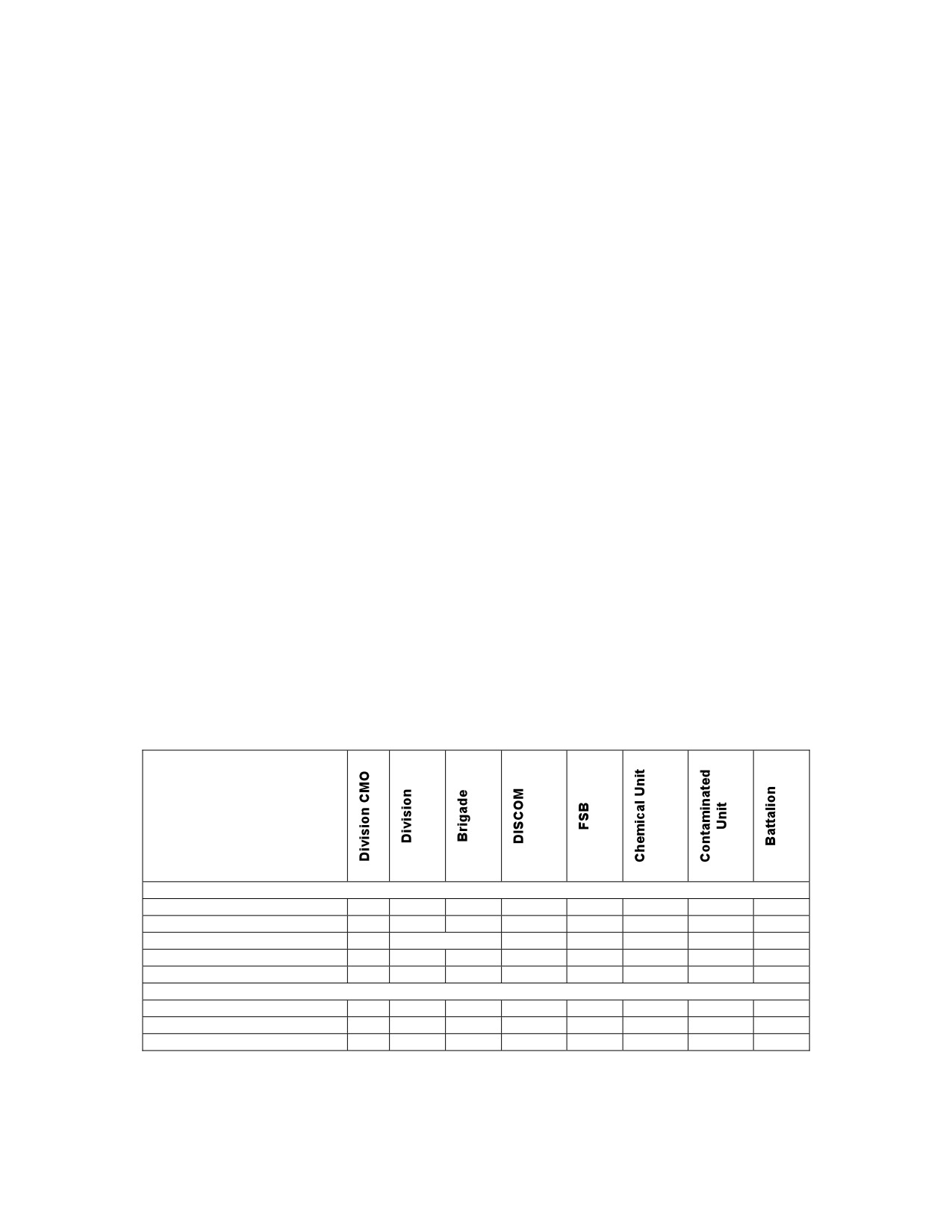
up with the chemical unit before the arrival of the contaminated unit (see Table V-2).
d.
The supported unit is responsible for site security and overall control. The
decontamination leader is responsible for operating the predecontamination area and for
processing vehicles.
e.
After linkup is achieved and all support assets are in position, the actual
decontamination operation begins. The decontamination platoon leader, with help from the
commander of the contaminated unit or the supported unit C2 cell, supervises the
decontamination operation. All equipment not necessary for decontamination operations
should be located in an uncontaminated area to limit the spread of contamination.
Table V-2. Thorough Decontamination Support Matrix (Land Forces)
Tasks
Preparation Phase
Request
S
N/A
N/A
N/A
N/A
N/A
P
S
Coordination
S
N/A
S
N/A
N/A
N/A
N/A
P
Site selection
N/A
S or P
N/A
N/A
P
N/A
N/A
Advance-party linkup
N/A
N/A
N/A
N/A
N/A
S
P
S
Site setup
N/A
N/A
N/A
S
S
P
N/A
N/A
Execution Phase
Site control/security
N/A
N/A
N/A
N/A
N/A
S
P
N/A
Predecontamination actions
N/A
N/A
N/A
N/A
N/A
P
S
N/A
Processing
N/A
N/A
N/A
N/A
N/A
P
S
N/A
V-4
FM 3-11.5/MCWP 3-37.3/NTTP 3-11.26/AFTTP(I) 3-2.60
4 April 2006
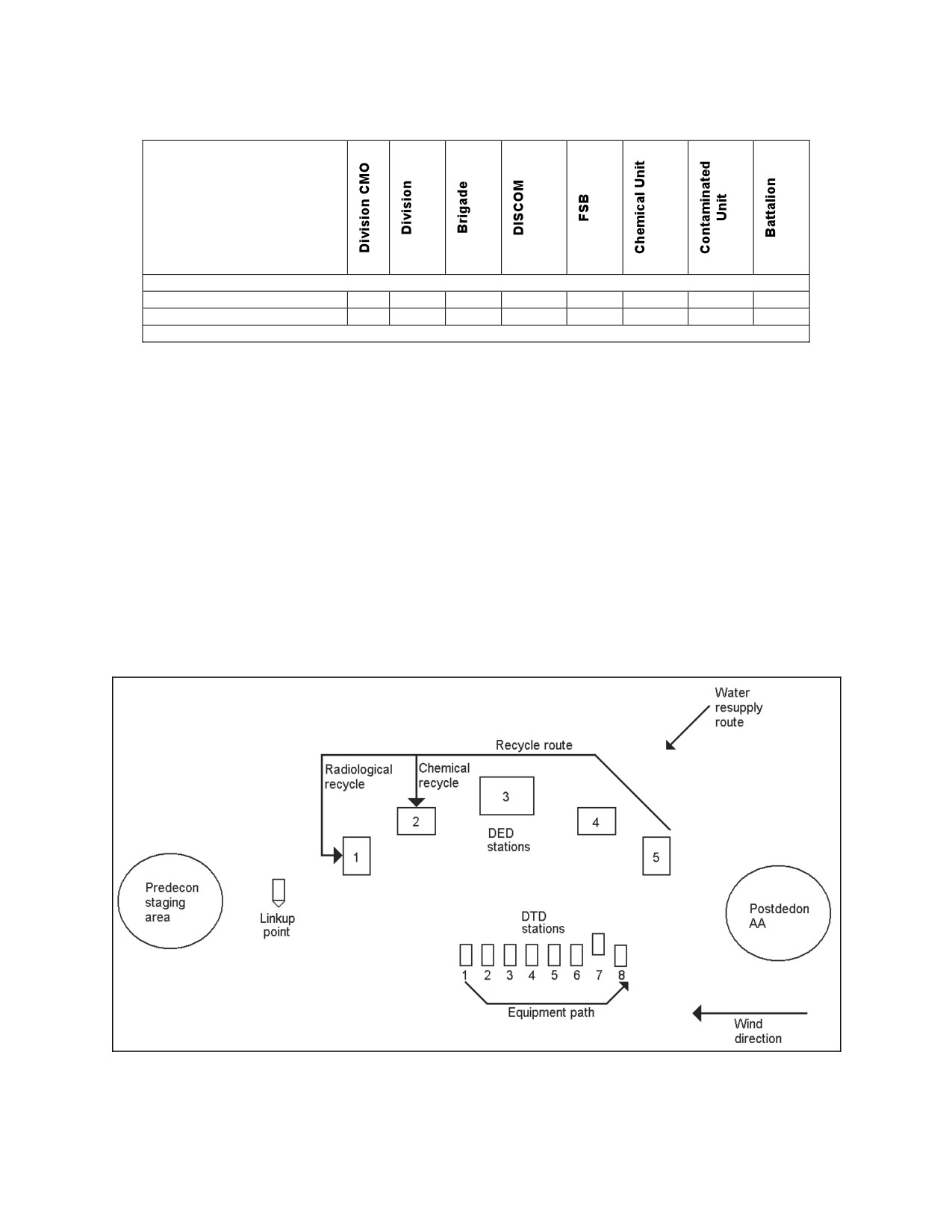
Table V-2. Thorough Decontamination Support Matrix (Land Forces) (Continued)
Tasks
Site Clearance Phase
Cleanup
N/A
N/A
N/A
N/A
N/A
P
P
N/A
Marking and reporting
N/A
N/A
N/A
N/A
N/A
P
N/A
N/A
Legend: P=primary; S=supporting
f.
A thorough decontamination site consists of the following areas:
•
Predecontamination staging area.
•
DED area.
•
DTD area.
•
Postdecontamination AA.
g.
There should be an alternate route for vehicles that have been decontaminated
but did not pass the M8 paper or ICAM test. This limits the spread of contamination by not
exposing clean vehicles with vehicles that might need to be reprocessed back though the
DED. The chemical unit leader selects these areas based on operational guidance, the road
network, available cover and concealment, and the water supply. The contaminated unit
uses the predecontamination staging area to ready itself. The postdecontamination AA is
the location where the vehicles and personnel exiting the DED and DTD areas are linked
up before moving from the decontamination site (see Figure V-1).
Figure V-1. Thorough Decontamination Site
4 April 2006
FM 3-11.5/MCWP 3-37.3/NTTP 3-11.26/AFTTP(I) 3-2.60
V-5
5.
Predecontamination Staging Area
The contaminated unit moves to the predecontamination staging area about 500
meters downwind of the thorough decontamination site. The contaminated unit performs
predecontamination actions, to include segregating vehicles by checking for contamination.
a.
For chemical contamination, use the ICAM/CAM and the M8/M9 detector paper.
When monitoring vehicles for contamination, there should be about 15 meters between each
vehicle to prevent false positive readings with the ICAM. For radiological contamination,
use the AN/PDR-77, AN/VDR-2, or ADM-300 radiac detector.
b.
If the vehicle only has isolated areas of contamination, use the M100 to
decontaminate those areas. Recheck for contamination, and consider the vehicle clean if
contamination is not detected.
NOTE: Do not use the M100 on sensitive items.
6.
Vehicle Crews
Vehicle crews play an integral part in the thorough decontamination process.
a.
The vehicle crews, except for the drivers, dismount. As the crews dismount, they
remove all contaminated equipment, including sensitive items (i.e. electro-optical), from the
top and sides of the vehicles. Once the crews have exited the vehicle, they will not reenter.
This prevents contamination from being spread into the vehicle interior.
b.
Using the pioneer tools from the contaminated vehicles, the crew removes all
heavy mud and debris. They concentrate on the undercarriage, which would be the most
likely place for contamination to collect and the hardest place to decontaminate. Once the
crew is finished with the pioneer tools, they are placed back on the vehicle. The initial
removal of the mud and debris makes it more likely that the decontamination wash will
remove any remaining contamination.
c.
Seat covers (when applicable), canvas items, camouflage netting, wooden rails,
and any other material that can absorb liquid contamination are removed. These items
create a potential transfer hazard and are not easily decontaminated. Left untreated,
absorbed chemical agents will desorb after being decontaminated and will create a vapor
hazard. The crew removes the items that cannot be decontaminated by the standard
methods used in the DTD and places them at the collection point. Decontamination unit
personnel provide advice concerning the decontamination or disposal of these items.
d.
Design vehicle-loading plans to minimize the amount of equipment carried on
the outside of the vehicle that cannot be readily decontaminated. Whenever possible,
CBRN covers should be used when a chemical attack is expected (see Multiservice Tactics,
Techniques, and Procedures for Nuclear, Biological, and Chemical Protection). All CBRN
covers are removed and disposed of as contaminated waste during the predecontamination
actions.
e.
Equipment and supplies that are exposed after removal of coverings should be
checked for contamination. If the items that can be removed are uncontaminated, they
should be moved via a clean route to the postdecontamination area. Contaminated
equipment and supplies will be decontaminated or disposed of properly.
V-6
FM 3-11.5/MCWP 3-37.3/NTTP 3-11.26/AFTTP(I) 3-2.60
4 April 2006
7.
Detailed Equipment Decontamination and Detailed Troop Decontamination
Areas
In coordination with the CBRN unit leader operating the decontamination site, the
contaminated unit begins sending contaminated vehicles by priority for processing.
Communication is maintained between the predecontamination staging area and the CBRN
unit leaders. All assistant vehicle drivers are the first individuals sent through the DTD to
ensure that there is a driver exchange at Station 3. See Appendix J for a series of charts to
support DED station attendants and supervisors.
a.
Postdecontamination AA. The CBRN unit leader selects the general location for
the post decontamination AA. It must be big enough to hold the entire unit and to provide
the proper cover and concealment while undergoing the thorough decontamination. The
postdecontamination AA is located about 1 kilometer (km) upwind from the DED and DTD
areas. The unit assembles in the postdecontamination AA after completing the DTD and
DED operations. The unit occupies the postdecontamination AA until the entire unit has
gone through decontamination and will then be instructed to move to a reconstitution
location or a tactical AA to prepare for future operations.
b.
Decontamination Sumps. The construction of decontamination sumps will be
required to control the wastewater runoff from various stations in the DED and for the
disposal of expendable supplies from the DED or DTD. The sumps should be of an
appropriate size and volume for the station that requires the sump. To prevent the spread
of contamination into the ground and to assist in the weathering process, each sump should
be lined with a sufficient amount of STB. See Appendix K for a discussion on
contaminated-waste disposal.
c.
DTD. The contaminated unit or its higher HQ is responsible for setting up,
operating, manning, and closing the DTD area at the thorough-decontamination site. The
CBRN unit leader determines the general location of the DTD within the decontamination
site and provides technical advice on setting up, operating, and closing the DTD area. The
supervisor of the DTD must establish a work/rest cycle. There are eight stations for a DTD.
Spacing between the stations is approximately 5 meters (see Figure V-2, page V-8). A
summary of personnel and equipment for a DTD is provided in Table V-3, page V-8.
Whenever possible, personnel should process through the DTD in buddy teams. If a buddy
is not available, the station attendant will provide assistance.
4 April 2006
FM 3-11.5/MCWP 3-37.3/NTTP 3-11.26/AFTTP(I) 3-2.60
V-7
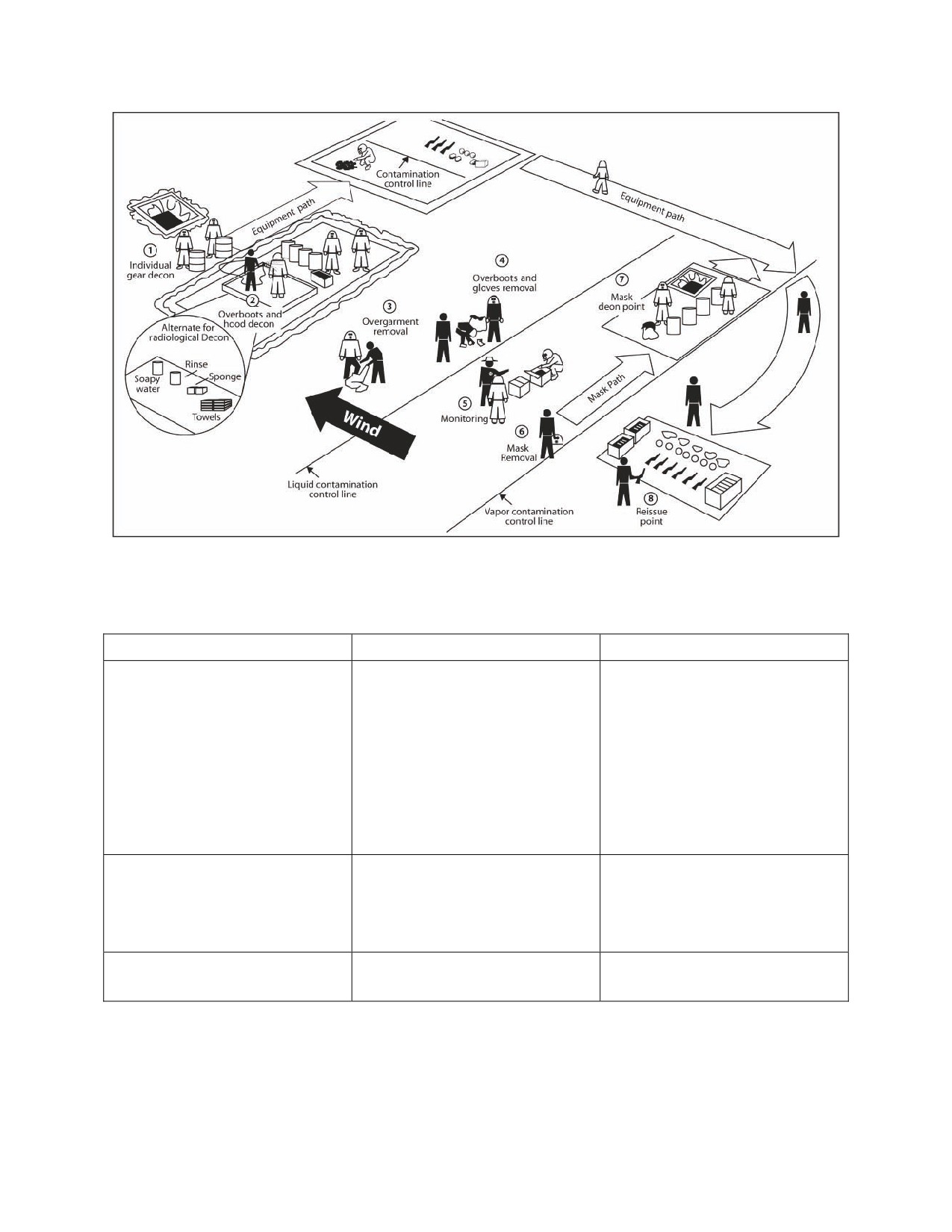
Figure V-2. DTD Layout
Table V-3. DTD Personnel and Equipment Recapitulation
Station
Personnel
Equipment and Supplies
Station 1—individual-gear
1 monitor (CAM/ICAM operator)
4 30-gallon containers
decontamination
2 attendants
2 long-handled brushes
2 ponchos or plastic sheets
1 CAM/ICAM
8 books of M8 detector paper
4 M256A1 detector kits
100 plastic trash bags
Sufficient STB slurry mix
Rinse water
*Hot, soapy water
*AN/VDR-2
*Sponge
Station 2—overboots and hood
1 attendant
1 cutting tool
decontamination
1 SDK or IEDK per person
Large plastic sheet
Plastic trash bags (as required)
10 drums of STB
1 shovel
Station 3—overgarment removal
1 attendant
2 30-gallon containers
100 plastic trash bags
10 boxes of SDKs
V-8
FM 3-11.5/MCWP 3-37.3/NTTP 3-11.26/AFTTP(I) 3-2.60
4 April 2006

Table V-3. DTD Personnel and Equipment Recapitulation (Continued)
Station
Personnel
Equipment and Supplies
Station 4—overboots and gloves
3 attendants
8 30-gallon containers
removal
2 long-handled brushes
M8 detector paper (as required)
1 immersion heater
100 plastic trash bags
1 CAM/ICAM
Engineer tape
1 cutting tool
2 ponchos or large plastic sheets
5 percent STB/HTH solution
Hot, soapy water
Cold rinse water
Station 5—monitoring
1 attendant (CAM/ICAM operator)
1 CAM/ICAM
1 trauma specialist (or combat
First aid supplies
lifesaver)
5 books of M8 detector papers
1 box of SDKs
Station 6—mask removal
2 attendants
1 M8A1 or M22 ACAA
Engineer tape
Station 7—mask decontamination
2 attendants
1 30-gallon container
point
1 monitor
4 3-gallon containers
1 CAM/ICAM
2 sponges
1 case of paper towels
1 immersion heater
Mask sanitizing solution
Hot, soapy water
Rinse water
Station 8—reissue point
Unit CBRN NCO/supply sergeant
Mask PLL
* Denotes the equipment needed for radiological contamination.
NOTE: Assume that an operational decontamination was done before the thorough decontamination.
(1)
Station 1—Individual-Gear Decontamination. At this station,
contamination is removed from individual gear (load-bearing equipment, mask carrier,
helmet, and weapon). The individual gear is checked with the ICAM or M256 kit to ensure
the completeness of the decontamination.
(a) Preparation. At this station, the following equipment and supplies are
needed: four 30-gallon containers for each two decontamination lanes used; two
long-handled brushes for each two decontamination lanes used; sufficient STB slurry mix
for chemical contamination; hot, soapy water and a sponge for radiological contamination;
rinse water; two ponchos or plastic sheets; and engineer tape.
•
Dig a sump that is 6 feet long, 6 feet wide, and 4 feet deep (minimum).
Place four 30-gallon containers near the sump for easy changing. Fill two containers with
the STB slurry mix. Fill the other two containers with clean water for rinsing, and place
them about 3 feet forward of the STB containers. Place two long-handled scrub brushes at
each container of STB slurry.
•
Prepare the slurry. Mix 100 pounds of STB with 20 gallons of hot
water. (The decontamination unit provides the hot water.) Change the mixture after 20
personnel have decontaminated their gear, and change the rinse water after every 10
personnel or when it appears dirty. Dump the old rinse water and used STB in the sump.
4 April 2006
FM 3-11.5/MCWP 3-37.3/NTTP 3-11.26/AFTTP(I) 3-2.60
V-9
•
Place a poncho or a plastic sheet on the ground at the checkpoint.
Using engineer tape, divide the poncho or sheet in half (this is the contamination control
line). Ensure that the checkpoint is a minimum of 10 feet from the other stations in order
to get a true reading on the detection equipment. Place the following equipment at the
checkpoint for an average company-size unit: one ICAM, eight books of M8 detector paper,
four M256A1 detector kits, 100 plastic trash bags, and one AN/VDR-2 for radiological
contamination. An additional CAM/ICAM may be required in the event of saturation of the
ion chamber.
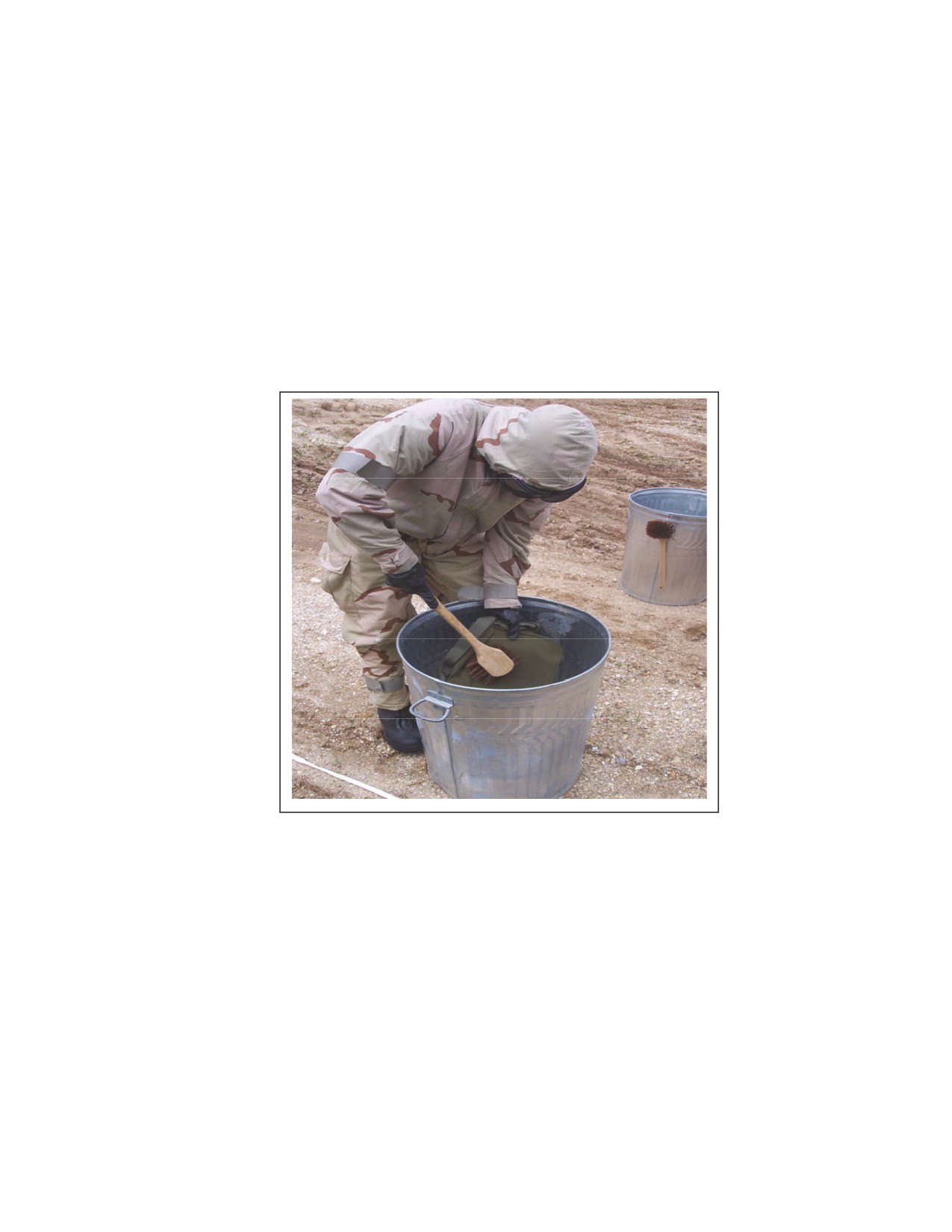
(b) Execution. The contaminated person decontaminates his gear by
washing and scrubbing it for 6 minutes in the container with hot, soapy water or an STB
slurry mix (see Figure V-3). If he is wearing the M42 mask, he should use hot, soapy water
and a sponge or an STB slurry mix to decontaminate the hose and canister.
Figure V-3. Decontaminating Individual Equipment
•
The contaminated person dips his gear into the clean-water container,
rinses it for 4 minutes, hands it to the attendant, and then proceeds to the next station.
The attendant takes the gear to the equipment checkpoint, places the decontaminated gear
on the “dirty” side of the contamination control line, and returns to the container to pick up
more gear. The monitor at the checkpoint checks the gear using the appropriate detection
device and the procedures associated with that device. If residual contamination is
detected, the attendant recycles the gear and decontaminates it again. If the gear passes
the check, the attendant places it on the clean side of the contamination control line. The
attendant carries the equipment to the reissue point.
•
The contaminated gear may go through more extensive washing and
checking procedures if time allows. The longer the gear is washed or left out in the air after
washing, the lower the contamination level will be. The gear may be put in closed areas or
V-10
FM 3-11.5/MCWP 3-37.3/NTTP 3-11.26/AFTTP(I) 3-2.60
4 April 2006
plastic bags and checked for hazardous vapors with the M256A1 detector kit or the CAM.
The CAM only detects the G- and V-series nerve-agent vapors and the H-series blister-
agent vapors.
(c)
Risk. If these procedures are done improperly, contamination may
remain on the equipment. The resulting vapor hazard could cause casualties to unmasked
personnel, particularly in closed areas (vehicle interiors) or heavily wooded areas where air
circulation is poor.
(2)
Station 2—Overboots and Hood Decontamination. At this station, gross
contamination on overboots, trouser legs, mask, and hood is neutralized. If ample hoods
are available at the reissue point, the hood should be cut away.
(a) Preparation. The following equipment and supplies are needed for the
mask and the shuffle pit: one cutting tool for each decontamination lane used, one SDK or
IEDK per person, plastic trash bags (as required), ten drums of STB, and one shovel. One
person is required to operate this station. The attendant directs and observes the
contaminated personnel as they decontaminate their overboots and hoods.
•
Prepare a shuffle pit by digging a shallow pit about 3 feet long, 3 feet
wide, and 6 inches deep.
•
Fill the shuffle pit with STB dry mix or STB slurry, depending on the
availability of water.
•
Prepare the STB dry mix by mixing three parts of earth to two parts of
STB.
•
Prepare the STB slurry as at Station 1.
•
Add more STB to the mix after ten people have processed through the
shuffle pit. The CBRN unit will provide ten drums of STB for every company-size unit that
goes through the station.
(b) Execution. The contaminated person walks into the shuffle pit,
spreads his legs apart (double shoulder-width), bends at the waist, and uses his hands to
thoroughly rub the STB dry mix or the STB slurry on his overboots and lower trouser legs
(see Figure V-4, page V-12). He takes special care to rub the rear of his overboots and also
removes any excess decontaminant from his gloves.
4 April 2006
FM 3-11.5/MCWP 3-37.3/NTTP 3-11.26/AFTTP(I) 3-2.60
V-11
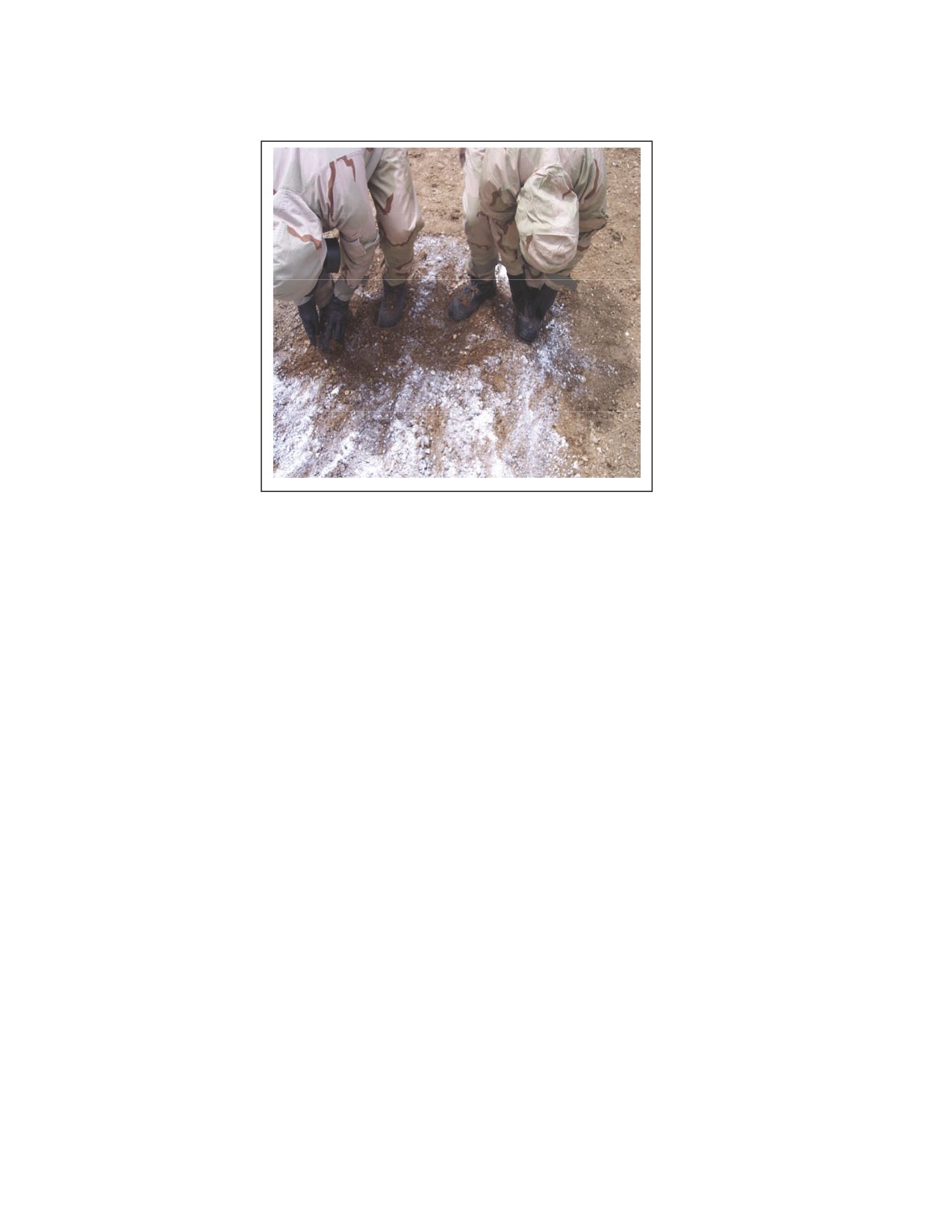
Figure V-4. Shuffle Pit Decontamination
•
If a replacement hood is available, remove the hood as follows: Buddy
1 cuts the shoulder straps and draw cord on Buddy 2’s hood. Buddy 1 pulls Buddy 2’s hood
inside out over the front of the mask, being careful not to touch the exposed neck or head.
Buddy 1 gathers Buddy 2’s hood in one hand and, using a cutting tool, cuts away the hood
as close as possible to the eye lens outsert, voicemitter, and inlet valve covers. Make sure
that nothing is left dangling below the bottom of the mask.
•
If a replacement hood is not available, Buddy 1 decontaminates and
rolls Buddy 2’s hood in the same manner as for a MOPP gear exchange (see Chapter III).
When the task is completed, Buddy 1 and Buddy 2 reverse roles.
NOTE: Personnel should check their overboots, rubber gloves, and overgarment
for damage. Any rips, tears, or punctures in these items should be reported to the
monitor at Station 5. This allows the monitor to check personnel for
chemical-agent symptoms and check their clothing for possible contamination.
•
Buddy 1 decontaminates his own gloves. He loosens Buddy 2’s
overgarment hood by unfastening the barrel lock. (NOTE: If there is difficulty
unfastening the barrel lock, loosen the draw cord.) He then loosens the draw cord
around the edge of the hood and unfastens the hook-and-pile fastener at the chin. Buddy 1
must take care to avoid touching Buddy 2’s skin and throat.
•
Buddy 1 removes Buddy 2’s overgarment hood by opening the front
closure flap and pulling the slide fastener from the chin down to the chest. Buddy 1
instructs Buddy 2 to turn around. Buddy 1 grasps the back of Buddy 2’s hood, rolls the
hood inside out (being careful not to contaminate the inner garment), and pulls the hood off.
(c)
Risk. If these procedures are done improperly, contamination can be
transferred from the hood to the combat boots, head, and neck.
(3)
Station 3—Overgarment Removal.
V-12
FM 3-11.5/MCWP 3-37.3/NTTP 3-11.26/AFTTP(I) 3-2.60
4 April 2006
(a)
Preparation. At this station, the contaminated overgarments are
removed before the agent penetrates the overgarment material and touches the
undergarments or the skin. The following equipment and supplies are needed: two
30-gallon containers for each two decontamination lanes, 100 plastic trash bags (or about
one per person), and ten boxes of SDKs. One person is required to operate this station. He
directs and monitors personnel as they remove their overgarments in the same manner as a
MOPP gear exchange (see Chapter III).
(b) Execution.
NOTE: The attendant avoids touching the person’s skin or inner clothing. If
contact is made, decontaminate immediately and then proceed with the
overgarment removal.
•
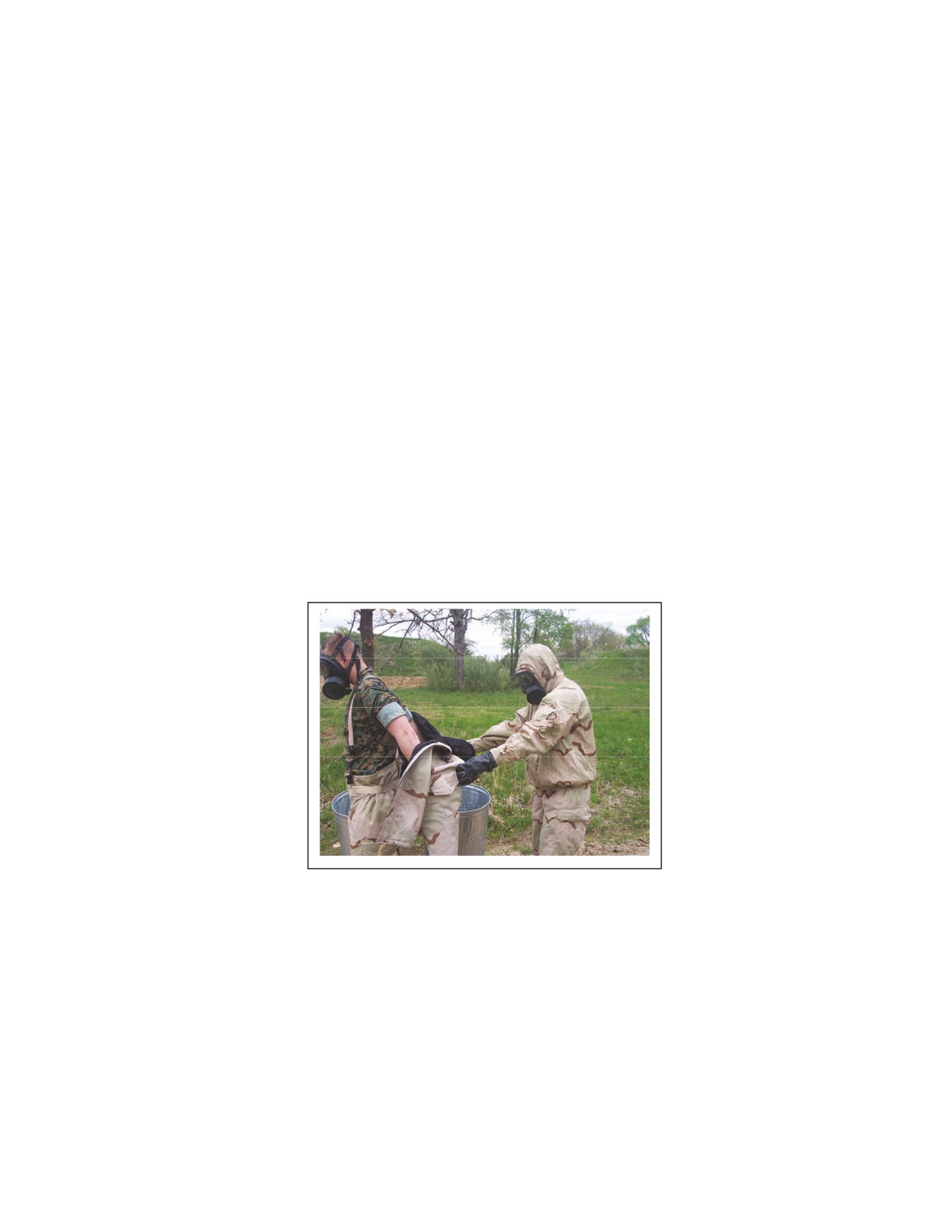
The attendant assists the contaminated person in removing his
overgarment. The contaminated person locates his trouser suspender snap-couplers by
feeling for them on the outside of his jacket and releases them. The attendant cuts and
removes the M9 detector paper from around the person’s wrist. He unfastens the
hook-and-pile fastener over the jacket zipper, waist cord, and wrist straps on the jacket.
The attendant unfastens the front-closure flap on the front of the jacket and pulls the slide
fastener from the top of the chest down to the bottom of the jacket. He unfastens the
webbing-strip snaps at the bottom of the jacket and releases the coat retention cord. He
unfastens the back snaps and instructs the person to make a fist. Touching only the outside
surface of the jacket, the attendant loosens the bottom of the jacket by pulling the material
away from the body. He then pulls the jacket down and away from him (see Figure V-5).
Figure V-5. Removing the Overgarment Jacket
•
The attendant instructs the person to turn around, extend his arms in
front of him, and make a fist to prevent the removal of his chemical protective gloves. The
attendant grasps the jacket near the shoulders and removes it by pulling it down and away
from the body.
NOTE: If there is difficulty removing the jacket in this manner, pull one arm out
at a time.
•
The attendant cuts and removes the M9 detector paper from the
trousers. He unfastens the hook-and-pile fasteners and zippers on the cuffs of the trousers.
He also unfastens the front waist snaps and unzips the front zipper. He has the person lift
4 April 2006
FM 3-11.5/MCWP 3-37.3/NTTP 3-11.26/AFTTP(I) 3-2.60
V-13
one leg and point that foot down and bend slightly at the knees for stability. The attendant
grasps the cuff of the elevated foot with a hand on each side and pulls the cuff in an
alternating, jerking motion until the person can step out of the trouser leg. The process is
repeated on the other leg.
NOTE: The attendant ensures that the person steps wide enough so that he will
not rub his clean leg against the contaminated boot and overgarment.
(4)
Station 4—Overboots and Gloves Removal. At this station, contaminated
overboots and gloves are removed to limit the spread of contamination. The overboots and
gloves may also be decontaminated for reissue.
(a) Preparation. At this station, the following equipment and supplies are
needed for every two lanes used: engineer tape, two cutting tools, and 100 plastic trash bags
(or about one per person).
•
If the overboots and gloves are not being decontaminated, two
30-gallon containers are needed.
•
If the overboots and gloves are being decontaminated, the following
items are needed: eight 30-gallon containers; two long-handled brushes; two ponchos or
large plastic sheets; one CAM; one AN/VDR-2 (for radiological contamination); four M256A1
detection kits; one immersion heater; 100 plastic trash bags; M8 detector paper, as
required; 10 percent STB/HTH solution; hot, soapy water; and cold rinse water.
•
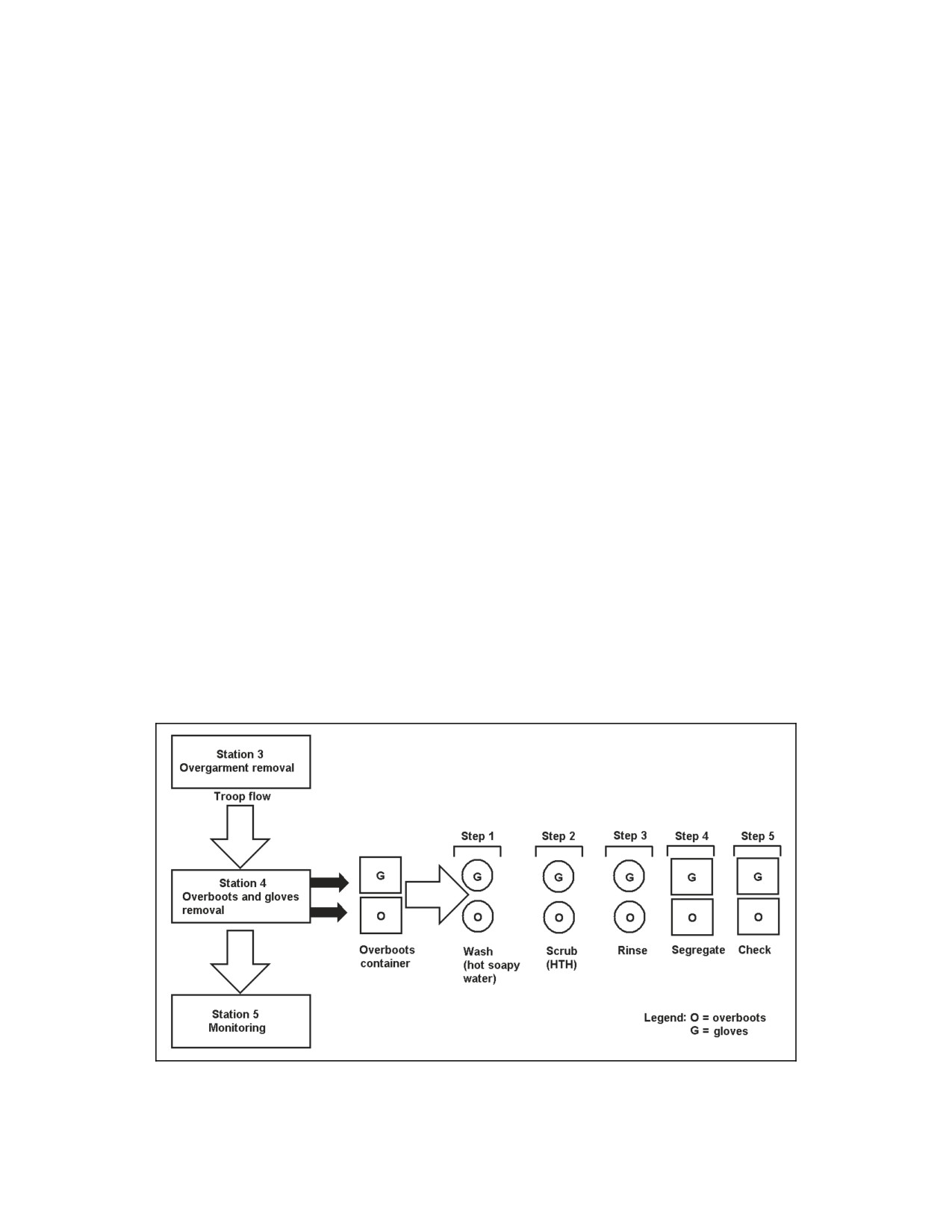
If replacement overboots and gloves are available, establish a liquid
contamination control line and set two 30-gallon containers 1 foot back from the line (see
Figure V-6). Personnel should support themselves using the containers and discard their
overgarments into the containers. An attendant directs and monitors the personnel as they
remove their overboots and gloves in the same manner as a MOPP gear exchange (see
Chapter III); however, the person steps over the control line instead of onto a jacket.
Figure V-6. Station 4 Layout
V-14
FM 3-11.5/MCWP 3-37.3/NTTP 3-11.26/AFTTP(I) 3-2.60
4 April 2006
•
If replacement overboots and gloves are not available, fill two
30-gallon containers with hot, soapy water; two 30-gallon containers with a 10 percent
STB/HTH solution, placing two scrub brushes near the containers; and then fill two
30-gallon containers with cold rinse water. One attendant supervises and assists the
personnel wearing the M42 mask. The other two attendants decontaminate the overboots
and the gloves; one processes the overboots, while the other processes the gloves.
NOTE: Replace the water in all the containers once 20 items have been processed.
When available, the decontamination platoon will assist with the water
requirements.
•
Use engineer tape to mark the liquid-contamination control line on the
ground. Place the cutting tools, two dirty containers, and plastic bags on the dirty side of
the liquid contamination control line. The liquid contamination control line separates the
dirty and clean areas. No liquid agent should be tracked on the ground beyond the liquid
contamination control line.
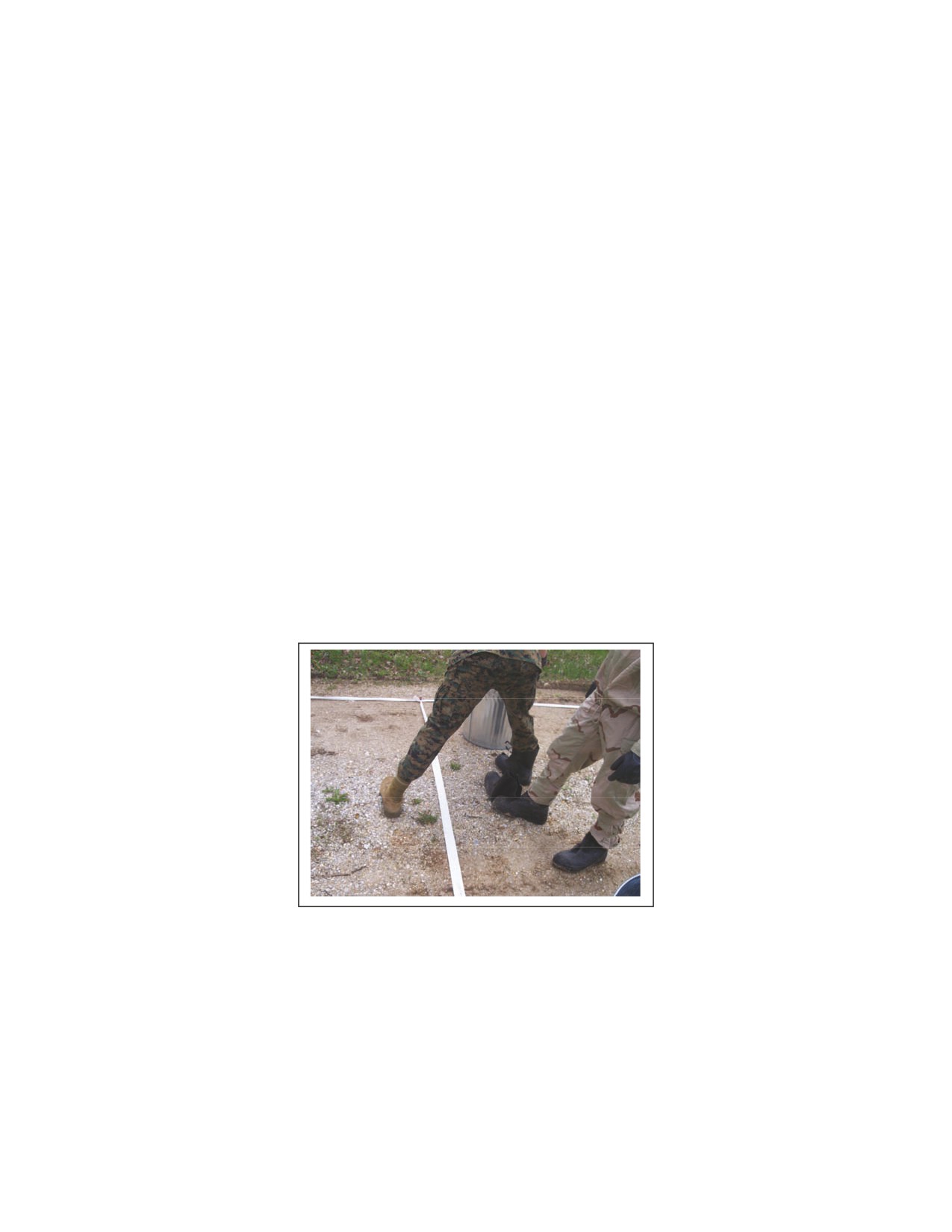
(b) Execution. The attendant unfastens or cuts the elastic closures on the
overboots. The contaminated person faces the liquid contamination control line and steps
back about 12 inches. The attendant steps on the back of the overboot and instructs him to
lift his heel and work his foot out of the overboot and step across the liquid contamination
control line (see Figure V-7). Repeat the process on the other foot. If this process cannot
remove the overboot, the attendant cuts it off and discards it in the designated container.
The person holds the fingertips of his gloves and partially slides his hands out. The
attendant removes the gloves. If the contaminated person is wearing the M42 protective
mask, the attendant from Station 6 carries the filter canister until it is removed. The
overboots and gloves are decontaminated using the following steps:
Figure V-7. Liquid Contamination Control Line
NOTES:
1. Check all items for holes, tears, and punctures; and discard any item with a
defect. Do not decontaminate any item that is unserviceable.
2. The attendant at Station 4 performs his duty from the dirty side of the liquid
contamination control line.
•
Step 1. Submerge the gloves and overboots in their respective
container of hot, soapy water. (Some of the contamination is removed during this step.)
4 April 2006
FM 3-11.5/MCWP 3-37.3/NTTP 3-11.26/AFTTP(I) 3-2.60
V-15
When the overboots and gloves are removed from the container, ensure that no water
remains inside them.
•
Step 2. Submerge the gloves and overboots in their respective
containers of STB/HTH solution. Thoroughly scrub the items until no visible
contamination remains. After scrubbing, submerge each item once more before
transferring it to the rinse container.
•
Step 3. Thoroughly rinse the scrubbed items, making sure that they
are rinsed inside and out.
•
Step 4. Place the usable items on a poncho or a plastic sheet to air-dry
and weather.
•
Step 5. Place the usable items in a plastic trash bag along with an
M256A1 detector kit. If the detector kit shows that contamination remains, the attendants
can recycle the items or discard them. However, if the kit shows no contamination, the
items can be reused.
(c)
Risk. If the overboots are improperly removed, the combat boots may
become contaminated and contamination may be spread to the clean areas. If the gloves
are not properly removed, the undergarments and skin may become contaminated.
(5)
Station 5—Monitoring. At this station, contamination on personnel is
identified, spot decontamination is provided, and medical aid is provided, as required.
(a) Preparation. The following equipment and supplies are needed for the
attendant and health care provider: first aid supplies, one CAM/ICAM, one AN/VDR-2 (for
radiological contamination), five books of M8 detector paper per 100 people, and one case of
SDKs. A health care provider should be present to treat any casualties suffering from
chemical-agent symptoms. If a health care provider is unavailable, a combat lifesaver
should be present.
(b) Execution. The attendant checks personnel for agent vapor
contamination using the CAM/ICAM (see Figure V-8). The attendant uses M8 paper to
detect liquid agents. Symptoms of agent poisoning are the most obvious indication of skin
contamination. At this station, the trauma specialist checks each person for symptoms of
agent poisoning and treats them, as required. Personnel should report damage to their
MOPP gear that was identified at Stations 2, 3, and 4. The attendant can then
decontaminate the identified areas with the SDK. Personnel are remonitored after
decontamination. It is possible that all liquid chemical contamination is absorbed into the
clothing. If so, M8/M9 detector paper will indicate negative, even though there is a hazard.
V-16
FM 3-11.5/MCWP 3-37.3/NTTP 3-11.26/AFTTP(I) 3-2.60
4 April 2006
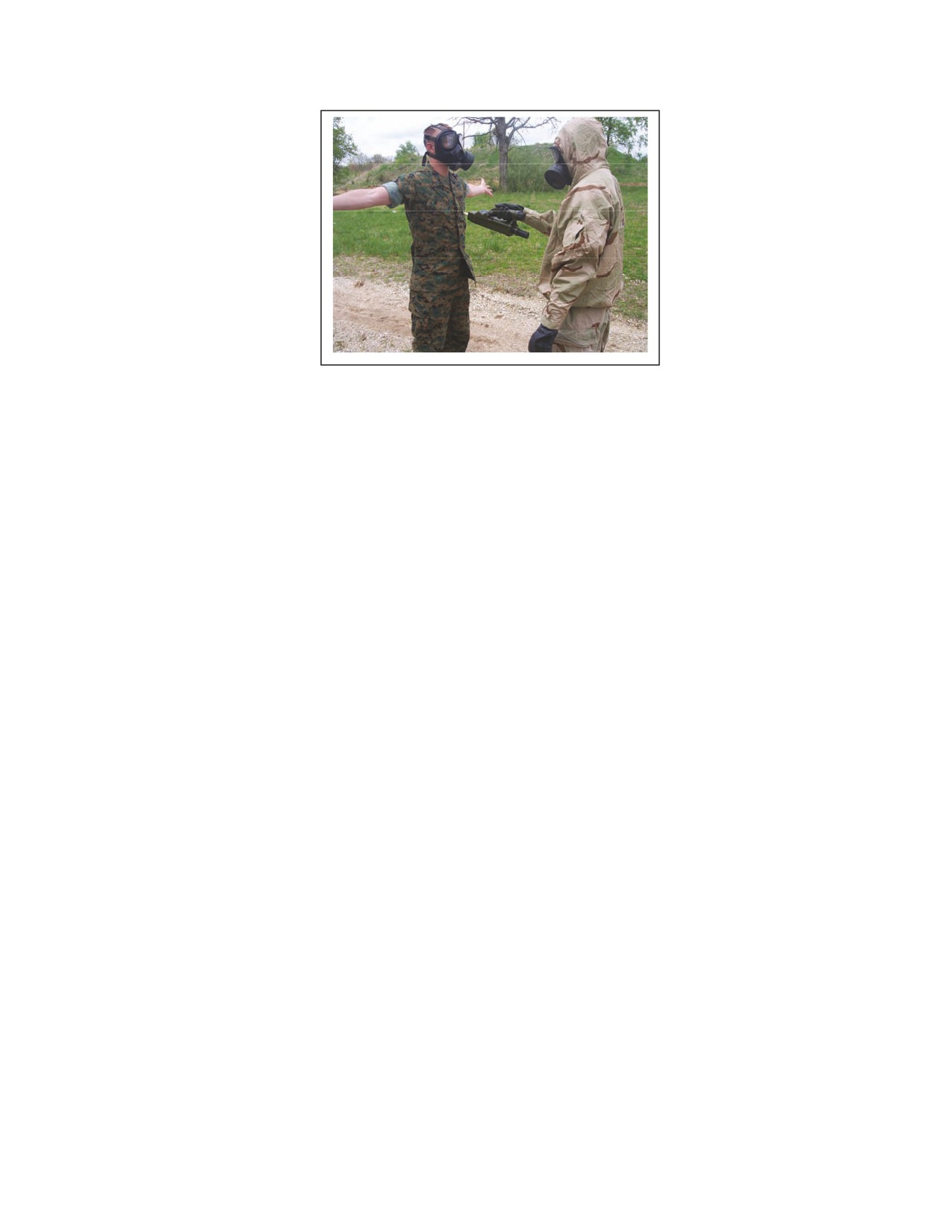
Figure V-8. Checking for Contamination
(c)
Risk. If this station is omitted, the contaminated personnel could
become a casualty. After this station, the personnel will not be checked for contamination
or decontaminated again. Commanders can choose to conduct a more extensive
contamination check here if medical assistance and time are available. This decreases the
risk of casualties.
(6)
Station 6—Mask Removal. At this station, the mask is removed without
contaminating the person. The mask is taken to a mask decontamination point, limiting
agent transfer at the station.
(a) Preparation. The M8A1 or M22 automatic chemical-agent detector
alarm (ACADA) and engineer tape are needed. Two people are needed to operate this
station. They remove and carry the masks to Station 7.
(b) Execution.
•
If the hood is still attached to the mask, the attendant pulls the hood
over the front of the mask, grabs the mask by the voicemitter cover, and pulls the mask off
the person. The person holds his breath as the mask is removed. If the mask has optical
inserts, the attendant holds the mask open so that the person can remove the inserts
without touching the outside of the mask. The person walks upwind 5 meters, crosses the
vapor contamination control line, and then resumes breathing. The attendant brings the
mask to Station 7.
NOTE: The attendant should show the individual the exit route before he
removes his mask and closes his eyes.
•
If the wind direction remains constant, no chemical vapor hazard is
expected beyond the vapor contamination control line. Position the M8A1 or the M22
ACADA upwind of the station to warn of vapor hazards. The person getting
decontaminated moves straight ahead; while his mask, which may still give off vapors, is
held on the dirty side of the vapor contamination control line and taken to Station 7 where
it is decontaminated.
(c)
Risk. If the mask is removed improperly, the person can breathe toxic
vapors. There is a high probability that the vapor hazard is still present on the mask and
the hood after it is decontaminated. The person must not touch the outside of the mask
because it could contaminate his bare hands. (The person then proceeds to Station 8.)
4 April 2006
FM 3-11.5/MCWP 3-37.3/NTTP 3-11.26/AFTTP(I) 3-2.60
V-17
(7)
Station 7—Mask Decontamination Point. At this station, all the
contamination is removed from the mask.
NOTE: Once 20 items have been processed in the wash containers, replace the
water. Once 10 items have been processed in the rinse water, replace it. Place
the contaminated waste into the sump.
(a) Preparation.
•
At this station, the following materials and equipment are needed:
four containers (about a 3-gallon capacity); one CAM (for chemical only); hot, soapy water;
rinse water; mask-sanitizing solution; one immersion heater; one 30-gallon container; two
sponges; and one case of paper towels per company.
•
Dig a sump that is 4 feet long, 4 feet wide, and 4 feet deep to discard
the used filters and canisters. Place the equipment and materials as shown in Figure V-3,
page V-8. Three people are needed to operate this station. Two people strip, wash, rinse,
sanitize, and dry the masks. The other person checks the masks and carries them to the
reissue point.
(b) Execution. Remove the eye lens outserts and the hood (if the hood
was not cut off at Station 2). Remove and discard the filters or canisters. Put the items
into the properly marked containers. Wash the mask, hood, eye lens outserts, and hoses on
the M42 and M43 masks in hot, soapy water. Rinse these items in clean water, dip them
into the sanitizing solution, agitate them for 5 minutes, and then rinse them again in clean
water. Ensure that two different buckets of water are used for rinsing. Add one tube of
mask-sanitizing solution (HTH) for each quart of water. Wipe the masks with rags until
they are almost dry. Discard each container of mask-sanitizing solution into a sump after
every ten masks. Check the masks for contamination with a CAM. If the masks are still
contaminated, recycle them for more decontamination and then decontaminate your rubber
gloves. If the masks are not contaminated, take the masks to the reissue point. Take care
not to become contaminated or to contaminate the reissue point.
(c)
Risk. If these procedures are done improperly, personnel may become
contaminated when the masks are reissued at the reissue point. Even if they are done
correctly, there is still a possible danger when many masks are stacked together. Small
amounts of residual vapor from each mask can become potentially dangerous.
NOTE: Runners between Stations 7 and 8 are in MOPP2 and are prepared to go to
MOPP4.
(8)
Station 8—Reissue Point. At this station, the mask and its components are
provided to personnel for reassembly and decontaminated individual equipment from
Station 1 is reissued.
(a) Preparation. At this station, the protective mask prescribed load list
parts are needed. The unit CBRN NCO or supply sergeant sets up the reissue point to
provide personnel with replacement parts for all types of protective masks and to assist in
mask maintenance. If M42 or M43 masks are used, the unit CBRN NCO must be at this
station.
(b) Execution. The mask and its components are reissued to the person
who assembles it in the AA. The unit CBRN NCO affixes canisters to the cleaned M42 and
V-18
FM 3-11.5/MCWP 3-37.3/NTTP 3-11.26/AFTTP(I) 3-2.60
4 April 2006
M43 hoses. The person picks up their individual gear and moves to the
postdecontamination AA.
(c)
Risk. If these procedures are done improperly, personnel may be
inadequately equipped for future operations.
NOTE: If time is critical, the CBRN NCO will have replacement chemical suits,
overboots, and gloves at this station for reissue. If time is available, personnel
will receive this equipment at the postdecontamination AA.
d.
Resupply Support Responsibilities. The supporting decontamination unit must
supply most of the equipment and supplies that are required to operate the DTD. This does
not relieve the supported unit of the requirement to maintain adequate supplies to conduct
DTD procedures.
(1)
A decontamination unit will continue to receive support from its parent
organization. The supported unit provides the decontamination unit with replacements,
supplies, and material at the end of the DED. This shortens the time that the
decontamination unit is not mission-capable following the DED. The supported unit must
coordinate for supplies and equipment necessary to operate the DTD. Three people are at
the station for proper operation.
•
One person supervises the decontamination of the individual gear and
takes the decontaminated equipment to the checkpoint. He also prepares a new slurry
mixture as necessary.
•
One person remains at the checkpoint and checks the gear using the
detection equipment to ensure that it is decontaminated.
•
One person transports the decontaminated gear to the reissue point.
(2)
Typical nondecontamination units do not have more than two CAMs per
company-size unit. However, the DTD requires a minimum of three CAMs. The supporting
HQ may need to provide additional CAMs. The division support command (DISCOM)
sustains the division decontamination units. A decontamination unit attached to a
maneuver force identifies the resources that are needed to accomplish the mission and
passes these requirements to the maneuver staff supply officer (S-4)/component logistics
staff officer (G-4). The S-4 and G-4 then coordinate with the supporting CSS element to fill
the requirement. The supply units that operate the Class II points issue the protective
masks and overgarments. They normally package protective clothing as complete sets of
MOPP equipment to support a predetermined number of personnel. Decontamination
supplies may be issued in preconfigured “push” packages.
e.
DED. Decontamination units are responsible for setting up, operating, and
closing the DED portion of the thorough decontamination operation. The DED for CB
contamination is comprised of five stations. For radiological contamination, the DED uses
all but Station 2. Stations are normally 50 meters apart; however, spacing is METT-TC
dependent. Resupply procedures are of critical importance. Resupply vehicles typically
operate independently and need to maintain communications with the platoon HQ in the
event that the platoon relocates or needs to change linkup locations or the mission
requirements change.
CAUTION
Do not kneel or touch the ground while attempting
to remove contamination.
4 April 2006
FM 3-11.5/MCWP 3-37.3/NTTP 3-11.26/AFTTP(I) 3-2.60
V-19

(1)
Station 1—Primary Wash.
(a) At this station, the gross contamination and dirt are removed from the
vehicle. Spray the vehicle for 2 to 3 minutes with hot, soapy water, and scrub it to help
remove caked-on dirt. The mechanical action of scrubbing also helps remove thickened
chemical agents. Although the undersurfaces are difficult to reach, try to remove as much
dirt as possible. After scrubbing the vehicle, spray it again for 2 to 3 minutes to remove
loosened dirt and contamination. This station uses about 250 gallons of water per vehicle.
Larger vehicles with large quantities of dirt use more water. The runoff from this station is
contaminated and must be treated as hazardous. The contaminated runoff must be
controlled; if available, engineer support may be used to construct a sump. This station
requires high water pressure systems (M12A1 power-driven decontamination apparatus
[PDDA], M17 lightweight decontamination system [LDS], or multipurpose decontamination
system [MPDS]) rather than low water volume systems (65-gallon-per-minute [GPM]
pumps).
NOTE: Use 35 cubic feet of space per 250 gallons of liquid runoff when calculating
the size for the drainage sump.
(b) The effectiveness of the wash depends on the type of wash (hot, soapy
water; hot water; cold water; or steam). The relative effectiveness rankings for selected
surfaces are listed in Table V-4. Hot, soapy water is heated from about 120°F to 140°F to
and a detergent is added to reduce surface tension. The detergent removes the agent by
emulsification, which is followed by the mechanical displacement of the suspension. Hot
water alone is less effective than hot, soapy water. For some chemical agents, cold water
exhibits better solvent characteristics. Because of the high temperature, some agents are
best removed by steam through vaporization. See Potential Military Chemical/Biological
Agents and Compounds, for the chemical and physical properties of CW agents.
Table V-4. Effectiveness of Types of Wash
Agents/Surfaces
Type of Wash
TGD on alkyd-painted metal
Hot water and/or steam; hot or cold, soapy water
TGD on CARC-painted metal
Hot, soapy water; hot water and/or steam; cold water
TGD on canvas or webbing
Steam; hot water and/or hot, soapy water; cold water
THD on alkyd-painted metal
Hot water and/or steam; hot, soapy water; cold water
THD on CARC-painted metal
Hot, soapy water; hot water and/or steam; cold water
THD on canvas or webbing
Steam; hot, soapy water; cold water; hot water
HD on alkyd-painted metal
Hot, soapy water; hot water and/or steam; cold water
HD on CARC-painted metal
Hot, soapy water and/or steam; cold water; hot water
HD on canvas or webbing
Steam; hot water; hot, soapy water; cold water
VX on alkyd-painted metal
Steam; cold water; hot water and/or hot, soapy water
VX on canvas or webbing
Steam; hot water and/or hot, soapy water; cold water
GD on canvas or webbing
Steam; hot, soapy water and/or hot water; cold water
NOTE: The types of wash are listed in the order of effectiveness, starting with the most effective to the least
effective.
V-20
FM 3-11.5/MCWP 3-37.3/NTTP 3-11.26/AFTTP(I) 3-2.60
4 April 2006
(2)
Station 2—Decontaminant Application.
(a) At this station, a decontaminant is applied to the entire vehicle. The
vehicle is divided into four parts, and a member of the scrubbing team is assigned to each
part. This limits the workload of each member of the scrubbing team and avoids
duplication of work. STB slurry, STB dry mix (if the temperature is below 0°F), or another
approved decontaminant is applied starting at the top of the vehicle and working toward
the undercarriage. Every effort is made to apply the decontaminant to the undercarriage,
especially if the vehicle has crossed a contaminated area.
(b) Before starting the decontamination operation, the decontamination
crew prepares the slurry mix in the M12 PDDA or by mixing 100 pounds of STB with 20
gallons of hot water in 30-gallon containers. Each member of the scrubbing team wears a
toxicological agent-protective (TAP) apron or wet-weather gear to protect him and his
clothing from being saturated with water, decontaminant, or agent.
NOTE: Use 35 cubic feet of space per 250 gallons of liquid runoff when calculating
the size for the drainage sump.
(c)
Ensure that there is a sufficient amount of decontaminant on the item
being decontaminated for neutralization to occur.
(3)
Station 3—Contact Time/Interior Decontamination.
(a) At this station, the decontaminant is allowed to completely neutralize
the chemical agent and the interior of the vehicle is decontaminated. Vehicles are moved to
a concealed position. The attendant tracks the time each vehicle enters and exits this site
to ensure that at least 30 minutes has passed. When there is a 30-minute contact time,
there should be no desorption for most chemical agents. The attendant also tracks whether
any contamination is found on the inside of the vehicle. This information may be needed
for redeployment as part of the clearance decontamination.
(b) While the vehicle is held at this station for the decontaminant to
completely react, the driver inspects the interior of the vehicle for liquid contamination.
The driver is given M8 detector paper to check for chemical contamination. If he identifies
contamination, he is given decontamination supplies to decontaminate the interior of the
vehicle. The best decontamination solution for use in the interior of vehicles is a 5 percent
solution of HTH or STB. The driver wipes all reasonably accessible surfaces with a rag or
sponge soaked in the HTH or STB solution. He should not attempt to decontaminate areas
where there is little likelihood of contamination (electrical assemblies, the area beneath the
turret floor, etc.).
(c)
Once the interior decontamination is complete, the driver places
covers over the seats and floor of the vehicle. (This prevents the assistant driver from
soaking excess decontaminant into his MOPP gear.) The driver dismounts the vehicle and
proceeds to the start of the DTD. The assistant driver, having completed the DTD, checks
with the attendant to ensure that at least 30 minutes have passed, mounts the vehicle, and
moves it to the next station. All drivers must exercise caution when entering or exiting the
vehicle.
(d) For radiological contamination, use an AN/PDR-77 or AN/VDR-2
radiac detector to determine the extent and location of contamination inside the vehicle. If
there is contamination, determine the intensity of the contamination. If the contamination
4 April 2006
FM 3-11.5/MCWP 3-37.3/NTTP 3-11.26/AFTTP(I) 3-2.60
V-21
is greater than 0.33 centigray (cGy), the interior of the vehicle must be decontaminated.
Use a wet sponge to wipe the interior of the vehicle.
(4)
Station 4—Rinse. At this station, the decontaminant is removed from the
vehicle. Spray the vehicle with water from the top to the bottom. Take care to rinse the
undercarriage. This station uses about 200 gallons of water per vehicle. Failure to remove
all the decontaminant from the vehicle may cause a false positive reading at Station 5. If
high water pressure systems (M12A1 PDDA, M17 LDS, or MPDS) are not available,
large-volume water pumps (65- and 125-GPM) should be used at this station. The driver
removes plastic or other material (if present) covering the seats and floor and disposes of it
as hazardous waste.
(5)
Station 5—Check. At this station, the vehicle is checked to see if it has a
negligible contamination level or if it still has significant contamination remaining.
Detection procedures will vary depending on the type of contamination. If significant
contamination is found on the vehicle, the vehicle is recycled to Station 2 for chemical
contamination or to Station 1 for radiological contamination. (See Figure V-1, page V-5, for
a suggested layout of the recycle route.) Caution must be exercised to prevent the vehicle
from contaminating clean areas. If the vehicle cannot be recycled, the commander must
decide what to do with the vehicle; at a minimum it should be segregated from the clean
troops and vehicles for weathering to occur. Personnel operating the vehicle must remain
in elevated MOPP. If sufficient resources and time are available, the vehicle should be
placed back into a through decontamination line.
(a) Chemical (CAM Interferents).
•
The ICAM/CAM is used to check for the presence of vapor from
residual liquid contamination. A one-bar or lower reading on the ICAM/CAM indicates a
negligible contamination level. Once the ICAM/CAM indicates the presence of vapor
contamination, M8 detector paper is used to verify the presence of liquid contamination. If
it is suspected that the ICAM/CAM and M8 detector paper are producing false positive
results, use an M256A1 detector kit near the area to verify the presence of contamination.
See Table V-5 for a list of common interferents that can cause false positive readings on the
CAM. If the vehicle has significant contamination remaining, recycle it to Station 2 for
chemical contamination or to Station 1 for radiological contamination. The commander
may modify the recycle criteria based on mission requirements.
V-22
FM 3-11.5/MCWP 3-37.3/NTTP 3-11.26/AFTTP(I) 3-2.60
4 April 2006

Table V-5. Common Interferents for the CAM
Interferents
G Agent Bar
H Agent Bar
Response
Response
Insect repellent
Low to very high
N/A
Brake fluid
High to very high
Very high
General-purpose
High
N/A
cleaner
Burning kerosene
N/A
High
Breath mints
High
N/A
Gasoline vapors
Low
Low
Burning grass
Low to high
Low
Burning gas
Low
N/A
Green smoke
Low
Low to high
Break-free oil
Low
N/A
Ammonia
Very high
N/A
•
There will be desorption of chemical agents from the surfaces after
decontamination. The desorption of vapors on surfaces painted with the CARC will stop
sooner than it will on surfaces painted with alkyd. Consider this when checking
decontaminated items for overall decontamination effectiveness.
(b) Radiological. Use the AN/PDR-77, ADM-300, or AN/VDR-2 to
determine if any contamination remains. If there is contamination remaining, determine
the intensity of the contamination inside and outside the vehicle. If the contamination is
greater than 0.33 centigray per hour (cGy/hr), the vehicle is then recycled to Station 1.
f.
Recycle Criteria. The commander, with the CBRN unit leader’s help, establishes
the recycle criteria before starting the decontamination operations. The recycle criteria
determine which vehicles will return to Station 1 after contamination is detected. If the
unit has sufficient time and resources, any vehicle having more contamination than the
acceptable level should be recycled. However, time and resources are usually limited and
not all vehicles can be recycled. The recycle criteria are based on the weathering effects.
g.
Reconstitution Criteria. The operational and thorough decontamination
operations that are performed on vehicles or major equipment will be recorded on the
Operator’s Inspection Guide and Trouble Report (General-Purpose Vehicles). This
information will become a permanent record for these vehicles or major equipment. The
entries that are required on this form are the type of decontamination performed,
decontaminant used, date-time group (DTG) completed, location of the decontamination
site, and type of monitoring equipment used to verify decontamination completeness. This
information will assist with reconstitution operations once the conflict or war has ended.
h.
DED Layouts.
(1)
Decontamination units establish thorough decontamination sites differently
because of organization and equipment differences. The optimum layout for each type unit
is described in the following paragraphs. This layout provides the maximum output for
units at 100 percent personnel and equipment strength. The equipment and personnel
requirements for the optimum layout are identified for the decontamination unit and the
supported unit (augmenter) (see Table V-6, page V-24).
4 April 2006
FM 3-11.5/MCWP 3-37.3/NTTP 3-11.26/AFTTP(I) 3-2.60
V-23

Table V-6. Personnel and Equipment Requirements for the Optimum DED Layout of an
M12A1 PDDA-Equipped Unit
Stations
Personnel
Equipment and Supplies
Decontamination platoon
Augmentees
Station 1—Primary wash
1 squad leader
4 scrubbers
1 M12A1 PDDA
1 PDDE operator
1 3,000-gallon tank
2 sprayers
2 65-/125-GPM pumps
6 long-handled brushes
4 TAP aprons
Liquid detergent
1 TPU
2 flashlights
Station 2—Decontaminant
1 squad leader
8 scrubbers
1 M12A1 PDDA
application
1 PDDE operator
1 3,000-gallon tank
2 sprayers
18 long-handled brushes
9 mops with extra mop
heads
3 30-gallon containers
Sufficient STB
4 TAP aprons
1 TPU
2 flashlights
Station 3—Contact
1 NCO
2 assistants
2 AN/VDR-2s
time/interior
3 TAP aprons
decontamination
6 30-gallon containers
10 books of M8 detector
paper
30 sponges
8 M256A1 detector kits
50 trash bags
1 clipboard
1 pen
1 stopwatch
Station 4—Rinse
1 squad leader
2 sprayers
1 M12A1 PDDA
1 PDDE operator
1 3,000-gallon tank
2 pump operators
3 65-/125-GPM pumps
1 TPU
2 TAP aprons
2 flashlights
Station 5—Check
2 NCOs or CAM operators
None
2 CAMs
10 M256A1 detector kits
20 books of M8 detector
paper
2 AN/VDR-2s
2 M8A1 or M22 ACAAs
C2
1 PL
None
1 HMMWV with a radio
1 PSG
3 NBC marking kits
Total Personnel
17
16
N/A
(2)
Since it is unlikely that all units will be at 100 percent strength, alternate
layouts are discussed. For each alternate layout, decontamination unit equipment
requirements are identified. However, personnel requirements are not identified by the
V-24
FM 3-11.5/MCWP 3-37.3/NTTP 3-11.26/AFTTP(I) 3-2.60
4 April 2006
chemical unit and supported unit. The total number of personnel that are needed is
identified, with a minimum number of decontamination unit personnel.
i.
Alternate-Layout Planning Considerations. CBRN unit leaders use METT-TC to
determine the best possible DED layout to execute their mission. When determining
alternate DED layouts, they use the following guidelines:
(1)
The ability to spray hot, soapy water or steam under pressure must be
retained at Station 1.
(2)
The largest number of people is required at Station 2.
(3)
Experienced and qualified ICAM/CAM operators are required at Station 5.
(4)
Water does not have to be hot to rinse off the decontaminant; however, the
lower the water pressure, the greater the amount of water required for the rinse.
j.
Decontamination Unit (M12A1).
(1)
The optimum DED layout for an M12A1 PDDA-equipped decontamination
unit requires the use of all authorized equipment and personnel. While this DED layout is
manpower- and equipment-intensive, it provides for the rapid decontamination of vehicles
and equipment (eight vehicles processed per hour). This layout uses dual lanes at Stations
1, 4, and 5 to process two vehicles at a time. Since the most time- and labor-intensive work
takes place at Station 3, this station is designed to process three vehicles at a time.
(2)
It may not be possible for an M12A1 PDDA-equipped decontamination unit
to use the optimum DED layout. Limited personnel or equipment will affect the DED
layout. See Table V-7 for an alternate layout. The processing rate using this layout will be
affected by work/rest cycles (see Table V-8, page V-26).
Table V-7. Personnel and Equipment Requirements for the Alternate DED Layout of an
M12A1 PDDA-Equipped Unit
Stations
Personnel
Equipment and Supplies
Station 1—Primary wash
1 NCOIC*
1 M12A1 PDDA
1 PDDE operator*
1 3,000-gallon tank
2 sprayers
2 65-/125-GPM pumps
2 scrubbers
4 long-handled brushes
4 TAP aprons
Liquid detergent
1 TPU
2 flashlights
Station 2—Decontaminant
1 NCOIC*
1 M12A1 PDDA
application
1 PDDE operator*
1 3,000-gallon tank
2 sprayers
12 long-handled brushes
8 scrubbers
4 mops with extra mop heads
3 30-gallon containers
Sufficient STB
1 TPU
4 TAP aprons
2 flashlights
4 April 2006
FM 3-11.5/MCWP 3-37.3/NTTP 3-11.26/AFTTP(I) 3-2.60
V-25

Table V-7. Personnel and Equipment Requirements for the Alternate DED Layout of an
M12A1 PDDA-Equipped Unit (Continued)
Stations
Personnel
Equipment and Supplies
Station 3—Contact time/interior
1 NCO*
2 AN/VDR-2s
decontamination
2 interior decontamination assistants
3 TAP aprons
6 30-gallon containers
10 books of M8 detector paper
30 sponges
8 M256A1 detector kits
50 trash bags
1 clipboard
1 pen
1 stopwatch
Station 4—Rinse
1 NCOIC*
1 M12A1 PDDA
1 PDDE operator*
1 3,000-gallon tank
2 sprayers
3 65-/125-GPM pumps
1 TPU
2 TAP aprons
2 flashlights
Station 5—Check
2 NCOs or CAM operators*
2 CAMs
10 M256A1 detector kits
20 books of M8 detector paper
2 AN/VDR-2s
2 M8A1 or M22 ACAAs
C2
1 PL*
1 HMMWV with a radio
1 PSG*
3 NBC marking kits
Total Personnel
29
N/A
*Denotes personnel from the decontamination unit.
Table V-8. Recommended Work/Rest Cycles for DED
Stations and Workload
Station 1
Station 2
Station 3
Station 4
Station 5
Primary
Decontaminant
Contact
Rinse
Check
Temperatures
Wash
Application
Time/Interior
Decontamination
Physical Exertion
Moderate
Heavy
Moderate
Moderate
Light
Cool (less than
60 work
30 work
60 work
60 work
60 work
68°F)
15 rest
30 rest
15 rest
15 rest
15 rest
Warm (68°-74°F)
45 work
20 work
45 work
45 work
50 work
45 rest
20 rest
45 rest
45 rest
50 rest
Hot (74°-84°F)
30 work
15 work
30 work
30 work
40 work
60 rest
30 rest
60 rest
60 rest
80 rest
Very hot (greater
20 work
10 work
20 work
20 work
25 work
than 84°F)
60 rest
30 rest
60 rest
60 rest
75 rest
NOTE: When operating in temperatures above 75°F, consider the ability of the personnel to accomplish the
mission. Once the personnel have reached their maximum workload for heat stress, they cannot recover
quickly enough to accomplish the decontamination mission. A viable option is to postpone the
decontamination operation until a cooler part of the day or evening. This will reduce the heat stress load on
the personnel and increase the probability of mission success.
V-26
FM 3-11.5/MCWP 3-37.3/NTTP 3-11.26/AFTTP(I) 3-2.60
4 April 2006

k.
Decontamination Platoon (M17 LDS or MPDS).
(1)
The decontamination units equipped with the M17 LDS or MPDS will set
up the DED differently than the decontamination units equipped with the M12A1 PDDA
(see Table V-9). While the optimum DED layout is manpower- and equipment-intensive, it
provides for the rapid decontamination of vehicles and equipment (eight vehicles processed
per hour). The layout uses dual lanes at Stations 1, 4, and 5 to process two vehicles at a
time. Since the most time- and labor-intensive work takes place at Station 3, this station is
designed to process three vehicles at a time. The processing rate of this layout will be
affected by any work/rest cycles.
Table V-9. Personnel and Equipment Requirements for the Optimum DED Layout of an M17
LDS-Equipped Unit
Stations
Personnel
Equipment and Supplies
Decontamination platoon
Augmenter
Station 1—Primary wash
1 squad leader
2 scrubbers
2 M17 LDSs
4 sprayers
2 3,000-gallon tanks
2 scrubbers
2 65-/125-GPM pumps
6 long-handled brushes
8 TAP aprons
Liquid detergent
2 flashlights
Station 2—Decontaminant
1 squad leader
8 appliers
2 65-/125-GPM pumps
application
3 appliers/mixers
1 3,000-gallon tank
18 long-handled brushes
9 mops with extra mop
heads
6 30-gallon containers
Sufficient STB
2 flashlights
Station 3—Contact
1 NCO
None
2 AN/VDR-2s
time/interior
2 assistants
3 TAP aprons
decontamination
6 30-gallon containers
10 books of M8 detector
paper
30 sponges
8 M256A1 detector kits
50 trash bags
1 clipboard
1 pen
1 stopwatch
Station 4—Rinse
1 squad leader
2 sprayers
1 M12A1 PDDA
4 sprayers
1 3,000-gallon tank
3 65-/125-GPM pumps
2 TPUs
2 TAP aprons
2 flashlights
4 April 2006
FM 3-11.5/MCWP 3-37.3/NTTP 3-11.26/AFTTP(I) 3-2.60
V-27

Table V-9. Personnel and Equipment Requirements for the Optimum DED Layout of an M17
LDS-Equipped Unit (Continued)
Stations
Personnel
Equipment and Supplies
Decontamination platoon
Augmenter
Station 5—Check
2 NCOs or CAM operators
None
2 CAMs
10 M256A1 detector kits
20 books of M8 detector
paper
2 AN/VDR-2s
2 M8A1 or M22 ACAAs
C2
1 PL
None
1 HMMWV with a radio
1 PSG
3 NBC marking kits
Total Personnel
23
12
N/A
(2)
It may not be possible for an M17 LDS- or MPDS-equipped
decontamination unit to use the optimum DED layout. Limited personnel or equipment
will affect the DED layout. See Table V-10 for an alternate layout.
Table V-10. Personnel and Equipment Requirements for the Alternate DED Layout of an M17
LDS-Equipped Unit
Stations
Personnel
Equipment and Supplies
Station 1—Primary wash
1 NCOIC*
2 M17 LDSs or MPDSs
4 sprayers
1 3,000-gallon tank
4 scrubbers
2 65-/125-GPM pumps
4 long-handled brushes
8 TAP aprons
Liquid detergent
2 flashlights
Station 2—Decontaminant
1 NCOIC*
2 65-/125-GPM pumps
application
8 scrubbers/mixers
1 3,000-gallon tank
12 long-handled brushes
8 mops with extra mop heads
3 30-gallon containers
Sufficient STB
2 flashlights
Station 3—Contact time/interior
1 NCO*
2 AN/VDR-2s
decontamination
2 interior decontamination assistants
3 TAP aprons
6 30-gallon containers
10 books of M8 detector paper
30 sponges
8 M256A1 detector kits
50 trash bags
1 clipboard
1 pen
1 stopwatch
Station 4—Rinse
1 NCOIC*
2 M17 LDSs or MPDSs
4 sprayers
1 3,000-gallon tank
2 65-/125-GPM pumps
4 TAP aprons
2 flashlights
V-28
FM 3-11.5/MCWP 3-37.3/NTTP 3-11.26/AFTTP(I) 3-2.60
4 April 2006

Table V-10. Personnel and Equipment Requirements for the Alternate DED Layout of an M17
LDS-Equipped Unit (Continued)
Stations
Personnel
Equipment and Supplies
Station 5—Check
2 NCOs or CAM operators*
2 CAMs
10 M256A1 detector kits
20 books of M8 detector paper
2 AN/VDR-2s
2 M8A1 or M22 ACAAs
C2
1 PL*
1 HMMWV with a radio
1 PSG*
3 NBC marking kits
Total Personnel
30
N/A
*Denotes personnel from the decontamination unit.
l.
Thorough Decontamination Site Closure. Once all vehicles and personnel from
the contaminated unit have processed through the thorough decontamination site, the site
can be closed. Coordination with the supported unit is necessary before actually closing the
site to ensure that all contaminated elements have been processed. The decontamination
unit closes the DED first. Once the DED is closed, the decontamination unit processes
through the DTD. After the chemical unit has processed through the DTD, the DTD is
closed. At this point, the decontamination unit marks the area as a contaminated area and
reports its exact location to the supported unit using an NBC5 Report.
(1)
Closing the DED Area. The DED is closed in sequence, starting at
Station 1. All vehicles, equipment, and nonexpendable supplies are inspected for
contamination. If contamination is found on an item, it is decontaminated.
(a) Station 1—Primary Wash. Spray all vehicles and equipment with hot,
soapy water to remove any contamination that could have been transferred during the
primary wash operations. Drain the water billets or fabric tanks of water. Inspect all
equipment and vehicles for contamination using the appropriate detection equipment.
(b) Station 2—Decontaminant Application. Throw the mops and brushes
that were used in applying the decontaminant into a sump or bury them. Inspect the
unused decontaminant, and load it on a vehicle.
(c)
Station 3—Contact Time/Interior Decontamination. Inspect any
unused supplies and equipment for contamination. If no contamination is detected, load
the equipment and supplies on a vehicle. Throw all contaminated supplies into the nearest
sump.
(d) Station 4—Rinse. Spray all vehicles and equipment with hot, soapy
water to remove any contamination that could have been transferred during the rinse
operations. Drain the water billets or fabric tanks. Inspect all the equipment and vehicles
for contamination using the appropriate detection equipment. If no contamination is
detected, load the equipment onto the vehicles. Spread one can of STB dry mix into each of
the sumps and then cover them. Post NBC hazard markers near the covered sumps.
(e) Station 5—Check. Ensure that all equipment has been checked for
contamination. If it is not contaminated, load it onto a vehicle. If it is contaminated,
decontaminate it according to the appropriate technical manual (TM). Throw any
contaminated supplies into the nearest sump. Move all vehicles upwind of Station 5 and
inspect them again for contamination. If any contamination is detected, use the M100 to
4 April 2006
FM 3-11.5/MCWP 3-37.3/NTTP 3-11.26/AFTTP(I) 3-2.60
V-29
decontaminate the identified areas. Once the vehicles are staged, all personnel proceed to
the DTD.
(2)
Closing the DTD Area. Once all personnel from the DED have processed
through the DTD, it may be closed. After the last person has exited the DTD—
(a) Pick up all used supplies from Station 7, and put them in the Station 7
sump. Remove the contamination control line. If engineer tape was used, dispose of it in
the Station 7 sump.
(b) Move all usable supplies and equipment from all stations to Station 1.
Discard all unusable supplies from Stations 3, 4, and 5 in the Station 1 sump.
(c)
Decontaminate all supplies and equipment collected at Station 1 using
the decontamination and rinse water at Station 1. Pour the decontamination and rinse
water from the station into the sump, and decontaminate the containers.
(d) Mark the entire decontamination area. Remove your overgarment
using the MOPP gear exchange technique, and dispose of it in the sump at Station 1.
(e) Move any equipment used to fill the sump upwind of the
decontamination area. Decontaminate rubber gloves, and move all remaining equipment
and supplies at Station 1 upwind of the decontamination area. Keep this equipment and
supplies separate from that used to fill the sump.
NOTE: See Appendix K for detailed procedures on the disposal of contaminated
waste.
8.
Thorough Decontamination Under Unusual Conditions
Decontamination operations are not restricted to daylight hours. The enemy may
employ CBRN weapons at night, since weather conditions are usually more favorable for
their employment. Consequently, CBRN contamination encountered at night may require
decontamination before daylight.
a.
Conducting decontamination operations at night is a challenge. “White light”
cannot be used without possibly revealing your location. However, decontamination
personnel must have illumination to perform essential decontamination tasks such as
spraying water, applying decontaminants, using detection equipment, and doffing the
MOPP gear.
b.
Use M8/M9 detector paper to check for chemical contamination and to see how
well the chemical decontamination was performed. If contamination is present, the paper
color changes to red, which cannot be seen if red-filtered light is used. The CAM and
M256A1 detector kit can be used to identify and detect chemical agents, but they require a
light source to obtain a reading.
c.
Several vehicles waiting for or undergoing decontamination present a significant
infrared signature because of the hot engines. Entering, exiting, and moving within the
decontamination site is difficult under blackout conditions.
d.
Night-decontamination operations are difficult, but they can be accomplished.
Conduct thorough decontamination operations in built-up areas, whenever possible. Use a
building for DTD operations and a warehouse for DED operations, if available. This allows
the use of white light. Personnel can see what they are decontaminating, see where they
are going, and read the color changes of the M8/M9 detector paper.
V-30
FM 3-11.5/MCWP 3-37.3/NTTP 3-11.26/AFTTP(I) 3-2.60
4 April 2006
e.
There will be a need for additional people to act as ground guides in the DED
area. The NCOICs of Stations 1, 2, and 4 will inspect each vehicle with a flashlight or
chemical light before the vehicle can proceed to the next station. There should be at least
two flashlights at each station in the DED and DTD areas.
9.
Colocation of Patient Decontamination With Troop Decontamination
The decontamination of patients for entry into an MTF or while they are awaiting
evacuation in clean vehicles for transport to an MTF can be established adjacent to a DTD
area. Close coordination needs to be maintained between medical personnel supervising
the patient decontamination and personnel supervising the DTD. This offers benefits to
both units.
NOTE: See Chapter X and FM 4-02.7 for more information.
4 April 2006
FM 3-11.5/MCWP 3-37.3/NTTP 3-11.26/AFTTP(I) 3-2.60
V-31
THIS PAGE IS INTENTIONALLY LEFT BLANK.
Chapter VI
CLEARANCE DECONTAMINATION
1.
Background
a.
Clearance decontamination is the final level of decontamination. It is the most
resource-intensive. It requires command involvement, guidance, and decisions on the
disposition of possible mission-essential equipment.
b.
Clearance decontamination provides the decontamination of equipment and
personnel to a level that allows unrestricted transportation, maintenance, employment and
disposal. Clearance decontamination can be used to prepare organizations or individual
units for return to their home garrisons, whether within the United States, its territories,
or possessions. At the end of a conflict or at normal rotation during peacekeeping or nation-
building operations, a unit may be ordered to return to garrison. US military assets may
also be required to support clearance decontamination to support HLS/HLD requirements.
c.
Tasks given to CBRN defense personnel or elements supporting clearance
decontamination may involve the physical status of the unit or activity itself, or they may
involve the fulfillment of obligations under a treaty or memorandum of understanding
(MOU) to the HN. These tasks may include the following:
•
Recordkeeping.
•
Postconflict intelligence preparation of the battlespace (IPB).
•
FP.
•
Decontamination.
•
Containment of residual hazards.
•
Recovery and control of enemy CBRN capabilities.
•
FHP.
•
Coordination with multinational forces or nonmilitary entities.
•
Contaminated material retrogradation.
c.
Most of the specified and implied tasks of CBRN defense personnel supporting
clearance decontamination are simultaneous and interdependent. For example, post
conflict IPB supports FP, containment of residual hazards, and contaminated material
retrogradation. Clearance decontamination may include supporting recovery and control of
the enemy CBRN hazards (see Figure VI-1, page VI-2). Recordkeeping supports virtually
all other tasks. Recovery operations are closely related to conflict termination.
4 April 2006
FM 3-11.5/MCWP 3-37.3/NTTP 3-11.26/AFTTP(I) 3-2.60
VI-1
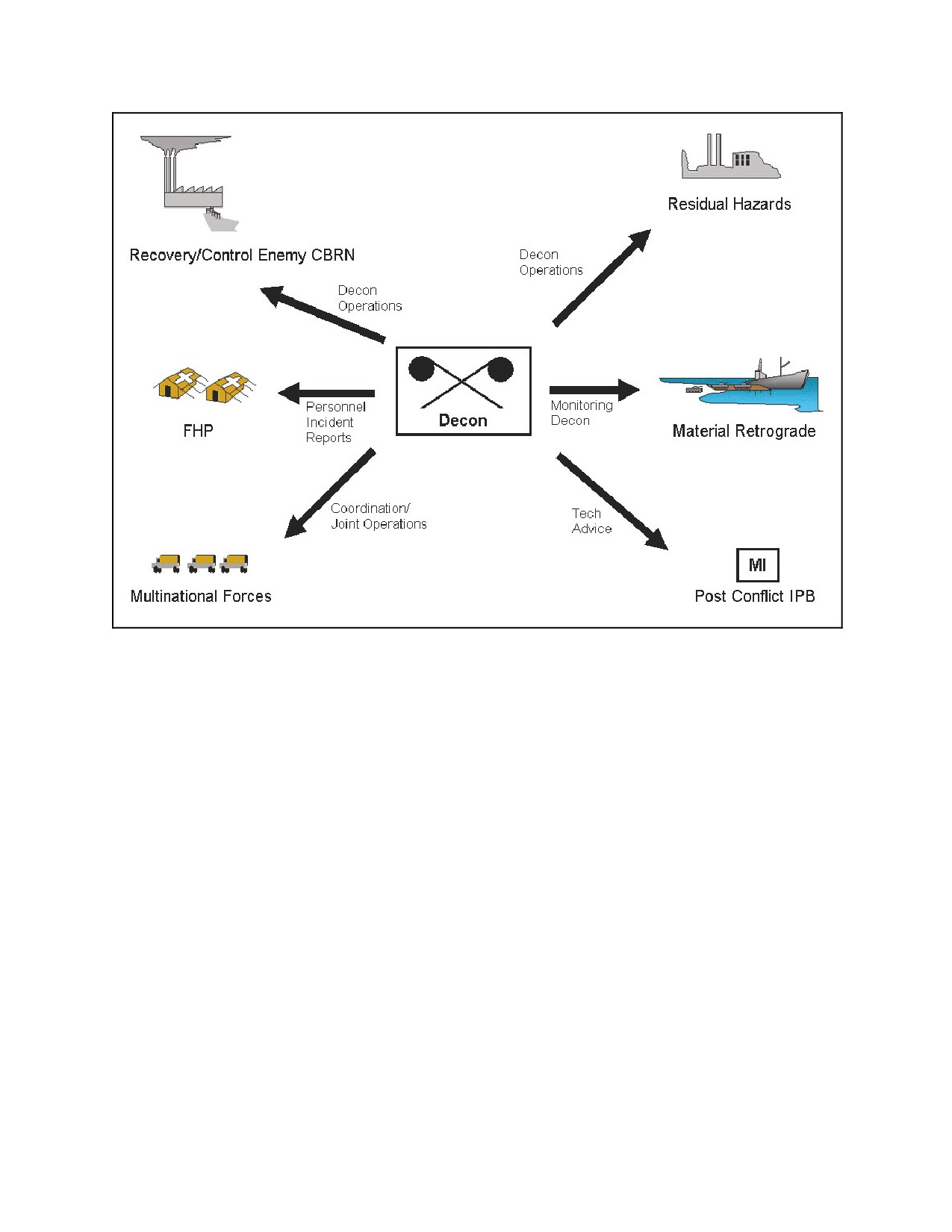
Figure VI-1. Decontamination Support
e.
Clearance decontamination requires a significant level of effort. The resources
needed to conduct clearance decontamination (i.e., low-level CBRN or TIM monitoring
capabilities, decontamination units, MEDSURV, supplies, and equipment) require
coordination from the unit level through the combatant command level.
2.
Postconflict Intelligence Preparation of the Battlespace
As a conflict ends, there remain significant IPB-related functions that may continue to
require decontamination support.
a.
Even when the conflict has terminated, the continued presence of threat CBRN
weapons, contaminated areas, and TIM hazards presents volatile situations. This may be
particularly true as HN and international relief agencies enter the area. CBRN defense
assets may be tasked to support intelligence collection on enemy CBRN weapons that are
assessed to exist but which have not been captured or destroyed. In such cases, intelligence
will attempt to develop a complete picture of the enemy’s residual CBRN assets and
capabilities—including probable locations and dispositions of weapons and agents, research
and production facilities, documentation, key enemy military and civilian personnel, and
possible reaction from residual enemy forces.
b.
The CBRN defense personnel may also be tasked to assess the hazards from
indigenous TIM facilities that have suffered collateral damage and to be prepared to deal
with the release of TIM from those facilities.
VI-2
FM 3-11.5/MCWP 3-37.3/NTTP 3-11.26/AFTTP(I) 3-2.60
4 April 2006
3.
Force Protection
During conflict termination, FP measures still deter, detect, contain, and mitigate the
possible effects of CBRN attacks and threats. Unit draw-down may invite strikes by
residual enemy forces or terrorists to punish and inflict revenge on the United States and
coalition forces. Planning for decontamination operations, therefore, must continue.
Decontamination site selection can now be based on internal lines of communication (LOCs)
rather than the axis of advance, which facilitates logistics and transportation. Other site
selection considerations (such as road network accessibility, water sources and drainage,
and likely wind direction) still apply.
4.
Decontamination
Clearance decontamination may be required as part of a supported unit’s restoration
operations. For example, a unit may now have time to conduct clearance decontamination
that was deferred during previous operations. Decontamination elements may also be
tasked to support the decontamination of civilian personnel, equipment, facilities or terrain
in coordination with HN authorities. See Multiservice Tactics, Techniques, and Procedures
for NBC Defense of Theater Fixed Sites, Ports, and Airfields for more information on
clearance decontamination procedures.
5.
Containment of Residual Hazards
Expect to receive taskings to identify, assess, and mitigate contamination hazards that
may remain at the end of the conflict. An assessment based on the accurate records of
known hazards will help determine what actions are necessary (e.g., isolation, weathering,
decontamination, containerization). Decontamination may be required, and
decontaminated materials may be transferred to the HN or to follow-on forces.
6.
Recovery and Control of Enemy Chemical, Biological, Radiological, and
Nuclear Capabilities
Emphasis will be placed on identifying and securing enemy CBRN capabilities. As
enemy CBRN weapons, agents, and facilities are discovered, they will likely be disabled,
destroyed, or isolated. Decontamination elements can expect taskings to support the
recovery and control of enemy CBRN capabilities.
a.
As in combat operations, prior planning will facilitate decontamination support
and ensure that the mission is successful. Decontamination elements should maintain
close coordination with those forces searching for and assessing residual enemy CBRN
capabilities (particularly the types of agents, locations, and size of facilities). This
coordination will enable decontamination planners to anticipate logistics, transportation,
and personnel requirements.
b.
A search and recovery task force (S/RTF), formed to gain timely control over
enemy CBRN capabilities, may include a decontamination specialist to advise on how
items, facilities, or hazard areas may be decontaminated or advise on the practicality of
decontamination. This specialist would provide vital planning information to the
decontamination element.
c.
The S/RTF would also provide emergency responses to CBRN incidents or
accidents, resulting in an emergency response from the supporting decontamination
element. This requires the decontamination element to maintain close coordination with its
higher HQ and supporting transportation and logistics elements.
4 April 2006
FM 3-11.5/MCWP 3-37.3/NTTP 3-11.26/AFTTP(I) 3-2.60
VI-3
7.
Force Health Protection
a.
The services use MEDSURV systems to identify outbreaks of illness, which can
help in the assessment and identification of potential BW casualties. Medical teams can
identify, treat, and handle CBRN casualties. MTFs have personnel who are trained in
decontamination procedures so that only clean patients will enter and be admitted to
hospitals. Biologically contagious patients can be treated under isolation conditions. HSS
systems also conduct health risk assessments for CBRN and TIM exposure and monitor
individual exposure as part of their recordkeeping. For more information, see FM 4-02.7.
b.
Records kept by decontamination elements also contribute to the surveillance
process. When coordinated with health service units is maintained, useful information on
individual exposure and decontamination (such as the type of agent, level of radiation
exposure, number of exposed individuals, dates and times of exposure events) can be
provided to assess the patient’s condition and short- and long-term treatment requirements.
8.
Coordination With Multinational Forces or Nonmilitary Entities
a.
As combat operations terminate, multinational forces or HN elements may arrive
and assume missions from redeploying US units. The activities of these forces and
organizations may include the decontamination and management of contaminated areas.
The US decontamination elements may be tasked to take the lead or to assist in these
activities. Working relationships with these elements should be defined by a treaty or
MOU.
b.
Incoming personnel must be briefed on multinational or HN procedures,
equipment, and training. In any case, ensure that the responsibilities of each element and
the procedures to be used are agreed to and clearly understood by all parties.
9.
Contaminated Materials Retrogradation
As a part of unit redeployment, some equipment to be redeployed (retrograded) may
have potential residual or low-level contamination. Suspected equipment may be identified
through the records made during operational and thorough decontamination operations.
Also, any vehicle or piece of equipment that was present in an attack or a downwind hazard
area may have residual contamination.
a.
If equipment is to be retrograded under nonemergency conditions, then it is
assumed that there will be time for thorough and clearance decontamination and
weathering. Redeployment planning should specify consolidation points in the JRA for
equipment suspected of residual contamination. Specialized detectors and monitors may be
needed for clearance decontamination to confirm and monitor for contamination. As
suspected equipment is consolidated for monitoring, decontamination, and weathering,
security and buffer zones around the site provide an additional contamination control
measure. Personnel engaged in monitoring, preparation, and clearance decontamination of
equipment will require stringent personal protection and specialized detectors. This
process may continue for weeks or months.
b.
Even after thorough decontamination, potential vapor and contact hazards will
likely remain. The risk increases as contaminated equipment is consolidated and as
personnel work around the equipment for extended periods. The risk increases again as
equipment is disassembled for maintenance or containerization (therefore, the need for
clearance decontamination). However, given the limitations of decontamination technology,
VI-4
FM 3-11.5/MCWP 3-37.3/NTTP 3-11.26/AFTTP(I) 3-2.60
4 April 2006
some items of equipment may require extensive weathering before retrogradation, or may
have to be destroyed.
c.
Once in the continental United States (CONUS), an item of equipment with a
contamination history will require precautionary measures throughout its remaining life
cycle. Guidance on the eventual disposition of previously contaminated equipment should
be provided from the strategic level.
d.
Accurate record keeping is crucial to a successful clearance decontamination
operation. Messages sent or received via the NBCWRS; records of personnel and
equipment undergoing operational, thorough, and clearance decontamination; and
photographic or video records will be referred to again in assessing a unit’s requirements
during clearance decontamination operations and in evaluating the (former) battlespace for
residual CBRN and TIM hazards. Especially important are NBC 4, 5, and 6 reports, which
may also be used to report TIM hazards. There may be a requirement to share information
on contaminated areas (contained in NBC 4, 5, and 6 reports) with the HN. (The security
that surrounded an NBC5 report during operations may no longer be required when
hostilities have ceased.) These reports may also form the basis for new CBRN
reconnaissance and monitoring missions at the end of hostilities.
(1)
Records pertaining to personnel and equipment that have undergone
operational and thorough decontamination are also necessary for assessing the unit
undergoing clearance decontamination. These records are made at the predecontamination
triage (they identify elements that required decontamination and identify uncontaminated
elements that were sent ahead to the postdecontamination AA) and should contain vehicle
and equipment identification numbers. While the contaminated unit is responsible for
maintaining an accurate decontamination record, it is useful for the supporting
decontamination element to keep a duplicate record. For example, such records can be used
to justify the expenditure of decontamination materials and the reordering of supplies. In
the context of clearance decontamination operations, the decontamination element may be
required to account for decontaminated personnel and equipment, even those that belong to
a supported unit.
(2)
Prepare follow-up reports as the conflict nears an end. Prepare summaries
that outline when, where, and how CBRN attacks or TIM incidents occurred. These records
will facilitate many of the tasks associated with clearance decontamination operations,
particularly postconflict IPB and the containment of residual hazards. Site incident reports
involving personnel will be useful in evaluating long-term health issues that could be
operationally related and will contribute to overall FHP.
4 April 2006
FM 3-11.5/MCWP 3-37.3/NTTP 3-11.26/AFTTP(I) 3-2.60
VI-5
THIS PAGE IS INTENTIONALLY LEFT BLANK.
Chapter VII
FIXED-SITE, PORT, AND AIRFIELD DECONTAMINATION
1.
Background
a.
This chapter addresses fixed-site decontamination, capabilities, and
organization. It also discusses the procedures for processing personnel on a fixed site for
chemical and radiological decontamination. See Multiservice Tactics, Techniques, and
Procedures for Chemical, Biological, Radiological, and Nuclear Defense of Fixed Sites, Ports,
and Airfields for more detailed information on CBRN decontamination operations for fixed
sites. Decontamination is necessary when protective items cannot be worn to perform the
mission, or when long-term occupancy is anticipated. Examples of fixed sites include the
following:
•
Command, control, communications, and intelligence facilities.
•
Ports and airfields.
•
Temporary key structures for reserve and large troop concentration.
•
Supply installations, and depots.
•
Pre-positioning of material configured to unit sets (POMCUS) storage locations,
airfields, water terminals, and rail terminals.
•
MTFs.
•
Ammunition supply points and petroleum, oils, and lubricants (POL) points.
•
Maintenance sites.
b.
Decontaminate as soon as possible. Remove any contamination that forces
personnel into a higher MOPP level. The first steps in recovering mission effectiveness are
personnel decontaminating themselves, their personal equipment, and critical, mission-
essential equipment.
c.
Decontaminate only what is necessary. For fixed sites, decontamination is more
of a manpower resource constraint rather than a time constraint. Decontaminate only
mission-essential equipment, and mark contamination appropriately. An example of this
principle is the loading and unloading of supplies on a boxcar at a site with railheads.
Since fixed-site personnel do not have the capability to decontaminate the entire boxcar,
only those parts that are touched, such as the door, are decontaminated.
d.
Decontaminate by priority. The commander must establish a set of priorities.
These priorities may be broken down by functional area if the site performs missions such
as maintenance (light and heavy), ammunition repair and supply, and general supply.
Items such as wheeled vehicles, forklifts, and railcars, which are critical to the overall
mission, should be decontaminated first.
e.
Limit the spread of contamination. Units should conduct decontamination
(operational and thorough) outside the contaminated area but near where the
contamination occurred. This reduces the risk of spreading contamination to other areas
and reduces travel time.
4 April 2006
FM 3-11.5/MCWP 3-37.3/NTTP 3-11.26/AFTTP(I) 3-2.60
VII-1
2.
Assessing Capability
Fixed-site decontamination capabilities must be adapted for each fixed site. Mobile
decontamination equipment capabilities may be available at a fixed site to decontaminate
equipment, roads, and buildings. Loading docks, entries and exits, and building exteriors
can be decontaminated with more conventional methods such as using STB and soap and
water. Equipment such as fire trucks could also be used. Commanders should identify all
systems that are capable of contributing to the decontamination effort (e.g., fire trucks,
steam cleaners, water pumps). Decontamination equipment can be retrofitted to
accommodate the throughput of each work area. For instance, rest-and-relief shelters need
rapid personnel decontamination systems, and supply operations need a decontamination
system that can handle moderate-size pieces of equipment at a high volume.
3.
Organizing for Decontamination
The commander should designate and train teams that can perform decontamination
for fixed-site operations. The following are fixed-site decontamination techniques that the
teams could apply:
a.
Decontamination can be conducted at contaminated entry and exit points to
sustain the mission. This concept is more practical and efficient when employing limited
decontaminated assets. The STB application could be conducted 3 meters on each side of
the entry and exit points. Transfer hazard will remain a problem until all parts of the area
have weathered. Buildings entries and exits must be decontaminated accordingly.
b.
To decontaminate helipads and similar sites, spray STB on entry and exit
approaches or on paths in an event that chemical contamination occurs. Airborne STB
particles can damage sensitive aircraft components so the area should be washed with
water prior to landing helicopters.
c.
In POMCUS sites, decontaminate entry and exit approaches to limit
contamination. Exposed vehicles in motor parks will get contaminated, but most likely
there will not be enough personnel to drive the vehicles to a decontamination station.
Decontaminate parked equipment by spraying them with STB or hot, soapy water. Driving
other vehicles around the parked vehicles and equipment will get the outside air flowing
and will accelerate the weathering process of the chemical agents.
d.
Establish a patient transfer zone for medical assets where designated dirty
ambulances coming from the contaminated area can transfer patients to clean ambulances
for patient movement to the MTF.
4.
Buildings and Mission-Essential Operating Areas and Surfaces
The decontamination of buildings and mission-essential surfaces and equipment
requires a well-thought-out process.
a.
Buildings. The decontamination of a building consists of two parts—interior and
exterior.
(1)
Interior. When conducting decontamination of the interior of a building,
the following activities must occur:
•
Secure the facility.
•
Sample to confirm and determine the extent of the contamination.
VII-2
FM 3-11.5/MCWP 3-37.3/NTTP 3-11.26/AFTTP(I) 3-2.60
4 April 2006
•
Evaluate the sampling results.
•
Isolate the areas to prevent the spread of the contamination.
•
Remove critical objects for special decontamination procedures. Take care
to ensure that contamination is not spread or transferred during movement.
•
Decontaminate localized areas of the contamination.
•
Continue monitoring and protecting against low-level exposure risks.
•
Document and record the decontamination operations.
(2)
Exterior. When decontaminating the exterior of a building, see Appendix D
to determine how to decontaminate specific building surfaces (e.g., roofing material and
wood). Many materials may absorb contamination and may not be completely
decontaminated. The removal or sealing (painting) of these surfaces may be required to
reduce the hazard. Continue monitoring the decontaminated surfaces until the detector
indicates there is no more off-gassing. As temperatures rise, off-gassing of previously
contaminated surfaces may occur at detectable levels. A point detection device (e.g.,
ICAM/CAM) should be used to monitor contaminated surfaces.
b.
Mission-Essential Operating Surfaces and Equipment.
(1)
On- and Off-Loading Ramps and Piers. Use Appendix D to determine how
to decontaminate the surfaces of on- and off-loading ramps and piers.
(2)
Helipads. Use Appendix D to determine how to decontaminate helipad
surfaces.
(3)
Lines of Communications. See Appendix I for information on terrain
decontamination.
(4)
Staging Areas. Staging areas pose a unique opportunity for the enemy to
contaminate large amounts of personnel and equipment. Commanders and their CBRN
staffs must ensure that they can effectively identify contaminated personnel and
equipment. Decontaminating only those personnel and equipment that have been
contaminated saves resources and time. The decontamination of staging areas can be
critical to operations. In addition to the personnel and equipment contaminated,
contaminated routes in and out of staging areas must be decontaminated to reduce the
likelihood of the spread of the contamination. See Multiservice Tactics, Techniques, and
Procedures for Nuclear, Biological, and Chemical Reconnaissance for methods to determine the
location and extent of contamination.
(5)
Terrain. Terrain decontamination is covered in Appendix I of this manual.
5.
Personnel Processing Procedures (Chemical)
A comprehensive CBRN VA can help determine a suitable location for the fixed-site
contamination control area (CCA) and the toxic-free area (TFA) complexes. The next
consideration is determining how large an area will be needed. The CCA and TFA may be
off or on the installation. The location of the CCA and TFA will depend on feedback from
the CBRN VA.
4 April 2006
FM 3-11.5/MCWP 3-37.3/NTTP 3-11.26/AFTTP(I) 3-2.60
VII-3
a.
Off Site. The decision to site CCA and TFA complexes off the installation
(probably at preselected sites located at least 10 km from the installation) should work if
the following parameters are present:
(1)
The sites are located at least 15 km away from populated areas, and the
proposed routes to the CCA and TFA complexes are not intersected by potential civilian
evacuation routes.
(2)
Locations provide adequate space, multiple access routes, sufficient water
and utility support, communications (primarily back to the main installation C2 and
warning and notification networks), and a degree of personnel protection (from elements
and hostile attack).
(3)
Civilian populations are not located downwind within 15 km of the CCA
complex, to include the aeration area and contaminated-waste disposal area.
(4)
There is an exceptionally limited or nonexistent ground threat, to include
activities from terrorists.
(5)
The installation possesses sufficient resources to execute the plan.
b.
On Site. Finding and utilizing clean areas for CCA and TFA operations within
the installation perimeter is preferable when—
(1)
The installation is near heavily populated civilian areas or near a potential
civilian evacuation route (there may be resulting traffic jams that would probably result in
making off-base CCA and TFA complexes unreachable).
(2)
A ground threat exists.
(3)
The population is resource-constrained in regards to transportation.
Communications limitations are also a factor.
(4)
The installation is large enough to possess areas outside the target-rich
environment associated with the industrial and main housing areas.
(5)
The installation possesses a reliable detection network. The potential risk
to personnel as a result of changing weather conditions and certain terrain features is
increased if the installation cannot field an effective detection system. For example,
because agents tend to follow the low-lying areas of the ground, an installation may
establish CCAs and TFAs on uncontaminated hilltops, ridges, or multistoried buildings. It
is possible that the concentrations of an agent at these levels (verified through the use of
detectors) are such that rest and relief may be obtained by “going up.”
c.
Combined Approach. A combined approach of site selection may be the best
methodology. The prioritization for site selection should be—
(1)
On site with a ground level arrangement.
(2)
On site with a vertical arrangement (space permitting).
(3)
Off site.
d.
Space Requirement. The requirement for space is a factor associated with
selecting the site for CCA and TFA complexes. The minimum size for CCA and TFA sites is
500 square meters. Once a processing line is established and people are moving through it
(i.e., as one person leaves a station, another person steps up), a relatively smooth flow will
VII-4
FM 3-11.5/MCWP 3-37.3/NTTP 3-11.26/AFTTP(I) 3-2.60
4 April 2006