FM 3-11.5 MULTISERVICE TACTICS, TECHNIQUES, AND PROCEDURES FOR CHEMICAL, BIOLOGICAL, RADIOLOGICAL, AND NUCLEAR DECONTAMINATION (April 2006) - page 1
*FM 3-11.5
MCWP 3-37.3
NTTP 3-11.26
AFTTP(I) 3-2.60
FM 3-11.5
US Army Training and Doctrine Command
Fort Monroe, Virginia
MCWP 3-37.3
Marine Corps Combat Development Command
Quantico, Virginia
NTTP 3-11.26
Navy Warfare Development Command
Newport, Rhode Island
AFTTP(I) 3-2.60
Headquarters Air Force Doctrine Center
Maxwell Air Force Base, Alabama
4 April 2006
MULTISERVICE TACTICS, TECHNIQUES, AND PROCEDURES
FOR
CHEMICAL, BIOLOGICAL, RADIOLOGICAL, AND NUCLEAR
DECONTAMINATION
TABLE OF CONTENTS
Page
EXECUTIVE SUMMARY
xv
CHAPTER I
DECONTAMINATION: CONCEPTS, PRINCIPLES, AND LEVELS
Background
I-1
Hazard
I-3
Concepts—Combat Operations
I-3
Concepts—Homeland Security
I-8
Service Capabilities
I-10
Training and Exercises
I-10
DISTRIBUTION RESTRICTION: Approved for public release; distribution is unlimited.
*This manual supersedes FM 3-5 and MCWP 3-37.3, 28 July 2000.
4 April 2006
FM 3-11.5/MCWP 3-37.3/NTTP 3-11.26/AFTTP(I) 3-2.60
v
CHAPTER II
DECONTAMINATION OPERATIONS: PLAN, PREPARE, AND
EXECUTE
Background
II-1
Decontamination Planning
II-1
Wartime Planning Considerations
II-3
Homeland Security Planning Considerations
II-6
Preattack Decontamination Operations
II-7
Execution
II-10
Postdecontamination Operations
II-11
CHAPTER III
IMMEDIATE DECONTAMINATION
Background
III-1
Skin Decontamination
III-1
Personal Wipe Down
III-1
Operator Wipe Down
III-2
Spot Decontamination
III-3
CHAPTER IV
OPERATIONAL DECONTAMINATION
Background
IV-1
Planning
IV-1
Phases
IV-2
CHAPTER V
THOROUGH DECONTAMINATION
Background
V-1
Planning
V-2
Preparation
V-3
Execution
V-3
Predecontamination Staging Area
…V-6
Vehicle Crews
V-6
Detailed Equipment Decontamination and Detailed Troop
Decontamination Areas
V-7
Thorough Decontamination Under Unusual Conditions
V-30
Colocation of Patient Decontamination With Troop
Decontamination
V-30
CHAPTER VI
CLEARANCE DECONTAMINATION
Background
VI-1
Postconflict Intelligence Preparation of the Battlespace
VI-2
Force Protection
VI-3
Decontamination
VI-3
Containment of Residual Hazards
VI-3
Recovery and Control of Enemy Chemical, Biological,
Radiological, and Nuclear Capabilities
VI-3
Force Health Protection
VI-4
Coordination With Multinational Forces or Nonmilitary
Entities
VI-4
Contaminated Materials Retrogradation
VI-4
CHAPTER VII
FIXED-SITE, PORT, AND AIRFIELD DECONTAMINATION
Background
VII-1
Assessing Capability
VII-2
vi
FM 3-11.5/MCWP 3-37.3/NTTP 3-11.26/AFTTP(I) 3-2.60
4 April 2006
Organizing for Decontamination
VII-2
Buildings and Mission-Essential Operating Areas and
Surfaces
VII-2
Personnel Processing Procedures (Chemical)
VII-3
Personnel Processing Procedures (Radiological)
VII-12
CHAPTER VIII
AIRCRAFT AND AIRCREW DECONTAMINATION
Background
VIII-1
General Planning
VIII-1
Aircraft Decontamination Levels and Procedures
…VIII-3
Civil Reserve Air Fleet and Contract Airlift Operations
VIII-21
Aircraft Munitions Decontamination
VIII-21
Air Cargo Movement Decontamination
VIII-23
CHAPTER IX
SHIPBOARD/MARITIME DECONTAMINATION
Background
IX-1
Shipboard Chemical, Biological, and Radiological
Decontamination
IX-1
Recovery Chemical, Biological, Radiological, and Nuclear
Decontamination
IX-5
CHAPTER X
PATIENT EVACUATION AND DECONTAMINATION
Background
X-1
Patient Decontamination
X-3
Army Patient Decontamination Procedures
X-5
Marine Corps Patient Decontamination Procedures
X-6
Navy Patient Decontamination Procedures
X-7
Air Force Patient Decontamination Procedures
X-7
CHAPTER XI
DECONTAMINATION IN SUPPORT OF HOMELAND SECURITY
Background
XI-1
Federal Assistance
XI-1
Response to a Homeland Security Incident—
Decontamination Considerations
XI-2
Department of Defense Decontamination Capabilities
XI-9
CHAPTER XII
LOGISTICS
Background
XII-1
Consumption Rates and Replenishment
XII-1
Maintenance Considerations
XII-7
APPENDIX A
CONVERSIONS AND MEASUREMENTS
APPENDIX B
TECHNICAL ASPECTS OF CHEMICAL, BIOLOGICAL,
RADIOLOGICAL, AND NUCLEAR, AND TOXIC INDUSTRIAL
MATERIAL DECONTAMINATION
Background
B-1
Nuclear and Radiological Weapons
B-1
Biological Warfare Agents
B-3
Chemical Agents
B-7
Toxic Industrial Material
B-9
Technical Reach-Back
B-10
4 April 2006
FM 3-11.5/MCWP 3-37.3/NTTP 3-11.26/AFTTP(I) 3-2.60
vii
APPENDIX C
DECONTAMINANTS
Background
C-1
Types of Decontaminants
C-1
Decontamination Solution Preparation
C-9
Storage and Shelf Life
C-10
Decontaminants
C-10
APPENDIX D
DECONTAMINATION OF SPECIFIC SURFACES AND
MATERIALS
APPENDIX E
SPECIAL DECONTAMINATION CONSIDERATIONS
Background
E-1
Vulnerable/Sensitive Equipment
E-1
Chemical, Biological, Radiological, and Nuclear Munitions
Disposal
E-4
Sample Transfer, Evacuation, and Processing
E-5
Depleted-Uranium Decontamination
E-5
Decontamination of Specific Radioisotopes
E-7
Contaminated-Remains Decontamination
E-9
Animals
E-10
APPENDIX F
EFFECTS OF THE ENVIRONMENT ON DECONTAMINATION
Background
F-1
Cold Weather
F-1
Hot Weather (Desert and Jungle)
F-3
Urban Areas
F-5
Mountains
F-5
APPENDIX G
DECONTAMINATION UNITS AND ASSETS
Background
G-1
Army
G-1
Marine Corps
G-4
Air Force
G-7
Navy
G-10
Other Units
G-11
APPENDIX H
DECONTAMINATION KITS, APPARATUSES, AND
EQUIPMENT
Background
H-1
Decontamination Devices for Personnel
H-4
Decontamination Devices for Equipment
H-5
Power-Driven Decontamination Systems
H-7
Fixed-Site Decontamination System Tactics, Techniques, and
Procedures
H-10
APPENDIX I
TERRAIN DECONTAMINATION
Background
I-1
Terrain Decontamination Methods
I-1
Types of Surfaces
I-4
APPENDIX J
THOROUGH DECONTAMINATION STATION CHARTS FOR
SUPERVISORS AND ATTENDANTS
viii
FM 3-11.5/MCWP 3-37.3/NTTP 3-11.26/AFTTP(I) 3-2.60
4 April 2006
APPENDIX K
CONTAMINATED-WASTE COLLECTION AND DISPOSAL
Background
K-1
Responsibility
K-1
Contaminated-Waste Holding Area
K-1
Unit Waste Accumulation Points
K-1
Equipment and Material
K-2
Procedures for the Collection of Contaminated Waste
K-3
Transportation Procedures
K-5
Waste Collection Point
K-6
Disposal Procedures
K-6
Open Storage
K-7
Burying
K-7
Open Burning
K-7
Marking Requirements
K-9
REFERENCES
.........................................................................................References-1
GLOSSARY
.............................................................................................Glossary-1
INDEX
...................................................................................................Index-1
FIGURES
I-1
How Decontamination Affects Combat
Effectiveness
I-7
IV-1 Two-Lane Wash Down
IV-4
IV-2 Dispersed Operational-Decontamination Setup
IV-5
IV-3 Rolling the Cuff in the Trouser
IV-12
IV-4 Wiping From the Head to the Bottom of the
Hood
IV-13
IV-5 Rolling the Hood to the Center of the Head
IV-14
IV-6 Unsnapping the Trousers from the Jacket
IV-15
IV-7 Pulling the Jacket Down and Away
IV-15
IV-8 Loosening the Overboots
IV-15
IV-9 Stepping on the Black Lining of the Jacket
IV-16
IV-10 Removing the Gloves
IV-16
IV-11 Putting on the New BDO
IV-17
IV-12 Putting on M9 Detector Paper
IV-18
IV-13 Securing Individual Gear
IV-18
IV-14 Removing the Garment and Turning it Inside
Out
IV-21
IV-15 Removing Your Leg and Foot From the
Garment
IV-21
IV-16 Reapplying the M9 Detector Paper
IV-22
IV-17 Tying the Microphone Cord to the Hose of the
Mask
IV-24
4 April 2006
FM 3-11.5/MCWP 3-37.3/NTTP 3-11.26/AFTTP(I) 3-2.60
ix
IV-18 Removing the Outer Garment
IV-26
V-1 Thorough Decontamination Site
V-5
V-2 DTD Layout
V-8
V-3 Decontaminating Individual Equipment
V-10
V-4 Shuffle Pit Decontamination
V-12
V-5 Removing the Overgarment Jacket
V-13
V-6 Station 4 Layout
V-14
V-7 Liquid Contamination Control Line
V-15
V-8 Checking for Contamination
V-17
VI-1 Decontamination Support
V-I
VII-1 Sample Decontamination Site Layout
VII-7
VII-2 Example of a Ground Crew CCA Layout
VII-9
VII-3 Example of an Aircrew CCA Layout
VII-10
VIII-1 Aircraft Operational Decontamination Site
Layout
VIII-10
VIII-2 Helicopter Operational Decontamination Site
Layout
VIII-10
VIII-3 Sample Layout for a DAD Station
VIII-17
VIII-4 Sensitive Areas for the UH-60/E60, CH-47, and
AH-64
VIII-18
VIII-5
Sensitive Areas for the OH-58 and UH-1
VIII-19
H-1
M291 Skin Decontamination Kit
H-5
H-2
M295 IEDK
H-6
H-3
M100 SDS
H-7
H-4
M17 LDS
H-8
H-5
MPDS
H-9
H-6
FSDS Placed in a Civilian Vehicle
H-10
H-7
Two FSDS Conducting Terrain
Decontamination
H-13
H-8
FSDS Overlap Operation
H-14
H-9
Decontamination Control Point
H-14
H-10
Resupply COAs (Options 1 and 2)
H-15
H-11
Large-Area Missions
H-16
H-12
Hose Reel Operation (Two-Person)
H-17
I-1
Decontamination by Exploding
I-3
J-1
Sample Station 1 Checklist
J-2
J-2
Sample Station 2 (BDO) Checklist
J-3
J-3
Sample Station 2 (JSLIST) Checklist
J-4
J-4
Sample Station 3 (BDO) Checklist
J-5
J-5
Sample Station 3 (JSLIST) Checklist
J-6
x
FM 3-11.5/MCWP 3-37.3/NTTP 3-11.26/AFTTP(I) 3-2.60
4 April 2006
J-6
Sample Station 4 Checklist
J-7
J-7
Sample Station 5 Checklist
J-8
J-8
Sample Station 6 Checklist
J-9
J-9
Sample Station 7 Checklist
J-10
J-10
Sample Station 8 Checklist
J-11
K-1
Glove Decontamination
K-4
K-2
Markings
K-4
TABLES
I-1
Decontamination Levels and Techniques
I-5
1-2
Special Medical Considerations
I-5
II-1
Work/Rest Cycles and Water Replacement
Guidelines
II-5
II-2
Preattack Decontamination Actions
II-10
IV-1
Advantages and Disadvantages of Operational
Decontamination Techniques
IV-2
IV-2
Operational Decontamination Phases
IV-2
IV-3
Vehicle Wash-Down Process
IV-6
IV-4
Steps for the Buddy Team Method of MOPP Gear
Exchange With the JSLIST Chemical-Protective
Ensemble
IV-7
IV-5
Steps for the BDO MOPP Gear Exchange
IV-11
IV-6
Steps for the CVCUS and CPU (Buddy Team
Method) MOPP Gear Exchange
IV-19
IV-7
Steps for the Triple Buddy Method of MOPP Gear
Exchange With the M40A1 and M42
IV-23
IV-8
Steps for the CVCUS and CPU (Triple Buddy
Method) MOPP Gear Exchange With the M40A1,
M42, and M43 (Aviation and Armor)
IV-28
IV-9
Steps for the JSLIST, Individual (Emergency
Method) MOPP Gear Exchange
IV-32
IV-10 Steps for the Individual (Emergency Method)
BDO MOPP Gear Exchange
IV-36
IV-11 Steps for the CVCUS and CPU, Individual
(Emergency Method) MOPP Gear Exchange
IV-39
V-1 Planning Factors for the Rinse Station
V-3
V-2 Thorough Decontamination Support Matrix
(Land Forces)
V-4
V-3 DTD Personnel and Equipment Recapitulation
V-8
V-4 Effectiveness of Types of Wash
V-20
V-5 Common Interferences for the CAM
V-22
4 April 2006
FM 3-11.5/MCWP 3-37.3/NTTP 3-11.26/AFTTP(I) 3-2.60
xi
V-6 Personnel and Equipment Requirements for the
Optimum DED Layout of an M12A1 PDDA-
Equipped Unit
V-23
V-7 Personnel and Equipment Requirements for the
Alternate DED Layout of an M12A1 PDDA-
Equipped Unit
V-25
V-8 Recommended Work/Rest Cycles for DED
V-26
V-9 Personnel and Equipment Requirements for the
Optimum DED Layout of an M17 LDS-Equipped
Unit
V-27
V-10 Personnel and Equipment Requirements for the
Alternate DED Layout of an M17 LDS-Equipped
Unit
V-28
VIII-1 Aircraft Spot Decontamination
VIII-4
VIII-2 Sample Aircraft Sizes and Recommended Pad
Containment Areas
VIII-11
VIII-3 Personnel Requirements for DAD
VIII-16
VIII-4 Cargo Movement Mission Criticality Level
VIII-23
VIII-5 Cargo Movement Hazard Category
VIII-23
VIII-6 Cargo Decontamination Actions (Negligible)
VIII-24
XII-1 Estimated Water Consumption
XII-2
XII-2 Decontamination Resources Available at Each
Organizational Level (Army)
XII-3
XII-3 Equipment and Supplies Needed for
Decontamination Operations (Army)
XII-4
XII-4 Medical Equipment Set Chemical-Agent Patient
Decontamination
XII-7
A-1 Measurements and Weights of Decontaminant
Containers
A-1
A-2 Table of Commonly Used Prefixes
A-1
A-3 Conversion Factors
A-2
B-1 Nuclear-Weapon Detonation Downwind
Radioactive Fallout Hazard Estimate
B-2
B-2 Survival of Selected Bacterial and Rickettsial
Agents in Some Environments
B-4
B-3 Protective Capability of Common Barrier Material
(in Minutes)
B-8
B-4 Categories of TIM
B-10
B-5 Technical Reach-Back POCs
B-10
C-1 Guidelines for the Use of Soil as a Decontaminant.. C-4
C-2 Preparation of Decontamination Solution Using
HTH (6-Ounce Bottles)
C-5
xii
FM 3-11.5/MCWP 3-37.3/NTTP 3-11.26/AFTTP(I) 3-2.60
4 April 2006
C-3
Preparation of Decontamination Solution Using
HTH (Granular)
C-5
C-4
Preparation of 0.5 Percent Available Chlorine
Solutions
C-5
C-5
Operational Limitations of DF 200
C-9
C-6
Standard Decontaminants Available in the Supply
System
C-11
C-7
Miscellaneous (Nonstandard) Decontaminants
C-13
C-8
Natural Decontaminants
C-21
D-1
Decontamination Procedures for Specific Surfaces
and Materials
D-1
F-1
Freezing Points and Melting Points of Selected
Chemical Agents
F-2
G-1
USAF UTCs
G-9
G-2
CE and Medical CBRN Decontamination
Capabilities
G-10
G-3
USA Reserve Component Platoon Equipment for
Casualty Decontamination
G-12
H-1
Decontamination Equipment and Materials
H-1
H-2
Detection Equipment and Materials
H-2
H-3
Typical Mission Parameters (1,000 gallons of
DF 200)
H-11
K-1
Weather Conditions
K-8
4 April 2006
FM 3-11.5/MCWP 3-37.3/NTTP 3-11.26/AFTTP(I) 3-2.60
xiii
EXECUTIVE SUMMARY
Multiservice Tactics, Techniques, and Procedures
for
Chemical, Biological, Radiological, and Nuclear Decontamination
Chapter I
Decontamination: Concepts, Principles, and Levels
Chapter I addresses the threats, purposes, and principles behind CBRN
decontamination.
Chapter II
Decontamination Operations: Plan, Prepare, and Execute
Chapter II addresses the planning of decontamination operations for wartime and for
civil support (CS). It also addresses the reconnaissance and preparation of
decontamination sites.
Chapter III
Immediate Decontamination
Chapter III addresses the steps used for immediate decontamination. This chapter also
discusses the techniques and procedures for using the most common decontamination kits
and equipment available in the US inventory.
Chapter IV
Operational Decontamination
Chapter IV addresses the planning, preparing, executing, and implementing
techniques for operational decontamination. It covers vehicle wash down and
mission-oriented protective posture (MOPP) gear exchange.
Chapter V
Thorough Decontamination
Chapter V addresses planning, preparing, and executing the techniques for thorough
decontamination. It covers predecontamination requirements, decontamination techniques,
detailed troop decontamination (DTD), detailed equipment decontamination (DED),
postdecontamination operations, site closure, and resupply.
Chapter VI
Clearance Decontamination
Chapter VI addresses decontamination of equipment and personnel to levels that
allow unrestricted transportation, maintenance, employment, and disposal.
4 April 2006
FM 3-11.5/MCWP 3-37.3/NTTP 3-11.26/AFTTP(I) 3-2.60
xv
Chapter VII
Fixed-Site, Port, and Airfield Decontamination
Chapter VII addresses planning, preparing, executing, and implementing the
techniques for fixed-site, port, and airfield decontamination.
Chapter VIII
Aircraft and Aircrew Decontamination
Chapter VIII addresses aircraft, aircraft cargo, and aircrew decontamination. Detailed
aircraft decontamination (DAD) procedures are provided in this chapter.
Chapter IX
Shipboard/Maritime Decontamination
Chapter IX addresses the considerations pertaining to shipboard and maritime
decontamination.
Chapter X
Patient Evacuation and Decontamination
Chapter X addresses patient evacuation procedures; the decontamination procedures
for litter or ambulatory patients for chemical, biological, and radiological (CBR)
contamination; and decontaminant preparation.
Chapter XI
Decontamination in Support of Homeland Security
Chapter XI addresses decontamination support for HLS.
Chapter XII
Logistics
Chapter XII identifies the logistical considerations for the various decontamination
techniques.
xvi
FM 3-11.5/MCWP 3-37.3/NTTP 3-11.26/AFTTP(I) 3-2.60
4 April 2006
PROGRAM PARTICIPANTS
The following commands and agencies participated in the development of this
publication:
Joint
Defense Threat Reduction Agency, 8725 John J. Kingman Road, MCS 6201, Fort Belvoir,
VA 22060-6201
Army
United States Army Chemical School, 464 MANSCEN Loop, Suite 2617, Fort Leonard
Wood, MO 65473
United States Army Medical Department Center and School, 1400 E. Grayson Street, Fort
Sam Houston, TX 78234
United States Army Edgewood Chemical and Biological Center, Aberdeen Proving Ground,
MD 21040
Marine Corps
United States Marine Corps Combat Development Command, 3300 Russell Road, Suite
318A, Quantico, VA 22134-5021
Navy
United States Navy Warfare Development Command, 686 Cushing Road, Sims Hall,
Newport, RI 02841
United States Navy Surface Warfare Development Group, 2200 Amphibious Drive, Norfolk,
VA 23521
Air Force
Headquarters Air Force Doctrine Center, ATTN: DJ, 155 North Twining Street, Maxwell
AFB, AL 36112-6112
United States Air Force Civil Engineer Support Agency, 139 Barnes Drive, Suite 1, Tyndall
AFB, FL 32403
4 April 2006
FM 3-11.5/MCWP 3-37.3/NTTP 3-11.26/AFTTP(I) 3-2.60
xvii
Chapter I
DECONTAMINATION: CONCEPTS, PRINCIPLES, AND LEVELS
1. Background
The hazards associated with CBRN attacks and events often force US forces into
protective equipment, thereby degrading their ability to perform individual and collective
tasks and reducing combat power. Such hazards may be created by the deliberate use of
CBRN weapons or a release from industrial sources. Additionally, they may be created by
accidental release, natural disasters, or collateral damage release from industrial sources
(TIM). These hazards may require decontamination of personnel, equipment, facilities, or
terrain.
a.
Forms of Contamination. CBRN agent contamination is the deposition on or
absorption of CBRN agents by personnel, materiel, structures, and terrain. US forces may
encounter CBRN agent contamination through direct attack, movement through
contaminated areas, the unwitting use of contaminated facilities, or the movement of agent
clouds. Forms of contamination may be—
(1)
Vapor. Vapors can be generated by generators or bursting munitions.
Vapor in an open or outdoor area will generally disperse rapidly.
(2)
Liquid. CB agents can be disseminated as liquids. Liquid droplets can
range from thick and sticky to the consistency of water. Liquids can also be disseminated
as an aerosol.
(3)
Aerosol. An aerosol is a liquid or solid composed of finely divided particles
suspended in a gaseous medium. Examples of common aerosols are mist, fog, and smoke.
They behave much like vapors.
(4)
Solids. Solid forms of contamination include radioactive particles,
biological spores, and dusty agents. A dusty agent is a solid agent that can be disseminated
as an aerosol.
b.
Hazard Transmission. When CBRN contamination cannot be avoided, resources
may require decontamination. Contaminated hazards can be transmitted as follows:
(1)
Transfer. Anything that contacts a surface covered with liquids or solids
contamination will tend to pick up that contamination and move it from one surface to
another.
(2)
Spread. Touching a surface covered with liquid or solid contamination can
spread contamination on that same surface.
(3)
Desorption. Liquid contamination absorbs into porous material. Once
absorbed, it begins to desorb or give off low levels of vapor that pass into the air.
(4)
Vapor and Aerosol. Vapors and aerosols can be carried through the air and
will disperse rapidly.
4 April 2006
FM 3-11.5/MCWP 3-37.3/NTTP 3-11.26/AFTTP(I) 3-2.60
I-1
c.
Decontamination. CBRN agent contamination should be avoided when possible.
When this is not possible, personnel and equipment must be decontaminated to reduce or
eliminate the risk to personnel and to make equipment serviceable. Decontamination
procedures will not degrade the performance of personnel or equipment and will not harm
the environment. The levels of decontamination are immediate, operational, thorough, and
clearance.
(1)
Immediate Decontamination. Immediate decontamination minimizes
casualties and limits the spread or transfer of contamination.
(2)
Operational Decontamination. Operational decontamination sustains
operations by reducing the contact hazard, limiting the spread of contamination, and
eliminating or reducing the duration that MOPP equipment must be used.
(3)
Thorough Decontamination. Thorough decontamination reduces
contamination to the lowest detectable level by the use of tactical-level capabilities. The
intent of thorough decontamination is to reduce or eliminate the level of MOPP. This is
accomplished by units (with or without external support) when operations and resources
permit.
(4)
Clearance Decontamination. Clearance decontamination provides
decontamination to a level that allows unrestricted transportation, maintenance,
employment, and disposal.
d.
Methods of Decontamination. Decontamination is accomplished by
neutralization, physical removal, and weathering.
(1)
Neutralization. Neutralization is the most widely used method of
decontamination, particularly for chemical warfare (CW) agents. Neutralization is the
reaction of the contaminating agent with other chemicals to render the agent less toxic or
nontoxic. When mixed with a reactive decontaminant, the agent is converted into other
substances (i.e., reaction products). The reactive decontaminant may be a commonly
available material (e.g., household bleach) or a specifically designed decontaminating agent
(see Appendix A for measurements and weights of containers that could be used).
(2)
Physical Removal. Physical removal is the relocation of the contamination
from one mission-critical surface to another less important location. Physical removal
generally leaves the contamination in toxic form. It often involves the subsequent
neutralization of the contamination. For example, if soap and water are used to remove the
agent, the runoff may be drained into a pit containing bleaching powder. However,
depending on mission requirements, physical removal can be an effective technique without
subsequent neutralization.
(3)
Weathering. Weathering involves such processes as evaporation and
irradiation to remove or destroy the contaminant. The contaminated item is exposed to
natural elements (e.g., sun, wind, heat, precipitation) to dilute or destroy the contaminant
to the point of reduced or negligible hazard. This may be as simple as letting a vehicle sit
in the hot desert sun to bake off the contaminant. Natural weathering is the simplest and
most often preferred method of decontamination, particularly for terrain and
non-mission-essential buildings and roads.
I-2
FM 3-11.5/MCWP 3-37.3/NTTP 3-11.26/AFTTP(I) 3-2.60
4 April 2006
2. Hazard
The potential for the increased use of CBRN weapons and the increased risk of TIM
hazards from commercial, industrial and medical facilities has increased the urgency for
developing more effective detection, protection, and decontamination procedures and
equipment (see Appendix B for more information on the technical aspects of CBRN
decontamination). Opposing forces may acquire or produce CBRN agents or seize TIM from
commercial facilities. During the conflict in the former Yugoslavia, Muslim forces
deliberately positioned canisters of chlorine from the Tuzla industrial chemical plant to
deter Serb artillery attacks.
a.
CW Agents and Delivery Means. Typically classified by their effects on the body,
CW agents consist of choking, nerve, blood, blister, and incapacitating agents (see Potential
Military Chemical/Biological Agents and Compounds for more information on CW agents).
Virtually all weapons systems, from howitzers to aerial bombs and missiles, can be used to
deliver CW agents over a wide area. Terrorists and insurgents can use spray systems or
other devices in localized attacks.
b.
Biological Warfare (BW) Agents and Delivery Means. BW is the use of
pathogens or toxins as weapons. BW agents include anthrax, plague, cholera, smallpox,
ricin toxin, botulinum toxin, mycotoxin, aflatoxin, and many others. Conventional
munitions, such as aerial bombs and missile warheads, can be modified to deliver BW
agents. Other delivery means include spray devices affixed to manned aircraft or aerial
drones and ground-based aerosol generators.
c.
Radiological Dispersal Devices (RDDs). RDDs scatter radiological material
without a nuclear explosion. The material is dispersed by a small blast to contaminate and
deny access to terrain or facilities, which slows military operations. “Dirty bomb” is a
common term for an RDD.
d.
Nuclear Weapons. Nuclear weapons can be delivered by conventional or
unconventional means. Weapons effects can cause significant residual radiation hazards.
e.
TIM. Industry develops and produces TIM for industrial operations or for
research by industry, government, and academia. These TIM are not manufactured to
produce human casualties or to contaminate equipment and facilities. Nevertheless, TIM
can be highly dangerous and lethal. Rapid industrialization in the developing world is
seldom accompanied by the safety and regulatory regimes found in the United States and
Western Europe. Hazards from TIM can occur through collateral damage to industrial
facilities or through the acquisition and use of these chemicals by opposing forces. These
TIM include hydrogen cyanide, cyanogens chloride, phosgene, and chloropicrin. Many
herbicides and pesticides are TIM that could also present a contamination hazard.
3. Concepts—Combat Operations
Decontamination is necessary to allow personnel to remove their protective gear and
resume normal operations after they become contaminated. Weathering is the most
desirable means of decontamination. However, time and operational needs may not permit
this option.
a.
Decontamination Purpose and Operational Impact. Decontamination is the
removal or neutralization of hazardous levels of contamination from personnel, equipment,
4 April 2006
FM 3-11.5/MCWP 3-37.3/NTTP 3-11.26/AFTTP(I) 3-2.60
I-3
materiel, and terrain. The ultimate purpose of decontamination is to restore full combat
power in the shortest possible time.
b.
Principles of Decontamination Operations. Decontaminate immediately for an
agent on the skin. Perform higher levels of decontamination as a result of risk assessment.
Personnel should consider the following:
(1)
Speed. Personnel should conduct decontamination operations as quickly as
possible. Direct exposure to some CBRN, toxic industrial chemicals (TIC), or TIM agents
will create casualties and could be fatal within minutes. The sooner equipment is
decontaminated, the less likely it is to absorb the agent or spread to other surfaces.
(2)
Need. Decontaminate only what is necessary. Personnel have a limited
amount of resources available and should expend resources only where they are needed.
(3)
Priority. Decontaminate the most essential items first; foremost will be the
skin if contact occurs. Once wearing protective equipment, personnel should begin
decontamination operations on clothing, equipment, and vehicles.
(4)
Limited Area. Personnel should perform decontamination near the area
where the contamination occurs. This limits the spread of contamination to other areas
and reduces the time spent traveling.
c.
Response—Wartime Operations. When a CBRN incident occurs, the commander
must decide whether decontamination is required to restore combat power and, if so, what
level of decontamination is required (see Table I-1 and Table I-2). Immediate and
operational decontamination are time-critical. These levels of decontamination save lives
and help to regenerate and maintain combat power. The units and activities affected will
continue their primary mission. However, the level of effort required for thorough and
clearance decontamination will remove the unit (for an extended period of time) from the
primary mission. Decontamination is not a sequential process that requires the conduct (in
order) of immediate, operational, and thorough decontamination. For example, weathering
may alleviate the requirement to conduct thorough decontamination. See Appendix C for
further information on the decontaminants that can be used for the different levels of
decontamination.
(1)
Immediate. Immediate decontamination is carried out to save lives and
reduce penetration of agent into surfaces. This may include decontamination of personnel,
clothing, and equipment. Immediate decontamination will help prevent casualties and
permit the use of individual equipment and key systems.
(a) Skin decontamination is a basic survival skill and should be
performed within 1 minute of being contaminated. Decontamination of the eyes is an
immediate decontamination action that involves flushing the eyes with water as soon as
possible following contamination (see Chapter III).
(b) Personal wipe down should be performed within 15 minutes. This is
done to remove contamination from individual equipment. Use detector paper or an
improved chemical-agent monitor (ICAM) to locate the agent. Use a radiac set to locate
radiological contamination; and then brush, wipe, or shake it off.
I-4
FM 3-11.5/MCWP 3-37.3/NTTP 3-11.26/AFTTP(I) 3-2.60
4 April 2006

Table I-1. Decontamination Levels and Techniques
Levels
Techniques1
Purpose
Best Start Time
Performed By
Immediate
Skin decontamination
Saves lives
Before 1 minute
Individual
Personal wipe down
Stops agent from
Within 15 minutes
Individual or buddy
penetrating
Operator wipe down
Limits agent spread
Within 15 minutes
Individual or crew
Spot decontamination
Limits agent spread
Within 15 minutes
Individual or crew
Operational
MOPP gear
Provides temporary
Within 6 hours
Unit
exchange2
relief from MOPP4
Vehicle wash down
Limits agent spread
Within 1 hour (CARC)
Battalion crew or
or within 6 hours (non-
decontamination
CARC)
platoon
Thorough
DED and DAD
Provides probability
When mission allows
Decontamination
of long-term MOPP
reconstitution
platoon
reduction
Contaminated unit
DTD
Clearance
Unrestricted use of
METT-TC depending
When mission permits
Supporting strategic
resources
on the type of
resources
equipment
contaminated
1 The techniques become less effective the longer they are delayed.
2 Performance degradation and risk assessment must be considered when exceeding 6 hours. See
Multiservice Tactics, Techniques, and Procedures for Nuclear, Biological, and Chemical (NBC) Protection.
Table I-2. Special Medical Considerations
Levels
Techniques
Purpose
Best Start Time
Performed By
Operational
Complete
Reduces the spread
Before transport on
Unit
(Patient)
decontamination of
of contamination
“dirty” evacuation
Buddy
contaminated areas of
inside ground, water,
vehicle
patient’s MOPP prior
and air ambulances
to evacuation or return
to duty, without
removing MOPP.
Thorough
Remove patient’s
Removes
Prior to entry into a
Medical unit with
(Patient)
clothing and
contamination on
clean MTF or
augmentees
decontaminate the
patients prior to
USAF aircraft
skin. This may
admission to a clean
involve
MTF or USAF
decontaminating only
aeromedical aircraft
the contaminated
areas of the skin
(especially if water is
scarce) or a full-body
wash. Clean the
patient and put him in
patient protective
wrap if he is to be
transported through a
contaminated area.
(c)
Operator wipe down should be done within 15 minutes. Operators use
the M100 Sorbent Decontamination System (SDS) to decontaminate the surfaces they need
to touch or contact to operate the equipment. Radiological contamination in the form of
dust particles may be wiped, scraped, or brushed off.
NOTE: The M100 SDS is not authorized for use on Naval aircraft.
4 April 2006
FM 3-11.5/MCWP 3-37.3/NTTP 3-11.26/AFTTP(I) 3-2.60
I-5
(2)
Operational. Operational decontamination is carried out by contaminated
units (with possible assistance from a decontamination unit). It is restricted to the specific
parts of contaminated, operationally essential equipment, material and work areas to
minimize contact and transfer hazards and to sustain operations. This may include
individual decontamination beyond the scope of immediate decontamination,
decontamination of mission-essential equipment, and limited terrain decontamination.
Operational decontamination reduces the level of contamination, thus lessening the chance
of spread and transfer. When combined with weathering, MOPP levels may be reduced
without further decontamination, depending on the surface or material being
decontaminated and the agent. See Appendix D for more information on the
decontamination of specific surfaces.
(a) A MOPP gear exchange should be performed within 6 hours of being
contaminated due to the performance degradation that occurs when a unit is in MOPP4. A
MOPP gear exchange allows a unit to remove the gross contamination from personnel and
equipment, which provides temporary relief from MOPP4 and a return to an increased
operating tempo (OPTEMPO) in pursuit of mission accomplishment.
(b) Vehicle wash down should be performed—
• Within 1 hour of contamination for equipment that is not painted
with chemical agent-resistant coating (CARC).
• Within 6 hours of contamination for CARC-painted equipment
• When the mission does not permit a thorough decontamination.
(3)
Thorough. DED and DAD are conducted as part of a reconstitution effort
during breaks in combat operations. These operations require immense logistical support
and are manpower-intensive. Thorough decontamination is carried out to reduce
contamination on personnel, equipment, materiel, and work areas. This permits the partial
or total removal of individual protective equipment (IPE) and maintains operations with
minimum degradation. While conducting thorough decontamination, contaminated units
will be non-mission-capable. The resulting decrease in MOPP will allow the unit to operate
with restored effectiveness.
(a) The DED and DAD restore items so that they can be used without
protective equipment. As a safety measure, some services require the use of protective
gloves until clearance decontamination has been completed. These operations require
support from a CBRN decontamination unit or element.
(b) Representative actions that may follow a thorough decontamination
include the following:
•
Replacing personnel who may have become injured or ill during
decontamination operations.
•
Reordering supplies (e.g., detector paper, decontamination solution,
decontamination kits and apparatuses).
•
Maintaining or repairing vehicles and equipment, including
recalibration or replacement of detectors and alarms.
I-6
FM 3-11.5/MCWP 3-37.3/NTTP 3-11.26/AFTTP(I) 3-2.60
4 April 2006
•
Marking used decontamination sites and selecting new
decontamination sites, reporting old and new decontamination sites, and recording and
reporting previously contaminated personnel and equipment.
•
Documenting resource expenditures.
•
Conducting force health protection (FHP).
•
Preparing after-action reviews.
(4)
Clearance. Clearance decontamination of equipment and personnel allows
the operation to continue unrestricted. Decontamination at this level will probably be
conducted at or near a shipyard, advanced base, or other industrial facility. Clearance
decontamination involves factors such as suspending normal activities, withdrawing
personnel, and having materials and facilities not normally present. Essentially, resources
from an industrial base (e.g., Army Materiel Command, Air Force Material Command,
Naval Sea Systems Command, and Marine Corps Systems Command [MARCORSYSCOM])
will be required. During clearance decontamination, resource expenditures are
documented, FHP measures are conducted, and after-action reviews are prepared.
d.
Decontamination Decisions.
(1)
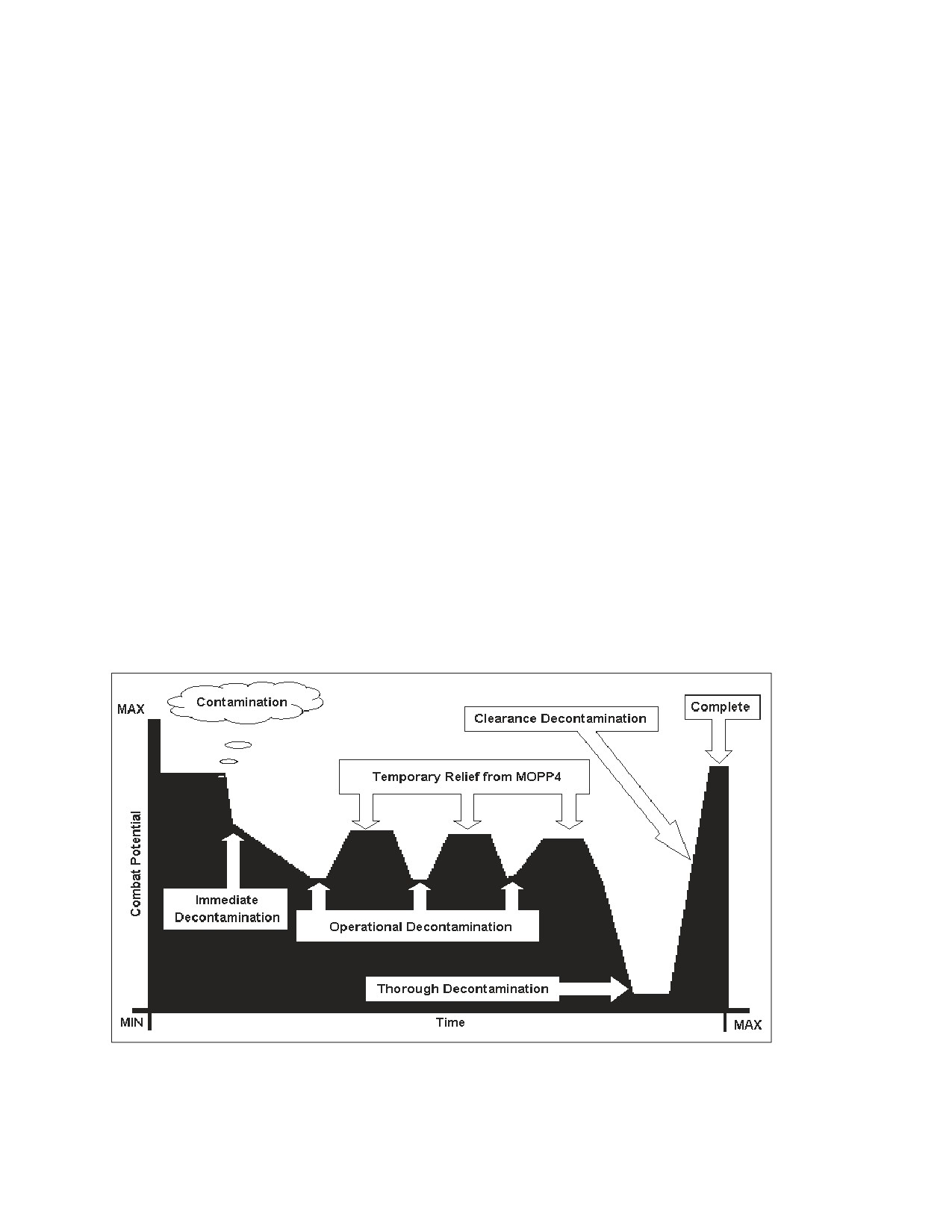
The decision to decontaminate is a risk assessment and is made within the
context of mission, enemy, terrain and weather, time, troops available and civilian
(METT-TC) considerations, and the resources available (see Figure I-1, page I-8).
NOTE: The USMC uses the term mission, enemy, terrain and weather, troops and
support available—time available (METT-T) vice the Army’s use of METT-TC.
Civilian considerations are inherently measured within the context of this
acronym.
Figure I-1. How Decontamination Affects Combat Effectiveness
4 April 2006
FM 3-11.5/MCWP 3-37.3/NTTP 3-11.26/AFTTP(I) 3-2.60
I-7
(a) The individual or crew decision to conduct immediate decontamination
will minimize casualties and limit the contact hazard. This applies the speed and need
principles of decontamination. Following decontamination, the unit continues to “fight
dirty.” The unit’s MOPP provides protection; however, continued wearing of MOPP gear
causes performance degradation.
(b) The unit or activity decision to conduct operational decontamination
will provide temporary relief from MOPP4 and limit the spread of contamination.
Operational decontamination supports sustained unit operations for prolonged periods and
is conducted as far forward as possible.
(c)
The command decision to conduct thorough decontamination should
reduce contamination below the detectable level with tactical-level detection equipment.
Caution should be exercised. Current tactical detectors are not sensitive enough to ensure
that the item does not off-gas when the temperature rises. Units can operate at this
temperature without the degradation imposed by higher MOPP levels. The commander
determines which assets are critical for a subsequent mission and allocates the resources to
conduct DED and DTD. The commander accepts the trade-off that the contaminated assets
will not be available for the period of time required to conduct a thorough decontamination.
(2)
The commander applies METT-TC considerations to the risk assessment
process to determine if and where operational or thorough decontamination is required.
For example, weathering may reduce contamination below detectable levels. Additionally,
thorough decontamination may be deferred until the operational situation or resources are
available to support the process. Furthermore, unique requirements such as
decontamination of electronic equipment or depleted uranium (DU) contamination may
have special considerations (see Appendix E for more information).
(3)
Risk assessment is a continuous process. Low-level residual contamination
may remain following weathering or decontamination. The contamination may also not be
detectable by tactical-level detection devices (see Appendix F for a summary of how the
environment could impact decontamination operations). Medical surveillance (MEDSURV),
conducted by preventive medicine (PVNTMED) personnel, is an FHP measure to identify
medical threats for personnel who may be exposed.
4.
Concepts—Homeland Security
HLS missions may require that defense decontamination support be furnished for the
two component parts of HLS—homeland defense (HLD) and CS. Decontamination support
will follow a process that essentially involves preparation, response, recovery, and
restoration. (Chapter XI provides more detailed information on decontamination support
for HLS.) CBRN decontamination operations conducted in support of HLS will comply with
29 Code of Federal Regulations (CFR) 1910.120, Hazardous Waste Operations and
Emergency Response, within the United States, its territories, and possessions.
a.
Preparation Phase. Military units tasked to assist local or state responders must
become intimately familiar with the National Response Plan (NRP) and coordinate and
train closely with local civilian emergency response agencies so that protocols and
procedures are coordinated, understood, and practiced before an actual event occurs in the
community. Whether preparing for HLS or combat operations, US military forces maintain
the capability to conduct or support decontamination based on unit capabilities. Unit or
I-8
FM 3-11.5/MCWP 3-37.3/NTTP 3-11.26/AFTTP(I) 3-2.60
4 April 2006
activity HLS preparatory actions are similar to other contingencies. Representative actions
include—
•
Planning contingency operations.
•
Preparing standard operating procedures (SOPs).
•
Conducting liaison with applicable organizations.
•
Establishing memorandums of agreement (MOAs) with appropriate authorities.
•
Establishing and maintaining required certifications.
•
Conducting training and exercises.
•
Obtaining required equipment (commercial or government) to accomplish
primary or collateral missions (e.g., patient decontamination).
b.
Response Phase. When a threat or an actual occurrence of a CBRN incident
requires HLD or CS decontamination support, DOD resources with decontamination
capabilities may respond. The required missions may include mass and casualty
decontamination, or technical assistance for decontamination (see Chapter XI for more
information on these missions). Personnel performing decontamination operations in
support of HLS must be trained and certified to the first-responder operations level as
defined in 29 CFR 1910.120, Hazardous Waste Operations and Emergency Response.
c.
Recovery Phase. For CS, recovery, transition, and redeployment operations start
when civil authorities or other designated agencies relieve the commander of selected
decontamination-related tasks. The operational duration of the response mission is
determined by the requirements established by the appropriate authority. The
requirement for mass and casualty decontamination will likely end following the response
phase. The requirement for technical decontamination to support first-responder
operations in a hot zone may continue. Military units with decontamination capabilities
may redeploy during this phase or be assigned other responsibilities. A transition plan is
implemented and tasks are transferred from the commander to the appropriate civil
authorities. Nongovernmental organizations (NGOs) and contracted services may augment
these civil authorities. Upon completion of the required recovery support, the commander
executes a transition and redeploys.
d.
Restoration Phase. Restoration constitutes those actions necessary to return the
decontamination section or unit to its full operational capability. Restoration actions will
generally be done at a unit’s home station. Restoration actions may include the following:
(1)
Replacing personnel who may have become injured/ill during
decontamination operations.
(2)
Reordering supplies (e.g., detector paper, decontamination solution,
decontamination kits and apparatuses).
(3)
Maintaining and repairing vehicles and equipment, including recalibration
or replacement of detectors and alarms.
(4)
Marking used decontamination sites and selecting new decontamination
sites.
(5)
Documenting personnel and equipment expenditures, event logs, and
MEDSURV.
4 April 2006
FM 3-11.5/MCWP 3-37.3/NTTP 3-11.26/AFTTP(I) 3-2.60
I-9
(6)
Concluding outstanding agreements with civil authorities or CS
organizations.
5. Service Capabilities
All services have varying levels of CBRN decontamination capabilities. All US forces
at the individual warfighter level must have immediate decontamination capabilities. Most
US military units at the major subordinate command level (e.g., brigade, regiment, wing,
shipboard) have operational and thorough decontamination capabilities. Clearance
decontamination will normally be conducted at the Unified Combatant Command level (i.e.,
Central Command [CENTCOM]) with the assistance of multiple agencies within the
command.
6. Training and Exercises
Individual and joint unit decontamination training across the force ensures the
readiness to fight and win should an adversary employ CBRN weapons. Training is a
responsibility shared by combatant commands, services, and a number of DOD agencies.
Training and exercise programs must incorporate the principles for operations in CBRN
environments and include realistic consideration of CBRN weapons effects on sustained
combat operations.
a.
Training. Training opportunities exist both internally and externally and should
include the following:
•
Initial and sustainment training.
•
Individual, collective, and unit training.
•
Intra-agency and interagency training.
b.
Exercises. Exercises provide the opportunity to interact with other units or
services and federal, state, or local agencies. Exercises developed by non-DOD agencies
provide an opportunity to improve military capabilities for support of HLS operations with
minimal resources. These exercises emphasize interoperability requirements and stress
staff coordination. They also serve to identify shortfalls in communications or other
capabilities that must be corrected.
I-10
FM 3-11.5/MCWP 3-37.3/NTTP 3-11.26/AFTTP(I) 3-2.60
4 April 2006
Chapter II
DECONTAMINATION OPERATIONS: PLAN, PREPARE, AND
EXECUTE
1.
Background
Decontamination planning provides recommendations for commanders’ guidance.
This helps ensure that forces and facilities are prepared to operate in CBRN environments;
supports the commander’s decision-making requirements; and identifies, assesses, and
estimates the enemy’s CBRN capabilities, intentions, and most likely courses of action
(COAs).
2.
Decontamination Planning
The decontamination planner must consider the hazards that may result from CBRN
or TIM contamination. Decontamination assessments include mission analysis, COA
development, and the analysis and comparison of enemy and friendly COAs.
Decontamination planning is dynamic and continuous from preattack to postattack,
through recovery operations.
NOTE: TIC and other hazardous materials [HAZMAT] are considered TIM
throughout this manual.
The unit CBRN defense personnel and staff work together to ensure that
decontamination planning is fully integrated into deliberate and crisis action planning.
They accomplish this through wargaming friendly versus enemy COAs and by mutually
developing products designed to assist the service components, multinational partners, and
joint force commanders (JFCs) decision-making processes.
a.
Commanders, with input from their staffs, assess their vulnerability to CBRN
attacks. Commanders determine the required protection for their units by assessing the
capabilities of the enemy. They estimate the likely impact of CBRN attacks and, based on
the concept of operations (CONOPS), determine the methods to reduce the impact and
allow for mission accomplishment. This includes MOPP acclimatization training and
decontamination planning to mitigate the affects of a CBRN attack. See Multiservice
Tactics, Techniques, and Procedures for Nuclear, Biological, and Chemical Vulnerability
Assessment for further information on CBRN vulnerability assessment (VA).
b.
The CBRN planner writes a decontamination plan as part of a CBRN defense
annex of the operation order (OPORD).
(1)
In preparing the decontamination portion of the CBRN defense annex, the
planner assesses the likelihood that decontamination operations will be required, the
probable extent of those operations, and the best procedures for execution.
(2)
In preparing the decontamination portion of the CBRN defense annex, the
planner should consider the following questions:
• Does the enemy possess CBRN weapons and has he demonstrated the intent
to use them?
• Does the unit’s mission bring it into likely contact with TIM hazards?
4 April 2006
FM 3-11.5/MCWP 3-37.3/NTTP 3-11.26/AFTTP(I) 3-2.60
II-1
• What is the unit’s decontamination capability (see Appendixes G and H for a
summary of decontamination capabilities for the services)?
• Does weather and terrain favor enemy use of CBRN weapons? (For terrain
decontamination, see Appendix I.)
• What are the unit’s logistics requirements?
• What is the unit’s level of decontamination training?
• Is contamination avoidance possible?
• What decontamination assets are available?
• What likely decontamination sites are available (through map
reconnaissance)?
(3)
During the plan preparation, all factors of the METT-TC considerations are
measured. The METT-TC considerations will impact the representative planning areas
(e.g., decontamination sites, priorities of effort, decontamination decisions, and
decontamination triage).
(a) The preselection of decontamination sites is essentially a map
reconnaissance that is based on the supported commander’s plan. (Detailed information on
a potential site may be determined from intelligence assets.) Preselected sites should be
within an avenue of approach, but just off main routes for easy access. Close proximity to
rivers, streams, or other water sources is also important. In conducting a map
reconnaissance, consider the following:
•
Probable level of decontamination that will be conducted.
•
Terrain (soil composition).
•
Mission.
•
Cover and concealment.
•
Water sources.
•
Drainage.
•
Presence or absence of contamination.
•
Road network that facilitates the movement in and out of the site for
both the contaminated unit and the resupply squad.
•
Adequate area for the dispersal of equipment before, during, and after
decontamination.
•
Location of downwind friendly personnel.
(b) The commander will establish priorities of effort that determine which
contaminated units are decontaminated first. Since decontamination assets are limited,
the commander must establish a priority of decontamination support. The priority of effort
lists the units in the order they will receive decontamination support. This can change
from phase to phase during an operation. The CBRN staff develops the priority of effort
based on an understanding of the commander’s intent.
II-2
FM 3-11.5/MCWP 3-37.3/NTTP 3-11.26/AFTTP(I) 3-2.60
4 April 2006
(c)
The commander decides when and where operational and thorough
decontamination will occur according to METT-TC. Note that the different levels of
immediate decontamination always occur as battle drills at the prescribed times following a
CBRN attack.
(d) Planning to decontaminate what is necessary ensures that units or
activities understand the decontamination triage (identifying clean and dirty elements).
Even though a unit has been identified for decontamination, it does not follow that each
individual, vehicle, or item belonging to that unit is contaminated. Decontamination triage
is the process of identifying those individuals, vehicles, aircraft, ships, ships spaces, or
items of equipment that require decontamination. Only the identified elements are to be
processed through the decontamination site. The commander may then employ his
uncontaminated elements to support the decontamination operation.
c.
Plans for decontamination operations will be included in the CBRN defense
annex to the operation plan (OPLAN) or OPORD. In preparing the decontamination
portion of the CBRN defense annexes, the planner must assess the disposition of forces and
assets available for CBRN reconnaissance and decontamination. It must identify locations
for preselected decontamination sites and linkup points and the missions for the CBRN
decontamination assets. It must also identify plans for divert airfields and/or naval vessels
for recovery operations and identify contingency plans for stations, ports, airfields, forward
arming and refueling points (FARPs), and facilities to receive contaminated aircraft and
ships with personnel and cargo aboard.
3.
Wartime Planning Considerations
Multiple factors must be considered when planning CBRN decontamination during
wartime.
a.
Joint or Combined Operations. These factors include the following:
•
Intelligence collection, analysis, and production.
•
Situational awareness (SA).
•
Common planning, training, and equipment standards.
•
Health service support (HSS).
•
Protection of the joint rear area (JRA) and theater sustainment capabilities.
•
Priorities.
•
Minimum essential requirements for the decontamination.
•
Human factor effects of the MOPP.
•
Logistics burden of CBRN decontamination.
•
Effect of the CBRN attack on the C2 systems.
•
Capabilities and limitations of US, multinational, and host nation (HN)
decontamination assets.
•
Consequence management (CM) support outside the continental United States
(OCONUS), its territories, and possessions.
•
Mortuary affairs.
4 April 2006
FM 3-11.5/MCWP 3-37.3/NTTP 3-11.26/AFTTP(I) 3-2.60
II-3
(1)
SA. Adequate SA is a central concern for decontamination planning. An
integrated warning and reporting system provides a significant measure of protection by
allowing friendly forces to minimize exposure to the hazard. Accurate and timely
understanding of the hazard and its effect minimizes the possibility of having excessive or
inadequate force protection (FP). Warning system provisions also address the need to warn
personnel, based on an alarm, thus causing units to increase their protective posture, and
can act as a warning order (WARNORD) for dedicated decontamination assets.
(2)
C ommon Planning, Training, and Equipment Standards. Common
standards for CBRN decontamination (especially training, exercises, and equipment
maintenance) enhance joint force capabilities.
(3)
HSS. Key elements of HSS include casualty estimation, chemoprophylaxis
and immunizations, MEDSURV, PVNTMED, diagnostics, mass casualty management,
evacuation, and patient decontamination requirements. HSS planning addresses
decontamination considerations. Unit plans should recognize that CBRN attacks have the
potential to create mass casualties. The treatment and evacuation of CBRN patients will
be difficult and hazardous to the patients, medical personnel, and medical treatment
facilities (MTFs). HSS CBRN defense planning includes appropriate liaison with affected
and supportive civilian HSS MTFs and an assessment of the capabilities and limitations of
those MTFs.
(4)
Protection of the JRA and Theater Sustainment Capabilities. The JRA and
theater sustainment capabilities must be protected. A successful adversary CBRN attack
on a critical logistics facility or a major TIM attack near it may degrade OPTEMPO and
force generation capabilities. Mitigation and decontamination measures focus on
maintaining support to combat operations and rapidly restoring the degraded capabilities.
Alternate sites are designated and exercised in advance to ensure uninterrupted JRA
operations and theater sustainment capabilities.
(5)
Priorities. In wartime, manpower and time are critical resources that
cannot be wasted on nonessential tasks. Therefore, the decontamination of areas, facilities,
and equipment will be prioritized and limited by necessity, to allow resumption of
operations by protected personnel. Priorities will be directly impacted by the mission with
the realization that protected personnel can work with contaminated equipment.
Therefore, decontamination must be aimed at restoring mission capability rather than
totally minimizing hazards. If decontamination is not possible or needed,
non-mission-essential areas may be marked and restricted from use. The first priority will
be given to personal decontamination to prevent casualties and reduce manpower losses.
The second priority will be the decontamination of equipment and material or facilities
necessary to meet mission requirements as established by the commander. During
wartime, decontamination operations will be expedited as the situation requires. Primary
considerations will be for effective accomplishment of the mission.
(6)
Minimum Essential Requirements. The minimal conditions that should be
met in planning decontamination operations are as follows:
•
Identification of contamination.
•
Designation and marking of contaminated area.
•
Identification of facilities, equipment, and material that have been
contaminated.
II-4
FM 3-11.5/MCWP 3-37.3/NTTP 3-11.26/AFTTP(I) 3-2.60
4 April 2006

•
Availability of personnel to fully operate each decontamination station.
•
Number and deployment or utilization of decontamination personnel.
•
Selection of appropriate decontaminant and decontamination equipment.
•
Selection of an effective method of decontamination.
•
Selection of a site for decontamination of equipment, supplies, and
personnel.
(7)
Human Factor Effects of MOPP.
(a) Physiological and psychological stress will occur during
decontamination operations. Body temperature must be maintained within a narrow limit
for optimum physical and mental performance. MOPP gear restricts the heat loss
mechanisms because of its high insulation and low permeability to water vapor. In
addition, physical work requires more effort when personnel wear protective clothing
because of its added weight and restricted movement. Work intensity, which is managed by
leaders, is also a major contributing factor to heat stress.
(b) Military personnel wearing MOPP while conducting decontamination
may experience heat stress. To prevent heat stress from resulting in injuries, they follow a
prescribed cycle of work and rest periods. See Table II-1 for work/rest cycles and water
replacement guidelines. The work/rest cycles are based on the environment (temperature,
humidity, and solar load), the workload of the individual, and the clothing ensemble being
worn. These work/rest cycles are usually described in terms of minutes of work allowed per
hour. The remainder of the hour (after completing the work allowed) is used for rest,
allowing heat to dissipate and allowing the individual to cool down. The local application of
work/rest cycles is directly influenced by METT-TC.
Table II-1. Work/Rest Cycles and Water Replacement Guidelines
Light (Easy) Work
Moderate Work
Hard (Heavy) Work
WBGT
Heat
Water
Water
Water
Index
Category
Work/Rest
Intake
Work/Rest
Intake
Work/Rest
Intake
(°F) 1, 2
(minutes) 4, 5
(qt/hr) 3
(minutes)4, 5
(qt/hr)3
(minutes)
(qt/hr)
1
78-81.9
No limit
½
No limit
¾
40/20
¾
2
82-84.9
No limit
½
50/10
¾
30/30
1
(Green)
3
85-87.9
No limit
¾
40/20
¾
30/30
1
(Yellow)
4
88-89.9
No limit
¾
30/30
¾
20/40
1
(Red)
5
More than
50/10
1
20/40
1
10/50
1
(Black)
90
1Wearing all MOPP overgarments (MOPP4) adds 10°F to the WBGT index.
2If wearing body armor, add 5°F to WBGT in humid climates.
3Hourly fluid intake should not exceed 1¼ quarts, and daily fluid intake should not exceed 12 liters.
4Rest means minimal physical activity (sitting or standing), accomplished in the shade if possible. The information
pertains to acclimated service personnel.
5The work/rest time and fluid replacement volumes will sustain performance and hydration for at least 4 hours of work
in the specified heat category. Individual water needs will vary ±¼ qt/hr.
(c)
The incidence of heat casualties can be reduced if personnel are
allowed to lower their work intensity and take frequent rest breaks.
4 April 2006
FM 3-11.5/MCWP 3-37.3/NTTP 3-11.26/AFTTP(I) 3-2.60
II-5
(8)
Logistics Burden of CBRN Attacks. See Multiservice Tactics, Techniques
and Procedures for Nuclear, Biological, and Chemical Protection.
(9)
Effects of CBRN Attacks on C2 Systems. CBRN attacks can degrade C2
systems. Effective decontamination operations rely on a C2 system that keeps the
commander informed and communicates the commander’s intent. For example, being
notified of the commander’s priorities for decontamination is critical for ensuring that
support is synchronized.
(10) Capabilities and Limitations of US, Multinational, and HN
Decontamination Assets. In preparation for multinational operations, unit planners assess
coalition member CBRN capabilities for decontamination and interoperability with US
forces. The planning process should consider the implications and feasibility of diverting
US assets and capabilities to support HN and other multinational members in
accomplishing the required decontamination objectives.
(11) OCONUS CM Support. OCONUS CM support will generally be
characterized by crisis action planning. A CBRN or TIM incident may result in US forces
providing OCONUS decontamination support. The support would probably be for a short
duration and would require extensive coordination and liaison with the HN.
b.
International Coalition Operations. Decontamination may be conducted within
the context of multinational arrangements. Planning is accomplished through both US and
multinational channels. Coordinated CBRN defense planning is essential to the unity
effort (e.g., operations; logistics (including infrastructure); intelligence; deception;
decontamination; warning, detection, and monitoring; CM; and CBRN interoperability).
Supporting plans that address coordination and liaison, host nation support (HNS), and the
provision of mutual support are examples of the essential tasks that must be accomplished.
4.
Homeland Security Planning Considerations
Decontamination support for HLS and CS present unique planning considerations.
CBRN decontamination planning ranges from planning to provide technical assistance and
recommendations to planning for resources for mass decontamination. The following are
examples of planning considerations that apply for HLS and CS:
•
CBRN specialists and planners understand and can operate within the civilian
based incident command system (ICS).
•
CBRN specialists and planners understand the terms of reference used to
support first-responder decontamination operations.
•
CBRN specialists conduct planning with civilian counterparts at the federal,
state, or local level, as applicable.
•
CBRN specialists and planners train and exercise for support of HLS or CS
operations.
•
CBRN specialists, as required, maintain the required certification to operate in a
CS mission with civilian first responders.
•
Military issue of the IPE (MOPP ensembles) do not meet Occupational Safety
and Health Administration (OSHA) Level C requirements.
II-6
FM 3-11.5/MCWP 3-37.3/NTTP 3-11.26/AFTTP(I) 3-2.60
4 April 2006
5. Preattack Decontamination Operations
Preattack decontamination actions are taken to increase readiness.
a.
Preattack Considerations. Preattack considerations extend from the present
until the first enemy weapon effects occur within the theater of operations.
(1)
Commanders will conduct VA and estimate the need for decontamination
based on the threat, the resources available for decontamination, and the potential results
of this operation. Preattack actions also consider the following:
•
Assessing the CBRN threat.
•
Identifying and preparing collective protective shelters (CPSs) and MTFs.
•
Ensuring the proficiency in CBRN decontamination procedures and
methods.
•
Preparing to conduct decontamination operations (based on the nature and
extent of contamination and resources available for decontamination).
•
Preparing to conduct response procedures (before and after a CBRN
attack). Guidance must be based on the concept that there may be no warning before an
attack and that all attacks in a high-threat area may contain CBRN agents.
•
Providing instructions for a warning unit or the base populace.
•
Notifying key personnel of an attack, of procedures for the activation of
preselected CPSs, and of the need to don the protective clothing.
•
Decontaminating mission-essential facilities (see Appendix I for
information on terrain decontamination).
•
Identifying recovery actions that must begin as soon as possible after the
attack.
(2)
Subordinate units and activities must support and comply with the
commander’s intent. They develop contingency plans for CBRN defense actions that
support missions conducted within the theater assigned. Plans must address CBRN
detection, warning, reporting, and decontaminating procedures and a rapid transition into
a CBRN defensive posture.
(3)
Specialized CBRN teams will be formed from existing personnel resources
to detect, identify, and decontaminate CBRN contamination and to operate protective
shelters.
(4)
Each soldier must be trained to perform decontamination of his own body,
clothing, personal equipment, individual weapons, and casualties.
b.
Reconnaissance/Site Survey of Decontamination Sites. Decontamination site
selection is necessary during preattack operational and thorough decontamination
planning. The following criteria should be considered for decontamination site selection:
•
Wind direction (to include downwind direction from friendly personnel).
•
Water supply.
•
Overhead concealment.
4 April 2006
FM 3-11.5/MCWP 3-37.3/NTTP 3-11.26/AFTTP(I) 3-2.60
II-7
•
Maximum use of existing facilities.
•
Drainage.
•
Trafficability. The path or road must be able to withstand large amounts of
water being placed on it.
•
Accessibility. The site should be accessible to the largest vehicle in the
contaminated unit.
•
Size. The area must be large enough to handle all stations of the level of
decontamination being conducted, especially Station 3 of thorough decontamination.
c.
Site and Linkup Point Selection.
(1)
The controlling headquarters (HQ) selects the potential decontamination
sites as part of mission planning. More than likely, this HQ will only be capable of a map
reconnaissance. For decontamination sites on the friendly side of the forward line of own
troops (FLOT), every effort must be made to conduct a ground reconnaissance of the site.
For thorough decontamination and supported operational decontamination, it is imperative
that these sites be further reconnaissanced by the supporting decontamination unit. For
example, when an operational decontamination is executed by an Army battalion, the
battalion CBRN noncommissioned officer (NCO) should make every attempt to reconnoiter
these sites.
(2)
As decontamination sites are selected (during the map reconnaissance), one
or more linkup points are chosen to support each site. Linkup at the designated point
includes establishing security, positioning the necessary marshalling areas, camouflaging
the entry and exit points, designating the direction of flow into and out of the site, and
ensuring that the unit’s supply or prestaged embarked assets have sufficient replacement
MOPP gear.
d.
Coordination.
(1)
The individual in charge of decontamination must make careful
coordination with those elements involved to ensure the successful completion of the
operation. The unit to be decontaminated must be aware of linkup points, times, and its
own responsibilities for the procedure.
(2)
Much of the coordination will be arranged through the decontamination
element or the unit’s higher echelon, particularly when involving the following:
•
Power-driven decontamination equipment (PDDE) support.
•
Engineer support for site preparation and closure.
•
Supply and transportation for linkup with bulk water trucks.
•
Air defense and security forces for security when those elements are
required.
•
HSS.
•
Augmentee support.
•
Support of medical patient decontamination operations (if the MTF is
colocated adjacent to troop decontamination).
II-8
FM 3-11.5/MCWP 3-37.3/NTTP 3-11.26/AFTTP(I) 3-2.60
4 April 2006
e.
Communications. Primary communications between the decontamination
element and the supported unit will be via radio. Therefore, signal operating instructions
(SOI) should be included in the supported unit’s initial request for decontamination
support.
f.
Maintaining SA.
(1)
Warnings. Warnings of CBRN contamination are conveyed by alarms and
signals. Units use easily recognizable and reliable alarm methods to respond quickly and
reliably to CBRN hazards. Standard alarms, the Nuclear, Biological, and Chemical
Warning and Reporting System (NBCWRS), and contamination markers help give orderly
warning that may also require a change of MOPP level. Alarms and signals may include
the following:
•
Audible alarms.
•
Automatic alarms.
•
Visual signals.
(2)
Markings. Contamination is marked to warn friendly personnel. Units or
CBRN reconnaissance teams mark the likely entry points into the area and report
contamination to higher HQ. The only exception is when marking would help the enemy.
In this event, the hazard is reported to higher HQ as an unmarked contaminated area.
When a unit enters a previously marked contaminated area, personnel check the extent of
contamination and adjust plans as necessary. As the hazard area changes, the unit
relocates the signs. When the hazard passes, the unit removes the signs. The unit reports
all changes to higher HQ. The decontamination site noncommissioned officer in charge
(NCOIC) ensures that his team properly marks the decontamination site with the standard
markings and sends the NBC5 (areas of actual contamination) report forward.
(3)
Control Measures.
(a) Ensure that drivers of contaminated vehicles know when to move into
position at the wash-down location.
(b) Ensure that the contaminated unit has provided site security.
(c)
See Appendix J for thorough decontamination station signs used as
control measures.
(4)
Wide-area data flow (Web site) provides up-to-date status, information, and
conditions across a broad spectrum.
g.
Maintenance of Decontamination Equipment. A thorough operator level
maintenance should be done on all decontamination equipment. If no mission-capable
equipment is found, all the shortcomings should be forwarded to higher echelons so that the
force commander is aware of the full decontamination capability.
h.
Pre-positioning of Logistics. Units will need to pre-position the replacement IPE
for issue at the end of the DED as part of the thorough decontamination. If replacement
IPE is needed during operational decontamination, the unit should pre-position the IPE for
use during MOPP gear exchange. As the CBRN threat rises, IPE and chemical
decontamination equipment should be pre-positioned forward to ensure timely delivery to
units for operational and thorough decontamination.
4 April 2006
FM 3-11.5/MCWP 3-37.3/NTTP 3-11.26/AFTTP(I) 3-2.60
II-9

i.
Other Preattack Actions. Other key preattack actions are included in Table II-2.
Table II-2. Preattack Decontamination Actions
• Know the current and future missions.
• Outline the capabilities of the unit or activity.
• Know the external support available from CBRN units.
• Know the decontamination support available to detached/remote elements.
• Designate the decontamination sites.
• Employ avoidance (whenever possible) within the context of the mission.
• Designate the TFAs.
• Establish and exercise the CBRN warning and reporting system.
6.
Execution
Actions necessary to successfully execute decontamination operations include
establishing a C2 site, establishing clean areas or zones, ensuring security, providing
proper and detailed reporting, ensuring the availability of resources, and controlling and
documenting personnel exposure.
a.
Decontamination Site C2. In a thorough decontamination, the supported unit is
responsible for overall control. The level that an operational decontamination operation is
being conducted determines C2 for the decontamination site. There are different levels (or
techniques) of control when conducting operational decontamination.
(1)
Decentralized Operational Decontamination. The unit commander
requests decontamination equipment support, selects the decontamination site, links up
with the decontamination element, and conducts the decontamination.
(2)
Centralized Operational Decontamination. The CBRN staff controls the
decontamination. The commander selects the site, and the battalion CBRN staff directs
site setup and security and provides C2. The CBRN staff officer or NCO travels with the
decontamination element and communicates via radio.
b.
Establishment of Clean Areas and Zones. A predecontamination staging area is
established downwind of the decontamination site. In the predecontamination staging
area, the supported commander segregates vehicles by checking for contamination. Clean
areas must be provided to avoid recontaminating personnel and equipment as they finish
the decontamination process. The decontamination element should be set upwind of the
decontamination site entrance. The MOPP gear exchange should be in place upwind and at
a 45° angle of vehicle wash down. After processing, the vehicles should marshal in a
postdecontamination assembly area (AA) upwind of the DTD and DED areas.
c.
Security. Security ensures that the decontamination operation is conducted
without interference. The supported unit is responsible for site security. Cover and
concealment must be considered in decontamination site selection. Traffic control is
another component of security. Linkup points and the entrances to AAs should be
controlled to ensure that uncontaminated personnel or vehicles do not enter.
d.
Reporting. Proper and detailed reporting is critical to the success of the
decontamination operation and to the restoration operations that will occur at the end of
the conflict. At the end of the decontamination operation, several things must be reported.
II-10
FM 3-11.5/MCWP 3-37.3/NTTP 3-11.26/AFTTP(I) 3-2.60
4 April 2006
The CBRN unit will be responsible for submitting a complete NBC5 report after the site is
closed. The supported unit will report the following to its higher HQ:
•
Quantity and types of vehicles decontaminated.
•
Number of personnel decontaminated through the DTD.
•
Number of causalities.
•
Time decontamination site was opened and closed.
e.
Consumption Rates. Decontamination operations expend resources. The
chemical unit must plan to have enough of the proper supplies on hand to perform its
mission. For information on consumption rates, see Chapter XII.
f.
Resupply. After a decontamination operation, the CBRN unit must restore itself
to mission-capable status. While the supported unit has the requirement to keep on-hand
supplies to conduct a DTD, the supporting CBRN unit may supply the majority of the
equipment and supplies expended. Likewise, while the supported unit is required to
provide the chemical unit with replacement supplies and material at the end of a DED, the
CBRN unit should make its material requirements known to the maneuver forces logistics
staff. The logistics staff may then arrange for decontamination supplies to be issued, often
in “push” packages.
g.
Personnel Exposure Control and Documentation. During decontamination
operations, steps should be taken to limit the exposure of personnel to the contamination.
Such measures include the decontamination crews wearing toxicological aprons or
wet-weather gear over MOPP gear and locating post decontamination AAs upwind. The
accurate documentation of individual exposure to contaminants will be essential for proper
medical treatment should those personnel become injured.
7.
Postdecontamination Operations
Postdecontamination operations provide for the restoration of combat power to the
commander.
a.
Immediately following an attack, recovery operations will be initiated.
Operations related to mission-essential operations may continue in a contaminated
environment. Those personnel not immediately required to ensure the continuation of
mission-essential activities will likely remain in their shelters until the hazard dissipates
or decontamination efforts allow resumption of their normal duties.
b.
Postattack operations involve assessing the degree of mission degradation after
the attack and reporting postattack readiness.
c.
Commanders will ensure that postattack operations emphasize those actions
necessary to restore mission and support functions. Representative postattack actions
include the following:
•
Assessing damage and casualties.
•
Restoring communications for C2.
•
Detecting, identifying, marking, isolating, decontaminating, and reporting
contaminated areas and equipment.
•
Performing casualty decontamination.
4 April 2006
FM 3-11.5/MCWP 3-37.3/NTTP 3-11.26/AFTTP(I) 3-2.60
II-11
d.
After completion of operational or thorough decontamination, units close out the
sites used for MOPP gear exchange, vehicle wash down, DED, and DTD. In a thorough
decontamination, the DED is closed first. The CBRN unit then processes through the DTD
and the DTD is closed. Then the CBRN unit marks the area as a contaminated area and
reports its exact location to the supported unit using an NBC4 report. See Chapters IV and
V for procedures to close a site.
II-12
FM 3-11.5/MCWP 3-37.3/NTTP 3-11.26/AFTTP(I) 3-2.60
4 April 2006
Chapter III
IMMEDIATE DECONTAMINATION
1.
Background
Once aware of chemical-biological (CB) contamination on the bare skin, initiate
immediate decontamination techniques, without command, by using the personal
skin decontamination kit (SDK). Decontaminate the hood, mask, gloves, and
weapon using the individual equipment decontamination kit (IEDK). To remove
radiological contamination from equipment and personnel, brush it off and wash the
area with soap and water.
NOTE: Throughout this manual, SDK refers to the M291 kit and IEDK
refers to the M295 kit.
2.
Skin Decontamination
Start the skin decontamination techniques within 1 minute of becoming contaminated.
Some toxic chemical agents, especially nerve agents, kill within minutes.
a.
Chemical.
(1)
Use the SDK within 1 minute of contamination of the exposed skin.
Instructions for its use are listed on the individual packet within the kit. Flushing the eyes
with water is also a critical immediate decontamination action and should occur as soon as
possible following contamination.
(2)
If an SDK is not available, chemical contamination may be blotted from the
skin with a cloth and flushed with water from a canteen. Soap (if available) can be used to
wash the agent from the skin. Washing with soap and water (preferably warm water) is
the best method for toxic-agent removal if SDKs are not available, but this method is not as
effective as using the decontamination kits.
b.
Biological. Immediately decontaminate using soap and water when there is a
suspected exposure to a BW agent. Careful washing removes nearly all the agent from the
skin’s surface. Hypochlorite solution or other disinfectants are reserved for gross
contamination (e.g., following the spill of a solid or liquid agent from a munition directly
onto the skin). Grossly contaminated skin surfaces should be washed with a 0.5 percent
chlorine solution, if available, with a contact time of 10 to 15 minutes. See Appendix C for
details on how to make this solution.
c.
Radiological. To remove radiological dust particles, brush, wash, or wipe them
off. If MOPP gear is wet, conduct a MOPP gear exchange as soon as possible because
brushing or shaking will not remove the contamination. Wash the exposed areas of the
skin with soap and water, and pay particular attention to the hair and fingernails.
3.
Personal Wipe Down
The personal wipe down technique is most effective when done within 15 minutes of
being contaminated. Using the IEDK, wipe down the mask, hood, gloves, and other
essential gear. Use the M295 IEDK, an M291 SDK pad, a stick, or any stiff device to
remove the gross contamination from the protective overgarment. Scrape any clumps off
4 April 2006
FM 3-11.5/MCWP 3-37.3/NTTP 3-11.26/AFTTP(I) 3-2.60
III-1
the material. Brush off radiological contamination or frozen chemical-agent contamination.
See Multiservice Tactics, Techniques, and Procedures for Nuclear, Biological, and Chemical
(NBC) Protection for detailed information on overgarment protective qualities.
a.
Chemical. Decontaminate individual equipment using the IEDKs. The ICAMs,
chemical-agent monitors (CAMs), and M8/M9 detector paper are used to detect
contamination and monitor the level of contamination on the equipment.
b.
Biological. Wash with soap and water. If water is not available, use IEDKs in
the same manner as described for chemical-agent decontamination.
c.
Radiological. Locate radiological contamination with monitoring equipment and
remove by brushing or shaking it off. Avoid breathing the dust particles by wearing the
protective mask or a piece of cloth over the nose and mouth. Wipe off the equipment with
soapy water (preferably warm) using rags or damp paper towels.
4.
Operator Wipe Down
Decontaminate other mission-essential surfaces of the equipment before continuing
the mission. Operators wipe down is most effective when done within 15 minutes of
contamination.
a.
Chemical.
(1)
Decontaminate the surfaces that must be touched on the exterior of the
vehicle or the equipment with the M100 SDS. If the M100 SDS is unavailable, scrub the
surfaces with super tropical bleach (STB) to decontaminate the equipment.
NOTE: The M100 has not been authorized for use on USN or USMC aircraft. Use
hot, soapy water to perform operator’s wipe down on all aircraft. Also, STB
should not be used to decontaminate aircraft surfaces.
(2)
Scrub STB dry mix or slurry onto the exterior surface with brushes (if
available). Wait 30 minutes, and then wash it off. If necessary, use the nonstandard
decontaminants that are discussed in Appendix C. The ICAM, CAM, and M8/M9 detector
paper are used to determine what surfaces require decontamination.
b.
Biological. For decontamination of equipment, a 0.5 percent chlorine solution
should be used, if available. A contact time of 30 minutes prior to normal cleaning is
required. Bleach is corrosive to most metals and fabrics so rinse thoroughly and oil the
metal surfaces after completion. Other nonstandard biological decontaminants are
described in Appendix C.
NOTE: Bleach has not been authorized for use on USN or USMC aircraft. Use hot
soapy water to perform operators wipe down on all aircraft.
c.
Radiological. If surfaces are contaminated by fallout, rain out, neutron-induced
contaminations, or any type of radiological agent, use the monitoring equipment to help
locate it and then decontaminate the surfaces as required. Decontaminate if detection
equipment is not available and contamination is suspected. Radiological contamination can
usually be removed by brushing or scraping. Water is effective for flushing away
radiological contamination; however, use drainage ditches that flow into a sump to control
the runoff. Remember, the contamination has not been destroyed, it has just been moved.
The runoff will still be hazardous. If time permits, brush or scoop away the top inch of soil
from the fighting position to lower the effects of radiological contamination.
III-2
FM 3-11.5/MCWP 3-37.3/NTTP 3-11.26/AFTTP(I) 3-2.60
4 April 2006
5.
Spot Decontamination
a.
Purpose. Aircrews and aircraft ground support crews can use spot
decontamination as an immediate measure to remove contamination from critical locations.
Spot decontamination is performed to limit the spread of contamination on aircraft that
requires servicing between sorties, to support ingress and egress of aircraft by crews and
passengers, and when performing pre- and postflight inspections. Spot decontamination
reduces the contamination on the areas that must be touched during servicing.
b.
Procedures.
(1)
Ensure that sufficient quantities of soapy water or applicable aircraft
cleaner and fresh water are available.
(2) Scrub service areas with soapy water using brushes, rags, or sponges until
deposited material, dirt, and grime are removed.
(3) Rinse areas with fresh water from a bucket or hose.
(4) Ensure that service providers decontaminate gloves (SDK, soapy water, or
high-test hypochlorite [HTH] solution).
(5) Perform service on the aircraft.
(6) Decontaminate runoff by applying a standard or nonstandard
decontaminant to the deck/ground/airfield. Runoff can be hosed overboard or into collection
sumps. If runoff is hosed without prior decontamination, it should be treated as
contaminated.
4 April 2006
FM 3-11.5/MCWP 3-37.3/NTTP 3-11.26/AFTTP(I) 3-2.60
III-3
Chapter IV
OPERATIONAL DECONTAMINATION
1.
Background
Operational decontamination limits the spread and transfer of contamination, allows
temporary relief from MOPP4, and facilitates additional decontamination requirements.
By speeding up the weathering process, the need for a thorough decontamination may be
eliminated. This chapter focuses on land forces operational decontamination TTP. This
process will likely require about a 120-square-yard area (depending on the number of
contaminated vehicles) and may not require a nearby water source. An operational
decontamination consists of a vehicle wash down and a MOPP gear exchange. The
techniques that may be used to conduct an operational decontamination include the
following:
•
Decentralized control for a company-size unit.
•
Centralized control for a battalion-size unit.
•
Centralized control for a brigade-size unit.
NOTES:
1. See Naval Ships Technical Manual (NSTM) 470 and NSTM 070 for operational
decontamination procedures and Naval Air (NAVAIR) 00-80T-121 for TTP on USN
and USMC aircrews, aircraft, and support equipment.
2. See Recovery Operations in a Chemical, Biological, Radiological, and Nuclear
(CBRN) Environment for other information on USN and USMC operational
decontamination procedures.
3. See Chapters VIII and IX for additional information on aviation and shipboard
decontamination, respectively.
4. Aircrew CBRN IPE/advanced logistics support site (ALSS) configurations for
the operational decontamination technique do not allow MOPP gear exchange.
See NAVAIR 00-80T-121 for procedures to doff contaminated aircrew CBRN IPE
and ALSS.
5. See Air Force Manual (AFMAN) 32-4005, AFMAN 32-4017, AFMAN 10-2602, and
USAF Technical Order (TO) 11C15-1-3 for TTP on USAF main operating base
(MOB), colocated operating base (COB), and bare operating base operational
decontamination.
6. See Chapter VII for further information on fixed-site, port, and airfield
decontamination.
2.
Planning
Operational decontamination requires a well-thought-out plan to be successful. The
advantages and disadvantages of operational decontamination techniques are listed in
Table IV-1, page IV-2.
4 April 2006
FM 3-11.5/MCWP 3-37.3/NTTP 3-11.26/AFTTP(I) 3-2.60
IV-1

Table IV-1. Advantages and Disadvantages of Operational Decontamination Techniques
Decentralized Control
Centralized Control
Centralized Control
(Company-Size)
(Battalion-Size)
(Brigade-Size)
Advantages
Flexibility
C2
C2
Dispersion
Flexibility
Synchronized support
Dispersion
assets
Planning
Rehearsal
Sustained operations
Time required
Planning
Sustained operations
Disadvantages
C2
Synchronized support
Flexibility
Synchronized support
assets
Dispersion
assets
Rehearsal
Rehearsal
Time required
Time required
Planning
Sustained operations
a.
Decentralized control of a company-size element undergoing decontamination is
provided by the contaminated unit’s commander. The advantages of this method are that it
is flexible and it conforms to the METT-TC conditions. It also disperses the units over a
large area, making them less vulnerable to attack by the enemy. The disadvantages are
that C2 is more difficult, it is difficult to synchronize the support assets to one location, it
may require rehearsal time, it takes more time overall, planning assets are not available at
that level, and the company cannot sustain operations without additional support from
higher HQ.
b.
Centralized control of a battalion-size unit is similar to the above except that the
unit CBRN NCO controls the decontamination. The unit commander and the CBRN NCO
direct the site setup and provide security and C2 for the selected site. The CBRN NCO
travels with the decontamination element and communicates via the radio.
c.
Centralized control for a brigade-size unit is done when decontamination assets
within the brigade have been consolidated. In this technique, the brigade CBRN NCO
performs those functions described for the battalion CBRN NCO.
3.
Phases
The three phases for an operational decontamination are preparation, execution, and
site clearance (see Table IV-2).
Table IV-2. Operational Decontamination Phases
Area
Actions
Preparation
Decontamination
Identify the personnel and equipment to be decontaminated.
assessment
Request decontamination support. The CBRNE section conducts coordination with the
Coordination
contaminated unit on the linkup point. Decontamination operations should be done between 1
and 6 hours after becoming contaminated.
IV-2
FM 3-11.5/MCWP 3-37.3/NTTP 3-11.26/AFTTP(I) 3-2.60
4 April 2006
///////////////////////////////////////