FM 5-472 Materials Testing (DEPARTMENT OF THE ARMY) December 2000 - page 3
FM 5-472/NAVFAC MO 330/AFJMAN 32-1221(I)
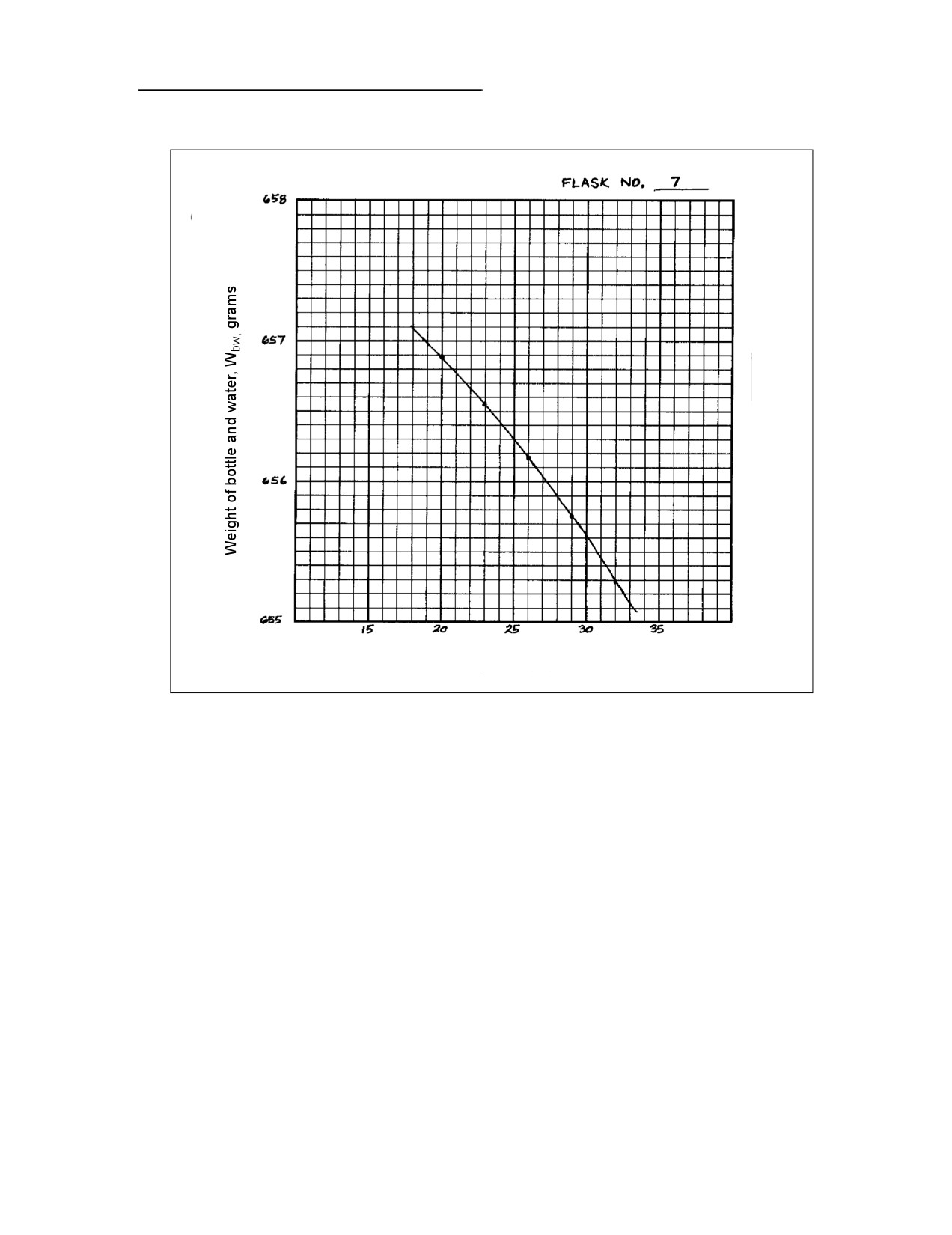
Temperature, T °C
Figure 2-37. Calibration curve for a volumetric flask
Computed data:
Tx of 20°C yields Wbw of 656.88
Tx of 23°C yields Wbw of 656.55
Tx of 26°C yields Wbw of 656.17
Tx of 29°C yields Wbw of 655.75
Tx of 32°C yields Wbw of 655.29
A complete data table can be created from the formula above for each
temperature expected to prevail during testing.
Step 2. Obtain a soil sample for testing. Separate the given sample over a No.
4 sieve to obtain at least a 100-gram sample passing the sieve or over a No. 10
sieve to obtain a 20-gram sample. Since this test method is only concerned
with the sample passing the appropriate sieve used, discard the material
retained on the sieve.
Step 3. Prepare the sample for testing.
Soils 2-67
FM 5-472/NAVFAC MO 330/AFJMAN 32-1221(I)
NOTE: To determine the specific gravity of solids, the sample may be
at its natural water content or oven-dried. Soils with a high organic
content or with fines that are low compressible are difficult to rewet
after having been oven-dried. These soils should be tested at their
natural water content first and the oven-dried weight determined at
the end of the test.
a. Record all identifying information about the sample on the form (see
Figure 2-36, page 2-65).
b. Place the -4 or -10 sample into the evaporating dish.
c. Perform the following procedures for soil at natural water content or
moisture; otherwise, go to step 3d:
(1) Add distilled water to the sample and mix to a slurry.
(2) Transfer the slurry to the pycnometer and add distilled water until
the pycnometer is about three-fourths full.
d. Perform the following procedures for an oven-dried soil sample:
(1) Oven-dry the sample to a constant weight at a temperature of 110°
± 5°C. Allow the sample to cool and weigh it to the nearest 0.01 gram.
Record the weight on the form as the weight of the dish and dry soil
(in block 6g).
(2) Transfer the dried sample to the volumetric flask. Take care to
avoid the loss of any particles.
(3) Fill the flask three-fourths full with distilled water and allow it to
soak for 12 hours.
(4) Weigh the empty, dry evaporating dish. Record the weight on the
form as the weight of the dish (block 6h).
Step 4. Process the sample through the test method.
a. Remove entrapped air by bringing the solution to a slow, rolling boil for
10 minutes while occasionally rolling the pycnometer to assist in the
removal of the air (ensure that no loss of material occurs while boiling).
Cool the sample to room temperature.
b. Fill the pycnometer with distilled water until the bottom of the
meniscus is level with the calibration mark.
c. Dry the outside and thoroughly remove any moisture adhering to the
neck of the pycnometer.
d. Weigh the pycnometer and its contents to the nearest 0.01 gram.
Record this amount on the form as the weight of the flask and water and
immersed soil (Wbws).
e. Shake the flask immediately after weighing (putting its contents in
suspension) and determine the water temperature at middepth to the
nearest whole degree, Tx. Record this amount on the form.
f. Determine the dry unit weight for soil processed at natural moisture
content as follows:
2-68 Soils
FM 5-472/NAVFAC MO 330/AFJMAN 32-1221(I)
(1) Transfer the soil solution from the flask to a preweighed pudding
pan. Record the weight in block 6h. Use care when transferring all
the grains of soil.
(2) Oven-dry the sample to a constant weight at a temperature of 110°
± 5°C. Allow the sample to cool. Weigh and record the weight on the
form in block 6g as the weight of the dish and dry soil.
Step 5. Compute the results on DD Form 1208 (see Figure 2-36, page 2-65).
a. Compute the weight of the dry soil (Ws) by subtracting the weight of
the dish from the weight of the dish and dry soil. Record it on the form.
b. Determine the weight of the flask and water (Wbw) by plotting the
temperature of the water (Tx) obtained in step 4e (block 6k) on the
calibration curve obtained in step 1. Record the result on the form. If the
calibration curve and graph were not produced, use the formula as
indicated in step 1e and record the result on the form.
c. Determine the correction factor (K) by locating the temperature of the
water (Tx) (obtained in step 4e [block 6k]) in Table 2-7, page 2-66; read
across to the correction factor column, and record it on the form as the
correction factor K (for Tx).
d. Compute the specific gravity of solids (Gs) to two decimal places.
Record the amount on the form using the following formula:
WsK
Gs
= -------------------------------------------
W
s + Wbw – Wbws
APPARENT AND BULK SPECIFIC GRAVITY
The specific gravity of solids is not applied to coarse particles because they
normally contain voids from which air cannot be displaced unless the particles
are ground into finer particles so as to eliminate the voids. Thus, when dealing
with coarser particles, it is more convenient to work with the apparent specific
gravity of the particle mass or to determine the bulk specific gravity. Test
methods for these determinations are listed in Chapters 3 and 4.
The apparent specific gravity is designated Ga and is the ratio of the weight in
air of a unit volume of the impermeable portion of aggregate to the weight in air
of an equal volume of distilled water, both at a stated temperature. The
impermeable portion of a porous material, such as most large soil grains,
includes the solid material plus impermeable pores or voids within the particles.
This test method is applicable to the testing of fine and coarse aggregates (see
Chapters 3 and 4).
The bulk specific gravity is designated Gm and is the ratio of the weight in air of
a unit volume of aggregate (including permeable and impermeable voids in the
particles, but not the voids between the particles) to the weight of an equal
volume of distilled water at a stated temperature. This test method is
applicable to the testing of soils with fine and coarse aggregates (see Chapters 3
and 4).
Soils 2-69
FM 5-472/NAVFAC MO 330/AFJMAN 32-1221(I)
SECTION V. GRAIN-SIZE ANALYSIS AND DISTRIBUTION (ASTM D 422-63 AND
ASTM
2217-85)
Soil particles, also referred to as grains, are discussed in Section I of this
chapter, with some consideration of the effects of particle characteristics on
the physical properties of soils. The use of grain size and grain-size
distribution in soil classification and visual-manual tests—and their use for
field identification—are also covered in Section I. Although estimates of grain
size of coarser materials may be made in this way, the accurate determination
of the grain-size distribution or gradation of coarse-soil fractions requires a
grain-size analysis.
Grain-size analysis, which is among the oldest of soil tests, is used in soils
classification and as part of the specifications of soil for airfields, roads, earth
dams, and other soil-embankment construction. The standard grain-size-
analysis test determines the relative proportions of different grain sizes as
they are distributed among certain size ranges, which is referred to as
particle-size or grain-size distribution. This is accomplished in two steps:
• A screening process
(a sieve analysis, which is also called a
mechanical analysis) for particle sizes retained on the No. 200 sieve.
• A sedimentation process (a hydrometer analysis) for particle sizes
smaller than the No. 200 sieve.
NOTE: Previous test methods presented the sieve analysis and the
hydrometer analysis as two separate test methods, and a combination
of these analyses was referred to as a combined analysis. ASTM
employs a different method for particle-size analysis which includes
both methods (ASTM D 422-63). This single method also references
the test method specific to wet preparation of soil samples (ASTM D
2217-85). These test methods provide for minor modifications to
allow the end user to obtain results specific to the purpose of the test.
The following test method is a product of this modification. It allows
for easier identification of the USCS classification.
Performing just the sieve-analysis portion of this test method may
yield sufficient information to classify a soil type and therefore not
require the hydrometer analysis. However, the hydrometer analysis
will ensure a more accurate depiction of the soil gradation as well as
provide necessary information required to determine the soil’s frost
susceptibility.
SIEVE ANALYSIS (MECHANICAL ANALYSIS)
The accurate completion of the sieve-analysis test will produce the percent of
gravel, sand, and fines of the material. The most accurate process for this test
method is to wash the material over the sieves; this will give a more accurate
percent of fines. It is possible the test will also provide sufficient information
to calculate the coefficient of uniformity and the coefficient of curvature.
2-70 Soils
FM 5-472/NAVFAC MO 330/AFJMAN 32-1221(I)
PURPOSE
Perform this test to determine the grain-size distribution or the gradation of a
soil or aggregate for the portion of the material that is larger than the No. 200
sieve. The results of this test should assist in the soil-classification process.
EQUIPMENT
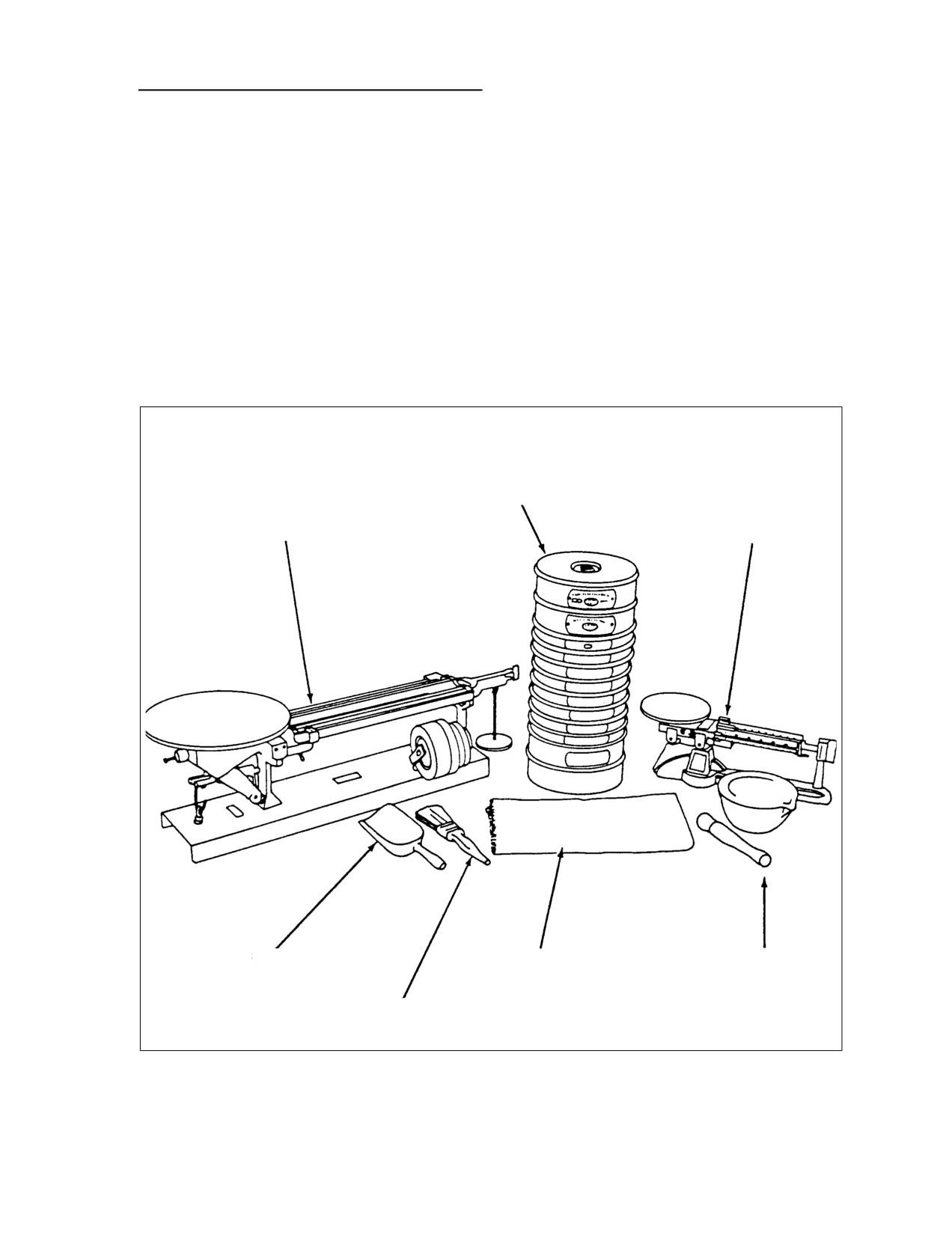
Use the following items to perform this test (see Figure 2-38):
• A calculator.
• DD Form 1206 or an equivalent form.
• DD Form 1207.
• Beam scales.
Sieves, test
8 inches w/cover and pan
Scale, bench, 2,600 g
Scale, bench, 21,100 g
Scoop
Cloth, cotton duck
Mortar and pestle
Brush
Figure 2-38. Equipment for sieve analysis
Soils 2-71
FM 5-472/NAVFAC MO 330/AFJMAN 32-1221(I)
•
Balance scales sensitive to 0.1 gram and 0.01 gram.
•
A scoop.
•
A brush.
•
A sieve shaker.
•
A nest of sieves including, as a minimum, the following sizes:
2
inches, 1.5 inches, 1 inch, 3/4 inch, 3/8 inch, No. 4, No. 10, No.
16, No.
30, No. 40, No. 50, No. 100, and No. 200.
•
A pan.
•
A cover.
•
A mortar.
•
A rubber-covered pestle.
•
Pudding pans.
•
Paper.
•
A pencil.
•
A french curve.
•
A splitter (if available).
•
Canvas (in a laboratory environment).
•
A laboratory oven.
•
Heat-resistant gloves.
•
A battery-filler syringe.
•
Distilled water.
STEPS
Perform the following steps to determine the grain-size distribution:
Step 1. Prepare the soil sample.
a. Spread out and air-dry the soil sample.
b. Break up the aggregate particles thoroughly with fingers or with the
mortar and pestle.
c. Obtain a representative sample for testing by using a sample splitter or
by quartering. The sample size recommended for sieve analysis depends
on the particle size. Obtain the required minimum sample as listed in
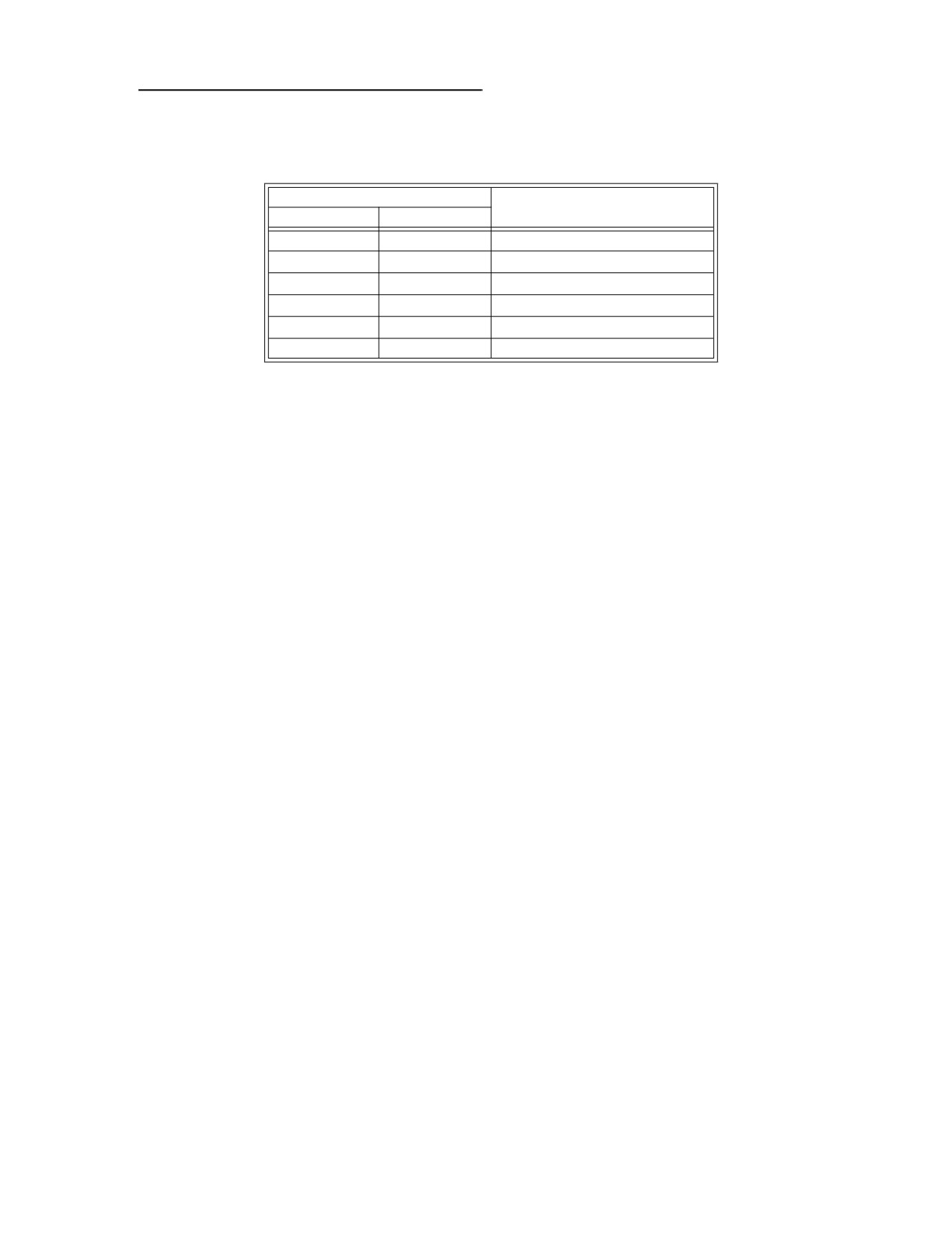
Table 2-8.
Step 2. Record all identifying information about the sample (such as the
project name, excavation number, sample number, description of sample, and
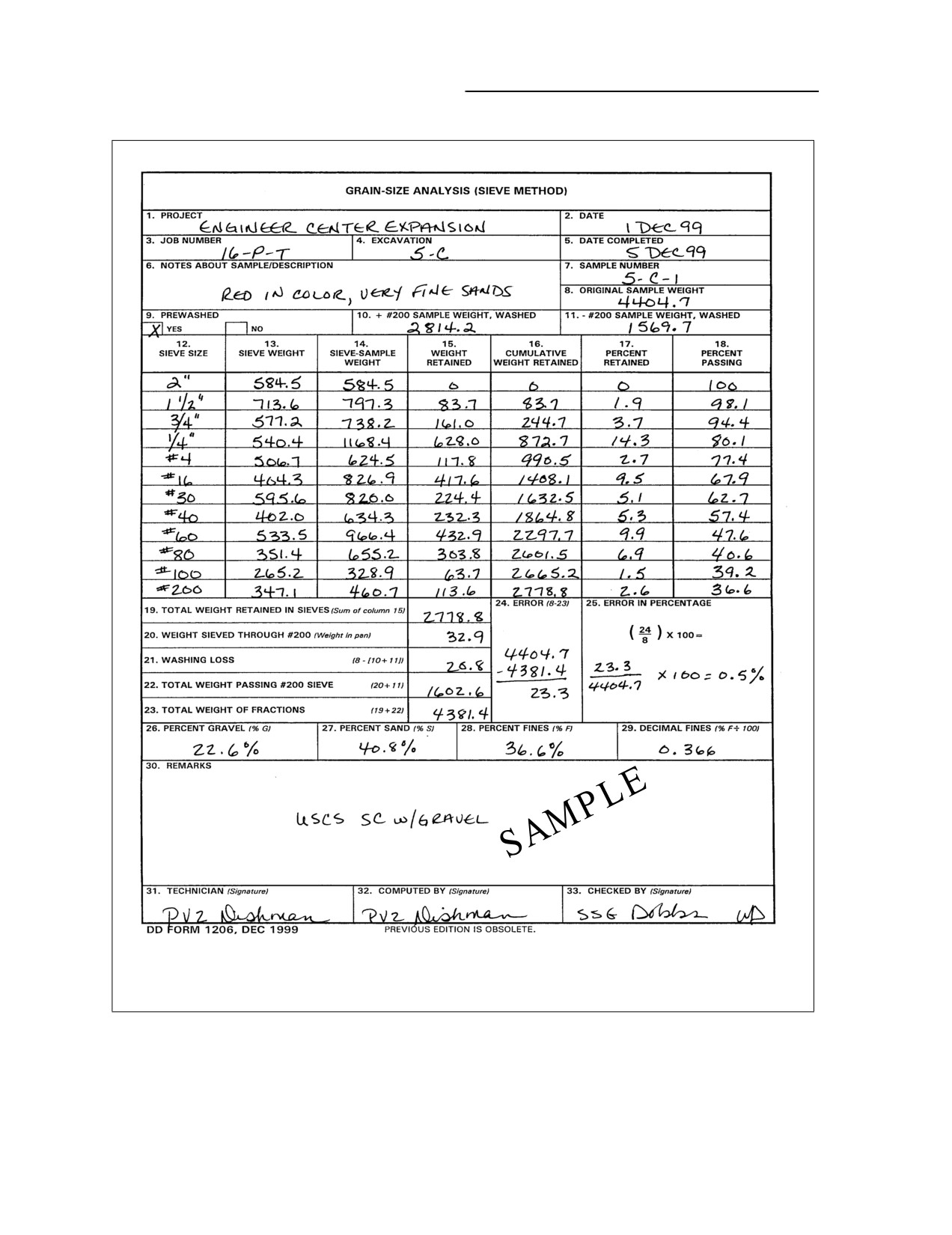
date [blocks 1 through 7]) on DD Form 1206 (see Figure 2-39, page 2-74).
Step 3. Oven-dry the material at 110°C ± 5° until a constant weight is
obtained. Allow the sample to cool.
Step 4. Weigh the oven-dried sample and record the weight on the form (block
8) to the nearest gram as the weight of the original sample.
2-72 Soils
FM 5-472/NAVFAC MO 330/AFJMAN 32-1221(I)
Table 2-8. Representative soil samples for grain-size analysis
Maximum Particle Size
Minimum Sample Weight
in
mm
(g)
3/8 (No. 4)
9.5
(No. 4)
500
3/4
19.0
1,000
1
25.4
2,000
1 1/2
38.1
3,000
2
50.8
4,000
3
76.2
5,000
Step 5. Check “No” in block 9 and enter 0 in blocks 10 and 11 if only a dry
sieve is to be performed, then proceed to step 10. If the sample will be
prewashed, check “Yes” in block 9 and proceed to step 6.
Step 6. Place the sample in a clean container and cover the sample completely
with water. Allow the sample to soak until the adhering and lumpy particles
are completely disintegrated. This process may take 2 to 24 hours.
Step 7. Wash the sample over a No. 200 sieve into a 2 x 2 concrete pan until
all
-200 material has been washed through. If the sample contains an
appreciable amount of coarse particles, combine the No. 4 and No. 200 sieves.
Take care not to overload the No. 200 sieve. If necessary, transfer the sample
in increments (this process may take up to 6 different pans and as long as 8
hours).
Step 8. Process the +200 material. Oven-dry the washed +200 material at
110°C ± 5° until a constant weight is obtained and allow the material to cool.
Record the weight on the form to the nearest tenth of a gram (block 10).
Step 9. Process the -200 material.
a. Allow the -200 material to settle in the pan until the surface water
becomes clear (16 to 24 hours).
b. Decant the surface water (using a siphon or a syringe), ensuring that
the settled material is not disturbed.
c. Use a trowel to transfer as much of the material as possible from the
pan to the pudding pans.
d. Rinse the remainder of the material from the 2 x 2 pans to the pudding
pans with as little water as possible.
e. Oven-dry the washed -200 material and determine the total -200
sample weight to the nearest tenth of a gram. Record this weight on the
form (block 11). Retain this material for use in the hydrometer analysis.
Step 10. Select a nest of sieves to accommodate the largest particle size of the
soil being tested, ensuring that all material will pass through the largest
sieve. As a minimum, the following sieves sizes will be used (up to the largest
Soils 2-73
FM 5-472/NAVFAC MO 330/AFJMAN 32-1221(I)
Figure 2-39. Sample DD Form 1206
2-74 Soils
FM 5-472/NAVFAC MO 330/AFJMAN 32-1221(I)
particle size):
2 inches, 1.5 inches, 1 inch, 3/4 inch, 3/8 inch, No. 4, No. 10, No.
16, No. 30, No. 40, No. 50, No. 100, and No. 200.
Step 11. Record the weight of each sieve selected on the form to the nearest
tenth of a gram (column 13), and arrange the sieves in a nest with the
smallest sieve size on the bottom. Weigh and place a pan on the bottom.
Step 12. Cover the sample. If the sample was prewashed, place only the +200
material onto the top sieve of the nest and place a cover over it. If the sample
was not prewashed, place the entire sample on the top sieve of the nest and
place a cover over it.
Step 13. Place the nest of sieves and the sample in the sieve shaker and shake
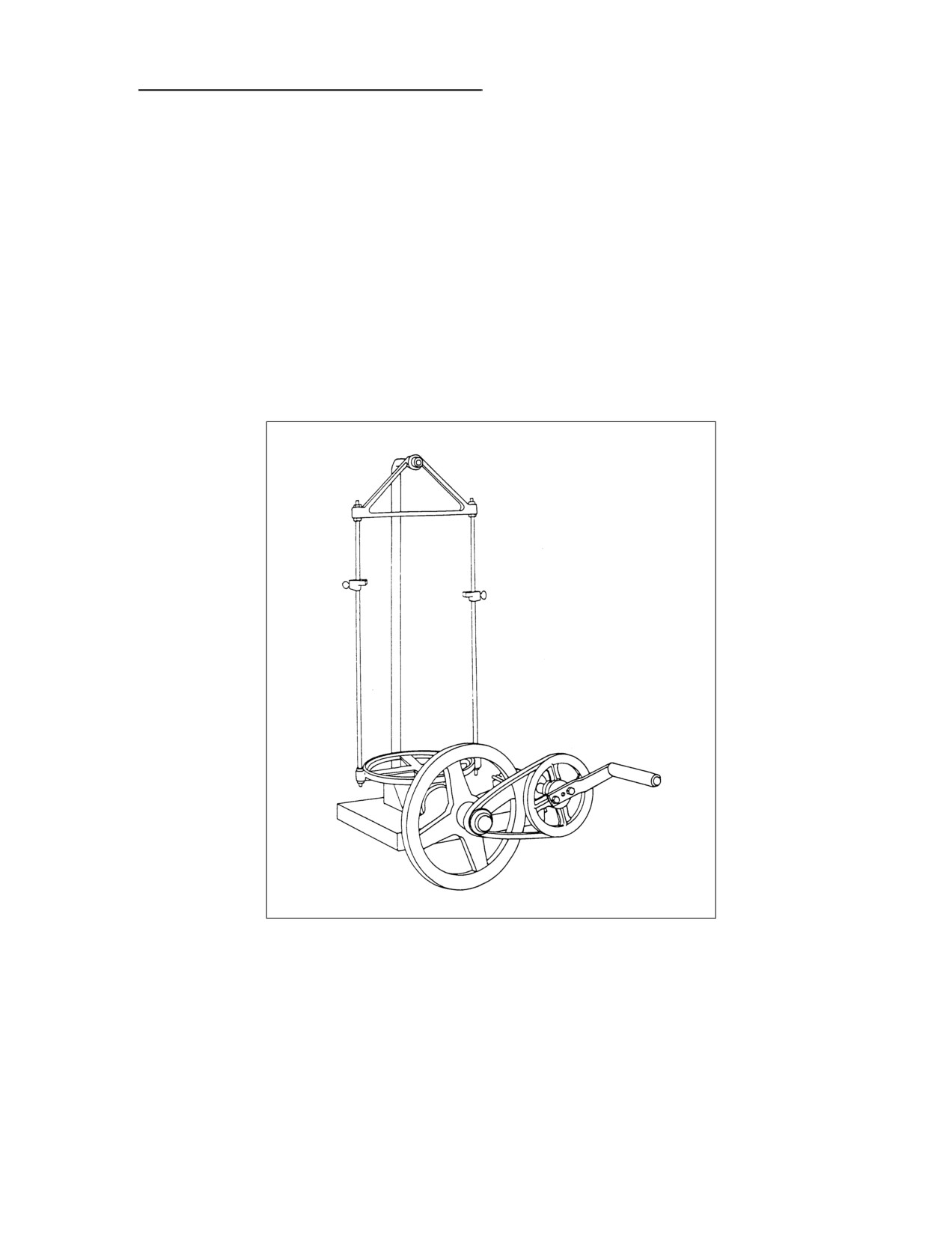
for 10 to 15 minutes (see Figure 2-40).
Figure 2-40. Hand-operated sieve shaker
Step 14. Remove the cover of the sieve nest after the shaking has been
completed.
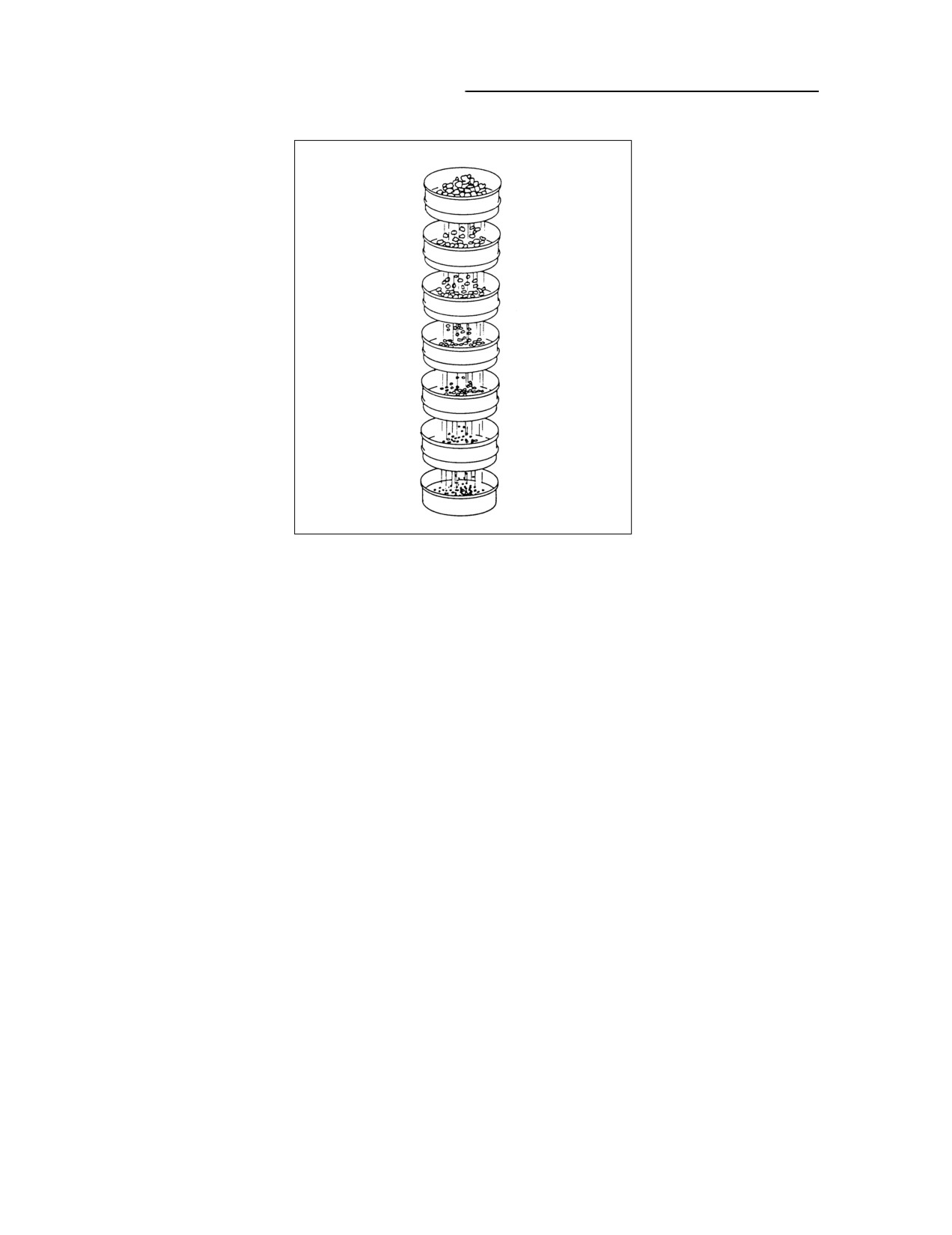
Step 15. Record the weight of each sieve with the retained sample (starting
with the top sieve (see Figure 2-41, page 2-76) on the form (column 14).
Soils 2-75
FM 5-472/NAVFAC MO 330/AFJMAN 32-1221(I)
Figure 2-41. Testing sieves stacked large to small
Step 16. Determine the weight of the material retained on each sieve by
subtracting the weight of the sieve from the weight of the sieve and retained
sample (columns 14 through 13). Record this weight as the weight retained
(column 15).
Step 17. Add the weights retained on all sieves and record as total weight
retained in sieves (block 19).
Step 18. Weigh the pan with the material passing the No. 200 sieve. Subtract
the weight of the pan (from step 11) and record this as the weight sieved
through No. 200 (block 20).
Step 19. Complete blocks 21 through 25 of the form using the formulas
provided on the sheet. If the error of percentage is 1 percent or greater, rerun
the test.
Step 20. Compute the cumulative weight retained (column 16) for each sieve
by adding the weight retained to the previous cumulative weight retained
with the starting point being 0.
Step 21. Compute the percent retained (column 17) for each sieve by dividing
the weight retained by the total weight of fractions as follows:
column 15
------------------------- × 100
block 23
Step 22. Compute the percent passing for each sieve size by subtracting the
cumulative weight retained from the total weight of fractions and dividing by
the total weight of fractions as follows:
2-76 Soils
C1, FM 5-472/NAVFAC MO 330/AFJMAN 32-1221(I)
block 23 - column 16
column 18
= --------------------------------------------------- × 100
block 23
Step 23. Determine the percentages for gravel, sand, and fines. Record the
information on the form.
• Gravel is the material retained on the No. 4 sieve.
• Sand is the material passing the No. 4 sieve and retained on the No.
200 sieve.
• Fines are the material passing the No. 200 sieve.
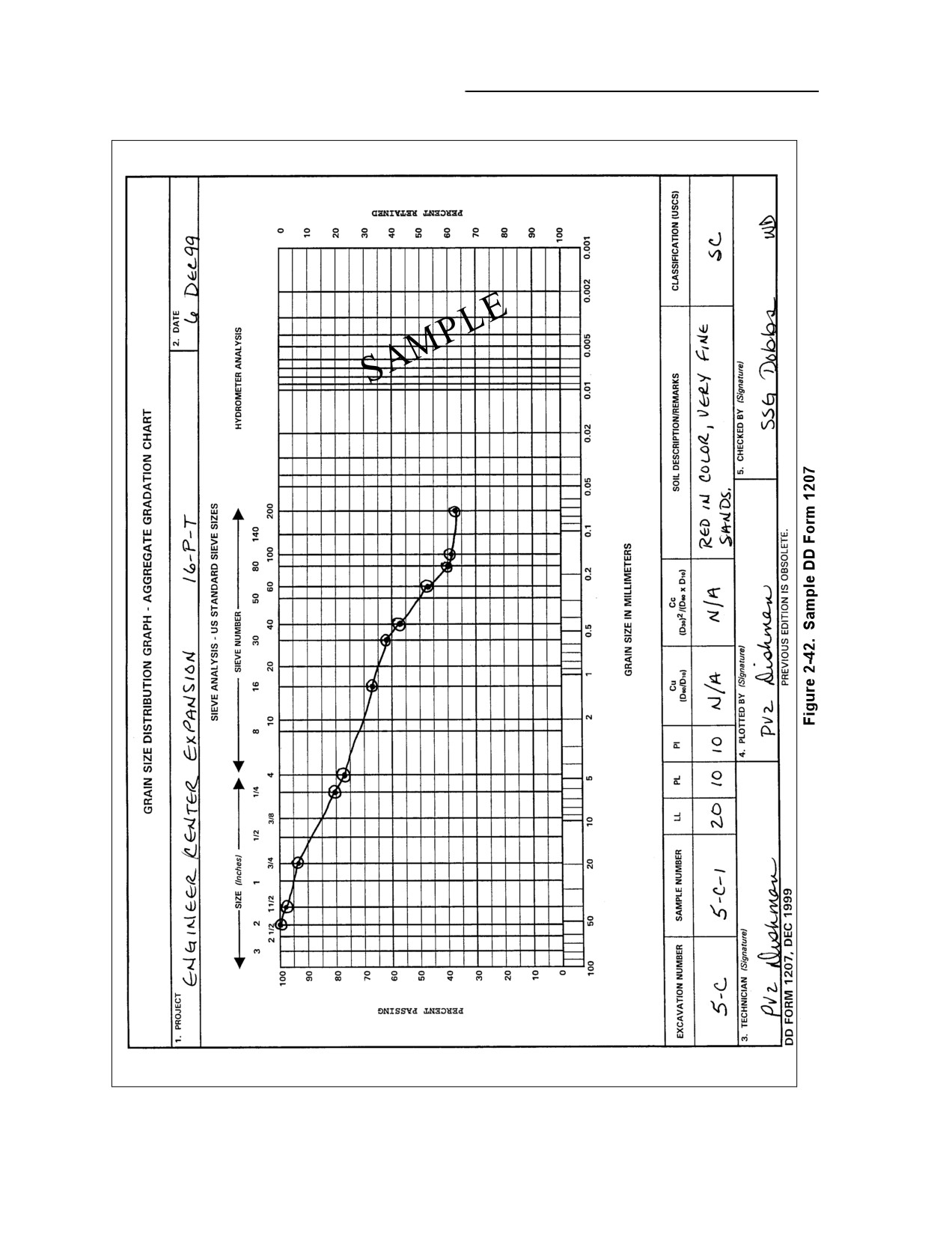
Step 24. Prepare DD Form 1207 (see Figure 2-42, page 2-78).
a. Record the identifying information for the sample in the remarks block.
b. Use the sieve-analysis data to plot (on DD Form 1207) the sieve size
and the percentage passing the sieve.
c. Using a french curve, connect the plotted points to form a smooth, free-
flowing curve (the grain-size distribution curve, Figure 2-42).
d. Determine the coefficient of uniformity (Cu).
NOTE: The grain size, in millimeters, which corresponds to 10
percent passing on the grain-size-distribution curve, is called Hazen’s
effective size. It is designated by the symbol D10. If the grain-size-
distribution curve extends to or below 10 percent passing, then the
Cu can be determined. The uniformity coefficient is the ratio
between the grain diameter, in millimeters, corresponding to 60
percent passing (D60) and 10 percent passing on the curve. Use the
following formula and record on the form:
D60
Cu
= --------
D
10
If D10 cannot be determined using the data from the sieve analysis, a
hydrometer analysis may be required to obtain information about the
smaller size grains and to extend the distribution curve to make it
more complete.
e. Determine the coefficient of curvature (Cc) by using D60 and D10 as
previously discussed and D30, the grain diameter, in millimeters,
corresponding to 30 percent passing on the grain-size-distribution curve.
These numbers are used in the following formula and recorded on the
form:
(
D30
)2
Cc
= -----------------------------
(D
×
D10
)
60
NOTE: The values for D60, D10, and D30 are obtained by going to the
percent passing by weight on the left vertical scale, then moving
horizontally across to the right until the grain-size-distribution curve
is intercepted, and then vertically down to the horizontal axis where
the diameter of the material is read in millimeters. See Figure 2-42,
for the completed gradation chart.
Step 25. Determine the gradation by using the abbreviated information listed
below. Record the information on the form.
Soils 2-77
FM 5-472/NAVFAC MO 330/AFJMAN 32-1221(I)
2-78 Soils
FM 5-472/NAVFAC MO 330/AFJMAN 32-1221(I)
a. The soil is well-graded (W) when all of the following apply:
• Cu is greater than 4 if the soil is predominantly gravel and greater
than 6 if the soil is predominantly sand.
• Cc is at least 1.0 but not more than 3.0 for both gravel and sand.
An indicator of a well-graded soil is a smooth curve plotted for grain-size
distribution. The curve must not have any horizontal or vertical portions
and must be continuous.
b. The soil is poorly graded (P) if any of the above criteria is not fulfilled.
HYDROMETER ANALYSIS
Hydrometer analysis is based on Stokes' law, which relates the terminal
velocity of a free-falling sphere in a liquid to its diameter—or, in simpler
terms, the larger the grain size, the greater its settling velocity in a fluid. It is
assumed that Stokes' law can be applied to a mass of dispersed soil particles of
various shapes and sizes. Larger particles settle more rapidly than smaller
ones. The hydrometer analysis is an application of Stokes' law that permits
calculating the grain-size distribution in silts and clays, where the soil
particles are given the sizes of equivalent spherical particles.
The density of a soil-water suspension depends on the concentration and
specific gravity of the soil particles. If the suspension is allowed to stand, the
particles gradually settle out of the suspension and the density decreases.
The hydrometer is used to measure the density of the suspension at a known
depth below the surface. The density measurement, together with knowledge
of specific gravity of the soil particles, determines the percentage of dispersed
soil particles in suspension at the time and depth of measurement.
The depth at which the measurement is made is found by calibrating the
hydrometer. Stokes' law is used to calculate the maximum equivalent particle
diameter for the material in suspension at this depth and for the elapsed time
of settlement. A series of density measurements at known depths of
suspension and at known times of settlement give the percentages of particles
finer than the diameters given by Stokes' law. Thus, the series of readings will
reflect the amount of different sizes of particles in the fine-grained soils. The
particle diameter (D) is calculated from Stokes' equation using the corrected
hydrometer reading.
PURPOSE
Perform the hydrometer analysis to determine the grain-size distribution of
the -200 material in a soil, to assist in determining the frost susceptibility of a
soil, and to provide data needed to calculate the coefficient of uniformity and
coefficient of curvature.
EQUIPMENT
Perform the hydrometer analysis in a laboratory environment using the
following items:
• A hydrometer.
• Alaboratoryoven.
Soils 2-79
FM 5-472/NAVFAC MO 330/AFJMAN 32-1221(I)
•
Heat-resistant gloves.
•
Balance scales sensitive to 0.1 gram and 0.01 gram.
•
A thermometer.
•
A timing device with a second hand.
•
A No. 200 sieve.
•
A battery-filler syringe.
•
Distilled water.
•
A dispersing agent.
•
Pudding pans.
•
Two graduated glass cylinders (1,000-milliliter) with cap.
•
DD Form 1207.
•
DD Form 1794.
•
A calculator.
•
Paper.
•
A pencil.
•
A grease pencil.
•
Graph paper.
•
A straightedge.
•
A mechanically operated stirring device with a dispersion cup.
STEPS
Perform the following steps for the hydrometer analysis:
Step 1. Prepare the sample.
a. Obtain the -200 sample as prepared in the sieve analysis. The size of
the
-200 sample varies according to the type of soil being tested.
Approximately 100 grams are required for sandy soils and 50 grams for
silty or clayey soils. Place the sample in a dish and add distilled water
until the sample is submerged.
b. Determine the amount and type of dispersing agent that will be used
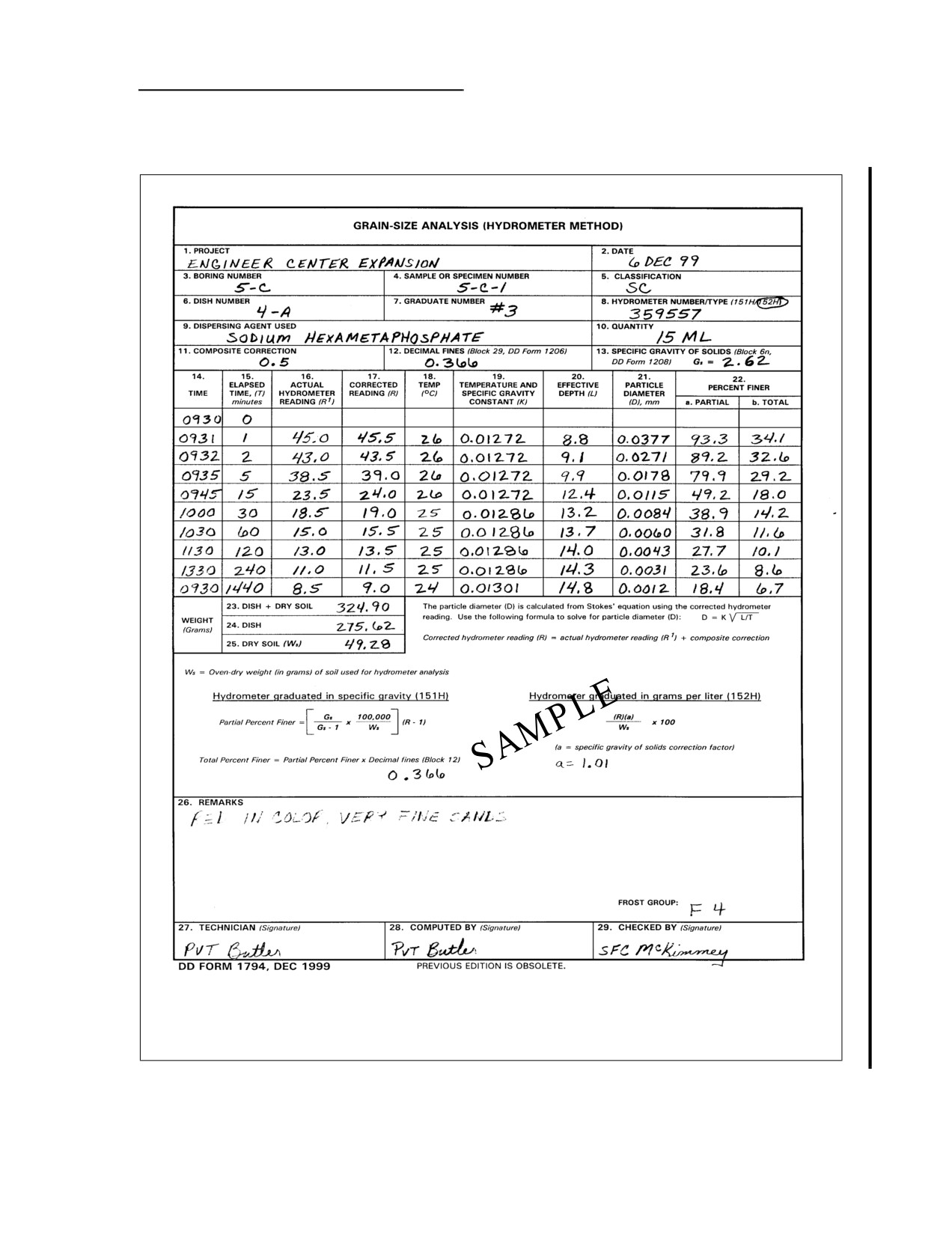
during the test. Record it on DD Form 1794 (blocks 9 and 10) (see Figure
2-43). The dispersing agents shown in Table 2-9, page 2-82, are listed in
approximate order of effectiveness. They have been found to be
satisfactory for most types of soils. In most instances, 15 milliliters of a
dispersing-agent solution is adequate to control flocculation
(the
adherence of fine soil grains to each other in clusters while in suspension).
An additional 15 milliliters can be added a second or third time if
flocculation continues.
c. Add the predetermined amount of dispersing agent to the soaking soil
sample and allow the sample to soak at least 16 hours.
2-80 Soils
C1, FM 5-472/NAVFAC MO 330/AFJMAN 32-1221(I)
Figure 2-43. Sample DD Form 1794
Soils 2-81
FM 5-472/NAVFAC MO 330/AFJMAN 32-1221(I)
Table 2-9. Dispersing agents
Stock Solution
Dispersing Agent
Manufacturer
Concentration
Grams Per Liter
Blockson Chemical Co,
Sodium tripolyphosphate
0.4N
29
Joliet, IL
Blockson Chemical Co,
Sodium polyphosphate
0.4N
36
Joliet, IL
Sodium tetraphosphate
Rumford Chemical Works,
0.4N
31
(Quadrofos)
Rumford, NJ
Sodium
hexametaphosphate
0.4N
41
Calgon Co, Pittsburgh, PA
(Calgon)
Step 2. Determine the type of hydrometer. If the hydrometer scale ranges
from 1.000 to 1.038, it is a Type 151H and measures specific gravity of the
suspension. If the scale ranges from 0 to 60, it is a Type 152H and measures
grams per liter of the suspension. The dimensions for both hydrometers are
the same.
Step 3. Determine the composite correction.
NOTE: Before performing the hydrometer test, a composite
correction for hydrometer readings must be determined to correct
for items that tend to produce errors in the test.
The first of these items needing correction is the meniscus reading.
Hydrometers are graduated by the manufacturer to be read at the
bottom of the meniscus formed by the liquid on the stem. Since it is
not possible to secure readings of soil suspensions at the bottom of
the meniscus, readings must be taken at the top and a correction
applied.
The second of these items needing correction is a result of using a
dispersing agent in the water to control flocculation. This leads to
errors in the analysis. While the dispersing agent assists in keeping
the soil grains from adhering to each other, it also increases the
specific gravity of the fluid used.
The net amount of the correction for the two corrections required is
designated as the composite correction.
a. Place about 500 milliliters of distilled water in a graduated cylinder.
b. Place the amount of dispersing agent that was used in step 1 in the
cylinder and mix well.
c. Add additional distilled water to the cylinder to reach the 1,000-
milliliter mark.
d. Place the hydrometer in the cylinder and allow it to settle for 20 to 25
seconds. Read the hydrometer at the top of the meniscus formed on the
2-82 Soils
C2, FM 5-472/NAVFAC MO 330/AFJMAN 32-1221(I)
stem. For the Type 151H hydrometer, the composite correction is the
difference between this reading and 1. For the Type 152H hydrometer, the
composite correction is the difference between the reading and 0.
e. Record the composite correction in block 11 of the form (Figure 2-43,
page 2-81).
f. Remove the hydrometer from the dispersing-fluid cylinder and place it
in a second cylinder filled with distilled water.
NOTE: From this point forward, all hydrometer readings will be
taken from the top of the meniscus.
Step 4. Perform the hydrometer test.
a. Record all identifying information for the sample, dispersing agent,
quantity used, and composite correction on the form.
b. Obtain the decimal fines from the original soil sample from DD Form
1206. Record it on DD Form 1794 (block 12).
c. Obtain the specific gravity of solids (Gs) of the soil sample from DD
Form 1208. Record it on DD Form 1794 (block 13).
d. Empty and thoroughly rinse the graduated cylinder containing the
dispersing solution from step 3.
e. Transfer the soaked sample to a dispersion cup, using distilled water to
wash any residue from the dish into the cup. Add distilled water to the
cup until the water surface is 3 inches below the top of the cup. Place the
cup in the dispersing machine and mix silts and sands for 5 minutes, low-
plasticity clay for 7 minutes, and high-plasticity clay for 9 minutes.
f. Transfer the mixed solution to the clean 1,000-milliliter graduated
cylinder, using distilled water to wash any residue from the cup into the
cylinder. Add distilled water until the 1,000-milliliter volume mark is
reached.
g. Place the rubber cap over the open end of the cylinder. Turn the
cylinder upside down and back for a period of 1 minute to complete the
agitation of the slurry.
NOTE: The number of turns during this minute should be about
60, counting the turn upside down and back as two turns. If any
soil remains at the bottom of the cylinder during the first few
turns, it should be loosened by vigorous shaking of the cylinder
while it is in the inverted position.
h. After shaking the cylinder for 1 minute, place it on a level and sturdy
surface where it will not be disturbed. Remove the cap and start the
timer. Remove any foam that has formed during agitation by lightly
touching it with a bar of soap.
i. Immerse the hydrometer slowly into the liquid 20 to 25 seconds before
each reading. Take the actual hydrometer reading (R1) at 1 and 2
minutes of elapsed time. As soon as the 1- and 2-minute readings are
taken, carefully remove the hydrometer and place it in the second cylinder
of pure distilled water using a spinning motion. Record the reading on the
form (block 16).
Soils 2-83
C2, FM 5-472/NAVFAC MO 330/AFJMAN 32-1221(I)
j. Place a thermometer in the solution. Record the temperature reading,
in centigrade, to the nearest whole degree. Record on the form (block 18).
NOTE: It is extremely important to obtain accurate temperature
readings. The soil hydrometer is calibrated at 20°C. Variations in
temperature from this standard temperature produces inaccuracies
in the actual hydrometer readings. These inaccuracies will be
compensated for later during the computations.
k. Repeat steps 4i and 4j for the remainder of the required readings. Take
readings at the following intervals: 5, 15, and 30 minutes and 1, 2, 4, and
24 hours. After each reading, remove the hydrometer, place it in the
hydrometer of distilled water, and obtain the temperature reading.
Record the information on the form for each reading.
Step 5. Determine the dry weight of the sample by carefully washing all of the
sample into a preweighed pudding pan or dish (block 24). Oven-dry the
sample, allow it to cool, and determine and record the weight of the sample
and the pan or dish (block 23).
Step 6. Determine the weight of the dry soil by subtracting the weight of the
pan from the weight of the pan and dry soil. Record this information on the
form as the weight of the oven-dried soil (Ws) used for hydrometer testing
(block 25).
Step 7. Compute the results on DD Form 1794 (see Figure 2-43, page 2-81).
a. Column 17. Obtain the corrected reading (R) by adding the actual
hydrometer reading (column 16, R1) and the composite correction (block
11) and record the sum on the form.
R = R1 + composite correction
b. Column 19. Obtain the temperature versus specific gravity constant
(K) from Table 2-10. Record it on the form.
NOTE: Although typical specific-gravity values are listed in Table 2-
10, there may be cases when a soil type falls above or below this range
of values. In these situations the value of K must be computed using
the following formula:
30η
K
=
---------------
G
-
1
s
where—
η = coefficient of viscosity of the liquid (water) in poises (varies with
changes in temperature)
Gs = Specific gravity of solids for the material being tested
c. Column 20. Obtain the effective depth (L) for each corrected reading
(column 17) by using Table 2-11, page 2-86, and record on the form.
2-84 Soils
FM 5-472/NAVFAC MO 330/AFJMAN 32-1221(I)
Table 2-10.
Values of K for use in Stokes’ equation for computing particle diameter
Specific Gravity of Solids (Gs)
Coeff of
Temp
Viscosity
°C
2.50
2.55
2.60
2.65
2.70
2.75
2.80
2.85
(η)
16
0.01505
0.01481
0.01458
0.01435
0.01414
0.01394
0.01374
0.01355
0.00001133
17
0.01486
0.01462
0.01439
0.01417
0.01396
0.01376
0.01356
0.01338
0.00001104
18
0.01467
0.01443
0.01420
0.01399
0.01378
0.01358
0.01339
0.01321
0.00001076
19
0.01449
0.01426
0.01403
0.01382
0.01361
0.01342
0.01323
0.01305
0.00001050
20
0.01432
0.01408
0.01386
0.01365
0.01345
0.01326
0.01307
0.01289
0.00001025
21
0.01414
0.01391
0.01369
0.01348
0.01328
0.01309
0.01291
0.01273
0.00001000
22
0.01397
0.01374
0.01353
0.01332
0.01312
0.01294
0.01275
0.01258
0.00000976
23
0.01381
0.01358
0.01337
0.01316
0.01297
0.01278
0.01260
0.01243
0.00000953
24
0.01365
0.01342
0.01321
0.01301
0.01282
0.01263
0.01246
0.01229
0.00000931
25
0.01349
0.01327
0.01306
0.01286
0.01267
0.01249
0.01232
0.01215
0.00000910
26
0.01334
0.01312
0.01292
0.01272
0.01253
0.01235
0.01218
0.01201
0.00000890
27
0.01319
0.01298
0.01277
0.01258
0.01239
0.01221
0.01204
0.01188
0.00000870
28
0.01305
0.01283
0.01263
0.01244
0.01225
0.01208
0.01191
0.01175
0.00000851
29
0.01290
0.01269
0.01249
0.01230
0.01212
0.01194
0.01178
0.01162
0.00000832
30
0.01276
0.01255
0.01235
0.01217
0.01199
0.01181
0.01165
0.01149
0.00000814
d. Column 21. Determine the particle diameter (D) corresponding to a
given hydrometer reading on the basis of Stokes' equation:
L
D = K
--
T
where—
D = diameter of the sphere, in millimeters
K = constant depending on temperature of suspension and specific gravity
of soil particles; values of K can be obtained from Table 2-10 (entered
in column 19)
L = distance from the surface of the suspension to the level at which the
density of the suspension is being measured, in centimeters (effective
depth) (entered in column 20)
T = interval of time from beginning of sedimentation to the taking of the
reading, in minutes (entered in column 15)
e. Column 22a. Compute the partial percent finer. To compute the
percent of particle diameters finer than that corresponding to a given
hydrometer reading, use the following formulas based on the hydrometer
type and record the results on the form:
(1) Hydrometer type 151H:
GS
100, 000
Partial percent finer
=
---------------
× -------------------- × (R - 1.0)
GS
-
1
WS
Soils 2-85
FM 5-472/NAVFAC MO 330/AFJMAN 32-1221(I)
Table 2-11. Values of effective depth for hydrometer analysis
Hydrometer 151H
Hydrometer 152H
1.000
16.3
1.021
10.7
0
16.3
21
12.9
42
9.4
1.001
16.0
1.022
10.5
1
16.1
22
12.7
43
9.2
1.002
15.8
1.023
10.2
2
16.0
23
12.5
44
9.1
1.003
15.5
1.024
10.0
3
15.8
24
12.4
45
8.9
1.004
15.2
1.025
9.7
4
15.6
25
12.2
46
8.8
1.005
15.0
1.026
9.4
5
15.5
26
12.0
47
8.6
1.006
14.7
1.027
9.2
6
15.3
27
11.9
48
8.4
1.007
14.4
1.028
8.9
7
15.2
28
11.7
49
8.3
1.008
14.2
1.029
8.6
8
15.0
29
11.5
50
8.1
1.009
13.9
1.030
8.4
9
14.8
30
11.4
51
7.9
1.010
13.7
1.031
8.1
10
14.7
31
11.2
52
7.8
1.011
13.4
1.032
7.8
11
14.5
32
11.1
53
7.6
1.012
13.1
1.033
7.6
12
14.3
33
10.9
54
7.4
1.013
12.9
1.034
7.3
13
14.2
34
10.7
55
7.3
1.014
12.6
1.035
7.0
14
14.0
35
10.6
56
7.1
1.015
12.3
1.036
6.8
15
13.8
36
10.4
57
7.0
1.016
12.1
1.037
6.5
16
13.7
37
10.2
58
6.8
1.017
11.8
1.038
6.2
17
13.5
38
10.1
59
6.6
1.018
11.5
18
13.3
39
9.9
60
6.5
1.019
11.3
19
13.2
40
9.7
1.020
11.0
20
13.0
41
9.6
(2) Hydrometer type 152H:
R×a
Partial percent finer
= ------------ × 100
W
S
where—
Gs = specific gravity of solids
Ws = oven-dried weight of soil (in grams) used for hydrometer analysis
R
= Corrected hydrometer reading
(with composite correction
applied)
a
= Correction factor from Table 2-12, to be applied to the reading for
Type 152H
2-86 Soils
C1, FM 5-472/NAVFAC MO 330/AFJMAN 32-1221(I)
Table 2-12. Specific-gravity correction factors applied to hydrometer 152H
for computing partial percent finer
Specific Gravity
2.45
2.50
2.55
2.60
2.65
2.70
2.75
2.80
2.85
2.90
2.95
Correction Factor
1.05
1.03
1.02
1.01
1.00
0.99
0.98
0.97
0.96
0.96
0.94
f. Compute the total percent finer for each hydrometer reading and record
it on the form using the formula—
Total percent finer = partial percent finer x decimal fines (block 12)
PRESENTATION OF RESULTS
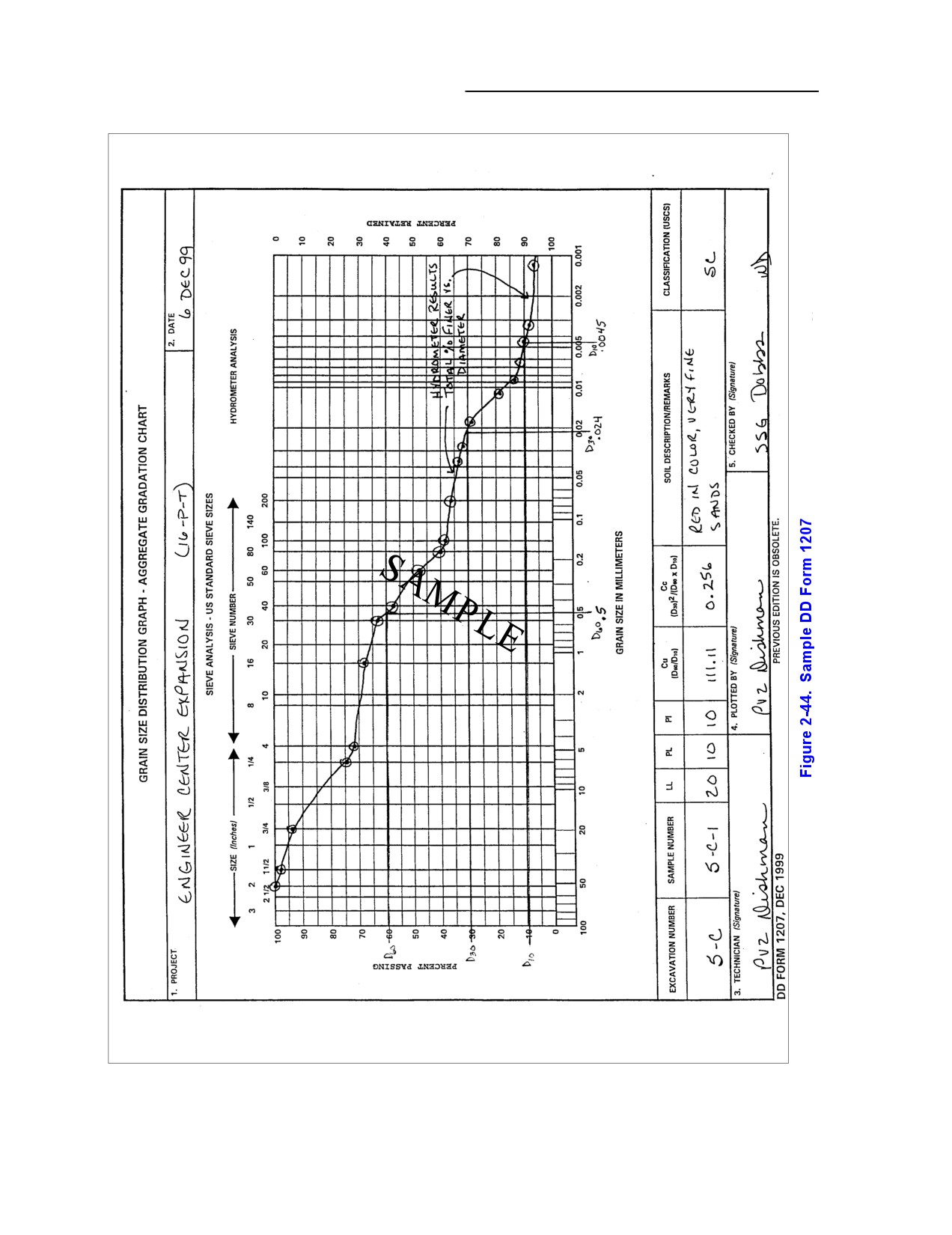
Plot the grain-size distribution on DD Form 1207 using the particle diameters
(D, grain-size, in millimeters) and the total percent finer (percent passing) and
connect the plotted points with a smooth curve (see Figure 2-44, page 2-88).
Read the curve on the form and determine if 3 percent or more of the particles
are smaller than 0.02 millimeter in diameter; if so, the soil is frost susceptible.
Frost-susceptible soils are listed in four groups in the order of increasing
susceptibility (see Table 2-13, page 2-89).
Soils in group F-4
have high frost susceptibility. Record the frost-
susceptibility group for the soil type in block 27 of DD Form 1794 (see Figure
2-43, page 2-81).
This curve can be used to determine the coefficient of uniformity (Cu) and the
coefficient of curvature (Cc).
The data in the example shown on DD Form 1794 (Figure 2-43, page 2-81) is
plotted on DD Form 1207 to give an example of such a curve for a mixed soil
(see Figure 2-44). For this soil, the diameter corresponding to 60 percent
passing (D60) is 0.5 millimeter. The diameter corresponding to 10 percent
passing (D10) is 0.0045 millimeter. Hence, the coefficient of uniformity is as
follows:
D60
0.5
CU
=
---------
= ----------------
= 111.11
D
0.0045
10
The diameter for 30 percent passing (D30) is 0.024 millimeters. Thus, the
coefficient of curvature is as follows:
·
2
(
D30
)2
(0.024)
0.000576
CC
=
------------------------
=
-----------------------------
= ----------------------
= 0.256
D60
×
D10
0.5 × 0.0045
0.00225
Soils 2-87
FM 5-472/NAVFAC MO 330/AFJMAN 32-1221(I)
2-88 Soils

FM 5-472/NAVFAC MO 330/AFJMAN 32-1221(I)
Table 2-13. Frost-susceptibility groups for typical soil types
Percentage Finer
Typical Soil Types Under
Frost Group
Kind of Soil
Than 0.02 mm by
USCS
Weight
(a) Gravels (e > 0.25)
0 to 3
GW, GP
crushed stone or rock
NFS
(b) Sands (e < 0.30)
0 to 3
SW, SP
(c) Sands (e > 0.30)
3 to 10
SP
(a) Gravels (e < 0.25)
0 to 3
GW, GP
crushed stone or rock
S-1
GW, GP, GW-GM, GP-GM,
(b) Gravelly soils
3 to 6
GW-GC, GP-GC
SW, SP, SW-SM, SP-SM,
S-2
Sandy soils (e < 0.30)
3 to 6
SW-SC, SP-SC
GW-GM, GP-GM, GW-GC,
F-1
Gravelly soils
6 to 10
GP-GC
(a) Gravelly soils
10 to 20
GM, GC, GM-GC
F-2
SM, SC, SW-SM, SP-SM,
(b) Sands
6 to 15
SW-SC, SP-SC, SM-SC
(a) Gravelly soils
Over 20
GM, GC, GM-GC
(b) Sands, except very fine
F-3
Over 15
SM, SC, SM-SC
silty sands
(c) Clays, PI > 12
CL, CH, ML-CL
(a) All silts
ML, MH, ML-CL
(b) Very fine sands
Over 15
SM, SC, SM-SC
(c) Clays, PI < 12
CL, ML-CL
F-4
(d) Varved clays and other
CL or CH layered with ML,
fine-grained, banded
MH, SM, SC, SM-SC, or ML-
sediments
CL
NOTE: e = void ratio
SECTION VI. LIQUID LIMIT, PLASTIC LIMIT, AND PLASTICITY INDEX
DETERMINATION (ASTM D 4318-95A)
Clays and some other fine-grained soils exhibit plasticity if the proper amount
of water is present in the soil. A plastic soil is one that can be deformed beyond
the point of recovery without cracking or change in volume. Such soils can be
remolded. The LL is the greatest water content that the material may contain
and still remain plastic. More water causes it to become a thick liquid. The PL
is the lowest water content that the material may contain for plastic behavior.
With less water, the soil becomes brittle and breaks into fragments if
remolding is attempted. The PI is the numerical difference between the LL and
the PL:
PI = LL - PL
Soils 2-89
FM 5-472/NAVFAC MO 330/AFJMAN 32-1221(I)
A large PI indicates a very plastic soil; a small PI denotes a soil having little
plasticity. As water content decreases below the PL, the soil mass shrinks and
becomes stiffer. The shrinkage limit is the water content where, with further
drying, shrinkage stops. Since there is no sharp distinction between the liquid,
plastic, and brittle solid states of consistency, standardized procedures have
been established for determining the LL and the PL. These consistency limits,
as well as the shrinkage limit, are called the Atterberg limits. Since the
primary tests in this section determine only the LLs and PLs and do not
include tests for the shrinkage limits, they are not identified as the Atterberg
limits.
Research with large numbers of clay soils was used to establish the soil
plasticity chart for laboratory classification of fine-grained soils. The LL and
PI values are coordinates that locate a particular soil sample on the chart. The
region on the chart in which the sample falls gives the classification based on
the behavioral characteristics of the particular soil.
Take particular care when performing the test methods described below. Some
soils, particularly those with a high organic content, can provide inconsistent
readings or drastic differences between an oven-dried sample and a sample at
natural moisture content. Conduct the test below on samples of natural
moisture content. Determine the moisture content at the end of the test.
LL DETERMINATION
A soil’s LL is the water content expressed as a percentage of the weight of the
oven-dried soil at the boundary between the liquid and the plastic states and
reported as a whole number. This boundary is arbitrarily defined by a standard
test method. The test is performed on two halves of a prepared soil specimen in
an LL device. The LL is determined when the soil halves flow together along a
distance of 13 millimeters when the cup is dropped or jarred exactly 25 times
from a height of 1 centimeter. This rate of drop is 1.9 to 2.1 drops per second.
PURPOSE
Perform this test to assist in classifying the soil by determining the LL from
three moisture-content samples.
EQUIPMENT
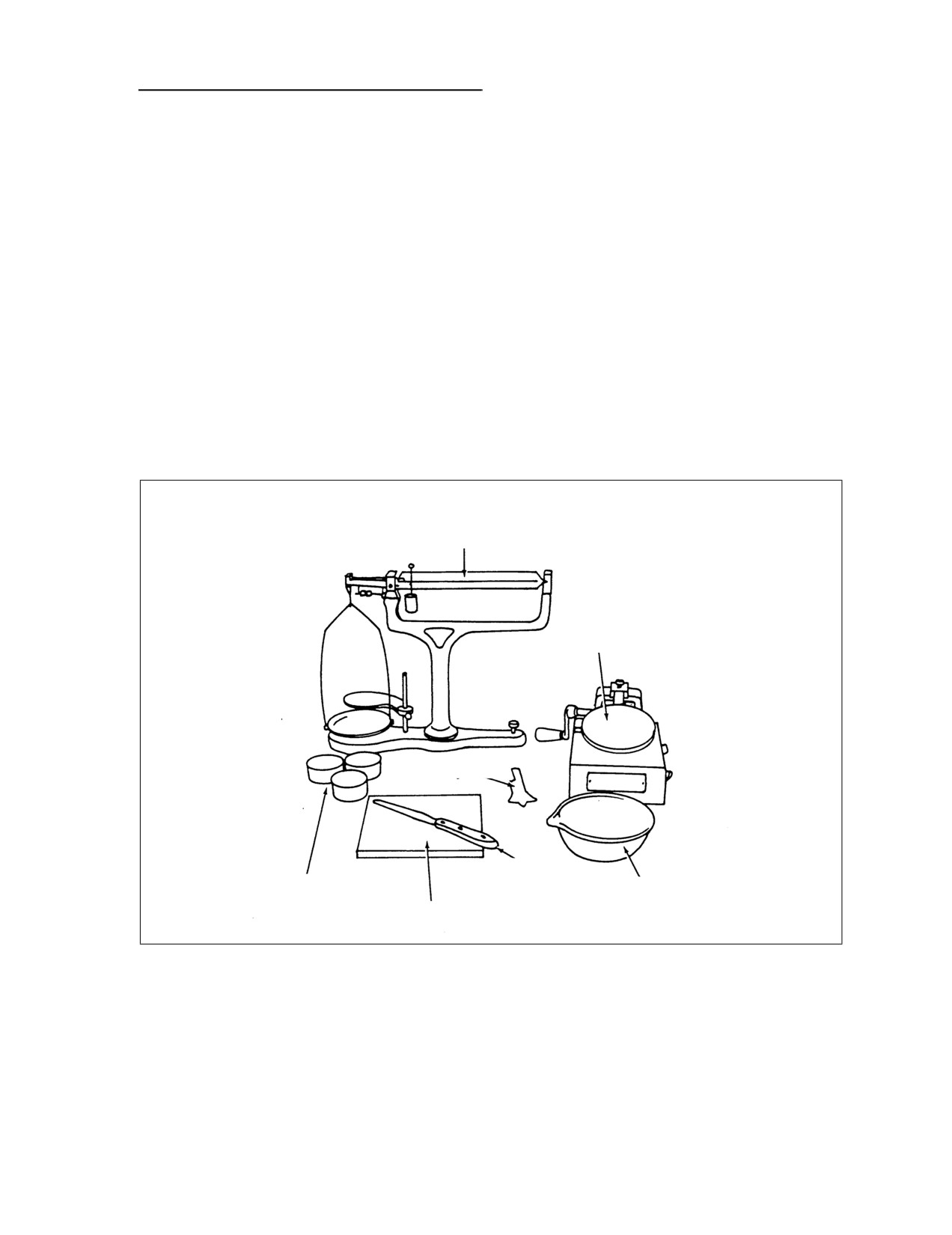
Perform this test in a laboratory environment using the following items (see
Figure 2-45):
• A balance scale sensitive to 0.01 gram.
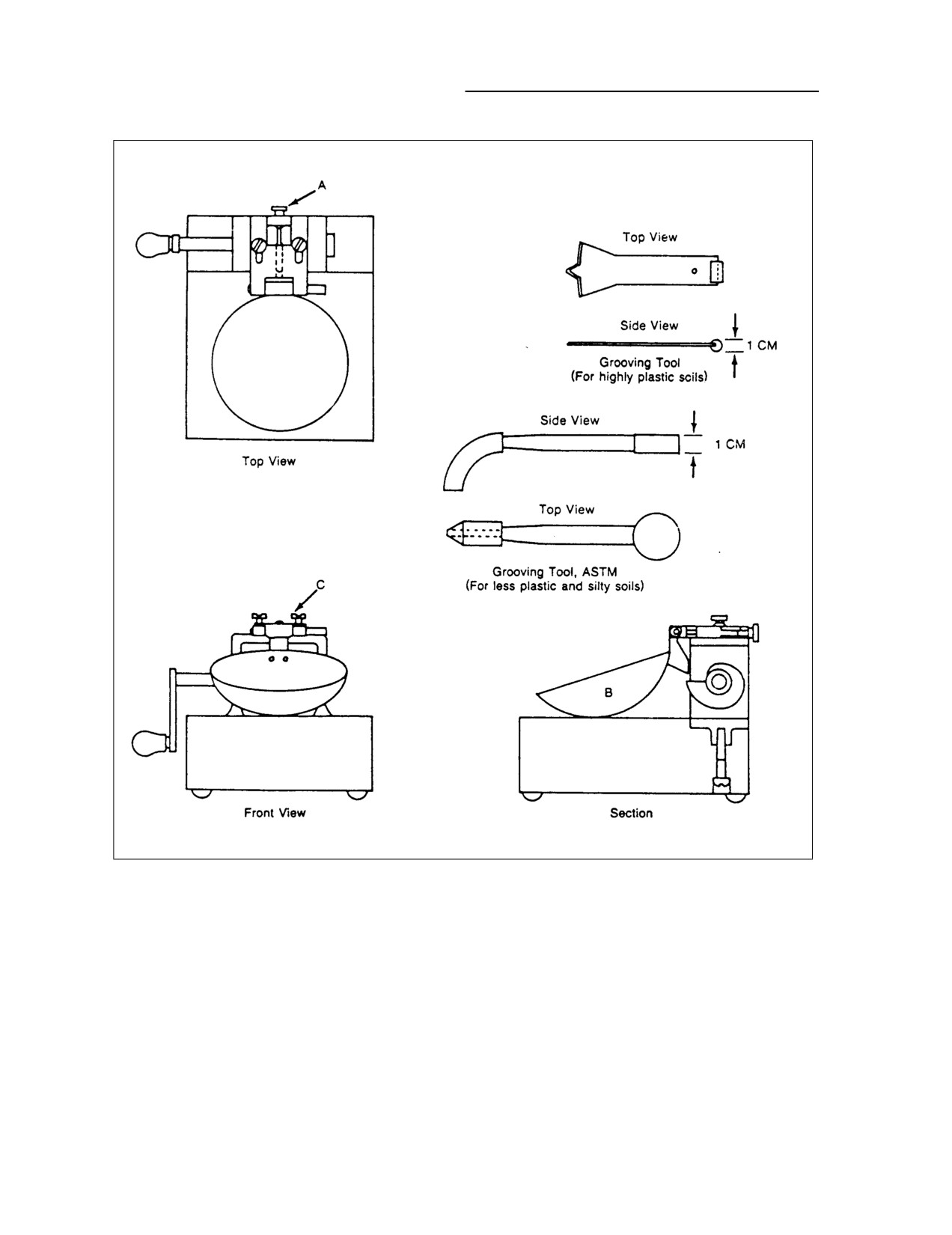
• An LL device and a grooving tool (see Figure 2-46, page 2-92).
• A No. 40 sieve.
• Pudding pans.
• A ground-glass plate (at least 30 centimeters square by 1 centimeter
thick) for mixing soil and rolling PL threads.
• A plastic bag.
• A calculator.
• Moisture-determination tares.
2-90 Soils
FM 5-472/NAVFAC MO 330/AFJMAN 32-1221(I)
• Paper.
• A pencil.
• A grease pencil.
• DD Form 1209.
• Gummed labels.
• A spatula.
• A straightedge.
• A mortar with a rubber-tipped pestle.
• A laboratory oven.
• Heat-resistant gloves.
• Distilled water.
200-g balance
LL machine
Grooving tool
Spatula
Moisture-content boxes
Evaporating dish
Ground glass 6” x 6” x 1/4”
Figure 2-45. Equipment for the LL and PL tests
Soils 2-91
FM 5-472/NAVFAC MO 330/AFJMAN 32-1221(I)
Figure 2-46. LL device with grooving tools
STEPS
Perform the following steps to determine the LL:
Step 1. Prepare the soil sample.
a. Sieve the soil sample (at natural moisture content) over the No. 40 sieve
to obtain a sufficient quantity of at least 250 grams.
b. Perform the following steps if little or no material is retained on the No.
40 sieve, otherwise go to step 1c:
2-92 Soils
FM 5-472/NAVFAC MO 330/AFJMAN 32-1221(I)
(1) Collect 200 to 250 grams of -40 material for testing.
(2) Mix the material with distilled water until the water content is
slightly below the LL or about a peanut butter consistency. The goal is
to have the material fall in the 25- to 35-blow range for the first test.
(3) Place the mixture in a plastic bag, making it airtight for at least 16
hours (overnight) so the moisture content can become consistent
throughout the sample. Remix the material thoroughly before testing.
c. Perform the following steps if material is retained on the No. 40 sieve:
(1) Place the -40 material in a plastic bag, making it airtight to
maintain its natural moisture content.
(2) Soak the coarse material retained on the No. 40 sieve (the soaking
time is variable).
(3) Rub the colloidal material from the surfaces of the large particles
until they are clean, placing the fines in suspension.
(4) Pour off the suspended fines slowly into another pan, being careful
not to pour off the coarse material.
(5) Add clean water to the coarse material and repeat the wash process
until the water poured off is sufficiently clear to indicate that the
majority of fines that were put in suspension have been poured off.
(6) Remove the excess water from the pan containing the suspended
fines after the fines have settled by decantation and evaporation. Do
not oven-dry or add chemical substances to speed dry or hasten the
settlement.
(7) Oven-dry the coarse material that has been soaked and washed.
(8) Sieve the oven-dried coarse material over the No. 40 sieve.
(9) Combine the -40 material obtained from steps 1c(1) and 1c(8) with
the decanted material from step 1c(6). If the combined material is too
moist, air-dry it until the water content is slightly below the LL. If the
combined material is too dry, add small quantities of water until the
water content is slightly below the LL (peanut butter consistency).
(10) Place the combined mixture in a plastic bag, making it airtight for
at least 16 hours (overnight) so the moisture content can become
consistent throughout the sample. Remix the material thoroughly
before testing.
Step 2. Inspect the LL device before testing.
a. Ensure that the pin connecting the cup is not worn (which would permit
side play).
b. Ensure that the screws connecting the cup to the hanger arm are tight.
c. Check the cup for wear. If a groove has developed from use, replace it.
d. Check the contact between the cup and the base. If a dent can be felt in
the base or flat on the cup, replace or repair it.
Soils 2-93
FM 5-472/NAVFAC MO 330/AFJMAN 32-1221(I)
e. Check the grooving tool for wear.
f. Check the height of the drop of the cup so that the point on the cup that
comes in contact with the base (not the lowest point of the cup) rises to a
height of 1 centimeter. Use the gauge on the handle of the grooving tool to
assist in this measurement. The height of the drop must be 1 centimeter.
Use the thumbscrew at the rear of the device to make an adjustment.
Example: The following is one procedure which could be used to aid
in checking and adjustments:
1. Place a piece of masking tape across the outside bottom of the cup
parallel with the axis of the cup-hanger pivot. The edge of the tape
away from the cup hanger should bisect the spot on the cup that
contacts the base. For new cups, place a piece of carbon paper on the
base and allow the cup to drop several times to mark the contact spot.
2. Attach the cup to the device, and turn the crank until the cup is
raised to its maximum height.
3. Slide the height gauge under the cup from the front, and observe
whether the gauge contacts the cup or the tape. If the tape and cup
are both contacted, the height of drop is approximately correct. If
not, adjust the cup until simultaneous contact is made.
4. Check the adjustment by turning the crank at 2 revolutions per
second while holding the gauge in position against the tape and cup.
If a faint ringing or clicking sound is heard without the cup rising
from the gauge, the adjustment is correct. If no ringing is heard or if
the cup rises from the gauge, readjust the height of drop. If the cup
rocks on the gauge during this step, the cam-follower pivot is
excessively worn and the worn parts should be replaced.
5. Remove the tape after completion of adjustments.
Step 3. Perform the LL test.
a. Obtain about 50 grams of the 200- to 250-gram prepared sample, and
place in an airtight container for use in the PL test.
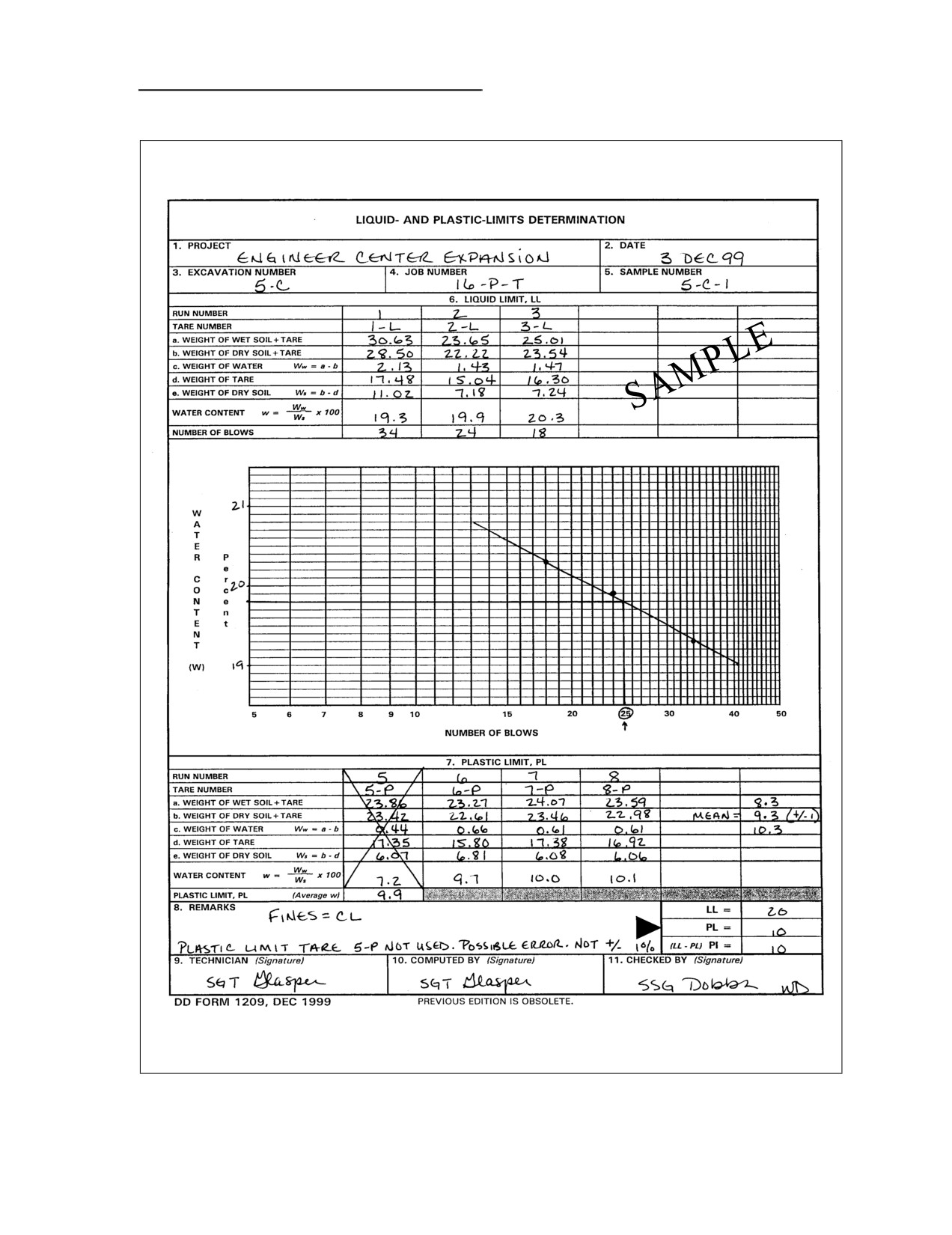
b. Record all identifying information for the sample on DD Form 1209 (see
Figure 2-47).
c. Label and preweigh three empty moisture-determination tares. Record
the weight on the form as the weight of the tare.
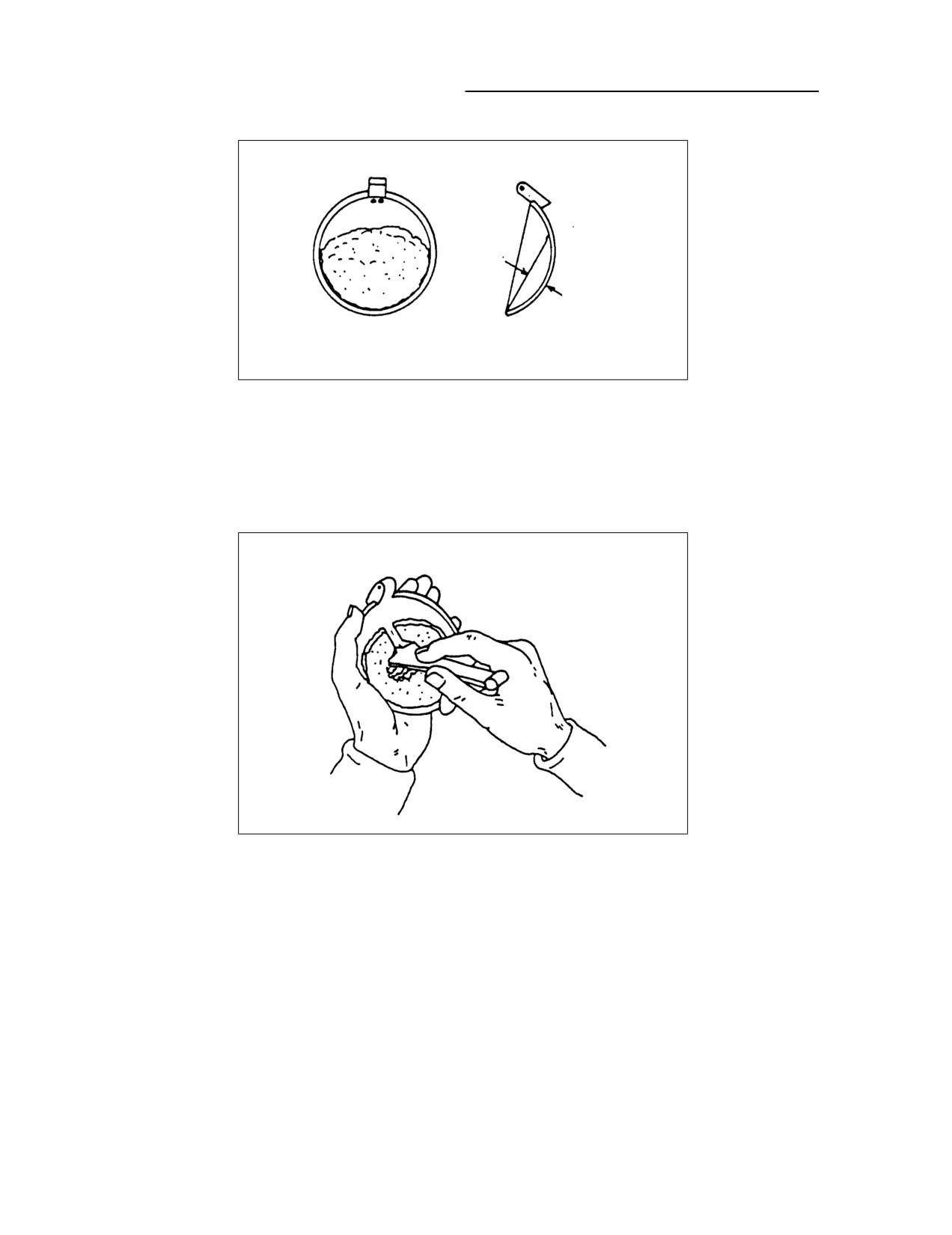
d. Place 20 to 25 grams of the thoroughly mixed sample into the brass cup,
and level it off with a maximum depth of 1 centimeter (see Figure 2-48,
page 2-96).
e. Divide the soil sample in the cup with a grooving tool so that a clean,
sharp groove is formed. Hold the cup with the cam follower upward and
draw the grooving tool, with the beveled edge forward, through the
specimen downward away from the cam follower (see Figure 2-49, page
2-96). Use more than one stroke to make the groove, but no more than six,
cleaning the grooving tool’s cutting edge after each stroke. Avoid tearing
the side of the groove. Replace the soil sample in the cup, and regroove if
2-94 Soils
FM 5-472/NAVFAC MO 330/AFJMAN 32-1221(I)
Figure 2-47. Sample DD Form 1209
Soils 2-95
FM 5-472/NAVFAC MO 330/AFJMAN 32-1221(I)
1 cm
Point of
contact
Figure 2-48. Leveling sample in the cup
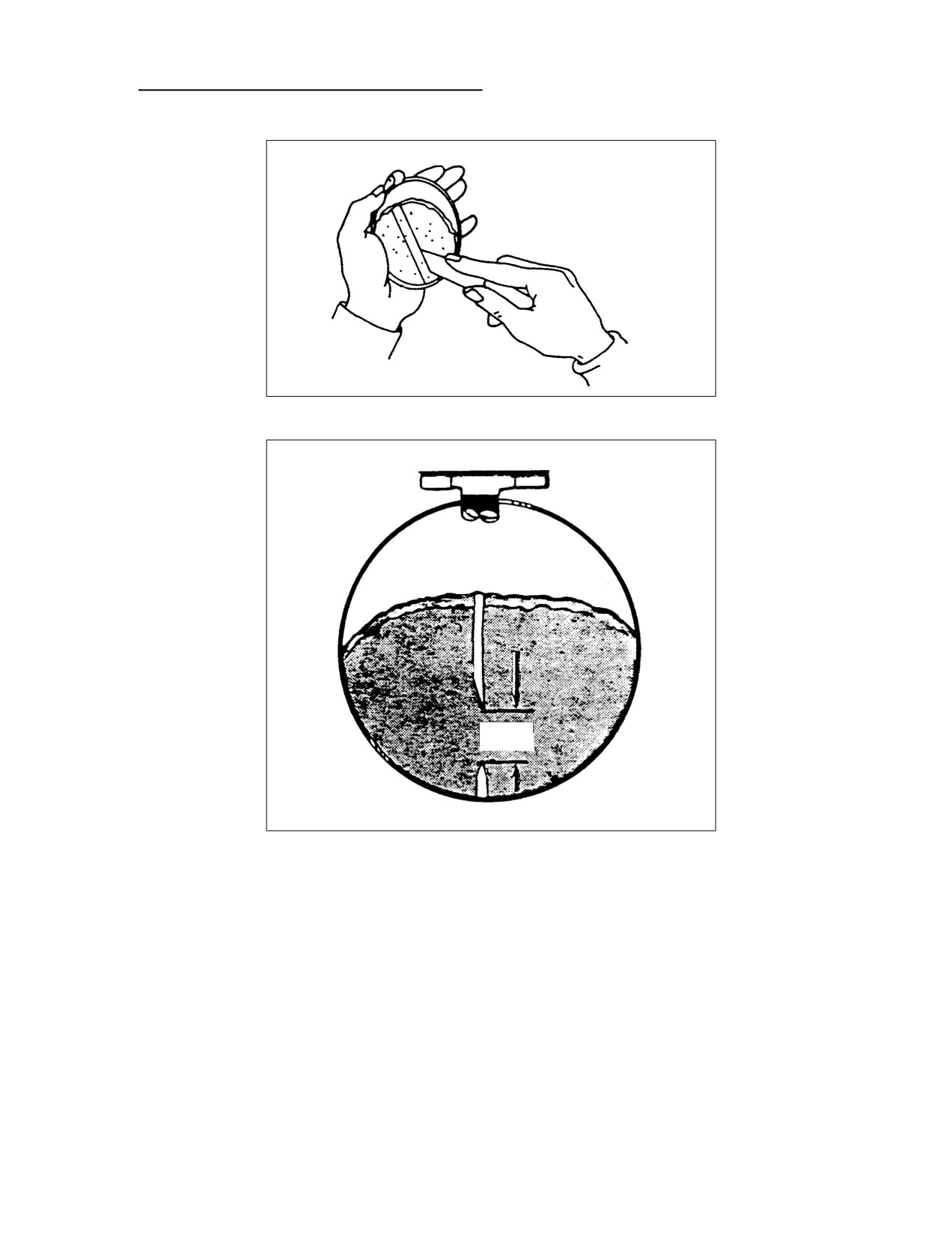
the side tears. With some sandy and highly organic soils, it is impossible
to draw the grooving tool through the specimen without tearing the sides
of the groove. In such cases, the groove should be made with a spatula,
using the grooving tool only for a final check of the groove (see Figure 2-
50).
Figure 2-49. Holding cup and grooving tool
f. Attach the cup to the device; ensure that the height of the drop is 1
centimeter.
g. Turn the crank of the device at a rate of two revolutions per second.
Count the blows until the two halves of the soil make contact at the
bottom of the groove along a distance of 13 millimeters (see Figure 2-51).
h. Record the number of blows to close the groove for 13 millimeters.
i. Obtain 5 to 10 grams of soil from the cup to determine the moisture
content. Take the sample perpendicular to the groove from the edge of the
cup and through the portion that has closed in the bottom of the groove.
Place the sample in the preweighed moisture-determination tare, and
2-96 Soils
FM 5-472/NAVFAC MO 330/AFJMAN 32-1221(I)
Figure 2-50. Cutting groove with spatula in sandy soil
13 mm
Figure 2-51. Soil coming into contact
cover it with a lid. Weigh it and record the weight on the form as the
weight of the wet soil and the tare.
j. Transfer the soil remaining in the cup to the mixing dish. Wash and dry
the cup and the grooving tool.
NOTE: It is recommended that one of the trials be for a closure
requiring 25 to 35 blows, one for a closure between 20 and 30 blows,
and one for a closure requiring 15 to 25 blows.
Soils 2-97
FM 5-472/NAVFAC MO 330/AFJMAN 32-1221(I)
k. Remix the entire soil specimen, adding a little water to increase the
water content of the soil and decrease the number of blows required to
close the groove. Repeat steps 3d through 3j for at least two additional
trials producing a successively lower number of blows to close the groove.
l. Oven-dry the water-content samples, allow them to cool, and reweigh
them. Record the weight on the form as the weight of the dry soil and the
tare.
m. Compute the weight of the water (Ww) by subtracting the weight of the
dry soil and the tare from the weight of the wet soil and the tare. Record
the weight on the form.
n. Compute the weight of the dry soil (Ws) by subtracting the weight of the
tare from the weight of the dry soil and the tare. Record the weight on the
form.
o. Record the water content for each specimen by computing the formula—
Ww
w
= -------- × 100
W
s
NOTE: All weighing should be accurate to 0.01 gram and water
contents computed in percent to one decimal place.
p. Plot the water-content points on the semilog graph on the form (water
versus number of blows) and draw a straight line
(flow line)
representative of the three or more points.
q. Determine the LL by interpreting the graph where the flow line
intersects the 25-blow line. Record the LL to the nearest whole number.
PL DETERMINATION
The PL of a soil is the water content, expressed as a percentage of weight of
oven-dried soil, at which the soil begins to crumble when rolled into a thread
3.2 millimeters in diameter. About 50 grams of material is required for the PL
test. Prepare the sample and set it aside while preparing for the LL test.
PURPOSE
Perform this test to assist in classifying the soil by determining the PL
moisture content to within ± 1 percent.
EQUIPMENT
Perform this test in a laboratory environment using the same equipment
listed in the LL determination test.
STEPS
Perform the following steps to determine the PL:
Step 1. Label and preweigh two empty moisture-determination tares. Record
the weight on DD Form 1209 as the weight of the tare.
2-98 Soils
FM 5-472/NAVFAC MO 330/AFJMAN 32-1221(I)
Step 2. Obtain the 50-gram sample set aside during step 3a of the LL test.
Reduce the water content, if required, to obtain a consistency with which the
soil can be rolled without sticking to the hands by spreading or mixing
continuously on the glass plate. The drying process may be accelerated by
air-drying only.
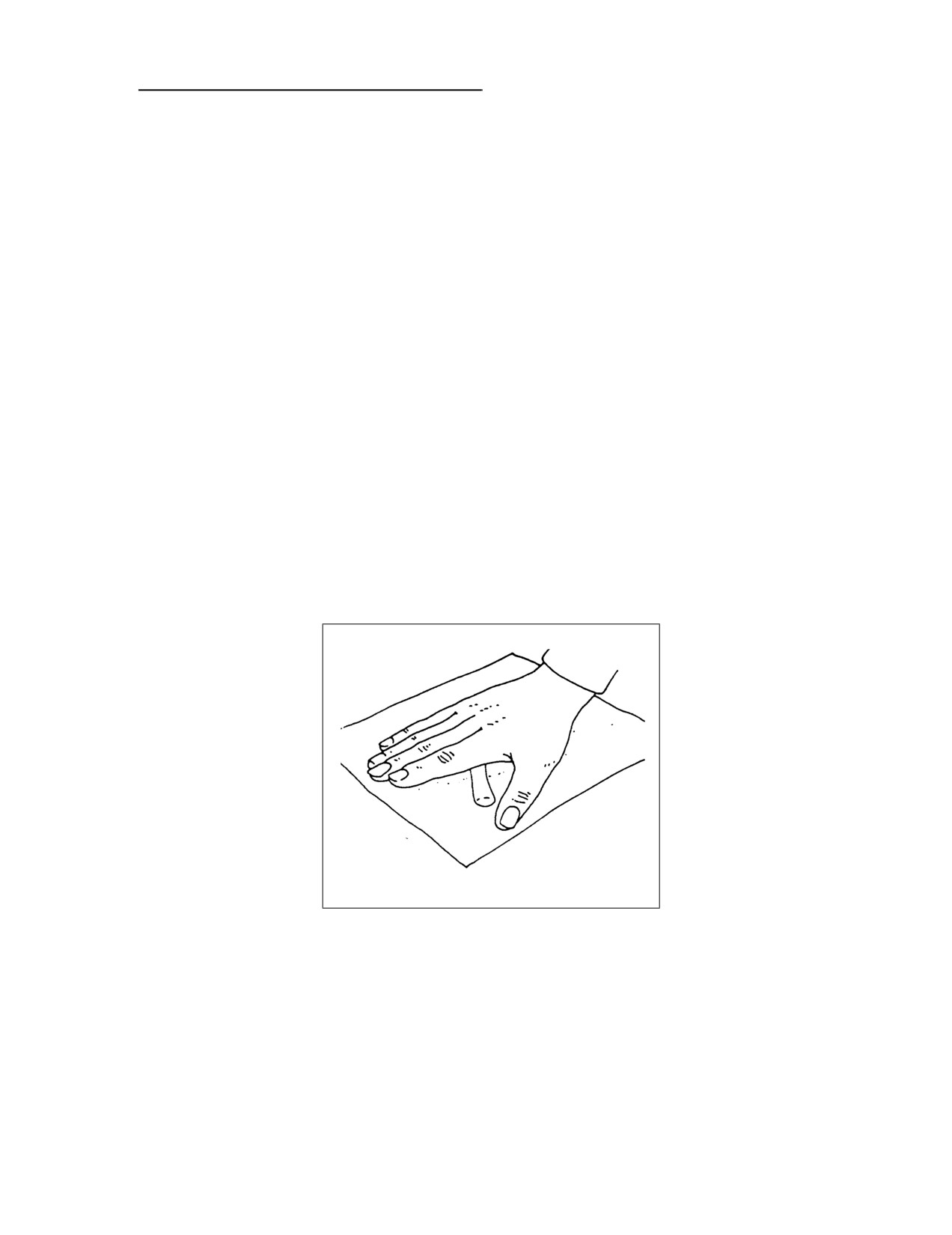
Step 3. Select a portion of about 2 grams (marble size) from the 50-gram
mass and form the test specimen into an ellipsoidal mass. Roll it on a finely-
ground glass plate with the fingers or palm of the hand to a uniform thread
diameter of 3.2 millimeters, taking no more than 2 minutes (see Figure
2-52).
NOTE: The rate of rolling should be between 80 to 90 strokes per
minute, counting a stroke as one complete motion of the hand
forward and back to the starting position. This rate of rolling may
have to be decreased for very fragile soil.
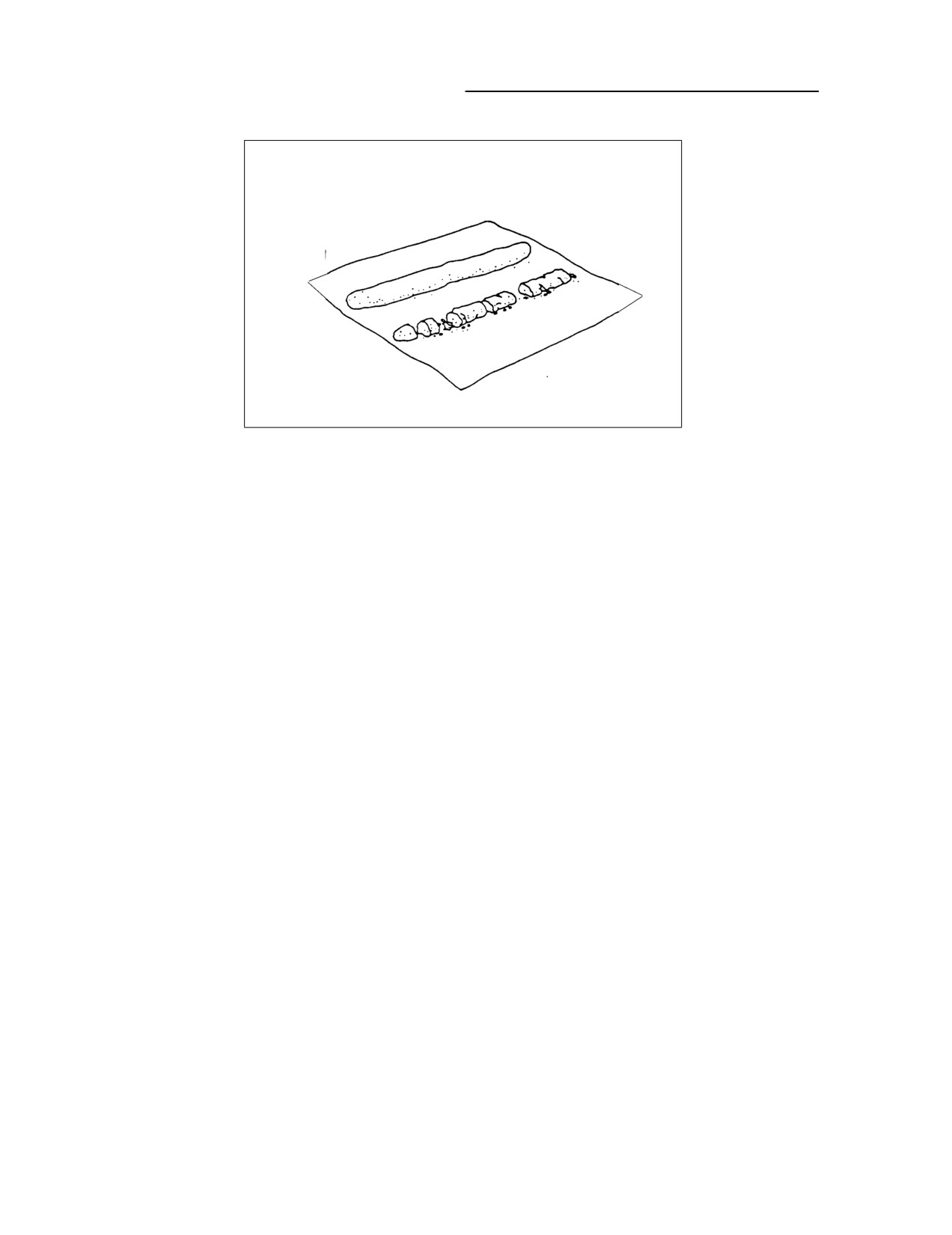
Step 4. Remold the sample and roll it again to 3.2 millimeters diameter,
repeating the rolling and remolding process until the total sample crumbles,
before reaching the 3.2-millimeters-diameter thread (see Figure 2-53, page
2-120).
NOTE: All of the sample may not crumble at the same time. If the
thread breaks into smaller lengths, roll each of these lengths to 3.2
millimeters. Continue the rolling and remolding process until the
sample can no longer be remolded and rolled to the 3.2-millimeter
thread without totally breaking up.
Figure 2-52. Rolling a soil specimen, PL test
Step 5. Collect and place the crumbled portions into a preweighed moisture-
determination tare and cover it with the lid.
Step 6. Repeat steps 3 through 5 until the crumbled threads in the moisture-
determination tare weigh at least 6 grams.
Soils 2-99
FM 5-472/NAVFAC MO 330/AFJMAN 32-1221(I)
Figure 2-53. Rolled threads, crumbled and uncrumbled
Step 7. Repeat steps 3 through 6 to obtain a second moisture-determination
tare of at least 6 grams of material.
Step 8. Weigh the moisture-determination tares with the crumbled threads,
and record the weights on the form as the weight of the wet soil and the tare.
Step 9. Determine the water content by following steps 3l through 3o (page
2-118) of the LL test.
Step 10. Determine the average water content of the samples and record to the
nearest tenth as the PL. When determining the average water content, the
individual tests must be within ± 1 percent of the mean. Any individual tests
that do not meet this requirement will not be used. If none of the individual
tests meet this requirement, then additional testing is required.
PI DETERMINATION
Compute the PI and record it on the form using the following formula:
PI = LL - PL
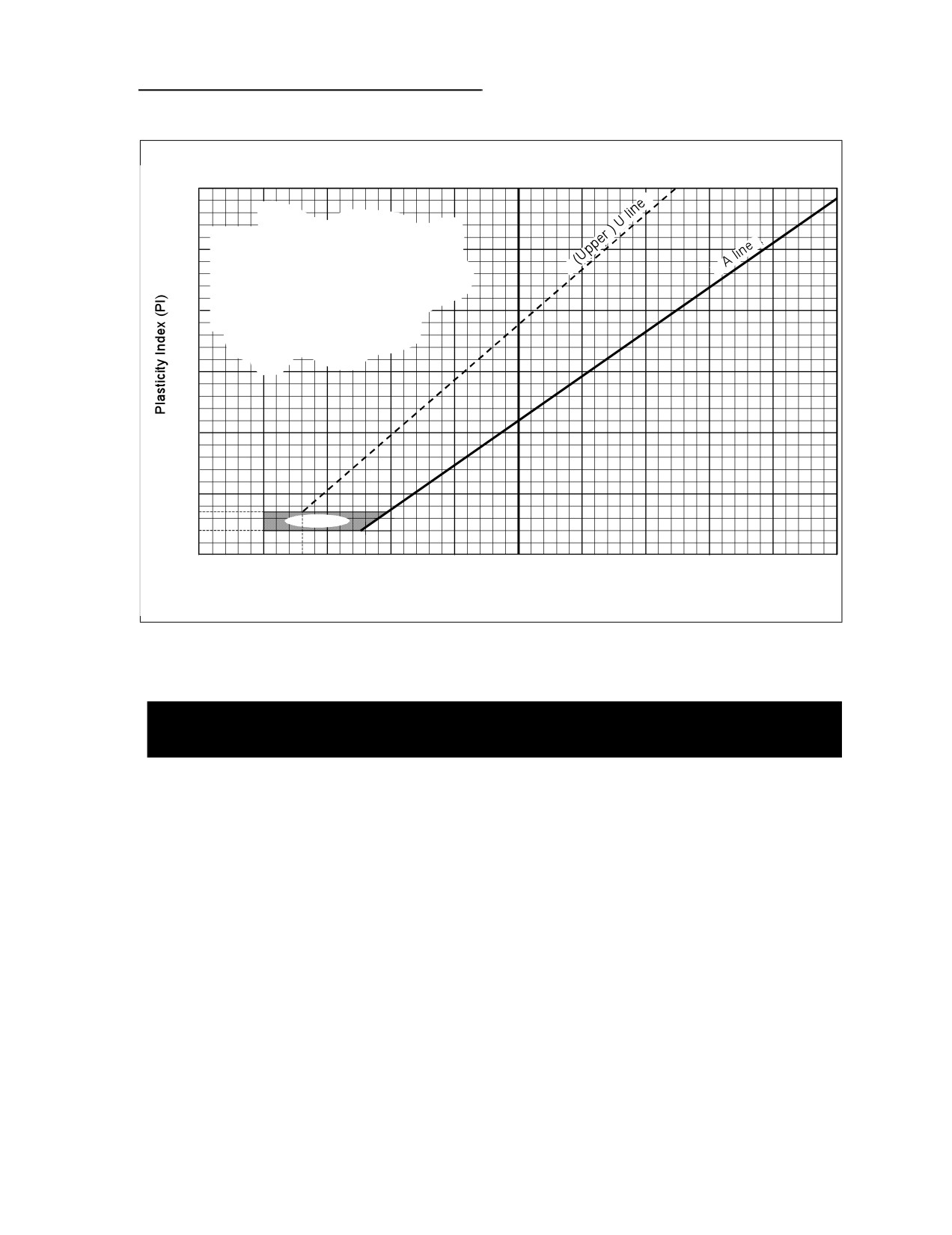
Classify the soil by plotting the LL versus the PI on the plasticity chart as
follows (see Figure 2-54):
• The material plotted on or above the A line is classified as clay, and
the material plotted below the A line is classified as silt.
• The material plotted on or to the right of the 50 percent line has a high
LL (H), and the material plotted to the left of the 50 percent line has a
low LL (L).
• The upper, or U, line is an approximate upper boundary. Although not
impossible, any results plotted above this line should be considered
suspect and the tests should be rechecked.
2-100 Soils
FM 5-472/NAVFAC MO 330/AFJMAN 32-1221(I)
60
Equation of:
Equation
of:
50
“A”
Line - Horizontal at
PI = 4 to LL = 25.5,
“A” line -
then PI =
horizo
0.73
ntal
( LL - 20 )
at
PI = 4 to LL
= 25.5, then PI
=
0.73
(LL-20)
“U”
Line - Vertical at LL = 16 to PI = 7,
CH
40
then PI =
0.9
( LL - 8
)
“U” line -
vertical at
LL = 16
to
PI = 7,
then PI = 0.9 (LL-8)
30
CL
20
MH or OH
10
7
CL — ML
4
ML or
OL
0
16
0
10
20
30
40
50
60
70
80
90
10
LiquidiLimit (LL)
Figure 2-54. USCS plasticity chart
SECTION VII. LABORATORY COMPACTION CHARACTERISTICS OF SOIL USING
MODIFIED EFFORT (COMPACTION TEST) (ASTM D 1557-91)
Compaction is one of the basic construction procedures involved in building
subgrades and bases for roads and airport pavements, embankments, earthen
dams, and similar structures. Compaction is the process of increasing the
amounts of solids per unit volume of soil by mechanical means. This increase
in density has an important effect in improving such soil properties as
strength, permeability, and compressibility.
The amount of compaction is quantified in terms of the soil’s density (dry unit
weight). Usually, soil can be compacted best (and thus a greater density
achieved) if only a certain amount of water is added. In effect, water acts as a
lubricant, allowing soil particles to be packed together better. However, if too
much water is added, a lesser density will result because the excess water
separates the soil particles. Therefore, for a given compactive effort, there is a
particular moisture content at which dry density is greatest and compaction is
best. This moisture content is the OMC, and the associated dry density is
called the maximum dry density (MDD).
Soils 2-101
FM 5-472/NAVFAC MO 330/AFJMAN 32-1221(I)
COMPACTION TEST
In the field, compaction is accomplished by rolling or tamping with special
equipment or by the passing of construction equipment. Laboratory
compaction usually is accomplished by placing the soil in a cylinder of known
volume and dropping a tamper of known weight onto the soil from a known
height for a given number of blows. The amount of work done to the soil per
unit volume of soil in this dynamic compaction procedure is called compactive
effort. Each compactive effort for a given soil has its own OMC. As the
compactive effort is increased, the maximum density usually increases and
the OMC decreases.
Before performing the compaction test, the grain-size analysis must be
determined (see Section V). This test method provides three alternative
testing procedures. The procedure used shall be as indicated in the project
specifications for the type of material being tested. If no procedure is clearly
specified, the selection should be based on follow-on testing requirements
(such as the CBR) and the material gradation.
PURPOSE
Perform compaction tests in the laboratory to determine such soil properties
as the effect of varying percentages of water on dry density, the maximum
density obtainable under a given compactive effort, and the OMC.
• Procedure A. This procedure uses the 4-inch mold on only the soil
passing the No. 4 sieve when the overall representative sample has no
more than 20 percent of the material by weight retained on the No. 4
sieve. The number of blows per layer for this procedure is 25 and the
number of layers is
5. NOTE: Materials that meet these
gradations may also be tested using procedures B or C.
• Procedure B. This procedure uses the 4-inch mold on only the soil
passing the 3/8-inch sieve when the overall representative sample has
more than 20 percent of the material by weight retained on the No. 4
sieve and 20 percent or less is retained on the 3/8-inch sieve. The
number of blows per layer for this procedure is 25 and the number of
layers is 5. NOTE: Materials that meet these gradations may
also be tested using procedure C.
• Procedure C. This procedure uses the 6-inch mold on only the soil
passing the 3/4-inch sieve when the overall representative sample has
more than 20 percent of the material by weight retained on the 3/8-
inch sieve and less than 30 percent is retained on the 3/4-inch sieve.
The number of blows per layer for this procedure is 56 and the number
of layers is 5.
NOTE: Previous testing methods incorporated a mix of standards
that have since been rescinded. The current standard for this test is
ASTM D 1557-91. This test procedure standardizes the use of the 4-
inch (Proctor) and 6-inch (CBR) molds. The compaction effort at 56
blows is about the same as used in previous test methods (CE 55).
This test method is applicable only to soils containing 30 percent or
less by weight of material retained on the 3/4-inch sieve.
2-102 Soils
FM 5-472/NAVFAC MO 330/AFJMAN 32-1221(I)
EQUIPMENT
Perform the compaction test using the following items:
•
Cylinder molds (use one of the following molds, depending on the soil
sample being processed):
— Proctor mold; 4-inch (4.0-inch inside diameter and 4.584-inch
inside height having an internal volume of 0.0333 cubic foot),
having an extension collar (2.375 inches high) and a detachable
metal baseplate.
— CBR mold; 6-inch (6-inch inside diameter and 7-inch inside
height), having an extension collar (2 inches high) and detachable
metal baseplate. The mold should also have a metal spacer disk
(5.94-inch inside diameter and 2.416 inches thick) for use as a
false bottom in the mold during testing. When the spacer disk is in
place in the bottom of the mold, the internal volume of the mold
(excluding extension collar) shall be 0.075 cubic foot.
•
A compacting hammer or tamper. A sliding-weight type compacting
tamper, having a 2-inch-diameter steel striking face, a 10-pound mass,
and an 18-inch fall.
•
A No. 4 sieve.
•
A 3/8-inch sieve.
•
A 3/4-inch sieve.
•
A balance scale sensitive to 0.01 gram.
•
A balance scale sensitive to 1.0 gram.
•
Moisture tares.
•
A soils oven.
•
Filter paper.
•
A large spoon.
•
A large knife.
•
A steel straightedge.
•
A calculator.
•
DD Form 1210.
•
DD Form 1211.
The amount of material (field sample) required for the compaction test
depends on the test procedure being used and the field sample ’s moisture
content. The following are guidelines for the amount of soil required for the
test procedures:
• Procedures A and B: Use about 35 pounds of dry soil or at least 50
pounds of moist soil.
Soils 2-103
C2, FM 5-472/NAVFAC MO 330/AFJMAN 32-1221(I)
• Procedure C: Use about 75 pounds of dry soil or at least 100 pounds of
moist soil.
STEPS
Perform the following steps for the compaction test:
Step 1. Determine the test procedure to be used.
• If the CBR design and tests are to be developed for this project, do not
use this method. See Section IX for procedures to be used for CBR.
• If CBR is not a factor, determine the test procedure by evaluating the
gradation criteria of the procedures listed above (A, B, or C) with
column 17 (percent retained) on DD Form 1206.
Step 2. Prepare the soil sample.
a. Dry the sample until it can be easily crumbled under a trowel. Drying
may be done by air-drying or by using a drying apparatus, provided the
temperature of the sample does not exceed 60°C.
b. Break up the sample thoroughly, but not in such a manner as to reduce
the size of the individual particles.
c. Sieve the sample over a No. 4 (procedure A), 3/8-inch (procedure B), or
3/4-inch sieve (procedure C). When preparing the material by passing it
over the 3/4-inch sieve for compaction in the 6-inch mold, break up
aggregates sufficiently to at least pass the
3/8-inch sieve. This
facilitates the distribution of water throughout the soil in later mixing.
d. Separate from the sample 5 equal portions representing each point
desired on the compaction curve. The size of each sample for one mold is
about 2,700 grams for procedures A and B or 6,800 grams for procedure C.
Retain all excess soil sample.
Step 3. Adjust the water content.
NOTE: The water-content adjustments in this step are designed to
provide approximations of the OMC. In no way should these
approximations be used for or be interpreted as the actual moisture
content. Exact moisture determinations will be conducted in a later
step.
a. Establish the assumed or approximate OMC.
(1) Place exactly 100 grams of the excess soil sample in a dish.
(2) Add 5 milliliters of water to the sample and mix thoroughly. The
approximate OMC is typically achieved so that when the soil is
squeezed in the palm, it will adhere together on its own but it will
break cleanly into two separate pieces without either piece shattering
when bent. Usually this will be slightly less than the PL.
(3) Add small amounts of water (in milliliters), remembering to record
the amounts added, until the approximate OMC is achieved. Do not
confuse the approximate OMC with the actual moisture content of this
soil, which will be determined in a later step. For purposes of
conducting the test method, the approximate OMC will be the amount
2-104 Soils
FM 5-472/NAVFAC MO 330/AFJMAN 32-1221(I)
of water, in milliliters, added to the sample. (For example, if only 8
milliliters of water was added to achieve the approximate OMC, then
the approximate OMC is 8.0 percent. This works in approximating
because 1 milliliter of water is about equal to 1 gram. By adding
weight to an original sample of
100
grams, no mathematical
calculations are required.)
b. Determine the moisture-content range. This range is the approximated
OMC ±4. (For example, if you have determined that the approximated
OMC is 8.0 percent, then the -4 is 4.0 percent and the +4 is 12.0 percent.
This identifies the moisture-content range as 4.0 to 12.0 percent.)
c. Use the following formula to determine the amount of water to add to
each of the 5 samples to obtain the desired approximate (-4, -2, OMC, +2,
+4) moisture contents:
water (in milliliters) to add =
weight of sample (in grams) × desired percent (decimal format)
For example, to determine the water to add to obtain the approximated
OMC for a sample of 6,804 grams (using procedure C)—
6, 804 × 0.08 = 544.3 milliliters
Perform the same calculations to determine the water to add for the
remaining samples for the required moisture-content range. The examples
below illustrate this calculation for the remaining samples, taking into
consideration that not all the sample weights will be exactly the same
(6,804 grams):
(-4)
4.0% moisture for a sample at 6,815 grams: 6,815 × 0.04 = 272.6 milliliters
(-2)
6.0% moisture for a sample at 6,800 grams: 6,800 × 0.06 = 408.0 milliliters
(+2) 10.0% moisture for a sample at 6,822 grams: 6,822 × 0.10 = 682.2 milliliters
(+4) 12.0% moisture for a sample at 6,810 grams: 6,810 × 0.12 = 817.2 milliliters
d. Add the water figured from the formulas for each of the 5 desired moisture
contents (-4,
-2, OMC, +2, and +4) and mix thoroughly to ensure even
distribution of water throughout the sample.
e. Place each sample in an airtight container and allow to stand for the
minimum period of time indicated below:
• For GW, GP, SW, and SP soil types, there is no minimum standing
period of time.
• For GM and SM soil types, a minimum of 3 hours standing time is
required.
• For all other soil types, a minimum of 16 hours standing time is
required.
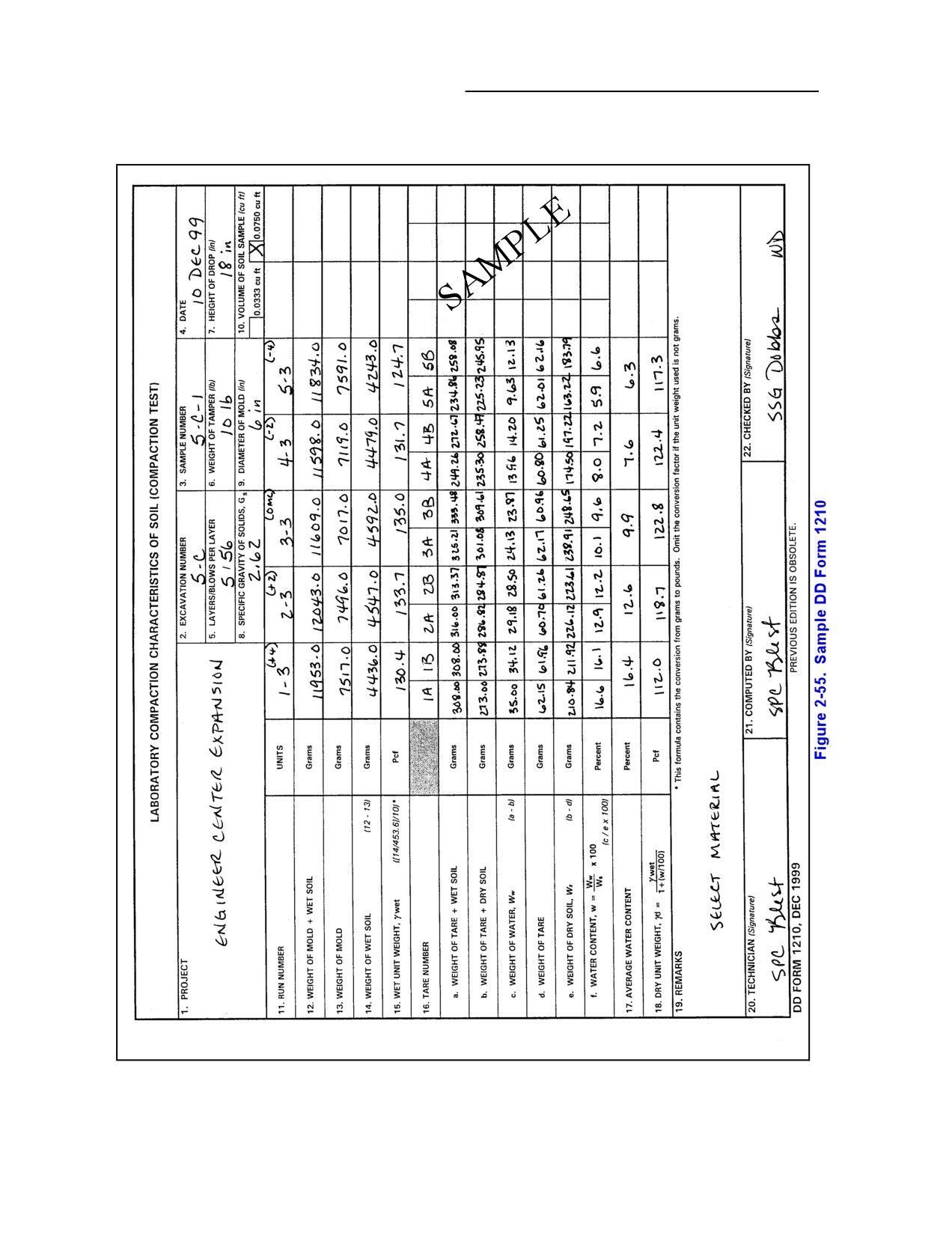
Step
4. Record all identifying information such as the project, the
excavation number, and other pertinent data on DD Form 1210 (see Figure
2-55, page 2-106).
Soils 2-105
FM 5-472/NAVFAC MO 330/AFJMAN 32-1221(I)
2-106 Soils