FM 5-472 Materials Testing (DEPARTMENT OF THE ARMY) December 2000 - page 1
FM 5-472*
NAVFAC M0 330
AFJMAN 32-1221(I)
Field Manual
Headquarters
No. 5-472
Department of the Army
NAVFAC M0 330
Department of the Navy
AFJMAN 32-1221(I)
Department of the Air Force
Washington, DC, 27 October 1999
MATERIALS TESTING
Table of Contents
Page
Preface
ix
Chapter 1. Materials Testing Overview
1-1
Materials Tests
1-1
Soil Properties
1-2
Classifications
1-2
Design Requirements
1-2
Bitumens
1-2
Concrete
1-3
Stabilization
1-3
Equipment
1-3
Test Set, Soil (SC 6635-98-CL-E02)
1-3
Test Set, Asphalt (SC 6635-98-CL-E03)
1-4
Test Set, Concrete (SC 6635-98-CL-E04)
1-4
Nuclear Moisture Density Gauge
1-4
Safety and Environmental Considerations
1-4
Chapter 2, Soils, part 1
2-1
Section I. Formation, Classification, and Field Identification
2-1
Soil Formation
2-1
Rocks
2-1
Strata
2-2
Physical Properties
2-2
Grain or Particle Size
2-3
Grain or Particle Shape
2-3
Gradation
2-4
Density
2-5
Specific Gravity
2-5
Moisture
2-6
DISTRIBUTION RESTRICTION: Approved for public release; distribution is unlimited.
*This publication supersedes FM 5-530, 17 August 1987.
i
FM 5-472/NAVFAC MO 330/AFJMAN 32-1221(I)
Page
Consistency
2-7
Organic Soil
2-8
Effects of Soil Characteristics
2-8
Soil Classification
2-8
Classification
2-9
Categories
2-9
Identification of Soil Groups
2-12
Field Identification
2-13
Test Equipment
2-14
Test Factors
2-14
Soil-Description Example
2-15
Field-Identification Tests
2-15
Visual Test
2-15
Odor Test
2-19
Sedimentation Test
2-19
Bite or Grit Test
2-21
Feel Test
2-21
Roll or Thread Test
2-22
Wet Shaking Test
2-23
Breaking or Dry-Strength Test
2-24
Ribbon Test
2-25
Shine Test
2-25
Section II. Soil Surveys and Sampling
2-26
Types of Soil Surveys
2-26
Hasty Survey
2-27
Deliberate Survey
2-27
Objective of a Soil Survey
2-27
Location, Nature, and Classification of Soil Layers
2-27
Condition of Soils in Place
2-27
Drainage Characteristics
2-28
Groundwater and Bedrock
2-28
Sources of Information
2-28
Intelligence Reports
2-28
Local Inhabitants
2-28
Maps
2-29
Aerial Photographs
2-30
Field Investigations
2-31
Sampling Methods
2-31
Preparing Samples
2-32
Recording Samples
2-33
Obtaining Representative Soil Samples
2-34
Moisture-Content Samples
2-38
Undisturbed Samples
2-38
Chunk Samples
2-39
Cylinder Samples
2-43
Quartering Samples
2-48
Samples Weighing Over 100 Pounds
2-48
Samples Weighing 25 to 100 Pounds
2-48
Samples Weighing Less Than 25 Pounds
2-50
The Soil Profile
2-50
ii
FM 5-472/NAVFAC MO 330/AFJMAN 32-1221(I)
Page
Purpose
2-50
Equipment
2-51
Steps
2-52
Section III. Moisture-Content Determination
2-54
Oven-Dry Method (ASTM D 2216-90)
2-55
Purpose
2-55
Equipment
2-55
Steps
2-55
Calcium-Carbide-Gas Pressure Method (AASHTO T 217-1986)
2-57
Purpose
2-58
Equipment
2-58
Steps
2-58
Calculations
2-59
Example
2-59
Chapter 2, Soils, part 2
2-62
Section IV. Specific-Gravity-of-Solids Determination (ASTM D 854-92)
2-62
Specific Gravity of Soil or Solids
2-62
Specific-Gravity Test
2-62
Purpose
2-63
Equipment
2-63
Steps
2-64
Apparent and Bulk Specific Gravity
2-69
Section V. Grain-Size Analysis and Distribution
(ASTM D 422-63 and ASTM 2217-85)
2-70
Sieve Analysis (Mechanical Analysis)
2-70
Purpose
2-71
Equipment
2-71
Steps
2-72
Hydrometer Analysis
2-79
Purpose
2-79
Equipment
2-79
Steps
2-80
Presentation of Results
2-87
Section VI. Liquid Limit, Plastic Limit, and Plasticity Index Determination
(ASTM D 4318-95a)
2-89
LL Determination
2-90
Purpose
2-90
Equipment
2-90
Steps
2-92
PL Determination
2-98
Purpose
2-98
Equipment
2-98
Steps
2-98
PI Determination
2-100
Section VII. Laboratory Compaction Characteristics of Soil Using Modified
Effort (Compaction Test) (ASTM D 1557-91)
2-101
Compaction Test
2-102
Purpose
2-102
Equipment
2-103
Steps
2-104
iii
FM 5-472/NAVFAC MO 330/AFJMAN 32-1221(I)
Page
Compaction-Test Graph—Presentation of Results
2-109
Compaction Curve
2-109
Zero Air Voids and Saturation
2-111
Percent Moisture
2-112
Percent Compaction
2-112
Compaction-Specification Block
2-112
Effect of Water on Density
2-113
Effect of Different Compactive Efforts on Density
2-114
Effect of Different Types of Soils on Density
2-115
Compaction Equipment
2-115
Other Compactive Efforts
2-116
Section VIII. In-Place Density Determination
2-116
Sand-Cone or Sand-Displacement Method (ASTM D 1556-90)
2-117
Purpose
2-118
Equipment
2-118
Steps
2-119
Nuclear Moisture-and-Density Tester
2-123
Water-Displacement Method
2-124
Section IX. CBR Tests
2-124
CBR of Laboratory-Compacted Soils (ASTM D 1883-94)
2-125
Purpose
2-125
Equipment
2-125
Steps
2-127
Undisturbed Sample Testing
2-135
In-Place Field CBR Testing
2-135
Presentation and Analysis of CBR Data
2-135
Test Program for Nonswelling Soils
2-135
Test Program for Swelling or Expansive Soils
2-146
Test Program for Free-Draining Soils
2-151
Section X. Technical Soils Report
2-153
Soils Tests Required
2-153
Purpose of the Report
2-153
Organization and Scope of the Tests
2-154
Soils Technical Report
2-155
Purpose
2-156
Equipment
2-156
Outline
2-156
Chapter 3. Bituminous Mixtures
3-1
Section I. Bituminous Pavements/Surfaces
3-1
Aggregates
3-1
Bituminous Materials
3-1
Asphalts
3-2
Tars
3-6
Characteristics and Uses of Bitumens
3-7
Safety Precautions
3-7
Advantages and Disadvantages
3-11
Section II. Sampling Materials
3-12
Bituminous Materials Sampling (ASTM D 140-88)
3-12
Liquid Materials
3-12
iv
FM 5-472/NAVFAC MO 330/AFJMAN 32-1221(I)
Page
Solid and Semisolid Materials
3-12
Aggregate Sampling (ASTM D 75-87)
3-12
Stone From Ledges and Quarries
3-13
Natural Deposits of Sand and Gravel
3-13
Stockpiles
3-14
Commercial Aggregates
3-14
Section III. Field Identification
3-14
Bitumen Field-Identification Tests
3-14
Asphalts and Tars
3-16
Asphalt Cement and Cutbacks
3-16
Asphaltic-Cutback Tests
3-16
Asphalt-Emulsion (Anionic) Tests
3-18
Road-Tar Tests
3-18
Aggregate Identification and Selection
3-19
Shape and Roughness
3-19
Hardness and Durability
3-19
Cleanliness
3-20
Hydrophobicity
3-20
Gradation
3-21
Particle Size
3-21
Section IV. Bitumen Testing
3-22
Specific-Gravity Test (ASTMs C 127-88 and C 128-93)
3-22
Flash-Point and Fire-Point Tests
3-24
Flash Point and Fire Point by Cleveland Open Cup
3-24
Flash Point by Tag Open Cup (ASTM D 4552-87)
3-25
Penetration Test (ASTM D 5-86)
3-27
Equipment
3-27
Steps
3-27
Results
3-29
Ductility Test
3-29
Softening-Point Test
3-30
Viscosity Tests
3-30
Saybolt-Furor Test (ASTM D 244-89)
3-30
Kinematic-Viscosity Test (ASTM D 2170-85)
3-30
Solubility Test (ASTM D 2042-81)
3-30
Spot Test
3-31
Thin-Film Oven Test (ASTM D 1754-87)
3-31
Section V. Aggregate and Filler Testing
3-31
Sieve Analysis
3-32
Mineral Filler (ASTM D 242-85)
3-32
Fine and Coarse Aggregate (Washed) (ASTMs D 1073-88, D 448-86, and D 692-88)
3-32
Specific Gravity
3-32
Apparent Specific Gravity of Coarse Aggregate
3-33
Apparent Specific Gravity of Fine Aggregate (Calibrated Flask)
3-34
Apparent Specific Gravity of Fine Aggregate (Uncalibrated Flask)
3-36
Specific Gravity of Bulk-Impregnated Aggregate
3-37
Specific Gravity of Mineral Filler
3-39
Los Angeles Abrasion Test
3-39
Section VI. Bituminous-Mix Design
3-40
Hot-Mix Design Considerations
3-40
v
FM 5-472/NAVFAC MO 330/AFJMAN 32-1221(I)
Page
Steps
3-40
Variables
3-41
Blends
3-41
Optimum Bitumen Content
3-41
Gyratory Test Method
3-41
Marshall Test Method (ASTM D 1559-89)
3-46
Surface-Area Method
3-59
Job-Mix Formula
3-60
Section VII. Plant Control
3-64
Plant Types
3-64
High-Type Bituminous Paving Plant
3-64
Intermediate-Type Plants
3-66
Initiating Plant Production
3-66
Sieve Analysis
3-66
Mix Redesign
3-66
Controlling Plant Production
3-66
Gyratory Test Control
3-67
Marshall Test Control
3-68
Plant-Control Execution
3-69
Centrifugal-Extraction Method (ASTM D 2172-88)
3-69
Purpose
3-69
Equipment
3-69
Steps
3-70
Calculations
3-72
Sieve Analysis of Aggregate
3-72
Testing Tar or Tar-Rubber Mixes
3-72
Density Tests
3-72
Expediting the Design
3-74
Chapter 4. Concrete
4-1
Section I. Characteristics and Identification
4-1
Description and Components
4-1
Cement
4-1
Air-Entrained Cement
4-2
Water
4-3
Aggregates
4-3
Properties of Concrete
4-4
Strength
4-4
Durability
4-5
Watertightness
4-5
Workability
4-6
Consistency
4-6
Uniformity
4-6
Concrete Curing
4-6
Temperature
4-6
Moisture
4-7
Concrete Admixtures
4-7
Accelerators
4-8
Retarders
4-8
Air-Entraining Agents
4-8
vi
FM 5-472/NAVFAC MO 330/AFJMAN 32-1221(I)
Page
Water Reducers (Plasticizers)
4-9
Section II. Aggregate Testing
4-9
Stockpile Sampling (ASTM D 75-87)
4-10
Gradation Determination
4-10
Apparatus, Test Procedures, and Calculations
4-11
Material Finer Than 0.75 Millimeters (No. 200 Sieve)
4-11
Fineness Modulus
4-13
Tests for Specific Gravity, Absorption, and Surface Moisture
4-13
Specific Gravity and Absorption of Coarse Aggregate (ASTM C 127-88)
4-13
Specific Gravity of Fine Aggregate (ASTM C 128-93)
4-15
Coarse- and Fine-Aggregate Absorption
4-16
Surface Moisture
4-17
Section III. Fresh-Concrete Tests
4-17
Slump Test (ASTM C 143-90a)
4-18
Equipment
4-18
Steps
4-18
Supplementary Test Procedure
4-20
Air-Content Test (ASTM 231-97)
4-20
Equipment
4-20
Steps
4-21
Section IV. Flexural-Strength Test (Modulus of Rupture)
4-21
Test Beams
4-21
Forming the Beams (ASTM C 192-90a)
4-21
Taking the Specimens
4-22
Curing the Beams
4-22
Flexural-Strength Test (ASTM C 78-94)
4-22
Equipment
4-22
Steps
4-22
Section V. Compressive-Strength Test
4-25
Casting a Concrete Cylinder
4-25
Equipment
4-25
Steps
4-26
Number of Specimens
4-27
Curing and Storing Cylinders
4-27
Capping Cylinders
4-28
Determining Compressive Strength of a Cylindrical Specimen (ASTM C 39-96)
4-28
Equipment
4-28
Steps
4-29
Chapter 5. Soil Stabilization
5-1
Section I. Mechanics of Soil Stabilization and Modification
5-1
Stabilization
5-1
Uses of Stabilization
5-1
Methods of Stabilization
5-2
Modification
5-3
Section II. Stabilizing Agents
5-3
Types of Stabilizers
5-3
Cement
5-3
Lime
5-4
Fly Ash
5-4
vii
FM 5-472/NAVFAC MO 330/AFJMAN 32-1221(I)
Page
Bituminous
5-4
Combination
5-4
Time Requirements for Testing
5-4
Stabilizer Selection
5-5
Equipment
5-5
Steps
5-5
Soil Stabilization in Frost Areas
5-6
Limitations
5-6
Construction Cutoff
5-7
Weather
5-7
Pick-and-Click Tests
5-7
Wet-Dry and Freeze-Thaw Tests
5-7
Preparation
5-8
Wet-Dry Test Procedure
5-8
Freeze-Thaw Test Procedure
5-8
Calculations and Criteria
5-8
Modified Mix Design for Sandy Soils
5-10
Soils with No Material Retained on the No. 4 Sieve
5-11
Soils with Material Retained on the No. 4 Sieve
5-13
Appendix A. Metric Conversion Chart
A-1
Appendix B. The Unified Soil Classification System
B-1
Basis of the USCS
B-1
Purpose and Scope
B-1
Definitions of Soil Components
B-2
The Classification System
B-2
Soil Groups and Group Symbols
B-4
Identification of Soil Groups
B-8
Laboratory Identification
B-9
Major Soil Groups
B-9
Characteristics of Soil Groups Pertaining to Embankments and Foundations
B-15
Features on the Soils-Classification Sheet
B-15
Graphical Presentation of Soils Data
B-22
Characteristics of Soil Groups Pertaining to Roads and Airfields
B-23
Features on the Soils-Classification Sheet
B-23
Graphical Presentation of Soils Data
B-26
Glossary
Glossary-1
References
References-1
Index
Index-1
viii
FM 5-472/NAVFAC MO 330/AFJMAN 32-1221(I)
Preface
Field Manual (FM) 5-472 provides the technical information necessary for military
personnel to obtain samples and perform engineering tests and calculations on soils,
bituminous paving mixtures, and concrete. These tests and calculations are required to
achieve proper design with these materials and adequate control over their use in military
construction.
This manual covers soils, aggregates, bituminous cements, bituminous paving mixtures,
portland-cement concrete, and stabilized soil including stabilizing agents such as
bitumens, cements, lime, fly ash, and chemical modifiers. The manual gives detailed
instructions for taking adequate representative test samples and step-by-step procedures
for making physical-properties tests and for recording, calculating, and evaluating test
results. The manual explains methods for designing bituminous paving mixtures and for
stabilizing soil. It also gives the procedures and tests required to control the manufacture
of these mixtures. The manual describes the tools and equipment for performing these
tests and contains general instructions for the care, calibration, and use of test equipment.
FM 5-472 is adopted for use by Navy personnel. Certain tests and procedures prescribed
differ in principle or method and are more detailed than counterpart tests currently
required by the Navy for new construction at Navy installations, including those in
forward areas. Although this manual provides general guidance for materials and soils
testing, the design of new structures and facilities will be based on the results obtained
from methods and procedures outlined in Naval Facilities Engineering Command Design
Manual (NAVFAC DM)-7.1 and NAVFAC DM-7.2. When methods and procedures
prescribed by the Navy differ from those in this manual, the Navy’s methods will take
precedence.
The test procedures and terminology used in this manual conform to the latest methods
and specifications of the American Society for Testing and Materials (ASTM), the
American Concrete Institute (ACI), and the Portland Cement Association (PCA).
The tests listed in this manual also apply to arctic construction. However, cold-weather
effects present different problems and additional tests will be required for correct
evaluation of the materials. These additional tests and the considerations associated with
arctic construction are in Technical Manual (TM) 5-349.
Appendix A contains an English-to-metric measurement conversion chart.
The proponent of this publication is HQ TRADOC. Send comments and recommendations
on Department of the Army (DA) Form 2028 directly to Commander, USAES, ATTN:
ATSE-TD-D, Fort Leonard Wood, Missouri 65473-6650.
Unless this publication states otherwise, masculine nouns and pronouns do not refer
exclusively to men.
ix
Chapter 1
Materials Testing Overview
Military engineers develop and maintain—
• Transportation facilities.
• Housing and special structures.
• Sanitary facilities.
• Military defenses.
Transportation facilities include roads, railways, airports and landing
strips, pipelines, and harbor structures. These structures and facilities are
built on and sometimes use the local soil, so engineers must know the type
and characteristics of the soil at the site to design them. For example, in
designing a road or an airfield, engineers must determine whether the soil
can withstand the loads to be transported, including vehicle weights. They
must also determine whether soil stabilization or paving will be needed. If
the road or airfield requires pavement, then the engineers establish the
suitability of available aggregate materials, since speed and efficiency of
construction dictate the use of nearby sources. Bituminous paving
mixtures and portland-cement concrete are made at or near the work site
under the control of the local engineering officers. The engineers must
design the mix and test the finished product’s performance. They must
have basic data concerning the properties of these materials to use them
effectively in construction. Such data are obtained from the tests described
in this manual.
MATERIALS TESTS
The properties of all materials are determined by their chemical composition
and the physical structure in which the constituent compounds are arranged.
Earth minerals and cementing materials are very complex, and the nature of
the forces that bind them together is poorly understood on an atomic or
molecular scale. However, the strength, stiffness, stability, and resistance to
wear, erosion, or weathering can be determined by tests on the bulk material.
Laboratory research related to field observation and experience with such
materials enables engineers to establish limiting values of the measured
properties to ensure satisfactory performance in service. Materials
specifications based on this research give such limits. Tests of representative
samples of a particular material available for engineering use are made, and
the results are compared to the specifications to decide whether the material
is adequate for the intended application. Materials tests also are used to
identify or classify materials on the basis of their physical properties. These
tests also provide basic data on the aggregates and cements necessary for the
design of bituminous mixtures, stabilized soil, or portland-cement concrete.
Materials Testing Overview 1-1
FM 5-472/NAVFAC MO 330/AFJMAN 32-1221(I)
SOIL PROPERTIES
A soil’s physical characteristics determine its usefulness to support traffic or
to serve as a subgrade or foundation material. These physical characteristics
include the—
• Size and shape of the individual grains.
• Grain-size distribution.
• Specific gravity.
• Compaction characteristics.
Properties of many soils depend on moisture content. Tests for the moisture
limits describe the soil's plasticity characteristics. Strength tests, such as the
California Bearing Ratio (CBR) and the unconfined compression test, measure
load-carrying capacity directly. Tests for these properties include expedient
and deliberate testing procedures. The tests are used to identify and classify
the type of soil represented by the samples. With the soil accurately tested and
classified, its suitability for supporting traffic as a subgrade, base, or
foundation material or as an aggregate, filler, or binder for mixtures can be
evaluated. The construction of subgrades and bases for pavements,
embankments, and other earth structures requires continual testing during
the course of the work to adjust the mixtures and the construction methods
that are needed.
CLASSIFICATIONS
Tests and evaluations of test results are more easily made by using a common
reference or system that has a universal interpretation. Thus, no matter who
performs the tests or the evaluation, the results can be understood by anyone
familiar with the system. One reference for soils used by military engineers is
the Unified Soil Classification System (USCS). Unified soil classification is
found in ASTM D 2487-93. All soils are divided into three major categories,
two of which are based on grain size. Further subdivision distinguishes
between gravel, sand, silt, clay, and organic content and between well-graded
and poorly graded soils. Each of these types is symbolized by a combination of
two or four letters. A more detailed explanation of the USCS is in Chapter 2,
Section I, of this manual and in Chapter 5 of FM 5-410.
DESIGN REQUIREMENTS
When engineers have the completed soil classification and all other
information required for the proper design of an airfield or road, they can start
the design. The design requirements are covered in FM 5-430-00-1 (for roads)
and FM 5-430-00-2 (for airfields).
BITUMENS
Bituminous paving mixtures consist of aggregates, filler, and bitumen binder.
Aggregate sources near the construction area are tested to give data on
particle-size distribution and specific gravity. These data are used in designing
the mix. Testing of bituminous cements received at the mixing plant may
require identifying the material, determining its suitability as a binder, or
providing data for determining what aggregates and fillers are required. The
1-2 Materials Testing Overview
FM 5-472/NAVFAC MO 330/AFJMAN 32-1221(I)
tests of bitumens described in this manual are field-identification procedures
to expedite the use of the material until more detailed tests can be performed.
CONCRETE
Portland-cement concrete is a mixture of fine and coarse aggregates, portland
cement, and water. The cement and water chemically react to form compounds
that hold the aggregates in a strong, rock-like mass. Concrete is made in
mixing plants, field mixers, or truck mixers near or at the construction site.
The quality of the concrete produced depends on the proper mix design to
achieve the desired workability of the fresh concrete and strength of the
hardened material. This manual describes tests of aggregates and fresh and
hardened concrete, with instructions for using test data in mix design and
control. Detailed information about concrete can be found in FM 5-428.
STABILIZATION
An accurate soil description, determined from test data, is necessary to
determine whether its properties must be improved by stabilization to make it
adequate for supporting traffic or for use as a base course. Test results
indicate the method of stabilization and materials to be used and verify the
adequacy of the stabilized soil.
EQUIPMENT
The equipment for all materials tests given in this manual consists of three
sets:
• The soil test set.
• The asphalt test set.
• The concrete test set.
The soil test set is considered the basic set; the other two sets are used with it.
In selected operations (such as control testing at a concrete batch plant), the
concrete test set can be used without the soil test set. Certain items listed as
part of the sets are not issued with the sets but must be requisitioned
separately. Some of the test methods (such as the specific gravity of solids, the
hydrometer analysis, and the shrinkage limit) describe items of equipment
that are not issued with the test sets but would be available locally or from
commercial sources.
TEST SET, SOIL (SC 6635-98-CL-E02)
The soil test set is the basic set for performing soil tests including sieve
analysis, moisture content, Atterberg limits, CBR, and soil trafficability. The
separately packaged soil-trafficability test set
(SC
6635-97-CL-E01) is
included in this set. Items such as DA forms, pencils, tracing paper, labels and
tags, towels, twine, and wax are not issued initially with the set but must be
requisitioned separately by stock or form number.
TEST SET, ASPHALT (SC 6635-98-CL-E03)
The asphalt test set is issued in three chests:
• Laboratory-centrifuge chest.
Materials Testing Overview 1-3
FM 5-472/NAVFAC MO 330/AFJMAN 32-1221(I)
• Miscellaneous-equipment chest.
•
1,1,1-trichloroethane chest.
This set is not complete within itself; therefore, it must be used with the soil
test set. Items such as forms, brushes, cloths, and chemicals (alcohol, sodium
hydroxide, and 1,1,1-trichloroethane) are not issued with the set but must be
requisitioned separately. The 1,1,1-trichloroethane is a hazardous substance.
Numerous substitute agents are available. Consult your installation
environmental office to find out which substitute is available and best suited
to your needs.
TEST SET, CONCRETE (SC 6635-98-CL-E04)
The concrete test set is issued in three chests:
• Beam-testing-machine chest.
• Collapsible-steel-forms chest.
• Miscellaneous-equipment chest.
This set normally is used with the soil test set. Chemicals, DA forms, and
some other items are not issued with the set but must be requisitioned
separately.
NUCLEAR MOISTURE DENSITY GAUGE
The nuclear moisture density gauge (national stock number [NSN] 6635-01-
030-6896) is used to perform moisture and density tests. The gauge is issued in
its case with all necessary equipment except test forms. Forms should be locally
reproduced from the United States Army Engineer School (USAES) or from
manufacturers' samples. This equipment requires special storage
considerations and licensing of operators. The Nuclear Regulatory Commission
(NRC) requires that any unit that owns this equipment must have a qualified
local radiation protection officer (RPO) and a licensed operator before it can be
operated. Information concerning this equipment should be addressed to the
USAES or to the Tank-automotive and Armaments Command (TACOM).
SAFETY AND ENVIRONMENTAL CONSIDERATIONS
Safety and environmental awareness must be planned and integrated as part of
all military operations to protect personnel and the environment. Some of the
tests described in this manual will require special safety equipment that may
not be included in the test sets. Some of the tests in this manual will require the
use of environmentally hazardous materials. Special care must be taken to
minimize the potential harmful effects of exposure to hazardous substances.
Violation of environmental laws through improper storage, handling, or
disposal of hazardous materials can result in severe penalties, including fines
and imprisonment. Proper training is necessary to ensure that all personnel
performing materials tests know how to properly handle and dispose of the
substances listed in the test procedures. If you are unsure what materials are
hazardous or how to dispose of materials properly, or if you need training,
consult your unit or post environmental representative.
1-4 Materials Testing Overview
Chapter 2
Soils
The soil in an area is an important consideration in selecting the exact
location of a structure. Military engineers, construction supervisors, and
members of engineer reconnaissance parties must be capable of properly
identifying soils in the field to determine their engineering characteristics.
Because a military engineer must be economical with time, equipment,
material, and money, site selection for a project must be made with these
factors in mind.
SECTION I. FORMATION, CLASSIFICATION, AND FIELD IDENTIFICATION
The word soil has numerous meanings and connotations to different groups of
professionals who deal with this material. To most soil engineers (and for the
purpose of this text), soil is the entire unconsolidated earthen material that
overlies and excludes bedrock. It is composed of loosely-bound mineral grains
of various sizes and shapes. Due to its nature of being loosely bound, it
contains many voids of varying sizes. These voids may contain air, water,
organic matter, or different combinations of these materials. Therefore, an
engineer must be concerned not only with the sizes of the particles but also
with the voids between them and particularly what these voids enclose (water,
air, or organic materials).
SOIL FORMATION
Soil formation is a continuous process and is still in action today. The great
number of original rocks, the variety of soil-forming forces, and the length of
time that these forces have acted all produce many different soils. For
engineering purposes, soils are evaluated by the following basic physical
properties:
• Gradation of sizes of the different particles.
• Bearing capacity as reflected by soil density.
• Particle shapes.
An engineer extends soil evaluation by considering the effect of water action
on the soils. With a complete evaluation, an engineer can determine whether
or not the soil is adequate for the project.
ROCKS
Soil forms when rocks that are exposed to the atmosphere disintegrate and
decompose, either by mechanical action (wind, water, ice, and vegetation),
chemical action, or both. The resulting material may remain where it is
Soils 2-1
FM 5-472/NAVFAC MO 330/AFJMAN 32-1221(I)
formed or it may be transported by water, glaciers, wind, or gravity and
deposited at a distance from the parent rock.
Geologists classify rocks into three basic groups:
• Igneous (formed by cooling from a molten state).
• Sedimentary (formed by the accumulation and cementation of existing
particles and remains of plants and animals).
• Metamorphic (formed from existing rocks subjected to heat and
pressure).
STRATA
At a particular location are usually several layers (strata), one above the
other, each composed of a different kind of soil. Strata may be a fraction of an
inch or many feet thick. The upper layer is called the topsoil or agricultural
soil since it supports plant growth. For an adequate soil evaluation for
engineering uses, identify all strata to whatever depth may be affected by the
construction. A vertical cross section through the earth, with the depths and
types of soil indicated, is called a soil profile.
PHYSICAL PROPERTIES
A soil’s physical properties help determine the engineering characteristics.
The following properties are the basis for the soil-classification system used in
engineering identification of soil types. The discussion of the physical
properties of soil focuses on the soil particles themselves. The terms particle
and grain are used interchangeably.
• Grain size.
• Particle shape.
• Gradation.
• Density.
• Specific gravity.
• Moisture.
• Consistency.
• Organic soil.
Physical characteristics of soil particles include size and shape. The
proportions of different-sized particles determine an aggregate's gradation.
Density or compactness refers to the closeness of packing of soil particles; the
closer the packing, the greater the compactness and the larger the soil weight
per unit of volume. Plasticity characteristics of fine-grained soil components
include the liquid limit (LL) and the plastic limit (PL); shrinkage ratios; dry
strength; and unconfined, compressive strength. Specific gravity of soil
particles aids in their identification. The presence of organic matter is
important to the engineering use of soils. Color, texture, odor, structure, and
consistency are readily observed factors that aid in soil description.
2-2 Soils
FM 5-472/NAVFAC MO 330/AFJMAN 32-1221(I)
GRAIN OR PARTICLE SIZE
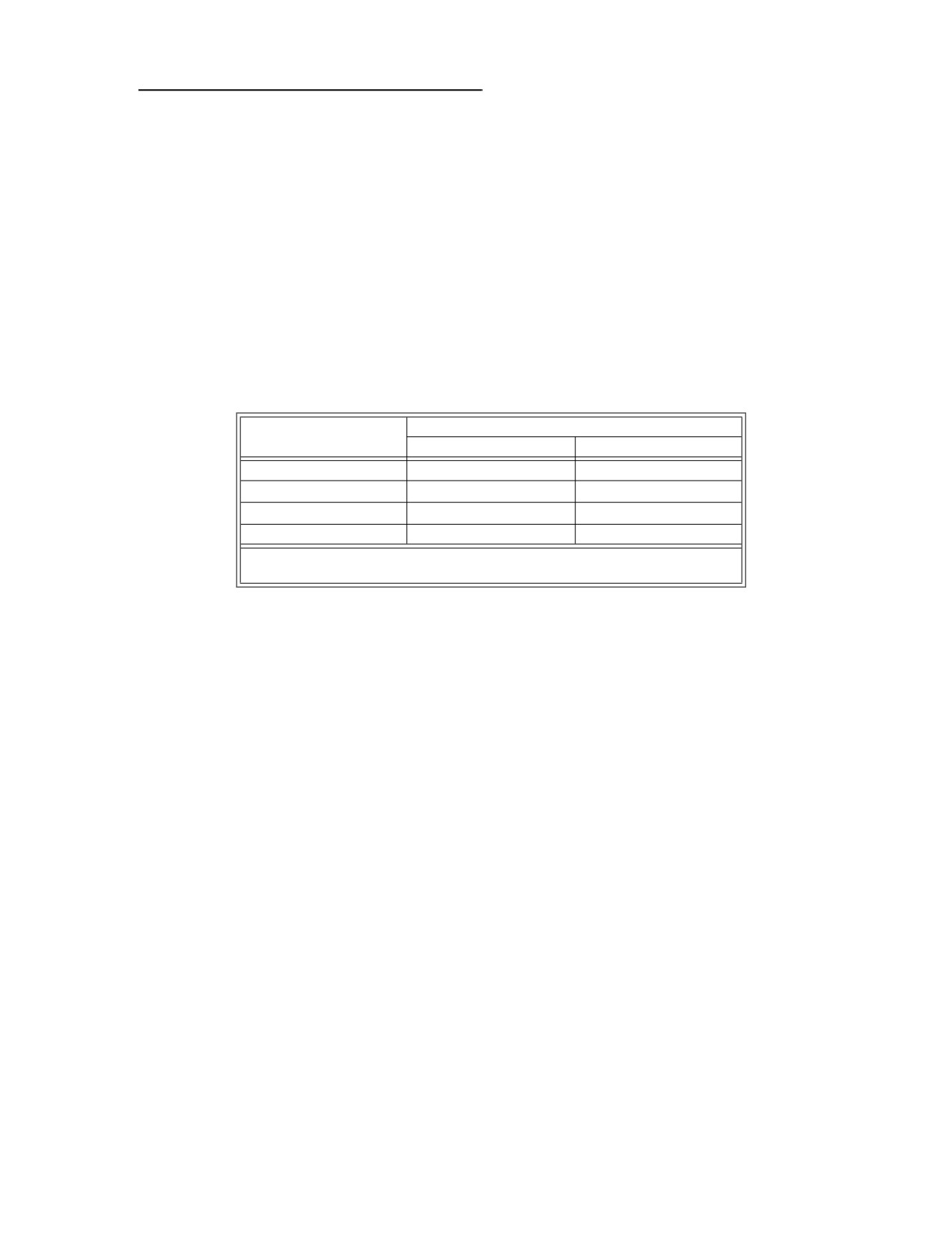
Soils are divided into groups based on the size of the particle grains in the soil
mass. Common practice is to distinguish the sizes by using sieves. A sieve is a
screen attached across the end of a shallow, cylindrical frame. The screen
permits smaller particles to fall through and retains the larger particles on
the sieve. Sieves with screen openings of different sizes (the largest on the top
and the smallest at the bottom) separate the soil into particle groups based on
size. The amount remaining on each sieve is measured and described as a
percentage by weight of the entire sample. The size groups that are
designated by the USCS are cobbles, gravels, sands, and fines (silt or clay), as
shown in Table 2-1. Further discussion on these size groups can be found later
in this chapter and in Appendix B.
Table 2-1. Grain-size groups
Sieve Size
Size Group
Passing
Retained On
Cobbles
No maximum size*
3 inches
Gravels
3 inches
No. 4
Sands
No. 4
No. 200
Fines (clay or silt)
No. 200
No minimum size
* In military engineering, the maximum size of cobbles is accepted as 40
inches, based on the maximum jaw opening of a rock-crushing unit.
GRAIN OR PARTICLE SHAPE
The shape of the particles influences a soil’s strength and stability. Two
general shapes are normally recognized—bulky and platy.
Bulky
The bulky shapes include particles that are relatively equal in all three
dimensions. In platy shapes, one dimension is very small compared to the
other two. For example, a thick book would be considered bulky, but a page of
the book would be platy. Bulky shapes are subdivided into four groups:
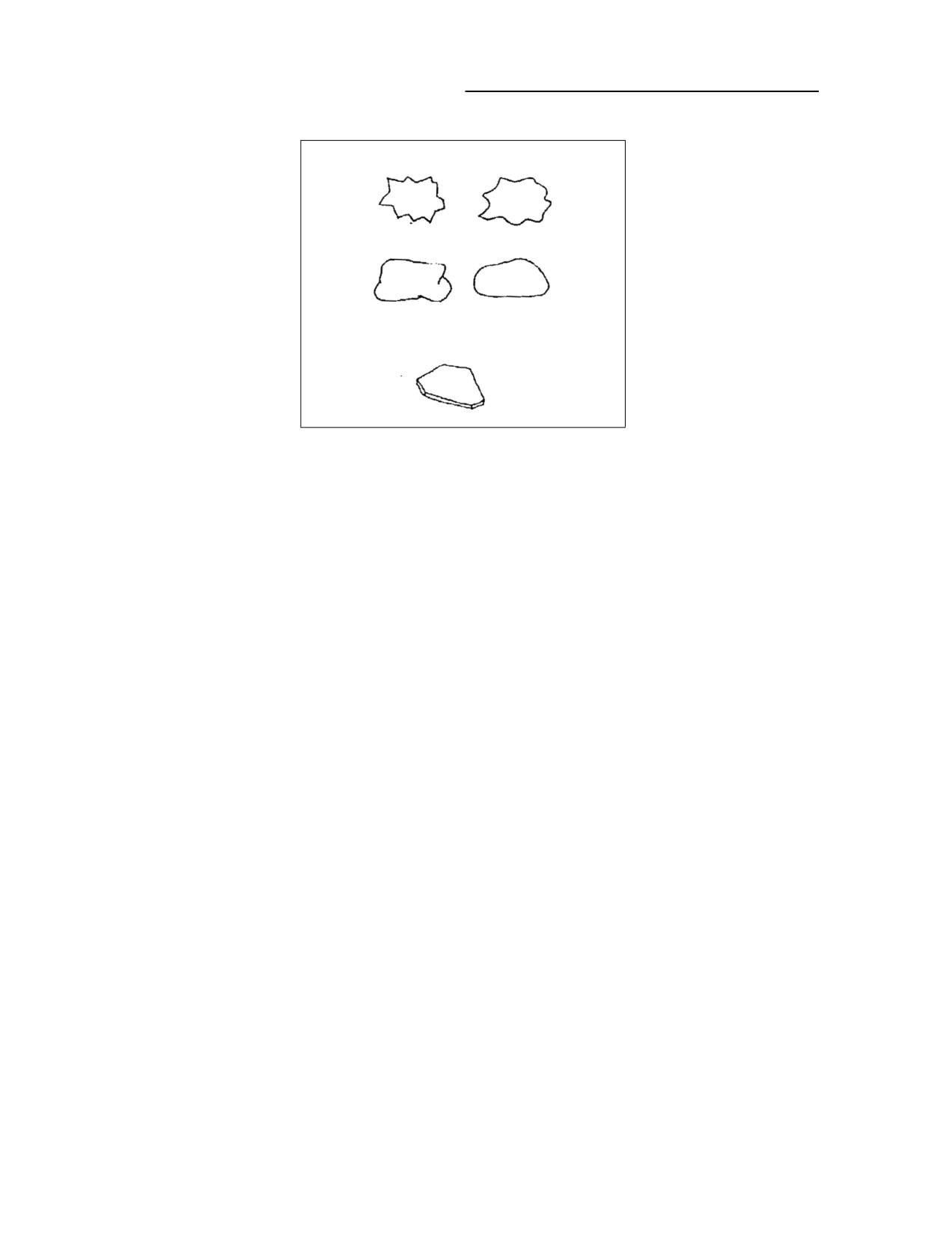
angular, subangular, subrounded, and well-rounded (see Figure 2-1, page 2-4).
These four subdivisions are dependent on the amount of weathering that has
occurred. Cobbles, gravel, sand, and silt usually fall into this bulky-shape
group. These groups are discussed in the order of desirability for construction.
Angular-shaped particles are those that have recently broken up. They are
characterized by jagged projections, sharp ridges, and flat surfaces. The
interlocking characteristics of angular gravels and sands generally make
them the best materials for construction. These particles are seldom found in
nature because weathering processes normally wear them down in a
relatively short time. Angular material may be produced artificially by
crushing, but because of the time and equipment required for such an
operation, natural materials with other grain shapes are frequently used.
Subangular-shaped particles have been weathered to a point that the sharper
points and ridges of their original angular shape have been worn off. These
Soils 2-3
FM 5-472/NAVFAC MO 330/AFJMAN 32-1221(I)
BULKY
Angular
Subangular
Subrounded
Rounded
PLATY
Figure 2-1. Shapes of soil grains
particles are still very irregular in shape with some flat surfaces and are
excellent for construction.
Subrounded particles are those on which weathering has progressed even
further. While they are still somewhat irregular in shape, they have no sharp
corners and few flat areas. These particles are frequently found in
streambeds. They may be composed of hard, durable particles that are
adequate for most construction needs.
Rounded particles are those in which all projections have been removed and
few irregularities in shape remain. The particles approach spheres of varying
sizes. Rounded particles are usually found in or near streambeds, beaches, or
dunes. Possibly the most extensive deposits exist at the beaches where
repeated wave action produces almost perfectly rounded particles that may be
uniform in size. They may also be found in arid environments due to wind
action and the resulting abrasion between particles. They are not desirable for
use in asphalt or concrete construction until the rounded shape is altered by
crushing.
Platy
The platy shapes have one dimension relatively small compared to the other
two. They have the general shape of a flake of mica or a sheet of paper.
Particles of clay soil exhibit this shape, although they are too small to be seen
with the naked eye. Coarse-grained soil particles are individually discernible
to the naked eye; fine-grained particles with platy or bulky shapes are not.
GRADATION
Gradation describes the distribution of the different size groups within a soil
sample. The soil may be well-graded or poorly graded.
Well-Graded Soils
Well-graded soils must have a good range of all representative particle sizes
between the largest and the smallest. All sizes are represented, and no one
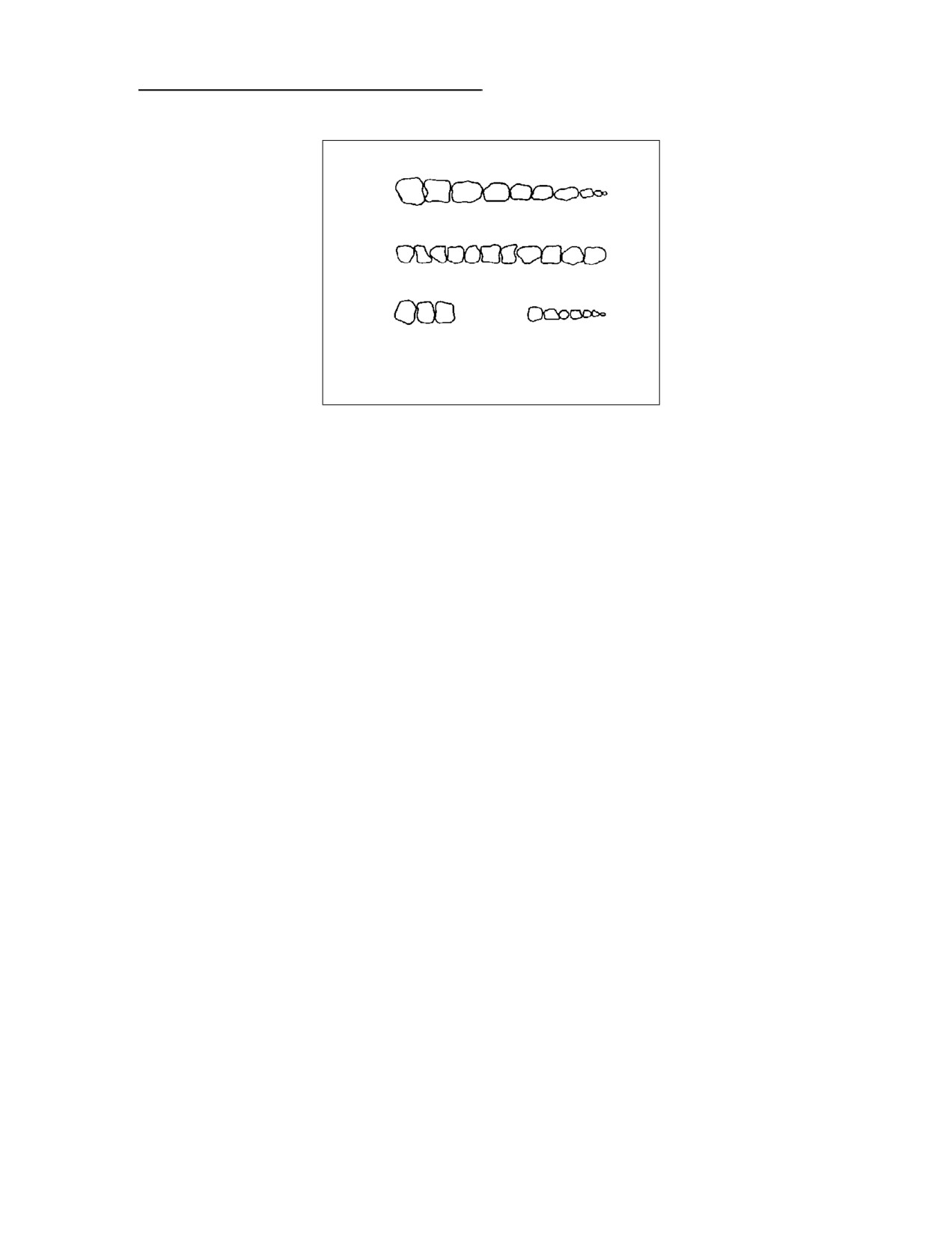
size is either overabundant or missing (see Figure 2-2).
2-4 Soils
FM 5-472/NAVFAC MO 330/AFJMAN 32-1221(I)
Well graded
Uniformly graded
Gap graded
Figure 2-2. Soil gradation
Poorly Graded Soils
Poorly graded soils can be classified as either uniformly graded or gap graded.
A uniformly graded soil consists primarily of particles of nearly the same size.
A gap-graded soil contains both large and small particles, but the gradation
continuity is broken by the absence of some particle sizes (see Figure 2-2).
DENSITY
The structure of the aggregate of soil particles may be dense (closely packed)
or loose (lacking compactness). A dense structure provides interlocking of
particles with smaller grains filling the voids between the larger particles.
When each particle is closely surrounded by other particles, the grain-to-grain
contacts are increased, the tendency for displacement of individual grains
under a load is lessened, and the soil is capable of supporting heavier loads.
Coarse materials that are well-graded usually are dense and have strength
and stability under a load. Loose, open structures have large voids and will
compact under a load, leading to settlement or disintegration under
foundation or traffic loads.
SPECIFIC GRAVITY
The specific gravity is the ratio between the weight-per-unit volume of the
material and the weight-per-unit volume of water at a stated temperature.
There are three ways of determining and expressing specific gravity:
• Specific gravity of solids.
• Apparent specific gravity.
• Bulk specific gravity.
The specific gravity of solids is the method most widely used when testing
soils. The apparent and bulk specific-gravity methods are used in testing fine
and coarse aggregates. The specific gravity of solids is explained further in
Section IV of this chapter, along with the test procedure.
Soils 2-5
FM 5-472/NAVFAC MO 330/AFJMAN 32-1221(I)
MOISTURE
The term moisture content (w) is used to define the amount of water present
in a soil sample. It is the proportion of the weight of water to the weight of the
solid mineral grains (weight of dry soil) expressed as a percentage.
The moisture content of a soil mass is often the most important factor
affecting the engineering behavior of the soil. Water may enter from the
surface or may move through the subsurface layers either by gravitational
pull, capillary action, or hygroscopic action. This moisture influences various
soils differently and usually has its greatest effect on the behavior of fine-
grained soils. The fine grains and their small voids retard the movement of
water and also tend to hold the water by surface tension.
Many fine-grained soils made from certain minerals exhibit plasticity (putty-
like properties) within a range of moisture contents. These soils are called
clays, and their properties may vary from essentially liquid to almost brick
hard with different amounts of moisture. Further, clays are basically
impervious to the passage of free or capillary moisture. Coarse-grained soils
with larger voids permit easy drainage of water. They are less susceptible to
capillary action. The amount of water held in these soils is less than in fine-
grained soils, since the surface area is smaller and excess water tends to drain
off.
Surface Water
Surface water from precipitation or runoff enters the soil through the
openings between the particles. This moisture may adhere to the different
particles or it may penetrate the soil to some lower layer.
Subsurface Water
Subsurface water is collected or held in pools or layers beneath the surface by
a restricting layer of soil or rock. This water is constantly acted on by one or
more external forces.
Gravitational Pull
Water controlled by gravity (free or gravitational water) seeks a lower layer
and moves through the voids until it reaches some restriction. This restriction
may be bedrock or an impervious soil layer with openings or voids so small
that they prevent water passage.
Capillary Action
Voids in soil may form continuous tunnels or tubes and cause the water to rise
in the tubes by capillary action (capillary moisture). Since the smaller the
tube, the stronger the capillary action, the water rises higher in the finer soils
that have smaller interconnected voids. This area of moisture above the free
water layer or pool is called the capillary fringe.
Adsorbed Water and Hygroscopic Moisture
In general terms, adsorbed water is water that may be present as thin films
surrounding separate soil particles. When soil is in an air-dried condition, the
adsorbed water present is called hygroscopic moisture. Adsorbed water is
present because soil particles carry a negative electrical charge. Water is
2-6 Soils
FM 5-472/NAVFAC MO 330/AFJMAN 32-1221(I)
dipolar; it is attracted to the surface of a particle and bound to it. The water
films are affected by the soil particle ’s chemical and physical structures and
its relative surface area. The relative surface area of a particle of fine-grained
soil, particularly if it has a platy shape, is much greater than for coarse soils
composed of bulky grains. The electrical forces that bind adsorbed water to a
soil particle also are much greater.
In coarse soils, the adsorbed layer of water on a particle is quite thin in
comparison to the overall particle size. This, coupled with the fact that the
contact area with adjacent grains is quite small, leads to the conclusion that
the presence of the adsorbed water has little effect on the physical properties
of coarse-grained soils. By contrast, for finer soils and particularly in clays, the
adsorbed water film is thick in comparison to the particle size. The effect is
very pronounced when the particles are of colloidal size.
Plasticity and Cohesion
Two important aspects of the engineering behavior of fine-grained soils are
directly associated with the existence of adsorbed water films. These aspects
are plasticity and cohesion.
Plasticity is a soil’s ability to deform without cracking or breaking. Soils in
which the adsorbed films are relatively thick compared to particle size (such
as clays) are plastic over a wide range of moisture contents. This is
presumably because the particles themselves are not in direct contact with
one another. Coarse soils (such as clean sands and gravels) are nonplastic.
Silts also are essentially nonplastic materials, since they are usually
composed predominantly of bulky grains; if platy grains are present, they may
be slightly plastic.
A plasticity index (PI) is used to determine whether soil is cohesive. Not all
plastic soils are cohesive. Soil is considered cohesive if its PI is greater than 5.
That is, it possesses some cohesion or resistance to deformation because of the
surface tension present in the water films. Thus, wet clays can be molded into
various shapes without breaking and will retain these shapes. Gravels, sands,
and most silts are not cohesive and are called cohesionless soils.
In engineering practice, soil plasticity is determined by observing the different
physical states that a plastic soil passes through as the moisture conditions
change. The boundaries between the different states, as described by the
moisture content at the time of changes, are called consistency limits or
Atterberg limits, named after the Swedish scientist who defined them years
ago.
CONSISTENCY
Atterberg established four states of consistency for fine-grained soils: liquid,
plastic, semisolid, and solid. The dividing lines between these states are called
the LL, the PL, and the shrinkage limit. These limits are quantified in terms
of water content.
Liquid Limit
The LL is the moisture content at an arbitrary limit between a soil’s liquid
and plastic states of consistency. Above this value, a soil is presumed to be a
Soils 2-7
FM 5-472/NAVFAC MO 330/AFJMAN 32-1221(I)
liquid and flows freely under its own weight. Below this value, it will deform
under pressure without crumbling, provided it exhibits a plastic state.
Plastic Limit
The PL is the moisture content at an arbitrary limit between the plastic and
semisolid states. As a sample is dried, the semisolid state is reached when the
soil is no longer pliable and crumbles under pressure. Between the LL and PL
is the plastic range. The PI is the numerical difference in moisture contents
between the two limits (PI = LL - PL). It defines a soil's range of moisture
content in a plastic state.
Shrinkage Limit
The shrinkage limit is the boundary moisture content between the semisolid
and solid states. This boundary is determined when a soil sample, upon being
dried, finally reaches a limiting or minimum volume. Beyond this point,
further drying will not reduce the volume, but may cause cracking.
ORGANIC SOIL
Soil having a high content of organic material is described as organic soil. It is
usually very compressible and has poor load-maintaining properties.
EFFECTS OF SOIL CHARACTERISTICS
Soil characteristics are a measure of a soil's suitability to serve an intended
purpose. Generally, a dense soil will withstand greater applied loads (having
greater bearing capacity) than a loose soil. Particle size has a definite relation
to this capacity. Empirical tests show that well-graded, coarse-grained soils
generally can be compacted to a greater density than fine-grained soils
because the smaller particles tend to fill the spaces between the larger ones.
The shape of the grains also affects the bearing capacity. Angular particles
tend to interlock and form a denser mass. They are more stable than the
rounded particles which can roll or slide past one another. Poorly graded soils,
with their lack of one or more sizes, leave more or greater voids and therefore
a less-dense mass. Moisture content and consistency limits aid in describing a
soil's suitability. A coarse-grained, sandy or gravelly soil generally has good
drainage characteristics and may be used in its natural state. A fine-grained,
clayey soil with a high PI may require considerable treatment, especially if
used in a moist location.
SOIL CLASSIFICATION
Soil seldom exists separately as sand, gravel, or any other single component in
nature. It is usually a mixture with varying proportions of different-sized
particles. Each component contributes to the mixture’s characteristics. Once
the principal characteristics are identified within this system (by both visual
examination and laboratory tests), a descriptive name and letter symbol are
assigned to the soil.
Before soil can be classified properly, it is necessary to establish a basic
terminology for the various soil components and to define the terms used. As
mentioned earlier, the USCS uses specific names to designate the size ranges
of soil particles. These basic designations are cobbles, gravel, sand, and fines
(silt or clay).
2-8 Soils
FM 5-472/NAVFAC MO 330/AFJMAN 32-1221(I)
CLASSIFICATION
To start the classification process, become familiar with the USCS
(see
Appendix B) and the classification sheet used in the classification process (see
Table B-1, page B-2). The first three columns of the classification sheet show
the major divisions of the classification and the symbols that distinguish the
individual soil types. Names of typical and representative soil types found in
each group are shown in column 4. The field procedures for identifying soils by
general characteristics and from pertinent tests and visual observations are
shown in column 5. The desired descriptive information for a complete
identification of a soil is presented in column 6. Column 7 presents the
laboratory classification criteria by which the various soil groups are
identified and distinguished.
CATEGORIES
In the USCS, soils are divided into three major soil divisions: coarse-grained,
fine-grained, and highly organic. Coarse-grained soils are those having 50
percent or less material passing the number (No.) 200 sieve; fine-grained soils
are those having more than 50 percent passing the No. 200 sieve. Highly
organic soils can generally be identified by visual examination. This system
recognizes 15 soil groups and uses names and letter symbols to distinguish
between these groups. The letter symbols used are relatively easy to
remember. They are derived either from the terms descriptive of the soil
fractions, the relative value of the LL (high or low), or the relative gradation
(well-graded or poorly graded). Table
2-2
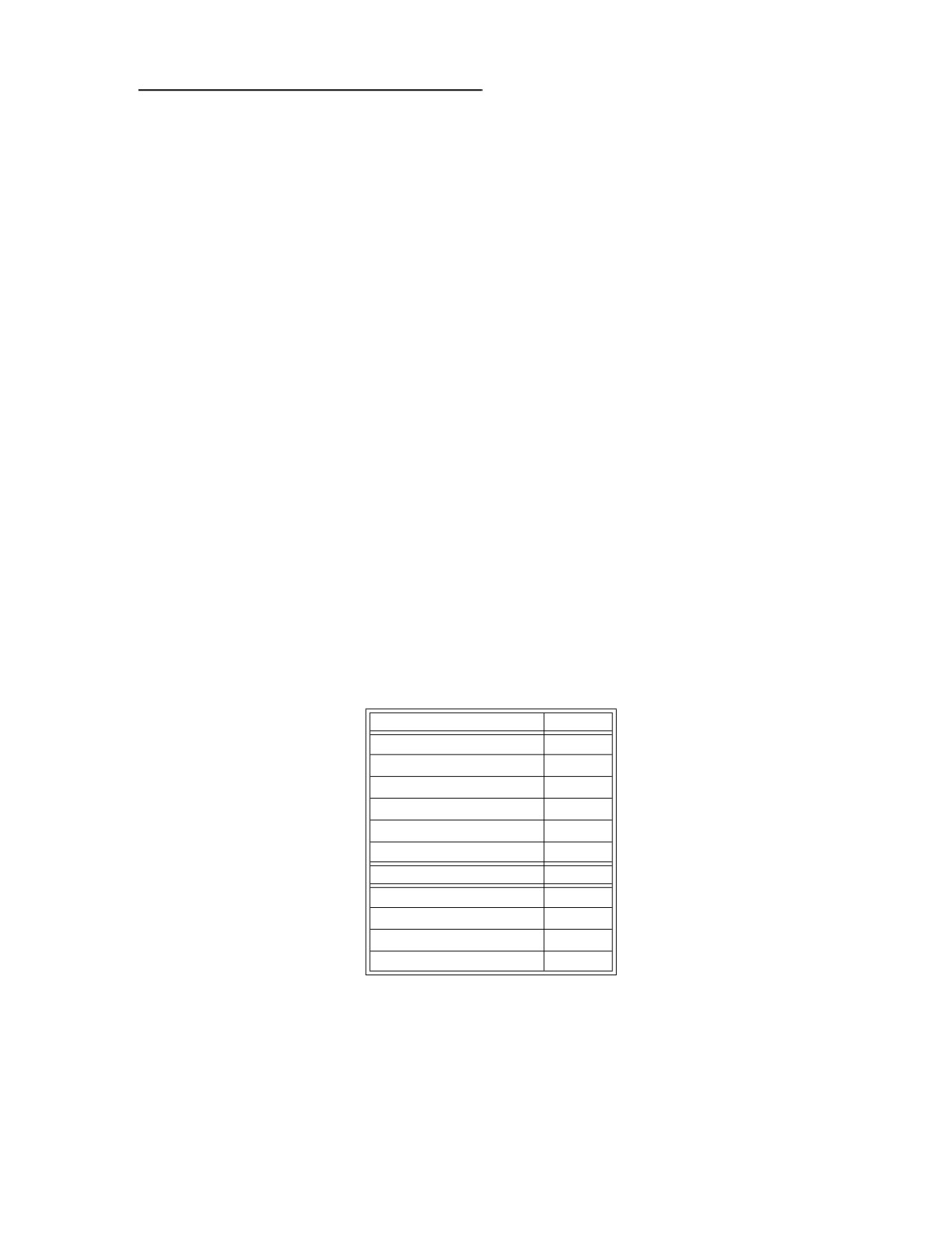
shows these individual letter
symbols. The symbols are combined to form the group symbols that
correspond to the names of typical soils as seen in columns 3 and
4 of the
classification sheet. These symbols are also used in combination to describe
borderline soils.
Table 2-2. Soil-classification symbols
Soil Groups
Symbol
Gravel
G
Sand
S
Silt
M
Clay
C
Organic (silts and clays)
O
Organic (peat)
Pt
Soil Characteristics
Symbol
Well graded
W
Poorly graded
P
Low LL (less than 50)
L
High LL (50 or greater)
H
Coarse-Grained Soils
Coarse-grained soils are subdivided into two divisions—
• Gravels and gravelly soils (G).
• Sands and sandy soils (S).
Soils 2-9
FM 5-472/NAVFAC MO 330/AFJMAN 32-1221(I)
A coarse-grained soil is classified as a gravel if more than half the coarse
fraction, by weight, is larger than a No. 4 sieve. It is a sand if more than half
the coarse fraction, by weight, is smaller than a No. 4 sieve. In general, there
is no clear-cut boundary between gravelly and sandy soils. As far as behavior
is concerned, the exact point of division is relatively unimportant. Where a
mixture occurs, the primary name is the predominant fraction, in percent by
weight, and the minor fraction is used as an adjective. For example, a sandy
gravel would be a mixture containing more gravel than sand, by weight. It is
desirable to further divide coarse-grained soils into three groups based on the
amount of fines (materials passing a No. 200 sieve) they contain.
NOTE: If fines interfere with free-draining properties (as may occur
with plastic fines), use the double symbol (GW-GM, GW-GC, and so on)
indicating that such soils will be classed with soils having from 5 to
12 percent fines.
Less-Than-5-Percent Nonplastic Fines
These soils may fall into the groups GW, GP, SW, or SP, where the shape of the
grain-size-distribution curve determines the symbol’s second letter. The terms
well graded (W) and poorly graded (P) have been discussed earlier. However,
as noted above, if the fines interfere with the free-drainage properties, a dual
or double symbol is used.
• GW and SW groups. The GW and SW groups include well-graded,
gravelly soils and sandy soils with little or no nonplastic fines (less
than 5 percent passing the No. 200 sieve). The presence of the fines
must not noticeably change the strength characteristics of the coarse-
grained fraction and must not interfere with its free-draining
characteristics.
• GP and SP groups. The GP and SP groups include poorly graded
gravels and sands with little or no nonplastic fines. These materials
may be classed as uniform gravels, uniform sand, or gap-graded
materials.
More-Than-12-Percent Fines
These soils may fall into the groups designated GM, GC, SM, and SC. The use
of the symbols M and C is based on the plasticity characteristics of the
material passing the No. 40 sieve. Use the LL and PI in specifying the
laboratory criteria for these groups. The symbol M is used to indicate that the
material passing the No.
40 sieve is silty in character. An M usually
designates a fine-grained soil of little or no plasticity. The symbol C is used to
indicate that the binder soil is predominantly clayey in character.
• GM and SM groups. The GM and SM groups comprise silty (M)
gravels and silty sands with fines (more than 12 percent passing the
No. 200 sieve) having low or no plasticity. For both of these groups, the
LL and PI will plot below the A line on the plasticity chart or the PI
will be less than 4. Both well-graded and poorly graded materials are
included in these two groups. Normally these soils have little to no dry
strength, but occasionally the fine or binder materials will contain a
natural cementing agent that will increase dry strength.
2-10 Soils
FM 5-472/NAVFAC MO 330/AFJMAN 32-1221(I)
• GC and SC groups. The GC and SC groups include gravelly or sandy
soils with fines (more than 12 percent passing the No. 200 sieve) that
are more clay-like and that range in plasticity from low to high. For
both of these groups, the LL and PL will plot above the A line with a
PI of more than 7 (see Section VI of this chapter).
Borderline Soils
Coarse-grained soils of which between 5 and 12 percent of material passes the
No. 200 sieve are classed as borderline and are given a dual symbol (for
example, GW-GM). Similarly, coarse-grained soils of which more than 12
percent of material passes the No. 200 sieve, and for which the limits plot in
the shaded portion of the plasticity chart, are classed as borderline and
require dual symbols (for example, SM-SC). It is possible, in rare instances,
for a soil to fall into more than one borderline zone. If appropriate symbols
were used for each possible classification, the result would be a multiple
designation consisting of three or more symbols. This approach is
unnecessarily complicated.
It is best to use only a double symbol in these cases, selecting the two that are
believed to be most representative of the soil’s probable behavior. In cases of
doubt, the symbols representing the poorer of the possible groupings should be
used. For example, a well-graded sandy soil with 8 percent passing the No.
200 sieve, with an LL of 28 and a PI of 9, would be designated as SW-SC. If the
soil’s LL and PI were plotted in the shaded portion of the plasticity chart (for
example, an LL of 20 and a PI of 5), the soil would be designated either SW-SC
or SW-SM, depending on the engineer’s judgment from the standpoint of the
climatic region.
Fine-Grained Soils
Fine-grained soils are subdivided into two divisions—
• Silts (M).
• Clays (C).
Fine-grained soils are not classified on the basis of grain-size distribution, but
according to plasticity and consistency. Like the coarse-grained soils,
laboratory classification criteria are based on the relationship between the LL
and PI designated in the plasticity chart. The L groups, which have LLs less
than 50, and the H groups, which have LLs greater than 50, are the two major
groupings of fine-grained soils. The symbols L and H have general meanings
of low and high LLs, respectively.
Fine-grained soils are further divided by their position above or below the
plasticity chart’s A line.
• ML and MH groups. Typical soils of the ML and MH groups are
inorganic silts. Those that have an LL less than 50 are in the ML
group; others are in the MH group. All of these soils plot below the A
line. The ML group includes very fine sands; rock flours (rock dust);
and silty or clayey, fine sands or clayey silts with slight plasticity.
Loess-type soils usually fall into this group. Micaceous and
diatomaceous soils generally fall into the MH group, but they may
extend into the ML group when their LLs are less than 50. This is true
Soils 2-11
FM 5-472/NAVFAC MO 330/AFJMAN 32-1221(I)
of certain types of kaolin clays which have relatively low plasticity.
Plastic silts fall into the MH group.
•
CL and CH groups. In these groups, the symbol C stands for clay,
while L and H denote low or high LLs. These soils plot above the A
line and are principally inorganic clays. The CL group includes
gravelly, sandy, silty, and lean clays. The CH group contains inorganic
clays of medium to high plasticity including fat clays, the gumbo clays
of the southern United States (US), volcanic clays, and bentonite. The
glacial clays of the northern US cover a wide area in the CL and CH
groups.
•
OL and OH groups. The soils in these two groups are characterized by
the presence of organic matter, hence the symbol O. All of these soils
generally plot below the A line. Organic silts and organic silt-clays of
low plasticity fall into the OL group. Organic clays of high plasticity
plot in the OH zone of the plasticity chart. Many of the organic silts,
silt-clays, and clays deposited by the rivers along the lower reaches of
the Atlantic seaboard have LLs above 40 and plot below the A line.
Peaty soils may have LLs of several hundred percent and will plot well
below the A line due to their high percentage of decomposed
vegetation. However, an LL test is not a true indicator where a
considerable portion consists of other than soil matter.
•
Borderline soils. Fine-grained soils with limits that plot in the shaded
portion of the plasticity chart are borderline cases and are given dual
symbols (for example, CL-ML). Several soil types that exhibit low
plasticity plot in this general region on the chart where no definite
boundary between silty and clayey soils exists.
Highly-Organic Soils
A special classification is reserved for the highly organic soils (Pt), such as
peat, which have many characteristics undesirable for use as foundations and
construction materials. No laboratory criteria are established for these soils,
as they can be identified in the field by their distinctive color, odor, spongy
feel, and fibrous textures. Particles of leaves, grass, branches, or other fibrous
vegetable matter are common components of these soils.
IDENTIFICATION OF SOIL GROUPS
The USCS is designed so that most soils may be classified into the three
primary or major divisions (coarse-grained, fine-grained, and highly organic)
by means of visual inspection and simple field tests. Classification into the
subdivisions can be made by visual examination only with some degree of
success. More positive identification may be made by means of laboratory
tests on the materials. However, in many instances a tentative classification
determined in the field is of great benefit and may be all the identification
that is necessary, depending on the purpose for which the soil is to be used.
Methods of general identification of soils are discussed in the following
paragraphs as well as a laboratory testing procedure. It is emphasized that
the two methods of identification are never entirely separated. Certain
characteristics can only be estimated by visual examination, and in borderline
cases it may be necessary to verify a classification by laboratory tests. The
2-12 Soils
FM 5-472/NAVFAC MO 330/AFJMAN 32-1221(I)
field methods are entirely practical for preliminary laboratory identification
and may be used to advantage in grouping soils in such a way that only a
minimum number of laboratory tests need to be conducted. The field methods
of classification should never be used as the end product for performing
design.
FIELD IDENTIFICATION
Field identification is an excellent tool when an engineer needs to have an
idea of the general type of soil being dealt with. One excellent use of these
procedures is during a preliminary construction-site analysis.
Several simple tests are used in field identification. The number of tests
depends on the soil type and the experience of the individual employing them.
Experience is the greatest asset in field identification, and learning the
techniques from an experienced technician is the best way to acquire
experience. Lacking such assistance, experience is gained during laboratory
testing by systematically comparing the numerical test results for typical soils
in each group with the “look” and “feel” of the material. An approximate
identification can be made by examining a dry sample spread on a flat surface.
All lumps should be separated until individual grains are exposed. Individual
grains, no matter how large, should not be broken to a smaller size since this
changes the soil’s grain size and character. A rubber-faced or wooden pestle
and a mixing bowl are recommended, but separating the sample underfoot on
a smooth surface will suffice for an approximate identification. Examining the
characteristics of the particles in the sample makes it possible to assign the
soil to one of the three principal groups. Classification derived from these tests
should be recognized as approximations.
An approximate identification of a coarse-grained soil is made by observing—
• Grain size.
• Gradation.
• Grain shape.
• Hardness.
Tests for identifying the fine-grained portions of a soil are performed on the
portion of material that passes a No. 40 sieve. This is the same soil fraction
used in the laboratory for the LL and PL tests. If this sieve is not available, a
rough separation may be made by spreading the material on a flat surface and
removing the gravel and larger sand particles. Fine-grained soils are
examined primarily for characteristics related to plasticity.
Organic soils are identified by significant quantities of organic matter. When
decayed roots, leaves, grasses, and other vegetable matter are present, they
produce a highly organic soil, which is usually dark-colored when moist and
has a soft, spongy feel and a distinctive odor of rotting organic matter. Partly-
organic soils may contain finely divided organic matter detectable by color or
odor.
Soils 2-13
FM 5-472/NAVFAC MO 330/AFJMAN 32-1221(I)
TEST EQUIPMENT
Field tests may be performed with little or no equipment other than a small
amount of water. However, accuracy and uniformity of results will be
increased greatly by properly using the following equipment available in
nearly all engineer units:
• A No. 4 and a No. 40 sieve. (A No. 200 sieve is useful but not required.)
• A digging instrument such as a pick, shovel, or entrenching tool. (A
hand earth auger or posthole digger is useful in obtaining samples
from depths a few feet or more below the surface.)
• A stirrer.
• A knife.
• Several sheets of heavy, nonabsorbent paper.
• A mixing bowl and a pestle (a canteen cup and a wooden dowel).
• A pan and a heating element.
• Scales or balances.
TEST FACTORS
The USCS considers three soil properties:
• The percentage of gravel, sand, or fines.
• The shape of the grain-size-distribution curve.
• The plasticity.
These are the primary factors to be considered, but other observed properties,
whether made in the field or in the laboratory, should also be included in the
soil description. The following information can be determined from field
identification:
• Color (in moist condition).
• Grain size (estimated maximum grain size and estimated percent, by
weight, of gravel, sands, and fines).
• Gradation (well or poorly graded).
• Grain shape (bulky or platy and angular, subangular, rounded, or
subrounded).
• Plasticity (nonplastic, low, medium, or high).
• Predominant soil type.
• Secondary components.
• Identification or classification symbol.
• Organic, chemical, or metallic content.
• Compactness (dense or loose).
• Consistency.
2-14 Soils
FM 5-472/NAVFAC MO 330/AFJMAN 32-1221(I)
• Cohesiveness (ability to hold together without cementation).
• Dry strength.
• Source (residual or transported).
SOIL-DESCRIPTION EXAMPLE
A complete description with proper classification symbols conveys more to the
user of the data than the symbol of any isolated portion of the description. An
example of a soil description, using the sequence and considering the
properties, is—
• Dark brown to white.
• Coarse-grained (maximum particle size 3 inches; estimated 60 percent
gravel, 36 percent sand, and 4 percent fines passing through the No.
200 sieve).
• Poorly graded (gap-graded, insufficient fine gravel).
• Subrounded to rounded gravel particles.
• Nonplastic.
• Predominantly gravel.
• Considerable sand and a small amount of nonplastic fines (silt).
• GP (identification symbol).
• Slightly calcareous, no dry strength, dense in the undisturbed state.
FIELD-IDENTIFICATION TESTS
The following tests produce observations that pertain to the USCS and permit
field identification as well as classification. Tests appropriate to the given soil
sample should be made. Some tests appear to yield duplicate results. The
purpose of these tests is to get the best possible identification in the field.
Thus, if a simple visual examination will define the soil type, only one or two
of the other tests have to be made to verify the identification. When the
results from a test are inconclusive, some of the similar tests should be tried to
establish the best identification.
Figure 2-3, pages 2-16 and 2-17, gives the suggested sequence of tests for
identifying and classifying a soil sample using the hasty field procedures
described in the following paragraphs.
VISUAL TEST
This test should establish the color, grain sizes, grain shapes of the coarse-
grained portion, some idea of the gradation, and some properties of the
undisturbed soil.
Determine the color, grain size, and grain shape of the material and estimate,
if possible, the grain-size distribution by visual examination. The following
paragraphs provide methods and information concerning identification of
these properties.
Soils 2-15
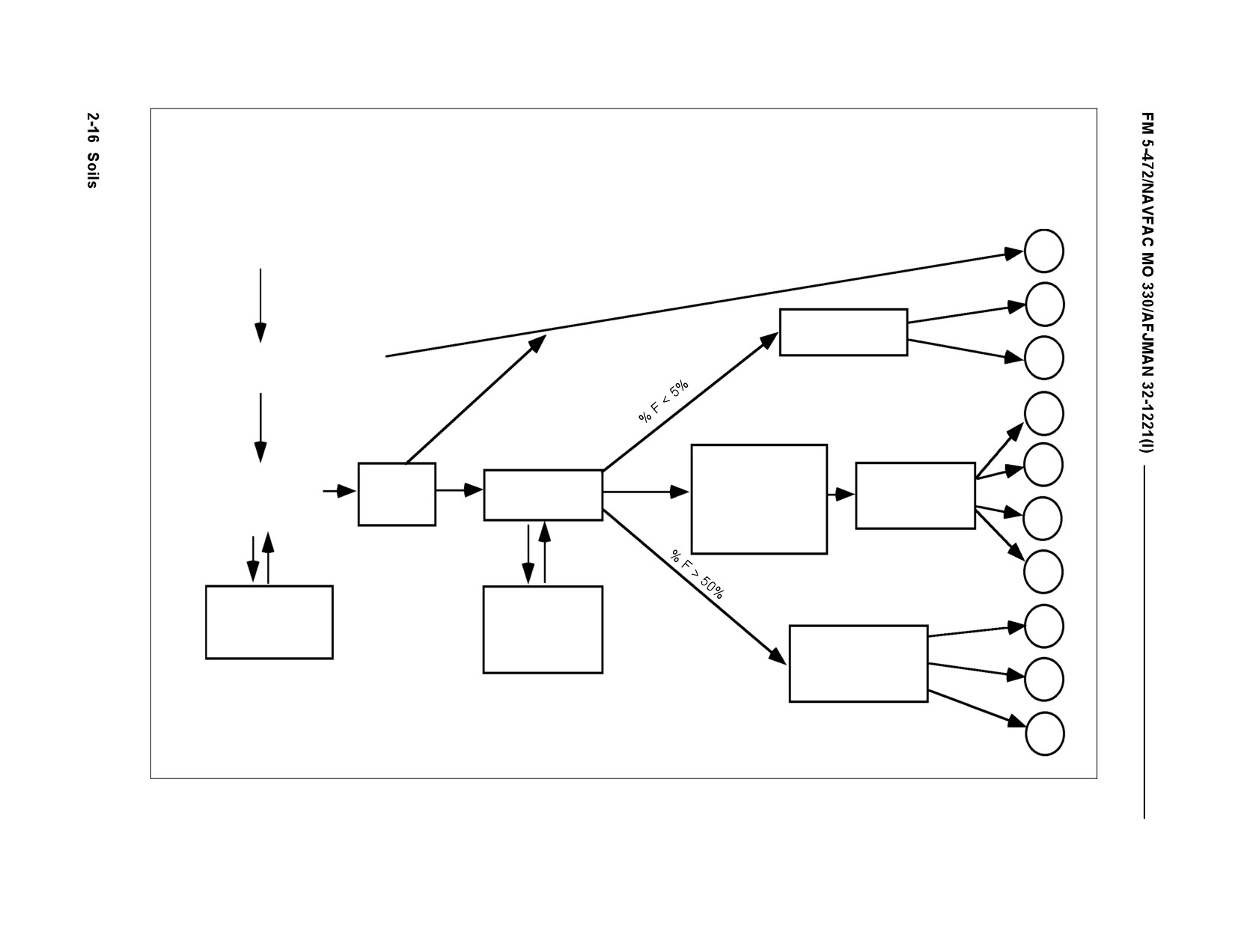
Select representative
sample of soil - 1 pint
(canteen full).
O
G
Predominant
grain-size
Perform visual
S
examination (color, grain-size,
and grain shape).
GM
Field tests
GC
Separate gravel
% F= 5 - 50%
Bite/grit test
Predominant
Odor
Sedimentation
Feel test
particles 1/4” or
coarse-grain
test
test
Thread test
larger (No. 4 sieve).
size
Wet shaking test
SM
Hand-washing test
SC
Estimate
Estimate
% gravel
% sand and
M
(% G)
% fines
Field tests
(%S) (%F)
Dry-strength test
Ribbon test
CL
Shine test
CH
Figure 2-3. Suggested procedures for hasty field identification
FM 5-472/NAVFAC MO 330/AFJMAN 32-1221(I)
1. Perform a visual examination of the sample.
*7. Perform the roll or thread test.
a. Color.
a. Form a ball of moist soil (marble size).
b. Grain size.
b. Attempt to roll the ball into a thread 1/8 inch
c. Grain shape.
in diameter.
d. Contents— leaves, grass, and other possible
• If a thread is easily obtained, it is clay (C).
organic material.
• If a thread cannot be obtained, it is silt (M).
2. Separate the gravel.
*8. Perform the wet shaking test.
a. Remove from the sample all particles larger
a. Place the pat of moist (not sticky) soil in the palm
than 1/4 inch in diameter (No. 4 sieve).
of your hand (the volume is about 1/2 cu in).
b. Estimate the % G.
b. Shake the hand vigorously and strike it against
the other hand.
3. Perform the odor test.
c. Observe how rapidly water rises to the surface.
a. Heat the sample (less gravel) with a match or
• If it is fast, the sample is silty (M).
open flame.
• If there is no reaction, the sample is clayey (C).
b. If the odor becomes musty or foul smelling,
there is a strong indication that organic
*9. Perform the breaking or dry-strength test.
material is present.
a. Form a moist pat 2 inches in diameter by 1/2
inch thick.
4. Perform the sedimentation test to determine the
b. Allow it to dry with low heat.
% S.
c. Place the dry pat between the thumb and index
a. Place approximately 1 inch of the sample (less
finger only and attempt to break it.
gravel) in a glass jar.
• If breakage is easy, it is a silt (M).
b. Mark the depth of the sample with a grease pencil.
• If breakage is difficult, it is a clay of low plasticity
c. Cover the sample with 5 inches of water with at
(CL).
least 1 inch space to the top of the jar.
• If breakage is impossible, it is a clay of high
d. Cover and shake the mixture for 3 to 4 minutes.
plasticity (CH).
e. Place on a flat surface and allow sand particles
to settle for 30 seconds.
*10. Perform the ribbon test.
f. Compare the settled material after 30 seconds to
a. Form a cylinder of moist soil, approximately cigar
the grease-pencil mark and estimate the percent
shape and size.
that has settled.
b. Flatten the cylinder over the index finger with the
g. Determine % S for the overall sample.
thumb, attempting to form a ribbon 8 to 9 inches
% S = (% settled) x (100% - % G)
long, 1/8 to 1/4 inch thick, and 1 inch wide.
h. Determine % F for the overall sample.
• If 8 to 9 inches is obtained, it is (CH).
% F = 100% - (% S + % G)
• If 3 to 8 inches is obtained, it is (CL).
• If less than 3 inches is obtained, it is silt (M).
*5. Perform the bite or grit test. Place a pinch of the
sample between the teeth and bite.
*11. Perform the shine test. Draw a smooth surface,
• If the sample feels gritty, the sample is silt (M).
such as a knife blade or a thumbnail, over a pat of
• If the sample feels floury, the sample is clay (C).
slightly moist soil.
• If the surface becomes shiny and lighter in
*6. Perform the feel test. Rub a portion of dry soil
texture, the sample is a highly plastic clay (CH).
over a sensitive part of the skin, such as the inside
• If the surface remains dull, the sample is a low
of the wrist.
plasticity clay (CL).
• If the feel is harsh and irritating, the sample is silt (M).
• If the surface remains very dull or granular, the
• If the feel is smooth and floury, the sample is clay (C).
sample is silt or sand (M).
*These tests are conducted only with material that passes the No. 40 sieve.
Figure 2-3. Suggested procedures for hasty field identification (continued)
Soils 2-17
FM 5-472/NAVFAC MO 330/AFJMAN 32-1221(I)
Color
Color helps in distinguishing between soil types and, with experience, aids in
identifying the particular soil type. Color may also indicate the presence of
certain chemicals or impurities. Color often varies with the soil’s moisture
content. Thus, the moisture content at the time of color identification should
be included. Some of the more familiar color properties are stated below.
Colors in general become darker as the moisture content increases and lighter
as the soil dries. Some fine-grained soil (OL and OH) with dark, drab shades
of brown or gray (including almost black) contain organic colloidal matter. In
contrast, clean, bright shades of gray, olive green, brown, red, yellow, and
white are associated with inorganic soils. Gray-blue or gray-and-yellow
mottled colors frequently result from poor drainage. Red, yellow, and
yellowish-brown colors result from the presence of iron oxides. White to pink
may indicate considerable silica, calcium carbonate, or aluminum compounds.
Grain Size
The maximum particle size of each sample considered should always be
estimated if not measured. This establishes the gradation curve ’s upper limit.
Gravels range down to the size of peas. Sands start just below this size and
decrease until the individual grains are just distinguishable by the naked eye.
The eye can normally see individual grains about 0.07 millimeter in size, or
about the size of the No. 200 sieve. Silt and clay particles, which are smaller
than sands, are indistinguishable as individual particles.
Grain Shape
While the sample is examined for grain sizes, the shapes of the visible
particles can be determined. Sharp edges and flat surfaces indicate an
angular shape; smooth, curved surfaces indicate a rounded shape. Particles
may not be completely angular or completely rounded. These particles are
called subangular or subrounded, depending on which shape predominates.
Grain-Size Distribution
A laboratory analysis must be performed to determine accurate distribution;
however, an approximation can be made during the visual examination.
Perform the following steps to obtain the grain-size distribution:
Step 1. Separate the larger grains (+4 gravel or coarse grains and some sand
particles) from the remainder of the soil by picking them out individually.
Step 2. Examine the remainder of the soil, and estimate the proportion of
visible individual particles (larger than the No. 200 sieve) and the fines
(smaller than the No. 200 sieve).
Step 3. Convert these estimates into percentages by weight of the total
sample. If the fines exceed 50 percent, the soil is considered fine-grained (M,
C, or O). If the coarse material exceeds 50 percent, the soil is coarse-grained
(G or S).
Step 4. Examine coarse-grained soil for gradation of particle sizes from the
largest to the smallest. A good distribution of all sizes means the soil is well
graded (W). Overabundance or lack of any size means the material is poorly
graded (P).
2-18 Soils
FM 5-472/NAVFAC MO 330/AFJMAN 32-1221(I)
Step 5. Estimate the percentage of the fine-grained portion of the coarse-
grained soil.
If less than 5 percent (nonplastic fines) of the total, the soil may be classified
either as a GW, GP, SW, or SP type, depending on the other information noted
above. If the fine-grained portion exceeds 12 percent, the soil is either M or C
and requires further testing to identify.
Fine-grained portions, between 5 and 12 percent (nonplastic fines or fines not
interfering with free drainage) are borderline and require double symbols
such as GW-GM or SW-SM.
Fine-grained soils (M, C, or O) require other tests to distinguish them further.
Grain-size distribution of fine portions is not normally performed in field
identification. However, if necessary, make an approximation by shaking the
fine portions in a jar of water and allowing the material to settle. The material
will settle in layers of different sizes from which the proportion can be
estimated. Gravel and sand settle into a much denser mass than either clay or
silt settles.
Undisturbed Soil Properties
Using characteristics determined up to this point, it is possible to evaluate the
soil as it appeared in place. Gravels or sands can be described qualitatively as
loose, medium, or dense. Clays may be hard, stiff, or soft. The ease of difficulty
with which the sample was removed from the ground is a good indicator. Soils
that have been cultivated or farmed can be further evaluated as loose or
compressible. Highly-organic soils can be spongy or elastic. In addition, the
soil's moisture content influences the in-place characteristics. This condition
should be recognized and reported with the undisturbed soil properties.
ODOR TEST
Organic soils (OL and OH) usually have a distinctive, musty, slightly offensive
odor. The odor can help identify such materials. This odor is especially
apparent from fresh samples but becomes less pronounced as the sample is
exposed to air. The odor can be made stronger by heating a wet sample.
SEDIMENTATION TEST
From the visual-examination tests, it is easy to approximate the proportions of
sand and gravel in a soil by spreading the dry sample out on a flat surface and
separating the gravel particles by hand. Separating the fines from the sand
particles however, is more difficult, although just as important. Smaller
particles settle through water at a slower rate than large particles.
To perform this test, place about 1 inch of the fine fraction of soil (passing the
No. 4 sieve) in a transparent cup or jar. Mark the height of the sample with a
grease pencil. Place about 5 inches of water into the jar, ensuring that at least
1 inch is still remaining above the water line to the top of the jar. Cover and
shake the water and soil mixture for 3 to 4 minutes. Place the jar on a flat
surface. After 30 seconds compare the level of material that settled to the
bottom with the height of the original sample (grease pencil line). This
comparison should indicate the proportion of sand within the mixture as
indicated in Table 2-3, page 2-20. For example, if the level of the settled
material comes halfway from the bottom of the jar to the grease-pencil line
Soils 2-19
FM 5-472/NAVFAC MO 330/AFJMAN 32-1221(I)
after 30 seconds, then it can be estimated that the amount of sand in this
fraction of the soil is about 50 percent.
Table 2-3. Sedimentation test
Approximate Time of
Settlement Through 5
Grain Diameter (mm)
Differentiates
Inches of Water
2 seconds
0.400
Coarse sand, fine sand
30 seconds
0.072
Sand, fines
10 minutes
0.030
Coarse silt, fine sand
1
hour
0.010
Silt, clay
Once this determination is complete, estimating the amount of sand and fines
of the overall sample is made easy, providing the approximate percentage of
gravel was obtained from the visual examination. Use the following equation
to determine the percent of sand for the overall sample:
% S = percent of sand in jar × (100% - %G)
where—
% S = percent of sand
% G = percent of gravel
Using the information from the example in the previous paragraph and given
the percent gravel as 40 percent, this equation would yield the following
information:
%S = 50% × (100% - 40-%)
%S = 30%
Additionally, once this information is obtained, the percent of fines (% F) can
be determined by subtracting the percent of gravel and the percent of sand
from 100 percent as follows:
%F = 100% - (40% + 30%)
%F = 30%
The most important use of the sedimentation test is to differentiate the coarse
(0.072 millimeter) fraction from the fine fraction of a soil. Since all of the
particles of soil larger than 0.072 millimeter will have settled to the bottom of
the cup or jar 30 seconds after the mixture has been agitated, it follows that
the particles still remaining in suspension are fines. Alternatively, if the water
containing the suspended fines is carefully poured into another jar 30 seconds
after agitation, if more water is added to the cup or jar containing the coarse
fraction, and if the procedure is repeated until the water-soil mixture becomes
clear 30 seconds after mixing, then the cup or jar will contain the coarse
fraction of soil only, and the jar containing the suspension will hold the fines.
If the water can be wicked or evaporated off, the relative amounts of fines and
sand can be determined fairly accurately. Otherwise, a direct measurement of
the settled-out fines can be obtained as a guide. Thus, in a sense, the test acts
like the No. 200 sieve.
2-20 Soils
FM 5-472/NAVFAC MO 330/AFJMAN 32-1221(I)
Difficulty may be encountered with many clay soils because the clay particles
often form small lumps (flocculate) that will not break up in water. Usually
this condition can be detected by examining the coarse fraction of the soil after
several repetitions of the test. If substantial amounts of clay are still present,
the sand will feel slippery and further mixing and grinding with a good stick
will be necessary to break up the lumps.
BITE OR GRIT TEST
The bite or grit test is a quick and useful test in identifying sand, silt, or clay.
A small pinch of soil is ground lightly between the teeth.
The results of this test indicate the following:
• Sandy soils. The sharp, hard particles of sand grate very harshly
between the teeth and are highly objectionable. This is true even of
the fine sands.
• Silty soils. Silt grains are so much smaller than sand grains that they
do not feel nearly as harsh between the teeth. They are not
particularly gritty, although their presence is still quite unpleasant
and easily detected.
• Clayey soils. Clay grains are not gritty, but feel smooth and powdery
like flour between the teeth. Dry lumps of clayey soils stick when
lightly touched with the tongue.
FEEL TEST
This is a general-purpose test requiring considerable experience and practice
before reliable results can be expected. Its use will increase with growing
familiarity with soils. Consistency and texture are two characteristics that
can be determined.
Consistency
The natural moisture content is an indicator of the soil drainage which may
affect this characteristic. For the consistency test, squeeze a piece of
undisturbed soil between the thumb and forefinger to determine its
consistency. Consistency is described by such terms as hard, stiff, brittle,
friable, sticky, plastic, and soft. Remold the soil by working it between the
hands and observe the results. This can indicate the natural water content.
Clays that become fluid on remolding are probably near their LL. If they
remain stiff and crumble when reworked, they are probably below their PL.
Texture
This term is applied to the soil’s fine-grained portion and refers to the degree
of fineness and uniformity. Rub a portion of the soil between the fingers,
observe the texture, and describe it as floury, smooth, gritty, or sharp. To
increase sensitivity, rub the soil on a more tender skin area, such as the inside
of the wrist. Typical results are similar to the bite test—sand feels gritty; silts,
if dry, dust readily and feel soft and silky to the touch; and clays powder only
with difficulty but feel smooth and gritless like flour.
Soils 2-21
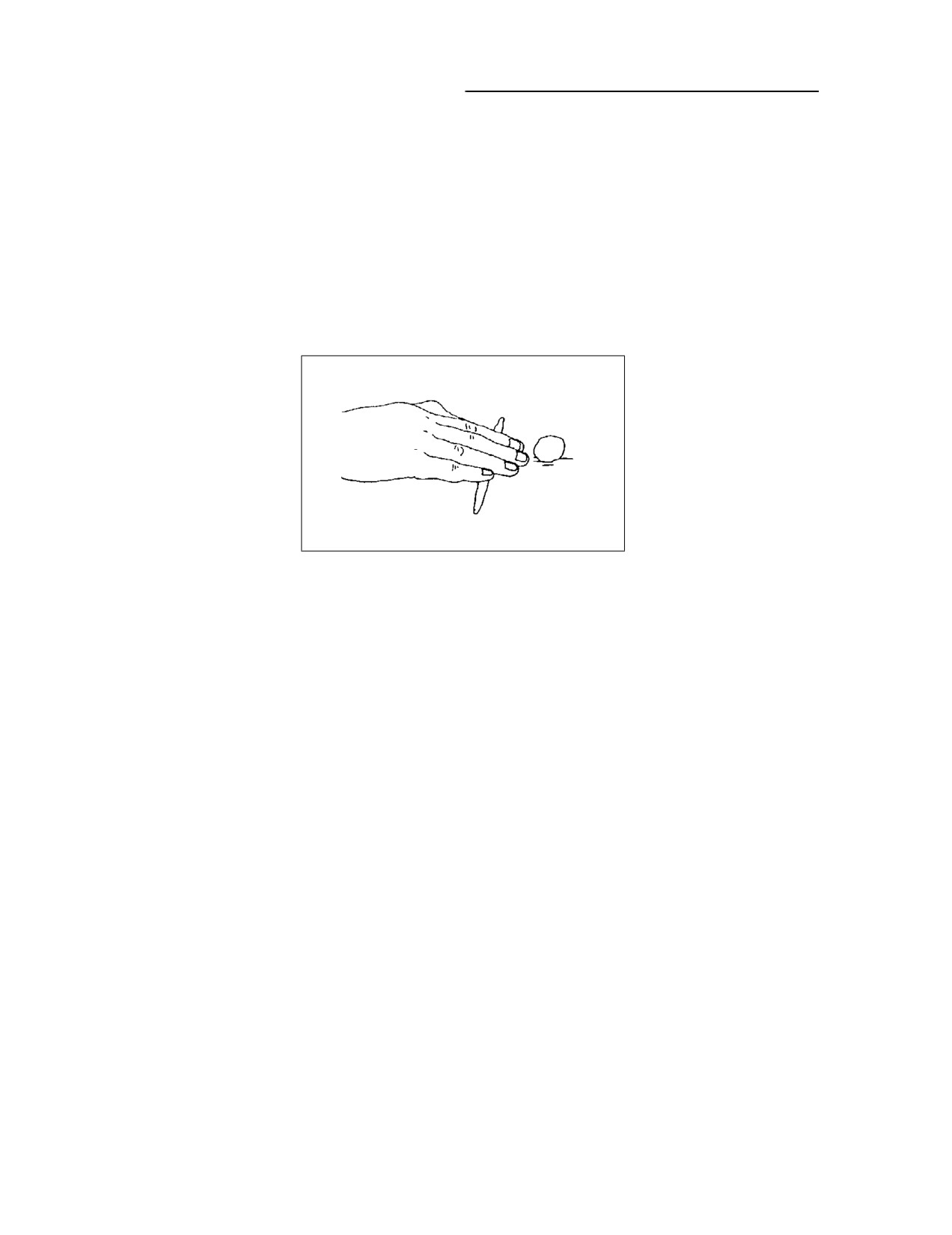
FM 5-472/NAVFAC MO 330/AFJMAN 32-1221(I)
ROLL OR THREAD TEST
This test is performed only on the material passing the No. 40 sieve. Mix a
representative portion of the sample with water until it can be molded or
shaped without sticking to the fingers. This moisture content is referred to as
being just below the sticky limit.
Prepare a nonabsorbent rolling surface by placing a sheet of glass or heavy
waxed paper on a flat or level support, shape the sample into an elongated
cylinder, and roll the prepared soil cylinder on the surface rapidly into a
thread about 1/8 inch in diameter. The technique is shown in Figure 2-4.
Figure 2-4. Roll or thread test
If the moist soil rolls into a thread, it has some plasticity. The number of times
it can be rolled into a thread without crumbling is a measure of the soil’s
degree of plasticity. Materials that cannot be rolled in this manner are
nonplastic or have a very low plasticity.
The results of this test indicate the following:
• If the soil can be molded into a ball or cylinder and deformed under
very firm finger pressure without crumbling or cracking, it is of high
plasticity (CH).
• If the soil can be molded but cracks or crumbles without breaking up,
it is of low plasticity (CL, ML, or MH).
• If the soil forms a soft, spongy ball or thread when molded, it is
organic material (OL or OH), also peat.
• If the soil cannot be rolled into a thread at any moisture content, it is
nonplastic soil (ML or MH).
From the thread test, the cohesiveness of the material near the PL may also
be described as weak, firm, or tough. The higher the soil is on the plasticity
chart, the stiffer the threads are as they dry out and the tougher the lumps
are if the soil is remolded after rolling.
2-22 Soils
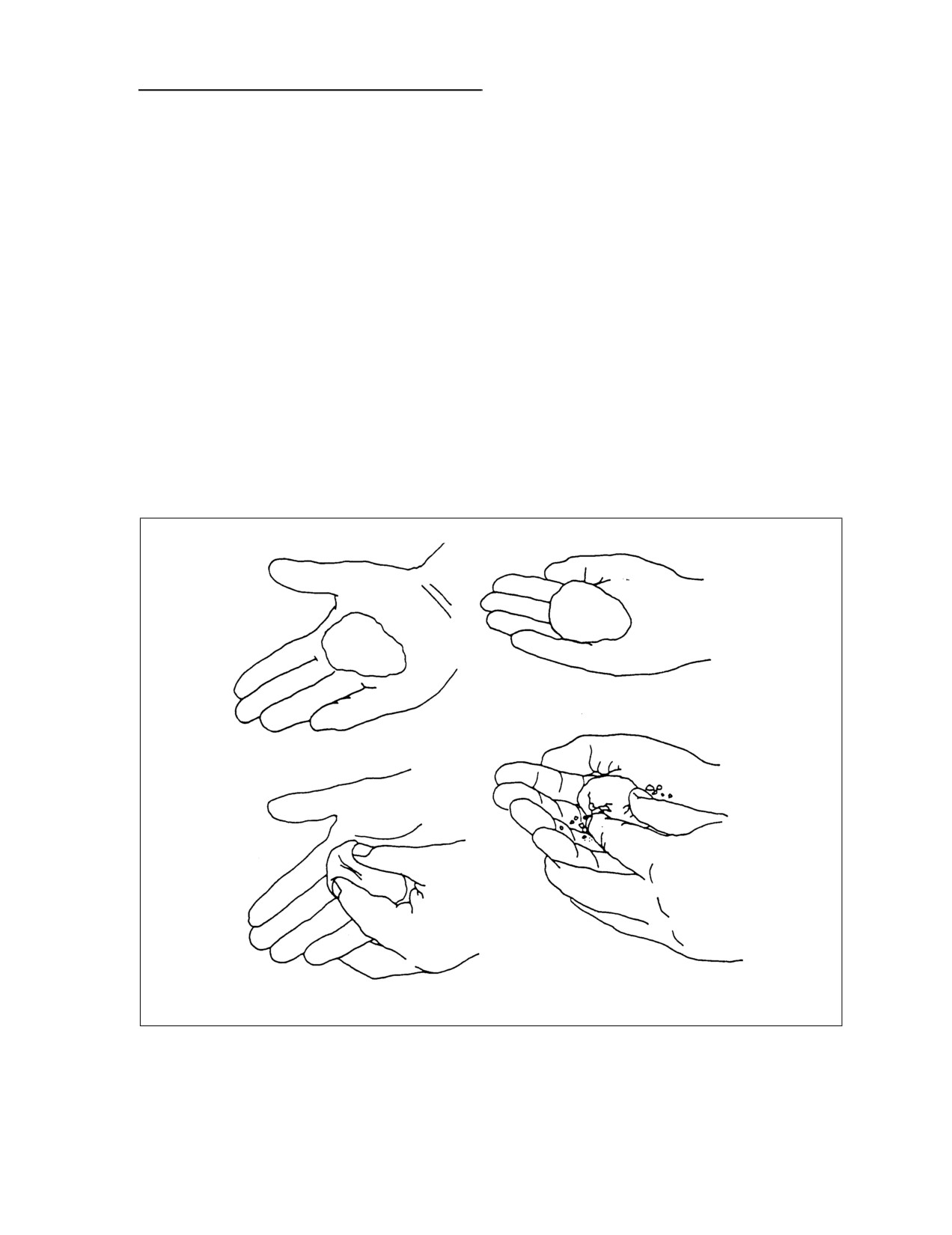
FM 5-472/NAVFAC MO 330/AFJMAN 32-1221(I)
WET SHAKING TEST
Perform the wet shaking test only on the material passing the No. 40 sieve.
For this test, moisten enough material to form a ball of material about 3/4 inch
in diameter. This sample should be just wet enough that the soil will not stick
to the fingers when remolding or just below the sticky limit.
Smooth the soil pat in the palm of the hand with a knife blade or a small
spatula. Shake it horizontally and strike the back of the hand vigorously
against the other hand. The soil reacts to this test when, on shaking, water
comes to the surface of the sample, producing a smooth, shiny appearance.
This appearance is frequently described as livery (see Figure 2-5a and 2-5b).
Squeeze the sample between the thumb and forefinger of the other hand and
the surface water will quickly disappear. The surface becomes dull (see Figure
2-5c) and the material becomes firm, resisting deformation. Cracks occur as
pressure is continued, with the sample finally crumbling like a brittle
material (see Figure 2-5d).
The vibration caused by the shaking of the soil sample tends to reorient the
soil grains, decrease the voids, and force water within these voids to come to
b. Livery appearance
a. Initial sample
c. Squeezing the sample
d. Crumbling the sample
Figure 2-5. Wet shaking test
Soils 2-23
FM 5-472/NAVFAC MO 330/AFJMAN 32-1221(I)
the surface. Pressing the sample between the fingers tends to disarrange the
soil grains, increase the voids space, and draw the water into the soil. If the
water content is still adequate, shaking the broken pieces will cause them to
liquefy again and flow together, and the complete cycle may be repeated. This
process can occur only when the soil grains are bulky in shape and
noncohesive in character.
Very fine sands and silts fall into this category and are readily identified by
the wet shaking test. Since it is rare that fine sands and silts occur without
some amount of clay mixed with them, there are varying reactions to this test.
Even a small amount of clay tends to greatly retard this reaction.
The results of this test indicate the following:
• A rapid reaction to the shaking test is typical of nonplastic, fine sands
and silts.
• A sluggish reaction indicates slight plasticity (such as might be found
from a test of some organic silts) or silts containing a small amount of
clay.
• No reaction at all to this test does not indicate a complete absence of
silt or fine sand.
BREAKING OR DRY-STRENGTH TEST
This test is performed only on the material passing the No. 40 sieve. It is used
to measure the soil’s cohesive and plastic characteristics. The test
distinguishes between the clayey (C) and silty (M) soils.
Separate the selected soil sample on the No. 40 sieve and prepare a pat of soil
about 2 inches in diameter and 1/2 inch thick by molding it in a wet, plastic
state. Natural samples may be found in pats that are of the proper size but
that may yield incorrect results. This is due to the variations in the natural
drying and compaction processes. If natural samples are used, the results
must be treated as approximations and verified later.
Allow the pat to dry completely, then grasp it between the thumbs and
forefingers of both hands and attempt to break it. See Figure 2-6 for the
proper way to hold the pat. If the pat breaks, powder it by rubbing it between
the thumb and forefinger of one hand.
The results of this test indicate the following:
• If the pat cannot be broken nor powdered by finger pressure, it is very
highly-plastic soil (CH).
• If the pat can be broken with great effort, but cannot be powdered, it is
highly-plastic soil (CL).
• If the pat can be broken and powdered with some effort, it is medium-
plastic soil (CL).
• If the pat breaks easily and powders readily, it is slightly-plastic soil
(ML, MH, or CL).
• If the pat has little or no dry strength and crumbles or powders when
picked up, it is nonplastic soil (ML or MH) or (OL or OH).
2-24 Soils
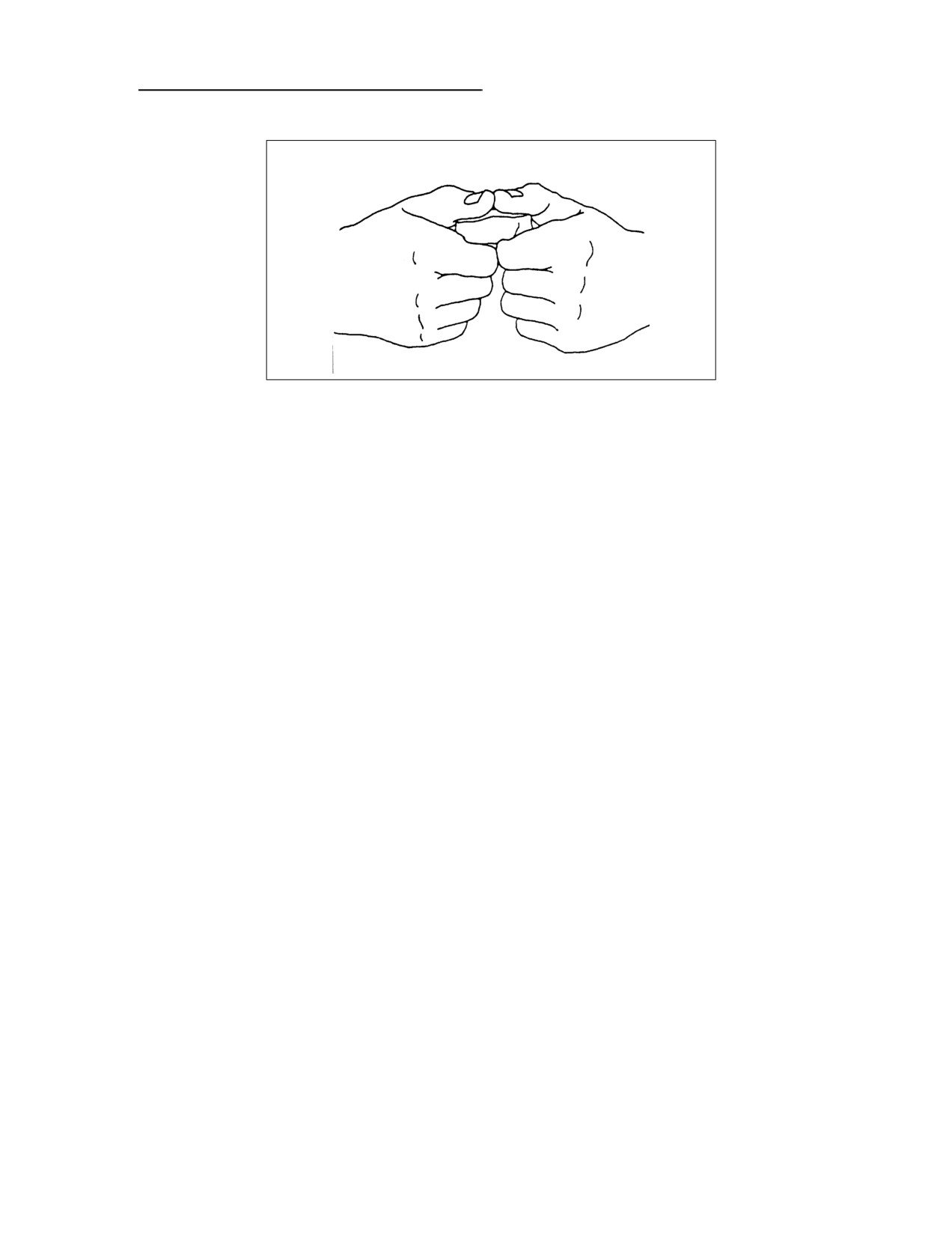
FM 5-472/NAVFAC MO 330/AFJMAN 32-1221(I)
Figure 2-6. Breaking or dry-strength test
NOTE: Dry pats of highly-plastic clays often display shrinkage
cracks. Breaking the sample along such a crack gives an indication of
only a very small part of the soil’s true dry strength. It is important to
distinguish between a break along such a crack and a clean, fresh
break that indicates the soil’s true dry strength.
RIBBON TEST
The ribbon test is also performed only on material passing the No. 40 sieve.
The sample is prepared as for the roll or thread test until the moisture content
is just below the sticky limit. This test and the roll test complement each other
and give a clearer picture of the soil.
Form a roll of soil 1/2 to 3/4 inch in diameter and 3 to 5 inches long. Lay the
roll across the palm of one hand (palm up). Starting at one end, squeeze the
roll between the thumb and forefinger over the edge of the hand to form a flat,
unbroken ribbon about 1/8 to 1/4 inch thick. Allow the ribbon as formed to
hang free and unsupported (see Figure 2-7, page 2-26). Continue squeezing
and handling the roll carefully to form the maximum length of ribbon that can
be supported only by the cohesive properties of the soil.
The results of this test indicate the following:
• If the sample holds together for a length of 8 to 10 inches without
breaking, it is considered to be plastic having a high LL (CH).
• If the soil can be ribboned only with difficulty into 3- to 8-inch lengths,
it is of low plasticity (CL).
• If the soil cannot be ribboned, it is nonplastic (ML) or (MH).
SHINE TEST
The shine test is another means of determining the soil’s plasticity. A slightly
moist or dry piece of highly-plastic clay (CH) produces a definite shine when
rubbed with a fingernail or a smooth, metal surface such as a knife blade.
Lean clay remains dull after this treatment (CL).
Soils 2-25
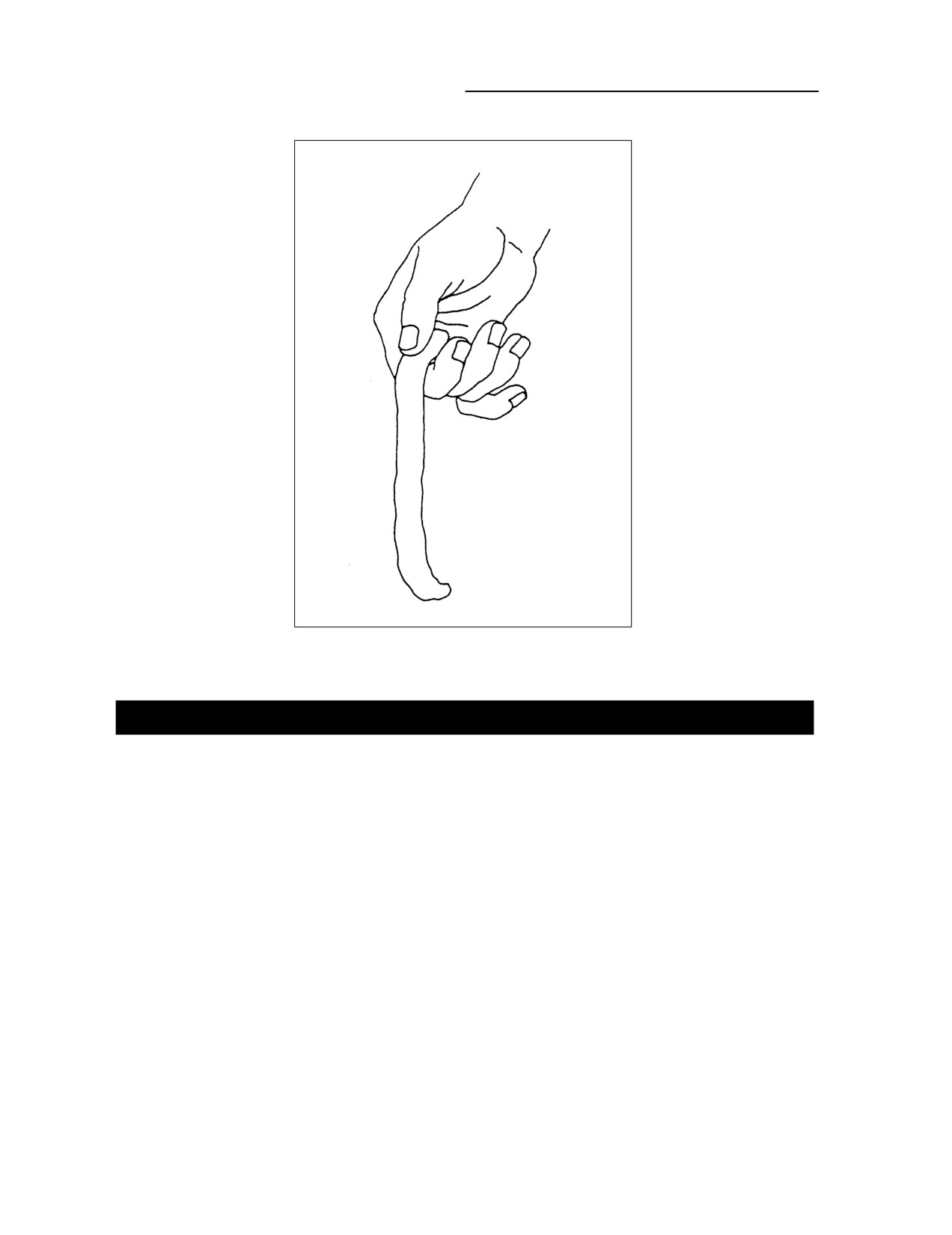
FM 5-472/NAVFAC MO 330/AFJMAN 32-1221(I)
Figure 2-7. Ribbon test
SECTION II. SOIL SURVEYS AND SAMPLING
Surveying soil conditions at proposed military construction sites provides
information about the nature, extent, and condition of soil layers; the position
of the water table and drainage characteristics; and the sources of possible
construction materials. A soil survey is vital to planning and executing
military construction operations. The information obtained from a soil survey
is the basis for a project’s success.
TYPES OF SOIL SURVEYS
A soil survey consists of gathering soil samples for examining, testing, and
classifying soils and developing a soil profile. The two types of soil surveys
commonly associated with military construction are the hasty and deliberate
surveys.
A hasty survey—made either under expedient conditions or when time is very
limited—is a type of survey that usually accompanies a preliminary site
analysis. A deliberate survey is made when adequate equipment and time are
available. When possible, a hasty survey should be followed by a deliberate
survey.
2-26 Soils
///////////////////////////////////////