FM 5-472 Materials Testing (DEPARTMENT OF THE ARMY) December 2000 - page 4
FM 5-472/NAVFAC MO 330/AFJMAN 32-1221(I)
Step 5. Prepare the mold and moisture-determination tares.
a. Lightly oil a mold (4- or 6-inch, depending on the procedure selected).
b. Weigh the mold.
• For the 4-inch mold, weigh the mold with the baseplate to the
nearest gram. Record this weight on the form as the weight of the
mold (block 13). Do not include the collar.
• For the 6-inch mold, weigh the mold with the baseplate and spacer
disk to the nearest gram. Record this weight on the form as the
weight of the mold (block 13). Do not include the collar.
c. Attach the collar to the mold. If using the 6-inch mold, place a coarse
filter paper on top of the spacer disk.
d. Record the volume of the mold as 0.0333 cubic foot for the 4-inch mold
or 0.075 cubic foot for the 6-inch mold with the spacer disk.
e. Mark and weigh
2
moisture-determination tares for each mold
prepared. Record as the weight of tare.
Step 6. Place sufficient soil in the mold (about 1 1/2 to 2 inches) to obtain
about a 1-inch compacted layer. After compaction of all 5 layers, each layer
should be about equal in thickness. The fifth compacted layer will slightly
extend into the collar but will not exceed 1/4 inch above the top of the mold.
Step 7. Apply compactive effort.
a. Hold the 10-pound compaction tamper within 5 degrees of vertical,
placing its face on top of the soil.
b. Raise the handle until it reaches the top (18 inches) and release it,
allowing the weight to fall freely onto the soil.
c. Change the position of the guide and tamper, and repeat the process
until the soil layer has received the prescribed 25 blows for procedures A
and B or 56 blows for procedure C. Apply the blows at a uniform rate of
about 25 blows per minute. The height of fall of the tamper must be
controlled carefully and the blows distributed evenly over the specimen’s
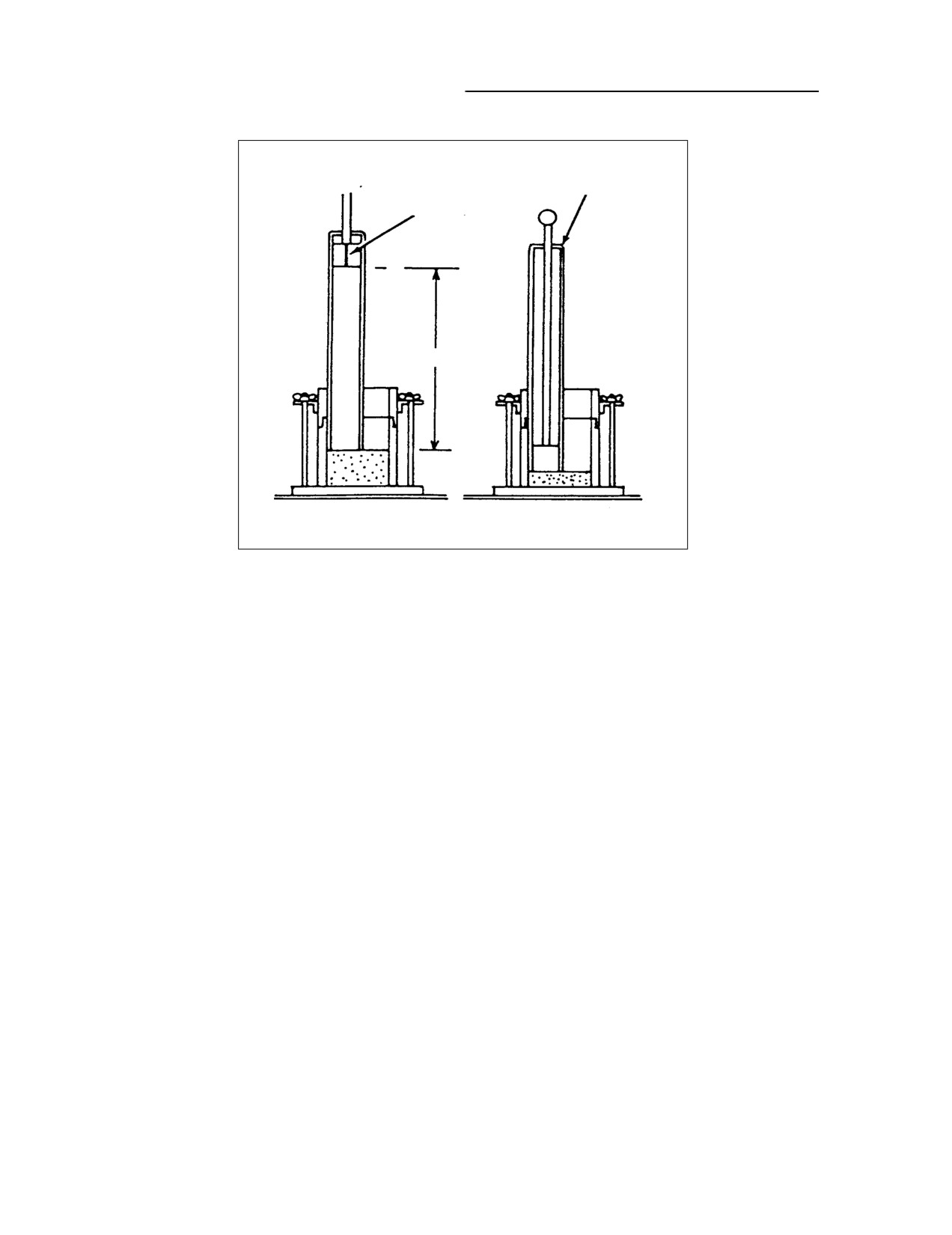
surface (see Figure 2-56, page 2-108).
Step 8. Trim the compacted layer. After compacting each layer (except the fifth
layer), use a knife to trim any soil adjacent to the mold walls that has not been
compacted or that extends above the compacted surface. Include the trimmed
soil with the additional soil for the next layer.
Step 9. Repeat steps 6, 7, and 8 until five layers have been compacted in the
mold. Each compacted layer should be about equal in thickness (just under 1
inch). Adjust each layer accordingly to ensure that the fifth compacted layer
will slightly extend into the collar, but will not exceed 1/4 inch above the top of
the mold.
Step 10. Remove the collar from the mold.
a. Cut around the inside edge of the collar to prevent shearing the
compacted soil when removing the collar.
Soils 2-107
FM 5-472/NAVFAC MO 330/AFJMAN 32-1221(I)
Tamper guide
10-lb tamper
18”
Figure 2-56. Soil compaction in a mold
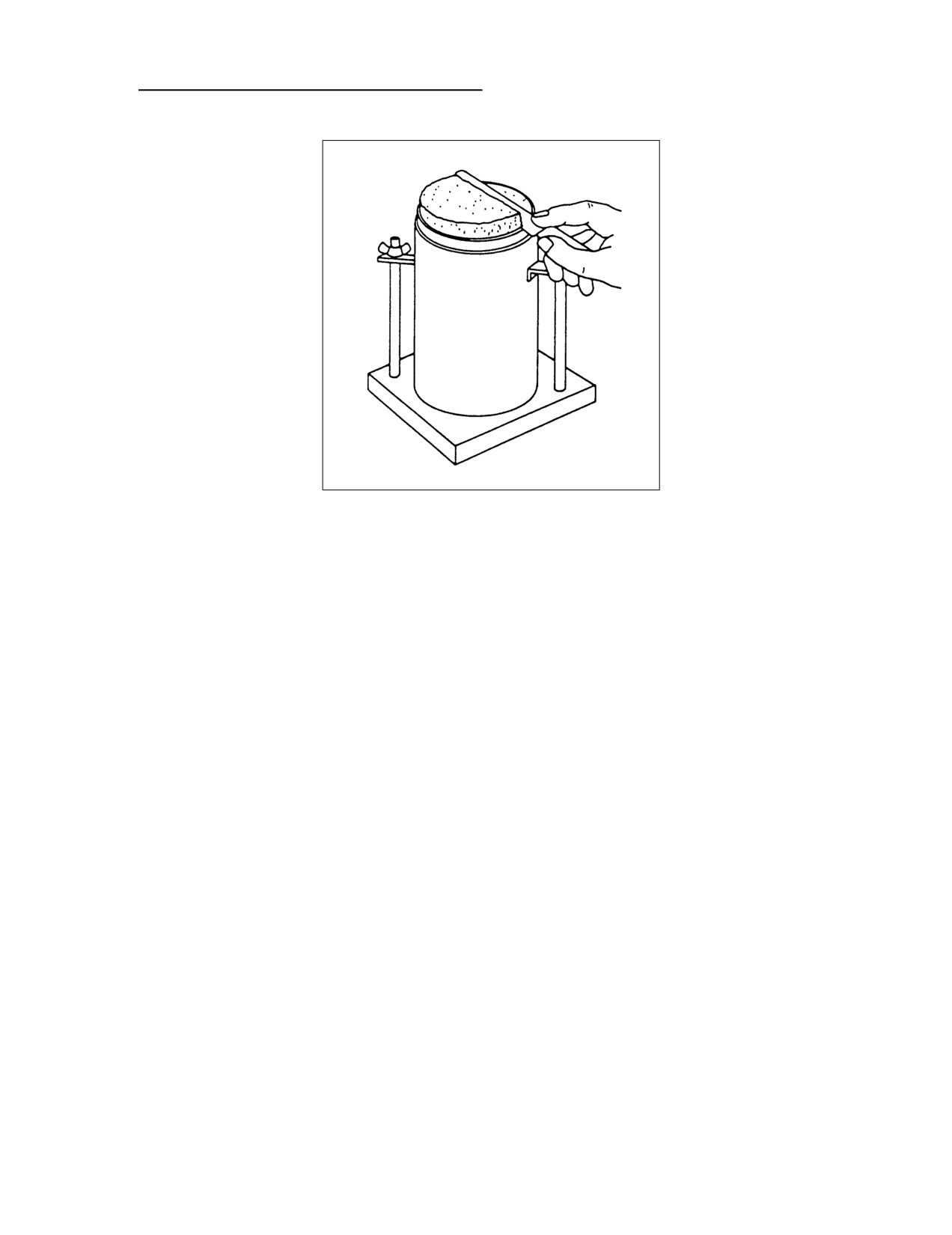
b. Trim and smooth the compacted soil flush with the top of the mold (see
Figure 2-57). Use a sawing motion with the straightedge to trim the excess
soil. Start at the center of the mold and work outward, first to one side and
then to the other. Fill any holes with unused or trimmed soil from the
specimen, press in with the fingers, and again scrape the surface with the
straightedge.
Step 11. Weigh and record the data. Weigh the complete mold with the
baseplate and compacted specimen (including the spacer disk for the 6-inch
mold) to the nearest gram. Record the weight on the form as the weight of the
mold and wet soil (block 12). Do not include the collar.
Step 12. Prepare the specimen for moisture-content determination.
a. Remove the specimen from the mold.
b. Slice the compacted specimen axially through the center and remove
about 250 grams of material from one side of the cut and place it in one of
the moisture-determination tares and cover. Remove about 250 grams
from the other side of the cut, and place it in the other moisture-
determination tare and cover.
Step 13. Repeat steps 5 through 12 for the remaining molds at the different
moisture contents described in step 3c.
Step 14. Determine the moisture content of the material in the moisture-
determination tares by performing moisture-content testing of the tares as
described in Section III.
2-108 Soils
FM 5-472/NAVFAC MO 330/AFJMAN 32-1221(I)
Figure 2-57. Trimming the compacted soil sample
Step 15. Perform calculations. Record the weight of the dry soil and tare on
the form. Compute the weight of water, weight of dry soil, and the water
content and record it on the form. Compute the average water content from
the two tares and record it on the form. Calculate and record the dry unit
weight as follows:
wet unit weight
dry unit weight
= -------------------------------------------------------------
percent water content
1
+ ---------------------------------------------------
100
COMPACTION-TEST GRAPH—PRESENTATION OF RESULTS
The soil compaction-test graph (DD Form 1211) is an important part of
presenting the data from the compaction test. It is used to plot a compaction
curve. This curve is needed to determine the MMD and OMC as part of the
compaction-test procedures. It also includes a zero-air-voids curve and a
compaction-specification block.
COMPACTION CURVE
The compaction curve is obtained by plotting moisture content versus dry
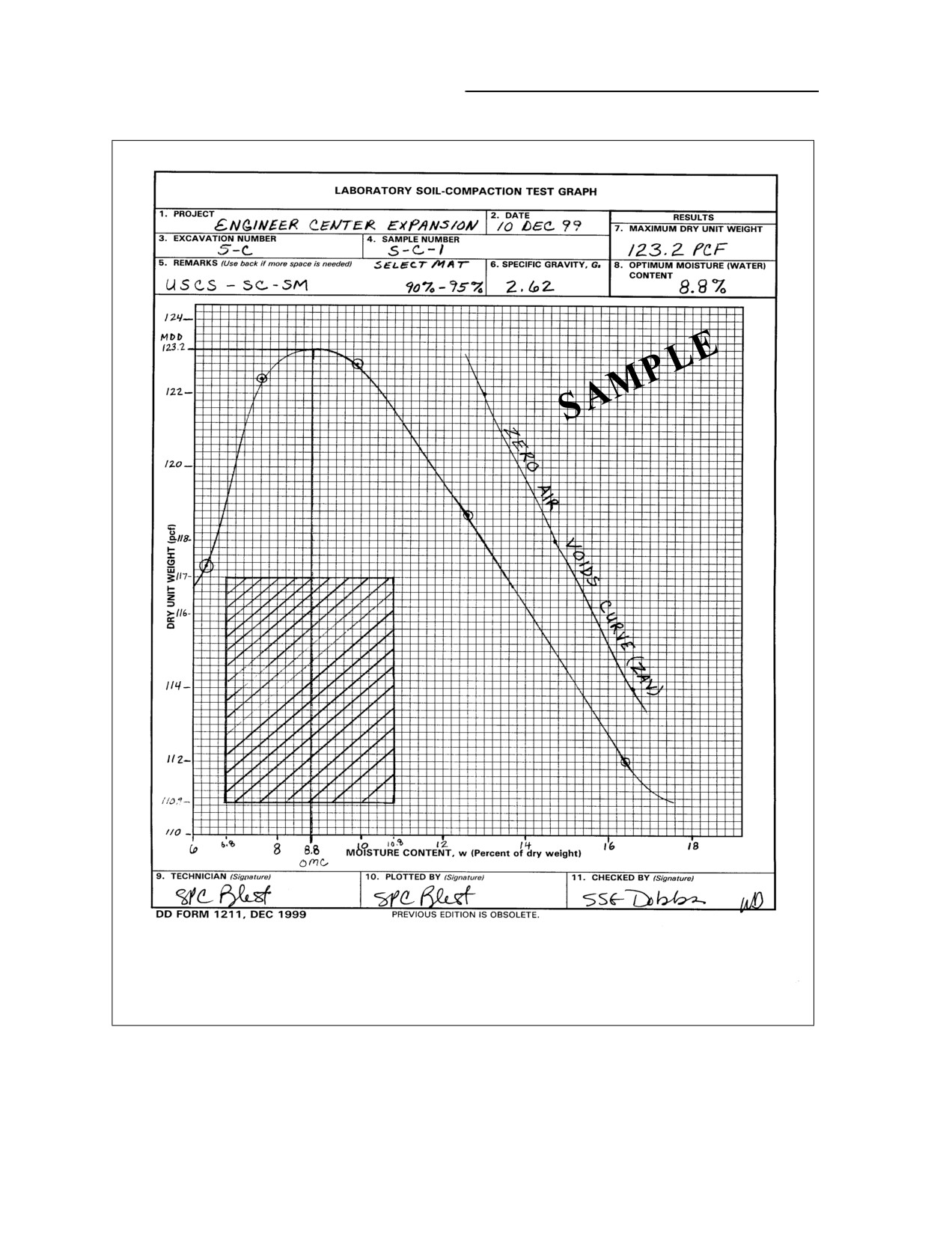
unit weight for each test on the soil-compaction-test graph (see Figure 2-58,
page 2-110). To construct an acceptable curve, at least two of the plotted
points should fall on each side of the OMC. It is important to remember that
during the testing period, the only density that can be determined is the
wet soil density or wet unit weight. To compute the dry unit weight, the
moisture content must be determined. This can take up to 24 hours.
For a typical cohesive soil, dry density increases to a certain point (the OMC)
as the moisture in the soil increases. Once the OMC is achieved, the dry
density begins to decrease with increasing moisture content. The primary
reason for performing the compaction test is to determine the moisture
Soils 2-109
FM 5-472/NAVFAC MO 330/AFJMAN 32-1221(I)
Figure 2-58. Sample DD Form 1211
2-110 Soils
FM 5-472/NAVFAC MO 330/AFJMAN 32-1221(I)
content at which the MDD can be obtained. After plotting the compaction
curve, it is possible to determine the moisture content that will give the MDD
for that particular soil directly from the plotted curve.
The compaction curve shows the OMC or the moisture content at which the
MDD is obtained for a given compaction effort. By determining the highest
point on the compaction curve (apex) and dropping vertically to the horizontal
moisture scale or line, the OMC for this particular soil is found to be 8.8
percent, as shown in Figure 2-58.
The compaction curve also shows MDD (100 percent compaction). The MDD of
100 percent effort may be obtained by running a tangent from the highest
point on the compaction curve for the particular soil to the vertical dry-density
scale (see Figure 2-58); in this case, 123.2 pounds per cubic foot (pcf).
A compaction curve is not complete without the zero-air-voids curve, which
acts as a control to the compaction curve.
ZERO AIR VOIDS AND SATURATION
The zero-air-voids curve represents theoretical values that are practically
unattainable—no matter what degree of compactive effort—because it is not
possible to remove all the air contained in the voids of a soil by compaction
alone. Typically, at moisture contents beyond optimum, the actual compaction
curve closely parallels the theoretically-perfect compaction curve. Any values
of dry density that plot to the right of the zero-air-voids curve are in error. The
error may be in the test measurement, the calculations, or the specific gravity.
At complete saturation, the voids in the solid mass are completely filled with
water. That is, no air is present and the degree of saturation (S) is equal to 100
percent. The zero-air-voids curve (100 percent saturation) for the soil tested is
shown on the graph in Figure 2-58. This curve is obtained by plotting dry
densities corresponding to complete saturation at different moisture contents
using the following formula:
62.43
1
w = S
×
-------------
- ------
g
d
Gs
where—
w = water content, in percent
S = degree of saturation, in percent
62.43 = unit weight of water, in pcf
gd = dry unit weight of soil, in pcf
Gs = specific gravity of solids for this soil (block 6, DD Form 1211)
Use this equation to compute points for plotting the zero-air-voids curve. Plot
at least three points for drawing the curve. Use points within the range of the
compaction-curve dry unit weights. Select three dry unit weights in this range
and calculate as listed above.
Soils 2-111
FM 5-472/NAVFAC MO 330/AFJMAN 32-1221(I)
Example: The upper plotted point of the zero-air-voids curve for the soil
represented in Figure 2-58 is a whole number just under maximum density
(122 pcf). The specific gravity of solids (Gs) was determined to be 2.62. At 100
percent saturation for this density, the corresponding moisture content would
be 13 percent. This is determined by the zero-air-voids formula:
62.43
1
100
×
-------------
- ----------
= 13
122
2.62
Any other plotted points are also determined using this formula as follows:
62.43
1
100
×
-------------
- ----------
= 14.7
118
2.62
62.43
1
100
×
-------------
- ----------
= 16.6
114
2.62
PERCENT MOISTURE
To obtain the maximum dry unit weight or density in the field, it is necessary
to maintain the construction soil’s moisture content as close as possible to the
optimum determined from the laboratory compaction test. If the moisture
content is not close to the OMC, it will require extra time and equipment effort
to obtain the MDD. The limits for moisture contents should be outlined in the
specifications for each job. If not specified, the limits should be established as
± 2 percent of the OMC. Using Figure 2-58, where the OMC is 8.8 percent, the
moisture limits would range from 6.8 to 10.8 percent. This provides the limits
for a workable and practical specification block.
PERCENT COMPACTION
Some soils will not or cannot be compacted to 100 percent at a reasonable
equipment effort, regardless of the combination. In those cases, it is not
mandatory to compact to 100 percent. For each job, the specifications will
state the percent of compaction required for the particular loadings. Assume
that the specifications require 90 percent of MDD. To find the dry density
required, multiply the MDD (100 percent), regardless of its value, by 0.90.
This will give the density limit. If the specifications state between 90 and 95
percent, the 90 percent density will constitute the lower limit with 95 percent
as the upper limit. A specification block can now be constructed (see Figure
2-58, page 2-110).
COMPACTION-SPECIFICATION BLOCK
The compaction-specification block shows a determination range based on the
project specifications. If no specifications are given, refer to the minimum
compaction specification requirements as listed in FMs 5-410, 5-430-00-1, or
5-430-00-2. Once the range is determined, the specification block is plotted on
the compaction curve (see Figure 2-58), covering the specified compaction-
range requirement in percent for the dry unit weight within a 4 percent range
of the OMC (± 2 OMC). The block is then lightly cross-hatched so as to not
interfere with the compaction curve. If the field results fall within this block,
the job is meeting specifications.
2-112 Soils
FM 5-472/NAVFAC MO 330/AFJMAN 32-1221(I)
Equipment
Use the following to complete the compaction-specification block:
• DD Form 1211 with compaction curve and zero-air-voids curve.
• A calculator.
• The proposed use of the soil.
• The project’s compaction specifications.
Steps
Perform the following steps to complete the soil compaction-specification block
(DD Form 1211):
Step 1. Determine the compaction-specification requirements as discussed
above.
Step 2. Draw the compaction-specification block. Establish the upper and
lower limits of the block as the specification range (in percent) of the dry unit
weight. Establish the left and right limits of the block as ± 2 of OMC.
The example in Figure 2-58, page 2-110, represents the compaction data from
DD Form 1210 (see Figure 2-55, page 2-106), the zero-air-voids curve plotted
from a specific gravity value of 2.62, and a compaction specification of 90 to 95
percent. Notice the compaction-specification block ranges vertically from 117
to 110.9 pcf and horizontally from 6.8 to 10.8 percent in moisture content. The
computation used to achieve the upper and lower limits is based on the MDD
(in this case, 123.2 pcf) and the specification range of 90 to 95 percent as
follows:
123.2 x 0.95 = 117.0
123.2 x 0.90 = 110.9
Once the block has been established and drawn, the inside of the block can be
lightly cross-hatched to easily identify the range. Do this so as not to interfere
with the curve or any other data plotted on the chart.
EFFECT OF WATER ON DENSITY
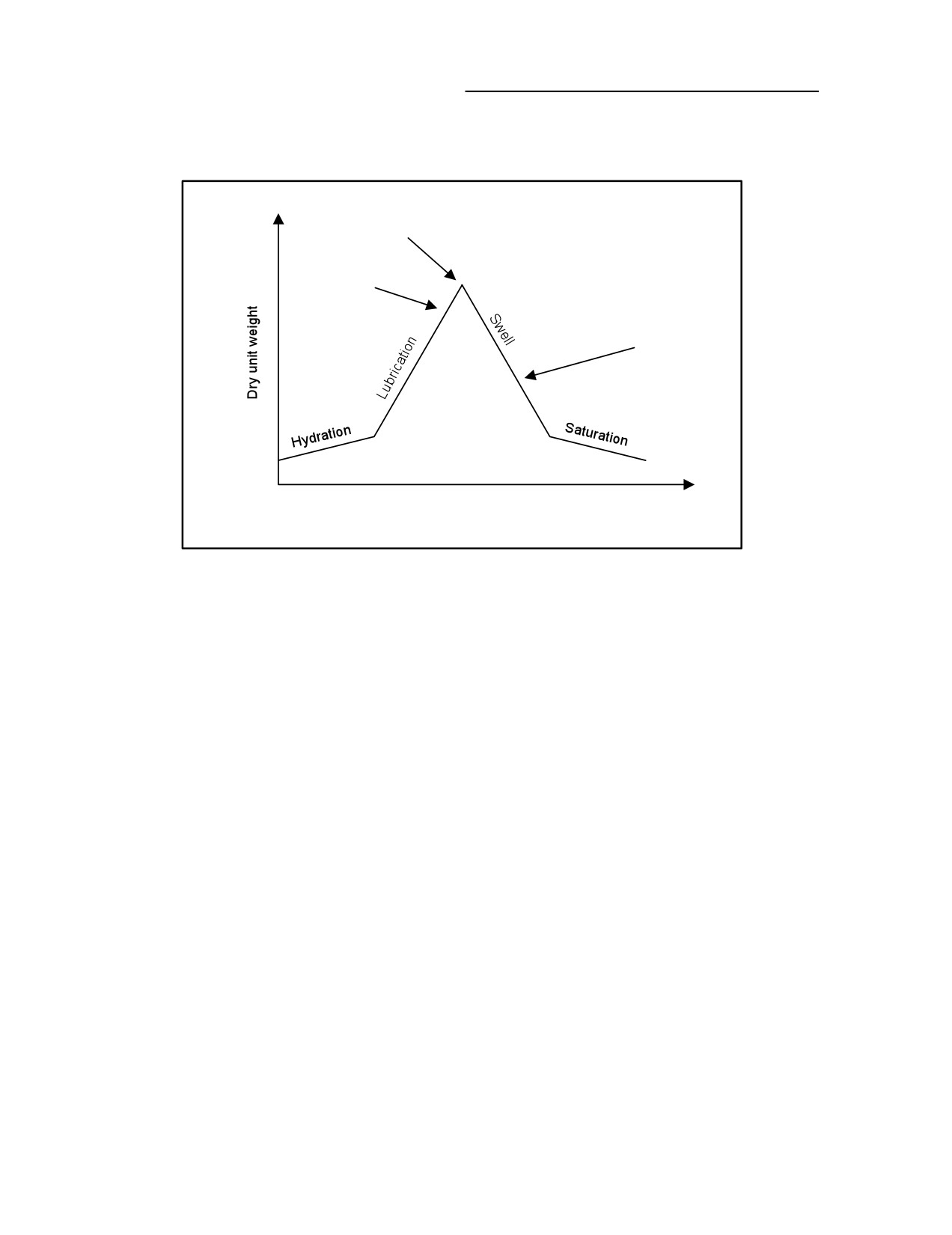
Figure 2-59, page 2-114, demonstrates that as the moisture content is varied,
the dry density also varies. As water is added to an oven-dried soil, the dry
density increases until the OMC is reached. The dry density then begins to
decrease using a constant compactive effort.
After adding small increments of water to a completely air-dry soil,
subsequent compaction with a constant compactive effort causes a small
increase in the soil’s dry unit weight. During the initial hydration phase, the
water being added to the soil is absorbed on the surface of the soil grains. This
water does not aid compaction by acting as a lubricant since it is firmly
attached to the surface of the soil particles. Adding additional water brings
the soil to a point where a slight change in moisture begins to produce a large
increase in density. This rapid increase indicates that the lubrication phase of
the compaction curve has been reached.
Soils 2-113
FM 5-472/NAVFAC MO 330/AFJMAN 32-1221(I)
Maximum dry unit weight
Adding
cohesive
water
Swell water
begins forcing
grains apart
w (moisture content)
Figure 2-59. Effect of water on density
The first portion of the compaction curve to the right of OMC is known as the
swell phase. The addition of water increases the film around the soil particles,
forcing the soil particles apart and decreasing the dry density. With further
increases in moisture content, free water added to the soil will fill the void
spaces. This is known as the saturation phase. In the swell and saturation
phases, the water begins to take the place of the solids, thus decreasing the
dry density.
EFFECT OF DIFFERENT COMPACTIVE EFFORTS ON DENSITY
The mass-per-unit volume of a soil varies directly with the amount of energy
expended to compact that soil. Therefore, the greater the compactive effort,
the greater the amount of solids per unit volume. This results in a stronger
and more stable soil.
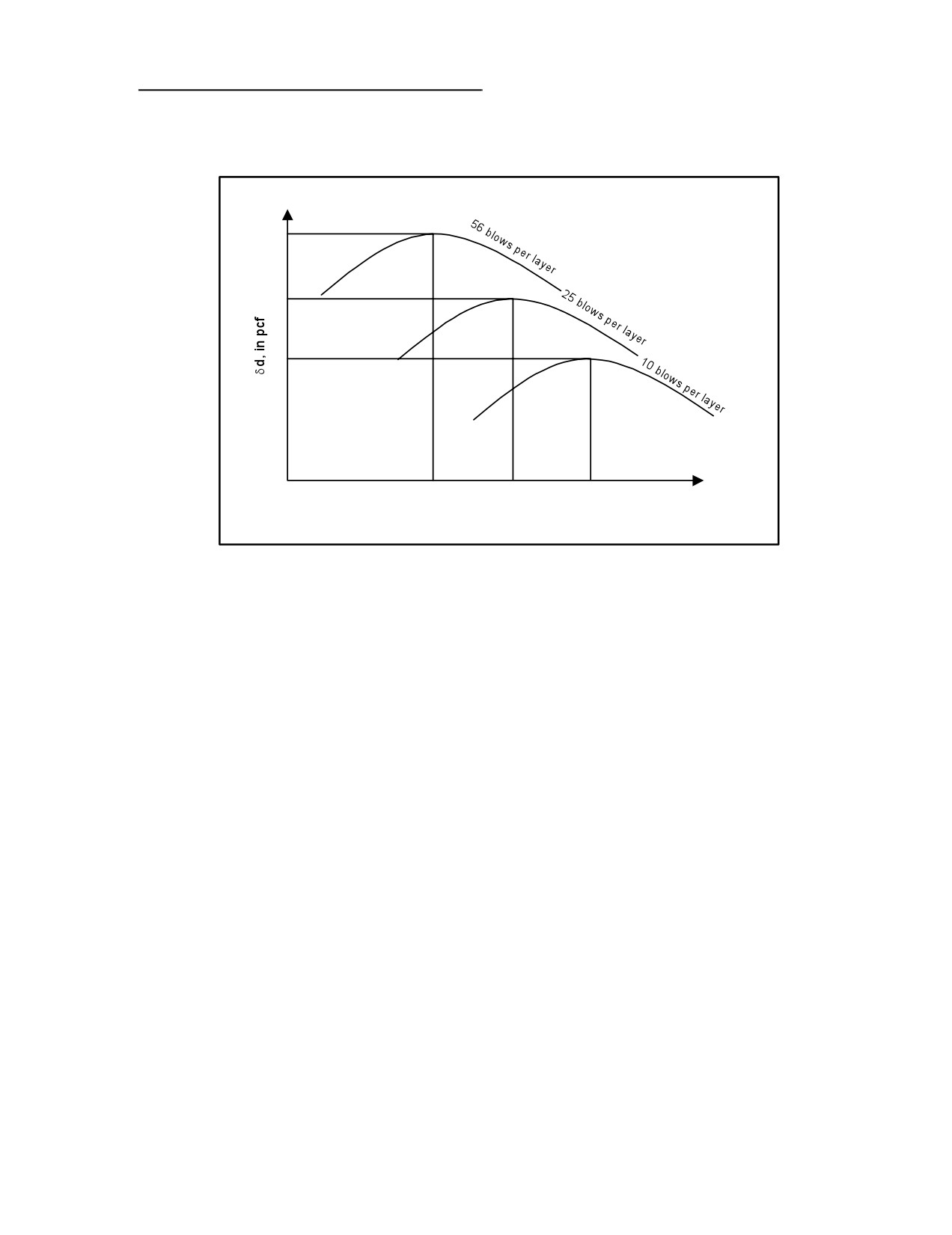
As the compactive effort is increased, the dry density of the soil increases.
This means that if more energy is used to compact a soil, the increased energy
will cause the particles to be rearranged to a greater extent, thus increasing
the mass of soil particles per unit volume. If the compactive effort is
decreased, the particles will not be rearranged as much, thus decreasing the
dry density. Figure 2-60 shows how the dry density varies with the compactive
effort.
The OMC varies inversely with respect to compactive effort. If the compactive
effort is increased, the soil does not have to be as wet to obtain the MDD. In
other words, the OMC will be decreased with increasing compactive effort (see
Figure 2-60).
2-114 Soils
FM 5-472/NAVFAC MO 330/AFJMAN 32-1221(I)
w (moisture content)
Figure 2-60. Effect of different compactive effort on density
EFFECT OF DIFFERENT TYPES OF SOILS ON DENSITY
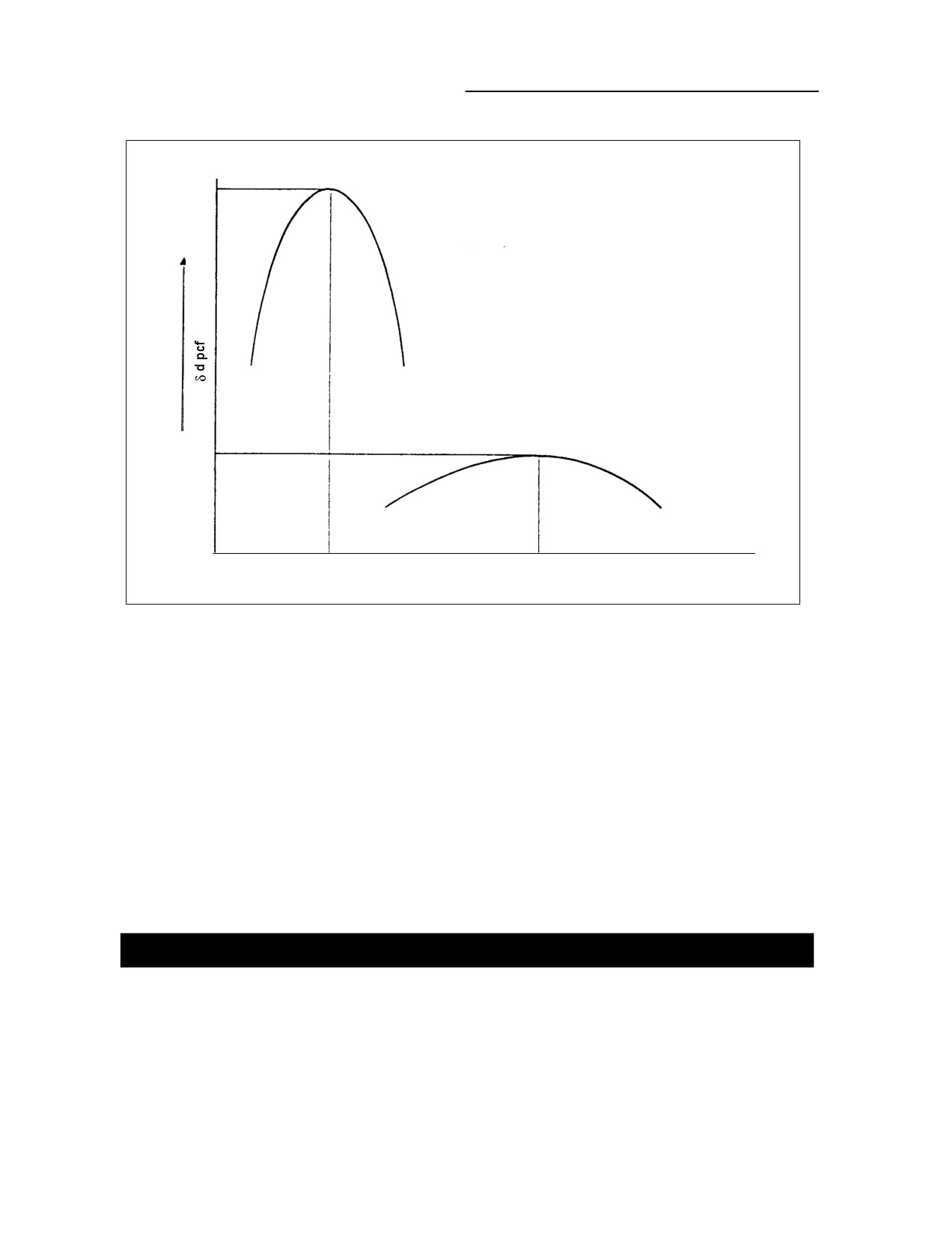
Different soils have varying compactive characteristics. Gravelly and sandy
soils have a lower OMC and higher densities under the same compactive effort
compared with silty and clay soils
(see Figure
2-61, page
2-116). The
sharpness of the curves indicates that moisture content is much more critical
in obtaining maximum density for coarse-grained soils than for fine-grained
soils.
COMPACTION EQUIPMENT
Equipment normally available to the military engineer for soil compaction
includes sheepsfoot, pneumatic-tired, and steel-wheeled rollers. Other
construction equipment and load-hauling units may also be used. Crawler-
type tractor units are efficient in compacting free-draining sands and gravels
that should be kept wet during the compaction process. This equipment is not
efficient for compacting cohesive soils. Compaction equipment use is covered
in FM 5-434.
For compaction equipment to be used efficiently, the moisture content at
which maximum compaction can be obtained (the OMC) and the maximum
density to which the soil can be compacted are required. This data is obtained
by performing the laboratory compaction test. The stability or strength of the
base course in the field can only be obtained if the moisture content allows
proper compaction and if compaction is obtained at or above the amount
specified.
Soils 2-115
FM 5-472/NAVFAC MO 330/AFJMAN 32-1221(I)
GW
56 blows per layer
CL
56 blows per layer
w (moisture content)
Figure 2-61. Effect of different soil types on density
OTHER COMPACTIVE EFFORTS
Under some circumstances, it may be necessary to use a compactive effort in
the laboratory. Usually this is done to study the effect of variation in density
on some property of the soil, such as the CBR. In this case, samples are
compacted using the procedures previously described, except that the
variation in density is achieved by varying the number of blows applied to
each layer as described in ASTM D 1883-94. In unusual circumstances, the
laboratory compaction procedure may be changed to produce a compactive
effort that more closely resembles the energy that can be put into the soil
using available rolling equipment. In the CBR test, the compaction procedure
calls for 10, 25, or 56 blows per layer. This is explained in Section IX of this
chapter.
SECTION VIII. IN-PLACE DENSITY DETERMINATION
Proper field control is essential in earthwork construction. The control tests
are conducted on the soil at the jobsite as construction proceeds. If at any time
a test indicates that operations are not producing a soil condition specified by
the design tests, take immediate action to remedy the situation.
2-116 Soils
FM 5-472/NAVFAC MO 330/AFJMAN 32-1221(I)
A soil’s stress-deformation characteristics are directly related to the soil's
moisture content and density, allowing specifications to be set for a given soil
as construction proceeds. Densities obtained are compared with minimum
density requirements established for the particular job. Water contents are
compared with the OMC previously established to see that compaction is
taking place within the desired range or to permit its adjustment.
An undisturbed sample of known or measurable dimensions provides
information for computing the soil's density and moisture content. If the soil is
not in proper condition during construction to remove an undisturbed sample,
the density may be determined by measuring the volume of the hole after the
sample is removed. The procedure consists of filling the hole with a measured
quantity of a known density material (such as sand, oil, or water) and
computing the volume of soil removed. The soil's moisture content and density
are then determined.
The method for in-place density depends on the type of soil encountered and
the equipment available. On moist, cohesive, fine-grained soils, undisturbed
samples taken by samplers may be sufficient. Coarse-grained or cohesionless
soils make it difficult to obtain an undisturbed sample. In these soils, density
determination may require the displacement method. Sand displacement may
be used on any type of base course or subgrade material. Oil displacement
cannot be used on highly pervious soils, crushed stone, or slag base courses. If
the pavement to be used is asphaltic concrete, the residual oil and spillage will
tend to soften the asphalt. Displacing water requires the use of a balloon to
contain the water and can be used on any type of soil.
If the density determined by the methods described in the following
paragraphs is equal to or greater than that required, compaction may be
judged to be satisfactory and the placing of another lift may proceed. If the
density is lower than that required, additional rolling may be necessary or the
moisture content may have to be adjusted. If these methods fail, the weight of
the roller may have to be increased, the thickness of lift reduced, or other
methods used to obtain adequate compaction. The possibility that the soil
being compacted in the field is not the same as the one tested in the laboratory
should never be overlooked. Under normal field conditions (the work is
proceeding smoothly and uniform soils are being compacted), the number of
density and moisture checks required should be limited after the initial period
of compacting. If adequate densities are being obtained and the proper
moisture content is being maintained, inspections may be performed to
determine and verify the number of passes and the combination of rollers to
achieve the desired result with minimum effort. Where conditions are more
variable, density and moisture checks may be needed more often for a fill of
even moderate length. The exact number of checks needed should be
determined by the engineer in charge of the job.
SAND-CONE OR SAND-DISPLACEMENT METHOD (ASTM D 1556-90)
The sand-cone or sand-displacement method may be used in either fine- or
coarse-grained materials. Calibrated sand is used to determine the volume of
the hole from which a sample has been taken.
Soils 2-117
FM 5-472/NAVFAC MO 330/AFJMAN 32-1221(I)
The sand-cone or sand-displacement test consists of digging out a sample of
the material to be tested, determining the volume of the hole, and determining
the dry weight of the sample. There are three requirements that must be met
for this test.
The volume of the sample should be as close to the same volume at which the
sand was calibrated; however, the sample’s maximum particle size will
determine the volume of sample to be tested. Sample requirements are as
follows:
• Material with a maximum aggregate size of 1/2 inch requires a
minimum test-hole volume of 0.05 cubic foot.
• Material with a maximum aggregate size of
1
inch requires a
minimum test-hole volume of 0.075 cubic foot.
• Material with a maximum aggregate size of 2 inches requires a
minimum test-hole volume of 0.10 cubic foot.
A double-cone cylinder must be used. This permits calibrating the sand for
each test performed. The sand must be clean, dry, and free-flowing with a
constant moisture content during the test. The sand should pass the No. 10
sieve and should have less than 3 percent passing the No. 60 sieve. The ideal
solution to ensure that the gradation requirements are met is to obtain
Ottawa sand, which generally ranges from the No. 20 to No. 40 sieve sizes.
PURPOSE
Perform this test to determine the in-place density of a soil to within ± 2 pcf.
EQUIPMENT
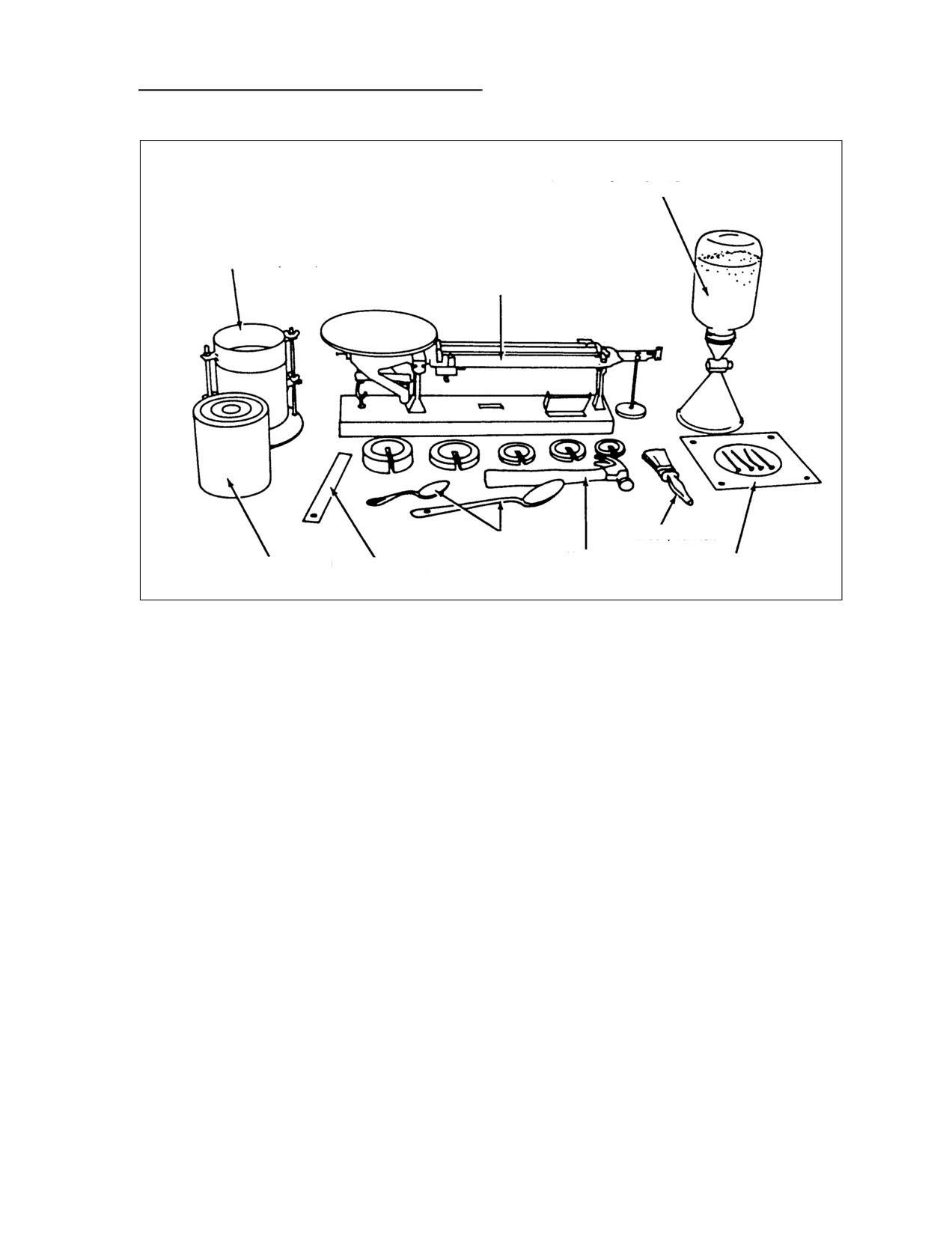
Use the following items to perform this test in a field environment (see Figure
2-62):
• A template with a 6-inch hole.
• A 6-inch soil-density tester.
• A CBR mold.
• A 2 1/2-inch spacer disk.
• Filter paper.
• A knife.
• A hammer.
• Nails, twentypenny (20d).
• A steel straightedge.
• A varnish brush.
• A balance scale sensitive to 1.0 gram with a 20-kilogram capacity.
• A balance scale sensitive to 0.01 gram with a 500-gram capacity.
• A ruler.
• Aspeedymoisturetestset.
2-118 Soils
FM 5-472/NAVFAC MO 330/AFJMAN 32-1221(I)
Cone, sand-density
Compaction cylinder, soil
Scale, bench, 21,100 g
Brush, varnish
Spoon, cooking
Hammer
Tray, template
Can, friction top, 1 gal
Straightedge, steel
Figure 2-62. Sand-displacement-method apparatus
• A laboratory oven.
• Heat-resistant gloves.
• A spoon.
• A chisel.
• Friction-top cans.
• Sand, well-rounded, passing the No. 10 sieve with less than 3 percent
passing the No. 60 sieve.
• DD Form 1215.
• Paper.
• A pencil.
• A calculator.
• A grease pencil.
• Moisture-determination tares.
STEPS
Perform the following steps for the sand-cone or sand-displacement method:
Step 1. Determine the sand’s density.
Soils 2-119
FM 5-472/NAVFAC MO 330/AFJMAN 32-1221(I)
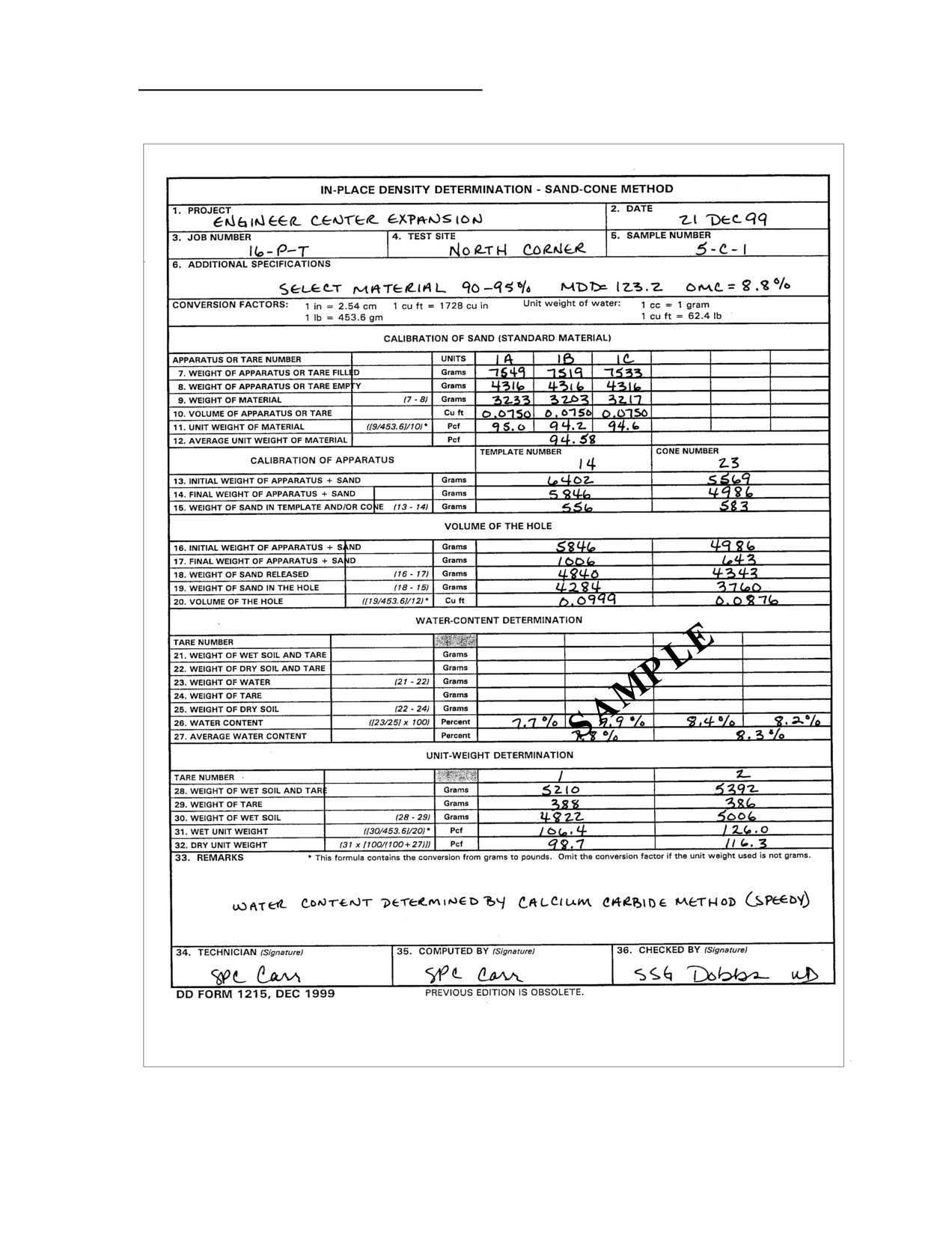
a. Weigh the mold, baseplate, spacer disk, and filter paper. Record this
weight (in grams) on line 8 of DD Form 1215 (see Figure 2-63).
b. Attach the collar to the mold and place the filled sand-cone apparatus,
with the valve closed, on top of the mold.
c. Open the valve and allow sand to fall at its own rate into the mold. Do
not jar the apparatus while the sand is falling.
d. Close the valve when the sand stops running into the mold and the
collar.
e. Remove the sand cone and collar carefully from the mold.
f. Use a straightedge to strike off the excess sand remaining in the top of
the mold.
g. Brush off any sand adhering to the outside of the mold.
h. Weigh the mold full of sand (in grams) and record it on line 7 on the
form.
i. Determine the weight (in grams) of the material by subtracting line 8
from line 7 and record the weight on line 9 of the form.
j. Enter the known volume of the mold (in cubic feet) on line 10.
k. Determine the unit weight of the material. Convert the weight of the
materials (line 9) from grams to pounds, divide this quotient by the known
volume (line 10), and record the weight on line 11.
weight of sand
----------------------------------
453.6
unit weight of material (line 11)
= ----------------------------------------
volume of mold
l. Repeat steps a through k at least two more times. The unit weight of
sand used in the calculations shall be the average of at least three
determinations. Record the average unit weight of material on line 12.
The maximum variation between any one determination and the average
should not exceed 1 percent.
Step 2. Prepare the site for sand-cone testing.
a. Clear the overburden and seat the template tray flush on the surface.
Fasten it in place with nails.
b. Seal the spaces on the inside edge under the template using soil from
the preparation site.
Step 3. Determine the surface calibration.
a. Weigh the sand-cone apparatus filled with sand. Record the weight (in
grams) on line 13 of the form.
b. Turn the sand-cone apparatus over with the valve closed and place it on
the template.
2-120 Soils
FM 5-472/NAVFAC MO 330/AFJMAN 32-1221(I)
Figure 2-63. Sample DD Form 1215
Soils 2-121
FM 5-472/NAVFAC MO 330/AFJMAN 32-1221(I)
c. Open the valve and allow the sand to fall at its own rate. Do not jar the
apparatus while the sand is falling. Close the valve when the sand stops
running.
d. Remove the sand-cone apparatus from the template and weigh it.
Record this weight (in grams) on line 14 of the form.
e. Determine the weight of the sand in the cone by subtracting line 14
from line 13. Record the difference on line 15 of the form.
Step 4. Recover as much sand as possible from the template and brush the
remaining sand lightly from the hole, being careful not to disturb the soil
surface.
Step 5. Dig the sample.
a. Predetermine the weight of a friction-top can. Record this weight on line
29 of the form.
b. Dig a hole through the center of the template. The hole should be 6
inches deep or to the bottom of the lift and about the same diameter as the
hole in the template. The sides should be as smooth as possible.
c. Place all soil particles from the hole into the preweighed can, keeping
the lid on the can as much as possible to prevent excessive moisture loss.
d. Weigh the wet soil and can. Record the weight on line 28 of the form.
Step 6. Determine the volume of the hole.
a. Refill the jar if it appears there is not enough sand to fill the hole and
record the weight of the jar on line 16; otherwise, transfer the weight from
line 14 to line 16.
b. Turn the sand-cone apparatus over with the valve closed and place it on
the template.
c. Open the valve and allow the sand to fall at its own rate into the
prepared hole. Do not jar the apparatus while the sand is falling.
NOTE: If additional sand is needed due to requirements for hole
volume, ensure that these jars with sand have been properly weighed
and will be on hand during the testing procedures. If used, ensure
that the weight of the additional jar plus sand is included on line 16
and that line 17 also includes the final weight of the additional jar.
d. Close the valve when the sand stops running and remove the sand-cone
apparatus. Weigh it and record this weight on line 17 of the form.
e. Determine the weight of the material released by subtracting line 17
from line 16. Record this difference on line 18 of the form.
f. Determine the weight of the material in the hole by subtracting line 15
from line 18. Record this difference on line 19 of the form.
g. Recover as much sand as possible from the hole.
h. Compute the volume of the hole. Convert the weight of the material in
the hole (line 19) from grams to pounds, divide this quotient by the
2-122 Soils
FM 5-472/NAVFAC MO 330/AFJMAN 32-1221(I)
average unit weight of material (line 12), and record the weight on line 20
of the form using the following formula:
weight of sand in hole
----------------------------------------------------
453.6
volume of the hole (line 20)
= ------------------------------------------------------------------
average unit weight of sand
Step 7. Determine the average water content of the soil removed from the hole
(step 5) using the oven-laboratory method or speedy moisture tester, and
record it on line 27 of the form. If using the speedy moisture tester, enter the
results on line 27; otherwise, make appropriate entries on lines 21 through 27
using at least two moisture-determination tares according to Section III of
Chapter 2.
Step 8. Determine the unit weight (density).
a. Compute the weight of the wet soil by subtracting the weight of the tare
(line 29) from the weight of the wet soil and the tare (line 28). Record the
difference on line 30 of the form.
b. Compute the wet unit weight (density). Convert the weight of the wet
soil (line 30) from grams to pounds, divide this quotient by the volume of
the hole (line 20) and record it on line 31 of the form using the following
formula:
weight of wet soil
-----------------------------------------
453.6
wet density (line 31)
= -----------------------------------------------
volume of hole
c. Compute the dry unit weight (density), and record it on line 32 of the
form using the following formula:
100
dry density (line 32)
=
wet unit weight
× --------------------------------------------------------------------
100 + average water content
NUCLEAR MOISTURE-AND-DENSITY TESTER
Use this method to determine the soil’s dry density and moisture content.
Individual models of equipment vary in the specific procedures. Radiation
protection programs vary as well from service to service. It is for this reason
that the procedures are not discussed here. The procedures for this test
method must be as prescribed by the individual equipment’s manufacturer’s
manual, the requirements prescribed by the service holding the piece of
equipment, and the Nuclear Regulatory Commission licensing agreement
with that service.
The testers contain sources of radioactive material, typically cesium and a
combination of americium mixed with beryllium powder. The cesium emits
gamma radiation that the detector in the tester can count when it is passed
through the soil. This count can be translated into density. The americium/
beryllium emits neutrons following collisions with hydrogen which are
moderated and detected by the tester. The moisture content can be
determined by counting the hydrogen atoms in the soil.
Soils 2-123
FM 5-472/NAVFAC MO 330/AFJMAN 32-1221(I)
WATER-DISPLACEMENT METHOD
Measure the volume of the hole from which a soil-density sample is taken by
placing a rubber balloon in the hole and observing the volume of water
required to fill the balloon. A water-balloon device is a watertight container
with a float attached to a calibrated scale, graduated directly in cubic feet. A
balloon is attached to the bottom of the device to make the test. Fill the
cylinder in the device with water and place the apparatus over the area where
the sample is to be removed. Allow the balloon to fill with water and take an
initial reading. Remove the sample from the ground and replace the device
over the hole in the original position. Allow the water to flow by gravity into
the balloon in the hole. Blow through the hose attached to the device to
increase the air pressure on the water surface and force the water-filled
balloon in the hole to conform to all the contours of the hole. Observe the scale
attached to the float for a reading of the water volume left in the device.
Subtract this value from the original reading. The result is the volume of the
hole, in cubic feet.
SECTION IX. CBR TESTS
The CBR test is a relatively simple test used to obtain an indication of the
strength of a subgrade soil, subbase, and base-course material for use in road
and airfield pavements. The test is used primarily to determine empirically
required thicknesses of flexible pavements for highways and airfield
pavements. The test was developed by the California Division of Highways in
1929 and adopted by the Corps of Engineers for use in the design of flexible
pavements for airfields in locations where frost action is not the controlling
factor.
NOTE: The current employed standard for CBR testing is ASTM D
1883-94.
The test procedure determines the CBR of pavement subgrade, subbase, and
base-course materials from laboratory-compacted specimens that can be used
in the design of a specific airfield. It consists of two steps—
• Preparing the soil test specimens.
• Performing the penetration test on the prepared soil samples.
Although one standardized procedure has been established for the penetration
portion of the test, it is not possible to establish one procedure for the
preparation of test specimens since soil conditions and construction methods
vary widely. The soil test specimens are prepared to duplicate the soil
conditions existing (or expected to occur later) in the field.
The method of preparing the test specimens and the number of specimens
depend on the type of airfield, the soils encountered at the site, and other
factors. Test the soil sample in the laboratory at a density comparable to the
density required on the construction site. There are situations where moisture
conditions are favorable and the subgrade will not accumulate moisture
approaching a saturated condition. Test samples at a moisture content
approximating the actual moisture conditions expected during the time the
2-124 Soils
FM 5-472/NAVFAC MO 330/AFJMAN 32-1221(I)
road or airfield is used. In all other conditions, samples are laboratory tested
in a saturated condition.
Although penetration tests are most frequently performed on laboratory
specimens, they may also be performed on undisturbed soil samples or in the
field on the soil in place.
CBR OF LABORATORY-COMPACTED SOILS (ASTM D 1883-94)
The basic operations for conducting the CBR test are the same regardless of
variations in soil conditions and types of construction. The test essentially
measures the soil’s shearing resistance under controlled moisture and density
conditions. The CBR for soil is the ratio obtained by dividing the penetration
stress required to cause a 3-inch two-area piston to penetrate 0.10 inch into
the soil by a standard penetration stress of 1,000 pounds per square inch (psi).
This standard penetration stress is roughly what is required to cause the
same piston to penetrate 0.10 inch into a mass of crushed rock (limestone).
The CBR value may be thought of as the strength of the soil relative to that of
crushed rock.
Minor variations in the CBR test will cause wide variations in the results. For
this reason, step-by-step procedures are detailed. Difficulties may still arise.
Material with gravel or stones does not yield entirely satisfactory results. A
number of tests must be conducted to establish a reasonable average value.
The CBR values range from as low as 3 to as high as 80, depending on the type
of soils. The fine-grained soils vary from 3 for organic clays to 15 for micaceous
or diatomaceous silts and sands. The sand-silt-clay coarse-grained
combinations range from 10 for the clayey mixtures to 40 for the gravelly and
silty sands. Gravelly soils range from 20 for the clayey group to 80 for the well-
graded gravels and gravel-sand mixtures. Table B-3, pages B-16 and B-17,
lists the typical range for soils classified under the USCS.
PURPOSE
Perform this test is to determine the CBR of a soil to ± 3 percent and
determine the best moisture-content range to ± 4.
EQUIPMENT
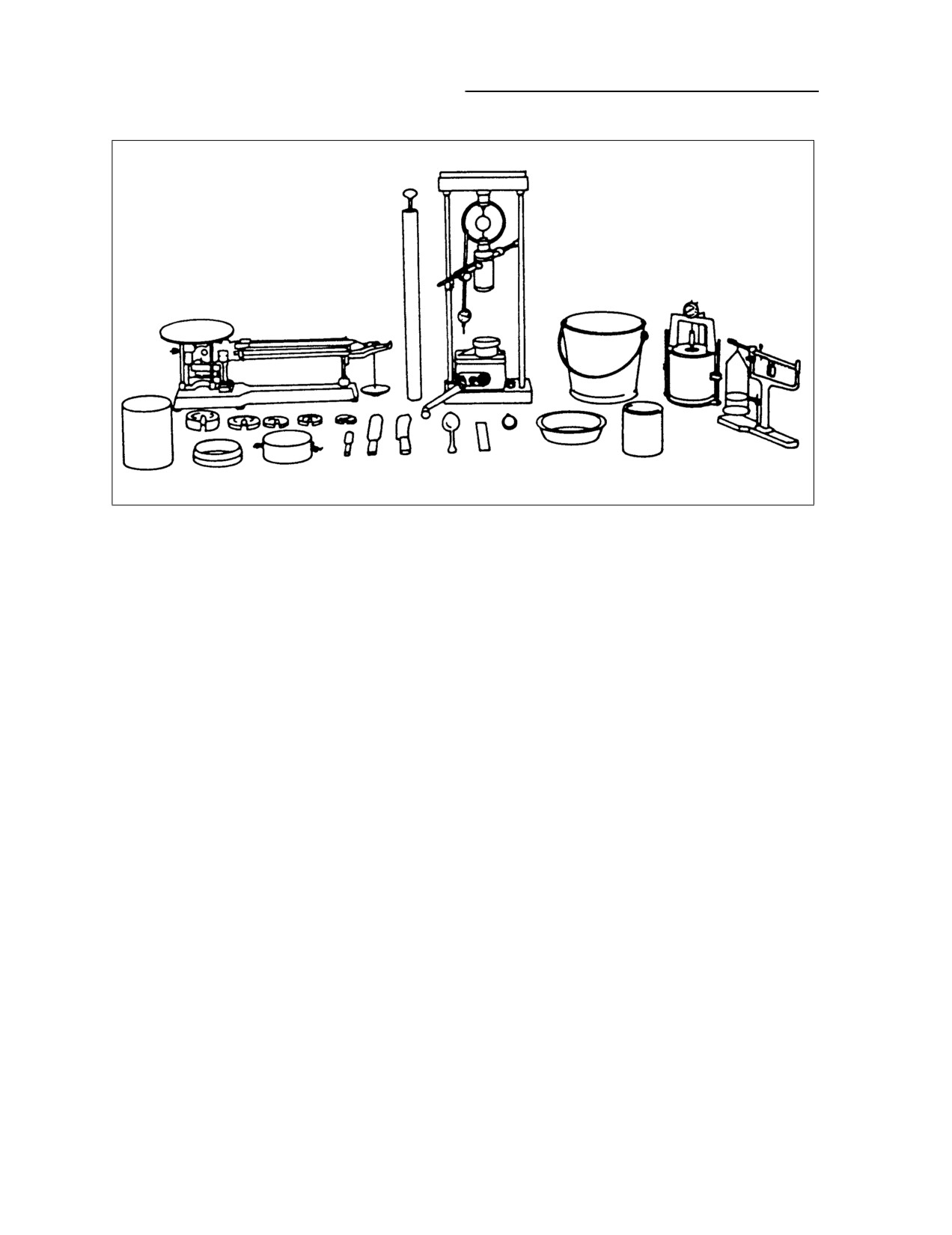
Use the following items in a laboratory environment to perform this test (see
Figure 2-64, page 2-126):
• A 225-pound soil sample with known classification, PI, and OMC.
• A CBR laboratory test set consisting of—
— 15 CBR molds.
— Surcharge weights.
— A penetration piston.
— Two dial gauges reading to 0.001 inch.
• Pails.
• Plastic bags.
Soils 2-125
FM 5-472/NAVFAC MO 330/AFJMAN 32-1221(I)
Figure 2-64. Laboratory CBR test-set apparatus
•
Shipping tags.
•
A compaction tamper.
•
Filter paper.
•
A recorder.
•
Moisture-determination tares.
•
Balance scales sensitive to 0.01 gram and 0.1 gram.
•
A steel straightedge.
•
A mixing pan.
•
A spoon.
•
A spatula.
•
A graduated cylinder (100-milliliter).
•
A laboratory oven.
•
Heat-resistant gloves. Asbestos gloves should not be used for any
materials-testing procedures. If your unit has asbestos gloves, turn
them in through your supply system for proper disposal. Order heat-
resistant gloves to replace them.
•
A pencil.
•
Paper.
•
A grease pencil.
•
A calculator.
2-126 Soils
FM 5-472/NAVFAC MO 330/AFJMAN 32-1221(I)
• DD Forms 1210, 1211, and 1212.
• A 3/4-inch sieve.
• A No. 4 sieve.
• Pudding pans.
• A stopwatch.
• Plans and specifications.
STEPS
Perform the following steps for the CBR test:
Step 1. Determine the moisture-content range of investigation (± 4 percent of
OMC). If the OMC has not yet been definitively established for this soil type,
perform the laboratory compaction test as described in Section VIII to obtain
the OMC.
Step 2. Prepare the soil sample. The size of the total sample will be about 225
pounds, which should provide enough material for the required 6,800 grams
for each of the 15 molds.
a. Dry the soil sample until it can be easily crumbled under a trowel.
Drying may be done by air-drying or by using a drying apparatus,
provided the temperature of the sample does not exceed 60°C.
b. Break up the sample thoroughly, but not in such a manner as to reduce
the size of the individual particles.
c. Sieve the sample over a 3/4-inch sieve. If all material passes the 3/4-inch
sieve, use the entire gradation without modification. If there is material
retained on the 3/4-inch sieve, remove it and replace it with an equal
amount (by weight) of material passing the 3/4-inch sieve but retained on
the No. 4 sieve by separation from portions of the sample not otherwise
used for testing. (The CBR test is not conducted on any material retained
on the 3/4-inch sieve.) This amount will be recorded later on DD Form
1212
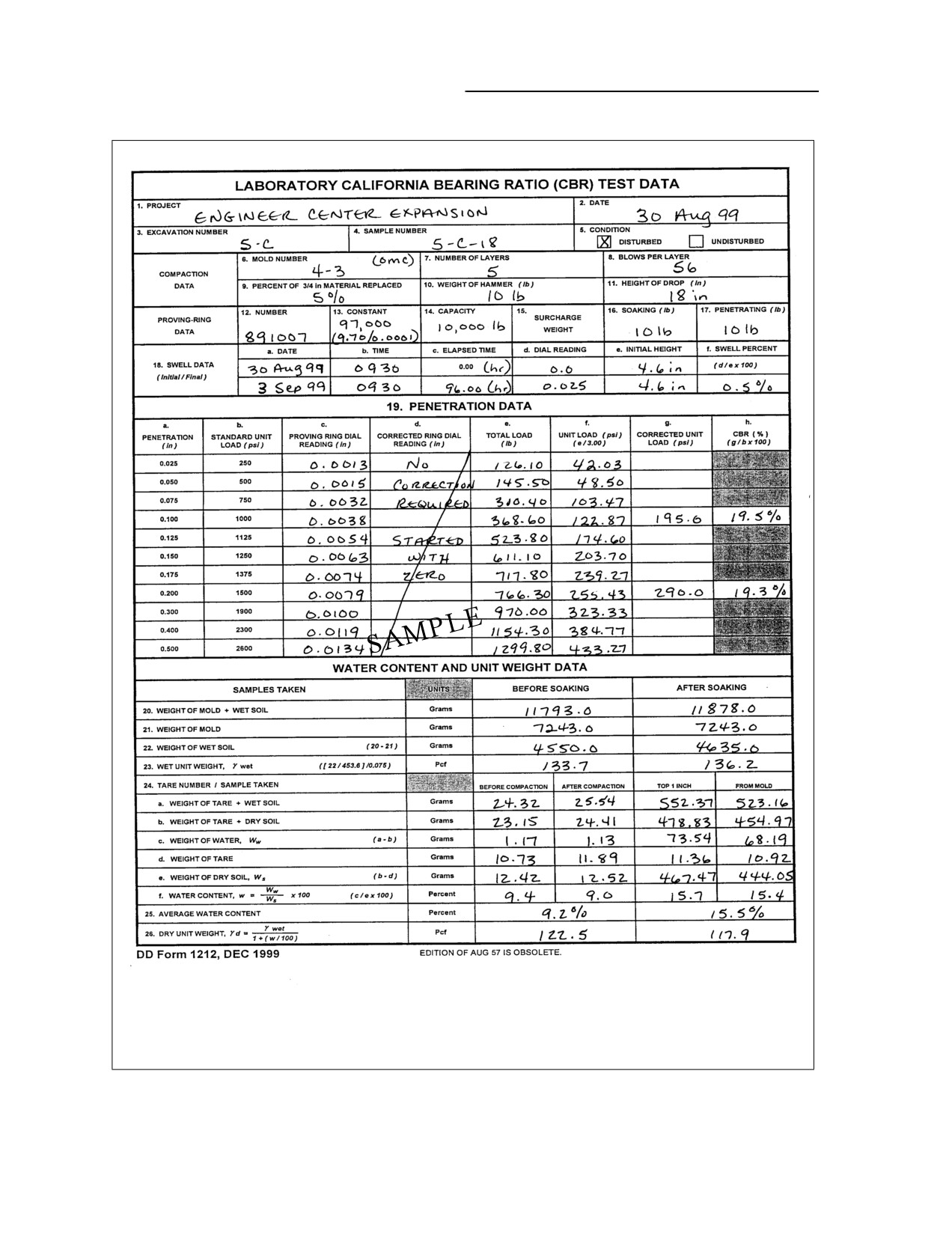
(see Figure 2-65, page 2-128 and 2-129). .
d. Divide the entire sample into 15 smaller samples of about 6,800 grams
each and place them into separate plastic bags. Seal the bags to maintain
the current (or floor) moisture content.
e. Determine the moisture content from a
20-gram sample of the
remaining material. Record this on a sheet of paper as the moisture
content of the floor sample.
Step 3. Prepare and label a 6-inch compaction mold for each water content to
be used (-4, -2, OMC, +2, and +4) at the compactive effort of 56 blows per layer
as described in step 5 of Section VIII. In addition to the 5 molds required for
the compactive effort of 56 blows per layer, prepare a mold for each water
content using the other required compactive efforts of 10 and 25 blows per
layer. Prepare a minimum of 15 molds. Prepare a DD Form 1212 for each mold
and record the weight of the mold with the baseplate (to the nearest gram) on
the form before continuing.
Step 4. Prepare the samples at the adjusted water contents.
Soils 2-127
FM 5-472/NAVFAC MO 330/AFJMAN 32-1221(I)
Figure 2-65. Sample DD Form 1212
2-128 Soils
FM 5-472/NAVFAC MO 330/AFJMAN 32-1221(I)
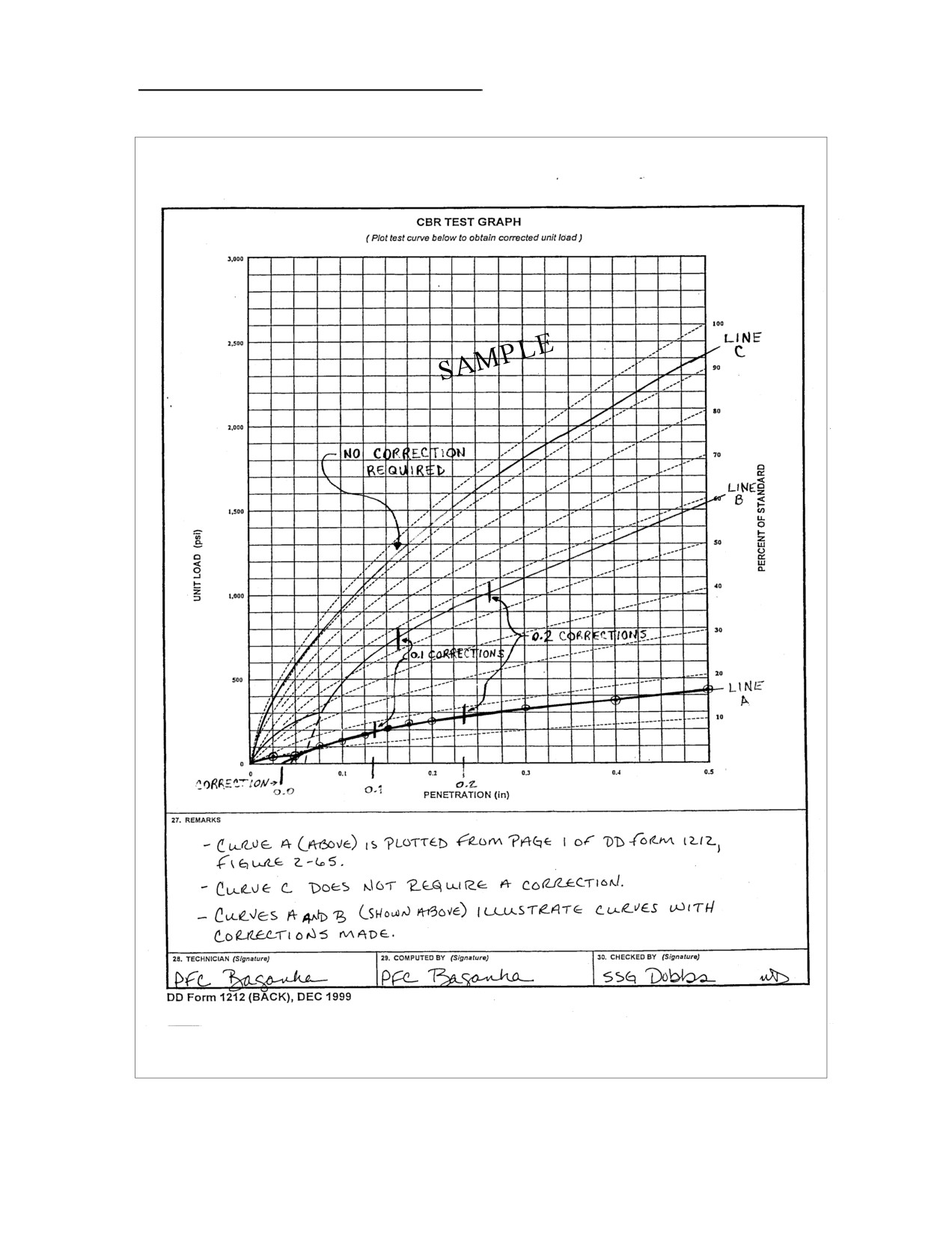
Figure 2-65. Sample DD Form 1212 (continued)
Soils 2-129
FM 5-472/NAVFAC MO 330/AFJMAN 32-1221(I)
a. Determine the amount of water to add to each sample using the
following procedure:
water to add (in milliliters) =
weight of sample (in grams) × (desired percent - floor moisture content)
For example, to determine the amount of water to add to a sample to
obtain the determined OMC of 8 percent,
6, 800 × (0.08 - 0.02) = 6, 800 × 0.06 = 408.0 milliliters
where—
weight of sample = 6,800 grams
OMC = 8 percent (0.08)
floor moisture content = 2 percent (0.02)
To determine the water to add for the remaining samples for the required
moisture-content range, perform the same calculation. The example below
illustrates this calculation for the remaining samples, taking into
consideration that not all of the sample weights will be exactly the same
(6,800 grams):
6.0% moisture for a sample at 6,800 grams: 6,800 × (0.06 - 0.02) =
272.2 milliliters
4.0% moisture for a sample at 6,815 grams: 6,815 × (0.04 - 0.02) =
136.3 milliliters
10.0% moisture for a sample at 6,822 grams: 6,822 × (0.10 - 0.02) =
545.8 milliliters
12.0% moisture for a sample at 6,810 grams: 6,810 × (0.12 - 0.02) =
681.0 milliliters
b. Add the water figured from the formulas for each of the 5 desired
moisture contents (-4, -2, OMC, +2, and +4), and mix thoroughly to ensure
an even distribution of water throughout the sample.
c. Place each sample in an airtight container, and allow to stand for the
minimum period of time indicated.
• For GW, GP, SW, and SP soil types, there is no minimum standing
period of time.
• For GM and SM soil types, a minimum of 3 hours standing time is
required.
• For all other soil types, a minimum of 16 hours standing time is
required.
2-130 Soils
FM 5-472/NAVFAC MO 330/AFJMAN 32-1221(I)
Step
5. Mark and weigh 2 moisture-determination tares for each mold
prepared. Record each on DD Form 1212 as the weight of tare.
Step 6. Remove a small quantity of material (20 grams) from each sample and
place it in one of the marked tares upon completion of the standing time.
Weigh it in preparation for moisture determination and record the results on
the form.
Step 7. Place sufficient soil in the mold (about 1 1/2 to 2 inches) to obtain a 1-
inch compacted layer. After compaction of all 5 layers, each layer should be
about equal in thickness. The fifth compacted layer will slightly extend into
the collar but will not exceed 1/4-inch above the top of the mold.
Step 8. Apply compactive effort.
a. Hold the 10-pound compaction tamper within 5 degrees of vertical,
placing its face on top of the soil.
b. Raise the handle until it reaches the top (18 inches) and release it,
allowing the weight to fall freely onto the soil.
c. Change the position of the guide and tamper and repeat the process
until the soil layer has received the prescribed number of blows for the
compactive effort required. Apply the blows at a uniform rate of about 25
blows per minute. The height of fall of the tamper must be controlled
carefully and the blows distributed evenly over the specimen’s surface.
Step 9. Trim the compacted layer. After compacting each layer (except the fifth
layer), use a knife to trim any soil adjacent to the mold walls that has not been
compacted or that extends above the compacted surface. Include the trimmed
soil with the additional soil for the next layer.
Step 10. Repeat steps 7, 8, and 9 until five layers have been compacted in the
mold. Each compacted layer should be about equal in thickness (just under 1
inch). Adjust each layer accordingly to ensure that the fifth compacted layer
will slightly extend into the collar, but will not exceed 1/4 inch above the top of
the mold.
Step 11. Remove the collar from the mold.
a. Cut around the inside edge of the collar to prevent shearing the
compacted soil when removing the collar.
b. Trim and smooth the compacted soil flush with the top of the mold. Use
a sawing motion with the straightedge to trim the excess soil. Start at the
center of the mold and work outward, first to one side and then to the
other. Fill any holes with unused or trimmed soil from the specimen, press
in with the fingers, and again scrape the surface with the straightedge.
Step 12. Take another small sample from the remaining material after
compacting each mold and place it in the other moisture-determination tare
and weigh it in preparation for moisture determination. Record the results on
the form.
Step 13. Place a disk of coarse filter paper on top of the compacted specimen.
Release the mold from the baseplate and while slightly lifting, slide the mold
with the spacer disk off the baseplate and onto the edge of the table or
Soils 2-131
FM 5-472/NAVFAC MO 330/AFJMAN 32-1221(I)
countertop. Invert the baseplate and place it on top of the mold against the
filter paper and reattach. Raise the mold and baseplate to allow the spacer
disk to slide out. Invert the mold with baseplate and place it flat on the table
or countertop.
Step 14. Weigh and record the data. Weigh the complete mold with the
baseplate and compacted specimen (without the spacer disk) to the nearest
gram. Record as the weight of the mold and wet soil (block 12). Do not include
the collar.
Step 15. Repeat steps 7 through 14 for each of the compactive efforts required
(10, 25, and 56 blows per layer). Compact a minimum of 5 molds for each
compactive effort.
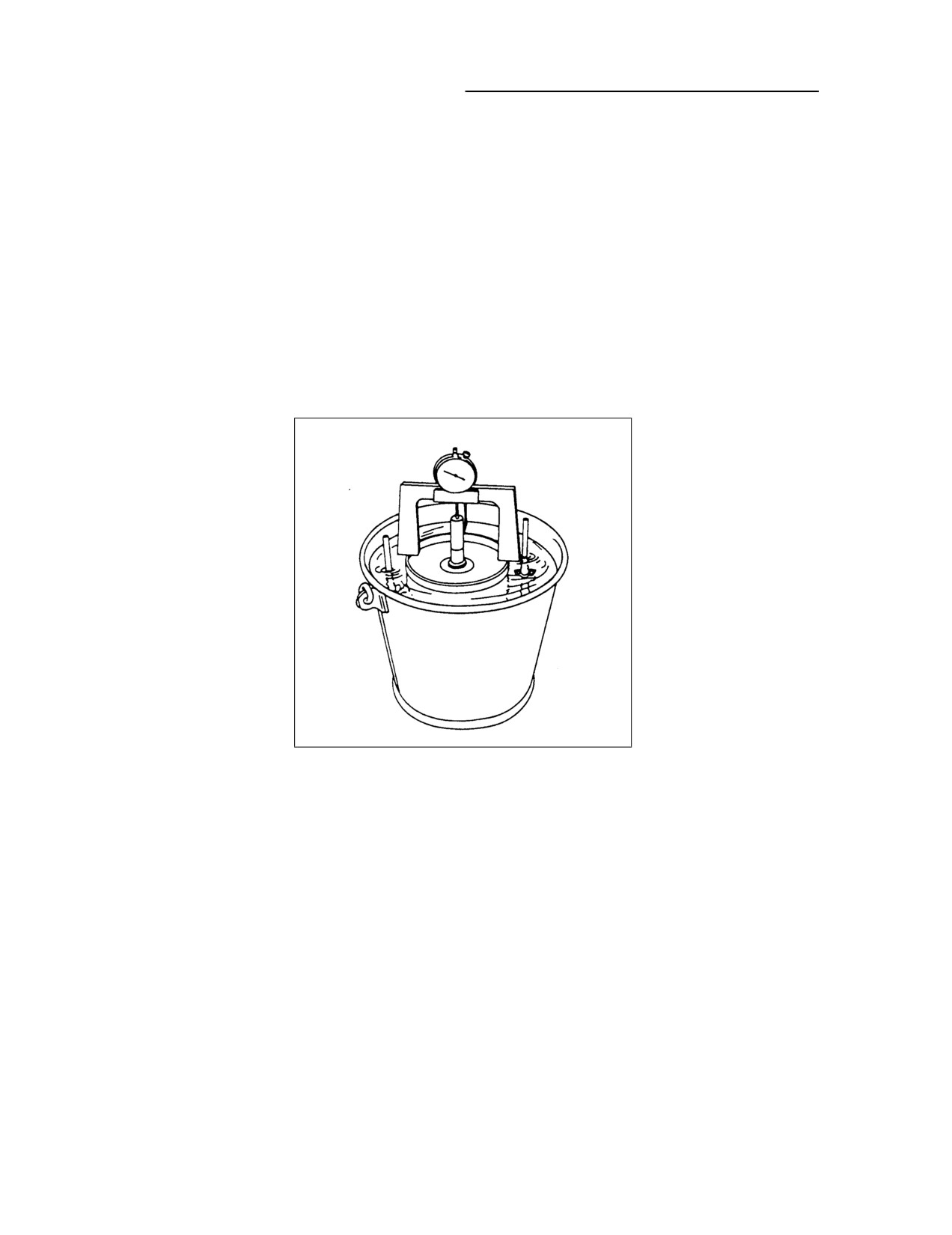
Step 16. Soak the samples and measure the swell (see Figure 2-66).
Figure 2-66. Soaking the CBR sample
a. Place surcharge weights on the perforated plate and adjustable stem
assembly and carefully lower into the mold onto the filter paper and
compacted soil specimen. Ensure that the surcharge applied is equal to
the weight of the base material and pavement within 2.27 kilograms, but
never use a total weight of less than 4.54 kilograms. If no pavement
weight is specified, use 4.54 kilograms. Record the surcharge weight on
the form.
b. Immerse the mold in water.
c. Calibrate the adjustable stem so that the tripodal dial reads 100 and
can then travel in either direction. Obtain the initial dial reading and
record it on the form.
d. Soak the sample for 96 hours.
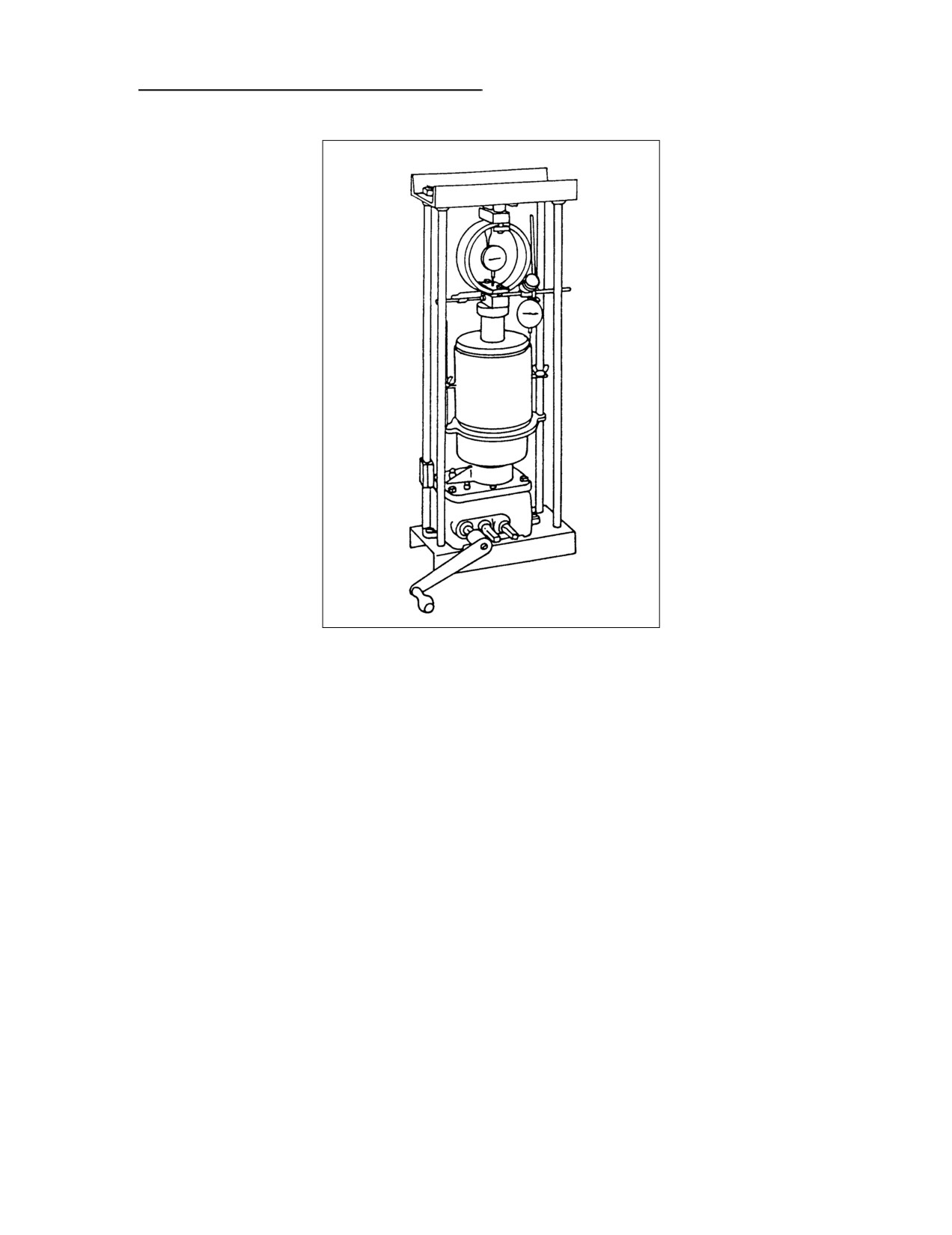
e. Assemble the penetration apparatus (see Figure 2-67).
2-132 Soils
FM 5-472/NAVFAC MO 330/AFJMAN 32-1221(I)
Figure 2-67. Assembled CBR-test penetration apparatus
(1) Attach the jack to the frame.
(2) Attach the proving ring and dial indicator to the frame. Record the
proving-ring data on the form.
f. Take the dial reading at 96 hours and record on the the form.
g. Determine the amount of swell, in inches, by subtracting the initial dial
reading from the final dial reading. Record the data on the form.
h. Determine the percent of swell and record it on the form using the
following formula:
swell in inches (at 96 hours)
------------------------------------------------------------------- × 100
original sample height
Step 17. Drain the CBR mold.
a. Remove the immersed mold from the water and remove the free water.
Allow the specimen to drain downward for 15 minutes. Do not disturb the
specimen’s surface while removing the water. It may be necessary to tilt
the specimen to remove surface water.
Soils 2-133
FM 5-472/NAVFAC MO 330/AFJMAN 32-1221(I)
b. Remove the surcharge weights, the perforated plate, and the filter
paper from the mold. Do not disturb the specimen’s surface while
removing these items.
c. Determine the mass and record it on the form as the weight of the
soaked sample.
d. Return a 5-pound surcharge weight to the specimen.
Step 18. Perform the CBR penetration.
a. Prepare the components.
(1) Place the mold on the jack.
(2) Attach and adjust the piston to the jack, then zero the dial
indicator.
(3) Lower the penetration piston until it is in contact with the sample
with sufficient pressure to cause the load dial to register a load of 1
pound.
(4) Replace the remainder of the surcharge weights required for the
mold.
(5) Attach the adjustable arm with the dial indicator to the jack
assembly, adjusting the position until the dial-indicator plunger is
resting on the mold’s projecting rim.
(6) Turn both dial indicators to 0.
b. Apply the load.
(1) Crank the jack to lower the piston at a rate of 0.05 inch per minute.
(2) Read the proving-ring dial indicator when the piston has reached
penetration depths of 0.025, 0.050, 0.075, 0.100, 0.125, 0.150, 0.175,
0.200, 0.300, 0.400, and 0.500 inch. Take the first eight readings at 30-
second intervals and the remaining three at 2-minute intervals.
(3) Record the proving-ring dial readings on the form.
c. Determine the average moisture of the soaked samples.
(1) Remove the top 1 inch of soil from the mold. For fine-grained soils,
place at least 100 grams of soil in a moisture-determination tare. For
granular soils, place at least
500
grams of soil in a moisture
determination tare.
(2) Weigh the tare and record on the form.
(3) Remove an additional sample from the remaining contents of the
mold for moisture determination. For fine-grained soils, place at least
100 grams of soil in a moisture-determination tare. For granular soils,
place at least 500 grams of soil in a moisture-determination tare.
(4) Weigh the tare and record on the form.
(5) Perform the moisture-content determination of the tares. Record
the results and average on the form.
2-134 Soils
FM 5-472/NAVFAC MO 330/AFJMAN 32-1221(I)
Step 19. Solve the computations for each reading, and record the results on
the form.
a. Determine the total load, in pounds, by multiplying the proving-ring
dial reading (block 19c) by the proving-ring constant (block 13). Enter this
number in block 19e of the form. The corrected ring dial readings need not
be determined as long as the dial indicators have been zeroed before
penetration. If the dials were not adjusted to
0 before penetration,
determine the corrected ring dial readings and enter them in block 19d.
Calculate the total load from the corrected reading instead of the observed
reading.
b. Determine the unit load (in psi) by dividing the total load by 3. Enter
this number in block 19f of the form. The value of 3 is determined by the
area of the penetrating piston in square inches.
c. Determine the corrected unit load (in psi) by plotting (on the reverse
side of the form) the unit load (in psi) against the depth of penetration (in
inches). If the curve has an initial concave upward shape between 0 and
0.1, then the zero point must be adjusted. This occasionally happens with
some soil types under certain conditions and it is necessary to obtain true
penetration loads. Adjust the zero point of the curve as indicated in the
example in Figure 2-65, pages 2-128 and 2-129. Once the zero-point
correction has been made, the 0.100- and 0.200-inch points are moved to
the right on the curve the same distance as the zero point. Obtain
corrected unit-load values from the corrected graphs at 0.100- and 0.200-
inch penetrations and enter in block 19g of the form. If no corrections were
made, the numbers entered into block 19g will be the same as block 19f.
d. Calculate the CBR (in percent) for penetration at 0.100 and 0.200
inches using the following formula:
corrected unit load
--------------------------------------------- × 100
standard unit load
Since the standard unit load for each penetration is given (block 19b of the
form), perform the following computations for each penetration:
corrected unit load
CBR for 0.100
= --------------------------------------------- × 100
1, 000
corrected unit load
CBR for 0.200
= --------------------------------------------- × 100
1, 500
NOTE: The CBR value of the mold is computed at 0.100- and 0.200-
inch penetrations. The bearing ratio normally reported is that of the
0.100-inch penetration. When the ratio at 0.200-inch penetration is
greater, the test must be verified by another test. If the test is verified
with similar results, use the bearing ratio at the
0.200-inch
penetration.
Step
20. Complete DD Form 1212. Ensure that any other information
concerning the soil sample is indicated in the remarks block.
Soils 2-135
FM 5-472/NAVFAC MO 330/AFJMAN 32-1221(I)
UNDISTURBED SAMPLE TESTING
Tests on undisturbed samples are used when the base design calls for
uncompacted soil, such as highly compressible clay that loses strength upon
remolding, or when correlating field in-place tests to the design-moisture
condition. For this latter condition, duplicate samples should be tested to
determine the correction necessary for the in-place tests. The reduction that
occurs from four days of soaking is applied as a correction to the field in-place
test.
Care and patience are necessary to maintain the relatively undisturbed
samples in this condition. If proper lateral support is not given on the sides of
the samples, erroneous CBR values will result. In fine-grained materials,
molds or metal jackets are satisfactory. With samples cut or trimmed from a
pedestal, use a mixture of 10 percent resin and 90 percent paraffin to fill the
annular space and offer support. For gravelly soils, the box method is
desirable. Use wax paper or paraffin to cover the sample and prevent
moisture loss while transporting it to the laboratory.
Perform soaking and penetration tests after removing the paper or paraffin
from the end of the specimen and after leveling the surface (use a thin layer of
sand, if necessary).
IN-PLACE FIELD CBR TESTING
To overcome some of the shortfalls associated with older in-place field CBR
test methods, the Corps of Engineers Waterway Experimentation Station
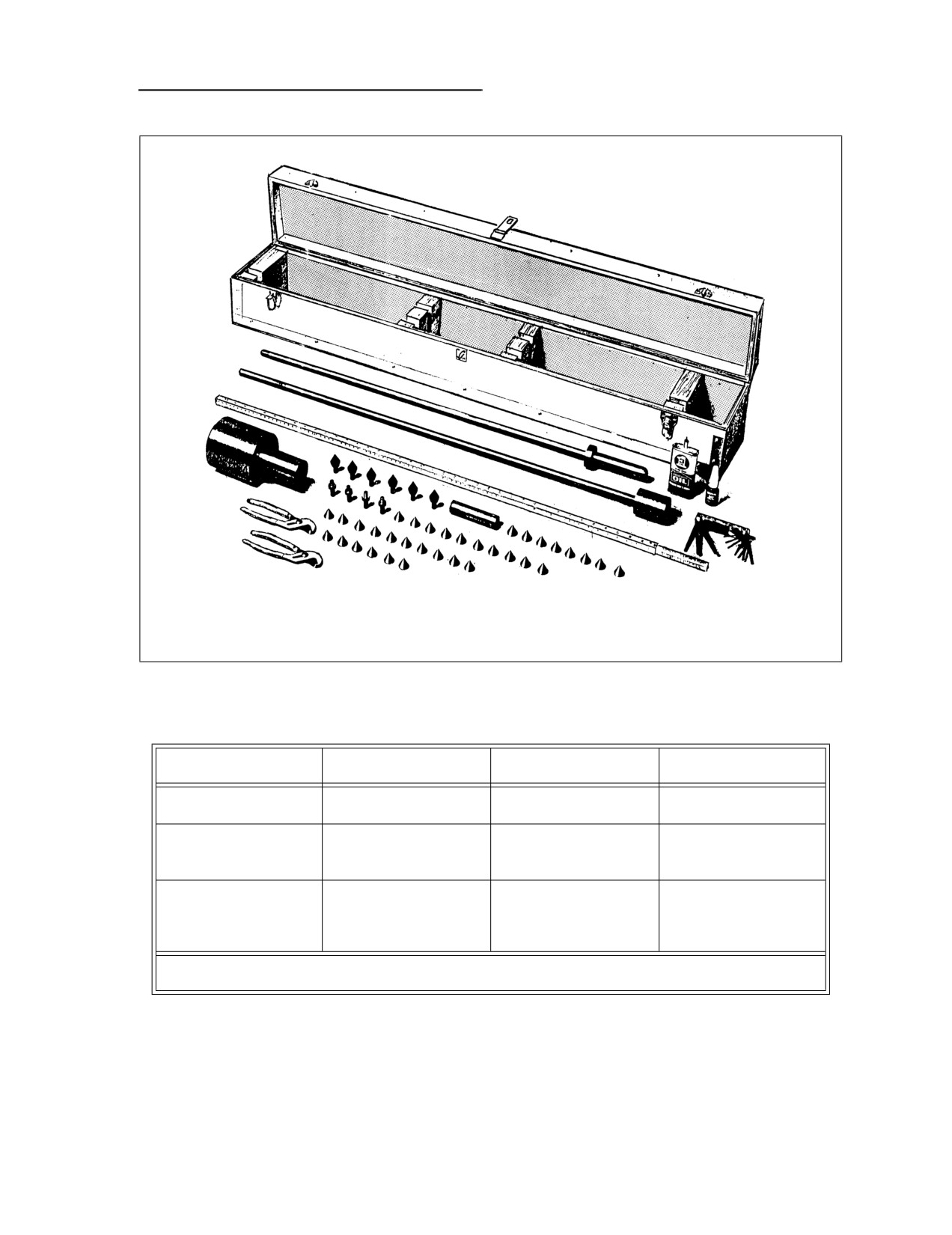
has developed the dual-mass dynamic cone penetrometer (DCP) (see Figure
2-68) for evaluating the load-carrying capability of military roads and
airfields. The results from using the DCP are reported in terms of index
values which can be converted to CBR values. Three correlations currently
exist for this conversion, each dependent on the soil type being tested.
The procedures for testing with the DCP and the correlation of CBR values
can be found in the user’s manual for the equipment or in FM 5-430-00-2,
Annex J.
PRESENTATION AND ANALYSIS OF CBR DATA
The CBR value, molding water content, and dry density for each specimen can
be presented in several ways that facilitate analysis. The individual test
programs used to present this data are relative to the type of soil encountered
and are discussed in the following paragraphs.
TEST PROGRAM FOR NONSWELLING SOILS
The test program for nonswelling soils applies to the majority of soils used in
construction. As Table 2-14 indicates, soils that fall into this group might be
used as compacted subgrade, select, or subbase materials depending on their
strengths and location regarding the construction site. The compaction
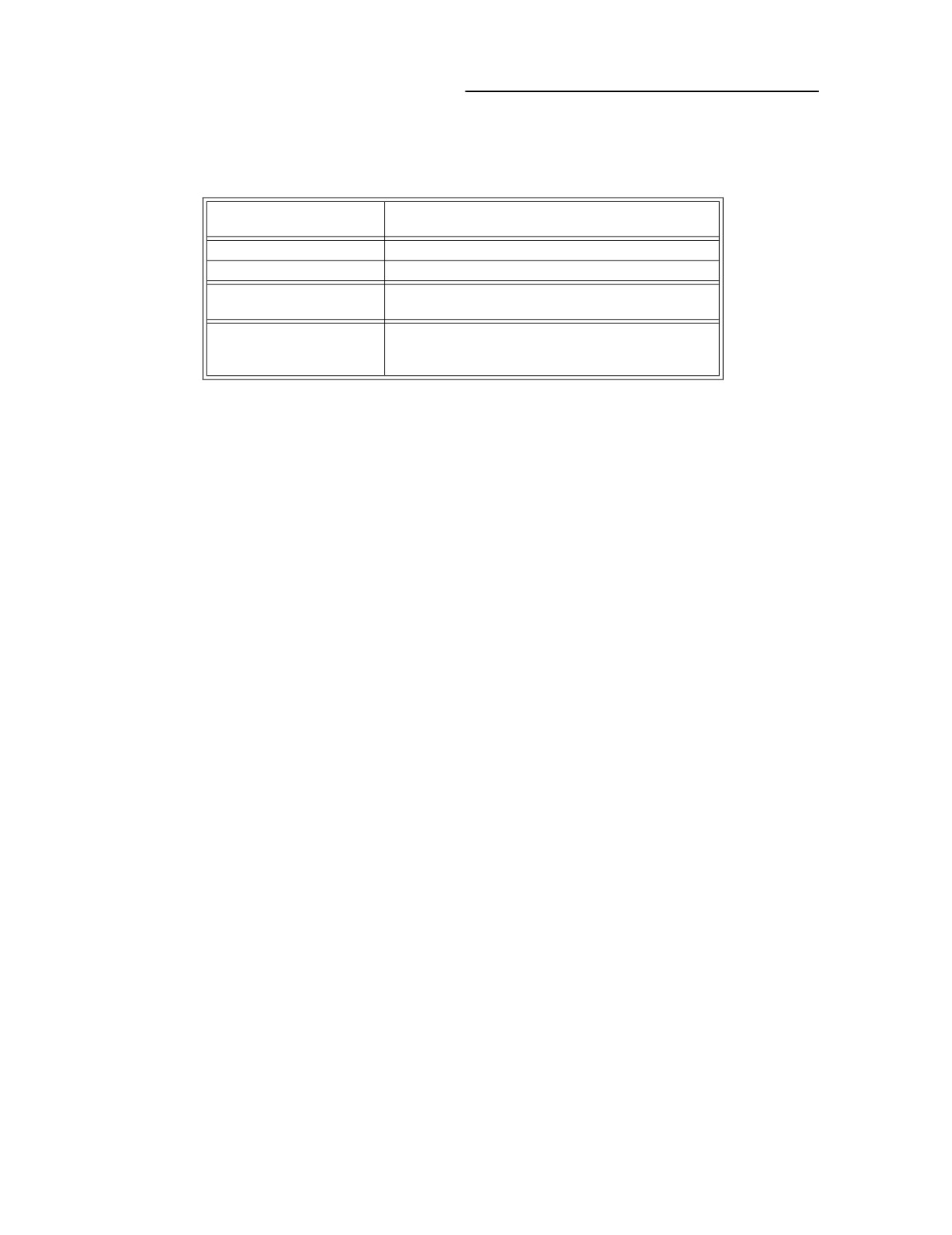
requirements can then be determined as listed in Table 2-15, page 2-138.
2-136 Soils
FM 5-472/NAVFAC MO 330/AFJMAN 32-1221(I)
Figure 2-68. DCP test kit
Table 2-14. Summary of remolded CBR laboratory test programs
Type of Soil Normally
Compaction Blows
Probable Use of Test
Test Program
Tested*
Per Layer
Results
Low-quality compacted
Swelling soils
CH, MH, and OH
10, 25, and 56
subgrades
Compacted subgrade,
Free-draining soils
GW, GP, SW, and SP
25, 56, and 72
select, and subbase
materials
For CBR >20: 25, 56,
Compacted subgrade,
All except CH, MH, OH,
and 72
Other soils
select, and subbase
GW, GP, SW, and SP
For CBR <20: 10, 25,
materials
and 56
*This categorization is intended to serve as a guide for planning laboratory activities. Deviations
may be noted in the initial stages of a test program which will dictate adjustments.
Soils 2-137
FM 5-472/NAVFAC MO 330/AFJMAN 32-1221(I)
Table 2-15. Summary of compaction requirements
Percentage of Compaction of Materials With
Material
Design CBR Values of 20 and Above
Base course
No less than 100% of CE 56 maximum density
Subbase and subgrade
No less than 100% of CE 56 maximum density
Percentage of Compaction of Materials With
Material
Design CBR Values Below 20
Cohesionless fill will not be placed at less than 95%
Select material and
of CE 56 maximum density. Cohesive fill will not be
subgrade in fills
placed at less than 90% of CE 56 maximum density
Example
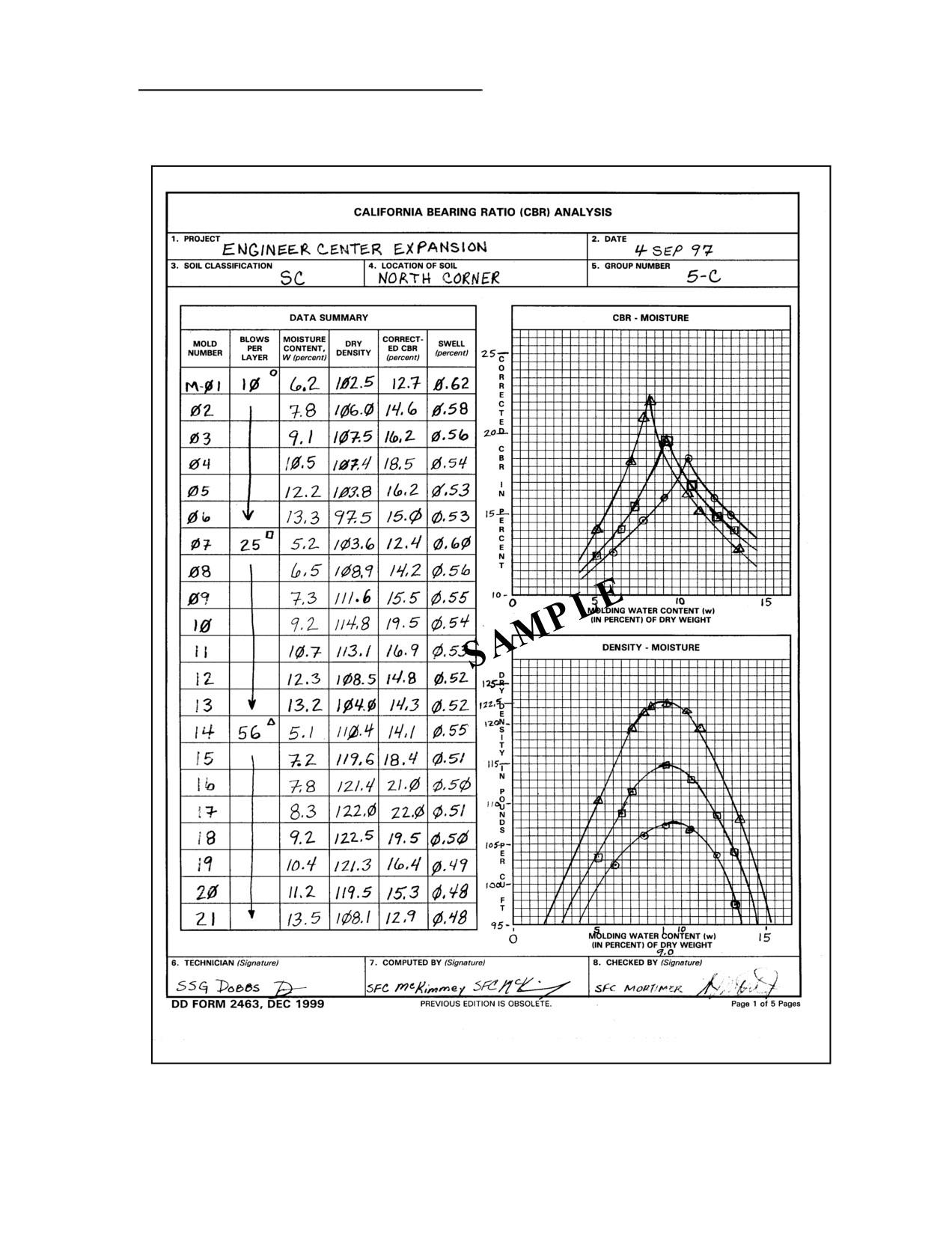
To illustrate the methods of evaluating the design CBR, the data given on
the DD Form 2463 for the Engineer Center expansion road (see Figure 2-69,
pages 2-139 through 2-143) will be used. The data was taken from the
subgrade along a proposed road alignment. The object of the following
analysis is to determine a soil-placement moisture-content range for a
specified level of compactive effort which gives the greatest assured design
CBR. This technique for determining a design CBR provides for a strength
measure of at least 15.0 when the associated density and moisture-content
ranges are followed. Greater strengths will be realized within the specified
limits, but the value obtained allows the engineer to size the structure for
the worst condition. Notice that for this soil and the limits used, the
greatest assured strength occurs for the 4 percent moisture-content range
centered on the OMC. This may not always be the case. Also note that the
analysis is based on an initial selection of density limits. You may find it
better to evaluate other density limits that meet the minimum requirements
to see if an adjustment to these limits yields greater strengths.
Steps
Perform the following steps for CBR testing of a nonswelling soil:
Step 1. Establish the OMC of the soil at 56 blows per layer by using the data
collected from the compaction test as outlined in Section VII (see Figure 2-58,
page 2-110). For this example, OMC equals 8.8 percent.
Step 2. Establish a moisture range for CBR investigation. The moisture
range generally used for nonswelling soils is OMC ± 4 percent. This is a time-
saving guide, as experience shows that the maximum CBR normally occurs at
compaction moisture contents within this range and that testing soils beyond
these limits is wasted effort. For this example, the moisture-content
investigation range is 5 to 13 percent.
Step 3. Compact the samples within the moisture-content investigation range
at different levels of compactive effort as described earlier in this section.
This allows for evaluation of soil strength when field placement is other than
100 percent of the compaction test’s maximum density.
2-138 Soils
FM 5-472/NAVFAC MO 330/AFJMAN 32-1221(I)
Figure 2-69. Sample DD Form 2463, page 1
Soils 2-139
FM 5-472/NAVFAC MO 330/AFJMAN 32-1221(I)
Figure 2-69. Sample DD Form 2463, page 2 (continued)
2-140 Soils
FM 5-472/NAVFAC MO 330/AFJMAN 32-1221(I)
Figure 2-69. Sample DD Form 2463, page 3 (continued)
Soils 2-141
FM 5-472/NAVFAC MO 330/AFJMAN 32-1221(I)
Figure 2-69. Sample DD Form 2463, page 4 (continued)
2-142 Soils
FM 5-472/NAVFAC MO 330/AFJMAN 32-1221(I)
Figure 2-69. Sample DD Form 2463, page 5 (continued)
Soils 2-143
FM 5-472/NAVFAC MO 330/AFJMAN 32-1221(I)
The levels of compactive effort selected in the laboratory are based on the
compaction requirements. If the soil is to be used as select material or
subgrade in fills (CBR < 20), it may be placed at less than 100 percent of the
compaction test’s maximum density for CE 56, as indicated in Table 2-15, page
2-138. Additionally, laboratory compactive efforts of 10, 25, and 56 blows per
layer are usually selected for this soil. If the soil is a very high-quality
subgrade or a subbase (CBR > 20), the laboratory tests should include samples
compacted in excess of 56 blows per layer. Normally 25, 56, and 72 blows per
layer are adequate. The only stipulations placed on the levels of compactive
effort are that a 56-blow-per-layer compaction curve be obtained and that data
be developed at two other levels of compactive effort encompassing the
specified placement densities.
In this example, the soil type is SC and the DD Form 1211 from the
compaction test displays a bell-shaped compaction curve. This is indicative of
a either a swelling or a nonswelling soil. A U-shaped compaction curve
indicates a free-draining soil. An assumption is made then that this is a
nonswelling soil. This information is based on typical soil characteristics for
soils of type SC as found in Table B-3, pages B-16 and B-17, and Table 2-14,
page 2-137. Using Table 2-14 and column 15 of Table B-3 as a guide, the
samples were compacted at 10, 25, and 56 blows per layer. The DD Form 1212
for this sample compacted at 56 blows per layer at approximate OMC can be
found in Figure 2-65, pages 2-128 and 2-129.
Step 4. Soak the samples and measure the swell as outlined in the previous
section.
Step 5. Perform CBR penetration tests and determine the corrected CBR for
each sample according to the technique discussed in the previous section.
Note that accumulating the required data involves a considerable amount of
work. At a minimum, 15 molds (5 per level of compactive effort) must be
made. In this example,
21
molds were compacted, soaked, and then
penetrated.
Step 6. Transfer the results of the 21 tests from each DD Form 1212 onto the
data summary section of DD Form 2463, page 1 (see Figure 2-69, page 2-139).
Step 7. Plot the data on the graphs of dry density versus molding moisture
content and corrected CBR versus molding moisture content on DD Form 2463,
page 1 (see Figure 2-69).
Step 8. Determine the moisture range for the CBR family of curves. For a
nonswelling soil, the moisture content that corresponds to the MDD is the
OMC. The moisture range is OMC ± 4 percent. In this example, the OMC
discovered from DD Form 2463 is 9 percent; therefore, the range for the family
of curves is 5 to 13 percent.
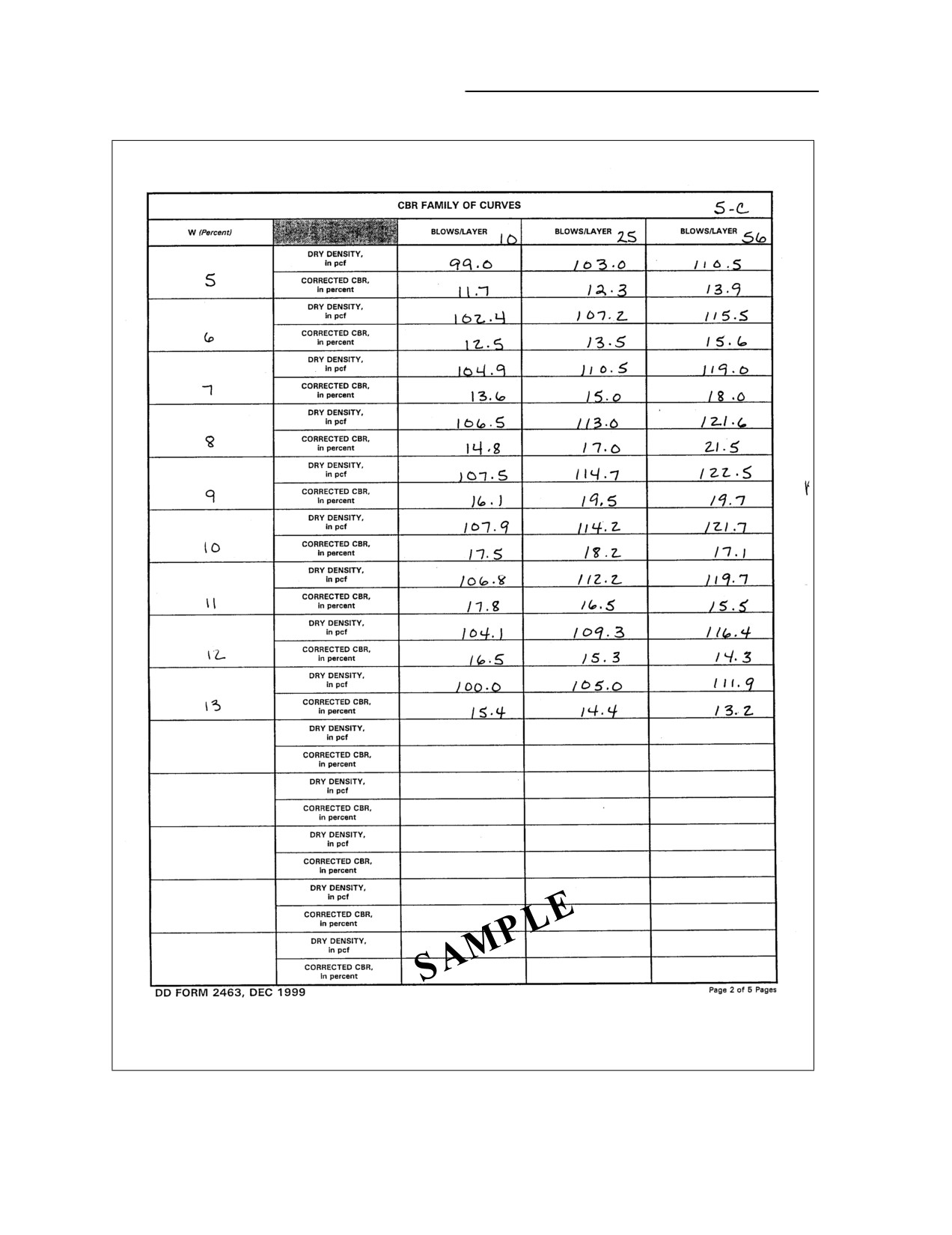
Step 9. Transcribe the data points from the graphs onto page 2 of the DD Form
2463
(see Figure 2-69, page 2-140) for each whole moisture percentage in the
range determined from step 8. This step is performed to identify values of dry
density and CBR for whole-integer moisture contents within the range of
investigation at each level of compactive effort. Some of the data may be
transferred directly from the data-summary table. The remainder must be
2-144 Soils
FM 5-472/NAVFAC MO 330/AFJMAN 32-1221(I)
interpolated from the CBR/dry-density versus molding moisture-content
graphs.
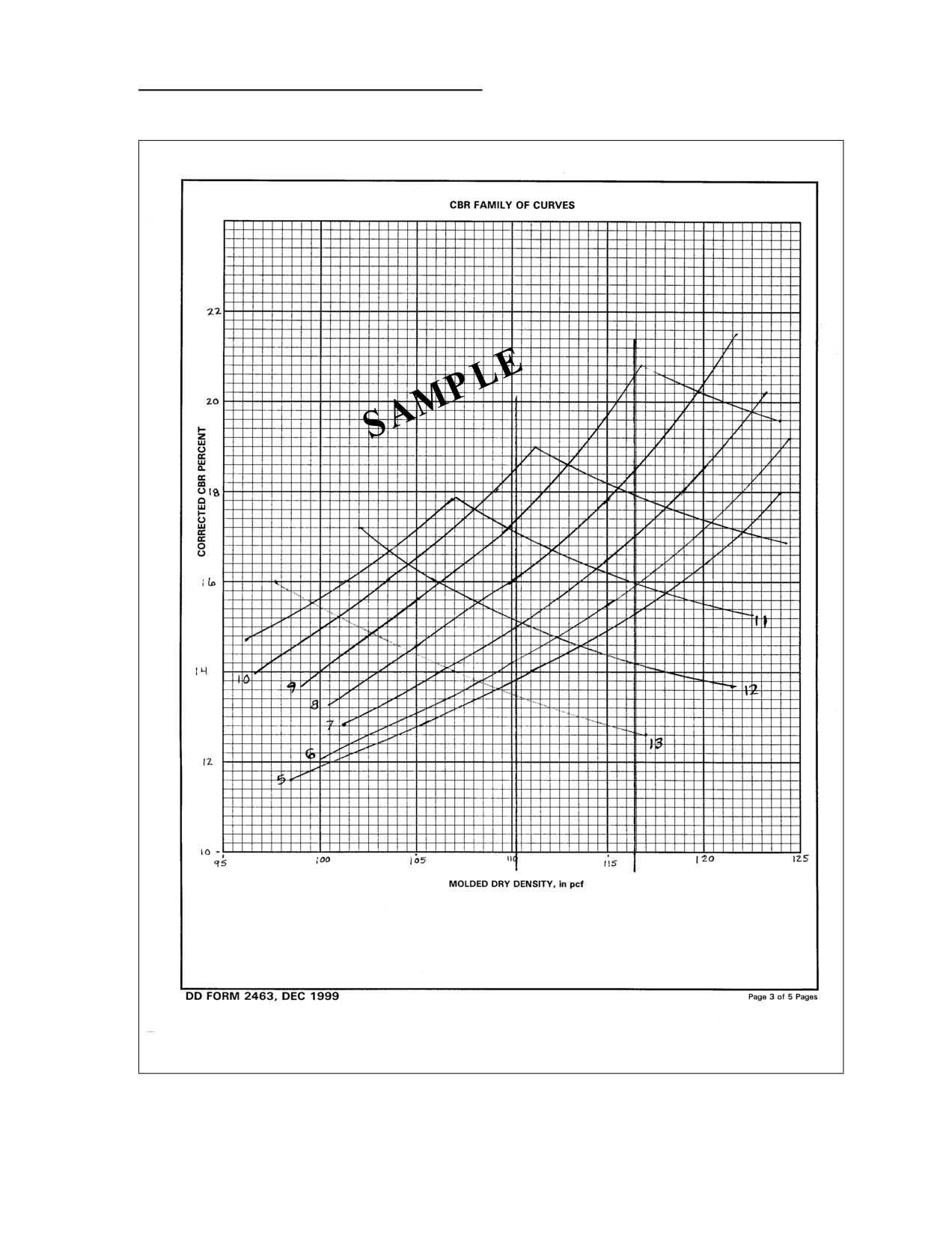
Step 10. Plot the CBR family of curves on page 3 of DD Form 2463 (see Figure
2-69, page 2-141). This step places the laboratory data in a form that lends
itself to analysis. The trends of strength variation are determined as the
moisture content and dry density change. Drawing a CBR family of curves
involves considerable practice, numerous attempts, and subsequent
adjustments. The example (Figure 2-69) shows that the available data has been
plotted on a graph of corrected CBR versus molded dry density for whole
moisture contents. For low molding water contents (from 5 to 8 percent), there
was an increase in strength with dry density. At high moisture contents (12 and
13 percent) the reverse was true. For the intermediate moisture contents, there
was an increase in strength to some point and then a decrease as the dry
density increased.
Step 11. Proceed with an engineering analysis. After all the testing has been
completed, it is the engineer’s responsibility to ensure that the CBR data is
properly obtained and presented. The engineer must analyze the data and
understand how the results affect the design and economic factors. Before
considering the details of the analysis, it is possible to observe two points of
interest about the soil being used for the example. First, the maximum
strength of this soil does not occur at OMC but at 1 percent drier (see corrected
CBR versus molding water content). Second, the CBR family of curves shows
that for some moisture contents the soil loses strength as the dry density or
level of compactive effort increases. The impact of these two factors is
important. If maximum strength from this soil is desired, that strength may in
some soils be achieved at a moisture content less than OMC and at some level of
compactive effort less than CE 56. The reasons for these two phenomena are
highly speculative. Soil placement at OMC and the most compactive effort
possible are not always the answers to good construction.
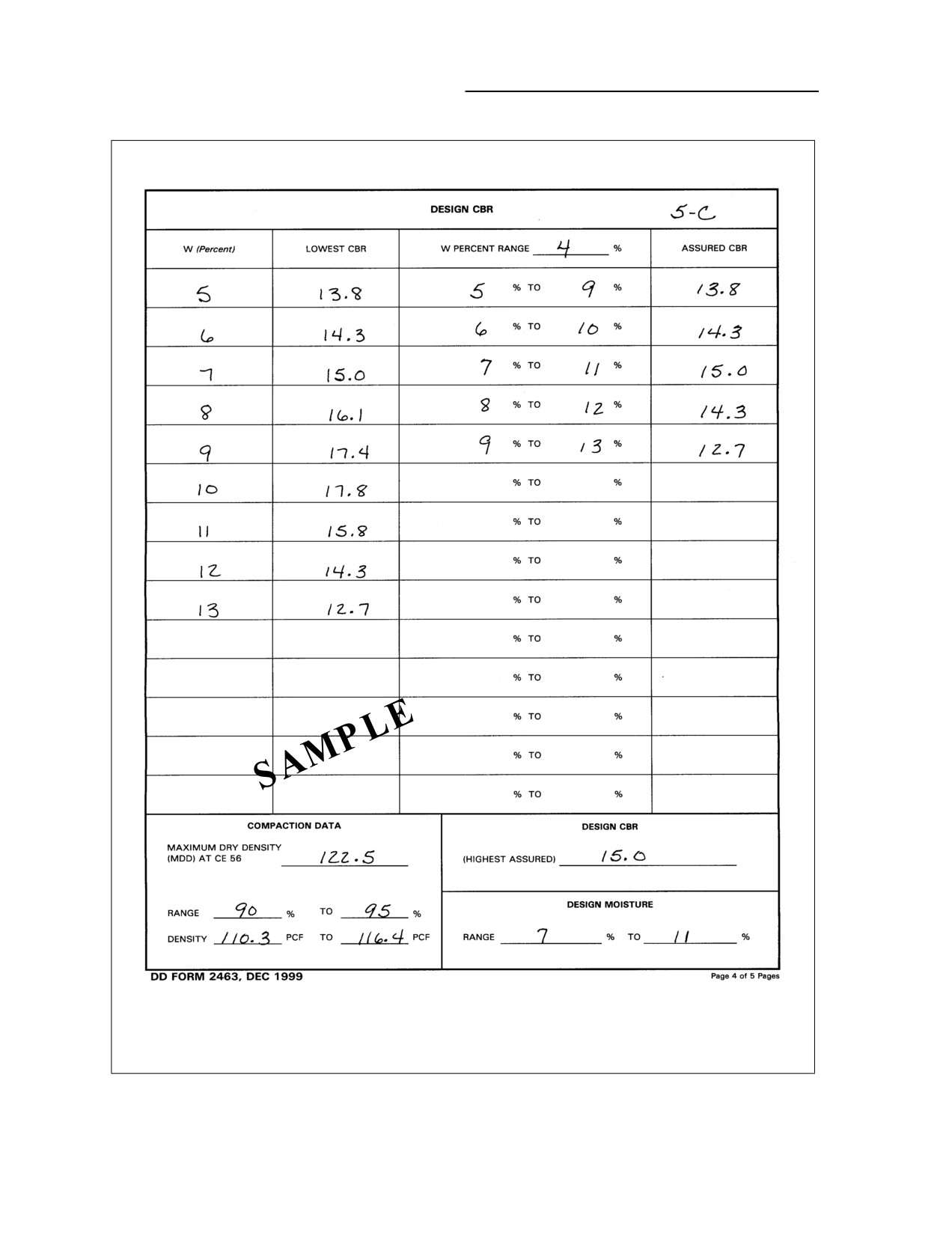
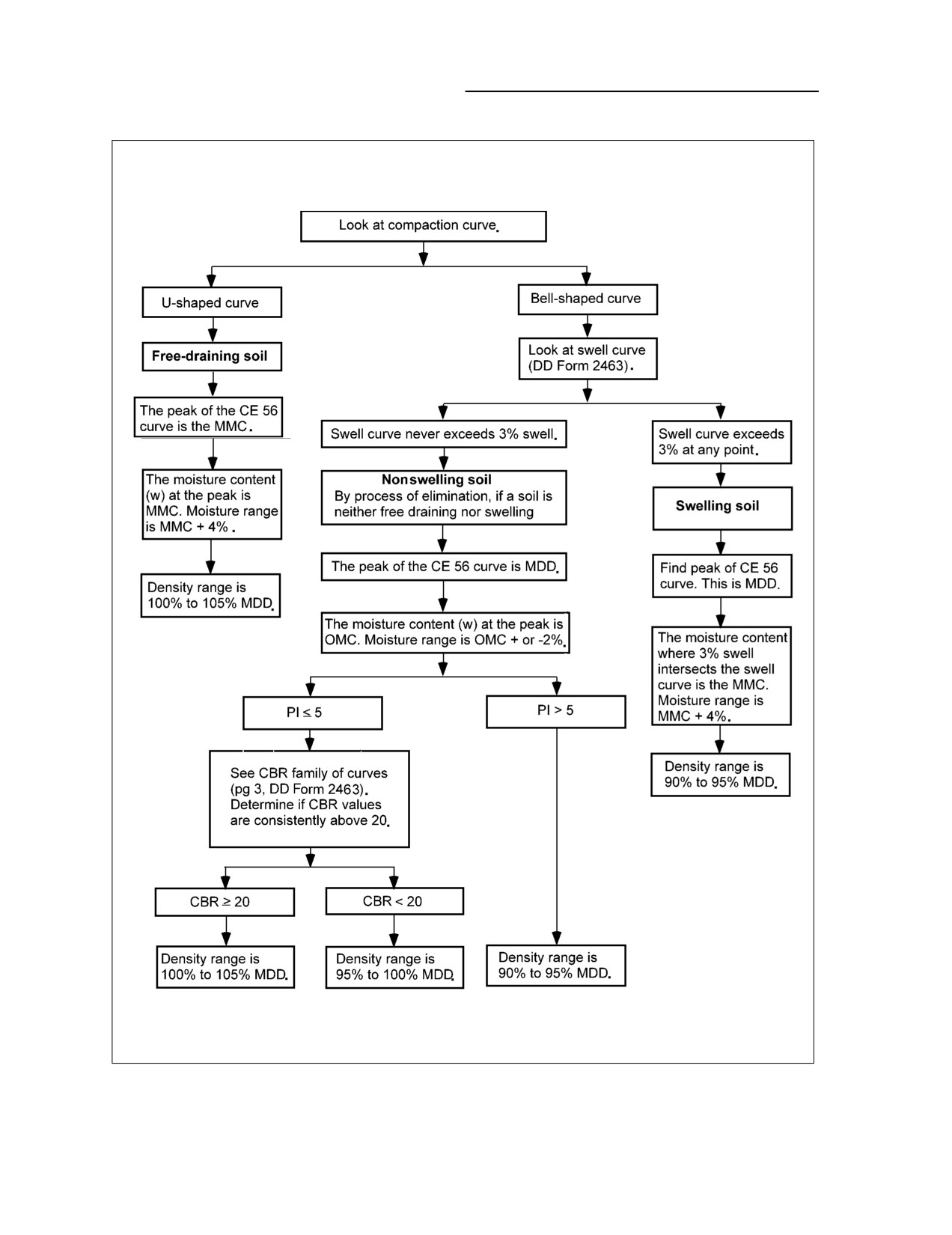
Step 12. Establish a density range at which soil will be placed in the field. The
TO standard compaction range is 5 percent, unless otherwise stated. The flow
chart in Figure
2-70, page
2-146, provides the information necessary for
determining the density and moisture ranges for nonswelling, swelling, and
free-draining soils. For nonswelling soils, the following information is normally
used to assist in determining a density range.
To facilitate construction, it is common to specify a reasonable range of densities
that can be economically obtained and then examine the strength values that
would occur without that range. Establishing the density range depends
greatly on economics. The more latitude given to the builder, the better the
chances of placing the soil within established limits. However, if an extreme
range is stipulated, the CBR value allowed for design might be reduced and
thicker pavement structure could be required. Another factor is the actual field
compaction experience obtained from either a test strip or prior construction.
Such data can be accumulated by measuring the in-place dry densities for
different numbers of passes with the available compaction equipment and
determining the point where additional passes give little increase in density.
For this example, the soil type was determined to be SC with a PI of 10, as
shown on DD Form 1209 (see Figure 2-47, page 2-95). With this information
following the flow chart, the soil must be placed to at least 90 percent of MDD.
Soils 2-145
FM 5-472/NAVFAC MO 330/AFJMAN 32-1221(I)
Figure 2-70. Density and moisture requirements using the CBR design method
2-146 Soils