FM 3-04.240 Instrument Flight for Army Aviators (April 2007) - page 8
Appendix B
Instrument Flight in a Theater of Operations
An Army aviator conducts a flight under instrument flight rules in an FAA or ICAO
environment. Conversely, an Army aviator may experience IIMC during the initial
entry phase of a combat operation and need to execute an emergency GPS recovery.
Instrument flight may be required in a theater of operation in which a country’s
aviation infrastructure ranges from fully intact and operational to completely
destroyed or nonexistent. This appendix provides information on what the aviator can
expect from ATC upon entry.
ATC OPERATIONS
B-1. Air traffic command and control is crucial to the effectiveness of aviation operations and must be
outlined, synchronized, and integrated effectively to meet the service or joint force commander’s
requirements. A typical theater of operation is composed of and operates as a joint force. These operations
are set forth in FM 3-52.3, which provides multiservice ATC procedures. An airspace integration entity
and Regional Air Movement Control Center (RAMCC), especially for nations with a nonfunctioning civil
ATC system, is created to ensure that ATC issues are handled competently. A command-and-control
relationship is identified between each of the four services and ATC. ATC operations occur during initial
entry, transition, and sustainment operations.
INITIAL ENTRY
B-2. The Army, Marine Corps, and Air Force—either jointly or on their own—can provide an initial
airfield ATC capability. Initial ATC forces are normally of short duration and require follow-on
sustainment (less than 14 days). An ATC team can usually complete an initial stand-up with limited IFR
capability within 12 to 72 hours, depending on the following factors:
Joint force commander (JFC) risk acceptance.
Flyability check.
Required flight check.
B-3. All services can initially deploy systems that allow ATC radio communications and limited airfield
IFR airfield abilities. These systems are matched to very specific aircraft systems such as TACAN, the
Marine Corps ARA-63 airborne radar, Marine remote area automatic landing system (MRAALS), Army
NDB, or Air Force mobile microwave landing system (MMLS). The Marine Corps and Air Force special
tactics teams (STTs) have packable/portable airfield lighting systems organic to their units, allowing them
to provide a complete initial airfield operating package. The Navy has onboard ATC communications, IFR
capability, and lighting systems available on the amphibious assault ship, landing platform helicopter
(LPH), multipurpose amphibious assault ships (LHDs), and general-purpose amphibious assault ships
(LHAs). Initial service ATC capabilities are outlined in table B-1, page B-2.
30 April 2007
FM 3-04.240
B-1

Appendix B
Table B-1. Initial air traffic control capabilities
Service
Voice Communication
Deployable
Runway
VFR
Limited
(Secure)
NAVAIDs
Lighting
IFR
VHF
UHF
FM
Army
Yes
Yes
Yes
NDB, PAR
No
Yes
Yes
Air Force
Yes
Yes
Yes
MMLS, TACAN
Yes
Yes
Yes
Marine
Yes
Yes
Yes
MRAALS, TACAN
Yes
Yes
Yes
Corps
Navy*
Yes
Yes
Yes
PAR, ILS
Yes
Yes
Yes
*Navy ship availability is based on the ship’s proximity, patrol area, and time on station/in assigned area.
B-4. The Marine Corps MRAALS is an all-weather instrument landing system. It transmits azimuth,
distance, and elevation data in the J-band (15.412 to 15.680 gigahertz) and DME/station identification data
in the D-band (962 to 1213 megahertz). It provides 40-degree azimuth and 20-degree elevation guidance
out to 10 nautical miles on final approach to aircraft equipped with the ARA-63 airborne radar system. It
also provides 360-degree DME and station identification information out to 40 nautical miles.
B-5. The Air Force MMLS is similar to an ILS. It has a glide-slope antenna, known as an elevation
station, and a localizer antenna, known as an azimuth station. Coverage extends to a distance of at least 15
nautical miles. MMLS has 200 discrete channels in the range of 5000 to 5150 megahertz.
B-6. Navy ATC facilities (sea-based) are resident in numerous ships capable of launching and recovering
aircraft. The two largest platforms are the aircraft carrier and large deck amphibious assault carrier. If an
Army aircraft experiences IIMC and is routed to a Navy ship, the aircraft is most likely to be sequenced to
a member of the large deck amphibious assault carrier ship class, specifically, an LHA, LHD, or LPH.
Smaller ships do launch and recover aircraft; however, capabilities are generally restricted to terminal
approach and landing on their specific platform.
ARMY NAVIGATIONAL AIDS
RADIO BEACON SET
B-7. The AN/TRN-30 radio beacon set transmits a homing signal, which is used in airborne
direction-finding equipment installed in Army aircraft. The radio beacon provides an amplitude-modulated
radio frequency signal on any one of 964 channels in the frequency range of 200 to 535.5 and 1605 to
1750.5, tunable in 500-Hertz increments. The RF output is automatically keyed into four-letter Morse code
characters selected by the operator or manually keyed.
Radio Beacon Set Version 1
B-8. The pathfinder configuration consists of both the 15-foot and 30-foot antenna configurations that the
AN/TRN 30 (V1) is capable of operating in. The power requirements are 24 volts direct current (DC). The
V1 beacon requires a cleared area of 128 feet in diameter. Operating in the 15-foot antenna configuration,
the beacon operates in the frequency range of 1605 to 1750.5 only and has a transmission range of 28
kilometers, or 15 nautical miles. Operating in the 30-foot antenna configuration, the beacon uses frequency
ranges of 200 to 535.5 and 1605 to 1750.5 and has a transmission range of 46 kilometers, or 25 nautical
miles.
Radio Beacon Set Version 2
Tactical Mode
B-9. The tactical configuration uses a 60-foot antenna configuration in the AN/TRN 30 (V2) radio beacon
set and is a semipermanent NAVAID. The power requirements are 28 volts DC. The V2 beacon tactical
B-2
FM 3-04.240
30 April 2007

Instrument Flight in a Theater of Operations
configuration operates on the frequency range of 200 to 535.5 only and has a transmission range of 93
kilometers, or 50 nautical miles.
Semifixed Mode
B-10. The semifixed mode uses the 60-foot antenna configuration and continues to require 28 volts DC as
its power requirement. The frequency range in this mode of the V2 beacon remains 200 to 535.5, but the
transmission distance is 185 kilometers, or 100 nautical miles.
AIR TRAFFIC NAVIGATION, INTEGRATION, AND COORDINATION SYSTEM
B-11. The Air Traffic Navigation, Integration, and Coordination System
(ATNAVICS) provides
continuous, near all weather, precision landing assistance and departure recovery capability at Army
tactical airfields and landing areas. In addition, the AN/TPN-31 provides area surveillance and aircraft
identification capability for a 25 nautical mile radius of all sites and a 10 nautical mile precision approach
radar capability. The system consists of three integrated radars: ASR, PAR, and SSR.
TRANSITION OPERATIONS
B-12. Transition operations are operations during the period that initial entry ATC resources require
replacement, replenishment, augmentation, or upgrade of ATC services until sustainment ATC forces are
established. Transitional ATC operations may be extended based on the intended time frame of the
operation or availability of airlift or sealift resources to deploy sustainment ATC forces. Initial ATC forces
require relief within 72 hours to reconstitute the initial entry capability and provide a sustained or more
capable conventional airfield environment. Timelines for replacement of initial ATC forces are situation
dependent.
B-13. Under ideal conditions, ATC operations flow from initial to sustained operations, without the need
for a distinct transition phase. After the initial entry phase, which lasts about 72 hours, there is a typical
timeline progression from initial through transition and into the sustained phase. This transition is shown in
table B-2.
Table B-2. Transition to sustained air traffic control operations
Action
Timeline in Days
3-7
8-14
15-25
45+
Sustainment ATC forces and equipment arrive
X
Air Force combat communications established
X
Marine ATC established
X
Army ATC established
X
Transitional ATC begins
X
Transition to sustainment forces begins
X
Initial ATC forces relieved/forward deployment/reassigned
X
Sustainment NAVAIDS operational
X
GCA/radar approach control (RAPCON) operational
X
PAR operational
X
TACAN/NDB/MMLS operational
X
PAR/GCA/TERPS approaches approved
X
Host nation resumes ATC services
X
Sustainment ATC redeploys
X
30 April 2007
FM 3-04.240
B-3

Appendix B
SUSTAINMENT OPERATIONS
B-14. Sustained ATC operations occur when the desired operational capability is achieved. They terminate
when services are no longer required. Services can provide VFR and IFR service to all aircraft through
mobile control towers, radar systems, and communications connectivity. All forces are limited by the
extent that they can be resupplied/maintained. Navy shipboard systems (FM 1-564) are limited only by the
ship’s ability to remain on station and maintain the operational health of its systems. Air Force and Marine
ATC sustainment equipment provides complete ATC service to support a theater airbase mission; however,
it requires extensive airlift to deploy. Currently, the Army does not have the capability to provide an
approach control and airfield lighting. However, the Army can provide a fully instrumented airfield, which
includes a tower and radar services. Table B-3 shows service capabilities and references.
Table B-3. Service capabilities and references
Service
Approach
GCA
Tower
Reference
Army
X
X
FM 1-120 and FM 3-52.3, Appendix B
Air Force
X
X
X
AFMAN 13-220
Marine
X
X
X
MCWP 3-25.8
Corps
Navy
X
X
X
FM 1-564
Army manuals: AKO.
Air Force manuals: http://www.e-publishing.af.mil/afpubs.asp.
Marine Corps manuals: https://www.doctrine.quantico.usmc.mil/.
Navy manuals: https://www.natec.navy.mil/.
B-15. ATC units begin transition and restoration back to civil ATC services as soon as possible after
conclusion of military operations. ICAO surveys airfields and ATC facility infrastructures to determine
needed improvements and ensure that these facilities meet ICAO standards and recommended practices
(SARPs). During the transition from military ATC personnel and equipment to host-nation or contracted
services, military ATC personnel continue to be present, providing oversight, quality-assurance evaluation,
procedures review, and host-nation agreements.
THEATER AIRSPACE COMMAND AND CONTROL
AIRSPACE CONTROL SYSTEM
B-16. There is a distinct difference between tactical flight procedures in a combat zone and IFR flight in a
sovereign nation’s airspace. During initial combat operations, Army ATS units establish IFR procedures
within a combat zone under supervision and control of the combined forces air component commander
(CFACC). Many of these procedures are published in loose-leaf format or an Aviator Procedures Guide
(APG) rather than in the DOD FLIP. As the theater matures and civil authorities begin to reestablish
airspace control, tactical flight procedures or FAA-developed approaches may be replaced by host-nation
procedures. At the same time, the APG or loose-leaf procedures may be replaced by published FLIP
procedures. This maturing of the airspace control system is either ongoing in a number of theaters of
operation or complete. FLIP account managers and unit operations officers must be aware of the status of
airspace control in their area of responsibility (AOR) and obtain sufficient FLIP products to operate in and
around the theater. AR 95-1 requirements to use DOD/United States Government FLIP for all Army
missions are not waived during contingency operations. Unprepared units may find it difficult or
impossible to conduct IFR flight operations.
DEPARTMENT OF DEFENSE FOREIGN CLEARANCE GUIDE
B-17. Another source of information for operating outside of continental United States (OCONUS) or
during contingency operations is the Department of Defense Foreign Clearance Guide (DOD 4500.54-G)
accessible with a user name and password at https://www.fcg.pentagon.mil/. The DOD FCG, which may
contain sensitive information, is based on bilateral arrangements between the United States and foreign
B-4
FM 3-04.240
30 April 2007
Instrument Flight in a Theater of Operations
government officials and is not releasable outside the United States government unless approved by a
competent authority. This document provides necessary information for aircraft international mission
planning and execution, personnel travel to foreign countries, as well as general information on foreign
locations. Because the DOD FCG is directive for all DOD and DOD-sponsored travel abroad, travelers
must ensure that they comply with this guide.
THEATER OF OPERATION PROCEDURES
B-18. The pace of operating tempo (OPTEMPO) and deployments to contingency operations continues to
challenge the capabilities of Army aviation and ATS units across the force. Before deploying to an
operational area, operations officers and FLIP account managers must complete several steps to ensure
continued support. The unit’s FLIP account changes to support operations in areas away from home
station. United States Army units should contact the USAASA FLIP manager to suspend or curtail United
States FLIP distribution amounts before deploying from home base and upon arriving or receiving a valid
APO mailing address for the new location. Point of contact information is in the front of DOD FLIP
publications or at usaasade@hq.hqusareur.army.mil. Traditional distribution methods for DOD FLIP
products often are not feasible in fast-moving contingency operations caused by mail system delays. To
overcome this delay, USAASA may set up FLIP distribution points in the theater of operations to ensure
unit access to required FLIP information and/or FLIP information, which can be downloaded from
https://164.214.2.62/products/digitalaero/index.cfm#plan. Specific procedures for a given theater of
operations or country are found in the appropriate DOD FLIP Area Planning publication (Iraq information
is located in AP/3), and new information is updated/posted according to the print cycle.
30 April 2007
FM 3-04.240
B-5
Appendix C
Weather Reports and Risk Management
SECTION I - WEATHER REPORTS USED FOR PLANNING
DEPARTMENT OF DEFENSE FORM 175-1
C-1. Unless directed by higher headquarters or local operating procedures, all entries in individual blocks
are at the discretion of the briefer, based on aircrew requirements and the weather situation. Entries on the
DD Form 175-1, or equivalent briefing form, must be horizontally and vertically consistent, showing sound
meteorological reasoning. For example, if a weather warning or advisory for surface wind is indicated in
block 11, the surface wind forecast in block 9 should reflect the warning or advisory wind criteria, along
with the warning or advisory number entered in block 13. Enter all times in UTC, all winds in five digits
(six for wind speeds over 99 knots), and record all heights in hundreds of feet with the surface level as
SFC.
PART I - TAKEOFF DATA
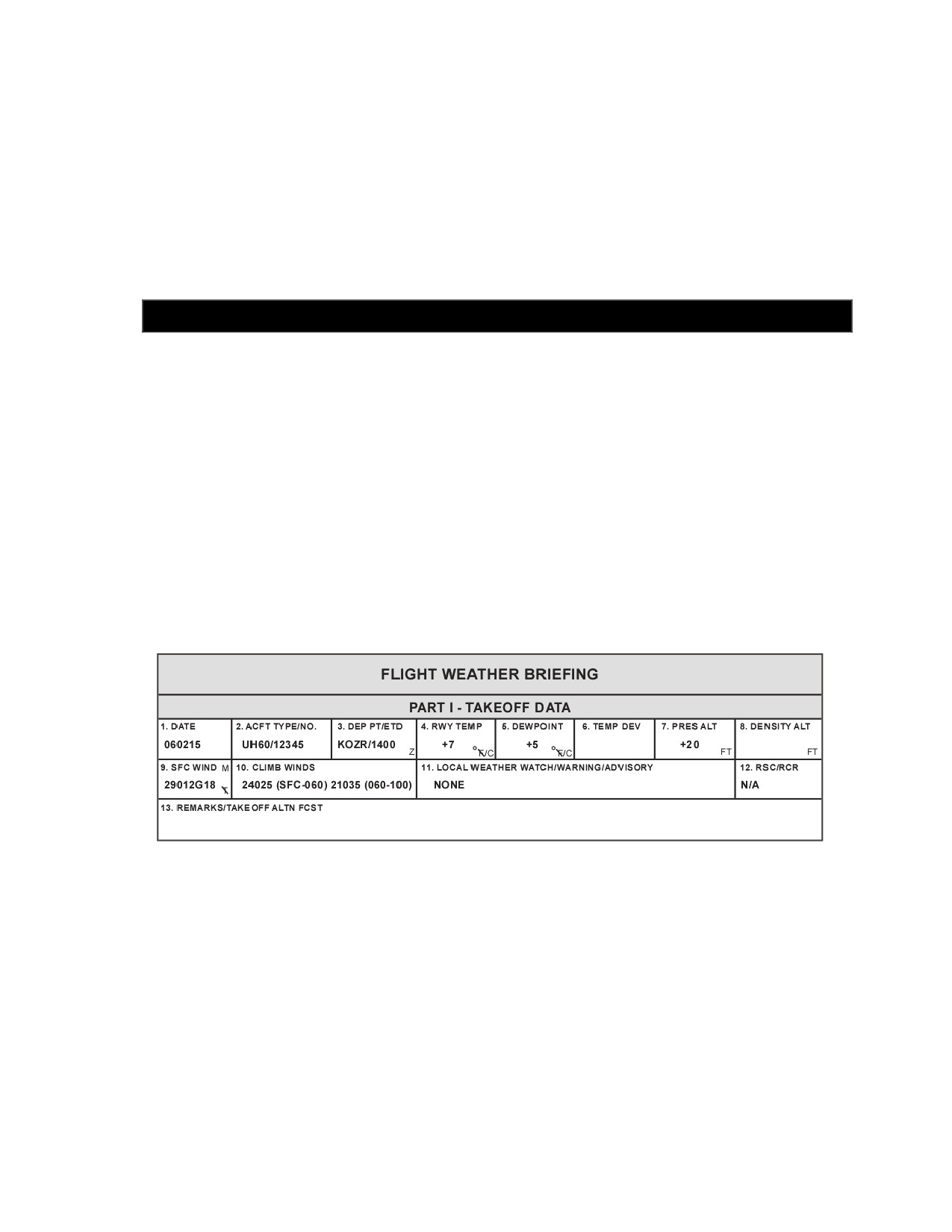
C-2. Enter the general forecast for takeoff one hour either side of the estimated time of departure (ETD).
Figure C-1 reflects part I of the flight weather briefing. Table C-1, page C-2, explains these blocks.
Meteorological codes can be found in AFMAN 15-124.
Figure C-1. Takeoff data
30 April 2007
FM 3-04.240
C-1

Appendix C
Table C-1. Takeoff data block explanation
Block No. and Explanation
1. Date
Enter UTC departure date in the format needed for operational use & communication with command
and control (C2) systems (YYMMDD, DD/MMM/YYYY, & YYYY/MM/DD).
2. ACFT type/no.
Enter aircraft type (UH-60, CH-47) & radio call sign, mission #, or last three digits of tail #.
3. Dep PT/ETD
Enter ICAO ID# & ETD. Enter departure grid point or latitude/longitude for locations not having
location identifiers.
4. RWY temp
Enter runway temperature (prefixed with + or -, as applicable) & designate ºF/C used.
5. Dew point
Enter dew-point temperature (prefixed with + or -, as applicable) & designate ºF/C used.
6. Temp deviation
Enter temperature deviation in ºC unless requested in Fahrenheit.
7. Pres alt
Enter pressure altitude in feet, prefixed with + or -, as applicable.
8. Density alt
Enter density altitude in feet, prefixed with + or -, as applicable.
9. SFC wind
Enter surface wind direction in magnetic heading for missions departing the airfield & in true direction
for missions departing another airfield. Designate “M” for magnetic or “T” for true. Enter surface wind
direction to nearest 10° in 3 digits & surface wind speed (including gust) in 2 or 3 digits. Ensure that
wind entries use a minimum of 5 digits (3 digits for direction & 2 digits for speed). Surface winds have
2 digits to represent gusts, while winds aloft use 3 digits for speed when winds exceed 99 kt. Enter
VRB for forecast variable wind direction & CALM when winds are forecast to be calm.
10. Climb winds
Enter true direction & representative wind or winds from takeoff to cruise altitude. Input wind direction
to nearest 10° in 3 digits & wind speed in 2 or 3 digits to nearest 5 kt. Input climb winds in layers if
significant differences exist (wind speed changes of ≤ 20 kt &/or wind direction changes ≤ 30°& wind
speed expected to be more than 25 kt) from 1 stratum to another.
11. Local weather watch/ warning/ advisory
Enter any known forecast/observed weather watch, warning, or advisory valid for ETD +/- 1 hour.
When watch, warning, & advisory data for a location are not available (remote briefing), enter check
with local flight agencies. Inform aircrew that status of local weather watches, warnings, &/or
advisories is undeterminable, & recommend checking with local ATC or airfield operations.
12. RSC/RCR*
Enter latest reported RSC/RCR for departure airfield, if available. Runway condition codes can be
found AFMAN 15-124. When the RSC/RCR is not available, enter N/A.
13. Remarks/takeoff ALTN FCST
Enter remarks on weather affecting takeoff & climb (such as inversions, icing, turbulence, and low-
level wind shear). Ensure that briefing contents & local TAF are consistent. If requested, enter forecast
for specific takeoff alternate & time.
*RSC-Runway Surface Condition; RCR- Runway Condition Reading
C-2
FM 3-04.240
30 April 2007
Weather Reports and Risk Management
PART II - EN ROUTE AND MISSION DATA
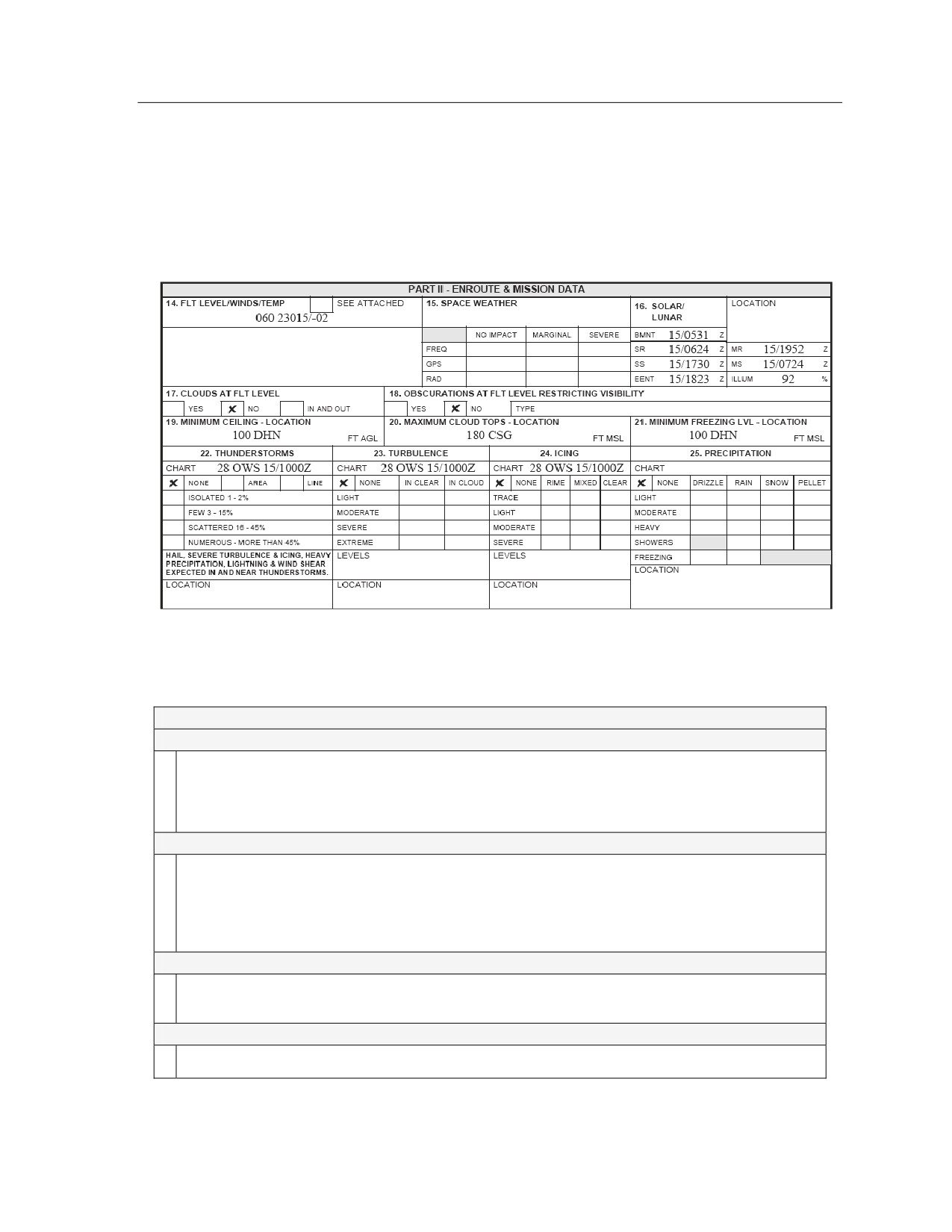
C-3. Enter data for the duration of the mission and entire route of flight. Brief hazards for the specific
mission, if applicable, and en route that are within 25 miles either side of the route and within 5,000 feet
above and below the planned flight level. Insert or attach forecasts for drop zones, ranges, or low-level
routes that apply to the specific mission. Figure C-2 reflects part II of the flight weather briefing. Table C-2
explains the blocks.
Figure C-2. En route and mission data
Table C-2. En route and mission data block explanation
Block No. and Explanation
14. Flight level/winds/temp
Enter planned flight level in hundreds of ft in 3 digits (280 for 28,000 ft, 080 for 8,000 ft). Enter true
wind direction at flight level in tens of degrees and speed to nearest 5 kt. Enter forecast flight-level
temperature in °C (prefixed with + or -, as applicable). For significant wind-speed direction changes,
break forecast into legs (BLV-MXF 27025/-15). Otherwise, brief a representative wind & temperature
for entire route (32020/-18).
15. Space weather
Check appropriate block indicating frequency (FREQ), GPS, & radiation (RAD) that apply to mission.
Indicate boundaries of degradation (UHF 20N180W to Paya Lebar). When weather forecasters use a
High Altitude Radiation Dosage Chart, 10.0 to less than 100.0 millirems per hour constitute marginal,
& 100.0 millirems per hour & greater constitute severe. A second option is to check appropriate blocks
& attach applicable space weather charts to DD Form 175-1. Indicate attachments by writing SEE
ATTACHED in block 15 (Figure C-2), & check “Yes” in block 34 (Figure C-4).
16. Solar/lunar
Enter location specified by aircrew, beginning morning nautical twilight (BMNT), sunrise (SR), sunset
(SS), ending evening nautical twilight (EENT), moonrise (MR), moonset (MS), & percentage of moon
illumination (ILLUM).
17. Clouds at flight level
Check appropriate block for flight level. “Yes” implies flight in clouds at least 45% of the time; “No,” in
clouds<1%, or “In & Out,” in clouds between 1% & 45%.
30 April 2007
FM 3-04.240
C-3

Appendix C
Table C-2. En route and mission data block explanation
Block No. and Explanation
18. Obscurations at flight level restricting visibility
Check appropriate block. If “Yes,” enter forecast obscurations type (such as fog, haze, and smoke)
that could potentially restrict in-flight visibility along planned route or mission flight level. Specify
intensity and location if applicable.
19. Minimum ceiling
Enter lowest ceiling en route for mission (if applicable) in hundreds of ft AGL & geographical location
(060 ft BLV-MXF). For minimum ceiling over mountainous or hilly terrain, or in thunderstorms, indicate
010 ft BOSTON MTS or 020 ft SW KY TSTMS.
20. Maximum cloud tops
Enter maximum tops of cloud layers (exclusive of thunderstorm tops) with more than 4/8 coverage in
hundreds of ft MSL and geographical location.
21. Minimum freezing level
Enter height and geographical location of lowest freezing level en route for mission (if applicable) in
hundreds of ft MSL. If lowest freezing level is at surface, enter SFC & geographical location.
22. Thunderstorms
Enter name & date-time group (DTG) of thunderstorm product used (Air Force Weather Agency
(AFWA)/OWS products, radar summary, satellite imagery, or National Weather Service (NWS) or
foreign weather service in-flight weather advisories). Enter type, extent, maximum tops, &
geographical location of thunderstorms affecting route or mission.
23. Turbulence
Enter name and DTG of turbulence forecast product used (such as AFWA/OWS products or NWS or
foreign in-flight weather advisories). Enter type, intensity, levels, & locations of turbulence affecting
route or mission.*
24. Icing
Enter name and DTG of icing forecast product used (such as AFWA/OWS products or NWS or foreign
in-flight weather advisories). Enter type, intensity, levels, & locations of icing affecting route or specific
mission.**
25. Precipitation
Enter type, intensity, character, & geographical location of precipitation areas affecting route/mission,
& precipitation encountered at flight level not at surface.
* Not associated with thunderstorms.
**Like AFWA & OWS forecast products, in-flight weather advisories should be used as guidance when preparing the en
route forecast. Carefully evaluate & temper all available data (such as radar, PIREPs/air reports [AIREPs], upper air
soundings, and online resources) to determine potential effects on the mission & aircraft. Weather personnel must alert
aircrews to all existing in-flight weather advisories, even if not used as a basis for the forecast, affecting the mission. If
the weather briefer disagrees with the advisory, annotate in block 35 (Figure C-4). Whether the condition described is
potentially hazardous to a particular flight is for the aviator to evaluate based on experience, mission, & operational
limits of the aircraft. See the FAA AIM for detailed information on NWS in-flight weather advisories.
PART III - AERODROME FORECASTS
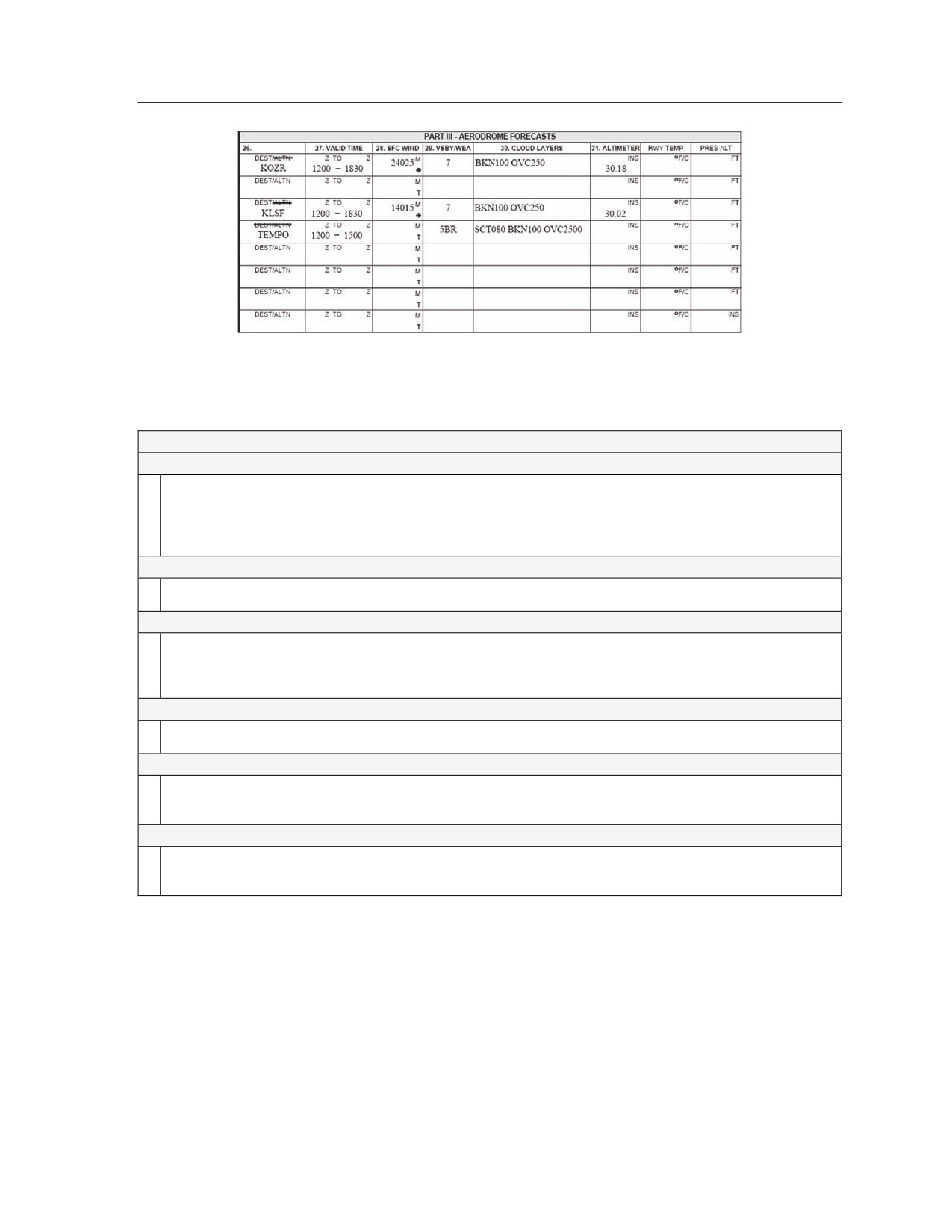
C-4. Brief the worst conditions expected during the valid period for the destination and alternate
aerodrome. The forecaster ensures that the aircrew is briefed and fully understands the entire weather
situation at the destination and alternate airport/location. The need for and selection of an alternate is an
aviator decision. The forecaster enters forecasts for subsequent stops and alternates on request, advising the
aviator of updates as necessary. Figure C-3, page C-5, shows part III of the flight weather briefing. Table
C-3, page C-5, explains the blocks.
C-4
FM 3-04.240
30 April 2007
Weather Reports and Risk Management
Figure C-3. Aerodrome forecasts
Table C-3. Aerodrome forecasts block explanation
Block No. and Explanation
26. DEST/ALTN
Enter appropriate station identifier for destination
(DEST) or alternate
(ALTN) aerodrome forecast.
Designate DEST or ALTN used. Place conditions described by a TEMPO group under appropriate station
identifier, line through DEST/ALTN, & enter TEMPO in the block. In Army multistop missions, if the forecast
for all stops is similar, enter A/S (for all stops) & the worst condition and location expected along the route.
These entries imply that conditions at all other stops are the same or better.
27. Valid time
Briefings for Army missions require a valid time from ETA through 1 hour after ETA. For A/S entries, valid
times are determined from original ETD to last stop, ETA plus 1 hour.
28. SFC wind
Enter true wind direction if destination is an airfield other than own. If flight departs from & terminates at
own airfield with no intermediate stops, enter wind direction. Designate M for magnetic or T for true. Enter
wind direction to nearest 10° & speed (including gusts) to nearest whole knot. For A/S missions, enter
highest wind speed expected (including gusts) & location.
29. VSBY/WEA
Enter lowest prevailing visibility & weather expected during the valid period. Represent in SM for CONUS &
overseas U.S. locations, & in meters for other overseas locations, unless otherwise specified by aircrew.
30. Cloud layers
Enter lowest prevailing sky condition expected during the valid period. Weather briefer must fully evaluate
all NWS probability groups (PROB30/40%) & indigenous variations of the TAF code. If necessary, use
Remarks section to record the briefer assessment & translation of these conditions.
31. Altimeter/RWY TEMP/PRES ALT
Enter lowest altimeter setting expected during the valid period in all cases except where impossible to
obtain or determine. Enter forecast runway temperature (RWY TEMP), & designate ºF/C used (prefixed
with + or -, as applicable). Enter forecast pressure altitude (PRES ALT) for arrival time at the destination.
PART IV - COMMENTS/REMARKS
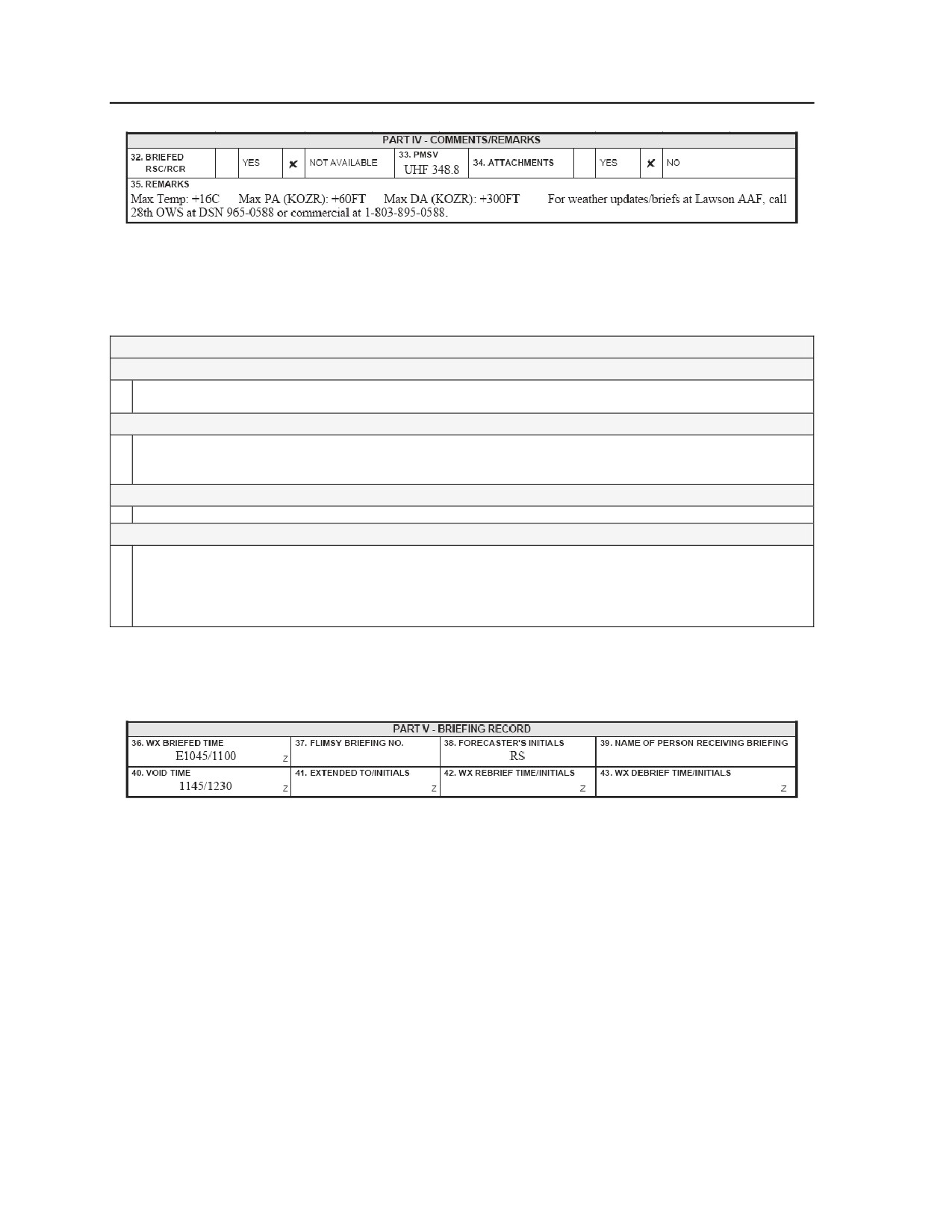
C-5. Figure C-4, page C-6, reflects part IV of the flight weather briefing. Table C-4, page C-6, explains
the blocks.
30 April 2007
FM 3-04.240
C-5
Appendix C
Figure C-4. Comments/remarks
Table C-4. Comments/remarks block explanation
Block No. and Explanation
32. Briefed RSC/RCR
Check appropriate block, & enter latest available RSC/RCR value briefed to aircrew for destination &
alternate in Remarks section.
33. PMSV
Enter Pilot-To-Metro Service (PMSV) frequency &/or phone patch number of weather unit providing brief. If
requesting pilot (weather) reports (PIREPs) for specific areas, enter areas in Remarks (Request PIREP
DURGC [during climb]).
34. Attachments
Check appropriate block, indicating if attachments are provided with briefing.
35. Remarks
Enter other significant data (data for which there was insufficient space in other blocks & specialized
mission forecasts). Weather briefings provided electronically (faxed, posted on Web page, or e-mailed)
must include following statement: Call (airfield weather forecaster) at DSN ###-#### or commercial (###)
###-#### for weather update. Include data on how to get weather support at the next location (for weather
updates/briefs at Lawson AAF, call 28th OWS at DSN 965-0588 or commercial at 1-803-895-0588).
PART V - BRIEFING RECORD
C-6. Figure C-5 reflects part V of the flight weather briefing. Table C-5, page C-7, explains the blocks.
Figure C-5. Briefing record
C-6
FM 3-04.240
30 April 2007

Weather Reports and Risk Management
Table C-5. Briefing record block explanation
Block No. and Explanation
36. WX briefed time
Enter time that brief was provided. For briefings sent electronically, enter time that brief was faxed, posted
on a Web page or local LAN or passed to a central dispatch facility (such as AMOCC). Append an E in
front of time (E1045Z) if crew was not verbally briefed. If calling later for verbal briefing, put a (/) after E
time & enter verbal brief time (E1045Z/1100Z).
37. Flimsy briefing no.
If a flight weather briefing folder, flimsy, or computer flight plan (CFP) was prepared, enter folder, flimsy, or
CFP identification number.
38. Forecaster’s initials
Enter initials of weather briefer/forecaster preparing & disseminating briefing.
39. Name of person receiving briefing
(Remote briefings only). If available, enter receiver’s name &, if applicable, military grade.
40. Void time
Add 1:30 to weather briefed time. For Army briefings sent electronically, calculate void time from E time
(block 36). If crew calls later for verbal briefing, recalculate void time from verbal briefing time & enter new
void time after the first time (1145Z/1230Z).
41. Extended to/initials
When asking for an extension, recheck weather entries, rebrief, & indicate required changes (highlight/bold
if electronic, green ink if paper). Enter initials of forecaster providing extension. Extensions follow same
rule as void time.
42. WX rebriefed time/initials
(Not required for Army; Army equivalent is “extended to.”) If weather rebriefed is different from that
originally briefed, indicate changes to original weather entries as specified in block 41 & enter rebrief time
& initials of forecaster providing rebrief.
43. WX debrief time/initials
Enter time & initials of debriefing forecaster.
METEOROLOGICAL AVIATION REPORT
C-7. The meteorological aviation report (METAR) is the weather observer’s interpretation of weather
conditions at a given site and time. The METAR is used by aviators and the NWS to determine the
airport’s flying category and to produce the terminal area forecast (TAF). Flying categories consist of
VFR, marginal visual flight rules (MVFR), and IFR.
C-8. Although the METAR code is being adopted worldwide, each country is allowed to make
modifications or exceptions to the code for use in that particular country. The United States reports
temperature and dew point in degrees Celsius and continues to use current units of measurement for the
remainder of the report.
C-9. The elements in the body of a METAR report are separated by a space. The only exception is
temperature and dew point, which are separated by a solidus (/). An element not occurring or not observed
is omitted. Figure C-6, page C-8, denotes elements of a METAR.
30 April 2007
FM 3-04.240
C-7

Appendix C
Figure C-6. Meteorological aviation report
TYPE OF REPORT
C-10. The two types of reports are the METAR and aviation selected special weather report (SPECI). The
METAR is observed hourly between 45 minutes after the hour until the hour. It is transmitted between 50
minutes after the hour until the hour and encoded as a METAR even if it meets SPECI criteria (table C-6).
It is a nonroutine aviation weather report taken when any SPECI criteria have been observed.
Table C-6. Special weather report criteria
Report Element and Criteria
Wind
Wind direction changes by 45º or more in less than 15 minutes, & wind speed is 10 kt or more throughout
wind shift.
Visibility
Surface visibility decreases to less than or, if below, increases to equal or exceed 3, 2, or 1 mile or lowest
standard IAP minimum as published in the National Ocean Service U.S. Instrument Procedures. If not
published, use ½ mile.
Ceilings
The ceiling forms or dissipates below or, if below, increases to equal or exceed 3,000, 1,500, 1,000, or 500
feet or lowest standard IAP minimum as published in the National Ocean Service U.S Instrument
Procedures. If not published, use 200 ft.
RVR
Tornado, Funnel Cloud, Waterspout
Changes to above or below 2,400 ft.
When observed or when disappears from sight (ends).
Thunderstorm
Squalls
Begins or ends.
When they occur.
Precipitation
Sky Condition
When freezing precipitation or ice pellets
A layer of clouds or obscuring phenomenon aloft that forms
begin, end, or change intensity or hail
below 1,000 ft.
begins or ends.
Volcanic Eruption
Aircraft Mishap
Upon notification of an aircraft mishap, unless of an
When an eruption is first noted.
intervening observation.
Miscellaneous
Any other meteorological situation designated by the agency or, in observer’s opinion, is critical.
INTERNATIONAL CIVIL AVIATION ORGANIZATION STATION IDENTIFIER
C-11. The METAR code uses ICAO four-letter station identifiers that follow the type of report. In the
contiguous United States, the three-letter identifier is prefixed with K (for example, Los Angeles [LAX]
becomes KLAX). Elsewhere, the first one or two letters of the ICAO identifier indicate in which region of
the world and country (or state) that the station is located. Pacific locations—such as Alaska, Hawaii, and
the Mariana Islands—start with P, followed by an A, an H, or a G respectively. The last two letters reflect
the specific reporting station identification. For example, Anchorage (ANC) becomes PANC; Canadian
C-8
FM 3-04.240
30 April 2007
Weather Reports and Risk Management
station identifiers start with C, and Mexican and western Caribbean station identifiers start with M. For a
complete worldwide listing, see ICAO Document 7910.
DATE AND TIME OF REPORT
C-12. The date and time that the observation is taken are transmitted as a six-digit date-time group
appended with Z to denote Universal Time Coordinated (UTC), also known as Zulu (Z) time or Greenwich
Mean Time (GMT). The first two digits are the date followed with two digits for the hour and two digits
for the minutes. A corrected report bears the time of the previously distributed erroneous report.
MODIFIER (AS REQUIRED)
C-13. The modifier element, if used, follows the date-time element. The modifier AUTO identifies an
automated weather report with no human intervention. If AUTO is shown in the body of the report, AO1 or
AO2 will be encoded in the remarks section of the report to indicate the type of precipitation sensor used at
the station. The remark AO1 indicates a report from a station without a precipitation discriminator, and an
AO2 remark indicates a report from a station with a precipitation discriminator. The absence of AUTO
indicates that the report was made manually or the automated report had human augmentation/backup. The
modifier COR identifies a corrected report that is sent out to replace an earlier report with an error
(METAR KLAX 140651Z COR…).
WIND
C-14. Wind element is reported as a five-digit group (six digits if speed is over 99 knots). The first three
digits are the direction from which the wind is blowing in tens of degrees referenced to true north.
Directions less than 100 degrees are preceded with a zero. The next two digits are the average speed in
knots or, if over 99 knots, the next three digits (340105KT). Abbreviation KT is appended to denote the
use of knots for wind speed. Other countries may use kilometers per hour or meters per second.
C-15. If the wind speed is less than 3 knots, the wind is reported as calm (00000KT). If the wind is gusty,
10 knots or more between peaks and lulls, G denoting gust is reported after the speed followed by the
highest gust reported (08012G25KT). If the wind direction is variable by 60 degrees or more and the speed
is greater than 6 knots, a variable group consisting of the extremes of the wind directions separated by V
follows the wind group (08012G25KT 040V120).
C-16. The wind direction may also be considered variable if wind speed is 6 knots or less and varying in
direction (the 60-degree rule does not apply). Variable wind speeds is indicated with the abbreviation VRB
(VRB04KT).
Wind Remarks
C-17. Facilities with a wind recorder or automated weather reporting system report peak winds exceeding
25 knots in the Remarks element of the report following the event. The peak wind remark includes three
digits for direction and two or three digits for speed, followed by the time in hours and minutes of
occurrence. If the hour can be inferred from the report time, only the minutes are reported (PK WND
28045/15).
C-18. A wind shift is indicated by a change in wind direction of 45 degrees or more in less than 15 minutes
with sustained winds of 10 knots or more. When a wind shift occurs, WSHFT is included in the Remarks
element followed by the time that the wind shift began. If the hour can be inferred from the report time,
only the minutes are reported. The contraction FROPA is entered following the time if the wind-shift is the
result of a frontal passage (WSHFT 30 FROPA).
VISIBILITY
C-19. Prevailing visibility is reported in statute miles or fractions of statute miles, as needed, followed by
SM. Other countries may use meters or kilometers. Prevailing visibility is considered representative of the
30 April 2007
FM 3-04.240
C-9
Appendix C
visibility conditions at the observing site. Prevailing visibility is the greatest visibility equaled or exceeded
throughout at least half the horizon circle, which need not be continuous. When visibilities are less than 7
miles, the restriction to visibility is shown in the weather element. Observations of volcanic ash,
low-drifting dust, sand, or snow (regardless of visibility) are shown in the weather element.
Visibility Remarks
C-20. If tower or surface visibility is less than 4 statute miles, the lesser of the two is reported in the body
of the report; the greater is reported in the Remarks element (TWR VIS 1 1/2 or SFC VIS 1 1/2).
Automated reporting stations show visibility less than 1/4 statute mile (M1/4SM) and visibility 10 statute
miles or greater. For automated reporting stations having more than one visibility sensor, site-specific
visibility (which is lower than the visibility shown in the body) is shown in the Remarks element (VIS 2
1/2 RWY 11).
C-21. When the prevailing visibility rapidly increases or decreases by 1/2 statute mile or more during the
observation and average prevailing visibility is less than 3 statute miles, the visibility is variable. Variable
visibility is shown in the Remarks element with minimum and maximum visibility values separated by a V
(VIS 1/2V2).
C-22. Sector visibility is shown in the Remarks element when it differs from the prevailing visibility and
either the prevailing or sector visibility is less than 3 miles (VIS NE 2 1/2).
RUNWAY VISUAL RANGE (AS REQUIRED)
C-23. RVR, when required, is reported in the following format:
R - Identifies the group.
“35” - Runway heading.
L - Identifies the parallel runway designator, if needed.
4500V6000FT - Identifies the visual range in feet (meters in other countries) and any variation
required.
C-24. RVR is shown in a METAR/SPECI if the airport has RVR equipment and whenever the prevailing
visibility is 1 statute mile or less and/or the RVR value is 6,000 feet or less.
Note. When RVR varies by more than one reportable value, the lowest and highest values are
shown with V between them.
C-25. When RVR observed is above the maximum value that can be determined by the system, it should be
reported as P6000 where 6,000 is the maximum value for this system. When RVR observed is below the
minimum value that can be determined by the system, it should be reported as M0600 where 600 is the
minimum value for this system.
WEATHER PHENOMENA
C-26. Weather phenomena in the METAR can be broken down into two parts. The qualifiers, the first part,
are intensity, proximity, and/or descriptors. Actual weather descriptions, the second part, are precipitation,
obscurations, and other weather conditions. Additional weather information—weather begins/ends and
hailstone size—may be included in the Remarks.
C-10
FM 3-04.240
30 April 2007

Weather Reports and Risk Management
Qualifiers
Intensity
C-27. Intensity may be shown with most precipitation types light (-), moderate, and heavy (+). When more
than one type of precipitation is present, intensity refers to the predominant precipitation (+TSRA is a
thunderstorm with heavy rain and not a heavy thunderstorm with rain).
Proximity
C-28. Proximity is reported only for weather phenomena occurring in the vicinity of the airport. Airport
vicinity is defined for obscuration to be between 5 and 10 miles of the usual observation point and
precipitation just beyond the observation point up to 10 miles and is denoted by VC. Intensity and VC are
never shown in the same group, for example—
VCSH indicates showers in the vicinity of the airport.
VCFG indicates fog in the vicinity of the airport.
Descriptor
C-29. Eight descriptors (table C-7) further identify weather phenomena and are used with certain types of
precipitation and obscurations. TS and SH are used with precipitation and may be preceded with an
intensity symbol.
Table C-7. Descriptor qualifiers
Descriptor
Descriptor
Describes fog that has little
Low
When dust, sand, or snow is raised by
MI
Shallow
DR
vertical extent (less than 6 ft)
drifting
wind to less than 6 ft
Describes fog that has little
When dust, sand, snow, and/or spray is
BC
Patches
vertical extent & reduces
BL
Blowing
raised by wind to a height of 6 ft or more
horizontal visibility
SH
Showers
TH
Thunderstorm
FZ
Freezing
PR
Partial
Weather Descriptions
C-30. If more than one significant weather phenomenom is observed, entries are listed in order of
decreasing predominance, and, except precipitation, separate weather groups are shown in the report. No
more than three weather groups are used to report weather phenomena at or in the vicinity of the station. If
more than one type of precipitation is observed, the appropriate contractions are combined into a single
group with the predominant type being reported first. In such a group, any intensity refers to the first type
of precipitation in the group (refer to Tables C-9 through C-11 while reading the remainder of this section).
Examples include the following:
TSRA indicates thunderstorm with moderate rain.
+SHRA indicates heavy rain showers.
-FZRA indicates light freezing rain.
Precipitation
C-31. Precipitation is any form of water particle, whether liquid or solid, that falls from the atmosphere and
reaches the ground. Table C-8, page C-12, shows precipitation types.
30 April 2007
FM 3-04.240
C-11
Appendix C
Table C-8. Precipitation types
Precipitation
DZ
Drizzle
SG
Snow grains
GR
Hailstones*
RA
Rain
IC
Ice crystals
GS
Small hail or snow pellets*
SN
Snow
PL
Ice pellets
UP
Unknown precipitation**
*Refers to hailstone size.
**Used only at automated sites when light precipitation is falling but precipitation discriminator cannot determine type. This
situation usually occurs when rain and snow are falling at the same time.
Obscurations
C-32. Obscurations are any atmospheric phenomena, other than precipitation, that reduce horizontal
visibility. Table C-9 shows the types of obscuration.
Table C-9. Obscuration types
Obscuration
BR
Mist*
DU
Dust
HZ
Haze
VA
Volcanic ash
FG
Fog**
SA
Sand
PY
Spray
FU
Smoke
*Indicates mist restricting visibility & used only when visibility is from 5/8 mile to 6 miles.
**Indicates fog restricting visibility & used only when visibility is less than 5/8 mile.
Other Weather Conditions
C-33. The other weather phenomena are reported when they occur. Table C-10 shows these other types of
weather phenomena.
Table C-10. Other types of weather phenomena
PO
Dust/Sand whirls
FC
Funnel cloud
SS
Sandstorm
SQ
Squall*
+FC
Tornado or Waterspout
DS
Dust storm
*Denotes sudden increase in wind speed of at least 16 kt, speed rising to 22 kt or more, & lasting at least 1 minute.
Weather Begins/Ends
C-34. The Remarks element shows the beginning and ending times of any type of precipitation or
thunderstorms. Types of precipitation may be combined if beginning or ending times are the same
(RAB05E30SNB30E45). Because the METAR is generated every hour, only minutes are used to denote
beginning (B) and ending (E) times. Refer to table C-8 for precipitation types.
Hailstone Size
C-35. When hailstones are shown in the body of a report, the largest hailstone size is shown in the Remarks
element in 1/4-inch increments and identified with the contraction GR (GR 1 ¾). Hailstones less than 1/4
inch are shown in the body of a report as GS, and no remarks are entered indicating hailstone size.
SKY CONDITION
C-36. Sky condition is reported in amount/height/type format. It can also be reported in indefinite
ceiling/height (vertical visibility) format.
C-12
FM 3-04.240
30 April 2007

Weather Reports and Risk Management
Amount
C-37. A clear sky, a layer of clouds, or an obscuring phenomenon is reported by one of six sky-cover
descriptions. The summation of the cloud layers from below and at higher levels determines what sky
covers are reported. The amount of sky cover is reported in eighths of the sky (table C-11).
Table C-11. Reportable descriptions for sky cover
Reportable descriptions
Meaning
Summation amount
*SKC or CLR
Clear
0 or 0 below 12,000 feet
FEW
Few
>0 but < 2/8
SCT
Scattered
3/8 - 4/8
BKN
Broken
5/8 - 7/8
OVC
Overcast
8/8
VV
Vertical Visibility (indefinite ceiling)
8/8
*SKC will be reported at manual stations. The abbreviation CLR shall be used at automated stations when no clouds below
12,000 ft are detected.
Note. For aviation purposes, ceiling is defined as the height AGL of the lowest broken or
overcast layer aloft or vertical visibility into an obscuration.
Height
C-38. Cloud bases are reported with three digits in hundreds of feet AGL (SCT020). Clouds above 12,000
feet cannot be detected by automated reporting systems. At reporting stations located in the mountains, if
the cloud layer is below the station level, the height of the layer is shown as three solidi (SCT///).
Type (as Required)
C-39. If towering cumulus (TCU) or cumulonimbus (CB) clouds are present, they are reported after the
height representing their base. Examples of these reports are SCT040TCU or BKN025CB.
Indefinite Ceiling/Heights (Vertical Visibility)
C-40. The height into an indefinite ceiling is preceded with VV followed by three digits indicating the
vertical visibility in hundreds of feet AGL (VV002). Indefinite ceiling indicates total obscuration.
Partial Obscurations
C-41. The amount of obscuration is reported in the body of the METAR when the sky is partially obscured
by a surface-based phenomenon by indicating the amount of obscuration as FEW, SCT, or BKN followed
by three zeros. The type of obscuring phenomenon is stated in the Remarks element and precedes the
amount of obscuration and three zeros. For example, if fog is hiding >1/8 to 2/8 of the sky, it is coded in
the body of the METAR as FEW000. Because fog is partially obscuring the sky, a remark is required (FG
FEW000).
C-42. Sky covers and ceiling, as determined from the ground, represent—as nearly as possible—what the
aviator should experience in flight. An aviator flying at or above a reported ceiling layer (BKN or OVC)
should see less than half of the surface below. An aviator descending through a surface-based total
obscuration should first see the ground directly below from the height reported as vertical visibility into the
obscuration. However, because of the differing viewpoints of the aviator and the observer, observed values
and what the aviator sees do not always exactly agree.
30 April 2007
FM 3-04.240
C-13
Appendix C
Additional Sky-Condition Remarks
C-43. These remarks are included when—
The ceiling is below 3,000 feet and is variable; the remark ceiling (CIG) is shown in the
Remarks element, followed by the lowest and highest ceiling heights, separated with a V (CIG
005V010).
An automated station uses meteorological discontinuity sensors; site-specific sky conditions that
differ from the ceiling height in the body of the report are shown in the Remarks element (CIG
002 RWY 11).
A layer is varying in sky cover; the variability range is shown in the Remarks element. If there is
more than one cloud layer of the same coverage, the variable layer is identified by including the
layer height (BKN014 V OVC).
Significant clouds are observed; the following cloud types are described in the Remarks
element:
Towering cumulus, TCU, and direction from the station (TCU W).
Cumulonimbus, CB; or cumulonimbus mammatus (CBMAM); direction from the station;
and direction of movement (if known). If the clouds are beyond 10 miles from the airport,
DSNT indicates that they are distant (CB DSNT E or CBMAM E MOV NE).
Altocumulus castellanus, ACC; standing lenticular (stratocumulus, SCSL; altocumulus,
ACSL; or cirrocumulus, CCSL); or rotor clouds, ROTOR CLD; describe the clouds (if
needed) and the direction from the station (ACC NW or ACSL SW).
TEMPERATURE/DEW POINT GROUP
C-44. Temperature/dew point is reported in a two-digit form in whole degrees Celsius separated by a
solidus (/). Temperatures below zero are prefixed with an M, which indicates a negative reading. If
temperature is available but dew point is missing, temperature is shown followed by a solidus. If
temperature is missing, the group is omitted from the report.
ALTIMETER
C-45. The altimeter element is reported in a four-digit format representing tens, units, tenths, and
hundredths of inches of mercury prefixed with A. The decimal point is not reported or stated.
Altimeter Remarks
C-46. When pressure is rising or falling rapidly at the time of observation, Remarks element shows
PRESRR or PRESFR respectively. Some stations also include the sea-level pressure (which is different
from altimeter). It is identified in the Remarks element as SLP followed by the sea-level pressure in
hectopascals (SLP982).
REMARKS (AS REQUIRED)
C-47. Remarks (RMK) are included, when appropriate, in the order presented in table C-13, page C-21.
Time entries are shown as minutes past the hour if the time reported occurs during the same hour the
observation is taken. If the hour is different, hours and minutes are shown. Locations of phenomena within
5 statute miles of the point of observation are reported as at the station. Phenomena between 5 and 10
statute miles are reported as in the vicinity, VC. Phenomena beyond 10 statute miles are shown as distant
(DSNT). Direction of phenomena is indicated with the eight points of the compass. Distance remarks are in
statute miles except for automated lightning remarks that are in nautical miles. Movements of clouds or
weather are indicated by the direction toward which the phenomenon is moving.
C-14
FM 3-04.240
30 April 2007

Weather Reports and Risk Management
Categories of Remarks
C-48. There are two categories of remarks. One category is automated, manual, and plain language. The
other category is additive and automated maintenance data.
Automated, Manual, and Plain Language Remarks
C-49. This group of remarks is generated from either manual or automated weather reporting stations and
generally elaborates on parameters reported in the body of the report. Table C-12 shows examples of these
type of remarks and their meaning.
Table C-12. Automated, manual, and plain language remarks
Example Remark
Remark meaning
Mt. Augustine volcano 70 miles SW erupted 231505 large ash cloud
Volcanic Eruptions
extending to approximately 30,000 ft moving NE
Tornado, Funnel Cloud, or
TORNADO B13 6 NE
Waterspout
AO1 or AO2
Automated Station Type
PK WND 28045/15
Peak Wind
WSHFT 30 FROPA
Wind shift
TWR VIS 1 ½ or SFC VIS 1 ½
Tower Visibility or Surface Visibility
VIS 1/2V2
Variable Prevailing Visibility
VIS NE 2 ½
Sector Visibility
VIS 2 ½ RWY 11
Visibility at Second Site
OCNL LTGICCG OHD or FRQ LTGICCCCG W
Lightning
RAB05E30SNB20E55
Beginning and Ending of Precipitation
Beginning and Ending of
TSB05E30
Thunderstorm
TS SE MOV NE
Thunderstorm Locations
GR 1 ¾
Hailstone Size
VIRGA NE
Virga (see note)
CIG 005V010
Variable Ceiling Height
FU BKN000
Obscurations
BKN014 V OVC
Variable Sky Condition
CB W MOV E or CBMAM S MOV E or TCU W or ACC NW or ACSL
Significant Cloud Types
SW-W
CIG 002 RWY 11
Ceiling Height at Second Location
PRESRR or PRESFR
Pressure Rising or Falling Rapidly
SLP982
Sea-Level Pressure
(ACFT MSHP)
Aircraft Mishap
NOSPECI
No SPECI Report Taken
SNINCR 2/10
Snow Increasing Rapidly
Any other information that will affect aviation operations
Other Significant Information
Note. Virga is precipitation falling from a cloud but evaporating before reaching the ground. It results when air below the
cloud is very dry. Virga associated with showers suggests strong downdrafts with possible moderate or greater turbulence.
Additive and Automated Maintenance Data Remarks
C-50. Additive data groups are reported only at designated stations. Maintenance data groups are reported
only from automated weather reporting stations. Additive data and maintenance groups are not used by the
aviation community. The example shows the METAR along with what the aviator hears. The aviator will
not hear any remark information. Optional phrases are in parentheses.
30 April 2007
FM 3-04.240
C-15
Appendix C
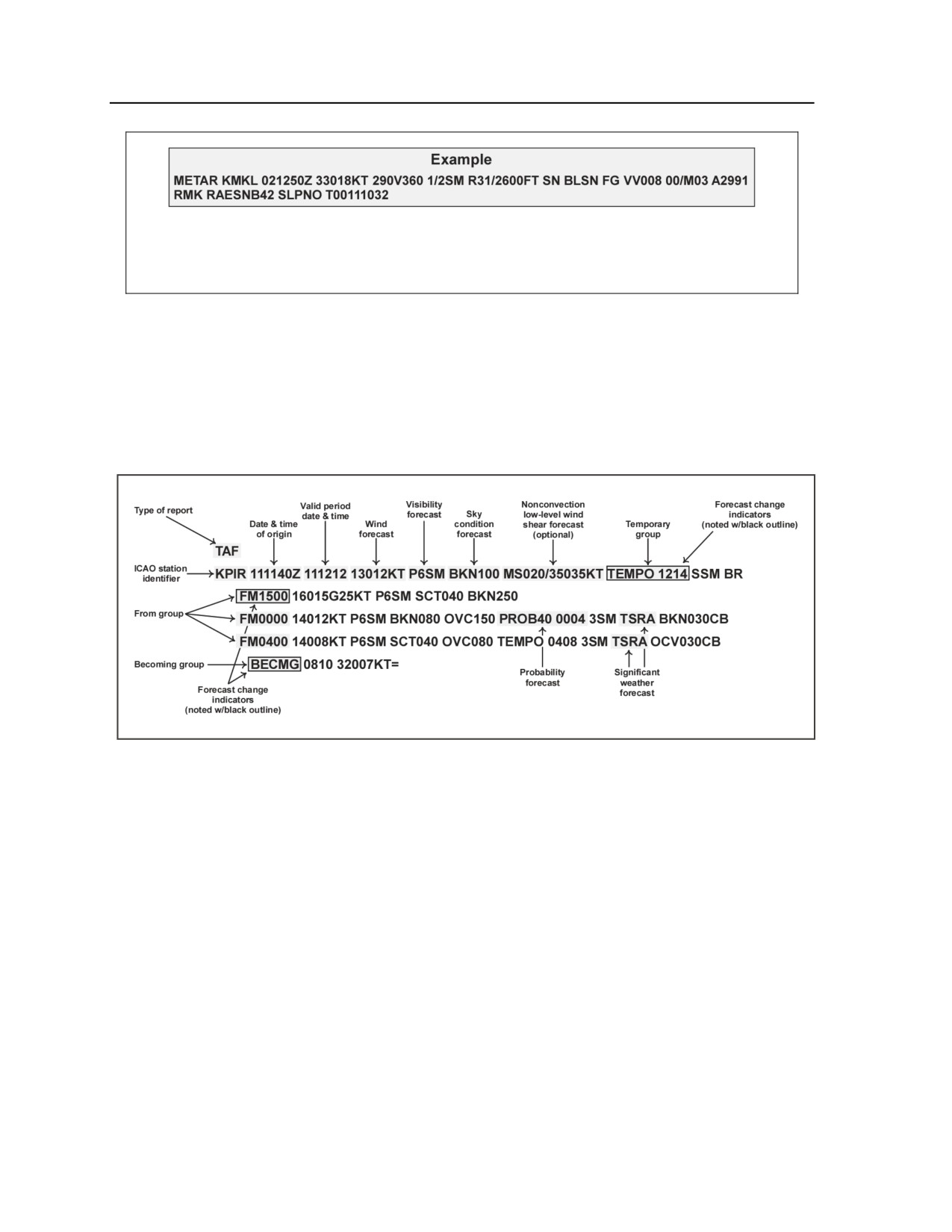
“Jackson (Tennessee), (one two five zero observation), wind three three zero at one eight,
wind variable between two niner zero and three six zero, visibility one half, runway three one
RVR, two thousand six hundred, moderate snow, blowing snow, fog, indefinite ceiling eight
hundred, temperature zero, dew point minus three, altimeter two niner niner one.”
TERMINAL AREA FORECAST
C-51. A TAF (Figure C-7) is a concise statement of expected meteorological conditions within a 5 statute
mile radius from the center of an airport’s runway complex during a
24-hour time period. Some
airfields/airports cover a larger area, such as Cairns (KOZR) TAF, which is valid to a radius of 15 statute
miles. TAFs use weather codes found in METAR weather reports. U.S. Air Force generated TAFs include
forecast elements for icing, turbulence, maximum/minimum temperature, and minimum altimeter.
Figure C-7. Terminal area forecast
C-52. The NWS requires that an airport have two consecutive METAR observations, not less than 30
minutes apart nor more than one hour apart, before a TAF is issued. After it is issued, the forecaster uses
available weather data sources to maintain the TAF. If, during this time, part or all of the METAR is
missing, the forecaster can use other weather sources to maintain the TAF. However, if the forecaster feels
that these sources do not provide necessary information, the forecaster will discontinue the TAF.
C-53. International and U.S. military TAFs also contain forecasts of maximum and minimum temperature,
icing, and turbulence. These three elements are not included in N3WS-prepared TAFs. For forecast icing
and turbulence, see the in-flight aviation weather advisories located at the National Weather Service Web
site http://aviationweather.gov/.
TYPE OF REPORT
C-54. This element denotes the TAF type. Two types of TAF reports are a routine forecast, TAF, and an
amended forecast, TAF AMD. An amended TAF is issued when the forecaster feels that the TAF is not
representative of current or expected weather conditions. An equal sign appears at the end of the TAF
report.
C-16
FM 3-04.240
30 April 2007
Weather Reports and Risk Management
INTERNATIONAL CIVIL AVIATION ORGANIZATION STATION IDENTIFIER
C-55. The TAF code uses ICAO four-letter location identifiers. Paragraph C-11 contains more information
on ICAO identifiers.
DATE AND TIME OF ORIGIN
C-56. This element is the date and UTC that the forecast is prepared. The format is a two-digit date and
four-digit time followed by the letter Z. Routine TAFs are prepared and filed about one-half hour before
scheduled issuance times (111140Z for a forecast prepared on the eleventh day of the month at 1140Z or
050530Z for a forecast prepared on the fifth day of the month at 0530Z).
VALID PERIOD DATE AND TIME
C-57. The valid period of the forecast is a two-digit date followed by the two-digit beginning and two-digit
ending hours in UTC. Routine TAFs are valid for 24 hours and are issued daily at 0000Z, 0600Z, 1200Z,
and 1800Z. Currently, most TAFs are changing over to three times a day at 0000Z, 0600Z, and 1800Z. All
ending times throughout the TAF of 00Z are indicated by the number 24; for example—
Forecast valid from the eleventh at 12Z to the twelfth at 12Z is indicated by 111212.
Forecast valid from the thirtieth at 00Z to the first at 00Z is indicated by 300024.
Amended, canceled, or delayed forecasts may have valid periods less than 24 hours; for example—
Forecast valid from the twenty-third at 15Z to the twenty-fourth at 12Z is indicated by 231512.
Forecast valid from the ninth at 10Z to the tenth at 06Z is indicated by 091006.
C-58. For airports with less than 24-hour observational coverage for which part-time terminal forecasts are
provided, the TAF is valid until the end of the scheduled forecast even if observations have ceased before
that time. Amendment not scheduled (AMD NOT SKED) or no amendment (NIL AMD) is issued after the
forecast information. Amendment not scheduled after closing time (AMD NOT SKED AFT Z) is used if
the observation times are known and judged reliable. During the time that the station is closed and a TAF is
issued, there is no forecast as indicated by NIL (no TAF) after the valid date and time group. Only after
two METARs observations are disseminated is a TAF issued. Amendment limited to clouds, visibility, and
wind (AMD LTD TO CLD VIS AND WIND) is used at observation sites having part-time manual
augmentation, meaning that there will be amendments only for clouds, visibility, and wind and not for
thunderstorms or freezing/frozen precipitation.
WIND FORECAST
C-59. The surface wind forecast is the wind direction in degrees from true north (first three digits) and
mean speed in knots (last two or three digits if 100 knots or greater). KT denotes the units of wind speed in
knots. Wind gusts are noted by the letter G appended to the mean wind speed followed by the highest
expected gust (two or three digits if 100 knots or greater). Calm winds are encoded as 00000KT. A
variable wind is encoded as VRB when wind direction fluctuates because of convective activity or low
wind speeds (3 knots or less). Examples include 13012KT, 18010KT, 35012G26KT, or VRB16G28KT.
VISIBILITY FORECAST
C-60. The prevailing visibility is forecasted in whole and fractions of statute miles followed by SM to note
the units of measurement (5SM). Statute miles followed by fractions of statute miles are separated with a
space (1 1/2SM, 2 1/4SM). Forecasted visibility greater than 6 statute miles is indicated by coding P6SM.
If prevailing visibility is 6 statute miles or less, one or more weather phenomena must be included in the
significant weather forecast. If volcanic ash is forecasted, the visibility must also be forecasted even if the
visibility is greater than 6 statute miles. Sector or variable visibility is not forecasted.
30 April 2007
FM 3-04.240
C-17
Appendix C
SIGNIFICANT WEATHER FORECAST
C-61. Expected weather phenomena are coded in TAF reports using the same format, qualifiers, and
phenomena contractions as METARs (except unknown precipitation [UP]). Obscurations to vision are
forecasted whenever the prevailing visibility is forecasted to be 6 statute miles or less. Precipitation and
volcanic ash will always be included in the TAF regardless of the visibility forecasted; for example—
FM2200 18005KT 1SM BR SKC.
FM0100 12010KT P6SM -RA BKN020.
FM1500 22015KT P6SM VA SCT100.
C-62. If no significant weather is expected to occur during a specific time in the forecast, the weather
group is omitted. However, if after a period in which significant weather has been forecasted, a change to a
forecast of no significant weather (NSW) appears as the weather included in becoming (BECMG) or
TEMPO groups. NSW is not used in the initial time period of a TAF or in FM groups (FM0600 16010KT
3SM RA BKN030 BECMG 0810 P6SM NSW).
C-63. If the forecaster determines weather that affects aviation is within the vicinity of the airport, the
forecaster will include those conditions after the weather group. The letters VC describe conditions that
will occur within the vicinity of an airport (5 to 10 statute miles) and are used only with fog, showers, or
thunderstorms (such as P6SM VCFG, 5SM BR VCSH, and P6SM VCTS).
SKY CONDITION FORECAST
C-64. TAF sky condition forecasts use the METAR format. Cumulonimbus (CB) clouds are the only cloud
type forecasted in TAFs. Examples include BKN100, SCT040 BKN030CB, or FEW008 BKN015.
C-65. When the sky is obscured because of a surface-based phenomenon, vertical visibility (VV) into the
obscuration is forecasted. The format for vertical visibility is VV followed by a three-digit height in
hundreds of feet. Partial obscurations are not forecasted. Remember that a ceiling is the lowest broken or
overcast layer or vertical visibility (VV008).
NONCONVECTIVE LOW-LEVEL WIND-SHEAR FORECAST (OPTIONAL DATA)
C-66. A forecast of nonconvective low-level wind shear is included immediately after the cloud and
obscuration group when wind-shear criteria have been or will be met. The forecast includes the height of
the wind shear followed by the wind direction and wind speed at the indicated height. Height is given in
hundreds of feet AGL up to and including 2,000 feet. Wind shear is encoded with the contraction WS,
followed by a three-digit height, solidus (/), and winds at the height indicated in the same format as surface
winds (WS020/36035KT). The wind-shear element is omitted if not expected to occur.
FORECAST CHANGE INDICATORS
C-67. If a significant change in any of the elements is expected during the valid period, a new time period
with the changes is included. The following change indicators are used when either a rapid, gradual, or
temporary change is expected in some or all of the forecasted meteorological conditions.
From Group
C-68. The “From” (FM) group is used when a rapid and significant change, usually occurring in less than
one hour, in prevailing conditions is expected. Appended to the FM indicator is the four-digit hour and
minute that the change is expected to begin. The forecast is valid until the next change group or until the
end of the current forecast.
C-18
FM 3-04.240
30 April 2007

Weather Reports and Risk Management
C-69. The FM group will mark the beginning of a new line in a TAF report. Each FM group shall contain a
forecast of wind, visibility, weather (if significant), sky condition, and wind shear (if warranted). FM
groups will not include the contraction NSW. The following are examples of FM groups:
FM1500 16015G25KT P6SM SCT040 BKN250.
FM0200 32010KT 3SM TSRA FEW010 BKN030CB.
Becoming Group
C-70. The BECMG group is used when a gradual change in conditions is expected over a period not to
exceed two hours. The time when the change is expected to occur is a four-digit group containing the
beginning and ending hours of the change that follows the BECMG indicator. The gradual change will
occur at an unspecified time within the period. Only the changing forecasted meteorological conditions are
included in BECMG groups. Omitted conditions are carried over from the previous time group (FM2000
18020KT P6SM BKN030 BECMG 0103 OVC015).
C-71. This BECMG group describes a gradual change in sky condition from BKN030 to OVC015. The
change in sky conditions occurs between 01Z and 03Z. Refer to the FM2000 group for the wind and
visibility conditions. The forecast after 03Z will be as follows: 18020KT P6SM OVC015. The report will
read as in the following example.
FM0400 14008KT P6SM SCT040 OVC080 TEMPO 0408 3SM TSRA OVC030CB
BECMG 0810 32007KT=
This BECMG group describes a gradual change in wind direction only beginning between 08Z and 10Z.
Refer to the previous forecast group (in this case, the FM0400 group) for the prevailing visibility, weather,
and sky conditions. The forecast after 10Z will be 32007KT P6SM SCT040 OVC080.
Temporary Group
C-72. The temporary (TEMPO) group is used for temporary fluctuations of wind, visibility, weather, or
sky condition expected to last for generally less than an hour at a time (occasional), and expected to occur
during less than half the time period. The TEMPO indicator is followed by a four-digit group giving the
beginning and ending hours of the time period during which the temporary conditions are expected. Only
the changing forecasted meteorological conditions are included in TEMPO groups. The omitted conditions
are carried over from the previous time group such as in the following example.
FM1000 27005KT P6SM SKC TEMPO 1216 3SM BR.
This temporary group describes visibility and weather between 12Z and 16Z. The winds and sky condition
have been omitted. Go back to the previous forecast group (FM1000) to obtain the wind and sky condition
forecast. The forecast between 12Z and 16Z is 27005KT 3SM BR SKC. The report will read as in the
following example.
FM0400 14008KT P6SM SCT040 OVC080 TEMPO 0408 3SM TSRA OVC030CB
BECMG 0810 32007KT=
C-73. This temporary group describes visibility, weather, and sky condition between 04Z and 08Z. The
winds have been omitted. Go back to the previous forecast group (FM0400) to obtain the wind forecast.
The forecast between 04Z and 08Z is 14008KT 3SM TSRA OVC030CB.
PROBABILITY FORECAST
C-74. The probability (PROB30 or PROB40) forecast describes the probability or chance of thunderstorms
or other precipitation events occurring, along with associated weather conditions (wind, visibility, and sky
conditions). The probability forecast will not be used in the first six hours of the TAF. Probability forecasts
30 April 2007
FM 3-04.240
C-19
Appendix C
are not used in U.S. Air Force generated TAFs. Probability forecasts will be seen in TAFs generated by the
NWS.
C-75. The PROB30 or PROB40 group is used when the occurrence of thunderstorms or precipitation is in
the 30 percent to less than 40 percent or 40 percent to less than 50 percent ranges, respectively. If the
thunderstorm or precipitation chance is greater than 50 percent, it is considered a prevailing weather
condition and is included in the significant weather section or the TEMPO change indicator group.
PROB30 or PROB40 is followed by a four-digit time group giving the beginning and ending hours of the
period during which the thunderstorms or precipitation is expected.
C-76. An example is FM0600 0915KT P6SM BKN020 PROB30 1014 1SM RA BKN015; this example
depicts a 30 percent to less than 40 percent chance of 1 statute mile, moderate rain, and a broken cloud
layer (ceiling) at 1,500 feet between the hours of 10 to 14Z. Another example is FM0000 14012KT P6SM
BKN080 OVC150 PROB40 0004 3SM TSRA BKN030CB; in this example, there is a 40 percent to less
than 50 percent chance of visibility 3 statute miles, thunderstorms with moderate rain showers, and a
broken cloud layer (ceiling) at 3,000 feet with cumulonimbus between the hours of 00 to 04Z.
SECTION II - EN ROUTE WEATHER REPORTS
AUTOMATED SURFACE OBSERVING SYSTEM
C-77. ASOS is sponsored by the FAA, NWS, and DOD. A total of 569 FAA-sponsored and 313
NWS-sponsored ASOSs are installed at airports throughout the country.
C-78. Automated observing systems provide aviators and other users with airport weather observations
(temperature, dew point, wind, altimeter setting, visibility, sky condition, and precipitation) and critical
aviation weather parameters (the runway touchdown zone on the airport) when and where needed. The
systems work nonstop, updating observations every minute, 24 hours a day, every day of the year. By
providing atmospheric information at increasing locations, these systems improve aviation mission safety
and efficiency and weather forecasts and warnings.
C-79. The automated observing system routinely and automatically provides computer-generated voice
directly to aircraft in the vicinity of airports using FAA VHF ground-to-air radio or attached to the ATIS
broadcast. The same information is available via landline, and most data is found on the national weather
data network.
AUTOMATED WEATHER OBSERVING SYSTEM
C-80. AWOS is a suite of sensors that measures, collects, and disseminates weather data. The information
assists meteorologists, aviators, and flight dispatchers in preparing and monitoring weather forecasts,
planning flight routes, and providing takeoff and landing information. AWOSs supply a minute-to-minute
update usually provided to aviators by a VHF radio on frequencies between 118 and 136 megahertz.
AWOSs are categorized as Federal or non-Federal. Federal AWOSs are purchased and maintained by the
FAA. Nonfederal AWOSs are purchased and maintained by state, local, and private organizations. The
sensors measure weather parameters such as wind speed and direction, temperature and dew point,
visibility, cloud heights and types, precipitation, and barometric pressure. The AWOS does not predict
weather, but many send current information to weather offices where forecasts are produced using
compiled information. Every hour on the hour, AWOS data is made available to off-site users by those
AWOSs on Service A (long line telephone communication) or satellite uplink.
C-81. Six AWOS types are available; each includes a different sensor array. Table C-13, page C-21, lists
the differences in models, which correspond to systems described in FAA Advisory Circular 150/5220
16C. Federal AWOSs are all AWOS III. The AWOS data acquisition system (ADAS) for the Federal
AWOS is a powerful microprocessor-based computer system that collects and processes data from AWOS.
It then formats the data for output and dissemination into the NAS.
C-20
FM 3-04.240
30 April 2007

Weather Reports and Risk Management
Table C-13. Automated weather observing system models
Broadcast Information
AWOS Types
I
II
III
III-P
III-T
III-P-T
Wind speed
X
X
X
X
X
X
Wind gust
X
X
X
X
X
X
Wind direction
X
X
X
X
X
X
Variable wind direction
X
X
X
X
X
X
Temperature
X
X
X
X
X
X
Dew point
X
X
X
X
X
X
Altimeter setting
X
X
X
X
X
X
Density altitude
X
X
X
X
X
X
Visibility
X
X
X
X
X
Variable visibility
X
X
X
X
X
Sky condition
X
X
X
X
Cloud height and type
X
X
X
X
Present weather
X
X
Precipitation identification
X
Thunderstorm & lightning detection
X
Present weather & lightning detection
X
SECTION III - WEATHER RISK MANAGEMENT AND DECISION MAKING
C-82. Many weather providers and weather products make it difficult for aviators to screen out
nonessential data, focus on key facts, and correctly evaluate the risk. The perceive-process-perform risk
management framework is a guide for preflight weather planning and in-flight weather decision making:
Perceive weather hazards that could adversely affect the flight.
Process information to determine whether hazards create risk, which is the potential effect of a
hazard not controlled or eliminated.
Perform by acting to eliminate the hazard or mitigate the risk.
PREFLIGHT WEATHER PLANNING
PERCEIVE - UNDERSTANDING WEATHER INFORMATION
C-83. When planning a mission, first check if weather conditions are suitable by collecting information
about current and forecast conditions along the intended route and then develop an understanding of
weather conditions expected along the flight route. If no military weather information is available at the
point of departure, other resources are accessible to aviators. This information becomes even more crucial
when weather becomes questionable.
Television and Internet
C-84. For long-range weather planning, many aviators start with televised weather such as The Weather
Channel (TWC). TWC is not an FAA-approved source of weather information, but its television and
Internet offerings provide tactical and strategic summaries and forecasts (up to 10 per day). The data is
compact and easy to use and can supplement approved sources; for example, one TWC Internet page
includes a weather map with color-coding for IFR and MVFR conditions at airports around the country.
This and other TWC features provide a useful first snapshot of weather conditions needing to be evaluated
more closely. The National Weather Service’s Aviation Weather Center is another useful source of initial
weather information. The AIRMET and SIGMET watch boxes quickly provide a list of marginal or
instrument weather areas.
30 April 2007
FM 3-04.240
C-21
Appendix C
C-85. A printed version of the FSS briefing package is available by obtaining a standard briefing for the
www.duats.com , this resource provides weather information in an FAA-approved format and records the
transaction as an official weather briefing. Printing out selected portions of the DUATS computer briefing
provides for closer study and easy reference when an aviator speaks with an FSS briefer.
C-86. Aviation Digital Data Service (ADDS) is a joint effort of the National Oceanic and Atmospheric
Administration (NOAA) Forecast Systems Laboratory, National Center for Atmospheric Research (NCAR)
Research Applications Program (RAP), and the National Centers for Environmental Prediction (NCEP)
information from NWS aviation observations and forecasts, making the data available on the Internet,
along with visualization tools, for practical flight planning.
Operational Weather Squadron
C-87. OWSs are located worldwide to be the primary 24-hour weather-briefing source. Contact the OWS
responsible for the area. Local base/post weather flights may also assist the aviator if higher priority
tasking and local mission support allow. Contact information is listed in the FIH, section C. When talking
to a military forecaster, provide the following information at least two hours before the desired brief time:
Name of person calling.
Aircraft type and call sign.
VFR or IFR and proposed altitude.
ETD for departure point and ETA for destination and alternates.
Route.
En route stops, if applicable (in order, with ETAs).
Federal Aviation Administration
C-88. The FAA FSS is a source of comprehensive weather information. FSS creates briefing packages
derived from NWS data and other flight planning sources. FSS offers four basic briefing packages:
Outlook (for flights more than six hours away).
Standard (for most flights).
Abbreviated (to update specific items after a standard briefing).
Telephone information briefing service (TIBS), which provides recorded weather information.
C-89. The specific weather information packaged in a standard briefing includes a weather synopsis, sky
conditions (clouds), and visibility and weather conditions at the departure, en route, and destination points.
Also included are adverse conditions, altimeter settings, cloud tops, dew point, icing conditions, surface
winds, winds aloft, temperature, thunderstorm activity, precipitation, precipitation intensity, visibility
obscuration, PIREPs, AIRMETs, SIGMETs, convective SIGMETS, and NOTAMs, including any TFRs.
C-90. A FSS weather briefing can be difficult to absorb via telephone. Pictures display complex, dynamic
information such as cloud cover and precipitation; therefore, it is helpful to begin the preflight planning
process by viewing weather products from a range of providers. The preflight planning process develops
an overall mental picture of current and forecast weather conditions and identifies areas that require help
from the FSS briefer.
Flight Service Station Briefing
C-91. If a local military weather forecaster and OWS are not available, contact an FSS. Once the weather
conditions for the trip are assessed, call FSS. If a DUATS briefing is obtained or the weather situation and
mission are simple, an abbreviated briefing is appropriate. If not, ask for a standard briefing. Armed with
information obtained from the self-briefing process, the aviators finds it easier to absorb new information
from the briefer and can ask questions that are more relevant and specific. Guidelines for obtaining weather
data from FSS include the following:
C-22
FM 3-04.240
30 April 2007
Weather Reports and Risk Management
Contact the right FSS. When dialing the standard number from a cellular phone, the caller is
connected to the FSS associated with the cellular telephone’s area code, not necessarily to the
FSS nearest to present position; when using a cellular telephone outside its normal calling area,
check the airport/facility directory for the specific telephone number of the nearest FSS.
Identify what is needed so that the right briefing package (outlook, standard, or abbreviated) is
requested.
Use the standard flight plan form (FAA Form 7233-1) to provide background to the briefer;
review the form before calling, and develop estimates for items such as altitude, route, and
estimated time en route to ensure receipt of accurate information.
Be honest about any limitations in skill or aircraft capability.
Inform the FSS specialist if new to the area or unfamiliar with the typical weather patterns,
including seasonal characteristics; if unfamiliar with the area, have VFR or IFR navigation
charts available while talking to the specialist to help sharpen the mental picture of the location
of weather hazards in relation to the departure airport, proposed route of flight, and destination.
Ask questions, and clarify any unclear item. Less experienced aviators are sometimes less
assertive; smart aviators ask questions to resolve ambiguities in the weather briefing. The worse
the weather, the more data needed to develop options.
Obtain all weather information needed; if flying in IMC or MVFR that could deteriorate, do not
end the briefing without identifying which direction (north, south, east, west) to turn to fly
toward for better weather and how far it is to reach.
PROCESS—ANALYZING WEATHER INFORMATION
C-92. After obtaining weather information, study and evaluate the information and how it relates to the
circumstances. Aviator training includes weather theory and use of weather products in aviation; however,
it takes continuous study and experience to develop skills in evaluating and applying weather data to a
specific flight. Approach the task of practical, real-world weather analysis with certain concepts in mind.
Weather Elements
C-93. Six basic elements of weather are the following:
Temperature (warm or cold).
Wind (a vector with speed and direction).
Moisture (or humidity).
Clouds.
Precipitation.
Pressure.
C-94. Temperature differences (uneven heating) support development of low-pressure systems, which can
affect wide areas. Surface low-pressure systems usually have fronts associated with them. A front is the
zone between two air masses that contain different combinations of the basic elements. Because weather is
associated with fronts, which are, in turn, associated with low-pressure systems, possible conditions are
revealed by identifying where the low-pressure systems are in relation to the route.
Effects of Weather
C-95. Temperature, wind, and moisture combine to varying degrees to create conditions that affect
aviators. The range of possible combinations is nearly infinite, but weather affects aviators in only three
ways. Specifically, basic weather elements can—
Reduce visibility.
Create turbulence.
Reduce aircraft performance.
30 April 2007
FM 3-04.240
C-23
Appendix C
Evaluate Weather
C-96. Review weather data in terms of how current and forecast conditions will affect visibility,
turbulence, and aircraft performance for the specific flight. For example, suppose the mission is to fly from
Cincinnati Municipal Airport (KLUK) to Ohio State University Airport in Columbus, Ohio (KCMH). The
departure from KLUK is around 1830Z and flies VFR at 5,500 MSL. ETE is about one hour. See table
C-14 for the weather briefing.
C-97. Aviators have the option of receiving this information in plain English format, if preferred, rather
than in code. Whichever format is selected, the first step is to view the weather data in terms of the three
specific ways that weather can affect flight: ceiling visibility, aircraft performance, and turbulence.
Table C-14. Weather briefing
Weather Briefing
METARs:
KLUK 261410Z 07003KT 3SM -RA BR OVC015 21/20 A3001
KDAY 261423Z 14005KT 3SM HZ BKN050 22/19 A3003
KCMH 261351Z 19005KT 3SM HZ FEW080 BKN100 OVC130 22/17 A3002
TAFs:
KLUK 261405Z 261412 00000KT 3SM BR BKN015
TEMPO 1416 2SM -SHRA BR
FM1600 14004KT 5SM BR OVC035
TEMPO 1618 2SM -SHRA BR BKN015
FM1800 16004KT P6SM BKN040
FM0200 00000KT 5SM BR BKN025
TEMPO 0912 2SM BR BKN018
KDAY 261303Z 261312 06003KT 5SM BR SCT050 OVC100
TEMPO 1315 2SM -RA BR BKN050
FM1500 15006KT P6SM BKN050
TEMPO 1519 4SM -SHRA BR BKN025
FM1900 16007KT P6SM BKN035
FM0200 14005KT 5SM BR BKN035
FM0600 14004KT 2SM BR BKN012
KCMH 261406Z 261412 19004KT 4SM HZ SCT050 BKN120
FM1800 17006KT P6SM BKN040
TEMPO 1922 4SM -SHRA BR
FM0200 15005KT 5SM BR BKN035
FM0700 14004KT 2SM BR BKN012
WINDS ALOFT (Direction/Speed [in knots] at Various Altitudes [in feet]):
3000
6000
9000
12000
15000
18000
21000
24000
27000
CMH
1910
2108+15
2807+10
2712+05
2922-07
2936-17
2945-32
2945-40
3138-51
CVG
2310
2607+16
2811+11
2716+06
3019-05
2929-16
2934-30
2932-40
2936-52
C-98. The aviator can organize the information from the weather brief (table C-14) into a locally produced
table, as depicted in table C-15, page C-25, that allows for easier comparisons. The column headings in the
top row, arranged to match the order in which the briefing information is presented, assist in quickly
identifying specific weather hazards possible on the trip. The aviator may convert Zulu (UTC) times to
local times.
C-24
FM 3-04.240
30 April 2007

Weather Reports and Risk Management
Table C-15. Derived mission information
Current Conditions
Visibility &
Turbulence
Ceiling & Visibility
Trends
Performance
Place
Time
Ceiling
Temp/Dewpt
Wind
Visibility
Weather
(feet in
Altimeter
(°C)
hundreds)
KLUK
1410Z
07003KT
3SM
RA, BR
OVC015
21/20
A3001
KDAY
1432Z
14005KT
3SM
HZ
BKN050
22/19
A3003
FEW080,
KCMH
1351Z
19005KT
3SM
HZ
22/17
A3002
OVC130
Forecast Conditions
Turbulence
Ceiling & Visibility
Place
Time
Ceiling (feet in
Wind
Visibility
Weather
hundreds)
KLUK
FM1800Z
16004KT
P6 SM
BKN040
KDAY
TEMPO 1519Z
--
4SM
-SHRA
BKN025
FM1900Z
16007KT
P6 SM
--
BKN035
KCMH
FM1800Z
17006KT
P6 SM
--
BKN040
TEMPO 1922Z
--
4SM
-SHRA, BR
--
Winds Aloft
Visibility &
Turbulence
Performance
Altitude
Place
Wind
(in feet)
(direction/
Temp °C
knots)
CVG
6,000
260/07
16
CMH
6,000
210/08
15
Ceiling and Visibility
C-99. The first columns to view are the weather data elements reporting ceiling and visibility. In the case
of the proposed VFR flight from KLUK to KCMH, current visibility at the departure and destination
airports is marginal and the small temperature/dew point spread should trigger a mental red flag for
potentially reduced visibility. The forecasts call for conditions to improve at the departure airport, KLUK,
by the time of planned takeoff (1830Z).
C-100. It is possible to encounter marginal conditions, including light rain showers, en route and also at
the destination (KCMH). Because the forecast ceilings will probably not allow VFR flight at the planned
altitude
(5,500 feet MSL), this part of the analysis indicates terrain and obstacle avoidance planning
(discussed in the next section) will be necessary if this flight departs at the originally scheduled time.
Aircraft Performance
C-101. Current and forecast temperatures for departure, en route, and destination points are reviewed for
possible adverse effect on aircraft performance. In high temperatures, knowledge and planning for the
effects of high-density altitude—especially on takeoff, climb, and landing—are imperative. If temperatures
are low and flight is planned in the clouds, pay special attention to known or forecast icing and freezing
levels.
C-102. In the sample VFR flight from KLUK to KCMN, temperatures on the surface and at the planned
altitude are moderate. In those conditions, performance problems associated with density altitude or icing
are not likely.
30 April 2007
FM 3-04.240
C-25
Appendix C
Turbulence
C-103. Review wind conditions for departure airport, en route, and destination airport. A mental picture
of vertical wind profiles is also required to select the best altitudes for cruise flight and to determine
whether wind shear is present.
C-104. For the sample flight from KLUK to KCMH, the chart format shows that there are light southerly
surface winds at the departure and destination airports. Winds aloft will also be light but from a westerly
direction. There are no indications for wind shear or convective activity (thunderstorms); therefore, it is
safe to conclude that turbulence is not likely to be a hazard.
PERFORM - MAKING A WEATHER PLAN
C-105. The third step is to perform an honest evaluation of crew/aircraft capability and the challenge
posed by the particular set of weather conditions. Aviators should consider the adequacy of the combined
crew-aircraft team. For example, the crew may be very experienced, proficient, and current, but its weather
flying ability is limited by the aircraft model. On the other hand, the aircraft may be technically
advanced—with moving map GPS, weather data link, and autopilot—but the crew does not have much
weather flying experience. An airplane’s capability can never fully compensate for lack of experience. The
crew must be fully proficient in the use of onboard equipment and verify proper function.
C-106. Self-check the decision (regardless of experience). If the result of the evaluation process leaves
any doubt, then develop safe alternatives. Think of the preflight weather plan as a strategic, overarching
exercise. The goal is to ensure that all of the weather-related hazards for this particular flight are identified
and that ways to eliminate or mitigate each one are planned. There are several items to include in the
weather flying plan.
Escape Options
C-107. A good aircrew knows where to find good weather within the aircraft’s range and endurance
capability. The aircrew must know where it is, which direction to turn to get there, and how long it will
take to get there. When the weather is IMC (ceiling less than 1,000 feet or visibility less than 3 statute
miles), identify an acceptable alternative airport for each 25 to 30 nautical-mile segment of the route.
Reserve Fuel
C-108. Identifying the location of VFR weather does no good unless there is adequate fuel to reach it.
Flight planning for only a legal fuel reserve could significantly limit options if weather deteriorates. More
fuel means access to more alternatives and frees the aircrew from the worry (and distraction) of fuel
exhaustion when weather has already increased the cockpit workload.
Terrain Avoidance
C-109. Recognize altitude limitations to avoid encountering terrain and/or obstacles. Consider a terrain
avoidance plan for any flight involving the following conditions:
Weather at or below MVFR (ceiling 1,000 to 3,000 feet; visibility 3 to 5 miles).
A temperature/dew-point spread of 4°C or less.
Any expected precipitation.
Operating at night.
C-110. Identify the MSA for each segment of the flight. All VFR sectional charts include a maximum
elevation figure (MEF) in each quadrangle. The MEF is determined by locating the highest obstacle
(natural or manmade) in each quadrangle and rounding up 100 to 300 feet. Charts for IFR navigation
include an MEA and an MOCA. Jeppesen (civilian) charts depict a minimum off route altitude (MORA),
while FAA/NACO charts show an OROCA that guarantees a
1,000-foot obstacle clearance in
nonmountainous terrain and a 2,000-foot obstacle clearance in mountainous terrain. In addition, many GPS
C-26
FM 3-04.240
30 April 2007
Weather Reports and Risk Management
navigators (panel mounted and handheld) include a feature showing the MSA, en route safe altitude (ESA),
or MEA relative to the aircraft’s position. If there is access to such equipment, an understanding of how to
access and interpret the information regarding safe altitudes is necessary.
Passenger Plan
C-111. A number of weather accidents have been associated with external or peer pressures such as
reluctance to disappoint passengers eager to make or continue a mission. There is almost always pressure
to launch and pressure to continue. Even the small trip to the hangar can create pressure to avoid wasted
time. For this reason, weather planning should include briefing the passengers (and anyone waiting at the
destination) in addition to preflighting the aircraft. By jointly planning for weather contingencies and
briefing passengers before boarding the aircraft, the aviator will be under less pressure to continue in
deteriorating weather conditions. Suggestions include the following:
Understand the minimums that help build the toughest go/no-go and continue/divert decisions
well in advance of any flight.
Understand that the presence of others can influence decision making and willingness to take
risks; emphasize to passengers that safety is the priority.
Establish weather checkpoints every 25 to 30 nautical miles along the route, at which to
reevaluate conditions; if possible, have passengers assist by tracking progress and conditions at
each weather checkpoint.
Use preestablished minimums to determine exactly what conditions will trigger a diversion at
any given weather checkpoint; let passengers know what these conditions are.
Decide specific actions to take if diversion is required at any particular point, and inform
passengers during the briefing; preflight is the time to make alternative arrangements if weather
conditions worsen.
Inform personnel at the destination that plans are flexible and they will be kept informed; be
sure they understand that safety is the priority and that a delay or cancellation is possible if
weather becomes a problem.
Wait out bad weather, especially involving weather fronts; bad weather normally does not last
long, and waiting just a day can often make the difference between attempting a high weather
risk flight and a flight that falls within safety guidelines.
IN-FLIGHT DECISION MAKING
PERCEIVE—OBTAINING IN-FLIGHT WEATHER INFORMATION
C-112. Often, weather is not forecast to be severe enough to cancel the mission so aviators often choose to
take off and evaluate the weather in flight. It is not necessarily incorrect to take off and evaluate the
situation, but it is important to stay alert to weather changes. Aviators and their aircraft operate in (rather
than above) most weather. At typical aircraft speeds, a 200-mile trip can leave a two- to three-hour weather
information gap between the preflight briefing and the actual flight. Therefore, this gap makes in-flight
updates vital.
Visual Updates
C-113. Survey the weather, and determine whether conditions around the aircraft match conditions
reported or forecasted. Sometimes there are local deviations in weather conditions (such as isolated cells
and fog) that may not be immediately known to the weather briefer or may not appear on weather-product
depictions, especially if there is no weather-reporting capability at the departure point. Next Generation
Weather Radar (NEXRAD) information is at least 6 to 10 minutes old when it reaches the display—and is
older still by departure time.
30 April 2007
FM 3-04.240
C-27
Appendix C
En Route Weather Conditions
C-114. To monitor conditions en route, aviators can listen to ATIS and ASOS/AWOS broadcasts along
the route. These broadcasts help update and corroborate preflight weather information about conditions
along the route of flight.
En Route Flight Advisory Service or Flight Watch and Pilot-To-Metro
C-115. Available on 122.0 CONUS from 5,000 AGL to 17,500 MSL (124.67 at higher altitudes), EFAS
(addressed as Flight Watch) is a service that provides en route aircraft with timely and meaningful weather
advisories pertinent to the type of flight intended, route of flight, and altitude. Request permission from
ATC to leave the frequency to contact EFAS, and then provide EFAS with the aircraft identification and
name of the VOR nearest to the position of the aircraft. Consult the FIH for current Pilot-to-Metro Service
frequencies and instructions.
Air Traffic Control
C-116. Monitoring ATC frequencies along the way keeps the aircrew abreast of changing weather
conditions. Monitor if other aircraft along the route are requesting diversions. Aviators can also request
information on the present location of weather, which the controller will try to provide if workload permits.
When requesting weather information from ATC, be aware that radar, the controller’s primary tool, has
limitation, and that operational considerations (use of settings that reduce the magnitude of precipitation
returns) will affect what the controller sees on radar.
Datalink and Weather Avoidance Equipment
C-117. Radar and lightning detectors, available in some aircraft for many years, contribute significantly to
weather awareness in the cockpit. An increasing number of aircraft are now equipped with weather data
link equipment, which uses satellites to transmit weather data—such as METARs, TAFs, and NEXRAD
radar—to the cockpit. It is often shown as an overlay on the multifunction display (MFD). Handheld
devices with weather data link capability are also a popular source of en route weather information.
PROCESS—EVALUATING AND UPDATING IN-FLIGHT CONDITIONS
Visual Updates
C-118. Humans are conditioned to believe what they see. The eyes perceive weather during flight, but
prior visual experience largely determines our ability to see things. Like other sensory organs, the eye
responds best to changes. It adapts to circumstances that do not change or those that change in a gradual or
subtle way by reducing its response. Just as the skin becomes acclimated to the feel of clothing, the eye
becomes accustomed to progressive small changes in light, color, and motion so that it no longer visualizes
an accurate picture. In deteriorating weather conditions, reduction in visibility and contrast occurs quite
gradually and it may be some time before the aviator senses that weather conditions have deteriorated
significantly. Therefore, aviators must learn how to look past the visual illusion and see what is really
there.
In-Flight Weather Information
C-119. In-flight weather information obtained from ATIS and ASOS/AWOS broadcasts can contribute
useful pieces to the en route weather picture; however, this information is only a weather snapshot of a
limited area. ATIS and ASOS/AWOS broadcasts are primarily intended to provide information on
conditions in the airport vicinity.
C-120. The information reported is derived from an array of sensors. While designed to be as accurate as
possible and becoming increasingly sophisticated, these automated systems actually monitor a very small
area on the airfield and report only what the sensors can see. For example, sensors measuring visibility
C-28
FM 3-04.240
30 April 2007

Weather Reports and Risk Management
actually measure a section of air less than 24 inches wide. Even a dense fog on a portion of the airfield will
go undetected by the system unless the fog obscures the sensors. The system will not identify an
approaching thunderstorm until it is almost directly over the automated site’s ceiling instruments.
En Route Flight Advisory Service
C-121. If deteriorating conditions are suspected or encountered while en route, contact EFAS-Flight
Watch or PMSV for additional information. EFAS can be a helpful resource, but interpreting and applying
the information received while flying the aircraft—especially in adverse or deteriorating conditions with no
autopilot—can be difficult. The aviator needs to understand where the weather is in relation to present
position and flight path, where it is going, and how fast it is moving. It is good practice to have an
aeronautical chart, with the route clearly marked, readily available before calling Flight Watch/PMSV. The
chart helps the aviator visualize where weather conditions are located in relation to current position and
intended route of flight and determine whether (and where) a deviation from the original plan is required.
Air Traffic Control
C-122. Radar identifies only entities that reflect energy, including precipitation, the density of which is
indicated by the strength of the return. Radar does not detect turbulence, but its existence may sometimes
be implied by the intensity of a precipitation return: the stronger the return, the more likely the presence of
turbulence. In addition, icing is not directly evident but may be inferred by the presence of moisture,
clouds, and precipitation at temperatures at or below freezing.
C-123. ATC radar capacity is limited by the kind of equipment in use. Older radars only depict primary
radar returns, and controllers using these units often use a device known as circular polarization (CP) to
reduce the magnitude of precipitation returns so that aircraft targets are more clearly visible. In these cases,
the weather information displayed is reduced and understated. In general, TRACON radar systems have
greater weather capability than ATTC radar with respect to depicting weather. Terminal ATC facilities
equipped with the latest radar systems can measure precipitation intensity and display it to the controller in
six levels of intensity (table C-16).
Table C-16. Radar system precipitation intensity levels
Level
Intensity
Level
Intensity
1.
Light precipitation
4.
Heavy rain
2.
Light to moderate rain
5.
Very heavy rain; hail possible
3.
Moderate to heavy rain
6.
Very heavy rain and hail; large hail possible
C-124. Interpreting weather information from ATC is facilitated through a thorough understanding of
pilot-controller communications. In recent years, several general aviation accidents have occurred in which
the effectiveness of information provided by ATC was diminished because aviators and controllers
interpreted the same terms in different ways. Never make assumptions regarding ATC-provided en route
information. Be specific, and do not hesitate to ask questions to clarify points not understood.
Datalink and Weather Avoidance Equipment
C-125. The quality of datalink and weather avoidance equipment information depends heavily upon
update rate, resolution, and coverage area. When an aviator is flying an aircraft that has datalink
equipment, safe and accurate interpretation of information received depends on understanding of each of
these parameters.
C-126. Data link does not provide real-time information. Although weather and other navigation displays
can give aviators an unprecedented quantity of high-quality weather data, their use is safe and appropriate
only for strategic decision making (attempting to avoid the hazard altogether). Data link is not accurate or
current enough to be safely used for tactical decision making (negotiating a path through a weather hazard
area such as a broken line of thunderstorms). Be aware that onboard weather equipment can
30 April 2007
FM 3-04.240
C-29
Appendix C
inappropriately influence the decision to continue a flight. No matter how thin a line of storms appears to
be or how many holes appear on the display, there is no safe path through them.
PERFORM—PUTTING IT ALL TOGETHER
C-127. During the preflight planning process, the aircrew develops a strategic, overarching flight plan
based on weather data and analysis. During the en route phase, use the data and analysis to make tactical
weather decisions. Tactical weather flight requires perception of the conditions, processing (interpreting)
their effect on the flight, and performing by taking appropriate action at each stage. Steps include the
following:
Reassess weather on a continuous basis; designate specific fixes (airports) on or near the flight
path as weather checkpoints, and use in-flight resources to get updated information.
Take action if deteriorating weather is suspected:
Trust the eyes if weather conditions appear to be deteriorating.
Contact EFAS/PMSV for detailed information.
Proceed to the nearest airport if clouds form at a lower altitude, or if there are gray or black
areas ahead, hard rain or moderate turbulence, or clouds forming above that require
descent; reevaluating and implementing a new plan are easier from the safety of an airport.
Contribute to the system by making PIREPs. Format is not important; offer the information, and
the specialist will put it into the appropriate format for distribution.
Air Traffic Control
C-128. If ATC help is necessary to avoid or escape bad weather, ask sooner rather than later. Guidelines
include the following:
Be sensitive to ATC communications workload, but keep controllers advised of weather
conditions; tell the controller if deviation is required to avoid a weather hazard.
Navigational guidance information issued to a VFR flight is advisory; suggested headings do not
authorize violation of regulations and do not guarantee clearance of all weather.
Ask questions, and ask for clarification if a point is not understood.
Do not assume that the controller is knowledgeable about the flight:
If ATC is needed to avoid convective weather, inform the controller that the aircraft has no
onboard weather avoidance equipment.
If given to another controller while on a suggested heading for weather avoidance, confirm
that the next controller knows the original request was for weather avoidance assistance;
for example, the initial call might be: “Center, Army 12345, level 5,000, 020 heading for
weather avoidance.”
Never assume that “cleared direct when able” means flying a direct course at that time will
keep the aircraft clear of weather; to ATC, “direct when able” means to fly direct when able
to navigate directly to the fix. When in doubt, ask if a direct course will keep the aircraft
clear of moderate and heavy radar return areas indicative of thunderstorm activity.
Words such as showers and precipitation are misleading. Some aviators mistakenly assume
that these words indicate areas of rain with no thunderheads present. Do not proceed into
areas of showers or precipitation without clarifying the level of precipitation or a descriptor
such as light, moderate, or heavy; the difference between Level 1 precipitation and Level 4
precipitation can be fatal.
POSTFLIGHT WEATHER REVIEW
C-129. After a challenging flight in weather, an aviator’s initial impulse may be to go home and unwind;
however, the immediate postflight period is one of the best opportunities to increase weather knowledge
and understanding. Studies show that aviators sometimes fly into bad weather because they lack relevant
C-30
FM 3-04.240
30 April 2007
Weather Reports and Risk Management
experience and did not recognize certain weather cues that might create a safety hazard to the flight. Make
it a point to learn something from every weather encounter. At the end of a flight involving weather,
mentally review the flight and reflect on what was learned from the experience. A possible postflight
weather after action report (AAR) can consist of the following questions:
What weather conditions/hazards existed, and how did they affect this flight? (Examples include
turbulence and winds, ceilings and visibility, and aircraft performance.)
How did the conditions encountered during this flight compare to information obtained in the
preflight briefing?
Which sources of preflight weather information provided the best
(or most useful, most
accurate, most relevant) data for this flight?
Which sources of en route weather information provided the best (or most useful, most accurate,
most relevant) data for this flight?
C-130. Aviators can also develop weather experience and judgment by observing and analyzing the
weather every day. Look out the window or go outside to observe the clouds. What are they doing? Why
are they shaped as they are? Why is their altitude changing? This simple habit helps develop the ability to
read clouds and understand how shape, color, thickness, and altitude can be valuable weather indicators.
As cloud-reading skill develops, try to correlate temperature, dew point, humidity, and time of day to the
types of clouds forming. Take note of the wind, and try to visualize how it wraps around the tree or whips
around the corner of a building. This exercise increases awareness of wind at critical points in the flight.
Developing weather knowledge and expertise helps keep the crew and passengers safe.
30 April 2007
FM 3-04.240
C-31

Appendix D
Internet Resources
D-1. The list provided in table D-1 is not meant to be all inclusive. This appendix provides a starting point
for aviators to obtain the latest, accurate information needed to conduct flight operations. Bookmarked web
sites addresses do change periodically. Some of these sites are nongovernmental; Web sites without .mil or
.gov extensions should be used with discretion by the aviator.
Table D-1. Internet resources for flight operation planning
Proponent
Internet Address
Air Force
Publications
Weather Agency
AOPA
Web site
Online Courses
Army
USAASA
ASOS/AWOS
Trainer’s Tool Box
FAA
DUATS
CSC DUATS
(CPU-26A/P)
Emulator
FAA
Air Traffic Publications
FLIP
FAA
NGA
General
AVweb
FAA
Whittsflying (Gene Whitt’s Web site)
GPS
U.S. Army program manager site (GPS)
FAA
ICAO
ICAO
NOTAMs
DOD
FAA
Planning
30 April 2007
FM 3-04.240
D-1

Appendix D
Table D-1. Internet resources for flight operation planning
Proponent
Internet Address
enflight
FAA
Baseops Network
Distance calculations
Fuel
RVSM
FAA
Training
Aeromedical
Tutorials
Flight Simulator Navigation
Approach charts
Weather
Intellicast
METAR/TAF information
NOAA National Weather Center Aviation
site
Pilot’s Guide FAA/NWS
D-2
FM 3-04.240
30 April 2007
Appendix E
Aircrew Coordination and Instrument Flight
This appendix describes the background of crew coordination development, crew
coordination elements, basic qualities, and objectives as found in the Army Aircrew
Coordination Training Enhancement
(ACTE) Program. The focus is crew
coordination as it applies to instrument flight.
Note. Digitization of crew compartments has expanded and redefined the lines of responsibility
for each crew member. The ability of either crew member to perform most aircraft/system
functions from his crew station breaks down the standard delineation of duties, allowing the
crew added capabilities in training and combat. A crew member can attempt to resolve an
unforeseen circumstance without the assistance of another crew member; therefore, good
communication among crew members is necessary. The PC must brief specific duties before
stepping into the aircraft.
CREW COORDINATION BACKGROUND
E-1. Many aircraft accidents result from one or more crew coordination errors committed before or during
the mission. Often, an accident is the result of a sequence of undetected crew errors that combines to
produce a catastrophic result. Continued research shows that even when accidents are avoided, crew
coordination errors result in degraded mission performance. A systematic analysis of error patterns
indicates specific areas that crew-level training could improve. Improved training can reduce the
occurrence of such errors and can break the chain of errors that cause accidents and poor mission
performance.
CREW COORDINATION ELEMENTS
E-2. Broadly defined, aircrew coordination is the interaction between crew members necessary for safe,
efficient, and effective performance of tasks. The essential elements of crew coordination include the
following:
Communicate positively. Good cockpit teamwork requires clear communication among crew
members; when the sender directs, announces, requests, or offers information, the receiver
acknowledges the message while the sender confirms it based on the receiver’s
acknowledgment.
Direct assistance. A crew member directs assistance when he cannot maintain aircraft control.
(During ITO, pilot on the controls [P*] calls for the copilot to call out airspeed, torque, and
climb rate); he also directs assistance when aircraft systems are not operating properly and
assistance is required of the other crew member.
Announce actions. Effective and well-coordinated actions in the aircraft require all crew
members to be aware of expected crew movements and unexpected individual actions; each
crew member announces actions affecting the duties of other crew members.
Offer assistance. A crew member provides assistance or information, when requested.
Acknowledge actions. Communications in the aircraft must include supportive feedback to
ensure that crew members correctly understand announcements or directives.
30 April 2007
FM 3-04.240
E-1
Appendix E
Be explicit. Crew members use clear terms and phrases and positively acknowledge critical
information. Avoid using terms having multiple meanings, such as “Right,” “Back up,” or “I
have it.” Also avoid statements such as “Do you see that?” or “You are coming in a little
fast/slow.”
Provide aircraft control and obstacle advisories. Although the P* is responsible for aircraft
control, other crew members should provide aircraft control information regarding airspeed,
altitude, or heading.
Coordinate action sequence and timing. Proper sequencing and timing ensures that the actions
of one crew member will mesh with the actions of another crew member.
CREW COORDINATION BASIC QUALITIES
E-3. Crew coordination elements are further broken into a set of 13 basic qualities. Each basic quality is
defined in terms of observable behaviors that support the elements.
FLIGHT TEAM LEADERSHIP AND CREW CLIMATE
E-4. Aircrews have a designated leader with clear lines of authority and responsibility. The PC sets the
tone for the crew and maintains the working environment. Effective leaders use their authority but do not
operate without the participation of other crew members. When crew members disagree on a course of
action, they must effectively resolve the disagreement. Specific goals include the following:
The PC actively establishes an open climate in which crew members talk freely and ask
questions.
Crew members value each other for their expertise and judgment; they do not allow differences
in rank and experience to influence their willingness to speak up.
Alternative viewpoints are normal and part of crew interaction; crew members must handle
disagreements in a professional manner, and avoid personal attacks or defensive posturing.
The PC actively monitors attitudes of crew members and offers feedback, when necessary; each
crew member should display appropriate concern for balancing safety with mission
accomplishment.
PREMISSION PLANNING AND REHEARSAL
E-5. Premission planning includes all preparatory tasks associated with planning the mission. These tasks
include planning for VFR or IFR flight. They also include assigning crew member responsibilities and
conducting all required briefings and back briefs. Premission rehearsal involves the crew collectively
visualizing and discussing expected and possible events for each phase of the mission. Specific goals
include the following:
The PC ensures that all actions, duties, and mission responsibilities are clearly assigned to
specific crew members. Each crew member actively participates in the mission planning process
to ensure a common understanding of mission intent and operational sequence; the PC
prioritizes planning activities so that critical items are addressed within the available planning
time.
Crew members identify alternate courses of action in anticipation of potential weather changes.
Crew members must be prepared to implement contingency plans when required. Crew
members mentally rehearse the entire mission by visualizing and discussing potential problems,
contingencies, and responsibilities.
The PC ensures that crew members take advantage of periods of low workloads to rehearse
upcoming flight segments; crew members continuously review remaining flight segments to
identify and implement required adjustments.
E-2
FM 3-04.240
30 April 2007