FM 3-04.240 Instrument Flight for Army Aviators (April 2007) - page 6
This page intentionally left blank.
Chapter 9
Air Traffic Control System
This chapter provides a general overview of communication equipment,
communication procedures, and ATC facilities and services available for IFR flight in
the NAS. Specific and detailed information is provided in FAA Order 7110.10, AIM,
Instrument Flying Handbook, Instrument Procedures Handbook, and other
FAA/ICAO publications and Web sites.
COMMUNICATIONS
EQUIPMENT
Navigation/Communication Equipment
9-1. Aviators communicate with ATC on VHF and
UHF frequencies. If ATC assigns a frequency that
Contents
cannot be selected on the assigned radio, ask for an
alternative frequency. Some AFSSs can be
Communications
9-1
communicated with by transmitting on
122.1
Control Sequence
9-6
megahertz (selected on the communication radio)
Letters of Agreement
9-8
and receiving on a VOR frequency (selected on the
navigation radio). This is called duplex operation.
Radar and Transponders
9-2. ATC radars are able to display energy reflected from an aircraft’s metallic structure, which is
displayed as a primary return. Some ATC radars are also able to display secondary returns. A secondary
return, which relies on transponder replies to ground interrogation signals, is able to display aircraft-
specific information. This information can be used with automation.
9-3. A transponder is a radar beacon transmitter/receiver installed in the instrument panel. ATC beacon
transmitters send out interrogation signals continuously as the radar antenna rotates. When an interrogation
is received by the transponder, a coded reply is sent to the ground station for display on the controller’s
scope. Transponder codes are assigned by ATC.
9-4. When a controller asks the aviator to IDENT and he pushes the IDENT button, the return on the
controller’s scope is intensified for precise identification of the flight. When requested, briefly push the
IDENT button to activate this feature. A good practice is to verbally confirm to ATC that the codes have
been changed or the IDENT button has been pushed.
9-5. Secondary radar returns can display Mode C altitude reporting on the control scope if the aircraft is
equipped with an encoding altimeter or blind encoder. When the transponder’s function switch is in the
altitude (ALT) position, the aircraft’s pressure altitude is sent to the controller. Adjusting the altimeter’s
Kollsman window has no effect on the altitude read by the controller. (Primary radar returns provide only
range and bearing information from the radar antenna to the target.)
9-6. Transponders must be on whenever the aircraft is operating in controlled airspace. Mode C altitude
reporting is required by regulation in Class B and Class C airspace and inside of a 30-mile circle
surrounding the primary airport in Class B airspace. Altitude reporting should be on at all times.
30 April 2007
FM 3-04.240
9-1
Chapter 9
PROCEDURES
9-7. Clarity in communication is essential for safe instrument flight and requires aviators and controllers
to use terms understood by both. The pilot/controller glossary in the AIM is the best source of terms and
definitions. The AIM is revised twice a year, and new definitions are added. Review the glossary
frequently. Because clearances and instructions are composed largely of letters and numbers, a phonetic
pronunciation guide has been developed for both.
9-8. Air traffic controllers must follow the guidance of FAA Order 7110.65 when communicating with
aviators. The manual presents the controller with different situations and prescribes precise terminology to
be used. This is advantageous for aviators because a recognized pattern or format can be expected.
Controllers are faced with a variety of communication styles based on aviator experience, proficiency, and
professionalism.
9-9. Aviators should study the examples in the AIM, listen to other aviators communicate, and apply
lessons learned to their own communications with ATC. Aviators should ask for clarification of a clearance
or instruction, when needed. Use plain English to ensure understanding, and expect the controller to reply
in the same way. A safe instrument flight is the result of cooperation between controller and aviator.
FACILITIES
9-10. The controller’s primary responsibility is separation of aircraft operating under IFR. Separation of
aircraft is achieved using ATC facilities, which include the AFSS, airport traffic control tower (ATCT),
terminal radar approach control (TRACON), and ARTCC.
Automated Flight Service Station
9-11. The first contact with ATC will likely be through AFSS, either by radio or telephone. AFSSs provide
pilot briefings, receive and process flight plans, relay ATC clearances, originate NOTAMs, and broadcast
aviation weather. Some facilities provide EFAS, take weather observations, and advise United States
Customs and Immigration of international flights.
9-12. Telephone contact with flight service is obtained by dialing 1-800-WX-BRIEF anywhere in the
United States for connection to the nearest AFSS based on the area code from which the aviator is calling.
There are a variety of methods for making radio contact: direct transmission, RCOs, ground
communication outlets (GCOs), and using duplex transmissions through NAVAIDs. The best source of
information on frequency usage is the A/FD. The legend panel on sectional charts also contains contact
information.
9-13. The briefer sends the flight plan to the host computer at the ARTCC. After processing, the computer
sends flight strips to the tower, radar facility handling the departure route, and center controller in whose
sector the aviator will first enter. These strips are delivered about 30 minutes before the proposed departure
time. Strips are delivered to en route facilities 30 minutes before the aviator is expected to enter their
airspace. If the aviator fails to open the flight plan, the flight plan will time out 2 hours after the proposed
departure time.
9-14. When departing an airport in Class G airspace, the aviator receives IFR clearance from the AFSS by
radio or telephone. The clearance contains either a clearance void time (the aviator must be airborne before
this time) or a release time (the aviator should not be airborne before this time). Aviators can help the
controller by stating how soon they expect to be airborne. If, for example, the void time is 10 minutes past
the hour and the aviator is airborne at exactly 10 minutes past the hour, the clearance is void; he must be
airborne before the void time. Aviators may ask for a specific void time when filing their flight plan.
Air Traffic Control Towers
9-15. Several controllers in the tower cab are involved in handling instrument flight. Where there is a
dedicated clearance delivery position, that frequency is found in the A/FD and on the instrument approach
chart for the departure airport. Where there is no clearance delivery position, the ground controller
9-2
FM 3-04.240
30 April 2007
Air Traffic Control System
performs this function. At the busiest airports, pretaxi clearance is required; the frequency for pretaxi
clearance can be found in the A/FD. Taxi clearance should be requested not more than 10 minutes before
proposed taxi time.
9-16. IFR clearances should be read back to the clearance delivery controller. Instrument clearances can be
overwhelming when the aviator copies them verbatim. IFR clearances typically begin with the clearance
limit (usually the destination airport) and then continue with the route, including any DP; initial altitude;
frequency (for departure control); and transponder code. With the exception of the transponder code, most
of these items are known before engine start. Clearances will be issued according to FAA Order 7110.65,
as appropriate, in the following order:
Aircraft identification.
Clearance limit.
SID.
Route of flight including preferential departure route/preferential departure arrival
route/preferred arrival route, when applied.
Altitude data in the order flown.
Holding instructions.
Any special information.
Frequency and beacon code information.
9-17. One technique for copying clearances is writing CRAFT (clearance, route, approach, frequency, and
transponder code) down the left side of a page. Refer to the following example.
Example of IFR Clearance (using CRAFT)
An aviator has filed an IFR flight plan from Seattle, Washington, to Sacramento,
California, via V-23 at 7,000 feet. He notes that traffic is taking off to the north from
Seattle-Tacoma
(Sea-Tac) airport and, by monitoring the clearance delivery
frequency, notes the DP being assigned to southbound flights. The clearance limit
will be the destination airport, so he writes
“SAC” after the letter C. He writes
“SEATTLE TWO-V23” after R for route, because departure control has issued this
departure to other flights (the aviator could also call the tower via telephone to ask
what departure is in use). He writes “7” after the A and the departure control
frequency printed on the approach charts for Sea-Tac after F, and leaves the space
after T blank-the transponder code is generated by computer and can seldom be
determined in advance. Then he calls clearance delivery and reports ready to copy.
As the controller reads the clearance, the aviator confirms what he has already
written down; if there is a change, he draws a line through that item and writes in the
changed item. Chances are that changes will be minimal, and he will have copied
most of the clearance before keying the microphone. Developing clearance
shorthand to cut down on the verbiage that must be copied is worthwhile.
9-18. Either the text or a graphic representation of a DP is required (if one is available) and should be
reviewed before accepting a clearance. This is another reason for the aviator to find out beforehand which
DP is in use. If the DP includes an altitude or a departure control frequency, those items will not be
included in the clearance from the tower cab.
9-19. The last clearance received supersedes all previous clearances. For instance, if the DP is “Climb and
maintain 2,000 feet, expect higher in 6 miles” and upon contacting the departure controller, the aviator is
told “Climb and maintain 8,000 feet,” the 2,000-foot restriction has been canceled. This rule applies in
terminal and center airspace. If the aviator is ready to copy the IFR clearance before the strip has been
received from the center computer, he will be advised “clearance on request” and the controller will call
when the clearance has been received.
30 April 2007
FM 3-04.240
9-3
Chapter 9
9-20. The local controller is responsible for operations in Class D airspace and on active runways. At some
towers designated as IFR towers, the local controller has vectoring authority. At VFR towers, the local
controller accepts inbound IFR flights from the terminal radar facility and cannot provide vectors. The
local controller also coordinates flights in the local area with radar controllers. Although Class D airspace
normally extends 2,500 feet above field elevation, towers frequently release the top 500 feet to the radar
controllers to facilitate overflights. Accordingly, when a flight is vectored over an airport at an altitude that
appears to enter the tower controller’s airspace, there is no need to contact the tower controller—all
coordination is handled by ATC.
9-21. The departure radar controller may be in the same building as the control tower, but often the
departure radar position is remotely located. The tower controller will not issue a takeoff clearance until the
departure controller issues a release.
Terminal Radar Approach Control
9-22. TRACONs are considered terminal facilities because they provide the link between the departure
airport and en route structure of the NAS. Terminal airspace normally extends 30 nautical miles from the
facility with a vertical extent of 10,000 feet; however, dimensions vary widely. Class B and Class C
airspace dimensions are provided on aeronautical charts. At terminal radar facilities, the airspace is divided
into sectors, each with one or more controllers. Each sector is assigned a discrete radio frequency. All
terminal facilities are approach controls and should be addressed as “Approach” except when directed to
do otherwise: “Contact departure on 120.4.”
9-23. Terminal radar antennas are located on or adjacent to the airport. Terminal controllers can assign
altitudes lower than published procedural altitudes, called minimum vectoring altitudes (MVAs). MVAs
are not published or accessible to aviators but are displayed at the controller’s position. However, if
altitude assigned seems too low, confirm before descending.
9-24. When the aviator receives and accepts his clearance and reports ready for takeoff, a controller in the
tower contacts the TRACON for a release; the aviator will not be released until the departure controller can
fit the flight into the departure flow and may have the aviator hold for release. When the aviator receives
takeoff clearance, the departure controller is advised of the flight and awaits a call from the aviator. All of
the information that the controller needs is on the departure strip or computer screen; there is no need to
repeat any portion of the clearance to that controller. Simply establish contact with the facility when
instructed to do so by the tower controller. The terminal facility computer detects and tracks assigned
transponder codes; for this reason, the transponder should remain on standby until takeoff clearance has
been received.
9-25. The aircraft will appear on the controller’s radar as a target with an associated data block that moves
as the aircraft moves through the airspace. The data block includes aircraft identification and type, altitude,
and airspeed. A TRACON controller uses airport surveillance radar (ASR) to detect primary targets and
automated radar terminal systems (ARTSs) to receive transponder signals. These two are combined on the
controller’s scope.
9-26. At facilities with ASR-3 equipment, radar returns from precipitation are not displayed as varying
levels of intensity and controllers must rely on pilot reports and experience to provide weather avoidance
information. With ASR-9 equipment, the controller can select up to six levels of intensity. Level 1
precipitation does not require avoidance tactics, but the presence of levels 2 or 3 should cause aviators to
investigate further. The returns from higher levels of intensity may obscure aircraft data blocks, and
controllers may select the higher levels only on aviator request. When uncertain about the weather ahead,
ask the controller if the facility can display intensity levels.
Tower En Route Control
9-27. At many locations, instrument flights can be conducted entirely in terminal airspace. These TEC
routes are generally for aircraft operating below 10,000 feet and can be found in the A/FD. Aviators
desiring to use TEC should include that designation in the remarks section of the flight plan.
9-4
FM 3-04.240
30 April 2007
Air Traffic Control System
9-28. Aviators are not limited to the major airports at the city pairs listed in the A/FD. For example, a
tower en route flight from an airport in New York (NYC) airspace could terminate at any airport within
about 30 miles of Bradley International Airport (BDL) airspace such as Hartford (HFD).
9-29. Minimum safe altitude warnings (MSAWs) are a valuable service provided by the automated radar
equipment at terminal radar facilities. This equipment predicts aircraft positions with a two-minute lead
time based on the present flight-path conditions—the controller issues a safety alert if the aircraft will
encounter terrain or obstructions in its projected path. An unusually rapid descent rate on a nonprecision
approach can trigger such an alert.
Air Route Traffic Control Center
9-30. Air route traffic control center facilities are responsible for maintaining separation between IFR
flights in the en route structure. Center radars (air route surveillance radar) acquire and track transponder
returns using the same basic technology as terminal radars.
9-31. Earlier center radars display weather as an area of slashes (light precipitation) and “H”s (moderate
rainfall). Because the controller cannot detect higher levels of precipitation, aviators should be wary of
areas showing moderate rainfall. Newer radar displays show weather as three levels of blue, and controllers
can select the level of weather to be displayed. Weather displays of higher levels of intensity can cause
difficulty for controllers in seeing aircraft data blocks; aviators should not expect ATC to display weather
continuously.
9-32. Center airspace is divided into sectors in the same manner as terminal airspace; in addition, most
center airspace is divided by altitudes into high and low sectors. Each sector has a dedicated team of
controllers and selection of radio frequencies because each center has a network of remote
transmitter/receiver sites. All center frequencies are found in the back of the A/FD and on en route charts.
Each ARTCC’s area of responsibility covers several states; when flying from the vicinity of one remote
communication site toward another, expect the same controller to talk on different frequencies.
Center Approach/Departure Control
9-33. Most airports with instrument approaches do not lie within terminal radar airspace, and when
operating to or from these airports, the aviator communicates directly with the center controller. If the
aircraft is departing a tower-controlled airport, the tower controller provides instructions for contacting the
appropriate center controller. When an aircraft is departing an airport without an operating control tower,
clearance includes instructions such as “Upon entering controlled airspace, contact Houston Center on
126.5.” The aviator is responsible for terrain clearance until reaching the controller’s MVA and still has
this responsibility until he hears his aircraft call sign and “radar contact” from the center controller.
9-34. If obstacles in the departure path require a steeper-than-standard climb gradient (200 FPNM), the
aviator should be so advised by the controller. However, the departure airport listing should be checked in
the A/FD to determine if there are trees or wires in the departure path; when in doubt, ask the controller for
the required climb gradient.
9-35. A common clearance in these situations is “When able, proceed direct to the Astoria VOR.” This
means that the aviator can proceed when he is able to do so while maintaining terrain and obstruction
clearance but not as soon as a signal suitable for navigation is received from the NAVAID. Using the
standard climb gradient, the aviator must be 2 miles from the DER before it is safe to turn (400 feet AGL).
When a center controller issues either a heading to fly to or a direct route or states “direct when able,” the
controller becomes responsible for terrain and obstruction clearance.
9-36. Another center clearance is “Leaving (altitude), fly (heading) or proceed direct when able.” This
clearance keeps the terrain/obstruction clearance responsibility in the cockpit until above the minimum IFR
altitude. A controller cannot issue an IFR clearance until the aviator is above the minimum IFR altitude
unless the aircraft is able to climb in VFR conditions.
30 April 2007
FM 3-04.240
9-5

Chapter 9
9-37. On a center controller’s scope, one nautical mile is about 1/28 of an inch. When a center controller is
providing approach/departure control services at an airport many miles from the radar antenna, estimating
headings and distances is difficult for center controller. Controllers issuing vectors to final must set the
range on their scopes to not more than 125 nautical miles to provide the greatest possible accuracy for
intercept headings. At locations farther from a center radar antenna, aviators should expect a minimum of
vectoring.
CONTROL SEQUENCE
9-38. The IFR system is flexible and accommodating if an aviator is prepared. As many frequencies as
possible are written down before they are needed, and an alternate is determined if the flight cannot be
completed as planned. Be familiar with facilities and services available on the flight route (table 9-1).
Know where to find the nearest VFR conditions, and be prepared to divert if the situation deteriorates. An
IFR flight with departure and arrival at airports with control towers uses ATC facilities and services in the
following sequence:
AFSS: Obtain a weather briefing for departure, destination, alternate airports, and en route
conditions, and then file a flight plan by calling 1-800-WX-BRIEF.
ATIS: Preflight complete, listen for present conditions and approach in use.
Clearance delivery: Before taxiing, obtain departure clearance.
Ground control: Receive taxi instructions.
Tower: Takeoff checks complete, receive clearance to takeoff.
Departure control: Once the transponder tags up with the ARTS, the tower controller instructs
the aviator to contact “Departure” to establish radar contact.
ARTCC: After departing the departure controller’s airspace, the aviator is handed off to the
center that coordinates the flight while en route. He may be in contact with multiple ARTCC
facilities; they coordinate handoffs.
EFAS/HIWAS: Obtain in-flight weather information before leaving the ATC frequency.
ATIS: Obtain ATIS information before leaving the ATC frequency.
Approach Control: Center hands off to approach control where the aviator receives additional
information and clearances.
Tower: Once cleared for approach, the aviator is instructed to contact tower control; the flight
plan is canceled by the pilot through the tower controller when the aircraft lands.
Table 9-1. Air traffic control facilities, services, and radio call signs
Communications Facility
Description
Frequency
AFSS personnel provide traffic advisories
Airport Advisory Area
to pilots operating within 10 miles of the
122.2, 123.6, and 255.4 MHz.
“(AFSS name) RADIO”
airport.
UNICOM
Airport advisories from an airport without
Listed in A/FD under the city name; also
“(airport name) UNICOM”
an operating control tower or AFSS.
on sectional charts in airport data block.
En route radar facilities that maintain
separation between IFR flights and
Air Route Traffic Control Center
Listed in A/FD and on instrument en route
between IFR flights and known VFR flights.
“CENTER”
charts.
Centers will provide VFR traffic advisories
on a workload-permitting basis.
Positions at a terminal radar facility
Approach/Departure Control
Listed in A/FD; also on sectional charts in
responsible for handling of IFR flights to
“(airport name) APPROACH”
the communications panel and on
and from the primary airport (where Class
(unless otherwise advised)
terminal area charts.
B airspace exists).
9-6
FM 3-04.240
30 April 2007

Air Traffic Control System
Table 9-1. Air traffic control facilities, services, and radio call signs
Communications Facility
Description
Frequency
Continuous broadcast of audiotape
prepared by ATC controller containing wind
Listed in A/FD under the city name; also
Automatic Terminal Information
direction, wind velocity, temperature,
on sectional charts in airport data block, in
Service
altimeter setting, runway and approach in
the communications panel, and on
use, and other information of interest to
terminal area charts.
pilots.
Control tower position responsible for
Clearance Delivery
Listed on instrument approach procedure
transmitting departure clearances to IFR
“(airport name) CLEARANCE”
charts.
flights.
Listed in A/FD; also on sectional charts in
CTAF provides a single frequency for pilots
the airport data block (followed by a white
Common Traffic Advisory
in the area to use for contacting the facility
C on a blue or magenta background). At
Frequency
and/or broadcasting their position and
airports with no tower, CTAF is 122.9, the
intentions to other pilots.
“MULTICOM” frequency.
Listed in A/FD and on sectional charts,
Automated Flight Service
both under city name and in a separate
Provides information and services to pilots,
Station
listing of AFSS frequencies. On sectional
using RCOs and GCOs.
“(facility name) RADIO”
charts, listed above the VOR boxes or in
separate boxes when remote.
At tower-controlled airports, a position in
Ground Control
the tower responsible for controlling aircraft
Listed in A/FD under city name.
“(airport name) GROUND”
taxiing to and from the runways.
Continuous
broadcast
of
forecast
Black circle with white H in VOR
Hazardous Inflight Weather
hazardous weather conditions on selected
frequency box; notation in A/FD airport
Advisory Service
NAVAIDs. No communication capability.
listing under “Radio Aids to Navigation.”
122.9 MHz.
Intended for use by pilots at airports with
A/FD shows 122.9 as CTAF; also on
MULTICOM
no radio facilities. Pilots should use
sectional charts,
122.9 is followed by a
“(airport name) TRAFFIC”
self-announce procedures given in the
white C on a dark background, indicating
AIM.
CTAF.
Listed in A/FD under city name; also on
“Local”
controller
responsible
for
Tower
sectional and terminal control area charts
operations on the runways and in Class B,
“(airport name) TOWER”
in
the airport
data block and
C, or D airspace surrounding the airport.
communications panel.
En Route Flight Advisory
In-flight weather information provided by
122.0 MHz (0600-2200 local time).
Service “FLIGHT WATCH”
FAA.
9-39. An IFR flight with departure and arrival at airports without operating control towers uses ATC
facilities and services in the following sequence:
AFSS: Obtain a weather briefing for departure, destination, alternate airports, and en route
conditions, and then file the flight plan by telephone; provide the latitude/longitude description
for small airports to ensure that the center is able to locate departure and arrival locations.
AFSS or UNICOM: ATC clearances can be filed and received on the UNICOM frequency if
the licensee has made arrangements with the controlling ARTCC; otherwise, file with AFSS via
telephone. Be sure preflight preparations are complete before filing. Clearance includes a
clearance void time; the aviator must be airborne before the void time.
ARTCC: After takeoff, establish contact with the center. The aviator may be in contact with
multiple ARTCC facilities; they coordinate handoffs.
EFAS/HIWAS: Obtain in-flight weather information before leaving the ATC frequency.
Approach Control: Center hands off to approach control, where the aviator receives additional
information and clearances. If the aircraft is able to land under VMC, the IFR clearance may be
canceled before landing.
30 April 2007
FM 3-04.240
9-7
Chapter 9
LETTERS OF AGREEMENT
9-40. At boundaries between the airspace controlled by different facilities, the location and altitude the
aviator is handed off is determined by letters of agreement (LOAs) negotiated between the two facilities.
This information is not available in any FAA publication. Note on en route charts the points at which
handoffs occur. In each handoff to a different facility, the controller must know aircraft altitude and
position.
9-8
FM 3-04.240
30 April 2007
Chapter 10
Instrument Flight Rules Information and Procedures
No single procedure applies to the planning and preparation involved with all flights
conducted IFR. Once an aviator understands the overall operation of IFR flight, the
many procedural details can be put into the appropriate sequence. This chapter
explains sources for flight planning, conditions associated with instrument flight, and
procedures used for each phase of IFR flight: departure, en route, approach, and
landing.
SECTION I - SOURCES OF FLIGHT PLANNING INFORMATION
10-1. Aviators consult the appropriate aircraft
operator’s manual for flight planning information
Contents
pertinent to the aircraft flown. In case of a conflict
Section I - Sources of Flight Planning
between AR 95-1 and FARs, Army aviators are
Information
10-1
expected to comply with AR 95-1. USAASA has
Section II - Instrument Flight Rules
negotiated with the FAA and obtained written
Flight Plan
10-4
authorization to deviate, in certain instances, from
Section III - Clearances
10-8
requirements stipulated in the FARs.
Section IV - Notice to Airmen System
10-11
Section V - Navigation Options in the
DEPARTMENT OF DEFENSE
National Airspace System
10-15
FLIGHT INFORMATION
Section VI - Departures
10-17
Section VII - En Route
10-19
PUBLICATIONS
Section VIII - Approaches
10-29
10-2. DOD FLIP information is provided at:
Section IX - Landing
10-56
flip. After 1 October 2006, the FLIP and Digital
Aeronautical Flight Information File (DAFIF) will no longer be accessible to the public. DOD customers
will continue to have web access to all DAFIF and FLIP products through a restricted Web site. Details are
available at http://www.nga.mil.
GENERAL PLANNING
10-3. General planning (GP) contains general information on all FLIP terms, explanation of divisions of
United States Airspace, flight plans and codes, common worldwide pilot procedures, ICAO procedures,
operations and firings over high seas, and aviation weather codes. The GP is published every 32 weeks
with planning change notices (PCNs) issued at the 16-week midpoint of the GP book cycle and urgent
change notices (UCNs) issued as required.
AREA PLANNING
AP 1, 2, 3, and 4
10-4. These documents contain planning and procedure information for a specific region or geographic
area. Area planning (AP)/1, 2, and 3 are published every 24 weeks with PCNs at the 8- and 16-week
intervals. AP/4 is published every 48 weeks with PCNs at the 16- and 32-week intervals. UCNs are
published as required.
30 April 2007
FM 3-04.240
10-1
Chapter 10
AP 1A, 2A, 3A and 4A (Special-Use Airspace)
10-5. These documents contain all prohibited, restricted, danger, warning, and alert areas listed by country.
Military operations and known parachute jumping areas are also listed. These documents are published
every 48 weeks with PCNs at the 16- and 32-week intervals. UCNs are published as required.
AP 1B (Military Training Routes, North and South America)
10-6. AP/1B contains information relative to military routes including IRs, VRs, slow-speed, low-altitude
training routes (SRs), refueling tracks/anchors/VFR helicopter refueling tracks, and avoidance locations.
Charts (seven charts on four sheets) containing graphic depictions of IR, VR, and SR route systems
throughout the continental United States and Alaska are also included. These documents are published
every eight weeks.
FLIGHT INFORMATION HANDBOOK
10-7. The FIH contains aeronautical information required by DOD aircrews in flight that is not subject to
frequent change. Sections include information on emergency procedures, FLIP and NOTAM
abbreviation/codes, national and international flight data and procedures, meteorological information,
conversion tables, and standard time signals. The handbook is designed for worldwide use with DOD FLIP
en route supplements. The publication cycle is every 32 weeks.
INSTRUMENT FLIGHT RULES SUPPLEMENT
10-8. This supplement contains an alphabetical IFR airport/facility directory, special notices, and
procedures required to support en route and area charts. The publication cycle is every eight weeks.
INSTRUMENT FLIGHT RULES EN ROUTE LOW-ALTITUDE CHARTS
10-9. These charts portray the airway system and related data required for IFR operations at altitudes
below 18,000 feet MSL. Twenty-six variable scale charts are printed on 13 sheets, L-1 through L-26,
covering the entire United States. An additional sheet containing Charts L-27 and L-28—duplicating data
shown on L-20, L-22, L-24 and L-25—is available for those who frequently plan flights north and south
along the east coast within the area of coverage. The publication cycle is every eight weeks.
INSTRUMENT FLIGHT RULES EN ROUTE HIGH-ALTITUDE CHARTS
10-10. These charts portray the airway system and related data required for IFR operations at altitudes at
and above 18,000 feet MSL. Six charts are printed on three sheets. The publication cycle is every eight
weeks.
TERMINAL HIGH AND LOW ALTITUDE
10-11. Twenty-five bound booklets contain IAPs, airport diagrams, SIDs, and radar instrument approach
minimums. The set contains all DOD TERPS and civil TERPS requested by the military. Cross-hatching,
displayed along the entire top and bottom borders, denotes high-altitude procedures; cross-hatching,
displayed along the upper left half of the top border and lower right half of the bottom border, denotes
high- and low-altitude procedures. Publication cycle is every eight weeks. A high-low terminal change
notice is published at the four-week midpoint and contains revisions, additions, and deletions to the last
complete issue. TERPS are identified to be meaningful to the aviator and permit ready identification of air
traffic control phraseology. The types of charts found in these publications follow.
Straight-in Approach
10-12. Procedures meeting criteria for authorization of straight-in landing minima are identified by the
type of NAVAIDs that provide final approach guidance and the runway to which the final approach
10-2
FM 3-04.240
30 April 2007
Instrument Flight Rules Information and Procedures
courses are aligned (such as ILS Rwy 18R, LOC BC Rwy 7, TACAN Rwy 4, NDB Rwy 21, VOR Rwy 15,
VOR/DME Rwy 6, or ILS or TACAN Rwy 9). A solidus (/) indicates that more than one type of
equipment must be used to execute final approach (VOR/DME). When two approaches are on the same
chart, the word “or” indicates that either type of equipment may be used to execute the final approach (for
example, ILS or TACAN, ILS or NDB, or VOR/DME or TACAN). When the same final approach
guidance is used to the same runway, procedures are identified as follows: TACAN 1 Rwy 36, TACAN 2
Rwy 36, VOR 1 Rwy 18, and VOR 2 Rwy 18. Carefully examine all procedures to determine if the aviator
is capable of flying the entire procedure. In some instances, Army aircraft may not be equipped to execute
missed approach segments that are designated to/from a NAVAID such as TACAN.
Circling Approach
10-13. When a procedure does not meet criteria for straight-in landing minimums authorization,
identification is by the type of NAVAID that provides final approach guidance and an alphabetical suffix.
The first procedure formulated bears the suffix A although there may be no intention to formulate
additional procedures. If additional procedures are formulated, they are identified alphabetically in
sequence (VOR-A, VOR/DME-B, NDB-C, and localizer-type directional aid [LDA]-D). A revised
procedure bears its original identification.
Helicopter Procedures
10-14. Helicopter-only procedures bear an identification that includes the term copter, type of facility
providing final approach course guidance, and a final approach course numerical identification (such as
COPTER VOR 090, COPTER NDB 270, COPTER PAR 327, and COPTER ASR 327). If the procedure
includes an arc final approach, the word ARC is used and followed by a sequential number (COPTER
VORTAC ARC 1, COPTER VOR/DME ARC 2, and COPTER TACAN ARC 3).
STANDARD TERMINAL ARRIVALS
10-15. A single booklet contains all STARs. The publication cycle is every eight weeks.
CIVIL PUBLICATIONS
AERONAUTICAL INFORMATION MANUAL
10-16. The AIM provides the aviation community with basic flight information and ATC procedures used
in the U.S. NAS. An international version, called the Aeronautical Information Publication, contains
parallel information, as well as specific information on international airports used by the international
community. The AIM is available online at
http://www.faa.gov/airports_airtraffic/air_traffic/publications/atpubs/aim/.
AIRPORT/FACILITY DIRECTORY
10-17. The A/FD contains information on airports, communications, and NAVAIDs pertinent to IFR
flight. The A/FD also includes VOR receiver checkpoints, AFSS, weather service telephone numbers, and
ARTCC frequencies. Various special notices essential to IFR flight are also included, such as land and hold
short operations (LAHSO) data, civil use of military fields, continuous power facilities, and special flight
procedures.
10-18. In major terminal and en route environments, preferred routes have been established to guide
aviators in planning their routes of flight, minimizing route changes, and aiding in the orderly management
of air traffic using Federal airways. The A/FD lists high- and low-altitude preferred routes.
30 April 2007
FM 3-04.240
10-3
Chapter 10
NOTICES TO AIRMEN PUBLICATION
10-19. The Notices to Airmen Publication (NTAP) contains current NOTAMs that are essential to flight
safety as well as supplemental data affecting other operational publications listed. The NTAP also includes
current flight data center (FDC) NOTAMs, which are regulatory in nature, issued to establish restrictions
to flight or amend charts or published IAPs.
INSTRUMENT PROCEDURES HANDBOOK
10-20. The Instrument Procedures Handbook (IPH) is a technical reference for aviators who are
conducting IFR operations in the NAS. Instrument flight examiners (IFEs), instructor pilots (IPs), and all
Army aviators will find this handbook a valuable training aid that details coverage of instrument charts and
procedures including IFR takeoff, departure, en route, arrival, approach, and landing. The IPH is available
at http://www.faa.gov/library/manuals/aviation/instrument_procedures_handbook. The IPH introduces
advanced information for IFR operations and expands on information contained in FAA H-8083-15 and is
available at http://www.faa.gov/library/manuals/aviation/instrument_flying_handbook/.
10-21. Safety information covering relevant subjects—such as runway incursion, LAHSO, controlled
flight into terrain (CFIT), and human factors issues—are also included. Emphasis applies to airplane
operations. Guidelines specific to helicopter IFR operations are included in Appendix C. Persons using this
handbook must also become familiar with and apply the pertinent parts of the AIM.
AERONAUTICAL CHART USER GUIDE
10-22. For reference purposes, the Aeronautical Chart User’s Guide is now available in Adobe Acrobat
format for download at http://www.naco.faa.gov/index.asp?xml=naco/online/aero_guide. The guide is
divided into six sections and covers the charts listed in Figure 10-1.
• World aeronautical charts
• IAPs
•
Sectional aeronautical charts
• Flyway planning charts
• STARs
• En route low-altitude charts
• En route high-altitude charts
• Area charts
• Oceanic route charts
• Helicopter route charts
• SIDs
• Terminal area charts
Figure 10-1. Types of aeronautical charts
SECTION II - INSTRUMENT FLIGHT RULES FLIGHT PLAN
FILING
PRIOR TO FLIGHT
10-23. As specified in 14 CFR, part 91, no person may operate an aircraft in controlled airspace IFR
unless that person has filed an IFR flight plan. IFR flight plans are filed and IFR flights are conducted
according to AR 95-1 and AR 95-2. Flight plans may be submitted to military flight operations in person or
to the nearest AFSS or ATCT either in person or by telephone or computer (using the direct user access
10-4
FM 3-04.240
30 April 2007
Instrument Flight Rules Information and Procedures
terminal system [DUATS] at http://www.duats.com/ ), or by radio if no other means are available. Aviators
should file IFR flight plans at least 30 minutes before estimated time of departure to preclude possible
delay in receiving a departure clearance from ATC. Chapter 4 provides guidance for completing and filing
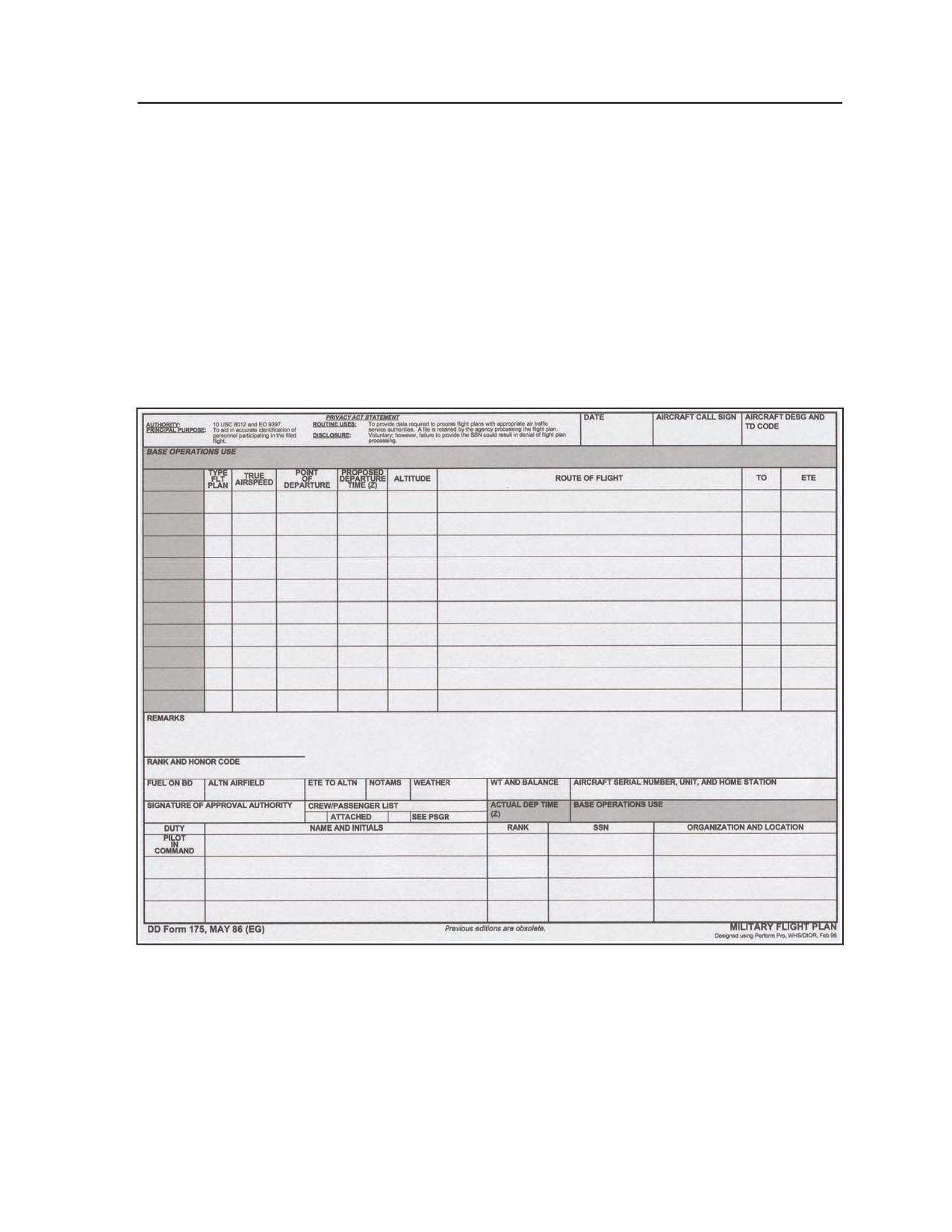
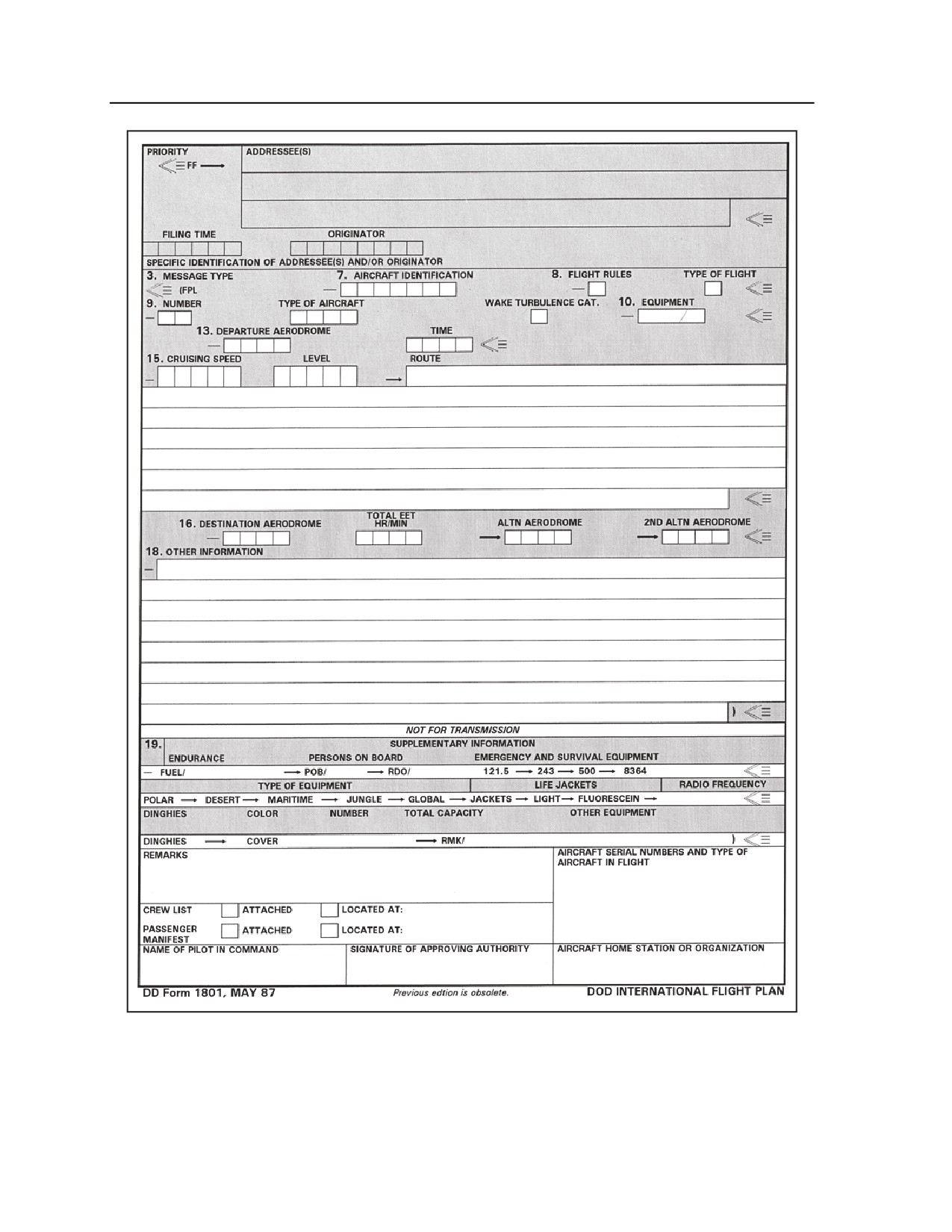
DD Form 175 (Military Flight Plan) (Figure 10-2) and DD Form 1801 (DOD International Flight Plan)
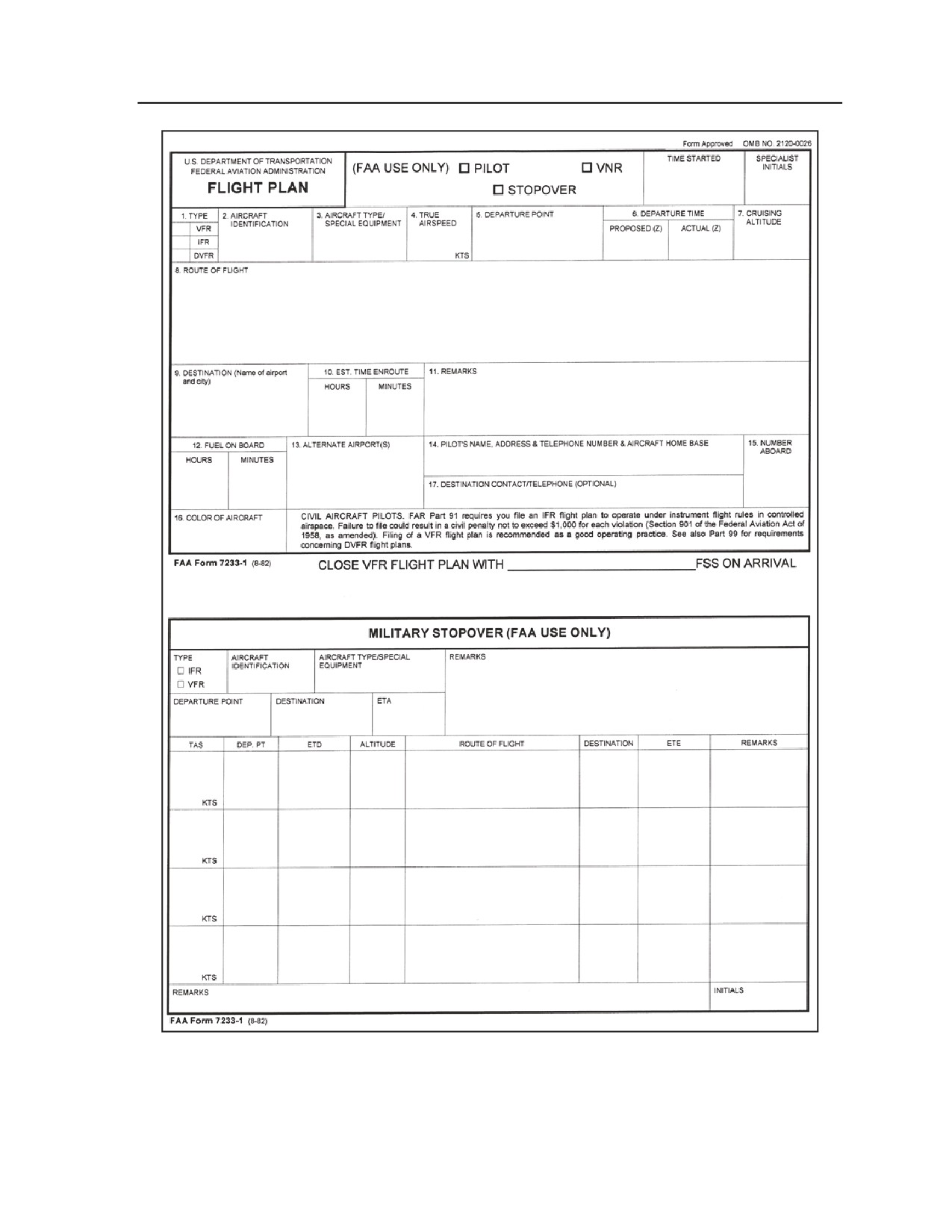
(Figure 10-3, page 10-6). The GP authorizes use of FAA Form 7233-1 (Flight Plan) in lieu of DD Form
175 and of FAA Form 7233-4 (International Flight Plan) in lieu of DD Form 1801 when the aircraft is
departing U.S. installations that do not have a military base operations facility. Find DD Form 175 and DD
Form 1801 at http://www.dtic.mil/whs/directives/infomgt/forms/formsprogram.htm. The GP provides a
blank copy of FAA Form 7233-1 and FAA Form 7233-4 but not specific guidance on completing the form.
The AIM provides guidance for completing and filing FAA Form 7233-1 (Figure 10-4, page 10-7); it is
available at FSSs and is generally found in flight planning rooms at airport terminal buildings. An
electronic version of FAA Form 7233-1 is located at http://forms.faa.gov/forms/faa7233-1.pdf . Specific
guidance on completing FAA Form 7233-4 is found at http://www.faa.gov/ats/aat/ifim/ifim0107.htm under
flight planning notes, and the blank form is found at http://forms.faa.gov/forms/faa7233-4.pdf.
Figure 10-2. Department of Defense Form 175
30 April 2007
FM 3-04.240
10-5
Chapter 10
Figure 10-3. Department of Defense Form 1801
10-6
FM 3-04.240
30 April 2007
Instrument Flight Rules Information and Procedures
Figure 10-4. Federal Aviation Administration Form 7233-1
30 April 2007
FM 3-04.240
10-7
Chapter 10
10-24. Aviators must advise base operations or the tie-in FSS serving the departure, stopover, or en route
delay aerodrome when actual departure time will be delayed one hour or more beyond the filed proposed
departure time and provide an updated proposed departure time. When departing nonmilitary fields, the
aviator must ensure that the actual departure time is passed to the tie-in FSS servicing the departure field.
The aviator can request this change through the tower or directly to the tie-in FSS. If takeoff time is not
passed to the tie-in FSS, the aircraft will arrive unannounced at the next destination.
IN FLIGHT
10-25. IFR flight plans may be filed from the air under various conditions including the following:
A flight outside of controlled airspace before the aircraft proceeds into IFR conditions in
controlled airspace.
A VFR flight with IFR weather conditions expected en route in controlled airspace.
10-26. In either situation, the flight plan may be filed with the nearest AFSS or directly with the ARTCC.
An aviator who files with the AFSS submits the information normally entered during preflight filing,
except for point of departure, together with present position and altitude. The items required for an in-flight
plan are located on the inside back cover of the DOD FLIP IFR-Supplement. AFSS relays this information
to the ARTCC. The ARTCC then clears the aviator from present position or a specified navigation fix.
10-27. An aviator filing direct with the ARTCC reports present position and altitude and submits only the
flight-plan information normally relayed from the AFSS to the ARTCC. Traffic saturation frequently
prevents ARTCC personnel from accepting flight plans by radio. In such cases, the aviator is advised to
contact the nearest AFSS to file the flight plan.
CANCELING
10-28. An IFR flight plan may be canceled at any time when the aircraft is operating in VFR conditions
outside Class A airspace by stating “cancel my IFR flight plan” to the controller or air-to-ground station
with which communicating. After canceling the IFR flight plan, change to the appropriate air-to-ground
frequency and transponder code as directed and VFR altitude/flight level.
10-29. ATC separation and information services (including radar services, where applicable) are
discontinued. If an aviator desires VFR radar advisory service, he must specifically request it. Other
procedures may apply if the IFR flight plan is canceled within areas such as Class B or Class C airspace.
10-30. If an aviator is operating on an IFR flight plan to an airport with an operating control tower, the
flight plan is canceled automatically upon landing. If operating on an IFR flight plan to an airport without
an operating control tower, the aviator must cancel the flight plan. The aviator can cancel the flight plan
after landing by telephone or by radio while airborne and able to communicate with ATC. If there is no
FSS and air-to-ground communications with ATC are not possible below a certain altitude, the aviator can
cancel the IFR flight plan while still airborne and able to communicate with ATC by radio. When
following this procedure, be certain that the remainder of the flight can be conducted under VFR. The
aviator should expeditiously cancel the IFR flight plan because this allows other IFR traffic to use the
airspace.
SECTION III - CLEARANCES
10-31. An ATC clearance allows an aircraft to proceed under specified traffic conditions within
controlled airspace for the purpose of providing separation between known aircraft. A flight filed for a
short distance at a relatively low altitude in an area of low traffic density might receive a clearance as in the
following example.
Clearance Example 1
“Army 12345, cleared to Andalusia-Opp airport direct, cruise 5,000.”
10-8
FM 3-04.240
30 April 2007

Instrument Flight Rules Information and Procedures
10-32. The term cruise in this clearance means that the aviator is authorized to fly at any altitude from the
minimum IFR altitude up to and including 5,000 feet. He may level off at any altitude within this block of
airspace. A climb or descent within the block may be made at the aviator’s discretion. However, once the
aviator has reported leaving an altitude within the block, the aircraft may not return to that altitude without
further ATC clearance.
10-33. When ATC issues a cruise clearance with an unpublished route, an appropriate crossing altitude is
specified to ensure terrain clearance until the aircraft reaches a fix, point, or route where altitude
information is available. The crossing altitude ensures IFR obstruction clearance to the point at which the
aircraft enters a segment of a published route or IAP. Once a flight plan is filed, ATC issues clearance with
appropriate instructions as in the following clearing examples 2 and 3.
Clearance Example 2
“Army 12345 is cleared to Skyline airport via the Crossville 055 radial, Victor 18, maintain 5,000. Clearance
void if not off by 1330.”
Clearance Example 3
“Army 12345 is cleared to Wichita Mid-continent airport via Victor 77, left turn after takeoff; proceed direct to
the Oklahoma City VORTAC. Hold west on the Oklahoma City 277 radial, climb to 5,000 in holding pattern
before proceeding on course. Maintain 5,000 to CASHION intersection. Climb to and maintain 7,000.
Departure control frequency will be 121.05. Squawk 0412.”
10-34. Suppose that an aviator is awaiting departure clearance at a busy metropolitan terminal (the first
IFR departure from this airport). On an average day, the tower at this airport controls departures at a rate of
one every two minutes to maintain the required traffic flow. Clearance delivery may issue the abbreviated
clearance given in clearing example 4, which includes a DP.
Clearance Example 4
“Army 12345, cleared to La Guardia as filed, RINGOES 8 departure Phillipsburg transition, maintain 8,000.
Departure control frequency will be 120.4, Squawk 0700.” This clearance may be readily copied in shorthand
as follows: “CAF RNGO8 PSB M80 DPC 120.4 SQ 0700.”
10-35. The information contained in this DP clearance is abbreviated using clearance shorthand found in
the FAA Instrument Flying Handbook. An aviator should be aware of the locations of specified navigation
facilities, together with the route and point-to-point time, before accepting the clearance. The DP enables
the aviator to study and understand details of the departure before filing an IFR flight plan. The DP
provides information necessary to set up communication and navigation equipment and the departure
procedures required before requesting IFR clearance.
10-36. Once clearance is accepted, the aviator is required to comply with ATC instructions. He may
request a clearance different from that issued if another course of action is more practical or aircraft
equipment limitations or other considerations make acceptance of the clearance inadvisable. Aviators
should also request clarification or amendment, as appropriate, whenever a clearance is not fully
understood or considered unacceptable because of safety of flight. The aviator is responsible for requesting
an amended clearance if ATC issues a clearance that would cause an aviator to deviate from a rule or
regulation or place the aircraft in jeopardy.
SEPARATIONS
10-37. ATC may or may not be able to provide separation information. Table 10-1, page 10-10, shows
ATC parameters regarding separation.
30 April 2007
FM 3-04.240
10-9

Chapter 10
Table 10-1. Air traffic control separation parameters
Air Traffic Control
Provides an IFR clearance w/separation
Does not provide clearance for aircraft operating
• Vertically by assignment of different
altitudes.
• Outside of controlled airspace.
• Longitudinally by controlling time
• With VFR-On-Top authorized instead of a
separation between aircraft on the same
specific assigned altitude.
course.
• During climb or descent in VFR conditions.
• Laterally by assignment of different flight
• In VFR conditions, because uncontrolled VFR
paths.
flights may be operating in the same airspace.
• By radar including all of the above.
10-38. In addition to heading and altitude assignments, ATC occasionally issues speed adjustments to
maintain required separations. Example 1 shows an ATC-issued separation adjustment that involves
slowing the aircraft speed.
Separation Example 1
“Army 12345, slow to 100 knots.”
10-39. Aviators who receive speed adjustments are expected to maintain that speed, ±10 knots. If for any
reason the aviator is not able to accept a speed restriction, the aviator should advise ATC. ATC may also
employ visual separation techniques to keep aircraft safely separated. An aviator obtaining visual contact
with another aircraft may be asked to maintain visual separation or to follow the aircraft. A second
separation adjustment is given in the following example.
Separation Example 2
“Army 12345, maintain visual separation with that traffic, climb and maintain 7,000.”
10-40. Acceptance of these instructions is an acknowledgment that the aviator will maneuver the aircraft,
as necessary, to maintain safe separation. The aviator also acknowledges responsibility for wake turbulence
avoidance by accepting these instructions.
10-41. In the absence of radar contact, ATC relies on position reports to assist in maintaining proper
separation. Using data transmitted by the aviator, the controller follows flight progress. ATC must correlate
the reports with all others to provide separation; therefore, accuracy of reports can affect the progress and
safety of every other aircraft operating in the area on an IFR flight plan.
VISUAL FLIGHT RULES-ON-TOP
10-42. Aviators on IFR flight plans operating in VFR weather conditions may request VFR-On-Top in
lieu of an assigned altitude. VFR-On-Top is an IFR clearance allowing aviators to fly VFR altitudes, which
permits them to select an altitude or flight level of their choice (subject to any ATC restrictions).
10-43. By requesting a climb to VFR-On-Top, aviators can climb through a cloud, haze, smoke, or other
meteorological formation and then either cancel their IFR flight plan or operate VFR-On-Top. The ATC
authorization will contain either a top report (or a statement that no top report is available), and a request to
report upon reaching VFR-On-Top. In addition, the ATC authorization may contain a clearance limit,
routing, and an alternative clearance if VFR-On-Top is not reached by a specified altitude.
10-44. An aviator on an IFR flight plan, operating in VFR conditions, may request to climb/descend in
VFR conditions. When operating in VFR conditions with an ATC authorization to maintain
VFR-On-Top/maintain VFR conditions, aviators on IFR flight plans must do the following:
10-10
FM 3-04.240
30 April 2007
Instrument Flight Rules Information and Procedures
Fly at the appropriate VFR altitude as prescribed in part 91.
Comply with VFR visibility and distance-from-cloud criteria in part 91.
Comply with IFRs applicable to this flight (minimum IFR altitudes, position reporting, radio
communications, course to be flown, and adherence to ATC clearance).
10-45. Aviators operating on a VFR-On-Top clearance should advise ATC before any altitude change to
ensure exchange of accurate traffic information. ATC authorization to maintain VFR-On-Top is not
intended to restrict aviators to operating only above an obscuring meteorological formation (layer). The
clearance also permits operation above, below, or between layers or in areas where there is no
meteorological obscuration. Aviators must understand that clearance to operate VFR-On-Top/VFR
conditions does not imply cancellation of the IFR flight plan.
10-46. Aviators operating VFR-On-Top/VFR conditions may receive traffic information from ATC on
other pertinent IFR or VFR aircraft. However, when operating in VFR weather conditions, aviators are
responsible for remaining vigilant to see and avoid other aircraft. This clearance must be requested by the
aviator on an IFR flight plan. VFR-On-Top is not permitted in certain areas (such as Class A airspace);
consequently, IFR flights operating VFR-On-Top must avoid such airspace.
VISUAL FLIGHT RULES OVER-THE-TOP
10-47. VFR Over-The-Top is strictly a VFR operation in which the aviator maintains VFR cloud
clearance requirements while operating on top of an undercast layer. This situation might occur when the
departure airport and destination airport are reporting clear conditions, but a low overcast layer is present
in between. The aviator could conduct a VFR departure, fly over the top of the undercast in VFR
conditions, then complete a VFR descent and landing at the destination. VFR cloud clearance requirements
are maintained at all times, and an IFR clearance is not required for any part of the flight.
SECTION IV - NOTICE TO AIRMEN SYSTEM
10-48. Check applicable NOTAMs for each flight. Flight operations depend on thorough preflight
planning. For flight planning purposes, NOTAM information is available from the United States NOTAM
System (USNS) via the DOD Internet NOTAM Distribution System (DINS).
10-49. The DINS is composed of a large central data management system deriving information from the
U.S. Consolidated NOTAM Office at the FAA Air Traffic Control Command Center located at Herndon,
VA. Real-time NOTAM information is maintained and made available through the internet. Coverage
includes all military airfields and virtually all domestic, international, and FDC NOTAMs. If not covered
by DINS, the airfield does not transmit NOTAM data to the USNS. A plain language notice in red font is
displayed advising the user of that fact. In such a case, contact the desired location directly for NOTAM
information.
NOTICE TO AIRMEN
10-50. NOTAM is defined in the GP as a notice containing information (not known sufficiently in
advance to publicize by other means) concerning the establishment, condition, or change in any component
(facility, service, procedures, or hazards in the NAS) of which timely knowledge is essential to personnel
concerned with flight operations. NOTAM abbreviations are explained in the FIH and NTAP.
NOTICES TO AIRMEN TYPES
MILITARY FLIGHT SAFETY
10-51. These NOTAMs contain flight safety related information about individual military aerodromes.
This information includes runway closures, NAVAID outages, frequency changes, and runway lighting.
30 April 2007
FM 3-04.240
10-11
Chapter 10
FLIGHT DATA CENTER
10-52. FDC NOTAMs are regulatory documents containing important information such as amendments
to published approaches, chart changes, and TFRs. FDC NOTAMs are broken down into the categories of
general FDC NOTAMs; ARTCC FDC NOTAMs; airport, facility, and procedural FDC NOTAMs; and
special notices.
General Flight Data Center
10-53. General FDC NOTAMs apply to all aircraft—regardless of departure, destination, or flight route.
The general FDC NOTAMs contain information including, but not limited to, changes to U.S. Government
FLIPs, hostile airspace advisories, special FAA regulations, changes to SOPs in U.S. airspace, and any
other general information that might affect flight operations.
Air Route Traffic Control Center Flight Data Center
10-54. Applying only to aircraft flying through the associated ARTCC, these FDC NOTAMs are
identified by the three-letter center identifier beginning with a Z (ZHU - Houston Center). ARTCC FDC
NOTAMs may include, but are not limited to, changes to published minimum altitudes and routings,
in-flight hazards and advisories, special-use airspace activity, and airspace changes/restrictions.
Airports, Facilities, and Procedural Flight Data Center
10-55. These NOTAMs cover civilian and some joint-use fields. They include, but are not limited to,
changes to local procedures, changes/revisions/amendments to published instrument approach and
departure procedures, and changes/revisions to minimum altitudes.
Special Notices
10-56. These NOTAMs are FDC NOTAMs. They normally specify special FAA regulations dealing with
current events and issues of national security.
ATTENTION NOTICES
10-57. Attention notices (general notices) are broken into groups (table 10-2). Table 10-2 shows the
abbreviations for these groups.
Table 10-2. Attention notice groups
Group
Abbreviation
All
ATTA
North America
ATTN
Caribbean & South America
ATTC
CIVILIAN “D” (DISTANT) SERIES
10-58. D-Series NOTAMs contain information about individual civilian aerodromes. These include
runway closures and lighting, NAVAID outages, and frequency changes.
CIVILIAN “L” (LOCAL) SERIES
10-59. Equivalent to a military airfield advisory, L-Series NOTAMs contain information that is not
widely disseminated and will not prevent use of an airfield’s runways. The information may, however,
affect the use of other parts of an airfield. Contact the local FSS governing the field to find these
NOTAMs.
10-12
FM 3-04.240
30 April 2007
Instrument Flight Rules Information and Procedures
NOTICES TO AIRMEN PUBLICATION
10-60. NTAP is available on the Internet at http://www.faa.gov/NTAP/INDEX.HTM. If Internet access is
not available, ask base operations personnel for the hard copy. This book consists of four parts:
Part 1 contains FDC NOTAMs and NOTAMs that meet the criteria of D NOTAMs and are
expected to remain in effect for an extended time.
Part
2 contains revisions to minimum en route IFR altitudes and COPs as well as other
information regarding a wide geographic area or not suited for Part 1.
Part 3 contains significant international NOTAMs including foreign notices, Department of
State advisories, and overland/oceanic airspace notices.
Part 4 contains graphical notices of items that will affect flight operations in the following areas:
General Information, Special Military Operations, Major Sporting and Entertainment Events,
Northeast United States, Southeast United States, East Central United States, South Central
United States, Southwest United States, Northwest United States, Alaska/Hawaii, and Special
Airshow Section.
GLOBAL POSITIONING SYSTEM
10-61. The aviator accesses GPS NOTAMs through the DINS Web page by entering the four-letter
identifier KGPS. When entered, this identifier yields individual satellite information useful for updating
FMS database information. GPS NOTAM information regarding GPS approach availability is obtained by
entering the four-letter ICAO airfield identifier on the NOTAM home page. GPS NOTAMs must be
retrieved for all flights using GPS.
INTERNET DISTRIBUTION SYSTEM
10-62. DINS (https://www.notams.jcs.mil or backup https://www.notams.faa.gov ) is the current method
for aircrews to obtain real-time NOTAM data validated by the USNS, which includes domestic,
international, military, and FDC NOTAMs. DINS is frequently changed to improve content and format of
information provided. The information is broken down into multiple pages including the Home
Page/United States NOTAM Office, FDC NOTAMs, TFRs, Special Notices, ARTCC NOTAMs,
Radius/Flight Path Search, North Atlantic and Pacific Track Systems, reduced vertical separation
minimums (RVSM), European Theater, FM Immunity, and ICAO Search/Listing. DINS provides a
plain-language notice, highlighted in red, when a requested location is not in the U.S. NOTAM System. If
the requested location is not covered, NOTAM information is not transmitted for the USNS. Contact the
requested location to receive NOTAM information.
HOME PAGE/UNITED STATES OFFICE PAGE
10-63. Check for NOTAMs by inputting the four-letter ICAO airfield identifiers in the space provided for
Flight Safety & Local NOTAMs. The user can enter up to 10 ICAO identifiers at any one time. Flight
information region (FIR) identifiers, MOA names, special-use airspace identifiers, and ARTCC identifiers
(to check their NOTAMs as well as KFDC and KGPS to check FDC and GPS NOTAMs respectively) may
be entered. GPS NOTAMs must be retrieved before flights using GPS. Click the “View NOTAMs” button
to view current NOTAMs for the selections. NOTAMs are displayed in plain-language text with the
tracking number unless raw format is selected. When raw format is selected, NOTAMs are presented in the
international, machine-readable, ICAO code format with multiple report fields, NOTAM series, and
NOTAM tracking numbers displayed.
FLIGHT DATA CENTER PAGE
10-64. The “FDC TFR, Special Notices and ARTCC” page offers the flexibility to extract TFRs from the
FDC NOTAMs and various ARTCC area NOTAMs. Click on the “TFR Only” button, and then select the
ARTCCs of interest.
30 April 2007
FM 3-04.240
10-13
Chapter 10
Note. For those interested in all ARTCC TFRs, click on the All ARTCC TFRs button. Use the
optional “ARTCC Special Notices” checkbox to add “FDC Special Notices” with the TFR
request.
RADIUS/FLIGHT PATH SEARCH
10-65. The radius search page allows the user to input an ICAO identifier or latitude/longitude and
receive NOTAMs within a specified radius of that location. The NOTAMs listed include surrounding
airports and NAVAIDs, ARTCCs, universal information regions (UIRs), and FIRs. The flight-path search
page allows the user to input ICAO identifiers for departure and arrival fields as well as several en route
locations. The user can select to receive any of the NOTAMS specified above within a specified nautical
mile buffer in addition to FDC NOTAMs. Special-use airspace NOTAMs are also available with the radius
and flight-path search pages.
Note. Local NOTAMs are not displayed on these pages. Check for local NOTAMs from the
DINS home page for military airfields or the local FSS for civilian fields.
TRACK SYSTEMS
10-66. This section provides aircrews with daily message traffic regarding the North Atlantic Track
System (NATS) and Pacific tracks. Other parts of the organized track system will be added in the future.
REDUCED VERTICAL SEPARATION MINIMUMS
10-67. RVSM NOTAMs are broken out by FIR and the controlling ATC center. They are displayed
alphabetically by their ICAO identifier. Aircrews are encouraged to frequently check the FAA RVSM Web
Note. There could be as many as 90 active RVSM notices, and it may take about 15 to 20
seconds to retrieve the data.
EUROPEAN THEATER
10-68. This page provides data from the U.S. Army Flight Operations Detachment Europe (AFOD) and
contains NOTAMs on airfields, airspace, navigation/communications, special notices, and updates
throughout the European theater. This page also covers FM immunity information for Europe, Africa, and
Middle East AOs as well as Bird Activity NOTAMs (BIRDTAMS) issued by the German Military
Geophysical Office.
European Central Airspace Reservation Facility Page
10-69. NOTAMs concerning operations and airspace controlled by the European Central Airspace
Reservation Facility (EUCARF) can be obtained through this page. Information includes airspace,
refueling tracks, and altitude reservations (ALTRVs) currently reserved through EUCARF.
Frequency Modulation Immunity
10-70. Covering Europe, Africa, and Middle East AOs, this page provides a consolidated listing of FM
immunity NOTAM and country guidance applicable to DOD FLIP. Information is depicted by DOD FLIP
documents and followed by individual country limitations, guidance, and NOTAMS. Listed countries
10-14
FM 3-04.240
30 April 2007
Instrument Flight Rules Information and Procedures
require FM-immune receivers unless otherwise noted. Countries not listing any information are assumed to
have implemented ICAO Annex 10 requirements for FM immunity.
INTERNATIONAL CIVIL AVIATION ORGANIZATION SEARCH/LISTING PAGES
10-71. Use this site to search the DINS database for an ICAO airport and country by inputting the ICAO
identifier. The Listing Page provides a geographic listing of all sites covered by DINS, allowing the user to
find the four-letter identifier of the desired airfield by selecting the country (and state in the continental
United States [CONUS]) to determine if an airfield is covered by DINS and the USNS. Special-use
airspace identifiers are listed at the bottom of each state listing on the Listing Page.
THE FEDERAL ADMINISTRATION AGENCY DISTRIBUTION SYSTEM
10-72. Unlike DINS, which allows aviators to check their own NOTAMs, the FAA NOTAM Distribution
System is based on a verbal briefing system. To obtain a verbal briefing, contact a FSS by calling
1-800-WX-BRIEF. The FSS briefer will provide the NOTAM D information for any field requested.
NOTAM L information must be requested from the servicing FSS or directly from the airfield. Flight
Service Stations maintain a file of FDC NOTAMs affecting conditions within 400 miles of their facility.
FDC information concerning conditions more than 400 miles away from the FSS or information that is
already published in the NTAP is given only on request. The FSS briefer assumes that the aviator has
looked at the appropriate sections of the Notices to Airman Publication. They will not brief the information
contained in the NTAP unless specifically requested.
WEB PAGE LIMITATIONS
10-73. The DINS web page, while updating on a real-time basis, does not autorefresh information. This
means that while the page is current up-to-the-minute when the aviator originally accesses it, no further
updates are received unless the page is refreshed by clicking VIEW—REFRESH or by reentering the
selected ICAO identifiers and clicking on “view notices.” New NOTAMs will contain a tracking number
and should be sorted in increasing numerical order (oldest to newest). Use caution because various
numbering formats are used depending on the type of NOTAM displayed. The newest NOTAMs may not
necessarily be at the bottom of the complete list of NOTAMs for a particular ICAO location. Recheck the
NOTAM Web site before all flights to ensure receipt of the latest NOTAMs.
SECTION V - NAVIGATION OPTIONS IN THE NATIONAL AIRSPACE SYSTEM
10-74. The two methods of navigating in the NAS are on airways and off airways. Specific procedures
for filing are found in FLIP General Planning unless noted otherwise.
ON AIRWAYS
10-75. The two fixed route systems established for air navigation purposes are the VOR and low/medium
frequency (L/MF) system and the jet route system. To the extent possible, these route systems are aligned
in an overlying manner to facilitate transition between each. Unless otherwise authorized by ATC, aviators
are required to adhere to the centerline of airways or routes being flown. Special attention must be given to
this requirement during course changes. Turns that begin at or after fix passage may exceed airway or route
boundaries. Thus, the FAA expects aviators to lead turns and take other actions considered necessary
during course changes to adhere as closely as possible to the airways or route being flown. Aviators should
attempt to adhere to course centerline whenever possible.
10-76. The VOR and L/MF airway system consists of airways designated from 1,200 feet above the
surface (in some instances, higher) up to, but not including, 18,000 feet MSL. These airways are depicted
on en route low-altitude charts:
Except in Alaska and coastal North Carolina, VOR airways are based solely on VOR or
VORTAC NAVAIDs and are identified by a “V” (Victor) followed by the airway number
30 April 2007
FM 3-04.240
10-15
Chapter 10
(V12); segments of VOR airways in Alaska and North Carolina (V290) are based on L/MF
NAVAIDs and charted in brown, instead of black, on en route charts. To make the transition
from one airway to another at an unnamed intersection, enter the designations of the two
airways, separated by a space (YKM V4 V187 TCM).
The L/MF airways (colored airways) are based solely on L/MF NAVAIDs, depicted in brown
on aeronautical charts, and identified by color name and number (Amber One). Green and red
airways are plotted east and west. Amber and blue airways run north and south. Except for G13
in North Carolina, the colored airway system exists only in Alaska.
10-77. The Jet Route system consists of jet routes established in Class A airspace. These routes are
depicted on en route high-altitude charts. On aeronautical charts, jet routes are depicted in black and are
identified by a “J” (Jet), followed by the airway number (J12). Jet routes are based solely on VOR or
VORTAC navigation facilities (except in Alaska). Segments of jet routes in Alaska are based on L/MF
NAVAIDs and are charted in brown on en route charts.
AREA NAVIGATION ROUTES
10-78. RNAV is a method of navigation permitting aircraft operations on any desired course within the
coverage and capabilities of the aircraft onboard navigation equipment. Designated area navigation routes
are permanently published and charted airway routes based on area navigation equipment. They are
available to aircraft with RNAV capability.
REQUIRED EQUIPMENT
10-79. FAA AC 90-45 outlines the RNAV equipment specifications for certification within the NAS. The
major types of appropriate equipment are the following:
VORTAC referenced or course line computer (CLC) systems.
INS units.
Microwave landing system (MLS)/RNAV equipment, which provides area navigation with
reference to an MLS ground facility; aircraft must stay within range of the navigation station.
GPS.
OFF AIRWAYS (DIRECT)
10-80. Aviators can use several methods to fly off the airway system. This system is otherwise known as
direct flight.
NAVIGATIONAL AID USE
10-81. The absence of airway identifiers between fixes/NAVAIDs on a flight plan indicates direct flight.
Aircraft may file along a direct course between NAVAIDs as long as the aircraft does not exceed the
limitations of the NAVAIDs being used to define the course. For example, an “L” class VORTAC is only
usable below 18,000 feet MSL and within 40 nautical miles of the station. NAVAID limitations can be
found in the front of the FLIP IFR Supplement.
DEGREE-DISTANCE ROUTE DEFINITION
10-82. Degree-distance route definition is a military-only privilege that allows certain aircraft to exceed
the NAVAID limitations imposed by NAVAID-to-NAVAID filing restrictions. The specific procedures for
filing and using degree-distance route definitions are published in FAA Order 7110.65. The use of
degree-distance criteria is limited to aircraft performing specialized military missions.
10-16
FM 3-04.240
30 April 2007
Instrument Flight Rules Information and Procedures
RANDOM AREA NAVIGATION ROUTES
10-83. Random RNAV routes are direct routes flown between any two points, based on aircraft onboard
RNAV capability, and defined in terms of latitude/longitude coordinates, degree-distance fixes, or offsets
from established routes/airways at a specified distance and direction. Radar monitoring by ATC is required
on all random RNAV routes within the National Airspace System. Factors that ATC will consider in
approving random RNAV routes include the capability to provide radar monitoring and compatibility with
traffic volume and flow. ATC will monitor each flight with radar; however, navigation on the random
RNAV route is the responsibility of the aviator. Paragraph 10-79 describes acceptable RNAV equipment.
SECTION VI - DEPARTURES
DEPARTURE PROCEDURES
10-84. DPs are designed to expedite clearance delivery, facilitate transition between takeoff and en route
operations, and ensure adequate obstacle clearance. DPs provide aviators with departure routing clearance
information in both graphic and textual form. To simplify clearances, DPs are established for the most
frequently used departure routes in areas of high traffic activity. A DP will normally be used where such
departures are available because this is advantageous to both users and ATC (Figure 10-5, page 10-18).
10-85. DPs can be found after the charted approaches for a particular airport/airfield in DOD FLIP
(Terminal) Low Altitude United States volumes. The aviator should remember the following points when
filing IFR out of terminal areas where DPs are in use:
Aviators operating IFR aircraft from locations where DP procedures are in effect may expect an
ATC clearance containing a DP; the use of a DP requires aviator possession of at least the
textual description of the approved DP.
If an aviator does not possess a preprinted DP or, for any other reason, does not wish to use a
DP, the aviator is expected to advise ATC; notification is accomplished by filing “NO DP” in
the remarks section of the filed flight plan or by advising ATC.
When accepting a DP in the clearance, the aviator must comply with the DP.
DIVERSE DEPARTURE
10-86. An aviator may have to file a flight plan from an airfield where diverse departures are not
authorized. If so, he is required to fly the approved DP assigned by ATC.
10-87. When an instrument approach is initially developed for an airport, the procedure designer also
does an assessment for departures. If an aircraft turns in any direction from a runway and is clear of
obstacles, that runway meets diverse departure criteria and no DP is developed. At busier airports, there
may be a need to develop DPs to increase efficiency and reduce communications and departure delays as
opposed to obstacle avoidance.
10-88. If no IFR DP is published, climb runway heading to 400 feet above the departure end of runway
elevation; turn in the shortest direction to the first filed point. This procedure keeps the aircraft clear of
terrain and obstructions as long as the climb is at 200 FPNM, unless the aircraft is required to level off by a
crossing restriction, until it reaches the minimum IFR altitude. The 40:1 OIS begins at the DER and slopes
upward at 152 FPNM until the aircraft reaches the minimum IFR altitude or entering the en route structure.
30 April 2007
FM 3-04.240
10-17
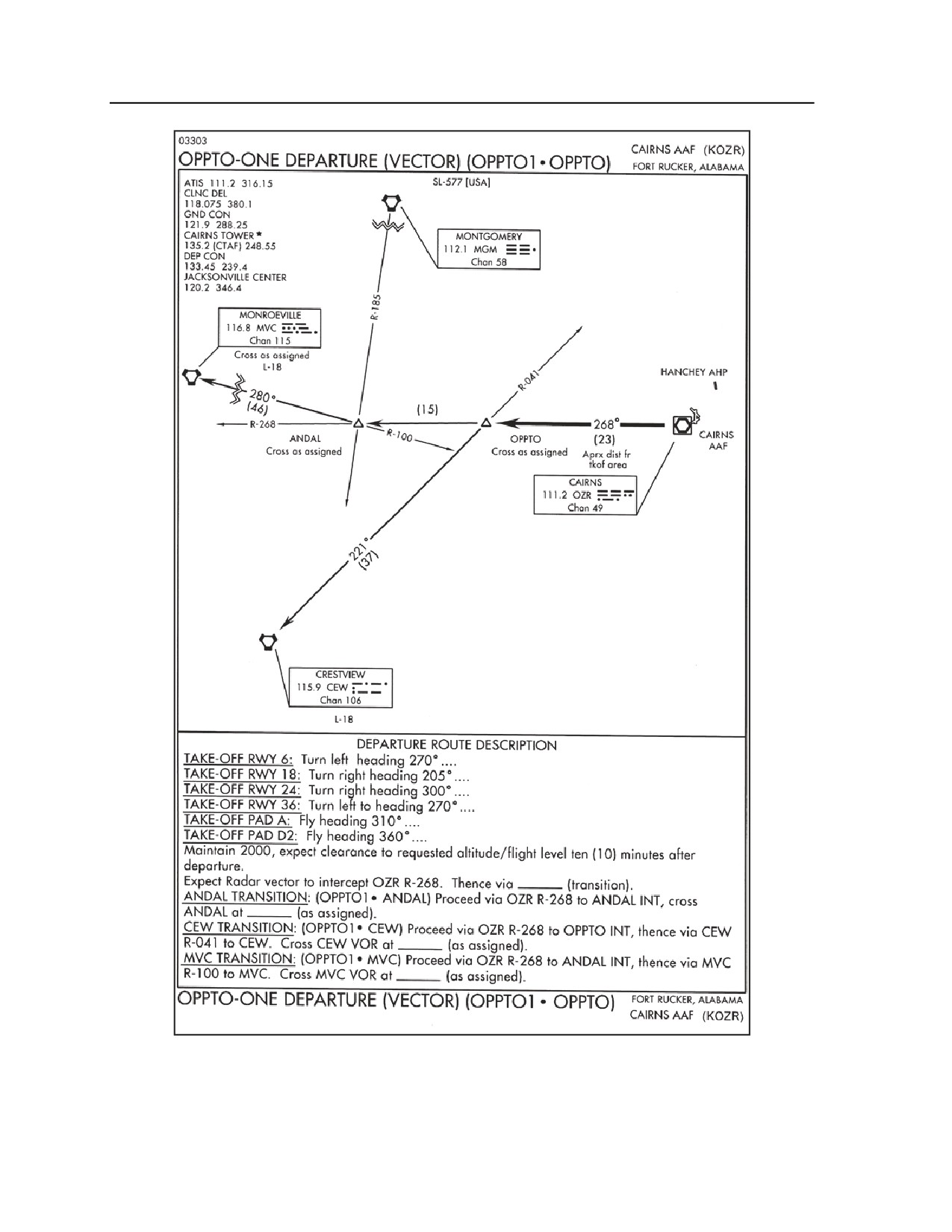
Chapter 10
Figure 10-5. Departure procedure
10-18
FM 3-04.240
30 April 2007
Instrument Flight Rules Information and Procedures
10-89. If diverse departures are not authorized, consider AIM information and make the following
checks:
Before departing an airport on an IFR flight, consider the type of terrain and other obstacles on
or near the departure airport.
Comply with nonstandard IFR minimums and DPs.
Always follow the specific ATC departure instructions.
10-90. Aviators must be aware that diverse departure criteria are based solely on an aircraft’s ability to
operate within the standard departure envelope for that specific category of aircraft and do not consider
degraded climb capability because of equipment malfunction, terminal aid to navigation degradation, or
special aircrew qualification requirements. The AIM indicates that obstacle clearance responsibility rests
with the aviator when choosing to climb in visual conditions in lieu of flying a DP and/or depart under
increased takeoff minima rather than fly the DP.
RADAR CONTROLLED DEPARTURE
10-91. An aviator departing IFR from airports in congested areas normally receives navigational guidance
from departure control by radar vector. When the departure is to be vectored immediately following
takeoff, the aviator is advised before takeoff of the initial heading to be flown. This information is vital in
the case two-way radio communications are lost during departure.
10-92. Following takeoff, contact departure control on the assigned frequency when advised to do so by
the control tower. At this time, departure control verifies radar contact and gives headings, altitude, and
climb instructions to move the aircraft quickly and safely out of the terminal area. Fly the assigned
headings and altitudes until the controller provides aircraft position with respect to the route given in the
clearance, whom to contact next, and to “resume your own navigation.” Departure control vectors the
aircraft to either a navigation facility or an en route position appropriate to the departure clearance, or the
flight is transferred to a controller with further radar surveillance capabilities.
10-93. A radar-controlled departure does not relieve aviator responsibilities as PC. Be prepared before
takeoff to conduct navigation according to ATC clearance with navigation receivers checked and properly
tuned. While under radar control, monitor instruments to ensure continuous orientation to the route
specified in the clearance and record the time over designated checkpoints.
DEPARTURE FROM AIRPORTS WITHOUT AN OPERATING
CONTROL TOWER
10-94. When departing from airports that have neither an operating tower nor an FSS, telephone the flight
plan to the nearest ATC facility at least 30 minutes before the estimated departure time. If weather
conditions permit, the aviator could depart VFR and request IFR clearance as soon as radio contact is
established with ATC. If weather conditions make flying VFR undesirable, again telephone and request
clearance. In this case, the controller issues a short-range clearance, pending establishment of radio contact,
and might restrict the departure time to a certain period (for example, “Clearance void if not off by 0900”).
This authorizes departure within the allotted period and authorization to proceed according to the
clearance. In the absence of any specific departure instructions, the aviator is expected to proceed on
course via the most direct route.
SECTION VII - EN ROUTE
PROCEDURES
10-95. Procedures en route vary according to the proposed route, traffic environment, and ATC facilities
controlling the flight. Some IFR flights are under radar surveillance and controlled from departure to
arrival, while others rely entirely on aviator navigation. Where ATC has no jurisdiction, an IFR clearance
30 April 2007
FM 3-04.240
10-19
Chapter 10
will not be issued. ATC has no control over the flight nor does the aviator have any assurance of separation
from other traffic.
POSITION REPORTS
10-96. The aviator is required to furnish a position report over certain reporting points unless in radar
contact with ATC. Position reports are required over each compulsory reporting point (shown on the chart
as solid triangle figures
) along the route being flown, regardless of altitude, including those with a
VFR-On-Top clearance. Along direct routes, IFR flight reports are required over each point used to define
the route. Reports at reporting points (shown as open triangle figures
) are made only when requested
by ATC. Position reports should include the following items (inside back cover of IFR supplement):
Identification.
Position.
Time.
Altitude/FL.
Type of flight plan.
Next reporting point and ETA.
The name only of the next succeeding (required) reporting point along the flight route.
Pertinent remarks.
10-97. Submit en route position reports to ARTCC controllers via direct controller-to-pilot
communications channels. Use appropriate ARTCC frequencies listed on the en route chart.
10-98. Whenever an initial center contact is to be followed by a position report, the name of the reporting
point is included in the communication. Including the reporting point alerts the controller that information
is forthcoming (for example, “Cleveland Center, Army 12345 at HARWL intersection”).
ADDITIONAL REPORTS
10-99. The aviator will make the following reports to ATC or FSS facilities without a specific ATC
request (found in the FIH):
When departing a previously assigned altitude/flight level for a newly assigned altitude/flight
level.
When an altitude change will be made if operating on a clearance specifying “VFR-On-Top.”
When unable to climb/descend at a rate of at least 500 feet per minute.
When the approach has been missed (request clearance for specific action—to alternate airport,
another approach).
When the change in the average TAS (at cruising altitude) varies by 5 percent or 10 knots
(whichever is greater) from the filed flight plan.
Note. Aviators of aircraft involved in instrument training at military terminal area facilities may
omit the reports in the next two bulleted sentences when radar services are provided.
Upon reaching a holding fix or point to which cleared, report time and altitude or flight level.
When leaving any assigned holding fix or point.
After any loss of VOR, TACAN, ADF, LF navigation receiver capability in controlled airspace,
complete or partial loss of ILS receiver capability, or impairment of air-to-ground
communications capability; reports include aircraft identification, equipment affected, degree to
which the capability to operate under IFR in the ATC system is impaired, and the nature and
extent of assistance desired from ATC.
10-20
FM 3-04.240
30 April 2007
Instrument Flight Rules Information and Procedures
Note. Other equipment installed in an aircraft may effectively impair safety and/or the ability to
operate IFR. If such equipment (airborne weather radar) malfunctions and if the aviator judges
safety or IFR capabilities to be affected, reports are made as above.
Any safety-of-flight information.
10-100. The following reports are required when the aviator is not in radar contact:
When leaving FAF inbound on final approach (nonprecision approach) or when leaving the
outer marker or fix used in lieu of the outer marker inbound on final approach (precision
approach).
Whenever it becomes apparent that a previously submitted estimate is in error by more than
three minutes, the aviator submits a corrected estimate.
10-101. Aviators encountering unforecast weather conditions or forecast hazardous conditions are
expected to forward a report of such weather to ATC. ICAO position reporting is found in the FIH, after
the FAA position reporting requirements.
PLANNING DESCENT AND APPROACH
10-102. ATC arrival procedures and cockpit workload are affected by weather conditions, traffic density,
aircraft equipment, and radar availability. When landing at airports with approach control services and
where two or more IAPs are published, aviators are provided, in advance of arrival, with information on
the type of approach to expect or if the aircraft will be vectored for a visual approach. This information is
broadcast either on ATIS or by a controller. It is not furnished when visibility is 3 miles or better and the
ceiling is at or above the highest initial approach altitude established for any low-altitude IAP for the
airport. Although this information helps plan arrival actions, it is not an ATC clearance or commitment and
is subject to change. Fluctuating weather, shifting winds, or blocked runways are conditions that may result
in changes to the approach information previously received. Advise ATC immediately if unable to execute
the approach or if another type of approach is preferred. If the destination is an airport without an operating
control tower but has automated weather data with broadcast capability, monitor the ASOS/AWOS
frequency to determine current weather. Advise ATC, once receipt of the broadcast weather is obtained,
and state future intent.
10-103. Upon deciding which approach to execute, plan for descent before reaching the IAF or transition
route depicted on the IAP. When flying the transition route, maintain the last assigned altitude until hearing
“cleared for the approach” and intercepting a segment of the approach. The aviator may “request lower” to
bring the transition route closer to the required altitude for the initial approach altitude. When ATC uses
the phrase, “at pilot’s discretion” in the altitude information of a clearance, the aviator has the option to
start a descent at any rate and may level off temporarily at any intermediate altitude. However, once
vacating an altitude, the aviator may not return to that altitude. When ATC has not used the term “at pilot’s
discretion” nor imposed any descent restrictions, initiate descent promptly upon acknowledgment of the
clearance.
10-104. Descend at an optimum rate (consistent with the operating characteristics of the aircraft) to 1,000
feet above the assigned altitude. Then attempt to descend at a rate of between 500 and 1,500 FPM until the
assigned altitude is reached. If unable to descend at a rate of at least 500 FPM or if necessary to level off at
an intermediate altitude during descent, advise ATC. When required for speed reduction, descend at an
optimum rate except when leveling off at 10,000 MSL during descent or 2,500 feet above airport elevation
(before entering a Class B, Class C, or Class D surface area).
30 April 2007
FM 3-04.240
10-21
Chapter 10
STANDARD TERMINAL ARRIVAL ROUTES
10-105. STARs are established to simplify clearance delivery procedures for arriving aircraft at certain
areas having high-density traffic. A STAR serves a purpose parallel to that of a DP for departing traffic
(Figure 10-6, page 10-23). The following points regarding STARs are important to remember:
along with IAP charts for the destination airport. The AIM also describes STAR procedures.
If the destination is a location for which STARs are published, the aviator may be issued a
clearance containing a STAR whenever ATC deems appropriate; the aviator must possess the
approved textual description.
It is the aviator’s responsibility to accept or refuse an issued STAR; if the aviator does not wish
to use a STAR, he should advise ATC by placing “NO STAR” in the remarks section of the
filed flight plan or when first contacting ATC by radio.
When accepting a STAR in the clearance, the aviator must comply.
INOPERATIVE/UNUSABLE COMPONENTS SUBSTITUTION
10-106. The basic ground components of an ILS are the localizer, glide slope, outer marker, middle
marker, and inner marker (when installed). A compass locator or precision radar may be substituted for the
outer or middle marker. DME, VOR, or NDB fixes authorized in the standard IAP or surveillance radar
may be substituted for the outer marker.
10-107. In addition, IFR-certified GPS equipment, operated according to AC 90-94, may be substituted for
ADF and DME equipment, except during NDB IAP. Specifically, GPS can be substituted for ADF and
DME equipment when—
Flying a DME arc.
Navigating to/from an NDB.
Determining the aircraft position over an NDB.
Determining the aircraft position over a fix made up of a crossing NDB bearing.
Holding over an NDB.
Determining aircraft position over a DME fix.
HOLDING PROCEDURES
10-108. Holding is maneuvering an aircraft in relation to a navigation fix while the aviator awaits further
clearance. The standard no-wind holding pattern is flown by following a specified holding course inbound
to the holding fix. This procedure is done by making a 180-degree turn to the right, flying a heading
outbound to parallel the holding course, and making another 180-degree turn to the right to intercept and
following the holding course to the fix (Figure 10-7, page 10-24). The holding pattern is nonstandard when
turns are made to the left. Unless otherwise instructed by ATC, aviators are expected to hold in a standard
pattern. The standard no-wind length of the inbound leg of the holding pattern is one minute at or below
14,000 feet MSL and one-and-a-half minutes above 14,000 feet MSL. DME holding patterns specify the
outbound leg length. If holding at a DME fix without specified outbound leg length, use the timing
procedures listed above. Depending on traffic and weather conditions, holding may be required. The ATC
clearance always specifies left turns if a nonstandard pattern is to be flown.
10-22
FM 3-04.240
30 April 2007
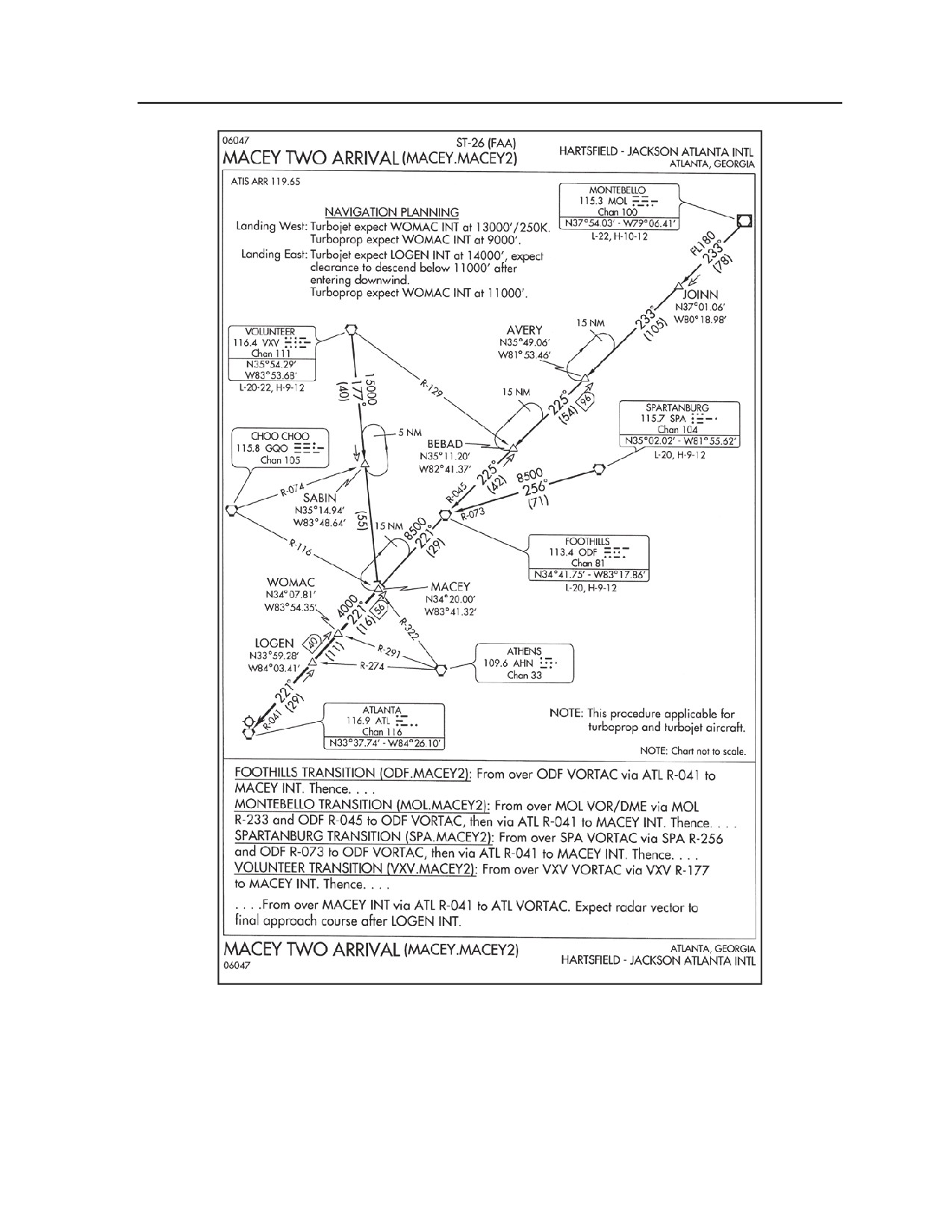
Instrument Flight Rules Information and Procedures
Figure 10-6. Standard terminal arrival route
30 April 2007
FM 3-04.240
10-23
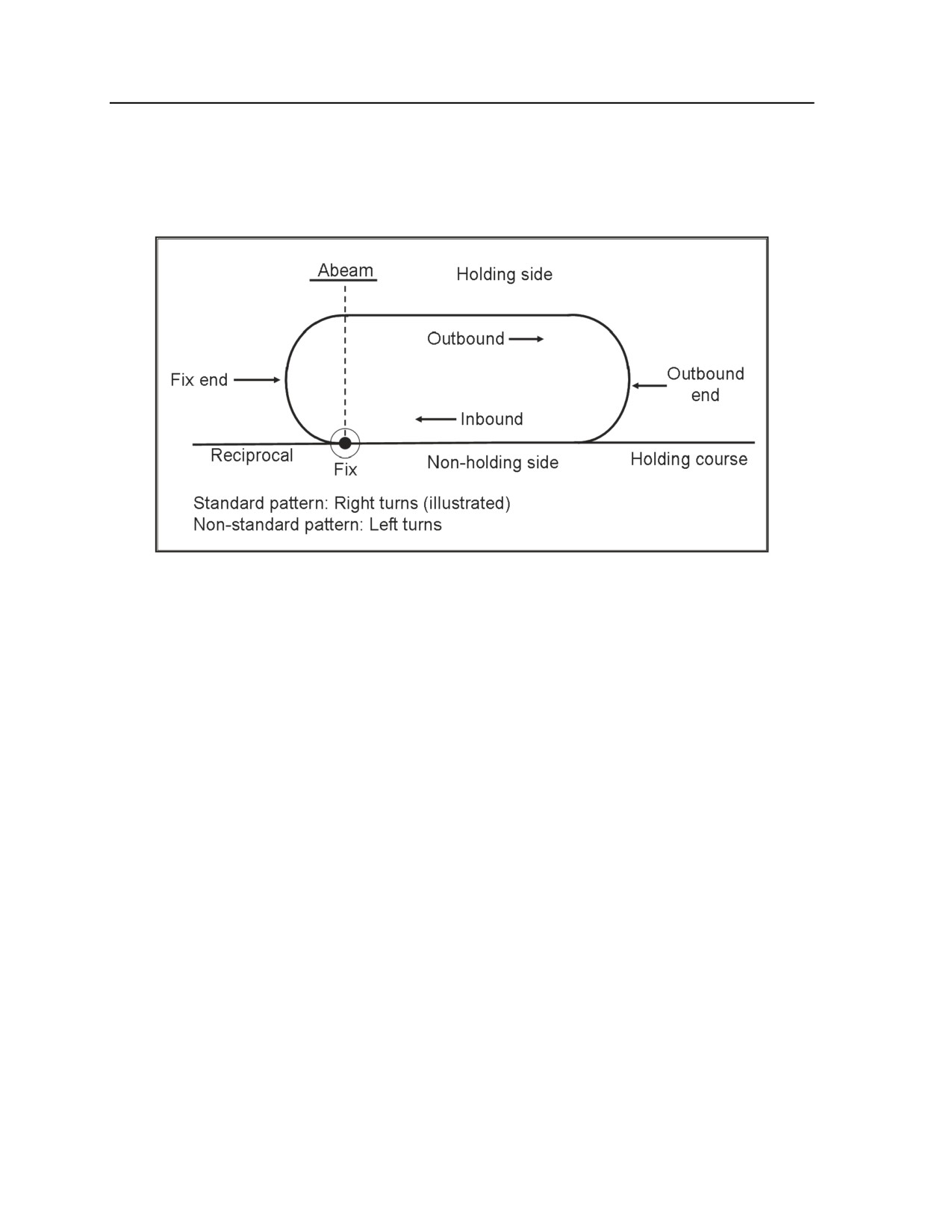
Chapter 10
STANDARD HOLDING PATTERN (NO WIND)
10-109. The standard holding pattern is a racetrack pattern (Figure 10-7). The aircraft follows the specified
course inbound to the holding fix, turns 180 degrees to the right, flies a parallel straight course outbound
for one minute, turns 180 degrees to the right, and flies the inbound course to the fix.
Figure 10-7. Standard holding pattern—no wind
STANDARD HOLDING PATTERN (WITH WIND)
10-110. When complying with the holding pattern procedures given in the AIM, aviators may not be able
to fly a symmetrical racetrack pattern when wind exists. Aviators are expected to—
Compensate for the effect of a known wind except when turning.
Adjust outbound timing to achieve a one minute (one-and-a-half minutes above 14,000 feet
MSL) inbound leg; see Figures 5-6 and 5-7, page 5-5, for examples of calculating outbound
time. See Figure 10-10, page 10-28, regarding when to start outbound time.
10-111. Figure 10-8, page 10-25, illustrates the asymmetrical track that an aviator must fly to compensate
for a left crosswind. The aviator can compensate for wind by applying drift corrections to the inbound and
outbound legs and time allowances to the outbound leg.
10-24
FM 3-04.240
30 April 2007
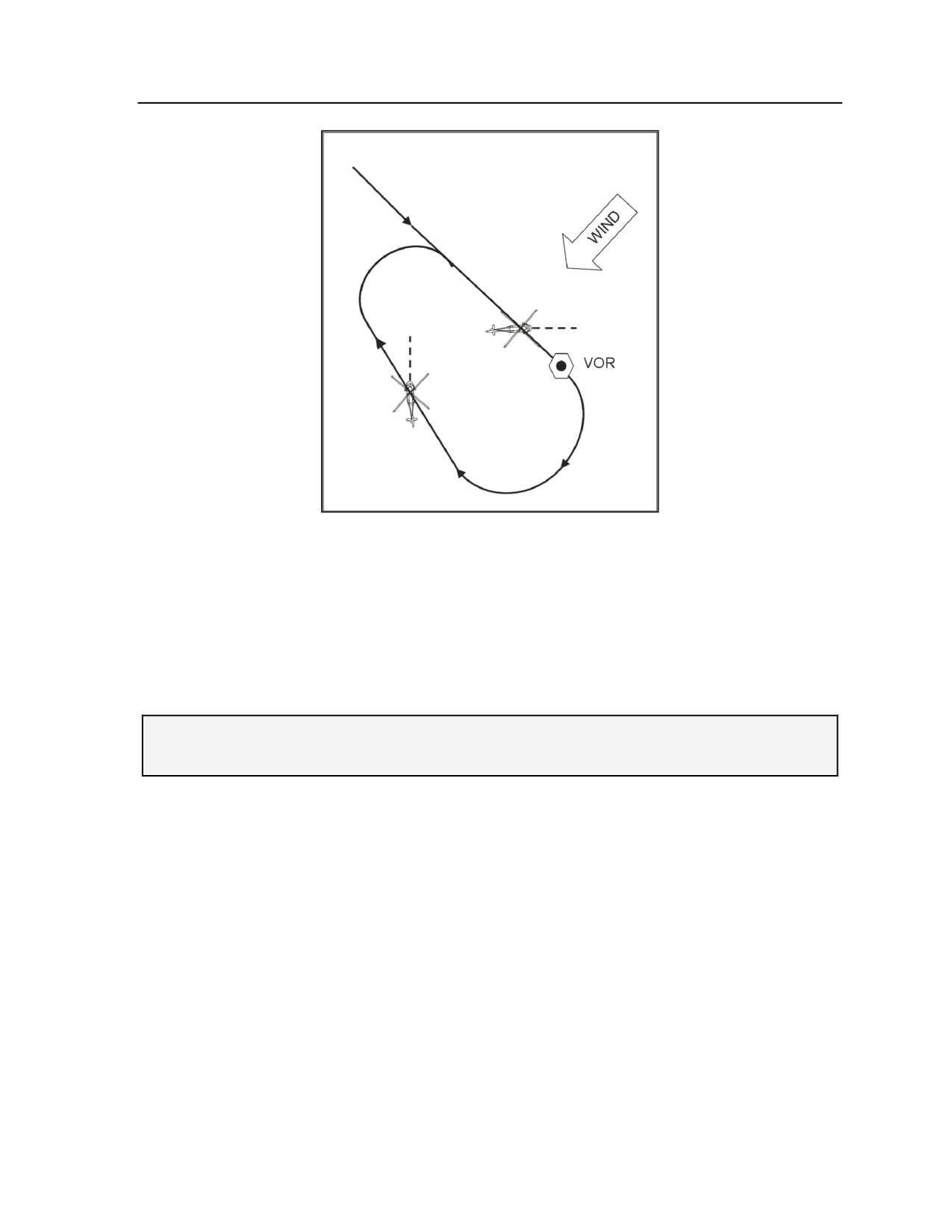
Instrument Flight Rules Information and Procedures
Figure 10-8. Standard holding pattern with drift correction
DRIFT CORRECTIONS
10-112. Knowledge of drift correction and TAS relationship can be useful, especially when course
guidance is not available (for example, during the outbound legs of a holding pattern or procedure turn).
The following technique may be used to determine approximate drift correction when the crosswind
component is known: Divide crosswind component by aircraft speed in nautical miles per minute as shown
in the following example.
Example of Drift Correction
30 knots crosswind and 180 KTAS [3NM per minute]
30 ÷ 3 = 10 degrees drift correction.
10-113. The aviator should compensate for wind effect primarily by drift correction on the inbound and
outbound legs. When the aircraft is outbound, triple the inbound drift correction; if correcting left by 8
degrees when inbound, correct right by 24 degrees when outbound as shown in the following example.
HOLDING INSTRUCTIONS
10-114. When the aircraft arrives at the clearance limit before receiving clearance beyond the fix, ATC
expects the aircraft to maintain the last assigned altitude and begin holding according to the depicted
holding pattern. If no pattern is depicted, the aviator begins holding in a standard holding pattern on the
course upon which the fix is approached. Immediately request further clearance. When no delay is
anticipated, ATC will issue holding instructions at least five minutes before estimated arrival at the fix.
When an aircraft is three minutes or less from a clearance limit and a clearance beyond the fix has not been
received, the aviator is expected to start a speed reduction so that the aircraft crosses the fix at or below the
maximum holding airspeed. If holding instructions are not received upon arrival at the fix, hold according
to procedures in FLIP. For two-way radio failure holding procedures, refer to the FIH.
10-115. Where a holding pattern is depicted, ATC clearances specify the direction of holding from the fix.
The clearance is given in terms of the eight cardinal compass points (N, NE, E, SE) along with the name of
the holding fix (for example, “Cleared to DARED, hold south as published.”).
30 April 2007
FM 3-04.240
10-25

Chapter 10
10-116. When a holding pattern is not depicted, ATC clearances specify the direction of holding from the
fix in terms of the eight cardinal compass points, the holding fix (the fix may be omitted if included at the
beginning of the transmission as the clearance limit), and the radial, course, bearing, airway, or route on
which the aircraft is to hold. ATC also provides the leg length in miles if DME or RNAV is to be used (leg
length is specified in minutes on aviator request or if deemed necessary by the controller), and the direction
of turn (for left turns, the aviator requests or the controller states direction if necessary).
10-117. Time to expect further clearance (EFC) and any pertinent additional delay information is issued
for either a charted or uncharted holding pattern. ATC instructions are also issued when a delay will exceed
one hour or a revised EFC is necessary. In a terminal area having a number of NAVAIDs and approach
procedures, a clearance limit may not indicate clearly which approach procedures to use. On initial contact,
or as soon as possible thereafter, approach control advises the aviator of the approach type anticipated.
Ceiling/visibility is reported as being at or below the highest circling minimums established for the airport
concerned. ATC transmits a current weather conditions report and subsequent changes, as necessary.
Aircraft holding while awaiting approach clearance are advised if reported weather conditions are below
minimums applicable to their operation. In this case, ATC issues suitable instructions to aircraft desiring to
continue holding or proceed to another airport. According to AR 95-1, aviators may initiate an approach
regardless of ceiling and visibility.
STANDARD ENTRY PROCEDURES
10-118. Entry procedures in the AIM evolved from extensive experimentation under a wide range of
operational conditions. By following these standardized procedures, the aircraft remains within the
boundaries of the prescribed holding airspace.
10-119. Reduce airspeed to holding speed within three minutes of ETA at the holding fix. Speed reduction
prevents overshooting the holding airspace limits, especially at locations where adjacent holding patterns
are close together. The exact time to reduce speed is not important as long as arrival at the fix occurs at the
preselected holding speed within three minutes of the submitted ETA. If speed reduction and preparation
for fix identification take longer, adjust entry to the pattern and report the amended ETA. The aviator
should advise ATC if the aircraft exceeds maximum holding speed. All aircraft may hold at the altitudes
and maximum holding airspeeds shown in table 10-3.
Table 10-3. Holding altitudes and airspeeds
Altitude (MSL) (feet)
Airspeed (KIAS)
MHA-6,000
200
6,001-14,000
230
14,001 and above
265
10-120. Maximum holding airspeeds can be limited by the following:
Maximum airspeed of 210 KIAS in holding patterns from 6,001 to 14,000 feet (as depicted by
an icon).
Maximum airspeed of 175 KIAS in holding patterns (as depicted by an icon) that are generally
found on IAPs applicable to Category A and B aircraft only.
Maximum airspeed of 310 KIAS in holding patterns at Air Force airfields and 230 KIAS in
holding patterns at Navy airfields unless otherwise depicted.
Maximum airspeed of 100 KIAS in holding patterns during copter/short takeoff and landing
(STOL) only approaches.
FEDERAL AVIATION ADMINISTRATION ENTRY PROCEDURES
10-121. Entry procedures enable the aircraft to enter the holding pattern and remain within protected
airspace. The FAA recommends parallel, teardrop, and direct entries into holding (see Figure 10-9).
10-26
FM 3-04.240
30 April 2007
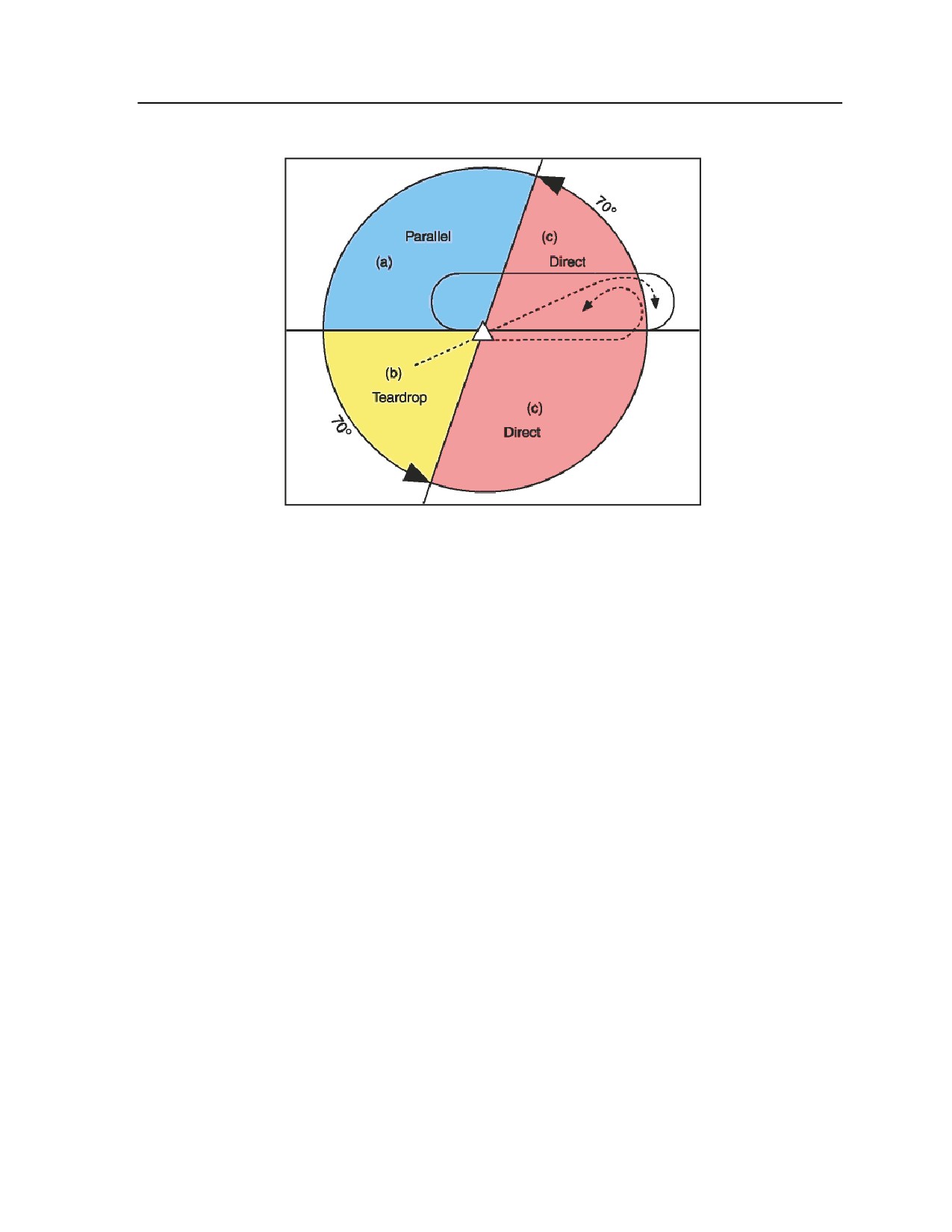
Instrument Flight Rules Information and Procedures
Figure 10-9. Holding pattern entry procedures
Parallel Entry
10-122. When approaching the holding fix from sector (a) in Figure 10-9, turn to a heading to parallel the
holding course outbound on the nonholding side for about one minute. Turn in the direction of the holding
pattern through more than 180 degrees, and return to the holding fix or intercept the holding course
inbound.
Teardrop Entry
10-123. When approaching the holding fix from sector (b) in Figure 10-9, fly to the fix, turn outbound
using course guidance, when available, or to a heading for a 30-degree teardrop entry within the pattern
(on the holding side) for about one minute, then turn in the direction of the holding pattern to intercept the
inbound holding course.
Direct Entry
10-124. When approaching the holding fix from sector (c) in Figure 10-9, fly directly to the fix and turn to
follow the holding pattern. All turns during entry and while holding are made at 3 degrees per second, a
30-degree bank angle, or a bank angle provided by a flight director system.
TIME FACTORS
10-125. The holding pattern entry time reported to ATC is the initial time of arrival over the fix. Upon
entering a holding pattern, the initial outbound leg is flown for one minute at or below 14,000 feet MSL
and for one-and-a-half minutes above 14,000 feet MSL. Timing for subsequent outbound legs is adjusted,
as necessary, to achieve proper inbound leg time. Aviators begin outbound timing over or abeam the fix,
whichever occurs later. If the abeam position cannot be determined, start timing when the turn to outbound
is completed (Figure 10-10). Timing inbound begins at the completion of the outbound-end turn, wings
level (see Figure 10-6, page 10-23, for identification of the outbound end).
30 April 2007
FM 3-04.240
10-27
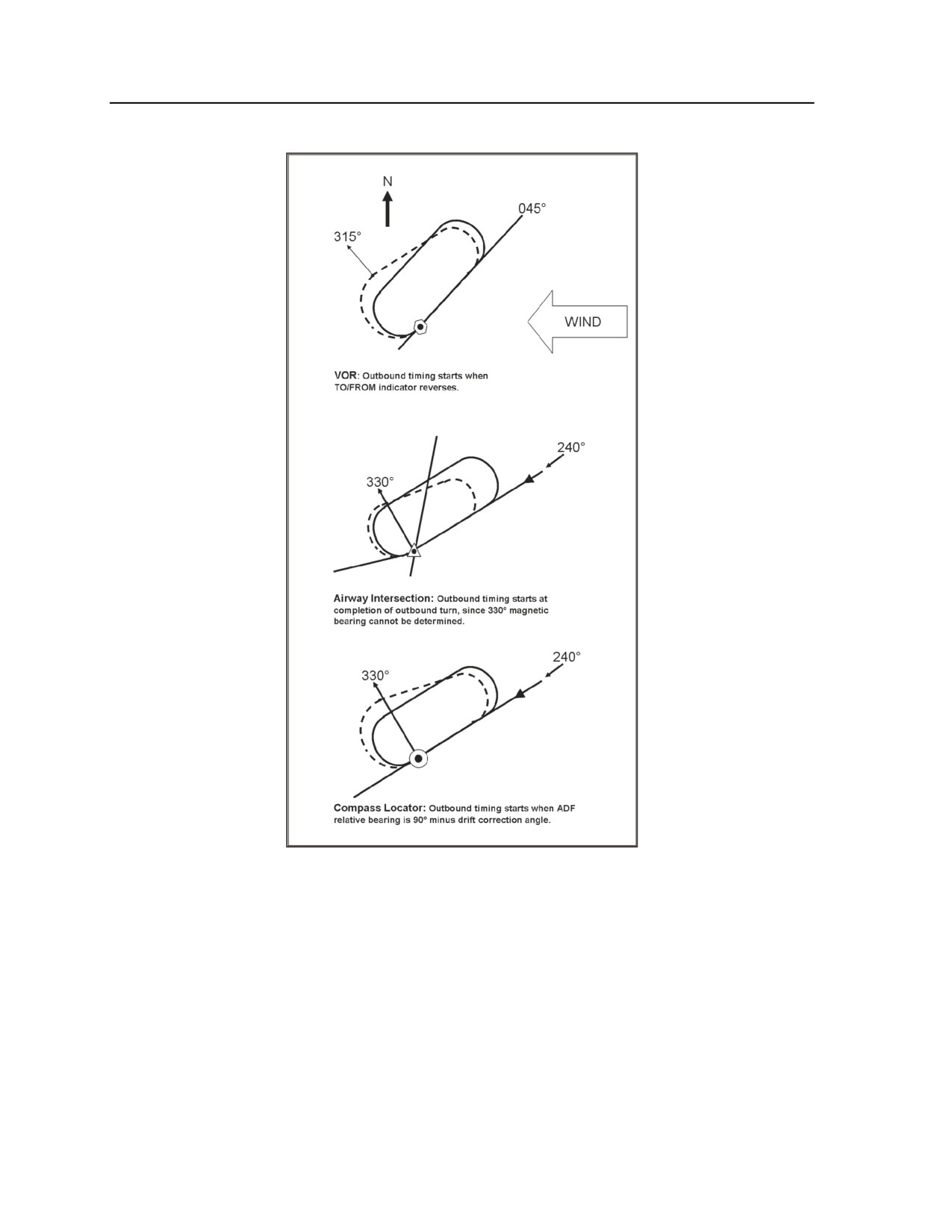
Chapter 10
Figure 10-10. Holding and outbound timing
10-126. ATC issues an EFC time in holding clearances. The purpose of the EFC time is twofold. First, the
EFC lets the aviator know how long that he is expected to remain in a holding pattern. Second, it provides
him with a clearance time to leave the holding pattern if two-way radio communications failure occurs.
ATC may provide an earlier clearance to depart the holding pattern and should provide a clearance to
depart as EFC time approaches. If an aviator does not receive further clearance before reaching the EFC,
he should request clearance to leave holding or a revised EFC time from ATC. ATC must know the time
leaving the holding fix before succeeding aircraft can be cleared to the airspace that the aircraft has
vacated. Leave the holding fix—
When ATC issues either further clearance en route or approach clearance.
As prescribed in part 91 (for IFR operations; two-way radio communications failure, and
responsibility and authority of the PC).
10-28
FM 3-04.240
30 April 2007
Instrument Flight Rules Information and Procedures
After canceling the IFR flight plan, if holding in VFR conditions.
DISTANCE MEASURING EQUIPMENT HOLDING
10-127. The same entry and holding procedures apply to DME holding except distances (nautical miles)
are used instead of time values. The length of the outbound leg is specified by the controller, and the end of
this leg is determined by the DME readout.
SECTION VIII - APPROACHES
PUBLISHED PROCEDURE COMPLIANCE
10-128. Compliance with procedures on approach charts provides necessary navigation guidance for
alignment with final approach courses as well as obstruction clearance. Under certain conditions, a course
reversal maneuver or procedure turn may be necessary. This procedure is not authorized when—
“No PT” appears on the approach course on the plan view of the approach chart.
Radar vectoring is provided to the final approach course.
A holding pattern is published in lieu of a procedure turn.
A timed approach is executed from a holding fix.
Otherwise directed by ATC.
APPROACHES TO AIRPORTS
INSTRUMENT LETDOWN
10-129. Unless otherwise authorized, when an instrument letdown to an airport is necessary, aviators
should use a standard IAP prescribed for that airport. IAPs are depicted on IAP charts and found in the
TPP or DOD FLIP (Terminal).
10-130. ATC approach procedures depend on facilities available at the terminal area, the type of
instrument approach executed, and existing weather conditions. ATC facilities, NAVAIDs, and associated
frequencies appropriate to each standard instrument approach are given on the approach chart. Individual
charts are published for standard approach procedures associated with the facilities in Figure 10-11.
10-131.
• NDB
• LDA*
• VORTAC
• RNAV
• ILS
• VOR
• LOC
• VOR/DME
• SDF**
• GPS
* Localizer-type directional aid
** Simplified directional facility
Figure 10-11. Facilities with standard approach procedures
30 April 2007
FM 3-04.240
10-29
Chapter 10
Full Approach
10-132. An IAP can be flown as a full approach or with the assistance of radar vectors. When flown as a
full approach, aviators conduct their own navigation using routes and altitudes depicted on the instrument
approach chart. This procedure allows the aviator to make the transition from the en route phase to the
instrument approach and then to a landing with minimal assistance from ATC. A full approach is requested
by the aviator and is most often used in areas without radar coverage, providing the aviator with a means of
completing an instrument approach during a communications failure.
Radar Vectors
10-133. When an approach is flown with radar vectors, ATC provides guidance in the form of headings
and altitudes to position the aircraft to intercept final approach. The aviator resumes navigation, intercepts
the final approach course, and completes the approach using the IAP chart. This method is often more
expedient than the full approach and allows ATC to sequence arriving traffic. An aviator operating in radar
contact can generally expect assistance of radar vectors to the final approach course.
WITHOUT AN OPERATING CONTROL TOWER
10-134. When approaching a facility without a control tower (Figure 10-12, page 10-31), monitor the
AWOS/ASOS (if available) for the latest weather conditions. When direct communication between the
aviator and controller is no longer required, the ARTCC or approach controller clears the aircraft for an
instrument approach and advises “change to advisory frequency approved.” Aviators should expeditiously
change to the CTAF frequency because the ATC facility will not have runway in use or airport traffic
information. If arriving on a cruise clearance, ATC will not issue further clearance for approach and
landing.
10-135. If an approach clearance is required, ATC authorizes the aviator to execute his choice of standard
instrument approach (if more than one is published) with the phrase “cleared for the approach” and the
communications frequency change required, if any. From this point, the aviator has no contact with ATC
and should close the IFR flight plan before landing, if in VFR conditions, or by telephone after landing.
Unless otherwise directed by ATC, the aviator is expected to execute the complete IAP shown on the chart.
10-136. Inbound aircraft should initiate contact about 10 miles from the airport and continue to monitor the
appropriate frequency until after landing and clear of the movement area. If the aircraft has only one radio
capable of transmitting on the ATC and CTAF frequency, do not leave the assigned ATC frequency until
instructed to do so. Inbounds should—
Report altitude, aircraft type, and location relative to the airport.
Indicate whether landing or over flight.
Request airport advisory (if UNICOM or FSS).
10-137. Make position reports at the following locations on the approach:
When departing the final approach fix inbound.
When established on the final approach segment or immediately upon being released by ATC.
Upon completion or termination of the approach.
Upon executing the missed approach procedure.
When exiting the active runway.
10-138. Most VFR pilots operating in the vicinity of the airport will not be familiar with fix names.
Locations should be referred to in the simplest terms that the average VFR pilot will understand. For
example, use the terminology “5 miles east” instead of “Kirby Intersection.”
10-30
FM 3-04.240
30 April 2007
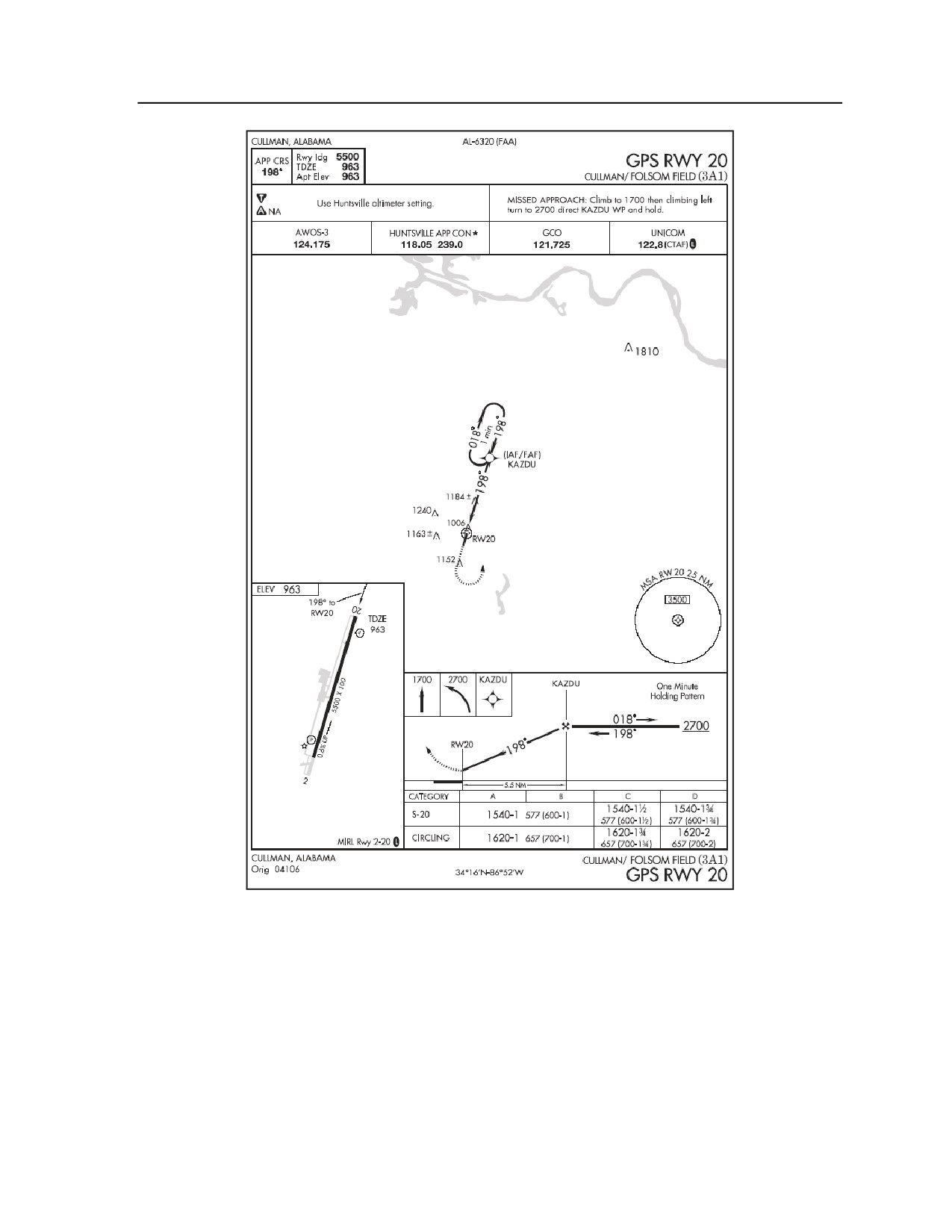
Instrument Flight Rules Information and Procedures
Figure 10-12. Approach procedure without an operating control tower
10-139. When self-announcing the aviator’s position, as in the example, the aviator uses the following
format:
Name of the airport, followed by the word “traffic.”
The aviator’s call sign.
The aircraft type in terms that the average VFR pilot will understand.
The aviator’s location in terms that the average VFR pilot will understand.
The aviator’s intentions.
Name of the airport repeated.
30 April 2007
FM 3-04.240
10-31