FM 3-04.240 Instrument Flight for Army Aviators (April 2007) - page 5
Chapter 7
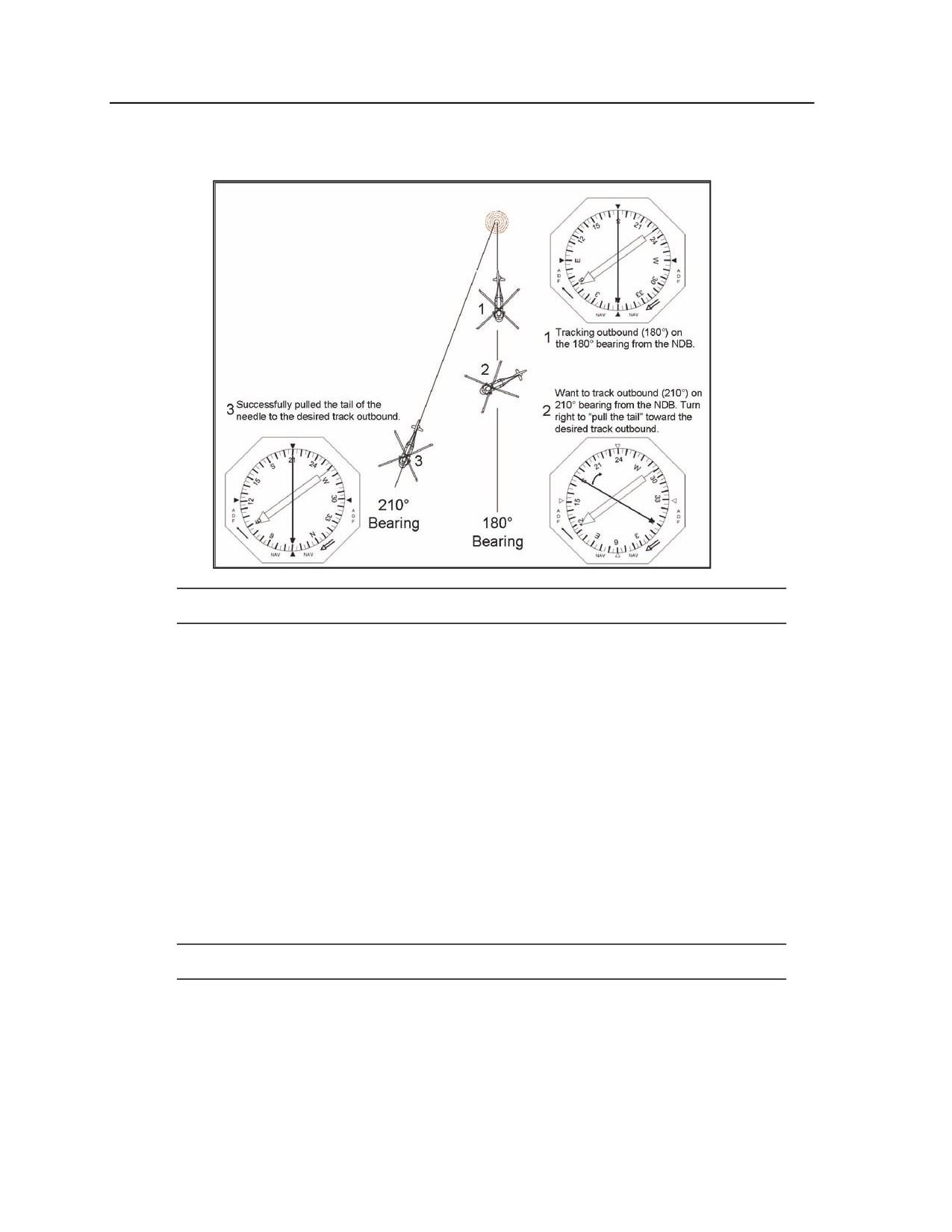
Note. The online version of this manual contains a video clip of the procedure in Figure 7-5.
Figure 7-5. Pull the tail
TRACKING INBOUND
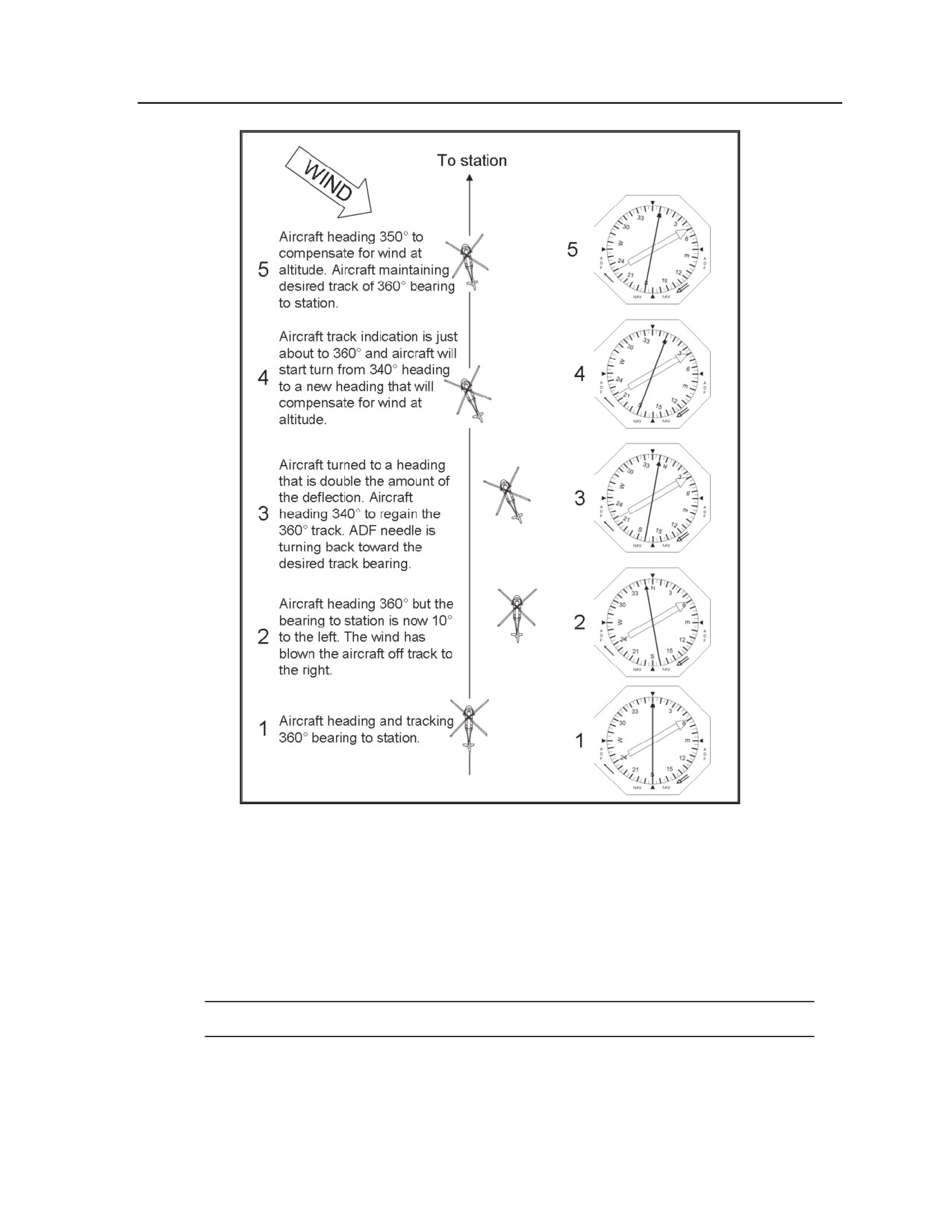
7-91. Tracking inbound (Figure 7-6, page 7-19), NDB or VOR, uses a heading to maintain the desired
track to or from the station, regardless of crosswind conditions. Interpretation of the heading indicator and
needle is done to maintain a constant magnetic bearing to or from the station. Magnetic bearing is the
direction to or from a radio transmitting station measured relative to magnetic north.
7-92. To track inbound, turn the aircraft in the shorter direction to place the head of the bearing pointer
under the top index of the RMI or upper lubber line of the HSI. Maintain this heading until off-course drift
is indicated by displacement of the needle, which occurs if during a crosswind (needle moving left equals
wind from the left; needle moving right equals wind from the right). When a definite (2 to 5 degrees)
change in needle reading occurs, turn the aircraft to push the head of the needle back to the desired
bearing/radial. The angle of interception must be greater than the number of degrees of drift. The intercept
angle depends on the rate of drift, aircraft speed, and station proximity (see table 7-1, page 7-21).
Note. The online version of this manual contains a video clip of the procedure in Figure 7-6.
7-18
FM 3-04.240
30 April 2007
Navigation Aids
Figure 7-6. Tracking inbound
TRACKING OUTBOUND
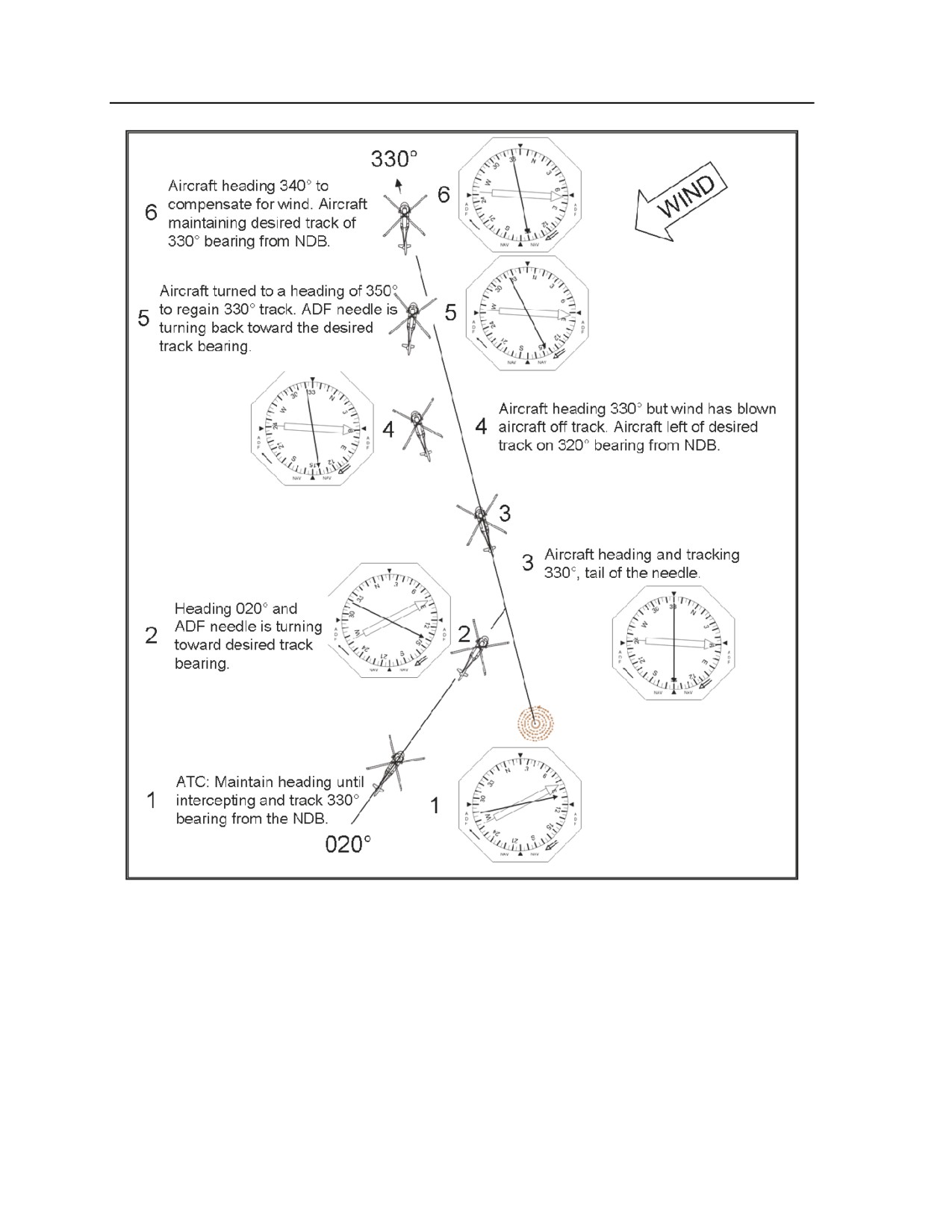
7-93. To track outbound, the same bracketing principles apply, except that the tail of the needle moving
left equals wind from the right and the tail of the needle moving right equals wind from the left. Wind
correction is made away from the tail of the needle deflection. This action is displayed as pulling the tail of
the needle to the desired heading, bearing, or radial. Note the example of outbound tracking in Figure 7-7,
page 7-20.
Note. The online version of this manual contains a video clip of the procedure in Figure 7-7.
30 April 2007
FM 3-04.240
7-19
Chapter 7
Figure 7-7. Tracking outbound
7-20
FM 3-04.240
30 April 2007

Navigation Aids
STANDARD WIND DRIFT CORRECTION
7-94. Wind-drift correction is a continuous process because of the varying nature of winds in speed and
direction. Table
7-1 depicts standard wind drift correction procedures. When applying wind drift
corrections, continually monitor the desired course to be flown.
Table 7-1. Standard wind drift correction
Condition
Correction
Initial correction
Used to return to course (reintercept).
30° at airspeeds < 90 knots
20° at airspeeds =/> 90 knots
First trial
Apply half the initial correction after course reinterception.
15° at airspeeds < 90 knots
10° at airspeeds =/> 90 knots
Too little wind correction
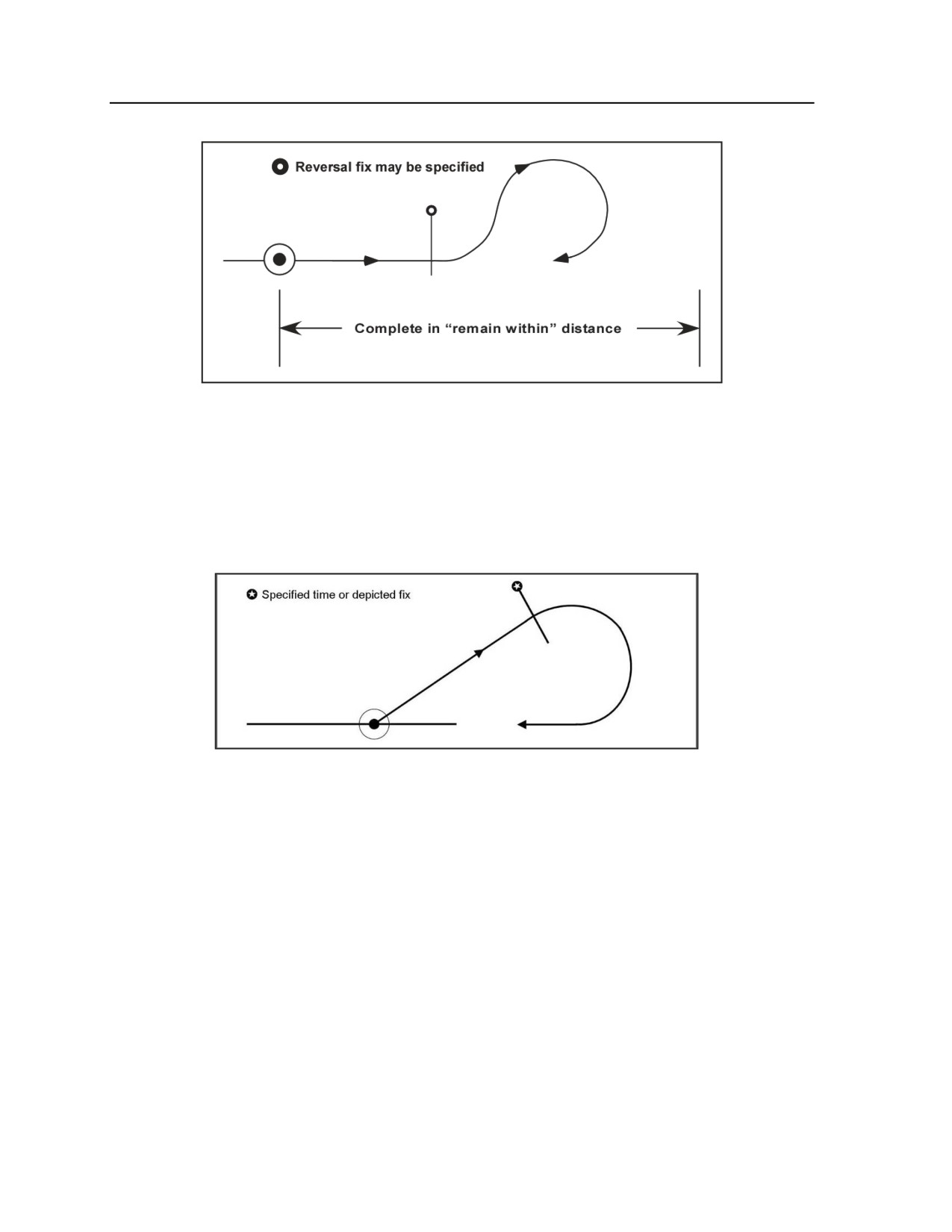
Repeat initial correction to return to course.
Second trial
Increase correction by applying ½ of the first trial correction (Example: ½ of
15° is 7.5° [rounded to 7]; 15° + 7° = 22°).
Too much wind correction
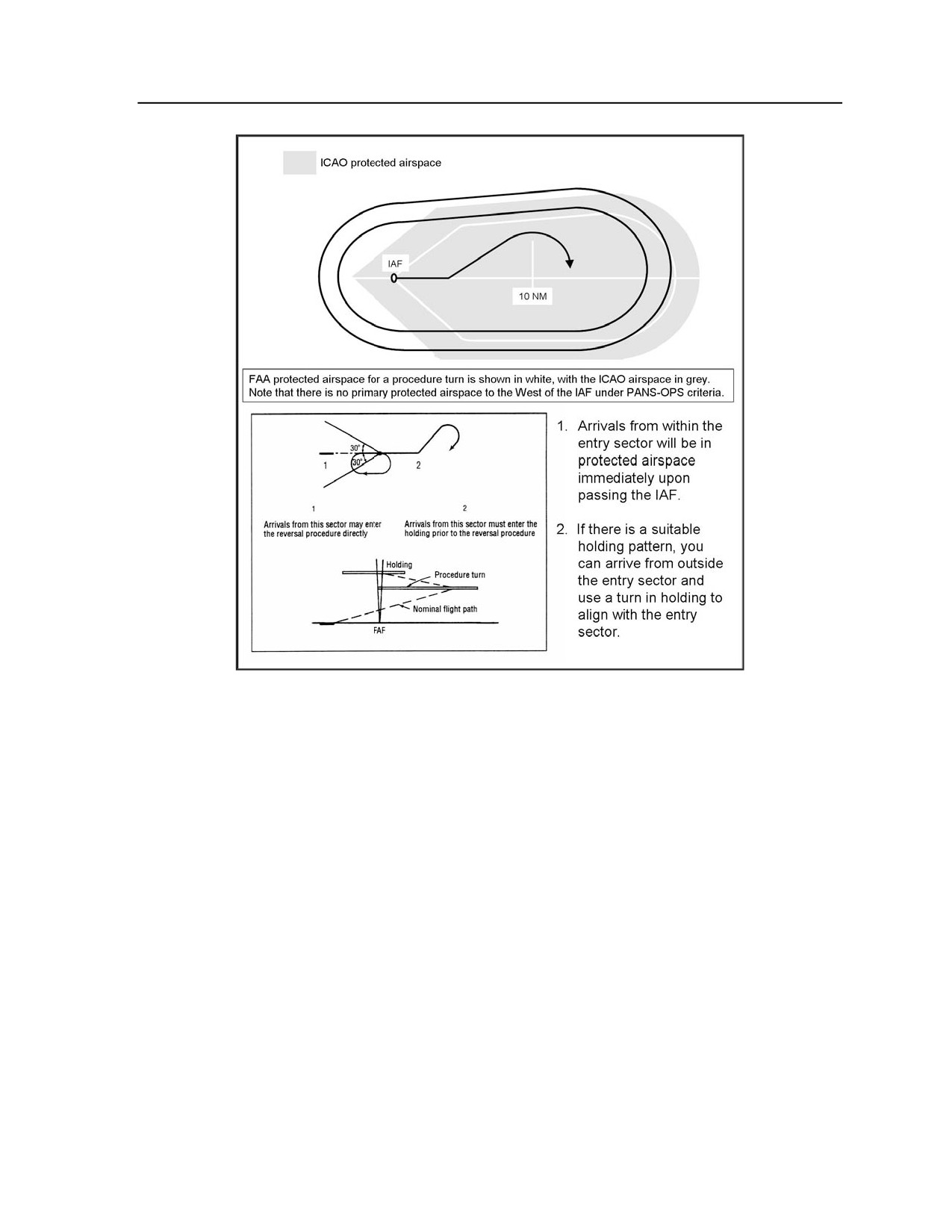
If trial drift correction is too large, turn to parallel course & allow wind to drift
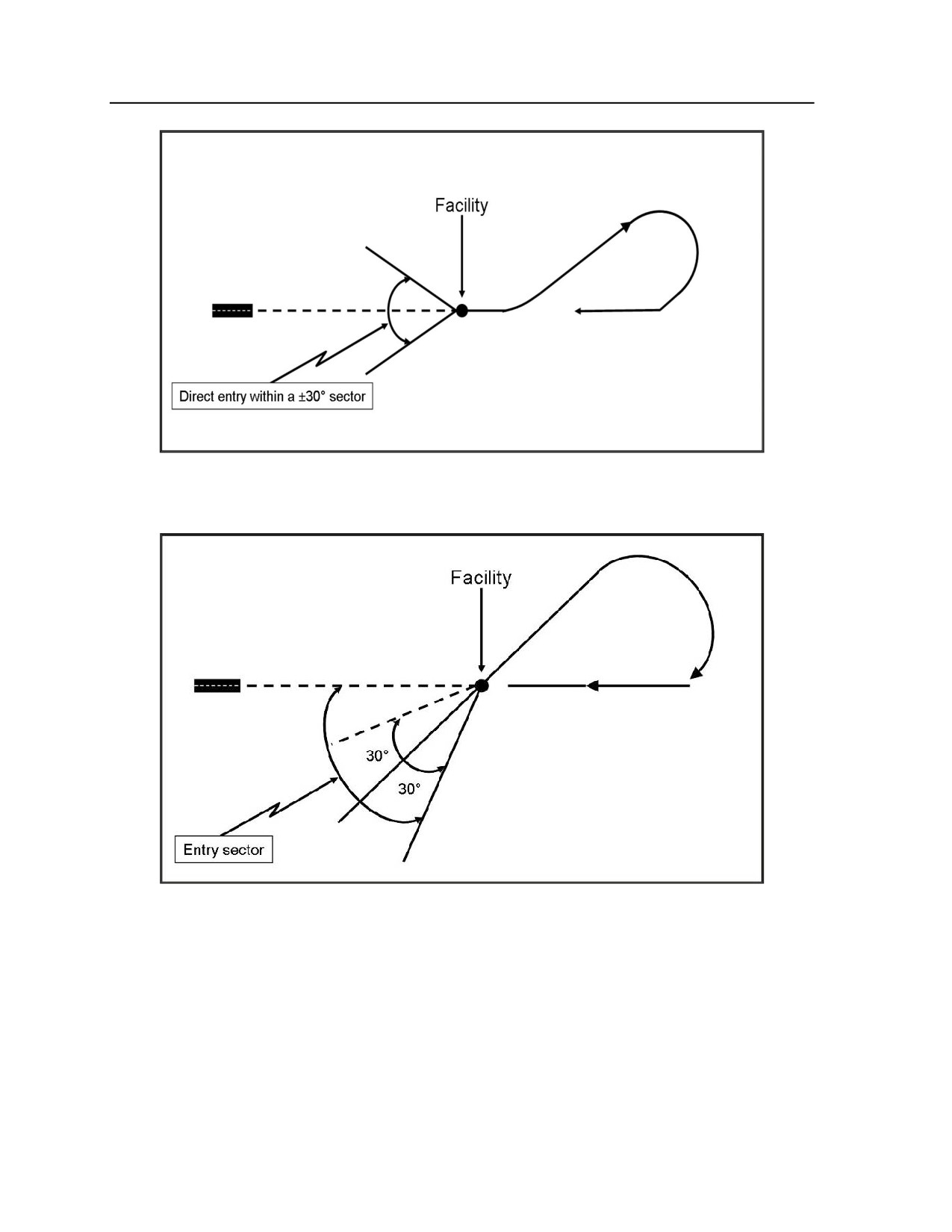
aircraft back on course; then decrease correction on next trial correction.
Bracketing process
Continue until a heading is determined that maintains aircraft course.
Corrections for unusually
After applying standard initial corrections and course is not reintercepted,
strong winds
correction of 40° or more may be required to return to course.
Note. All course corrections are applied to the tracked (maintained) course.
COURSE INTERCEPT
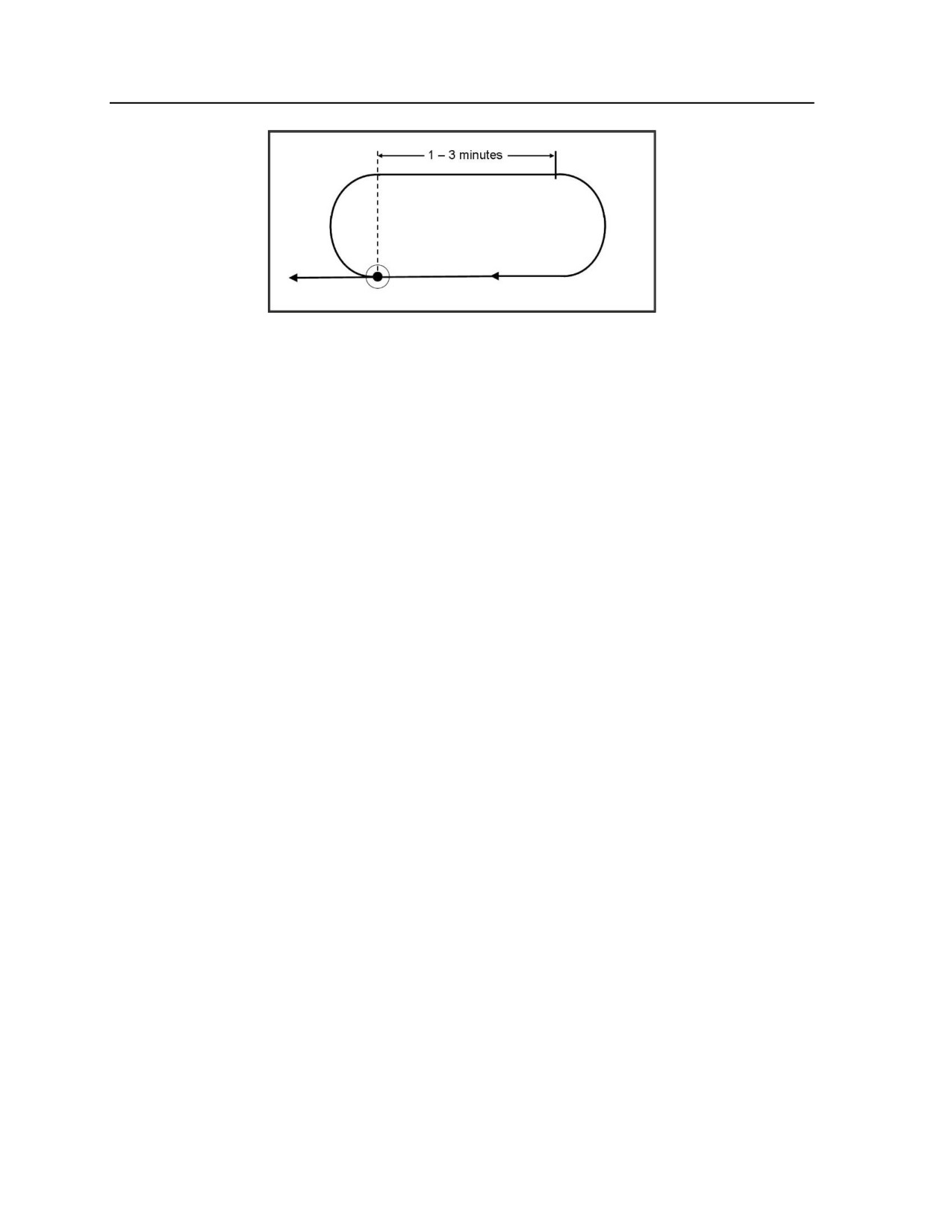
7-95. Course interceptions are performed in most phases of instrument navigation. The equipment used
varies, but an intercept heading must be flown that results in an angle or rate of intercept sufficient to solve
a particular problem.
RATE OF INTERCEPT
7-96. Rate of intercept, seen by the aviator as bearing pointer or HSI movement, is a result of the following
factors:
The angle at which the aircraft is flown toward a desired course (angle of intercept).
True airspeed and wind (ground speed).
Distance from the station.
ANGLE OF INTERCEPT
7-97. The angle of intercept is the angle between the heading of the aircraft (intercept heading) and desired
course. Controlling this angle by selection/adjustment of the intercept heading is the easiest and most
effective way to control course interceptions. Angle of intercept must be greater than the degrees from
course but should not exceed 90 degrees. Within this limit, adjust to achieve the most desirable rate of
intercept.
7-98. When selecting an intercept heading, the key factor is the relationship between distance from the
station and degrees from the course. Each degree, or radial, is 1 nautical mile wide at a distance of 60
nautical miles from the station. Width increases or decreases in proportion to the 60 nautical mile distance.
For example, 1 degree is 2 nautical miles wide at 120 nautical miles—and 1/2 nautical mile wide at 30
30 April 2007
FM 3-04.240
7-21
Chapter 7
nautical miles. For a given ground speed and angle of intercept, the resultant rate of intercept varies
according to the distance from the station. When selecting an intercept heading to form an angle of
intercept, consider the following factors:
Degrees from course.
Distance from the station.
True airspeed and wind (ground speed).
COMPLETING THE INTERCEPT
Lead Point
7-99. A lead point to roll out on the course must be determined because of turn radius of the aircraft. The
lead point is determined by comparing bearing pointer or HSI movement with the time required to turn to
course. Remember that the HSI deviation scale remains fully deflected until the aircraft is within 10
degrees of course for a VOR. Because deviation scale movement can be accurately compared with angle of
intercept displayed by the heading pointer, use the deviation scale for completing intercepts whenever
possible.
Rate of Intercept
7-100. To determine the rate of intercept, monitor the bearing pointer or HSI movement. If the movement
of the bearing pointer or the HSI is quick, the rate of intercept should also be quick.
Turn
7-101. The time required to make the turn to course is determined by the intercept angle and the aircraft
turn rate. Greater intercept angles and slower aircraft turn rates require more time.
Complete the Intercept
7-102. Use the HSI, when available, for completing the course intercept. The HSI deviation scale is more
sensitive than a bearing pointer.
Undershoot or Overshoot
7-103. If the selected lead point will result in undershooting the desired course, either reduce the angle of
bank or roll out of the turn and resume the intercept. If the selected lead point results in an overshoot,
continue the turn and roll out with a correction back to the course.
Maintain Course
7-104. The aircraft is considered to be maintaining course centerline when the HSI is centered or the
bearing pointer points to the desired course. A correction for known winds should be applied when
completing the turn to a course, as shown in Figure 7-6, page 7-19, and figure 7-7, page 7-20.
7-105. Aviators should always attempt to fly as close to the course centerline as possible. TERPS design
criteria provide maximum obstacle clearance protection when the course centerline is maintained.
INBOUND PROCEDURES
7-106. An aviator may use various methods to intercept a radial while flying to a station. Generally,
setting up a 45-degree angle of intercept is recommended (Figure 7-9, page 7-25); a 30-degree angle of
intercept (Figure 7-8, page 7-24) is also correct, as is double the angle off the nose method if the number of
radials to be crossed is not in excess of 45 degrees. The double the angle off the nose method (Figure 7-12,
page 7-28) and timed distance method for radial changes in excess of 45 degrees (Figure 7-10, page 7-26)
are described in detail below.
7-22
FM 3-04.240
30 April 2007
Navigation Aids
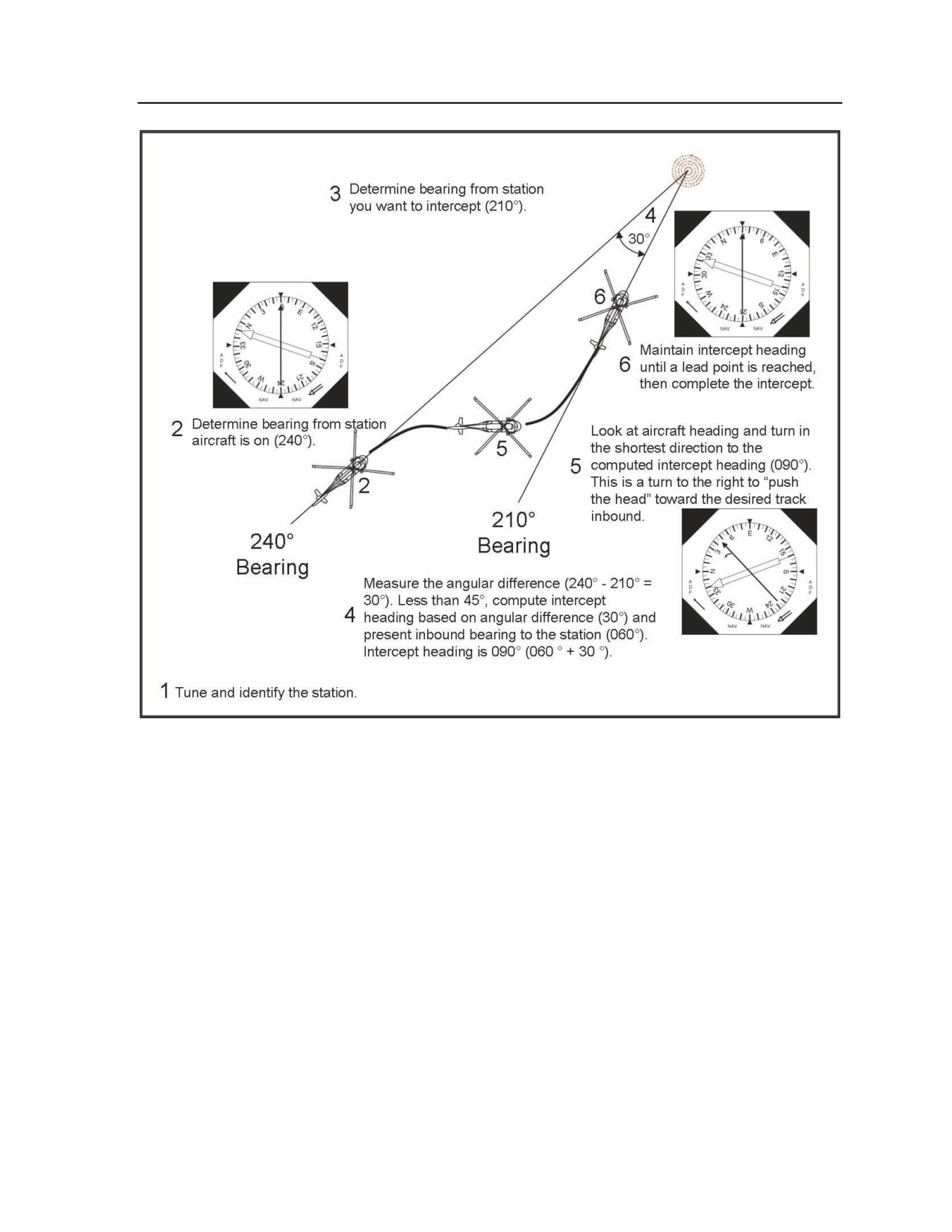
Figure 7-8. Inbound course intercept of less than 45 degrees
Horizontal Situation Indicator
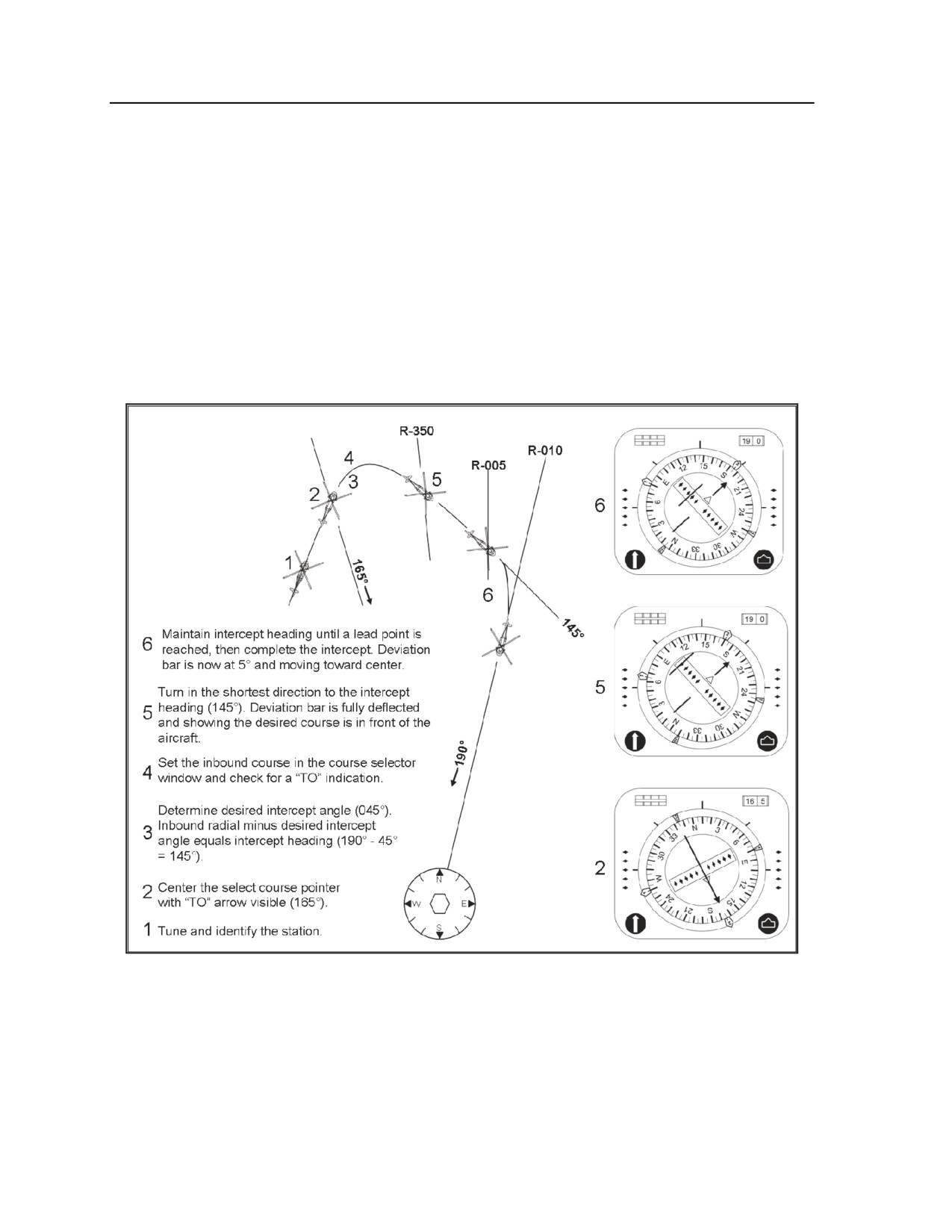
7-107. The HSI used in the following figures is a generic representation and has the following
features/functions:
Needle 1, representing an NDB signal.
Needle 2, representing a VOR signal or GPS WP.
Upper left indicator, representing distance to go in kilometers.
Upper right indicator, the course set display.
Lower left knob, the course selector.
Lower right knob, the heading selector.
To or from arrows.
Compass card.
Deviation scale (each dot representing 2 degrees of deviation for VOR).
Lubber line, 45-degree left and right marks, and 90-degree left and right marks.
Glide-slope deviation scale and dual pointers.
30 April 2007
FM 3-04.240
7-23
Chapter 7
Angular Difference Less Than 45 Degrees
7-108. To determine the intercept heading, locate the bearing from the station presently on. Find the
bearing that the aviator wants to intercept, and measure the angular difference.
7-109. If the angular difference is less than 45 degrees, turn toward the desired bearing in the shortest
direction with an angle of intercept equal to the computed angular difference. The time to the station will
be about equal to the time necessary to complete the intercept (Figure 7-8, page 7-23).
Angular Difference Greater Than 45 Degrees
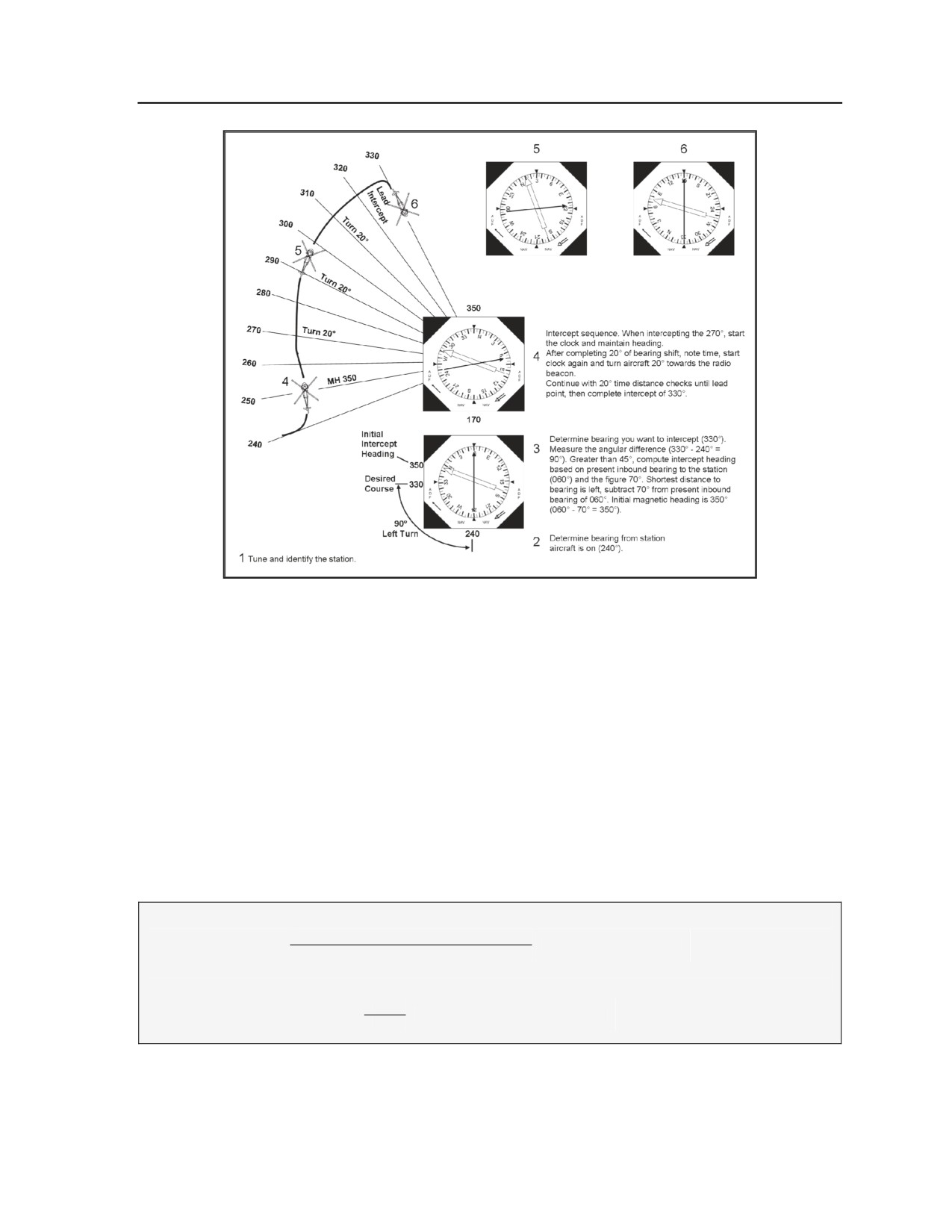
7-110. The aviator may select any angular interception if timing is not essential, 30 to 45 degrees being
generally sufficient
(Figure
7-9). If the angular difference is greater than
45 degrees, a series of
time-distance check maneuvers (discussed later) may be performed if distance/time to the station is
unknown (Figure 7-10, page 7-25).
Figure 7-9. Inbound course intercept
7-24
FM 3-04.240
30 April 2007
Navigation Aids
Figure 7-10. Inbound course intercept of greater than 45 degrees
Station Passage
7-111. When the aircraft is using VOR and VOR/DME, station passage occurs when the TO-FROM
indicator makes the first positive change to FROM. For RMI only, station passage is determined when the
bearing pointer passes 90 degrees to the inbound course. When the aircraft is using TACAN, station
passage is determined when the range indicator stops decreasing. When the aircraft is using NDB, station
passage is determined when the bearing pointer passes 90 degrees to the inbound course.
TIME AND DISTANCE CHECK
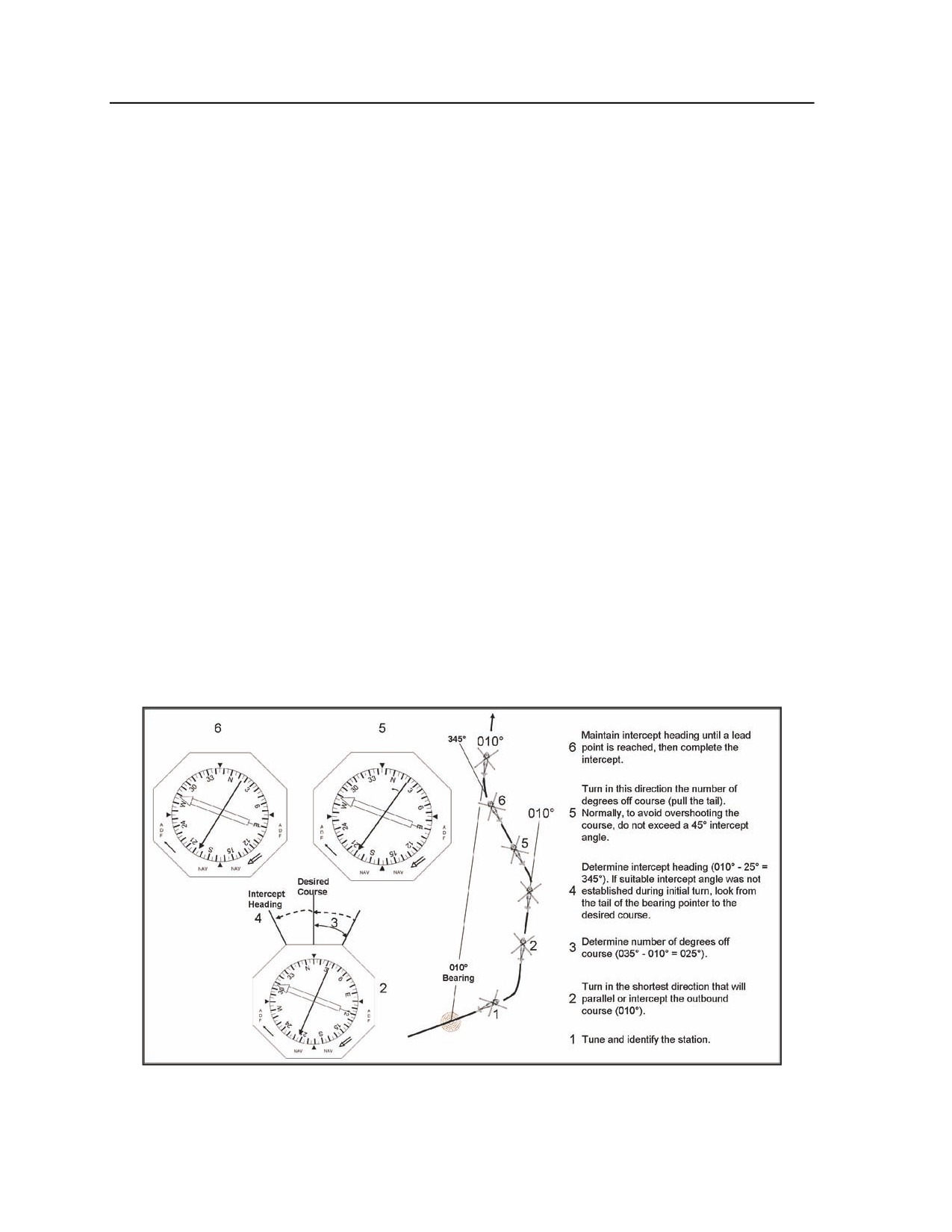
7-112. To compute time and distance from a station, first turn the aircraft to place the bearing pointer on
the nearest 90-degree index; note time and maintain heading. When the bearing pointer has moved 10
degrees, note the elapsed time in seconds and apply the formulas in the following example to determine
time and distance.
Time-Distance Check Example
Time in seconds between bearings
= Minutes to station
Degrees of bearing change
For example, if two minutes (120 seconds) is required to fly a bearing change of 10 degrees, the aircraft is—
120
= 12 minutes to the station
10
7-113. The time from station may also be calculated by using a short method based on the above formula,
if a 10-degree bearing change is flown. If the elapsed time for the bearing change is noted in seconds and a
10-degree bearing change is made, the time from the station in minutes is determined by counting off one
30 April 2007
FM 3-04.240
7-25
Chapter 7
decimal point. Thus, if 75 seconds are required to fly a 10-degree bearing change, the aircraft is 7.5
minutes from the station. When the bearing pointer is moving rapidly or when several corrections are
required to place the pointer on the wingtip position, the aircraft is at station passage.
7-114. The distance from the station is computed by multiplying TAS or ground speed (in miles per
minute) by the previously determined time in minutes. For example, if the aircraft is four minutes from
station, flying at a TAS of 150 knots or 2.5 nautical miles per minute, the distance from station is 10
nautical miles (2.5 x 4).
7-115. The preceding are methods of computing approximate time and distance. For increased accuracy,
use only a small amount of bearing change (about 10 degrees) and correct for existing winds.
7-116. The aviator can determine the ETA over the station by flying a constant heading and checking the
time and bearing progression closely. The aviator can also check the position and distance from another
station not directly on the flight path.
7-117. The accuracy of time and distance checks is governed by existing wind, degree of bearing change,
and accuracy of timing. The number of variables involved causes the result to be an approximation.
However, by flying an accurate heading and checking the time and bearing closely, the aviator can get a
reasonable estimate of time and distance from the station.
OUTBOUND PROCEDURES
Immediately After Station Passage
7-118. Intercepting courses immediately after station passage does not require large intercept angles.
Because of radial convergence, actual aircraft displacement from course is relatively small. For example, a
30-degree off-course indication at 2 nautical miles from the station represents about 1 nautical mile off
course.
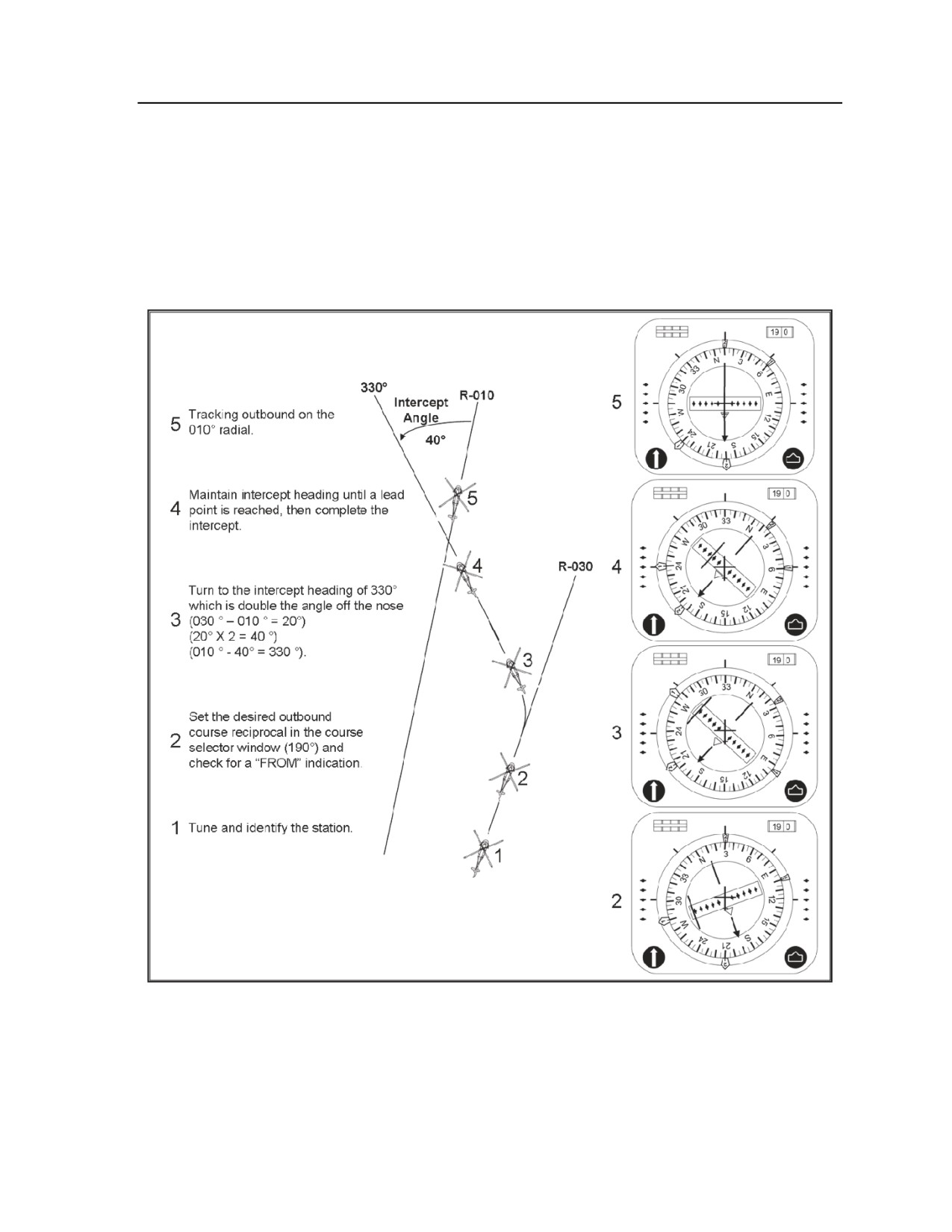
7-119. Turn to parallel the desired outbound course (compensate for wind). Maintain heading, and allow
the bearing pointer to stabilize. Note the number of degrees between the tail of the bearing pointer and the
desired course. To correct back on course, use the outbound course interception technique (Figure 7-11).
Figure 7-11. Outbound course intercept immediately after station passage
7-26
FM 3-04.240
30 April 2007
Navigation Aids
Away From Station
7-120. Note the position of the bearing pointer tail. Then, on the compass card, look from the tail in the
short direction to the desired course. Any heading beyond the desired course is a no-wind intercept
heading. Normally, 45 degrees beyond the desired course is a good intercept heading. As in inbound
intercepts, consider the known factors of ground speed and distance from the station when selecting an
intercept heading. Outbound—away from station procedures are essentially identical to outbound—
immediately after station passage, the intercept heading as determined in step 4, Figure 7-12, can be 45
degrees, 30 degrees, or double the angle off the nose intercept.
Figure 7-12. Outbound course intercept away from station
ARC INTERCEPTIONS
7-121. TACAN and VOR/DME arcs are used during all phases of flight. An arc may be intercepted at
any angle but is normally intercepted from a radial. An arc may be intercepted when the aircraft is
30 April 2007
FM 3-04.240
7-27
Chapter 7
proceeding inbound or outbound on a radial. A radial may be intercepted either inbound or outbound from
an arc. The angles of intercept (arc to radial or radial to arc) are about 90 degrees. Because of the large
intercept angles, the use of accurate lead points during the interception aids in preventing excessive
undershoots or overshoots.
ARC INTERCEPTION FROM A RADIAL
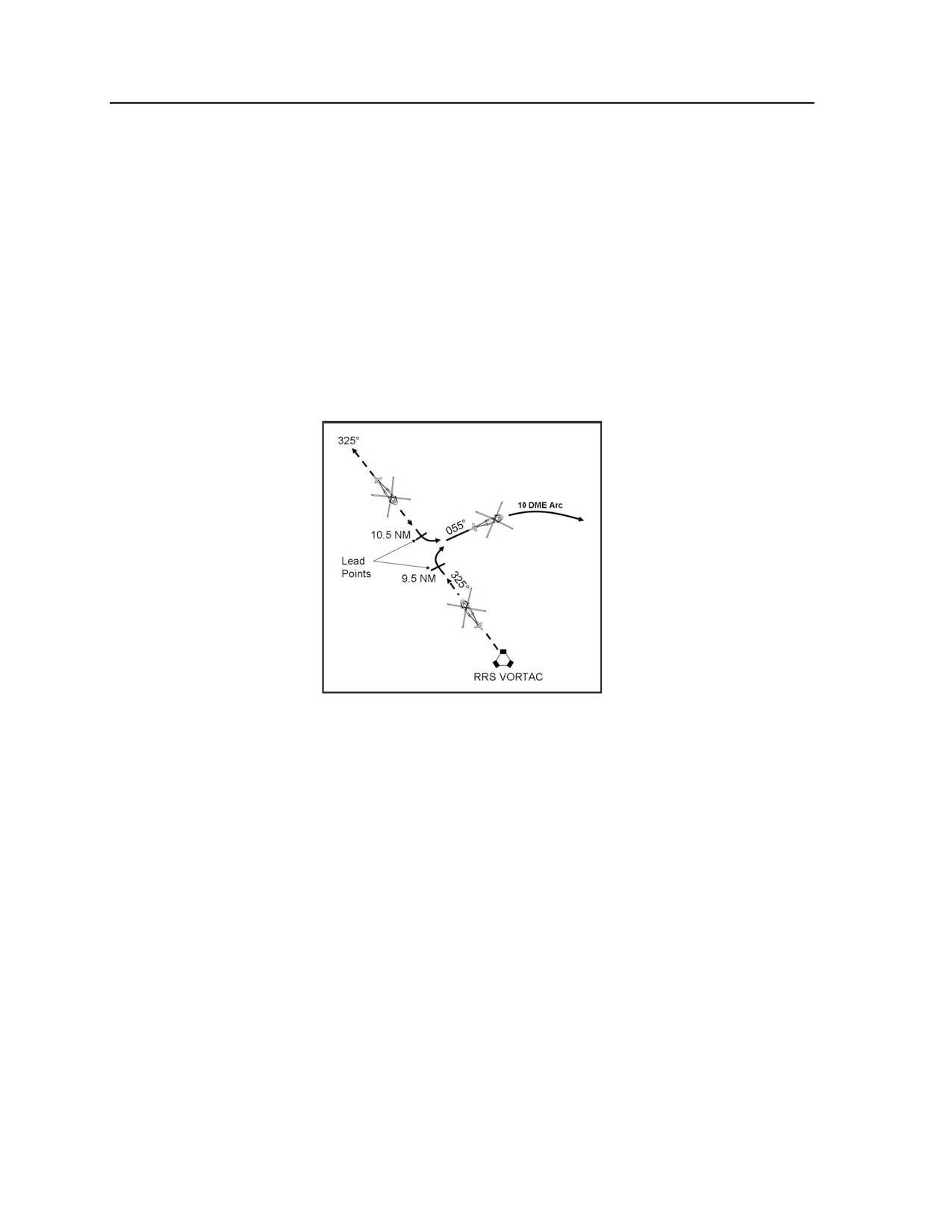
7-122. Track inbound on the RRS 325-degree radial (Figure 7-13), frequently checking the DME mileage
readout. A .5 nautical mile lead is satisfactory for ground speeds of 150 knots or less; start the turn to the
arc at 10.5 miles. At higher ground speeds, use a proportionately greater lead. Continue the turn for about
90 degrees. The rollout heading will be 055 degrees in no-wind conditions. During the last part of the
intercepting turn, monitor the DME closely. If the arc is being overshot (more than 1 nautical mile),
continue through the originally planned rollout heading. If the arc is being undershot, roll out of the turn
early. The procedure for intercepting the 10 DME when outbound is basically the same, the lead point
being 10 nautical miles minus .5 nautical mile, or 9.5 nautical miles.
Figure 7-13. Arc interception from a radial
RADIAL INTERCEPTION FROM AN ARC
7-123. A lead radial is the radial at which the turn from the arc to the inbound course is started. When the
aircraft intercepts a radial from a DME arc, the lead radial will vary with arc radius and ground speed.
When an aviator flies arcs, such as those depicted on most approach plates, the lead radial will be less than
5 degrees at speeds of 150 knots or less. There is no difference between intercepting a radial from an arc
and intercepting from a straight course.
7-124. Set the course of the radial to be intercepted as soon as possible and determine the approximate
lead. Upon reaching this point, start the intercepting turn. Without an RMI, the technique for radial
interception is the same except for azimuth information, which is available only from the OBS and CDI.
7-125. The technique for intercepting a localizer from a DME arc is similar to intercepting a radial. At the
depicted lead radial (LR 330 degrees in Figure 7-14, page 7-29), an aviator having a single VOR/LOC
receiver should set the localizer frequency. If the aviator has dual VOR/LOC receivers, one unit may be
used to provide azimuth information with the other being set to the localizer frequency.
7-28
FM 3-04.240
30 April 2007
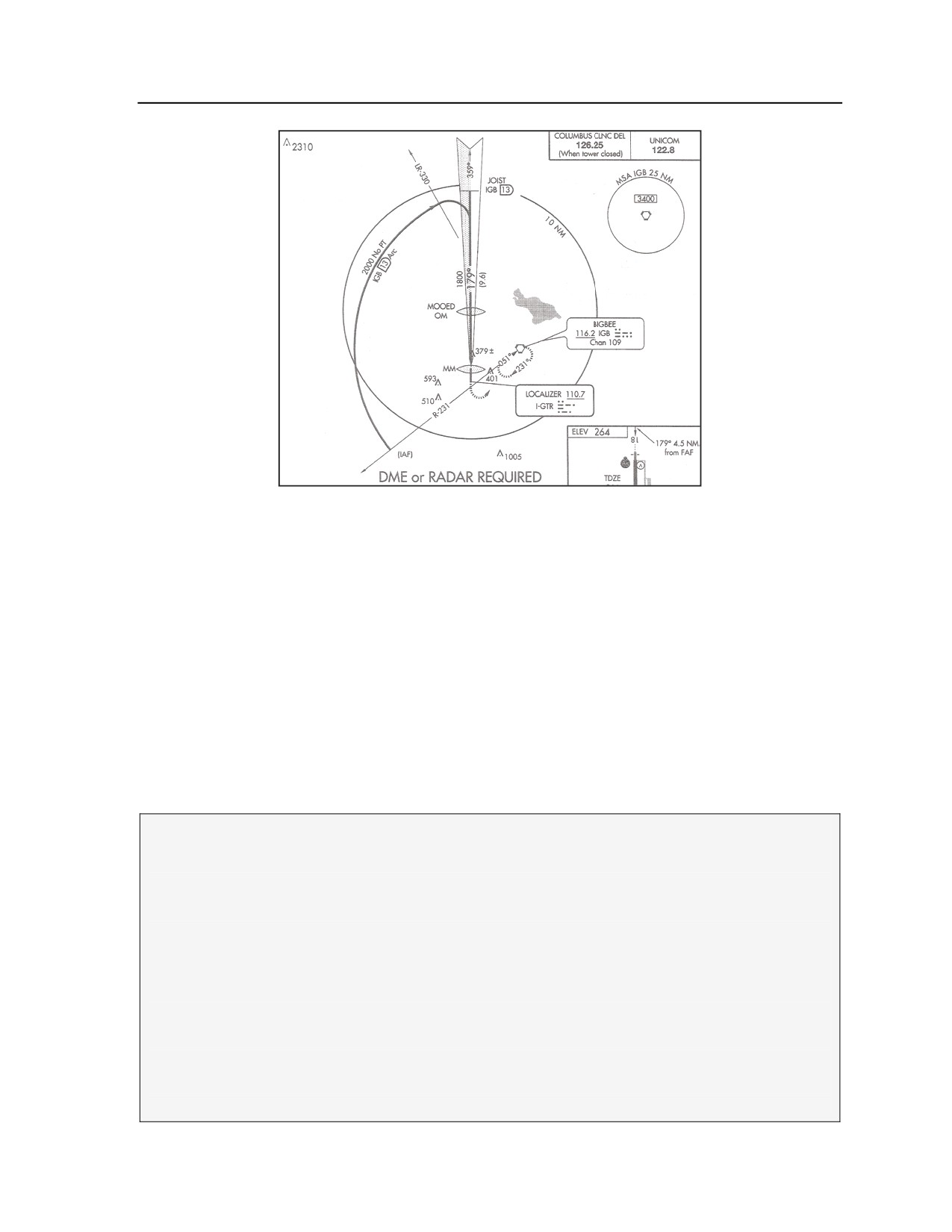
Navigation Aids
Figure 7-14. Localizer interception from a distance measuring equipment arc
FLYING A DISTANCE MEASURING EQUIPMENT ARC
7-126. When flying a DME arc with wind, the aviator should keep a continuous mental picture of
position relative to the facility. Because the wind-drift correction angle is constantly changing throughout
the arc, wind orientation is important. In some cases, wind can be used to return to the desired track. High
airspeeds require more aviator attention because of the higher rate of deviation and correction.
7-127. Maintaining the arc is simplified by keeping slightly inside the curve; thus, the arc is turning
toward the aircraft and interception may be accomplished by holding a straight course. If outside the curve,
the arc is turning away and a greater correction is required.
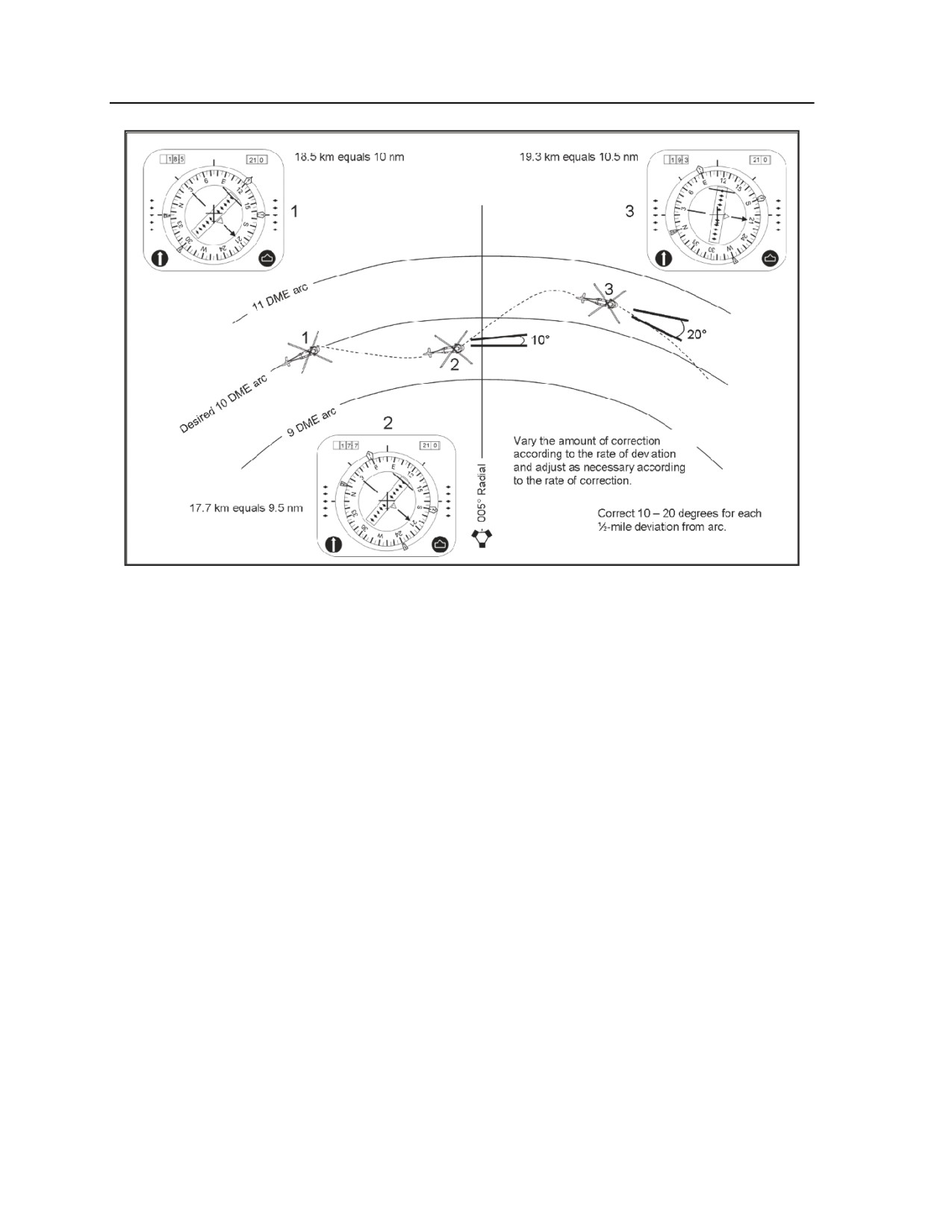
7-128. With an RMI, in a no-wind condition, the aviator should theoretically be able to fly an exact circle
around the facility by maintaining an RB of 90 degrees or 270 degrees. In actual practice, a series of short
legs are flown. To maintain the arc in Figure 7-15, page 7-30, proceed as the following example describes.
Flying a DME Arc Example
With the RMI bearing pointer on the wingtip reference (90º or 270º position) and the aircraft at the desired
DME range, maintain a constant heading and allow the bearing pointer to move 5º to 10º behind the wingtip.
DME range should increase slightly.
Turn toward the facility to place the bearing pointer 5º to 10º ahead of the wingtip reference, then maintain
heading until the bearing pointer is again behind the wingtip. Continue this procedure to maintain the
approximate arc.
If a crosswind is drifting the aviator away from the facility, turn the aircraft until the bearing pointer is ahead of
the wingtip reference. If a crosswind is drifting the aviator toward the facility, turn until the bearing is behind the
wingtip.
As a guide in making range corrections, correct about 10º to 20º for each ½-mile deviation from the desired
arc. For example, in no-wind conditions if the aviator is ½ to 1 mile outside of the arc and the bearing pointer is
on the wingtip reference, turn the aircraft 20º toward the facility to return to the arc.
Maintain aircraft position within 2 nautical miles of the desired DME arc.
30 April 2007
FM 3-04.240
7-29
Chapter 7
Figure 7-15. Flying a distance measuring equipment arc
AREA NAVIGATION
DESCRIPTION
7-129. RNAV equipment includes VOR/DME, TACAN, VORTAC, GPS, and INS. RNAV equipment is
capable of computing aircraft position, actual track, and ground speed and then presenting meaningful
information to the aviator. This information may be in the form of distance, cross-track error, and time
estimates relative to the selected track or WP. In addition, RNAV equipment installations must be
approved for use under IFR. The appropriate aircraft operator’s manual must always be consulted to
determine what equipment is installed, approved operations, and details of how to use the equipment. Some
aircraft may have equipment allowing input from more than one RNAV source, thereby providing a very
accurate and reliable navigation source.
AREA NAVIGATION COMPUTATION
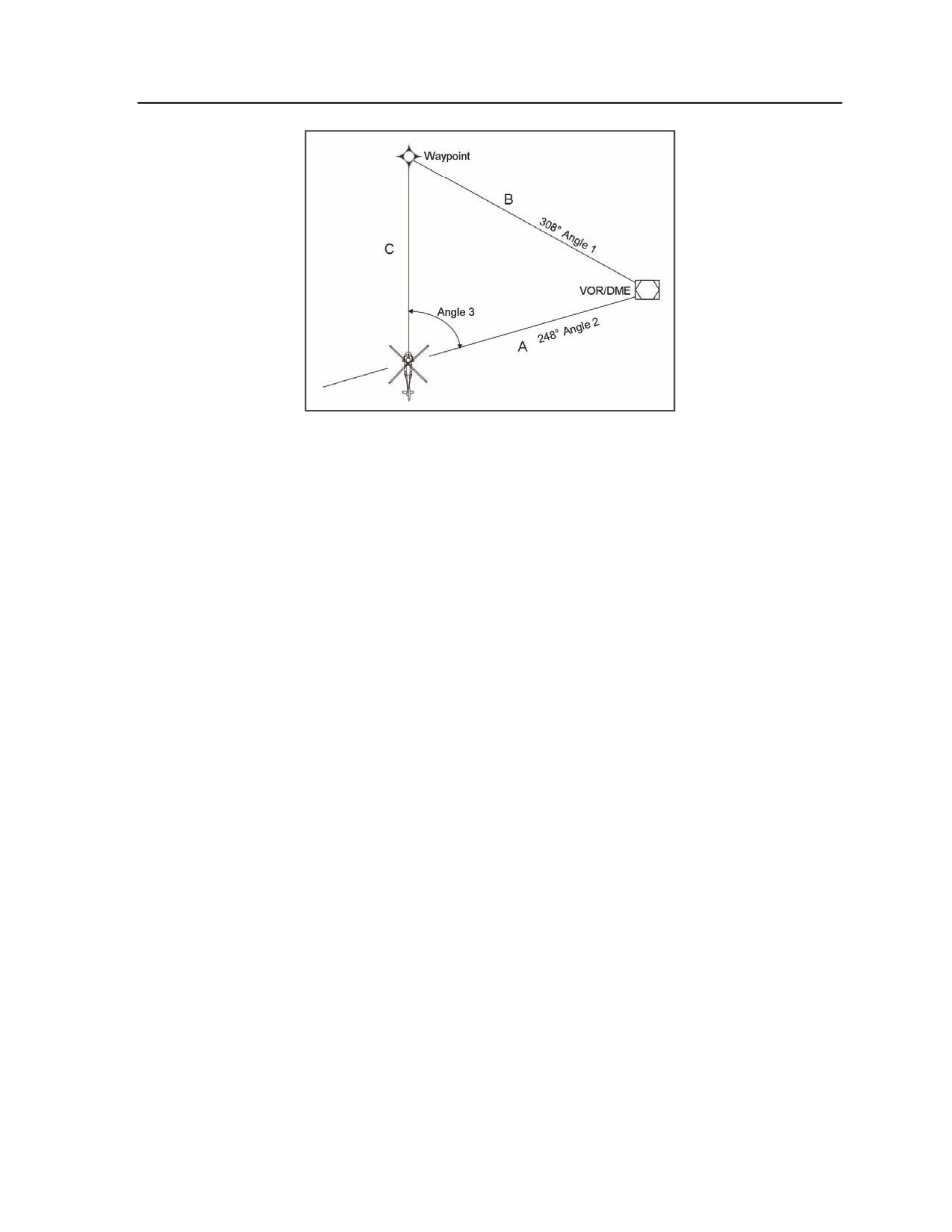
7-130. VOR RNAV is based on information generated by present VORTAC or VOR/DME systems to
create a WP using an airborne computer. As shown in Figure 7-16, page 7-31, the value of side A is the
measured DME distance to the VOR/DME. The value of Side B is the distance from the VOR/DME to the
WP angle 1 (VOR radial or bearing from the VORTAC to the WP). The bearing from the VOR/DME to
the aircraft, angle 2, is measured by the VOR receiver. The airborne computer continuously compares
angles 1 and 2 and determines angle 3 and side C, which is the distance in nautical miles and magnetic
course from the aircraft to the WP. Guidance information is presented on the cockpit display.
7-30
FM 3-04.240
30 April 2007
Navigation Aids
Figure 7-16. Area navigation computation
COMPONENTS
7-131. Although RNAV cockpit instrument displays vary among manufacturers, most are connected to
the aircraft CDI with a switch or knob to select VOR or RNAV guidance. The display includes WP,
frequency, mode in use, WP radial and distance, DME distance, ground speed, and time to station. Most
VOR/DME RNAV systems have the following airborne controls:
Off/on/volume control to select the frequency of the VOR/DME station to be used.
MODE select switch used to select VOR/DME mode with one of the following:
Angular course width deviation (standard VOR operation).
Linear cross-track deviation as standard (±5 nautical miles full-scale CDI).
RNAV mode with direct to WP with linear cross-track deviation of ±5 nautical miles.
RNAV/APPR (approach mode) with linear deviation of ±1.25 nautical miles as full-scale CDI
deflection.
WP selection control, which allows selection of any WP in storage; some units allow the storage
of more than one WP.
Data input controls, which allow user input of WP number or identification (IDENT), VOR or
LOC frequency, WP radial, and distance.
7-132. DME ground-speed readout in the VOR/DME mode is accurate only when the VOR/DME is
tracking directly to or from the station. In RNAV mode, the DME ground-speed readout is accurate on any
track.
FUNCTION
7-133. Advantages of the VOR/DME RNAV system stem from the ability of the airborne computer to
locate a WP wherever convenient, as long as the aircraft is within reception range of both a nearby VOR
and DME facility. A series of these WPs make up an RNAV route. In addition to the published routes, a
random RNAV route may be flown under IFR if approved by ATC. To either fly a route or to execute an
approach under IFR, the RNAV equipment installed in the aircraft must be approved for the appropriate
IFR operations.
7-134. In vertical NAV mode, vertical as well as horizontal guidance is provided in some installations. A
WP is selected where the descent begins and another where the descent ends. The RNAV equipment
computes rate of descent relative to ground speed and, on some installations, displays vertical guidance
information on the glide-slope indicator. When using RNAV during an instrument approach, the aviator
30 April 2007
FM 3-04.240
7-31
Chapter 7
must keep in mind that the vertical guidance information provided is not part of the nonprecision approach.
Published nonprecision approach altitudes must be observed and complied with, unless otherwise directed
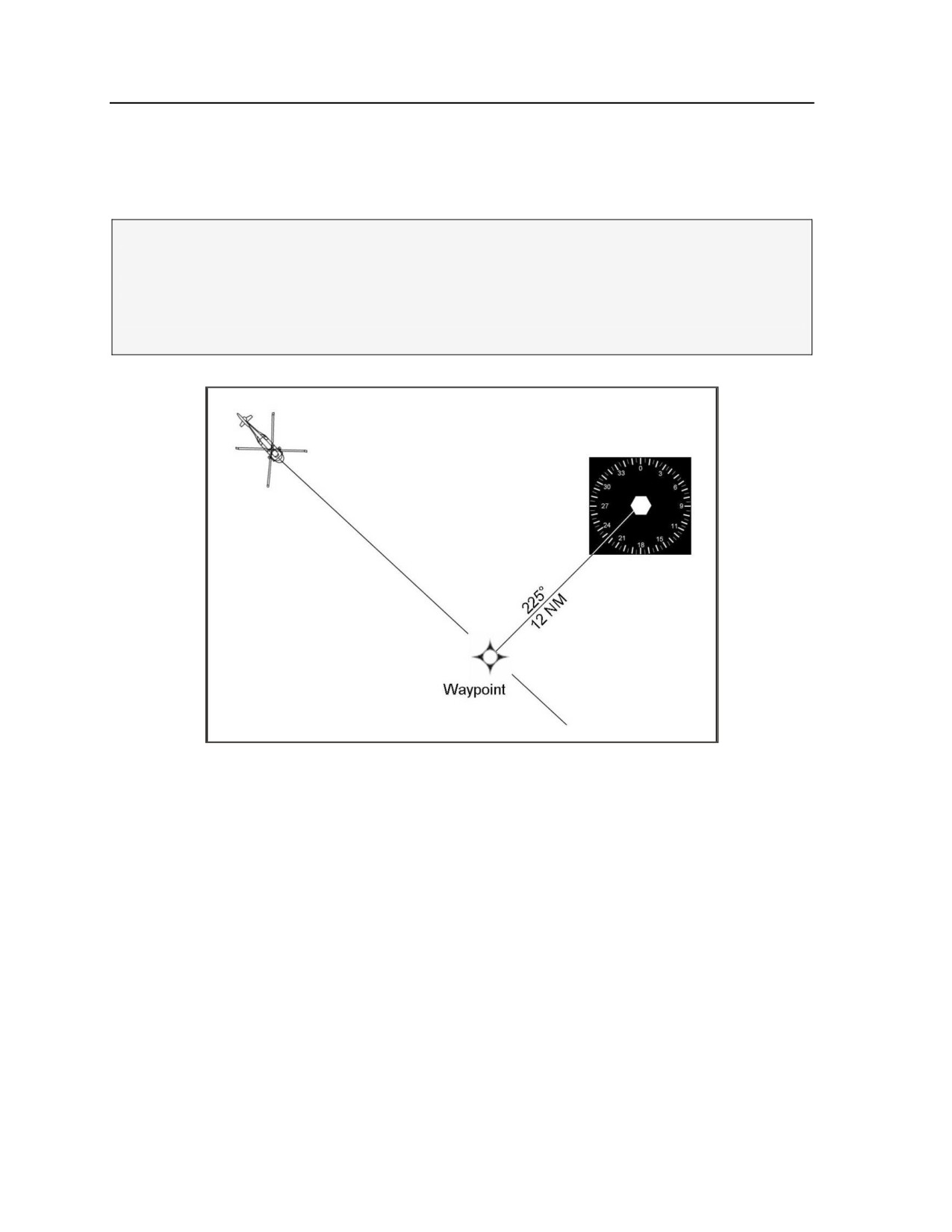
by ATC. To fly to a WP using RNAV, observe the procedure described in the following example and
illustrated in Figure 7-17.
Aircraft/VORTAC/WP Relationship Example
Select the VOR/DME frequency, the RNAV mode, and the radial of the VOR that passes through the WP (225
degrees). Select the distance from the DME to the WP chosen (12NM). Check and confirm all inputs and that
the CDI needle is centered with the TO indicator showing. To keep the CDI needle centered, maneuver the
aircraft to fly the indicated heading ± wind correction. The CDI needle indicates distance off course of 1
nautical mile per dot; DME readout indicates distance (NM) from the WP; ground speed reads closing speed
(knots) to the WP; and time to station (TTS) reads time to the WP.
Figure 7-17. Aircraft/very (high frequency) omnidirectional radio range tactical air navigation
aid/waypoint relationship
ERRORS
7-135. The limitation of the RNAV system is the reception volume. Published approaches have been
tested to ensure that reception volume is not a problem. Descents/approaches to airports distant from the
VOR/DME facility may not be possible because during the approach, the aircraft may descend below the
reception altitude of the facility at that distance.
GLOBAL POSITIONING SYSTEM NAVIGATION
7-136. GPS equipment used while operating under IFR must meet the standards set forth in Technical
Standard Order (TSO) C-129 (or equivalent) and the airworthiness installation requirements and be
approved for that type of IFR operation and operated according to the appropriate aircraft operator’s
manual.
7-137. An updatable GPS database that supports the appropriate operations (en route, terminal, and
instrument approaches) is required when the aircraft is operating under IFR. The aircraft GPS navigation
7-32
FM 3-04.240
30 April 2007
Navigation Aids
database contains WPs from geographic areas where GPS navigation has been approved for IFR
operations. The aviator selects the desired WPs from the database and may add user-defined WPs for the
flight.
7-138. Equipment approved according to TSO C-115a, VFR, and hand-held GPS systems do not meet the
requirements of TSO C-129 and are not authorized for IFR navigation, instrument approaches, or as a
principal instrument flight reference. During IFR operations, these units (TSO C-115a) may only be
considered as an aid to situational awareness (SA).
7-139. Using the calculated range and position information supplied by the satellite, the GPS
receiver/processor mathematically determines its position by triangulation from several satellites. The GPS
receiver needs at least four satellites to yield a three-dimensional position (latitude, longitude, and altitude)
and time solution. The GPS receiver computes navigational values (such as distance and bearing to a WP
and ground speed) by using the aircraft’s known latitude/longitude and referencing these to a database built
into the receiver.
7-140. The GPS receiver verifies the integrity
(usability) of the signals received from the GPS
constellation through RAIM to determine if a satellite is providing corrupted information. RAIM needs a
minimum of five satellites in view (or four satellites and a barometric altimeter barometrically aiding), to
detect an integrity anomaly. For receivers capable of doing so, RAIM needs six satellites in view (or five
satellites with barometrically aiding) to isolate and remove a corrupt satellite signal from the navigation
solution.
7-141. Generally there are two types of RAIM messages. One type indicates that there are not enough
satellites available to provide RAIM, and another type indicates that the RAIM has detected a potential
error exceeding the limit for the current phase of flight. Without RAIM capability, the aviator has no
assurance of the accuracy of GPS position.
7-142. Aircraft using approved GPS navigation equipment during IFR conditions may be required to have
an alternate means of navigation. Alternate means of navigation are required when aircraft are operating
IFR during the following: domestic en route phase, terminal operations, and certain IAPs. The avionics
necessary to receive all ground-based facilities appropriate for the route to the destination airport and any
required alternate airport must be installed and operational. Ground-based facilities necessary for these
routes must also be operational. Active monitoring of alternative navigation equipment is not required if
the GPS receiver uses RAIM for integrity monitoring. Active monitoring of an alternate means of
navigation is required when the RAIM capability of the GPS equipment is lost. In situations where the loss
of RAIM capability is predicted, the flight must rely on other approved equipment or delay departure or the
flight may be cancelled.
INSTRUMENT FLIGHT RULES FLIGHT
7-143. Preflight preparations ensure that the GPS is properly installed and certified with a current
database for the type of operation. The GPS operation must be conducted according to the appropriate
aircraft operator’s manual. Aviators must be thoroughly familiar with the particular GPS equipment
installed in the aircraft.
7-144. Required preflight preparations include checking NOTAMs relating to the IFR flight when the
aviator is using GPS as a supplemental method of navigation. GPS satellite outages are issued as GPS
NOTAMs, both domestically and internationally. Aviators may obtain GPS RAIM availability information
for an airport by specifically requesting GPS aeronautical information from an AFSS during preflight
briefings. GPS RAIM aeronautical information can be obtained for a three-hour period: the ETA and one
hour before to one hour after the ETA hour or a 24-hour timeframe for a specific airport. FAA briefers
provide RAIM information for a period of one hour before to one hour after the ETA, unless a specific
timeframe is requested by the aviator. Aviators should request a RAIM prediction from the departure
airport when departing on a published GPS departure procedure. Some GPS receivers can predict RAIM
availability. The aviator ensures that the required underlying ground-based navigation facilities, related
aircraft equipment appropriate to the route of flight, terminal operations, instrument approaches for the
30 April 2007
FM 3-04.240
7-33
Chapter 7
destination, and alternate airports/heliports are operational for the ETA. If the required ground-based
facilities and equipment are not available, the flight should be rerouted, rescheduled, or canceled or
conducted under VFR.
7-145. Except for programming and retrieving information from the GPS receiver, planning the flight is
accomplished in a manner similar to that using conventional NAVAIDs. Departure WP, DP, route, STAR,
desired approach, IAF, and destination airport are entered into the GPS receiver according to the
manufacturer’s instructions. During preflight, additional information may be entered for functions such as
ETA, fuel planning, and winds aloft.
7-146. When the GPS receiver is turned on, an internal process of test and initialization is started. When
the receiver is initialized, the user develops the route by selecting a WP or series of WPs, verifies the data,
and selects the active flight plan. This procedure varies widely among the manufacturer’s receivers. GPS is
a complex system, offering little standardization between receiver models. The aviator is responsible for
being familiar with the operation of the aircraft equipment that he is using.
7-147. The GPS receiver provides navigational values such as track, bearing, ground speed, and distance.
These are computed from the aircraft’s present latitude and longitude to the location of the next WP.
Course guidance is provided between WPs. The aviator has the advantage of knowing the aircraft’s actual
track over the ground. As long as track and bearing to the WP are matched up (by selecting the correct
aircraft heading), the aircraft is going directly to the WP.
SUBSTITUTION
7-148. Aircraft GPS systems, certified for IFR en route phase and terminal operations, may be used as a
substitute for ADF, VOR, and DME receivers during the following operations within the United States
NAS:
Determining the aircraft position over a DME fix, which includes en route operations at and
above 24,000 feet MSL (FL240) during GPS navigation.
Flying a DME arc.
Navigating TO or FROM the NDB/compass locator or VOR.
Determining the aircraft position over the NDB/compass locator or VOR.
Determining the aircraft position over a fix defined by the NDB/compass locator bearing
crossing a VOR/LOC course.
Holding over the NDB/compass locator or VOR.
7-149.
The following restrictions apply when the aviator uses GPS as a substitute for ADF, VOR, or
DME:
Equipment must be installed according to appropriate airworthiness installation requirements
and operated within the provisions of the appropriate aircraft operator’s manual.
The required integrity for these operations must be provided by at least en route RAIM or
equivalent.
WPs, fixes, intersections, and facility locations to be used for these operations must be retrieved
from the GPS airborne database, which must be current; if the required positions cannot be
retrieved from the airborne database, the substitution of GPS for ADF, VOR, and/or DME is not
authorized.
Procedures must be established for RAIM outages or predicted outages; these outages may
require the flight to rely on other approved equipment or the aircraft to be equipped with
operational NDB/ADF, VOR, and/or DME receivers. Otherwise, the flight must be rerouted,
delayed, or canceled or conducted VFR.
The course deviation bar or indicator must be set to terminal sensitivity (normally 1 or 1-1/4
nautical miles) during GPS course guidance tracking in the terminal area.
7-34
FM 3-04.240
30 April 2007
Navigation Aids
A non-GPS approach procedure must exist at the alternate airport when one is required; if the
non-GPS approaches on which the aviator must rely require DME, VOR, or ADF, the aircraft
must be equipped with DME, VOR, or ADF avionics, as appropriate.
Charted requirements for ADF, VOR, and/or DME can be met using GPS, except for use as the
principal instrument approach navigation source.
7-150. To determine the aircraft position over a DME fix, verify that aircraft GPS system integrity
monitoring is functioning properly and indicates satisfactory integrity. If the fix is identified by a five-letter
name contained in the GPS airborne database, select either the named fix as the active GPS WP or facility
establishing the DME fix as the active GPS WP. When the aviator uses a facility as the active WP, the only
acceptable facility is the DME facility charted as the one used to establish the DME fix. If this facility is
not in the airborne database, the aviator is not authorized to use that facility WP for this operation. If the
fix is identified by a five-letter name not contained in the GPS airborne database or if the fix is not named,
select the facility establishing the DME fix or another named DME fix as the active GPS WP. If selecting
the named fix as the active GPS WP, the aviator is over the fix when the GPS indicates arrival at the active
WP. If selecting the DME providing facility as the active GPS WP, the aviator is over the fix when the
GPS distance from the active WP equals the charted DME value and the aircraft is on the appropriate
bearing or course.
7-151. To fly a DME arc, verify that aircraft GPS system integrity monitoring is functioning properly and
indicates satisfactory integrity. Select from the airborne database the facility providing the DME arc as the
active GPS WP. The only acceptable facility is the DME facility on which the arc is based. If this facility is
not in the airborne database, the aviator is not authorized to perform this operation. Maintain position on
the arc by reference to the GPS distance, instead of DME readout.
7-152. To navigate TO or FROM the NDB/compass locator or VOR, verify that aircraft GPS system
integrity monitoring is functioning properly and indicates satisfactory integrity. Select the NDB/compass
locator or VOR facility from the airborne database as the active WP. If the chart depicts the compass
locator collocated with a fix of the same name, use of that fix as the active WP in place of the compass
locator facility is authorized. Select and navigate on the appropriate course to or from the active WP.
7-153. To determine the aircraft position over the NDB/compass locator or VOR, verify that aircraft GPS
system integrity monitoring is functioning properly and indicates satisfactory integrity. Select the
NDB/compass locator or VOR facility from the airborne database. When the aviator uses the
NDB/compass locator or VOR, that facility must be charted and in the airborne database. If this facility is
not in the airborne database, the aviator is not authorized to use a facility WP for this operation. The
aviator is over the NDB/compass locator or VOR when the GPS system indicates he is at the active WP.
To determine the aircraft position over a fix made up of the NDB/compass locator bearing crossing a VOR/
LOC course, verify that aircraft GPS integrity monitoring is functioning properly and indicates satisfactory
integrity.
7-154. A fix made up by crossing an NDB and/or a compass locator bearing is identified by a five-letter
fix name. The aviator may select the named fix or NDB/compass locator facility providing the crossing
bearing to establish the fix as the active GPS WP. When using the NDB/compass locator, that facility must
be charted and in the airborne database. If this facility is not in the airborne database, the aviator is not
authorized to use a facility WP for this operation. If selecting the named fix as the active GPS WP, the
aviator is over the fix when the GPS system indicates that he is at the WP and the aircraft is on the
prescribed track from the non-GPS navigation source. If selecting the NDB/compass locator facility as the
active GPS WP, the aviator is over the fix when the GPS bearing to the active WP is the same as the
charted NDB/compass locator bearing for the fix when flying the prescribed track from the non-GPS
navigation source.
7-155. To hold over the NDB/compass locator or VOR, verify that aircraft GPS system integrity
monitoring is functioning properly and indicates satisfactory integrity. Select the NDB/compass locator or
VOR facility from the airborne database as the active WP. When using a facility as the active WP, the only
acceptable facility is the NDB/compass locator or VOR facility that is charted. If this facility is not in the
airborne database, the aviator is not authorized to use a facility WP for this operation. Select
30 April 2007
FM 3-04.240
7-35
Chapter 7
nonsequencing (HOLD or OBS) mode and the appropriate course according to the appropriate aircraft
operator’s manual. Hold using the GPS according to the appropriate aircraft operator’s manual.
7-36
FM 3-04.240
30 April 2007
Chapter 8
Airspace
This chapter provides a general overview of airspace systems. AR 95-1, AIM,
Instrument Flying Handbook, Instrument Procedures Handbook, and other
FAA/International Civil Aviation Organization (ICAO) publications and Web sites
provide specific and detailed information.
SECTION I - NATIONAL AIRSPACE SYSTEM
8-1. The National Airspace System (NAS) is the
network of U.S. airspace: air navigation facilities,
Contents
equipment, services, airports, landing areas,
Section I - National Airspace System
8-1
aeronautical charts, rules, regulations, procedures,
Section II - International Civil Aviation
technical information, manpower, information
Organization
8-7
and/or services, and material. Included are system
components shared jointly with the military. The system’s present configuration is a reflection of the
technological advances involving the speed and altitude capability of jet aircraft, as well as the complexity
of microchip and satellite-based navigation equipment. To conform to international aviation standards, the
U.S. adopted the primary elements of the classification system developed by ICAO.
AIRSPACE CLASSIFICATION
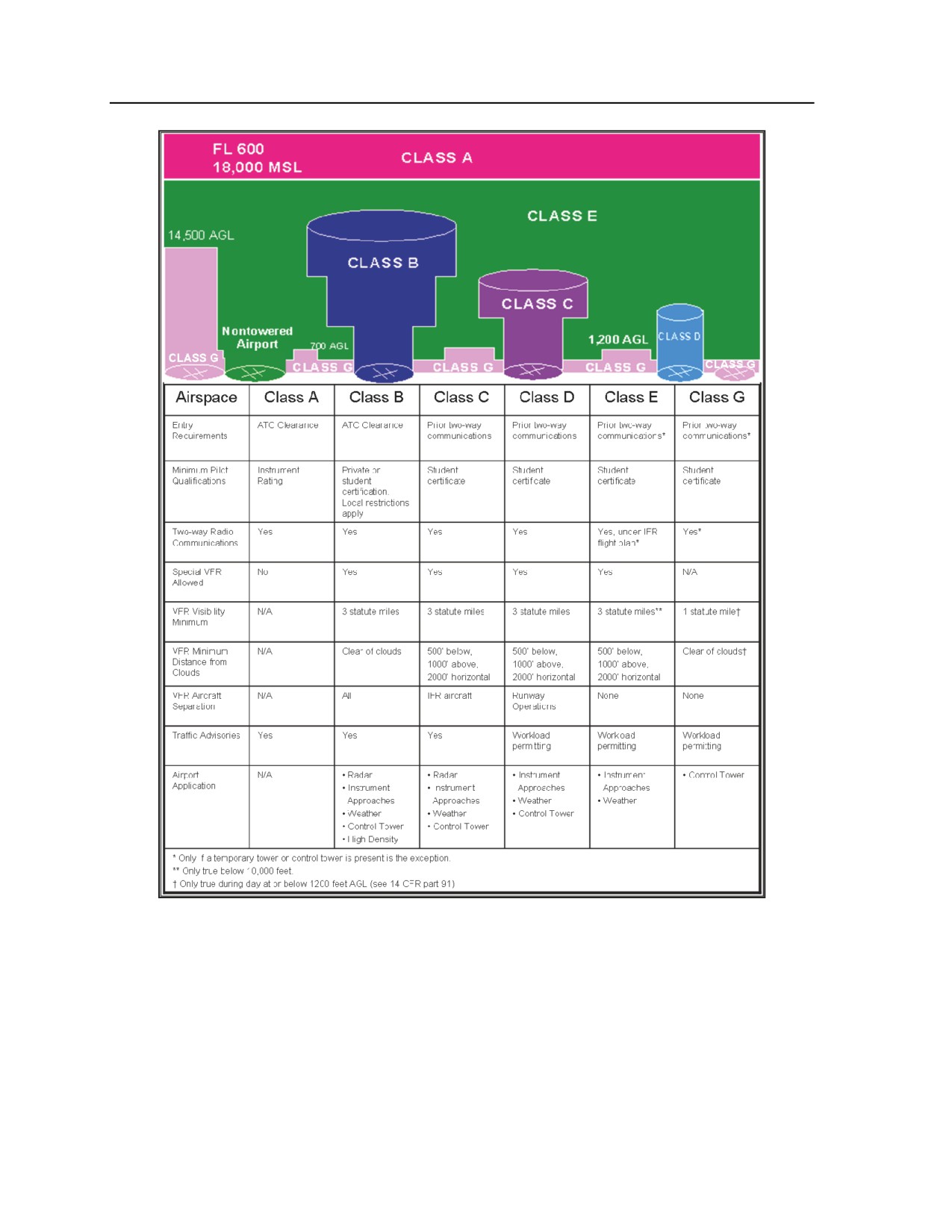
8-2. Airspace classification in the United States is as designated in Figure 8-1, page 8-2. Refer to AR 95
1 for approved cloud clearance and flight visibility for Army aviators.
CLASS A
8-3. Generally, Class A airspace is airspace from 18,000 feet MSL up to and including FL600, including
the airspace overlying the waters within 12 nautical miles of the coast of the 48 contiguous states and
Alaska. Unless otherwise authorized, all pilots must operate their aircraft under IFR.
CLASS B
8-4. Generally, Class B airspace is airspace from the surface to 10,000 feet MSL surrounding the nation’s
busiest airports in terms of airport operations or number of passengers. The configuration of each Class B
airspace area is individually tailored and consists of a surface area and two or more layers (some Class B
airspace areas resemble upside-down wedding cakes) and is designed to contain all published instrument
procedures, once an aircraft enters the airspace. An ATC clearance is required for all aircraft to operate in
the area, and all aircraft that are cleared receive separation services within the airspace.
30 April 2007
FM 3-04.240
8-1
Chapter 8
Figure 8-1. Airspace classification
CLASS C
8-5. Generally, Class C airspace is airspace from the surface to 4,000 feet above the airport elevation
(charted in MSL) surrounding those airports that have an operational control tower, are serviced by a radar
approach control, and have a certain number of IFR operations or passengers. Although the configuration
of each Class C area is individually tailored, the airspace usually consists of a surface area with a 5 nautical
mile radius, an outer circle with a 10 nautical mile radius that extends from 1,200 feet to 4,000 feet above
the airport elevation, and an outer area. Each person must establish two-way radio communications with
8-2
FM 3-04.240
30 April 2007
Airspace
the ATC facility providing air traffic services before entering the airspace and thereafter maintain those
communications while within the airspace.
CLASS D
8-6. Generally, Class D airspace is airspace from the surface to 2,500 feet above the airport elevation
(charted in MSL) surrounding those airports that have an operational control tower. The configuration of
each Class D airspace area is individually tailored, and when instrument procedures are published, the
airspace will normally be designed to contain the procedures. Arrival extensions for IAPs may be Class D
or Class E airspace. Unless otherwise authorized, each person must establish two-way radio
communications with the ATC facility providing air traffic services before entering the airspace and,
thereafter, maintain those communications while in the airspace.
CLASS E
8-7. Generally, if not classified as A, B, C, or D airspace, and it is controlled airspace, then it is Class E.
Class E airspace extends upward from either the surface or a designated altitude to the overlying or
adjacent controlled airspace. When designated as a surface area, the airspace will be configured to contain
all instrument procedures. Also in this class are Federal airways, airspace beginning at either 700 or 1,200
feet AGL used to make the transition to and from the terminal or en route environment and en route
domestic and offshore airspace areas designated below 18,000 feet MSL. Unless designated at a lower
altitude, Class E airspace begins at 14,500 MSL over the United States, including that airspace overlying
the waters within 12 nautical miles of the coast of the 48 contiguous states and Alaska, up to but not
including 18,000 feet MSL and the airspace above FL600.
CLASS G
8-8. Class G airspace is airspace not designated as Class A, B, C, D, or E. Class G airspace is essentially
uncontrolled by ATC except when associated with a temporary control tower.
SPECIAL-USE AIRSPACE
8-9. Special-use airspace is the designation for airspace in which certain activities must be confined or
where limitations may be imposed on aircraft operations that are not part of those activities. Certain
special-use airspace areas can create limitations on the mixed use of airspace. The special-use airspace
depicted on instrument charts includes the area name or number, effective altitude, time and weather
conditions of operation, the controlling agency, and the chart panel location. On NACO en route charts,
this information is available on the panel opposite the air/ground (A/G) voice communications.
PROHIBITED AREA
8-10. Prohibited areas contain airspace of defined dimensions within which the flight of aircraft is
prohibited. Such areas are established for security or other reasons associated with national welfare. These
areas are published in the Federal Register and are depicted on aeronautical charts. The area is charted as a
“P” with a number (such as P-123). As the name implies, flight through this airspace is not permitted.
RESTRICTED AREA
8-11. Restricted areas are areas where operations are hazardous to nonparticipating aircraft and contain
airspace within which the flight of aircraft, while not wholly prohibited, is subject to restrictions. Activities
within these areas must be confined because of either their nature or limitations imposed upon aircraft
operations that are not a part of those activities, or both. Restricted areas denote the existence of unusual,
often invisible, hazards to aircraft (artillery firing, aerial gunnery, or guided missiles). IFR flights may be
authorized to transit the airspace and are routed accordingly. Penetration of restricted areas without
authorization from the using or controlling agency may be extremely hazardous to the aircraft and its
30 April 2007
FM 3-04.240
8-3
Chapter 8
occupants. ATC facilities apply the following procedures when aircraft are operating on an IFR clearance
(including those cleared by ATC to maintain VFR-On-Top) via a route that lies within joint-use restricted
airspace:
If the restricted area is not active and has been released to the FAA, the ATC facility will allow
the aircraft to operate in the restricted airspace without issuing specific clearance to do so.
If the restricted area is active and has not been released to the FAA, the ATC facility will issue a
clearance that will ensure that the aircraft avoids the restricted airspace.
8-12. Restricted areas are charted with an “R” followed by a number (such as R-5701) and are depicted on
the en route chart appropriate for use at the altitude or FL being flown.
WARNING AREA
8-13. Warning areas are similar in nature to restricted areas; however, the U.S. government does not have
sole jurisdiction over the airspace. A warning area is airspace of defined dimensions, extending from 3
nautical miles outward from the coast of the United States, containing activity that may be hazardous to
nonparticipating aircraft. The purpose of such areas is to warn nonparticipating pilots of the potential
danger. A warning area may be located over domestic or international waters or both. The airspace is
designated with a “W” and a number (such as W-123).
MILITARY OPERATIONS AREA
8-14. Military operations areas (MOAs) consist of airspace of defined vertical and lateral limits established
for the purpose of separating certain military training activities from IFR traffic. Whenever an MOA is
being used, nonparticipating IFR traffic may be cleared through an MOA if IFR separation can be provided
by ATC. Otherwise, ATC will reroute or restrict nonparticipating IFR traffic. MOAs are depicted on
sectional, VFR terminal area, and en route low-altitude charts and are named rather than numbered
(Boardman MOA).
ALERT AREA
8-15. Alert areas are depicted on aeronautical charts with an “A” and a number (A-123) to inform
nonparticipating aviators of areas that may contain a high volume of aviator training or an unusual type of
aerial activity. Aviators should exercise caution in alert areas. All activity within an alert area shall be
conducted according to regulations, without waiver, and aviators of participating aircraft, as well as
aviators transiting the area, shall be equally responsible for collision avoidance.
CONTROLLED FIRING AREA
8-16. Controlled firing areas (CFAs) contain activities that, if not conducted in a controlled environment,
could be hazardous to nonparticipating aircraft. The distinguishing feature of the CFA, as compared to
other special-use airspace, is that its activities are suspended immediately when spotter aircraft, radar, or
ground lookout positions indicate that an aircraft might be approaching the area. There is no need to chart
CFAs because they do not cause a nonparticipating aircraft to change its flight path.
OTHER AIRSPACE
MILITARY TRAINING ROUTE
8-17. Military training routes (MTRs) are used by military aircraft to maintain proficiency in tactical
flying; see Area Planning/1B (AP/1B). These routes are usually established below 10,000 feet MSL for
operations at speeds in excess of 250 knots. Some route segments may be defined at higher altitudes for
purposes of route continuity. Routes are identified as IR for IFR and VR for VFR, followed by a number.
MTRs with no segment above 1,500 feet AGL are identified by four number characters (IR1206, VR1207).
MTRs that include one or more segments above 1,500 feet AGL are identified by three-number characters
8-4
FM 3-04.240
30 April 2007
Airspace
(IR206, VR207.). IFR low-altitude en route charts depict all IR and VR routes that accommodate
operations above 1,500 feet AGL. IR routes are conducted according to IFR, regardless of weather
conditions. Refer to DOD FLIP AP/1B.
TEMPORARY FLIGHT RESTRICTION
8-18. Temporary flight restrictions (TFRs) are put into effect when traffic in the airspace would endanger
or hamper air or ground activities in the designated area. For example, a forest fire, chemical accident,
flood, or disaster-relief effort could warrant a TFR, which would be issued as a NOTAM.
NATIONAL SECURITY AREA
8-19. National security areas
(NSAs) consist of airspace of defined vertical and lateral dimensions
established at locations where there is a requirement for increased security and safety of ground facilities.
Flight in NSAs may be temporarily prohibited by regulation under the provisions of 14 CFR, part 99, and
prohibitions will be disseminated via NOTAM.
FEDERAL AIRWAY
8-20. The primary NAVAID for routing aircraft operating under IFR is the Federal Airways System. Each
Federal airway is based on a centerline that extends from one NAVAID or intersection to another
NAVAID specified for that airway. A Federal airway includes the airspace within parallel boundary lines 4
nautical miles to each side of the centerline. As in all instrument flight, courses are magnetic and distances
are in nautical miles. The airspace of a Federal airway has a floor of 1,200 feet AGL, unless otherwise
specified. A Federal airway does not include the airspace of a prohibited area.
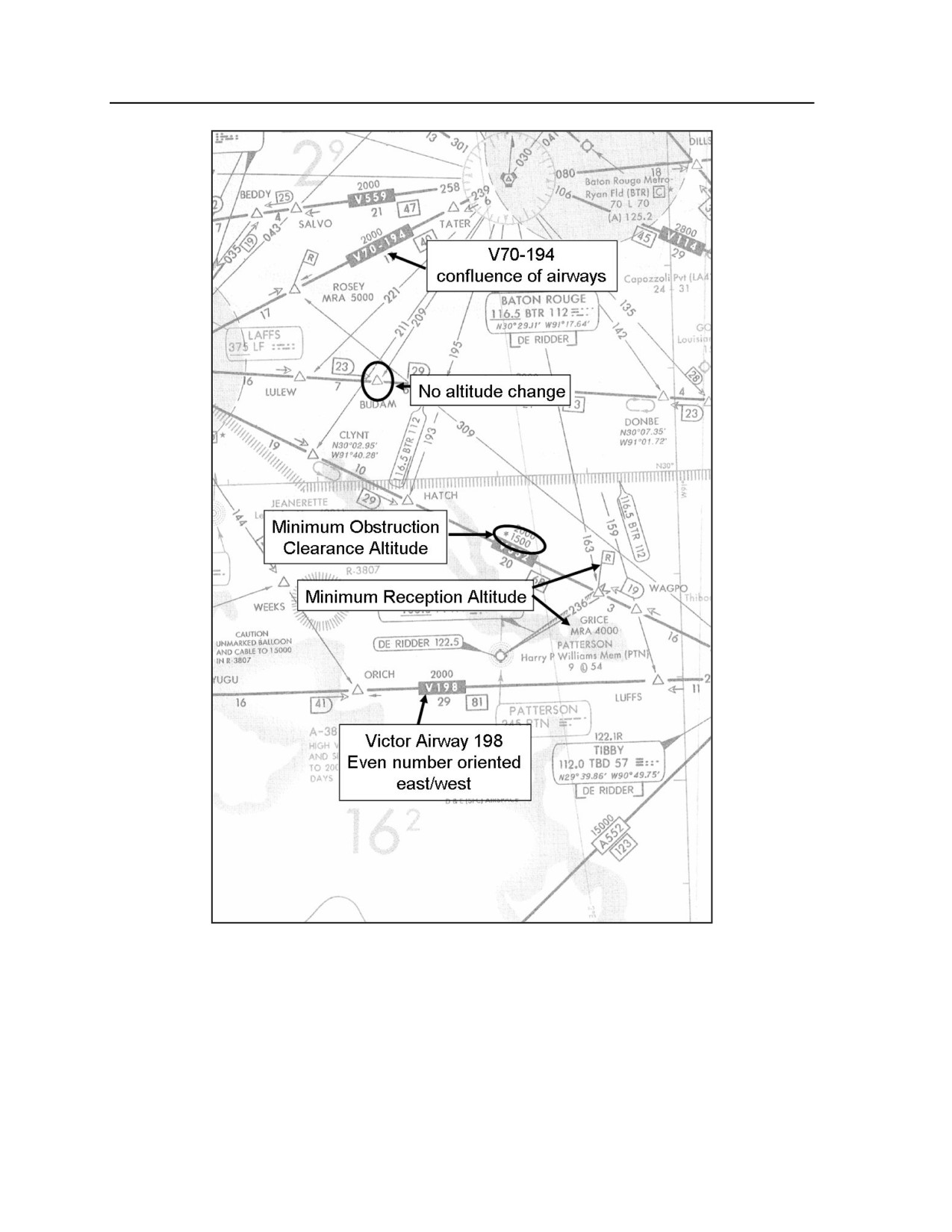
VICTOR AIRWAY
8-21. Victor airways include the airspace extending from 1,200 feet AGL up to, but not including, 18,000
feet MSL. The airways are designated on sectional and IFR low-altitude en route charts with the letter “V,”
followed by a number (such as V198). Typically, victor airways are given odd numbers when oriented
north/south and even numbers when oriented east/west. If more than one airway coincides on a route
segment, the numbers are listed serially (such as V70-194) (Figure 8-2, page 8-6).
JET ROUTE
8-22. Jet routes exist only in Class A airspace, from 18,000 feet MSL to FL450, and are depicted on
high-altitude en route charts. The letter “J” precedes a number to label the airway (J12).
OTHER ROUTING
8-23. The latest version of AC 90-91, National Route Program, provides guidance to users of the NAS for
participation in the National Route Program (NRP). All flights operating at or above FL290 within the
continental United States are eligible to participate in the NRP, the primary purpose of which is to allow
operators to plan minimum time/cost routes that may be off the prescribed route structure.
8-24. In addition, international flights to destinations within the United States are eligible to participate in
the NRP within specific guidelines and filing requirements. NRP aircraft are not subject to route-limiting
restrictions (published preferred IFR routes) beyond a 200 nautical mile radius of their point of departure
or destination.
30 April 2007
FM 3-04.240
8-5
Chapter 8
Figure 8-2. Victor airways and charted information
8-6
FM 3-04.240
30 April 2007
Airspace
Preferred Instrument Flight Rules Route
8-25. Preferred IFR routes have been established between major terminals to guide pilots in planning their
routes of flight, minimizing route changes, and aiding in the orderly management of air traffic on Federal
airways. Low- and high-altitude preferred routes are located at the following Web site,
rred_routes_database.html. To use a preferred route, reference the departure and arrival airports; if a
routing exists for the flight, airway instructions will be listed.
Tower En Route Control
8-26. Tower en route control (TEC) is an ATC program that uses overlapping approach control radar
services to provide IFR clearances. By using TEC, the aviator is routed by airport control towers. Some
advantages include abbreviated filing procedures, fewer delays, and reduced traffic separation
requirements. TEC depends on the ATC’s workload, and the procedure varies among locales.
SECTION II - INTERNATIONAL CIVIL AVIATION ORGANIZATION
8-27. The ICAO is composed of more than 180 member nations and is a part of the United Nations. Unlike
the FAA, whose regulations are directive, ICAO is basically an advisory organization that jointly agrees on
procedural criteria. These criteria are published in a document called Procedures for Air Navigation
Services-Aircraft Operations (PANS-OPS). Individual ICAO member nations may then comply with all, a
part, or none of the criteria published in PANS-OPS. For example, the United States is an ICAO member
nation but uses none of the PANS-OPS procedures—instead using the Federal Aviation Regulations
(FARs) for procedural guidance. A specific nation’s adoption of ICAO criteria makes that criteria directive
in that country. When adopted by a participating nation, these procedures are intended to be strictly
adhered to by flight crews to achieve and maintain an acceptable level of safety in flight operations. The
information provided in this chapter is based on the standards of PANS-OPS.
SAFETY
8-28. Even more so than in the United States, international flying requires good judgment on the part of
the aviator. The Army expects and encourages the application of good, sound judgment. The global
mission of the Army requires aviators to operate in countries without a well-developed aviation system or
into airfields where the ICAO rules have been ignored, replaced, or poorly applied. The pilot-in-command
(PC) must necessarily be the final judge of what is safe and prudent for any given mission.
APPLICABILITY
8-29. Procedures described in this chapter apply only in airspace not under FAA control. These procedures
are ICAO standard procedures and may be modified by each country.
CURRENT INFORMATION AND PROCEDURES
8-30. Changes to ICAO standard procedures can be numerous and may even vary from airfield to airfield
within a country. Area planning FLIP generally contains a comprehensive consolidation of procedural
requirements, but a thorough review of all applicable preflight planning sources is essential to ensuring
compliance with ICAO, host-nation, and Army requirements.
TERMINAL INSTRUMENT APPROACH PROCEDURES
8-31. There are many different kinds of approaches published in the DOD FLIP books for regions outside
of the United States. Some approaches are designed using U.S. TERPS at overseas bases. Other approaches
are designed under the civil PANS-OPS criteria while other procedures use host-nation criteria that are
different from PANS-OPS. Aircraft executing maneuvers other than those intended by the host-nation
30 April 2007
FM 3-04.240
8-7
Chapter 8
approach design could exceed the boundaries of the protected airspace or may cause overflight of
unauthorized areas. All ICAO procedures must be flown as depicted.
COMPLIANCE
8-32. When operating in airspace not under FAA control, aviators will apply ICAO procedures. Local
procedures may have to be developed for operations in different theaters, airfields, or host nations not
under ICAO or FAA jurisdiction.
DEFINITIONS
PROCEDURES FOR AIR NAVIGATION SERVICES-AIRCRAFT OPERATIONS
8-33. PANS-OPS is a two-part document. The first volume is for aviators and is similar to the FAA’s
AIM. The second volume contains the ICAO TERPS. The document is intended for use by international
civilian aviation, not the military. A number of editions of PANS-OPS have been published since the
creation of the ICAO, each with significant changes in the details of instrument approach procedure design.
Therefore, approaches in different parts of the world have been designed with entirely different rules.
AIRCRAFT CATEGORIES
8-34. Aircraft approach categories play a much larger role in the design of ICAO instrument procedures
than they do in the United States. In addition to affecting final approach minimums, PANS-OPS references
maximum speeds by category for such operations as holding, departures, and the intermediate segments of
instrument approaches. To make matters even more confusing, these additional category restrictions
specify speeds that are completely different from the familiar approach speeds on final. The appropriate
PANS-OPS category speeds appear in table 8-1, page 8-10, and table 8-2, page 8-15.
TRACK
8-35. Track is the projection on the surface of the earth of the path of an aircraft, the direction of which
path at any point is usually expressed in degrees from North. The aviator should apply known wind drift to
maintain the ground path.
BANK ANGLE
8-36. Bank angles for ICAO procedures are based on an average achieved bank angle of 25 degrees or the
bank angle giving a rate of turn of 3 degrees per second, whichever is less.
ESTABLISHED ON COURSE
8-37. The ICAO defines established on course as being within half full scale deflection for an ILS or
VOR/TACAN and within ± 5 degrees of the required bearing for the NDB. Aviators should not consider
their aircraft established on course until within these limits. ICAO obstacle clearance surfaces assume that
the aviator does not normally deviate from the centerline more than one-half scale deflection after being
established on track. Although there is a range of acceptable variation, make every attempt to fly the
aircraft on the course centerline and on the glide path. Allowing a more than half-scale deflection (or a
more than half-scale fly-up deflection on glide slope), combined with other system tolerances, could place
aircraft near the edge or bottom of the protected airspace where loss of protection from obstacles can occur.
8-8
FM 3-04.240
30 April 2007
Airspace
DEPARTURE PROCEDURES
SCREEN HEIGHTS
8-38. Accurately determining screen height used for a particular DP may be difficult or impossible. For
PANS-OPS, the origin of the obstacle identification surface (OIS) begins at 16 feet (5 meters) above the
departure end of the runway (DER). Use this for a default planning reference unless it is determined that a
different screen height applies. Use caution, be conservative, and make use of all available resources when
attempting to determine the actual screen height.
CLIMB GRADIENT
8-39. ICAO gradients are the same as the FAA, but they are expressed as percent gradients instead of
feet/nautical miles. ICAO obstacle clearance during departures is based on a 2.5 percent gradient obstacle
clearance (152 feet/nautical miles) and an increasing 0.8 percent obstacle clearance (48 feet/nautical miles).
This minimum climb gradient equates to 3.3 percent (200 feet/nautical miles). Minimum climb gradients
exceeding 3.3 percent will be specified to an altitude/height, after which the 3.3 percent will be used.
BASIC RULES FOR ALL DEPARTURES
8-40. PANS-OPS uses the same initial departure concept as the U.S. TERPS. Unless the procedure
specifies otherwise, the aviator must climb on runway heading at a minimum of 200 feet/nautical miles (3.3
percent) until reaching 400 feet above the DER. Continue to climb at a minimum of 200 feet/nautical miles
until reaching a safe en route altitude.
OMNIDIRECTIONAL DEPARTURES
8-41. The PANS-OPS omnidirectional departure is somewhat similar to the FAA’s diverse departure; the
departure procedure is without any track guidance provided. There are some very important differences,
however. An omnidirectional departure may be published although obstacles penetrate the 40:1 OIS. If this
is the case, PANS-OPS gives the departure designer a number of ways to publish departure restrictions.
These restrictions may be published singly or in any combination.
Standard Case
8-42. Where no obstacles penetrate the 40:1 OIS, then no departure restrictions will be published. Upon
reaching 400 feet above DER, the aviator may turn in any direction.
Specified Turn Altitude
8-43. The procedure may specify a 3.3 percent climb to an altitude where a safe omnidirectional turn can
be made.
Specified Climb Gradient
8-44. The procedure may specify a minimum climb gradient of more than 3.3 percent to an altitude before
turns are permitted.
Sector Departure
8-45. The procedure may identify sectors for which either a minimum turn altitude or a minimum climb
gradient is specified. For example, climb straight ahead to 2,000 feet before commencing a turn to the
east/sector 180 degrees to 270 degrees.
30 April 2007
FM 3-04.240
8-9

Chapter 8
DEPARTURES WITH TRACK GUIDANCE
8-46. PANS-OPS uses the term standard instrument departure (SID) to refer to departures using track
guidance. Minimum climb gradients may apply. Two basic types are straight and turning.
Straight Departures
8-47. Whenever possible, a straight departure will be specified. A departure is considered straight if the
track is aligned within 15 degrees of the runway centerline.
Turning Departures
8-48. A turning departure may be constructed where a route requires a turn of more than 15 degrees. Turns
may be specified at an altitude, a fix, or a facility. If an obstacle prohibits turning before reaching the DER,
an earlier turning point or a minimum turning altitude/height will be specified. When necessary, the aviator
will turn to a heading to intercept a specified radial/bearing. The turning departure procedure will specify
the turning point, the track to be made, and the radial/bearing to be intercepted.
Maximum Speed Limits
8-49. Maximum speeds may be published by category or by a note. For example, these procedures may be
annotated, “Departure limited to CAT B Aircraft” or “Departure turn limited to 165 KIAS maximum.”
Aviators must comply with the speed limit published on the departure to remain within protected airspace.
If a higher speed is required, request an alternate DP.
Aircraft Categories
8-50. If the departure is limited to specific aircraft categories, table 8-1 provides the applicable speeds.
Table 8-1. Aircraft category and maximum airspeed
Category
Maximum Airspeed (KIAS)
A
120
B
165
C
265
D
290
E
300
APPROACH PROCEDURES
PROCEDURAL TRACKS
8-51. Procedural track approaches are the most common ways of making the transition from the en route
structure. These approaches are often much more complicated than a comparable United States approach,
and may include multiple NAVAIDs, fixes, and course changes.
REVERSAL AND RACETRACK PROCEDURES
8-52. If the instrument approach cannot be designed as a procedural track arrival, then a reversal procedure
or a racetrack or a holding pattern is required.
Reversal Procedure
8-53. ICAO reversal procedures are similar in concept to FAA procedure turns. The ICAO recognizes
three methods of performing a reversal procedure, each with its own airspace characteristics:
The 45-degree/180-degree procedure turn.
8-10
FM 3-04.240
30 April 2007
Airspace
The 80-degree/260-degree procedure turn.
The base turn.
8-54. Entry is restricted to a specific direction or sector. To remain within the airspace provided requires
strict adherence to the directions and timing specified. The protected airspace for reversal procedures does
not permit a racetrack or holding maneuver to be conducted unless so specified. An aviator may not enter
an ICAO procedure turn using the holding technique described in Chapter 10. Instead, refer to the
following entry procedures.
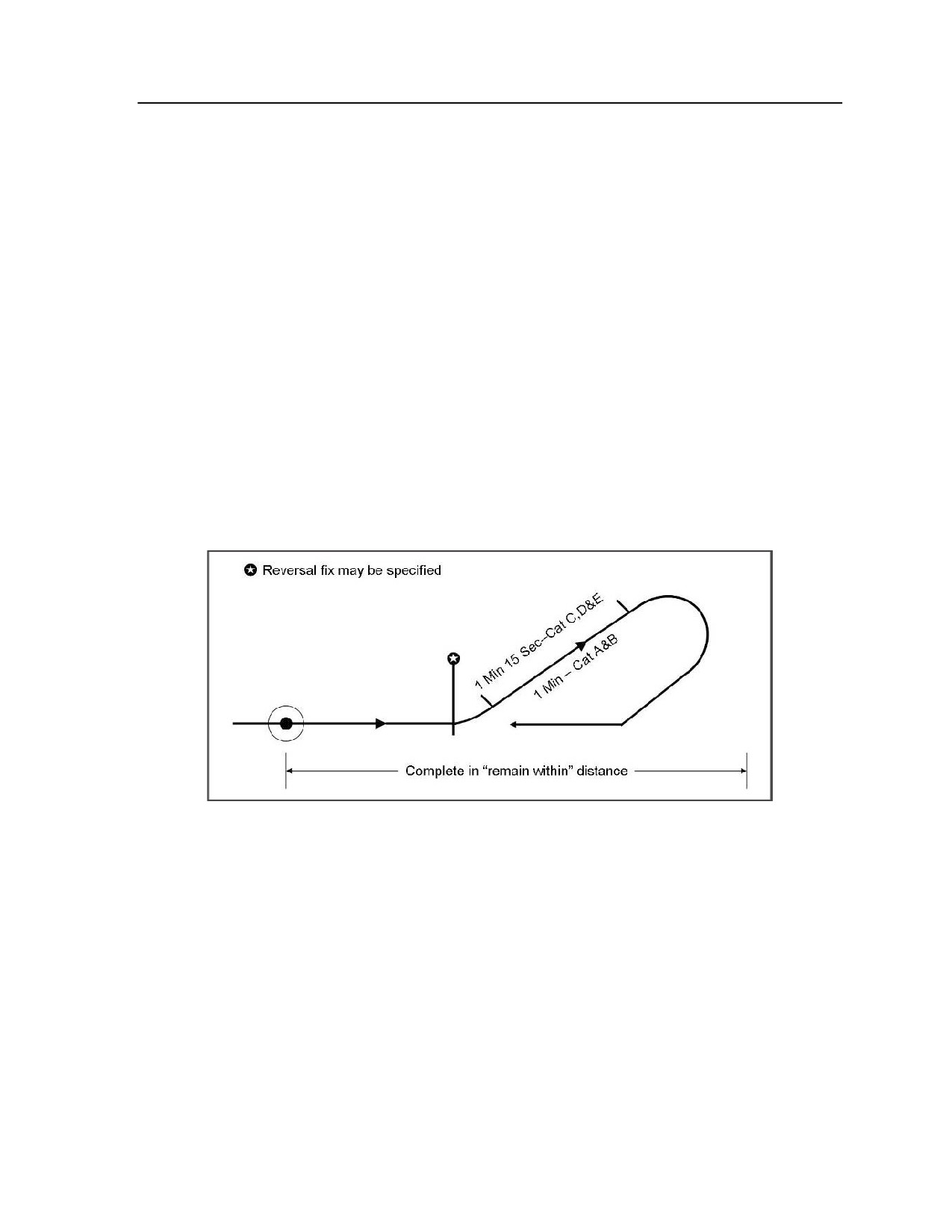
The 45-Degree/180-Degree Procedure Turn
8-55. This procedure starts at a facility or fix and consists of the following:
A straight leg with track guidance (may be timed or limited by a radial or DME distance).
A 45-degree turn.
A straight leg without track guidance (timed one minute from the start of the turn for categories
A and B aircraft and 1 minute 15 seconds from the start of the turn for categories C, D, and E
aircraft).
Turning 180 degrees in the opposite direction to intercept the inbound track.
8-56. Adjust time or distance on the outbound track to ensure that the reversal is initiated at a point
specified on the IAP, if so depicted, or the maneuver is completed within the specified “remain within”
distance (Figure 8-3).
Figure 8-3. The 45-degree/180-degree procedure turn
The 80-Degree/260-Degree Procedure Turn
8-57. This procedure (Figure 8-4, page 8-12) starts at a facility or fix and consists of—
A straight leg with track guidance (may be timed or limited by a radial or DME distance).
An 80-degree turn.
Turning 260 degrees in the opposite direction to intercept the inbound track.
8-58. Adjust time or distance on the outbound track to ensure that the reversal is initiated at a point
specified on the IAP, if so depicted, or the maneuver is completed within the specified “remain within”
distance.
30 April 2007
FM 3-04.240
8-11
Chapter 8
Figure 8-4. The 80-degree/260-degree procedure turn
The Base Turn
8-59. This procedure consists of intercepting and maintaining a specified outbound track, timing from the
facility or proceeding to a specified fix, followed by a turn to intercept the inbound track (Figure 8-5). The
base turn procedure is not optional. An aviator may not fly one of the procedure turns described above
instead of the depicted base turn. More than one track may be depicted, depending on the aircraft category.
Figure 8-5. Base turn
Reversal Procedure Entry
The 30-Degree Entry Sector
8-60. PANS-OPS specifies this entry sector because, unlike in the United States, the course reversal
protected airspace may not include any airspace except on the outbound side of the procedure turn fix. In
the United States, protected airspace includes a large entry zone surrounding fix (Figure 8-6, page 8-13).
8-12
FM 3-04.240
30 April 2007
Airspace
Figure 8-6. Comparison of Federal Aviation Administration and International Civil Aviation
Organization protected airspace for a procedure turn
8-61. Unless the procedure specifies particular entry restrictions, the
45-degree/180-degree,
80-degree/260-degree, and base turn reversal procedures must be entered from a track within ± 30 degrees
of the outbound reversal track (Figure 8-7, page 8-14). There is a special rule for base turns; for base turns
where the ± 30-degree entry sector does not include the reciprocal of the inbound track, the entry sector is
expanded to include the reciprocal (Figure 8-8, page 8-14). If the aircraft’s arrival track is not within the
entry sector—
Comply with the published entry restrictions or arrival routing.
Enter holding before the reversal procedure if a suitable arrival holding pattern is published.
Use good judgment while maneuvering the aircraft into the entry sector if no published routing
or suitable holding pattern is available.
30 April 2007
FM 3-04.240
8-13
Chapter 8
Figure 8-7. Procedure turn entry
Figure 8-8. Base turn entry
Arriving From Outside the Entry Sector
8-62. There is often some form of published arrival routing into the course reversal IAF such as a STAR, a
feeder routing, or an arrival airway. This arrival routing may not fall into the 30-degree entry sector. Such
arrival routes will be blended into the reversal approach, and protected airspace is provided to allow the
aviator to turn onto the outbound reversal track. Aviators need not request maneuvering airspace to
perform an alignment maneuver. Such requests are often met with confusion by ATC. Aviators should
remain within protected airspace on the published arrival routing whether maneuvering happens to align
the aircraft with the 30-degree entry sector.
8-14
FM 3-04.240
30 April 2007

Airspace
8-63. On most ICAO course reversals, a holding pattern is published at or near the IAF to accommodate
arrivals from outside the 30-degree sector and not on a published arrival routing. PANS-OPS directs
aviators arriving from outside the entry sector to enter holding before the reversal procedure. In most cases,
the holding pattern will align the aircraft for the approach.
8-64. If there is no suitable holding pattern, danger arises when the aviator attempts to perform the course
reversal upon arriving into the IAF from a direction not anticipated by the approach designer. Sometimes
there is no holding pattern published for alignment or there is a holding pattern that does not turn into the
entry sector. In this case, the aviator will need to maneuver into the entry sector somehow. The aviator
must understand the criticality of how small the protected airspace is, especially when compared to an FAA
procedure turn. An aviator may be operating completely outside of protected airspace while proceeding to
the IAF, and terrain and obstacle clearance may be totally up to aviator judgment. Use good judgment,
consider the published minimum safe/sector altitudes, and do not rely solely on ATC to keep safe. Begin
timing to comply with published times, or remain within distances when outbound abeam the facility or fix.
If the abeam position cannot be determined while in a turn, start timing after completing the turn.
8-65. A descent can be depicted at any point along a course reversal. When a descent is depicted at the
IAF, start descent when abeam or past the IAF and on a parallel or intercept heading to the depicted
outbound track. For descents past the IAF, be established on a segment of the IAP before beginning a
descent to the altitude associated with that segment.
8-66. According to the ICAO definition, established on a segment is considered being within half full-
scale deflection for an ILS or VOR and within ± 5 degrees of the required bearing for the NDB.
8-67. The course-reversal maneuver must be completed within the prescribed “remain-within” distance if
one is specified and at or above the altitude specified for its completion. Most ICAO course reversals
specify a fix or a time to start the reversal turn instead of a remain-within distance. Comply with all
guidance on the IAP. Do not automatically assume an ICAO course-reversal maneuver is treated the same
as a procedure turn in the United States.
8-68. Before reaching the IAF, reduce to maneuvering airspeed. Use holding speed if maneuvering speed
is not specified for the aircraft. If the procedure is limited to specific aircraft categories, the applicable
speeds for these are located in table 8-2.
Table 8-2. Aircraft category and airspeed
Category
Maximum Airspeed (KIAS)
A
110
B
140
C
240
D
250
E
250
8-69. Additional speed restrictions may be charted on individual IAPs. The maximum speeds by category,
as shown above, however, will not be exceeded without approval of the appropriate ATC agency.
Racetrack Procedure
8-70. The ICAO racetrack procedure (Figure 8-9, page 8-16) is similar in concept to FAA holding in lieu
of procedure turn. This maneuver consists of a holding pattern with outbound leg lengths of one to three
minutes, specified in 30-second increments. As an alternative to timing, the outbound leg may be limited
by a DME distance or an intersecting radial or bearing.
30 April 2007
FM 3-04.240
8-15
Chapter 8
Figure 8-9. Racetrack procedure
Racetrack Entry
8-71. A racetrack procedure is used when aircraft arrive at the fix from various directions. Entry
procedures for a racetrack are the same as entry procedures for holding patterns. Exceptions are the
following:
The teardrop offset will not exceed 30 degrees from the inbound course.
The teardrop entry from sector 2 (Figure 8-10, page 8-18) is limited to one-and-a-half minutes
wings level on the 30-degree teardrop track, after which the aviator is expected to turn to a
heading to parallel the outbound track for the remainder of the outbound time; if the outbound
time is only one minute, the time on the 30-degree teardrop track will also be one minute.
Parallel entries may not return directly to the facility without first intercepting the inbound track.
All maneuvering will be done, as much as practical, on the maneuvering side of the inbound
track.
8-72. When necessary because of airspace limitations, entry into the racetrack procedure may be restricted
to specified routes. When so restricted, the entry routes will be depicted on the IAP. Racetrack procedures
are used where sufficient distance is not available in a straight segment to accommodate the required loss
of altitude and when entry into a reversal maneuver is not practical. They may also be specified as
alternatives to reversal procedures to increase operational flexibility.
Shuttle
8-73. A shuttle is a descent or climb conducted in a holding pattern. A shuttle is normally specified where
the descent required between the end of the initial approach and the beginning of the final approach
exceeds standard ICAO approach design limits.
Alternate
8-74. Alternate procedures may be specified to any of the procedures described above. IAPs will contain
the appropriate depiction and the words “alternative procedure.” Aviators should be prepared to execute
either procedure. Before accepting clearance for an approach that depicts an alternative procedure,
determine which procedure that the controlling agency expects.
Circling
8-75. ICAO circling protected airspace is essentially the same as in the United States. One important
distinction to make is between the terms “runway environment” and “airport environment.” While circling
using an ICAO-designed procedure, the aviator must maintain visual contact with the runway environment
(as defined in paragraph 10-184) throughout the entire circling maneuver. In the United States, an aviator
is required to maintain visual contact with the airport environment only while circling to land.
8-16
FM 3-04.240
30 April 2007
Airspace
LOCALIZER
8-76. PANS-OPS abbreviates the localizer facility as LLZ. The accuracy of the signal generated by the
LLZ is the same as an LOC. PANS-OPS normally requires the LLZ final-approach track alignment to
remain within 5 degrees of the runway centerline. However, in certain cases, the alignment can exceed 5
degrees. Where required, PANS-OPS allows an increase of the final-approach track to 15 degrees for
categories C, D, and E. For aircraft categories A and B, the maximum angle formed by the final-approach
track and the runway centerline is 30 degrees.
8-77. Before flying an LLZ, compare the final approach course with runway heading. The airdrome sketch
should provide a visual indication of the angle formed between the final-approach track and the runway
centerline.
TIMING FOR MISSED APPROACH AND FINAL APPROACH FIX TO MISSED APPROACH POINT
8-78. Some host nations use nonstandard timing for determining the MAP on a procedure. Timing may go
from the FAF to the runway threshold or from a step-down fix to the runway threshold. When these
host-nation procedures are published in DOD FLIP, these nonstandard timing blocks will be converted to
the U.S. standard of FAF to MAP. This conversion can induce some errors because of rounding of
numbers. For this reason, when using timing to determine the MAP on a DOD procedure produced by a
host nation, crews must correctly determine the timing based on ground speed and then fly that ground
speed to avoid exaggerating errors already induced because of the conversion from host-nation to DOD
format.
HOLDING
BANK ANGLE
8-79. Make all turns at a bank angle of 25 degrees or at a rate of 3 degrees per second, whichever requires
the lesser bank. ICAO procedures do not allow correcting for winds by adjusting bank angle. The
triple-drift technique, described in paragraph 10-113, is a good way to correct for winds without varying
the bank angle.
TRACKS
8-80. All procedures depict tracks. Attempt to maintain the track by allowing for known winds and
applying corrections to heading and timing during entry and while flying in the holding pattern.
LIMITING RADIAL
8-81. When holding away from a NAVAID, where the distance from the holding fix to the NAVAID is
short, a limiting radial may be specified. A limiting radial may also be specified where airspace
conservation is essential. If encountering the limiting radial first, initiate a turn onto the radial until turning
inbound. Do not exceed the limiting DME distance, if published.
HOLDING ENTRY PROCEDURE
8-82. The ICAO holding entry procedure is a mandatory procedure. Aviators must comply with all timing,
distances, and limiting radials. Enter the holding pattern based on the heading (±5 degrees) relative to the
three entry sectors depicted in Figure
8-10, page
8-18. Upon reaching the holding fix, follow the
appropriate procedure for the following entry sectors:
Sector 1 (Parallel). Turn onto an outbound heading for the appropriate time or distance, and
then turn towards the holding side to intercept the inbound track or to return to the fix.
Sector 2 (Offset). Turn to a heading making an angle of 30 degrees from the reciprocal of the
inbound track on the holding side; fly outbound for the appropriate period of time, until the
30 April 2007
FM 3-04.240
8-17
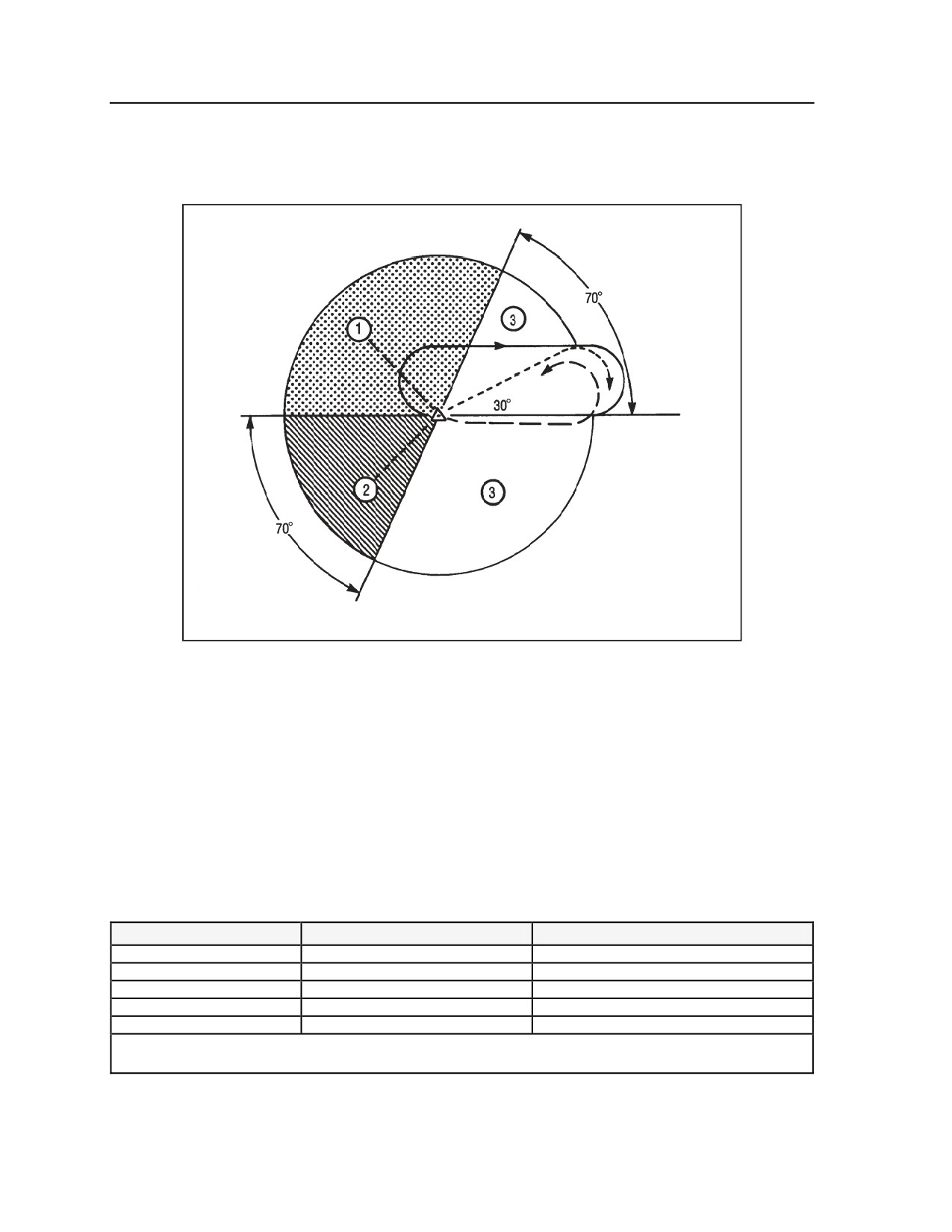
Chapter 8
correct limiting DME is attained or where a limiting radial is specified, then turn right to
intercept the inbound holding track.
Sector 3 (Direct). Turn and follow the holding pattern.
Sector 1: Make a parallel entry.
Sector 2: Make a teardrop entry (30º offset track).
Sector 3: Make a direct entry.
Figure 8-10. International Civil Aviation Organization holding pattern entry sectors
AIRSPEEDS
8-83. There is little standardization of maximum holding airspeeds in PANS-OPS. There are three
different tables of holding airspeeds that an approach designer could use, depending on which edition of
PANS-OPS was used when the holding pattern was constructed. Furthermore, many countries publish their
own holding pattern airspeeds. This information should be published in FLIP but may be quite difficult or
impossible to actually find. An aviator must understand, however, that the concept is the same as in the
United States. Maximum holding airspeeds are defined by PANS-OPS (or the host country) and have no
relation to the holding speed specified in the aircraft operator’s manual. Table 8-3 reproduces airspeeds
from the second edition of PANS-OPS, which is the one most commonly used.
Table 8-3. Airspeeds
ALTITUDE (feet)
AIRSPEED (Normal Conditions)
AIRSPEED (Turbulence*)
0-14,000 (CAT A and B)
170 KIAS
170 KIAS
0-14,000 (CAT C and D)
230 KIAS
280 KIAS
14,001-20,000
240 KIAS
280 KIAS or 0.8 Mach, whichever is less
20,001-34,000
265 KIAS
280 KIAS or 0.8 Mach, whichever is less
34,001+
0.83 Mach
0.83 Mach
*The speeds published for turbulence conditions shall be used for holding only after prior clearance with ATC, unless the
relevant publications indicate the holding area can accommodate aircraft flying at these high holding speeds.
8-18
FM 3-04.240
30 April 2007
Airspace
HOLDING PATTERN LENGTHS
8-84. On the second and subsequent arrivals over the fix, turn and fly an outbound track that will most
appropriately position the aircraft for the turn onto the inbound track. Continue outbound until the
appropriate limiting distance or time. ICAO outbound legs are the limiting factor for both timed and
fixed-distance holding patterns. The times are one minute outbound at or below 14,000 feet MSL or
one-and-a-half minutes outbound above 14,000 feet MSL.
WIND CORRECTIONS
8-85. Attempt to correct both heading and timing to compensate for the effects of wind to ensure that the
inbound track is regained before passing the holding fix inbound. Indications available from the NAVAID
and estimated or known winds should be used in making these corrections. If a limiting radial is published
and encountered before the outbound limits, that radial must be followed until a turn inbound is initiated.
ALTIMETER SETTING PROCEDURES
8-86. There are three different methods of reporting the altimeter measurements and four different units of
measure used to express altimeter settings. For aircraft having only one type of altimeter scale or for areas
where the altimeter setting is not converted for the aviator, the FIH contains conversion tables. Crew
members must understand how to apply the conversions before flight into airspace using other than inches
of mercury/atmosphere pressure at nautical height (QNH) for altimeter settings. Refer to FLIP AP for
specific altimeter setting procedures for each country.
ATMOSPHERIC PRESSURE AT NAUTICAL HEIGHT SETTINGS
8-87. A QNH altimeter setting represents the pressure that would, in theory, exist at sea level at that
location by measuring the surface pressure and correcting to sea-level pressure for a standard day. Set the
reported QNH when descending through, or operating below, the published MSL transition level. With the
proper QNH set, the altimeter will indicate the height above MSL. All DOD approach criteria are based on
using QNH altimeter settings.
STANDARD ALTIMETER SETTINGS
8-88. The standard altimeter (QNE) is used to indicate the height above an imaginary plane called the
standard datum plane, also known as FL0. The established altimeter setting at FL0 is 29.92 inches of
mercury, or 1013.2 millibars. Set QNE (29.92) when climbing through or operating above the transition
altitude.
ATMOSPHERIC PRESSURE AT FIELD ELEVATION SETTINGS
8-89. Atmospheric pressure at field elevation (QFE) is the altimeter setting issued to aircraft to indicate the
AGL height above the airport. With the proper QFE set, the altimeter should indicate zero on the ground.
QFE is commonly used by the Royal Air Force and the Royal Navy in the United Kingdom and in many
parts of the Pacific and Eastern Europe.
TRANSITION ALTITUDE
8-90. Transition altitude is the altitude in the vicinity of an airport at or below which the vertical position
of an aircraft is determined from an altimeter set to QNH. Transition altitude is normally specified for each
airfield by the country in which the airfield exists. Transition altitude will not normally be below 3,000 feet
HAA and must be published on the appropriate charts.
30 April 2007
FM 3-04.240
8-19
Chapter 8
TRANSITION LEVEL
8-91. The lowest flight level available for use above transition altitude is called the transition level.
Transition level is usually passed to aircraft during approach or landing clearances. The transition layer
may be published or supplied by ATC via the ATIS or during arrival. Half flight levels may be used
(FL45).
TRANSITION LAYER
8-92. The transition layer is that area between the transition altitude and transition level. Aircraft are not
normally assigned altitudes within the transition layer.
TRANSITION BETWEEN FLIGHT LEVELS AND ALTITUDES
8-93. The vertical position of an aircraft at or below transition altitude shall be expressed in altitude (QNH
or QFE as appropriate). Vertical position at or above the transition level shall be expressed in terms of
flight levels (QNE). When passing through the transition layer, vertical position shall be expressed in terms
of flight levels (QNE) when climbing and in terms of altitudes (QNH or QFE as appropriate) when
descending. After an approach clearance has been issued and the descent to land is commenced, the
vertical positioning of an aircraft above the transition level may be by reference to altitude (QNH or QFE
as appropriate), provided that level flight above the transition altitude is not indicated or anticipated. This is
intended for turbo jet aircraft where an uninterrupted descent from high altitude is desired and for airfields
equipped to reference altitudes throughout the descent.
ALTIMETER ERRORS
8-94. When the altimeter does not indicate the reference elevation or height exactly but is within specified
tolerances, no adjustment of this indication should be made either by the pressure adjustment knob or other
adjustments on the altimeter during any phase of flight. Furthermore, any error within tolerances noted
during preflight check on the ground should be ignored by the aviator in flight.
ALTIMETER USE IN FLIGHT
8-95. Before takeoff, at least one altimeter will be set to the latest QNH/QFE altimeter setting. Set the
altimeter to QNE (29.92) climbing through transition altitude. Before commencing the initial approach to
an airfield, the number of the transition level should be obtained from the appropriate air traffic services
unit. Obtain the latest QNH/QFE before descending below the transition level.
TRANSPONDER OPERATING PROCEDURES
8-96. When an aircraft carries a serviceable transponder, the aviator shall operate the transponder at all
times during flight, regardless of whether the aircraft is within or outside airspace where secondary
surveillance radar (SSR) is used for air traffic service purposes.
OPERATING CODES
8-97. Operate codes as assigned by ATC on the basis of regional air navigation agreements. In the absence
of any ATC directions or regional air navigation agreements, operate the transponder on Mode A, Code
2000.
8-98. The use of Mode A, Code 7700, in certain areas, may result in the elimination of the SSR response
of the aircraft from the ATC radar display in cases where the ground equipment is not provided with
automatic means for its immediate recognition.
8-20
FM 3-04.240
30 April 2007
Airspace
8-99. If an aviator squawks 7600, the controller will try to verify by asking the aviator to IDENT or
change the code. If the aviator’s receiver is functioning, the controller will communicate with him using
the IDENT or code change.
HI-JACK CODES
8-100. If an aviator experiences an unlawful interference with an aircraft in flight and selects code 7500,
ATC will request confirmation of this code. Depending on the circumstances, the aviator can confirm the
code or not reply at all. The absence of a reply from the aviator will be taken by ATC as an indication that
the use of code 7500 is not due to an inadvertent false code selection.
30 April 2007
FM 3-04.240
8-21