FM 3-04.240 Instrument Flight for Army Aviators (April 2007) - page 3
Chapter 3
3-84. The angle of bank necessary for a given rate of turn is proportional to the TAS. Because turns are
executed at a standard rate, the angle of bank must be varied in direct proportion to the airspeed change to
maintain a constant rate of turn. During a reduction of airspeed, an aviator must decrease the angle of bank
and increase the pitch attitude to maintain altitude and a standard-rate turn.
3-85. The altimeter and turn coordinator indications should remain constant throughout the turn. The
altimeter is primary for pitch control, and the miniature aircraft of the turn coordinator is primary for bank
control. The torque gauge is primary for power control while the airspeed is changing. As the airspeed
approaches the new indication, the airspeed indicator becomes primary for power control.
3-86. Two methods of changing airspeed in turns may be used. In the first method, airspeed is changed
after the turn is established; in the second method, the airspeed change is initiated simultaneously with the
turn entry. Regardless of the method used, the rate of cross-check must be increased as power is reduced.
As the airplane decelerates, check the altimeter and VSI for needed pitch changes and the bank instruments
for needed bank changes. If the miniature aircraft of the turn coordinator shows a deviation from the
desired deflection, change the bank. Adjust pitch attitude to maintain altitude. When the aircraft
approaches the desired airspeed, the airspeed indicator becomes primary for power control and the torque
gauge is adjusted to maintain the desired airspeed. Trim is important throughout the maneuver to relieve
control pressures. Until an aviator’s control technique is smooth, frequent cross-check of the attitude
indicator is essential to keep from overcontrolling and to provide approximate bank angles appropriate to
the changing airspeeds.
COMMON TURN ERRORS
PITCH
3-87. Pitch errors and their resolutions include the following:
Preoccupation with bank control during turn entry and recovery. Check pitch instruments when
initiating bank pressures. If bank control pressure and rate of bank change are consistent, an
aviator soon develops a sense of timing regarding attitude change. Control the total attitude
instead of one factor at a time.
Failure to understand the need for changing pitch attitude as the vertical lift component changes,
causing consistent loss of altitude during entries.
Changing the pitch attitude before necessary (because of a slow cross-check and a rapid rate of
entry); the error occurs during the turn entry because of a mechanical and premature application
of back-elevator control pressure.
Overcontrolling pitch changes.
Failure to properly adjust the pitch attitude as the vertical lift component increases during the
rollout causing consistent gain in altitude on recovery to headings.
Failure to trim during turn entry and following turn recovery (if the turn is prolonged).
Failure to maintain straight-and-level cross-check after rollout (commonly follows a perfectly
executed turn).
Erratic rates of bank change on entry and recovery resulting from failure to cross-check pitch
instruments with changes in lift.
BANK
3-88. Bank and heading errors and their resolutions include the following:
Overcontrolling resulting in overbanking upon turn entry and overshooting and undershooting
headings as well as aggravated pitch, airspeed, and trim errors.
Fixation on a single bank instrument; be selective during the cross-check and avoid fixating on a
single instrument as described in the following example.
3-22
FM 3-04.240
30 April 2007

Fixed Wing Instrument Flight Maneuvers
An Example of Using Other Cues During Turns
On a 90 degrees change of heading, leave the heading indicator out of the cross-check for about 20 seconds
after establishing a standard-rate turn because, at 3 degrees per second, the aircraft will not approach the
lead point until that time has elapsed.
Failure to check for precession of the horizon bar following recovery from a turn. If the heading
indicator shows a change in heading when the attitude indicator shows level flight, the airplane
is turning. If the ball is centered, the attitude gyro has precessed; conversely if the ball is not
centered, the airplane may be in a slipping or skidding turn. Center the ball with rudder pressure,
check the attitude indicator and heading indicator, stop a continued heading change, and retrim.
Failure to use the proper degree of bank for the amount of heading change desired; rolling into a
20-degree bank for a heading change of 10 degrees will normally overshoot the heading. Use the
bank attitude appropriate to the amount of heading change desired.
Failure to remember the new heading; this fault is likely when the aviator rushes the maneuver.
Turning in the wrong direction because of misreading or misinterpreting the heading indicator or
confusion as to the location of points on the compass; turn in the shortest direction to reach a
given heading, unless there is a specific reason to turn the long way around. To avoid turning in
the wrong direction—
The aviator should be familiar enough with the compass rose to be able to visualize the
positions of the eight major points around the azimuth and quickly determine the correct
direction to be flown; for example, to turn from a heading of 305 degrees to a heading of
110 degrees, the shortest way around is to the right.
The aviator should be able to quickly determine reciprocal headings as in the following
example.
Example of Determining a Reciprocal Heading
Subtracting 200 from 305 and adding 20, the answer is 125 degrees (as the reciprocal of 305 degrees); thus,
execute a turn to the right. Likewise, to figure the reciprocal of a heading less than 180 degrees, add 200 and
subtract 20. Compute quickly by using multiples of 100s and 10s, and then add or subtract 180 degrees from
the actual heading.
Failure to check the ball of the turn coordinator when the aviator interprets the instrument for
bank information. If the roll rate is reduced to zero, the miniature aircraft of the turn coordinator
indicates only direction and rate of turn. Unless the ball is centered, do not assume that the turn
results from a banked attitude.
POWER
3-89. Power and airspeed errors result from the following:
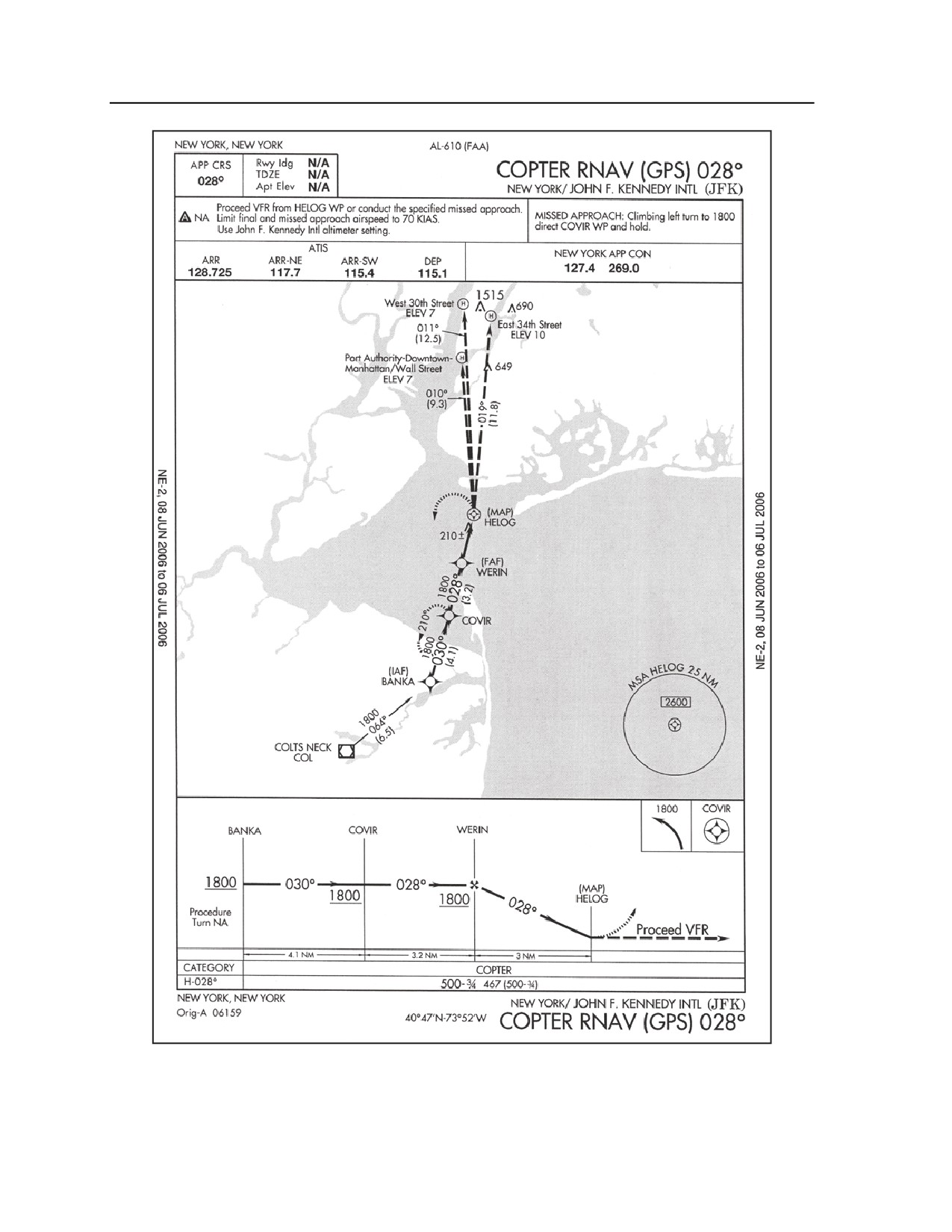
Failure to cross-check the airspeed indicator when the aviator makes pitch changes.
Erratic use of power control; these type of errors may be due to improper friction control,
inaccurate power lever settings, the tendency to chase the airspeed readings, abrupt or
overcontrolled pitch-and-bank changes, or failure to recheck the airspeed to note the effect of a
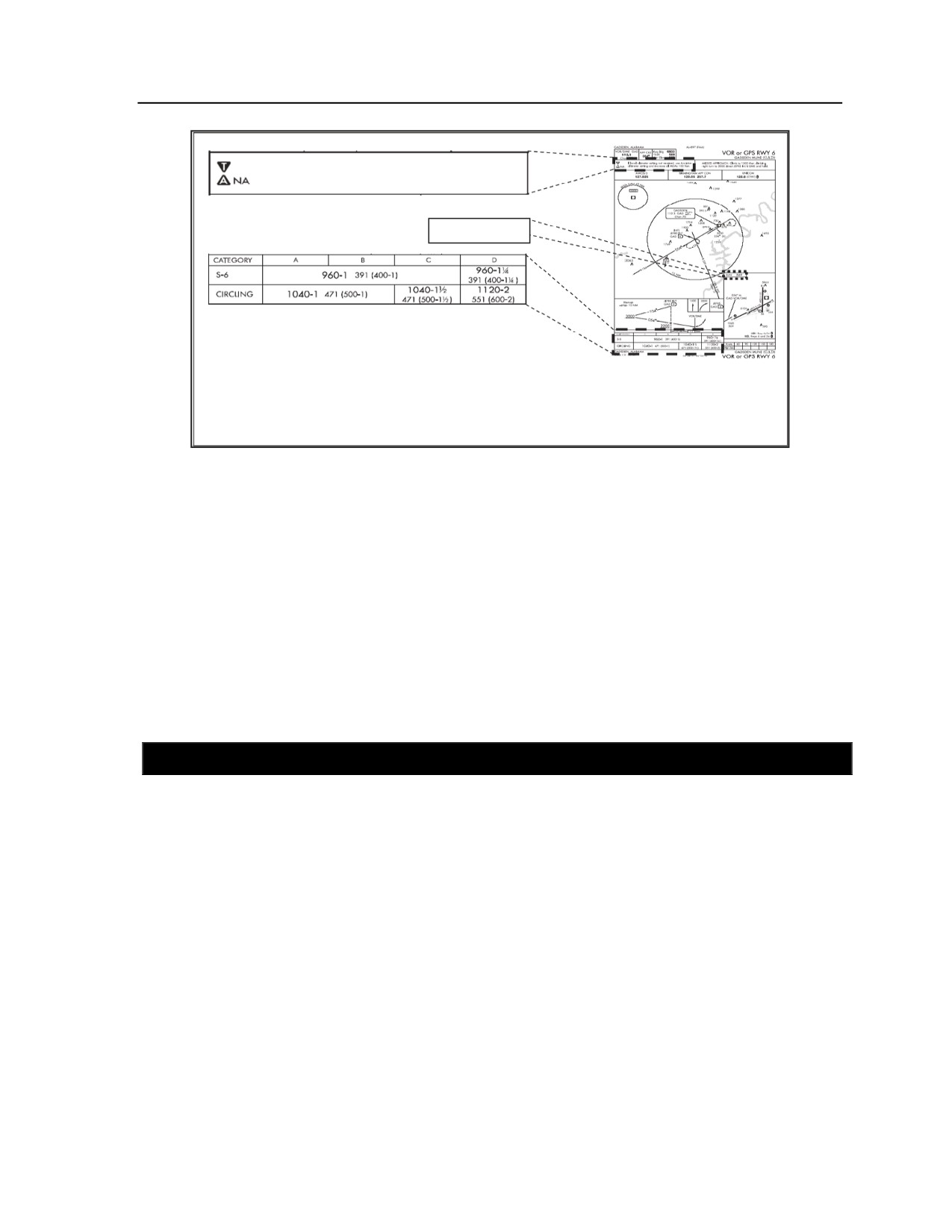
power adjustment.
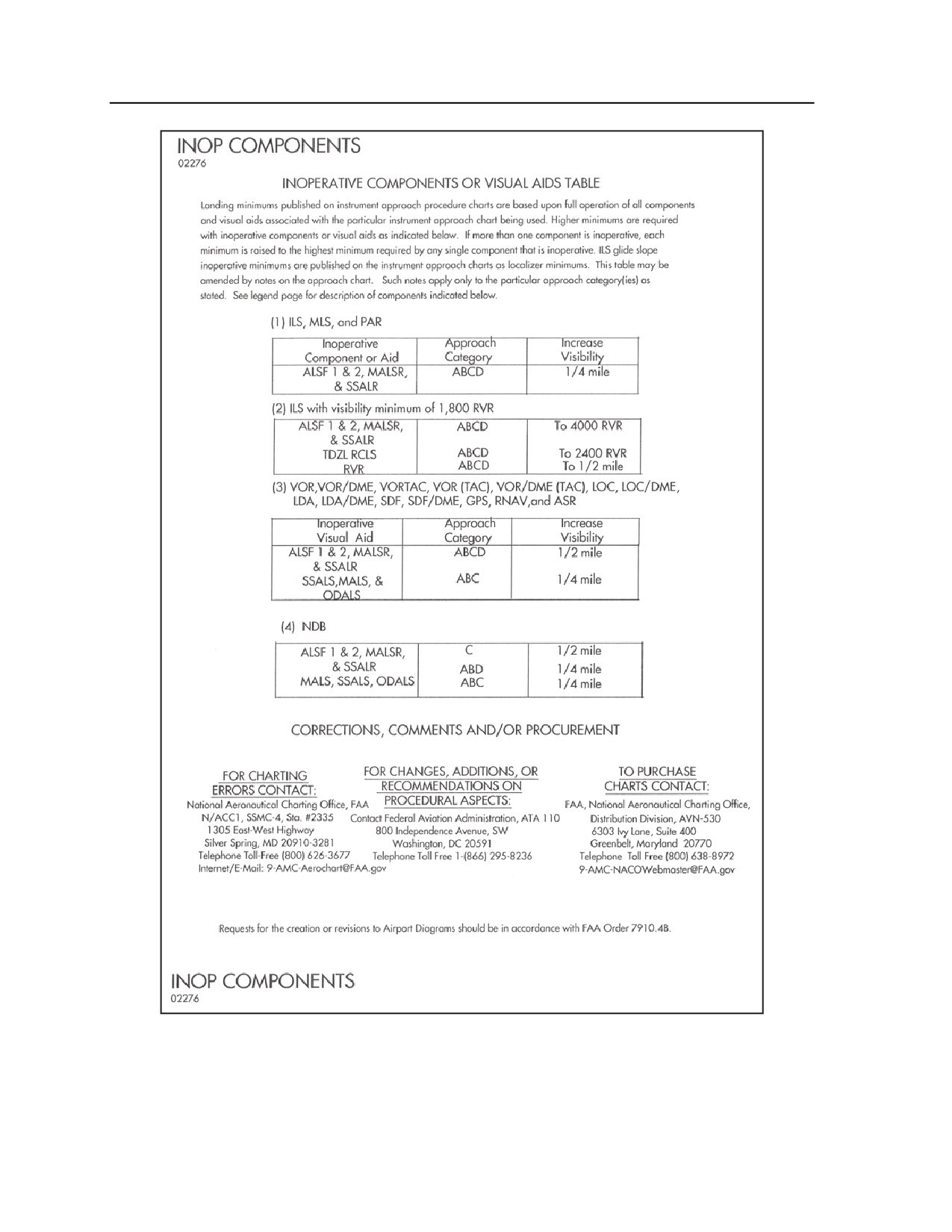
Poor coordination of power lever controls. Errors occur when poor coordination of power lever
controls is combined with pitch-and-bank changes associated with slow cross-check and can be
caused by a failure to understand the aerodynamic factors related to turns.
30 April 2007
FM 3-04.240
3-23
Chapter 3
TRIM
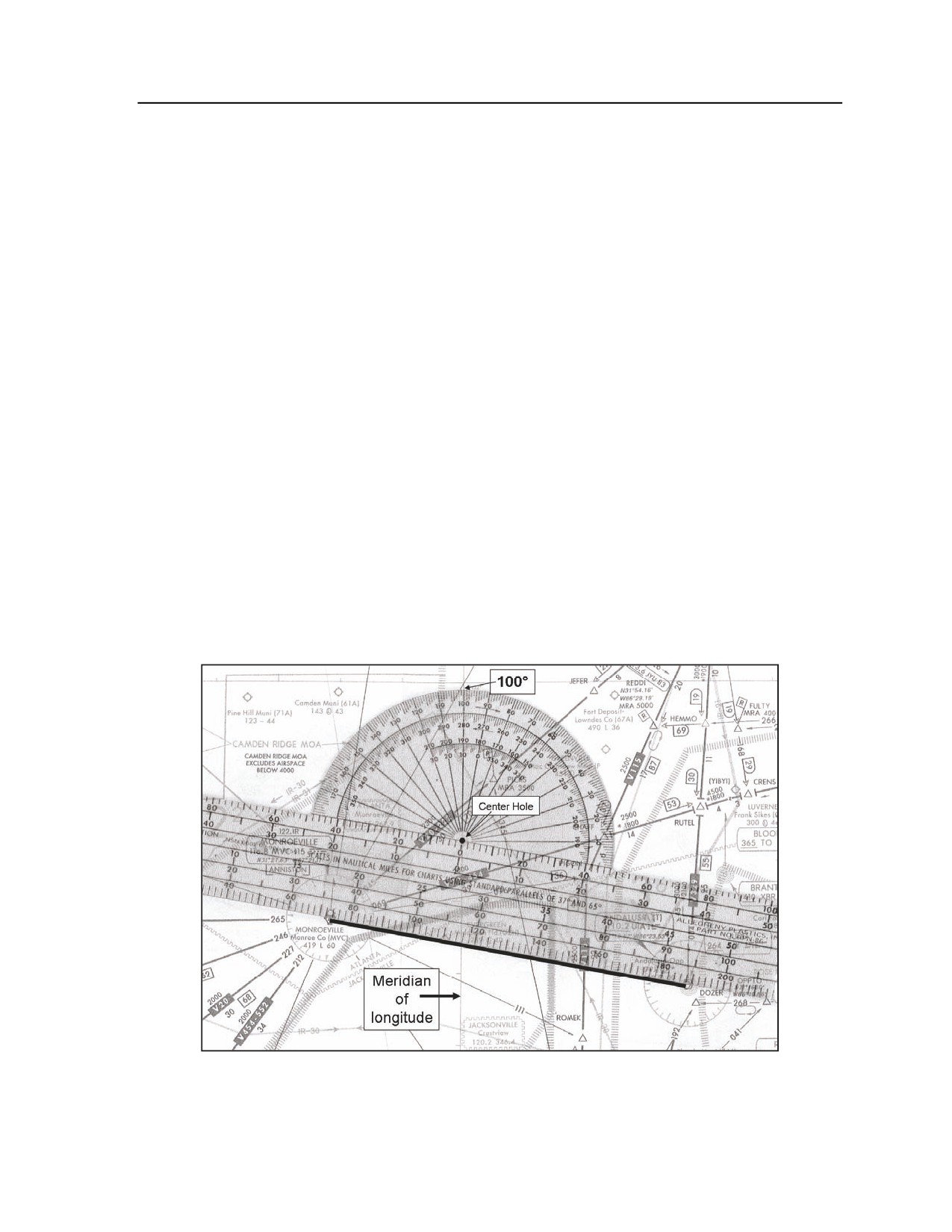
3-90. Trim errors result from the following mistakes:
Failure to recognize the need for a trim change because of slow cross-check and interpretation;
for example, a turn entry at a rate too rapid for the cross-check leads to confusion in cross-check
and interpretation with resulting tension on the controls.
Failure to understand the relationship between trim and attitude/power changes.
Tendency to chase the vertical-speed needle. Overcontrolling leads to tension and prevents the
aviator from sensing the pressures to be trimmed off.
Failure to trim following power changes.
SECTION V - OTHER MANEUVERS
APPROACH TO STALL
3-91. Practicing approach to stall recoveries in various airplane configurations builds confidence in an
aviator’s ability to recognize and recover the airplane in unexpected situations such as stalls. Approach to
stall should be practiced from straight-and-level flight and from shallow banks. Prior to stall recovery
practice, select a safe altitude above the terrain, free of conflicting air traffic, verifying that adequate
weather conditions are present and appropriate radar traffic advisory services are available. During
approaches to stalls, power is applied while smoothly and simultaneously increasing the angle of attack to
induce an indication of a stall. The approaches to stalls are accomplished in the following configurations:
Takeoff. Begin from level flight near liftoff speed.
Clean. Begin from a reduced airspeed, such as pattern airspeed, in level flight.
Approach or landing. Initiate at the appropriate approach or landing airspeed.
3-92. Promptly respond to a stall warning device or an aerodynamic indication by smoothly reducing the
angle of attack and applying maximum power or as recommended by the appropriate aircraft operator’s
manual. The recovery should be completed without an excessive loss of altitude and on a predetermined
heading, altitude, and airspeed.
UNUSUAL ATTITUDES AND RECOVERIES
3-93. An unusual attitude is an airplane attitude not normally required for instrument flight. Unusual
attitudes may result from a number of conditions such as turbulence, disorientation, instrument failure,
confusion, preoccupation with cockpit duties and carelessness in cross-checking, errors in instrument
interpretation, or lack of proficiency in aircraft control. Unusual attitudes are often unexpected during
instrument flight (except in training), and the reaction of an inexperienced aviator to an unexpected
abnormal flight attitude is usually instinctive rather than deliberate. Avoid responding with abrupt
muscular effort, which is hazardous in turbulent conditions, at excessive speeds, or at low altitudes;
however, techniques for rapid and safe recovery from unusual attitudes can be learned. When noting an
unusual attitude on the cross-check, focus on returning the aircraft to straight-and-level flight as quickly as
possible.
RECOGNIZING UNUSUAL ATTITUDES
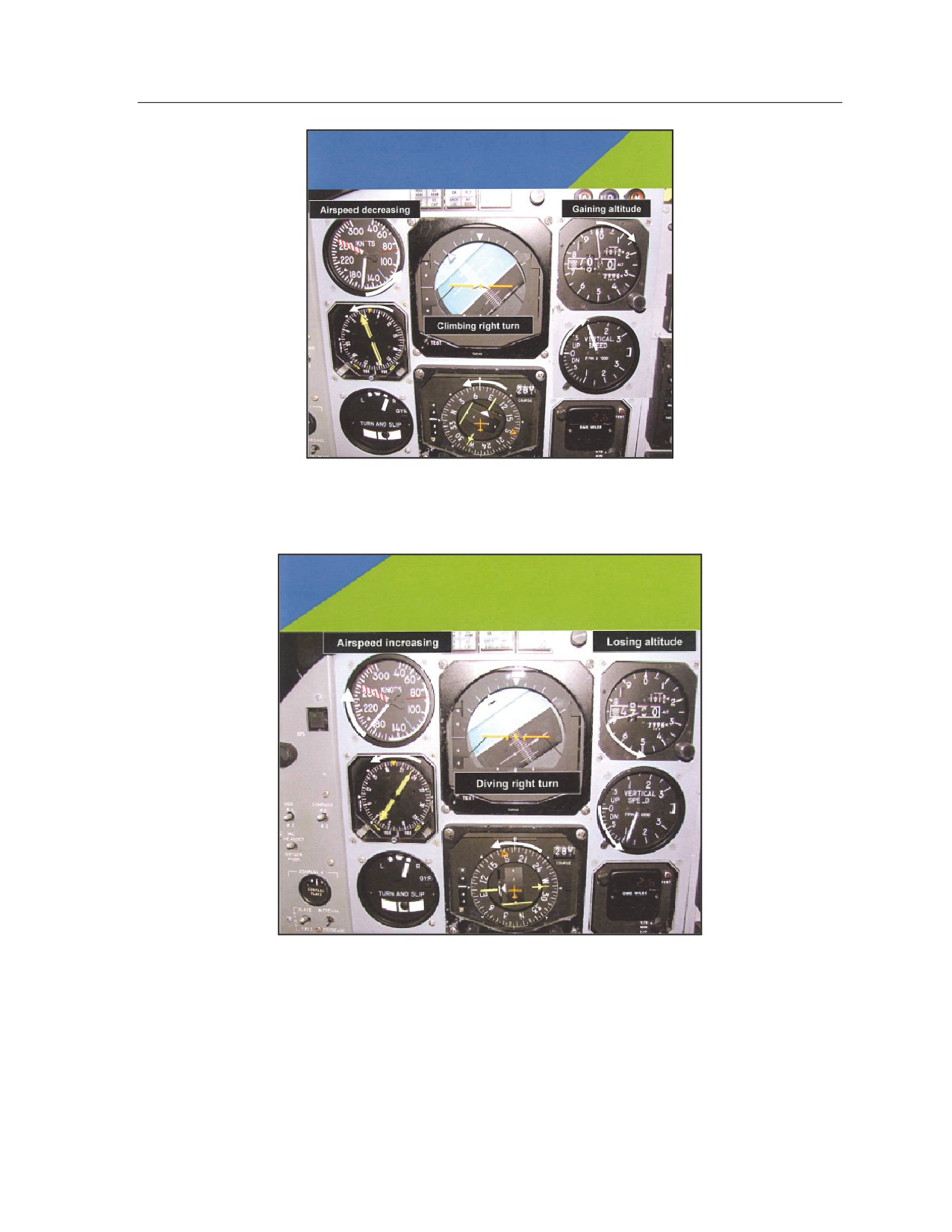
3-94. When an abnormal instrument rate of movement or indication is noted, assume an unusual attitude
and perform a rapid cross-check to confirm the attitude, instrument error, or instrument malfunction.
Nose-high attitudes are shown by the rate and direction of movement of the altimeter needle, vertical-speed
needle, airspeed needle, and the attitude indicator (except in extreme attitudes) (Figure 3-16, page 3-25).
3-24
FM 3-04.240
30 April 2007
Fixed Wing Instrument Flight Maneuvers
Figure 3-16. Unusual attitude—nose high
3-95. Nose-low attitudes are shown by the same instruments but in the opposite direction (Figure 3-17).
Figure 3-17. Unusual attitude—nose low
RECOVERY FROM UNUSUAL ATTITUDES
3-96. In moderate unusual attitudes, the aviator can normally be reoriented by establishing a level flight
indication on the attitude indicator. However, the aviator should not depend on this instrument if the
attitude indicator is the spillable type because upset limits may have been exceeded, making the unit
inoperative because of mechanical malfunction. Even if the instrument is operating properly, errors up to 5
30 April 2007
FM 3-04.240
3-25
Chapter 3
degrees of pitch-and-bank may result. Its indications are difficult to interpret in extreme attitudes. When
the unusual attitude is detected, recommended recovery procedures in the appropriate aircraft operator’s
manual are initiated. If there are no recommended procedures, the recovery is initiated by reference to the
airspeed indicator, altimeter, VSI, and turn coordinator.
Note. Refer to the airplane operator’s manual to determine if the attitude indicator is a spillable
type.
Nose-High Attitudes
3-97. When airspeed is decreasing or below the desired airspeed—
Increase power (in proportion to the observed deceleration).
As the nose pitches to the horizon, decrease bank to wings level.
Adjust pitch to reverse the airspeed trend and return to a level flight attitude.
Adjust power to cruise setting.
Cross-check the slip indicator.
Trim the aircraft.
3-98. Corrective control applications are made almost simultaneously but in the sequence given above. A
level pitch attitude is indicated by reversal and stabilization of the airspeed indicator and altimeter needles.
Straight coordinated flight is indicated by a level miniature aircraft and centered ball of the turn
coordinator.
Nose-Low Attitudes
3-99. When airspeed is increasing or is above the desired airspeed—
Smoothly reduce power as required.
Level wings.
Adjust pitch up to the horizon.
Adjust power to maintain desired airspeed and altitude.
Cross-check the slip indicator.
Trim the aircraft.
3-100. All components of control are changed simultaneously for a smooth recovery. However, during
initial training, a positive recovery is made in the sequence provided above. The instinctive reaction to a
nose-down attitude is to pull back on the elevator control.
3-101. After initial control has been applied, continue with a rapid cross-check for possible
overcontrolling because the necessary initial control pressures may be excessive. As the rate of movement
of the altimeter and airspeed indicator needles decreases, the attitude is approaching level flight. When the
needles stop and reverse direction, the aircraft is passing through level flight. As the indications of the
airspeed indicator, altimeter, and turn coordinator stabilize, incorporate the attitude indicator into the
cross-check.
3-102. The attitude indicator and turn coordinator are checked to determine bank attitude. Then corrective
aileron and rudder pressures are applied. The ball should be centered. If not centered, skidding and slipping
sensations can easily aggravate disorientation and retard recovery. When entering the unusual attitude from
an assigned altitude (either by the instructor or by ATC if operating under IFR), return to the original
altitude after stabilizing in straight-and-level flight.
3-26
FM 3-04.240
30 April 2007
Fixed Wing Instrument Flight Maneuvers
COMMON RECOVERY ERRORS
3-103. Errors noted in connection with basic instrument skills are aggravated during unusual attitude
recoveries. Common errors include the following:
Failure to keep the airplane properly trimmed. A cockpit interruption when an aviator is holding
pressures can lead into unusual attitudes.
Disorganized cockpit. Hunting for charts and logs detracts attention from the instruments.
Slow cross-check and fixations. The impulse is to stare when an instrument discrepancy is
noted.
Attempting to recover by senses other than sight (see FM 3-04.301 for more information).
Failure to practice basic instrument skills.
30 April 2007
FM 3-04.240
3-27
This page intentionally left blank.
Chapter 4
Air Navigation Charts
All aviators must be able to navigate. By understanding and using air navigational
charts, aviators are able to maintain situational awareness and accomplish missions
during VFR and IFR conditions. The following chapter explains DOD-approved
charts used by aviators to navigate while instrument flying. The chapter also covers
basic plotting and measuring techniques used to plan instrument flights.
SECTION I - AIR NAVIGATION
MEASURING A POSITION USING LATITUDE AND LONGITUDE
EQUATOR
4-1. The equator is an imaginary circle equidistant
from the poles of the earth. Circles parallel to the
Contents
equator (lines running east and west) are parallels of
latitude. They measure degrees of latitude north or
Section I - Air Navigation
4-1
south of the equator. The angular distance from the
Section II - Plotting and Measuring
4-25
equator to the pole is one-fourth of a circle, or 90
degrees. Thus, latitude runs from 90 degrees north to 90 degrees south of the equator. Fort Rucker,
Alabama lies approximately at the 30 degrees north latitude. The following example shows a distance
conversion.
Example of a Distance Conversion
1 degree of latitude is 60 nautical miles (NM), 69 statute miles (SM), or 111 kilometers (KM).
1 minute of latitude is 1 NM, 1.15 SM, or 1.85 KM.
MERIDIAN
4-2. Meridians of longitude are drawn from North Pole to South Pole and at right angles to the equator.
The prime meridian, which passes through Greenwich, England, is used as the zero-degree line from which
measurements are made in degrees east and west to 180 degrees. Fort Rucker, Alabama, lies about at the 90
degrees west longitude. Any specific geographical point can be located by reference to its latitude and
longitude.
DEGREES, MINUTES, AND SECONDS
4-3. Degrees, minutes, and seconds are the most universal format used to mark maps and the most
cumbersome:
There are 60 seconds in a minute (60 inches equal 1 foot).
There are 60 minutes in a degree (60 feet equal 1 degree).
30 April 2007
FM 3-04.240
4-1
Chapter 4
Degrees, Minutes, Seconds Example
DDD° MM’ SS.S”
32° 18’ 23.1” N 122° 36’ 52.5” W
4-4. A few easy conversions between seconds and decimal minutes help when the aviator works with
maps that use degrees, minutes, and seconds:
Fifteen seconds is one quarter of a minute, or 0.25 minutes.
Thirty seconds is one half of a minute, or 0.5 minutes.
Forty-five seconds is three quarters of a minute, or 0.75 minutes.
DEGREES AND DECIMAL MINUTES
4-5. This format is found in the IFR supplement and is most commonly used when working with
electronic navigation equipment. To convert decimal minutes (MM.MMM) to degrees, minutes, and
seconds, multiply decimal point numbers by 60.
Degrees and Decimal Minutes Example
For latitude 32° 18.385’ N, multiply .385 by 60, and the coordinate converts to 32° 18’ 23.1” N; longitude 122°
36.875’ W converts to 122° 36’ 52.5”
W.DDD° MM.MMM’ = 32° 18.385’ N 122° 36.875’ W
DECIMAL DEGREES
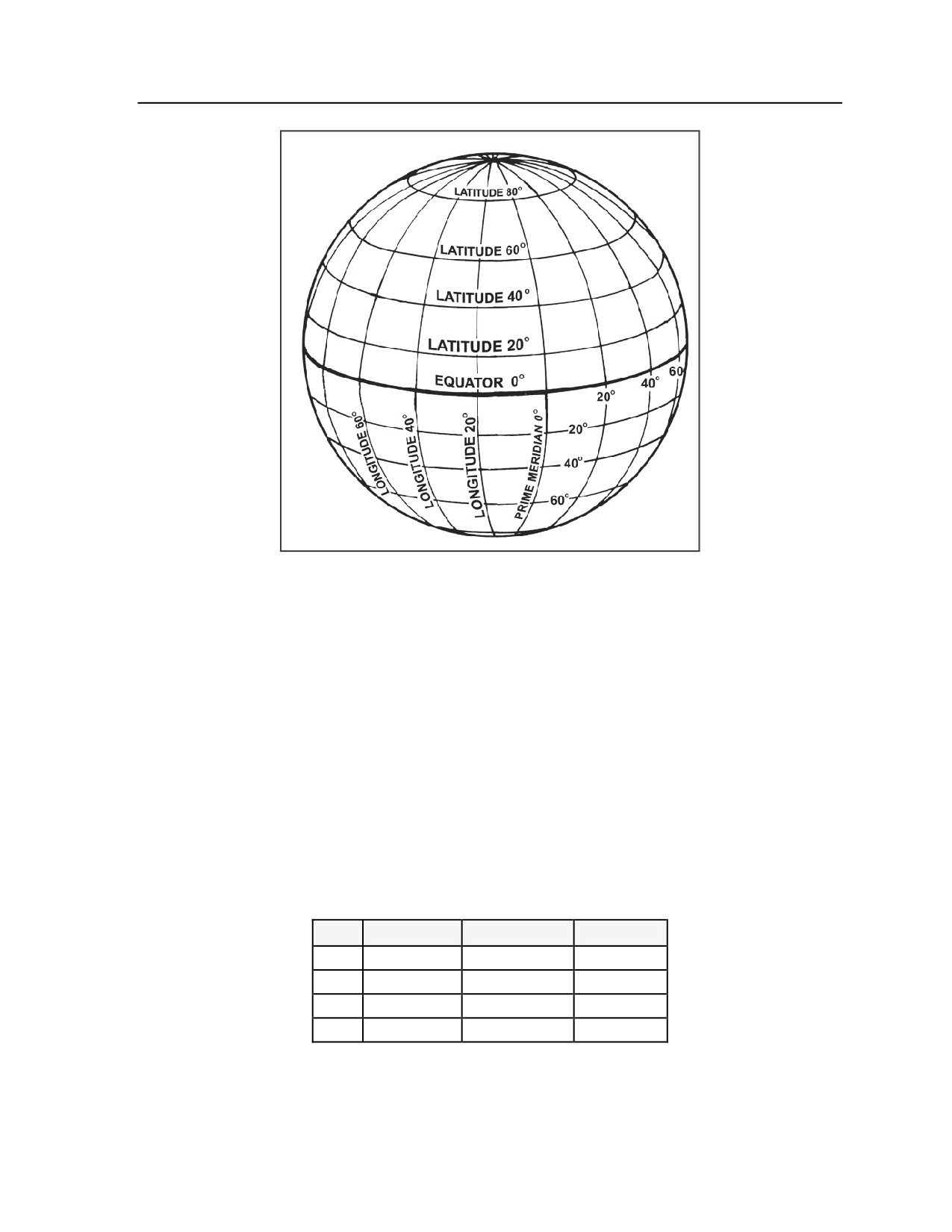
4-6. This is the format that most computer-based mapping systems display. The coordinates are stored
internally in a floating point data type; no additional work is required to print them as a floating point
number. Positive values of latitude are north of the equator, negative values to the south. Watch the sign on
the longitude; most programs use negative values for west longitude, but a few are opposite (Figure 4-1,
page 4-3).
Decimal Degrees Example
DDD.DDDDD°
32.30642° N 122.61458° W
or +32.30642, -122.61458
4-2
FM 3-04.240
30 April 2007
Air Navigation Charts
Figure 4-1. Longitude and latitude
MEASURING DIRECTION
EARTH CIRCUMFERENCE
4-7. The circumference of the earth is divided into 360 degrees; each degree is further divided into 60
minutes. Moving one minute east or west on the equator is equal to 1 nautical mile. Thus, a nautical mile is
the circumference of the earth divided by 360, giving the distance in 1 degree, which is further divided by
60 for the distance in one minute of arc.
DISTANCE
4-8. The circumference of the earth is 24,857 statute miles, or 40,003.2 kilometers. The statute mile has
been standardized at 5,280 feet. The nautical mile has been standardized at 6,076 feet. Therefore, 1 statute
mile is equal to 0.87 nautical mile, or 1.609 kilometers, for the purposes of measuring distance (table 4-1).
Table 4-1. Distance conversions
1 SM
1 NM
1 KM
Feet
5,280
6,076.1
3280.8
SM
1.0
1.15
0.621
NM
0.87
1.0
0.539
KM
1.609
1.852
1.0
30 April 2007
FM 3-04.240
4-3
Chapter 4
SPEED
4-9. A nautical knot is a measure of speed equal to 1 nautical mile per hour. To determine this speed,
sailors would throw lines over the sides of the ships. Each line was divided into 47 feet, 3 inch, sections
called knots. The line was run over the ship’s side while a 28-second glass was emptying itself. The length
of the knot was derived from the proportion that one hour (3,600 seconds) is to 28 seconds as 1 nautical
mile (6,080 feet) is to the length of 1 knot (47 feet, 3 inches). Therefore, a knot is equal to 1 nautical mile
per hour, or 1.15 statute miles per hour (see Chapter 1 for a discussion on the different types of airspeed).
Example of Knots to Statute Mile Conversion
120 knots on the airspeed indicator is equal to 138 (statute) miles per hour (120 X 1.15 = 138).
NAVIGATION CHARTS
4-10. An air navigation chart is a diagram representing the earth’s surface. In this manual, aeronautical
chart discussion is limited to charts used for instrument navigation. Both the National
Geospatial-Intelligence Agency (NGA) charts and FAA National Aeronautical Charting Office (NACO)
charts are approved Department of Defense (DOD)/United States (U.S.) Government Flight Information
Publications (FLIPs), and aviators may fly procedures in both sets. FAA NACO charts may contain more
civil procedures than NGA charts. Generally, only one of each type of procedure is included in NGA
charts. NGA does not normally include multiple instrument landing system (ILS) procedures to the same
airfield; the NGA chooses one to include. Mission needs must be considered when the aviator determines
which FLIP to use; aviators can choose, depending on the flight destination. All DOD approaches are now
included in the NACO publications. If a procedure is not in either set of charts, then the procedure is a
non-DOD/U.S. Government procedure and must have United States Army Aeronautical Services Agency
(USAASA) approval before use.
CHARACTERISTICS
4-11. Each chart has a different purpose, and no one chart is best for every use. A chart cannot be both
equal in angles and equal in area. Secondary charts assist aviators in finding and plotting coordinates and
finding cardinal directions parallel throughout the chart. They also assist when it is necessary to join two or
more charts together, promoting easier assembly.
INSTRUMENT FLIGHT RULES EN ROUTE CHARTS
4-12. En route charts show civil and military airports with an approved instrument approach procedure
(IAP) and many non-IFR airports. En route charts do not show terrain or cultural landmarks (such as roads
and cities); only large bodies of water are depicted. Low-altitude en route charts are for use up to, but not
including, 18,000 feet MSL.
4-13. The objective of an IFR en route flight is to navigate within the lateral limits of a designated airway
at an altitude consistent with ATC clearance. The ability to fly instruments in the system safely and
competently is enhanced by understanding the vast array of data available to the aviator within instrument
charts. NACO maintains the database and produces the charts for the U.S. Government.
4-14. En route high-altitude charts provide aeronautical information for en route IFR navigation at or
above 18,000 feet MSL. Information includes the portrayal of jet routes, identification and frequencies of
radio aids, selected airports, distances, time zones, special-use airspace, and related information. From
altitudes of 18,000 feet MSL to FL450, aviators should establish routes using NAVAIDs not more than
260 nautical miles apart. Scales vary from 1 inch equals 45 nautical miles to 1 inch equals 18 nautical
miles. The charts are revised every 56 days.
4-15. Appropriate IFR en route low-altitude charts are required to effectively depart from one airport and
navigate en route under instrument conditions. The IFR en route low-altitude chart is the instrument
4-4
FM 3-04.240
30 April 2007
Air Navigation Charts
equivalent of the sectional chart. When folded, the cover of the NACO en route chart displays a map of the
United States, showing coverage areas. Cities near congested airspace are shown in black type, and their
associated area chart is listed in the box in the lower left-hand corner of the map coverage box. Also noted
is the highest off-route obstruction clearance altitude. The effective date of the chart is printed on the other
side of the folded chart. Information concerning military training routes (MTRs) is also included on the
chart cover. Scales vary from 1 inch equals 5 nautical miles to 1 inch equals 20 nautical miles. The en route
charts are revised every 56 days. When the NACO en route chart is unfolded, the legend is displayed and
provides information concerning airports, NAVAIDs, air traffic services (ATS), and airspace.
4-16. Area navigation (RNAV) routes, including routes that use GPS for navigation, are normally not
depicted on IFR en route charts; however, a number of RNAV routes have been established in the
high-altitude structure and are depicted on the RNAV en route high-altitude charts. RNAV instrument DPs
and standard terminal arrival routes (STARs) are contained in the U.S. Terminal Procedures booklets.
Graphic notices and supplemental data also contain a tabulation of RNAV routes.
4-17. In addition to published routes, aviators may fly a random RNAV route under IFR if approved by
ATC. Random RNAV routes are direct routes (based on area navigation capability) between waypoints
defined in terms of latitude/longitude coordinates, degree-distance fixes, or offsets from established
routes/airways at a specified distance and direction.
4-18. Radar monitoring by ATC is required on all random RNAV routes. These routes can only be
approved in a radar environment. Factors considered by ATC in approving random RNAV routes include
the capability to provide radar monitoring and compatibility with traffic volume and flow. ATC radar
monitors each flight; however, navigation on the random RNAV route is the responsibility of the aviator.
4-19. Reliance on RNAV systems for instrument approach operations is becoming more commonplace as
new systems, such as GPS and wide area augmentation system (WAAS), are developed and deployed. To
foster and support full integration of RNAV into the National Airspace System (NAS), the FAA has
developed a charting format for RNAV approach charts.
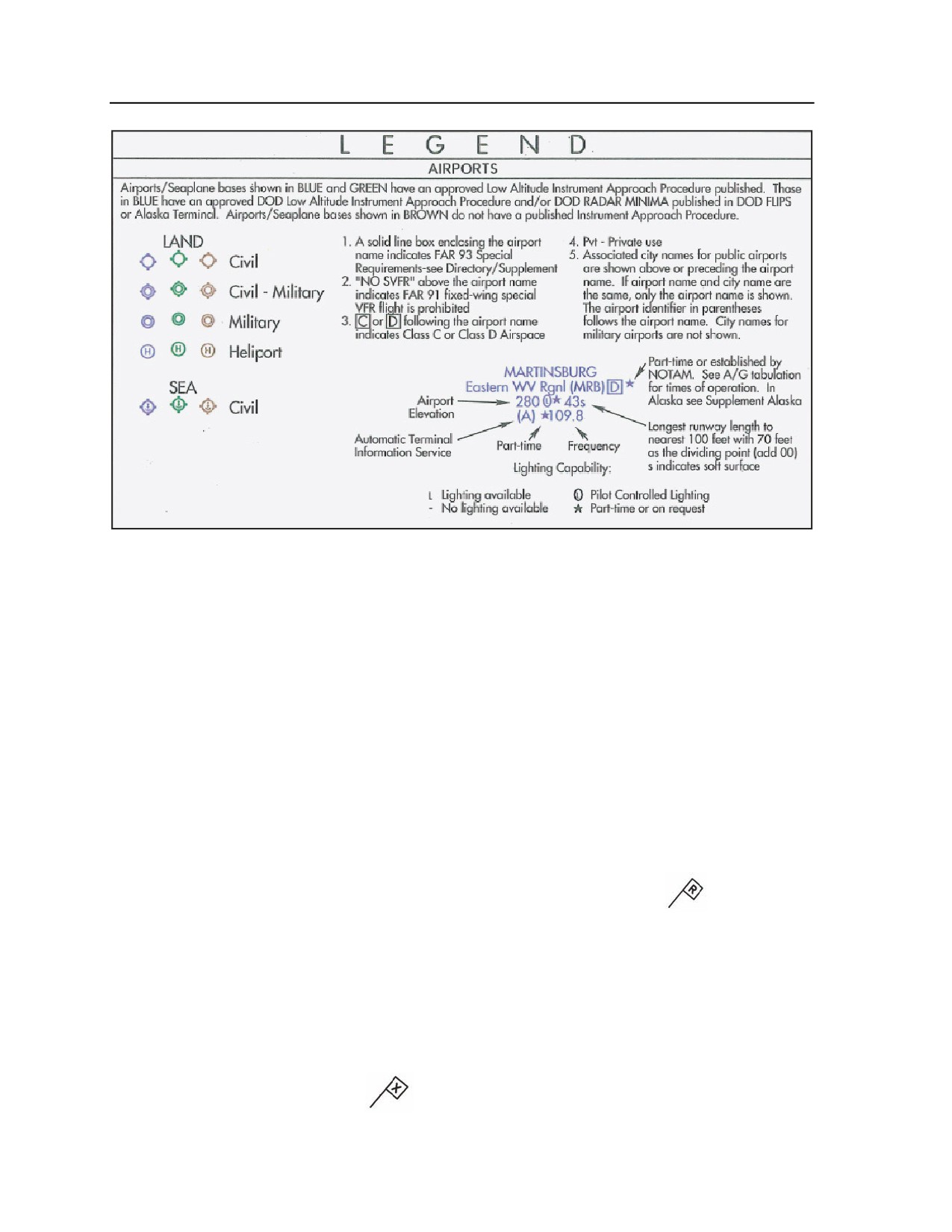
AIRPORT INFORMATION
4-20. Airport information is provided in the legend, and the symbols used for the airport name, elevation,
and runway length are similar to the sectional chart presentation. Instrument approaches are found at
airports with blue or green symbols, while a brown airport symbol denotes airports that do not have
published instrument approach procedures. Asterisks indicate the part-time nature of tower operations,
lighting facilities, and airspace classifications (consult the communications panel on the chart for primary
radio frequencies and hours of operation). The asterisk also indicates filing that airport as an alternate is not
approved during specified hours. A box after an airport name with a C inside indicates Class C airspace
while a box with a D inside indicates Class D airspace (Figure 4-2, page 4-6).
CHARTED INSTRUMENT FLIGHT RULES ALTITUDES
Minimum En Route Altitude
4-21. The minimum en route altitude (MEA) is the lowest published altitude between radio fixes that
ensures acceptable navigational signal coverage and meets obstacle clearance requirements between those
fixes. The MEA ensures a navigation signal strong enough for adequate reception by the aircraft navigation
(NAV) receiver and adequate obstacle clearance along the airway. Verbal ATC communication is not
necessarily guaranteed with MEA compliance. The obstacle clearance, within the limits of the airway, is
typically 1,000 feet in nonmountainous areas and 2,000 feet in designated mountainous areas. MEAs can
be authorized with breaks in signal coverage; if this is the case, the NACO en route chart notes the MEA
gap parallel to the affected airway. MEAs are usually bidirectional; however, they can be unidirectional.
Arrows are used to indicate the direction to which the MEA applies.
30 April 2007
FM 3-04.240
4-5
Chapter 4
Figure 4-2. En route airport legend
Minimum Obstruction Clearance Altitude
4-22. The minimum obstruction clearance altitude (MOCA) is the lowest published altitude in effect
between radio fixes on VOR airways, off-airway routes, or route segments that meets obstacle clearance
requirements for the entire route segment and ensures acceptable navigational signal coverage only within
25 statute (22 nautical) miles of a VOR. The MOCA provides the same obstruction clearance as an MEA;
however, the NAV signal reception is only ensured within 22 nautical miles of the closest NAVAID
defining the route. The MOCA is listed below the MEA and indicated on NACO charts by a leading
asterisk (*3400).
Minimum Reception Altitude
4-23. The minimum reception altitude (MRA) is the lowest altitude at which an airway intersection can be
determined. The MRA identifies an intersection from an off-course NAVAID. If reception is line-of-sight
based, signal coverage extends to the MRA or above. However, if the aircraft is equipped with DME and
the chart indicates the intersection can be identified with such equipment, the aviator could define the fix
without attaining the MRA. On NACO charts, the MRA is indicated by the symbol
, and the altitude
is preceded by MRA (MRA 9300).
Minimum Crossing Altitude
4-24. The minimum crossing altitude (MCA) is the lowest altitude at certain fixes at which an aircraft must
cross when it is proceeding in the direction of a higher MEA. The MCA is depicted along an MEA route
segment where altitude increases. The MCA is usually indicated when the route approaches steeply rising
terrain and obstacle clearance and/or signal reception is compromised. In this case, the pilot is required to
initiate a climb so that the MCA is reached by the time that the intersection is crossed. On NACO charts,
the MCA is indicated by the symbol
, Victor airway number, and applied direction.
4-6
FM 3-04.240
30 April 2007
Air Navigation Charts
Maximum Authorized Altitude
4-25. The maximum authorized altitude (MAA) is a published altitude representing the maximum usable
altitude or FL for an airspace structure or route segment. The MAA is the highest altitude at which the
airway can be flown without aircraft navigation systems receiving conflicting navigation signals from
NAVAIDs operating on the same frequency. Chart depictions appear as MAA-15000.
4-26. A sideways T
is depicted on the chart when an MEA, MOCA, and/or MAA changes on a
segment other than a NAVAID,. If there is an airway break without the symbol, assume that the altitudes
have not changed. When a change of MEA to a higher MEA is required, the climb may commence at the
break, ensuring obstacle clearance.
Off Route Obstruction Clearance Altitude
4-27. The off route obstruction clearance altitude
(OROCA) is an off-route altitude that provides
obstruction clearance with a 1,000-foot buffer in nonmountainous terrain areas and a 2,000-foot buffer in
designated mountainous areas within the United States. This altitude may not provide signal coverage from
ground-based NAVAIDs, ATC radar, or communications coverage.
NAVIGATION SYMBOLOGY
Types of Navigational Aids
4-28. VOR is the principal NAVAID that supports Victor airways. Many other navigation tools are also
available to the aviator. Nondirectional beacons (NDBs) broadcast signals accurate enough to provide
stand-alone approaches, and DME allows the aviator to pinpoint a reporting point on the airway. Though
primarily navigation tools, these NAVAIDs can also transmit voice broadcasts.
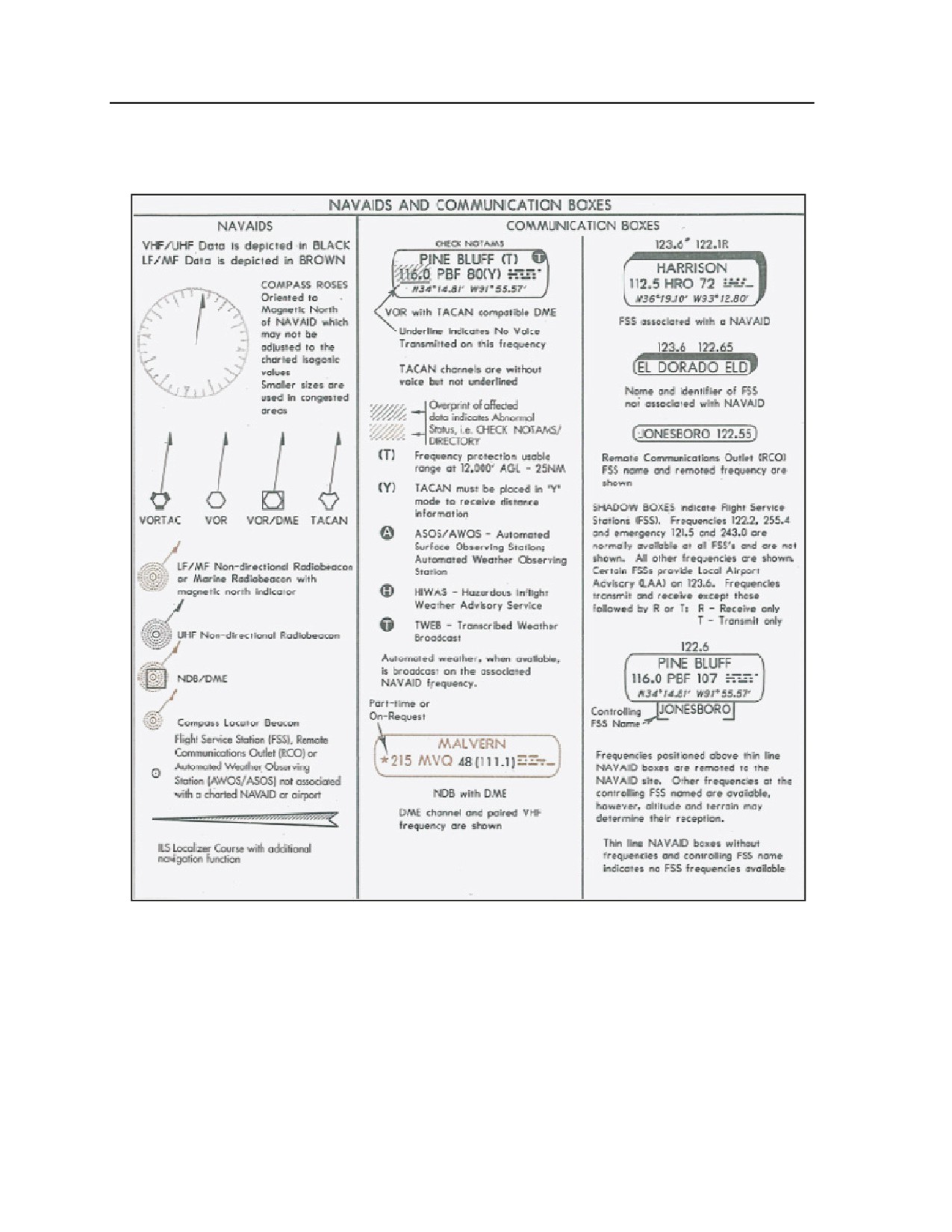
4-29. TACAN channels are represented as the two- or three-digit numbers following the three-letter
identifier in the NAVAID boxes. The NACO terminal procedures provide a frequency-pairing table for
TACAN-only sites. On NACO charts, very high frequency (VHF) and ultra high frequency (UHF)
NAVAIDs (VORs) are depicted in black, while low frequencies (LFs) and medium frequencies (MFs) are
depicted as brown (Figure 4-3, page 4-8).
Identifying Intersections
4-30. Intersections along the airway route are established by a variety of NAVAIDs. An open triangle
indicates the location of an ATC reporting point at an intersection; a solid triangle
means that a report
is compulsory (Figure
4-4, page
4-9). NDBs, localizers, and off-route VORs are used to establish
intersections. NDBs are sometimes collocated with intersections; if so, the passage of the NDB marks the
intersection. A bearing to an off-route NDB also can provide intersection identification. The presence of a
localizer course can be determined from a feathered arrowhead symbol on the en route
chart
. If crosshatched markings appear on the left-hand side of the arrowhead,
a back course (BC) signal is transmitted. On NACO charts, the localizer symbol is
depicted to identify an intersection.
4-31. When an aircraft is traveling on an airway, off-route VORs remain the most common means of
identifying intersections. Arrows depicted next to the intersection,
, indicate the NAVAID being used
for identification. Another means of identifying an intersection is with the use of DME. A hollow
arrowhead
indicates that DME is authorized for intersection identification. If DME mileage at the
intersection is a cumulative distance of the route segments, the mileage is totaled and indicated by a
D-shaped symbol with a number inside
. Typically, distance numbers do not appear on the initial
30 April 2007
FM 3-04.240
4-7
Chapter 4
segment. Approved IFR GPS units are also used to report intersections if the intersection name resides in a
current database.
Figure 4-3. Navigational aid and communication boxes
4-8
FM 3-04.240
30 April 2007
Air Navigation Charts
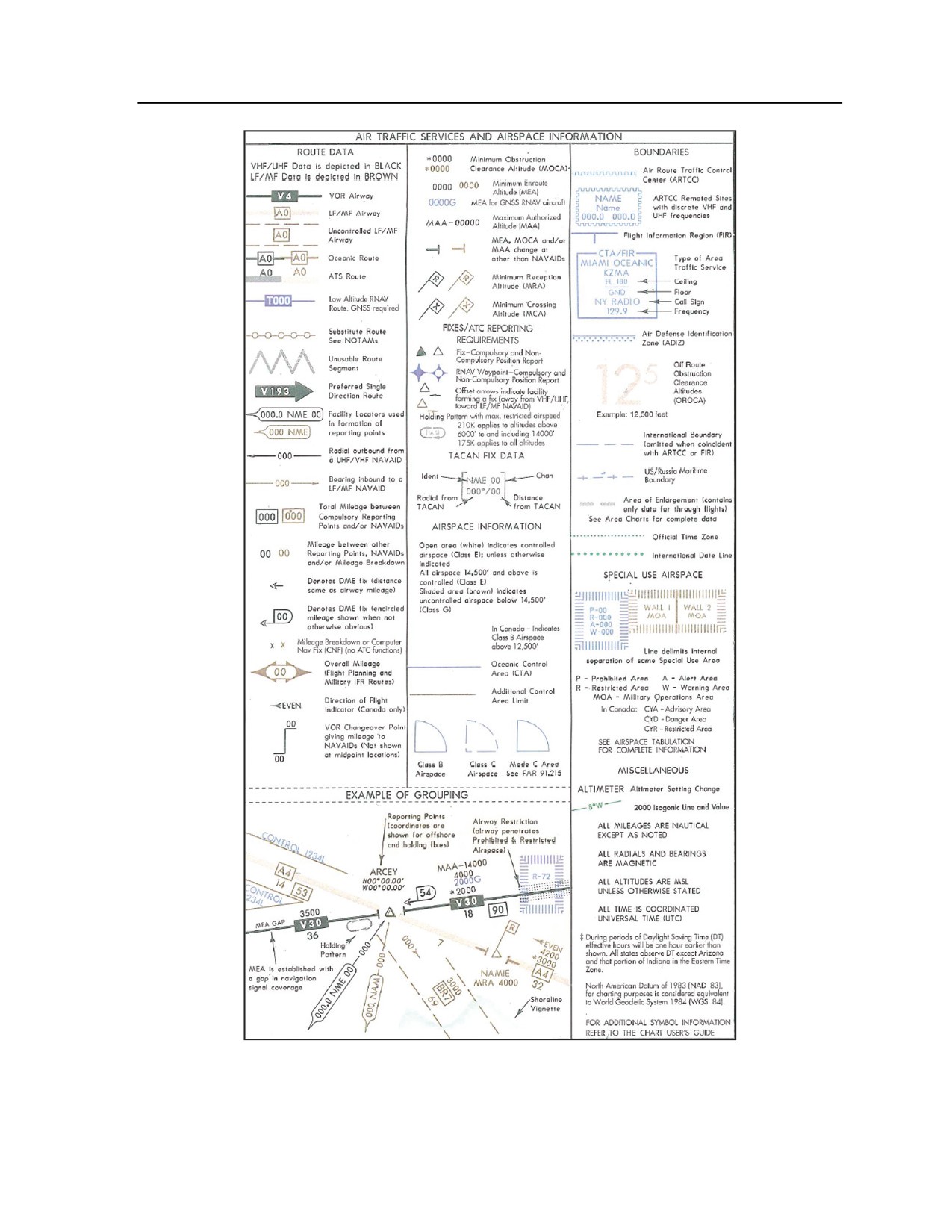
Figure 4-4. Air traffic services and airspace information
30 April 2007
FM 3-04.240
4-9
Chapter 4
Other Route Information
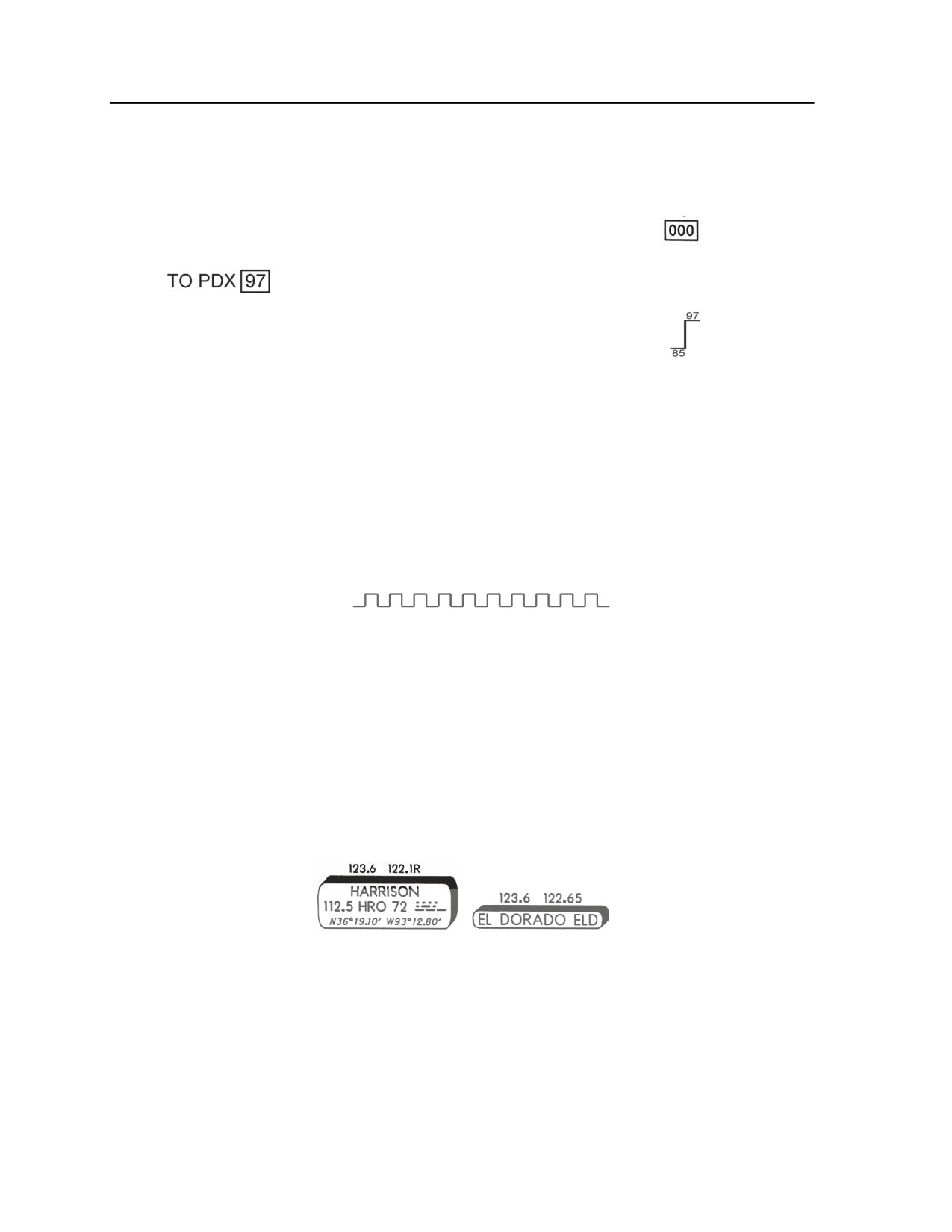
4-32. DME and GPS provide valuable route information such as mileage, position, and ground speed.
Even without this equipment, information provided on the charts makes the necessary calculations, using
time and distance. The en route chart depicts point-to-point distances on the airway system in nautical
miles. Distances from VOR to VOR are charted with a number inside of a box
. To differentiate
distances when two airways cross, TO with the three-letter VOR identifier appears next to the distance
box
4-33. A VOR changeover point (COP) is depicted on charts by this symbol:
. The numbers
indicate the distance at which to change the VOR frequency. The frequency change might be required
because of signal reception or conflicting frequencies. If a COP does not appear on an airway, the
frequency should be changed midway between the facilities. A COP at an intersection often indicates a
course change.
4-34. Occasionally an “x” will appear at a separated segment of an airway that is not an intersection. The
“x” is a mileage breakdown or computer navigation fix and indicates a course change.
4-35. The ATC computerized system has reduced the need for holding en route. However, published
holding patterns are still found on charts at junctures where ATC has deemed a holding pattern necessary
to enable traffic flow. When a holding pattern is charted, the controller may provide the holding direction
and the statement as published (Figure 4-4, page 4-10).
4-36. Boundaries separating the jurisdiction of Air Route Traffic Control Centers (ARTCCs) are depicted
on charts with blue serrations:
. The name of the controlling
facility is printed on the corresponding side of the division line. ARTCC remote sites are depicted as blue
serrated boxes and contain the center name, sector name, and sector frequency.
Weather Information and Communication Features
Automated Flight Service Station
4-37. En route NAVAIDs also provide weather information and serve communication functions. When a
NAVAID is shown as a shadowed box, an automated flight service station (AFSS) of the same name is
directly associated with the facility. If an AFSS is located without an associated NAVAID, the shadowed
box is smaller and contains only the name and identifier. The AFSS frequencies are provided on top of the
box (frequencies 121.5, 122.2, 255.4, and 243.0 are normally available at all flight service stations [FSSs]
and are not shown above the boxes).
Remote Communications Outlet
4-38. A remote communications outlet (RCO) associated with a NAVAID is designated by a box with the
controlling AFSS frequency on the top and the name under the box. Without an associated facility, the
RCO box contains the AFSS name and remote frequency.
4-10
FM 3-04.240
30 April 2007

Air Navigation Charts
Hazardous In-Flight Weather Advisory Service and Transcribed Weather Broadcast
4-39. The Hazardous In-flight Weather Advisory Service
(HIWAS) and the Transcribed Weather
Broadcast (TWEB) are continuously transmitted over selected NAVAIDs and depicted in the NAVAID
box. HIWAS is depicted by a white H in a black circle in the upper left corner of the box; TWEB
broadcasts show as a white T in a black circle in the upper right corner.
DEPARTURE PROCEDURE CHART
4-40. Departure Procedure (DP) charts are ATC-coded departure procedures established at certain airports
to simplify clearance delivery procedures. DPs provide obstacle clearance protection to aircraft in IMC
while reducing communications and departure delays. DPs are published in text/charted graphic form.
Regardless of format, all DPs provide a way to depart the airport and make the transition to the en route
structure safely. When available, aviators are strongly encouraged to file and fly a DP at night during
marginal VMC and IMC.
4-41. DPs provide obstacle clearance given that the aircraft crosses the end of the runway at least 35 feet
AGL, climbs to 400 feet above airport elevation before turning, and climbs at least 200 feet per nautical
mile (FPNM), unless a higher climb gradient is specified to the assigned altitude. ATC may vector an
aircraft off a previously assigned DP; however, the 200 FPNM or the FPNM specified in the DP is
required. Textual DPs are listed by airport in the DOD FLIP (Terminal) volumes. Graphic DPs are depicted
in the DOD FLIP (Terminal) volumes following the approach procedures for the airport.
STANDARD TERMINAL ARRIVAL ROUTE CHARTS
4-42. Standard Terminal Arrival Route (STAR) charts are ATC-coded IFR arrival routes established for
certain airports to simplify clearance delivery procedures. STARs depict prescribed routes so that the
instrument pilot can make the transition from the en route structure to a fix in the terminal area from which
an instrument approach can be conducted. If the appropriate STAR is not available, the aviator can write
No STAR in the flight plan. However, if the controller is busy, the aviator might be cleared along the same
route. If necessary, the controller has the aviator copy the entire text of the procedure.
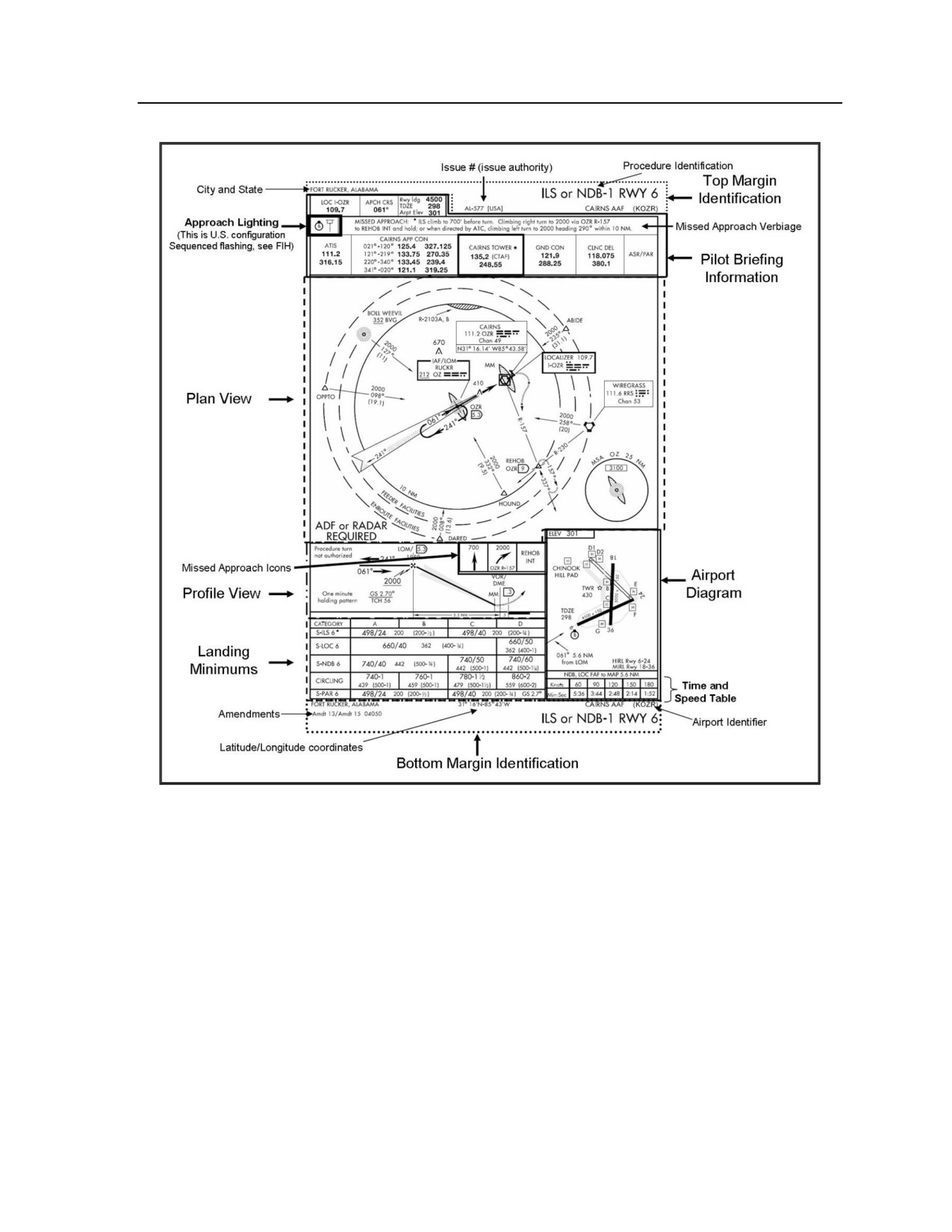
INSTRUMENT APPROACH PROCEDURE CHART
4-43. Instrument approach procedure (IAP) charts provide an IFR descent from the en route environment
to a point where a safe landing can be made. The instrument approach chart is divided into five main
sections: the margin identification, pilot briefing information, plan view, profile view, landing minimums
(and notes), and airport diagram (Figure 4-5, page 4-12).
MARGIN IDENTIFICATION
4-44. The margin identification, found at the top and bottom of the chart, depicts airport location and
procedure identification. The approach plates are organized by city first, then airport name and state.
30 April 2007
FM 3-04.240
4-11
Chapter 4
Military airfields are organized by airfield name first, then city and state. For example, Cairns Army
Airfield (AAF) at Fort Rucker, Alabama, is alphabetically listed under C for Cairns.
4-45. In the center of the top margin is the FAA chart reference number and approving authority and, at
the bottom center, the airport’s latitude and longitude coordinates. The chart’s amendment status appears
below the city and state on the left side in the bottom margin, along with the amendment’s effective date.
The five-digit date format in the amendment (06050) is read, the fiftieth day of 2006.
4-46. The procedure identification (top and bottom margin area of Figure 4-5) is derived from the type of
navigational facility providing final-approach course guidance. A runway number is listed when the
approach course is aligned within 30 degrees of the runway centerline (ILS runway [RWY] 6 or VOR or
GPS RWY 24); this type of approach allows a straight-in landing under the right conditions. Some airports
have parallel runways and simultaneous approach procedures. To distinguish between the left, right, and
center runways, an L, R, or C follows the runway number (ILS RWY 16R). If the approach course
diverges more than 30 degrees from the runway centerline, a letter from the beginning of the alphabet is
assigned (VOR-A). Letter designation signifies the expectation for the procedure to culminate in a circling
approach to land. In some cases, an airport might have more than one circling approach.
4-12
FM 3-04.240
30 April 2007
Air Navigation Charts
Figure 4-5. Instrument approach chart
4-47. More than one navigational system, separated by a slash, indicates that more than one type of
equipment is required to execute the final approach (VOR/DME RWY 31). More than one navigational
system separated by “or” indicates either type of equipment may be used to execute final approach (VOR
or GPS RWY 6). Multiple approaches of the same type to the same runway using the same guidance have
an additional letter from the end of the alphabet, number, or term in the title (ILS Z RWY 28, Silver ILS
RWY 28, or ILS 2 RWY 28). VOR/DME RNAV approaches are identified as VOR/DME RNAV RWY
(runway number). Helicopters have special IAPs designated with COPTER in the procedure identification
(COPTER LOC/DME 25L). Other types of navigation systems may be required to execute other portions
of the approach before intercepting the final-approach segment or during a missed approach.
PILOT BRIEFING INFORMATION
4-48. Pilot briefing information format consists of three horizontal rows of boxed procedure-specific
information along the top edge of the chart. Altitudes, frequency, and course and elevation values (except
HATs and HAAs) are charted in bold type. The top row contains the primary procedure navigation
30 April 2007
FM 3-04.240
4-13
Chapter 4
information, final approach course, landing distance available, touchdown zone, and airport elevations. The
middle row contains procedure notes and limitations, icons indicating if nonstandard alternate and/or
takeoff minimums apply, approach lighting symbology, and a full-text description of the missed approach
procedure. The bottom row contains air-to-ground communication facilities and frequencies in the order
used during an approach.
4-49. When an alternate airport is required, standard IFR alternate minimums apply according to AR 95-1.
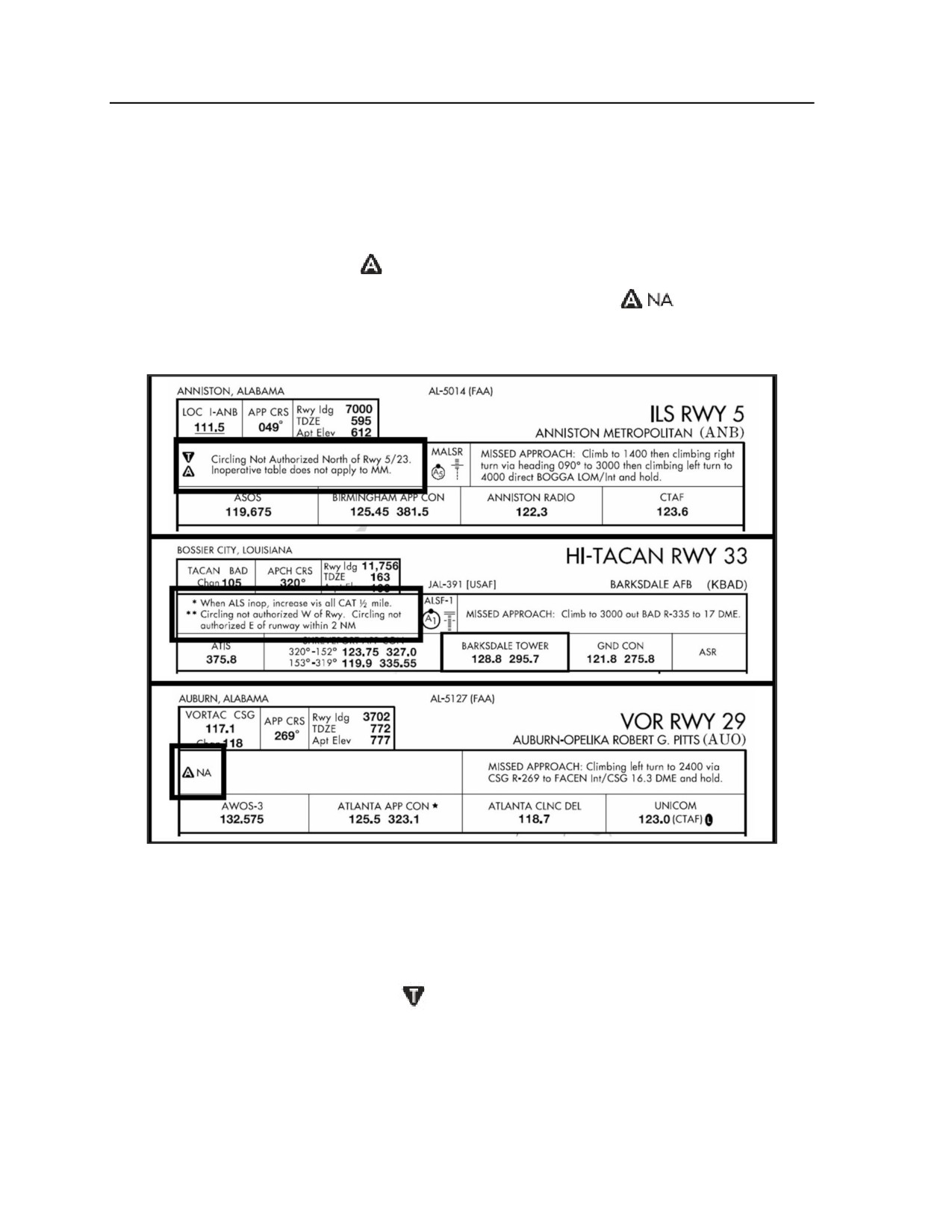
A black triangle with a white A,
, appearing in the middle row (Figure 4-6) indicates nonstandard
IFR alternate minimums exist for the airport. If an NA appears after the A,
, alternate minimums
are not authorized. This information is found on the Roman numeral pages in the beginning of the DOD
FLIP (Terminal) charts.
Figure 4-6. Procedures and notes
4-50. Procedural notes are included in a box located on the middle row. A procedural note might indicate,
“Circling not authorized west of RWY.” Other notes might concern a local altimeter setting and the
resulting change in the minimums. The use of radar may also be noted in this section. Additional notes may
be found in the plan view.
4-51. A black triangle with a white T,
,
(appears in the notes area), signifies that the airport has
nonstandard IFR takeoff minimums. The appropriate section in the front of the DOD FLIP (Terminal)
charts is consulted in this case.
4-14
FM 3-04.240
30 April 2007
Air Navigation Charts
PLAN VIEW
4-52. The plan view provides a graphical overhead view of the procedure and depicts the routes that guide
the aviator from the en route segments to the initial approach fix (IAF) (Figure 4-5, page 4-12). During
initial approach, the aircraft has departed the en route phase of flight and is maneuvering to enter an
intermediate or final segment of the instrument approach. An initial approach can be made within the
terminal area along prescribed routes such as an arc, a radial, or a course; a heading or a radar vector; or a
combination thereof. Procedure turns and high-altitude teardrop penetrations are initial approach segments.
Features of the plan view include the procedure turn, obstacle elevation, minimum safe altitude (MSA),
and procedure track (Figure 4-5, page 4-12).
4-53. Most NACO/DOD FLIP (Terminal) charts contain a reference or distance circle with a 10 nautical
mile radius. Normally, approach features within the plan view are shown to scale; however, only data
within the reference circle are always drawn to scale. The circle is centered on an approach fix and has a
radius of 10 nautical miles unless otherwise indicated. When a route segment outside of the circle is drawn
to scale, the symbol interrupts the segment.
4-54. Dashed circles or concentric rings around the distance circle are used when the information
necessary to the procedure will not fit to scale within the limits of the plan view area. They serve as a
means to systematically arrange this information in its relative position outside and beyond the reference
circle. These concentric rings are labeled en route and feeder facilities. The en route facilities ring depicts
NAVAIDs, fixes, and intersections that are part of the en route low-altitude airway structure used in the
approach procedure. The feeder facilities ring includes radio aids to navigation, fixes and intersections
used by ATC to direct aircraft to intervening facilities/fixes between the en route structure, and the IAF.
Feeder routes are not part of the en route structure.
4-55. The primary airport depicted in the plan view is drawn with enough detail to show the runway
orientation and final approach course alignment. Airports other than the primary approach airport are not
depicted in the plan view.
4-56. Known spot elevations and obstacles are indicated on the plan view in MSL altitudes. The largest dot
and number combination indicates the highest elevation. An inverted V with a dot in the center depicts an
obstacle. The highest obstacle is indicated with a bolder, larger version of the same symbol. Two
interlocking inverted “Vs” signify a group of obstacles.
4-57. The MSA circle appears in the plan view (Figure 4-5, page 4-12), except in approaches for which
appropriate NAVAIDs (VOR or NDB) are unavailable. The MSA is provided for emergency purposes only
and guarantees 1,000 feet obstruction clearance in the sector indicated with reference to the bearing in the
circle. For conventional navigation systems, the MSA is normally based on the primary omnidirectional
facility on which the IAP is predicated. The MSA depiction on the approach chart contains the facility
identifier of the NAVAID used to determine the MSA altitudes. For RNAV approaches, the MSA is based
on the runway waypoint for straight-in approaches or the airport waypoint for circling approaches. For
GPS approaches, the MSA center is the missed approach waypoint. The MSL altitudes appear in boxes
within the circle, which is typically a 25-nautical mile radius unless otherwise indicated. The MSA circle
refers to the letter identifier of the NAVAID or waypoint that describes the center of the circle. MSAs are
not depicted on terminal arrival area (TAA) approach charts.
4-58. NAVAIDs in the plan view are necessary for completion of the instrument procedure and include the
facility name, frequency, letter identifier, and Morse code sequence. A heavy-lined NAVAID box depicts
the primary NAVAID used for the approach. An “I” in front of the NAVAID identifier (Figure 4-5, page
4-12, I-OZR) listed in the NAVAID box indicates a localizer and a TACAN channel (Chan 49), which
signifies DME availability. The requirement for an ADF, DME, or RADAR in the approach is noted in the
plan view.
4-59. Intersections, fixes, radials, and course lines describe route and approach sequencing information.
The main procedure or final approach course is a thick, solid line. A DME arc, which is part of the main
procedure course, is also represented as a thick, solid line. A feeder route is depicted with a medium line
and provides heading, altitude, and distance information. All three components must be designated on the
30 April 2007
FM 3-04.240
4-15
Chapter 4
chart to provide a navigable course. Radials, such as lead radials, are shown by thin lines. The missed
approach track is drawn using a thin-dashed line with a directional arrow. A visual flight path segment
appears as a thick, dashed line with a directional arrow. IAFs are charted when associated with a NAVAID
or when freestanding.
4-60. The missed approach holding pattern track is represented with a thin, dashed line. When collocated,
the missed approach holding pattern and procedure turn holding pattern are indicated as a solid-black line.
Arrival holding patterns are depicted as thin, solid lines.
Course Reversal Elements in Plan View and Profile View
4-61. Course reversals are included in an IAP and depicted in one of three ways: a 45/180-degree
procedure, holding pattern, or teardrop procedure. The maneuvers are required when it is necessary to
reverse direction to establish the aircraft inbound on an intermediate or final approach course. Components
of the required procedure are depicted in the plan view and profile view. The maneuver must be completed
within the distance and at the minimum altitude specified in the profile view. Aviators should coordinate
with the appropriate ATC facility relating to course reversal during the IAP.
Procedure Turns
4-62. A procedure turn barbed arrow indicates the direction or side of the outbound course on which the
procedure turn is made. Headings are provided for course reversal using the 45-degree procedure turn.
However, the point at which the turn may be commenced and type and rate of turn are at the discretion of
the aviator. Some options are the standard 45-degree procedure turn (45/180), holding/racetrack pattern,
teardrop procedure turn, or 80/260-degree course reversal. Absence of the procedure turn barbed arrow in
the plan view indicates that a procedure turn is not authorized. A maximum procedure turn speed of not
greater than 200 knots indicated airspeed (KIAS) should be observed when the aircraft turns outbound over
the IAF and throughout the procedure turn maneuver to ensure staying within the obstruction clearance
area. The normal procedure turn distance is 10 nautical miles but may be reduced to a minimum of 5
nautical miles where only Category A or helicopter aircraft are operated or increased to as much as 15
nautical miles to accommodate high-performance aircraft. Descent below the procedure turn altitude begins
after the aircraft is established on the inbound course. The procedure turn is not required when “No PT”
appears or radar vectoring to final approach is provided and when conducting a timed approach or the
procedure turn is not authorized. Aviators contact the appropriate ATC facility when in doubt if a
procedure turn is required.
Holding in Lieu of Procedure Turn
4-63. A holding in lieu of procedure turn may be specified for course reversal in some procedures. In such
cases, the holding pattern is established over an intermediate fix (IF) or a FAF. The holding pattern
distance or time specified in the profile view must be observed. Maximum holding airspeed limitations set
forth for all holding patterns apply. The holding pattern maneuver is completed when the aircraft is
established on the inbound course after executing the appropriate entry. If cleared for the approach before
returning to the holding fix and the aircraft is at the prescribed altitude, additional circuits of the holding
pattern are not necessary nor expected by ATC. It is the aviator’s responsibility to advise ATC, upon
receipt of the approach clearance, if electing to make additional circuits to lose excessive altitude or
become better established on course. When holding in lieu of a procedure turn is conducted, the holding
pattern must be followed except when radar vectors to the final-approach course are provided or when “No
PT” is shown on the approach course.
Teardrop Procedure
4-64. When a teardrop procedure turn is depicted and a course reversal is required (unless otherwise
authorized by ATC), this type of procedure must be executed. The teardrop procedure consists of departure
from an IAF on the published outbound course, followed by a turn toward and intercepting the inbound
course at or before the intermediate fix or point. Its purpose is to permit an aircraft to reverse direction and
4-16
FM 3-04.240
30 April 2007
Air Navigation Charts
lose considerable altitude within reasonably limited airspace. Where no fix is available to mark the
beginning of the intermediate segment, assume that the segment commences at a point 10 nautical miles
before the FAF. When the facility is located on the airport, an aircraft is considered to be on final approach
upon completing the penetration turn; however, the final approach segment begins on the final approach
course 10 nautical miles from the facility.
Terminal Arrival Area
4-65. Terminal arrival area (TAA) procedures provide a transition method for arriving aircraft with
GPS/RNAV equipment. TAAs also eliminate or reduce the need for feeder routes, departure extensions,
and procedure turns or course reversal. The TAA is controlled airspace established with standard or
modified RNAV approach configurations. Three areas in a standard TAA are straight-in, left base, and
right base. Arc boundaries of the three TAA areas are published portions of the approach and allow aircraft
to make the transition from the en route structure directly to the nearest IAF. When crossing the boundary
of these areas or when released by ATC within the area, the aviator proceeds directly to the appropriate
waypoint IAF for the approach area being flown. An aviator has the option, in all areas, of proceeding
directly to the holding pattern.
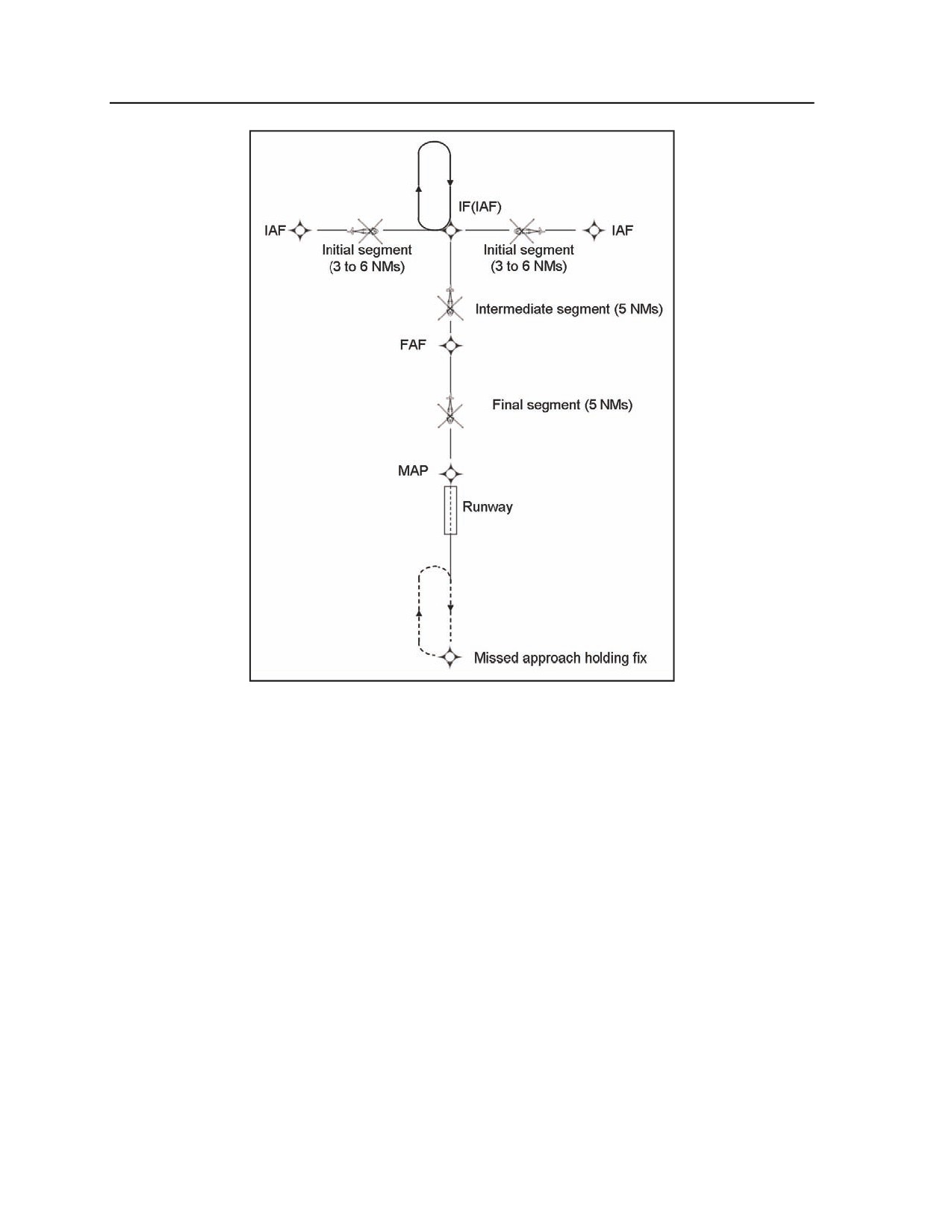
4-66. The TAA has a T structure normally providing a “No PT” for aircraft using the approach (Figure
4-7, page 4-17). The TAA provides the aviator and air traffic controller with an efficient method for
routing traffic from the en route to the terminal structure. The basic T contained in the TAA normally
aligns the procedure on the runway centerline with the missed approach point (MAP) located at the
threshold, the FAF 5 nautical miles from the threshold, and the IF 5 nautical miles from the FAF.
4-67. To descend from a high en route altitude to the initial segment altitude, a hold in lieu of a procedure
turn provides the aircraft with an extended distance for the necessary descent gradient. The holding pattern
constructed for this purpose is always established on the center IAF waypoint. Other modifications may be
required for parallel runways or because of operational requirements. When published, the RNAV chart
depicts the TAA through icons representing each TAA associated with the RNAV procedure. These icons
are depicted in the plan view of the approach plate and are generally arranged on the chart according to
their position relative to the aircraft’s arrival from the en route structure.
PROFILE VIEW
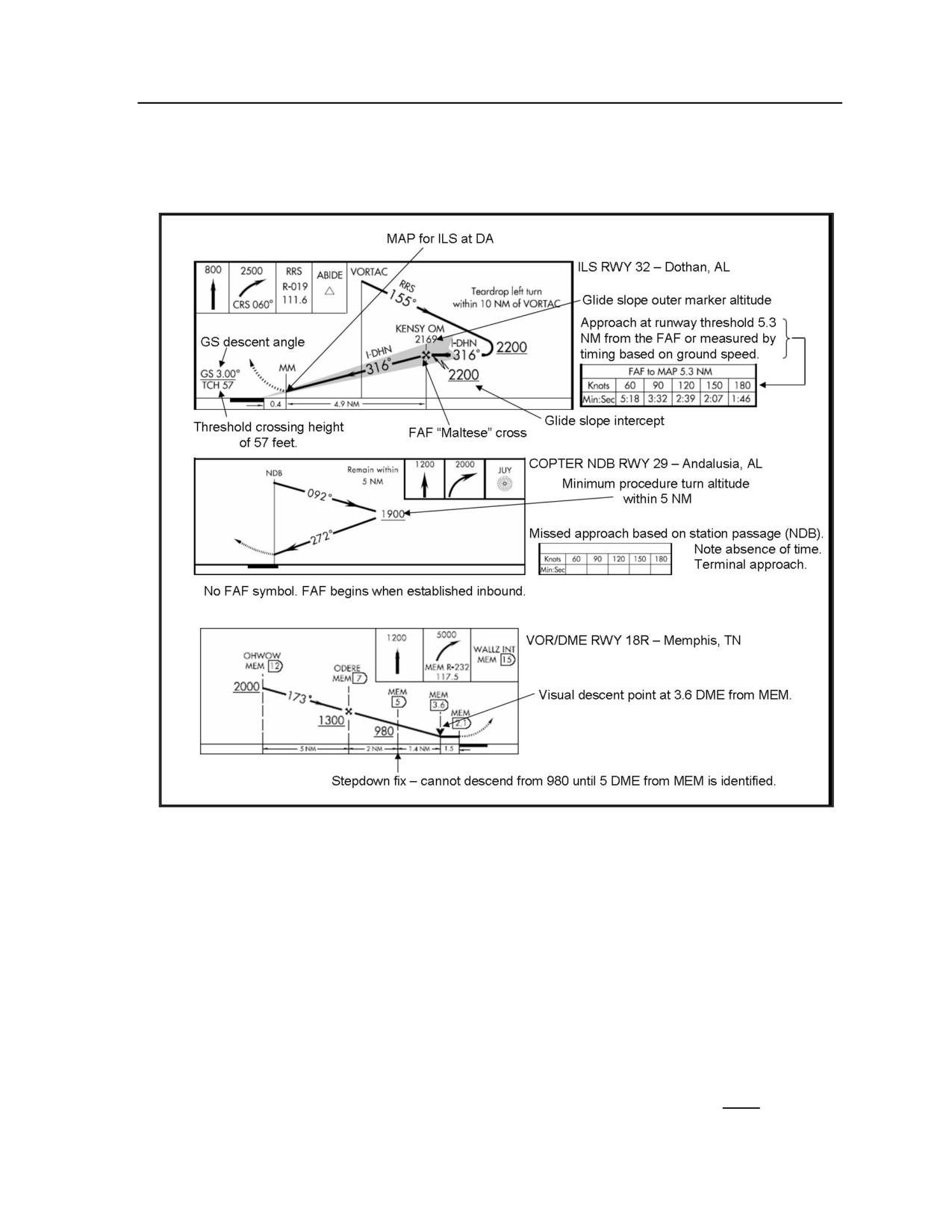
4-68. The profile view is a side-view drawing of the procedure illustrating the vertical approach path
altitudes, headings, distances, and fixes (Figure 4-8, page 4-17). The view includes minimum altitude and
maximum distance for the procedure turn, altitudes over prescribed fixes, distances between fixes, and the
missed approach procedure. The profile view aids in the aviator’s interpretation of the IAP; however, the
profile view is not drawn to scale.
4-69. The precision approach glide-slope intercept altitude (Figure 4-8, page 4-18) is a minimum altitude
for glide-slope interception after completion of the procedure turn illustrated by an altitude number and
zigzag line with an arrow pointer. It applies to precision approaches and, except where otherwise
prescribed, applies as a minimum altitude for crossing the FAF when the glide slope is inoperative or not
used. Precision approach profiles also depict the glide-slope angle of descent, threshold crossing height
(TCH), and glide-slope altitude at the outer marker (OM).
30 April 2007
FM 3-04.240
4-17
Chapter 4
Figure 4-7. Basic T design of terminal arrival area
4-70. In nonprecision approaches, a final descent is initiated at the FAF or after completing the procedure
turn and established inbound on the procedure course. The FAF is clearly identified by use of the Maltese
cross symbol in the profile view. If the FAF is not indicated in the profile view, the MAP is based on
station passage when the facility is on the airport or at a specified distance
(VOR/DME or GPS
procedures).
4-71. Step-down fixes in nonprecision procedures are provided between the FAF and airport for
authorizing a lower MDA after passing an obstruction. Step-down fixes are identified by NAVAID,
NAVAID fix, waypoint, and radar and are depicted by a vertical dashed line. Normally, there is only one
step-down fix between the FAF and MAP, but there can be several. If the step-down fix cannot be
identified for any reason, the minimum altitude at the step-down fix becomes the MDA for the approach.
However, circling minimums apply if they are higher than the step-down fix minimum altitude and a
circling approach is required.
4-72. The visual descent point (VDP) is a defined point on the final approach course of a nonprecision
straight-in approach procedure. A normal descent from the MDA to the runway touchdown point may be
commenced, provided visual reference is established. The VDP is identified on the profile view of the
approach chart by the symbol “V” (Figure 4-8, page 4-18).
4-73. The MAP varies, depending upon the approach flown. For the ILS, the MAP is at the DA/DH. In
nonprecision procedures, the aviator determines the MAP by timing from the FAF when the approach aid
is well away from the airport, a fix or NAVAID when the navigation facility is located on the field, or
4-18
FM 3-04.240
30 April 2007
Air Navigation Charts
waypoints as defined by GPS or VOR/DME RNAV. The aviator may execute the MAP early, but aviators
should, unless otherwise cleared by ATC, fly the IAP as specified on the approach plate to the MAP at or
above the MDA or DA/DH before executing a turning maneuver.
Figure 4-8. Profile view features
4-74. A complete description of the missed approach procedure appears in the pilot briefing information
section (Figure 4-5, page 4-12), and missed approach icons appear in the profile view. When initiating a
missed approach, the aviator will be directed to climb straight ahead (climb to 2,500) or commence a
turning climb to a specified altitude (climbing left turn to 2,500). In some cases, the procedure will direct
the aviator to climb straight ahead to an initial altitude, then turn or enter a climbing turn to the holding
altitude (climb to 900, then continue a climbing right turn to 2,500 direct ABC VOR and hold).
4-75. When the missed approach procedure specifies holding at a facility or fix, the aviator proceeds
according to the missed approach track and pattern depicted on the plan view. An alternate missed
approach procedure may also be issued by ATC. The textual description specifies the NAVAIDs or radials
that identify the holding fix.
4-76. The profile view also depicts minimum, maximum, recommended, and mandatory block altitudes
2500
used in approaches. Minimum altitude is depicted with the altitude underscored
. On final
30 April 2007
FM 3-04.240
4-19
Chapter 4
approach, aircraft are required to maintain an altitude at or above the depicted altitude until reaching the
4300
subsequent fix. Maximum altitude is depicted with the altitude overscored
, and aircraft must
remain at or below the depicted altitude. Mandatory altitude is depicted with the altitude both underscored
5500
and overscored
, and altitude is to be maintained at the depicted value. Recommended altitudes are
advisory altitudes and are neither overscored nor underscored. When an overscore or underscore spans two
numbers, a mandatory block altitude is indicated and aircraft are required to maintain altitude within the
range of the two numbers (Figure 4-7, page 4-17).
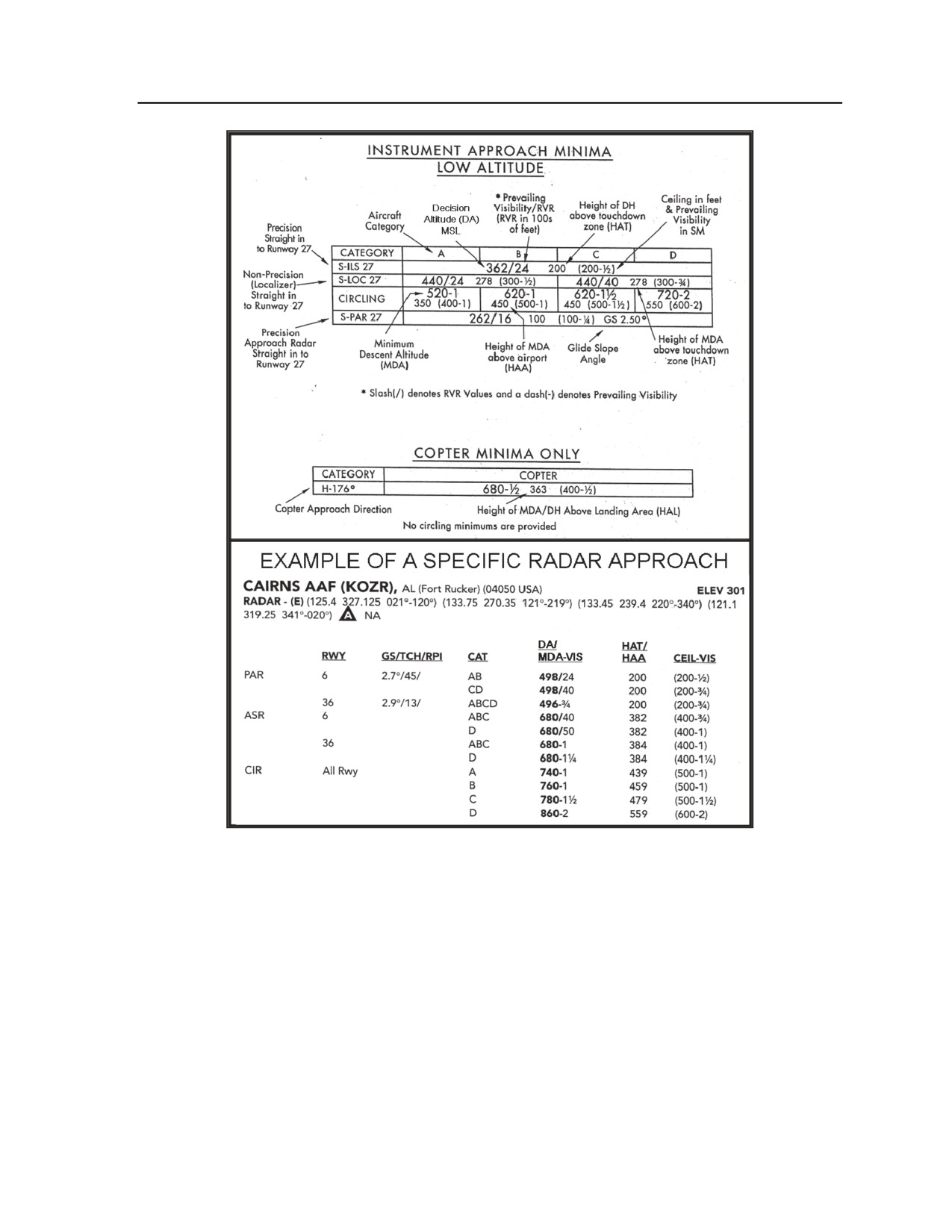
LANDING MINIMUMS
4-77. The landing minimums section sets forth the lowest altitude and visibility requirements for the
approach, whether precision or nonprecision, straight-in or circling, or radar vectored. When a fix is
incorporated in a nonprecision final segment, two sets of minimums may be published, depending on
whether the fix can be identified. Two sets of minimums may also be published when a second altimeter
source is used in the procedure. The minimums ensure that final approach obstacle clearance is provided
from the start of the final segment to the runway or MAP, whichever occurs last. The same minimums
apply to day and night operations unless different minimums are specified. Published circling minimums
provide obstacle clearance when aviators remain within the appropriate area of protection (Figure 4-9, page
4-20).
4-78. Minimums for straight-in and circling appear directly under each aircraft category (Figure 4-9, page
4-20). When there is no solid division line between minimums for each category on the straight-in or
circling rows, minimums apply to the two or more undivided categories.
4-20
FM 3-04.240
30 April 2007
Air Navigation Charts
Figure 4-9. Landing minimums
Altitudes
4-79. Terms used to describe minimum approach altitudes differ between precision and nonprecision
approaches (Figure
4-9). Precision approaches use DA, charted in feet MSL and measured with a
barometric altimeter, followed by DH, which is referenced to the HAT. DA will replace DH for Category I
precision IAP. Category II and III approach DHs are referenced to AGL and measured with a radar
altimeter. Category II and III approaches require special ground and airborne equipment to be installed and
operational, as well as special aircrew training and authorization (see AR 95-1).
4-80. Nonprecision approaches use MDA referenced to feet MSL and measured with a barometric
altimeter. Minimums are also referenced to HAT for straight-in approaches or HAA for circling
approaches. Height above landing (HAL) is a term specific to helicopters, which means height above a
30 April 2007
FM 3-04.240
4-21
Chapter 4
designated helicopter landing area used for helicopter IAPs. On NACO charts, figures listed parenthetically
are for military operations, not civil aviation.
4-81. Minimums are specified for various aircraft approach categories based on a value 1.3 times the
stalling speed of the aircraft in the landing configuration at maximum certified gross landing weight. If
necessary to maneuver the aircraft at speeds in excess of the upper limit of a speed range for a category, the
minimums for the next higher category should be used. For example, an aircraft falling into Category A but
circling to land at a speed in excess of 91 knots should use approach Category B minimums (table 4-2).
Table 4-2. Aircraft approach categories and circling limits
Category
A
B
C
D
E
Maneuvering Speed (knots)
0-90
91-120
121-140
141-165
166 & higher
Circling Approach Area Radii (miles)
1.3
1.5
1.7
2.3
4.5
Note. All U.S. military helicopters may use the aircraft approach Category A minima published
in authorized FLIP. Because aircraft speeds are used in determining turning radii and obstacle
clearance areas for circling and turning missed approaches, helicopters operating at speeds
greater than Category A use the higher category minima. Procedures containing the word
COPTER in the procedure title (COPTER VOR 190) are approved under terminal instrument
procedures (TERPS) helicopter criteria for helicopter use only and are restricted to 90 KIAS,
unless a lesser speed is annotated on the approach plate.
Visibility
4-82. Visibility figures are provided in statute miles or runway visual range (RVR), which is reported in
hundreds of feet. RVR is measured by a transmissometer, which represents the horizontal distance
measured at points along the runway and is based on sighting of either high-intensity runway lights or on
the visual contrast of other targets, whichever yields greater visual range. RVR is horizontal visual range,
not slant visual range, and is used in lieu of prevailing visibility when the aviator determines minima for a
particular runway (table 4-3).
4-83. Visibility figures are depicted after the DA/DH or MDA in the minima section. If visibility in statute
miles is indicated, an altitude number, hyphen, and a whole or fractional number appear (for example,
530-1, which indicates 530 feet MSL and 1 statute mile visibility). This is the descent minimum for the
approach. The RVR value is separated from the minimum altitude with a slash (1065/24, which indicates
1,065 feet MSL and a RVR of 2,400 feet). If RVR was prescribed for the procedure but not available, a
conversion table would be used to provide the equivalent visibility, in this case, of 1/2 statute mile
visibility (table 4-3). The conversion table is also available in the DOD FLIP (Terminal) chart.
Table 4-3. Runway visual range conversion table
RVR (ft)
Visibility (SM)
RVR (ft)
Visibility (SM)
1,200
1/4*
4,000
3/4
1,600
1/4
4,500
7/8
2,400
1/2
5,000
1
3,200
5/8
6,000
1 1/4
* copter only
4-22
FM 3-04.240
30 April 2007
Air Navigation Charts
4-84. In addition to COPTER approaches, instrument-equipped helicopters may fly standard approach
procedures. The required visibility minimum may be reduced to one-half of the published visibility
minimum for Category A aircraft, but in no case may the reduction be less than 1/4 mile, or 1,200 feet
RVR. Reduction of visibility for approaches labeled “copter only” is not authorized.
4-85. Point in space approach refers to a helicopter IAP to a MAP more than 2,600 feet from an associated
helicopter landing area. For example, the COPTER RNAV (GPS) 028 degrees displays a helicopter IAP
with a portion of the approach that is conducted VFR to three helicopter landing points (Figure 4-10, page
4-23).
AIRPORT DIAGRAM
4-86. Airport diagrams are specifically designed to assist in the movement of ground traffic at locations
with complex runway/taxiway configurations and provide information for updating geodetic position
navigational systems aboard aircraft. The airport diagram, located on the bottom right side of the chart,
includes helpful features. IAPs for some larger airports devote an entire page to an airport diagram.
Information concerning runway orientation, lighting, final approach bearings, airport beacon, and obstacles
all serve to guide the pilot in the final phases of flight. See Figure 4-5, page 4-12, for an example of an
airport diagram.
4-87. The diagram shows the runway configuration in solid black, while taxiways and aprons are shaded
gray. Other runway environment features shown are runway identification, dimensions, magnetic heading,
displaced threshold, arresting gear, usable length, and slope. Airport elevation is indicated in a separate box
at the top of the airport diagram box. The touchdown zone elevation (TDZE), the highest elevation within
the first 3,000 feet of the runway, is designated at the approach end of the procedure’s runway. Beneath the
airport diagram is the time and speed table providing distance and the amount of time required to transit the
distance from the FAF to the MAP for selected ground speeds.
4-88. Approach lighting systems and visual glide-slope indicators are depicted on the approach chart.
White on black symbols,
, are used for identifying pilot-controlled lighting (PCL). Runway lighting
aids are noted (runway end identifier lights [REIL], high intensity runway lights [HIRL]) as well as the
runway centerline lighting (RCL). Refer to FIH, section B, for a current description and information.
Remote Altimeter Settings
4-89. Weather planning minimums are computed when the aviator identifies that an MDA or a DA/DH has
been raised because of the need to use a remote altimeter setting. In some cases, new minimums are shown
in the minimum box. When not shown, the method illustrated in Figure 4-11, page 4-24, is used to compute
new weather planning minimums.
30 April 2007
FM 3-04.240
4-23
Chapter 4
Figure 4-10. Point in space approach
4-24
FM 3-04.240
30 April 2007
Air Navigation Charts
If local altimeter setting not received, use Anniston
altimeter setting and increase all MDAs 100 ft.
ELEV 569
960 ft - MDA w/local altimeter
100 ft - increase when using remote altimeter
1060 ft - New MDA
569 - less airport elevation
491 - rounded up (500-1)
Figure 4-11. Remote altimeter settings
INOPERATIVE COMPONENTS
4-90. Certain procedures can be flown with inoperative components. According to the Inoperative
Components Table (Figure 4-12, page 4-25), an ILS approach with a malfunctioning medium-intensity
approach lighting system (MALS) with runway alignment indicator lights (MALSR = MALS with RAIL)
can be flown if the minimum visibility is increased by 1/4 mile (figure 4-12). A note in this section might
read as follows: “Inoperative Table does not apply to ALS or HIRL Runway 13L.”
4-91. For helicopter operations, add the visibility requirement for the inoperative components chart to the
visibility requirement for the approach to be flown. This increased visibility may be reduced by one-half
for Category A aircraft but in no case may it be reduced to less than 1/4 mile, or 1,200 feet RVR. For
approaches labeled “copter only,” do not reduce the visibility; increase for inoperative components.
SECTION II - PLOTTING AND MEASURING
4-92. Plotting is establishing points and lines on a chart with reference to meridians and parallels.
Measuring refers to distance and direction on a chart. The chart serves as a record and provides necessary
information for a successful flight. Accurate chart work is a fundamental navigational skill.
PLOTTER
4-93. A plotter (Figure 4-13, page 4-26)—an instrument that primarily aids in drawing lines and in
measuring distances on an aeronautical chart—is made of transparent plastic, and has lines and scales
printed in black. The rectangular part of the plotter has a straight edge for drawing lines and scales for
measuring distances. The semicircular part of the plotter has three circular scales for measuring direction.
RECTANGULAR PART
4-94. All scales on the rectangular part are for measuring distances in nautical miles. The two upper scales
read outward from the center in both directions. The three lower scales read from left to right. Scales of
1:500,000
(Sectional Aeronautical Charts),
1:1,000,000
(Operational Navigation Charts and World
Aeronautical Charts), and 1:2,000,000 (charts such as Jet Navigation Charts) are provided. No scale is
provided for the IFR en route chart measurement/ratio (1 inch equals 12 nautical miles).
30 April 2007
FM 3-04.240
4-25
Chapter 4
Figure 4-12. Inoperative components
4-26
FM 3-04.240
30 April 2007
Air Navigation Charts
CIRCULAR SCALES
4-95. The circular scales are calibrated in degrees. The outer scale, reading from 0 degrees to 180 degrees
(right to left), is for direction in the first and second chart quadrants (north through east to south, Figure
4-13). Because these directions are to the right on the chart, the outer scale has an arrow pointing to the
right. The inner scale, reading from 180 degrees to 360 degrees (right to left), is for directions in the third
and fourth quadrants (Figure 4-13). The center of curvature of both scales is marked by a small hole.
SIXTY-DEGREE CENTER SCALE
4-96. This scale is an aid for aviators to measure courses that are nearly north or south. The outer scale
reads from 150 degrees to 210 degrees, while the inner scale reads from 030 degrees to 330 degrees.
MEASUREMENTS AND COURSE LINES
4-97. To measure a course, the aviator places the center hole on a meridian about midway along the plotted
course line, with the straight edge parallel to the course line. If the chart meridians do not intersect the
course line, the line is extended and the straight edge of the plotter is moved parallel to the course line until
the center hole lies over a meridian. The small arrows on the circular scale determine correct direction. The
scale on which the small black arrow points in the direction of the course should be noted. The scale
should be read up from the smaller values toward the larger values.
4-98. To determine the direction of a course line, place the straight edge of the plotter along the course line
and, while keeping them aligned, slide the plotter over to the nearest meridian of longitude so that the
center hole in the plotter lies over the meridian (Figure 4-13). Reading off the outer protractor scale,
determine what number of degrees matches the meridian. This is the true course. There will actually be two
numbers on the plotter, the course heading and the reciprocal. Use the one that makes sense. If the course
was almost due east and the true heading choices are 100 degrees and 280 degrees, the heading would be
100 degrees, for example.
Figure 4-13. East/west course reading, using outer/inner scale
30 April 2007
FM 3-04.240
4-27
Chapter 4
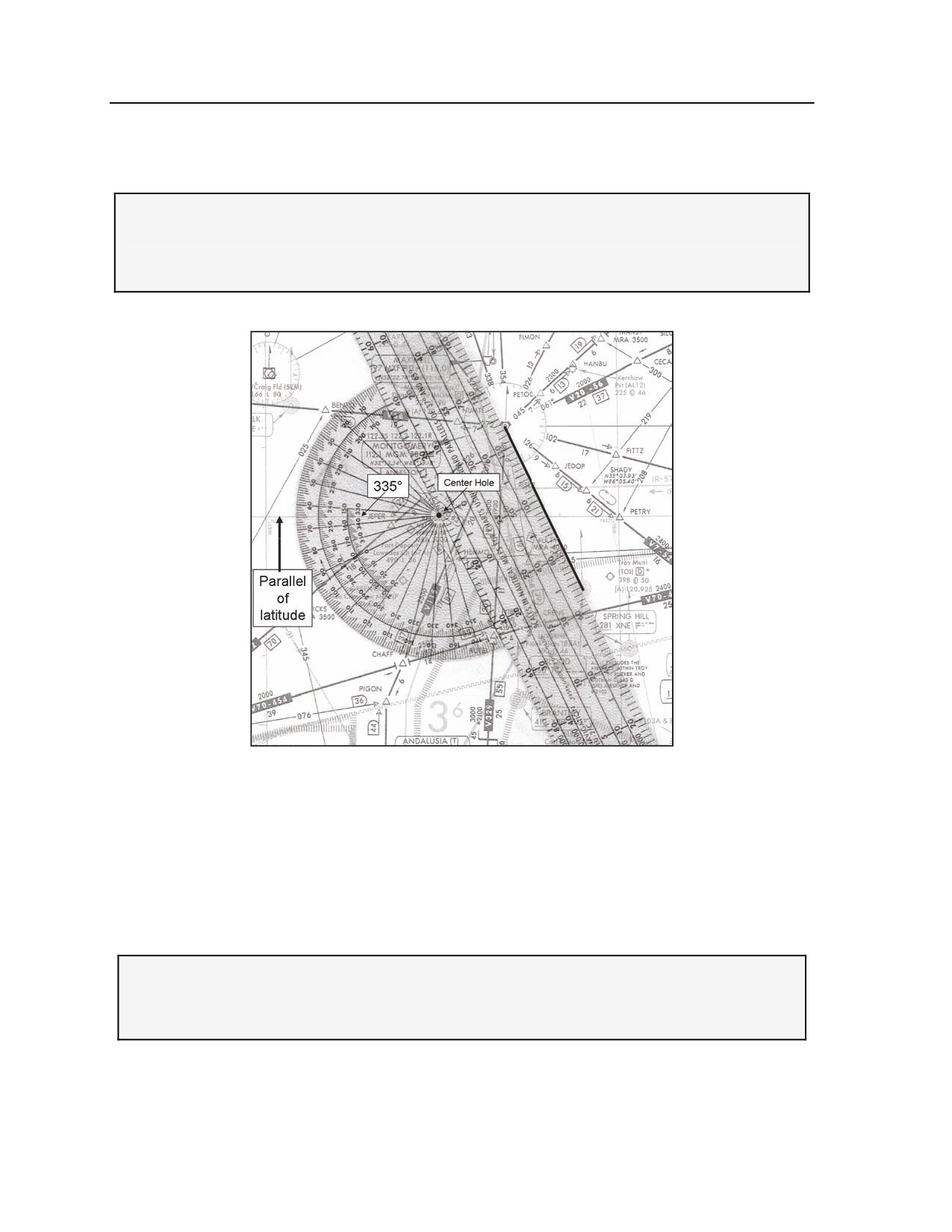
4-99. For some courses approaching vertical angles on the chart, it may become difficult or impossible for
the aviator to line up the course line at the meridian. In these instances, use a parallel of latitude and read
the course off the inner scale printed on the protractor. The following example is depicted in Figure 4-14.
Example of Using the Inner Scale on the Protractor
A course drawn from the Blood NDB direct to the Montgomery very (high frequency) omnidirectional radio
range tactical air navigation aid (VORTAC) has a true heading of 335 degrees (Figure 4-14) with a reciprocal
heading of 155 degrees .
Figure 4-14. North course reading, using inner scale
4-100. To draw a given course line from a known point, the aviator places the point end of a pencil at the
known point. While the plotter is being pushed and pivoted against the pencil, the straight edge remains on
the known point while the center hole and desired heading (number of degrees on the protractor) are being
aligned with a meridian. The pencil is in place for drawing the course line when the plotter has been
properly aligned with a meridian. In drawing a course line that is nearly north or south, 0 to 180 degrees,
the center scale may be used. The following example of plotting a course line is depicted in Figure 4-15,
page 4-28.
Example of Plotting a Course Line
If a 040 degrees course line is desired from the Summerdale NDB, the course line is drawn as depicted in
Figure 4-15.
4-28
FM 3-04.240
30 April 2007
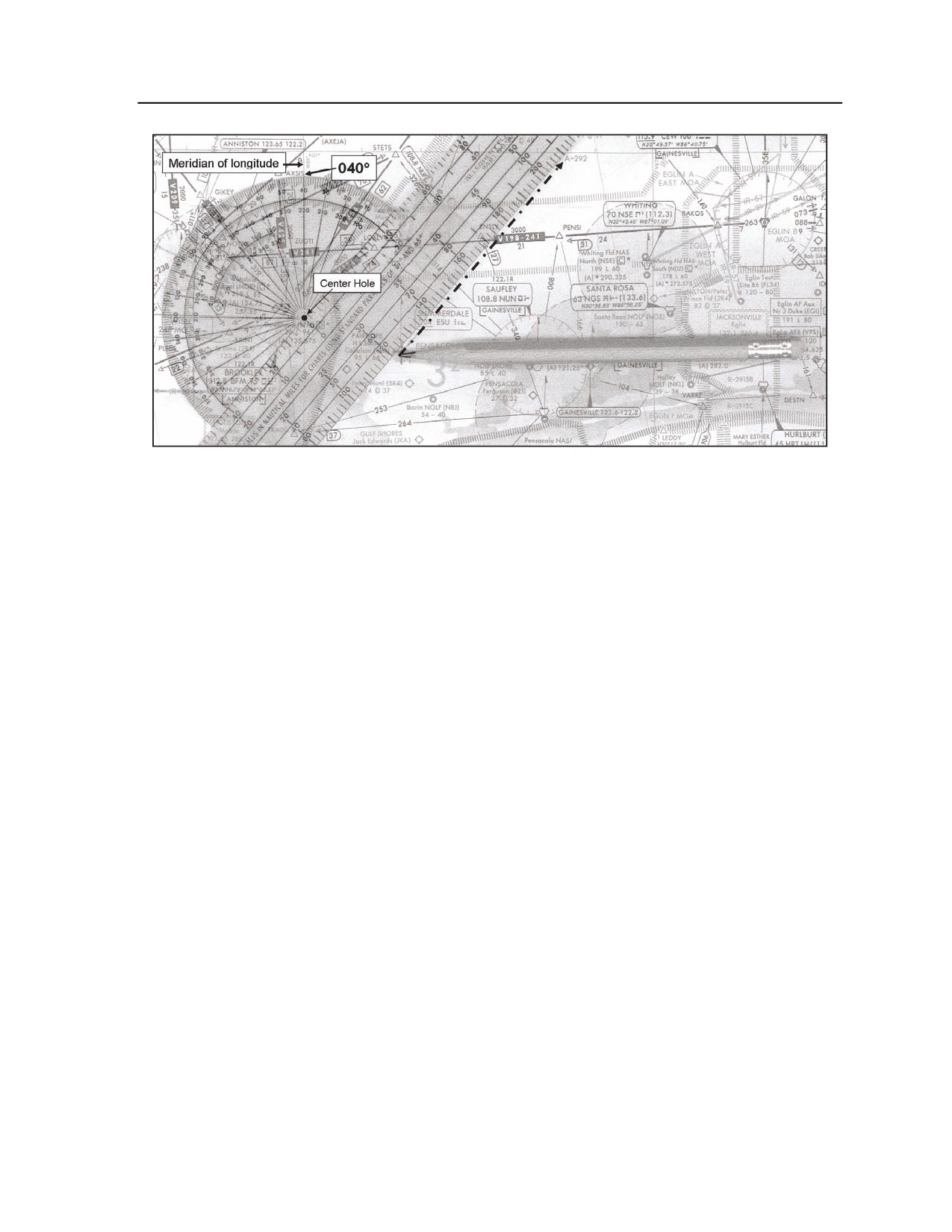
Air Navigation Charts
Figure 4-15. Drawing a course line from a known point
30 April 2007
FM 3-04.240
4-29
This page intentionally left blank.
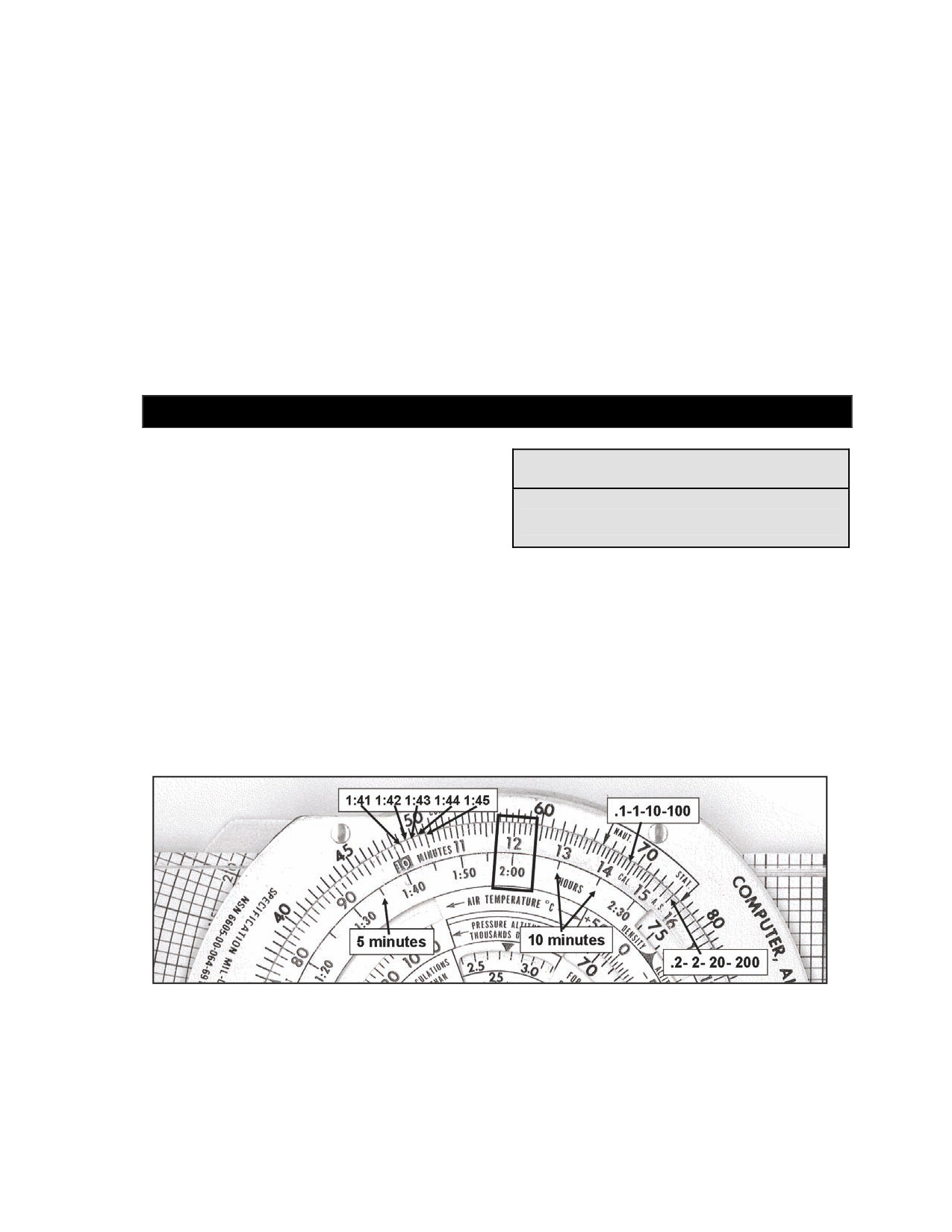
Chapter 5
Air Navigation Handheld Computer
A dead reckoning (DR) computer is a combination of two devices: a specially
designed instrument for solving wind triangles and a circular slide rule for solving
mathematical problems. Many different types of DR navigational computers exist,
but construction and design features of major types are similar. Electronic versions of
the DR, also known as the CPU-26A/P computer, are available for download.
SECTION I - CALCULATOR SIDE
5-1. The slide rule side of the handheld computer
consists of two circular scales. The miles scale
Contents
(outer scale) is stationary while the minutes scale
(inner scale) rotates.
Section I - Calculator Side
5-1
Section II - Wind Side
5-13
VALUES
5-2. Numbers on the computer scale (Figure 5-1) represent multiples of 1, 2, 5, or 10; care must be used
to determine the value of the numbers shown. For example, the number 12 on either scale (outer or inner)
may represent 0.12, 1.2, 12, 120, or 1,200. On the inner scale, minutes may be converted to hours by
reference to the adjacent hour scale; for example, two hours is adjacent to 12 (meaning 120 minutes) as
found in Figure 5-1.
5-3. The higher the scale values, the fewer the graduations between numbers. There are only
5
graduations, for example, between 15 and 16, compared to 10 graduations between 14 and 15. When the
aviator uses numbers between 15 and 16, each graduation equals .2; when used as 150 and 160, each unit
represents 2, and so on. The same application applies to the 10 graduations between 10 and 11, which
equal .1; these .1 graduations can also indicate one-minute marks between 1:40 and 1:50.
Figure 5-1. CPU-26A/P calculator side
INDEXES
5-4. Three of the indexes on the outer stationary scale are used for converting statute miles, nautical
miles, and kilometers. These indexes are appropriately labeled NAUT (nautical) at 66, STAT (statue) at 76,
30 April 2007
FM 3-04.240
5-1
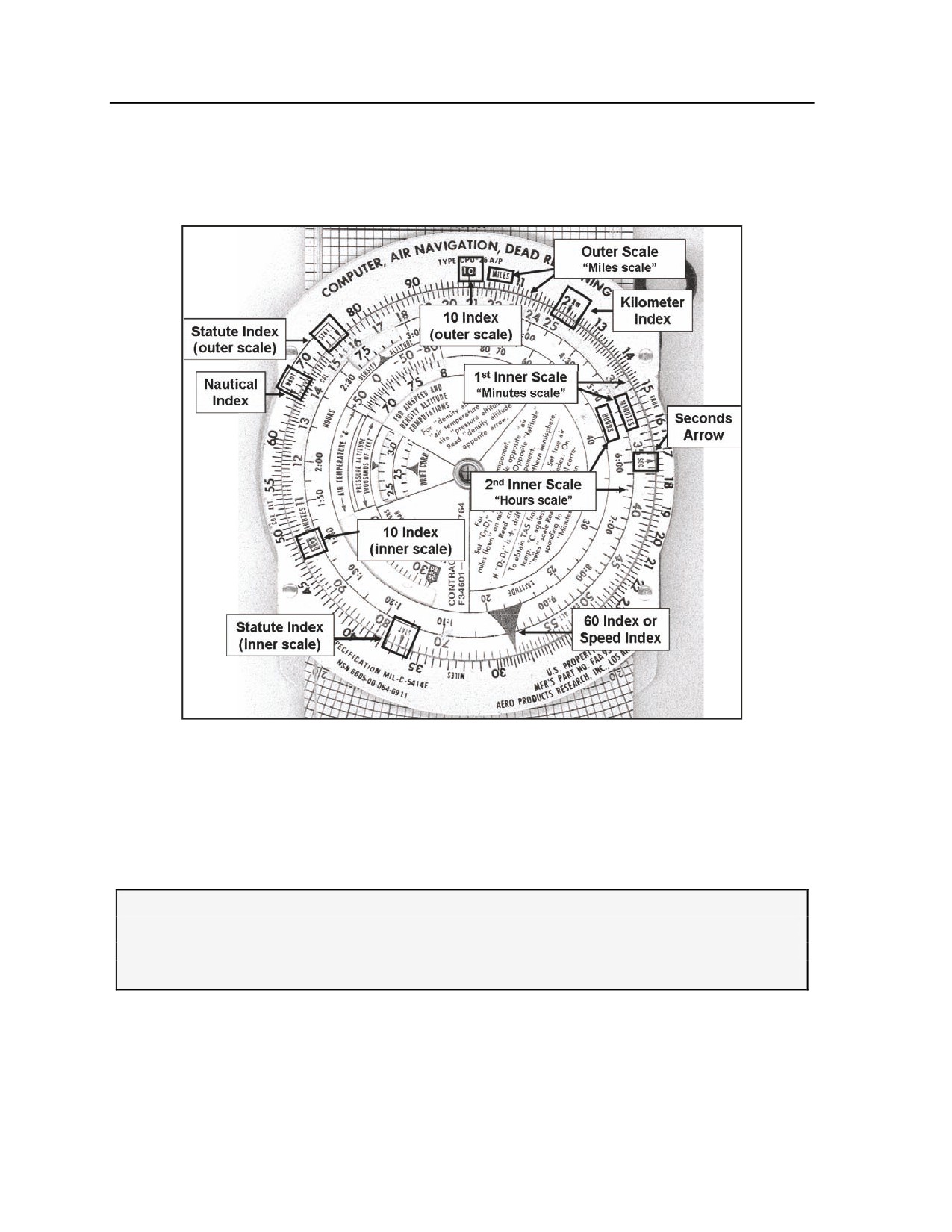
Chapter 5
and KM at 122. On the inner rotating scale are two rate indexes. The large black arrow at 60 (speed index
or 60 index) is the hour index. The small arrow at 36 is the second (SEC) index (3,600 seconds equal 1
hour). The STAT index on the inner scale is used in mileage conversion. Each scale has a 10 index used as
a reference mark for multiplication and division (Figure 5-2).
Figure 5-2. Calculator side of CPU-26A/P computer
TIME AND DISTANCE
5-5. Time and distance problems (Figure 5-3, page 5-3) use three items: time, distance, and speed. Two
of three items must be known. Figure 5-3 depicts the following examples of computing time and distance.
Figure 5-4, page 5-3, depicts the following example of computing speed.
Example of Computing Time
How much time is required to fly 329 NM at a ground speed of 170 kt (Figure 5-3)? 1:56 hours.
Set 60 index under 17 (outer scale) for 170 kt.
Under 32.9 (outer scale) for 329 NM, read 116 minutes (inner scale) or 1:56 (hours scale).
5-2
FM 3-04.240
30 April 2007
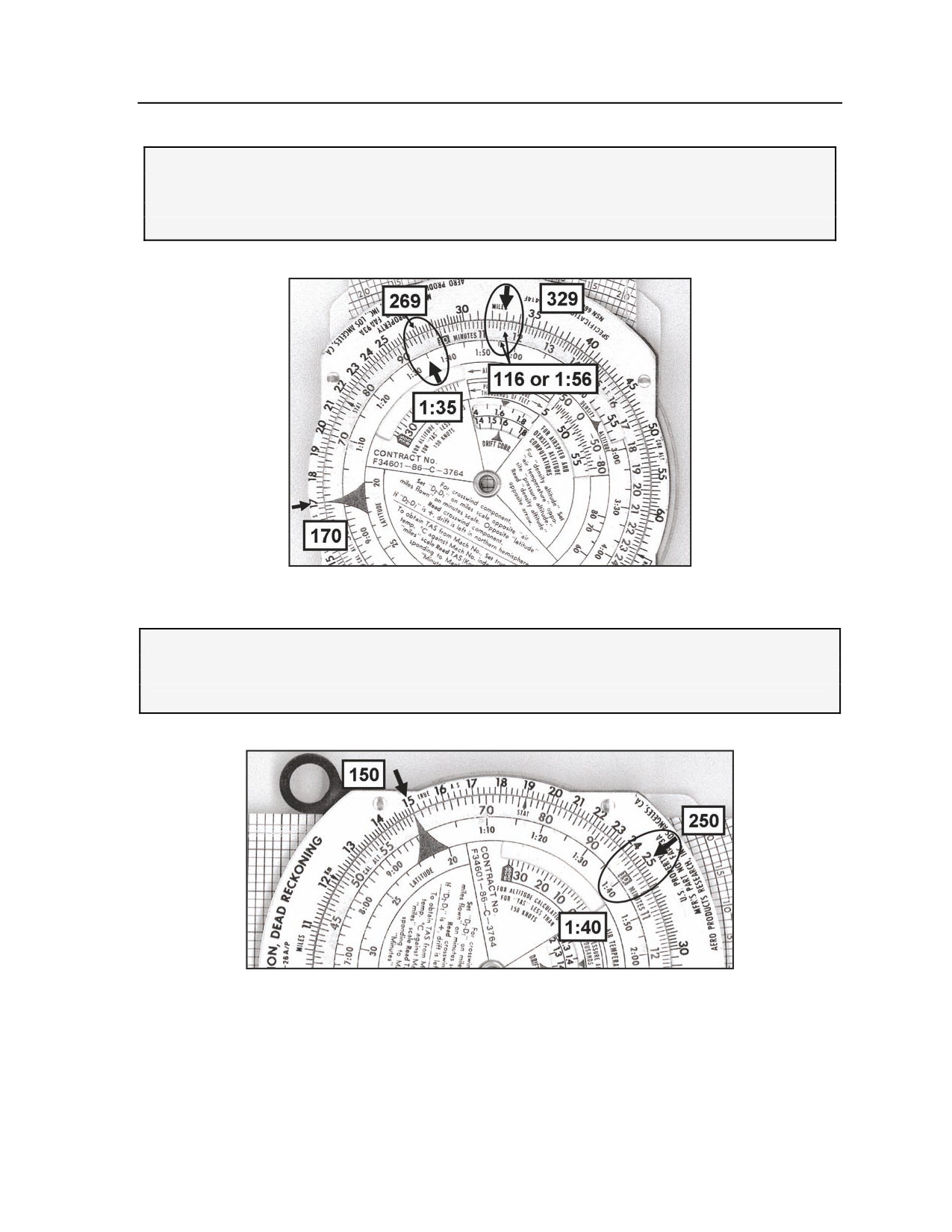
Air Navigation Handheld Computer
Example of Computing Distance
If an aircraft has a ground speed of 170 kt & flies for 1 hour & 35 minutes, how many NM will the aircraft have flown
(Figure 5-3)? 269 miles.
Set 60 index under 17 for 170 (outer scale).
Above 1:35 (hour scale), read just left of 27 for 269 miles (outer scale).
Figure 5-3. Computing time and distance
Computing Speed Example
An aircraft flies 250 NM in 1:40; what is the speed of the aircraft (Figure 5-4)? 150 kt.
Set 1:40 (hour scale) under 25 (outer scale) for 250 NM.
Directly over the speed index is 15; therefore, the answer is 150 kt (outer scale).
Figure 5-4. Computing speed
SHORT TIME AND DISTANCE (USE OF THE 36 INDEX)
5-6. The 36 index (Figure 5-5, page 5-4) is used to solve for short distances, usually less than 10 nautical
miles, and when time calculations are in seconds and minutes instead of minutes and hours. When the
30 April 2007
FM 3-04.240
5-3